The Gazette
Saturday, December 23, 1916
Cleveland, Ohio
Page text (machine-generated)
THIRTY FOURTH YEAR. NO.22.
AFRO-AMERICAN CULLINGS
IN UMLOH
THERE ESTABLISHED
THIRTY FOURTH
AFRO-AMERICA
Since the European war, by cutting off immigration to the United States and calling to their homes thousands of alien workers, created a shortage in the labor supply in industrial centers in this country, a constantly increasing movement of Negroes from southern states has been in progress which promises to have important economic results. Already the exodus of workers has arraised fears in the South. Various communities selected by employment agencies for recruiting purposes have endeavored by municipal enactments to hamper the work of these bureaus, and campaigns intended to convince the Negroes that they are better off in the land and at the tasks with which they are historically associated than they can be elsewhere have been undertaken.
The arguments of those seeking to transplant the Negroes to the North are summed up in higher wages and better political and social conditions and these are re-enforced by reports from blacks who have made the experiment in which they inform their friends of their satisfaction with their new environment. In some cases nos taligia has affected individuals, but homelessness has been less common than was predicted. The Negroes have been found easily adaptable, sufficiently competent and generally well fitted for the works on which they are engaged.
This migration of Negroes has assumed proportions that have led the American Federation of Labor to adopt a resolution looking toward the formation of trades unions among them in the South, to protect the unionists in the North. As the Sun has already suggested, it is bound to have an interesting effect on industrial and social conditions wherever the new element is introduced; and its results in the South are likely to be of great weight in that section.
It is plain that competition for the labor of the Negro, improving his economic situation, would be reflected in every aspect of his life. From it would flow political and social changes of far reaching effect; and the future of the race in this country will be altered seriously if the European war continues for many months more its embargo on the labor reservoirs from which the North has consistently dawned in the past.—New York Sun.
The Negro Yearbook shows wonderful gains made by the race since 1860 when the end of the war firmly established throughout the South the Negro's equality before the law and his right to "life, liberty and the pursuit of happiness." in addition to the specific legal rights defined by the thirteenth amendment to the national constitution.
Then 12,000 persons owned homes; now 600,000 are so fortunate. Then there were 20,000 farmers; now there are 981,000. Then there were 2,100 business proprietors; now there are 45,000. It proves that there is not much difference in ambition in races. Although it was declared that the average Negro wouldn't make anything of himself if he could, it is shown that they are both industrious and ambitious and that they know the value of thrift, of schools and of all the things which go to make up the highest state of civilization.
The Negro has made great strides as a manual laborer but he has invaded other fields as well. In 1860, 10 per cent of the race were literate.
Indianapolis now has a permanent colored branch of the Young Women's Christian association. Action was taken a short time ago at a meeting of the committee on management, when the provisional organization was disbanded by Miss Elizabeth Sweets, general secretary of the central association, who acted on the instructions of its board of directors.
Permanent organization of the branch was the result of the recent membership campaign, conducted by the colored women in which 646 memberships were added, making a total of nearly 900. When the branch was organized provisionally about two years ago, the central association agreed to make the organization permanent when 800 members had been obtained.
In disbanding the provisional branch, Miss Sweets said in part: "Inasmuch as the colored women have more than met the principal requirements for permanent organization, the directors have requested me to extend heartiest appreciation of your work and to take this step with you in the belief that you are ready
A German inventor's disk-talking talking machine record has a groove that automatically returns the needle to the starting point to make it repeat.
Fully 50 feet higher and more than twice as wide as Niagara, the falls of Iguazn, in South America, form one of the wonders of that continent.
Wireless waves have been utilized to light and extinguish gas lamps in Germany.
now 75 per cent are able to read and write. Then there were 15 colleges and normal schools, all supported with funds by northern donors; now there are 500 such institutions, many of them supported by general taxation and recognized as essential parts in the scheme of popular education. In 1806 there were only 100,000 Negro pupils in public schools; now there are 1,756,000. While the increase in population accounts for the great difference in the comparative figures there are great proportional increases in percentages.
An official of an Albany bank made the statement yesterday that within the last few weeks fully 300 Negro farmers have opened accounts with his bank, their deposits ranging from $50 to $75 for the smaller accounts to several hundred dollars for the larger ones. The number of these accounts is steadily increasing, and the amounts on deposit will be further augmented by those to whose credit the money stands.
A canvass of the other banks of the city, as well as banks throughout southwest Georgia would no doubt show a similar gratifying reflection of the present prosperous conditions in this part of the state. Hundreds of farmers who have been in debt for several years, banks or merchants or warehouse men having had to "carry over" varying amounts for them season after season, have this year paid every dollar they owed, and now have money in bank that is "pure velvet."
Peculiarly gratifying is this fortunate condition of the Negro farmers. The bank official already referred to says that, among all classes of depositors, the colored farmer is least likely to draw out his money, once he has it in bank. He literally "salts it down" against future needs, and will not check it out unless forced by circumstances to use all or a part of it.
With the certainty of a battle at close quarters with the boll weevil next year, the fact that so many colored farmers are not only out of debt, but have money laid aside for the rainy day that's coming, is most encouraging.
It will give the farmers a big advantage when they open the fight next year. Nineteen hundred and sixteen has proved a "fat year," and it came at a most fortunate time.—Albany (Ga.) Herald.
A second attempt to force the United States treasury to pay to former slaves or their descendants, $68,072,38890 collected as internal revenue tax on raw cotton between 1859 and 1869 failed when the court of appeals of the District of Columbia refused to permit H. N. Johnson, C. B. Williams, Rebecca Bowers and Mimie Thompson, to institute action to recover the amount.
the plaintiffs assert that this amount was collected in taxes from cotton produced as a result of their labors while they and their ancestors "were subject to a system of involuntary servitude." The decision declares that the real defendant is the United States, and that the United States cannot be made a defendant to a suit without its consent.
White wings in Cleveland will soon become a memory. John Tomson, commissioner of streets, is not in favor of requiring street cleaners to wear white uniforms if they do not want them.
to do your part to advance the work of the Y. W. C. A. among colored women."
To give an idea of the size of the dam which has recently been completed at Elephant Butte, N. M., one writer explains that the water held back is sufficient to cover the entire state of Connecticut to a depth of ten inches.
In Detroit a record has been made of 100 cases, 61 boys and 39 girls, who were backward pupils. Five years after leaving school it was found that 13 of the boys and four of the girls had been arrested at least once.
Miss Mabel F. Allen of Mount Vernon, Me., found an unusual pond lily recently. It had two stems grown together their entire length and a double blossom concealed in one set of petals.
Saco, Me., is now without a hotel, a manufacturing concern having leased the only building of the kind for accommodations for its employees, who could not find quarters elsewhere in the city.
According to the manufacturing plans of the 30 large rubber tire companies in the United States, their output during the present calendar year will exceed 11,000,000 tires, of an average value of $20 at retail.
Charleston (S. C.) colored building laborers have organized a federal labor union.
A plank road in portable sections is being laid in the California deserts for economy and convenience.
ESTABLISHED AUGUST 25, 1883 AND ISSUED EVERY WEEK ON TIME SINCE.
CLEVELAND, O., SATURDAY, DECEMBER 23, 1916.
ENGLAND REJECTS OFFER OF PEACE
ENGLAND REJECTS OFFER OF PEACE
British Premier Refuses to Enter Negotiations Without Definite Knowledge of Terms.
'TRUST IN UNBROKEN ARMY'
'The End of War Must Be Complete
Guarantee Against Prussian Militia
turbbing Peace of Europe,' Says Lloyd-George.
London. England. — "Tell us your
terms! Give us guarantees for the
peace of Europe from the swashbuckling
of Prussian militarism-guarantee
surers than those you have broken!
Then, and not until then, will
the allies treat with you with regard
to ending the war'."
Reduced to its sum and substance,
that is the answer of Great Britain
and her allies to the central powers'
proposal to enter into negotiations for
peace. It was given by Lloyd-George
in the house of commons.
The Allies' Terms.
As for the allies' terms—the only terms on which they will give peace negotiations a thought—the premier set them down thus:
"Without reparation peace is impossible. The allies insist that the only end of the war must be complete guarantee against Prussian militarism disturbing the peace of Europe."
And with a ringing note of bitter irony he added: "All the outrages on land and sea cannot be liquidated by a few pious phrases about humanity."
At the pinnacle of his political career, in his debut before the house of parliament as premier and virtual war dictator of Great Britain, Lloyd George delivered his long expected address before a house thronged to its capacity and amid deep, almost reverential silence, which was, however, broken repeatedly by thunderous cheering.
The substance of his declaration, he announced, would be sent to Germany within a few days. It was not only England's answer, the prime minister emphasized, it was England's "clear and definite support" to the identical statements already given by Russia and France.
It was not a flat-footed, defiant rejection of peace, this remarkable speech by England's "strenuous man" which the world had waited breathlessly for eight anxious days. It was an unqualified, scornful, almost contemptuous rejection of the central powers' proffer as it now stands. For this proffer in its present shape is "a noose" with the rope's end in Germany's hands"—thus Lloyd George described it—and the allies "do not propose to put their heads into it."
France and Russia Reject Protests.
The cables brought from Paris the news that Aristide Briand, the French premier, had announced in the senate that the entente would send a joint reply to the central powers, making it known that "it is impossible to take their request for peace seriously."
Earlier in the afternoon word had come from Petrograd that the council of the Russian empire had decided unanimously to favor a categorical refusal of the allies to enter peace negotiations with Germany.
The people of the English Isles throughout the day were in a state of excitement unequalled in decades, far more intense even than that of the momentous days of the war's outbreak.
The premier's speech was a masterly exposition of Lloyd George's remarkable versatility. Orator, statesman, diplomat and parliamentarian, the highest definition of each spoke out of every sentence. But more conspicuous, perhaps, than all these was Lloyd George, the democrat, the man of the people.
Characteristic of his democratic ways was the manner in which he referred to the chief statesman of the German empire. He called him simply "the chancellor," and once, when he mentioned his name, he dropped the "von"-a noteworthy deviation from the traditional red tape of parliamentary speeches.
$170,000 'Heart Balm.'
Pittsburgh, Penna. — The largest "heart balm" award on record in Alegheny county courts was made when the jury awarded Nettie Richardson, fcmer downtown hotel cashier, $170,000 damages in her suit against Henry Deniston, 78, recluse of Swissvale, whose banker testified he was worth more than $2,000,000.
Car Kills Ohio Farmer.
Delaware, Ohio. — H. A. Lowry 55, farmer, was struck and instantly killed here when he failed to hear an approaching Columbus, Delaware & Marion traction car which bore down on him from the rear. His head was crushed.
Find Body In River
Defiance, Ohio. — For several days employees of a construction company, which is building a new bridge over the Auglaseir river here, paid no attention to what they took to be the end of a key protruding through the ice on the Auglaseir river. Then they discovered the supposed end of a key was a man's cap. The snow was brushed away, and the body of a man was found to be floating in the river. The body proved to be that of Jesse Swank of Williamsport, Ind., who had been missing several days.
And Telis Some Plain Unvarnished Truths That "Strike Home."
ONE MINISTER A MAN
St. Louis, Mo.-Dr. John W. Gilbert, Dean of Theology at Paine College, Augusta, Ga., provoked much favorable discussion here when he addressed The Federal Council of the Churches of Christ in America, in session here, last week. The eloquent educator was speaking to the report of the Commission in the interest of Colored churches. He was frequently and loudly applauded by the five hundred delegates, majority of them white, while he made his plea for larger co-operation of the white pulp in South in the interest of justice for our people. Among other things he said:
"Sentiment is higher than law. Sentiment overrides the law when the law is not the offspring of sentiment. Therefore it is the duty of the ministry to change the sentiment antagonistic to the colored man. Most preachers are cowards in the face of sentiment and therefore for fear of losing their personal popularity they fail to teach the ethics of Christianity, fail to talk and act upon the principle of the Fatherhood of God and the brotherhood of God, and fail to understand the brotherly relationship existing between the M. E. Church, South, and the C. M. E. Church. He believes that most so-called Christians need a vision of Peter's sheet in order to be taught that "God is no respector of persons." "My people," said he, "are more shinned against than winning in the matter of residence in unsanitary, unrained and dirty sections of our cities and towns; also in the matter of all clothes liquors; and also in the matter of operate barrooms. White men manufacture liquor and sell it to our race who are debauched and ruined thereby." Dr. Gilbert also contends that our womanhood is sinned against and defenseless in many places because the community sentiment is against her. As to education, the race is sinned against because he does not get his just share of the public educational money and does not our rural schools, noncrowded and underpaid at that. Competent teachers cannot work for the pittance offered them as salaries.
He further contended that the argument so often resorted to, viz., that the whites pay the larger part of the taxes is false in its political economy, for in the last analysis, the consumer, the renter, the tiller, the miner—who pay the taxes. It is the purchases in the marts, their labor in the fields and mines that give taxable value to material things. The preacher must teach the people the truth along these lines.
He suggests that Ministers Alliances composed of white and colored preachers be formed in every community to maintain the community without regard to race or color. He also suggests that at least two and the same Sundays per year be set for preaching to both races on their duties to each other. He pledged the hearty co-operation of the colored miners, or all white miners, both in any endeavor, North or South, to inaugurate an era of good will, love and mutual help.
SEE COAL FAMINE SHUT MORE FACTORIES
Predicted Lack of Supply Will Force Out 25,000 Workers; Homes May Suffer.
Cleveland, Ohio.—Twenty-five thousand wrokers in Cleveland factories will be thrown out of employment within two weeks, Cleveland coal men predict, naming the acute shortage of coal as the cause.
Within the same period, Cleveland homes, dependent on coal for fuel, will be unable to obtain new supplies, they said.
The only possible hope to avert a real coal famine, it was pointed out, lies in the moderation of the weather and relief from the present car congestion. With the railroads declaring new embargos and with the severest weather yet to come, this hope was considered slight.
Complicating the labor situation in connection with the fuel shortage, was the order by the state public utilities commission to the East Ohio Gas Co., directing it to discontinue service to all consumers in Cleveland using more than 100,000 cubic feet of gas a month. M. B. Daly, president of the East Ohio Gas Co., reiterated his warning that to discontinue service to factories would result in thousands of idle men. The lack of coal, he said, was in measure responsible for the gas shortage.
The fuel situation, both coal and railroad men admitted, was by far the most serious in the city's history.
Within a week—unless the unexpected moderate weather and railroad relief come—coal dealers will be unable to more than partially supply private homes. The dealers' yards are being swept bare. In many cases their stocks are entirely exhausted. Already the wholesale coal price has reached the record figure of $6.50 a ton. Six dollars was the highest price bittorter reached in October.
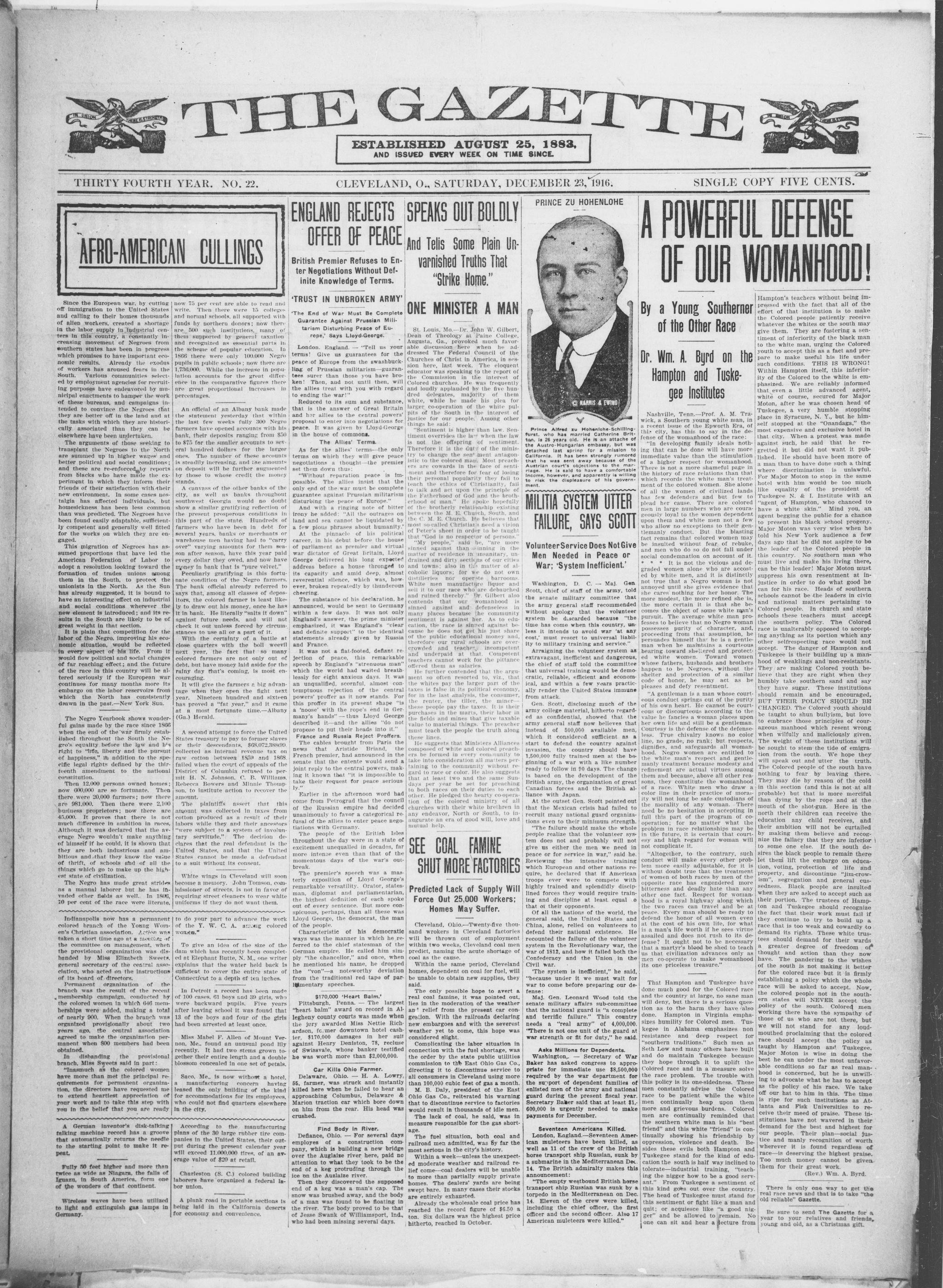
PRINCE ZU HOHENLOHE
© NARRIS & EWING
Prince Alfred zu Mohlenhole-Schillingfurst, who has married Catherine Britton, is 26 years old. He is an attach of the Austro-Hungarian embassy, but was detached last spring for a mission in the Middle East. But that he was sent away because of the Austrian court's objections to the marriage. He is said to have a comfortable income, however, and apparently is willing to ask the displeasure of his government.
MILITIA SYSTEM UTTER
FAILURE, SAYS SCOTT
VolunteerService Does Not Give Men Needed in Peace or War: 'System Inefficient.'
Washington, D. C. — Maj. Gen. Scott, chief of staff of the army, told the senate military committee that the army general staff recommended without apology that the volunteer system be discarded because "the time has come since this country, unless it intends to avoid war 'at any cost', must resort to universal liability to military training and service."
Arraigning the volunteer system as extravagant, inefficient and dangerous, the chief of staff told the committee that universal training would be democratic, reliable, efficient and economical, and within a few years practically render the United States immune from attack.
Gen. Scott, disclosing much of the army college material, hitherto regarded as confidential, showed that the army general staff now believes that instead of 500,000 available men, which it considered sufficient as a start to defend the country against invasion, the country should have 1,500,000 fully trained men at the beginning of a war with a like number ready to follow in 90 days. The change is based on the development of the British army, the organization of great Canadian forces and the British alliance with Japan.
At the outset Gen. Scott pointed out that the Mexican crisis had failed to recruit many national guard organizations even to their minimum strength.
"The failure should make the whole people realize that the volunteer system does not and probably will not give us either the men we need in peace or for service in war," said he. Reviewing the intensive training which European and other nations require, he declared that if American troops ever were to compete with highly trained and skilled disciplined forces they would require training and discipline at least equal to that of their opponents.
Of all the nations of the world, the general said, the United States and China, alone, relied on volunteers to defend their national existence. He recounted the failure of the volunteer system in the Revolutionary war, the war of 1812, and how it failed both the Confederacy and the Union in the Civil war.
"The system is inefficient," he said, "because under it we must wait for war to come before preparing our defense:
Maj. Gen. Leonard Wood told the senate military affairs sub-committee that the national guard is a complete and terrific failure." This country needs a "real army" of 4,000,000. "There is not one unit of the guard at war strength or fit for duty," he said.
Asks Millions for Dependents
Washington. — Secretary of War Baker has asked congress to appropriate for immediate use $8,500,000 required by the war department for the support of dependent families of enlisted men of the army and national guard during the present fiscal year. Secretary Baker said that at least $1,600,000 is urgently needed to make payments for December.
Seventeen Americans Killed
London, England—Seventeen American muleteers have been killed, as well as 11 of the crew of the British horse transport ship Russian, sunk by a submarine in the Mediterranean Dec. 14. The British admiralty makes this announcement: "The empty westbound British horse transport ship Russian was sunk by a torpedo in the Mediterranean on Dec. 14. Eleven of the crew were killed, including the chief officer, the first officer and the second officer. Also 17 American muleteers were killed."
SINGLE COPY FIVE CENTS.
A POWERFUL DEFENSE OF OUR WOMANHOOD!
Nashville, Tenn.—Prof A. M. T. Wriwick, a Southern young white man, in a recent issue of the Epworth Era, of a woman who was the foe of the womanhood of the race.
"In developing family ideals nothing that can be done will have more immediate value than the stimulation of a higher respect for womanhood. There is not a more shameful page in the history of race relations than that which records the white man's treatment of the colored women. She alone of all the women of civilized lands has few defenders and but few to plead her cause. There are colored men in large numbers who are courteously loyal to the women dependent upon them and white men not a few who allow to be treated with contempt. But the blasting fact remains that colored women may be insulted without fear of rebuke, and men who do so do not fall under social condemnation on account of it. * * * It is not the vicious and degraded women alone who are accosted by white men, and it is distinctly not true that a Negro woman is not annoyed until she gives evidence that she cares nothing for her honor. The more modest, the more refined she is, the more certain it is that she be comes the object of some white man's pursuit. The average white man professes to believe that no Negro woman possesses purity of character, and, proceeding from that assumption, he persuades himself that he is a gentle man, and he nurtures a nurturing bearing toward sheltered and protected white women. Toward women whose fathers, husbands and brothers happen to be Negroes, without the shelter and protection of a similar code of honor, he may act as he pleases and defy resentment.
"A gentleman is a man whose courteous conduct springs out of the purity of his own heart. He cannot be courteous or discourteous according to the value he fancies a woman places upon her own life and still be a gentleman. He cannot be a woman of the desire less. True chivalry knows no color line, no grade, no rank; but respects dignifies, and safeguards all womanhood. Negro women are entitled to the white man's respect and gentlemanly treatment because modesty and refinement are actual virtues among them. He cannot be a woman of the desire they constitute the womanhood of a race. White men who draw a color line in their practice of morality will not long be safe custodians of the morality of any woman. There need be no hesitation in accepting in full this part of the program of cooperation; for no matter what he does, he will not be a custodian in the future, it is certain that courtesy and high regard for woman will not complicate it.
"Altogether, to the contrary, such conduct will make every other problem more easily adjustable, for it is without doubt true that the treatment of women of both races by men of the opposite race has engendered more bitterness and deep hate than any other kind. But despite the hoodish is a royal highway along which the two races can travel and be at peace. Every man should be ready to defend the honor of all women even at the cost of his own life, for what is a man's life worth if he sees virtue assailed and does not rush to its defense. But the enemy is not in martyr's blood be shod to teach us that civilization advances only as men co-operate to make womanhood its one priceless treasure."
That Hampton and Tuskegee have done much good for the Colored race and the country at large, no sane man will deny, but there is a serious question as to the harm they have also done. Hampton in Virginia emphasizes humility for Colored men. Tuskegee in Alabama emphasizes non resistance and deep respect for "southern traditions." Such men as Seth Low and many others have built and do maintain Tuskegee because they hope through it to uplift the Colored race and in a measure solve the race problem. The trouble with this policy is its one-sidedness. These men constantly advise the Colored race to be patient while the white men continually heap upon them more and grievous burdens. Colored men are continually reminded that the southern white man is his "best friend" and this white "friend" is continually showing his friendship by oppression, violence and death. Besides these evils both Hampton and Tuskegee stand for the kind of education the south is half way inclined to tolerate—industrial training, "teaching the nigger to be a good servant." From Tuskegee a sentiment of this kind goes out over the country. The head of Tuskegee must stand for this sentiment or fight like a man and quit; or acquire like "a good nigger" and be allowed to remain. No one can sit and hear a lecture from
THE LOVE OF MEN
(Rev.) Wm. A. Byrd.
There is only one way to get the real race news and that is to take "the old reliable" Gazette.
Be sure to send The Gazette for a year to your relatives and friends, young and old, as a Christmas gift.
One Year.....$1.50.
Six Months.....1.00
Three Months.....50
Subscribers are requested to rem-
mit by postoffice money en-
der or registered letter
Entered at the postoffice in Cleveland
Ohio, as second-class matter.
Address all communications to
HARRY C. SMITH
Editor and proprietor,
THE GAZETTE,
Blackstone Building, Cleveland, O.
Member Ohio Legislature: 1894
to 1898; 1898 to 1898; 1900 to 1902
THE GAZETTE is the oldest, and has the largest bona fide circulation, double that of any newspaper in the Interest of Afro-Americans, published In the state of Ohio, and comparison with any will immediately establish its rank as one of the NEWSIEST AND BEST in the country.
SATURDAY, DECEMBER 23, 1916.
"Let us have faith that right makes might, and in that faith make so the things to do our duty as we understand it."—Abraham Lincoln.
Do not forget that a year's subscript to The Gazette will make a splendid Christmas gift for a relative friend or an acquaintance. Try it.
The editor of The Gazette's second Christmas gift arrived, Monday, and was a beautiful and valuable "Tourist's Sent," set by Mrs. L. D. Robus tinae, a daughter of Dr. C. Latrobe Mottley, (deceased), for many years a resident of this city and one of "The Old Reliable's" stamper friends and admirers. Many thanks, Mrs. Robus tinae. As we go to press, others are arriving. The friends are very thoughtful and kind to "the old bachelor editor", this year, as usual. It is hardly necessary to say that he is thoroughly appreciative.
While the immigration bill, passed by the House in the last session, was meeting unexpected opposition in the Senate, last week Monday, U. S. Senator James K. Vardaman grasped the opportunity to aim a blow at the fundal rights of 12,000,000 Afro Americans by offering an amendment setting forth that there is some doubt whether the Fourteenth and Fifteenth amendments to the U. S. Constitution were properly adopted, and directing the Attorney General, who is also a Southern democrat, to lay the question before the Southern democratic U. S. Supreme Court to have it ascertain whether they were made part of the Constitution in the manner provided for constitutional changes. At last it is here. This has been threatened for years.
OPPORTUNITIES IN 1920.
Col. Theodore "Brownsville" Roosevelt insists that any talk of 1920 at this time is "a pipe dream." Yet there will be many to indulge in it. Four years is a long time, especially in American politics. Men and issues are made and unmade sometimes in a shorter period. Seasoned politicians will doubtless begin to "mention" this, that or the other man as a suitable Republican standard-bearer for four years hence, and in the event of this, that or the other man winning, we shall have the usual crop of "original" boomers. The fact is that the Republican party has much to do before it can seriously consider making another Presidential nomination. We must make the most of the situation in the House of Representatives, we must assure control of that body in the elections of 1918, we must make certain of winning the Senate also. The man who makes the largest contribution to these ends, whether by some single brilliant stroke or by sustained Republican effort, will loom large in the early winter of 1920. There are Republican Senators and Congressmen who may do it, there are Republican Governors who may do it. And there are some Republicans, we do not doubt, in private life, who are capable of making a compelling impression on the public mind before the next ticket is named.
"THE NIGGER"!
Last Thursday while John J. Brown sat in Judge Homer G. Powell's courtroom, he heard Officer Burns, of the local police force, who was on the witeness stand refer to two or three prisoners ("white") by name, but when it came to the Afro-American prisoner he referred to him as "the nigger," as if he had no name! Assistant County Prosecutor Doerfer, who has been elected County Prosecutor, taking office the first of the month, Jan. 1, 1917, and who was handling the cases for the county, said to Burns: "The Colored man you mean." To which he replied: "Yes." What we cannot understand is how any judge would permit a thing of this kind to happen in his courtroom without a proper and stinging rebuke. Had some witness referred to Officer Burns as "the mick," he certainly would have felt hurt and just so, and the judge should also promptly rebuke the person guilty of making that insulting remark. The mongrel terms "darky, coon, nick, mick, sheeny, dutch (for German), dago" and the like, are synonyms or classes of people they are hurled at and should not be tolerated for a single moment especially in court rooms and other public officials'
quarters. Nor should servants of the people be thus allowed to so insult all citizens of races or classes resident in Cleveland, to which such insulting terms are applied. We call Chief Rowe's attention particularly to this fact because for years there has been a laxity in this respect in his department that has reached the point where one of his subordinates has the brazen effrontery to publicly exhibit the fact in open court-room. As to Judge Powell, we cannot believe that he heard the miserably insulting reference because of all judges on the common pleas bench, with the possible exception of Judge Martin Foran and Thomas Kennedy, we would expect him to rebuke any person making such a mistake instanter. We urged Mr. Brown to see both Chief Rowe and Judge Powell, friends of the race, and enter a vigorous protest in person and trust that he did so. This is another matter our local organizations can interest themselves in and to good purpose, too.
A DANGEROUS COMBINATION.
The south is very much concerned over the exodus of the Colored people from its cotton fields. It is resorting to every means, foul or fair, to put a stop to it. Many newspapers have spoken out and are placing the cause of this exodus where it belongs. The south has not as yet recognized the Colored man as a MAN. It looks upon him as a tool with which it hopes and intends to work. In planning for the uplift of its constituents the Colored race does not enter the equation. By reason of a half century of butchery murder, lynching and burning of Colored men and women with impunity the south has grown to feel that it has a right to do what it pleases to Colored people and the country dares not interfere. For a quarter of a century the south depended upon the influence of Booker Washington to keep the rank and file of the Colored people in the south and at the same time train them to accept as their portion anything the white south might heap up to them. Many well-meaning men have given utterance to the phrase "the south is the place for the Colored race." Why? Because he was being used by designing persons for their selfish ends. The price of Colored schools has been the price of the Colored youth of anything that looked like a real education, putting in place a "kind of training" and demanding of Colored teachers an acquiescence to this and, in many instances, a blatant advocacy of the infamous system. The Colored teacher and the demagogue politician combined to rob the Colored race of every spark of manhood. Whatever Colored man resented this treatment, was her added to the country as a "bad niger." Every Colored man that receives an opportunity to pull up from the south and go elsewhere, is in his own light if he refuses to go. Instead of hundreds of thousands of Colored people leaving the south, millions should go. The blood-thirsty white southern regime that has crushed the Colored race should be left to itself. Let their farms grow up in weeds, or let them cultivate them themselves. Let their children go into the arms of an other race to be nursed and nourished. The fondness and love of the black nurse for her white child finds no parallel in history. The goodnatured and uncompaining service rendered by the Colored people has been rewarded by abuse, death, and base humiliation. The so-called "best whites" have remained quiet and silently sanctioned the destruction of the Colored race. The barren fields of the south have touched the sympathy of the GOOD SOUTHERNER." He recoils at seeing the producers of his wealth leave the dollars and no humanity are calling forth this change of front in the south. If colored Men will join in keeping the Colored race in the south let them press a good bargain. The lyncher's rope, if used at all, must be used on those who have ruined the south. The Colored citizen must have a say to who must rule. The laws under which he lives must receive his sanction in part at least. The schools must have the same consideration given white schools. The jury-box must not be filled with his political enemies who delight in sending him to the chain-gang. Our school teachers should receive the same pay as their white co-workers. Colored women must be respected and protected. In fine, absolute freedom, the same as any other American citizen has, must be his. Are the Colored teachers and preachers who are leading the Colored people prepared to demand these things? Is the south ready to grant it? If not the rest of the country is. To these sections let every self-respecting Colored man fly. We shall watch this heretofore dangerous combination and see if it will even now give the unfortunate Colored man a square deal. In the mean time Colored people look out for yourselves.
(REV.) W. A. BYRD.
WELL-KNOWN OHIO-AN DEAD.
Cincinnati, O.—Mr. Powhatan Beaty was born in Richmond, Va., 1838, and died here, Dec. 6; aged 79. He was a veteran of the Civil War, being one of two Cincinnatians to receive a special medal of honor from the U. S. Government. Mr. Beaty is survived by two sons, Attorney A. Lee Beaty, member-elect of the Ohio Legislature; and two daughters, members of the U. S. army. He was a splendid reader (elocutionist), many years ago.
For many years the friends of Hon. Geo. W. Hays, and especially the officers and teachers of the Union Baptist Church of which he has been superintendent for twenty-seven years, have kindly remembered his birthday each year and spent a pleasant and happy evening with him and his family, no exception to this rule. Mr. and Mrs. Ralph R. Hawkins adding very materially to it, however, by serving an elaborate dinner which all the members of the family thoroughly enjoyed.
CARD OF THANKS.
We wish to express our sincere thanks to our friends, neighbors and all, for their many kindnesses, sympathy, beautiful floral offerings and words of consolation in our bereave-ments, the loss of our beloved mother and sister.
EUGENIA BALLARD.
ROBERT, JOHN AND ALICE.
—Adv.
THE GAZETTE, CLEVELAND, O. SATURDAY, DECEMBER 23, 1916.
DOINGS OF THE RACE
Start the new year right—subscribe for the old reliable Gazette.
For the first time in Columbus High school football an Afro-American lad has been named a team captain, Dave Smallwood, halfback, being elected to lead the South High eleven, this year's city champions.
FRESH OHIO NEWS
Written by 'The Old Reliable' Gazette's Correspondents
THROUGHOUT THE STATE
What Our People Are Doing Each Week—Church, Personal, Social, Lodge, Literary and Musical—Marriages, Deaths, Etc.
SMITHFIELD—Mr. and Mrs. N. Bigsby moved, last week, into the Pearl property on Green St—Mrs. C. Fitzgerald, of Steubenville, is visiting her children and sister, Mrs. L. Bigsby. Misses Anna Howard and Mattie West,
James W. Johnson, of N. Y. City, contributing editor of the N. Y. Age and former U. S. consul at Puerto Cabello, Venezuela, Corinto, Nicaragua and the Azores, has been appointed Honorary President of Hon. J. E. Bush, of Little Rock, Ark, most prominent Afro-American of that state for years, and Wm. H. Anderson, of Detroit, Mich., former editor of the Detroit Plaindealer, who was a native of Sandsky, O., died recently. Jim Lanford of Boston, knocked out Jim Johnson of New York, in the twelfth and final round of a boxing contest at St. Louis, Mo., last week Wednesday evening. After Johnson had been counted out he got up and demanded that he be allowed to fight some more. His seconds and manager persuaded him to take off his gloves and admit he had lost the fight. He was awarded 225 pounds and Langford 191.
It does seem as if this saying is about to come true in the experience of the Negro in the United States. The South for years has been abusing him as a shiftless and good-for-nothing individual, and has announced its intention to get rid of him. In fact it did make an effort, by the introduction of foreign white labor, either to displace him, or to run him out. But the war came and changed their plans—made foreign labor immigration impossible, and now all sections of the country are bidding for the land that has lynched and ravaged him, has promised if he stays that it will see to it that he receives protection. And now comes the Republican party, after a national defeat, in which the South and the West combined played an important part, with the announcement that the senator Penrose, that efforts will be made by statutory enactment to give him the enjoyment of the right of franchise guaranteed by the 14th and 15th amendments of the Federal Constitution. The next source to constitution from will be the Unification Commission (Md.) that will be established States which convenes in Baltimore, December 28th, 1916. — Baltimore (Md.) Commonwealth.
THREE LITTLE GIRLS ASSAULTED
The Brute Let Off With a Sentence of
$100 and Sixty Days in Jail—
their case.
Lorain, O., Dec. 14th, 1916.
Judge H. G. Redington,
In re The State of Ohio vs. Martin
Trowinski
With the sincere hope that we may never again be made to feel that justice can not be obtained in our county courts, I am
Yours very truly,
Ruth Anna Fisher,
President,
The Colored Woman's Association
Written by 'The Old Reliable' Gazette's Correspondents
What Our People Are Doing Each Week—Church, Personal, Social, Lodge, Literary and Musical—Marriages, Deaths, Etc.
SMITHFIELD.—Mr. and Mrs. N. Bigsy moved, last week, into the Pearl property on Green St.—Mrs. C. Fitzgerald, of Steubenville, is visiting her children and sister, Mrs. L. Bigsy. Misses Anna Howard and Mattie W, of that city, visited relatives here, last Thursday evening.—D. Freeman and S. West were here, last week.—R. Hargrave visited in Pittsburg and Homestead, Pa. Sunday week.—Mrs. Sadie Jackson, George and Henry. Thompson royally entertained the S. L. S. club, last Tuesday evening the S. T. sreat and club bazaar will be held, this Saturday evening. All cordially invited.
SANDUSKY. — The S. S. and churches are doing well. Christmas programs will be rendered, Admission free. Attend and get your presents, Monday evening. — "Mother" Gipson, nearly 100 years old, one of Sandusky's oldest residents up to a year ago, died in Cleveland at her granddaughter, Mrs. Butler's, and was brought here, Tuesday, for burial from the A. M. E. church, the pastor, Rev. Fleming, officiating.—Mrs. Strauder will soon be able to return home from the American hospital; also will Burns who underwent an operation.—Mr. Ed. Bryant, who was cut last week, is out again. We hope he will get well soon as his wife and children need him.
CADIZ—Supt. J. A. White, of the State Anti-Saloon league, made an interesting address at the A. M. E. church, Sunday afternoon. R. F. B. ballard and daughters, Misses Heloise and Pauline, and Mr. James Smith were in Cleveland, to attend the funeral of Mrs. Annie Ballard, a former resident of this city. Many expressions of sorrow and sympathy are extended the family. Both churches are preparing for Xmas. The A. M. E. congregation will worship in their new church in January. The dedication will take place in June. Mrs. Clarra Redmond was in Xmas. Mrs. Bertha Redmond was in Steubenville, Monday. Don't forget to send The Gazette for a year to a friend as a Xmas gift.
CORRESPONDENTS must mail all letters for publication at their main postoffice sufficiently early on Monday (or Sunday) of each week to have them reach The Gazette office on Tuesday morning, and always write also, their names and that of their city or town on the outside of the wrapper about returned copies. Unless this latter is done, proper credit cannot be given you. Lists of names, wedding presents, etc., obituary notices, speeches, resolutions, poetry, inquiries, and other items of all kinds, including items announcing entertainments to be held in the near future, must be paid for in advance at the rate of ten cents a line, six words to a line. Our rates for display advertisements will be sent on application.
HILLSBORO—Miss Esther Hough has returned to Jamestown.—Messrs Ed. Kilgore, Lewis Colter and Clarence Johnson are convalescing.—Rev Harvey Johnson preached, in George town, a few Sundays ago.—The B. Y. P. U. is progressing nicely. The young people are deeply interested and are rendering real service. The topic Sunday, "Undertaking Great Things on the topic were read by the Misses Annie Ames, Faith Delaney and Hazel McFarland, Song, Lincoln 4th and 5th grade, Duet, Lillian Smith and Lucille Delaney.—Mr. Asa Jackson are rived Saturday night, from Cleveland to spend the holidays with his family.—Mrs. Lang Young was called to Zanesville, last week, by her sister, Mrs. Carlisle's illness.—Mr. Chester Anderson is an extra letter-carrier during the week in Georgetown.—Miss Clara Smith is Saturday and Sunday in that city.—Rev S. H. Brown passed through here Saturday enroute to Georgetown to preach. Sunday.—Do not forget to send your friend a year's subscription to The Gazette as a Xmas gift.
HON. JOSEPH C. MANNING.
Former Postmaster of Alexander City, Ala., and Former Member of the Alabama Legislature—An Aggressive White Friend of the Race.
New York City, Dec. 18, 1916. Editor Gazette, Dear Sir: I wish for the editor of The Gazette and his associates a Merry Christmas. The founders of Colored Journalism in the United States not only deserve the appreciation and support of the Colored race but they have won and should have the highest sort of consideration from all the people of the entire country.
Sincerely yours,
Joseph C. Manning.
Christmas photos—as a gift—nothing is more acceptable; certainly nothing more appropriate. Sit for them NOW and save disappointments. See advertisement on other page. THE SMITH STUDIO—Adv.
Christmas Photos
Now, and be sure of them, THAN TO WISH YOU HAD.
LEGAL NOTICES.
Edward M. Tracy, whose residence is unknown, is hereby notified that in case O. S. Brown has filed his petition in case No. 153,040, in the common pleas of Cuyahoga County Ohio, against said defendant and setting forth therein that he is the owner in fee simple and in possession of the following described premises:
Situated in the City of Cleveland, County of Cuyahoga and State of Ohio in the vicinity of Cuyahoga, 179 in L. A. Kelley's Allotment No. 3, of a part of general lots Nos. 452 and 453 formerly in Newburgh Township, as recorded in Volume 16 of Maps, Page 20 of Cuyahoga county records.
That the aforesaid defendant claims an ownership or some interest in the above described property adverse to said plaintiff, but that he has none in reality. The prayer of said petition is that the claims of said defendant may be adjudged null and void; that plaintiff's title to said premises may be adjudged and for such other and further relief as may be just and equitable.
Said defendant is required to answer said petition on or before, Feb. 3, 1916, or judgment will be taken against him. E. O. S. Brown, By Fred L. Thompson, his attorney.
Zuzanna Hrkal whose residence is unknown, is hereby notified that E. O. S. Brown, has filed his petition in case No. 153,038, in the common pleas court of Cuyahoga County, Ohio, against said defendant, setting forth therein that he is the owner in fee simple and in actual possession of the property situated in the City of Cleveland, County of Cuyahoga and State of Ohio, and known as being part of Original Lot No. 428, and being Sub-Lot No. 88 in the Rice Homestead Allotment of Original Lot No. 428. Said Sub-Lot No. 88 being 35 feet front on the easterly side, East front on the extends of original wall with 104
That the aforesaid defendant claims some interest in the said property adverse to said plaintiff, but that she has none in reality. The prayer of said petition is that the claims of said petition be satisfied with the void; that plaintiff's title to said premises may be quieted and for such other and further relief as may be just and equitable.
Said defendant is required to answer said petition on or before Feb. 17, or judgment will be taken again.
Martin A. Gates and Martha A. Gates, whose residences are unknown, are hereby notified that E. O. S. Brown has filed his petition in case No. 153,038 in the common pleas court of Cuyahoga against said defendants and setting forth therein that he is the owner in fee simple and in possession of the following described premises:
Situated in the City of Cleveland, County of Cuyahoga and State of Ohio and in the town of Cuyahoga in the W. H. Kelley Heirs Allotment of part of Original one hundred acre lot No. 445, as shown by the plot of allotment in Volume 14 of Maps, page 30 of Cuyahoga County Records.
Said Sub-Lot No. 88 being forty feet from the北 side of Oakfield Avenue formerly known as Cannon Street.
That the defendants claim an ownership or some interest in the above described premises adverse to said plaintiff, but that they have none in reality. The prayer of said petition is that the claims of the said defendants may be adjudged null and void; that the plaintiff's title to said premises may be quieted and for such other and further relief as may be just and equitable.
Said defendants are required to answer said petition on or before Feb. 3, 1917, or judgment will be taken against them.
E. O. S. Brown,
Bryd E. L. Thompson, his attorney.
CORRESPONDENTS WANTED
The old reliable Gazette desires an active agent and correspondent in every city and town in Ohio and neighboring states having a number of Afro-American residents. Only a little time on Fridays or Saturdays is required.
We are especially desirous of hearing from persons in the following named cities: Springfield, Dayton, Plaqu, Mt. Vernon, East Liverpool, Akron, Lima, O., and other places, particularly in Ohio, where we have none.
Write to the editor of The Gazette. Blackstone building, Cleveland, O., and terms will be sent promptly. Our mailing address is currently sitting at once the addresses of persons in the cities named and others in the state, to whom we can write relative to the matter.
USE GORDON'S HAIR GROWER Then Watch the Results
This GREAT VALUE is sold with the understanding that if it does not grow the hair your money is refunded at any time. Save the empty boxes; they are worth five cents
If your hair is falling out, use GORDON POO CREAM, and if splitting at the ends, HAIR-GROWER direct to the scalp and ribble trouble.
GORDON'S GLORY HAIR-GROWER, 5
GORDON'S GLORY SHAMPOO CREAM
GORDON'S STRAIGHTENING COMMENT, $1.25.
Agents make from 10 to 15 dollars per everywhere. WRITE.
O. C. Gordon's Laboratory WIN
A Busy
Selling out, use GORDON'S GLORY SHAM-Splitting at the ends, rub GORDON'S GLORY to the scalp and be relieved of such hor-
RY HAIR-GROWER, 50c per box.
RY SHAMPOO CREAM, 25c per jar.
AIGHTENING COMBS, and LAMP attach-
m 10 to 15 dollars per week. Agents wanted
Laboratory No. 209 Roanoke St
WINSTON-SALEM, N. C.
usy Life
If your hair is falling out, use GORDON'S GLORY SHAMPOO CREAM, and if splitting at the ends, rub GORDON'S GLORY HAIR-GROWER direct to the scalp and be relieved of such horrible trouble.
Agents make from 10 to 15 dollars per week. Agents wanted everywhere. WRITE.
O. C. Gordon's Laboratory No. 209 Roanoke St WINSTON-SALEM, N. C.
ABusyLife
By HON. JOSEPH BENSON FORAKER
The Most Important Autobiograph
Mr Foraker has given us his experience
in the Bench, as Governor of Ohio and
United States.
Important Autobiography In Years
en us his experience in the Union Army
nner of Ohio and in the Senate of the
The Most Important Autobiography In Years
Mr Foraker has given us his experience in the Union Army on the Bench, as Governor of Ohio and in the Senate of the United States.
Political and public events of great importance and incidentally many national characters are dealt with in the most enlightening manner.
The work will prove of special interest to all students of political history whether they are public officials or only public spirited Americans, interested in the preservation of our institutions.
2 VOLS. NET $5.00
All orders sent direct to the
"THE GAZETTE"
Blackstone Bldg., Cleveland, O.
will have the personal direction
of its Editor
TEAR OFF HERE
The GAZETTE
Blackstone Bldg.
CLEVELAND, O.
Please send me___cop___
"Notes of a Busy Life"
BY J. B. FORAKER
Net $5.00 for which I enclose___
Name___
Address___
12 GREAT SERIALS OR GROUP STORIES IN 1917
Stories upon Stories—and plenty of them. Action, Life, Adventure, Fun, Pathos, Inspiration.
The Youth's Companion
will make 1917 a Great Story Year. Besides the Great Serials and 250 Short Stories, there are rare Special Pages for each one. Family Page, exceptional Editorial Page, Boys' Pages, Girl's Pages, Children's Pages, Doctor's Corner, Current Events, Nature and Science, Travel, Information, etc.
Everything from everywhere for every-one in the family.
THE YOUTH'S COMPANION, St. Paul St., BOSTON, MASS.
52 ISSUES A YEAR
CUT THIS OUT
and send it (or the name of this paper) with
$2.00 for The Companion for 1917,
and we will send you
FREE all the remaining issues of THE COMPANION for 1916.
FREE COMPANION HOME CALENDAR for 1917.
The Fifty-Two Weekly Issues of THE COMPANION for 1917.
SUBSCRIPTIONS RECEIVED AT THIS OFFICE
```markdown
```
G. J. TATE, Prop.
GENT'S FURNISHINGS
Hosiery, Underwear and
Neckwear
Arrow Collars and Shirts
Hats, Caps, Etc.
2922 CENTRAL AVENUE
CLEVELAND, O.
STERLING
5 and 10 Cent Store
3003 Central Ave.
Under New Management!
Watch Our Windows For Bargains
Colored Saleslady
We close at 8 P.M. every evening except Saturday
MME.C.H.JONES'
Hair Tonic and Invigorator
HER TONIC is the result of scientific study of the causes of diseases of the scalp. Instead of treating effects of the diseases she treats the causes, eliminating the same and leaving the scalp in a healthy condition that can be maintained by using her Hair Tonic and Invigorator, according to her direction. Madame C. H. Jones Hair Tonic and Invigorator is guaranteed to stop the failing out of the hair and to make the hair
Many people get diseased scars by being burned or scorched by parents or unscrupulous persons who have been burned.
On the other hand, MADAME JONES' PAIR HAIR TONIC and INVIGORATOR is available for it.
MADAME J. H. JONES' Hair Tonic and Invigorator promotes the growth of the hair, prevents and cures baldness, removes dandruff, cures scalp disease, improves hair color and color of the hair by supplying it with the natural elements and necessary nourishment.
MADAME C. H. JONES
835 Woodland
Toledo, Ohio
Agents Wanted
FOR
Pure Drugs, Prescriptions
AND
Cut Rate Patent Medicines
GO TO
The Arlington Pharmacy
S. W. Cor. E. 55th Street
and Central Avenue
The Pride of Carolina
The State Agricultural and Mechanical College of South Carolina
Orangeburg, S. C.
Next session begins September 27th and ends May 25th, 1917.
No Tution, no Room Rent, no Charges for Water, Lights or Fuel. Entrance Fee $10.00.
Board $6.00 per Month in Advance. Books, Laundry and Personal Expenses Extra.
Every Modern Faculty, Standard Equipment at Faculty of 57 Office and Instructors.
For Information and Catalogue, Write
R. S. Wilkinson, Pres.
Orangeburg, S. C.
G. G. REED
Ladies' and Gents' Furnishing Goods
Special $1 Waist
Worth more
Sole Agent for the
American Lady, Nemo & R. & G. Corsets
3222 CENTRAL AVENUE
Bell 'Phone: Prospect 1200 R.
DON'T THROW AWAY
Your copy of The Gazette after reading it, but give it to a friend or an acquaintance who might subscribe after reading a copy of the paper.
Editor
Where to Purchase The Gazette
Where to Purchase The Gazette
*O. C. SCHROEDER'S,
Cuyahoga Bldg.
J. E. BRANHAM'S
4219 Central Ave.
*ERNEST P. JACKSON'S
3969 Central Ave.
*OPEN SUNDAYS.
NOTICE TO SUBSCRIBERS
Subscribers not receiving The us at once. We desire every copy.
Send or bring locals and all bui fice, suite 2, Blackstone Bldg. If you please.
We advise our readers to care tisements before making purchases; this paper should have the parv othey advertise is assurance that Loca local reading notices (adver words in a line); display adverti publication.
All matters for publication in be in the office by 4 p. m. WEDN
Subscribers not receiving The Gazette regularly should notify us at once. We desire every copy delivered promptly.
Send or bring locals and all business matters to The Gazette's office, suite 2, Blackstone Bldg. If you wish to see the editor call there, please.
We advise our readers to carefully examine The Gazette's advertisements before making purchases. Business men who advertise in this paper should have the patronage of our people. The fact that they advertise is assurance that they want it.
Local reading notices (advertisements) ten cents a line (six words in a line); display advertising space, fifty cents an inch, single publication.
All matters for publication in current issues of The Gazette, must be in the office by 4 p. m., WEDNESDAY of that week, at the latest.
Our
Classified Ad
Department
WANTED.—Men roomers—All conveniences. Charge reasonable. Apply at 2347 E. 86th St., between 6 and 7 p. m.
WANTED—Porter—for printing office. Apply, Wm. E. Kneale, No. 321 Frankfort Ave., N. W. (Perkins Power block.)
FOR RENT.—Houses and Rooms—If you have them to rent or if you want to rent, advertise in The Gazette. It brings results.
NOTARY PUBLIC.—For such services call at The Gazette office, No. 2 Blackstone building, No. 1424 W. Third Street, near Superior Ave.
FOR SALE. — Five room house, lot
40 by 120, small barn. Street paved;
$1750. Very small down payment; balance
like rent. Fred. L. Thompson,
$27 Engineer's bld.
FOR SALE. — Houses or lots. If you
have either or anything else to
sell, or if you wish to purchase, advertise
in The Gazette. If anything can
bring you results, it can and
will.
FOR SALE — Property at 2176 E.
43d. St., near Cedar Ave: eleven
rooms, bath, furnace, etc., $3,000. Four
hundred dollars down and the balance,
$25 per month. Apply at The
Gazette office.
ANY WOMAN CAN MAKE BIG
MONEY IN HER OWN HOME. THIS
IS A MUST-READ PURTURE.
RASP IT AT ONCE! FOR PARTICULARS, WRITE EVELYN HORTON
MFG. CO., 4188 W. BELLE PLACE,
ST. LOUIS, MO., AND MENTION
"THE GAZETTE" PLEASE.
Cleveland Sixth City The Old Folk's home association will meet there, Jan. 8.
"Noomdy" Brasher is managing "The Alien," so report has it.
Rev. B. W. Paxton has left the city in the search of improved health.
in the search of improved health.
Mr. Asa Jackson went home to Hillsboro, Saturday, to spend the holidays with his family.
Mrs. Herbert L. Taylor, of E. 42d St. has the sympathy of a host of friends in his loss of her father.
Do not fail to read the Owl Drug Company's advertisement elsewhere in this paper. It is for you, reader.—Adv.
Mrs. C. Alfred Fox, who is visiting her parents and other relatives at Mt. Claire, N. J., will return to the city after the days, when she C. G. Friend, pastor of Shiloh Baptist church, has purchased a home in E. 59th St., and is a neighbor of Rev. Chas. Bundy.
Drs. Green and Clemens are in the city to locate. Four or five physicians have come to the city for the same purpose in recent months.
XMAS GIFTS—We have a complete list of XMAS gifts to fill your friends. Dry goods and gents' furnishings. LOMSKY. 3820 Central Ave.—Adv.
There is no Christmas gift your relatives and friends will receive more real benefit from than a year's subscription to "the old reliable" Gazette. Try it!
Your service examinations to be held in federal building Feb. 3 for customs clerks and internal revenue deputies and storekeepers. Take these examinations!
"Mother" Gibson's remains were taken to Sandusky for burial, last week. A daughter, Mrs. Butler, of that city survives her. Gibson was named after age 64.
Mr. James Smith, R. F. Ballard and two daughters, Heloise and Pauline, who were called to the city recently by the death of Mr. Ballard's mother, returned to Cadiz, last week.
Mr. Nicholas Mueller, (white), age 51, an insurance broker of Newtown, Pa., and Miss Lottie Taylor, age 27, a seamstress and near the same age, returned Dec. 12.
John Ballard, age 28, and Lucy V. Green, age 22, both of 4207 Central Av.; and Madison Jenkins, age 25, and Susie Watkins, age 22, both of 2950 Central Av., secured marriage licenses, Monday.
The Caldwell-Thompson musical recitals promise to eclipse all other efforts of the kind of the season. Prof. Caldwell comes to Cleveland with a splendid reputation in the East as a concert pianist—Adv.
Our advertisers want your trade. Those who do not ask for it in The Gazette certainly care little, if at all, for it. Therefore, we urge our readers and all of our friends to patronize those who ask for your trade in this paper.
If you want your prescriptions filled
*A. GORDON'S,
2928 Central Ave.
JACKSON'S,
3641 Central Ave.
*MRS. BESSIE KITZMILLER'S
3943 Central Ave.
SUNDAYS.
The Gazette regularly should notify
delivered promptly.
business matters to The Gazette's of-
you wish to see the editor call there,
Fully examine The Gazette's adver-
t. Business men who advertise in
image of our people. The fact that
they want it.
titements) ten cents a line (six
ing space, fifty cents an inch, single
current issues of The Gazette, must
USDAY of that week, at the latest.
Personal
"Any prejudice whatever will be insurmountable if those who do not share in it themselves truckle to it and flatter it and accept it as a law of nature."—John Stuart Mill.
with the best drugs, and most careful attention, take them to Jackson's Pharmacy, cor. E. 40th. St. and Central Av. We also carry a fine line of toilet articles, sundries, etc. Come in and look us over.—Adv.
Officers arrested 15 of our men and behead the Savannah ga. union deputy recently. They were waiting for a train to come North, and finally did so. This has occurred in several other Southern cities in recent months.
B. P. Phillips has opened one of the neatest and nicest dining parlors and lunch rooms in that section of the city, on the corner of Scovill Ave. and E. 31st. St. and is serving the very best quickies. HOME COOKING, too! Storm
The Sterling 5 and 10 cent store, 3003 Central Av., wishes all of its customers a merry Christmas and a happy New Year. We carry a complete line of holiday goods, including toys and novelties. Open, every evening t 9:30 p. m. Colored saleslades.—Adv. Mr. and Mrs. J. H. Cox of Memphis, have located in this city. He has purchased the tailoring business at 2728 Central Av., from W. J. Kenney, whose health requires more out-of-home life, and is doing splendidly. Mr. Cox is a first-class workman. Try him and be convinced.—Adv. Thos. J. Gibbs, 1286 E. 89th St., died Dec. 15 and was buried Dec. 18 from Mizon Cong. church. Interment in the cemetery. Rev. officiating. He is a member of Eureka lodge, F. A. A. M., which participated in the ceremonies. Slaughter Ros. funeral memorial.
Mr. and Mrs. J. H. Oliver, 2355 E. 43d St. formally opened their new home with religious services and a social affair which was enjoyed by their friends. Refreshments. Mr. and Mrs. J. H. Oliver, the missionary work and the latter is a member of St. John's deaconess board. No doubt we have the finest selections in holiday goods, as candy, stationary, perfumes, cigars, etc., at cut prices. Do your Xmas shopping here. Our postal station will take care of your parcels and save you time. Timen and bonzig's Arlington Pharmacy, sw. or E. 55th. St. and Central Ave. - Adv. The old folk will appreciate a fine hot-water bottle for Xmas more than anything else. For the younger generation the Brown Drug Co., is showing the finest line of boxed perfumes, toilet-waters, fancy boxes of candy, cut-glass atomizers and ciders for the holidays. See them on display at the Brown Drug Co. or E. 28th. St. and Central Adv. - Adv.
A warning to OUR public school teachers: Supt. T. Davidson of Pittsburgh, formerly of Washington, D. C., and Supt. T. Condon of Cincinnati, being considered as successors to Supt. Frederick, favor separate schools for our children and are opposed to Afro-American teachers in mixed classrooms. See Mrs. Virginia D. Green and Thos. H. Bushnell, Esq., once.
THE PEOPLE'S DRUG STORE, F. H. WEAVER, PHAR. D., PROPRIETOR, CORNER CENTRAL AV. AND EAST 33RD ST. PRESCRIPTIONS OUR SPECIALTY. MONEY ORDERS, TELEGRAMS, GAS BILLS, CAMERA SUPPLIES, ADAMS EXPRESS AND TRADING STAMPS, AND TRADING STAMPS. HOT DRINKS OF ALL KINDS. ALL FOR YOUR CONVENIENCE.—Advt.
The editor of The Gazette acknowledges the receipt, last week, of an invitation from President Thos. E. Monks, of the Cleveland National bank, to attend the formal opening of its new building in Euclid Ave., near E. 4th St. The bank certainly has beautiful new quarters, and stockholders and depositors alike are justly proud of it. The floral display was magnificent and grand, and the officers geniality itself in their greeting and welcome of all who visited the bank during the hours of 9 a. m. and 5 p. m. Monday.
One of the paintings displayed at the recent exhibition of the New York Water Color club was the work of Miss Laura Wheeler, teacher of Art at the Cheyney Pa., Training School for Teachers, and former winner of the Cresson Prize Scholarship from the Academy of Fine Arts of Philadelphia, Pa. The painting is one entitled "The Wheeler and was one of the 12 selected out of a total of 500 and will become a permanent illustration for the Water Color club catalogue. Last spring Miss Wheeler had five paintings on exhibition at the Art Institute of Chicago.
For many months agents have been canvassing among our people of this city selling lots in other states and stock in various companies out of the city, and many of our people have purchased from the university. Autumn's automatic straw binder the Boxer, Safety Back, the
unlikely the Revered Safety Ticket, the
THE GAZETTE, CLEVELAND, O., SATURDAY, DECEMBER 23, 1916
Gazette
R.'S.
Aval. Ave.
S.
Aval. Ave.
HITZMILLER'S
New York Realty, the Douglass Insurance and other companies, in which many of our people have invested to their sorrow and financial loss? Last and this week, The Gazette has been asked repeatedly about several lot and stock schemes, being "worked" among our people of this city at this time, of which we have no knowledge and we will to let them severely alone until the persons interested and The Gazette can learn more of them, their promoters and agents.
HATS OFF T
The Cleveland receiving the p for its many s l, of Ohio, All and Fairbanks public ticket to support Gov another term.
The Gazette we of our editors those reasons it vertising contr
It will be of interest to all music-lovers to know that Miss Bessie Blakemore Cook, pianist and accompanist, has opened a music studio for the accommodation of her pupils and friends. Miss Cook is young but an excellent musician, thoroughly devoted to her profession. She graduated from the music-school of Anderson, Ind., in 1912, with the highest honors of her class. Since that time she has devoted her time to teaching, having been instructor of music at Curry school, Urbana, prior to coming to Cleveland. Here she has gained a high degree of musical proficiency both as pianist and pipe-organist. She instructs in harmony, composition, and technic of the piano, and ought to be first considered by all of our people desiring to study piano, etc., or to have their children do so. Studio, 4910 Central Ave.-Adv.
Chief Rowe at a staff meeting of police captains, Tuesday, read a letter he received, late Monday, from Safer Sprosty, regarding gambling. In this letter Sprosty said his attention had been called to the fact that a few so-called social clubs are being used as places for gambling, and that all gambling must be suppressed. The captains were told to pay particular attention to the police and to stamp out gambling. However, police order No. 73, issued by Sprosty, still is on the books. Police order No. 73 forbids vice and gambling raids without the approval of Sprosty. Therefore, little faith is placed in the letter. On the contrary it is pretty generally regarded as "a holiday for the police," the trafron. The "gambling bell" in the Clayton block, for which its promoters claimed "protection" before and after it was opened, has gone on and will continue to do so regardless of the Sprosty letter, say those who claim to be in a position to know. Strange that our ministers who are charged with the moral welfare of our people have been so well aware of this city, exhibit apparently no interest whatever in the Clayton hall "gambling bell" and others in that vicinity. Don't they and their churchworkers care how much of our poor workmen are fleeced of their hard earnings in those places? Have they no care for the helpless woman who suffers, and too during this bitter winter season? It would seem so. PRAY FOR THEM!
A $1,000 TESTIMONIAL
On His Silver Anniversary for One of the Two or Three Afro-American Catholic Priests.
Baltimore. Md.-Roman catholics and other citizens are planning a big testimonial reception to Rev. C. Randolph Uncles on Jan. 8, the twenty-fifth anniversary of his elevation to the priesthood. He was the second Colored man to be elevated to the priesthood of the Church in this country. Father Uncles has been being being as well as members of other denominations, will join in the celebration. It is planned to present him a testimonial
JOHN H.
gift of $1,000. On the morning of Jan. 8, a solemn high mass will be celebrated at St. Francis Xavier Roman Catholic church at which time Cardinal Gibbons and other notables will be present. Benediction services will be held at the church of Father Uncles is a native of Maryland. Before entering St. Hyacinth's College, Canada, to get his scholastic training for the priesthood, he taught school in Baltimore county. He received his theological training at St. Mary's Seminary, this city, where Cardinal Gibbons was also educated. He attended Epiphany Apostolic College, Walbrook, for a number of years.
AN OHIO-AN IN GEORGIA
Writes That "The Old Reliable" is
Well-known Away Down in "Dixie"
"as a Fighter for a Square
Deal for the Race."
Fort Valley, Ga., Dec. 19, 1916.
Editor Gazette, My dear Mr. Smith:
—I am enclosing my subscription (renewal to The Gazette, and wish you a Merry Christmas and a Happy New Year.
I read with interest each issue that
reaches me, and note with interest
and appreciation your efforts for race
solidarity against issues that are detrimental. Down here in the heart of "Dixie" you are well-known as a fighter for a "square deal" for the race. I am.
Most Cordially,
Charles W. Reynolds.
A MERRY CHRISTMAS!
Make your Xmas a MERRY one by
starting it right — use MME C. H.
JONES HAIR TONIC.
There is a Reason—
It is made for those who DISCRIMINATE and demand the best QUALITY—Adv.
The Kind.
Willis—"What kind of a time did you have at Bump's last evening?" Gillis—"Very unintelligible. I couldn't understand anything they said to their baby or anything the phonograph played or anything that my wife whispered to me behind their backs"—Judge.
HATS OFF TO "THE GAZETTE."
The Cleveland Gazette is due and is receiving the praises of the race press for its manly stand against Gov. Willis, of Ohio. Altho it supported Hughes and Fairbanks and the rest of the Republican ticket, The Gazette refused to support Gov. Willis, of another state. The reasons given by The Gazette were righteous, but many of our editors would have forgotten those reasons if offered such "fat" advertising contracts as The Gazette refused. Manliness and racial independence, we are ashamed to say, are so rare that we must take off our hats The Gazette for the special shirt in this matter. - Louinillah (Kyu News.
Thank you, dear confere, for the kindly expressions. The praise, we desire to go to the more than ten thousand loyal Afro-American voters of the state who had the manhood, courage, race and self respect to cross Willis' and Secretary of State Hildebrandt's names from their tickets. God knows we are PROUD of them! As we have repeatedly said, ever since last February when we began our fight on Willis for so insulting and mistreating our people of this state, it is the only way we are ever going to make individuals and parties respect us as a people and show proper regard for OUR party rights and privileges. Willis and Hildebrant would have been triumphantly re-elected on Nov. 17, '16 if they had received the united support our voters gave them two years ago. Willis' opponent's plurality was about five thousand.
HARRY C. SMITH.
Gift-suggestions to men and TO WOMEN WHO BUY FOR MEN:
Neckwear of character, from 25 cents to $1; Reefers from 50 cents to $2; shirts—the most practical of all gifts—we have a splendid assortment in skirts, from $2.50 to $5; bath-robes and house-coats, from $3.50 to $10; everything neatly boxed for shipping. CENTRAL SHIRT SHOP, 2922 Central Ave. 'Phone, Bell, Prospect 441J... Adv.
Merry Christmas
and
Happy New Year
To All
THE OWL DRUG CO.
Corner Central Avenue
and E. 38th St.
CLEVELAND, O.
Phillips' Dining Parlor and Lunch Room
3046 SCOVILL AVENUE
Corner of E. 31st St.
THE BEST MEALS and QUICK SERVICE
at the lowest rates
B. P. Phillips
Proprietor
PHONES:
Studio, Rosedale 3883-J.
Home, Prospect 333-J.
Miss Bessie Blakemore Cook
TEACHER OF PIANO
Hours 10 A.M. to 6 P.M.
Evenings by Appointment
4910 CENTRAL AVE.
J. LOMSKY
3820 Central Avenue
We carry full line of Dry
Goods
Ladies and Gents Furnishings
"Heart of City"
Lunch Room
720 W. Frankfort Ave.
Between West 6th and West 9th Sts.
BEST HOME COOKING
QUICK SERVICE
T. E. BLAIR, Prop.
YOU
should take PURO HERBS,
the great Spring remedy.
Cleanses the organs and purifies
the blood.
A blood medicine with a reputa-
tion that cannot be beaten.
Made from Nature's health giv-
ing herbs.
( 35c PER PACK—Dry Form
PRICES ) 75c PER BOTTLE—Liquid Form
($1 PER BOTTLE—Extra Strong
FOR SALE ONLY AT
BROWN DRUG CO.
CARL R. SEYFERT. Prop.
2742 Central Ave. Cor. E. 28th
GRAND RECITAL
Thursday Eve'g, Jan. 11, '17
At Grays Armory
BY
Lillian Rogers Thompson
DRAMATIC SOPRANO
AND
Lyndon Hoffman Caldwell
of Syracuse, N. Y.
CONCERT PIANIST
TICKETS ON SALE AT
JACKSON'S PHARMACY, E. 40th St. and Central Ave.
PEOPLES' DRUG STORE, E. 32d St. and Central Ave.
JACKSON'S NEWS STORE, 3643 Central Ave., until Jan. 9,
1917, only, when the sale will be conducted at McMILLAN'S
MUSIC STORE, 2053 E. 9th St.
[Image of a man in a suit with a tie].
Cuyahoga,
Edward Do
(T H
3035 Cent
Wm. Brack, Prop. -
James M
Rosedale 1800
SLAUGH
Funeral D
Emb
Office and H
3923 CE
Autos for All Occasions.
Cuyahoga, Central 5727
Ward Doctor's Call
(THE Z)
3035 Central Avenue
Rack, Prop. - Frank Doctor, Ma
James Mabel, Chef
Bedale 1800 Quality Se
SLAUGHTER BROS.
Funeral Directors and
Embalmers
Office and Funeral Parlor
3923 CENTRAL AV.
Calls for All Occasions. Calls Answered Day and
Rosedale 1800 Quality Service
SLAUGHTER BROS.
Funeral Directors and
Embalmers
Office and Funeral Parlors
3923 CENTRAL AV.
Autos for All Occasions. Calls Answered Day and Night
GOLD BOND
The Cream of Table Beers
Gold Bond is a brew fit for most modern equipment, the "made from sun-r and hops, pure properly aged be It comes to your table pure.
Bond is a brew fit for Kings --- the product modern equipment, the highest skill in beer-b made from sun-ripened barley malts and hops, pure distilled water, and properly aged before bottling."
Gold Bond is a brew fit for Kings --- the product of the most modern equipment, the highest skill in beer-brewing. "made from sun-ripened barley malts and hops, pure distilled water, and properly aged before bottling." It comes to your table pure, wholesome, bubbling with good cheer. No other beer compares with the fine flavor of Gold Bond.
The National Training School
The National Training School
"I cordially commend the school's interest and needs to all who believe in the Negro race and in our obligation to help promote its intellectual, moral and religious uplift." Rev. Dr. Charles H. Parkhurst. New York City
It is a community of service and uplift.
Its influence is destined to be felt in all sections of the country in improved Negro community life wherever our trained workers locate.
Settlement workers, missionaries for home and foreign mission fields, Y. M. C. A. and Y. W. C. A. secretaries and district nurses receive a comprehensive grasp of their studies under a Wellesley graduate and experienced co-workers and actual everyday practice through the school's social service department.
We aim also to create a literary branches, business school, Industrial training, advanced literary branches, business school.
Thirty-two acres, ten modern buildings, healthful location.
We can accommodate a few more earnest, ambitious students.
Communities requiring social workers should write us.
Pres. JAS. E. SHEPARD National Training School DURHAM, NORTH CAROLINA
COX DRY CLEANING CO.
The Clothing Hospital Repairing, Pressing, Cleaning, etc., on short order. Suits Pressed, 30 Cents
2738 Central Avenue CLEVELAND, O.
Central 5727
Doctor's Cafe
(E Z)
Central Avenue
Frank Doctor, Manager
Label, Chef
Quality Service
TER BROS.
Directors and
Palmers
Funeral Parlors
CENTRAL AV.
Calls Answered Day and Night
Kings --- the product of the highest skill in beer-brewing, opened barley malts distilled water, and more bottling."
THE FASHION OF THE TWENTIETH CENTURY
FRENCH INDOOR ROBES, SUBSTITUTE FOR EVENING GOWNS.
One—Tea gown with tunic of silver over trousers that fasten at the ankle, with blue velvet coat trimmed with bands of ermine. Two—Gown of orange yellow chiffon, with cape of yellow and gold brocade trimmed with hands of black.
ECONOMY IN USE OF INDOOR GOWN
Many Reasons Why New Fashion Has Met With Such General Approval.
NOW WORN WITH WARM COAT
Addition of Extra Garment Removes Practically Last Argument Against It—Designers Have Exhausted Their Ingenuity in Devising Effects That Will Please.
New York.—The one thing that appeals to the average woman concerning the strong incoming fashion of the indoor gown, is that it can be made from evening gowns that are not quite in the present picture. All those who are interested in the economies of dress have preached the loose tea gown for one's own home after six o'clock in the afternoon as a means of preserving one's other apparel; and rest assured, this is the reason the French use it, because they have no class so rich that it does not know thrift.
You know by personal experience that wearing the skirt belonging to the tailored suit in the house after the coat has been removed, is just merely ruining the suit; and dressing for dinner, which has become such a universal custom among nearly all classes of American life in the last six years, is too expensive a practice, for it means that one's evening gown suitable for someone else's dinner or a dance is used. A gracious compromise lies in the indoor robe.
Lacks Sufficient Warmth.
The fault found with it in recent years has been that its flimsy quality
FRENCH INDOOR ROBES, SUB
One—Tea gown with tunic of si
ankle, with blue velvet coat trimmed w
orange yellow chiffon, with cape of ye
bands of black.
makes it too chilly for all houses, although overheating of American rooms is the rule instead of the incident.
This trouble has been offset by the new fashion which calls for a warm coat as a part of the tea gown. It is a wise procedure first to find out how these remarkably attractive new clothes are made and then, if not able to buy them at fountain-head, to look over the evening gowns and gaudy materials that one may possess and see if one or two such robes cannot be fashioned.
The appearance of these two gowns may be divided into two parts, the medieval and the empire. They swirl and slink and reveal the figure, and they glow with color.
Pictorial Gowns for the House.
A few of the most original indoor gowns worn by individuals have been imported from a famous studio in Venice. Importers have searched Italy for unique creations in fifteenth century styles, and old Italian pictures have been copied in richly colored velvets, furs and complex motifs of colored crystals.
The addition of the warm jacket to the indoor robe is a French conception because of the eternal chilliness
SMART TOUCHES THAT COUNT
Fit of the Cuffs is a Matter Worthy of Attention—Appearance of Boots Depends on Care.
This year the fit of the cuffs has much to do with the smartness of the costumes. The long, tight cuffs are meant to fit really smugly about the wrist. So if you buy a ready-made frock with long cuffs that do not fit, have it remodeled to fit smugly and neatly. Then it fit with buttons, hooks and eyes or snap fasteners so that the sleeves may be taken on and off.
Much to milady's gratification, smart white kid boots, which are so fashionable today, are washable, just as the gloves she may scrub with pure white soap and war mwater. Before going to bed she puts shoe trees in her boots and bathes them, and in the morning, presto, behold, they are spotless and fresh as new.
The fashionable materials—georgette chiffon, crepe de chine, pussy willow, faille and lusterless tafeta—all are applicable, as well as band embroidery to dull silks and dull jel beads. Mourn-
---
of their houses, but it has neth with eager approval on this side of the water.
One indoor gown is of oxidized gray net, covered with steel paillettes, and it falls in a straight line from shoulders well on the floor, it holds about the feet front and back. There is a girlle at the hips of immense imitation rubles set in a composition that looks like old silver, with a huge crystal in front and long fringes that hang to the knees. The neck of this is cut in the difficult renaissance fashion, and on each shoulder is an immense imitation ruby to clasp the front and back together. Over this, purely for the sake of riotous color, is a long, full coat that might be a Doge's mantle, or ruby red chiffon velvet, the same on both sides, and bordered with dark gray fur.
Oriental Effect
Another ten gown is oriental, with full trousers of silver net that are caught in at the ankles, a tunic of gauze that is girdled with old silver, an imitation turquoise, and a long coat of king's blue velvet lined with deep pink satin and trimmed with ermine. Still another indoor gown that has been brought over by the designers is of orange yellow chiffon, girdled high at the waist with gold and pearls, with a sweeping, imperial cape of yellow and gold brocade, ending in a long train; it is lined with pale blue velvet and broad bands of black seal hold it down on the shoulders.
The enthusiastic fashion for wearing indoor robes has brought about the introduction of brilliant blouses that are worn to all indoor affairs and which may be concocted to put in combination with a separate skirt for constant usage at night in one's own house. These blouses hang limply from the shoulders, they are usually made of chiffon or pane velvet and always in a gorgeous color. The belt, which is placed at the normal waistline, is an extravagant affair of colored crystal or bullion or any other bit of decoration that recalls the art of other days. There has been a dipping into old Aztec designs for clothes worn in the
STITUTE FOR EVENING GOWNS.
Over over trousers that fasten at the with bands of ermine. Two—Gown of low and gold brocade trimmed with
street and in the house, but the Napoleonic era is also productive of much that is desired.
Typical of Blouse Styles.
One such blouse gives a good idea of what all the others are. It is of brilliant green chiffon, dropped over thin yellow satin, and hangs in loose folds to the hips, with the immense cape collar that is low in front and has its edges embroidered in black. It is fastened in front with square cut jet buttons, and the belt is made of four loose strands of jet beads held in place by unusually large black and white Napoleonic canees. This is worn with a black velvet skirt. If a woman wants to adopt it for the house, it will bring any black skirt into the highlight of smartness.
Modeled on Old Styles.
All the straws show the tendency toward 1812 and 1830 in street clothes, borrowed from the men and not the women. One of the smartest new blue chevrots made for the south has a cont that looks like a daguerreotype with its full peplum, its immense pockets, its tightly buttoned waist, flaring revers, and shawl collar that rises to the hair in back.
(Copyright, 1916, by the McClure Newspaper Syndicate.)
ing crepe appears as trimming, also much hemsitching and combinations and sheer and heavy fabrics add to the chic of many of these waists.
New Neckwear.
The neck line is like the waistline, no longer a stationary thing. From Paris comes a high collar of black tafetta tied in the back with a faring bow which falls over a circular collar of white organdie—the whole a fetching little affair which is especially becoming, to the tall, slender woman. High collars are not easy to wear, but they are smart.
Chenille Eringed Negligee
Deep chenille fringe edges the large shawl collar and wide Japanese sleeves of a simple, loose-hanging negligee of French rose chiffon velvet, the fringe matching perfectly.
Black Velvet and Ermine
One of the newest black chiffon velvet frocks is made with a high empire waist and long sleeves. Its only decoration is a narrow roll of ermine to outline the round low-cut neck.
THE GAZETTE, CLEVELAND, O.. SATURDAY, DECEMBER 23, 1916
FOR WINTER WEAR
MODISH HATS DISTINCTLY ORIG
INAL IN STYLE.
One of the "Picture" Variety Eminently Suitable for a Young Girl—"Tailored" Type for Wear With the Street Suit.
The sketch illustrates two modish hats of widely different types. The upper belongs in the "picture" hat class, and it is for a young girl. The hat proper is of black velvet. The rather drooping brim is underfaced with ciel blue faille silk, and ribbon the same shade bands the soft crown. Continuing at one side it forms a flow loosely, or it may be caught up underneath the chin and secured to the hat at the opposite side. A pink rose with follage decks the upper brim on either side of the hat.
The lower hat has upper crown and visored brim of black velvet, with full outer crown of taupe-colored felt runs with ribbon in the same shade and ornamented in front with a metal buckle or slide.
This hat is of the "tailored" type and is suitable for wear with a street suit or coat. The vogue for tams and other soft-crowned hats continues very strong. The Henry VIII style with its plume crown is a popular crown is a popular model. The fancy for fur in the construction and decor-
THE HAT
Two Modish Hats for Winter Wear.
ation of hats shows no sign of abatling. Ermine, skunk, moleskin and Hudson seal are being cut up for millinery purposes.
Hats with helmet or visored brims emphasize the leaning to things military in the development of millinery, and chin bands of fur, velvet or grosgrain or faille ribbon are modish. These appear on many of the motor hat models.
While variety in shape is practically unlimited, it may be noted that the very tiny hats are growing fewer. Medium-sized and large hats are decidedly approved by Dame Fashion this year.
Rembrandt, shepherdess and Gainsborough hats are seen in great numbers.
The vogue for purple millinery has waned, and navy, burgundy, taupe, Russian green, brown may be said to be the leading colors, with bright trimming touches relieving any possible somberness.
USEFUL STAND FOR WATCH
Adapted for Writing Table or at the Bedside—Keeps the Timepiece Free From Dust.
A very useful watch stands this for a writing table or by the bedside; it may be used for keeping the watch covered and away from dust, or as a stand as shown.
It is made from any box about three inches square; it must be one that has the lid separate from lower part, over which it fits when closed. Cover the outside with a pretty piece of silk or small-patterned chintz. The silk for the lower part must be cut in a strip a little deeper than the box, so as to turn over each edge, and long enough to fit all four sides; that for the lid must be cut square and a little larger than ton of lid.
First cover the lid smoothly, fixing the turned-over edges with some adhesive; they can be notched here and there to make them lie flat; the strip for covering the sides should be laid over a strip of paper the depth of lid. the upper edge turned in and fixed, the other left free to turn over edge of lid
WHEN PLANNING NEW FROCK
Certain Things That Must Be Kept in Mind
Mind Be Basked in Fash-
ing, Ongoing Dress
When choosing a coat suit, cast not the eye upon velvet, for, if you would be fashionable, the coat and skirt will be of sturdy stuff, and the finer fabric will be taken for the gown which is to serve with or without a topcoat. In these frocks velvet has reached heights.
The dressmakers are turning out designs that some call Italian, others call Spanish. They savor of both. There is reason to believe that both countries are drawn from in cut, coloring and ornament. Black has its best chance here. For the street it is rarely used; for the evening it has its place, but it is rivaled by gorgeous colors that are pushing and jostling their way to the front; but in the twelfth century frock it holds its head very high indeed.
It is slenderly cut, reveals the curves of the figure through its folds that are unstifened and usually worn
after this piece is fixed neatly round
the sides of lid.
Next line the lid, commencing with
the sides; cover the lower part of box,
but only line the sides, and inside put
a soft silk-covered cushion of wadding
Watch Stand.
for the watch to rest on; it should fit
the box, being tucked down tightly at
the sides.
When the watch is not in use the lid would be put on in the usual way, but when the watch is wanted to be visible, place the lid on the table and the box titted up inside it as shown in the sketch.
SHOW ORIGINALITY IN STYLE
Season's Pattern Effects Certainly Novel, Whatever Else May Be Thought of Them.
Upon going the round of the shops there is one thing noticeable about the winter models in clothes and their accessories, and that is the new effects in patterns. Sometimes they are startling, sometimes merely different, but always they are novel. When, for example, one sees a evening gown, designed probably for the most elaborate affair of the fall season, blossoming forth in all kinds of fantastic Chinese embroidery, one wonders if the impressionists are, after all, the most extreme of modern schools of art. And when one sees tiny quadrups and miniature trees on the new veils the effect is arresting, to say the least. Some of the latter, instead of going so far as the above-mentioned animals, content themselves with a bee or a spider, which crawls nonchalantly across the wearer's face, and others affect extreme simplicity until their endurance gives out, whereupon the border of the vell becomes a revely of figures, patterns and designs. And so, from all appearances, whatever the coming season may hold in the way of beauty, in the matter of originality it certainly is not backward.
New Dress Belts.
A very new fashion feature are encircling dress belts. They are of the gown's color and have in the center front an applied oblong ornament of a bright contrasting color. This space is often covered by an odd scroll design done in beads, floss or metal threads and adorned with buttons and passe menterie touches.
Slippers at a Fashion Show.
Very fascinating were the slippers made of more silk in light blue and pale pink and pastel green with nars now bindings of self-colored grosgrain ribbon.
CANARY-COLORED CAPE COAT
Josephine
Imperial & International
An up-to-the-minute cape coat of yellow broadcloth trimmed with collar and cuffs of fur. It is not necessary, fashion experts say, to carry a cane in order to wear this coat, but it adds to the attractiveness. The drawn up effect on the sides is the latest wrinkle in coat designs.
over silk knickerbockers, has the difficult decollage of the renaissance, the silken cord around the hips, and over it is lavished heavy gold embroidery. This is the type of frock that the ultra smart dressmakers offer for indoor affairs.
When one says that chiffon has been relegated to a second place the hearts of women usually stink, for this fabric is the first and last choice of the great majority. The evident disadvantages or even the best weave of velvet give one cause for pause, and chiffon, along with georgette crepe, presents the easiest way out of all difficulties. But chiffon, remember, has its followers among the most fastidious, yet, in the main, it is used as a foundation for elaborate ornamentation.
Monkey Fur Used in Paris
Monkey fur, which is the new trimming adopted by Paris, is found on a black satin dress. The dress is buttoned down the back and has gold embroidery around the armhole. A wide band of black monkey fur is at the bottom of the skirt.
BAGS IN VARIETY
BAGS IN VARIETY
WOMAN MAY MAKE CHOICE OF KIND SHE PREFERS.
Color Schemes and Shapes, Where Beads Are Employed, Are In-numerable—Many of the Most Effective Made at Home.
It is a strong-minded woman who is contented with one bag this season, and it is a stoic who is contented with a cheap bag.
Bag temptation lurks in every shop window, and if one cannot afford to buy the bag of one's heart's desire perhaps one can make it. A host of women have turned to bag making, are crocheting, embroidering, stitching bits of velvet and fur or old brocade and fur together, and some of these amateurs achieve surprisingly good results, though most of them despair.
It would take talents more than ordinary to produce rivals to some of the bags shown in the shops. Bending plays an important role in the making of most of them, but the ways of using the beads are many and the color schemes and shapes are infinitely varied. Pouch shapes, big and little, fat or slim, are made up in many materials but usually in soft stuffs so that they are more or less collapsible. Some of them though, of supple silk or velvet or fur or crocheted silks or wools, are kept from faintheartedness by reeds run into shirrings around the center or by some slightly stiff band set under an encircling band of bead embroidery or fur.
Often the lower part of a pouch bag will be of one material, fur, silk, solid beading, velvet or cloth, white.
```markdown
```
With Fur and Beading.
the upper half is of another material trimmed in bands of fur or beading or embroidery, or possibly contrasting in color with the bottom of the bag and covered by an open mesh network of beads.
Bags, oval or round, like the one shown in the illustration, are covered with alternating bands of fur and beading following the oval or circular lines of the bag; and effects somewhat similar are secured by making the bag of silk, velvet cloth or metallic cloth and setting the circular or oval lines of fur upon this surface so that a line of the material shows alternately with the line of fur.
Best Way to Hang Skirt.
The woman who makes her own clothes is always on the alert for means which will facilitate the work. A splendid way to hang a skirt hem is to use an ordinary foot rule folded together so that it measures six inches. Place one end of the rule on the floor; then put a pin or chalk mark on the skirt where the other end would come, and continue at intervals all around the skirt. When done your dress measures exactly six inches from the floor and hang perfectly true. Place the skirt on the table and measure down two or more inches, according to the number of inches you wish your skirt to hang from the floor.
It is a splendid idea to hang a skirt by the belt for 24 hours before you attempt to turn up the hem. This prevents sagging.
The woman who has no one to turn up her shirt hem will find the following method helpful: First of all, the skirt is put on a belt and fastened on the figure. Taking a yardstick and a piece of chalk or pins, a line is traced around the hips one yard up from the floor. When the line is well marked, remove the skirt, and then after determining the number of inches the skirt is to be above the floor, measure off the required number from the 36 inches already lined off. For instance, if you wish your skirt to be six inches from the ground, merely pin off or
Care in Applying Powder.
Applying face powder has become an art, and there isn't one woman in a hundred who understands it properly. She either puts on too much or not enough. Usually she uses too much and then does not know how to remove it so that the effect remains without the powder showing.
First have the face perfectly clean and choose a powder that suits the tint of the natural skin. Powders are offered in six different shades. After these important points have been observed, dust the powder over the face with a generous hand, using a piece of absorbent cotton in preference to a powder puff. This is more sanitary and better for the skin.
Do not forget to powder the neck, ears and eyelids. For when they are neglected the face looks queer and the eyelids become too prominent. Then with the finger tips gently manipulate the face, rubbing the powder in, not brushing it off, as the ignorant woman will do. Rub under the eyes and up close to the hair, and for the eye-
Sir H. B. Sargent & Son
Here is how a thousand dollars or so looks when it is turned into clothes. This suit is made of blue-black velvet in Russian blouse effect. The hat is one of the latest transparent models.
chalk off 30 inches along the bottom of the skirt, measuring from the line placed about the hips. At the lower traced line the hem is turned up.
Lightens Wash-Day Labor.
The housewife who does most of the washing at home needs no reminding that washing day is one of the hardest work days in the week, and not the least troublesome part of the work is the hanging of clothes on the line, for it entails continually stooping, first for the clothes and then for the pegs.
The novel little article shown in our sketch will at any rate make the work of hanging the clothes lighter, and it can be easily made with a remnant of unbleached linen or other suitable material. It consists of a double row of small narrow pockets into which the pegs may be slipped.
These pockets are sewn to a band that can be tied round the waist in the way shown in the small sketch on the right of the illustration. In this position the pegs can be removed one by
Useful Hint for Washing Day. one from the pockets as they are required, without stooping. The pockets can, of course, be tied round the waist in a moment, and the task of filling them will amuse one of the little folk.
Some Odd Sweaters.
A "snowball set" is the latest in sweater fancies. It consists in a cap, scarf and sweater of brushed angora wool, trimmed on cap, cuffs and scarf ends with huge balls of white wool. The scarf is not separate, but is a continuation of the sweater collar. A sweater which might with perfect truth be called a blouse sweater is made of green wool, with a belt and peplum and a full blouse sleeve. The collar is high and a turnover, and buttons on one side.
Blue Serge Frock Is Little Different.
A blue serge frock recently imported had quite an original touch in its decoration. A belt of chamols, cuff linings and the border of the broad monks' collar were embroidered in a loose, conventional design in colored wools.
brows and eyelashes use a small brush. The face will look smooth and the powder will remain on a long time if this method is pursued.
Must Match Frock.
"Slippers and stockings should match the evening dresses," said a well-known dressmaker the other day. Where the dresses are so short in places, or so transparent, if a different colored stocking is worn the silhouette may be more lovely. The dress may be, the effect is spoiled if this is not covered.
Motor Stockings.
Motor stockings of wool, in such colors as blue, gray, green and tan, are shown for the motor enthusiast who will not allow even a blizzard to keep her at home. They pull on over the shoes, in which a hole admits the high heel of the shoe to be thrust. When provided with rosettes in the front, as they often are, they have the appearance of a neat slipper.
SOMETASTY DISHES
NEW AND OLD RECIPES OF AC-KNOWLEDGED MERIT.
Best Way to Serve Wings and Drum-sticks of Cold Fowl—Fried Apples a Delicacy That Will Be Appreciated—Nut Preparations.
Put two tablespoonfuls of butter in a frying pan and, when melted, add a tablespoonful each of chill sauce and mushroom catsup and a teaspoonful each of mustard and table sauce. Take the wings and drumsticks and any other pieces from a cold fowl, make gashes in them and sprinkle with pepper, salt and flour and cook in the above sauce until thoroughly heated. Then pour over a little boiling hot chicken stock—beef extract diluted with hot water will also do—sprinkle in a small quantity of chopped parsley and serve at once.
Pure and core several fine cooking apples and cut the slices in rings about a quarter of an inch thick. Dip these in a sauce made by mixing one tablespoonful of lemon juice with the same quantity of brandy and a little granulated sugar; fry the apples in hot boiling hot water. When the slices are nicely browned on each side take them up with a perforated pancake turner, lay them on white paper and sprinkle with cinnamon and powdered sugar. Serve at once.
Select your favorite nuts and peel and blanch them and then fry them in just enough olive oil to keep them from burning. When nicely browned mix together one tablespoonful each of English chutney and table sauce, some chopped pickles and a little salt. Pour this mixture over the nuts and serve with crackers and cheese.
If fresh lobster cannot be obtained, get the canned sort, and also ask for a box of the shells used for the patties. Mix up the lobster meat with raw egg beaten up—about two to a can of lobster—toasted bread crumbs, pepper, salt and a little butter. Then stuff the most ornamental pieces of the shell with the mixture, sprinkle the top with more toasted crumbs, add a nut of butter and bake until very brown.
To every quart of sweet apple elder add a bottle of club soda. Have ready some thinly sliced tart apples and some sprigs of fresh mint. Bruise the mint leaves, allowing a little sprig for each glass. Several of the apple slices must also be put into each glass, and the punch may contain much sugar and a little lemon juice if liked.
Troast a lot of marshmallow drops and while each one is piping hot drop it onto a little round, crisp gingersnip.
Almond Cake (to Be Cut).
Break four fresh eggs in a basin in which you cook it; add four ounces of sugar, teaspoonful of vanilla essence and two ounces finely chopped, peeled almonds. Briskly heat up with a whisk for 15 minutes and add very gradually four ounces sifted flour, continually mixing meanwhile. Add three ounces clarified butter, one-half teaspoonful baking powder and gently mix with a skimmer for half a minute. Line the bottom of a small pastry tin with a lightly buttered paper, drop the preparation into the tin, neatly smooth the surface, then set in a moderate oven to bake for 25 minutes. Remove, let cool off, turn upon a table, lift up the paper, cut the cake into six pieces, sprinkle a little fine sugar over, dress on a dish with the flowers of the table a little to one side or in center.
Rochester Jelly Cake.
One and a half cupfuls sugar, one-half cupful milk with one-half teaspoonful soda dissolved in it, two heaping teacupful flour with one teaspoonful cream of tartar, salt and flavor. Put half this mixture in shallow pan to bake and to remainder add one tablespoonful molasses, one-half cupful raisins or currants, a little cinnamon, clove and allspice and a generous tablespoonful of flour. Bake in pan same size as used for the light part. Spread jelly between the layers of cake white hot.
Candied Quince.
Core and slice the quinces and weigh. Weigh the same amount of sugar as fruit. Scald the quinces, then boil for eight minutes. Place them in the kettle containing the sugar and a little water, and put inside the oven and cook until a deep, clear red. Remove from the stove and drain the quince pieces. As soon as dry cover them with sugar, on top and bottom, and let them stand in a dry place over night. Then pack in dry sugar in jars.
Proper Way to Cook Duck
Remove all fat from the inside of the duck or goose. You know that there are layers of fat near the tail. Then stuff and prepare as you would a chicken. When ready for the oven with a sharp fork prick through the skin all over the bird and when roasting the fat under the skin will ooze out and you will have a bird free from grease. Before thickening the gravy turn off all the grease from the water in the dripping pan.
Winter Succotash.
One cupful either lima, yellow-eyed or peanut beans, which have been soaked over night. Drain. Simmer all the morning in enough water to cover, to which add salt, pepper and a piece of salt pork two inches square. Half an hour before serving add one can corn and water enough to keep from burning. Add one plut hot milk, bring to a boll and serve at once. Serve this some cold day with hot rolls or hot gingerbread.
They should simply be placed in an earthen receptacle. This earthen affair is covered and set in a pan of cold water. In this way they will keep for hours as fresh as when first made.