The Gazette
Saturday, December 30, 1916
Cleveland, Ohio
Page text (machine-generated)
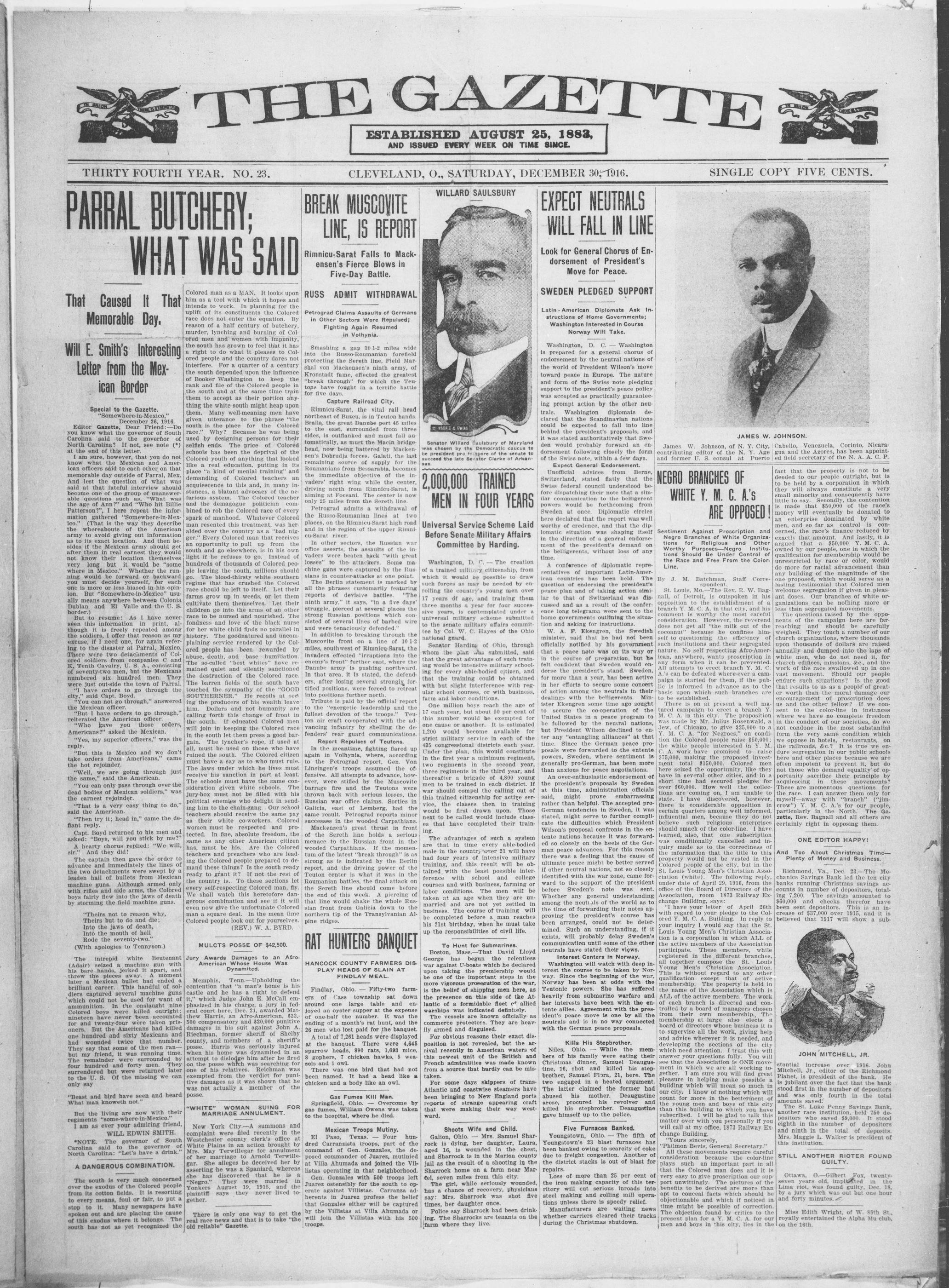
PARRAL BUTCHERY; WHAT WAS SAID
UNITED STATES OF AMERICA
That Caused It That Memorable Day.
Will E. Smith's Interesting Letter from the Mexican Border
Special to the Gazette.
"Somewhere-in-Mexico,"
December 26, 1916.
Editor Gazette, Dear Friend:—Do
you know what the governor of South
Carolina said to the governor of
North Carolina? If not, see note (*)
at the end of this letter.
I am sure, however, that you do not know what the Mexican and American officers said to each other on that memorable day outside of Parral, Mex. And lest the question of what was said at that fateful interview should be able questions such as, "What was the age of Ann?" and "Who hit Billie Patterson?" I here repeat the information gathered "Somewhere-in-Mexico." (That is the way they describe the whereabouts of the American army to avoid giving out information about location. And then besides if the Mexican army had after them in real earnest they would not know their location themselves very long but it would be "some where in Mexico." Whether the running would be forward or backward you must decide yourself, for each one is more or less biased in his opinion, because in Mexico, usually means anywhere, sweet Colon Dublan and El-Valle and the U. S. border.)
But to resume: As I have never seen this information in print, although it is freely repeated among the soldiers, I offer that reason as my excuse, if I need one, for again referring to the disaster at Parral, Mexico. There were two detachments of Colored soldiers from companies C and K, Tenth Cavalry, U. S. A., consisting of seventy-two men, but the Mexicans more men, and they were just out-side the town of Parral. "I have orders to go through the city," said Capt. Boyd. "You can not go through," answered the Mexican officer. "But I have orders to go through," reiterated the American officer. "Who gave you those orders,
"Who gave you those orders, Americans?" asked the Mexican.
"Yes, my superior officers," was the reply.
"But this is Mexico and we don't take orders from Americans," came the hot rejoinder.
"Well, we are going through just the same," said the American.
"You can only pass through over the dead bodies of Mexican soldiers," was the earnest rejoinder.
"That is a very easy thing to do," said the American.
"Then try it; head in," came the defiant reply.
Capt. Boyd returned to his men and asked: "Boys, will you stick by me?" A hearty chorus replied: "We will, sir." And they did!
The captain then gave the order to advance and immediately the lines of the two detachments were swept by a leaden hall of bullets from Mexican machine guns. Although armed only with rifles and side arms, the Colored boys fairly flew into the jaws of death by storming the field machine guns.
"Thethes not to reason why,
Theirs but to do and die:
Into the jaws of death,
Into the mouth of hell
Rode the seventy-two."
(With apologies to Tennyson.)
The intrepid white lieutenant (Adair) seized a machine gun with his bare hands, jerked it apart, and threw the pieces away. A moment later a Mexican bullet had ended a brilliant career. This handful of soldiers captured several machine guns which could not be used for want of ammunition. In the onslaught nine Colored boys were killed outright; nineteen have never been accounted for and twenty-four were taken prisoners. But the Americans had killed one hundred and sixty Mexicans and had wounded twice that number. They say that some of the men ran—but my friend, it was running time. The remainder were surrounded by four hundred and forty men. They surrendered but were returned later to the U. S. Of the missing we can only say
"Beast and bird have seen and heard What man knoweth not."
But the living are now with their regiments "some-where-in-Mexico." I am as ever your admiring friend, WILL EDWIN SMITH.
*NOTE. The governor of South Carolina said to the governor of North Carolina: "Let's have a drink."
A DANGEROUS COMBINATION.
The south is very much concerned over the exodus of the Colored people from its cotton fields. "It is resorting to every means, foul or fair, to put a stop to it. Many newspapers have spoken out and are placing the cause of this exodus where it belongs. The south has not as yet recognized the
THE GAZETTE
Colored man as a MAN. It looks upon him as a tool with which it hopes and intends to work. In planning for the uplift of its constituents the Colored race does not enter the equation. By reason of a half century of butchery murder, lynching and burning, Colored men and women with impunity the south has grown to feel that it has a right to do what it pleases to Colored people and the country dares not interfere. For a quarter of a century the south depended upon the influence of Booker Washington to keep the rank and file of the Colored people in the south and at the same time train them to accept as their portion anything the white south might heap up upon them. Many well-meaning men have given utterance to the phrase "the south is the place, for the Colored race." Why? Because he was being used by designing persons for their selfish ends. The price of Colored schools has been the deprivation of the Colored youth of anything that looked like a real education, putting in its place "a kind of mental training" and demanding of Colored teachers an acquiescence to this and, in many instances, a blatant advocacy of the far-nous system. The Colored teacher and the demagogue politician combined to rob the Colored race of every spark of manhood. Whatever Colored man resented this treatment, was heralded over the country as a "bad nigger." Every Colored man that receives an opportunity to pull up from the south and go elsewhere, is in his own light if he refuses to go. Instead of hundreds of thousands of Colored people leaving the south, millions should go. The blood-thirsty white southern regime that has crushed the Colored race should be left to itself. Let their farms grow up in weeds, or let them cultivate them themselves. Let their children go into the arms of an other race to be nursed and nourished. The fondness and love of the black purse for her white child finds no parallel in history. The goodnatured and uncomplaining service rendered by the Colored people has been rewarded by abuse, death, and base humiliation. The so-called "best whites" have remained quiet and silently sanctioned the destruction of the Colored race. The barren fields of the south have touched the sympathy of the "GOOD SOUTHERNER." He recalls at seeing the producers of his wealth leave him. Dollars and not humanity are calling forth this change of front in the south. If educated Colored men will join in keeping the Colored race in the south let them press a bargain. The lyncher's rope, if used at all, must be used on those who have ruined the south. The Colored citizen must have a say as to who must rule. The laws under which he lives must receive his sanction in pant at least. The schools must have the same consideration given white schools. The jury-box must not be filled with his political enemies who delight in sending him to the chain-gang. Our school teachers should receive the same pay as their white co-workers. Colored women must be respected and protected. In fine, absolute freedom, the same as any other American citizen has, must be his. Are the Colored teachers and preachers who are leading the Colored people prepared to demand these things? Is the south ready to grant it? If not the rest of the country is. To these sections let every self-respecting Colored man, fly. We shall watch this heretofore dangerous combination and see if it will even now give the unfortunate Colored man a square deal. In the mean time Colored people look out for ourselves. (REV. W. A. BYRD.
MULCTS POSSE OF $42,500.
Jury Awards Damages to an Afro-American Whose House Was Dynamited.
Memphis, Tennessee. Upholding the contention that "a man's home is his castle and he has a right to defend it," which Judge John E. McCall emphasized in his charge, a jury in federal court here. Dec. 21, awarded Matthew Harris, an Afro-American, $22,500 compensatory and $20,000 punitive damages in his suit against John A. Allegheny for the theft of Sheehy county, and members of a sheriff's posse. Harris was seriously injured when his home was dynamited in an attempt to dislodge him after he fired on the posse which was searching for one of his relatives. Rechman was exempted from the verdict for punitive damages as it was shown that he was not actually a member of the posse.
"WHITE" WOMAN SUING FOR MARRIAGE ANNULMENT.
New York City. A summons and complaint were filed recently in the Westchester county clerk's office at White Plains in an action brought by Mrs. May Terwillegar for annulment of her marriage to Arnold Terwillegar. She alleges he deceived her by asserting he was a Spaniard, whereas she has discovered that he is a Negro." They were married in Yonkers August 19, 1915, and the plaintiff says they never lived together.
There is only one way to get the
there is what is to take 'the
old reliable', *Sarahite*
ESTABLISHED AUGUST 25, 1883 AND ISSUED EVERY WEEK ON TIME SINCE.
CLEVELAND, O., SATURDAY, DECEMBER 30, 1916.
BREAK MUSCOVITE LINE, IS REPORT
Rimnicu-Sarat Falls to Mackensen's Fierce Blows in Five-Day Battle.
Petrograd Claims Assaults of Germans in Other Sectors Were. Repulsed; Fighting Again 'Resumed in Volthynia.'
Smashing a gap 10 1-2 miles wide into the Russo-Roumanian forefield protecting the Sereth line, Field Marshal von Mackeenus's ninth army, of Kronstadt fame, effected the greatest "break through" for which the Teutons have fought in a terrific battle for five days.
Capture Railroad City.
Rinnieu-Sarat, the vital rail head northeast of Bruze, is in Teunton hands. Bralia, the great Danube port 45 miles to the east, surrounded from three sides, is outfanned and must fall automatically, as must the Macin bridgehead, now being battered by Mackensen's Dobrudra forces. Galati, the last remaining source of supply for the Romanians from Bessarabia, becomes the immediate objective of the invaders' right wing while the center, driving north from Rinnieu-Sarat, is aiming at Focasan. The center is now only 25 miles from the Soreth line.
Petrograd adopts a withdrawal of the Russo-Romanian lines at two places, on the Rinnieu-Sarat high road and in the region of the upper Rinnieu-Sarat river.
In other sectors, the Russian war office userts, the assaults of the invaders beaten back "with great losses" to the attackers. Some, machine guns were captured by the Russians in counter-attacks at one point. The Berlin statement is marked by all the phrases customarily featuring reports of decisive battles. "The ninth army," it says, "in a five days' struggle, pierced at several places the strong Russian positions which consisted of several lines of barbed wire and were tenaciously defended."
In addition to breaking through the Muscovite front on a line of 10.12 miles, southwest of Riumuc-Sarat, the invaders effected "irruptions into the enemy's front" further east, where the Danube army is pushing northward. In that area, it is stated, the defenders, after losing several strongly fortified positions, were forced to retreat into positions further north.
Tribute is paid by the official report to the "energetic leadership and the fullest devotion of the troops." "Teuton air craft co-operated with the advancing infantry by shelling the defenders' rear guard, communications.
Report: Repuples of Teutons.
In the meantime, fighting flared up again in Volhynla, where, according to the Petrograd report, Gen. Von Linsingen's troops assumed the offensive. All attempts to advance, however, were stifled by the Muscovite barrage fire and the Teutons were thrown back with serious losses, the Russian war office claims. Sorties in Galicia, east of Lemberg, had the same result. Petrograd reports minor successes in the wooded Carpathians.
Mackensen's great thrust in front of the Sereth line holds a serious menace to the Russian front in the wooded Carpathians. If the momentum of the latest "break through" is as strong as is indicated by the Berlin report, and the driving power of the Teuton center is what it was in the Roumanian battles, the final attack on the Sereth line should come before the end of this week. A piercing of that line would shake the whole Russian front from Galicia down to the northern tip of the Transylvanian Alpine ridges.
RAT HUNTERS BANQUET
HANCOCK COUNTY FARMERS DISPLAY HEADS OF SLAIN AT FINDLAY MEAL.
Findlay, Ohio. — Fifty-two farmers of (ass township sat down around one large table and enjoyed an oyster supper at the expense of one-half the number. It was the ending of a month's rat hunt, and the 26 men who lost paid for the banquet. A total of 7,261 heads were displayed at the banquet. There were 4,645 sparrow heads, 890 rats, 1,698 mice, 8 gophers, 7 chicken hawks, 5 wensels and 1 owl.
There was one bird that had not been named. It had a head like a chicken and a body like an owl.
Gas Eumes Kill Man
Springfield, Ohio: Overcome by gas fumes, William Owens was taken to the hospital, where he died.
Mexican Troops Mutiny.
El Paso, Texas. — Four hundred Carranzista troops, part of the command of Gen. Gonzales, the deposed commander of Juarez, mutilated at Villa Abumada and joined the Villistas operating in that neighborhood. Gen. Gonzales with 500 troops left Juarez ostensibly for the south to operate against Villistas. Carranza adherents in Juarez profess the belief that Gonzales either will be captured by the Villistas at Villa Abumada or will join the Villistas with his 500 troops.
C. WARNIS C. LIVING
Senator Willard Gaulsbury of Maryland was chosen by the Democratic caucus to be president pro tempore of the senate to succeed the late Senator Clarke of Arkansas.
2,000,000 TRAINED MEN IN FOUR YEARS
Universal Service Scheme Laid Before Senate Military Affairs Committee by Harding.
Washington, D. C. -- The creation of a trained military citizenship, from which it would be possible to draw such forces as may be needed by enrolling the country's young men over 17 years of age, and training them three months a year for four successive years, is contemplated under a universal military affairs committee to the senate military affairs committee by Col. W. C. Hayes of the Ohio national guard.
Senator Harding of Ohio, through whom the plan was submitted, said that the great advantage of such training would be intensive military schooling for every able-bodied citizen, and that the training could be obtained with but slight interference with regular school courses, or with business, farm and labor conditions.
One million boys reach the age of 17 each year, but about 50 per cent of this number would be exempted for one cause or another. It is estimated 1,200 would become available for strict military service in each of the 435 congressional districts each year. Under the plan, this would constitute in the first year a minimum regiment, two regiments in the second year, three regiments in the third year, and thereafter a brigade of 4,800 young men to be trained in each district. If war should compel the calling out of this trained citizenship for active service, the classes then in training would be first drawn upon. Those next to be called would include classes that have completed their training.
The advantages of such a system are that in time every able-bodied male in the country 21 will have had four years of intensive military training, and this result will be obtained, with the least possible interference with school and college courses and, with business, farming or labor conditions. The men will be taken at an age when they are unmarried and are not yet settled in business. The course of training will be completed before a man reaches his 21st birthday, when he must take up the responsibilities of civil life.
To Hunt for Submarines
BOSTON, Mass.—That David Lloyd George has begun the relentless war against U-boats which he declared upon taking the premiership would be one of the important steps in the more vigorous prosecution of the war, is the belief of shipping men here, as the presence on this side of the Atlantic of a formidable fleet of allied warships was indicated definitely. The vessels are known officially as commerce protectors. They are heavily armed and disguised. For obvious reasons their exact disposition is not revealed, but the arrival recently in American waters of this newest unit of the British and French admiralties was made known from a source that hardly can be mistaken. For some days skippers of trans-Atlantic and coastwise steamers have been bringing to New England ports reports of strange appearing craft that were making their way westward.
Shoots Wife and Child
Shoots Wife and Ombuds
Gallon, Ohio. — Mrs. Samuel Sharrock is dying, her daughter, Laura, aged 16, is wounded in the chest, and Sharrock is in the Marlion county jail as the result of a shooting in the Sharrock home on a farm near Marcel, seven miles from this city.
The girl, while seriously wounded, has a chance of recovery, physiclaus say: Mrs. Sharrock was shot five times, her daughter once.
Police say Sharrock had been drinking. The Sharrocks are tenants on the farm where they live.
EXPECT NEUTRALS WILL FALL IN LINE
Latin - American Diplomats Ask Instructions of Home Governments; Washington Interested in Course Norway Will Take.
Washington, D. C. — Washington is prepared for a general chorus of endorsement by the neutral nations of the world of President Wilson's move toward peace in Europe. The nature and form of the Swiss note pledging support to the president's peace policy was accepted as practically guaranteeing prompt action by the other neutrals. Washington diplomats declared that the Scandinavian nations could be expected to fall into line behind the president's proposals, and it was stated authoritatively that Sweden would probably forward an endorsement following closely the form of the Swiss note, within a few days.
Expect General Endorsement.
Unofficial advices from Berner, Switzerland, stated flatly that the Swiss federal council understood before dispatching their note that a similar communication to the belligerent powers would be forthcoming from Sweden at once. Diplomatic circles here declared that the report was well worthy of credence, and that the diplomatic situation was shaping itself in the direction of a general endorsement of the president's demand on the belligerents, without loss of any time.
A conference of diplomatic representatives of important Latin-American countries has been held. The question of endorsing the president's peace plan and of taking action similar to that of Switzerland was discussed and as a result of the conference long telegrams were sent to the home governments outlining the situation and asking for instructions. W. A. F. Ekengroh, the Swedish minister, said that he had not been officially notified by his government that a peace note was on its way or in the course of preparation, but he felt confident that Sweden would endorse the president's stand. Sweden, for more than a year, has been active in her efforts to secure some concert of action among the neutrals in their dealings with the belligerents. Minister Ekengroh some time ago sought to secure the cooperation of the United States in a peace program to be followed by the neutral nations, but President Wilson declined to enter any "entangling alliances" at that time. Since the German peace proposals were forwarded to the entente powers, Sweden, where sentiment is generally pro-German, has been more than anxious for peace negotiations.
An over-enthusiastic endorsement of the president's proposals by Sweden at this time, administration officials said, might prove embarrassing rather than helpful. The accepted pro-German tendencies in Sweden, it was stated, might serve to further complicate the difficulties which President Wilson's proposal confronts in the entente nations because it was forwarded so closely on the heels of the German peace advances. For this reason there was a feeling that the cause of ultimate peace might be better served if other neutral nations, not so closely identified with the war zone, came forward to the support of the president before Sweden's note was sent. Whether any general understanding among the neutrals of the world as to the time of forwarding their notes approving the president's course has been arranged, could not be determined. Such an understanding, if it exists, will probably delay Sweden's communication until some of the other neutrals have stated their views.
Interest Centers In Norway.
Washington will watch with deep interest the course to be taken by Norway. Since the beginning of the war, Norway has been at odds, with the Teutonic powers. *She has suffered heavily from submarine warfare and her interests have been with the entente allies. Agreement with the president's peace move is one by all the neutrals and is in no way connected with the German peace proposals.*
Killa His Stepbrother
Niles, Ohio. — While the members of his family were eating their Christmas dinner, Samuel Deaugustine, 16, shot and killed his stepbrother, Samuel Flora, 21, here. The two engaged in a heated argument. The latter claimed the former had abused his mother. Deaugustine arose, procured his revolver and killed his stepbrother. Deaugustine gave himself up to the police.
Five Furnaces Banked.
Youngstown, Ohio. — The fifth of Youngstown's 23 blast furnaces has been banked owing to scarcity of coke due to freight congestion. Another of the district stacks is out of blast for repairs.
Manufacturers are waiting news
tracks during the Christmas shutdown.
SINGLE COPY FIVE CENTS.
JAMES W. JOHNSON:
NEGRO BRANCHES OF WHITE Y. M. C. A.s ARE OPPOSED!
Sentiment Against Prescription, and Negro Branches of White Organizations for Religious and Other Worthy Purposes—Negro Institutions Should Be Under Control of the Race and Free From the Color Line.
By J. M. Batchman, Staff Correspondent.
St. Louis, Mo. The Rev. R.W. Bagnall, of Detroit, is outspoken in his opposition to the establishment of a branch, Y.M. C. A. in that city, and his comment is worthy the most careful consideration. However, the recurrent does not need to be out of the coconut" because he confines himself to questioning the efficiency of such institutions and their segregated nature. No self respecting Afro-American, anywhere, wants proscription in any form when it can be prevented.
All attempts to erect branch Y.M. C. A.'s can be defeated where ever a campus is informed in advance as to the basis upon which such branches are to be established.
There is on at present a well matured campaign to erect a branch Y. M. C. A. in this city. The proposition was made by Mr. Julius Rosenwald, a Jew, of Chicago, to give $25,000 to a Y. M. C. A. "for negroes," on condition the Colored people raise $50,000; the white people interested in Y. M. A. work have promised to raise $25,000, making the proposed investment $15,000. Colored men here seized the opportunity to have in several other cities, and in a short time had secured pledges for over $60,000. How well the collections are coming on, I am unable to state. I have discovered, however, there is considerable opposition, in certain quarters among well informed, influential men, because they do not believe, such religious enterprises should smack of the color-line: I have learned, also, that one subscription was conditionally cancelled and inquiry made as to the correctness of the information that the title to this property would not be vested in the office of the Board of Directors of the St. Louis Moris Christian Association (white). The following reply, under date of April 29, 1916, from the office of the Board of Directors of the Association; room 1873 Railway Exchange Building, says:
"I have your letter of. April 26th with regard to your pledge to the Colored Y. M. C. A. Building. In reply to your inquiry I would say that the St. Louis Young Men's Christian Association is a corporation in which ALL of the active members of the Association participate. These members, while all together compose the St. Louis Young Men's Christian Association. This is without regard to any other qualification except that of active membership. The property is held in the name of the Association which is ALL of the active members. The work of each branch is directed and controlled by a board of managers chosen by the board of directors. The membership at large. The board of directors whose business it is to supervise all the work, giving help and advice wherever it is needed, and developing the sections of the city which need attention. I trust this will answer your questions fully. You will see that the Association is ONE movement in which we are all working together. I am sure you will find great satisfaction. I am possible a building which will mean a new city. I know of nothing which will count for more in the betterment of the young men and boys of this city than this building to which you have subscribed. I will be glad to talk this matter over with you personally if you will call at my office, 1873 Railway Exchange Building.
"Yours sincerely.
"Phillom Bovis, General Secretary."
All these movements require careful consideration because the colorline plays such an important part in all that the Colored man does and it is very easy to give prescription our support unwittingly. The pictures of the benefits to be derived are more than apt to conceal facts which should be objectionable and which if noticed in time might be possible of correction.
The objection found by critics to the present plan for a Y. M. C. A. for our men and boys in this city lies in the
THE EAGLE
LE COPY FIVE CENTS.
MES W. JOHNSON:
Y. City, Cabello, Venezuela, Corinto, Nicaragua, Y. Age, Agua and the Azores, has been appointed field secretary of the N. A. A. C. P.
I'S CLOSED!
ion and organiza-Other Institu-nt of c Color- Corre- W. Jag- in his of a W. age and his
fact that the property is not to be deeded to our people outright, but is to be held by a corporation in which they will always constitute a very small minority and consequently have little power to make decisions. It is made that $50,000 of the race's money will eventually be donated to an enterprise dominated by white men, and so far as control is concerned, the race's finance reduced by exactly that amount. And lastly, it is argued that a $50,000 Y. M. C. A. owned by our people, one in which the qualification for membership would be unrestricted by race or color, would do more for racial advancement than any building of the magnitude-of the race, which would be a lasting testimonial that Colored men welcome segregation if given in pleasant doses. Our branches of white organizations can be nothing more or less than segregated movements.
The questions raised by the opponents of the campaign here are far-reaching and should be carefully weighed. They touch a number of our church organizations, where thousands upon thousands of dollars are raised annually and dumped into the laps of church edifices, missions, &c. and the work of the race swallowed up in one vast movement. Should our people endure such situations? Is the good that results to us as a people of greater worth than the moral damage our encouragement of proscription does us and the other fellow? If we consent to the color-line in instances where we have no complete freedom in the conduct of our societies, do we not condone in the most substantial form the very same condition which we oppose in hotels, restaurants, on the railroads, &c.? It is true we endeavor to public schools here and other places because we often impotent to prevent it, but do not those who demand equality of opportunity sacrifice their principle by acquiescing in these movements? These are momentous questions for the race. I can answer them only for myself—away with "branch" (j'fum-crow*) Y. M. C. A.'s for our people, particularly in the North. The Gaze, Rev. Bagnall and all others are certainly right in opposing them.
ONE EDITOR HAPPY!
And Too 'About Christmas Time—Plenty of Money and Business.
Richmond, Va., Dec. 23.—The Mechanics Sayings Bank led the ten city, banks running Christmas savings accounts in number of depositors, totaling 7,200. The savings amounted to $60,000 and checks therefor have been sent depositors. This is an increase of $37,000 over 1915, and it is believed that 1917 will show a sub-
JOHN MITCHELL, JR.
stantial increase over 1916. John Mitchell, Jr., editor of the Richmond Planet, is president of the bank. He is jubilant over the fact that the bank stood first in the number of depositors and was only fourth in the total amounts saved.
The St. Luke Penny Savings Bank, another race institution, held 750 depositors who saved $9,000. It stood eighth in the number of depositors and ninth in the total of deposits. Mrs. Maggie L. Walker is president of this institution.
STILL ANOTHER RIOTER FOUND GUILTY.
Ottawa, O.—Gilbert Fox, twenty-seven years old, implanted in the Lima riot, was found guilty, Dec. 18, by a jury which was out but one hour and forty minutes.
Miss Edith Wright, of W. 85th St., royally entertained the Alpha Mu club, on the 16th.
PUBLISHED EVERY SATURDAY
SUBSCRIPTION RATES
(In Advance)
One Year.....$1.50.
Six Months.....1.00
Three Months......50
Subscribers are requested to re-
mit by postoffice money or
der or registered letter
Entered at the postoffice in Cleveland,
Ohio, as second-class matter.
Address all communications to
Blackstone Building, Cleveland, O.
Member Ohio Legislature: 1894
to 1896; 1896 to 1898; 1900 to 1902
THE GAZETTE is the oldest, and
has the largest bona fide circulation,
double that of any newspaper in the
interest of Afro-Americans, published
in the state of Ohio, and comparison
with will immediately establish
its rank as one of the NEWSIEST
AND BEST in the country.
10,000,000 Afro-Americans..
180,000 in Ohio.
20,000 in Cleveland.
SATURDAY, DECEMBER 30, 1916.
"Let us have faith that right makes might, and in that faith let us to the end dare to do our duty as we understand it."—Abraham Lincoln.
HAPPY NEW YEAR TO ALL.
Wonder where Terwillegar got that name?
If you make any resolutions for the coming year, we trust that you will keep them.
"Goin' some!" Editor John Mitchell of the Richmond (Va.) Planet. Congratulations confere! Also, Mrs. Maggie L. Walker.
The Gazette will enter 1917 profoundly grateful for the generous success it has l.d. during the year just closing. Help us to improve upon it, the coming year; we wish to double our circulation in 1917.
Again this year, many friends have been very kind indeed, remembering the editor with Christmas gifts, valuable and useful — all most pleasing Friends, we thank you; it is very en courageing and makes us feel as if our work is really appreciated.
Our many readers will agree with us, we know, when we say that Prof Will. E. Smith's letters to The Gazette from the Mexican border are always illuminating. This same is equally true of Dr. Wm. A. Byrd's contributed editors and Mr. J. M. Batchman's articles from St. Louis. "The Old Relieable" is especially fortunate, these days, in the matter of contributors. Start the new year right—tell your friends—by subscribing for The Gazette.
Where-over "branch" ("jim-crow") Y. M. C. A.'s are established here in the North for our people, their members only are denied the full use of the central and all other Y. M. C. A.'s in that city not established especially for Afro-Americans. This rivals the Y. M. C. A. color-line and segregation on our people of the city or town in which the "jim-crow" or "branch" Y. M. C. A. is established. This fact is not brought to the surface often enough. Couple with it the fact made so clear in our St. Louis staff correspondent's letter, elsewhere in this paper, and remembering what a dangerous precedent such segregation is in any northern community, and any self and race respecting member of the race ought to have enough to thoroughly convince him that "branch" or "jim-crow" Y. M. C. A.'s in this section of the country are not only most undesirable but absolutely vitally harmful.
POWER OF THE SOUTHERN VOTER.
In shaping national legislation one vote in Alabama, Arkansas, Florida, Georgia, Louisiana, Mississippi, South Carolina, or Virginia is worth as much as five votes cast in Connecticut, New Jersey, Ohio, Michigan, Iowa, New Mexico or Idaho. The eight southern states enumerated cast a total of 511-199 votes for the election of members to sit in the Sixty-fourth Congress. This makes an average of 7,745 votes to each district, the entire number of districts returning 64 Democrats, one Republican and one Progressive.
For the seven northern States mentioned, the total vote at the same time was 2,587,402, or an average of 39,203 votes for each district, returning 50 Republicans and 16 Democrats. Thus slightly over half a million southern voters have 66 spokesmen in the House of Representatives, whereas it required more than two and a half million northern voters to secure equal representation. The inequality in voting power is the 'outcome,' of course, of a basis of total population forming the several southern Congressional districts where the Afro-American is counted in, but his vote excluded. How long must this inequality continue? Are the North and the Republican party to supinely continue to submit indefinitely to this condition of affairs?
WILLIS' POLITICAL LESSON.
Gov. Frank B. Willis will vacate the office in about 10 days. We wonder if he has learned his political lesson? Hardly he been inaugurated, two years ago, than he began to give his best appointments to Republicans representing the portion of the party that had most actively opposed him for the gubernatorial nomination and did not support him any too actively during the campaign for his election.
This to the exclusion of most of his friends who had worked hardest for him from the very beginning. This mistaken policy he pursued throughout his administration, only trying to "jolly" his old friends into supporting him again this fall. Of course, this failed. How he broke his voluntary
"GERMANY" HUDSON.
promise to our people and mistreated them in several ways in order that he might continue to cater to the portion of the party that had opposed him so actively prior to his nomination, has been told so often in The Gazette that repetition is unnecessary at this time. However, we wonder if he remembers how The Gazette repeatedly warned him that the Maschke-Davis faction in this county, that so actively opposed his nomination, could not be depended upon to carry Cuyahoga (county) for him, and that it (the faction) would not make up for the loss of the united support of our vote either in this county or the state, in event of his permitting State Oil Inspector Carr to make the appointment of "Germany" Hudson as a deputy for this county over the protests filed with him (the governor)? This is really what defeated Gov. Willis at the recent election, for if he had received the united support, last month, he received from our people, two years ago, Governor-elect Cox's plurality of a little more than 5,000 would have been wiped out and a like plurality given Willis. It pays, even in politics, to be loyal to your friends, Frank!
Because she refused to send her two children to a "jim-crow" (basement) school, Mrs. Rebecca Simms of Downington, Pa., was fired $4.40 by Justice Hunter Wills, of West Chester, Pa., Dec. 20, 1916, and refusing to pay the fine was sent to jail. Mr. Simms testified that he was willing to pay the fine in order to keep his wife from going to prison, but she refused to permit him. He said that he wanted treatment just the same as other people who paid taxes. Of course, and should have it, too. After the testimony of several witnesses and the argument of counsel, the court granted the appeal for a new trial. This occurred in PENNSYLVANIA and not Georgia or Alabama! May the good Lord bless "Sister" Simms. O, how we need more of her kind in Ohio as well as Pennsylvania and throughout the North.
Dr. W. E. B. Du Bois and Mr. Oswald Garrison Villard, of the N. A. A. C. P., have "fallen out," the latter re
DR. W. E. B. DU BOIS.
signing from the editorial board of the Crisis. For a long time there have been rumors of an "impending crisis" in the N. A. A. C. P., with DuBois as the central figure. Villard does not like DuBois' aggressive attitude in race matters, and leans more to the "Booker T. Washington doctrine of
O. G. VILLARD.
surrender" course, although not fully indorseing it. It begins to look as if Dr. Wm. A. Byrd's recent O. G. Villard editorial suggestions in The Gazette are being accepted by that gentleman (Villard), if not by one or two race newspapers.
CHIFF ROWE'S ORDER!
Cleveland, O., Dec. 22nd, 1916.
Hon. Harry C. Smith, Editor Gazeette, My Dear Sir:—A marked copy of my Gazeette, my Editor Gazeette, 23rd, 1916, I am pressed to S. Rowe, chief of police, was received. I read the editorial to him carefully. He was much surprised to learn that a member of this department had used such language in criminal court and immediately dictated an order to Norman A. Shaw, a lawyer for the police, which I herewish enclose to you. The chief desires to thank you very much for calling his attention to this matter and wishes to assure you that
there will be no further cause for complaint. I beg to remain,
Very truly yours,
CHARLES S. SMITH,
Secretary to Chief of Police.
FRESH OHIO NEWS
thousands right to v biggest del Lotte fede ter of a ce Every A
THE CHIEF'S ORDER
December 22nd, 1916.
Order No. 277 A.
Norman A. Shattuck,
Inspector of Police.
Sir:—I am attaching hereto an editorial from The Gazette commenting on the conduct of a police officer in Criminal Court.
It hardly seems possible that a police officer could be guilty of this offense after having received instructions which are so frequently given to the members of the department regarding their conduct toward citizens and their manner of giving testimony in courts. Ascertain what policeman it was that used the language and order his captain to severely reprimand him for his conduct and laughed. Also direct the captains of districts to have the matter thoroughly explained at their Schools of Instruction.
All of the foregoing is just what we expected from Chief Rowe whom we have known for a great many years as a friend of the race. He is a "broad minded Clevelander" who was reared and schooled in this city, "side by side" with members of our race, and who has never yet failed "to meet the writer half way or more" whenever we have had to appeal to him for fairness and justice (in his power to give) for our people. He is not only a good clean man (from a character viewpoint) but an exceptionally capable chief of police, all criticism to the contrary notwithstanding. His father, Cleveland's first real good detective, undoubtedly taught the son the rudiments of the profession, and the latter has a life-long experience on the police force of this city as a foundation for his sterling efficiency, when left unhampered by political local "city administrations."
Thank you for the "order," chief.
VILLARD AND LEADERSHIP
Some of our contemporaries are running to the defense of Mr. Oswald Garrison Villard. We shall not quarrel with them about it, but we reiterate, there is no middle ground! If Mr. Villard approves the policies of President Wilson respecting the Colored people, he cannot fight the battles of the Colored race so as to get for it real freedom! Any man, or organization or newspaper that straddles and wabbles on the issue of absolute equality of the Colored race in everything respecting citizenship with other races, cannot be a leader of the race!
The Colored race is not going about asking anybody to be our friends. What it demands is constitutional justice as an American citizen. It is a sign of inferiority and truckling when a Colored man speaks loudly about "our white friends." As a race, we are not asking to put our friends or foes in the White House, but we do demand that whoever goes there is duty bound to be just and fair with all American citizens. "Our white friends" in the South are the most useless class extant! They speak after the mean deed is executed. They are worth nothing as a preventative.
That Mr. Villard by voting for and supporting Mr. Wilson can get better consideration for the Colored people at his (Wilson's) hands is a damaging admission. As a man among men, I would spurn any consideration given me because some white man can intercede and get it for me. If I am entitled to it, the constitution demands that I shall have it. If I am not entitled to it, no one should seek to get it for me, for in so doing the constitution is being destroyed. As a man, Mr. Villard is fine but as a leader in the fight for justice for Colored Americans, he has compromised by doing as he has.
(Rev.) Wm. A. Byrd.
Written by 'The Old Reliable Gazette's Correspondents
THROUGHOUT THE STATE
What Our People Are Doing Each Week—Church, Personal, Social, Lodge, Literary and Musical — Marriages, Deaths, Etc.
YOUNGSTOWN — St. Augustine mission men's club elected the following officers, recently: H. G. Emerson, pres; C. B. Stewart, vice-pres; C. B. Robinson, treas; Geo. Jefferson, sec; Rev. J. T. Ogborn, C. O. C. H. Crumpler, cor. sec; R. B. Crumpler, reporter. Next meeting, Jan. 8, at the mission—Quite a number spent the holidays out of the city—At its last meeting, Logan lodge received a number of applications and elected the following officers for the ensuing term: T. H. Lonesome, C. C.; Gaines Williams, V. C.; Jesse Pine, M. of F.; G. Plater, M. of S.; and S. of E. M. Logan, prelate; J. F. Patterson, M. of W.; E. S. Moore, M. of A.; trustees, Park Hall, C. H. Lincoln and Howard Thompson; delegate, J. F. Patterson; alternate, G. Williams. St. Augustine mission cleared $175 on its fair, the 6th and 7th, and wishes to thank all who helped in any way to make it the encouraging success it certainly was.
CORRESPONDENTS must mail all letters for publication at their main postoffice sufficiently early on Monday (or Sunday) of each week to have them reach The Gazette office on Tuesday morning, and always write also, their names and that of their city or town on the outside of the wrapper about returned copies. Unless this latter is done, proper credit cannot be given you. Lists of names, wedding presents, etc., obituary notices, speeches, resolutions, poetry, inquiries, advertisements and advertisements of all kinds, including items announcing entertainments to be held in the near future, must be paid for in advance at the rate of ten cents a line, six words to a line. Our rates for display advertisements will be sent on application.
HILLSBORO—Mrs. Lizzie Porter and Mrs. Nannie Cannon, of Cleveland, visited here, last Monday.—Mrs. Redenman, of Circilleau, spent the holidays here.—Myril Dent, of Springfield, is visiting her mother, Mrs. Rosa Harris.—Mrs. Mortimer Wilson and daughter, of Indiana, visited her parents during the holidays.—George Atchison, of Alma University.—Mose Trimble and Fred Williams, employed on the New York Central lines in Cleveland, spent Saturday to Wednesday day here.—Booker T. Atchison is here, from school at Columbus, to spend his vacation with his father, Mr. George Atchison—George Trimble Jr., of Cleveland, spent Xmas here with relatives.—Mr. and Mrs. Frye, Mr. and Mrs. Smith and daughter, Jnan Patel, spent Xmas here with relatives, Mr. and Mrs. Milton Day.—Mr. John Hudson has returned from Cleveland.—Miss Romayne Donaldson, of Wilberforce University, spent the vacation here with parents. Her sister, Mrs. Walker, of Cincinnati, spent Friday day here.—The cantata, "Loyal Santa Claus," at Lincoln school, was a success, and the audience was greatly pleased. The teachers deserve much credit.—Mrs. Ona Peyton, of Columbus, is visiting her mother, Mrs. Burton, during the holidays.
DOINGS
OF
THE
RACE
Start the new year right—subscribe
for the old reliable Gazette.
The Texas Supreme court has re-
fused to sustain that state's "jim-
crow" car law.
Madam E. Azalia Hackley and
Bishop Alexander Walters are in N. Y.
City hospitals for slight operations.
Ladies, our fashion page is the latest and best—up to date! Tell your friends and acquaintances about it, please.
By the will of Mr. John Martin, merchant, Philadelphia, probated recently, our Home for the Aged and Infirm of that city, will receive $5,100. Editor John H. Murphy, of the Moore (M.A. Afro-American) been appointed on the federal grand jury for the January term. He would make an excellent foreman of the jury, too. Walter White, age 18, of Boston, has appointed a stenographer in the War Department, Washington, D.C., at a salary of $1,000. He gained the position through the civil service.
At a recent meeting of the Woman's Relief Corps, No. 99, of Stouston, Mass., Miss R. Adelaide Washington, the only Afro-American member, was unanimously elected president. She is a florist.
Among $63,000 in charitable bequests, on the of the $3,000,000 estate of Brownsboro, Northristown, Pa., $2,000 each to our Shelter for Orphans, Philadelphia, and Frederick Douglass Hospital, same city.
Madam Schumann-Heink who was filling an engagement in San Francisco, presented Mrs. George Dorsey with a check for $50 to be used for the benefit of our poor children of that city for a Christmas tree. Congressman Isaac Shirwood, of Toledo, has elected president of the Booker T. Washington Memorial Association, to which plans have just been presented for the erection of a memorial to the Tuskegee educator in Washington, D. C., to cost $100,000. Professor University proposes to build a memorial to the memory of William Hayes Ward, late editor of the New York Independent, in the form of a science building, which shall perpetuate his memory in a substantial way among Afro-Americans, whose consistent friend Mr. Ward was. After the holiday recess of Congress, the whole question of the South's methods of carrying elections and denying to the Afro-American and
thousands of white Republicans the right to vote, may come in for the biggest debate of the kind since the Lodge federal elections bill of a quarter of a century ago. Every Afro-American home should have at least one race paper in it. We need our press to defend the cause and advance the progress of the race, and we here appeal to all true hearted Afro-Americans to rally to the effort our journals in more of our homes. If you are loyal to the cause of race enterprise which makes more and more employment as well as enlightens a race, now is a time to show it.—Ex.
AN OHIO-AN IN GEORGIA
Writes "The Old Reliable" is Well-known Away Down in "Dixie" "as a Fighter for a Square Deal for the Race."
Fort Valley, Ga., Dec. 19, 1916. Editor Gazette. My dear Mr. Smith: —I am enclosing my subscription (renewal to The Gazette, and wish you Christmas and a Happy New Year.
I read with interest each issue that reaches me, and note with interest and appreciation your efforts for race solidarity against issues that are detrimental. Down here in the heart of "Dixie" you are well-known as a fighter for a "square deal" for the race. I am
Dr. J. K. Nickens has arrived in the city from a year's lecture tour through the South. He says he will be busy the rest of the winter filling orders for his medicines. Good!
Mrs. Baldwin Allen, of Xenia, is spending the holidays with her sister, Mrs. A. T. Abbott, 2127 E. 96th St. Mrs. M. A. Mitchell, Mr. Abbott's sister, who has been visiting them, is spending the holiday season with another brother in Newport, Ky.
LEGAL NOTICES
Edward M. Tracy, whose residence is unknown, is hereby notified that O. E. S. Brown has filed his petition in case No. 153,040, in the common pleas court of Cuyahoga County Ohio against said defendant and setting forth therein that he is the owner in fee simple and in possession of the following described premises:
Situated in the City of Cleveland, Cuyahoga County, State of Ohio, and known as being sub-lot No. 179 in L. A. Kelley's Allotment No. 3, of a part of general lots Nos. 452 and 453 formerly in Newburgh Township, as recorded in Volume 16 of Maps, Page 20 of Cuyahoga county records.
That the aforesaid defendant claims an ownership or some interest in the above described property adverse to said plaintiff, but that he has none in reality. The prayer of said petition is that the claims of said defendant may be adjudged null and void; that plaintiff's title to said premises may be used and for such other and further belief as may be just and equitable.
Said defendant is required to answer said petition on or before, Feb. 3, 1916, or judgment will be taken against him.
E. O. S. Brown.
By Fred L. Thompson, his attorney.
Zuzanna Hrkal whose residence is unknown, is hereby notified that E. O. S. Brown, has filed his petition in case No. 153,039, in the common pleas court of Cuyahoga County, Ohio, against said defendant, setting forth the legal Lot No. 153,039 for free simple and in actual possession of the following described premises:
Situated in the City of Cleveland, County of Cuyahoga and State of Ohio, and known as being part of Original Lot No. 428, and being Sub-Lot No. 88 in the Rice Homestead Allotment of Ohio, being 35 feet front on the easterly side of East 118th. Street and extends back of equal width 104 feet deep.
That the aforesaid defendant claims some interest in the said property adverse to said plaintiff, but that she has none in reality. The prayer of said petition is that they may be adjudged full and void; that plaintiff's title to said premises be quieted and for such other and further relief as may be just and equitable.
Said petition is required to answer said petition on or before Feb. 3, 1917, or judgment will be taken against him.
E. O. S. Brown,
By Fred L. Thompson, his attorney.
Martin A. Gates and Martha A. Gates, whose residences are unknown, are hereby notified that E. O. S. Brown has filed his petition in case No. 153,038 in the common pleas court of Cuyahoga County, Ohio, against said defendants, and the setting through that he is the owner in fee simple and in possession of the following, described premises:
Situated in the City of Cleveland, County of Cuyahoga and State of Ohio and known as being Sub-Lot No. 88 in the W. H. Kelley's Heirs Allotment of part of Original No. 445, as is shown by the plot of aid settlement in Volume 14 of Mans, page 30 of Cuyahoga County Records.
Said Sub-Lot No. 88 being forty feet front on the north side of Oakfield Avenue formerly known as Cannon Street.
That the defendants claim an ownership or some interest in the above plantation adverse to said plaintiff, but that they have none in reality. The prayer of said petition is that the claims of the said defendants may be adjudged null and void; that the plaintiff's title to said premises may be quieted and for such other and further relief as may be just and equitable.
Said defendants are required to answer said petition on or before Feb. 3, 1917, or judgment will be taken against them. E. O. S. Brown, By Fred L. Thompson, his attorney.
CORRESPONDENTS WANTED
The old reliable Gazette desires an active agent and correspondent in every city and town in Ohio and neighboring states having a number of Afro-American residents. Only a little time on Fridays or Saturdays is required. We especially desirous of hearing from persons in the following named cities: Springfield, Dayton, Plaqu, Mt. Vernon, East Liverpool, Akron, Lima, O., and other places, particularly in Ohio, where we have none.
Write to the editor of The Gazette, Blackstone building, Cleveland, O., and terms will be sent promptly. Our attention will be greatly by sitting at once the addresses of persons in the cities named and others in the state, to whom we can write relative to the matter.
USE GORDON'S HAIR GROWER
Then Watch the Results
This GREAT VALUE is sold with the understanding that if it does not grow the hair your money is refunded at any time. Save the empty boxes; they are worth five cents each.
If your hair is falling out, use GORDON'S GLORY SHAMPOO CREAM, and if splitting at the ends, rub GORDON'S GLORY HAIR GROWER direct to the scalp and be relieved of such horrible trouble.
If your hair is f
POO CREAM, and if
HAIR-GROWER direc
tible trouble.
GORDON'S GLO
GORDON'S STR
ment, $1.25.
Agents make
everywhere. WRITE
O. C. Gordon's
FORD
HAIR POMA
MAKES HAIR
KINNY HAIR SOR
MORE PLAYABLE
TO COMB AND
IN ANY STYLE
LENGTH WILL PERF
PRICE 25¢ AND 50¢ A B
FORD'S HAIR STRAIGHTENER
FOR O.D. PHOTOGRAPHY THE MAKE
BY ROLLING IT BETWEEN YOUR PAIR
ROLLS. BEST AND QUICEST THING
WE KNOW OF STRAIGHT HAIR
PRICE $1.50
PATENT SECTIONAL
PATENT
DEVICES FOR HAIR
FORD'S SPIRAL HANDLE
HAIR STRAIGHTENING AND CLOSING
COM NO.004. HAIRS MICHEL
PLATED, LARGE AND VERT STRONG
KNEST DRIVE THE HAND OF SPECIAL
GREENGUARD PRICE. MODEL THE HANDLE
WITHOUT SOLDERING PRICE $1.00
FORD'S MEDIUM SIZED
BROTHER AND
HAIR STRAIGHTENING COM NO.004.
A GOOD AND SERVICED COMFORT
FOR THE MONEY. PRICE $5.00
ALL OUR GOODS WARPAMED AS
FOR SALE BY YOUR PAIR OR OVER
PRICE. IN WRITING DIRECT, LAND M
OZONIZED OX A B
If your hair is falling out, use GORDON
POO CREAM, and if splitting at the ends, use
HAIR-GROWER direct to the scalp and be
rible trouble.
GORDON'S GLORY HAIR-GROWER, 50
POO CREAM, and if splitting at the ends, use
HAIR-GROWER direct to the scalp and be
rible trouble.
GORDON'S GLORY SHAMPOO CREAM,
GORDON'S STRAIGHTENING COMB,
ment, $1.25.
Agents make from 10 to 15 dollars per
everywhere. WRITE.
O. C. Gordon's Laboratory WINES
FORD'S
HAIR POMADE
MAKES HARSH
KINKY HAIR SOFTER,
MORE PLAINABLE, EASHER
TO COME AND PUT IN
ANY STYLE THE LENGTH WILL PERMIT
PRICE 25¢ AND 50¢ A BOTTLE
FORD'S HAIR STRAIGHTENER
NO O223 HAIR STRAIGHTENER THE HAIR
BY ROLLING IT BETWEEN FOUR BRASS
ROLLS. BEST AND QUICEST THING
WE KNOW OF TO STRAIGHTEN HAIR
PRICE $1.50
PATENT SECTIONAL TOOCH COMB
PATENTED LOCKING
DEVICE FOR MOLDING TEETH TIGHT
NO O223 TE
SEPARATE PLA
STEEL BANDS
THE TEETH BAND
BY TWISTING
THE ELEVEN
AND HOLDING
FORD'S SPIRAL HANDLE
HAIR STRAIGHTENING AND SHAMPOO
COMB NO O223. SOLID BRASS, NICKEL
PLATED, LARGE AND VERY STRONG
LONG TURN THE MANDLE IN SPECIAL
LOCKING DEVICE HOLDS THE HANDLE
WITHOUT SOLDERING PRICE $1.00
FORD'S SMALL BRASS
LARGE SERVICE
MANDLE
FORD'S MEDIUM SIZED
MANDLE STRAIGHTENING COMB NO O226
A GOOD AND SERVICEABLE COMB FOR
THE MONEY PRICE $5.00
ALL OUR GOODS WARRANTED AS DESCRIBED OR MONEY REFUNDED.
FOR SALE BY YOUR DEALER OR DIRECT FROM US UPON RECEIPT OF
PRICE. IN WRITING DIRECT AND MONEY BY POST OFFICE OR SERVICES MONEY.
OZONIZED OX MARROW CO. 46 W
A Busy L
GLOBE GLOSSARY
GORDON'S STRAIGHTENING COMBS, and LAMP attachment, $1.25.
Agents make from 10 to 15 dollars per week. Agents wanted everywhere. WRITE.
O. C. Gordon's Laboratory
No. 209 Roanoke St
WINSTON-SALEM, N. C.
FORD'S
HAIR POMADE
MAKES HARSH
KINNY HAIR SOFTER
WITH PHONE LEVER
TO CMB AND PUT UP
IN ANY STYLE THE
LENGTH WILL PERMIT
PRICE 25¢ AND 50¢ A BOTTLE
FORD'S
ROYAL WHITE
SKIN LOTION
MAKES THE SKIN
LOOK WHAT
AS SOON AS IT IS
PUT ON EXCELLENT
FOR SIMPLES, ROUGH SKIN AND
LOCAL SKIN DISEASE
PRICE $5.99 A BOTTLE
FORD'S PATENT
TWO PICE SHAMPOO
AND HAIR STRAIGHTENING
COMB NO.023.1 TEETH IN THE COMB
NO.023.2 HEAT IN THE COMB
THE ROD, NOT THE COMB
THUS SHOWING BRINGING
AND SOILING THE COMB
RETAINS HEAT LONGER. PRICE $1.00
PATENTED LOCKING
DEVICE FOR BUILDING TEETH TIGHT
NO.023.2 TEETH IN THE COMB ARE MADE OF
SEPARATE PIECES OF BRASS, MOUNTED ON A ROUND
STEEL AND WELD IN A WET FERRULE. SHOULD
THE COMB BE CLOSE LOSE, TURN THE PERMUE
BY TWISTING THE HANDLE AND THIS WILL PRESS
THE LIEVE UP TIGHTLY AGAINST THE HANDLE
AND MOLD THE FINALLY. PRICE $1.25
FORD'S SPIRAL HANDLE
HAIR STRAIGHTENING AND SHAMPOO
COMB NO.024 SOLID BRASS, NICKEL
PLATTER AND VERY STRONG
LOCKING DEVICE HOLDS THE HANDLE
WITHOUT SOLIDERING PRICE $1.60
FORD'S LARGE BRASS
SHAMPOO AND HAIR STRAIGHTENING
COMB NO.025 WOODEN BRASS
LARGE AND VERY STRONG, MAKING THE
SERVICEABLE COMB NO.026 GNAPPY Hair
NICKEL PLATED. PRICE $1.00
FORD'S MEDIUM SIZED
BRASS SHAMPOO AND
HAIR STRAIGHTENING COMB NO.026
A GOOD AND SERVICABLE COMB FOR
THE MONEY. PRICE $5.00
SHAMPOO AND HAIR STRAIGHTENING COMB NO.027
A SMALL LONG COMB USED BEST ON REAL SHORT
Hair, NICKEL PLATED. PRICE $2.50
ALL YOUR GOODS WARRANTIES ARE DESIGNED, ON MONKEY RETURN.
FOR SALE ONLINE FROM US UP TO RECEIPT OF
PRICE. IN WRITING BEST AND MONEY BY POST OFFICE OR EXPRESS MONEY ORDER:
OZONIZED OX MARROW CO. 46 W.KINZIE ST.CHICAGO,ILL.
ABusyLife
BY HON. JOSEPH BENSON FORAKER
The Most Important Autobiograph
Mr Foraker has given us his experiences
on the Bench, as Governor of Ohio and in
United States.
Political and public events of great imp
ally many national characters are dealt w
lightening manner.
The work will prove of special interest
political history whether they are public or
spirited Americans, interested in the pres
The Most Important Autobiography
Mr Foraker has given us his experiences in the Bench, as Governor of Ohio and in United States.
Political and public events of great imply many national characters are dealt with tightening manner.
The work will prove of special interest political history whether they are public or spirited Americans, interested in the presse
The Most Important Autobiography In Years
Mr Foraker has given us his experience in the Union Army on the Bench, as Governor of Ohio and in the Senate of the United States.
Political and public events of great importance and incidentally many national characters are dealt with in the most enlightening manner.
The work will prove of special interest to all students of political history whether they are public officials or only public spirited Americans, interested in the preservation of our institutions.
2 VOLS. NET $5.00
All orders sent direct to the
"THE GAZETTE"
Blackstone Bldg., Cleveland, O.
will have the personal direction
of its Editor
TEAR OFF HERE
The GAZETTE
Blackstone Bldg.
CLEVELAND, O.
Please send me eop
"Notes of a Busy Life"
BY J. B. FORAKER
Net $5.00 for which I enclose
Name
Address
12 GREAT SERIALS OR GROUP STORIES IN 1917
Stories upon Stories—and plenty of them. Action, Life, Adventure, Fun, Pathos, Inspiration.
The Youth's Companion
will make 1917 a Great Story Year. Besides the Great Serials and 250 Short Stories, there are rare Special Pages for each one. Family Page, exceptional Editorial Page, Boys' Page, Girls' Page, Children's Page, Doctor's Corner, Current Events, Nature and Science, Travel, Information, etc.
Everything from everywhere for everyone in the family.
THE YOUTH'S COMPANION, St. Paul St., BOSTON, MASS.
CUT THIS OUT
and send it (or the name of this paper) with
$2.00 for The Companion for 1917,
and we will send you
FREE at the remaining issues of THE COMPANION for 1917.
FREE THE COMPANION HOME CALENDAR.
THEN The Fifty-Two Weekly Issues of THE COMPANION for 1917.
SUBSCRIPTIONS RECEIVED AT THIS OFFICE
Subscribe for the Gazette
USE GORDON'S HAIR GROWER Then Watch the Results
This GREAT VALUE is sold with the understanding that if it does not grow the hair your money is refunded at any time. Save the empty boxes; they are worth five cents each.
calling out, use GORDON'S GLORY SHAM-Splitting at the ends, rub GORDON'S GLORY to the scalp and be relieved of such hor-
HY HAIR-GROWER, 50c per box.
HY SHAMPOO CREAM, 25c per jar.
HAIGHTENING COMBS, and LAMP attach-
ment 10 to 15 dollars per week. Agents wanted
Laboratory
No. 209 Roanoke St
WINSTON-SALEM, N. C.
FORD'S
ROYAL WHITE
SKIN LOTION
MAKES THE SKIN
LOOK WHITER
AS SOON AS IT IS
PUT ON EXCELLENT
FOR PIMPLES, ROUGH SKIN AND
LOCAL SKIN DISEASES
PRICE $25 A BOTTLE
FORD'S PATENT
TWO PIECE SHAMPOO
AND HAIR STRAIGHTENING
COMB NO.023. YOU HEAT
THE ROD, NOT THE COMB
THEN DUMPING BURNING
AND SOiling the COMB
RETains Heat Longer. PRICE $1.50
NO.023½ TEETH IN THIS COMB ARE MADE OF
SEPARATE PIECES OF BRASS, MOUNTED OR SOLID
STEEL LOOSE AND WELD BY A PATENT FERULE. AHOULD
THE TREAT BROOME LOOSE. TURN THE FERULE
BY TWISTING THE HANDLE AND THIS WILL PRESS
THE SLEEVE UP TIGHTLY AGAINST THE TEETH
AND MOLD THEM FIRMLY. PRICE $1.25
FORD'S LARGE BRASS
SHAMPOO AND HAIR STRAIGHTENING
COMB NO.025 WOODEN HANDLE
LARGE AND VERY STRONG, MAKING A GOOD AND
SERVICEABLE COMB FOR MINI AND KNAPPY HAIR
NICKEL PLATED. PRICE $1.40
SHAMPOO AND HAIR STRAIGHTENING COMB NO.027.
A SMALL STRONG COMB USED BEST ON REAL SHORT
HAIR. NICKEL PLATED. PRICE $2.50
FORD'S HAIR PRESSER
NO.028 NICKEL PLATED.
STEEL FRAME, SOLID BRASS
KNobs. VERY SERVICEABLE
PRICE $5.00
SCRIBED OR MONEY REFUNDED.
FROM US UPON REceipt OF
BY POST OFFICE OR PRESS MONEY ORDER:
MARROW CO. 46 W.KINZIE ST.CHICAGO,ILL.
Important Autobiography In Years
when us his experience in the Union Army'
Governor of Ohio and in the Senate of the
e events of great importance and incident-
characters are dealt with in the most en-
ove of special interest to all students of
wer they are public officials or only public
interested in the preservation of our insti-
V
3003 Central Ave.
Under New Management!
Watch Our Windows
For Bargains
Colored Saleslady
We close at 8 P.M. every
evening except Saturday
MME. C. H. JONES'
Hair Tonic and Invigorator
HER TONIC is the result of scientific study of the causes of diseases of the scalp.
Instead of treating effects of the diseases she treats the causes, eliminating the same cause, having the scalp in a healthy condition that can be maintained by using her Hair Tonic and Invigorator, according to her directions.
Mediane C. M. Jones Hair Tonic and Invigorator is guaranteed to stop the falling out of the hair and to make the hair
It has been successfully used by many ever since 1900 and with perfect satisfaction by many Toledo people and elsewhere, by many Toledo people and elsewhere. Many people get diseased scalps by using widely advertised hair tonics prepared by unappreciated persons who have fallen ill. On the other hand, MADAME JONES HAIR TONIC and INVIGORATOR is absolutely claimed for it. MADAME JONES Hair Tonic and Invigorator promotes the growth of the hair, prevents and cures baldness, restores hair color and disables hair parts just and beautiful; it colors the hair by supplying it with the natural elements and necessary nourishment. MADAME C. H. JONES 383 Woodland Toledo, Ohio Agents Wanted.
FOR
Pure Drugs, Prescriptions
AND
Cut Rate Patent Medicines
GO TO
The Arlington Pharmacy
S. W. Cor. E. 55th Street
and Central Avenue
The State Agricultural and Mechanical College of South Carolina
Orangeburg, S. C.
Next session begins September 27th and ends May 25th, 1917.
No Tuition, no Room Rent, no Charges for Water, Lights or Fuel. Entrance Fee $10.00.
Board $6.00 per Month in Advance. Books, Laundry and Personal Expenses Extra.
Every Modern Facility. Standard Equipment. A Faculty of 57 Officers and Instructors.
For Information and Catalogue, Write
R. S. Wilkinson, Pres.
Orangeburg, S. C.
G. G. REED
Ladies' and Gents' Furnishing Goods
Special $1 Waist
Worth more
Sole Agent for the
American Lady, Nemo & R. & G. Corsets
3222 CENTRAL AVENUE
Bell 'Phone; Prospect 1200 R.
DON'T THROW AWAY
Your copy of The Gazette after reading it, but give it to a friend or an acquaintance who might subscribe after reading a copy of the paper.
Editor
Where to Purchase The Gazette
NOTICE TO SUBSCRIBERS
Subscribers not receiving The us at once. We desire every copy. Send or bring locals and all bui fice, suite 2, Blackstone Bldg. If you please.
We advise our readers to care tisements before making purchases, this paper should have the patron they advertise is assurance that the Local reading notices (adver words in a line); display advertisi publication.
All matters for publication in or be in the office by 4 p. m., WEDNES
Social and
Subscribers not receiving The Gazette regularly should notify us at once. We desire every copy delivered promptly.
Send or bring locals and all business matters to The Gazette's office, suite 2, Blackstone Bldg. If you wish to see the editor call there, please.
We advise our readers to carefully examine The Gazette's advertisements before making purchases. Business men who advertise in this paper should have the patronage of our people. The fact that they advertise is assurance that they want it.
Local reading notices (advertisements) ten cents a line (six words in a line); display advertising space, fifty cents an inch, single publication.
All matters for publication in current issues of The Gazette, must be in the office by 4 p. m., WEDNESDAY of that week, at the latest.
Our
Classified Ad
Department
WANTED.—Men roomers—All conveniences. Charge reasonable. Apply at 2347 E. 86th St., between 6 and 7 p. m.
WANTED.—Porter—for printing office. Apply, Wm. E. Kneale, No. 321 Frankfort Ave., N. W. (Perkins Power block.)
FOR RENT.—Houses and Rooms—If you have them to rent or if you want to rent, advertise in The Gazette. It brings results.
NOTARY PUBLIC.—For such services call at The Gazette office, No. 2 Blackstone building, No. 1424 W. Third Street, near Superior Ave.
FOR SALE. Five room house, lot
40 by 120, small barn. Street paved;
$1750. Very small down payment; balance
like rent. Fred. L. Thompson,
827 Engineers' bldg.
FOR SALE. Houses or lots. If you have either or anything else to sell, or if you wish to purchase, advertise in The Gazette. If anything can bring you results, it can and will.
FOR SALE — Property at 2176 E.
43d. St., near Cedar Ave: eleven
rooms, bath, furnace, etc., $3,000. Four hundred dollars down and the balance, $25 per month. Apply at The Gazette office.
ANY WOMAN CAN MAKE BIG
MONEY IN HER OWN HOME. THIS
IS A GREAT OPPORTUNITY!
GRASP IT AT ONCE! FOR ARM
ULARS, WRITE EVERY HOTTON
ST. LOUIS, 100, W. BELLE PLACE,
ST. LOUIS, MO, AND MENTION
"THE GAZETTE." PLEASE.
Cleveland Sixth City
Mrs. Frank Perkins spent Christmas in Youngstown.
Mrs. Charles Leatherman entertained the Wistaria club last Saturday week.
Mrs. F. A. Dandridge attended the funeral of Mr. John Woods, of Oberlin, last week.
Mrs. B. F. Lindsay, E. 90th St., was hostess to the Lydians Association, last Tuesday.
Mr. Wm. Smith, of Oil City, Pa., spent Christmas with Mr. and Mrs. Lacey of E. 46th St.
Mrs. Josephine Marshall, of E. 76th St., is spending the holidays with her mother in Ypsilant, Mich.
Mrs. Edw. Dunnill and little son are in California visiting her mother who is in California visiting her mother, who is ill.
Mrs. Rosa Johnson, president of the North Ohio W. M. M. S., is still quite ill at Mrs. Maude Good's, East Liverpool.
Our banks of Savannah, Ga., last week distributed $20,117 to 2,360 persons who had joined their Christmas clubs.
T. S. J. Hicks, E. 74th St., entertained, Tuesday evening, with a victoria, a Christmas present from her husband.
Do not fail to read the Owl Drug Company's advertisement elsewhere in this paper. It is for you, reader.—Adv.
The Misses Helen Wright and Geneva Coleman, students at Kent Normal School, spent the holidays with their parents.
Mr. and Vera, Charles Spencer and daughter, Vera, of Canton, attended the funeral of Mr. Spencer's mother here, recently.
Harold Lee and William Aaron returned, last week, from a hunting trip to Harrisburg, Fa. Do not ask them what they got.
Frank Bundy, brother of Rev. Chas
Bundy, died last week after a brief ill
ness. The latter has the sympathy of
a host of friends.
Mrs. George Dunjill and baby son returned to Detroit, Dec. 16, after a pleasant visit with her mother, Mrs. Crazetta Gordon, E. 39th St.
Miss Hazel Mountain addressed the Y. M. C. U. vesper service on "Unity" on the 17th. The Union cleared $50 from the Thanksgiving week bazaar. Strange that some of our people insist on advertising their ignorance and weaknesses by loud talk in street cars, restaurants and other public places. Ladies, how do you like our fashion page? It is the latest and best—thor-
The Gazette regularly should notify
delivered promptly.
business matters to The Gazette's of-
you wish to see the editor call there,
fully examine The Gazette's adver-
Business men who advertise in
age of our people. The fact that
they want it.
dissements) ten cents a line (six
space, fifty cents an inch, single
current issues of The Gazette, must
SDAY of that week, at the latest.
Personal
"Any prejudice whatever will be insurmountable if those who do not share in it themselves truckle to it and flatter it and accept it as a law of nature."—John Stuart Mill.
oughtly up to date! Tell your friends and acquaintances about it, please.
"Kid" Bray, well known resident of this city for years, died suddenly at 2507 Central Av., Christmas evening. A sister at Cambridge was notified.
Mrs. Rosa Johnson, who sustained a stroke of paralysis at Mrs. J. A. Goode's, in E. Liverpool, was removed to a hospital there and pneumonia set in.
Robert S. Allen, of Columbus, is visiting his sister, Mrs. Mattie McAdoo, and her son, Myron, of the East End. He called on The Gazette, Monday.
Dr. A. S. Scott, dentist, 3404 Central Av., announces that his office will be closed until Feb. 1. The doctor has gone to Hot Springs, to take the baths—Adv.
The Optimistic club met at Mrs. Prutts' E. 39th St., last week. Next meeting and election of officers, at Mrs. Willa Randall's, 1947 Central Ave. Jan. 3.
Mrs. Mary A. Richardson, of Hudson Av., who has spent many months in the South and East, in an effort to improve her health, has returned to the city much improved.
Mrs. Clintie Porter and Mrs. Nanie Cannon visited in Hillsboro, last Monday. Likewise, Geo. Thompson, Al Kittrell, Mose Trimble, Fred. Williams, Geo. Trimble, Jr., and John Hudson.
Mr. and Mrs. James Offer royally entertained Christmas eve in honor of Charles A. Hunt of Cincinnati. Covers were laid for eight. Each guest was presented with a Christmas gift from the hostess.
Mr. Christmas day at the bride's mother, Mrs. Laura Basey's, Miss Paula Tananza was married to Mr. Olmstead. Only the immediate relatives and friends of the family witnessed the ceremony.
The Caldwell-Thompson musical recital promises to eclipse all other efforts of the kind of the season. Prof. Caldwell comes to Cleveland with a splendid reputation in the East as a music optimist. The Optimistic club will hold a meeting, Wednesday evening, at Mrs. Willa Randall's, 1947 Central Av., and elect officers. The club gave its usual Christmas basket of provisions to needy and distressed families. The gambling "hell" in clayton Bay on Monday in Sunday, Monday and Tuesday evenings by the police, and much Xmas money saved to many families. We are watching to see how long it will be kept closed. Mrs. Fred. Berry, of Arthur Av., died last week. Thursday, in a hospital. Pneumonia. She was active in the work of St. James A. M. E. church, for years, and will be greatly missed. Mr. Berry has earned sympathy of a few friends.
* Paul Bolden, son of Mrs. Belle Bolden, who has spent the summer on the lakes, returned home Christmas day from Buffalo. His brother, Louis, returned from Wilberforce University to spend the holidays with his mother, sister and brothers, with the best drugs, and most careful attention, take them to Jackson's Pharmacy, cor. E. 40th, St. and Central Av. We also carry a fine line of toilet articles, sundries, etc. Come in and look us over.—Adv.
B. P. Phillips has opened one of the neatest and decorated parlors and the nearest in that section of the city, on the corner of Scovill Ave. and E. 31st. St, and is serving the very best meals quickly, HOME-COOKING, too! Step in and see for yourself.—Adv.
The Sterling 5 and 10 cent store, 3003 Central A, wishes all of its customers a merry Christmas and a happy New Year. On the holiday goods, including toys and novelty, Open every evening till 9:30 p. m. Colored salesladies.—Adv.
Word reached the city, Thursday morning, of the death of Mrs. Rosa Johnson. The body will be brought here from E. Liverpool for burial, this Friday at 2 p. m., from St. John's A. M. E. church, Mrs. Allen, Mrs. Goode and others will accompany the remains to this city. And Mrs. J. H. Cox, of Memphis, have located in this city. He has purchased the tailoring business at 2728 Central Av., from W. J. Kenney, whose health requires more out-of-home life, and is doing splendidly. Mr. Cox is a first-class workman. Try him and be convinced—Adv.
The Gazette acknowledges the receipt of "Christmas greetings" from Prof. Allen S. Peal, principal of our schools at Bluefield, W. Va., and an old Cleveland "boy"; from Prof. Robert Shaw Wilkinson, president of the A. & M. College, Orangeburg, S. C., a member of The Gazette's staff, and of Oberlin College, and many others.
THE PEOPLES' DRUG STORE. F. H. WEAVER. PHAR. D. PROPRIE-
---
THE GAZETTE, CLEVELAND, O., SATURDAY, DECEMBER 30, 1916.
Gazette
R'S,
Real Ave.
S,
Real Ave.
BITZMILLER'S
Real Ave.
TOR, CORNER CENTRAL AV. AND
EAST 33RD ST. PRESCRIPTIONS
OUR SPECIALTY, MONEY ORDERS,
TELEGRAMS, GAS BILLS, CAMERA
SUPPLIES, ADAMS EXPRESS
AGENCY, WANT ADS, POSTAGE
AND TRADING STAMPS, HOT
DRINKS OF ALL KINDS. ALL FOR
YOUR CONVENIENCE.—Advt.
It is rumored in Methodist circles that Dr. P. O'Connell, a member of the Delaware Conference, who is now engaged in securing funds for Morgan College will be transferred to the Baltimore Conference, and will probably be given one of the District Superintendents, Dr. O'Connell was at one time connected with Gammon Theological Seminary.—Baltimore Afro-American.
915,286, had m in September.
$43,000,000.
For the first year, the com m the raiire $29,647 from all the chief items lows:
Freight, $1.9
traffic, $522,102
609; from expt 474; incidental car service, or restaurants, on trains rooms at station
Among the many Christmas cards received by the editor of The Gazette were one from Mr. and Mrs. A. M. Malone of Poro college, St. Louis, and one from Prof. Will E. Smith, of Las Cruces, N. M., on which he wrote: "With best wishes for a happy Christmas season and many more of the same. Unavoidable conditions have prevented me from writing for The Gazette here of late." We were shocked last week to learn direct from the Salvation Army headquarters in this city that it refuses to take Colored men into its lodging houses because "the whites object." We were shocked by the age of business as well as of charity that "beggars cannot be choosers." We do not believe that it is the objection of the slum bums and other miserable white unfortunates who seek shelter that accounts for the Salvation Army's illegal and revolting color line.—N. Y. City News.
It will be of interest to all music-lovers to know that Miss Bessie Blakemore Cook, pianist and accompanist, has opened a music studio for the accommodation of her pupils and friends. Miss Cook is young but an excellent musician, thoroughly devoted to her profession. She graduated from the music school of Anderson, Ind., in 1912, with the highest honors of her class. Since that time she has devoted her time to teaching, having been instructor of music at Curry school, Urbana, prior to coming to Cleveland. Here she has gained a high place in the hearts of the people, both as pianist and composer. She is in piano, composition, and technic of the piano, and ought to be first considered by all of our people desiring to study piano, etc., or to have their children do so. Studio, 4100 Central Ave.-Adv.
In a letter to the editor of The Gazette, under date Dec. 27, 1916, Attorney R. R. Cheeks writes, as follows: "Friend Smith:—When I lost the case of Jones vs. Cessna, et al. in the municipal court, you gave the fact some publicity. I am writing to say that I feel proud to say to you that I have just won that case in the Court of Appeals, thus reversing Judge George Baer in taking the same from the jury. I am confident that the excellent opinion of Judge Grant in this case, which you will please return to me after reading the same, incidentally I won two other cases in the Court of Appeals last week. A mandamus case against E. A. Durchlag, a Justice of the Peace, in your building, and an error case taken up by the attorney for the other party." The Gazette's editor rejoices with Friend Cheeks as a result of his victories, especially the first one mentioned, for the reason he states and because no one is happier over the success of the case. And now that we are. The Jones-Cessna case was instituted under our Ohio Civil Rights' law. Even greater success for 1917 is wished upon, Friend Cheeks, by "The Old Reliable."
"THE LORD WORKS IN A MYSTE BIOUS WAY."
Had the Republicans been successful in the last election despite the Solid South's vote, it is not unlikely that its passive attitude to the cause of political liberty and political justice for the repressed masses of the South would have been continued. Since it was defeated there is a displacement on the party leadership and the Republican press of the country to give serious consideration to this issue. Never before has there been, in recent years, such a widespread discussion of this question, as has been engaged in since the recent election,—Hon. Joseph C. Manning.
A LOVING CUP FOR SHERIFF ELEY
Columbus, O.—Because he risked his life defending an Afro-American prisoner in his custody, some months ago, Sheriff Sherman Eldar of Lima was presented with a silver loving gift Wednesday night, by officials of the N. A. A. C. P. Gov. Frank B. Willis made the presentation speech at the Second Baptist church.
REPORT SAYS BILLION MADE BY RAILROADS
Net Income of Lines Larger Than 1913; Expenses Do Not Keep Pace With Receipts.
Washington, D. C. — More than $1,000,000 net income from operations was made by the railroads of the country in the year now closing. This huge total is the peak of prosperity in railroad operations, and stands more than one-third higher than the total of 1913, hitherto the banner year.
Statistics gathered by the interstate commerce commission complete for nine months and made the basis for calculation for the entire year, indicate that the total net income from operations will be approximately $1,098,000,000. For the first nine months of the year complete returns show $758,558,266. Even this does not represent the full amount, as roads whose income is less than $1,000,000 are not included.
The estimate — $1,098,000,000 — is regarded by officials as conservative. It makes no allowance for normal increase in business during the last three months of the year, returns for which are unavailable, but places the income for October, November and December at the same figures as for July, August and September. There is no question, officials say, but that there will be an increase; the only doubt is to its size.
Analysis of the returns for the first nine months shows a startling increase from January to September, amounting to more than 67 per cent. Thus, the net income in January, $64.
915,286, had mounted to $107,910,814 in September, an increase of nearly $43,000,000.
For the first nine months of the year, the commission's figures show that the railroads collected $2,654,820,647 from all sources of operation, the chief items of which were as follows:
Freight, $1,875,019,990; passenger traffic, $522,103,907; malls, $45,348,609; from express companies, $65,898,474; incidentals — dining and buffet car service, operation of hotels and resturants, sales of vending privileges on trains and at stations, parcel rooms at stations, demurrage, storage of freight and baggage, telegraph and telephone wires leased to other companies, operation of grain elevators, etc., $60,414,597; and all other transportation charges, $76,078,611.
This total, using the first nine months as a basis, will reach $3,600,640,502 when the year closes, officials estimate, and without doubt will exceed it. Never before in the history of railroad operations have the roads had so great a gross income.
Expenses have not kept pace with the rapid rise in receipts, although they have been measurably increased. From a total of $182,881,269 in January, expenses had increased to $203,235,394 in September, approximately 11 per cent. During that period receipts had increased from $260,054,306 to $324,954,301, approximately 25 per cent. The chief items of expense for the nine-month period for which returns are available, are as follows:
Maintenance of way, $220,157,526;
maintenance of equipment, $441,750,069;
transportation, $858,973,536;
traffic, $46,679,429; miscellaneous operations, $19,904,769; general expenses, including administration, $61,996,428. All operating expenses totaled $1,744,160,022.
Compared with previous earnings, net income for 1916 shows an increase of more than 52 per cent over the fiscal year of 1915: 59 per cent over 1914, and 34 per cent over 1913.
Happy New Year
To All
THE OWL DRUG CO.
E. A. COHN, Mgr.
Corner Central Avenue
and E. 38th St.
CLEVELAND, O.
Phillips' Dining Parlor and Lunch Room
3046 SCOVILL AVENUE
Corner of E, 31st St.
THE BEST MEALS and
QUICK SERVICE
B. P. Phillips
Proprietor
PHONES:
Studio, Rosedale 3883-J.
Home, Prospect 333-J.
Miss Bessie Blakemore Cook
TEACHER OF PIANO
Hours 10 A. M. to 6 P. M.
Evenings by Appointment
4910 CENTRAL AVE.
J. LOMSKY
3820 Central Avenue
We carry full line of Dry
Goods
Ladies and Gents Furnishings
"Heart of City"
Lunch Room
720 W. Frankfort Ave.
Between West 6th and West 9th Sts.
BEST HOME COOKING
QUICK SERVICE
T. E. BLAIR, Prop.
YOU
should take PURO HERBS,
the great Spring remedy.
Cleanses the organs and purifies
the blood.
A blood medicine with a reputa-
tion that cannot be beaten.
Made from Nature's health giv-
ing herbs.
35c PER PACKAGE--Dry Form
PRICES 75c PER BOTTLE--Liquid Form
$1 PER BOTTLE--Extra Strong
FOR SALE ONLY AT
BROWN DRUG CO.
CARL R. SEYFERT. Prop.
2742 Central Ave. Cor. E. 28th
GRAND RECITAL
Thursday Eve'g, Jan. 11, '17
At Grays Armory
BY
Lillian Rogers Thompson
DRAMATIC SOPRANO
AND
Lyndon Hoffman Caldwell
of Syracuse, N. Y.
CONCERT PIANIST
TICKETS ON SALE AT
JACKSON'S PHARMACY, E. 40th St. and Central Ave.
PEOPLES' DRUG STORE, E. 33d St. and Central Ave.
JACKSON'S NEWS STORE, 3643 Central Ave., until Jan. 9,
1917, only, when the sale will be conducted at McMILLAN'S
MUSIC STORE, 2053 E. 9th St.
[Name]
Cuyahoga,
Edward Do
(TH
3035 Cen
Wm. Brack, Prop. . .
James M
Cuyahoga, Central 5727
Award Doctor's Call
(THE Z)
3035 Central Avenue
Rack, Prop. - Frank Doctor, Ma
James Mabel, Chef
Edale 1800 Quality Se
SLAUGHTER BROS.
Funeral Directors and
Embalmers
Office and Funeral Parlour
3923 CENTRAL AV.
Calls for All Occasions. Calls Answered Day and
Rosedale 1800
SLAUGH
Funeral D
Emb
Office and H
3923 CE
Autos for All Occasions.
Office and Funeral Parlors 3923 CENTRAL AV.
GOLD BOND
The Cream of Table Beers
Gold Bond is a brew fit for most modern equipment, the "made from sun-r and hops, pure properly aged be It comes to your table pure,
Bond is a brew fit for Kings --- the product modern equipment, the highest skill in beer-brew "made from sun-ripened barley malts and hops, pure distilled water, and properly aged before bottling."
Gold Bond is a brew fit for Kings --- the product of the most modern equipment, the highest skill in beer-brewing, "made from sun-ripened barley malts and hops, pure distilled water, and properly aged before bottling." It comes to your table pure, wholesome, bubbling with good cheer. No other beer compares with the fine flavor of Gold Bond.
The National Training School
The National Training School
"I cordially commend the school's interest and needs to all who believe in the Negro race and in our obligation to help promote its intellectual, moral and religious uplift." Rev. Dr. Charles H. Parkhurst, New York City.
It is a community of service and uplift.
Its influence is destined to be felt in all sections of the country in improved Negro community life wherever our trained, workers locate.
Settlement workers, missionaries for home and foreign mission fields, Y. M. C. A. and Y. W. C. A. secretaries and district nurses receive a comprehensive grasp of their studies under a Wellsley graduate and experienced co-workers and actual everyday practice through the school's social service department.
We alm also to create a qualified ministry.
Industrial training, advanced literary branches, business school.
Thirty-two acres, ten modern buildings, healthful location.
We can accommodate a few earnest, ambitious students.
Communities requiring social workers should write us.
COX DRY CLEANING CO.
The Clothing Hospital Repairing, Pressing, Cleaning, etc., on short order. Suits Pressed, 30 Cents
2738 Central Avenue CLEVELAND, O.
Central 5727
Doctor's Cafe
E Z)
Central Avenue
Frank Doctor, Manager
Label, Chef
Quality Service
TER BROS.
Directors and
Palmers
Funeral Parlors
CENTRAL AV.
Calls Answered Day and Night
Kings --- the product of the highest skill in beer-brewing,
opened barley malts distilled water, and more bottling."
Fur Coats and Earrings Again STYLES FOR WINTER LINES ARE SIMPLE
---
Combination Once More With Us, and Human Nature Responds to Call.
SMOOTH PELTRIES PREFERRED
Prevailing Fur Coats Have Less Flare
Than Last Year, Unless They Are
Cut—Three-Quarter Length
Muffs Are Small and Simple.
New York.—As far back as one can
look into the annals of American
fashions, the possession of a sealskin
coat was accounted supreme happiness. The woman who had such a
garment, linked with a pair of diamond earrings, either strung in her
vanity or tried to look unconscious of
the envy of her neighbors.
Other times, other wishes. Three
decades have passed since the sealskin coat was a desirable possession,
and the diamond earrings swinging
from a long loop that went through a
pierced hole in the ear speedily sank
into that blackness of barbarism from
which it had sprung.
The fur coat and the diamond earring are with us again, and again human nature responds to the same old call. They are not in the shape in which they prevailed for so many decades among our best families. Looking back on the pierced ear with its pendant baule, we have a shudder of horror to think that enlightened and Christian nations should have really permitted their women to retain this bit of savagery without bitter protest. Our mothers had their ears pierced as children, and possibly we did, too.
FASHION
This evening gown of black velvet has shoulder straps of ermine, also a fringe of this expensive petrery at the hem. There is a diplomat's sash of it that goes across the chest and hangs to the knees.
If we were born before the barbarism was abolished.
There are thousands of us now who bear those scars. We cover them up with tabs of hair or, better still, with ornaments that clamp over the ear, just to hide the ravages of an earlier epoch.
We have not given up the barbaric baubles; the world is too young to ask that denial of women. The elimination of colored stones, cheap and praecious, may come as civic life presses itself more insistently into the social scale and women will do as men have done in giving up all that is ornamental and resisting the lure of the barbaric.
Elemental and Primitive.
After all, we are elemental and primitive in our clothes. We may change the symptoms, but the deep-seated disease is there. What woman is there who doesn't want to wear peltry? Those companions of the Paleolithic men in Europe probably received massive peltry as marriage gifts.
Men have always been hunters of game, and women have always been wearers of skins. Therefore, how can we expect to change primitive instinct merely because we have changed our behavior? And then, there is nothing else that keeps one so warm as peltry, one may argue. This reasoning, however, has little to do with the fact. There are women as far south as the boundary line of Florida who are buying fur coats that reach to their heels.
DEVOTE THOUGHT TO CLOTHES
Mow Some Women Have Solved the Problem of Dressing Well on Little Money.
One of the most sensible women I know always has a simple frock of dark blue serge, which she wears with a white organdle collar under a long coat every day, unless she is making calls or doing something that requires her to "dress up," remarks a contributor to the New York Evening World. This frock she buys at a mid-season sale for $10, and with care it lasts her three winters. She buys a long coat every three years at from $15 to $20.
These things save her best suit so that it looks perfectly fresh for two years, and can even be worn for a third year as second best. She has so arranged her purchases that each fall she buys but one expensive garment for the winter wardrobe—a suit, a coat, or if she needs neither of these, a new frock or even a good blouse. All the clothes bought in previous years
and there are women in India who still gird their loins with the skins of beasts. Logic and reasoning are not behind the wearing of petry; it is the absolute expression of primordial instinct.
The skins of the animals are not the same; they differ as the world's epochs differ. It was quite easy for a woman of the stone age to invest herself in the skin of a stone age animal, but today it takes many skins from the squirrel,ermine, sable, rabbit or rat to make one garment for one woman.
It was necessary to introduce semi-precious furs, because it was not possible for the masses to pay the price of the precious ones; so this winter we have a vast variety from which to choose.
The furriers say there is no one animal that reigns supreme and that the peltry of any animal is worth while if it passes through the right hands. The art of the furrier has become significant. His is the magic quality to make squirrel look like sable, to make raccoon and 'possum reach important heights and to put pony skin on a pedestal. He has learned how to point the common fox and lift the wolf into greatness. He has made beaver almost precious and has made Belgian hare do some service to the world.
It is no wonder, therefore, that a woman pays well for peltry, no matter from what animal it was skinned. Her dollars go to the furrier, and that is where she is far behind the stone age woman who employed no middleman between the beast and the garment.
The Fashion in Furs.
There are two or three things that one might say are out of fashion: first, the band of fur on the hem of a cloth or velvet coat; second, the small animal with head and tails worn sungly around the neck. No one who dresses well is partial to the usage of the entire animal this season, which is well, for there is nothing artistic about the head, glassy eyes and feet of a dead animal hanging below a woman's live face. Why look like the hunter home from the field?
The small neckpiece is in the shape of a half muffler or a whole one if you like, provided that the two ends are fastened in front. Unless a single end thrown over the shoulder is excessively weighted, it is a nuisance to the wearer.
The extra high coachman's collar of fur remains in fashion for those who do not like to spoil the shapefulness of their shoulders and back by hanging drapery. The fashionable neckpiece is really a shoulderpiece, for in many of the best models it extends to the waistline. There is a sungness about the shoulders that is reminiscent of Victorianism. The prevailing fur coats have less flare than last winter, unless they are cut three-quarter length. The long ones hang in a straight, medieval line, with sometimes a deep band of another fur at the hem. Their rivals, the velour and velvet coats, have the hem free of peltry, but make up for this omission by lavishness at the waist, the neck and the wrists. Immense Slavic belts of fur, ornamented with barbaric designs of jewels in front, are fashionable for gowns and coats. Wristlets of fur that reach almost to the elbow are also in demand.
The muff is a small affair, barrel shaped and usually made of two kinds of fur. Its distinguishing feature is simplicity. It has no cordings nor frills nor ornamentation.
Evening gowns are trimmed with fur, and evening coats are heaped with it. Black and white tails of ermine are used to fringe the edges of velvet evening gowns, and on one distinguished black velvet dinner frock there are shoulder straps of ermine and a diplomat's ribbon of the same petty that is spread across the chest and finished at the waist with a rosette.
Among the furs that are offered as first choice this season are ermine, kolinki, flying squirrel, sealskin, Belgian rabbit, sable, skunk, moleskin and beaver. The smooth peltries are preferred to the long-haired ones. Even such furs as kolinki and skunk have a razor passed down them by the furrier to bring them to the softness of sealskin. This is the first time that it has been possible to make that coarse fur called skunk becoming to the face. (Copyright, 1915, by the McClure Newspaper Syndicate.)
Smart Gloves.
New washable glace gloves of straw color have black cuffs and black stitching.
Brown and tan shades are the vogue — in glace, suede, kidskin and mocha.
Gloves with Vandyke pointed bands at the top are another of the season's smart novelties.
Heavy embroidery in contrasting color, or solid black distingush many new gloves.
she keeps in good repair and makes such little alterations as keep them up to date.
The needs of nearly every woman differ greatly; what would be a sensible economy for one would be a wild extravagance for another. Everything depends on the income and the mode of life. Yet there are a few general rules that apply to all. The first of these is always to get as good material as possible. By this I do not necessarily mean the most expensive, but well-made fabrics suitable for the purpose for which the purchaser wants them. Very cheap goods are expensive at any price, for they will not wear. Rather one pair of neat, well-made shoes that will last all whiter and sometimes take one into the next season, than two cheap pairs that fall to pieces in two months. The same is true of very cheap gloves, stockings or underwear. If you have not the money to buy something serviceable, it is best to wear the old things a little longer until the 25 or 30 cents on the gloves and perhaps the dollar extra on the shoes can be saved.
THE GAZETTE, CLEVELAND, O., SATURDAY, DECEMBER 30, 1916.
Winter modes are well established. We shall see deviations and adaptations of them, but little now till the buyers ha'e made their midwinter voyage to Paris for spring styles.
There are so many new ideas in the present modes that women will not tire of them soon. Indeed, it has been a constant struggle, to judge from looking on, to get used to the present long and slender contours decreed by Paris dressmakers and milliners.
I have heard women speak with bitterness of the expensiveness of winter shoes, "and they do not show half as much this winter," and complain that the top coat was not half so practical and smart as the tailored trotter. But when it comes to evening gowns without exception every woman just gaps and says, "My dear, they are perfectly lovely!" There seems to be no objection to the trains, because "they're not the kind that are in the way," and the ankles manage to be in evidence because of the unevenness of the hem.
One sees less of the fox animal scarf this winter; the predilection for fur sets is obvious.
Sets of fur combined with some fabric have always been the vogue of "elegantes" in Paris. Now the idea is being taken up here. The result is great individuality, for the scarfs or capes must harmonize with the dress with which they are worn. Most of them are of the shoulder-cape variety; this is good in that being worn without any other outside garment they are plenty warm enough, except for the shivery sort of person and in very cold weather.
Another peculiarity in winter modes is the reappearance of the long fur cape. It may or may not have a slit for the hand. Often these capes are shaped so they extend out of the sides enough to form something that resembles a sleeve—enough to partly cover the arm.
In the long fur coats and wraps the collar is almost invariably made of a contrasting fur. The trimming hem band this year, if there is one, is rather deep, 9 or 12 inches, flat in appearance, where last year the hem band was generally narrow and round in appearance.
Moyen Age contours on evening gowns are often arranged so there is a startling air of undress, for the lower part of the skirt, full and draped, is attached at the hip line, while the upper part clings to the figure. This gives it a startling air of being a lounging gown—odd for a ballroom. But one soon grows accustomed to new contours—New York Herald.
PARTY FROCK FOR A GIRL
Pretty and Simple Affair Which Anyone Who Can Sew Can
Make.
Just the prettiest little dress for a young girl's dance is at the same time the simplest. Anyone who can sew can make one like it at home. White China silk and white net make the dress, and white satin ribbon trims it. There is a plain waist of silk, low in the neck and with just a sleeve-band over the shoulders. The skirt is silk, short and full. Then over this band the net, quite a course net. It is
1
This useful little school dress is in navy serge, made with one box-plait each side front and back. The fulness is drawn in loosely by a band of material fastened by a metal hook; braid forms trimming. Dressed: Two and three-fourths yards 46 inches wide, about six, s yards braid.
TAM KEEPS ITS POPULARITY
Balloon Crowns Are Made a Feature of
This Most Becoming Headgear—
Oversized Balloons
Balloon and tam crown are ubiquitous. The tam has "taken" like wildfire, as it always does, for nothing is so suave, or rakish or so coquettish as a soft velvet tam, slanted one way or another on the head. There are artist tams which seemed to be shaped on carelessly, a narrow brim showing only at one side, and there are wide brimmed sailors with big tam crowns drooping over toward the front. A hat of this sort is of mulberry velvet with a tam crown in slightly lighter shade. Caroline Reboux brought out the balloon crown and sent over among other models early in the season, which is a hat of changeable green silk with a high, bellied crown around which is a trimming of small, overlapping humming birds' wings in fridescent blue, green and gold tones. This hat sinks well down on the head on account of its big balloon crown; the brim turns
draped onto the waist, and short, full, puffed sleeves are added to the silk shoulder straps. The edges of the net are trimmed on the body and sleeves with narrow white satin ribbon run on flat, and the skirt has the same ribbon, in different widths running round in bands. The widest is used, one row of it, just a little above the edge, then a little above that a narrow ribbon, and so on for about five rows. The only other trimming, and the only bit of color, were two little bunches of silk-made fruit, quite good-sized, with foliage, one on the waist at the upper edge, the other on the skirt, a little below the waistline and on the opposite side from the first bunch. Each bunch had three colors, the big berries in each being one of pink, one of blue, and one of yellow. The girl who wore that dainty little frock was dressed right.
USEFUL AND DAINTY CUSHION
Can Be Made From Holland or Linen and Needs Only a Rose for Decoration.
Very effective and useful cushions can be made from holland or linen, and all that is needed in the way of decoration is simply a single rose with one or two leaves attached. Grey linen looks very beautiful with a rose worked in delicate pink shades; the heart of the rose should be deeper than the outside petals. The rose is simply worked with satin stitch in Perl Lusta, so that it can be easily washed as well as being deco-
A Useful Cushion. rative; or a rose cut from good cretonne and appliqued on will have an excellent effect.
First make a bag for 'the cushion in calico the size you wish it to be, then fill with vegetable down, real down or feathers. The linen for the case should be embroidered before it is made up; when made, put it over the cushion, sew up the end and edge all round with cord, and either put a tassel at each corner or else arrange the cord in loops. Though so very simple, the cushion is in exquisite taste, yet is not too fine to use for the wear and tear of everyday life.
EASILY MADE TRAVELING BAG
An Eleven-Inch Square of Pink Linen and some Tape All That Is Needed.
A very pretty and quickly made traveling bag can be made with an 11-inch square of pink linen. Bind the entire square with white tape, then fold one side of the linen to one-third the depth. Featherstitch into five pockets, three narrow ones and two wide ones, placing a narrow one in the center at each end, with the wide ones between. The edges where the square is folded are overhanded together. The small pockets are for toothpaste, toothbrush and cold cream, the larger ones for talcum powder and powder puff. If the toothbrush is enclosed in a glass case, the pocket need not be rubber lined. Fasten a piece of tape in the center of the side opposite the pockets. This is folded over and the tape tied around the case.
Sets Fur Trimmed.
Angora wool, knitted by hand or machine woven, is fur trimmed and made into very delectable neckpiece, muff and hat sets, not only for sports wear, but for ordinary street wear as well. As for the velts, silks and fine cloths joined with fur to make the little things of the winter costume, there is no end to them.
Whole hats of fur, relieved only by some single ornament or slight trimming of velvet or metal lace, are worm. One unusually becoming model of moke-skin has a smoke-color ostrich tip at one side and an embroidered velvet ribbon of blue which ties in a small bow at the front.
The much-exploitated beret is, of course, shown in fur, and there are many fur hats that, like the velts, have brims clasping the head close and flaring out at audacious angles as they stilt upward.—New York Sun.
down at the right side and rolls up at the back and left side to show the hair. The black velvet tam really needs no trimming; its sasy shape and its pose on the head are self-sufficient, but many of these hats have a single small ornament made of beads or ribbon in cockade effect.
An Agreeable Mouth Wash.
A mouth wash which hardens the gums and also acts as a bleach on the teeth, is two ounces of borax dissolved in a quart of boiling water. Before it gets cold add a teaspoonful of spirits of camphor. Shake well and pour a small quantity on the brush. If this is used once or twice a day even badly discolored teeth will be greatly improved in a short time.
Deep Cuffs a Novelty
Deep fur cuffs on coats are a peculiarity of this season's modes. Sleeve tops, with a slight fullness at their tops, just enough to give it a sort of embryo leg-of-mutton look, are seen in so many of the imported dresses that one is forced to believe that this new sleeve will really stay in style.
NEW MODELS HAVE STRAIGHT
SILHOUETTE AS FEATURE.
Coats Reach Almost to the Skirt Hems
—Much Velvet and Satin Is Being
Used in Latest Street
Frocks.
The fashions for 1916 and 1917 are
launched and many of the models are
extremely simple of line though often
fashioned of sumptuous materials. The
characteristic feature of the new mode
is the straight silhouette. Skirts, as
a rule, begin on the hips and have
belts—often bowed very low toward
the back, in the manner of certain
moyen age frocks.
The middle ages' period is apparently
inspiring dressmakers more or less
with ideas, though in the designs from
Suzanne
Miller
&
Cameron
A Checuit reproduction in black satin trimmed with gray fox fur, now being proclaimed as the most popular style of coat. Featuring this model is the tassel of fur which adds to the nobbiness of the belt.
some well-known houses, one catches but a mere suspicion of its influence, while other couturiers go in for closer copies.
Madame Lanvin has always shown a preference for the straight line and at the present time she is using it with artistic effect. Her tailored costumes look simple, and have a warm, cozy air about them.
Many have embroidered velvet waistcoats, and extremely smart and simple is the straight collar band slipped inside the coat and waistcoat.
There are costumes exploited by Madame Lavin in Jersey and some in burellain and in thick beige nattaine, but one of her most sensational novelties is the doeskin jacket, of which there is a variety of models, each one being original in style.
One extremely smart model is rich Russian green, a color by the way, which will be a great favorite. It fastens at the side and has for its sole trimming some arrows in silk stitches. Another is a soft gray doeskin, a color which is particularly pretty with the black pocket skirt it accompanies. Two pocket show across the side-slits of the coat, which is hemmed with beaver.
As a rule the coat model of the season is long. In his tailored costumes Worth emphasizes the long coats, reaching almost to the hem of the skirt. Some couturier favor long redingotes, shaped in at the waist and simply trimmed with fur collar. One such model was in bordeaux red velvet trimmed with fur, and the waistline is defined by a black satin belt showing here and there under dull bold embroidery.
A charming street frock intended for dressy afternoon wear is in velour, in a deep old rose tone, trimmed with narrow bands of skunk. The frock fastens down the front with small material buttons.
Much velvet is being used, likewise satin, and an attractive mixture of faille and burella.
A charming model in black charmeuse was edged with chinchilla, and the coat, slightly shaped, showed three
White Lace Veil Becoming.
Those women who wish to indulge in an all white hat and find that this type of headgear is not at all becoming, may be able to indulge this fancy by adding a white lace veil to the white hat. When a woman's skin has lost its first freshness and begins to look a bit saloon and wrinkled, a white hat seems to bring out all the age in a face. But add a white veil to the hat and a magical change will take place. White lace veils are almost invariably becoming to both old and young. They soften the telltale marks of time and give a semblance of youth to a face that has long since said good-by to any such pretensions, by which it acquires an added beauty when seen behind a white lace veil.
Cretonne Doilies.
Bright color is no disgrace to the luncheon table these days. Colored centerpieces and dolls are replacing the all-white effects that have been fashionable of late. In the department
nounces reaching almost to the bottom of the skirt. The coat opened slightly, showing a fourreau reaching to the hips of pinkish cloth, fastened with multi-colored buttons.
Home-Made Neck Fixings.
There are some things, to be sure that it never pays a woman to make for herself—that is, if she sets even the slightest value upon her own time expended in making. Even then there are some things the material for which costs almost as much as the finished garments bought ready made. To such lengths have efficiency and economy in the manufacture of women's apparel and women's accessories gone. But there are obb things that it decidedly does pay to make at home, providing one has any time to spare and is moderately dextrous with the needle.
Take neck fixings—it is amazing how much they cost in the shops and how inexpensively they may be made. This does not apply to the cheaper sort, made by machine, for these are much cheaper when bought ready made. But it does apply to the very high-clas neck accessories—collars and jabots ranging from $3 to $15, for example.
So if you have a little time and a little more taste, get to work to make one or two of the new neck fixings. Many of the most effective of these are made mainly of fine cuer net. The smartest models show a high neck and a full flaring, generous jabot. They are especially smart when worn with the coat and skirt suit. With dark furs they give just the light touch, the touch of smartness that is needed. The collars are high and straight—that is, they do not shape under and behind the ears. They are stiffened in three places—the side, the back and the side-back, and when worn they do not fit painfully tight. The jabots attached are soft, but full. They, too, are made with net, trimmed with lace or thread edging. The jabots often are arranged of folds and plats hanging from the center front of the collar. A brooch or bar pin covers the juncture when worn, or they are provided with a small bow of more black ribbon.
Other neck fixings that it is worth while to make at home are those of white broadcloth or flannel. Some of these are sailor collars to be worn over dark dresses, and with some of the collars are worn matching cuffs.
For the Traveler.
The modern traveling watch comes in expensive forms and gold cases. These are exquisitely chased, the watches may be in oval or octagon shape. Leather cases are lighter, and the fine watches are often preferred mounted in these. With a radium dial the time can be read at night.
EXPRESSION
BADGEMAN &
WALTERSON
Egypt and its Cleopatra designs will dominate the fashion world to a large extent this winter.
Evening gowns, in particular, will feel the influence of the Egyptian patterns. This gorgeous evening gown, designed by Harry Collins, fashion experts predict, is the style of Egyptian creation that will make its bid for popularity.
The body of the gown is made of black chiffon velvet. It is in the robe that the Egyptian tendency makes itself felt. The shoulder straps also are of the Egyptian design.
where cretonne is sold one may buy a yard or two of striped cretonne on which are medallion figures representing plate and tumbler dolls and a large centerpiece, all to match, with a scalloped edge and festoon floral design. The cretonne may be spread on the table as it is, or the dolls and centerpieces cut out and used separately.
White Gloves for Spring.
Women's all white gloves will take preference in spring over those with black stitching and edges, if the present buying is an indication. Three times as many all white are selling as of white with black. The popular glove is the one and two button, practically no long gloves. New York has a glove factory where the highest class goods are turned out, says the New York Times. The skins come from all over Europe, Russia, France, and Italy, chiefly from France. They are scraped at the New York house, cut, sewed, and the various embroidered designs on the back worked.
FLAVORING OF HIGH VALUE
Cook Who Is Prodigial in the Use of Celery Will Find She Has Made No Mistake.
Celery should be used as frequently as possible, not only because of its delicious flavor, but because it is one of the few vegetables possessing so many highly valuable chemical salts. Indeed, it has been declared very often that celery has direct curative properties for the nervous, rheumatic or neurologic person. Incidentally, there is practically no waste to celery — every bit of it can be used.
Of course, we know best the use of the delicate inside stalks, for salads and fillings. But the outside stalks, even though not perfect enough in appearance for service in the raw, should not be neglected, but stewed or used in the making of soup. The trimming, too, leaves, imperfect stalks, can be added to broths, soups, or used to help flavor other dishes. The addition of a little chopped celery to any kind of meat or vegetable dish is sure to improve its flavor. If celery is not used immediately, it should be wrapped in paper and kept in a cool place, and it will then remain in perfect condition for many days. Two cupfuls of chestnuts, two cupfuls of celery, four cupfuls of milk, two tablespoonfuls of butter. Small onion, carrot, salt, four cloves. Chop the celery, onion and carrot and brown in butter, add milk and cloves and allow to stew for about one hour.
Blanch chestnuts and boil ten minutes. Drain and stew for half an hour in one-half of the celery liquor that has been stewing. Then press through a colander and pour into the remaining celery-and-milk mixture and cook for ten minutes. Serve hot and, if desired, garnish with a few whole-cooked chestnuts.
DELICIOUS DISHES OF RICE
Five 'Suggestions for Those Who Are Fond' of the Cheap and Appetizing Cereal.
To Boil Rice.—Pick over one cupful of rice, wash in two waters, drop in one quart of boiled salted water, cook slowly on back of stove. Never stir, and when done each kernel will stand alone. Pour into colander and set on coolest part of stove. It should be boiled in an open stewpan. One tablespoonful of lemon juice added to water in which rice is boiling makes it very white and keeps kernels separate.
Rice Omelet.—Beat one cupful boiled rice and two cupfuls of milk in a smooth paste. Add two eggs well beaten, salt and pepper. Fry until brown, cover with powdered sugar and serve at once.
Rice Croquettes—Put over fire in double boiler one pint of milk and one-half cupful of washed rice. Cook till thick, add the yolks of two eggs, one-half teaspoonful of salt and two tablespoonfuls of sugar. Remove from fire, beat till smooth, add one-half teaspoonful vanilla, a bay leaf boiled in rice and milk removed as soon as a slight flavor is given to add to daintiness of seasoning. Spread all on a flat dish, and when cold form into cone shape. Dip in egg, then in crumbs and cook in boiling fat. This makes 12 croquettes.
Rice Bread—One tumbler rice flour, one and one-half gills of milk, one egg, two teaspoonfuls butter, one tablespoonful cooked hominy, the white of one egg beaten separately and added last. Bake three-quarters of an hour.
Rice Cornbread—One pint boiled rice, one pint cornmeal, one dessert-spoonful lard, one pint sour milk, two eggs beaten well.
Cut the raw meat into long, thin strips or the thin portions of the breast. Dip in melted butter, broil until cooked or heated through. Then place on a hot serving dish and spread with the hot mixture two tablespoonfuls of vinegar, two of Worcestershire sauce or mushroom catup, one tablespoonful of chutney sauce and a dash of salt.
Baking Powder Blacuits
Sift together one teaspoonful of baking powder and one-quarter teaspoonful of salt. Mix into the flour one large tablespoonful of lard, then add one-half cupful of milk, stirring in milk with knife. Roll out the dough on a floured board and cut into shape with a cutter. Bake in quick oven about fifteen minutes.
Chocolate Walnut Pudding
Boll one pint of milk, add one-half cupful sugar, two tablespoonfuls grated chocolate and one tablespoonful of cornstarch, yolks of two eggs, well beaten; cook until it thickens; remove from fire and add one-half cupful of walnuts and mix well; serve cold in tall glasses with a spoonful of whipped cream on top.
Household Lore.
Dark-colored goods will not fade if soaked in salt and vinegar in the water.
In the home a fireless cooker is indispensable. At times when a large amount of cooking is done it will work overtime, night or day, without getting out of repair $ \sigma $ using up fuel.
Flaky Bie Crust
Use one and one-half cupcups flour, two-thirds cupful milk, mix with as little cold water as possible. Roll out, then spread lard on and roll again. Repeat the process several times. You can use this for either pies or tarts.
More Appetizing Potatoes
When baking potatoes grease them first with a little butter, and when cooked they will be beautifully brown and crisp, with the rice glazed appearance that makes them look so appetizing.
Use Glycerin.
A couple of teaspoonfuls of glycerin to a small tubful of water is useful in softening the lather in which flannel articles are to be washed.
When Making Jam.
A tablespoonful of glycerine added to every pint of jam will prevent its crystallizing.