The Gazette
Saturday, February 24, 1917
Cleveland, Ohio
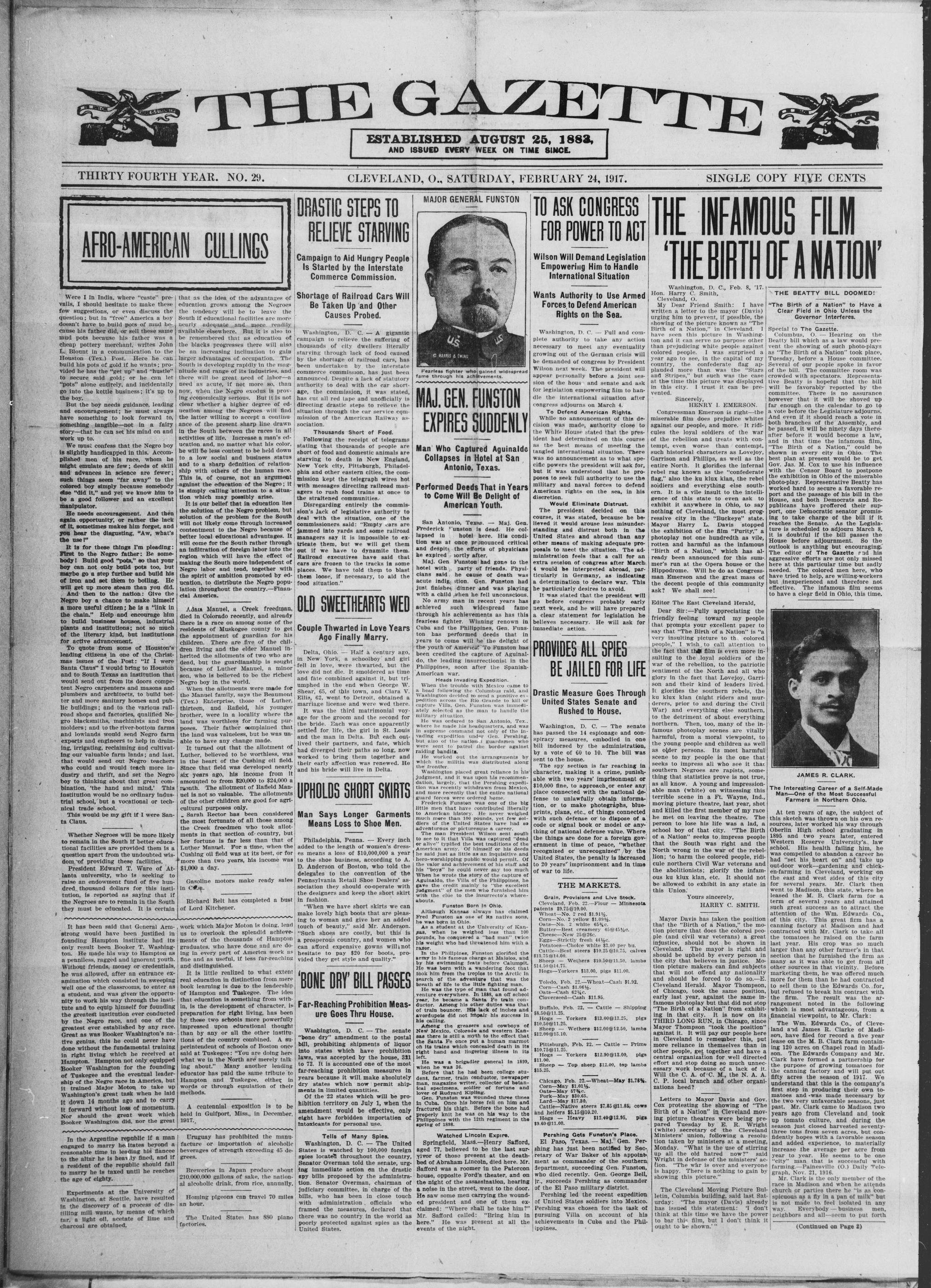
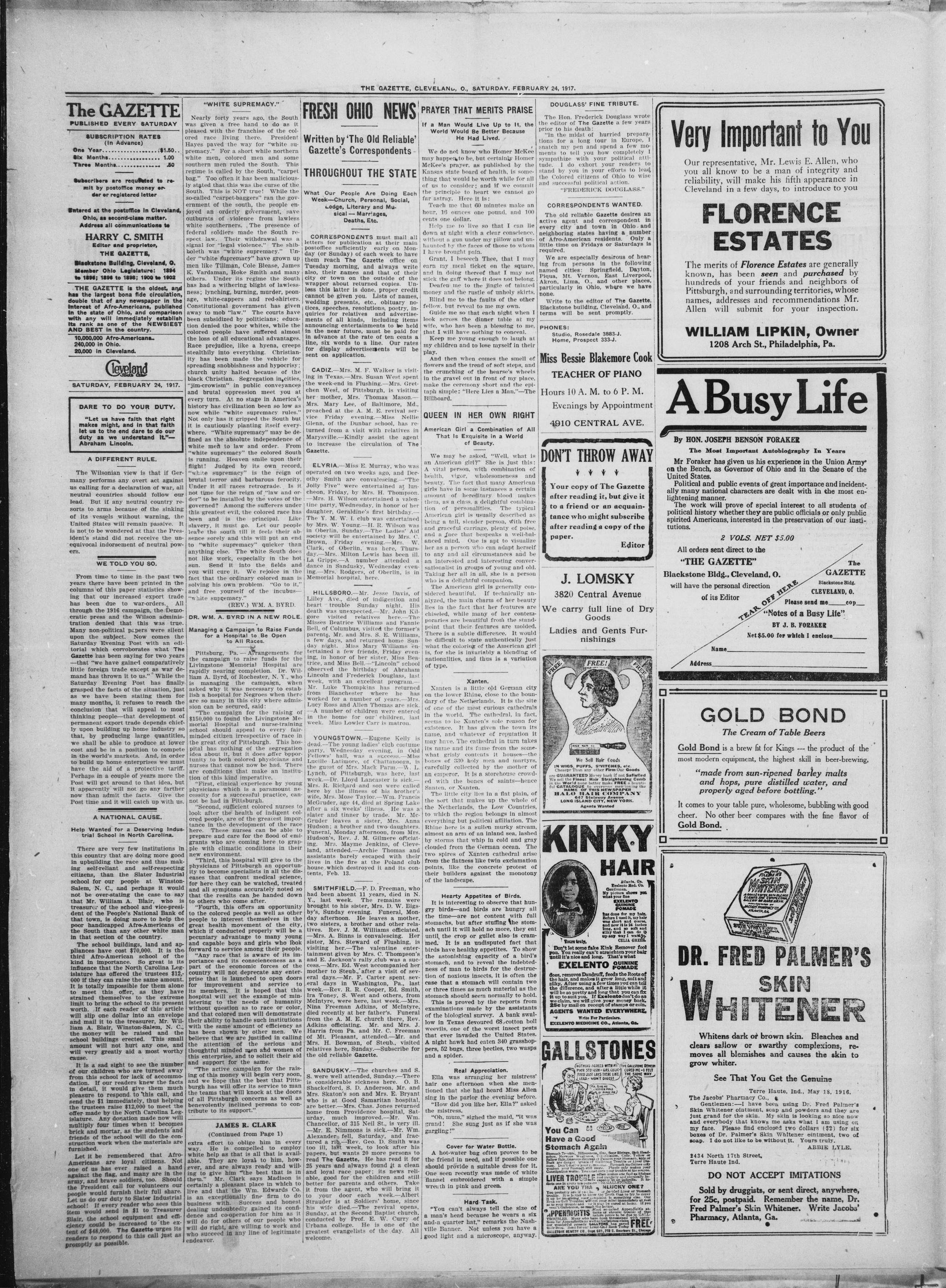
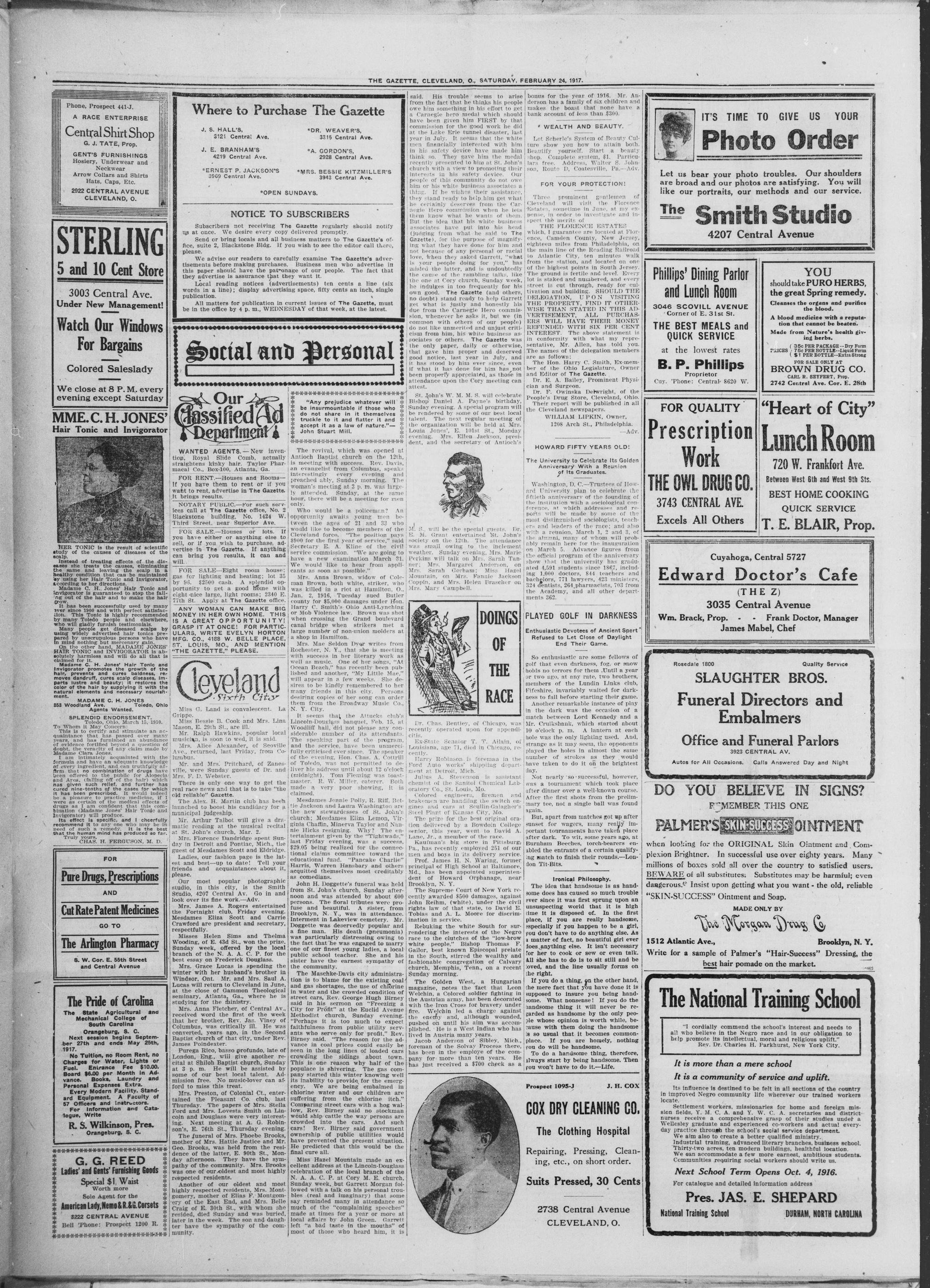
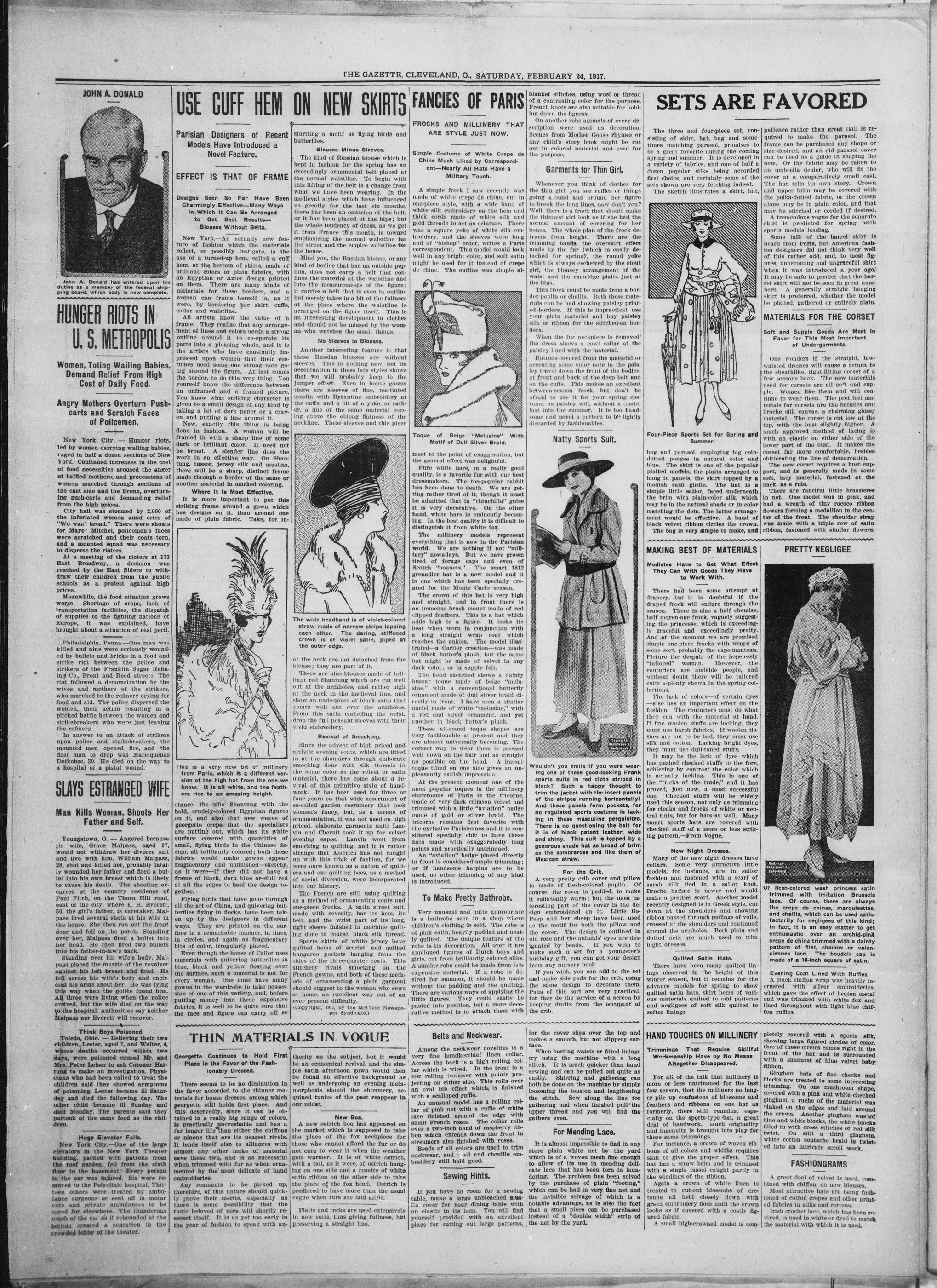
Page text (machine-generated)
AFRO-AMERICAN CULLINGS
Eagle
Were I in India, where "caste" prevails, I should hesitate to make these few suggestions, or even discuss the question; but in "free" America a boy doesn't have to build pors of mud because his father did, or sell these same mud pots because his father was a cheap pottery merchant, writes John L. Blount in a communication to the Houston (Tex.) Post. Here he can build his pots of gold if he wants; provided he has the "get up" and "hustle" to secure sold gold; or he can let "pots" alone entirely, and incidentally go into the kettle business; it's up to the boy.
But the boy needs guidance, leading and encouragement; he must always have something to look forward to, something tangible—not in a fair story—that he can set his mind on and work up to.
We must confess that the Negro boy is slightly handicapped in this. Accomplished men of his race, whom he might amulate are few; deeds of skill and advances in science are fewer; such things seem "far away" to the colored boy simply because somebody else "did it," and yet we know him to be a good follower and an excellent manipulator.
He needs encouragement. And then again, opportunity, or rather the lack of it, sometimes makes him forget, and you hear the disgusting, "Aw, what's the use!"
It is for these things I'm pleading: First to the Negro father: Be somebody! Build good "pods," so that your boy can not only build pots too, but maybe go a step further and build his of iron and set them to boiling. He will get up more steam than you did. And then to the nation: Give the Negro boy a chance to make himself a more useful citizen; he is a "link in the chain." Help and encourage him to build business houses, industrial plants and institutions; not so much of the literary kind, but institutions for active advancement.
To quote from some of Houston's leading citizens in one of the Christmas issues of the Post: "If I were Santa Claus" I would bring to Houston and to South Texas an institution that would send out from its doors competent Negro carpenters and masons and plumbers and architects, to build better and more sanitary homes and public buildings; and to the various railroad shops and factories, qualified Negro blacksmiths, machinists and iron molders; and to the river-bottom farms and lowlands would send Negro farm experts and engineers to help in draining, reclaiming and cultivating our valuable farm lands; and last, that would send out Negro teachers who could and would teach more industry and thrift, and set the Negro boy to think about that great combination, "the hand and mind." This institution would be no ordinary industrial school, but a vocational or technical trade school.
This would be my gift if I were Santa Claus.
Whether Negroes will be more likely to remain in the South if better educational facilities are provided them is a question apart from the undoubted wisdom of providing these facilities.
President Edward T. Ware of Atlanta university, who is seeking to raise an endowment fund, of five hundred, thousand dollars for this institution, is reported as saying that if the Negroes are to remain in the South they must be educated. It is certain
It has been said that General Armstrong would have been justified in founding Hampton institute--had its only result been Booker T. Washington. He made his way to Hampton as a pennissi, ragged and ignorant youth. Without friends, money or credentials, he was allowed, after an entrance examination which consisted in sweeping well one of the classrooms, to enter as a student, and was given the opportunity to work his way through the institute and to equip himself for founding the greatest institution ever conducted by the Negro race, and one of the greatest ever established by any race. Great as was Booker Washington's native genius; this he could never have done without the fundamental training in right living which he received at Hampton. Hampton not only squilled Booker Washington for the founding of Tuskegee and the eventual leadership of the Negro race in America, but it trained Major Moton to take up Washington's great task when he laid it down 14 months ago and to carry it forward without loss of momentum. Nor should the great work which Booker Washington did, nor the great
In the Argentine republic if a man engaged to marry he states beyond a reasonable time in leading his fiancee to the altar he is heavily fined, and if a resident of the republic should fail to marry he is taxed until he reaches the age of eighty.
Experiments at the University of Washington, at Seattle, have resulted in the discovery of a process of distilling mill waste, by means of which tar, a light oil, acetate of lime and charcoal are obtained.
that as the idea of the advantages of education grows among the Negroes the tendency will be to leave the South if educational facilities are more nearly adequate and more readily available elsewhere. But it is also to be remembered that as education of the blacks progresses there will also be an increasing inclination to gain larger advantages of occupation. The South is developing rapidly in the magnitude and range of its industries, and there will be great need of labor—need as acute, if not more so, than now, when the Negro exodus is proving economically serious. But it is not clear whether a higher degree of education among the Negroes will find the latter willing to accept a continuance of the present sharp line drawn in the South between the races in all activities of life. Increase a man's education, and, no matter what his color, he will be less content to be held down to a low social and business status and to a sharp definition of relationship with others of the human race. This is, of course, not an argument against the education of the Negro; it is simply calling 'attention to a situation which may possibly arise.
It is our belief that in education lies the solution of the Negro problem, but solution of the problem for the South will not likely come through increased contentment to the Negro because of better local educational advantages. It will come for the South rather through an infiltration of foreign labor into the region which will have the effect of making the South more independent of Negro labor and tend, together with the spirit of ambition promoted by education, to distribute the Negro population throughout the country.—Financial America.
Adam Manuel, a Creek freedman, died in Colorado recently, and already there is a race on among some of the residents of Muskogee county to get the appointment of guardian for his children. There are five of the children living and the elder Manuel inherited the allotments of two who are dead, but the guardianship is sought because of Luther Manuel, a minor son, who is believed to be the richest Negro boy in the world.
When the allotments were made for the Manuel family, says the Benumont (Tex.) Enterprise, those of Luther, thirteen, and Rafield, his younger brother, were in a locality where the land was worthless for farming purposes. Their father complained that the land was valueless, but he was unable to have any change made.
It turned out that the allotment of Luther, believed to be worthless, was in the heart of the Cushing oil field. Since that field was developed nearly six years ago, his income from it amounted to from $20,000 to $24,000 a month. The allotment of Rafield Manual is not so valuable. The allotments of the other children are good for agricultural purposes only.
Sarah Rector has been considered the most fortunate of all those among the Creek freedmen who took allotments in that section of country, but her fortune is far less than that of Luther Manual. For a time, when the Cushing oil field was at its best, or for more than two years, his income was $1,000 a day.
Gasoline motors make ready sales in C.Op.
Richard Belt has completed a bust of Lord Kitchener.
work which Major Moton is doing, lend us to overlook the splendid achievements of the thousands of Hampion graduates, who have done and are doing in every part of America work fine and as useful, if less far-reaching and distinguished.
It is little realized to what extent real education in distinction from mere book learning is due to the leadership of Hampton and Tuskegee. The idea that education is something from within, is the development of character, is preparation for right living, has been by these two schools more powerfully impressed upon educational thought than by any or all the other institutions of the country combined. A superintendent of schools of Boston once said at Tuskegee: "You are doing here what we in the North are merely talking about." Many another leading educator has paid the same tribute to Hampton and Tuskegee, either in words or through emulation of their methods.
A centennial exposition is to be held in Gulfport, Miss., in December, 1917.
Uruguay has prohibited the manufacture or importation of alcoholic beverages of strength exceeding 45 degrees.
Breweries in Japan produce about 210,000,000 gallons of sake, the national alcoholic drink, from rice, annually.
Homing pigeons can travel 70 miles an hour.
The United States has 880 piano factories.
ESTABLISHED AUGUST 25, 1883 AND ISSUED EVERY WEEK ON TIME SINCE.
CLEVELAND, O., SATURDAY, FEBRUARY 24, 1917.
DRASTIC STEPS TO RELIEVE STARVING
DRASTIC STEPS TO RELIEVE STARVING
Campaign to Aid Hungry People Is Started by the Interstate Commerce Commission.
Shortage of Railroad Cars Will Be Taken Up and Other Causes Probed.
Washington, B.C. C. A gigantic campaign to relieve the suffering of thousands of city dwellers literally starving through lack of food caused by the shortage of railroad cars, has been undertaken by the interstate commerce commission, has just been announced. Despite a lack of statutory authority to deal with the car shortage, the commission, it was stated, has cut all red lane and unofficially is cutting the car situation through the car service commission of the American Railway association.
Thousands Short of Food.
Thousands Short of Food.
Following the receipt of telegrams stating that thousands of people are short of food and domestic animals are starving to death in New England, New York city, Pittsburgh, Philadelphia and other eastern cities, the commission kept the telegram wires, hot with messages directing railroad managers to rush food trains at once to the straitened communities.
Disregarding entirely the commission's Jack of legislative authority, to deal with the situation, one of the commissioners said: "Empty cars are jammed into yards and some railroad managers say it is impossible to extricate them, but we will get them out if we have to dynamite them. Railroad executives have said that cars are frozen to the tracks in some places. We have told them to blast them loose, if necessary, to aid the food situation."
OLD SWEETHEARTS WED
Couple Thwarted in Love Years Ago Finally Marry.
Delta, Ohio: — Half a century ago, in New York, a schoolboy and girl fell in love, were thwarted, but the love did not die. It smoldered as time and fate combined against it, but triumphed in the end when George W. Shear, 65, of this town, and Clara V. Ellis, 62, went to Detroit, obtained a marriage license and were wed there. It was the third matrimonial voyage for the groom and the second for the bride. Each was once apparently settled for life, the girl in St. Louis and the man in Delta. But each outlived their partners, and fate, which had diverged their paths soslong, now worked to bring them together and their early affection was renewed. He and his bride will live in Delta.
UPHOLDS SHORT SKIRTS
UPHOLDS SHORT SKIRTS
Man Says Longer Garments Means Loss to Shoe Men.
Philadelphia, Penna. — Every inch added to the length of women's dresses means a loss of $10,000,000 a year to the shoe business, according to A. D. Anderson of Boston, who told the delegates to the convention of the Pennsylvania Retail Shoe Dealers' association they should co-operate with the designers and keep the short skirt in fashion.
"When we have short skirts we can make lovely high boots that are pleasing to woman and give her an added touch of beauty," said Mr. Anderson. "Such shoes are costly, but this is a prosperous country, and women who can afford expensive gowns" will not hesitate to pay $20 for boots, provided they get style and quality."
'BONE DRY' BILL PASSES
Far-Reaching Prohibition Measure Goes Thru House.
Washington, D. C. — The senate "bone dry" amendment to the postal bill, prohibiting shipments of liquor into states which have prohibition laws, was accepted by the house, 321 to 72. It is accounted one of the most far-reaching prohibition measures in years because it will make absolutely dry states which now permit shipments in limited quantities. Of the 22 states which will be prohibition territory, on July 1, when the amendment would be effective, only eight have forbidden importation of intoxicants for personal use.
Tella of Many Splea.
Washington, D. C. — The United States is watched by 100,000 foreign spies located throughout the country, Senator Overman told the senate, urging immediate action on the drastic spy bills proposed by the administration. Senator Overman, chairman of judiciary committee, in charge of the bills, who has been in close touch with - administration officials, who framed the measures, declared that there was no country in the world as poorly protected against spies as the United States.
Fearless fighter who gained widespread fame through his achievements.
MAJ. GEN. FUNSTON EXPIRES SUDDENLY
Performed Deeds That in Years to Come Will Be Delight of American Youth.
San Antonio, Texas — Maj. J. Gen. Frederick J. Funston is dead. He collapsed in, hotel here. His condition was at once pronounced critical and despite the efforts of physicians he expired, torty after.
Maj. J. Funston had gone to the hotel with, party of friends. Physicians said he cause of death was acute indignation. Gen. Funston had just finished dinner and was playing with a child when he fell unconscious. No army man in recent years has achieved such widespread fame through his achievements as has this fearless fighter. Winning renown in Cuba and the Philippines, Gen. Funston has performed deeds that in years to come will be the delight of the youth of America. To Funston has been credited the capture of Aguinaldo, the leading insurrectionist in the Philippines, soon after the Spanish-American war.
Heads Invading Expedition.
The trouble with Mexico came to a head following the Columbus raid, and the Mexican government had a pedition across the Rio Grande to kill, or capture Villa Gen. Funston was immediately selected as the man to handle the war. He was ordered to San Antonio, Tex., where he made his headquarters, and in supreme command not only, of the invading expedition under Gen. Perching, but also of the expedition under Funston, were sent to patrol the border against raiding bandits.
He worked out the arrangements by the millia was distributed along the front.
Washington placed great reliance in his judgment, and it was upon his recommendation, largely, that he signed expingitation and more recently withdrew his support and more recently that the entire national guard forces were ordered home.
Frederick Funson was one of the big fathers of the American liberals to American history. He never weighed much more than 700 pounds, yet few soldiers of the United States have had so much to lose. The man President Wilson sent south to see to it that Tillman was captured "dead or alive" typified the best traditions of the United States. He said just as little as an inquisitive hero-worshiping public would permit. Of the valor and achievement of his stuff and his "boys" he could never say too much. He gave the president the Aguinaldo, the Villa of the Philippines, he gave the credit mainly to "the excellent judgment" of the men who furnished him with the clue to the insurrece's whereabouts.
Eunston Born In Ohio.
Although Kansas, always has claimed Fred Funston as one of its native sons, he was born in Ohio. As a student at the University of Kansas, he gained the heighten 'look than 100 pounds, he conquered a "bad man" twice his weight who had threatened him with a razor. In the Philippines, Funston clarified the facts his father changed at Biology and by his swimming feats before Calipult. He was born with a wandering foot that took him from the tropics to the Arctic in search of the adventure that was the breath of life to the little fighting man. He adventured everywhere. In 1888, an off school year, he became a Santa Fe train conductor. Among his other duties was that of train bouncer. His lack of inches and availopudes did not impair his success in his job. Among the greasers and cowboys of New Mexico, Colorado and western Kansas there is still a myth to the effect that the Santa Fo once put a human marmor to trains which concealed deserts, hand and lingering illness in its left.
He was a brigadier general in 1899, when he was 36. Before that he had been college student, formal train conductor, newspaper man, magazine writer, collector of botanical specimens, soldier of fortune and lover of Rudyard Kipling. He was wounded three times in Cuba. Once his horse fell on him and fractured his thigh. Before the bone had proper he was on his way to the war with the 12th regiment in the spring of 1898.
Watched Lincoln Expire.
Springfield, Mass.—Henry Safford, aged 77, believed to be the last survivor of those present at the death bed of Abraham Lincoln, died here. Mr. Safford was a roomer in the Patercon house, opposite Ford's theater, and on the night of the assassination, hearing a noise in the street, went to the door. He saw some men carrying the wounded president and one of them exclaimed: "Where shall be take him?" Mr. Safford called: "Bring him in here." He was present at all the events of the night.
TO ASK CONGRESS FOR POWER TO ACT
Wilson Will Demand Legislation Empowering Him to Handle International Situation
Wants Authority to Use Armed Forces to Defend American Rights on the Sea.
Washington, D.C. — Full and complete authority to take any action necessary to meet any eventuality growing out of the German crisis will be demanded of congress by President Wilson next week. The president will appear personally before a joint session of the house and senate and ask for legislation empowering him to handle the international situation after congress adjourns on March 4.
To Defend American Rights.
While no announcement of this decision was made, authority close to the White House stated that the president had determined on this course as the best means of meeting the tangled international situation. There was no announcement as to what specific powers the president will ask for, but it was understood that he proposes to seek full authority to use the military and naval forces to defend American rights on the sea, in his discretion.
Would Eliminate Distrust.
Would Eliminate Distrust.
The president decided on this course, it was stated, because he believed it would arouse less misunderstanding and distrust both in the United States and abroad than any other means of making adequate proposals to meet the situation. The administration feels that a call for an extra session of congress after March 4 would be interpreted abroad, particularly in Germany, as indicating a determination to declare war. This he particularly desires to avoid.
It was stated that the president will go before congress probably early next week, and he will have prepared a clear statement for legislation he believes necessary. He will ask for immediate action.
PROVIDES'ALL SPIES BE JAILED FOR LIFE
Drastic Measure Goes Through United States Senate and Rushed to House.
Washington, D. C. — The senate has passed the 14 esplosion and conspiracy' measures, embodied in one bill indorsed by the administration, by a vote of 60 to 10. The bill was sent to the house.
The spy system is far reaching in character, making it a crime, punishable with two years' imprisonment or $10,000 fine, to approach, or enter any place connected with the national defense to unlawfully obtain information, or to make photographs, blueprints, plans, etc., of things connected with such defense or to dispose of a code or signal book or model or anything of national defense value. Where the things are done for a foreign government in time of peace, "whether recognized or unrecognized" by the United States, the penalty is increased to 20 years' imprisonment and in time of war to life.
THE MARKETS.
Grain, Provisions and Live Stock.
Cleveland, Feb. 22.—Flour Minnesota patency $8.55@10.00.
Wheat No. 2 red $1.91%. Wheat No. 2 yellow $1.03%. Corn No. 2 yellow $1.03%. Corn No. 2 white $65%.c. Butter-Best cremery 45@152%. Cheese-Best cremery 45@152%. Cheese-Strictly fresh 41%. Potatoes-Choice white $3.00 per bus. Cattle-Best steers $10.25@10.75. calves $11.50@14.00. Sheep-Wethers $10.50@11.50. lambs $11.50@14.75. Hogs-Yorkers $13.00, pigs $11.00.
Tealto, Feb. 22.—Wheat-Cash $1.92. Corn-Cash $1.06%. Oats-Cash $62%. Cloverseed-Cash $11.95.
Buffalo, Feb. 22.—Cattle-Shipping $6.50@11.25. Hogs—Yorkers $13.00@13.25, pigs $10.50@11.25. Sheep—Wethers $12.00@12.50, lambs $12.00@15.10.
Pittsburgh, Feb. 22.—Cattle-Prime $10.75@11.25. Hogs—Yorkers $12.90@13.00, pigs $11.00. Sheep—Top sheep $12.00, top lambs $15.25.
Chicago, Feb. 22.—Wheat-May $1.78%. Corn-May $1.01%. Oats-May $57%.c. Pork-May $30.65. Lard-May $17.80. Lard-May $7.85@11.85, cows and heifers $5.15@10.20. Hogs—Heavy $12.40@12.95, pigs $9.60@11.00.
Pershing Gets Funston's Place
El Paso, Texas. — Mal Gen. Pershing has just been notified by Secretary of War Baker of his appointment as commander of the southern department, succeeding Gen. Funston, who died recently. Gen. George Bell, Jr., succeeds Pershing as commander of the El Paso military district. Pershing led the recent expedition of United States soldiers into Mexico. Pershing was chosen for the task of pursuing Villa on account of his achievements in Cuba and the Philippines.
SINGLE COPY FIVE CENTS.
THE INFAMOUS FILM 'THE BIRTH OF A NATION'
Washington, D. C., Feb. 8, 177
Hon. Harry C. Smith,
C.S.H.
My Dear Friend Smith: 'I have written a letter to the mayor (Davis) urging him to prevent, if possible, the showing of the picture known as "The Birth of a Nation," in Cleveland. I have seen this picture in Washington than prejudicing white people against colored people. I was surprised a year ago to see, in the capital of my country, the confederate flag applauded more than when I stared at it. "Stripes" but was the case at the time this picture was displayed in this city. I trust it can be prevented.
Congressman Emerson is right—the miserable film does prejudice whites against our people, and more. It ridicules the loyal soldiers of the war of the rebellion and treats with contempt, even worse than contempt, such historical characters as Lovejoy, Garrison and Phillips, as well as the entire North. It glorifies the infernal rebel rag known as the "confederate flag," also the ku klux klan, the rebel soldiers and everything else southern. It is a vile insult to the intelligence of this state to even ask to exhibit it anywhere in Ohio, to say nothing of Cleveland, the most progressive city in the "Buckeye" state. Mayor Harry L. Davis stopped the exhibition of the film "Purity," a photoplay not one hundredth as vile, rotten and harmful as the Infamous "Birth of a Nation," which has already been announced for this summer's run at the Opera house or the Hippodrome. Will he do as.Congressman Emerson and the great mass of the decent people of this community ask? We shall see!
Editor The East Cleveland Herald.
Dear Sir:—Fully appreciating the friendly feeling toward my people that prompts your excellent paper to say that "The Birth of a Nation" is "a very insulting picture to the colored people," I wish, to call attention to the fact that the film is even more insulting to the loyal soldiers of the war of the rebellion; to the patriotic sentiment of the North and all who glory in the fact that Lovejoy, Garisson and their kind of leaders lived: It glorifies the southern rebels, the ku klux klan (night riders and murderers, prior to and during the Civil War) and everything else southern, to the detriment of about everything northern. Then, too, many of the infamous photoplay scenes are vitally harmful, from a moral viewpoint, to the young people and children as well as older persons. Its most harmful scene to my people is the one that seeks to impress all who see it. that southern Negroes are rapists, something that statistics prove is not true, as all know. A young on impressionable man (white) on witnessing this terrible scene in a Ft. Wayne, Ind, moving picture theatre, last year, shot and killed the first member of my race he met on leaving the theatre. The person to lose his life was a lad, a school boy of that city. "The Birth of a Nation" seeks to impress people that the South was right and the North wrong in the war of the rebellion; to harm the colored people, ridicule northern Civil war veterans and the abolitionists; glorify the infamous ku klux klan, etc. It should not be allowed to exhibit in any state in this Union.
Yours sincerely.
Mayor Davis has taken the position that the "Birth of a Nation," the motion picture that does the colored people (and civil war veterans) a great injustice, should not be shown in Cleveland. The mayor is right and should be upheld by every person in the city that believes in justice. Motion pictures that will not offend any nationality and should be forced to do so.—E. Cleveland Herald. Mayor Thompson, of Chicago, took the same-position, early last year, against the same-infamous photoplay that did not stop "The Birth of a Nation" from exhibiting in that city is now on its "Million RUN, in the MIDDLE OF A NATION." Mayor Thompson "took the position" against it. It will pay our people here in Cleveland to remember this, but more reliance in themselves than in other people, get together and have a central organization for well directed effort and stop doing so much unnecessary work because of a lack of it. Will the C. A. of C. M., the N. A. A. C. P. local branch and other organizations heed? —
Letters to Mayor Davis and Gov. Cox protesting the showing of "The Birth of a Nation" in Cleveland moving picture theatres were being prepared Tuesday by E. R. Wright (white) secretary of the Cleveland Ministers' union, following a resolution taken by ministers at a meeting, Monday, in the old hooded snow? — Wright in defense of the ministers' action. "The war is over and everyone is happy. There is nothing to gain by showing this picture."
The Cleveland Moving Picture Bulletin, Columbia building, said last Saturday: "The mayor (Davis) already has issued this statement: I don't think at this time we have the power to move." I don't think it ought to be shown."
THE BEATTY BILL DOOMED!
"The Birth of a Nation" to Have a Clear Mistake Unless the Governor Interferes
Special To The gazette.
Columbus On The Hearing on the Birth of a Nation, as law would prevent the showing of such photo-plays "The Birth of a Nation" took place, Tuesday, before a House committee. Several of our people spoke in favor of the bill. The committee-room was crowded with spectators. "Representative Beatty is hopeful that the bill will be favorably reported by the committee." There is no assurance that "there will be far enough on the calendar to go to a vote before the Legislature adjourns. And even if it should reach a vote in both branches of the Assembly, and be passed, it will be ninety days thereafter. before it would become a law, and in that time the infamous film, "The Birth of a Nation," could be shown in every city in Ohio. The best plan at present is to use the bill in the House, and use his influence with the Censor Board to postpone the exhibition in Ohio of the miserable photo-play. Representative Beatty has worked hard, to secure a favorable report and the passage of his bill in the House, and both Democrats and Republicans have proffered their support, one Democratic senator promising to take charge of the bill if it reaches the Senate. As the Legislature is scheduled to be filled, it is painful the bill passes the House before adjournment. So the outlook is anything but encouraging. The editor of The Gazette and his aggressive efforts are not only missed here at this particular time but sadly needed. The colored men here, who have tried to help, are willing-workers but inexperienced and therefore not effective. The infamous film seems to have a clear field in Ohio, this time.
JAMES R. CLARK.
The Interesting Career of a Self-Made Man—One of the Most Successful Farmers in Northern Ohio.
At ten years of age, the subject of this sketch was thrown on his own resources, later worked his way through Oberlin High school graduating in 1895 and two years later, entered Western Reserve University's, law school. His health falling him, he was compelled to abandon a career he had been working in but door work—gardening and chicken-farming in Cleveland, working on the east and west sides of this city for several years. Mr. Clark then went to Madison, this state, where he leased the M. B. Clark farm for a term of several years and attained such great success as to attract the attention of the Wm. Edwards, Co., of this city. The farm has a man named Madison, contracted with Mr. Clark to take all the tomatoes he raised on the farm last year. His crop was so much larger than any other farmer's in that section that he furnished the firm as many as it was able to get from all other sources in that vicinity. Before marketing them, he was offered much more for them than he had contracted to them with his cards. So, for but refused to break his contract with the firm. The result was the arrangement noted in the following which, is most advantageous, from a financial viewpoint, to Mr. Clark:
The Wm. Edwards Co., of Cleveland and James R. Clarke of Madison, have filed for record a five year lease on the M. B. Clark farm containing 120 acres on Chapel road in Madison. The Edwards Company, and Mr. Clark have formed a partnership for the purpose of growing tomatoes for the canning factory and will put out a new crop to understand that this is the company's first step in producing their own tomatoes and -was made necessary by the two very unfavorable seasons, just past. Mr. Clark came to Madison two years ago from Cleveland and took up tomato culture, and during the season just closed harvested seventy-three tons from seven acres, but confidently hopes with a favorable season and added experience, to materially increase the average per acre from year to year. He seems to omit "ommy," that he seems to wish with farming.—Painesville (O.) Daily Telegraph. Nov. 21, 1916.
Mr. Clark is the only member of the race in Madison and when he attends church or parties there he 'ls as conspicuous as a ty in a pan of men or as a disgusting figure in any way. Everybody—business men, neighbors and all—seem to put forth
The GAZETTE
SUBSCRIPTION RATES
(In Advance)
One Year.....$1.50.
Six Months.....1.00
Three Months......50
Subscribers are requiited to re-
mit by postoffice money en-
der or registered letter
Entered at the postoffice In Cleveland,
Ohio, as second-class matter.
Address all communications to
HARRY C. SMITH
Editor and proprietor,
THE GAZETTE,
Blackstone Building, Cleveland, O.
Member Ohio Legislature: 1894
to 1898; 1896 to 1898; 1900 to 1802
THE GAZETTE is the oldest, and has the largest bona fide circulation, double that of any newspaper in the interest of Afro-Americans, published in the state of Ohio, and comparison established by publicly established its rank as one of the NEWSIEST AND BEST in the country.
10,000,000 Afro-Americans.
240,000 in Ohio.
20,000 in Cleveland.
SATURDAY, FEBRUARY 24, 1917.
"Let us have faith that right makes might, and in that faith us to the end dare to do our duty to the end stand it."—dubra Lincoln.
A DIFFERENT RULE.
The Wilsonian view is that if Germany performs any overt act against us calling for a declaration of war, all neutral countries should follow our lead. But if any neutral country resorts to arms because of the sinking of its vessels without warning, the United States will remain passive. It is not to be wondered at that the President's stand did not receive the unequivocal indorsement of neutral powers.
WE TOLD YOU SO
From time to time in the past two years there have been printed in the columns of this paper statistics showing that our increased export trade has been due to war-orders. All through the 1916 campaign, the Democratic press and the Wilson administration denied that this was true. Many non-political papers were silent upon the subject. Now comes the Saturday Evening Post with an editorial which corroborates what The Gazette has been saying for two years
—that "we have gained comparatively little foreign trade except as war demand has thrown it to us." While the Saturday Evening Post has finally grasped the facts of the situation, just as we have been stating them for many months, it refuses to reach the conclusion that will appeal to most thinking people—that development of permanent export trade depends chiefly upon building up home industry so that, by producing large quantities, we shall be able to produce at lower cost and be in a position to compete in the world's markets. And, in order to build up home enterprises we must have the aid of a protective tariff. Perhaps in a couple of years more the Post will get around to that idea, but it apparently will not go any farther now than admit the facts. Give the Post time and it will catch up with us.
A NATIONAL CAUSE.
Help Wanted for a Deserving Industrial School in North Carolina.
There are very few institutions in this country that are doing more good in upbuilding the race and thus making self-reliant and self-respecting citizens, than the Slater Industrial school for our people at Winston Salem, N. C., and perhaps it would not be over-stating the case to say that Mr. William A. Blair, who is treasurer of the school and vice-president of the People's National Bank of that town, is doing more to help the poor handicapped Afro-Americans of the South than any other white man in that section of the country.
The school buildings, land and appliances have cost $70,000. It is the third Afro-American school of the kind in importance. So great is its influence that the North Carolina Legislature has offered the trustees $12,000 if they can raise the amount for the school to meet its offer, as they have strained themselves to the extreme limit to bring the school to its present worth. If each reader of this article will slip one dollar into an envelope and mail it to the treasurer, Mr. William A. Blair, Winston-Salem, N. C. school buildings erected. This small amount will not hurt any one, and will very greatly aid a most worthy cause.
It is a sad sight to see the number of our children who are turned away from this school for lack of accommodation. If our readers knew the facts in detail, it would give them much pleasure to respond to 'this call, and send the $1 immediately, thus helping the trustees raise $12,000 to meet the offer made by the North Carolina Legislature. Any donation made now will multiply and enhance when it becomes brief and shorter, as the students and friends of the school will do the construction work when the materials are furnished.
Let it be remembered that Afro-Americans are loyal citizens. Not one of us has ever raised a hand against the flag, and many are in the army, and brave soldiers, too. Should the President call for volunteers our people would furnish their full shire. Let us do our duty to Slater Industrial school! He would order who sees this item should send in $1 to Treasurer Blake, the school equipment and efficiency could be increased to the extent of $48,000. The Gazette urges its readers to respond to this call just as promptly as possible.
"WHITE SUPREMACY."
Nearly forty years ago, the South was given a free hand to do as it pleased with the franchise of the colored race living there. President Hayes paved the way for "white supremacy." For a short while northern white men, colored men and some southern men ruled the South. This regime is called by the South, "carpet bag." Too often it has been maliciously stated that this was the curse of the South. This is NOT true! While the so-called "carpet-baggers" ran the government of the south, the people enjoyed an orderly government, save outbursts of violence from lawless white southerners. The presence of federal soldiers made the South respect law. Their withdrawal was a signal for "legal violence." The shibboleth was "white supremacy." Under "white supremacy" have grown up men like Tillman, Cole Blease, James K. Vardaman, Hoke Smith and many others. Under its regime the South has had a withering blight of lawlessness; lynching, burning, murder, peonage, white-cappers and red-shirts. Institutional government has given away to mob "law." The courts have been subsidized by politicians; education denied the poor whites, while the colored people have suffered almost the loss of all educational advantages. Race prejudice, like a hyena, creeps stealthily into everything. Christianity has been made the vehicle for spreading snobbishness and hypocrisy; church unity halted because of the black Christian. Segregation in cities, "jim-crowism" in public conveyances and brutal oppression meet you at every turn. At no stage in America's history has civilization been so low as now while "white supremacy rules." Not only has it gripped the South but it is cautiously planting itself everywhere. "White supremacy" may be defined as the absolute independence of white men to law and order. From "white supremacy" the colored South is running. Heaven smile upon their flight! Judged by its own record "white supremacy" is the reign of brutal terror and barbarous ferocity. Under it all races retrograde. Is it not time for the reign of "law and order" to be installed by the votes of the governed? Among the sufferers under this greatest evil, the colored race has been and is the principal. Like slavery, it must go. Let our people leave the south till it feels their abseence sorely and this will put an end to "white supremacy" quicker than anything else. The white South does not like work, especially in the hot sun. Send it into the fields and you will cure it. We rejoice in the fact that the ordinary colored man is solving his own problem. "Go to it," and free yourself of the incubus—"white supremacy."
Managing a Campaign to Raise Funds for a Hospital to Be Open
Pittsburgh, Pa. — Arrangements for the campaign to raise funds for the Livingstone Memorial Hospital are rapidly nearing completion. Dr. William A. Byrd, of Rochester, N. Y., is managing the campaign, when asked why it was necessary to establish a hospital for Negroes when there are so many in this city where admission can be secured, said:
"The campaign for the raising of $150,000 for the Livingstone Memorial Hospital and nurse-training school should appeal to every fair-minded citizen irrespective of race in the great city of Pittsburgh. This hospital has nothing of the segregation idea about it, but it does offer opportunity to both colored physicians and nurses that cannot now be bead. There are conditions that make an institution of this kind imperative.
"First, clinical experience by young physicians which is a paramount necessity in the practice, cannot be bead in Pittsburgh."
"Second, sufficient colored nurses to look after the health of indigent colored people, are of the greatest importance in the development of the race here. These nurses can be able to prepare and care for the flood of emigrants who are coming here to grapple with climatic conditions in their new environment. "Third, this hospital will give to the physicians of Pittsburgh an opportunity to become specialists in all the diseases for which they can be watched, treated and all symptoms accurately noted so that the results can be handed down to others who come after.
"Fourth, this offers an opportunity to the colored people as well as other people to interest themselves in the great health movement of the city, which if conducted properly will be a pecuniary advantage to many young and capable boys and girls who look forward to service among their people. "Any race that is aware of its importance and its conscienceness as a part of the economic forces of the country will not depreciate any enterprise that is launched to open doors for improvement and service to its members. It is hoped that this hospital will set the example of ministering to the needs of human beings in the race for Dor, and that colored men will demonstrate their ability to handle such institutions with the same amount of efficiency as has been shown by other men. We believe that we are justified in calling the attention of the serious and thoughtful minded men aid women of this enterprise, and to solicit their aid and support for the same.
"The active campaign for the raising of this money will begin very soon, and we hope that the best that Pittsburgh has will offer its service to man the teams that will knock at the doors of all Pittsburgh concerns as well as benevolently inclined persons to contribute to its support."
JAMES B. CLARK
extra effort to oblige him in every way. He is compelled to employ white help as that is all that is available. They are loyal to him, however, and are always ready and willing to give him "the best that is in them." Mr. Clark says Madison is certainly a pleasant place in which to live and that the Wm. Edwards Co. is an exceptionally fine firm to business with. Success and honest dealing undoubtedly gained its confidence and co-operation for him as it will do for others of our people who will do right, are willing to work and who succeed in any line of legitimate endeavor.
THE GAZETTE, CLEVELAND, O., SATURDAY, FEBRUARY 24, 1917
Written by 'The Old Reliable' Gazette's Correspondents
THROUGHOUT THE STATE
What Our People Are Doing Each Week—Church, Personal, Social, Adoption, Literacy, and Music
CORRESPONDENTS must mail all letters for publication at their main postoffice sufficiently early on Monday (or Sunday) of each week to have them reach The Gazette office on Tuesday morning, and always write also, their names and that of their city or town on the outside of the wrapper about returned copies. Unless this latter is done, proper credit cannot be given you. Lists of names, wedding presents, etc., obituary notices, speeches, resolutions, poetry, inquiries for relatives and advertisements, including announcements entertainments to be held in the near future, must be paid for in advance at the rate of ten cents a line, six words to a line. Our rates for display advertisements will be sent on application.
CADIZ—Mrs. M. F. Walker is visiting in Texas—Mrs. Susan West spent the week-end in Flushing—Mrs. Gretchen West, of Pittsburgh, is visiting her mother, Mrs. Thomas Mason—Mrs. Mary Lee, of Baltimore, Md., preached at the A. M. E. revival service Friday evening—Miss Nellie Glenn, of the Dunbar school, has returned from a visit with relatives in Marysville—Kindly assist the agent to increase the circulation of The Gazette.
ELYRIA — Miss E. Murray, who was operated on two weeks ago, and Dorothy Smith are convalescing. "The Jolly Five" were entertained at luncheon, Friday, by Mrs. H. Thompson. — Mrs. H. Wilson entertained a valentine party, Wednesday, in honor of her daughter, Geraldine's first birthday. — The Y. M. W. I. club was entertained by Mrs. W. Young. — H. R. Wilson was in Oberlin, Sunday. — The Ladies' Aid society will be entertained by Mrs. C. Brown, Friday evening. — Mrs. W. Clark, of Oberlin, was here, Thursday. — Mrs. Milton Lewis has been ill numbered a danced a dance in Sandusky. — Tuesday evening. — Mrs. Rodgers, of Oberlin, is in Memorial hospital here.
HILLSBORO—Mr. Jesse Davis, of Lilley Ave., died of indigestion and heart trouble Sunday night. His death was unexpected—Mr. John Killogre visited relatives here—The Misses Beatrice Williams and Fannie Bell, of Columbus, visited the former's parents, Mr. and Mrs. S. E. Williams, a few days, and returned home Sunday night. Miss Mary Williams entertained a few friends, Friday evening, in honor of her sister, Miss Beatrice, and Miss Bell—"Lincoln" school observed the birthday of Abraham Lincoln and Frederick Douglass, last week. The program, Mr. Luke Thompson has been funded from Blanchester where he has worked for a number of years—Mrs. Lucy Ross and Thomas are sick. A number of children were entered in the home for our children, last week. Miss Lowler Carr is matron.
YOUNGSTOWN. —Eugene Kelly is dead—the young ladies' club costume party, Wednesday evening, in Odd Fellows' hall, was a success. —Miss Lucille Latimore, of Chattanooga, is the guest of Mrs. Mack Parmoo. —W. L. Lynch, of Pittsburgh, was here, last week. Dr. Lloyd Lancaster is sick. Mr. McGruder, who was here by the host of his brother's wife, Mrs. Mose Taylor. —Wm. Francis McGruder, age 42, died at Spring Lake after a six weeks' illness. He was a slater and tinner by trade. Mr. McGruder leaves a sister, Mrs. Anna Hudson; a brother and two daughters, Funeral, Monday afternoon, from Mrs. Hudson's, Rev. J. M. Gillmore officiating. Mrs. Mae Jenkins, of Cleveland, was a teacher, assistants barely escaped with their lives in the fire at the Poland club house which destroyed it and its contents, Feb. 13.
SMITHFIELD.—F. D. Freeman, who had been absent 11 years, died in N. Y., last week. The remains were brought to his sister, Mrs. D. W. Bigby's, Sunday evening. Funeral, Monday afternoon. He leaves a mother, two sisters, a brother and other relatives. Rev. J. M. Williams officiated.—Mrs. A. Binns is convalescing. Her sister, Mrs. Steward of Flushing, is visiting her.—The valentine entertainment given by Mrs. C. Thompson's and E. Jackson's rally club was a success.—Mrs. Ed. West accompanied her mother to Steub, after a visit of several days.—Mr. Carter spent several weeks with Mrs. Ed. Last week.—Rev. R. R. Cooper, Ed. Smith, Ira Toney, S. W. and others, from Mcntyre, were here, last week.—Mrs. Nina Freeman Adkins, of Mcntyre, died recently at her father's. Funeral from the A. M. E. church there, Rev. Adkins officiating. Mr. and Mrs. J. Harris from Pa. and Mr. C. Freeman of Mt. Pleasant, attended.—Mr. and Mrs. H. Bowman, of Steub, visited relatives here, Sunday.—Subscribe for the old reliable Gazette.
SANDUSKY.—The churches and S. S. were well attended, Sunday.—There is considerable sickness here. O. B. Shackelford, S. D. Anderson, Mr. and Mrs. Skaton's son and Mrs. E. Bryant who is at good Samaritan hospital, are better.—Mrs. Chas. Jones returned home from Providence hospital, Saturday, much improved.—Mr. Wm. Cancellor, of 315 Neil St., is very ill.—Mr. E. Nimmons is sick.—Mr. Wm. Alexander fell, Saturday, and fractured a rib.—Rev. Geo. D. Smith was too ill, last week, to look after his papers, but wants 20 more persons to read The Gazette. He has read it for 25 years and always found it a clean and loyal race paper. It is also able to care for children and still care for parents and others. Take it from the agent, who will bring it to your door each week.—Albert Strauder is at Soldiers' home, since his wife died.—The revival opens, Sunday, at the Second Baptist church, conducted by Prof. E. W. Curry of Urbana college. He is one of the greatest evangelists of the day. All welcome.
PRAYER THAT MERITS PRAISE
If a Man Would Live Up to It, the World Would Be Better Because He Had Lived.
We do not know who Homer McKee may happen to be, but certainly Homer McKee's prayer, as published by the Kansas state board of health, is something that would be worth while for all of us to consider; and if we commit the principle to heart we cannot go far astray. Here it is:
Teach me that 60 minutes make an hour, 16 ounces one pound, and 100 cents one dollar.
Help me to live so that I can lie down at night with a clear conscience, without a gun under my pillow and unhaunted by the faces of those to whom I have brought pain.
Grant, I beseech Thee, that I may earn my meal ticket on the square, and in doing thereof that I may not stick the gaff where it does not belong.
Deafen me to the jingle of tainted money and the rustle of unholy skirts.
Blind me to the faults of the other fellow, but reveal to me my own.
my eighth to me my own.
Guide me so that each night when I look across the dinner table at my wife, who has been a blessing to me, that I will have nothing to conceal.
Keep me young enough to laugh at my children and to lose myself in their play.
And then when comes the smell of flowers and the trend of soft steps, and the crunching of the hearse's wheels in the gravel out in front of my place, make the ceremony short and the epitaph simple: "Here Lies a Man."—The Billboard.
QUEEN IN HER OWN RIGHT
American Girl a Combination of All That Is Exquisite in a World of Beauty.
We may be asked, "Well, what is an American girl?" She is just this: A vital person, with combination of health, vigor, wholesomeness and beauty. The fact that many American girls have in some instances a certain amount of hereditary blood makes them, as a class, a delightful combination of personalities. The typical American girl is usually described as being a tall, slender person, with free and graceful carriage, plenty of poise, and a face that bespeaks a well-balanced mind. One is apt to visualize her as a person who can adapt herself to any and all circumstances and be an interested and interesting conversationalist in groups of young and old. Taking her all in all, she is a person who is a delightful companion.
The American girl is generally considered beautiful. If technically analyzed, the main charm of her beauty lies in the fact that her features are chiseled, while many of her contemporaries are beautiful from the standpoint that their features are molded. There is a subtle difference. It would be difficult to state authentically just what the coloring of the American girl is, for she is invariably a blending of nationalities, and thus is a variation of type.
Xanten.
Xanten is a little old German city on the lower Rhine, close to the boundary of the Netherlands. It is the site of one of the most curious cathedrals in the world. The cathedral, in fact, seems to be Xanten's sole reason for existence. It has given the town its name, and whatever of reputation it may have. The cathedral in turn takes its name and its fame from the somewhat grisly contents it houses—the bones of 330 holy men and martyrs, carefully collected by the mother of an emperor. It is a storehouse crowded with the bones of saints—hence Xanten, or Xanten.
The little city lies in a flat plain, of the sort that makes up the whole of the Netherlands, the Low Countries, to which the region belongs in almost everything but political affiliation. The Rhine here is a sullen murky stream, almost an arm of an inland sea, lashed by storms that whip in cold and gray clouded from the German ocean. The two spires of Xanten cathedral arise from the flatness like twin exclamation points, like the concrete protest of their builders against the monotony of the landscape.
Hearty Appetites of Birds.
It is interesting to observe that hungry birds—and birds are hungry all the time—the are not content with full stomachs, but after stuffing the stomach until it will hold no more, they eat until the crop or gullet also is crammed. It is an undisputed fact that birds have healthy appetites. To show the astonishing capacity of a bird's stomach, and to reveal the indebtedness of man to birds for the destruction of noxious insects, it is often the case that a stomach will contain two or three times as much material as the stomach should seem normally to hold. This is proved by the reports from examinations made by the assistants of the biological survey. A bank swallow in Texas devoured 68, cotton boll weevils, one of the worst insect pests that ever invaded the United States. A night hawk had eaten 340 grasshoppers, 52 bugs, three beetles, two wasps and a spider.
Real Appreciation.
Ella was arranging her mistress' hair one afternoon when she mentioned that she had heard Miss Allen sing in the parlor the evening before. "How did you like her, Ella?" asked the mistress. "Oh, mum," sighed the maid, "it was grand! She sung just as if she was garring!"
Cover for Water Bottle.
A hot-water bag often proves to be the friend in need, and if possible one should provide a suitable dress for it. One seen recently was made of white flannel embroidered with a simple wreath in pink and green.
Hard Task.
"You can't always tell the size of a man's head because he wears a six and a quarter hat," remarks the Nashville Banner. Not unless you have a good light and a microscope, anyway.
DOUGLASS' FINE TRIBUTE.
The Hon. Frederick Douglass wrote the editor of The Gazette a few years prior to his death: "In the midst of hurried preparations for a long tour in Europe, I snatch my pen and spend a few moments to tell you how completely I sympathize with your political attitude. I do exhort your readers to stand by you in your efforts to lead the Colored citizens of Ohio to wise and successful political action.
CORRESPONDENTS WANTED.
The old reliable Gazette desires an active agent and correspondent in every city and town in Ohio and neighboring states having a number of Afro-American residents. Only a little time on Fridays or Saturdays is required.
We are especially desirous of hearing from persons in the following named sites: Springfield, Dayton, Pleasant Mt. Vernon, East Liverpool, Akron, Lima, O., and other places, particularly in Ohio, where we have none.
Write to the editor of The Gazette, Blackstone building, Cleveland, O, and terms will be sent promptly.
PHONES:
Studio, Rosedale 3883-J.
Home, Prospect 333-J.
Miss Bessie Blakemore Cook
TEACHER OF PIANO
Hours 10 A. M. to 6 P. M.
Evenings by Appointment
4910 CENTRAL AVE.
DON'T THROW AWAY
Your copy of The Gazette after reading it, but give it to a friend or an acquaintance who might subscribe after reading a copy of the paper.
J. LOMSKY
3820 Central Avenue
We carry full line of Dry
Goods
Ladies and Gents Furnishings
FREE!
FREE!
FREE!
We Soil Hair Goods
IN WIGS, PUFFS, SWITCHES, etc.
Chasepr Than any other Firm Our Goods
are GUARANTEED Money back if not Satisfied
We sell the Finns Hair Straightening Comb
in the World great before make buying
catalogue to guarantee winning the
HALO OF THIS NEWSPAPER
HALO OF THIS NEWSPAPER
687 STOLENVY AVENUE
LONG ISLAND CITY, NEW YORK.
Agents Wanted
KINKY
HAIR
Attica Co.
Evangelio Mcd. Co.
Gentlemen.
My picture shows jen
wind your hair.
EXCLUSIVE
GUINNE
POMADE
has dons for my skin.
Before we need my hair
was short and coarse,
and wore it in longer
long, and go soft and
cloth it can do it
up any way I want.
has done for my hair. Before I used it, my hair was short and coarse, and now it is 24 inches long, and so soft and alky that I can do is up any way I want to CELIA GREEN
does, removes Dandruff, feeds the Roots of the hair, and makes it grow long, soft and silky. All of this is necessary to tell the difference and after a little while it will be so pretty and long that you can fix it up to you. We have a special team we claim, we will give your money back, 25c by mail on receipt of stamps or coin.
AGENTS WANTED EVERYWHERE.
Write For Particulars.
EXELENTO MEDICINE Co., Atlanta, Ga.
GALLSTONES
NOTHING AGREES WITH ANY OF THE GALLSTONES REMEDY. WE SAY YOU CAN'T COLLICHT FOOD JUST LAS THERE LIKE LEAD. WON'T DIGEST.
THE GALLSTONES REMEDY IS MORE THAN A MEDICINE. IT IS A GOOD THING.
You Can Have a Good
Stomach Trouble, Jillousness, Gau, Sour Rings, Sick Headaches, Nervous Weakness, Corundation, Colic, Yellow or Sallow Skin, Gaenone distress or Pain in your stomach, hide or Back are danger levels of Gallstone Trouble or Liver Disease. Don't do your e-mail. Stomach medicines only weaken your stomach still more. Ph�le only makes your Constipation worse. You must cure your trouble at the source. LIVER TROUBLE often makes one feel as lifelong and negatively and physically in-capable in an unbeable. It is
ARE YOU THIS NLIJCKY ONE?
You probably are if you be a de-dotted Liver or Stomach trouble. It is better to know the Truth than to try to cover it up by improving your compassial is something else. Our Back on Gill Troubles will set your mind immediately at rest as you're trouble and for it may be cured at home. If you don't go out, you'll be better.
APPENDIGITIS
tacks or chronic trouble of that nature prove to be due to GALL.
TROUBLES: Many who have been threatened with帝突
toms for Appendectians wellens Gallowson clain
our wonderful remedy GALLTONE has saved
their Breve. Some for our Liver-Cal Book Today
GALLSTONE BLEEDY CO., Dept. 239, 219 S. Beasboro St., Chicago
Very Important to You
Very Important to You
Our representative, Mr. Lewis E. Allen, who you all know to be a man of integrity and reliability, will make his fifth appearance in Cleveland in a few days, to introduce to you
The merits of Florence Estates are generally known, has been seen and purchased by hundreds of your friends and neighbors of Pittsburgh, and surrounding territories, whose names, addresses and recommendations Mr. Allen will submit for your inspection.
WILLIAM LIPKIN, Owner
1208 Arch St., Philadelphia, Pa.
ABusyLife
By HON. JOSEPH BENSON FORAKER
The Most Important Autobiography In Years
Mr Foraker has given us his experience in the Union in the Bench, as Governor of Ohio and in the Senate in United States.
Political and public events of great importance and in many national characters are dealt with in the more tightening manner.
The work will prove of special interest to all studen political history whether they are public officials or only aspirated Americans, interested in the preservation of our institutions.
2 VOLS. NET $5.00
All orders sent direct to the
"THE GAZETTE"
Blackstone Bldg., Cleveland, O.
will have the personal direction of its Editor
TEAR OFF HERE
GAZETE
Blackstone Bldg.
CLEVELAND
Please send me
"Notes of a Busy Life"
BY J. B. FORAKER
Net $5.00 for which I enclose
Name
Address
The Most Important Autobiography In Years
Mr Foraker has given us his experience in the Union Army on the Bench, as Governor of Ohio and in the Senate of the United States.
Political and public events of great importance and incidentally many national characters are dealt with in the most enlightening manner.
The work will prove of special interest to all students of political history whether they are public officials or only public spirited Americans, interested in the preservation of our institutions.
GOLD BOND
The Cream of Table Beers
Gold Bond is a brew fit for Kings --- the product most modern equipment, the highest skill in beer-brew.
"made from sun-ripened barley malts and hops, pure distilled water, and properly aged before bottling."
It comes to your table pure, wholesome, bubbling wi cheer. No other beer compares with the fine fla Gold Bond.
Gold Bond is a brew fit for Kings --- the product of the most modern equipment, the highest skill in beer-brewing. "made from sun-ripened barley malts and hops, pure distilled water, and properly aged before bottling." It comes to your table pure, wholesome, bubbling with good cheer. No other beer compares with the fine flavor of Gold Bond.
A DRY MILK
WASHINGTON
WHITENER
A BRIGHTLY SPLIT WILLOW
LEAF IN WATER, WITH
BALLOON IN DARK DRINK.
MATES PHARMACY CO.
ALAMEDA, WA.
THE MILK MACHINE
SOME WHITENER
WASHINGTON
WASHINGTON
DR. FRED PALMER
SKIN
WHITENER
Whitens dark or brown skin. Bleaches
clears sallow or swarthy complexions,
moves all bllemishes and causes the skin
grow whiter.
See That You Get the Genuine
Terre Haute, Ind., May 18, 191
The Jacobs' Pharmacy Co.,
Gentlemen:—I have been using Dr. Fred Palm
Skin Whitener ointment, soap and powders and they
just grand for the skin. My skin is looking so nice
and everybody that knows me asks what I am usin
my face. Please find enclosed two dollars ($2) for
boxes of Dr. Palmer's Skin Whitener ointment, tw
soap. I do not like to be without it. Yours truly.
ABBIE LYL
DR. FRED PALMER'S SKIN WHITENER
Whitens dark or brown skin. Bleaches and clears sallow or swarthy complexions, removes all blernishes and causes the skin to grow whiter.
Terre Haute, Ind., May 18, 1916.
The Jacobs' Pharmacy Co.,
Gentlemen: I have been using Dr. Fred Palmer's Skin Whitener ointment, soap and powders and they are just grand for the skin. My skin is looking so nice now and everybody that knows me asks what I am using on my face. Please find enclosed two dollars ($2) for six boxes of Dr. Palmer's Skin Whitener ointment, two of soap. I do not like to be without it. Yours truly.
ABBIE LYLE.
2434 North 17th Street,
Terre Haute Ind.
DO NOT ACCEPT IMITATIONS
Sold by druggists, or sent direct, anywhi for 25c, postpaid. Remember the name, Fred Palmer's Skin Whitener. Write Jac Pharmacy, Atlanta, Ga.
Sold by druggists, or sent direct, anywhere, for 25c, postpaid. Remember the name, Dr. Fred Palmer's Skin Whitener. Write Jacobs' Pharmacy, Atlanta, Ga.
3003 Central Ave.
Under New Management!
Colored Saleslady
We close at 8 P.M. every evening except Saturday
MME. C. H. JONES'
Hair Tonic and Invigorator
HER TONIC is the result of scientific study of the causes of diseases of the skin. Instead of treating effects of the diseases she treats the causes, eliminating the underlying healthy condition that can be maintained by using her Hair Tonic and Invigorator, according to her directions. Her Hair Tonic and invigorator is guaranteed to stop the falling out of the hair and to make the hair it has been successfully used by many over since 1900 and with perfect satisfaction, recommended by many Toledo people and elsewhere, who will gladly furnish testimonials. Many people get diseased scaly skin by using her Hair Tonic, paired by unscrupulous persons who have in mind nothing but mercenary gain. HER TONIC and INVIGORATOR is absolutely harmless and will do all that is claimed for it. H. Jones' Hair Tonic and invigorator promotes the growth of the hair, prevents and cures baldness, removes dandruff, cures scalp diseases, improves hair health, and colors the color of the hair by supplying it with the natural elements and necessary nourish-
MADAME C. H. JONES
853 Woodland, Toledo, Ohio
Agents Wanted.
SPLENDID ENDORSEMENT.
Toledo, Ohio, March 15, 1910.
To Whom:
William H.
This is to certify and stimulate an acquaintance that has passed over many years, and has furnished an abundance of knowledge, and doubt, the veracity of any claim made by Modane for joy, and is already acquainted with the formula and have an adequate knowledge of the medical effects of drugs, firm that no combination of drugs have been offered to the public for Alonpee or any other purpose. It has given such relief, and further has cured nine-tenths of the cases for which it has been prescribed. It would indeed have been sufficient to treat these were as certain of the medical effects of drugs as I am confident that this company will produce. Its effect is specific, and I cheerfully anticipate that a need of such a range will be the best that the human mind has produced so far. Truly yours. H. FERGUSON, M. D.
FOR
Pure Drugs, Prescriptions
AND
Cut Rate Patent Medicines
GO TO
The Arlington Pharmacy
S. W. Cor. E. 55th Street
and Central Avenue
The State Agricultural and Mechanical College of South Carolina
Orangeburg, S. C.
Next session begins September 27th and ends May 25th, 1917.
No Tuition, no Room Rent, no Charges for Water, Lights or Fuel. Entrance Fee $10.00.
Board $6.00 per Month in Advance. Books, Laundry and Personal Expenses Extra.
Every Modern Faculty Standard Equipment A Faculty of 57 Officers and Instructors.
For information and Catalogue, Write
R. S. Wilkinson, Pres.
Orangeburg, S. C.
G. G. REED
Ladies' and Gents' Furnishing Goods
Special $1. Waist
Worth more
Sole Agent for the
American Lady, Nemo & R. & G. Corsets
$222 CENTRAL AVENUE
Bell 'Phone: Prospect 1200 R.
Where to Purchase The Gazette
Where to Purchase The Gazette
*ERNEST P. JACKSON'S
3969 Central Ave.
*OPEN SUNDAYS.
NOTICE TO SUBSCRIBERS
Subscribers not receiving The us at once. We desire every copy.
Send or bring locals and all bu fice, suite 2, Blackstone Bldg. If you please.
We advise our readers to care tisements before making purchases this paper should have the parv othey advertise is assurance that the Local reading notices (adve words in a line); display advertis publication.
All matters for publication in be in the office by 4 p. m., WEDN
Subscribers not receiving The Gazette regularly should notify us at once. We desire every copy delivered promptly.
Send or bring locals and all business matters to The Gazette's office, suite 2, Blackstone Bldg. If you wish to see the editor call there, please.
We advise our readers to carefully examine The Gazette's advertisements before making purchases. Business men who advertise in this paper should have the patronage of our people. The fact that they advertise is assurance that they want it.
Local reading notices (advertisements) ten cents a line (six words in a line); display advertising space, fifty cents an inch, single publication.
All matters for publication in current issues of The Gazette, must be in the office by 4 p. m., WEDNESDAY of that week, at the latest.
Our
Classified Ad
Department
WANTED AGENTS—New invention, Royal Slide Comb, actually straightens khaki hair, Taylor Pharmacal Co., Box100, Atlanta, Ga.
FOR RENT—Houses and Rooms—If you have them to rent or if you want to rent, advertise in The Gazette. It brings results.
NOTARY PUBLIC—For such services call at The Gazette office, No. 2 Blackstone building, No. 1424 W. Third Street, near Superior Ave.
FOR SALE—Houses or lots. If you have either or anything else to purchase, advertise in The Gazette. If anything can bring you results, it can and will
FOR SALE—Eight room house; gas for lighting and heating; lot 35 by 96. $2500 cash. A splendid opportunity to get a good home with eight nice large, light rooms; 2340 E. 77th St. Apply at The Gazette office.
ANY WOMAN CAN MAKE BIG MONEY IN HER OWN HOME. THIS IS A GREAT OPPORTUNITY! GRASP IT AT ONCE! FOR PARTICULARS, WRITE EVELYN HORTON MFG. CO., 4188 W. BELLE PLACE, ST. LOUIS, MO., AND MENTION "THE GAZETTE," PLEASE.
Cleveland
Sixth City
Miss G. Land is convalescent, La Grippe.
Miss Bessie B. Cook and Mrs. Lina Mason. E. 29th St. are ill.
Mr. Ralph Hawkins, popular local musician, is soon to wed, it is said.
Mrs. Alice Alexander, of Scoville Ave., returned, last Friday, from Columbus.
Mr. and Mrs. Pritchard, of Zanesville, were Sunday guests of Dr. and Mrs. F. D. Webster.
There is only one way to get the real race news and that is to take "the oak leaf" from the tree. The Alex. H. Martin club has been launched to boost his candidacy for a municipal judgeship.
Mr. Arthur Talbot will give a dramatic reading at the musical recital at St. John's church, Mar. 2.
Mrs. Florence Dandridge spent Sunday in Detroit and Pontiac, Mich., the guest of Mesdames Scott and Eldridge.
Ladies, our fashion page is the latest and best—up to date! Tell your friends and acquaintances about it, please.
Our most popular photographic studio, in this city, is the Smith Studio, 4207 Central Av. Go in and look over its fine work.—Adv.
Mrs. James A. Rogers entertained the fortnight club, Friday evening. Mesdames Eliza Scott and Carrie Crawford are president and secretary, respectfully. Misses Helen Sims and Thelma Wooding, E. 43d St. won the prize. Sunrise week, offered by the local branch of the N. A. A. C. P. for the best essay on Frederick Douglass. Mrs. Grace Lucas is spending the winter with her husband's brother in Windsor, Ont. Mr. and Mrs. Saul A. Lucas will return to Cleveland in June, at the close of Gammon Theological seminary, Atlanta, Ga., where he is studying for the ministry. Mrs. Anna Fletcher, of Central Av., received word the first of the week that her brother, Rev. Jan. Crayley, will be ill. He converted years ago, in the Second Baptist church of that city, under Rev. James Poindexter.
Purea Rico, basso profundo, late of London, Eng., will give another recital at Shiloh Baptist church, Sunday at 3 p. m. He will be assisted by some of our best local talent. Admission free. No music-lover can afford to treat the great. Protto of Colonial Ct., entertained the Pleasant Co. club, last Thursday. The papers of Mrs. Stella Ford and Mrs. Lovesta Smith on Lincoln and Douglas were very interesting. Next meeting at A. G. Robinson's, E. 76th St., Thursday evening. The funeral of Mrs. Phoebe Brooks, mother of Mrs. Hattie Justice and Mr. Geo. Brooks, was held from the residence of the latter. E. 90th St., Monroe, was held from the pathy of the community. Mrs. Brooks was one of our oldest and most highly respected residents.
Another of our oldest and most highly respected residents, Mrs. Montgomery, mother of Elias F. Montgomery of the East End, and Mrs. Belle Craig of E. 30th St., with whom she resided, died Sunday and was buried, later in the week. The son and daughter have the sympathy of the community.
*DR. WEAVER'S,
3315 Central Ave.
*A. GORDON'S,
2928 Central Ave.
*MRS. BESSIE KITZMILLER'S
3943 Central Ave.
The Gazette regularly should notify
delivered promptly.
business matters to The Gazette's of-
you wish to see the editor call there,
fully examine The Gazette's adver-
t. Business men who advertise in
image of our people. The fact that
they want it.
estimements) ten cents a line (six
ing space, fifty cents an inch, single
current issues of The Gazette, must
SDAY OF that week, at the latest.
Personal
"Any prejudice whatever will be insurmountable if those who do not share in it themselves truckle to it and flatter it and accept it as a law of nature."—John Stuart Mill.
The revival, which was opened at Antioch Baptist church on the 12th, is meeting with success. Rev. Davis, an evangelist from Columbus, speaks interestingly every evening and preached ably, Sunday morning. The woman's meeting at 3 p.m. was largely attended. Sunday, at the same hour, there will be a meeting for men only.
Who would be a policeman? An opportunity awaits young men between the ages of 21 and 33 who want to become members of the Cleveland football team, which was $900 for the first year of service," said Secretary E. A. Kline of the civil service commission. "We are going to have a new examination March 21. We would like to hear from applicants as soon as possible."
Mrs. Anna Brown, widow of Coleman Brown, both white, striker, who was killed in a riot at Hamilton, O. Jan. 2, 1916. Tuesday sued Butler county for $5,000 damages under Hon. Harry C. Smith's. Ohio Anti-Lynching or Mob Violence law. Brown was shot when crossing the Grand boulevard canal bridge when strikers met a large number of non-union molders at a shop in Hamilton.
Mrs. Mae Seldon Dyer writes from Rochester, N. Y., that she is meeting with success in her literary work as well as music. One of her songs, "At Ocean Beach," has recently been published and another, "Little Mae," will be published in a few weeks. She desires to be kindly remembered to her many friends in this city. Persons desiring copies of her song can order them from the Broadway Music Co., N. Y. City.
It seems that the Attacks club's Lincoln-Douglass banquet, Feb. 15, at Woodliff hall, did not please any considerable number of its attendants. The speaking part of the program, and the service, have been unmercifully criticised ever since. The speaker of the evening, Hon. Chas. A. Cottrell of Ohio was not permitted to deliver his address until midnight (midnight). Tom Fleming was toastmaster. R. W. Miller, caterer. Both made a very poor showing, it is claimed.
Mesdames Jennie Polly, R. Riff, Bettie Jackson and Laura Washington are the new stewardesses of St. John's church; Mesdames Eliza Lemon, Virginia Chaffin, Minerva Taylor and Nannie Hicks resigning. Why? The entertainment given by the "Tightwads," last Friday evening, was a success, $29.05 being realized for the connectional claims committee toward the Nannie Hicks, Warren Hansbury and Charles Harris, Warren Hansbury and others acquired themselves most creditably as comedians.
John H. Doggette's funeral was held from St. John's church, Sunday afternoon and was attended by about 600 persons. The floral tributes were profuse and beautiful. A sister, from Brooklyn, N. Y., was in attendance. Interment in Lakeview cemetery. Mr. Doggette was deservedly popular and a fine man. His death (pneumonia) was particularly distressing owing to the fact that he was engaged to marry one of our finest young ladies, a local public school teacher, and his sister have the earnest sympathy of the community.
The Maschke-Davis city administration is to blame for the existing coal and gas shortages, the use of chlorine in water and the crowded condition of street cars, Rev. George Hugh Birney said in his sermon on "Freezing a City for Profit" at the Euclid Avenue fire station on Sunday evening. "Perhaps it is too cold to faithfulness from public utility servants who serve only for profit." Rev. Birney said. "The reason for the advance in coal prices could easily be seen in the long lines of loaded cars crowding the sliders about town. This is one reason why half of the company started this winter knowing its inability to provide for the emergency. We are being embalmed in chlorine water and our children are suffering from the chlorine itch." Comparing street cars with a hog wallow, Rev. Birney said no stockman would ship cattle the way persons are walking. "And such cars!" Rev. Birney said government ownership of public utilities would have prevented the present situation. He predicted that this would be the final cure all.
Miss Hazel Mountain made an excellent address at the Lincoln-Douglass celebration of the local branch of the N. A. A. C. P. at Cory M. E. church, Sunday week, but Garrett Morgan followed with a talk on his personal troubles (real and imaginary) that some say reminded many in attendance so much of the "complaining speeches" made at times for a year or more at local affairs by John Green. Garrett left "a bad taste in the mouths" of most of those who heard him, it is
THE GAZETTE, CLEVELAND, O., SATURDAY, FEBRUARY 24, 1917
said. His trouble seems to arise from the fact that he thinks his people owe him something in his effort to get a Carnegie hero medal which should have been given him FIRST by that commission for the good work he did at the Lake Erie tunnel disaster, last year in July. It seems that the white men financially interested with him in his safety device have made him think so. They gave him the medal recently presented to him at St. John's University, from which he had interests in his safety device. Our people of this community do not owe him or his white business associates a thing. If he wishes their assistance, they stand ready to help him get what he certainly deserves from the Carnegie Hero commission when he lets them know what he wants of them. But the idea that his white business associates have put into his head, from which he said to The Gazette, for the purpose of magnifying what they have done for him and not because of any personal or racial love, when of any Garrett, "what is your people doing for you," has misled the latter, and is undoubtedly the cause of the rambling talks, like the one at Cory church, Sunday week, he indulges in too frequently for his own good. The Gazette (and others, for instance) from which he gets what is justly and honestly his due from the Carnegie Hero commission, whenever he asks it, but we (in common with others of our people) do not like unmerited and unjust criticism from him, his white business associates or others. The Gazette was the only paper, daily or otherwise, that gave him proper and deserved good notice, last year in July, and that gave him permission to what it has done for him has not been properly appreciated, as those in attendance upon the Cory meeting can attest.
St. John's W. M. M. S. will celebrate Bishop Daniel A. Payne's birthday, Sunday evening. A special program will be rendered by some of our best local talent. The next regular meeting of the organization will be held at Mrs. Louia Jones', E. 101st St., Monday evening. Mrs. Ellen Jackson, president, and the secretary of Antioch's
M. S., will be the special guests. Dr. E. M. Grant entertained St. John's society on the 12th. The attendance was small owing to the inclement weather. Sunday evening, Mrs. Marie Perkins will talk on Mrs. Sarah Tanner, Mrs. Margaret Anderson, on Mrs. John Anderson, on Mountain, on Mrs. Fannie Jackson Coppin, and Mrs. Helen Fraserer on Mrs. Mary Campbell.
DOINGS OF THE RACE
Dr. Chas. Bentley, of Chicago, was recently operated upon for appendicitis.
Ex-State Senator T. T. Alburn, of Louisiana, age 71, died in Chicago, recently.
Harry Robinson is foreman in the Ford Auto works' shipping department at Detroit, Mich.
Julius A. Stevenson is assistant chemist of the Sanitol Chemical Laboratory Co., St. Louis, Mo. Colored engineers, firemen and brakemen are handling the switch engines and cars at Scullin-Galagher's Steel Plant of Kansas City, Mo. The prize for the best original oration delivered by a Bowdoin College senior, this year, went to David A. Lane, Jr., a member of the race. Kaufman's big store in Pittsburg Pa., has recently employed 251 of our men and boys in its delivery service. Prof. James H. N. Waring, former principal of High School at Baltimore, Md. has appointed superintendent of Howard Orphanage, near Brooklyn, N. Y. The Supreme Court of New York recently awarded $500 damages, against John Reihm, (white), under the civil rights law of that state, to David E. Tobias and A. L. Moore for discrimination in service.
Rebuking the white South for surrendering the interests of the Negro race to the clutches of the "low-brow white people," Bishop Thomas F. Gallor, best known Episcopal prelate in the South, stirred the wealthy and fashionable congregation of Calvary Presbyterian Church, Tenn., on a recent Sunday morning.
The Golden West, a Hungarian magazine, notes the fact that Leon Welchin, a Colored soldier fighting in the Austrian army, has been decorated with the Iron Cross for bravery under fire. Welchin led a charge against the enemy and, although wounded, pushed on until his aim was accomplished. He is a West Indian who lived in Austria many years. He was a member of the Mich. formation of the Solvay Process there has been in the employee of the company for more than ten years. He has just received a $700 check as a
A. B.
bonus for the year of 1916. Mr. Anderson has a family of six children and makes the boast that none have a bank account of less than $300.
* WEALTH AND BEAUTY.
Let Scherle's System of Beauty Culture show you how to attain both. Beauty yourself. Start a beauty shop. Complete system, $1. Particulars free. Address, Walter S. Johnson, Route D, Coatesville, Pa.—Adv.
FOR YOUR PROTECTION!
Three prominent gentlemen of Cleveland will visit the Florence Estates, sometime in June, at my expense, in order to investigate and inspect the merits of THE FLORENCE ESTATES which, I guarantee are located at Florence, Camden County, New Jersey, eighteen miles from Philadelphia, on the Atlantic City, Reading Road to Atlantic City, ten minutes walk from the station, and located on one of the highest points in South Jersey. The ground is fertile and level. Every lot is staked and numbered, and every street is cut through, ready for cultivation and building. SHOULD THE DELEGATION, UPON VISITING THE PROPERTY, FIND IT OTHERWISE THAN STATED IN THIS ADVERTISEMENT, ALL MONEY WAS THEIR MONEY REFUNDED WITH SIX PER CENT INTEREST. The above statement is in conformity with what my representative, Mr. Allen, has told you. The names of the delegation members are as follows:
The Hon. Harry C. Smith, Ex-mem-
ber and Editor of The Gazzette
Dr. E. A. Bailey, Prominent Physician and Surgeon.
Dr. F. Owinska Delwright, of the People's Drug Store, Cleveland, Ohio. Their records will be published in all the Cleveland newspapers.
WILLIAM LIPKIN, Owner.
1208 Arch St., Philadelphia.
—Ady.
HOWARD FIFTY YEARS OLD!
The University to Celebrate Its Golden
Anniversary and Reunion
of its Graduate
Washington, D. C., Trustees of Howard University plan to celebrate the fifthteen anniversary of the founding of the institution with a sociological conference, at which addresses and reports will be made by some of the most distinguished sociologists, teachers, leaders of the race, with a particular emphasis on 3, and 8, of the alumni, many of whom will probably remain here for the inauguration on March 5. Advance figures from the official program of the anniversary show that the university has graduated 4,591 students since 1867, including 324 bachelors, 771 lawyers, 423 ministers, 324 dentists, 264 pharmacists, 703 from the Academy, and all other departments 362.
PLAYED GOLF IN DARKNESS
Enthusiastic Devotees of Ancient Sport
Refused to Let Close of Daylight
End Their Game.
So enthusiastic are some fellows of
golf that even darkness, fog, or snow
holds no terrors for them. Until a year
or two ago, at any rate, two brothers,
members of the Lundin Links club,
Fifeshire, invariably waited for darkness to fall before starting their game.
Another remarkable instance of play
in the dark was the occasion of a
match between Lord Kennedy and
a Mr. Cruikshank, which started about
10 o'clock p. m. A lantern at each
hole was the only lighting used. And,
strange as it may seem, the opponents
played the holes in almost the same
number of strokes as they would
have taken to do it on the brightest
day.
Not nearly so successful, however, was a tournament which took place after dinner over a well-known course. After the first shots from the preliminary tee, not a single ball was found again.
But, apart from matches got up after sunset for wagers, many really important tournaments have taken place after dark. To wit, some years ago, at Burnham Beeches, torch-bearers enabled the entrants of a certain qualifying match to finish their rounds.—London Tit-Bits.
Ironical Philosophy
The idea that handsome is as handsome does has caused so much trouble ever since it was first spring upon an unsuspecting world that it is high time it is disposed of. In the first place, if you are really handsome, especially if you happen to be a girl, you don't have to do anything else. As a matter of fact, no beautiful girl ever does anything else. It isn't necessary for her to cook or sew or even talk. All she has to do is to sit still and be loved, and the line usually forms on the right.
If you do a thing, on the other hand, the mere fact that you have done it is supposed to insure you being handsome. What nonsense! If you do the handsome thing it will never be regarded as handsome by the only people whose opinion is worth while, because with them doing the handsome is so usual that it becomes commonplace. If you are homely, nothing you do will be handsome.
To do a handsome thing, therefore,
always start by being handsome. Then
you won't have to do it.-Life
Repairing, Pressing, Cleaning, etc., on short order.
Let us bear your photo troubles. Our shoulders are broad and our photos are satisfying. You will like our portraits, our methods and our service.
YOU
should take PURO HERBS,
the great Spring remedy.
Cleanses the organs and purifies
the blood.
A blood medicine with a reputation
that cannot be beaten.
Made from Nature's health giv-
ing herbs.
( 36c PER PACKAGE - Dry Form
TRICES 76c PER BOTTLE - Liquid Form
$1 PER BOTTLE - Extra Strong
FOR SALE ONLY AT
BROWN DRUG CO.
CARL R. SEYFERT, Prop.
2742 Central Ave. Cor. E. 28th
"Heart of City"
Lunch Room
720 W. Frankfort Ave.
Between West 6th and West 9th Sts.
BEST HOME COOKING
QUICK SERVICE
T. E. BLAIR, Prop.
Cuyahoga, Central 5727
Edward Doctor's C
(THE Z)
3035 Central Avenue
Wm. Brack, Prop. - Frank Doctor, M
James Mabel, Chef
Rosedale 1800 Quality 8
central 5727
Doctor's Cafe
(E Z)
Central Avenue
Frank Doctor, Manager
bel, Chef
Quality Service
3035 Central Avenue Wm. Brack, Prop. Frank Doctor, Manager James Mabel, Chef
SLAUGHTER BROS.
Funeral Directors and
Embalmers
Office and Funeral Parlo
3923 CENTRAL AV.
Autos for All Occasions. Calls Answered Day and
DO YOU BELIEVE IN S
REMEMBER THIS ONE
PALMER'S SKIN-SUCCESS OINTMENT
when looking for the ORIGINAL Skin Ointment
plexion Brightner. In successful use over eighty y
millions of boxes sold all over the country to sat
BEWARE of all substitutes. Substitutes may be ha
dangerous.® Insist upon getting what you want - the
"SKIN-SUCCESS" Ointment and Soap.
MADE ONLY BY
The Morgan Drug Co
1512 Atlantic Ave., Bro
Write for a sample of Palmer's "Hair-Success" I
best hair pomade on the market.
The National Training So
"I cordially commend the school's interest and m
all who believe in the Negro race and in our obliga
help promote its intellectual, moral and religious upli
Rev. Dr. Charles H. Parkhurst, New York C
directors and
almers
meral Parlors
Funeral Directors and Embalmers
Office and Funeral Parlors
3923 CENTRAL AV.
Autos for All Occasions. Calls Answered Day and Night
DO YOU BELIEVE IN SIGNS?
REMEMBER THIS ONE
PALMER'S SKIN-SUCCESS OINTMENT
when looking for the ORIGINAL Skin Ointment and Complexion Brightner. In successful use over eighty years. Many millions of boxes sold all over the country to satisfied users. BEWARE of all substitutes. Substitutes may be harmful; even dangerous. Insist upon getting what you want - the old, reliable "SKIN-SUCCESS" Ointment and Soap.
1512 Atlantic Ave., Brooklyn, N. Y. Write for a sample of Palmer's "Hair-Success" Dressing, the best hair pomade on the market.
The National Training School
"I cordially commend the school's interest and needs to all who believe in the Negro race and in our obligation to help promote its intellectual, moral and religious uplift."
Rev. Dr. Charles H. Parkhurst, New York City.
It is more than a mere school
It is a community of service and uplift.
Its influence is destined to be felt in all sections of the county in improved Negro community life wherever our trained worker locate.
Settlement workers, missionaries for home and foreign mission fields, Y. M. C. A. and Y. W. C. A. secretaries and district nurses receive a comprehensive grasp of their studies under Wellesley graduate and experienced co-workers and actual every day practice through the school's social service department.
We aim also to create a better qualified ministry.
Industrial training, advanced literary branches, business school Thirty-two acres, ten modern buildings, healthful location.
We can accommodate a few more earnest, ambitious student Communities requiring social workers should write us.
Next School Term Opens Oct. 4, 1916.
For catalogue and detailed information address
Its influence is destined to be felt in all sections of the country in improved Negro community life wherever our trained workers locate.
Settlement workers, missionaries for home and foreign mission fields, Y. M. C. A. and Y. W. C. A. secretaries and district nurses receive a comprehensive grasp of their studies under a Wellsley graduate and experienced co-workers and actual everyday life at the school's social service department.
We aim also to create a better qualified ministry.
Industrial training, advanced literary branches, business school.
Thirty-two acres, ten modern buildings, healthful location.
We can accommodate a few more earnest, ambitious students.
Communities requiring social workers should write us.
A
FOR QUALITY Prescription Work THE OWL DRUG CO. 3743 CENTRAL AVE. Excels All Others
Rosedale 1800
JOHN A. DONALD
John A. Donald has entered upon his duties as a member of the federal shipping board.
HUNGER RIOTS IN U. S. METROPOLIS
Women, Toting Wailing Babies, Demand Relief From High Cost of Daily Food.
Angry Mothers Overturn Push-carts and Scratch Faces of Policemen.
New York City. — Hunger riots, led by women carrying walling babies, raged in half a dozen sections of New York. Continued increases in the cost of food necessities aroused the anger of baffled mothers, and processions of women marched through sections of the east side and the Bronx, overturning push-carts and demanding relief from the high prices.
City hall was stormed by 2,000 of the infuriated women amid cries of "We war! bread." There were shouts for Mayo· Mitchel, policemen's faces were scratched and their coats torn, and a mounted squad was necessary to disperse the rioters.
At a meeting of the rioters at 173 East Broadway, a decision was reached by the East Siders to withdraw their children from the public schools as a protest against high prices.
Meanwhile, the food situation grows worse. Shortage of crops, lack of transportation facilities, the dispatch of supplies to the fighting nations of Europe, it was explained, have brought about a situation of real peril.
Philadelphia, Penna—One man was killed and nine were seriously wounded by bullets and bricks in a food and strike riot between the police and strikers of the Franklin Sugar Refining Co., Front and Reed streets. The riot followed a demonstration by the wives and mothers of the strikers, who marched to the refinery crying for food and aid. The police dispersed the women, their action resulting in a pitched battle between the women and stribreakers who were just leaving the refinery.
In answer to an attack of strikers upon police and strikebreakers, the mounted men opened fire, and the first man to drop was Mareiqenas Detkobz, 30. He died on the way to a hospital of a pistol wound.
SLAYS ESTRANGED WIFE
Man Kills Woman, Shoots Her Father and Self.
Youngstown, O. — Angered because ris wife, Grace Malpass, aged 27, would not withdraw her divorce suit and live with him, William Malpass, 28, shot and killed her, probably fatally wounded her father and fired a bullet into his own breast which is likely to cause his death. The shooting occurred at the country residence of Paul Fitch, on the Thorn Hill road, east of the city, where E. H. Everett, 50, the girl's father, is caretaker. Malpass fired several shots at his wife in the house. She then ran out the front door and fell on the porch. Standing over her, Malpass fired a bullet into her head. He then fired two bullets into his father-in-law's back.
Standing over his wife's body, Malpass placed the muzzle of the revolver against his left breast and fired. He fell across his wife's body and encircled his arms about her. He was lying this way when the polite found him. All three were living when the police arrived, but the wife died on the way to the hospital. Authorities say neither Malpass nor Everett will recover.
Think Boys Poisoned.
Toledo, Ohio. — Believing their two children, Lester, aged 7, and Walter, whose deaths occurred within two days, were poisoned caused Mr. and Mrs. Peter Leiser to ask Coroner Hartung to make an investigation. Physicians who had been called to treat the children said they showed symptoms of poisoning. Lester became ill Saturday and died the following day. The other child became ill Sunday and died Monday. The parents said they partook of the same food as the children.
Huge Elevator Falls
New York City.—One of the large elevators in the New York Theater building, packed with patrons from the roof garden, fell from the sixth floor to the basement. Every person in the car was injured. Six were removed to the Polyclinic hospital. Thirteen others were treated by ambulance surgeons or sent off in motor cars and private ambulances to be cared for elsewhere. The thunderous crash of the car as it rebounded at the bottom created a seasion in the crowded lobby of the theater.
USE CUFF HEM ON NEW SKIRTS
THIN MATERIALS IN VOGUE
Parisian Designers of Recent Models Have Introduced a Novel Feature.
EFFECT IS THAT OF FRAME
Designs Seen So Far Have Been Charmingly Effective—Many Ways In Which It Can Be Arranged to Get Best Results—Blouses Without Belts.
New York—An actually new feature of fashion which the materials reflect, or possibly instigate, is the use of a turned-up hem, called a cuff hem, at the bottom of skirts, made of brilliant colors or plain fabrics, with an Egyptian or Aztec design printed on them. There are many kinds of materials for these borders, and a woman can frame herself in, as it were, by bordering her skirt, cuffs, collar and waistline.
All artists know the value of a frame. They realize that any arrangement of lines and colors needs a strong outline around it to co-operate its parts into a pleasing whole, and it is the artists who have constantly impressed upon women that their costumes need some one strong note going around the figure. At last comes the border, to do this very thing. You yourself know the difference between an unframed and a framed picture. You know what striking character is given to a small design of any kind by taking a bit of dark paper or a crayon and putting a line around it. Now, exactly this thing is being done in fashion. A woman will be framed in with a sharp line of some dark or brilliant color. It need not be broad. A slender line does the work in an effective way. On Shantung, tussor, jersey silk and muslins, there will be a sharp, distinct frame made through a border of the same or another material in marked coloring.
Where It Is Most Effective.
It is more important to put this striking frame around a gown which has drawn attention. It is made of plain fabric. Take, for in-
THE FASHION
This is a very new bit of millinery from Paris, which is a different version of the high hat from the one we know. It is all white, and the feathers rise to an amazing height.
stance, the milie Shantung with the bold, crudely-colored Egyptian figures on it, and also that new weave of georgette crepe that the specialists are putting out, which has its white surface covered with quantities of small, flying birds in the Chinese design, all brilliantly colored; both these fabrics would make gowns appear fragmentary and unfinished—sketchy as it were—if they did not have a frame of black, dark blue or dull red at all the edges to hold the design together.
Flying birds that have gone through all the art of China, and quivering butterflies flying in flocks, have been taken up by the designers in different ways. They are printed on the surface in a remarkable manner, in lines, in circles, and again as fragmentary bits of color, irregularly placed. Even though the house of Callot uses materials with quivering butterflies in blue, black and yellow floating over the surface, such a material is not for every woman. One must have many gows in the wardrobe to take possession of one of this variety, and, before putting money into these expensive fabrics, it is well to be quite sure that the face and figure can carry off so
Georgette Continues to Hold First Place in the Favor of the Fashionably Dressed.
There seems to be no diminution in the favor accorded to the thinner materials for house dresses, among which georgette still holds first place. And this deservedly, since it can be obtained in a really big range of colors, is practically uncrushable and has a far longer life than either the chiffons or minions that are its nearest rivals. It lends itself also to alliances with almost any other make of material save these two, and is as successful when trimmed with fur as when ornamented by the most delicate of hand embroideries.
Any remnants to be picked up, therefore, of this nature should quickly prove their merits, especially as there is some possibility that the tunic beloved of yore will shortly reassert itself. It is as yet too early in the year of fashion to speak with au
THE GAZETTE, CLEVELAND, O., SATURDAY, FEBRUARY 24, 1917
startling a motif as flying birds and butterflies.
Blouses Minus Sleeves.
The kind of Russian blouse which is kept in fashion for the spring has an exceedingly ornamental belt placed at the normal waistline. To begin with this lifting of the belt is a change from what we have been wearing. In the medieval styles which have influenced us greatly for the last six months, there has been an omission of the belt, or it has been placed at the hips; but the whole tendency of dress, as we get it from France this month, is toward emphasizing the normal waistline for the street and the empire waistline for the house.
Mind you, the Russian blouse, or any kind of bodice that has an outside peplum, does not carry a belt that confines the material at the waistline and into the measurements of the figure; it carries a belt that is even in outline but merely takes in a bit of the fullness at the place where the waistline is arranged on the figure itself. This is an interesting development in clothes and should not be missed by the woman who watches the small things.
No Sleeves to Blouses.
Another interesting feature is that these Russian blouses are without sleeves. This is nothing new, but its accentuation in these late styles shows that we will probably keep to the jumper effect. Even in house gowns there are sleeves of fine, ten-tinted muslin with Byzantine embroidery at the cuffs, and a bit of a yoke, or rather, a line of the same material coming above the oblong flatness of the neckline. These sleeves and this piece
The wide headband is of violet-colored straw made of narrow strips lapping each other. The daring, stiffened crown is of violet satin, piped at the outer edge.
The wide headband is of violet-colored straw made of narrow strips lapping each other. The daring, stiffened crown is of violet satin, piped at the outer edge.
at the neck are not detached from the blouse; they are part of it.
There are also blouses made of belliant red Shantung which are cut well out at the armholes, and rather high at the neck in the medieval line, and show an underpiece of black satin that comes well out over the armholes. From this satin encircling the wrist, drop the full peasant sleeves with their vivid embroidery.
Revival of Smocking.
Since the advent of high priced and artistic evening coats, which are fitted in at the shoulders through elaborate smocking done with silk threads in the same color as the velvet or satin material, there has come about a revival of this primitive style of handwork. It has been used for three or four years on that wide assortment of so-called garden costume that took women's fancy, but, as a means of ornamentation, it was not used on high priced, elaborate garments until Lanvin and Cheruit took it up for velvet evening capes. Lanvin went from smocking to quilting, and it is rather strange that America has not caught up with this trick of fashion, for we were once known as a nation of quilters and our quilting bees, as a method of social diversion, were incorporated into our history.
The French are still using quilting as a method of ornamenting coats and one-piece frocks. A satin street suit, made with severity, has its hem, its belt, and the wrist part of its long, tight sleeve finished in machine quilting done in coarse, black silk thread. Sports skirts of white jersey have quilted hems of scarlet, and quilted kangaroo pockets hanging from the sides of the three-quarter coats. This stitchery rivals smocking on the French gowns, and both of these methods of ornamenting a plain garment should suggest to the woman who sews at home, an excellent way out of an ever present difficulty. (Copyright, 1917, by the McClure Newspaper Syndicate.)
thority on the subject, but it would be an economical revival, and the simple satin afternoon gown would then be found an effective background as well as undergoing an evening metamorphosis should the shimmery, sequined tunics of the past reappear in our midst.
New Boa
A new ostrich box has appeared on the market which is supposed to take the place of the fox neckpiece for those who cannot afford the fur or do not care to wear it when the weather gets warmer. It is of white ostrich, with a tail, as it were, of ostrich hanging on one side and a rosette of white satin ribbon on the other side to take the place of the fox head. Ostrich is predicted to have more than the usual vogue when furs are laid aside.
Plaits and tucks are laid extensively in new suits, thus giving fullness, but preserving a straight line.
FANCIES OF PARIS
FROCKS AND MILLINERY THAT
ARE STYLE JUST NOW.
Simple Costume of White Crepe de Chine Much Liked by Correspondent—Nearly All Hats Have a Military Touch.
A simple frock I saw recently was made of white crepe de chine, cut in one-piece style, with a wide band of white silk embroidery on the hem and thick cords made of white silk and gold threads to act as culture. There was a square yoke of white silk embroidery, and the sleeves were long and of "bishop" order, writes a Parts correspondent. This model would look well in any bright color, and soft satin might be used for it instead of crepe de chine. The outline was simple al-
Toque of Beige "Melusine" With Motif of Dull Silver Braid.
most to the point of exaggeration, but the general effect was delightful.
Pure white hair, in a really good quality, is a favorite fur with our best dressmakers. The too-popular rabbit has been done to death. We are getting rather tired of it, though it must be admitted that in "chinchilla" gulse it is very decorative. On the other hand, white hair is eminently becoming. In the best quality it is difficult to distinguish it from white fox.
The millinery models represent everything that is new in the Parisian world. We are nothing if not "military" nowadays. But we have grown tired of forage caps and even of Scotch "bonnets." The smart 1812 grenadier hat is a new model and it is one which has been specially created for the Monte Carlo season.
The crown of this hat is very high and straight, and in front there is an immense brush mount made of red clipped feathers. This is a hat which adds high to a figure. It looks its best when worn in conjunction with a long straight wrap coat which reaches the ankles. The model illustrated—a Carlier creation—was made of black hatter's plush, but the same hat might be made of velvet in any dark color; or in supple felt.
The head sketched shows a dainty hussar toque made of beige "meusine," with a conventional butterfly ornament made of dull silver braid directly in front. I have seen a similar model made of white "meusine," with a red and silver ornament, and yet another in black hatter's plush.
These all-round toque shapes are very fashionable at present and they are almost universally becoming. The correct way to wear them is pressed well down on the hair and as straight as possible on the head. A hussar touched tilted on one side gives an unpleasantly raik impression.
At the present moment one of the most popular toques in the millinery showrooms of Paris is the tricorne, made of very dark crimson velvet and trimmed with a little "aviation" badge made of gold or silver braid. The tricorne remains first favorite with the exclusive Parisiennes and it is considered specially chic to have these hats made with exaggeratedly long points and practically untrimmed.
An "aviation" badge placed directly in front is considered ample trimming; or if handsome hatpins are to be used, no other trimming of any kind is introduced.
To Make Pretty Bathrobe.
Very unusual and quite appropriate is a bathrobe seen in a shop where children's clothing is sold. The robe is of pink satin, heavily padded and neatly quilted. The unique feature of the robe is its decoration. All over it are appliqued figures of Dutch boys and girls, cut from brilliantly colored silks. A similar robe could be made from less expensive material. If a robe is desired for summer, it should be made without the padding and the quilting. There are various ways of applying the little figures. They could easily be pasted into position, to a more decorative method is to attach them with
Belts and Neckwear.
Among the neckwear novelties is a very fine handkerchief linen collar. Across the back is a high rolling collar which is wired. In the front is a low rolling turnover with points projecting on either side. This rolls over an oval bib effect which is finished with a scalloped ruffle.
An unusual model has a rolling collar of pink net with a ruffle of white lace finished around the edge with small French roses. The collar rolls over a two-inch band of raspberry ribbon which extends down the front in streamers also finished with roses.
Beads of all colors are used to trim neckwear, and wool and chenille embroidery still hold good.
Sewing Hints.
If you have no room for a sewing table, make a large unbleached muslin cover for your dining table with an elastic in its hem. You will find yourself provided with an excellent place for cutting out large patterns,
blanket stitches, using wool or thread of a contrasting color for the purpose. French knots are also suitable for holding down the figures.
On another robe animals of every description were used as decoration. Scenes from Mother Goose rhymes or any child's story book might be cut out in colored material and used for the purpose.
Garments for Thin Girl.
Whenever you think of clothes for the thin girl, you see ruffles or things going around and around her figure to break the long lines, now don't you? Well, there is a frock that should make the thinnest girl look as if she had the normal amount of covering for her bones. The whole plan of the frock detracts from height. There are the trimming bands, the overskirt effect made by the fur (which is easily detached for spring), the round yoke which is always eschewed by the stout girl, the blousey arrangement of the waist and the cartridge plaits just at the hips.
This frock could be made from a border poplin or challis. Both these materials can be had showing paisley printed-borders. If this is impractical, use your plain material and buy paisley silk or ribbon for the stitched-on borders.
When the fur neckpiece is removed, the dress shows a cowl collar of the paisley lined with the material.
Buttons covered from the material or accenting some color note in the paisley travel down the front of the bodice, at front and back of the deep belt and on the cuffs. This makes an excellent between-season frock, but don't be afraid to use it for your spring costume, as paisley will, without a doubt, last into the summer. It is too handsome and novel a pattern to be lightly discarded by fashionables.
Copyright
Meadow &
Underland
Wouldn't you smile if you were wearing one of these good-looking Frank sports suits in red cloth striped in black? Such a happy thought to trim the jacket with the insert panels of the stripes running horizontally. And these panels form pockets, for no regulated sports costume is lacking in these masculine perquisites. There is no questioning the belt for it is of black patent leather, wide and shiny. This suit is topped by a generous shade hat as broad of brim as the sombreros and like them of Mexican straw.
For the Crib.
A very pretty crb cover and pillow is made of flesh-colored poplin. Of course, the cover is padded, to make it sufficiently warm; but the most interesting part of the cover is the design embroidered on it. Little BoPeep and her sheep have been used as the motif for both the pillow and the cover. The design is outlined in old rose and the animals' eyes are designated by beads. If you wish to make such a set for a youngster's birthday gift, you can get your design from any nursery book.
If you wish, you can add to the set and make side pads for the crb, using the same design to decorate them. Pads of this sort are very practical, for they do the service of a screen by keeping drafts from the occupant of the crb.
for the cover slips over the top and makes a smooth, but not slippery surface.
When basting waists or fitted linings try using the machine with a long stitch. It is much quicker than hand sewing and can be pulled out quite as easily. Shirring and gathering can both be done on the machine by simply loosening the tension and lengthening the stitch. Sew along the line for gathering and when finished pull the upper thread and you will find the gathers even.
For Mending Lace.
It is almost impossible to find in any store plain white net by the yard which is of a woven mesh fine enough to allow of its use in mending delicate face that has been torn in laundering. The problem has been solved by the purchase of plain "footing," which can be bead in very fine net and the invisible selvage of which is a notable advantage, as is also the fact that a small piece can be purchased instead of a "double width" strip of the net by the yard.
SETS ARE FAVORED
---
The three and four-piece set, consisting of skirt, hat, bag and sometimes matching parasol, promises to be a great favorite during the coming spring and summer. It is developed in a variety of fabrics, and one of half a dozen popular silks being accorded first choice, and certainly some of the sets shown are very fetching indeed.
The sketch illustrates a skirt, hat
1
Four-Piece Sports Set for Spring and Summer.
bag and parasol, employing big coated dongue in natural color and blue. The skirt is one of the popular plated models, the plats arranged to hang in panels, the skirt topped by a modish sash girldie. The hat is a simple little sailor, faced underneath the brim with plain-color silk, which may be in the natural shade or in color matching the dots. The latter arrangement would be effective. A band of black velvet ribbon circles the crown. The hat is more suitable to wear and
MAKING BEST OF MATERIALS
Modistes Have to Get What Effect They Can With Goods They Have to Work With.
There had been some attempt at drapery, but it is doubtful if the draped frock will endure through the season. There is also a half chemise, half moyen-age frock, vaguely suggesting the princesses, which is exceedingly graceful and exceedingly pretty. And at the moment we are promised simple one-piece frocks with wraps of some sort, probably the cape-manteau. Picture the despair of the hopelessly "tailored" woman. However, the courtlers are amenable people, and without doubt there will be tailored suits a-plenty shown in the spring collections.
The lack of colors—of certain dyes—also has an important effect on the fashion. The contourers must do what they can with the material at hand. If fine woolen stuffs are lacking, they must use harsh fabrics. If woolen tissues are not to be bad, they must use silk and cotton. Lacking bright dyes, they must use dull-toned stuffs. It may be the lack of dyes which has pushed checked stuffs to the fore, achieving by contrast the color which is actually lacking. This is one of the “tricks of the trade,” and it has proved, just now, a most successful one. Checked stuffs will be widely used this season, not only as trimming for cloaks and frocks of white or neutral tints, but for hats as well. Many smart sports hats are covered with checked stuff of a more or less striking pattern.—From Vogue.
Many of the new night dresses have collars. Some very attractive little models, for instance, are in sailor fashion and fastened with a scarf of surah silk tied in a sailor knot. Broche batiste is newer and would make a prettier scarf. Another model recently designed is in Greek style, cut down at the shoulders and showing ribbon passed through puffs of volle, crossed at the shoulders and continued around the armbules. Both plain and dotted nets are much used to trim night dresses.
Quilted Satin Hats.
There have been many quilted linings observed in the height of this winter season, but it remains for the advance models for spring to show quilted satin hats, skirt hems of various materials quilted in odd patterns and negliges of soft silk quilted to softer linings.
Of flesh-colored wash princess satin trimmed with imitation Brussels lace. Of course, there are always the crepe de chines, marquisses, and challis, which can be used satis-factorily for negleges of this kind; in fact, it is an easy matter to get enthusiastic over an orchid-pin crepe de chine trimmed with a dainty pattern of filet, shadow or valenciennes lace. The boudoir cap is made of a 16-inch square of satin.
Evening Coat Lined With Ruffles.
A black chiffon wrap was heavily crusted with silver embroideries, which gave the effect of beaten metal and was trimmed with white fox and lined throughout with light blue chiffon ruffles.
HAND TOUCHES ON MILLINERY
Trimmings That Require Skillful Workmanship Have by No Means Altogether Disappeared.
For all of the talk that millinery is more or less untrimmed for the last few season, that the milliners no longer pile up confusions of blossoms and feathers and ribbons on one hat as formerly, there still remains, especially on the sports-type hat, a great deal of handwork. Much originality and ingenuity is brought into play for these same trimmings.
For instance, a crown of woven ribbons of all colors and widths requires skill to give the proper effect. This hat has a straw brim and is trimmed with a single tassel caught partly in the windings of the ribbon.
Again a crown of white linen is treated to cut-out blossoms of cretonne all held closely down with green embroidery floss until the crown looks as if covered with a costly figured fabric.
A small high-crowned model is com-
New Night Dresses.
Quilted Satin Hats
patience rather than great skill is required to make the parasol. The frame can be purchased any shape or size desired, and an old parasol cover can be used as a guide in shaping the new. Or the fabric may be taken to an umbrella dealer, who will fit the cover at a comparatively small cost. The hat tells its own story. Crown and upper brim may be covered with the polka-dotted fabric, or the crown alone may be in plain color, and that may be stitched or corded if desired. A tremendous vogue for the separate skirt is predicted for spring, with sports models leading. Some talk of the barrel skirt is heard from Paris, but American fashion designers did not think very well of this rather odd, and, to most figures, unbecoming and ugraceful skirt when it was introduced a year ago. It may be safe to predict that the barrel skirt will not be seen in great numbers. A generally straight hanging skirt is preferred, whether the model be plaited, gathered or entirely plain.
MATERIALS FOR THE CORSET
Soft and Supple Goods Are Most in Favor for This Most Important of Undergarments.
One wonders If the straight, low-waisted dresses will cause a return to the sheathlike, tight-fitting corset of a few seasons back. The new materials used for corsets are all soft and supple. Women like them and will continue to wear them. The prettiest materials for corsets are the batistes and broche silk canvas, a charming glossy material. The corset is cut low at the top, with the bust slightly higher. A much approved method of lacing is with an elastic on either side of the lower part of the bust. It makes the corset far more comfortable, besides obliterating the line of demarcation.
The new corset requires a bust support, and is generally made in some soft, lacy material, fastened at the back, as a rule.
There are fanciful little brasserses in net. One model was in pink, and had a wreath of tiny rococo ribbon flowers forming a medallion in the center of the front. The shoulder strap ribbon was made with shiny flowers.
Suffragal
Bedworn &
Bedworn
Of flesh-colored wash princess satin trimmed with imitation Brussels lace. Of course, there are always the crepe de chines, marquettes, and challis, which can be used satisfactorily for negligees of this kind; in fact, it is an easy matter to get enthusiastic over an orchid-plin crepe de chine trimmed with a dainty pattern of flet, shadow or valenciennes lace. The boudicat cap is made of a 16-inch square of satin.
Evening Coat Lined With Ruffles. A black chiffon wrap was heavily incrusted with silver embroideries, which gave the effect of beaten metal and was trimmed with white fox and lined throughout with light blue chiffon ruffles.
pletely covered with a sports silk, showing large figured circles of color. One of these circles come right in the front of the hat and is surrounded with a sunburst of blue velvet baby ribbon. Gingham hats of fine checks and blocks are treated to some interesting trimming. On one mushroom shape, covered with a pink and white checked gingham, a ruche of the material was pinned on the edges and laid around the crown. Another gingham was of blue and white blocks, the white blocks filled in with cross stitches of red silk twist. On still a third gingham, white cotton soutache braid is twisted into an intricate scroll work.
A great deal of velvet is used, combined with chiffon on new blouses.
bouses.
Most attractive hats are being fashioned of cotton cappes and other printed fabrics in silks and cottonis. Irish crochet lace, which has been revived, is used in white or dyed to match the material with which it is used.
FASHIONGRAMS