The Gazette
Saturday, March 17, 1917
Cleveland, Ohio
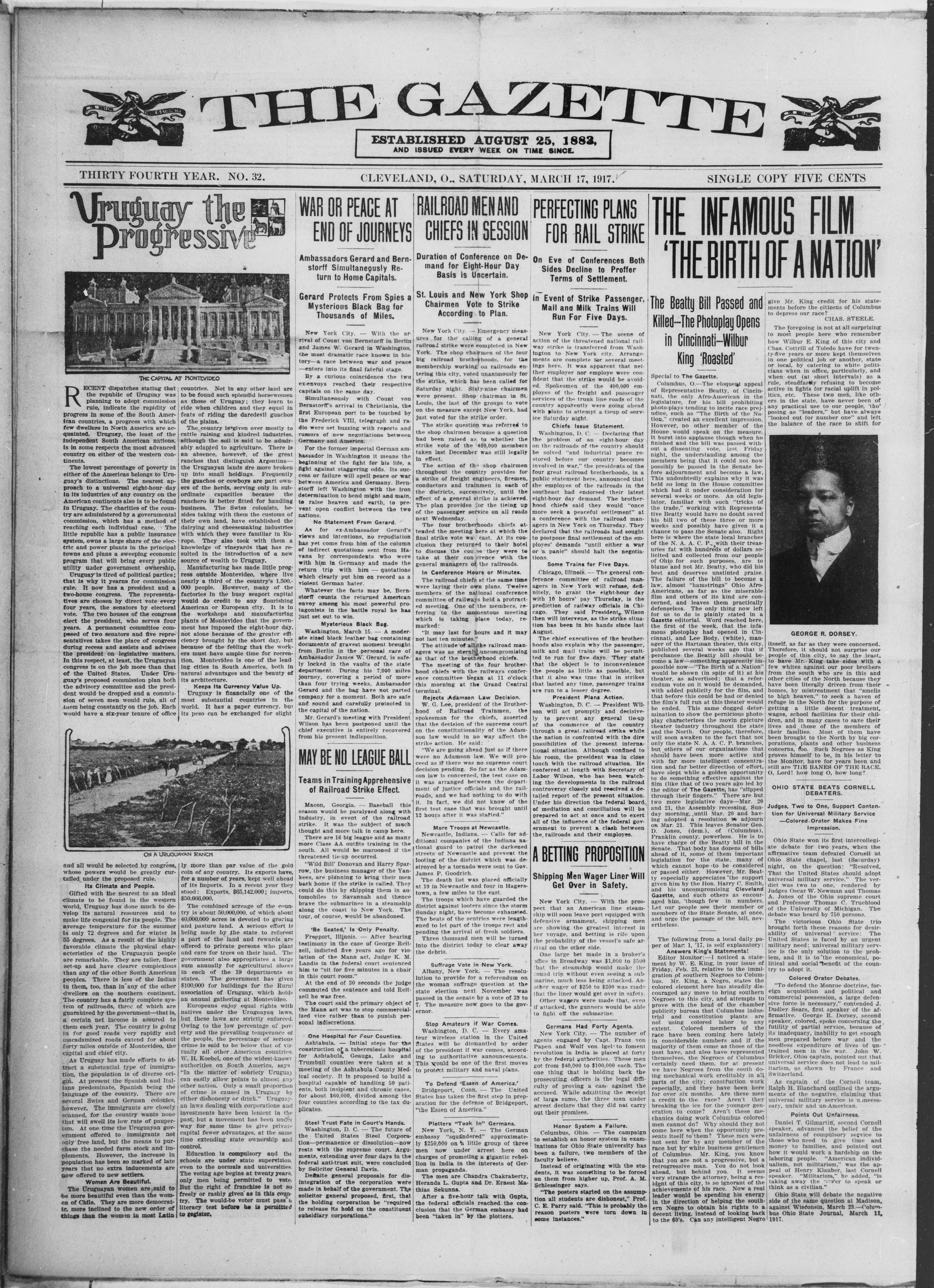
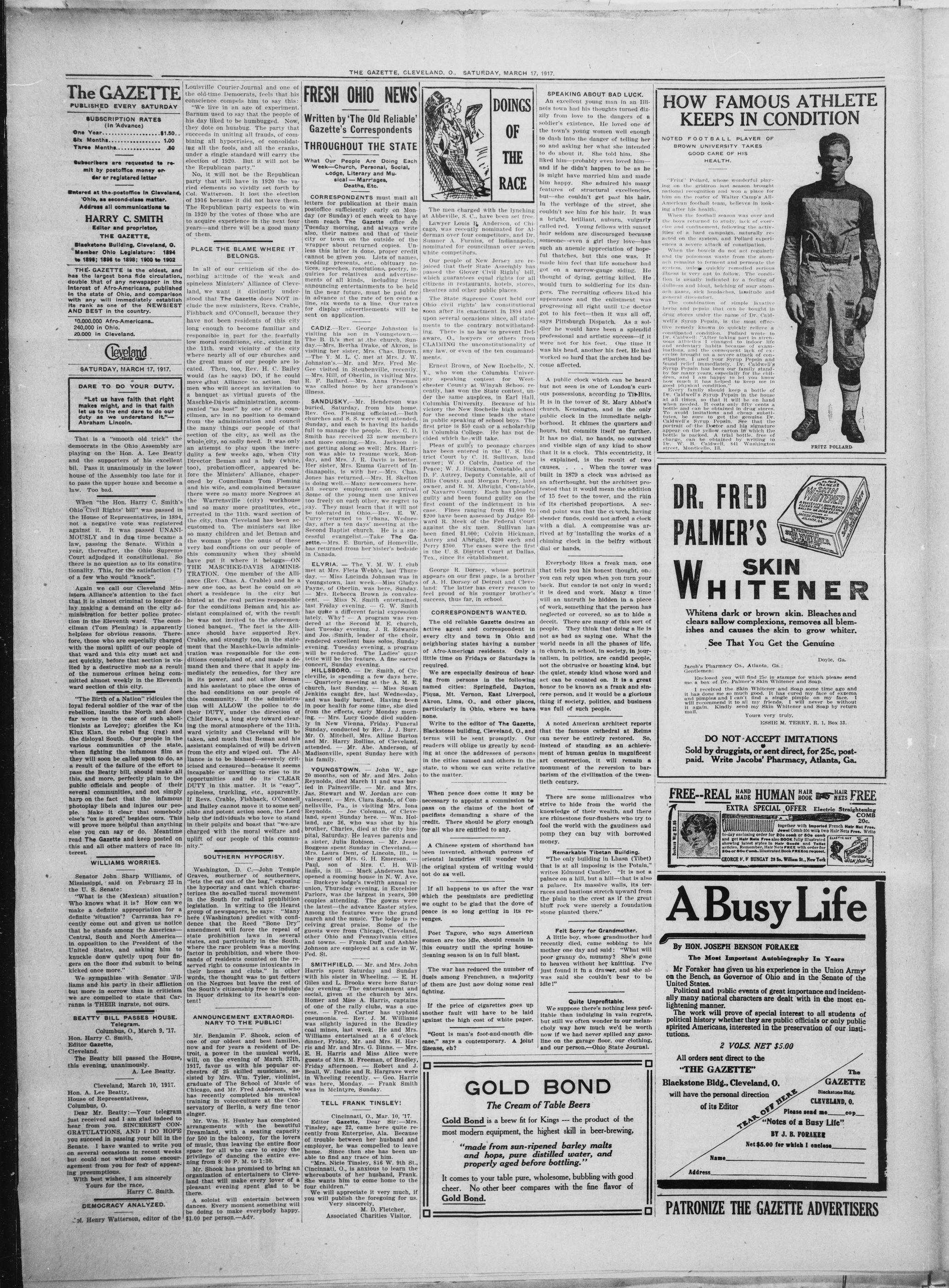
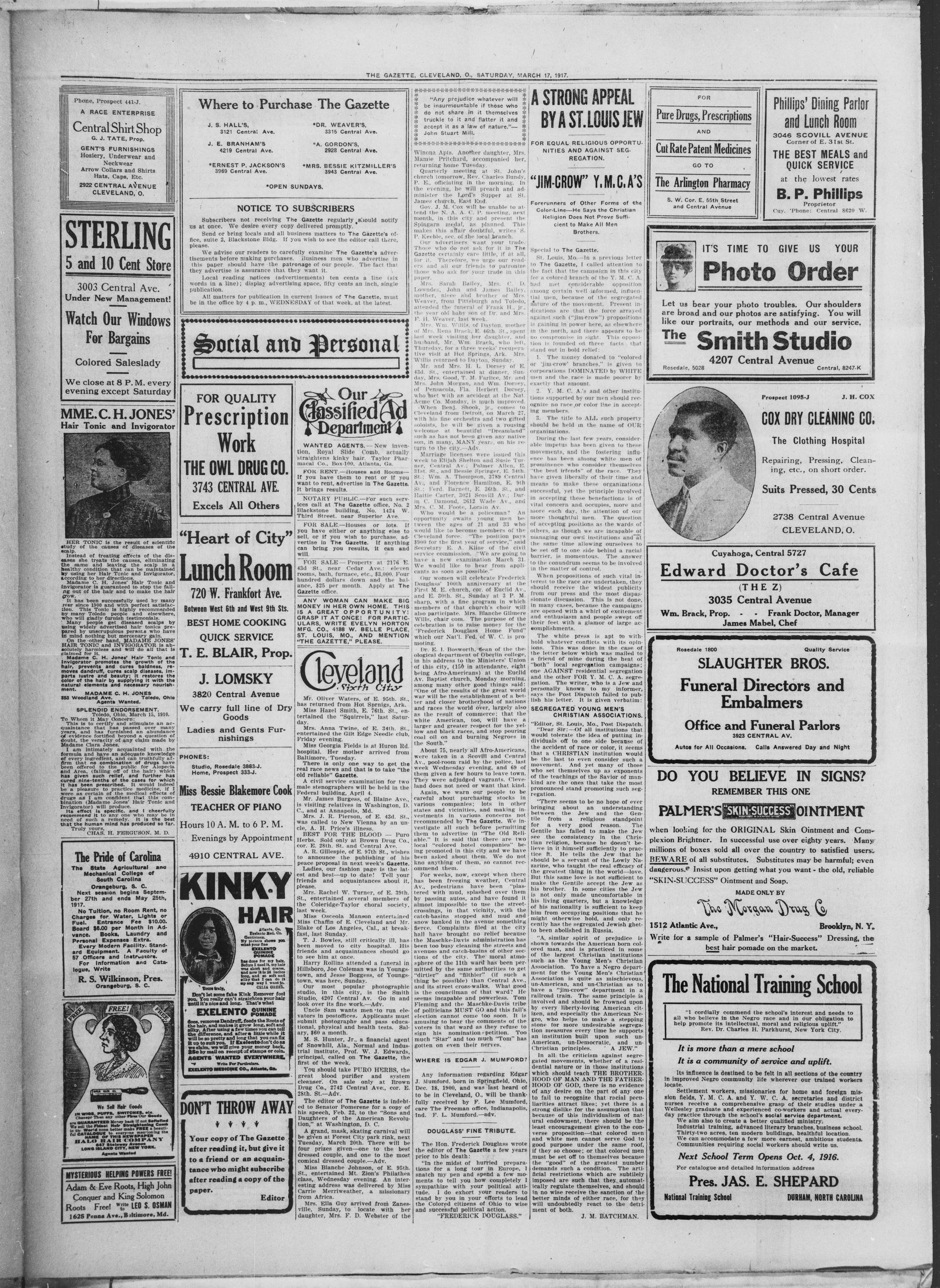
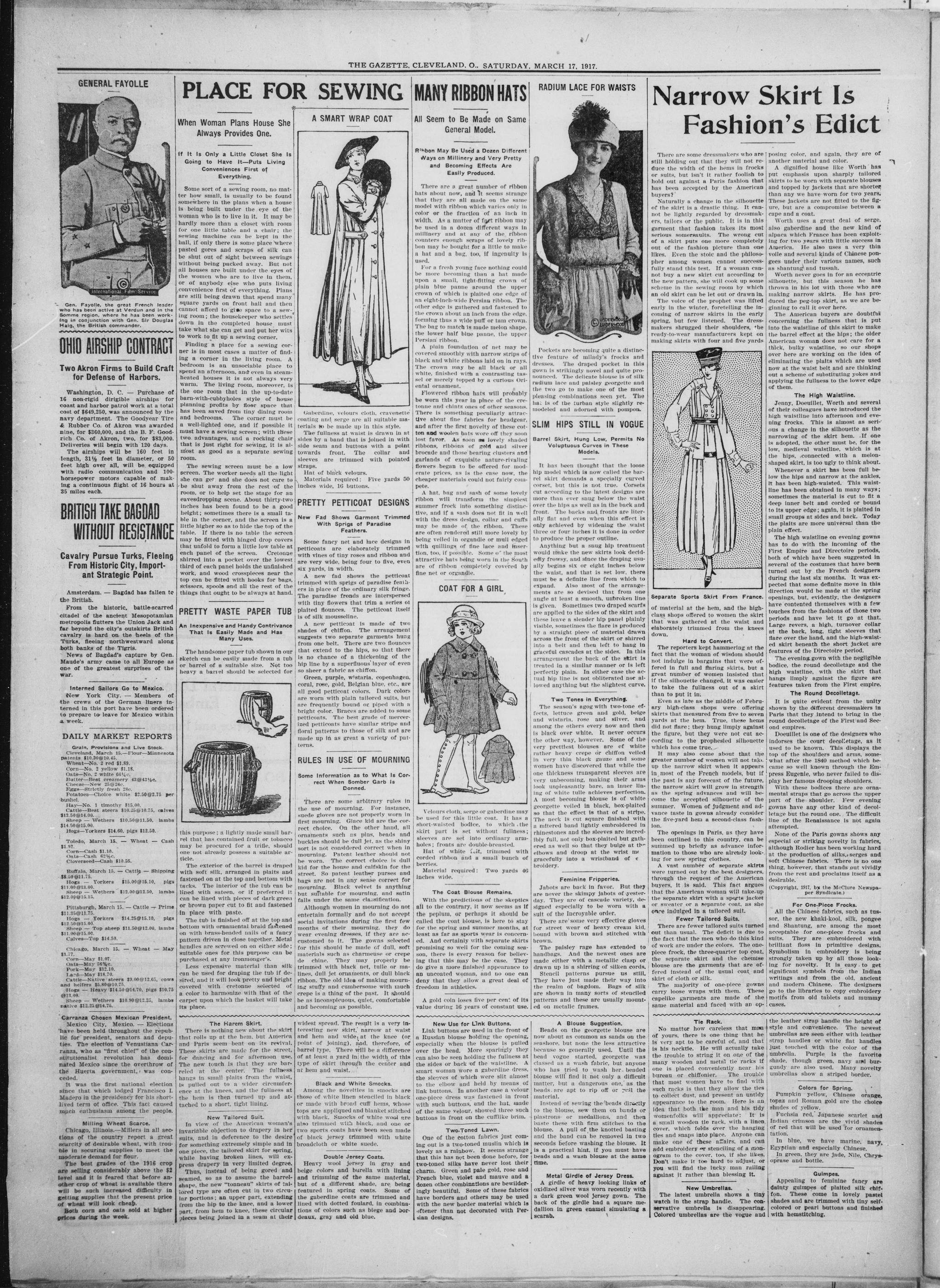
Page text (machine-generated)
IN DUTION
HONOUR
AND VERSATILE
THIRTY FOURTH YEAR
Uruguay
Progres
THIRTY FOURTH YEAR. NO. 32.
Uruguay the Progressive
RECENT dispatches stating that the republic of Uruguay was planning to adopt commission rule, indicate the rapidity of progress in some of the South American countries, a progress with which few dwellers in North America are acquainted. Uruguay, the least of the independent South American nations, is in some respects the most advanced country on either of the western continents. Not in any other land are to be found such splendid horsewomen as those of Uruguay; they learn to ride when children and they equal feats of riding the daredevil guache of the plains.
The country is given over mostly to cattle raising and kindred industries, although the soil is said to be administratively adapted to agriculture. There is an absence, however, of the great ranches that distinguish Argentina.
The lowest percentage of poverty in either of the Americas belongs to Uruguay's distinctions. The nearest approach to a universal eight-hour day in its industries of any country on the American continents also is to be found in Uruguay. The charities of the country are administered by a governmental commission, which has a method of reaching each individual case. The little republic has a public insurance system, owns a large share of the electric and power plants in the principal towns and plans a sweeping economic program that will bring every public utility under government ownership. Uruguay is tired of political parties; that is why it years for commission rule. It now has a president and a two-house congress. The representatives are chosen by direct vote every four years, the senators by electoral vote. The two houses of the congress elect the president, who serves four years. A permanent committee composed of two senators and five representatives takes the place of congress during recess and assists and advises the president on legislative matters. In this respect, at least, the Uruguayan congress is on the job more than that of the United States. Under Uruguay's proposed commission plan both the advisory committee and the president would be dropped and a commission of seven men would rule, all of them being constantly on the job. Each would have a six-year tenure of office
[Image of a long line of people walking along a road]
ON A URUOUAYAN RANCH
and all would be selected by congress, whose powers would be greatly curtailed under the proposed rule. Only more than par value of the go coin of any country. Its exports have for a number of years, kept well ahea
its Climate and People.
Gifted with the nearest to an ideal climate to be found in the western world, Uruguay has done much to develop its natural resources and to make life congenial for its people. The average temperature for the summer is only 72 degrees and for winter is 55 degrees. As a result of the highly favorable climate the physical characteristics of the Uruguayan people are remarkable. They are taller, finer set-up and have clearer complexions than any of the other South American peoples. There is less of the Indian in them, too, than in any of the other dwellers on the southern continent. The country has a fairly complete system of railroads, three of which are guaranteed by the government—that is, a certain net income is assured to them each year. The country is going in for good roads very rapidly and macadamized roads extend for about forty miles outside of Montevideo, the capital and chief city.
As Uruguay has made efforts to attract a substantial type of immigration, the population is of diverse origin. At present the Spanish and Italians predominate, Spanish being the language of the country. There are several Swiss and German colonies, however. The immigrants are closely scanned, for the country wants none that will swell its low rate of pauperism. At one time the Uruguayan government offered to immigrants not only free land, but the means to purchase the needed farm stock and implements. However, the increase in population has been so marked of late years that no extra inducements are now offered to new settlers.
Women Are Beautiful.
The Uruguayan women are, said to be more beautiful even than the women of Chile. They are more democratic, more inclined to the new order of things than the women in most Latin
Women Are Beautiful.
countries. Not in any other land are to be found such splendid horsewomen as those of Uruguay; they learn to ride when children and they equal in feats of riding the daredevil guachos of the plains.
The country is given over mostly to cattle raising and kindred industries, although the soil is said to be admirably adapted to agriculture. There is an absence, however, of the great ranches that distinguish Argentina—the Uruguayan lands are more broken up into small holdings. Frequently the guachos or cowboys are part owners of the herds, serving only in subordinate capacities because the ranchero is better fitted for handling business. The Swiss colonists, besides taking with them the customs of their own land, have established the dairying and cheesemaking industries with which they were familiar in Europe. They also took with them a knowledge of vineyards that has resulted in the introduction of a new source of wealth to Uruguay.
Manufacturing has made little progress outside Montevideo, where live nearly a third of the country's 1,500,000 people. However, many of the factories in the busy seaport capital would do credit to any flourishing American or European city. It is in the workshops and manufacturing plants of Montevideo that the government has imposed the eight-hour day, not alone because of the greater efficiency brought by the short day, but because of the feeling that the workers must have ample time for recreation. Montevideo is one of the leading cities in South America, both in natural advantages and the beauty of its architecture.
Keeps Its Currency Value Up.
Uruguay is financially one of the most substantial countries in the world. It has a paper currency, but its peso can be exchanged for slight
LYMAN RANCH
ly more than par value of the gold coin of any country. Its exports have, for a number of years, kept well ahead of its imports. In a recent year they stood: Exports, $65,142,000; imports, $50,666,000.
The combined acreage of the country is about 50,000,000, of which about 40,000,000 acres is devoted to grazing and pasture land. A serious effort is being made by the state to reforest a part of the land and rewards are offered to private persons who plant and care for trees on their land. The government also appropriates a large sum annually for agricultural shows in each of the 19 departments or states. The government has given $100,000 for buildings for the Rural association of Uruguay, which holds an annual gathering at Montevideo.
Europeans enjoy equal rights with natives under the Uruguayan laws, but these laws are strictly enforced. Owing to the low percentage of poverty and the prevailing temperance of the people, the percentage of serious crime is said to be below that of virtually all other American countries. W. H. Koebel, of the widest-known authorities on South America, says "In the matter of sobriety Uruguay can easily allow points to almost any other nation. Only a small proportion of crime is caused in Uruguay by either dishonesty or drink." Uruguayan laws dealing with corporations and investments have been lenient in the past, but a movement has been under way for same time to give private capital fewer advantages, at the same time extending state ownership and control.
Education is compulsory and the schools are under state supervision even to the normals and universities. The voting age begins at twenty years only men being permitted to vote. But the right of franchise is not so freely or rashly given as in this country. The would-be voter must pass a literacy test before he is permitted to register.
ESTABLISHED AUGUST 25, 1883 AND ISSUED EVERY WEEK ON TIME SINCE.
WAR OR PEACE AT END OF JOURNEYS
WAR OR PEACE AT END OF JOURNEYS
Ambassadors Gerard and Bernstorff Simultaneously Return to Home Capitals.
Gerard Protects From Spies a Mysterious Black Bag for Thousands of Miles.
New York City. — With the arrival of Count von Bernstorff in Berlin and James W. Gerard in Washington, the most dramatic race known in history—a race between war and peace—enters into its final fateful stage.
By a curious coincidence the two ex-envoys reached their respective capitals on the same day.
Simultaneously with Count von Bernstorff's arrival in Christianity, the first European port to be touched by the Frederick VIII, telegraph and radio were set buzzing with reports and rumors of new negotiations between Germany and America.
For the former imperial German ambassador in Washington it means the beginning of the fight for his life, a fight against staggering odds. Its success or failure will spell peace or war between America and Germany. Bernstorff left Washington with the iron determination to bend might and main, to raise heaven and earth, to prevent open conflict between the two nations.
No Statement From Gerard.
As for ex-Ambassador Gerard's views and intentions, no repudiation has yet come from him of the column of indirect quotations sent from Havana by correspondents who were with him in Germany and made the return trip with him — quotations which clearly put him on record as a violent German hater.
Whatever the facts may be, Bernstorf counts the returned American envoy among his most powerful protagonists in the battle royal he has just set out to win.
Mysterious Black Bag.
Washington, March 15. — A moderate size black leather bag containing documents of gravest moment brought from Berlin in the personal care of Ambassador James W. Gerard, is safely locked in the vaults of the state department. During his 7,000 miles journey, covering a period of more than four trying weeks, Ambassador Gerard and the bag have not parted company for a moment. Both are safe and sound and carefully protected in the capital of the nation.
Mr. Gerard's meeting with President Wilson has been postponed until the chief executive is entirely recovered from his present indisposition.
MAY BE NO LEAGUE BALL
MAY BE NO LEAGUE BALL
Teams in Training Apprehensive of Railroad Strike Effect
Macon, Georgia. — Baseball this season would be paralyzed along with industry, in event of the railroad strike. It was the subject of much thought and more talk in camp here. There are 16 big league and as many more Class AA outfits training in the south. All would be marooned if the threatened tie-up occurred. "Wild Bill' Donovan and Harry Sparrow, the business manager of the Yankees, are planning to bring their men back home if the strike is called. They could do this by shipping them in automobiles to Savannah and then brave the submarines in a steamship along the coast to New York. The tour, of course, would be abandoned.
'Be Seated.' Is Only Penalty
Freeport, Illinois. — After hearing testimony in the case of George Reitzell, indicted five years ago for violation of the Mann act, Judge K. M. Landis in the federal court sentenced him to "sit for five minutes in a chain in this court room."
At the end of 30 seconds the judge commuted the sentence and told Reitzell he was free.
The court said the primary object of the Mann act was to stop commercialized vice rather than to punish personal indiscretions.
One Hospital for Four Counties.
Ashtabula. — Initial steps for the construction of a tuberculosis hospital for Ashtabula, Geauga, Lake and Trumbull counties were taken at a meeting of the Ashtabula County Medical society. It is proposed to build a hospital capable of handling 50 patients, both insipient and chronic cases, for about $60,000, divided among the four counties according to the tax duplicates.
Steel Trust Fate in Court's Hands. Washington, D. C. — The future of the United States Steel Corporation—permanence or dissolution—now rests with the supreme court. Arguments, extending over four days in the federal anti-trust suit, were concluded by Solicitor General Davis.
Definite general proposals for disintegration of the corporation were made in behalf of the government. The solicitor general proposed, first, that the holding corporation be "required to release its hold on the constituent subsidiary corporations."
RAILROAD MEN AND CHIEFS IN SESSION
Duration of Conference on Demand for Eight-Hour Day Basis is Uncertain.
St. Louis and New York Shop Chairmen Vote to Strike According to Plan.
New York City. — Emergency measures for the calling of a general railroad strike were completed in New York. The shop chairmen of the four big railroad brotherships, for the membership working on railroads entering this city, voted unanimously for the strike, which has been called for Saturday night. Sixty-nine chairmen were present. Shop chairman in St. Louis, the last of the groups to vote on the measure except New York, had just voted for the strike order.
The strike question was referred to the shop chairmen because a question had been raised as to whether the strike vote of the 400,000 members taken last December was still legally in effect.
The action of the shop chairmen throughout the country provides for a strike of freight engineers, firemen, conductors and trainmen in each of the districts, successively, until the effect of a general strike is achieved. The plan provides for the tieing up of the passenger service on all roads next Wednesday.
The four brotherhoods chiefs attended the meeting here at which the final strike vote was cast. At its conclusion they returned to their hotel to discuss the course they were to take at their conference with the general managers of the railroads.
In Conference Hours or Minutes.
The railroad chiefs at the same time were laying their own plans. Twelve members of the national conference committee of railways held a protracted meeting. One of the members, referring to the momentous meeting which is taking place today, remarked: "It may last for hours and it may not last ten minutes." The attitude of all the railroad managers was as sternly uncompromising as that of the brotherhood chiefs. The meeting of the four brotherhood chiefs with the railways conference committee began at 11 o'clock this morning at the Grand Central terminal.
Rejects Adamson Law Decision.
W. G. Lee, president of the Brotherhood of Railroad Tralmen, the spokesman for the chiefs, asserted that the decision of the supreme court on the constitutionality of the Adamson law would in no way affect the strike action. He said: "We are going ahead just as if there were no Adamson law. We will proceed as if there was no supreme court decision pending. So far as the Adamson law is concerned, the test case on it was arranged between the department of justice officials and the railroads, and we had nothing to do with it. In fact, we did not know of the first test case that was brought until 12 hours after it was started."
More Troops at Newcastle
Newcastle, Indiana, — Calls for additional companies of the Indiana national guard to patrol the darkened streets of Newcastle and prevent the looting of the district which was destroyed by a tornado were sent to Gov. James P. Goodrich.
The death list was placed officially at 19 in Newcastle and four in Hagerstown, a few miles to the east.
The troops which have guarded the district against looters since the storm Sunday night, have become exhausted.
The beats of the sentries were lengthened to let part of the troops rest and pending the arrival of fresh soldiers.
Three thousand men will be turned into the district today to clear away the debris.
Suffrage Vote in New York
Suffrage Vote in New York.
Albany, New York. — The resolution to provide for a referendum on the woman suffrage question at the state election next November was passed in the senate by a vote of 39 to 7. The measure now goes to the governor.
Stop Amateurs if War Comes
Washington, D. C. — Every amateur wireless station in the United States will be dismantled by order of the president if war comes, according to authoritative announcements. This would be one of the first moves to protect military and naval plans.
To Defend 'Essen of America.'
Bridgeport, Conn. — The United States has taken the first step in preparation for the defense of Bridgeport, "the Essen of America."
Plotters "Took In" Germans
Plotters "Took In" Germans.
New York, N. Y. — The German embassy "squandered" approximately $250,000 on a little group of three men now under arrest here on charges of promoting a gigantic rebellion in India in the interests of German propaganda.
The men are Chandra Chakraberty, Heranda L. Gupta and Dr. Ernest Mathias Sekunna.
After a five-hour talk with Gupta, the federal officials reached the conclusion that the German embassy had been "taken in" by the plotters.
PERFECTING PLANS FOR RAIL STRIKE
PERFECTING PLANS FOR RAIL STRIKE
On Eve of Conferences Both Sides Decline to Proffer Terms of Settlement.
In Event of Strike Passenger, Mail and Milk Trains Will Run For Five Days.
New York City. — The scene of action of the threatened national railway strike is transferred from Washington to New York city. Arrangements are complete for several meetings here. It was apparent that neither employer nor employee were confident that the strike would be avoided. Spokesmen of the 400,000 employees of the freight and passenger services of the trunk line roads of the country apparently were going ahead with plans to attempt a tieup of service Saturday night.
Chiefs Issue Statement.
Washington, D. C. — Declaring that the problem of an eight-hour day on the railroads of the country should be solved "and industrial peace restored before our country becomes involved in war," the presidents of the four great railroad brotherhoods, in a public statement here, announced that the employees of the railroads in the southeast had endorsed their latest eight-hour day demand. The brotherhood chiefs said they would "once more seek a peaceful settlement" at a conference with the railroad managers in New York on Thursday. They declared that the railroads had sought to postpone final settlement of the employees' demands "until either a war or a panic" should halt the negotiations.
Some Trains for Five Days.
Chicago, Illinois. — The general conference committee of railroad managers in New York will refuse, definitely, to grant the eight-hour day with 10 hours' pay Thursday, is the prediction of railway officials in Chicago. They said President Wilson then will intervene, as the strike situation has been in his hands since last August.
The chief executives of the brothers-hoods also explain why the passenger, milk and mail trains will be permitted to run for five days. They state that the object is to inconvenience the people as little as possible, but that it also was true that in strikes that lasted any time, passenger trains are run to a lesser degree.
President Plans Action.
President Plans Action.
Washington, D. C. — President Wilson will act promptly and decisively to prevent any general tie-up of the commerce of the country through a great railroad strike while the nation is confronted with the dire possibilities of the present international situation. Although confined to his room, the president was in close touch with the railroad situation. He conferred at length with Secretary of Labor Wilson, who has been watching the developments in the railroad controversy closely and received a detailed report of the present situation. Under his direction the federal board of mediation and conciliation will be prepared to act at once and to exert all of the influence of the federal government to prevent a clash between the railroads and their employees.
A BETTING PROPOSITION
Shipping Men Wager Liner Will Get Over in Safety.
New York City, — With the prospect that an American line steamship will soon leave port equipped with defensive armament, shipping men are showing the greatest interest in her voyage, and betting is rife upon the probability of the vessel's safe arrival on the other side.
One large bet made in a broker's office in Broadway was $1,000 to $500 that the steamship would make the round trip without even seeing a submarine, much less being attacked. Another wager of $250 to $200 was made that the liner would get over in safety. Other wagers were made that, even if attacked, the gunners would be able to fight off the submarine.
Germans Had Forty Agents
New York City. — The number of agents engaged by Capt. Franz von Papen and Wolf von Igel-to foment revolution in India is placed at forty by the federal authorities. These men got from $40,000 to $100,000 each. The one thing that is holding back the prosecuting officers is the legal difficulty of proving a case against the accused. While admitting the receipt of large sums, the three men under arrest declare that they did not carry out their promises.
Hope System a Failure
Columbus, Ohio. — The campaign to establish an honor system in examinations for Ohio State university has been a failure, two members of the faculty believe.
Instead of originating with the students, it was something to be forced on them from higher up, Prof. A. M. Schlessinger says.
"The posters started on the assumption all students are dishonest," Prof. C. E. Parry said. "This is probably the reason posters were torn down in some instances."
SINGLE COPY FIVE CENTS
THE INFAMOUS FILM 'THE BIRTH OF A NATION'
The Beatty Bill Passed and Killed--The Photoplay Opens in Cincinnati--Wilbur King 'Roasted'
Special to The Gazette
The following from a local daily pa-
per of Mar 1, 17, is self explanatory:
*The following from a local daily pa-
per of Mar 1, 17, is self explanatory:*
Answers King's Statements:
Editor Monitor: noticed a notice of Friday, Feb. 23, relative to the immigration of southern Negroes to Columbus. Mr. King, a Negro, states the colored element here has steadily discouraged any move to bring southern Negroes to this city, and attempts to prove with the head of the chamber publicity bureau that Columbus industrial and constitution plants are not using colored labor to any extent. Colored members here lately have invested considerable numbers and if the majority of them come as those of the past have, and also have represented themselves, the Negroes of Columbus certainly need them, for at present we have Negroes from the south doing mechanical work creditably in all parts of the city; construction work especially, and they have been here for over six months. Are these men a credit to the race? Aren't they coming to the region for education to come? Aren't these mechanics doing work Columbus colored men cannot do? Why should they not come here when the opportunity presents itself to them? These men were not sent for by any member of the race but by white business gentlemen of Columbus. Mr. King, you know that you are not a progressive, but a retrogressive man. You do not look ahead, but behind you. It seems very strange the attorney, being a resident of this city, would be involved in the race. Now a real leader would be spending his energy in the direction of helping the south Negro to obtain his rights to a decent living, instead of looking back to the 60's. Can any intelligent Negro
give Mr. King credit for his statements before the citizens of Columbus to depress our race? CHAS. STEEL.
The foregoing is not at all surprising to most people here who remember how Wilbur E. King of this city and Chas. Cottill of Toledo have for twenty-five years or more kept themselves in one political job or another, state or local, by catering to white politicians when in office, particularly, and when out (at short intervals) as a rule, steadfastly refusing to become active in fights for racial uplift in politics, etc. These two men, like others in the state have never been of practical use people, thou posing as "leaders," but have always "looked out for number one" and left the balance of the race to shift for
GEORGE R. DORSEY.
itself, as far as they were concerned.
Therefore, it should not surprise our people of this city, to say the least,
to have Mr. King take sides with a few whites against our poor brothers from the south who are in this and other cities of the North because they have been literally driven from their homes, by mistreatment that "smells to high heaven," to seek a haven of refuge in the North for the purpose of getting a little decent treatment, wages, school facilities for their children, and in many cases to save their lives. In such cases their families. Most of them have been brought to the North by big corporations, plants and other business concerns, too. Such Negroes as King proves himself to be, in his letter to the Monitor, have for years been and still are THE BANES OF THE RACE, O Lord; how long O, how long?
OHIO STATE BEATS CORNELL
DEBATERS.
Judges, Two to One, Support Conten-
tion for Universal Military Service
—Colored. Orator Makes Fine
Impression
Ohio State won its first intercollegiate debate for two years, when the affirmative team defeated Cornell at Ohio State chapel, last (Saturday) night, on the question: "Resolved, That the United States should adopt universal military service." The verdict was two to one, rendered by Judges Oscar W. Newman and Thomas de la Cruz of Ohio State court and Professor Thomas C. Truchard of the University of Michigan. The debate was heard by 750 persons. The victorious Ohio State trio brought forth these reasons for desirability of universal* service: The United States is faced by an urgent military need; universal military service is the only solution to the problem; it is to the economical, political and social benefit of the country to adopt it.
Colored Orator Debates.
"To defend the Monroe doctrine, foreign acquisition and political and commercial possession, a large defensive force is necessary," contended J. Dudley Sears, first speaker of the affirmative. George R. Dorsey, second speaker, colored, spoke concerning the futility of partial service, because of its inadequacy, inability to get enough men prepared before war and the needless expenditure of lives of untrained men in the war. John W. H. Blanchard outlined the arguments of the negative, claiming that universal military service is u necessary, unfair and un-American.
Points Out Unfairness.
Daniel T. Gilmartin, second Cornell speaker, advanced the belief of the unfairness of compulsory service to those who need to give time and money to families, and pointed out how it would work a hardship on the laboring people. "American individualism, not militarism," was the appeal of Henry Klauber, last Cornell speaker. "Whitearm," he added, "is taking away the "2-4" to speak or think as a civilian." Ohio State will debate the negative side of the same question at Madison, against Wisconsin, March 23. "Columbus Ohio State Journal, March 11, 1917.
PUBLISHED EVERY SATURDAY
SUBSCRIPTION RATES
(Un ’Advance)
One Year... e.sceceseeeeses S180..
She Months......eseeceeeee 100
Three Monthe.....ceceeseee 80
Subscribers are requested te re
mit by postoftice money er
dar oF registered letter
Entered at the-postoffice In Cleveland,
“Ohle, as second-clase matter.
‘Address all communications te
HARRY C. SMITH
Editor and proprietor,
THE GAZETTE,
__Biacketone Bullding, Cleveland, 0,
Member Ohio Legislature: 1894
‘te 1898; 1896 to 1898; 1900 to 1902
THE. GAZETTE |e the oldest, and
hhas the largest bona fide circulation,
double that of any newspaper in the
Interest of Afro-Americans, published
In the state of Ohio, and comparison
with any will immediately establish
its rank as one of the NEWSIEST
AND BEST in the country.
10,000,000 Afro-Americans..
240,000 in Ohio.
20.000 in Cleveland.
~SATURDAY, MARCH 17, 1917.
DARE TO DO YOUR DUTY.
“Let us have faith that right
makes might, and in that faith
Jet us to the end dare to do our
duty as we understand It”"—
Abraham Lincoln.
‘That is a “smooth old trick” the
democrats in the Ohio Assembly are
playing on the Hon. A. Lee Beatty
and the supporters of his excellent
bil. Pass it unanimously in the lower
house of the Assembly too late for it
to pass the upper house and become a
Jaw. Too bad.
When “the Hon. Harry C. Smith's
Ohio" Civil Rights’ bill” was passed in
the House of Representatives, in 1894,
not a negative yote was registered
against it. It was passed UNANI-
MOUSLY and in dug time became a
law, passing the Senate. Within a
yeir, thereafter, the Ohio Supreme
Court adjudged it constitutional. So
there is no question as to its constitu:
tionality. This, for the satisfaction (?)
Ob a tam Gb aeala “enock”.
Again we call our Cleveland Min
isters Alliance's attention to the fac
that it is almost criminal to longer de
Jay making a demand on the city ad.
ministration for better police protec
tion in the Bleventh ward. ‘The coun
cilman (Tom Fleming) is apparently
helpless for obvious reasons. There
fore, those who are especially charged
with the moral uplift of our people of
that ward and this city must act and
‘act quickly, before that section is vis
ited by a destructive mob as a result
‘of the numerous crimes being com:
mitted almost weekly in the Eleventh
ward section of this city.
“The Birth of a Nation” ridicules the
loyal federal soldier of the war of the
rebellion, insults the North and does
far worse in the case of such abolt
tionists as Lovejoy; glorifies the Kx
Klux Klan, the rebel flag (rag) and
the disloyal South. Our people in the
various communities of the state
when fighting the infamous film a:
they will soon be called upon to do, as
a result of the failure of the effort t
pass the Beatty bill, should make al
this, and more, perfectly plain to the
public officials and people of their
several communities, and not simply
harp on the fact that the infamous
photoplay libels and injures our peo
ple, Make it clear that somebods
else’s “ox is gored” besides ours. This
will prove more helpful than anything
else you can say or do. Meantime
read The Gazette and keep posted on
‘this and all other matters of race in.
WILLIAMS WORRIES.
Senator Jobn Sharp Williams, of
Mississippi, ‘said on February 23 in
the U. 8. Senate:
“What is the (Mexican) situation?
‘Who knows what it is? How can we
make a definite appropriation for a
definite ‘situation’? Carranza has re-
cently come out and given us notice
that he stands among the Americas—
Central, South and North America—
in opposition to the President of the
United States, and asking him to
Knuckle donw quietly upon four fn:
gers on the floor md submit to being
kicked once more.”
We sympathize with Senator Wil
Jiams and his party. in their affliction
but more in sorrow than in criticism
we are compelled to state that Car-
ranza is THEIR ingrate, not ours.
———
BEATTY BILL PASSES HOUSE.
Telegram.
Columbus, 0,, March 9, 17.
Hon. Harry C. Smith,
Editor Gazette,
Cleveland.
‘The Beatty bill passed the House,
this evening, unanimously.
‘A. Lee Beatty.
COUSINS, “SCR BN, SeP he
Hon. A. Lee Beatty,
House of Representatives,
Columbus, 0.
Dear Mr. Beatty:—Your telegram
just received and Iam glad indeed to
hear from you. SINCEREST CON-
GRATULATIONS, AND I DO HOPE
you succeed in passing your bill in the
Benate. I have wanted to write you
‘on several occasions in recent weeks
Dut could not without some encour-
agement from you for fear of appear-
ing. presumptious.
‘With best wishes, I nm sincerely
‘Yours for the race,
‘Harry C. Smith,
DEMOCRACY ANALYZED.
9! Henry Watterson, editor of the
Louisville Courier-Journal and one of
the old-time Democrats, feels that his
conscience compels him to say this:
“We live in an age of experiment.
Barnum used to say that the people ot
his day liked to be humbugged. Now
they dote on humbug. ‘The party thal
Succeeds in uniting all frauds, of com
dining all hypocrisies, of consolidat
ing all the fools, and all the cranks
under a single standard will carry the
election of 1920. But it will not be
the Republican party.”
No, it will not be the Republicar
party that will have in 1920 the va
ried elements so vividly set forth by
Col. Watterson. It lost the electior
of 1916 because it did not have them
‘The Republican party expects to wit
in 1920 by the votes of those who are
to acquire experience in the next four
years—and there will be a good man)
of them,
PLACE THE BLAME WHERE IT
BELONGS.
In all of our criticism of the do-
nothing atsimde of the weak and
spineless Ministers’ Alliance of Cleve-
land, we want it distinetly under
stood that The Gazette does NOT in
elude the new ministers, Revs. Crable,
Fishback and O'Connell, because they
have not been residents of this city
long enough to become familiar and
responsible in part for the. fearfully
low moral conditions, ete., existing in
the 1ith. ward vicinity of the city
where nearly all of our churches and
the great mass of our people are lo-
cated. ‘Then, too, Rey. H. C. Bailey
‘would (as he says) DO, if he could
move sthat Alliance to action. But
men who will accept an invitation to
a banquet» as virtual guests of the
‘Masehke-Davis administration, accom:
panied “as host” by one of its coun-
Bhs urea ences cc
from the administration and council
‘the many things our people of that
‘section of the city, as well as the
wholecelty, so sadly heed. It was only
an attempt to play upon the incre-
dulity a few weeks ago, when City
Director Beman and a lady (white,
too), probation-officer, appeared be-
fore the Ministers’ Alliance, chaper
foned by Councilman Tom Fleming
and his wife, and complained because
there were so many more Negroes al
the Warrensville (city) workhouse
and so many more prostitutes, etc.
arrested in the Ith. ward section of
the city, than Cleveland has been ac:
customed to. ‘The ministers sat like
so many children and let Beman and
the woman place the onus of these
very bad conditions on our people of
this community when they should
have put it where it belongs—ON
THE MASCHKE-DAVIS ADMINIS.
TRATION. One member of the All
ance (Rev. Chas. A. Crable) and he a
new one too, as best he could on so
short a residence in the city but
hinted at the real parties responsible
for the conditions Beman and his as:
sistant complained of, with the resul!
he was not invited to the aforemen-
tioned banquet. The fact is the Alli
ance should have supported Rev.
Crable, and strongly too, in the state-
ment that the Maschke-Davis adminis.
tration was responsible for the con-
ditions complained of, and made a de-
mand then and there that it apply im-
mediately the remedies, for they are
in its power, and not allow Beman
and his assistant to place the onus of
the bad conditions on our people of
this community. If the administra-
tion will ALLOW the police to do
their DUTY, under the direction of
Chief Rowe, a long step toward clear-
ing the moral atmosphere of the 11th.
ward vicinity and Cleveland will be
taken, and much that Beman and his
assistant complained of wil} be driven
from the city and wiped out. ‘The AF
Hance is to be blamed—severely erit-
cised and censured—because it seems
incapable or’ unwilling to rise to its
opportunities. and do its) CLEAR
DUTY in this. matter. It is “easy”,
spineless, truckling, ete., apparently.
If Revs. Crable, Fishback, O'Connell
and Bailey cannot move it to some sen:
sible and potent action soon, the Lord
help the individuals who love to stand
in their pulpits and boast that “we are
charged with the moral welfare and
uplift of our people of this commu:
SOUTHERN HYPOCRISY.
Washington, D. C.—John Temple
Graves, southerner of southerners
“lets the cat out of the bag,” exposing
‘the hypocrisy and cant which charac
terizes the so-called moral movement
in the South for radical prohibition
legislation. In writing to the Hears!
‘group of newspapers, he says: "Many
here (Washington) predict with confi
dence that the Reed “Bone Dry’
amendment will foree the repeal of
state prohibition laws in several
states, and particularly in the South,
where the race problem Was a moving
factor in prohibition, and where thou:
sands of residents counted on the re
served right to consume intoxicants in
their homes and clubs.” In other
‘words, the thought was to put fetters
‘on the Negroes but leave the rest of
the South's citizenship free to indulge
in liquor drinking to its heart's con
tent!
ANNOUNCEMENT EXTRAORDI-
'NARY TO THE PUBLIC!
Mr. Benjamin F. Shook, scion of
one of our oldest and best. families,
now and for years a resident of De
troit, @ power in the musical world,
will, on the evening of March 27th,
1917, favor us with his popular or
chestra of 25 skilled musicians, as
sisted by Mrs, Wm, Tyler, violinist
graduate of The School of Music of
Chicago, and Mr. Fred Anderson, who
has recently completed his musical
training in voice-culture at the Con:
servatory of Berlin, a very fine tenor
singer.
Mr. Wm. H. Hunley has completed
arrangements with the beautiful
Dreamland, with a seating capacity
for 500 in the balcony, for the lovers
of music, thus leaving’ the entire floor
space for all who care to enjoy the
privilege of dancing the entire eve
Bing from 8:00 P. M. to 1:20.
Mr. Shook has promised to bring an
organization of entertainers to Cleve
land that will make every lover of a
pleasant evening spent glad to be
there.
‘A soloist will entertain . between
dances, Every moment something will
be doing to make everybody happy.
$1.00 per person.—Adv.
THE GAZETTE, CLEVELAND, 0. SATURDAY, MARCH 17, 1917.
REE nck LSA te a oslo SERA
> | se
sees MG DOINGS}...
a Easy nois tc
: || ee aly t
Written by ‘The Old Reliable’ | PAN sits
Gazette's Correspondents || (Ry is >| OF jt
THROUGHOUT THE STATE | Vex jm a
| ‘ A leone
| | Nae Z THE ic:
What Our People Are Doing Each | SAMS ne
| Week—Church, Personal, Social, A TS av and if
UN Toage, Literary and Mur || RSA Ff is aug
sical — Marriages, { KotH GAS RACE him h
—— esc
CORRESPONDENTS must mail all iit toe buts
letters for publication at their main | In the
Dostoffice sufficiently early on Mon-| ‘The men charged with the lynching | eoutan
[Bay (or Sunday) or each week to have | at Abbeville; © Ce have been set tree | ae
[thom reach "The Gaustie offce Oi| Lawyer Louis iy Anerson, of Chi. [yt
Tuesday ‘morning, and always write cago, Gus recent nominated for At |
also, their names and that of their! derman over four competitors, and Dr, | heir 8
fae Or si On Ga gates ot Gel Serer Renner Gana | aocten
Wrapper about returned copies. Un-| nominated for councilman over seven | euch
Teas’ thie latter is done, proper credit | ner nemertcs es
Cannot be elven You. Tasty of maine | yr wnt oF seq gorsey ave vey
Redding presents, ete. obituary no"| 20) Mat tuaie State assembly, ts ade
Tice speechen, resolutions, poctty, Hn [soled Hat thelr State Assembly. haa ie,
Quirtes, for relatives, ‘and. advertise whieh guarantees equal rights for all | though
Diens) oF wil kinds, \ticlodiie items citizens in restaurants, hotels, store would
Announcing entertainments to be held citizens i restaurants, hotels, stores, .
Jin the ear future, must. be paid tor] (Healtes bubite pl ers
ese ct ares cl acme «| whe Sista sirens Coun! nald wut eppan
ise, six worcy tom tine. "Our tates | one vcvil rievie’ low commtinsions) tree
for ‘display advertisements will be soon after its enactment in 184 and | potty
sent on application. Nel ae eine oe aa ehie etcheai LAR aa gE
| ene _Rev. George Johnston: te
‘xisiting “his son in Youngstown
The B. Bis met at the church, Sun-
day—Mrs, Bertha Drake, of Akron, Is
visiting her sister, Mrs, Chas. Brown
—The YM. L. C. met at Mrs. J. W.
Johnston’s.—Mr. ‘and Mrs, Fred Me
Gee visited in Steubenville, recentiy.
—Mrss, Hill, of Oberlin, is visiting Mrs.
R. F. Ballard.—Mrs. "Anna. Freeman
Was called home by her grandson's
illness.
SANDUSKY.—Mr. Henderson was
buried, Saturday, ‘from his home.
Rev. Geo. Fleming officiated —Both
churches and 8.8. were well attended,
Sunday, and each fs having its hands
{ull to manage the people. Rey. G. D.
Smith has received 33 new members
and more coming. —Mrs. Jackson is
ot getting along so weil; Mrs. Harri
son was able to resume work, Mon-
day, and Mrs, J. 1 Davis is better
Her sister, Mrs. Emma Garrett of In-
‘dianapolis, ts with her.—Mrs. Chas.
Jones has’ returned.—Mrs. H. Skelton
is doing well—Many neweomers here
All secure employment on. arrival
Some of the young men use knives
too freely on each other, we regret to
say. ‘They must fearn that it will not
be tolerated in Ohio—Rev. EW.
Curry returned to. Urbana, Wednes
day, after a ten days’ meeting at the
Second Baptist church. He is a suc
cessful evangelist—Take The Ga.
zette.—Mrs. B, Burton, of Homeville,
“has returned from her bister's bedside
lta Caada.
ELYRIA. — The Y. M. W. I. club
met at Mrs. Fleta Webb's, last Thurs:
day. — Miss Lucinda Johnson was in
Youngstown, last week.-Miss Gladys
Payne, of Oberlin, was here, Sunday
— Mrs. Rebecca Brown is ‘ronvalex
cent, — Miss N, Smith entertained,
last Friday evening. — G. W. Smith
has quite a different facial expression
lately. Why? — A program was ren-
dered at the Second M. E. church,
last Tuesday evening. J. R. Edwards
and Jos. Smith, leader of the choir,
rendered excellent bass solos, Sunda;
evening. Tuesday evening, a program
will be rendered. ‘The Ladies’ quer.
tette will be the feature. A fine sucred
concert, Sunday evening.
HILLSBORO. — Dr. Smith, of Cir-
cleville, is spending a few days here.
— Quarterly meeting at the A. M. E.
chureh, Jast Sunday. — Miss Susan
Jenkins caught fire, last Wednesday,
and was badly burned. Having been
in poor health for some time, she died
from the effects, early Monday morn-
ing. — Mrs. Lucy Goode died sudden:
ly in New Vienna, Friday, Funeral
Sunday, conducted by Rev. J. J. Burr.
Mr. 0.' Mitchell, Mrs. Alline Burton
and Mr. Harry Rollins, of Cleveland,
attended. — Mr. Abe. Anderson, of
Madisonville, spent Sunday here with
his family.
VOUNGSTOWN. — John W., age
20 months, son of Mr. and Mrs. John
Reynolds, died Mareh 11 and was bur:
ied in Painesville. — Mr. and Mrs.
Jas. Stewart and W. Jordan are con-
valescent. — Mrs, Clara Sands, of Con:
nellsville, Pa, is visiting Mrs. lona
Reynolds. — Joe Coleman, of Cleve-
land, spent ‘Sunday here. Wm. Hol-
land, age 36, who was shot by his
brother, Charles, died at the city hos:
pital, Saturday. He leaves parents and
a sister, Julia Robison. — Mr. Jesse
Boggess spent Sunday in Cleveland.—
Mrs. Laura Dent, of Lincoln, Ill, is
the guest of Mrs! G. H. Emerson, —
Paul, son of Mrs. C. H. Wil
liauis, is ill. — Mack ,Anderson has
opened a rooming house in N. W. Ave.
— Buckeye lodge’s twelfth annual re-
union, Thursday evening, in Excelsior
Parlors, was the largest in years, 300
couples attending. The gowns were
the latest—-the advance Easter styles,
Among the features were the grand
march and the music. The lodge is re-
ceiving great praise. Some of the
guests were from Chicago, Cleveland,
other Ohio and Pennsylvania cities
and towns. — Frank Duff and Ashbie
Johnson are employed at a cafe in W.
Fed. St.
SMITHFIELD. — Mr. and Mrs. John
Harris spent Saturday and Sunday
with his sister in Wheeling. — E. H.
Giles and L. Brooks were here Satur-
day evening.—The entertainment and
social, given at the church by Mrs.
Homer and Miss A. Harris, captains
of one of the rally clubs, was a suc-
cess. — Fred. Carter has typhoid
pneumonia. — Rey. J. M. Williams
was slightly injured in the Bradley
coal mines, last week. He and Mrs.
Williams entertained at a 6 o'clock
dinner, Friday, Mr. and Mrs. H. Har
ris and Mr. and Mrs. G. Binns. — Mrs.
BE. H. Harris and Miss Alice were
guests of Mrs. M. Freeman, of Bradley,
Friday afternoon. — Robert and J.
Beall, W. Dadie and R. Hargrave were
in Wheeling recently. — Geo. Harris
was here, Monday. — Frank Smith
was in Mcintyre, Sunday.
TELL FRANK TINSLEY!
Cincinnati, O., Mar. 10, ‘17.
Editor Gazette," Dear Sir:—Mrs.
Tinsley, age 22, came here quite re-
cently from Enterprise, Ala. Because
of trouble between her husband and
employer, he was compelled to leave
home. Since then she has been un-
able to find any trace of him.
“Mrs, Nicie Tinsley, 816 W. 9th St.,
Cincinnati, 0., is anxious to learn the
whereabouts of her husband, Frank.
She wants him to come home to the
four children.”
‘We will appreciate it very much, if
you will publish the foregoing for us.
Very sincerely,
M. D. Fletcher,
Associated Charities Visitor.
The Cream of Table Beers
Gold Bond is a brew fit for Kings --- the product of the
most modern equipment, the highest skill in beer-brewing,
“made from sun-ripened barley malts
and hops, pure distilled water, and
properly aged before bottling.”
It comes to your table pure, wholesome, bubbling with good
cheer, No other beer compares with the fine flavor of
Gold Bond.
aS bs
Br 2 .
» pal Z
XU wS
DOINGS
OF
THE
RACE
The men charged with the lynching
at Abbeville, S. C., have been set free
Lawyer Louis 1 Anderson, of Chi:
cago, was recently nominated for Al
dernian over four competitors, and Dr.
‘Sumner A. Furniss, of Indianapolis,
nominated for councilman over seven
white competitors.
Our people of New Jersey are re
Jioiced that thelr Slate: Assembly ti
passed the Glover Civil Righty bill,
“which guarantees equal rights tor al
citizens in restaurants, hotels, stores,
“theatres and other publie places
The State Supreme Court held our
Ohio civil rights" law constitutional
‘soon after its enactment in 1804 and
upon several oceasions sinee, all state:
ments to the contrary notwithstand
‘ing. ‘There is no law to prevent Det
‘aware, O., lawyers or others trom
(CLAIMING the unconstitutionality of
any law, oF even of the ten command:
“ments,
i est osm ot ere este
¥.. who won the Columbia Univer
sity speaking contest for West.
“chester County at Winyah Schoo; re
“cently, has won the State contest, un:
der the same auspices, in Earl Hall
Columbia University. Because of his
victory the New Rochelle high school
for the second time leads the state
“in public speaking of school boys. The
“first prize 18 $50 cash or a scholarship
‘in Columbia College. He has not de-
‘cided which he-will take,
| Pleas of guilty to peonage charges
have been entered in the U. S, Dis:
trlet Court by C,H. Sullivan, tand
owner; W. O. Colvin, Justice of the
Peace; W. J. Hickman, Constable, and
D. F, Autrey, Deputy Constable, all ot
“Bilis County. and Morgan Perry, land
owner, and Rt. M. Albright, Constable,
of Navarro County. Bach has pleaded
guilty and been found guilty on the
first count of the indictment in his
case, Pines ranging from $1,000 to
$200 have been assessed by Judge Ed.
[ward R. Meek of the Federal Court
against the six men. Sullivan has
been fined $1,000; Colvin Hickman,
“Autrey and Aibright, $200 each and
Perry $200. ‘The cases were the first
[in the Ui. 8, District Court at Dallas,
tm’ tion tie detainee.
| George R. Dorsey, whose portrait
|appears on our first page, is-a brother
[of A. H. Dorsey of Detroit and Cleve
land: “The latter has every” reason to
feel proud of Mis. younger ‘brottier"
|suceess, thus far, in'sctoo!
| CORRESPONDENTS WANTED.
|The old reliable Gazette desires an
active agent and correspondent in
jpelenboriee states having a number
of Afro-American residents. Only a
‘ttle time on Fridays or Saturdays is
| required.
‘We are especially desirous of hear-
Ing from persons in the following
named cities: Springfield, Dayton,
Piqua, Mt. Vernon, East Liverpool,
Akron, Lima, ©., and other places,
particularly In Ohio, where we have
none.
Write to the editor of The Gazette,
Blackstone bullding, Cleveland, O., and
terms will be sent promptly. "Our
readers will oblige us greatly by send-
ing at once the addresses of persons
in the cities named and others in the
state, to whom we can write relative
to the matter
necessary to appoint # commission te
ass on the claims of the host of
pacifste demanding a share of the
credit, There should be glory enough
for all who are entitled to any.
| A Chinese system of shorthand has
been invented, although patrons of
oriental Iaundries will wonder why
the original system of writing would
not do as well.
If all happens to us after the war
which the pessimists are predicting
we ought to be glad that the dove of
peace is so long getting in its re
venges.
Poet Tagore, who says American
women are too Idle, should remain in
this country until the spring house-
cleaning season is on in full blast.
‘The war has reduced the number of
duels among Frenchmen, a majority
of them are just now doing some real
Gghting.
If the price of cigarettes goes up
another fault will have to be laid
against the high cost of white paper.
“Gout Is man's foot-and-mouth dis-
ease,” says contemporary. A joint
disease, eh?
SPEAKING ABOUT BAD LUCK.
NOTED FOOTBALL PLAYER OF
BROWN UNIVERSITY TAKES rs
00D CARE OF His =
os
tice, econ aad os guce ae
Antes lonce foots tenis BUlaraR SG ee N
ing after hin health eo ee
i(leg ot Achaia CaPieNER aus ae ee
acted on the system, and Pollard expert- Pn [4% i
Since te le
Wy gutnen, lek headaches, lasitude and = a of 7
ey ear she | ery
well's Syrup Pepsin, is the most effe Wee oT
ee | Pa
thr, Caldwetl! “After taking part In atren ee ey
Sea eet oh ecg a Ao cel
crnion DESEN LGR Alenvoes atin Clic: eS pg,
Gten and. tam happy to. fet. vou Know
ae ly meaghaes te Beem me »
oe Galowell seein Hep? de outs Pf
at all times, so that it will be on hand, ei mo]
BOUT gare, te ceaee cig, rt eens ‘ oe
Re cee aan ote ainn mane eae §
Churkes oun bec obinined. by weitng 10 :
HEM OW Musa” ace ee
An excellent young man in an Tilt-
nols town had his thoughts turned dlz-
zily from love to the dangers of a
soldier's existence, He loved one of
the town’s young women well enough
to dash Into the danger of telling her
So und asking her what she intended
to do about it. She told him, She
liked hin—probably even loved him—
und if he didn't happen to be as he
is might have married bim and made
him happy, She admired his many
features of structural excellencies,
but—she couldn't get past his hair,
In the verblage of the street, she
couldn't see hin for his halr, It was
a bright, brilliant, auburn, vulgarly
called red. Young fellows with sunset
hair seldom are discournged because
someone--even a girl they love—hns
Such an anemic appreciation of hope-
ful thatches, but this one was, It
made him feel that life somehow had
kot on a narrow-gauge siding. He
thought of dying, getting killed. He
would turn to soldiering for its dan-
gers. The recruiting officers liked his
appesranee and the enlistment was
Progressing all right until the doctor
got to his feet—then It was all off,
Says Pittsburgh Dispatch. As a sol-
dier he would have been a splendid
Professional and artistic success—if 1t
were not for his feet. One time ft
was his head, another his feet, He had
Worked so hurd that the arches had be
come affected,
A public clock which can be heard
but not seen Is one of London's curl-
ous possessions, according to Ti*Bits,
It Is In the tower of St. Mary Abbot's
church, Kensington, and is the only
public clock in the Immediate nelgh-
borhood. It chimes the quarters and
hours, but commits itself no further,
It has no dial, no hands, no outward
and visible sign of any kind to show
that it ts a clock. ‘This eccentricity, it
is explained, 1s the result of two
causes. . . . When the tower was
built in 1879 a clock was advised as
an afterthought, but the architect pro-
tested that It would mean the addition
of 15 feet to the tower, and the riin
of Its cherished proportions, A. sec-
‘ond point was that the clureb, having
slender funds, could not iford a clock
with a dial. A compromise was ar-
ea at by'Installing the works of a
chiming clock in the belfry without
‘dial or hands,
ysis {
Lite \ fat
DR. FRED BiBiuaaeen }
0 Ce
\
Whitens dark or brown skin. Bleaches and
clears sallow complexions, removes all blem-
ishes and causes the skin to grow whiter.
See That You Get the Genuine
Doyle, Ga:
Icoh's Pharmacy Gn Atlanta, Ga
Encore Sel paimer's Skin Whitense sau Soap, ee ant
im [reece ine hin Velour od Gogp aiinp ti aaah
sc nue'Gone eo much Rood. TC haa cured. my" face of weer
ee ne esti teal ty. {ene I wih never Be without
Seam aetaiy ‘send my Skin Whitener aid’ Soap by" return
ea Yours very truly,
ESSIE M, TERRY, R. 1, Box 92,
DO NOT-ACCEPT IMITATIONS
Sold by druggists, or sent direct, for 25c, post-
paid. Write Jacobs’ Pharmacy, Atlanta, Ga.
Everybody likes a freak man, one
‘that tells you his honest thought, on:
you ean rely upon when you turn your
buck. But eandor is not only in word;
it ts deed and work. Many a time
‘will an untruth be hidden in a plece
of work, something that the person has
neglected or covered, so a8 to hide a
decelt. ‘There are many of this sort of
people. They think that doing a He ts
hot as bad as saying one. What the
‘world needs in all the phases of life,
In church, In school, in soclety, in Jour-
‘oalism, in polities, are candid people,
‘uot the obtrusive or boasting kind, bot
‘the qulet, steady kind whose word and
‘uct can be counted on. It is a great
honor to be known as a frank and sin-
‘cere person, and it would be a glorious
thing if soclety, polities, and business
‘was full of such people.
that the famous cathedral at Reims
‘ean never be entirely restored. So,
Instead of standing as an achleve-
‘ment of human genius in magnificent
‘art construction, it will remain a
monument of the reversion to bar-
barism of the elvilization of the twen-
athe caakure:
A HAL HAIR
FREE--REAL th: HUMAN 2&3 papi FREE
: | EXTRA SPECIAL OFFER Electric Straightening
¥
i } Ci a fier
2] Ge BP | tet eacmrenete, soma carte taht
Sl Sve |Seierthtatrenemn cri | oe
a} ee 3 \SoceroosCenbsilicstated Bock ravecovesues,| &e a
EN caonce¥. BUNGAY 288 Wan, How Yr] SM Gr
| ‘There are some millionaires who
‘strive to hide from the world the
knowledge of thelr wealth, and there
‘are rhinestone four-flushers who try to
fool the world with the gaudiness aud
pomp they can buy with borrowed
money.
| Remarkable Tibetan Building.
“The only bullding In Lhasa (Tibet)
that is at all Imposing is the Potala,”
“writes Edmund Candler, “It is not
‘palace on a hill, but a hiil—that is also
4 palace, Tis massive walls, Its ter
races and bastions stretch upward from
‘the plain to the crest as if the great
bluff rock were merely a foundation
‘stone! planted thare.”
4 By HON. JOSEPH BENSON FORAKER
The Most Important Autobiography In Years
Mr Foraker has given us his experience in the Union Army’
on the Bench, as Governor of Ohio and in the Senate of the
United States.
Political and public events of great importance and incident-
ally many national characters are dealt ‘with in ¢he most en-
lightening manner.
‘The work will prove of special interest to all students of
political history whether they are public officials or only public
spirited Americans, interested in the preservation of our insti-
tutions,
2 VOLS. NET $5.00 7
All orders sent direct to the
“THE GAZETTE” The
Blackstone Bldg., Cleveland, 0. GAZETTE
e a $e daactsione Bi.
will have _ —— direction ge CLEVELAND, 0,
of ite Editor oft ebinaatagtte gop.
<P> “Notes of a Busy Life”
BY J. B. FORAKER
Net $5.00 for which I onclese. s
Wipe Sais ig Se ee
RE i eo
Felt Sorry tor Grandmother.
/_Ailttle boy, whose grandmother had
‘recently died, came sobbing to his
‘mother one day and sald: “What will
poor granny do, mummy? She's gone
to heaven without her knitting. I've
Just found it M a drawer, and she al-
was said she couldn't bear to be
fale!”
Quite Unprofitable.
We suppose there's nothing less prof:
‘stable than indulging In vain regrets
“but still we often wonder In our melan:
‘choly way how much we'd be worth
‘now if we had never spilled any gaso-
‘line on the garage floor, our clothing,
and our person.—Ohio State Journal.
PATRONIZE THE GAZETTE ADVERTISERS
Phone, Prospect 441-J.
A RACE ENTERPRISE
Central Shirt Shop
G. J. TATE, Prop.
GENT'S FURNISHINGS
Hosiery, Underwear and
Neckwear
Arrow Collars and Shirts
Hats, Caps, Etc.
2922 CENTRAL AVENUE
CLEVELAND, O.
STERLING
5 and 10 Cent Store
3003 Central Ave.
Under New Management!
Watch Our Windows
For Bargains
Colored Saleslady
We close at 8 P.M. every
evening except Saturday
HER TONIC is the result of scientific study of the causes of diseases of the scalp.
Instead of treating effects of the diseases she treats the causes, eliminating the same and leaving the scalp in a healthy condition that can be maintained by using her Hair Tonic and Invigorator, according to her directions.
Madame C. H. Jones' Hair Tonic and Invigorator is guaranteed to stop the falling out of the hair and to make the hair
It has been successfully used by many dermatologists. This Tonic is highly recommended by many Toledo people and elsewhere, this Tonic is used by many people get diseased scals by using widely advertised hair tonics prepped with unappurved persons who have mind numbness. On the other hand, MADAME JONES' HAIR TONIC and INVIGORATOR is abolished and will do all that is claimed for it. Madame G. J. Honeys Hair Tonic and Invigorator is used for hair, prevents and cures baldness, removes dandruff, cures scalp diseases, imbalances color of the hair by supplying it with the natural elements and necessary nourlah-
MADAME C. H. JONES
885 Woodland Hills
Tolteo, Ohio
Agents Wanted.
SPLENDID ENDORSEMENT.
Toledo, Ohio, March 15, 1910.
To Whom This is to certify and stimulate an acquaintance that has passed over many years, and has furnished an abundance of knowledge, and doubt, the veracity of any claim made by Madam T. I am intimately acquainted with the formula and have an adequate knowledge of every ingredient in the preparation of drugs have been offered to the public for Alopecia and Arena, (falling off of the hair) which have cured nine-tenths of the cases for which it has been prescribed. It would indeed be useful to have them as were certain of the medical effects of drugs as I am confident that this company will provide the Hair Tonic and Invertebrate) will process.
its effect is specific, and I cheerfully become accustomed to it, even such a remedy. It is the best that the human mind has produced so far. Truly yours. H. FERGUSON, M. D.
The State Agricultural and Mechanical College of South Carolina
Orangeburg, S. C.
Next session begins September 27th and ends May 25th, 1917.
No Tultlon, no Room Rent, no Charges for Water, Lights or Fuel.
Entrance Fee $10.00.
Board $600 and Month in Advance.
Books, Laundry and General Expenses. Extra.
R. S. Wilkinson, Pres.
Orangeburg, S. C.
FREE! FREE! FREE!
We Sell Hair Goods
IN WIGS, PUFFS, SWITCHER, etc.
Cheaper Than any other hair store.
We clear衣物 away back if not Sellerled.
We sell the Finest Hair Straightening Comb
in the catalogue FREE, perfect
ful CATALOGUE to everyone mentioning the
NAME OF THIS HAIR COMPANY
HALD HAIR COMPANY
647 Stanley Avenue
LONG ISLAND CITY, NEW YORK.
MYSTERIOUS HELPING POWERS FREE!
Adam & Eve Roots, High John
Conquer and King Solomon
Roots Freel Write to LEO S. OSMAN
1625 Penna Ave., Baltimore, Md.
Where to Purchase The Gazette
*DR. WEAVER'S,
3315 Central Ave.
*A. GORDON'S,
2922 Central Ave.
*MRS. BESSIE KITZMILLER'S
3943 Central Ave.
*OPEN SUNDAYS.
NOTICE TO SUBSCRIBERS
The Gazette regularly should notify delivered promptly. business matters to The Gazette's of you wish to see the editor call there. fully examine The Gazette's adver- Business men who advertise in onage of our people. The fact that they want it.品ements) ten cents a line (six space, fifty cents an inch, single current issues of The Gazette, must SDAY of that week, at the latest.
Subscribers not receiving The Gazette regularly should notify us at once. We desire every copy delivered promptly.
Send or bring locals and all business matters to The Gazette's office, suite 2, Blackstone Bldg. If you wish to see the editor call there, please.
We advise our readers to carefully examine The Gazette's advertisements before making purchases. Business men who advertise in this paper should have the patronage of our people. The fact that they advertise is assurance that they want it.
Local reading notices (advertisements) ten cents a line (six words in a line); display advertising space, fifty cents an inch, single publication.
All matters for publication in current issues of The Gazette, must be in the office by 4 p. m., WEDNESDAY of that week, at the latest.
Our Classified Ad Department
WANTED AGENTS.—New invention, Royal Slide Comb, actually straighteners kinky hair, Taylor Pharmacal Co., Box-100, Atlanta, Ga.
FOR RENT—Houses and Rooms. If you have them to rent or if you want to rent, advertise in The Gazette. It brings results.
NOTARY PUBLIC—For such services call at The Gazette office. No. 2 Blackstone building, No. 1424 W Third Street, near Superior Ave.
FOR SALE—Houses or lots. If you have either or anything else to sell or if you wish to purchase, advertise in The Gazette. If anything can bring you results, it can and will.
FOR SALE—Property at 2176 E. 43d St., near Cedar Ave.; eleven rooms, bath, furnace, etc. $3,000. Four hundred dollars down and the balance. $25 per month. Apply at The Gazette office.
ANY WOMAN CAN MAKE BIG MONEY IN HER HOME HOME. THIS IS A GREAT OPPORTUNITY! GRASP IT AT ONCE! FOR PARTICULARS, WRITE EVELYN HORTON MFG. CO., 4188 W. BELLE PLACE, ST. LOUIS, MO., AND MENTION "THE GAZETTE," PLEASE.
Cleveland, Sixth City
Mr. Oliver Waters, of E. 95th St., has returned from Hot Sprngs, Ark. Miss Hazel Smith, E. 76th St., entertained the "Squirrels," last Saturday.
Mrs. Anna Twine, of E. 34th St., entertained the Gilt Edge Needle club, Friday evening.
Miss Georgia Fields is at Huron Rd. hospital. Her mother arrived from Baltimore. Tuesday.
There is only one way to get the real race news and that is to take "the old reliable" Gazette.
A civil service examination for two male stenographers will be held in the Federal building, April 4.
Mr. James Burgess, of Blaine Ave., is visiting relatives in Washington, D.C., and at Annapolis, Md.
Mr. E. 43d. St., was called to New Vienna by an uncle, A. H. Price's illness.
BEST FOR THE BLOOD — Puro Herbs. Sold only at Brown Drug Co. cor. E. 28th. St. and Central Ave.
A. R. Gillespie, of E. 97th St., wishes to announce the publishing of his peace proposal in next week's Gazette.
Ladies, our fashion page is the latest and best—up to date! Tell your friends and acquaintances about it, please.
Mrs. Rachel W. Turner, of E. 39th St., entertained several members of the Coleridge-Taylor choral society, last week.
Miss Osceola Manson entertained Miss Chaffin of E. Cleveland and Mr. Blake of Los Angeles, Cal., at breakfast, last Sunday.
Miss Blake still critically ill, has been moved to city hospital. His friends and acquaintances should go to see him at once.
Harry Rollins attended a funeral in Hillsboro, Joe Coleman was in Youngstown, and Jesse Boggess, of Youngstown, was here, Sunday.
Our most popular photographic studio in the city, is the Smith Studio, 2007 Central Ave. Go in and look over its fine work.—Adv.
Uncle Sam wants men to run elevators in postoffices. Applicants must submit photographs and pass educational, physical and health tests. Salary, $60 a month.
M. S. Hunter, Jr., a financial agent of Snowhill, Ala., Normal and Industrial institute, Prof. W. J. Edwards, principal, called on The Gazette, the first of the week.
You should take PURO HERBS, the grape blood purifier and system cleanser, sale only at Brown Drug Co., 2742 Central Ave., cor. E 28th. St.—Adv.
The editor of The Gazette is indebted to Senator Pomerene for a copy of his speech, Feb. 22, to the "Sons and Daughters of the American Revolution," at Washington, D. C.
A grand, mask, skating carnival will be given at Forest City park rink, next Tuesday, March 20th. There will be four prizes given—one to the best dressed couple, and one to the most comical dressed couple—Adv.
Miss Blanche Johnson, of E. 95th. St., entertained Mt. Zion's Philathea class, Wednesday evening. An interesting address was delivered by Miss Carrie Merriweather, a missionary from Africa.
Mrs. Ella Guy arrived from Zanesville, Sunday, to locate with her daughter, Mrs. F. D. Webster of the
J. E. BRANHAM'S
4219 Central Ave.
*ERNEST P. JACKSON'S
3969 Central Ave.
FOR QUALITY Prescription Work THE OWL DRUG CO. 3743 CENTRAL AVE. Excels All Others
"Heart of City" Lunch Room
T. E. BLAIR, Prop.
J. LOMSKY
3820 Central Avenue
We carry full line of Dry
Goods
Ladies and Gents Furnishings
PHONES:
Studio, Rosedale 3883-J.
Home, Prospect 333-J.
TEACHER OF PIANO
Hours 10 A.M. to 6 P.M.
Evenings by Appointment
4910 CENTRAL AVE.
KINKY
T
Atlanta, Ga.
Exelento Med. Co.
Gentlemen.
My pictures show you
what makes me
EXELENTO
POMADE
has done for my hair,
has built me up, has hair
was short and coarse,
has built me up, and so soft and
long, and so soft and
up my hair will want to.
CELIA GREEK.
Don't let some fake Kink Remover fool you.
You can stretch your hair
until it is nice and long. That's what.
EXELENTO QUININE
POMADE
does, removes Dandruff, feeds the Roots of
the hair. After using a few times you can tell
will be pretty and long that you can fit
it up to your face. If Exelento do not as
a chin, we can use it on receipt of stamps or coin.
AGENTS WANTED EVERYWHERE.
Write For Particulars.
EXELENTO MEDICINE CO., Atlanta, Ga.
Your copy of The Gazette after reading it, but give it to a friend or an acquaintance who might subscribe after reading a copy of the paper.
"Any prejudice whatever will be insurmountable if those who do not share in it themselves truckle to it and flatter it and accept it as a law of nature."—John Stuart Mill.
Winona Apts. Another daughter, Mrs. Mamie Pritchard, accompanied her, returning home Tuesday.
Quarterly meeting at St. John's church tomorrow, Rev. Charles Bundy, P. E., officiating in the morning. In the evening, he will preach and administer the Lord's Supper at St. James church, East End.
Gov. J. M. Cox will be unable to attend the N. A. A. C. P. meeting, next month, in this regard and present the Spingarn medal, as planned. This makes this affair doubtful, writes S. P. Keeble see of the local branch.
Our advertisers want my trade. Those who do not ask for it in The Gazette certainly care little, if at all, for it. Therefore, we urge our readers and all our friends to patronize those who ask for your trade in this paper.
Mrs. Sarah Bailey, Mrs. C. D. Lowendes, John and James Bailey, mother, niece and brother of Mrs. Weaver, from Pittsburgh and Toledo, attended the funeral of Frank H. Jr., the year old baby son of Dr. and Mrs. F. Weaver. Last week.
Mrs. Wai Wai of Dayton, mother of Mrs. Rena Brack, E. 48th St., spent last week visiting her daughter, and husband, Mr. Wm Brack, who left, Thursday, for a three weeks' recuperative visit at Hot Springs, Ark. Mrs. Willis returned to Dayton, Sunday.
Mr. and Mrs. H. L. Dorsey of E. 43d St., entertained at dinner, Sunday, Mrs. Good, T. M. Farlice, Mr. and Mrs. John Morgan, and Wm. Dorsey, of Pensacola, Fla. Herbert Dorsey, who met with an accident at the Nat. Aquarium, and When Benj Shook, jr., comes to Cleveland from Detroit, on March 27, with his fine orchestra and two gifted soloists, he will be given a rousing welcome at beautiful "Dreamland" such as has not been given any native son, in many, MANY years, on his recollection. Marriage licenses were issued this week to Elijah Shelton and Susie Turner, Central Av.; Palmer Allen, E. 31st St., and Bessie Springer, E. 34th St.; Wm. A. Thompson, 3789 Central Av., and Florence Hamilton, E. 9th St., and Barnett, E. 36th St., and Jill Carter, E. 37th St., Darin C. Diamond, 2612 Wade AV., and Mrs. C. M. Foote, Loren Av.
would be a policeman? An opportunity awaits young men between the ages of 21 and 33 who would like to become members of the Cleveland force. "The position pays $800 for the first year of service," said Secretary E. A. Kline of the civil service commission. "We are going to have a new examination March 31. We would like to hear from applicants as soon as possible."
Our women will celebrate Frederick Douglass' 100th anniversary at the First M. E. church, chur. of Eucled A. M. and St. S., Sunday, 3 P. M. with a program in which members of that church's choir will also participate. Mrs. Blanche Gilmore Wills, chair com. The purpose of the celebration is to raise money for the "Frederick Douglass Home Fund" which our Nat'l. Fed. of W. C. is promoting.
Dr. E. I. Bosworth, dean of the theological department of Oberlin college, in his address to the Ministers' Union of this city, (150 in attendance, eight being Afro-Americans) at the Euculid Av. Baptist church, Monday morning, among many other good things said: One of the members of the establishment of a better and closer brotherhood of nations and races the world over, largely also as the result of commerce; that the white American, too, will have a larger and greater respect for the yellow and black races, and stop pouring coal oil on and burning Negroes in the South.
About 75, nearly all Afro-Americans, were taken in a Scout and Central African Republic, on the week Wednesday evening, and 69 of them given a few hours to leave town. They were adjudged vagrants. Cleveland does not need or want that kind.
Again, we warn our people to be careful about purchasing stocks in various companies; lots in other states and vicinties, and making investments in various companies not in the Gazzetta. We investigate all such before permitting them to advertise in "The Old Reliable." It is said that there are two local "colored hotel companies" being promoted in this city and we have been asked about them. We do not ask about them, so cannot recommend them.
For weeks, now, except when there has been freezing weather, Central Av., pedestrians have been "plastered with mud, splashed over them by passing autos, and have found it almost impossible to use the street-crossings, in that vicinity, with the catch-basins stopped and mud and snow banked in the avenue something fierce. Complaints filed at the city council have been too busy cleaning the streets and avenues and catch-basins of other sections of the city. The moral atmosphere of the 11th ward has been permitted by the same authorities to get "dirtier" and "filthier" (if such a thing be possible) than Central Ave. and its street cross-walks. What good is the councilman of that ward? He seems incapable and powerless. Tom Fleming and the Maschke-Davis tribe of politicians MUST GO and this fall's campaign has been an amusing to hear the comments of the voters in that ward as they refuse to sign his nomination-petition. Too much "star" and too much "Tom" has gotten on even their nerves.
WHERE IS EDGAR J. MUMFORD?
Any information regarding Edgar J. Mumford, born in Springfield, Ohio, Dec. 18, 1800, and was last heard of to be in Cleveland, O., will be thankfully received by F. Lee Mumford, care the Freeman office, Indianapolis, Ind. F. L. Mumford—adv.
DOUGLASS' FINE TRIBUTE.
The Hon. Frederick Douglass wrote the editor of the *Gazette* a few years prior to his death: "In the midst of hurried preparations for a long tour in Europe, I snatch my pen and spend a few moments to tell you how completely I sympathize with your political attitude. I do exhort your readers to take up their efforts to lead the Colored citizens of Ohio to wise and successful political action." "FREDERICK DOUGLASS."
A STRONG APPEAL BY A ST.LOUIS JEW
FOR EQUAL RELIGIOUS OPPORTUNITIES AND AGAINST SEGREGATION.
"JIM-CROW" Y.M.C.A'S
Forerunners of Other Forms of the Color-Line—He Says the Christian Religion Does Not Prove Sufficient to Make All Men
Special to The Gazette.
St. Louis, Mo.—In a previous letter to The Gazette, I called attention to the fact that the campaign in this city for a colored branch of the Y. M. C. A. had met considerable opposition among certain well informed, influential men, because of the segregated nature of the movement. Present indications are that the force arrayed against such ("jim-crow") propositions is gaining in power here, as elsewhere in the north, and there appears to be no compromise in sight. This opposition is founded on three facts that stand out in bold relief:
1. The money donated to "colored or jim-crow' branches," is given to institutions DOMINATED by WHITE men and the race is made poorer by exactly that amount.
2. Y. M. C. A.'s and other institutions supported by our men should recognize no race or color line in accepting members.
3. The title to ALL such property should be held in the name of OUR organizations.
During the last few years, considerable impetus has been given to these movements, and the fostering influence has been among white men of prominence who consider themselves "the best friends" of the race. They have given liberally of their time and means to make these organizations successful, yet the principle involved in accepting these benefactions is of vital concern and occupies, more and more each day, the attention of our more thoughtful men. The question of accepting positions as the wards of others, as though we are incapable of managing our own institutions and at the same time allowing ourselves to be set off to one side behind a racial barrier, is momentous. The answer to the conundrum seems to be involved in the matter of control.
When propositions of such vital interest to the race are undertaken, they should receive the widest publicity from our press and the most dispassionate discussion. This is not done, in many cases, because the campaigns, enthusiasm and people sweep off their feet with a glamor or large accomplishments. The white press is apt to withhold whatever conflicts with its opinions. This was done in the case of the letter below which was mailed to a friend of mine during the heat of "both" local segregation campaigns; ACACA presidential segregation and the other FOR, M'K. segregation. The writer, who is a Jew and personally known to my informer, says the Post Dispatch failed to publish his letter. It is given verbatim:
SEGREGATED YOUNG MEN'S
CHRISTIAN ASSOCIATIONS
"Editor, St. Louis, Mo., Post Dispatch.
"Dear Sir,—Of all institutions that would tolerate the idea of putting individuals off to one side because of the accident of race or color, it seems that a CHRISTIAN institution would be the last to even consider such a case. And up until now, who set themselves up of the teachings of the Savior of mankind are the ones that take the most pronounced stand promoting such segregation.
"There seems to be no hope of ever bringing about an understanding between the Jew and the Gentile from a religious standpoint for a very good reason. The Gentile has failed to make the Jew see the consistency in the Christian religion, because he doesn't believe in it himself sufficiently to practice it. He tells the Jew that he should be a servant of the Lowly Nazarine, who taught the real efficacy of the greatest thing in the world—love. He tells the Jew that he should make the Gentile accept the Jew as his brother. In some cities the Jew is not only made uncomfortable in his living quarters, but a knowledge of his nationality is sufficient to keep him from occupying positions that he might otherwise hold, and only recently has the segregated Jewish ghetto been abolished in Russia.
"A similar spirit of prejudice is shown towards the American born colored man, and is practiced in some of the largest Christian institutions such as the Young Men's Christian Association. To have a Negro departing from the United States, the Christian Association is quite as mischievous un-American, and un-Christian as to have a "jin-crow" department in a railroad train. The same principle is involved and should be frowned upon by every liberty-loving American citizen, and especially the American Negro, who helps to make a stepping stone more undesirable segregation measure, an institution built upon such un-American, un-Democratic, and un-Christian principles. A JEW."
In all the criticism against segregated movements, whether of a residential nature or in those institutions which should teach THE BROTHERHOOD OF MAN AND THE FATHERHOOD OF GOD, there is no evidence of any desire on the part of any one to fail to recognize that racial peculiarities attract likes; yet there is a strong dislike for the assumption that black men are more rural endowment, there should be the least encouragement given to the converse proposition—that colored men and white men cannot serve God to good purpose under the same roof, if they so choose; or that colored men must be set off to themselves because the "good" of the greatest number demands such a condition. The artificial restrictions which are subtly imposed are such that they automatically regulate the behavior of men in no wise receive the sanction of the better minds of either race, for they will undoubtedly react to the detriment of both.
J. M. BATCHMAN.
IT'S TIME TO GIVE
Photo C
Let us bear your photo troubles
are broad and our photos are satis
like our portraits, our methods
The Smith St
4207 Central Ave
Rosedale, 5028
Let us bear your photo troubles. Our shoulders are broad and our photos are satisfying. You will like our portraits, our methods and our service.
Repairing, Pressing, Cleaning, etc., on short order. Suits Pressed, 30 Cents
Central 5727
Doctor's Cafe
(NE Z)
Central Avenue
Frank Doctor, Manager
Label, Chef
Quality Service
TER BROS.
Directors and
Palmers
Funeral Parlors
CENTRAL AV.
Calls Answered Day and Night
EVE IN SIGNS?
FOR THIS ONE
SUCCESS' OINTMENT
NAL Skin Ointment and Com-
ual use over eighty years. Many
of the country to satisfied users.
Substitutes may be harmful; even
what you want - the old, reliable
and Soap.
ONLY BY
Drug C
Cuyahoga, Central 578
Edward Doctor
(THE Z)
3035 Central Ave.
Wm. Brack, Prop. - Frank L.
James Mabel, Chest
Rosedale 1800
SLAUGHTER B
Funeral Director
Embalmer
Office and Funeral
3923 CENTRAL AV.
Autos for All Occasions. Calls Answer
DO YOU BELIEVE
REMEMBER THIS O
PALMER'S "SKIN-SUCCESS"
when looking for the ORIGINAL Skin-
plexion Brightner. In successful use over
millions of boxes sold all over the coun-
BEWARE of all substitutes. Substitutes
dangerous. Insist upon getting what you
"SKIN-SUCCESS" Ointment and Soap.
MADE ONLY BY
The Morgan Dr.
1512 Atlantic Ave.,
Write for a sample of Palmer's "Hair-S
best hair pomade on the m
The National Trainin
Funeral Directors and Embalmers
Office and Funeral Parlors
3923 CENTRAL AV.
Autos for All Occasions. Calls Answered Day and Night
PALMER'S SKIN-SUCCESS OINTMENT
when looking for the ORIGINAL Skin Ointment and Complexion Brightner. In successful use over eighty years. Many millions of boxes sold all over the country to satisfied users. BEWARE of all substitutes. Substitutes may be harmful; even dangerous. Insist upon getting what you want - the old, reliable "SKIN-SUCCESS" Ointment and Soap.
Training School
school's interest and needs to
race and in our obligation to
moral and religious uplift."
Parkhurst, New York City.
Write for a sample of Palmer's "Hair-Success" Dressing, the best hair pomade on the market.
The National Training School
"I cordially commend the school's interest and needs to all who believe in the Negro race and in our obligation to help promote its intellectual, moral and religious uplift."
Rev. Dr. Charles H. Parkhurst, New York City
It is more than a mere school
It is a community of service and uplift.
Its influence is destined to be felt in all sections of the county in improved Negro community life wherever our trained worker locate.
Settlement workers, missionaries for home and foreign mission fields, Y. M. C. A. and Y. W. C. A. secretaries and district nurses receive a comprehensive grasp of their studies under Wellesley graduate and experienced co-workers and actual every day practice through the school's social service department.
We aim also to create a better qualified ministry.
Industrial training, advanced literary branches, business school
Thirty-two acres, ten modern buildings, healthful location.
We can accommodate a few more earnest, ambitious student Communities requiring social workers should write us.
Next School Term Opens Oct. 4, 1916.
For catalogue and detailed information address
service and uplift.
he felt in all sections of the country
life wherever our trained workers
maries for home and foreign mis-
W. C. A. secretaries and district
are grasp of their studies under a
acced co-workers and actual every-
day department.
after qualified ministry.
and literary branches, business school.
in buildings, healthful location.
more earnest, ambitious students.
It is a community of service and uplift.
Its influence is destined to be felt in all sections of the country in improved Negro community life wherever our trained workers locate.
Settlement workers, missionaries for home and foreign mission fields, Y. M. C. A. and Y. W. C. A. secretaries and district nurses receive a comprehensive grasp of their studies under a Wellesley graduate and experienced co-workers and actual everyday practice through the school's social service department.
We aim also to create a well-qualified ministry.
Industrial training, advanced literary branches, business school.
Thirty-two acres, ten modern buildings, healthful location.
We can accommodate a few more earnest, ambitious students.
Communities requiring social workers should write us.
S. W. Cor. E. 55th Street and Central Avenue
1
A. E.
2738 Central Avenue CLEVELAND, O.
Brooklyn, N. Y.
GENERAL FAYOLLE
International Film Service
Gen. Fayole, the great French leader, has been active at Verdun and in the Somme during the war, and ing in conjunction with Gen. Sir Douglas Haig, the British commander.
OHIO AIRSHIP CONTRACT
Two Akron Firms to Build Craft for Defense of Harbors.
Washington, D. C. — Purchase of 16 non-rigid dirigible airships for coast and harbor patrol work at a total cost of $649,200, was announced by the navy department. The Goodyear Tire & Rubber Co. of Akron was awarded nine, for $600,000, and the B. F. Goodrich Co. of Akron, two, for $83,000. Deliveries will begin with 120 days. The airships will be 160 feet in length, $31½ feet in diameter, or 50 feet high over all, will be equipped with radio communication and 100 horsepower motors capable of making a continuous flight of 16 hours at 35 miles each.
BRITISH TAKE BAGDAD WITHOUT RESISTANCE
Cavalry Pursue Turks, Fleeing From Historic City, Important Strategic Point.
Amsterdam. — Bagdad has fallen to the British.
From the historic, battle-scarred citadel of the ancient Mesopotamian metropolis flutters the Union Jack and far beyond the city's outskirts British cavalry is hard on the heels of the Turks, fleeing northwestward along both banks of the Tigris.
News of Bagad's capture by Gen. Maude's army came to all Europe as one of the greatest surprises of the war.
Interned Sailors Go to Mexico.
New York City. — Members of the crews of the German liners interned in this port have been ordered to prepare to leave for Mexico within a week.
DAILY MARKET REPORTS
Grain, Provisions and Live Stock.
Milch, Provisions and Flour—Flow-March
patients $10.30@10.45
Butter—Best creamy 43@43½c.
Cheese—New 25@28c.
Cattle — Best sters $10.25@10.75, calves
$13.50@14.00.
Sheep — Wethers $10.50@11.50, lambs
$14.50@15.00.
Hogs — Yorkers $14.60, pigs $12.50.
Toledo, March 15. — Wheat — Cash
$1.90.
Corn — Cash $1.10.
Oats — Cash 62½c.
Cloverseed — Cash $10.55.
Buffalo, March 15. — Cattle — Shipping
$8.50@11.75.
Hogs — Yorkers $15.00@15.10, pigs
$11.00@19.00.
Hogs — Wethers $12.00@12.50, lambs
$12.00@15.15.
Pittsburgh, March 15. — Cattle — Prime
$8.55@11.75.
Hogs — Yorkers $14.25@15.10, pigs
$12.50@15.00.
Chicago, March 15. — Wheat — May $1.77.
Corn — May $1.97.
Cattle — May $65.66.
Pork — May $32.10.
Lard — May $18.70.
Cattle — Native steers $9.00@12.65, cows and heifers $5.80@10.75.
— Heavy $14.50@14.70, pigs $10.75@18.90.
Sheep — Wethers $10.90@12.35, lambs native $12.25@14.75.
Carranza Chosen Mexican President.
Mexico City, Mexico. — Elections have been held throughout the republic for president, senators and deputies. The election of Venustiana Carranza, who as "first chief" of the constitutionalist revolution has dominated Mexico since the overthrow of the Huerta government, was conceded.
It was the first national election since that which lodged Francisco I. Madero in the presidency for his short-lived term of office. This fact caused much enthusiasm among the people.
Milling Wheat Scarce.
Chicago, Illinois.—Millers in all sections of the country report a great scarcity of desirable wheat, with trouble in securing supplies to meet the moderate demand for flour.
The best grades of the 1916 crop are selling considerably above the $2 level and it is feared that before another crop of wheat is available there will be such increased difficulty in getting supplies that the present price of wheat will look cheap.
Both corn and oats sold at higher prices during the week.
PLACE FOR SEWING
When Woman Plans House She Always Provides One.
If It Is Only a Little Closet She Is Going to Have It—Puts Living Conveniences First of
Some sort of a sewing room, no matter how small, is usually to be found somewhere in the plans when a house is being built under the eye of the woman who is to live in it. It may be hardly more than a closet with room for one little table and a chair; the sewing machine can be kept in the hall, if only there is some place where pasted gores and scraps of silk can be shut out of sight between sewings without being packed away. But not all houses are built under the eyes of the women who are to live in them, or of anybody else who puts living convenience first of everything. Plans are still being drawn that spend many square yards on front hall and then cannot afford to go space to a sewing room; the housekeeper who settles down in the completed house must take what she can get and put her wits to work to fit a sewing corner.
Finding a place for a sewing corner is in most cases a matter of finding a corner in the living room. A bedroom is an unsuspectable place to spend an afternoon, and even in steam-heated houses it is not always very warm. The living room, moreover, is the one room that in the up-to-date barn-with-cubyholes style of house planning profits by floor space that has been saved from tiny dining room and bedrooms. The corner must be a well-lighted one, and if possible it must have a sewing screen; with these two advantages, and a rocking chair that is just right for sewing, it is almost as good as a separate sewing room.
The sewing screen must be a low screen. The worker needs all the light she can get and she does not care to be shut away from the rest of the room, or to help set the stuge for an eavesdropping scene. About thirty-two inches has been found to be a good height; sometimes there is a small table in the corner, and the screen is a little higher so as to hide the top of the table. If there is no table the screen may be fitted with hinged drop covers that unfold to form a little low table at each panel of the screen. Cretone shirred into a pocket over the lowest third of each panel holds the unfinished work, and wood crosspieces near the top can be fitted with hooks for bags, scissors, spools and all the rest of the things that ought to be always at hand.
PRETTY WASTE PAPER TUB
An Inexpensive and Handy Contrivance
That Is Easily Made and Has
Many Uses.
The handsome paper tub shown in our sketch can be easily made from a tub or barrel of a suitable size. Not too heavy a barrel should be selected for
this purpose; a lightly made small barrel that has contained fruit or tobacco may be procured for a trifle, should one not already possess a suitable article.
The exterior of the barrel is draped with soft silk, arranged in plains and fastened on at the top and bottom with tacks. The interior of the tub can be lined with sateen, or if preferred it can be lined with pieces of dark greca or brown paper cut to fit and fastened in place with paste.
The tub is finished off at the top and bottom with ornamental braid fastened on with brass-bended nails of a fancy pattern driven in close together. Metal handles are screwed on on either side; suitable ones for this purpose can be purchased at any ironmonger's.
Less expensive material than silk can be used for draping the tub if desired, and it will look pretty and bright covered with cretonne selected of a color to harmonize with that of the carpet upon which the basket will take its place.
There is nothing new about the skirt that rolls up at the hem, but America and Paris seem bent on its revival. These skirts are made for the street, for dancing and for afternoon use. The new touch is that they are barreled at the center. The fullness hangs in small plats from the waist, is pulled out to a wider circumference at the knees, and the fullness at the hem is then turned up and attached to a short, tight lining.
New Tailored Suit
In view of the American woman's invariable objection to drapery in her suits, and in deference to the desire for something extremely simple and in one piece, the tailored skirt for spring, while having broken lines, will express drapery in very limited degree. Thus, instead of being gored and seamed, so as to assume the barrel-shaped, the new "tonnean" skirts of tailored type are often cut in two circular portions; an upper part, extending from the hip to the knee, and a lower part, from hem to knee, these circular pieces being joined in a seam at their
THE GAZETTE, CLEVELAND, O., SATURDAY, MARCH 17, 1917.
A SMART WRAP COAT
A
Gaberdine, velours cloth, cravenette coating and serge are all suitable materials to be made up in this style. The fullness at waist is drawn in at sides by a band that is joined in with side seam and buttons with a point towards front. The collar and sleeves are trimmed with pointed straps. Hat of black velours. Materials required: Five yards 50 inches wide, 16 buttons.
PRETTY PETTICOAT DESIGNS
New Fad Shows Garment Trimmed With Sprigs of Paradise Feathers.
Some fancy net and lace designs in petticoats are elaborately trimmed with vines of tiny roses and ribbon and are very wide, being four to five, even six yards, in width.
A new fad shows the petticoat trimmed with sprigs of paradise feathers in place of the ordinary silk fringe. The paradise fronds are interspersed with tiny flowers that trim a series of plaited flouces. The petticoat itself is of silk mousseline.
A new petticoat is made of two shades of chiffon. The arrangement suggests two separate garments hung from one belt. There are two flouces that extend to the hips, so that there is no chance of a thickening of the hlp line by a superfluous layer of even so sheer a fabric as chiffon.
Green, purple, wistaria, copenhagen, coral, rose, gold, Belgian blue, etc., are all good petticoat colors. Dark colors are worn with plain tailored suits, but are frequently bound or piped with a bright color. Braces are added to some petticators. The best grade of mercerized petticators have similar stripe and floral patterns to those of silk and are made up in as great a variety of patterns.
RULES IN USE OF MOURNING
Some Information as to What Is Correct When Somber Garb Is Donned.
There are some arbitrary rules in the use of mourning. For instance, suede gloves are not properly worn in first mourning. Glace kid are the correct choice. On the other hand, all ornaments such as pins, beads and buckles should be dull jet, as the shiny sort is not considered correct when in mourning. Patent leather should not be worn. The correct choice is dull kid for the house and caftskin for the street. So patent leather purses and bags are not in any sense correct for mourning. Black velvet is anything but suitable for mourning, and satin falls under the same classification.
Although women in mourning do not entertain formally and do not accept social invitations during the first few months of their mourning, they do wear evening dresses, if they are accustomed to it. The gowns selected for this should be made of dull, soft materials such as charmeuse or crepe de chine. They may properly be trimmed with black net, tulle or matines, dull jet ornaments, or dull black ribbon. The old idea of making mourning stuffy and cumbersome with much crepe is a thing of the past. It should be as inconspicuous, quiet, comfortable and becoming as possible.
widest spread. The result is a very interesting new skirt, narrow at waist and hem and wide at the knee (or point of joining), and, therefore, of barrel type. There will be a difference of at least a yard in the width of this type of skirt through the center and at hem and waist.
Black and White Smocks
Among the novelties in snocks are those of white linen stenciled in black or made with broad cuff hems, whose tops are appliqued and blanket stitched with black. Snocks of white wool are also trimmed with black, and one or two sports coats have been seen made of black jersey trimmed with white broadcloth or white suede.
Double Jersey Coats.
Heavy wool jersey in gray and beige colors and burella with lining and trimming of the same material, but of a different shade, are being featured in spring coats. Some of the gaberdine coats are trimmed and lined with dotted foulard, in combinations of colors such as biege and bordéaux, gray and old blue.
---
MANY RIBBON HATS
MANY RIBBON HATS
All Seem to Be Made on Same General Model.
Ribbon May Be Used a Dozen Different Ways on Millinery and Very Pretty and Becoming Effects Are Easily Produced.
There are a great number of ribbon hats about now, and it seems strange that they are all made on the same model with ribbon which varies only in color or the fraction of an inch in width. As a matter of fact ribbon may be used in a dozen different ways in millinery and at any of the ribbon counters enough scraps of lovely ribbon may be bought for a little to make a hat and a bag, too, if ingenuity is used.
For a fresh young face nothing could be more becoming than a hat made upon a small, tight-fitting crown of plain blue panne around the upper crown of which is plaited one edge of an eight-inch-wide Persian ribbon. The other edge is gathered and fastened to the crown about an inch from the edge, forming thus a wide puff or tam crown. The bag to match is made melon shape, the lower half blue panne, the upper Persian ribbon.
A plain foundation of net may be covered smoothly with narrow strips of black and white ribbons laid on in rays. The crown may be all black or all white, finished with a contrasting tassel or merely topped by a curious Oriental ornament.
Flowered ribbon hats will probably be worn this year in place of the cretonne and chintz ones of other seasons. There is something peculiarly attractive about fine fabrics for headgear, and after the first novelty of these cotton and woolen hats wore off they soon lost favor. As soon as lovely shaded ribbons, ribbons of gold and silver brocade and those bearing clusters and garlands of exquisite nature-rivailing flowers began to be offered for moderate prices, as is the case now, the cheaper materials could not fairly compete.
A hat, bag and sash of some lovely ribbon will transform the simplest summer frock into something distinctive, and if a sash does not fit in well with the dress design, collar and cuffs may be made of the ribbon. These are often rendered still more lovely by being velled in organdie or mull edged with quillings of fine lace and insertion, too, if possible. Some o" the most attractive hats being worn in the South are of ribbon completely covered by fine net or organdie.
COAT FOR A GIRL
1
Velours cloth, serge or garberdine may be used for this little coat. It has a short-waisted bodice, to which the skirt part is set without fullness; sleeves are set into ordinary armholes; fronts are double-breasted. Hat of white Celt, trimmed with corded ribbon and a small bunch of berries. Material required: Two yards 46 inches wide.
The Coat Blouse Remains.
With the predictions of the skeptics all to the contrary, it now seems as if the peplum, or perhaps it should be called the coat blouse, is here to stay for the spring and summer months, at least as far as sports wear is concerned. And certainly with separate skirts promising so well for the coming season, there is every reason for believing that this may be the case. They do give a more finished appearance to an uncoated woman, and no one can deny that they allow a great deal of freedom in athletics.
A gold coin loses five per cent of its value during 16 years of constant use.
Link buttons are used in the front of a Russian blouse holding the opening, especially when the blouse is pulled over the head. More sparingly they can also be seen holding the fullness at the sides or back of the waistline. A smart woman wore a gaberdine dress, the sleeves of which were slit almost to the elbow and held by means of link buttons. In another case a velour one-piece dress was fastened in front with such buttons, and the hat, made of the same velour, showed three such buttons in front on the cufflike brim.
Two-Toned Lawn.
One of the cotton fabrics just coming out is a two-toned muslin which is lovely as a rainbow. It seems strange that this has not been done before, for two-toned silks have never lost their charm. Green and pale gold, rose and French blue, violet and mauve and a dozen other combinations are bewilderingly beautiful. Some of these fabrics have borders and others may be used with the new border material which is offener than not decorated with Persian designs.
RADIUM LACE FOR WAISTS
© INDEPENDENT PRESS
Pockets are becoming quite a distinctive feature of milady's frocks and dresses. The draped pocket in this gown is strikingly novel and quite pronounced. The delicate blouse is of silk radium lace and paisley geogette and the two go to make one of the most pleasing combinations seen yet. The hat is of the turban style slightly remodeled and adorned with pompon.
SLIM HIPS STILL IN VOGUE
Barrel Skirt, Hung Low, Permits No Voluptuous Lives in These
It has been thought that the loose hip model which is now called the barrel skirt demands a specially curved corset, but this is not true. Corsets cut according to the latest designs are more than ever snug below the waist over the hips as well as in the back and front. The backs and fronts are literally flat and even when this effect is only achieved by widening the waist three or four inches it is done in order to produce the proper outline.
Anything but a sung hip treatment would make the new skirts look decidedly frowny, and since the draping usually begins six or eight inches below the waist, and that is set low, there must be a definite line from which to expand. Also most of the arrangements are so devised that from one angle at least a smooth, unbroken line is given. Sometimes two draped scarfs are applied to the sides of the skirt and these leave a slender hip panel plainly visible, sometimes the flare is produced by a straight piece of material drawn across the front of the skirt or shredded into a belt and then left to hang in graceless cascades at the sides. In this arrangement the back of the skirt is treated in a similar manner or is left perfectly plain. In either case the actual hip line is not obliterated nor allowed anything but the slightest curve.
Two Tones in Everything.
The season's agoy with two-tone effects, lettuce green and gold, beige and wistaria, rose and silver, and among the others every now and then is black over white. It never occurs the other way, however. Some of the very prettiest blouses are of white rather heavy crepe or chiffon velled in very thin black gauze and some women have discovered that while the one thickness transparent sleeves are very unbecoming, making their arms look unpleasantly bare, an inner lining of white tulle achieves perfection. A most becoming blouse is of white georgette veiled in black, box-plated so that the effect is that of a stripe. The neck is cut square finished with a mitered band light embroidered in rhinestones and the sleeves are incredibly full, not only box-platted but gathered as well so that they bulge at the elbows and droop at the wrist me gracefully into a wristband of ebroidery.
Feminine Fripperies
Jabots are back in favor. But they are never the skimpy jabots of yesterday. They are of cascade variety, designed especially to be worn with a suit of the Incroyable order.
There are some very effective gloves for street wear of heavy cream kid, bound with brown and stitched with brown.
The paisley rage has extended to handbags. And the newest ones are made either with a metallic clasp or drawn up in a shirring of silken cords,
Stencil patterns pursue us still, They have just made their way into the realm of bagdom. Bags of silk are shown in many sorts of stencled patterns and these are usually mounted on metallic frames.
A. Blouse Suggestion.
Beads on the georgette blouse are now about as common as sands on the seashore, but none the less attractive because so generally used. Until the bead vogue started, georgette was classed as a wash fabric, but anyone who has tried to wash her beaded blouse will find it not only a difficult matter, but a dangerous one, as the beads are apt to rip off or roll the material.
Instead of sewing the 'beads directly to the blouse, sew them on bands or plastrons or medallions, and then baste these with firm stitches to the blouse. A pull of the knotted basting and the band can be removed in two seconds before washing the blouse. It is a practical hint, if you must have beads and a wash blouse at the same time.
Metal Girdle of Jersey Press
A girdle of heavy looking links of oxidized silver was worn recently with a dark green wool jersey gown. The back of the girdle had a square medallion in green enamel simulating a scarab.
Narrow Skirt Is Fashion's Edict
---
There are some dressmakers who are still holding out that they will not reduce the width of the hems in frocks or suits, but isn't it rather foolish to hold out against a Paris fashion that has been accepted by the American buyers? Naturally a change in the silhouette of the skirt is a drastic thing. It cannot be lightly regarded by dressmakers, tailors or the public. It is in this garment that fashion takes its most serious somersaults. The wrong cut of a skirt puts one more completely out of the fashion picture than one likes. Even the stoic and the philosopher among women cannot successfully stand this test. If a woman cannot buy a new skirt cut according to the new pattern, she will cook up some scheme in the sewing room by which an old skirt can be let out or drawn in.
The voice of the prophet was lifted early in the winter, foretelling the incoming of narrow skirts in the early spring, but few listened. The dressmakers shrugged their shoulders, the ready-to-wear manufacturers kept on making skirts with four and five yards
S
Separate Sports Skirt From France. of material at the hem, and the high-class shops offered to women the skirt that was gathered at the waist and elaborately trimmed from the knees down.
Hard to Convert.
The reporters kept hammering at the fact that the woman of wisdom should not indulge in bargains that were offered in full and flaring skirts, but a great number of women insisted that if the silhouette changed, it was easier to take the fullness out of a skirt than to put it in.
Even as late as the middle of February high-class shops were offering skirts that measured from five to seven yards at the hem. True, these hems did not flare; they hung limply against the figure, but they were not cut according to the prophesied silhouette which has come true.
It may also come about that the greater number of women will not take up the narrow skirt when it appears in most of the French models, but if the past is any forecast of the future, the narrow skirt will grow in strength as the spring advances and will become the accepted silhouette of the summer. Women of judgment and advance taste in gowns already consider the five-yard hem a second-class fashion.
The openings in Paris, as they have been outlined to this country, can be summed up briefly as advance information to those who are already looking for new spring clothes.
A vast number of separate skirts were turned out by the best designers, through the request of the American buyers, it is said. This fact argues that the American woman will take up the separate skirt with a sports jacket or sweater or a separate coat, as she once indulged in a tailored suit.
There are fewer tailored suits turned out than usual. The deficit is due to the fact that the men who do this kind of work are under the colors. The one-piece frock, the three-quarter top coat, the separate skirt and the chemise blouse are the garments that are offered instead of the usual coat and skirt of cloth or silk. The majority of one-piece gowns carry loose wraps with them. These capelike garments are made of the same material and faced with an op-
No matter how careless that man of yours, there is one thing that he is very apt to be careful of, and that is his necktie. He will actually take the trouble to string it on one of the many wooden and metal tie racks if one is placed conveniently near his bureau or chiffonier. The trouble that most women have to find with such racks is that they allow the ties to collect dust, and present an untidy appearance to the room. Here is an idea that both the man and his tidy womenfolks will appreciate: It is a small wooden tie rack, with a linen cover, which folds over the hanging ties and snaps into place. Anyone can make one of these affairs, and can embroidery or stencling of a monogram to the cover, too, if she likes. Don't make it too hard to adjust, or you will find the lucky man railing against it rather than blessing it.
The latest umbrella shows a tiny watch in the strap handle. The conservative umbrella is disappearing. Colored umbrellas are the vogue and
Hard to Convert.
Fewer Tailored Suits
New Umbrellas
posing color, and again, they are of another material and color.
A dignified house like Worth has put emphasis upon sharply tailored skirts to be worn with separate blouses and topped by jackets that are shorter than any we have worn for two years. These jackets are not fitted to the figure, but are a compromise between a cape and a coat.
Worth uses a great deal of serge, also garerdine and the new kind of alpaca which France has been exploiting for two years with little success in America. He also uses a very thin volle and several kinds of Chinese ponges under their various names, such as shantung and tussah.
Worth never goes in for an eccentric silhouette, but this season he has thrown in his lot with those who are making narrow skirts. He has produced the peg-top skirt, as we are beginning to call it over here.
The American buyers are doubtful concerning the fullness that is put into the waistline of this skirt to make the barrel effect at the hips; the older American woman does not care for a thick, bulky waistline, so our shops over here are working on the idea of eliminating the plats which are used now at the waist belt and are thinking out a scheme of substituting yokes and applying the fullness to the lower edge of them.
The High Waistline.
Jenny, Doeoullet, Worth and several of their colleagues have introduced the high waistline into afternoon and evening frocks. This is almost as serious a change in the silhouette as the narrowing of the skirt hem. If one is adopted, the other must be, for the low, medieval waistline, which is at the hips, connected with a melon-shaped skirt, is too ugly to think about.
Whenever a skirt has been full below the hips and narrow at the ankles, it has been high-waisted. This waistline has been obtained in many ways; sometimes the material is cut to fit a deep inner belt and corded or bound to its upper edge; again, it is plaited in small groups at sides and back. Today the plaits are more universal than the plain effect.
The high waistline on evening gowns has to do with the incoming of the First Empire and Directoire periods, both of which have been suggested in several of the costumes that have been turned out by the French designers during the last six months. It was expected that some definite move in this direction would be made at the spring openings, but, evidently, the designers have contented themselves with a few touches from the fashions of those two periods and have let it go at that. Large revers, a high, turnover collar at the back, long, tight sleeves that flare over the hand, and the high-waisted skirt beneath the short jacket are features of the Directoire period.
The evening gown with the negligible bodice, the round decolletage and the high waistline, with the skirt that hangs limply against the figure are features taken from the First empire.
It is quite evident from the unity shown by the different dressmakers in Paris that they intend to bring in the round decolletage of the First and Second empires. Doeullet is one of the designers who indorses the court decolletage, as it used to be known. This displays the top of the shoulders and arms, somewhat after the 1840 method which became so well known through the Empress Eugenie, who never failed to display her famous drooping shoulders. With these bodices there are ornamental straps that go across the upper part of the shoulder. Few evening gowns have any other kind of decolletage but the round one. The difficult line of the Renaissance is not again attempted.
None of the Paris gowns shows any especial or striking novelty in fabrics, although Rodier has been working hard at the production of silks, serges and soft Chinese fabrics. There is no one thing, however, that stands out vividly from the rest and proclaims itself as a desirable. (Copyright, 1917, by the McCure Newspaper Syndicate.)
For One-Piece Frocks.
All the Chinese fabrics, such as tussor, the new khaki-kool, silk, pongee and Shantung, are among the most acceptable for one-piece frocks and suits. They are embroidered with brilliant floss in primitive designs. Symbolism in embroidery is being strongly taken up by all those looking for novelty. It is easy to get significant symbols from the Indian writings and from the old, ancient and modern Chinese. The designers go to the libraries to copy embroidery motifs from old tablets and mummy cases.
the leather strap handle the height of style and convenience. The newest umbrellas are either seen with leather strap handles or white flat handles just touched with the color of the umbrella. Purple is the favorite shade, though green, navy and burgundy are also used. Many novelty umbrellas show a striped border.
Colors for Spring.
Pumpkin yellow, Chinese orange, topaz and Roman gold are the choice shades of yellow.
Fuchsia red, Japanese scarlet and Indian crimson are the vivid shades of red that will be used for ornamentation.
In blue, we have marine, navy, Egyptian and especially Chinese.
In green, they are jade, Nile, Chrysoprase and bottle.
Guimpes.
Appealing to feminine fancy are dainty guimpes of plaited silk chiffon. These come in lovely pastel shades and are trimmed with tiny self-colored or pearl buttons and finished with hemstitching.
The High Waistline.
The Round Decolletage.
Colors for Spring