The Gazette
Saturday, March 24, 1917
Cleveland, Ohio
Page text (machine-generated)
THIRTY FOURTH YEAR. NO. 33.
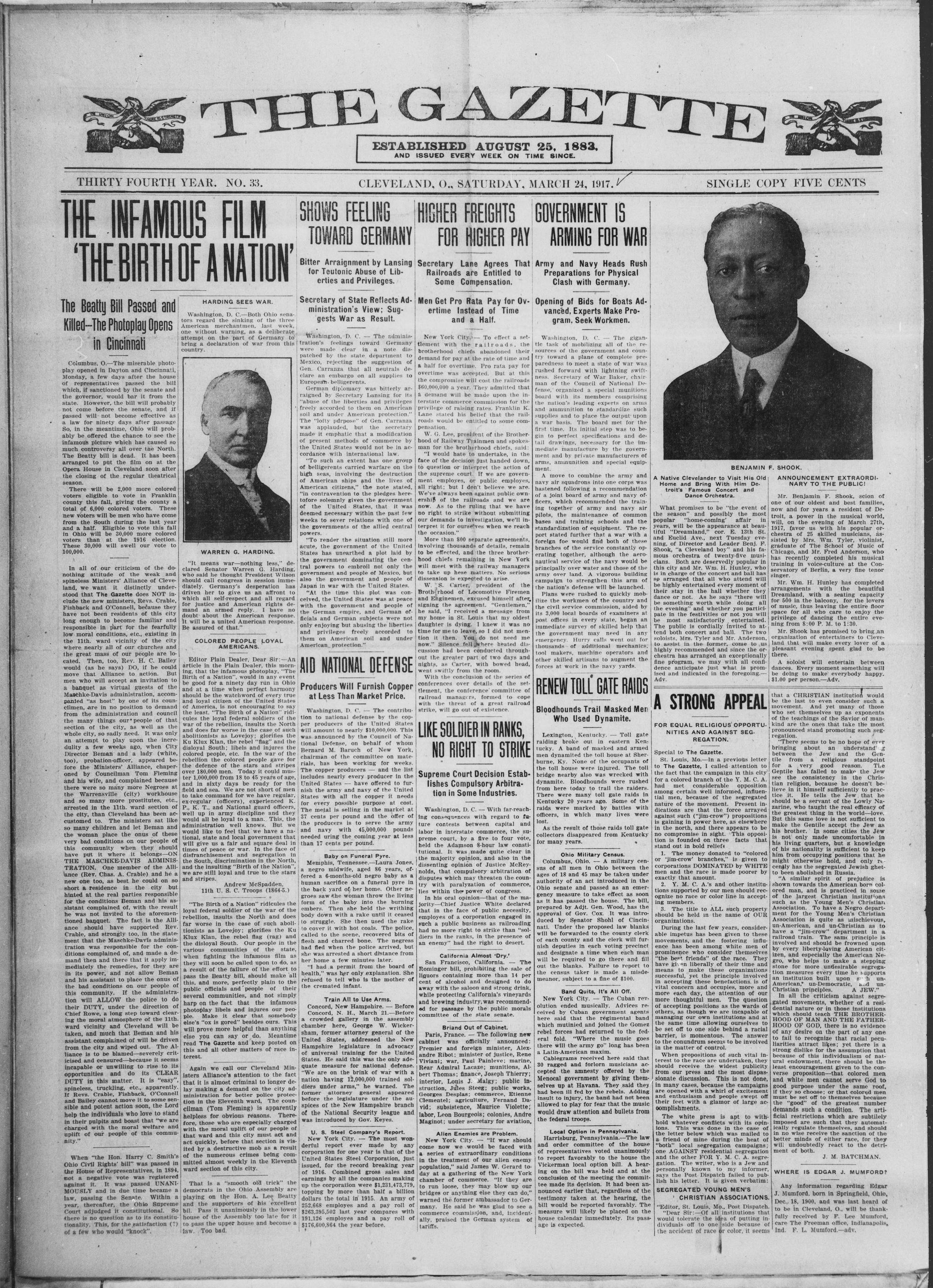
THE INFAMOUS FILM 'THE BIRTH OF A NATION'
The Beatty Bill Passed and Killed-The Photoplay Opens in Cincinnati
Columbus, O. — The miserable photoplay opened in Dayton and Cincinnati, Monday, a few days after the house of representatives passed the bill which, if sanctioned by the senate and the governor, would bar it from the state. However, the bill will probably not come before the senate, and if passed will not become effective as a law for ninety days after passage So, in the meantime, Ohio will probably be offered the chance to see the infamous picture which has caused so much controversy all over the North. The Beatty bill is dead. It has been arranged to put the film on at the Opera House in Cleveland soon after the closing of the regular theatrical season.
There will-be 2,000 more colored voters eligible to vote in Franklin county this fall, giving the county a total of 6,000 colored voters. These new voters will be men who have come from the South during the last year and a half. Eligible to vote this fall in Ohio will be 30,000 more colored voters than at the 1916 election. These 30,000 will swell our vote to 100,000.
In all of our criticism of the do-nothing attitude of the weak and spineless Ministers' Alliance of Cleveland, we want it distinctly understood that The. Gazette does NOT include the new ministers, Revs. Crable, Fishback and O'Connell, because they have not been residents of this city long enough to become familiar and responsible in part for the fearfully low moral conditions, etc., existing in the 11th. ward vicinity of the city where nearly all of our churches and the great mass of our people are located. Then, too, Rev. H. C. Balley would (as he says) DO, if he could move that Alliance to action. But men who will accept an invitation to a banquet as virtual guests of the Maschke-Davis administration, accompanied (as host) by one of its councilmen, are in no position to demand from the administration and council the many things our people of that section of the city, as well as the whole city, so sadly need. It was only an attempt to play upon the incredulity a few weeks ago, when City Director Beman and a lady (white, too), probation-officer, appeared before the Minister's Alliance, chaperoned by Councilman Tom Fleming and his wife, and complained because there were so many more Negroes at the Warrensville (city) workhouse and so many more prostitutes, etc., arrested in the 11th. ward section of the city, than Cleveland has been accustomed to. The ministers sat like so many children and let Beman and the woman place the onus of these very bad conditions on our people of this community when they should have put it where they belong—ON THE MASCHKE-DAVIS ADMINISTRATION. One member of the Alliance (rev. Chas. A. Crable) and he a new one too, as best he could on so short a residence in the city but hinted at the real parties responsible for the conditions Beman and his assistant complained of, with the result he was not invited to the aforementioned banquet. The fact is the Alliance should have supported Rev. Crable, and strongly too, in the statement that the Maschke-Davis administration was responsible for the conditions complained of, and made a demand then and there that it apply immediately the remedies, for they are in its power, and not allow Beman and his assistant to place the onus of the bad conditions on our people of this community. If the administration will ALLOW the police to do their DUTY, under the direction of Chief Rowe, a long step toward clearing the moral atmosphere of the 11th. ward vicinity and Cleveland will be taken, and much that Beman and his assistant complained of will be driven from the city and wiped out. The Alliance is to be blamed—severely criticised and censured—because it seems incapable or unwilling to rise to its opportunities and do its CLEAR DUTY in this matter, it is "easy", spineless, truckling, etc., apparently. If Revs. Crable, Fishback, O'Connell and Bailey cannot move it to some sensible and potent action soon, the Lord help the individuals who love to stand in their pulps and boast that "we are charged with the moral welfare and uplift of our people of this community."
When "the Hon. Harry C. Smith's Ohio Civil Rights bill" was passed in the House of Representatives, in 1894, not a negative vote was registered against it. It was passed UNANI-MOUSLY and in due time became a law, passing the Senate. Within a year, the cafferlaw, the Ohio Supreme Court adjudged it constitutional. So there is no question as to its constitutionality. This, for the satisfaction (2) of a few who would "knock".
HARDING SEES WAR.
Washington, D. C.—Both Ohio senators regard the sinking of the three American merchantmen, last week, one without warning, as a deliberate attempt on the 'part of Germany' to bring a declaration of war from this country.
WARREN G. HARDING.
"It means war—nothing less," declared Senator. Warren G. Harding who said he thought President Wilson should call congress in session immediately. Germany's desperation has driven her to give us an affront to which all self-respect and all regard for justice and American rights demand an armed reply. I have no doubt about the American response. It will be a united American response. Be assured of that."
COLORED PEOPLE LOYAL AMERICANS.
Editor Plain Dealer, Dear Sir:—An article in the Plain Dealer, this morning, that the infamous photophy, "The Birth of a Nation", would in any event be good for a ninety day run in Ohio and at a time when perfect harmony should be the watchword of every true and loyal citizen of the United States of America, is not encouraging to say the least. "The Birth of a Nation" ridicules the loyal federal soldiers of the war of the rebellion, insults the North and does far worse in the case of such abolitionists as Lovejoy; glorifies the Ku Klux Klan, the rebel army; and injures the colored people, etc. in the war of the rebellion the colored people gave for the defence of the stars and stripes over 180,000 men. Today it could mister 180,000 from 18 to 45 years of age, and in sixty days be ready for the field and sea. We are not short of men to take command for we have regular, ex-regular (officers), experienced K. P., K. T., and National guard officers, well up in army discipline and they would all be loyal to a man. This, the administration well knows. But we would like to feel that we have a national, state and local government that is fair and square deal in times of peace or war. In the face of disfranchisement and segregation in the South, discrimination in the North, and the insulting "Birth of the Nation", we are still loyal and true to the stars and stripes.
Andrew McSpadden,
11th U. S. C. Troops (1864.5.)
1
"The Birth of a Nation" ridicules the loyal federal soldier of the war of the rebellion, insults the North and does far worse in the case of such abolitionists as Lovejoy; glorifies the Ku Klux-Klan, the rebel flag (tag) and the disloyal South. Our people in the various communities of the state, when fighting the infamous film as they will soon be upon to do, as a result of the failure of the effort, to pass the Beatty bill, should make all this, and more, perfectly plain to the public officials and 'people of their several communities, and not simply harp on the fact that the infamous photoplay libels and injures our people. Make it clear that somebody else's "ox is gored" besides ours. This will prove more helpful than anything else you can say or do. Meantime read The Gazette and keep posted on this and all other matters of 'race interest.
Again we call our Cleveland Ministers Alliance's attention to the fact that it is almost criminal to longer delay making a demand on the city administration for better police protection in the Eleventh ward. The councilman (Tom Fleming) is apparently helpless for obvious reasons. Therefore, those who are especially charged with the moral uplift of our people of that ward and this city must act and act quickly, before that section is visited by a destructive mob as a result of the numerous crimes being committed almost weekly in the Eleventh ward section of this city.
That is a "smooth old trick" the democrat in the Ohio. Assembly are playing on the Hon. A. Lee. Beauty and the supporters of his excellent bill. Pass it unanimously in the lower house of the Assembly too late for it to pass the upper house and become a law. Too bad.
ESTABLISHED AUGUST 25, 1883. AND ISSUED EVERY WEEK ON TIME SINCE.
CLEVELAND, O., SATURDAY, MARCH 24, 1917.
SHOWS FEELING TOWARD GERMANY
Bitter Arraignment by Lansing for Teutonic Abuse of Liberties and Privileges.
Secretary of State Reflects Administration's View; Suggests War as Result.
Washington, D. C. — The administration's feelings toward Germany were made clear in a note dispatched by the state department to Mexico, rejecting the suggestion of Gen. Carranza, that all neutrals declare an embargo on all supplies to European belligerents.
German diplomacy was bitterly arraigned by Secretary Lansing for its "abuse of the liberties and privileges freely accorded to them on American soil and under American protection." The "lofty purpose" of Gen. Carranza was applauded, but the secretary made it emphatic that a modification of present methods of commerce by the United States would not be in accordance with international law.
"To such an extent has one group of belligerents carried warfare on the high seas, involving the destruction of American ships and the lives of American citizens," the note stated, "in contravention to the pledges hereof solemnly given the government of the United States, that it was deemed necessary within the past few weeks to sever relations, with one of the governments of the allied central powers.
"To render the situation still more acute, the government of the United States has unearthed a plot laid by the government dominating the central powers to embroll not only the government and people of Mexico, but also the government and people of Japan in war with the United States.
"At the time this plot was conceived, the United States was at peace with the government and people of the German empire, and German officials and German subjects were not only enjoying but abusing the liberties and privileges freely accorded to them on American soil, and under American protection."
AID NATIONAL DEFENSE
Producers Will Furnish Copper at Less Than Market Price.
Washington, D. C. — The contribution to national defense by the copper producers of the United States will amount to nearly $10,000,000. This was announced by the Council of National Defense, on behalf of whom Bernard M. Baruch of New York, chairman of the committee on materials, has been working for weeks. The copper producers — and the list includes nearly every producer in the United States — have offered to furnish the army and navy of the United States with all the copper it needs for every possible purpose at cost. The metal is selling in the market at 37 cents per pound and the offer of the producers is to serve the army and navy with 45,000,000 pounds needed uiring the coming year at less than 17 cents per pound.
Baby on Funeral Pyre.
Memphis, Tennessee—Laura Jones, a negro midwife, aged 86 years, offered a 6-month-old negro baby as a human sacrifice on a funeral pyre in the back yard of her home. Other negroes saw the woman throw the living form of the baby into the burning embers. Then she held the writhing body down with a rake until it ceased to struggle. She then used the rake to cover it with hot coals. The police, called to the scene, recovered bits of flesh and charred bone. The negress had fled when the police arrived, but she was arrested a short distance from her home a few minutes later.
"I had a permit from the board of health," was her only explanation. She refused to tell who is the mother of the cremated infant.
Train All to Use Arms
Concord, New Hampshire. — Before Concord, N. H., March 21.—Before a crowded gallery in the assembly chamber here, George W. Wickersham, former attorney general of the United States, addressed the New Hampshire legislature in advocacy of universal training for the United States. He said this was the only adequate measure for national defense. "We are on the brink of war with a nation having 12,000,000 trained soldiers under arms," he warned. "The former attorney general appeared before the legislature under the auspices of the New Hampshire branch of the National Security league and was introduced by Gov. Keyes.
11. S. Steel Company's Report
U. S. Steel Company's Report.
New York City. — The most wonderful report ever made by any corporation for one year is that of the United States Steel Corporation, just issued, for the record breaking year of 1916. Combined gross sales and earnings by all the companies making up the corporation were $1,231,473,779, topping by more than half a billion dollars the total in 1915. An army of 252,688 employees and a pay roll of $263,395,502 last year compares with 191,126 employees and a pay roll of $176,600,644 the year before.
HIGHER FREIGHTS GOVERNMENT IS FOR HIGHER PAY ARMING FOR WAR
Secretary Lane Agrees That Railroads are Entitled to Some Compensation.
Men Get Pro Rata Pay for Overtime Instead of Time and a Half.
New York City.—To effect a settlement with the railroads, the brotherhood 'chiefs' abandoned their demand for pay at the rate of time and a half for overtime. Pro rata pay for overtime was accepted. But at this compromise will cost the railroads $60,000,000 a year. They admitted that a demand will be made upon the interstate commerce commission for the privilege of raising rates. Franklin K. Lane stated his belief that the railroads would be entitled to some compensation.
W. G. Lee, president of the Brotherhood of Railway Trainmen and spokeman for the brotherhood chiefs, said: "I would hate to undertake, in the face of the decision just handed down, to question or interpret the action of the supreme court. If we are government employees, or public employees, all right; but I don't believe we are. We always been against public ownership of the railroads and we are now. As to the ruling that we have no right to strike without submitting our demands to investigation, we'll interpret it for ourselves when we reach the occasion."
More than 800 separate agreements, involving thousands of details, remain to be effected, and the three brotherhood chiefs remaining in New York will meet with the railway managers to take up these matters. No serious dissension is expected to arise.
W. S. Carter, president of the Brothertail of Locomotive Firemen and Enginemen, excused himself after signing the agreement, "Gentlemen," he said, "I received a message from my home in St. Louis that my oldest daughter is dying. I knew it was no time for me to leave, so I did not mention it then. You do not need me now." Silence fell where braided discussion had been conducted throughout the greater part of two days and nights, as Carter, with bowed head, went swiftly from the room.
With the conclusion of the series of conferences over details of the settlement, the conference committee of railroad managers, formed to cope with the threat of a great railroad strike, will go out of existence.
LIKE SOLDIER IN RANKS NO RIGHT TO STRIKE
LIKE SOLDIER IN RANKS NO RIGHT TO STRIKE
Supreme Court Decision Estab- lishes Compulsory Arbitration in Some Industries.
Washington, D. C. — With far-reaching consequences with regard to future contests between capital and labor in interstate commerce, the supreme court, by a five to four vote, held the Adamson 8-hour law constitutional. It was made quite clear in the majority opinion, and also in the dissenting opinion of Justice McReynolds, that compulsory arbitration of disputes may threaten the country with paralyzation of commerce, lies within the power of congress.
In his oral opinion—that of the majority—Chief Justice White declared that in the face of public necessity, employees of a corporation engaged in such a public business as railroading had no more right to strike than "soldiers in the ranks, in the presence of an enemy" had the right to desert.
California Almost 'Dry.'
San Francisco, California. — The Rominger bill, prohibiting the sale of liquors containing more than 14 per cent of alcohol and designed to do away with the saloon and strong drink, while protecting California's vineyards and brewing industry, was recommended for passage by the public morals committee of the state senate.
Briand Out of Cabinet.
Paris, France. — The following new cabinet was officially announced: Premier and foreign minister, Alex andre Ribot; minister of justice, Rene Viviani; war, Paul Painleine; marine, Rear Admiral Lacage; munitions, Albert Thomas; finance, Joseph Thiery; interior, Louis J. Malgy; public instruction, Julies Steege; public works, Georges Desplas; commerce, Etienne Clementel; agriculture, Fernand David; subsistence, Maurice Violette; labor, Bourgeols; colonies, Andre Maginot; under secretary for aviation,
Allen Enemies are Problem
Allen Enemies are Problem.
New York City. — "If war should come now we would be faced with a series of exorcismary conditions the treatment of our alien population," said James W. Gerard today at a gathering of the New York chamber of commerce. "If they are to run loose, they may blow up our bridges or anything else they can do," warned the former ambassador to Germany. He said he was glad to see a commerce commission, and, incidentally, praised the German system of tariffs.
Army and Navy Heads Rush Preparations for Physical Clash with Germany.
Opening of Bids for Boats Advanced, Experts Make Program, Seek Workmen.
Washington, D. C. . . The gigantic task of mobilizing all of the resources' of the government and country toward a plane of complete preparedness to meet a state of war was rushed forward with lightning's swiftness. Secretary of War Baker, chairman of the Council of National Defense, organized a special munitions board with its members comprising the nation's leading experts on arms and ammunition to standardize such supplies add to the place upon a war basis. The board, met for the first time, its initial step was to begin to perfect specifications and detail drawings, necessary for the immediate manufacture by the government and by private manufacturers of arms, ammunition and special equipment.
A move to combine the army and navy air squadrons into one corps was hastened following a recommendation of a joint board of army and navy officers, which recommended the training together of army and navy air pilots, the maintenance of common bases and training schools and the standardization of equipment. The report stated further that a war with a foreign foe would find both of these branches of the service constantly operating together, although the aeronautical service of the navy would be principally over water and those of the army over land. A vigorous building campaign to strengthen this arm of the nation's defense will be launched. Plans were rushed to quickly mobilize the workmen of the country and the civil service commission, aided by its 3,000, local boards of examiners at post offices in every state, began an immediate survey of skilled help that the government may need in any emergency. Hurry calls went out for thousands of additional mechanics, tool makers, machine operators and other skilled artisans to augment the forces at work in the navy yards.
RENEW TOLL GATE RAIDS
RENEW TOLL GATE RAIDS
Bloodhounds Trail Masked Men Who Used Dynamite.
Lexington, Kentucky. — Toll gate raiding broke out in eastern Kentucky. A band of masked and armed men dynamited the toll house at Sherburne, Ky. None of the occupants of the toll house were injured. The toll bridge nearby also was wrecked with dynamite. Bloodhounds were rushed from here today to trail the raiders. There were many toll gate raids in Kentucky 20 years ago. Some of the raids were marked by battles with officers, in which many lives were lost. As the result of those raids toll gate collectors disappeared from Kentucky for many years.
Ohio Military Census
Columbus, Ohio. — A military census of all men in Ohio between the ages of 18 and 45 may be taken under authority of an act introduced in the Ohio senate and passed as an emergency measure to take effect as soon as it has passed the house. The bill prepared by Adjit. Gen. Wood, has the approval of Gov. Cox. It was introduced by Senator Shohl of Cincinnati. Under the proposed law blanks will be forwarded to the county clerk of each county and the clerk will furnish deputies in each voting precinct and designate a time when each man will be required to go there and fill out the blanks. Failure to report to the census taker is made a misdemeanor, subject to a fine of $100.
Band Quits. It's All Off.
New York City. — The Cuban revolution ended musically. Advices received by Cuban government agents here said that the regimental band which mutinied and joined the Gomez rebel forces had returned to the federal fold. "Where the music goes there will the army go" long has been a Latin-American maxim. Cablegrams received here said that 30 ragged and forlorn musicians accepted the amnesty offered by the Menocal government by giving themselves up at Havana. They said they had been ill fed by the rebels. Adding insult to injury, the band had not been allowed to play for fear that the music would draw attention and bullets from the federal troops.
Local Option in Pennsylvania.
Harrisburg, Pennsylvania.—The law and order committee of the house of representatives voted unanimously to report favorably to the house the Vickerman local option bill. A hearing on the bill was held and at the conclusion of the meeting the committee made its decision. It had been announced earlier that, regardless of the testimony taken at the hearing, the bill would be reported favorably. The measure will likely be placed on the house calendar immediately. Its passage is expected.
M.
A Native Clevelander to Visit His Old Home, and Bring With Him *D*etroit's Famous Concert and Dance Orchestra
What promises to be the "event of the season" and possibly the most popular "home-coming" affair in years, will be the appearance on June 13th, "Dreamland" at 13th St. and Builcid Ave, next Tuesday evening, of Director and Leader Benj. F. Shook, "a Cleveland boy" and his famous orchestra of twenty-five musicians. Both are deservedly popular in this city and Mr. Wn. H. Hunley, who is in charge of the concert and ball has so arranged that all who attend will be highly entertained every moment of the show, when they dance or not. As he says "there will be something worth while doing all the evening" and whether you participate in the festivities or not you will be most satisfactorily entertained. The public is cordially invited to attend both concert and ball. The two soloists, Mrs. Tyler and Mr. Anderson, will be highly recommended and since the orchestra has arranged an exceptionally fine program, we may with all confidence anticipate just what is promised and indicated in the foregoing.— Adv.
A STRONG APPEAL
A STRONG APPEAL
FOR EQUAL RELIGIOUS OPPORTUNITIES AND AGAINST SEGREGATION.
Special to The Gazette.
St. Louis, Mo.—In a previous letter to The Gazette, I called attention to the fact that the campaign in this city for a colored branch of the Y. M. C. A. had met considerable opposition among certain well informed, influential men, because of the segregated nature of the movement. Present indications are that the force arrayed against such "jim-crow" propositions is going in the hope here as elsewhere the. nth. and there appears to be no compromise in sight. This opposition is founded on three facts that stand out in bold relief.
1. The money donated to "colored or jim-crow" branches," is given to corporations DOMINATED by WHITE men and the race is made poorer by exactly that amount.
2. Y. M. C. A.'s and other institutions supported by our men should recognize no race or color line in accepting members.
3. The title to ALL such property should be held in the name of OUR organizations.
During the last few years, considerable impetus has been given to these movements, and the fostering influence has been among white men of prominence who consider themselves "the best friends" of the race. They have given liberally of their time and means to make these organizations successful, yet the principle involved is vital concern and occupies, more and more each day, the attention of our more thoughtful men. The question of accepting positions as the wards of others, as though we are incapable of managing our own institutions and at the same time allowing ourselves to be set off to one side behind a racial conundrum to one side. The answer to the conundrum seems to be involved in the matter of control.
When propositions of such vital interest to the race are undertaken, they should receive the widest publicity from our press and the most dispassionate discussion. This is not done, in many cases, because the campaigns are opened with a whirl of excitement and enthusiasm and people sweep off their feet with a glamor of large accomplishments.
The writer's press is apt to withhold whatever conflicts with its opinions. This was done in the case of the letter below which was mailed to a friend of mine during the heat of "both" local segregation campaigns; one AGAINST residential segregation and the other FOR Y. M. C. A. segregation. The writer, who is a Jew and personally known to me, informer, says the PoD Displays failed to publish his letter. It is given verbatim;
SEGREGATED YOUNG MEN'S
CENTRAL ASSOCIATION
CHRISTIAN ASSOCIATIONS.
"Editor, St. Louis, Mo., Post Dispatch.
"Dear Sir:—Of all institutions that would tolerate the idea of putting individuals off to one side because of the accident of race or color, it seems
ANNOUNCEMENT EXTRAORDINARY TO THE PUBLIC!
Mr. Benjamin F. Shook, sion of one of our oldest and best families, now and for years a resident of Detroit, a power-in the musical world, will, on the evening of March 27th, 1917, favor us with his popular, orchestra of 25 skilled musicians, assisted by Mrs. Wm. Tyler, violinist, graduate of The School of Music of Chicago, and Mr. Fred Anderson, who has recently completed his musical training in voice-culture at the Conservatory of Berlin, a very fine tenor singer.
Mr. Wm. H. Hunley has completed arrangements with the beautiful Dreamland, with a seating capacity for 500 in the balcony, for the lovers of music, thus leaving the entire floor space for all who care-to enjoy the privilege of dancing the entire evening from 8:00 P. M. to 1:30.
Mr. Shook has promised to bring an organization of entertainers to Cleveland that will make every lover of a pleasant evening spent glad-to be there.
A soloist will entertain between dances. Every moment something will be doing to make everybody happy: $1.00 per person.—Adv.
that a CHRISTIAN institution would be the last to even consider such a number of people, yet many of those who get themselves up on the teachings of the Savior of mankind are the ones that take the most pronounced stand promoting such segregation.
"There seems to be no hope, of ever bringing about an 'understand' g between the Jew and the Gentile 'from a religious standpoint for a very good reason. The Gentile has failed to make the Jew see the consistency in the Christian religion, because he doesn't believe in it himself sufficiently to practice. He should be a servant of the Lowly Nazarine, who taught the real efficacy of the greatest thing in the world—love. But this same love is not sufficient to make the Gentile accept the Jew as his brother. In some cities the Jew is not only made uncomfortable in his living quarters, but a knowledge of his nationality is sufficient to keep him from occupying positions that he might otherwise hold, and only recently has the segregated Jewish ghetto been abolished Russia. The prejudice is shown towards the American-born man, and is practiced in some of the largest Christian institutions such as the Young Men's Christian Association. To have a Negro department for the Young Men's Christian Association is quite an unchievous, un-American, and un-Christian as to have a "jim-crow" department in a railroad train. The same principle is involved and should be frowned upon by every liberty-loving American citizen, and especially the American Neanderthal stone for more, undesirable segregation measures every time he supports an institution built upon s' h American, un-Democratic, and un-Christian principles. A JEW."
In all the criticism against segregated movements, whether of a residential nature or in those institutions which should teach THE BROTHERHOOD OF MAN AND THE FATHERHOOD OF MAN, the evidence of any desire on the part of men to fail to recognize that racial peculiarities attract-likes; yet there is a strong dislike for the assumption that because of this individualism of natural endowment, there should be the least encouragement given to the converse proposition—that colored men and white men cannot serve God to them; that they cannot if they so choose; or that colored men must be set off to themselves because the "good" of the greatest number demands such a condition. The artificial restrictions which are subtly imposed are such that they automatically regulate themselves, and should in no wise receive the sanction of the other race, for they will undoubtedly react to the detriment of both.
WHERE IS EDGAR J. MUMFORD?
Any information regarding Edgar J. Mumford, born in Springfield, Ohio, Dec. 18, 1900, and was last heard of to be in Cleveland, O. will be thankfully received by F. Lee Mumford, care the Freeman office, Indianapolis, Ind. F. L. Mumford—adv.
GENT'S FURNISHINGS
Hosiery, Underwear and
Neckwear
Arrow Collars and Shirts
Hats, Caps, Etc.
2922 CENTRAL AVENUE
CLEVELAND, O.
STERLING
5 and 10 Cent Store
3003 Central Ave.
Under New Management!
Watch Our Windows For Bargains
Colored Saleslady
We close at 8 P.M. every evening except Saturday
MME. C. H. JONES'
Hair Tonic and Invigorator
HER TONIC is the result of scientific study of the causes of diseases of the scalp.
Instead of treating effects of the diseases she treats the causes, eliminating the same and leaving the scalp in a healthy condition that can be maintained by using her Hair Tonic and Invigorator, according to her directions.
Madame C. H. Jones' Hair Tonic and Invigorator is guaranteed to stop the falling out of the hair and to make the hair
It has been successfully used by many
liver since 1900 and with perfect satisfa-
tion. This Tonic is highly recommended
by many Toledo people elsewhere,
especially in the South.
Madame C. H. Jones' Hair Tonic and Invigorator promotes the growth of the hair, prevents and cures baldness, restores hair color and strength, parts iustre and beauty; it restores the color of the hair by supplying it with the natural elements and necessary nourlah-
MADAME C. H. JONES
383 Woodland
Tolio, Ohio
Wanted.
SPLENDID ENDOSEMENT.
(Toledo, Ohio, March 15, 1910.
To Whom it may be addressed.
This is to certify and stimulate an acquaintance that has passed away, and to obtain an abundance of evidence fortified beyond a question of doubt, the veracity of any claim made by Madame Clara Joy Jones, who has acquainted with the formula and have an adequate knowledge of the medical effects of such relief, and further has cured nine-tenths of the cases for which it has been prescribed. I have also received such relief, and further has I were as certain of the medical effects of drugs as I am confident that this company need of such a remedy. It is the best that the human mind has produced so far.
Truly yours.
H. FERGUSON, M. D.
The Pride of Carolina
The State Agricultural and Mechanical College of South Carolina
Orangeburg, S. C.
Next session begins September 27th and ends, May 25th, 1917.
No Tuition, no Room Rent, no Charges for Water, Lights or Fuel. Entrance Fee $10.00.
Board $6.00 per Month in Advance. Books, Laundry and Personal Expense Extra. Every Modern Facility, Standard Equipment. A Faculty of 57 Officers and instructors.
For Information and Catalogue, Write
R. S. Wilkinson, Pres.
Orangeburg, S. C.
FREE! FREE! FREE!
We Sell Hair Cools
IN WIGS, Haircuts, HYGIENES, etc.
Observation Th in any other Firm Our Goods
are GUARANTEED Money back if not Satisfied
in sell the hair we have Stripped FREE Cools
in World's room better make FREE a beautiful CATALOGUE of THIS NEWSPAPER
WANTS OF THIS NEWSPAPER
HALO HAIR COMPANY
BROOKLYN, NEW YORK
LONG ISLAND-CITY, NEW YORK.
Agents Wanted
MYSTERIOUS HELPING POWERS FREE!
Adam & Eve Roots, High John
Conquer and King Solomon
Roots Free! Write to LEO S. OSMAN
1625 Penna Ave., Baltimore, Md.
Where to Purchase The Gazette
*DR. WEAVER'S,
3315 Central Ave.
*A. GORDON'S,
2928 Central Ave.
*MRS. BESSIE KITZMILLER'S,
3943 Central Ave.
*OPEN SUNDAYS.
NOTICE TO SUBSCRIBERS
The Gazette regularly should notify delivered promptly. business matters to The Gazette's office wish to see the editor call there. fully examine The Gazette's advert. business men who advertise in magazine of our people. The fact that they want it. resirements) ten cents a line (sixing space, fifty cents an inch, single current issues of The Gazette, must SDAY of that week, at the latest.
Subscribers not receiving The Gazette regularly should notify us at once. We desire every copy delivered promptly.
Send or bring locals and all business matters to The Gazette's office, suite 2, Blackstone Bldg. If you wish to see the editor call there, please.
We advise our readers to carefully examine The Gazette's advertisements before making purchases. business men who advertise in this paper should have the patronage of our people. The fact that they advertise is assurance that they want it.
Local reading notices (advertisements) ten cents a line (six words in a line); display advertising space, fifty cents an inch, single publication.
All matters for publication in current issues of The Gazette, must be in the office by 4 p. m., WEDNESDAY of that week, at the latest.
Social and Personal
Our
Classified Ad
Department
WANTED AGENTS.—Now invention, Royal Slide Comb, actually straightens kinky hair, Taylor Pharmacal Co., Box-100, Atlanta, Ga.
FOR RENT.—Houses and Rooms—if you have them to rent or if you want to rent, advertise in The Gazette. It brings results.
NOTARY PUBLIC.—For such services call at The Gazette office, No. 2 Blackstone building, No. 1424 W. Third street, near Superior Ave.
FOR SALE.—Houses or lots, if you have either anything else to sell, or if you wish to purchase advertise in The Gazette. If anything can bring you results, it can and will.
FOR SALE—Property at 2176 E.
43d St., near Cedar Ave.; eleven
rooms, bath, furnace, etc., $3,000. Four
hundred dollars down and the bal-
ance, $25 per month. Apply at The
Gazette office.
Cleveland
Sixth City
Geo. H. Randolph is confined. Pneumonia.
Ernie Burke was here from Toledo,
last week.
L. R. Cary visited relatives in New
Vienna, recently.
H. O. Slaughter is visiting relatives in Urbana and Springfield.
Millard Jones, E. 29th St., visited his brother in Pittsburg, the first of the week.
Misses Pearl Wood, Belle Harris and Georgia Fields are steadily improving.
Mrs. J. S. Jackson is visiting her daughter, Mrs. Keller, of Xenia, who is sick.
Miss Katherine Scott, of Blaine Avey and Rev. G. V. Clark are sick, last week.
Mrs. W. Whiting, E. 103rd St., entertained the Fortnightly club, Thursday evening.
There is only one way to get the real race news and that is to take "the old reliable" Gazette.
James Harris, father of Mrs. Susie Badger, E. 43rd St., died at Amelia C. H. V., last week.
A civil service examination for two male stenographers will be held in the Federal building, April 4.
Miss Hazel Mountain, press., C. C. of W. C., addressed a ladies' club meeting in La Crosse, Sunday.
BEST FOR THE BLOOD — Puro Herbs. Sold only at Brown Drug Co., e. C. 28th, St. and Central Ave.
The local Bell Telephone Co. is offering to teach our girls at its headquarters, paying them $1 daily.
The Alpha Mu club entertained the Minerva Reading club, Saturday evening, at Miss Blanche Johnson's.
Ladies, our fashion page is the latest and best—up to date! Tell your friends and acquaintances about it, please.
Our most popular photographic studio, in this city, is the Smith Studio, 4207 Central Av. Go in and look over its fine work—Adv.
Mrs. Sarah Good, E. 43rd St., received a telegram, Monday morning, anpounding the death of her brother, A. H. Price, of New Vienna. Funeral, Tuesday.
You should take PUER HERBS, the great blood purifier and system cleanser. On sale only at Brown Drug Co., 2742 Central Ave., cor. E. 28th, St.-Adv.
The free recital given by Miss Ruby C. Pettiford, reader, of Urbana, at St. John's church under the auspices of "the committee of fifteen" was not properly advertised. Uncle Sam wants men to run elevators in the Applicants must submit photographs and pass educational, physical and health tests. Salary, $60 a month. Mrs. Lina Mason. E. 29th St., underwent an operation for cancer and golter at Charity hospital, Wednesday. Speedy recovery is expected notwithstanding her age. Cleveland Steel Casting Co. employee of color are having trouble with its superintendent over their pay. Several cases are in Squire Sanborn's court. Blackstone building. Mrs. Ruby Shaughter, Miss Bessie B. Cook, J. Wingfield, Jas. A. Garrfield and Reginald Ryan and the Zephyr quartette gave a meritorious program, last week Thursday evening. Judge Dan Cuny dismissed both degrees from Johnson in Polite court, last Friday. This was a great disappointment to some of his friends.) He was found innocent. Rev. P. O'Connell, pastor of Cory
---
J. S. HALL'S.
3121 Central Ave.
J. E. BRANHAM'S
4219 Central Ave.
*ERNEST P. JACKSON'S
3969 Central Ave.
FOR QUALITY Prescription Work THE OWL DRUG CO. 3743 CENTRAL AVE. Excels All Others
"Heart of City" Lunch Room
720 W. Frankfort Ave.
Between West 6th and West 9th Sts.
BEST HOME COOKING
QUICK SERVICE
T. E. BLAIR, Prop.
3820 Central Avenue
We carry full line of Dry
Goods
Ladies and Gents Furnishings
PHONES:
Studio, Rosedale 3883-J.
Home, Prospect 333-J.
TEACHER OF PIANO
Hours 10 A.M. to 6 P.M.
Evenings by Appointment
4910 CENTRAL AVE.
KINKY
F
Attars, Ga.
Exelento Med. Co.
Genloreon.
My picture shows you
what your fio
EXELENTO
POMADS
has done for my hair.
Before I used to my hair
was short and coarse,
and now it is 24 inches
long, and so long and
easy that I can do it
up any way I want to.
Eores truly,
CELIA GREEN.
Don't let some fake Kink Remover fool you. You really can't straighten your hair until it's nice and long. That's what
EXELENTO QUINNE POMADE does, removes Dandruff, feeds the Roots of the hair, and makes it grow long, soft and silky. After using a few times you can tell the difference, and after a little while it will be so pretty and long that you can fix it up to suit you. If Exelento don't do as we claim, we will give your money back.
256 by mail on receipt of stamps or coin.
AGENTS WANTED EVERYWHERE.
Write For Particulars.
EXELENTO MEDICINE CO., ATLANTAS, GA.
Your copy of The Gazette after reading it, but give it to a friend or an acquaintance who might subscribe after reading a copy of the paper.
THE GAZETTE, CLEVELAND, O., SATURDAY, MARCH 24, 1917
"Any prejudice whatever will be insurmountable if those who do not share in it themselves truckle to it and flatter it and accept it as a law of nature."—John Stuart Mill.
---
M. E. church, will lecture on "The Stranger Within Your Gates" at St. John's A. M. E. church, Sunday at 3 p. m. under the auspices of the C. A. of C. M.
Mr. Jesse Binga, banker, recently donated $100 to Fisk University, Nashville. The school is in a campaign for $150,000 to rehabilitate buildings in need of repairs. Over $100,000 has been raised.
Mrs. Chumblin, an old and highly respected resident of this city, grandmother of Mrs. Edw. Turn, died and was buried, the first of the week.
Severaf children and other relatives survive her and have the sympathy of the community.
Our advertisers want your trade. Those who do not ask to it in The Gazette certainly do not ask it, if at all, for it. Therefore, we urge our readers and all our friends to parateze those who ask for your trade in this paper.
Charles Cottrell, Albert Payne, Alexander Robinson, of Toledo; George W. Bowman and Howard Gilbert, of Columbus; J. E. Jackson and D. J. Galloway, of Chicago, were among the Masons in the city, Sunday week, to visit the farm from the Grand Council of the state.
When Bcn J. Shook, jr., comes to Cleveland from Detroit, on March 27, with his fine orchestra and two gitted soloists, he will be given a rousing welcome at beautiful "Dreamland" such as has not been given any native son, in hany, MANY years, on his retiring day. Mrs. J. W. Hunter, of E. 34th. St., who has been ill for three weeks, is convalescent. LoGripple. A brother, Alonzo Basey, of Youngstown, is visiting her this week. Mr. Chas. S. Basey, who was in a railroad wreck at Griffin, Mar. 7, had an arm injured. He was at home, the first of the week.
Richard Singleton 1, Saturday morning, after a brief illness. Pneumonia. "Dick," as he was familiarly called by his host of friends, came to Quito from Kentucky, years ago. Funeral Monday from Undertaker Rogers' chapel. A wife survives him and his wife systematically many friends. J. Hobson died Samantha at the City hospital after a brief serious illness, although he has not been well for a year. For several years he was a member of the S. S. orchestra of Antioch Baptist and St. John's churches, often playing when physically unfit. Modest, unassuming yet cordial Mr. Bowles made many friend who also miss him. A wife and son mimicked him in a wife and child in the East survive him. Who would be a policeman? An opportunity awaits young men between the ages of 21 and 33 who would like to become members of the Cleveland force. "The position pays $200 for the first year of service," said Secretary E. A. Kline of the civil service commission. "We are going to have a new examination March 31." He took this to be from applicants as soon as possible."
Bessie Hood, age 19, negress, 1713 Oregon avenue, was sentenced to life imprisonment in the women's reformatory at Marysville, by Judge Vickery, Saturday, for killing Charles Ware. She claims Ware called her vile names.—Cleveland News. One is as insulting as the other (nigger and negress) and our local Women's Federation, the managed editor and also the business manager of the News, at once.
Lumen Page took 36 of our men and boys to the Statier hotel, last week Thursday, to replace strikers—20 bellboys, 4 door men, 10 for the elevators, and two page boys. The elevator-men are to have permanent employment, Mr. Page says, while the others, the employed temporarily, less than 30 days, will be given a month's pay. If they are not employed, they will "breaking a large piece of ice" as that hotel was notorious for its stand against our people in about every thing.
Again, we warn our people to be careful about purchasing stocks in various companies; lots in other states and vicinities, and making investments in various concerns not recommended by The Gazette. We investigate all such before permitting them to advertise in "The Old Reliable." It is said that there are two being promoted in this city and we have been asked about them. We do not know anything of them, so cannot recommend them.
Mrs. Louise Snyder Thomas, 9014 Blaine Ave, wife of Wm. Thomas and only daughter of James R. Snyder, of E. 105th St., died last Thursday morning. Funeral. Saturday afternoon, from Shiloh Baptist church of which she had been a member for 18 years. The pastor officiated. Four children, husband, father, grandmother, and other relatives here and in Oberlin, survive her and have the sympathy of her community as a native of this city, a product of our public schools and highly esteemed by all who knew her. The funeral was largely attended.
Rev. Charles Bundy, P. E., preached a fine sermon at St. John's church. Sunday morning at quarterly meeting services, and officiated at similar services at St. James' church, East Emily, Md. To permit the men's Bible classes of the city and county, in the afternoon was a success, the speakers including Rev. E. H. Tippett, pastor of Hough Ave, Cong church, and D. Carl Yoder, sec. Cuvahoga County S. S. association. A men's chorus sang several occasions. They will sing at a similar meeting. Eworth Memorial church, Sunday.
Edward Gordon, age 34, 1215 Scovill Avenue, inadicted on a charge of second degree murder in connection with the stabbing to death of Sylvester Williams, Feb. 20. Wednesday entered a plea of guilty of manslaughter. Judge bickering accepted the plea in the case. A New York walked to Bolivar R. and E. 9th St. Wednesday, expecting to receive three $100 bills. Instead he received the attentions of two detectives. Isadore Goldstein, 2048 E. 88th St., Monday was informed by mail that he and his house would be blown up unless he delivered the three bills. The detectives Harwood and Van Uum to keep the appointment in his stead. The man will be turned over to the federal authorities. And still our Ministers' Alliance refuses to act. A DISMAL FAILURE, in point of attendance, was the women's Frederick Douglass Home Fund meeting at the First E. and F. Church and all because those in charge of the affair refused to properly advertise it. Not over 125 persons, of whom five were white (in
addition to the church chair quarrette which assisted in the program) assembled and certainly presented a most pitiful spectacle. The program was excellent, barring the imposition of too much "Fleming." Mrs. Ida Joyce Jackson's address was very satisfactory, indeed. The cost of programs, $18; Mrs. Jackson's traveling expenses, $5.50, $10, which it is claimed was spent for "advertising"; and other expenses, $10, which up to $11 it was claimed had been raised in one way and another. Too "bad. The church should have been crowded and would have been if the affair had been properly handled.
For weeks, now, except when there has been freezing weather, Central Av., pedestrians have been "plastered with mud, splashed over them by passing autos, and have found it almost impossible to use the street-crossings, in that vicinity, with the catch-basins stopped and mud and snow banked in the avenue something fierce. Complaints Sited at the city of Chicago by the Maschek-Davis administration has been too busy cleaning the streets and avenues and catch-basins of other sections of the city. The moral atmosphere of the 11th ward has been permitted by the same authorities to get "dirtier" and "fifthier" (if such a thing be possible) than Central Av., and its street cross-walks. What good is the councilman of that ward? He seems incapable and powerless. Tom Fleming and the Maschek-Davis tribe of politician MUST GO and this fall's election cannot come too soon. It is impossible for voters in that ward as they refuse to sign his nomination petition. Too much "star" and too much "Tom" has gotten on even their nerves.
Forty men were so interested in the pastime of rolling dice that they failed to hear patrolmen of the vice squad break down four doors at the home of Peter Brooks, 2412 Central Ave., where they were alleged to have been arrested with eleven others, arrested elsewhere, were charged with gambling. Cleveland's women bandits were active again, Monday night, according to a report made by George R. Scott, 2118 Prospect Ave., to police, early Tuesday. Scott says that a colored woman held him up in E. 20th St. near Marion Avenue, 2118 West 20th Street, he be to one of the women who robbed two men, Sunday night. Three colored men robbed Ed. Williams, Bedford, for $16.80 at Central Ave. and E. 18th. St. Our ministers will please make note of this and demand that the Maschke-Davis administration and Councilman Tom Fleming do their work in the UPT before it is too late—before a mob suggests up Central Ave., and wrecks our churches and business places in that vicinity.
MOST POPULAR CASH.
The treasury department announces that it will meet the growing demand for one dollar and two-dollar bills by issuing greenbacks in those denominations. Such action is authorized by the act of March 4, 1907, but there has been little occasion for it heretofore. The total amount of one-dollar and two-dollar greenbacks outstanding at present is only $3,000,000. Nobody knows how many of these have been lost or destroyed. The treasury still reports every bill and every coin as outstanding, if it has even been issued, says St. Louis Globe Democrat. The last report of the United States treasury, for example, showed 28,000,000 bronze two-cent pieces and over 21,000,000 nickel three-cent pieces in circulation, although neither coin is often used. The tendency toward the use of paper money has long been strong. The estimated stock of silver dollars in the country at the end of the last fiscal year was 595,270,319, of which 501,855,387 were held in the treasury. This would leave only 66,414,932 in "circulation," including all that have been lost or destroyed. This speaks volumes for the unpopularity of the "cart wheel." Silver certificates have practically taken the place of the silver dollars. Some idea of the activity of a one-dollar silver certificate may be gained from the longevity table. The average life is 1.01 years. The average life of a five-dollar certificate is 1.86 years. The United States is a "hard-money" country, but the people generally are averse to using the actual coin. California still clings to gold, probably for sentimental reasons, but it is both inconvenient and expensive, for it does not pass at face value when worn. The people prefer paper money when they know it is redeemable in gold. The more gold there is in the country the less there is in general circulation.
Hoard's Dairyman says that the demand for dairy butter is increasing, and this, together with the splendid market for the buttermilk by-product, is bringing about the re-establishment of the small creamery on the farm. The number of people who would drink good buttermilk if they could get it is vastly in excess of present facilities for supplying them. Public attention was called to buttermilk in a striking way by the late Professor Metchnikoff's recommendation of it as promotive of health and longevity. Those who once establish the habit of drinking a glass of buttermilk in the morning before breakfast would abandon it with extreme reluctance, notwithstanding the fact that Metchnikoff died at seventy.
On December 2, 1816, a savings bank opened its doors for business in the city of Philadelphia. Now, 100 years later, there are in the savings banks of the United States nearly $5,000,000. There are nearly 12,000,000 depositors in these banks. And with all that remarkable growth, the United States is far down the list in the matter of savings as compared with other countries.
A restriction is to be put upon the French consumption of cake and candy. This takes half the joy out of life in that nation, and makes the matinee girl in our own beloved land of liberty shudder a thanksgiving for peace on this side, as she munches her unconfiscated caramels.
S. W. Cor. E. 55th Street and Central Avenue
IT'S TIME TO GIVE US
Photo Ord
bear your photo troubles. Our show
load and our photos are satisfying. Y
ur portraits, our methods and our s
Smith Studi
4207 Central Avenue
5028 Centra
Let us bear your photo
are broad and our photo
like our portraits, our
The Smith
4207 Cen
Rosedale, 5028
Let us bear your photo troubles. Our shoulders are broad and our photos are satisfying. You will like our portraits, our methods and our service.
A. B.
Cuyahoga, C
Edward Do
(T H
3035 Cent
Wm. Brack, Prop. -
James M
Rosedale 1800
SLAUGHT
Funeral D
Emba
Office and F
3923 CE
Autos for All Occasions.
Cuyahoga, Central 5727
ward Doctor's Ca
(THE Z)
3035 Central Avenue
rack, Prop. - Frank Doctor, Ma
James Mabel, Chef
edale 1800 Quality Se
SLAUGHTER BROS.
Funeral Directors and
Embalmers
Office and Funeral Parlor
3923 CENTRAL AV.
Calls for All Occasions. Calls Answered Day and
Funeral Directors and Embalmers
Office and Funeral Parlors
3923 CENTRAL AV.
Autos for All Occasions. Calls Answered Day and Night
GOLD BOND
The Cream of Table Beers
Gold Bond is a brew fit for most modern equipment, the "made from sun-r and hops, pure properly aged be It comes to your table pure, cheer. No other beer com Gold Bond.
Bond is a brew fit for Kings --- the product modern equipment, the highest skill in beer-baking "made from sun-ripened barley malts and hops, pure distilled water, and properly aged before bottling." es to your table pure, wholesome, bubbling wit No other beer compares with the fine fla Bond.
Gold Bond is a brew fit for Kings --- the product of the most modern equipment, the highest skill in beer-brewing. "made from sun-ripened barley malts and hops, pure distilled water, and properly aged before bottling." It comes to your table pure, wholesome, bubbling with good cheer. No other beer compares with the fine flavor of Gold Bond.
The National Training School
"I cordially commend the school's interest and needs to all who believe in the Negro race and in our obligation to help promote its intellectual, moral and religious uplift." Rev. Dr. Charles H. Parkhurst, New York City.
It is a community of service and uplift.
Its influence is destined to be felt in all sections of the country in improved Negro community life wherever our trained workers locate.
Settlement workers, missionaries for home and foreign mission fields, Y. M. C. A. and Y. W. C. A. secretaries and district nurses receive a comprehensive grasp of their studies under a Wellesley graduate and experienced co-workers and actual everyday practice through the school's social service department.
We aim also to create a unique university.
Industrial training, advanced literary branches, business school.
Thirty-two acres, ten modern buildings, healthful location.
We can accommodate a few earnest, ambitious students.
Communities requiring social workers should write us.
Pres. JAS. E: SHEPARD National Training School DURHAM, NORTH CAROLINA
A.
COX DRY CLEANING CO.
Repairing, Pressing, Cleaning, etc., on short order.
Suits Pressed, 30 Cents
2738 Central Avenue
CLEVELAND, O.
Central 5727
Doctor's Cafe
(NE Z)
Central Avenue
Frank Doctor, Manager
Label, Chef
Quality Service
TER BROS.
Directors and
Palmers
Central Parlors
CENTRAL AV.
Dalls Answered Day and Night
Kings --- the product of the highest skill in beer-brewing, opened barley malts distilled water, and ore bottling."
CAPT. HAROLD E. MONTAGUE
International Film Service
Capt. Montague has invented a new submersible which the United States government is trying out. A new feature of the submarine is its one-man control and absence of electric motors.
NAVY PUT ON WAR BASIS
This is Nation's Answer to Destruction of American Ships
Washington, D. C. — Under the personal direction of President Wilson, Secretary of the Navy Daniels instituted drastic measures to put the navy in shape to meet war conditions, which Washington was convinced are imminent. This conference followed close on the heels of a report to the president by Secretary of State Lansing on the latest acts of destruction in the German submarine zone. There was a growing feeling in Washington that a "state of war" already existed between the United States and Germany. State department officials declined to comment on this phase of the situation, declaring that "the matter "is too serious for discussion." Meanwhile, the president withheld all comment and dealt with the increased gravity of the situation only by augmenting the military and naval preparations for a possible state of war. The following steps were taken:
an emergency appropriation of $115,000,000 made by congress to enable the president to hasten naval construction in the event of a crisis, was made available by the president for immediate use.
Secretary Daniels ordered 60 submarine chasers', motor boats 100 feet long and with 25 knots' speed, built at once, at the New York navy yard, and announced that bids would be opened from private shipyards for 200 more of this type of craft.
Suspended the statutory 8-hour day on naval construction, bith in private and government yards. Work will be pushed as fast as the then will work, with payment of time and a half for overtime to be made out of the emergency fund.
Authorized the speeding up of Annapolis graduates to provide additional naval officers. The first year class will be graduated on March 29 with 172 cadets and the second class next September with 187.
DAILY MARKET REPORTS
Grain, Provisions and Live Stock.
Cleveland, March 22 — Flour — Minnesota
patients $1.00 each.
Wheat — No. 2 red $1.99.
Corn — No. 3 yellow $1.18½.
Oats — No. 2 white $9c.
Butter — Beat creamy $43@42½c.
Cheese — No. 27½% at $28¢/c.
Potatoes — Strictly fresh 28@28¢/c.
Potatoes — Choice white $2.60@2.75 per
bushel.
Hay — No. 1 timothy $15.00.
Corn — Best steers $10.50@11.00, calves
$14.75@15.00.
Sheep — Wethers $10.50@11.50, lambs
$14.75@15.00.
Hogs — Yorkers $15.25, pigs $13.25.
Toledo, March 22 — Wheat — Cash
$1.99½.
Corn — Cash $1.14.
Cats — Cash $6c.
Cloverseed — Cash $10.10.
Buffalo, March 22 — Cattle — Shipping
$11.50@12.25.
Sheep — Wethers $15.75@16.00, pigs
$14.00@14.50.
Sheep — Wethers $12.00@12.50, lambs
$12.00@15.60.
Pittsburgh, March 22 — Cattle — Prime
$11.50@12.25.
Hogs — Yorkers $15.60@15.75, pigs
$13.00@14.50.
Sheep — Top sheep $12.50, top lambs
$15.50.
Calves — Top $15.75.
Chicago, March 22 — Wheat — May
$14.84½.
Corn — May $11.00.
Oats — May $58¢/c.
Pork — May $34.10.
Hogs — Heavy $14.60@15.20, pigs $10.60
@6½¢/c.
Sheep — Wethers $14.20@12.75, lambs
$12.75@15.25.
Russian Refugees Celebrate.
New York City. — The over 300,000
Russian political exiles in New York,
at a great open air meeting, celebrated
the revolution in Russia which makes
possible their return to their country.
Mass meetings in celebration of the
revolution were held also in Spring-
field, Mass., Philadelphia, New Haven,
Ct., Gary, Ind., Quincy, Mass., Melrose
Park, Ill., and Norwood, Mass.
Petrograd, Russia. — Headed by
red flags and wearing red buttons. 33.
000 troops paraded the red square of
Moscow.
Impersonates Ex-Gov. Herrick
New York City. — A man who said he was John C. Frey was arrested here, charged with being a fugitive from justice. The police said that the man was wanted by the authorities at Chicago and Washington. It was alleged that the prisoner had represented himself as a brother of Myron T. Herrick, formerly governor of Ohio, and recently ambassador to France. By this representation, it was charged, he had obtained money from persons in this city and possibly elsewhere.
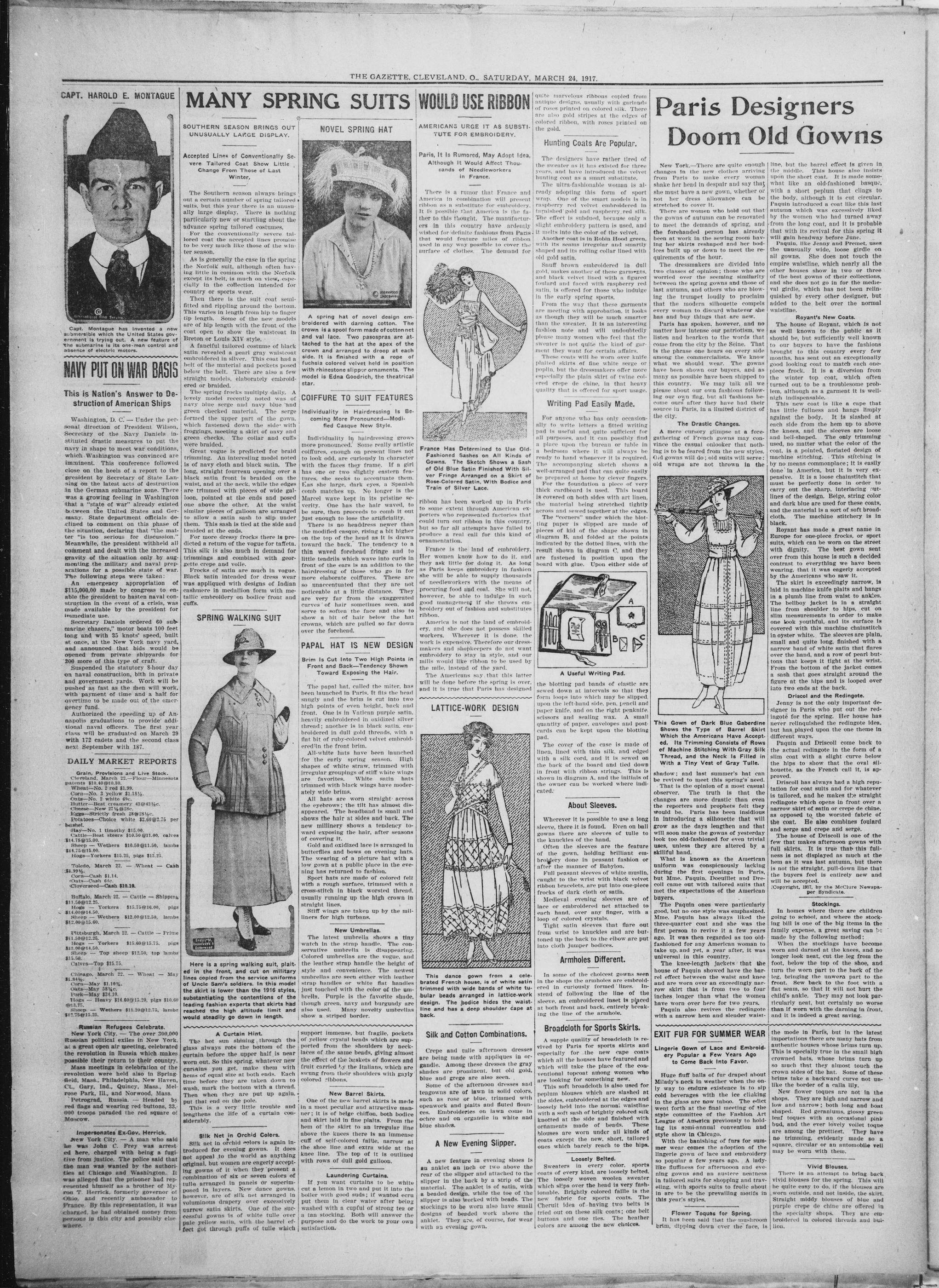
MANY SPRING SUITS
SOUTHERN SEASON BRINGS OUT
UNUSUALLY LARGE DISPLAY.
The Southern season always brings out a certain number of spring tailored suits, but this year there is an unusually large display. There is nothing particularly new or startling about the advance spring tailored costumes.
For the conventionally severe tailored coat the accepted lines promise to be very much like those of the winter season.
As is generally the case in the spring the Norfolk suit, although often having little in common with the Norfolk except its belt, is much on view, especially in the collection intended for country or sports wear.
Then there is the suit coat semi-fitted and rippling around the bottom. This varies in length from hip to finger tip length. Some of the new models are of hip length with the front of the coat open to show the waistcoat in Breton or Louis XIV style.
A functive tailored costume of black satin revealed a pearl gray waistcoat embroidered in silver. This coat had a belt of the material and pockets below the belt. There are also a few straight models, elaborately embroidered or braided.
The spring frocks multiply daily. A lovely model recently noted was of navy blue serge and navy blue and green checked material. The serge formed the upper part of the gown, which fastened down the side with froggings, meeting a skirt of navy and green checks. The collar and cuffs were braided.
Great vogue is predicted for braid trimming. An interesting model noted is of navy cloth and black satin. The long, straight fourureau opening over a black satin front is braided on the waist, and at the neck, while the edges are trimmed with pieces of wide galloon, pointed at the ends and posed one above the other. At the waist similar pieces of galloon are arranged to allow a satin sash to slip under them. This sash is tied at the side and braided at the ends.
For more dressy frocks there is predicted a return of the vogue for tafetta. This silk is also much in demand for trimmings and combined with georgette crepe and voile.
Frocks of satin are much in vogue. Black satin intended for dress wear was applied with designs of Indian cashmere in medallion form with metallic embroidery on bodice front and cuffs.
SPRING WALKING SUIT
Copyright
PUBLICATIONS
EDINBURGH
Here is a spring walking suit, plaited in the front, and cut on military lines copied from the service uniforms of Uncle Sam's soldiers. In this model the skirt is lower than the 1916 styles, substantiating the contentions of the leading fashion experts that skirts had reached the high altitude limit and would steadily go down in length.
A Curtain Hint.
The hot sun shining, through the glass always rots the bottom of the curtain before the upper half is near worn out. So this spring, whatever new curtains you get, make them with hems of equal size at both ends. Each time before they are taken down to wash, mark the bottom with a thread. Then when they are put up again, put that end on the pole.
This is a very little trouble and lengthens the life of a curtain considerably.
Silk Net in Orchid Colors
Silk net in orchid colors is again introduced for evening gowns. It does not appeal to the world as anything original, but women are eagerly accepting gowns of it when they present a combination of six or seven colors of tulle arranged in panels or superimposed in layers. New dance gowns, however, are of silk net arranged in voluminous drapery over excessively narrow satin skirts. One of the successful gowns is of white tulle over pale yellow satin, with the barrel effect got through puffs of tulle which
THE GAZETTE, CLEVELAND, O., SATURDAY, MARCH 24, 1917
NOVEL SPRING HAT
CORNWOOD
JUNE 8, 1914
A spring hat of novel design embroidered with darning cotton. The crown is a spool form made of cotton net and val lace. Two pasospras are attached to the hat at the apex of the crown and arranged to droop at each side. It is finished with a rope of fuchsia colored velvet held in position with rhinestone slipper ornaments. The model is Edna Goodrich, the theatrical star.
COIFFURE TO SUIT FEATURES
Individuality in Hairdressing Is Becoming More Pronounced—Modified Casque New Style.
Individuality in hairdressing grows more pronounced. Some really artistic coiffures, enough on present lines not to look odd, are curiously in character with the faces they frame. If a girl has one or two slightly eastern features, she seeks to accentuate them. Eas she large, dark eyes, a Spanish comb matches up. No longer is the Marcel wave kept in its pristine severity. One has the hair waved, to be sure, then proceeds to comb it out just enough to lose the artifice.
There is no headdress newer than the modified casque, rising a bit higher on the top of the head as it is drawn toward the back. The tendency to a thin waved forehead fringe and to little tendrils which wave into curls in front of the ears is an addition to the hairdressing of those who go in for more elaborate coiffures. These are so unaccentuated that they are not noticeable at a little distance. They are very far from the exaggerated curves of hair sometimes seen, and serve to soften the face and also to show a bit of hair below the hat crowns, which are pulled so far down over the forehead.
PAPAL HAT IS NEW DESIGN
Brim Is Cut Into Two High Points in Front and Back—Tendency Shown Toward Exposing the Hair.
The papal hat, called the miter, has been launched in Paris. It fits the head sungly and the brim is cut into two high points of even height, back and front. One is in Vatican purple satin, heavily embroidered in oxidized silver thread; another is in black satin, embroidered in dull gold threads, with a flat bit of ruby-colored velvet embroidered in the front brim.
All-white hats have been launched for the early spring season. High shapes of white straw, trimmed with irregular groupings of stiff white wings are favorites. White satin hats trimmed with black wings have moderately wide brims.
All hats are worn straight across the eyebrows; the tilt has almost disappeared. The headband is small and shows the hair at sides and back. The new millinery shows a tendency toward exposing the hair, after seasons of covering it.
Gold and oxidized hair is arranged in butterflies and bows on evening hats. The wearing of a picture hat with a low gown at a public place in the evening has returned to fashion. Sport hats are made of colored felt with a rough surface, trimmed with a cross-stitch in black worsted thread, usually running up the high crown in straight lines. Stiff wings are taken up by the milliners for high turbans.
New Umbrellas
The latest umbrella shows a tiny watch in the strap handle. The conservative umbrella is disappearing. Colored umbrellas are the vogue, and the leather strap handle the height of style and convenience. The newest umbrellas are seen either with leather strap handles or white flat handles just touched with the color of the umbrella. Purple is the favorite shade, though green, navy and burgundy are also used. Many novelty umbrellas show a striped border.
support immense, but fragile, pockets of yellow crystal beads which are supported from the shoulders by necklaces of the same beads, giving almost the effect of the buckets of flowers and fruit carried by the Italians, which are swung from their shoulders with gayly colored ribbons.
New Barrel Skirts.
One of the new barrel skirts is made in a most peculiar and attractive manner; it is of beige chiffon, both bodice and skirt laid in fine plaits. From the hem of the skirt to an irregular line above the knees there is an immense cuff of self-colored faille, narrow at the shoe line and extra wide at the knee line. The top of it is outlined with rows of dull gold galloon.
Laundering Curtains
If you want curtains to be white cut a lemon in two and put it into the boiler with good suds; if wanted ecru put them in clear water after beig washed with a cupful of strong tea or a tan stocking. Both will answer the purpose and do the work to your own satisfaction.
WOULD USE RIBBON
WOULD USE RIBBON
AMERICANS URGE IT AS SUBSTI
TUTE FOR EMBRIDERY.
Paris, it Is Rumored, May Adopt Idea Although It Would Affect Thousands of Needleworkers in France.
There is a rumor that France and America in combination will present ribbon as a substitute for embroidery. It is possible that America is the father to this thought. The manufacturers in this country have ardently wished for definite fashions from Paris that would feature miles of ribbon used in any way possible to cover the surface of clothes. The demand for
A
France Has Determined to Use Old-Fashioned Sashes on All Kinds of Gowns. The Sketch Shows a Sash of Old Blue Satin Finished With Silver Fringe Arranged on a Skirt of Rose-Colored Satin, With Bodice and Train of Silver Lace.
ribbon has been worked up in Paris to some extent through American exporters who represented factories that could turn out ribbon in this country, but so far all attempts have failed to produce a real call for this kind of ornamentation.
France is the land of embroidery. Her women know how to do it, and they ask little for doing it. As long as Paris keeps embroidery in fashion she will be able to supply thousands of needleworkers with the means of procuring food and food. She will not, however, be able to indulge in such good management if she throws embroidery out of fashion and substitutes ribbon.
America is not the land of embroidery, and she does not possess skilled workers. Wherever it is done, the work is expensive. Therefore our dress-makers and shopkeepers do not want embroidery to stay in style, and our mills would like ribbon to be used by the mile, instead of the yard.
The Americans say that this latter will be done before the spring is over, and it is true that Paris has designed
LATTICE-WORK DESIGN
```markdown
```
This dance gown from a celebrated French house, is of white satin trimmed with wide bands of white tubular beads arranged in lattice-work design. The bodice hides the waistline and has a deep shoulder cape at back.
Silk and Cotton Combinations.
Crepe and taffel afternoon dresses are being made with appliques in organdie. Among these dresses the gray shades are prominent, but old gold, blue and grege are also seen. Some of the afternoon dresses and tengowns are of lawn in solid colors, such as rose or blue, trimmed with openwork and plaits and fluted flounces. Embroideries on lawn come in ochre and on organdie in white and blue shades.
A New Evening Slipper.
A new feature in evening shoes is an anklet an inch or two above the rear of the slipper and attached to the slipper in the back by a strip of the material. The anklet is of satin, with a beaded design, while the toe of the slipper is also worked with beads. The stockings to be worn also have small designs of beaded work above the anklet. They are, of course, for wear with an evening gown.
quite marvelous ribbons copied from antique designs, usually with garlands of roses printed on colored silk. There are also gold stripes at the edges of colored ribbon, with roses printed on the gold.
Hunting Coats Are Popular.
The designers have rather tired of the sweater as it has existed for three years, and have introduced the velvet hunting coat as a smart substitute. The ultra-fashionable woman is already adopting this form of sport wrap. One of the smart models is in raspberry red velvet embroidered in tarnished gold and raspberry red silk. The effect is subdued, because only a slight embroidery pattern is used, and it melts into the color of the velvet. Another coat is in Robin Hood green, with its seams irregular and smartly shaped and its rolling collar lined with old gold satin. Snuff brown embroidered in dull gold, makes another of these garments and black velvet lined with a figured fountain and faced with raspberry red satin, is offered for those who indulge in the early spring sports.
From the way that these garments are meeting with approbation, it looks as though they will be much smarter than the sweater. It is an interesting fashion note and will undoubtedly please many women who feel that the sweater is not quite the kind of garment they want for certain affairs. These coats will be worn over knife plaited skirts of fine white serge or poplin, but the dressmakers offer more especially the plain skirt of twocolored crepe de chine, in that heavy quality that is offered for sport usage.
Writing Pad Easily Made.
For anyone who has only occasionally to write letters a fitted writing pad is useful and quite sufficient for all purposes, and it can possibly find a place upon the bureau or table in a bedroom where it will always be ready to hand whenever it is required. The accompanying sketch shows a well-arranged pad that can quite easily be prepared at home by clever fingers.
For the foundation a piece of very thick cardboard is used. This board is covered on both sides with art linen, the material being stretched tightly across and sewed together at the edges. The "corners" under which the blotting paper is slipped are made of pieces of kid of the shape shown in diagram B, and folded at the points indicated by the dotted lines, with the result shown in diagram C, and they are fastened in position upon the board with glue. Upon either side of
A Useful Writing Pad.
the blotting pad bands of elastic are sewed down at intervals so that they form loops into which may be slipped, upon the left-hand side, pen, pencil and paper knife, and on the right penknife selssors and sealing wax. A small quantity of paper, envelopes and postcards can be kept upon the blotting pad.
The cover of the case is made of linen, lined with thin silk, and edged with a silk cord, and it is sewed on the back of the board and tied down in front with ribbon strings. This is shown in diagram A, and the initials of the owner can be worked where indicated.
About Sleeves.
Wherever it is possible to use a long sleeve, there it is found. Even on bull gowns there are sleeves of tulle to the knuckles of the hand.
Often the sleeves are the feature of the gown, holding brilliant embroidery done in peasant fashion or after the manner of Babylon.
Full peasant sleeves of white muslin, caught to the wrist with black velvet ribbon bracelets, are put into one-piece frocks of dark cloth or satin.
Medieval evening sleeves are of lace or embroidered net attached to each hand, over any finger, with a loop of colored crystals.
Tight satin sleeves that flare out from wrist to knuckles and are buttoned up the back to the elbow are put into cloth jumper bodices.
Armholes Different.
In some of the choicest gowns seen in the shops the armholes are embroidered in curiously formed lines. Instead of following the line of the sleeve, an embroidered inset is placed at both front and back, entirely breaking the line of the armhole.
Broadcloth for Sports Skirts
A supple quality of broadcloth is revived by Paris for sports skirts and especially for the new cape coats which all the houses have featured and which will take the place of the conventional topcoat among women who are looking for something new.
This soft broadcloth is also used for plum blouses which are slashed at the sides, embroidered at the edges and loosely held into the normal waistline with a soft sushi of bright colored silk knotted at the side and finished with ornaments made of beads. These blouses are worn under all kinds of coats except the new, short, tailored ones which barely reach to the hips.
Loosely Belted.
Sweaters in every color, sports coats of every kind, are loosely belted. The loosely woven woolen sweater which slips over the head is very fashionable. Brightly colored faille is the new fabric for sports coats. The Cherruit idea of having two belts is tried out on these silk coats; one belt buttons and one ties. The heather colors are among the new choices.
Paris Designers Doom Old Gowns
---
New York.—There are quite enough changes in the new clothes arriving from Paris to make every woman shake her head in despair and say that she must have a new gown, whether or not her dress allowance can be stretched to cover it.
There are women who hold out that the gowns of autumn can be renovated to meet the demands of spring, and the forehanded person has already been at work in the sewing room having her skirts reshaped and her bodies built up or down to meet the requirements of the hour.
The dressmakers are divided into two classes of opinion; those who are worried over the seeming similarity between the spring gowns and those of last autumn, and others who are blowing the trumpet loudly to proclaim that the modern silhouette compels every woman to discard whatever she has and buy things that are new.
Paris has spoken, however, and no matter how intense our patriotism, we listen and hearken to the words that come from the city by the Seine. That is the phrase one hears on every side among the commercialists. We know what we should wear. The gowns have been shown our buyers, and as many as possible have been shipped to this country. We may talk all we please about our own fashions following our own flag, but all fashions become ours after they have had their source in Paris, in a limited district of the city.
The Drastic Changes.
A mere cursory glimpse at a gathering of French gowns may convince the casual onlooker that nothing is to be feared from the new styles. Old gowns will do; old suits will serve; old wraps are not thrown in the
1
This Gown of Dark Blue Gaberdine
Shows the Type of Barrel Skirt
Which the Americans Have Accepted.
Its Trimming Consists of Rows
of Machine Stitching With Gray Silk
Thread, and the Neck is Filled in
With a Tiny Vest of Gray Tulle.
shadow; and last summer's hat can
be revived to meet this spring's need.
be perceived to meet this spring's need.
That is the opinion of a most casual observer. The truth is that the changes are more drastic than even the reporters and prophets felt they would be. Paris has been insidious in introducing a silhouette that will grow as the days lengthen and that will soon make the gowns of yesterday look too old-fashioned for even trivial uses, unless they are altered by a skillful hand.
What is known as the American uniform was conspicuously lacking during the first openings in Paris, but Mme. Paquin. Doeullet and Drecoll came out with tailored suits that met the expectations of the American buyers.
The Paquin ones were particularly good, but no one style was emphasized. Mme. Paquin has always liked the three-quarter coat and she was the first person to revive it a few years ago. It was then regarded as too old-fashioned for any American woman to take up, and yet, a year after, it was universal in this country.
The knee-length jackets that the house of Paquin showed have the barrel effect between the waist and knee and are worn over an exceedingly narrow skirt that is from two to four inches longer than what the women have worn over here for two years.
Paquin also revives the redingote with a narrow hem and slender waist.
EXIT FUR FOR SUMMER WEAR
Lingerie Gown of Lace and Embroidery Popular a Few Years Ago to Come Back Into Favor.
Huge fuff balls of draped about Milady's neck in weather when the only way to endure existence is to sip cold beverages with the ice claking in the glass are now tubo. The eldest went forth at the final meeting of the style committee of the Fashion Art League of America previously to holding its semi-annual convention and style show in Chicago.
With the banishing of furs for summer wear comes the adoption of the lingerie gown of lace and embroidery so popular a few years ago. A lady-like fluffiness for afternoon and evening gowns and an austere neatness in tailored suits for shopping and travel, with sports suits to frolic about in are to be the prevailing motifs in this year's styles.
Flower Toques for Spring.
It has been said that the mushroom brim, dipping down over the face, is
The Drastic Changes
line, but the barrel effect is given in the middle. This house also insists upon the short coat. It is made somewhat like an old-fashioned basque, with a short peplum that clings to the body, although it is cut circular. Paquin introduced a coat like this last autumn which was excessively liked by the women who had turned away from the long coat, and it is probable that with its revival for this spring it will gain headway before June. Paquin, like Jenny and Premet, uses the unusually wide, loose girdle on all gowns. She does not touch the empire waistline, which nearly all the other houses show in two or three of the best gowns of their collections, and she does not go in for the medieval girdle, which has not been reenlivened by every other designer, but added to the belt over the normal waistline.
The house of Royant, which is not as well known to the public as it should be, but sufficiently well known to our buyers to have the fashions brought to this country every few months, has sent out an exceptionally good looking coat to match each one piece frock. It is a diversion from the winter top coat, which often turned out to be a troublesome problem, although as a garment it is well-nigh indispensable.
This new coat is like a cape that has little fullness and hangs limply against the body. It is slashed at each side from the hem up to above the knees, and the sleeves are loose and bell-shaped. The only trimming used, no matter what the color of the coat, is a pointed, floridated design of machine stitching. This stitching is by no means commonplace; it is easily done in America, but it is very expensive. It is a loose chainstitch that must be perfectly done in order to carry out the sharp, interlacing outlines of the design. Belge, string color and dark blue are used for these coats, and the material is a sort of soft broadcloth. The machine stitchery is in black.
Royant has made a great name in Europe for one-piece frocks, or sport suits, which can be worn on the street with dignity. The best gown sent over from this house is such a decided contrast to everything we have been wearing, that it was eagerly accepted by the Americans who saw it.
The skirt is exceedingly narrow, is laid in machine knife plats and hangs in a plumb line from waist to ankles. The bellboy jacket is in a straight line from shoulder to hips, cut on slim measurements in order to make one look youthful, and its surface is covered with this machine chainstitch in oyster white. The sleeves are plain, small and quite long, finished with a narrow band of white satin that flares over the hand, and a row of pearl buttons that keeps it tight at the wrist. From the bottom of the jacket comes a sash that goes straight around the figure at the hips and is looped over into two ends at the back.
Driscol and the Redingote
Jenny is not the only important designer in Paris who put out the redingote for the spring. Her house has never relinquished the redingote idea, but has played upon the one theme in different ways.
Paquin and Driscoll come back to the actual redingote in the form of a slim coat with a slight curve below the hips to show that the oval silhouette, as the French call it, is approved.
Driscoll has always had a high reputation for coat suits and for whatever is tailored, and he makes the straight redingote which opens in front over a narrow skirt of satin or crepe de chine, as opposed to the worsted fabric of the coat. He also combines foulard and serge and crepe and serge.
The house of Driscoll is one of the few that makes afternoon gowns with full skirts. It is true that this fullness is not displayed as much at the hem as it was last autumn, but there is not the straight, pull-down line that the buyers feel is entirely new and will be accepted.
(Copyright, 1917, by the McClure Newspaper Syndicate
In homes where there are children going to school, and where the stocking bill is one of the big items in the family expense, a great saving can be made by the following method:
When the stockings have become worn and look at the knees, and no longer look neat, cut the leg from the foot, below the top of the shoe, and turn the worn part to the back of the leg, bringing the unworn part to the front. Sew back to the foot with a flat seam, so that it will not hurt the child's ankle. They may not look particularly neat, but certainly no worse than it worn with the darning in front, and it is indeed a great saving.
the mode in Paris, but in the latest importations there are many hats from authentic houses whose brims turn up. This is specially true in the small high crowned hats, whose brims turn up so much that they almost touch the crown sides of the hat. Some of these brims take a backward curve not unlike the border of a calla lily.
New flower toques are not in the shops. They are high and narrow and low and narrow; both long and boat shaped. Red geraniums, glossy green leaf toques with an occasional pink bud, and the ever lovely velo toque are among the prettiest. They have no trimming, evidently made so a square, circular or an automobile veil may be worn with them.
There is an attempt to bring back vivid blouses for the spring. This will be quite easy to do, if the blouses are worn outside, and not inside, the skirt. Straight mildly blouses of blue and purple crepe de chine are offered in the specialty shops. They are embroidered in colored threads and builton.
Royant's New Coats.
Stockings.
Vivid Blouses