The Gazette
Saturday, April 7, 1917
Cleveland, Ohio
Page text (machine-generated)
THIRTY FOURTH YEAR. NO. 35.
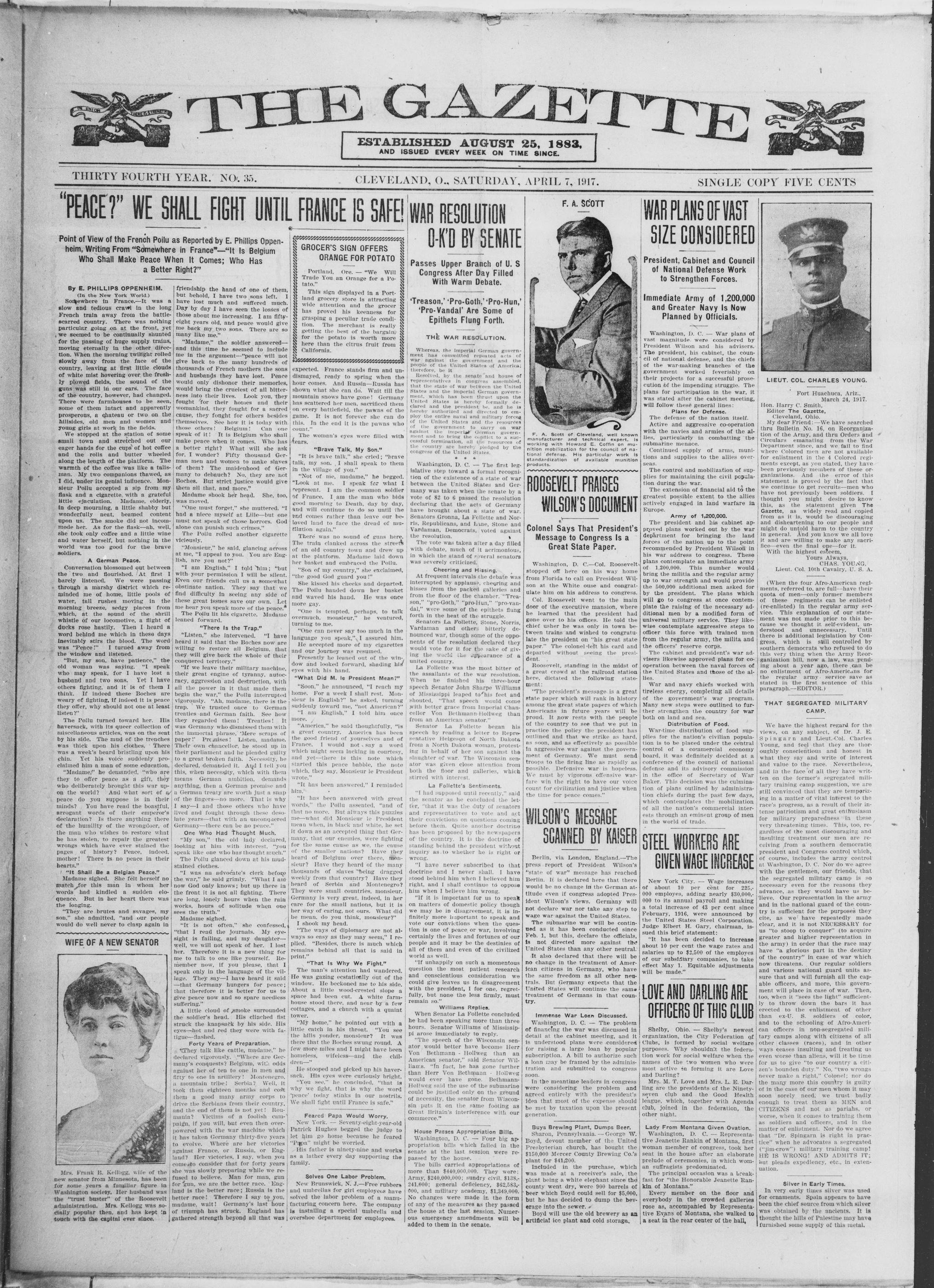
"PEACE?" WE SHALL FIGHT UNTIL FRANCE IS SAFE! WAR RESOLUTION
Point of View of the French Poilu as Reported by E. Phillips Oppenheim, Writing From "Somewhere in France"—"It Is Belgium Who Shall-Make Peace When It Comes; Who Has a Better Right?"
THE WHICH
FREEDOMS THE WORLD
By E. PHILLIPS OPENHEIM.
(In the New York World.)
Somewhere in France—It was a slow and tedious crawl in the long French train away from the battle-scarred country. There was nothing particular going on at the time, we seemed to be constantly shunted for the passing of huge supply trains, moving eternally to the other direction. When we marched twilight rolled slow away from the face of the country, leaving at first little clouds of white mist hovering over the freshly plowed fields, the sound of the guns was still in our ears. The face of the country, however, had changed. There were farmhouses to be seen, some of them intact and apparently prosperous, a chateau or two on the hillsides, old men and women and young girls at work in the fields.
We stopped at the station of some small town and stretched out our eager hands for the cups of hot coffee and the rolls and butter wheeled along the length of the platform. The warmth of the coffee was like a tullman. My two companions thawed, as I did, under its genial influence. Monseur Pollu accepted a sip from my flask and a cigarette, with a grateful little ejaculation. Madame, dressed in deep mourning, a little shubby but wonderfully near. The smoke, borne content mode her. As for the flask—uh, well, she took only coffee and a little wine and water herself, but nothing in the world was too good for the brave soldiers.
A German Peace.
Conversation blossomed out between the two and flourished. At first I barely listened. We were passing through a marshy district which reminded me of home, little pools of water, tall rushes moving in the morning breeze, sedgy places from which, at the sound of the shrill whistle of our locomotive, a flight of ducks rose hastily. Then I heard a word behind me which in these days inevitably stirs the blood. The word was "Pence!" I turned away from the window and listened.
"But, my son, have patience," the old woman was saying. "I speak who may speak; for I have lost a husband and two sons. Yet they others fighting, and are of their think. If indeed these Boches are weary of fighting, If indeed it is peace why, should not one at least listen?" The Polu turned toward her. His hawksuck, with its queer collection of miscellaneous articles, was on the sent by his side. The mud of the trenches was thick upon his clothes. There was a week's beard bristling upon his chin. Yet his voice suddenly proclaimed him a man of some education.
"Mudameh," he denounced, "who are they to offer peace as a gift, they who deliberately brought this war up on the world? And what sort of a peace do you suppose is in their minds? You have read the boastful, arrogant words of their emperor's declaration? Is there anything there of the humility of the wrongdoer, of the man who wishes to restore what he has stolen, to repair the greatest wickles which have ever stained the pages of history? Peace, indeed, mother! There is no peace in their hearts."
"It Shall Be a Belgian Peace."
Madame sighed. She felt herself no match for this man in whom her words had kindled a sudden eloquence. But in her heart there was the longing.
"They are brutes and savages, my son," she admitted, "and our people would do well never to clasp again in
Mrs. Frank B. Kellogg, wife of the new senator from Minnesota, has been for some years a familiar figure in Washington society. Her husband was the "trust buster" of the Roosevelt administration. Mrs. Kellogg was socially popular then, and has kept in touch with the captain ever since.
THE GAZETTE
friendship, the hand of one of them, but behold, I have two sons left. I have lost much and suffered much. Day by day I have seen, the losses of those about me increasing. I am fifteenth years old, and peace would give me back my two sons. There are so many like me."
"Madame," the soldier answered, and this time he seemed to include me in the argument—"peace will not give back to the many hundreds of thousands of French mothers the sons and husbands they have lost." Peace would only dishonor their memories, would bring the cruelest of all bitterness into their lives. Look you, they fought for their homes and their womankind, they fought for a sucered husband, they fought for themselves. So how it is to tohy with those others? Belgium! Can one speak of it! It is Belgium who shall make peace when it comes. Who has a better right? What will she ask for, I wonder? Fifty thousand German men and women to make slaves of them? The middenhood of Germany to debauch? No, they are not Boches. But strict, justice would give them all that, and more."
Madame shook her head. She, too, was moved.
"One must forget," she muttered. "I had a niece myself at Lille—but one must not speak of those horrors. God alone can punish such crimes."
The Polli roiled another cigarette violently.
"Monsieur," he said, glancing across at me, "I appeal to you. You are English, are you not?"
"I am English," I told him; "but with your permission I will be silent. Even our friends call us a somewhat obstinate nation. They say that we find difficulty in seeing any side of these great issues save our own. Let me hear you speak more of the peace."
The Polli lit his cigarette. Madame leaned forward.
"There is the Trap," "Listen," she interrupted. "I have heard it said that the Boches now are willing to restore Belgium, that they will give back the whole of their conquered territory."
"If we leave their military machine, their great engine of tyranny, autocracy, aggression and destruction, with all the power in it that made them begin the war," the Polish interrupted vigorously. "Ah, madame, there is the trap. We trusted once to German treaties and German faith. See how they regarded them! Treaties! It was Germany who dismissed them with the immoral phrase, "Mere scraps of paper!" Prises! Listen, madame, their own chancellor, he stood up in their parliament and he pleaded guilty to a great broken faith. Necessity, he declared, demanded him. And I tell you this, when necessity, which with them means: German ambition, demands anything, then a German promise and a German treaty are worth just a snip of the fingers—no more. That is why I say—I and those others who have lived and fought through these desolate years—that with an uncompleted Germany—there can be no peace."
One Who Had Thought Much.
"My son," the old lady declared, looking at him with interest, "you speak like one who has thought much."
The Polish glanced down at his unstained clothes.
"I was an advocate's clerk before the war," the boy grimly. "What I am now God only knows; but up in the front it is not all fighting. There are long, lonely hours when the rain works, hours of solitude when one sees the truth."
"It is not often," she confessed,
"that I read the journals. My eyesight is falling, and my daughter—well, we will not speak of her. I lost her. Therefore it is a new thing for me to talk to one like yourself. Remember now, if you please, that I speak only in the language of the village. They say I have heard it said—that Germany hungers for peace; that therefore it is better for us to give peace now and so spare needless suffering."
A little cloud of smoke surrounded the soldier's head. His clinched fist struck the knapsack by his side. His eyes—hot and red they were with fatigue—dashed.
Forty Years of Preparation.
"They talk like talk, muddune," he declared vigorously. "Where are Germanys conquests? Belgium, with odds against her of ten to one in men and fifty to one in artillery! Montenegro, a mountain tribe! Serbia? Well, it took them eighteen months and cost them a good many army corps to drive the Serbians from their country, and the end of them is not yet a mania? Victims of our foolish campaign, if you will, but even then overpowered with the war machine which it has taken thirty-five years to evolve. Where are her victories against France, or Russia, or England? Her victories, I say, when you consider consider that for forty years she was slowly preparing while we refused to believe. Man for man, gun for gun, we are the better race. England is the better race; Russia is the better race. Therefore I say to you, madame, wait! Germany's last hour of trump has struck. England has gathered strength beyond all that was
ESTABLISHED AUGUST 25, 1883. AND ISSUED EVERY WEEK ON TIME SINCE.
CLEVELAND, O., SATURDAY, APRIL 7, 1917.
ORANGE FOR POTATO
Portland, Ore. — "We Will Trade You an Orange for a Potato."
This sign displayed in a Portland grocery store is attracting wide attention and the grocer has proved his keenness for grasping a peculiar trade condition, getting the best of the bargain, for the potato is worth more here than the citrus fruit from California.
---
expected. France stands firm and undismayed, ready to spring when the hour comes. And Russia—Russia has shown what she can do. Wait till the mountain snows have gone! Germany has scattered her men, sacrificed them on every battlefield, the pawns of the game. It is not forever she can do this. In the end it is the pawns who count.
The woman's eyes were filled with tears.
"Brave Talk, My Son."
"It is brave talk," she cried; "brave talk, my son. I shall speak to them in the village of you."
"Not of me, madame," he begged.
"Look at me, I speak for what I represent. I am the common soldier of France. I am the man who bids good morning to Death, day by day, and will continue to do so until the end comes rather than leave our beloved land to face the dread of mutilation again."
There was no sound of guns here. The train clanked across the streets of an old country town and drew up at the platform. Madame laid down her basket and embraced the Polun.
"Son of my country," she exclaimed, "the good God guard you."
She kissed his checks and departed. The Polun banded down her basket and waved his hand. He was once more gay.
"One is tempted, perhaps; to talk overmuch, mousseur," he ventured, turning to me.
"One can never say too much in the language you speak," I assured him. He accepted many of my cigarettes and many of my resumes.
Presently he leamed out of the window and looked forward, shading his eyes with his hand.
"What Did M. le President Mean?"
"Soon," he immined, "I reach my home. For a work I shall rest. Monsieur is English?" he asked, turning suddenly toward me, "not American?" "I am English," I told him once more.
"American," he said thoughtfully, "is a great country. America has been the good friend of yourselves mid of France. I would not say, "a word which might seem lacking in courtesy, and yet there is this note which started this peace bubble, the note which they say, Monsieur le President wrote."
"It has been answered," I reminded him.
"It has been answered with great words," the Polish assented, "and of that no more. But always this puzzles me—what did Monsieur le President mean when, in black and white, he set it shown as an accepted thing that Germany, that our counries, were fighting for the same cause as we, the cause of the smaller nations? Have they heard of Belgium over there, monsieur? Have they heard of the many thousands of shaves being dragged weekly from that country? Have they heard of Serbia and Montenegro? They were small countries, monsieur, Germany is very great, indeed, in her care for the small unions, but it is her way of caring, not ours. What did he mean, do you think, monsieur?" shock my head.
"I have no diplomacy are not always so easy as they may seem," I replied. "Besides, there is much which remains behind all that is said in print."
"That Is Why We Fight."
The man's attention had wandered. He was gazing cestationally out of the window. He beckoned me to his side. About a little 'wood-crested slope a space had been cut. A white farmhouse stood there, and near by a few cottages, and a church with a quaint tower. "My home" he pointed out with a little catch in his throat. You see the underwear? It was there that the Boaches swing round few more miles and I might have been honeless, wifeless—and the children—" He stooped and picked up his haver-sack. His eyes were curiously bright. "You see," he concluded, "that is why we fight, that is why the word 'peace' today stinks, in our nostrils. We shall fight until France is safe."
Feared Papa Would Worry
Feared Papa Would Worry.
New York. -- Seventy-eight-year-old
Patrick Hughes begged the judge to
let him go home because he feared
"Papa" might be worried.
His father is ninety-nine and works
as a nather every day supporting the
family.
Solves One Labor Problem
New Brunswick, N. J.-Free rubbers and umbrellas for girl employees have solved the labor problem of a manufacturing concern here. The company is installing a special umbrella and overshoe department for employees.
WAR RESOLUTION
O-K'D BY SENATE
Passes Upper Branch of U. S Congress After Day Filled With Warm Debate.
'Treason,' 'Pro-Goth,' 'Pro-Hun,
'Pro-Vandal' Are Some of
Epithets Flung Forth.
THE WAR RESOLUTION.
Whereas, the Imperial German government has committed repeated acts of war against the government and the United States of America; therefore, be it
Resolved, by the senate and house of representatives in congress assembled, that the United States and the Imperial German government, which has been thrust upon the United States is hereby generally authorized and directed to employ the entire naval and military forces of the United States and the resources of the United States against the Imperial German government and to bring the conflict to a successful termination, all the resources of the United States and Germany was taken when the senate by a vote of 82 to 6 passed the resolution declaring that the acts of Germany have brought about a state of war. Senators Groonna, La Follette and Norris, Republiens, and Line, Stone and Arthur Democrats, voted against the resolution.
The vote was taken after a day filled with debate, much of it amurionnt, in which the stand of several senators was severely criticized.
Cheering and Hissing.
At frequent intervals the debate was interrupted by applause, cheering and hisses from the packed galleries and from the floor of the chamber, "Treason," "pro-Goth," "pro-fun," "provadale," were some of the epithets hung forth in the heat of the struggle.
Senators La Follette, Stone, Norris, Vardaman and others bitterly denounced war, though some of the opponents of the resolution declared they would fight for the sake of giving the world the appearance of a united country.
La Follette was the most bitter of the assaultants of the war resolution. When he finished his three-hour speech Senator John Sharpe, Williams of Mississippi leaped to his foot and shouted, "That speech would come with better graves from imperial Chancellor Von Baltham-Hollweg than from an American senator."
Senator La Follette began his speech by reading a letter to representative Hudgess of North Dakota in response to the criticism in behalf of her son against the shamster of war. The Wisconsin senator was given close attention from both the floor and galleries, which stirred with interest.
La Follette's Sentiments.
"I had opposed until recently," said the senator as he concluded the letter, "that it was the duty of senators and representatives to vote and act their convictions on questions coming before them. Quite another doctrine has been proposed by the newspapers of the country. It is the doctrine of standing behind the president without inquiry as to whether he is right or wrong.
"I have never subscribed to that doctrine and I never shall. I have stood behind him when I believed him right, and I shall continue to oppose him when I believe him wrong.
"It is important for us to speak on matters of domestic policy though we may be in disagreement, it is infinitely more important to speak and vote our convictions when the question is one of peace or war, involving certainly the lives and fortunes of our people and it, may be the destinies of all of them and even of the civilized world as well."
If properly on such a momentous question the most patient research and conscientious consideration was could give leaves in disagreement with the president, I for one, regretfully, but none the less firmly, must remain so.
Williams Replies.
"When Senator La Follette concluded he had been spaking more than three hours. Senator Williams of Mississippi arose immediately to reply. "The speech of the Wisconsin senator would better have become Herr Von Bettmann· Hollweg than an American senator," said Senator Williams. "In fact, he has gone further than Herr Von Bettmann· Hollweg than Herr Von Bettmann· Hollweg said the use of the submarine could be instilled only on the ground of necessity, the senator from Wisconsin puts it on the same footing as Great Britain's interference with our commerce."
---
**House Passes Appropriation Bills.**
Washington, D.C. — Four big appropriation bills which failed, in the senate at the last session were repassed by the house.
The bills carried appropriations of more than $440,000,000. They were:
Army, $240,000,000; sundry civil, $138,241,000; general deficiency, $62,583,000; and military academy, $1,349,000. Of any of the measures as they passed the house at the last session. Numerous emergency amendments will be added to them in the Senate.
F. A. Scott of Cleveland, well known manufacture and technical expert, is working with Howard E. Coffin on munition mobilization for the council of national defense. His particular work is standardization of available munition products.
ROOSEVELT PRAISES WILSON'S DOCUMENT
Washington, D. C.—Col. Roosevelt stopped off here on his way home from Florida to call on President Wilson at the White house and congratulate him on his address to congress. Col. Roosevelt went to the main door of the executive mansion, where he learned that the president had gone over to his offices. He told the chief usher he was only in town between trains and wished to congratulate the president on "his great state paper." The colonel told his card and departed without seeing the president. Roosevelt, standing in the midst of a great crowd at the railroad station here, dictated the following statement:
"The president's message is a great state paper which will rank in history among the great state papers of which Americans in future years will be哄. It now rests with the people of the country to see that we put in practice the policy the president has outlined and that we strike as hard, as soon, and as effectively as possible in aggressive war against the government of Germany. We must send troops to the diring line as rapidly as possible. Defensive war is hopeless. We must by vigorous offensive warfare win the right to have our voice count for civilization and justice when the time for peace comes."
WILSON'S MESSAGE
SCANNED BY KAISER
Berlin, via London, England.—The press report of President Wilson's "state of war" message has reached Berlin. It is declared here that there would be no change in the German attitude even if congress adopted President Wilson's views. Germany will not declare war nor take any step to wage war against the United States. The submarine war will be continued as it has been conducted since Feb. 1, but this, declare the officials, is not directed more against the United States than any other neutral. It also declared that there will be no change in the treatment of American citizens in Germany, who have the same freedom as all other neutrals. But Germany expects that the United States will continue the same treatment of Germans in that country.
Immense War Logn Discussed
Immense War Loon Discussed.
Washington, D.C. - The problem of financing the war was discussed in detail at the cabinet meeting, and it is understood plans were considered for raising a large loan by popular subscription may be framed by the administration and submitted to congress soon.
In the meantime leaders in congress were considering the problem and agreed entirely with the president's idea that most of the expense should be met by taxation upon the present generation.
*Buys Brewing Plant, Dumps Beer, Staron, Pennsylvania. - George W. Boyd, devout member of the United Presbyterian church, has bought the $15,000 Mercer County Brewing Co's plant for $14,200.
Included in the purchase, which was made at a receiver's sale, the plant being a white elephant since the county wont dry, were 900 barrels of beer which Boyd could sell for $5,000, but he has decided to dump the beverage into the sewer.
Boyd will use the old brewery as an artificial ice plant and cold storage.
WAR PLANS OF VAST SIZE CONSIDERED
President, Cabinet and Council of National Defense Work to Strengthen Forces.
Immediate Army of 1,200,000 and Greater Navy Is Now Planned by Officials.
Washington, D. C. — War plans of vast magnitude were considered by President Wilson and his advisers. The president, his cabinet, the council of national defense, and the chiefs of the war-making branches of the government worked feverishly on their projects for a successful prosecution of the imminent struggle. The plans for participation in the war, it was stated after the cabinet meeting, will follow these general lines:
**Plans for Defense.**
The defense of the nation itself. Active and aggressive co-operation with the navies and armies of the allies, particularly in combatting the submarine menace.
Continued supply of arms, munitions and supplies to the allies overseas.
The control and mobilization of supplies for maintaining the civil population during the war.
The extension of financial aid to the greatest possible extent to the allies actively engaged in land warfare in Europe.
Army of 1,200,000.
The president and his cabinet approved plans worked out by the war department for bringing the land forces of the nation up to the point recommended by President Wilson in his war address to congress. These plans contemplate an immediate army of 1,200,000. This number would bring the militia and the regular army up to war strength and would provide the 500,000 additional men asked for by the president. The plans which will go to congress at once contemplate the raising of the necessary additional men by a modified form of universal military service. They likewise contemplate aggressive steps to officer this force with trained men from the regular army, the militia and the officers' reserve corps. The cabinet and president's war advisers likewise approved plans for cooperation between the naval forces of the United States and those of the aliens. War and navy chiefs worked with tireless energy, completing all details of the government's war-program. Many new steps were outlined to further strengthen the country for war both on land and sea.
Distribution of Food
Wartime distribution of food supplies for the nation's civilian population is to be placed under the central control of a commercial economy board, it was definitely decided at a conference of the council of national defense and its advisory commission in the office of Secretary of War General Douglas MacArthur, the description of plans outlined by administration chiefs during the past few days, which contemplates the mobilization of all the nation's commercial interests through an eminent group of men in the world of trade.
STEEL WORKERS ARE GIVEN WAGE INCREASE
New York City. — Wage increases of about 10 per cent for 225,000 employees, adding nearly $30,000,000 to its annual payroll and making a total increase of 43 per cent since February, 1916, were announced by the United States Steel Corporation. Judge Elbert H. Gary, chairman, issued this brief statement: "We decided to increase about 10 per cent the wage rates and salaries up to $2,500 of the employees of our subsidiary companies, to take effect May 1. Equitable adjustments will be made."
Shloby, Ohio. — Shebly's newest organization, the City Federation of Clubs, is formed by social welfare purposes. Why shouldn't the federation work for social welfare when the names of the two women, who were most active in forming it are Love and Darling?
Mrs. M. T. Love and Mrs. L. E. Darling are the presidents of the Ninety-seven club and the Good Health league, which, together with Agenda club, joined in the federation, the other night.
Lady From Montana Given Ovation, Washington, D. C. — Representative Jeanne Rankin of Montana; first woman member of congress, took her seat in the house after an elaborate predece of ceremonies, in which woman suffragists predominated.
The principal occasion was a Breakfast for "the Honorable Jeanne Rankin of Montana."
Every member on the floor and everybody in the crowded galleries rose as, accompanied by Representative Evans of Montana, she walked to a seat in the rear center of the hall,
IN HIGH HONOR
100
Hon. Harry C. Smith,
Editor The Gazette,
Cleveland, Ohio.
My dear Friend:—We have searched thru Bulletin No. 16, on Reorganization of the Army, and thru Orders and Circulars emanating from the War Department since, and we fail to find where Colored men are not available for recruitment, and the missions except, as you stated, they have been previously members of these organizations. And, the error of this statement is proved by the fact that we continue to get recruits—men who have not previously been soldiers. I thought 'you might desire to know' that Colored men are not available for recruitment, as widely read and copied from as it is, would be discouraging and dishheartenting to our people and might do untold harm to the country in general. And you know we all love it and are willing to make any sacrifice—even the final one—for it.
(When the four Afro-American regiments, referred to, are full—have their quota of then—only former members of these regiments can be enlisted in the army. This service. This explanation of our statement was not made prior to this, because we thought it self-evident, understood and unnecessary. Until there is additional legislation by the Army to control my southern democrats who refused to do this very thing when the Army. Reorganization bill, now a law, was pending about a year ago, there can be an enlistment. If the Army service save as stated in the first sentence of this paragraph—EDITOR.)
THAT SEGREGATED MILITARY CAMP.
We have the highest regard for the views, on any subject, of Dr. J. E. Spingar n and Lieut.-Col. Charles Young, and feel that they are thoroughly conscientious and honest in what they say and write of interest and value to the race. Nevertheless, and in the face of all they have written on the former's segregated military training camp suggestion, we are still convinced that, they are temporizing in a matter of vital interest to the race's progress, as a result of their intense patriotism and great enthusiasm for military preparedness in those very threatening times. This, too, regardless of the most discouraging and insulting treatment our men are receiving from a southern democratic president and Congress control which, of course, includes the army control at Washington, D. C. Nor do we agree with the gentlemen, our friends, that the segregated, military camp is necessary even for the reasons they advance as they have done in their life. In the segregation in the army in the national guard of the country is sufficient for the purposes they cite, as we have repeatedly made clear, and it is not NECESSARY for us to stoop to conquer" (to acquire higher and higher protection in the army) in case of the race may in agrilicious part in the destiny of the country" in case of war which now national. Our soldiers and various national" guard units assure that and will furnish all the capable officers, and more, this government will place in case of war. Then, too, when it "sees the light" sufficiently to throw down the bars it has erected to the enlistment of other than ex-U. S. soldiers of color, and to the schooling of Afro-American officers in non-segregated military camps along with citizens of all other classes (races), and in other ways ceases insulting even worse when it will be time to give "to our country a citizen's bounded den." No, "two wrongs never make a right." Colonel: nor do the many this country is guilty of in the case of our men whom it may sood sorely need; we trust badly enough to treat them as MEN and CITIZENS and not as pariahs, or worse, when it comes to training them as soldiers and officers, and in the matter of enlistment. Nor do we agree that "Dr. Spingar is right in practice" when he advocates a segregated "jim-crow") military training camp! HE IS WRONG! AND ADMITS IT; our pleads expiency, etc., in extension.
Silver in Early Times
In very early times silver was used for ornaments. Spain appears to have been the chief source from which silver was obtained by the ancients. It is thought the hills of Palestine may have furnished some supply of this metal.—
PUBLISHED EVERY SATURDAY |
SUBSCRIPTION ‘RATES
(in Advance)
One Voar......cecscceesers 81.80.
Bix Monthe....-eeeseeeeee 1:00
Three Monthe.....cceccseeee 0
Qubscribers are requested to re
mit by postoffice meney on
der or registered letter
‘Entered at the postoffice In Cleveland,
Ohio, ae second-class matter.
‘Address all communications te
HARRY C. SMITH
Editor and proprietor,
THE GAZETTE,
Blackstone Bullding, Cleveland, 0.
Member Ohio Legislature: 1894
te 1896; 1896 to 1898; 1900 to 1902
THE GAZETTE Ie the oldest, and
has the largest bona fide circulation,
double that of any newspaper in the
interest of Afro-Americans, published
In the state of Ohio, and comparison
with any will immediately establish
Its rank as one of the NEWSIEST
AND BEST in the country.
70,000,000 Afro-Americans.
240,000 in Ohio.
20,000 in Cleveland. .
SATURDAY, MARCH 31, 1917.
DARE TO DO YOUR DUTY.
“Let us have faith that right
makes might, and In that faith
let ua to the end dare to do our
duty as we understand It”"—
Abraham Lincoln.
Gov. James M. Cox is said to have
‘een oppopsed to tite Beatty bill. He
certainly gave it no help.
A recruiting officer on the public
square of this city told Dr. J. K.
‘Nickens, Saturday, that “no Colored
men (except former soldiers, honor-
ably discharged,) were being enlisted
for the regular army now because the
four Colored regiments were full.”
“The Birth of a Nation” ridicules the
loyal federal soldier of the war of the
rebellion, insults the North and does
far worse in the case of such aboli-
tonists as Lovejoy; glorifies the Ku
Klux Klan, the rebel flag (rag) and
the disloyal South. Our people in the
various communities of the state,
when fighting the infamous film as
they will soon be called upon to do, as
a result of the failure of the effort to
pass the Beatty bill, should make all
this, and more, perfectly plain to the
Public officials and people of their
several communities, and not simply
harp on the fact that the infamous
photoplay libels and injures our peo-
ple. Make it clear that somebody
else's “ox is gored” besides ours. This
‘will prove more helpful than anything
else you can say or do. Mecatime
read The Gazette and keep posted on
this and all other matters of race in-
Saar
Notice was given the city, Wednes-
day, that an application for an in-
Junetion restraining the city authori-
ties from interfering with the exhibi-
tion of “The Birth of a Nation” film
in Cleveland would be filed in the U.
8. district court, Thursday morning of
this week, before Judge Westenhaver.
City Law Director FitzGerald said he
has received this notice and that the
case would be heard this week Fri-
day morning, Mayor Davis forwarded
a letter to Manager Geo. A. Gardner,
of the Opera House, prohibiting the
public exhibition of the film, which is
announced to take place there, open-
ing Monday afternoon. The miser-
able photoplay was shown in Boston,
New York City and Chicago after tem:
porary injunctio&s were secured. The
outlook here, therefore, is anything
Dut encouraging. It is sincerely hoped
that the U. S. distriet court will re-
fuse the Epoch Producing Co., what
a coke:
New Jersey has a Civil Rights’ law
recently amended so damages secured
under it revert to. the overseer of the
poor of the county in which legal
‘action is brought. This is something
new! Damages secured under all
other Civil Rights’ laws in the coun
try go to the plaintiff, the person in:
stituting the suit. The New Jersey
state senator who introduced the
amendment was evidently trying to
kill other and more important amend:
ments to the law, but did not succeed,
‘The Pennsylvania Civil Rights’ bill
of @ year or two ago was amended ‘to
death and now they are trying to do
the same thing in that state by intro-
ducing a number of bills of the kind.
Leading New Jersey Afro-Americans
are roasting Attorney Isaac T. Nut:
ter forta failure to show proper in-
terest in the passage of the amend:
ments they were backing. and claim
his indifference arose from his affilia-
tion with white politicians. Possibly
he is another “Indianapolis Freeman
Knox and Indianapolis World Man-
ning.”
THE WAR.
America has shown the lack of
statesmanship and diplomacy ever
sine the European war began. The
many years of unjust discrimination
against colored citizens have made
the ‘country incapable of rising above
nationality and racial lines in any
controversy. The destruction of life
and property by Mexicans could not
yuoy us on to resentment and action
to maintain our honor. “He kept us
‘out of war’ was the monumental le
of Mex, Merely 2 “sop” to hold to
office. ‘The weak and spineless of
‘our eitivenship “fell for it.” Because
‘our countrymen for the most part are
descendants of Great Britain the
country has been and is pro-British.
The right or wrong of the matter bas
never entered the consideration. In
order that a few might ply their trade
upon the high seas in a “zone of star
vation and danger” the whole coun:
try is asked to pour out its blood.
Not for national honor but for gain
and sordid greediness together with
& purpose to help the British people.
Christianity in America has suffered a
greater shock than it has in Europe.
Race prejudice and bias have warped
our national conscience. A blunder-
ing and incapable southern democ-
macy has swept us into the whirlpool
of destruction, In the face of the im-
pending dangers this country is show-
ing itself a cursed hypocrite and vil-
lain in its attitude toward colored
people, The foolish south is thirsting
for the life of every colored person
accused of a crime while the whites
themselves are sinking into savagery
and cannibalism. Can the colored
man fight wholeheartedly for a peo:
ple who seek at every turn to destroy
him? Can any nation on earth be as
cruel and brutal toward any race as
the white south is toward the colored
people? Is t manhood for the race
to fight to maintain the integrity and
welfare of a bloody people as it lives
among in the south? But it may be
argued that it is the country and not
the south alone that is in jeopardy
It ts the country and not the south
alone that has dealt treacherously with
the colored race. To say so now will
be called unpatriotic: and un-Ameri
can. That may be so. Yet this land
has been un-American toward our
race for hundreds of years and if at
this time we follow their lead, we are
not to be censured. Now Is the time
to say to the country that we are no
going to take the wrongs the south is
heaping apon us any longer. We are
not going to submit. to annthitation by
slow torture both of body and mind
any longer. We are not fighting for
Germany nor England but we are
taking this opportunity to assert our
rights, Russia fell because it was un
Just to many of its subjects. America
having learned to be unjust toward
colored people with impunity is now
ready to follow its habit with othe
nationalities. Yes, we are going tc
take our part in this damnable war
not because we want fo, but because
the lives of our wives, daughters and
infants have been endangered by the
| competents from the south. “We shal
bravely meet any foe that comes upor
our soil for in so doing we are dying
for those whom God gave us to pro
tect. We shall fight to keep thi
country in safety from foe without
‘and when this is secured we are ready
to continue the fight till the foe within
has learned to be just and fair toward
the black man. The occupant of the
White House was asked to say some
thing in his last inaugural address
against lynching, but followed hie
custom: He dodged, because at heart
he sympathizes with the southern
miscreants who have made America a
byword, Let us sey to him now that
a ruler should be just: Remember
‘The Czar"! No man can hope to rule
peaceably a people when he seeks to
‘oppress a portion. Negroes of Amer
fea are going to be free, Indeed.
(REV.) WM. A. BYRD.
BEATTY’S WILLIS CHARGE.
We do not “take any stock” in the
alleged statements of Representative
‘A. Lee Beatty and Senator Jones, pub:
lished in our Columbus letter else-
where in this paper. Nor do we think
others ought to, either. The effort to
place the blame for the defeat of the
Beatty bill on Ex-Goy. Frank B. Willis
is without any foundation in fact,
“farfetched” and “nothing in the
world” but « miserably poor democra-
tic trick.
‘As The Gazette has repeatedly said
In recent weeks, the bill never had a
chance to pass the democratic State
Assembly for a number of reasons,
not tht least of which was its misera-
bly weak and poor management, due
doubtless to a lack of experience, in
such maiters, on the part of Repre
sentative Beatty, a new member; his
N. A. A. C. P. assistants and others.
The democratic assemblymen never
intended that the bill should become
fa law and proved this beyond all ques-
tion or doubt (to old legislators) when
‘they allowed it to pass the House of
Representatives. UNANIMOUSLY!
This was but a part of their welllaid
plan to Kill the bill and foot the peo-
ple into the belief that such was not
their original Intention. We are not
“green” enough to think for a single
‘moment that the Epoch Producing
Co., which promotes "The Birth of a
Nation”, did not understand tris
thoroughly, also,
Our readers will agree that The Ga-
zette has not been “taking Willis’
part” in anything since last year in
February and we have not changed
our position toward him “one ene
for good and sufficient reasons all are
thoroughly familiar with. But we
brand as simply ridiculous the charge
that Willis’ letter to Republican leg.
islators had anything whatever to do
with the defeat of the Beatty bill—its
failure to be considered and passed
in the State Senate, Indced, we are
loth to believé that Representative
Beatty is quoted correctly by our Col-
uumbus correstiondent and the daily
papers.
‘As to Senator Jones, (white and a|
democrat), president of the Columbus |
branch of the N. A. A.C. P., if he, too, |
has been quoted correctly, that or-|
ganization cannot insist upon his |
resignation as a member and officer |
too quiekly for it shows him to be ab-
solutely unfit for the position or even |
membership in a race organization.
Another thing the defeat of the bill
proves is that the attempt of the N.
A. A. C. P. to direct the Ohio fight
against the miserable film, “The Birth
of a Nation”, by long distance--from
its headquarters in New York City—
through its local (Ohio) branches has
been A DISMAL FAILURE! There
is a lesson for our people in this|
which It is sincerely to be hoped they |
will learn and learn quickly. Through: |
out the contest The Gazette has done |
its duty and tried to make our pe0|
ple SEE but they would not. |
THE GAZETTE. CLEVELAND. O.. SATURDAY, APRIL 7, 1917.
ee eae eee,
WILLIS OFFERS $1,000. for it, The letter became public, party
columbes, Ou, March. 21--Former | We will Tefuse to let it come to vote
Governor Willis has offered $1,000 for Last Saturday night, Senator White
of Columbiana County unsuccessfully
: Moved to have the meastire taken | Y
8 : 30. that ie might be voted on His
: proposal was killed by a 9 to 18 vote
fo ee Baker, voted to Have. the measure
ff come up for passage along with Re-
to publicans, with. the exception of Mi T
nority Leader Vollenweider and Mur
oo | [rei “racy voted ‘with Democrats to
oe keep it in committee. Senator Lloyd |W
a and Jones of Franklin did not an:
4 swer ToH call, It was quite a surprise
| that Vollenweider, Republican minor
| ity leader should oppose the bil, Sen
3 ator Jones, of Franklin county, who
he aN : Voluniarily’ offered. to champion the
| bill in the senate, refused when Willis
es P butted in. Sendtor Jones is president
|e r othe local NAT ASC) Pen na |e
aA RNG
4 1
a %. al
S25 pe |DOINGS) ;
| a aa i
| any letter Of is which influenced Sen: | AMBRANNS U «
jate sentiment so as to defeat the [ARR RINGS F :
| Beatty bill, Intended to prohibit the ay Y s
_ranbidon oc the nth ora Nation” TR RA q
a RA Vskd Zl ror | ©
‘That the movement of workers of
the colored race from southern to
northern states is still going on fs evi
denced by the complaints that are
continually appgtring in southern
newspapers. A recent issue of the
Age-Herald, of Birmingham, Ala., the
chief iron and steel city of the south,
says:
“The entire Negro population of the
south seems to be deeply affected
The fact that many Negroes, who
went north without sufficient "funds
and without clothing to keep them
Warm, have suffered severely and
have died In large numbers, has not
checked the tide leaving the south
Te was expected that the Negroes
Would come back, sorry that they had
ever left, but comparatively few have
returned, With the approach of
warmer weather the number going
north will increase.”
The Age-Herald calls uttention to
the fact thar It is not so. much the
poor, inefficient class of colored people
that is emigrating as the ambitious,
industrious workers who have steady
fobs. Commenting upon the general
beliet in the south that the exodus is
due to highiy-colored Promises. made
by employment agents, it says:
“But there is something more be
hind their going, something that lies
deeper than @ temporary discontent
and the wish to try a new environ
ment merely for the sake of frée
{nip on the railroads.”
The Age-Herald ts deceived if it be
lieves these ‘people are suffering se
verely and “dying in large numbers”
in the north. ‘The change of climate
is not pleasant for them, but they
have employment at vages whieh en
able them to live more than comfort
ably if they choose to take it. The
Age-Herald 1s right, however, In the
conclusion that there exists a cause
"deeper than & temporary discontent,”
and {t undoubtedly knows what that
cause fs.
To all appenrances the south is at
last paying for Ite refusal to treat as
human beings the men and women
upon whom 1 almost entirely depends
for its manual work, in the loss of that
labor-—Cleveland Daily Leader.
(ee
fe
Ye
| ee
i
| a
| Ne
<<
oe
7
7
WARREN G, HARDING.
Says Our Nation Should Protect Oui
Rights Everywhere on Land
ae
Cincinnati, O.—"I_ have beard that
America is doomed if we undertake to
protect our indisputable rights on the
Sea. If that be true, my countrymen,
we deserve to die.”
This was the ringing declaration of
U.S. Senator Warren G, Harding, last
Saturday night, the principal speaker
at a banquet given by the Business
Men's club of this city to the men of
‘Troop C of the Ohio National Guard,
recently returned from the Mexican
border, The senator's statement, made
in the course of his speech on “Need-
ed Americanism,” was received with
thunderous applause. Because of its
large number of citizens of German
birth and descent, Cincinnati has
been considered a stronghold of pro-
German sympathy.
“Let us be united,” Editor Harding
continued, “to preserve American op-
portunity, cherish honored peace and
defend noble justice. And let us be
prepared for that mighty task. We are
pitiably unprepared to assert Ameri-
can rights, but we ean develop our
might if our heart is right. We shall
not be so negligent in the future.
Universal military training is as cer-
tain as the morrow. It will be born
of national necessity and perfected in
patriotic resolution.”
BLAMES WILLIS FOR DEATH
OF BILL TO FORBID FILM
Legislator Beatty Says Former Gov.
ernor’s Butting in Quickly
Breuntd Hescctment.,
Columbus, 0., Mar.*26. — Represen-
tative Beatty, of Cincinnati, yester.
day blamed former Governor Willis
for the defeat of his bill to bar “The
Birth of a Nation” motion picture
film.
“The Dill passed the house unani
mously,” he said. “I had hopes of
bringing it toa vote in the senate,
until Willis wrote a letter to Repub-
liean senators, urging that all vote
DO YOU BELIEVE IN SIGNS?
REMEMBER THIS ONE
aT =
PALMER'SEIGRSIES OINTMENT
when looking for the ORIGINAL Skin Ointment and Com-
plexion Brightner. {n successful use over eighty years. Many
millions of boxes sold all over the country to satisfied users.
BEWARE of all substitutes. Substitutes may be harmful; even
dangerous. Insist upon getting what you want - the old, reliable
“SKIN-SUCCESS” Ointment and Soap.
MADE ONLY BY
~ cr
Ws Woeasn Dog &
1512 Atlantic Ave., Brooklyn, N. Y.
Write for a sample of Palmer’s “Hair-Success” Dressing, the
best hair pomade on the market. oak
for it, ‘The letter became public, party
lines were drawn, and I realize now
that Democrats in control of the sen-
ate will refuse to let It come to vote.”
Last Saturday night, Senator White
of Columbiana County unsuccessfully
moved to have the measure taken
from the senate judiciary committee
so that it might be voted on. His
proposal was Killed by a 9 to 18 vote.
‘Two Democratic senators, Timby aad
Baker, voted to have the measure
come up for passage along with Re-
publicans, with the exception of Mi:
nority Leader Vollenweider and Mur-
rell. They voted with Democrats to
keep it in committee. Senator Lloyd
and Jones of Franklin did not an-
swer rolt call, It was quite a surprise
that Vollenweider, Republican. minor-
ity leader should oppose the bill. Sen:
ator Jones, of Franklin county, who
‘voluntarily offered to champion the
Dill in the senate, refused when Willis
butted in. Senator Jones is president
of the local N. A.A. C. P.
RW.
ion
ae DOs
os B
Bra ne (6
re OF
Nea”.
LS, uy Ze
De” | THE
WA?
Ru eay.| RACE
eS
Dublin, Ga.—That Negroes are be:
ing enlisted rapidly in the army of
England, in Canada, was’ the state:
ment of Congressman-elwct WW.
Larson, who returned recently from a
business (rip to Canada, “At Wind:
sor,” sald Judge Larson, “I was sur.
prised to see a large sprinkling of
Negro soldiers among the recruits
who were being prepared for service
in Burope. T iilentioned it to the man
with whom 1 was transacting business
and he told me that several hundred
Colored troops from the southland
had been enlisted recently at Windsor
and would be sent to Europe with the
other troops, and that they were all
from my section of the country. ‘To
my surprise, also, 1 found them seat-
tered among white men promiscuous
ly, and not in separate companies
Both whites and blacks seemed to be
on good terms with each other and
as chummy as soldiers generally get.”
30,000 ADDITIONAL VOTERS
In Ohio as a Result of the Exodus
1 ‘Foun ‘ths Genth:
Columbus, O.—Tive 30,000 additional
Afro-American voters in Ohio have
been distributed in cousties having
large industrial plants. Hamilton
county, 1,000; Cuyahoga, 1,500; Sum:
mit, 700; Lucas, 850; Mahoning, 500;
Lorain, 600; Montgomery, 750; Clark,
400; Miamt, 200, ete. Information in:
dieates that the exodus from the south
has only started, and during the spring
and summer they will come north by
the thonsands to work in industrial
plants, on railroads and other con:
struction work. ‘Thousands of these
men are skilled laborers, thougl the
larger per cent is unskilled. Rail-
roads running into Columbus are em-
ploying hundreds of them on construc-
tion work, In the yards and at shops.
Among the skilled laborers are many
brick masons, cement workers, plas-
terers and carpenters,
a
A cnsual study of the animal crea-
tim, in the majority of species, will
show how utterly thoughtless is man
compared with the ant or bee, ‘These
little creatures ure fully awakened to
the value of time, ‘Their lives are of
short duration, and they have intelli:
gence sufficient to appreciate the value
of every moment. No place for drones
among them! Beasts of prey. and
many others in their natural state,
divide thelr tine between action and
vest—they are always at work or
uisieep. Waking hours are wholly de-
voted (0 pursuit of prey for sustenance
of fife, ‘The human animal, to the re-
proach of our natures be it suid, finds
time heavy on his hands when he has
f hundred chanuel’ of occupation open
to bln that the inferior creature hus
not,
Heat Drawn From the Sur.
‘The great German physicist Helm-
holtz was the first to explain satisfac-
torily what keeps the sun hot. The
sun is not burning; it is heated to the
glowing point, like a piece of white hot
iron, Helmholtz found that if we sup:
pose the sun to be contracting by only
250 feet a year we would receive our
Present amount of heat. In_ other
words, says the Popular Science
Monthly, heat is being _Iiterally
squeezed cut of the sun. Professor
Newcomb estimated that when the
squeezing process has continued for
about 7,000,000 years the sun will be
‘one-half tis present size.
i ‘is .
Written by ‘The Old Reliable’
,
Gazette’s Correspondents
THROUGHOUT THE STATE
What Our People Are Doing Each
Week—Church, Personal, Social,
codge, Literary and Mu-
sical — Marriages,
Deaths, Ete,
CORRESPONDENTS must mail all
letters tor publication at thelr’ main
Postomice sufficiently early on. Mon.
Gay (or Sunday) of each week to have
them Teach ‘The Gazette office’ on
Tuesday morning, aud always. write
also, thelr names end that of their
city’ or town onthe outside of the
Wrapper about returned copies. Un:
Tess’ this latter is done, proper credit
cannot be given you, Lists of names,
wedding presents, ete, obituary. no:
tices, speeches, resolutions, poetry, in
quiries for reintives and advertise
ments of all kinds, including items
announcing entertainments to be held
in the near future, must. be patd for
tn advance at the rate of ten cents m
line, six: words ton line, Our. rates
for’ display advertisements ‘will be
sent on’ application.
ELYRIA.—The Gazette desires
live agent and correspondent here at
once. Write to the editor in Cleve
land. There is splendid fleld in
this eity, Lorain and Oberlin,
| SANDUSKY.—The churcnes_ were
well attended, Sunday. The revival
at the A. ME, church closed Sunday
evening. It was a success, Baptiz-
ing and communion at the Second Bap-
Uist chureh, Easter, at 9:30 a.m. The
8. S. program at 6:30 p.m. General
roll call of members, Sunday, Let all,
young and old, be present—-Mr. M,C.
Murray's little son died Monday, and
was buried from the Second Baptist
ehureb, ‘Thursday, at 2p. m.—Mr.
Dehoney will return home from the
hospital this week. His mother ts
with him.—Little Kenneth Shackel-
ford is ill
YOUNGSTOWN.—The next St.
Augustine Men's club meeting, April
23.—Mrs. Clarence Robinson and
‘Thelma B. Lucas are sick.—Buckeye
Lodge anniversary sermon, 3 p. m,
Sunday, at Oak Hill Avenue chureh.
Members are requested to meet at the
lodge room at 1:20, C. B, Sterye, E.
R., and C. H. Jenking, secretary
Louisa Edwards court will meet, Wed-
hesday evening, and Logan ‘lodge,
‘Thursday evening —Rev. W. 0. Har
per is assisting in a revival at Rich:
mond, Va.—Mrs. M. C, Churchville is
convalescing.—Mrs. Joe Williams. is
‘sick.—Charles Pool died at St. Eliza:
beth hospital, Friday.—All churches
will have Easter services,
CADIZ.—Rally class No. 6 gave an
entertainment Friday evening at the
A.M. E, church, Quarterly meeting
Sunday morning. Rev. Chas. Bundy
will preach and administer sacra-
ment. In the evening the S. 8. wil
render an Easter program.— Warren
Tyler has returned from Lorain.—Mr.
Samuel Ramsey has moved here from
Hopedale.—Rey. Moyer, _ successful
pastor of Simpson M. E. church, will
leave for conference, April. 10.—Rev.
George Johnston preached at Seto,
Sunday.—Melvin Christian has return:
ed from Canton.—Jas. Smith enter.
tained the Busy Bees Sunday.—This
country’s entrance into. the war
against Germany is the cause of much
anxiety here.
HILLSBORO.—Mr. and Mrs. Jesse
Bullard returned from Toledo” and
moved to their property in Mechanics:
burg.—The Court of Calanthe gave a
social at the hall, Saturday evening —
Mrs. Philip Smith visited her daugh-
ters in Cincinnati, this week.—Miss
Romaine Donaldson returned Monday
to Wilberforce to resume her studies,
Misses Aleise Donaldson and Lucile
Delaney left for Dayton, Saturday,
where they have secured employment.
An entertainment at the LS. hall,
‘Thursday evening. A good program
will be rendered,—Mr, and Mrs, Ly-
man Ames have purchased property
and moved to town.—Mrs, J.J. Bw
and daughter spent Friday with Mr,
and Mrs. J. T. Williams.
SMITHFIELD.—Mr. and Mrs. G.
Binns spent Sunday ih Steubenville.
Mr. and Mrs, P Christian, son, and
Mr. D, West, of Hopedale visited rela
tives here, Sunday.—Born, to Mr. and
Mrs, Jas. Harris, Jr., a baby girl, last
‘Tuesday.—Dave West of Hopedale, V.
Carter and F. West attended Clarence
Linear funeral in Steubenville, last
Week. Mrs. M, Ford and daughter,
Mrs, ‘Thos. West, of Melntyre, visited
her mother and attended St. Paul's
chureh, Sunday.—Mrs. Mae Steward
B. Alexander and others were here
Sunday —Mr and. Mrs. Jas. Harris,
In’s baby xin] died Saturday of pneu
‘monia.—Little Ruth Freeman of Brad-
Joy, hag measles and pneumonia—Kd,
West, Jr, is employed in Parlette.—
“Mrs. M." B. Veney, R. and J, Beall,
Walter and Anna Davis, D. Linear and
G. Binns were in Steubenville, Mon:
day. .N. Bigsby and Ed. Washington
were there Saturday.
Paradoxical Patriots.
“Funny, isn't it. nbout minate men?”
“What's funny about them?) “That
Cleveland
Blest With
Best Gas
Many of the largest cities in
the country are not blest
with natural gas.
And these cities that are
forced to use artificial gas
as a substitute must pay
almost three times as much
per thousand cubic feet. \
Yet artificial gas is barely 50
per cent. as efficient as
Natural Gas for heating
purposes.
In other words, you pay
about one third for twice as
much actual heat.
The East Ohio
Gas Company
Main 6640 Central 9020
A Busy Life
_ By HON. JOSEPH BENSON FORAKER
The’ Most Important Autobiography In Years
Mr Foraker has given us his experience in the Union Army’
on the Bench, as Governor éf Ohio and in the Senate of the
United States.
Political and public events of great importance and incident-
ally many national characters are dealt with in the most en-
lightening manner. a
The work will prove of special interest to all students of
political history whether they are public officials or only public.
spirited Americans, interested in the preservation of our insti
tutions,
2 VOLS. NET $5.00
All orders sent direct to the yee
“THE GAZETTE” “The
Blackstone Bldg,, Cleveland, 0. GAZETTE
; deca $ incastone Bide,
will have the personal a Si daa
ae jee Please sond me___cop_
a ”
at ‘Notes of a Busy Life’
ei BY J. B. FORAKER
me Net $5.00 for which I enclose.
A Wie SS IEA See
piace nO ae
SS
—————_—————___———
CORRESPONDENTS WANTED.
‘The old reliable Gazette desires an
active agent and correspondent in
every city and town in Ohio and
neighboring states having a number
of Afro-American residents. Only a
little time on Fridays or Saturdays is
required,
We are especially desirous of hear-
Ing from persons in the following
named cities: Springfield, Dayton,
Piqua, Mt. Vernon, East Liverpool,
Akron, Lima, ©., and other places,
particularly in Obio, where we have
none.
Write to the editor of The Gazette,
Blackstone building, Cleveland, O., and
terms will be sent promptly. | Our
readers will oblige us greatly by send-
ing at once the addresses of persons
in the cities named and others in the
state, to whom we can write relative
to the matter.
WHERE IS EDGAR J. MUMFORD?
Any information regarding Edgar
J. Mumford, born in Springfield, Ohio,
Dee. 18, 1900, and was last heard of
to be in Cleveland, ©., will be thank-
fully received by F. Lee Mumford,
care The Freeman office, Indianapolis,
Ind. F. L. Mumford.—adv.
Unique Method.
‘That western man who advertised
that he would not be responsible for
uny debts contracted by himself or
‘anyone else certainly has hit upon @
unique method of reducing the cost of
Serr
GENT'S FURNISHINGS
Hoslery, Underwear and
Neckwear
Arrow Collars and Shirts
Hats, Caps, Etc.
2922 CENTRAL AVENUE
CLEVELAND, O.
STERLING
5 and 10 Cent Store
3003 Central Ave.
Under New Managemen!
Watch Our Windows
For Bargains
Colored Saleslady
We close at 8 P.M. every
evening except Saturday
MME. C. H. JONES'
Hair Tonic and Invigorator
HER TONIC is the result of scientific study of the causes of diseases of the scalp.
Instead of treating effects of the diseases she treats the causes, eliminating the same and leaving the scalp in a healthy condition that can be maintained by using her Hair 'tonic and Invigorator, according to her directions.
Madame C. H. Jones' Hair Tonic and invigorator is guaranteed to stop the falling out of the hair and to make the hair
It has been successfully used by many
tourists this season. This Tonic is highly recommended
by many Toledo people and elsewhere,
who will gladly furnish testimonials.
It is also used by using widely advertised hair tonics
prepared by unscrupulous persons who have
nothing but money to spend.
On the other hand the MADAME JONES'
HAIR TONIC and INVIGORATOR is absolutely harmless and will do all that is necessary.
Madame C. H. Jones' Hair Tonic and
Invigorator promotes the growth of the hair and helps to prevent dandruff, cures scalp disease, imparts iustre and beauty; it restores the color of the hair by supplying it with the essential elements and necessary nourishment.
MADAME C. H. JONES
883 Woodland Hills
Toledo, Ohio
Agents Wanted.
SPLENDID ENDORSEMENT.
Toledo, Ohio, March 15, 1910.
To Whom It May Be谢
This is to certify and stimulate an acquaintance that has passed over many of evidence for fortitude in an abundance of doubt, the veracity of any claim made by M. I am intimately acquainted with the formula and have an adequate knowledge of the nature of the case, that no combination of drugs have been offered to the public for Alopecia and Area, (falling off of the hair) which has cured nine-tenths of the cases for which it has been prescribed. It would indeed be were as certain of the medical effects of drugs as I am confident that this com- and Indigator) will produce. its effect is specific, and I cheerfully commend to any person who may be need- ing such a remedy, to set that the human mind has produced so far. Truly yours, H. FERGUSON, M. D.
The State Agricultural and Mechanical College of South Carolina
Orangeburg, S. C.
Next session begins September 27th and ends May 25th, 1917.
No Tuition, no Room Rent, no Charges for Water, Lights or Fuel. Entrance Fee $10.00.
Board $6.00 per Month in Advance. Books, Laundry and Personal Expenses Extra.
Every Modern Facility. Standard Equipment. A Faculty of 57 Officers and Instructors.
For Information and Catalogue, Write
R. S. Wilkinson, Pres.
Orangeburg, S. C.
MYSTERIOUS HELPING POWERS FREE!
Adam & Eve Roots, High John
Conquer and King Solomon
Roots Free! Write to LEO S. OSMAN
1625 Penna Ave., Baltimore, Md.
DON'T THROW AWAY
Your copy of The Gazette
after reading it, but give it
to a friend or an acquaintance who might subscribe
after reading a copy of the paper.
Editor
Where to Purchase The Gazette
Where to Purchase The Gazette
J. S. HALL'S,
3121 Central Ave.
J. E. BRANHAM'S
4219 Central Ave.
*ERNEST P. JACKSON'S
3669 Central Ave.
*OPEN SUNDAYS.
NOTICE TO SUBSCRIBERS
Subscribers not receiving us at once. We desire every copy. Send or bring locals and all bice, suite 2, Blackstone Bldg. If please.
We advise our readers to care tisements before making purchases; this paper should have the pat they advertise is assurance that t
Local reading notices (adver words in a line); display advertis publication.
All matters for publication in be in the office by 4 p. m., WEDN
Subscribers not receiving The Gazette regularly should notify us at once. We desire every copy delivered promptly.
Send or bring locals and all business matters to The Gazette's office, suite 2, Blackstone Bldg. If you wish to see the editor call there, please.
We advise our readers to carefully examine The Gazette's advertisements before making purchases. Business men who advertise in this paper should have the patronage of our people. The fact that they advertise is assurance that they want it.
Local reading notices (advertisements) ten cents a line (six words in a line); display advertising space, fifty cents an inch, single publication.
All matters for publication in current issues of The Gazette, must be in the office by 4 p. m. WEDNESDAY of that week, at the latest.
Social and Personal
FOR QUALITY Prescription Work THE OWL DRUG CO. 3743 CENTRAL AVE. Excels All Others
"Heart of City"
Lunch Room
720 W. Frankfort Ave.
Between West 6th and West 9th Sts.
BEST HOME COOKING
QUICK SERVICE
T. E. BLAIR, Prop.
3820 Central Avenue
We carry full line of Dry Goods
Ladies and Gents Furnishings
Studio, Rosedale 3883-J
Home, Prospect 333-J.
TEACHER OF PIANO
Hours 10 A.M. to 6 P.M.
Evenings by Appointment
4910 CENTRAL AVE.
Pure Drugs, Prescriptions
AND
Cut Rate Patent Medicines
GO TO
The Arlington Pharmacy
S. W. Cor. E. 55th Street
and Central Avenue
Phillips' Dining Parlor and Lunch Room
3046 SCOVILL AVENUE
Corner of E. 31st St.
THE BEST MEALS and QUICK SERVICE
at the lowest rates
B. P. Phillips
Proprietor
Cuy. 'Phone: Central 8620 W.
Dr. F. HARVEY ROOF CO. Depth. A.
PHONES:
FOR
FITS
drills of testimonials on file. Give ago
*DR. WEAVER'S,
3315 Central Ave.
*A. GORDON'S,
2928 Central Ave.
*MRS. BESSIE KITZMILLER'S
3943 Central Ave.
The Gazette regularly should notify
delivered promptly.
business matters to The Gazette's of
you wish to see the editor call there,
fully examine The Gazette's adver-
Business men who advertise in
onage of our people. The fact that
they want it.
tisements) ten cents a line (six
ing space, fifty cents an inch, single
current issues of The Gazette, must
SDAY of that week, at the latest.
Personal
Cleveland
Sixth City
There is only one way to get the real race news and that is to take "the old reliable" Gazette.
Bishop Wm. A. Leonard will administer the Holy Communion Easter Sunday, at St. Andrew's P. E. church. Special music.
BEST FOR THE BLOOD — Puro Herbs. Sold only at Brown Drug Co., cor. E. 28th St. and Central Ave.—Adv.
Members of a younger set were entertained at a dancing party, Friday evening, in honor of Adelbert M. Gibson's 18th birthday.
On our fashion page is the latest and best-up to date! Tell your friends and acquaintances about it, please.
An Alex. Martin meeting was held, last week Friday evening, at 2439 Scovill Ave. Considerable enthusiasm was manifested during his address.
You should take Puro HERBS, the great blood purifier and system cleanser. On sale only at Brown Drug Co., 2742 Central Ave., cor. E. 28th St.—Adv.
Mrs. Mary Foster, who has resided in Los Angeles, Cal., eight years spent Saturday with Mrs. Louia Jones, E. 101st. St. She is a relative of Mrs. Jones' and was en route to N. Y. City to locate.
There will be a mass-meeting held under the auspices of the N. A. A. C. P., Sunday, Apr. 8 at 3 P. M. at Anti och Baptist church. Prominent speakers and good music. All are welcome. —Adv.
St. John's W. M. M. M. will meet at Mrs. S. Ward's, 3924 Central Ave. Monday evening. A question will be the president, Mrs. Anderson, who requests all members to attend this meeting.
Our advertisers want your trade. Those who do not ask for it in the Gazette certainly care little, if at all, for it. Therefore, we urge our readers and all our friends to patronize those who ask for your trade in this paper.
The editor of The Gazette acknowledges the receipt of several invitations, in recent weeks, to attend the recreation survey luncheons held at the Hollden hotel in the assembly room, Monday noon. Mr. Chas. Adams and Mr. Malcolm McBride, chairman, "The Birth of a Nation" case against the city comes up in the U. S. district court, this Friday morning, before Judge Westenhaver. Attend the hearing if you can—in the Post office building on the Public Square, Alex H. Martin, Esq., is asking law Dfctor FitzGerald. Mrs. J. K. Ashton, E. 103d. St. entertained the Pleasant Co. club, last Thursday. All members had some little baby Aston. Next meeting at Mrs. Scott Barbers', 2218 E, 46th. St., Thursday evening. Subject, "Current Topics."
The Young Men's Sedulous club gave a fine concert, Wednesday evening, at Mt. Zion Cong, church, featuring Harry E. Thompson, Harry Ford, Miss Ahrie Payne, and club talent: Earl Harris, Howard Cary, John Perry, Lowell Fox, the quartette, and chorus; S. Perry, director.
Rev. B. W. Paxton, who arrived in the city, last week Friday night from Newark, N. J., has resigned the rectorship of St. Andrews P. E. church, his resignation to take effect. May I. He will be placed on the disabled clergy-pension fund list of the P. E. Church and receive $600 per annum.
Our Classified Ad Department
FOR RENT—Furnished rooms for gentlemen; 2536 E. 63d St., up stairs.
FOR RENT.—Two rooms for rent—one for a couple and the other for two gentlemen. Apply at 2244 E. 103d St.
WANTED.—By the Acme Employment Agency—women for house-cleaning; $2 day and lunch. 308 Superior Ave., N. W.
FOR RENT.—Houses and Rooms—If you have them to rent or if you want to rent, advertise in The Gazette. It brings results.
NOTARY PUBLIC.—For such services call at The Gazette office. No. 2 Blackstone building, No. 1424 W Third Street, near Superior Ave.
FOR SALE.—Houses or lots. If you have either or anything else to sell, or if you wish to purchase, advertise in The Gazette. If anything can bring you results, it can and will.
---
THE GAZETTE, CLEVELAND, O., SATURDAY, APRIL 7, 1917
"Any prejudice whatever will be insurmountable if those who do not share in it themselves truckle to it and flatter it and accept it as a law of nature."—John Stuart Mill.
Easter services at St. Andrew's will be conducted by the bishop. The archdeacon will conduct the services. Good Friday evening and a new rector will be appointed in the near future.
Opera House, ager Gardner situation, or show the filenstructions to made. In ev it is not until ray Miller, the film for two of censors, cute the battle as she did which also ban—Cleveland 17. The Gazette
It will pay you to sit down and study some figures on the subject of what rent-paying means when carried on for years. If two families live side by side for ten years, the one owning its home and the other paying rent, the increase in population will raise the value of the one and raise the rent of the other. Read John M. Abbey's advertisement relative to "3 Percent Money" elsewhere in this paper. It is the BEST proposition of the kind. Tell your friends about it, too.—Adv.
A chase of five city blocks after a Negro who robbed the house of Mrs. Simon Leffauer, 1063 E. 71st. St., of $9.78. Monday afternoon, came to naught when the man turned and drew a knife on his pursuer, John E. Gillson, 1442 E. 115th St., who caught up with the thief at E. 79th St., was forced to release his hold when the man attacked him with a knife. And the police, in daily occurrence, Still our Ministers. Alliance fears to demand that the city administration do its clear duty in the matter.
Suits for $10,000 each were filed in common pleas court, Saturday, against Lient. Martin Lavelle, Officers Harry Kugler and George Feiss of the vice squad, by attorneys Hart & Hart, E. F. Spurney and Chas. S. Sutton. The suits were brought by George W. Johnson, who charges the lieutenant falsely placed him in prison, and the two other officers maliciously prosecuted him. Johnson was arrested on a charge of suspicion. On March 1, he was arrested on a charge of obtaining money by false pretence. Municipal Judge Cull found him not guilty of either charge and discharged him.
Saturday at a meeting of the Attucks Republican club, Mayor Davis was lauded for his order to prevent the exhibition of the film, "The Birth of a Nation." Wait until he STOPS it before you begin to shower praises on him. He has fooled us so often, it is time for even the Attucks club members (mostly petty job-holders) to enable Davis administration) to wake up. Furthermore, the administration, which is opposed to an Afro-American clerk in the city hall and opposed to any member of the race as an assistant police-prosecutor, etc. is a poor thing for us to place any confidence in, especially beforehand. Then, too, the administration refuses to endorse Alex. H. Martin's candidacy for mayor" judge the candidacy for "white" judge forget these things and be sure to explain them to our men (voters) as you meet them.
Rev. P. O'Connell in his address, last Sunday week at St. John's A. M. E. church, said that lots of people thought there was "some hell" in Europe, these days, but that he was there to tell them that there was "some hell" in Georgia, too. He depicted the situation in his book and another county in Georgia, "driven from their homes by villainous and murderous whites." At the same meeting, the program, which was so poorly arranged, J. Walter Wills, president of the C. A. of C. M., on the other hand said in his talk, which preceded and greatly delayed Dr. O'Connell's address, that although he greeted the crowd against the country, because of its insulting and harmful discriminations and unjust laws. Nevertheless he thought in times of the country's peril every colored man would come to his country's relief. A clearly audible murmur of disapproval, of this last statement, seems to him, or four latter times now unstakable the sentiment of the large audience. Mr. Wills then said he did not know the cause of the "unrest."
Pittsburgh music lovers were treated to something rare last Wednesday evening when Professor Shook, with his band of excellent musicians appeared for the first time at Labor Temple. The occasion was the cause for rejoicing for more than one reason. Notwithstanding the fact that we have never before heard Mr. Shook's organization, or any other organization in concert, we have in spite of our attention filled heart. Temple as an expression of appreciation, we hope, and out of curiosity, perhaps, And Mr. Shook met the expectations of his audience. It is, indeed, just cause for pride to see members of our group devote themselves to a conscientious study of the musical art. We are the natural students of music; we are a musical people—admittedly so, and there is no reason why we should not be masters in that art. The renditions were far above anyone; that they were excellent interpretations, every one of them, and our experiences at Exposition hall where the masters have appeared fit us to compare Mr. Shook with the best the country knows. And the members of the orchestra are to be congratulated, also. With the possible exception of the stage department of one member they appeared to excellent advantage, and exhibited evidence of constant application. Every man knew his place and took his cue with precision, and had a thorough account of that the organization and its performance was well worth a sacrifice to hear. The Courier joins the suggestion that Mr. Shook's appearance in Pittsburgh be made an annual occasion—Pittsburgh Courier.
"I'll do all in my power to prevent 'The Birth of a Nation' from being shown in Cleveland." Mayor Davis, in those words, for the second time, made known his attitude on the question of the exhibition of this moving picture in Cleveland. It has been announced that the picture will be shown early in April. The mayor urged City Council to step necessary to prevent exhibition of the picture on the ground that it might tend to incite riots—Cleveland Plain Dealer, March 30. 17. Mayor Davis' censorship was clamped on the film "The Birth of a Nation" when he issued instructions to Safety Director Sprosty yesterday to go to the limit of having police seize the reels, if necessary to prevent their exhibition here. The mayor issued the order on the ground that the film tends to excite race prejudice and might cause a riot, as it is reported to have done in the past. The mayor also shown, "Such a possibility must be avoided by all means, especially in such critical times as these." Mayor Davis said. The film was billed to open for a run of several weeks at the
Opera House beginning April 9. Manager Gardner declined to discuss the situation, or to say whether efforts to show the film over the mayor's instructions to the contrary will be made. In event such a step is taken, it is not unlikely that Mrs. Mary Murray Miller, the sole champion of the film for two years on the Ohio board of censors, will come here to prosecute the battle to have the film shown, as she did in the case of "Purity": the mayor under the mayor's ban—Cleveland Leader, March 20, 17. The Gazette is free to say that it does not believe Mayor Davis will stop the exhibition of the film although under the new city charter he has the power to do so.
WHO IS TO BLAME?
In all of our criticism of the do-nothing attitude of the weak and spineless Ministers' Alliance of Cleveland, we want it distinctly understood that The Gazette does NOT include the new ministers, Revs. Crable, Fishback and O'Connell, because they have not been residents of this city long enough to become familiar and responsible in part for the fearfully low moral conditions, etc., existing in the 11th. ward vicinity of the city where nearly all of our churches and the great mass of our people are located. Then, too, Rev. H. C. Bailey would (as he says) DO, if he could move that Alliance to action. But men who will accept an invitation to a banquet as virtual guests of the Maschke-Davis administration, accompanied "as host" by one of its councilmen, are in no position to demand from the administration and council the many things our people of that section of the city, as well as the whole city, so sadly need. It was only an attempt to play upon their credibility a few weeks ago, when City Director Beman and a lady (white, too), probation-office, appeared before the Councilman Tom Fleming and his wife, and complained because there were so many more Negroes at the Warrensville (city) workhouse and so many more prostitutes, etc., arrested in the 11th. ward section of the city, than Cleveland has been accustomed to. The ministers sat like so many children and let Beman and the woman place the onus of these very bad conditions on our people of this community when they should have put it where it belongs—ON THE MASCHKE-DAVIS ADMINISTRATION. One member of the Alliance (Rev. Chas. A. Crable) and he a new one too, as best he could on so short a residence in the city but hinted at the real parties responsible for the conditions Beman and his assistant complained of, with the result he was not invited to the aforementioned banquet. The fact is the Alliance should have supported Rev. Crable, and strongly too, in the statement that the Maschke-Davis administration was responsible for the conditions complained of, and made a demand then and there that it apply immediately the remedies, for they are in its power, and not allow Beman and his assistant to place the onus of the bad conditions on our people of this community. If the administration will ALLOW the police to do their DUTY, under the direction of Chief Wreth, a long step toward clearing the moral atmosphere of the 11th. ward vicinity and Cleveland will be taken, and much that Beman and his assistant complained of will be driven from the city and wiped out. The Alliance is to be blamed—severely criticised and censured—because it seems incapable or unwilling to rise to its opportunities and do its CLEAR DUTY in this matter. It is "easy," spineless, truckling, etc., apparently. If Revs. Crable, Fishback, O'Connell and Bailey cannot move it to some sensible and potent action soon, the Lord help the individuals who love to stand in their pulpits and boast that "we are charged with the moral welfare and uplift of our people of this community."
DRAIN ON FRENCH MANHOOD
Comparison With Other Wars Shows How That Country Is Feeling Effects of Grim Struggle.
One day last week I heard Stephane Launanne, editor of the Matin of Paris, say that one person out of every ten in France is a soldier in the war.
That is a terrificly heavy mobilization. In no American war has the number of soldiers in proportion to population equaled that.
During the entire eight years of the American Revolution 300,000 soldiers served under Washington. Had they all been in the army at once it would only have matched the present French mobilization; but there were never 100,000 soldiers in the Revolution at one time—less than one person in thirty of the population.
About one in twenty, counting militia who never heard the whiz of a bullet, was the best they did in the war of 1812.
The war of Mexico required only one in 200.
Mobilization in the Confederate states during the Civil war was heavier than in the Union states. The biggest Union army in the field at one time was about 1,050,000, or one out of every twenty of the Northern population.
The war with Spain called out only one man from each 300 population.
Recently I heard a member of the Canadian parliament say that Canada had raised 400,000 troops for this war, which makes the drain upon the Dominion's manhood just half that in France.
Were Russia to call out its fighting strength, as France has done, the czar's army would embrace 17,000,000 soldiers.
Verily, in the grim language of Bismarck, on another occasion, France is being bled white."—Girard in Philadelphia Ledger.
Twist Off Top.
Very few people, with the exception of those living in a pineapple country, know how to remove the top from the fruit. Hold the apple firmly with one hand, catch the top with the other, and twist around. It comes out easily.—Good Housekeeping.
REAL ESTATE INSURANCE
I CAN SECURE FOR YOU
3 Per Cent Money WITH
WHICH
TO OWN A HOME
TO BUILD ON YOUR VACANT LOT, TO MAKE YOUR RENT
PAY FOR YOUR HOME
A SMALL PAYMENT STARTS IT. OUR PLAN DOES THE REST
LOANS AT ONLY 3% INTEREST
JOHN M. ANDERSON
510 SUPERIOR BLDG.
W. O. LEE, Salesman CENTRAL 5930 L
Perfect Child Portraits
NATURALNESS--EASE--SIMPLICITY
Are the three essentials in portraits of children.
Add to this the CORRECT STYLE and this
spring weather and you get the
Perfect Child Portrait
The Smith Studio
4207 Central Avenue
Rosedale, 5028 Both Phones Central, 8247-K
[Image of a man in a suit with a tie].
Cuyahoga, Central 5727
Edward Do
(T H
3035 Cent
Wm. Brack, Prop. - -
James M
Rosedale 1800
SLAUGHT
Funeral Dr
Emba
Office and F
3923 CE
Autos for All Occasions.
Edward Doctor's
(THE Z)
3035 Central Avenue
n. Brack, Prop. - Frank Doctor
James Mabel, Chef
Rosedale 1800 Qual
SLAUGHTER BRO
Funeral Directors
Embalmers
Office and Funeral Pa
3923 CENTRAL AV.
Autos for All Occasions. Calls Answered Day
GOLD BON
(THE Z)
3035 Central Avenue
Wm. Brack, Prop. - - Frank Doctor, Manager
James Mabel, Chef
Office and Funeral Parlors
3923 CENTRAL AV.
Autos for All Occasions. Calls Answered Day and Night
The Cream of Table Beers
Gold Bond is a brew fit for most modern equipment, the "made from sun-ru and hops, pure properly aged beer It comes to your table pure, cheer. No other beer com Gold Bond.
The National T
"I cordially commend the all who believe in the Negro help promote its intellectual Rev. Dr. Charles H
It is more than a me It is a community of Its influence is destined to be in improved Negro community locate.
Settlement workers, mission fields, Y. M. C. A. and Y. nurses receive a comprehensive Wellesley graduate and experience day practice through the school We aim also to create a be Industrial training, advance Thirty-two acres, ten modes We can accommodate a few Communities requiring soc
Next School Term
Gold Bond is a brew fit for Kings --- the pre-
post modern equipment, the highest skill in it
"made from sun-ripened barley ma-
and hops, pure distilled water,
properly aged before bottling."
comes to your table pure, wholesome, bubbly
beer. No other beer compares with the fife
Gold Bond.
The National Training
"I cordially commend the school's interest
all who believe in the Negro race and in our
help promote its intellectual, moral and religious
Rev. Dr. Charles H. Parkhurst, New Y
It is more than a mere school
It is a community of service and up
its influence is destined to be felt in all sections,
improved Negro community life wherever our tute.
Settlement workers, missionaries for home and
fields, Y. M. C. A. and Y. W. C. A. secretaries receive a comprehensive grasp of their
lesley graduate and experienced co-workers and practice through the school's social service dept.
We aim also to create a better qualified minister.
Industrial training, advanced literary branches,
Thirty-two acres, ten modern buildings, health.
We can accommodate a few more earnest, am-
munities requiring social workers should w
Next School Term Opens Oct. 4,
Gold Bond is a brew fit for Kings --- the product of the most modern equipment, the highest skill in beer-brewing, made from sun-ripened barley malts and hops, pure distilled water, and properly aged before bottling." It comes to your table pure, wholesome, bubbling with good cheer. No other beer compares with the fine flavor of Gold Bond.
The National Training School
The National Training School
"I cordially commend the school's interest and needs to all who believe in the Negro race and in our obligation to help promote its intellectual, moral and religious uplift." Rev. Dr. Charles H. Parkhurst, New York City.
It is a community of service and uplift.
Its influence is destined to be felt in all sections of the country in improved Negro community life wherever our trained workers locate.
Settlement workers, missionaries for home and foreign mission fields, Y. M. C. A. and Y. W. C. A. secretaries and district nurses receive a comprehensive grasp of their studies under a Wellsley graduate and experienced co-workers and actual everyday practice through the school's social service department.
We also aim to create a better qualified ministry.
Industrial training, advanced literary branches business school.
Thirty-two acres, ten modern buildings, healthful location.
We can accommodate a few earnest, ambitious students.
Communities requiring social workers should write us.
For catalogue and detailed information address
Pres. JAS. E. SHEPA
National Training School
DURHAM, I
Pres. JAS. E. SHEPA
National Training School
DURHAM, N
Pres. JAS. E. SHEPARD National Training School DURHAM, NORTH CAROLINA
COX DRY CLEANING CO.
The Clothing Hospital Repairing, Pressing, Cleaning, etc., on short order. Suits Pressed, 30 Cents
2738 Central Avenue CLEVELAND, O.
Doctor's Cafe
ME Z)
Central Avenue
Frank Doctor, Manager
Label, Chef
Quality Service
TER BROS.
Directors and
Palmers
Funeral Parlors
CENTRAL AV.
Dalls Answered Day and Night
BOND
Kings --- the product of the highest skill in beer-brewing,
opened barley malts distilled water, and more bottling."
wholesome, bubbling with good pares with the fine flavor of
Training School
the school's interest and needs to race and in our obligation to moral and religious uplift." Parkhurst, New York City.
re school
service and uplift.
felt in all sections of the country wherever our trained workers
aries for home and foreign mis-
W. C. A. secretaries and district
ge grasp of their studies under a ceed co-workers and actual every-
social service department.
her qualified ministry.
literary branches, business school.
buildings, healthful location.
more earnest, ambitious students.
workers should write us.
Opens Oct. 4, 1916.
E. SHEPARD
DURHAM, NORTH CAROLINA
CHICAGO TO BE FOOD SUPPLY DEPOT OF U.S.
Provisions of All Classes Will Be Mobilized in Windy City From Every Section.
Chicago, Illinois. -- The United States government has inaugurated plans here for making Chicago the great food supply depot of America. Provisions of all classes will be mobilized here from all sections of the country. The gathering and distribution of food for the contemplated great army of perhaps more than a million men and even for private consumption will be under the direction of experts, many of them already selected by the federal authorities. These were the outstanding features in the campaign to solve the food problem confronting the nation: An unprecedented rise in all commodities and an apparent effort by the dealers to boost prices. The United States has laid plans to commandeer food supplies for the army and navy. Chicago packers have been ordered to hold in reserve 5,000,000 pounds of meat subject to commandeering in the case of war.
The government will fix its own price on foods at the cost to the supply house plus only a profit to be fixed by the government. Supply houses must give preference to government orders. All purchases possible will be made direct from the producer. The government will ask for no bids for supplies but will issue requisitions for them and will itself fix the price to be paid. The government will not allow any speculation in food either for army or private consumption.
GERMANY DENIES THAT SHE BROKE TREATIES
Teuton Government Charges the United States Has Not Lived Up to Pacts.
Washington, D. C. — Germany's reply to the American note which refused to accept her interpretation of the old Prussian treaties of 1799 and 1828 because of Germany's "fragar violations" of the treaties, contains almost no argument in refutation of American contentions, but states that Germany will live up to that part of the treaty dealing with Americans in Germany.
Germany denies having herself broken the treaties and charges that this government practically has done so.
Germany's denial of having violated the articles providing for free intercourse of either country with an enemy of the other on the ground of blockade, is considered absurd here. Her present submarine campaign is not credited with the first qualification of a blockade—namely, effectiveness—as not 3 per cent of the vessels entering and leaving England are affected.
Germany's charge in her reply that the United States has prevented the departure of German vessels in American harbors is flatly denied except for certain German vessels known to be planning unneutral service in supplying German warships at sea. All other German vessels complying with American neutrality laws have been and are still free to leave at any moment.
THE MARKETS
Grain. Provisions and Live Stock.
Cleveland, April 5. - Flour--Minnesota
patents $10.50@10.83.
Wheat. No. 3. 2.84@2.17.
Corn--No. 2. yellow $1.35.
Oats--No. 2. yellow $73@74c.
Butter--Best cremery $46@45c.
Eggs--Strictly fresh 32c.
Hay--No. 1 limothy $15.00.
Cattle best steers $11.00@11.50, calves
$14.50@15.25.
Sheep - Wethers $10.50@11.50, lambs
$14.50@15.00.
Hogs-Yorkers $15.00, pigs $12.25.
Toledo, April 5. - Wheat - Cash
$2.15%.
Corn-Cash $1.23%.
Oats-Cash $63@4c.
Rye $1.71.
Buffalo, April 5. - Cattle - Shipping
$3.00@12.55.
Hogs-Yorkers $15.40@15.55, pigs $12.50
@15.00.
Sheep - Vethers $12.00@12.75, lambs
$12.00@15.75.
Pittsburgh, April 5. - Cattle - Prime
$11.75@12.00.
Hogs-Yorkers $15.30@15.50, pigs $11.50
@12.00.
Sheep - Top sheep $10.50, top lambs
$12.75.
Chicago, April 5. - Wheat - May
$20.01%.
Corn-May $1.25%.
Oats-May $64@4c.
Pork-May $25.15.
Lard-May $20.65.
New York City. — German agents in the south are trying to foment an uprising of negroes in event of war, according to charges contained in a special dispatch from Greensboro; N. C., to the New York Tribune.
Working in German schools, these agents of the kaiser, it is charged, have been busy for some time. One settlement entirely of negroes, it is declared, has made plans to follow the German leadership. The plan is said to have been formed at a meeting of Mexicans, negroes and Germans.
Four Killed in Shooting Affray. Hanford, California. — Four men were killed here in a shooting affray started by L. H. Denny, a wealthy farmer, and ended in his death.
Denny is said to have brooded over a legal action brought against him. He first went to the office of E. T. Cosper, an attorney, and shot and killed Cosper and M. W. Wiley, manager of a traction engine business. He then walked to the court house and shot to death George L. Meadows, justice of the peace. Denny was shot dead by the city marshal.
WAR IS DECLARED ON PEG-TOP SKIRT
High-Priced Dressmakers Want Something Different From That Sold in Shops.
WARY IN ADOPTING DESIGN
Those Who Cater to Exclusive Sets
Refuse to Accentuate Barrel Effect—Short Jacket Has Settled Place In Fashions.
New York.—There is a real struggle between the barrel or pegtop skirt and the one that hangs plumb from waist to ankles. It is not necessary to indicate that the lines are drawn between the exclusive, high-priced dressmakers and the shops, in the battle to produce the most fashionable skirt.
There is, ostensibly, a feeling among the women and men who cater to a fastidious and conservative clientele, that whatever the manufacturers have put out in large numbers should be avoided by them. This feeling is not based on any bitterness or rivalry between the two concerns; it is really a reflection on the patrons of these exclusive places. It is not possible for dressmakers who hold their heads high in prices to sell in bulk; they must make their money from the individual, not from the mass, and there is a strong and growing feeling among the patrons of specialty plates that they will not wear the gowns which are seen in shop windows, and especially those which are manufactured by the hundreds and sold throughout the trade. These women want French models or gowns that cannot be imitated and sold by the dozen for less than $50.
When the barrel skirt was first exploited on this side of the ocean, the semi-annual openings in Paris had not taken place, and the majority of dress-makers insisted that they would not answer for the success of the per-top or oval silhouette, as one chooses to call it, because it was not probable that Paris would show it later in the season, and equally improbable that fastidious patrons would want to pay a large price for a style that had been run to the ground through wholesale distribution.
Theory Fell Flat
This argument was plausible and it influenced those who handled the so-called barrel skirt; but this built-up theory proved to be a house of cards that fell flat under the weight of the semi-annual Paris openings, where the peg-top skirt, or oval silhouette, was featured in every prominent house. The flare went out of hems as suddenly as a flash of lightning leaves the sky. Circular skirts remained in fashion, but they were attenuated and simplified. The hems dropped down from one to four inches, and the straight line of machine pleating came into fashion. The French gowns all displayed a tendency to be held in at the hem in some manner and the
ROSE COAT
This coat is cut on long, slim lines and trimmed with gray stitchery which gives the effect of silver lace. The frock beneath is of black satin with bands of the stitchery on each side of the skirt and narrow bands of it trimming the bodice.
dressmakers all over the country were face to face with the fact that the skirts shown by the manufacturers and
PLAIN WAISTS TO BE WORN
Something Very Much on Order of Man's Shirt Demanded by Vogue of the Sport Suit.
As a natural consequence of the vogue for sport suits comes a demand for shirtwaists that are more on the order of men's shirts than women's blouses. Many prophetic buyers and dressmakers predict a very large demand for extremely plain waists as the season advances, and others of ever greater clear-sightedness hold that while a certain smart and youthful contingency will demand a number of these plain shirts in their wardrobe, by far the majority—the rank and file—of women will cling as pugnaciously as ever to the lingerie effects, lace insertion, frills, tucks and ruffles.
For sports wear, of course, the sports shirt is a necessity. No woman with an eye for the fitness of tilings would venture on the golf turf or into the tennis court with a fronton shirt-wrist. Riding and boating, cross-country walking and almost all other sports, too, require shirts of almost
THE GAZETTE, CLEVELAND, O.. SATURDAY, APRIL 7, 1917.
those they had brought over were double first cousins, if not sisters.
Yet, against this fact, the dressmakers who cater to exclusive sets are insisting that the peg-top silhouette is to be taken up warily and not accentuated.
All the dressmakers are willing to take material from the skirts or to hold whatever material they use in a narrow, hobbled band at the instep. They weight the hem so that it will not dure, but they do not pull the skirt or shape it over the hips in any extreme manner.
There is little need of origination on this side of the water, as far as skirts are concerned because France, through
MR. JOHN MALLEY
French costume of green jersey with collar of black satin and skirt of green and black Scotch plaid. The skirt is narrow, and the sailor blouse is without a belt and is fastened up the front.
her February openings, has given enough ideas in the matter of cutting and draping skirts to last a sensible continent a whole year, let alone a half season.
Each designer in Paris has a fling at an oval skirt, and each designer, not resting content with one origination, tried a hundred methods in as many materials.
Whichever way one turns, there is a new idea in skirts. So true is this that, after going through the openings, one rushes to a tailor who makes manshish clothes, and, with a feeling of serenity and a sigh of content, orders a plain, plaited skirt that has nothing about it to attract attention but fine workmanship and the perfection of a straight line.
The Struggle in Jackets.
There is no serious fight between the long and the short jacket, and there are not many original ideas in coats. There are Americans who have gladly turned to the tailors of this country for ideas, because they did not find what they wanted in the French output. Everyone was warned that Paris could not produce a sizable assortment of coat suits for this spring, on account of the scarcity of men workers. Some of the houses, notably Docuillot, produced their usual quota of coats and skirts for the American trade, but the entire burden of cleverness, originality and good workmanship was carried by the one-piece frocks which, in nearly all cases, had a long coat to match.
The stress of French designing was laid upon the gown with its coat, and not the short skirt with its short jacket. The French designers themselves said to the American buyers when they were there in February, that no one produced the mannish coat and skirt to such perfection as the American tailor, and that it seemed to France quite unnecessary to invent much in that direction for people who were past masters of the art.
A few lines were laid down for general work, because America must have its silhouette from Paris, regardless of the way in which it twists and turns it in this country. Therefore, the tightly plaited, straight skirt or the slightly circular skirt with three seams was offered with a short jacket usually trusting to its collar and cuffs for originality.
(Copyright, 1977, by the McClure Newspaper Syndicate.)
masculine simplicity. And on the woman who is young or youthful looking or both the mammish blouse or shirt is immensely becoming.
Pongee For Spring.
Pongee seems to be a spring surety. But the pongee of this spring will be more interesting than the pongee of the other seasons when it has been worn. Much of it will be printed with vivid dots on a plain pongee background. There will be strips of vivid green, blue and red, and when it is used plain it will be trimmed vividly. In fact, though neutral colors, grays and tans, are to be used extensively for suits this spring, they are all going to be trimmed lavishly with brilliant colored brads, ribbons and buttons.
The New Satin-Serge.
Many of the smartest sports suits are being made of a double faced material, which is satin on the outer surface and a soft wool twill beneath. This material is unexcelled for sports wear, as it has the gloss of silk while possessing the necessary warmth and body of wool.
CAPE COAT COSTLY
French Idea Is to Have One to Match Every Frock.
If Wardrobe Can Be Arranged so That One Will Do for All Gowns, Expense is Not So Great.
If American women take up the French idea of a one-piece frock with a loose, vaguely-shaped cape coat to match, it will be an extravagant process. If a woman can so arrange the color scheme of her wardrobe that one of these coats will for all her gowns, then she is not showing any extravagance in buying one, but the idea is that each gown carries its own coat, the two being alike in material, color and ornamentation.
Many of these coats are of soft broadcloth, but satin, garbeline, taffeta and crepe de chine are used. The coats made of the latter material are quite effective and excessively graceful.
All the crepe weavers are again in style, and they lead themselves to plaiting and to the pliable lines that are demanded in the new silhouette. Cont suits of crepe meteor as well as crepe de chine are preferred by the exclusive woman to those of satin, for the latter material has become commercialized even before the snow has melted of the ground in some places.
A frock of crepe de chine with a coat to match, both covered with a stitchery done in a striking design, will serve for the street and for any indoor affair before seven o'clock.
It must be admitted that the strictly tailored suit has its limitations; one cannot wear it on an errand at 11 o'clock in the morning and again to a card party or afternoon tea before sundown.
The difference between the usual topcoat and the new, long cape-cowl is more striking than one can make it sound by the printed word. The latter has a softness of outline and gives the effect of drapery over a one piece gown that is commendable for spring days. On the surface, it has nothing in common with sport activities, although it will undoubtedly be worn for all the events at which are ushered in the new spring fashions. (Copyright, 1975 by the McClure Newspaper Syndicate.)
PRETTY MORNING DRESS
1
Cashmere in a pretty shade of mole is used here. The skirt has a panel front laid to the sides with wrapped seams and trimmed at top and foot with three buttons each side. The foot of the sides and back is faced up on right side with material about five inches deep. Bodice opens in front to show a cross-over vest and collar of hem-stitched white lawn; the plaited basque joins bodice under a plain band. Materials required: 5 yards 46 inches wide, 16 buttons, one-half yard 36-inch lawn.
Fancy Lining for Parasols
The newest parasols have very little to distinguish them from the colored umbrellas which have been such favorites of late. This is outside; inside the matter is quite the reverse, Soft, neutral shades of gray blue, tan and rose are found to be lined with
Long Gloves and Trains.
Gloves to be worn with evening frocks—those long, long, white, white, 70-button affairs—are perhaps to be correct and indispensable again in the near future. This is already so in Washington, where formal ladies are formal ladies still; and who knows what doth portend? Shoulder-length gloves is their official title in diplomatic circles. And with the gloves have come again the swirling trains, three yards or more, and the big black, spreading, obstetric leather fans.
Crocheted Slippers.
Something else to add to the list of things that the crocheter can make for herself or her friends. This is a pair of crocheted slippers which are pretty enough to attract the eye of the person who has heretofore been unable to appreciate the beauty of the stitches. The finished piece, spread out before it is attached to the sole, is Ushaped. The one seen has a butterfly perched on the toe, a scroll design extending from the wings to the
Mary Crawford
If brims must be worn wide this season by all means have them wide, but transparent, too. For we must get a glimpse of Madily's eyes. The designers have heeded this thought and built this hat of black horsehair, banded with black satin and laid across the crown a black feather fantasy. The coat possesses the very latest novelty, the epaulet shoulder strap.
vividly patterned or embroidered silks or chiffons, and a parasol included in a recent troussseau was made of white taffeta and left absolutely devoid of ornament on the outside, but inside it was a froth of real valenciennes lace flouennes held in place by invisible stitches, and nestled among the frills were little bouquets of French handmade flowerets.
Chiffon is a favorite parasol lining, and shirred, tucked and plaited it is used to accomplish the favorite two-toned effects. There is also a lovely new satin, sallow and a solid color on one side, but gagly figured on the other. Ribbon, of course, plays an important role in the make-up of the new parasols; it is festooned inside, run through footing to edge the flouences of a particularly lovely sunshade of Japanese design, and on yet another, rainshaded ribbons outline the ribs, and are bunched in streamers and rosettes at the ferrule. The Japanese influence is strong, and many are the gay paper parasols that have been seen at Southern resorts. Some of these are made of lovely hand-painted silk paper and others of the finest silk gauze, the painting done on both sides, so that the figures are reversible. Gold cords and bright tassels are used to profusion, and parasols as parts of sets are no less popular than they were last season.
No Place for Petticoats
The manufacturers who have insisted upon turning out petticoats by the hundreds all through the winter, turning a deaf ear to the palpable fact that skirts must grow narrower in the near future, are unusually worried today concerning the disposal of their wares. When some of the smartest French skirts are not two yards wide at the hem, it would seem probable that no woman will want a petticoat with her new gown. Even with evening gowns, for which petticoats de luxe have been sold for two years, there is every reason to suppose that the narrow skirt will prevail and that short bloomers of jersey silk will be the only kind of undergarment worn.
It is impossible to think of the taffeta petticoat in connection with any skirt that is now on the market, for even where there is width in the latter, fashion demands that they cling to the figure, with the exception of the newly exploited barrel skirt, which has its bulge in the middle and which would not be improved by a petticoat.
In the new, straight pleated skirts which all the designers are putting out, there is no chance for a petticoat, and considering all these things, the wiser merchants are throwing their underskirts in heaps on the counters and selling them off at greatly reduced prices.
A new fashion upsets a wide range of industry.
Green a Favorite.
Green is the favorite color. And this probably because of the vogue for jade and the high favor with which that stone is always regarded in the land of Confucius. Or perhaps it is because of the deep admiration all Chinese have for this color of spring, and the deep sea that has made green and jade so popular a color among them.
heel of the slipper. A strap of lace and a crocheted button were provided to fasten the slipper comfortably across the instep.
It is optional whether one puts a silk lining beneath the lace to introduce color.
A Pretty Table.
A plain, unpainted wood table, oblong in shape, was made into a charming writing table in this way. It was first painted white with varnish paint that gave a glossy surface, then a chintz pad was made that exactly fitted the top. This was just a piece of cardboard covered with chintz with a finishing braid glued round the edge. Over this went a piece of glass cut to it and having a smooth, rounded edge, Corners were made of cardboard, chintz and gimp braid. These went over the glass.
Gold Straw the Rage
For every hat of another shade there are 12 of gold straw. The early spring hats are quite small and most of them are noticeably sports hats.
Sash Cuts Capers
Rarely Content Now With Merely Encircling the Waist.
Feature of New Clothes Appeals to Women and Is Likely to Be Abused by Them, It is Feared.
There is one feature about the new clothes which will appeal to women, and which will be abused by many before the summer season really begins, it is feared. This is the sash.
For four months Paris has been experimenting with this accessory. She has given the impression of struggling to find a waistline which she liked, for her girdles were in three places all at once. She has put a belt above the waistline and a sash below it, or two sashes above and one girdle exactly at the line which nature provides.
Out of this uncertainty she has evolved the sash. It rarely contents itself with going around the waist and tying in a bow; it usually performs more antics than that. It may be wrapped around the waist once, then dropped to the hip and arranged in a loose knot with streamers in front or a huge bow at the back that gives one a startled feeling that a bustle might be intended.
There are indoor gowns on which the Japanese obi has been introduced. This was to be expected, for our commercialists talk of nothing but the trade with Japan in women's apparel, while the designers keep harping on the fact that the East will soon furnish the majority of our ideas in dress.
The poplum blouse, which is gaining, instead of diminishing, in power, shows sashes of Chinese brocade against backgrounds of deep, rich colors, and the one-piece frock, taking this idea from the poplum blouse, drops its medievalism and is girdled with dull brocades or with black satin ribbon ornamented with a cross stitch of gold at the edges.
No gown is so poor but it boasts a rich looking sash. There are tailors who even put them on coats, provided they are in somber and sedate materials, such as plain black satin wrapped around an Oxford gray coat and finished with n flat Japanese boy in the middle of the back.
No matter what other kinds of blouses are in fashion, the long, peasant garment with its wrapped sash leads them all. Cheruit has insisted upon this garment for two years, and Cailot gave a jaunty version of it five years ago. Today, all the American specialists offer it, and in some shops it runs as high as $75 in plain cotton hand embroidered and trimmed with real val lace.
1, 1977, by the McClure Newspaper Syndicate.
PINCUSHION FROM 'KERCHIEF
Cover Should Be Arranged in Same
Manner as Pillowslip So That It
May Be Removed and Washed.
Here is a suggestion for making a
simple, effective pincushion with a
cover that is made from a handkerchief. The illustration shows one
Pincushion Made From Handkerchief,
with checked border, but any lace-
edged or embroidered one might be
used.
The cushion must first be made from sateen and stuffed with bran or sawdust, the size to be determined by the size of the handkerchief to be used. The cover should be arranged in the same manner as an ordinary pillow-slipp and made to fasten with a flap and two buttons and buttonholes underneath the cushion. It should be ornamented with a little bow of ribbon at each corner. These little bows need to be but lightly tacked in their places so that they can be easily removed when the cover is washed.
New Veil Fancies.
One of the new veils is made of large-meshed net with a heavy design in silver or gold thread over half the width of the net. The veil is worn over the hat with the designs at the top, so that it seems to form a trimming to the hat. The plain mesh is over the face. This sort of veil is especially attractive with a simple hat of the sort worn for motoring or skating, as it adds much to the hat's appearance.
Clever Use for Ribbons.
Ribbons are cleverly used for trimming blouses of georgette and chiffon. They are used to cover or mask the rather ugly line that often shows at
COIFFURE LOSES ITS KINKS
Hair Is Dressed Simply in Paris Now and Also High to Meet Demands of the New Hats.
The war has, as it were, combed the kninks out of the coifure in Paris. The hair is dressed simply now, and since the new hats demand a high coifure, it is dressed high. Drawn rather tightly to the back of the head—a lock left loose about each ear—the hair is twisted under and upward, and the ends are brought out on top where the hair is fluffed out and piled incredibly high. And for a certain type of face this is a very happy arrangement, for it has softness and dignity, says Vogue.
The moyen-age coifure is affected by girls in their teens. The hair is arranged in two braids, crossed at the back of the head and coiled about on each side, covering the ears. A bandau of some sort is employed with this coifure and the braids are attached firmly to the bandeau in order to keep them in position. However, this is a very trying coifure and only a young and blooming face is adapted
Maggieik
Meadowd & Bedroom
This charming costume has a distinctly martial look about it. The cross strap in black and the knapsack-like pockets on the side are reminders of the gay French "poilu". By a slight stretch of the imagination one can almost see the long coat, with the pannier representing its skirt. The dress itself is of green georgette crepe combined with yellow satin and finished with odd stitchings of green worsted.
the back of the neck. Often the ribbons are laced through button-holed slits in the fabric, so that the ribbon shows in places and then disappears.
REAL WORKBAG CARRIED NOW
No More Women Go to Sewing Parties With Tiny Silk Affairs Dangling From Arm.
Women don't go out to sewing parties any more with a tiny silk bag dangling from the arm. They are more likely to sally forth with a huge mending bag of bright cretonne all decked out with cords and ribbons and tassels. For the woman who likes to carry her mending or her knitting to a friend's for a chat there comes this very capacious but charming bag. It is made of two semicircular pieces of bright printed linen, bound together along the curved edges with a bright tape. On the outside of one side is stitched another piece of linen about four inches shorter from the straight edge than the other pieces. This should be boud in with the other two pieces. It is stitched down the center to make two capacious pockets, which snap close to the bag to keep such things as spools, scissors, darning balls, etc., from rolling out. Above these pockets is attached flat to the linen a stuffed square pincushion, also covered with the linen. This is deep enough to hold firmly the points even of darning needles. The mending or sewing is kept inside the bag and does not get mixed up with the implements. The bag is swung from the arm by a strap of the material.
STRAW EMBROIDERY FOR HAT
Here is a French hat in sunbonnet shape, made of straw covered with blue chiffon which in turn is touched up with a primitive embroidery in uncolored straw.
to it. Once in her twenties, the Parisienne arranges her hair in two loose braids and twists them flatly about her head, while on top the hair is loosely pulled out and rendered fluffy.
Velvet's Origin
Few persons realize that velvet was developed and originated in China. Thence velvet-making was introduced into India and, in the fourteenth century, into Italy, where that sort of fabric especially appealed and where the art of velvet making reached its height. It is said that velvet was first inspired by fur and that it was in order to make a silken fabric on the same order as fine fur that man first set his wits about to invent this.
The Spinet Desk
Do not try to put a spinet desk out of its proper setting. This is in the room' which has some claim to quaintness, and an older fashion, even if the old-fashioned furniture be new. A spinet desk will harmonize delightfully with colonial furniture which is not too massive.