The Gazette
Saturday, April 21, 1917
Cleveland, Ohio
Page text (machine-generated)
---
IN WATCH
IN ASSISTANCE
TREASON IN NATIONHIT
Commission of Any Acts in Violation of the Country's Laws Will Be Vigorously Prosecuted.
Washington, D. C. — President Wilson has put his foot down hard on treason. The president has just issued a proclamation warning all citizens of the United States, as well as all aliens domiciled in the United States and owing allegiance to this government; that the commission of any acts in violation of the laws which he enumerates will be vigorously prosecuted. The proclamation sets forth the various acts which the courts have held to be treasonable and are punishable by death. The proclamation follows:
BY THE PRESIDENT OF THE UNITED STATES OF AMERICA.
A Proclamation:
Whereas, all persons in the United States, citizens as well as allens, should be informed of the penalties which they will incur for any failure to bear true, obedient, and faithful obedience.
Now, therefore, I. Woodrow Wilson, president of the United States, hereby issue this proclamation to call especial attention to the following provisions of the Constitution and the laws of the United States.
Section 3 of Article III of the Constitution provides, in part:
Treason against the United States shall consist only in levying against them, or in adhering to their enemies, giving them aid and comfort.
For Bone Dry Nation during War.
Columbus, Ohio. — James M. Cox is for a "bone dry" nation during the war. He climbed on the band wagon with the following statement: "Without reservation I am in favor, during the war, of turning the grain now used for the making of liquor into food for the family."
The governor now stands with a majority of the state officials, headed by Beecher W.-Waltermire, chairman of the public utilities commission, and State Auditor Donahue, who see a "bone dry" nation not afar off.
THE GAZETTE
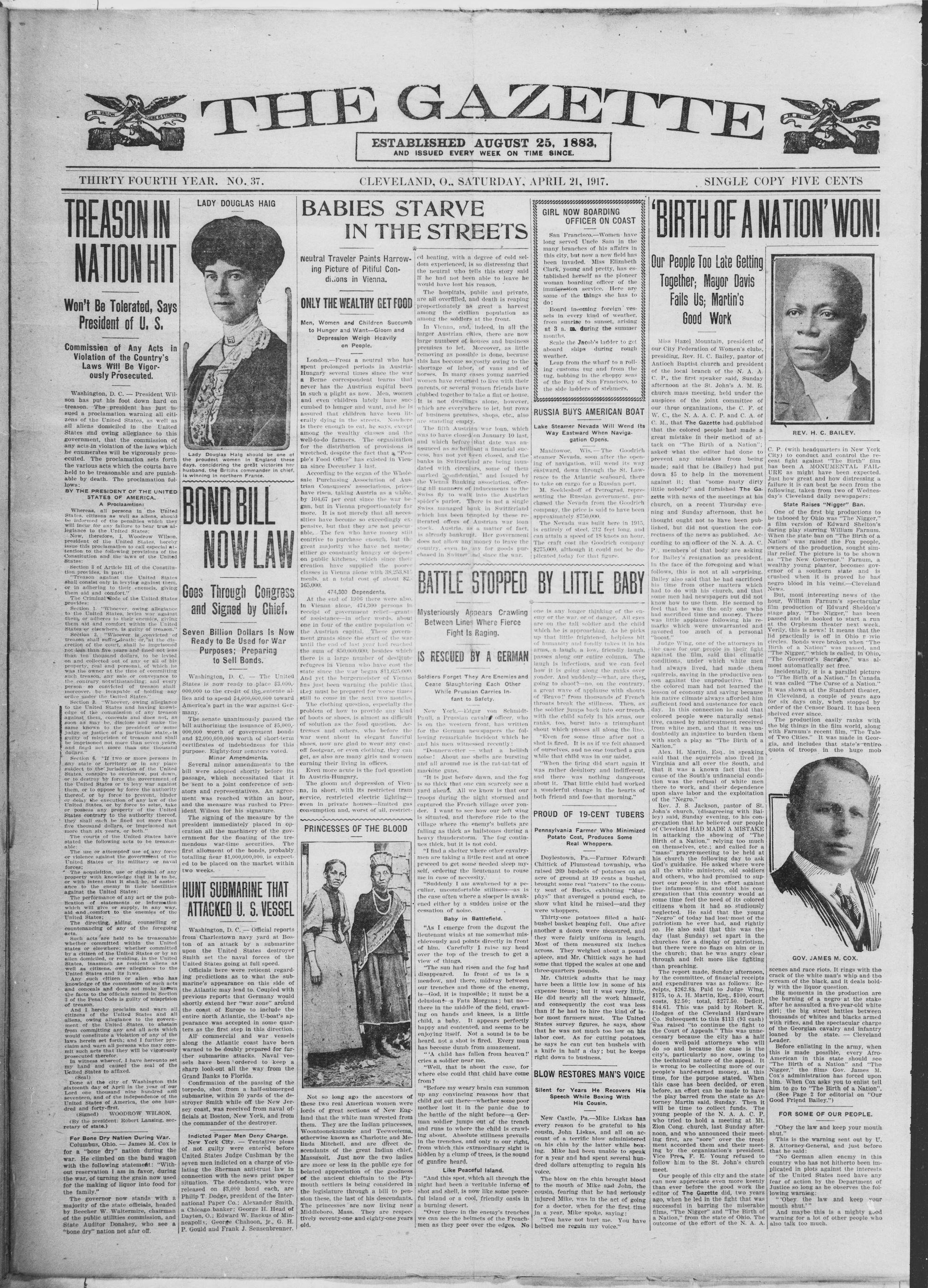
Lady Douglas Haig should be one of the proudest women in England these days, considering the great victories her husband, the Brillis commander in chief, is winning in northern France.
BOND BILL NOWLAW Goes Through Congress and Signed by Chief.
Seven Billion Dollars Is Now Ready to Be Used for War Purposes; Preparing to Sell Bonds.
Washington, D. C. -- The United States is now ready to place $3,000,000,000 to the credit of the content allies and to spend $4,000,000,000 toward America's part in the war against Germany.
The senate unanimously passed the bill authorizing the issuance of $5,000,000,000 worth of government bonds and $2,000,000,000 worth of short-term certificates, of indebtedness for this purpose. Eighty-four senators voted.
Minor Amendments.
Several minor amendments to the bill were adopted shortly before its passage, which necessitated that it be sent to a joint conference of senators and representatives. An agreement was reached within an hour, and the measure was rushed to President Wilson for his signature.
The signing of the measure by the president immediately placed in operation all the machinery of the government for the floating of the tremendous war-time securities. The first allotment of the bonds, probably totalling near $1,000,000,000, is expected to be placed on the market within two weeks.
HUNT SUBMARINE THAT ATTACKED U. S. VESSEL
Washington, D. C. — Official reports from Charlestown navy yard at Boston of an attack by a submarine upon the United States destroyer Smith set the naval forces of the United States going at full speed. Officials here were reticent regarding predictions as to what the submarine's appearance on this side of the Atlantic may lead to. Coupled with previous reports that Germany would shortly extend her "war zone" around the coast of Europe to include the entire north Atlantic, the U-boat's appearance was accepted in some quarters as the first step in this direction. All commercial and war vessels along the Atlantic coast have been warned to be doubly prepared for further submarine attacks. Naval vessels have been ordered to keep a sharp look-out all the way from the Grand Banks to Florida. Confirmation of the passing of the torpedo, shot from a half-submerged submarine, within 30 yards of the destroyer. Smith while off the New Jersey coast, was received from naval officials at Boston, New York, and from the commander of the destroyer.
Indicted Paper Men Deny Charge.
New York City. - Tentative pleas of not guilty were entered before United States Judge Cushman by the seven men indicted on a charge of violating the Sherman anti-trust law in connection with the news print paper situation. The defendants, who were released on $3,000 bond each, are Phillt T. Dodge, president of the International Paper Co.; Alexander Smith, a-Chicago banker; George H. Head of Dayton, O.; Edward W. Backus of Minneapolis; George Chahoon, Jr., G. H. P. Gould and Frank J. Sensenbrenner.
ESTABLISHED AUGUST 25, 1883 AND ISSUED EVERY WEEK ON TIME SINCE.
CLEVELAND, O., SATURDAY, APRIL 21, 1917.
BABIES STARVE IN THE STREETS
neutral Traveler Paints Harrowing Picture of Pitiful Conditions in Vienna.
ONLY THE WEALTHY GET FOOD
Men, Women and Children Succumb to Hunger and Want—Gloom and Depression Weigh Heavily on People.
London.—From a neutral who has spent prolonged periods in Austria, Hungary several times since the war in a Berne correspondent hears, that never has the Austrian capital been in such a plight as now. Men, women and even children later have succumbed to hunger and want, and he is assured that children have been literally dying in the streets. Nowhere is there enough to eat, he says, except among the wealthy classes and the well-to-do farmers. The organization for the distribution of provisions, is wretched, despite the fact that a "People's Food Office" has existed in Vienna since December 1 last.
According to the organ of the Wholesale Purchasing Association of Austrian Consumers' associations, prices have risen, talking Austria as a whole, by 10,147 per cent since the war began, but in Vienna proportionately far more. It is not merely that all societies have become so exceedingly expensive, but that they are not presentable. The few who have money sufficient to purchase enough, but the great majority who have not more, either go constantly hungry or on public kitchens, since the creation have supplied the poor classes in Vienna alone with 32,535 meals, at a total cost of about $215,000.
471.300 Dependents
474,300 Dependents.
At the end of 1866 there were also in Vienna alone, 471,200 persons in receipt of government relief grants of assistance in other wards, alone in four of the entire population in the Austrian capital. These government grants since the start of the war until the end of last year have been the sum of 840,000, besides what there is a large number of destitute refugees in Vienna who have the state since the war began $814,050,000. And yet the junglepiston of Vienna has just been waving the public that they must be prepared for worse time still to come in the next two months.
The clothing question, especially the problem of how to provide any kind of boots or shoes, is almost as difficult of solution as the food question. Attresses and others, who before the war wore about in elegant funeral shoes, now are clad to wear any east off-footwear, or even clothing, they can get, as also are many girls and women caring their living in offices.
Even more necissary is the fuel question in Austria-Hungary.
The gloom and depression of Vienna, in short, with its restricted trade service, restricted electric lighting—even in private houses—limited gas consumption and, worst of all, restricted
THE WOMEN OF THE WEST
Not so long ago the ancestors of these two real American women were lords of great sections of New England that the white man wrested from them. They are the Indian princesses, Wooontoneckanuske and Teeweelemua, otherwise known as Charlotte and Melinda Mitchell, and are direct descendants of the great Indian chief, Massasoit. Just now the two indies are more or less in the public eye for belated appreciation of the goodness of the ancient chieftain to the Plymouth settlers is being considered in the legislature through a bill to pension these, the last of his descendants. The princesses are now living near Middleboro, Mass. They are respectively seventy-one and eighty-one years old.
BATTLE STOPPED BY LITTLE BABY
ed heating, with a degree of cold seldom experienced, is so disstressing that the neuron who tells this story said if he had not been able to leave he would have lost his reason.
The hospitals, public and private, are all overfilled, and death is raping proportionately as great a harvest among the civilian population as among the soldiers at the front.
In Vietnam, and indeed, in all the larger Austrian cities, there are now large numbers of houses and business premises to let. Moreover, as little removing as possible is done, because this has become so costly owing to the shortage of labor, of vans and, of horses. In many cases young married women have returned to live with their parents, or several women friends have embubled together to take a flat or house. It is not dwellings alone, however, which are everywhere to let, but rows of business premises, shops, etc., also are standing empty.
The fifth Austrian war boon, which was to have been on January 10 fact, and which before that date was an admired as so brilliant a financial success, has not yet been closed, and the banks in Switzerland are being imitated with circuits, some of them married "confidential" and is led by the Vienna Banking association offering all manners of indebtments to the Swissy, to walk into the Austrian spider's piter. "There is not a single Swiss banked bank in Switzerland which has been tempted by these reiterated offers of Austrian war boon. Austria as a matter of fact, is already banked." The government does not give any money to leave the country, even to say for good purposes in Switzerland since the war.
Mysteriously Appears Crawling Between Lines Where Fierce Fight Is Raging.
Soldiers Forget They Are Enemies and
Cause Staggling Each Other
New York, NY. Liturgy von Schmidt-Baith a Prussian naval officer who is on the western front, has written for the German newspapers the following remarkable incident which he and his men witnessed recently:
"Domenow vor... what in hellish noise? About me shells are bursting and all around me is the rat hat of machine guns.
"It is just before dawn, and the fog is so thick that one can secrely see a yard ahead. All we know is that our troops during the night stormed and captured the French village over yonder. I want to see how our left wing is stimulated, and therefore ride to the village where the enemy's bullets are falling as thick as ballstones during a heavy thunderstorm. The dog continues thick, but it is not cold.
"I find a shelter where other cavalry are taking a little rest and at once proceed to get some needed sheep myself, ordering the lieutenant to cause me in case of necessity."
"Suddenly I am awakened by a peculiar, uncomfortable stillness—as is the case often when a sheep is awakened either by a sudden noise or the cessation of noise.
Baby in Battlefield.
"As I emerge from the digout the honour winks at me somewhat mischievously and points directly in front of him. Carefully I raise my head over the top of the trench to get a view of things.
"The sun had risen and the fog had disappeared. In front of us is a mendow, and there, midway between our trenches and those of the enemy, is—God. It is impossible; it must be a deblusion—a Fata Morgani; but no—there in the middle of the field, crawling on hands and knees, is a little child, a baby. It appears perfectly happy and contented, and seems to be enjoying itself. Not a sound is to be heard, not a shot is fired. Every man has become dumb from amazement.
"A child has fallen from heaven!"
"A child has fallen from heaven!" cries a soldier near me.
"Well, that is about the case, for where else could that child have come from?
"Before my weary brain can summon up any convincing reasons how that child got out there—whether some poor mother lost it in the panic due to the battle of the night before—a German soldier jumps out of the trench and runs to where" the child is crawling about. Absolute stillness prevails in the trenches, and only to our right, from which this extraordinary sight is hidden by a clump of trees, the sound of gunfire heard.
Like Peaceful Island.
"And this spot, which all through the night had been a vertible inferno of shot and shell, is now like some peaceful island or a cool, friendly casks in a burning desert."
"Over there in the enemy's trenches we can see the helmets of the Frenchmen as they peer over the edges. No
GIRL NOW BOARDING
OFFICER ON COAST
San Francisco—Women have long served Cabin Sam in the many branches of his affairs in this city, but now a new field has been invaded. Miss Elizabeth Clark, young and pretty, has established herself as the pioneer woman boarding officer of the immigration service. Here are some of the things she has to do:
Board in-coming foreign vessels in every kind of weather, from sunrise to sunset, arising at 3 a. m. during the summer months.
Seale the Jacob's ladder to get aboard ships during rough weather.
Leap from the wharf to a rolling customs ring and from the ring, holding in the happy seas of the Bay of San Francisco, to the side holders of steamers.
RUSSIA BUYS AMERICAN BOAT
Lake Steamer Nevada Will Wend Its Way Eastward When Navigagation Opens.
Mandiwoko, Wis. The Goodrich
seamer Nevada, soon after the opening
of navigation, will wend its way
eastward, down through the St. Lawrence
to the Atlantic seabound, there to take on cargo for a Russian port.
M. Schoelshoff of Portugal, represent-
ting the Russian government, purchas-
ed the Nynada from the Goodrich
company, the price is said to have been
approximately $74,000.
The Nevada was built here in 1875,
as entirely of steel 222 feet long, and
can attain a speed of 15 knots in hour.
The exist cost the Goodrich company
$77,000, although it could not be
displaced today for that purpose.
one is our army thanking of the courage on the way out of danger. All eyes are on the tall hill and the child which he is appalled at. As he picks up that little boy and takes him to his arms, it laughs, a low, treetop laugh, passes along our entire column. The lunch is infectious, and we can feel how it is going along the ranks over young, and suddenly what, are they going to shoot? no on the contrary, a great war of applause with shoots of "Brave" from thousands of French threaths break the stiffness. Then, as the soldier jumps back into our trench with the child safety in his arms, our ranks, too, burst into a triumphant shout which passes all along the line. "Exon for some time after not a shot is fired. It is as if we felt alamed of ourselves, and no one touched a gun while that child was in our midst.
"When the trending did start again it was rather desortiment and indifferent, and there was nothing-dangerous about it. That little child had worked a wonderful change in the hearts of both friend and foe that morning."
PROUD OF 19-CENT TUBERS
Pennsylvania Farmer Who Minimized Potato Cost, Produces Some Real Whoppers.
Doylestown, Pa.—Farmer Edward Chittick of Plumstead township, who raised 250 bushels of potatoes on an area of ground at 19 cents a bushel, brought some real "taters" to the county seat of Bucks, exhibiting "Murphys" that averaged a pound cach, to show what kind he raised—and they were whoppers.
Thirty-one potatoes filled a half-bushed basket heaping full. One after another a dozen were measured, and they were fairly uniform in length. Most of them measured 'six inches across'. They weighed about a pound apiece, and Mr. Chittick says he had some that tipped the scales at one and three-quarter pounds.
Mr. Chittick admits that he may have been a little low in some of his expense items; but it was very little. He did nearly all the work himself, and consequently the cost was less than if he had to hire the kind of labor most farmers must. The United States survey figures, he says, show that he was not much too low on his labor cost. As for cutting potatoes, he says he can cut ten-bushels with a knife in half a day; but he keeps right down to business.
BLOW RESTORES MAN'S VOICE
Silent—for Years He Recovers His Speech While Boxing With His Cousin.
New Castle, Pa.—Mike Liskas has every reason to be grateful to his cousin, John Liskas, and all on account of a terrific blow administered on his chin by the latter while boxing. Mike had been unable to speak for a year and had spent several hundred dollars attempting to regain his voice.
The blow on the chin brought blood to the mouth of Mike and John, the cousin, fearing that he had seriously injured Mike, was in the act of going for a doctor, when for the first time in a year, Mike spoke, saying:
"You here not hurt me. Now
"You have not hurt me. You have helped me regain my voice."
SINGLE COPY FIVE CENTS
'BIRTH OF ANATION'WON!
Our People Too Late Getting Together; Mayor Davis Fails Us; Martin's Good Work
Miss Hazel Mountain, president of our City Federation of Women's clubs, presiding, Rev. H. C. Bailey, pastor of Antioch Baptist church and president of the local branch of the N. A. A. C. P., the first speaker said, Sunday afternoon at the St. John's A. M. E. church mass meeting, held under the auspices of the joint committee of our three organizations, the C. F. of W. C., the N. A. A. C. P, and A. C. of M. C., that The Gazette had published that the colored people had made a great mistake in their method of attack on "The Birth of a Nation"; asked what the editor had done to prevent any 'mistakes' from being made; said that he (either) had put down $5 to help in the movement against it; that "some nasty dirty little nobody" and furnished The Gazette with news of the meetings at his church, on a recent Thursday evening and Sunday afternoon, that he thought ought not to have been published, but did not question the correctness of the news as published. According of an officer of the N. A. A. C. P., members of that body are asking for Bailey's reservation as president, in the face of the foregoing and what follows, this is not at all surprising. Bailey also said that he had sacrificed his time from other matters which had to do with his church, and that some men had newspapers but did not know how to use them. He seemed to feel that he was the only one who had sacrificed time and money. There was a mark which were unwarranted and scored too much of a personal boost.
Jerome Wing, one of the attorneys in the case for our people in their fight against the film, said that climatic conditions, under which white men had always lived, had made them squirrels, saving in the productive season against the unproductive. That the colored man had not learned the lesson of economy and saving because his native climate always afforded him sufficient food and sustenance for each day. In this connection he said that colored people were naturally sensitive, caused by mistreatment received from white men, and that it was undoubtedly an injustice to burden them with such a play as "The Birth of a Nation."
Alex H. Martin, Esq., in speaking said that the squirrels also lived in Virginia and all over the South, and that the cause of the South's unfinancial condition was the refusal of white men there to work, and their dependence upon slave labor and the exploitation of the "Negro."
Rev. J. S. Jackson, pastor of St. John's church, (disagreeing with Bailey), said, Sunday evening, to his congregation that he believed our people of Cleveland HAD MADE A MISTAKE in attacking the showing of "The Birth of a Nation," relying too much on themselves, etc., and called for a change in the way he approached his church the following day to ask God's guidance. He asked where were all the white ministers, old soldiers and officers, who had promised to support our people in the effort against the infamous film, and told his congregation that this country would-at some time feel the need of its colored citizens whom it had so studiously neglected. He said that the young "Negro" of today had lost most of the patriotism he ever had, and rightly believed that he had lost most of the day (last Sunday) set apart in the churches for a display of patriotism, but there were no flags on him or in the church; that he was angry clear through and felt more like fighting than preaching.
"The report made, Sunday afternoon, by the committee, of financial receipts and expenditures was as follows: Receipts, $262.89. Paid to Wicket Wing, $175, to A. H. Martin, Esq., $100, court costs, $2.50; total, $275.00. Deficit, $14.61. This was paid by Robert K. flogges of the Cleveland Hardware Co. Subsequent to this $118 ($93-cash) payment, the case is the Cause of Appeals." This was unnecessary because the city has a half dozen well-paid attorneys who will do so and because the case is the city's, particularly so, now, owing to the technical-nature of the appeal. It is wrong to be collecting more of our people's hard-earned money, at this time, for the purpose stated. When this case has been decided, or even before, an effort can be made to have the play barred from the state as Attorney Martin said. Sunday. Then it will be time to collect funds. The C. F. E. C. who tried to hold a meeting at Mt. Zion Cong. church, last Sunday afternoon, and who announced their meeting first, are "sore" over the treatment accorded them and their meeting by the organization's president. Vice Press, F. E. Young refused to follow him to the St. John's church meet.
Our people of this city and the state can now appreciate even more keenly than ever before the good work the editor of The Gazette did, two years ago, to make the successful in barring the miserable films, "The Nigger" and "The Birth of a Nation," from the state of Ohio. The outcome of the effort of the N. A. A.
THE EAGLE
REV. H. C. BAILEY.
C. P. twith headquarters in New York City to conduct and control the recent fight against "The Birth" film has been a MONUMENTAL FAILURE as might have been expected. Just how great and how distressing a failure it is can best be seen from the following, taken from two of Wednesday's Cleveland daily newspapers:
State Raises "Nigger" Ban.
One of the first big productions to be 'taoboo by Ohio was "The Nigger," a film version of Edward Shelton's daring play starring William Farnum. When the state ban on "The Birth of a Nation" was raised the Fox people, owners of the production, sought similar relief. The picture is to be shown as "The New Governor," Farnum, a owner of the former biennies, error of a southern state and is crushed when it is proved he has negro blood in his veins—Cleveland News.
But, most interesting news of the hour—William Farnum's spectacular film production of Edward Shelton's stage play, "The Nigger," has been passed and is booked to start a run at the Orpheum theater next week. Veryly, this is news! It means that the governor is actually jailed in Ohio circles. Bonds were broken when "The Birth of a Natiog" was passed, and "The Nigger," which is called, in Ohio, "The Governor's Sacrifice," was almost automatically-set free.
Incidentally, it is a parallel picture to "The Birth of a Nation." In Canada it was called "The Curse of a Nation." It was shown at the Standard theater, in Cleveland, a couple of years ago (maybe five years), when stopped by order of the Consecrator Board. It has been shelved ever since.
The production easily ranks with the big things in the film world, along with Farnum's recent film, "The Tale of Two Cities." It was made in Georgia, and includes that state's entire quota of troops in the huge mob
GOV. JAMES M. COX.
scenes and race riots. It rings with the
crack of the white man's whip and the
scream of the black, and it deals boldly
with the liquor question.
Big moments in the production are the burning of a negro at the stake after he assaulted a five-year-old white girl; the big street battles between thousands of whites and blacks armed with rifles in the spectacular charge of the Georgian cavalry and infantry loaned by the state — Cleveland Leader.
Before enlisting in the army, when this is made possible, every Afro-American in this state should see "The Birth of a Nation" and "The Nigger," the films—Gov. James M. Lewis, Cox administration, for him. When Cox asks you to enlist tell him to go to "The Birth of a-Nation." (See Page 2 for editorial on "Our Good Friend Bailey.")
FOR SOME OF OUR PEOPLE.
"Obey the law and keep your mouth shut."
This is the warning, sent out by U.S. Attorney-General, and just before that he said: "No German alien enemy in this country who has not hitherto been implicated in plots against the interests of the United States need have any fear of action by the Department of Justice so long as he observes the following warning:
"Obey the law and keep your mouth shut."
And maybe this is a mighty good
other people who also
take too much.
PUBLISHED EVERY SATURDAY
SUBSCRIPTION RATES
(in Advance)
One Year.....$1.50.
Six Months.....1.00
Three Months......50
Subscribers are requested to re-
mit by postoffice money or
der or registered letter
Entered at the postoffice in Cleveland
Ohio, as second-class matter.
Address all communications to
HARRY C. SMITH
Editor and proprietor,
THE GAZETTE,
Blackstone Building, Cleveland, O.
Member Ohio Legislature: 1894
to 1896; 1896 to 1898; 1900 to 1902
THE GAZETTE is the oldest, and has the largest bona fide circulation double that of any newspaper in the Interest of Afro-Americans, published in the state of Ohio, and comparison with any will immediately establish its rank as one of the NEWSIEST AND BEST in the country.
10,000,000 Afro-Americans.
240,000 in Ohio.
20,000 in Cleveland.
SATURDAY, APRIL 21, 1917.
"Let us have faith that right makes might, and in that faith let us to the end dare to do our duty as we understand it."—Abraham Lincoln.
"He kept us out of war!" Don't that remind you of last fall—in October?
"Please enroll me as a private," wired Col. Wm. Jennings Bryan to President Wilson. And everybody says "Agreed."
The N. A. A. C. P. (National Association for the Advancement of Colored People) fight on "The Birth of a Nation," in Ohio, has been a colossal failure.
Before enlisting, Ohio Afro-Americans should see "The Birth of a Nation," the miserable film the Democratic government of this state has forced upon them, and see how it not only libels our people but also the loyal soldier of the war of the rebellion, abolitionists, patriotism, etc.
Is the Democratic party just to the country in keeping Stone at the head of the committee on foreign relations in the Senate? Has he the breadth of view? Are his ideas what they should be? Is he a statesman? Has he the confidence of the country? Has he even discretion? As a measure of preparedness should he not be replaced by an abler and a more patriotic man?
THIS WOULD PLEASE ROOSEVELT
Senator Warren G. Harding is proposing a plan which may prove a solution of the issue as to whether the American army about to be created shall be raised by conscription or by the volunteer method. Senator Harding proposes that the question shall be divided under two heads. The army that is to be sent to Europe to fight in the trenches should be raised entirely from volunteers, he said, while in forming the permanent army of national defense selective conscription may be entered upon if circumstances make it necessary. His view is that no man should be compelled to go to Europe and fight unless he desires to do so, or in other words, unless he volunteers. There are indications that Senator Harding's plan will find many supporters in Congress.
MUSKET PREPAREDNESS.
James W. Gerard, recent ambassador to Germany, in a speech at New York, said: "We hear even today, prattlings about embattled farmers taking their old muskets from over the chimney place and defeating the invader. But nowadays the old flintlock means Zepelins, airplanes, captive observation balloons, steel helmet, gas and gas masks, machine guns, searchlights, sixteen-inch guns and eighteen-inch howitzers, trench mortars, range finders, telescopes, armored automobiles, tanks, miles of barbed wire, underground mining, rockets and grenades and countless other instruments of war, the proper use of which can only be learned after years of hard application. All these modern means of war require great preparations. If we are in for war we are in for a serious war."
If we are in for a serious war and it takes years of hard application to learn all these things, why have they not been prepared, why are they not ready? It has been almost three years since the war began. In the musket days of our foresathers they at least had the musket ready over every man tel and they knew how to use it.
OUR "GOOD FRIEND" BAILEY.
Our good friend(?), Rev. H. C. Bailey, has been "losing his head" for quite a year. This has been evident to many of his best friends who have been frank in their expressions of regret; none more so than the editor of The Gazette, who as many know has been one of his staunchest and best friends throughout all his trials in this city, domestic, church, etc. The Gazette, more than any other local agency, helped to place him in the favorable position he has enjoyed in this community for several years and which it now seems he is determined to sacrifice as the result of a peculiar "mental condition" that has caused the downfall of many a much abler man than our quondam friend. The Gazette in the past so often frankly stated why it liked the "Rev." that our readers can easily imagine how
much we regret—more than we care to express at this time—the necessity, which he has forced upon us, of showing how positively unwarranted and really foolish was his mean attack on The Gazette in a characteristic talk, Sunday afternoon last, at St. John's A, M. E. church.
First, RESULTS show so conclusively that our people of the state and this city made a great mistake, or rather many of them, in their method of attack on the infamous film, "The Birth of a Nation", that it is a waste of time to discuss that. Then that lone $5 bill that Brother Bailey contributed to the local fight would not pay our carfare to Columbus and return on any one of the four trips to that city the editor of The Gazette made when fighting "The Birth of a Nation", two years ago. And we won then! Nor is Bailey's lonesome "five" one twentieth of the money we spent in fighting the miserable film at that time, not one cent of which has been returned to us, or have we asked or expect. We held no mass meetings to collect money from our people or any other, either. In this local fight we spent more than three times the sum, Brother Bailey boasts of contributing, and greatly to the fact and would not do so if he had not made it necessary. We do not like advertising such things and regret that, apparently, he does. The "dear man" does not say that the Gazette published (so distasteful to him) was not the TRUTH—relative to his quarrel with Vice President F. E. Young of the N. A. A. C. P.—but abuses our representative for reporting, it, "reflects upon the editor" for publishing it, and proceeds to pass judgment as to "men who have news papers and do not know how to use them". It was in this remark Brother Bailey reached the height of the arrogance that has characterized all of his ignorant criticisms. The Gazette was clearly within its rights and correct when it made the publication one seems to object to but him. Not even Mr. Young with whom he quarrelled that Sunday afternoon in his church. The fact that he (Bailey) does not know this is not at all surprising when one remembers his overwintering "selfesteem", his ignorance of journalism, etc.
It pains us greatly, as we have said, to have to speak so plainly of our quondam friend and our only defense is that he alone has compelled it. Possibly one of the most amusing parts of his talk, Sunday afternoon, was when, with the importance of a marrytred Rocketeller, Brother Bailey made reference to that five "spot" and the "sacrifice of his time", as if he were the only person interested in the case who had made such sacrifice. Some years ago we read a contribution to a local daily paper on the "Negro" in which the writer, a Mady friend of the race, said that "the Negro was self conscious". Ever since we have tried to decide whether she was correct or not in that statement. Brother Bailey and other things of more or less ancient "vintage" have convived us at last.
THE KAISER'S NEGRO BANDMASTER
Sabac El-Cher, whose mother was a native African of color, bandmaster of the First Grenadier Guards of the Imperial German Army, was born on the grounds of the Royal Palace in Germany, educated, and schooled in music in that country. He was a musician in Germany, and later to Germany from Africa by Prince Albrecht, an uncle of the present Emperor.
NEWS FLIES FAST IN CHINA
Most Wonderful Courier Service in the World Takes the Place of the Telegraph and Railroad.
Travelers who return from the remote interior of vast countries where telegraphs and railways are practically unknown will tell you of the astonishing swiftness with which news travels, despite the seeming absence of facilities.
Away in the wilds of the Tibetan border, or in the Mongolian deserts, hundreds of miles from the nearest telegraph wire, the traveler will perchance hear of some momentous event in the outside world within an incredibly short while of its happening. This rapid transmission of news is the work of natives employed in counter services of higher organization than we have ever dreamed. China, that spacious land where distance is measured by days, not miles, affords the best example. For, although the means of communication by rail and telegraph have greatly developed there of late, the bulk of the interior is still virgin to these inventions of the "foreign devil." and China still maintains what has been from time immemorial the most wonderful courter service in the world.
It is now mainly controlled by the Chinese post office, and the mileage of the courier lines has recently reached the stupendous figure of 136,000, or about $5\frac{1}{2}$ times the circumference of the globe. By Road, river and track, radiating from the capital of Peking, or other important centers, couriers are speeding without ceasing, night and day, to almost every corner of the 5,000,000 square miles of country which form the Chinese empire. The couriers are all stalwart men especially chosen for their physique, powers of endurance and knowledge of routes. They work in relays, eat as they go along, and are supposed not to stop until they have handed the mailbag to the next relay. An average speed of 90 miles a day is often maintained.
About Hardwood Floor.
If hardwood floors are badly spotted and dirty, the best way to clean them is wiping up with gasoline. Moisten a clean piece of cheesecloth with gasoline and rub the surface of the floor vigorously with the moistened cloth, changing it as soon as it becomes much soiled.
Refining Influence.
To be thoroughly imbued with the liberal arts refines the manners and makes men to be mild and gentle in their conduct—Ovid.
THE GAZETTE, CLEVELAND, O., SATURDAY, APRIL 21, 1917.
EASY TO TELL REAL DIAMOND
There Are Many Ways in Which the Finest Imitations May Be Detected, Even by the Inexperienced.
The experienced eye does not find it difficult to decide whether a diamond is genuine, for the facets of real ones are seldom so regular as those of fine imitations. With the latter the greatest care is taken in grinding to polish and smooth the whole stone so that there will be irregularity in the reflection or refraction of the light. A necessary tool for testing is the file, which cannot scratch a real diamond, although it quickly leaves its mark on an imitation. Better than the file is the sapphire, for the sapphire is the next hardest stone to the diamond. Any stone that a sapphire can scratch is assuredly not a diamond.
If you put a small drop of water on the upper facet of a brilliant and touch it with the point of a pencil the drop will keep its rounded form, but the stone will remain clean and dry. In case of an imitation the drop immediately spreads out. Plunge a diamond into water and it will be plainly visible and will glitter through the liquid, but an imitation stone is almost invisible. If you look through a diamond, as through a bit of glass, at a black dot on a sheet of white paper you will see one single point clearly. If you see several points or a blur of black it is an imitation. The white sapphire, the white topaz and rock crystal are frequently sold as diamonds, but imitations are more commonly made of glass.
MANY GOLD COINS ABRADED
Are Often Found by Banks to Be Below Weight Fixed by the United States Treasury Department.
Gold coin in circulation loses weight more rapidly than most people realize, and it is said that a great amount of the gold in circulation on this coast is abraded below the limit of tolerance at which the United States treasury will receive it, says the San Francisco Chronicle. A good deal of this lightweight money is accepted by the banks, as is discovered whenever a national bank makes a gold payment to the Federal Reserve bank. Probably the banks have now become educated, but when the first payments were made to the reserve banks it was found that considerable gold which passed current among banks would not be received by the reserve banks at face value. It is safe to assume that all gold coin received by banks is sorted, the perfect coins being held in the vaults and the worn pieces paid out over the counter so that the ultimate loss which is inevitable is borne by the last individual holder.
Congress is now asked by the treasury department for authority to receive for a limited period all gold coin at its face value. That which is abraded will then be recoined and the integrity of the circulation restored.
Duration of American Wars
DURATION of American Wars.
The first American war, that of the Revolution, dated from April 19, 1775, to April 11, 1783, a period of eight years; the Northwestern Indian wars, from September 19, 1790, to August 3, 1795; the war with France, from July 9, 1793, to September 30, 1800; the war with Trilpoll, from June 10, 1801, to June 4, 1805; the Creek Indian war, from July 27, 1813, to August 9, 1814; the War of 1812 with Great Britain, from June 18, 1812; to February 17, 1815; the Seminole Indian war, from November 20, 1817; to October 21, 1818; the Black Hawk Indian war, from April 21, 1831; to September 30, 1822; the Cherokee disturbance or removal, from 1836 to 1837; Creek Indian war or disturbance, from May 5, 1836; to September 30, 1837; the Florida Indian war from December 23, 1835; to August 14, 1843; Aroostock disturbance, 1896 to 1839; the war with Mexico, April 24, 1846, to July 4, 1848; the Apache, Navajo and Utah war, from 1849 to 1855; the Seminole war, from 1856 to 1858; the Civil war, from 1861 to 1865; the Spanish-American war, April 21, 1898, to August 12, 1898, and the Philippine insurrection, from 1899 to 1900.
Studies in Sacrifice.
"Do you think women ought to take an active part in politics?" "Yes," replied Senator Sorghum. "But I'm afraid that a girl who sacrifices her life to politics is going to have something like the customary experience of a girl who marries a man to reform him."
Bad Opening.
"I say, old boy, are you going to keep Lent?" "No but I care say that fiver you borrowed from me is."
Our Classified Ad Department
FOR RENT—Furnished rooms for gentlemen; 2536 E. 63d St. up stairs.
WANTED—By the Amee Employment Agency—women for house-cleaning; $2 day and lunch. 308 Superior Ave. N. W.
FOR RENT—Houses and Rooms.
If you have them to rent or if you want to rent, advertise in The Gazette. It brings results.
NOTARY PUBLIC—For such services call at The Gazette office, No. 2 Blackstone building, No. 1424 W. Third Street, near Superior Ave.
FOR SALE—Houses or lots. If you have either or anything else to sell, or if you wish to purchase advertise in The Gazette. If anything can bring you results, it can and will.
WANTED—20 colored bench-moulders in Detroit, Mich. If necessary, transportation will be advanced and deducted from wages later. Men should have experience on malleable steel. Write immediately to Forrester B. Washington, Director, Detroit League on Urban Conditions Among Negroes, 297 St. Antoine St., Detroit, Mich.
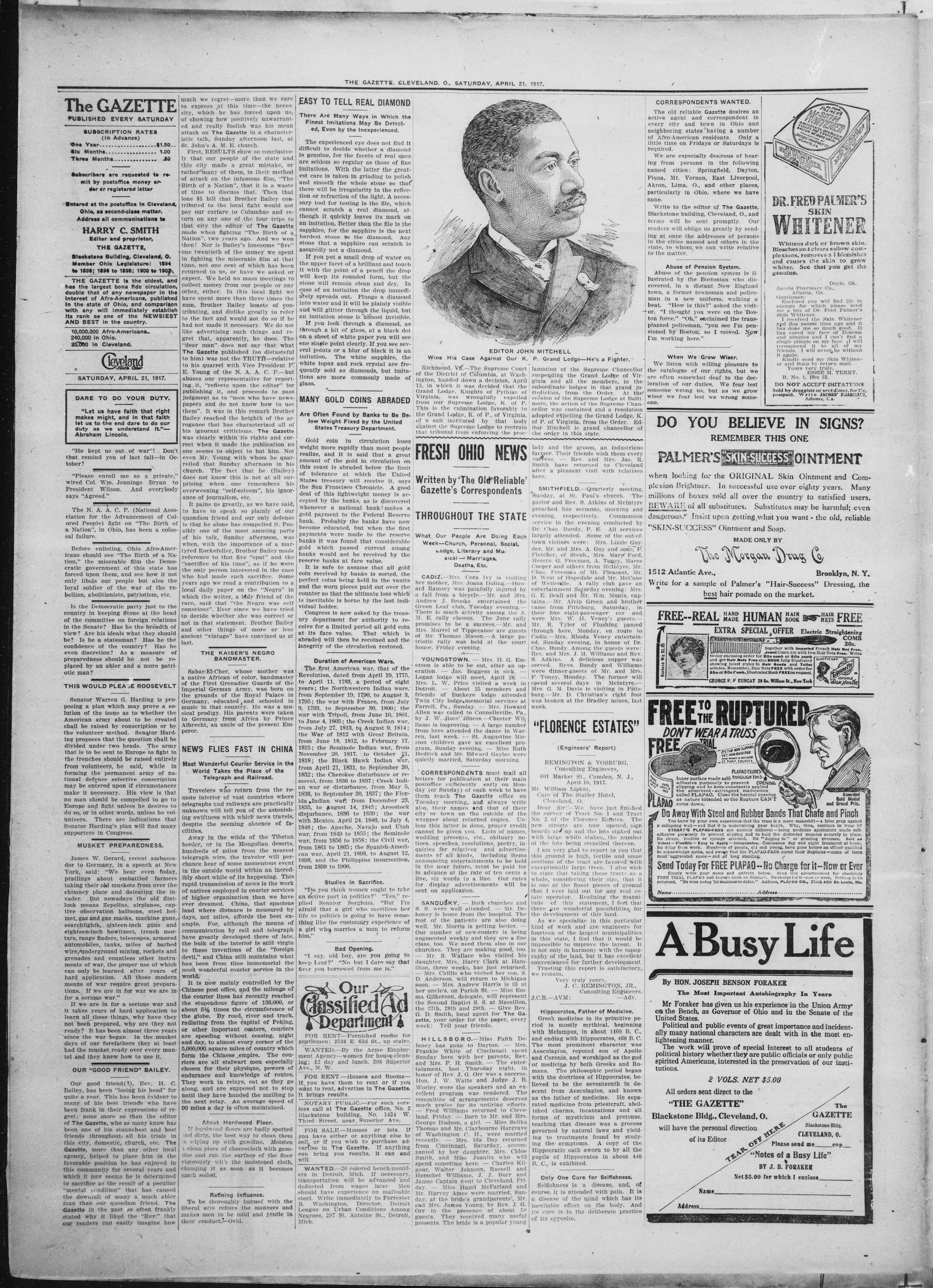
EDITOR JOHN MITCHELL
Wins His Case Against Our K. P. Grand Lodge—He's a Fighter.
Richmond, Va.—The Supreme Court of the District of Columbia, at Washington, handed down a decision, April 13, in which it was decided that the Grand Lodge, Knights of Pythias of Virginia, was wrongfully expelled from our Supreme Lodge, K of P. This is the culmination favorably to the Grand Lodge, K of P., of Virginia, of a suit instituted by that body against the Supreme Lodge to restrain that tribunal from enforcing the proc
FRESH OHIO NEWS
Written by 'The Old Reliable' Gazette's Correspondents
THROUGHOUT THE STATE
What Our People Are Doing Each Week—Church, Personal, Social, Lodge, Literary and Musical—Marriages, Deaths, Etc.
CADIZ—Mrs. Cora Ivy is visiting her mother, Mrs. Joana Duling.—Howard Ramsey was painfully injured by a fall from a bicycle.—Mr. and Mrs. Andrew J. Brooks entertained the Green Leaf club, Tuesday evening.—There is much activity among the A. M. E. rally classes. The June rally was attended—Mr. and Mrs. Murray of Tippacco—guests of Mr. Thomas Mason.—A large patriotic rally was held at the court house, Friday evening.
YOUNGSTOWN. — Mrs. H. G. Emerson is able to be able, after an operation. — Jas. Boggess is sick. — Logan lodge will meet, April 26. — Mrs. L. W. Price visited a week in about 25 members and friends of Twin City lodge, memorial services at Farrrell, Pa., Sunday. — Mrs. Howard Allen was called to Connellsville, Pa., by J. W. Ross' illness. Chester Williams is improving. — A large number from here attended the dance in Warren, last week. — St. Augustine Miss. attended a memorial, Sunday evening. — Mrs. Ruth Hedrick and Mr. Edward Gayles were quietly married, Saturday morning.
CORRESPONDENTS must mail all letters for publication at their postoffice sufficiently early on Monday (or Sunday) of each week to have them reach The Gazette office on Tuesday morning, and always write also, their names and that of their postmaster, and obituary of the wrapper about returned copies. Unless this latter is done, proper credit cannot be given you. Lists of names, wedding presents, etc., obituary notices, speeches, resolutions, poetry, inquiries for relatives and advertisements of all kinds, including items announcing entertainments to be held in the near future, must be paid for by the agent upon request. On line, six words to a line. Our rates for display advertisements will be sent on application.
SANDUSKY. — Both churches and S. S. were well attended. Mr. Dehoney is home from the hospital. The rest of the patients are also doing well. Mr. Morris is getting better. Our number of newcomers is increasing. They are a fine class, too. We need them also in our churches. They are making good, too.
Mr. S. Wallace who visited his daughter, Mrs. Harry Clark at Hamilton, three weeks, has just returned. Mrs. Chillis who visited her son, S. D. Anderson, will return to Michigan soon. Mrs. Andrew Harris is ill at her home on Parmelia, Miss Emma Gilkerson in delaware will represent the Second Baptist S. S. at Massillon, the 27th, 28th and 29th. Give Rev. G. D. Smith, local agent for The Gazette, your order for the paper, every week: Tell your friends.
HILLS LAKE—Miss Faith Delaney has gone to Dayton. Mrs. Frankie White of Cincinnati spent Sunday here with her parents, Rev. and Mrs. P. H. Smith. The entertainment, last Thursday night, in honor of Rev. J. G. Ornell, a teacher Hon. J. Cattie and Judge J. B. Clement were the speakers and an excellent program was rendered. The committee of arrangements deserves much praise for its untrigging efforts.
— Fred Williams returned to Cleveland, Friday. — Born to Mr. and Mrs. George Hudson, a girl. — Miss Selika Thomas and Mr. Claybourne Hargrave of Washington C. H., were married early in Cincinnati, then in Cincinnati, Saturday, accompanied by her daughter, Mrs. Chloe Smith, and Miss Juanta who will spend sometime here. — Charles Kiligow, Walter Johnson, Russell and Herschel Williams, J. J. Burr and James Captain went to Cleveland, Friday. — Miss Hazel McFarland and Mr. Harvey Ames were married, Sunny Ames was born to Mrs. and Mrs. James Young, by Rev J. G. Orr in the presence of about 50 guests. They received many useful presents. The bride is a popular young
lamation of the Supreme Chancellor suspending the Grand Lodge of Virginia and all the members, in the subordinate lodges in that grand jurisdiction, from the Order. At the session of the Supreme Lodge at Baltimore, the action of the Supreme Chancellor was solicited by the Grand Lodge K. K. of P. of Virginia, from the Order. Editor Mitchell is grand chancellor of the order in this state.
lady and the groom, an industrious farmer. Their friends wish them every success. — Rev. and Mrs. Jas. R. Smith have returned to Cleveland after a pleasant visit with relatives here.
SMITHFIELD—Quarterly meeting Sunday, at St. Paul's church. The pastor and Rev. S. Atkins of McIntyre preached five sermons, morning and evening, respectively. Communion service in the evening conducted by Dr. Chas. Bundy, P. E. All services largely attended. Some of the out-town visitors were: Mrs. Lizzie Guyer, Mr. and Mrs. A. Guy and sons, P. Fletcher, of Steub, Mrs. Mary Ford, Messrs. G. Freeman, A. Toney, Marceo Cooper and others from McIntyre, Mr. Chas. Freeman of Mr. Pleasant, Mr. Cooper and Hopper, Mr. Mcine of Wellsbury. A rally churched entertainment Saturday evening: Mrs. G. E. Beall and Mr. Wm. Munts, captains—Mr. Alvin Green and brother came from Pittsburg, Saturday, in their nine passenger car and were Mrs. W. H. Veney's guests—Mr. R. Tyler of Flushing passed through here, Monday, en route to Cadiz—Mrs. Rhoda Veney entertained, Sunday evening, in honor of Dr. Chas. Bundy. Among the guests were: Rev. and Mrs. J. M. Williams and Rev. and Mrs. J. M. Williams was served. Revs. Bundy and Williams were dinner-guests of Mr. and Mrs. F. Toney, Monday. The former will spend several days in McIntyre—Mrs. G. M. Davis is visiting in Pittsburgh—Mr. D. Christian's right foot was broken at the Bradley mines, last week.
"FLORENCE ESTATES"
"FLORENCE ESTATES"
(Engineers' Report)
REMINGTON & VOSBURG,
Consulting Engineers,
601 Market St., Camden, N. J.,
April 10, 1917.
Mr. William Lipkin,
Care of The Statler Hotel,
Cleveland, O.
Dear Sir!-We have just finished
the survey of Tract No. 1 and Tract
No. 2 of the Florence Estates. The
new streets are now opened, sign
boards are up and the lots staked out
with large white stakes, the number
of the lots being stenled thereon.
I am very glad to report to you that
this ground is high, fertile and some
sections of the tract are favored with
exceptionally large trees. I also wish
to state that taking these tracts as a
whole, considering their size, that it
is one of our finest pieces of ground
that I ever saw for any real estate
operator. Realizing the magnitude
of this statement, I feel that
there are wonderful possibilities for
the development of this land.
As we specialize in this particular kind of work and are engineers for fourteen of the largest municipalities in this state, I feel that it would be impossible to improve the layout. It is not only in harmony with the topo raphy of the land, but it has excellent conveniences for further development. Trusting this report is satisfactory. we remain. Very truly yours, J. C. REMINGTON, JR., Consulting Engineers J.C.R.-AVM: —Adv.
Hippocrates, Father of Medicine.
Greek medicine in its primitive period is mostly mythical, beginning with Melampus, in about 1400 B. C., and ending with Hippocrates, 460 B. C. The most prominent character was Aesculapius, reputed son of Apollo and Coronis, and worshiped as the god of medicine by both Greeks and Romans. The philosophic period began with the doctrines of Hippocrates, believed to be the seventeenth in descent from Aesculapius, and known as the father of medicine. He separated medicine from priestcraft, abolished charms, incantations and all forms of mysticism and pretense, teaching that disease was a process governed by natural laws and yielding to treatments found by studying the symptoms. A copy of the Hippocratic oath sworn to by all the pupils of Hippocrates in about 440 B. C., is exhibited.
Only One Cure for Selfishness
Selfishness is a disease, and, of course, it is attended with pain. It is a disease of the mind which has its inevitable effect on the body. And its cure is in the deliberate practice of its opposite.
DO YOU BELIEVE
REMEMBER THIS
PALMER'S SKIN-SUCCESS
when looking for the ORIGINAL Sk
plexion Brightner. In successful use ove
millions of boxes sold all over the cou
BEWARE of all substitutes. Substitute
dangerous.* Insist upon getting what you
"SKIN-SUCCESS" Ointment and Soap.
MADE ONLY BY
The Morgan D.
1512 Atlantic Ave.,
Write for a sample of Palmer's "Hair
best hair pomade on the
FREE--REAL HAND MADE HUMAN
DO YOU BELIEVE IN SIGNS?
REMEMBER THIS ONE
PALMER'S SKIN-SUGGESS OINTMENT
when looking for the ORIGINAL Skin Ointment and Complexion Brightner. In successful use over eighty years. Many millions of boxes sold all over the country to satisfied users. BEWARE of all substitutes. Substitutes may be harmful; even dangerous.* Insist upon getting what you want - the old, reliable "SKIN-SUCCESS" Ointment and Soap.
Write for a sample of Palmer's "Hair-Success" Dressing, the best hair pomade on the market.
FREE TO THE RUP.TUR
DON'T WEAR A TRUSS
FREE
TRIAL
SILVER ADJUST
PLAPAO PAD
IT'S THE NEW SUPPIRY
NORMAL RUP.TUR PAD
AND WHEN IS IS WHEN IS
PLAPAO ELUDES
Do Away With Steel and Rubber Bands
You know by your own experience that the truss is a m
in collapsing wall—and that it is understaining your health.
STAYS in PLAPAO-PAD and is entirely different, being
adhesive purposely to prevent slipping and to the dri
No straps, buckles or springs attached. No "digging in
Valver - Fearful - Easy to Apply - Responsive. Continuous
No delay from work. Hundreds of people, old and young,
to acknowledge ouths, and away that the PLAPAO-PAD
must be acquired easily and of long standing.
Sending Today For FREE PLAPAO -- No Charge
Hunting with FREE PLAPAO and 4-pound book on Impulse. No chap
returned. "Be wise today 'tis madness to defer." Address, Pl
Name... Address...
Do Away With Steel and Rubber Bands That Chate and Pinch
You know by your own experience that the truss is a more makehift—a false opponent in a collapsing wall—and that it is undermining your health. Why, then, continue to wear your STUART'S PLAPAO-PADS are entirely different—being medicine applicators made self-purposefully to prevent slipping and to hold the distended muscles in place. No issue with the PADS—they are designed to be flexible. Velvet—Flexible—Easy to Apply—Inexpensive. Continuous day and night treatment at home. No delay from work. Hundreds of people, old and young, have gone before an officer qualified to wear PLAPAO-PADS cured their Ruptures—some of them most aggravated cases—and of long standing.
Send Today For FREE PLAPAO—No Charge for it—Now or Ever
Simply write your name and address below. Send this advertisement for absolutely FREE TRIAL PLAPAO and 6-piece look on Ruptures. No charge for now or ever. Nothing to be brought. “Be wise today! my madness to address.” Address, PLAPAO CO., 420 Block 12, St. Louis, Mo.
ABusyLife
By HON. JOSEPH BENSON FORAKEE
The Most Important Autobiography
Mr Foraker has given us his experience
on the Bench, as Governor of Ohio and in
United States.
Political and public events of great imp
ally many national characters are dealt w
lightening manner.
The work will prove of special interest
political history whether they are public or
spirited Americans, interested in the pres
tutions.
2 VOLS. NET $5.00
All orders sent direct to the
"THE GAZETTE"
Blackstone Bldg. Cleveland, O
The Most Important Autobiography In Years
Mr Foraker has given us his experience in the Union Army on the Bench, as Governor of Ohio and in the Senate of the United States.
Political and public events of great importance and incidentally many national characters are dealt with in the most enlightening manner.
The work will prove of special interest to all students of political history whether they are public officials or only public spirited Americans, interested in the preservation of our institutions.
2 VOLS. NET $5.00
All orders sent direct to the
"THE GAZETTE"
Blackstone Bldg., Cleveland, O.
will have the personal direction of its Editor
The GAZETTE
Blackstone Bldg.
CLEVELAND, O.
Please send me ___ cop_
"Notes of a Busy Life"
BY J. B. FORAKER
Net $5.00 for which I enclose
Name___
Address___
CORRESPONDENTS WANTED
The old reliable Gazette desires an active agent and correspondent in every city and town in Ohio and neighboring states having a number of Afro-American residents. Only a little time on Fridays or Saturdays is required.
We are especially desirous of hearing from persons in the following named cities: Springfield, Dayton, Plqua, Mt. Vernon, East Liverpool, Akron, Lima, O., and other places, particularly in Ohio, where we have none.
Write to the editor of The Gazette, Blackstone building, Cleveland, O, and terms will be sent promptly. Our readers will oblige us greatly by sending at once the addresses of persons in the cities named and others in the state, to whom we can write relative to the matter.
Abuse of Pension System
ABUSE of Pension System.
Abuse of the pension system is ill-illustrated by the Bostonian who discovered, in a distant New England town, a former townman and policeman in a new uniform, walking a beat. "How is this?" asked the visitor. "I thought you were on the Boston force." "Oh," exclaimed the transplanted policeman, "you see I'm pensioned by Boston, so I moved. Now I'm working here."
When We Grow Wiser
We listen with willing pleasure to the catalogue of our rights, but we are often somewhat deaf to the declaration of our duties. We fear lost someone wrong us, but as we grow wiser we fear lest we wrong someone.
Buckles Wife of Joseph
IT'S THE NON-SLIPPING YET NON-RIGIO PAD AND WHAT IS WITHIN IT THAT COUNTS
PLAPAO EXUDES
Inner surface made self-THROUGH THIS-adhesive purposely to prevent OPENING slipping and to keep constantly applied the absorbent-astringent medication called PLAPAO. Close the hernial opening as nature intended so the Rupture CAN'T come down.
BARRER PALMER'S
SKIN WHITENER
APPELLING SANDELLIER
APPELLING BARN SUN
SALON OF BARN SUN
INDOOR SUPPLIER CO.
ATLANTA, GA
DR. FRED PALMER'S
SKIN
WHITENER
Whitens dark or brown skin.
Bleaches and clears sallow complexions, removes a blemishes and causes the skin to grow whiter. See that you get the genuine.
Doyle, Ga.
Jacobs Pharmacy Co.,
Alurum, Ga.
Gentlemen:
Enclosed you will find 25e in
please send please send
me a box of Dr. Fried Palmer's
Skin Whitener.
The Skin Whitener
gpd Soa pace time ago and it
has done me so much good. It
has cured my face of Exema
and I will have a single pimple on my face, it will
recommend it to all of my
friends. I will never
again.
Kindly send my skin Whitener
mails. You're very truly,
Yours very truly,
TERRY,
R. No. 1, Box 33.
DO NOT ACCEPT IMITATIONS
Sold by druglux or direct for, Ec
paid邮. Wash at PALACEKY
Washington, Ca.
EVE IN SIGNS?
THIS ONE
ACCESS OINTMENT
AL Skin Ointment and Com-
use over eighty years. Many
the country to satisfied users.
Substitutes may be harmful; even
that you want - the old, reliable
Soap.
LY BY
Drug C
Brooklyn, N. Y.
"Hair-Success" Dressing, the
on the market.
MAN HAIR BOOK HAIR NETS FREE
L, OFFER Electric Straightening COMB 20c.
Phone, Prospect 441-J.
A RACE ENTERPRISE
Central Shirt Shop
G. J. TATE, Prop.
GENT'S FURNISHINGS
Hosiery, Underwear and
Neckwear
Arrow Collars and Shirts
Hats, Caps, Etc.
2922 CENTRAL AVENUE
CLEVELAND, O.
STERLING
5 and 10 Cent Store
3003 Central Ave.
Under New Management!
Watch Our Windows
For Bargains
Colored Saleslady
We close at 8 P. M. every evening except Saturday
MME.C.H.JONES' Hair Tonic and Invigorator
HER TONIC is the result of scientific study of the causes of diseases of the scalp.
Instead of treating effects of the diseases she treats the causes, eliminating the same and leaving the scalp in a healthy condition that can be maintained by using her Hair Tonic and Invigorator, according to her directions.
Madame C. H. Jones' Hair Tonic and invigorator is guaranteed to stop the falling out of the hair and to make the hair
It has been successfully used by many since 1997 and with perfect satisfaction by many Toledo people and elsewhere, by many Toledo people and elsewhere, by many Toledo people and elsewhere, by many people get diseased scabs by using widely advertised hair tonics prepared by undisruptive persons who have been to Toledo. On the other hand, MADAME JONES' solutely harmless and will do all that is claimed for it. MADAME H. JONES' Hair Tonic and Invigorator promotes the growth of the hair, prevents and cures baldness, restores hair color and part's urease and beauty; it restores the color of the hair by supplying it with the natural elements and necessary nourishment. MADAME C. H. JONES 353 Woodland Toledo, Ohio Agents Wanted.
SPLENDID ENDORSEMENT.
Toledo, Ohio, March 15, 1910.
This is to certify and stimulate an acquaintance that has passed over many years of evidence fortified beyond a question of doubt, the veracity of any claim made by Madame L. intimately acquainted with the formula and have an adequate knowledge of every ingredient in the medicine, the combination of drugs have been offered to the public for Alopecia and Area, (falling off of the hair) which have cured nine-tenths of the cases for which it has been prescribed. It would indeed be were as certain of the medical effects of drugs as I am confident that this combination (Madame Jones' Hair Tonic and its effect is specific, and I cheerfully believe that it is the need of such a remedy). It is the best that the human mind has produced so far. Truly yours. H. FERGUSON M. D.
The Pride of Carolina
The State Agricultural and Mechanical College of South Carolina
Orangeburg, S. C.
Next session begins September 27th and ends May 25th, 1917.
No Tuition, no Room Rent, no Charges for Water, Lights or Fuel. Entrance Fee $10.00.
Board $6.00 per Month in Advance. Books, Laundry and Personal Expenses Extra.
Every Modern Facility, Standard Equipment. A Faculty of 57 Officers and Instructors.
For Information and Catalogue, Write
R. S. Wilkinson, Pres.
Orangeburg, S. C.
MYSTERIOUS HELPING POWERS FREE!
Adam & Eve Roots, High John
Conquer and King Solomon
Roots Free! Write LEO S. OSMAN
1625 Penna Ave., Baltimore, Md.
DON'T THROW AWAY
Your copy of The Gazette after reading it, but give it to a friend or an acquaintance who might subscribe after reading a copy of the paper.
Editor
Where to Purchase The Gazette
J. E. BRANHAM'S
4219 Central Ave.
*ERNEST P. JACKSON'S
3969 Central Ave.
*OPEN SUNDAYS.
NOTICE TO SUBSCRIBERS
Subscribers not receiving T us at once. We desire every cop Send or bring locals and all b fice, suite 2, Blackstone Bldg. If please. We advise our readers to care tisements before making purchases this paper should have the pa they advertise is assurance that t Local reading notices (adve words in a line); display adverti publication. All matters for publication in be in the office by 4 p. m., WEDN
Subscribers not receiving The Gazette regularly should notify us at once. We desire every copy delivered promptly.
Send or bring locals and all business matters to The Gazette's office, suite 2, Blackstone Bldg. If you wish to see the editor call there, please.
We advise our readers to carefully examine The Gazette's advertisements before making purchases. Business men who advertise in this paper should have the patronage of our people. The fact that they advertise is assurance that they want it.
Local reading notices (advertisements) ten cents a line (six words in a line); display advertising space, fifty cents an inch, single publication.
All matters for publication in current issues of The Gazette, must be in the office by 4 p. m., WEDNESDAY of that week, at the latest.
Social and Personal
FOR QUALITY Prescription Work THE OWL DRUG CO. 3743 CENTRAL AVE. Excels All Others
"Heart of City"
Lunch Room
720 W. Frankfort Ave.
Between West 6th and West 9th Sts.
BEST HOME COOKING
T. E. BLAIR, Prop.
3820 Central Avenue
We carry full line of Dry Goods
Ladies and Gents Furnishings
Bell 'Phone, Prospect 333-J.
Miss Bessie Blakemore Cook
TEACHER OF PIANO
Hours 10 A. M. to 6 P. M.
Evenings by Appointment
2331 E. 29th Street
Phillips' Dining Parlor and Lunch Room
3046 SCOVILL AVENUE
Corner of E. 31st St.
THE BEST MEALS and
QUICK SERVICE
at the lowest rates
B. P. Phillips
Proprietor
Cuy. 'Phone: Central 8620 W.
"The E'ladi
W. W. MASSEN
Ideal Rooms
All Modern
PHONE
Central 4191-L
"The E'ladio" 2326 East 55th Street
W. W. MASSENGALE, Proprietor
Ideal Rooms for Gentlemen
All Modern Improvements
PHONE SERVICE
Central 4191-L CLEVELAND, O.
FITS
*DR. WEAVER'S,
3315 Central Ave.
*A. GORDON'S,
2928 Central Ave.
*MRS. BESSIE KITZMILLER'S
3943 Central Ave.
The Gazette regularly should notify delivered promptly. business matters to The Gazette's of you wish to see the editor call there. Fully examine The Gazette's adver. Business men who advertise in onage of our people. The fact that they want it. institutions) ten cents a line (sixing space, fifty cents an inch, single current issues of The Gazette, must SDAY of that week, at the latest.
Personal
Cleveland
Sixth City
"Any prejudice whatever will be insurmountable if those who do not share in it themselves truckle to it and flatter it and accept it as a law of nature."—John Stuart Mill.
Chas. S. Waldon, Central Ave., is visiting sisters in Mt. Vernon.
Mrs. Ruby Y. Slaughter left, Thursday, for a week's visit in Columbus.
Mr. and Mrs. John H. Early, E. 70th St., have sold their home.
J. H. Gibson of Pittsburgh visited his son, Harry A. Gibson, recently.
Mrs. Della Offer was hostess to the Optimistic Club, recently.
J. E. Branham was called to Columbus last week.
Miss Beryl Reed, E. 120th St., gave an egg-hunt, last Saturday afternoon.
There is only one way to get the real race news and that is to take "the old reliable" Gazette.
BEST FOR THE BLOOD — Puro Herbs, Sold only on Brown Drug Co. cor. E. 28th St. and Central Ave.—Adv. The Girls' Friendly society of St. Andrew's church is rehearsing a play which it intends giving in May. Hugh O. Slaughter was married in Springfield, recently, to Miss Alice Orr. Thas. S. Waldon has returned from Bufalo where he attended a sister's funeral. The P. W. association gave a successful concert at Y. M. C. A. hall, last week Monday evening. Gladys G. Slaughter of Pittsburg was Mrs. Howard Jones' guest, recently. Two carloads more of our people arrived in the city from "the sunny South," Sunday evening. Elmer Cheeks and a Chicago lady are to wed in August. His mother arrived from W. Va., Monday. Fanny Wonder new employed in Lorain, and Mivian Vivian Service of Chicago, were married, last week. Mrs. T. J. Hicks, E. 74th St., entertained her S. S. class, last Friday evening.
Mrs. Mary Bundy is going to Baltimore, Md., to live with her son, Edward.
Ladies, our fashion page is the latest and best—up to date! Tell your friends and acquaintances about it, please.
Rodhard Lewis of Washington, D.C. Mrs. Agnes Harris' nephew, will wed a southern school teacher in September. He is employed in the agricultural department.
You should take PURO HERBS, the great blood purifier and system cleanser. On sale only at Brown Drug Co. 2742 Central Ave., cor. E. 28th. S.-Adv.
Roy Kilgour, Walter Johnson, Russell and Herschel Williams, J. J. Burr, Fred Williams and Jas. Captain, of Hillsboro, arrived in the city, last Saturday.
Even some of our people, it is said, do not want to live on the same street
FOR
Pure Drugs, Prescriptions
AND
Cut Rate Patent Medicines
GO TO
The Arlington Pharmacy
S. W. Cor. E. 55th Street
and Central Avenue
O" 2326
East 55th Street
GALE, Proprietor
For Gentlemen
Improvements
SERVICE
CLEVELAND, O.
THE GAZETTE, CLEVELAND, O, SATURDAY, APRIL 21, 1917.
ttte
LLER'S
notify
ttte's off all there.
with members of the race as good and respectable as they are.
Miss Eugenia Ballard's friends say that she will be among the middle of May comes because it costs something to telephone a long distance often.
Saul A. Lucas, who is attending Gammon Theological seminary, Atlanta, Ga., has "made good" in all his classes this year, and won the first prize of $14 in the oratorical contest. May his good work continue.
Mr. and Mrs. Carol Scott, of E. 86th St., were blessed with twin boys, last week. They have twin girls and three or four other children. The latest are their third pair of twins. Rah! for Mrs. Scott!
Our advertisers want your trade. Those who do not ask for it in the Gazette certainly care little, if at all, for it. Therefore, we urge our readers and all our friends to patronize those who ask for your trade in this paper.
Mr. Wm. Lipzette when in the Sernando Owine People's Drug store from the delegation his "Florence from Philadelphia.
Agatha, the Richardson of the little white boy Park Ave., last to her in re of a Nation": dirty-black nigra white girl." The school bitterly able photoplay, did success. M. of New York, S. Mitchell evening and the editions were the Program we organ solo by M. Very plea.
Mr. and Mrs. P. W. Lemon. E. 87th St., have purchased a home on E. 85th St., and will move there soon. Mr. and Mrs. Dan. Fairfax have purchased one O. E. 74th St., and Mr. and Mrs. Alex O. Taylor on E. 103rd St. GOOD!
Mr. Wm. Burton, Arthur Ave., entrained the. Tuesday Afternoon Thirsty club this week, and Mrs. Carrie Blue, E. 90th St. the Fortnightly club, last week Friday.
Chas. Weaver was 61 years of age, yesterday (Friday), and is justly proud of the fact and also that he is enjoying excellent health as well as prosperity, these days. Save The Gazette its "smoke," Charley.
The Women's auxiliary to the J. C. and H. S. will meet at Sterling Library, Wednesday at 7:30 p. m. There was no meeting, April 11, the library being closed.
The following were ill, last week: Jake Yeger. Leroy Jones, Mr. and Mrs. Dan. Edgar Moore's mother and Mr. Jesse Carey.
E. P. Randolph is convalescent.
Emmuelman Commandery, K. T., and Queen Elizabeth chapter, O. E. S., made an excellent showing at Cory M. E. church services. Sunday week, M. E. church services, Maggie Roozers, matron, were in charge. Rev. J. S. Jackson attended the Willberforce University trustee board meeting in Columbus, recently. En route home he visited his baby grandmother, in Xenia, Mrs. Keller is his daughter.
Mr. and Mrs. W. J. Anderson arrived from Boston, the first of the week, to attend his former mother-in-law, Mrs. Wm. Moore, who is very ill. Mr. Anderson's first wife was Mrs. Eva Moore Anderson, deceased. Mayor Davis took care to NOT appoint even one member of the race on the city War Commission. He has and the chance now. Herman Fellin-ner assigned from the commission, this week.
A report is being maliciously circulated that Dr. Arthur Smith, dentist, 3404 Central Ave., is about to sell his practice and his home, and is to leave the city. Dr. Scott wishes to empathically deny this report as being unwarranted and untrue.—Adv.
St. John's W. M. M. society will hold a meeting on Friday, 2197 E 37th St. Monday at 8 p.m. Mrs. C. Blue, president of St. James', and Mrs. Rose, president of Tried-Stone M. societies, will be guests of honor and address the meeting.
The Cleveland Branch of the N. A. A. C. P. will present Roland W. Hayes, of Boston, our greatest tenor at Cory M. E. church, Wednesday evening, May 2. Patrons' tickets are $1 each. General admission, 50 cents. Tickets on sale at the People's drug store, Central Ave, and E. 33d. St.; at Mrs. Bessie Kitzmiller's, 3943 Central Ave, and at Miss Eleanor Alexander's, 2190 Mary G. Slaughter, guest of Mr. and Mrs. Howard Jones, E. 93d St., returned to Pittsburg, Monda, Mrs. Slaughter, a dinner, last Saturday, in her honor. Among those present were: Mr. and Mrs. B. Douglass, Ozella Moore, Blanche Hickman, Bessie Cook and C. S. Sutton, Esq. Mrs. Slaughter has a pleasing soprano voice.
Rev. B. W. Paxton, who wandered from the Old Folks' home, recently, and was lost, is now at Mrs. Etta Banks', Lakeview Rd. Mrs. Paxton, who was operated on at Charity hospital, last Friday, is convalescing slowly.
"A damned nigger" is an expression in Wednesday's daily Leader, "The News" of the same day used the mongrel word "nigger". We have ordered our copy of the paper discontinued. We have ordered the paper to will. They certainly ought to, if they have any self or race respect.
Mrs. Scott Barber entertained the Pleasant Co. club, last Thursday, "Current Topics", the subject discussed; led by Mrs. Preston. Dainty refreshments were served by the hostess. The club met at Mrs. Brewer's, Thursday night.
The editor of the *Gazette* is indebted to Prof. W. S. Carborough, president of Wilberforce University, for a copy of his paper on "What should be the standard of the university, college, normal school, teacher training and secondary schools", read at the conference on education at the National Training School, Durham, N. C. Nov. 24, 1916.
The editor of The Gazette is indebted to Congressman E. W. Saunders for a copy of "War and Criminal Anthropology; Moral Evils of War and Atrocities. Principles for The Study of Humanity," by Mr. Arthur MacDonald, of Washington, D. C. Also to Secretary of State Wm. Lauton for a copy of the Electron Statistics for the Year 1916. Many thanks. T W. Walker, John P. Green and Edward Daw, committee appointed by Bishop Wm. H. Leonard to meet him and the arch-deacon to consider the calling of a successor to the Rev. B. W. Paxton, rector of St. Andrew's P. E. church, after careful consideration selected from the five clergymen considered, the Rev. W. B. Suthern of Hartford, on one hand, and he been accepted He is expected in the city about May 1. Rev. Mr. Suthern has a wife and two children.
It will pay you to sit down and study some figures on the subject of what rent paying means when carried on for years. If two families live side by side for ten years, the one owning its home and the other paying rent, the increase in population will raise the value of the one and raise the rent of the other. Read John M. Anderson's advertisement relative to "3 Persons in a Room." It is the BEST proposition of the kind. Tell your friends about it, too—Ady. The concert at Cory M. E. church, last Wednesday evening, was a splen-
Mr. Wm. Lipkin informed The Gazette when in the city, last week, that Sernando Owinska Delwright, of the People's Drug store, has been dropped from the delegation selected to visit his "Florence Estates" lots, not far from Philadelphia, early next month. Agatha, the little daughter of Mrs. Richardson of Blaine Ave., struck a little white boy in the mouth, on Wade Park Ave, last week Monday, for saying to her in reference to "The Birth of the Girl," that the dirty-black nigger treated that little white girl." The children of Hough school bitterly denounce the miserable photonlay.
did success. Mr. Harry *J*, Burleigh of New York City and Madam Kathryn S. Mitchell the "stars" of the evening and their selections and renditions were especially meritorious. The program was opened with a fine organ solo by Mrs. Florence Washington. Very pleasing were the selections of the Zephyr Male Quartette and the cornet imitations of Harry T. Ford, Mrs. Mabel Biggs and Miss Bessie H. Cook were the efficient accompanists. J. W. Wilfs directed the program. Paul Feiss leading local business man told Mr. Pureza Rice, Monday, that local Afro-Americans have been collecting money in recent weeks and months from business men of the city for the purpose of assisting in housing the Afro-American immigrants of recent months from the South. He said that more than $3,000 had been thus collected. Who has been doing this and where is the money? More than 50 Afro-Americans possessed, were arrested in Philadelphia, a few weeks ago, for doing this very thing. The notice here should get busy.
Marriage licenses issued, last week; Harry J. Williams and Janie Scott, Central Ave.; James E. Prescott, E. 30th St., St. and Pearl Carpenter, Pine Ave.; Wm. R. Guy and Mamie Chick, Central Ave.; Garfield Pryor and Jessie Campbell, Scovell Ave.; Wm. Mosby, Marion Ave. and Olive Morris, E. 30th St.; Charles Oswald, Central Ave. and Helen Augustine, Professor St.; Wm. Reed, E. 30th St. and Georgia Lockett, E. 30th St.; Cliton Zone, E. 87th St., and Katie Gray, Central Ave.; Alvin Harrison and Lillian D. Anderson, E. 30th St. and Ernest Jones, St. and Pearl Hall, E. 30th St.; Bhussee Mugo Pearl and Amelia Hurley, Central Ave.; John Buchanan, Central Ave. and Ida Jones, E. 23th St.
Judge Marvin and Attorney Martin, Sunday week, at Antioch church implored our people not to go on with that advertised fool-demonstration in front of the Opera house, the following Friday night, but led by "Starlight" Boyd, Central A.s. saloon-keeper, who identified the theater, the mob in which were Henry Taylor, Syd. Thompson and about 125 others, persisted in marching down town. Every one now knows what great harm it did to property, to our local fight on "The Birth, of a Nation" and our people generally. But the "richest" part of the demonstraction was made up of the front of the theater. It is on par with Bailey's, at St. John's church, Sunday. He said: "Boys, we have done all we can do; we have created a riot. Now let's march back up home" The "boys" were quietly standing the street in front of the Opera house waving little American flags, who their leader's conception of a "riot."
W. H. Polhamus, secretary of the Soldiers' Relief Commission of this county, wrote Mr. Andrew McSpadden, under date of April 2, 1917, in reply to his letter, as follows: "Comrade: I would gladly lend my influence against this picture, "The Birth of a Nation," if I had any means of knowing that it was harmful, but I have not. Were I to talk against it in Post meeting, what could I say? I would have to talk and for one I have no desire or curiosity to see it. This is as far as I feel justified in going without further knowledge." This from an OLD SOLDIER is enough to make Mr. McSpadden and others gnash their teeth. We trust Mr. Polhamus has (by this time) learned what he ought to know about the infamous photoplay. He certainly has "had the means of knowing" all last and this week. As a "boost" of American patriotism, just at this moment, he intends to interest and concern even Mr. Polhamus; indeed all veterans of the war of the rebellion and the Spanish-American war particularly and all true Americans generally.
Afro-American pupils are segregated ("jim-crowed") at Sibley school and have been, it seems, for some time. There are two other such classses in our local public schools, all organized in recent months, and not a word have our public school teachers lapsed. A member of the board of education of the school was ferried with Tom Fleming and his wife, many weeks ago. Thus early is the clamor for a "jim-crow" Y. M. C. a showing its "fangs," causing segra-
GEO. A. MYERS.
tion in our schools, just as we have predicted for years; and the exhibition in this city of "The Birth of a Nation" is helping along local segregation greatly. Through all this our public school teachers and too many others seem perfectly satisfied and apparently on the verge of being or continued. "Twas ever thus. Wednesday noon at a dinner tendered them at the Hollenden by Geo. A. Myers, Messrs. Chas. W. Chenut, Alex. H. Martin, J. E. Reed, J. Wills and Mr. Myers; Revs. G. V. Clark, J. S. Jackson and H. C. Balley considered various methods of combating this new insulting classification of our pupils, most of which have come from the South. The editor of The Gazette acknowledges the receipt, Tuesday, of Mr. Myers' invitation to attend the dinner and conference and regrets his inability to do so.
Apparent System.
"Is this hospital run on the home-opathic system?" "No; what makes you think so?" "I notice that blonde nurse has a light-headed patient."
REAL ESTATE
I CAN SECURE FOR YOU
INSURANCE
3 Per Cent Money WITH
WHICH
TO OWN A HOME
TO BUILD ON YOUR VACANT LOT, TO MAKE YOUR RENT
PAY FOR YOUR HOME
A SMALL PAYMENT STARTS IT. OUR PLAN DOES THE REST
LOANS AT ONLY 3% INTEREST
JOHN M. ANDERSON
510 SUPERIOR BLDG.
W. O. LEE, Salesman
CENTRAL 5930 L
Are the three essentials in portraits of children. Add to this the CORRECT STYLE and this spring weather and you get the Perfect Child Portrait
4207 Central Avenue Both Phones
[Name]
Cuyahoga, C
Edward Do
(T H
3035 Cent
Wm. Brack, Prop. . . .
James M
Rosedale 1800
SLAUGHT
Funeral Di
Emba
Office and F
3923 CE
Autos for All Occasions.
GOLD
Cuyahoga, Central 5727
Edward Doctor's Cafe
(THE Z)
3035 Central Avenue
n. Brack, Prop. . Frank Doctor, Manager
James Mabel, Chef
Rosedale 1800 Quality Service
SLAUGHTER BROS.
Funeral Directors and
Embalmers'
Office and Funeral Parlors
3923 CENTRAL AV.
Autos for All Occasions. Calls Answered Day and Night
GOLD BOND
3035 Central Avenue
Wm. Brack, Prop. - Frank Doctor, Manager
James Mabel, Chef
Rosedale 1800 Quality Service
SLAUGHTER BROS.
Funeral Directors and
Embalmers
Office and Funeral Parlors
3923 CENTRAL AV.
Autos for All Occasions. Calls Answered Day and Night
The Cream of Table Beers
Gold Bond is a brew fit for most modern equipment, the "made from sun-rise and hops, pure and properly aged before It comes to your table pure, cheer. No other beer com Gold Bond.
The National T
"I cordially commend the all who believe in the Negro help promote its intellectual Rev. Dr. Charles H.
It is more than a me It is a community of Its influence is destined to be in improved Negro community locate.
Settlement workers, mission ston fields, Y. M. C. A. and Y. nurses receive a comprehese Wellesley graduate and experien day practice through the school We aim also to create a bet Industrial training, advance Thirty-two acres, ten modern We can accommodate a few Communities requiring social
Next School Term
Gold Bond is a brew fit for Kings --- the product of the most modern equipment, the highest skill in beer-brewing.
"made from sun-ripened barley malts and hops, pure distilled water, and properly aged before bottling."
comes to your table pure, wholesome, bubbling with good beer. No other beer compares with the fine flavor of Gold Bond.
The National Training School
"I cordially commend the school's interest and needs to all who believe in the Negro race and in our obligation to help promote its intellectual, moral and religious uplift."
Rev. Dr. Charles H. Parkhurst, New York City.
It is more than a mere school
It is a community of service and uplift.
Its influence is destined to be felt in all sections of the country improved Negro community life wherever our trained workers ate.
Settlement workers, missionaries for home and foreign mis-fields, Y. M. C. A. and Y. W. C. A. secretaries and district ses receive a comprehensive grasp of their studies under a lesley graduate and experienced co-workers and actual every-practice through the school's social service department.
We aim also to create a better qualified ministry.
Industrial training, advanced literary branches, business school.
Thirty-two acres, ten modern buildings, healthful location.
We can accommodate a few more earnest, ambitious students.
Communities requiring social workers should write us.
Next School Term Opens Oct. 4, 1916.
Gold Bond is a brew fit for Kings --- the product of the most modern equipment, the highest skill in beer-brewing. "made from sun-ripened barley malts and hops, pure distilled water, and properly aged before bottling." It comes to your table pure, wholesome, bubbling with good cheer. No other beer compares with the fine flavor of Gold Bond.
The National Training School
The National Training School
"I cordially commend the school's interest and needs to all who believe in the Negro race and in our obligation to help promote its intellectual, moral and religious uplift." Rev. Dr. Charles H. Parkhurst, New York City.
It is a community of service and uplift.
Its influence is destined to be felt in all sections of the country in improved Negro community life wherever our trained workers locate.
Settlement workers, missionaries for home and foreign mission fields, Y. M. C. A. and Y. W. C. A. secretaries and district nurses receive a comprehensive grasp of their studies under a Wellesley graduate and experienced co-workers and actual everyday practice through the school's social service department.
We also to create a better qualified ministry, Industrial training, advanced literary branches, business school. Thirty-two acres, ten modern buildings, healthful location.
We can accommodate a few more earnest, ambitious students. Communities requiring social workers should write us.
Next School Term Opens Oct. 4, 1916.
For catalogue and detailed information address
Pres. JAS. E. SHEPARD
National Training School
DURHAM, NORTH CAROLINA
National Training School
Prospect 1095-J J. H. COX COX DRY CLEANING CO.
Suits Pressed, 30 Cents
2738 Central Avenue CLEVELAND, O.
AMERICA'S HUGE ARMY
Men Will Be Put in Shape to Fight for Uncle Sam.
Men Will Be Put in Shape to Fight for Uncle Sam.
Location of Citizens' Training Camps Is Announced by War Department in Washington.
Washington, D. C. — The location of the citizens' training camps at which America's new gigantic army will be trained has just been announced by the war department. They embrace every section of the country. On May 1 they will be ready for the reception of reserve officers and candidates for commissions, and the course of instruction will begin one week later. The camps will later be used for training a large part of the prospective army of 500,000 men. It develops that under the present regulations, those in training for commissions will not receive any pay. It was announced that "the citizens selected for admission will receive transportation, subsistence and uniforms at the expense of the United States, although it is believed that most of them will have their own uniforms in advance. Other articles of equipment will be issued at the camps.
"The camp for the New England states will be at Fort Ethan Allen or such other point in New England as may be designated by the commanding general of the eastern district," says an announcement by the war department. "The camp for congressional district numbers 1 to 26, inclusive, in New York state (which comprises Long Island, New York city) and a small piece of territory immediately north of New York city) will be at Plattsburg barracks, N. Y.
"The camp for the remainder of New York state and the 10th, 11th, 14th, 15th, 16th, 21st, 25th and 26th congressional districts of Pennsylvania will be at Madison barracks, N. Y. The camps for the remainder of Pennsylvania (which includes Philadelphia and Pittsburgh) will be at Fort Niagara, N. Y.
"The camp for Ohio will be at Fort Benjamin Harrison, Ind., near Indianapolis."
T. TOTTEN, MAYOR OF FINDLAY, PASSES ON
Findlay, Ohio. — Theodore Totten, mayor of Findlay, died in a hospital here. Death was due to a general breakdown. He was advised some time ago to give up his duties but declined to do so, maintaining he must serve the people.
Mr. Totten was a Republican, a veteran of the Civil war and served as mayor 20 years ago. He was postmaster of Findlay under President Rosevelt. His widow survives him. P. S. Shoupe, Republican, president of the council, will succeed him.
THE MARKETS
Grain, Provisions and Live Stock.
Cleveland, April 19. - Flour-Minnesota
patients $12.35.
Wheat-No. 1 red $2.62.
Corn-No. 3 yellow $1.58.
Oats-No. 2 white $7.62 c.
Potatoes- Choice white $3.20@12.5 per
bushel.
Hay-No. 1 timothy $15.00.
Cattle- Best steers $9.50@10.25, calves
$13.00@12.5.
Sheep- Wethers $9.50@10.25, lamba
$13.00@12.5.
Hogs-Yorkers $15.50, plgs $13.25.
Toledo, April 19. - Wheat - Cash
$2.62.
Buffalo, April 19. — Cattle — Shipping
$8.50@13.25.
Hogs-Yorkers' $16.00@16.15, pligs $12.00@
14.00.
Sheep — Wethers $11.75@12.00, lambs
$13.00@16.65.
Pittsburgh, April 19. — Cattle — Prime
$12.25@13.00.
Hogs—Yorkers $16.00@16.25, plgr $12.75
@10.25.
Sheep — Top sheep $11.00, top lambs
$13.00.
Calves — Top $14.00.
Chicago, April 19. — Wheat — May
$3.21%
Cattle-Native steers $3.00@13.15, cows
and buffers $5.60@10.85.
Hogs—Heavy $15.20@16.05, plgs $10.75@14.20.
Sheep — Wethers $10.60@12.75, lambsnative $11.90@15.65.
Couple Fight With Razors, Die.
Toledo, Ohio. — In a razor duel between Philip Abrams, 30, and his wife, 28, each slashed the other more than a dozen times, death resulting while both were being taken to the hospital.
According to Joseph Wallace, 14, a witness, Mrs. Abrams told her husband she was going to the hospital to take fruit to the owner of their home. Abrams, the boy said, objected and slapped his wife. The couple continued quarreling several hours when both procured razors.
War Claims First Young Patriot.
Chicago, Illinois.—The war claimed its first young patriot in Chicago.
James Platt, aged 10, was leading his company of boys against the sand fort defended by Alvedo Cimmelly, 12, and his company of child soldiers. "Capt. Platt ordered a charge and "Capt. Cimmelly fired at him with an old revolver.
Little "Capt." Platt dropped with a bullet through his chest. He died almost instantly. The old revolver had been resurrected from a garret and the children thought it was unloaded.
JERSEY HAS MADE GREAT PROGRESS
It Is No Longer a Novelty But Ruling Fabric Among the Informal Gowns.
SOMBER TONES PREDOMINATE
None of Colors Adopted In Models Imported From France Is Especially Attractive to the American Woman.
The history or jersey cloth could not be written in one chapter. Its introduction was not taken seriously, but its persistence has caused it to be regarded with importance.
It is quite useless to attempt to describe the spring fashions without starting from jersey, incorporating it in the middle and ending up with it. It has ceased to be a novelty. It has become a standard fabric. It is so strongly, and disagreeably, like certain well-advertised brands of American woolen for men's underwear, that one feels partially undressed when wearing it. Its slender surface which tintalized the economical women and was the delight of the extravagant woman, appears to have been relegated to the limbo of things that were.
The weave that does not indicate by its appearance that it was ever intended for smart and expensive apparel is the weave that is accepted. There is a French quality that cannot be duplicated in this country, the dressmakers say, and the woman who orders a suit or frock of it pays a good fat price for it, with the sails
FABRIC
This frock is made of blue gaberdine and the curve at the knees is accentuated by machine stitchery in blue and embroidery in blue beads. The short cape buttons on the shoulder. The fancy vest is of white organdie.
faction that it will wear forever—if that is a satisfaction in these days of whirling fashions and cyclonic commercial conditions.
This is not the time or place to indulge in a summary of the triumphal procession of jersey from an outlander to a conqueror. Women have used the word as well as the weave indifferently, and they speak of it slightly as a thing of the beach, the country lane and the hard benches about the field of sport.
Even the high price of the slender fabric, which Chanel took it into her head to embroider with gold and silver, did not make women stop to consider that such a flotous extravagance had a purpose behind it.
Jersey coats and skirts were trimmed with fur, worn during the summer months and hung in the closet at other times. They were a bit more of a caprice than a colored sweater, so women thought, but the manufacturers' thought ran in another vein. They saw in Jersey cloth a sturdy, reliable fabric that could be standardized and kept continually on the market like serge.
Amazing Success of Jersey Cloth.
At the moment, it looks as though the manufacturers have thought better than the public. Jersey not only rivals serge in the spring clothes, but runs ahead of it. Even the importers in this country were surprised when the packers opened the enormous boxes which came over on the French steamers from Bordeaux and lifted gown after gown, suit after suit and coat after coat . Jersey. There was no silk jersey there; all the apparel was made of this new and prevailing
FOR THE "BOBBED COIFFURE"
There Are Ways of Meeting Difficulties of Those Whose Hair Is Either too Thin or Too Thick
No, it is not particularly new, this fascinating way of covering one's ears, but it is always universally becoming, and is still the "lates," says an expert hairdresser. However, there are some tew who make a very poor attempt at "bobbing" their hair. "How do you manage to make your hair look so nice over the ears?" one damselfly will say to another more skillful than herself. "My hair is so thin that I can't possibly puff it." "My hair is so thick that it sticks out," are the usual complaints. Well, for the too-thin haired there come in the way of boon tiny rats that can be tucked underneath the scantiest of locks to give them the nice rounded appearance of the ideal "bob." And all that the too-thick crop requires is thinner strands for the ear covering. One strand on gach side of the head, rolled and brought back to be caught "in the 'kroob,' and that as the secret
THE GAZETTE, CLEVELAND, O.. SATURDAY, APRIL 21, 1917
wene which has an unfinished, integ-
gant appearance.
One has a feeling that the exigen-
des of war have made women get
hold of all the men's undershirts they
could find, dip them in the dye pot, put
a belt around them and use them with
a plaited skirt.
The one feeling of discouragement
that the American importers have had
about the abundance of jersey cloth
clothes was caused by the sad tones
which the buyers have chosen. An al-
moused unlimited range of gray and
beige predominates.
Not one of these colors is especially
attractive to the American woman.
It takes a peculiarly toned brunette to wear string, muscle, cafe au
bait, beige and the biscuit tones, and it takes a peculiarly toned blonde to
wear gray in its several light shades
that have neither blue nor mauve in
However, the French designers have got around this by using collars, belts, cuffs and facings of black, dark blue and white on these gray and beige jersey costumes.
It may be due to some inability to dye this new type of Jersey that the sad colors are chosen, or it may be that the manufacturers of materials in France prefer to use the gray and beige in these everyday suits and keep the gorgeous colors for evening and afternoon frocks.
Have Long Tunic Goats.
The majority of the jersey suits, and they may be called frocks as well, have long, tunic coats that reach to the knees and must be slipped on over the head through the opening at the neck. These coats are as shapeless as the costumery of the tenth century, and they depend entirely upon the girdle for a silhouette of any grace or distinction.
One of the best of the jersey frocks, which was instantly snapped up by the American woman, is a combination of black and cafe au lait. The top of the skirt is of the latter color and is slightly held in at the waistline so that it will not stretch in an unagainst manner across the hips and spine. It is cut off across the hips in a sharp line that turns and outlines a panel in the back. The lower half of the skirt is of black jersey, joined to the top in such a manner that it gives a slight barrel effect and then curves in to the ankles and falls in in an irregular line at the hem, which is the prevailing note of the really smart frock. The slim bodice clings to the figure like the
```markdown
```
This gown is made of blue serge trimmed with black satin. The sleeves are barreled and built of the two materials joined by soutaching. The turn over collar is faced with natural shantung.
This gown is made of blue serge trimmed with black satin. The sleeves are barreled and built of the two materials joined by soutaching. The turnover collar is faced with natural shantung.
first jerseys which Lily Langtry made famous, but never do they show such a silhouette as she presented to the world, for the days of thy waists, curved hips and slender shoulders have been eliminated.
To keep the tone of the cafe an latt away from the face, there is a wide, rolling, horse collar of black, and the long, tight sleeves, which are buttoned from elbow to wrist, flare so far over the hands that they have to be rolled back carcassly to show a black facing. (Copyright, 1917, by the McClure Newspa-
of this mode or hairdressing. Of course, the woman, a bit up in years will not desire the exaggerated coifure of the flapper, but a less thin strand of hair water-waived and a little aft of the cheek. But above all things, be careful not to "rough" the hair to produce the desired puff. In a short while such abusive treatment results in a distressing thinness and split condition of the hair. If there is any objection to the use of a rat, then the homemade variety might suit. A few combings secured in a bit of hair net is an easy way of making one.
Indian Turbans Featured
Indian turbans made of cashmere shawls and draped in the regulation Indian way, have been featured among the spring hats. There is a cuff brim of black satin turning up from the face, which frames in the bright colors of the cashmere shawl.
American dealers in the last three months have purchased most of the gourkskins in Aden, Arabia. Prices have increased from $8.50 to $12.33 a score.
FOR TEN-YEAR-OLD
FOR TEN-YEAR-OLD
Daintiness of Finish Marks New
Frocks for Young Girls.
Pique Strongly Favored, Among Other Sturdy Tub Fabrics, for Children's Dresses This Season.
The little frock shown in the accompanying sketch designed for a girl of eight to twelve years, is made of the white pique and is trimmed with a very narrow -southeast braid applied in conventional design. The oddly shaped little coat or jacket is separate from the frock proper. The latter is cut on simple, straight lines. The waist fits easily and extends a trifle lower than the normal waistline, where the skirt is attached by large flat or box plats.
The flat pliats are more effective, and are also more easily inundered, which is a feature worth considering. The sleeveless jacket is exactly alike back and front, and it fastens with small buttons on the left shoulder and at the side. This is really not necessary, except that when opened and laid flat on the board it can be more easily ironed than when the shoulders are seamed. Daintness of fit distinguishes this little frock, and the same holds true of all apparel designed for members of the younger generation this season.
The frock may be braided in color if desired, although as designed all white is used, and this would undoubtedly prove the most satisfactory. A bright touch of color may be given an all-white frock by a bow of bright ribbon at the throat, and the frock in question is toned up by using a soft sash of wide taffeta ribbon, which ties about the waist, peeps beneath the jacket underneath the arms, and falls in loops and ends at the back.
To make this frock for a ten-year-old girl four and a half yards of material 36 inches wide will be required. The frock is made from children's dresses this season, and no
I.
Tub Frock for Ten-Year-Old. other fabric that is accorded approval in the selection of sturdy tub fabrics is a washable crepe. Ginghans, chambrays and various heavyweight lines are also good, but pique ranks well at the top of the list.
Velvet's Origin.
Few persons realize that velvet was developed and originated in China. Thence velvet making was introduced into India and, in the fourteenth century, into Italy, where that sort of fabric especially appealed and where the art of velvet making reached its height. It is said that velvet was first inspired by fur and that it was in order to make a silken fabric on the same order as fine wool that man first set his wits about to invent this.
Blush Dotted Voile
A very pretty novelty is of cotton voile with dot stripes in self-tone plush. The dots are about three-quarters of an inch across and set just that distance apart. This voile comes in rose and ivory and green and pale blue.
The Bandbox Bag.
A new traveling bag takes the shape of a round hat box and is about that size. Black leather is used for the binding and handle, while the bag itself is of black and tan narrow striped, glazed leather.
Great Leeway.
Great leeway is permissible in the development of suit coats. Some are so short as to be more jackets; others are finger-tip length, while extreme models reach to the knees. The finger-tip length is probably the general favorite, and inasmuch as it is the most becoming length, it may be said to be the accepted one.
Various silks, serge, garbardine, silk and wool jersey cloth, and many attractive mixtures are shown in the array of suit fabrics, and too great emphasis can hardly be laid on the vogue for high colors.
White Silk Gloves for Dress
White Silk Gloves for Dress.
If it is not that leather for shoes is passing it is much more true that kid for gloves is running short, and already the shops are showing long dress gloves of white silk. These are elaborately tucked to elbow length and some are stitched in black silk. Other long gloves have insets of fine lace medallions, which match up with fancy lace inset hosiery, and we are left to wonder if gloves and stockings will not presently be sold together matching in color and decoration.
TOUCH OF THE ORIENT
Mary
Here is the advent of a charming fashion. The gown is of Chinese embroidery on black net. The colors of the embroidery are emphasized in triple chiffon foundation of green, purple and mustard. There is a freshness of youth and a richness of antiquity which make this costume most stunning.
FRENCH SEEK FOOT COMFORT
Talk Is Heard of Introduction of Round-Toed 'Oxford Among American Women
There is a talk of introducing the round-toed Oxford shoe among American women for spring use. There are still some sensible minds among women in this country, and the tendency toward the medieval shoe of the twelfth century with a point that has grown almost long enough to roll up and touch the instep, does not meet with their approval, says an authority on woman's shoes.
The American manufacturers have elongated the vamp of the shoe until it is out of all proportion to any foot, and they have balanced it on such high heels that the entire forward part of the foot is thrown down into this toothpick vamp. All of which is good for the chirurgists and foot specialists, but not for the sweet temper and endurance of women.
The French have forsaken the French heels; they have high, sturdy, Spanish heels going from ground to foot on a straight line that entirely supports the body and keeps the spine in a correct position. They have shortened the vamp of the shoe so that it allows free play to the spring of the foot where the toes begin and they have rounded the vamp as nature rounded the foot at that place. Their feet not only look better than they have looked in a century, but the French women are learning to enjoy walking.
The American woman is wearing a shoe that is neither comfortable nor good-looking. It is wrong in every particular. It does not support the foot and it does not add to the attractiveness of the silhouette.
DOTTED SWISS WIDELY USED
Dearth of Other Desirable Fabrics Makes It Very Much in Evidence in Little Girl's Wardrobes.
No material leads itself more to originality in fashioning the little girl's clothes than the dotted swiss. And now, when there is dearth of destruible fabrics on account of the foreign war, dotted swiss is distinctly in evidence. Not only is it obtainable in white with dots of various sizes but in a wide range of colors, from pastel shades to vivid yellow and pink. Pale pink, cemar, white and white with pale blue dots are the most suitable for the little girl's wardrobe.
While the dotted swiss is most desirable for the little girl's dress, there are many other uses for which it is adapted. For instance, ceruse swiss is most attractive as a lining for a ponge coat. White dotted swiss combined with China silk also makes an effective outside garment for summer wear.
Then, too, there are many other ways in which the dotted swiss is found to be a valuable factor in the child's outfit. Cunning aprons are made of the swiss. These aprons are made in envelope fashion and trimmed with a narrow edge of Valenciennes lace.
In addition, collars suitable for wear on a coat or silk dress are made of the swiss; sashes, bonnet strings, and, indeed, hats and bonnets as well, are all made from this durable material.
The Mannish Shirt
There are really many women who have found that the mannish shirt is easier and more generally suitable than the usual sort of Trilled and tucked and lacy blouse that most women wear. Of course, all women wear suits nowadays and most women have one suit at least that is cut on the regulation tailor style—noted collar, belted back, long plain sleeves and plain buttoned front. And women still wear their suit skirts short enough to look sensible, and there is nothing so very unusual in seeing a woman wear low-heeled shoes on the sports order for the street. So looking mannish nowadays is not so very much of a jump from looking simply well dressed for the street.
Indian Shawls for Sport
In Guatemala, the maidens wrap a blanket around their shoulders when they squat before their huts; in the U. S. A., shantung is embroidered in the same reds and blues and made into a blouse to wear with a plaited shantung sports skirt when the girls gather at the country clubs.
CLEVER LITTLE VESTS ARE NOTABLE
Mannish Feature of New Styles Wins Wide Popularity.
Many of the "Weskits" Are Quite Independent of Suits or Frocks With Which They Are Worn.
The 1917 season is one of contradictions. It is quite easy one moment to decide definitely that all apparel developed for femininity is distinctly feminine, and in the very next moment run into something so mannish that decision number one is completely reversed.
In the line-up of things masculine or mannish the clever little vests are notable. Neckwear or accessory designers and manufacturers have contributed their quota to popularizing the glet or vest, as "weskits" galore have been turned out quite separate and apart from the suits or frocks they are destined to adorn. A woman may possess modish plain white vests of pique, linen, broadcloth, etc., in one tone high color or rakish, sporty affairs in broad and striking checks sug-
J. H.
Vests for All Occasions.
gestive of the racecourse toggery. These vests are sometimes complete in themselves, being in fact merely little sleeveless jackets to be worn underneath the coat, and again they must be sewed or hooked into the garment and made a very real and definite part of it.
A modish tailored vest of black and white checked faillie silk is here shown, accompanying a suit coat of navy serge. The blouse and collar, or stock, worn with a severely tailored vest is usually quite mannish, in order to agree with the general suggestion. But soft stocks and jabots and ruffle front shirts are also worn. The vest or gilet is featured as a part of many smart spring coats and dresses as well as suits.
NEW KINKS IN NECK RIBBONS
Narrow Cravats, Weighted on End to Hang Straight From Under Collar, Largely Worn.
The pretty little dainty rose or rosette or ribbon ornament for the neck to finish off the collar is virtually passe, but that does not say that neck ornaments are altogether out. They have merely changed character. Now they consist mostly of narrow cravats weighted on the ends to hang perfectly straight from under one of the novelty collars, at the sides of a collarless neck line through lacings in the front of the frock or blouse, or to tie once at the center front. Striped, brocaded and figured ribbons and braids of all kinds are used for these fetching little vanities, and while they are not by any means exorbitant when bought all made up in the shops, you can put more character into them and match them up better to your costumes when you make them yourself.
Besides the ribbons and cotton braids, one can crochet some very pretty cravats. The prettiest stitch resembles somewhat the popcorn stitch done in solid crochet. You make a series of chains, loop them and fill the end of this loop with, say, four or five doubles. At the top of the last doubles, you chain some more, about five or six, and make a double into the last doubles to bring your thread to the edge of this next loop. Then you proceed to fill this again, repeating the process ad libitum.
It is in the weighting of these ribbons that much originality can be shown. Heavy metallic tassels for both ribbons and bands of platted metal cords are good. Some lovely decorated Japanese beads are not only used to weight the ribbons, but are strung on them as well. Chinese coins give an other Oriental touch.
LITTLE HINTS FOR KNITTERS
Corks Slipped on the Ends of Needles Will Be Found Handy in Arresting Sliding Wool.
When you are doing any loose knitting where stitches are likely to slip off the needle while the work is resting, or even while you are working on it, you will find some good corks handy to have about, as they can be slipped on the ends of the needles and serve as efficient stoppers for the sliding wool. The same is true for crochet; a cork on the end of the crochet hook will not only keep it in the work, but will keep the hook from piercing every available soft substance. Where either knitting or crochet has to be laid aside for a time with a stitch or stitches left loose, a safety pin may be used to insure the "safety" of these loose stitches. In joining worsteds for knitting or crocheting, knots may be avoided if the end of the wool to be joined to the new hank is threaded through a coarse needle—probably a darning needle or crewel needle—and threaded with run-
BLAZER STRIPES THE RULE
Were Never So Startling or So Popular as They Are in the Sweaters This Year.
The fewest of the new in sweaters are showing very decided oriental tendencies. And blazer stripes were never before so startling or nearly so popular—in sweaters. Imagine, if you will, a bizarre combination like Nile green and Chinese blue, or resedra green and American beauty, or old gold and royal purple. Well, this sort of daring color scheme is the last word in sweaters, and for that matter in all sports styles this season.
The blazer stripe effects are stitched along the stripe simulating the box plent. Pinchback effects are noticeable, too. A belt placed at the normal waistline and a bit of gathering at the back are responsible for this decidedly chic treatment of the sweater cont. The conventional sailor collar is still holding its own. Some collars there are which show a marked tendency to convertibility. For example, the altogether modest collar may be loosened to drop into the smartest of cape collars. And lest the subject of stripes be forgotten altogether, all the sweater stripes are not straight up and down. Startingly brilliant effects are achieved by setting the contrasting color in points, which begin at the waistline and widen as they go down, giving a shaded appearance that is most fascinating.
SHIRTWAISTS WILL BE WORN
Women Will Not Give Up This Conventional and Satisfactory Raiment at Mere Dictate of Fashion.
It is quite evident that women will wear the conventional shirtwaist this summer, although the short satin tunic has been the preference for the winter. The delightful feeling of something fresh and washable next the skin is not to be given up for mere fashion. One might summarize the exhibition of spring blouses as follows:
Heavy Chinese silk in narrow candy stripes, in different colors, is made up in a severe style, with a rolling collar and pearl buttons.
Flesh-colored chiffon, georgette and fine vole are trimmed with fletl, Irish crochet and honiton laces, and made up with long sleeves, sailor collar and groups of fine tucks in front.
A hundred blouses will have a deep sailor collar edged with lace, to ten that are arranged otherwise at the neck.
White crepe de chine is made into blouses, with broad panels of fletch tape extending down the front. There is a flat, turn-over collar. The sleeves are long and gathered into deep, tight cuffs of fletch lace.
White chiffon is knife-plaited from shoulders to waist, with two wide bands of lace forming the front The sleeves are full, with a tight cuff of lace and a wide band of it placed at the back from shoulder to cuff.
Crude tones of blue, red, green and yellow in a thick weave of Japanese silk are simply made and offered for use with dark tailored suits.
JOINS COMFORT AND BEAUTY
Dress on
conserving
with
care.
The burning rays of the summer sun will hold no thought of discomfort in such a smart and light white silk jersey sports suit as this. It is daintily embroidered in silk and has the sash effect in front, ending in long tassels. The hat is of fine white straw, such as the emartest dressed young ladies like to wear.
ning stitches up through the end of the new wool for several inches. When the ends joined thus are knitted up they cannot pull apart, and there are no bulky knots to be reckoned with and coaxed to the wrong side of the work.
If you are the happy possessor of a knit sweater, either machine or hand knit, and you have the misfortune to tear it or catch a thread which will pull farther or leave a run unless caught down again, don't forget the threads of the tassel. One of these will go a long way to repair damages if none of the original wool is available.
Solid Colors for Gowns
Considerable amount of green is being worn both in suits and dresses. In suits it is not infrequent to see green predominating in plaid designs, used on the bias on the skirt or only as trimming. For one-piece dresses solid colored fabrics are almost always employed. The greens seen are of the dark and warm variety, somewhat likg sap green or light shades of Russian green. The trimming uses with these greens are reds, citron, black, buff.