The Gazette
Saturday, June 16, 1917
Cleveland, Ohio
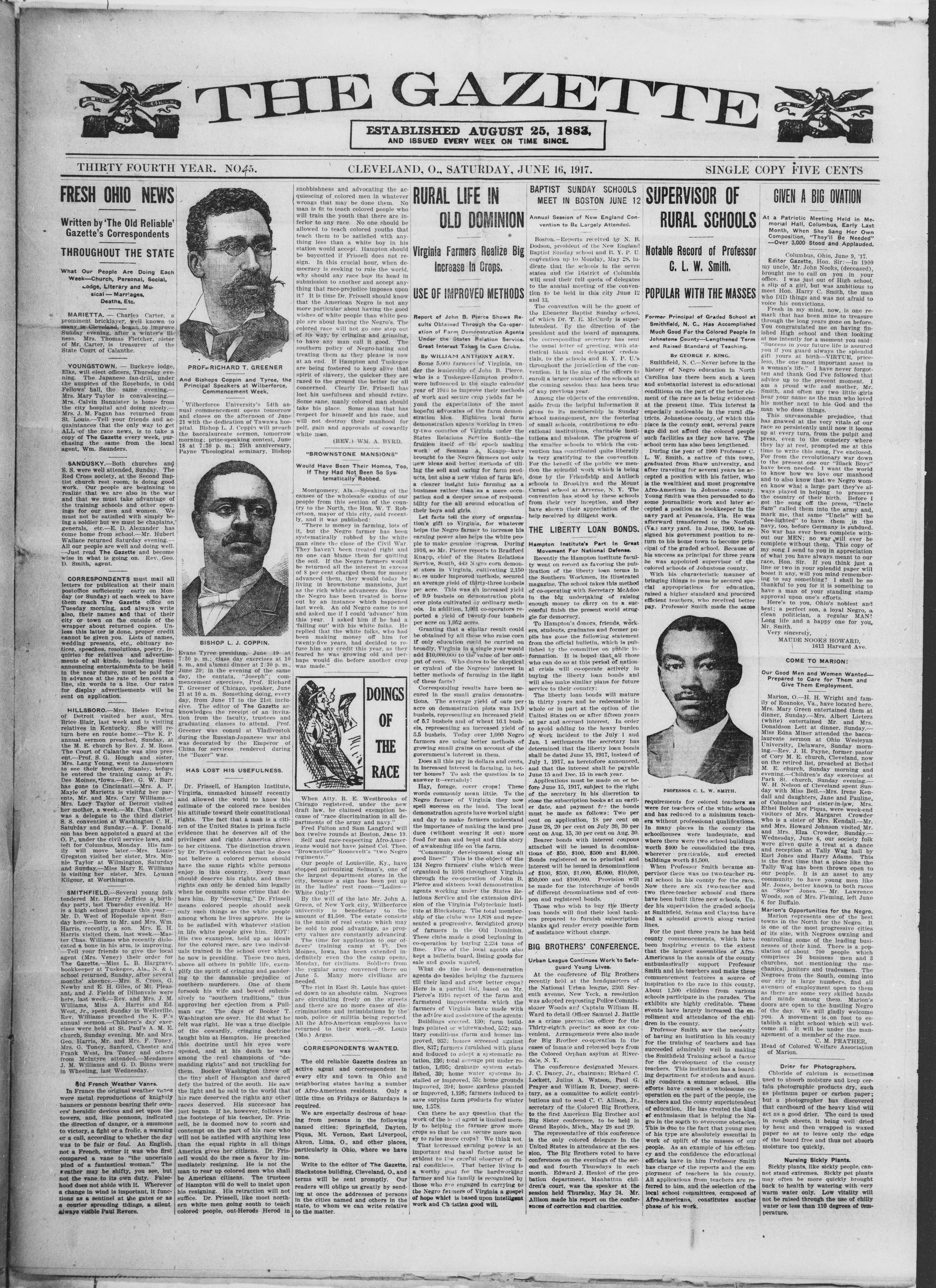
Page text (machine-generated)
THIRTY FOURTH YEAR. NO45.
IN WATCH DARE ESTINITIA
What Our People Are Doing Each Week — Church, Personal, Social, Lodge, Literary and Musical — Marriages, Deaths, Etc.
MARIETTA. — Charles Carter, a prominent bricklayer, well known to many in Cleveland, began to improve the work of his father's business. Mrs. Thomas Fletcher, sister of Mr. Carter, is treasurer of the State Court of Calanthe.
YOUNGSTOWN. — Buckeye lodge, Elks, will elect officers, Thursday evening. The Japanese fan-drill, under the auspices of the Rosebuds, in Odd Fellows' hall, the same evening. Mrs. Mary Taylor is convalescing. Mrs. Calvin Bannister is home from the city hospital and doing nicely. Mrs. J. M. Fagan has returned from St. Louis, where she and acquaintances that the only way to get ALL of the race news, is to take a copy of the Gazette every week, purchasing the same from the local agent, Wm. Saunders.
SANDUSKY.—Both churches and S. S. were well attended. Sunday. The Red Cross society, at the Second Baptist church rest room, is doing good work. Our people are beginning to realize that we are also in the war and that we must take advantage of the training schools and other openings for our men and women. We must not be satisfied with simply being a general, etc.—E. D. Alexander has come home from school. Mr. Hubert Wallace returned Saturday evening. All our people are well and doing well.—Just read The Gazette and become wise in what is going on. Rev. Geo. D. Smith, agent.
CORRESPONDENTS must mail all letters for publication at their main postoffice sufficiently early on Monday (or Sunday) of each week to have them reach The Gazette office on Tuesday morning, and always write also, their names and that of their city or town on the outside of the wrapper about returned copies. Unless this latter is done, proper credit cannot be given you. Lists of names, wedding presents, etc., obituary notices, speeches, solutions, poetry inquiries for relatives and advertisements of all kinds, including items announcing entertainments to be held in the near future, must be paid for in advance at the rate of ten cents a line, six words to a line. Our rates for display advertisements will be sent on application.
HILLSBORO.-Mrs. Helen Ewing of Detroit visited her aunt, Mrs Brice Blair, last week and is visiting relatives in Kentucky. She will return here en route home.-The K. P. annual semester preached, Sunday, at the M. E. church by Rev. J. M. Ross. The Court of Calanthe was also preset,—Prof. S. G. Hough and sister. Mrs. Lang Young, went to Jamestown to that brother. Stanley, before he married the Governor, Des Moines, Iowa.-Rev. G. W. Burr has gone to Cincinnati.-Mrs. A. P. Mayle of Marietta is visiting her parents, Mr. and Mrs. Cary Williams.-Mrs. Lucy Taylor of Detroit visited her mother, a week.-Mr. Chas. Colter was a delegate to the third district S. S. convention at Washington C. H. Saturday and Sunday.-A. F. Donaldson has been appointed a guard at the O. P., under the civil service laws, and left for Columbus, Monday. His family was visiting his sister, Lizzie Gregson visited her sister, Mrs. Minnie Taylor at Wilmington, Saturday and Sunday.-Miss Mary E. Williams is visiting her sister, Mrs. Lyman Kilgour, at Worthington.
SMITHFIELD.—Several young folks tendered Mr. Harry Jeffries a birthday party, last Thursday evening. He is a high school graduate this year.—Mr. D. West of Hopedale spent Sunday here.—Born to Mr. and Mrs. Wm. Harris, recently, a son. Mrs. E. H. Harris visited them, last week.—Master Chas. Williams who recently dislocated a bone in his arm, is improving.—Tell your friends to give the local agent (Mrs. Veney) their order for The Gazette.—Miss L. B. Hargrave bookkeeper at Tuskegee, Ala. N. & I school returned, Sunday, after months' absences.—Cress, G. H. E. H. Gles, of Mt. Pleasant, and J. Fields of Dillonville were here, last week.—Rev. and Mrs. J. M. Williams, Miss A. Harris and Ed Wr., Jr. spent Sunday in Wellsville. Rev. Williams preached the K. P.'s annual sermon.—Children's day exercises were held at St. Paul's A. M. E. church, Sunday evening. Mr. and Mrs. Geo. Harris, Mr. and Mrs. F. Toney, Mrs. G. Toney, Sanford, Chester and Frank West, Ira Toney and others from McIntyre attended.—Mesdames J. M. Williams and G. D. Bins were in Wheeling, last Wednesday.
Old French Weather Vance
In France the original weather vans were metal reproductions of knightly banners or pennons bearing their owners' heraldic devices and set upon the towers, and, like pennons, indicated the direction of danger, or a summons to victory, a fight or a fricle, a warning or a call, according to whether the day was to be fair or foul. An English, not a French, writer it was who first compared a vane to "the uncertain mind of a fantastical woman." The weather may be shifty, you see, but not the vane to its own duty. False-hood does not abide with it. Wherever a change in wind is important, it functions as a sentinel at the gates or as a courier spreading tidings, a silent always visible Paul Revere.
THE GAZETTE
PROF. RICHARD T. GREENER
And Bishops Coppin and Tyree, the Principal Speakers at Wilberforce, Commencement Week.
Wilberforce University's 54th annual commencement opens tomorrow and closes on the afternoon of June 21 with the dedication of Tawawa hospital. Bishop L. J. Coppin will preach the baccalaureate sermon, tomorrow morning; prize-speaking contest, June 18 at 7:30 p. m.; 25th anniversary, Payne Theological seminary, Bishop
BISHOP L. J. COPPIN.
Evans Tyrese presiding, June 19 at 7:30 p.m.; class day exercises at 10 a.m., and alumni dinner at 2:30 p.m. June 20; in the evening of the same day, the cantata, "Joseph," commenced. Professor of History, T. Greener of Chicago, speaker June 21 at 10 a.m. Something doing, every day, from June 17 to the 21st inclusive. The editor of The Gazette acknowledges the receipt of an invitation from the faculty, trustees and graduating classes to attend. Prof. Greener was consul at Vladivostok was consulted by the Russian-Japanese war and was decorated by the Engineer China for services rendered during the "Boxer" war.
HAS LOST HIS USEFULNESS.
Dr. Frissell, of Hampton Institute, Virginia, unmasked himself recently and allowed the world to know his estimate of the colored race besides his attitude toward their constitutional rights. The fact that a man is a citizen of the United States is prima facie evidence that he deserves all of the privileges and rights America gives to her citizens. The distinction drawn by Dr. Frissell evidences that he does not believe a colored person should have the same rights white persons enjoy in this country. Every man should deserve his rights, and these rights can only be denied him legally when he commits some crime that debarms him. By "deserving," Dr. Frissell means colored people should seek only such things as the white people among whom he lives approve. He is to be satisfied with whatever station in life white people give him. ROT! His two examples, held up as ideals for the colored race, are two individuals trained in the school over which he now is presiding. These two men, above all others in public life, exemplify the spirit of cringing and pandering to the damnable prejudice of southern murders. One of them forsook his wife and bowed submissively to "southern traditions," thus approving her ejection from a Pullman car. The days of Booker T. Washington are over. He did what he felt was right. He was a true discipline of the cowardly, cringing doctrine taught him at Hampton. He preached this doctrine until his eyes were opened, and at his death he was among the real champions of "demanding rights" and not truckling for them. Booker Washington threw off the tiny shell of Hampton and dared defy the hatred of the south. He saw the light and he said to the world that his race deserved the rights any other races deserved. His successor has just begun. If he, however, follows in the footsteps of his teacher, Dr. Frissell, he is doomed to scorn and contempt on the part of his race who will not be satisfied with anything less than the equal rights in all things America gives her citizens. Dr. Frissell would do the race a favor by immediately resigning. He is not the man to rear up colored men who shall be American citizens. The trustees of Hampton will do well to insist upon his resigning. His retraction will not suffice. Dr. Frissell, like most northern white men going south to teach colored people, out-Herods Herod in
ESTABLISHED AUGUST 25, 1883 AND ISSUED EVERY WEEK ON TIME SINCE.
snobbishness and advocating the acquiescing of colored men in whatever wrongs that may be done them. No man is fit to teach colored people who will train the youth that there are inferior to any race. No one should be allowed to teach colored youths that teach them to be satisfied with anything less than a white boy in his station would accept. Hampton should be boycotted if Frissell does not resign. In this crucial hour, when democracy is seeking to rule the world, why should any race bow its head in submission to another and accept anything that race-prejudice imposes upon it? It is time Dr. Frissell should know that the American Negro is not any more particular about having the good wishes of white people than white people are about having the Negro's. The colored race will not go one step out of its way, by cringling and grinning, to have any man call it good. The southern policy of Negro-hating and treating them as they please is now at an end. If Hampton and Tuskegee are being fostered to keep alive that spirit of slavery, the quicker they are razed to the ground the better for all concerned. Clearly Dr. Frissell has lost his usefulness and should retire. Some sane, manly colored man should take his place. Some man that has respect for himself and his race, and will not destroy their manhood for self, gain and approvals of cowardly white men.
RURAL LIFE IN OLD DOMINION
Virginia Farmers Realize Big Increase In Crops.
USE OF IMPROVED METHODS
Report of John B. Pierce Shows Results Obtained Through the Co-operation of Farm Demonstration Agents Under the States Relation Service. Great Interest Taken in Corn Clubs.
By WILLIAM ANTHONY AERY.
Some 5,000 farmers of Virginia, under the leadership of John B. Pierce, who is a Tuskegee-Hampton product, were influenced in the single calendar year of 1916 to improve their methods of work and secure crop yields far beyond the expectations of the most hopeful advocates of the farm demonstration idea. Eighteen local farm demonstration agents working in twenty-two counties of Virginia under the
BAPTIST SUNDAY MEET IN BOSTON
Annual Session of Newvention to Be Large.
Boston.—Reports reed Dodson, president of the Baptist Sunday convention up to Mondicate that the school states and the District will send their full quill to the annual meeting to be held in the and 13.
The convention will the Ebenezer Baptist of which Dr. T. E. M. intendent. By the O president and the board corresponding see the usual letter of gratitude blank and details to the schools at throughout the jurisdiction. It is the aim to enroll a larger number the coming session than of any previous year.
Among the objects of aside from the help given to its member school management, a of small schools, contri-
(REV.) WM. A. BYRD.
"BROWNSTONE MANSIONS"
Would Have Been Their Homes, Too
If That Was True So Sys-
ternically Rebell
Montgomery, Ala.—Speaking of the causes of the wholesale exodus of our people from this section of the country to the North, the Hon. W. T. Robertson, mayor of this city, said recently, and it was published: "The money in farming, lots of it, but the Negro farmer has been systematically robbed by the white man since the close of the Civil War. They haven't been treated right and no one can blame them for quitting the soil. If the Negro farmers would be returned all the interest in excess of $ per cent charged them for money advanced them, they would today be living in brownstone mansions, just as the rich white advances do. How deep the mann treated is by an instance which happened last week. An old Negro came to me and asked me if I could 'advance' him this year. I asked him if he had a 'falling out' with his white folks. He replied that the white folks, who had been making money off him for twenty-five years, had decided to re-enter the land and feared he was growing old and perhaps would die before another crop was made."
DOINGS
OF
THE
RACE
When Atty. R. E. Westbrooks of Chicago registered, under the new law he claimed exemption because of "race discrimination in all departments of the army and navy."
Fred Fulton and Sam Langford will box twelve rounds at Boston, Jane 19. Self and race-respecting Afro-Americans would not have joined Col. Theo. "Brownsville" Roosevelt's "two Negro regiments."
Our people of Louisville, Ky., have stopped patronizing Selman's, one of the largest department stores in the city because a sign has been put in the ladies' rest room—"Ladies—White Only."
By the will of the late Mr. John A. Green, of New York city, Wil伯森 university is beneficiary to the amount of $1,500. The estate consists in the main of real estate which may be sold to good advantage, as property values are constantly advancing; the fine application to our of fliers' training camp at I.D. Des Moines, Iowa, has been extended indefinitely even tho the camp opens, Monday, for civilians. Soldiers from the regular army convened there on June 5. Many more civilians are needed.
The riot in East St. Louis has quieted down to an absolute calm. Negroes are circulating freely on the streets and do more of the discriminations and humiliations of mob, police or militia being reported. All the Afro-American employees have returned to their work—St. Louis (Mo.) Argus.
CORRESPONDENTS WANTED
The old reliable Gazette desires an active agent and correspondent in every city and town in Ohio and neighboring states having a number of Afro-American residents. Only a little time on Fridays or Saturdays is required.
We are especially desirous of hearing from persons in the following named cities: Springfield, Dayton, Piqua, Mt. Vernon, East Liverpool, Akron, Lima, O., and other places, particularly in Ohio, where we have none.
Write to the editor of The Gazette, Blackstone building, Cleveland, O., and terms will be sent promptly. Our readers will oblige us greatly by sending at once the addresses of persons in the cities named and others in the state, to whom we can write relative to the matter.
RURAL LIFE IN OLD DOMINION
USE OF IMPROVED METHODS
Report of John B. Pierce Shows Results Obtained Through the Co-operation of Farm Demonstration Agents Under the States Relation Service. Great Interest Taken In Corn Clubs.
BY WILLIAM ANTHONY AERY.
Some 5,000 farmers of Virginia, under the leadership of John B. Pierce, who is a Tuskegee-Hampton product, were influenced in the single calendar year of 1916 to improve their methods of work and secure crop yields far beyond the expectations of the most hopeful advocates of the farm demonstration idea. Eighteen local farm demonstration agents working in twenty-two counties of Virginia under the States Relations Service South—the fruition itself of the epoch making work of Seaman A. Knapp—have brought to the Negro farmers not only new ideas and better methods of tilling the soil and caring for farm products, but also a new vision of farm life, a clearer insight into farming as a business rather than as a mere occupation and a deeper sense of responsibility for the all around education of their boys and girls.
Lets facts tell the story of organization's gift to Virginia, for whatever helps the Negro farmer to increase his earning power also helps the white people to make genuine progress. During 1916, so Mr. Pierce reports to Bradford Knapp, chief of the States Relations Service, South, 449 Negro corn demonstrators in Virginia, cultivating 2,150 acres under improved methods, secured an average yield of thirty-three bushels per acre. This was an increased yield of 9.9 bushels on demonstration plots over plots cultivated by ordinary methods. In addition, 1,001 co-operators reported a yield of twenty-four bushels per acre in 1,552 acres.
Granting that a similar result could be obtained by all those who raise corn if only education could be carried on broadly, Virginia in a single year would add $10,000,000 to the value of her output of corn. Who dares to be skeptical or cynical of the Negroes' interest in better methods of farming in the light of these facts?
Corresponding results have been secured in the small grains demonstrations. The average yield of oats per acre on demonstration plots was 18.9 bushels, representing an increased yield of 5.7 bushels and of wheat 16.1 bushels, representing an increased yield of 5.5 bushels. Today over 1,000 Negro farmers are using better methods of growing small grains on account of the government's interest in them.
Does this pay in dollars and cents, in increased interest in farming, in better homes? To ask the question is to answer it—certainly!
Hay, forage, cover crops! These words commonly mean little. To the Negro farmer of Virginia they now spell success on the land. The local demonstration agents have worked night and day to make farmers understand the importance of making the land produce (without wearing it out) more food for man and beast and this story of awakening life on the farm. "Community development along all good lines!" This is the object of the 134 Negro farmers' farm which were organized in 1916 throughout Virginia through the co-operation of John B. Pierce and sixteen local demonstration agents working under the States Relations Service and the extension division of the Virginia Polytechnic Institute at Blacksburg. The total membership of the clubs was 1,838 and represented a progressive, farsighted group of farmers in the Old Dominion. These clubs made a good beginning in co-operation by buying 2,234 tons of lime. Five of the local agents also kept a bulletin board, listing goods for sale and goods wanted.
What do the local demonstration agents do besides helping the farmers till their land and grow better crops? Here is a partial list, based on Mr. Pierce's 1916 report of the farm and farmstead improvements which the farmers of Virginia have made with the advice and assistance of the agents: Buildings erected, 130; farm buildings painted or whitewashed, 552; sanitary conditions (farm and home) improved, 933; homes screened against tiles, 537; farmers furnished with plans and induced to adopt a systematic rotation, 136; total acreage put under rotation, 1,605; drainage system established, 39; home water systems installed or improved, 55; home grounds improved, 394; home gardens planted or improved, 1,198; farmers induced to save surplus farm products for winter use, 1,578.
Can there be any question that the work of the local agent is limited merely to helping the farmer grow more crops so that he can secure more money to raise more crops? We think not. That increased earning power is an important and basal factor must be evident to the careful observer of rural conditions. That better living is a worthy goal for the hardworking farmer and his family is recognized by those who are engaged in carrying to the Negro farmers of Virginia a gospel of hope which is based upon intelligent work and Christian good will.
BAPTIST SUNDAY SCHOOLS
MEET IN BOSTON JUNE 12
Annual Session of New England Convention to Be Largely Attended.
Boston.—Reports received by N. B. Dodson, president of the New England Baptist Sunday school and B. Y. P. U. convention up to Monday, May 28, indicate that the schools in the seven states and the District of Columbia will send their full quota of delegates to the annual meeting of the convention to be held in this city June 12 and 13.
The convention will be the guest of the Ebenezer Baptist Sunday school, of which Dr. T. E. McCurdy is superintendent. By the direction of the president and the board of managers, the corresponding secretary has sent the usual letter of greeting, with statistical blank and delegates' credentials, to the schools and B. Y. P. U.'s throughout the jurisdiction of the convention. It is the aim of the officers to enroll a larger number of the schools at the coming session than has been true of any previous year.
Among the objects of the convention, aside from the helpful information it gives to its membership in Sunday school management, are the fostering of small schools, contributions to educational institutions, charitable institutions and missions. The progress of the smaller schools to which the convention has contributed quite liberally is very gratifying to the convention. For the benefit of the public we mention the splendid work which is being done by the Friendship and Antioch schools in Brooklyn and the Mount Carmel school at Arverne, N. Y. The convention has stood by these schools from their very inception, and they have shown their appreciation of the help received by diligent work.
THE LIBERTY LOAN BONDS.
Hampton Institute's Part In Great Movement For National Defense.
Recently the Hampton institute faculty went on record as favoring the publication of the liberty loan terms in the Southern Workmen, its illustrated magazine. The school takes this method of co-operating with Secretary McAdoo in the big undertaking of raising enough money to carry on to a successful finish the present world struggle for democracy.
To Hampton's donors, friends, workers, students, graduates and former pupils has gone the following statement from the official bulletin, which is published by the committee on public information. It is hoped that all those who can do so at this period of national crisis will co-operate actively in buying the liberty loan bonds and will also make similar plans for future service to their country:
The liberty loan bonds will mature in thirty years and be redeemable in whole or in part at the option of the United States on or after fifteen years at par and accrived interest. In order to ayold adding to the heavy burden of work incident to the July 1 and Jan. 1 settlements the secretary has determined that the liberty loan bonds shall be dated June 15, 1917, instead of July 1, 1971, as heretfores announced, and that the interest shall be payable June 15 and Dec. 15 in each year.
Applications must be made on or before June 15, 1917, subject to the right of the secretary in his discretion to close the subscription books at an earlier date, and payment for the bonds must be made as follows: Two per cent on application, 18 per cent on June 28, 20 per cent on July 30, 30 per cent on Aug. 15, 30 per cent on Aug. 20. Bearer bonds with interest coupons attached will be issued in denominations of $50, $100, $500 and $1,000. Bonds registered as to principal and interest will be issued in denominations of $100, $500, $1,000, $5,000, $10,000, $50,000 and $100,000. Provision will be made for the interchange of bonds of different denominations and of coupon and registered bonds. Those who wish to buy the liberty loan bonds will find their local banks prepared to furnish subscription blanks and render every possible form of assistance without charge.
BIG BROTHERS' CONFERENCE.
Urban League Continues Work to Safeguard Young Lives.
At the conference of Big Brothers recently held at the headquarters of the National Urban league, 2303 Seventh avenue, New York, a resolution was adopted requesting Police Commissioner Woods and Captain William H. Ward to detail Officer Samuel J. Battle as a crime prevention officer for the Thirty-eighth precinct as soon as convenient. Arrangements were also made for Big Brother co-operation in the cases of inmate and released boys from the Colored Orphan asylum at Riverdale, N. Y.
The conference designated Messrs. J. C. Dancy, Jr., chairman; Richard C. Lockett, Julius A. Watson, Paul G. Prayer and William R. Dorsey, secretary, as a committee to solicit contributions and to send C. C. Allison, Jr., secretary of the Colored Big Brothers, to the first American Big Brother and Big Sister conference, to be held in Grand Rapids, Mich., May 28 and 29.
The representative of this conference is the only colored delegate in the United States in attendance at the session. The Big Brothers voted to have conferences on the evenings of the second and fourth Thursdays in each month. Edward J. Henkel of the probation department, Manhattan children's court, was the speaker at the session held Thursday, May 24. Mr. Allison made his report on the conferences of correction and charities.
SINGLE COPY FIVE CENTS
SUPERVISOR OF RURAL SCHOOLS
Notable Record of Professor C. L. W. Smith.
POPULAR WITH THE MASSES
Former Principal of Graded School at Smithfield, N. C., Has Accomplished Much Good For the Colored People In Johnstone County—Lengthened Term and Raised Standard of Teaching.
By GEORGE F. KING.
Smithfield, N. C.—Never before in the history of Negro education in North Carolina has there been such a keen and substantial interest in educational conditions on the part of the better element of the race as is being evidenced at the present time. This interest is especially noticeable in the rural districts. Johnstone county, of which this place is the county seat, several years ago did not afford the colored people such facilities as they now have. The school term has also been lengthened.
During the year of 1900 Professor C. L. W. Smith, a native of this town, graduated from Shaw university, and after traveling for several years he accepted a position with his father, who is the wealthiest and most progressive Afro-American in Johnstone county. Young Smith was then persuaded to do some journalistic work and later accepted a position as bookkeeper in the navy yard at Pennacola, Fla. He was afterward transferred to the Norfolk (Va.) navy yard. In June, 1900, he resigned his government position to return to his home town to become principal of the graded school. Because of his success as principal for three years he was appointed supervisor of the colored schools of Johnstone county. With his characteristic manner of bringing things to pass he secured special appropriations for education, raised a higher standard and procured efficient teachers, who received better pay. Professor Smith made the same
PROFESSOR C. L. W. SMITH.
requirements for colored teachers as were for teachers of the white schools and has reduced to a minimum teachers without professional qualifications. In many places in the county the schoolhouses were inadequate, and where there were two school buildings worth $400 be consolidated the two, wherever practicable, and erected buildings worth $1,500.
When Professor Smith became supervisor there was no two-teacher rural school in his county for the race. Now there are six two-teacher and two three-teacher schools and there have been built three new schools. Under his supervision the graded schools at Smithfield, Selma and Clayton have had a splendid growth along varied lines.
For the past three years he has held county commencements, which have been inspiring events to the extent that the largest assemblies of Afro-Americans in the annals of the county enthusiastically support Professor Smith and his teachers and make these commencement features a source of inspiration to the race in this county. About 1,500 children from various schools participate in the parades. The exhibits are highly creditable. These events have largely increased the enrollment and attendance of the children in the county.
Professor Smith saw the necessity of having an institution in his county for the training of teachers and has succeeded admirably well in making the Smithfield Training school a factor for the development of the county teachers. This institution has a boarding department for students and annually conducts a summer school. His efforts have caused a wholesome cooperation on the part of the people, the teachers and the county superintendent of education. He has created the kind of enthusiasm that is helping the Negro in the south to overcome obstacles. This is due to the fact that young men of his type are absolutely essential in work of uplift of the masses of our people. As an example of his efficiency and the confidence the educational officials have in him Professor Smith has charge of the reports and the employment of teachers in his county. All applications from teachers are referred to him, and the selection of the local school committees, composed of Afro-Americans, constitutes another phase of his work.
RECORDS
GIVEN A BIG OVATION
At a Patriotic Meeting Held in Memorial Hall, Columbus, Early Last Month, When She Sang Her Own Composition, "They'll Be Needed" —Over 3,000 Stood and Applauded.
Columbus, Ohio, June 9, '17.
Editor Gesson, Hon. Sir:—In 1900 my uncle, Mr. John Nooks, (deceased), brought me to call on you in your office. I was told I was in High school, a slip of a girl, but was asked to meet Hon. Harry C. Smith, the man who DID things and was not afraid to voice his convictions.
Fresh in my mind, now, is one remark that has been mine to treasure through the long years gone on before. You congratulated me on having finished High school and then looking at me intently for a moment you said: "Success in your life is the gift you if you guard always the splendid gift yours at birth—VIRTUE, priceless, the one most important asset in a woman's life." I have never forgotten and thank God I've followed that advice up to the present moment. I am a proud wife and mother, Mr. Gesson, and two little girls hear your name as the man who loved his mother next to his God and the man who does things.
This unreasonable prejudice, that has gnawed at the very vitals of our race so persistently until now it looms up at every turn, from the pulpit and press, even to the cemetery where they lay at rest, prompted me at this time to write this song, I enclosed. For from the revolutionary war down the present one our "Black Boys" have to know how we want the world to know how we want the manhood and to also know that we Negro men know what a large part they've always played in helping to preserve the country of their birth. Before I got the song off the press, "Uncle Sam" called them into the army and, mark me, that same "Uncle" will be "dee-lighted" to have them _in the navy, too, before Germany is subdued. No war has ever been complete with our MEN; no war _will ever be complete without them. This copy of my song I sent to you in appreciation of what you have always meant to our race. Hon. Sir. If you just a line or two in your splendid paper boost it any, will you remember to say something? I shall be so thankful to you for it is something to have a man of your standing stamp approval upon one's efforts.
Here's to you, Ohio's noblest and best; a perfect son, a loyal Negro, a clean politician, a regular MAN! Long life and a happy one for you, Mr. Smith.
Very sincerely,
MAUDE NOOKS HOWARD,
1613 Harvard Ave.
COME TO MARION
Our Good Men and Women Wanted—Prepared to Care for Them and Give Them Employment.
Marion, O.—H. W. Wright and family of Ronnake, Va., have located here. Mrs. Mary Green entertained them at dinner, Mrs. Albert Lieters (white) entertained them, Mrs. Donaldson Lett at dinner, Sunday. Miss Edna Mira attended the baccalaureate sermon at Ohio Wesleyan University, Delaware, Sunday morning.—Rev. J. H. Payne, former pastor of Cory M. e. church, Cleveland, now on the retired list, preached at Bethel E. e. church, Sunday morning and evening. Children exercises at Park St. church, Sunday, visited W. H. Nelson of Cleveland spent Sunday with Miss Bell—Mrs. Irene Kendall and daughters, Jane and Pauline, of Columbus and sister-in-law, Mrs. Ethel Bolden of Pluqa, were week-end visitor to Margaret Crowder who is a sister of Mary—Mr. and Mrs. Howard Johnson visited and Mrs. Elza Crowder, Sunday.—Wednesday, 6, our society folk were given quite a treat at a dance and reception at Tally Wag hall by Earl Jones and Harry Adams. This is the first time that a place like the Tally Wag has been thrown open to our. It is an asset to any community to have such a place like Mr. Jones, better known both as the "Slow" Jones. — Mr. Lawrence Woods, son of Mrs. Fleming, left June 6 for Buffalo.
Marion's Opportunities for the Negro.
Marion represents one of the best towns in the North for the Negro. It is one of the most progressive cities of its size, with Negroes owning and controlling some of the leading businesses of their kind. There is a population of about 700 people which comprises 26 business men and 3 churches, not mentioning the mechanics, janitors and tradesmen. The Negroes from the South, coming into our city in large numbers, find all avenues of employment open to them as there are some in large hands and minds among them. Marion's doors are open to the hustling Negro of the day. We will gladly welcome you. A movement is on foot to establish a night school which will welcome all. It will be under the management of a member of the race.
C. M. PRATHER,
Head of Colored Welfare Association of Marion.
Drier for Photographers.
Chloride of calcium is sometimes used to absorb moisture and keep certain photographic products dry, such as platinum paper or carbon paper; but a photographer has discovered that cardboard of the heavy kind will act as a good drier. The card is used in rough sheets, it being well dried by heat and then wrapped in waxed paper so as to leave only the edge of the board free and thus not absorb moisture too quickly.
Nursing Sickly Plants.
Sickly plants, like sickly people, cannot stand extremes. Sickly pot plants may often be more quickly brought back to health by watering with very warm water only. Low vitality will not be raised through the use of chilly water or less than 110 degrees of temperature.
The GAZETTE
PUBLISHED EVERY SATURDAY
One Year.....$1.50.
Six Months.....1.00
Three Months.....50
Subscribers are requested to re-
mit by postoffice money or
der or registered letter
Entered at the postoffice in Cleveland
Ohio, as second-class matter.
Address all communications to
Blackstone Building, Cleveland, O.
Member Ohio Legislature: 1894
to 1898; 1898 to 1898; 1900 to 1902
THE GAZETTE is the oldest, and
has the largest bona fide circulation,
demonstrated of any newspaper in the
interest of the Americans, published
in the state of Ohio, and comparison
with any will immediately establish
its rank as one of the NEWSIEST
AND BEST in the country.
10,000,000 Afro-Americans.
240,000 in Ohio.
20,000 in Cleveland.
SATURDAY, JUNE 16, 1917.
DARE TO DO YOUR DUTY.
"Let us have faith that right makes might, and in that faith let us to the end dare to do our work to understand it"—Abraham Lincoln.
```markdown
```
"Any prejudice whatever will be insurmountable if those who do not share in it themselves truckle to it and flatter it and accept it as a law of nature."—John Stuart Mill.
************************************************************
"I honor the man who in the conscientious discharge of his duty dares to stand alone; the world, with ignorant, intolerant judgement, may condemn, the countenances of relatives may be averted, and the hearts of those grow cold, but the sense of duty alone be greater than the applause of the world, the countenances of relatives or the hearts of friends."—Charles Sumner.
PROTEST AGAINST WRONG.
To submit in silence when we should protest makes cowards out of men. The human race has climbed on Protest. Had no voice been raised against injustice, ignorance and lust, the inquisition yet would serve the law, and guillotines decide our last disputes. The few who dare, must speak and speak again to right the wrongs of many—Ella Wheeler Wilcox.
************************************************
The Democratic press condemns discussion of the tariff at the present time, but the tariff commission is going right along with its work. If a tariff commission composed of low tariff advocates, none of whom has ever been engaged in manufacturing and only one of whom has been engaged in productive industry of any kind, can properly continue its work, why cannot the business men of America just as properly continue to advocate that tariff policy which has been the foundation of permanent prosperity?
The "Eastland," a former Cleveland excursion boat, we hear, is to be converted into a gunboat. The Eastland, it will be remembered, is the boat that turned turtle at her berth in Chicago about two years ago and drowned several hundred people. Secretary Redfield, though making much fuss about it, was never able to accomplish anything in reference to the case, but maybe Secretary Daniels can do better with the death-ship now. One thing is certain, if the Eastland can be as fatal to the enemy in time of war as she was to our own people in time of peace, there should be no delay in getting her into commission.
Mrs. Maude Nooks Howard's song, "They'll Be Needed," is really moritious—pretty and pleasing, both words and music—and just what our people want to sing, these days. Yes, "Uncle Sam" will be wanting the "Black Boys", will be needing them, sorely, too, before the war is over, much as he affects to care little for them now. Unfortunately, "Uncle Sam" is in prejudiced Southern democratic hands with the result that the "Black Boys" have been "handed" some mighty aggrating rebuffs and insults for their insistent patriotic and loyal demonstrations, to date. Write Mrs. M. N. Howard, 1613 Harvard Ave., Columbus, O., for a copy of her splendid new composition.
There is some sentiment attaching to the cause which prompted our entrance into the war against Germany; but, generally speaking, it is cold reason which at length convinced the President that we should do so. We become a full partner in the enter prise. Our obligations are the same as those of the Allies in Europe. Accordingly, we shall find in their mutual relations the measure of our duties; and we may well take pattern thereby. England and France have been the bankers of the Entente. They have made large loans to Russia and to the smaller Powers with which they are allied. They have not made gifts of cash, though they have made borrowing easy. There is no reason why we should go further than England in this matter. The Allies do not ask it.
---
Pale Faced Women Take Phosphates to Make Rosy Cheeks and Beautiful Forms Men Need Phosphates to Make Strong, Healthy, Vigorous Bodies.
Athletes increase their strength, energy and endurance 200% or more by simply taking a few weeks treatment of Apo-Prosate.
"THE SOUTH IN THE SADDLE."
There is one thing about the South one could admire if it were directed in a better channel and that is its pernicious activity in persisting that it was right and the North wrong in the contest best known as the war of the rebellion. Since 1861 to 1865, the South has won back all that it lost in that memorable struggle except its slaves, and last week celebrated the fact in the capital of the nation with a "national" (sectional) gathering of ex-brebels (confederate veterans) who also marched down Pennsylvania Ave. and to Arlington (the national) cemetery where "15,000 men, women and children" were addressed by President Thomas Woodrow Wilson, a southerner, and the rebel leaders, Jefferson Davis and Robert E. Lee, were extolled to the highest. This too, when the country is busy preparing for active participation in the greatest war this world has ever known. Good Lord! whither is this country drifting? It is enough to make Gens. Grant, Sherman, Sheridan and our great and good friend Foraker turn over in their graves.
GET A U. S. ARMY RIOT GUN!
One night, last week, a white woman claimed that a colored man had insulted her on Central Ave. near E. 71st St. and immediately a crowd gathered and began to chase the man who ran into the home of Mr. and Mrs. Wm. McIntyre. E. 71st St., for refuge, remaining there until the patrol wagon arrived. It is said that by that time a mob of about two hundred persons gathered in front of the house, crying "Lynch the Negro." This reminds the editor of The Gazette of an address he delivered, several years ago at Shiloh Baptist church, this city, in which he called the attention of our people of the Central Avenue district to the growing probability of just such demonstrations in that locality and warned all to prepare for them. We called attention to the sacking of business places and residences of our people at Springfield, Ohio, at least two occasions in recent years up their wild orgies with the lynchmur of two Negroes and the injury of innocent members of the race as well as property. Your life and those of the members of your family, particularly those living in the Central Avenue vicinity, are safe no longer and to be jeopardized any moment as were those of Mr. and Mrs. McIntyre, last week, but with far more serious results—if you have not proper protection in your homes. With the recent great influx, in that vicinity particularly, of bad members of the race from the South and other parts of the country the danger of such demonstrations has increased one hundred fold, making absolutely necessary for the protection of your life and property the possession in the home of a riot gun and plenty of ammunition for it. This we urged upon our audience, and thru them upon all of our people of this community, several years ago, in the address at a mass meeting held in Shiloh Baptist church and now again call attention to the absolute need of such "preparedness" on the part of our people of this community. The mob demonstration, last week, in front of the home of Mr. and Mrs. McIntyre, of E. 71st St., is or ought to be sufficient warning to even the most skeptical. Purchase a U. S. regular army riot gun and plenty of ammunition, for your home and do not delay doing so.
NOTICE
Real estate is a serious business. It ought to be handled by people who know values, abstracts, deeds and mortgages. A lot of fakers have rushed into the business to catch the stranger.
I advise all to deal with people who have a reputation for honesty and fair dealing.
S. E. Woods, 3704 Central Ave.
Ohio State phone, Central 4600 K.
Free advice. —Adv.
THIS IS A "HOT ONE"!
President Wilson Asked to Remove All Restrictions So That Members of the Race May Be Accepted in All Branches of the Army and Navy.
New York City.—"I know of no law that precludes the Afro-American from enlisting in the marine corps or the artillery or any other branch, other than that American law laid down by militaries in the U. S. of the German stripe." This sentence is taken from a letter written by Attorney Robert Lewis Waring of this city to President Thomas Woodrow Wilson, urging, on behalf of the 12,000,000
Atlanta, Ga. Dr. F. A. Jacobson says that Phosphates are just as essential to any man or woman who tires easily, is nervous, or irritable, worn out, or looks haggard and pale to make a strong, recoiling figure. They can be used to cotton to make it grow. The lack of Phosphate is the cause of all enemic conditions and the administration of 5-grain Argo-Phosphate tablets will increase the strength and endurance of weak, nervous patients. It is also very recent in two or three weeks' time in many instances, and their continued use will build up the whole nervous system, and give them the body vigor, and vitality the whole body. And the presence Argo-Phosphate to patients who are pale and colorless, and it is surprising to see how quickly a few weeks' treatment will transform a pale face to a rosy cheeked face. Phosphates are healthy, beautiful women, without their system is sufficiently supplied with Phosphates. In recent interviews with physicians on the grave and serious consequences of a deficiency of Phosphates in the blood, I have strongly emphasized the fact that doctors should prescribe more phosphates in the form of Argo-Phosphate for weak, worn out, haggard-looking men and women. When the skin is pale, and flesh is pale, I have strongly emphasized the fact that phosphates go from the blood, the pink cheeks go too. The muscles lack tone.
THE GAZETTE. CLEVELAND. O.. SATURDAY. JUNE 16. 1917.
Afro-Americans that he remove all restrictions that prevent them from enlisting in any branch of the military service. Mr. Waring believes that the President, as commander-in-chief of the nation's military forces, has the right, in time of war, to open all branches of that service to all American citizens. "Although it may be said," wrote Mr. Waring, "that the 24th and 25th infantry and the Ninth and Tenth cavalry are open to my people for enlistment. Afro-Americans must be militated, outraged that they must be held up to the world falsely as a race of citizens lacking courage enough to lead in battle. Bless the hand that will give me, and the thousands like me, a free hand to serve my country as other men are permitted to serve it."
FINE NEW A. M. E. CHURCH
The Work of Rev. O. W. Childers and His Loyal Congregation and Friends, Being Dedicated—The Program
Cadiz, O.—The dedicatory exercises of St. James A. M. E. church, Rev. O. W. Childers, pastor, began June 14 and will continue until June 25. The first number on the program was a lecture, "The Ringing of the Bell's," by Dr. Chas. Bloom of Beaver, Pa. Thursday evening. On Friday evening, (June 15), a play entitled "The Ringing of the Bell's," was given by Mrs. O. W. Childers and a team of children. During the week—from June 17 to 24—Rev. John Mason, Wellsville; Rev. John T! Farley, Steubenville; Dr. R. French Hurley, Wheeling, and Rev. John Williams of Smithfield will be on the program. The dedication proper will take place, Sunday, June 24 when Bishop C. A. D. L. D., of Chicago, will be present and have a tour of the exercises. He will also lecture on the following evening, June 25. The new church is complete in every detail. It is gothic in design and built of hydraulic red pressed-brick and finished in oak. The windows are opaless art glass and the seats are of massive construction. The church is located on one of the prominent corner streets and has a advantage of all the city improvements. The cost of the church-building was about $10,000. The entire property, including the new 8 room parsonage, is valued at $15,000. The people of Cadiz and vicinity are to be congratulated on the completion of such a structure, a credit to the religious life of the community. Rev. Childers is closing the fifth year of a very successful church, the longest in the history of the church.
HAROLD D. LEE
Hooks Without Holes.
Persons living in apartments or furnished rooms will find this a useful device for increasing closet capacity: Fasten one end of a heavy wire—picture wire works well—to a hook in the closet, thread the other end through the spring of a patent clothespain, wind the wire about the second hook and so on around the closet until there is a clothespain between each pair of hooks. This is an excellent way of holding skirts or waists and can be removed easily.
WORKIN WHITENER
BEST SELLER IN THE
WESTERN UNION
BEST SELLER IN THE
WESTERN UNION
WILLOW ST. FLAT
WILLOW ST. FLAT
MONTANA
MONTANA
MONTANA
WORKIN WHITENER
WORKIN WHITENER
WORKIN WHITENER
DR.FRED PALMER'S SKIN WHITENER
Whitens dark or brown skin
Bleaches and clears sallow complexions, removes all blemishes and causes the skin to grow whiter. See that you get the genuine.
Cornersville, Tenn., Dec. 6, 1916.
Jacobs Pharmacy Co.,
Atlanta, Ga..
Gentlemen:
You will find enclosed 25c for which send me a box of Dr. Fred Palmer's Skin Whitener. I think it is marvelous in making the skin soft and many shades lighter. I use the soap also.
Yours truly,
MISS LAZINCA BATES
Box 103.
DO NOT ACCEPT IMITATIONS
Sold by druggist or court direct, for 25c postpaid. Write JACOB'S PHARMACY,
Atlanta, Ga.
They become nervous, irritable, dependent, melancholy, the brain fags, and the memory falls. Therefore if you wish to preserve your youthful vital, vigor and strength, you should apply the deficiency of Phosphates lacking in your food by using Argo-Phosphate, the form of Phosphates most easily assimilated. NOTE: Argo-Phosphate, which is recommended and prescribed by physicians in all enemic cases, is not a secret or patent medicine, but one that is sold and recommended by well known drugstores. Phosphates are daily subscribing the constituents contained in it. Being entirely unlike many other Phosphates, it is easily assimilated and is the main treatment of indigestion and stomach troubles, as well as for care worn, nervous conditions. The manufacturers of Argo-Phosphate will forfeit to any charm that causes any treatment any man or woman under 65 who lacks Phosphates, and increase their strength and endurance 100% to 300% or more in one month's time, if they are free from organic trouble. It is dispensed
If your druggist will not supply you send $1.00 to the Argo Laboratories. 10 Forayte St., Atlanta, Ga., and they will send two weeks' treatment by return mail.
Phone Rosedale 2784-W
"The E'ladio" East 55th
W. W. MASSENGALE, Proprietor
Ideal Rooms for Gentlemen
All Modern Improvement
PHONE SERVICE
2326
East 55th Street
GALE, Proprietor
For Gentlemen
Improvements
SERVICE
THE HOME OF THE MAYOR OF NEW YORK
"The E'ladio" 2326 East 55th Street
W. W. MASSENGALE, Proprietor
Ideal Rooms for Gentlemen
All Modern Improvements
PHONE SERVICE
Central 4191-L CLEVELAND, O.
Prospect 1095-J J. H. COX
COX DRY CLEANING CO.
The Clothing Hospital Repairing, Pressing, Cleaning, etc., on short order. Suits Pressed, 30 Cents
2738 Central Avenue
CLEVELAND, O.
EVE IN SIGNS?
FOR THIS ONE
ACCESS OINTMENT
NAL Skin Ointment and Com-
mal use over eighty years. Many
the country to satisfied users.
Substitutes may be harmful; even
what you want - the old, reliable
and Soap.
ONLY BY
DO YOU BELIEVE IN S
REMEMBER THIS ONE
PALMER'S SKIN-SUCCESS" OINT
when looking for the ORIGINAL Skin Ointment
plexion Brightner. In successful use over eighty y
millions of boxes sold all over the country to sa
BEWARE of all substitutes. Substitutes may be b
dangerous. Insist upon getting what you want - the
"SKIN-SUCCESS" Ointment and Soap.
MADE ONLY BY
DO YOU BELIEVE IN SIGNS? REMEMBER THIS ONE
PALMER'S SKIN SUCCESS OINTMENT
when looking for the ORIGINAL Skin Ointment and Complexion Brightner. In successful use over eighty years. Many millions of boxes sold all over the country to satisfied users. BEWARE of all substitutes. Substitutes may be harmful; even dangerous. Insist upon getting what you want - the old, reliable "SKIN-SUCCESS" Ointment and Soap.
MADE ONLY BY
The Morgan Drug C
1512 Atlantic Ave. Br
Write for a sample of Palmer's "Hair-Success"
best hair pomade on the market.
COCOTON
SKIN WHITEN
TONE
HITENER
Write for a sample of Palmer's "Hair-Success" Dressing, the best hair pomade on the market.
COCOTONE SKIN WHITENER
25c BOX FREE
A Skin Bleach or Whitener for dark or brown skin, blemishes and clearing swarthy or sallow complexions the skin to Grow Whiter. Don't envy a clear cor Cocotone Skin Whitener and have one.
dark or brown skin, removing all sallow complexions and causing it envy a clear complexion, use one.
A Skin Bleach or Whitener for dark or brown skin, removing all blemishes and clearing swarthy or sallow complexions and causing the skin to Grow Whiter. Don't envy a clear complexion, use Cocotone Skin Whitener and have one.
WHAT USERS THINK OF COCOTONE.
Macon, Ga.
Cocotone Co.
Dear Sirs, Send me by return mail two boxes of Cocotone Skin Whitener and three cakes of Cocotone Skin Soap. They are fine and I do not care to be without them. Enclosed is money order for $1.25. You must truly.
CLARA M. JACKSON.
Cocotone Co.
Montgomery, Ala.
Dear Sirs, I find that Cocotone Skin Whitener is the best preparation I have ever used to clear the skin, and wish you would mail me two boxes at once.
(Signed) MRS. C. P. JOHNSON.
Do not accept substitutes or imitations.
CUT THIS OUT
I have never used Cocotone Skin Whitener, but if you will send me a 25c box free, will be pleased to try it. I endorse 25c stamps to cover cost of mailing packing, etc.
Name ...
Address ...
AGENTS WANTED.
---
2113 EAST 77th STREET
Central 4191-L
A. E.
Macon, Ga.
Cocotone Co.
Dean Shr. Send me by return mail two boxes of Cocotone Skin Whitener and three cakes of Cocotone Skin Soap. They are fine and I do not care to be without them. Enclosed is mail order for $1.25 Your reply.
CLARA M. JACKSON,
Waycron, Ga.
Cocotone Co.
Dear Friends: Your Cocotone Skin Whitener is the finest thing I ever saw. My skin was very dark and the first box made it many shades lighter, and my skin also was very white. Enclosed you will find $2.00. Please send me six boxes of Skin Whitener and two cakes of soap.
Yours truly,
ANNA M. WHITE
Brooklyn, N. Y.
Montgomery, Ala.
Daylight at Night.
One of Edison's latest inventions is a portable searchlight, mounted on cart wheels, which will illuminate the side of a building at a distance of over 200 feet, producing at night practically the glare of noonday. From the axle is suspended a box of batteries, which are always ready for use.
The Good Old Ways.
Synthesis is said to have produced a potato. May be all right, but wed as soon take a chance on the well-known methods of the ten-acre lot and the garden patch—Buffalo Times.
The Speaking
SMITH'S name insures all PHOTOS. Make it in the Choice for O Style and Satisfaction
The Smith S
4207 Central A
Rosedale, 5028 Both Phones
REAL ESTATE
I CAN SECURE FOR
3 Per Cent Mo
TO OWN A HOM
TO BUILD ON YOUR VACANT LOT, T
PAY FOR YOUR HO
A SMALL PAYMENT STARTS IT. OUR
LOANS AT ONLY 3% IN
JOHN M. AND
510 SUPERIOR B
W. O. LEE, Salesman
Rosedale 1800
Speaking Like
SMITH'S name insures this
all PHOTOS. Make no mistake
in the Choice for QUALITY
style and Satisfaction . . .
Smith Stud
4207 Central Avenue
5028 Both Phones Cen
ATE
I CAN SECURE FOR YOU
Per Cent Money WHAT
TO OWN A HOME
ON YOUR VACANT LOT, TO MAKE YOU
PAY FOR YOUR HOME
PAYMENT STARTS IT. OUR PLAN DOES T
LOANS AT ONLY 3% INTEREST
HN M. ANDERSON
510 SUPERIOR BLDG.
Salesman
CENTR
Le 1800
Quality $
The Speaking Likeness
SMITH'S name insures this on all PHOTOS. Make no mistake in the Choice for QUALITY, Style and Satisfaction . . .
The Smith Studio
4207 Central Avenue
Rosedale, 5028 Both Phones Central, 8247-K
REAL ESTATE INSURANCE
I CAN SECURE FOR YOU
3 Per Cent Money WITH
WHICH
TO OWN A HOME
TO BUILD ON YOUR VACANT LOT, TO MAKE YOUR RENT
PAY FOR YOUR HOME
A SMALL PAYMENT STARTS IT. OUR PLAN DOES THE REST
LOANS AT ONLY 3% INTEREST
JOHN M. ANDERSON
510 SUPERIOR BLDG.
W. O. LEE, Salesman
CENTRAL 5930 L
SLAUGHTER BROS.
Funeral Directors an
Embalmers
Office and Funeral Parlo
3923 CENTRAL AV.
Autos for All Occasions. Calls Answered Day and
A Busy Lif
uneral Directors an
Embalmers
office and Funeral Parlo
3923 CENTRAL AV.
for All Occasions. Calls Answered Day and
Busy Lif
Office and Funeral Parlors
3923 CENTRAL AV.
Autos for All Occasions. Calls Answered Day and Night
ABusyLife
By HON. JOSEPH BENSON FORAKER
Mr Foraker has given us his experiences on the Bench, as Governor of Ohio and in United States.
Political and public events of great importance many national characters are dealt with lightening manner.
The work will prove of special interest political history whether they are public or spirited Americans, interested in the presentations.
2 VOLS. NET $5.00
All orders sent direct to the
"THE GAZETTE"
Blackstone Bldg., Cleveland, O.
will have the personal direction of its Editor
Please
"Notes of
BY J. B. I
Net $5.00 for which
Name
Address
Most Important Autobiography In Years
her has given us his experience in the Union,
as Governor of Ohio and in the Senate.
and public events of great importance and in
national characters are dealt with in the m
anner.
will prove of special interest to all stud
ory whether they are public officials or onl
Americans, interested in the preservation of o
2 VOLS. NET $5.00
is sent direct to the
"GAZETTE"
Bldg., Cleveland, O.
the personal direction
its Editor
Please send me
"Notes of a Busy Life
BY J. B. FORAKER
Net $5.00 for which I enclose
Name
The Most Important Autobiography In Years
Mr Foraker has given us his experience in the Union Army on the Bench, as Governor of Ohio and in the Senate of the United States.
Political and public events of great importance and incidentally many national characters are dealt with in the most enlightening manner.
The work will prove of special interest to all students of political history whether they are public officials or only public spirited Americans, interested in the preservation of our institutions.
KINKY
has done for my hair. It has grown to 26 inches
hog and is hair thick, scaly and silky. I can
now make my hair want to be silky. LUCIA BAKES.
Don't be fooled all your life by using
some fake preparation which claims
to straighten kinky hair. You are just
fooling yourself by using Kinky
hair cannot be made straight. You
must have hair first. Now this
EXELENTO QUININE
is a Hair Grower which feeds the scalp
and roots of the hair and makes kinky
nappy hair grow long, soft and silky.
It cleans dandruff and stops Falling
Hair at once. Price 25c by mail on
receipt of stamps or coin
AGENTS WANTED EVERYWHERE
Write for Particulars
EXELENTO MEDICINE CO. ATLANTA, GA.
OUTSTANDING
---
A. B. C. D. E. F. G. H. I. J. K. L. M. N. O. P. Q. R. S. T. U. V. W. X. Y. Z.
Had Won the Right.
A mother of my acquaintance suggested to her five-year-old daughter that she pray for a baby sister or brother. Time passed and the five-year-old was rewarded for her prayers, and when the question of a name arose, the little miss demanded the right to name the baby, saying: "I'll name that baby; I did the praying."
Not Always.
"It's the thing we haven't that makes us unhappy," remarked the parlor philosopher. "How about the toothache?" suggested the mere man.-Minneapolis Tribune.
ing Likeness
me insures this on
Make no mistake
for QUALITY,
affaction . . .
h Studio
Central Avenue
Phones Central, 8247-K
INSURANCE
RE FOR YOU
Money WITH WHICH
A HOME
LOT, TO MAKE YOUR RENT
YOUR HOME
T. OUR PLAN DOES THE REST
Y 3% INTEREST
INDERSON
BRIOR BLDG.
CENTRAL 5930 L
Quality Service
Directors and
Palmers
Funeral Parlors
CENTRAL AV.
Bells Answered Day and Night
y Life
FORAKER
Autobiography In Years
experience in the Union Army'
chio and in the Senate of the
great importance and incident-
deal with in the most en-
tal interest to all students of
public officials or only public
the preservation of our insti-
$5.00
The
GAZETTE
Blackstone Bldg.
CLEVELAND, O.
Please send me___cop___
notes of a Busy Life"
BY J. B. FORAKER
0 for which I enclose___
Black and White OINTMENT
By Marian Only Lee
Colored people can now easily, quickly, safely and at little expense brighten up their skin by improving texture, freeness, Black & White Ointment, a scientific discovery that brightens up dark, saloon or brown skin to such a delicate fair tint as to fool almost everyone. Florida Black & White Ointment is a bleach or whitener for dark skin and cleans up the oil of any eruptions, bumps or pimples and gives skin a beautiful, smooth, soft, fair complexion to anyone, making them the envy of their friends. Everybody should have a fair, bright complexion, and Black & White Ointment is your opportunity. A large box sent by mail for only $20.00 or stamps). Address FLOURISH CHEMICAL CO., Dept. H, MEMPHIS, TENN. Agents wanted everywhere.
Central Shirt Shop
G. J. TATE, Prop.
GENT'S FURNISHINGS
Hoslery, Underwear and
Neckwear
Arrow Collars and Shirts
Hats, Caps, Etc.
2922 CENTRAL AVENUE
CLEVELAND, O.
STERLING
5 and 10 Cent Store
3003 Central Ave.
Under New Management!
Watch Our Windows
For Bargains
Colored Saleslady
We close at 8 P.M. every
evening except Saturday
MME.C.H.JONES' Hair Tonic and Invigorator
HER TONIC is the result of scientific study of the causes of diseases of the scalp.
Instead of treating effects of the diseases she treats the causes, eliminating the same and treating the scalp in a healthy condition that can be maintained by using her Hair Tonic and Invigorator, according to her doctors.
Madame G. H. Jones' Hair Tonic and invigorator is guaranteed to stop the falling out of the hair and to make the hair
It has been successfully used by many
since juniors and with perfect
surety, has been commended
by many Toledo people and elsewhere,
who will gladly furnish testimonials.
they have been advertised by
using widely advertised hair tonics
prepared by unscrupulous persons who have
in mind nothing but manicure and
hair care. MADAMIE JONES'
HAIR TONIC and INVIGORATOR is
absolutely harmless and will do all that is
required. Madame C. H. Jones' Hair Tonic
and Invigorator promotes the growth of the
hair, prevents dandruff, improves
dandruff, cures scalp disease, imports
iustre and beauty; it restores the
color of the hair by supplying it with the
natural necessary nourishment.
MADAME C. H. JONES
$83 Woodland Ave.
Agents Wanted.
SPLENDID ENDORSEMENT.
Toledo, Ohio, March 15, 1910.
To Whom:
This is to certify and stimulate an acquaintance that has passed over many years and has multiplied an abundance of evidence fortified beyond a question of fond, the veracity of any claim made by Madison if I am intimately acquainted with the formula and have an adequate knowledge of every circumstance of the firm that no combination of drugs have been offered to the public for Alopecia or other conditions, and that has given such relief, and further has cured nine-tenths of the cases for which it has been prescribed. It would indeed be wise to have such drugs were as certain of the medical effects of drugs as I am certified that this company, Madison James Hail Tonic and Invigorator) will produce. I cheerfully recommend it to any one who may be in need of such a remedy. It is the best that the human mind has produced so far. Truth. CHAS. H. FERGUSON, M. D.
The Pride of Carolina
The State Agricultural and Mechanical College of South Carolina
Next session begins September
27th and ends May 25th,
1917.
No Tuition, no Room Rent, no
Charges for Water, Lights or
Fuel. Entrance Fee $1.000.
Board $50 per Month. Ad
Book, Laundry and
Personal Expenses Extra.
For Information and Catalogue, Write
R. S. Wilkinson, Pres.
Orangeburg, S. C.
DON'T THROW AWAY
Your copy of The Gazette after reading it, but give it to a friend or an acquaintance who might subscribe after reading a copy of the paper.
To advertise our NEW 24 HOUR MEDICAL TREATMENT will sell to one in each county our most convenient SELF ADJUSTED MEDICATED TRUSS at a very low price and send the treatment absolutely FREE of charge.
A. PERLMAN, M. D., (R. 65)
60 W. Washington Street Chicago, Ill.
Where to Purchase The Gazette
J. E. BRANHAM'S
4219 Central Ave.
*ERNEST P. JACKSON'S
3969 Central Ave.
NOTICE TO SUBSCRIBERS
Subscribers not receiving The us at once. We desire every copy Send or bring locals and all but face, suite 2, Blackstone Eldg. 16 please. We advise our readers to care tisements before making purchases this paper should have the pat they advertise is assurance that the Local reading notices (adver words in a line); display advertis publication. All matters for publication in be in the office by 4 p. m., WEDNE
Subscribers not receiving The Gazette regularly should notify us at once. We desire every copy delivered promptly.
Send or bring locals and all business matters to The Gazette's office, suite 2, Blackstone Bldg. If you wish to see the editor call there, please.
We advise our readers to carefully examine The Gazette's advertisements before making purchases. Business men who advertise in this paper should have the patronage of our people. The fact that they advertise is assurance that they want it.
Local reading notices (advertisements) ten cents a line (six words in a line); display advertising space, fifty cents an inch, single publication.
All matters for publication in current issues of The Gazette, must be in the office by 4 p. m., WEDNESDAY of that week, at the latest.
Social and Personal
FOR QUALITY Prescription Work THE OWL DRUG CO. 3743 CENTRAL AVE. Excels All Others
J. LOMSKY
3820 Central Avenue
We carry full line of Dry Goods
Ladies and Gents Furnishings
Bell 'Phone, Prospect 333-J.
TEACHER OF PIANO
Hours 10 A. M. to 6 P. M.
Evenings by Appointment
2331 E. 29th Street
FOR
Pure Drugs, Prescriptions
AND
Cut Rate Patent Medicines
GO TO
The Arlington Pharmacy
S. W. Cor. E. 55th Street
and Central Avenue
Kink-Out
(FOR THE HAIR)
Takes Out Kinks
Leaves Glossy Waves
This advertisement is good for
10 Cents
At Tinen-Danzig's
Arlington Pharmacy
2300 E. 55th St. Corner
Central Avenue
KINKY HAIR
MADE
STRAIGHT
Colored folks are crazy
about Herolin, then nice,
easy, which straightens
out kinky, sally, norny
hair. Simply apply a little
HEROLIN
to hair and scalp, and
in a short time your
hair becomes soft,
smooth, silky and
straight
that it can be
combined together in any
dress. Herolin grows lots of
new hair, soft, fluffy, straight, thick and beautiful.
that you feel proud of your hair and are the envy
of your friends. Herolin also stops itching
scalp and dandruff at once.
cooling packs or coin) for a big box.
HEROLIN MEDICINE CO., Atlanta, Ga.
AGENTS
You can make an easy living sell-
ing Herolin. Write for terms.
Isn't it queer? The head of the family has to foot the bills.
FOR
*DR. WEAVER'S,
3315 Central Ave.
*A. GORDON'S,
2928 Central Ave.
*MRS. BESSIE KITZMILLER'S
3943 Central Ave.
The Gazette regularly should notify
delivered promptly.
business matters to The Gazette's of-
you wish to see the editor call there.
Fully examine The Gazette's adver-
t. Business men who advertise in
morage of our people. The fact that
they want it.
attitements) ten cents a line (six
ing space, fifty cents an inch, single
current issues of The Gazette, must
NESDAY of that week, at the latest.
Personal
Cleveland
Sixth City
Our
Classified Ad
Department
WANTED. By the Acme Employment
Agency—women for house-cleaning; 32 day and lunch. 308 Superior
Ave., N. W.
FOR RENT—houses and Rooms—
If you have them to rent or if you
want to rent, advertise in The Gazette.
It brings results.
NOTARY PUBLIC—For such services call at The Gazette office, No. 2 Blackstone building, No. 1424 W Third Street, near Superior Ave.
FOR SALE—Houses or lots. If you have either or anything else to sell, or if you wish to purchase, advertise in The Gazette. If anything can bring you results, it can and will.
Mrs. Edwina Seelig has been ill for several weeks.
Was it "pneumonia" that made it so late, last week?
Mr. Wm. Tensley of Kansas has located here.
Mrs. F. H. Weaver is visiting relatives in Pittsburgh.
St. John's W. M. M. society met, Monday, at Mrs. Belle York's.
George Queen, Jr., was married recently in Barberton, it is said.
Mrs. Nina Wilson of Chicago is visiting her mother, Mrs. Mabel Cline.
Mrs. Nikki Wilson of Chicago is visiting her mother, Mrs. Mabel Cisco.
Mrs. J. B. Burbidge, E. 101st St. is visiting in Cincinnati and Louisville.
Mrs. Florence Smith visited a sister, Mrs. Grandison, in Cincinnati last week.
Mrs. John M. Mann of 2188 E. 39th St. has been very ill for several weeks.
O. V. Hamlin has been assigned to P. O. station C, Woodland Ave. and E. 55th St.
Mrs. F. H. Weaver has returned from Pittsburg, Pa., where she visited her mother.
There is only one way to get the real race news and that is to take "the old reliable" Gazette.
Mrs. Willa Scott and daughter, Cora, E 71st St., visited Mr. Fred Scott in Massillon, recently.
Clarence Checks graduated from the dental department of Western Reserve university, last week.
The Knights of Tabor, St. Matthews Taboracle, will worship at Cory M. Feinch, tomorrow afternoon.
You can make ten cents easier than by cutting but the "Kink Out" advertisement elsewhere in this paper. Try it!—Adv.
Shiloh Baptist church will hold its final rally tomorrow to raise the balance of the $10,000 needed for a new church building.
The very best auto trucking, moving and expressing is done by Robert Maddie, 812 E. 77th St. 'Phone Rose-Dehldy, 854 W. Ady.
Why is it our local Ministers' Alliance FEARS to DEMAND of Mayor Davis proper police protection for the Central Ave, vicinity?
Mr. Lafayette Cole, of the E. 39th St. who was called to Johnson City, Tenn., by a sister's illness, has returned and reports her much improved. Mr. John Slade of Portsmouth, an Ohio State University, visited his sister, Mrs. Otto Calloway, of E. 29th St. the first of the week. Mr. J. Atkins of Winston-Salem, N.C., a student at Fisk University, Nashville, will spend the summer here with his brother, Mr. Harvey Atkins. Mrs. John M. Mann, of 2188 E. 39th St. who has been ill for several weeks, is slowly recovering. She thanks St. John's Vashid for beautiful flowers. You should take PURO HERBS, the great blood purifier and system cleanser. On sale only at Brown Drug Co., 2742 Central Ave., cor. E. 29th St.—Adv. They'll be "needed"—meaning our boy is being a fine, new song by Mrs. Maude Nook. 1613 Harvard Ave. Columbus, O. Mr. John Nooks, deceased was her uncle.
The Pleasant Company club held an interesting meeting, last Thursday, at Mrs. Stella Ford's, E. 77th St. Dainty refreshments were served by the hostess. Next meeting, at Mrs. Mason's, 2424 E. 59th St. The Smith Studio needs two or three good lady-solicitors at once. Those familiar with store-work GOOD PAY! THE SMITH STUDIO, 4207 Central Ave.—Adv.
THE GAZETTE, CLEVELAND, O., SATURDAY, JUNE 16, 1917.
Gazette
ER'S, central Ave.
S, central Ave.
KITZMILLER'S central Ave.
ave.
J. L. Thomas, of E. 29th St., was married last week to Miss Ruth Bailey, of Springfield, and Mr. Harry Gibson, a Co. D volunteer, Tuesday, to Miss Julia Barnett of Zanesville.
Mrs. Sallee G. Coles, 2176 E. 30th St., entertained thirty-six guests, Thursday evening, June 7, at a birthday party in honor of her husband. Mr. Coles received many valuable presents.
Frank R. Chisholm, 638 Marcy avenue, Brooklyn, N. Y., brother of Mrs. W. H. Van Dusen, E. 75th street, arrived in the city Tuesday en route to the training camp at Ft. Des Moines. In lieu of Chisholm left Wednesday evening for Chicago.
Children's day exercises were held at Mt. Zion Cong. church, Sunday evening. The program by the S. S. was thoroughly enjoyed by the audience. Those in charge of it deserve much credit for their efforts.
Nut Bee
Opinion Late
NEW able disc or "For taken th
Stanley Brown, Misses Jeanneette Brown, Reba Doctor, Ophelia Childs, Rise Berkley, Gladys Linthecobine, Ethel Blue, Ida May Fountain and Frances Smith are the graduates of Central High school, this year.
The first outing and dancing party at Puritas Springs will be given by "Boral Guild of St. Andrews, Monday, June 18, 1998," Boose Cook's orchestra, Admission, 600 Special cars returning from the grounds.-Adv.
BEST FOR THE BLOOD — Puro Herbs. Sold only on Brown Drug Co. cor. E. 28th St. and Central Ave.-Adv. Ladies, our fashion page is the latest and best-up to date! Tell your friends and acquaintances about it, please.
Children's day was fittingly celebrated by St. John's S. S., Sunday. An excellent program was rendered, under the supervision of Mesdames Marsh Anderson, M. Morton and Ida Anderson, Wm. Jones, supt., was in charge of the services of M. Zion S. S.
Mesdames E. Slaughter and F. Lowry, Mr. J. A. Johnson and daughter, Bessie, of Massillon were here last week to attend the installation services of Rev. B. K. Smith, pastor of E. Mt. Zion Baptist church. Rev. Smith was formerly pastor of a church in Massillon.
REMEMBER! the first outing and dancing party at Puritas Springs will be given by the Choral Guild of St. Andrews, Monday, June 18, 1917. Miss Bessie Cook's orchestra, Admission, fifty cents. Special cars returning from the grounds.—Adv.
Our advertisers want your trade. Those who do not ask for it in the Couture can easily care like it, for all, if you call them. Readers and all our friends to patronize those who ask for your trade in this paper.
The Council of C. W. clubs will give a patriotic concert at Shiloh Baptist church, July 4, at 8 p.m. The "Harmony Tri" will render the program. Go and "do your bit" and help buy a "comfy" for members of Co. D, 9th Battalion, O. N. G.
Rev. Alfred H. Leandt, former pastor of St. Andrews P. E. church, this city, now rector of St. Philip's E. church in St. Paul, and St. Thomas' church, Minneapolis, Minn., observed that 31, 31, 31, and 31 his ordination as a priest. His wife was Miss Ida Deaver, a native of this city.
Rev. G. V. Clark, pastor of Mt. Zion Cong. church, who announced his resignation (to take effect in November) as pastor because of ill health, is one of the most highly respected ministers, regardless of race needed in this city, and his many friends will sheerly regret his leaving the church.
What promises to be one of the most enjoyable social functions of the summer season is the first outing and dancing party at Puritas Springs to be given by the Choral Guild of St. Andrews, Monday, June 18, 1917. Miss Cook or orchestra, Admission, fifty ten. Social scars leaving the grounds—Ady.
Francis H. Warren, Esq., president of The Iliac McJih Mig. Co., of Detroit, was in the city, last week, on business and paid The Gazette sanctum a pleasant call. Atty. Warren was editor of the Detroit Informer, a paper published in that city, several years ago. The company he is now president of manufactures McCoy's perfect graphite lubricator for locomotives and is doing a fine business. Miss Reba Doctor, a niece of Messrs. Ralph and Frank Doctor and Mrs. Alice Doctor Gilliam, and one of our most promising misses, is among the Central High school graduates, this spring. Her standing in Spanish was in her class. She will enter college on May 16. Congratulations galore. Miss Reba from the editor of The Gazette. Mr. Robert Greer of Detroit was her guest, Sunday.
The Women's College Club made its initial appearance, Sunday evening at Cory M. E. church. The pastor gave an instructive address and excellent papers were read by Misses Edith Wright, Myrtle Johnson and Mrs. Inez Fairfax. The church chair rendered several pleasing selections; Members of the Alpha Phi Alpha acted as students. A college song by the young men was interesting. The club should feel proud of its first attentive
Within two hours, Monday night, police answered two riot calls to Central Ave. and E. 14th St., where scores of Negroes and foreigners were fighting with fists, clubs and stones. Police stopped the first riot. Fully 100 persons took part in the fight, and the curry man, a short time after the disorder was quieted Police Captain John Rieber led a squad of several policemen from central police station to quell another riot. No arrests were made. Several persons were brushed. When The Gazette predicted this very thing, several years ago, our statements and warnings were treated lightly by both officers. The edicts on age 2 of this poor heart "GET A U. S. RIOT GUN." The riot at E. 71st St. and Central Ave., last week, was worse by far than these two.
Mrs. Grace Willis-Thompson was undoubtedly the "star" of the musical entertainment given, Tuesday evening, at Shiloh Baptist church. Her strong, sweet soprano voice and splendid stage presence showed to splendid advantage in all of her selections, particularly in her songs by teny, Will Marian Cook's "Wid de moon, Moon, Moon," and in the duet, "I Feel Thy Angel Spirit" (by Hoffman), with her husband, Harry Edward Thompson, the sterling baritone. Miss Bessie Cook's piano solo, which opened the program, was so artistically played as to secure her a hearty encore. Indeed, this courtesy was accorded every one of the partici- pial songs in the Thompson's singing of "Vision Fugitive" by benet, a high class composition, was excellent, particularly as a result of
Nuxated Iron to Make New Age of BeautifulWomenandVigorousIronMen
Say Physicians—Quickly Puts Roses Into the Cheeks of Women and Most Astonishing Youthful Vitality Into the Veins of Men—It Often Increases the Strength and Endurance of Delicate, Nervous, “Run-Down” Folks 100 Per Cent. in Two Weeks’ Time.
Opinions of Dr. Schuyler C. Jaques, Visiting Surgeon of St. Elizabeth’s Hospital, New York City; Dr. Howard James, Late of the Manhattan State Hospital of New York, and formerly Assistant Physician Brooklyn State Hospital, and Wm. R. Kerr, Former Health Commissioner, City of Chicago.
NEW YORK, N. Y.—Since the remarkable discovery of organic iron, Nuxated Iron or “Per Nuxate” as the French call it has taken the country by storm. It is conservatively estimated that over three million people annually are taking it in this country alone. Most astonishing results are reported from its use by both physicians and laymen. So much so that doctors predict that we shall soon have a new age of far more beautiful, rosy-cheeked women, and vigorous iron, men.
Dr. Ferdinand King, a New York Physician and Medical Author, when interviewed on this subject, said: "There can be no vigorous iron men without iron. Pallor can be the result of an inadequate iron deficiency. The skin of anaemic men and women is pale, the flesh flabby. The muscles lack tone; the brain fags and the memory falls and often they become weak, nervous, and disoriented. The iron goes from the blood of women the roses go from their cheeks.
"In the most common foods of America, the starches, sugars, table syrups, candies, biscuits, biscuits, macaroni, spaghetti, tapioca, sago, farina, degerminated cornmeal, no longer is iron to be found. Refining processes have made iron more available to impoverished foods, and silly methods of home cooking, by throwing down the waste pipe the water in which our vegetables are cooked, are responsible for another grave problem."
"Therefore, if you wish to preserve your youthful vim and vigor to a ripe old age, you must supply the iron deficiency in your food by using some form of organic iron, just as you would use salt when your food has not
"Former Health Commissioner, Wm. R. Keer, of the City of Chicago, says: "I have taken Nuxated Iron myself and experienced its health-saving, strength-building effect, and I have been able to make it my duty to make known the results of its use. I am well past three score years and want to say that I believe my own great personal experience of Nuxated Iron. From my own experience with Nuxated Iron, I feel it is a valuable remedy that it ought to be used in every hospital and prescribed by every doctor. Dr. E. Sauer, a foston physician who has studied both in this country and in great European medical institutions, said: "As I have said a hundred times over, organic iron is a very valuable remedy. Not long ago a man came to me who was nearly half a century old and asked me to give him a preliminary examination for life insurance. I was astonished to find him with the blood pressure of a boy of twenty and as young as his father. In fact, a young man he really was, notwithstanding his age. The secret he said, was taking iron—Nuxated Iron had been used with enwounded bone in his arm. In the case he was enwounded nearly all in. Now at 50 offer taken Nuxated Iron, a miracle of vitality and his face bearing with the bigness of youth, Iron has become a change food into living tissue. Without
his exceptionally fine articulation, at tack and strong voice. His result evidenceed careful study. These things undoubtedly explain his deserved popularity with local audiences. Mr John Perry's solos and the jubilee selections by the Harmony Trio (Messdams Balle, Clegg and Miss Wells) also pleased greatly. The audience was large, attentive and very enthusiastic. The pastor of Shiloh closed the exercises with deserved praise for all of the participants. Refreshments were then served in the basement of church by Club No. 14 under whose auspices the entertainment was given.
Mr. Wm. McIntire was not at home the night, last week, of the outrageous affair referred to on page 2 of The Gazette, today, so he was not hurt, as rumored. The Negro chased was not guilty of "insulting" a white woman. He had been in a saloon at the corner of Quince and E. 71st St., posing as a white woman (white) in the place, suspecting that he was faking, suggested that they chase him. So the fellow ran through E. 71st St, to Central Ave. and down to E. 70th St. By that time a mob had gathered and some of them concluded that as he was colored, he must have "insulted a white woman." He ran into the yard of a colored family on E. 70th St. Just then a young man by the name of Moore came out of the house and was of course surprised to see the Befores he had the infortunate fellow some of the mob turned on him and he ran to E. 71st St. to the McIntire residence which he reached in safety. Mrs. McIntire was not at home but a lady who lives with her happened to be there. She let him in. Mrs. McIntire returned while the mob was surrounding her house and walking up on the street. Before he had the mob replied that the fellow in her home had "insulted a white woman." In the meantime the rest of the mob had beaten the supposed beggar frightfully. Mrs. McIntire ordered the crowd away and telephoned to the police. Several white men say that the fellow did not insult any one. That neighborhood is getting very rough and it is a common thing for white men to insult women, says an old resident. In cases but there was no sign of a mob." Mrs. McIntire and her friend, Mrs. Crawford, are nearly prostrated over the affair.
**BABY DAYS** SYSTEM of Beauty Culture,
MME ROBERTS and BEAUTY CULTURIST
HAIR DRESSER and BEAUTY CULTURIST
will teach you these courses in her Blue
Baby DAYS. You will learn how to
earn one money among your friends. If
you are desirous of earning more money
and becoming independent, here is your opportu-
nity.
The price of these complete courses is only
a limited time only and will expire very
limited time only and a money Order to
THE IDEAL STATION G New York City
Mention this paper
GET MARRIED
Read my answer and advice on the Divorce-Proof Marriage Question. Let me tell you who to marry to live successful and happy. Send your full name, Birthdate and 25 cents. THE D. P. M. SYSTEM, 15 E. Woodbridge Street, Detroit Mich. Please mention The Gazette.
DR. FROST
AKE WEST
R.
Magnolia from C. B.
City, State, and Z.
3 times a day.
Kingstown
Gold Bond is a brew fit for Kings --- the product of the most modern equipment, the highest skill in beer-brewing,
"made from sun-ripened barley malts and hops, pure distilled water, and properly aged before bottling."
It comes to your table pure, wholesome, bubbling with good cheer. No other beer compares with the fine flavor of Gold Bond.
The National Training School
The National Training School
"I cordially commend the school's interest and needs to all who believe in the Negro race and in our obligation to help promote its intellectual, moral and religious uplift." Rev. Dr. Charles H. Parkhurst, New York City.
It is a community of service and uplift.
Its influence is destined to be felt in all sections of the country in improved Negro community life wherever our trained workers locate.
Settlement workers, missionaries for home and foreign mission fields, Y. M. C. A. and Y. W. C. A. secretaries and district nurses receive a comprehensive grasp of their studies under a Wellesley graduate and experienced co-workers and actual everyday practice through the school's social service department.
it, no matter how much or what you eat, your food merely passes through you without doing you any good. You don't get the strength out of it and, as a consequence, you don't eat as much as you like, like a plant trying to grow in a soil deficient in iron. If you are not strong or well, you owe it to yourself to make the following test: can you walk without being tired. Next, take two five-grain tablets of ordinary nuxed oil three times per day after meals for two weeks, and see how much you have gained. I have seen dozens of nervous, run-down people who are alting all the while double their strength and endurance and entirely recover from other troubles in from ten to fourteen days' time simply by taking iron in the proper form. And this, after they had in some cases been forced for months without obtaining any benefit.
Dr. Schupler C. J. Clauses, Visiting Surgeon of St. Elizabeth's Hospital, New York City, NJ. Dr. Clauses has medical information or advice for publication, as I ordinarily do not believe in it. But in the case of Nuxated Iron I feel I would be remiss in my duty not to mention it. I would be grateful to patients with most surprising and satisfactory results. And those wip wish to increase their strength, power and endurance and make them workable and wonderfully effective remedy." Dr. Howard James, late of the Manhattan state Hospital of New York, and formerly a surgeon at the
pitial, said: "Nuxated Iron is a most surprising remedy. A patient of mine remarked to me (after having been on a six weeks' course of treatment) that I THERE STUFF IS LIKE MAGIC." Previous to using Nuxated Iron I had been prescribing the various mineral salts of iron for years, only to meet complaints of dislodgement and hardened secretions, etc., when I came acuse Nuxated Iron, an elegant Ingenious preparation containing organic iron, which has no effect on the stomach, and which is readily assimilated into the blood and quickly makes its presence felt in increased vigor, swamp and bloody stools. It also roses to the cheeks of women and is an unfalling source of renewed vitality, endurance and power to men who burn up too rapidly their nervous energy in the strenuous strain of the great business competition of the day.
NOTE: Nuxsted Iron, which is prescribed and repomended above by physicians in such a great variety of cases, is not a patent medicine nor secret remedy, but one which, is well known to drugists and whose iron constituents are widely prescribed by current physicians both in Europe and America. Unlike the older inorganic iron products, it is easily assimilated, does not injure the teeth, make them black, nor upset the stomach; on the contrary, it is a most potent remedy in nearly all forms of indigestion, as well as for nervous, run-down conditions. The manufacturers have such great confidence in nuxsted iron, that they offer to forfeit $100.00 to any charitable institution if they cannot take any man or woman under 60 who lacks iron, and increase their strength 100 per cent or over in four weeks' time, provided they have no serious organic trouble. They also offer to refund your money if it does not at least double your strength and endurance in tea days' time. It is dispensed in this city by all good drugists.
U-BOATIS NOMORE
Submarine Is Destroyed by American Vessel.
German Craft Attempts to Torpodo Yankee Boat in Foreign Waters.
New York City.—The story of how one of Germany's latest and largest submarines fell a victim to Yankee steamship was told when the big American steamship that did the trick arrived at an American port.
It was on the morning of May 19 when the steamship was about 200 miles off the coast of Ireland that the look-outs caught sight of two periscope. At the same instant they perceived two torpedoes already cleaving toward the liner.
The captain ordered the helm hard over, swinging the vessel out of her course. As she turned, the torpedoes missed her, or grazed her bows at a harmless angle, according to some accounts.
As she made her second turn, two more torpedoes silhoueted toward her. But her erratic course had baffled the agents of frightfulness and both missed their mark. Another ship order from the captain to steersman sent the line swinging on her heel again. This time, so skillfully had she been maneuvered, her sharp bow was pointed straight at the starboard submarine.
It was too late for the German to get out of the way. The American ship swept over the frail submersible with a shock felt by all on board and it was seen no more. One blade of the liner's propeller was snapped off as she sank the U-obat.
WOMAN, AFTER JURY'S EDIGT, ENDS HER LIFE
Steubenville, O. —"Im not guilty, God knows I'm not guilty. I'll kill myself."
Screaming at the jury and the crowd that thronged the common pleas court room here, Mrs. Julia Petroskey, 25, Brilliant, O., found guilty of manflauntage, broke loose from relatives and attendance and rushing to an open window overlooking the court yard, plunged through headfirst. She alighted on the stone fagging 40 feet below. She was picked up unconscious and rushed to a hospital, where she died.
EX-EDITOR OF GERMAN
NEWSPAPER INTERNED
Cleveland, Ohio — Waldemar Von Nostitz, 65, former editor and editorial writer of the Waechter und Anzeiger, and accredited by federal agents with being the personal representative of Kauffman of Dresden, Germany, principal stockholder in the paper, was arrested and ordered interned for the remainder of the war. The internment, first in Cleveland and most important in the central district of the war department since the beginning of the war, was brought about by the orders of President Wilson. Von Nostitz is held on the charge of being an alien enemy, but the real cause of the action is publication of articles in his newspaper held to be seditious.
EXPLOSION AND FIRE BRINGS LOSS OF LIFE
New York City.—Heavy loss of life is believed to have occurred in an explosion and resultant fire in the big Williamsburg plant of the American Sugar Refining Co. The estimates of the dead run from 25 to 100. Two 11-story buildings have been entirely destroyed. The fire resulted from an explosion of a boiler in one of the buildings.
The explosion shook the entire Williamsburg section. Flames shot up hundreds of feet in the air. Five hundred workmen were in the buildings at the time.
Would Control All Paper Mills. Washington, D. C.—All paper mills of the United States will be placed under government control during the war, and a request made that the Canadian government take the same action, if a recommendation made to the senate by the federal trade commission is carried out.
It is estimated by the commission that paper manufacturers during 1916 received over $17,500,000 in excess profits, and that paper during 1917 will cost consumers $35,000,000 more than last year.
Urgent Deficiency Bill O-K'd.
Washington, D. C.—Without a single dissenting voice, the senate accepted the conference report on the urgent deficiency bill.
This means that the $3,340,000,000 measure, including the $750,000,000 authorization for the merchant marine, now goes to the president for his signature.
The bill appropriates the greatest sum ever voted at one time by any legislative body.
The budget provides principally for army and navy expenditures.
CAPE FOR THE KIDDIE
Adopted as Summer Wrap Even for the Little Girl.
Extra Military Effect Given by Soldier-
ly Looking Buttons Used on
Collar and Belt.
Even the kiddies are wearing capes.
The little model shown in the sketch is
made of navy blue gaberdine, with col-
arm, armhole edging, belt and bottom
finish of gendarme red taffeta. As an
extra military note a very soldierly
looking brass button is used to fasten
the collar and serve the belt in a simi-
lar manner.
Every little girl needs a summer
wrap, and surely now that capes have
been adopted, as the favorite mode of
Military Cape for Small Girl.
mothers and grown-up sisters there seems to be no reason at all why the younger member of the family should not insist that she, too, have one, says a writer in the Washington Star. The cape is an ideal spring and summer wrap, as it gives all the warmth and protection ordinarily required, and can be slipped on over the filmmist of frocks without mussing the frock as a coat with sleeves would.
Many capes developed for adults show set-in vests or inside sections, with loose flowing outer part. This arrangement, however, would not be satisfactory for the smaller models. To make a cape comfortable and just right for the little girl, at the same time giving it an unusual style touch so it isn't merely one of the stereotyped Red Riding Hood affairs, this little cape is cut off at the waistline back and front and fullness let in by means of plaits.
To make this cape for a girl of six or eight years two yards of material 36 inches wide will be required. If desired, the cape may be lined throughout with the red, and this is recommended if the trifling additional weight is not objected to.
FOR THE LUNCHBOX
Here are some suggestions for lunch-ces that are inexpensive and pleasing:
Potato salad, with sandwiches made with hard-boiled eggs.
Graham bread and lettuce with mayonnaise and cold fish.
onnise and cold fish.
Cold pork, lamb or mutton chops pre
Cold pork, lamb or mutton chops preserved in waxed paper.
Pecan and celery sandwiches sea soned with onion juice.
Cold baked beans with brown bread and lettuce.
Corned beef, with rye bread, horse radish and shredded cabbage.
Smart Traveling Togs
Tailleurs of beige, blue and gray serge of cheviot, waistcoats of checked woolen stuffs in odd colors—there is a pretty one of green and beige checked cheviot with a mere line of black—manteaux of jersey or checked and plain cheviot, of bats of satin, cloth or tricot de laine; nothing is forgotten, says Vogue. The blouse figures again in the traveling outfit. In fact, in view of dust and cluders, the blouse is almost indispensable. It may be in the form of a smart gilet with a guipme of soft muslin, or it may be a pepium blouse of crepe de chine, satin or tinted muslin. Of the traveling frock may be a sleeveless slip of serge or tussah, with a sleeved guipme of some thin stuff. Very like the old "jumper" is this last mentioned traveling frock, which, by the way, is much liked.
Tulle Hats of Tets de Negre
Transparent hats of tete de negre are worn with dresses of pale tinted mult. The tulle hat is new and is much worn at the moment. A fetching—little brim is made of tete-de-negre straw; a whirl of tete-de-negre tulle forms the crown. The tall coiffure supports this tulle crown, which is quite transparent, says Vogue. Hats are growing taller and taller. The brim may be wide or narrow, but the crowns of most of the smartest hats are very tall. 'A novelty is "straw" of taffeta tulle or ribbon, which is used for small hats of different sorts—not that any hat is really small this season.
Generate Costs of Blue Taffeta
Separate Coats or Blue Tanetta.
Several stunning afternoon coats were seen at a smart tea in New York. One was worked in begonia red silk and lined with a begonia red taffeta, and another was embroidered with green and yellow beads around motifs of small velvet roses applied on the taffeta. This was lined with a white satin, and was sleeveless. It was worn with a tan georgette blouse and blue raberdine skirt.
THE GAZETTE, CLEVELAND, O., SATURDAY, JUNE 16, 1917
PEASANT LACE IS ADOPTED
Paris Designers Go to Roumania for Heavy Colored Trimming Used Extensively in That Country.
It may be that the incoming of lace as a powerful fashion for the summer may not bring forth the best of results in costumery. What a woman owns in the way of fine lace she will not cut and reshape except under the lash of conviction that she can do nothing less if she is to make use of her possession, observes a fashion authority.
A few of the French designers have gone to Roumania for the heavy string colored lace used by the peasantry, and have built tunic frocks of it, mounting it on slips of bright-colored satin or silk. One tunic that reaches nearly to the ankles is girdled a trifle below the waist, and again above it, with rolled sashes of blue silk, and there is a foundation of this silk to give color through the wide meshes of the coursely woven lace.
Although the finer laces, such as point, Venetian, Bruges, d'Alencon, and their sisters, are used on the hand-somer gowns, there is a return to a design that is conspicuously open and appears to be a more artistic sprawling of threads finally knotted together.
MAKE OLD PETTICOATS NEW
Detachable Flouances Also Enable One to Have an Underskirt to Match Every Dress.
Decidedly practical are the tailored petticoat flounces which will give a new lease of life to the underskirt whose upper section is in good condition but whose plaitings have become frayed or shabby.
The latter may be removed and the attachable petticoat flounces put on. They are made with a drawstring adjustable to the old petticoat or to the new. In width they measure about two yards and in depth about nine inches. According to one's preference the attachable flounces are to be had in chiffon, taffeta or messaline.
For the knockabout petticoat there are flounces of sateen or percale in a variety of colors so that by merely changing the flounce to match the tone of the dress one may have, to all intents and purposes, several petticoats by merely possessing several flounces.
FOR THE STOUT WOMAN
Copyright
Copyright
Stout women, especially in the summer time, frequently find difficulty in selecting a gown that will in no way emphasize their largeness. The latest styles aim at slenderness of appearance. This costume is a specially designed sveltline model with long girdle ends, rows of buttons, and overdrapery, all of which gives a svelt fashionable appearance. This looks cool and comfortable and there is small doubt that any woman of generous size may look quite as stylish and attractive if she has her gowns made along the same lines.
Uneven Hangs the Hem .
Owenne Hangs the Hem..
There is a great diversity of opinion as to the sorts of hens deemed proper for the smarter skirts. Many favor the uneven hem, even for wood tailleurs. Some skirts are shorter somewhat fuller than the even-eleged models. Practically all of the leading couturiers turn up the hem of some of their soft satin and chiffon models, while Worth makes nearly all of his skirts with this charming double effect. Several of his very lovely afternoon dresses of charmeuse show this skirt tipped by simple timone blouses, opening over waistcoats embroidered in gold. -Harper's Bazar.
Gowns of Lace and Ribbon
Gowns of combination lace with touches of color added by silks and satins used for girdles, pipings and petticoues are immensely popular. Malines lace, Louis XV filet, and chantilly, the latter beautiful tinted, and some run through with either gold or silver threads are noted. Heavy valenciennes is used for the bodice of a gown which has the upper part of the skirt of cornflower blue brocaded chiffon and from the knees down the valenciennes lace used in ruffles, and showing through is a petticule of coral chiffon. Coral moire ribbon is employed for a sash and girdle. A hat of coral moire and valenciennes lace trimmed with cornflower blue narrow velvet ribbons and tiny pink roses goes with the gown.
Gingham Pattern Sink Frocks.
A gingham pattern in pink and white has been used for a dress of Jap silk with organelle vestes and collar and large pearl buttons for trimming. The dress is finished with a ruffled At the sides falls a rather full over-skirt over a smooth band of the material as the frond panel.
USE PLAIN SHAPES
USE PLAIN SHAPES
Paris Milliners Put Ban on Trimming This Season.
Flower-Pot Models, With Narrow Brims and Very High Crowns, are Very Fashionable Just Now.
The quint hat for a young girl, which is shown in the accompanying sketch, was created by the famous Caroline Reboux. It is exceedingly simple, but at the same time amazingly chic, writes Idalia de Villiers, a Paris correspondent. The hat itself is made of laquer-red Japanese straw, and the broad ribbons are in a delicate shade of silver gray.
These ribbons are tied in a full bow right at the top of the high crown, passed through the brim at either side, and then passed under the chin. In all black, with a bright color lining in
Quaint Hat for Young Girl.
the narrow brim, this model would be charming, or in dark blue straw with japonica-pink ribbons and a lining of cream glove kid.
These flower-pot shapes are very fashionable just now. They always have narrow brims, very high crowns and hardly any trimming. Indeed, the leading note of the 1917 millinery season is simplicity.
Very beautiful and expensive straws are selected for the hat shapes, but trimnings are lightly used.
Georgette is making a specialty of Boy Scout hats for morning wear, in fine chip and also in Japanese straw. Lengths of pictot ribbon are twisted round the crowns of these wide-brimmed hats, the ends hanging loosely over one shoulder.
POCKETS IN NEW BLOOMERS
Garment Designed to Be Worn With Short Skirt of Khaki and the Norfolk Jacket.
It is now possible to buy bloomers which have pockets. In this will be seen the influence of the new sort of feminine garb which is being brought forward in anticipation of woman's entrance into industrial fields which heretofore have not been opened to her.
The pocketed bloomer will be worn with the new short skirt of khaki, whose proper complement is the Norfolk jacket. Moreover, the summer girl who at present does not feel the necessity of identifying herself with any of the national organizations to aid the war department will be glad to avail herself of this convenient accessory for camp wear or for the hikking expedition in the country.
These bloomers are to be hud all the way from those of white satin to the same humble variety of cotton or satins. The average woman will be attracted toward the models in dimity or nainsook, some of which are in color and which are designed to wear with the lingerie dress of matching hue.
Lengthen Days of Silk Stockings
Lengthen Days of Silk Stockings.
Of course you know that nothing, however durable, will wear either well or long if not cared for properly. Silk stockings are no exceptions to this rule. They demand proper care. First and foremost, a thorough washing every time the stocking is worn is almost imperative. Perspiration tends to not the fiber—consequently the little holes that popped out so unexpectedly. Make a lather from a mild, white soap, "swish" the stockings about in it, rinse and iron when quite damp. If the stocking is only mercerized and you desire the silky seen, then rinse in water that is a bit soapy and press damp. And a word about mending: Silk on cotton and cotton on silk is easy to remember and a deal more satisfactory in the long run.
The Corsage Flower.
We just, most of us, get asked to the fact that something his gone out of fashion when the rest of us find that it has just come into fashion, again. Now when most of us have just discarded our little cluster of artificial flowers that we bought two or three years ago, the shops are showing charming new corsage flowers that are worn with distinction by a few well-dressed women. They are, most of them, small flowers and two or three kinds and colors are combined in each little bunch. We all like the fashion of wearing a bunch of the most springlike flowers on a fur cape or stole, says a writer on fashion. The furs in question are, of course, furs for summer use, which are quite established. This combination gives the same sort of satisfaction that a wide fur hem on a frock of tulle or a straw hat with a skating suit gives us.
A. New Combination.
Yellow taffeta and gray chiffon are being used a great deal and the mingling of these two colors is apt to be taken up more and more.
TO WASH SUMMER FROCKS
Handful of Salt in Rinsing Water
Nearly Always Acts as Preservative for Any Color.
When washing colored summer frocks at home, remember these hints:
A handful of salt in the rinsing water nearly always acts as a preservative for any shade or color.
Brown Holland frocks always present a better appearance if washed in bran water, without any soap being used.
Boll a pound of bran in two quarts of water, strain this into two quarts of clean warm water, and wash the dress in as many lots of water as necessary.
Rinse through cold water and, when half dry, iron on the wrong side with a hot iron.
Silk summer blouses want washing quickly and carefully, one at a time. Do not wring the blouses, but squeeze through two bowls of soapsuds, then rinse through clean warm water. Pale colored silks improve by being given a second rinsing through blue water. Roll in a towel and iron before quite dry with a fairly hot iron, keeping a piece of muslin between the silk and the iron—a good tip this latter. So many home tundresses ruin silk blouses, making them yellow, by washing them in very hot water.
SUPPER SET FOR LITTLE ONES
Same General Decorative Scheme Car
Be Carried Out In Tray Cloth,
Bib and Napkins.
When your particular little boy sings for his supper see that he is set down to something as attractive as this little supper set, which will amuse him if he eats alone or at least keep him quiet if he shares his evening meal with the family.
It consists of a traycloth of crash all finished with fancy buttonholing in black and embellished with a procession of animals from the cross-stitch book. The bib, which Tommy Tucker will put on to protect his clean suit will follow the same general decorative scheme. Then there are two little napkins each with one of the cross—no, cross-stitched—animals in one corner. These are used to form an extra protection under the little one's plate, especially if the cloth is used to cover his portion of a polished table. Surely a kiddie would not grow obstinate at a supper served under such attractive conditions.
ADJUST HAIR NET LIGHTLY
It Should Not Be Pulled Tightly Over Coifure at the Beginning as Might Be Supposed.
In adjusting a hair net it is not pulled tightly over the hair, as one night suppose. The best hairdressers always throw it lightly over the hair. While one end is held in one hand, the other is pinned down at one side of the front and a few invisible hairpins thrust into it without any attempt to make it fit smoothly at first. Then the other end is fastened to the other side of the front. This leaves the hair net standing out from the hair in places. Then these little full places are gradually taken up, always being careful not to pull the collure down too tightly. The little bunches of net are pinned under the surface of the hair, where they will not be noticeable. A last touch is to take a hatpin and pull the collure out into its original form wherever it has become flattened. As the hairdresser says, "Don't be stingy with hairpins."
SUIT WEIGHS TEN OUNCES
UNIVERSITY OF MICHIGAN
UNIVERSITY OF MICHIGAN
In summer, comfort's the thing. It is not any too easy to obtain it either. Many frocks have been designed to insure comfort, but few have lived up to their purpose. This charming suit of pussy-willow weighs only ten ounces, and is made in navy blue with white silk stitchings that are very attractive. The suit is adaptable for sport wear and is very durable. The hat is of unusual shape with a very broad brim.
Knitting Kink.
Some of the "knitting girls" are making attractive sweaters out of two colors of wool. They merely use the double strand, one of each color, and treat it as they would the single strand of wool in any other sweater. The effect at a distance is novel and artistic when the right colors are combined. The darker wool is usually used for the trimming bands, sash, collar and cuffs. Sleeveless sweaters made in this way of college colors are popular with the younger girls.
Coloring Process.
If you have ribbons or waists of delicate shade which have become faded and soiled you can restore them to their natural color or change to a darker shade if desired. Buy tube water color paints. Put a few drops, or until the shade desired is reached, in gasoline. After well dissolved, dip goods in and continue dipping until shade is desired. You can color feathers in this way also.
The difference between green and black tea is entirely a matter of its treatment.
Flag Colors Too Frequently Used
New York.—When France went to war she abolished the introduction of colors into all apparel. When England went to war she did not change a jot or tota of her life in any manner. Mr. Wells, with his extraordinary facility for telling the truth in the guise of fiction has shown us in "Mr. Britling Sees It Through" a picture of England and her greatest war. When America went to war she introduced the red, white and blue into woman's apparel to such an alarming manner that one critic truly said that if this exploitation of the flag continued, Americans would soon prefer to see the enemy's flag to their own.
The Colors Too Freely Used
Everywhere we wore the colors.
They not only floated from the windows, covered the facades of houses, swung from every public building and hotel, ornamented railroad stations and draped themselves around monuments, but they were carried by every motorcar, by the ox wagons of the South, by the bicycles of boys, by the buckets on their little curts and even by the bootblacks' boxes on the corner stands.
When France wore seriously, sadly, terribly in earnest to meet the enemy in the shape of the "gray fog that rolled through Brussels," she did not exploit one-elfitt as many flags as one city in America during the first week that war was declared; for in addition to all the methods by which the flag itself was exploited, several million people wore the colors in their buttonholes, wrapped about their hats and plumed to their shoulders.
Billions of buttons showing the flag were sold in two weeks, and then the dressmakers and designers of all sorts of woman's apparel saw to it that the colors would be introduced into their field of work. By this time one begins to feel that the critic was right. The flag has become so commonly used that there should be a law to prohibit its being flaunted in this way. If we do not succeed in stemming the tide of clothes made in the red, white and blue, we shall all become an animated flag moving across the continent, made up of a few million human beings appearing as parts of the whole.
The day that General Joffre arrived in New York it was the delight of the women to wear the red, white and blue in every possible way, and some of the smart set launched fashions that may become part of the season's styles.
There were flag blue frocks of silk with brilliant red belts or sashes and a white star embroidered on each shoulder, and there were caps taken from those of the French Guard of 1870, with the wide strap under the chin and the red, white and blue cockade floating in front. There were red, white and blue sunshades, to match handbags. There were army capes of every kind in dark blue lined with red and showing white satin collars. There were military suits of blue serge with lapels and cuffs of red and white striped silk, and
TENNIS
In this French flannel tennis frock the skirt and blouse are plaited and trimmed with wide, white silk braid. On the immense pockets there are large pearl buttons. The flannel is amber colored.
there were visored caps of red satin and patent leather trimmed with a dark blue band.
As General Joffre rode from the city hall to upper Fifth avenue, he must have wondered at the overwhelming display of his own colors, perhaps
SUITS MADE OF RIBBOMS
No Other Materials Used in Sport Costume and Pajamas, Which Are Novelty of Season.
Ribbons have taken unto themselves much responsibility this season. One finds them gayly joining forces in sports suits, separate skirts, hats, bags and even so audacious as to attempt a pajama suit in which brocaded lingerie ribbon is employed.
Made entirely of bayadere ribbon about four inches wide a new sports suit has the Russian blouse of red and white striped ribbon, with a plaited skirt made of white ribbon intersected with the striped. The hat has the upper portion made of the striped ribbon with the facing of silk straw, and the bag is fashioned entirely of the striped effect.
A pajama suit is made of light blue brocaded lingerie ribbon about two inches wide, joined together to the slipover blouse with a deep border of lavender ribbon of the same variety that is fagoted together. The sleeves are of the short kimono type, also with
not realizing that America was exploiting herself as well as France.
It is no longer a question as to whether the three colors will be introduced into fashion through the entrance of America into the war; it is a question as to how they shall be suppressed.
The colors of our flag are exceptionally lovely, and bits of red or blue introduced into the costume freshen and enliven it; but a studied and continuous array, of the three colors joined together in some type of costume should become a dead fashion because of its monotony, if for nothing else.
The Wearing of the Capes.
The widespread demand for army capes cut in any fashion that different sections of the army wear, is accepted by the makers of wom-
In this simple hat the straw is partly covered with emerald green georgette crepe, and the upright stalks of roses are cut from biscuit-colored kid en's clothes as a dominant fashion. It has given the tailors a good chance to break loose into a mass of work which is ready for instant sale.
Coats and skirts have not been demanded as much as usual this spring, and even elaborate afternoon frocks have been partly replaced by sports suits; therefore, the coming of these military capes into the fashions of the hour has proved a boon to those who deal in cloth.
There are far too many designs in these capes to attempt to describe them, but the general silhouette must be slim, there must be an opening of some kind on each side for the arm, the collar must be a pretentious and elaborate affair and the cape must fall well below the knees.
As a garment it has become a serious rival to the top coat. This is natural. Several years of the top coat as a constant garment and its increase in fashion during the last two years have put one or more into the possession of most women, until they feel they have enough top coats to last them until the fashion is dead.
For several varieties of capes that are worn, the choice of materials is usually limited to thin, dark blue serge, white broadcloth, black and white checked wool, and sometimes deep red broadcloth.
In all the capes there is no tendency to hide the openings at the sides which serve as armholes. There is a wide band of soutache braid, sometimes the application of another color with embroidery, of pieces of the material cut into points, scallops or battlements.
One of the dark blue capes which is lined with army red has 12-inch openings for the arms which are edged with small blue bone buttons and buttonholes, so that any part of the opening can be fastened whenever desired. When one tires of bright colors, the mind constantly turns to black-and-white checks. There are seasons when this design is a trifle smarter than other seasons, but it is always in fashion and usually in strong demand. This season it has taken a high place in the affection of the public. Coat suits, one-piece frocks, capes and other wraps are made of it. It is sometimes trimmed with marine blue or any shade of dark red, but an application of solid black is the best way to treat it.
These capes are about the only kind of top garment that is not belted; they swing free and full from the shoulders, but there is a fashion law against their being too full and the dressmakers have invented several ways of making the cut irregular and full of character. (Copyright, 1917, by the McClure Newspaper Syndicate.)
the border and adding a touch of interest is the Boshanara girdle. This is square in effect, made of 50 yards of very narrow double-faced ribbon in this instance in light blue and lavender and is formed by the clever winding in and out of the ribbon to show one row of blue and the other of the contrasting color alternately.
Art in Wearing Black
It takes an artist to make and an artist to wear black with success. The average person who puts on a black frock or hut or wrap without care or discrimination is courting sartorial disaster. Opposed to this class are the women who see all the danger signals and never run past them recklessly. They make a fine art of wearing a black costume, whether it be for morning or evening.
A woman can look as conspicuous in black as in scarlet. The Parisienne knows this so well that she saves her black gowns for her most adventurous hours, those in which she wishes to startle, to surprise, to shock. She realizes the possibilities of glittering jet against a white skin.