The Gazette
Saturday, February 2, 1918
Cleveland, Ohio
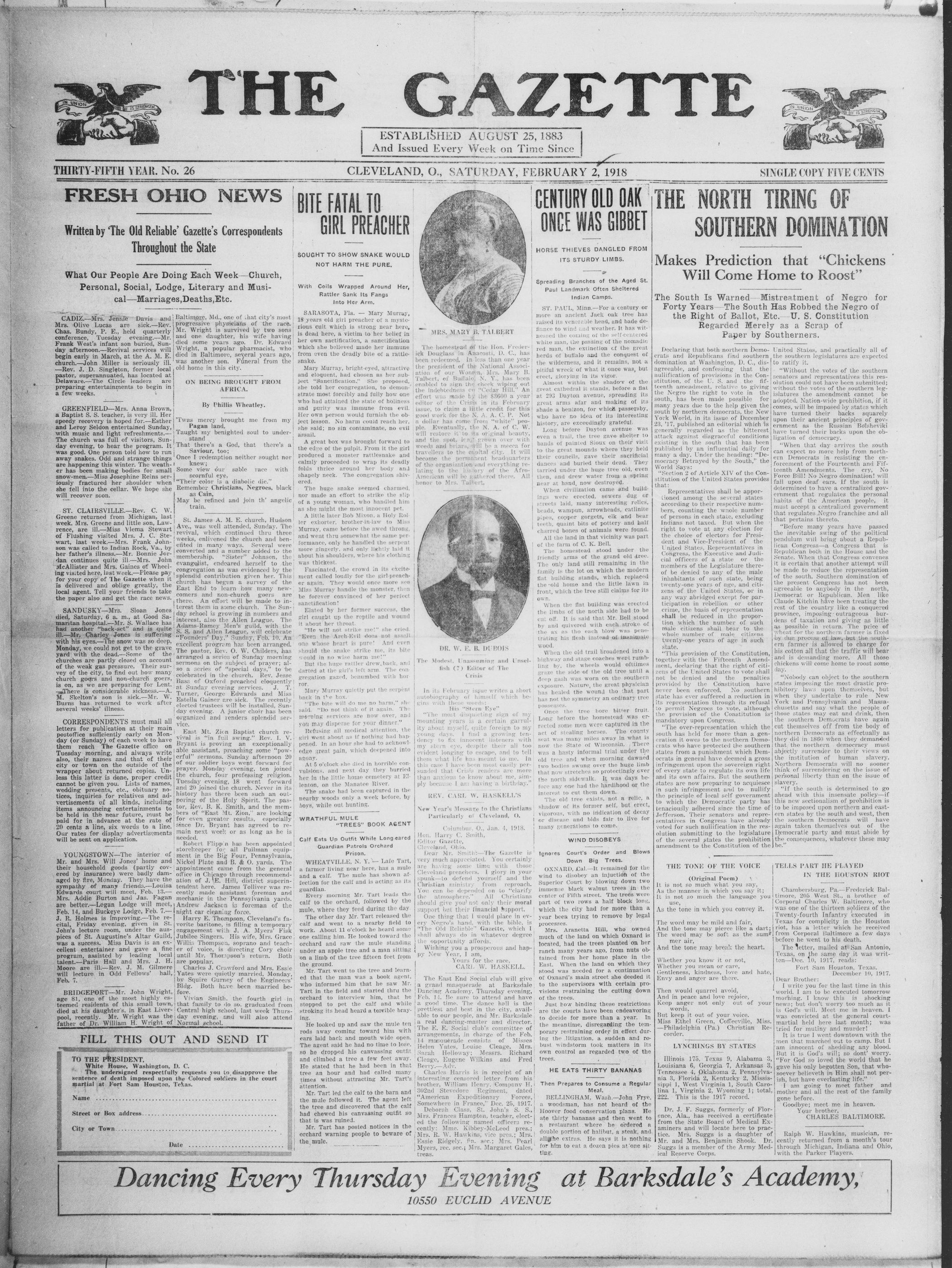
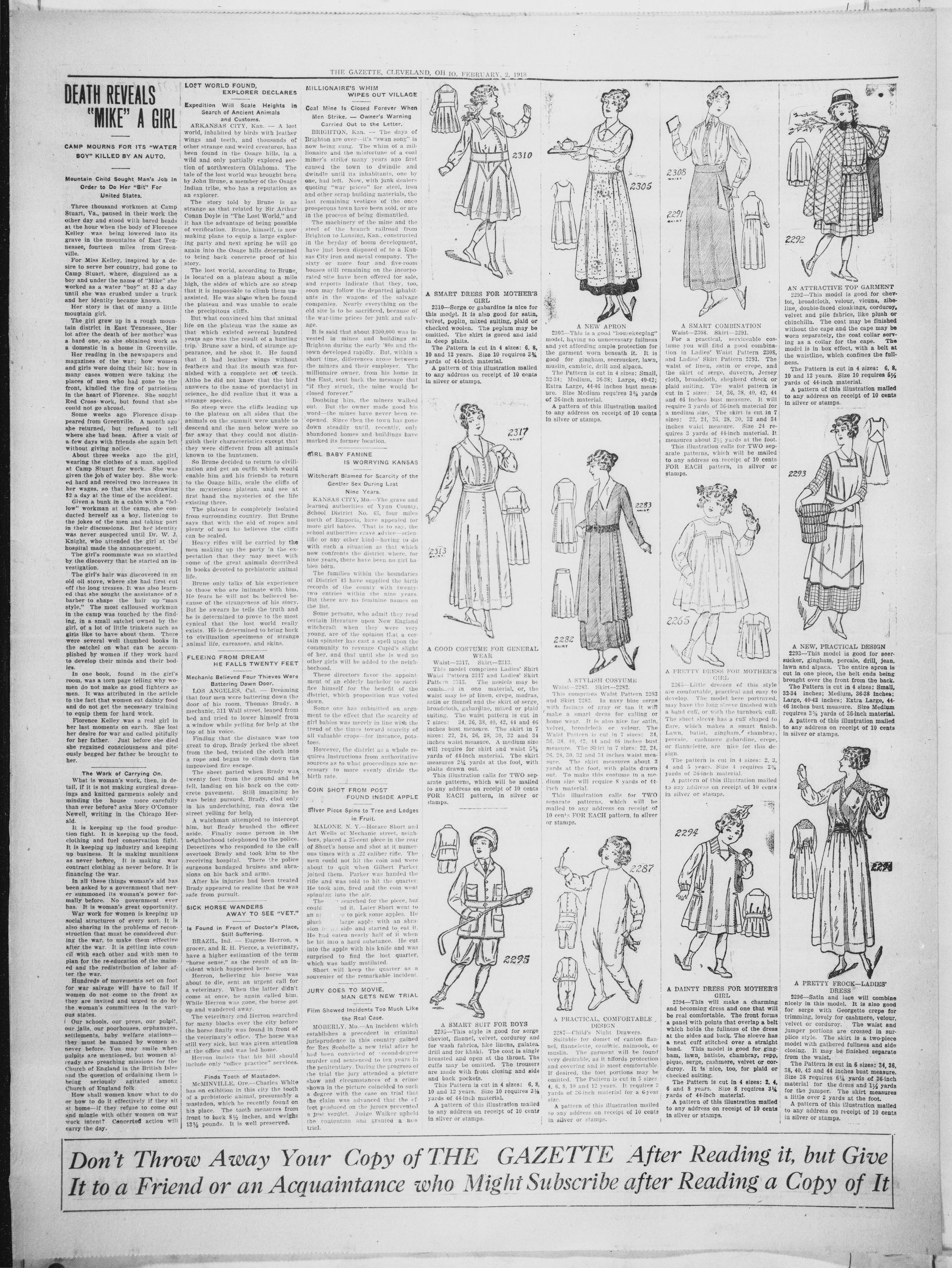
Page text (machine-generated)
Dancing Every Thursday Evening at Barksdale's Academy,
THIRTY-FIFTH YEAR. No. 26
FRESH OHIO NEWS
Written by 'The Old Reliable' Gazette's Correspondents Throughout the State
What Our People Are Doing Each Week—Church, Personal, Social, Lodge, Literary and Musical—Marriages, Deaths, Eto.
FILL THIS OUT AND SEND IT
IN UNION IS STRENGTH
THIRTY-FIFTH YEAR. N
FRESH O
Written by 'The Old Reliab
Throughout
What Our People Are De
Personal, Social, Loca
cal—Marriage
CADIZ—Mrs. Joanie Davis and Mrs. Olive Lucas are sick—Sick. Chas. Bundy, P. E, held quarterly conference, Tuesday evening—Mr. Frank West's infant son buried, Sunday afternoon—Revival services will begin early in March, at the A. M. E. church. John Miller is seriously ill.—Rev. J. D. Singleton, former local pastor, superannuated, has located at Delaware. The Circle leaders are preparing entertainments to begin in a few weeks.
GREENFIELD—Mrs. Anna Brown, a Baptist S. t. teacher, is very ill. Her speedy recovery is hoped for.—Esther and Leroy Seldon entertained Sunday, with music and light refreshments. The church was full of visitors, Sunday evening, to hear the program. It was a wonderful sold-out show to run away snakes. Odd and strange things are happening this winter. The weather has been making bodies for small-snow-men.—Miss Josephine Reins seriously fractured her shoulder when she fell into the cellar. We hope she will recover soon.
ST. CLAIRSVILLE—Rev. C. W. Greene returned from Michigan, last week. Mrs. Greene and little son, Lawrence, are ill—Miss Vlena Stewart of Flushing visited Mrs. J. C. Stewart, last week—Mrs. Frank Johnson was called to Indian Rock, Va., by her illness—Mr. Bonnie Jordan continues quite ill—Mrs. John McAllister and Mrs. Gaines of Wheeling visited here, last week. Please pay for your copy of The Gazette when it is delivered and oblige greatly, the local agent. Tell your friends to take the paper also and get the race news.
SANDUSKY—Mrs. Sloan Jones died, Saturday, 6 a.m., at Good Samaritan hospital. Mr. S. Wallace has had another "back-set" and is quite Mr. Charlow. Jones is suffering from a broken arm. Monday we could not get to the grave yard with the dead. Some of the churches are partly closed on account of the weak gas pressure. Their survey of the city, to find out how many church goers and non-church goers, is on, as we are preparing for Lent. They is considerable sickness. A. M. Skelton's son is sick. Mr. W. Burns has returned to work after several weeks' illness.
CORRESPONDENTS must mail all letters for publication at their main postoffice sufficiently early on Monday (or Sunday) of each week to have them reach The Gazette office on Tuesday morning, and always write also, their names and that of their city or town on the outside of the wrapper about returned copies. Unless this latter is done, proper credit cannot be given you. Lists of names, city names, and other information, inquiries for relatives and advertisements of all kinds, including items announcing entertainments to be held in the near future, must be paid for in advance at the rate of 20 cents a line, six words to a line. Our rates for display advertisements will be sent on application.
YOUNGSTOWN—The interior of Mr. and Mrs. Will Jones' home and their household goods (partly covered by insurance) were bully damaged by fire. Monday. They have the sympathy of many friends—Louisa Edwards court will meet, Feb. 13. Mrs. Addie Burton and Jas. Fagan are better—Logan Lodge will meet, Feb 14, and Buckeye Lodge will meet, Feb 7. J. D. Holmes is improving. The official, even when not present in St. John's lecture room, under the auspices of St. Augustine's Altar Guild, was a success. Miss Davis is an excellent entertainer and gave a fine program, assisted by leading local talent—Paris Hall and Mrs. J. H. Moore are ill—Rev. J. M. Gilmore will lecture in Odd Fellows' hall, Feb. 7.
BRIDGEPORT—Mr. John Wright, age 81, one of the most highly esteemed residents of this small town, died at his daughter's in East Liverpool, recently. Mr. Wright was the father of Dr. William H. Wright of N.
FILL THIS OUT
TO THE PRESIDENT,
White House, Washington, D.C.
The undersigned respectfully sentence of death imposed upon the marital at Fort Sam Houston, To
Name.....
Street or Box address.....
City or Town.....
Date....
THE GAZETTE
Baltimore, Md., one of that city's most progressive physicians of the race. Mr. Wright is survived by two sons and one daughter, his wife having died some years ago. Dr. Edward died some years ago. Dr. Edward died in Baltimore, several years ago, was another son. Funeral from the old home in this city.
ON BEING BROUGHT FROM AFRICA.
By Phillis Wheatley.
"Twas merry brought me from...ny
Pagan land,
Taught my benighted soul to understand
That there's a God, that there's a Saviour, too;
Once I redemption neither sought nor knew;
Some view our sable race with scornful eye,
"Their color is a diabolic die."
Remember Christians, Negroes, black as Cain,
May be refined and join th' angelic train.
St. James A. M. E. church, Hudson Ave, was well attended, Sunday. The revival, which continued thru three weeks, enlivened the church and benefited in many ways. Several were converted and a number added to the membership, "Sister" Johnson, the evangelist, endured herself to the congregation, was evidenced by the spiritual contribution given to her. The church has begun a mission of the East. End to learn how many newcomers and non-church goers are there. An effort will be made to interest them in some church. The Sunday school is growing in numbers and interest, also the Allen League. The Adams-Ramey Men's guild, with the S. S. and Allen League, will celebrate "Founders' Day." Sunday, Feb. 10. An excellent program has been arranged. The pastor, Rev. O. W. Childers, has arranged a series of Sunday morning sermons on the subject of prayer; also a series of "special days," to be held at the church. Rev. Jesse Bass of Oxford presided over sermons at Sunday evening services. J. T. Turner, George Edwards and Miss Estella Gainer are slick. The recently elected trustees will be installed, Sunday evening. A junior chair has been organized and tender splendid service.
East Mt. Zion Baptist church revival is "in full swing." Rev. I. V. Bryant is proving an exceptionally able assistant, preaching some "powerful" seismics. Sunday afternoon 20 of our soldier boys went forward for prayer. Monday evening, ten joined the church, four professing religion. Tuesday evening, 18 went, forward and 20 joined the church. Never in its history has there been such an outburst of the Holy Spirit; the pastor, Rev. B. K. Smith, and the members of "East Mt. Zion," are looking for even greater results, especially since Dr. Bryant has agreed to remain next week; or as long as he is needed. Robert Fippin has been appointed storekeeper for all Pullman equipment in the Big Four, Pennsylvania, Nickel Plate and B; & O. yards. The appointment came from the general office in Chicago through recommendation of J. E. Hill, district superintendent; was recently made assistant foreman mechanic in the Pennsylvania yards. Andrew Jackson is foreman of the night car cleaning force. Harry E. Thompson, Cleveland's favorite baritone, is filling a temporary engagement with J. A. Myers' Fisk Jubilee Singers. His wife, Mrs. Grace Willi. Thompson, soprano and teacher of voice, is directing Cory choir until Mr. Thompson's return. Both are popular. Charles J. Crawford and Mrs. Essie Yankee are quietly married, Monday, by Squire Gurney of the Engineers' Bldg. Both have been married before.
Vivian Smith. the fourth girl in that family to do so, graduated from Central high school, last week Thursday, and will also attend normal school.
CLEVELAND, O., SATURDAY, FEBRUARY 2, 1918
BITE FATAL TO GIRL PREACHER
SOUGHT TO SHOW SNAKE WOULD NOT HARM THE PURE.
With Coils Wrapped Around Her Rattler Sank Its Fangs Into Her Arm.
SARASOTA, Ela. — Mary Murray, 18 years old girl preacher of a mysterious cult which is strong near here, is dead here, a victim to her belief in her own saintification, a sancification which she believed made her immune from even the deadly bite of a rattlesnake.
Mary Murray, bright eyed, attractive and eloquent, had chosen as her subject "Sanification." She proposed, she told her congregation, to demonstrate most forcibly and fully how one who had attained the state of holiness and purity was immune from evil. Her own person would furnish the object lesson. No harm could reach her, she said, no sin contaminate, no evil assault.
A great box was brought forward to the edge of the pulpit. From it the girl produced a monster rattlesnake and calmly proceeded to wrap its deadly folds three around her body and shaped neck. The congregation shivered.
The huge snake seemed charmed nor made an effort to strike the step of a young woman, who handled him as she might the most innocent pet.
A little later Bob Mixon, a Holy Body for exhorter, brother in law to Mr. Murray, caged before the sword throne, and went then somewhat the same performance, only he handled the serpent more gingerly, and only lightly led it about his shoulders, where his clothing was thickest.
Fascinated, the crowd in its excitement called loudly for the, the preacher again. They would once more, the Miss Murray handle the mound, to be forever convinced of her perfect sanctification!
Blated by her former sincerity, the girl caught up the reptile and wound it about her throat.
"He will not strike pre" she cried. "Even the Arch-Fail does not as one whose heart is pure." And even should the snake strike me, it bit could in no wise harm me."
But the high rattle drew teeth, and darted at the girl's left arm. The cremation gag, bumbed with horror.
Mary, Murray quietly put the scorpent back in the hay.
"The bite will do me no harm," she said. "Do not think of it again. The moving services are now over, and you may dispense for your dinner."
Refusing all medical attention, the girl went about as if nothing had happened. in an hour she had to acknowledge great pain, which deepened into agony.
At 5 o'clock she died in horrible convulsions, and next day they buried her in the little home cemetery at Elleton, on the Manatee River.
The snake had been captured in the nearby woods only a week before, by boys, while out hunting.
WRATHFUL MULE
"TREES" BOOK AGENT
Calf Eats Up Outfit While Long cared
Guardian Patrols Orchard
Prison.
WHEATVILLE, N. Y. --- Late Tart,
a farmer living near here, has a mule
and a calf. The mule has shown affection for the calf and is acting as its guardian.
Every morning Mr. Tart leads the calf to the orchard, followed by the mule, where they feed during the day.
The other day Mr. Tart released the calf and went to a nearby field to work. About 11 o'clock he heard someone calling him. He looked toward the orchard and saw the mule standing under an apple tree and a man sitting on a limb of the tree fifteen feet from the ground.
Mr. Tart went to the tree and learned that the man was a book agent, who informed him that he saw Mr. Tart in the field and started the orchard to 'interview him, that he stopped to pet the calf and while stroking its head heard a terrible braying.
He looked up and saw the male ten rods away coming toward him with ears laid back and mouth wide open. The agent said he had no time to lose so he dropped his canvassing outfit and climbed a tree a few feet away. He stated that he had been in that tree an hour and had called many times without attracting Mr. Tart's attention.
Mr. Tart led the calf to the barn and the male followed it. The agent left the tree and discovered that the calf had chewed his canvassing outfit so that is was ruined.
Mr. Tart has posted notices in the orchard warning people to beware of the mule.
MRS. MARY E. TALBERT
The homestead of the Hon. Frederick Doughard in Amnesia, D. C., has been reopened. In less than one year the president of the National Association of our Women, M. Mary B. Talbert, of Bristol, N. Y., has been enabled to join the stock wiping out the indole ores on the Marsh Hill. An effort was made by the 2660 a year earlier to the Cure in its February issue, to obtain a little credit for this good work for the N. A. C. P. Not a dollar has come from "white people. Eventually, the N. A. of C. W. will preside to the original beauty and the pot, and the oven will work weeks and ten. In a poor country, the bread will be made of the bread matters of the organization, and everything pertaining to the city of the Americas can be offered and the w
A. B.
DR. W. F. B. DUPONS
The Nodule, Lepidostome and Lusell-
tich C1 Edition of The
In that I deliberately gave written a brief explanation of my life to those who were interested in them.
In "Storm Eye"
"I am the one who is to tell you my biography, my career, my personality about my life, my life to my young years. I find it growing tiring to tell the important stories with my children, to tell them about their adventures to complete, and to tell them about their life in prison. In this time I have been most deeply interested that. I can give you more than I can know about my simple life. I am a birthday boy."
REV. CARL W. HASKELLS
New Year's Message to the Christians Particularly to Cleveland, O.
Columbus, O. June 3, 1915.
Henry H. C. Smith.
Edgar Gazette.
School of Ohio.
Learn Mr. Smith: The Gazette is very much appreciated. You certainly are in love, some time with those Cleveland progenies. I glory in your pupil to defend yourself and the Christian ministry, from approach. You can be depended on to "clarify the atmosphere." All Christians should give power to their moral support but their financial support.
One thing that I would place in every Newer's hand, with the bible, is "The (4th Ed.) Gazette, which I shall always do in whatever degree the opportunity affords."
Wishing you a prosperous and happy New Year, I am.
Yours for the race.
CARE W. HASKELL.
The East End Social club will give a grand masquerade at Barkside Dancing Academy, Thursday evening, Feb. 1. Be sure to attend and have a good time. The dome hall is the art gallery and the auditorium is able to our people, and Mr. Barkside a real dancemaster and director. The K. E. Social club committee of arrangements, in charge of the Feb. 14 masquerade consist of Misses Helen Yates, Lutes, Cleague, Mrs. Sarah Holloway; Messrs. Richard Chlege, Eugene Wilkins and Fred Berry... Ada.
Charles Huff is in receipt of an interesting censored letter from his brother, William Henry, Company H. 302d Steveodert Regiment, dated "American Expeditionary Forces, Somewhere France," Dec. 25, 1917. Mrs. Chlege, Class A, teacher, Mrs. Frances Hampton, teacher, elected the following named officers, recently: Mine, Kibby-Nedel press; Mrs. Mine, Hawkins, vice press; Mrs. Essie Kidgely, fin press; Mrs. Pearl Myers, ree, sec; Mrs. Margaret Gales, treas.
10550 EUCLID AVENUE
CENTURY OLD OAK ONCE WAS GIBBET
HORSE THIEVES DANGLED FROM ITS STURDY LIMBS.
Spreading Branches of the 'Aged St. Paul Landmark Often Sheltered Indian Camps.
ST. PAUL, Minn. - For a century or more an ancient Jark oak tree has raised its cane head, and bade defense to wattle and weather. It has witnessed the coming of the white man, the passing of the nomadic red man, the extinction of the great herds of buffalo and the conquest of the wilderness, and it remains, not a painful wreck of what it once was, but sheer, storying in its vigor.
Almost within the shadow of the great cathedral it stands, before a flat at 223 Bayton avenue, spreading its great army star, and making of its shade a horizon, for which passbyer, who have no idea of its interesting history, are exceedingly grateful.
Long, before Bayton avenue, was even a trail, the tree gave shelter to hands of painted Sloux on their visit to the great mounds where they held their councils, save their sacrificial dances and buried their dead. They tread under the huge tree, even again, and drew water from a spring near at hand now destroyed.
When civilization came and built, it created, sewers dug or street laid, many interesting roles, beads, wampan, arrowheads, earlinen pearls, copper gorges, elk and bear teeth, quant bits of pottery and half charred bones of animals were found. All the land in that vicinity was part of the farm of C, K. Belt.
The homestead stood under the friendly arms of the grand old tree. The only land still remaining in the family is the lot on which the modern flat building stands, which replaced the old home and the little lawn in front which the tree still claims for its own.
When the flat building was erected the limbs of the north side had to be cut off. It is said that Mr. Belt stood by and quivered with each stroke of the axe so the each blow was penetrating the flesh instead of innumerable good.
When the old trail broadened into a highway and shone canes were wading by, the wheels would oftimes move the side of the old tree until a deep path was worn on the southern exposure. Nature, the great physician has held the wound to that part has not the symmetry an ordinary tree
Once the tree lore bitter fruit
longs before the homestead was cre
erated some men were captured in the
net of stealing horses. The "country
seat was many miles away in what is
now the State of Wisconsin. There
was a hasty informal trial under the
old tree and when morning dawned
two bodies swung over the huge fimb
that now stretches so protectingly over
the north side walk. It was days before
he was one had the hardship or the
intention to cut their down.
The old tree exists, not a relic, a
shadow of its former self, but erect,
violent, with no indication of decay
or disease and blids fair to live for
fruits or necessities to come.
WIND DISOBEYS
Ignores Court's Order and Blows Down Big Trees.
OXNARD, Cal. It remained for the wind to disobey an injection of the Superior Court by blowing down two immense black walnut trees in the center of Fifth Street. The trees were part of two rows a half block long, which the city had for more than a year been trying to remove by legal processes.
Mrs. Aranetta Hill, who owned much of the land on which Oxnard is located, had the trees planted on her ranch many years ago, from nuts obtained from her home place in the East. When the land on which they stood was needed for a continuation of Oxnard's main street she deed it to the supervisors with certain provisions restraining the cutting down of the trees.
Just now binding these restrictions are the courts have been endeavoring to decide for more than a year. In the meantime, disregarding the temporary restraining order in effect during the litigation, a sudden and robust windstorm took matters in its own control as regarded two of the trees.
HE EATS THIRTY BANANAS
Then Prepares to Consume a Regular Meal
BELLINGHAM, Wash.—John Frye, a woodman, has not heard of the Howeer food conservation plans. He ate thirty bananas and then went to a restaurant where he ordered a double portion of hambut, a steak, and all the extras. He says it is nothing for him to eat a dozen pies at one sitting.
THE NORTH TIRING OF SOUTHERN DOMINATION
Makes Prediction that "Chickens Will Come Home to Roost"
The South Is Warned Mistreatment of Negro for Forty Years The South Has Robbed the Negro of the Right of Ballot, Etc. U. S. Constitution Regarded Merely as a Scrap of Paper by Southerners:
Declaring that both northern Demo- United States, and practically all of crates and Republicans find southern, the southern legislatures are expected domination at Washington, D. C., dis- to ratify it.
Declaring that both northern Democrats and Republicans find southern domination at Washington, D. C., disagreeable, and confessing that, the amplification of provisions in the Constitution, of the [U. S. and the fifteenth amendment, relative to giving the Negro the right to vote in the south, has been made possible, for many years due to the help given the south by northern democrats, the New York World, in its issue of December 23, 17, published an editorial which is generally regarded as the bitterest attack against disgrieve conditions existing in the "south that has been published by an influential daily for many a day, under the heading: "Democracy Retrayted by the South," the World Says:
"Section 2 of Article XIV of the Constitution of the United States provides that:
"Apparitions shall be apportioned among the several states according to their respective numbers, counting the whole number of persons in each state, excluding Indians not taxed. But when the right to vote is constitutionally elected for President and Vice-President of the United States, Representatives in Congress, the Executive and Judicial officers of a state or the members of the Legislature thereof be denied to any of the male inhabitants of such state, being twenty-one years of age, and citizens of the United States, or in any way abridged except for participation in rebellion, or other crime, the basis of representation shall be reduced in the proportion which the number of such male citizens shall bear to the whole number of male citizens twenty-one years of age in such state.
"This provision of the Constitution, together with the Fifteenth Amendment, declaring that the right of citizens of the United States to vote shall not be denied and the penalties provided by the Constitution have never been enforced. No southern state has suffered a suffrage in the proportion through its reapportionment to vote, although the provision of the Constitution is mandatory upon Congress."
"The over-representation which the south has held for more than a generation it owes to the northern Democrats who have protected the southern states from a punishment which Democrats in general have deceived a gross infringement upon the sovereign right of the people and its own affairs. But the southern states are now preparing to sequestrate in such infringement and to nullify the principle of local self government to which the Democratic party has emotionally adhered since the time of Jefferson. Their senators and representatives in Congress, have already forged such nullification in the recognition of the several states the prohibition amendment to the Constitution of the
(Original Poem)
It is not so much what you say.
As the manner in which you say it;
It is not so much the language you
use.
As the tone in which you convey it.
The word may be mild and fair,
And the tone may pierce like a dart.
The word may be soft as the sum-
mer air.
And the tone may break the heart.
Whether you know it or not,
Whether you mean or care,
Gentleness, kindness, love and hate,
Envy and anger are there.
Then would quarrel avoid;
And in peace and love rejoice.
Keep anger not only out of your
words.
worries
But Kaitlin out of your voice.
Miss Eileen Green, Coffeeface, Miss.
—Philadelphia (Pa.) Christian Recorder.
Illinois 175, Texas. 9. Alabama 3, Louisiana 6, Georgia 7, Arkansas 3, Tennessee 4, Oklahoma 2, Pennsylvania 3, Florida 2, Kentucky 2, Mississippi 1, West Virginia 1, South Carolina 1, Virginia 2, Wyoming 1; total, 222. This is the 1917 record.
Dr. J. F. Suggs, formerly of Florence, Ala., has received a certificate from the State Board of Medical Examiners and will locate here to practice. Mrs. Suggs is a daughter of Mr. and Mrs. Benjamin Shook. Dr. Suggs is a member of the Army Medical Reserve Corps.
IN UNION
FOR IS STRONG
SINGLE COPY FIVE CENTS
TIRING OF
BURN DOMINATION
on that "Chickens
Home to Roost"
Mistreatment of Negro for
th Has Robbed the Negro of
Etc. U. S. Constitution
rely as a Scrap of
Southerners:
United States, and practically all of
the southern legislatures are expected
this to ratify it.
Without the votes of the southern
senators and representatives this resi-
solution could not have been submitted,
without the votes of the southern
legislatures the amendment cannot be
adopted. Non-wide prohibition. If
the law will be imposed by state, which
have turned their backs squarely
upon their ancient principles of
government as the Russian Bolsheviks
have turned their backs upon the obli-
gence of democracy.
"When that day arrives the south can expect no more help from northern Democrats in resisting the enforcement of the Fourteenth and Fifteenth Amendments. The cry, No Force Bill! No Negro domination! will fall upon deaf ears. If the south is determined to have a centralized government that regulates the personal habits of the American people, it must accept a centralized government that regulates Negro franchise and all that pertains thereto.
"Before many years have passed the inevitable swing of the political pendulum will bring about a Republican Congress—a Congress that is Republican both in the House and the Senate. When that Congress convenes it is certain that another attempt will be made to reduce the representation of the south. Southern domination of the present Congress has not been agreeable to anybody in the north, Democrat or Republican. Men like Cinder Kittin have been treating the country of the country like a contemptuous province, imposing outrageous burdens of taxation and giving as little as possible in return. The price of defeat for the northern farmer is fixed by the process of law, but the southern farmer is allowed to charge for his cotton all that the traffic will bear and is demanding more. All those chickens will come home to roost some day."
"Nobody can object to the southern states imposing the most drastic prohibitory laws upon themselves, but when they undertake to rule New York and Pennsylvania and Massachusetts and say what the people of those states may eat and drink, then the southern Democrats have again cut themselves off from the body of the people they did in 1860 when they demanded that the northern democracy must objectly surrender to their views on the institution of human slavery. Northern Democrats will no sooner think of surrendering on the issue of personal liberty than on the issue of slavery.
"If the south is determined to go ahead with this insensitive policy—if this new sectionalism of prohibition is to be imposed upon northern and eastern states by the south and west, this new sectionalism of prohibition again taken themselves out of the Democratic party and must abide by the consequences, whatever these may be."
Chambersburg, Pa.-Frederick Baltimore, 205, West St., a brother of Corporal Charles W. Baltimore, who was one of the thirteen soldiers of the Twenty-fourth Infantry executed in Texas for complicity in the Houston riot, has a letter which he received from Corporal Baltimore a few days before he went to his death.
The Letter, mailed at San Antonio, Texas, on the same day it was written—Dec. 10, 1917, reads:
Fort Sam Houston, Texas.
December 10, 1917.
Dear Brother:
I write you for the last time in this world. I am to be executed tomorrow morning. I know this is is shocking to me, but to touch as it is God's will. Meet me in heaven. I was convicted at the general court-martial held here last month; was tried for mutiny and murder!
It is true I went downtown with the men that marched out to camp. But I am innocent of shedding any blood. But it is God's will; so don't worry. "For God so loved the world that he gave his only begotten Son, that who-sover-believe in Him shall not perish, but have everlasting life."
I am going to meet father and mother and all the rest of the family gone before.
Goodbye; meet me in heaven.
Goodbye; meet me in heaven.
Ralph W. Hawkins, musician, recently returned from a month's tour through Michigan, Indiana and Ohio, with the Parker Players.
The GAZETTE
PUBLISHED EVERY SATURDAY
SUBSCRIPTION KATES
* © im Advance)
tome HORE Sines cep ene SLB
WHE MONI es sence... 100
TEMFCG-MONUS™s..eeeeeceseeeees OU
Subseribors are requested to remit py
postoRice money order or reg
istered letter
Entered at the postoiiice in Cleve
land, Ohio, as second-class
mail matter.
Address all communications to
HARRY €. SMITH
Balitor and proprietor,
THE GAZETTE,
Blackstone Building, Cleveland, 0.
Member Ohio Legislature: 1894
to 1896; 1896 (0 1893; 1900 to 1902
THE GAZETTE ts the oldest, and
has the largest bona fide circulation,
Aouble that of any newspaper in the
interest of Afro-Americans, publish
ed in the state of Ohio, and compar-
ison with any will immediately es-
tablish its rank as one of the NEWS-
JEST AND BEST in the country.
10,000,000 Afro-Amerteans.
300,000 in Ohio.
25,000 In Cleveland.
SATURDAY, FEBRUARY, 2, 1918
pa ete a Sime
Tg eee
PREJUDICE 4
; “Any prejudice whatever will 3
< be, insurmountable if those who 3
3 do not share im it themselves 4
% truckle to it and flatter it and ¢
$ accopt it is: a law of nature."— 3
3 John Stuart Mill. 3
: 3
deceessecsecciessesoeecse:
sroreeteresssresereeeesees
PARE TO DO YOUR DUTY 3
—— 3
“Let us have faith that right 3
makes might, and in. that 3
faith let us-to the end dare
to: do our duty as we under- }
stand ft.’—Abraham Lincoln. 3
eee eee!
Representative Carter, an Oklaho-
ma Democrat, tried to dump Prof.
Harry ‘Garfield, national fuel admin-
istrator, with this question:
“Isn't Garfield a Republican?”
And’ Congressman “Nick” Long-
worth, of Cincinnati, shut him up with
just seven words: “He worked ear-
nestly for Wilson last campaign.” And
he might have added that State Fuel
Commissioner Johnson, of Cleveland,
was another Wilson Republican.
Arrangements for\the early trans-
portation of 50,000 common laborers
to this country from Porto Rico are
being made by the employment ser-
vice of the Department of Labor. As
soon as tonnage is available 60,000
others will be brought from Porto
Rico and the Virgin Islands (St.
‘Thomas and others), sufficient, the
department has announced, to take
care of any shortage in the domestic
supply of railroad and agricultural
workers. The Afro-Americans, who
emigrated to the North in the last
year and a half, caused the “shortage
in the domestic supply of agricultur-
al workers.” The South is “in the
saddle” alright, at Washington, D. C.
ie
“4 RAY OF SUNSHINE”
The New York World is angry at
the “Solid South.” It is not angry at
the South because it is an organized
conspiracy for government spoils. It
is not-angry at the South because it
has ensérfed many millions of humar
beings. It is not angry at the South
because it has blithely crucified north-
ern business whenever the spirit mov-
ed it, It has seen it doing these things
over many years. During these years
it never once’ lifted up its voice
against the practices of the South.
Now it is breathing vengeance, retri-
bution “and justice upon the South.
‘The cause for this breathing of an-
athema on the part of the World is
that the southern senators and rep-
resentatives voted to fasten prohibi-
tion and.woman suffrage on their fel-
low Demoerats in the North. ‘The
World, on behal® of the northern
Democrats, resent this, and promises
the South in return that Afro-Amer-
icans in that section of the country
shall also be given the right to vote.
And it wants to know how the South
will like’that! When the professional
southern Democracy and the profes-
sional northern Democracy fall out,
it looks like ‘there might be a chance
for this long-suffering race. of ours
in the South, getting justice done it.
WAR RISK INSURANCE.
Washington, D. C.—To safeguard
America’s gallant soldiers and sailors
and their families, it is imperative
that our fighting, forces avail them-
selves of the full privileges conferred
by the Military and Naval Insurance
‘Act. For his own benefit and for the
benefit of his family, every enliste:
man and officer in the Army and Navy
should take the full $10,000 of insur-
ance. Insurance of almost $4,000,000
000 has already been applied for, but
this great total iz only a beginning
‘America's Army and Navy should b
100 per cent insured. The necessity
of prompt application can not be em:
phasized too strongly. Persons in
service before October 15, 1917, must
dae or before February 12, 1918.
ose who joined after October 15,
1917, have 120 days from the date of
‘enlistment in which to apply. All
‘that is needed now is vigorous pub-
lieity to speed up applications before
february 2. Everybody can help ix
this,
Q
pe f
ves
a 6
Baas WS
ays KS
Uae
S Sacred Z
wi BSE
L SS a
RS Ne
SSNS
| WS
pa es
6 (
lees” 27 | DOINGS
BRATS
TS for
Ww Tae ‘
ENE @ THE
PSN <
VSN 3
ec nace
i pee
Owing to war conditions our Odd
Fellows B. M. C. will’ meet in 1920
and not next year as planned. N, Y,
Afro-Americans disappointed.
ESTAS RAO Peay i espnlaiate
Louis S. Hicks has been appointed
‘an assistant Corporation Counsel by
Acting Corporation Counsel Henies-
sey, of Boston, Mass,
| Wynston Brown, a graduate of
‘Hughes high school, Cinemnnati, is that
‘city’s first Afro-American sanitary in-
‘speetor in the health department.
| Miss Helen L. Milton of Philadel-
phia, Pa. has been appointed to a
$1000 clerkship in the U.S, Medical
Supply Department at Washington,
Dc.
Bishops of the A. M. E, Chureh,
Zion A. M. B. and C. M. E. ‘churches,
will meet in Louisville, Ky., in
{joint session, Reb. 14, to tty to find a
‘basis on which they can unite.
___ A court martial can not take away
‘that part of a soldier's pay which has
ibeen alloted to his dependents... 'This
“has just been announced at depart-
ment headquarters, San Antonio,
Tex.
It is said that 2000 Mississivpi Af-
ro-Amerieans of the first draft were
formed into a stevedore regiment and
[sent at onee to France and that their
chief employment is the loading and
unloading of ocean vessels.
In South Carolina, a few weeks
ago, a “white” man was sent to jail
for ‘thirty days for stealing an auto-
mobile, and an Afro-American was
sent to jail for three years for steal-
ing a bieyele. Southern “justice!”
Mrs, Catirie Burton Overton, of Wy-
oming, who was refused a pocition in
the office of the Council of National
Defense, Washington, D. C., has been
appointed to a position as’ stenogra-
|pher in the Agricultural Department,
‘paying $1000 2 year.
|" “Frederick Stock, conductor of the
Chicago Symphony Orchestra, has an-
inounded Henry . Gilbert's “Comedy
[Overture on Negro Themes,” and Ot
‘terstrom’s “Negro Suite” among. a
lnuinber of American works to be giv-
en on the program this year.
Dr. E. P. Reed was recently ap-
pointed a notary public and magis-
trate for the second. district, Center
‘Township, Camden, N. J., comprising
the towns of Lawnside, Nunnymeade,
Wood Crest and Mt. Ephraim, with
main office at White Horse Pike, ard
Browning Lane, Lawnside, N. J.
‘The Carnegic Hero fund commis-
sion, headquarters at Pittsburg, Pa.,
has awarded Christopher L. Williams,
lof Dayton, a.bronze medal and $500
for saving Marie Mocabee, “white,”
age 4, from d@ath in a runaway acei-
dent, Aug. 26, 1916. Williams fougint
17 gruelling ‘rounds with “Battling”
Nelson in 1902,
A Kansas City, Mo., undertaker re-
ceived this note and a bank book with
$190 made over to him: “Come and
take Peter Johnson for your business,
please.” Investigating, he found
“Peter Johnson” hanging by the neck
from a rope, dead, in a room in the
year of his cobbler’s shop. Yes, he
was a member of the race.
Recently at the Church of Engiani
Congress at Southampton, Sir Sidney
Olivier, who was governor of Jamai-
€a from 1907 to the end of 1912, put
forward the claim that no solution of
the American color question was pos-
sible except by a resolute disclaimer
of the color line and the race differ-
ention theory.
Catherine D. Lealtad,-a native of
Cleveland, 0., was graduated from
MeAlester College, St. Paul, Minn,
‘with first honors in a class of twen-
ty-five in 1915, completing her course
fa three years. She made the best
scholarship record in. the history. of
the college and received: the Noyes’
mrize. Afterward she was graduated
from the Normal school ‘of St. Paul,
and in the fall of 1917, was appointed
2 teacher in one of the schools there.
Calling attention to the fact that
the N. A. A. C. Ps-printing bill for
the Crisis is $18,000 a year and that
that amount of money is paid to the
white firm in New York city that
prints. the magazine, the Baltimore
(Md.) Afro-American, which calls. at-
tention to the fact that no N.Y. Af-
ro-American firm is equipped to print
the Crisis, says: ‘In. thet interest
of race advancement, the Afro-Amer-
ican hopes that the Crisis will speed-
ily develop its own plant or else suf-
fer the slight ‘neonvenience of corn
ing to Philadeiphia, Baltimore or
Washington to be printed.”
We visited Camp Funston (Kan-
sas) the past week and found every-
thing moving smoothly in the 92nd
Division, of which Major General Bal-
jou is in command. ‘The colored sol-
diers seem to be in fairly good shape.
except they. sxe short of uniforms,
‘and. we think the government should
rush up uniforms for these soldiers,
as so many are doing guard duty,
and we saw men shivering during the
recent cold spell because they were
50 poorly clad. We do not see why
they have not heen clothed before this
time, as most of the white soldiers
of the 89th Division are clothed—To-
peka.(Kan.) Plaindealer, Jan. 18, "18.
Colored men and women, way down
in their inmost soul—sometimes not
admitted even to themselves—are
awaiting the appearance of a real
Jeader—not a leader made by the
white press, whose policy is a cross
between the closed fist and the open
hand—not 2 man who rises on the
crest of temporary ambition and is
then willing, to sell out for a post in
Haiti ov the honor of putting his sig-
natare on the currency of the'U. S.,
but a leader who will crystalize the
yesentment of twelve million human
beings, and organize this resentment
into an active “Black Crusade” against
the worst caste system the world has
ever known.—Louisville (Ky.) News.
. i ecar
:
Opinions.
Every man is entitled to “his opin-
Jon, but not every man is entitled to
tmpose his opinion on his neighbor—
Buffalo Times,
THE GAZETTE, CLEVELAND, OH 10, FEBRUARY, 2, 1918 ~
MUNITION WORKERS
GET CORDITE HABIT
Explosive.
Drink is not the only temptation to
whicl over strained munition workers
are exposed. Quite recently it has
Leen discovered that a good deal of
the “drunkenness” altributed to wo-
men and comparatively young kirls is
due to another and hitherto unsuspect-
ed cause—the chewing of cordite, the
smokeless explosive used in the shell
of cannon and the ammunition of
small arms,
‘The fact that cordite, has a pleas-
ant taste tending to sweetness has
been a real discovery to many of the
women workers and the primary
source of their danger.
“1 did not know at all what the
stuff was made of," said a woman who
had been handling cordite for six
months or more. “But one day 1 hap-
pened to put a 1ittt® bit of it into my
mouth and to begin chewing it. Tt felt
nice, ‘Then I began to be a bit lively,
I could not understand what the thing
meant. After tex I chewed a bit more
and it was nice, too. Next day 1 did
the same thing, and then I got a
fright. I began to feel headachy and
—well, drunk, ‘That was the end of
its ves, for me it was. Bat my mate,
well, she just laughed; but when she
took a bit home with her and chewed
it.hard she gave us a time and a hail,
that she did.”
‘The explanation of all this is, of
course, simple ssough. Cordite, when
chewed has all the exilarsting ef
fects of a highly stimulating druss and
cannot be tampered with except st
great risk. Its effects on the nervous
system are immediate and ultimately
deadly. Besides, like all such drues,
it has to be taken in increasing quan
titles of the exhilaration is 10 be
maintained, And herein lies the grea
peril of the worker in cordite who
forms the chewing habit, i
How far the habit bas spread it is
difficult to say. Equally difficult is it
to ascertain whether the authorities
have become alive to the fact that the
peril exists. In the north it is under
stood that several cases have had to
be sharply dealt with, But quite ob-
viously there Is need for greater ea
tion on the part of workers and strict
er supervision on the part of factory
managements.
‘The ministry of munitions should
nip the evil in the bud if it is not al
ready past that stage. On its action
much may depend not only for the
worker, but for the maintenance of an
essential feature of national offic
eney.
‘The effect of cordite as an “intox
icant” was first discovered during the
South African war. Some British sol
diers found to their surprise that by
eating eordite they could get all the
excitement of the most powerful nar-
cotit—and all the terrible effects, too.
Curdite consists roughly of about
_ 58 parts of nitroglycerin, 37 parts gun-
cotton and 5 paris of mineral jelly.
"Each cartridge contains 60 cylindrical
strands of cordit and when Majo:
Jennings, D. S. 0., learned that the
men were eating these he experiment
ed on himself by sucking a strand. Ho
found that it tasted sweet, pleasant
and pungent, but it resulted in giving
him the most racking, splitting head.
| ache: and. it lated for thirtesix. hours.
Hun Brutality.
Stories of German brutality have
heen printed with a great deal of
prominence all over the country, and
yet many do not believe them yet. We
urge them to read the following from
the lips of a Freneh soldier, invalided
home from a German prison camp. It
is translated from a Paris paper
Lillustration:
“Our prison camp at Gustrow wa
clean, and that's about all. ‘The Ger
mans are very brutal, and if our let-
ters to our people would not have
been censored many, a pitiful story
would have seen daylight. Worst
treated among them are the British.
One day one of the British Prisoners
got round the lack of the cookhouse
where the refuse is kept, to fish a
piece of bread out of a barrel of
seraps that were being sent to the
pigs. Up came the chief cook, knock-
ed the legs from under the English-
man, and while on the ground beat
him unmercifully. The poor fellow
Gare not defend himself for fear of be-
ing punished for insubordination. The
food we received here was not only
bad, but it was not even enough to
keep body and soul together.
“When we received Swiss bread or
other things from home we gave the
black bread to the Russians, or some-
times would sell it to the Germans. In
many camps the commandants were
really good and human, but: unfortu-
nately we very seldom came in con-
tact with them, and if s0, no notice
would be taken of any complaints for
generally the German under officer
would have the first word, and the
matter would end.
“But not alone the soldiers, the elv-
Sifan population is just as bad. When
marching through or working in the
streets we have been pelted with
stones and mud ‘By men, women and
ctisldren under the eyes of the soldiers
who guarded and should have prote:t-
ed us. There was not one who sympa-
thized with us. Tt almost looked a it
these people were bereft of all human
febling.
“Here, before we were released, we
had to sizn papers to the effect that
our treatment was without reproach.
When we reached Switzerland what a
wonderful change! It was like comin
out of hell into heaven. In Germany
we were treated like dogs. ‘The eynt
pathetic Swiss people treated us like
hhuman beings.”
More Useful If Less Poetic.
“A poetic contributor recently suly
mitted to a northern weekly an efw
Subscribe Now !
SORCERY GIVING WAY TO: CiVI-
LIZING INFLUENCES.
Missionary Tells How King of Fakers
Was Made Laughing Stock
‘of dumeites
LOS ANGELES, Cal. — The Congo.
witeh doctor's sway of life and death
over iniilions of African natives by
“satanic right” is today toppling We-
fore the envoys of civilization and the
Gospel.
This fs the word recently brought
here by Dr. Joseph Clark, noted mis-
slonary, who has spent 33 years in the
Jungle country, and whose life has.
been a magnifictent adventure,
“We have always found the witeh
doctor our greatest opponent,” said Dr.
Clark.
“His faculty of condemning men,
women ad children to death without
compunction; his craft, ahd bis ability
to lie, elevated this monster to grin.
power for his personal henefit,
“The medical and surgical work of
the missionary is proving a big {actor
in shattering this evil influence.
“Sometimes the witeh doctor has
been ridicnled into the diseard.
“One of the most cmusing agd far-
reaching episodes of this nature was a
clash between one of our women mis-
sionavies and « powertal witch doctor
in whieh the lady's Slse teeth won the
day for civilization.
“The native had been boasting that
his powers were far sreater than those
of this missionary Iady, and he boldly
came into the mission station to make
such a statement before her, and in
the presence of highly interested
Blacks.
“she asked him, ‘I presume, since
you are so clever, you can remove
your teeth?” 53
# ‘No, people cannot move their
teeth, he replied. ,
“She said, ‘Yes some people can,
and if you axe so great you ought to
be able to move yours.” Again he de-
nied that this feat, was possible.
“Looking bim in the face she sald:
“phis is the way to do it? and with a
slight touch of ber tongue spon her
upper plate, she caused her false
teoth visibly to descend.
“the witch doctor seied the edge of
a door to support Irimself.
“Oh, they moved! ‘They moved!”
he cried. ‘Then like, an arrow he
“darted past the good Indy and. thru
the laughing erowd of natives who
understood the secret of the moving
teeth,
“It can easily be seen why these
witch doctors are our greatest ene-
mies. It must be remembered that
whether we wish It or,tot our texeh
ing must enter into very definite op:
| position to theirs,”
WHIPPING DISCARDED
IN DENVER SCHOOLS
Shaking and Boxing of Ears Must
‘Also Cease.
DENVER, Colo, — "Thou shalt not
whip” Is to be the eleventh command
ment for Denver school teachers here-
after, An order to this effect was
iasued by Charles M. Cole, superinten-
dent of public schools. It is, in part,
as follows
“After this dite teachers may not
administer corporal punishment to chil-
dren without the written consent of
the parent or guardian, and then only
thra investizution by the principal
Corporal punishment shall always be
administered in the presence of the
principal and one other wimness.
“Shaking, boxing of ears, slapping of
children are ali considered corporal
punishments and will not be tolerated.
Compelling children to stand upon the
floor oF in ihe hails is not an indiea-
tion of good control.”
FINDS COSTLY RING IN FISH
IRD Sime eave en rea hake oS eee ae
Lost.
DANVILLE, I. — ‘That truth ts
stranger than fiction was demonstrat
ed at Hoopeston the other day when
Ray Tilton, a young farmer, received
a letter from Peoria saying a diamond
ying, valued at $250, had been found in
the stomach of a fish whieh had been
caught in the Ilinois river.
When Tilton was at Peoria, and
while rowing on the river the ting
dropped off his finger. He never ex-
pected to soe it again, and was much
surprised to receive the letter,
‘The writer said he caught the fish
and, while dressing it, saw something
bright fal! out of the stomach. ite
also said he would be glad to send the
ving to Hoopeston if Tilton would send
the reward offered in a Peoria news:
paper. The owner sent a check for $50
fo the Peoria man.
LAZIEST MAN 1S DISCOVERED
Makes Phonograph Do Work of
whistling for Birds.
SAN FRANCISCO, Cal. — F. B. Bat:
turs, general passenger agent at San
Francisco for the Southern Pacittc
has found the laziest man, ‘The “1. m.”
lives In New York, where his wife ral
ses canary birds.
‘phe wite works all day and far into
the night. The husband's duty hither:
to has been to sit in an arm chair and
whistle to the birds, encouraging them
io develop their vocal talents.
‘This finally became too strenuon’
and he now has a phonograph to do
bis whistling.
Daily Thought,
If we are indeed here to complete
and perfect our own natures and grow
larger, stronger and more sympathet-
fe against some nobler career In the
foture, we had alt best hestir our-
selves to the utmost while we have
ee ee ee ee ae eRe ie on oe Tt ea
When Business Centers Shift
} We are often able to help owners adapt their property to new
: conditions. Our knowledge of Real Estate currents, and our varied
y experience in Real Estate management have often enabled us to
: suggest economical alterations to a buiiding that made it attrac-
y tive to g new class of tenants.
: x <tr .
THE MATHER REALTY CO.
: 3955 CENTRAL AVENUE
SR LOL MIE De RE OE ITE
POCKET IN WALNUT LOG
1S RACER SNAKE'S TOMB
Mummy Chamber 20 Years.
BRISTOL, Tenn. — Imprisoned in a
vacuum in the heart of a walnut log
2 feet in diameter for 15 or 20 years is
the most unusual expevience of a black
shake of the racer type, accordimg to
autheniie information youched for by
M. L. Scifers, a milan of Johnson
City, Tenn.
‘The diseoyery of this reptile was
made when the saw in the veneer plant
suddenly uneapped the yacuamn. An ex-
amination of the unexpected: chamber
in the heart of a sound lox of walnut
reveated the oot racer coiled in what
had up to that moment been a herme-
Mically sealed prison, the ehnmber be-
ing as large as a man’s head, The
snake, which had probably been dead
for many yeers, was still perfect in
form and retained its shape uncil lifted
from its snus position.
“Phig is mot a snake story in the
ordinary sense of the ter,” said Seif
ers when steked abont it, “It is a fact
attested by all employes of our mill
‘he tog, ns nearly as Iam able to tell
“came to ua in « shipment from Way:
nosville, N.C. from which locality we
have recived some exceptionally
choiee logs of walnut, ‘The sapyoaition
is (hat (he snake elimbed the tree and
slid down inty a hole caused by a de
cayed lim), How long the reptile may
have wed this chamber as a home,
‘one can only imagines but it seems
to me natural to presume that by the
droppitie of a bit of bark, which dark-
ened the sinall opening, the snake
found itself iy a prison from which f
wan never able to escape.
“Death may have followed by suffo
cation." Mr, Selfers theorizes. “Na-
ture then begnn its process of sealing
over the opening with new Tayers of
limber, ‘The depth of these Tayers fn
Aieates that the sneke may have been
imprisoned 20 years, if mot longer, It
‘mummy chamber’ was beautifully. po-
lished within, indicating that the
snake misht Have traversed its wall
for days or weeks before succumbing.”
SERRA RORE EES eRe eee |
7
| CENTRAL SHIRT SHOP :
' A RACE ENTERPRISE 1
: G. J. TATE, Proprietor. :
7 GENTS’ FURNISHINGS, NECKWEAR, J
Hosiery, Underwear and Arrow Collars and Shitts, Hats, Cap’, ete” ‘
1 2922 CENTRAL AVE. a
| Phone Prospect 441-1. ,
DANGERS ee RR eS OASAR ewe
bt Gea oa oS Me SME
. ee
j PATRONIZE
: .
: JOE HEDGES’ POOL ROOM
; 3048 Central Ave.
;
* One of the Best in the city. Everybody Wel-
: . come!
pb sobbed doreeco eb obo ody Seti de ete de older to ete esele nine oa
en ns pes eel
Buy A Home and Stop Psying Rent
See or Call :
A, ], GORDON, Real Estate Dealer
Wilson’s Poultry Yard
2201 East 33rd St.
Chickens, Turkeys & Dueks for Sale
Prices Reasonable
Cent. 1929-W
i aitpiaainkeahinnhed Aa ba ba ep ae ae
HIS CORN EXPERIMENT
GETS AN EARLY SETBACK
Mother Fen Waiks High Wire and
Steals for Chicks.
ST. ALBANS, Vt-—Maicoim Hersey,
who conducts a truck farm near this
eliy, heard of a method of preserving
ewe! corn by drying it on the cob in
lie sunshine, He utrung a itstoot wire
Clothesline hetwoen two posts in his
buck yard twelve feet from. the
svonnd.
‘Two hundred ears of choice sweet
com had been fastened to the Hine be:
fore it wax hoisted Into postiton, Her:
“hey believed the corn was out of the
way of birds and that it would not be
disturbed:
One morning Mersey went to. the
book yard to see how the corm was
preserving and waa sneprised to find
that twenty ears next to the south
post had been strénped af their kern
lq. Just before dark he went to the
hack yard and found the corn gone
fram fifteen more ears,
Determined to eateh the thief, Hor
ny arose Vetere daylight and eon:
coated hitnselt in the back vard. At
boat 6 o'clock, ho vay, a large Rhode
Inland Red hen came to Ure back yard,
followed by a seore of her ehickons
flow: up to the wire, walked along the
Ine until the good ears of corn were
reached and began picking the kernels
from the cob,
Hersey avers that the hen shelled
the corn from the ear and that §
dropped to the gvound where it was
greedily devoured by her chickens. He
says hoe watehed the hen until she had
sizipped'two ears of the corn from the
cob ant then interfered and. drove
her and the chickens into the hen-
house, wheng they will he kept unti
he ean ascertain whether his corn:
preserving process is a success oF fall:
ee
Rosedale 1800 ‘Quality Service
SLAUGHTER BROS.
Funeral Directors and
Embalmers
Office and Funeral Parlors
Cuyahoga, Cential OFZ. Se
Edward Doctor’s Dining Room
3035 Central Avenue
Wm. Brack, Prop. Frank Doctor, Manager
| James Mabel, Chef
| “What's in a name?’-—-EVERY TRING!
“IN cortnds ray be cued ttt not BE ames?”
Foroyer eighty yenrs, Palmer's: Shin Srecess”?
| Ointment has made a great name for itself; as
a cure for most formé o1 skin troubles. [tis the
Original Skin-Bagurence:
WARNING! Our Trade-Mark “Sita Suecess”
is being used by otlyors, cvidently to deceive our”
friends. Let them BEWARE: we shall prosetute
them to the fullest extent of the law.
Look for our name and address on every pack
age of Palmer’s\ ‘Skin Success” Ointment and
Soap.
The Morgan Drug Company fs
1512 Adlontic Avenue . Brookin, New York?
GROUCHY MULE KICKS
HOLES |N MOTOR CAR
Maryland Maud Attacks Adtomobile
‘on Turnpike.
SNOWHILL, Md. — Growing weary
y{ inactivity, a mule belonging to J. E.
Reid, who lives near the Berlin road,
left his sumptuous pasiure In search,
of adventure, It walked out into the
middle of the road, resolved to chal-
Jonge the first automobile that hove
in sight. In a short time one belons-
ing (oS. T, Marshall of Temperance,
Va., came buazing along.
‘Pho mule stood on her front feet.
Maud fashion, and directed a fustlade
of vixorous Kicks into the front of the
machine, making two large holes in
the radiator,
In order 10 get home, Mr, Marshall
had to have the machine repaired, The
mule came off without a serateh.
SE ES SS SR SE
t “ <a heer
Stories upon Stories al Se Mle oo
. —with high ideals = =
12 Glorious Serials or Group Js . x
Stories and 250 Shotter Stories AP emetamte™ o/ I
and every one with ee it, i> SN
AE — le
The Youths Gey’ (req)
i d ak ;
oe
LN eae
7 ee
Companion \“<4g
4 eZ
Sie piinkicws i, ee
THE 1918 PROGRAMME inclules the ablest Hiltorials written, Articles
Nature aud Science, Finnily Page, Boys’ Page, Girls’ Page, Children’s
Page, Doctor's Coracr and a constat run of the world’s choicest fan,
52 Issues a Year—not 12—$2.00 a
Giln YOUTHS COMPANION, BOSTON, Mase
GUT | se become or ae gen gin flo t cea
THIS | FA Aor (1) teenie
ce remaining 19 voek! E.
OUT | 5 The Gompunion Noms Calendar tor 1918:
SERS RT STS
SUBSCRIPTIONS RECEIVED AT THIS OFFICE i
HERE IS 4 ROOSTER
‘THAT POSES AS A HEN
He Gits on Egus ond Has No End of
Patience,
KANSAS CITY. Mo—John B, Bales
thinks his veoster is carrying mutual
Independence of sexes entirely 40 far
The rooster hes heen sitting for. the
last two weeks on two eges, Iaid by
a friend hen before leaving for the
first Tine feed trough!
‘And he hus the technique absotutely
pal, hie slts as if he were born on the
Job, When the time comes to feed he
leaves the nest, stays the right tim:
and veturns to the task of warming bi
potential oftspring,
“My wife and T have been keepin
ehickens ever since we went to house
keeplas,” said Bales, “but this ts the
first rooster I ever had that took It
into his head he was a hen,”
Our advertisers want your trade.
‘Those who do not ask for it in The
Gazette certainly care little, if at all,
for it, Therefore, we urge our read-
ers and all our friends to patronize
those who asi: for your trade in this
lee
Patronize The Gazette Advertisers
G. S. is guaranteed for one bottle to benefit any case of pellagra, rheumatism, eczema, serofila or any blood, liver or kidney disease, or your dollar returned and no questions asked; or if you take two bottles between today and March 1, 1918, and you receive no benefit, upon affidavit of same, I will refund your $2.00 and give you $1.00 free. Why experiment? Take a remedy with wonderful merit. A trial is all I ask you to give G. S. Sold by all druggists or sent prepaid. Price $1.00, or six for $5.00. Call on your druggist for G. S. before you order from me. Write for testimonials. I. M. GROSS 72F Spring St. Little Rock, Ark.
The Pride of Carolina
The State Agricultural and Mechanical College of South Carolina
Orangeburg, S. C.
Next session begins September 20th and ends May 31st, 1918.
No Tuition, no Room Rent, no Charges for Water, Lights or Fuel. Entrance Fee $10.00.
Board $8.00 per Month in Advance. Books, Laundry and Personal Expenses Extra.
Every Modern Facility, Standard Equipment. A Faculty of 57 Officers and instructors
For information and Catalogue, Write.
R. S. WILKINSON, Pres.
Orangeburg, S. C.
KINKY
HAIR
Eastbourne Modelling Co.
Association
Gentlemen: Please I need
your Elisabeth Charlotte
Cassie hair for the
baby boy, but now she is
grown up, and I do not
need it any way I want to
use it so long, and my
one son just my one
son, so I need it
properly Elisabeth that made
MME. C. H. JONES Hair Tonic and Invigerator
HER TONIC is the result of scientific study of the causes of diseases of the scalp.
Instead of treating effects of the diseases she treats the causes, eliminating the same and leaving the scalp in a healthy condition that can be maintained by using the Hair Wonder and Invigorator according to her directions.
Madame C. H. Jones' Hair Tonic and Invigorator is guaranteed to stop the falling out of the hair and to make the hair
Madame Jones: pleasure regarding your hair treatment. I suffered for years with dandruff and itching. Was treated by doctors without receiving any benefit. I was going to Pittsburgh's treatment with dandruff. I have used it nearly four months. I am proud to state to the world that your remedy is worth its weight in gold and will now in as good condition as it ever was. It will be a pleasure to answer all questions regarding your wonderful remedy. I will will use it to remind your cintment to all sufferers. You may use this letter as best suited for your purpose.
MRS. EMMA COOPER BRYANT
Subscribe Now!
Where to Purchase The Gazette
Where to Purchase The Gazette
NOTICE TO SUBSCRIBERS
Subscribers not receiving The Gazette regularly should notify us at once. We desire every copy delivered promptly.
Send or bring locals and all business matters to The Gazette's office, 214-215 Blackstone Bldg. If you wish to see the editor call here, please.
All matters for publication in current issues of The Gazette must be in the office by 4 p. m., WEDNESDAY of that week, at the latest
Where to Purcha
J. S. Hall's
3212 Central Ave.
J. E. BRANHAM'S
4219 Central Ave.
*ERNEST P. JACKSON'S
3939 Central Ave.
O. HAMILTON,
3957 Central Ave.
JACKSON'S,
4401 Central Ave.
NOTICE TO
Subscribers not receiving The us at once. We desire every copy
Send or bring locals and all the office, 214-215 Blackstone Bldg. In there, please.
We advise our readers to care vertisements before making puri tise in this paper should have the fact that they advertise is assu
All matters for publication must be in the office by 4 p. m., V latest.
Classified Advertising
... Department ...
FOR RENT — Furnished rooms with gas range to cook on; extra kitchen, at 235 West 41st St. This is a splendid opportunity.
FOR RENT — Furnished rooms; modern improvements. Rosedale 1073 W. 2346 E. 65th St.
CLUB NOTICE — The Working Men's Social and Literary club meets every Friday evening, for business and gives a dance, every Monday night, at their hall, 3103 Scovill Ave. H. P. Williams, pres., 3040 Central Ave. L. V. Orton, see, 2667 E. 40th St. Milton Watkins, chairman, 2524 E. 30th St.
Signor Pureza Rico left the city, Tuesday, for Detroit and the western vaudeville circuit.
In the French system there are no inferior peoples.' All the peoples of all the lands where the French flag waves are free, equal, and brothers. They are citizens of the French Republic exactly like all other citizens. — Vicksburg (Miss.) Evening Post.
"Jimmy, the sport from Chi." is again making it hard for local "sports." They "touched" him for about $5,000, week before last and early last week, but it was "not for long," it seems. More anon! "Gamblin's goin' again, big."
Mrs. Mimie Ball Pierce, of Bridgeson N. J. sister of Mrs. Edina Seelig, who was operated on, last Thursday week, died last week Tuesday. A sister, Mrs. Edna Ball, left this city, last Friday, to attend the funeral. They have the sympathy of the community. Mrs. Seelig was too ill to go.
St. John's W. M. M. S. will celebrate Bishop Payne's birthday, Feb. 24, with a special program. On the following (Monday) evening the society, of which Mrs. Marie T. Perkins is president (Mrs. Ella White, honorary president), will hold a banquet celebrating its 25th anniversary. Next meeting of the society at Mrs. Havelow's, Feb. 28.
The Gazette acknowledges the receipt of a copy of the twenty-first annual report of the board of trustees of the Agricultural and Mechanical College at Orangeburg, S. C. Proof, R. S. Wilkinson, a graduate of Oberlin College and well and most favorably known in this section of Ohio, is president of this educational institution, one of the best in the South.
The Race Co-Operation club, which was organized from Golden Leaf club, Daughters of Sphinx, for the purpose of aid relief work for soldiers and any other charitable work, will meet for knitting on Monday evenings (of each week) at 2352 E. 40th St. Ladies and gentlemen are welcome. A lunch, for three cents, is served, to benefit its treasury.
Next Tuesday afternoon, Forte and Crable, who were admitted to $500 bail each, must appear in Squire Chas, Bencner's court in the Superior Bldg., for their long deferred hearing. It is expected that they will be bound over to the probate court where they will be tried by Judge Alexander Hadden on the charge of criminal libel preferred, in December, 1917, by the editor of The Gazette.
J. A. Tolbert, a member of the Royal Aviation Corps, headquarters, Hamilton, Ont., Can., and a native of Johannesburg, S. Africa and wife, who is a native of Brazil, are stopping at W. W. Edmondson's, E. 46th St. He was injured in a fall at West Point, N.Y., last year, while demonstrating, and since has spent his time in Canada and this country, recuperating. Having spent much time in England and France also, he has a number of interesting experiences, telling of some of which proved exceedingly interesting, Wednesday afternoon, when he and Mr. Edmondson called on The Gazette, Mr. Tolbert will leave the city, on Feb. 10, for "somewhere in France."
The "Smarter Set" at the Prospect theater, has played to capacity houses each evening and at the matinees, thus far this week. This tuneful musical comedy, "My People," is capably written, staged, costumed and acted by our folk. The music, especially, is melodious and of a high order and its faithful interpretation by finished soloists and chorus could hardly be improved upon. Given Ziegfeld's money and his disposition to lavisiness in both scenery and costumes, just double the number of performers, an entre on Broadway and his premier organization before the public would undoubtedly be equaled if not elicited by the excellence of the presentation of "My People" Whitney and Tutt, the "stars" of the company, "made good" and were able assisted by a number of singers and dancers far above the ordinary, Man-
ager J. W. Lyons, of the Prospect theater, is to be congratulated on the wisdom displayed in the selection of the "Smarter Set" company for at least one week at his theater. They could "pack it" for two weeks and easily, too.
About 300 gathered at St. John's church, Sunday afternoon, to listen to the program prepared for the mass meeting of young people's societies and adopted a motion to perfect a permanent organization. Eugene F. Cheeks of Allen C. E., St. John's church, was chairman, assisted by Charles Lee. The pastor of St. John's delivered the welcome address. Antioch Baptist Y. B. P. U., was represented by John Smith; W. R. McCallister represented St. Paul's A. M. E. Zion; Cory M. E. had Mrs. Wm. Sellers as speaker; St. James, Miss Etta Geller; Lane Memorial, Rev. B. A. Beachman; Second Emmanuel, Miss Smith; St. John's, Robert Crowler the usher; Second Emmanuel, Jas Smith; St. James, John Boggess, Cory, William Sellers; St. Paul's Frederick Crowler; Antioch, Fred Smith. Music by a male quartet from St. John's—Messrs. Crowler Scott, Hicks, and Tabtow; quartette from Second Emmanuel choir; Miss Emma Robinson and William Smith soprano and bass soloists, respectively, from Cory. Prayer was offered by Rev. Brooks, St. Paul's church, C. M. Dabney of Antioch was master of ceremonies.
If you owe the Gazette, do not wait for the collector to call on you but come to the office and pay. It is so much pleasant and better.
Delinquent subscribers, especially those in the East End, will please save the collector the long trips to their residences by sending us a post office money order, AT ONCE, and oblige the Gazette, greatly.
BEST FOR THE BLOOD — Puro Herbs. Sold only at Brown Drug Co., cor E. 28th St. and Central Ave.—Adv.
Do not allow your landlords to take advantage of you in the matter of rentals, etc., but come to the Gazette office when you have troubles of that kind.
You should take PURO HERBS, the great blood purifier and system cleanser. On sale only at the Brown Drug Co., 2742 Central Ave., cor E. 28th St.—Adv.
CORRESPONDENTS WANTED.
The old reliable Gazette desires and active agent and correspondent for every city and town in Ohio and neighboring states having a number of Afro-American residents. Only a little time on Fridays or Saturdays is required.
We are especially destroys of hearing from persons in the following named cities: Springfield, Dayton, Plaina, Mt. Vernon, East Liverpool, Akron, Lima, O., and other places, particularly in Ohio, where we have none.
Write to the editor of The Gazette, Blackstone building, Cleveland, / O., and terms will be sent promptly. Our readers will oblige us greatly by sending at once the addresses of persons in the cities named and others in the state, to whom we can write relative to the matter.
2297
A SIMPLE, ONE-Piece MODEL
2297—This style is excellent for
home or porch wear. Its lines are
comfortable and becoming and it is
suited to any of the materials now in
vogue. Satin or serge with braid or
embroidery could be used. It is also
nice for velvet and crepe, cashmere or
gabardine.
The Pattern is cut in 6 sizes: 34,
36, 38, 40, 42 and 44 inches bust measure. Size 36 requires 7 yards of 36-inch material. The skirt portion measures about 2½ yards at the foot.
A pattern of this illustration mailed
to any address on receipt of 10 cents
in silver or stamps.
ONE OF MOST POWERFUL
Considering the fact that a large number of men will soon be going through the motions of the manual of arms and learning how to shoot the Army rifle, I believe that a short talk on the rifle which is in use by the United States government at present may be of interest, writes Alfred P. Lame.
The United States rifle, calibre 30, model of 1903, as it is officially designated, is a bolt action repeating rifle. The action is an improved form of the regular Mauser action. It consists of a bolt which contains the firing mechanism and made with a handle at the rear end and locking lugs at the forward end. To work it, lift up on the handle which rotates the bolt and unlocks it, then pull it straight back and empty cartridge will be ejected if you have fired the rifle.
Pushing it straight forward carries a new cartridge into the chamber and turning the handle down to its original position seats the locking lugs in their recesses and finishes cocking the firing mechanism.
The safety is a thumb piece at the back end of the bolt marked on one side "ready" and on the other "safe." Turning it all the way over so that "safe" appears locks the action, and the mechanism; putting it in a vertical position locks the firing mechanism but permits the action to be worked. This position is useful in unloading the magazine if it is not desired to shoot the cartridges.
The sight consists of a folding slide which, when in the upright position, gives sightings for distances up to 2,850 yards. When folded down in the so-called "battle sight" position, it is sighted approximately correct for 510 yards. Practically all military rifles are made with the barrel well covered with wood nearly to the muzzle. This is done to protect it in rough usage and also to protect the hand of the soldier in continued firing, as the barrel gets very hot.
Here is a condensed table of interesting facts about our national arm: Length over all, 43 inches.
Weight of rifle without bayonet, 834 pounds.
Caliber, 30 inch.
Length of barrel, 24 inches.
Speed of bullet, 2,700 feet per second
Maximum range, 4,891 yards
Maximum height, 400 yards.
The government rile will penetrate over one-half inch of boiler plate at 50 feet and at 100 yards will penetrate 5½ inches of brick wall or over 20 inches of solid oak, and will drive through 10 inches of white pine at 1,000 yards.
BRITISH PEERESSES
NOW HOUSEMAIDS
"By Jove, I never felt more like an ass in my life, old chap." It was an old British colonel speaking to he. He had just returned from a government mission to the colonies, and seated before a great open fire of his London club, he was relating to a crony some of his experiences while away. "It was while I was in Sydney. Knew a chap out there and thought I'd drop in on him. Walked up to the house and rang the bell. Deceased pretty maid answered, and, by Jove, so strong was the force of habit, don't you know, I up and kissed her before I realized she was my own niece."
And don't think for a minute that the old colonel's experience was unique, except in a few minor details. Others may not have developed such osculatory habits, but many an officer has come back from the front and found his women folk working as domesticies in London. The pretty young women one sees polishing the woodwork of the hospital waiting room or busily dusting the furniture of the club parlor may be a duchess or countess or the daughter of a millionaire wine merchant. There's no telling these days, and the English public is so accustomed to being waited upon by its gentlewomen that it has come to accept it as a matter of course.
Not so the Sammy, though. He'd be the first to resent the charge of being undemocratic, but still the thought of being served by one of the "Four Hundred" is almost too much for him. He was a pretty fresh young man when he first hit England. He had a reputation for breeziness to uphold and by the spike of Heinle's hat, he was going to live up to it. But when he learned that the young woman servant was the daughter of one of the peers of the realm he wilted. For one may find the English gentleman any place, and doing any kind of mental labor. She isn't the petted and pampered hothouse product popular novelists would have one believe. Instead, she's a mighty sensible, industrious, patriotic person. Her brothers and sweetheart are "out there" doing their bit, and she is working—plying the dust cloth and mop, washing dishes, answering doors and doing the thousand and one other things that have to be done.
Giving Him a Scare.
A young soldier had gone to the theatre with a friend. The play dragged and he fell asleep. An hour later he was awakened by the voice of an actor, saying:
"We have been here five days."
"Blass me! and I had only leave to stop out till midnight."
Gorilla Closely Resembles Man
Gorilla Oursley instructs man.
The gorilla is man's nearest relative on the earth today. He is so much like a man that in all likelihood, according to Doctor Gregory, he would in the course of ages develop into a very human sort of creature, if his species were permitted to survive. Unfortunately, he will not enjoy the opportunity, because his race is being rapidly exterminated.
HEROIC ACTS BY ARMY CHAPLAINS
PRIESTS OF MANY CREEDS WORK
AS ONE IN KHAKI
Undaunted Bravery of a Rabbi—An Irish Pricet's Story—A "Good Samaritan."
Braving the perils of life on the battlefield, the army chaplains of Europe are going about among the troops daily administering to their spiritual needs. Jew and Gentile, Catholic and Protestant, working together in khaki for the common good.
The heroic deeds of these churchmen, who many times face death to give comfort to stricken soldiers and live usually in the trenches with the men, have gone unsung, but when the great war is over the world will learn of the glorious sacrifices the "padres" have made for the cause of humanity.
Many chaplains among the Allied troops already have received decorations for conspicuous gallantry.
A correspondent at the Western front tells of an incident which came to light recently in which a Jewish rabbit figured.
A British soldier was dying. He lay in front of the trenches quite close, but too far to reach; the Boche took good care of that. The rabbit happened to be in the front line trenches. Some one told him that the lad who lay dying in No Man's Land was a Jew. Deaf to all protests, regardless of almost certain death, the rabbit crawled out over the top and among the wire. Boche bullets zipped around him and spat up little angry clouds of dust, but the padre crawled on until he reached the boy. With infinite tenderness, he raised the fired head and whispered consolation. But the paling lips began to move and the head to shake wearily, for the lad was not a Jew but a Catholic.
Fumbling hurriedly in his pocket for the time was short, the Jew produced something which he held aloft before the fast closing eyes. A smile broke over the soldier's face, then the head rolled over and he lay still.
Every one in the front line could see quite distinctly, for it was only a few yards to where the boy lay. His smile meant peace—peace purchased at a price, how great only the rabbi knew, though the others could guess; for that which the Jew held up on high was a little silver crucifix. That the Boches had seen the act was evident from the fact that the snipers ceased firing when the crucifix was raised, and all was silent along that stretch of trenches until the rabbi had reached the safety of the Allied trench. Another story is recorded of an Irish Catholic priest, told in a railway coach by a robed Celt, who was in England on a leave of absence from the front.
"Twas a praste of an Irish division," he said. "They were next in line to the Ulsters at the time. That praste was an ignorant, hard-breaded old man, and he hated all Orangemen as if they were the civil. Many's the tome he preached fire and bristmite again 'em back before the war.
"Out yonder in the trinches he took quite a fancy to a Protestant lad from Belfast. And sure 'twas little wonder, for 'tis dead he would have been but for that same lad, who flattened him out in the trinch just as a shell dropped handy.
"There was a day that fool of a bhoy wint bonbien' along with several other biops; brave lads they were, be the powers, though they were Orangemen. And he wint and took a shot in the leg and could not get back.
"The ould praste saw it and he wint and carried him in, whin in the ould days he would likely as not have given the devil his due. "Twas a midy they gave him for him, and he's mighty proud of it, is that ould praste—I have it here in my pocket."
Unexcelled opportunities are offered by the position of chaplain for giving a churchman a broader outlook on life and otherwise completing his education every day the war rages and they are embracing them.
NEW WAR ENGINE
SHOOTS 100 MILES
Would Gives Allies Fighting Apparatus Which Destroys All Life Within Rest of Mile
A new engine of war has been invented by a Minneapolis, Minn., man which is said to have greater powers of destruction than any gun or other device now in use, according to Victor F. V. de Brauwere, who is standing sponsor for the inventor and is presenting the invention to the Allied war inventions board.
"Of course accurate description of the invention is not to be permitted, but I may say that the machine is of a size that heretofore has been regarded as a fit subject for wild fiction of the Wells type," he said.
"The machine is 135 feet long and its effective range is between 75 to 100 miles. At that range it will destroy all life within a radius of a mile. When I say all life I mean all plant or animal life. The machine is capable of infinite variety of ranges and removes one serious drawback to all machines of similar type which have been experimented with before and makes the idea practical.
At last we have discovered why a woman doesn't keep a secret. She is afraid that some other woman will tell it first.
Optical Illusion.
A freshman in a New York university who was asked to write a theme on his first impressions of the city began with this: "The most amazing sight I ever saw was the skyscrapers of New York crossing the Hudson river on a ferryboat." Such optical illusions of relative motion are not uncommon. E. E. Slosson, in New York Independent.
"I honor the man who in the conscientious discharge of his duty dares to stand alone; the world, with ignorant, tolerant judgment, may condemn, the countenances of relatives may be averted, and the hearts of friends grow cold, but the sense of duty done shall be sweeter than the applause of the world, the countenances of relatives or the hearts of friends."—Charles Sumner.
PROTEST AGAINST WRONG.
To submit in silence when we should protest makes co-wards out of men. The human race has climbed on Protest. Had no voice been raised against injustice, ignorance and must the injustice yet would serve the law, and guillotines decide our least disputes. The few who dare, must speak and speak again to right the wrongs of many. —Elia Wheeler Wilcox.
Bell Phone, Prospect 233-J
Miss Bessie B. Cook
Bell Phone, Prospect 323-J
Miss Bessie B. Cook
TEACHER OF PIANO
Hours 10 a. m. to 6 p. m.
Evenings by Appointment
Hours 19 a. m. to 6 p. m.
enquiries by Appointment
2331 E. 29th Street
FOR
Pure Drugs, Prescriptions
AND
Cut Rate Patent Medicines
GO TO
Jack A.Timen's Pharmacy
Formerly "The Arlington"
MR. JACK TIMEN, Prop.
S. W. Cor. E. 55th Street.
and Central Avenue
FOR
drugs, Prescriptions
AND
the Patent Medicines
GO TO
Timen's Pharmacy
by "The Arlington"
BACK TIMEN. Prop.
Con. E. 55th Street.
Central Avenue
KIRINY HAIR
BECOMES (LIKE PICTURE)
Fluffy, Soft, Silky, Long
—By Using Herolin
BONDE HAIR DRESSING.
Pleasantly perfumed thick, thicky Herolin stimulates and nourishes the roots of the hair causing nappy, coarse, stubborn, funky or short hair to grow soola long, silky, easy to manage, you can do it in any style. Remove DAY DRUFF and Stops ITCHING SCALE. Don't forget to wash your hair. Sold by Drug Stores or
SEND 28 CENTS (stamps or coins) for free by HEROLIN MEDICINE CO., Atlanta, GA.
AGENTS WANTED Welcome to Turn
WHEN YOU ARE T
AND WANT A REFRESHING
WHEN YOU ARE THIRST
AND WANT A REFRESHING DRINK—
BEVIERA
This is the popular, non-intoxicating beverage
good in every way. Every drop is healthful,
ening and PURE. Order by the Box from a
gist, grocer, confectioner or soda fountain
phone Harvard 730. Prompt delivery servi-
part of Cleveland.
The Leisy Company Clev
"A Busy L
the popular, non-in toxicating beverage
every way. Every drop is healthful,
and PURE. Order by the box from a
cocer, confectioner or soda fountain
Harvard 730. Prompt delivery service
Cleveland.
Leisy Company Clever
A Busy L
This is the popular, non-intoxicating beverage that is good in every way. Every drop is healthful, strengthening and PURE. Order by the box from any druggist, grocer, confectioner or soda fountain — or phone Harvard 730. Prompt delivery service to any part of Cleveland.
"A Busy Life"
The Most Important Autobiography In Years
Mr Foraker has given us his experience in the Union Army on the Bench, as Governor of Ohio and in the Senate of the United States.
Political and public events of great importance and incidentally many national characters are dealt with in the most enlightening manner.
The work will prove of special interest to all students of political history whether they are public officials or only public spirited Americans, interested in the preservation of our institutions.
2 VOLS. NET $5.00
All orders sent direct to the
"THE GAZETTE"
Blackstone Bldg., Cleveland, O.
will have the personal direction
of its Editor
TEAR OFF HERE
The
GAZETTE
Blackstone Bldg.
CLEVELAND, O.
Please send me ___ cop__
"Notes of a Busy Life"
BY J. B. FORAKER
Net $5.00 for which I enclose
Name___
Address___
Patronize The Gazette Advertisers
SANTAL
CARPULSULES
MIDY
CATARRH OF
THE BLADDER
relieved in
CATARRHS.
Each Care
sule peers the (MIDY)
ramo 4F.
Bearer of counterfeits.
219 American Trust Building Cleveland, Ohio el. Central, 1400-W
312 Superior Building Cleveland, O.
Phone, Bell Main 806 Cent. 2251-R
Roy Smith's Orchestra
Louis Murray, Director
Parties and Receptions a
Speciality
ROY SMITH, Manager
6319 Central Ave., Cleveland, O.
'Phone, Rosedale 789-1
PALMER'S
SKIN
WHITENER
A LUXURIOUS LABORATORY
A LUXURIOUS LABORATORY
A LUXURIOUS LABORATORY
BROOKLYN, NY
DR. FRED PALMER'S
SKIN
WHITENER
Whitens dark or brown skin.
Bleaches and clears sallow complexions, removes all blemishes and causes the skin to grow whiter.
See that you get the genuine.
THE
MISSING
MEN
WERE
REPORTED
TO
BE
RECOVERED
FROM
THE
MISSING
MEN
yLife" ORAKER biography In Years experience in the Union Army and in the Senate of the
HENRY L. THOMAS,
J. LOMSKY
3820 Central Avenue
We carry full line of
Dry Goods
Ladies and Gents Furnishings
DO NOT ACCEPT IMITATIONS
Sold by druggists or sent direct, for 25c.
postpaid. Write JACOB'S PHARMACY,
Atlanta, Ga.
AGENTS WANTED
WRITE FOR OUR
LIBERAL TERMS
IRSTY
INK-ORDER
BA
beverage that is
althful, strength-
from any drug-
fountain — or
by service to any
SEVERA
CLEVELAND
Don't Throw Away Your Copy of THE GAZETTE After Reading it, but Give It to a Friend or an Acquaintance who Might Subscribe after Reading a Copy of It
DEATH REVEALS "MIKE"A GIRL
CAMP MOURNS FOR ITS "WATER
BOY" KILLED BY AN AUTO.
Mountain Child Sought Man's Job In Order to Do Her "Bit" For United States.
Three thousand workmen at Camp Stuart, Va., paused in their work the other day and stood with bared heads at the hour when the body of Florence Kelley was being lowered into its grave in the mountains of East Tennessee, fourteen miles from Greenville.
For Miss Kelley, inspired by a desire to serve her country, had gone to Camp Stuart, where, disguised as a boy and under the name of "Mike" she worked as a water "boy" at $2 a day until she was crushed under a truck and her identity became known.
Her story is that of many a little mountain girl.
The girl grew up in a rough mountain district in East Tennessee. Her lot after the death of her mother was a hard one, so she obtained work as a domestic in a home in Greenville.
Some weeks ago Florence disappeared from Greenville. A month ago she returned, but refused to tell where she had been. After a visit of a few days with friends she again left without giving notice.
About three weeks ago the girl, wearing the clothes of a man, applied at Camp Stuart for work. She was given the job of water boy. She worked hard and received two increases in her wages, so that she was drawing $2 a day at the time of the accident.
Given a bunk in a cabin with a "fellow" workman at the camp, she conducted herself as a boy, listening to the jokes of the men and taking part in their discussions. But her identity was never suspected until Dr. W. J. Knight, who attended the girl at the hospital made the announcement.
The girl's roommate was so startled by the discovery that he started an investigation.
The girl's hair was discovered in an old oil stove, where she had first cut off the long tresses. It was also learned that she sought the assistance of a barber to shape the hair up "man style." The most calloused workman in the camp was touched by the finding, in a small satchel owned by the girl, of a lot of little trinkets such as girls like to have about them. There were several well thumbed books in the satchel on what can be accomplished by women if they work hard to develop their minds and their bodies.
In one book, found in the girl's room, was a torn page telling why women do not make as good fighters as men. It was attributed in the article to the fact that women eat dainty food and do not get the necessary training to equip them for hard work.
Florence Kelley was a real girl in her last moments on earth. She lost her desire for war and called pitifully for her father. Just before she died she regained consciousness and pitifully begged her father be brought to her.
The Work of Carrying On.
What is woman's work, then, in detail, if it is not making surgical dressings and knitted garments solely and minding the house more carefully than ever before? asks Mory O'Connor Newell, writing in the Chicago Herald.
It is keeping up the food production fight. It is keeping up the food, clothing and fuel conservation fight. It is keeping up industry and keeping up business. It is making munitions as never before. It is making war contract clothing as never before. It is financing the war.
In all these things woman's aid has been asked by a government that never summoned its woman's power formally before. No government ever has. It is woman's great opportunity. War work for women is keeping up social structures of every sort. It is also sharing in the problems of reconstruction that must be considered during the war, to make them effective after the war. It is getting into council with each other and with men to plan for the re-education of the maimed and the redistribution of labor after the war. Hundreds of movements set on foot for war salvage will have to fall if women do not come to the front as they are invited and urged to do by the woman's committees in the various states.
Our schools, our press, our pulpit, our jails, our poor houses, orphanages, settlements, baby welfare stations---they must be manned by women as never before. You may smile when pulpits are mentioned, but women all ready are preaching missions for the Church of England in the British Isles and the question of ordaining them is being seriously agitated among Church of England folk.
How shall women know what to do or how to do it effectively if they sit at home--if they refuse to come out and mingle with other women on war work intent? Concerted action will carry the day.
LOST WORLD FOUND,
EXPLOREER DECLARES
ARKANSAS CITY. Kan. — A lost world, inhabited by birds with leather wings and teeth, and thousands of other strange and weird creatures, has been found in the Osage hills, in a wild and only partially explored section of northwestern Oklahoma. The tale of the lost world was brought here by John Brune, a member of the Osage Indian tribe, who has a reputation as an explorer.
The story told by Brune is as strange as that related by Sir Arthur Conon Doyle in "The Lost World," and it has the advantage of being possible of verification. Brune, himself, is now making plans to equip a large exploring party and next spring he will go again into the Osage hills determined to bring back concrete proof of his story.
The lost world, according to Brune is located on a plateau about a mile high, the sides of which are so steep that it is impossible to climb them unassisted. He was alone when he found the plateau and was unable to scale the precipitous cliffs.
But what convinced him that animal life on the plateau was the same as that which existed several hundred years ago was the result of a hunting trip. Brune saw a bird, of strange appearance, and he shot it. He found that it had leather wings without feathers and that its mouth was furnished with a complete set of teeth. Altho he did not know that the bird answers to the name of pterdactyl in science, he did realize that it was a strange species.
So steep were the cliffs leading up to the plateau on all sides that the animals on the summit were unable to descend and the men below were so far away that they could not distinguish their characteristics except that they were different from all animals known to the hunters.
So Brune decided to return to civilization and get an outfit which would enable him and his friends to return to the Osage hills, scale the cliffs of the mysterious plateau, and see at first hand the mysteries of the life existing there.
The plateau is completely isolated from surrounding country. But Brune says that with the aid of ropes and plenty of men he believes the cliffs can be scaled.
Heavy rifles will be carried by the men making up the party in the expecation that they may meet with some of the great animals described in books devoted to prehistoric animal life.
Brune only talks of his experience to those who are intimate with him. He fears he will not be believed because of the strangeness of his story. But he swears he tells the truth and he is determined to prove to the most cynical that the lost world really exists. He is determined to bring back to civilization specimens of strange animal life, carecases, and skins.
FLEEING FROM DREAM
HE FALLS TWENTY FEET
Mechanic Believed Four Thieves Were Battering Down Door.
LOS ANGELES, Cal. — Dreaming that four men were battering down the door of his room, Thomas Brady, a mechanic, 311 Wall street, leaped from bed and tried to lower himself from a window while yelling for help at the top of his voice.
Finding that the distance was too great to drop, Brady jerked the sheet from the bed, twisted the cloth into a rope and began to climb down the improvised fire escape.
The sheet parted when Brady was twenty feet from the ground and he fell, landing on his back on the concrete pavement. Still imagining he was being pursued, Brady, clad only in his underclothing, ran down the street velling for help.
A watchman attempted to intercept him, but Brady brushed the officer aside. Finally some person in the neighborhood telephoned to the police. Detectives who responded to the call overtook Brady and took him to the receiving hospital. There the police surgeons bandaged bruises and abrasions on his back and arms. After his injuries had been treated Brady appeared to realize that he was safe from pursuit.
Is Found in Front of Doctor's Place,
Still Suffering.
BRAZIL, Ind. — Eugene Herron, a
grocer, and R. H. Pierce, a veterinary,
have a higher estimation of the term
"horse sense" as the result of an
incident which happened here.
Herron, believing his horse was
about to die, sent an urgent call for
a veterinary. When the latter didn't
come at once, he again called him.
While Herron was gone, the horse got
up and wandered away.
The veterinary and Herron researched
for many blocks over the city before
the horse finally was found in front of
the veterinary's office. The horse was
still very sick, but was given attention
at the office and was led home.
Herron insists that his bill should
include only "office practice" services.
Finds Tooth of Mastadon
M.CMINVILLE, Ore—Charles White
has on exhibition in this city the tooth
of a prehistoric animal, presumably a
mastadon, which he recently found on
his place. The tooth measures from
front to back $8\frac{1}{2}$ inches, and weighs
$13\frac{1}{4}$ pounds. It is well preserved.
THE GAZETTE, CLEVELAND, OH IO, FEBRUARY, 2, 1918
MILLIONAIRE'S WHIM
WIPES OUT VILLAGE
Coal Mine Is Closed Forever When
Men Strike. — Owner's Warning
Carried Out to the Letter.
CARRIED OUT TO THE LETTER.
BRIGHTON, Kan. — The days of Brighton are over—it's "swan song" now being swam. The whim of a millionaire and the misfortune of a coal miner's strike many years ago first caused the town to dwindle and dwindle until its inhabitants, one by one, had left. Now, with junk dealers quoting "war prices" for steel, iron and other scrap building materials, the last remaining vestiges of the once prosperous town have been sold, or are in the process of being dismantled.
The machinery of the mine and the steel of the branch railroad from Brighton to Lansing, Kan., constructed in the heyday of boom development, have just been disposed of to a Kansas City iron and metal company. The sixty or more four and five-room houses still remaining on the incorporated site have been offered for sale, and reports indicate that they, too, soon may follow the departed inhabitants in the wagons of the salvage companies. Nearly everything on the old site is to be sacrificed, because of the war-time prices for junk and salvage.
It is said that about $300,000 was invested in mines and buildings at Brighton during the early '80s and the town developed rapidly. But, within a short time, differences arose between the miners and their employer. The millionaire owner, from his home in the East, sent back the message that "if they struck, the mine would be closed forever."
Doubting him, the miners walked out. But the owner made good his word—the mines have never been reopened. Since then the town has gone down steadily until, recently, only abandoned homes and buildings have marked its former location.
**CIRL BABY FAMINE**
**IS WORRYING KANSAS**
Witchcraft Blamed for Scarcity of the Gentler Sex During Last Nine Years.
KANSAS CITY, Mo.—The grave and learned authorities of Yynn County, School District No. 43, four miles north of Emporia, have appealed for more girl babies. That is to say, the school authorities crave advice—scientific or any other kind—having to do with such a situation as that which now confronts the district where, for nine years, there have been no girl babies born.
The families within the boundaries of District 43 have supplied the birth records of the county with twenty-two entries within the nine years. But there are no feminine names on the list.
Some persons, who admit they read certain literature upon New England witchcraft when they were very young, are of the opinion that a certain spinster has cast a spell upon the community to revenge Cupid's slight of her, and that until she is wed no other girls will be added to the neighborhood.
These directors favor the appointment of an elderly bachelor to sacrifice himself for the benefit of the district, which proposition was voted down.
Some one has submitted an argument to the effect that the scarcity of girl babies was merely in line with the trend of the times toward scarcity of all valuable crops—for instance, potatoes.
However, the district as a whole requires instructions from authoritative sources as to what proceedings are necessary to more evenly divide the birth rate.
FOUND INSIDE APPLE
Silver Piece Spins to Tree and Lodges in Fruit.
MALONE, N. Y.—Horace Short and Art Wells of Mechanic street, neighbors, placed a 25-cent piece in the rear of Short's house and shot at it numerous times with a 22 caliber rifle. The men could not hit the coin and were about to quit when Gilbert Parker joined them. Parker was handed the rifle and was told to hit the quarter. He took aim, fired and the coin went spinning into the air.
The men searched for the piece, but could find it. Later Short went to an art store to pick some apples. He plucked large apple with an abrasion in its side and started to eat it. He had eaten nearly half of it when he bit into a hard substance. He cut into the apple with his knife and was surprised to find the lost quarter, which was badly mutilated.
Short will keep the quarter as a souvenir of the remarkable incident.
JURY GOES TO MOVIE,
MAN GETS NEW TRIAL
Film Showed Incidents Too Much Like the Real Case.
MOBERLY, Mo.—An incident which establishes a precedent in criminal jurisprudence in this country gained for Rex Scobellie a new trial after he had been convicted of second-degree murder and sentenced to ten years in the penitentiary. During the progress of the trial the jury attended a picture show and circumstances of a crime shown in the picture coincided to such a degree with the case on trial that the claim was advanced that the effect produced on the jurors prevented a just verdict. Judge Walker upheld the contention and granted a new trial.
2310
A SMART DRESS FOR MOTHER'S GIRL
2310 - Serge or garbardine is nice for this modl. It is also good for satin, velvet, poplin, mixed suiting, plaid or checked woolen. The peplum may be omitted. The skirt is gored and laid in deep plats.
The Pattern is cut in 4 sizes: 6, 8, 10 and 12 years. Size 10 includes 3% yards of 44-inch material.
A pattern of this illustration mailed to any address on receipt of 10 cents in silver or stamps.
2317
2313
A GOOD COSTUME FOR GENERAL WEAR
Waist—2317. Skirt—2313.
This model comprises Ladies' Shirt Waist Pattern 2317 and Ladies' Skirt Pattern 2313. The models may be combined in one material, or, the waist may be of linen, crepe, madras, satin or flannel and the skirt of serge, broadcloth, gabardine, mixed or plaid suiting. The waist pattern is cut in 7 sizes: 34, 36, 38, 40, 42, 44 and 46 inches bust measure. The skirt in 7 sizes: 22, 24, 26, 28, 30, 32 and 34 inches waist measure. A medium size will require for skirt and waist $5\frac{1}{4}$ yards of 44-inch material. The skirt measures $2\frac{1}{4}$ yards at the foot, with plats drawn out.
This illustration calls for TWO separate patterns, which will be mailed to any address on receipt of 10 cents FOR EACH pattern, in silver or stamps.
2295
A SMART SUIT FOR BOYS
2235 This style is good for serge
cheviot, flannel, velvet, corduroy and
for wash fabrics, like linens, galatea
drill and for khaki. The coat is single
breasted and open at the throat. The
cuffs are not omitted. The trousers
are made with front closing and side
and back pockets.
This Pattern is cut in 4 sizes: 6, 8,
10 and 12 years. Size 10 requires 3½
yards of 44-inch material.
A pattern of this illustration mailed
to any address on receipt of 10 cents
in silver or stamps.
2305
2305—This is a good "housekeeping" model, having no unnecessary fullness and yet affording ample protection for the garment worn beneath it. It is good for gingham, seersucker, lawn, muslin, camibric, drill and alpaca. The Pattern is cut in 4 sizes: Small, 32-34; Medium, 38-38; Large, 40-42; Extra Large, 44-46 inches bust measure. Size Medium requires 3½ yards of 36-inch material. A pattern of this illustration malled to any address on receipt of 10 cents in silver or stamps.
2283
SKIRT
2282
SKIRT
A STYLISH COSTUME
Waist. 2282. Skirt. 2282.
This comprises Waist Pattern 2283
and Skirt. 2282. In navy blue silge
with facings of gray or tan it will
make a smart dress for calling or
home wear. It is also nice for satin,
velvet, broadcloth or velour. The
Waist Pattern is cut in 7 sizes: 34,
36, 38, 40, 42, 44 and 46 inches bust
measure. The Skirt in 7 sizes: 22, 24,
26, 28, 30, 32 and 34 inches waist measure. The skirt measures about 3
yards at the foot, with plains drawn
out. To make this costume in a medium size will require 8 yards of 44-
inch material.
This illustration calls for TWO
separate patterns, which will be
mailed to any address on receipt of
10 cents FOR EACH pattern, in silver
or stamps.
2287
A PRACTICAL, COMFORTABLE
DESIGN
2287—Child's Night Drawers.
Suitable for domet of canton flannel, flannelette, combric, minisook, or muslin. The garment will be found very desirable, as it affords protection and covering and is most comfortable. If desired, the foot portions may be omitted. The Pattern is cut in 5 sizes. 4, 6, 8, 10 and 12 years. It requires 2 yards of 36-inch material for a 6-year size.
A pattern of this illustration mailed to any address on receipt of 10 cents in silver or stamps.
2308
WAIST
2291
SKIRT
A SMART COMBINATION
Waist—2308. Skirt—2291.
For a practical, serviceable costume you will find a good combination in Ladies' Waist Pattern 2308, and Ladies' Skirt Pattern 2291. The waist of linen, satin or crepe, and the skirt of serge, duveten, Jersey cloth, broadcloth, shepherd check or plaid suiting. The waist pattern is cut in 7 sizes: 34, 36, 38, 40, 42, 44 and 46 inches bust measure. It will require 3 yards of 36-inch material for a medium size. The skirt is cut in 7 sizes: 22, 21, 26, 28, 30, 32 and 34 inches waist measure. Size 24 requires 3 yards of 44-inch material. It measures about $2\frac{1}{2}$ yards at the foot.
This illustration calls for TWO separate patterns, which will be mailed to any address on receipt of 10 cents FOR EACH pattern, in silver or stamps.
2265
A PRETTY DRESS FOR MOTHER'S GIRL.
2265—Little dresses of this style are comfortable, practical and easy to develop. The model here portrayed, may have the long sleeve finished with a band cuff, or with the turnback cuff. The short sleeve has a cuff shaped to flare, which makes a smart finish. Lawn, batist, gingham, chambray, percale, cashmere garbardine, crepe, or flannetlette, are nice for this design.
The pattern is cut in 4 sizes: 2, 3, 4 and 5 years. Size 4 requires 2% yards of 36-inch material.
A pattern of this illustration mailed to any address on receipt of 10 cents in silver or stamps.
2294
A DAINTY DRESS FOR MOTHER'S GIRL
2294—This will make a charming and becoming dress and one that will be real comfortable. The front forms a panel with points that overlap a belt which holds the fullness of the dress at the sides and back. The sleeve has a neat cuff stitched over a straight band. This model is good for gingham, lawn, batiste, chambray, repp, pique, serge, cashmere, velvet or corduroy. It is nice, too, for plaid or checked suiting.
The Pattern is cut in 4 sizes: 2, 4, 6 and 8 years. Size 8 requires 3½ yards of 44-inch material.
A pattern of this illustration malled to any address on receipt of 10 cents in silver or stamps.
2292
AN ATTRACTIVE TOP GARMENT 2292—This model is good for chevlot, broadcloth, velour, vicuna, zibeline, double-faced cloakings, corduroy, velvet and pile fabrics, like plush or chinchilla. The coat may be finished without the cape and the cape may be worn separately, the coat cowl serving as a collar for the cape. The model is in box effect, with a belt at the waistline, which confines the fullness. The Pattern is cut in 4 sizes: 6, 8, 10 and 12 years. Size 10 requires $5\frac{1}{2}$ yards of 44-inch material. A pattern of this illustration malled to any address on receipt of 10 cents in silver or stamps.
2293
A NEW, PRACTICAL DESIGN
2235—This model is good for seer-sucker, gingham, percale, drill, jean, lawn and alpaca. The entire apron is cut in one piece, the belt ends being brought over the front from the back. The Pattern is cut in 4 sizes: Small, 32-34 inches; Medium, 36-38 inches; Large, 40-42 inches; Extra Large, 44-46 inches bust measure. Size Medium requires 3½ yards of 36-inch material. A pattern of this illustration malled to any address on receipt of 10 cents in silver or stamps.
22
A PRETTY FROCK-LADIES' DRESS
2296—Satin and lace will combine nicely in this model. It is also good for serge with Georgette crepe for trimming, lovely for cashmere, velour, velvet or corduroy. The waist and jumper portions are crossed in surplice style. The skirt is a two-piece model with gathered fullness and side closing. It may be finished separate from the waist.
The Pattern is cut in 6 sizes: 34, 36, 38, 40, 42 and 44 inches bust measure. Size 38 requires 6½ yards of 36-inch material for the dress and 1½ yards for the jumper. The skirt measures a little over 2 yards at the foot.
A pattern of this illustration malled to any address on receipt of 10 cents in silver or stamps.