The Gazette
Saturday, February 16, 1918
Cleveland, Ohio
Page text (machine-generated)
IS UNION
IS STRONGER
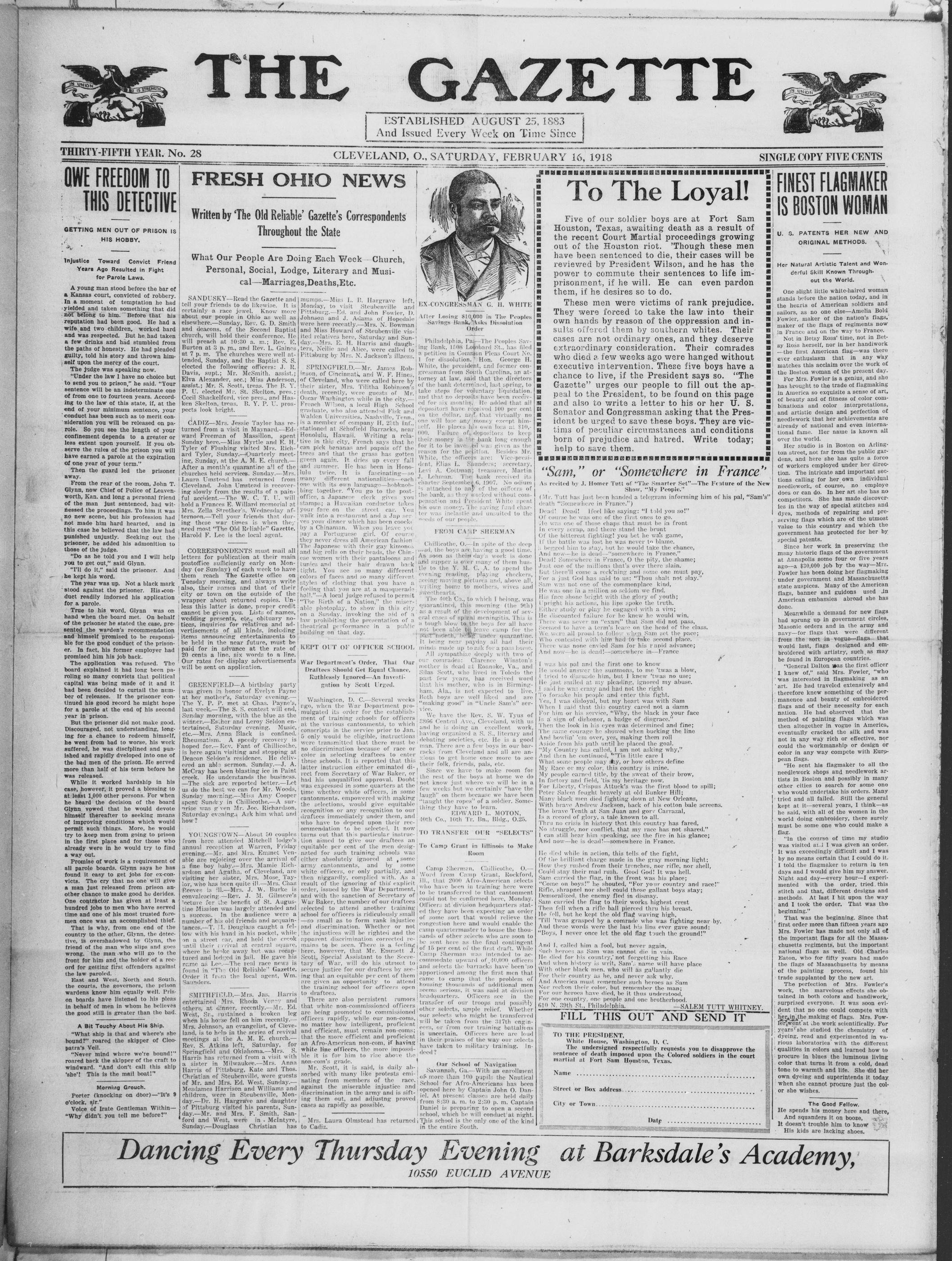
QWE FREEDOM TO THIS DETECTIVE
Injustice Toward Convict Friend Years Ago Resulted in Fight for Parole Laws.
A young man stood before the bar of a Kansas court, convicted of robbery. In a moment of temptation he had yielded and taken something that did not belong to him. Before that, his reputation had been good. He had a wife and two children, worked hard, and was respected. But he had taken a few drinks and had stumbled from the paths of honesty. He had pleaded guilty, told his story and thrown himself upon the mercy of the court.
The judge was speaking now.
"Under the law I have no choice but to send you to prison," he said. "Your sentence will be an indeterminate one of from one to fourteen years. According to the law of this state, if, at the end of your minimum sentence, your conduct has been such as to merit consideration you will be released on parole. So you see the length of your confinement depends to a greater or less extent upon yourself. If you observe the rules of the prison you will have earned a parole at the expiration of one year of your term."
Then the guard led the prisoner away.
From the rear of the room, John T. Glynn, now Chief of Police of Leuvenworth, Kan, and long a personal friend of the man just sentenced, had witnessed the proceedings. To him it was no new scene, but his profession had not made him hard hearted, and in this case he believed that the law had punished unjustly. Seeking out the prisoner, he added his admonition to those of the judge.
"Do as he told you and I, will help you to get out," said Glynn.
"I'll do it," said the prisoner. And he kept his word.
The year was up. Not a black mark stood against the prisoner. His conduct readily indorsed his application for a parole.
True to his word, Glynn was on hand when the board met. On behalf of the prisoner he stated the case, presented the warden's recommendation and himself promised to be responsible for the good conduct of the prisoner. In fact, his former employer had promised him his job back.
The application was refused. The board explained it had long been paroled so many convicts that political capital was being made of it and it had been decided to curtail the number of releases. If the prisoner continued his good record he might hope for a parole at the end of his second year in prison.
But the prisoner did not make good, Discouraged, not understanding, longing for a chance to redeem himself, he went from bad to worse, his work suffered, he was disciplined and punished and rapidly developed into one of the bad men of the prison. He served more than half of his term before he was released.
While it worked hardship in his case, however, it proved a blessing to at least 1,000 other persons. For when he heard the decision of the board Glynn vowed that he would devote himself thereafter to seeking means of improving conditions which would permit such things. More, he would try to keep men from going to prison in the first place and for those who already were in he would try to find a way out.
Promise of work is a requirement of all parole boards. Glynn says he has found it easy to get jobs for ex-convicts. The cry that no one will give a man just released from prison another chance to make good he derides. One contractor has given at least a hundred jobs to men who served time and one of his most trusted foremen once was an accomplished man. This is one end of the country to the other, Glynn, the detective, is overshadowed by Glynn, the friend of the man who slips and goes wrong, the man who will go to the front for him and the holder of a record for getting first offenders against the law paroled.
East and West, North and South, the courts, the governors, the prison wardens know him equally well. Prison boards have listened to his pleas in behalf of men in whom he believes the good still is greater than the bad.
Blt Touchy About His Ship.
"What ship is that and where's she bound?" roared the skipper of Cloppatra's Vell.
"Never mind where we're bound!" roared back the skipper of the craft to windward. "And don't call this ship 'she!' This is the mail boat!"
Morning Grouch.
Porter (knocking on door)—"It's 9 o'clock, sir."
Voice of frate Gentleman Within—"Why didn't you tell me before?"
THE GAZETTE
FRESH OHIO NEWS
What Our People Are Doing Each Week — Church, Personal, Social, Lodge, Literary and Musical—Marriages, Deaths, Etc.
SANDUSKY—Read the Gazette and tell your friends to do likewise. It is certainly a race jewel. Know more about our people in Ohio as well as elsewhere—Sunday, Rev. G. D. Smith and deacons, of the Second Baptist church, will hold their conference. He will preach at 10:30 a.m.; Rev. E. Burton at 3 p.m., and Rev. L. Gaines at 4 p.m. the churches were at tended Sunday, S. E. S. elected the following officers; J. R. Davis, supt.; Mr. McSmith, assist.; Elva Alexander, sec.; Miss Anderson, assist.; Mr. S. Scott, treas. The B. Y. P. U. elected Mr. St. Skelton, pres.; Cecil Shackelford, vice pres.; and Hasken Skelton, treas. B. Y. P. U. prospects look bright.
CADIZ—Mrs. Jessie Taylor has returned from a visit in Maynard—Ed. of Cleveland, who were called here their sister, Mrs. Tilitha Robinson death, were guests of Mrs. Oscar Washington while in the city. French Wilson, a local High School graduate, who also attended Fisk are Walden Universities, Nashville. Tour is a member of company B.21th in Schofield Barracks, near Houlton, Maine, in this city, French says that he can pick bennies and papais off the trees and that the grass has gotten green again. It dries up every day and summer. He has been in Houlton twice. It is fascinating—same with its own language—holiday together. You go to the post office to pick bennies and papais; stamps are a Hawaiian conductor to take your fare on the street car. You walk into a restaurant and a dap sees your dinner which has been cooked by a Chinaman. When you leave pay a Portuguese girl. Of course
CORRESPONDENTS must mail all letters for publication at their main postoffice sufficiently early on Monday (or Sunday) of each week to have them reach The Gazette office on Tuesday morning, and always write also, their names and that of their wrapper, in return copies. Unless this latter is done proper credit cannot be given you. Lists of names, wedding presents, etc., obituary notices, inquiries for relatives and advertisements of all kinds, including items announcing entertainments to be held in the near future, must be sent on a line. Our rates for display advertisements will be sent on application.
---
GREENFIELD—A birthday party was given in honor of Evelyn Payne at her mother's, Saturday evening.—The Y. P. p. met at Chas, Payne's last week.—The S. S. contest will end, Sunday morning, with the blue as the winner.—Escher and Leroy Seldon entertained, Saturday evening. Music, etc.—Mrs. Anna Black is confined, Rheumatism. A speedy recovery is hoped for.—Rev. Fant of Chillicothe, is here again visiting and stopping at Deacon Seldon's residence. He delivered an able sermon. Sue has joy and joy at the house, clusting in paint, creek he understands the business.—The sick are reported better.—Let us do the best we can for Mr. Woods. Sunday morning.—Miss Amy Cooper spent Sunday in Chillicothe.—A surprise was given Mr. Joe, Richardson, Saturday evening. Ask him what and how?
YOUNGSTOWN—About 50 couples from here attended Mitchell lodge's annual reception at Warren, Friday evening—Mr. and Mrs. Emmet Venable are rojoicing over the arrival of a fine boy baby—Mrs. Mamie Richardson and Agatha, of Cleveland, are visiting her sister, Mrs. Mose Taylor, who has been quite ill—Mrs. Chas Reeves is ill—Mrs. J. W. Burke is convalescing—Rev. J. M. Gilmore's lecture for the benefit of St. Augustine Mission was largely attended and a success. In the audience were a number of his old friends and acquaintances—T. J. Doughtas caught a white low with his hand in his chest while until their a rival in hold the creek until their a rival in central square, where he broke away but was recaptured and lodged in jail. He gave his name as Lee. The real race news is found in "The Old Reliable" Gazette, Order it from the local agent, Wm. Saunders.
SMITHFIELD—Mrs. Jas. Harris entertained Mrs. Rhoda View and others, at dinner, recently—Mr. Ed. West, Sr., sustained a broken leg when his horse fell on him recently. Mrs. Johnson, an evangelist, of Cleveland, is to help in the series of meetings with Mrs. Church of Akins left, Saturday, for Springfield and Oklahoma.—Mrs. S. Harris has returned from a visit with a sister in Milwaukee.—Mrs. Anna Harris of Pittsburg; Kate and Thos. Christian of Steubenville, were guests of Mr. and Mrs. Ed. West, Sunday.—Mesdames Harrison and Williams and children, were in Steubenville.—Mrs. Harrison and daughter of Pittsburg visited his parents, Sunday.—Mr. and Mrs. F. Smith, Sanford and West, were in, McIntyre, Sunday.—Douglass Christian has
ESTABLISHED. AUGUST 25,1883 And Issued Every Week on Time Since CLEVELAND, O., SATURDAY, FEBRUARY 16, 1918
mumps.—Miss L. B. Hargrove left, Monday, to visit Steubenville and Pittsburgh.—Ed. and John Fowler, D. Johnson and J. Adams of Hopdale were here recently.—Mrs. N. Bowman and Miss Howard of Steubenville visited relatives here, Saturday and Sunday.—Mrs. K. H. Harris and daughters, Nellie and Alice, were called to Pittsburgh by Mrs. N. Jackson's illness.
SPRINGFIELD—Mr. James Robinson, of Columbus, IN, and W. Hines, of Cleveland, who were called here by their sister, Mrs. Tilhia Robinson's death, recently, were guests of Mr. Oscar Washington while in the city—French Wilson, a local High School graduate, who also attended Fisk and Bunken Universities, Nassau, Tenn., is a student at Schofield Barracks, near Honolulu, Hawaii. Writing a relative in this city, French says that he can pick bananas and papas off the trees and that the grass has gotten green again. He dries up every fall and summer. He has been in Honolulu twice. It is fascinating—so nationalities—each with its own hangout, bringing together "You go to the postoffice, a Japanese clock giving you stamps; a Hawaiian conductor takes your fare on the street car." You walk into a restaurant and a Jap server your dinner which has been cooked by a Chinaman. When you leave you pay a Portuguese bill. Of course you pay a French bill. The Japanese with their gray kimonos and big robes on their backs, the Chinese women with their pantalons and their hair drawn thick tight. You see so many different colors of fares and so many different styles of clothing that you have a feeling that you are at a masquerade ball and just need to permit "The Birth of Nation." A photoboy, to show in this city on a Sunday, invoking the role of a law prohibiting the presentation of a theatrical performance in a public building on that day.
KEPT OUT OF OFFICER SCHOOL
War Department's Order, That Our Drafttees Should GetEqual Chance, Ruthlessly Ignored—An Investigation by Scott Urged.
Washington, D. C.—Sedental weeks ago, when the War Department prohagulated its order for the establishment of training schools for officers at the various contuments, to which conscripts in the service prohagated that there must be no discrimination because of race or color in selecting drafttees to enter these schools. It is reported that this latter instruction either eminated direct from Secretary of War Baker, or had his unqualified approval. Doubt was expressed in some quarters at the time whether white officers, in some contuments, empowered with making the selections, would give equitable recognition or any recognition to our drafttees immediately under them, and who have to depend upon their reservation.
turns out that this particular instruction aimed to give our drafters an equitable per cent, of the men designed for such training schools was either absolutely ignored at some army cantonments, and by some white officers, or only partially and then niggrally, complied with. As a result of the ignoring of this explicit order, issued by the War Department, and with the sanction of Secretary of War Baker, the number of drafters in the army school for officers is ridiculously small—so small as to form rank injustice and discrimination. Whether or not the injustices will be righted and the apportion discrimination corrected remains to be seen. There is a feeling here, however, that Mr. Emmett J. Scott, Special Assistant to the Secretary of War, will do his utmost to secure justice for our drafters by seeing that an equitable per cent of them are given an opportunity to attend the army school for officers open to drafters. There are also persistent rumors that white non-commissioned officers are being promoted to commissioned officers rapidly, while our non-coms, no matter how intelligent, proficient and efficient, must remain non-coms; that the more efficient and proficient an Afro-American non-com, if having white line officers, the more impossible it is for him to rise above the ranks. Mr. Scott, it is said, is daily absorbed with many, like protests eminating from members of the race, against the miserable injustice and discrimination in the army and is sifting them out, and adjusting proved cases as rapidly as possible.
Mrs. Laura Olmstead has returned to Cadiz.
EX-CONGRESSMAN G. D. WHITE
After Losing $10,000 in The Peoples
Savings Bank, Asks Dissolution
Order
Philadelphia, Pa.-The People's Savings Bank, 1608 Lloydhill St., has filed a petition in Corrion Pleas Court No. 1 for dissolution. Hon. George H. White, the president, and former congressman from South Carolina, an attorney at law, said that the directors of the bank determined, last spring, to take steps for voluntary liquidation, and that no deposits have been received for the bank. He requested 100 per cent on the dollar, and that virtually no one will have any money except himself. He pieces his own bank at $10,000. Failure of, depositors to keep their money in 'a bank long; enough for it to be inactive will give as the reason for the petition. Besides Mr. White, the officers are: Vice-president, Elias L. Saundee; secretary, Leif A. Contmnn; treasurer, Martin J. Leanne. The bank received $25,000 on June 6, 1907. No deposit was made on the bank, as they without compa-
sion and President White spent his own money, the saving final chapter was complete and unattended to the needs of our people.
FROM CAMP SHERMAN
Cildicothe, O. In spite of the deep land, the boys are having a good time. As soon as their day's work is done and sapper is no longer of their kind, to the Y. M. C. A. to spend the evening reading, playing checkers, keeping pictures and, about all, writing home to mothers, wives and grandchildren. Cs. to which I belong was guarded, this morning (the 31st) as a result of the development of several classes of spread meningitis. This is a tough blog to the boys for all have not been able to leave, camp for the next month, being under quarantine. It being new payday all had their minds made up to go for a pass home. All sympathize deeply with two of our cousins: Charlene Winston's mother is dead (Rosanne, Va., and Shaun Scott, who lived in Toltec the past few years, has received word that Bath boys are gifted and are "quaking good" in "indee Sam's" service.
I was his pal and the first one to know
He could answer the summons, to me 'twas a blow,
I tried to dissuade him, but I knew 'twas no use;
He just stumbled at my pleading, ignored my abuse.
I said he was crazy and had not the right
To forcake his people and enter this fight.
Yes, I was disloyal, but my heart was with Sam
When I said that this country cared not a damn
In his service, the service in your face
In a stint of dishearse, a badge of disgrace.
Then the look in his eyes was determined and fine;
The same courage he showed when bucking the line
And 'howlin' I am over, yes, making them roll
Aside from his path until he placed the goal.
"My Country has called, I am not asking why."
And then he continued, "Tis little care I
What some people may say, or how others define
My Race or my color, this country is mine.
My people earned title, by the sweat of their brow,
in history and field, 'tis my heritage now,
Lady Queen of England, blood to spill;
Peter Salmon fought bravely at old Bunker Hill;
Many black men died fighting down at New Orleans,
With brave Andrew Jackson, back of his cotton bale screens.
Is a record of glory, a tale known to all.
That no crisis in history that this country has fared,
No struggle, no conflict, that my race has not shared."
I can still hear his speaking, see the fire in his glance;
And now—he is dead!—somewhere in France.
We have the Rev. S. W. Tyus of 2866 Central Ave. Cleveland, with us and he is doing an excellent work, having organized a S. S. Literary and debating societies, etc. he is a good barracks' from Cleveland and all are anxious to get home once more to see their folk, friends, pals, etc. Since we have to make room for the rest of the boys at home we do not know just where we will be in a few weeks, but we certainly "have the laugh" on them because we have been "laughing" upon a soldier. Someone
10TH CO. 10TH TR. Ra. Hedges, 0.25
EDWARD L. MOTON
10TH CO. 10TH TR. Ra. Hedges, 0.25
TO TRANSFER OUR "SELECTS"
Camp Sherman, Calliehee, O.-Wood from Camp Grant, Rockford, ill., that 2000 Afro-American selects who have been in training here were to be transferred to that cantonment could not be confirmed here. Monday, Officer: at division headquarters stated they have been expecting an order of congratulation and congestion here and would enable the camp quartermaster to house the thousands of other selects who are soon to be sent here as the final contingent of 15 per cent of the first draft. While Camp Sherman was intended to accommodate upward of 10,000 officers, apportioned among the first men that came to camp that the problem of housing thousands of additional men seems serious, it was said at division headquarters. Officers see in the transfer of our troops and possibly other selects, ample relief. Whether officers will be taken or not the troops will be taken from the 317th engineers, or from our training battalions is uncertain. Officers here are loud in their praises of the way our selects have taken to military training. Indeed?
Our School of Navigation
Our School of Navigation
Savannah, Ga.—With an enrollment
of more than 400 pupils, the Nautical
School of Afro-Americans has been
opened here by *Cantonville John O. Daniel*
At present classes are held daily
from 8:30 a. m. to 2:30 p. m. *M. Captain
Daniel* is preparing to open a second
school, which he will conduct at night.
*This school is the only one of the kind
in the entire South.*
IN UNION IS STRENGTH
SINGLE COPY FIVE CENTS
To The Loyal!
Five of our soldier boys are at Fort Sam Houston, Texas, awaiting death as a result of the recent Court Martial proceedings, growing out of the Houston riot. Though these men have been sentenced to die, their cases will be reviewed by President Wilson, and he has the power to commute their sentences to life imprisonment, if he will. He can even pardon them, if he desires so to do.
U. S. PATENTS HER NEW AND ORIGINAL METHODS.
Her Natural Artistic Talent and Wonderful Skill Known Through-out the World.
One slight little white-haired woman stands before the nation today, and in the hearts of American soldiers and sailors, as no one else—Amelia Bold Fowler, maker of the nation's flags, maker of the flags of regiments, now in France and on the way to France.
These men were victims of rank prejudice. They were forced to take the law into their own hands by reason of the oppression and insults offered them by southern whites. Their cases are not ordinary ones, and they deserve extraordinary consideration. Their comrades who died a few weeks ago were hanged without executive intervention. These five boys have a chance to live, if the President says so. "The Guette" urges our people to fill out the appeal to the President, to be found on this page and also to write a letter to his or her U. S. Senator and Congressman asking that the President be urged to save these boys. They are victims of peculiar circumstances and conditions born of prejudice and hatred. Write today; help to save them.
Not in Betsy Ross' time, not in Betty Ross herself, nor in her hairstuff—the first American flag—was there ever enthusiasm that in any way matches this acclaim over the work of the Boston woman of the present day. For Mrs. Fowler is a genius, and she has brought to the trade of flagmaking in America so exquisite a sense of art, of beauty and of fitness of color combinations and color interpretations, and artistic design and perfection of needlework that her achievements are already of national and even international fame. Her name is known all over the world. Her studio is in Boston on Arlington street, not far from the public gardens, and here she has quite a force of workers employed under her direction, intricate and important sections calling for her own individual woodwork, of course, no employee does or can do. In her art she has no competitors. She has made discoveries in the way of special stitches and dyes, methods of repairing and preserving flags which are of the utmost value to this country and which the government has protected for her by special patents.
---
"Sam," or "Somewhere in France"
As recited by J. Homer Tutt of "The Smartier Set"—The Feature of the New Show, "My People."
Chr. Tutt has just been handed a telegram informing him of his pal, "Sam's" death "Somewhere in France."
Since her work in preserving: the many historic flags of the government at Annapolis some four or five years ago—a $20,000 job by the way—Mrs. Fowler has been doing her flagging under government and Massachusetts state auspices. Many of the American flags, banner and guildons used in American embassies abroad she has done.
Meanwhile a demand for new flags had sprung up in government circles, Masonic orders and in the army and navy—for flags that were different from the sort in vogue—flags that would last, flags designed—and embroidered with artistry, such, as may be found in European countries.
"General Dalton was the first officer I knew of," said Mrs. Fowler, "who was interested in flagmaking as an art. He had traveled extensively and therefore knew something of the permanence and beauty of embroidered flags and of their necessity for each nation. He had observed that the method of painting flags, which was then altogether in vogue in America, eventually cracked the silk and was not in any way rich or effective, nor could the workmanship or design or color in any way compete with European flags.
"He sent his flagmaker to all the needlework shops and needlework artists in Boston and possibly in many other cities to search for some one who would undertake his orders. Many tried and all failed. Still the general kept at it—several years, I think—as he said, with all the women in the world doing embroidery, there surely must be some one who could make a flag.
"In the course of time my studio was visited a.i. I was given an order. It was exceedingly difficult and I was by no means certain that I could do it. I told the flagmaker to return in ten days and I would give him my answer. Night and day—every hour—I experimented with the order, tried this stitch and that, different designs and methods. At last I hit upon the way and I took the order. That was the beginning."
That was the beginning. Since that first order more than fifteen years ago Mrs. Fowler has made not only all of the important flags for all the Massachusetts regiments, but the important national flags as well. Old Charles Eaton, who for fifty years had made the flags of Massachusetts by means of the painting—process, found his supplanted the flags of the Mrs. Fowler's work, the marvelous effects she obtained in both colors and handiwork surprised everyone. It was soon evident that no one could compete with her in the making of flags. Mrs. Fowler went at the work scientifically. For years she studied the chemistry, of dyeing, read and experimented in various laboratories with the different qualities in colors and learned how to procure in blues the luminous living color that turns it from a cold, dead tone to warmth and life. She did her own dyeing and superintends it today when she cannot procure just the color she wishes.
The Good Fellow.
He spends his money here and there,
And sandworms it on booze.
It doesn't trouble him to know
His kids are lacking shoes.
The GAZETTE
PUBLISHED EVERY SATURDAY
One Year $1.50
Six Months 1.00
Three months 5.00
Subscribers are requested to remit
postoffice money order or registered letter
Entered at the postoffice in Cleve land, Ohio, as second-class mail matter.
THE GAZETTE,
Blackstone Building, Cleveland, O.
Member Ohio Legislature: 1894
to 1896; 1896 to 1898; 1900 to 1902
THE GAZETTE is the oldest, and has the largest bona fide circulation, double that of any newspaper in the interest of Afro-Americans, published in the state of Ohio, and comparison with any will immediately establish its rank as one of the NEWS-EST AND BEST in the country.
10,000,000 Afro-Americans.
300,000 in Ohio.
25,000 in Cleveland.
SATURADY, FEBRUARY 16, 1918
PREJUDICE
"Any prejudice whatever will be insurmountable if those who do not share in it themselves truckle to it and flatter it and accept it is, a law of nature."—John Stuart Mill.
"Let us have faith that right makes might, and in that faith let us to the end dare to do our duty as we understand it." Abraham Lincoln.
Wouldn't it be a little more warlike if we had a man at the head of the War Department who was a little less sanguine and more sanguinary? Secretary of War Baker is a past master in the use of the future tense.
Fuel Administrator Garfield eliminated most of the South, Monday from the observance of his heatless day order. This is sectionalism with a vengeance. And, too, on the order of an Ohioan, but one burdened with the official influence of an administration controlled by southern democracy.
On the "Garfield" heatless days all the thirty-seven furniture factories in Grand Rapids, Mich., are shut down. Thereby they saved six tons of coal. The shutdown cost the factories $22,000 and the employees $40,000. This was at the rate of over $10,000 a ton. Senator Smith of that state says this was the highest price ever paid for coal in this country.
U. S. Senators Chamberlain and Hitchcock, chairman and second member, respectively, of the Senate Military Affairs Committee, aver that all is not going well in the conduct of the war. President Thomas Woodrow Wilson and Secretary of War Newton D. Baker aver that all is well. All are members of the same political party, the Democratic party. Naturally the people are worried as to what are the exact conditions. A coalition cabinet, wilt all partisanship eliminated, would do much to do away with concern and dubiousness among the people.
Dr. Booker T. Washington, when president of the National Business League, tried to raise money enough to clear the Frederick Douglass home, at Anacostia, D. C., from a debt of $5,000 or $8,000, and failed! This reflects upon our men, particularly members of that organization, and not upon Dr. Washington or his memory. Along comes "mere woman," years afterward, in the person of Mrs. Mary B. Talbert, of Buffalo, N. Y., bucked by our national woman's organization of which she is president, raises the money, clears the home of debt, and makes it a permanent headquarters for her organization. This is only another of the many demonstrations showing why men simply must take off their hats to women.
"The Birth of a Nation" is showing at the Academy of Music, Brooklyn, N. Y., and in other cities of the country. In view of its baneful effect upon the enthusiasm, patriotism and loyalty of the Afro-American whom it harms greatly wherever it is exhibited because of its tremendous encouragement of racial prejudice, it seems to us that the President and the Secretary of War should regard it as a duty they owe the country, particularly at this time, to put the infamous film out of business: Therefore, we call upon our special representative in the War Department, Mr. Emmet J. Scott, special assistant to Secretary of War Newton D. Baker, to take up this matter with his chief at the earliest possible moment with a view to eliminating the miserable photoplay.
Gilbert M. Hitchcock, Democratic senator from Nebraska, is 58 years of age. He was born in Omaha. Spent two years in study in German univer-
ities. Was graduated from the law department of Ann Arbor. Is the publisher of the Omaha World-Herald. Served three terms in the House in Congress, and is now upon his Second term in the U. S. Senate. He has always been a consistent supporter of all the administration measures of President Thomas Woodrow Wilson. He is the second member on the Committee of Military affairs and participated in the investigation made by that committee into war conditions. With Chairman Chamberlain he holds that the progress of the preparation for war is defective. This Secretary of War Baker flatly denies and his statement was recently given to the public. Facts however developed in the investigation, support the Chamberlain-Hitchcock side of this very important democratic controversy.
WILL STOP EMIGRATION
WILL STOP EMIGRATION
In our issue of Jan. 26, 1918, we called attention to the government's "peremptory directions" through its department of labor to "many industrial concerns (in the North) to cease widespread advertising (in the South) for help because "it was unsettling the labor supply (there) and working hardship on individuals (who lost the labor and) who answered the advertisements." The government's control of railroads was all that was necessary, with the foregoing, to "put a stop" to the emigration of our people from the South to the North, as was the case, last Spring, particularly. Watch and see it done, this Spring! Thousands of our men who went South last Fall and later, to spend the winter only, will find it impossible to purchase tickets to the North when they attempt to return in the Spring. The southern appeal, last year, to Washington, to stop emigration was not made in vain.
The promptness with which the War Department tries to reorganize its incompetent bureau, as each disclosure of the investigating committee makes public some new weakness, is sufficient proof that there should have been a joint bi-partisan congressional committee on the conduct of the war. That committee should have been created on the day war was declared. Nearly every important reform in the War Department has been forced by public criticism or by congressional investigation. Each concession to public demand is one more link in the chain of evidence that convicts the Department of incompetence. The Department denies incompetence and then proceeds to do, in a half heartbeat way, what the disclosures prove should have been done at the beginning. If that joint congressional committee had been established and had been active from the day we entered the war, there would have been a great saving of time, money, suffering and life.
THE BUILDERS.
Republicans are of the constructive type of statesmanship because their habits of thought are constructive. "As a man thinketh, so is he," is a truth recognized by philosophers from time whereof the memory of man runneth not to the contrary. Republicans have been builders not destroyers. The fundamental characteristic of a Republican policy from the beginning of the party organization was advocacy of building up industries in America. There have been other issues also constructive, but that has been the constant and supreme test of Republicanism. It has been a live and let live policy. Republicans of the North have advocated measures which would build up the industries of the South. Republicans of the East have favored legislation that would promote the industries of the West. The men who have supported constructive policies in government have been following constructive occupations in private life. Constructiveness, like self-preservation is the first law of their nature. That is why Republicans make good legislators, good executives and good judicial officers. They build, rather than tear down.
PHYLLIS WATERS' POSITION
And Her Splendid Record While at School.
Washington, D. C.—Miss Phyllis Wheatley Waters, the talented daughter of Mr. and Mrs. Phil Waters, of Charleston, W. Va., was recently appointed an instructor of French in the department of University of modern languages of Howard University. She is a graduate of the University of Michigan, and forget her course in the college and in the high school at Ann Arbor she was a favorite with teachers and classmates. Miss Waters has the distinction of being the first girl of the race in the history of the university to win her letters in athletics, and for several terms was captain of the basketball team of the institution. She finished with high honors in the class of 1917.
Headed for West Point!
Dayton, O.-Byron Alexander, 17 of this city, has been named by Congressman Warren Gard as the appointee from this Congressional district to West Point (N. Y.), Military academy. Young Alexander, who graduated last year, from Stivers high school, passed the preliminary test for a cadetship held here with the highest honor, outstripping all the young white men who were examined and anxious for the appointment.
THE GAZETTE, CLEVELAND, OHIO. FEBRUARY 16, 1918.
DOINGS OF THE RACE
Approximately one-eleventh of America's army, when the full strength is sent to France, will be Afro-American troops.
The Hon. W. H. Lewis, of Boston, former assistant U. S. attorney general, will deliver the commencement address to the graduating classes of Wilberforce university in June.
If the former 15th N. Y. N. G. regiment is "somewhere in France," where are the former Eighth Illinois regiment and Ninth Ohio Battalion? It looks as if the boys are really "over there."
The second officers' training camp has been opened at San Juan, Porto Rico with 400 student candidates. Of these 100 are colored. May 1 drafted men will be called for training at the cantonment there.
Again Robert R. Church, Jr., politi cal leader of Nashville, Tenn., has "wiped up the floor" with the "lily white" "white," in whose wake has come much of the woe the Republican party in the South has suffered for many years.
The 317th Engineers Regiment is all Afro-Americans up to the rank of major. It needs $300 more toward the purchase of band instruments. Our people of Cincinnati raised $600 for the purpose by giving a benefit-recital.
There are 113,000 Negroes in the cantonments, and of the Colored men in the cotton fields all went out on a strike tomorrow and stopped the supply of the staple needed for all clothing and ammunition, the eagles of Germany would be triumphant.—Rev. Robert Patton, (white), of New Orleans, La.
Mrs. Chas. W. Filmore, wife of a former major of the Ninth Ohio Battalion, who is captain of Co. B, 15th N. Y. regiment, now a part of the New National Army, dropped dead at their home in N. Y. City, last week. Interment at her old home in Xenia, Capt. Filmore is "somewhere in France."
Never before has such interest been manifested by the public at large in downing a segregation propaganda as was shown last week when the defender warned the citizens of Chicago that he opposed "jin-crow" Kappa Alpha Pi fraternity, now in embryo at the University of Chicago. —Chicago Defender
The Boston Post published an article recently giving the experiences of some of the American boys who are now fighting in France, but who first enlisted in the "Foreign Legion" under French colors. Great praise was given a group of thirteen, ten white and three colored, who left the "Foreign Legion" to fight for Uncle Sam. Of our boys the article says: "As for the colored boys in the regiment, he declared they are upholding the honor and tradition of the legion in every battle. John F. Brown of Boston and James Bracey of Newport News, Va., remain. A third, Henry Walker, was wounded on the Somme, get the Croix de Guerre, and was honorably discharged. Confidentially, my informant, Barry, whispered to me: 'You can't heat the colored boys for patrol work at night. They crawl right into the German lines.' 'They are brother Legionnaires,' says Moyet.
One of Our Physicians Honored
Muncie, Ind.-Dr. Charles A. Martin has just been elected vice president of the local board of health. Dr. Martin formerly taught school in New Albany but has lived here several years. He is a brother-in-law of Lieut. M. A. Blackburn, of Louisville.
Own Property Worth $20,000,000
New York City—In a recent article in the Fargo Mail, John E. Nail, of the well known real estate firm of Nail and Parker, gave detailed facts and figures showing that our citizens of Greater New York own realty valued at $20,000,000.
Lack of Accommodations
Lack of Accommodations.
Decatur, Ala.—Alabama selectmen who are included in the second call will not be ordered out until April 1. in the opinion of Adjunct General Hubbard. He has stated that there were at present 4,000 of our men of the first call in the black belt of Alabama who had not been sent to the training, camps for lack of accommodations.
Wishes He'd Known of It Before
Jones, Okla., Feb. 1, '18.
Editor Gazette: I just received a copy of your splendid paper and I must admit that it is among the leading papers of this country for our race. It is simply fine; the bold news it carries is worthy of any citizen's reading. I believe The Gazette to be a true race paper and wish I had known of it before now. I am enclosing one dollar for a six months' subscription and I hope to induce my friends to subscribe for it, also.
Yours for the uplift of the race,
WM. A. ARMSTRONG.
CORRESPONDENTS WANTED
The old reliable Gazette desires an active agent and correspondent in every city and town in Ohio and neighboring states having a number of Afro-American residents. Only a little time on Fridays or Saturdays is required.
We are especially destruous of hearing from persons in the following named cities: Springfield, Dayton, Piqua, Mt. Vernon, East Liverpool, Akron, Lima, O., and other places, particularly in Ohio, where we have none.
Write to the editor of The Gazette, Blackstone building, Cleveland, O., and terms will be sent promptly. Our readers will oblige us greatly by sending at once the addresses of persons in the cities named and others in the state; to whom we can write relative to the matter.
Subscribe Now!
OLD VETS RECALL RAIDS BY INDIANS
As Boys They Suffered Beatings at Hands of Savages, Whited Friends Were Slain.
Rock Springs, Texas. — Two old-timers may here in few days ago, W. C. Riggs, now of Colorado, who "struck it rich" and is now touring Texas hunting up his old friends and relatives, came to see his friend, D. M. Eims, or, as his friends call him, "Indian Davie."
Mr. Riggs, who was born in Izard County, Arkansas, came to Texas when a small boy with his parents, John and Jane Riggs, settled near Sugarloaf Mountain, 18 miles from Delton, in 1837. Mr. Eims said:
"I also am an Arkansas lawyer. My parents came to Texas, settled in Washington County in 1847, moved to Belt County in 1850, and of all the things I have seen the murder by the Indians of Mr. and Ms. John Riggs is most indelibly stamped on my memory. I was a boy about 12 years old. John Riggs and I started after some散页 posts to fence our field. We had only gone a short distance when we were overtaken by fifteen Indians.
The first one that came up spoke to us in English and said, 'How do you do?' As the others came up they formed a circle around us and began to club us with cow tails, holding the bush of the tail in their hands. We stood the punishment quite a while. Mr. Riggs started toward his home in a run, followed by a number of the Indians. Some of the Indians continued to punish him, the others laughing and shouting, suddenly very much amused. The three left with me seemed to have just lots of fun, punishing me in various ways, took off my clothing and divided the garments up among themselves.
"We could hear the other Indians yelling and those left with me went off in that direction. I then became frightened and ran my level best in the opposite direction to Alex Reid's place, three and a half miles away. When about half-way, I met Mr. Reid's brother riding a horse and leading another, which I mounted, and we went to Mr. Reid's and reported what had happened.
"Mr. Riggs had a brother at home and, being unarmed, ran for help. When the few neighbors gathered at the Riggs home they found the dead bodies of Mr. and Mrs. Riggs; some 200 yards from the house—the baby crawling over its dead mother.
"W. C. Riggs, then a small boy, run and hid in the tall grass. The two girls, Roda and Margaret, were carried away prisoners. In the afternoon the girls witnessed the killing of George Pevey at Douglas Mountain, near where the town of Killain, now stands. In their haste to get away they dropped the girls and left them. The girls spent the night alone on the prairie, but next morning went to a vacant house and were found by John B. Slack. Just prior to the killing of Mr. and Mrs. Riggest the Indians killed Young Pierce." "Uncle Davie" timidly removed his hat and exhibited scars, the result of the beating he received.
After the death of his parents, the baby and the present Mr. Riggs and two sisters made their home with their grandparents and uncles — Grandina Roda and Grandpa Thomas, Branick and James Riggs. They first settled near Salado, then in Bandaera County at Cave Mountain near Medina Dam. The old home is now owned by Mrs. John Leboldt. The Indians gave them a great deal of trouble, stealing their horses and killing their cattle. So the Riggs family, assisted by Frank Fox, built a large stockade, commonly known as Fort Riggs. The walls were double, filled between with dirt, and on top they planted cactus. They had no wagons or horses and the stone was hauled on slides pulled by oxen. Grandpa Riggs was drowned in the Medina River and is buried near where Lee D. Montell now lives.
The hair of these old-timers is now whitened by the many winters, but their minds are clear, and many are the stories of hardship and adventures of the early settlers and their personal experience and observation; and not many summers will pass until they cross over the river to join their friends and relatives in the "happy hunting grounds."
MAKES FEET OF PAPER PULP
Doctor's Idea to Meet Needs of Crippled Soldiers.
The uses to which paper and paper pulp are being put are constantly increasing in number. At present there are paper furniture, paper cloth, paper silks and clothes, and even paper legs.
Now Dr. Svindt, of Denmark, who is responsible for the artificial leg of papier-mache, has brought forward a paper foot, intended to meet the needs of the crippled soldiers. These feet are said to be strong enough to withstand ordinary usage, and they have the added advantage of being cheap. A model of the foot is made of wire gauze, and upon this is poured a specially prepared pulp which entirely fills the interstices of the model.
San Antonio, Tex.—Feb. 18 or 20 is now the tentative date set for the third court martial of 40 more fortunate members of the 21st U. S. Infantry, to be held at Fort Sam Houston: This sort of thing should be stopped.
THE FUEL VALUE OF WOOD.
Persons who plan to relieve the coal shortage by burning wood can figure, roughly speaking, that two pounds of seasoned wood have a fuel value equal to one pound of coal, according to experts of the Forest Service. While different kinds of wood have different fuel values, the foresters say that in general the greater the dry weight of a non-resinous wood, the more heat it will give out when burned.
For such species as hickory, oak, beech, birch, hard maple, ash, locust, longleaf, pine or cherry, which have comparatively high fuel values, one cord, weighing about 4,900 pounds, is required to equal one ton of coal.
It takes a cord and a half of short-leaf pine, hemlock, red gum, Douglas fir, sycamore, or soft maple, which weighs about 3,000 pounds a cord, to equal a ton of coal, while for cedar, redwood, "poplar, catalpa, Norway pine, cypress basswood, spruce, and white pine, two cords, weighing about 2,000 pounds each, are required.
Weight for weight, however, there is very little difference between various species. Resin affords about twice as much heat as wood, so that resinous woods, and this increased value varies, of course, with the resin content.
The available heat value of a cord of wood depends also on the amount of moisture present. When the wood is green part of the heat which it is capable of yielding is taken up in evaporating the water. The greater amount of water in the wood the more heat is lost.
Furthermore, cords 'vary as to the amount of solid wood they contain, even when they are of the standard dimensions and occupy 128 cubic feet of space. A certain proportion of this space is made up of air spaces between the sticks, and this air space may be considered in a cord of twisted, crooked, and knotty sticks. Out of the 128 cubic feet, a fair average of solid wood is about 80 cubic feet. This, however, applies to the standard cord, in which the sticks are cut to four-foot lengths and piled 4 feet high and 8 feet long. Instead of buying the four-foot lengths, however, most people nowadays have the sticks cut in two-foot lengths by a gasoline saw. This results in a saving of both time and labor. The purchaser should, however, take care to see that he gets full measurement when wood is bought in this way. In parts of New England a stack of 16-inch wood 4 feet high and 8 feet long is commonly sold as a "run," but contains only one-third of a cord.
Where wood is to be burned in a stove or furnace intended for coal, it will be found desirable, the foresters say, to cover the grate parly with sheet iron or fire brick, in order to reduce the draught. If this is not done the wood is wasted by being consumed too fast, and makes a very hot fire which in a furnace may damage the fire box.
It is pointed out, however, that heat value is not the only test of usefulness in fuel wood and* since 35 per cent of all wood used for fuel is consumed for domestic purposes, largely in farm houses, such factors as rapidity of burning and ease of lighting are important. Each section of the country has its favored woods and these are said to use, is general, the right ones to use. Hickory, of the non-resinous wood, has the highest fuel value per unit volume of wood, and has other advantages. It burns evenly, and, as housewives say, holds the heat. The oaks come next, followed by beech, birch and maple. The white pines have a relatively low heat value per unit volume, but have other advantages. They ignite readily and give out a quick hot flame, but one that soon dies down. This makes them favorites with rural housekeepers as a summer wood, because they are particularly adapted for hot days in the kitchen. The same is true of gray birch, or "white birch," as it is often called, in the regions in which it abounds. With the resinous pines a drawback is their oily black smoke.
Clocks That Strike Thirteen
Clocks That Strike Thirteenth.
Among the curious clocks in the world, says Harper's Weekly, are two in Worsley, Lancashire, England, that never strike one. Instead they strike thirteenth at 1 a.m. and 1 p.m. One of them is over the Earl of Elsenecrea place called Worsley Hall, and is the original clock which the Duke of Bridgewater had placed in the tower. It is said that the duke had the clock made to strike the "unlucky" number so as to warn his workmen that it was time to return after dinner, some of them having excused themselves for being late on the ground that they could not hear it strike one.
Where Men Are Scarce
Where Men Are Scarce.
Maude—The vicar says there is no
marrying in Heaven.
Mabel — Of course not. There
wouldn't be enough men to go around.
Making Her Think.
Grace — I didn't accept Walter the
first time he proposed.
Gladys—No, dearie; you weren't
there.
"Worse than that. He's down to the point where nobody will lend him money any more."
The ukulele, Hawai'i national musical instrument, is growing quite popular in the United States. A California music company has received orders for 1,000, which it has been unable to fill. A single order of this house to a Honolulu manufacturer was for 166 ukuleles.
Our advertisers want your trade. Those who do not ask for it in The Gazette certainly care little, if at all, for it. Therefore, we urge our readers and all our friends to patronize those who ask for your trade in this paper.
CENTRAL SHIRT SHOP
A RACE ENTERPRISE
G. J. TATE, Proprietor.
GENTS' FURNISHINGS, NECKWEAR,
Hosiery, Underwear and Arrow Collars and Shirts, Hats, Caps, etc
2922 CENTRAL AVE.
Phone Prospect 441-J.
PATRONIZE
JOE HEDGES' POOL ROOM
3048 Central Ave.
One of the Best in the city. Everybody Welcome!
Buy A Home and Stop Paying Rent
See or Call
A.I.GORDON, Real Estate Dealer
2363 E. 87th St.
* 2201 East 33rd St.
Chickens, Turkeys & Ducks for Sale
Prices Reasonable
Office and Funeral Parlors
3022 CENTRAL AVE.
Autos for All Occasions. Calls Answered Day and Night
3035 Central Avenue
Wm.Brack,Prop. Frank Doctor, M
James Mabel, Chef
WHEN YOU ARE THIRSTY
AND WANT A REFRESHING DRINK-ORDER
rank Doctor, Manager
label, Chef
Wm.Brack,Prop. Frank Doctor, Manager James Mabel, Chef
WHEN YOU ARE THIRSTY
AND WANT A REFRESHING DRINK—ORDER
BEVIERA
This is the popular, non-intoxicating beverage that is
good in every way. Every drop is healthful, strength-
ening and PURE. Order by the box from any drug-
gist, grocer, confectioner or soda fountain — or
phone Harvard 730. Prompt delivery service to any
part of Cleveland.
The Leisy Company Cleveland
"OLD SIGNS DO NOT DECEIVE"
Watch out for these three.
This is the popular, non-intoxicating beverage that is good in every way. Every drop is healthful, strengthening and PURE. Order by the box from any drug-gist, grocer, confectioner or soda fountain — or phone Harvard 730. Prompt delivery service to any part of Cleveland.
The Leisy Company Cleveland
"OLD SIGNS DO NOT DECEIVE"
Watch out for these three.
PALMER'S
SKIN-SUCCESS
Ointment
PALMER'S
HAIR-SUCCESS
Dressing
PALMER'S
SKIN-SUCCESS
Soap
They stand for Merit and Reputation
This Ointment successfully used for eighty in thousands of cases of skin troubles
The Only ORIGINAL Complexion Brighter
At all druggists, or sent by mail upon receipt of price, 25¢ each.
Made Only By
erit and Reputation.
fully used for eighty years,
cases of skin troubles.
Complexion Brightener.
or sent by mail
of price, 25¢ each.
Only By
This Ointment successfully used for eighty years,
in thousands of cases of skin troubles.
The Only ORIGINAL Complexion Brightener.
At all druggists, or sent by mail
upon receipt of price, 25¢ each.
Made Only By
The Morgan Drug C
1512 Atlantic Ave., Brooklyn, N. Y.
Beware of Substitutes and Imitations. They may
dangerous. Look for the Melon-Colored packages and
Trade Marks.
Brooklyn, N. Y. Imitations. They may be selon-Colored packages and our
Beware of Substitutes and Imitations. They may be dangerous. Look for the Melon-Colored packages and our Trade Marks.
Stories upon Stories
—with high ideals
12 Glorious Serials or Group Stories and 250 Shorter Stories and every one with "lift" in it.
The Youth's Companion
Indispensable in quality, lavish in quantity
—no other publication in the world like it.
this ablest Editorials written, Articles
knowledgable authorities, Current Events,
Boy's Page, Girl's Page, Children's
run of the world's choicest fun.
—not 12—$2.00
UNION, BOSTON, MASS.
of this paper with $2.00 for The Companion for
and we will send you
of 1918.
1917 Weekly Issues FREE.
in Home Calendar for 1918.
THE 1918 PROGRAMME includes the ablest Editorialists written by the world's brightest men and acknowledged authorities. Currier Nature and Science, Family Page, Boys' Page, Girls' Page, Page, Doctor's Corner and a constant run of the world's choices.
52 Issues a Year—not 12—$2.00
THE YOUTH'S COMPANION, BOSTON, MASS.
CUT
THIS
OUT
Send this coupon (or the name of this paper) with $2.00 for The Companion 1918 and we will send you.
1. 52 ISSUES of 1918.
2. All remaining 1917 Weekly Issues B.
3. The Companion Home Calendar for
THE 1918 PROGRAMME includes the ablest Editorials written, Articles by the world's brightest men and acknowledged authorities, Current Events, Nature and Science, Family Page, Boys' Page, Girls' Page, Children's Page, Doctor's Corner and a constant run of the world's choicest fun.
CUT
THIS
OUT
Send this coupon (or the name of this paper) with $2.00 for The Companion for
It is and we will send you
1. 52 ISSUES of 1918.
2. All remaining 1917 Weekly Issues FREE.
3. The Companion Home Calendar for 1918.
SUBSCRIPTIONS RECEIVED AT THIS OFFICE
(11)
PAIMER'S SKIN SUCCESS Ointment
TheYouth's Companion
Indispensable in quality, lavis in quantity—no other publication in the world like it.
LIMONERO
BEVERO
CERVEJA
CERVEJA COBERTA
PALMER'S
SKIN SUCCESS
Soap
Your Doctor Gives you a Prescription
And You Want it Filled
Just Right—
Take It To
The Owl Drug Store
Cor. Central Ave. & E. 38th St.
G.S. is guaranteed for one bot-
tle to benefit any case of
pellagra, rheumatism,
eczema, scrofula or any blood,
liver or kidney disease, or your
dollar returned and no questions asked;
you take two bottles between
today and next, 1, 1918, and you
receive no benefit, the visit of
same, I will refund your $2,000
give you $1,00 free. Why experiment?
Take a remedy with wonderful merits
A trial is all I ask you to give G.S.
Sold by all druggists or sent prepaid. Price $1.00, or six for $5.00. Call on your druggist for G. S. before you order from me. Write for testimonials.
L. M. GROSS
721 Spring St. Little Rock, Ark.
The Pride of Carolina
The State Agricultural and Mechanical College of South Carolina
Orangeburg, S. C.
Next session begins September 20th and ends May 31st, 1918.
No Tuition, no Room Rent, no Charges for Water, Lights or Fuel. Entrance Fee $10.00.
Board $8.00 per Month in Advance. Books, Laundry and Personal Expenses Extra.
Every Modern Facility. Standard Equipment. A Faculty of 57 Officers and instructors
For information and Catalogue, Write.
H. S. WILKINSON, Pres.
Orangeburg, S. C.
KINKY
F
Emekto Medical Co., the
Gentlemen's Boutique. I bought
Emekto Gentlemen's Quinine
Pomade, thick, chick, and warm,
but you have the proven do-
tice in place. It will do it
and all that you can do it
up to your heart. And you can
smell my picture to know you
have grown it. SALLY USED.
Don't let none Lake Kink. Removes fool
you. You really want to remove your hair
mud and loosen it. Gentlemen's
Boutique.
EXELENTO QUININE
POMADE
does, removes Dandruff, feeds the Books of
the haint, milts can grow long, soft and
allergic. After tanning, it will be so pretty and long that you can fix it
up to suit you. If Exelento does as
we claim, we will give your money back.
Price 25c by mail on second of stamps
or coin.
ARENTS WANTED EVERYWHERE.
We're for medicals.
EXELENTO MEDICAL CO., Emekto, C.
HAIR Invigorator and Grower
Stop, Look, Read!
When I started using Mme. C. H. Jones' Hair Invigorator and Grower, my hair was but one inch long. After using it only one year, my hair is to my shoulders. Charlotte Smith The C. C. C. Hair Co. 353 WOOLAND AVENUE Home Phone, BT218 TOLEDO, OHIO AGENTS WANTED—Stamp for reply Subscribe Now!
---
Where to Purchase The Gazette
*OPEN*
NOTICE TO
Subscribers not receiving T
us at once. We desire every copy
Send or bring locals and all
office, 214-115 Blackstone Bldg.
there, please.
We advise our readers to ca
vertiseements before making pu
tise in this paper should have a
fact that they advertise is assu
All matters for publication
must be in the office by 4 p. m.,
latest.
Classified Advertising
... Department ...
NOTICE TO SUBSCRIBERS
Subscribers not receiving The Gazette regularly should notify us at once. We desire every copy delivered promptly.
Send or bring locals and all business matters to The Gazette's office, 214-215 Blackstone Bldg. If you wish to see the editor call there, please.
We advise our readers to carefully examine The Gazette's advertisements before making purchases. Business men who advertise in this paper should have the patronage of our people. The fact that they advertise is assurance that they want it.
All matters for publication in current issues of The Gazette must be in the office by 4 p. m., WEDNESDAY of that week, at the latest.
FOR RENT —Furnished rooms with gas range to cook on; extra kitchen, at 2385 West 41st St. This is a splendid opportunity.
CLUB NOTICE — The Working Men's Social and Literary club meets, every Friday evening, for business and gives a dance, every Monday night, in hall, 8103 Scocovill Ave. H. P. Williams, pres. 8040 Cooring Ave. L. V. Orton, sec. 2667 E. 40th St. Milton Watkins, chairman, 2524 E. 30th St.
CLEVELAND Social and Personal
Mrs. Mamie Richardson is visiting a sister in Youngstown.
The Optimistic Club met, Wednesday, at Mrs. M. J. Wilson's, W, 110th St.
Mrs. John M. Mann, 2488 E. 39th St., who has been ill, several weeks, with heart trouble, is better.
It is said that Nahum Brasher has been succeeded as state organizer of the Ohio Welfare Association.
Central Ave., the past week, has been like its street cars and street car service - BAD! VERY BAD!
Mrs. Wm. Owley, who was the guest of Mrs. John Cossey, E. 34th St., returned to Chicago Wednesday.
Rumor has it that Clarence Davis and Syd Thompson are in the midst of a political squabble in the City's street-cleaning department.
Thurman W. C. T. U. will hold its next regular meeting at Mrs. Wm. Guy's, 1058 Frank Ave., Tuesday at 7:30 p.m. Mrs. H. K. Price, pres.
Miss Hazel Weaver, of the East End, graduate of the normal department of Howard University, Washington, D. C., was married recently in New York City.
Do not allow your landlords to take adva tage of you in the matter of rentals, etc., but come to The Gazette office when you have troubles of that kind.
Help save those five soldier boys of the 21th Infantry by writing to President Wilson as suggested elsewhere in this paper. "Do your bit!!"
You should take PURO HERBS, the great blood purifier and system cleanser. On sale only at the Brown Drug Co., 2742 Central Ave., cor. E. 28th St.-Adv.
Mrs. C. H. Hedgepath, who left the city, Sunday afternoon, after ten days' visit in the city, the guest of Mrs. D. Offer of Pine Ave., was on route to Akron from Indiapolis.
Mrs. Lisa Thompson Sampson, accounted for who children has, has returned to Jacksonville, to join her husband Prof. George Sampson, principal of our high school there.
Patronize those who advertise in the Gazette. They ask and are entitled to your trade because they want it and will treat you better than others who do not advertise in this paper. Dr. C. F. Dunn, graduate of the Officers' Training School, Des Moines, Ia., has returned to Columbus after several months' stay here. He contemplates locating in Cleveland after the war.
Rev. Irving K. Merchant is the new pastor of Mt Zion Cong, church. Rev. G. V. Clark, pastor a number of years, retired some time ago. The S. S. has elected Felix Harding as its superintendent. Wm. Seldon of 2707 Central Ave. wishes to know the name and address of the man who was in Hatcher's barbershop on Feb. 8, at the time a man abused him, using obscene language. The person in question will oblige Mr. Seldon greatly by calling on him at once—Adv.
Two indictments for first decree murder were among the thirty-four returned by the county grand jury last week Friday. One was a bill of first degree murder against Clarence Ray, 2736 Central Ave., who is accused of shooting Edward Harris, a fellow roomer, on Dec. 31, 1977.
"Subscribe for "The Old Reliable' Gazette and get all the news of the race, each week. If you see it in the Gazette you can depend upon its being reliable news and not camouflage as is the case with much that you read, these days, in race papers that are 'using' the sensational daily press. The East End Social club's masquerade, Thursday evening, at Barksdale's Academy proved a most enjoyable affair, the outstanding feature of which was "The Bugle Trot," a beautiful new dance. It is to be repeated next Thursday evening, at the same place for the benefit of all others who wish to learn it. Mr. Barksdale is certainly an artist in his line.
The Phillis Wheatley Association has begun a campaign for $25,000 to remodel and furnish its recently purchased home at 2265 E. 40th St. A domestic science department to train girls for domestic work will be one of the features of the new home. It will also accommodate 100 boarding girls, just twice as many as the association's former home.
J. S. Hall's
3121 Central Ave.
J. E. BRANHAM'S
4219 Central Ave.
*ERNEST P. JACKSON'S
3969 Central Ave.
O. HAMILTON,
3957 Central Ave.
JACKSON'S,
4401 Central Ave.
*DR. WEAVER'S
3315 Central Ave.
*A. GORDON'S
2928 Central Ave.
*MRS. BESSIE KITZMILLER'S
3943 Central Ave.
*S. LEVIN,
3102 Central Ave.
W. T. GRANT,
3512 Central Ave.
*OPEN SUNDAYS.
Mrs. Alzada Johnson, age 54, 8912 Kenmore Ave, died, Feb. 10, after more than a year's affliction. A husband, Thos W. Johnson, two daughters, Alice and Elizabeth, and a large circle of friends here and in the East mourn her demise. Rev. G. V. Clark, who knew the deceased 20 years ago in her native city, Boston, preached the funeral.
Many people are wondering if the Ministers' Alliance which issued the call for a "humiliation and prayer (meeting) at Shiloh Baptist church, Monday, Feb. 11, 1918," intended it for the especial benefit of those three ministers who took ten dollars each from "Starlight" Boyd when they and the rest of the Alliance were fighting the renewal of "Stars" saloon license.
The Peace Pageant at Gray's armory, given last week was a practical failure in point of attendance, it is said. There are a number of good reasons for this, not the least of which was the failure of its promoters to properly advertise it. Some people may learn after awhile that "The Old Reliable" Gazette is also invaluable as an advertising medium.
James H. Garland, age 87, 8812 Blaine Ave., a veteran (corporal) of the war of the rebellion and for four years a councilman of his home city (in Pennsylvania) before coming to Cleveland in 1904, died. Feb. 2, 1918, after several years' affliction. A wife, two sons, Charles F. and James H., and a daughter, the wife of Justice of the Peace James T. Young of Chareroi, Pa., survive him and have the sympathy of the community.
Miss Lizzie Hamilton, of Cedar Ave., desires to thank St. John's S. S. Vashti class, the Helping Hand society, and other friends, including members and attendants of Antioch Baptist church, for their untiring kindness and courtesies at the time of her recent bereavement—the death of her aunt, Miss Fannie Couts. Miss Hamilton asks for prayers and says she is very lonesome without her aunt.
Southern students attending the University of Chicago have at last succeeded in obtaining the approval of the student committee on activities of that institution to establish a Jim Crow fraternity. It is to be deeply regretted that a clique of students seeking self-aggrandizement will take the first step in advancing the principles of segregation and caste at such a notable institution as the University of Chicago—Chicago Defender.
Those persons, some of whom are still "grumbling" about it, who were induced, some months ago, to subscribe for, and take part in a contest of a local publication, which was advertising two automobiles (a touring car and a roadster), a victrola and a building lot, should demand the return of their subscription money and get it, or place the matter in the hands of the proper (U. S.) authorities.
A Negro who was born in Germany is not classed as an alien enemy and does not have to register. This interpretation of the alien registration proclamation was made last week Thursday by a clerk in the Americanization bureau at the courthouse, when appealed to. Oswald Fentress said he was born in Germany in 1896 while his parents were there with a carnival company, and that he had been told he would have to register. He lives in a construction camp house under the Harvard-Denison bridge.
The Pageant of Peace, given to a small audience at Grays Army, last week Tuesday evening, met with many "stormy winds" before being staged, it seems. Robert Drake, director and impersonator of and one of the principal characters, resigned abruptly about two weeks ago because he observed that the actions of the affair going to state and local Welfare Associations when it had been originally announced that they were to go toward building a "guest house" at Chiliicothe, it is said. Only about 400 attended the pageant.
The services at St. Mark's Presbyterian church were well attended, Sunday, and the S. s. was interesting, Rev. W. W. Todd delivered an excellent sermon. The church is growing, a number of new members are being added at each service. Sunday, Wm. R. Conners, executive secretary of our local Welfare association, will deliver an address at 4 p. m. The public is cordially invited. St. Mark's church and S. s. services are being held in the Woodland Ave. Presbyterian church, Con. E. 46th St. and Woodland Ave. The entrance is on E. 46th St. S. S. hour 2 p. m.
Garret A. Morgan's invention, a hood saving life under heavy gas or water pressure, has been officially tried out at two Atlantic seaports by agents of the government, and the Morgan firm received a large order late last week Wednesday. The hood was tried in a submerged submarine. Morgan saved many lives last spring during the fatal crib explosion here, and was "euchered" out of a Carnegie Hero medal by designing and prejudiced white persons, it is said. Victor Sinecree, sunt, of the Bailey Co., and other prominent Jews, are interested in the Morgan Co., it is said.
Mrs. Esther Irving Cooper, of Ft. Myer, Va., a native of this city and for several years, years ago, stenographer in The Gazette office, writes
THE GAZETTE, CLEVELAND, OHIO, FEBRUARY 16, 1918.
zette
that her husband is now a first lieutenant and supply officer of the 367th regiment stationed at Camp Upton, N. Y. He was commissioned, early last fall, De Keesen Iowa, but prior to that had been connected with the quartermaster's department at Washington, D. C., for years. Lieut. and Mrs. Cooper have two fine girl babies, the youngest six months old, a splendid photograph of whom was sent to the editor of The Gazette. Mrs. Cooper, for many years one of the best stenographers in the government departments at Washington, D. C., is a sister of Mrs. Lottie Gordon of Gibson Ave., S. E. She may visit her old home in this city, this summer. Many friends will be more than pleased to see her and the children.
The following is from Ludwig Woltmann's "Politische Anthropologie," published in 1903: "The Teutonic race is called to circle the earth with its rule, to exploit the treasures of nature and of human labor power, and to make the passive races servient elements in its cultural development. * * * whoever has the characteristics of the Teutonic race is superior. All the dark people are mentally inferior, because they belong to the passive races. The cultural value of a nation is measured by the quantity of Teutonism it contains." Comment, on the foregoing, is unnecessary.
St. James A. M. E. church, Hudson Ave., is enjoying a period of prosperity. The services are well attended and every department of the church seems to have taken on more life. Last Sunday was "Founder's Day." The program was in charge of the Adams-Ramsey Men's Guild. In the morning, the pastor spoke on "The Life, Character and Work of Richard Allen"; in the evening, fine addresses were made by R. Koiner, S. Williams, G. Washington and F. I. Ballard, and music was rendered by a men's chorus. Miss Airilic Payne has accepted the position of choir leader and organist. The S. under Supt. F. E. Young is enjoying rapid growth, the attendance, Sunday, being 110 and the collection $8.34. The school is outgrowing its course and several classes, with new teachers, have been added. A number of strangers worshipped at St. James, Sunday. The monthly financial report shows a substantial increase. "The Trustee Helpers" held a Lincoln birthday social, Tuesday evening. The stewardesses have added several members to the board and reorganized.
R339
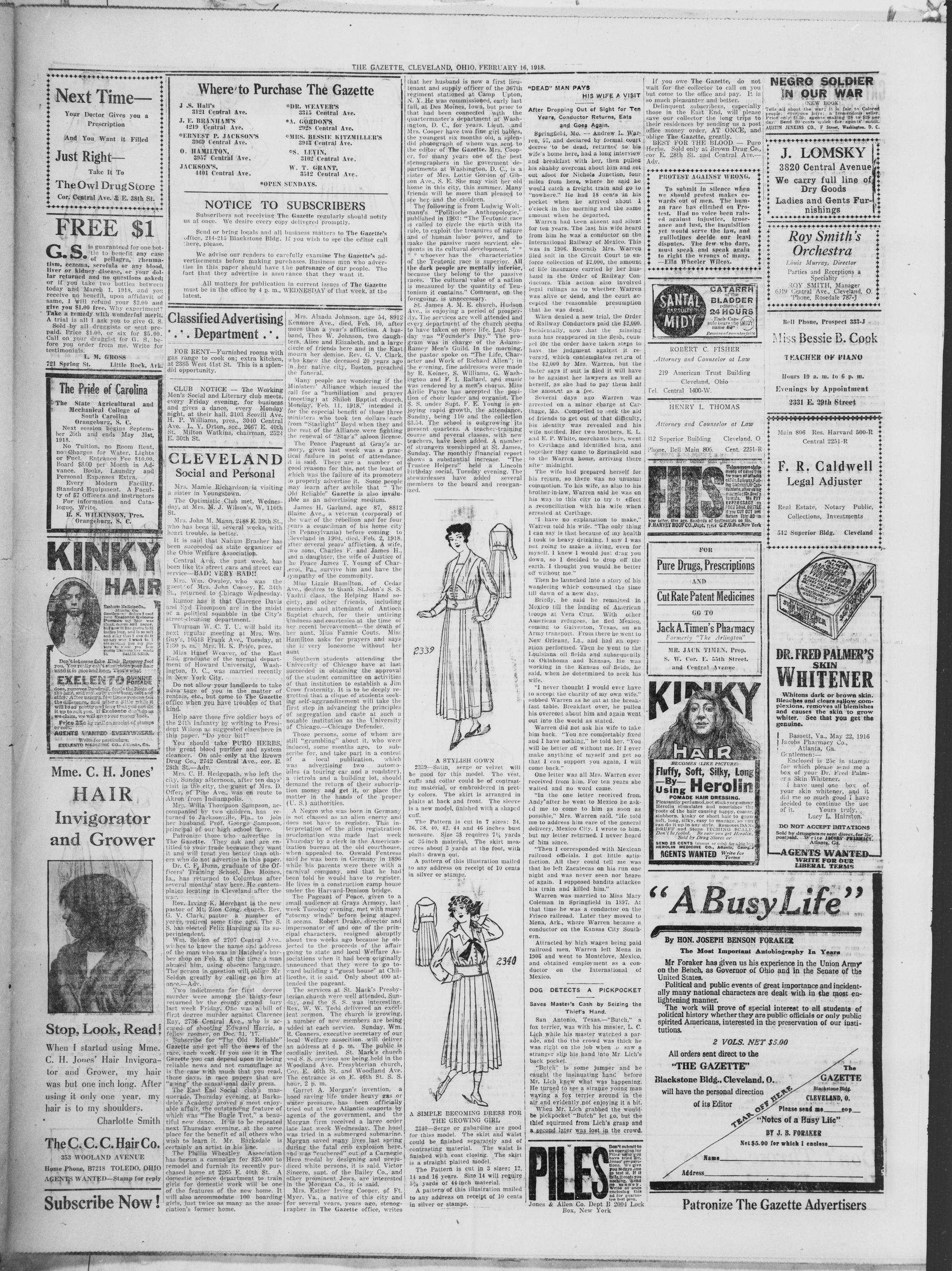
2339—Satin, serge or velvet will be good for this model. The vest, cuffs and collar could be of contrasting material, or embroidered in pretty colors. The skirt is arranged in plaits at back and front. The sleeve is a new model, finished with a shaped cuff.
The Pattern is cut in 7 sizes: 34, 36, 38, 40, 42, 44 and 46 inches bust measure. Size 33 requires $7\frac{1}{4}$ yards of 36-inch material. The skirt measures about 3 yards at the foot, with plaits drawn quit.
A pattern of this illustration mailed to any address on receipt of 10 cents in silver or stampe.
2340
A SIMPLE BECOMING DRESS FOR
THE GROWING GIRL
2340—Serge or gabardine are good
for this model. The skirt and waist
could be finished separately and of
contrasting material. The waist is
finished with coat closing. The skirt
is a straight plaited model.
The Pattern is cut in 3 sizes: 12,
14 and 16 years. Size 14 will require
5½ yards of 44-inch material.
A pattern of this illustration mailed
to any address on receipt of 10 cents
in silver or stamps.
After Dropping Out of Sight for Ten Years, Conductor Returns, Eats and Goes Again.
Springfield, Mo. — Andrew L. Warren, 57, and declared by formal court decree to be dead, returned to his wife's home here, had a long interview and breakfast with her, then pulled his shabby overcoat about him and set out afoot for Nichols Junction, four miles from here, where he said he would catch a freight train and go to "nowhere." He had 18 cents in his pocket when he arrived about 1 o'clock in the morning and the same amount when he departed.
Warren had been absent and silent for ten years. The last his wife heard from him he was a conductor on the International Railway of Mexico. This was in 1906. Recently Mrs. Warren filed suit in the Circuit Court to enforce collection of the $2,000, the amount of life insurance carried by her husband in the Order of Railway Conductors. This action also involved legal rulings as to whether Warren was alive or dead, and the court accepted the reasonable presumption that he was dead.
When denied a new trial, the Order of Railway Conductors paid the $2,000. Incidentally, now that the missing man has reappeared in the flesh, counsel for the order have taken steps to have the judgment against it reversed, which contemplates return of the $2,000 by Mrs. Warren, but the latter says if suit is filed it will have to be against her lawyers as well as herself, as she had to pay them half the amount as a fee.
Several days ago Warren was arrested on a minor charge at Carthage, Mo. Compelled to seek the aid of friends to get out of that difficulty, his identity was revealed and his wife notified. Her two brothers, E. L. and E. P. White, merchants here, went to Carthage and identified him, and together they came to Springfield and to the Warren home, arriving there after midnight.
The wife had prepared herself for his return, so there was no unusual commotion. To his wife, as also to his brother-in-law, Warren said he was on his way to this city to try to effect a reconciliation with his wife when arrested at Carthage.
"I have no explanation to make," Warren told his wife. "The only thing I can say is that because of my health I took to heavy drinking, I saw I was not going to make a living, even for myself. I knew I would drag you down, so I decided to drop off the earth. I thought you would be better off without me."
Then he launched into a story of his wandering which consumed the time till dawn of a new day.
Briefly, he said he remained in Mexico till the landing of American troops at Vera Cruz. With other American refugees, he fled Mexico, coming to Galveston, Texas, on an Army transport. From there he went to New Orleans, La., and had an operation performed. Then he went to the Louisiana oil fields and subsequently to Oklahoma and Kansas. He was working in the Kansas oil fields, he said, when he determined to seek his wife.
"I never thought I would ever have to accept the charity of my own wife," sobbed Warren as he sat at the breakfast table. Breakfast over, he pulled his overcoat about him and again went out into the world as stated.
Warren did not ask his wife to take him back. "You are comfortably fixed and I have nothing," he told her. "You will be better off without me. If I ever make anything of myself and get so that I can support you again, I will come back."
One letter was all Mrs. Warren ever received from him. For ten years she waited and no word came.
"In the one letter received from Andy' after he went to Mexico he asked me to come to him as soon as possible," Mrs. Warren said. "He told me to address him care of the general delivery, Mexico City. I wrote to him, but my letter returned. I never heard of him since.
"Then I corresponded with Mexican railroad officials. I got little satisfaction. All they could tell me was that he left Zacatecas on his run one night and was never seen nor hear of again. I supposed bandits attackee his train and killed him."
Warren was married to Miss Mary Coleman in Springfield in 1897. At that time he was a conductor on the Frisco railroad. Later they moved to Mena, Ark., where Warren became a conductor on the Kansas City Southern.
Attracted by high wages being paid railroad men, Warren left Mena in 1806 and went to Montelove, Mexico, and obtained employment as a conductor on the International of Mexico.
DOG DETECTS A PICKPOCKET
Saves Master's Cash by Seizing the Thief's Hand.
San Antonio, Texas.—"Butch," a fox terrier, was with his master, L. C. Lich while his master watched a parade, and the crowd was thick he was right on the job when he saw a stranger slip his hand into Mr. Lich's back pocket.
"Butch" is some jumper and he caught the insinuating hand, before Mr. Lich knew what was happening. He turned to see a strange young man waving a fox terrier around in the air and evidently not enjoying it a bit. When Mr. Lich grabbed the would-be pickpocket "Butch" let go, but the thief squirmed from Lich's grasp and a second later was lost in the crowd.
PILES
Don't submit to an operative you have no longer preparations. We give you money to test it. If it fails, it costs you cash. Soon we are on eve. When it complains, enclosing this ad for guaranty fees.
Jones & Allen Co. Dept B 2001 Lock
Box, New York
Tell all about the war; it is fair to Colored people; everyone boys; a tremendous seller; everyone girls; agents making money for the day; Send 200 agents to AUSTIN JENKINS CO. F, Street, Washington, D. C.
F. R. Caldwell
Legal Adjuster
FTS
We have sworn statements of cause free from all liability of FTS, Eclipse, Fulfing Sickness, or Co-
nrolled with any of our services (PaLM's formula). We PAY EXPRESSAGE on FIRST REMAIN OUTLE
if you CUT OUT and Return THIS AD in
your letter. Give age. Kindness of testimonials on file.
F.HARVEY ROOF CO.,Degt. 1144 G.P.O.Box,New York
FOR
Pure Drugs, Prescriptions
AND
Cut Rate Patent Medicines
GO TO
DR. FRED PALMER'S SKIN WHITENER
"A Busy L
yLife" ORAKER autobiography In Years experience in the Union Army Ohio and in the Senate of the
"ABusyLife"
By HON. JOSEPH BENSON FORAKER
The Most Important Autobiography
Mr Foraker has given us his experiences on the Bench, as Governor of Ohio and the United States.
Political and public events of great importance many national characters are dealt with lightening manner.
The work will prove of special interest political history whether they are public or spirited Americans, interested in the present tutions.
2 VOLS. NET $5.00
All orders sent direct to the
"THE GAZETTE"
The Most Important Autobiography In Years
Mr Foraker has given us his experience in the Union Army on the Bench, as Governor of Ohio and in the Senate of the United States.
Political and public events of great importance and incidentally many national characters are dealt with in the most enlightening manner.
The work will prove of special interest to all students of political history whether they are public officials or only public spirited Americans, interested in the preservation of our institutions.
All orders sent direct to the
"THE GAZETTE"
Blackstone Bldg., Cleveland, O.
will have the personal direction of its Editor
TEAR OFF HERE
The GAZETTE
Blackstone Bldg.
CLEVELAND, O.
Please send me ___ eop
"Notes of a Busy Life"
BY J. B. FORAKER
Net $5.00 for which I enclose ___
Name ___
Address ___
If you owe The Gazette, do not wait for the collector to call on you but come to the office and pay. It is so much pleasanter and better.
Delinquent subscribers, especially those in the East End, will please save our collector the long trips to their residences by sending us a post office money order, AT ONCE, and oblige The Gazette, greatly.
BEST FOR THE BLOOD — Puro Herbs. Sold only at Brown Drug Co., cor E. 28th St. and Central Ave.— Ady.
PROTEST AGAINST WRONG.
To submit in silence when we should protest makes cowards out of men. The human race has climbed on Protest. Had no voice been raised against injustice, ignorance and lust, the inquisition and guillotines decide our least disputes. The few who dare must speak and speak again to right the wrongs of many. —Ella Wheeler Wilcox.
SANTAL
CAPSULES
MIDY
CATARRH
of the
BLADDER
relieved in
24 HOURS
Each Cap
sule bears the
name 44
Beauty of counterfeits
SANTAL
CARPULS
MIDY
CATARRH
of the
BLADDER
reached in
24 HOURS
Each Carpul
bears the (MIDY)
name 40.
Bearer of counterfeits
ROBERT C. FISHER
Attorney and Counselor at Law
219 American Trust Building
Cleveland, Ohio
Tel. Central 1400-W.
HENRY L. THOMAS
Attorney and Counselor at Law
112 Superior Building Cleveland, O.
Phone, Bell Main 806. Cent. 2251-R
Pure Drugs, Prescriptions
Jack A.Timen's Pharmacy
Formerly "The Arlington"
MR. JACK TIMEN, Prop.
S. W. Cor. E. 55th Street.
and Central Avenue
KINKY
HAIR
BECOMES (LIKE PICTURE)
Fluffy, Soft, Silky, Long
—By—
Using Herolin
POMADE HAIR DRESSING.
Please wear thick stockings.
Herolin stimulates and helps the roots of the hair causing nappy, coarse, slick, kinky or short hair to grow soft, long and easy to wear. Removes DANE DRAFFE and Stops ITCHING SCALP.
Don't bleach. Sold by Drug stores or
HEROLIN MEDICINE CO., Atlanta, George J.
AGENTS WANTED Write for
J. LOMSKY
3820 Central Avenue
We carry full line of
Dry Goods
Ladies and Gents Furnishings
Roy Smith's
Orchestra
Louis Murray, Director
Parties and Receptions a
Speciality
ROY SMITH, Manager
6319 Central Ave., Cleveland, O.
Phone, Rosedale 787-J
Miss Bessie B. Cook
TEACHER OF PIANO
Hours 19 a. m. to 6 p. m.
Evenings by Appointment
2331 E. 29th Street
Main 806 Res. Harvard 500-R
Central 2251-R
Real Estate, Notary Public, Collections, Investments 512 Superior Bldg. Cleveland
POTTERY
WASHEN
WASHENNER
ASSOCIATION OF WASHENNERS
STREET AND WEST BROADWAY
WASHENNEN CO.
415 WASHENNEN ST.
WASHENNEN, NY 10501
501 GARAGE
WASHENNEN
501 GARAGE
WASHENNEN
Whitens dark or brown skin
Bleaches and clears sallow complexions, removes all blemishes and causes the skin to grow whiter. See that you get the genuine.
Bassett, Va., May 22, 1916
Jacobs Pharmacy Co.
Atlanta, Ga.
Gentlemen:
Enclosed is 25c in stamps for which please send me a box of your Dr. Bed Palmers Skin Whitener.
I have used one box of your skin whitener, and it did me so much good I have decided to continue the use of it.
Yours truly,
Lucy L. Hairston.
DO NOT ACCEPT IMITATIONS
Sold by druggists or sent direct, for 25c, postpaid. Write JACOBS PHARMACY.
Atlanta, Ga.
AGENTS WANTED
WRITE FOR OUR LIBERAL TERMS
Don't Throw Away Your Copy of THE GAZETTE After Reading it, but Give It to a Friend or an Acquaintance who Might Subscribe after Reading a Copy of It
CAT FIGHTS EAGLE AND DOES IT WELL FUR AND FEATHERS FLY FAST AND FURIOUS.
Tom Comes Back Again and Again,
a Regular Glutton for Punishment
—Boy Declares "Draw."
Springfield, Mo. — While piowing
near here William Ford witnessed a
thrilling fight between a cat and an
eagle. It was claws and beak against
claws and teeth, and resulted in a
draw.
Farmer Ford saw what at first he
took to be a chicken hawk sweeping
down on his barnyard. He thought
it was after a chicken and stepped to
the fence. Closer inspection revealed
that it was an eagle.
The bird swooped, struck and rose,
but, to the farmer's surprise, it held in
its talons not a chicken, but his large
tom cat. The eagle held the cat by
the back. The cat's four feet were
extended and its tail pointed toward the
zenith.
Forty feet from the ground the car gave a twist, wriggled from the grasp of the bird and fell to the earth seemingly unhurt. The bird circled and made another swoop but this time the cat was waiting for its featheread adversary, and, when the bird struck things happened. For about three minutes the air was full of fur and feathers.
The eagle withdrew baffled, to a distance of about fifteen feet, dragging one wing. The cat had its back high in the air, and both cat and eagle were hissing and spitting. Finally the cat crouched and began to creep slowly and steadily toward the eagle, its tail dragging. It's fighting blood was up.
The eagle stood with one foot lifted, turning its head from side to side, the better to observe its adversary The feathers on its neck were ruffled The cat hugged the ground a little closer and then sprang. it evidently expected the eagle to attempt to leap to one side, for is legs were far apart The cat, however, made a mistake The eagle turned on its back and drove its talons into the cat's breast and tried to strike it in the eyes, with its beak. The cat missed the bird's neck and got its wing. Then the an again became filled with fur and feathers.
The farmer's little son had seen the encounter from the front of the house, and ran as fast as he could to ward the scene. He was afraid his "pussy" was going to be carried off. His shout frightened the cat and it released its hold for a minute; the bird struggled free, ran about twenty feet and launched itself with a heavy wing and badly battered plumage into flight. The cat climbed the fence mewed, licked its bloody breast and mewed again, eyeing its fleeing adversary with baleful eye and switching tail.
-MAN'S HEART SENT
ACROSS THE OCEAN
Pasadena, Cal. — At her hotel in this city, the Countess Blanca de Ovies eagerly awaits news of the safe arrival in Spain of probably the strongest package that has left by ship from New York to take its chances with German submarines.
To comply with the letter of the Spanish law, and to receive an inheritance, the countess is sending the embalmed heart of her late husband to be buried in Spain soil. Her arrangement for the peculiar transaction were made during the last month since the countess has been a guest in this city.
The count died six years ago in Atlanta, Ga., and at that time the body was prepared with the view of sending the heart to Spain at this time. The count and the countess were natives of Spain and both were exiled because of political differences with the ruling authorities. The count owned a vast estate in Spain, which can come into the possession of the countess after she has complied with the peculiar Spanish law.
In his will the count left minute instructions telling the countess just how to proceed in complying with the law. A slow legal development in Spain, conducted at the expenditure of a small fortune, made it unnecessary to carry out the strange burial rites until this time.
The countess in an interview the other day told of her husband's adventurous life. When he was 12 years old he was stolen by bandits, and a ransom demanded. When the ransom was not forthcoming, the lad was abandoned in a forest after both his hands had been nailed to a tree. In 1876 he was exiled from Spain for taking part in the Carlist rebellion, and became a wanderer in many lands.
NO MORE PICKING UP OF NAILS
Magnetized Clip Now Does It For Carpenters.
A device to save carpenters from picking up nails has been invented. It consists of magnetized clips, which the carpenter fastens to his fingers and which draw the nails to his hands.
Good liars are scarce, but some liars are very skillful.
Animal Gives Battle When Women
Try to Drive It Away.
Los Angeles, Cal. — A spy suspect,
loitering around the home of Mrs. W.
C. Burke of Halldale avenue, is still
imprisoned in Mrs. Burke's garage.
The subject is a stray dog that
appeared at the Burke residence and,
after attempting to demolish the garden,
attacked and ate two American
flags.
Mrs. Burke became aware of the
goat first when she heard a loud
commotion on the front porch. It proved
to be the goat lunching on a young
peach tree at the edge of the porch.
Mrs. Burke endeavored to coax it
away. As a protest it tore around the
garden till it tipped the two American
flags on the garage. Without hesitation
it began to eat the flags.
The daughter made a dash to rescue the Stars and Stripes and it was then that the goat became a spy suspect. For at her appearance it charged in and finally butted her so far away from the garage that it managed to swallow the last bit of flag before she could counter-charge. Finally, however, with the aid of neighbors, the goat was driven into the garage and firmly tied. But Mrs. Burke and her daughter hope the allies of the goat will come and ger it.
Real Housekeeping Articles Handed Out With License.
Wichita, Kan.—This city claims the prize in trade boosting experiments. It is offering a bonus to every bride who gets married within the city limits.
It matters not to the merchants of the city whether the bride or groom live or have ever lived in Wichita. They may come from any place on earth, but if they get a marriage license at the office of the Probate Court and have a justice or a preacher marry them, the bride will have a little package presented to her as a wedding gift from the merchants of the city.
The bonuses are not stingy little advertising novelties, either. They are real housekeeping articles. They are a good sized sack of real flour, shoes, jewelry, ribbons, tea, knives, bricabrac, and many other articles that any girl will need when she starts housekeeping.
Not all of these are in every package, but there have been 1,000 brides' packages made up by the different merchants, and not less than five useful articles with a total value of $8 to $10 is placed in every package. Of course each article has the name of the donor and the whole scheme is purely a form of advertising.
BIRD BUILDS NEST
UPON COW' BACK
Cow Being Unable to Stand, Barn
Sparrow Clings to its Home
Barn
Bennett, N. Y. One day last week Abner Snowden had a cow which mired in the swamp. At 5 o'clock when the cow did not come to the barn with the other animals Mr. Snowden and his hired man went to the swamp and found her. The cow was dug out and it was found that the left hind leg was so badly sprained that she could not step on it. The cow was loaded on a stoneboat and drawn to the barnyard. A veterinary was called, examined the leg, and as he found no broken bones it was decided not to kill the animal. The leg was bandaged and the cow has not stood on her feet, since.
Since then the bird has laid four eggs in the nest and is now sitting on the eggs. The bird does not leave the nest when Snowden or his helper feeds the cow.
HUSBAND DRAGS WOMAN
OUT OF CHURCH BY HAIR
Omaha Man Knocks Down Two Neighbors Seeking to Aid Wife Then Is Arrested.
Omaha, Neb.-Lon E. Pryor, 2632 Chicago Street, objected to his wife attending religious services.
When he came home the other night and found his better half out, he went to the Pentecostal Mission, 1723 Cunning street, and disrupted services by dragging her out, witnesses said, by her hair.
All the way home, witnesses said, he abused her and threatened a number of the congregation who followed them, if they interfered.
When L. Morris, a neighbor, rushed in to the Pryor household in answer to shrieks of "help" and "murder" from Mrs. Pryor, he was knocked down and forced to retreat.
Undaunted, Francis McGovern, another neighbor, entered the house. He received a cracked lip.
The whole neighborhood was aroused and police were summoned.
Before officers arrived, Pryor escaped. Shortly before the officers left he returned, took down an army rifle and threatened his wife with instant death. The officers were called again and Pryor was arrested before he could carry out his intention.
Mrs. Pryor said her husband always objected to her going to services, the he insisted that she say grace at meals."
THE GAZETTE, CLEVELAND, OH IO, FEBRUARY 16, 1918
ALLEGED WOMAN
FAKED ROBBERIES
Houston Man in Divorce Petition Asks For Custody of Their Child Houston, Tex. — Mrs. Mary McKaskle, a bride of two months, has been sued by Clarence W. McKaskle for a divorce. At the same time and in the same court a former husband sued her for the possession of their 18-months-old child.
Mrs. McKaskle is a beautiful young woman whose recent performances have had Houston's police force guessing. She has reported five successive burglaries in the McKaskle home in as many weeks. All these burglaries were alleged to have taken place in the day-time, and on one occasion Mrs. McKaskle was found in a fainting condition from apparent fright, she having called her husband by telephone from his work in the Union National Bank. The furniture was thrown around in a promiscuous fashion, there were stains looking like blood about the floor and an overturned bottle of carbolic acid was found which Mrs. McKaskle asserted a burglar attempted to force down her throat.
Mckaskle alleges in his petition for divorce that his wife developed ideas without a parallell in human history. "Ideas of imaginary murders, suicides, burglaries and other crimes frequently possess Mrs. McKaskle," read the petition for divorce. "If she rehearses a sensational burglary, she poses and plays as the victim, pretends to lose valuables, to have been knocked down, ill treated and abused. "The vulgar gaze of a curious public was trained upon the privacy of our home when the daily newspapers of Houston published glaring headlines, such as: "Bride, 19, Found in a Faint." "Says Man Sought Her Life." "When the police discovered that the supposed burglaries had not been committed, Mrs. McKaskle was quoted as saying she was merely testing the love of her husband for herself.
Parents of Mrs. McKaskle declared that the bride had pawned jewelry to purchase necessary supplies and had then resorted to what amounted to mere practical jokes.
The suit filed for the custody of the child by the former husband, J. Russell Winston, also asks for an injunction restraining Mr. and Mrs. Clarence McKaskle from removing from Harris County, Texas, Frances Rebecca Winston, 18 months of age. The child had been awarded to her custody at the time she was divorced from Winston last September, one month before she married McKaskle.
Apology for Violation of Boycott:
Angers Mothers and Hair-pulling
Match Results.
Boston, Mass. — Mrs. May Levine
ate an onion. The other night the
meeting of the Maiden Mothers' Lea-
gue in Bryant Hall, was converted into
a hair-pulling session and almost
ended in a riot as a result.
As Eve partook of the forbidden
fruit in the garden, so did Mrs. Levine
allow a gnawing desire for an onion
to cause her to fall from grace in the
Mothers' League. For, be it known,
the delectable and detectable onion
is among the forbidden "fruits" in a
boycott the club has started.
If Mrs. Levine had not been one of the important pickets in a recent siege of grocers her indiscretion might not have assumed such alarming proportions. But when she publicly confessed that the call of the onion had proved irresistible, her apology proved poor balm for the wounded feelings of her dumfounded compatriots.
A commotion followed, during which cries of sympathizers to the effect of: "Have a heart; maybe an onion's her weakness," only served to enrage the feelings of others.
Whether it was pure envy or a matter of principle, nobody took time to state. There was a generous reach for convenient heads and the squeals that followed showed that considerable enthusiasm was employed in tugging the crowning joy of woman.
The matter was finally arbitrated along the lines of every woman having a weak moment at least once in her life and of the irresistible qualities of the impressive and fragrant onion.
But the meeting did not close until a committee of five had been appointed to obtain a list of names and addresses of every person buying boycotted food with the avowed purpose of refusing to allow their children to play with the children of the non-boycotters.
"SMELLER" LOCATES OIL WELL
He "Scents" Metals Also by Walking Over Ground
Wichita Falls, Texas.—Henry Zachary, an "oil smoker," was employed to locate the well of the Uncle Luke Wilson Oil Company on a lease on the Wilson ranch in the Archer district. He is said to be gifted with super sensitive olfactory nerves which enable him to buried oil or metals by simply passing over the ground.
SEES FORTUNE IN OLD VIOLIN
Civil War Veteran Said to Own Genuine "Strad."
Sussex, N. J.-Mahon P. Johnson, a civil war veteran, recently got out an old oil given to him by his grandfather in 1847. An expert in such matters discovered on the inside of the instrument the inscription "Antonio Stradivarius, Cremonii Facibet, Anno 1730." It is now valued at from $10,000 to $30,000.
?338
A STYLE SIMPLE AND EASY TO DEVELOP
2338—This model is good for cashmere, serge, albatross, satin, silk and for all wash fabrics. The front is closed over a stay with lacing or buttons. The sleeve may be in wrist or elbow length.
The Pattern is cut in 4 sizes: 2, 4, 6 and 8 years. Size 6 requires 3 yards of 36-inch material.
A pattern of this illustration mailed to any address on receipt of 10 cents in silver or stamps.
2337
A SPLENDID DRESS FOR SCHOOL OR GENERAL WEAR
2337 - Gingham, galatea, chambray, drill, linen, khaki, serge, garadine, corduroy, velvet, and satin may be used for this style. The front are reversible and overlap at the center, with the belt sections or sash ends joined to the front edges and holding the fulness over sides and back.
The Pattern is cut in 4 sizes: 8, 10, 12 and 14 years. Size 12 requires 4½ yds. of 36-inch material, with 2 strips of 36 inches long and 5 inches wide, for the sash ends.
A pattern of this illustration mailed to any address on receipt of 10 cents in silver or stamps.
WAIST
2334
SKIRT
2335
A VERY ATTRACTIVE GOWN
Waist—2234. Skirt—2335.
This model is excellent for the soft
silks, velvet and cropes that are now
so popular. The waist and skirt
could also be finished separately.
The style requires little trimming. A
bit of lace or embroidery being quite
sufficient. Combinations of material
would be fine for this design. The
Waist Pattern 2334 is cut in 6 sizes:
34, 36, 38, 40, 42 and 44 inches bust
measure. The Skirt Pattern 2335 is
cut in 6 sizes: 22, 24, 26, 28, 30
and 32 inches waist measure. For a
medium size the entire dress will
require about 8 yards of 44-inch
material, with 3¾ yards of silk or
ribbon, 6½ inches wide, for the sash
ends of the waist. The skirt measures
about 2¾ yards at the foot.
This illustration calls for TWO separate patterns, which will be mailed to any address on receipt of 10 cents FOR EACH pattern, in silver or stamps.
2332
A STYLISH DRESS FOR THE GROWING GIRL
2332—This model is good for serge, satin, silk, cashmere, garadine, or any of the pretty plaids or mixed suitings, as well as for wash materials. The pocket is a pretty style feature. The skirt is straight and plaited.
The Pattern is cut in 4 sizes: 6, 8, 10 and 12 years. Size 10 requires 4¼ yards of 44-inch material.
A pattern of this illustration mailed to any address on receipt of 10 cents in silver or stamps.
2329
A PRETTY NEGLIGE
2329- As here shown,blue and white
figured crepe was used. The design
is also good for lawn, percale, Japane
nese toweling, albatross, cashmere,
silk, flannel and fannielette. The
bolero portion may be omitted. The
fulness is held at the waistline by a
belt, sash or girdle.
The Pattern is cut in 4 sizes:
Small, 32-34; Medium, 36-38; Large,
10-42, and Extra Large, 44-46 inches
bust measure. Size Medium requires
3% yards of 36-inch material.
A pattern of this illustration malled
to any address on receipt of 10 cents
in silver or stamps.
2327
2227—This dress is a very new and comfortable model. The shaped front buttons over the side portions. The skirt is straight and gathered. The waist fulness may be held by a belt or sash girldle. Serge, cashmere, garardine, satin, velvet, crepe and voil are good for this desgin. The Pattern is cut in 6 sizes: 34 36, 38, 40, 42 and 44 inches bust measure. Size 33 requires 6 yards of 36-inch material. The skirt portion measures a little over 2 yards at the foot. A pattern of this illustration mailed to any address on receipt of 10 cents in silver or stamps.
2325
2326
A SPLENDID BUSINESS DRESS
Walist - 2325. Skirt - 2326.
Comprising Ladies' Waist Pattern
2325 and Ladies' Skirt Pattern 2325.
Serge, satin or garbardine could be used for both models, or the waist could be of madras, crepe or silk and the skirt of serge. The skirt is a good model for sports goods, velvet and corduroy. The Waist Pattern 2325 is cut in six sizes: 34, 36, 38, 40, 42 and 44 inches bust measure. Size 38 will require $3\frac{1}{4}$ yards of 36-inch material. The Skirt Pattern 2326 is cut in 6 sizes: 22, 24, 26, 28, 30 and 32 inches waist measure. Size 24 will require $3\frac{1}{2}$ yards of 36-inch material. The skirt measures about 2 yards at the foot.
This illustration calls for TWO separate patterns, which will be mailed to any address on receipt of 10 cents FOR EACH pattern, in silver or stamps.
2330
A COMFORTABLE SUIT FOR THE
LITTLE BOX
A COMFORTABLE SUIT FOR THE LITTLE BOY
2330—For this model the blouse could be of drill, madras, linen or flannel, and the trousers of serge, cheviot, or of wash fabrics. The suspender portions are a new feature. They could be omitted.
The Pattern is cut in 4 sizes: 2, 3, 4 and 5 years. Size 4 requires 1½ yards of 44-inch material for the waist and 2½ yards for the trousers.
A pattern of this illustration mailed to any address on receipt of 10 cents in silver or stamps.
2331
2331—Good for gingham, chambroy,
versucker, linen, linene, khaki, per-
d and lawn. The fronts are reverse,
a practical feature. The dress
may have the sleeve in wrist or elow length.
The Pattern is cut in 7 sizes: 34,
36, 38, 40, 42, 44 and 46 inches bust
measure. Size 38 requires 7 yards
of 36-inch material. The dress measure
about 2½ yards at the foot.
A copy of this illustration mailed to
the dress on receipt of 10 cents in
stamps.
1
2333
A GOOD COMFORTABLE APRON
MODEL
2233—This style is nice for percale, lawn, gingham, chambray, drill or khaki. The apron is in one piece, with added straps that cross over the back and are buttoned at the waistline.
The Pattern is cut in 4 sizes: Small, 32-34; Medium, 36-38; Large, 48-42, and Extra Large, 44-46 inches bust measure. Size Medium requires 3½ yards of 36-inch material.
A pattern of this illustration malled to any address on receipt of 10 cents in silver or stamps.
2324
AN IDEAL WORK DRESS
2234-Striped seersucker, checked gingham, chambray, khaki, drill, percale and lawn are good for this style. Both fronts are cut alike, so they may be reversed, if one front should become soiled. The fulness is held by a belt. The Pattern is cut in 7 sizes: 34, 36, 38, 40, 42, 44 and 46 inches bust measure. Size 38 requires 6½ yards of 44-inch material. The dress measures about 2½ yards at the foot.
A pattern of this illustration mailed to any address on receipt of 10 cents in sillier or stamps.
2336
A SIMPLE, BECOMING STYLE FOR THE LITTLE MISS
2336—The guippe and dress may be of the same material, or, the guippe could be of lawn, crepe, batiste or silk, and the dress of gabardine, challie, albatross, lawn, or other contrasting material. In velvet or corduroy, the dress will be nice with the girdle of soft silk, that could match the guippe. Plaid or checked suiting would be very serviceable, with a guippe of crepe or lawn.
The Pattern is cut in 4 sizes: 2, 4, 6 and 8 years. Size 6 requires 3 yards of 27-inch material for the dress and 2¼ yards for the guippe.
A pattern of this illustration mailed to any address on receipt of 10 cents in silver or stamps.