The Gazette
Saturday, February 23, 1918
Cleveland, Ohio
Page text (machine-generated)
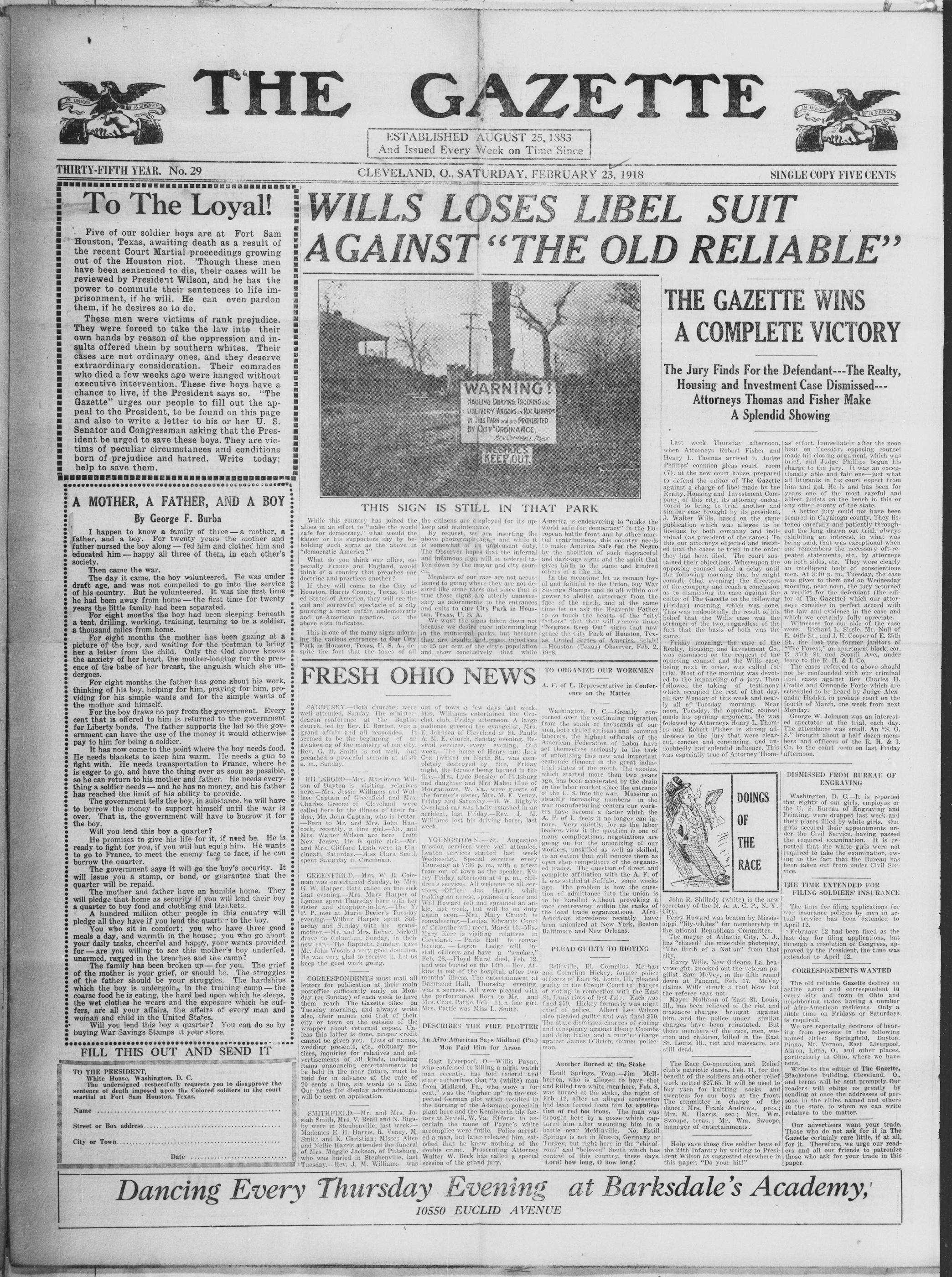
WILLS LOSES LIBEL SUIT AGAINST "THE OLD RELIABLE"
---
IN UNION IS STRENGTH
THIRTY-FIFTH YEAR. No. 29
To The Loyal!
Five of our soldier boys are at Fort Sam Houston, Texas, awaiting death as a result of the recent Court Martial proceedings growing out of the Houston riot. "Though these men have been sentenced to die, their cases will be reviewed by President Wilson, and he has the power to commute their sentences to life imprisonment, if he will. He can even pardon them, if he desires so to do.
These men were victims of rank prejudice. They were forced to take the law into their own hands by reason of the oppression and insults offered them by southern whites. Their cases are not ordinary ones, and they deserve extraordinary consideration. Their comrades who died a few weeks ago were hanged without executive intervention; These five boys have a chance to live, if the President says so. "The Gazette" urges our people to fill out the appeal to the President, to be found on this page and also to write a letter to his or her U. S. Senator and Congressman asking that the President be urged to save these boys. They are victims of peculiar circumstances and conditions born of prejudice and hatred. Write today; help to save them.
A MOTHER, A FATHER, AND A BOY
By George F. Burba
I happen to know a family of three—a mother, a father, and a boy. For twenty years the mother and father nursed the boy along—fed him and clothed him and educated him—happy all three of them, in each other's society.
Then came the war.
The day it came, the boy volunteered. He was under draft age, and was not compelled to go into the service of his country. But he volunteered. It was the first time he had been away from home—the first time for twenty years the little family had been separated.
For eight months the boy had been sleeping beneath a tent, drilling, working, training, learning to be a soldier, a thousand miles from home.
For eight months the mother has been gazing at a picture of the boy, and waiting for the postman to bring her a letter from the child. Only the God above knows the anxiety of her heart, the mother-longing for the presence of the babe of her breast, the anguish which she undergoes.
For eight months the father has gone about his work, thinking of his boy, helping for him, praying for him, providing for his simple wants and for the simple wants of the mother and himself.
For the boy draws no pay from the government. Every cent that is offered to him is returned to the government for Liberty bonds. The father supports the lad so the government can have the use of the money it would otherwise pay to him for being a soldier.
It has now come to the point where the boy needs food. He needs blankets to keep him warm. He needs a gun to fight with. He needs transportation to France, where he is eager to go, and have the thing over as soon as possible, so he can return to his mother and father. He needs everything a soldier needs—and he has no money, and his father has reached the limit of his ability to provide.
The government tells the boy, in substance, he will have to borrow the money to support himself until the war is over. That is, the government will have to borrow it for the boy. Will you lend this boy a quarter?
Will you lend this boy a quarter?
He promises to give his life for it, if need be. He is ready to fight for you, if you will but equip him. He wants to go to France, to meet the enemy face to face, if he can borrow the quarter.
The government says it will go the boy's security. It will issue you a stamp, or bond, or guarantee that the quarter will be repaid.
The mother and father have an humble home. They will pledge that home as security, if you will lend their boy a quarter to buy food and clothing and blankets.
A hundred million other people in this country will pledge all they have if you lend the quarter to the boy.
You who sit in comfort; you who have three good meals a day, and warmth in the house; you who go about your daily tasks, cheerful and happy, your wants provided for—are you willing to see this mother's boy underfed, unarmed, ragged in the trenches and the camp?
The family has been broken up—for you. The grief of the mother is your grief, or should be. The-struggles of the father should be your struggles. The handships which the boy is undergoing in the training camp—the coarse food he is eating, the hard bed upon which he sleeps, the wet clothes he wears and the exposure which he suffers, are all your affairs, the affairs of every man and woman and child in the United States.
Will you lend this boy a quarter? You can do so by buying War Savings Stamps it your store.
White House, Washington, D. C.
The undersigned respectfully requests you to disapprove the sentence of death imposed upon the Colored soldiers in the court martial at Fort Sam Houston, Texas.
THE GAZETTE
ESTABLISHED AUGUST 25,1883 And Issued Every Week on Time Since CLEVELAND, O., SATURDAY, FEBRUARY 23, 1918
WARNING!
HAULING, DRAYING, TRUCKING and
DELIVERY WAGONS are NOT ALLOWED
IN THIS PARK and are PROHIBITED
BY CITY ORDINANCE.
BEN CAMPBELL Mayor
NEGROES
KEEP OUT.
THIS SIGN IS STILL IN THAT PARK
FRESH OHIO NEWS
While this country has joined the allies in an effort to "make the world safe for democracy," what would the kaiser' or his supporters say by holding such signs as the above in "democratic America?" What do you think our allies, especially France and England, would think of a country that preaches one doctrine and practices another? If they will come to the City of Haiti, in Texas, the United States of America, they will cease and sorrowful spectacle of a city pursuing a most unfair, undemocratic and un-American practice, as the above sign indicates.
This is one of the many signs adorning the various entrances to Our City Park in Houston, Texas, U. S. A., despite the fact that the taxes of all
SAN DUSEY.—Ruth churche were well attended, Sunday. The minister deacon conference at the Baptist church, led by Rev. E. Burton, was a grand affair and all attended. It seemed to be the beginning of an awakening of the ministry of our city. Rev. G. D. Smith is not well, but preached a powerful sermon at morning m. Sunday.
HILLSEGRO—Mrs. Martinere Wilson of Dayton, is visiting relatives here—Mrs. Jessie Williams and Wallace Captain of Greenfield and Mrs. Charles Greene of 'Cleveland were called here by the illness of their father, Mr. John Captain, who is better, born to Mr. and Mrs. John Han cook, recently a fine girl, Mr. and Mrs. Javier Wilson and Mrs. New Javier Wilson, sick, Mr. and Mrs. Clifford Lamb were in Cincinnati, Saturday. Miss Charl Smith spent Saturday in Cincinnati.
GREENFIELD.—Mrs. W. R. Coleman was entertained Sunday, by Mrs. G. W. Harper. Both called on the sick but evening, Mrs. W. Harper Thursday with her sister and daughter-in-law. The N. P. met at Marie Bester's Tuesday evening. Wilbur Harper spent Saturday and Sunday with his grandmother—Mr. and Mrs. Robert, Nickel drave to Colman, Sunday, in their new car. The Baptist, Sunday gave Mr. John Woods a very good donation. He was very glad to receive it. I ask we keep the good work going.
CORRESPONDENTS must mail all letters for publication at their main postoffice sufficiently early on Monday (or Sunday) of each week to have them reach The Gazette office on Tuesday morning, and always write also, their names and that of their city or town on the outside, the包裹所填满了 copies. Unless this fatter is done, proper credit cannot be given you. Lists of names, wedding presents, etc., obituary notices, inquiries for relatives and advertisements of all kinds, including items, announcing entertainments, to be held in the near future, must be paid for in advance at the rate of 20 cents on a line. Our rates for display advertisements will be sent on application.
SMITHFIELD — Mr. and Mrs. Josiah Smith, Mrs. V. Beall and N. Biggs—by were in Steubenville, last week. Madnesses in Harris, Harris, Harris; Alice Nobile Harris attended the funeral of Mrs. Maggie Jackson, of Pittsburgh, who was buried in Steubenville, last Tuesday. Rey, J. M. Williams, was
the citizens are employed for its upkeep and maintenance. By request, we are inserting the above photograph again and while it is somewhat of an unpleasant duty, the Observer hopes that the informal and infamous sign will be ordered taken down by the ravoy and city council. Members of our race are not accustomed to going where they are not desired like some races and since that is true those signs are utterly unnecessary as adornments to the entrances and exits to Our City Park in Houston, Texas, T. S. A.
out of town a few days last week.
Mrs. Williams, appointed the Coach
tibby, Friday afternoon. A large
audience greeted the evangelist, Mrs.
K. Johnson of Clockland of St. Pauls
A. N. E. church Sunday evening. Re-
ceived a large number of visitors
weeks. The house of Henry and Jack
Cotwil (white) on North St. was com-
pletely destroyed by fire. Friday
night, the former being burned in
their. Mrs. Lyle Bensley of Pittsburg
and daughter and Mrs. Mabel Blue of
Morganstown, W. Va., were guests of
the former's sister, Mrs. M. K. Veney,
Friday and Saturday. W. W. Higby a
noble man, was invited to the
incident. Friday - Rev. J. M.
Williams best his driving horse, last week.
---
YOUNGSTOWN, -- N. Augustine mission services were well attended. Lenten services started last week Wednesday. Special services every Thursday at 7:30 p. m., with a priest from out of town as the speaker. Every Friday afternoon at 4 p. m., children a service. All welcome to all services. Office Jes. Jes. Harp', while children a sprouted a knee and Will Harp' a cell at knee. klee last week, but will be on duty again soon. -- Mrs. Mary Church is convening. Louisin Edward Court of Calebthe will meet, March 12. Miss Mary Kear is visiting relatives in Cleveland. -- Paris Hall is convening. Lorean Louise will install officers and have a "speakup" Feb. 28. - Floyd Hurst died, Feb. 12, and was buried on the 14th. - Roy Atkins is out of the hospital, after two days. The entertainment at Dundalk Hall was a success. All were pleased with the performance born to Mr. and Mrs. Chris. Pattisb. J. b., a 11-year girl, Mrs. Pattie was Miss L. Smith.
DESCRIBES THE FIRE PLOTTER
Mrs. Clas, Patrice, Fo. 11. a tha
Pattie was Miss L. Smith.
DESCRIBES THE FIRE PLOT
An Afro-American Says Midland
Man Paid Him for Arson
East Liverpool, O.—Willis I
who confessed to killing a night
man recently, has tood fettera
state authorities that "a (white
from Midland, Pa., who wore
coat," was the "higher up" in the
pected German plot which result
the burning of the Adamant
plant here and the Kenilworth ti
tory at Newell, W, Va. Efforts
certain the name of Powell.
America is endeavoring to "make the world safe for democracy" in the European battle front and by other military contributions, this country needs to make America Safe for the Negro by the abolition of such disgraceful and darkage signs and the spirit that kept the name and kindred names of a like the. In the moment we let us remain loyal and faithful to the Union, buy War Savings' Stamps and do all within our power to abolish utterance, from the life of the earth, and at the same time let us ask the Heavenly Father to so touch the hearts of the "city" that they will preserve once New York, and to name the City Pack of Houston, Texas, United States of America, Jackson—Houston (Texas) Observer, Feb. 2, 1918.
TO ORGANIZE OUR WORKMEN
A. F. of L. Representative in Conference on the Matter
Washington, D. C.—Greatly concerned over the continuing migration from the south of the thousands of our men, both skilled artisans and common laborers, the highest officials of the American Federation of Labor have set themselves seriously to the task of unifying the new and important economic element in the great industrial states of the north. The exodus, ago, has been accelerated by the brain on the labor market since the entrance of the L. S. into the war. Massing in steadily increasing numbers in the war manufacturing centers our workers have become a factor which the A. F. of L. feels it no longer can ignore. Very quietly, for as the labor leader, view it the question is one of many complications, negotiations are going on for the unionizing of our workers, unskilled as well as skilled, to an extent that will remove them as open shop competitors of the organized trades. The question of direct and complete affiliation with the A. F. of Lewis is of great importance. The problem is how the question of adjutents into the union is to be handled without provoking a race controversy within the ranks of the local trade organizations. Afro-American stevedores recently have been unionized at New York, Boston Baltimore and New Orleans.
PLEAP GUILTY TO RIOTING
Bellville, IL—Cornellian, Meghan and Cornellian, Hickey, former police officer of East St. Louis, IL, pleaded guilty in the Cincinnati Court to charges of fishing in connection with the East St. Louis lions of lost Juice. Each was fined $50. Hickey formerly was night guard of police. Albert Lee Wilson also pleaded guilty and was fined $50. The St. Louis discharged guilty of fishing and conspiracy against Henry Coombs and John Hiley and a lawyer's charge against James O'Brien, former policeman.
---
Another Burned at the Stake
Estill Springs, Teenn—Jim McIlheron, who is alleged to have shot and killed two, white men here, Feb. 8, was burned at the stake, the night of Feb. 12, after an alleged confession had been forged from him by application of red hot irons. The man was brought here by a posse which captured him after rounding him in a Bellevue Wilmington Springs is not in Russia, Germany or Turkey, but fight here in the "chivalrous" and "beloved" South which has control of this country, these days, Lord how long, O how long!
THE GAZETTE WINS A COMPLETE VICTORY
The Jury Finds For the Defendant----The Realty Housing and Investment Case Dismissed--- Attorneys Thomas and Fisher Make A Splendid Showing
Last week Thursday, afternoon, when Attorneys Robert Fisher and Henry L. Thomas arrived in Judge Phillips' common pleas court room (7), at the new court house, prepared to defend the editor of The Gazette against a charge of libel made by the Realty, Housing and Investment-Company, of this city, its attorney endeavored to bring to trial another and similar case brought by its president, J. Allen Wills based on the same evidence, published by both company and individual (the president of the same). To this our attorneys objected and insisted that the cases be tried in the order they had been filed. The court sustained their objections. Whereupon the opposing counsel asked a delay until the following morning that he might consult (that evening) the directors of the company and reach a conclusion as to dismissing its case against the editor of The Gazette on the following Friday) morning, which was, done, and doubtless, to do without belief that Wills case was the stronger of the two, regardless of the fact that the basis of both was the same.
Friday morning, the case of the Reeky, Housing, and Investment Co. was dismissed on the request of the opposing counsel and the Wills case, being next in order, was called for trial. Most of the morning was devoted to the impaneling of a jury. Then followed the taking of testimony which occupied the rest of that day. all day Monday of this week and nearly all of Tuesday morning. Near noon. Tuesday, the opposing counsel made his opening argument. He was followed by Attorney Henry L. Thom- and Robert Fisher in strong addresses to the jury that were clear-cut, concise and convincing, and undoubtedly had splendid influence. This was especially true of Attorney Thom-
DOINGS OF THE RACE
John R. Shillagly (white) is the new secretary of the N. A. A. C. P., N. Y. City.
Perry Howard was beaten by Mississippi "lily-whites" for membership in the ational Republican Committee.
The mayor of Atlantic City, N. J., has "chased" the miscellaneous photoplay, "The Birth of a Nat on" from that city.
Harry Wills, New Orleans, La. heaviest knocked out the veteran polygamist Sam McKinney in the 19th round down at Pamunkey, Feb. 17, where claims Wills struck a foul blow but the referee says not.
Mayor Mollman of East St. Louis, Ill., has been relieved of the riot and massacre charges, brought, against him, and the police under similar charges have been reinstated. But those members of the race, men, women and children, killed in the East St. Louis, Ill., riot and massacre, are still dead.
The Race Co-operation and Relief club's patriotic dance, Feb. 11, for the benefit of the soldiers and other relief work netted $27.65. It will be used to buy yarn for knitting socks and sweaters for our boys at the front. The committee in charge of the dance: Mrs. Frank Andrews, pres.; Mrs. M. Harris, sec.; Mrs. Wm. Swope, treas.; Mr. Wm. Swope, manager of entertainments.
Help save those five soldier boys of the 24th Infantry by writing to President Wilson as suggested elsewhere in this paper, "Do your bit!"
IN UNION
WE IS STRONG
SINGLE COPY FIVE CENTS
'T
MABLE''
TTE WINS
ETE VICTORY
The Defendant---The Realty,
tment Case Dismissed---
nas and Fisher Make
did Showing
as effort. Immediately after the noon hour on Tuesday, opposing counsel made his closing argument, which was brief, and Judge Phillips began his charge to the jury. It was an exceptionally able and fair one—just what all litigants in his court expect from years one of the most careful and ablest jurists on the bench in this or any other county of the state.
A better jury could not have been secured in Cuyahoga county. They listened carefully and patiently throughout the long drawn out trial, always exhibiting an interest, in what was being said, that was exceptional when one remembers the necessary offset on both witnesses. The jury were clearly an intelligent body of conscientious men. At 3:40 p.m. Tuesday, the case was given to them and on Wednesday morning, near noon, the jury returned a verdict for the defendant (the editor of The Gazette) which our attorney consider in perfect accord with the law and evidence in the case and which we certainly fully appreciate. The case of the one were: Richard I. Sislele, Mr. Null of E. 16th St., and J. E. Cooper of E. 35th St., the last two former jailors of "The Forest," an apartment block, cor. E. 57th St. and Scovill Ave., under lease to the R. H. & J. Co.
The cases referred to above should not be confounded with our criminal life cases against Rev Charles H. Crudle and Ormonde Forte which are under Hadden in probate court on the fourth of March, one week from next Monday.
George W. Johnson was an interested spectator at the trial, each day. The attendance was small. An "S. O. S." brought about a half dozen members and officers of the R. H. & I. Co. to the court room on last Friday afternoon.
DISMISSED FROM BUREAU OF ENGRAVING
Washington, D. C. It is reported that eighty of our girls, employees of the Y. Bureau of Engraving and Printing, were dropped last week and their places filled by white girls. Our girls secured their appointments under the Civil Service, having passed the required examination. It is reported that the white girls were not required to take the examination, owing to the fact that the Bureau has been taken out from under Civil Service.
THE TIME EXTENDED FOR FILING SOLDIERS' INSURANCE
The time for filing applications for war insurance policies by mea in actual service has been extended, to April 12.
February 12 had been fixed as the last day for filing applications, but through a resolution of Congress, approved by the President, the time was extended to April 12.
CORRESPONDENTS WANTED
The old reliable Gazette desires an active agent and correspondent in every city and town in Ohio and neighboring states having a number of Afro-American residents. Only a little time on Fridays or Saturdays is required.
We are especially destined of hearing from persons in the following named cities: Springfield, Dayton, Pikeville, Vermont, East Liverpool, Akron, Lima, O., and other places, particularly in Ohio, where we have none.
Write to the editor of The Gazette, Blackstone building, Cleveland, O., and terms will be sent promptly. Our readers will oblige us greatly by sending at once the addresses of persons in the cities named and others in the state, to whom we can write relative to the matter.
Our advertisers want your trade. Those who do not ask for it in the Gazette certainly care little, if at all, for it. Therefore, we urge our readers and all our friends to patronize those who ask for your trade in this paper.
academy,
(In Advance)
One year ..... $1.50
Six Months ..... 1.00
Three months ..... 50
Subscribers are requested to remit
postoffice money order or reg-
istered letter
Entered at the postoffice in Cleveland,
Ohio, as second-class
mail matter.
Blackstone Building, Cleveland, O.
Member Ohio Legislature: 1894
to 1896; 1896 to 1898; 1900 to 1902
THE GAZETTE is the oldest, and has the largest bona fide circulation, double that of any newspaper in the interest of Afro-Americans, published in the state of Ohio, and comparison with any will immediately establish its rank as one of the NEWS-EST AND BEST in the country.
10,000,000 Afro-Americans.
300,000 in Ohio.
25,000 in Cleveland.
PREJUDICE
"Any prejudice whatever will be insurmountable if those who do not share in it themselves truckle to it and flatter it and accept it is a law of nature."—John Stuart Mill.
DARE TO DO YOUR DUTY
"Let us have faith that right makes might, and in that faith let us to the end dare to do our duty as we understand it."—Abraham Lincoln.
The Germans had better look out. They may have to face 70,000 blueprints of the Browning machine gun when they are not looking for them.
Secretary Daniels is not fortunate in his submarine interviews. On the day he declared the fight on the U-boats was being won came in a parallel column the report of the sinking of the Tuscania.
____||||||____
As we observe every one panning Mr. Leon Trotsky for what he does not know about war, the thought intrudes that there are some things we ourselves do not seem to have known about preparedness, coal, transportation, etc., etc.
---
Forty years from now the old residents will be saying: "And you think this is a fuel famine we are having." Well, all I have to say is that you ought to have seen the Democratic fuel famine in 1918. That was a real famine," etc., etc.
The Council of National Defense consists of two lawyers, a college pressident, a retired business man, an editor and a union labor official. There is no minister of the gospel nor any agriculturist upon it. Nor a soldier a sailor, a banker, or a railroad man.
The Republican party is standing loyally by everything that is being done to win the war. It would also like to stand by a lot of things for the winning of the war that are not being done if it could only get the chance. It seeks to speed the war not to slack it.
The Federation Council of our bishops, which met in Louisville, Ky., last week, recommended the union of our three great Methodist bodies—the A. M. E., C. M. E., and the M. E. Churches—and something resulting in some sort of a federation of all our great church bodies should result, and soon too, if not a great union. The times make such action imperatively necessary.
"The Birth of a Nation" was shown in the Opera House at Lorain, this week, and there is a Greek restaurant proprietor in that city who displays conspicuously in his place of business two signs notifying our people that their patronage is not desired. Lorain has already begun to feel the loss of our good friend and its long-time leading citizen of color, Mr. David C. Fisher, who died some weeks ago. Is there no one there to take up the work for the race where he left off?
The Houston (Texas) Observer portrait and article, elsewhere in this paper, illustrates, and splendly, too, an old and well known story of the Southland many of us have often heard but never had any personal knowledge of. That is why The Gazette asked the Observer to favor it with permission to use its cut and article, both of which will prove of surpassing interest to thousands of our readers. Our esteemed conferee's courtesy and kindness in complying so promptly with our request is thorolly appreciated.
Japan is getting into the glass trade. Lamp chimneys and thermos bottles, made in Japan, are already being sold in this country at a lower price than the American manufacturer can put
them on the market. William P. Clarke, of Toledo, president of the American Flint Glass Workers' Union, holds that unless protection is given to American manufacturers after the war the wages that in some departments have jumped 100 per cent must necessarily drop. Especially will this be the case if Germany seeks to recover the vast glass trade she had in America before the war.
In his argument against Senator Hitchcock's claim that the war was not going on as it should, John Sharp Williams, Democratic senator from Mississippi, made the following statement, paying a sincere compliment to Republicans:
"Aren't we all doing our level best to win the war? Isn't every Republican trying to help win the war, except a few pacifists who have nearly ended their political lives?" That the record may be kept straight it is proper to add that pacifists among Republicans are few. The Republican party preached the doctrine of preparedness in 1916. Its pacifist left it then to vote to be kept out of war. Without at all attempting to locate the pacifists all the world knows where they are not.
WILL STOP EMIGRATION
In our issue of Jan. 26, 1918, we called attention to the government's "peremptory directions" through its department of labor "to many industrial concerns (in the North) to cease widespread advertising (in the South) for help because "it was unsettling the labor supply (there) and working hardship on individuals (who lost the labor) and who answered the advertisements." The government's control of railroads was all that was necessary, with the foregoing, to "put a stop" to the emigration of our people from the South to the North, as was the case, last Spring, particularly. Watch and see it done, this Spring! Thousands of our men who went South last Fall and later, to spend the winter only, will find it impossible to purchase tickets to the North when they attempt to return in the Spring. The southern appeal, last year, to Washington, to stop emigration was not made in vain.
CULMINATING CRISIS HAS COME
In his letter to the farmers' conference at Urbana, Illinois, President Wilson said: "You will realize, as I think statesmen on both sides of the water realize, that the culminating crisis of the struggle has come, and that the achievements of this year on the one side or the other must determine the issue."
With Russia out of it, with trains sweeping from the east across Germany all winter long, laden with soldiers, guns and munitions for its western front, Germany in the year 1918 is indeed to present to the allies the culminating crisis. And when the crisis is over will we as a people, as a nation, and as an ally, be able to say: "We have done our full part?"
That is why Americans all over the land are worrying that the ships be ready, that the big guns be ready, that the rifles be ready, that the munitions and equipment be ready, and that the soldiers of America be ready—and be there—in time for the culminating crisis.
It has been over a year since President Wilson gave von Bermstorff his passports and recalled Gerard. A year is a year. Have we done all in this year that our allies have a right to expect? Not in intention, but in fact?
The people are confused. They do not know. The assurances do not completely assure. They do not wish to annoy the President, but they do not wish to be found lagging. If the war is being sufficiently speeded then—Speed the speed.
MILITARY DRILL BY 32 PIGS.
Can Perform Their Evolutions Without a Commander.
BELCHERTOWN, Mass. — Jack Newman has organized his piggyaccording to the infantry drill regulations. From out of a company of a hundred pigs he has picked a squad of thirty-two.
Every morning before breakfast these thirty-two pigs follow their drillmaster for two miles around the edge of the field, just inside the wire, and then parade across the center.
Newman purposely delayed his appearance one day and found that the pigs went through their usual evolutions alone.
SURE, IT PAYS TO ADVERTISE.
Experience of This Woman Woman Lends Further Proof.
BUCKSPORT, Maine. — Anna Cagley, answering an offer to wed in a matrimonial magazine because of the man's many fine points, found it was her divorced husband. They were married for the second time this week.
Mrs. Cagley says she never knew till she read the advertisement what a fine man her husband was, or they never would have parted in the first place.
Touchy.
Husband—"Why are you so angry at the doctor?" Wife—"When I told him I had a terrible tired feeling, he told me to show him my tongue."
Not So Easy.
Sidney Smith being ill, his physi clan advised him to "take a walk upon an empty stomach." "Upon whose?" said the witty dean
THE GAZETTE, CLEVELAND, OHIO, FEBRUARY 23, 1918
A POPULAR MISAP.
PREHENSION CORRECTED.
Just as every man believes he can edit a newspaper, notwithstanding the fact that he doesn't know the difference between "six point type" and an "italic shooting stick," so every man thinks he can produce motion pictures. It matters not that all his previous training may have been confined to a tailor shop, the carpenter's bench, a bank or a playwright's desk. Why this is so is hard to understand, but it is nevertheless true. Even a bricklayer must serve his apprenticeship at laying bricks before he can become a skilful mason. A man who owns and runs a shoe factory and makes a success of it has got to know something about each one of the fifty-nine and more component parts that are necessary to the making of one pair of shoes. This he doesn't learn overnight. The successful shoe manufacturer has often begun at the workman's bench and given many years to the study of the different angles of his business. So with all business if one would be successful. It is only in the proper editing of a newspaper and the production of motion pictures and selection of motion picture stars that the idea seems to prevail that there is nothing to learn and no time needed to gain experience. If a man has once written a play that was seen on the dramatic stage, he then feels that he can give the world something new and startling in the form of motion picture entertainment—Film Fun.
Care of Goldfish.
There are few homes nowadays that do not have goldfish for household pets, but the trouble is that most folk know little or nothing about the fish and how to keep them in good condition. They do not need much care or treatment. According to the best authorities, they should be fed sparingly—not more than a pinch of food every second or third day. Most persons kill their goldfish by overfeeding.
The fish are subject first of all to indigestion. This can be quickly noticed by the fact that the fish in such a condition swims sideways or floats on its back. In that case take the fish out of the aquarium and place it in water in which a little salt has been put. That will revive the fish within a few minutes. The best method is to starve the fish rather than to give them too much food.
The aquarium should also be considered. It should be square shaped and not round; it should not contain too many fish for its size, and it should have just enough aquatic plants which serve to "eat" the waste matter from the fish, while the fish live on the waste matter from the plants, thus establishing a healthy balance in the aquarium.
Water in the aquarium should not be changed very often—not more than once a month or so, though a glassful of fresh water can occasionally be added to make up for loss through evaporation. In changing the water care should be taken that the fresh water is of the same temperature as that from which the fish are taken, otherwise they will be chilled and will suffer. When once in the water and they are accustomed to the temperature outside influences will not affect them.
The Pamphlet Traveler.
Do the railroad and steamship companies recognize this pamphlet traveler? Well, just listen: "We are a nation of travelers," said the president of a large coastwise steamship company. "Those who can't travel in reality travel in fancy. Thousands of dollars are spent yearly by the railroad and steamship lines in pamphlets and advertising matter which goes into the hands of thousands of people who do their traveling mainly by street car.
"Pamphlet travelers we call them and they are the most expensive travelers we have, for they never produce any revenue. There are some people who actually intend to take these trips, but I can honestly say that a majority of our pamphlets go to people who know that they are not going to leave the city. These booklets are a favorite summer reading around vacation time and the circulation figures would make a best-seller envious.
"Many railway and steamship line presidents have considered dispensing with their finely illustrated and costly booklets but is in next to impossible, for we would then fail to serve the real prospective travelers. But these street car vacationists cost us thousands of dollars."
One of the best-informed men on travel I ever met was a bookkeeper for a grain concern in a Middle West city. He could talk familiarly of every corner of the world, tell one the best hotels in Nagasaki, Manila, Florence, Bordeaux* or Petrograd. I thought he must have been an old and experienced traveler, until I met a close friend of his and we were discussing the bookkeeper.
"He is one of the best-traveled men I ever met," I remarked. "He must have had a remarkable life."
The friend looked at me closely.
"John has never been outside the state." he said.
Then I knew that John was one of the great army of travelers de luxe—via pamphlet—Leslie's.
A. Generous Daughter.
Aged Admirer—Think of all the luxuries a rich husband like me can give you.
Miss De Young—Oh, a rich father would do just as well! Marry my mother!
Poverty is the only luxury the rich can't afford.
Too Long.
Edith—Haven't you and Jack been engaged long enough to get married? Ethel—Too long. He hasn't a cent left.
Swatow, China, has a British Chamber of Commerce. It is the only foreign chamber of commerce at that place.
LAST PORT MADE BY PELORUS JACK
FAITHFUL DOLPHIN SUCCUBMS
TO INFIRMITIES OF AGE.
After Piloting Ships 35 Years, He Grieved for Absent Friends and About War.
Sydney, Australia. — Pelorus Jack is dead. The famous New Zealand pilot fish had conveyed steamships from Wellington to Nelson at a point near French Pass for the last thirty-five years. According to Ben Raddles, the tarry-handed, bronzed, and bearded bo' sun of a British freighter, the finny pilot died from the infirmities of old age aggravated by grief of the war.
"I knew Pelorus Jack back in 1886," said Ben Raddles, "when I was bo' son of the old Wanagatik, running between Australia and New Zealand, and he was a smart, young dolphin dazzling blue and white in color and about fourteen feet long.
"In those days Jack, as the fish was known by all men in the coasting and deep water trade to New Zealand, could swim like a streak, and moved so fast that when the sun wa. shining strong all the officers, on the bridge and lookout forward could see was a flash as he jumped out of the water ahead to show his dexterity.
"Jack always kept on the starboard bow as he knew that was the Captain's side of the ship, and was a regular nautical aristocrat in manner. Skippers who followed Peliosus Jack never grounded on any shoals or hit rocks, and this became so well known that many of the older mariners would not go thru French Pass unless he was ready to pilot them.
"They all took a delight in feeding him with pieces of beef and small fresh leaves, which Jack had a great tondness for. One of his best friends was Captain Inman R. Seably, of the White Star Line, who afterward had the Republic, and the two were so chummy that Jack would miss two or three vessels when he knew that Seably was about to leave Wellington for Nelson.
"In 1904 some young landlubber, with more money then sense, came along in his yacht and fired a shot at the old pilot fish as he came under the bow and knocked a chunk off his starboard fin. This cruel act upset Pelorus Jack so much he swam away and was not seen for three months, and many of the coast skippers believed that he had given up his job.
"Finally the New Zealand government sent a dispatch boat to look for him, and Jack was discovered hiding up a small inlet in a jameson state and brought back to French Pass. To protect him from further attacks the governor of New Zealand issued a special order in council establishing a fine of $500 for any person who attempted to injure Pelorus Jack.
"Just before the war began it was noticed that the famous dolphin was turning gray and was showing his age in other ways. He took on a shovel-nosed whistling grampus called Billy to teach him the pilot business, but Billy had lost his port headlight, and had to carry so much starboard helm that he was continually going around. Then Jack got hold of a trisky young dugong named Wiffin which indulged in so much skylarking around the sapps that the officers would not truss him, and the sailors used to chuck coal at him to chase him away.
"What with his age and scionity, in the part which wagged his tail, and missing, all his old friends who had been called away to the Atlantic trade by the war, Pelorus Jack just pined away and died. His body was found on the sandy shore near French Pass, and out of respect for his long and faithful services the crew of a coast steamer dug a trench and put the body of the old funny pilot in it on a bed of seaweed and planted a blue gum tree at the head and tail to mark the spot."
Ben Ruddles, who seemed much affected by the death of Pelorus Jack, said that after the war the officers and men in the Australian and New Zealand coast trade would take up a collection for a monument to the only fish ever known to have been honored by a special order in council.
BOY CLIMBES LOFTY TREE
TO FREE TRAPPED BIRD
Ten-year-old Lard is Awarded a Medal for His Daring and Heroic Act.
Hartford, Conn.,— The Connecticut Humane Society has informed 19-year-old Michael Kavoevo of East Hartford he is to have a medal for rescuing an imprisoned robin.
Little Michael had to climb an elm tree 75 feet high to effect the rescue.
The robin had flown to one of the top-most branches with a long string in its bill for nest-building. The string caught in a stout twig, and as the robin worked to get it free, the string tangled about one of its legs. It was thus held prisoner.
It took the boy more than half an hour to work his way to the top or the tree. But he managed to reach the twig to which the string had fastened itself and snapped it off. With this hanging to its leg the robin fluttered to the ground, was released and flew off chirping at its restored freedom.
An up-to-date woman is seldom up to date, with her age.
Value of Advertising.
From a capital of $20,000 to $25,
000,000 in 12 years through advertising
is the record of a St. Louis cor-
poration. The doubter of the virtue
of printer's ink properly distribute
and of the right quality will find a lot
of food for thought in that fact.—St
Louis Star.
Very Little Formerly Grown but Now it is Even Exported.
The use, of fruit in Japan was until recently limited to the upper classes, and the cultivation of fruit trees was not carried on as at the present day, though fruits growing wild in field or forest were gathered and offered for sale. A few fruit trees were grown by householders in their home gardens for private use, but little attention was paid to their cultivation.
The principal cause for the slow development of fruit culture in Japan appears to have been the climate. The climate being warm and moist, there is luxurious growth of vegetation, producing the exquisitely beautiful landscapes for which Japan is so well known, but on the other hand few advantages for fruit culture exist. In order to obtain satisfactory results, great expenditure is necessary.
Fruits which have been cultivated from ancient days extensively enough to be grown in orchards or vineyards, says the Japan Magazine, are oranges, pears, plums and grapes, and great attention was paid to the different varieties of each, though the plum was chiefly cultivated and prized for its blossom and large plum gardens abound in Japan, valued for their beauty and attractiveness during their flowering season, which is in snowy January.
Such trees as the persimmon, peach, lequat, quince, Japanese apricot, and plum, jujube and ginnan are often planted around the home or along footpaths in rice fields, but these are for the most part seedlings and no special attention is paid to them, except occasional fertilizing. Formerly there was no uniform and methodical system for fruit culture in Japan except for pears, oranges and grapes, but since 1877, when foreign fruit trees were first introduced, the method of culture according to scientific principles has been advocated.
The amount and value of oranges, peaches, plums, persimmons, pears and grapes produced last year reached a surprisingly high figure, and large quantities were shipped to the United States, Canada, China and Vladivostok. Peats and pears, oranges, apples, date plums, loquats, quinces, pomegranates, peaches, apricots (Japanese and foreign), plums, jujube, sweet cherries, grapes, figs and gooseberries, and walnuts and chestnuts are the fruits and nuts mostly appreciated and eaten in Japan, the latter being wild with only a few examples of the cultivated variety.
Food and Digestion.
Sir Ray Lankester, the eminent English scientist, writing in the London Telegraph, tells us that robust people, so long as they eat what suits their own uncultivated taste, are apt to make very light of what they call "fancies" about food and overlook their real importance. Feeding on the part of civilized man is not the simple procedure which it is with animals, although many animals are particular as to their food and what is called "dainty." The necessity for civilized man of cheerful company at his meal and for the absence of mental anxiety is universally recognized, as well as the importance of an inviting appeal to the appetite through the sense of smell and of sight, while the injurious effect of the reverse conditions, which may lead to nausea and even vomiting is admitted.
Even the ceremonial feature of the dinner table, the change of clothes, the leisurely yet precise succession of approved and expected dishes, accompanied by pleasant talk and light-hearted companionship, are shown by strict scientific examination to be important aids to the healthy digestion of food, which need not be large in quantity, because wisely presented.
Primitive School Books.
The horn book invented in 1450 and used considerably up to the close of the eighteenth century was the usual text book of the elementary school. A thin slab of hard wood was covered with parchment, on which were printed the capital and small letters, numerals and some elementary syllables and words.
Over this a thin sheet of transparent cow's horn was placed and firmly bound so that no moisture could penetrate. To this the Bible and the sampler on which little girls painfully stitched the letters of the alphabet, some "Godly saying" and a border of herring stitch, or some conventional pattern of impossible flowers and foliage and the legend "Mary Smith, her sample," or the like, were about all that the children used up to the beginning of the eighteenth century.
The Push Man Train
One of the quaintest sights in Japan is the "push man train," a little railway which runs for nineteen miles along the seacoast between Atami and Odawara, taking four hours to complete the journey. Each car is hauled and pushed up hill by coolies and then allowed to run down the next incline by its own momentum. The coolies jumping on behind. When skirting precipices and rounding sharp curves this becomes somewhat exciting, the sensation is rather like being in a runaway switchback car.
A. Fishy Explanation
Mother-Johnny, you said you'd been to Sunday school.
Johnny (with a far-away look)—
Yes, ma.
Mother—How does it happen that
your hands smell fishy?
Johnny—I—I carried home th' Sunday
school paper an'-an' th' outside
page is all about Jonah an' the whale.
Daily Average of Wind.
Some builders of windmills estimate that a wind 16 miles an hour may be expected for eight hours per day on the average for every day in the year. This does not mean that such a wind can be relied upon every day in the year, but that the average wind all the year round would equal 16 miles an hour for eight hours every day.
A RACE ENTERPRISE
G. J. TATE, Proprietor.
GENTS' FURNISHINGS, NECKWEAR.
Hosiery, Underwear and Arrow Collars and Shirts, Hats, Caps, etc
2022 CENTRAL AVE.
JOE HEDGES' POOL ROOM 3048 Central Ave. One of the Best in the city. Everybody Welcome!
Buy A Home and Stop Paving Rent SEE A.I.GORDON, Real Estate Dealer 2363 E. 87th St.
Wilson's Poultry Yard
2201 East 33rd St.
Chickens, Turkeys & Ducks for Sale
Prices Reasonable
Cent. 1929-W
Office and Funeral Parlors
3923 CENTRAL AVE.
Wm.Brack,Prop. Frank Doctor, Manager James Mabel, Chef
BEVAERA
This is the popular, non-intoxicating beverage that is good in every way. Every drop is healthful, strengthening and PURE. Order by the box from any drug-gist, grocer, confectioner or soda fountain — or phone Harvard 730. Prompt delivery service to any part of Cleveland.
The Leisey Company Cleveland
"What's in a name?"—EVERYTHING
This is the popular, non-intoxicating beverage that is good in every way. Every drop is healthful, strengthening and PURE. Order by the box from any drugist, grocer, confectioner or soda fountain — or phone Harvard 730. Prompt delivery service to any part of Cleveland.
The Leisy Company Cleveland
EVERYTHING!
"What's in a name?"—EVERYTHING!
"Ill wounds may be cured but not ill names"
"A famous name will never die"
"Nothing success like success"
For over eighty years, Palmer's "Skin Su
Ointment has made a great name for its
a cure for most forms of skin troubles. It
Original Skin-Brightener.
WARNING! Our Trade-Mark "Skin Su
is being used by others, evidently to deceive
friends. Let them BEWARE; we shall prox
them to the fullest extent of the law.
Look for our name and address on every
age of Palmer's "Skin Success" Ointment
Soap.
The Morgan Drug Company
1512 Atlantic Avenue
Brooklyn, N
Palmer's "Skin Success" great name for itself, as skin troubles. It is the trade-Mark "Skin Success" evidently to deceive our ARE; we shall prosecute it of the law. and address oh every pack- Success" Ointment and Drug Company Brooklyn, New York
For over eighty years, Palmer's "Skin Success" Ointment has made a great name for itself, as a cure for most forms of skin troubles. It is the Original Skin-Brightener.
WARNING! Our Trade-Mark "Skin Success" is being used by others, evidently to deceive our friends. Let them BEWARE; we shall prosecute them to the fullest extent of the law.
Look for our name and address on every package of Palmer's "Skin Success" Ointment and Soap.
The Morgan Drug Company
1512 Atlantic Avenue
Brooklyn, New York
utility
the ablest Editorials written, Articles
knowledged authorities, Current Events,
Boy's Page, Girls' Page, Children's
run of the world's choicest fun.
—not 12—$2.00
NION, BOSTON, MASS.
of this paper with $2.00 for The Companion for
and we will send you
of 1918.
1917 Weekly Issues FREE.
In Home Calendar for 1918.
THE 1918 PROGRAMME includes the oldest Editorialists by the world's brightest men and acknowledged authorities, Curate Nature and Science, Family Page, Boys' Page, Girls' Page, Page, Doctor's Corner and a constant run of the world's choicest.
52 Issues a Year—not 12—$2.00
THE VOYETTE'S COMPANION, BOSTON, MASS.
CUT
THIS
OUT
Send this coupon (or the name of this paper) with $2.00 for The Companion 1918 and we will send you.
1. 52 ISSUES of 1918.
2. All remaining 1917 Weekly Issues F.
3. The Companion Home Calendar for
THE 1918 PROGRAMME includes the ablest Editorials written, Articles by the world's brightest men and acknowledged authorities, Current Events, Nature and Science, Family Page, Boys' Page, Girls' Page, Children's Page, Doctor's Corner and a constant run of the world's choicest fun.
CUT
THIS
OUT
Send this coupon (or the name of this paper) with $2.00 for The Companion for
1918 and we will send you
1. 52 ISSUES of 1918.
2. All remaining 1917 Weekly Issues FREE.
3. The Companion Home Calendar for 1918.
SUBSCRIPTIONS RECEIVED AT THIS OFFICE
---
TheYouth's Companion
Indispensable in quality, lavish in quantity —no other publication in the world like it
BEVERA
THE LESSY COMPANY
The Owl Drug Store
Cor. Central Ave. & E. 388 St.
G.S. is guaranteed for one bottle to benefit any case of poliagra, rheumatism, eczema, scrofula or any blood, liver or kidney disease, or your dollar returned and no questions asked; or if you take two bottles between today and March 1, 1918, and you receive no benefit, upon affidavit of same, I will refund your $2.00 and give you $1.00 free. Why experiment? Take a remedy with wonderful merit. A trial is all I ask you to give G. S. Sold by all druggists or sent prepaid. Price $1.00, or six for $5.00. Call on your druggist for G. S. before you order from me. Write for testimonials. L. M. GROSS
721 Spring St. Little Rock, Ark.
The Pride of Carolina
The State Agricultural and Mechanical College of South Carolina
Orangeburg, S. C.
Next session begins September 26th and ends May 31st, 1918.
No Tuition, no Room Rent, no Charges for Water, Lights or Fuel. Entrance Fee $10.00.
Board $8.00 per Month in Advance. Books, Laundry and Personal Expenses Extra.
Every Modern Facility. Standard Equipment. A Faculty of 57 Officers and instructors
Por information and Catalogue, Write.
R. S. WILKINSON, Pres.
Orangeburg, S. C.
KINY
HAIR
Ecainito Medicine Co.,
Alabama, Ga.
Corporation: Before I I
wrote Ecainito Cinino,
Corporation I have
short, curvy and ruffy,
wet hair, and I have
finches long, and is so soft
and alley that I can call
wavy hair and not
no running you may plece
with it. I know it is very
pretty Ecainito has made it.
SALER KERO.
Atlanta, Ga.
Gentlemen: Before I see I your Exelento Quinine
Ponace n.g. Eat was short, course and navy, but now it has grown to 82 inches long, and is so soft and silly that I could let up any way I want to. I am sending you my picture to know you how pretty Exelento has made it. SALLIE RIEO.
does, removes Dandreluf, feeds the Roots of the hair, and makes it grow long, and that makes it look better. And the difference, and after a little while it will be so pretty, we will give it to someone as we claim, we will give your money back.
Price $25 by mail on receipt of stamps or coin.
AGENTS WANTED EVERYWHERE.
Mme. C. H. Jones' HAIR Invigorator and Grower
FREDERICK L. MAYER
When I started using Mme. C. H. Jones' Hair Invigorator and Grower, my hair was but one inch long. After using it only one year, my hair is to my shoulders. Charlotte Smith
The C.C.C.Hair Co.
353 WOOLAND AVENUE
Home Phone, BT218 TOLEDO, OHIO
AGENTS WANTED—Stamp for reply
Subscribe Now!
Where to Purchase The Gazette
NOTICE TO SUBSCRIBERS
Subscribers not receiving The Gazette regularly should notify us at once. We desire every copy delivered promptly.
Send or bring locals and all business matters to The Gazette's office, 214-215 Blackstone Bldg. If you wish to see the editor call there, please.
We advise our readers to carefully examine The Gazette's advertisements before making purchases. Business men who advertise in this paper should have the patronage of our people. The fact that they advertise is assurance that they want it.
All matters for publication in current issues of The Gazette must be in the office by 4 p.m., WEDNESDAY of that week, at the latest.
J. S. Hall's
3121 Central Ave.
J. E. BRANHAM'S
4219 Central Ave.
*ERNEST P. JACKSON'S
3969 Central Ave.
O. HAMILTON,
3957 Central Ave.
JACKSON'S,
4401 Central Ave.
NOTICE TO
Subscribers not receiving The us at once. We desire every copy.
Send or bring locals and all office, 214-215 Blackstone Bldg. there, please.
We advise our readers to care vertisements before making puri tise in this paper should have the fact that they advertise is assu.
All matters for publication must be in the office by 4 p. m., latest.
Classified Advertising
... Department ...
FOR RENT—Nicely furnished room for rent at 2305 E. 85th St.
FOR RENT—Furnished rooms with gas range to cook on; extra kitchen, at 2385 West 41st St. This is a splendid opportunity.
CLUB NOTICE — The Working Men's Social and Literary club meets every Friday evening, for business and gives a dance, every Monday night, at their hall, 3103 Scovill Ave. H. P. Williams, pres., 3040 Central Ave. L. V. Orton, sce., 2667 E. 40th St. Milton Watkins, chairman, 2524 E. 30th St.
CLEVELAND Social and Personal
Miss Mary Kerr of Youngstown, is here visiting relatives. Wm. Freeman is very ill at Glenville hospital. Miss Bessie Cook's mother was taken to St. Luke's hospital, recently, for treatment for gall stones. Mrs. Chas. Greene was called to Hillsboro, last week, by her father's illness. The editor of The Gazette spent Sunday in Lorain, guest of Miss Ruth Fisher and mother. Mrs. E. Johnson, evangelist, of this city, is conducting a revival at St. Paul's A. M. E. church, Smithfield. Do not allow your landlords to take advantage of you in the matter of rentals, etc., but come to The Gazette office when you have troubles of that kind. Miss Amanda Brown was hostess to the Pleasant Company club, last Thursday. A Lincoln program was rendered. Next meeting at Mrs. Dorseys.
You should take PURO HERBS, the great blood purifier and system cleanser. On sale only at the Brown Drug Co., 2742 Central Ave., cor. E. 28th St.-Adv. Patronize those who advertise in The Gazette. They ask and are entitled to your trade because they want it and will treat you better than others who do not advertise in this paper.
Mme. C. H. Jones of Toledo was in the city, the first of the week, visiting relatives and friends. She was the guest of Mrs. Robert Corom of Lakewood and visited The Gazette sanctum. The Attucks club's Lincoln-Douglass banquet was held, Tuesday evening, at ideal hall. Mayor Harry L. Davis was again advertised as one of the speakers of the evening.
See page 1 for the account of our great victory in common pleas court. Wednesday morning: Yes, "the local atmosphere is being clarified" slowly but surely, just as we predicted, early last December.
Mr. and Mrs. F. J. Hughes, who recently moved to 2162 E. 70th St, entertained at a delicious dinner, Sunday week. Mrs. Lady Luckett, Mrs. John Holmes Jackson and Miss Foley of Boston. The Cincinnati Enquirer (Dem.) says, speaking of the unsatisfactory conduct of things in Washington "When we read criticisms from eminent Democratic authority, we are surprised at Republican moderation."
Promotions in the 372nd Reg. formerly the Ninth Ohio Bat.; First Lieutenant Ed. Dunjill to captain of Co. m, formerly of the Connecticut N. G.; Lieut. W. E. Stokes to captain on the staff. The latter has been here at home recently on a short furlough. Subscribe for "The Old Reliable" Gazette and get all the news of the race, each week. If you see it in The Gazette you can depend upon its being reliable news and not camouflage as is the case with much that you read, these days, in race papers that are "aning" the sensational daily press. Wilma Stewart, 27, 2231 Central Ave., was shot, killed, Sunday night, week, in a Central Ave. restaurant, when she resented the advances of a man. Early Monday morning of last week the police arrested H. J. Harris, 2251 E. 35th St., and charged him with the killing. He shot her five times, it is said.
Eighteen years ago at Cincinnati occurred the famous battle between the welterweights, Joe Walcott and Australian Jimmy Ryan. The latter had many admirers who believed he was the greatest scraper in the welter division, but Walcott had little trouble in pounding out a victory. Ryan went down in the fourteenth round and took the count.
Miss Gertrude Land of 2167 E. 25th Place, entertained at dinner Sunday afternoon, in honor of Mr. Purcell Jones and Miss Willa Smith of Pittsburg, who are visiting Mrs. Anna Fletcher of 2603 Central Ave. Covers were laid for ten. The hostess was assisted by T. Collins. A number of guests called in the men and the very pleasant time was spent.
The country is divided on the tariff question. A majority favor protection. The wage scale of the workers, the standard of living in the American home, demand it. The President has
---
THE GAZETTE, CLEVELAND, OHIO, FEBRUARY 23, 1918
*DR. WEAVER'S
3315 Central Ave.
*A. GORDON'S
2928 Central Ave.
*MRS. BESSIE KTZMILLER'S
3943 Central Ave.
*S. LEVIN,
3102 Central Ave.
W. T. GRANT,
3512 Central Ave.
expressed, if his words carry their apparent meaning, a willingness to make equality of trade a part of the treaty of peace at the close of the war. Should he do this?
Lewis Williams, 3644 Central Ave., won't have to pay a $25 fine in posed on him by Police Judge Moylan, Monday, if he quits hanging around the police station and particularly the jail. But he will have to serve the rest of the sentence—costs and thirty days. Williams, according to the testimony of Sergeant Fitchen, offered two women—innates of the jail—to bail them out if they would give him certain sums of money.
The following are officers or Cory S. S., recently elected; Richard Sisle, supt.; John Nelson, assist; Mrs. Juanita Burnsies, treas.; Mrs. Della Offer, gen. sec.; Miss Irene McQueen, rec. sec.; Mrs. Wm. Owens, reporter; Jack Dean and the Messrs. Baid, librarians; Mrs. Clara Williams, intermediate dept.; Miss Fannie Jackson, supt, junior dept.; Miss Esther Thomas, primary dept.; Mrs. Geo. Bunker, beginners' dept.
Wm. R. Irving of 5615 Gibson Ave. one of our oldest residents, died Feb. 9, 18, and was buried in Woodland cemetery on Feb. 12. Funeral services, at the residence, Mrs. Bell Smoot officiating. Three daughters, Mrs. Lotte Gordon of Gibson Ave., Mrs. Ester G. Cooper of Ft. Mt. Va., and Mrs. Josephine Pankey of Little Rock, Ark., and a son, William, a resident of Qenney Ave., survive the deceased and have the sympathy of the community. Little Father Cooper age 10. Jr. fill in, ill. Mrs. M. Kearney, who arrived before her father's death, will visit her sister at Ft. Mt. en route home. Mesdanes Gordon and Pankey visited The Gazette sanctorum Tuesday afternoon.
In the course of his testimony before the Senate Investigating Committee Secretary Baker said: "A large army is in the field and in training; so large that further increments to it can be adequately equipped and trained so rapidly as those already in training can be transported. The training of the army is proceeding rapidly. A substantial army is already in France, where both men and officers have been additionally and specially trained and are ready for active service. No army of similar size in the history of the world has ever been raised, equipped or trained so quickly, etc. etc." Thereupon there was general rejoicing among the people. They understood his meaning to be that all was well and that we were ready. But Senator McKellar, Democrat, from Tennessee, brought Mr. Baker to march in this event. Mr. Baker to him he wished to take the country into your confidence and tell them the real conditions?" On his next appearance before the Committee Mr. Baker said: "The misfortune for me, if I may call it such, lay in the fact that I attempted to give opinions of the broad general situation as I saw it when the information lay in details that ought to have been gotten from the experts in direct charge, or in statistics giving specific facts. I was attempting a general survey. It was a misfortune for me to do that."
2333
A GOOD COMFORTABLE APRON MODEL
2333—This style is nice for percale, lawn, gingham, chambray, drill or khaki. The apron is in one piece, with added straps that cross over the back and are buttoned at the waistline.
The Pattern is cut in 4 sizes: Small, 32-34; Medium, 36-38; Large, 48-42, and Extra Large, 44-46 inches bust measure. Size Medium requires 3¼ yards of 36-inch material.
A pattern of this illustration mailed to any address on receipt of 10 cents in silver or stamps.
2329
2332
A STYLISH DRESS FOR THE GROWING GIRL
Compare The Costs
Adequate tests show that twenty thousand cubic feet of natural gas produce as much heat as a ton of bituminous coal.
This means that at thirty cents per thousand cubic feet our customers get the equivalent of a ton of coal at the rate of six dollars per ton—a considerable saving over the present market price of coal.
But that isn't all. This comparison shows only the relative prices of coal and gas with respect to the actual heat units produced by each.
It does not take into consideration the convenience and comfort which go exclusively with Gas Service.
Gas Service is delivered direct to the appliance ready for use. It can be turned off in an instant so that there can be no waste.
Taking Winter as a whole, Gas Service saves you a good deal of money and endless trouble. The inconveniences during the zero weather when the demand for Gas Service at times exceeds the available supply are many times offset by the economies which Gas Service gives at all other times.
Compare the costs of Gas Service with coal or any other fuel and see if you aren't saving money every day.
The East Ohio Gas Co.
2027
2327—This dress is a very new and comfortable model. The shaped from buttons over the side portions. The skirt is straight and gathered. The waist fulness may be held by a belt or sash girdle. Serge, cashmere, gardine, satin, velvet, crepe and voil are good for this desitin. The Pattern is cut in 6 sizes: 34 35, 38, 40, 42 and 44 inches bust measure. Size 38 requires 6 yards of 36 inch material. The skirt portion measures a little over 2 yards at the toot. A pattern of this illustration mailed to any address on receipt of 10 cents in silver or stamps.
Grave Danger. Indeed.
A judge was questioning an Irishman. "He caught you by the throat and choked you, did he?" asked the judge. "He din, yer worship," said Pat. "He squeezed me throat till I thought he would be making cider of me Adam's apples sure."
Roxanne Rox—"Harold, may I ask the clergyman to omit from the marriage service the word 'obey'?" Harold Hardup—"Certainly, darling. Just tell him to make it 'love, honor and supply.'"—Puck.
now that twenty feet of natural gas heat as a ton of
at thirty cents per feet—our custom-valent of a ton of
FOR Pure Drugs, Prescriptions AND
"ABusyL
"ABusyLife"
BY HON. JOSEPH BENSON FORAKER
The Most Important Autobiography
Mr Foraker has given us his experience on the Bench, as Governor of Ohio and in United States.
Political and public events of great importance many national characters are dealt with lightening manner.
The work will prove of special interest political history whether they are public or spirited Americans, interested in the presentations.
2 VOLS. NET $5.00
All orders sent direct to the
"THE GAZETTE"
The Most Important Autobiography In Years
Mr Foraker has given us his experience in the Union Army on the Bench, as Governor of Ohio and in the Senate of the United States.
Political and public events of great importance and incidentally many national characters are dealt with in the most enlightening manner.
The work will prove of special interest to all students of political history whether they are public officials or only public spirited Americans, interested in the preservation of our institutions.
Patronize The Gazette Advertisers
2314
A POPULAR, PRACTICAL GARMENT
2314-In these days of physical training, a suit of this kind is most appropriate. A skirt may be attached for ordinary wear, which can be slipped off easily when required. Serge, drill, khaki, gingham, gabardine, flannel and cashmere are good materials for this model.
The Pattern is cut in 5 sizes: 4, 6, 10 and 12 years. Size 12 requires 14 yards of 44-inch material.
If you owe The Gazette, do not wait for the collector to call on you but come to the office and pay. It is so much pleasanter and better. Delinquent subscribers, especially those in the East End, will please save our collector the long trips to their residences by sending us a post office money order, AT ONCE, and office The Gazette, greatly.
BEST FOR THE BLOOD — Puro Herbs. Sold only at Brown Drug Co. cor E. 28th St. and Central Ave. Adv.
PROTEST AGAINST WRONG.
To submit in silence when we should protest makes cowards out of men. The human race has climbed on Protest. Had no voice been raised against Injustice, ignorance and lust, the inquisition yet would serve the law, and guillotines decide our least justices decide our least must speak and speak again to right the wretches of many. —Elia Wheeler Wilcox.
SANTAL
GARQUES
MIDY
SANTAL
CATARRH
of the
BLADDER
relieved in
24 HOURS
MIDY
Each Car.
suls bears the (MIDY
name 20
Bacureo Carterfield
Woharspavronelde
the title of causes free
for years of attacks
of FAS, Epdepsy, Fall
Clergy for Con-
Wales, Afterusing
amplitude, No.1
P.V.F.
F.HARVEST GOF CO., Depth, 1144 G.F.O.Des, New York
Cut Rate Patent Medicines
Jack A.Timen's Pharmacy
Formerly "The Arlington"
MR. JACK TIMEN. Prop.
S. W. Cor. E. 55th Street.
and Central Avenue
ROBERT FISHER
Attorney and Counselor at Law
810 American Trust Building
Cleveland, Ohio
Tel. Central 1400-W.
Attorney and Counselor at Law
512 Superior Building Cleveland, O.
Central, 2251-R
```markdown
```
J. LOMSKY
3820 Central Avenue
We carry full line of
Dry Goods
Ladies and Gents Furnishings
Roy Smith's
Orchestra
Louis Murray, Director
Parties and Receptions a
Speciality
ROY SMITH, Manager
6319 Central Ave., Cleveland, O.
'Phone, Rosedale 787-J
Bell Phone, Prospect 333-J
Miss Bessie B. Cook
TEACHER OF PIANO
Hours 19 a.m. to 6 p.m.
Evenings by Appointment
2331 E. 29th Street
---
Residence, Harvard 500-R
Central 2251-R
F. R. Caldwell Legal Adjuster
Real Estate, Notary Public, Collections, Investments 512 Superior Bldg. Cleveland
PILES
Don't submit to an operation for treatment you have tried Dr. Jones' preparations. We give you a safe way to treat it. If falls, it could end up in one e.y., which once enclosed the ad for guaranteed Jenes & Allen Co. Dept B 2004 Lock
KINY
HAIR
BECOMES (LIKE PICTURE)
Fluffy, Soft, Silky, Long
—By—
Using Herolin
POMADE HAIR DRESSING.
Pleasantly perfumed, not sticky or gummy
Herolin is gentle and nourishes the
roots of the hair causing mapping, caarse,
stubborn, kinky or short hair to grow
soft, long, silky, easy to manage, so you
can do hairmatters safely. Removes DAN,
DRUFF and Stops ITCHING SCALP.
Don't be foolish. It sure you get Herolin.
Dress with DAN.
SEND 25 CENTS (stamp or coin) for big key
HEROLIN MEDICINE CO., Allanie, Georgia
AGENTS WANTED Write for
Terms
yLife" ORRAKER biography In Years experience in the Union Army and in the Senate of the
Don't Throw Away Your Copy of THE GAZETTE After Reading it, but Give It to a Friend or an Acquaintance who Might Subscribe after Reading a Copy of It
BANDIT REFORMED BY STOLEN TRACT
YOUTH READS, LOSES INTEREST
IN WORK AND IS CAUGHT
Helpa Chicago Police Identify Him Will Go Straight After "Taking Medicine."
A prayer book taken by a Chicago highwayman from a woman whose purse he also took, has put an end to the career as a robber of George Custer, 19 years old. His heart has been so chaned by reading the stolen book that he is now confessing many hold-ups and even helping detectives to identify him.
"I don't want to rob any more," he says. "I can't do it since I've been reading that book."
Sunday night Custer held up Mrs. Margaret Hearn on her way home from church. He took the book to his room and begin to read. And as he read the life of the criminal appealed less and less to him.
He went out the next night to rob again, but his heart was not in the work. As a result he let Miss Bertha Soutar scream. Detective Sergeants Trant and Cook heard her, gave chase and caught Custer.
He confessed to Lieutenant Patrick McCauley, who sent for several victims to come and identify the robber. G. W. Eggers said he could not identify him.
"Give me a gun. 'Loot,' and I'll make him remember," said Custer. McCauley handed him a revolver—empty—and Custer shoved it snugly aagainst Eggers' stomach.
"Isn't that the way I did it?" he demanded.
"And didn't I get three $1 bills of you?"
"He's right," admitted Eggers.
"That's exactly how it was done."
Then Custer turned to Lyman Lathrop who also could not identify him. Lathrop, also, was convinced.
"I don't want to rob anybody after reading that prayer book," Custer explained.
"I want to get this all cleared up and take my medicine. Then I'll go straight."
MAC·LINE IS INVENTED
TO MAKE PIE CRUSTS
Daily Output Is 100,000 Dies, Warranted Good for a Year.
A machine, reported to have been invented by two Iowa men, according to claims made will turn out 100,000 small individual pie crusts in a day. This invention, it is believed, will add a new industry in many large communities and another article to the long list of "ready-made" supplies that have become acceptable to the great majority of consumers of prepared foods.
All the cooks will have to do when pies are needed, its promoters claim, is take a number of crusts for small individual pies from the carton, spread the pumpkin, lemon cream, custard, or other filling, and place in the oven and 'bake. The crusts turned out by the machine are warranted to remain good for a year.
At present only lower crusts are produced, but just why the upper crust is ignored is not explained. Minneapolis reports the presence of promoters in that city who are looking about for a likely location in which to start a pie crust factory. Opportunity is now suggested for some quick-acting genius to devise means of producing and marketing pie fillers in tubes.
FARMERS ARE URGED
TO RAISE FISH "CROPS"
College Seeks Cheap Food to Make Industry Profitable.
So great is the possibility of making fish ponds important adjuncts of farms that the New York State College of Agriculture is devoting much research to finding a food for breeding fish which will make the industry profitable.
In time, says a bulletin, every farm will have its own fish pond, stocked with bass, perch, sunfish and other warm water fishes, and, where cold, running water is available, pools in which trout will thrive.
Practically every farm has facilities for making a small fish pond without great cost. Usually this can be accomplished by the erection of a small and comparatively inexpensive dam across a pasture brook. At a cost altogether inconsiderable compared to the profit this pond can be stocked with sunfish, shiners, bass, perch and bullheads, which would require comparatively little attention.
SHE WAS AN EARNEST TEACHER
And Had to Be If There Were More Like Bobby.
An earnest teacher who sought to give her pupils an understanding of English words was describing the advantages of suffixes. "We know," she said, "what 'danger' and 'hazard' mean now add 'ous' to each word and give the meaning."
"Dangerous—full of danger; hazardous—full of hazard," said the class in concert, and Bobby raised his hand.
At a nod from the teacher he continued:
"And 'plous'—full of pie."
Wash Boiler Attachment.
A wire basket, made to fit inside the wash boiler, and held in place by wire hooks, makes less work for the laundress.
DEVICE ENABLES BLIND
TO SEE WITH THE EARS
Machine Invented by Doctor Goss a Step Beyond the Mystic "Sixth Sense."
"Science has discovered something besides the mystic "sixth sense" to help the blind. If the new device invented by Dr. Fournier d'Albe is successful the ear will be made to do the work of the destroyed organs of sight. Already sufficient success has been achieved to demonstrate the practical value of the appliance.
By magnifying certain sounds caused by light being projected from an illuminated disk upon selenium the ear is literally made to "hear" letters. The light form is influenced by the form of the letters, each letter creating a slight but perceptible variation in the sound.
These sounds, magnified and transmitted thru a telephone instrument, enable the auditory "reading process" to be achieved. A printed page, placed over the illuminated disk and passed across it, spells out in distinctive sound each letter against which the light shines.
By this expedient the Roentgen rays can be made to impress the significance of the letters upon the mind of the blind individual. In three or four days the peculiar "sound" alphabet can be mastered. In a short time the totally blind individual can read at the rate of twenty or thirty words a minute.
The machine is actually several years old, having been invented in 1912. At that time, however, it was regarded in the light of a curiosity and used chiefly to demonstrate the peculiar physical properties of the apparatus. The war, with its thousands of blind veterans, will make the device of incalculable value to those who have been deprived of their sight. By means of the "optophone," as it is called, blind men can be made to "hear" when a shade is lowered or a light turned on. The Roentgen Society of Electrical Engineers believes that the optophone has great possibilities and will do everything in its power to demonstrate the machine's worth.
WHY OIL CALMS ANGRY SEAS
It Prevents Wind-driven Ripples From Piling Up.
Waves in mid-ocean are caused entirely by the action of the wind. The adhesion between the rapidly moving particles of air which compose the wind and the surface particles of the water causes the water's surface to be dragged along with the air. Small ripples are immediately formed. These ripples soon overtake others near them. They unite, and due to the friction between the water particles, each succeeding ripple piles up on the top of previous ones.
Just as soon as oil is spread upon the water, however, the size of the waves is reduced like magic. The reason for this is interesting. Oil, unlike water, has very little internal friction between its particles. The ripples of oil formed by the wind, therefore, cannot pile upon each other to any considerable height.
Hence, water waves cannot grow in an area of oil placed about a steamer. They begin to fall down instead. By the time these waves reach the boat they will have lost their formative ripples and the result is a perfectly calm surface over the portion of the sea thru which the boat is making its way.
AUTO TIRES OF RUBBER SPONGE
Will Prove Puncture Proof, Is Hope of Promoters.
It is proposed to manufacture puncture proof automobile tires from rubber sponge, and experiments with this end in view are being carried forward. Rubber sponge has some remarkable properties which make it a promising material. It contains great quantities of air, but the air is in the form of very minute bubbles, each bubble inclosed in a thin sac of rubber. Rubber sponge is made by the addition of certain chemicals which give off large quantities of gas, which is imprisoned by the soft rubber during the vulcanizing process. It distributes the shock of the road much as an air filled tire does by virtue of the imprisoned gas in its structure, and has the added virtue that a puncture will only effect the air sacs actually ruptured.
MAKES PAPER FROM SPINACH
Experimenter Declares Product Is Equal to the Best
A French horticulturist, Monsieur de Noyer, proposes the stems of spinach for making paper. These contain 46 per cent of cellulose against 4 per cent in the stems of wheat straw. M. de Noyer claims that in his experiments in making paper from spinach stems he has followed the methods of the Grenoble paper-making school and has produced equal to the best Japanese in its remarkable consistency. He intimates, in an article on paper making that with the proper culture of spinach for this purpose remarkable economies in the manufacture of paper may be achieved.
Patrolmen Purtell and Mahoney and Building Inspector Corcoran of Ansonia, Conn., claim to have seen a parrot which manicured its nails with a penknife. While these men watched, this bird picked up the knife from the bottom of its cage and, holding it in its mouth, carefully scraped its toes on the blade. When this was done the parrot's satisfaction it dropped the knife.
THE GAZETTE, CLEVELAND, OHIO, FEBRUARY 23, 1918
PIANO BOX HOME SCHOLAR-HERMIT
NEW YORKERS ARE AMAZED BY THE DISCOVERY.
Aged Man's Strange Abode Concealed Five Years—Find French Classics Among Miscellaneous Junk.
NEW YORK, N. Y.—How George Colby, known in East New York as the "Vermont street hermit," lived in a combination packing case and piano box hut for five years is revealed by his removal to the Kings County Hospital on an order issued by the department of public charities.
The disclosures that followed his removal amazed policemen and neighbors, who for the first time in twenty-two years invaded his vacant lot and picked their way along janes that were bordered by heaps of junk, including partly burned timbers and the corner bottoms of wash boilers.
The examination of the premises revealed the life of a twentieth century hermit who refused to permit the advancing boundaries of a city to intrude on his privacy. The lot in which he lived was protected from the sight of the curious by a high fence. Policemen and neighbors who knew Colby's hut lay somewhere behind the high peek proof fence was amazed to find collections of valuable books, files of newspapers, collections of bottles, trunks full of furs and dismantled engines among the possessions of the old man. His home, a piano box to which had been attached a large packing case, was found only after a careful search.
As cleverly concealed from the gaze of the curious as are the dugouts of the French army along the battlefront in France, it lay partly underground and almost under the walls of his one time home, a converted stable that was burned down five years ago. He had lived in the stable for seventeen years.
When Colby's case was brought to the attention of the department of charities Dr. Arthur J. O'Connor of the Bradford Street Hospital, was sent to investigate the man's condition and remove him to the King's County Hospital if it called for hospital care. A policeman led the physician into the lot, a hole broken through the fence serving as an entrance. Colby was found lying on his couch when the lanters of the policemen and ambulance driver were flashed on him. As Dr. O'Connor entered the hut three half wild cats scurried from under his feet and hid themselves under the bed. While the man was being placed on a stretcher the cats snarled their displeasure. Since he was taken to the hospital his one worry has been the disposition of his "valuable property," as he refers to the collection of books and old metal.
The "valuable property" was examined and workmen who appraised the broken machinery and other articles said there was about $750 worth of iron and steel in the lot. A policeman counted 235 pots and pans on the premises. Among the pieces of machinery was a pile driver. Colby burned his own charcoal and then used it in a brazier for cooking. His bathroom, provided with an ingenious contrivance that served as a washstand, was located under a tree and concealed even from the hut by vines and tangled bushes. His bed was a partly burned couch, salvaged from the fire and propped up by a volume of Cowper's poetical works in Latin, a volume of Ludwig von Beethoven's biography, and the satires of A. Persius Flaccus. The policeman and a neighbor declared that while Colby attended to his personal wants and never permitted interference by outsiders, he always went to a nearby barber to be shaved.
"Before he entered the shop he called to the barber to cover all the mirrors in sight, remarking in explanation that he had no wish to see his own face. It is believed he feared his advancing age. The "Vermont street hermit" was born in Windsor, Vt., sixty-five years ago.
HERE'S BIRD OF A MYSTERY.
Lost Gold Ring Is Found on Pigeon's Neck
STELLA, Mont.—Arthur DeMuth, a pigeon fancier of Stella, is deploring the love of his birds for jewelry. Recently he lost a valuable ring while attending the pigeons.
He tried advertising in the local papers, but it was futile. Recently, however, while out among his birds, he saw his ring around the neck of one of the birds.
DeMuth told friends that he would guard the pigeon carefully and wait until it died to recover his ring. He cannot remove it from over the bird's head and is considerably mystified as to how it got around the pigeon's neck.
A Fair Question.
A little girl, aged 6, had been breathlessly watching the terrible villian of the film play. When he reached a railway bridge she turned to her mother and asked:
"Oh, muver, what's he going to do now?"
"He's going to blow up that bridge."
"But muver," came back the small inquiring voice, "how can he get enough breft?"
COMPOSER'S NEW SONG
BANKED ON FOR "HIT"
Delighted Publisher Planks Down
800 "Bucks" as soon as He
Hears the Title.
The receipts for "Go Away a Little Closer, Honey Mine," had only amounted to $80,000 that week, and Iz Knott, the music publisher, leaining back in his swivel chair and puffing dejectedly at his 50-cent Tampahino, did not even turn his head when Floodmarket Pannson the world's youngest and niftiest composer bustled in.
"Somepin wonderful. Iz! somepin great!" he announced as he sat down at the office piano. "Here, how's this? (Tinkle, tinkle, biff, tinkle.) "Meet Me Near the Tissie Tree.' How ya like it?
"Fierce," yawned Iz Knott. "Ain't no such thing as a tissie tree. Besides what the publick wants is a novelty."
"I put that in to make it harder," exclaimed Panns. "Well, how ya like this?" (Tinkle, biff, tinkle, bam)
"Epiphalet, I Love You Yet.' What ye think?"
"Bloo," said Iz. "That ain't no novelty."
"Well, here's 'Oh, Carolina, Your Feet Go Fine-a.' (Tinkle, tinkle, tinkle). How about?" "Extra punk," murmured Iz sleepy. "All right here's a Hawaiian number called 'Those Hypnotizing Hawaiian Hips.' I'd dash it off for you." "Don't bother—I'll take it on the name alone—swell," cried Iz Knott. "That what I call a novelty, friend. Here's check for 800 advance royalties." And the next week the insatiable public started buying and playing its 406th Hawaiian song.
SKINS OF FISHES ARE TANNED
Manufacturers Now Will Test New Substitute for Leather.
The Government's experiments to develop leather from the shark and other skins of fish are progressing satisfactorily, the Bureau of Fisheries announces.
A large number of the skins have been tanned by manufacturers, many with promising results, the bureau reports. Experiments were made with the skins of such fishes as cod, hake, grouper and stingray, in addition to sharks.
The bureau will furnish samples of the finished products to manufacturers, as soon as they are available. It also will be determined to what special uses the new leather products are best adapted.
BEEFSTEAK AND MATHEMATICS
Here We have a Simple Problem in Long Division.
"If I cut a beefsteak in two," asked the teacher, "and then cut the halves in two, what do I get?"
"Heml arguer," cried the boy, impatiently.
DOG TENTS IN ARMY? SURE
Otherwise Young Mrs. Torkins Might Feel So Sad.
"Charley, dear," said young Mrs. Torkins, "they have dog tents in the army don't they."
"Why, yes. You see, it's a sort of technical term——"
"You needn't trouble to explain. I guess I understand words of one sylable. What I wanted to say is that I am glad our faithful four-footed friends are provided for. Only I suspect the S. P. C. A. made them do it."
INVENTS "NOISELESS HAIRCUT"
Barber Seeks Patent on His Silencer for Shears
A barber, who has a touch of inventive ingenuity, announces that he has brought about the "noiseless haircut," and has just applied for a patent. A brass device, fastened to one of the handles of a pair of barbers' shears, does away with the snipping noise of shearing, thereby removing strain from easily irritated listeners' nerves.
An Automatic Egg Cooker.
Every American household likes its boiled eggs at breakfast, but nobody enjoys cooking them. However, some self-sacrificing member of the family must always jump up and leave his own food to cool while, watch in hand, he concentrates over the boiling process. A device has been invented which will change all this. It is an egg shaped hot water kettle, suspended over an alcohol lamp, one section of which contains just enough alcohol to boil an egg hard and the other just enough to boil it soft. The eggs are placed in an egg rack, which fits into the kettle of hot water, and the lamp is lighted. The alcohol does the rest, according to which section of the lamp is burning. When the eggs are done the flame goes out.
Two infant humming birds, the mother of which was accidentally killed, are being brought up by hand at the home of Mr. and Mrs. Samuel Benn, founders of Aberdeen, Wash. The birds now are about grown. The Benns have fed them on honey, and they have become so tame that after being freed for the day they return to the Benn home at night for shelter.
The girl who takes the cake is one who can bake good bread.
FARMERS TO RAISE CHRISTMAS TREES
EXPERIMENT CONVINCES THEM
"CROP" WILL PAY
"Plantations" Can Be Made to Produce in Five or Six Years— Always a Market.
Following a recent experiment of a Michigan agricultural station, a number of farmers in Michigan have laid out Christmas tree "plantations." The experiment convinced them that money could be made in the "crop." With the depletion of the forests, the supply of small trees suitable for Christmas trees, from year to year, is diminishing. Like everything else, they are going up in price, and as time goes on they will surely be higher.
Here is the opportunity of the farmer who is located not very far from a city. His plantation of Christmas trees once established, he can draw from it a regular and satisfactory income annually. It is a cash crop, and sure money, for the demand for such trees at Christmas time never fails. Norway spruce makes the best Christmas tree. It is a fast grower and will do well in almost any reasonably good soil. The branches stand cut well from the main stem and are strong. Such trees four to eight feet tall (the size for which there is most demand) can be grown in five or six years.
A Christmas tree plantation should be started in the spring with strong "transplants," such as are obtainable from a forest nursery. These should be four or five years old and a foot or more high. They will cost about $15 a thousand, and should be planted with a triangular spacing of three feet each way.
They will grow about a foot a year. A more rapid growth is not desirable, because it tends to spindling. The best Christmas trees are those that have grown rather slowly; they are bushier and better shaped for that reason. The plantation should be cultivated occasionally during the first two years. When the trees are about four feet high they may be thinned out to prevent crowding. This will make room for the development of side branches, and the larger specimens, selected for removal in this way, will find a ready sale in the Christmas market.
AMERICA CAN PRODUCE IVORY
Tusks of Big Elephants May Be Found Here.
That much ivory in the future may be derived from American elephants seems at a glance a scarcely credible statement, but it is made thoroly comprehensible by George F. Kur: in a recent work upon ivory. In prehistoric ages several species of enormous elephants ranged North America and Siberia, which were then joined by a land budge at Bering Strait. In the far North the tusks of these great animals have been well preserved by the cold and a large amount of valuable ivory has been unearthed in the islands north of Siberia. Alaska is a promising field for this sort of prospecting, which becomes more profitable as the supply of ivory from wild modern elephants decreases.
PRINTING IN TWELFTH CENTURY
Book of That Period Has Letters Stamped by Block.
Amid manuscripts done by crafts of the middle ages, in a gallery in Pittsburgh's Carnegie institute, lies a manuscript of the Cistercian order, done in the early half of the twelfth century which bears witness to the discovery of the principle of printing 300 years before the date generally recognized for that discovery.
The book belongs to Wilfred M. Voynich of London, England.
The manuscript in question deals with the teachings of St. Augustine. The startling feature is in the decorative initials. These show the same style for every use of the same letter, and the raised impress on the reverse of the page proves that, instead of being drawn and colored individually, they were made by the use of large movable blocks of type.
SHOES HAVE ALUMINUM SOLES
Said to Be Meeting With Favor Wherever Introduced. In some parts of the country there has been received with favor a shoe partly made of aluminum. The use of leather is not dispensed with entirely, but the sole and counter, the parts most subject to wear, are made of the metal. The hard usage of shoes comes on the heel and sole, and in the case of aluminum the wearer walks on the heel and a rocker, across the sole of the shoe, which parts are renewable and may be readily replaced without sending the shoes to the shoesmaker. The new shoes are no heavier than those of leather, and are said to be much more economical on account of the increased service secured.
Aspen wood is used almost exclusively in making matches in Sweden, as it is easily cut and porous enough to be impregnated readily with sulphur o. paraffin.
Percia leads in use of tents.
IMPRISIONED DOG LIVES
16 DAYS WITHOUT FOOD
Remarkable Record Is Made by Halfbreed Animal Locked in Summer Home by Accident.
How long will a dog live without water or food? An accidental imprisonment of a family pet in a seaside cottage on the New Jersey coast has stablished what is believed to be the American record in this sad and grewsome happening.
It was a most remarkable test of endurance and tenacity of life under the most distressing circumstances.
The animal questioned was a halfbreed collie and St. Bernard, Beauty, the property of Mr. and Mrs. Wolf Ross, who have a summer home at Manasquan, N. J.
When they returned to their Manhattan home last fall they arranged for the care of their dog, with an Italian and his wife who lived in the neighborhood. Last month Mrs. Ross made a trip to Manasquan to look over the cottage and, unknown to her, the dog followed the owner into the house and, in the manner of family canines which fear they may be disobeying orders. Beauty secreted herself, so that Mrs. Ross remained in ignorance of her presence.
The inspection over, Mrs. Ross locked up the house and hurried off to the railroad station to take the first train for home. The dog was made an accidental prisoner and the scene was set for the near tragedy.
The Italians missed the dog, but supposed Mrs. Ross had taken it with her to New York, while this woman, of course, was not worrying, as she had no knowledge that she had doomed the dog to solitary confinement.
Two weeks and two days elapsed before the dismal plight of the imprisoned dog was discovered.
Thomas Riley, a local caretaker for the closed summer cottages and bungalows, happened by the Ross homestead early one morning, and, looking in thru a window, observed the form of an emaciated dog, which was vainly trying to raise up to the lintel and bark a greeting to him.
Riley knew the dog well and also the story of her disappearance from the house of the Italians. H) did not venture to break in the cottage to rescue the dog, as the contents were of value and the caretaker did not care to assume the risk of even an amateur burglary for humanitarian reasons.
As the next best thing to an immediate rescue, he telegraphed the discovery and the doleful plight of the dog to Mr. and Mrs. Ross, who with their son, hurried to catch the morning train for the seaside resort, and they arrived in Manasquan soon after midday. Chartering a hack, the rescuing trio hastened to their cottage, but a stop was made on the way at a village store to buy some bottles of milk.
Albo just sixteen days without any nourishment whatever, the dog was able to take milk in small quantities and later ample drinks of rich broth. As marvelous in the exhibition of recuperative powers as in her endurance, in forty-eight hours the dog was fully restored to health and spirits, with the appetite of an entire menagerie.
HOW $1,000,000 IN GOLD LOOKS
Such a Pile Is said to Weigh Nearly Two Tons
In a recent celebration held in San Francisco one of the chief attractions was a pile of a million dollars in gold. The privilege of having a good look at all this money was given the guests by the City Treasurer, who offered to make the display before the coins were released on their separate adventurers in the business world. There were 50,000 twenty-dollar gold pieces in the display, which means that nearly two tons of gold had to be brought from the treasury. The coins were all minted at San Francisco within the past year. If they were placed one on top of the other a pile 417 feet high would be formed. Such a pile would be one and a half times the height of the large dome on the Federal Capitol at Washington.
NEW DEVICE FOR CUTTING HAIR
Surely Would Prove Popular if Bars here Went on Strike
Should every barber in the United States go on a strike a new invention for cutting hair surely would prove popular.
You strap to your neck a yoke somewhat similar to that used on oxen. On one side of this a carrying bar is pivoted; on the rear end a hair clipper is held, while on the front end are operating handles. The clipper consists of a number of shears, somewhat like sheep shears, operated by two levers attached to the clipper. A guard is provided to keep these a safe distance from the head. There is a string-and-pulley arrangement connecting the front operating handles with the two levers so that the levers may be worked by the hands when the haircut is progressing.
To use the apparatus you simply ad- guard at which you desire to cut your hair (thus regulating the length), keep the handles going and move the clippers about by swinging the carry- ing bar upon its pivot until the entire head has been gone over.
If you have a suspicion that the gas pipes are leaking, a sure test can be made by applying a paste of soap and water to the joints, if there is a crack or break bubbles will appear in a little while. This is a safe attempt to locate a leak. Neither matches nor candles ever should be used.
SPIDERS DO WORK IN ENGLISH PLANT
SPIN THREAD TO MARK CENTER OF LENSES IN TELESCOPES
Girls Care for Them, Can Tell Them Apart and Often Call Them by Nicknames
In a large English factory that produces surveying instruments, spiders are probably the most indispensable workmen. It is their duty to spin the delicate thread used for the cross hairs that mark the exact center of the object lens in the surveyor's telescope. Spider web is the only suitable material yet discovered for the cross hairs of surveying instruments. Altho this fiber is almost invisible to the naked eye, the powerful lenses of the telescope magnify it to the size of a man's thumb. Human hair when magnified in the same way has the apparent dimensions of a rough hewn lamp post. Moreover, human hair is transparent and cross hairs must be opaque.
The spiders produce during a two-months' spinning season thousands of yards of web, which is wound upon metal frames and stored away until needed. A spider "at work" dangles in the air its invisible thread, the upper end of which is attached to a metal wire frame whirled in the hands of a girl.
The girl first places the spider on her hand until the protruding end of the thread has become attached. When the spider attempts to leap to the ground she quickly attaches the thread to the center of the whirling frame, and as the spider pays out its web she wraps it round the frame. At one time she removes from the spider several hundred feet of thread.
The spiders are kept in a large room under the supervision of three girls and a forewoman. When the little workmen are not spinning they live in a large wooden cage. Flies are their chief article of diet. During the winter months the spider colony usually dies, and an entirely new corps of workmen must be recruited. Not every spider will do—only large fat fellows that spin a tough thread are suitable. The girls who have charge of the spiders are not the least afraid of them. On the contrary, they regard them as pets, can tell them apart, and often call them by nicknames that humorously described their appearance or their peculiar habits of work
NEW SYSTEM OF PHOTOGRAPHY
Scientist Makes Motion Pictures Easy for the Amateur.
If your little brother or sister could make 600 separate and distinct photographs of you in one minute and twelve seconds, show you the negative inside of ten minutes and give you the chance to select any one of the sixty dozen poses for enlarged photographs, all within an hour, you might be willing to admit that painless photography has arrived. A French scientist, now in New York, N. Y., has evolved a wholly new system of photography which is not only revolutionary as to simplicity and economy, but which places the motion picture easily within the reach of every amateur. With a standard glass plate negative in horizontal and vertical rows, something like 600 exposures can be made b; the new process. When the camera has recorded the series of poses, the negative is removed from the light-proof magazine and developed in the usual manner. A positive glass plate, or lantern slide, can then be made from the negative.
A MECHANICAL BOOKKEEPER
lowan's Invention Adds, Subtracts, and Makes Change.
A machine of simple construction, which adds and subtracts, has been invented by an lowan, and is being manufactured in Iowa. The complexity of earlier machines on the market is said to have been avoided in this one.
In addition to its simplicity the machine is said to be a mechanical bookkeeper. It will take debit and credit items intermittently at the will of the operator, without the necessity of using subtotals, and will give total results. It is especially adaptable for the finding of trial balances. It will produce a customer's bank statement entirely comprehensive to the depositor.
It will keep cash records, merchandise records and will make the proper change to the man who proffers a check, returns articles for credit or makes numerous purchasers of old amounts, and will do all at the will of the operator using one hand and manipulating three levers.
CAN SHOOT CHUTES TO SAFETY
Powder Factory's Means of Escape in Case of Fire.
Shooting the chutes out of a burning powder factory is a safety provision in a big plant at Carney's Point, N. J. Just under the windows of the buildings are fire escape platforms from which lead metal chutes.
In an emergency the men can run thru the windows and slide safely to the ground. So convenient are the chutes that many men use them daily when leaving the plant.
In about fifteen years Argentina has trebled its area of cultivated land.