The Gazette
Saturday, March 9, 1918
Cleveland, Ohio
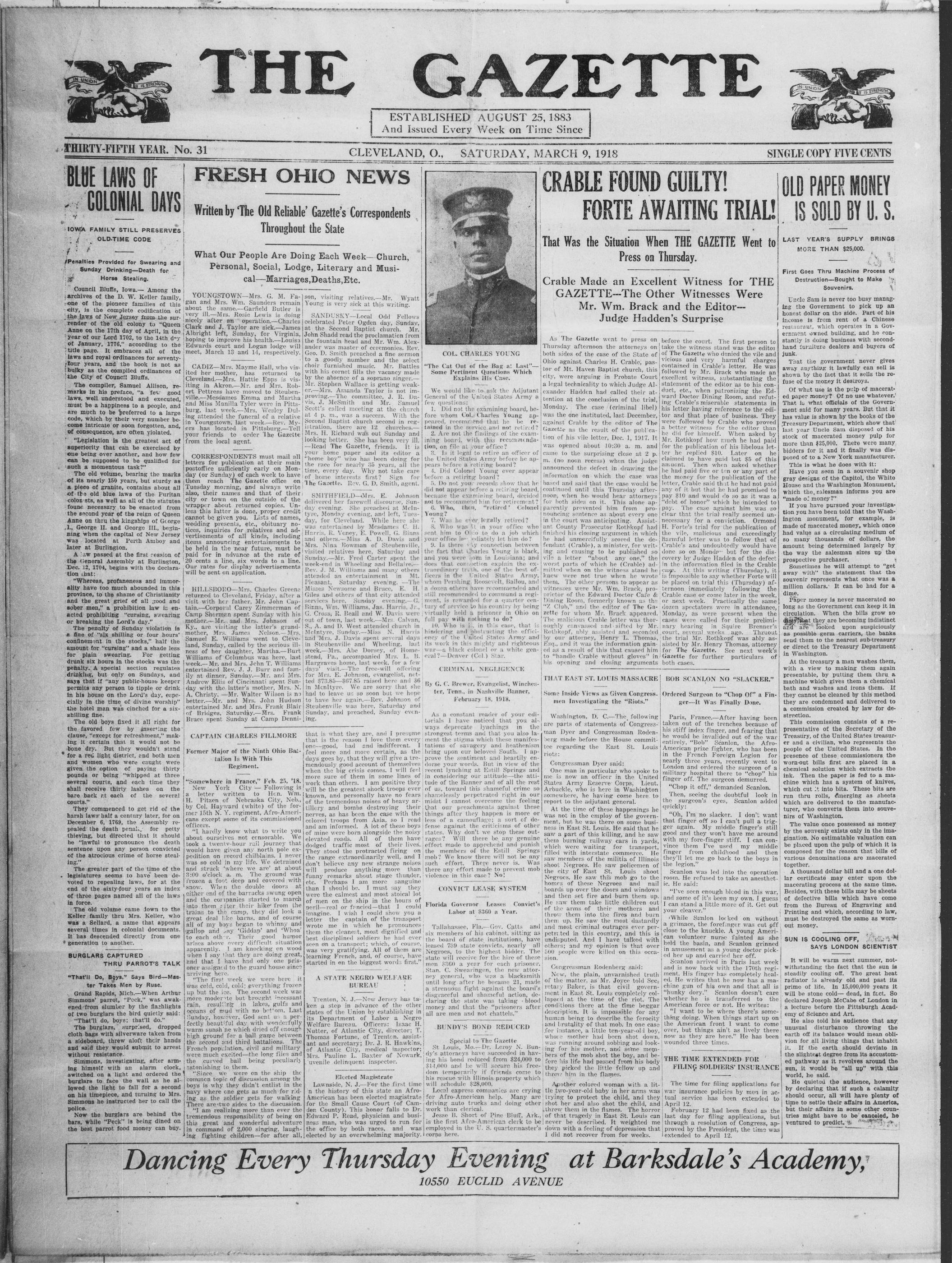
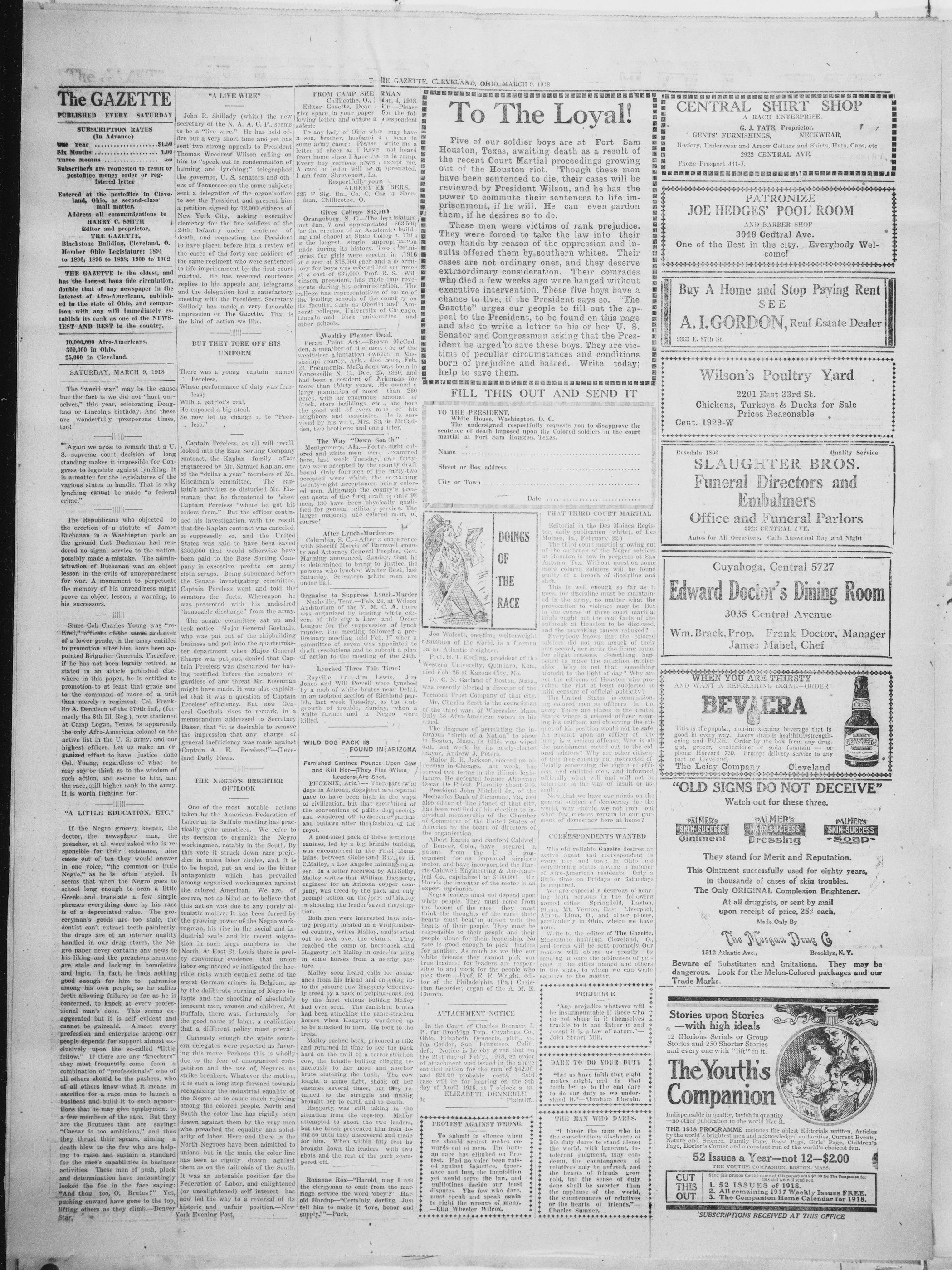
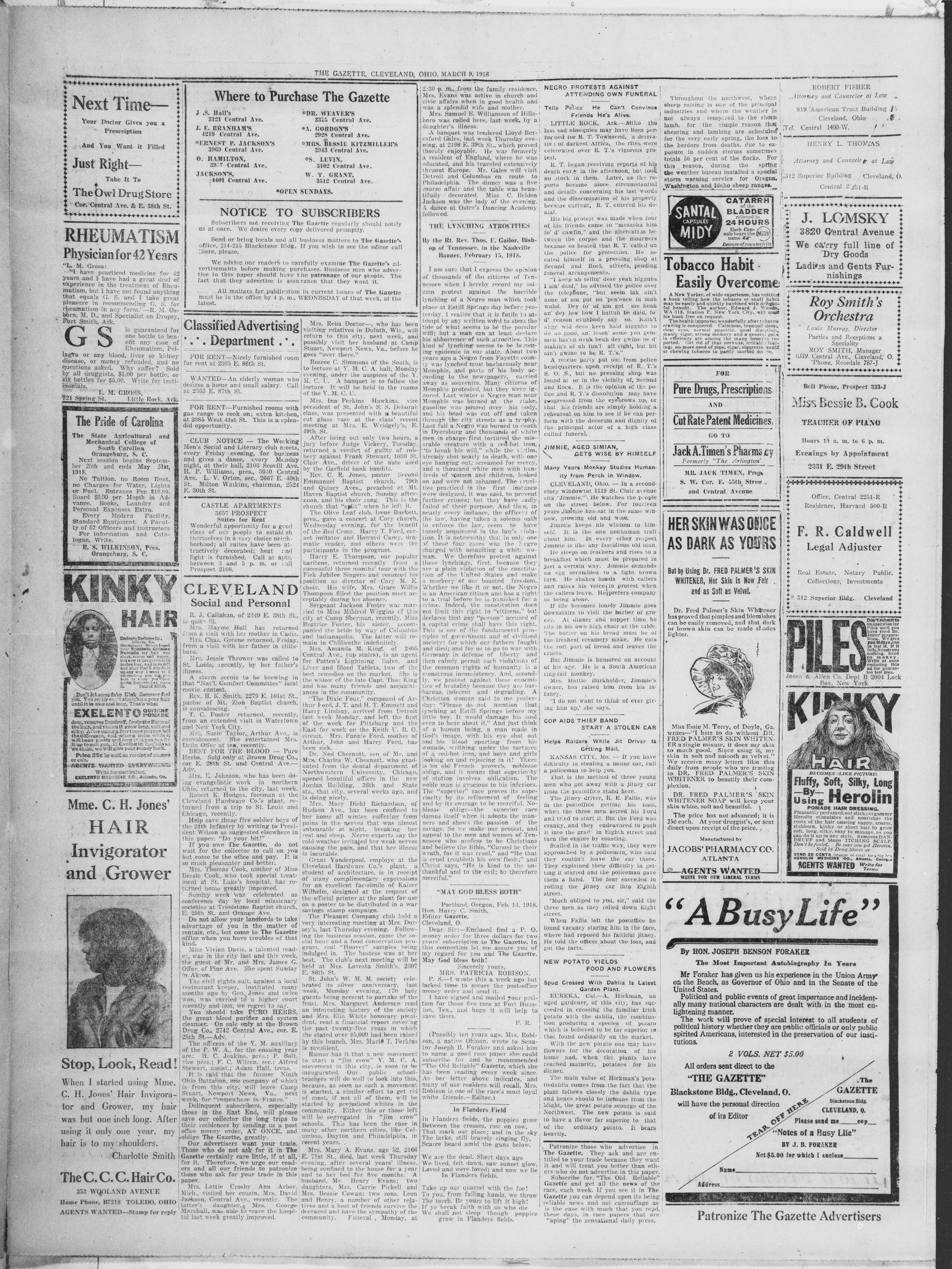
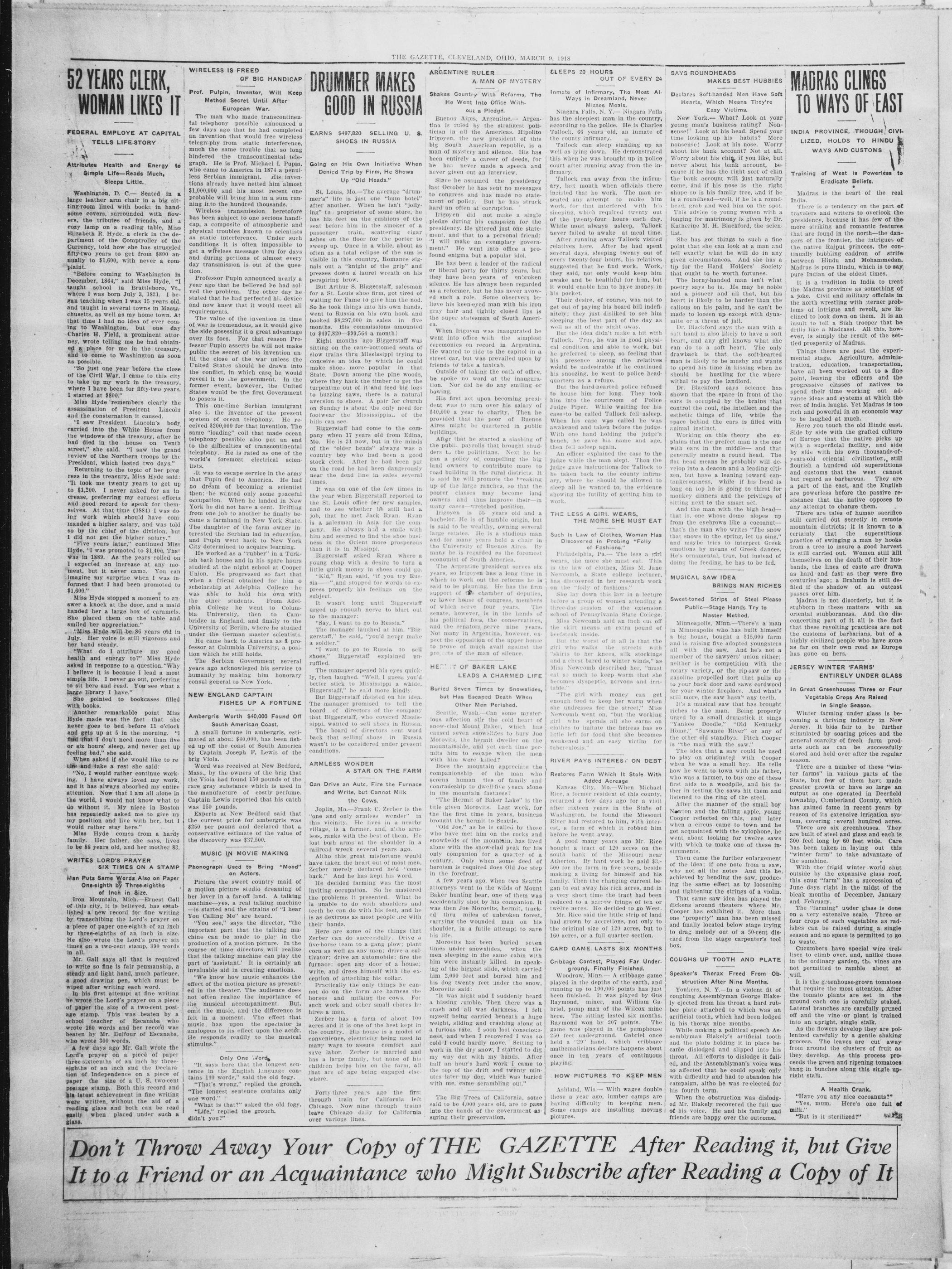
Page text (machine-generated)
Dancing Every Thursday Evening at Barksdale's Academy, 10550 EUCLID AVENUE
IN STROTH
BLUE LAWS OF COLONIAL DAYS
Penalties Provided for Swearing and Sunday Drinking—Death for Horse Stealing.
Council Bluffs, Iowa.—Among the archives of the D. W. Keller family, one of the pioneer families of this city, is the complete codification of the laws of New Jersey from the surrender of the old colony to "Queen Anne on the 17th day of April, in the year of our Lord 1702, to the 14th day of January, 1776," according to the title page. It embraces all of the laws and royal ordinances for seventy-four years, and the book is not as bulky as the compiled ordinances of the City of Council Bluffs.
The compiler, Samuel Allison, remarks in his preface, "a few good laws, well understood and executed, must be a happiness to a people, and are much to be preferred to a large code, which by their very number become intricate or soon forgotten, and, of consequence, are often yolated.
"Legislation is the greatest act of superiority that can be exercised by one being over another, and how few can be supposed to be qualified for such a momentous task?"
The old volume, bearing the marks of its nearly 150 years, but sturdy as a piece of granite, contains about all of the old blue laws of the Puritan colonists, as well as all of the statutes found necessary to be enacted from the second year of the reign of Queen Anne on thru the kingships of George I, George II, and George III, beginning when the capital of New Jersey was located at Perth Amboy and later at Burlington.
A law passed at the first session of the General Assembly at Burlington, Dec. 12, 1704, begins with the declaration that:
"Wheeless, profaneness, and immorality have too much abounded in this province, to the shame of Christianity and the great grief of all good and sober man, a prohibition law is enacted prohibiting 'cursing, swearing or breaking the Lord's day.'
The penalty of Sunday violation is a fine of "six shilling or four hours' confinement in the stocks," half the amount for "cursing" and a shade less for plain swearing. For getting drunk six hours in the stocks was the penalty. A special section regulates drinking, but only on Sundays, and says that if "any public-house keeper permits any person to tipple or drink in his house on the Lord's day, especially in the time of divine worship" the hotel man was cinched for a six-shilling fine.
The old boys fixed it all right for the favored fowr by insisting the clause, "except for refreshment," making it certain that it would not be bone dry. But they wouldn't stand for a red light district, and both men and women who were caught were given the option of paying thirty pounds or being "whipped at three several courts, and each time they shall receive thirty lashes on the bare back rite each of the several courts."
They commenced to get rid of the harsh laws half a century later, for on December 6, 1769, the Assembly repealed the death penalty, for petty thieving, but directed that it should be "lawful to pronounce the death sentence upon any person convicted of the atrocious crime of horse stealing."
The greater part of the time of the legislatures seems to have been devoted to repealing laws, for at the end of the sixty-four-years an index of three pages named all of the laws in force.
The old volume came down to the Keller family thru Mrs. Keller, who was a Sellard, a name that appears several times in colonial documents. It has descended directly from one generation to another.
BURGLARS CAPTURED
THRU PARROT'S TALK
"That'll Do, Boys," Says Bird—Masten, Takes Men by Buse
Grand Rapids, Mich.—When Arthur Simmons' parrot, "Peck," was awakened from slumber by the flashlights of two burglaries the bird quietly said: "That'll do, boys: that'll do." The burglaries, surprised, dropped cloth bags with silverware taken from a sideboard, threw aloft their hands and said they would submit to arrest without resistance. Simmons, investigating, after arming himself with an alarm clock, switched on a light and ordered the burglaries to face the wall as he allowed the light to fall for a second on his timepiece, and turning to Mrs. Simmons he instructed her to call the police.
New the burglaries are behind the bars, while "Peck" is being dined on the best pet food money can buy.
THE GAZETTE
FRESH OHIO NEWS
Written by 'The Old Reliable' Gazette's Correspondents Throughout the State
What Our People Are Doing Each Week—Church, Personal, Social, Lodge, Literary and Musical—Marriages, Deaths, Etc.
YOUNGSTOWN—Mrs. G. M. Fagan and Mrs. Wm. Saunders remain about the same—Garfield Butler is very ill—Mrs. Rosie Lewis is doing after an operation—Charles Clark and J. Taylor are sick—James Albright left, Sunday, for Virginia, hoping to improve his health—Louisa Edwards court and Logan lodge will meet, March 13 and 14, respectively.
CADIZ—Mrs. Mayme Hall, who visited her mother, has returned to Cleveland—Mrs. Hattie Epps is visiting in Akron—Mr. and Mrs. Robert Pettress have moved to Steubenville—Miss Mcdessons Tomma and Martha and Miss Manille Tyler were in Pittsburg, last week—Mrs. Wesley Duling attended the funeral of a relative in Youngstown, last week—Rev. Myers has located in Pittsburgh—Tell your friends to order The Gazette from the local agent.
son, visiting relatives.—Mr. Wyaa Young is very sick at this writing.
SANDUSKY—Local Odd' Fellow celebrated Peter Qgden day, Sunday at the Second Baptist church. Mr John Shadd read the proclamation from the fountain head and Mr. Wm. Alexander was master of ceremonies. ReGeo. D. Smith preached a fine sermon to a goodly number and the solo choir furnished music. Mr. Battle with his cornet fills the vacancy made by the absence of a soprano singer. Stephen Wallace is getting weaker. Mrs. Amanda Taylor is in proving. The committee, J. R. Davis, J. McSmith and Mr. Samuel Scott's called meeting at the church at 4 p.m., was a success. With the Second Baptist church second in registration, there are 12 churches—Mrs. H. Richard was out Sunday and looking better. She has been very ill
CORESPONDENTS must mail all letters at their postoffice sufficiently early on Monday (or Sunday) of each week to have them reach The Gazette office on Tuesday morning, and always write also, their names and that of their city or town on the outside of the wrapper about returned copies. Unless this latter is done, proper credit cannot be given you. Lists of names, wedding presents, etc., obituary notices, inquiries for relatives and advertisements of all kinds, including items announcing entertainments to be held in the near future, must be paid for in advance at the rate of cent per week, so owed to a line. Our rates for display advertisements will be sent on application.
HILLSBORO—Mrs. Charles Greene returned to Cleveland, Friday, after a visit with her father, Mr. John Captain—Corporal Carey Zimmerman of Camp Sherman spent Sunday with his mother. Mr. and Mrs. Johnson of Ky., are visiting the latter's grandmother, Mrs. James Nelson—Mrs. Samantha Saunders, called by the serious illness of her daughter, Martha.—Burt Williams, of Columbus was here, last week. Mr. and Mrs. John T. Williams entertained Rey, J. J. Burr and family at dinner, Sunday.—Mr. and Mrs. Andrew Ellis of Cincinnati spent Sunday with the latter's mother, Mrs. N. Christy.—Mr. Walter Wilson is no better. Mr. and Mrs. John Hudson entertained Mr. and Mrs. Frank Blair of Bridges, Saturday.—Mrs. Frank Brace spent Sunday at Camp Denni-
CAPTAIN CHARLES FILLMORE
Former Major of the Ninth Ohio Baptalion Is With This
"Somewhere in France." Feb. 25, 18.
New York City — Following is a letter written to Hen. Wm. H. Pitten of Nebraska City, Neb., by Col. Hayward (white) of the former 15th N. Y. regiment, Afro-Americans except some of its commissioned officers.
"I hardly know, what to write you about, ourselves not canonizable. We took a twenty-hour journey that would have given any north pole expedition on record my life. We detained so cool my life. We are at about 3:00 o'clock a.m. The ground was frozen a foot deep and covered with snow. When the double doors at either end of the barracks swung open and the companies started to march into them after their hiker from the trains to the camp, they did look a great deal like barns, and of course all of my boys began to whinny and gallop and say 'Giddad' and 'Whoa' to each other. Their good humor arises above every difficult situation apparently, am knocking at the door that they doing great, and that I have had only one prisoner assigned to the guard house since arriving here.
"The first week we were here it was cold, cold, cold; everything frozen up but the ice. The second week we were more moderate but brought dessert rain, resulting in lakes, gulfs and oceans of mud with no beton on. Last Sunday, however, God sent us a perfectly beautiful lake with wonderful ice which dried off enough high ground for a ball game between the second and third battalions. The French population, civil and military were much excited—the long flies and the curved ball being peculiarly astonishing to them.
"Since we were on the ship the common topic of discussion among the boys is why they didn't enlist in the navy where one gets as much for riding as the soldier gets for fighting. The topic of discussion is 'I am realizing more than the tremendous responsibility of being on this great and wonderful adventure in command of 2,000 singing, laughing fighting children—for after all,
ESTABLISHED AUGUST 25,1883 And Issued Every Week on Time Since
son, visiting relatives.—Mr. Wyatt Young is very sick at this writing.
SANDUSKY—Locod. Old! Follows celebrated Peter Ogden day, Sunday, at the Second Baptist church, Mr. John Shadd read the proclamation from the fountain head and Mr. Wm. Alexander was master of ceremonies, Rev. Geo D. Smith preached a fine sermon to a goodly number and the select with furnished music, Mr. Battles by the absence of a soprano singer, Mr. Stephen Wallace is getting weaker—Mrs. Amanda Taylor is not improving.—The committee, J. R. Davis, J. McSmith and Mr. Samuel Scott's called meeting at the church at 4 p.m., was a success. With the Second Baptist church second in reg. there are 12 churches, H. R. Johnson and looking better. She has been very ill.—Read The Gazette, friends. It is your home paper and its editor a "home boy" who has been doing for the race for nearly 35 years, all the time, every day. Why not take care of home interests first? Sign for The Gazette, Rev. G. D. Smith, agent.
SMITHFIELD—Mrs. E. E. Johnson delivered her farewell discourse, Sunday evening. She preached at Meltwyre, Monday evening, and left Tuesday, for Cleveland. While here she was entertained by Mesdames C. H. Harris, R. Veney, E. Powell, G. Binns and others. Miss A. D. Davis and Mrs. Nina Bowman of Steubenville, visited relatives here, Saturday and Sunday. Mr. Fred Carter spent the week-end in Wheeling and Bellaire. Rev. J. M. Williams and many others attended an entertainment in Mt. Pleasant, Saturday evening. --The Misses Newsome and Bruce, E. H. Hiles and others of that city attended services here. Sunday evening. G. Binns, Wm. Williams, Jas. Harris, Jr. G. Cross, R. Beall and W. Davis were out of town, last week. Mr. Hiles attended church in Meltrieu Sunday. Miss N. Harris and Mrs. J. Davis spent several days in Steubenville and Wheeling, last week. Mrs. Abe Dorsey, of Homestead, Pa, accompanied Mrs. L. L. Hairgraves home, last week, for a few days' visit. --The free will offering for Mrs. E. Johnson, evangelist, netted $73.85, $67.85, raised here and $6 in Mentrieu. We are sorry that she had to leave us so soon but we hope to have her again. Rev. Johnson of Steubenville was here, Saturday and Sunday, and preached, Sunday evening.
that is what they are, and I presume that is the reason I love them every one—good, bad and indifferent. I feel more and more certain, as the days go by, that they will give a tremendously good account of themselves when the big crisis comes. I will feel more sure of them in some lines of work than others. I am positive they will be the greatest shock troops ever known, and personally have no fears of the tremendous noises of heavy artillery and bombs destroying their nerves, as has been the case when the colored troops from Asia, so we and am informed, those those boys on the battlefield alongside the noisy elevated roads. All of them have dodged traffic most of their lives. They stood the protracted firing on the range extraordinarily well, and I don't believe any new strange noises will produce anything more than funny remarks about stage thunder, etc. Perhaps I am more sanguine than I should be. I must say they were the calmest and most stoical lot of men on the ship in the hours of peril—real or forced—that I could imagine. I wish I could letter to the captain of the transport in which he pronounces them the cleanest, most dignified and best disciplined soldiers he had ever seen on a transport; which, of course, was very gratifying. All of them are learning French, and, of course, have started in on the biggest word: first.
Trenton, N. J.—New Jersey has taken a step in advance of the other states of the Union by establishing in its. Department of Labor a Negro Welfare Bureau. In 1934, the National City, director; Thomas Fortune, of Trenton, assistant and secretary; Dr. J. R. Hawkins, of Atlantic City, medical inspector; Mrs. Pauline B. Baxter of Newark, uvenile delinquent inspector.
Elected Magistrate
Lawnside, N. J.—For the first time in the history of this state an Afro-American has been elected magistrate for the Small Cause Court (of Camden County). This honor falls to the business man, who was urged to run for the office by both races, and was elected by an overwhelming majority.
COL. CHARLES YOUNG
"The Cat Out of the Bag at Last"—Some Pertinent Questions Which Explains His Case!
We would like to ask the Adjutant General of the United States Army a few questions:
1. Did not the examining board before whom Col. Charles Young appeared, recommend that he be retained in the service and not retired?
2. Are not the findings of the examining board, with this recommendation, on file at your office?
3. Is it legal to retire an officer of the United States Army before he appears before a retiring board?
4. Did Colonel Young ever appear before a retiring board?
5. Do not your records show that he did not appear before a retiring board because the examining board, decided not to recommend him for retirement?
6. who, who, "retired" 'Colonel Young?
7. Was he ever legally retired?
8. Who was it in your office who sent him to Ohio to do a job which your office he立刻 let him do?
9. Is there any connection between the fact that Charles Young is black, and you were born in Louisiana; and does that connection explain the extraordinary truth, one of the best officers in the United States Army, whom Porshing Rosevelt, Ballou, and a dozen others have recommended and still recommended to command a regiment, is rewarded for a quarter century of service to his country by being virtually a prisoner in Ohio on his return with his do?
10. Who is it in this case, that is hindering and obstructing the office of the United States Army and its work in this mighty and righteous war—black colored or a white general?—Denver (Cd) Star.
CRIMINAL NEGLIGENCE
By G. C. Brewer, Evangelist, Winchester, Tenn., in Nashville Banner, February 18, 1918.
As a constant reader of your editorials I have noticed that you always deprecate lynchings in the strongest terms and that you also lament the stigma which these manifestations of savagery and heathemism bring upon our beloved South. I approve the sentiment and jacently endorse your words. But in view of the recent lynching at Estill Springs and in considering our attitude—the attitude of the Banner and of all the rest of az. toward this shameful crime so shamelessly perpetrated right in our midst I cannot overcome the feeling that our preachments against these things after they happen is more or less of a camouflage; a sort of defense against the criticisms of states that these outreformers will be there by any genuine effort made to apprehend and punish the members of the Estill Springs mob? We know there will not be any such effort. There never is. Was there any effort made to prevent mob violence in this case? No!
CONVICT LEASE SYSTEM
Florida Governor Lees Convict's Labor at $360 a Year.
Tallahassee, Fl., Gov. Gatts, and six members of his cabinet, sitting as the board of state institutions, have leased 769 state convicts, nearly all Negroes, to the highest bidders. The state will receive or the those of these $360 a year each prisoner, Stan C, Swearingen, the new attorney, general, who was a blacksmith until long after he became 21, made a strenuous fight against the board's disgraceful and shameful action, declaring the state was taking blood money and that the "prisoners after all are men and not chattters."
BUNDY'S BOND REDUCED
Special to. The Gazette
St. Louis, Mo., Dr. Leroy N. Bundy's attorneys have succeeded in having his bond reduced to $24,000. The bond will ensure his freedom (temporarily if friends come to his rescue with Illinois property, which will schedule $28,000).
Local express companies are crying for Afro-American help. Many are driving auto trucks and doing other work than clerical.
is the first Afro-American clerk to be employed in the U. S. quartermaster's corps here.
CRABLE FOUND GUILTY! FORTE AWAITING TRIAL!
That Was the Situation When THE GAZETTE Went to Press on Thursday.
Crable Made an Excellent Witness for THE GAZETTE--The Other Witnesses Were Mr. Wm. Brack and the Editor-- Judge Hadden's Surprise
FILAT EAST ST. LOUIS MASSACRE BOB SCANLON NO "SLACKER."
As The Gazette went to press on Thursday afternoon the attorneys on both sides of the case of the State of Ohio against Charles H. Crable, pastor of Mt. Haven Baptist church, this city, were arguing in Probate Court a legal technicality to which Judge Alexander Hadden had called their attention at the conclusion of the trial, Monday. The case (criminal libel) was the one instituted, last December, against Crable by the editor of The Gazette as the result of the publication of his vile letter, Dec. 1, 1917. It was opened about 10:30 a. m. and came to the surprising close at 2 p. m. (no noon recess) when the judge announced the defect in drawing the information on which the case was based and said that the case would be continued until this Thursday afternoon, when he would hear attorneys on both sides on it. This alone apparently prevented him from pronouncing sentence as against every one of the defendants (Crable), a minister, for writing and causing to be published so a letter "about any one" the worst parts of which he (Crable) admitted when on the witness stand he knew were not true when he wrote them. The other persons to appear as witnesses were Mr. Wm. Brack, proprietor of the Edward Doctor Cafe & Bring Room, formerly known as the Kaufman office for whom Mr. Brack appeared. The malicious Crable letter was thoroughly canceled and sifted by Mr. Rothkopf, a lawyer, and seconded by attorney, Henry L. Thomas, Esq., and it was the information gained as a result of this that caused him to "handle Crable without gloves" in his opening and closing arguments
Some Inside Views as Given Congressmen Investigating the "Riots."
Washington, D. C.—The following are parts of statements of Congressman Dyer and Congressman Rodenberg made before the House committee regarding the East-St. Louis riots:
Congressman Dyer said:
One man in particular who spoke to me is now an officer in the United States Army Reserve Corps, Lieut. Arbuckle, who is here in Washington somewhere, he having come here to report to the adjutant general.
At the time of these happenings he was not in the employ of the government, but he was there on some business in East St. Louis. He said that he saw a part of this killing, and he saw them burning railway cars in yards, which were waiting for transport, filled with interstate commerce. He saw members of the militia of Illinois shoot Negroes. He saw policemen of the city of East. St. Louis shoot Negroes. He saw this mob go to the homes of these Negroes and nail boards up over the doors and windows and then set fire and burn them up. He saw them take little children out of the arms of their mothers and throw them into the fires and burn them up. He saw the most dastardly person in the outstretched perpetual in this country, and this is undisputed. And I have talked with others, and my opinion is that over 500 people were killed on this occasion.
Congressman Rodenberg said:
Now, the plain, unvarnished truth of the heresy as in *Joye* told Secretary Baker that the government in East St. Louis completely collapsed at the time of the riot. The conditions there at the time begged description. It is impossible for any human being to describe the ferocity and brutality of that mob. In one case for instance, a little ten-year-old boy, whose mother had been shot down, was running around sobbing and looking for his mother, and some members of the mob shot the boy, and before his life had passed from his body they picked the little fellow up and threw him in the flames.
Another colored woman with a little two-year-old baby in her arms was trying to protect the child, and they shot her and also shot the child, and threw them in the flames. The horror of that tragedy in East St. Louis can never be described. It weighted me down with a feeling of depression that I did not recover from for weeks.
before the court. The first person to take the witness stand was the editor of The Gazette who denied the vile and vicious and very harmful charges contained in Crable's letter. He was followed by Mr. Brack who made an excellent witness, substantiating the statement of the editor as to his conduct, etc., when patronizing the Edward Doctor Dining Room, and refuted the miserable statements in his letter having misrepresented the editor, and that place of business. They were followed by Crable who proved a better witness for the editor than he did for himself. When asked by Mr. Rothkopf how rawe he had paid for the publication of his libulous letter he replied $10. Later on he claimed to have paid but $5 of this amount. Then when asked whether he had paid five or ten or any part of the money for the publication of the letter, Crable said that he had not paid any of it but that he had promised to and would so as it was a debt of honor" which he included in the case against him was clear that the trial really seemed unnecessary for a conviction. Ormond H. Forte's trial for the publication of the vile, malicious and exceedingly harmful letter was to follow that of Crable's and undoubtedly would have done so on Monday" but for the discovery by Judge Hadden of the defect in the information filed in the Crable case. At this writing (Thursday), it is impossible to say whether Forte will be placed on trial this (Thursday) afternoon immediately following the Crable case or come later in the week, next week, or later in the same two successor officers were in attendance Monday, as were present when the cases were called for their preliminary hearing in Squire Brenner's court, several weeks ago. Throught the trial Mr. Rothkopf was ably assisted by Mr. Henry Thomas, attorney for The Gazette. See next week's Gazette for further particulars of both cases.
Ordered Surgeon to "Chop Of" a Finger—It Was Finally Done.
Paris, France—After having been taken out of the trenches because of his stiff index finger, and fearing that he would be involved in the entirely, "Bob" Scanlan, the Afro-American prize fighter, who has been in the French Foreign Legion for nearly three years, recently went to London and ordered the surgeon of a military hospital there to "chop" his finger off. The surgeon demurred.
"Chop it off," demanded Scanlan. Then, seeing the doubtful look in the surgeon's eyes, Scanlan added quickly:
"Oh, I'm no slacker. I don't want that finger off so I can't pull a trigger again. My middle finger's still good and they won't have me around with my fore-finger stiff. I can convince them I've used my middle finger from childhood and then they'll me go back to the boys in the legion."
Scanlan was led into the operation room. He refused to take an anesthetic. He said:
"I've seen enough blood in this war, and some of it's been my own. I guess I can stand a little more of it. Get out your cleaver."
While Scanlon locked on without glance, the forefinger was cut off as glance, the knuckle. A young American volunteer nurse attached, she held the basin, and Scanlon grinned in amusement as a young doctor picked her up and carried her off.
Seanlon arrived in Paris last week and is now back with the 1700 regiment. His finger has completely healed. He writes that he now has a machine gun of his own and that all is "hunky dory." Seanlon doesn't care whether he is transferred to the American force or not. He writes: "I want to be where there's something doing. When things start up on the American front I want to come over, but things ain't as lively there now as they are Here." He has been wounded three times.
THE TIME EXTENDED FOR
The time for filing applications for war insurance policies by men in actual service has been extended to April 12. February 12 had been fixed as the last day for filing applications, but through a resolution of Congress, appended to President, the time-was extended to April 12.
IN UNION
LAY IS STRKKIN
SINGLE COPY FIVE CENTS
OLD PAPER MONEY IS SOLD BY U. S.
First Goes Thru Machine Process of Destruction—Bought to Make Souvenirs.
Uncle Sam is never too busy managing the Government to pick up an honest dollar on the side. Part of his income is from rent of a Chinese restaurant, which operates in a Government owned building, and he constantly is doing business with second-hand furniture dealers and buyers of junk.
That the government never gives away anything it lawfully can sell is shown by the fact that it sells the refuse of the money it destroys.
Of what use is the pulp of macerated paper money? Of no use whatever.
That is what officials of the Government said for many years. But that it has value is shown by the books of the Treasury Department, which show that last year Uncle Sam disposed of his stock of macerated money pulp for more than $25,000. There were many bidders for it and it finally was disposed of to a New York manufacturer.
This is what he does with it.
Have you seen in a souvenir shop gray designs of the Capitol, the White House and the-Washington Monument, which the galesman informs you are "made of money?"
If you have pursued your investigation you have been told that the Washington monument, for example, is made of macerated money, which once had value a circulating medium of so many thousands of dollars, the amount being determined largely by the way the salesman sizes up the prospective purchaser.
Sometimes he will attempt to "get away with" the statement that the souvenir represents what once was a million dollars. It can be had for a dime.
Paper money is never macerated so long as the Government can keep it in circulation. When the bills grow so thick that they are becoming indistinct and are looked upon suspiciously as possible germ carriers, the banks send them to the nearest sub-treasury or direct to the Treasury Department in Washington.
At the treasury a man washes them with a view to making them again presentable, by putting them thru a machine which gives them a chemical bath and washes and irons-them. If they cannot be cleaned by this method they are condemned and delivered to a commission-created by law for destruction.
This commission consists of a representative of the Secretary of the Treasury, of the United States treasurer and a civilian, who represents the people of the United States. In the presence of these commissioners the worn-out bills first are placed in a chemical solution which extracts the ink. Then the paper is fed to a machine which has a system of knives, which cut it into bits. These bits are run thru rolls, emerging as sheets which are delivered to the manufacturer, who converts them into souvenirs of Washington. The value once possessed as money by the souvenir exists only in the imagination. No estimatable valuation can be placed upon the pulp of which it is composed for the reason that bills of various denominations are macerated together.
A thousand dollar bill and a one dollar-certificate may enter upon the macerating process at the same time. Besides, with these bills may be sheets of defective bills which have come from the Bureau of Engraving and Printing and which, according to law, must be destroyed the same as worn-out money.
It will be warm next summer, notwithstanding the fact that the sun is steadily cooling off. The great heat radiator is already old and past its prime of life. In 15,000,000 years it will be stone cold—dead, in fact. So declared Joseph McCabe of London in a lecture before the Pittsburgh Academy of Science and Art.
He also told his audience that any unusual disturbance throwing the earth off its balance would mean-collision for all living things that inhabit it. If the earth should deviate in the slightest degree from its accustomed pathway as it revolves around the sun, it would be "all up" with this world, he said.
He quieted the audience, however by declaring that if such a calamity should occur, that will have plenty of time to settle their affairs in America, but their affairs in some other countries might have to be canceled, he ventured to predict.
"L. M. Gross:
"I have practiced medicine for 42 years and I have had a great deal of experience in the treatment of Rheumatism, but I have not found anything that equals G. S. and I take great pleasure in recommending G. S. for rheumatism in any form."—R. M. Osborn, M. D., and Specialist on Drops, Port Smith, Ark.
GS is guaranteed for one bottle to benefit any case of
GS is guaranteed for one bottle to benefit any case of Rheumatism, Pelagra or any blood, liver or kidney disease, or money refunded, and no questions asked. Why suffer? Sold by all druggists, $1.00 per bottle, or six bottles for $5.00. Write for testimonials.
L. M. GROSS,
721 Spring St. Little Rock, Ark.
The Pride of Carolina
Next session begins September
26th and ends May 31st,
1918.
No Tuition, no Room Rent,
no Charges for Water, Lights
or Fuel. Entrance Fee $1.00.0,
Board $8.00 per Month in Advance,
Books, Laundry and Personal Expenses Extra.
Every Modern Facility,
Standard Equipment. A Faculty
of 57 Officers and instructors
For information and Catalogue,
Write.
R. S. WILKINSON, Pres.
Orangeburg, S. C.
KINKY
HAIR
Exaltato Medicine Co.
Gentleman: Notice I used your Holiday Celebration Pomade my hair was thick, coarse and bumpy, but you and the loved ones had a shaded long, and is so neat it up any way I want to I minute, however, we did here to show you how pretty hair can be. MALBERT KITER
Exxentio Medicine Co.
Continental. Brought in
Columbia Univine
Pensate and
shock, course and nappy.
short, course and nappy.
individual and personal
individual and personal
and play that I embody in
amongning you, my
preference. Exxentio Medicine has
VALUE REWARD.
Don't let some fake Kink. Remove fool
you, really ene standstill on your hair
until you can stand up. Exxentio
EXELENTO QUININE
dead, removes Dandruff, feeds the Roots of
the hair, and makes it grow long, soft and
the difference, and others, little while it
will be good poetry and long life that you can
up to suit your needs. We will give you your money back.
Price 25c by mail on receipt of stamps or
coin.
AGENTS WANTED EVERYWHERE.
Write for advertisers.
EXELENTO MEDICINE CO., Atlanta, Ga.
HAIR Invigorator and Grower
A
Stop, Look, Read!
When I started using Mme. C. H. Jones' Hair Invigorator and Grower, my hair was but one inch long. After using it only one year, my hair is to my shoulders. Charlotte Smith
The C.C.C.Hair Co.
353 WOOLAND AVENUE
Home Phone, B7218 TOLEDO, OHIO
AGENTS WANTED—Stamp for reply
Where to Purchase The Gazette
NOTICE TO SUBSCRIBERS
Subscribers not receiving The Gazette regularly should notify us at once. We desire every copy delivered promptly.
Send or bring locals and all business matters to The Gazette's office, 214-215 Blackstone Bldg. If you wish to see the editor call there, please.
We advise our readers to carefully examine The Gazette's advertisements before making purchases. Business men who advertise in this paper should have the patronage of our people. The fact that they advertise is assurance that they want it.
All matters for publication in current issues of The Gazette must be in the office by 4 p. m., WEDNESDAY of that week, at the latest.
Classified Advertising
... Department ...
FOR RENT—Nicely furnished room for rent at 2305 E. 86th St.
WANTED—An elderly woman who desires a home and small salary. Call at 2363 E. 87th St.
FOR RENT—Furnished rooms with gas range to cook on; extra kitchen, at 2385 West 41st St. This is a splendid opportunity.
CLUB NOTICE — The Working Men's Social and Literary club meets, every Friday evening, for business and gives a dance, every Monday night, at their hall, 3103 Scovill Ave, H. P. Williams, pres., 3040 Central Ave. L. V. Orton, see, 2667 E. 40th St. Milton Watkins, chairman, 2524 E. 30th St.
Wonderful opportunity for a good class of our people to establish themselves in a very choice neighborhood; all suites have been attractively decorated; heat; and light is furnished. Call at apts, between 3 and 5 p. m. or call Prospect 2108.
CLEVELAND Social and Personal
R. J. Callaham, of 2249 E. 38th St. is quit ill.
Mrs. Mayme Hall has returned from a visit with her mother in Cadiz.
Mrs. Chas. Greene returned, Friday, from a visit with her father in Hillsboro.
Mrs. Jessie Thrower was called to St. Louis, recently, by her father's illness.
A storm seems to be brewing in that "Nat'l. Comfort Committee" local movie contest.
Rev. B. K. Smith, 2279 E. 101st St., pastor of Mt. Zion Baptist church, in convalescing.
T. C. Foster returned, recently, from an extended visit in Watertown and New York City.
Mrs. Susie Taylor, Arthur Ave., is convalescent. She entertained Mrs. Delia Offer at tea, recently.
BEST FOR THE BLOOD — Puro Herbs. Sold only at Brown Drug Co. or E. 28th St. and Central Ave.—Ady.
Mrs. E. Johnson, who has been doing evangelistic work in northern Ohio, returned to the city, last week. Robert K. Hodges, foreman at the Cleveland Hardware Co.'s plant, returned from a trip to St. Louis and Chicago, recently.
Help save those five soldier boys of the 29th Infantry by writing to President Wilson as suggested elsewhere in this paper. "Do your bit!"
If you owe The Gazette, do not wait for the collector to call on you but come to the office and pay. It is so much pleasant and better.
Mrs. Thomas Cook, mother of Miss Bessie Cook, who took special treatment at St. Luke's hospital, has returned home greatly improved.
Sunday week was celebrated as conference day by local missionary societies at Triedstone Baptist church, E. 25th St. and Orange Ave.
Do not allow your landlords to take advantage of you in the matter of rentals, etc., but come to The Gazette office when you have troubles of that kind.
Miss Vivian Davis, a talented reader, was in the city last and this week, the guest of Mr. and Mrs. James G. Offer, of Pine Ave. She spent Sunday in Akron.
The civil rights suit, against a local restaurant keeper, instituted many months ago by Geo. Jones and twice won, was carried to a higher court recently and lost, we regret to say.
You should take PURO HEIBES, the great blood purifier and system cleanser. On sale only at the Brown Drug Co., 2742 Central Ave., cor. E. 26th St.-Adv.
The officers of the Y. M. auxiliary of the P. W. A., for the ensuing year are: H. C. Jenkins, pres.; P. Bolt, pres.; F. W. Wien, pres.; Alfred Stewart, assist.; Adrian Henn, tres.
It is said that the former Ninth Ohio Battalion, one company of which is from this city, will leave Camp Stuart, Newport News, Va., next week for "somewhere in France."
Delinquent subscribers, especially those in the East End, will please save our collector the long trips to their residences by sending us a post office money order, AT ONCE, and oblige The Gazette, greatly. Our advertisers want your trade. Those who do not ask for it in The Gazette certainly care little, if at all, for it. Therefore, we urge our readers and all our friends to patronize those who ask for your trade in this paper. Mrs. Lottie Crosby, Ann Arbor, Mrs. visited her cousin, Mrs. David Jackson, Central Ave, recently. The latter's daughter, Mrs. George Marshall, was able to save the hospital last week greatly improved.
THE GAZETTE, CLEVELAND, OHIO, MARCH 9, 1918
Mrs. Reba Doctor—who has been visiting relatives in Duluth, Wis., will return to this city, next week, and possibly visit her husband at Camp Stuart, Newport News, Va., before he goes "over there."
Roscoe C. Simmons of the South, is to lecture at Y. M. C. A. hall, Monday evening, under the auspices of the Y. M. C. U. a banquet to follow the lecture. It will be held in the rooms of the Y. M. C. U.
Mrs. Ina Perkins Hawkins, vice president of St. John's S. S. Dehorbh class, was presented with a beautiful cut glass vase at the class' recent meeting at Mrs. E. Wridgely's, E. 49th St.
After being out only two hours, a jury before Judge Vickery, Tuesday, returned a verdict of guilty of robbery against Frank Stewart, 1030 St. Clair Ave. driver of the auto used by the Garfield bank bands.
Rev. C. R. Jones, pastor Second Emmanuel Baptist church, 79th and Quinney Aves, preached at Mt. Haven Baptist church, Sunday afternoon, and his choir sang. This is the church that "spit" when he left it. The Olive Leaf club, lrene Burkett, press, gave a concert at Cory church, Wednesday evening, for the benefit of the Red Cross. Harry T. Ford, cornet imitator and Howard Carey, dramatic reader, and others were the participants in the program. Harry E. Thompson, our popar baritone, returned recently from a successful three months' tour with the Fisk Jubilee Singers and resumed his position as director of Cory M. E. choir. His wife, Mrs. Grace Willis Thompson filled the position most acceptably during his absence. Sergeant Jackson Foster was married to Miss Mildred Wiggins of this city at Camp Sherman, recently. Miss Beatrice Foster, his sister, accompanied the bride by way of Columbus and Indianapolis. The latter will remain in Chillicothe indefinitely.
Mrs. Amanda M. King, of 2805 Central Ave. (up stairs), is an instructor for Pattern's Lightning Salve, and Liver and Blood Tablets, two of the best remedies on the market. She is the widow of the late Capt. Thos King and has many friends and acquaintances in the community.
"The Dixie Four," composed of Arthur Ford, J. T. and H. T. Emmett and Harry Lindsay, arrived from Detroit last week Monday, and left the first of the week for Pittsburgh and the East for work on the Keith U. B. O. circuit. Mrs. Fannie Ford, mother of Arthur, John and Harry Ford, has been sick. Mrs. Fannie Chestnut, son of Mr. and Mrs. Charles W. Chestnut, who graduated from the dental department of Northwestern University, Chicago, opened beautiful offices in the new Jordan Building, 36th and State sts, that city, several weeks ago, and is doing nicely.
Mrs. Mary Dichl Richardson, of Hudson Ave., has been confined to her home all winter, suffering from pains in the nerves that was almost unbearable at night, breaking her rest and sleep. Nurse experts say the cold weather irritated her weak nerves causing the pain, and that her illness is incurable.
Grant Vanderpool, employ at the Cleveland Hardware Co.'s plant, a student of architecture, is in receipt of many complimentary expressions for an excellent fac-simile of Kaiser Wilhelm, designed at the request of the official printer at the plant for use on a poster to be distributed in a war savings stamp campaign.
The Pleasant Company club held a very interesting meeting at Mrs. Dorsely's, last Thursday evening. Following the business session, came the social hour and a food conservation program, real "Hoover" samples being indulged in. The hostess was at her best. The club's next meeting will be held at Mrs. Lovesta Smith's, 2307 E. 86th St.
St. John's W. M. M. society celebrated its silver anniversary, last week. Monday evening, 170 lady guests being present to partake of the feast. Mrs. Margaret Anderson read an interesting history of the society and Mrs. Ella White honorary president, read a financial report covering the past twenty-five years in which she stated over $5,000 had been raised by this branch. Mrs. Marie T. Perkins is president.
Rumor has it that a new movement to start a "jim crow" Y. M. C. A. movement in this city, is soon to be inaugurated. Our public school-teachers will do well look into the because, as soon as such movements are started, a similar effort to get rid of most, if not all of them, will be started by prejudiced whites in the community. Either this or those left will be segregated in "jim crow" schools. This has been the case in many other northern cities, like Columbus, Dayton and Philadelphia, in recent years.
Mrs. Mary A. Evans, age 52, 216
E. 71st St. died, last week Thursday
evening, after several years' illness,
being confined to the house for a year
and to her bed for five months. A
husband, Mr. Henry Evans; two
daughters, Mrs. Carrie Pickell and
Mrs. Bessie Cowan; two sons, Leon
and Henry, a number of other
relatives and a host of friends survive the deceased and have the sympathy of the community. Funeral, Monday, at
2:30 p. m., from the family residence, M. Evans was active in church and civic affairs when in good health and was a splendid wife and mother. Mrs. Samuel E. Williamson of Hillsboro was called here, last week, by a daughter's illness. A banquet was tendered Lloyd Bercford Gales, last week Thursday evening, at 2198 E. 39th St., which proved thoroughly enjoyable. He was formerly a resident of England, where he was educated, and his traveled extensively throughout Europe. Mr. Gales will visit and Columbia on route to Philadelphia. The dinner was a five course affair and the table was beautifully decorated. Miss C. Belden Jackson was the lady of the evening. A dance at Oster's Dancing Academy followed.
THE LYNCHING ATROCITIES
By the Rt. Rev. Thos. F. Gailor, Bishop of Tennessee, in the Nashville Banner, February 15, 1918.
I am sure that I express the opinion of thousands of the citizens of Tennessee when I hereby record my solenm protest against the horrible lynching of a Negro man which took place at Estil Springs day before yesterday. I realize that it is futile to attempt by any written word to stem the tide of what seems to be the popular will; but a man can at least declare his abhorrence of such atrocities. This kind of lynching seems to be becoming epidemic in our state. About two years ago a Negro from Fayette county was lynched most barbarously near Memphis, and parts of his body according to the newspapers, carried away as souvenirs. Many citizens of Memphis protested, but they were ignored. Last winter a Negro man near Memphis was burned at the stake, gasoline was poured over his body, and his head was cut off and taken through the city streets as a trophy. Last fall a Negro was burned to death in Dyersburg and thousands of white men in charge first tortured the miserable creature with a red hot iron, "to break his will," while the victim, already shot nearly to death, with one eye hanging近ly, screamed for mercy, and a thousand white men with hundreds of women and children, looked on and were not ashamed. The cruelties practiced in the first instance were designed, it was said, to prevent further crimes; but they were sadly failed of their purpose. And then, in nearly every instance, the officers of the law, having taken a solemn oath to enforce the law, seem to have tamely acquiesced in the law's violation. It is noteworthy that in only one of these four cases was the Negro charged with assaulting a white woman. We therefore protest against these lynchings, first, because they are a plain violation of the constitution of the United States and make a mockery of our boasted freedom. Whether we like it or not, the Negro is an American citizen and has a right to a trial before he is punished for a crime. Indeed, the constitution does not limit this right to "citizens," but declares that any "person" accused of a capital crime shall have this right. This is one of the fundamental principles of our government for our civil society, for which our fathers fought and died; and for us to go to war with Germany in defense of liberty and then calmly permit such violations of the common rights of humanity is a monstrous inconsistency. And, secondly, we protest against these enemies of brutality because they are barbarous, indecent and degrading. A Christian woman said to me yesterday: "Please do not mention that lynching at Estil Springs before my little boy. It would damage his soul even to hear about it." And just think of a human being, a man made in God's image, with his eye shot out on his blood spitting under the tortures of a red hot iron, and boys and girls looking on and rejoicing in it. There is an old French proverb, noless oblige, and it means that superiority of station involves obligation. The noble man is gracious to his inferiors. The "superior" race proves its superiority by its refinement of feeling and by its courage to be merciful. Noblesse oblige—the superior race damns itself when it adopts the manners and shows the passion of the savage. So we make our protest, and appeal to the men and women of Tennessee who profess to be Christians and believe the Bible, "Cursed be their wrath, for it was cruel," and "He that is cruel trouble his own flesh;" and Christ says, "He is kind to the unthankful and to the evil; be therefore merciful."
"MAY GOD BLESS BOTH"
Portland, Oregon, Feb. 14, 1918.
Hon. Harry C. Smith,
Editor Gazette,
Cleveland, O.
Dear Sir:—Enclosed a p. A. O.
money order for three dollars for two
years' subscription to The Gazette. In
this connection let me assure you of
my regard for you and The Gazette.
May God bless both!
Sincerely yours,
MRS. PATRICIA ROBISON.
P. S. I wrote this a week ago but
lacked time to secure the post-office
money order and send it.
I have signed and mailed my petition
for those five men at Fort Houston,
Tex. and hope it will help to save them.
P. R.
(Possibly ten years ago, Mrs. Robinson, a native Ohioan, wrote to Senator Joseph B. Foraker and asked him to name a good race paper she could subscribe for and he recommended "The Old Reliable" Gazette, which she has been reading every week since. As her letter above indicates, and many of our readers will recall, Mrs. Robinson is one of the race's most loyal white friends.—Editor.)
in Flanders Field
In Flanders fields, the poppies grow
Between the crosses, row on row.
That mark our place; and in the sky
The larks, still bravely singing fly,
Scarce heard amid the guns below.
We are the dead. Short days ago
We lived, felt dawn, saw sunset glow,
Loved and were loved; and now we fly
In Flanders fields.
Take up our quarrel with the foe!
To you, from failing hands, we throw
The tore. Be yours to lift it high!
If ye break faith with us who die
We shall not sleep though poppies
grow in Flanders fields.
NEGRO PROTESTS AGAINST
ATTENDING OWN FUNERAL
Tell's Police He Can't Convince
Friends He's Alive.
LITTLE ROCK, Ark.-Attho the last sad obsequies may have been performed for R. T. Townsend, a derivative of darkest Africa, the rites were celebrated over R. T.'s vigorous protest.
R. T. began receiving reports of his death early in the afternoon, but took no stock in them. Later, as the reports became more circumstantial and details concerning his last words and the dissemination of his property became current, R. T. entered his denial.
His big protest was made when four of his friends came to "mesaasha him to' d.cawfin," and the altercation between the corpse and the mourners became so heated that R. T. called on the police for protection. He located himself in a pressing shop at Second and Rock streets, pending terminal arrangements.
"I keep uh tellin' dese yeah niggush i ain' daid," he掀 the police over the telephone, "but seem lak ain't none of um put no 'pen'ence in mah wubd. Dey to' of um got me heah an' dey low how I hartuh be daid, fo' d' reason evuthbody say so. Kain't algy wid dese keen haid nigghuhs to do no good, an' less' some you gemmen has'en ovuh heah dey gwine be d'makin' of uh fun' all right, but hit ain' gwine to be R. T.'s.
A rescue party put out from police headquarters upon receipt of R. T.'s S. O. S., but no pressing shop was found at or in the vicinity of, Second and Rock. It is the opinion of the police and R. T.'s dissolution may have progressed from the eyebrows up, or that his friends are simply holding a rehearsal on him to see if he can perform with the decorum and dignity of the principal actor of a high class culld funeral.
JIMMIE, AGED SIMIAN,
GETS WISE BY HIMSELF
Many Years Monkey Studies Human city from Perch in Window.
CLEVELAND, Ohio. — In a second-story window at 1119 St. Clair avenue sits "Jimmie." He watches the people on the street below. For fourteen years Jimmie has sat in the same window, growing old and wise. Jimmie keeps his wisdom to himself. It is the one nonhuman trait about him. In every other respect Jimmie is like any fastidious old man. He sleeps on feathers and rises to a breakfast which must be prepared in just a certain way. Jimmie demands an egg scrambled to a light brown turn. He shakes hands with callers and raises his voice in protest when the callers leave. He prefers company to being alone.
If life becomes lonely Jimmie goes downstairs to visit the barber of grocer. At dinner and supper time he sits in his own high chair at the table. The butter on his bread must be of the freshest creamy make. He eats the soft part of bread and leaves the crusts.
But Jimmie is humored on account of his age. He is a South American ring-tail monkey.
Mrs. Hattie Burkholder, Jimmie's owner, has raised him from his infancy.
"I do not want to think of ever giving him up," she says.
COP AIDS THIEF BAND
START A STOLEN CAR
Helps Raiders While Jit Driver Is Getting Mail.
KANSAS CITY, Mo. — If you have difficulty in stealing a motor car, call a policeman to help you.
That is the method of three young men who got away with a jitney car from the postoffice stand here.
The jitney driver, R. E. Fallis, was in the postoffice getting his man, when the three men seized his Ford and tried to start it. But the Ford was cranky, and they endeavored to push it into the gravel in Eighth street and turn the engine by coasting.
Stalled in the traffic way, they were approached by a policeman, who said they couldn't leave the car there. They explained their difficulty in getting it started and the policeman gave them a hand. The four succeeded in rolling the jitney car into Eighth street.
"Much obliged to you, sir," said the three men as they rolled down Eight street.
When Fallis left the postoffice he found vacancy staring him in the face, where had reposed his faithful jitney. He told the officer about the loss, and got the facts.
NEW POTATO YIELDS
FOOD AND FLOWERS
Spud Crossed With Dahlia Is Latest Garden Plant.
EUREKA, Cal.-A. Hickman, an aged gardener, of this city, has succeeded in crossing the familiar Irish potato with the dahlia, the combination producing a species of potato which is believed to be far superior to that found ordinarily on the market.
With the new potato one may have flowers for the decoration of his home and, when the plants have reached maturity, potatoes for his dinner.
The main value of Hickman's potato-dahlia comes from the fact that the plant follows closely the dahlia type and hence should be immune from the blight, the great potato scourge of the Northwest. The new potato is said to have a flavor far superior to that of the ordinary potato. It bears heavily.
Patronize those who advertise in The Gazette. They ask and are entitled to your trade because they want it and will treat you better than others who do not advertise in this paper. Subserve for "The Old Reliable" Gazette and get all the news of the race, each week. If you see it in The Gazette you can depend upon its being the news and not camouflage as is the news of the race. In these days, in race papers that are "aping" the sensational daily press.
"ABusyLife"
The Most Important Autobiography In Years
Mr Foraker has given us his experience in the Union Army on the Bench, as Governor of Ohio and in the Senate of the United States.
Political and public events of great importance and incidentally many national characters are dealt with in the most enlightening manner.
The work will prove of special interest to all students of political history whether they are public officials or only public spirited Americans, interested in the preservation of our institutions.
2 VOLS. NET $5.00
All orders sent direct to the
"THE GAZETTE"
Blackstone Bldg., Cleveland, O.
will have the personal direction of its Editor
TEAR OFF HERE
The GAZETTE
Blackstone Bldg.
CLEVELAND, O.
Please send me ___ eop_
"Notes of a Busy Life"
BY J. B. FORAKER
Net $5.00 for which I enclose
Name___
Address___
Throughout the northwest, where sheep raising is one of the principal industries and where the weather is not always tempered to the shorn lamb, for the simple reason that shearing and lambing are scheduled for the very early spring, the loss to the herders from deaths, due to exposure in sudden storms sometimes totals 50 per cent of the flocks. For this reason, during the spring the weather bureau installed a special storm warning service for Oregon, Washington and Idaho sheep ranges.
SANTAL CAPSULES MIDY
CATARRH of the BLADDER relieved in 24 HOURS Each Cap-sule bears the (MIDY) name #4
Bearer of counterfeits
CATARRH
of the
BLADDER
relived in
24 HOURS
Each Cap
suspend the MIM
name
Beaver of counterfeit
Tobacco Habit Easily Overcome
A New Yorker, of wide experience, has written a book telling how the tobacco or snuff habit may be easy and quickly banished with defoggers. A book by the author, WA 318, Station F, New York City, will mark the health improvement after tobacco craving is conquered. Calmness, tranquil sleep, clear eyes, normal appetite, good digestion, and a sense of well-being in efficiency are among the many benefits reported. Get rid of that nervous, irritable, frightful, no more need of pipe, cigarette, snuff habit, and tobacco.
FOR
Pure Drugs, Prescriptions
AND
Cut Rate Patent Medicines.
GO TO
Jack A.Timen's Pharmacy
Formerly "The Arlington"
MR. JACK TIMEN, Prose
S. W. Cor. E. 55th Street
and Central Avenue
HER SKIN WAS ONCE
AS DARK AS YOURS
But by Using Dr. FRED PALMER'S SKIN WHITENER, Her Skin is Now Fair and as Soft as Velvet.
Dr. Fred Palmer's Skin Whitener has proved that pimples and blemishes can be easily removed, and that dark or brown skin can be made shades lighter.
Miss Essie M. Terry, of Doyle, Ga.
writes: "I hate to do without DR.
FRED PALMER'S SKIN WHITENER
a single minute, it does my skin
so much good. Since using it, my
skin is soft and smooth as velvet."
We receive many letters like this
daily from people who are trusting
to DR. FRED PALMER'S SKIN
WHITENER to beautify their complexion.
DR. FRED PALMER'S SKIN
WHITENER SOAP will keep your
skin white, soft and beautiful.
The price has not advanced; it is
256 each. At your druggist's, or sent
direct upon receipt of the price.
Manufactured by
JACOBS' PHARMACY CC.
ATLANTA
(2) AGENTS WANTED
WRITE FOR OUR LIMERAL TERMS
"A Busy
By HON. JOSEPH BENSON F
The Most Important Au
Mr Foraker has given us his e
on the Bench, as Governor of O
United States.
ROBERT FISHER
Attorney and Counselor at Law
819 American Trust Building
Cleveland, Ohio
Tel. Central 1400-W.
HENRY L. THOMAS
Attorney and Counselor at Law
.512 Superior Building Cleveland, O.
Central 2 251-R
J. LOMSKY
3820 Central Avenue
We carry full line of
Dry Goods
Ladies and Gents Furnishings
Roy Smith's
Orchestra
Louis Murray, Director
Parties and Receptions a
Speciality
ROY SMITH, Manager
6319 Central Ave, Cleveland; O.
Phone, Rosedale 787-J
Bell Phone, Prospect 333-J
Miss Bessie B. Cook
TEACHER OF PIANO
Hours 10 a. m. to 6 p. m.
Evenings by Appointment
2331 E. 29th Street
Office, Central 2251-R Residence, Harvard 500-R
F. R. Caldwell Legal Adjuster
Real Estate, Notary Public Collections, Investments
PILES
Jones & Allen Co. Dept B 2004 Lock
Box. New York
KINKY
HAIR
BECOMES (LIKE PICTURE)
Fluffy, Soft, Silky, Long
—By—
Using Herolin
POWERD HAIR DRESSING.
Pleasantly perfumed not sticky, gummy
Herolin stimulates and nourishes the roots of the hair causing nappy, coarse,
stubborn, kinky, or short hair to grow
soft, long silky, easy to manage, so you
can do it up in any style. Removes DAN-
DRUFF and Stops ITCHING SCALP.
Don't be fooled. The best way to Herolin.
Sold by Drug Store or
SEND 25 CENTS (stamps or coin) for a big buy
HEROLIN MEDICINE CO., Atlanta, Georgia
AGENTS WANTED Write for
Terms
yLife"
ORAKER
biography In Years
experience in the Union Army
Ohio and in the Senate of the
Don't Throw Away Your Copy of THE GAZETTE After Reading it, but Give
It to.a Friend or an Acquaintance who Might Subscribe after Reading a Copy of It
at SS
Sage eh tS ie
veges £7 SAAS
hea oo
D2 YEARS CLERK,
FEQERAL EMPLOYE AT CAPITAL
_\. TELLS LIFE-sTorY
veh tas
Attributes Health and Eneray to
% Simple Life—Reads Much,
Gl ele tose
Washington, D. C.— Seated in a
Jarge leather arm chair in a big sit-
tingroom lined with book: in hand.
some covers, surrounded with flow-
ers, the tributes of friends, and a
cory lamp on a reading table, Miss
Wlizabeth R. Hyde, a clerk in the de-
Partment of the Comptroller of the
Currency, told how she has struggled
Aftytwo years to get from $800 an-
nually to $1,600, with never a com
‘piaint.
“Before coming to Washington tn
December, 1864,” said Miss Hyde, “1
taught school in Brattleboro, Vt.
where I was born July 3, 1821. 'I be-
Ran teaching when I was 15 years old,
and taught In several towns in Massa.
chusetts, as well as my home town, At
that time I had no idea of ever com
ing to Washington, but one day
Charles H. Field, a prominent attor
ney, wrote telling me he had obiain-
©@ g place for me in the treasury,
‘and to come to Washington as soon
‘as possible.
"So just one year before the close
of the ‘Civil War, I'eame to this city
to take up my work in the treasury,
where I have been for fitty-two years,
I started at $800.”
Miss Hyde ‘remembers clearly the
assassination of Presirent Lincoln
and the consternation it caused.
“I saw President Lincoln's body.
carried into the White House from
the windows of the treasury, after he
had died in the house on Tenth
street,” she said, “I saw the grand
review of the Northern troops by the
President, which lasted two days.”
Returning to the topic of her prox
ress in the treasury, Miss Hyde said
“It took me twenty years to get up
to $1,200. I never asked for an in
erease, preferring my earnest efforts
and good record to speak for them-
aelyes. At that time (1884) I wax do
ing work which should have com
manded a higher salary, and was told
80 by the chief of the division, but
I did not get the higher salary.”
“Five years later,” continued Miss
Hyde, “I was promoted to $1,400. That
was In 1889. As the years rolled on
I expected an increase at any mo
“ment, but it never camo. You can
“imagine my surprise when I was in
formed that I had been promoted to
$1,600." .
Miss Hyde stopped a moment to an.
swer a knock at the door, and a maid
handed her a large box of caramels
She placed them on the table and
smiled her appreciation.”
o {iMisg-Hyde willbe, 86 years ota in
July. Her voice is still vigorous and
her band steady.
“What do I attribute my good
health and energy to?” Miss Hyde
asked in response to a question, "Why
T believe it is because I lead a most
‘simple life. I never go out, preferring
to sit here and read. You see what «
Jagge library I have.”
She pointed to bookcases filled
with books.
‘Another remarkable point Miss
Hyde made was the fact that she
never goes to bed before 11 o'clock
and gets up at 5 in the morning. “1
MBE fase used tore thes ave
or six hours’ sleep, and never get up
feeling bad,” she said.
When asked if she would like to re
tifeand take a rest she said:
“No, I would rather continue work-
ing. I have always ioved my work,
and it has always absorbed my entire
attention. Now that I am all alone in
the world, I would not know what to
do without it, My niece in Boston
has repeatedly asked me to give up
amy position and live with her, but 1
would rather siay here." és
Miss Hyde comes trom a hardy
family. Her father, she says, lived
1o be 85 years old, and her mother 83.
Man Puts Same Words Also on Paper
One-scighth by Three-eighths
of Inch in Size.
Iron Mountain, Mich—Ernest Gall
of ‘this city, It Is believed, has estab
lished a new record for fine writing
by franschibing the Lerd’s prayer on
a plece of paper one-eighth of an inch
by three-eighths of an inch in size.
He also wrote the Lord's prayer six
times on a two-cent stamp, 390 words
in all,
‘Mr. Gall says all that is required
to write so fine is fair penmanship, a
‘stbady. and light hand, much patieuce,
@ good drawing pen, which must be
wiped after writing each word.
J bis first attempt at fine writing
he wrote the Lord's Piste 08.9 Dloce
of paper the size of a two-cent post-
age stamp. ‘This was beaten by a
School teacher of Escanaba who
wrote 160 words and her record was
beaten by Mr. Dulfour of Escanaba,
who wrote 300 words.
‘A few days ago Mr. Gall wrote the
Lord's prayer on a piec® of paper
three-sixteenths of an inch by three
ejghihs of an inch and the Declara
tion ‘of Independence on a piece of
paper the size of a U. 8. twocent
postage stamp. Both this record and
‘Bis latest achievement in fine writing
Were written, without the aid of a
Feading giass and both can be read
gasily, when placed under such «
5 alin
WIRELESS I$ FREED
OF BIG HANDICAP
Prof. Pulpin, Inventor, Will Keep
Method Secret Until After
Mieuckac hie.
‘The man who made transcontinen-
tal telephony possible announced a
few days ago that he had completed
an invention that would free wireless
telegrephy from static interference,
much the same trouble tha: so long
hindered the _ transcontinental tele-
graph. He is Prof. Michael L Pupin,
‘who came to America in 1871 a penni
Jess Serbian immigrant. lis inven:
tions already have netted him almost
$1,000,000 aud his most recent one
probable will bring him in a sum run:
ning irto the hundred thousands.
Wireless transmission heretofore
has been subject to one serious handi-
cap, a composite of atmospheric and
Physical troubles known to scientists
as static interference, Under such
conditions it is often impossible to
get a witeless message (hru for days
and during portions of almost every
day transmission is out of the ques
tion.
Professor Pupin announced nearly a
year ago that he believed ke had sol
¥ed the problem. ‘The other day he
stated that he had perfected hi. device
and now knew that it would meet all
requirements.
‘The value of the invention in time
of war is tremendous, as it would give
the side posessing it a great advantage
over its foes. For that reason Pro:
fessor Pupin asserts he will not make
Public the seeret of his invention un:
il the close of the war unless the
United States should be drawn into
the conflict, in which case he would
Teveal it to she government, In the
former event, however, the United
States would be the first Government
to poses it.
This one-time Serbian immigrant
also i. the inventor of the present
system of ocean telephony. He re-
ceived $200,000 for that invention, The
same “loading” coil that made ocean
telephony possible also put an end
to the difficuitios of transcontinental
telephony. He is rated as one of the
world’s foremost electrical scien:
tists.
<It was to escape service in the army
that Pupin fled to America. He had
no dréam of becoming a scientist
then; -he wented only some peaceful
ovcupation. When he landed in New
York he did not have a cent. Drifting
from one job to another he finally’ be-
came a farmhand in New York State.
The daughter of ‘the farm owner in
terested the Serbian lad in education,
and Pnpin went back to New York
City determined to acquire learning,
He worked as a “rubber” in a Turk-
ish bath house and in his spare hours
studied at the night sebool at Cooper
Union, He progressed so fast that
when a friead obtained for him o
scholarship at Adelphia College he
was able to hold his own with
the other students, From Adel:
phia College he went to Colum
bia University, then to Cam-
bridge in England, and finaily to the
Guiversity of Berlin, where he studied
under the German master scientists.
He came back to America as & pro:
fessor at Columbia University, a posi-
tion which he still holds.
‘The Serbian Government several
years ago acknowleged his service to
humanity by making him honorary
consul eeceral to New York.
NEW ENGLAND CAPTAIN
FISHES UP A FORTUNE
Ambergris Worth $40,000 Found Off
South American Coast.
‘A small fortune in ambergris, esti-
mated at abou: $40,000, has been fish:
ed up off the coast of South America
by Captain Joseph F, Lewis of the
brig Viola.
‘Word was received at New Bedford,
Mass., by the owners of the brig that
the Viola had found 150 pounds of the
rare gray substance which is used in
the manufacture of costly perfume.
Captain Lewis reported that his catch
was 150 pounds.
Experts at New Bedford said that
the current price for ambergris was
$200 per pound and declared that &
conservative estimate of the value of
the discovery was $37,500.
MUSIC IN MOVIE MAKING
Phonograph Used to Bring “Mood”
cin Abate.
Picture the sweet country maid of
@ motion pieture siudio dreaming of
her lover in a faroff land. A talking
machine—yes, a real talking machine
<is started snd the strains of “I hear
You Calling Me” are heard.
“You see,” says the director, “the
important part that the talking ma-
chine can be made to play in the
production of a motion pieture. In the
course of time directors will realize
that the talking machine can play the
part of ‘assistant.’ It is certainly an
invaluable aid in creating emotions.
“We know how music enhances the
effect of the motion picture as present-
ed in the theater. The audience does
not often realize the importance of
ihe musical accompaniment. But,
omit the music, and the differenco is
felt in a moment. ‘The effect that
music, has upon the spectator is
analogous to its effect upon the actdr.
He responds readily to the musical
stimulus.”
Only One word
“It says here that the longest sen-
tence in the English Iinguage con-
tains 140 words,” said the old fogy.
“That's wrong,” replied the grouch.
“The longest seatence contains only
une word.”
“What is that?” asked the old fogy.
“Life,” replied the grouch.
itn’ soul”
THE GAZETTE, CLEVELAND, ONIO, MARCH 9, 1918
EARNS $497,820 SELLING U. 8.
SHOES IN RUSSIA
Going on His Own Initiative When
Denicd Trip by Firm, He Shows
Up “Old Heads.”
St, Louis, Mo.—The average “drum-
mer's" life is just one “bum hotel”
after another. When he isn't “jolly:
ing” ta proprietor of some store, he
has his feet on the cushions of the
seat before him in the smoker of a
passenger train, scattering cigar
ashes on the tloor for the porter wo
sweep up. Once in a while, about as
often as a total eclipse of the sum is
visible in this country, Romance sig-
nals out a “knight of the grip” and
presses down a laurel wreath on his
perspiring brow.
But Arthur S. Biggerstaff, salesman
for a St. Louis shoe firm, got tired of
waiting for Fame to give him the nod.
So he took things into his own hands,
went to Russia on his own hook and
booked $8,297,000 in sales in five
months, His commissions amounted
to $497,820—-$99,564 a month!
Bight months ago Biggerstalf was
sitting on the cane-bottomed seals of
slow trains thru Miseissippi trying to
conceive an idea by which he could
make shoes more popular in that
State. Down among the pine woods,
where they hack the timber to get the
turpentine out of it and feed big logs
to buzzing saws, there is a natural
aversion to shoes. A pair for church
on Sunday {s about the only need for
footwear the Mississippian of the
hills can see.
Biggersta! had come to the com-
pany when 17 years old from Edina,
Mo. He is 31 now, but in the minds
of the “older heads” always was a
country boy who had been a good
stock clerk. After he had been put
on the road he hid been dangerously
near the dead line in sales several
times,
It was on one of the few times in
the year when Biggersafl reported to
the St. Louis office fer new samples,
and to see whether lM still bad a
Job, that he met Jack Ryan. Ryan
is @ salesman in Asia for the com:
pany. He always bed a smite with
him and seemed to find the shoe busi
ness in the Orient more prosperous
than it is in Missippi.
Biggersta™ asked Ryan where a
young chap with a desire to turn a
little quick money in shoes could go.
“Kid,” Ryan said, “if you try Ru
sia——" and stopped for words to ex-
press properly his feelings on the
subject.
It wasn't tong until Sicgerstaft
urged up enough nerve to blurt out
to the manager:
“Say, I want to Zo to Russia.”
‘The manager laughed at him, “Bis.
gerstaff,” he sald, “you'd nevgr make
a soldier.”
“E want to go to Russia to sell
shoes,” Biggerstait explained un
ruffled,
‘The manager opened his eyes quick
ly, thien laughed. “Well, I guess you'd
better stick to Mississippi a whide,
Biggerstaff,” he sad more kindly
But Biggerstatt idsisted on his idea.
The manager promised to tell the
board of directors of the company
that Biggerstaff, who covered Missis-
sippi, wanted to sell shoes in Russia.
‘The board of directors :ent word
back that selling’ shoes in Russia
wasn't to be considered under present
conditions.
ARMLESS WONDER
A STAR ON THE FARM
Can Drive an Aute, Fire the Furnace
and Write, but Cannot Milk
the Cows.
Joplin, Mo.—Frank C. Zerber is the
“one and only arsuless wonder" in
this vicinity, He lives in a nearby
village, is @ farmer, and, a'ho arn:
less, ranks with the best of them, He
lost both arms at the shoulder in a
railroad wreck several years ago.
Aliho this great misfortune would
have taker. the heart out of most men,
Zerber merely declared he'd “come
back.” And he has kept his word,
He decided farming was the most
Inviting occupation. So he mastered
the problems it presented. What he
ia unable to do with shoulders and
teeth he can do with his feet, and he
ig as dextrous as most people are with
their hands.
Here are some of the things that
Zerber can do successfully. Drive a
five-horse team to a gang plow; plant
corn as well ax any man; drive a cul
tivator; drive an automobile; fire the
furnace; open any door of a house;
write, and dress himself with the ex
ception of attaching his collar.
Practically tae only things be ean-
not do on the farm are harness the
horses and milking the cows, Fo:
such work and other small chores he
hires a man,
Zerber has a farm of about 100
acres and it is one of the best kept in
the country. His house is a model of
convenience, electricity being used in
many ways to assure comfort and
save labor. Zerber is. married and
has a large family, but none of his
children helps him’ on the farm, all
shat are of age being engaged elsc
where.
Forty-three yeacs ago the first
through train for California leit
Chicago. Now nine through trains
leave Chicago dally for California
okie wanton ttke:
ARGENTINE RULER
A-MAN OF MYSTERY
Shakes Country With Reforms, Tho
He Went Into Office With.
sic etdad
Buenos Ales, Angentine— Argen-
tina is mled by the strangest poll-
tician in all the Americas. Hipolito
Irigoyen, the new president of this
big South American republic, is a
man of mystery and silence. His has
deen entirely a career of deeds, for
he hao never made a speech’ and
hever given out an interview.
Since he assumed the presidency
last October he has sent no messages
to congress and has made no state-
ment of policy, But he has struck
hard an often at corruption.
Irlgoyen did not make a single
pledge during his campaign for the
presidency. He uttered just one state-
ment, and that to a personal friend:
“I will make an exemplary govern-
ment.” He went into office a pro-
found enigina bat a popular idol,
He has been a leader of the radical
or liberal party for thirty years, but
they have been years of —nnbroken
silence. He has always been regarded
a3 a reformer, but he has never avow-
ed such a role, Some observers be-
lieve his keen-eyed man with his iron
gray halr and tightly closed lips is
the super statesman of Suuth Ameri-
ca.
When Irigoyen was inaugurated ho
Went into office with the simplest
ceremonies on record in Argentina.
He wanted to ride to the capitol in a
street car, but was prevailed upon by
friends (0 take a taxicab.
Outside of taking the oat’ of office,
he spoke no word at the inaugura-
tion. Nor did he do any smiling or
bowing.
His first act upon becoming presi-
dent was {0 turn over his salary of
$40,000 a year to charity, Then he
provided that the poor of Buenos
Aires might be quartered in public
buildings.
Afigr that he started a slashing of
the publi. payrotis that brought shud-
ders to the politicians, Next he be.
gan a policy of compelling the big
land owners to contribute more to
road building in the rural districts. It
is said he will promote the Freaking
up of tia large ranehes, so that the
poorer classes muy become land
owners and thus improve their—in
wany cases—wretched position.
Inigoyen is 55 years old und a
bachelor, He is of humble origin, but
is said to be wealthy, owning several
large estates, He is a studious man
and for many years held a chair tn
the University of Buenos Aires, By
many he is regarded as the foremost
economist of South America
‘The Argentiin president serves eix
years, so Irigoyet bas a Jong time in
which (o work out the reforms he in
said to be plasning. He has the firm
support of OM chamber of deputies,
or lower house of congress, members
of which serve four years, The
senate, however, Is in te hands of
his political fora, the conservatives,
and the senators serve nine years,
Not many in Argentina, however, ex
pect the opposition of the upper house
to prove of much avail against the
pro,scts of the man of silence.
HES’ .7 OF BAKER LAKE
LEADS A CHARMED LIFE
Buried Seven Times by Snowslides,
but Has Escaped Death When
Other Men Perished.
‘Seattle, “wash,—Can some myster-
fous affection stir the cold heart of
snow-clad Mount Baker, which has
caused seven snowslides to bury Joe
Morovits, the hermit dweller on the
mountainside, and yet each time por
mits him to escape when the men
with him were killed?
Does the mountain appreciite the
companionship of the man who
xeorns human ties of family and
comradeship to dwelltive years atone
in the mountain fastaess?
“The Hermit of Baker Lake” ts the
title given Morovits. Last week, for
the the first time in years, business
brought the hermit to Seattle,
“Old Joe,” as he is called by those
who have met him on the rocks and
snowdlelds of the mountain, has lived
alone with the snow-clad peak for his
only companion for a quater of a
century. Only when some deed of
heroism is required does Old Joe step
in the forefront,
A few years ago, when two Seattle
attorneys went to the wilds of Mount
Baker hunting hear, one of them was
accidentally shot by his companion, It
was then Joe Morovits, hermit, track-
ed thru miles of unbroken forest,
carrying the wounded man on his
shoulder, in a futile attempt to save
his lite.
Morovits has been buried seven
times under snowstides, when the
men sleeping in the same cabin with
him were instantly killed. In speak-
ing of the biggest slide, which carried
him 2,000 feet and buried him and
his dog twenty feet cinder the snow,
Morovits, said:
“It was night and 1 suddenly heard
a hissing cumble, Then there was a
crash and all was darkness, 1 felt
myself being carried beneath a huge
weight, sliding and crashing along at
a furious rate. I soon lost conscious
ness, and when I recovered I was so
cold I could hardly move. Seiting to
work in the dry snow, I started to dig
my way dut with my hands. After
half an hour's hard work T came to
the top of the drift and twenty min-
utes later my dog, which was buried
with me, eame scrambling out.”
‘The Big Trees of California, some
sald to be 4,000 years old, are (0 pass
into the hands of the government as-
suring thelr preservation,
SLEEPS 20 HOURS
OUT OF EVERY 26
Inmate of Infirmary, Tho Most Al-
Ways in Dreamland, Never
‘Misses’ (Gieata.
Niagara Valls, N, Y.— Niagara Falls
has the sleepiest man in the country,
necording to the police. He is Charles
‘Yallock, 66 years old, an inmate of
the county infirmary.
‘Pallock can sleep standing up as
well as lying down. He demonstrated
“this when he was brought up in police
court after running away from the in-
/firmary.
/ Tallock ran away from the infirm-
“ary, last month when officials there
Incisted that he work. ‘The man re-
sented any attempt to make him
“work, for that interfered with h’s
-siveping, which required twenty out
‘of the twenty-four hours each day.
While niost always asleep, ‘Tullock
| never failed to awake at meal time.
Alter running away Tallock visited
relatives here. After he had spent
| several days, sleeping twenty out of
every twenty-four hours, his relatives
‘suggested that he find work, Work,
“they said, not only would keep him
awake and be healthful for him, but
/it'would enable hin to hgve money in
his pocket,
‘Their desire, of course, was not to
get out of paying his board bill indefl-
nitely; they just disliked to see him
sleeping the best part of the day as
Well as all of the night away.
But the idea didn’t make a hit with
Tallock. ‘rue, he was in good physl-
cal condition and able to work, but
| he preferred to sleep, so feeling that
his presence among the relatives
-wduld be undesirable it he continued
| his snoozing, he went to police head-
quarters as a refuge.
| But the hard-hearted police refused
to house him for long. ‘They took
him into the courtroom of Police
casesto be called Tallock fell asleep.
‘awakened and taken before the judge.
With one hand holding the judco's
‘bench, he gave his name and age,
then fet asleep again.
An officer explained the case to the
judge while the man slept. Thon the
| judge gave Instructions for Tallock to
be taken buck to the county infirm
ary, where he should be allowed to
sleep all he wanted to, the evidence
‘showing the futility of getting him to
ome
THE LESS A GIRL. WEARS,
THE MORE SHE MUST EAT
Such Is Law of Clothes, Woman Has
Discovered in Probing ‘Folly
oh Baakiann)®
Philadelphia, Pa— ‘The less a_rirt
Wears, the more she muat eat, This
ls the Jaw of clothes, Miss M. June
Newcomb, a State college lecturer,
has discovered in her research work
on the “folly of fashions.”
Sie lay down this nw in a lecture
before a group of women attending a
Uirecday session of the extension,
school of Pennsylvania State Coliege,
Mixs Newcomb said an Inch cui off
the skirt means an extra pound of
bewfatoak inside.
Hut the worst of it all fs that the
girl who walks the streets with
“skirts to her knees, silk stockings
and & chest bared to winter winds,” as
Miss Neweomb described her, “must
eat so much to keep warm that she
becomes dyspeptic, nervous and irri-
table.”
The girl with money can get
enough tood to keep her warm when
she undresses for the street,” Miss
Newcomb went on, “but the working
aitl who sponds all she earns on
elothiew to imitate the heiress has so
Little left for food that she becomes
weakened and an easy victim for
tuberculosis.”
RIVER PAYS INTERESs ON DEBT
Restores Farm Which It Stole With
AAA Asante:
Kansas Clty, Mo.—When Michael
Rice, a former resident of this county,
returned a few days ago for a visit
after sixteen years in the State of
Washingion, he found the Missouri
River hud restored to him, with inter-
est, a farm of which it robbed him
before he went away.
A <ood many years ago Mr. Rice
bought a tract of 120 xeres on the
south bank of the Missouri near
Atherton. By hard work he paid $3,-
500 for the farm in five years, beside
making @ living for himself and his
family. Then the changing current be-
gan to eat away his rich acres, and in
a very short time the tract had been
reduced to @ nerrow fringe of ten or
iwelve acres. He decided to go West.
Mr. Rice said the little strip of land
had grown by accretions, not only to
the original size of 120 acres, but to
160 acres, or a full quarter section,
CARD GAME LASTS SIX MONTHS
Cribbage Contest, Played Far Under.
‘Ground, Fitalty Bistaled:
Woodrow, Minn.— A cribbage game
played in the depths of the earth, and
running up to 100,006 points has just
been finished. It was played by Gus
Raymond, miner, and William Ga-
briel, pump man of the Wilcox mine
here. The sitting lasted six months,
Raymond won by 207 points. — The
game was played in the pumphouse
250 feet underground. Gabriel once
held a "29" hand, which cribbage
mathematicians declare happens about
once in ten years of continuous
playing.
HOW PICTURES TO KEEP MEN
Ashland, Wis. With wages double
those a year ago, lumber camps are
having difficulty im keeping men.
Some camps are installing moving
eats
SAYS ROUNDHEADS.
MAKES BEST HUBBIES
Declares Soft-handed Men Have Soft
Hearts, Which Means They're
Easy Victims,
New York.— What? Look at your
young man’s business rating? Non-
sense!’ Look at his head. Spend your
time looking up his habits? More
nonsense! Look at his nose. Worry
‘about bis bank account? Not at all.
Worry about his chin, it you like, but
nover about his bank account, be-
eanve If he has the right sort of chin
the bank account will just naturally
come, and if his nose is the right
shape so is his family tree, and if he
is a roundhead—well, if he is a round:
head, grab and wed him on the spot
‘This adviee to young women with a
longing for matrimony is given by Dr.
Katherine M. H, Blackford, the seien-
tist.
She has got things to such a fine
point that she can look at a man and
tell exactly what he will do in any
given cireamstances, And she has a
tip for the Hand Holders’ Society
that ought to be worth fortunes.
‘The horny-handed man isn't what
povtry says he is. He may be noble
and a pioneer and all that, but his
heart is likely to be harder than the
callous on his palm, and he can’t be
made to loosen up except with dyna-
mite or a threat of jail.
Dr. Blackford says the man with a
so!t hand ts also likely to have a soft
heart, and any girl knows what she
can do to a soft heart. The only
drawback is that the softhearted
man is likely to be mushy and wants
to epend his time in Kissing when he
should be hustling for the where-
withal to pay the landlord,
Dr. Blackford says science has
shown that the space in front of the
ears is occupied by the brains that
control the coul, the intellect and the
esthetiv things of life, while the
space behind the ears is filled with
animal instinet,
Working on this theory she ex
plains that the prefect man is the one
with ears in the middle— and that
generally means a round head, Tbe
flat head means he probably will de-
Yelop into a deacon and a leading citi-
zen, but have a leaning toward can-
tankerousness, while if his head is
long on top he is going to thirst for
monkey dinners and the privilege of
sitting next to the smart set.
And the man with the high head—
that is, one whose dome slopes up
from the eyebrows like a cocoanut—
that’s the man who writes “The snow
that snows in the spring, let us sing,”
and maybe tries to interpret Greek
emotions by means of Greek dances,
He's ormamental, true, but instead of
doing the feeding, he has to be fed.
MUSICAL SAW IDEA
BRINGS MAN RICHES
Sweetctoned Strips of Stec! Please
Public—Stage Hands Try to
Master Method,
Minneapolis, Minn.—There’s a man
in Minneapolis who bas built himself
a big house, bought a $15,000 farm
and is raising flve adopted youngsters
all with the saw. And he's not a
tember of the sawyers’ union either;
neither is he competition with the
rotary variety, or the rip-saw or the
gasoline propelled sort that pulls up
to your back door and saws cordwood
for your winter fireplace, And what's
suil more, the saw hasn't any teeth.
It’s a musieal saw that hes brought
riches to the man. Being properly
urged by a small drumstick it sings
Yankee Doodle,” “Old Kentucky
Home,” “Suwanee River” or any of
the other old standbys. Fitch Cooper
is “the man with the saw.”
The idea that a saw could be used
to play on originated with Cooper
when he was a small boy. He tells
how be went to town with his father,
who was a farmer, to buy one of these
first aids to a woodpile, and his fa-
ther in testing the saws bit them and
listened to the ring of the steel.
After the manner of the small boy
Newton and the falling apple, young
Cooper retlected on this, and later
when a circus came to town and he
got acquainted with the xylophone, he
went about looking for twelve saws
with which to make one of these in-
siruments.
‘Then came the further enlargement
of the idea; if one note from a saw,
why not all the notes And this be,
achieved by bending the saw, produe-
ing the same effect as by loosening
and tightening the strings of a violin.
‘That same saw idea has played the
dickens around theaters where Mr.
Cooper has exhibited it. More than
one “property” man has been missed
and finally located below stage trying
to drag melody out of a 50-cent dis-
card from the stage carpenter's tool
box.
COUGHS UP TOOTH AND PLATE
Speaker's Thorax Freed From Ob-
struction Atter Mine Montha:
ee eae ener ee eet
Yonkers, N. ¥.—In a violent fit of
coughing Assemblyman George Blake-
ly ejected from his throat a hard rub-
ber plate attached to which was an
artificial tooth, which had been lodged
in his thorax nine months.
While making a political speech As-
semblyman Blakely’s artificial tooth
and the plate holding it in place be-
cante dislodged and slipped into his
throat, All efforts to dislodge it fail-
ed, and the Assemblyman's voice was
50 affected that he could speak only
with difficulty and had to abandon his
campaign, altho he was reelected for
his fourth term,
‘When the obstruction was dislodg-
ed Mr. Blakely recovered the full use
of his voice. He and his family and
friends are happy over the outcome,
De eN GN
i205) noLbe. Yo, KING
Madras is the heart of the real
India,
There is a tendency on the part of
travelers and writers to overlook the
presidency, because it has few of the:
more striking and romantic features.
that are found in the north—the dan-
xers of the frontier, the intrigues of
the native Rajput princess, the con-
tinually bubbiing eaddron of strife
between Hindu and Mohammedan.
Madras is pure Hindu, which is to say,
pure Indian of the oldest times.
It is a tradition in India to treat
the Madras province as something of
a joke, Civil and military officials in
the north wrestling with sterner prob-
lems of intrigue and revolt, are in-
clined to look down on them, It is an
insult to tell_a Sikh trooper that he
drills like a Madrassi. All this, how-
ever, is simply the result of the set-
tled prosperity of Madras.
Things there are past the experi-
mental stage. Agriculture, adminis-
tration, education, transportation,
have all been worked out to a fine
point, leaving the officers and the
progressive classes of natives to
spend their time working out ad-
vance ideas and systems at which the
rest of India laughs. Yet Madras is too
rich and powerful in an economic way
to be laughed at much.
Here you touch the old Hinde east.
Side by side with the grafted culture
of Europe that the native picks up
with a superficial facility, and side
by side with his own thousands-of-
years-old oriental civilizatior,, still
flourish a hundred old superstitions.
and customs that the west cannot
but regard as barbarous. They are
a part of the east, and the English
are powerless before the passive re-
sistance that the native opposes to
any attempt to change them.
‘There are tales of human sacrifice
still carried out secretly ir remote
mountain districts; it is known to ®
certainty that the —_ superstitious
practice of swinging a man by hooks
from a tree to insure a good harvest
is still carried out, Women still Kilt
themselves on the death of their hus-
bands, the lines of caste are drawn
as hard and fast as they were five
conturies’ago; a Brahmin is still de-
filed if the shadow of an outcast
passes over him, ‘
Madras is not disorderly, but it is
stubborn in these matters with an
oriental stubbornness, And the dis-
concerting part of it all is the fact
that these reyolting practices are not
the customs of barbarians, but of @
highly civilized people who have gone
as far on their own road as Burope
has gone on hers. ‘
JERSEY WINTER ‘FARMS’
ENTIRELY UNDER GLASS
in Great Greenhouses Three or Four
Vegetable Crops Are Raised
in Sinalé: Geakon.:
Winter farming under glass is be-
coming a thriving industry in New
Jersey. It bids fair to be further
stimulated by soaring prices and the
general scarcity of fresh farm prod-
ets such as can be successfully
stored and held over after the regular
season.
‘There are a number of these “win-
ter farms” in various pazts of the
State, but few of them have made
greater growth or have so large an
output as one operated in Deerfield
township, Cumberland County, which
has gained fame in recent years by
reason of its extensive irrigation sys-
tem, covering several hundred acres.
There are six greenhouses, They
are built of steel and glass and each is
300 feet long by 60 feet wide. Care
has been taken in laying out this
“winter farm” to take advantage of
the sunshine. °
With the: frigid winter world shit
outside by the expansive glass roof,
this snug “farm” has a succession of
June days right in the midst of the
bleaic months of December, January
and February.
‘The “farming” under glass is done
on a very extensive seale. ‘Three or
four crops of such vegetables as rad-
ishes can be raised during a single
season and no space is permitted to go
to waste.
Cucumbers have special wire trel-
lisee to climb over, and, unlike those
in the ordinary garden, the vines are
not permitted to ramble about at
will,
It is the g/venhouse-grown tomatoes
that require the most attention. After
the tomato plants are set in the
ground each one is carefully staked.
Lateral branches are carefully prened
off and the vine or plant is trained
into an upright, single stalk.
As the flowers develop they are pol-
lenized carefully by a gentle shaking
process. ‘The leaves are cut away:
from around the clusters of fruit as
they develop. As this process pro-
ceeds the green and ripening tomatoes
hang in bunches along this single up-
right stalk.
A Health Crank,
“Have you any nice cocoanuts?”
“Yes, mum. Here's one full ef
milk.”
“But is it sterilized?” wet