The Gazette
Saturday, March 16, 1918
Cleveland, Ohio
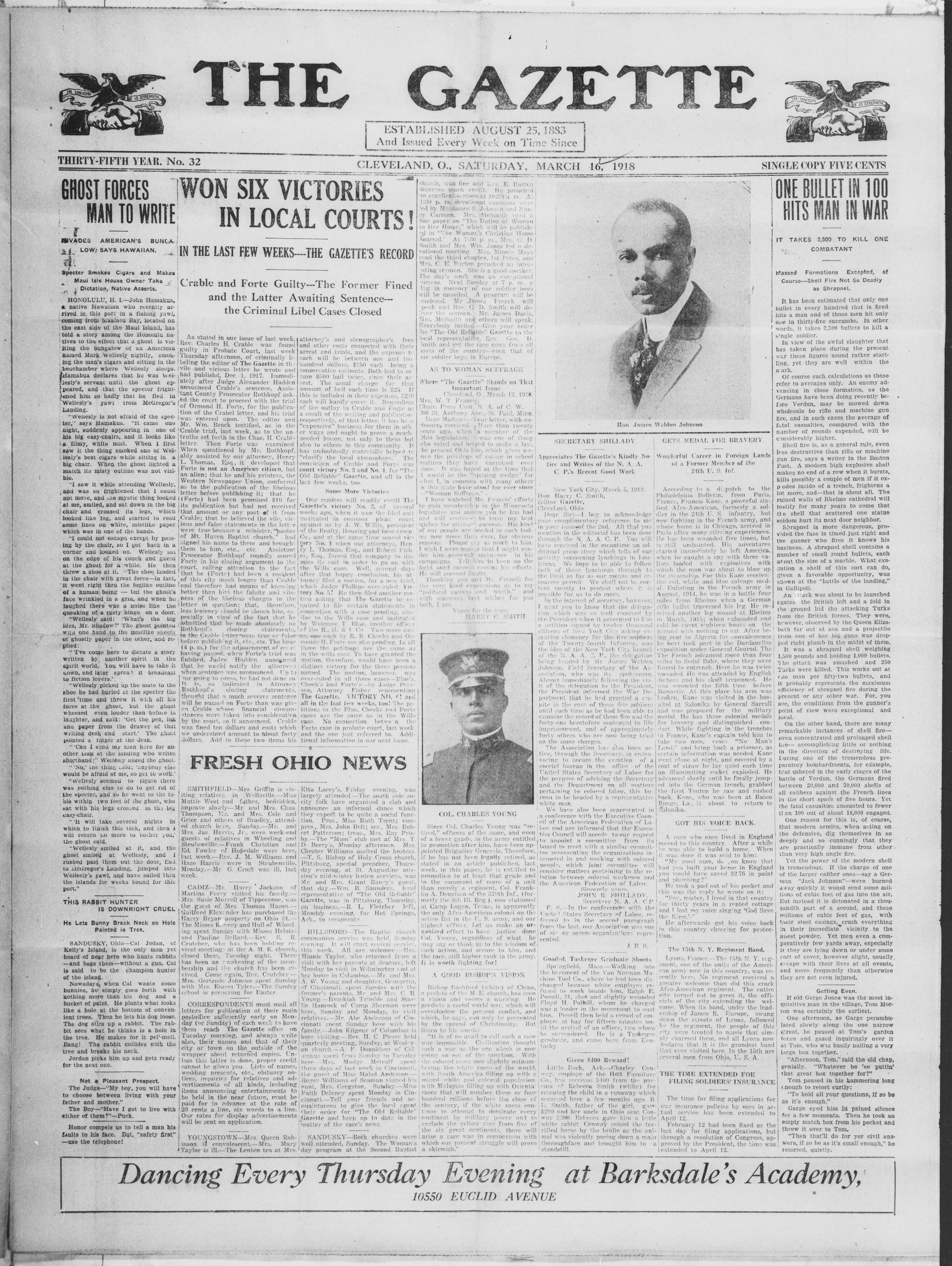
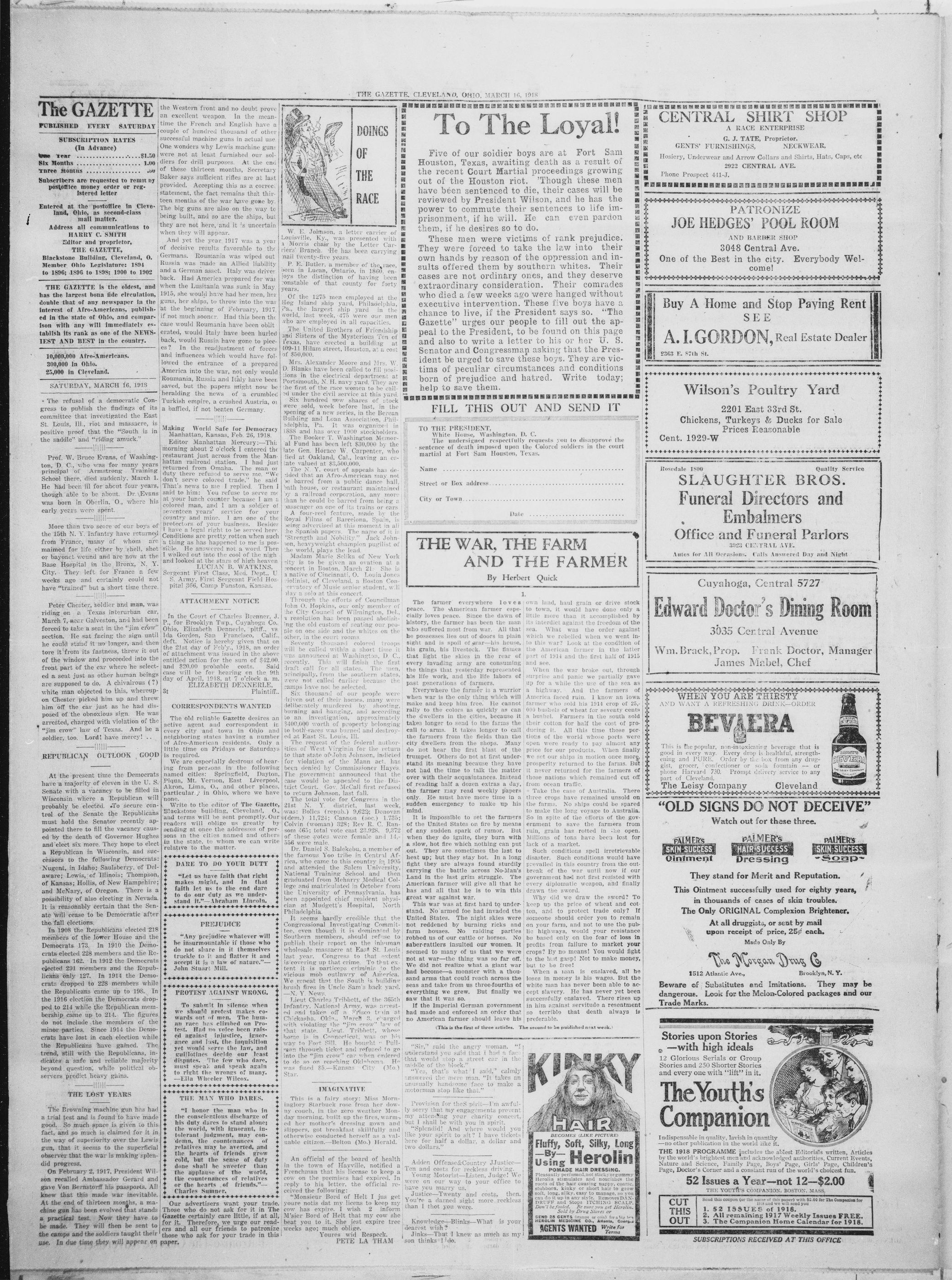
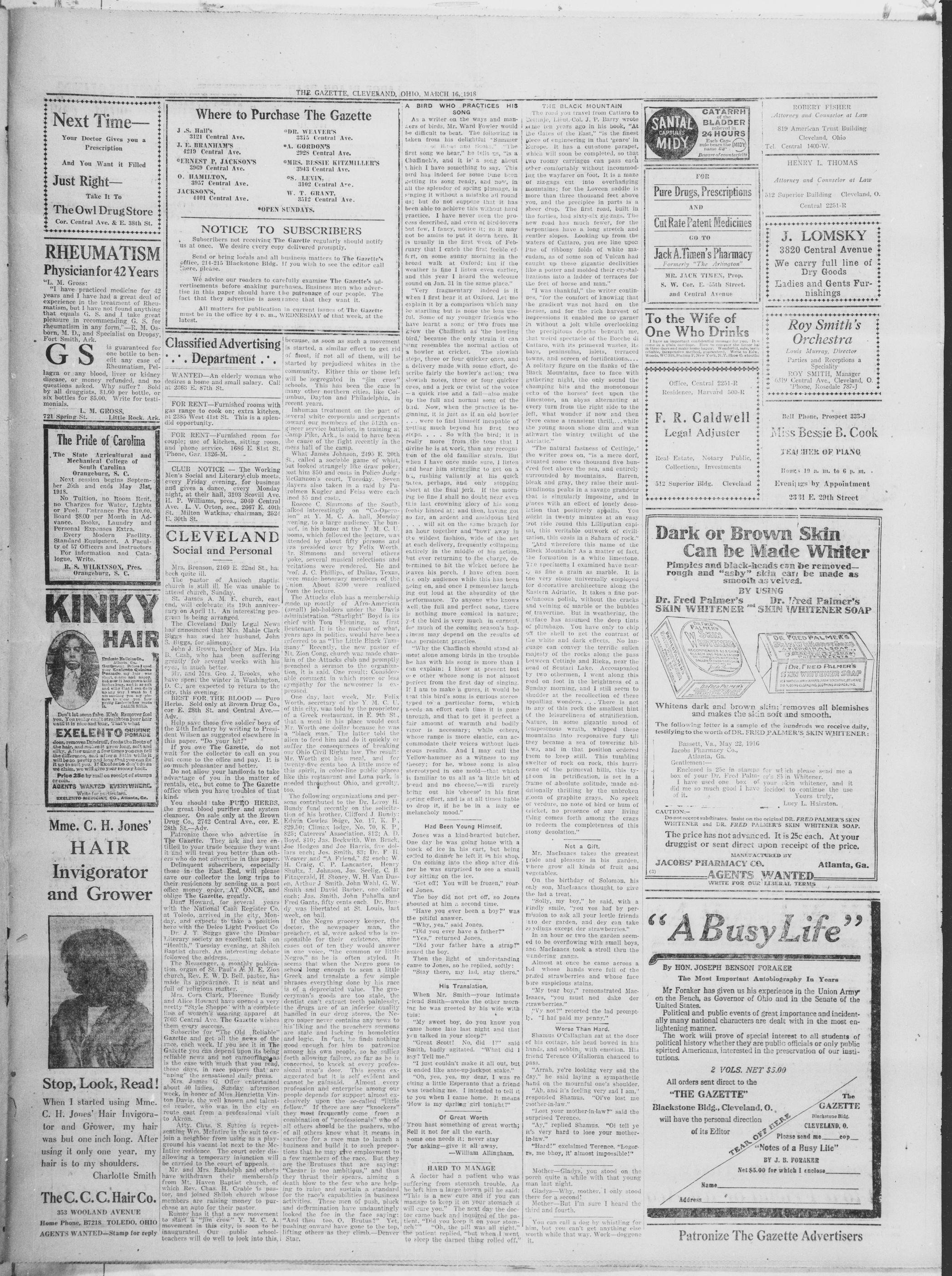
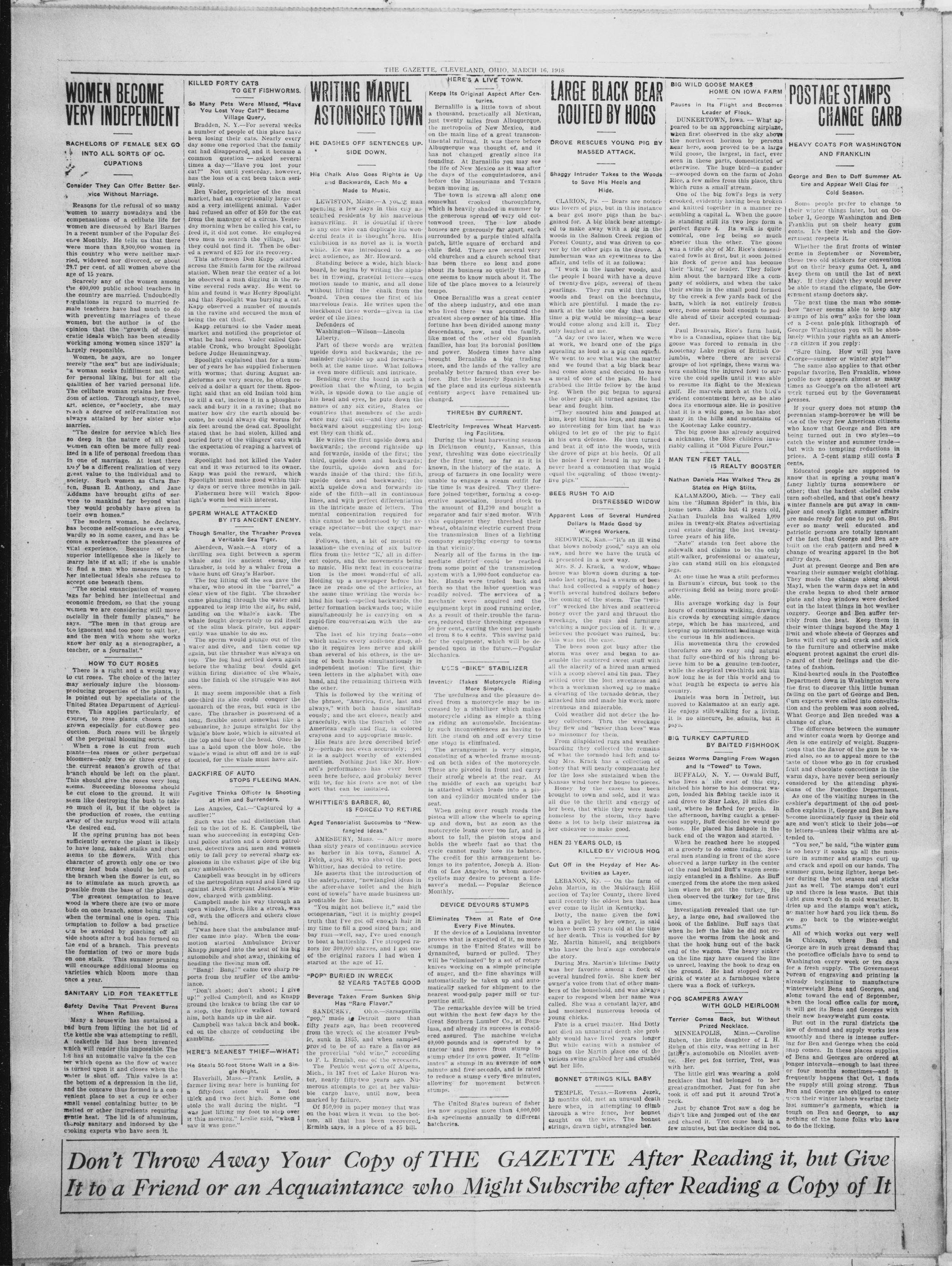
Page text (machine-generated)
THIRTY-FIFTH YEAR. No. 32
CADIZ—Mr. Harry Jackson of Martins, Merry visited his family—Mrs. Susie Murrell of Tipppecanoe, was the guest of Mrs. Thomas Musson, Guilford Elec.nder has purchased the Harry Bryan property on Ohio St.—The Misses Kenney and Hull of Wheeling spent Sunday with Misses Helios and Pauline Bishard—Kew. S. K. Crutcher, who has been on vacation, the M. E. church closed them, Tuesday night. There has been an revoking of the membership and the church has been revived. Come again, Rev. Crutcher—Mrs. Gertrude Johnson spent Sunday with Mrs. Emma Tyler.—The Sunday school is preparing for Easter.
CORRESPONDENTS: must mail all letters for publication at their mail office (Priceline Plaza, Monday or Sunday) of each week to have them reach the Gazette office on Tuesday morning, and always write also, their names and that of their city or town on the outside of the wrapper about returned copies. Unless this latter is done, proper credit cannot be given you. Lists of names, wedding presents, etc., obtunary notices, inquiries for relatives and advertisements in announcing entertainments to be held in the near future, must be paid for in advance at the rate of 20 cents a line, six words to a line. Our rates for display advertisements will be sent on application.
YOUNGSTOWN—Mrs. Queen Robinson is convalescent—Mrs. Mary Taylor is lined. The Lenten tea at Mrs.
MR. and MRS. HARRY Jackson of Martins, Merry visited his family—Mrs. Susie Murrell of Tipppecanoe, was the guest of Mrs. Thomas Musson, Guilford Elec.nder has purchased the Harry Bryan property on Ohio St.—The Misses Kenney and Hull of Wheeling spent Sunday with Misses Helios and Pauline Bishard—Kew. S. K. Crutcher, who has been on vacation, the M. E. church closed them, Tuesday night. There has been an revoking of the membership and the church has been revived. Come again, Rev. Crutcher—Mrs. Gertrude Johnson spent Sunday with Mrs. Emma Tyler.—The Sunday school is preparing for Easter.
HILLSBORO: The Epiphany church communion service will hold Sunday morning. It will start at 11 a.m. Mimi Taylor, who returned from her home in Columbus, and Mr. and M. A. W. Young and daughter, George of Cincinnati, spent Sunday with the former's parents, Mr. and M. C. Young—Hesketh Tinkle and Sturge Hateock of Camp Shenmere were Sunday and Monday, to visit relatives and Mimi Taylor, who lived with his family—John Kilgur of Columbus is here visiting—Rev. H. C. Pierce held a church—A. F. Donaldson of Columbus—society from Sunday to the day here. Mimi Taylor, Mettelf, spent three days of last week in Cincinnati—the guest of Miss Mabel Anderson—Roger Williams of Sequan visit Hunt, Mrs. Gregson, Sunday—Mrs. Dalton Delaware spent Monday in Cincinnati—Tell your friends to keep up the good spirit for "The Old Reliable Gazette and keep up to date in the matter's news.
SANDUSKY—Both churches were well attended, Sunday. The Womens day program at the Second Baptist
IN LION
IS STRENGTH
LOW; SAYS HAWAIIAN.
Specter Smokes Cigars and Makes Maul iale House Owner Take Dictation, Native Asserts.
HONOLULU, H. I—John Hamakuna, a native Hawaiian who recently arrived in this port in a fishing yawl, coming from Mauaiaea Bay, located on the east side of the Maul Island, has told a story among the Honoula natives to the effect that a ghost is visiting the bungalow of an American named Mark Wellesly nightly, smoking the man's cigars and sitting in the beechman where Wellesly sleeps. Hamabua declares that he was Wellesly's servant until the ghost appeared, and that the specter frightened him so badly that he fled in Wellesly's yawl, from McGregor's Landing.
"Wellesly is not afraid of the specter," says Hamakuna. "It came one night, suddenly appearing in one of his big easy-cnails, and it looks like a filmy, white mist. When I first saw it the thing smoked one of Wellesly's best cigars while sitting in a big chair. When the ghost lighted a match its mists outline was not visible.
"I saw it while attending Wellesley, and was so frightened that I could not move, and as my mystic thing looked at me, smiled, and sat down in the big chair and crossed its legs, which looked like fog, and started to read some lines on white, mistlike paper which was in one of the hands.
"I could not escape except by passing by the chair, so I got back in a corner and looked on. Wellesley sat on the edge of his couch and gized at the ghost for a while. He then threw a shoe at it. "The shoe landed in the chair with great force—in fact, it went right thru the foglike outline of a human being — but the ghost's face wrinkled in a grin, and when he laughed there was a noise like the queaking of a rusty hinge on a door.
"Wellesley said: 'What's the big idea, Mr. Shadow?' The ghost pointed with one hand to the mistlike sheets of ghostly paper in the other, and replied:
"I've come here to dictate a story written by another spirit in the spirit world. You will have to take it down, and later spread! I broadcast to fiction lovers."
"Wellesley picked up the mute to the shoe he had hurled at the specter the first time and threw it with all his force at the ghost, but the ghost wheezed even louder than before in laughter, and said: 'Get the pen, ink and paper from the drawer of that writing desk and start.' The ghost pointed a finger at the desk.
"Can I send my man here for another man at the landing who writes shorthand." Wellesley assed the ghost. "No, the thing said; anybody else would be afraid of me, so get to work." Wellesley seemed to figure there was nothing else to do to get rid of the specter, and so he went to the table within two feet of the ghost, who sat with his legs crossed in the big easy-chair. "It will take several nights in which to finish this task, and then I will return no more to bother you, the ghost said." Wellesley smiled at it, and the ghost smiled at Wellesley, and I rushed past them out the door, fed to actregor's Landing, jumped into Wellesley's yaw, and have sailed thru the islands for weeks bound for this port."
He Lets Bunny Break Neck on Hole Painted in Tree.
SANDUSKY, Ohio—Cal Jodan, of Kelly's Island, is the only man yet heard of near here who hunts rabbits—and bags them—without a gun. Cal is said to be the champion hunter of the island.
Nowadays, when Cal wants some bunnies, he simply goes forth with nothing more than his dog, and a bucket of paint. He plants what looks like a hole at the bottom of convenient trees. Then he lets his dog loose. The dog stirs up a rabbit. The rabbit sees what he thinks is a hole in the tree. He makes for it pel-mell. Bang! The rabbit collides with the tree and breaks his neck.
Jordan picks him up and gets ready for the next one.
Not a Pleasant Prospect.
The Judge—"My boy, you will have to choose between living with your father and mother."
The Boy—"Have I got to live with either of them?"—Puck.
Honor compels us to tell a man his faults to his face. But, "safety first"—use the telephone!
THE GAZETTE
WON SIX VICTORIES IN LOCAL COURTS!
Crable and Forte Guilty---The Former Fined and the Latter Awaiting Sentence-- the Criminal Libel Cases Closed
FRESH OHIO NEWS
---
SMITHPIELD—Mrs. Griffin is visiting relatives in Wells—Miss Mattie West and father, bedridden, improve slowly—Mr. and Mrs. Chas. Thompson, Mr. and Mrs. Cole and Grice and others of Bradley, attended chureh Sunday—Mr. and Mrs. Jas. Harris, Jr., were week-end and relatives in Wheeling and Steubenville—Frank Christian and Ed. Fowler of Hopedea were here, last week—Rev. J. M. Williams and Haze Harris were in Steubenville, Monday—Mr. G. Cross was ill, last week.
attorney's, and stenographer's fees, and other costs connected with their arrest and trials, and the expense to teach will be between one and two hundred dollars; $150 each being a conservative estimate. Both had to secure $400 bail twice, since their arrest cost of bill each is $35. If this is included in their expense, $240 each will hardly cover it. Regardless of the outlay to Crabble and Forge in a result of the writing and publication of respectively, of that letter, it has been "expensive" business for them in other ways and ought to prove a much needed lesson, not only to them but also to others in this community. Itoubtedly satisfactorily helped "clarify" the conviction of Crabble and Forge was court victory No. 3 and No. 12 ("The Old Reliable" Gazette, and all in the last few weeks, too.
Our readers will readily recall the Gazette's victory No. 2, of several weeks ago, when it won the 11th federal instituted in criminal police court against us by J. W. Wells, appointee of the Realty, Housing and Fire总局 Co., and at the same time co-appointee of the No. 1, with our attorney, Henry L. Thomas, Eag, and Euben Eag, forced that company to dismiss it in order to go on with the Wills case. Well, a several days after that happy conclusion, L. Thomas attorney told me a month ago, a new trial which Judge Phillips avoided by Gazette No. 3. He then laid another ground for the Gazette's conviction of the fireman, connected with a case pending in day to the Wills case and instituted by Wesley of T. Elase, and co-officiated by R. H. & I. C. This time, one each by R. H. Checks and C. Coolemil H. Checks also appointed. In three the petition, one and a half in the wills case. To have granted the motion, the officer, would have been a distinct victory for the three persons named. The motion, however, was over-ruled in all three cases. Checks and Checks and Fowler Judge P. Checks and Fowler Judge P. Checks and Fowler Judge P. The Gazette AUCTION NO. 14 all in the last few weeks, and the petition in the Elase, Checks and Fowler Gazette No. 14 connection between the Fowler case in probate court, last week and the one just referred to. Additional information in our next issue.
Etta Lacey's, Fighty evening, was largely attended. The south side society folk have organized a club and announce an informal dance which they expect to be quite a social function. Pres. Miss Kurt Trent; viewpoint Patterson trus. Pattyson trus. Ms. Bri Peshy. The "Mun" club nod at Mrs. T. D. Berry's, Monday afternoon. Mrs. Chester Williams assisted the hostess. T. S. Bishop of Holy Cross church, Pittsburg, special presender, Thursday evening, at St. Augustine mission's mid-winter lenton services, was Mr. and Mrs. Grant Raby, guest, and preparation of "The Old Reliefs" Gazette, was in Pittsburg Thursday en business. R. K. Fletcher left, Monday evening, for Hot Springs, Ack, to generate
HILLSBORO. The Gapstals, single-communication service, will be held Monday morning. It will start privately this week. All are welcome. Mrs. Minnie Taylor, who returned from a visit with her parents at Seacur, left Monday to visit in Wilmington and at her home in Columbus. Mr. and Mrs. A.W. Yong and daughter, Gortney of Cincinnati, former interns, Mr. and Mrs. C.R Young, Hesekiah Trinkle and Stacie Hueckle of Camp Sherman were here, Sunday and Monday, to visit relatives. Mr. Abel Anderson of Cincinnati sent Sunday here with his family — John Kilgour of Columbus is here visiting — Rev. H. C. Pierce held quarterly meeting, Sunday, at Wesleyan church — A F. Donaldson of Cincinnati sent Scoon Sunday to deliver here. Mrs. C. C. Pierce, days of last week in Cincinnati, the guest of Miss Mabel Anderson, Reger Williams of Scanan visit 11 p.m., Mrs. Cregston, Sunday — Miss Faith Delaney spend Monday in Cincinnati — Tell your friends and accountants to give the local grant their order for "The Old Reliable" Gazette and keep up to date in the matter of the race's news.
ESTABLISHED AUGUST 25,1883 And Issued Every Week on Time Since
Same More Victories
the day was time and I, E. Europe,
decided to much quick. He promised
to excellent service in the city at
1200 p. m. devotional service
by Mehmedan S. Sakil, a priest
by Cemeran, Mrs. Meryza Sakil,
a fine paper on "The Devil of Women
to Fear Homme" which will be printed
in "The Woman's Catholic Home
Journal." At 1200 p. m. Dr. D.
Smith and Mrs. Wesley Long will be
devotional meeting. Ms. Sakil
and the third chapter. At 1200 p. m.
Mr. C. D. Phelon presides at devotional
meeting. Ms. Sakil is a good speaker.
The day's work was an excellent
lesson. Next Sunday at 10 p. m.
the program of our church town will
be published. A program will be
published. Mr. James French will
peek into G. D. Smith will devote
the season. Mr. James Davis,
Mr. Messiah, and others will speak.
Everybody invited. Give your order
to "The Old Religious" Gazette to
the council representative. R. Gay. D.
Smith and the new year new year
pieces of the country even that of
sir soldier boy in Europe.
AS TO WOMAN SUFFrage
Chairman, President, N. of W.
John Anthony, East St. Paul, Minn.
Lake Magna, Year letter with en-
closure, received. More than twenty
years ago, with a member of the Ohio
legislature, was one of those who
also voted and passed to the law he
been presided over. Which was a woman
the principal voter in school
walters they have exercised ever
since. It was in the time that I
would be the speaking wizard for
the law, in coming with many other
in the law he have stood for ever since
I have served W. Francis Offering
to begin member in the Minnesota
legislature, and many in the law he had
and would love to have my best
grace in the law. This first of
our people are served in much bus-
ness now come the rest, for election
person. Please send a thank to him.
I wish I have served that I should run
him in office and serve in his
legislature. I will be to him an on-
the law and will serve in office.
H. H. G.
COL. CHARLES YOUNG
Since Col. Charles Young was "retired," officers of the same, and even of a lower grade, in the army entitled to promotion after him, have been appointed Brigadier General. Therefore, if he has not been legally retired, as stated, in an article published, last week, in this paper, he is entitled to promotion to at least grade and to the command of more of a unit than merely a regiment, Col. Franklin A. Demonstration of the 1770th IG, (formerly the 11th HG), now stationed at Camp Logan, Texas, is apparently the only Afro American colonel on the active Earl of St. Mary, and no other officer or organization effort to have justice done Col. Voices, regardless of what he may, agree to ask to the wisdom of such action, and secure to him and the once still higher rank in the army, it is worth fighting for.
A GOOD FASHIONS VISION
Bishop Bredley (Catholic) of China, a path of the M. E. Church, has been vision and power, a warning. He predicts a raid world war, which will overthrow the present conflict, and which he says, "can only be prevented by the moral of Christianity." But it lays out its own.
"If it is required to call such a race war impossible, Cilicization thought such a war in the one which is now come out of the formation. "With the developed race now highly outnumbering the white races of the world with North America filling up with a white and black colored population with M. Maya filling up with Orientals that will number three or four hundred millions before the close of the century, if the white races continent by military power and to exclude the yellow race from five of the six great continents, there will arise a race war in connection with which our present struggle will prove a skirmish."
Hon James Weldon Johnson.
Appreciates The Gazette's Kindly No. 11
C. P. S. Receipt Good Work.
New York City, March 5, 1918.
Hot Editor C. S. South.
Editor Gazette.
Chairman, Ohio.
Dear Sir, I hope to acknowledge your complimentary reference to me in your letter on the 2nd. All that you mention in the editorial has been done through the N. A. A. C. P. You will also receive in the print time an advertisement to which you tell of your interest in opening syndications in Law.
We hope to be able to follow the news of the Lancaster County law firm in the next few weeks. We shall be able to protect where we focus to do more.
In the interest of propriety, however, I know to you that the disposition which you will be provided by the President when it is presented to him, is bound by the constitution of the New York City, and is a grave charge for the few soldier of the Navy to whom you gave the blessing of the New York City, in the service of the Navy. The obligation on the Navy is the Secretary of the Navy, who was it, and the President informed the War Department that he had granted a respite in the case of these few soldiers, and such time as he had been able to examine the record of these fifty forty-one men before sentenced to life imprisonment, and of approximately forty others who are now being tried on the same charges.
"The Association has been active, through the Secretary, in enforcing to secure the conditions of a social burrow in the office of the Secretary. Secretary Secretary is the purpose of advising the Secretary and the Department on all matters pertaining to coloured labor, this burrow to be headed by a representative white man.
We have also been represented in a conference with the Executive Council of the American Federation of Labor and are informed that the Executive Council will accept "a pur request to appoint a committee from its board 66 with a board committee representing the organization and working withcolleagues, which joint committee will consider matters pertaining to the relation between colored workmen and the American Federation of Labor. Sinceely yours,
JOHN R. SHULLADY,
Secretary N. A. A. CP
P. S. In the conference with the United States Secretary of Labor, referred to in the second paragraph from the book, the Association was one of six or seven organizations represented.
J P S.
Goadel, Taukeer Graduate Shoots
Springfield, Mass. Walking into the bequest of the Van Norman Machine Tool Co., where he had been charged "because" white employees refused to work beside him, Ralph E. Powell, 21, shot and slightly wounded Floyd H. Foldhill, whom he charged was a leader in the movement to coal-bin. Powell then showed an emblem of an officer who all the aristocrats of an officer whom he considered. He is a Taukeer graduate, and came here from Kentucky.
Little Rock, Ark.—Charley Conway, companion of the Hilt Equpression, he receives $100 from the parents of Rebecca Smith (white) for returning the child in a runaway which occurred here a few months ago. It is Smith father of the girl, gave $200 and her uncle in Ohio sent Conway, $200. Rebecca gave him a little white rabbit. Conway seized the terrified boy by the bribe as the animal was violently pacing down a main thoroughfare and brought him to a standstill.
Wonderful Career in Foreign Lands of a Former Member of the
According to a di patch, to the Philadelphia Collegiate, from Paris, France, Francis Kane, a powerful sixteen-foot American, former a soldier in the 21st U. S. infantry, but now fighting in the French army, and where home is in Chicago, arrived in Paris for many stirring experiences. He has been wounded five times, but all won battled. His adventures started immediately he left America, when he caught a spy with three values, loaded with explosives to shoot the man to blow up his house. For this Kane received the white and blue salvage medal for fighting in the French army in August, 1914, he was in a battle four miles from Trenches when a German soldier fell traversed his leg. He received another leg wound at Rheims on March 6th when exhausted and call for eight hours on the ground was nothing to eat. After being sent of Mugna for consolations he next took part in the Daydandelies under General Gould. The French advanced more than four miles to encircle him. Here he was twice around he was attacked by English doctors and his skull trapped. He was rounded the fifth time before Mugna. At this place his arm was broken, Kane was visited in the hospital at Salonik by General Sarrall and was proposed for the, the military model. He has three colonial medals for delivery and distinguished contest. While fighting in the trenches in France, Kane's captain told him to take two men, cross. "No Mom's land and being back a prisoner, as brain information was covered by a coat of straw he lay injured each time an illuminating rocket exploded. He advanced slowly until he finally jumped into the German French, grabbed the first tenet he saw and pushed back. Kane, who was born at Baton Rouge, La. is about to return to Salonik.
A sailor who once lived in England moved to this country. After a while it was able to build a home. When it was done it was said to help: "My good man, do, on know that you had built your home in England you would have saved $276 in paint and plumbing?"
He took a pail out of his pocket and this was the reply he wrote on it: "Sweet, master! I lived in that country for thirty years in a rented cottage and I lost my voice singing 'God Save the King.'"
He afterwards got his voice back in this country cheering for protection.
The 15th K. Y. Regiment Band.
Lyons, France. The 15th K. Y. regiment, one of the units of the American army now in this country, was recently here. No regiment received a greater welcome than did this crack After American regiment. The entire city turned out to greet it, the offices of the city extending the welcome. When its band, under the leadership of James R. Europe, swung down the streets of Lyons, followed by the regiment, the people of this city were treated to music that simply charmed them, and all Lyons now believes that it is the greatest band that ever visited here in the 15th are several men from Ohio, U. S. A.
THE TIME EXTENDED FOR
The time for filing applications for waiver insurance policies by mea in actual service has been extended to April 12.
February 12 had been fixed as the last day for filing applications, but threw a resolution Congress, approved by the President, the time was extended to April 12.
IN UNION
IS STRONG
ONE BULLET IN 100 HITS MAN IN WAR
Massed Formations Excepted, of Course—Shell Fire Not So-Deadly as Shrapnel.
It has been estimated that only one bullet in every hundred that is fired hits a man and of those men hit only one in thirty-five succumbs. In other words, it takes 3,500 bullets to kill a single soldier.
In view of the awful slaughter that has taken place during the present war, figures sound rather startling, yet they are well within the mark.
Of course such calculations as those refer to averages only. An enemy advancing in close formation, as the Germans have been doing recently before Verdun, may be mowed down wholesale be rife and machine gun fire, and in such cases the average of fatal casualties, compared with the number of rounds expended, will be considerably higher.
Shell fire is, as a general rule, even less destructive than rifle or machine gun fire, says a writer in the Boston Post. A modern high explosive shell makes no end of a row when it bursts, kills possibly a couple of men if it expodes inside of a trench, frightens a lot more, and—that is about all. The ruined walls of Rhein cathedral will testify for many years to come that the shell that scattered one statue seldom hurt its next door neighbor.
Shrapnel is more dangerous, provided the fuse is timed just right and the gunner who fires it knows his business. A shrapnel shell contains a number of small round bullets, each about the size of a marble. What execution a shell of this sort can do, given a favorable opportunity, was shown at the "battle of the landing" in Gallipoli.
An attack was about to be launched against the British left and a fold in the ground hid the attacking, Turks from the British forces. They were, however, observed by the Queen Elizabeth far out at sea and a probefly from one of her big guns was dropped right plumb in the midst of them. It was a shrapnel shell weighing 1,500 pounds and holding 1,000 bullets. The attack was smashed and 250 Turks were killed. This works out at one man per fifty-two bullets, and it probably; represents the maximum efficiency of shrapnel fire during the present or any other war. For you see, the conditions from the gunner's point of view were exceptional and ideal.
On the other hand, there are many remarkable instances of shell fire—even concentrated and prolonged shell fire—accomplishing little or nothing in the direction of destroying life. Luring one of the tremontous preparatory bombardments, for example, that ushered in the early stages of the battle of Verdun, the Germans fired between 20,000 and 30,000 shells of all bullets against the French lines in the short space of five hours. Yet the fatal casualties, unbounded to fewer than 100 out of about 18,000 engaged. One reason for this is, "of course, that modern armies, when acting on the defensive, dig themselves in so deeply and so cunningly—that they are practically immune from other than very high angle fire.
Yet the power of the modern shell is tremendous. If the charge of one of the larger caliber ones—say a German "Jack Johnson"—were burned away quickly it would send some millions of cubic feet of gas into the air, but instead it is detonated in a thousand part of a second, and these millions of cubic feet of gas, with their steel casings, crush everything in their immobile, vicinity to the most powder. Yet men even a comparatively few yards away, especially if they are lying down or under some sort of cover, however slight, usually escape with their lives at all events, and more frequently than otherwise they are not even injured.
Getting Even.
If old Garge Jones was the most inquisitive man in the village, Tom Morton was certainly the surfeit.
"Afternoon, Tom," said the old-chap, genially, "Whatever be 'ee puttin' that great box together for?" Tom passed in his hammering long enough to retort curtly: "To hold all your questions, if so be as it's enough." Garge eyed him in pained silence for a few moments. Then he took an empty match box from his pocket and threw it over to Tom. "Then that'll do for yer civil ans,wers, if so be as it's small enough," he retorted, quietly.
The GAZETTE
PUBLISHER EVERY SATURDAY
PUBLISHED EVERY SATURDAY
SUBSCRIPTION RATES
(In Advance)
One Year ..... $1.50
Six Months ..... 1.00
Three months ..... 5.00
Subscribers are requested to remit by postoffice money order or registered letter
Entered at the postoffice in Cleveland, Ohio, as second-class mail matter.
Address all communications to HARRY C. SMITH
Blackstone Bullding, Cleveland, O.
Member Ohio Legislature: 1894
to 1896; 1896 to 1898; 1900 to 1902
THE GAZETTE is the oldest, and has the largest bona fide circulation, double that of any newspaper in the interest of Afro-Americans, published in the state of Ohio, and comparison with any will immediately establish its rank as one of the NEWS-EST AND BEST in the country.
10,000,000 Afro-Americans.
300,000 in Ohio.
25,000 in Cleveland.
SATURDAY, MARCH 16, 1918
* The refusal of a democratic Congress to publish the findings of its committee that investigated the East St. Louis, Ill., riot and massacre, is positive proof that the "South is in the saddle" and "riding amuck."
Prof. W. Bruce Evans, of Washington, D. C., who was for many years principal of Armstrong Training School there, died suddenly. March 1. He had been ill for about four years, though able to be about. Dr. Evans was born in Oberlin, O., where his early years were spent.
More than two score of our boys of the 15th N. Y. Infantry have returned from France, many of whom are maimed for life either by shell, shot or bayonet wound and are now at the Base Hospital in the Bronx, N. Y. City. They left for France a few weeks ago and certainly could not have "trained" but a short time there.
Peter Chester, soldier and man, was riding on a Texas interurban car, March 7, near Galveston, and had been forced to take a seat in the "jim crow" section. He sat facing the sign until he could stand it no longer, and then tore it from its fastness, threw it out of the window and proceeded into the front part of the car where he selected a seat just as other human beings are supposed to do. A chivalrous (?) white man objected to this, whereupon Chester picked him up and threw him off the car just as he had disposed of the obnoxious sign. He was arrested, charged with violation of the "jim crow" law of Texas. And he a soldier, too. Lord! have mercy! . .
At the present time the Democrats have a majority of eleven in the U. S. Senate with a vacancy to be filled in Wisconsin where a Republican will probably be elected. To secure control of the Senate the Republicans must hold the Senator recently appointed there to fill the vacancy caused by the death of Governor Hughes and elect six more. They hope to elect a Republican in Wisconsin, and successors to the following Democrats: Nugent, in Idaho; Saulberry, of Delaware; Lewis, of Illinois; Thompson, of Kansas; Hollis, of New Hampshire; and McNary, of Oregon. There is a possibility of also electing in Nevada. It is reasonably certain that the Senate will cease to be Democratic after the fall elections.
In 1908 the Republicans elected 218 members of the lower House and the Democrats 173. In 1910 the Democrats elected 228 members and the Republicans 162. In 1912 the Democrats elected 291 members and the Republicans only 127. In 1914 the Democrats dropped to 228 members while the Republicans came up to 198. In the 1916 election the Democrats dropped to 214 while the Republican membership came up to 214. The figures do not include the members of the minor parties. Since 1914 the Democrats have lost in each election while the Republicans have gained. The trend, still with the Republicans, indicates a safe and reliable majority beyond question, while political observers predict heavy gains.
THE LOST YEARS
The Browning machine gun has had a trial test and is found to have made good. So much space is given to this fact, and so much is claimed for it in the way of superiority over the Lewis gun, that it seems to the superficial observer that the war is making splendid progress.
On February 2, 1917, President Wilson recalled Ambassador Gerard and gave Von Bernstorff his passports. All knew that this made war inevitable. At the end of thirteen months, a machine gun has been evolved that stands a practical test. Now they have to be made. They will then be sent to the camps and the soldiers taught their use. In due time they will appear on
the western front and no doubt prove an excellent weapon. In the meantime the French and English have a couple of hundred thousand of other successful machine guns in actual use. One wonders why Lewis machine guns were not at least furnished our soldiers for drill purposes. At the end of these thirteen months, Secretary Baker says sufficient rifles are at last provided. Accepting this as a correct statement, the fact remains that thirteen months of the war have gone by. The big guns are also on the way to being built, and so are the ships, but they are not here, and it is uncertain when they will appear.
And yet the year 1917 was a year of decisive results favorable to the Germans. Roumania was wiped out. Russia was made an Allied liability and a German asset. Italy was driver back. Had America prepared for war when the Lusitania was sunk in May 1915, she would have had her men, her guns, her ships, to throw into the war at the beginning of February, 1917 if not much sooner. Had this been the case would Roumania have been obliterated, would Italy have been hurled back, would Russia have gone to pieces? In the readjustment of forces and influences which would have followed the entrance of a prepared America into the war, not only would Roumania, Russia and Italy have been saved, but the papers of a crumpled Turkish empire, a crushed Austria, or a baffled, if not beaten Germany.
Manhattan, Kansas, Feb 26, 1918.
Editor Manhattan Mercury:—This morning about 2 o'clock I entered the restaurant just across from the Manhattan railroad station. I had just returned from Omaha. The man or duty there refused to serve me. "We don't serve colored trade." he said. That's news to me I replied. Then I said to him: You refuse to serve me at your lunch counter because I am a colored man, and I am a soldier of seventeen years' service for your country and mine. I am one of the protectors of your business. Besides I have a legal right to be served here. Conditions are pretty迅 when such a thing as has happened to me is possible. He answered not a word. Then I walked out into the cool of the night and looked at the stars of heaven
LUCKUAN B. WATKINS,
Sergeant First Class, Med. Dept., U.
S. Army, First Sergeant Field Hos-
pital 366, Camp Funston, Kansas.
ATTACHMENT NOTICE
In the Court of Charles Brenner, J. P., for Brooklyn Twp., Cuyahoga Co., Ohio, Elizabeth Dennerle, pitff, vs Ida Gordon, San Francisco, Calif. deft. Notice is hereby given that on the 21st day of Feb'198, an order of attachment was issued in the above entitled action for the sum of $42.00 and $20.00 probable costs. Said case will be for hearing on the 9th day of April, 1918, at 7 o'clock a.m. ELIZABETH DENNERLE,
CORRESPONDENTS WANTED
The old reliable Gazette desires an active agent and correspondent in every city and town in Ohio and neighboring states having a number of Afro-American residents. Only a little time on Fridays or Saturdays is required.
We are especially destruous of hearing from persons in the following named cities: Springfield, Dayton, Piqua, Mt. Vernon, East Liverpool, Akron, Lima, O., and other places, particular; in Ohio, where we have none.
Write to the editor of The Gazette, Blackstone building, Cleveland, O., and terms will be sent promptly. Our readers will oblige us greatly by sending at once the addresses of persons in the cities named and others in the state, to whom we can write relative to the matter.
DARE TO DO YOUR DUTY
"Let us have faith that right makes might, and in that faith let us to the end dare to do our duty as we understand it."—Abraham Lincoln.
PREJUDICE
"Any prejudice whatever will be insurmountable if those who do not share in it themselves truce to it and flatter it and accept it is a law of nature."—John Stuart Mill.
PROTEST AGAINST WRONG.
To submit in silence when we should protest makes cowards out of men. The human race has climbed on Protector beasts to protect proofs of against injustice, ignorance and lust, the inquisition yet would serve the law, and crusifolios decide our least disputes. The few who dare, must speak and speak again to right the wrongs of many.—Ella Wheeler Wilcox.
THE MAN WHO DARES.
"I honor the man who in the conscious discharge of his duty dares to stand alone; the world, with ignorant, intolerant judgment, may condemn, the countenances of relatives may be averted, and the hearts of friends grow cold, but the sense of duty done shall be sweeter than the applause of the world, the countenances of relatives or the hearts of friends."—Charles Sumner.
Our advertisers want your trade. Those who do not ask for it in the Gazette certainly care little, if at all, for it. Therefore, we urge our readers and all our friends to patronize those who ask for your trade in this paper.
THE GAZETTE, CLEVELAND, OHIO, MARCH 16, 1918
THE NEW YORK TIMES
DOINGS
OF
THE
RACE
W. E. Johnson, a letter carrier of Louisville, Ky., was presented with a Morris chair by the Letter Carriers' Branch. He has been carrying nail twenty-five years.
P. E. Butler, a member of the race, born in Luean, Ontario, in 1860, enjoys the distinction of having been constable of that county for forty years.
Of the 1275 men employed at the Hog Island ship yard, Philadelphia, Pa., the largest ship yard in the world, last week, 475 were our men who are employed in all capacities.
The United Brothers of Friendship and Sisters of the Mysterious Ten of Texas, have erected a building at 409-11 Hilam street, Houston, at a cost of $50,000.
Mrs. Alexander Moore and Mrs. W. D. Blanks have been called to fill positions in the electrical department at Portsmouth, N. H. navy yard. They are the first of the race women to be called under the civil service at this yard
Six hundred new shares of stock were sold, week before last, in the opening of a new series, in the Berean Building and Loan Association, Philadelphia, Pa. It was organized in 1888 and has over 1000 stockholders. The Booker T. Washington Memorial Fund has been left $30,000 by the late Gen. Horace W. Carpenter, who lied at Oakland, Cal., leaving an estate valued at $3,500,000. The N. Y. court of appeals has decided that an Afro-American may not be barred from a public dance hall, bath house, or restaurant maintained by a railroad corporation, any more than he could be barred from being a passenger on one of its trains or cars. A four-relief feature, made by the Real Estate of Barcelona, Spain, is being advised this moment in the Spanish papers. It is "Strength and Nobility" Jack Johnson, heavyweight champion pugilist of the world, plays the lead
Madam Marie Selika of New York city is to be given an ovation at a concert in Boston, March 21. She is a native of Cincinnati, O. Louia Jones violinist, of Cleveland, a Boston Conservatory of Music senior student, will play a solo at this concert.
Through the efforts of Councilman John O. Hopkins, our only member of the City Council of Wilmington, Del., a resolution has been passed abolishing the old custom of seating our people on one side and the whites on the other, in the court rooms.
Seventy thousand colored troops will be called within a short time it was announced at Washington, D C, recently. This will finish the first draft call for all states. The men, principally, from the southern states, were not called earlier because the camps have not be selected.
Six thousand of our people were driven out of their homes, many were deliberately murdered by shooting, burning and hanging, and according to an investigation, approximately $400,000 worth of property belonging to both races was burned and destroyed at East St. Louis, Ill.
The request of the federal authorities of West Virginia for the return to that state of John Johnson, indicted for violation of the Mann act, has been denied by Commissioner Hayes. The government announced that the case would be appealed to the District Court. Gov. McCall first refused to return Johnson, last fall.
The governor for Congress in the 21st N. Y. district, last week was: Belas (rebub). 9,622; Donovan (dem.) 11,724; Cannon (soc.) 1,735 Colvin (woman) 328; Rev R. C. Ransom 465; total vote怠23,928. 9,372 of these votes were female and 14,556 were male.
Dr. Daniel S. Balekeu, a member of the famous Yoo tribe in Central Africa, who came to this country in 1905 and attended the Salem University, National Training School and then graduated from Meharry Medical College and matriculated in October from the University of Pennsylvania. has been appointed chief resident physician at Mudgett's Hospital, North Philadelphia.
It seems hardly credible that the Congressional Investigating Committee, even though it is dominated by Southern members, should refuse to publish their report on the inhuman wholesale massacre at East St. Louis last year. Congress to that extent is covering up that crime. To that extent it is particens criminia to the vicious mob outlawry of America. We repeat that the South is building brush fires in Uncle Sam's back yard. N. Y. News
Lieut Charles Tribbett, of the 365th Infantry, National Army, was arrested and taken off a Frisco train at Chickasaw. Okla. March 3, charged with violating the "jim crow" law of that state. Lieut. Tribbett, whose home is in Connecticut, was on his way to Fort Sill. He bounced off a police ticker and got to go into the "jim crow" car when ordered to do so on reaching Oklahoma. He was fined $5—Kansas City (Mo.) Star.
IMAGINATIVE
This is a fairy story: Miss Morningglory Starbuck rose from her downy couch, in the zero weather Monday morning, built up the fires, warmed her mother's dressing gown and slippers, got breakfast skillfully and otherwise conducted herself as a valuable citizen—Belton (Mo) Herald.
An official of the board of health in the town of Hayville, notified a Frenchman that his license to keep a cow on the premises had expired. In reply to his letter, the official received the following:
"Monsieur Bord of Helt I just get younotis dat my licits to keep my cow has expire. I wish 2 inform M'sier Bord of Helt that my cow she beat you to it. She jest expire tree weeks ago; much oblige.
Youres wid Respeck.
PETE LA THAM
To The Loyal!
Five of our soldier boys are at Fort Sam Houston, Texas, awaiting death as a result of the recent Court Martial proceedings growing out of the Houston riot. 'Though these men have been sentenced to die, their cases will be reviewed by President Wilson, and he has the power to commute their sentences to life imprisonment, if he will. He can even pardon them, if he desires so to do.
These men were victims of rank prejudice. They were forced to take the law into their own hands by reason of the oppression and insults offered them by southern whites. Their cases are not ordinary ones, and they deserve extraordinary consideration. Their comrades who died a few weeks ago were hanged without executive intervention. These five boys have a chance to live, if the President says so. "The Gazette" urges our people to fill out the appeal to the President, to be found on this page and also to write a letter to his or her U. S. Senator and Congressman asking that the President be urged to save these boys. They are victims of peculiar circumstances and conditions born of prejudice and hatred. Write today; help to save them.
FILL THIS OUT AND SEND IT
THE WAR, THE FARM AND THE FARMER
By Herbert Quick
The farmer everywhere loves peace. The American farmer especially loves peace. Since the dawn of history, the farmer has been the man who suffered most from war. All that he possesses lies out of doors in plain sight and is spoil of war—his house, his grain, his livestock. The flames that light the skies in the rear of every invading army are consuming the things that yesterday represented his life work, and the life labors of past generations of farmers.
Everywhere the farmer is a warrior when war is the only thing which will make and keep him free. He cannot rally to the colors as quickly as can the dwellers in the cities, because it takes longer to send to the farms the call to arms. It takes longer to call the farmers from the fields than the city dwellers from the shops. Many do not hear the first blast of the trumpet. Others do not at first understand its meaning because they have not had the time to talk the matter over with their acquaintances. Instead of reading half a dozen extras a day, the farmer may read weekly papers only. He must have more time in a sudden emergency to make up his mind.
It is impossible to set the farmers of the United States on fire by means of any sudden spark of rumor. But when they do ignite, they burn with a slow, hot fire which nothing can put out. They are sometimes the last to heat up; but they stay hot. In a long fight they are always found sturdy carrying the battle across No-Mans Land in the last grim struggle. The American farmer will give all that he has and all that he is to win this great war against war.
This war was at first hard to understand. No armed foe had invaded the United States. The night skies were not reddened by burning ricks and farm houses. No raiding parties robbed us of our cattle or horses. No saber-rattlers insulted our women. It seemed to many of us that we were not at war—the thing was so far off. We did not realize what a giant war had become—a monster with a thousand arms that could reach across the seas and take from us three-fourths of everything we grew. But finally we saw that it was so.
If the Imperial German government had made and enforced an order that no American farmer should leave his
keep up the price of wheat ton, and to protect trade of someone should order you to on your farm, and not to use lie highways, would your re be based only on the fear of profits from failure to mark crops? By no means! You wou to the last gasp! Not to make but to be free!
When a man is enslaved loses in money is his wages, white man has never been ab cept slavery. He has never so successfully enslaved. There in him against servitude a res so terrible that death all preferable.
(Sir, said the angry woman. "I understand you said that I had a face that would stop a street car in the middle of the block."
"Yes, that's what I said," calmly answered the mere man. "It takes an unusually handsome face to make a motorman stop like that."
Provision for the Spirit—I am awfully sorry that my engagements prevent my attending your charity concert, but I shall be with you in spirit.
"Splendid! And where would you like your spirit to sit? I have tickets here for half a dollar, a dollar and two dollars."
Adden Offense&Country JJustice—Ten and costs for reckless driving.
Young Motorist—Listen, Judge! We were on our way to your office to have you marry us.
Justice—Twenty and costs, then. You're a darn sight more reckless than I that you were.
Knowledge—Blinks—What is your dearest wish?
Jinks—That I knew as much as my son thinks I do.
own hand, haul grain or drive stock to town, it would have done only a little more than it accomplished by its interdict against the freedom of the sea. What was the order against which we rebelled when we went into this war? Look at the condition of the American farmer in the latter part of 1914 and the first half of 1915 and see.
When the war broke out, through surprise and panic we partially gave up for a while the use of the sea as a highway. And the farmers of America faced ruin. I know an Iowa farmer who sold his 1914 crop of 25,000 bushels of wheat for seventy cents a bushel. Farmers in the south sold their cotton for half the cost of producing it. All this time those portions of the world whose ports were open were ready to pay almost any price for our products. When finally we set our ships in motion once more, prosperity returned to the farms. But it never returned for the farmers of those nations which remained cut off from ocean traffic.
Take the case of Australia. There three crops have remained unsold on the farms. No ships could be spared to make the long voyage to Australia. So in spite of the efforts of the government to save the farmers from ruin, grain has rotted in the open. Millions of tons have been lost for lack of a market.
Such conditions spell irretrievable disaster. Such conditions would have prevailed in this country from the outbreak of the war until now if our government had not first resisted with every diplomatic weapon, and finally drawn the sword.
Why did we draw the sword? To keep up the price of wheat and cotton, and to protect trade only? If someone should order you to remain on your farm, and not to use the public highways, would your resistance be based only on the fear of loss in profits from failure to market your crops? By no means! You would fight to the last gasp! Not to make money, but to be free!
When a man is enslaved, all he loses in money is his wages. But the white man has never been able to accept slavery. He has never yet been successfully enslaved. There rises up in him against servitude a resentment so terrible that death always is preferable.
KINKY
HAIR
BECOMES (LIKE PICTURE)
Fluffy, Soft, Silky, Long
By Using Herolin
PONDDE HAIR DRESSING.
Pleasantly perfumed, not sticky, orgummy
Herolin stimulates and nourishes the
roots of the hair causing nappy, coarse,
stubborn, kinky or short hair to grow
soft, long, silky, easy to manage, so you
can do it up in any style. Removes DAN-
DRUFF and Stops ITCHING SCALP.
Dow it be found. Remove wounds and Herolin.
Sold by Drug Stores or
SEND 25 CENTS (stamps or coin) for a big buy.
HEROLIN MEDICINE CO., Atlanta, Georgia.
AGENTS WANTED
Winter For
Terms
A RACE ENTERPRISE
G. J. TATE, Proprietor.
GENTS' FURNISHINGS, NECKWEAR.
Hosiery, Underwear and Arrow Collars and Shirts, Hats, Caps, etc
2922 CENTRAL AVE.
PATRONIZE JOE HEDGES' POOL ROOM AND BARBER SHOP 3048 Central Ave. One of the Best in the city. Everybody Welcome!
Buy A Home and Stop Paying Rent SEE A.I.GORDON, Real Estate Dealer
Wilson's Poultry Yard
2201 East 83rd St.
Chickens, Turkeys & Ducks for Sale
Prices Reasonable
SLAUGHTER BROS. Funeral Directors and Embalmers
Cuyahoga, Central 5727
3035 Central Avenue
Wm. Brack, Prop. Frank Doctor, Ma
James Mabel, Chef
WHEN YOU ARE THIRSTY
AND WANT A REFRESHING DRINK-ORDER
Doctor, Manager
Chef
Wm.Brack,Prop. Frank Doctor, Manager James Mabel, Chef
WHEN YOU ARE THIRSTY AND WANT A REFRESHING DRINK-ORDER BEVAERA
This is the popular, non-intoxicating beverage that is good in every way. Every drop is healthful, strengthening and PURE. Order by the box from any drug-gist, grocer, confectioner or sola fountain — or phone Harvard 730. Prompt delivery service to any part of Cleveland.
The Leisy Company Cleveland
"OLD SIGNS DO NOT DECEMBER
Watch out for these three.
PALMER'S
SKIN-SUCCESS
Ointment
PALMER'S
HAIR-SUCCESS
Dressing
PALMER'S
SKIN-SUCCESS
So
They stand for Merit and Reputation.
This Ointment successfully used for eighty ye
in thousands of cases of skin troubles.
The Only ORIGINAL Complexion Brighten
This is the popular, non-intoxicating beverage that is good in every way. Every drop is healthful, strengthening and PURE. Order by the box from any drugist, grocer, 'confectioner or soda fountain — or phone Harvard 730. Prompt delivery service to any part of Cleveland.
SIGNS DO NOT DECEIVE"
Watch out for these three.
PALMER'S
HAIR-SUCCESS
Dressing
PALMER'S
SKIN-SUCCESS
Soap
They stand for Merit and Reputation.
Treatment successfully used for eighty years,
thousands of cases of skin troubles.
Only ORIGINAL Complexion Brightener.
At all druggists, or sent by mail
upon receipt of price, 25¢ each.
Made Only By
The Morgan Drug C
1512 Atlantic Ave., Brooklyn, N. Y.
Beware of Substitutes and Imitations. They
dangerous. Look for the Melon-Colored packages
Trade Marks.
in Drug C
Brooklyn, N. Y.
Imitations. They may be
on-Colored packages and our
Beware of Substitutes and Imitations. They may be dangeroue. Look for the Melon-Colored packages and our Trade Marks.
ITY
THE 1918 PROGRAMME includes the ablest Editorialists written by the world's brightest men and acknowledged authorities, Currier Nature and Science, Family Page, Boys' Page, Girls' Page, Page, Doctor's Corner and a constant run of the world's choicest
52 Issues a Year—not 12—$2.00
THE YOUTH'S COMPANION, BOSTON, MASS.
CUT
THIS
OUT
Send this coupon (or the name of this paper) with $2.00 Oz The Coup
1818 and we will send you
1. 52 ISSUES of 1918.
2. All remaining 1917 Weekly Issues B
3. The Companion Home Calendar for
the ablest Editorialists written, Articles
knowledgable authorities, Current Events,
Boy's Page, Girls' Page, Children's
run of the world's choicest fun.
—not 12—$2.00
NION, BOSTON, MASS.
of this paper with $2.00 for The Companion for
and we will send you
of 1918.
1917 Weekly Issues FREE.
In Home Calendar for 1918.
THE 1918 PROGRAMME includes the oldest Editorials written, Articles by the world's brightest men and acknowledged authorities, Current Events, Nature and Science, Family Page, Boys' Page, Girls' Page, Children's Page, Doctor's Corner and a consummate run of the world's choicest fun.
CUT
THIS
OUT
Send this coupon (or the name of this paper) with $2.00 for The Companion for
1918 and we will send you
1. 52 ISSUES of 1918.
2. All remaining 1917 Weekly Issues FREE.
3. The Companion Home Calendar for 1918.
12 Glorious Serials or Group Stories and 250 Shorter Stories and every one with "lift" in it.
TheYouth's Companion
COSTA DEL REVERA
BEVERA
COSTA DEL REVERA
The Levi Company
Costa Del Revera, CA
Next Time—
Your Doctor Gives you a
Prescription
And You Want it Filled
Just Right—
Take It To
The Owl Drug Store
Cor. Central Ave. & E. 38th St.
RHEUMATISM Physicianfor42Years
"I have practiced medicine for 42 years and I have had a great deal of experience in the treatment of Rheumatism, but I have not found anything that equals G. S. and I take great pleasure in recommending G. S. for rheumatism in any form."—R. M. Osborn, M. D., and Specialist on Dropsy, Fort Smith, Ark.
GS is guaranteed for one bottle to benefit any case of
GS is guaranteed for one bottle to benefit any case of Rheumatism, Pelagra or any blood, liver or kidney disease, or money refunded, and no questions asked. Why suffer? Sold by all druggists, $1.00 per bottle, or six bottles for $5.00. Write for testimonials. L. M. GROSS, 721 Spring St. Little Rock, Ark.
The Pride of Carolina
The State Agricultural and Mechanical College of South Carolina
Orangeburg, S. C.
Next session begins September 20th and ends May 31st, 1918.
No Tuition, no Room Rent, no Charges for Water, Lights or Fuel. Entrance Fee $10.00.
Board $8.00 per Month in Advance. Books, Laundry and Personal Expenses Extra.
Every Modern Facility, Standard Equipment. A Faculty of 57 Officers and instructors
For information and Catalogue, Write.
R. S. WILKINSON, Pres.
Orangeburg, S. C.
F
Dromache Medical Co., Albany, Ga. We can help you your Exelento Quinine Medicine. Shop it now and money, but now it has grown to 10 inches, and is so soft and easy to handle. And in any way I want to it to come out how many times I buy it. CALL ME RED.
Let let some fake Kink Remover feel you. You really can't straighten your hair until it is nice and bona. That's what THE EXELENTO QURINEMINE POMADE does, removes Dandruff, feeds the Roots of hair, and makes it grow long, soft and dense. The difference, and after a little while it will be so, pretty and long that you can fix it. If you want to we claim, we will give your money back.
Price 25e by mail on stamps or coin.
AGENTS WANTED EVERYWHERE.
Works for particular.
EXELENTO MEDICINE CO., Atlanta, Ga.
Mme. C. H. Jones' HAIR Invigorator and Grower
A
Stop, Look, Read!
When I started using Mme. C. H. Jones' Hair Invigorator and Grower, my hair was but one inch long. After using it only one year, my hair is to my shoulders.
The C.C.C.Hair Co.
353 WOOLAND AVENUE
Home Phone, B7218 TOLEDO, OHIO
AGENTS WANTED—Stamp for reply
Where to Purchase The Gazette
Where to Purchase The Gazette
NOTICE TO SUBSCRIBERS
Subscribers not receiving The Gazette regularly should notify us at once. We desire every copy delivered promptly.
Send or bring locals and all business matters to The Gazette's office, 214-215 Blackstone Bldg. If you wish to see the editor call there, please.
We advise our readers to carefully examine The Gazette's advertisements before making purchases. Business men who advertise in this paper should have the patronage of our people. The fact that they advertise is assurance that they want it.
All matters for publication in current issues of The Gazette must be in the office by 4 p. m., WEDNESDAY of that week, at the latest.
J. S. Hall's
3121 Central Ave.
J. E. BRANHAM'S
4219 Central Ave.
*ERNEST P, JACKSON'S
3369 Central Ave.
O. HAMILTON,
3557 Central Ave.
JACKSON'S
4401 Central Ave.
*OPEN*
NOTICE TO
Subscribers not receiving T
us at once. We desire every copy
Send or bring locals and all
office, 214-215 Blackstone Bldg.
there, please.
We advise our readers to can
vertisements before making pu
tise in this paper should have the
fact that they advertise is assu
All matters for publication
must be in the office by 4 p. m.,
latest.
Classified Advertising
... Department ...
WANTED—An elderly woman who desires a home and small salary. Call at 2363 E. 87th St.
FOR RENT—Furnished rooms with gas range to cook on; extra kitchen, at 2385 West 41st St. This is a splendid opportunity.
FOR RENT—Furnished room for couple; use of kitchen, sitting room, and phone service. 1686 E. 81st St. Phone, Gar. 1326 M.
CLUB NOTICE — The Working Men's Social and Literary club meets every Friday evening, for business and gives a dance, every Monday night, at their hall, 3103 Scovill Ave. H. P. Williams, pres., 2040 Central Ave. L. V. Orton, sec., 2687 E. 40th St. Milton Watkins, chairman, 2524 E. 30th St.
CLEVELAND Social and Personal
Mrs. Bronson, 2169 E. 22nd St., has been quite ill. The pastor of Antioch Baptist church is still ill. He was unable to attend church, Sunday. St. James A. M. E. church, east end, will celebrate its 19th anniversary on April 11. An interesting program is being arranged. The Cleveland Daily Legal News has announced that Mrs. Mable Clark Biggs has sued her husband, John S. Biggs, for alimony. John J. Brown, brother of Mrs. Ida B. Cash, who has been suffering greatly for several weeks with his eyes, is much better. Mr. and Mrs. Goo J. Brooks, who have spent the winter in Washington, D. C., are expected to return to the city, this evening. IN THE BLOOD — Puro Herbs. Sold only at Brown Drug Co., cor E. 28th St. and Central Ave.— Adv. Help save those five soldier boys of the 24th Infantry by writing to President Wilson as suggested elsewhere in this paper. "Do your bit!"
If you owe The Gazette, do not wait for the collector to call on you but come to the office and pay. It is so much pleasant and better. Do not allow your landlords to take advantage of you in the matter of rentals, etc., but come to The Gazette office when you have troubles of that kind. You should take PURO HERBS, the great blood purifier and system cleanser. On sale only at the Brown Drug Co., 2742 Central Ave., cor. E. 28th St.-Adv. Patronize those who advertise in The Gazette. They ask and are entitled to your trade because they want it and treat it great. The other who do not advertise in this paper. Delinquent subscribers, especially those in the East End, will please save our collector the long trips to their residences by sending us a post office money order, AT ONCE, and oblige The Gazette, greatly.
Danz Howard, for several years with the National Cash Register Co. at Toledo, arrived in the city, Monday, and expects to take a position here with the Delco Light Product Co. Dr. J. T. Suggs gave the Dunbar Literary society an excellent talk on "Health." Tuesday evening, at Shilch Baptist church. An interesting debate followed the address.
The Messenger, a monthly publication, organ of St. Paul's A. M. E. Zion church, Rev. E. W. D. Bell, pastor, has made its appearance. It is neat and full of religious matter.
Mrs. Cora Clark, Florence Bundy and Alice Howard have opened a very "Style Shoppe" with a complete line of women wearing apparel at 750 Continent. The Gazette wishes them every success.
Subscribe for "The Old, Reliable" Gazette and get all the news of the race, each week. If you see it in the Gazette you can depend upon its being reliable news and not camouflage as is the case with much that you read, these days, in race papers that are "aning" the sensational daily press.
Mrs. James G. Offer entertained about 40 ladies, Sunday afternoon week, in honor of Miss Henrietta Vinton Davis, the well known and talented reader, who was in the city on route east from a professional visit to Akron.
Atty. Chas. S. Sutton is representing Wm. McIntire in the suit to enjoin a neighbor from using as a playground his vacant lot next to the McIntire residence. The court order disallowing a temporary injunction will be carried to the court of appeals.
Mr. and Mrs. Randolph and others have withdrawn their membership from Mt. Haven Baptist church, of which Rev. Chas. H. Crable is pastor, and joined Shiloh church whose members are raising money to purchase an auto for their pastor.
Rumor has it that a new movement to start a "jim crow" Y. M. C. a movement in this city is soon to be inaugurated. Our public school teachers will do well to look into this.
THE GAZETTE, CLEVELAND, OHIO, MARCH 16, 1918
because, as soon as such a movement is started, a similar effort to get rid of frost, if not all of them, will be started by prejudiced whites in the community. Either this or those left will be segregated in "jim crow" schools. This has been the case in many other northern cities, like Columbus, Dayton and Philadelphia, in recent years. Inhuman treatment on the part of several white corporals and sergeants toward our members of the 512th engineer service battalion, in training at Camp Pike, Ark, is said to have been the cause of the fight recently in the mess hall of the camp. What James Johnson, 2495 E. 20th St., called a sociable game of whist, but looked strangely like draw poker, cost him $50 and costs in Police Judge McGannon's court, Tuesday. Seven players also taken in a raid by Patrolmen Kugler and Feiss were each named $5 and costs.
Roscoe C. Simmons of the South, talked interestingly on "Co-Operation" at Y. M. C. A. hall, Monday evening, to a large audience. The banquet, in his honor at the Y. M. C. U. booms, which followed the lecture, was attended by about fifty persons and was presided over by Felix Worth. He spoke, in several other spoke, several musical selections and recitations were rendered. He and Prof. J. C. Phillips, of Dallas, Texas, were made honorary members of the Union. About $300 were realized from the lecture.
The Attucks club has a membership made up mostly of Afro-American (small) job-holders under the Davis administration "Starlight" Boyd is its chief with Tom Fleming, as first lieutenant. It is the nucleus of what, years ago in politics, would have been referred to as "The Little Black Tammany." Recently, the new pastor of Mt. Zion Cong, church was made chaplain of the Attucks club and promptly preached a sermon to the organization, it is said. One result; Considerable comment in which more or less sympathy for the newcomer is expressed.
One day, last week, Mr. Felix Worth, secretary of the Y. M. C. U. of this city, was told by the proprietor of a Greek restaurant, in E. 9th St., that a meal in his place would cost Mr. Worth one dollar because he was a "black man." The latter told the alien to feed him and do it quickly or suffer the consequences of breaking our Ohio Civil Rights law. The result: Mr. Worth got his meal, and for twenty-five cents too. A little more of this spirit, in color-line public places like this restaurant and Luna park, is needed throughout Ohio, and greatly, too.
The following organizations and persons contributed to the Dr. Leroy H. Bundy fund recently on the solicitation of his brother, Clifford J. Bundy: Edwin Cowles lodge, No. 17, K. P $29.50; Climax lodge, No. 70, K. P $25; Caterers' Association; A12, A D Boyd, B10; Jas, Beckwith, Wm Brack, Joe Hedges and Joe Harris, five dollars each; Jos. Smith, B3; Dr. F. H Weaver and "A Friend," $2 each; W. H Craig, C. P. Lancaster, Henry Shultz, J. Johnson, Jos. Seelig, C. B Fitzgerald, H. Stoney, W. H. Van Dusen, Arthur J. Smith, John Wahl, G. W. Smith and David Barber, one dollar each; Jas. Smith, John Puhalla and Fred Gants, fifty cents each. Dr. Bundy was libertated at St. Louis, last week, on bail.
If the Negro grocery keeper, the doctor, the newspaper man, the preacher, et al., were asked who is responsible for their existence, nine cases out of ten they would answer in one voice, "the common or little Negro," as he is often styled. It seems that when the Negro goes to school long enough to scan a little Greek and translate a few simple phrases everything done by his race is of a depreciated value. The groceryman's goods are too stale, the dentist can't extract teeth painlessly, the drugs are of an inferior quality handled in our drug stores, the dentist perplexes when he comes to his liking and the preachers sermons are state and lacking in homeliness and logic. In fact, he finds nothing good enough for him to patronize among his own people, so he sallies forth allowing failure, so far as he is concerned, to knock at every professional man's door. This seems exaggerated but it is self evident and cannot be gainslain. Almost every profession and enterprise among our people depends for support almost exclusively upon the so-called "little fellow." If there are any "knockers" they most frequently come from a combination of "professionals" who of all others should be the pushers, who of all others know what it means in sacrifice for a race man to launch a business and build it to such proportions that he may give employment to a few members of the race. But they are the Brutuses that are saying: "Caesar is too ambitious," and thus they thrust their spears, aiming a bow to the few who are having to make use of their abilities for the race's capabilities in business activities. These men of push, pluck and determination have undauntingly looked the foe in the face saying: "And thou too, O. Brutus?" Yet, pushing onward goes to the top, lifting others as they climb—Denver Star.
A BIRD WHO PRACTICES HIS
SONG
As a writer on the ways and manners of birds, Mr. Ward Powerson would be difficult to beat. The following is taken from his delightful "Summer in Books and Books." The first song we hear, "he tells us, "is a Chaffinch's, and it is a song about which I have something to say. This bird has indeed for some time been getting its song ready, and now, in all the splendor of spring plumage, is singing it without a mistake all round; but do not suppose that it has been able to achieve this without hard practice. I have never seen the process described, and even of bird-lovers but few, I fancy, notice it; so it may not be amiss to put it down here. It is usually in the first week of February that I catch the first feeble effort, on some sunny morning in the broad walk at Oxford; but if the weather is fine I listen even earlier, and this year I heard the welcome sound on Jan. 31 in the same place."
"Very fragmentary indeed is it when I first hear it at Oxford. Let me explain it by a comparison which may be startling but is none the less useful. Some of my younger friends who have learnt a song or two from me know the Chaffinch as the 'bowling bird', because the only strain it can 'sing' resembles the normal action of a bowler at cricket. The slowish steps, three or four quicker ones, and a delivery made with some effort, describe fairly the bowler's action; two slowish notes, three or four quicker ones, and a jerk or twist of the voice—a quick rise and a fall—also make up the full and normal song of the bird. Now, when the practice is beginning it is just as if an old bowler
... were to find himself incapable of getting much beyond his first two steps. . . . So with the bird; it is really more from the tone that I divine he is at work, than any recognition of the old familiar strain. But when I have once made sure, I listen and hear him struggling to get on a bib, rushing valiantly at his quick notes, perhaps, and only stopping short at the final jerk. If the morning be fine I shall no doubt hear even this last crowning glory of his song feebly hinted at; and then, having got so far, an ardent and assiduous bird . . . will sit on the same branch for an hour together and 'bowl' away in the wildest fashion, wide of the net at each delivery, frequently collapsing entirely in the middle of his action, but ever returning to the charge, determined to hit the wicket before he leaves his porch. I have often been the only audience while this has been going on, and once I remember laughing out loud at the absurdity of the performance. To anyone who knows well the full and perfect song, there is nothing more comical in nature; yet the bird is very much in earnest, for much of the coming season's happiness may depend on the results of this persistent practice.
"Why the Chaffinch should stand almost alone among birds in the trouble he has with his song is more than I can explain; I know at present but one other whose song is not almost perfect from the first day of singing. If I am to make a guess, it would be that this bird's song is curious stereotyped to a particular form, which needs an effort each time it is gone through, and that to get it perfect a fair amount of warmth and bodily vigor is necessary; while others, whose range is more elastic, can accommodate their voices without ludicrous results. And I may call the Yellow-hammer as a witness to my theory; for he, whose song is also stereotyped in one mold—that which is familiar to us all as a 'little bit of bread and no cheese';—will rarely bring out his 'cheese' in his first spring effort, and is at all times liable to drop it, if he be in a lazy or melancholy mood."
Had Been Young Himself.
Jones was a kind-hearted butcher,
One day he was going home with a
bock of ice in his cart, but being
called to dinner he left it in his shop.
On coming into the shop after dinner
he was surprised to see a small
boy sitting on the ice.
"Get off! You will be frozen," roared Jones.
The boy did not get off, so Jones
shouted at him a second time.
"Have you ever been a boy?" was
the pitiful answer.
"Why, yes," said Jones.
"Did you ever have a father?"
"Yes," returned Jones.
"Did your father have a strap?"
assed the boy.
Then the light of understanding
came to Jones, so he replied, softly:
"Stay there, my lad, stay there."
His Translation.
When Mr. Smith—your intimate friend Smith—awoke the other morning he was greeted by his wife with this:
"My sweet boy, do you know you came home late last night and that you talked in your sleep?" "Great Scott! No, did I?" said Smith, badly agitated. "What did I say? Tell me." "I just couldn't make it all out, but it ended like ante-up-lackout snake."
"Oh, yes, yes, my dear, I was reciting a little Esperanto that a friend was teaching me. I intended to tell it to you when I came home. It means 'How is my darling girl tonight?'
Of Great Worth
Trou hast something of great worth;
Sell it not for all the earth.
Some one needs it; never stay
For asking—give it all away.
—William Allingham
HARD TO MANAGE
A doctor had a patient who was suffering from stomach trouble. As he left him a large brown pill he said: "This is a new cure and if you can manage to keep it on your stomach it will cure you." The next day the doctor come back and inquired of the patient, "Oh, the pill won your stomach," "Oh, the pill replied, "but when I went to sleep the darned thing rolled off."
The road you travel from Cattaro to Bentinje, Lieut. Col. J. P. Barry wrote some ten years ago in his book, "At the Gates of the East," "is the finest piece of engineering in that 'genre' in Europe. It has a cut-stone parapet, which will soon be completed, so that two roomy carriages can pass each other comfortably without incommoding the wayfarer on foot. It is a maze of ziz-gags cut into overhanging mountains; for the Loveen saddle is more than three thousand feet above you, and the precipice in parts is a sheer drop. The first road, built in the forties, had sixty-six ziz-gags. The new road has much fewer, for the serpentines have a long stretch and center slopes. Looking up from the waters of Cattaro, you see line upon line of ribbon folds of white macadam, as of some son of Vulcan had caught up these gigantic declivities like a potter and molded their crystalizations into a ladder of terraces for the feet of horse and man."
"I was thankful," the writer continues, "for the comfort of knowing that the gradient was not hard on the horses, and for the rich harvest of impressions it enabled me to garner in without a jolt while overlocking the precipitous depths beneath me, that weird spectacle of the Bocche di Cattaro, with its primeval wastes, its bays, peninsulas, islets, terraced towns, and screen of fortifications.... A solitary figure on the flanks of the Black Mountains, face to face with gathering night, the only sound the champing bits and the monotonous echo of the horses' feet upon the limestone, an abyss alternating at every turn from the right side to the left, what wonder if now and then there came a transient thrill...while the young moon shone dim and wan ahtwart the wintry twilight of the Agraticite.
"The natural fastness of Cettinje," the writer goes on, "is a mere dore, situated some two thousand five hundred feet above the sea, and entirely surrounded by mountains. Barren, bleak and gray, they raise their multitudinous peaks in a savage grandeur that is singularly imposing, and in places with an effect of lonely desolation that positively appalls. You might in twenty minutes at an easy trot ride round this Lilliputian capita, this veritable outwork of civilization, this oasis in a Sahara of rock." "And wherefore this name of the Black Mountain? As a matter of fact, the formation is a white limestone. The specimens I examined have nearly as fine a grain as marble. It is the very stone universally employed for decorative architecture along the Adriatic. It takes a fine porcelainous polish, without the cracks and veining of marble or the bubbles of travertine. But in weathering, the surface has assumed the deep tints of plumbago. You have only to chip off the shell to get the contrast of the white and dark effects. No language can convey the terrific sullen majesty of the rocks along the pass between Cettinje and Rieka, near the head of Scutari Lake. Accompanied by two othermen, I went along this road on foot in the brightness of a Sunday morning, and I still seem to shudder at the recollection of these appalling wonders. . . . There is not in any of this rock the smallest hint of the leisurefulness of stratification. Nature, in some gigantic mood of tempestuous wrath, whipped these mountains into responsive fury till they became a sea of towering billows, and in that position ordered them to keep still. This tumbling swolter of rock on rock, this hurricane of the primeval hills, this typhoon in petrification, is set in a frame of absolute solitude, made additionally thrilling by the unbroken gloom of graphite grays. No speck of verdure, no note of bird or hum of cricket, no presence of any living thing comes forth among the crags to redeem the completeness of this stony desolation."
Not a Gift.
Mr. MacIsaacs takes the greatest pride and pleasure in his garden, where grow all kinds of fruit and vegetables.
On the birthday of Solomon, his only son, MacIsaacs thought, to give the lad a treat.
"Solly, my boy," he said, with a Findly smile, "you vos haf by permission to ask all your leetle friends to der garden, and dey can take aydings except der strawberries."
In an hour or two the garden seemed to be overflowing with small boys, and MacIsaacs took a stroll thru the wandering gangs.
Almost at once he came across a lad whose hands were full of the prized strawberries and whose face bore suspicious stains.
"My tear boy," remonstrated MacIsaacs, "you must not dake der strawberries."
"Vy not?" retorted the lad promptly. "I had faal my penny."
Worse Than Hard
Shamus O'Callaghan sat at the door of his cottage, his head bowed in his hands, and sobbing, with emotion. His friend Terence O'Halloran chanced to pass.
"Arrah, ye're looking very sad the day," he said laying a sympathetic hand on the mournful one's shoulder.
"Ah, and it's feeling very sad I am," responded Shamus. "Of've lost my mother-in-law."
"Lost your mother-in-law?" said the surprised Terence.
"Ay," replied Shamus. "Oi tell you it's very hard to lose your mother-in-law."
"Hard!" exclaimed Terence. "Legorre, me bhoy, it' almost impossible!"
Mother—Gladys, you stood on the porch quite a while with that young man last night.
Gladys—Why, mother. I only stood there for a second!
Mother—But I'm sure I heard the third and fourth.
You can call a dog by whistling for him, but you can't get anything else worth while that way. Work—doggone it.
CATARRH
of the
BLADDER
reheated in
24 HOURS
Each Cap
sures ID
name 42
MIDY
name 42
of comfortable
FOR
Pure Drugs, Prescriptions
AND
Cut Rate Patent Medicines
GO TO
Jack A. Timen's Pharmacy
Formerly "The Arlington"
MR. JACK TIMEN, Prop.
S. W. Cor. E. 55th Street.
and Central Avenue
To the Wife of
One Who Drinks
I have an important confidential message for you. It
come in a plain envelope. How to compare the longer li-
n in three days and make some happy. Wonderful, safe, in-
tact, inexpensive, gentle, pamphlet. We wish to fok-
Woods, WC318, Station F, New York, N.Y. Show the stoofts
Office, Central 2251-R
Residence, Harvard 500-R
F. R. Caldwell
Legal Adjuster
Real Estate, Notary Public,
Collections, Investments
Dark or Brown
Can be Made
Pimples and black-heads can
rough and "asby" skin can
smooth as velvety
BY USING
Dr. Fred Palmer's and Dr. J.
SKIN WHITENER and SKIN W
Whitens dark and brown skin; re-
and makes the skin soft and
The following letter is a sample of the hun-
testifying to the worth of DR. FRED PALMER.
Bassett, Va., May 22, 1916
Jacobs Pharmacy Co.,
Atlanta, Ga.
Gentlemen—
Enclosed is 25c in stamps for which
box of your Dr. Fred Palmer's Skin.
I have used one box of your skin
did me so much good I have decided to
of it.
CAUTION:
Do not accept substitutes. Insist on the original DR.
WHITENER and DR. FRED PALMER'S SKIN.
The price has not advanced. It is 2
druggist or sent direct upon rec
MANUFACTURED BY
JACOBS' PHARMACY CO.
For Brown Skin
can be Made With
and black-heads can be re-
duced "ashy" skin can be
smooth as velvet.
BY USING
Palmer's and Dr. Fred
WHITENER and SKIN WHITE
DR. FRED PALMER'S
SKIN WHITE
MEDICINAL
FOR MACHINERY USE
DR. FRED
SKIN WHITE
FOR DOG CLEANING
k and brown skin; removes
makes the skin soft and smo
etter is a sample of the hundreds
worth of DR. FRED PALMER'S SKIN
Va., May 22, 1916
Carmacy Co.,
Ga.
This is 25c in stamps for which please
Dr. Fred Palmer's Skin Whitener
used one box of your skin whiten
much good I have decided to continue
Yours
Lucy L. H.
Indicates. Insist on the original DR. FRED PALMER'S SKIN WHITE
has not advanced. It is 25c each
or sent direct upon receipt or
MANUFACTURED BY
MARMACY CO.
Pimples and black-heads can be removed—rough and "asby" skin can be made as smooth as velvet.
BY USING
Dr. Fred Palmer's and Dr. Fred Palmer's SKIN WHITENER SOAP
DR. FRED PALMER'S SKIN WHITENER
RECOMBINED AS A SKIN BLEACH AND TO CLEANSE THE SKIN. SALON CLEANSING SOAP.
DR. FRED PALMER'S SKIN WHITENER SOAP
RECOMBINED AS A SKIN BLEACH AND TO CLEANSE THE SKIN. SALON CLEANSING SOAP.
Whitens dark and brown skin; removes all blemishes and makes the skin soft and smooth.
The following letter is a sample of the hundreds we receive daily, testifying to the worth of DR. FRED PALMER'S SKIN WHITENER:
Bassett, Va., May 22, 1916
Jacobs Pharmacy Co.,
Atlanta, Ga.
Gentlemen:—
Enclosed is 25c in stamps for which please send me a
box of your Dr. Fred Palmer's Skin Whitener.
I have used one box of your skin whitener, and it
did me so much good I have decided to continue the use
of it.
Yours truly,
Lucy L. Hairston.
AUTION:—
Do not accept substitutes. Insist on the original DR. FRED PALMER'S SKIN
WHITENER and DR. FRED PALMER'S SKIN WHITENER SOAP.
The price has not advanced. It is 25c each. At your
druggist or sent direct upon receipt of the price.
AGENTS WANTED WRITE FOR OUR LEGAL TERMS "A BusyLi
BusyLit
"ABusyLife"
By HON. JOSEPH BENSON FORAKER
The Most Important Autobiography
Mr Foraker has given us his experiences on the Bench, as Governor of Ohio and I United States.
Political and public events of great importance many national characters are dealt with lightening manner.
The work will prove of special interest political history whether they are public or spirited Americans, interested in the presentations.
2 VOLS. NET $5.00
All orders sent direct to the
"THE GAZETTE"
Most Important Autobiography In
has given us his experience in the
was Governor of Ohio and in the S
public events of great importance,
onal characters are dealt with in
nter. He will prove of special interest to all
whether they are public officials or
ans, interested in the preservation.
2 VOLS. NET $5.00
ent direct to the
AZETTE"
The Most Important Autobiography In Years
Mr Foraker has given us his experience in the Union Army on the Bench, as Governor of Ohio and in the Senate of the United States.
Political and public events of great importance and incidentally many national characters are dealt with in the most enlightening manner.
The work will prove of special interest to all students of political history whether they are public officials or only public spirited Americans, interested in the preservation of our institutions.
2 VOLS. NET $5.00
All orders sent direct to the
"THE GAZETTE"
Blackstone Bldg., Cleveland, O.
will have the personal direction of its Editor
The GAZETTE
Blackstone Bldg.
CLEVELAND, O.
Please send me ___ cop_
"Notes of a Busy Life"
BY J. B. FORAKER
Net $5.00 for which I enclose ___
Name___
Address___
Patronize The Gazette Advertisers
SANTAL
CAPSULES
MIDY
ROBERT FISHER
Attorney and Counselor at Law
819 American Trust Building
Cleveland, Ohio
Tel. Central 1400-W.
Attorney and Counselor at Law
512 Superior Building Cleveland, O.
Central 2251-R
J. LOMSKY
3820 Central Avenue
We carry full line of
Dry Goods
Ladies and Gents Furnishings
Roy Smith's
Orchestra
Louis Murray, Director
Parties and Receptions a
Speciality
ROY SMITH, Manager
6319 Central Ave., Cleveland, O.
Phone, Rosedale 787-J
Bell Phone, Prospect 333-J
Miss Bessie B. Cook
TEACHER OF PIANO
Hours 19 a. m. to 6 p. m.
Evenings by Appointment
2331 E. 29th Street
Drown Skin Made Whiter
loads can be removed—
skin can be made as
asvelved.
SING
Dr. Fred Palmer's
SKIN WHITENER SOAP
DR. FRED PALMER'S
SKIN WHITENER SOAP
AMERICAN LABORATOR OF SOAPS, CLEARANCE
SKIN, CLEARING, SOOTHING AND HEALING.
skin; removes all blemishes
soft and smooth.
of the hundreds we receive daily,
PALMER'S SKIN WHITENER:
for which please send me a
er's $8 skin whitener,
your skin whitener, and it
decided to continue the use
Yours truly,
Lucy L. Hairston.
Original DR. FRED PALMER'S SKIN
MER'S SKIN WHITENER SOAP.
d. It is 25c each. At your
upon receipt of the price.
URED BY
Atlanta, Ga.
yLife" ORAKER biobiography In Years experience in the Union Armyonio and in the Senate of the
Don't Throw Away Your Copy of THE GAZETTE After Reading it, but Give It to a Friend or an Acquaintance who Might Subscribe after Reading a Copy of It
WOMEN BECOME
VERY INDEPENDENT
BACHELORS OF FEMALE SEX GO
INTO ALL SORTS OF OC.
CUPATIONS
Consider They Can Offer Better Service Without Marriage.
Reasons for the refusal of so many women to marry nowadays and the compensations of a celibate life for women are discussed by Earl Barnes in a recent number of the Popular Science Monthly. He tells us that there were more than 8,900,000 women in this country who were neither married, widowed nor divorced, or about 29.7 per cent. of all women above the age of 15 years. Scarcely any of the women among the 400,000 public school teachers in the country are married. Undoubtedly regulations in regard to married female teachers have had much to do with preventing marriages of these women, but the author is of the opinion that the "growth of democratic ideals which has been steadily working among women since 1870" is largely responsible.
Women, he says, are no longer merely "the sex" but are individuals; "a woman seeks fulfillment not only for personal liking, but for all the qualities of her varied personal life. The cellate妇人 retains her freedom of action. Through study, travel, art, science, or*society, she may reach a degree of self-realization not always attained by her sister who marries.
"The desire for service which lies so deep in the nature of all good women can often be more fully realized in a life of personal freedom than in one of marriage. At least there may be a different realization of very great value to the individual and to society. Such women as Clara Barton, Susan B. Anthony, and Jane Addams have brought gifts of service to mankind far beyond what they would probably have given in their own homes."
The modern woman, he declares, has become self-conscious even awkwardly so in some cases, and has become a seekersafter the pleasures of vital experience. Because of her superior intelligence she is likely to marry late if at all; if she is unable to find a man who measures up to her intellectual ideals she refuses to accept one beneath them.
"The social emancipation of women lags far behind her intellectual and economic freedom, so that the young women we are considering still move socially in their family planes," he says. "The men in that group are too ignorant and too poor to suit her, and the men with whom she works know her only as a stenographer, a teacher, or a journalist."
HOW TO CUT ROSES
There is a right and a wrong way to cut roses. The choice of the latter may seriously injure the blossom-producing properties of the plants, it is pointed out by specialists of the United States Department of Agriculture. This applies particularly, of course, to rose plants chosen and grown especially for cut-flower production. Such roses will be largely of the perpetual blooming sorts. When a rose is cut from such plants—tea roses or other perpetual bloomers—only two or three eyes of the current season's growth of that branch should be left on the plant. This should give the roses very long stems. Succeeding blossoms should be cut close to the ground. It will seem like destroying the bush to take so much of it, but if the object is the production of roses, the cutting away of the surplus wood will attain the desired end.
If the spring pruning has not been sufficiently severe the plant is likely to have long, naked stalks and short aems to the flowers. With this character of growth only one or two strong leaf buds should be left on the branch when the flower is cut, as to stimulate as much growth as possible from the base of the plant. The greatest temptation to leave wood is where there are two or more buds on one branch, some being small when the terminal one is open. This temptation to follow a bad practice can be avoided by pinching off all side shoots after a bud has formed on the end of a branch. This prevents the formation of two or more buds on one stalk. This summer pruning will encourage additional blooms on varieties which bloom more than once a year.
SANITARY LID FOR TEAKETTLE
Safety Devine That Prevent Burns When Refilling.
Many a housewife has sustained a bad burn from lifting the hot lid of the kettle she was attempting to refill. A teakettle lid has been invented which will render this impossible. The lid has an automatic valve in the center which opens as the flow of water is turned upon it and closes when the water is shut off. This valve is at the bottom of a depression in the lid, and the concave thus formed is a convenient place to set a cup or other small vessel containing butter to be melted or other ingredients requiring gentle heat. The lid is of aluminum, thermo sanitary and indorsed by the cooking experts who have seen it.
So Many Pets Were Missed, "Have You Lost Your Cat?" Became Village Query.
Bradden, N. Y.—For several weeks a number of people of this place have been losing their cats. Nearly every day some one reported that the family cat had disappeared, and it became a common question — asked several times a day—"Have you lost your cat?" Not until yesterday, however, has the loss of a cat been taken seriously.
Ben Vader, proprietor of the meat market, had an exceptionally large cat and a very intelligent animal. Vader had refused an offer of $50 for the cat from the manager of a circus. Yesterday morning when he called his cat, to feed it, it did not come. He employed two men to search the village, but they could not find it. Then he offered a reward of $25 for its recovery.
This afternoon Don Kapp started across the Smith farm for the railroad station. When near the center of a lot he observed a man digging in the ravine several rods away. He went to him and found it was Henry Spoollight and that Spoollight was burying a cat. Kapp observed a number of mounds in the ravine and accused the man of being the cat theft.
Kapp returned to the Vader meat market and notified the proprietor of what he had seen. Vader called Constable Cronk, who brought Spoollight before Judge Hemmingway.
Spoolight explained that for a number of years he has supplied fishermen with worms; that during August angleforms are very scarce, he often received a dollar a quart for them. Spoolight said that an old Indian told him to kill a cat, inclose it in a phosphate sack and bury it in a ravine; that no matter how dry the earth should become, he could always dig worms for six feet around the dead cat. Spoolight stated that he had stolen, killed and buried forty of the villagers' cats with the expectation of reaping a harvest of worms.
Spoolight had not killed the Vader cat and it was returned to its owner. Kapp was paid the reward, which Spoolight must make good within thirty days or serve three months in jail. Fishermen here will watch Spoolight's worm bed with interest.
SPERM WHALE ATTACKED
BY ITS ANCIENT ENEMY
Though Smaller, the Thrasher Proves a Veritable Sea Tiger.
Aberdeen, Wash.—A story of a thrilling sea fight between a sperm whale and its ancient enemy, the thrasher, is told by a whaler from a whale hunt off Gray's Harbor. The fog lifting off the sea gave the whaler, who stood in the "barrel," a clear view of the fight. The thrasher came plunging through the water and appeared to leap into the air, he said, landing on the whale's back. The whale fought desperately to rid itself of the slim black pirate, but apparently was unable to do so. The sperm would plunge out of the water and dive, and then come up again, but the thrasher was always on top. The fog had settled down again before the whaling boat could get within firing distance of the whale, and the finish of the struggle was not seen.
It may seem impossible that a fish one-third its size could conquer the monarch of the seas, but such is the case. The thrasher is possessed of a long, flexible snout somewhat like a submarine, he jumps straight for the whale's blow hole, which is situated at the top and base of the head. Once he has a hold upon the blow hole, the whale's wind is shut off and he is suffocated, for the whale must have air.
DACKFIRE OF AUTO
STOPS FLEEING MAN.
Fugitive Thinks Officer Is Shooting at Him and Surrenders.
Los Angeles, Cal.—"Captured by a muffler!"
Such was the sad distinction that fell to the lot of E. E. Campbell, the man who succeeding in escaping Central police station and a dozen patrolmen, detectives and men and women only to fall prey to several sharp explosions in the exhaust pipe of the big gray ambulance.
Campbell was brought in by officers of the metropolitan squad and lined up against Desk Sergeant Jackson's window, charged with gambling.
Campbell made his way through an open window, then, like a streak, was off, with the officers and others close behind.
"Twas here that the ambulance muffler came into play. When the commotion started Ambulance Driver Knapp jumped into the seat of his big automobile and shot away, thinking of heading the fleeing man off.
"Bang! Bang!" came two sharp reports from the muffler of the ambulance.
"Don't shoot; don't shoot; I give up!" yelled Campbell, and as Knapp ground the hakes to bring the car to a stop, the fugitive walked toward him, both hands up in the air.
Campbell was taken back and booked on the charge of conducting the gambling.
HERE'S MEANEST THIEF—WHAT!
He Steals 50-foot Stone Wall in a Single Night.
Haverhill, Mass.—Frank Leslie, a farmer living near it is hunting for a fifty-foot stone wall a foot thick and two feet high. Some one stole the wall during the night. "I was just lifting my foot to step over it this morning," Leslie said, "when I saw it was gone."
THE GAZETTE, CLEVELAND, OHIO, MARCH 16, 1918
WRITING MARVEL ASTONISHESTOWN
HE DASHES OFF SENTENCES UP
* SIDE DOWN.
His Chalk Also Goes Rights Je Up
and Backwards, Each Mo e
Made to Music.
LEWISTON, Maine.—A young man
spending a few days in this city astonished residents by his marvelous
hawning writing. It is doofulent if there is any one who can duplicate his wonderful feats it is thought"here. His exhibition is as novel as it is worth while. He was introduced to a select audience, as Mr. Howard.
Standing before a wide, high black-board, he begins by writing the alphabet in flowing, graceful letters—each motion made to music, and all done without lifting the chalk from the board. Then comes the first of his marvelous feats. He writes upon the blackboard these words—given in the order of the lines:
Defenders of
Washington—Wilson—Lincoln
Liberty.
Part of these words are written upside down and backwards; the remainder rightside up and forwards—both at the same time. What follows is even more difficult and intricate. Bending over the board in such a position that the whiting, to begin with, is upside down to the angle of his head and eyes, he puts down the names of any six cities, States or countries that members of the audience may call out—and they are not backward about suggesting the longest they can think of.
He writes the first upside down and backwards; the second rightside up and forwards, inside of the first; the third, upside down and backwards; the fourth, upside down and forwards inside of the third; the fifth, upside down and backwards; the sixth upside down and forwards inside of the fifth—all in continuous lines, and with perfect differentiation in the intricate maze of letters. The mental concentration required for this cannot be understood by the average spectator—but the expert marvels.
Follows, then, a bit of mental relaxation—the evening of six butterflies from the letter "K," all in different colors, and the movements being to music. His next feat in concentration is the most wonderful of all. Holding up a newspaper before his face he reads one of the articles, at the same time writing the words behind his back—spelled backwards, the letter formation backwards too; while simultaneously he is carrying on a rapid-fire conversation with the audience.
The last of his trying feats—one which makes every audience gasp, altho it requires less nerve and skill than several of his others, is the using of both hands simultaneously in independent motion: The first thirteen letters in the alphabet with one hand, and the remaining thirteen with the other.
This is followed by the writing of the phrase, "America, first, last and always," with both hands simultaneously; and the act closes, neatly and gracefully, with the flourish of the American eagle and flag, in colored crayons and to appropriate music. His feats are here described briefly—perhaps not even accurately; yet it is a subject worthy of extended mention. Nothing just like Mr. Howard's performances has ever been seen here before, and probably never will be, for his feats are not of the sort that can be imitated.
WHITTIER'S BARBER, 60,
IS FORCED TO RETIRE
Aged Tonsorialist Succumbs to "New
fancled ideas."
AMESBURY, Mass. — After more than sixty years of continuous service as barber in his town, Samuel A. Pelch, aged 80, who shaved the poet Whittier, has decided to retire.
He asserts that the introduction of the safety, razor, "newfangled ideas in the after-shave toilet and the high cost of towels" have made business unprofitable for him.
"You might not believe it," said the octogenarian, "but it is mighty gospel truth that I've got enough oil in my time to fill a good sized barn; and bay rum—well, say, I've used enough to boat a battleship. I've stopped razors for 300,000 shaves, and I got one of the original razors I had when I started at the age of 17.
"POP" BURIED IN WRECK
52 YEARS TASTES GOOD
Beverage Taken From Sunken Ship Has "Bare Flavor."
SANDUSKY. Ohio.—Sarsaparilla "pop," made Detroit more than fifty years ago, has been recovered from the wreck of the steamer Peubic, sunk in 1865, and when sampled provided to be of as rare a flavor as the proverbial "old wine," according to F. L. Ermish, one of the wreckers. The Peubic went down off Alpena, Mich, in 187 feet of Lake Huron water, nearly fifty-two years ago. Numerous attempts to get at her valuable cargo have, until now, been marked by failure.
Of $5,000 in paper money that was on the boat when it went to the bottom, all that has been recovered, Ermish says, is a piece of a $5 bill.
Keeps Its Original Aspect After Cen turies
Bernalillo is a little town of about a thousand, practically all Mexican, just twenty miles from Albuquerque, the metropolis of New Mexico, and on the main line of a great transcontinental railroad. It was there before Albuquerque was thought of, and it has not changed greatly since its founding. At Bernalillo you may see the life of New Mexico as it was after the days of the conquestadores, and before the Missourians and Texans began moving in.
The town is strenued all along one somewhat crooked thoroughfare, which is heavily shaded in summer by the generous spread of very old cottonwood trees. The low abode houses are generously far apart, each surrounded by a purple tinted alfalfa patch, little square of orchard and chile field. There are several very old churches and a church school that has been there so long and gone about its business so quietly that no one seems to know much about it. The life of the place moves to a leisurely tempo.
Once Bernalillo was a great center of the sheep industry, and one man who lived there was accounted the greatest sheep owner of his time. His fortune has been divided among many descendants, now, and the family, like most of the other old Spanish families, has lost its baronial position and power. Modern times have also brought Bernalillo a big trading store, and the lands of the valley are probably better farmed than ever before. But the leisurely Spanish was of the place and its curious sixteenth century aspect have remained unchanged.
THRESH BY CURRENT.
Electricity Improves Wheat Harvest ing Facilities
During the wheat harvesting season in Dickinson county, Kansas, this year, threshing was done electrically for the first time, so far as it is known, in the history of the state. A group of farmers in one locality were unable to engage a steam outfit for the time is was desired. They therefore joined together, forming a cooperative association, issued stock to the amount of $1,200 and bought a separator and fair sized motor. With this equipment they threshed their wheat, obtaining electric current from the transmission lines of a lighting company supplying energy to towns in that vicinity.
Nearly all of the farms in the immediate district could be reached from some point of the transmission system with a 1,000-foot conductor cable. Hands were traded back and forth so that the labor question was readily solved. The services of a mechanic were acquired and the equipment kept in good running order. As a result of their,trouble the farmers, reduced their threshing expenses 50 per cent, cutting the cost per bushel from 8 to 4 cents. This saving paid for the equipment, which will be depended upon in the future.—Popular Mechanics.
USES "BIKE" STABILIZER
Inventor Makes Motorcycle Riding More Simple
The usefulness and the pleasure derived from a motorcycle may be increased by a stabilizer which makes motorcycle riding as simple a thing as riding an automobile. Incidentally such inconveniences as having to lift the stand on and off every time one stops is eliminated. The arrangement is very simple, consisting of a wheeled frame mounted on both sides of the motorcycle. These are pivoted in front and carry their strong wheels at the rear. At the middle of each an upright bar is attached which leads into a piston and cylinder mounted under the seat.
When going over rough roads the piston will allow the wheels to spring up and down, but as soon as the motorcycle leans over too far, and is about to fall, the piston stops and holds the wheels fast so that the cycle cannot really lose its balance. The credit for this arrangement belongs to its patentee, Joseph A. Blondin of Los Angeles, to whom motor cyclists may desire to present a lifesaver's medal.—Popular Science Monthly.
DEVICE DEVOURS STUMPS
Eliminates Them at Rate of One Every Five Minutes.
If the device of a Louisiana inventor proves what is expected of it, no more stumps in the United States will be dynamited, burned or pulled. They will be "eliminated" by a set of rotary knives working on a simple principle of auger, and the fine shavings will automatically be taken up and automatically sacked for shipment to the nearest wood-pulp paper mill or turpentine still.
The remarkable device will be tried out within the next few days by the Great Southern Lumber Co, at Bogalusa, and already its success is considered assured. The machine weighs 40,000 pounds and is operated by a tractor and moves from stump to stump under its own power. It "eliminates" a stump in an average of one minute and five seconds, and is rated to reduce a stump every five minutes, allowing for movement between stumps.
The United States bureau of fisheries now supplies more than 4,000,000 fish specimens annually to different hatcheries.
LARGE BLACK BEAR ROUTED BY HOGS
DROVE RESCUES YOUNG PIG BY
MASSED ATTACK.
Shaggy Intruder Takes to the Woods to Save His Heels and Hide.
CLARION, Pa. — Bears are notorious lovers of pigs, but in this instance a bear got more pigs than he bargained for. A big black bear attempted to make away with a pig in the woods in the Salmon Creek region of Forest County, and was driven to cover by the other pigs in the drove. A lumberman was an eyewitness to the affair, and tells of it as follows:
"I work in the lumber woods, and the people I board with have a drove of twenty-five pigs, several of them yearlings. They run wild thru the woods and feast on the beechnuts, which are plentiful. I made the remark at the table one day that some time a pig would be missing—a bear would come along and kill it. They only laughed at me.
"A day or two later, when we were at work, we heard one of the pigs squealing as loud as a pig can squall. We went to see what was the matter and we found that a big black bear had come along and decided to have a meal of one of the pigs. He had grabbed the little fellow by the hind leg. When the pig began to squeal the other pigs all turned against the bear and fought him.
"They snouted him and jumped at him, kept biting his legs, and made it so interesting for him that he was obliged to let go of the pig to fight in his own defense. He then turned and beat it off into the woods, with the drove of pigs at his heels. Of all the noise I ever heard in my life I never heard a commotion that would equal the squealing of those twenty-nine pigs."
Apparent Loss of Several Hundred Dollars Is Made Good by Winged Workers.
SEDGWICK, Kan.—"It's an ill wind that blows nobody good," said an old saw, and here we have the truth of it presented in a new way.
Mrs. S. J. Krack, a widow, whose house was blown down during a tornado last spring, had a swarm of bees that had collected a supply of honey worth several hundred dollars before the coming of the storm. The "twister" wrecked the hives and scattered honey over the yard and thrust the wreckage, the rugs and furniture catching a major portion of it. It w. believed the product was runed, but this was not the case.
The bees soon got busy after the storm was over and began to assemble the scattered sweet stuff with all the alacrity of a hired man armed with a scoop shovel and tin pan. They settled over the lost sweetness and when a workman showed up to make a clearing of the tornado debris, they attacked him and made his work more strenuous and miserable.
Cold weather did not deter the honey collectors. Thru the wreckage they flew and "bussier than bees" was no misnomer for them.
From dilapidated rugs and weatherboarding they collected the remains of what the tornado had left and today Mrs. Krack has a collection of honey that will nearly compensate her for the loss she sustained when the Kansas wind tore her house to pieces.
Honey by the cases has been brought to town and sold, and it was all due to the thrift and energy of her bees, that while they were made homeless by the storm, they have done a lot to help their mistress in her endeavor to make good.
HEN 23 YEARS OLD, IS
KILLED BY VICIOUS HOG
Cut Off in the Heyday of Her Activities as Layer.
LEBANON, Ky. — On the farm of John Martin, in the Muldraugh Hill section of Taylor County, there lived until recently the oldest hen that has ever come to light in Kentucky.
Dotty, the name given the fowl when a pullet by her owner, is said to have been 23 years old at the time of her death. This is vouched for by Mr. Martin himself, and neighbors who knew the hen's age coroborate the story.
During Mrs. Martin's lifetime Dotty was her favorite among a flock of several hundred fowls. She knew her owner's voice from that of other members of the household, and was always eager to respond when her name was called. She was a constant layer, and had mothered numerous broods of young chicks.
Fate is a cruel master. Had Dotty not died an unnatural death she probably would have lived years longer. But while eating with a number of hogs on the Martin place one of the vicious swine grabbed her and crushed out her life.
BONNET STRINGS KILL BABY
TEMPLE. Texas.- Rowena Jezek,
19 months old, met an unusual death
here when, in attempting to climb
through a wire fence, her bonnet
caught on the wire. The bonnet
strings, drawn tight, strangled her.
BIG WILD GOOSE MAKE$
HOME ON IOWA FARM
Pauses in Its Flight and Becomes Leader of Flock.
—swooped down on the farm of John Rice, a few miles from this place, thr which runs a small stream.
One of the big fowl's legs is very crooked, evidently having been broken and knitted together in a manner resembling a capital L. When the goose is standing still its two legs form a perfect figure 4. Its walk is quite comical, one leg being so much shorter than the other. The goose was a trifle shy of Mr. Rice's domesticated fowls at first, but it soon joined his flock of geese and has become their "king," or leader. They follow him about the barnyard like a company of soldiers, and when the take their swims in the small pond formed by the creek a few yards back of the barn, which is not entirely frozen over, none seems bold enough to paddle ahead of their accepted commander.
Paul Beauvais, Rice's farm hand, who is a Canadian, opines that the big goose was forced to remain in the Kootenay Lake region of British Columbia, where there are several groupe of hot springs, these warm waters enabling the injured fowl to survive the cold spells until it was able to resume its flight to the Mexican gulf. He marvels much at the bird's evident contentment here, as he also does its enormous size. He is positive that it is a wild goose, as he has shot many in the hills and mountains of the Kootenay Lake country. The big goose has already acquired a nickname, the Rice children invariably calling it "Old Figure Four."
MAN TEN FEET TALL
IS REALTY BOOSTER
Nathan Daniels Has Walked Thru 26
States on High Stills.
KALAMAZOO, Mich. — They call him the "Human Spider" in this, his home town. Altho but 41 years old, Nathan Daniels has walked 1,000 miles in twenty-six States advertising real estate during the last twenty-three years of his life.
"Kate" stands ten feet above the sidewalk and claims to be the only stilt-walker, professional or amateur, who can stand still on his elongated legs.
At one time he was a stilt performer in Barnum's circus, but took to the advertising field as being more profitable.
His average working day is four hours of continuous walking, drawing his crowds by executing simple dance steps, which he has mastered, and keeping up intermittent badage with the curious in his audiences.
His movements thru the crowded thorfae are so easy and natural that fully one-third of his throng believe him to be a genuine ten-footer, while the skeptical two-thirds ask him how long he is for this world and to what length he expects to serve his country. Daniels was born in Detroit, but moved to Kalamazoo at an early age. He enjoys stilt-walking for a living. It is no sinceure, he admits, but it pays.
BIG TURKEY CAPTURED
BY BAITED FISHHOOK
Seizes Worms Dangling From Wagon
and Is "Towed" to Town.
BUFFALO, N. Y. — Oswald Buff, who lives a 'tile east of this city, hitched his horse to his democrat wagon, loaded his fishing tackle into it and drove to Star Lake, 10 miles distant, where he fished for perch. In the afternoon, having caught a generous supply, Buff decided he would go home. He placed his fishpole in the back end of the wagon and started. When he reached here he stopped at a grocery to do some trading. Several men standing in front of the store observed a large turkey in the center of the road behind Buff's wagon seemingly entangled in a fishline. As Buff emerged from the store the men asked him where he got the turkey. He then observed the turkey for the first time.
Investigation revealed that the turkey, a large one, had swallowed the hook of the fishline. Buff says that when he left the lake he did not remove the worms from the hook and that the hook hung out of the back end of the wagon. The heavy sinker on the line may have caused the line to unreel, leaving the hook to drag on the ground. He had stopped for a drink of water at a farmhouse where there was a flock of turkeys.
POG SCAMPERS AWAY
WITH GOLD HEIRLOOM
Terrier Comes Back, but Without Prized Necklace.
MINNEAPOLIS, Minn.—Caroline Ruben, the little daughter of L. H. Ruben of this city, was setting in her father's automobile on Nicollet avenue. Her pet fox terrier, Trot, was with her.
The little girl was wearing a gold necklace that had belonged to her great-grandmother. Just for fun she took it off and put it around Trot's neck.
Just by chance Trot saw a dog he didn't like and jumped out of the car and chased it. Trot came back in a few minutes, but the necklace did not.
POSTAGE STAMPS CHANGE GARB
HEAVY COATS FOR WASHINGTON
AND FRANKLIN
George and Ben to Doff Summer Ati-
tire and Appear Well Clad for
Cold Season.
Some people prefer to change to
their winter things later, but on
October 1, George Washington and Ben
Franklin put on their heavy gum
coats. It's their wish and the Gov-
ernment respects it.
Whether the first frosts of winter
come in September or November,
these two old stickers for convention
put on their heavy gums Oct. 1, and
keep them on until the 1st of next
May. If they didn't they would never
be able to stand the climate, the Gov-
ernment stamp doctors say.
The next time the man who som-
how "never seems able to keep any
stamps of his own" asks for the loan
of a 2-cent pale-pink lithograph
of George Washington you will be ab-
olutely within your rights as an Ameri-
can citizen if you reply:
"Sare thing. How will you have George—summer or winter style?" The same also applies to that other popular favorite, Ben Franklin, whose profile now appears almost as many times as George's on the all-stair art work turned out by the Government presses. If your query does not stump the perennial stamp-borrower he will be one of the very few American citizens who know that George and Ben are being turned out in two styles—to catch the winter and summer trade—but with no tempting reductions in prices. A 2-cent stamp still costs 2 cents.
Educated people are supposed to know that in spring a young man's fancy lightly turns somewhere or other; that the hardest shelled crabs turn soft-shelled, and that one's heavy winter flannels are put away in camphor and one's light summer affairs are made ready for one to put on. But ever so many well educated and patriotic persons are totally ignorant of the fact that George and Ben are built on the crab pattern and need a change of wearing apparel in the hot sultry days.
Just at present George and Ben are wearing their summer weight clothing. They made the change along about May1, when the warm days set in and the crabs began to shed their armor plate and shop windows were decked out in the latest things in hot weather toggery. George and Ben suffer terribly from the heat. Keep them in their winter things beyond the May 1 limit and whole sheets of Georges and Bens will curl up and crack and stick to the furniture and otherwise make eloquent protest against the cruel disgard of their feelings and the dictates of fashion.
Kind-hearted souls in the Postoffice Department down in Washington were the first to discover this little human failing on the part of George and Ben. Cum experts were called into consultation and the problem was soon solved. What George and Ben needed was a change of glue.
The difference between the summer and winter coats worn by George and Ben is one entirely of weight. Suggestions that the flavor of the gum be varied also, so as to appeal more to the taste of those who go in for crushed fruit and chocolate concoctions in the warm days, have never been seriously considered by the attending physicians of the Postoffice Department. As one of the visiting nurses in the cashier's department of the old postoffice explains it, George and Ben have become inordinately fussy in their old age and won't stick to their jobs—or to letters—unless their whims are attended to.
"You see," he said, "the winter gum is so heavy it soaks up all the moisture in summer and stamps curl up and crack and spoil on our hands. The summer gum, being lighter, keeps better during the hot season and sticks just as well. The stamps don't curl up and there is less waste. But this light gum won't do in cold weather. It dries up and the stamps won't stick, no matter how hard you lick them. So we go back to the winter-weight gums."
All of which works out very well in Chicago, where Ben and George are in such great demand that the postoffice officials have to send to Washington every week or ten days for a fresh supply. The Government bureau of engraving and printing is already beginning to manufacture winterweight Bens and Georges, and along toward the end of September, when the local office calls for more, it will get its Bens and Georges with their new heavyweight gum coats.
But out in the rural districts the law of demand and supply works less smoothly and there is intense suffering for Ben and George when the cold snap comes. In these places supplies of Bens and Georges are ordered at longer intervals—enough to last three or four months sometimes—and it frequently happens that Oct. 1 finds the supply still going strong. Thus Ben and George are obliged to enter upon their winter labors wearing their last summer's garments, which is tough on Ben and George, to say nothing of the home folks who have to do the licking.