The Gazette
Saturday, March 30, 1918
Cleveland, Ohio
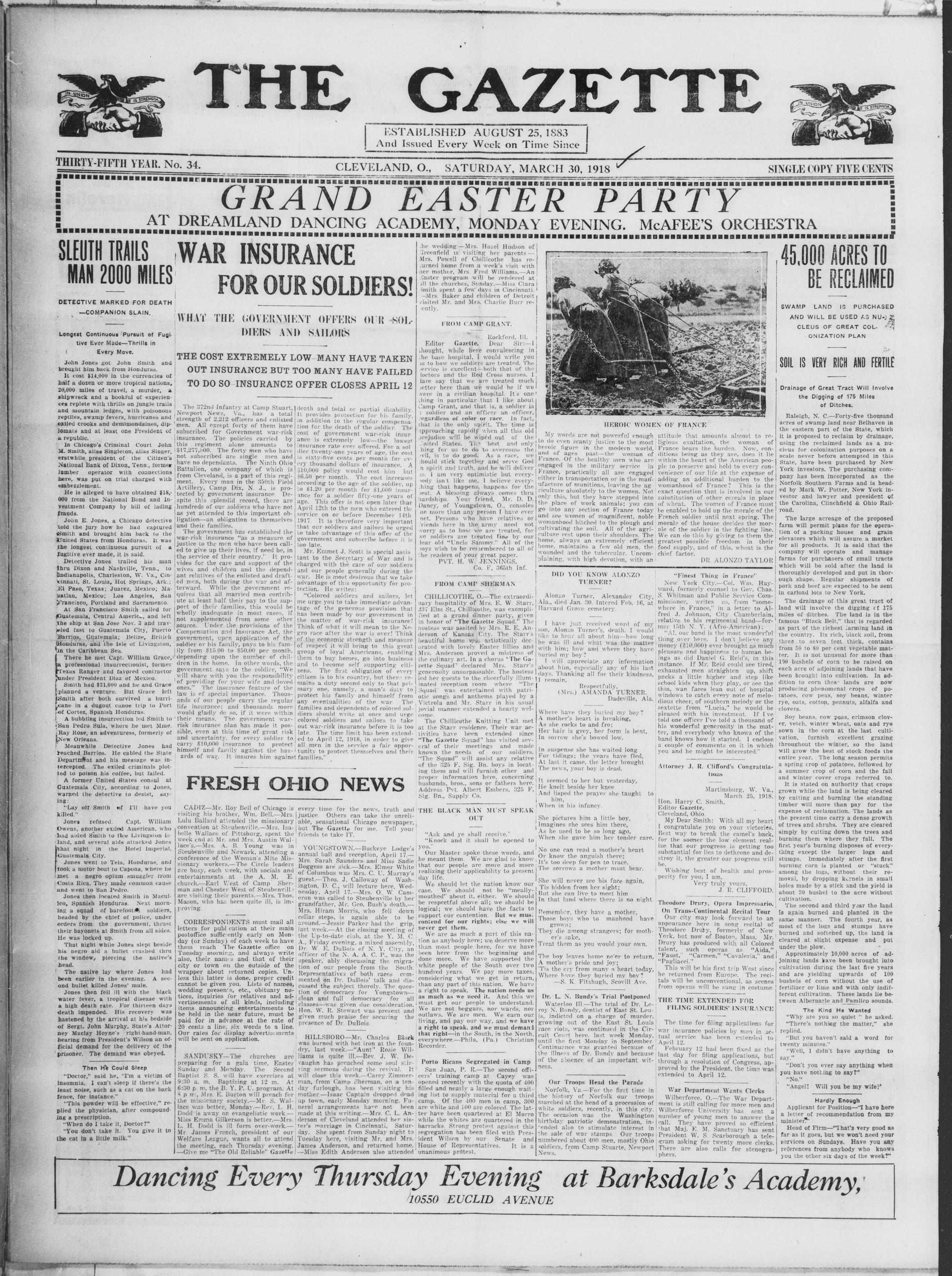
Page text (machine-generated)
Dancing Every Thursday Evening at Barksdale's Academy,
IN UNION IS STRONGEST
THIRTY-FIFTH YEAR. N
AT
SLEUTH TRAILS
MAN 2000 MILES
DETECTIVE MARKED FOR DEATH
—COMPANION SLAIN.
Longest Continuous Puruit of Fugitive Ever Made—Thrills In Every Move.
John Jones got John Smith and brought him back from Honduras. It cost $14,000 in the currencies of half a dozen or more tropical nations, 20,000 miles of travel, a murder, a shipwreck and a bookful of experiences replete with thrills on jungle trails and mountain ledges, with poisonous reptiles, swamp fevers, hurricanes and exiled crooks and demimondanes, diplomas and at least one President of a republic.
In Chicago's Criminal Court John M. Smith, alias Singleton, alias Singer, erstwhile president of the Citizen's National Bank of Dixon, Tenn., former lumber operator with connections here, was put on trial charged with embezzlement.
He is alleged to have obtained $18,000 from the National Bond and Investment Company by bill of lading frauds.
John E. Jones, a Chicago detective told the jury how he had captured Smith and brought Chin back to the United States from Honduras. It was the longest continuous pursuit of a fugitive ever made, it is said.
Detective Jones trailed his man thru Dixon and Nashville, Tenn., to Indianapolis, Charleston, W. Va., Cincinnati, St. Louis, Hot Springs, Ark.; El Paso, Texas; Juarez, Mexico; Mazatlan, Mexico; Los Angeles, San Francisco, Portland and Sacramento.
At San Francisco Smith sailed for Guatemala, Central America, and left the ship at San Jose Nov. 3 and traveled fast to Guatemala City, Puerto Barrios, Guatemala, Belize, British Honduras, and the Isle of Livingston, in the Caribbean Sea.
There he met Capt. William Grace, a professional insurrectionist, former Texas Ranger and favored contractor under President Diaz of Mexico.
Smith had $21,000 and he and Grace planned a venture. But Grace left Smith after both survived a hurricane in a dugout canoe trip to "Port of Cortez, Spanish Honduras.
A bubbling insurrection led Smith to San Pedro Sula, where he met Mime Ray Rose, an adventurer, formerly of New Orleans.
Meanwhile Detective Jones had reached Barrios. He cabled the State Department and his message was intercepted. The exiled criminals plotted to poison his coffee, but failed.
A former United States consul at Guatemala City, according to Jones, warned the detective to desist, saying: "Lay off Smith if I'll have you killed."
Jones refused. Capt. William Owens, another exiled American, who had aided Smith to flee Livingston Island, and several aids attacked Jones that night in the Hotel Imperial, Guatemala City.
Jones went to Teh, Honduras, and took a motor boat to Capona, where he met a negro opium smuggler from Costa Rica. They made common cause and went to San Pedro.
Jones then located Smith in Maculco, Spanish Honduras. Next morning, a squad of barefoot, soldiers, headed by the chief of police, under orders from the government, thrust their bayonets at Smith from all sides. He was locked up.
That night while Jones slept beside his negro soldier a bullet crashed thru the window, piercing the native's head.
The native lay where Jones had been earlier in the evening. A second bullet killed Jones' male.
Jones then fell ill with the black water fever, a tropical disease with a high death rate. For thirteen days death impeded. His recovery was hastened by the arrival at his bedside of Sergt. John Murphy, State Attorney Maclay Hoyne's right-hand-man, bearing from President Wilson an official demand for the delivery of the prisoner. The demand was obeyed.
Then He Could Sleep
"Doctor," said he, "I'm a victim of insomnia. I can't sleep if there's the least noise, such as a cat on the back fence, for instance."
"This powder will be effective," replied the physician, after compounding a prescription:
"When do I take it, Doctor?"
When do I take it, Doctor?
"You don't take it. You give it to the cat in a little milk."
THE GAZETTE
WHAT THE GOVERNMENT OFFERS OUR SOLDIERS AND SAILORS
THE COST EXTREMELY LOW-MANY HAVE TAKEN OUT INSURANCE BUT TOO MANY HAVE FAILED TO DO SO INSURANCE OFFER CLOSES APRIL 12
The 572nd Infantry at Camp Stuart, Newport News, Va., has a total strength of 2,212 officers and enlisted men. All except four of them subscribed for Government war-risk insurance. The policies carried by this regiment alone amounts to $17,277,500. The forty men who have not subscribed are single men and have no dependants. The Ninth Ohio Battalion, one company of which is from Cleveland, is a part of this regiment. Every man in the 350th Field Artillery, Camp Dix, N. J., is protected by government insurance. Despite this sphenidian record, there are hundreds of soldiers who have not yet attended to this important obligation—an obligation to themselves and their families.
It provides protection for his family, in addition to the regular compensation for the death of the soldier. The cost of government war-risk insurance is extremely low—the lowest insurance rate ever offered. For a soldier twenty-one years of age, the cost is sixty-five cents per month for every thousand dollars of insurance. A $10,000 policy would cost him but $6.50 per month. The cost increases according to the age of the soldier up to $1.20 per month for $1,000 insurance for a soldier fifty-one years of age. This offer is not open later than April 12th to the men who entered the service in 1917. It is therefore very important that our soldiers and sailors be urged
The government has established the war-risk insurance "as a measure of justice to the men who have been called to give up their lives, if need be, in the service of their country." It provides for the care and support of the wives and children, and the dependant relatives of the enlisted and drafted men, both during the war and afterward. While the government requires all of its enlisted to pay at least half their pay to the support of their families, this would be wholly inadequate in most cases, if not supplemented from some other source. Under the provisions of the Compensation and Insurance Act, the government, upon application of the soldier or his family, pays to his family from $15.00 to $50.00 per month, depending upon the number of children in the home. In other words, the government says to the soldier, "We will share with you the responsibility of providing for your wife and developing the law of special importance. Thousands of our people carry the regular life insurance; and thousands more would gladly do so, if it were within their means. The government war-risk insurance plan has made it possible, even at this time of great pisk and uncertainty, for every soldier to carry $10,000 insurance to protect himself and family against the hazards of war. It insures him against to take advantage of government and subsistence late.
Mr. Emmet J. Scott taint to the Secretary charged with the care and our people general war. He is most desis advantage of this oppression. He writes: Colored soldiers are urged to take advantage of the tags of the war has been made by our matter of war. Think of what it will grow after the war of the economic strife of respect it will bring group of loyal Amees to buy homes, and to become self-sens. The first citizen is to his county mains a duty second mary one namely, any eventualities of families and dependents should write at colored soldiers and out war-risk insurance late. The time limited to April 12, 1918, all men in the service unity to protect their families."
FRESH OHIO NEWS
CADIZ—Mr. Roy Bell of Chicago is visiting his brother, Wm. Wim-Bell. Mrs. Lulu Ballard attended the missionary convention at Steubenville. Mrs. Isabelle Wallace, of Pittsburg, spent the week end at Mr. and Mrs. Austin Wallace's. Mrs. A. B. Young was in Steubenville and Newark, attending a conference of the Woman's Mite Missionary, workers. The Circle leaders are busy, each week, with socials and entertainments at the A. M. E. church. Earl West of Camp, Sherman and Chester West of Steubenville will visiting their parents. Mrs. Thos. Mason, who has been quite ill, is improving.
CORESPONDENTS must mail all letters for publication at their main postoffice sufficiently early on Monday (or Sunday) of each week to have them reach The Gazette office on Tuesday morning, and always write also, their names and that of their city or town on the outside of the wrapper about returned copies. Unless this latter is done, proper credit cannot be given you. Lists of names, wedding presents, etc., obituary notices, inquiries for relatives and advertisements of all kinds, including items announcing, entertainments that are paid for in attendance at the rate of 20 cents a line, six words to a line. Our rates for display advertisements will be sent on application.
SANDUSK—The churches are preparing for a gala time. Easter Sunday and Monday. The Second Baptist S. S. will have exercises at 9:30 a.m. Baptizing at 12 m. At 6:30 p.m. the R. Y. P. U. program. At 8 p.m. Mrs. E. Burton will preach for the missionary society. Mr. S. Wallace was better, Monday. Rev. L. H. Dodd is away on evangelical work. Miss Emma Gilkerson is better. Mrs. L. H. Dodd is ill form over-work. Mr. James, French, president of our Welfare League, wants all to attend the meeting, each Thursday evening. Give me "The Old Reliable" Gazette
death and total or partial disability.
It provides protection for his family,
in addition to the regular compensation
for the death of the soldier. The cost of
government war-risk insurance
is extremely low - the lowest
insurance rate ever offered. For a soldier
twenty-one years of age, the cost is sixty-five cents per month for every
thousand dollars of insurance. A 100 dollar policy would cost him
$6.50 per month. The cost is according to the age of the soldier; up
to $120 per month for $1,600 insurance
for a soldier fifty-one years of age.
This offer is not open later than
April 12th to the man who entered the
service on or before December 14th
1917. It is therefore very important
that our soldiers and sailors be urged
to take advantage of this offer of the
government and subscribe before it
soo late.
Jamnet J. Scott is special assistant
to the Secretary of War and is
charged with the care of our soldiers
and our people generally during the
war. He is most desirous that we take advantage of this opportunity for protection. He writes:
"Colored soldiers and sailors, let me urge you to take immediate advantage of the generous provision that has been made by our government in the matter of war-risk insurance. Think of what it will mean to the Negro race after the war is over! Think of the economic strength and measure of respect it will bring to this great group of loyal Americans, enabling them to buy homes, go into business and to become self supporting citizens. The first obligation of every citizen is to his country, but their remains a duty second only to that primary one, namely, a man's duty to protect his family and himself from any occurrences of the war. The militia should write at once and urge colored soldiers and sailors to take out war-risk insurance before it is too late. The time limit has been extended to April 12, 1918, in order to give all men in the service a fair opportunity to protect themselves and their families."
every time for the news, truth and justice. Others can take the unreliable, sensational Chicago newspaper, but The Gazette for me. Tell your friends to take IT.
YOUNGSTOWN—Bucklegee Lodge's annual hall and reception, April 17. Mrs. Saunders and Miss Sadie Boggess are sick—S Mrs. Elmer White of Columbus was Mrs. C. U. Murray's guest. Thos. J. Calloway of Washington, D. C., will lecture here, Wednesday, April 17. Mrs. O. W. Cameron was called to Steubenville by her grandfather, Mr. Geo. Bush's death. Mrs. Hiram Morris, who fell down cellar steps, is again able to be around. Jessie Parker had the grip, and she was good enough to use the Upto-date club of the Y. M. C. A. Friday evening, a mixed assembly, Dr. W. E. DuBois of N. Y. City, an officer of the N. A. A. C. P., was the speaker,哑 discussing the migration of our people from the South. Representatives of both races commented on Dr. DuBois' talk and discussed the subject thoroly. The question of democracy for Yongstown—clean and full democracy—all classes—was given due consideration. Hon. W. R. Stewart was present and given much praise for securing the presence of Dr. DuBois.
HILLSBORO—Mr. Charles Black was burned with hot iron at the foundation, last week. "Aunt" Rosie Williams is quite ill—Rev. J. W. Davenaugh has preached some soul stirring sermons during the revival. It will close this week. Carye Zimmerman, from Camp Sherman, on a tuesday furough, has been visiting his mother, Isaac Captain dropped dead up town, early Monday morning. Funeral arrangements have been made for Mrs. C. L. Anderson of Cleveland attended her sister's marriage in Cincinnati, Saturday. She spent from Sunday night to Tuesday here, visiting Mr. and Mrs. James Anderson, and returned home. -Miss Edith Anderson also attended
ESTABLISHED AUGUST 25,1883 And Issued Every Week on Time Since
the wedding—Mrs. Hazel Hudson of Greenfield is visiting her parents—Mrs. Powell of Chillicothe has returned home from a week's visit with her mother, Mrs. Fred Williams—An artist, program will be presented all of the week, Sunday—Miss Clarissa spent a few days in Cincinnati.—Mrs. Baker and children of Detroit visited Mr. and Mrs. Charlie Burrell recently.
FROM CAMP GRANT
Rockford, Ill.
Editor Gazette, Dear Sir—I thought, while here, convalescing in the base hospital. I would write you as to how we soldiers are treated. The service is excellent—both that of the doctors and the Red Cross nurses. I dare say that we are treated much better here than we would. If ever in a civilization, I once thing the Grant, and that is, a soldier is a soldier and an officer an officer, regardless of color or race. In fact, that is the only guirit. The time is approaching rapidly when all this old prejudice will be wiped out of the United States. The best, and only thing for us to do to overcome the will, is to do good. As a race, we should stick together, and serve God in spirit and truth, and he will deliver us. I am very optimistic but everybody is not like me. I believe everything that happens, for the best. A blessing always comes through partnerships. Your friend, M. D. Daney, of Youngmen's Q. Consiles, more than any person I have ever met. Persons who have relatives or friends here in the army need not worry as to how we are treated, for we soldiers are treated fine by our dear old "Uncle Sammy." All of the boys wish to be remembered to all of the readers of your great paper.
PVT. H. W. JENNINGS,
Co. F. 365th Inf.
FROM CAMP SHERMAN.
CHILLICOTHE, O.—The extraordinary hospitality of Mrs. E. W. Stair, 227 Elm St., Chillicothe, was exemplified at a grand dinner party, given in honor of "The Gazette Squad." The hostess was assisted by Mrs. R. E. Anderson of Kansas City. The Stair's beautiful home was, artistically decorated with lovely Easter bllies and Mrs. Anderson proved a mistress of the culinary art. In a chorus "The Gazette Squad" declared Mrs. Stair's generosity unsurpassable. The hostess her guests to the cheerfully illuminated reception room where "The Squad" was entertained with patriotic songs and anthems played by a Victoria and Mr. Stair in his usual jovial manner extended a hearty welcome.
The Chillicothe Knitting Unit met at the Stair residence. Their war activities have been extended, since "The Gazette Squad" has visited several of their meetings and made known the needs of our relatives. "The Squad" will present relative of the 225 F. Sig. Bn. boys in location and will furnish other and proper information here, concerning husbands, bros., sons or fathers here. Address Pet. Albert Einbers, 225 F. Sig. Bn., Supply Co.
THE BLACK MAN MUST SPEAK OUT:
"Ask and ye shall receive."
"Knock and it shall be opened to you."
Our Master spoke these words, and he meant them. We are glad to know that our people are more and more realizing their applicability to present day life.
We should let the nation know our case. We should not be "mcellly-mouthed" about it. Either, we should be respectful about all; we should logical about all; we should have the facts to inform our contention. But we mus, content for our rights; else we will never get them.
We are as much a part of this nation as anybody here; we deserve more than most people here, for we have been here from the beginning and done more. We have supported the white people of the South over two hundred years. We pay more taxes, considering what we get in return, than any part of this nation. We have a right to speak. We have a right to need. And this must get our people to understand, We are not beggars, nor wards, nor outlaws. We are men. We gain our living, and pay our way, and we have a right to speak, and we must demand that right—in the South, in the North, everywhere—.Phila. (Pa.) Christian Recorder.
Porto Ricans Segregated in Camp
San Juan, P. R. — The second officer, training camp at Cayey was opened recently with the quota of 400 filled and nearly a large enough waiting list to supply material for a third camp. Of the 400 men in camp, 300 are white and 100 are colored. The latter have been quartered at El Morro while the whites are quartered in the barracks. Strong protest against this segregation has been filed with President Wilson by our Senate and House of Representatives. It is a unanimous protest.
10550 EUCLID AVENUE
HEROIC WOMEN OF FRANCE
My words are not powerful enough to do even scanty justice to the most heroic figure in the modern world, and of ages past—the woman of France. Of the healthy men who are engaged in the military service in France, practically all are engaged either in transportation or in the manufacture of munitions, leaving the agriculture absolutely to the women. Not only do we have stepped into the place of work, but we go into any section of France today and see women of magnificent, noble womanhood hitched to the plough and cultivating the soil. All of the agriculture rest upon their shoulders. The home, always an extremely efficient home, maintains a few old men, the wounded and the tuberculous, with high devotion, with an
DID YOU KNOW ALONZOY
TURNER?
Alona Turner, Alexander City, Ala., died Jan. 30, Intered Feb. 16, at Harvard Grove cemetery.
I have just received word of my son, Alona Turner's death. I would like to hear all about him—how long he was ill and what was the matter with him; how and where they have buried my boy?
I will appreciate any information about him, especially any of his last days. Thanking all for their kindness, I remain.
Respectfully,
(Mrs.) AMANDA TURNER,
Dadeville, Ala.
Where have they buried my boy?
A mother's heart is breaking.
As she rocks to and fro;
Her hair is grey, her form is bent,
In sorew she's bowed low.
In suspense she has waited long
For tidings; the years have fled.
At last it came, the letter brought.
The news, your boy is dead.
and lisped the prayer she taught him,
When she gave him her tender care.
No one can read a mother's heart
Or know the anguish there;
It's too deep for pen to trace.
The sorrows a mother must hear.
She will never see his face again,
It's hidden from her sight;
But she can live to meet him
In that land where there is no night.
Remember, they have a mother.
Those boys who to manhood have
grown.
They die among strangers; for mother's sake.
Treat them as you would your own.
The boy leaves home never to return,
A mother's pride and joy.
Tis the cry from many a heart today. Where have they buried my boy?
- S. K. Fitzhugh, Scovill Ave.
Dr. L. N. Bundy's Trial Postponed Waterloo III — the trial of Dr. Leroy N. Bundy, dentist of East St. Louis, indicted on a charge of murder, growing out of the East St. Louis race riots, was continued in the Circuit Court here, last week Monday, until the first Monday in September. Continuance was granted because of the illness of Dr. Bundy and because of the absence of an important witness.
Our Troops Head the Parade Norfolk, Va. — For the first time in the history of Norfolk* our troops marched at the head of a procession of white soldiers, recently, in this city. The occasion was the Washington birthday patriotic demonstration, intended also to stimulate interest in the sale of war stamps. Our troops numbered about 400 men, mostly Ohio soldiers, from Camp Stuart, Newport News.
It seemed to her but yesterday,
he knelt beside her knee.
And lisped the prayer she taught.
When in his infancy.
attitude that amounts almost to religious escalation, the 'woman' of France hears the burden. Now, conditions being as they are, does it lie within the heart of the American people to preserve and hold to every convenience of our life in the expense of adding an additional burden to the womanhood of France? This is the exact question that is involved in our substitution of other cereals in place of wheat. The women of France must be enabled to hold up the morale of the French soldier until next spring. The morale of the house decides the morale of the soldier in the fighting line. We can do this by giving to them the greatest possible freedom in their food supply, and of this, wheat is the chief factor.
DR. ALONZO TAYLOR
“Finest Thing in France”
New York City—Col. W. Hayward, formerly counsel to Gov. Chas S. Whitman and Public Service Commission, writes us from “somewhere in France” in a letter to Alfred J. Johnson, City Chamberlain, relative to his regimental band—former Eth. N. X. (Afro-American):
“All our band is the most wonderful thing over here. I don’t believe any money ($10,000) ever brought as much pleasure and happiness to human beings as did Daniel G. Reid, in this instance. Mr. Mr. Reid could see tired, exhausted men straighten up, shift peaks a little higher and step like school kids when they play, or see the thin, man faces lean out of hospital windows to catch every note of melodies echoed of southern beauty he could be pleased with his investment. If I’ve told one officer I’ve told a thousand of his wonderful generosity in the matter, and everybody who knows of the band knows how it started. I enclose a couple of comments on it in which you and he might be interested.”
Cleveland, Ohio.
My Dear Smith: With all my heart I congratulate you on your victories, best way to break the cound's back, for the somer the low element realize that our progress is getting too substantial for lies to dethrone and destroy it, the greater our progress will be.
Wishing best of health and prosperity for you, I am.
Very truly yours.
J. R. CLIFFORD.
Theodore Drury, Opera Impressario, On Trans-Continental Recital Tour.
Our city may look forward to an amusement here in song recital of Theodore Drury; formerly of New York, but now of Boston. Mr. Drury has produced with all Colored talent, such operas as "Aida," "Faust," "Carmen," "Cavaleria," and "Pagliacci."
This will be his first trip West since he returned from Europe. The recitals will be unconventional, as scenes from operus will be sung in costume.
THE TIME EXTENDED FOR FILING SOLDIERS' INSURANCE
The time for filing applications for war insurance policies by me in actual service has been extended to April 12.
February 12 had been fixed as the last day for filing applications, but through a resolution of Congress, approved by the President, the time was extended to April 12.
War Department Wants Clerks
Wilberforce, O.-The War Department is still calling for more men and Wilberforce University has sent a number of young men to answer the call. They have proved so efficient that Maj. E. M. Sanctuary has sent assistance to Norwichborough a telegram asking for twenty more. There are also calls for stenographers.
IN UNION IT IS STRENGTH.
SINGLE COPY FIVE CENTS
ESTRA
45,000 ACRES TO
BE RECLAIMED
SWAMP LAND IS PURCHASED
AND WILL BE USED AS NU-
CLEUS OF GREAT COL-
ONIZATION-PLAN
SOIL IS VERY RICH AND FERTILE
Drainage of Great Tract Will Involve the Digging of 175 Miles of Ditches.
Raleigh, N. C.—Forty-five thousand acres of swamp land near Belhaven in the eastern part of the State, which it is proposed to reclaim by drainage, using the reclaimed lands as a nucleus for colonization purposes on a scale never before attempted in this State, have been purchased by New York investors. The purchasing company has been incorporated as the Norfolk Southern Farms and is headed by Mark W, Potter, New York Investor and lawyer and president of the Carolina, Clingfield & Ohio Railroad.
The large acreage of the proposed farm will permit plans for the operation of a packing house and grain elevators which will assure a market for all products. It is said that the company will operate and manage farms for purchasers of small tracts which will be sold after the land is thoroughly developed and put in thorough shape. Regular shipments of hork and beef are expected to be sent in carload lots to New York.
The drainage of this great tract of land will involve the digging e 175 miles of ditches. The land is in the famous "Black Belt," that is regarded as part of the ticiest farming land in the country. Its rich, black soil, from three to seven feet thick, contains from 50 to 80 per cent vegetable matter. It is not unusual for more than 100 bushels of corn to be raised on each acre of adjoining lands that have been brought into cultivation. In addition to corn the lands are now producing phenomenal crops of potatoes, cow peas, soy beans, winter rye, oats, cotton, peanuts, alfalfa and clovers. Soy beans, cow peas, crimson clover, vetch, winter wheat, oats and rye sown in the corn at the last cultivation. furnish excellent grazing throughout the winter, so the land will grow the best of stock foods the entire year. The long season permits a spring crop of potatoes, followed by a summer crop of corn and the fall and winter cover crops referred to.
It is stated on authority that crops grown while the land is being cleared by cutting and burning the standing timber will more than pay for the expense of reclamation. The lands, as the present time carry a dense growth of trees and shrubs. They are cleared simply by cutting down the trees and burning them where they fall. The first year's burning disposes of everything except the larger logs and stumps. Immediately after the first burning corn is planted or "stuck among the logs, without their removal, by dropping Kernels in small holes made by a stick and the yield is about 30 bushel to the acre without cultivation.
The second and third year the land is again burned and planted in the same manner. The fourth year, as most of the logs and stumps have burned and softened up, the land is cleared at slight expense, and put under the plow.
Approximately 10,000 acres of adjoining lands have been brought into cultivation during the last five years and are yielding upwards of 100 bushels of corn without the use of fertilizer or lime and with only indifferent cultivation. These lands lie between Albernarle and Pamlico sounds.
The Kind He Wanted
"Why are you so quiet?" he asked.
"There's nothing the matter," she replied.
"But you haven't said a word for twenty minutes."
"Well, I didn't have anything to say"
"Don't you ever say anything when you have nothing to say?"
"No."
"Angel! Will you be my wife?"
Hardly Enough
Applicant for Position—"I have here a letter of recommendation from my minister."
Head of Firm—"That's very good as far as it goes, but we won't need your services on Sundays. Have you any references from anybody who knows you the other six days of the week?"
The GAZETTE
PUBLISHED EVERY SATURDAY
One Year ..... $1.50
Six Months ..... 1.00
Three Months ..... 0.00
Subscribers are requested to remit
postoffice money order or reg-
istered letter
Entered at the postoffice in Cleve-
land, Ohio, as second-class
mail matter.
Blackstone Building, Cleveland, O.
Member Ohio Legislature: 1894
to 1896; 1896 to 1898; 1900 to 1902
THE GAZETTE is the oldest, and has the largest bona fide circulation, double that of any newspaper in the interest of Afro-Americans, published in the state of Ohio, and comparison with any will immediately establish its rank as one of the NEWS-EST AND BEST in the country.
10,000,000 Afro-Americans.
300,000 in Ohio.
25,000 in Cleveland.
SATURDAY, MARCH 30, 1918
The Gazette acknowledges the receipt of a copy of "His Majesty's Black Labourers," an interesting treatise on their camp life, etc., by F. Z. S. Peregrino of Cape Town, South Africa, a native of that country who many years ago lived for several years in this city and Buffalo, N. Y.
---
Don't worry! The big German "drive" now on in northern France is but the beginning of the end—for Germany. The Kaiser is but playing his last and biggest trump card—and cannot win! Mark our prediction. It will take a year or two, prehaps, to finish the job thoroly but it will be finished and right, too, by the Allies.
---
The Gazette is indebted to Congressman Crosser for a generous supply of government garden seed; to Congressman Henry I. Emerson for valuable government documents, and to the War Department, Washington, D.C. for a copy of the report of the Provost Marshal General to the Secretary of War on the operation of the first draft.
There are 5,516,163 illiterates over ten years of age in this country, and 4,600,000 of them are over twenty years of age. Over 58 per cent of these are white persons, and of these 1,500,000 are native-born whites. So you see the "colored man and brother" does not furnish a preponderance of the ignorance in this country after all.
The failure of the national administration to live up to its promises and secure even ordinary results, in preparing for the war during the past year, was unmercifully scored in the U. S. Senate, Tuesday afternoon, by Senators Lodge, Johnson, New, Hitchcock and others, Democrats and Republicans. From now on it looks very much as if the people will learn the truth as to real conditions of preparedness and be given less democratic camouflage along this line. As one of the Senators well said, when the facts are generally known by the people of this country things will be done and not simply promised. Truth, brother, talk it! Then tell the people about the unnecessary, shameful and disgraceful Porto Rican and American color-lines in army matters!
---
The Wilson administration has forced segregation in army matters in Porto Rico, where it was never known before, over the protest of the House and Senate and the people of that little island. The mixed Porto Rican regiment has been separated on a color basis, separate quarters being provided for its colored and white members, in the face of a resolution-petition to President Wilson unanimously adopted by the Porto Rican House and Senate. This is carrying the American color line, not into Africa but into Porto Rico, not so far away from "the dark continent," and is really more than even we expected from our prejudiced southern democratic controlled national administration. O, the pity of it!
THERE CAN BE NO FEDERAL LAW AGAINST LYNCHING
That delegation of Philadelphiaians of color that called on Senator Boise Penrose in Washington, D. C. recently, urging the introduction in Congress of a bill making lynching a federal crime, could have spent its time much more profitably urging the introduction in their State Assembly of a mob violence or anti-lynching bill similar to our Ohio law. The U. S. Supreme Court, years ago, decided that mob violence and lynching is a matter for the legislatures of the various states to handle and not one for Congress to legislate against. A state right, pure and simple! Ohio led the way in 1896 and Illinois only has followed, enacting a law very similar to the Ohio law the editor of this paper introduced in the Legislature of this state in 1894 and again in 1896
when successful in securing its enactment Pennsylvania and other northern states at least should do likewise and our people, residents of these states, Ohio and Illinois excepted, should be more active along this line. Stop wasting time and money running to Washington, D. C., clamoring for something it is impossible for Congress to give if it would and, we might add, as now constituted would not give if it could.
PEACE BY VICTORY
"Peace by victory" is to be the principle upon which the Republican party will go into the elections of 1918. And only by a decisive military victory, full, complete and lasting. This is no after-thought. The Republican party saw what the sinking of the Lusitania in May, 1915, meant. In its National platform of 1916 it stood definitely and courageously for preparedness, and the fullest protection of American lives and interests. That it lost the election by so doing made no difference in its conduct, for by birth, tradition and history and in practice it is the Nationalistic party in the United States, if we may coin a word. Hence, that victory might come to our nation, and not defeat, it rallied to the support of the administration when war came and from that time on it has given a more unified support to the war than has the party of the administration itself. That this is true is evidenced by the fact that the opposition to the war policies of the administration have come, not from Republicans, but from Democrats. We offer in evidence the records of Senators Stone and Reed of Missouri; Gore, of Oklahoma; Vardaman, of Mississippi; Hardwick and Smith, of Georgia; Hitchcock, of Nebraska; Representatives Kitchin Democratic leader in the House Dent, Chairman of Military Affairs; Burnett, and others, even Speaker Clark having defiantly opposed the selective conscription act. With these must be placed a Republican, LaFollette, if he be a Republican, instead of a victim of a megalomania, which has
self as to be without a party. Coming home to Ohio, every Republican in Congress, headed by Senator Harding, has supported the administration in all its legislation to carry on the war. Whereas, Democratic Congressmen Sherwood, Gordon, Crosser and Claypool have antagonized it. The Democratic cry will be: "Stand by the administration in time of war. Don't swap horses in crossing the stream." The Republican answer is ready: "We have stood by the administration except where it has delayed in crossing the stream—then we went ahead of it." To make their cry stick, the Democratic party must be sincere. The Republican party will cast out its LaFollette. The Democratic party must cast out its Vardanans, Reeds, Stones, Gores, Hardwicks, Smiths, Hitchcocks, Kitchins, Burnetts, Dents, Sherwoods, Gordons, Crossers and Claypools. It cannot fool the people by crying, "Stand by the administration" in one breath, and in the next appealing for the "election" of the Sherwoods, Crossers, Gordons and Claypools who fought that same administration. Since the "he kept us out of war" cry in 1916, the electors are in the frame of mind to apply the acid test to anything the Democratic party puts forth. Public opinion anyway is reaching the conclusion that the job is rather large for the Democratic party, and the people are beginning to phrase the thought: "Republican know-how is needed to win the war." It will not diminish in volume as the war goes on. Republican executive and administrative ability is needed to win the war, to preserve the fruits of the war, to solve the great after-problems when there has come "Peace by Victory."
Our advertisers want your trade.
Those who do not ask for it in The
Gazette certainly care little, if at all,
for it. Therefore, we urge our readers
and all our friends to patronize
those who ask for your trade in this
paper.
PREJUDICE
"Any prejudice whatever will be insurmountable if those who do not share in it themselves truckle to it and flatter it and accept it is a law of nature."—John Stuart Mill.
To submit in silence when we should protest makes cowards out of men. The human race has climbed on Protest. Had no voice been raised against injustice, ignorance and lust, the inquisition yet would serve the law, and guillotines decide our least disputes. The few who dare, must speak and speak again to right the wrongs of many. —Ella Wheeler Wilcox.
THE MAN WHO DARES.
"I honor the man who in the conscientious discharge of his duty dares to stand alone; the world, with ignorant, intolerant judgment, may condemn, the countenances of relatives may be averted, and the hearts of friends grow cold, but the sense of duty done shall be sweeter than the applause of the world, the countenances of relatives or the hearts of friends."—Charles Sumner.
THE GAZETTE, CLEVELAND, OHIO, MARCH 30, 1918
DOINGS
OF
THE
RACE
William Wise, a farmer near Mart,
Texas, bought $100 worth of Liberty
stamps. He is one of the largest
stamp purchasers at that place.
G. A. Sheehy has been appointed Inspector of Leather for the government, and is at Vincland, N. J., inspecting sole leather at Kieghley's Shoe Factory, where a large contract is beingilled for "Uncle Sam." The commission on union of the northern and southern Presbyterian church failed to agree on a plan for the poor to merger. The north would not agree on a close-line proposals of the infamous south. F. W. Riffe, charged with thefts from the U. S. mails while an employee of the post office, was sentenced to a year and a half in Leavenworth prison, Saturday, by Judge Landis. - Chicago (HI.) Idea.
Attorney Robert L. Vann, editor of the Courier, has been appointed an assistant city solicitor of Pittsburg, something the Negroes of Cleveland, friendly to its "Republican" administration, are even afraid to ask for George Borden, of Goldsboro, N. C. has furnished 14 sons to the war. He is the father of 35 children, 27 of them living. The sons are all either in this country or in France. He has been three times married and on four occasions has been the father of quadruplets—a world's record. William E. Stringfellow of 3811 Rhodes Ave, dentist by day and mail desk by night, was arrested charged five unpleasant special duties. Thirty-five unpleasant special duties were found at his home. The majority contained money. He was arraigned before Commissioner Mason, March 24—Chicago Idea.
At the headquarters of the Red Cross, Washington, D.C., an appeal has been sent out for five thousand nurses whose services are in urgent demand. In spite of this fact and also that our people have been contributing liberally to that organization, it refuses still to recognize our nurses, or give consideration to our physicians.
Additional Locals
Additional Locals
The Smith Players (A. F of M.
Local No. 550) an orchestra of selected
musicians, music for all occasions.
Arthur J. Smith, director. Robt. L.
Reynolds, mgr. 4207 Central Ave.
Cleveland, O. O. S. Central 5886-W-
Adv.
Pay no attention to the story being
circulated to the effect that the Crable
suit "was dismissed." There is
absolutely no truth in it. Crable was
CONVICTED in Probate Court and
the conviction stands and is a matter
of court record.
Roy Smith's splendid orchestra, supported by other local talent, gave a fine entertainment at East Mt. Zion Baptist church, last week Tuesday evening. Mr. Smith is a son of Rev B. K. Smith, pastor of the church. In addition to the orchestra, those participating were: Beatrice Foster, vocalist; Mary Moore and Raymond Grosse, J. K. Smith, J. Jayphone soloist; Lucy L. J. Page-Rosalie and Emma Dupree and Mrs Carrie E. Williams, readers; Roy Smith, cellist, Invocation was offered by j. K. Altson.
Rev. Charles H. Crable, pastor of Mt. Haven Baptist church, and Ormond H. Forte, an alien publisher have been found guilty of criminal libel, in the cases instituted, last December, against them by the editor of The Cleveland Gazette as the result of the publication of Crable's vile letter, Dec. 1. The above cases are part of the seven (cases and motions) in which The Gazette has figured in the courtroom with eight wins. The Gazette is one of the oldest Colored weeklies in the country, being now in its 35th year. Hon Harry C. Smith is its editor and proprietor - St. Louis. (Mo.) Arpus.
ATTACHMENT NOTICE
In the Court of Charles Brenner, J. P., for Brooklyn Twp., Cuyahoga Co. Ohio, Elizabeth Dennerle, pliff. vs. Ida Gordon, San Francisco, Calif. deft. Notice is hereby given that on the 21st day of Feb'y., 1918, an order of attachment was issued in the above entitled action for the sum of $42.00, and $20.00 probable costs. Said case with $20.00 probable costs on the 6th day of April, 1918, at 7 o'clock a.m. ELIZABETH DENNERLE, 3t. Plaintiff.
CORRESPONDENTS WANTED
The old reliable Gazette desires an active agent and correspondent in every city and town in Ohio and neighboring states having a number of Afro-American residents. Only a little time on Fridays or Saturdays is required.
We are especially destruous of hearing from persons in the following named cities: Springfield, Dayton, Plqua, Mt. Vernon, Egst Liverpool, Akron, Lima, O., and other places, particularly in Ohio, where we have none.
Write to the editor of The Gazette, Blackstone building, Cleveland, O., and terms will oblige us greatly by sending at once the addresses of persons in the cities named and others in the state, to whom we can write relative to the matter.
DARE TO DO YOUR DUTY
"Let us have faith that right makes might, and in that faith let us to the end dare to do our duty as we understand it."—Abraham Lincoln.
FILL THIS OUT AND SEND IT
White House, Washington:
The undersigned respectfully requests you to disapprove the sentence of death imposed upon the Colored soldiers in the court martial at Fort Sam Houston, Texas.
Name .....
THE MYSTERY OF ARROWHEAD
California has so many of Nature's greatest wonders, including the Yosemite, the Big Trees, the highest mountain and the only active volcano in continental United States, that it is not surprising that some have been overlooked. One of its most remarkable as well as one of its most mysterious natural attractions lies hidden in the San Bernardino Mountains. These rise from 3,000 to 12,000 feet above the valley. On one of the most imposing of them, extending from near its top and covering fully seven and a half acres, a gigantic Indian arrowhead is superimposed. The point is directed toward the famous hot springs whose waters pour out of the mountainsides in such volume that they have cut deep canyons as they push on to the mesa.
Who formed this arrowhead 3,500 feet up the mountainside, who planted, with white sage brush, the seven and a half acres, within its clearly defined limits, a quarter of a mile long and 550 feet wide, in sharp contrast with the growth outside the line of demarcation, of thick chaparral, mesquit and chamisal? The Franciscan tathers saw it a century ago and it looked then as it does now. Of course there are Indian legends about it, for all this section was in possession of the roaming tribesmen until 60 or 70 years ago. One of the legends is that the Indians outlined the gigantic arrow on the highest hill to locate the springs in whose warm, bubbling waters they sought the healing power.
No historian confirms this legend and few believe it, for the task of climbing 1000 feet up a steep mountainside to plant a seven-and-a-half acre plot with brush differing in appearance from that with Which Nature's has clothed its countless hills would have taxed the superhuman. The Indian could have had neither resources nor patience for the undertaking. It was Nature's work and the best proof of it is that, as long memory runs, the gigantic arrowhead has kept its place unchanged and unchangeable, except for deep rifts in its surface caused by the floods of water from the melting snow. Nature could have carved the great arrow with a mountain cloudburst as its chisel, for scientists assert that a sudden torential downpour of water might have struck a rock dividing on both sides and been brought together again, thus carving out an arrowhead, point downward.
The thermal springs at Arrowhead are not shallow dripping pools, but deep, bubbling, flowing underground streams finding their sources in the underlying volcanic formation and pushing out to the surface in search of freedom. Paths have been built and are neatly kept so that the visitor can walk along the canyons in which the streaming waters flow. Their warmth keeps the grass green along these pathways and brings out a pro fusion of richly-tinted wild flowers. The bracing air is redolent of Nature's sweetest perfume—Leslie's.
KNOCKED OUT
"We'll have to film this last battle scene over again."
"What's wrong with it."
"The hero, who is supposed to club twenty men to death with the butt of his rifle, accidentally struck one of the supernumeraries too hard."
"Well."
"The 'super' retaliated with a vicious upper cut and the hero won't be able to act for several days."
Need Not Wait
A young girl, fresh from the country, was employed by an English mistress as maid. They were about retiring for the night when she explained to Bridget: "We generally have breakfast about eight o'clock." Bridget, looking at mistress in an amusing way, with candlestick turned sideways in hand, grease, dropping on the carpet, said. "All right, if I'm not down, don't wait."
Trying It On The Dog
An Irishman, having gone out in his nightgown a bitter cold night to stop the howling of a dog, was found by his wife almost paralyzed with cold, holding the struggling dog by the tail. "Howly murder, Pat," says she, "what would ye be afer doin?" "Tush," said Pat. "Don't ye see Oi'm tryn' to fraze the baste?"
"Your first husband must still love you?"
"Why so?"
"He tells me that he owes a great deal to you."
"He's referring to the back alimony."
A Vision of Judgment
"Extremes met at our boarding-house today," remarked the star boarder.
"How so?" asked the innocent by-sitter.
"I ate deviled ham and had angel cake for dessert."
"I got on to a sure way of getting out for an hour by snuffin' red ink up my nose."
TO THE PRESIDENT.
White House, Washington, D. C.
HER $200,000 MANSION
Presents It to Salvation Army on Con-
Not Be Draped.
Covington, Ky.—"A $200,000 mansion, furnished complete, is yours for the asking, if you do not drape or disturb the statuary therein."
This is what the Salvation Army in this city was told and the mansion and its contents have been accepted, as well as the conditions laid down by the giver. Here is the story:
Several months ago a meek, retiring woman called upon Brigadier Dunham, the representative of the Salvation Army at Cincinnati. She informed him that she was Mrs. Bradford Shinkle of Covington. She said the family had decided to give the home-steed to the Salvation Army, to be used as a woman's training school, where domestic science would occupy first place in the curriculum.
But the quiet woman stipulated that none of the statuary should be removed, dipped or in any way tampered with. She declared that no member of the family would tolerate any attempt on the part of any person to improve on the work of the famous sculptors.
Bridgidian Dunham communicated the wonderful offer to headquarters and also the conditions under which it was offered, which by this time had become neighborhood gossip and it was being said that every piece of sculpture would suggest evil thoughts and the gossips pretied terrible things for the girls who would come within the compass of their malign influence. Commander Eva Booth commissioned Col. Margaret Bevill, who is secretary for the woman's and children's departments, to go to Covington, look over the ground and report if the objections were well founded. Mrs. Bevill who is the mother of five children visited the home and after careful examination, strongly recommended that it be accepted and that all the conditions be scrupulously observed.
"There is nothing that any pure minded person could possibly regard as suspective in the statuary," Mrs. Bevill said.
The Shinkle mansion is one of the best appointed private dwellings in Kentucky. It is situated on a lofty eminence which commands Cretta. It is surrounded by gardens and lawns, in which fountains play continually. Playgrounds, walks and other attractions are found on the two acres of land surrounding the mansion.
The interior of the house is gorgeously decorated with some of the finest specimens of the painter's art. Thirty-five rooms are at the disposal of the young women. Among these is a classroom, where all arts which concern the housekeeper will be taught. It is planned to receive as guests only such young women as are willing to qualify themselves for the proper conduct of a household.
AUSTRALIA TRAVELER GOES 150 MILES WITHOUT SEEING HOUSE
Country Is Not Desert and Climate Is Fairly Good in Northern Section, Says Lecturer.
Melbourne, Australia.—The only country in the world where one might travel for 150 miles without seeing a house or meeting a person, was the description of Australia's vast Northern Territory, given by Dr. Gilruth, the administrator, in a lecture on this section of the continent.
Dr. Gilruth pointed out that the territory was not a desert and that its climate was delightful for three months, and not unfavorable even in the middle of summer. There was much mineral wealth, and water could be secured by sinking bores. Immense tracts awaited stock and maize; sorghum and cotton grew well. It was possible to leave the cotton until all the pods had ripened, as no rain fell in the ripening period of the year. With the extension of the railway from Katherine River there should be a future for wolfram, copper and tin mining.
Opinions.
Every man is entitled to his opinion, but not every man is entitled to impose his opinion on his neighbor.—Buffalo Times
ROBERT FISHER
Attorney and Counselor at Law
819 American Trust Building
Cleveland, Ohio
Tel. Central 1460-W.
HENRY L. THOMAS
Attorney and Counselor at Law
Central 2251-R
Any Watch Repaired
No matter how $1
badly broken.
Work guaranteed.
Mail orders.
Superior Watch Co.
307 Superior Bldg.
KILLY
HAIR
BECOMES (LIKE PICTURE)
Fluffy, Soft, Silky, Long
—By— Herolin
Using
POMADE HAIR DRESSING.
Pleasantly perfumed, not stick or gummy.
Herolin eliminates, and minimizes the
roots of the hair causing nappy, coarse,
stubborn, kinky or short hair to grow
soft, long, silky, easy to manage, so you
can do it up in any style. Removes DAN
DRUFF and Stops ITCHING SCALP.
Don't be fooled. Be sure you get Herolin.
Soft Drug Stores 6
SEND 25 CENTS more or cash for a big box
HEROLIN MEDICINE Doe, Atlanta, Coop. J
AGENTS WANTED Write for
Terms
MIRT SHOP
ENTERPRISE
Proprietor.
NECKWEAR.
Dollars and Shirts, Hats, Caps, etc.
REAL AVE.
MONIZE
POOL ROOM
BER SHOP
Central Ave.
city. Everybody Welcome!
Stop Paying Rent
N, Real Estate Dealer
Country Yard
33rd St.
& Ducks for Sale
Reasonable
Quality Service
BER BROS.
Directors and
almers
General Parlors
REAL AVE.
Is Answered Day and Night
CENTRAL SHIRT SHOP
A RACE ENTERPRISE
G. J. TATE, Proprietor.
GENTS' FURNISHINGS, NECKWEAR.
Hosiery, Underwear and Arrow Collars and Shirts, Hat
2922 CENTRAL AVE.
Phone Prospect 441-J.
PATRONIZE
JOE HEDGES' POOL ROOM
AND BARBER SHOP
3048 Central Ave.
One of the Best in the city. Everybody
come!
Buy A Home and Stop Paying
SEE
A. I. GORDON, Real Estate
2363 E. 87th St.
Wilson's Poultry Yard
2201 East 33rd St.
Chickens, Turkeys & Ducks for S
Prices Reasonable
Cent. 1929-W
Rosedale 1800
SLAUGHTER BROTHERS
Funeral Directors and
Embalmers
Office and Funeral Park
3923 CENTRAL AVE.
Autos for All Occasions. Calls Answered Day and
CENTRAL SHIRT SHOP
G. J. TATE, Proprietor.
GENTS' FURNISHINGS, NECKWEAR,
Hosiery, Underwear and Arrow Collars and Shirts, Hats, Caps, etc
2922 CENTRAL AVE.
AND BARBER SHOP
3048 Central Ave.
One of the Best in the city. Everybody Welcome!
Buy A Home and Stop Paying Rent SEE A.I.GORDON, Real Estate Dealer 2363 E. 870h St.
Wilson's Poultry Yard
2201 East 33rd St.
Chickens, Turkeys & Ducks for Sale
Prices Reasonable
Cent. 1929-W
Rosedate 1800 Quality Service
SLAUGHTER BROS.
Funeral Directors and
Embalmers
Office and Funeral Parlors
3923 CENTRAL AVE.
Autos for All Occasions. Calls Answered Day and Night
Cuyahoga, Central 5727 Edward Doctor's Dining
s Dining Room
Edward Doctor's Dining Room
3035 Central Avenue
Wm. Brack, Prop. Frank Doctor,
James Mabel, Chef
WHEN YOU ARE THIRSTY
AND WANT A REFRESHING DRINK-ORDER
ank Doctor, Manager
bel, Chef
Wm.Brack,Prop. Frank Doctor, Manager James Mabel, Chef
WHEN YOU ARE THIRSTY
AND WANT A REFRESHING DRINK—ORDER
BEVIERA
This is the popular, non-intoxicating beverage that is
good in every way. Every drop is healthful, strength-
ening and PURE. Order by the box from any drugg-
gist, grocer, confectioner or soda fountain — or
phone Harvard 730. Prompt delivery service to any
part of Cleveland.
This is the popular, non-intoxicating beverage that is good in every way. Every drop is healthful, strengthening and PURE. Order by the box from any drug-gist, grocer, confectioner or soda fountain — or phone Harvard 730. Prompt delivery service to any part of Cleveland.
The Leisy Company Cleveland
"What's in a name?"—EVERYT
"—EVERYTHING!
"What's in a name?"—EVERYTHING!
"Ill wounds may be cured but not ill names"
"A famous name will never die"
"Nothing succeeds like success"
For over eighty years, Palmer's "Skin
Ointment has made a great name for
a cure for most forms of skin troubles.
Original Skin-Brightener.
WARNING! Our Trade-Mark "Skin
is being used by others, evidently to de-
friends. Let them BEWARE; we shall p
them to the fullest extent of the law.
Look for our name and address on eve-
lage of Palmer's "Skin Success" Ointm
Soap.
The Morgan Drug Company
1512 Atlantic Avenue
Brooklyn
Palmer's "Skin Success" great name for itself, as skin troubles. It is the trade-Mark "Skin Success" evidently to deceive our ARE; we shall prosecute it of the law. and address on every pack- Success" Ointment and Drug Company Brooklyn, New York
For over eighty years, Palmer's "Skin Success" Ointment has made a great name for itself, as a cure for most forms of skin troubles. It is the Original Skin-Brightener.
WARNING! Our Trade-Mark "Skin Success" is being used by others, evidently to deceive our friends. Let them BEWARE; we shall prosecute them to the fullest extent of the law.
Look for our name and address on every package of Palmer's "Skin Success" Ointment and Soap.
The Morgan Drug Company
1512 Atlantic Avenue
Brooklyn, New York
NEGRO SOLDIER IN OUR WAR
NEGRO SOLDIER IN OUR WAR
(NEW BOOK)
Tells all about the war; it is fair to Colored people; everyone buys; a tremendous seller. Price only $1.50; agents making $8 to $15 per day. Send 24 cents quick for agents' outfit. USTIN JENKINS CO., F. Street, Washington, D. C.
SANTAL CAPSULES MIDY
CATARRH of the BLADDER relieved in 24 HOURS
Each Cap-sule bears the MIDY name #42
Beware of counterfeits
CATARRH
of the
BLADDER
relied in
24 HOURS
Each BODY
bears the name
#20
Because of counterfeits
AGENTS—The COLORED
MAN IS NO MAN
patricio picture in coles
showing the troop troops
rear for the front. It’s a
picture that will stir the
patricio heart of every
million. Millions will be
cold. Sample B. Agnase
carnival card. Sample C.
Every money will buy.
Pictures Portrait.
St. D. Dept. 20, Chicago
A
BENETTON
BEVERS
THE LABEL COMPANY
EST. 1910
"I have practiced medicine for 42 years and I have had a great deal of experience in the treatment of Rheumatism, but I have not found anything that equals G. S. and I take great pleasure in recommending G. S. for rheumatism in any form."—R. M. Ossborn, M. D., and Specialist on Dropsy, Fort Smith, Ark.
GS is guaranteed for one bottle to benefit any case of
GS is guaranteed for one bottle to benefit any case of Rheumatism, Pellagra or any blood, liver or kidney disease, or money refunded, and no questions asked. Why suffer? Sold by all druggists, $1.00 per bottle, or six bottles for $5.00. Write for testimonials. L. M. GROSS, 721 Spring St. Little Rock, Ark
The Pride of Carolina
The State Agricultural and Mechanical College of South Carolina
Orangeburg, S. C.
Next session begins September 20th and ends May 31st, 1918.
No Tuition, no Room Rent, no Charges for Water, Lights or Fuel. Entrance Fee $10.00.
Board $500 per Month in Advance. Books, Laundry and Personal Expenses Extra.
Every Modern Facility, Standard Equipment. A Faculty of 57 Officers and instructors
For information and Catalogue, Write.
R. S. WILKINSON, Pres.
Orangeburg, S. C.
KINY
HAIR
Exelento Medicines Co.
Alhambra, CA
Gentlemen: Before I used
your Exelento Quinine
Remedies, my hair was
short, over my hair, hungy,
but very well grown. I
inches long, and is so soft
and silky that I can go up
any way I want to it.
I need sedation, you need
progly Exelento has made
it to be.
Eหลีเงา Medicine Do.
Ahlman, Gm.
Gentlemen: Before I used your Exelento Quinine Pomade my hair was short, come and happy, but now it has grown to $2 inches long, and it is soft and silky that I can do it up any way. I want to i am sending you my picture to show you how pretty Exelento has made it. SALLIE REED.
Don't let some fake Kink Remover fool you. You really can't strighten your hair until it is nice and long. That's what
EXELENTO QUIINE POMADE does, removes Dandruff, feeds the Roots of the hair, and makes it grow long, soft and silky. After using a few times you can tell the difference, and after a little while it will be so pretty and long that you can fix it up to suit you. If Exelento don't do as we claim, we will give your money back.
Mme. C. H. Jones' HAIR Invigorator and Grower
A
Stop, Look, Read!
When I started using Mme. C. H. Jones' Hair Invigorator and Grower, my hair was but one inch long. After using it only one year, my hair is to my shoulders. Charlotte Smith
The C.C.C.Hair Co.
353 WOOLAND AVENUE
Home Phone, B7218 TOLEDO, OHIO
AGENTS WANTED—Stamp for reply
Where to Purchase The Gazette
J. S. Hall's
3121 Central Ave.
J. E. BRANHAM'S
4219 Central Ave.
*ERNEST P. JACKSON'S
3969 Central Ave.
O. HAMILTON,
3957 Central Ave.
JACKSON'S,
4401 Central Ave.
*DR. WEAVER'S
3315 Central Ave.
*A. GORDON'S
2928 Central Ave.
*MRS. BESSIE KITZMILLER'S
3943 Central Ave.
*S. LEVIN,
3102 Central Ave.
W. T. GRANT,
3512 Central Ave.
*OPEN SUNDAYS.
NOTICE TO SUBSCRIBERS
Subscribers not receiving The Gazette regularly should notify us at once. We desire every copy delivered promptly.
Send or bring locals and all business matters to The Gazette's office, 214-215 Blackstone Bldg. If you wish to see the editor call there, please.
We advise our readers to carefully examine The Gazette's advertisements before making purchases. Business men who advertise in this paper should have the patronage of our people. The fact that they advertise is assurance that they want it.
All matters for publication in current issues of The Gazette must be in the office by 4 p. m., WEDNESDAY of that week, at the latest.
WANTED—An elderly woman who desires a home and small salary. Call at 2363 E. 87th St.
FOR RENT—Furnished rooms with gas range to cook on; extra kitchen, at 2385 West 41st St. This is a splendid opportunity.
FOR RENT—Nicely furnished front room, bath, phone, and all conveniences. Must be seen to be appreciated. Will rent very reasonable to reliable people. 2293 E. 87th St. Gar 3393-W.
CLUB NOTICE—The Working Men's Social and Literary club meets every Friday evening, for business and gives a dance, every Monday night, at their hall, 3103 Scovill Ave. H. P. Williams, pres., 3040 Central Ave. L. V. Orton, see, 2667 E. 40th St. Milton Watkins, chairman, 2524 E. 30th St.
CLEVELAND Social and Personal
Mr. Horace Roller of E. 28th St. has been quite ill, the past week. Henry "Aris." Taylor, custodian of St. John's church, was confined to his bed, last week. Mrs. Sara. Dorsey of Lansing, Mich., is visiting her daughter, Mrs. Fred Hughes of E. 70th St. Howard L. Slaughter was in Pittsburgh, on business, the first of last week. He is our leading undertaker.
Mrs. Dorsey of Columbus, mother of Allen H. Dorsey of this city, was in Cleveland, Wednesday, and called on The Gazette.
Phil. H. Dennie, clerk in the main postoffice building for twenty-five years, has been confined to his home with rheumatism.
Palm Sunday services at St. Andrews Episcopal church were very impressive. Mrs. Robert Corom sang the Palms very effectively.
H. Demonde Hughes of E. 70th St., was badly bruised when the chauffeur lost control of the car in which he was riding, last Wednesday.
Miss Drusilla Dupree was married to Private Walter Hightower at Camp Stuart, Newport News, Va., recently. The bride has returned home.
Mt. Zion Cong. M. S. will hold an open meeting, Sunday evening, April 7, the program for which will be furnished by the Alpha Phi Alpha.
Mrs. Florence Cole Talbert, the celebrated lyric soprano, will concert at Y. M. C. A. hall, April 29, for the benefit of the Phyllis Wheatley home. Do not allow your landlords to take advantage of you in the matter of rentals, etc., but come to The Gazette office when you have troubles of that kind. You should take PURO HERBS, the great blood purifier and system cleanser. On sale only at the Brown Drug Co., 2742 Central Ave., cor. E. 28th St.—Adv. Serg. Ed Chaffin of the hospital corps, Camp Sherman, recently spent his first furlough with his parents, Mr. and Mrs. E. Chaffin, and sister, Miss Nina. Mrs. C. L. Anderson attended a sister's marriage in Cincinnati and visited in Hillsboro, several days last year. She was highly entertained there.
Joe Blue, a clerk in the Post Office, and Miss Amy Rogers, one of our local school teachers, were married at her parents', last week Friday evening. Both are popular young people. Mrs. Wm. Owens, E. 49th St. had as her guests, last week, Mrs. D. Miles and daughter, Miss Josephine, of Atlantic City, N. J. Mrs. Owens is president of Ladies Aid No. 4, of Cory M. e church. "Protect Humanity," is the title of a very pretty song by E. S. Huntington, the words of which were written by S. K. Fitzhugh, 2018 Scovill Ave. this city. If you haven't seen a copy, it will pay you to go to the Telegraph Monday by the Graduate from Detroit, from Lucinda Morrison, for Tuascant L. Morrison, this city, reads: "Father is dead." If you know Tuascant, send him this word or tell him.
East Mt. Zion Baptist church's celebration, Sunday afternoon, of the pastor's first year's work and its rally for its building fund, was a grand success of which Rev. B. K. Smith and his congregation have every reason to feel proud.
Be sure to attend the grand Easter party, Monday evening, at dreamland Dancing academy, E. 13th St. north of Euclid Ave. Music by McAfee's full voiced orchestra. Admission, 83 cents including war tax. The party is being held the auspices of the Men's club—Adv.
Mrs. Willa Patterson Smith, accompanied by Mrs. Eva Hill, was here, last week, from Canton, visiting her aged father, Wm. H. Patterson, and
THE GAZETTE, CLEVELAND, OHIO, MARCH 30, 1918
her sisters, Mrs. Agnes Martin Harris and Mrs. Kate Dodge. Their niece, Miss Rena Lewis, left for Chicago, last week Monday.
Judge Vickery sentenced Harry J. Harris, 3852 Central Ave., to an indeterminate sentence in the penitentiary, last week Friday. Harris pleaded guilty to a charge of second degree murder for killing Miss Wilma Hawart. Feb 10 it is said Mrs Steenway was from Piqua, where she left a husband and child to accompany Harris.
Mrs. George Alexander, of E. 37th St., an old resident of this city, died after a lingering illness, last Wednesday. Funeral services at Mt Zion Cong. church of which she had been an active member for many years. Mrs. Alexander leaves two daughters who have the sympathy of the community.
Mr. and Mrs. W. Bowles of Windsor, Can, motored to Cleveland, Sunday morning and family, Mr. and Mrs. Joseph Seelig, Jr., of Blaine Ave., accompanied Mr. and Mrs. Bowles to Youngstown and Pittsburg, Sunday afternoon, returning Monday night, and reporting a delightful trip. We desire to call our readers' attention, particularly, to the Co-Operative Hardware Co., and the Main Theater advertisements eleswhere in this paper and again urge our patrons to prefer those business enterprises that advertise in "The Old Reliable" Gazette.
Our local Welfare Association held a mass meeting at Cory M. E. church, this Friday evening, which was addressed by Eugene K. Jones of N. Y. City, executive secretary of N. L. on U. C. among Afro-Americans; Dr. J. P. Williamson, Sherman S. Kingsley and others. The purpose of the meeting was to impress our people of this community with the new opportunities which are opening up to them, etc.
The Optimistic club held an interesting meeting at Mrs. Orlando Owens, E. 90th St. Visitors: Mesdames Beatrice Miller, Staples, Ricks, Hamlet, Messrs, Owens, Offer and Bronson of Camp Sherman. The latter spoke of camp, life; Mrs. Emma Robinson gave a piano solo; Mrs. Celia Thurman, a whistling solo; and Mr. Owens a reading. The meeting at Mrs. Robinson's, E. 46th St. Wednesday, was also very interesting. Rev. C. H. Vinegar writes The Gazette from Detroit as follows: "Rev. Wm. Stone, formerly of Cleveland, now of Detroit, was recently nominated for the bishopic, in evangelistic work in this country and Canada. He has served in every office except this one and we hope to see him elected. Should Rev. Stone be elected, he will be the youngest bishop in the work as he is only 27 years of age. We of Detroit are proud of him."
Mr. and Mrs. Edward Scott, 2427 Central Ave., gave a very pretty party, last week Wednesday, for little "tots," in honor of their daughter, Jeannette's third birthday. The color scheme was suggestive of St. Patrick's day, little Jean being attired in Nile green cloth, trimmed in pink roses, and green ice cream being served. Among the little ones in attendance were Virginia Jones, Julia Gantz, Juita Griffith, Bettie Sills, Roberta Sanwich, Rochelle Irving, Roland, May and Dorothy Scott.
MAIN THEATRE
FRIDAY, MARCH 29TH
GERALDINE FARRAR in "The
Woman Who God Forgot,"
one of the most, wonderful
photoplays ever made.
SATURDAY, MARCH 30TH
CLARA KIMBALLE YOUNG
and her own company in
"Magda;" also "Vengeance
and the Woman." No. 12.
SUNDAY, MARCH 31ST
VIOLET MERSEREAU in
"Morgan's Raiders" Continuous
from 12:30 noon to 11 p. m.
MONDAY, APRIL 1ST
CHARLIE CHAPLIN in "The
Tramp," also "Broncho Billy"
and others.
TUESDAY, APRIL 2ND
Beautiful OLIVE THOMAS in
"Limousine Life," also Pearl
White in her most wonderful
serial, "The House of Hate,"
No. 4.
WEDNESDAY, APRIL 3D
VIVIAN MARTIN in "The
Trouble Buster."
THURSDAY, APRIL 4TH
DARRELL FOSS in "Her
American Husband." Also last
episode of "Who Is No. One"
and the first episode of "Eddie
Dolo in "The Bull's Eye."
No matter what day you go to
the MAIN you always see two
hours of the Best Photoplays
made.
COMING, Sunday, April 7th
KING BAGGOT and MAR-
GUERITE SNOW in "The
Eagle's Eye."
To The Loyal!
Five of our soldier boys are at Fort Sam Houston, Texas, awaiting death as a result of the recent Court Martial proceedings growing out of the Houston riot. Though these men have been sentenced to die, their cases will be reviewed by President Wilson, and he has the power to commute their sentences to life imprisonment, if he will. He can even pardon them, if he desires so to do.
These men were victims of rank prejudice. They were forced to take the law into their own hands by reason of the oppression and insults offered them by southern whites. Their cases are not ordinary ones, and they deserve extraordinary consideration. Their comrades who died a few weeks ago were hanged without executive intervention. These five boys have a chance to live, if the President says so. "The Gazette" urges our people to fill out the appeal to the President, to be found on this page and also to write a letter to his or her U. S. Senator and Congressman asking that the President be urged to save these boys. They are victims of peculiar circumstances and conditions born of prejudice and hatred. Write today; help to save them.
Cedar Ave. and East 105th Street. SOME OF THE READERS OF THE GAZETTE KNOW US To those who do not, we wish to introduce ourselves, and ask you to drop in and get acquainted. Springtime calls for many articles in the hardware line. We mention below just a few of the many Spring needs that we carry:
GARDEN TOOL DEPARTMENT Lawn and Garden Rakes Spading Forks Hoes and Shovels 3-Pe. Garden Sets. HOUSE FURNISHING DEPARTMENT Gas Ranges and Hot Plates Water Power Washing Machines Granite Ware Linoleum Oil Mops and Furniture Polish MECHANIC'S TOOL DEPT. Diston and Atkins Saws Hammers Planes Mason and Plasterers' Trowels PAINT AND VARNISH DEPARTMENT White Lead and Linseed Oil Turpentine and Shellac Ready Mixed Paints Enamels and Varnishes Brushes
We take pride in our Paint Department, carrying a most complete line, and our goods are dependable.
We advise a liberal use of paint this spring for it is the cheapest article in comparison to its preservative qualities, on the market. A protective coat of paint now will save many expensive repairs.
We have a well equipped Tin Shop in connection and do all kinds of repair work, such as SPOUTING, FURNACES, ROOFING and GAS FITTING.
Something Special for the Ladies - A Dust Mop (39c value) free, with the purchase of a 50c bottle of Nu Bright Furniture Polish.
Cordially Yours.
Co-Operative Hardware Co.
Co-Operative Hardware Co.
101405 Cedar Avenue.
Our phones are Garfield 3704, Princeton 2647R.
NO NEED NOW TO HAVE A DARK SKIN
When a few applications of
DR. FRED PALMER'S
SKIN WHITENER
will make your skin shades lighter.
Not only does it whiten dark or brown skin, but it clears sallow complexions, removing all blemishes and leaving the skin fair and soft.
By using Dr. Palmer's SKIN WHITENER SOAP you can keep your skin this way.
Dr. Fred Palmer's
SKIN WHITENER
Dr. Fred Palmer's
SKIN WHITENER SOAP
The following letter is a sample of the hundreds we receive daily, testifying to the worth of DR. FRED PALMER'S SKIN WHITENER.
Jacobs Pharmacy Co.,
Atlanta, Ga.
Gentlemen:—
Enclosed is 25c in stamps for which please send me a box of your Dr. Fred Palmer's Skin Whitener.
I have used one box of your skin whitener, and it did me so much good I have decided to continue the use of it.
Lucy L. Hairston.
DO NOT ACCEPT IMITATIONS
Sold by druggists or sent direct for 25clpostpaid. Write
JACOBS' PHARMACY CO. Atlanta, Ga.
(1) AGENTS WANTED
WRITE FOR OUR LIBERAL TERMS
Order your Suits and Topcoats now. We have a big selection of novelties in blue, brown, green, black, etc. We have made hundreds of friends in this locality by giving them the best tailored clothes.
William Tailoring Co.
Leading Tailors.
3017 Central Ave. Cleveland, Ohio.
Headquarters, N. Slavin Co. 2544 and 2546 E. 55th St.
The Studio Where Quality Reigns
Do you know that every Photograph you get from Smith is guaranteed to please?
Smith's name insures this!
The Smith Studio
4207 Central Avenue
Try Our Box Back Tailor-
Made Suits
THEY FIT
Men's Suits pressed, 30c.
Cleaned, $1.00. We do all
kinds of alterations.
Cox Dry Cleaning &
Tailoring Co.
Tailors and Dry Cleaners.
2738 Central Ave.
'Phone, Central 4069L.
J. LOMSKY
3820 Central Avenue
We carry full line of
Dry Goods
Ladies and Gents Furnishings
Roy Smith's Orchestra
Louis Murray, Director
Parties and Receptions a
Speciality
ROY SMITH, Manager
6319 Central Ave., Cleveland, O.
Phone, Rosedale 787-J
Bell Phone, Prospect 333-J
TEACHER OF PIANO
Hours 10 a. m. to 6 p. m.
Evenings by Appointment
2331 E. 29th Street
"ABusyLife"
By HON. JOSEPH BENSON FORAKER
The Most Important Autobiography In Years
Mr Foraker has given us his experience in the Union Army on the Bench, as Governor of Ohio and in the Senate of the United States.
Political and public events of great importance and incidentally many national characters are dealt with in the most enlightening manner.
The work will prove of special interest to all students of political history whether they are public officials or only public spirited Americans, interested in the preservation of our institutions.
Try Our Box Back Tailor Made Suits
THEY FIT
Men's Suits pressed, 30c. Cleaned, $1.00. We do all kinds of alterations.
Cox Dry Cleaning & Tailoring Co.
Tailors and Dry Cleaners.
2738 Central Ave.
'Phone, Central 4069L.
Cut Rate Patent Medicines
GO TO
Jack A Timen's Pharmacy
Formerly "The Arlington"
MR. JACK TIMEN, Prop.
S. W. Cor. E. 55th Street.
and Central Avenue
Office, Central 2251-R Residence, Harvard 500-R
F. R. Caldwell Legal Adjuster
Real Estate, Notary Public Collections, Investments
Don't Throw Away Your Copy of THE GAZETTE After Reading it, but Give It to a Friend or an Acquaintance who Might Subscribe after Reading a Copy of It
COUNTERFEITER KING FREED
FROM ATLANTA PEN
Friendless, Homeless, Broken in Health, He May End His Last Days in Almshouse.
Sam Tate, oldest and most skilled bad coin maker, who now is in Philadelphia, Pa., has done his last bit.
Clever as he was, the king of counterfeiters could not beat the game. His success in crime was measured in a few hundred dollars and a few weeks or months of easy living, at most. His gains were soon gone, and today he is penniless without a friend or relative. His daughter, Emma Tate, who had followed him in crime, died nearly twenty years ago.
Tate, 90 years old, came out of Atlanta, Ga., penitentiary recently, a hopeless parallely, too old and crippled to make a living, honestly or dishonestly. He was taken to Philadelphia and is being cared for in a charitable institution.
River pirate, burglar, highway robber, counterfeiter, gang leader, has been Tate's life—three-quarters of a century of crime. He has defied the law and the best efforts of skilled sleuths. He has defied the death sentence that his advancing years seemed to make out of every prison term. He has postponed old age with his 6 feet 3 of strong body. But now he is an old man, with all the feeble helplessness of old age, broken at last by disease.
When he went to Atlanta on his last sentence it was thru a special order from Washington, because Tate had appealed to be sent to the prison he liked best among all he had tried. He went in a white-haired, almost erect man, strong for his years, confident as of old, the match for younger wits. But three years have done for him. His age has at last beaten him. He had to be carried out and started on his journey to Philadelphia, the scene of his most daring crimes.
He is being cared for by the Pennsylvania Prison Society until a place in some old men's home can be found. If no such place is available, Tate may have to go to the almshouse. Police and court records tell of most of his life. Tate was never caught until he was 44 years old. He was born in Maryland and went to Philadelphia, where he set up as a junk dealer as a mask for disposal of the booty of his river robberies. He kept an old boat, in which he wandered up and down the river, robbing houses, tugs and private yachts. He was first caught in a haul of a gang of burglar. Since that time he has not been out of the sight of the law.
It was after he was arrested as a witness in the Sharpless murder case in Philadelphia in 1883 and aided the commonwealth in learning as much as was ever found in that still unsolved mystery of the wealthy farmer's death that Sam Tate abandoned his more active criminal career and became a quiet and dangerous counterfeiter. He was never a paper money maker. But the last coins he made, the ones they found in his little, dirty hangout in 1914, were almost too good to be detected. They "rang true." In 1891 Emma Tate, his daughter, a beautiful girl who had followed the old man throut these years, and aided him in his counterfeiting ventures, was passing the coin for her father. She was caught and sentenced to the penitentiary for three and a half years. She came out a year later and married while her father was doing a five-year term at Atlanta. She died soon afterward, leaving the old man alone.
When he came out again all his old cronies were disappearing, too. But he kept on at the game. He was developing his methods of making false coin. In 1907 he was arrested with a gang of five, and the jury acquitted him. But three months later he again was arrested, this time in a house where a counterfeiting outfit was discovered by the detectives. He protested his innocence, saying that lead pipe found there was part of his stock as a junk dealer. He was sentenced to eight years in the penitentiary.
In 1914, several weeks after Tate's sentence was commuted, a detective received a tip of a counterfeiting joint in North Second street in Philadelphia. He went there one night, found the door locked, broke in and searched the place. He found the layout in the kitchen—molds, powders, metals. Then he sat down to wait for the counterfeiters to come in. At 2 o'clock in the moring two old men approached the door. Police surrounded them. The detective looked into the face of one and saw Sam Tate.
"I thought you were dead, Sam," the detective told him.
"No, not yet." Tate replied, laconically. With him was George Reilly, then 75 years old, one of the few 'old timers' whom Tate felt he could make a partner. The secrets of molding the coins were Sam's own, and he kept them only for such old pals as George Reilly.
When they sent Sam to Atlanta the last time it seemed like a death sentence. But the man who had spent three-quarters of a century in crime came out, ill and feeble, to wait for death.
Some people are proud of their past—because it is past.
MADE FIRST INEN COLLAR
The wife of a Troy, N. Y., blacksmith is said to have been the first person to have made separate collars for men's shirts, says the Popular Science Monthly. This happened in 1825 and men have been suffering ever since. Outside of inventing the separate collar, this womin did the family washing. Accordingly she set herself to work making separate collars for her husband's shirts and then made enough to sell outside the home. This innovation attracted the attention of the Rev. Ebenezer Brown, a retired Methodist minister, and he, with the aid of the women of his family, went about selling collars. This was in 1829.
All the work on these early collars was done by hand, for the sewing machine had not yet been invented. In those days not more than a dozen collars a day were sold. Their name
—"string collars"—was especially appropriate, for they were tied around the neck with a string of tape attached to each end of the collar. Except the bands, the first separate collars were generally all linen and of two thicknesses, although some were faced with cotton cloth. They were slightly stiffened and had high points extending above the chin on either side.
Advice to Husbands
Get all the dishes on the table at once. It annoys a woman to have her husband hop up and down while she is eating. Do not scold if your wife drips the egg on the clean tablecloth as she serves, but tactfully present her at Christmas with some implement better suited to the purpose as a young pitchfork. Flavor the morning meal with a bright smile. If your wife forgets to kiss you as she hurries off to her day's toil do not throw yourself down in the smoking-room for a good cry.
Skullcaps are becoming only to long curly hair and short curly noses. Unless you are of the ringlet or retrouse type, never allow your wife to see you in this headgear. Even then it savors of disordered locks, and you should never appear at breakfast until you have arranged your coiffure. Do not spare the tongs, for stringy hair detracts from any man's appearance. Do not come to the table in a dressing gown. Negligee garments are unsanitary, as they are prone to get in the food. You can easily make some tim morning suits of wash materials. Do not neglect the little touches that make a house a home, touches that only a man can give. A cluster of pipes on the mantel, a pillow cover of tobacco labels, a jar plastered with cigar wrappers, a pair of cuffs leaning on the table in an attitude of careless grace—these give a homelike air.
A woman likes her husband to be accomplished. Do not drop your music just because you are married. Cultivate the graces, that your wife may show you to her friends with pride, which is said to be a large element in love.
Dress each night for dinner. You will feel fresher and your wife will think more of you for it. As it would be extravagant to cook in an evening suit and as the dinner would spoil if allowed to stand, slide deftly into your coat as you place the food on the table.
Greet your wife lovingly at night, but do not demand a response. Never ask her if she still loves you. Nothing tires a woman more than this.
Old-Timers Could Hike.
Some of the hiking that has been accomplished in Mexico recently, by various units of the "punitive expedition"—notably the feat of the detail from the 11th Cavalry under Maj. Robert Howse—may be compared with earlier records. Howse and his "smoked Yankees" covered 571 miles in twenty-one days, living off the country, as they took but five days' rations with them. Much of the way was over extremely rough mountain trails, says Outing.
In March, 1848, First Lieut. John Love, commanding Company B, 1st dragoons, who were acting light artillery, was 150 mile, from hearquarters when ordered to push forward with his battery. The distance was made in four nights and three days and a half. They arrived before Chihuahua at daybreak, after marching all night, were in position on the firing line at 9:30 a. m., fought all day and got no chance to rest until nine that night.
In October, 1862, Stuart's brigade rode seventy-five miles in one day when nearly cornered by Pleasanton. On June 30, 1863, the 6th Corps of the Army of the Potomac marched thirty-six miles, a long hike for the infantry and particularly good time for such a large body. Howse made fifty-five miles a day for part of the time. Considering the contrast between Mexico and our Middle States, the dash south from the border shows that their marching qualities have not deteriorated since the Civil War.
One Was Enough.
The minister was shaking hands with a new member of his congregation, a girl fresh from Sweden, and said, cordially, "I would like to know your address, so I can call on you." "With" said the girl, in surprise. "I
"Oh," said the girl, innocently, "I haf a man."
THE GAZETTE, CLEVELAND, OH IO. MARCH 30, 1918
IS A TOOTHSOME DELIGHT, AN
EPICUREAN JOY.
And Steaks! Ah, Enter Our Little Butchershop Mr. and Mrs. Sea-Cow and Family.
Canned whale—a little bit of him in one can—is on the American market, and Chicagoans who attended the food show at the Coliseum were shown how to avenge poor Jonah. Also it is declared that the avenging is really a pleasure, a toothsome delight, an epicurean joy, one that will compare most favorably with the gastronomic consumption of bacon and other pig products in the near future when the supply of hogs can be corralled within the most acute anglers known to mensuration.
Also, beefsteaks from the sea are posibilities, say those who have enjoyed lifelong acquaintance with the manatee. And beefsteak will be no misneron in this case, for is not the manatee a sea-cow? Floridaans say seacows are delicious when cooked and served, and that by nature they are so agreeable and docile that they will make no objection whatever to being lured abattoirward. Enter then Mrs. Manatee and the little Manatees which latter may find themselves classified in the best of butcher shops as seaveal.
And the walrus? Yes, the walrus, too, might enlist, for there are so many of him that countless thousands of persons could be fed on a herd from one single ice floe. Of course, it would be necessary to find the ice floe, but it could be found.
To enlist in Mr. Hoover's food conservation army, the walrus never, never would have to build up. He's always a big fellow, fat as butter, and that, of course, is a prime requisite for entrance to the Hoover ranks. Six inches of solid fat beneath his hide—that's the walrus' bedclothes. He yields to the Sandman on his bed of ice and the fatty blanket about his enormous body actually keeps him warm. So with fat at a premium and the walrus having such a surfeit of it—tho he'd say he needed it if he ever said—it might be a good idea to investigate the possibilities of food conditions in walrusland.
Steaks from the walrus could hold their own with the most exclusive whale tibits and there are plenty of them in one weighing, say three or four tons. And gibbets! Walrus liver, kidneys, the heart—fine; ask any Eskimo.
So it may come about that the sea which has cached in davy Jones' locker, via the submarine, so much of life's edible necessities, may be made to yield more than enough to make up for the losses.
KEEPING THE ENGINE COOL
The temperature of each explosion in a gasoline engine is somewhat over 2000 degrees F. This may be only slightly below the melting point of iron. The lubricant which we use in the cylinders burns at a temperature below 500 degrees F.
It is evident that even in winter we need some system whereby the intense heat of the explosions is carried away, so that the temperature in the cylinders will be reduced to the point at which the iron and oil may do their work effectively. To be sure, this point of most intense heat occurs when the piston is at the top of its stroke and is covering the whole cylinder walls. The descent of the piston allows the exploded charge to cool rapidly owing to the law of the expansion of gases. The temperature existing in the cylinders, however, at the time when the exhaust valve opens, is so high as to prevent the operation of any type of internal combustion engine without some exterior means of cooling.
The heat in an engine is generated by the explosions faster than it can be distributed into the surrounding air through the thinnest walls. If this heat in the explosion, however, can be distributed over a larger area, so that a greater amount of the cooler outside air may come in contact with the heated surfaces, a greatly increased cooling effect will take place. A few years ago the engine which would not overheat under normal conditions of hill-climbing on a warm day was so scarce as to cause comment. Today, an engine may be driven at nearly full load in the hotest weather without undue difficulty from this source. There need be no mystery about the causes of overheating—the are logical and can be remedied easily if the motorist will search out the cause of the trouble. Overheating in an engine can be caused primarily by but two things. either an undue generation of heat or an insufficient dissipation of heat. Leslie's.
She Couldn't Have It
A small boy who was sitting next to a very haughty woman in a crowded car kept sniffing in a most annoying manner. At last the lady could bear it no longer and turned to the lad. "Boy, have you got a handkerchief?" she demanded. The small boy looked at her for a few seconds and then, in a dignified tone, came the answer: "Yes, I have, but I don't lend it to strangers."
UNLUCKY NUMBERS ON PHONE
Japanese Are Wary of Those Pronounced Like "Death."
It is interesting to find science and superstition locking horns in connection with telephones in Japan. It is not strange to find convenience "cutting a figure" in the choice of numbers of instruments. A single figure phone sells in Tokyo for from 800 to 1,000 yen ($250 to $490) per year. The luckiest number, in the estimation of business men, is 8, because the character for it spreads downward and suggests the idea of gathering in prosperity. No. 755 is also a lucky number, because children are presented at Shinto shrines on their third, fifth and seventh birthdays. Indeed, odd numbers are lucky. Three figure numbers are not objectionable, if they are easy to remember, like 133 or 555. The most unlucky numbers are 42 and 49; because the former may be pronounced "shini," which means "to die," and the latter may be pronounced "shiku," which means "death" and "suffering." Therefore, it is said that these numbers are avoided by individuals and are generally taken by government officers, schools, police stations, and other invincible institutions.
Another interesting point, not of superstition, but of convenience, rather of inconvenience, is the face that numbers are not abbreviated as in America, but are always given in full. But the Japanese will doubtless before long see the time-saving element in saying "one, two, three, four," instead of saying "one thousand two hundred and thirty-four." As yet they are not in a great hurry.
THIS FISH IS MAGICIAN
Puffs Self Up So it Cannot be Swallowed.
It is doubtless true that there are no inermails in the sea and no Neptune with crown and flowing locks, but the species of life that do exist there are in many ways equally as interesting as the mythological folk. Take the little puffer fish, for example, which has attracted the attention of scientists from earliest times on account of its shrewd habit of defending itself by inflation. The moment it scents danger in the form of a larger fish, searching for a dinner, it instantly distends itself with water until it becomes almost spherical in shape, so that no ordinary fish could swallow it. Director H. C. Townsend of the New York Aquarium, placed a few good sized soup, or porgues, in a tank which contained a dozen young puppers about two inches in length, which the humury soup attacked at once.
Instantly the baby puffers inflated themselves and became a most globular in form, so that the larger fish were unable to do more than knock them about like top balloons too large to be swallowed, and on which they could get no hold no matter how hard they tried.—Popular Science Monthly.
MUSICIAN INVENTS DEVICE
He Now Plays Violin and Piano at Same Time
An ingenious musician has invented an apparatus by means of which he can play the piano and violin at the same time. The bow of the violin is held by a wire attached to an upright the height of the man's shoulder as he sits at the piano. The upright is supported by a base set upon four wheels which are moved by the left foot. The violin is supported from the piano by a brace with a hole large enough for the player's arm to pass thru. This arm enables him to tune the violin so that the proper strings come in contact with the bow operated by his foot. With his right hand he strikes the chords on the piano.
The Medical Wag.
A medical student who prided himself on being a humorist was running down the steps of a hospital when he met a fellow student.
"Hello, Brown." cried the latter, noticing that his friend looked pleased. "You're in a hurry. What's the matter—any good cases?"
"I should think so!" replied Brown. "We've got a woman in the ward upstairs who is so cross-eyed that the tears run down her back."
"Bless me!" said his friend. "You can't do anything with her, can you?"
Marked Improvement
"What happened to Professor Diggs?"
"I haven't noticed anything the matter with him."
4 "Why, he looks ten years younger."
"Oh, Miss Diggs is to be married soon. In honor of the occasion she has persuaded the professor to have his beard trimmed and his hair cut."
An Obtrusive Garment.
Miss Ruffles—"Look at the green-and-white-striped sweater the blonde in the next foursome is wearing!"
Mr. Truffles—"Anything as loud as that is distracting, and should be suppressed under the head of unnecessary noises."—Judge.
The Stupid Clerk
P. O. Clerk (to superior)—"Can't understand this address, sir. It reads 'John Jones, Y Hotel.' There's no such hotel here." Superior (looking at it)—"Where are your wits? Deliver at the Wyandotte Hotel at once."
"MADAME" POSED AS MATCH
MAKER GENERAL "SEER" AND
A HEALER IN GEORGIA
GATHERED IN JEWELRY AND MONEY
Negroes Couldn't Get to Her Often
Gainesville, Ga.—Jewelry, money and valuable ornaments belonging to the women of Gainesville—possibly amounting to $5500—disappeared a few days ago when Madame Zelma, clairvoyant, departed without leaving a forwarding address. The contributions were gathered up by the woman whose real name is said to be Mrs. Eva Gallagher, in a brief sojourn here as a marvelous fortune teller and worker of miraculous curses. It develops now that her most pertinent divining power was her ability to perceive the prosperity enjoyed by the people of Gainesville, in common with the rest of the South, and the gullibility of women spenders. The "Madame" came with a tent and a carnival, expecting to stay a few days and hoping to pick up a fair return for reading the future for the few who ordinarily would be attracted by the Oriental glamor of such an outfit as hers.
She spread the word that she was a matchmaker for bashful lovers and before she could think of departing from town women from the poorest and wealthiest families were seeking advice.
It was easy after that. SLe sent the tent away and rented a cottage where she continued to receive the elect of the town with their offerings of gold and silver and jewels. There was usually a fee—50 cents to $5, according to the ability of the client—and after a preliminary reading the Madam would ask that some piece of jewelry or money that had been worn or carried by the person, be left with her for a few days, in order that through it the spirits might reveal to her the future of the owner.
One young woman left a $20 la valiere, one a ruby ring, several diamond rings and others various sums of money. Negro women, pretty well off with cotton money, literally swarmed to the "Madan"* house to hear her words of flattery and rosy pictures of the future, but usually had trouble getting audiences because of the "white ladies," prior demands upon the fortune teller.
Then Mrs. J. W. W. Simonds, wife of an alderman-elect, came seeking a cure, and was told that the cure would be affected if she would wear a necklace made of currency. She gave the fortune teller $200 in bills with which to make the necklace and received in return a paper affair to wear around her neck. She became curious and open d the thing, finding that it was filled with worthless paper instead of the currency.
The madame, however, had hurriedly departed from town, leaving word that she was to meet her husband in Atlanta. She had not had an "opportunity" to return the valuables left with her. Inquiry revealed that she did not go to Atlanta, but nothing could be learned of her wherebouts. So the women of the town are now mainly concerned with hiding their losses from their husbands.
FACE OF OLD STUDENT:
Dean Recognizes Likeness After Thin
years, Then Girl Clears Up
Mystery
Eugene, Ore.—Prof. John Straub, dean of the college of liberal arts and sciences at the University of Oregon, is noted for his ability to remember faces.
Recently he was judge of a debate between students of two grade schools. Miss Velma Kizer was a member of one debating team. As she was speaking, something about her face and manner called the past to Dean Straub. It seemed as if an old friend suddenly had appeared, as young and winnows as she was thirty years ago. "Can there be two persons in the world exactly alike?" he asked himself. "Is it true that folks come back? Surely this is Mary Porter."
At the close of the debate he spoke to Miss Kizer, asking if she ever had heard of Mary Porter. "I ask," he said, "because to all appearances you are she." "Mary Porter?" Miss Kizer asked in astonishment. "Why, that was my mother's name."
"Ab. now I see," said the dean; "so you are Mary Porter's daughter. She was one of my students thirty years ago."
The dean had remembered the girlhood face of the mother thru thirty years and had recognized the striking resemblance in the face of the daughter.
Court Matinee for Women.
Columbus, O.-Judge Osborn of the Municipal Court will hold a session for "duties only" every afternoon to accommodate women violators of the new traffic code of Columbus.
Women protested against being arraigned with vagabonds and drunks at the regular morning sessions of police court.
LANGUAGE OF PRESCRIPTIONS
Should They Be Written in Latin or English?
Why shouldn't medical prescriptions be written in English, instead of Latin? Would it not be better for all concerned if good English were used instead of bad Latin or worse Greek? one writer asks, and he then goes on to say:
Hen-track writing of foreign words and obscure cabalistic symbols most certainly do not render the physic any more efficacious, and the simpler language would perhaps prevent uneducated or overworked pharmacists poisoning customers by misreading directions.
The suggestion is not new. Indeed, it is as old as the semi-occasional hints from bench and bar that it is time to have done with legal redundancy and verbiage and use plain language. It is just now under discussion by the American Medical society. But nothing is done. Doctors still differ.
The writer of the foregoing fails to explain why medical prescriptions are usually written in Latin. This is done as many times explained by those who are employed to answer questions, so that the prescriptions can be filled or refilled in any country where a regular and competent pharmacist can be found.
POISON IVY HAS THREE LEAVES
Virginia Creeper, With Five, Often Mistaken for Feared Plant
Mistaken for Peated Plant.
They don't pick poison ivy and take it home to cover brick walls; at least they don't do it more than once. Many persons have just cause to remember it well.
No doubt just a picture of the ivy is enough to cause some folks to shudder and remember the time their face and body became scarlet and swollen from contact with the leaves. How it itched and burned! Yet to rub it was only to make matters worse. A curious fact is that some persons are immune from this poison, while others must not even breathe the pollen of the plant. It is often confounded with the Virginia creeper, although the difference between them is distinct. The leaves of the latter are divided into five leaflets, while those of the former have but three, a fact well worth remembering.
Strange enough, the witch hazel plant is sometimes found growing close to the poison ivy. As witch hazel extract is one of the best remedies for ivy poisoning it would seem nature was holding disease in one hand and a remedy in the other.
Quick-fire Camera.
Carl E. Akeley of the American Museum of Natural History has evolved a motion picture camera so novel in its constructional and operating features that it gives promise of revolutionizing at least one of the diversified fields of motion picture photography—that of the naturalist and big game hunter. It is the first motion picture camera equipment with the necessary mechanism to enable it to enter the hitherto unexplored realm of the hand or still camera and thus place within the scope of the operator all the vast possibilities of quick action and instantaneous photography, says the Popular Science Monthly.
As a hunter of a big game in the wilds of Africa, Mr. Akeley has used the ordinary motion picture camera, to find it deficient and even useless. He has attempted time and time again, and at risk of great personal danger, to photograph a herd of charging elephants, or an alligator stealing on its prey, or a trapped lion in its death throes, only to be disappointed in the finished film. He once had the rare opportunity to photograph a real battle between giant ants of the tropics, but before he could adjust the intricate mechanism of the camera and set it up it was too late. It stimulated him to concentrate his technical knowledge on plans for a new camera.
There are parts of the Akeley camera which have yet to be named—they are so new. Indeed, the instrument is such a radical departure from the newest of the old style machines that it has few features in common with them. In form his camera is cylindrical. It rotates in a steel ring on ball bearings and is supported by a curved arm, which rises from a sub-base on which the panoramic base rests when in operation. The complete apparatus, camera, and panoramic devices form a single compact unit to be used with or without a tripod. The camera can be mounted in the twinkling of an eye for rapid picture taking. It can be trained in any direction as accurately and as quickly as a cowboy can draw a gun. If a tripod is not at hand a window-sill, a rock, a saddle horn, a tree branch, a knee—in fact, anything stationary may serve as a base for operations.
Where quick action is absolutely imperative, the newspaper photographer can film every stage of an exciting fire rescue, or a riot, or a sinking ship, or indeed, anything heretofore solely within the compass of the hand or still camera.
True.
"My boy, remember this."
"What, dad?"
"There's a big difference between being level-headed and flat-headed."
Fortunate is the man who knows how big a fool he can be without trying.
WOMAN SLAYER, TERROR, PAROLED
WARDEN RELIEVED WHEN SALVATION ARMY CAPTAIN UNDER-TAKES TO REFORM
HER RECORD WAS ALWAYS BAD
Former Painter of Miniatures Watched Another Man Beat Husband to Death.
Detroit, Mich.— Mrs. Nellie Pope, whose parole from the House of Correction wrought a feeling of intense relief to the officials and inmates of that State institution, whose greatest desire was to be rid of her, is a ward of Capt. Margaret Duffy of the Salvation Army.
Co-operating with Capt. Duffy in the effort to restore the woman to a place in the free world are Mrs. Robert Y. Ogg, Mrs. John Trix and Miss Clara Dyar, through whom a certified check for $1000 was placed with the State authorities as a guarantee that she would not become a public charge.
The first step taken by these friends of Mrs. Pope toward putting her in the way of earning a livehood was to provide her with paint and brushes with which to try her hand at miniature painting, a form of art in which she was quite proficient at the time she was sentenced to prison.
Mrs. Pope had been in the House of Correction for 21 years when her parole was issued. She had been convicted of contributing to the murder of her husband by a man named Brusseau, who was given a 25-year term in the penitentiary and is now dead. The murder was a peculiarly atrocious one. Pope having been beaten to death and the evidence accepted by the trial jury as true was that the wife had coolly stood by as a witness of the traceday.
As a prisoner Mrs. Pope did not merit clemency. On the contrary, her conduct was a continual source of worry to the prison officials and irritation to the other 800 convicts, from whom she was kept separated as much as possible. In order to prevent, as far as practicable, disturbance by her of the prison's peace and quiet it was necessary to find work that she could perform alone.
When she arrived at the institution she was put to work with the other inmates; but when she had several times thrown the shop into confusion by her charges against her neighbors, work was found that kept her isolated. For a time she darned socks, making as poor a job of it as she could. Then she carded buttons.
When plans were made to relieve her of this she stole a quantity of buttons and kept the job going for weeks after the officials had intended to take her from it, making as slow time as possible. Once during chapel she leaped from the gallery on the heads of the men prisoners below her.
Mrs. Pope has a daughter, but her identity is kept secret. She was but 7 years old at the time of the mother's conviction, was adopted by a good family, her name changed and reared with refining care. She holds a responsible business position in this city and is said to be engaged to marry. Because of fear that her life might be ruined should she become involved in the publicity attending her mother's release, those who know her are doing what they can to avert this turn in the case.
Mrs. Pope seemingly is resolved to become a source of gratification so those who were instrumental in getting her out of prison. "I want a chance to be good," she declared after her release. "I want the public to give me a chance. I want fair treatment. I am innocent of the crime for which I have spent a long time in prison. And it has been a long time—a long, long time."
The effects of prison life upon Mrs. Pope are marked. When she entered the House of Correction, at 35, there were no traces of anxiety on her face, nor was there a strand of gray in her hair. Now, at 57, she is tall, almost carverous, her sallow cheeks are sunken, her eyes peer out from deep hollows and her teeth are in bad condition.
Her friends maintain that she is really of fine character and that this will rapidly develop in the new atmosphere surrounding her.
BUFFALO BILL LEAVES
ONLY $65,000 FORTUNE
Monument Will Be Erected by Nickels of School Children.
Denver, Colo.— The estate of Col. William F. Cody, which had been estimated several times in the past at over $1,000,000 now is estimated by Judge W. L. W. Wall, for years Colonel Cody's attorney, at not to exceed $65,000.
School children of America will contribute the money to erect a monument to "Buffalo Bill" Cody on Lookout Mountain. It has been suggested that no child be permitted to contribute more than 5 cents.
Water From the Ocean.
According to a German scientist, a particle of water evaporated from the ocean is condensed and returns in ten days, but it remains there 3,460 years before being evaporated again.