The Gazette
Saturday, May 18, 1918
Cleveland, Ohio
Page text (machine-generated)
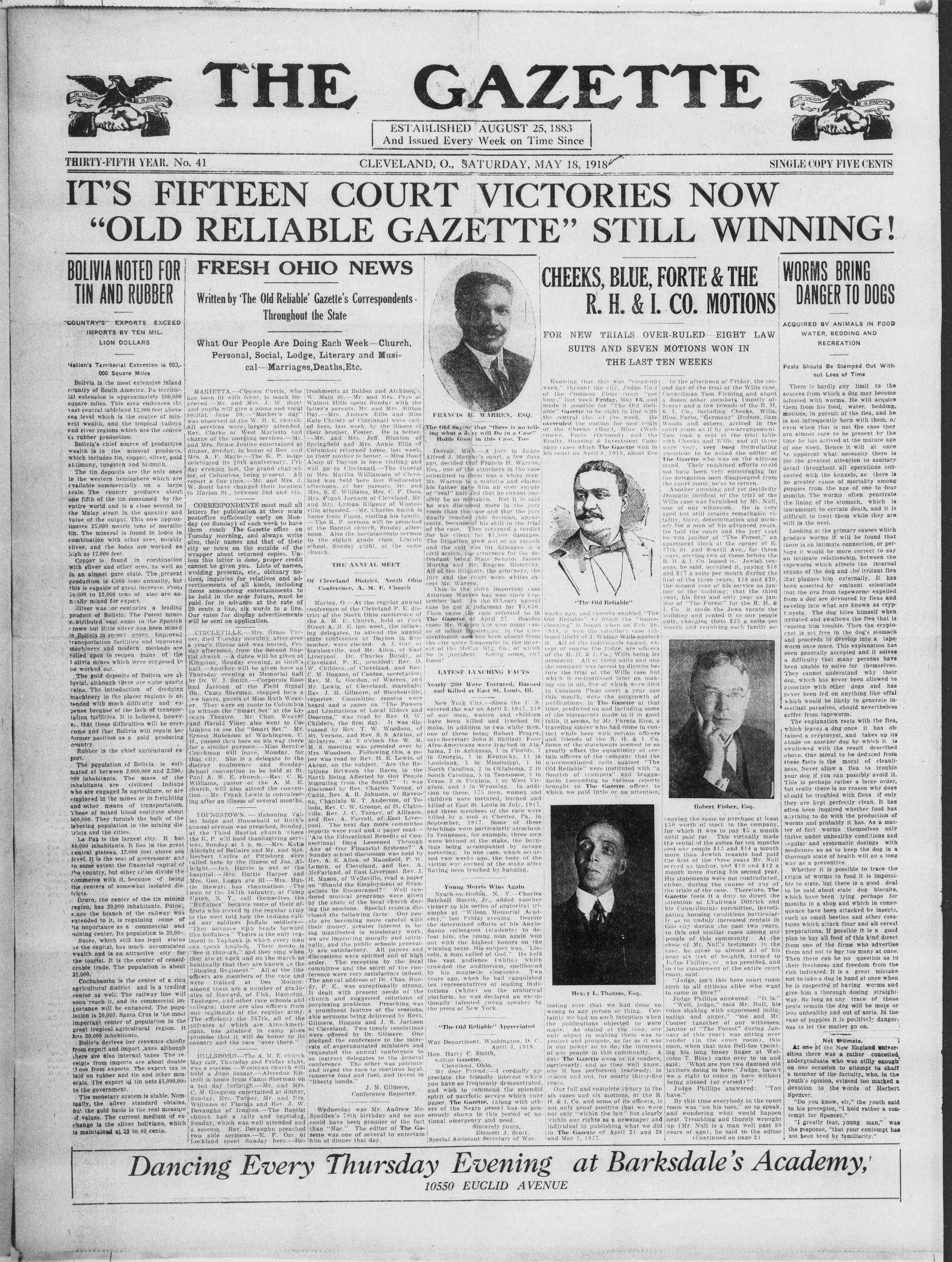
IT'S FIFTEEN COURT VICTORIES NOW "OLD RELIABLE GAZETTE" STILL WINNING!
Dancing Every Thursday Evening at Barksdale's Academy,
THIRTY-FIFTH YEAR. No. 41
IT'S FIF
"OLD
BOLIVIA NOTED FOR
TIN AND RUBBER
Dancing
IN UNION
IS STRENGTH
COUNTRYS' EXPORTS: EXCEED IMPORTS BY TEN MILLIÓN DOLLARS
Nation's Territorial Extension is 503,000 Square Miles
Bolivia is the most extensive inland country of South America. Its territorial extension is approximately 500,000 square miles. This area embraces the vast central tableland 12,000 feet above sea level which is the source of mineral wealth, and the tropical valleys and river regions which are the source of rubber production.
Bolivia's chief source of productive wealth is in the mineral products, which includes tin, copper, silver, gold, silicon, tungsten and bismuth.
The tin deposits are the only ones in the western hemisphere which are available commercially on a large scale. The country produces about one fifth of the tin consumed by the entire world and is a close second to the Malay strait in the quantity and value of the output. This now approximates 25,000 metric tons of metallic tin. The mineral is found in lodes in combination with other ores, notably silver, and the lodes are worked as high as 17,000 feet.
Copper is found in combination with silver and other ores, as well as in an almost pure state. The present production is 4,000 tons annually, but this is capable of great increase. From 20,000 to 12,000 tons of zinc are annually mined for export.
Silver was or centuries a leading product of Bolivia. The Potios mines contributed vast sums to the Spanish crown but little silver has been mined in Bolivia in recent years. Improved transportation facilities and improved machinery and modern methods are rolled upon to reopen many of the oliva mines which were supposed to be worked out.
The gold deposits of Bolivia are alivial, although there are some quartz veins. The introduction of dredging machinery in the placer regions is attended with much difficulty and expense because of the lack of transportation facilities. It is believed, however, that these difficulties will be overcome and that Bolivia will regain her former position as a gold producing country.
Rubber is the chief agricultural export.
The population of Bolivia is estimated at between 2,000,000 and 2,500,000 inhabitants. The mass of the inhabitants are civilized Indians who are engaged in agriculture, or are employed in the mines or in freighting and other means of transportation. Those of mixed blood constitute about 600,000. They furnish the bulk of the laboring population in the mining districts and the cities.
La-Paz is the largest city. It has 50,000 inhabitants. It lies in the great central plateau, 12,000 feet above sea level. It is the seat of government; and to some extent the financial capital of the country, but other cities divide the commerce with it, because of being the centers of somewhat isolated districts.
Oruro, the center of the tin mining region, has 20,000 inhabitants. Potosí, since the branch of the railway was extended to it, is regaining some of its importance as a commercial and mining center. Its population is 20,000. Sucre, which still has legal, status as the capital, has much accumulated wealth and is an attractive city for the tourist. It is the center of considerable trade. The population is about 25,000.
Cochabamba is the center of a rich agricultural district, and is a trading center as well. The railway line will soon reach it, and its commercial importance will be enhanced. The population is 30,000. Santa Cruz is the most important center of population, in the great tropical agricultural region. It has 20,000 inhabitants.
Bolivia derives her revenues chiefly from export and import axes, although there are also internal taxes. The receipts from imports are about double ifose from exports. The export tax is laid on rubber and tin and other minerals. The export of tin nets $1,000,000 to the government.
The monetary system is stable. Nominally, the silver standard obtains, but the gold basis is the real measure of values. The current medium of exchange is the silver boliviano, which is maintained at 12 to 40 cents.
THE
Written by 'The Old Reliable' Gazette's Correspondents Throughout the State What Our People Are Doing Each Week—Church, Personal, Social, Lodge, Literary and Musical—Marriages, Deaths, Etc.
MARIETTA---Clesson Curtis, who has been hll with fever, is much improved.--Mr. and Mrs. J. W. Scott and pupils will give a piano and vocal recital, June 20---Mother's day was observed at the W. M. E. church. At services of West Marriott and charge of the morning services.--Mr. and Mrs. Rena Justice entertained at dinner/Sunday, in honor of Rev. and Mrs. A. P. Mayle.--The K. P. lodge celebrated its 20th anniversary, Friday evening at the grand charactor of Columbus, being present. All report a fine time.--Mr. and Mrs. J. W. Scott have located their location to Marion St., between 2nd and 4th.
CORRESPONDENTS must mail all letters for publication at their main postoffice sufficiently early on Monday (or Sunday) of each week to have them reach The Guzette office on Tuesday morning, and always-write also, their names and that of their city or town on the outside of the wrapper-about returned copies. Unless this latter is done, proper credit cannot be given you. Lists of names, wedding presents, etc., relatives and advertisements of all kinds, including items announcing entertainments to be held in the near future, must be paid for in advance at the rate of 20 cents a line, six words to a line. Our rates for display advertisements will be sent on application.
CIRCLEYLEE...Mrs. Greer Turpier, died Tuesday morning, after over a year's illness and was buried, Friday afternoon, from the Second Baptist church. —A dance will be given at Kingston, Monday evening, at Gothic Hall, Thursday evening at Memorial hall by Dr. W. J. Smith. —Corporals Ross and Jackson of the Field Signal Bn. Camp Sherman, stopped here a few hours, guests of Miss Ruth Weaver. They were en route to Columbus to witness the "Smart Set" at the Layton and Harold Mine also went to Columbus to see the "Smart Set." Mr. Ernest, Robinson of Washington, C. H., passed thru on his way there for a similar purpose. —Miss Bernie Conchman will leave, Monday, for city. She is a delegate to the district conference on the campus, to be held at Paul A. M. E. church. —Rev. C. E. Williams, pastor of the A. M. E. church, will also attend the convention. —Mr. Frank Lewis is convoking after an illness of several months;
YOUGSTOWN. — Mahoolong, Valley lodge and Household of Ruth's annual Sermon was preached, Sunday, at the Third Baptist church where the K. P. will hold thanksgiving services, Sunday at 3 p. m.,—Mrs. Katie Albright of Bollarell and Mr. and Mrs Herbert Carles of Pittsburgh were called here by the illness of J. Am. Albright, a bright, young man.—Mrs. Hattie Harper and Mrs. Geo. Logan are ill—Mrs. Muttie Stewart has rheumatism.—The men of the 367th infantry, at Camp Upton, N. Y., call themselves the "Buffaloons" because some of their officers who served in the regular army in the west told how the Indians called our soldiers buffalo soldiers—They advance with heads forward, they advance with heads forward, they advance with heads forward, in Yankuh in which every man can speak English. "Their motto is" "See it through," and they sing when they are at work and on the march so habitually that they are known as the "Singing Regiment." All of the line officers are members of the race and were trained at Des Moines; among them are members of the 367th of Pisk, Hampton, Tuskegee, and other race schools and colleges; there are also officers from our regiments of the regular army. The efficiency of the 367th, all of the privatees of which are Aro-Americans, has attained in camp gives promise that it will do honor to its country and the race "over there."
HILLSHORO—The A. M. E. Church May fair, Thursday and Friday night, was a success. —Wesleyan church will hold a June bazaar—Alverdus Kittrell is home from Camp Sherman on a ten day furlough—Mr. and Mrs C. M. Gregson entertained at dinner Sunday, Mrs. Tuffner, Mr., and Mrs Williams of Florida and Rev. J. W Devaughn of Ironton the church house which was well attended and a success. Rev. Devaughn preached two able sermons.—E. F. Orr of Lockland snent Sunday here—Re
ESTABLISHED AUGUST 25,1883 And Issued Every Week on Time Since
freshments at Golden and Altobiscuit,
W. Main St.,—Mr. and Mrs. Free of
Walnut Hills spent Sunday with the
latter's parents, Mr. and Mrs. Milton
Bay, Mrs. Andrew Ellis and Mrs.
Joseph Ellis, both of the college
lived here, last week, by the illness
of their brother, Foster. He is better
—Mr. and Mrs. Jeff, Blanton of
Springfield and Mrs. Annie Ellis of
Columbia returned home, last week,
after her mother is here visiting
and will go to Cincinnati.—The funeral
of Mrs. Martha Williamson of Cleveland
was held here last Wednesday
attention, at her parents, Mr. and
Mrs. E. K. Jackson, and Mrs. Asa-
dell Jackson of Cleveland, Mr.
and Mrs. Lyman Kilbourn of Westerville
attended. Mr. Charles Smith is
home from Piqua, visiting his family.
—The K. P. sermon will be preached
at the Baptist church, Sunday afternoon.
Also the baccalaureate sermon
at the school, Sunday night, at the same
church.
Of Cleveland District, North Ohio Conference, A. M. E. Church
Wednesday was Mr. Andrew MeSpadden's 70th birthday and no one could have been prouder of the fact than "Mac." The editor of The Gazette was one of several to entertain him at dinner that day.
10550 EUCLID AVENUE
I
FRANCIS H. WARREN, ESQ.
The Old Squire that "there is no telling what a Jerry will Do in a Case"
Holds Groun in this Case, Too
Detroit, Mich. A jury in Judge Alfred J. Murphy's court, a few days ago decided that Francis H. Warren, Esq. one of the attorneys in the case submitted to them was a white man Mr. Warren is a mulatto and admits his father gave him an over supply of "real" hair and that he cannot possibly be so mistaken. But it is and he was discussed more in the jury room than the case and that the jury thereby reached his own conclusion of his skill in the case. The returned a verdict for his client for $1,500 damages. The litigation grew out of an assault and the split was for damages, in a civil action, the attorneys for the defendant being State Senator James Murtha and Mr. Engineer Master Kyle All of the litigants, the attorney's jury and the court were whites ex-convicted. This is the third important case Attorney Warren has won since September last. In the O'Leary appeal case he got a judgment for $5,000. Then came the case referred to in The Gazette of April 25. Besides these Mr. Warring has won many cases of minor import cases in the court mentioned, now has been issued an interment of the Metzky M.C. Co. of which he is president. Going some 627 Good.
LATEST LYNCHING FACTS
Nearly 200 Were Fortified, Bursed and killed in East-Str. Louis, III.
New York City - Since the U.S. entered the war on April 2, 1917, 212 Americans have been killed and lynched by mobs, in addition to two white men, one of those being Robert Prager, says Secretary John R. Shiladay. Four Afro-Americans were killed in Alabama, 2 in Arkansas, 1 in Florida, 7 in Louisiana, and 1 in Mississippi, 1 in North Carolina, 2 in Oklahoma, 2 in South Carolina, 5 in Tennessee, 2 in Texas, 2 in Virginia, 1 in West Virginia, and 1 in Wyoming. In addition to these, 175 men, women and children were tortured, burned and killed. Three members of the race were killed by a mob in Chester, Pa., in September, 1917. Some of these lynchings were particularly atrocious, in Tennessee, for example, three men were burned at the stake, the burnings being accompanied by a whistle which caused two weeks ago, the body of the victim was burned at the stake after having been lynched by hanging.
Young Morris Wins Again
Lung Jobbis Was Again
Nyack-in-Hudson, N.Y. Y. Charles Schaefer, M.D. and his victorious triumphs in his series of oratorical trumpets at "Wilson Memorial Academy," last Friday evening. Despite the determined efforts of his Anglo-Saxon colleagues (students) to defeat him, the young man again won out and was awarded the winning team. His subject was, "Lincoln, a man called of God." He held the vast audience (white) which crowded the auditorium, spellbound by his magnetic eloquence. Two years ago, when he had vanquished the institution (white) on the "oratorical platform, he was declared an ex-pionally talented young speaker by the press of New York.
War Department, Washington, D. C.
April 3, 1918.
Hon. Harry C. Smith,
Editor Gazette,
Oklahoma
Mr. deVera Friend—cordially appreciate the friendly interest which you have so frequently demonstrated and wish to commend the splendid spirit of patriotic service which you paper. The Gazette, (along with others of the Negro press) has so generously shown in this period of national emergency and need.
Sincerely yours,
Emmette J. Scott
Special Assistant Secretary of War.
CHEEKS, BLUE, FORTE & THE R. H. & I. CO. MOTIONS
FOR NEW TRIALS OVER-RULED EIGHT LAW SUITS AND SEVEN MOTIONS WON IN THE LAST TEN WEEKS
Knowing that this was "clean-up week," throught the day, Judge Gat of the Company pleaded in the case, and busy," last week Friday, May 18, and a dozen other members, mostly made it possible for "The Old Reliable" Gazette to be right in line with the central idea of the week.
He covered the motion for new trials of the checks (Roy, Blue (Web report), Forte (Ormond) and the Tom court room as if by pre-arrangement. Realty, Housing & Investment Company case which The Gazette won in very very, very busy formulating his court on April 8, 1918, about five questions to be asked the editor of the Gazette who was on the witness stand. Their combined efforts could not have been very encouraging for the delegation soon disappeared from the court room, not to return.
Another amusing and yet decidedly dramatic incident of the trial of the Wills case was furnished by Mr. Null, one of our witnesses. He is very aged but still retains remarkable vitality, force, determination and memory. His eloquent speech told the court and the jury that he was janitor of "The Forest," an apartment block at the corner of E. 27th St. and Scovill Ave., for three years, serving two of these before the R. H. & I. Co. leased it. Jewish tenants, he said, occupied it paying $16 and $17 a suitper month during the first of the three years; $18 and, $20, the second year of his service as janitor of the building; the third year, his first and only year as janitor of "The Forest" for the R. H. &
week ago, and decide enabled "The Old Reliable" to publish the "House cleaning" it began on Feb. 20, 1935, as the standard case, but later lobbied of J. Warner Wills against all of the individuals named, except of corpses the Judge, are officers of the House. All of them, three suits and one company was invited to discuss before the trial of the Wills case but which it reinstated later on making six in all, five of which were fled in common. Plans court a year into this month, were the outgrowth of publications in *The Gazette* at that time, predicted on and including some of the officers of the House, it seems, by Mr. Pureza Rico, a traveling sheriff who had come in contact while here with certain officers and friends of the R. H. & L. Co. Some of the statements seemed to so greatly affect the equanimity of certain officers of the company that the presentation of suits against "The House Cleaning" flourish of trumpets" and braggeddo (according to various reports brought to *The Gazette* officer) to which we paid little or no attention,
Henry L. Thomas, Esq.
feeling sure that we had done no wrong to any person or thing, 'Certainly we had no such intention when the publications objected to were made. As stated at the time, our only object in making them was to protect and promote, as far as it was in our power so to do', the interests of our people in this community. A duty The Gazette owes to its readers, particularly, and 'as they well know, one, it has performed fearlessly' in action and out, for nearly thirty-five years.
Our full and complete victory in the six cases and six motions, of the R. H. & L. Co. and some of its officers, is not only proof positive that we were not only "within the law" but clearly within our rights as a newspaper and publishing what we did in The Gazette of April 23 and May 5, 1917.
In the afternoon of Friday, the second day of the trial of the Wills case, Counselman Tom Fleming and about a dozen other members (most officers) and a few friends of the R. H. & I. Co., including, Checks, Wills, Hille, Forte, "Germany" Hudson, Sam Woods and others, arrived in the court room, not to return, but to take a seat at the table with Checks and Wills, and all three were very busy formulating questions to be asked the editor of the Gazette who was on the witness stand. Their combined efforts could not have been very encouraging for the delegation soon disappeared from the court room, not to return, but to take a seat at the table, incidentally dramatic incident of the trial of the Wills case was furnished by Mr. Nulf, one of our witnesses. He is very敏ed but still retains remarkable vitality, force, determination and memory for a man of his advanced years. He told the court and the jury that he was junior of "The Forest" all the way up, and that he had 18th and 19th and 20th and 21st and so forth. For three years serving two of these before the R. H. & I. Co. leased it. Jewish tenants, he said, occupied it paying $16 and $17 a suite per month during the last of the three years; $18 and $20, the second year of his service as junior of the building; that the third year of his service as junior of "The Forest" for the R. H. & I. Co. it made the Jews vacate the building and rented it to our people only, charging them $25 a suite per month and requiring each family o
Robert Fisher, Esq.
moving the same to purchase at least $50 worth of stock in the company, for which it was to pay $5 a month until paid for. This virtually made the rental of the suites for ten months cost our people $12 and $14 a month more than Jewish tenants had paid for the suites, and we served as junior, and $10 and $12 a month more during his second year. His statements were not contradicted, either, during the course of any of the trials of the case. Therefore, The Gazette feels it a duty to direct the attention of Chairman Dittrick and his Councillor Campbell to our companies particularly as to unduly increased rentals in this city during the past two years, to this and similar cases among our people of this community. At the close of Mr. Null's testimony in the case, he appears to almost all of his four six feet of height, turned to the ship, so who presided, to the enjoyment of the entire court room, said.
"Judge, isn't this here court room open to all citizens alike who want to come in here?" Judge Phillips answered: "It is." "Well, judge," said Mr. Nulh, his face shaking with suppressed anger, "and Mr. Cooper (another of our witnesses, juritor of 'The Forest' during January of this year) was sitting over wonder, (in the court room), this noon, when that man Bell-oo, (pointing his long honey finger at Welcome), the cane at his side: What are two damned, old juritors doing in here. Judge, haven't we a right to come in here without being abused (or cursed)?"
Judge Phillips answered: "You have."
By this time everybody in the court room was "on his toes," so to speak, and wondering what would happen next. Trembling and thorny wrought up his mouth, and for years of age, he said to the editor (Continued on page 2)
IN-UNION
J.S. STRONGS
SINGLE COPY FIVE CENTS
WORMS BRING DANGER TO DOGS
ACQUIRED BY ANIMALS IN FOOD WATER, BEDDING AND RECREATION
Pesta. Should Be Stamped Out Without Loss of Time.
There is hardly any limit to the sources from which a dog may become infested with worms. He will acquire them from his food, water, bedding, motions, in pursuit of the flea, and he is not infrequently born with them, or even when that is not the case they are almost never to be present by the time he has arrived at the mature age of one week. Hence it will at once be apparent what necessity there is for the greatest attention to sanitary detail throughout all operations connected with the kennels, as there is no greater cause of mortality among puppies from the age of one to four months. The worms often penetrate the lining of the stomach, which is taintamount to certain death, and it is difficult to treat them while they are still in the nest.
Looking at the primary causes which produce worms it will be found that there is an intimate connection, or perhaps it would be more correct to say an intimate relationship, between the tapeworm which affects the internal organs of the dog and the irritant flea that plagues him externally. It has been asserted by eminent scientists that the ova from tapeworms expelled from a dog are devoured by fleas and develop into what are known as ectypys. The dog bites himself when irritated and swallows the flea that is causing him trouble. Then the cryptocyst is set free in the dog's stomach and proceeds to develop into a tapeworm once more. This explanation has been generally accepted and it solves a difficulty: that many persons have been unable to solve for themselves. They cannot understand why their dog, which has never been allowed to associate with other dogs, and has never been fed on anything like offal which would be likely to generate intestinal parasites, should nevertheless suffer from tapeworm.
The explanation rests with the flea, which leaves a dog once it has obtained a cryptocyst, and takes up its blade on another dog by which it is swallowed, with the result described above. One moral to be deduced from these facts is the moral of cleanliness. Never allow a flea to trouble your dog if you can possibly avoid it. This is perhaps rather a large order, but really there is no reason why does should be troubled with fleas if only they are kept perfectly clean. It has often been inquired whether food has anything to do with the production of worms and probably it has. As a matter of fact worms themselves only thrive under unhealthy conditions and regular and systematic dosings, with medicines so as to keep the dog in a thorough suite of health will go a long way as a preventive.
Whether it is possible to trace the origin of worms to food it is impossible to state, but there is a good deal to be said about stale dog biscuits, which have been lying perhaps for months in a shop and which in consequence have been attacked by insects, such as small beetles and other creatures which attack flour and all cereal preparations. If possible it is a good plan to buy all food of this kind direct from one of the firms who advertise them and not to buy too many at once. Then there can be no question as to their freshness and freedom from the risk indicated. It is a great mistake not to take a dog in hand at once when it is suspected of having worms and give him a thorough dosing straightway. So long as any trace of these pests; remain the dog will be more or less unhealthy and out of sorts. In the case of puppies it is positively dangerous, out to the matter go on.
Not Intimate.
At one of the New England universities there was a rather conceited undergraduate who was still enough on one occasion to attempt to chaff a member of the factuary, who, in the youth's opinion, evinced too marked a devotion to the words of Herbert Spencer.
"Do you know, sir," the youth said to his preceptor, "I hold rather a contempt for Spencer."
"I greatly fear, young man," was the response, "that your contempt has not been bred by familiarity."
The GAZETTE
PUBLISHED EVERY SATURDAY
SUBSCRIPTION RATES
(In Advance)
One Year ..... $1.50
Six Months ..... 1.00
Three Months ..... 0.00
Subscribers are requested to remit by postoffice money order or registered letter
Entered at the postoffice in Cleveland, Ohio, as second-class mail matter.
Address all communications to HARRY C. SMITH
Editor and proprietor,
THE GAZETTE,
Blackstone Building, Cleveland, O.
Member Ohio Legislature: 1894 to 1896; 1896 to 1898; 1900 to 1902
THE GAZETTE is the oldest, and has the largest bona fide circulation double that of any newspaper in the interest of Afro-Americans, published in the state of Ohio, and comparison with any will immediately establish its rank as one of the NEWS-TEST AND BEST in the country.
10,000,000 Afro-Americans.
300,000 in Ohio.
25,000 in Cleveland.
SATURDAY, MAY 18, 1918.
"The president," says The Youth's Companion, "has been partisan while Congress has been non-partisan, not a party vote having been cast." But we live in hopes. The president has been known to change.
The long expected has happened. We see where a Southern office-holder has compared the immortal Abraham Lincoln to President Thomas Woodrow Wilson and an editor has compared Alexander Hamilton to Mr. McAdoo. Well, well!
Another billion is being asked for airplanes. For the same bunch to spend that got rid of the first $640,000,000 with nothing to show for it? We reckon not. Congress should put in the appropriation bill the words "to be expended by officials to be hereafter appointed by the President when duly confirmed by the U. S. Senate."
"It makes me heart sick to think of the profiteering that is going on," U. S. Senator Pomerene of this state said in a letter to Dan W. Caster, of Belleville, O., who has conveyed to the senator caustic observations on the conduct of affairs at Hog Island "Profitering is not limited to one class; it extends to all," said the senator. "But, on the other hand, how encouraging it is to see the large number of fine, patriotic men and women who are doing their bit here at home."
The service rendered the Government by the newspapers in the sale of Liberty Bonds has not been fully appreciated by the country. They have been the most potent force at work in preparing the public mind for the Government's great appeal; they did more than any other agency in quickening the public conscience as to the great obligation of the people to the Government. The response of the American people to the Government's request was the result of the patriotic service rendered by the newspapers.
E. D. Swinton, the English general,
says: "One thing you Americans
must do, and that is not to talk
much about your war preparations. I
see now some talk about building a
gun to shoot 100 miles. Well, if you
build such a gun, build it, but don't
talk about it. The same is true about
your airplane program. Let the Germans
have their first taste when they
see your air fleets in the air over
their lines."
The general seems to be a little bit
peeved about our hot-air plane program
and is giving splendid advice.
Old time Republicans of Ohio have
learned with regret of the passing of
Gen. Robert P. Kennedy, a life-long
friend of our race. He was one of the militant Republicans of the old school. Entering the war as a private and emerging as a brigadier general, he acquired the habit of courage when but little more than a boy, and he overlooked parting with it when he went into politics. He serv-
"Eat Us"
and Save the Wheat and Meat
for Our Soldier Boys
ed Ohio in Congress, and as lieutenant governor. He was an able and a likeable man who made and retained strong friendships. "Fighting Bob" was a manifestation of "The Happy Warrior."
A newspaper dispatch reads: "Members of the Senate Military Committee also had a meeting (on the airplane situation) at the conclusion of which Chairman Chamberlain went to the senate and announced in vigorous terms that the Committee proposed to have a thorough-going inquiry of its own, in which he declared it would attempt to locate the personal responsibility (for the abject failure to produce aircraft). He promised there would be 'no whitewashing.' Senator Chamberlain, 'the a democrat, has the confidence and the respect of the American people. It is now apparent to all that he was right last winter when he sought to advise the people of war conditions.
HOLD YOUR NOSE!
The New York Times, a Wilson organ, if any such there be in this country, editorially demands that a Federal grand jury investigate the failure of aircraft production and that Secretary Baker take the initiative in bringing this about. This is the first time that any responsible utterance has been made to indicate that any of the delay and waste which has accompanied our war preparation in the last year has any criminal aspect The New York Times holds that the conditions in the aircraft field "plainly point to an organized conspiracy, bold, powerful, numerous, made up of men able to formulate a great and definite plan and embracing within their number men sufficiently high placed and influential to have the ear and the confidence of the Secretary of War." Here is a definite charge. Whether the grand jury room or a committee room at the Capitol is the place to hear it, is not wholly clear But that the charge must be more cogently invested is only too plain
"A CRIMINAL ABSURDITY"
Col. Roosevelt points out an embarrassing contingency which may arise in consequence of our failure to declare war upon Bulgaria and Turkey, which failure he terms "a criminal absurdity." The Colonel argues that some day a Germanized Russian fleet may make a dash from the Black Sea through the Marmora and the Dardanelles and fall upon the Allied ships in the Mediterranean among which are some American destroyers. In that event of will be necessary for our ships to take vain the nationality of the attacking vessels by being on them. Of course, it is likely that in such a contingency the rule will be that when prevailed at the Donnybrook fair, where the motto was, "When you see a head, hit it," or such as prevails in submarine warfare in the western danger zone, where any periscope which is noted is fired upon. But there might be some diplomatic complications if such an event transpires before we find ourselves at formal war with the Turks—and it will be well to be prepared for it by formally declaring war as soon as may be.
Announcement
A movement has been set on foot to supply our soldiers with race books by our authors—books of a clad now not given to them, but which they greatly desire. We request our readers who are in sympathy with this movement and wish for all particulars to send a postal card containing their names and addresses to "The Books for Afro-American Soldiers' Movement." 61 Bible House, New York City.
* PREJUDICE
"Any prejudice whatever will be insurmountable if those who do not share in it themselves truckle to it and flatter it and accept it is a law of nature."—John Stuart Mill.
PROTEST AGAINST WRONG.
To submit in silence when we should protest makes co-wards out of men. The human race has climbed on Pro- Had no voiced been rallied against injustice, ignorance and lust, the inquisition yet would serve the law, and guillotines decide our least disputes. The few who dare, must speak and speak again to right the wrongs of many.—Ella Wheeler Wilcox.
THE GAZETTE, CLEVELAND, OHIO, MAY 18, 1918
A
DOINGS
OF
THE
RACE
Upon his return to New York, Bert A. Williams, the comedian, paid his income tax, amounting to $3,200.
John A. Sisco, Paterson, N. J., and Arthur Robinson, were awarded medals at the meeting of the Carnegie Hero Fund Commission on April 26, at Pittsburgh.
Prof. J. D. Reid, principal of our schools of Wilson, N. C., who took sides with Superintendent Coon (white) when the latter slapped one of our teachers, has been run out of town, it is reported.
Schools for the training of our officers were to be opened May 15, at Camp Meade, Md., and Camp Longueau. The graduates will qualify for commissions as second lieutenants and will be eligible for the ranks when vacancies occur among our troops.
Mrs. Pattie Hawkins of Detroit has brought suit in the U. S. District Court at Cincinnati against the James E. Martin Co., Union Station, asking for $5,000 damages because the defendant refused to serve her food.
Charles W. Scratchin, lawyer of Bemidji, Minn., enjoys a lucrative law practice in a community of 5,000 persons, only four of whom are Atro-Americans. He is to deliver one of the principal addresses on Decoration Day and tell of the part our soldiers are playing in the "World War."
A number of our soldier boys from France passed through Philadelphia, Tuesday afternoon, on their way to the base hospital at Lakewood, N. J. Some were blind, some were deaf, some were legless and armless but a tough still showed a desire to fight for liberation, from the old 8th Illinois, the 24th and 25th U. S. Infantry, suffering from shell shock and gas fumes and were nervous wrecks. They were seventeen days coming over and though unnerved by the horrors of the struggle "over there" favored a fight to the finish.
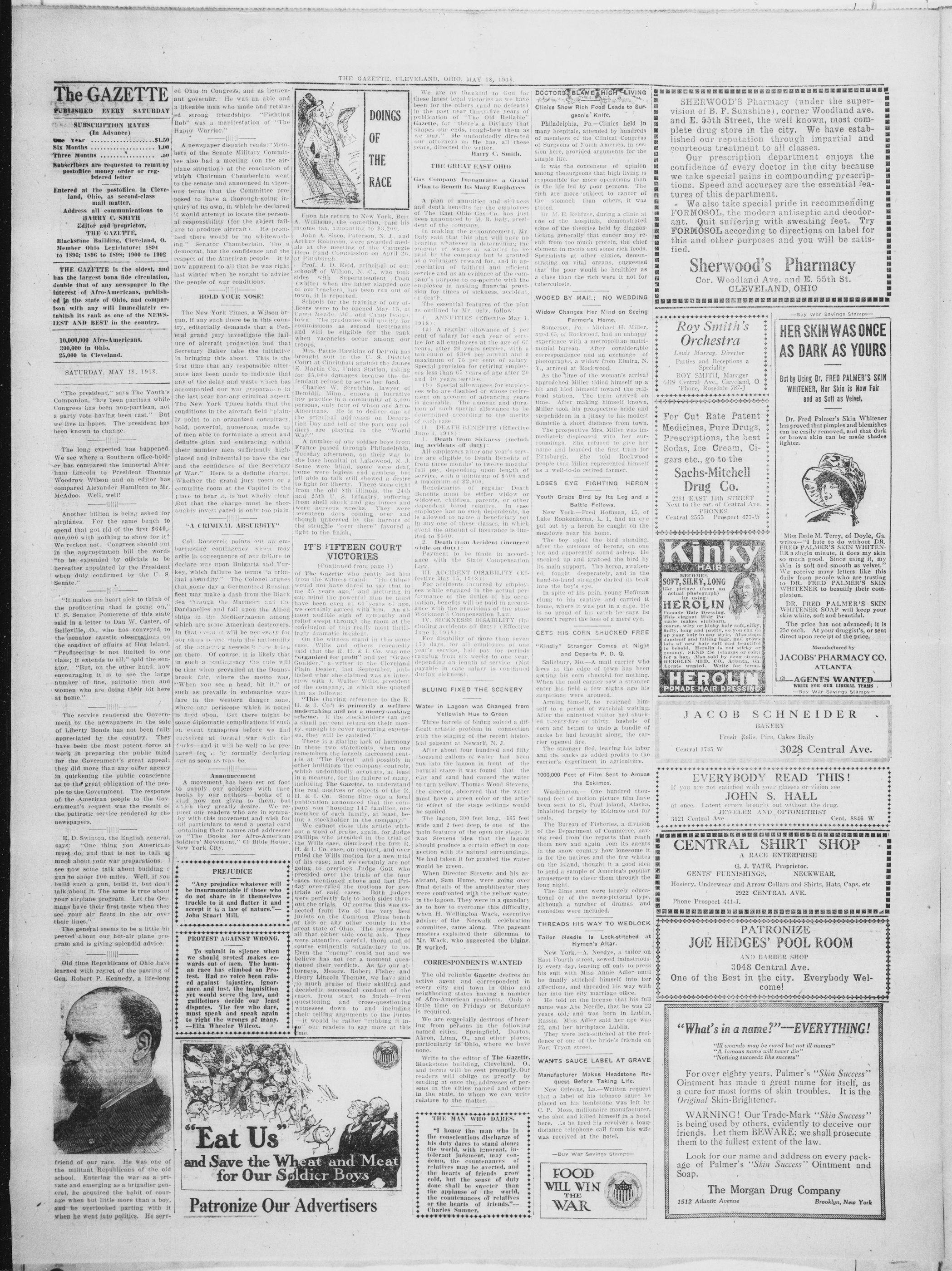
IT'S FIFTEEN COURT VICTORIES
(Continued from page 1)
Of the *The Gazette* who gently led him from the witness stand: "He (Blue) would not have dared to say that to me 25 years ago," and picturing in our mind the powerful man he must have been even at 60 years of age, we certainly agreed with him. An almost audible sigh of sympathy and relief swept through the room at the conclusion of this really most thrilling dramatic incident.
On the witness stand in this same case, Wills and others repeatedly said that the R. H. & I. Co. was one "organized for profit" and yet "Grace Goulder," a writer in the Cleveland Plain Dealer, last September, published what she claimed was an interview with J. Walter Wills, president of the company, in which she quoted him as follows:
"The inquiry reference to the R. H. & I. Co.) is primarily a welfare fund and not a money-sanking scheme. If the stockholders can get a small per cent return on their money, enough to cover operating expenses, they will be satisfied."
There is a glaring lack of harmony in these two statements, when one remembers the largely increased rent is at "The Forest" and possibly in other buildings the company controls, which undoubtedly accounts, at least in a measure, for the failure of many, including The Gazette, to understand the real motives or objects of the R. H. & I. Co. Some time ago a local publication announced that the company was "housing 147 families, one member of each family, at least, being a stockholder in the company."
We cannot close this article without a word of praise, again, for Judge Phillips who presided in the trial of the Wills case, dismissed the first R. H. & I. Co. case, on request, and over ruled the Wills motion for a new trial of his case; and we certainly are not going to overlook Judge Gott who presided over the trials of the four cases mentioned above and last Friday over-rated the motions for new trials of said cases. Both judges were perfectly fair to both sides throughout the trials. Of course this was expected from two of the very best jurists on the Common Pleas bench of this or any other county in the state of Ohio. The jurists were all that either she could do, were attentive, careful, thoro and of course eminently satisfactory to us. Even the "enemy" could not and we believe has not for a moment questioned their verdicts. As for our attorneys, Messrs. Robert Fisher and Henry Lincoln Thomas, we have said to much praise of their skillful and decidedly successful conduct of the cases, from start to finish—from questioning and cross-questioning witnesses down to and including their telling arguments to the juries—it would be rather "rubbing it in" our readers to say more at this time.
We are as thankful to God for these latest legal victories as we have been for the others (and no defeats) in the past near thirty-five years of publication of "The Old Reliable" Gazette, for "there's a Divinity that shapes our ends, rough-hew them as we may." He undoubtedly directed our attorneys as He has, all these years, directed the writer.
THE GREAT EAST OHIO
Gas Company Inaugurates a Grand Plan to Benefit Its Many Employees
A plan of annuities and sickness and death benefits for the employees of The East Ohio Gas Co. has just been announced by M.B. Daly, president of the company.
In making the announcement, Mr. Daly said that this plan will have no bearing whatever in determining the amount of wages or salaries to be paid by the company but is granted as a voluntary reward for, and in appreciation of faithful and efficient service and as an evidence of the company's purpose to co-operate with the employee in making financial provision for times of sickness, accident, or death.
The essential features of the plan as outlined by Mr. Daly follow:
1. ANNUITIES (Effective May 1, 1918):
(a) A regular allowance of 2 per cent of salary for each year of service for all employees at the age of 65 years, after 20 years service, with a minimum of $300 per annum and a maximum of 75 per cent of salary. Special provision for retiring employees less than 65 years of age after 20 and 30 years service. Special allowances for employees who are eligible or whose retirement on account of advancing years is desirable. The amount and duration of such special allowance to be determined according to the merits of each case. 11. DEATH BENEFITS (Effective June 1, 1918): 1. Death from Sickness (including accidents off duty): All employees after one year's service are eligible to Death Benefits of from three months' to twelve months' full pay, depending upon length of service, with an amount of $500 and a maximum of $200.
Beneificiaries of regular Death Benefits must be either widow or widower, children, parents, or other dependent blood relative. In case employee has no such dependents, he is allowed to name a beneficiary not in any one of these classes, in which event the amount of insurance is limited to $500.
2. Death from Accident (incurred while on duty):
Payment to be made in accordance with the State Compensation Law.
III. ACCIDENT DISABILITY (Effective May 15, 1918):
For accidents incurred by employees while engaged in the actual performance of duties of his occupation benefits will be paid in accordance with the provisions of the State Workman's Compensation Law.
IV. SICKNESS DISABILITY (Including accidents of duty) (Effective June 1, 1918):
For disability of more than seven (7) days, for all employees of one year's service, half pay for periods ranging from six weeks to one year, length of service (Not payable in case salary is continued during sickness).
BLUING FIXED THE SCENERY
Water in Lagoon was Changed from Yellowish Hue to Green
Three barrels of bluing solved a difficult artistic problem in connection with the staging of the recent historical pageant at Newark, N. J.
After about four hundred and fifty thousand gallons of water had been run into the lagoon in front of the natural stage it was found that the clay and sand had caused the water to turn yellow. Thomas Wood Stevens, the director, observed that the water must have a green color or the artistic effect of the stage settings would be spoiled.
The lagoon, 300 feet long, 165 feet wide and 2 feet deep, is one of the main features of the open air stage. It was Stevens idea that the lagoon should produce a certain effect in connection with its natural surroundings. He had taken it for granted the water would be green.
When Director Stevens and his assistant, Sam Hume, were going over final details of the amphitheater they were confronted with the yellow water in the lagoon. They were in a quandary as to how to overcome this difficulty when H. Wellington Wack, executive adviser of the Norwalk celebration committee, came along. The pageant masters explained their dilemma to Mr. Wack, who suggested the bluing It worked.
CORRESPONDENTS WANTED
The old reliable Gazette desires an active agent and correspondent in every city and town in Ohio and neighboring states having a number of Afro-American residents. Only a little time on Fridays or Saturdays is required.
We are especially destroys of hearing from persons in the following named cities: Springfield, Dayton, Akron, Lima, O., and other places, particularly in Ohio, where we have none.
Write to the editor of The Gazette Blackstone building, Cleveland, O., and terms will be sent promptly. Our readers will be asked by sending at once the addresses of persons in the cities named and others in the state, to whom we can write relative to the matter.
THE MAN WHO DARES.
"I honor the man who in the discharge of charge of his duty dares to stand alone; the world, with ignorant, tolerant judgment, may condemn, the countenances of relatives may be averted, and the hearts of friends grow cold, but the sense of duty does not the swerter than the applause, the world, the countenances of relatives or the hearts of friends."—Charles Sumner.
DOCTORS BLAME HIGH LIVING
Clinics Show Rich Food Leads to Surgeon's Knife.
Philadelphia, Pa.-Clinics held in many hospitals, attended by hundreds of members of the Clinical Congress of Surgeons of North America, in session here, provided arguments for the simple life.
It was the consensus of opinion among the surgeons that high living is responsible for more operations than is the life led by poor persons. The rich are more subject to cancer of the stomach than others, it was stated
Dr M. E. Rehftus, during a clinic at one of the hospitals, demonstrated some of the theories held by diagnostics generally that cancer may result from too much protein, the chief element in meats and some rich foods. Specialists at other clinics, demonstrating on vital organs, suggested that the poor would be healthier as a class than the rich were it not for tuberculosis.
WOOED BY MAIL; NO WEDDING
Widow Changes Her Mind on Seeing Farmer's Home.
Somerset, Pa.—Michael H. Miller, aged 65 of Rockwood, had an unhappy experience with a metropolitan matrimonial bureau. After considerable correspondence and an exchange of photographs, a widow from Elmira, N. Y., arrived at Rockwood.
As the time of the woman's arrival approached Miller tidied himself up a bit and hied himself toward the railroad station. The train arrived on time. After making himself known, Miller took his prospective bride and stepchildren in a jitney to his modest domicile a short distance from town.
The prospective Miller was immediately displeased with her surroundings. She refused to give her name and boarded the first train for Pittsburgh. She told Rockwood people that Miller represented himself as a well-to-do retired farmer.
LOSES EYE FIGHTING HERON
Youth Grabs Bird by Its Leg and a Battle Follows.
New York.-Fred Hoffman, 15, of Lake Ronkonkoma, L. L., had an eye put out by a heron he caught on the meadows near his home.
The boy spied the bird standing, after the customs of herons, on one leg and apparently sound asleep. He sneaked up and grabbed the bird by its main support. The heron, awakened, fought desperately, and in the hand-to-hand struggle darted its beak into the boy's eye.
In spite of his pain, young Hoffman clung to his captive and carried it home, where it was put in a cage. He is so proud of his catch he says he doesn't regret the loss of a mere eye.
GETS HIS CORN SHUCKED FREE
"Kindly" Stranger Comes at Night and Departs P. D. Q.
Salisbury, Mo.—A mail carrier who lives at the edge of town has been getting his corn shucked for nothing. When the mail carrier saw a stranger enter his field a few nights ago his suspicions were aroused.
Arming himself, he resigned himself to a period of watchful waiting. After the uninvited visitor had shucked twenty-five or thirty bushels of corn and began to undo a bundle of sacks he had brought along, the carrier opened fire.
The stranger fled, leaving his labor and the sacks as added profits to the carrier's experiment in agriculture.
1000,000 Feet of Film Sent to Amuse
the Eskimos.
Washington.— One hundred thousand feet of motion picture film have been sent to St. Paul Island, Alaska, inhabited largely by Eskimos and fur seals.
The Bureau of Fisheries, a division of the Department of Commerce, having road from the reports that reach them now and again from its agents in the snow country how lonesome it is for the natives and the few whites on the island, thought it a good idea to send a sample of America's popular amusement to cheer them through the long night.
The films sent were largely educational or of the news-pictorial type, although a number of dramas and comedies were included.
THREADS HIS WAY TO WEDLOCK
Tailor Needle is Lock-stitched at
Hymen's Altar.
New York—A. Needye, a tailor on East Fourth street, sewed industriously every day, leaving off only to press his suit with Miss Annie Adler until he finally stitched himself into her affections, and threaded his way with her into the city marriage office.
He told on the license that his full name was Abe Needle, that he was 22 years old; and was born in Lublin, Russia. Miss Adler said her age was 22, and her birthplace Lublin.
They were lock-sitched at the residence of one of the bride's friends on Fort Tron street.
WANTS SAUCE LABEL AT GRAVE
Manufacturer Makes Headstone Request Before Taking Life.
New Orleans, La.—Written request that a label of his tobasco sauce be placed on his tombstone was left by C. P. Moss, millionaire manufacturer, who shot and killed himself in a hotel here. ...is he fired his revolver a long-distance telephone call from his wife was received at the hotel.
—Buy War Savings Stamps—
FOOD WILL WIN THE WAR
SHERWOOD'S Pharmacy (under the supervision of B. F. Sunshine), corner Woodland ave. and E. 55th Street, the well known, most complete drug store in the city. We have established our reputation through impartial and courteous treatment to all classes.
Our prescription department enjoys the confidence of every doctor in the city because we take special pains in compounding prescriptions. Speed and accuracy are the essential features of this department.
We also take special pride in recommending FORMOSOL, the modern antiseptic and deodorant. Quit suffering with sweating feet. Try FORMOSOL according to directions on label for this and other purposes and you will be satisfied.
Cor. Woodland Ave. and E. 55th St.
CLEVELAND, OHIO
Louis Murray, Director
ROY SMITH, Manager
6319 Central Cleveland, O
Rocky Ridge, Rocky Ridge
For Cut Rate Patent Medicines, Pure Drugs, Prescriptions, the best Sodas, Ice Cream, Cigars etc., go to the Sachs-Mitchell
2281 EAST 14th STREET
Next to the cor. of Central Ave.
PHONES
Central 2555 Prospect 477-W
KINKY
HAIR
BECOMES
SOFT, SILKY, LONG
like picture (from an
atual photograph)
by using
HEROLIN
Pomade hair Dressing.
This elegant hair silkery
course, wiry or silky hair soft, silky
fuffy, long and pretty, so you can
up your hair to match. Manipulate
makes silky, fuffy hair, and grows
lots of new hair soft and beautiful
gummy, SENA cream or silky
gummy, SENA cream (clumps only)
for a box. Also sold by drug stores
and agents wanted.
HEROLIN
POHADE HAIR DRESSING
JACOB SC
COB SCHNEID
BAKERY
JACOB SCHNEIDER
PAEFFY
Fresh Rolls, Pics, Cakes Daily
Central 1745 W 3028 C
EVERYBODY READY
If you are not satisfied with your glasses or v
at once. Latent errors brought out without the
JEWELER AND OPTOMETR
3121 Central Ave
CENTRAL SHIRT
A RACE ENTERPRISE
G. J. TATE, Proprietor.
GENTS' FURNISHINGS, NECK
Hosiery, Underwear and Arrow Collars and Shi
2922 CENTRAL AVE.
5 W 3028 Centr
ERYBODY READ THE
not satisfied with your glasses or vision s
JOHN S. HALL
cent errors brought out without the dru
JEWELER AND OPTOMETRIST
Ave
TRAL SHIRT SH
If you are not satisfied with your glasses or vision see
JOHN S. HALL
at once. Latent errors brought out without the drug.
JEWELER AND OPTOMETRIST
3121 Central Ave
Cent. 8846 W
A RACE ENTERPRISE
G. J. TATE, Proprietor.
FURNISHINGS, NECKWEAR.
Perwear and Arrow Collars and Shirts, Ha
2922 CENTRAL AVE.
sect 441-J.
PATRONIZE
HEDGES' POOL ROO
G. J. TATE, Proprictor,
GENTS' FURNISHINGS,
NECKWEAR,
Hosiery, Underwear and Arrow Collars and Shirts, Hats, Caps, etc
2922 CENTRAL AVE.
Phone Prospect 441-J.
PATR
JOE HEDGES
AND BARBER SHOP
3048 Central Ave.
"What's in a name
the Best in the city. Everybody come!
's in a name?"—EVERYT
One of the Best in the city. Everybody Welcome!
"What's in a name?"—EVERYTHING!
"Ill wounds may be cured but not ill names"
"A famous name will never die"
"Nothing succeeds like success"
For over eighty years, Palmer's "Skin
Ointment has made a great name for
a cure for most forms of skin troubles.
Original Skin-Brightener.
WARNING! Our Trade-Mark "Skin
is being used by others, evidently to dee
friends. Let them BEWARE; we shall p
them to the fullest extent of the law.
Look for our name and address on ev
age of Palmer's "Skin Success" Ointm
ever eighty years, Palmer's "Skin
it has made a great name for
for most forms of skin troubles.
Skin-Brightener.
NING! Our Trade-Mark "Skin
used by others, evidently to deed
Let them BEWARE; we shall p
the fullest extent of the law.
For our name and address on evi
Palmer's "Skin Success" Ointm
For over eighty years, Palmer's "Skin Success" Ointment has made a great name for itself, as a cure for most forms of skin troubles. It is the Original Skin-Brightener.
WARNING! Our Trade-Mark "Skin Success" is being used by others, evidently to deceive our friends. Let them BEWARE; we shall prosecute them to the fullest extent of the law.
Look for our name and address on every package of Palmer's "Skin Success" Ointment and Soap.
Buy War Savings Stamps
HER SKIN WAS ONCE AS DARK AS YOURS
But by Using Dr. FRED PALMER'S SKIN WHITENER, Her Skin is Now Fair and as Soft as Velvet.
Dr. Fred Palmer's Skin Whitener has proved that pimples and blemishes can be easily removed, and that dark or brown skin can be made shades lighter.
Miss Essie M. Terry, of Doyle, Ga.
writes—"I hate to do without DR.
FRED PALMER'S SKIN WHITENER
a single minute, it does my skin
so much good. Since using it, my
skin is soft and smooth as velvet."
We receive many letters like this
daily from people who are trusting
to DR. FRED PALMER'S SKIN
WHITENER to beautify their complexion.
DR. FRED PALMER'S SKIN
WHITENER SOAP will keep your
skin white, soft and beautiful.
The price has not advanced; it is
25c each. At your druggist's, or sent
direct upon receipt of the price.
Manufactured by
JACOBS' PHARMACY CO.
ATLANTA
(2) AGENTS WANTED
WRITE FOR OUR LIBERAL TERMS
Buy War Savings Stamps
HNEIDER
ERY
Cakes Daily
3028 Central Ave.
READ THIS!
glasses or vision see
HALL
at without the drug.
OPTOMETRIST
Cent. 8846 W
HIRT SHOP
Proprietor.
NECKWEAR.
Dars and Shirts, Hats, Caps, etc
CAL AVE.
ONIZE
POOL ROOM
ER SHOP
Real Ave.
city. Everybody Welle!
'—EVERYTHING!
Palmer's "Skin Success" great name for itself, as skin troubles. It is the de-Mark "Skin Success" evidently to deceive our ARE; we shall prosecute of the law. address on every pack- Success" Ointment and
Don't Throw Away Your Copy of THE GAZETTE After Reading it, but Give It to a Friend or an Acquaintance who Might Subscribe after Reading a Copy of It
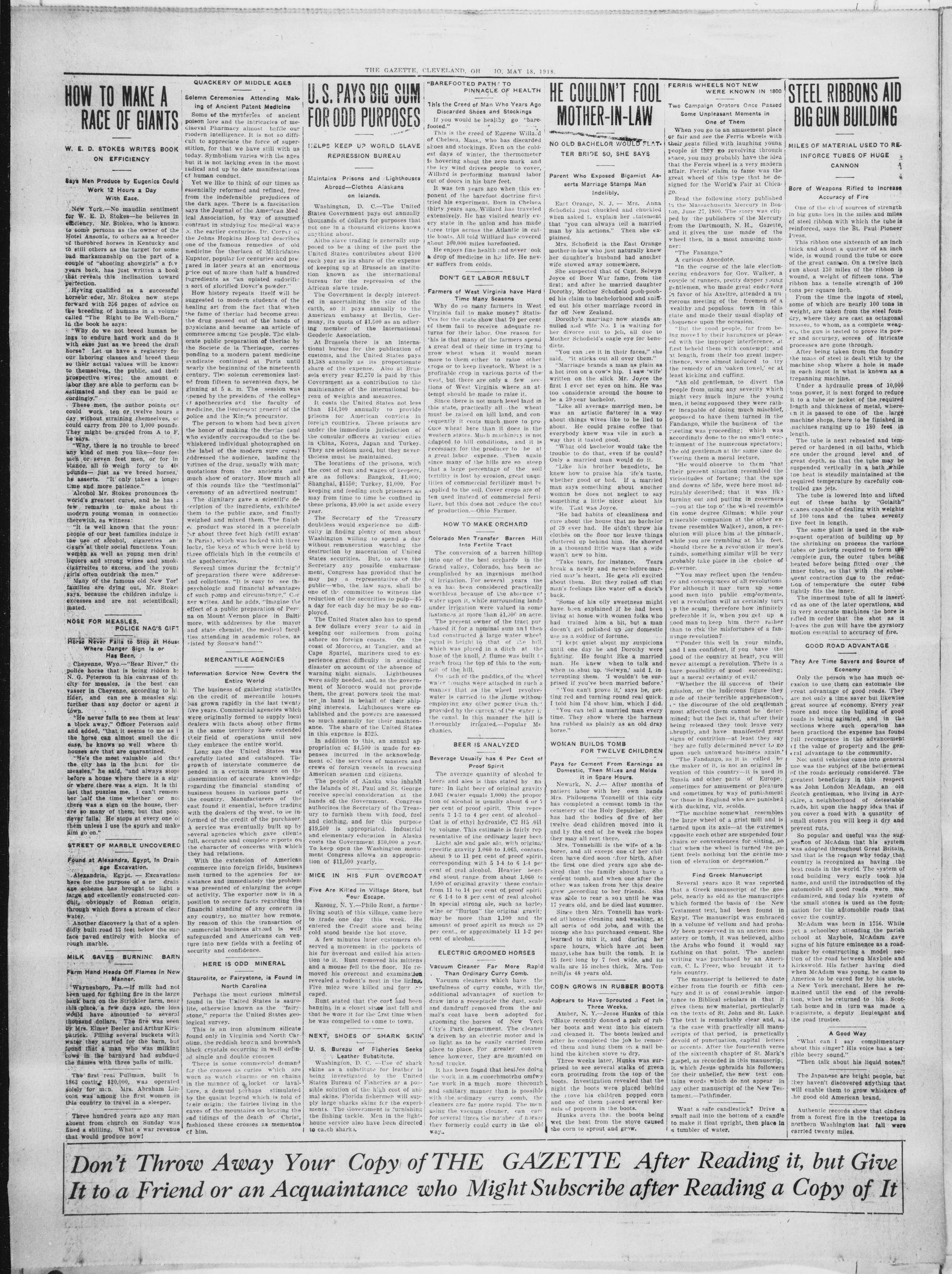
HOW TO MAKE A RACE OF GIANTS
W. E. D. STOKES WRITES BOOK
ON EFFICIENCY
Says Men Produce by Eugenics Could
Work 12 Hours a Day
With Ease.
New York.—No maudlin sentiment for W. E. D. Stokes—he believes in efficiency. Mr. Stokes, who is known to some persons as the owner of the Hotel Ansonia, to others as a breeder of thorroed horses in Kentucky and to still others as the target for some bad marksmanship on the part of a couple of "shooting showgirls" a few years back, has just written a book that reveals this inclination toward perfection.
Having qualified as a successful horse-breeder, Mr. Stokes now steps forward with 256 pages of advice on the breeding of humans in a volume called "The Right to Be Well-Born." in the book he says:
"Why do we not breed human beings to endure hard work and do it with ease just as we breed the draft horse?" Let us have a registry for our laboring classes and breed them so their actual values will be known to themselves, the public, and their prospective wives; the amount of labor they are able to perform can be estimated and they can be paid accordingly.
These men, the author points out could work ten or twelve hours a day without straining themselves, or could carry from 200 to 1,000 pounds. They might be graded from A to F. he says.
"Why, there is no trouble to breed any kind of men you like—four feet men or seven feet men, or for instance, all to weigh forty to 400 pounds—just as we breed horses, he asserts. "It only takes a longer time and more patience."
Alcohol Mr. Stokes pronounces the world's greatest curse, and he has a few remarks to make about the modern young woman in connection therewith, as witness:
"It is well known that the young people of our best families indulge in the use of alcohol, cigarettes and cigars at their social functions. Young women as well as young men drink liquors and strong wines and smoke cigarettes to excess, and the young girls often outdrink the men."
Many of the famous old New York families are dying out, Mr. Stokes says, because the children indulge in excesses and are not scientifically mated.
NOSE FOR MEASLES,
POLICE NAG'S GIFT
Cheyenne, Wyo.—"Bear River," the police horse that is being ridden by N. G. Peterson in his canvass of the city for measles, is the best can vasser in Cheyenne, according to his rider, and can see a measles sign further than any doctor or agent in town.
"He never falls to see them at least a block away," Officer Peterson said and added, "that it seems to me as if the horse can almost smell the disease, he knows so well where the houses are that are quarantined.
"He's the most valuable aid that the city has in the hunt for the measles," he said, "and always stops before a house where there is a sign or where there was a sign. It is this last that puzzles me. I can't remember her half the time whether or not there was a sign on the house, there are so many of them, but that pony never fails. He stops at every one of them unless I use the spurs and make him go on."
STREET OF MARBLE UNCOVERED
Found at Alexandra, Egypt, in Drainage Excavation.
Alexandrin, Egypt. — Excavations here for the purpose of a ne drainage scheme has brought to light a large and excellently constructed conduit, obviously of Roman origin, through which flows a stream of clear water.
Another discovery is that of a splendidly built road 13 feet below the surface paved entirely with blocks of rough marble.
MILK SAVES BURNING BARN
Farm Hand Heads Off Flames in New Manner.
Waynesboro, Pa.—If milk had not been used for fighting fire in the large bank barn on the Strickler farm, near this place, a few days ago, the loss would have amounted to several thousand dollars. The fire was seen by Mrs. Elmer Beeler and Arthur Kirkpatrick. Filling several buckets with water they started for the barn, but found that a man who was milking cows in the barnyard had subdued the flames with three palls of milk.
The first real Pullman, built in 1863 costing $20,000, was operated solely for men. Mrs. Abraham Lincoln was among the first women in this country to travel in a sleeper.
Three hundred years ago any man absent from church on Sunday was fined a shilling. What a war revenue that would produce now!
QUACKERY OF MIDDLE AGES
Solemn Ceremonies Attending Making of Ancient Patient Medicine
Some of the mysteries of ancient poison lore and the intricacies of medieval Pharmacy almost baffle our modern intelligence. It is not so difficult to appreciate the force of superstition, for that we have still with us today. Symbolism varies with the ages but it is not lacking even in the most radical and up to date manifestations of human conduct.
Yet we like to think of our times as essentially reformed and refined, free from the indefensible prejudices of the dark ages. There is a fascination says the Journal of the American Medical Association, by way of assumed contrast in studying the medical ways of the earlier centuries. Dr. Corwin of the Johns Hopkins Hospital describes one of the famous remedies of old medicine the therica of Mithidates Eupator, popular for centuries and prepared in later years at an enormous price out of more than half a hundred ingredients as "an opiated sudorific a sort of glorified Dover's powder."
How history repeats itself will be suggested to modern students of the healing art from the fact that when the fame of theriac had become great the drug passed out of the hands of physicians and became an article of commerce among the people. The elaborate public preparation of theriac by the Societe de la Theriaure, corresponding to a modern patent medicine syndicate continued at Paris until nearly the beginning of the nineteenth century. The solemn ceremonies lasted from fifteen to seventeen days, beginning at 5 a. m. The session was opened by the president of the college of apothecaries and the faculty of medicine, the lieutenant general of the police and the King's procurator.
The person to whom he had given the honor of making the theia (and who evidently corresponded to the bewhiskered individual photographed on the label of the modern sure cures) addressed the audience, lauding the virtues of the drug, usually with marquations from the ancients and much show of oratory. How much all of this sounds like the "testimonial" ceremony of an advertised nostrum! The dignitary gave a scientific description of the ingredients, exhibited them to the public gaze, and finally weighed and mixed them. The finish product was stored in a porcelain jar about three feet high (still extant in Paris), which was locked with three locks, the keys of which were held by three officials high in the councils of the annotaries.
Several times during the fictional of preparation there were addresses and collations. "It is easy to see the psychologic and financial advantages of such pump and circumstance." Corner writes. And he adds, "Imagine the effect of a public preparation of Perma on Mount Vernon place in Balti more, with addresses by the mayor and state chemist, the medical faculties attending in academic robes, as listed by Sousa's band!"
MERCANTILE AGENCIES
Information Service Now Covers the Entire World
The business of gathering statistics on the credit of mercantile houses has grown rapidly in the last twenty five years. Commercial agencies which were originally formed to supply local dealers with facts about other firms in the same territory have extended their field of operations until now they embrace the entire world. Long ago the United States was carefully listed and cataloged. The growth of interstate commerce depended in a certain measure on the dissemination of accurate knowledge regarding the financial standing of business houses in various parts of the country. Manufacturers of the east found it essential, before trading with the dealers of the west, to be informed of the credit of the purchaser. A service was eventually built up by several agencies which gave clients full, accurate and complete reports on the character of concerns with which they had relations.
With the extension of American commerce into foreign fields, business men turned to the agencies for assistance and immediately the problem was presented of enlarging the scope of activity. The exporter now is in a position to secure facts regarding the financial standing of any concern in any country, no matter how remote. By reason of this the transaction of commercial business abroad is well safeguarded and Americans can venture into new fields with a feeling of security and confidence.
HERE IS ODD MINERAL
Staurolite, or fairystone, is Found in North Carolina
Perhaps the most curious mineral found in the United States is saurolite, otherwise known as the "fairy-stone," reports the United States geological survey.
This is an iron aluminum silicate found only in Virginia and North Carolina, the reddish brown and brownish black crystals occurring in well defined single and double crosses.
There is some commercial demand for the crosses as curios which are worn as watch charms or on chains in the manner of a pocket or lavaliere, a demand perhaps stimulated by the quaint legend which is told of their origin; the fairies living in the caves of the mountains on hearing the sad tidings of the death of Christ, fashioned these crosses as mementos of him.
THE GAZETTE, CLEVELAND, OH IO MAY 18 1918
U.S. PAYS BIG SUM FOR ODD PURPOSES
KELPS KEEP UP WORLD SLAVE
REPRESSION BUREAU
Maintains Prisons and Lighthouses Abroad—Clothes Alaskans
on islands.
Washington, D. C.—The United States Government pays out annually thousands of dollars for purposes that not one in a thousand citizens knows anything about.
Altho slave trading is generally supposed to be a thing of the past the United States contributes about $100 each year as its share of the expense of keeping up at Brussels an institution known as the international bureau for the repression of the African slave trade.
The Government is deeply interested in ascertaining the size of the earth, so it pays annually to the American embassy at Berlin, Germany, its quota of $1.500 as an adhering member of the International Geodetic Association.
At Brussels there is an international bureau for the publication of customs, and the United States pays $1,388 annually as its proportionate share of the expense. Also at Brussels every year $2,270 is paid by this Government as a contribution to the maintenance of the international bureau of weights and measures. It costs the United States not less than $14,100 annually to provide prisons for American convicts in foreign countries. These prisons are under the immediate jurisdiction of the consular officers at various cities in China, Korea, Japan and Turkey. They are seldom used, but they nevertheless must be maintained.
The locations of the prisons, with the cost of rent and wages of keepers, are as follows: Bangkok, $1,000; Shanghai, $1550; Turkey, $1,000. For keeping and feeding such prisoners as may from time to time be confined in these prisons, $9,000 is set aside every year.
The Secretary of the Treasury doubtless would experience no difficulty in finding plenty of men about Washington willing to spend a day without remuneration watching the destruction by maceration of United States securities. But, to save the Secretary any possible embarrassment, Congress has provided that he may pay a representative of the public—who, the law says, shall be one of the committee to witness the reduction of the securities to pulp—$5 a day for each day he may be so employed.
The United States also has to spend a few dollars every year to aid in keeping our sailormen from going ashore on foreign coasts. On the coast of Morocco, at Tangier, and at Cape Spartel, mariners used to experience great difficulty in avoiding disaster on account of the absence of warning night signals. Lighthouses were sadly needed, and, as the government of Morocco would not provide them, the great powers took the matter in hand in behalf of their shipping interests. Lighthouses were established and the powers are assessed so much annually for their maintenance. The share of the United States in this expense is $225.
In addition to this, an annual appropriation of $4,500 is made for expenses incurred in the acknowledgment of the services of masters and crews of foreign vessels in rescuing American seamen and citizens.
The people of Alaska who inhabit the islands of St. Paul and St. George receive special consideration at the hands of the Government. Congress authorizes the Secretary of the Treasury to furnish them with food, fuel and clothing, and for this purpose $19,500 is appropriated. Industrial and elementary education in Alaska costs the Government $20,000 a year. To keep open the Washington monument Congress allows an appropriation of $11,500 yearly.
MICE IN HIS FUR OVERCOAT
Five Are Killed in Village Store, but Four Escape.
Kasoag, N. Y.-Philo Runt, a farmer living south of this village, came here to trade one day this week. He entered the Credit store and being cold stood beside the hot stove. A few minutes later customers observed a movement in the pockets of his fur overcoat and called his attention to it. Runt removed his mittens and a mouse fell to the floor. He removed his overcoat and examination revealed a rodent's nest in the lirings. Five mice were killed and four scaped. Runt stated that the coat had been hanging in a closet since last fall and that he wore it for the first time when he was compelled to come to town.
NEXT, SHOES OF SHARK SKIN
U. S. Bureau of Fisheries Seeks
Leather Substitute
Washington, D.C. — Use of shark skins as a substitute for leather is being investigated by the United States Bureau of Fisheries as a possible solution of the high cost of animal skins. Florida fishermen will supply large shark skins for the experiments. The Government is furnishing the fishing tackle. Men in the light-house service also have been directed to cach sharks.
"BAREFOOTED PATH' TO
PINNACLE OF HEALTH
This the Creed of Man Who Years Ago
Discarded Shoes and Stockings
If you would be healthy go "bare-
footed."
This is the creed of Eugene Willard of Chelsea, Mass., who has discarded shoes and stockings. Even on the coldest days of winter, the thermometer is hovering about the zero mark and the ice wind drives people to cover. Willard is performing manual labor out of doors in his bare feet.
It was ten years ago when this exponent of the barefoot doctrine first tried his experiment. Born in Chelsea thirty years ago, Willard has traveled extensively. He has visited nearly every state in the union and has made three trips across the Atlantic in cattle boats. All told Willard has covered about 100,000 miles barefoot.
He enjoys fine health and never ook a drop of medicine in his life. He never suffers from colds.
DON'T GET LABOR RESULT
Farmers of West Virginia have Hard Time Many Seasons
Why do so many farmers in West Virginia fail to make money? Statistics for the state show that 70 per cent of them fail to receive adequate returns for their labor. One reason for this is that many of the farmers spend a great deal of their time in trying to grow wheat when it would mean more to them either to raise other crops or to keep livestock. Wheat is a profitable crop in various parts of the west, but there are only a few sections of West Virginia where an attempt should be made to raise it.
Since there is not much level land in this state, practically all the wheat must be raised on hill land, and consequently it costs much more to produce wheat here than it does is the western states. Much machinery is not adapted to hill conditions, and it is necessary for the producer to be at a great labor expense. Then again since many of the hills are so steep that a large percentage of the soil fertility is lost by erosion, great qualities of commercial fertilizer must be applied to the soil. Cover crops are often used instead of commercial fertilizer, but this does not reduce the cost of production. -Ohio Farmer.
HOW TO MAKE ORCHARD
Colorado Men Transfer Barren Hill
Into Fertile Tract
The conversion of a barren hilltop into one of the best orchards in the Grand valley, Colorado, has been accomplished by an ingenious method of irrigation. For several years the aea has been considered practically worthless because of the absence of water upon it, while surrounding lands under irrigation were valued in some instances at more than $1,000 an acre. The present owner of the tract purchased it for a nominal sum and then had constructed a large water wheel equal in height to that of the hull, which was placed in a ditch at the base of the knoll. A flume was built to reach from the top of this to the summit of the hill.
On each of the paddles, of the wheel water troughs were attached in such a manner that as the wheel revolve-water is carried to the flume without employing any other power than that provided by the current of the water in the canal. In this manner the hill is thoroughly irrigated.—Popular Mechanics.
BEER IS ANALYZED
Beverage Usually has 6 Per Cent of Proof Spirit
The average quantity of alcohol in beers and ales is thus stated by nature: In light beer of original gravity 1.043 (water equals 1.000) the proportion of alcohol is usually about 6 or 7 per cent of proof spirit. This represents 3 1-3 to 4 per cent of alcohol—that is of ethyl hydroxide, C2 H5 6H2 by volume. This estimate is fairly representative of the ordinary lager beer. Light ale and pale ale, with original specific gravity 1.060 to 1.065, contains about 9 to 11 per cent of proof spirit, corresponding with 5 1-4 to 6 1-4 per cent of real alcohol. Heavier beers and stout range from about 1.060 to 1.090 of original gravity; these contain from 11 to 14 per cent of proof spirit or 6 1-4 to 8 per cent of real alcohol. In special strong ale, such as barley wine or "Burton" the original gravity may be more than 1.100 and the amount of proof spirit as much as 28 per cent., or approximately 11 1-2 per cent of alcohol.
ELECTRIC GROOMED HORSES
Vacuum Cleaner Far More Rapid Than Ordinary Comp. Comb
Vacuum cleaners which have the usefulness of curry combs, with the additional advantages of suction to draw into a receptacle the dust, scale and dandruff removed from the animal's coat have been adopted for grooming the horses of New York City's Park department. The cleaner's driven by an electric motor and is so light as to be easily carried from place to place. For greater convenience however, they are mounted on hand trucks.
It has been found that besides doing the work in a m cuoerhmothru omfw the work in a much more thorough and sanitary manner than is possible with the ordinary curry comb, the cleaners are far more rapid. The men using the vacuum cleaner, can care for several times the number of horses they formerly could curry in the old way.
HE COULDN'T FOOL MOTHER-IN-LAW
NO OLD BACHELOR WOULD FLAT-
TER BRIDE SO, SHE SAYS
Parent Who Exposed Bigamist Assets Marriage Stamps Man
Indelibly.
East Orange, N. J. — Mrs. Anna Schofield just chucked and chuckled when asked t. explain her statement that "you can always tell a married man by his actions." Then she explained.
Mrs. Schofield is the East Orange mother-in-law who just naturally knew her daughter's husband had another wife stewed away somewhere.
She suspected that of Capt. Selwyn Joyce of Boer War fame, from the first; and after he married daughter Dorothy, Mother Schofield pooh-poohed his claim to bachelorhood and sniffed out his other marriage record in far off New Zealand.
Dorothy's marriage now stands annulled and wife No. 1 is waiting for her divorce suit to jel, all due to Mother Schofield's eagle eye for benefiets.
"You can see it in their faces," she said, "it sticks all over them."
"Marriage brands a man as plain as a hot iron on a cow's hip. I wore "wife" written on the slick Mr. Joyce the first I ever set eyes on him. He was too considerate around the house to be a 39-year bachelor.
"Like all average married men, he was an artistic flatterer in a way about things wives like to be lied to about. He could praise coffee that everybody knew was vile in such a way that it tasted good.
"What old bachelor would take the trouble to do that, even if he could? Only a married man would do it.
"Like his brother benedicts, he knew how to praise his 'life's taste, whether good or bad. If a married man says something about another woman he does not neglect to say something a little nicer about his wife. That was Joyce.
"He had habits of cleanliness and care about the house that no bachelor of 39 ever had. He didn't throw his clothes on the floor nor leave things cluttered up behind him. He showed in a thousand little ways that a wife wasn't new to him.
"Take tears, for instance. Tears break a newly and never-before-married man's heart. He gets all excited about them. But they rolled off that man's feelings like water off a duck's back.
"Some of his oily sweetness might have been explained if he had been living at home with women folks who had trained him a bit, but a man doesn't get polished up or domestic use as a soldier of fortune.
"I kept quiet about my suspicions until one day he and Dorothy were fighting. He fought like a married man. He knew when to talk and when to shut up. 'Selwyn', said I, interrupting them. 'I wouldn't be surprised if you've been married before.'
"You can't prove it," says he, getting red and turning round real quick. I told him I'd show him, which I did. "You can tell a married man every time. They show where the harness has rubbed as plainly as an old dray horse."
WOMAN BUILDS TOMB
FOR TWELVE CHILDREN
Pays for Cement From Earnings as Domestic, Then Miles and Molds It in Spare Hours.
Newark, N. J. After months of patient labor with her own hands Mrs. Philomena Tonnelli of this city has completed a cement tomb in the cemetery of the Holy Sepulchur. She has had the bodies of five of her twelve dead children moved into it and by the end of the week she hopes they may all rest there.
Mrs. Tonnehill is the wife of a laborer, and all except one of her children have died soon after birth. After the first one died years ago she desired that the family should have a cement tomb, and when one after the other was taken from her this desire grew according to her friends. She was able to rear a son until he was 17 years old, and he died last summer. Since then Mrs. Tonnehill has worked at house cleaning and washing, at all sorts of odd jobs, and with the money she has purchased cement. She learned to mix it, and during her spare hours, which have not been many, she has built the tomb. It is 15 feet long by 7 feet wide, and its walls are 15 inches thick. Mrs. Tonnehill/is 48 years old.
CORN GROWS IN RUBBER BOOTS
Appears to Have Sprotuted a Foot in Three Weeks.
Amber, N. Y.—Jesse Hunks of this village recently donned a pair of rubber boots and went into his cistern and cleaned it. The boots leaked and after he completed the job he removed them and hung them on a nail behind the kitchen stove to dry.
Three weeks later, Hunks was surprised to see several stalks of green corn protruding from the top of the boots. Investigation revealed that the night the boots were placed behind the stove his children popped corn and one of them placed several kernels of popcorn in the boots.
Hunks avers that the boots being wet the heat from the stove caused the corn to sprout and grow.
FERRIS WHEELS NOT NEW
WERE KNOWN IN 1800
When you go to an amusement place or fair and see the Ferris wheels with their goats filled with laughing young people as they go revolving through space, you may probably have the idea that the Ferris wheel is a very modern affair. Ferris' claim to fame was the great wheel of this type that he designed for the World's Fair at Chicago.
Read the following story published in the Massachusetts Mercury in Boston, June 27, 1800. The story was clipped by the publishers of the Mercury from the Dartmouth, N. H., Gazette, and it gives the use made of the wheel then, in a most amusing manner:
"The Fanango."
A curious Anecdote.
In the course of the late electionering endeavors for Gov. Walker, a couple of runners, pretty dapper young gentlemen, who made great endervers in favor of his Axeltret, attended a numerous meeting of the freemen of a wealthy and populous town in this state and made their usual display of cloquence upon the occasion.
"But the good people, far from being moved by their harangues or pleased with the improper interference, at length, from their too great impernence, were almost induced to try the remedy of an 'oaken towel,' or at least kicking and cuffing.
"An old gentleman, to divert the people from using any severity which might very much injure the young men, it being supposed they were rather incapable of doing much mischief, proposed to have them turned in the Fandango, while the business of the meeting was proceeding; which was accordingly done to the no small entertainment of the numerous spectators; the old gentleman at the same time diverting them a moral lecture.
"He would observe to them 'that their present situation resembled the vicissitudes of fortune; that the ups and downs of life, were here most admirably described; that it was liketurning out and putting in governors—you at the top of the wheel resemble (in some degree Gilman; while your miserable companion at the other extreme resembles Walker), anon, a revolution will place him at the pinnacle, while you are trembling at his feet, should there be a revolution in men's trunks, something similar will be very probably take place in the choice of governor.
"You may reflect upon the tendency and consequences of all revolutions. For although it may turn up some good men into public employments, yet a revolution will as certainly turn up the scum; therefore how infinitely preferable it is, when you get up a good man to keep him there rather than to rsk the misfortunes of a fangange revolution?
"Ponder this well in your minds, and I am confident, if you have the good of the country at heart, you will never attempt a revolution. There is a bare possibility of good succeeding; but a moral certainty of evil!
"Whether the ill success of their mission, or the ludicrous figure they made of their terrible apprehension; or the discourse of the old gentleman most affected them cannot be determined; but the fact is, that after their being released they took leave very abruptly, and have manifested great signs of constition—at least they say 'they are fully determined never to go upon such untoward business again.'
The Fandango, as it is called by the maker of it, is not an original invention of this country—it is used in Russia and other parts of Europe, sometimes for amusement or pleasure and sometimes by way of punishment 'or those in England who are punished with ducking, viz. scolds.
"The machine somewhat resembles the large wheel of a grist mill and is turned upon its axis—at the extremes opposite each other are suspended four chairs or conveniences for sitting, so that when the wheel is turned the patient feels nothing but the gentle motion of elevation or depression."
Find Greek Manuscript
Several years ago it was reported that a Greek manuscript of the gospels, nearly as old as the manuscripts which formed the basis of the New Testament text, had been found in Egypt. The manuscript was embraced in a volume of vellum and had probably been preserved in an ancient monastery or tomb, it was believed, altho the Arabs who found it would say nothing on that point. The ancient writing was purchased by an American, C. L. Freer, who brought it to this country.
The manuscript is believed to date either from the fourth or fifth century and it is of considerable importance to Biblical scholars in that it gives them new material, particularly on the texts of St. John and St. Luke. The text is remarkably clear and, as is the case with practically all manuscripts of that period, is practically devoid of punctuation, capital letters or accents. After the fourteenth verse of the sixteenth chapter of St. Mark's gospel, as recorded in this manuscript, in which Jesus upbraids his followers for their unbelief, the new text contains words which do not appear in any other manuscript of the New Testament.—Pathfinder.
Want a safe candlestick? Drive a small nail into the bottom of a candle to make it float upright, then place in a tumbler of water.
STEEL RIBBONS AID BIG GUN BUILDING MILES OF MATERIAL USED TO RE INFORCE TUBES OF HUGE
Bore of Weapons Rifled to Increase Accuracy of Fire
One of the chief sources of strength in big guns lies in the miles and miles of steel ribbon with which the tube is reinforced, says the St. Paul Pioneer Press.
This ribbon one sixteenth of an inch thick and about a quarter of an inch wide, is wound round the tube or core of the great cannon. On a twelve inch gun about 130 miles of the ribbon is wound, a weight of fifteen tons. The ribbon has a tensile strength of 100 tons per square inch.
From the time the ingots of steel, some of which are nearly 100 tons in weight, are taken from the steel foundry, where they are cast as octagonal masses, to whom, as a complete weapon, the gun is tested to prove its power and accuracy, scores of intricate processes are gone through.
After being taken from the foundry the mass of steel is dealt with by the machine shop where a hole is made in each ingot in what is known as a trepanning machine.
Under a hydraulic press of 10,000 tons power, it is next forged to reduce it to a tube or jacket of the required length and thickness of metal, where on it is passed to one of the large machine shops, there to be finished in machines ranging up to 180 feet in length.
The tube is next reheated and tempered or hardened in oil baths, which are under the ground level and of great depth, so that the tube may be suspended vertically in a bath while the heat is steadily maintained at the required temperature by carefully controlled gas jets.
The tube is lowered into and lifted out of these baths by "Golai" canes capable of dealing with weights of 100 tons and the tubes seventy five feet in length.
The same plant is used in the subsequent operation of building up by the shrinking on process the various tubes or jackets required to form the complete gun, the outer tubes being heated before being fitted over the inner tubes, so that with the subsequent contraction due to the reduction of temperature the outer tube tightly fits the inner.
The innermost tube of all is inserted as one of the later operations, and in very accurate machines the bore is riffed in order that the shot as it leaves the gun will have the gyratory motion essential to accuracy of fire.
GOOD ROAD ADVANTAGE
They Are Time Savers and Source of Economy
Only the person who has much occasion to use them can estimate the great advantage of good roads. They are not only a time saver but likewise great source of economy. Every year more and more the building of good roads is being agitated, and in the sections where such operation has been practiced the expense has found full recompense in the advancement of the value of property and the general advantage to the community.
Not until vehicles came into general use was the subject of the betterment of the roads seriously considered. The greatest beneficiary in this respect was John London McAdam, an old Scotch gentleman, who living in Ayrshire, a neighborhood of detestable roads, hit upon the happy idea that if you cover a road with a quantity of small stones you will keep it dry and prevent ruts.
So popular and useful was the suggestion of McAdam that his system was adopted throughout Great Britain, and that is the reason why today that country is recognized as having the best roads in the world. The system of road building very early took his name, and until the introduction of the automobile all good roads were madamized, and today his system of the small stones is used as the foundation for the automobile roads that cover the country.
McAdam was born in 1756. While yet a schoolboy attending the parish school at Maybole, McAdam gave signs of his future eminence as a road-maker by constructing a model section of the road between Maybole and Kirkswald. His father having died when McAdam was young, he came to America to be cared for by his uncle, a New York merchant. Here he remained until the end of the revolution, when he returned to his Scottish home and in turn was made a registrate, a deputy lieutenant and the road trustee.
A Good Way
"What can I say complimentary about this singer? His voice has a terrible beery sound."
"Then talk about his liquid notes."
The Japanese are bright people, but they haven't discovered anything that will enable them to grow whiskers of the good old American brand.
Authentic records show that cinders from a forest fire in the treetops in northern Washington last fall were carried twenty miles.