The Gazette
Saturday, June 22, 1918
Cleveland, Ohio
Page text (machine-generated)
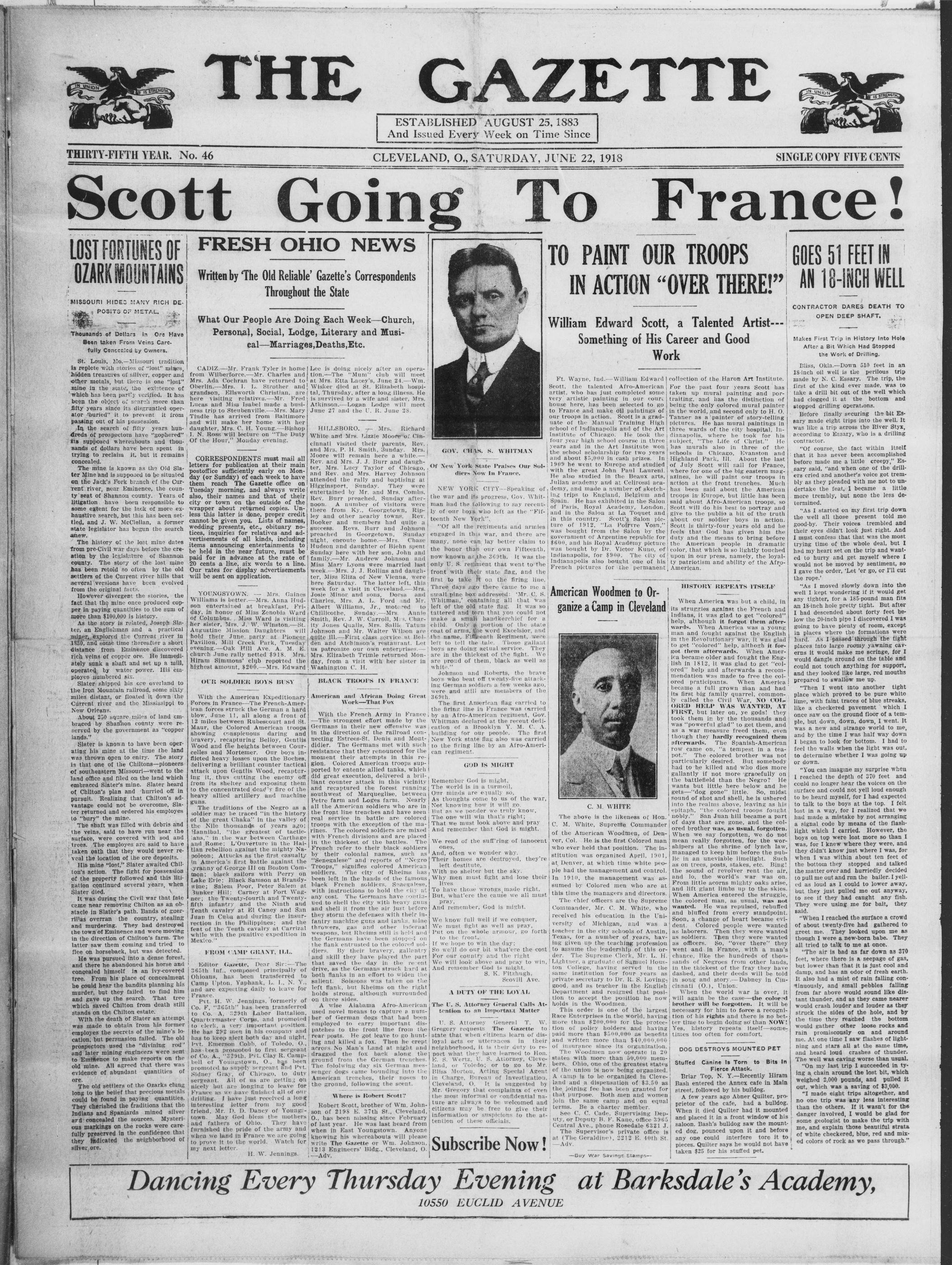
Scott Going To France!
THIRTY-FIFTH YEAR. No. 46
CORRESPONDENTS must mail all letters for publication at their main postoffice sufficiently on Monday (or Sunday) of each week to have them reach The Gazette office on Tuesday morning, and always write also, their names and that of their city or town on the outside of the wrapper about returned copies. Unauthorized copies cannot be given you. Lists of names, wedding presents, etc., obituary notices, inquiries for relatives and advertisements of all kinds, including items announcing entertainments to be held in the near future, must be paid for in advance at the rate of 20 cents a line, six words to a line. Our rates for display advertisements will be sent on application.
YOUNGSTOWN. — Mrs. Gaines Williams is better. — Mrs. Ann Hudson entertained at breakfast, Friday, in honor of Miss Zenobia Ward of Columbus. Mrs. Ward is visiting her sister, Mrs. J. W. Winston. —St. John, Mission lighters, will hold their party at Placez Pavilion, Mill Creek Park; Tuesday evening, —Oak-Hill Ave. A. M. E. church June rally netted $181. Mrs. Hiram Simmons' club reported the highest amount, $200. —Mrs. Edward
With the American Expeditionary Forces, in France—The French-American forces struck the German a hard blow, June 11, all along a front of 12 miles between Rubescourt and St. Maur, the Colored American troops during and bravery, recounting Bombing German Wood and the heights between Courcelles and Mortemer. Our boys inflicted heavy losses upon the Boches, delivering a brilliant counter tactical attack upon Gontilly Wood, recapturing /it, thus cutting the enemy' off from its shelter and exposing them concentrated deadly' fire of the heavy allied artillery and machine guns.
The traditions of the Negro as a soldier may be traced "in the history of the great Chaka" in the valley of the Nile thousands of years ago; Hannibal, "the greatest of taciticians," in the war between Carthage and Rome; L'Ouverture in the Haitian rebellion against the mighty Napoleon; Attucks as the first casualty in America's first battle against the yranny of George III on Boston Common; black gallons with Perry on Lake Erie; Black Sauson of Brandywine; John C. Calhoun of Garnsey Hill; Garnsey at Fort Wagner; the Twenty-fourth and Twenty-fifth infantry and the Ninth and Tenth cavalry at El Caney and San Juan in Cuba and during the insurrection in the Philippines; and the feat of the Tenth cavalry at Carrizal while with the punitive expedition in Mexico."
Editor Gazette, Decar Sir:—The 365th Inf., composed principally of Ohioans, has been transferred to Camp Upton, Yapank, L. I., N. Y., and are expecting daily to leave for France.
Pvt. H. W. Jennings, formerly of Co. F. "365th" has been transferred to Co. A. "229th Labor Battalion, Quartermaster Corps, and promoted to clerk, a very important position, to keep alert both day and night, Pvt. Emerson Cobb, of Toledo, O. has been promoted to first sergeant of Co. A. "229th" Pvt. Clay R. Campbell of Youngstown, O. has been promoted to supply sergeant and Pvt. Sidney Gray, of Chicago, to duty sergeant. All of us are getting on nicely but are longing to leave for France as we have finished all of our drilling. I have just received a long interesting letter from my good friend, Mr. D. D. Dancy of Youngstown. May please bless me with gratitude of Otho. They have furnished the pride of the army and when we land in France we are going to prove it to the world. Watch for my next letter.
H. W. Jennings
IN SUNSHINE IN STRENGTH
MISSOURI HIDES MANY RICH DEPOSITS OF METAL
Thousands of Dollars in Ore Have Been taken From Veins Carefully Concealed by Owners.
St. Louis, Mo.—Missouri tradition is replete with stories of "lost" miles, hidden treasures of sillver, copper and other metals, but there is one "lost" mine in the state, the existence of which has paralleled with it. It has been the object of years' more than fifty years since its disgruntled operator buried" it to prevent it from passing out of his possession.
In the search of fifty years hundreds of prospectors have "gopherhed" its supposed whereabouts and thousands of dollars have been spent in trying to reclaim it. It, but it remains concealed.
The mine is known as the Old Slater Mine and is supposed to be situated on the Jack's Fork branch of the Current river, near Eminence, the county seat of Shannon county. Years of litigation have been responsible to some extent for the lack of more exhaustive search, but this has been settled, and J. W. McClellan, a former state legislator has begun the search show.
The history of the lost mine dates from pre-Civil war days before the creation by the legislature of Shannon county. The story of the lost mine has been retold so often by the old settlers of the Current river hills that several versions have been evolved from the original facts.
However divergent the stories, the fact that the mine once produced copper in paying quantities to the sum of more than $100,000 is history.
As the story is related, Joseph Slater, an Englishman and a practical miner, explored the Current river in 1830, and some time thereafter a short distance from Eminence discovered rich veins of copper ore. He immediately sank a shaft and set up a mill, operated by water power. His employees numbered six.
Slater shipped his six overland to the Iron Mountain railroad, some sixty miles distant, or floated it down the Current river and the Mississippi to New Orleans.
About 250 square miles of land embraced by Shannon county were reserved by the government as "copper lands."
Slater is known to have been operating his mine at the time the land was thrown open to entry. The story is that one of the Chiltons—pioneers of southeastern Missouri—went to the land office and filed on the land which embraced Slater's plan and hurried off in pursuit. Realizing that Chilton's advantage could not be overcome, Slater returned and ordered his employees to "burry" the mine.
The shaft was filled with debris and the veins, said to have run near the surface, were covered with sod and trees. The employees are said to have taken path that they would never reveal the location of the ore deposits. His mine "lost," Slater awaited Chilton's action. The fight for possession of the property followed and this litigation continued several years, when Slater died. ^
It was during the Civil war that fate came near removing Chilton as an obstacle in Chilton's path. Bands of guerrillas overran the country, stealing and murdering. They had destroyed the town of Eminence and were moving in the direction of Chilton's farm. The latter saw them coming and tried to flee on horsback; but was delected.
He was pursued into a dense forest, and there he abandoned his horse and consoled himself in an ivy-covered tree. From his place of concealment he could hear the bandits planning his murder, but they failed to find him and gaye up the search. That tree which saved Chilton from death still stands on the Chilton estate. With the death of Slater an attempt was made to obtain from his former employer the secrets of the mine's location; but persuasion failed. The old prospectors used the "divining rod" and later mining engineers were sent to intelligence to make reports on the old mine. All agreed that there was evidence of abundant quantities of ore.
The old settlers of the Ozarks clung long to the belief that precious metals could be found in paying quantities. They classified the traditions that the Indians and Spaniards mined silver and concealed the sources. Mysterious markings on the rocks were carefully preserved in the confidence that they indicated the neighborhood of silver, ore.
THE GAZETTE
What Our People Are Doing Each Week—Church, Personal, Social, Lodge, Literary and Musical—Marriages, Deaths, Etc.
CADILZ, Mr. Frank Tyler is home from Wilberforce, Mr. Charles and Mrs. Ada Cochran have returned to Oberlin, Mrs. I. L. Strother and grandson, Ellsworth Christian, are here visiting relatives, Mr. Reed Lutte and Miss Isabel made a business trip to Tindle has arrived from Baltimore and will make her home with her daughter, Mrs. C. H. Young—Bishop I. N. Ross will lecture on "The Duty Of the Hour," Monday evening.
OUR SOLDIER BOYS BUSY
FROM CAMP GRANT, H4c
ESTABLISHED AUGUST 25,1883 And Issued Every Week on Time Since CLEVELAND, O., SATURDAY, JUNE 22, 1918
Lee is doing nicely after an operation—The "Mum" club will meet at Mrs. Etta Lacey's, June 24.—Wm. Wisker died at St. Elizabeth hospital, Thursday, after a long illness. He is survived by a wife and sister, Mrs. Atkinson,—Logan Lodge will meet June 27 and the C. It. June 28.
HILLSBORO. — Mrs. Richard W. and Mrs. Iliza Moore. O'Chinnan visited their parents, Rev. and Mrs. P. H. Smith. Synday, Mrs. Moore will romance her here. Rev. and Mrs. J. J. Burr and daughter, Mrs. Lucy Taylor of Chicago, and Rev. and Mrs. Harvey Johnson attended the rally and baptising at Higginsport. Sunday. They were entertained by Mr. and Mrs. Combs, Rev. burr preached, Sunday afternoon. A number of visitors were there from Ky. Georgetown, Ripley and Burlington. Booker and members had quite a success. Rev. Burr and Johnson preached in Georgetown. Sunday night, en route home. — Mrs. Chase Hudson and daughter of Biehn spent Sunday here with her son, John and family. — Mr. Andrew Johnson and Miss Mary Lyons were married last week. Miss Eliza of Norfolk and daughter Miss Eliza of Norfolk were here Saturday. The latter left, this week for a visit in Cleveland. — Mrs. Josie Minor and sons, Dorsau and Charles, Mrs. A. L. P. Lord and Mr. Albert William Jr., moved to chillicothe. Sunday. — Mrs. Annie Smith, Rev. J. W. Carroll, M. Chargy ly Jones Qualis, Mrs. Sullie Tatum quilell ill. First, class service at Bleden and Atchinson's restaurant. Let us patronize our own enterprises. — Mrs. Elizabeth Trinkle returned Monday, from a visit with her sister in Washington. C. H.
BLACK TROUSS IN FRANCE
American and African Doing Great Work.—That Fox
With the French Army in France — The strongest effort made by the Germans in their new offensive was in the direction of the railroad connecting Estrets-St. Denis and Montdidier. The Germans met with such resistance that they renounced forage moment their attempts in this region. Colored American troops supported by entente allied tanks, which had a large flattop counter attack in this vicinity and recaptured the forest running southwest of Marquégue, between Petro farm and Loges farm. Nearly all the American soldiers who are in the front line trenches and have seen real service in battle are colored troops with the exception of the marines. The colored soldiers are mixed with French divisions and are placed in the thickest of the battles. The French troops, by their colonial names, such as "Songeglese" and reports of "Negro Troops," signifies colored American soldiers. The city of Rheims has been left in the hands of the famous black French soldiers, Sangeglese, with instructions to hold the city at any cost. The Germans have continued to shell the city with heavy guns and shell it from the air just before they storm the defenses of the city, mine throwers, gas and other Internal weapons, but Rheims still is held and the Germans have been stopped on the flank entrusted to the colored soldiers. By their bravery, gallantry and skill they have played the part that saved the day in the reentrant drive, as the Germans struck hard at both tanks in an effort to widen the front left flank, but Rheims on the right holds strong, although surrounded on three sides.
A wise Alabama 'Afo-American' used novel means to capture a number of German dogs that had been employed to carry important dispatches to the front line to help to hunting and killing a fox. Then he crept across No Man's Land at night and dragged the fox back along the ground from the German trenches. The following day six German men met American trenches, their noses to the ground, following the scent.
Where is Robert Scott?
Robert Scott, brother of Wm. Johnson of 2198 E. S. 37th St., Cleveland, O., has been missing since February of last year. He was last heard from when in East Youngstown. "Anyone knowing his whereabouts will please Quette or Wilson, 1213 Engineers' Bldg. Cleveland, O.-Adv.
M. B.
Of New York State Praises Our Soldiers Now in France.
NEW YORK CITY - Speaking of the war and its progress, Gov. Whitman had the following to say recently of our boys who left as the "Fifteenth New York":
"Of all the regiments and armies engaged in this war, and there are many, none can lay better claim to the honor than our own Fifteenth, now known as the 369th. It was the only U. S. regiment that went to the front with their state flag, and the first to take it on the firing line. Three days ago there came to me a small pine box addressed: "Mr. C. S. Whitman, containing all that was left of the old state flag. It was so large that we could make a small handkerchief for a child. Only a portion of the state coat of arms, the word Excelsior, and the name, Fifteenth Regiment, were left to tell the tab. Those gallant boys are doing actual service. They are in the thickest of the light. We are proud of them, black as well as white."
Johnson and Roberts, the brave boys who beat off twenty-five attackers and German soldiers a few weeks ago, were still are members of the 369th.
The first American flag carried to the firing line in France was carried by an Afro-American regiment, Gov. Whitman declared at the recent dedication of a Brooklyn Y. M. C. A. to the New York state flag also was carried to the firing line by an Afro-American regiment.
GOD IS MIGHT
Remember God is might.
The world is in a turmoil.
Our minds are equally so.
As thoughts come to us of the war
Not knowing how it will go,
but as we wonder we truly know,
the one we fear is right;
That we must look above and pray
And remember that God is might.
We read of the suffering of innocent
ones.
And, often we wonder why.
Their homes are destroyed, they're
left destitute.
With power, but the sky.
Why men must fight and lose their
lives.
To have those wrongs, made right,
But, what are the cause we all must
pray,
And remember, God is might.
We know full well if we conquer,
We must light as well as pray,
Put on the whole armour, go forth
to the grief.
If we hope to win the day;
So we'll do our bit what we're the cost
For our country and the right
We will look above and pray to win,
And remember God is might.
The U. S. Attorney General Calls Attention to an Important Matter
U. S. Attorney General T. W. Gregory requests "The Gazette to state that when citizens learn of disloyal acts or utterances in their neighborhood, it is their duty, to report what they have learned to Hon. E. S. Wertz, U. S. Attorney, Cleveland, or Toledo; or to go to Mr. Bliss Morton, Acting Special Agent in Charge, Bureau of Investigation, Cleveland, O. It is suggested by Mr. Gregory that allaints of such the most informal or nonconfidential nature are always to be welcomed and citizens may be free to give their information or suspicions to the attention of these officials.
Subscribe Now!
10550 EUCLID AVENUE
TO PAINT OUR TROOPS IN ACTION "OVER THERE!"
American Woodmen to Organize a Camp in Cleveland
10
C. M. WHITE
The above is the likeness of Hon. C. M. White, Supreme Commander of the American Woodmen, of Denver, Col. He is the first Colored man who ever held that position. The institution was organized April, 1901, at Denver, at which time white people had the management and control. In 1919, the management was assumed by Colored men who are at this time the managers and directors. The chief officers are the Supreme Commander, Mr. C. M. White, who received his education in the University of Michigan, and was a teacher in the city schools of Austin, Texas, for a number of years, having given up the teaching profession to assume the leadership of this order. The Supreme Clerk, Mr. L. H. Lighter, a graduate of Samuel Houston College, having served in the University for a private secretary to Dr. R. S. Loving good, and as teacher in the English Department and resigned that position to accept the position he now holds in the Woodmen.
This order, is one of the largest Race Enterprises in the world, having more than $200,000 for the protection of policy holders and having and written more than $700,000 as benefits and written more than $1,500 of insurance since its organization. The Woodmen now operate in 20 states with more than 50,000 members. Ohio, one of the greatest states of the union is now being organized. A camp is to be organized in Cleveland and a dispensation of $3.50 as benefits for both men and women that purpose. Both men and women join the same camp and on equal terms. Be a charter member. See C. C. Cade, Supervising Deputy, or Deputy B. F. Kane, office 3965 Central Ave., phone Rosedale 6321 4. The Supervisor's private office is at (The Geraldine), 2212 E. 10th St. - Adv.
—Doy War Saving Stamps—
collection of the Haron Art Institute. For the past four years Scott has taken up mural painting and portraituring, and has the distinction of being the only colored mural painter in the world, and second only to H. O. Tanner as a painter of story-telling pictures. He has mural paintings in three wards of the city hospital, Indianapolis, where he took for his subject, the life of Christ. He has murals贮藏 in three of schools in Chicago, Evanson and Highland Park, Ill. About the last of July Scott will sail for France, where for one of the big eastern magazines, 'he will paint our troops in action at the front trenches. Much has been said about the American troops in Europe. But little has been said about Afro-American troops, so Scott will do his best to portray and give to the public a bit of the truth about the war. In Chicago Scott is thirty-four years old and he feels that God has given him the duty and the means to bring before the American people in dramatic color, that which is so lightly touched upon in our press, namely, the loyalty patriotism and ability of the Afro-American.
HISTORY REPEATS ITSELF
When America was but a child, in its struggles against the French and huddles, it was glad to get "colored" help, although it forgot them afterwards. When America was a young man and fought against the English in the Revolutionary war, it was glad to get "colored" help, although it forgot them afterwards. When America became older and fought the English in 1812, it was glad to get "colored" help and afterwards a recommendation was made to free the colony, and when America became a full grown man, its first big family quarrel, commonly called the Civil War, NO COLORED. HELP WAS WANTED, AT FIRST, but later on, ye gods' they took them in by the thousands and was "powerful gild" to get them, and as a war measure freed them, even though they hardly recognized them afterwards. "The Spanish-American row came on," the tempest in a teapot, "The colored brother was not particularly desired. But somebody had been killed and who dies more frequently if he were there the battlefield than the Negro? He wants but dog little here. So and mis sound of shot and shell; he is ushered up to the realms above, he is ushered his epitaph, "the colored troops fourt nobly." San Juan hill became a part of days that are gone; and the colored brother was, as usual, forgotten. When we say, forgotten, we do not mean really forgotten, for the worshipers at the shrine of lynch law, managed to keep him before the public in an unviable limelight. Such a man was, as usual, forgotten. The sound of revolver rent the air; and lo, the world's war was on. From little acorns might gaks arise; and lift giant limbs up to the skies. When America entered the struggle, the colored man, as usual, was not wanted. He was repulsed, rebuffed and blushed from every standpoint. Soon, a change of heart became evident. Colored people were wanted as laborers. Then they were wanted as soldiers. Then they were wanted as officers. So, "over there" they were wanted as officers. So, "over there" they were wanted as officers. Like the hundreds of thousands of Negroes from other lands, in the thickest of the fray they have dashed, and their deeds will be told in song and story—Dabney in Cincinnati (O. I.) Union.
When the world war is over, it will again be the case—the colored brother will be forgotten. It will be necessary for him to force a recognition of his rights and there is no better time to begin doing so than NOW! Yes, history repeats itself—sometimes too often for comfort.
DOG DESTROYS MOUNTED PET
Stuffed *Canine Is Torn to Bite in Fierce Attack.*
Briar Top, N. Y. - Recently Hiram Bash entered the Annox cave in Mainstreet, followed by his bulldog.
A few years ago Abner Quilter, proprietor of the cafe, had a bulldog.
When it died Quilter had it mounted and placed it in a front window of his saloon. Bash's bulldog saw the mounted dog, pounced upon it and before any one could interfere (ore it to pieces. Quilter said he would not have taken $25 for his stuffed pet.
IN UNION
LE STRENGTH
SINGLE COPY FIVE CENTS
GOES 51 FEET IN AN 18-INCH WELL
CONTRACTOR_DARES DEATH TO OPEN DEEP SHAFT.
Makes First Trip in History Into Hole After a Bit Which Had Stopped the Work of Drilling.
Illiss, Okla.—Down 510 feet in an 18-inch oil well is the perilous trip made by N. C. Essary. The trip, the first of the kind ever made, was to take a drill bit out of the well which had clogged it at the bottom and stopped drilling operations.
Before finally securing the bit Essary made eight trips into the well. It was like a trip across the River Styx, according to Essary, who is a drilling contractor.
"Of course, the fact within itself that it has never been accomplished before made me a little creepy," Essary said, "and when one of the drillers cried and another's voice got trembly as they gleamed with me not to undertake the feat, I became a little more trembly, but none the less determined.
"As I started on my first trip down the well all those present told me good-by. Their voices trembled and their eyes didn't look just right. And I must confess that that was the most trying time of the whole deal, but I had my heart set on the trip and wanted to hurry and get myself, where I would not, be moved by sentiment, so I gave the order, 'Let 'er go, or I'll cut the rope.'
"As I moved slowly down into the well I kept, wondering if it would get any tighter, for a 185-pound man fits an 18-inch hole pretty tight. But after I had descended about forty feet below the 20-inch pipe I discovered I was going to have plenty of room, except in places where the formations were hard. As I passed through the tight places into large room yawning caverns it would make me scrine, for I would dangle around on the table and could not touch anything for support, and they looked like large, red mouths prepared to swallow me up.
"Then I went into another tight place which proved to be pure white lime, with faint traces of blue streaks, like a checkered payment which I once saw on the ground floor of a temple, but down, down, down. I went. It was a new and strange world to me, and by the time I was half way down I began to look for bottom. I had to feel the walls when the light was out, to determine whether I was going up or down."
"You can imagine my surprise when I reached the depth of 370 feet and could no longer hear the voices on the surface and could not yell loud enough to be heard myself, for I had expected to talk to the boys at the top. I felt lost in a way, for I realized that we had made a mistake by not arranging a signal code by means of the flashlight which I carried. However, the boys on top were lost more so than I was, for I knew where they were, and they didn't know just where I was, for when I was within about ten feet of the bottom they stopped and talked the matter over and hurriedly decided to pull me out and run the baller. I yelled as loud as I could to lower away, but they just pulled me out anyway, to see if they had caught any fish. They were using me for bait, they said.
"When I reached the surface a crowd of about twenty-five had gathered to greet me. They looked upon me as though I were a new-born babe. They all tried to talk to me at once.
"The air is bad as far down as 370 feet, where there is a seepage of gas, but lower than it is just cool and damp, and has that odor of fresh earth. It also had a mist of rain falling continuously, and small, pebbles falling from far above would sound like distant thunder, and as they came nearer would crash louder and louder as they struck the sides of the hole, and by the time they reached the bottom would gather other loose rocks and rain promiscuously on and around me. At one time I saw flashes of lightning and stars all at the same time, and heard loud crashes of thunder. The well was caving worse than usual.
"On my last trip I succeeded in trying a chain around the lost bit, which heard 2,000 pounds, and pulled it out, which was a saving of $3,000.
"I made eight trips altogether, and no one trip was any less interesting than the others. If it wasn't for the danger involved, I would be glad for some geologist to make the trip with me, and explain those beautiful strata of white checkered, blue, red and mixed colors of rock as we pass through."
PUBLISHED EVERY SATURDAY
SUBSCRIPTION RATES
(In Advance)
Subscribers are requested to remit
postoffice money order or reg-
istered letter
Entered at the postoffice in Clevel-
land, Ohio, as second-class
mail matter.
Blackstone Building, Cleveland, O.
Member Ohio Legislature; 1894
to 1896; 1896 to 1898; 1900 to 1902
THE GAZETTE is the oldest, and has the largest bona fide circulation. Double that of any newspaper in the interest of Afro-Americans, published in the state of Ohio, and comparison with any will immediately establish its rank as one of the NEWS-TEST AND BEST in the country.
10,000,000 Afro-Americans.
300,000 in Ohio.
25,000 in Cleveland.
SATURDAY, JUNE 22, 1918.
THE DEMOCRATIC CREED
Here is the Democratic creed for
1918:
First—We are opposed to any and all politics during the war.
Second—We are opposed to the election to Congress of the few Republicans who failed to support any part of the war legislation.
Third—We are also opposed to the election to Congress of the many Republicans who supported every part of the war legislation.
Fourth—We are opposed, in fact, to the election of any Republican to any office, during the war or any other time.
Fifth—We are opposed to anything during the war which will not make the world and the country safer and surer for the Democratic party.
Sixth—We are opposed, therefore, to any and all politics during the war.
AN INSULTED OFFICIAL
We have a horrible fact to put before the people. Secretary of Agriculture Houston has been insulted! We make this statement on the authority of the Democratic Congressman named Rubey—most appropriately named, by the way. It seems that during the debate on the agriculture bill the usual clause appeared therein creating thousands of new positions, all of the appointees being covered into the deferred classification under the draft law. Representative Madden of Illinois protested against the addition of 11,000 men to the pay roll, all of whom were to be kept at a safe and remote distance from military service. But when Representative McLaughlin of Michigan offered an amendment making the appointees subject to draft, Mr. Rubey made the impassioned statement that the subject was a reflection on the secretary of agriculture and that he said it advisedly! Whereupon the House proceeded to pass the McLaughlin amendment by an overwhelming vote and thereby insulted the secretary of agriculture.
It is about time some of the other departments in Washington engaged in filling themselves up with civilians in the deferred classification were similarly insulted.
GOOD JUDGMENT NEEDED
Representative Kahn of California, a conservative member of Congress, of whom all speak with respect, recently had this to say of the Republican policy prior to the coming of the war. "For years," he said, "some of us tried to make the rest see that we were living in a fool paradise." * "Long ago, before the war, I offered an amendment to increase the regular army 250,000 men. It was voted down. Some thought because we were the United States of America no nation would dare to attack us. Some thought that the war could be prevented by the circulation of religious tracts; but we were notoriously unprepared, so when war broke out we had to start from the bottom with everything."
It will remembered that Representative Kahn was called on by President Wilson to lead the fight for the draft law when Representative Dent, the Democratic head of the military committee in the House, opposed the measure. There can be no question in regard to either the loyalty or the judgment of Mr. Kahn. Consequently, what he says about unpreparedness before the war will be accepted by all as a fair statement of the case. The events in Europe now show how lacking in vision were those charged with the responsibility of action to protect the interests of the American people. The question arises, where statesmen went so far astray on a great proposition like that—may they not be just as apt to go astray on the great propositions that will confront the country after the war? This is a matter which the people should seriously consider when they come
to elect a Congress this fall. Statesmen whose judgment proved to be bad in one of the greatest emergencies that have confronted a nation, should be set aside as rapidly as the people can get to them, simply upon the ground that they have been tried in the balance and found wanting.
LET THE SOLDIERS VOTE
Assistant Secretary of War Crowell has notified Representative Rogers of Massachusetts that American soldiers in France will not be allowed to vote at the election this fall because he thinks it would interfere with military efficiency. Yet it is a matter of general knowledge that the Canadian and Australian soldiers have voted in France for several years, and it would be a very brave man who would charge that these soldiers lack in efficiency. A very interesting point will be reached when the attempt is made to shut out the vote of the soldiers of the state of New York, for it so happens that the constitution of New York expressly provides that no elector of that state in the actual military service of the United States shall be deprived of his vote by reason of his absence from his election district. It remains to be seen whether the policy of the administration at Washington will be able to set aside the constitution of the state of New York.
The fact is that the voting by the soldiers is a matter of grave national concern. It is now apparent that possibly two million electors, by reason of the determination at Washington, will be excluded from the franchise this fall. The people should consider very carefully the effects of this exclusion. All the pro-Germans, anti-militarists, shirkers and desk warriors have their votes sacredly protected, but the man who carries a gun on the battlefield of Europe is to have his civil rights withheld from him. It does not seem to us that this is right and there should be an effort by some one in Congress to see that the country does not lose the value of the soldier vote in the coming election.
DOINGS OF THE RACE
The "Buffaloes," the 367th Inf., are now quartered at Hoboken, N. J., and Gen. C. C. Bailou's 92 Div., at Camp Upton, N. Y. Both are daily expecting to leave for France.
As an initial step, the Rockefeller Foundation has appropriated $25,000 to make possible a demonstration of a plan of adequate care and entertainment of our troops in a typical war camp community.
Afro-American troops, supported by an Allied tank, which did great execution, delivered a brilliant counter attack and re-captured the forest running southwest of Marqueglaise, last week.
Editor Phil. H. Brown
F. M. Sackett, federal food administrator for Kentucky, has appointed Phil H. Brown, editor of the Hopkinsville, (Ky.) Saturday News, to be director of activities for Mr. Sackett's department. Mr. Brown will have immediate control under Mr. Sackett of the work of food conservation and salvage among the Colored people of the State. Our criticisms of German brutality are all we want deserved no doubt, but our criticism would better if we could find some effective way to prevent these french lynchings which are so common to this country and which often are based merely on complexion and flying rumors.—Cincinnati, (O..) Commercial Tribune.
BERT WILLIAMS QUITS "THE FOLLIES."
NEW YORK CITY—Bort Williams, premier comedian of the American stage, has quit the "Ziegfeld Follies" with which company he has been connected for several seasons—since the death of his partner, George Walker. The reason given is that Mr. Williams felt he was not given enough work to do. In other words his name was carried to help the show, but he was not given parts commensurate with his ability or reputation. Mr. Williams is the first and only Afro-American to star in a "white" company, and when he first joined it he was given all the spotlight, but in late seasons he has been pushed back.
THE GAZETTE, CLEVELAND, OH IO, JUNE 22-1918
CLOCK WITH 95 FACES
TELLS DIFFERENT TIMES.
Colossal Indicator Vies With Unique Self-Winding Watch in Glasgow.
Petrograd, Russia. — Petrograd boasts what is in many respects the most wonderful clock in the world. It has ninety-five faces. It indicates simultaneously the time of day at thirty different spots on the earth's surface, besides the movement of the earth round the sun, the phases of the moon, the signs of the zodiac, the passage over the meridian of more than fifty stars of the northern hemisphere and the date according to the Gregorian, Greek, Mussulman and the Hebrew calendars. The works took two years to put together after the clock had been sent in detached pieces from Switzerland to Russia.
A Glassgow watchmaker tells about a watch that was brought to him for repairs and surpassed in interest all others that he had seen during his forty-two years of business. It was self-windling. The case was that of the regular hunting watch, and every time it was opened it partly wound the watch by the closing of the lid.
Where the lid joined the watch there was a little lever, to the free end of which was joined a scythe shaped rack, which worked into a wheel with rachet shaped teeth. Instead of the ordinary fly spring there was a spring fixed to the plate, and attached by means of a short chain to the lever. As this spring pulled the cover open the teeth of the scythe slipped over the teeth of the winding wheel, and by closing the cover the wheel was partly pulled around. To wind it completely the watch had to be opened and closed eight or nine times a day.
SIGHTLEGS STOREKEEPER
IS WONDER TO PATRONS
Cincinnati, Ohio—Ask any one in the vicinity of the 1920 Eastern avenue who is the most talked of man in the neighborhood and he will say, without hesitation, Arthur J. Kob, the sightless man, who keeps a small department store at the above address.
Nearly every one thereabouts patronizes Kob because it is always marvelous to the customers to see Kob go immediately to the article asked for, measure it, or weigh it, wrap it up, and then give back the exact change.
He has been totally Nice.
Kob is 48. He has been totally blind since he was 8.
He was educated at the Columbus State school, and took up piano tuning, which he soon dropped and entered the grocery and notion trade in the neighborhood where he was born.
He has a bright little son, 6 years old whose vision is perfect.
For nineteen years he has been in his present business. For eleven of those years he kept his own accounts along with his work in the shop, and he has always taken care of the store.
He will climb to the ceiling for a certain order and in a moment be in the center of the store unhesitatingly picking out some other request.
He has no difficulty with his array of candies or cigars or threads, or, in fact, anything in the establishment.
Are Finally Smoked Out and Their Honey Seized.
Lima, N. Y.—An alcove back of the pulpit of the M. E. church of this village held 50 pounds of fine honey recently, but it has been confiscated for the pastor.
For several months a buzzing was heard in the alcove and became very annoying to pastor and congregation.
The pastor and trustees decided to rout the bees. They took the alcove apart.
The bees resented disturbance and the men were stung and driven away. But they waited the honey, and forcing smoke through a gas pipe drove the bees from the alcove. Fifty pounds of honey was secured, which was presented to the pastor.
TAKES NAP IN 'DEAD' ENGINE
Workman Starts Fire and Man Is
Bruised and Burned.
Tamaqua, Pa.—Arlamond Wagner had a narrow escape from being burned to death at the Reading railroad shops, when he crawled into the firebox of a "dead" locomotive to make repairs and fell asleep. In the meantime, not knowing that a worker was in the engine and believing the repairs had been made and not reported, the foreman ordered the engine fired up. A pile of wood was ignited and the flames were just beginning to pour through the firebox when Wagner woke up. He plunged through the firebox door headforemost and sustained severe bruises, in addition to his burns.
BOY IS 16; HAIR NEVER CUT.
He Guards His Locks Jealously, Fearing Samson's Fate.
Webster Springs, W. Va.-Joe Donahue, 16, who lives near this city, has never had a haircut. His locks reach almost to the ground, and he is proud of them.
When a child he had a long illness and his hair grew to great length. When he recovered he became so proud of his locks that he has never had them cut. He fears that if his hair is cut he will lose his strength like Samson did.
He guards his hair closely, tying it up about his head when he retires at night, fearing that persons with evil designs will try to separate him from his precious locks.
FOOD
WILL WIN
THE
WAR
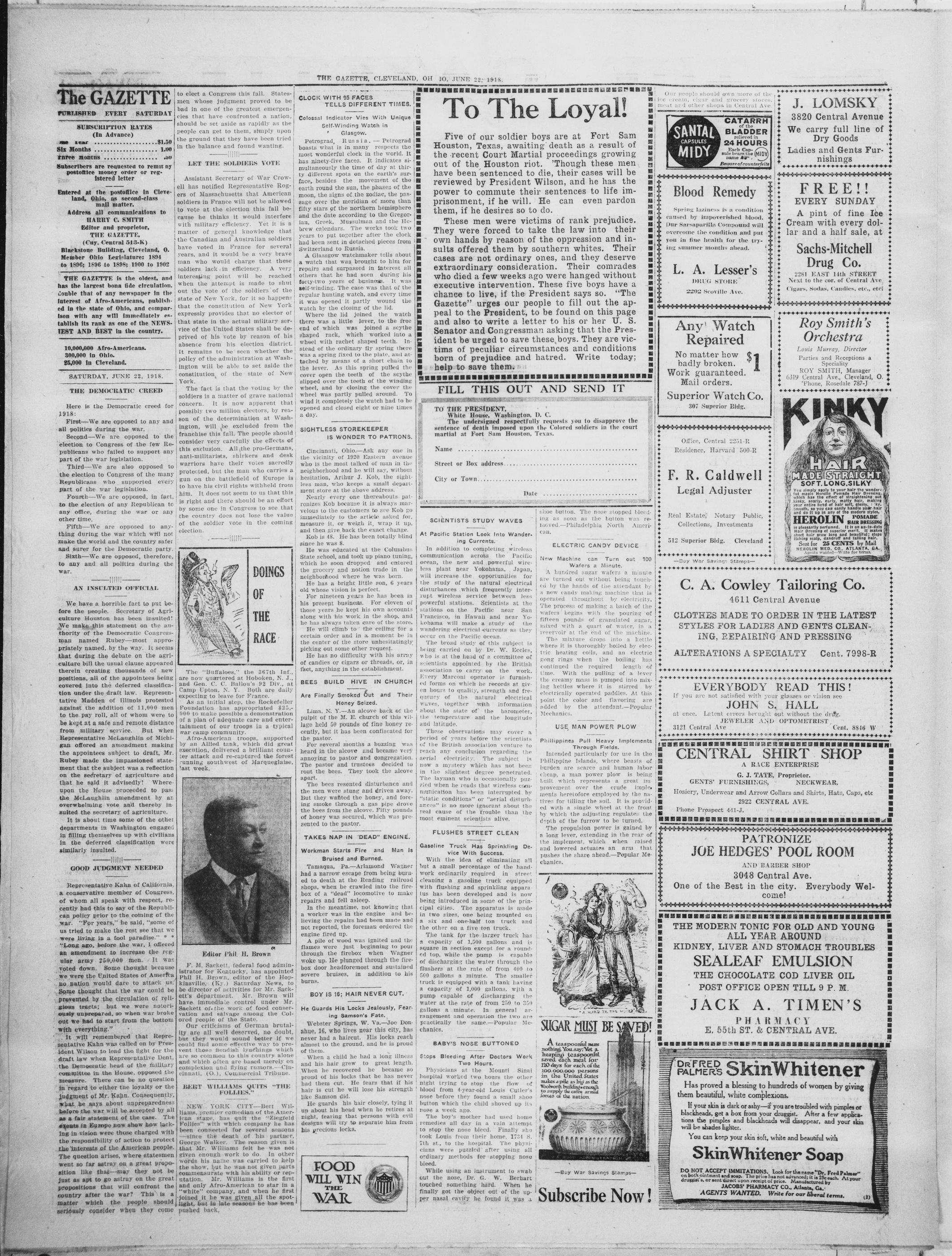
To The Loyal!
Five of our soldier boys are at Fort Sam Houston, Texas, awaiting death as a result of the recent Court Martial proceedings growing out of the Houston riot. Though these men have been sentenced to die, their cases will be reviewed by President Wilson, and he has the power to commute their sentences to life imprisonment, if he will. He can even pardon them, if he desires so to do.
These men were victims of rank prejudice. They were forced to take the law into their own hands by reason of the oppression and insults offered them by southern whites. Their cases are not ordinary ones, and they deserve extraordinary consideration. Their comrades who died a few weeks ago were hanged without executive intervention. These five boys have a chance to live, if the President says so. "The Gazette" urges our people to fill out the appeal to the President, to be found on this page and also to write a letter to his or her U. S. Senator and Congressman asking that the President be urged to save these boys. They are victims of peculiar circumstances and conditions born of prejudice and hatred. Write today; help to save them.
White House, Washington. D. C.
The undersigned respectfully requests you to disapprove the sentence of death imposed upon the Colored soldiers in the court martial at Fort Sam Houston, Texas.
SCIENTISTS STUDY WAVES
At Pacific Station Look Into Wandering Currents.
In addition to completing wireless communication across the Pacific ocean, the new and powerful wireless plant near Yokohama, Japan, will increase the opportunities for the study of the natural electrical disturbances which frequently interrupt wireless service between less powerful stations. Scientists at the stations on the Pacific near San Francisco, in Hawaii and near Yokohama will make a study of the wandering electrical currents as they occur on the Pacific ocean.
The broad study of this subject is being carried on by Dr. W. Eccles, who is at the head of a committee of scientists appointed by the British association to carry on the work. Every Marconi operator is furnished forms on which he records at given hours to quality, strength and frequency of the natural electrical waves, together with information about the state of the barometer, the temperature and the longitude and latitude.
These observations may cover a period of years before the scientists of the British association venture to reach any conclusion regarding the aerial electricity. The subject is now a mystery which has not been in the slightest degree penetrated. The layman who is occasionally puzzled when he reads that wireless communication has been interrupted by "static conditions" or "aerial disturbances" is no more ignorant about the real cause of the trouble than the most eminent scientists alive.
FLUSHES STREET CLEAN
Gasoline Truck Has Sprinkling Device With Success. With the idea of eliminating all but a small percentage of the handwork ordinarily required in street cleaning a gasoline truck equipped with flushing and sprinkling apparatus has been developed and is now being introduced in some of the principal cities. The apparatus is made in two sizes, one being mounted on a six and one-half ton truck and the other on a five ton truck.
The tank for the larger truck has a capacity of 1,500 gallons and is square in section except for a rounded top, while the pump is capable of discharging the water through the flushes at the rate of from 400 to 500 gallons a minute. The smaller truck is equipped with a tank having a capacity of 1,000 gallons, with a pump capable of discharging the water at the rate of from 250 to 350 gallons a minute. In general arrangement and operation the two are practically the same.-Popular Mechanics.
BABY'S NOSE BUTTONED
Stops Bleeding After Doctors Work
Two Hours.
Physicians at the Mounti Sinai hospital worked two hours the other night trying to stop the flow of blood from 4-year-old Louis Cutler's nose before they found a small shoe button which the child shoved up its nose a week ago.
The boy's mother had used home remedies all day in a vain attempt to stop the nose bleed. Finally she took Louis from their home, 1734 S. 7th st., to the hospital. The physicians were puzzled after using all ordinary methods for stopping nose bleed.
While using an instrument to swab out the nose, Dr. G. W. Berhart touched something hard. When he finally got the object out of the upper nasal cavity he found it was a
shoe button. The nose stopped bleeding as soon as the button was removed—Philadelphia North American.
ELECTRIC CANDY DEVICE
New Machine can Turn out 100 Wafers a Minute.
A hundred sugar wafers a minute are turned out without being touched by the hands of the attendant by a new candy making machine that is operated throughout by electricity. The process of making a batch of the wafers begins with the pouring of fifteen pounds of granulated sugar, mixed with a quart of water, in a reservoir at the end of the machine. The mixture drops into a kettle where it is thoroughly boiled by electric heating coils, and an electric gong rings when the boiling has continued the required length of time. With the pulling of a lever the creamy mass is pumped into mixing kettles where it is stirred by electrically operated paddles. At this point the color and flavoring are added by the attendant.—Popular Mechanics.
USE MAN POWER PLOW
Philippines Pull Heavy Implements Through Fields.
Intended particularly for use in the Philippine Islands, where beasts of burden are scarce and human labor cheap, a man power plow is being built which represents a great improvement over the crude implements heretofore employed by the natives for filling the soil. It is provided with a single wheel at the front by which the adjusting regulates the depth of the furrow to be turned. The propulsion power is gained by a long lever, extending in the rear of the implement, which when raised and lowered actuates an arm that pushes the share ahead—Popular Mechanics.
MOHUN
A WORD TO THE WIDE
A teaspoonful means nothing. You say, "Yet a heaping teaspoonful saved each meal for 120 days for each of the 100,000,000 persons in the United States makes a tale as big as the Woolworth building, enough to supply the entire armed forces of the nation.
J. LOMSKY
3820 Central Avenue
We carry full line of
Dry Goods
Ladies and Gents Furnishings
FREE!!
EVERY SUNDAY
A pint of fine Ice
Cream with every dollar and a half sale, at
2281 EAST 14th STREET
Next to the cor. of Central Ave.
Cigars, Sodas, Candies, etc., etc.
Roy Smith's
Orchestra
Louis Murray, Director
Parties and Receptions a
Speciality
ROY SMITH, Manager
6319 Central Ave., Cleveland, O.
'Phone, Rosedale 787-J
Any Watch Repaired Roy Sr Orche
KINKY
HAIR
MADE STRAIGHT
SOFT. LONG. SILKY
You simply apply to your hair the wonder-
ful magic powder created, it makes
the effect of straightening out
kinky, snarly, curly, matty hair, making
your entire hair look smooth,
so you can easily handle your hair
and do it up in any of the modern
formulas.
HEROLIN POMADE
is pleasantly perfumed. It is an up-to-date
form of our premier work. It makes
short hair grow long and beautiful; stops
itching scalp, dandruff and tearing hair.
AGENTS: L. MAIL
HEROLIN MED. CO. ATLANTA, GA.
Agents wanted—Write for terms.
C. A. Cowley Tailoring
4611 Central Avenue
CLOTHES MADE TO ORDER IN THE
STYLES FOR LADIES AND GENTS C
ING, REPAIRING AND PRESSI
ALTERATIONS A SPECIALTY Cent
EVERYBODY READ THE
If you are not satisfied with your glasses or vision so
JOHN S. HALL
at once. Latent errors brought out without the duff
JEWELER AND OPTOMETRIST
3121 Central Ave.
CENTRAL SHIRT SHOP
A RACE ENTERPRISE
G. J. TATE, Proprietor.
GENTS' FURNISHINGS, NECKWEAR,
Hosiery, Underwear and Arrow Collars and Shirts, Hat
2922 CENTRAL AVE.
Phone Prospect 441-J.
PATRONIZE
JOE HEDGES' POOL ROOM
AND BARBER SHOP
3048 Central Ave.
One of the Best in the city. Everybe
come!
THE MODERN TONIC FOR OLD AND
ALL YEAR AROUND
KIDNEY, LIVER AND STOMACH TR
SEALEAF EMULSION
THE CHOCOLATE COD LIVER
POST OFFICE OPEN TILL 9 P.
JACK A. TIMEN
Tailoring Co.
Central Avenue
ORDER IN THE LATEST
AND GENTS CLEAN-
AND PRESSING
QUALTY Cent. 7998-R
READ THIS!
Glasses or vision see
HALL
Not without the drug.
OPTOMETRIST
Cent. 8846 W
SHIRT SHOP
ENTERPRISE
Proprietor.
NECKWEAR.
Hats and Shirts, Hats, Caps, etc
AL AVE.
ONIZE
POOL ROOM
ER SHOP
Central Ave.
City. Everybody Wel-
e!
FOR OLD AND YOUNG
CAROUND
OPTOMACH TROUBLES
MULSION
COD LIVER OIL
EN TILL 9 P. M.
TIMEN'S
CLOTHES MADE TO ORDER IN THE LATEST
STYLES FOR LADIES AND GENTS CLEAN-
ING, REPAIRING AND PRESSING
ALTERATIONS A SPECIALTY Cent. 7998-R
EVERYBODY READ THIS!
G. J. TATE, Proprietor.
GENTS' FURNISHINGS, NECKWEAR.
Hosiery, Underwear and Arrow Collars and Shirts, Hats, Caps, etc
2922 CENTRAL AVE.
Phone Prospect 441-J.
AND BARBER SHOP
3048 Central Ave.
One of the Best in the city. Everybody Welcome!
THE MODERN TONIC FOR OLD AND YOUNG ALL YEAR AROUND KIDNEY, LIVER AND STOMACH TROUBLES SEALEAF EMULSION THE CHOCOLATE COD LIVER OIL POST OFFICE OPEN TILL 9 P.M.
PHARMACY
E. 55th ST. & CENTRAL AVE.
DR FRED
PALMERS SkinWhitener
Has proved a blessing to hundreds of women b
them beautiful, white complexions.
If your skin is dark or ashy—if you are troubled with p
blackheads, get a box from your druggist. After a few
tions the pimples and blackheads will disappear, and
will be shades lighter.
You can keep your skin soft, white and beautiful with
SkinWhitener Soap
DO NOT ACCEPT IMMITATIONS. Look for the name "Dr. Fred
Whitener
hundreds of women by giving
us are troubled with pimples or
suggiest. After a few applica-
tion will disappear, and your skin
ate and beautiful with
ner Soap
kt for the name "Dr. Fred Palmer"
DRFRED PALMERS SkinWhitener
Has proved a blessing to hundreds of women by giving them beautiful, white complexions.
If your skin is dark or ashy—if you are troubled with pimples or blackheads, get a box from your druggist. After a few applications the pimples and blackheads will disappear, and your skin will be shades lighter.
You can keep your skin soft, white and beautiful with
DO NOT ACCEPT IMMITATIONS. Look for the name "Dr. Fred Palmer" on both ointment and soap. The price has not advanced; it is $26 each. At your drugsale, or sent directly to us, by JACOB'S PHARMACY CO., Atlanta, GA. **AGENTS WANTED.** Write for our liberal terms.
SANTAL
CAPSULES
MIDY
CATARRH
of the
BLADDER
relieved in
24 HOURS
Each Cap
name #4
MIDY
Beaver of counterfeits
Blood Remedy
Spring laziness is a condition caused by impoverished blood. Dur Sarsaparilla Compound will overcome the condition and put you in fine health for the trying summer months ahead.
L. A. Lesser's
DRUG STORE
2202 Scoville Ave.
No matter how $1 badly broken. Work guaranteed. Mail orders.
Office, Central 2251-R Residence, Harvard 500-R
F. R. Caldwell
Legal Adjuster
Real Estate, Notary Public,
Collections, Investments
512 Superior Bldg. Cleveland
RHEUMATISM Physician for 42 Years
"L. M. Gross:
"I have practiced medicine for 42
years and I have had a great deal of
experience in the treatment of Rheu-
matism, but I have not found anything
that equals G. S. and I take great
pleasure in recommending G. S. for
rheumatism in any form."—R. M. Os-
born, M. D., and Specialist on Dropsy,
Fort Smith, Ark.
GS is guaranteed for one bottle to bene-
fit any case of
G S is guaranteed for one bottle to benefit any case of Rheumatism, Pellagra or any blood, liver or kidney disease, or money refunded, and no questions asked. Why suffer? Sold by all druggists, $1.00 per bottle, or six bottles for $5.00. Write for testimonials. L. M. GROSS, 721 Spring St. Little Rock, Ark
The Pride of Carolina
The State Agricultural and Mechanical College of South Carolina
Orangeburg, S. C.
Next session begins September 20th and ends May 31st, 1918.
No Tuition, no Room Rent, no Charges for Water, Lights or Fuel. Entrance Fee $10.00.
Board $8.00 per Month in Advance. Books, Laundry and Personal Expenses Extra.
Every Modern Facility, Standard Equipment. A Faculty of 57 Officers and instructors
For information and Catalogue, Write.
R. S. WILKINSON, Pres.
Orangeburg, S. C.
KINKY
T
Exlent Medica Co.
Albuquerque, Co.
Gentleman, I loved
your Exlentio Quinine
short, course and nappy,
but now it has grown to 52
inches long, and is so neat
up any way. I want to
measure up my hair
to show you how
pretty Exlentio made
me ALL HELPED.
Don't let some fake Kink. Remove fool
you. Your reality can't straighten your hair
until it is nice and long. That's what.
does, remove Dandruff, the Roots of
dandruff, and remove it. After a few times you can tell
the difference, and after a little while it
doesn't work, you can stop it. It
up to you to suit you. If Exsenteo don't do
as we claim, we will give your money back.
Price $26 by mail on receipt of stamps
HAIR Invigorator and Grower
A
Stop, Look, Read!
When I started using Mme. C. H. Jones' Hair Invigorator and Grower, my hair was but one inch long. After using it only one year, my hair is to my shoulders.
The C.C.C.Hair Co.
353 WOOLAND AVENUE
Home Phone, B7218 TOLEDO, OHIO
AGENTS WANTED—Stamp for reply
NOTICE TO SUBSCRIBERS
Subscribers not receiving The Gazette regularly should notify us at once. We desire every copy delivered promptly.
Send or bring locals and all business matters to The Gazette's office, 214-215 Blackstone Bldg. If you wish to see the editor call there, please.
We advise our readers to carefully examine The Gazette's advertisements, before making purchases. Business men who advertise in this paper should have the patronage of our people. The fact that they advertise is assurance that they want it.
All matters for publication in current issues of The Gazette must be in the office by 4 p. m., WEDNESDAY of that week, at the latest.
Classified Advertising
... Department ...
FOR SALE — Three houses and lot;
seven rooms and bath, electric lights,
gas, etc. Splendid location in Col-
umbus. A bargain! Address Mrs.
John Haskell, 264 E. Mound St., Col-
umbus, O.
CLUB NOTICE — The Working
Men's Social and Literary club meets
every Friday evening, for business
and gives a dance, every Monday
night, at their hall, 3103 Scovill Ave.
H. P. Williams, pres., 3040 Central
Ave. L. V. Orton, sec., 2667 E. 40th
St. Milton Watkins, chairman, 252
E. 30th St.
CLEVELAND Social and Personal
Miss Eliza Rollins of New Vienna is in this city visiting.
James, young son of Mrs. Amanda Taylor, of E. 37th St., was drowned Sunday.
Wm. Carroll Dean has been called to the colors, leaving Thursday for Camp Sherman.
It is said that Dr. A. J. Whitehead recently married Miss Mamie Davis one month before the birth, the Knights of Taber had their annual sermon preached, Sunday at ternoon, at Cory M. E. church.
Allen H. Dorsey, of 2922 Central Ave., spent most of last week in Erie, Fa., visiting his sweetheart. He doesn't want this generally known, it is said, so don't tell any one.
You should take PURO HERBS, the great blood purifier and system cleanser. On sale only at the Brown Drug Co., 2742 Central Ave., cor. E. 28th St.-Adv.
Dennis Fowler was shot three time, last week Wednesday night, in front of his house in E. 39th St. He was taken to Charity hospital and is convulsing.
La Roí will pay, 2312 E. 90th St. the Crystal Restaurant, 2314 Quincy Ave., in Municipal Court, last week, for refusing to serve him on May 14th. Chas. S. Sutton, Esq., is his attorney.
It will pay our people from E. 33d to E. 40th streets, at least, and as far west on Central Ave., as E. 22d St., to patronize Jacob Schneider's bakery at 3028 Central Ave.-Adv.
A souvenir post-card, received, Monday, announced the safe arrival of our old friend, J. H. Stepney, in Baltimore, where he is to spend six weeks with a sister he has not seen for many years.
Harvey Monroe White, premier violinist, en route on a concert tour, was in the city a few hours, last week Friday, guest of Wm. R. Green, Esq. He paid The Gazette sanctum a pleasant call.
Sunday when it is hot, go to the Sachs-Mitchell Drug Store, cor. Central Ave. and E. 14th St., and get a pint of ice cream free! See their advertisement elsewhere in this paper.
—Ady.
Cleota, daughter of Rev. I. A. Collins of Zanesville, sang the leading line in Butterfield's "Ruth, to Cleaner," a five act opera given in New York City, one evening last week, by the Aida Choral Society.
If you want to meet your friends and have a most enjoyable time—where the air is filled with good music—go to "Dreamland". Thursday evening, July 4th—the big dance and promenade given by the men's Club Admission, eight-keys of this McAfee's entertainment will be required to remove their coats-Adv. Mrs. Sarah Woods, widow of Mr. John Woods, who was married several weeks ago, at Buxton, Ont., can, returned here to ship her household goods there. She is now Mrs. Robert Sege and left yesterday, to join her husband on his $8-acre farm near Buxton. Geo. W. Sampson, jr., principal of the Jacksonville, Fla., High School, arrived in the city Tuesday, called by the sergeant of this mother's company. Mrs. Sampson shows slight improvement and Mrs. Hattie Dale, who is at St. Vincent's hospital, will be able to return home in about ten days.
Mr. Frank Doctor, manager of the Edward Doctor Cafe, left Sunday night for Duluth, Minn., where he will visit his niece, Mrs. Laura Colby. He will visit old friends in Chicago, en route. On his return he will visit West Baden, Ind., to recuperate. His niece, Mrs. Reba Taylor, is visiting her mother-in-law at Rome, Ga.
Those of our people in the vicinity of Woodland Ave. and E. 37th St., should make it a point to not only patronize Grossman's Pharmacy but to urge their friends and acquaintance to do so also. There you get the best treatment and the best results for your money and at the most reasonable rates—Ady.
Mr. and Mrs. L. S. Jones, of E. 101st St., left Friday for Boston to witness the graduation of their son, Louin, from the New England Conservatory of Music, Tuesday. Andrew
F. Rosemond, violinist, Boston, who has taken a position with the Parker Players of Columbus on the recommendation of Lovia Vaughn Jones, visited Mr. and Mrs. Jones, last Friday and Saturday, returning to Columbus.
Local Afro-Americans who filed declaration of candidacy for state representative to be voted for at the Republican primaries in August, are: Peter Boult, S. E. Woods, W. T. Blue, B. C. McGlinness and Harry E. Davis. It is said that Davis is the organization choice (Davis administration candidate) as "sop" for its refusal to appoint him to an assistant police prosecutorship. Sydney Thompson "pulled out of the race." As a matter of fact, he was never in it.
The Men's Club always "make good" whenever it invites its patrons to its dances and promenades. This all know and appreciate. Therefore when it announces its big dance and promenade for July 4. (Thursday evening, at "dreamland" and inform the gentlemen that they will be allowed to remove their coats, "Nuff Sed"? Admission eighty-five cents McAfee's orchestra.—Adv. The editor of The Gazette acknowledges the receipt of an invitation from Louia Vaughn Jones, a 1918 graduate, to attend the commencement exercises, June 25, of the New England Conservatory of Music, Boston. Our other member of the large graduation class is Madison Colahan. Ongratulations should be shown on Monday and Louia S. Jones, parents of Louia, as well as on the son. He has proven a credit to them and to our people of this city.
At the Elks' election of officers last week, the boys went after "Star" and Tom Fleming's scalps and seem to have lifted them in the most improved style. Every candidate that "Star" backed was beaten to a frazzle including Tom who was a candidate for Exalted Ruler. When this massacre of the "organization" candidates was completed one of the boys announced that it was only the beginning and that the onslaught was to be continued to Aug. 13, the day of the primaries when Harry E. Davis' candidacy for nomination for State Representative was to be named the "Star" candidate. The worm is turning at last be it said to the everlasting credit of the Elks (and their friends). Federal authorities in Cleveland decided Monday that warrants issued by U. S. District Attorney Wertz against owners of property used for immoral purposes within five miles of two city armories would not be served pending a ruling from Washington. "We want to first be sure that Dorothea and Central armories are classed as barracks," said Assistant District Attorney Breitenstein. Chief of Police Smith gave names of landlords and inmates of houses of ill repute within five miles of Central and Dorothea armories. Federal action of guarding soldiers and sailors. Police, in co-operating with federal authorities, hope to clean out troublesome districts. The campaign was first taken up several weeks ago. The penalty under the federal law is much more severe than under city ordinance, landlords or inmates being subject to a $1,000 fine and imprisonment for a year.
RICO STILL SUCCESSFUL
PITTSBURG, Pa., June 16, 1918.
My dear friend, Mr. Smith:—Just a line to let you hear from me. I am well and am doing nicely. At present I am trying to get myself before the local public. Enclosed you will find one of my programs for next Thursday evening's concert. I receive The Gazette every week and is a great help me to read a paper that really tries to help protect the race and never solls us out to the other race. May you have a long life, your true friend, Purtico Rizo.
THE MAN WHO DARES.
"I honor the man who in the conscientious discharge of his duty dares to stand alone; the world, with ignorant, tolerant judgment, may condemn, the countenances of relatives may be averted, and the hearts of friends grow cold, but the sense of duty done shall be sweeter than the applause of the world, the countenances of relatives or the hearts of friends."—Charles Sumner.
---
PROTEST AGAINST WRONG.
To submit in silence when we should protest makes, cowards out of men. The human race has climbed on Protest. Had no voice been raised against injustice, ignorance and lust, the inquisition yet would serve the law, and guillotines decide our least disputes. The few who dare, break weak peaks again to right the wrongs of many. —Ella Wheeler Wilcox
CLEVELAND, OHIO, JUNE 22, 1918
FARMER FIRES NAILS
THROUGH SKUNK'S TAIL.
Heavy Charge Disables Old Muzzle-
Loader, but Modern Weapon Ends
Animal's Activity.
Wellington, N. Y.-For a week a
skunk has been prowling around the
Arba Pary farm hear here, making it
unpleasant for the Pary family.
Recently Mr. Pary saw the animal
in a field fifty rods from his house.
Pary has a muzzle-loading shotgun. He
got out the firearm, powder and caps,
but found he had no shot. However,
he knew what to do.
He placed a quantity of powder in
the gun, followed by a wad, some shingle
nails and a number of brass tacks.
The gun being loaded, he started for
the field.
The skunk appeared tame and as Pary approached it moved a few feet and stopped at a fence post. He got within shooting distance, stopped, aimed and fired. The skunk jumped, made things lively for a few minutes, but did not appear to be mortally wounded. Anyway, it did not leave the post.
Pary returned to the house, started to reload the gun and then discovered that the charge had blown the lock away.
During the afternoon Pary came to the village and purchased a 30-20 caliber rifle and a box of cartridges. He returned home, loaded the rifle, went to the field. The skunk was by the post, and as frisky as ever. Pary shot the skunk through the head. When he was sure the little animal was dead he went to it and was surprised to find its tail nailed to the fence post.
Pary says that when he shot at the skunk in the forenoon a nail from his muzzle-loading shotgun pierced the skunk's tail, entered the fence post and held the animal fast. Pary aws that he found four nails and seven tacks imbedded in the post.
1,500 DIAMONDS FOUND
IN ARKANSAS FIELDS
Gems Picked Out of Crude Machines
By Watchman—One Weighs
In
Buffalo, Ark.—From 1,000 to 1,500 diamonds have been found by one company operating in the Pike county diamond field during the last year. The caretaker of one of the properties that is idle found 200 during that period, having recovered them by a crude hand-washing method from the peridotite, the formation in which they are found. The largest diamond found is reported to have weighed thirty carats. As to the actual production of the field no one knows because operations are guarded very closely. One company, however, has been in steady operation for several years. The ground belonging to this company and others is inclosed by high barbed wire fences and no one is admitted without proper credentials. The company has a big diamond washing plant near Murtreesboro, Ark. the dirt being hauled by a motor railroad about two miles.
The main peridotite bed occupies about eighty acres. Two other smaller areas showing peridotite have been discovered two miles from there. One shows from ten to fifteen acres of this diamond bearing ground, and the other about five.
Is 14 Years Old, But His Doings Are Spectacular.
San Antonio, Tex—Mack, the 14-year old registered English bulldog owned by H. C. Flint, of this city, first acquired local fame several months ago when he prevented a burglar from robbing his master's house. He has long been a neighborhood celebrity, however, his many less spectacular performances gaining him friends among people of all ranks of life except burglaries.
Aside from being an efficient watchdog, as was demonstrated when he seized the burglar, who was escaping through the window with a bag full of silverware and cut glass, he has many other accomplishments. He herds chickens as a collie does sheep, he brings in wood in the evening, and brings in the newspaper and the mail.
When all the members of the family are too far away to hear the telephone he calls them to it as soon as it rings, and on one occasion he saved the house from burning when he called his mistress into the room where the rug had caught fire from the grate. Moreover, in spite of his age, Mack is an expert mouser.
ELEPHANT SUFFERING
FROM LOCKJAW SLAIN
Big Beast Is Strangled to Death By Engine and Tackle.
East St. Louis, III—Juday, a 9,600 pound elephant attached to a large circus for many years, was executed in the railroad yards here in order to relieve its sufferings from lockjaw.
The elephant was put in a refrigerator car, which had been blocked with ties, and stakes, and a rope was fastened around its head, passed through a small window in the forward end of the car and attached to the tender of a locomotive. When all was ready the engine pulled, and the rope broke.
A chain was then procured and arranged as was the rope. Again the engine moved slowly ahead until the chain was pulled taut, and in thirty minutes the elephant was pronounced dead by strangulation. Judy was 50 years old.
When a man finally succeeds in putting his past to sleep he is always afraid some one will come along and wake it up.
DARE TO DO YOUR DUTY
"Let us have faith that right makes might, and in that faith let us to the end dare to do our duty as we under-
DELAYING GOVERNMENT WORK
As The Result of Miserable Race Discrimination—Attention, Mr. Charles Otis!
Editor Gazette, Dear Sir:—The American Ball Bearing Plant of The Standard Parts Co., of this city, is making, exclusively, munitions for our government which is fighting for "democracy". It is in dire need of mechanics and labor of all kinds, and is begging their present employees, white and colored, to recommend their friends to the plant for positions which they may be able to fill. And et when those of color apply for some of the better positions they are capable of filling, they are given the common labor to do when a large number of machines of all descriptions are standing idle because the manager will not put colored men to work at them.
This same manager also issued an order to one of his colored foremen, on last Saturday, to "call the colored men to use a certain toilet in the blacksmith shop and also to use a certain wash-bowl, both of which are a filthy condition at all times. No effort is being made to fix toilets or put them in a sanitary condition. This matter has been reported to the manager and different foremen on numerous occasions. The manager ought to be aware of the fact that the laws of Ohio require all factories to have toilets enough to have one for every 50 men. There are now employed in this plant in the neighborhood of 125 colored men, it is said that this is the only plant hereabouts that is making such discrimination at this time. A few days ago the badges which read "Foreman" were taken away from the three colored men who were foremen. The excuse offered was that it was a mistake for them to have such badges. Also one colored man was put to work on a machine for 15 minutes and at the end of that time was told that the operator had returned to work, so he went back to labor. A. B. C.
CORRESPONDENTS WANTED
The old reliable Gazette desires an active agent and correspondent in every city and town in Ohio and neighboring states having a number of Afro-American residents. Only a little time on Fridays or Saturdays is required.
We are especially destrous of hearing from persons in the following named cities: Springfield, Dayton, Akron, Lima, O., and other places, particularly in Ohio, where we have none.
Write to the editor of The Gazette, Blackstone building, Cleveland, O., and terms will be sent promptly. Our readers will oblige us greatly by sending at once the addresses of persons in the cities named and others in the state, to whom we can write relative to the matter.
ROBERT FISHER
Attorney and Counselor at Law
819 American Trust Building
Cleveland, Ohio
Tel. Central 1400-W.
HENRY L. THOMAS
Attorney and Counselor at Law
512 Superior Building Cleveland, O
Central 2251-R
Office Phones:
Main 2912; Central 1424-R
Residence, 614 E. 107th St.
Phone, Eddy 2318-J
JOHN P. GREEN
Attorney-at-Law
Room 510, Blackstone Building
1426 West 3rd Street
Notary Public
Polish Interpreter Cleveland O.
P.A. HOERET
EYE SPECIALISTS
11 Taylor Arcade
Cleveland
Bell Phone, Prospect 333-J
Miss Bessie B. Cook
TEACHER OF PIANO
Hours 19 a. m. to 6 p. m.
Evenings by Appointment
2331 E. 29th Street
MAIN THEATRE
Scovill & 25th St.
Friday, June 21st, HENRY
B. WALTHALL, in "Hoops
of Steel," western drama.
Saturday, June, 22nd, W. S.
HART in "Blue Blazes Rauden," one of his latest and best.
Sunday, June 23rd, MONROE
SALISBURY in "The Guild
of Silence." Also "Eagle's
Eye," No. 12.
Monday, June 24th, NORMA
TALMADGE in "The Ghosts
of Yesterday," BRONCHO
BILLY and Keystone com-
edy.
Tuesday, June 25th, BELLE
BENNETT in "The Lonely
Woman," "House of Hate,
No. 16, Mack Sennett com-
edy.
Wednesday, June 16th, Mine.
LINA CAVALIERI in "The
Eternal Tempress," RUTH
ROLAND in "The Rebound."
Thursday, June 27th. Wm. DESMOND in "Society For Sale." "Bull's Eye" No. 13. Fatty Arbuckle.
GROSSMAN'S DRUG STORE
3703 Woodland Avenue
CUT PRICES
COURTEOUS TREATMENT
Headquarters for
Mme. Walker's Preparations
CO-OPERATIVE HARDWARE CO.
HARDWARE, PAINTS & GLASS
Stoves, Furnaces, Tinwork and Gas Fitting
Lawn Mowers - Garden Hose
Our goods are dependable and prices right
10405 Cedar Avenue Cleveland, O.
Edward Doctor's Dining
ard Doctor's Dining
Edward Doctor's Dining Room
3035 Central Avenue
Wm. Brack, Prop. F
James M
WHEN YOU ARE T
AND WANT A REFRESHING
Brack,Prop. Frank Doctor James Mabel, Chef WHEN YOU ARE THIRSTY VANT A REFRESHING DRINK-ORDER
Wm.Brack,Prop. Frank Doctor, Manager James Mabel, Chef
WHEN YOU ARE THIRSTY
AND WANT A REFRESHING DRINK—ORDER
BEVIERA
This is the popular, non-intoxicating beverage that is
good in every way. Every drop is healthful, strength-
ening and PURE. Order by the box from any dru-
gist, grocer, confectioner or soda fountain — or
phone Harvard 730. Prompt delivery service to any
part of Cleveland.
The Leisy Company Cleveland
the popular, non-intoxicating beverage that is
every way. Every drop is healthful, strength-
thd PURE. Order by the box from any dru-
gocer, confectioner or soda fountain — or
Harvard 730. Prompt delivery service to any
Cleveland.
Leisy Company Cleveland
This is the popular, non-intoxicating beverage that is good in every way. Every drop is healthful, strengthening and PURE. Order by the box from any drugist, grocer, confectioner or soda fountain — or phone Harvard 730. Prompt delivery service to any part of Cleveland.
Try Our Box Back Tailor Made Suits
THEY FIT
Men's Suits pressed, 30c. Cleaned, $1.00. We do all kinds of alterations.
Cox Dry Cleaning & Tailoring Co.
Tailors and Dry Cleaners.
2738 Central Ave.
'Phone, Central 4069L.
A Busy Lif
"ABusyLife"
The Most Important Autobiography In Years
Mr Foraker has given us his experience in the Union Army on the Bench, as Governor of Ohio and in the Senate of the United States.
Political and public events of great importance and incidentally many national characters are dealt with in the most enlightening manner.
The work will prove of special interest to all students of political history whether they are public officials or only public spirited Americans, interested in the preservation of our institutions.
2 VOLS. NET $5.00
All orders sent direct to the
"THE GAZETTE"
Blackstone Bldg., Cleveland, O.
will have the personal direction of its Editor
TEAR OFF HERE
The GAZETTE
Blackstone Bldg.
CLEVELAND, O.
Please send me ___ cop_
"Notes of a Busy Life"
BY J. B. FORAKER
Net $5.00 for which I enclose
Name___
Address___
S Dining Room
ral Avenue
ank Doctor, Manager
bel, Chef
A.
yLife"
BLANDOTT'S
DEVERA
BREWED
For Lazy Couples
Don't Throw Away Your Copy of THE GAZETTE After Reading it, but Give It to a Friend or an Acquaintance who Might Subscribe after Reading a Copy of It
SMALLEST OF HERD FEEDS BIG ONE AFTER HIS THEFTS.
Cunning of Animal Discovered by
Trainer as He Watches Sammy
Carefully Free Himself.
Baraboo, Wis—The mystery of vanishing elephant food has been solved.
And now Sammy, smallest of the elephant herd, is "in bad." Babylon, the largest of the tribe, also is receiving few kind words during these days, for it is the big fellow who is credited with putting thieving ideas into the little elephant's trunk.
The elephants, which belong to a circus, are housed in a large brick barn.
"Elephants have enormous appetites," exclaimed George Denman, keeper, who discovered Sammy during his nightly raids on the feed. Of course, there is always a great deal of feed around—ons upon tons of hay in the loft overhead and stacks of sacked oats and piles of baked straw in the corners of the barn.
"Sammy, though a tiny chap, would. I am sure, eat his weight in oats every day, were he allowed to have his way. But, though the elephants are well fed, they are not allowed to have all the food that they might like. And now we come to our story.
"The lights had been put out for the night and I supposed that every one on my charges was sound asleep. So I was about to leave the barn when I heard a low, rasping sound coming from the opposite side of the big room. Instead of walking straight across the ring, I softly slipped around back of the elephants. Peering from behind a pile of baled薪, I saw Sammy was carefully lifting his chain stake out of the ground with his trunk.
"The stake came out so easily that I knew the little rascal must have had it out before. As I watched, he slipped his foot-chain down over the tapering end of the stake and was free. I was not afraid that he would do any real mischief, for I realized that he must have been loose many times before.
"Across the barn, some twenty feet from where Sammy had been chained, were a number of sacks filled with oats. Picking up his foot-chain very carefully, with his trunk, so it would not rattle or jangle on the floor, he moved slowly and cautiously until he was within reaching distance of the grain. Then he laid down the chain and picked up a sack of oats in his trunk. His journey back to the herd was made even more cautiously, because this time he was obliged to drag the chain and yet have to make no noise.
"At last he reached the elephant line and went up to the giant Babylon, who stood like a great, bronze statue. There Sammy stopped and Babylon, whom I had supposed fast asleep, took the oats. They got into the bag in a twinkling and then the feast began. Sammy filled his mouth and munched away, for he knew that his big companion would get most of the oats if he lost any time.
"As it was, Babylon took almost half the oats at the very start, and poor little Sammy, his mouth so full that he couldn't speak.
"I decided it was time to make a noise, just to see what would happen. So I banged on the floor and then walked to the back of the barn, wondering what I should do to punish the pair. A few days before I had had to use a sharp instrument on one of Babylon's teeth, and he hadn't liked that one bit. This gave me an idea."
"I went to my own room, got out the instrument and went back. There was Sammy in his usual place at the stake, pretended to be fast asleep. I didn't do anything to Sammy, but went over to Babylon.
"He was playing possum too. I had a good deal of trouble in wakening him. To punish Babylon, I ordered him to sit down and open his mouth as wide as possible. Then I made a motion as if to pass the instrument inside. At sight of it the big fellow shut his mouth and began to cry and trumpet like a great baby. He became so frightened that he never repeated his trick with the oats again.
"What about Sammy, you ask? Why, that sly little rascal is more trouble than all the rest of the circus elephants put together. He gets loose just whenever he wants to. But then, you see, he's the baby of the family and that, of course, make a difference."
USES WELL AS INCUBATOR.
Hot Water Causes Eggs Buried in Hot Water to Hatch.
Beamont, Cal.—An artesian well of hot water that serves the double purpose of irrigating his land and hatching hen's eggs is owned by E. L. Edmunds, living near Oasis in the Coachella Valley. The water has a temperature of 101 degrees at the well. It irrigated six acres of asparagus, from which Mr. Edmunds made almost daily shipments during December, January and February.
Heat to operate an incubator is secured by placing five gallon cans with perforated sides in an irrigation ditch. The cans are partially filled with sand in order to sink them. The eggs are then put in the sand and turned daily until hatched. As the water is at an even temperature at all times a satisfactory hatch record has resulted.
EXPERT GIVES ADVICE
ON BAKING OF BREAD
Columbia, Mo.—Home-made bread, if well made, is to be preferred over bakers' bread, says Miss Addie D. Roof of the Missouri College of Agriculture. The condition if the yeast used in bread-making is more important than the End of yeast. If yeast is allowed to stand in a dusty place or is put into an unstirred vessel it will collect bacteria and the bread will have a sour, unpleasant taste. All utensils and liquids should be scalded before using.
Yeasts are small plants which need air. Flour, therefore, should be added slowly and beaten into the liquid thoroughly to incorporate air. Sugar is food for the yeast plant and if given to it will hasten its growth.
If dough is too stiff, a harsh, crumbly bread results. The least amount of flour possible to avoid a sticky dough gives the best bread.
The quick, even stroke in kneading counts for more than the strength put into it. A thoroughly kneading distributes the yeast plants evenly throughout the dough and results in bread of the best texture as the gas bubbles rise evenly. Dough should be kneaded until it has a smooth, velvety surface. If kneaded longer than 30 minutes, the elastic quality is destroyed.
Yeast plants thrive at a temperature of from 79 to 95 degrees Fahrenheit. When dough is set to rise, it should be placed in a clean bowl. If the bowl is covered tightly and an even temperature maintained, it is not necessary either to oil or moisten the surface to prevent a crust from forming. If the temperature is too high, the bread will be dark, coarse and sour. If the dough is chilled while rising, the volume will be smaller, the texture rubbery and an undesirable crust will form. Best results are obtained when dough is kept at a gentle, warm, even temperature until it is twice its bulk, and then worked.
The temperature of the oven should be 360 degrees Fahrenheit when the bread is placed in it. It should be allowed to rise after 15 minutes and lowered after 30 minutes. The bread should begin to brown in patches during the first 15 minutes and should have an even brown surface after 30 minutes. If the dough is not twice its original bulk or as light as desired, it may be allowed to finish rising in the oven.
GHOSTLY CALLS ALARM
GIRL PHONE OPERATORS
Feminine Voice From "Spirit Land"
Asks About Friends Still in
Love
REALM OF THE LIVING
Petersburg, Ind.—The southern part of this State, including the counties of Pike, Dubois, Warrick and Spencer, are worked up over peculiar things happening at the telephone exchanges at Chirney and Dale.
For a number of weeks, between the hours of 8 and 9 o'clock p. m., these two exchanges have been getting long-distance calls, and when the telephone girls ask "Number," a voice replies, "Petersburg; I'm the dead operator from that place. I'm in the spirit land and want to talk with you about things on earth and here where I am."
The voice—a feminine one—follows by telling of people in Dale and Chirney who are in the spirit land, and how they are getting along. Religious songs are sung, and if any one is in the office with the operator, the "spirit" tells who they are and makes inquiry of them.
Usually the "spirit" only gets started when the excited telephone operator rushes from the exchange and it takes some time to quiet her down. The managers of both the Chrisney and Dale exchanges have done everything possible to ferret out the trouble. They have their automobiles ready and the moment the "spirit" puts in a call they rush the entire distance between Dale and Chrisney, inspecting every pole, hoping to locate a cut-in. The call does not go thru the Huntingsburg, Winslow or Petersburg exchanges, and the disturber has not talked to any of the operators at any of these places, but the girls are all nervous, and hope that the mystery soon will be solved.
A year ago Miss Nola Dedman, the head operator of the Cumberland exchange here, died suddenly, but Miss Dedman was not acquainted with any one at Dale, and did not know any of Dale's person's family history, while the unknown, who has a girl irish voice, seems to know practically everybody in Spencer County.
HOW TO RUN A CITY PLANNED
AS A KANSAS SCHOOL COURSE
Men and Women Would Be Taught How to Conduct Plants and Keep Records. Topeka, Kan.—A school for city service where men and women would be taught how to run an electricia, plant, water plant, sewerage system, lay pavements, keep the records of the city, and do everything else that is required of city officials, will be the next move in the enlargement of the Kansas State schools. The State Board of Administration is planning the introduction of such a course. J. F. Jones of Osage City is preparing to ask the Legislature for the needed funds. "The wastefulness of the small cities of Kansas, and I think of other states" he said, "is so unnecessary that, while small in most of the cities, it makes a gigantic aggregate of useless expenditures. And it all comes from a lack of experience in city affairs."
But His Death Made Nuns Bob and Doctors Weep When They Re- called
Omaha, Neb. — "Little Chief is dead."
It was a nurse speaking in the St. Joseph Hospital. Her voice shook. No answer came from nuns, doctors and nurses outside the door of the room where Little Chief lay, but eyes that were wet with tears spoke volumes. The news spread thru the hospital and everywhere there were the same moist eyes, and now and then a sob, for Little Chief, the a charity patient, was the pet of the hospital.
Eleven years old, Little Chief had won the admiration and love of all the hospital staff by his stoic indifference to pain. For months he had suffered with a tubercular knee, but never had he whimpered. He was a Sioux Indian and true to the tenets of his race.
Peter Selwyn was the little Chief's right name, but his sobriquet is what his chums and the hospital authorities called him. Peter was a leader of boys. Despite his lame leg the young Indian joined with his little white friends in their pastimes. Peter had steadfastly refused to believe that he was going to get better, but never complained. Recently, when he had been brought back to the hospital from St. Francis academy to undergo another operation, "Little Chief" turned to the attendant nun and said:
"Sister, I am going to die soon."
"No, Chief, you are not. You are going to get better after this operation," was the reply.
"You try to encourage me," said Peter. "I don't need encouragement. I am not afraid to die."
And Little Chief wasn't. He died as he lived, with stoic calmness.
Six of Little Chief' chums acted as palebearers at the funeral. Rupert Weir, Paul Schoeppe, William Laux, Francis Krebs, Leo Coyne and Philip Weinert were boys with whom the little redskinned lad always liked to play and they carried the white coffin that bore Peter from the hospital to a railroad station, where the body was placed on a train for Gregory, S. D.
SOLDIERS DRAW LOTS
WHEN GIRL PROPOSES
Romance Starts in Theater and Culminates a Few Minutes Later
Wichita, Kan.—"Gee, I wish I was married."
Charles L. Tood, 20 years old, was spakible. He was sitting in a picture theater with five other members of the 2nd Kansas Infantry, just back from the border. A film depicting the joys of married life had evoked his comment.
"So do I," said Harry Van Horn, another of the party.
"And so do I," said Donald Jones, a third. "This bachelor stuff is getting on my nerves."
Aaron Maynard and Sergeant Harry Slates, the other two, said nothing. They already were married.
Hardly had the three spoken when a form in the row in front of them turned and pair of big blue eyes swept the trio. The eyes belonged to Myrtle Wood, pretty and 18. Myrtle spoke.
"I will marry the first soldier who asks me," she said, and smiled.
Then this is what happened: All three asked her at once. So one of the married men produced three matches, broke them up, and concealed their length behind his hand, told the bachelors to draw lots, the one who drew the longest match to wed the girl.
The longest stick fell to Todd. The soldier leaned forward, kissed the girl and placed a ring with the United States seal on it upon her finger. Then the entire party were driven to the courthouse, where Miss Wood and Todd were married by Probate Judge Jones.
After the marriage the bride gave as her reason for marrying Todd that "I always did say if I couldn't have a soldier I didn't want anybody."
MOTHER STILL EXPECTS RETURN
OF SON MISSING FOR 10 YEARS
Indiana Youth Had Disappeared Once Previously—Part of Family Inclined to Murder Theory.
South Bend, Ind. —Altnough he has been missing for 10 years, the mother of Louis Zachne, formerly of Granger this county, has not given up hope that he will return to 16.
Zaennelle's disappearance a decade ago was his second. After a term in the University of Notre Dame and four years' employment with a railroad, he went to Kalamazoo, Mich., where one day, he vanished, leaping part of his wages behind. Later he was recogniz by a policeman on a street in Peoria, Ill., and advised to return to South Bend which he did.
Zaehleh obtained employment with a railroad in South Bend and had worked only a short time when he said some property for $300 and again disappeared. Two unsigned postal cards from Council Bluffs, Ia., but recognized as being in Zaehleh's hand-writing, in the only word which his relatives have, had from him since His mother belies that he possibly joined the United States navy under an assumed name, but his long silence has inclined some members of the family to the theory that he may have been murdered for the $300 which he carried with him.
When a man gets short money lots of his so-called friends get short of sympathy.
THE GAZETTE, CLEVELAND, OHIO...JUNE 22, 1918
MOUNT RAINIER IS FROZEN OCTOPUS
MORE THAN TWENTY MIGHTY
GLACIERS REACH THEIR
ARMS DOWNWARD
A frozen octopus of enormous bulk whose glittering armored body rises three miles into the sky, with twenty or more huge wrinkled arms reaching down among thousands of acres of the most gorgeous and luxuriant wild flowers, to squirt, from each finger tip, a river of ice water into the valley below.
Surely quotation from the Arabian Night's. Or a ghost tale to frighten children on Halloween!
But no, however, figurative this is a true statement of an actual fact. There really exists such an ice armored octopus in these United States. It is a justifiable description of the most interesting mountain in Uncle Sam's dominions, and perhaps in the world.
Mount Rainier is in the state of Washington, fifty-six miles southwest of Tacoma. It is one of that celebrated range of volcanoes which were supposed to be extinct until, within the year, Lassen Peak broke forth again. Rainier, though, supporting one of the most remarkable single peak glacial systems in the world, emits steam from certain crevices, evidence of continued internal heat.
Seen from Tacoma or Seattle the vast mountain appears to rise directly from sea level, so insignificant seem the ridges about its base. Yet these ridges themselves are of no mean height. They rise 3,000 to 4,000 feet above the valleys that cut through them, and their crests average 6,000 feet in altitude. Thus at the southwest entrance to the Mount Rainier National Park, which congress created to protect this natural marvel from private encroachment, the elevation above sea level is 2,000 feet, while Goat Mountain, close by rises to an altitude of 6,045 feet. But so collosal are the proportions of the great volcano that they dwarf even mountains of this size and give them the appearance of mere foothills. In height Rainier is second in the United States only to Mount Whitney.
Mount Rainier stands, in round numbers 10,000 feet high above its immediate base and covers 100 square miles of fortification. In shape it is not a simple cone tapering to a slender, pointed summit like Fujiyama, the great volcano of Japan. It is rather a broadly truncated mass resembling an enormous tree stump with spreading base and irregular broken top.
Its life history has been a varied one. Like all volcanoes, Rainier has built up its cone with the materials elected by its own eruptions—with cinder and steam shredded particles and lumps of lava and with occasional flows of liquid lava that have solidified into layers of hard basaltic rock. At one time it attained an altitude of not less than 16,000 feet, if one may judge by the steep inclination of the lava and cinder layers visible in its flanks. Then followed a great explosion that destroyed the top part of the mountain and reduced its height by some 2,000 feet. The volcano was left beheaded, with a capacious hollow crater surrounded by a lagged rim.
Later on this great cavity which measured nearly three miles across from south to north, was filled by two smaller cinder cones. Successive freecrue eruptions added to their height until at last they formed together a low rounded dome—the eminence that now constitutes the mountain's summit. The higher portions of the old crater rim rise to elevations with in a few hundred feet of the summit and especially when viewed from below, stand out boldly as separate peaks that mask and seem to overshadow the central dome.
INTERESTING NEW INVENTIONS
Doorknob Connected With Electric Lamp by New York Device
A door knob connected with an electric lamp that may be switched on by pressing a button has been patched by a New York inventor. The invention is expected to help materially in the sometimes difficult process of finding the key hole after dark. The door knob is illuminated. The same principle is applied to the doors and dials of safes.
A cattle guard invention by an Arkansas man, a section foreman, has been approved by railroads. It is made in three sections, so that it can be removed for track surfacing. The guard consists of rollers, which are made in a frame, resting on top of the ties.
A Philadelphia University professor has invented a dust proof fire-resisting glass case for museum specimens.
Wireless apparatus that weighs but eight pounds yet will transmit messages twenty-one miles and has received signals more than 300 miles has been invented by a New Jersey man.
INVENTS TRAIN TRIPPER
Priest is Designer of Device to Prevent Wrecks
Seeking neither patent nor profit, but offering the work of his ingenuity free, the Rev. Thomas J. Glynn of Beaver Falls, Pa., has invented an automatic device which he says will stop railroad trains whether or not the engine driver sees the signal and without action of either trainem or toweman.
The invention is entirely mechanical, thus differing from the New York subway train stop which is electrical. It is a steel rod which connects the signal arm with the rail lever and works on the transom lever principle. When the signal arm rises to the danger point it pulls the rail lever to an eject position. Another lever, which is attached to the locomotive, is set in bearings and extends down until it meets the rail lever. It has an arm at right angles with it. When this arm comes in contact with the rail lever it thrus the arm on the locomotive lever and causes it to press the valve on the arbrake.
Before he became a priest Father Glynn had ten years' experience in the mechanical departments of the Cambria Steel Works at Johnstown.
INVENTS LIFE SAVING BUOY
Huge Cylinder Arranged to Carry Many Persons
A life saving buoy invented by A. A. Kurb of Portland, Ore, is 8x12 feet in size and resembles a huge can it presents a cylindrical exterior to the water, a conning tower extending from the top above the waves and a ballast tank below holding it upright. Provision is made in each buoy for handling 125 to 150 people. The passengers are arranged in tiers about the inside of the buoy and strapped to their places. Stairways on either side lead from hatches which can be quickly battered down. For the comfort of passengers a toilet compartment is built about the air and water shaft in the center. A small hand operated air pump assists the inflow of air from a valve closed automatically when the water strikes it. Food and drinking water are carried to jockers under each passenger's seat.
STARVE IF YOU'D ! IVE LONG
Occasional Periods of Fasting Aid the Health, Professor Says
Occasional periods of starvation, say once or twice a year, in the case of healthy adult persons, may not only add to the joy of living, but also to the length of life, according to Prof. Anton J. Carlson, hunger expert of the University of Chicago.
"Civilized man," he says, "has traveled far from the conditions of life among animals and primitive man with whom starvation periods were and are not uncommon."
Portugal's Valuable Colonies
Portugal was the earliest European colonizer in Africa but in her various wars lost much of her possessions. Today she has the Cape Verde Islands off, 480 square miles, with 150,000 inhabitants; Portuguese Guinea with 13,540 square miles and 850,000 people; Principe and St. Thomas islands, containing but 360 square miles and 43,000 souls; Angola, covering 484,800 square miles and the home of 4,200,000 backs and Mozambique or Portuguese, East Africa with an area of 253,000 square miles and 3,200,000 population. Outside of the Portuguese officials, a small representation from the army and a few business men and traders of European birth the entire population are illiterate blacks. But little has been done to improve the country on its inhabitants. The island possessions are devoted chiefly to agriculture, coffee, millet, cocoa, rubber and cinchona being the principal products.
From Portuguese Guinea ivory, oil seeds, wax, hides and timber are exported. This territory is one of the most backward possessions in the world.
Angola has a coastline of over 1,000 miles. Its chief products are coffee, rubber, wax, sugar, vegetable oils, saal, cocoa-nuts and ivory. There are deposits of petroleum and asphalt which are at present being worked by a British syndicate, Malacite, copper iron, petroleum, asphalt, salt, gold, and asbestos exists in fair quantities, but are so far from transportation they cannot be mined profitably. The yearly exports and imports each reach approximately $5,500,000. There are about 1,000 miles of poorly equipped railroads in the territory.
Mozambique or Portuguese East Africa, of which Lourenco Marques is the capital is perhaps the best known Portuguese African possession. Its exports are rubber, ores, wax, and ivory chiefly elephant tusks, and its requirements, like Angola's are cotton goods, ammunition, arms, provisions, tools, hardware, candle, cutlery and liquors. It has less than 500 miles of operating railways and much of its traffic is carried by boats on the Zambesi and Shire rivers.
Portugal endeavors to control both the export and the import trade of her African colonies, but Germany and England supplied a great share of the materials not produced by the another country. While the larger cities have financial connectiones with Europe through Portuguese banks, still the bulk of the trade here, as in all parts of Africa is come by barter, tracing posts are to be found throughout the land. The methods of the Portuguese officials hinder, rather than aid, those inclined to develop this territory.—Leslies.
BANK NOTE IS HARD TO IMITATE
Paper Money of European Government Is Easier to Counterfeit—Some Depend on Color Work
According to officials of the Treasury Department, not only do American engravers of bank notes excel all others in the artistic quality of their designs, but they likewise excel in the ingenuity of their provisions against counterfeiting.
Jacob Perkins of Newburyport, Mass., invented the method of transferring designs from hardened steel plates to steel cylinders and of retransferring to flat plates, thus enabling the engraver to devote the time necessary to accomplish his best work in the original and reproduce it at will. Asa Spencer, another Yankee, contributed another instrument, the geometric lathe, which renders difficult the successful counterfeiting of paper money.
Most European governments depend for the protection of their paper money upon color work. Several of the large banks of issue employ civil engineers in their bureaus of engraving and printing, a proceeding that puzzles American experts, who cannot see the connection between engineering and engraving. Many Italian bank notes are easy to counterfeit. A few years ago the bank of Spain was chilled to abandon its own plant, since its notes were imitated so successfully that the counterfeiters were without question accepted by the bank itself. A private concern now does the work. The bank of Greece employs the American method, having suffered a ssd experience with notes of German, Austrian and English make.
The American experts do not hold to the popular notion abroad that the notes of the bank of England cannot be counterfeited. They contend that these famous notes can be imitated readily enough, for little attempt is made to protect them beyond the use of a watermarked paper, and this watermark can easily be copied. A sensitized gelatin film soaked in cool water after contact with an original water mark will show every detail in clear relief. A thin film of copper deposited upon this forms the basis upon which a matrix in celluloid is made. If a sheet of paper be pasted upon the matrix and rubbed with glass paper the exact water mark is reproduced. Nevertheless, the English law seems to deter counterfeiters.
One practical safeguard of great effectiveness is the custom of the Bank of England of canceling every note that is returned to the bank and issuing another in its place.
PORTABLE DARKROOM CABINE
Something for Tourists Who Carry a Cameca.
A portable dark cabinet has been invaded, which does away with many inconveniences encountered by photographers in developing their negatives without the advantage of a suitable dark room. A metal framework supports a table or shelf adjustable to any desired height. Extending above the table are two rods supporting a square frame to which is attached a large hood. This hood completely envelopes the table and affords enough room for the upper portion of the photographers body behind the table.
A hole in one side of the covering is used for introducing the materials in the cabinet. Another hole in its lower part is provided with a strap or elastic band which passes around the waist of the operator as he enters the mood, says the Popular Science Monthly.
The cabinet is lighted by a window of ruby glass/directly over the table and opposite the photographer. Fresh air is supplied by means of a mask with a rubber tube leading to the outside. Tourists who make many pictures can make good use of this cabinet.
"DIVINING ROD" IS NO JOKE
German Scientist Finds it Useful in Discovering Water
Scientific experiments with the divining rod conducted by Germans over a period of months in the desert wastes of Syria and Eastern Egypt—approximately in the district of the new railway line being built toward the Suez Canal—not only have resulted in the discovery of water but have proved that the scorned and flouted rod is about 70 per cent infallible, according to Dr. Th. Preyen, formerly in the German consular office, who is a practical scientist himself.
He admits that he should belong to that majority of intelligent persons who deside the divining rod as a swindle if he had not been able to see it work for four months.
Dr. Preyer admits that he does not snow the secret of the divining rod and that seemingly a peculiarly gifted man must use the instrument to have success. He believes that science will discover that subterranean streams flowing under pressure emit rays like the radio active rays of some springs which force their way thru the earth and affect certain peculiarly constituted persons.
Novel Bedroom Clock
The novel bedroom clock lately produced in New York is mounted on a box of dry cells, and has a tiny lamp oalb just below the dial with a cord to run from the table or dressing stand to the bed. Pressing a button at the end of the cord shows the occupant of the bed what the time is, while a switch on the call box can be used for turning on current for continuous lighting.
LURE OF ADVENTURE SENT LADS
TO CANADA AND THEN TO
CATTLE VESSELS
RELEASE MADE:EASY BY BRITISH
State Department at Washington Has A Bureau for the Appeals of Parents.
Washington.—Lured by the spirit of adventure, more than 2,000 Americans have died in battle, fighting in armies of the British Empire.
Somewhere in the United States thousands of anxious mothers and fathers are awaiting the return of those who will never return, and somewhere in France there are Americans fighting in the khaki of Britain who will never return to their native land.
So serious has become the problem of American youths slipping away into Canada to join overseas regiments that the American State Department has been forced recently to create a new division to care for the hundreds of communications which pour in, asking officials of this Government to obtain the release of American youths from foreign regiments.
In many cases these boys have joined in Canada by the simple expedient of falsifying their ages. Today, these same boys can be found in the trenches along the Somme, in the training camps of England and aboard British vessels patrolling the high seas.
Because of the willingness of the British Government to release and send home boys who joined by fraudulent means, the State Department has found little difficulty restoring "lost" boys to their parents when the boy himself can be located alive, but there are many cases, department officials say, where the names of American boys, sought by terrified parents in America, have been found in the lists of those killed in action. In many instances not even the body can be recovered.
The figures of the newly created division show that the cattle boat traffic across the Atlantic from American ports to London, is a great recruiting source for the British army.
If an American boy has enlisted in Canada and his parents believe he has not left the Dominion, the State Department forwards the request for a discharge to United States Consul General Foster at Ottawa. If the boy is still there, he's sent to the American Consulate under guard and turned over to Mr. Foster.
If the Canadian contingent which such a lad has joined has sailed for England, the job becomes more difficult. Robert P. Skinner, American Consul General at London, then takes up the case and appeals to the British Foreign Office. This request must pass through the proper official channels, and if the boy is alive, he will be located eventually.
The thing that makes difficult the task of locating these boys, however, is the almost universal tendencies of the youngster to give fictitious names and addresses.
The appeals received at the State Department from parents seeking their sons are pathetic in many cases. One mother wrote in saying her son was "only 14 and merely over-large for his age." Other parents charge that their sons were forced into the service of Great Britain, through such an idea is manifestly inaccurate, as the Government of Great Britain releases boys who are under the proper age limit.
Both Are Experts on Rollers or
Eaton, Ohio—Eaton has grown so accustomed to seeing William, Bennett and Scott Rayburn, young blind men, roller skating on the paved streets that the town sees nothing remarkable about it. Even Bennett riding a bicycle doesn't attract much attention any more. Both men are roller skating "fans." Rayburn doesn't ride a wheel, and says Bennett is a "dare-devil."
"I don't ride a wheel as much as I used to, because I hit a telephone pole not long ago and mashed my nose," said Bennett.
Both boys were educated at the State blind school in Columbus, and played on the football team. They are broom-makers and piano tuners. Both are married and have one child each.
They refer to their canes as their "eye." Whenever they go roller skating one of them carries an "eye" to keep from running into the curb.
Neither man ever asks directions, yet they are able to go direct from their homes to any store or office. "W've lived in Eaton all our lives, and carry the location of every street and building in our heads," says Bennett:
NO MORE BAGGY TROUSERS NOW
New York Tailor Invents Device to Hold Creases
A New York tailor is the inventor of a device that prevents trousers bagging at the knees by pulling them up slightly as a wearer sits down.