The Gazette
Saturday, February 4, 1928
Cleveland, Ohio
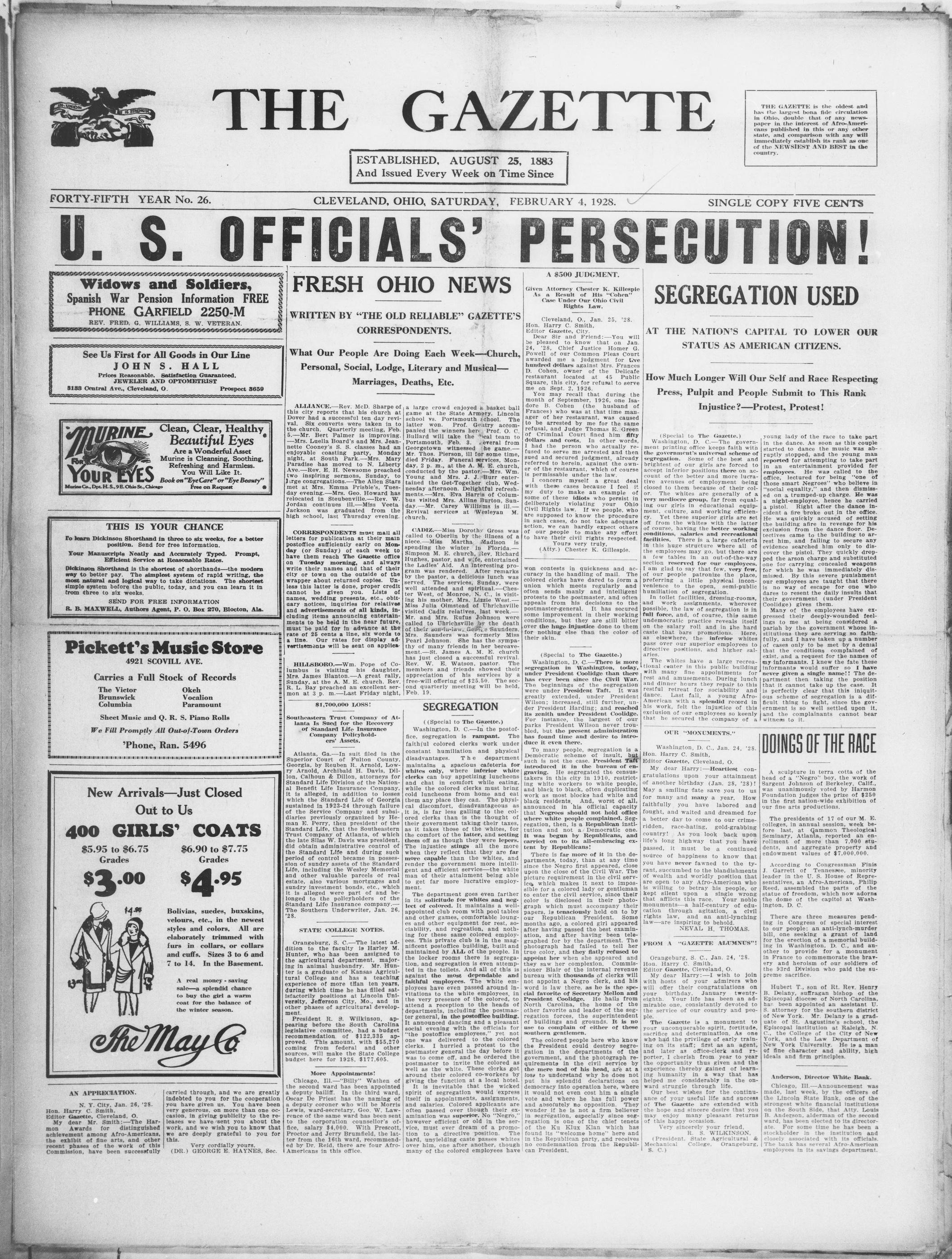
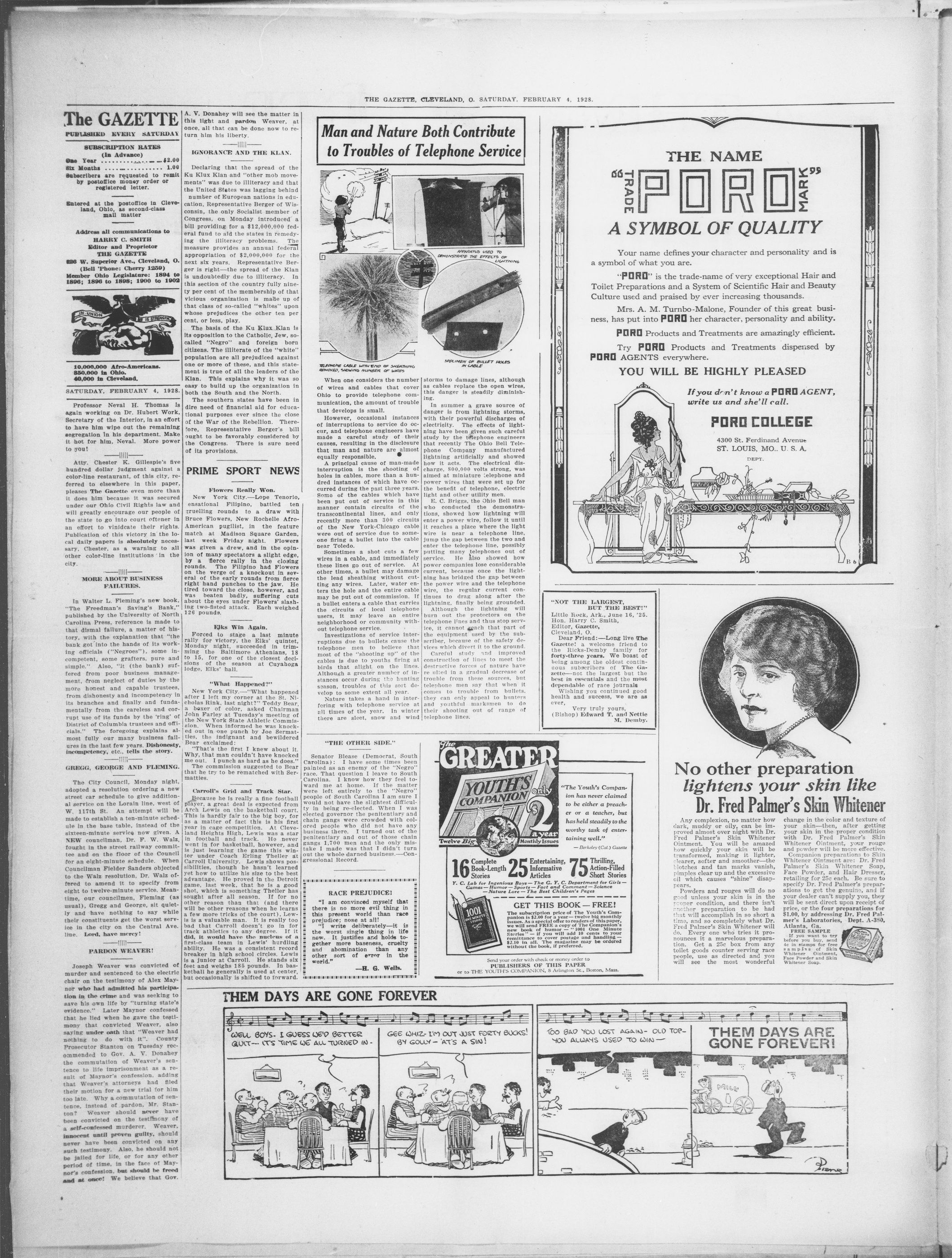
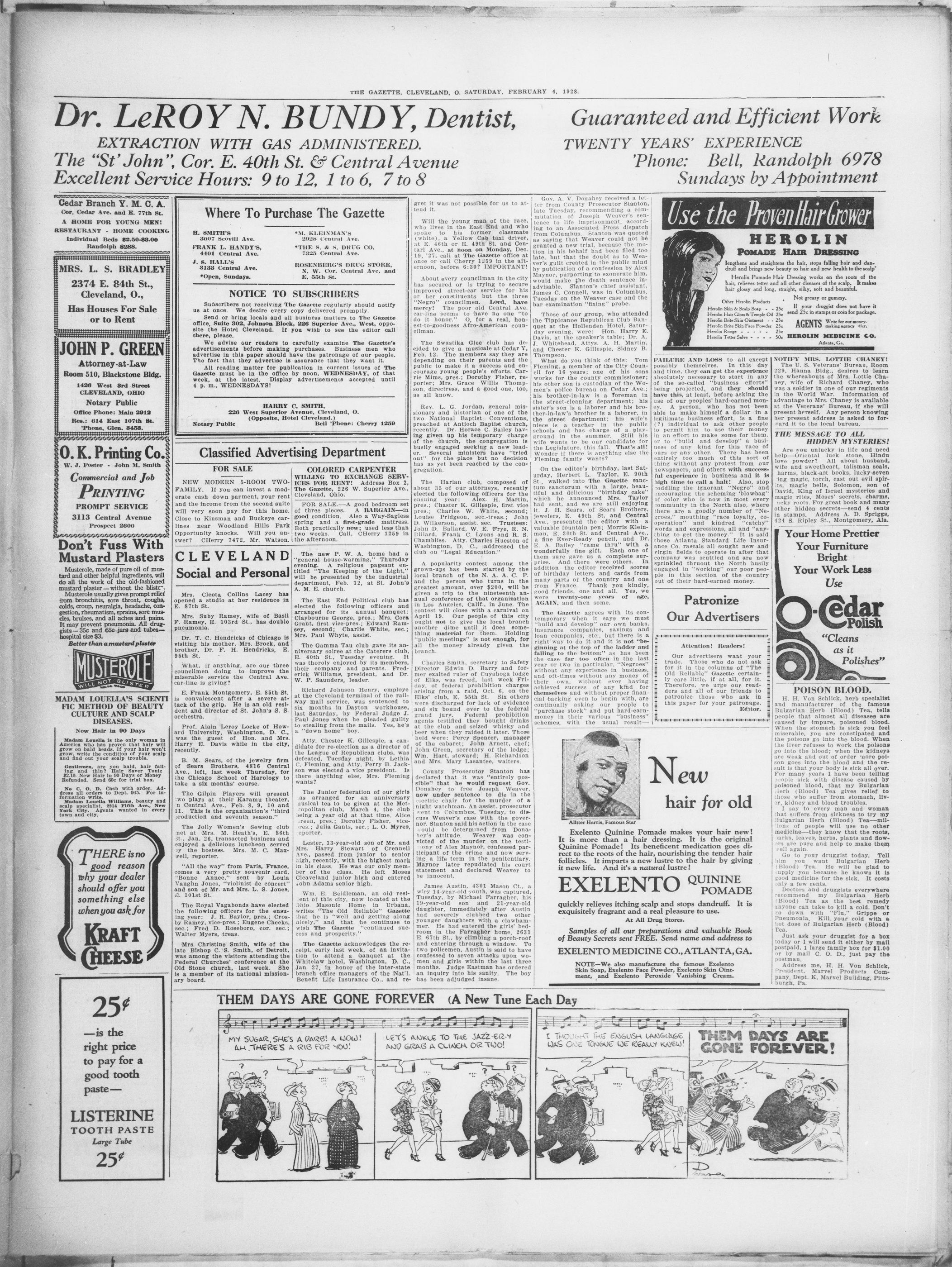
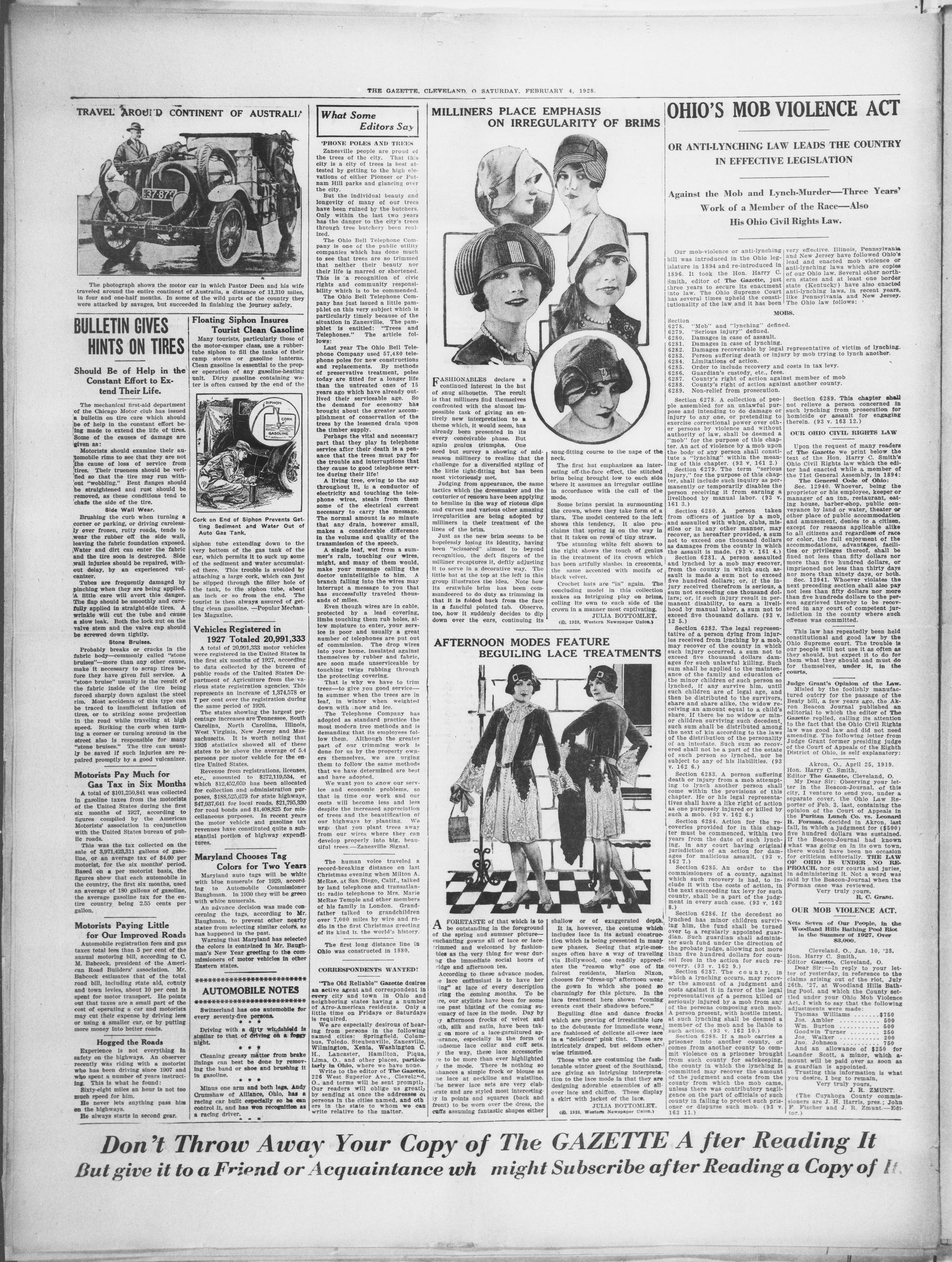
Page text (machine-generated)
IN UNION IS STRONGER
FORTY-FIFTH YEAR
U. S
Widows and
Spanish War Pension
PHONE GARD
REV. FRED. G. WILLE
See Us First for A
JOHN
Prices Reasonable.
JEWELER AN
5133 Central Ave., Cleveland,
FIFTH YEAR No. 26.
Widows and Soldiers
Rush War Pension Information
PHONE GARFIELD 2250-N
REV. FRED. G. WILLIAMS, S. W. VETERAN
Use Us First for All Goods in Our L.
JOHN S. HALL
Prices Reasonable. Satisfaction Guaranteed.
JEWELER AND OPTOMETRIST
Central Ave., Cleveland, O.
Prosp
FORTY-FIFTH YEAR No. 26.
Widows and Soldiers, Spanish War Pension Information FREE PHONE GARFIELD 2250-M REV. FRED, G. WILLIAMS, S. W. VETERAN.
See Us First for All Goods in Our Line
JOHN S. HALL
Prices Reasonable. Satisfaction Guaranteed.
JEWELER AND OPTOMETRIST
8133 Central Ave., Cleveland, O.
Prospect 3659
MURINE
FOR
YOUR EYES
Murine Co., Dpt. H.S., 9 E. Ohio St., Chicag
THIS IS YOUR CHANCE
To learn Dickinson Shorthand in
position. Send for
Your Manuscripts Neatly and
Efficient Service s
Dickinson Shorthand is the sho-
way to better pay. The simple
most natural and logical way
simple system before the pub-
lance from three to six weeks.
SEND FOR FRE
R. B. MAXWELL, Authors Ag
Pickett's N
4921 SCO
Dickinson Shorthand in three to six weeks, for
position. Send for free information.
Manuscripts Neatly and Accurately Typed. Use
Efficient Service at Reasonable Rates.
A Shorthand is the shortest of shorthands—the
better pay. The simplest system of rapid write-
ural and logical way to take dictations. The
system before the public, today, and you can lea-
ve to six weeks.
SEND FOR FREE INFORMATION
MAXWELL, Authors Agent, P. O. Box 270, Block
Bett's Music Store
4921 SCOVILL AVE.
Do learn Dickinson Shorthand in three to six weeks, for a better position. Send for free information.
Your Manuscript Neatly and Accurately Typed. Prompt, Efficient Service at Reasonable Rates.
Dickinson Shorthand is the shortest of shorthands—the modern way to better pay. The simplest system of rapid writing, the most natural and logical way to take dictations. The shortest simple system before the public, today, and you can learn it in from three to six weeks.
SEND FOR FREE INFORMATION
R. B. MAXWELL, Authors Agent, P. O. Box 270, Blocton, Ala.
Carries a Full Stock of Records
The Victor Okeh
Brunswick Vocalion
Columbia Paramount
Sheet Music and Q. R. S. Piano Rolls
We Fill Promptly All Out-of-Town Orders
The Victor Okeh
Brunswick Vocalion
Columbia Paramount
Sheet Music and Q. R. S. Piano Rolls
We Fill Promptly All Out-of-Town Orders
'Phone, Ran. 5496
New Arrivals
Out
400 GIRL
$5.95 to $6.75
Grades
$3.00
The M
New Arrivals—Just Closed
Out to Us
GIRLS' COAT
$1.95 to $6.75
Grades
$6.90 to $7.95
Grades
$3.00
$4.95
Bolivias, suedes, br
velours, etc., in the
styles and colors,
elaborately trimmed
furs in collars, or
and cuffs. Sizes 3 to
7 to 14. In the Ba
A real money-save
sale—a splendid ch
to buy the girl a w
coat for the balance
the winter season.
The May Coat
New Arrivals—Just Closed
Out to Us
400 GIRLS' COATS
$5.95 to $6.75
Grades
$3.00
$6.90 to $7.75
Grades
$4.95
Bolivias, suedes, buxskins,
velours, etc., in the newest
styles and colors. All are
elaborately trimmed with
furs in collars, or collars
and cuffs. Sizes 3 to 6 and
7 to 14. In the Basement.
A real money-saving
sale—a splendid chance
to buy the girl a warm
coat for the balance of
the winter season.
The May Co.
AN APPRECIATION
N. Y. City, Jan. 26, '28.
Hon. Harry C. Smith.
Hon. Harry C. Smith.
O.
My dear Mr. Smith:—The Harmon Awards for distinguished achievement among Afro-Americans, the exhibit of fine arts, and other recent phases of the work of this Commission, have been successfully
```markdown
```
Clean, Clear, Healthy
Beautiful Eyes
Are a Wonderful Asset
Murine is Cleansing, Soothing,
Refreshing and Harmless.
You Will Like It.
Book on "EyeCare" or "Eye Beauty"
Free on Request
in three to six weeks, for a better
for free information.
and Accurately Typed. Prompt,
at Reasonable Rates.
shortest of shorthands—the modern
oldest system of rapid writing, the
to take dictations. The shortest
music, today, and you can learn it in
REE INFORMATION
Agent, P. O. Box 270, Blocton, Ala.
Music Store
OVILL AVE.
Stock of Records
Okeh
Vocalion
Paramount
Q. R. S. Piano Rolls
All Out-of-Town Orders
Just Closed
to Us
LS' COATS
$6.90 to $7.75
Grades
$4.95
Bolivias, suedes, buxskins,
velours, etc., in the newest
styles and colors. All are
elaborately trimmed with
furs in collars, or collars
and cuffs. Sizes 3 to 6 and
7 to 14. In the Basement.
A real money-saving
sale—a splendid chance
to buy the girl a warm
coat for the balance of
the winter season.
May Co.
carried through, and we are greatly indebted to you for the cooperation you have given us. You have been very generous, on more than one occasion, in giving publicity to the releases we have sent you about the work, and we wish you to know that we are deeply grateful to you for this.
Very cordially yours.
(DR.) GEORGE E. HAYNES, Sec.
THE GAZETTE
ESTABLISHED, AUGUST 25, 1883 And Issued Every Week on Time Since
CLEVELAND, OHIO, SATURDAY, FEBRUARY 4, 1928.
FRESH OHIO NEWS
WRITTEN BY "THE OLD RELIABLE" GAZETTE'S CORRESPONDENTS.
What Our People Are Doing Each Week—Church, Personal, Social, Lodge, Literary and Musical— Marriages, Deaths, Etc.
ALLIANCE.—Rev. McD. Sharpe of this city reports that his church at Dover had a successful ten day revival. Six converters were taken in to the church. Quarterly meeting, Feb. 5.—Mrs. Bert Palmer is improving.—Mrs. Luella Board's and Mrs. Jeanne Cooney's S. s. classes had an enjoyable coasting party, Monday night, at South Park.—Mrs. Mary Paradis has moved to N. Liberty Rose.—Mrs. Joan two inspiring sermons, Sunday to urge congregations.—The Allen Stars met at Mrs. Emma Prisble's Tuesday evening.—Mrs. Geo. Howard has relocated in Steubenville.—Rev. W. Jordan continues ill.—Miss Veeta Jackson was graduated from the high school, last Thursday evening.
CORRESPONDENTS must mail all letters for publication at their main postoffice sufficiently early on Monday (or Sunday) of each week to have them reach The Gazette office on Tuesday morning, and always write their names and that of their city or town on the outside of the wrapper about returned copies. Unless this latter is done, proper credit cannot be given you. Lists of names, wedding presents, etc., obituary notices, inquiries for relatives and advertisements of all kinds, including items announcing entertainments to be heed in the near future, must be paid for in advance at the rate of 25 cents a line, six words to a line. Our rates for display advertisements will be sent on applica-
HILLSBORO.—Wm. Pope of Columbus is visiting his daughter Mrs. James Blanton.—A great rally Sunday, at the A. M. E. church. Rev R. L. Bay preached an excellent sermon at 3 p. m.—Last Friday night
$1,700,000 LOSS!
Southeastern Trust Company of Atlanta Is Sued for the Recovery of Standard Life Insurance Company Policyholders' Assets.
Atlanta, Ga.—In suit filed in the Superior Court of Fulton County Georgia, by Reuben R. Arnold, Lowry A. Arnold, Anthony H. Davison, Calhoun, Calhoun & Dillon, attorneys for Standard Life Division of the National Benefit Life Insurance Company, it is alleged, in addition to losses which the Standard Life of Georgia sustained in 1923-24 through failure of the Service Company and subsidiaries previously organized by Heman E. Perry, then president of the Standard Life, that the Southeastern Trust Company of Atlanta, of which the State W.Davison, did obtain administrative control of the Standard Life and during such period of control became in possession of sundry assets of the Standard Life, including the Wesley Memorial and other valuable parcels of real estate, also various mortgages and sundry investment bonds, etc., which it is alleged were part of and belonged to the policyholders of the Standard Life Insurance company.
The Southern Underwriter, Jan. 26, '28
STATE COLLEGE NOTES.
Orangeburg, S. C.—The latest addition to the faculty is Harley M. Hunter, who has been assigned to the agricultural department, majoring in animal husbandry. Mr. Hunter is a graduate of Kansas Agricultural College and has a teaching experience of more than ten years, during which time he has filled satisfactorily positions at Lincoln University, Jefferson City, Mo., and in other phases of agricultural development. President R. S. Wilkinson, appending before the South Carolina legislative committee, had a budget recommendation of $122,335 approved. This amount, with $55,270 coming, from federal and other sources, will make the State College budget here for 1928, $177,605.
More Appointments!
Chicago, Ill.—"Billy" Wathen of the second ward has been appointed a deputy bailiff. In the third ward, Oscar De Priest has the naming of a deputy coroner who will be Morris Lewis, ward-secretary, Geo. W. Lawrence of the same ward has been sent to the corporation counselor's office, salary $4,000. With Prescott, Lewis, ward-principal, from the 16th ward, recommended by Dr. Reid, there are four Afro-Americans in this office.
a large crowd enjoyed a basket ball game at the State Armory. Lincoln school vs. Portsmouth school. The latter won. Prof. Gentry accompanied the winners her. Prof. O. C. Bullard will take the local team to Gortwouth. Feb. 7. several from Gortwouth. Tested. Ms. Thos. Mr. Thos. Pierson, ill for some time, died Friday. Funeral services. Monday, 2 p. m., at the A. M. E. church, conducted by the pastor—Mrs. Wm. Young and Mrs. J. J. Burr entertained the Get-Together club, Wednesday afternoon. Delightful refreshments—Mrs. Eva Harris of Columbras, Mrs. J. J. Burr, Mrs. Sunday—Mr. Carey Williams is ill. Revival services at Wesleyan M. church.
CADIZ.—Miss Dorothy Gross was called to Oberlin by the illness of a niece.—Miss Martha Madison is spending the winter in Florida.—Simpson M. E. church, Rev. Richard Hughes, pastor, and wife, entertained the Ladies' Aid. An interesting program was rendered. After remarks by the pastor, a delicious lunch was served. The services, Sunday, were well attended and spiritual.—Cherier West, of Monroe, N. C., is visiting his mother, Mrs. Lizzie West.—Miss Julia Olmstead of Uhrhville visited Cadiz relatives, last week. Mr. and Mrs. Rufus Johnson were invited to their own family, of their own life. Gauss, Saunders, Mrs. Saunders was formerly Miss Pearl Johnson. She has the sympathy of many friends in her bereavement.—St. James A. M. E. church has just closed a successful revival. Rev. W. E. Watson, pastor. The members and friends showed their sympathy to the free-will offering of $25.50. The second quarterly meeting will be held, Feb. 19.
SEGREGATION
(Special to the gazette)
Washington, D. C.—In the postoffice, segregation is rampant. The faithful colored clerks work under constant humiliation and physical disadvantages. The department maintains a spacious cafeteria for whites only, where inferior white clerks can buy appetizing lunches and chat in comfort while eating, while the colored clerks must bring cold lunches from home and eat them any place they can. The physical discomfort, discontinuance as it is far less gailling to the colored clerks than is the thought of their government taking their taxes, as it takes those of the whites, for the comfort of the latter, and setting them off as though they were lepers. The injustice stings all the more when they reflect that they are far more capable than the whites, and render the government the service—the white man of their attainment able to get far more lucrative employment.
The department goes even farther in its solicitude for whites and neglect of colored. It maintains a well-appointed club room with pool tables and other games, comfortable lounges and other equipment for rest, sociability, and regression, and nothing for these same colored employees. This private club is in the magnificent postoffice building, built and the locker rooms are all full of the locker rooms there is segregation, and segregation is even attempted in the toilets. And all of this is against the most dependable and faithful employees. The white employees have even passed around invitations to the white employees, in the very presence of the colored, to attend a reception to the heads of departments, including the postmaster general, in the postoffice building. It announced dancing and a pleasant social evening with the officials for the postoffice employee, including the colored clerks. I hurried a protest to the postmaster general the day before it was to come off, and he ordered the postmaster to invite the colored as well as the white. These clerks got around their colored co-workers by giving the function at a local hotel. It is inevitable that the wicked spirit of segregation would express itself in appointments, assignments, and salaries. Colored applicants are often passed over though their examination was superior. No "Negro," however efficient, could "seal" the position to a directive position. The hard, unpleasant caste passes whites over him, one after another, though many of the colored employees have
PERSECUTION!
A $500 JUDGMENT.
Given Attorney Chester K. Killespie
As a Result of His "Cohen"
Case Under Our Ohio Civil
Rights Law.
Cleveland, O., Jan. 25, '28.
Hon. Harry C. Smith.
Editor Gazette, City.
Dear Sir and Friend:—You will be pleased to know that on Jan. 4, '28. Chief Justice Homer G. Powell of our Common Pleas Court awarded me a judgment for hundred dollars against Mrs. Frances D. Cohen, owner of the Delicate restaurant located at 45 Public Square, this city, for refusal to serve me on Sept. 2, 1926.
You may recall that during the month of September, 1926, one Isaidore B. Cohen (the husband of Thomas Cohen, that time manager of her restaurant, was caused to be arrested by me for the same refusal, and Judge Thomas E. Green of the Criminal Court fined him fifty dollars and costs. In other words, I had the person who actually refused to serve me arrested and then sued and secured judgment, already referred to herein, against the owner of the restaurant, which of course is permissible under law.
I concern myself a great deal with these cases because I feel it my duty to make an example of some of these *idiot*s who persist in deliberately violating your Ohio Civil Rights law. If we people, who are supposed to know the procedure in such cases, do not take adequate action, we can hardly expect others of our people to make any effort to have their civil rights respected. Yours very truly, (Atty.) Chester K. Gillespie.
won contests in quickness and accuracy in the handling of mail. The colored clerks have dared to form a union which meets regularly and often sends manly and intelligent protests to the postmaster, and often appeals from his decisions to the court. It has secured some improvement in their working conditions, but they are still bitter over the *huge injustice* done to them for nothing else than the color of their skin.
(Special to The Gazette.)
Washington, D. C.—There is more segregation in Washington, today, under President Coolidge than there has ever been since the Civil War. The beginnings of the segregation were under President Taft. It was greatly extended, under President Wilson; increased, still further, under President Johnson; and ended its zenith under President Coolidge. For instance, the largest of our parks President Wilson never troubled, but the present administration has found time and desire to introduce it even there.
To many people, segregation is a Democratic scheme of insult, but such is not the case. President Taft introduced it in the bureau of enforcing the laws, and called the court takers in this city in 1910, restricting white workers to white people, and black to black, often duplicating work as most blocks had white and black residents. And, worst of all, announced in his official capacity that Negroes should not hold office where white people segregated. Segregation, then, is a Republican institution. It was begun by Republicans, and carried on to its all-embracing extent by Republicans!
There is far more of it in the departments, today, than at any time since the Negro first appeared, close upon the close of the Civil War. The picture requirement in the civil service, which makes it next to impossible for a colored lady or gentleman to enter the civil service, since their color is disclosed in their photograph which must accompany the papers of the Negro. Republican President. Some months ago, a colored girl appeared after having passed the best examination, and after having been telegraphed for by the department. The photograph had failed to tell her true color, and they flatly refused to appoint her when she appeared and they saw her complexion. Commissioner Blair of the internal revenue bureau with thousands of clerks will not appoint a Negro clerk, and his word is law there, as he is the special favorite of Secretary Mellon and President Coolidge. He hails from the city of New York, the other favorite and leader of the segregation forces, the superintendent of buildings and grounds. It is no use to complain of either of these southern gentlemen.
The colored people here who know the President could destroy segregation in the departments of the government, and the photograph requirements in the civil service by the mere nod of his head, are at a loss to understand why he does not vote in the presidential democracy into operation here, where it would not even cost him a single vote and where he has full power and assoultely no opposition. They wonder if he is not a firm believer in segregation, especially since segregation is one of the chief tenets of the Ku Klux Klan which has found its "welcome home" here and in the American party, and receives no condemnation from the Republican President.
SINGLE COPY FIVE CENTS
AT THE NATION'S CAPITAL TO LOWER OUR STATUS AS AMERICAN CITIZENS.
How Much Longer Will Our Self and Race Respecting Press, Pulpit and People Submit to This Rank Injustice?—Protest, Protest!
(Special to The Gazette.)
(Special to The Gazette.)
Washington, D. C. The government printing office keeps faith with the government's universal scheme of segregation. Some of the best and brightest of the girls are accepted inferior positions there on account of the better and more lucrative avenues of employment being closed to them because of their color. The whites are generally of a very mediocre group, far from equaling our girls in educational equipment, culture, and working efficiency. Yet these superior girls are set off from the whites with the latter of course, having the better working conditions, salaries and recreational facilities. There is a large cafeteria in this huge structure where all of the girls may go, but there are a few tables. Out-of-the-way section reserved for our students. I am glad to say that few, very few, of our people patronize the place, preferring a little physical inconvenience to the open, semi-public humiliation of segregation. In toilet facilities, dressing-rooms, and work assignments, wherever possible, the law of segregation is in full force, and, of course, this same undemocratic practice reveals itself on the salary roll and in the hard caste that bars promotions. Here, as elsewhere, the inferior whites pass over our superior employees to directive positions, and higher salaries.
The whites have a large recreational center in this public building with many fine appointments for rest and amusements. During lunch and dinner hours they repair to this restful retreat for sociability and last fall, a young Afro-American expedition record in his work, felt the injustice in his exclusion of our employees so keep that he secured the company of a
OUR "MONUMENTS."
Washington, D. C., Jan. 24, '28.
Hon. Harry C. Smith,
Editor Gazette, Cleveland, O.
My dear Harry:—Heartiest congratulations upon your attainment of another birthday (Jan. 28, '28)! May a smiling fate save you to us for many and many a year. How faithfully you have labored and fought, and waited and dreamed for a better day to come to our crime-ridden, race-hating, gold-grabbing country! As you look back upon life's long highway that you have passed, it must be a continued source of happiness to know that you have never fawned to the tyrant, succumbed to the blandishments of wealth and worldly position that are open to any Afro-American who is willing to betray his people, or kept silent in a single wrong that afflicts this race of monuments—a half-century of education through agitation, a civil rights law, and an anti-lynching law—are inspiring to behold.
NEVAL H. THOMAS.
FROM A "GAZETTE ALUMNUS"!
Orangeburg, S. C., Jan. 24, '28.
Hon. Harry C. Smith.
Editor Gazette, Cleveland, O.
My dear Harry:—I wish to join with hosts of your admirers who will offer their congratulations on your birthday. January twenty-eighth. Your life has been an admirable one, consistently devoted to the service of our country and people.
The Gazette is a monument to your unquencher spirit, fortitude, sacrifice and determination. As one who had the privilege of early training on its staff; first as an agent, and later as office-clerk and reporter, I cherish from year to year the opportunity thus given and the experience thereby gained of learning humanity in a way that has helped me considerably in the onward struggle through life.
Our best wishes for the continuance of your useful life and success of The Gazette are extended with the hope and sincere desire that you may enjoy many pleasant returns of this happy occasion.
Very sincerely your friend,
R. S. WILKINSON,
(President, State Agricultural & Mechanical College, Orangeburg, S. C.)
THE GAZETTE is the oldest and has the largest bona fide circulation in Ohio, double that of any newspaper in the interest of Afro-Americans published in this or any other country. We immediately establish its rank as one of the NEWSIEST AND BEST in the country.
THE COPY FIVE CENTS
TION!
TION USED
CAPITAL TO LOWER OUR
AMERICAN CITIZENS.
Our Self and Race Respecting
ople Submit to This Rank
-Protest, Protest!
young lady of the race to take part in the dance. As soon as this couple started to dance the music was abruptly stopped, and the young man reported for attempting to take part in an entertainment provided for employees. He was called to the office, lectured for being "one of those smart Negroes" who believe in "social equality," and then dismissed on a trumped-up charge. He was a night-employee. He was arrested after the dance incident a fire broke out in the office. He was quickly accused of setting the building afire in revenge for his exclusion from the dance floor. Detectives came to the building to arrest him, and failing to secure any evidence searched him only to discover the pistol. They quickly dropped the arson charge and substituted one for carrying concealed weapons for which he was immediately dismissed. By this severe punishment our employees are taught that they dare to resent the daily insults that their government (under President Coolidge) gives them.
Many of the employees have expressed their deeply-wounded feelings to me at being considered a pariah by the government whose institutions they are serving so faithfully, and I have taken up a number of cases only to be met by a denial that the conditions complained of exist, and a request for the names of my informants. I know the fate these informants would suffer so I have never given a single name!! The department then taking the position that it cannot take up the case. It is perfectly clear that this iniquitous scheme of segregation is a difficult thing to fight, since the government is so well settled upon it, and the complainants cannot bear witness to it.
DOINGS OF THE RACE
A sculpture in terra cotta of the head of a "Negro" boy, the work of Sargent Johnson of Berkeley, Calif., was unanimously voted by Harmon Foundation judges the prize of $250 in the first nation-wide exhibition of our fine arts productions.
The presidents of 17 of our M. E. colleges, in annual session, week before last, at Gammon Theological Seminary, Atlanta, reported an enrollment of more than 7,000 students, and aggregate property and endowment values of $7,000,000.
According to Congressman Finnis J. Garrett of Tennessee, minority leader in the U. S. House of Representatives, an Afro-American, Philip Reed, assembled the parts of the statue of freedom, which now adorns the dome of the capitol at Washington, D. C.
There are three measures pending in Congress of special interest to our people: an anti-lynch-murder bill, one seeking a grant of land for the erection of a memorial building in Washington, D. C., and another to provide for a monument in France to commemorate the bravery and heroism of our soldiers of the 93rd Division who paid the supreme sacrifice.
Hubert T., son of Rt. Rev. Henry B. Delany, suffragan bishop of the Episcopal diocese of North Carolina, has been appointed an assistant U. S. attorney for the southern district of New York. Mr. Delany is a graduate of St. Augustine's school, the Episcopal institution at Raleigh, N. C., the College of the City of New York, and the Law Department of New York University. He is a man of fine character and ability, high ideals and firm principles.
Anderson, Director White Bank.
Chicago, Ill.—Announcement was made, last week, by the officers of the Lincoln State Bank, one of the strongest white financial institutions on the South Side, that Atty. Louis B. Anderson, alderman of the second ward, has been elected to its directorate. For some time he has been a stockholder in the institution and closely associated with its officials. The bank has several Afro-American employees in its savings department.
PUBLISHED EVERY SATURDAY
One Year ..... $2.00
Six Months ..... 1.00
Subscribers are requested to remit
by postoffice money order or
registered letter.
Entered at the postoffice in Cleveland, Ohio, as second-class
mail matter
Address all communications to
HARRY C. SMITH
Editor and Proprietor
THE GAZETTE
826 W. Superior Ave., Cleveland, O.
(Bell 'Phone: Cherry 1259)
Member Ohio Legislature: 1894 to
1896; 1896 to 1898; 1900 to 1902
IN UNION IS STRONGER
10,000,000 Afro-Americans.
850,000 in Ohio.
40,000 in Cleveland.
SATURDAY, FEBRUARY 4, 1928
Professor Neval H. Thomas is again working on Dr. Hubert Work.
Secretary of the Interior, in an effort to have him wipe out the remaining segregation in his department. Make it hot for him. Neval. More power to you!
---
Atty. Chester K. Gillespie's five hundred dollar judgment against a color-line restaurant, of this city, referred to elsewhere in this paper, pleases The Gazette even more than it does him because it was secured under our Ohio Civil Rights law and will greatly encourage our people of the state to go into court offender in an effort to vinidicate their rights. Publication of this victory in the local daily papers is absolutely necessary. Chester, as a warning to all other color-line institutions in the city.
MORE ABOUT BUSINESS
FAILURES.
In Walter L. Fleming's new book, "The Freedman's Saving's Bank," published by the University of North Carolina Press, reference is made to that dismal failure, a matter of history, with the explanation that "the bank got into the hands of its working officials ("Negroes"), some incompetent, some grafters, pure and simple." Also, "it (the bank) suffered from poor business management, from neglect of duties by the more honest and capable trustees, from dishonesty and incompetency in its branches and finally and fundamentally from the careless and corrupt use of its funds by the 'ring' of District of Columbia trustees and officials." The foregoing explains almost fully our many business failures in the last few years. Dishonesty incompetency, etc., tells the story.
GREGG. GEORGE AND FLEMING.
The City Council, Monday night, adopted a resolution ordering a new street car schedule to give additional service on the Lorain line, west of W. 117th St. An attempt will be made to establish a ten-minute schedule in the base table, instead of the sixteen-minute service now given. A NEW councilman, Dr. F. W. Walz fought in the street railway committee and on the floor of the Council for an eight-minute schedule. When Councilman Fielder Sanders objected to the Walz resolution, Dr. Walz offered to amend it to specify from eight to twelve-minute service. Meantime, our councilmen, Fleming (as usual), Gregg and George, sit quietly and have nothing to say while their constituents get the worst service in the city on the Central Ave. line. Lord, have mercy!
PARDON WEAVER!
Joseph Weaver was convicted of murder and sentenced to the electric chair on the testimony of Alex Maynor who had admitted his participation in the crime and was seeking to save his own life by "turning state's evidence." Later Maynor confessed that he lied when he gave the testimony that convicted Weaver, also saying under oath that "Weaver had nothing to do with it". County Prosecutor Stanton on Tuesday recommended to Gov. A. V. Donahey the commutation of Weaver's sentence to life imprisonment as a result of Maynor's confession, adding that Weaver's attorneys had filed their motion for a new trial for him too late. Why a commutation of sentence, instead of pardon, Mr. Stanton? Weaver should never have been convicted on the testimony of a self-confessed murderer. Weaver, innocent until proven guilty, should never have been convicted on any such testimony. Also, he should not be jailed for life, or for any other period of time, in the face of Maynor's confession, but should be freed and at once! We believe that Gov.
.
THEM DAYS ARE GONE FOREVER
WELL BOYS- I GUESS WE'D BETTER QUIT--- IT'S TIME WE ALL TURNED IN-
GEE WHIZ- I'M OUT JUST FORTY BUCKS! BY GOLLY- 'AT'S A SIN!
A. V. Donahay will see the matter in this light and pardon Weaver, at once, all that can be done now to return him his liberty.
IGNORANCE AND THE KLAN
Declaring that the spread of the Ku Klux Klan and "other mob movements" was due to illiteracy and that the United States was lagging behind number of European nations in education, Representative Berger of Wisconsin, the only Socialist member of Congress, on Monday introduced a bill providing for a $12,000,000 federal fund to aid the states in remedying the illiteracy problems. The measure provides an annual federal appropriation of $2,000,000 for the next six years. Representative Berger is right—the spread of the Klan is undoubtedly due to illiteracy. In this section of the country fully ninety per cent of the membership of that vicious organization is made up of that class of so-called "whites" upon whose prejudices the other ten per cent, or less, play.
The basis of the Ku Klux Klan is its opposition to the Catholic, Jew, so-called "Negro" and foreign born citizens. The illiterate of the "white" population are all prejudiced against one or more of these, and this statement is true of all the leaders of the Klan. This explains why it was so easy to build up the organization in both the South and the North. The southern states have been in dire need of financial aid for educational purposes ever since the close of the War of the Rebellion. Therefore, Representative Berger's bill ought to be favorably considered by the Congress. There is sure need of its provisions.
PRIME SPORT NEWS
Flowers Really Won.
New York City—Lope Tenorio,
ensational Filipino, battled ten
gruelling rounds to a draw with
Bruce Flowers, New Rochelle Afro-
American pugilist, in the feature
match at Madison Square Garden,
last week Friday night. Flowers
was given a drew, and in the opinion
of many spectators a slight edge,
by a fierce rally in the closing
rounds. The Filipino had Flowers
on the verge of a knockout in several
of the early rounds from fierce
right hand punches to the jaw. He
was beaten the close, however, and
was beaten the offence, about
about the eyes under Flowers' slashing
two-fisted attack. Each weighed
126 pounds.
Elks Win Again
Forced to stage a last minute rally for victory, the Elks' quintet, Monday night, succeeded in trimming in Baltimore Athenians, 18 to 15. For the closest decisions of the season at Cuyaloga lodge, Elks' hall.
"What Happened?"
New York City.—"What happened after I left my corner at the St. Nicholas Rink, last night?" Teddy Bear, a boxer of color, asked Chairman Foarley at Tuesday's meeting of the New York City board of commission. When informed he was knocked out in one punch by Joe Sermatties, the indignant and bewildered Bear exclaimed: "That's the first I knew about it. Why, that man couldn't have knocked me out. I punch as hard as he does." The commission suggested to Bear that he try to be rematched with Sermatties.
Carroll's Grid and Track Star.
Because he is really a fine football player, a great deal is expected from Arch Lewis on the basketball court. This is hardly fair to the big boy, for as a matter of fact this is his first year in cage competition. At Cleveland Heights High, Lewis was a star player, and he went in for basketball, however he is just learning the game this winter under Coach Erling Theller at Carroll University. Lewis shows possibilities, though he hasn't learned yet how to utilize his size to the best advantage. He proved in the Detroit game, last week, that he is a good shot, which is something Theller has sought after all season. If for no reason will he other reasons when he learns a few more tricks of the court), Lewis is a valuable man. It is really too bad that Carroll doesn't go in for track athletics to any degree. If it did, it would have the nucleus of a first-class team in Lewis' hardling ability. He was a consistent record breaker in high school circles. Lewis was a star player in both feet and weighs 185 pounds. In basketball he generally is used at center, but occasionally is shifted to forward.
THE GAZETTE, CLEVELAND, O. SATURDAY, FEBRUARY 4, 1928.
Man and Nature Both Contribute to Troubles of Telephone Service
Man and Nature Both Contribute to Troubles of Telephone Service
APPARATUS USED TO
DEMONSTRATE THE EFFECTS OF
LIGHTNING
SPECIMEN OF BULLET HOLES
TELEPHONE CABLE WITH END OF SHEATHING
REMOVED, SHOWING NUMBER OF WIRES
When one considers the number
of wires and cables that cover
Ohio to provide telephone com-
munication, the amount of trouble
that develops is small.
However, occasional instances
of interruptions to service do occur, and telephone engineers have made a careful study of their causes, resulting in the disclosure that man and nature are almost equally responsible.
A principal cause of man-made interruption is the shooting of holes in cables, more than a hundred instances of which have occurred during the past three years. Some of the cables which have been put out of service in this manner contain circuits of the transcontinental lines, and only recently more than 300 circuits of the New York-Chicago cable were out of service due to someone firing a bullet into the cable near Toledo. Sometimes a shot cuts a few wires in a cable, and immediately these lines go out of service. At other times, a bullet may damage the lead sheathing without cutting any wires. Later, water enters the hole and the entire cable may be put out of commission. If a bullet enters a cable that carries the circuits of local telephone users, it may leave an entire neighborhood or community with out telephone service.
Investigations of service interruptions due to bullets cause the telephone men to believe than most of the "shooting up" of the cables is due to youths firing at birds that alight on the lines. Although a greater number of instances occur during the hunting season, troubles of this sort develop to some extent all year. Nature takes a hand in interfering with telephone service at all times of the year. In winter there are sleet, snow and wind
"THE OTHER SIDE."
Senator Blease (Democrat, South Carolina): I have some times been painted as an enemy of the "Negro" race. That question I leave to South Carolina. I know how they feel toward me at home. If the matter were left entirely to the "Negro" people of South Carolina I am sure I would not have the slightest difficulty in being re-elected. When I was elected governor the penitentiary and chain gangs were crowded with colored people who did not have any business in the penitentiary and out of those chain gangs 1,700 men and the only mistake I made was that I didn't turn out the whole darned business.—Congressional Record.
RACE PREJUDICE
"I am convinced myself that there is no more evil thing in this present world than race prejudice; none at all!
"I write deliberately—it is the worst single thing in life now. It justifies and holds together more baseness, cruelty and abomination than any other sort of error in the world."
—H. G. Wells.
The GREATER YOUTH'S COMPANION only a year Twelve Big Monthly Issues
"The Youth's Companion has never claimed to be either a preacher or a teacher, but has held steadily to the worthy task of entertaining well."
-Berkley (Cal.) Gazette
16 Complete Book-Length Stories 25 Entertaining, Informative Articles 75 Thrilling, Action-Filled Short Stories
Y. C. Lab for Ingenious Boy—The G. Y. C. Department for Girls—Games—Humor—Sports—Fact and Comment—Science—Nature Lore—The Best Children's Pages
1001 ONE MINUTE TOURS
GET THIS BOOK — FREE!
The subscription price of The Youth's Companion is $2.00 for a year—twelve big monthly issues. As a special offer to readers of this paper, we will send FREE a copy of The Companion's new book of humor—"1001 One Minute Stories"—if you will add 10 cents to your remittance to cover postage and handling—$2.10 in all. The magazine may be ordered without the book, if preferred.
Send your order with check or money order to PUBLISHERS OF THIS PAPER or to THE YOUTH'S COMPANION, 8 Arlington St., Boston, Mass.
SPEMEN OF BULLET HOLES
IN CABLE
storms to damage lines, although
as cables replace the open wires,
this danger is steadily diminishing.
In summer a grave source of
danger is from lightning storms,
with their powerful discharges
of electricity. The effects of lightning
have been given such careful
study by the telephone engineers
that recently The Ohio Bell
Telephone Company manufactured
lightning artificially and showed
how it acts. The electrical discharge,
800,000 volts strong, was aimed at miniature telephone and
power wires that were set up for
the benefit of telephone, electric
light and other utility men.
E. C. Briggs, the Ohio Bell man who conducted the demonstrations, showed how lightning will enter a power wire, follow it until it reaches a place where the light wire is near a telephone line, jump the gap between the two and enter the telephone line, possibly putting many telephones out of service. He also showed how power companies lose considerable current, because once the lightning has bridged the gap between the power wire and the telephone wire, the regular current continues to drag along after the lightning, finally being grounded. Although the lightning will burn out the protectors on the telephone lines and thus stop service, it cannot grapp that part of the equipment used by the subscriber, because of the safety devices which divert it to the ground. Careful study and improved construction of lines to meet the destructive forces of nature have relied in a gradual decrease of trouble from these sources, but telephone men say that when it comes to trouble from bullets, they can only appeal to hunters and youthful marksmans to do their shooting out of range of telephone lines.
THE NAME
TRADE PORO MARK
A SYMBOL OF QUALITY
Your name defines your character and personality and is a symbol of what you are.
"PORO" is the trade-name of very exceptional Hair and Toilet Preparations and a System of Scientific Hair and Beauty Culture used and praised by ever increasing thousands.
Mrs. A. M. Turnbo-Malone, Founder of this great business, has put into PORO her character, personality and ability.
PORO Products and Treatments are amazingly efficient.
Try PORO Products and Treatments dispensed by PORO AGENTS everywhere.
YOU WILL BE HIGHLY PLEASED
If you don't know a PORO AGENT, write us and she'll call.
PORO COLLEGE
4300 St. Ferdinand Avenue
ST. LOUIS, MO.. U. S. A.
DEPT.
TOO BAD YOU LOST AGAIN- OLD TOP-
YOU ALWAYS USED TO WIN
THEM DAYS ARE
GONE FOREVER!
BUT THE BEST!"
Little Rock, Ark., June 16, '25.
Hon. Harry C. Smith,
Editor, Gazette,
Cleveland, O.
Dear Friend!—Long live The Gazette! a welcome friend to the Ricks-Demby family for forty-three years. We boast of being among the oldest continuous subscribers of The Gazette—not the largest but the best in essentials and the most dependable of race journals.
Wishing you continued good health and success, we are as ever.
Very truly yours,
(Bishop Edward T. and Nettie M, Demby.
A. E.
No other preparation lightens your skin like Dr. Fred Palmer's Skin Whitener
Any complexion, no matter how dark, muddy or oily, can be improved almost over night with Dr. Fred Palmer's Skin Whitener Ointment. You will be amazed how quickly your skin will be transformed, making it lighter, clearer, softer and smoother—the blotches and tan marks vanish, pimples clear up and the excessive oil which causes "shine" disappears.
Powders and rouges will do no good unless your skin is in the proper condition, and there isn't another preparation to be had that will accomplish in so short a time, and so complicate. Fred Palmer's Skin Whitener will do. Every one who tries it pronounces it a marvelous preparation. Get a 25c box from any toilet goods counter serving race people, use as directed and you will see the most wonderful
change in the color and texture of your skin—then, after getting your skin in the proper condition with Dr. Fred Palmer's Skin Whitener Ointment, your rouge and powder will be more effective. Companion preparations to Skin Whitener Ointment are: Dr. Fred Palmer's Skin Whitener Soap, Face Powder, and Hair Dresser, retailing for 25c each. Be sure to specify Dr. Fred Palmer's preparations to get the genuine, and if your dealer can't supply you, they will be sent direct upon receipt of price, or the four preparations or the addressing Dr. Fred Palmer's Laboratories, Dept. A-380, Atlanta, *C*
MILK CHEESE
MILK CHEESE
MILK CHEESE
FREE SAMPLE
If you want to try
buy, sell, or
deci in stamps,
free
samples of a
skin's Whitener
Ointment,
Face powder and Skin
cream.
Don't Throw Away Your Copy of The GAZETTE After Reading It But give it to a Friend or Acquaintance wh might Subscribe after Reading a Copy of It
37-873
The photograph shows the motor car in which Pastor Deen and his wife traveled around the entire continent of Australia, a distance of 11,310 miles, in four and one-half months. In some of the wild parts of the country they were attacked by savages, but succeeded in finishing the journey safely.
BULLETIN GIVES HINTS ON TIRES
Should Be of Help in the Constant Effort to Extend Their Life.
The mechanical first-aid department of the Chicago Motor club has issued a bulletin on tire care which should be of help in the constant effort being made to extend the life of tires. Some of the causes of damage are given as:
Motorists should examine their automobile rims to see that they are not the cause of loss of service from tires. Their trueness should be verified so that the tire may run without "wobbling." Bent flanges should be straightened and rust should be removed, as these conditions tend to chafe the side of the tire.
Side Wall Wear.
Brushing the curb when turning a corner or parking, or driving carelessly over frozen, rutty roads, tends to wear the rubber off the side wall, leaving the fabric foundation exposed. Water and dirt can enter the fabric and the tire soon is destroyed. Side wall injuries should be repaired, without delay, by an experienced vulcanizer. Tubes are frequently damaged by pinching when they are being applied. A little care will avert this danger. The flap should be smoothly and carefully applied in straight-side tires. A wrinkle will cut the tube and cause a slow leak. Both the lock nut on the valve stem and the valve cap should be screwed down tightly.
Stone Bruises.
Probably breaks or cracks in the fabric body—commonly called "stone brushes"—more than any other cause, make it necessary to scrap tires before they have given full service. A "stone briste" usually is the result of the fabric inside of the tire being forced sharply down against the steel rim. Most accidents of this type can be traced to insufficient inflation of tires, or to striking some projection in the road while traveling at high speed. Striking the curb when turning a corner or turning around in the street also is responsible for many "stone brushes." The tire can usually be saved if such injuries are repaired promptly by a good vulcanizer.
Motorists Pay Much for
Gas Tax in Six Months
A total of $101,250,841 was collected in gasoline taxes from the motorists of the United States during the first six months of 1927, according to figures compiled by the American Motorists' association in conjunction with the United States bureau of public roads.
This was the tax collected on the sale of 3,971,428,311 gallons of gasoline, or an average tax of $4.60 per motorist, for the six months' period.
Based on a per motorist basis, the figures show that each automobile in the country, the first six months, used an average of 180 gallons of gasoline, the average gasoline tax for the entire country being 2.55 cents per gallon.
Motorists Paying Little
for Our Improved Roads
Automobile registration fees and gas taxes total less than 5 per cent of the annual motoring bill, according to C. M. Babcock, president of the American Road Builders' association. Mr. Babcock estimates that of the total road bill, including state aid, county and town levies, about 10 per cent is spent for motor transport. He points out that taxes are a small part of the cost of operating a car and motorists may cut their expense by driving less or using a smaller car, or by putting more money into better roads.
Hogged the Roads
Experience is not everything In safety on the highways. An observer recently was riding with a motorist who has been driving since 1907 and who spent a number of years instructing. This is what he found: Sixty-eight miles an hour is not too much speed for him. He never lets anything pass him
He never lets anything pass him on the highways.
He always starts in second gear.
Floating Siphon Insures
Tourist Clean Gasoline Many tourists, particularly those of the motor-camper class, use a rubber-tube siphon to fill the tanks of their camp stoves or gasoline lanters. Clean gasoline is essential to the proper operation of any gasoline-heating unit. Dirty gasoline containing water is often caused by the end of the
SIPHON
CORK
GASOLINE
Cork on End of Siphon Prevents Getting Sediment and Water Out of Auto Gas Tank.
siphon tube extending down to the very bottom of the gas tank of the car, which permits it to suck up some of the sediment and water accumulated there. This trouble is avoided by attaching a large cork, which can just be slipped through the filter hole of the tank, to the siphon tube, about an inch or so from the end. The tourist is then always assured of getting clean gasoline. —Popular Mechanics Magazine.
Vehicles Registered in
1927 Totaled 20,991,333 A total of 20,991,333 motor vehicles were registered in the United States in the first six months of 1927, according to data collected by the bureau of public roads of the United States Department of Agriculture from the various state registration agencies. This represents an increase of 1,374,578 or 7 per cent over the registration during the same period of 1926. The states showing the largest percentage increases are Tennessee, South Carolina, North Carolina, Illinois, West Virginia, New Jersey and Massachusetts. It is worth noting that 1926 statistics showed all of these states to be above the average of 54 persons per motor vehicle for the entire United States.
Revenue from registrations, licenses, etc., amounted to $272,119,534, of which $12,452,050 has been allocated for collection and administration purposes, $188,252,679 for state highways, $47,937,641 for local roads, $21,765,350 for road bonds and $1,408,825 for miscellaneous purposes. In recent years the motor vehicle and gasoline tax revenues have constituted quite a substantial portion of highway expenditures.
Maryland Chooses Tag
Colors for Two Years
Maryland auto tags will be white with blue numerals for 1920, according to Automobile Commissioner Baughman. In 1930 they will be green with white numerals.
An advance decision was made concerning the tags, according to Mr. Baughman, to prevent other nearby states from selecting similar colors, as has happened in the past.
Warning that Maryland has selected the colors is contained in Mr. Baughman's New Year greeting to the commissioners of motor vehicles in other Eastern states.
************************************************************
AUTOMOBILE NOTES
Switzerland has one automobile for every seventy-five persons.
Driving with a dirty windshield is similar to that of driving on a foggy night.
Cleaning greasy matter from brake linings can best be done by removing the band or shoe and brushing it in gasoline.
Minus one arm and both legs, Andy Crumshaw of Alliance, Ohio, has a racing car built especially so he can control it, and has won recognition as a racing driver.
THE GAZETTE, CLEVELAND, O SATURDAY, FEBRUARY 4, 1928.
What Some Editors Say
'PHONE POLES AND TREES
Zanesville people are proud of
the trees of the city. That this
city is a city of trees is best
attested by getting to the high elev-
ations of either Pioneer or Putnam Hill parks and glancing over the city.
But the individual beauty and
longevity of many of our trees
have been ruined by the butchers.
Only within the last two years
has the danger to the city's trees
through tree butchery been real-
ized.
The Ohio Bell Telephone Company is one of the public utility
companies which has done much
to see that trees are so trimmed
that neither their beauty nor
their life is marred or shortened.
This is a recognition of civic
rights and community responsi-
bility which is to be commended.
The Ohio Bell Telephone Company has just issued a little pamphlet on this very subject which is particularly timely because of the situation in Zanesville. The pamphlet is entitled: "Trees and Telephones." The article follows:
Last year The Ohio Bell Telephone Company used 57,480 telephone poles for new constructions and replacements. By methods of preservative treatment, poles today are fitted for a longer life than the untreated ones of 15 years ago which have already outlived their serviceable age. So the demand for economy has brought about the greater accomplishment of conservation of the trees by the lessened drain upon the timber supply.
Perhaps the vital and necessary part that they play in telephone service after their death is a pence that the trees must pay for the trouble and interruptions that they cause to good telephone service during their life!
A living tree, owing to the sap throughout it, is a conductor of electricity and touching the telephone wires, steals from them some of the electrical current necessary to carry the message. The normal amount is so minute that any drain, however small, makes a considerable difference in the volume and quality of the transmission of the speech.
A single leaf, wet from a summer's rain, touching our wires, and many of them would, make your message calling the doctor unintelligible to him.
A branch falling into the wires may interrupt a message to you that has successfully traveled thousands of miles.
Even though wires are in cable, protected by a lead covering, limbs touching them rub holes, a low moisture to enter, your service is poor and usually a great number of telephones are put out of commission. The drop wires into your home, insulated against themselves by rubber and fabric, are soon made unserviceable by touching twigs rubbing through the protecting covering.
That is why we have to trim trees—to give you good service—in summer when the trees are in leaf, in winter when weighted down with snow and ice.
The Telephone Company has adopted as standard practice the most modern tree methods and is demanding that its employees follow them. Although the greater part of our trimming work is done for us by the property owners themselves, we are urging them to follow the same methods that we have determined are best and have adopted.
We want you to know our service and economic problems, so that in time our work and our costs will become less and less despite the increased appreciation of trees and the beautification of our highways by planting. We urge that you plant trees away from our wires where they can develop properly into big, beautiful trees.—Zanesville Signal.
The human voice traveled a record-breaking distance on last Christmas evening when Milton A. McRae, at San Diego, Calif., talked by land telephone and transatlantic radio telephone to Marie McRae Temple and other members of his family in London. Grandfather talked to grandchildren over 7,000 miles by wire and radio in the first Christmas greeting of its kind ir. the world's history.
The first long distance line in Ohio was constructed in 1880.
CORRESPONDENTS WANTED!
"The Old Reliable" Gazette desires an active agent and correspondent in every city and town in Ohio and neighboring states having a number of Afro-American residents. Only a little time on Fridays or Saturdays is required.
We are especially desirous of hearing from persons in the following named cities: Springfield, Columbus, Toledo, Steubenville, Zanesville, Wilmington, Xenia, Washington C. H., Lancaster, Hamilton, Piqua, Lima, O., and other places, particularly in Ohio, where we have none.
Write to the editor of The Gazette, 226 N. 10th St., Steubenville, O., and terms will be sent promptly.
Our readers will oblige us greatly, by sending at once the addresses of persons in the cities named, and others in the state to whom we can write relative to the matter.
MILLINERS PLACE EMPHASIS ON IRREGULARITY OF BRIMS
FASHIONABLES declare a continued interest in the hat of snug silhouette. The result is that milliners find themselves confronted with the almost impossible task of giving an entirely new interpretation to a theme which, it would seem, has already been presented in its every conceivable phase. But
AFTERNOON MODES FEATURE BEGUILING LACE TREATMENTS
THE FASHION OF THE TWENTIES
need but survey a showing of mid-season millinery to realize that the challenge for a diversified styling of the little tight-fitting hat has been most victoriously met.
Judging from appearance, the same tactics which the dressmaker and the couturier of renown have been applying to hemline in the way of riotous dips and curves and various other amazing irregularities are being adopted by milliners in their treatment of the lines of the brim.
Just as the new brim seems to be hopelessly losing its Identity, having been "scissored" almost to beyond recognition, the deft fingers of the milliner recaptures it, deftly adjusting it to serve in a decorative way. The little hat at the top at the left in this group illustrates the idea. Note how its erstwhile brim has been commerced to do duty as trimming in that it is folded back from the face in a fanciful pointed tab. Observe, too, how it suddenly decides to dip down over the ears, continuing its
AFTERNOON MODE
BEGUILING
A FORETASLE of that which is to be outstanding in the foreground of the spring and summer picture—enchanting gowns all of lace or lace-trimmed and welcomed by fashion-bles as the very thing for wear during the immediate social hours of ridge and afternoon tea.
According to these advance modes, the lace enthusiast is to have her "bling" at lace of every description during the coming months. To be sure, our stylists have been for some one past hinting of the coming supremacy of lace in the mode. Day by day afternoon frocks of velvet and both, silk and satin, have been taken on more of a lace-garnitured appearance, especially in the form of some lace collar and cuff sets, by the way, these lace accessories are to be more than ever highlighted by the mode. There is nothing so enhances a simple frock or blouse as the lace at neckline and waistline. The newer lace sets are very elaborate and are styled most interestingly in points and squares (back and front) to be worn over the dress, the cupping assumes fantastic shapes either
py of The ce wh might
sung-fitting course to the nape of the neck.
The first hat emphasizes an interesting off-the-face effect, the stitched brim being brought low to each side where it assumes an irregular outline in accordance with the call of the mode.
Some brims persist in surmounting the crown, where they take form of a tiara. The model centered to the left shows this tendency. It also proclaims that spring is on the way in that it takes on rows of tiny straw.
The stunning white felt shown to the right shows the touch of genius in the treatment of its crown which has been artfully slashed, in crescents, the same accented with motifs of black velvet.
Crochet hats are "in" again. The concluding model in this collection makes an intriguing play on brims, colling its own to each side of the crown in a manner most captivating.
JULIA BOTTOMLEY.
(© 1928, Western Newspaper Union.)
S FEATURE
PLACE TREATMENTS
shallow or of exaggerated depth.
It is, however, the costume which includes lace in its actual construction which is being presented in many new phases. Seeing that style-messages often have a way of travelling via Hollywood, one readily appreciates the "reason why" one of its fairest residents. Marion Nixon, chooses for "dress-up" afternoon wear the gown in which she posed so charmingly for this picture. In the lace treatment here shown "coming events cast their shadows before."
Beguiling dine and dance frocks which are proving of irresistible lure to the debutate for immediate wear, are fashioned of delicate all-over lace in a "delicious" pink tint. These are intricately draped, but seldom otherwise trimmed.
Those who are costuming the fashionable winter guest of the Southland, are giving an intriguing interpretation to the lace mode in that they are designing adorable ensembles of all over lace and chiffon. These display a skirt with jacket of the lace.
JULIA BOTTOMLEY.
(@ 1928, Western Newspaper Union.)
GAZETTE
Subscribe a
OHIO'S MOB VIOLENCE ACT
OR ANTI-LYNCHING LAW LEADS THE COUNTRY IN EFFECTIVE LEGISLATION
Against the Mob and Lynch-Murder-Three Years' Work of a Member of the Race-Also His Ohio Civil Rights Law.
Section
6278. "Mob" and "lynching" defined.
6279. "Serious injury" defined.
6280. Damages in case of assault.
6281. Damages in case of lynching.
6282. Damages recoverable by legal representative of victim of lynching.
6283. Pemon suffering death or injury by mob trying to lynch another.
6284. Limitations of action.
6285. Order to include recovery and costs in tax levy.
6286. Guardian's custody, etc., fees.
6287. County's right of action against member of mob
6288. County's right of action against another county.
6289. Non-relief from prosecution.
Our mob-violence or anti-lynching bill was introduced in the Ohio legislature in 1894 and re-introduced in 1896. It took the Hon. Harry C. Smith, editor of The Gazette, just three years to secure its enactment into law. The Ohio Supreme Court has several times upheld the constitutionality of the law and it has been
Section 6278. A collection of people assembled for an unlawful purpose and intending to do damage or injury to any one, or pretending to exercise correctional power over other persons by violence and without authority of law, shall be deemed a "mob" for the purpose of this chapter. An act of violence by a mob upon the body of any person shall constitute a "lynching" within the meaning of this chapter. (93 v. 161 2.)
Section 6279. The term "serious injury," for the purpose of this chapter, in which inquiry as permanently or temporarily disables the person receiving it from earning a livelihood by manual labor. (93 v. 161 3.)
Section 6280. A person taken from officers of justice by a mob, and assaulted with whips, clubs, missiles or in any other manner, may recover, as hereafter provided, a sum not to exceed one thousand dollars as damages from the county in which the assault is made. (93 v. 161 4.)
Section 6281. A person assaulted and lynched by a mob may recover, from the county in which such assault occurred, five hundred dollars; or, if the injury received therefrom is serious, a sum not exceeding one thousand dollars; or, if such injury result in permanent disability, to earn a livelihood by manual labor, a sum not to exceed five thousand dollars (93 v. 12. 5).
Section 6282. The legal representative of a person dying from injuries received from lynching by a mob, may recover of the county in which such injury occurred, a sum not to exceed five thousand dollars damages for such unlawful killing. Such sum shall be applied to the maintenance of the family and education of the minor children of such person so lynched, if any survive him, until such children are of legal age, and then be distributed to the survivors, share and share alike, the widow receiving an amount equal to a child's share. If there be no widow or minor, such children are not distributed, such sum shall be distributed the next of kin according to the laws of the distribution of the personality of an intestate. Such sum so recovered shall not be a part of the estate of such person so lynched, nor be subject to any of his liabilities. (93 v. 162 6.)
Section 6283. A person suffering death or injury from a mob attempting to lynch another person shall come within the provisions of this chapter. He or his legal representatives shall have a like right of action as one purposely injured or killed by such a mob. (93 v. 162 6.)
Section 6284. Action for the recurrence provided for in this chapter must be commended, within two years from the date of such lynching, in any court having original jurisdiction of an action for damages for malicious assault. (93 v. 162 7.)
Section 6285. An order to the commissioners of a county, against which such recovery is had, to include it with the costs of action, in the proceeding tax levy for such county, shall be a part of the judgment in every such case. (93 v. 162 8.)
Section 6286. If the decedent so lynched has minor children surviving him, the fund shall be turned over to a regularly appointed guardian. Such guardian shall administer such fund under the direction of the probate judge, allowing not more than five hundred dollars for counsel fees in the action for such recovery. (93 v. 162 9.)
Section 6287. The county, in which a lynching occurs, may recover the amount of a judgment and costs against it in favor of the legal representatives of a person killed or seriously injured by a mob from any one of the towns where the lynching took place. A person present, with hostile intent, at such lynching shall be deemed a member of the mob and be liable to such action. (93 v. 162 10.)
Section 6288. If a mob carries a prisoner into another county, or comes from another county to commit violence on a prisoner brought into the county, the county in which the lynching is committed may recover the amount of the judgment and costs from the county from which the mob came, unless there was contributory negligence on the part of officials of such county to protect such prisoner or disperse such mob (93 v. 163 11.)
very effective. Illinois, Pennsylvania and New Jersey have followed Ohio's lead and enacted mob violence or anti-lynching laws which are copies of our Ohio law. Several other northern states and at least one border state (Kentucky) have also enacted anti-lynching laws, in recent years, like Pennsylvania and New Jersey. The Ohio law follows:
OBJS.
ed.
representative of victim of lynching.ry by mob trying to lynch another.
costs in tax levy.
inst member of mob
inst another county.
MOBS.
Section 6289. This chapter shall not relieve a person concerned in such lynching from prosecution for engaging therein. (93 v. 163 12.)
OUR OHIO CIVIL RIGHTS LAW
Upon the request of many readers of The Gazette we print below the text of the Hon. Harry C. Smith's Ohio Civil Rights law which the editor had enacted while a member of the 71st General Assembly, in 1894; the commencement of the law. Sec. 1294. Whoever being the proprietor or his employee, keeper or manager of an inn, restaurant, eating house, barber-shop, public conveyance by land or water, theater or other place of public accommodation and amusement, denies to a citizen, except for reasons applicable alike to all citizens and regardless of race or color, the full enjoyment of the community, facilities or privileges thereof, shall be not less than fifty dollars nor more than five hundred dollars, or imprisoned not less than thirty days nor more than ninety days, or both. Sec. 1294. Whoever violates the next preceding section shall also pay not less than fifty dollars nor more than five hundreds dollars to the persecutor in any court of competent jurisdiction in the county where such offense was committed.
This law has repeatedly been held constitutional and good law by the Ohio Supreme court. The trouble is our people will not use it as often as they should, but expect it to do for them what they should and must do for themselves, under it, in the courts.
Judge Grant's Opinion of the Law.
Misled by the foolishly manufactured outcry for the passage of the Beaty bill, a few years ago, the Akron Beacon Journal published an editorial to which the editor of The Gazette replied, calling its attention to the fact that the Ohio Civil Rights law was good law and did not need amending. The following letter from Judge Grant former presiding judge of the Court of Appeals of the Eighth District of Ohio, is self explanatory:
Akron, O., April 25, 1919.
Hon. Harry C. Smith.
Editor: David O.
Editor, The Gazette, Cleveland, O.
Year, Sir; Observer, your letter
to the Editor, The Gazette, this
city, I venture to send you, under a
separate cover, the Ohio Law Reporter of Feb. 3, last, containing the opinion of the Court of Appeals in the Puritan Lunch Co. vs. Leonard B. Forman, decided in Akron, last fall, in which a judgment for ($500) five hundred dollars was sustained. If the Beacon-Journal had known what was going on in its own town, there would have been no occasion for criticism editorially. THE LAW OF PROACH, nor our courts and juries, in administering it. Not a word was said by the Beacon-Journal when the Forman case was reviewed.
OUR MOB VIOLENCE ACT
Nets Seven of Our People, in the Woodland Hills Bathing Pool Riot in the Summer of 1927, Over $3,000.
Cleveland, O. Jan. 10, '28.
Hon. Harry C. Smith,
Editor Gazette, Cleveland, O.
Dear Sir:—In reply to your letter of yesterday, in reference to the claims arising out of the riot, July 26th, '27, at Woodland Hills Bathing Pool, and which the County settled under your Ohio Mob Violence Act, I wish to say that the following adjustments were made:
Thomas Williams ... $750
Jos. Ambler ... 500
Wm. Burton ... 500
Goodwin Turner ... 250
Jos. Walker ... 200
Jno. Johnson ... 750
And an allowance of $250 for Leander Scott, a minor, which amount will be paid over as soon as a guardian is appointed.
Trusting this information is what you desire, I beg to remain.
J. R. ZMUNT.
(The Cuyahoga County commissioners are J. H. Harris, pres.; John F. Fischer and J. R. Zmunt.—Editor.)
reading It
a Copy of It