The Gazette
Saturday, February 9, 1929
Cleveland, Ohio
Page text (machine-generated)
OEHME, ON STAND, TELLS OF "BRIBE"
IN UNION
BE STRONGER
FORTY-SIXTH YEAR
OEHM
See Us First for
JOHN
Prices Reasonable
JEWELER
Eyes Carefully Examined
3133 Central Ave., Cleveland
Notice of
DR. EDWARD
Wishes to announce
5400 WOOD
In Rooft
The Woodland
More Spa
Specializing in
Men a
The Kazen
6006-6006
RA
OPEN for
With a Complete List
Wallpaper
Paints
Screen Doors
COME IN AND
We Also Carry a Coat
Barh
A Limited
$15 and
DRE
2400 Piece
Rayon
SIXTH YEAR. No. 27.
EHME, O.
We Us First for All Goods in Our Line.
JOHN S. HALL
Prices Reasonable. Satisfaction Guaranteed.
JEWELER AND OPTOMETRIST
Carefully Examined and Glasses Properly Fitted.
Central Ave., Cleveland, O. CHerr
Notice of Removal
DR. EDWARD A. BAILEY
We to announce the removal of his office.
5400 WOODLAND AVENUE
In Rooms 201-203,
The Woodland-Market Building
More Spacious Quarters.
Specializing in Chronic Diseases of
Men and Women.
The Kazdin Company
6006-6008 Central Avenue
RAndolph 3021
OPEN for BUSINESS
With a Complete Line of Wallpaper, Paints and
Hardware
Per ..... 3c per roll
Doors ..... $1.50 per gallon, except
COME IN AND CONVINCE YOURSELF
Also Carry a Complete Line of Malt and Hoe
Barley and Sugar
Limited Quantity of
$15 and $16.75
DRESSES
reduced
to clear
$7.75
Georgette Flat Crest
Georgette & Velvet Crest
Transparent Velvet
Wool Tweed Je
FORTY-SIXTH YEAR. No.27.
See Us First for All Goods in Our Line
JOHN S. HALL
Prices Reasonable. Satisfaction Guaranteed.
JEWELER AND OPTOMETRIST
Eyes Carefully Examined and Glasses Properly Fitted.
3133 Central Ave., Cleveland, O. CHerry 1873
Notice of Removal
DR. EDWARD A. BAILEY
Wishes to announce the removal of his offices to
5400 WOODLAND AVENUE
In Rooms 201-203,
The Woodland-Market Building
More Spacious Quarters.
Specializing in Chronic Diseases of
Men and Women.
OPEN for BUSINESS
With a Complete Line of Wallpaper, Paints and
Hardware
Wallpaper ..... 3c per roll and up
Paints ..... $1.50 per gallon, except white
Screen Doors ..... $1.69—all sizes
COME IN AND CONVINCE YOURSELF
We Also Carry a Complete Line of Malt and Hops,
Barley and Sugar
A Limited Quantity of $15 and $16.75 DRESSES
2400 Pieces of Women's
Rayon Undies
Irregulars
$1.29 and $1.95
Grades, at
88
Bloomers, step-ins, slips, gowns, chemises, panties
of a heavy quality rayon fabric. All are well ma-
come in the wanted colors. Irregularities are
BASEMENT
ers, step-ins, slips, gowns, chemises, panties heavy quality rayon fabric. All are well made in the wanted colors. Irregularities are BASEMENT
Bloomers, step-ins, slips, gowns, chemises, panties, etc. of a heavy quality rayon fabric. All are well made and come in the wanted colors. Irregularities are slight. BASEMENT
Women's Rayon Vests, Irregulars
$1.00 Grade, at 68c
The May Co.
The May
The May Co.
THE GAZETTE
Many in this group were priced more than $16.75, but none were less than $15.00. This is an unusual sale, offering frocks for women and misses, as well as women who wear larger sizes, an opportunity to save. As the quantity is limited, early selection will be to your advantage. BASEMENT.
Prices of Women's
On Undies
$88c
ses, gowns, chemises, panties, etc.,
on fabric. All are well made and
colors. Irregularities are slight.
BASEMENT
ESTABLISHED, AUGUST 25, 1883 And Issued Every Week on Time Since
CLEVELAND, OHIO, SATURDAY, FEBRUARY 9, 1929.
WRITTEN BY "THE OLD RELIABLE" GAZETTE'S CORRESPONDENTS.
What Our People Are Doing Each Week—Church, Personal, Social, Lodge, Literary and Musical—Marriages, Etc.
WASHINGTON C. H.—Club, No. 3's entertainment, Friday evening, was a success. It will give another, Feb. 15, at Rawling St. Baptist church. All invited. Rev. Wm. Davis assisted Rev. J. J. Burr with the communion services, Sunday. — Mr. John Mitchell, who was badly injured in an auto accident, two weeks ago, is much improved. Miss Pearl Brandon, Mrs. Ada Williams and Rev. Burr visited the sick, Sunday. — Rev. Cook is able to be out again. —Read "The Old Reliable" Gazette and give your local news.
mons officiating, assisted by Rev. McGee.
HILLSBORO.—Vivian Hudson of Dayton spent Sunday with his mother, Mrs. A. Burton.—Elisha Rickman and two daughters, of Greenfield, visited his daughter, Mrs. T. Ames, Sunday.—Mrs. J. J. Burr was entertained at dinner, Sunday, by Mr. and Mrs. Edward Jones.—Miss Helen Johnson entertained Miss Lilian Carr at lunch, last Thursday.—Mrs. Ruth Hudson and son of Columbus is visiting her grand-mother
CORRESPONDENTS must mail all letters for publication at their main postoffice sufficiently early on Monday (or Sunday) of each week to have them reach The Gazette office on Tuesday morning, and always write their names and that of their city or town on the outside of the wrapper about returned copies. Unless this latter is done, proper credit names, wedding presents, etc., obliquity notes, inquiries for relatives and advertisements of all kinds, including items announcing entertainments to be held in the near future, must be paid for in advance at the rate of 20 cents a line, six words to a line. Our rates for display advertisements will be sent on application.
CADIZ. — Miss May Johnson of Warren was called by her father, Mrs. T. H. clu Hays Madison pres. Mrs. H. clu Hays M. E. church was largely attended by both races. Mrs. Lola Ramsey visited in Massillon, recently. Mrs. Sarah Miller and Estella Bell are visiting Mrs. Martha Chavis of Pittsburgh. Miss Hilda Ramsey was called to Columbus by her father's illness. Mrs. Martha West has gone to Oberlin to spend the winter. Mr. Rezin Dulling is improving. Quarterly meeting, Sunday, at St. James' made its initial appearance in the evening, and made a fine impression. Mrs. E. L. Liggins, directress. Mr. John Smith of Smithfield and Mrs. May Stewart and daughter of Flusfling spent Sunday here.
ALLIANCE—Mrs. Mamello, who is at Mrs. Mike Lawson's, is seriously ill.—Mrs. Chas. Garner visited her sister in Cleveland over the week-end.—Mrs. Dolly Young was buried, Friday, from Mrs. J. Leath's home, Rev. E. Richardson officiating.—St. Luke's Allen league will render an interesting "Bishop Allen" program, Sunday afternoon. Communion service in the morning conducted by Rev. L. Truss, P. E. Quarterly conference, Saturday over the week.—Mrs. Meredith heard his niece, Miss Jeridine Christian of Akron, sing over the radio, Saturday afternoon.—Anniversary week at Mt. Olive, next week. Interesting programs.—(This letter arrived a day late. Please mail news on Mondays.—Editor.)
BELLEFONTAINE. — Many were saddened by the death of Carl Newsome. — Mrs. Helena C. Webb of Lawnside, is our first and only member of a city or town council in the state of New Jersey — Nora Holt, 6f of Lawnside, married a married musician and cabaret owner, is still holding on to $42,000, $12,000 of it in jewelry and $30,000 in property, which she is alleged to have received when she married Charles Ray, of Bethlehem, Pa., secretary to Charles Schwab, steel magnate. For the second time, Mr. Ray appealed his case to the Pennsylvania Supreme Court, two weeks ago, alleging that Mrs. Ray contracted a bigga marriage with him and the $30,000 in property which he made over to her and the $12,000 in jewelry should be returned. The case has been in the courts since 1924.
LORAIN—St. James’ A. M. E. church is revival closed, Sunday. The church was greatly benefited. Mrs. Simmons visited in Cleveland, last week.—Rev. J. Walker of Elyria preached at Second Baptist church, Sunday afternoon, when two deacons were ordained good wife. Mrs. Walker is imprisoned. St. Joseph’s hospital—Mrs. W. Finley’s funeral, last Saturday, from St. Matthew’s church was largely attended. She leaves a brother, husband and son, two weeks old. They have the sympathy of the entire community.—Stewardess board, No. 1, met at Mrs. S. Smith’s Tuesday afternoon. Rev. Giles is ill. Neuralgia—Mrs. Luau Scott had the flu. Mrs. Henry Hassan has been in Matew’s church, died Friday. Funeral day from day from Rev. O. J. Sim.
mons officiating, assisted by Rev. McGee.
HILLSBORO.—Vtian Hudson of Dayton spent Sunday with his mother, Mrs. A. Burton.—Elisha Rickman and two daughters, of Greenfield, visited his daughter, Mrs. T. Ames. Sunday.—Mrs. J. J. Burr was interrupted at dinner, Sunday, by Mr. and Mrs. Edward Jones, Miss Helen Johnson entertained Miss Lillian Carr at lunch, last Thursday.—Mrs. Ruth Hudson and son of Columbus is visiting her grand-mother who remains quite ill.—Mr. and Mrs. Vernon Young and daughter were entertained at dinner, Sunday, by Mr. and Mrs. M. Gragston. Miss Riley Nelson.—Mr. and Mrs. A. M. Cilmer have returned from a month's stay in Indiana.—Mr. and Mrs. Albert Williams, Jr., entertained at dinner, Sunday, and Mrs. Dorsey and Mr. and Mrs. Chas. Minor.—Mrs. Rachel Wilbur of Dayton visited her parents, and Clarence Johnson and Archive Sharp of Greensfield visited Mr. and Mrs. Chas. Bolden, Sunday.—Miss Milled Griffith died at Maysville, Ky. Mrs. Chas was a sister to Mrs. Chas Williams. Mrs. Chas Ruth Cottman of Columbus spent Thursday evening with her mother.
DR. E. J. SCOTT ON CITIZENSHIP
Washington, D. C.—In the Freshman Lecture Series, last week at Howard University, Dr. Emmett J. Scott, Secretary-Treasurer, spoke on the subject of Citizenship. He urged students to bear in mind the responsibilities as well as the privileges of citizenship, and those responsibilities, in particular, that have to do with the common problems of everyday life.
shrdlu etaoishrd lup shrdlu;Oupup "The commonplace responsibilities of citizenship", said the speaker, "require more sublime virtues than the great national crises that call forth heroic action. Such acts call or character, education, self-resistance, or commonness." By such daily conduct the individual has the effect of lifting the level of citizenship a bit higher and of extending a bit further ahead, the torch of civilization.
"The everyday acts of citizenship", Dr. Scott continued, "involve one's duty to his family and to his neighbors, as well as to his state. The payment of taxes and voting are mere symbols of citizenship, while human rights and property rights are the rewards, that citizenship, citizenship involve, every citizen, citizenship involve a high moral sense that will deprive no man of any right guaranteed him by the Constitution of the country, and that will seek to promote the greatest happiness for the greatest number."
The speaker concluded with the statement that with the privileges of citizenship there goes the responsibility to cry out against inequality, fraud, and oppression, and ever to recognize the liberty and the pursuit of happiness, which every citizen of the country is entitled.
"How soon can you get it?" Mrs. Oehme said she heard Fleming ask her husband in a sidewalk conference in September, 1927, after Oehme had told the councilman he would have to borrow money to "pay" him. "Walter told him he didn't have any money and that if he wanted some he would have to borrow to pay him."
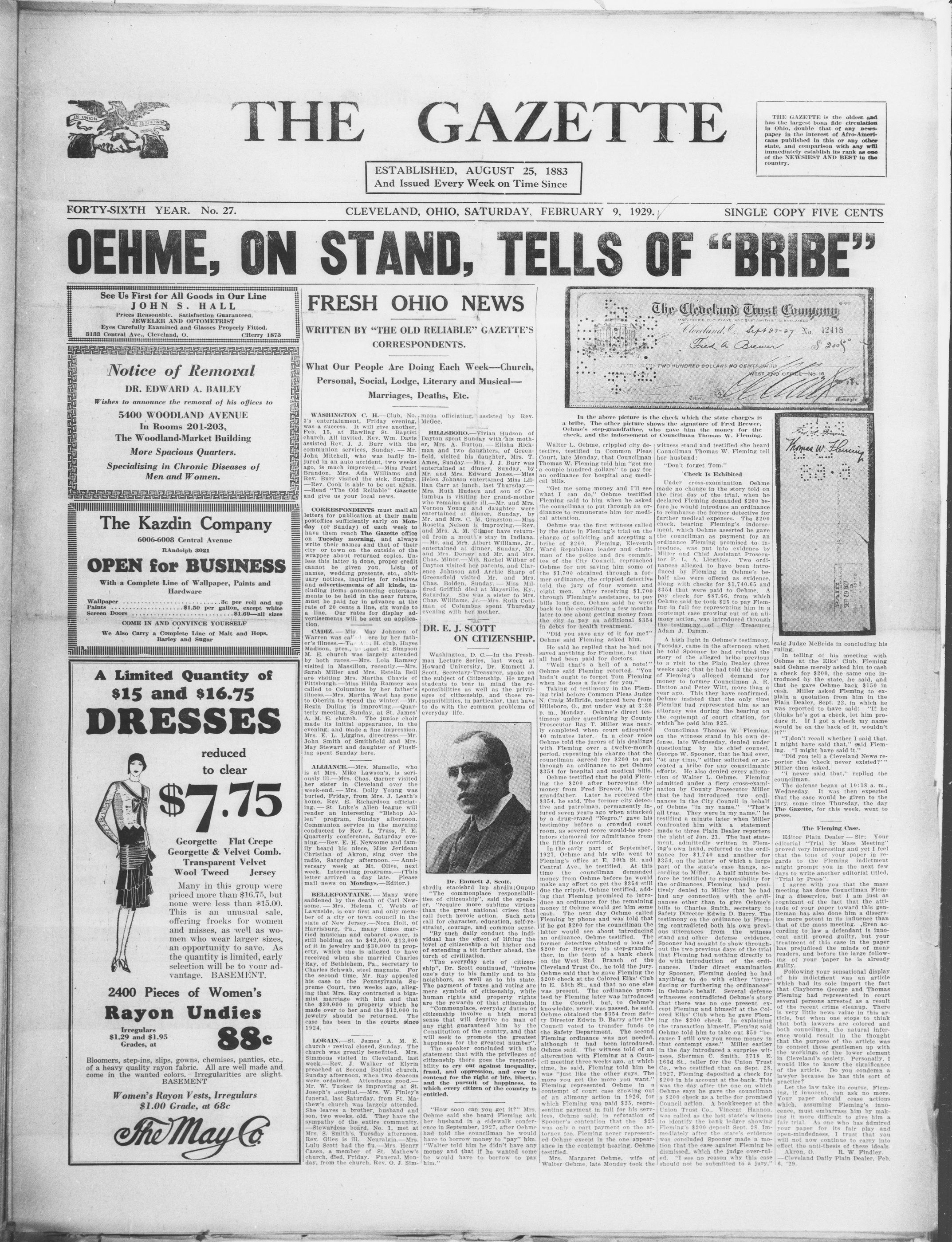
In the above picture is the check which the state charges is a bribe. The other picture shows the signature of Fred Brewer, Oehme's step-grandfather, who gave him the money for the check, and the indorsement of Councilman Thomas W. Fleming.
Walter L. Oehme, crippled city detective, testified in Common Pleas Court, late Monday, that Councilman Thomas W. Fleming told him "get me a couple hundred dollars" to pay for an ordinance for hospital and medical bills.
"Get me some money and I'll see what I can do," Oehme testified Fleming said to him when he asked the councilman to put through an ordinance to remunerate him for medical attention.
witness stand and testified she heard Councilman Thomas W. Fleming tell her husband:
"Don't forget Tom."
'Check Is Exhibited'
Under cross-examination Oehme made no change in the story told on the first day of the trial, when he declared Fleming demanded $200 before he would introduce an ordinance to reimburse the former detective for further medical expenses. The $200
Oehme was the first witness called by the state in Fleming's trial on the charge of soliciting and accepting a bribe of $200. Fleming, Eleventh Ward Republican leader and chairman of the police and fire committee of the City Council, reproached Oehme for not saving him some of the $1,700 obtained through a former ordinance, the crippled detective told the jury of four women and eight men. After receiving $1,700 through Fleming's assistance, to pay back the councilman a few months later to see about getting money from the city to pay an additional $354 in debts for health treatment. "Did you save any of it for me?" Oehme said Fleming asked him. He said he replied that he had not saved anything for Fleming, but that all had been paid for doctors. "Well that's a hell of a note!" Oehme said Fleming retorted. "You hadn't ought to forget Tom Fleming when he does a favor for you." Taking of testimony in the Fleming trial before Common Pleas Judge N. Craig McBride, assigned here from Hillsboro, O., got under way at 3:30 p. m. Monday. Oehme's direct testimony under questioning by Prosecutor Ray T. Miller was nearly completed when court adjourned 40 minutes later. In a clear voice Oehme told the jurors of the entire twelve-month period, repeating his charge that the councilman agreed for $200 to put through an ordinance to get Oehme $354 for hospital and medical bills.
Oohme testified that he paid Fleming the $200 after borrowing the money from Fred Brewer, his step-grandfather. Later he received the $354, he said. The former city detective and patrolman, permanently injured seven years ago when attacked by a drug-crazed "Negro," gave his testimony before a crowded court room, as several score would-he spectators clamored for admittance from the fifth floor corridor.
In the early part of September, 1927, Oehme and his wife went to Fleming's office at E. 30th St. and Central Ave., he testified. At this time the councilman demanded money from Oehme before he would make any effort to get the $354 still due the cripple, Oehme testified, adding that Fleming promised to introduce an ordinance for the remaining money if Oehme would get him some cash. The next day Oehme called Fleming by phone and was told that if he got $200 for the councilman the latter would see about introducing an ordinance, Oehme testified. He made a decree to loan of $200 for Brewer, his step-grandfather, in the form of a bank check on the West End Branch of the Cleveland Trust Co., he told the jury, Oehme said that he gave Fleming the $200 check at the Colored Elks' Club in E. 55th St., and that no one else knew the ordinance promised by Fleming later but in the Council, but, to Oehme's knowledge, never was passed, he said. Oehme obtained the $354 from Safety Director Edwin D. Barry after the Council voted to transfer funds to the Safety Department. The second Fleming ordinance was not needed, although it had been introduced Oehme said. The witness told of an altercation with Fleming at a Council meeting three weeks ago, at which time, he said. Fleming told him he was 'just like the other guy'. He got the more iron-want.' Fleming represented Oehme in a contempt of court case growing out of an alimony action in 1926, for which Fleming was paid $25, representing payment in full for his services. Oehme said in refutation of Spooner's contention that the $25 was only a part payment on the attorney fee. Fleming never represented Oehme except in the one appearance in the contempt hearing, Oehme testified.
Mrs. Margaret Oehme, of Walter Oehme, late Monday took the
SINGLE COPY FIVE CENTS
witness stand and testified she heard Councilman Thomas W. Fleming tell her husband:
"Don't forget Tom."
'Check Is Exhibited'
Under cross-examination Oehme made no change in the story told on the first day of the trial, when he declared Fleming demanded 200 before he would introduce an ordinance to reimburse the former detective for the $1,740.65 check, bearing Fleming's indemnation, which Oehme asserted he gave the councilman as payment for an ordinance Fleming promised to introduce, was put into evidence by Miller and Chief Assistant Prosecutor P. L. A. Lieghley. Two ordinations alleged to have been introduced by Fleming in Oehme's behalf also were offered as evidence, along with checks for $1,740.65 and $354 that were paid to Oehme. A pay check for $87.65 from which Oehme paid for $255 in payment in full for representing him in a contempt case growing out of an all-motion action, was introduced through the testimony of City Treasurer Adam J. Damm.
A high light in Oehm's testimony, Tuesday, came in the afternoon when he told Spooner he had related the story of the alleged bribe previous to a visit to the Plain Dealer three weeks ago; that he had told the story of Fleming's alleged demand for money to former Councilmen A. R. Bitton and Peter Wilt, more than a year ago. Another confirmed Fleming insisted that the only time Fleming had represented him as an attorney was during the hearing on the contempt of court citation, for which he paid him $25.
Councilman Thomas W. Fleming, on the witness stand in his own defense, late Wednesday, denied under questioning by his chief counsel, George W. Spooner, that he had ever, "at any time," either solicited or accepted a bribe for any councilmanic efforts. He also denied any allegation of Walter L. Oehme. Fleming admitted under a fiery cross-examination that the Prosecutor Mihm had introduced a bribe in the City Council in behalf of Oehme "in my name." "That's all true. They were in my name," he testified a minute later when Miller confronted him with a statement made to three Plain Dealer reporters the night of Jan. 21. The last statement, admittedly written in Fleming's own hand, referred to the ordinance for $1,740 and another for $354, on the latter of which a large part of the state's case hangs, according to Miller. A half minute before he testified to responsibility for the ordinations, Fleming had positively denied to Miller that he had had any connection with the ordinance. He also denied bills to Charles Smith, secretary to Safety Director Edwin D. Barry. The testimony on the ordinance by Fleming contradicted both his own previous utterances from the witness stand and other defense evidence. Spooner had sought to show throughout the two previous days of the trial that Fleming had nothing directly to do with introduction of the ordinances. Under direct examination by Spooner, Fleming denied he had anything to do with either "introducing or furthering the ordinances" in Oehme's behalf. Several defense witnesses contradicted Oehme's story that Fleming was no one present except Flema. He also denied Elks' Club when he gave Fleming the $200 check. In explaining the transaction himself, Fleming said Oehme told him to take out $50 "because I still owe you some money in that contempt case." Miller earlier in the day introduced a surprise witness, Sherman C. Smith, 3718 E. 163d St. teller for the Union Trust Co., who testified that on Sept. 28, 1927, Fleming deposited a check for $200 in his account at the bank. This was the day after the one on which he says he gave Flema a councilman a $200 bribe for Flema to Council action. A bookkeeper at the Union Trust Co. Vincent Hannon was called as the last state's witness to identify the bank ledger showing Fleming's $200 deposit Sept. 28. Immediately after the state's evidence was concluded Spooner made a motion that the case against Fleming be dismissed, which the judge over-rul-ed. "I see no reason why this case should not be submitted to a jury,"
THE GAZETTE is the oldest and has the largest bona fide circulation in Ohio, double that of any newspaper in the interest of Afro-Americans published in this or any other country. It immediately establish its rank as one of the NEWSIEST AND BEST in the country.
RIBE"
Post Company
107-07 No. 42418
$ 20090
T END OFFICE—No. 16
Thomas W. Flaming
PAID
SEP 29 1927
said Judge McBride in concluding his ruling.
In telling of his meeting with Oehme at the Elks' Club, Fleming said Oehme merely asked him to cash a check for $200, the same one introduced by the state, he said, and that he gave Oehme back $150 in cash. Miller asked Fleming to explain a quotation from him in the Dealer店, 22, in which he was reported to have said: "It he thinks he's got a check, let him produce it. If I got a check my name would be on the back of it, wouldn't it?"
"I don't recall whether I said that. I might have said that," Fleming. "I might have said it."
"Did you tell a Cleveland News reporter the 'check never existed?' Miller then asked.
"I never said that," replied the councilman.
The defense began at 10:18 a.m. Wednesday. It was then expected that the case would be given to the jury, some time Thursday, the day The Gazette, for this week, went to press.
The Fleming Case.
Editor Plain Dealer — Sir: Your editorial "Trial by Mass Meeting" proved very interesting and yet I feel that the tone of your paper in regards to the Fleming indictment might prompt you in the next few days to write another editorial titled, "Trial by Press."
I agree with you that the mass meeting has done Councilman Fleming a disservice, but I am just as cognizant of the fact that this tribute of your paper has also done him a disservice more potent in its influence than that of the mass meeting. "Even according to law a defendant is innocent until proved guilty, but your treatment of this case in the paper has prejudiced the minds of many readers, and before the large following of your paper he is already guilty.
Following your sensational display of his indictment was an article which had its sole import the fact that the police had acted in good faith. Fleming had represented in court several persons arrested as a result of the recent crime cleanup. There is very little news value in this article, but when one stops to think that both lawyers are colored and both councilmen, the natural inference would result in the thought that the purpose of the article was to connect these gentlemen up with the workings of the lower element. I would like to know the significance of the article. Do you condemn a lawyer because he has this sort of practice?
Let the law take its course. Fleming, if innocent, can ask no more. Your paper should cease actions which, assuming Fleming's innocence, must embarrass him by making it more difficult to give him a fair trial. As one who has admired your paper for its fair play and open-mindedness, I trust that you will not now continue to carry into effect the anti-thesis of these ideals. Akron, O. R. W. Findley.
case —Cleveland Daily Plain Dealer, Feb.
ry." 6. "29.
YOU SAY, YOU KNOW WHO SIGNED JOEY MOORE'S NAME TO THAT LOVE LETTER AN SENT IT TO YOU?
THAT'S WHAT I SAID
OOOH, I'M IN A SWELL FIX NOW. - GEE, I NEVER THOUGHT SHE'D FIND THAT OUT!
SAY, COUSIN PATRICIA, YOU WON'T TELL MOM THAT I WROTE IT, WILL YA? SHE'D GIVE ME THE DICKENS!
YOU? WHY, WAS IT YOU WHO WROTE IT?
Dr. LeROYN. BUNDY. Dentist.
Cedar Branch Y. M. C. A.
Cor. Cedar Ave. and E. 77th St.
A HOME FOR YOUNG MEN!
RESTAURANT - HOME COOKING
Individual Beds $2.50-$3.00
RAndolph 8288.
2374 E. 84th St.,
Cleveland, O.,
Has Houses For Sale
or to Rent
JOHN P. GREEN
Attorney-at-Law
Room 510, Blackstone Bldg.
1426 West 3rd Street
CLEVELAND, OHIO
Notary Public
Office Phone: Main 2912
Res.: 614 East 107th St.
Phone, Glen. 3453.
O. K. Printing Co.
W. J. Foster - John M. Smith
Commercial and Job
PRINTING
PROMPT SERVICE
3113 Central Avenue
Prospect 2600
LISTERINE
THROAT
TABLETS
Antiseptic
Prevent
& Relieve
Hoarseness
Sore Throat
Coughs
Made by
Lambert Pharmacal Co., Saint Louis, U. S. A.
Don't Fuss With Mustard Plasters
Musterole, which is made of oil of mustard and other helpful ingredients, takes the place of mustard plasters. Musterole usually gives prompt relief from rheumatism, colds, group, neuralgia, headache, congestion, rheumatism, sprains, sore muscles, bruises, and all aches and pains. It may prevent pneumonia.
To Mother's: Musterole is also made in milder form for babies and small children. Ask for Children's Musterole.
Jars & Tubes
MUSTEROLE
WILL NOT BLISTER
A Delicious Food
A food for protein; a food for mineral salts; for calcium and phosphorus; all the essential elements for health and strength are found in good cheese. And all the essential elements of good cheese are found in Kraft Cheese.
KRAFT K CHEESE
KRAFT.PHENIX
CHEESE COMPANY
Where To Purchase The Gazette
H. SMITH'S
3007 Scovill Ave.
FRANK L. HANDY'S
4401 Central Ave.
J. S. HALL'S
3133 Central Ave.
*Open, Sundays.
NOTICE TO SUBSCRIBERS
Subscribers not receiving The us at once. We desire every y
Send or bring locals and all office, Suite 302, Johnson Block site the Hotel Cleveland. If there, please.
We advise our readers to advertisements before making advertise in this paper should be The fact that they advertise in
All reading matter for pub Gazette must be in the office week, at the latest. Displa 4 p. m., WEDNESDAYS!
HARRY
226 West Superior
(Opposite, He
Notary Public
Classified Adver
Subscribers not receiving The Gazette regularly should notify us at once. We desire every copy delivered promptly.
Send or bring locals and all business matters to The Gazette office, Suite 302, Johnson Block, 226 Superior Ave., West, opposite the Hotel Cleveland. If you wish to see the editor call there, please.
We advise our readers to carefully examine The Gazette's advertisements before making purchases. Business men who advertise in this paper should have the patronage of our people. The fact that they advertise is assurance that they want it.
All reading matter for publication in current issues of The Gazette must be in the office by noon, WEDNESDAY, of that week, at the latest. Display advertisements accepted until 4 p. m., WEDNESDAYS!
HARRY C. SMITH,
226 West Superior Avenue, Cleveland, O.
(Opposite, Hotel Cleveland.)
Notary Public
Bell 'Phone: Cherry 1259
(Call, in the Afternoon.)
Classified Advertising Department
He is a native of Toronto, Ont., Ca. a graduate of the University of Chicago and has been executive secretary of the St. Louis Urban league for the past five years.
FOR RENT. — Five nice rooms (down) in good condition in the East End. Bath, electric lights and gas. Large cellar and yard. Call, CHerry 1258, in the afternoon. Rental charge, reasonable.
FOR SALE. — A good bedroom set of three pieces. A BARGAIN—in good condition. Also a Way-Sagless spring and a first-grade mattress. Both practically new; used less than two weeks. Call, CHerry 1259 in the afternoon.
CLEVELAND
Social and personal
Take Hethol to ward off as well as to cure the flu. See adv., else where in this paper.
There is a letter at The Gazette office for Mr. John Duke, formerly of 2246 E. 97th St. Tell him to call in the afternoon for it, please.
Atty. Chester K. Gillespie writes The Gazette requesting it to ask whoever borrowed his fountain pen, last week, to "please be good enough to return it, as the pen was a gift".
That Shaker Heights property (unrestricted), advertised elsewhere in the Gazette is "the opportunity of a life-time" for any person who is looking for a home, a real home!
Mrs. Grace Willis Thompson entertained her pupils at a recital, recently, when a splendid program was rendered by them. Mrs. Thompson plans to give these recitals monthly.
Detectives Peter Allen and Alfred Meier arrested Peter Finley, 2461 E. 82d St., Saturday, at E. 89th St. and Cedar Ave. Finley, police say, admitted having snatched more than 15 purses from women in the vicinity of E. 105th St. and Euclid Ave.
The Gilpin Players will present their third production of the season. Feb. 14, 15, 16 and 17, at the Karam theater, 3807 Central Ave. The offering is "The Field God" by Paul Green whose play, "In Abraham's homom", won the 1926 Pulitzer prize.
Our graduates from E. Tech high school: Wm. Seals, Gladys Taylor, Shelton Galloway, Damon Carroll, Lottie Hallums, Lillian Atkins, Verne Wooding, Emmanuel Holmsgorth, Moore, Joe Davenport, James Shores, Julius Robinson and Elsie Fox.
There is to be a "dinner meeting" of the N. A. A. C. p. local branch's annual conference committee, Tuesday at 5:30 p. m. sharp, at St. Andrew's P. E. church, 2171 E. 49th St. Plates, $1 each. Speaker, Wm. Pickens. The conference, this year, is to be held in Cleveland.
Mrs. Louis J. Dean, formerly of Cleveland, but now located on a 74-
TUBBY
YOU SAY YOU
KNOW WHO SIGNED
JOEY MOORE'S NAME
TO THAT LOVE
LETTER AN SENT
IT TO YOU?
*BILL, VASSILEFF,
2928 Central Ave.
*THE S. & S. DRUG CO.
7325 Central Ave.
ROSENBERG'S DRUG STORE,
N. W. Cor. Central Ave. and
E. 55th St.
The Gazette regularly should notify
copy delivered promptly.
b business matters to The Gazette
nk, 226 Superior Ave., West, oppo-
you wish to see the editor call
carefully examine The Gazette's
purchases. Business men who
have the patronage of our people,
assurance that they want it.
application in current issues of The
by noon, WEDNESDAY, of that
advertisements accepted until
C. SMITH,
Avenue, Cleveland, O.
Hotel Cleveland.)
Bell 'Phone: Cherry 1259
(Call, in the Afternoon.)
FOR RENT. — Five room house.
All modern. Best location in the
city, 1673 E. 81st St. Phone, CEdaR
1147.
WANTED. — A stenographer who
has a good English education and
can read her "notes" readily.
Call, Cherry 1259, in the afternoon.
WANTED. — A young man, a graduate
of Longwood High school,
wants a position: part-time or full-
time office-work. Can type, keep
small set of books, and do general
office-work. Call, Cherry 1259,
or write Eugene Russell, 7501 Central
Ave., City.
acre Connecticut farm, which the
Dean family purchased. Last year,
was the guest of her sister, Mrs.
Lena Rice, E. 74th St., when called
to the city, recently, by the death of
her other sister, Mrs. Eleanor Shook.
One of the interesting affairs of the week was the meeting of the Wistaria club, Jan. 26, with Mrs. John P. Green as hostess. Bridge was the pastime, honors being won as follows: First prize, Miss Ida Gray; second, Mrs. John Wilson; Mrs. Green served a delicious luncheon.
Mrs. Chas. Turner of Greenlawn Ave, who died recently, was buried in Springfield, her old home. Mr. Turner has been in the U. S. railway mail service for many years, a position secured for him by Geo. A. Myers and the editor of The Gazette when Tom L. Johnson was a member of Congress.
Dr. U. C. Vincent of N. Y. City, a graduate of Shaw Univ. and the University of Pennsylvania, a resident surgeon of Bellville hospital, and adjunct-surgeon at Harlem hospital, N. Y. City, and an instructor in several nurse-training schools has just completed a modern fifty-bed private sanitarium. He did not beg for a "jim-crow" hospital.
Russell B. Scott is the newly appointed manager of the East End Branch of the Peoples Realty Co. which opened recently at 8933 Cedar Ave. Mr. Scott, a native of Cleveland, is a member of St. John's senior chair and director of the octette of the church. His host of friends graduatedating him on his new venture. Mr. Scott was educated at Kinsman and Central High schools, this city.
Mary, daughter of Mr. and Mrs. Tennis Brown, E. 105th St., student in 10-A class at E. Tech high school, was awarded an honor for receiving the highest increase in scores in her last semester. The thirteen receiving the highest scores were taken to be "Porgy" at the Allen theater. Eleven white boys, one of our boys and Mary composed the party.
John Atkinson, age 15, of 2374 E.
82d St., student at Central High
school, exercised too hard. Monday.
He is now at home with a fractured
arm. The youth was said to have
slipped on the hardwood floor of the
gymnasium at Central High while
attending a class in calisthenics. C.
THE GAZETTE, CLEVELAND, O., SATURDAY, FEBRUARY 9, 1929.
J. Able, instructor, took him to St. Alexis' hospital, where the injury was treated. The youth later was removed to his home.
Last week Wednesday, Municipal Judge David Moylan, in the case of Verger Turner, E. 75th st., against V. Baumeister, $307 Kinsman Rd., for refusal of service in the Baumeister restaurant, Oc. 28, gave Attys, Gillespie and Dillard, a $75 judgment for Turner. This case was instituted under Hon. Harry C. Smith's Ohio Civil Rights Law. Baumeister's attorneys have filed a motion for a new trial, it is said.
Price lyceum, organized at St. Paul's A. M. E. Zion church, Sunday, will meet, every Sunday, from 5 to 6 M. The officers: Pres., Atty. Ron. W. Dillard; vice-pres., Wm. M. Walker; vice-Theo. Holmes; rec. sec. W. M. Calhoun; treas. M. J. Austin; Rev. J. P. Foote, office. Dr. H. M. Lambright will give the lyceum a health talk, Sunday. All invited to attend the talk and become members of the Lyceum.
Jan. 21, the following named persons met at Mr. and Mrs. O. Fuller's, E. 49th St., and organized The Epicurean club: Oscar Fuller, A. A. Robinson, W. A. Henderson, J. E. Downey, M. Johnson, R. Booth, A. Wakefield, E. M. Simpson, B. Tyson, R. Goints, M. White, Officers elected; the Board of Directors, Wakefield, vice-pres.; J. T. Downey, Fuller, chair, banking.com; Messrs. Johnson, White and Booth, trustees; E. M. Simpson, chair, by-laws.com. Meetings will be held at Mr. and Mrs. Fuller's, every Monday evening.
Dedication services of the newly acquired building of former Central Ave. Christian church, at Cedar Ave. and E. 74th St., were held, Sunday. The dedicatory sermon was preached by Rev. I. J. Cahill, executive secretary of the Ohio Christian Missionary society. Rev. J. H. Goldner, pastor of Euclid Ave. Christian church, and Rev. Johnson C. Taylor of Toledo took part in the services, during which $5,000 was raised toward payment of the building. The structure was purchased for $40,000 from the Gospel church thru the Cleveland Disciples' union.
Robert Richardson, age 19, and without a home, was arrested, Dec. 3, charged with robbing a restaurant, at 1411 Central Ave., of $19. In the first police report of the robbery, the counterman at the restaurant identified the robber. He tried again later, ever, and Richardson was induced to plead guilty, and was sentenced, Dec. 24, to 10 to 25 years in the Ohio penitentiary. Now comes another man, who was arrested, last week, and admits the crime, detectives say, and absolves Richardson. And two men bore him out. Police were offered with County Prosecutor, but Richardson remains in durance vile, a la Joseph Weaver.
The 17th Ward Republican club's annual meeting was held at Mt. Zion Cong. church, Jan. 29. Dr. LeRoy N. Bundy and the other officers were unanimously and enthusiastically re-elected for the ensuing year. Rev. C. R. Worthy and Rev. E. F. Smith were elected vice-presidents and Vernon Clearer, financial secretary. Rev. Jas Foote, the principal speaker, was followed by Rev. R. S. Brown. Mrs. Marie Lomax of the non-profit read an excellent report. Non-profit officials were issued, for the candidacy of Dr. R. Bundy for councilman in the third district. After an inspiring talk by him, the meeting adjourned to Feb. 26, the next regular meeting. H. Mayerson, chair, and Mamie Hudson, sec.; publicity committee.
Violet Juvenile class. No. 1043
Elks, gave a musical tea at Alma Lee's. E. 40th St. Jan. 27, presenting the following program: Eleanor May and Bertram Brewer, violin duet; Eugenia Niles, Chas. Lampkin Thelma Jordan, piano solos; Pauline Peaks, recitation; Eleanor May, vocal sol; Bettie Pope, James Cherry Catherine White, and Julia Burrell piano solos. The closing number was rendered by senior mother, Mrs. Eugenia Brewer May. Mrs. L. Jackson and Mrs. E. May then served a light luncheon consisting of tea cookies, mints and ice cream. Alm Lee, chair; Bertram C. Brewer, reporter. Feb. 10, at 4 p. m., this program will be repeated (by request) for the Forum committee, at King Tutt Rest, 5610 Scillov Ave. All invited.
Subscribe Now
Guaranteed and Efficient Work TWENTY YEARS' EXPERIENCE 'Phone: Randolph 5870 Sundays by Appointment
COOPER IGNORING CURRY
A Jew for Governor's Messenger—A
Contest on for the Job—
A Jew for Governor's Messenger—A
Contest on for the Job—
(Special to The Gazette)
Columbus, O. — They are having a time at the Governer office as to who shall be messenger for Myers Y. Cooper, Ohio's color-line Republican Governor. This job, which has always gone to an Afro-American, seems in a fair way to go. Cooper has two persons setting in the office, similarly, one a "Negro" and the other a man who seems to have the inside track.
404-222-3
Gov. Myers Y. Cooper.
The Rev. E. W. B. Curry of Springfield, who sided with the Kluxes against his own people there, some years ago, in the memorable Fulton "jim-crow" school contest, and who was Cooper's political "black man Friday" in the campaign, last fall, is much in evidence at the Governor's office, these days, but does not seem to get anywhere as far as serving as arguments for those "Negro" who were Ohio's color-line Republican Governor for election. If Curry is not "the limit", from a loyal race viewpoint, then who is?
State Treasurer Bert. B. Buckley's conviction, last week, and the Governor's demand that he resign his position, the he has appealed the need to have his attorneys. Personally, I have thought little of him since he gave out the misstatement that he had so many Afro-Americans in his office. More anon.
Where Did They "Park"?
Atlanta, Ga. — Roland Hayes, "tenor of ineffably sweet voice," as he was called in the Daily Constitution, scored a second triumph in this city, Friday evening, at Public Auditorium, 4,000, which included many of the elite of both races. The singer rendered a program remarkable for variety and beauty, reaching a dramatic and artistic climax in a group of naturals. Where did the Afro-American " elite park" in the auditorium?
Says He Paid $1500 For Job
Says He Paid $1500 For Job.
Washington, D. C. — A. P. Russell, former postmaster at Magee, Miss., told a Senate committee investigating the payment paid $1,500 to obtain the appointment as U. S. marshal in Mississippi. The money, he said, was given to Perry W. Howard, Republican national committeeman for Mississippi, one charge and faces an accusation growing out of alleged payments for postmastership appointments.
"Vestris" Hero in Vaudeville
New York City — Lionel Liorcish, the young Barbarian quartermaster hero of the ill-fated steamship, "Vestris," received by Gov. Ritchie of Maryland and Mayor W. F. Broen, who served on Feb. 4, will tour to Chicago and the midwest. In Baltimore, he is to appear in the largest theatre there.
Elks Honor Clevelanders
Columbus, O. — Franklin Lodge, Elks, gave an enjoyable reception and dance, Jan. 30, in honor of the Porgy cast, Hon. Perry B. Jackson and two employees of the State House of Representatives; James W. Minor and Richard Baylor, engrossing clerk, also of Cleveland, Lieut. W. C. Ayers was master of ceremonies.
WHERE'S MARY WALKER?
Information is desired by the U. S. Veterans' Bureau as to the present whereabouts of Mrs. Mary Elizabeth Walker, formerly living at 2424 E. 61st St., this city, Cleveland. A relative of Mrs. Walker, living with her at that address was Howard Dyall, who is now deceased. Dyall was a soldier in the World War. Information of the whereabouts of Mrs. Walker, if now living, or information of her decease, or information which might lead to the whereabouts of any heirs of Mrs. Walker, if deceased, may be transmitted to the U. S. Veterans' Bureau, Hanna Building, Cleveland, O., or to the office of this newspaper, The Gazette.
FOR SALE!
Shaker Heights Property.
Unrestricted!
A Beautiful Home!
A sixroom single: Break-
fast room, pantry, full tile bath
with shower, hardwood floors
throught the house, birch finish
down stairs, pine up, book-
cases, china-cabinets, fire-place,
combination-furnish, guest-clo-
set up and down, clothes-chute,
shoes-drawer, one-car garage,
cement-drive, lot 40 by 150,
paved street, house one year
old, door-reeds thrush
out the house, lindeum in
kitchen and both balls, gas
electric; five minutes walk
from Rapid Transit Moreland
car. Beautiful fixtures.
For further information, call
WAsh. 2133-R.
USED PIANOS
Repaired and Tuned.
For Sale at Reasonable Prices.
Goodwill Industries
2146 E. Ninth St.
Patronize
Our Advertisers
MURINE
FOR
YOUR EYES
Murine Co., Dpt. H. S., 9E. Ohio St., Chicago
THIS IS YOUR OPPORTUNITY
To learn Dickinson Shorthand in position. Send for
Your Manuscripts Nearly and
Efficient Service at
Dickinson Shorthand is the short way to better pay. The simple most natural and logical way to simple system before the public from three to six weeks.
SEND FOR FRE
R. B. MAXWELL, Authors Age
FADEOUT ON
THE POT AND KI
Do learn Dickinson Shorthand in three to six weeks, for a better position. Send for free information.
Your Manuscripts Neatly and Accurately Typed. Prompt, Efficient Service at Reasonable Rates.
Dickinson Shorthand is the shortest of shorthands—the modern way to better pay. The simplest system of rapid writing, the most natural and logical way to take dictations. The shortest simple system before the public, today, and you can learn it in from three to six weeks.
FADEOUT OF POPULISM
AND
THE POT AND KETTLE IN COMBAT
By JOSEPH C. MANNING
Formation of the Populist
list-Republican Fusion Movement,
giving also the facts as to Disf-
Diagnosis of the Southern
of existing Political Conditions
Smith-Vare contests in the
Saloon League and its working
the Lynching of the 15th Ame
of present interest discussed.
Price $1.00--First Edit
T. A. HEBBO
De
Formation of the Populist Party and history of the Populist-Republican Fusion Movement in Alabama and the South; giving also, the facts as to Disfranchisement. Diagnosis of the Southern Political Situation and an Analysis
Diagnosis of the Southern Political Situation and an Analysis of existing Political Conditions. Smith-Vare contests in the United States Senate; the Anti-Saloon League and its working in connection with the Klu Klux; the Lynching of the 15th Amendment. These and other topics of present interest discussed.
Price $1.00--First Edition in Press--Order Now
184 West 135th Street
Prevent Colds—Take
Helthol
HEALTH FOR ALL
$1.00 at Druggists or
Helthol Medicine Co.
12606 EDMONTON AVE.
Cleveland, Ohio.
Agents Wanted — See Doc
Helthol at Steiner's Drug, 4602
Central Ave.
For
hair beauty
Gladys May of Shufflin Sam Co.
Follow the lead of Gladys May, vivacious actress in Shufflin' Sam from Alabam' who says she finds Exelento the most delightful hair dressing she has ever used.
EXELENTO
QUININE POMADE
is the original! It reaches the roots of the hair and gives natural lustre that stays! Stops itching scalp and makes harshest hair soft and pliable. At All Drug Stores. Write for FREE sample and book of Beauty Hints. EXELENTO MEDICINE CO. Atlanta, Ga. Clean, Clear, Healthy Beautiful Eyes Are a Wonderful Asset Murine is Cleansing, Soothing, Refreshing and Harmless. You Will Like It. Book on "Eye Care" or "Eye Beauty" Free on Request
in three to six weeks, for a better
for free information.
and Accurately Typed. Prompt,
at Reasonable Rates.
shortest of shorthands—the modern
largest system of rapid writing, the
to take dictations. The shortest
lic, today, and you can learn it in
FREE INFORMATION
Agent, P. O, Box 270, Blocton, Ala.
OF POPULISM
AND—
KETTLE IN COMBAT
list Party and history of the Popu-
ment in Alabama and the South;
Isfranchisement.
Political Situation and an Analysis
ons.
the United States Senate; the Anti-
g in connection with the Klu Klux;
mendment. These and other topics
Lition in Press--Order Now
BONS, Publisher
Dept. B
YOU?
WHY, WAS
IT YOU
WHO WROTE
IT?
New York City
Don't Throw Away Your Copy of The GAZETTE After Reading It But Give it to a Friend or an Acquaintance who might Subscribe after Reading It
NEW BAGGAGE CAR FOR CARRYING AUTOS
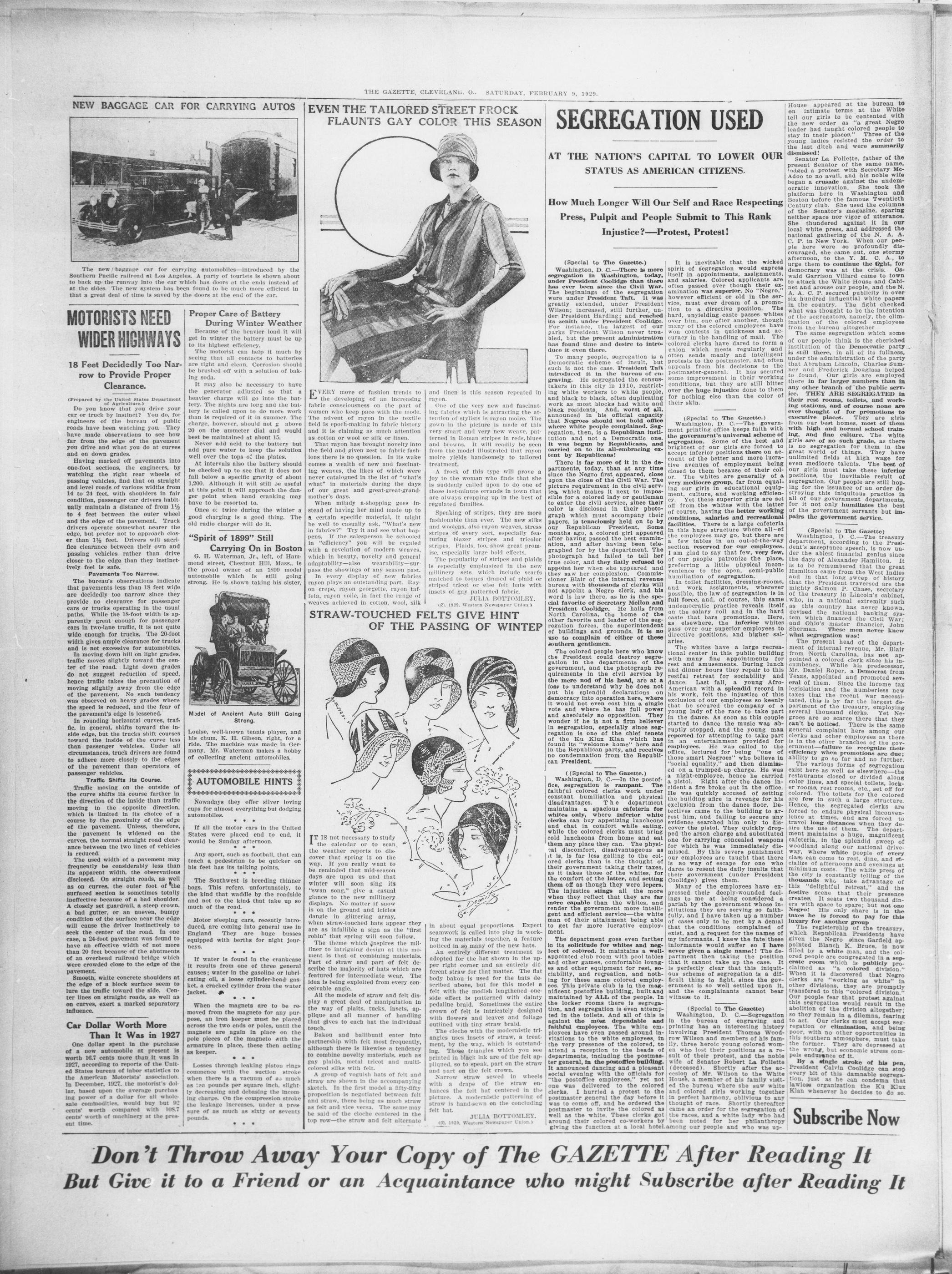
The new/baggage car for carrying automobiles—introduced by the Southern Pacific railroad at Los Angeles. A party of tourists is shown about to back up the runway into the car which has doors at the ends instead of at the sides. The new system has been found to be much more efficient in that a great deal of time is saved by the doors at the end of the car.
MOTORISTS NEED WIDER HIGHWAYS
18 Feet Decidedly Too Narrow to Provide Proper Clearance. (Prepared by the United States Department of Agriculture)
Do you know that you drive your car or truck by instinct? You do, for engineers of the bureau of public roads have been watching you. They have made observations to see how far from the edge of the pavement you drive and what you do at curves and on down grades.
Having marked off pavements into one-foot sections, the engineers, by watching the right rear wheels of passing vehicles, find that on straight and level roads of various widths from 14 to 24 feet, with shoulders in fair condition, passenger car drivers habitually maintain a distance of from $1\frac{1}{2}$ to 4 feet between the outer wheel and the edge of the pavement. Truck drivers operate somewhat nearer the edge, but prefer not to approach closer than $1\frac{1}{2}$ feet. Drivers will sacrifice clearance between their own and passing vehicles rather than drive closer to the edge than they instinctively feel is safe.
Pavements Too Narrow.
Pavements Too Narrow. The bureau's observations indicate that pavements less than 18 feet wide are decidedly too narrow since they provide no clearance for passenger cars or trucks operating in the usual paths. While the 18-foot width is apparently great enough for passenger cars in two-lane traffic, it is not quite wide enough for trucks. The 20-foot width gives ample clearance for trucks and is not excessive for automobiles. In moving down hill on light grades, traffic moves slightly toward the center of the road. Light down grades do not suggest reduction of speed, hence traffic takes the precaution of moving slightly away from the edge of the pavement. No such tendency was observed on heavy grades where the speed is reduced, and the fear of the pavement's edge is lessened. In rounding horizontal curves, traffic, in general, shifts toward the inside edge, but the trucks shift courses toward the inside of the curve less than passenger vehicles. Under all circumstances, truck drivers are found to adhere more closely to the edges of the pavement than operators of passenger vehicles.
Traffic Shifts Its Course.
Traffic moving on the outside of the curve shifts its course farther in the direction of the inside than traffic moving in the opposite direction, which is limited in its choice of a course by the proximity of the edge of the pavement. Unless, therefore, the pavement is widened on the curves, the normal straight road clearance between the two lines of vehicles is reduced.
The used width of a pavement may frequently be considerably less than its apparent width, the observations disclosed. On straight roads, as well as on curves, the outer foot of the surfaced section is sometimes totally ineffective because of a bad shoulder. A closely set guardrail, a steep crown, a bad gutter, or an uneven, bumpy condition of the surface near the edge will cause the driver instinctively to seek the center of the road. In one case, a 24-foot pavement was found to have an effective width of not more than 20 feet because of the abutments of an overhead railroad bridge which were crowded close to the edge of the pavement.
Smooth, white concrete shoulders at the edge of a block surface seem to lure the traffic toward the side. Center lines on straight roads, as well as on curves, exert a marked separatory influence.
Car Dollar Worth More
One dollar spent in the purchase of a new automobile at present is worth 16.7 cents more than it was in 1927, according to reports of the United States bureau of labor statistics to the American Motorists' association. In December, 1927, the motorist's dollar, based upon the average purchases power of a dollar for all wholesale commodities, would buy but 92 cents' worth compared with 108.7 cents' worth of machinery at the present time.
Proper Care of Battery
During Winter Weather
Because of the heavier load it will get in winter the battery must be up to its highest efficiency.
The motorist can help it much by seeing that all contacts to batteries are tight and clean. Corrosion should be brushed off with a solution of baking soda.
It may also be necessary to have the generator adjusted so that a heavier charge will go into the battery. The nights are long and the battery is called upon to do more work than is required of it in summer. The charge, however, should not g above 20 on the ammeter dial and would best be maintained at about 15.
Never add acid to the battery but add pure water to keep the solution well over the tops of the plates.
At intervals also the battery should be checked up to see that it does not fall below a specific gravity of about 1,200. Although it will still be useful at this point it will approach the danger point when hand cranking may have to be resorted to.
Once o: twice during the winter a good charging is a good thing. The old radio charger will do it.
"Spirit of 1899" Still
Carrying On in Boston
G. H. Waterman, Jr., left, of Hammond street, Chestnut Hill, Mass., is the proud owner of an 1899 model automobile which is still going strong. He is shown taking his sister,
Model of Ancient Auto Still Going Strong.
Louise, well-known tennis player, and his chum, K. H. Gibson, right, for a ride. The machine was made in Germany. Mr. Waterman makes a hobby of collecting ancient automobiles.
Nowadays they offer silver loving cups for almost everything but dodging automobiles.
If all the motor cars in the United States were placed end to end, it would be Sunday afternoon.
Any sport, such as football, that can teach a pedestrian to be quicker on his feet has its talking points.
The Southwest is breeding thinner hogs. This refers, unfortunately, to the kind that waddle by the roadside and not to the kind that take up so much of the road.
Motor sleeping cars, recently introduced, are coming into general use in England. They are huge busses equipped with berths for night journeys.
If water is found in the crankcase it results from one of three general causes; water in the gasoline or lubricating oil, a loose cylinder-head gasket, a cracked cylinder from the water jacket.
When the magnets are to be removed from the magneto for any purpose, an iron keeper must be placed across the two ends or poles, until the magnets are again in place on the pole pieces of the magneto with the armature in place, these then acting as keeper.
Losses through leaking piston rings commence with the suction stroke when there is a vacuum of as much as ten pounds per square inch, slightly decreasing and debasing the incoming charge. On the compression stroke the leakage increases, under a pressure of as much as sixty or seventy pounds.
THE GAZETTE, CLEVELANE, O.. SATURDAY, FEBRUARY 9, 1929.
THE FASHION OF THE TWENTIETH CENTURY
EVERY move of fashion trends to the developing of an increasing fabric consciousness on the part of women who keep pace with the mode. The advent of rayon in the textile field is epoch-making in fabric history and it is claiming as much attention as cotton or wool or silk or linen. That rayon has brought novelty into the field and given zest to fabric fashions there is no question. In its wake comes a wealth of new and fascinating weaves, the likes of which were never catalogued in the list of "what's what" in materials during the days of our great and great-great-grand-mother's days. When milady a-shopping goes instead of having her mind made up to a certain specific material, it might be well to casually ask, "What's new in fabrics?"> Try it and see what happens. If the salesperson be schooled in "efficiency" you will be regaled with a revelation of modern weaves, which in beauty, novelty and general adaptability—also wearability—surpass the showings of any season past. In every display of new fabrics rayon plays an outstanding part. Rayon crepe, rayon georgette, rayon tafeta, rayon volle, in fact the range of weaves achieved in cotton, wool, silk
STRAW-TOUCHED F
OF THE
IT IS not necessary to study the calendar or to scan the weather reports to discover that spring is on the way. If you really want to be reminded that mid-season days are upon us and that winter will soon sing its "swan song," give a casual glance to the new millinery displays. No matter if snow is on the ground and icicles dangle in glittering array,
when straw-touched hats appear they are as infallible a sign as the "first
The theme which jspires the miliner to intriguing design at this moment is that of combining materials. Part of straw and part of felt describe the majority of hats which are featured for intermediate wear. The idea is being exploited from every conceivable angle.
All the models of straw and felt display a great deal of manipulation in the way of plats, tucks, insets, applique and all manner of handling that gives to each hat the individual touch.
Bakon and ballibuntl enter into partnership with felt most frequently, although there is likewise a tendency to combine novelty materials, such as gay plaids, metal tricot and multicolored silks with felt.
A group of vognish hats of felt and straw are shown in the accompanying sketch. In the first model a fifty-fifth proposition is negotiated between felt and straw, there being as much straw as felt and vice versa. The same may be said of the cloche centered in the top row—the straw and felt alternate
y Your Co or an Acqu
and linen is this season repeated in rayon.
One of the very new and fascinating fabrics which is attracting the attention of stylists is rayon moire. The gown in the picture is made of this very smart and very new weave, patterned in Roman stripes in reds, blues and browns. It will readily be seen from the model illustrated that rayon moire yields handsomely to tailored treatment.
A frock of this type will prove a joy to the woman who finds that she is suddenly called upon to do one of those last-minute errands in town that are always cropping up in the best of regulated families.
Speaking of stripes, they are more fashionable than ever. The new silks and woolens, also rayon weaves, stress stripes of every sort, especially featuring blazer stripes and tricolor stripes. Plains, too, show great promise, especially large hold effects.
The popularity of stripes and plains is especially emphasized in the new millinery sets which include scarfs matched to tapes draped of plaid or striped tricolor or else fitted bats with insets of gray pattern fabric.
JULIA BOTTOMLEY.
(© 1929 Western Newspaper Union.)
ELTS GIVE HINT
PASSING OF WINTER
in about equal proportions. Expert work is called into play in working the materials together, a feature noticed in so many of the new hats. An entirely different treatment is adopted for the hat shown in the upper right corner and an entirely different straw for that matter. The flat body bakon is used for the hats described above, but for this model a felt with the modish lengthened one-side effect is patterned with dainty pedaline braid. Sometimes the entire crown of felt is intricately designed with flowers and leaves and foliage outlined with tiny straw braid. The cloche with the modernistic triangles uses insets of straw, a treatment, by the way, which is outstanding. Those triangles which you see printed in black ink are of the felt applied, so to speak, part on the straw and part on the felt crown. Narrow straw sewed in wheels with a drape of the straw enhances the felt hat centered in the picture. A modernistic patterning of straw is hand-sewn on the concluding felt hat.
JULIA BOTTOMLEY.
(© 1829, Western Newspaper Union.)
py of The maintenance w
SEGREGATION USED
AT THE NATION'S CAPITAL TO LOWER OUR STATUS AS AMERICAN CITIZENS.
How Much Longer Will Our Self and Race Respecting Press, Pulpit and People Submit to This Rank Injustice?—Protest, Protest!
(Special to The Gazette.)
Washington, D. C.—There is more segregation in Washington, today, under President Coolidge than there has ever been since the Civil War. The beginnings of the segregation were under President Taft. It was greatly extended, under President Wilson; increased, still further, under President Harding; and reached President Coolidge. For instance, the largest of our parks President Wilson never troubled, but the present administration has found time and desire to introduce it even there.
To many people, segregation is a Democratic scheme of insult, but such is not the case. President Taft introduced it in the bureau of engraving, in 1910, in this city in 1910, restricting white workers to white people, and black to black, often duplicating work as most blocks had white and black residents. And, worst of all, announced in his official capacity that Negroes should not hold office where white people complained. Segregation, then, is a Republican institution and not a Democratic one. The segregation of white workers and carried on to its all-embracing and tent by Republicans!
There is far more of it in the departments, today, than at any time since the Negro first appeared, close upon the close of the Civil War. The picture requirement in the civil service, which makes it next to impossible for a colored lady or gentleman to enter the civil service, since their color is disclosed in their photograph which must accompany their papers, is tenaciously held on to by our Republican senator. Similarly, colored girl appears after having passed the best examination, and after having been telegraphed for by the department. The photograph had failed to tell her true color, and they flatly refused to appoint her when she appeared and they saw her complexion. Commissioner Blair of the internal revenue bureau with thousands of clerks will not appoint a Negro clerk, and his word is law there, as he is the speeches officer. Secretary Cannon and President Coolidge have held from North Carolina the home of the other favorite and leader of the segregation forces, the superintendent of buildings and grounds. It is no use to complain of either of these southern gentlemen.
The colored people here who know the President could destroy segregation in the departments of the government, and the photograph requirements in the civil service by the mere nod of his head, are at a distance and why he nods out his splendid declarations on democracy into operation here, where it would not even cost him a single vote and where he has full power and absolutely no opposition. They wonder if he is not a firm believer in segregation, especially since segregation is one of the chief tenets of the Constitution, and found its "welcome home" here and in the Republican party, and receives no condemnation from the Republican President.
((Special to The Gazette.)
(Special to The Gazette)
Washington, D. C.—In the postoffice, congressmen request clerks work under constant humiliation and physical disadvantages. The department maintains a spacious cafeteria for whites only, where inferior white clerks can buy appetizing luncheons and chat in comfort while eating, while the colored clerks must bring cold luncheons from home and eat them any place they can. The physical discomfort, disadvantageous as it is, far less galling to the colored clerks than is the thought of their government taking their taxes, as it takes those of the whites, for the comfort of the latter, and setting them off as though they were lepers. The injustice stings all the more when they reflect that they are more capable than the whites, and render the government more intelligent and efficient service—the white man of their attainment being able to get far more lucrative employment.
The department goes even farther in its solicitude for whites and neglect of colored. It maintains a well-appointed club room with pool tables and other games, comfortable lounges and other equipment for rest, so-coolability, and regression, and nothings. This private club is in the magnificent postoffice building, built and maintained by ALL of the people. In the locker rooms there is segregation, and segregation is even attempted in the toilets. And all of this is against the most dependable and faithful employees. The white employees have even passed around in the office building, the very presence of the colored, to attend a reception to the heads of departments, including the postmaster general, in the postoffice building. It announced dancing and a pleasant social evening with the officials for "the postoffice employees," yet not one was delivered to the colored clerks. I hurried a protest to the postmaster general, the day before it was announced that postmaster to invite the colored as well as the white. These clerks got around their colored co-workers by giving the function at a local hotel
It is inevitable that the wicked spirit of segregation would express itself in appointments, assignments, and salaries. Colored applicants are often passed over though their examination was superior. No "Negro," however efficient or old in the service, must ever dream of a promotion to a directive position. The hard, unyielding caste passes whites over him, one after another, though many of the colored employees have won contests in quickness and accuracy in their handling of mail. Colored workers have tended to form a culture which meets regularly and often sends manly and intelligent protests to the postmaster, and often appeals from his decisions to the postmaster-general. It has secured some improvement in their working conditions, but they are still bitter over the huge injustice done to them for nothing else than the color of their skin.
(Special to The Gazette.)
Washington, D. C. The government printing office keeps faith with the government's universal scheme of segregation. Some of the girls are forced to accept inferior positions there on account of the better and more lucrative avenues of employment being closed to them because of their color. The whites are generally of a very mediocre group, far from equaling our girls in educational equipment, culture, and working efficiency. Yet these superior girls are set off from the whites with the latter of course, having the better working conditions, salaries and recreation facilities. There is a large cafeteria this week, where all of the employees may go, but there are a few tables in an out-of-the-way section reserved for our employees. I am glad to say that few, very few, of our people patronize the place, preferring a little physical inconvenience to the open, semi-public humiliation of segregation.
In toilet facilities, dressing-rooms, and work assignments, wherever possible, the law of segregation is in full force, and, of course, this same undemocratic practice is itself more arbitrary practice and in the hard cases that bars promotions. Here, as elsewhere, the inferior whites pass over our superior employees to directive positions, and higher salaries.
The whites have a large recreational center in this public building with many fine appointments for rest and amusements. During lunch and dinner hours they repair to this restful retreat for sociability and dance. Last fall, a young Afro-American with a splendid record in work, held an exclusive of our employees so keenly that he secured the company of a young lady of the race to take part in the dance. As soon as this couple started to dance the music was abruptly stopped, and the young man reported for attempting to take part in an entertainment provided for employees. He was called to the office, lectured for being "one of those smart Negroes" who believe in "social equality," and then dismisses him. He a night-employee, hence he carried a pistol. Right after the dance incident a fire broke out in the office. He was quickly accused of setting the building afire in revenge for his exclusion from the dance floor. Detectives came to the building to arrest him, and falling to secure any evidence searched him only to discover the pistol. They quickly dropped the arson charge and substituted one for carrying concealed weapons for which he was immediately dismissed. His employees there our employees are taught there is so way of escape for one who dares to resent the daily insults that their government (under President Coolidge) gives them.
Many of the employees have expressed their deeply-wounded feelings to me at being considered a pariah by the government whose institutions they are serving so faithfully, and I have taken up a number of them to be met by a deal that the conditions complained of exist, and a request for the names of my informants. I knew the fate these informants would suffer so I have never given a single name!! The department then taking the position that it cannot take up the case. It is perfectly clear that this iniquitous difficult thing to fight, since the government is so well settled upon it, and the complainants cannot bear witness to it.
(Special to The Gazette)
Washington, D. C. —Segregation in the bureau of engraving and printing has an interesting history involving President Thomas Woodrow Wilson and members of his family, three heroic young colored women who lost their positions as a rebel during the Civil War, and wife of Senator Robert La Follette (deceased). Shortly after the accession of Mr. Wilson to the White House, a member of his family visited the bureau where she saw white and colored girls working together in perfect harmony, oblivious to any thought of race. Shortly thereafter the bureau moved to the races, and a white lady who had been noted for her philanthropy among our people and who was up-
House appeared at the bureau to on intimate terms at the White tell our girls to be contented with the new order as "a great Negro leader had taught colored people to stay in their places." Three of the young ladies resisted the order to the last ditch and were summarily dismissed!
Senator La Follette, father of the present Senator of the same name, "odded a protest with Secretary McCoy to the office," while a widowed wife began a condescension against the undemocratic innovation. She took the platform here in Washington and Boston before the famous Twentieth Century club. She used the columns of the Senator's magazine, sparing neither space nor vigor of utterance. She thundered against it in our local white press, and addressed the national gathering of the N. A. A. C. P. in New York. When people could publicly discouraged, she came out, one stormy afternoon, to the Y. M. C. A. to continue the fight, for democracy was at the crisis. Oswald Garrison Villard came to town to attack the White House and Cabinet and arouse our people, and the N. A. A. C. P. secured publicity in over six hundred influential white papers in the country. The fight checked the White House and the control of the regressors, namely, the elimination of the colored employees from the bureau altogether
The same segregation which some of our people think is the cherished institution of the Democratic party is still there, in all of its fullness, under the administration of the party that Abraham Lincoln, Charles Sumner and Frederick Douglass helped to found. Our girls are employed there in far larger numbers than in any other branch of the public service. THEY ARE SEGREGATED in our stations, toilets, and working rooms, of course, but ever thought of for promotion to executive places. They are girls from our best homes, most of them with high and normal school training, and fine culture. The white girls are of no such grade, as there is no segregation for them in the great world of things. They have unlimited fields at high wage for even mediocre talents. The best of girls must take these inferior positions, in a inevitable result of segregation. Our people are hoping for the issuance of an order destroying this iniquitous practice in all of our government departments, for it not only humiliates the best of the government servants but impairs the government service.
(Special to The Gazette)
Washington, D. C. — The treasury department, according to the President's acceptance speech, is now under the ablest financial genius since the days of Alexander Hamilton. It is to be remembered that the great Hamilton came from the West Indies that had long sweep of history that the most traversed are the mighty Salmon P. R. secretary of the treasury in Lincoln's office who, in a national extremity such as this country has never known, devised the national banking system which financed the Civil War; and Ohio's master financier, John Sherman. These men never knew what segregation was!
The present head of the department of internal revenue, Mr. Blair from North Carolina, has not applauded a colored clerk since his incumbent, Mr. Daniel Roper, is predecessor from Texas, appointed and promoted several of them. Since the income legislation and the numberless new taxes that the recent war necessitated, this is by far the largest department of the treasury, employing several thousand clerks. Yet Negroes are so scarce there that they can't be noticed. There is the same general complaint among our clerks and other employees as there government—other branches of the government—recognize their efficiency when promotion is able to go so far and no further.
The various forms of segregation exist here as well as elsewhere—the restaurants closed or divided along color lines, and special toilets, locker rooms, rest rooms, etc. set off for colored. The toilets for the colored are few in such a large structure. The segregated clerks are forced to endure physical inconvenience at long distances and are forced to travel long distances to dissuade the use of them. The department maintains a huge, magnificent cafeteria, in the splendid sweep of woodland along our national driveway, where white people of every class can come to rest, dine, and socialize of afternoons and evenings at minimum costs. The white press of the city is constantly telling of the hardships to take advantage of this "delightful retreat," and the festive scene that their presence creates. It seats two thousand and dimers with space to spare; but no Negro! His only share is in the taxes he is forced to pay for this luxury for another group
The registship of the treasury, which Republican Presidents have given the Negro since Garfield appointed Blanch K. Bruce, is now filled by a white man, and the colored people are congregated in a seep room which is publicly proclaimed the form of a division." When it is discovered that Negro clerks are "working as white" in other divisions, they are promptly transferred to this "colored division." Our people fear that protest against this segregation would result in the abolition of the division altogether; so they remain in a dilemma, fearing to act. Our clerks must accept segregation or elimination, and being poor, with no other opportunities in this southern atmosphere, must take the role. They are depressed at the wrong, but economic stress compels endurance of it.
By a single stroke of his pen, President Calvin Coolidge can stop every bit of this damnable segregation, just as he can condemn that lawless organization the Ku Klux Klan whenever he decides to do so.
Subscribe Now