The Gazette
Saturday, March 23, 1929
Cleveland, Ohio
Page text (machine-generated)
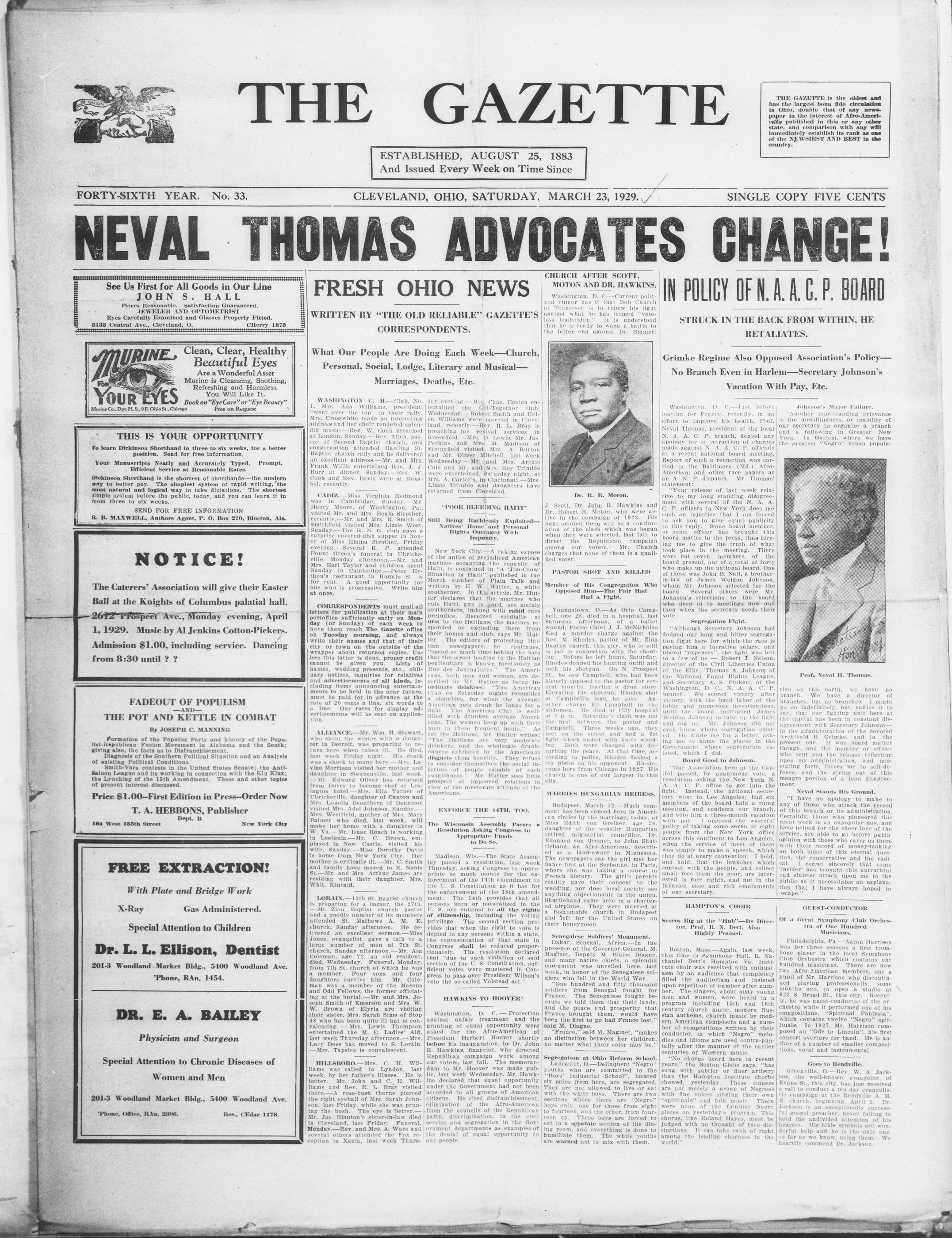
NEVAL THOMAS ADVOCATES CHANGE!
IN UNION IS SINISTER
FORTY-SIXTH YEAR
NEVA
See Us First for A
JOHN S
Prices Reasonable.
JEWELER AN
Eyes Carefully Examined
3133 Central Ave., Cleveland,
V-SIXTH YEAR. No. 33.
EVAL T
Free Us First for All Goods in Our Life
JOHN S. HALL
Prices Reasonable. Satisfaction Guaranteed.
JEWELER AND OPTOMETRIST
Services Carefully Examined and Glasses Properly Fit
Central Ave., Cleveland, O. CHer
FORTY-SIXTH YEAR. No. 33.
See Us First for All Goods in Our Line
JOHN S. HALL
Prices Reasonable. Satisfaction Guaranteed.
JEWELER AND OPTOMETRIST
Eyes Carefully Examined and Glasses Properly Fitted.
3133 Central Ave., Cleveland, O. CHerry 1873
MURINE
FOR
YOUR EYES
Clean, Clear, Healthy
Beautiful Eyes
Are a Wonderful Asset
Murine is Cleansing, Soothing,
Refreshing and Harmless.
You Will Like It.
Book on "Eye Care" or "Eye Beauty"
Murine Co., Dpt. H. S., 9E, Ohio St., Chicago
Free on Request
THIS IS YOUR OPPORTUNITY
To learn Dickinson Shorthand in position. Send f
Your Manuscripts neatly and Efficient Service
Dickinson Shorthand is the shaw way to better pay. The simi
most natural and logical way
simple system before the publ
from three to six weeks.
SEND FOR FR
R. B. MAXWELL, Authors Ag
in Dickinson Shorthand in three to six weeks, for position. Send for free information.
Manuscripts Neatly and Accurately Typed. P. Efficient Service at Reasonable Rates.
Shorthand is the shortest of shorthands—the better pay. The simplest system of rapid write natural and logical way to take dictations. The system before the public, today, and you can lea- three to six weeks.
SEND FOR FREE INFORMATION
MAXWELL, Authors Agent, P. O. Box 270, Bloct
Do learn Dickinson Shorthand in three to six weeks, for a better position. Send for free information.
Your Manuscripts Nearly and Accurately Typed. Prompt, Efficient Service at Reasonable Rates.
Dickinson Shorthand is the shortest of shorthands—the modern way to better pay. The simplest system of rapid writing, the most natural and logical way to take dictations. The shortest simple system before the public, today, and you can learn it in from three to six weeks.
SEND FOR FREE INFORMATION
R. B. MAXWELL, Authors Agent, P. O. Box 270, Blocton, Ala.
NOTICE!
The Caterers' Association
Ball at the Knights of
2612 Prospect Ave.
1, 1929. Music by A
Admission $1.00, inc
from 8:30 until ? ?
FADEOUT C
—A
THE POT AND K
By JOSEPH
Formation of the Populist-
list-Republican Fusion Mover
giving also, the facts as to Dis-
diagnosis of the Southern n
of existing Political Condition
Smith-Vare contests in the
Saloon League and its working
the Lynching of the 15th Am
of present interest discussed.
Price $1.00--First Edi
T. A. HEBB
Caterers' Association will give their best
at the Knights of Columbus palatium,
7 Prospect Ave., Monday evening,
129. Music by Al Jenkins Cotton-Pi-
mission $1.00, including service. Day
8:30 until ? ?
FADEOUT OF POPULISM
—AND—
THE POT AND KETTLE IN COMB
By JOSEPH C. MANNING
Formation of the Populist Party and history of the
Publican Fusion Movement in Alabama and the
also, the facts as to Disfranchisement.
Diagnosis of the Southern Political Situation and an
biting Political Conditions.
With-Vare contests in the United States Senate; t
League and its working in connection with the K
Teaching of the 15th Amendment. These and other
dent interest discussed.
$1.00--First Edition in Press--Order
T. A. HEBBONS, Publisher
Dept. B
The Caterers' Association will give their Easter Ball at the Knights of Columbus palatial hall, 2612 Prospect Ave., Monday evening, April 1, 1929. Music by Al Jenkins Cotton-Pickers. Admission $1.00, including service. Dancing from 8:30 until ? ?
Formation of the Populist Party and history of the Populist-Republican Fusion Movement in Alabama and the South; giving also, the facts as to Disfranchisement. Diagnosis of the Southern Political Situation and an Analysis of existing Political Conditions. State and Local Issues in United States Senate; the Anti-Saloon League and its working in connection with the Klu Klux; the Lynching of the 15th Amendment. These and other topics of present interest discussed.
184 West 135th Street
FREE EXT
With Plate and
X-Ray
Special Atten
Dr. L. L. Elli
201-3 Woodland Market
'Phone,
FREE EXTRACTION
With Plate and Bridge Work
X-Ray Gas Administered.
Special Attention to Children
D. L. L. Ellison, Dent
Woodland Market Bldg., 5400 Woodland
'Phone, RAn, 1454.
FREE EXTRACTION!
201-3 Woodland Market Bldg., 5400 Woodland Ave.
'Phone, RAn, 1454.
DR. E. A. BAILEY
Physician and Surgeon
Special Attention to Chronic Diseases
Women and Men
201-3 Woodland Market Bldg., 5400 Woodland
'Phone, Office, RAn. 2306. Res., CEdar
Physician and Surgeon
Special Attention to Chronic Diseases
Women and Men
Woodland Market Bldg., 5400 Woodland
e, Office, RAn. 2306.
Res., CEdar
Special Attention to Chronic Diseases of Women and Men
201-3 Woodland Market Bldg., 5400 Woodland Ave.
'Phone, Office, RAn. 2306. Res., CEdar 1178.
Clean, Clear, Healthy Beautiful Eyes Are a Wonderful Asset Murine is Cleansing, Soothing, Refreshing and Harmless. You Will Like It. Book on "EyeCare" or "Eye Beauty" go Free on Request
in three to six weeks, for a better
for free information.
and Accurately Typed. Prompt,
at Reasonable Rates.
shortest of shorthands—the modern
latest system of rapid writing, the
to take dictations. The shortest
pic, today, and you can learn it in
LEE INFORMATION
agent, P. O. Box 270, Blocton, Ala.
tion will give their Easter
of Columbus palatial hall,
Monday evening, April
Jenkins Cotton-Pickers.
including service. Dancing
OF POPULISM
AND—
KETTLE IN COMBAT
H. C. MANNING
First Party and history of the Popu-
ment in Alabama and the South;
franchisement.
Political Situation and an Analysis
issues.
The United States Senate; the Anti-
g in connection with the Klu Klux;
endment. These and other topics
tion in Press--Order Now
ONS, Publisher
TRACTION!
and Bridge Work
Gas Administered.
ation to Children
ison, Dentist
Bldg., 5400 Woodland Ave.
RAn, 1454.
and Surgeon
to Chronic Diseases of
n and Men
Bldg., 5400 Woodland Ave.
Res., CEDar 1178.
THE GAZETTE
New York City
ESTABLISHED, AUGUST 25, 1883 And Issued Every Week on Time Since
CLEVELAND, OHIO, SATURDAY, MARCH 23, 1929.
FRESH OHIO NEWS
WRITTEN BY "THE OLD RELIABLE" GAZETTE'S CORRESPONDENTS.
Marriages, Deaths, Etc.
WASHINGTON C. H.—Club, Nov. 1, Mrs. Ada Williams, president, "went over the top" in their rally. Mrs. Crosswhite made an interesting address and her choir rendered splendid music—Rev. W. Cook preached at London, Sunday—Rev. Allen, pastor of Second Baptist church, and congregation attended Rawling St. Baptist church rally and he delivered an excellent address.—Mr. and Mrs. Frank Willis entertained Rev. J. J. Burr at dinner, Sunday—Rev. W. Cook and Davis were at Roxabel, recently.
CADIZ.—Miss Virginia Redmond was in Cambridge, Sunday—Mr. Henry Moore, of Washington, Pa. visited Mr. and Mrs. Beula Strother, recently.—Mr. and Mrs. R. Smith of Smithfield visited Mrs. Lizzie West, Sunday.—The R. N. G. club gave a surprise covered-dish suit in honor of Miss Emma Strother, Friday evening.—Several K. P. attended Fount Green's funeral in Uhrichsville, Monday afternoon.—Mr. and Mrs. Earl Taylor and children spent Strother's Cambridge.—Peter H. thon's restaurant in Buffalo St. is for rent. A good opportunity for one who is progressive. Write him at once.
CORRESPONDENTS must mail all letters for publication at their main postoffice sufficiently early on Monday (or Sunday) of each week to have them reach The Gazette office on Tuesday morning, and always write their names and that of their city or town on the outside of the wrapper about returned copies. Unless this latter is done, proper credit will be given to the names, wedding presents, etc. obituary notes, inquiries for relatives and advertisements of all kinds, including items announcing entertainments to be held in the near future, must be paid for in advance at the rate of 20 cents a line, six words to a line. Our rates for display advertisements will be sent on application.
ALLIANCE.—Mr. Wm. H. Stewart, who spent the winter with a daughter in Dec. 1945, was preparing to return her bill last week Friday night. His death was a shock to many here—Mrs. Lavina Morrison visited her mother and daughter in Steubenville last week
—Mr. Edward Oliver has returned from Dover to become chef at Lexington hotel.—Mrs. Ella Turner of Uhrichville, daughter of Canton and Mrs. Louella Deonther of Dennison visited Mrs. Adel Johnson, Sunday.—Mrs. Westfield, mother of Mrs. Mary Palmer who died, last week, will make her home with a daughter in W. Va.—Mr. Isaac Roach is working Loveland.—Mr. C. Brown, employed in Castle, visited wife, Sunday.—Miss Dorothy Davis is home from New York City. Her mother is critically ill.—Mr. C. Smith and family moved to E. Noble St.—Mr. and Mrs. Arthur James are residing with their daughter, Mrs. Whit. Kincaid
LORAIN.—12th St. Baptist church is preparing for a bazaar, the 27th. —Mt. Zion Baptist church pastor and a goodly number of its members attended St. Mathews A. M. E. church, Sunday afternoon. He delivered an excellent sermon.—Miss Jones, evangelist, gave a talk to a large number of men at 7th St. church, Sunday afternoon.—Mr. Asa Coleman, age 72, an resident, dedicated an annual, for from 7th St. church of which he was a member. Four sons and four daughters survive him. Mr. Coleman was a member of the Masons and Odd Fellows, the former officiating at the burial.—Mr. and Mrs. Joseph Smith of Emerson and Mrs. W. B. Wren of Elyria are visiting their sister, Mrs. Sarah Sims of Stop 48 who has been quite ill but is convalescing.—Mrs. Lewis Thompson entertained the M. E. Ladies' Aid, last week Thursday afternoon.—Mrs. Lucy Doss has moved to S. Lorain.—Mrs. Tapsico is convalescent.
HILLSBORO.—Mrs. C. H. Williams was called to Lyndon, last week, by her father's illness. He is better. Mr. John and C. H. Williams are in town, and they visited there.—A rose-bush thorne pierced the right eyehall of Mrs. Sarah Johnson, last Friday, while she was pruning the bush. The eye is better.—Mr. Jas. Blanton's sister-in-law died in Cleveland, last Friday. Funeral Monday.—Rev. and Mrs. A. Ware and several others attended the Fox reception in Xenia, last week Thurs-
day evening.—Mrs. Chas. Easton entertained the Celt Together club, Wednesday.—Robert Smith and Helen Williams were married in Cleveland, recently.—Rev. R. L. Bray is preaching for revival services in Greenfield.—Mrs. O. Lewis, Mr. Jas. Perkins and Mrs. M. Madison of Springfield visited Mrs. A. Burton and Mr. Oliver Mitchell, last week Wednesday.—Mr. and Mrs. Archie Cole and Mr. and Mrs. Roy Trimble were entertained, Saturday night, at Mrs. A. Carter's, in Cincinnati.—Mrs. Lizzie Trimble and daughters have returned from Cleveland.
"POOR BLEEDING HAITI"
Still Being Ruthless Exploited-
Natives' Home and Personal
Rights Outraged With
Impunity.
ENFORCE THE 14TH, TOO.
The Wisconsin Assembly Passes a Resolution Asking Congress to Appropriate Funds to Do So.
Madison, Wis.—The State Assembly passed a resolution, last week Thursday, asking Congress to appropriate as much money for the enforcement of the 14th amendment to the U. S. Constitution as it has for the enforcement of the 18th amendment. The 14th provides that all persons born or naturalized in the U. S. are entitled to all the rights of citizenship, the voting privilege. The second section provides that when the right to vote is denied to any persons within a state, the representation of that state in Congress shall be reduced proportionately. The resolution declared that "due to such violation of said section of the U. S. Constitution, sufficient votes were mustered in Congress to pass over President Wilson's veto the so-called Volstead act."
HAWKINS TO HOOVER!
Washington, D. C. — Protection against unfair treatment and the granting of equal opportunity were asked for the Afro-American of President Herbert Hoover shortly before his inauguration, by Dr. John R. Hawkins, financier, who directed Republican campaign work among our voters, last fall. The memorandum to Mr. Hoover was made public, last week Wednesday. Mr. Hawkins declared that equal opportunity under the Government had not been accorded to all groups of American citizens. He cited disfranchisement, elimination of the Afro-American from the councils of the Republican party, discrimination, in the civil service and segregation in the Government departments as examples of the denial of equal opportunity to our people.
CHURCH AFTER SCOTT,
MOTON AND DR. HAWKINS
Washington, D. C.—Current political rumor has it that Bob Church of Tennessee is to renew his fight against what he has termed "voteless leadership." It is understood that he is ready to wage a battle to the bitter end against Dr. Emmett
Dr. R. R. Moton.
J. Scott, Dr. John R. Hawkins and Dr. Robert R. Motion, who were active in the campaign of 1928. His fight against them will be a continuation of the clash which was begun when they were selected, last fall, to direct the Republican campaign among our voters. Mr. Church charges that none of them is a qualified voter.
PASTOR SHOT AND KILLED
Member of His Congregation Who
Opposed Him—The Pair Had
Had a Fight.
Youngstown, O.—As Otto Campbell, age 28, died in a hospital, last Saturday afternoon, of a bullet wound, Police Chief J. J. McNicholas filed a murder charge against the Rev. M. Rhodes, pastor of Mt. Zion Baptist church, this city, who is still in jail in connection with the shooting. Before he left home, Saturday, Rhodes donned his hunting outfit and took his shotgun. On N. Prospect St., he saw Camellia who had been shot in the back of the metal months, leaving a drug store. Elevating the shotgun, Rhodes shot at Campbell's legs, he says. Another charge hit Campbell in the abdomen. He died at City hospital at 1 p.m. Saturday's clash was not the first between the pastor and Campbell. Three weeks ago, they met on the street and had a first fight which ended with knife wielding. Both were charged with disobeying the peace. At that time, according to police, Rhodes fashed a toy pistol on his opponent. Rhodes came here from Chicago in 1927. His church is one of our largest in this city.
MARRIES HUNGARIAN HEIRESS.
Budapest, March 12.—Much comment has been caused here in American circles by the marriage, today, of Miss Edith von Greiner, age 20, daughter of the wealthy Hungarian retired ministerial councillor, Dr Edouard von Greiner, to John Shuttlehand, an Afro-American, described as a land-owner in Minnesota. The newspapers say the girl met her fiance first at the Sorbonne, in Paris, where she was taking a course in French. The girl's parents readily gave their consent to the wedding, nor does local society see anything objectionable in the union. Shuttlehand came here in a chartered airplane. They were married at a fashionable church in Budapest and left for the United States on their hourmoon.
Senegalese Soldiers May
Senegalese Soldiers' Monument.
Dakar, Senegal, Africa.—In the presence of the Governor-General, M. Magnetet, Deputy M. Blaise Diagne, and many native chiefs, a splendid monument was unveiled here, last week, in honor of the Senegalese soldiers who fell in the World War.
One hundred and fifty thousand soldiers from Senegal fought for France. The Senegalese fought because they told them that their lands, and the peace and prosperity that France brought them, would have been the first to go had France lost," said M. Diagne.
"France" said M. Magnetet, "makes no distinction between her children, no matter what their color may be."
Segregation at Ohio Reform School.
Lancaster, O.—Delinquent "Negro" youths who are committed to the "Boy's School," located six miles from here are segregated. They are not allowed to live with the white boys. There are two sections where there are "Negro" boys only, one for those from eight to fourteen, and the other, from fourteen up. These boys are forced to eat in a separate section of the dining room, and everything is done to humiliate them. The white youths are warned not to mix with them.
SINGLE COPY FIVE CENTS
IN POLICY OF N.A.A.C.P. BOARD
STRUCK IN THE BACK FROM WITHIN, HE RETALIATES.
Grimke Regime Also Opposed Association's Policy—No Branch Even in Harlem—Secretary Johnson's Vacation With Pay, Etc.
Washington, D. C.—Just before leaving for France, recently, in an effort to improve his health, Prof. Neval Thomas, president of the local N. A. A. C. P. branch, denied any apology for or retraction of charges made against N. A. A. C. P. officials at a recent national board meeting, Report of such a retraction was carried in the Baltimore (Md.) Afro-American and other race papers as an A. N. P. dispatch. Mr. Thomas' statement:
Johnson's Major Failure.
"Another long-standing grievance is the unwillingness, or inability of our secretary to organize a branch and a following in Greater New York. In Harlem, where we have the greatest "Negro" urban popula-
"Your release of last week relative to my long standing disagreement with several of the N. A. A. C. P. officers in New York does me such an injustice that I am forced to ask you to give equal publicity to this reply. Some board member, or some officer has brought this board matter to the press, thus forcing me to give the truth of what took place in the meeting. There were but seven members of the board present, out of a total of forty who make up the national board. One of these was John B. Nail, a brother-in-law of James Weldon Johnson, whom Mr. Johnson selected for the board. Several others were Mr. Johnson's selections to the board who drop in to meetings now and then when the secretary needs their vote.
Segregation Fight.
"Although Secretary Johnson had dodged our long and bitter segregation fight here for which the race is paying him a lucrative salary, and liberal 'expenses', the fight was left to a few of us — Robert J. Nelson, director of the Civil Liberties Union of the Elks; Thomas A. Johnson of the National Equal Rights League, and Secretary A. S. Pinkett, of the Washington, D. C., N. A. A. C. P. branch. We scored victory after victory, with the hard labor of the lobby and numerous investigations, until the board instructed James Weldon Johnson to take up the fight and aid us. Mr. Johnson did not even know where segregation existed. He wrote me for a letter, asking me to name the places in the Government where segregation existed, which I did.
Board Good to Johnson.
Board Good to Johnson.
"Our Association here at the Capital passed, by unanimous vote, a resolution asking the New York N. A. A. C. P. office to get into the fight. Instead, the national secretary went to Los Angeles; had six members of the board hold a rump meeting, and condemn our branch, and vote him a three-month vacation when policy opposed the wasteful policy of taking everyone or eight people from the New York office across this continent to Los Angeles, when the service of most of them was simply to make a speech, which they do at every convention. I held, and hold, that the branches which contact with the people, and collect small fees from the poor, are interested in race rights, and not in the luxuries, ease and rich emoluments of our secretary.
HAMPTON'S CHOIR
Scores Big at the "Hub"—Its Director, Prof. R. N. Dett, Also Highly Praised.
Boston, Mass—Again, last week, this time in Symphony Hall, R. Nathaniel Dett's Happiness Choir was received with enthusiasm by an audience that completely filled the auditorium and insisted upon repetition of number after number. The singers, about sixty young men and women, were heard in a program including 15th and 16th century church music, modern Russian anthems, church music by modern American composers and a number of compositions written by their conductor, in which "Negro" melodies and idioms are used contra-puntally after the manner of the earlier centuries of Western music.
"No chorus heard here in recent years," the Boston Globe says, "has sung with subtler or finer artistry than the Hampton Institute chorus showed, yesterday. These singers are not merely a group of Negroes with fine voices singing their own "spirituals" and folk music. There were none of the familiar Negro pieces on yesterday's Program chorus, like Roland Hayes, must be judged with no thought of race distinctions. It can take rank of right among the leading choruses in the world."
THE GAZETTE is the oldest and has the largest bona fide circulation in Ohio, double that of any newspaper in the interest of Afro-Americans published in this or any other country. It immediately establish its rank as one of the NEWSIEST AND BEST in the country.
E COPY FIVE CENTS
RANGE!
A. A. C. P. BOARD
ACK FROM WITHIN, HE
ALIATES.
opposed Association's Policy—
Harlem—Secretary Johnson's
With Pay, Etc.
Johnson's Major Failure.
"Another long-standing grievance is the unwillingness, or inability of our secretary to organize a branch and a following in Greater New York. In Harlem, where we have the greatest "Negro" urban popula-
Prof. Neval H. Thomas.
tion on this earth, we have no branch. We have a director of branches, but no branches. I might go on indefinitely, but, suffice it to say, that our fighting unit here at the capital has been in constant disagreement with Secretary Johnson—in the administration of the devoted Archibald H. Grimke, and in the present one. It was board matter though, and the member or officer who sent you the release reflecting upon my administration, missing facts, forces, and self-defense, and the giving out of this meagre portion of a long disagreement.
Neval Stands His Ground.
"I have no apology to make to any of those who attack the record of this branch or its administration. Certainly, those who pioneered this great work in an unpopular day, and have helped for the sheer love of the service, are able to go before public opinion with those who carry us there with their record of money-making on both sides of this eternal question, the conservative and the radical, regret sincerely that some insider burrowed this untemptful and sinister attack upon us to the public as it necessitates an explanation that I have always hoped to "escape."
GUEST-CONDUCTOR
Of a Great Symphony Club Orchestra of One Hundred Musicists
Philadelphia, Pa.—Aaron Harrison was for three seasons a first trombone player in the local Symphony Club Orchestra which contains one hundred musicians. There are now two Afro-American members, one a pupil of Mr. Harrison who discontinued playing professionally, some months ago, to open a studio at 623 St. John's this city. Recently, he was guest-starred in orchestra while it performed one of his compositions, "Spiritual Fantasia," which contains twelve "Negro" spirituals. In 1927, Mr. Harrison composed an "Ode to Lincoln," his first concert overture for band. He is author of a number of smaller compositions, vocal and instrumental.
Goes to Rendville.
Greenville, O.—Rev. W. A. Jackson, the well-known evangelist of Evans St., this city, has just received a call to conduct a ten day evangelistic campaign at the Rendville A. M. E. church, beginning, April 1. Dr. Jackson is an exceptionally successful gospel preacher, never failing to hold the undivided attention of his hearers. His bible symbols are wonderful help and he is the only one, so far as we know, using them. We heartily commend Dr. Jackson.
WHAT WOULD YOU DO IF I GAVE YOU A QUARTER?
A QUARTER! GOSH, GRAN'PA, I GUESS I'D GO COO-COO
ID HATE TO SEE YOU DO THAT - BUT ILL TAKE A CHANCE, HERE YOU ARE
THANKS! GRAN'PA, HOT DOG!
FOR PITY'S SAKE, CHESTER, ARE YOU GOING TO WASTE IT ALREADY?
I AIN'T A-GOIN' TO WASTE IT
I'M A-GOIN' TO SPEND IT TO BUY A PURSE TO KEEP IT IN
One Year ..... $2.00
Six Months ..... 1.00
Subscribers are requested to remit
by postoffice money order or
registered letter.
Entered at the postoffice in Cleveland, Ohio, as second-class
mail matter
Address all communications to
HARRY C. SMITH
Editor and Proprietor
THE GAZETTE
226 W. Superior Ave., Cleveland, O.
(Bell Phone: CHerry 1259)
Member Ohio Legislature: 1894 to
1896; 1896 to 1900 to 1902.
IN UNION IS STRENGTH
10,000,000 Afro-Americans.
350,000 in Ohio.
40,000 in Cleveland.
SATURDAY, MARCH 23, 1929
We hope Congressman-Elect Oscar DePriest of Chicago will be seated and will "measure up."
"John Shuttlehand of Minnesota" is making a mistake in bringing his Hungarian heiress bride to this country, even on a honeymoon trip. Any country but this, John; because of its silly racial prejudice.
Wonder if President Herbert Hoover will pay any more attention to the "memorandum" Dr. John R. Hawkins filed with him just before his inauguration than President Calvin Coolidge did to the one given him shortly after his inauguration by his leading "Negro" supporter?
DR. DE BOW DENIES IT
Rev. Charles L. DeBow never advocated the closing of the Apex night club of the third precinct, because white and colored women or others mingled there, he told a large audience at Cory M. E. church, in an address, Monday night. Dr. DeBow, who started police on an alleged "cleanup campaign", several weeks ago, with a sermon at First M. E. church, Euclid Ave. and E. 300th St., of which he is pastor, declared good citizenship has nothing to do with race and that the problems of right-cousness, decency, honesty and morality face all races. Director Ed. Barry refused to deny, on several occasions, once in the City Council, that he said what Dr. DeBow denies having said or advocated. So hold Barry responsible for that foolish statement until he denies having made it. He was quoted in the daily newspapers at the time as having done so and has never denied saying it.
Wednesday's Cleveland Plain Dealer said:
"City Manager Wm. R. Hopkins stood by the pulpit of Cory M. E. church at Scovill Ave, and E. 355th St. last night, which had just applauded him. He had come to pay the respects of the city in connection with the 50th anniversary of the church, and he walked right into a love feast."
Can you imagine representatives of any other class of people receiving "with open arms" a man who insults and discriminates against them so unfairly and unjustly as Hopkins does our people in the case of the City Hospital alone? Rev. S. E. Grannum, pastor, and certain members of Cory M. E. church should hang their heads in shame! The very idea of inviting to their 50th anniversary celebration and "love feast" a man who as City Manager refuses to permit their boys only to interne and their girls only to enter the school for nurses at City Hospital because of their color or race connection! It is enough to bring down upon them the wrath of a just God, let alone that of all of the loyal, race and self respecting Afro-Americans in this community and the country. Whither are we drifting? And after Hopkins had completed his address, Councilman Russell S. Brown spoke highly of him. Lord, have merry!
THAT MEMORIAL BUILDING.
A wrong impression has been made, generally, throut the country by articles, sent out from Washington, D. C., in the last few weeks, to the effect that the recent Congress in passing "a joint resolution to create a commission to secure plans and designs for and to erect a memorial building for the National Memorial Association, Inc., in the city of Washington, as a tribute to the 'Negro's contribution to the achievements of America", and appropriating "$50,000 to assist in carrying out the plans", had provided for or intended to provide for such a building. This is NOT the case. The joint reso-
Councilman E. J. Gregg opened Secretary Wm. R. Conners' health campaign, Sunday evening, with a talk at Revelation Baptist church, 7498 Kinsman Rd. Another meeting, held at 5 p. m., Sunday, at St. Paul's Zion A. M. E. church, E. 551 St. and Quincy Ave., was addressed by Dr. Edward A. Bailey. Twelve per cent of Cleveland's deaths in 1928 were among our people although only 6 per cent of the population is Afro-American, according to health department figures. If Councilman Gregg's housing "drive" had not proven such a dismal failure, last year, that "twelve per cent" would have been much less. The health campaign will end, April 30. If Councilman Russell Brown doesn't do something material in the council for his Afro-American constituents and the rest of our people of this community, and soon, too, good-by Messrs Gregg, George and Brown, the three councilmanic "musketeers". By the way, what has become of George's resolution for improved street-car service in Central, Cedar and Scovill Avenues?
Biocont Amt. Items.
Mrs. Q. E. Carter is visiting her sister, Mrs. L. E. Porter, who is very ill at Maylene—Mrs. Lillian Duff is visiting her sisters, the Misses Birtley and Judy O. Mackenzie in stenbenville, O. Mrs. M. E. D. Dobbins have moved to Wylam. Alabama is facing the "the greatest catastrophe in its history." A dozen counties in the southern part of the state are in imperative need. The flood condition is a great menace.
Killed Her "Sweetie."
Bronx, N. Y—Mary Schnapp (white), 21-year-old dance-hall hostess, who is alleged to have shot and killed her "Negro" common-law husband, Seymour Irick, age 30, in their apartment at 3579 Fish Ave. Feb. 7, during a quarrel, was discharged in Bronx Homicide court and immediately re-arrested, last week, on an indictment for manslaughter in the first degree, returned by the Bronx County grand jury.
'Round Home
by CHAS.S.KINNISON
Old Taffy Pullin'
member the old "taffy pullin' "
to go to in days past and gone?
recall the old-fashioned "woolin' "
the girls as the evening wore on!
The Old T
Who can remember the
We all used to go to
And who can recall the
We gave to the girls
And don
after
'Round Home by CHAS.S.KINNISON
Who can remember the old "taffy pullin' "
We all used to go to in days past and gone?
And who can recall the old-fashioned "woolin' "
We gave to the girls as the evening wore on!
And don't you remember the one you ran after—
And the big funny bow that she had in her hair?
And still don't you hear the shouts and the laughter—
And ho, for the taffy that clung to your fingers,
And ho, for the fun we had pullin' it, too!
The memory of it still fancifully lingers
While all of my playmates pass by in review.
And ho, for the stars that above us were gleamin'
As out in the moonlight the candy we made—
The very same moonlight in which I am dreamin',
Tonight, of the old-fashioned games
that we p'ayed!
We tugged at the taffy until it was brittle.
At least that's the way that it should
have been done.
But if it stayed sticky, that mattered but
little—
The taffy was nothing
(Nor is it sweet kiss
The kisses we stole fro
Beat all of the taffy
TUBBY
WHAT WOULD YOU
DO IF I GAVE YOU
A QUARTER?
The candy itself was the least of the fun
thing experienced to the bliss.
The candy it been was the least of the run
The taffy was nothing compared to the kisses
(Nor is it sweet kisses of candy, I mean)
The kisses we stole from the sweet little misses
Beat all of the taffy man ever has seen
HORRING compared to the kisses
sweet kisses of candy. I mean)
stole from the sweet little misses
the taffy man ever has seen
Would you
have you
ter?
A QUARTER!
GOSH, GRAN'PA,
I GUESS I DD
GO COO-COO
ID HAT
DO THE
TAKE
HERE
lution also provided for "a commission of fifteen persons to be appointed by the President" which is to erect and maintain such a building but only AFTER the National Memorial Association has raised the sum of $100,000 with which to do so. This thing does not look any too good to us. The officers of the Association are: Ferdinand D. Lee, pres.; John R. Hawkins, treas.; Samuel C. Smith, sec.; Martin R. Powell, publicity director. We have heard of Hawkins but who, please, are the others?
OUR THREE COUNCILMEN!
Planton New Items
Killed Her "Sweetie"
A
THE GAZETTE, CLEVELAND, O., SATURDAY, MARCH 23, 1929
ABOUT 19, WE GUESS
"How old is your son?" asked the visitor. "Well," replied the dad, "he's reached that age when he thinks the most important thing to pass isn't his examination, but the car ahead."
"HUMAN NATURE'S
FOULEST BLOT."
My ear is palmed.
My soul is sick with every day's report.
Of wrong and outrage, with which the earth is filled.
There is no flesh in man's obdurate heart.
It does not feel for man; the natural bond
Of brotherhood is severed as the flax
That falls asunder at the touch of fire.
He finds his fellow guilty of a skim
Not colored like his own; and having power
To enforce the wrong, for such a worthy cause
Dooms and devotes him as his lawful prey.
Thus man devotes his brother, and destroys:
Tis human nature's broadest desire.
IS IT ANY USE TO CON-
TEND FOR RIGHTS?
Colored Americans are the only race, responsible members of which are in favor of "always will be discriminated submitting to discrimination on the claim that their race against." The Jews are still contending, after over 1900 years of universal discrimination and are now facing social rights today. The Irish at home have contended for 700 years and are winning because they will die rather than submit. The race that says it's cf no use to resist, downs itself and the world then will say, "Negroes are not worthy of equal rights; they are by nature without self-respect and no "guts." The world nores only those who resent and resist proscriptions for race.
Let us be worthy of the abolitionists, worthy of our own fathers who have died in every war to vindicate the title of their race to equal liberty, and forever resist denial of rights in our native land, however long race discrimination may continue. To submit is to deserve contempt.—Boston (Mass.) Guardian.
And still don't you picture the gang that was there?
OHIO'S MOB VIOLENCE ACT
OR ANTI-LYNCHING LAW LEADS THE COUNTRY IN EFFECTIVE LEGISLATION
Against the Mob and Lynch-Murder-Three Years Work of a Member of the Race-Also His Ohio Civil Rights Law.
section
6278. "Mob" and "lynching" defined.
6279. "Serious injury" defined.
6280. Damages in case of assault.
6281. Damages in case of lynching.
6282. Damages recoverable by legal representative of victim of lynching
6283. Person suffering death or injury by mob trying to lynch another.
6284. Limitations of action.
6285. Order to include recovery and costs in tax levy.
6286. Guardian's custody, etc., fees.
6287. County's right of action against member of mob
6288. County's right of action against another county.
6289. Non-relief from prosecution.
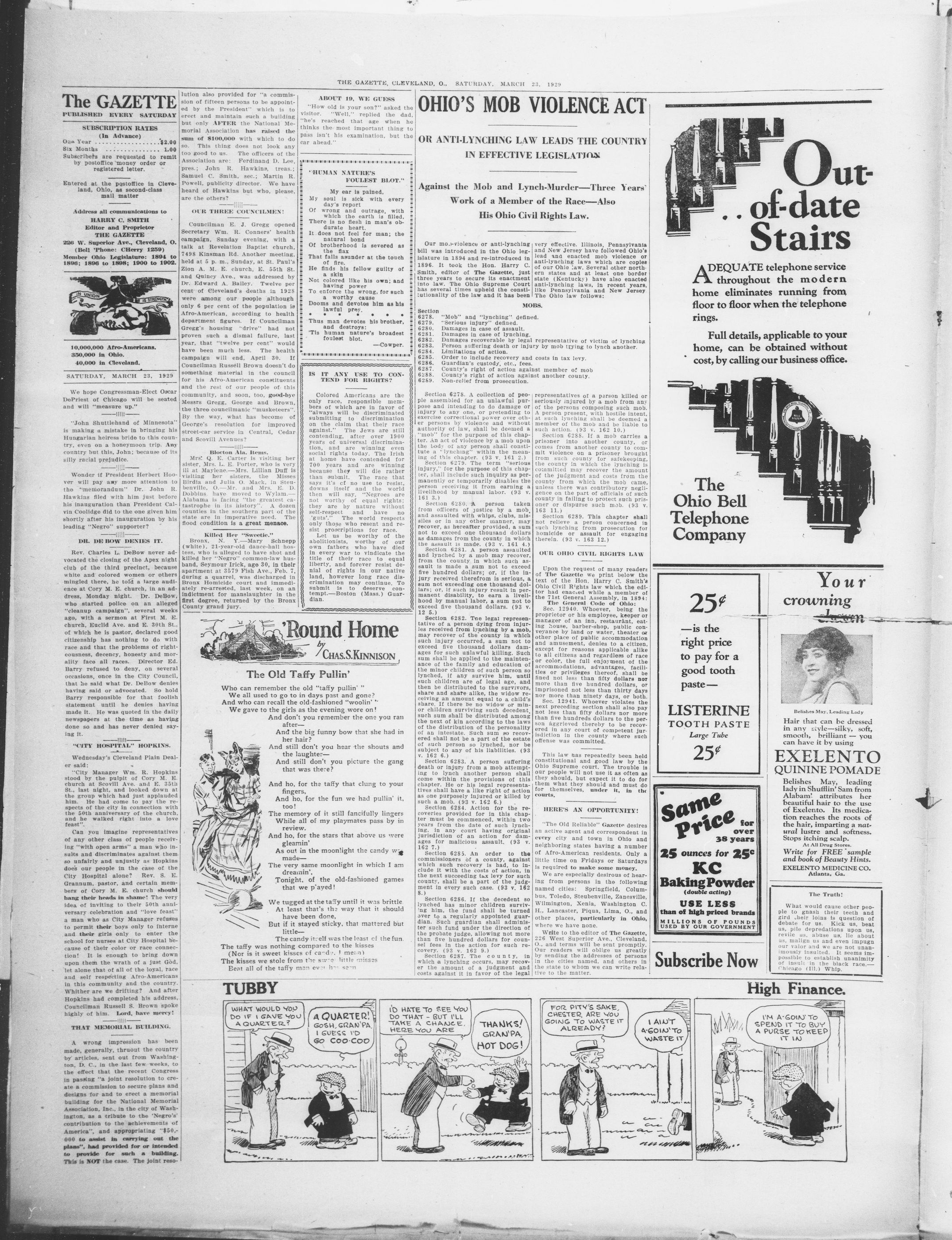
Our mo-violence or anti-lynching bill was introduced in the Ohio legislature in 1894 and re-introduced in 1896. It took the Hon. Harry C. Smith, editor of The Gazette, just three years to secure its enactment into law. The Ohio Supreme Court has several times upheld the constitutionality of the law and it has been
Section 6278. A collection of people assembled for an unlawful purpose and intending to do damage or injury to any one, or pretending to exercise correctional power over other individuals by violence and without authority of law, will be deemed "mob" for the purpose of this chapter. An act of violence by a mob upon the body of any person shall constitute a "lynching" within the meaning of this chapter. (93 v. 161 2). Section 6279. The term "serious injury," for the purpose of this chapter, shall include such inquiry as per the definition of the person receiving it from earning a livelihood by manual labor. (93 v. 161 3). Section 6280. A person taken from officers of justice by a mob, and assaulted with whips, clubs, missiles or in any other manner, may recover, as hereafter provided, a sum not to exceed one thousand dollars as damages from the county in which the person was arrested.
Section 6281. A person assaulted and lynched by a mob may recover, from the county in which such assault is made a sum not to exceed five hundred dollars; or, if the injury received therefrom is serious, a sum not exceeding one thousand dollars; or, if such injury result in permanent disability, to earn a livelihood by manual labor, a sum not to exceed five thousand dollars. (93 v. 12 5.)
Section 6282. The legal representative of a person dying from injuries received from lynching by a mob, may recover of the county in which such injury occurred, a sum not to exceed five thousand dollars damages for such unlawful killing. Such sum shall be applied to the maintenance of the family and education of the minor children of such person so lynched, if any survive him, until such children are of legal age, and then be distributed to the survivors, share and share alike, the widow receiving an amount equal to a child's share. If there be no widow or minor, such surviving such decedent, such sum shall be distributed among the next of kin according to the law of the distribution of the personality of an intestate. Such sum so recovered shall not be a part of the estate of such person so lynched, nor be subject to any of his liabilities. (93 v. 162 6.)
Section 6283. A person suffering death or injury from a mob attempting to lynch another person shall come within the provisions of this chapter. He or his legal representatives shall have a like right of action as one purposely injured or killed by such a mob. (93 v. 162 6.) Section 6284. Action for the recovery provided or in this chapter must be commenced, within two years from the date of such lynching, in any court having original jurisdiction of an action for damages for malicious assault. (93 v. 162 7.) Section 6285. An order to the commissioners of a county, against which such recovery is had, to include it with the costs of action, in which, during their law for such county, shall be a part of the judgment in every such case. (93 v. 162 8.)
Section 6286. If the decedent so lynched has minor children surviving him, the fund shall be turned over to a regularly appointed guardian who shall administer such fund, the probate judge, allowing not more than five hundred dollars for counsel fees in the action for such recovery. (93 v. 162 9.)
Section 6287. The country, in which you reside, may recover the amount of a judgment and costs against it in favor of the legal
very effective. Illinois, Pennsylvania and New Jersey have followed Ohio's lead and enacted mob violence or anti-lynching laws which are copies of our Ohio law. Several other northern states and at least one border state (Kentucky) have also enacted anti-lynching laws, in recent years, like Pennsylvania and New Jersey The Ohio law follows:
UBS.
ed.
representative of victim of lynching by mob trying to lynch another.
costs in tax levy.
just member of mob
just another county.
representatives of a person killed or seriously injured by a mob from any of the persons composing such mob. A person present, with hostile intent, at such lynching shall be deemed a member of the mob and be liable to such action. (93 v. 162 10.) Section 6288. If a mob carries a prisoner from another county, or comes from another county, or commits violence on a prisoner brought from such county for safekeeping, the county in which the lynching is committed may recover the amount of the judgment and costs from the county from which the mob came, unless there was contributory negligence on the part of officials of such county in failing to protect such prisoner or disperse such mob. (93 v. 163 10.) Section 6289. This chapter shall not relieve a person concerned in such lynching from prosecution for homicide or assault for engaging therein. (93 v. 163 12.)
OUR OHIO CIVIL RIGHTS LAW
Upon the request of many readers of The Gazette we print below the text of the Hon. Harry C. Smith's Ohio Civil Rights law which the editor had enclosed while a member of the 71st General Assembly, in 1894.
Sec. 12940. Whoever, being the proprietor or his employee, keeper or manager of an inn, restaurant, eating House, barbershop, public conveyance by land or water, theater or other place of public accommodation and amusement, denies to a citizen, except for reasons applicable alike to all citizens and regardless of race color, the full enjoyment of the accommodation, advantages, facilities or privileges or privileges defined not less than fifty dollars nor more than five hundred dollars, or imprisoned not less than thirty days nor more than ninety days, or both. Sec. 12941. Whoever violates the next preceding section shall also pay not less than fifty dollars nor more than hundreds dollars to the person aggrieved to be recovered in any court of competent jurisdiction in the county where such offense was committed.
This law has repeatedly been held constitutional and good law by the Ohio Supreme court. The trouble is our people will not use it as often as they should, but expect it to do for them what they should and must do for themselves, under it, in the courts.
HERE'S AN OPPORTUNITY!
"The Old Reliable" Gazette desires an active agent and correspondent in every city and town in Ohio and neighboring states having a number of Afro-American residents. Only a little time on Fridays or Saturdays is required to make some money. We are especially desirous of hearing from persons in the following named cities: Springfield, Columbus, Toledo, Steubenville, Zanesville, Wilmington, Xenia, Washington C. H., Lancaster, Piqua, Lima, O., and other places, particularly in Ohio, where we have none.
Write to the editor of The Gazette, 226 West Superior Ave., Cleveland, O., and terms will be promptly. Our readers will oblige us greatly by reading the addresses of persons in the business field, and others in the state to whom we can write relative to the matter.
FOR PITY'S SAKE,
CHESTER, ARE YOU
GOING TO WASTE IT
ALREADY?
Out...of-date Stairs
ADEQUATE telephone service throughout the modern home eliminates running from floor to floor when the telephone rings.
Full details, applicable to your home, can be obtained without cost, by calling our business office.
The
Ohio Bell
Telephone
Company
—is the
right price
to pay for a
good tooth
paste—
LISTERINE
TOOTH PASTE
Large Tube
25¢
Same
Price
for
over
38 years
25 ounces for 25¢
KC
Baking Powder
(double acting)
USE LESS
than of high priced brands
MILLIONS OF POUNDS
USED BY OUR GOVERNMENT
Belishes May, Leading Lady
Hair that can be dressed in any style—silky, soft, smooth, brilliant — you can have it by using
Belishes May, leading lady in Shufflin' Sam from Alabam' attributes her beautiful hair to the use of Exelento. Its medication reaches the roots of the hair, imparting a natural lustre and softness. Stops itching scalp. At All Drug Stores. Write for FREE sample and book of Beauty Hints. EXELEENTO MEDICINE CO. Atlanta, Ga.
The Truth!
What would cause other people to gnash their teeth and gird their loins is question of debate for us. Kick us, beat us, pile depredations upon us, revile us, abuse us, lie about us, malign us and even impugn our valor and we are not unanimously insulted. It seems impossible to establish unanimity of insult in the black race.—Chicago (Ill.) Whip.
A GOIN' TO
Dr. LeROYN. BUNDY, Dentist,
Cedar Branch Y. M. C. A.
Cor. Cedar Ave. and E. 77th St.
A HOME FOR YOUNG MEN!
RESTAURANT - HOME COOKING
Individual Beds $2.50-$3.00
RAndolph 8288.
MRS. L. S. BRADLEY
2374 E. 84th St.,
Cleveland, O.,
Has Houses For Sale
or to Rent
JOHN P. GREEN
Attorney-at-Law
Room 510, Blackstone Bldg.
1426 West 3rd Street
CLEVELAND, OHIO
Notary Public
Office Phone: Main 2912
Res.: 614 East 107th St.
'Phone, Glen. 8458.
O. K. Printing Co.
W. J. Foster - John M. Smith
Commercial and Job
PRINTING
PROMPT SERVICE
3113 Central Avenue
Prospect 2600
LISTERINE
THROAT
TABLETS
Antiseptic
Prevent
& Relieve
Horseness
Sore Throat
Coughs
Don't Fuss With Mustard Plasters
Musterole, which is made of oil of mustard and other helpful ingredients, takes the place of mustard plasters. Musterole usually gives prompt relief from bronchitis, sore throat, coughs, colds, croup, neuralgia, headache, congestion, rheumatism, sprains, sore muscles, bruises, and all aches and pains. It may prevent pneumonia.
To Mothers: Musterole is also made in milder form for babies and small children. Ask for Children's Musterole.
Jars & Tubes
MUSTEROLE
WILL NOT BLISTER
Better than a mustard plaster A Delicious Food
A food for protein; a food for mineral salts; for calcium and phosphorus; all the essential elements for health and strength are found in good cheese. And all the essential elements of good cheese are found in Kraft Cheese.
KRAFT K CHEESE
KRAFT.PHENIX
CHEESE COMPANY
Where To Purchase The Gazette
NOTICE TO SUBSCRIBERS
Subscribers not receiving The us at once. We desire every y
Send or bring locals and all office, Suite 202, Johnson Block site the Hotel Cleveland. If there, please.
We advise our readers to advertisements before making advertisise in this paper should The fact that they advertise is
All reading matter for pub Gazette must be in the office week, at the latest. Display 4 p. m., WEDNESDAYS!
HARRY
226 West Superior
(Opposite, Ho
Notary Public
Classified Advertise
Subscribers not receiving The Gazette regularly should notify us at once. We desire every copy delivered promptly.
Send or bring locals and all business matters to The Gazette office, Suite 302, Johnson Block, 226 Superior Ave., West, opposite the Hotel Cleveland. If you wish to see the editor call there, please.
We advise our readers to carefully examine The Gazette's advertisements before making purchases. Business men who advertise in this paper should have the patronage of our people. The fact that they advertise is assurance that they want it.
All reading matter for publication in current issues of The Gazette must be in the office by noon, WEDNESDAY, of that week, at the latest. Display advertisements accepted until 4 p. m., WEDNESDAYS!
HARRY C. SMITH,
226 West Superior Avenue, Cleveland, O.
(Opposite, Hotel Cleveland.
Notary Public
Bell 'Phone: Cherry 1259
(Call, in the Afternoon.)
Classified Advertising Department
FOR SALE.—1925 Dodge coach in excellent condition. Always owned by a woman, given the best of care and never driven hard. Four new standard balloon tires and an extra. $350 cash. Call, Cherry 1259 in the afternoon. A bargain!
CLEVELAND Social and Personal
Miss Louise, daughter of Mrs. Miranda Cheeks, of Carolyn Ave., is attending Kent' Normal school.
Sierre Leone council, A. U. K. and D. of A., is planning a popularity contest for April. Mrs. Della Offer is queen of the council.
At the C. A. C. indoor carnival at Public Hall, Saturday evening, Geo. Anderson of E. High won the 40 yd. High School dash. Time, 4.4 seconds.
Mrs. Bessie Trigg, E. 126th St., attended her mother's funeral, last week, in Memphis, Tenn. Her daughter, Marciella, an honor graduate of John Adams High school, will enter W. R. U. this fall.
The Federation of new officers are: Opal Owens, pres.; Julia Gains, vice-pres.; Edith Young, sec.; Dorothy Owens, assist.; Frances Lewis, treas.; Hilda Crazette, reporter. It will have a style show in April.
Burrell Taylor, an old resident, is very ill at the Old Folks' home, 4807 Cedar Ave. The old residents particularly and others of his many friends, when in health, ought to go and see him immediately.
Mrs. Addie W. Hunton, of Brooklyn, N. Y., will speak for the local N. A. A. C. P. branch at Shiloh Bapst church, Sunday, at 3:30 p. m. Mrs. Hunton is president of our Empire State Federation of Women's clubs and a former field-agent of the N. A. A. C. P.
The Spritz Co., E. 9th St., has gone out of business. Cause: the "Coolidge Good Times". Popular Jim Shield of that company has gone to Elmira, N. Y., where he established a Spritz Co. branch store, about two years ago, when Mr. Irv Spritz established another one in Dauville, Ill.
That Shaker Heights property (unrestricted), advertised elsewhere in The Gazette, is "the opportunity of a life-time" for any person who is looking for a home, a real home! Drive out and look it over—5559 Driver RC Center, 3333 BSR make an appointment if you wish to see the interior, a fine home.
Rev. J. W. Ribbins, pastor of Providence Baptist church, located in Broadway near E. 554th St. until recently, announces the purchase of the old Shiloh Church property propounded in E. 554th St. between Scovill Ave. by his congregation. A recent payment of $721 on the church indebtedness leaves a mortgage of $1300, he says.
TUBBY
I GOT A
HUN'RED
IN SPELLIN'
T'IDAY, TUBBY
H. SMITH'S
3007 Scovill Ave.
FRANK L. HANDY'S,
4401 Central Ave.
J. S. HALL'S
3183 Central Ave.
*Open, Sundays.
THE GAZETTE, CLEVELAND, O., SATURDAY, MARCH 23, 1929
ROSENBERG'S DRUG STORE,
Cor. Central Ave. and
E. 55th.
The Workers Inter-Racial league will dedicate their new headquarters, Sunday afternoon, at the Elks' Rest, 2226 E. 55th St. Instrumental and vocal music, addresses and refreshments. "A house-warming social." All welcome!
Le Roy Bryant, who won the Plain Dealer Golden Gloves heavyweight title, last week, by defeating Eddie Simms, state titleholder, met Buck Dickman in one of the feature bouts, last evening. He was on the Cleveland team which battled a group of Toronto amateur stars at Charley Marotta's show in the north wing of Public Hall, last evening.
Director Barry "ducked" the talk, Sunday afternoon, at St. James forum, so Chief Graul substituted for him being introduced by Barry's secretary, Chas. S. Smith, who is also secretary of the police and fire departments. Charlie made a good job of it as also did the chief who gave an excellent talk on "Crime, Crime Conditions," etc. A real "warm reception" had been prepared for the director, it is said.
The twentieth annual conference of the N. A. A. C. P. will be held in this city, from June 26 to July 2. Hon. Harry E. Davis, general chairman of the conference committee, reports among the larger contributions received thus far, toward the expenses of the conference, are donations of $55 from Masonic bodies, $100 from the Caterers' Association, $25.50 from the East End Political club, $25 from the Titus Bible class, of the Caterers' Association's ballroom, of the Caterers' use of Cuyahora lodge, Elks' ballroom, of a dance and $250 from the Women's Auxiliary of the N. A. A. C. P. local branch. This organization is also sponsoring a popularity and a baby contest for the benefit of the conference fund. Donations may be forwarded to Hon. Harry E. Davis, 202 Engineers Bldg., city,
Abbie Mitchell, who plays the part of Julia, the old "mammy" in "Coquette" at the Hanna theater, this week, has had a notable stage career. When she was only 14 years of age, she married Will Marion Cook, the composer who lived in Cleveland, for years, when a boy. Later on she went to Europe with Williams and Walker in "In Dahomey," the song which was written by her husband. It was a sensation, success in London and ran for a and six months at the Shaftsbury theater. Miss Mitchell sang for King Edward and Queen Alexandra, by special "command," at Buckingham palace, and the present King George was in attendance at the time. Previous to "Coquette," she appeared as a mean old mammy in "In Abraham's Bosom." The Cooks, who had one child, were divorced, many years ago.
The Gilpin Players have established what is to be known as The Gilpin Scholarship Fund to pay the tuition, in the Cleveland School of Art, in the College of Arts and special talent classes at the Cleveland Museum of Art, now under the
*BILL VASSILEFF,
2928 Central Ave.
*THE S, & S. DRUG CO.
7325 Central Ave.
WHO COULDNT GET A HUNRED? SPEELIN' THE KINDA WORDS YOU HAVE IN YOUR CLASS
direction of Mrs. Louise M. Dunn and Chas. F. Ramus. The fund will be $5,000 and will be accepted by the board of trustees of the Art Museum. The initial payment of $500 has already been deposited with Frederic A. Whiting, director. It is hoped after completion of the course the scholarship winner will design for the Glipins stage settings and other things and will teach classes with the organist of Afro-American child in eligible for award. The Glipin Players are presenting a revival of "SUN-UP", a very pleasing and interesting play by Lula Vollmer at their Karamau theater in Central Ave., tonight and tomorrow night. It was given Thursday and Friday evenings of this week also.
FOR SALE!
Shaker Heights Property.
Unrestricted!
A Beautiful Home!
A six-room single: Break-
fast room, pantry, full the bath
with shower, hardwood floors
thruout the house, birch finish
down stairs, pine up, book-
case, china-cabinets, fire-place,
combination-furnace, guest-clo-
set up and down, clothes-chute,
shoes-drawer, one-car garage,
cement-drive, lot 40 by 150,
paved street, house one year
old, double curtain-rods thru-
out the house, linoleum in
kitchen and both halls, gas,
electric; five minutes walk
from Rapid Transit Moreland
car. Beautiful fixtures.
For further information, call
WAsh. 2133-R.
Helthol
HEALTH FOR ALL
$1.00 at Druggists or
Helthol Medicine Co.
Agents Wanted — See Doc Heilth at Steiner's Drug, 4602 Central Ave.
Gain more leisure
You can gain so many hours of leisure by using O-Cedar Mops and Polish—and it is so remarkably easy to keep floors and furniture clean and gleaming. The triangular O-Cedar Mop reaches into corners and molds hard-to-get-at places. Get yours today. At stores everywhere. O-Cedar Corp'n, Chicago, Ill.
O-Cedar Mops Polish
Subscribe Now
The Kazdin
6006-6008 C
RAndol
OPEN for
With a Complete Line
Hard
Wallpaper ...
Paints ...
Screen Doors ...
COME IN AND CON
We Also Carry a Complete
Barley a
OPEN for BUSINESS
Wallpaper ..... $3c per roll and up
Paints ..... $1.50 per gallon, except white
Screen Doors ..... $1.69—all sizes
---
LITTLE WORDS
LIKE CAT AN
CAP AN DOG!
I Could SPELL
THAT KIND ALL
DAY AN NEVER
MISS!
I'll go to the store.
With a Complete Line of Wallpaper, Paints and Hardware
We Also Carry a Complete Line of Malt and Hops, Barley and Sugar
That's Different.
I CAN SPELL
HARDER ONE'S
THAN THOSE,
DYA WANT ME
TO SPELL
BIRD?
B-O-I-D!
Guaranteed and Efficient Work TWENTY YEARS' EXPERIENCE 'Phone: Randolph 5870 Sundays by Appointment
AG
Hi-Ja Che
ATLANTA,
Subscribe Now
A
OHIO TRAINING
SCHOOL
for
Physicians' and
Dentists' Assistants
(A Splendid Profession for
Young Women)
The demand for trained assistants
is great. Our graduates are con-
petent to handle responsible posi-
tions. Modern equipment and
methods.
Employment Service for Our
Graduates.
Apply
560 ERIE BLDG.
CHerry 8126
CLASSES START NOW
Company
Central Avenue
Ph 3021
BUSINESS
of Wallpaper, Paints and
ware
...3c per roll and up
$1.50 per gallon, except white
...$1.69—all sizes
VINCE YOURSELF
The Line of Malt and Hops,
and Sugar
SEE THAT? YOU
CAN'T EVEN
SPELL BIRD.
I BETCHA AN
APPLE YOU
CAN'T SPELL IT
"I OWE IT ALL TO HI-JA"
How wonderful it is to be beautiful! To have hair that is long, soft and silky—hair that, when bobbed, falls in graceful curls, charmingly framing the face—hair that scents the air with a dainty, mysterious perfume.
Is it any wonder that such women are believed?
Gladys Robinson, famous leading lady of "The Smart Set", has such hair and says of it, "I owe it's beauty to Hi-Ja Quinine Hair Dressing. Without this wonderful product I would be lost. It is the best thing of its kind I have ever tried and since I am an actress and as must be, it I have naturally used many products."
Send 25c in stamps or coin today for a full sized package of Hi-Ja Quinine Hair Dressing and a list of other wonderful Hi-Ja beauty products.
AGENTS
Write to us for our amazing plan by which you can make large spare time profits by acting as our representative.
Ja Chemical Co
ALANTA, GEORG
Hi-Ja Chemical Co.
ATLANTA, GEORGIA
RAINING
IOOL
for
ans' and
Assistants
Profession for
Women)
trained assistants
graduates are com-
responsible posi-
equipment and
Service for Our
quates.
NESS
aints and
roll and up
except white
.69—all sizes
LF
and Hops.
cal Co.
GEORGIA
Patronize Our
Remarkable Be
Gives amazing
in lightening
Patronize Our Advertisers
PROFESSIONAL
WASHING
WITHOUT CARE
WASHING
WITHOUT CARE
WASHING
WITHOUT CARE
Joseph W. Krause
SIN CARE
Remarkable Beauty Treatment Gives amazingly quick results in lightening dark skins
Now it is remarkably easy to have a lighter, lovelier, clearer skin. No matter how dark, muddy or purply your complexion is, Dr. Fred Palmer's marvelous Skin Whitener will quickly make it supremely beautiful in a surprisingly short time. After a very few applications of this wonderful beauty treatment, your skin clears and lightens as if by magic—tan marks, pimples, freckles and blemishes go, and that excessive oil which causes "shine" disappears. Only with this famous Skin Whitener can you get such
DR. FRED
SK
WHIT
DR. FRED PALMER'S SKIN WHITENER
Send In Your Subscriptions
Miss Gladys Robinson, Stage Star
Special Introductory Offer
Beautiful Art Calendar
Free
So every lady and gentleman may see just what Hi-Ja Quinine Hair Dressing will do to straighten and beautify hair, we make the following remarkable offer: On receipt of $1.00 we will forward 4 boxes of Hi-Ja Quinine Hair Dressing and 1 cake of Hi-Ja Medicated Beauty Soap. (Value of this assortment, $1.25) in addition we will send you ABSOLUTELY FREE our beautiful New Art Calendar.
SEND $1.00 TODAY
amazing results, so quickly and so matchless. Get a 25c package from any toilet counter serving race people, use as directed and watch your skin clear and lighten —quickly. If your dealer can't supply you, sent direct, upon receipt of price.
FREE: If you want to try before you buy, send 4c in stamps for free sample of Skin Whitener Ointment, Face Powder and Skin Whitener Soap. Address Dr. Fred Palmer's Laboratories, Dept. A-382, Atlanta, Ga.
PALMER'S
KIN
TENER
Subscription
Don't Throw Away Your Copy of The GAZETTE After Reading It But Give it to a Friend or an Acquaintance who might Subscribe after Reading It
PE ELL GARAGE
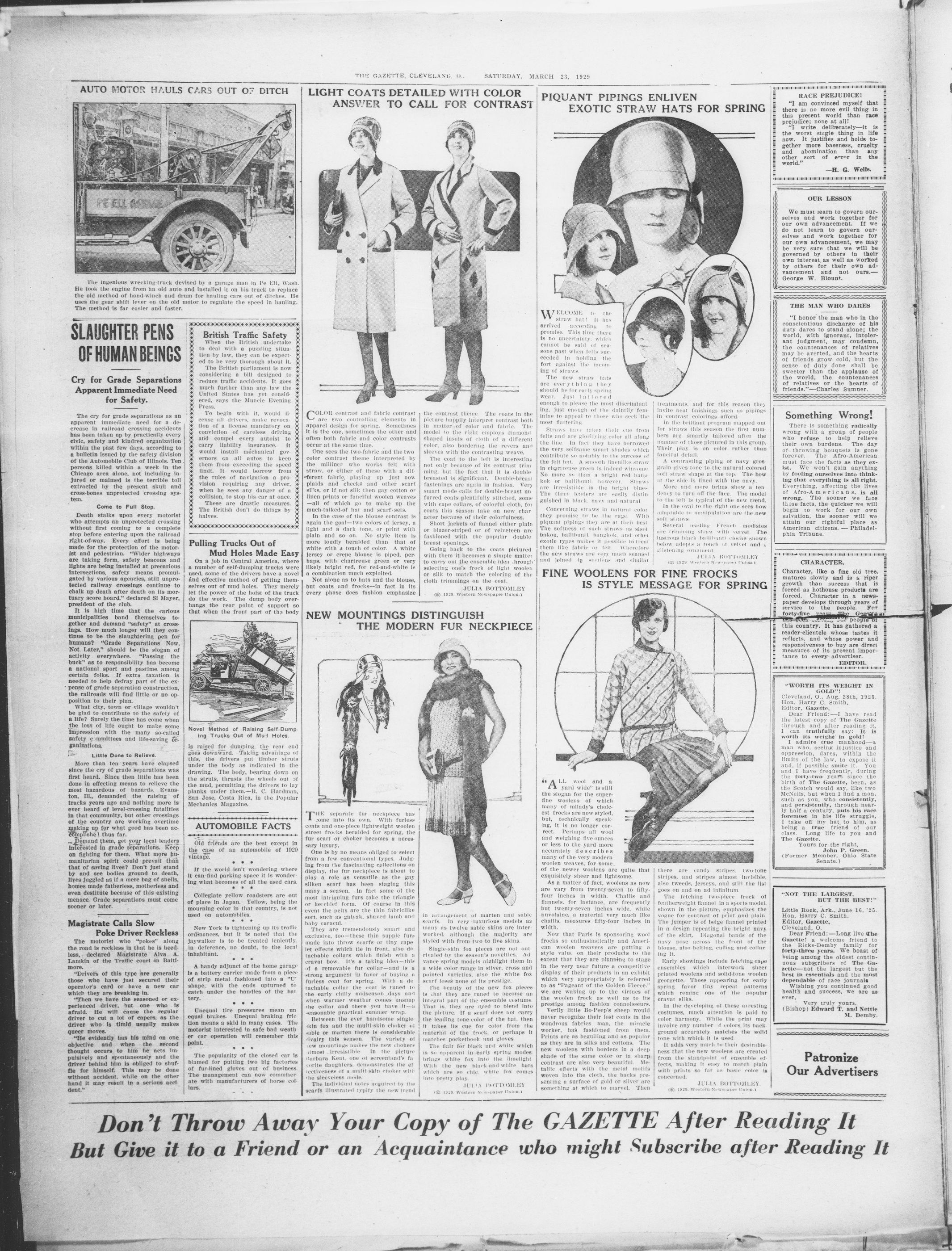
The ingenious wrecking-truck devised by a garage man in Pe Ell, Wash he took the engine from an old auto and installed it on his truck to replace the old method of hand-wich and drum for hauling cars out of ditches. He uses the gear shift lever on the old motor to regulate the speed in hauling. The method is far easier and faster.
SLAUGHTER PENS OF HUMAN BEINGS
Cry for Grade Separations Apparent Immediate Need for Safety.
The cry for grade separations as an apparent immediate need for a decrease in railroad crossing accidents has been taken up by practically every civic, safety and kindred organization within the past few days, according to a bulletin issued by the safety division of the Automobile Club of Illinois. Ten persons killed within a week in the Chicago area alone, not including injured or malmed is the terrible toll extracted by the present skull and cross-bones unprotected crossing system.
Come to Full Stop.
Death stalks upon every motorist who attempts an unprotected crossing without first coming to a complete stop before entering upon the railroad right-of-way. Every effort is being made for the protection of the motorist and pedestrian. "Wider highways are taking form, safety beacons and lights are being installed at precarious intersections, safety means promulgated by various agencies, still unprotected railway crossings continue to chalk up death after death on its mortuary score board," declared Sl Mayer, president of the club.
It is high time that the various municipalities band themselves together and demand "safety" at crossings. How much longer will they continue to be the slaughtering pen for humans? "Grade Separations Now, Not Later," should be the slogan of activity everywhere. "Passing the buck" as to responsibility has become a national sport and pastime among certain folks. If extra taxation is needed to help defray part of the expense of grade separation construction, the railroads will find little or no opposition to their plan.
What city, town or village wouldn't be glad to contribute to the safety of a life? Surely the time has come when the loss of life ought to make some impression with the many so-called safety committees and life-saving organizations.
Little Done to Relieve.
More than ten years have elapsed since the cry of grade separations was first heard. Since then little has been done in effecting means to relieve the most hazardous of hazards. Evanson, Ill, demanded the raising of tracks years ago and nothing more is ever heard of level-crossing fatalities in that community, but other crossings of the country are working overtime making up for what good has been accomplished thus far.
Demand them, get your local leaders interested in grade separations. Keep on fighting for them. What more humanitarian spirit could prevail than that of saving lives? Don't just stand by and see bodies ground to death, lives juggled as if a mere bag of shells, homes made fatherless, motherless and even destitute because of this existing menace. Grade separations must come sooner or later.
Magistrate Calls Slow
Poke Driver Reckless
The motorist who "pokes" along the road is reckless in that he is heedless, declared Magistrate Alva A. Lankin of the Traffic court in Baltimore.
"Drivers of this type are generally those who have just secured their operator's card or have a new car which they are breaking in.
"Then we have the seasoned or experienced driver, but one who is afraid. He will cause the regular driver to cut a lot of capers, as the driver who is timid usually makes queer moves.
"He evidently has his mind on one objective and when the second thought occurs to him he acts impulsively and spontaneously and the driver behind him is obliged to shuffle for himself. This may be done without accident, while on the other hand it may result in a serious accident."
British Traffic Safety When the British undertake to deal with a puzzling situation by law, they can be expected to be very thorough about it. The British parliament is now considering a bill designed to reduce traffic accidents. It goes much further than any law the United States has yet considered, says the Muncie Evening Press.
To begin with it, would license all drivers, make revocation of a license mandatory on conviction of careless driving and compel every autolist to carry liability insurance. It would install mechanical governors on all autos to keep them from exceeding the speed limit. It would borrow from the rules of navigation a provision requiring any driver, when he sees any danger of a collision, to stop his car at once. These are drastic measures. The British don't do things by halves.
Pulling Trucks Out of
Mud Holes Made Easy
On a job in Central America, where
a number of self-dumping trucks were
used, some of the drivers have a novel
and effective method of getting them-
selves out of mud holes. They merely
let the power of the hoist of the truck
do the work. The dump body over-
hangs the rear point of support so
that when the front part of the body
Novel Method of Raising Self-Dumping Trucks Out of Mud Holes.
is raised for dumping, the rear end goes downward. Taking advantage of this, the drivers put timber struts under the body as indicated in the drawing. The body, bearing down on the struts, thrusts the wheels out of the mud, permitting the drivers to lay planks under them.—R. C. Hardman, San Jose, Costa Rica, in the Popular Mechanics Magazine.
AUTOMOBILE FACTS
Old friends are the best except in the case of an automobile of 1920 vintage.
If the world isn't wondering where it can find parking space it is wondering what becomes of all the used cars.
Collegiate yellow roadsters are out of place in Japan. Yellow, being the mourning color in that country, is not used on automobiles.
New York is tightening up its traffic ordinances, but it is noted that the Jaywalker is to be treated leniently, in deference, no doubt, to the local inhabitant.
A handy adjunct of the home garage is a battery carrier made from a piece of strip metal fashioned into a "U" shape, with the ends upturned to catch under the handles of the battery.
Unequal tire pressures mean un
equal brakes. Unequal braking fric
tion means a skid in many cases. The
motorist interested in safe bad weather
er car operation will remember this
point.
The popularity of the closed car is
blamed for putting two big factories
of fur-lined gloves out of business.
The management can now commiserate
with manufacturers of horse collars.
LIGHT COATS DETAILED WITH COLOR ANSWER TO CALL FOR CONTRAST PIQUANT EXC
THE WOOL COAT
NEW MOUNTINGS DISTINGUISH THE MODERN FUR NECKPIECE
THE separate fur neckpiece has come into its own. With furless oats and one-piece lightweight woolen street frocks heralded for spring, the
COLOR contrast and fabric contrast are two controlling elements in apparel design for spring. Sometimes it is the one, sometimes the other and often both fabric and color contrasts occur at the same time.
One sees the two-fabric and the two-color contrast theme interpreted by the milliner who works felt with straw, or either of these with a different fabric, playing up just now plaids and checks and other scarf sliks, or not if silk then gay cotton or linen prints or fanciful woolen weaves—all of which go to make up the much-talked-of hat and scarf sets.
In the case of the blouse contrast is again the goal—two colors of jersey, a light and a dark tone, or print with plain and so on. No style item is more loudly heralded than that of white with a touch of color. A white jersey or crepe blouse is piped, perhaps, with chartreuse green or very likely bright red, for red-and-white is a combination much exploited.
Not alone as to hats and the blouse, but coats and frocks—in fact in its every phase does fashion emphasize
NEW MOUNTINGS D
THE MODE
THE separate fur neckpiece has some into its own. With furless conts and one-piece lightweight woolen street frocks heralded for spring, the fur scarf or choker becomes a necessary luxury.
One is by no means obliged to select from a few conventional types. Judging from the fascinating collections on display, the fur neckpiece is about to play a role as versatile as the gay silken scarf has been staging this many a season. In fact some of the most intriguing furs take the triangle or kerrich form. Of course in this event the pelts are the thin fabriclike sort, such as gulyak, shaved lamb and baby carcul.
They are tremendously smart and exclusive, too—these thin supple furms made into throw scarfs or thy capel let effects which tie in front, also detachable collarls which finish with a cavat bow. It's a taking idea—this of a removable fur collar—and is a strong argument in favor of buying a furless coat for spring. With a detachable collar the coat is tuned to the early chilly midseason days and when warmier weather comes unsnip the collar and there you have it—a seasonable practical summer wrap. Between the ever handsome single-skin fox and the multi-skin choker of sable or marten there is considerable rivalry this season. The variety of new mountings makes the new chokers almost irresistible. In the picture Barbara Kent, one of screenland's favorite daughters, demonstrates the effectiveness of a multi skin choker with the sleeveless mode.
The individual notes acquired by the scarfs illustrated typify the new trend
y Your Co or an Acq
the contrast theme. The coats in the picture happily interpret contrast both in matter of color and fabric. The model to the right employs diamond-shaped insets of cloth of a different color, also bordering the revers and sleeves with the contrasting weave. The coat to the left is interesting not only because of its contrast trimming, but the fact that it is double-breasted is significant. Double-breast fastenings are again in fashion. Very smart mode calls for double-breast unfurred coats plentifully stitched, some with cape collars, of colorful cloth, for coats this season take on new character because of their colorfulness. Short jackets of flannel either plair or blazer-striped or of velvetteen are fashioned with the popular double-breast openings. Going back to the coats pictured with them it becomes a simple matter to carry out the ensemble idea through selecting one's coat of light woolen or silk to match the coloring of the cloth trimnings on the coat.
JULIA BOTTOMLEY
(© 1929, Newspaper Union.)
ISTINGUISH
RN FUR NECKPIECE
in arrangement of marten and sable scarfs. In very luxurious models as many as twelve sable skins are inter-worked, although the majority are styled with from two to five skins.
Single-skin fox pieces are not out rivaled by the season's novelties. Advance spring models highlight them in a wide color range in silver, cross and pointed varieties, also the white fox scarf loses none of its prestige.
The beauty of the new fox pieces is that they are tuned to become an integral part of the ensemble costume. That is, they are dyed to blend into the picture. If a scarf does not carry the leading tone-color of the hat, then it takes its cue for color from the material of the frock, or perhaps it matches pocketbook and gloves.
The flat for black and white which is so apparent in early spring modes. brings white fox into the dimelight. With the new black and white hats which are so chic white fox comes into pretty play.
JULIA BOTTOMLEY
(© 1929. Western Newspaper Union.)
copy of The
maintenance w
PIQUANT PIPINGS ENLIVEN EXOTIC STRAW HATS FOR SPRING
FINE WOOLENS FOR FINE FROCKS IS STYLE MESSAGE FOR SPRING
100
WELCOME to the straw hat! It has arrived according to promise. This time there is no uncertainty, which cannot be said of seasons past when felts succeeded in holding the fort against the incoming of straws. The new straw hats are every thing the y should be for early spring wear. Just tailored enough to please the most discriminant just enough of the dainty female to appeal to those who seek the most flattering
Strains have taken their cure from felts and are glorifying color all along the line. In fact they have borrowed the very selfsame smart shades which contribute so notably to the success of the felt hat. A smooth linenlike straw in chintzeeuse is indeed whisome. No more so than a bright red bangkok or ballibunti however. Strains are irresistible in the bright blues. The three leaders are easily distin-gushed in black, mavy and natural.
Concerning straws in natural color they promise to be the rage. With piquant pipings they are at their best. The softness of such straws as sisal bakon, ballibunti, bangkok, and other exotic types makes it possible to treat them like fabric or felt. Wherefore the new straws are very much seemed and joined in sections and shilat
FINE WOOLENS FOR
IS STYLE M
"A LL wool and a "yard wide" is still the slogan for the superfine woolens of which many of milady's choice frocks are now styled, but, technically speaking, it is no longer correct. Perhaps all wool and weighing five ounces or less to the yard more accurately describes many of the very modern woolen weaves, for some
of the newer woolens are quite that exquisitely sheer and lightsome. As a matter of fact, woolens as now are vary from twenty-seven to fifty-four inches in width. Challis and flannels, for instance, are frequently but twenty-seven inches wide, while nuvolaque, a material very much like challis, measures fifty-four inches in width. Now that Paris is sponsoring wool frocks so enthusiastically and American woolen weavers are putting a style value on their products to the extent that they are planning to stage in the very near future a competitive display of their products in an exhibit which very appropriately is referred to as "Pagent of the Golden Fleece." we are waking up to the virtues of the woolen frock as well as to its prestige among fashion connoisseurs.
Verily little Bo-Peep's sheep would never recognize their lost coats in the wondrous fabrics man, the miracle worker, has fashioned from them. Prints are as beugling and as popular as they are in silks and cottons. The new woolens with borders in a deep shade of the same color or in sharp contrast are also very beautiful. Metallic effects with the metal motifs woven into the cloth, the backs presenting a surface of gold or silver are something at which to marvel. Then
GAZETTE who might Su
treatments, and for this reason they invite neat finishings such as pipings in contrast colorings afford.
In the brilliant program mapped out for straws this season the first numbers are smartly tailored after the manner of those pictured in this group. Their play is on color rather than fanciful detail.
A contrasting piping of navy grosgrain gives tone to the natural colored soft straw shape at the top. The bow at the side is lined with the navy. More and more brims show a tendency to turn off the face. The model to the left is typical of the new trend. In the oval to the right one sees how adaptable to manipulation are the new soft straws.
Several leading French modifiers are trimming straw with velvet. The tustuous black ballastlite) cheek shows below adopts a touch of velvet and a glistening ornament.
JULIA BOTTOMLEY
© 1922 Western Newspaper Group.)
R FINE FROCKS
MESSAGE FOR SPRING
there are candy stripes, two tone stripes, and stripes almost invisible, also tweeds, jerseys, and still the list goes on and on and infinitum.
The fetching two-piece frock of featherweight channel in a sports model, shown in the picture, emphasizes the vogue for contrast of print and plain. The jumper is of beige flannel printed in a design repeating the bright navy of the skirt. Diagonal bands of the navy pose across the front of the blouse, also belting, cutting and collaring it.
Early showings include fetching cape ensembles which interwork sheer printed woolens and solid-tone woolen georgette. Those appearing for early spring favor tiny repeat patterns which reminis one of the popular cavat silks.
In the developing of these arresting costumes, much attention is paid to color harmony. While the print may involve any number of colors, its background accurately matches the solid tone with which it is used.
It adds very much to their desirable
ness that the new woolens are created
from the standpoint of ensemble effec-
tics, making it easy to match plain
with prints so far as basic color is
concerned.
JULIA BOTTOMLEY.
(© 1929, Western Newsaper Union.)
RACE PREJUDICE!
"I am convinced myself that there is no more evil thing in this present world than race prejudice; none at all!
"I write deliberately—it is the worst single thing in life now. It justifies and holds together more baseness, cruelty and abomination than any other sort of error in the world."
—H. G. Wells.
OUR LESSON
We must learn to govern ourselves and work together for our own advancement. If we do not learn to govern ourselves and work together for our own advancement, we may be very sure that we will be governed by others in their own interest, as well as worked by others for their own advancement and not ours.—George W. Blount.
THE MAN WHO DARES
"I honor the man who in the conscientious discharge of his duty dares to stand alone; the world, with ignorant, intolerant judgment, may condemn, the countenances of relatives may be averted, and the hearts of one who has a sense of duty done shall be sweeter than the applause of the world, the countenances of relatives or the hearts of friends."—Charles Sumner.
Something Wrong!
There is something radically wrong with a group of people who refuse to help relieve their own burdens. The day of throwing bouquets is gone forever. The Afro-American must face the facts as they exist. We won't gain anything by fooling ourselves into thinking that everything is all right. Everything, affecting the lives of Afro-Americans, is all wrong so we sooner we face these facts, the quicker we will begin to work for our own salvation, the sooner we will attain our rightful place as American citizens. — Philadelphia Tribune.
CHARACTER.
Character, like a fine old tree, matures slowly and is a riper growth than success that is forced as hothouse products are forced. Character in a newspaper develops through years of service to the people. For forty-five years, the Georgia has been a people of this country. It has gathered a reader clientele whose tastes it reflects, and whose power and responsiveness to buy are direct measures of its present importance to every advertiser.
"WORTH ITS WEIGHT IN GOLD"
Cleveland, O., Aug. 28th, 1925.
Hon. Harry C. Smith,
Editor, Gazette,
Dear Friend:—I have read the latest copy of The Gazette through and after reading it,
I can truthfully say: It is worth its weight in gold!
I admire true manhood—a man who, seeing injustice and oppression dares, within the limits of it, exposes it and, if possible smiles. You and I have frequently, during the forty-two years since the birth of The Gazette, been, as the Scotch would say, like two McNeils, but when you, I find a man, such as you, who consistently, and persistently, through nearly half a century, puts his race foremost in his life struggle,
I take off my hat, to him, as being a true friend of our class. Long life to you and The Gazette.
Yours for the right,
John P. Green.
(Former Member, Ohio State Senate.)
"NOT THE LARGEST.
BUT THE BEST!"
Little Rock, Ark., June 16, '25.
Hon. Harry C. Smith.
Editor, Gazette,
Cleveland, O.
Dear Friend: —Long live The Gazette! a welcome friend to the Rickey-Demby family for forty-three years. We boast of being among the oldest continuous subscribers of The Gazette—not the largest but the best in essentials and the most dependable of race journals.
Wishing you continued good health and success, we are as ever.
Very truly yours.
(Bishop) Edward T. and Nettie M. Demby.
Patronize Our Advertisers
ading It
r Reading It