The Gazette
Saturday, August 27, 1932
Cleveland, Ohio
Page text (machine-generated)
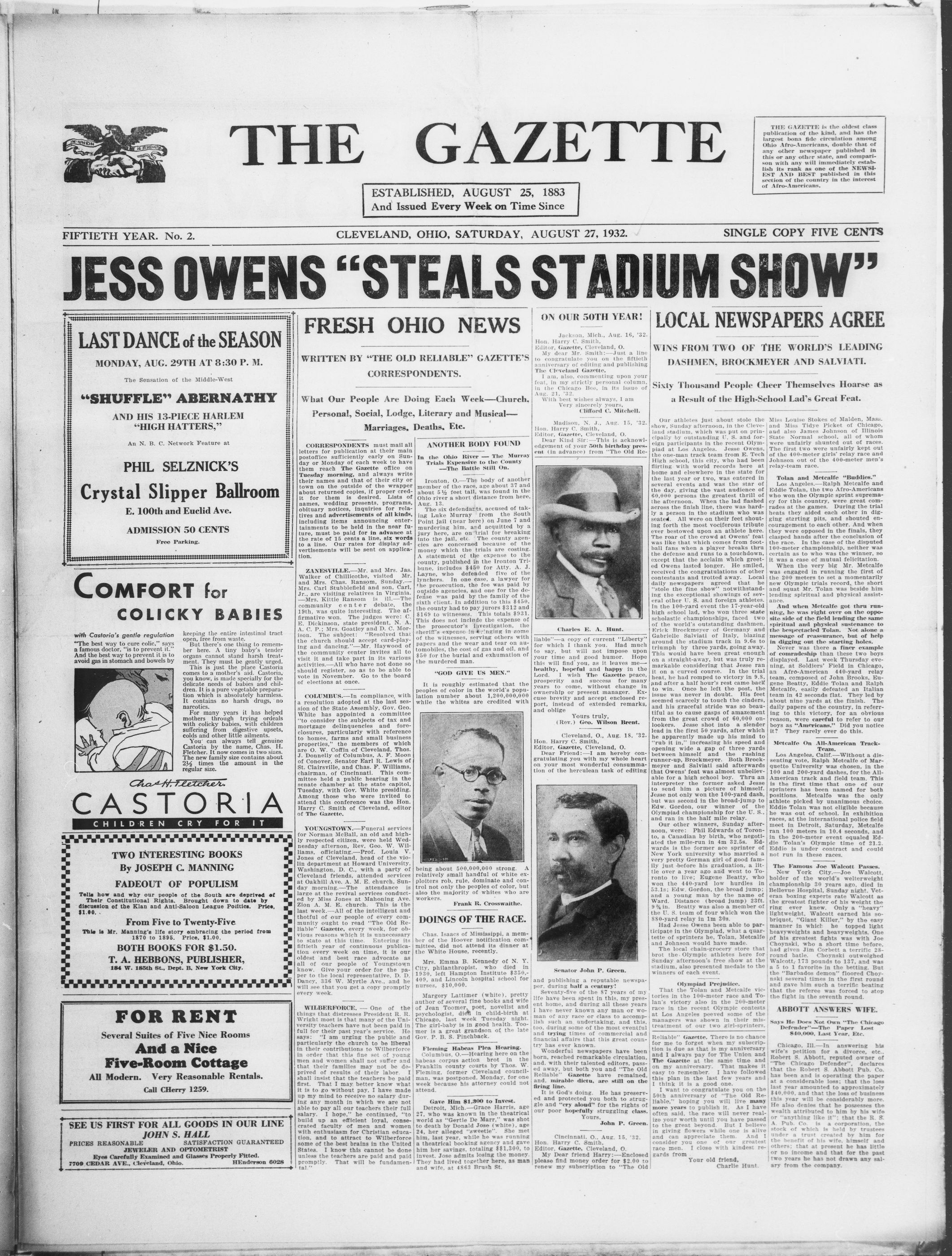
JESSOWENS "STEALS STADIUM SHOW"
IN UNION
16 STRENGTH
FIFTIETH YEAR. No. 2.
JESS O
LAST DANCE of
MONDAY, AUG. 29TH
The Sensation of the
"SHUFFLE" AB
SS OW
T DANCE of the SEA
SUNDAY, AUG. 29TH AT 8:30 H
The Sensation of the Middle-West
BUFFLE" ABERNA
MONDAY, AUG. 29TH AT 8:30 P. M.
AND HIS 13-PIECE HARLEM
"HIGH HATTERS,"
An N. B. C. Network Feature at
PHIL SELZNICK'S
Crystal Slipp
E. 100th and Eu
ADMISSION 50
Free Parking
COMFORT
COLICKY
Castal Slipper Ball
E. 100th and Euclid Ave.
ADMISSION 50 CENTS
Free Parking.
COMFORT for
COLICKY BAY
with Castoria's gentle regulation
"The best way to cure colic," says
a famous doctor, "is to prevent it."
And the best way to prevent it is to
avoid gas in stomach and bowels by
CASTO CHILDREN CR TWO INTERESTING BY JOSEPH C. M
Chas H. Fletcher
ASTOR
ILDREN CRY FOR
TWO INTERESTING BOOKS
BY JOSEPH C. MANNING
Tells how and why our people of the South are deprived of Their Constitutional Rights. Brought down to date by discussion of the Klan and Anti-Saloon League Politics. Price, $1.00.
FOR RENT
Several Suites of Five Nice Rooms
And a Nice
Five-Room Cottage
All Modern. Very Reasonable Rentals.
Call CHerry 1259.
SEE US FIRST FOR ALL GOODS IN OUR LINE
JOHN S. HALL
PRICES REASONABLE SATISFACTION GUARANTEED
JEWELER AND OPTOMETRIST
Eyes Carefully Examined and Glasses Properly Fitted.
7709 CEDAR AVE., Cleveland, Ohio. HEnderson 6028
Super Ballroom
at Euclid Ave.
50 CENTS
parking.
RT for
SKY BABIES
keeping the entire intestinal tract
open, free from waste.
But there's one thing to remember here. A tiny baby's tender organs cannot stand harsh treatment. They must be gently urged. This is just the place Castoria can come to. You know, is made specially for the delicate needs of babies and children. It is a pure vegetable preparation which is absolutely harmless. It contains no harsh drugs, no narcotics. Many years it has helped mothers, through trying ordeals with colicky babies, with children suffering from digestive upsets, colds and other little ailments. You can always tell genuine Castoria by the name, Chas. H.Fletcher. It now comes in two sizes. no family size contains about 2½% the amount in the regular size.
ORIA
THE GAZETTE
ESTABLISHED, AUGUST 25, 1883 And Issued Every Week on Time Since
CLEVELAND, OHIO, SATURDAY, AUGUST 27, 1932.
FRESH OHIO NEWS
FRESH OHIO NEWS
WRITTEN BY "THE OLD RELIABLE" GAZETTE'S CORRESPONDENTS.
What Our People Are Doing Each Week—Church, Personal, Social, Lodge, Literary and Musical—Marriages, Deaths, Etc.
CORRESPONDENTS must mail all letters for publication at their main postmaster sufficiently early on Sunday or Monday of each week to have them reach The Gazette office on Tuesday morning, and always write their names and that of their city or town on the outside of the wrapper about returned copies, if proper credit for them is desired. Lists of names, wedding presents, programs, obituary notices, inquiries for relatives and advertisements of all kinds, including items announcing entertainments to be held in the near future, must be in advance at the rate of 15 cents a line, six words to a line. Our rates for display advertisements will be sent on application.
ANOTHER BODY FOUND
In the Ohio River — The Murray Trials Expensive to the County — The Battle Still On.
Ironton, O.—The body of another member of the race, age about 37 and about 5½ feet tall, was found in the Ohio river a short distance from here, Aug. 13.
The six defendants, accused of taking Luke Murray from the South Point jail (near here) on June 7 and murdering him, are accused by a jury here on a trial for breaking into jail, etc. The county agencies are concerned because of the money which the trials are costing. A statement of the expense to the
ZANESVILLE.—Mr. and Mrs. Jas. Walker of Chilliecote, visited Mr. and Mrs. Chas, Ransom, Sunday.—Mrs. Carl Stubblefield and son, Carl Jr., are visiting relatives in Virginia.—Mrs. Kittle Ransom is ill. The community center debate, the 19th, was quite interesting. The affirmative won. The judges were: C. E. Dickinson, state president, N. A. A. C. P.; Mrs. Goatley and D. C. Morison. The subject: "Resolved that the church should accept card-playing and dancing."—Mr. Haywood of the community center invites all to visit it and take part in its various activities.—All who have not done so should register, so as to be able to vote in November. Go to the board of elections at once.
COLUMBUS.—In compliance, with a resolution adopted at the last session of the State Assembly, Gov. Geo. White has appointed a committee "to consider the subjects of tax and mortgage delinquencies and foreclosures, particularly with reference to homes, farms and small business properties," the members of which are O. W. Coffin of Cleveland, Thos. J. Donnelly of Columbus, A. F. Moon of Conover, Senator Earl R. Lewis of St. Clairsville, and Chas. F. Williams, chairman of Cincinnati. The committee public hearing in the senate chamber at the state capitol, Tuesday, with Gov. White presiding. Among those who were invited to attend this conference was the Hon. Harry C. Smith of Cleveland, editor of The Gazette.
YOUNGSTOWN.—Funeral services for Norman McBall, an old and highly respected citizen, were held Wednesday afternoon, Rev. Geo. W. Williams, officiating.—Prof. Loula V. Jones of Cleveland, head of the violin department at Howard University, Washington, D. C., with a party of Cleveland friends, attended services at Oakhill Ave. A. M. E. church, Sunday morning.—The attendance is large at the revival services conducted by Miss Jones at Mahoning Ave. Zlon A. M. E. church. This is the last week.—All of the intelligent and thoufful of our people of every community ought to read "The Old Reliable" Gazette, every week, for obvious reasons which it is unnecessary. We have a fiftieth year of continuous publication every week on time, it is our oldest and best race advocate as all of our people of Youngstown know. Give your order for the paper to the local representative. D. D. Dancy, 336 W. Myrtle Ave., and he will see that you get a copy promptly every week.
WILBERFORCE. — One of the things that distresses President R. R. Wright most is that many of the University teachers have not been paid in full for their past year's service. He says: "I am urging the public and particularly the church to be liberal in their contributions to Wilberforce in order that this fine set of young men be allowed to attend that their families may not be deprived of results of their labor. I shall insist that the teachers be paid first. That I may better know what it is to go without pay. I have made up my mind to receive no salary during any month in which we are not able to pay all our teachers their full salary. I hope," he continued, "to build up an efficient loyal, consecrated faculty of men and women with enthusiasm for Christian education, and to attend Wilberforce some of the best brains in the United States. I know this cannot be done unless the teachers are paid and paid promptly. That will be fundamental."
ANOTHER BODY FOUND
In the Ohio River — The Murray Trials Expensive to the County —The Battle Still On.
Ironton, O. —The body of another member of the race, age about 37 and about 5½ feet tall, was found in the Ohio river a short distance from here.
The six defendants, accused of taking Luke Murray from the South Point jail (near here) on June 7 and murdering him, and acquitted by a jury here, are on trial for breaking into the jail, etc. The county agencies are concerned because of the money which the trials are costing. A statement of the expense to the county, published in the Ironton Tribune, includes $450 for Atty. A. J. Layne, who defended five of the lynchers. In one case, a lawyer for the prosecution, the fee was paid by outside agencies, and one for the defense was paid by the family of the victim. In addition to this $450, the county had to pay jurors $312 and $169 to witnesses. This totals $931. This does not include the expense of the prosecutor's investigation, the sheriff's expense in bringing in some of the witnesses, serving others with papers and the wear and tear on automobiles, the cost of gas and oil, and $50 for the burial and exhumation of the murdered man.
"GOD GIVE US MEN."
It is roughly estimated that the peoples of color in the world's population number about 1,200,000,000 while the whites are credited with
PEQ 101
being about 500,000,000 strong. A relatively small handful of white exploiters rob, rule, dominate and control not only the peoples of color, but also the majority of whites who are workers. Frank R. Crosswaithe.
DOINGS OF THE RACE.
Chas. Isaacs of Mississippi, a member of the Hoover notification committee, did not attend its dinner at the White House, recently.
Mrs. Emma B. Kennedy of N. Y. City, philanthropist, who died in 1830, left Hampton Institute $350,409, and Lincoln hospital school for nurses, $10,000.
Margery Lattimer (white), pretty author of several fine books and wife of Jean Toomer, poet, novelist and psychologist, died in child-birth at Chicago, last week Tuesday night. The girl-baby is in good health. Toomer is a great grandson of the late Gov. P. B. S. Pinchback.
**Fleming Habeas Plea Hearing.**
Columbus, O.—Hearing here on the habeas corpus action brot in the Franklin county courts by Thos. W. Fleming, former Cleveland councilman, was postponed. Monday, for one week because his attorney could not attend.
Gave Him $1,300 to Invest
Detroit, Mich — Grace Harris, age 27, who was known in the theatrical world as "Gertie De Marr," was shot to death by Donald Jose (white), age 24, her alleged "sweetie." She met him, last year, while he was running a theatrical booking agency and gave him her savings. He then paid her bills losing the money. They had lived together here, as man and wife, at 4883 Brush St.
ON OUR 50TH YEAR!
Jackson, Mich., Aug. 16, '32.
Hon. Harry C. Smith,
Editor, Gazette, Cleveland, O.
My dear Mr. Smith:—Just a line to congratulate you on the fiftieth anniversary of editing and publishing
The Cleveland Gazette
I am, also, commenting upon your feat, in my strictly personal column, in the Chicago Bee, in its issue of Aug. 21, '32.
With best wishes always, I am
Very sincerely yours.
Clifford C. Mitchell.
Madison, N. J., Aug. 15, '32.
Hon. Harry C. Smith,
Editor, Gazette, Cleveland, O.
Dear Kind Sir:—This is acknowledgement of your 50th birthday present (in advance) from "The Old Re-
Charles E. A. Hunt.
liable"—a copy of current "Liberty" for which I thank you. Had much to say, but will not impose upon your time and good humor. Hope this will find you, as it leaves me—healthy, hopeful and happy in the Lord. I wish The Gazette peace, prosperity and success for many years to come, without change in ownership or present manager. Excuse brevity and enclosed report, instead of extended remarks, and oblige
Yours truly,
(Rev.) Geo. Wilson Brent.
Cleveland, O., Aug. 18, '32.
Hon. Harry C. Smith,
Editor. Gazette, Cleveland, O.
Dear Friend:—I am hereby congratulating you with my whole heart on your most wonderful consummation of the herculean task of editing
M. B.
and publishing a reputable newspaper, during half a century!
Seventy-five of the 87 years of my life have been spent in this, my present home, and during all these years I have never known any man or woman of any race or class to accomplish such an undertaking, and this, too, during some of the most eventful and trying times of commercial and financial affairs that this great country has ever known.
Wonderful newspapers have been born, reached remarkable circulation, and, with their talented editors, pressed away, but both you and "The Old Reliable" Gazette have remained, and, miracle dictu, are still on the firing line.
It is God's doing. He has preserved and protected you both to struggle and "cry aloud" for the rights of our poor hopefully struggling class.
Yours,
John P. Green
Cincinnati, O., Aug. 15, '32.
Hon. Harry C. Smith.
Editor, Gazette, Cleveland, O.
My Dear friend Harry: Enclosed
please find money order for $2.00 to
the following person:
SINGLE COPY FIVE CENTS
WINS FROM TWO OF THE WORLD'S LEADING DASHMEN, BROCKMEYER AND SALVIATI.
Sixty Thousand People Cheer Themselves Hoarse as a Result of the High-School Lad's Great Feat.
Our athletes just about stole the show, Sunday afternoon, in the Cleveland stadium, which was put on principally by outstanding U. S. and foreign participants in the recent Olympiad at Los Angeles. Jesse Owens, the one-man track team from E. Tech High school, this city, who had been flirting with world records here at home and elsewhere in the state for the last year or two, was the star of the day, giving the vast audience of 60,000 persons the greatest thrill of the afternoon. When the lad flashed across the finish line, there was hardly a person in the stadium who was seated. All were on their feet shouting forth the most vociferous tribute ever bestowed upon an athlete here. The roar of the crowd at Owens' feat was like that which comes from football fans when a player breaks thru the net. He was the star of the day, except that the necclaim which greeted Owens lasted longer. He smiled, received the congratulations of other contestants and trotted away. Local daily newspapers agreed that he "stole the fine show" notwithstanding the exceptional showings of several other U. S. and foreign athletes. In the 100-yard event the 19-year-old high school champion, who won three schoolatic championships, faced two schoolatic championships, of Italy, glazing around the stadium track in 9.65 to triumph by three yards, going away. This would have been great enough on a straight-away, but was truly remarkable considering that Jesse ran on a curved course. In the trial heat, he had romped to victory in 9.8, and after a half hour's rest came back to win. Once he left the post, the issue was never in doubt. His feet seemed scarcely to touch the cinders, and his graceful stride was so beautiful as to cause gausps of amazement from the great crowd into a slender lead in the first 50 yards, after which he apparently made up his mind to "rub it in," increasing his speed and opening wide a gap of three yards between himself and the rushing runner-up, Brockmeyer. Both Brockmeyer and Salviati said afterwards that Owens' feat was almost unbelievable for a high school boy. Thru an interpreter the former asked Jesse to send him a picture of himself, but was second in the broad-jump to Edw. Gordon, our winner of the Olympiad championship for the U. S. and ran in the half mile relay.
Our other winners, Sunday afternoon, were: Phil Edwards of Toronto, a Canadian by birth, who negotiated the mile-run in 4m 32.55. Edwards is the former ace spinner of New York university who married a very pretty German girl of good family just before his graduation, a little over a year ago and went to Toronto, where he played the golf game, who won the 440-yard low hurdles in 53.1s. Edw. Gordon, the broad jump; and a young man by the name of Ward. Distance (broad jump) 23ft. 9¾ in. Beatty was also a member of the U. S. team of four which won the 800-yard relay in 1m 30s. Had Jesse Owlsen been able to participate in the Olympiad, what a quartette of sprinters he, Tolan, Metcalfe and Johnson would have made. The local chain-grocery store that broths and dips was here for Sunday afternoon's free show at the stadium, also presented medals to the winners of each event.
Olympiad Prejudice.
That the Tolan and Metcalfe victories in the 100-meter race and Tolan's victory also in the 200-meter race in the recent Olympic contests at Los Angeles peeved some of the managers was shown in their mistreatment of our two girl-sprinters. Reliable" Gazette. There is no chance for me to forget when my subscriptions is due as that is my anniversary and I always pay for The Union and The Gazette at the same time and on my anniversary. That makes it easy to remember. I have followed this plan in the last few years and I want it is a gift. I want to magnificate you on the 50th anniversary of "The Old Reliable," hoping you will live many more years to publish it. As I have often said, the race will never realize your worth until you have passed to the great beyond. But I believe in giving flowers while one is alive and can appreciate them. And I consider you one of our greatest friends. I close with kindest regards from
Your old friend,
Charlie Hunt.
THE GAZETTE is the oldest class publication of the kind, and has the largest bona fide circulation among Ohio Afro-Americans, double that of any other newspaper published in this or any other state, and comparison with any will immediately establish its rank as one WPA BIBL published in this section of the country in the interest of Afro-Americans.
THE COPY FIVE CENTS
HOW"
PAPERS AGREE
THE WORLD'S LEADING
MEYER AND SALVIATI.
Cheer Themselves Hoarse as
School Lad's Great Feat.
Miss Louise Stokes of Malden, Mass. and Miss Tidy Picket of Chicago, and also James Johnson of Illinois State Normal school, all of whom were unfairly shunted out of races. The first two were unfairly kept out of the 400-meter girls' relay race and Johnson out of the 400-meter men's relay-team race.
**Tolan and Metcalfe "Buddies."**
Los Angeles.—Ralph Metcalfe and Eddie Tolan, the two Afro-Americans who won the Olympic sprint supremacy for this country, were great comrades at the games. During the trial heats they aided each other in digging starting stirs, and shouted engagement to each other. And when they opposed in the finals, they clapped hands after the conclusion of the race. In the case of the disputed 100-meter championship, neither was certain as to who was the winner, so it was a case of mutual felicitation.
When the very big Mr. Metcalfe was engaged in running the first of the 200 meters to set a momentarily new Olympic trials record, the short and squat Mr. Tolan was beside him lending spiritual and physical assistance.
And when Metcalfe got thru running, he was right over on the opposite side of the field lending the same spiritual and physical sustenance to the bespectacled Tolan. Not alone a message of reassurance, but of help in digging out the starting holes.
Never there was a second of comparison among these two boys displayed. Last week Thursday evening, at Soldiers' Field in Chicago, an Afro-American 440-yard relay team, composed of John Brooks, Eugene Beatty, Eddie Tolan and Ralph Metcalfe, easily defeated an Italian team in 42 seconds flat. They led by about nine yards at the finish. The daily papers of the country, in referring to this victory, for an obvious reason, were careful to refer to our boys as "Americans." Did you notice it? They rarely ever do this.
Metcalfe On All-American Track- Team.
Los Angeles, Calif.—Without a dissenting vote, Ralph Metcalfe of Marquette University was chosen, in the 100 and 200-yard dashes, for the All-American track and field team. This is the first time that one of our sprinters has been named for both positions. Metcalfe was the only athlete picked by unanimous choice. Eddie Tolan was not eligible because he was out of school. In exhibition races, at the international police field meet in Detroit, Saturday, Metcalfe ran 100 meters in 10.4 seconds, and in the 200-meter event equaled Eddie Tolan's Olympic time of 21.2. Eddie is under contract and could not run in these races.
The Famous Joe Walcott Passes.
New York City—Joe Walcott,
holder of the world's welterweight
championship 30 years ago, died in
Bellevue Hospital, Sunday night.
Veteran boxing experts rate Walcott as
the greatest fighter of his weight the
ring ever knew. Only a "heavy"
lightweight, Walcott earned his sobriquet,
"Giant Killer," by the easy manner in which he topped light
heavyweights and heavyweights. One of his greatest fights was with Joe Choynski, who a short time before,
had given Jim Corbett a terrific 28-
round victory. Choynski outweighed
Walcott, 173 pounds to 143, with a
5 to 1 favorite in the betting.
But the "Barbados demon" floored Choynski several times in the first round and gave him such a terrific beating that the referee was forced to stop the fight in the seventh round.
ABBOTT ANSWERS WIFF.
Says He Does Not Own "The Chicago Defender"—The Paper Lost $40,000, Last Year, Etc.
Chicago, Ill.—In answering his wife's petition for a divorce, etc., Robert S. Abbott, reputed owner of "The Chicago Defender", declares that the Robert S. Abbott Pub. Co. has been and is operating the paper at a considerable loss; that the loss last year amounted to approximately $40,000, and that the loss of business year will be considerably more. He asks that he possesses the wealth attributed to him, or anything like it" that the R. S. A. Pub. Co. is a corporation, the stock of which is held by trustees under a trust created by him for the benefit of his wife, himself and others; that at present he has little or no income and that for the past two years he has not drawn any salary from the company.
---
Cor. Cedar Ave. and E. 77th St.
A HOME FOR YOUNG MEN!
RESTAURANT - HOME COOKING
Individual Beds $2.50-$3.00
EN迪科特 9094
KNOXIT
PROPHYLACTIC
Unnatural and mucous discharges can be avoided by destroying the germs of infectious diseases.
$1.10 at all druggists.
CLARK'S
ONE'S
COLLECTION
For a valuable book on dreaming to be
THE SPOOL COTTON CO., Dept O
315 Fourth Ave., New York
JOHN P.GREEN
Attorney-at-Law
Notary Public
OFFICE NOW
At 614 East 107th St.
Cleveland, O.
'Phone, GLen. 3453
Take St. Clair Car to E. 106th St.
O. K. Printing Co.
W. J. Foster - John M. Smith
Commercial and Job
PRINTING
PROMPT SERVICE
3113 Central Ave.
Cor. E. 31st St.
PROspect 7818
How One Woman
Lost 20 Lbs. of Fat
Lost Her Prominent Hips—
Double Chin—Sluggishness
If you're fat—first remove the causes
Take one half teaspoonful of Kruschen
Salts in a glass of hot water in the morn-
ing. Pour it over your skin. How many pounds of fat have vanished.
Notice also that you have gained in
energy—your skin is clearer—you feel
younger in body—Kruschen will give any
fat person a joyous surprise.
Your health comes first—and SAFETY first is the Kruschen promises.
Get a bottle of Kruschen Salts from any lead-
enin store. The salt is less toxic and the cost is but little. If this first bottle doesn't
surely want to lose fat—your money already returned.
LEG SORES
LEG SORES
A treatment which heals varicose ulcers, broken or swollen veins, blue knots and other leg troubles-without operations, injections nor enforced rest-is available right here in your own home town. You can try it TODAY on the responsibility of a druggist whom you know and trust. Without any risk whatever. In other words, Emerald Oil, used according to directions, will give you swift, sure relief, or your druggist will gladly refund your money. You need deposit only 85c with him as the purchase price to get immediate relief. Money back if you are disappointed.
ASSASSIN
A Drinker of Hashish!
In eleventh-century Persia, a secret;
order was founded by Hassan ben
Sabbah, indulging in the use of the
Oriental drug hashish, and, when
under its influence, in the practice
of secret murder. The murderous
drinker of hashish came to be
called hashash in the Arabic and
from that origin comes our English
word assasin!
Write for Free Booklet, which suggests how you may obtain a command of English through the knowledge of word origins included in
WEBSTER'S NEW INTERNATIONAL DICTIONARY
"The Supreme Authority"
G. & C. MERRIAM
COMPANY
SPRINGFIELD
MASS.
Where To Purchase The Gazette
O. K. PRINTING CO., 3113 Central Ave.
NOTICE TO SUBSCRIBERS
Subscribers not receiving T
fy us at once. We desire every
Send or bring locals and all
office, Suite 302, Johnson Block,
site the Hotel Cleveland entrance
call there, please.
We advise our readers to o
advertisements before making g
advertise in this paper should h
The fact that they advertise in
they want it.
All reading matter for publ
Gazette must be in the office b
week, at the latest. Display adver
WEDNESDAYS!
HARRY C
226 West Superior Ave
(Opposite, Hotel C
Notary Public.
Classified Advert
Subscribers not receiving The Gazette regularly should notify us at once. We desire every copy delivered promptly.
Send or bring locals and all business matters to The Gazette office, Suite 302, Johnson Block, 226 Superior Ave., West, opposite the Hotel Cleveland entrance. If you wish to see the editor call there, please.
We advise our readers to carefully examine The Gazette's advertisements before making purchases. Business men who advertise in this paper should have the patronage of our people. The fact that they advertise in The Gazette is assurance that they want it.
All reading matter for publication in current issues of The Gazette must be in the office by noon, WEDNESDAY, of that week, at the latest. Display advertisements accepted until 4 p. m., WEDNESDAYS!
HARRY C. SMITH,
226 West Superior Avenue, Cleveland, Ohio.
(Opposite, Hotel Cleveland entrance)
Notary Public.
Bell 'Phone: CHerry 1259.
Classified Advertising Department
FOR RENT.—A nice comfortable,
modern five-room cottage. Two bed-
rooms. In the East End and near
carline. Large attic, cellar and yard.
Call, CHerry 1259.
FOR RENT.—Five nice good-sized
rooms (up) at 2417 E. 82d St.
Front and back entrance, electric
lights, gas, etc. Rent, $25 per
month. Call CHerry 1259 in the
afternoon.
CLEVELAND Social and Personal
Mrs. Geo. R. Hinton is matron at Burton's bathing beach, Ashtabula.
Miss Eva Johnson returned, the first of the week, from a visit in Chicago.
The Modern Crusaders' annual picnic was held at Garfield park, Thursday.
The original "76" club will have a house-party, this evening, at Mr. Mose Williams', E. 84th St.
A number of our singers and instrumentalists are being heard over WHK these "depression" days.
Arthur Moore, E. 126th St., won a pen and pencil set in the recent Fisher Bros. popularity contest.
Cicero Scott, baritone, radio singer, was on the program for the unemployed at the stadium, Sunday evening.
Alonzo Wright and Dr. Clarence Cheeks are the new proprietors of the grocery store at Cedar and E. 100th St.
It is said that 2300 people attended the Duke Ellington dance recently at the Crystal Slipper. It pays to advertise.
Miss Irene Ritter, evangelist, E. 100th St., recently closed a series of revival meetings at Dover and Quinn A. M. E. chapel.
Miss Geraldine and Audrey Howard, of Philadelphia, Pa., are spending their vacation with their aunt, Mrs. Ella Garner, E. 126th St.
The "76" club's dance, Saturday night, at the club rooms on E. 128th St., was a great success. Mt. Pleasant jug band furnished music.
Maceo' and Carol Thomas, de luxe dancers and entertainers, were in the city, a few hours recently, en route west and called on his parents, Dr.
The Kroger Grocery Co. is planning to open a store on E. 130th St. and Metcalfe Ave., S. E., in which all Afro-American help will be employed, it is said.
Bessie Brown and Billy Banks were the sterling entertainers at the very enjoyable benefit dance given Monday evening, at the beautiful Crystal Slipper ballroom. The Giants and the A. B. C. teams will start a double-header in the stadium, Sunday at 1 o'clock, the winner to oppose the Mason and Son baseball nine at 3 p. m.
and Mrs. Joe T. Thomas, E. 40th St. Miss Mabel Early, local public school teacher, and Mrs. Wm R. School teacher, and Everton Ave., left for New York City, recently, to visit.
John Hillard, E. 33d St., Oscar Johnson, E. 83d St., and Andrew Jackson, of Central Ave., recently passed the Red Cross life-saving test and are eligible for appointment as life-guards.
John Carter, E. 78th St., a leading debater in the Literary society of E. M. Zion Baptist church, will enter Wilberforce U. theological department, this fall, to prepare to enter a school at Rochester, N. Y.
Rishop C. H. Phillips of the C. M. E. Church has been invited to preach again at Wesley Chapel, City Roads, in London, Eng., when he reaches that city at an early date to attend an international religious conference.
Mr. and Mrs. Frank Brown, E. 132d St., had as guests over the week-end. Mr. and Mrs. Joseph Deas, the two Misses Deas, Mrs. Frank Brown and Arthur L. Brown, all of Chicago. Mrs. Deas is a talented musician and has a number of successful compositions to her credit.
Dr. Hugh Wimbish of this city, whose practice is in Cleveland, O., attended the Olympics and while at Los Angeles met not only notables of virtually every country represented there, but also the track stars of these nations, socializing with the
HALE SMITH'S,
8806 Quincy Ave.
FRANK L. HANDY'S,
4401 Central Ave.
THE GAZETTE, CLEVELAND, O
ROSENBERG'S DRUG STORE,
Central Ave. and,
E. 55th St.
WANTED. — Work — part or full time for a young girl; high school graduate and stenographer. Jeannette Russell, 7501 Central Ave.
FOR RENT. — Five nice rooms (down) at 2417 E. 82d St., modern and in good condition. $28 a month. Call, CHerry 1259 in the afternoon, up to 7 p. m., or call at suite 302, No. 226 W. Superior Ave., opposite Hotel Cleveland entrance.
Haitian bunch at many private affairs given by our leading families of Los Angeles—Atlanta (Ga.) World.
The officers of the Senior Leaders club are: Joe Jackson, pres.; Henry Tucker, vice-pres.; Jes. Ponce, sec., and Fred Carlo, treas.
The members are qualified Red Cross life-savers, five of whom received appointments from the city for the summer season, four being placed at the new Portland-Outouthwaite center and one at the Central bathhouse.
Rev. Sylvester Williams, superintendent of the Christian Community center and principal of the Baptist bible (vacation) schools, reports a very successful season, this year, which was closed recently by rendering in several districts a one-act play written by him and entitled, "Olive Wise and Some Were Foolish". Rev. Williams' success his work is largely the result of the splendid co-operation he receives from Dr. D. R. Sharpe, secretary of the local organization of Baptist churches.
A few days ago Judge Samuel H. Silbert filed with the board of elections petitions containing 65,000 names, Republicans, Democrats and Independents. He needed only 2750 signatures to his nominating petition. Many of our most prominent residents were among the signers. The judge has been in public service for 21 years, serving as police prosecutor, the municipal and common pleas court's judge. He is the only judge in the state to ever lead the judge ticket at four separate elections. He is popular among our people because of practical demonstrations of true friendship.
The Women's Civic organization met at Mrs. B. Johnson's, Tuesday, and changed its name to the Louise Pridigeon Civic club, honoring its late president. Election of officers resulted as follows: Mrs. Ethel Simone, pres.; Mrs. Johnson, vice-pres.; Mrs. Samuel Jones, sec.; Mrs. W. Lanier, assist, and Mrs. Pauline Crump, treas. The club gave a picnic, last Tuesday, at Garfield park for woodland, Casewoodland, Mayflower and Glades schools and the Friendly Inn. Refreshments served. There will be a-acquired-meeting at Mrs. Lanier's. E. $5th St. Sept. 6.
Judge Dan B. Cull of the city Civil Service Commission has cited Geo. C. Lacey, Democratic leader of the 17th ward, to appear before the commission; Monday, on the charge that city employees in that ward are assessed a percentage of their salaries to defray party expenses; that Lacey is in charge of collecting 500 pieces every two weeks from approximately 65 members of the ward club. This, he said, he was doing with the knowledge and authority of W. B. Gongwer, local Democratic boss, and added that the same practice was being conducted in the 16th and 17th wards. The Institute of the 17th ward Democratic club provides that all of its members, city employees, donate 2 per cent of their salary, or pay, to the treasury of the club. This, however, is in direct conflict with section 139 of the city charter which provides that "no person in the administrative service of the city shall
I FEEL LIKE RELAXING
SO I THINK I'LL STROLL
INTO A NICE, QUIET
MOVIE - THERE'S
NOTHING SO
SOOTHING AS A
MOVIE
THEY'VE
CLOSED THE
DOORS TILL THE
NEXT SHOW AND
I CAN'T MOVE ONE
WAY OR THE OTHER-
I GUESS I CAN STAND
IT TILL I GET IN-
SIDE AND FLOP
INTO A NICE,
COMFORTABLE
SEAT
THE DOORS
ARE OPEN
AND EVERYBODY'S
GONE MAD - NURMI
WOULDN'T HAVE
ENOUGH SPEED FOR
THIS MOB - WELL,
ALL I CAN DO IS
FIGHT IT OUT
WITH THE REST
OF 'EM
I WASN'T
FAST ENOUGH-
ALL THE
SEATS ARE
TAKEN!
I'LL WAIT HERE
ALL NIGHT
TILL THE
DOORS OPEN
TOMORROW
I WONDER
WHAT DROVE
HIM CRAZY
NOW, DON'T
RUSH - THERE
ARE PLENTY
OF SEATS
DOWN IN
FRONT!
RUBE GOLDBERG
J. S. HALL'S,
7709 Cedar Ave.
directly or indirectly give, solicit or receive or be in any manner concerned in giving, soliciting or receiving any assessment, subscription or contribution to any political party or purpose whatever." The Gazette calls attention to the fact that Mayor Miller and Boss Gongwer are doing what they charged the Republicans with doing before Miller's election.
Possibly the strongest endorsement of sane radicalism among our people, spoken in recent years, came from Atty. C. F. Stradford at the National Bar Association, the National Bar Association, and he is right in what he says, too. See Indianapolis letter elsewhere in this paper.
"Shuffle!" Abermaty and Abermaty "High-Hatters" a thirteen piece band and NBC broadcasting orchestra.
'SHUFFLE'
ABERNATHY
AND HIS HARLEM HIGH HATTERS
tra, just from the Eagle ballroom, Milwaukee, Wis., will be at the Crystal Slipper ballroom, Monday evening, Aug. 29. Dancing starts at 8:30 if no crowd and the admission fee will be the 50 cents. Be the last dance, until Sept. 17, as the ballroom is to close for redecoration.
We colored Americans' worst present blunder is use of the word, Negro, as a race name. It is useful, in imbibing the minds of white people with the fool idea that we are not Americans, and not fully human beings. — Editor Wm. Monroe Trotter in the Boston Guardian.
What would cause other people to gnash their teeth and gird their loins is question of debate for us. Kick us, beat us, pile depredations upon us, revile us, abuse us, lie about us, malign us and even impugn our valor and we are not unanimously insulted. It seems impossible to establish unanimity of insult in the black race.—Chicago (Ill.) Whip.
Province of The Southwest,
Little Rock, Ark. Aug. 25, '32.
Hon. Harry C. Smith,
Editor, Gazette, Cleveland, O.
Dear Friend: Continue to live in time, The Gazette! It has a welcome friend in the Ricks-Demby family from its first issue until now within its fiftieth birthday. We boast of being among the oldest continuous subscribers of The Gazette, not the largest but the best in ideas and ideals, and the most reliable and dependable of race journals.
As a teacher, will live The Gazette, and may you continue in good health with our good wishes.
WEIGHT IN GOLD!!
Cleveland, O., Aug. 25, 1932.
Hon. Harry C. Smith,
Editor, Gazette.
Dear Friend: I have read
the latest copy of The Gazette
through and after reading it,
I can truthfully say: It is worth
its weight in gold!
I admire true manhood—a
man who, seeing injustice and
oppression, dares, within the
limits of the law, to expose it
and, if possible, smite it. You
and I have frequently, during
the fifty years since the birth
of The Gazette, been, as the
Scotch would say, like two McNells, but, when I find a man,
such as you, who consistently,
and persistently, thru half a
century, puts his race against
his own, I take off
my hat to him, as being a true
friend of our class. Long life
to you and "The Old Reliable"
Gazette.
Yours for the right,
John P. Green.
(Former Member, Ohio State
Senate.)
SATURDAY. AUGUST 27. 1932.
(Bishop) E. Thomas and Mrs. Nettie M. Demby.
The Truth!
Very sincerely yours,
More
USE QUININE
COPYRIGHT
1927
Lady Andres
HAIR GROWER
AND
BEAUTIFIER
PRICE 50 CENTS
WASHINGTON, D.C.
A COMPOUND OF OLIVE-
CASTOR and Mineral Oils
Containing Quinine-Sulphur-
Sage-Tar and Tinctures.
In cash prizes for the best LADY ANDRES HAIR age restrictions. Both chie not more than 50 words on 1st prize 2nd prize 3 prizes 30 prizes 65 prizes Contest blank and envelope PACKAGE containing 1 and Scalp Soap and 1 Hair
THE LADY ANDRE
1338 YOU STREET, N. W.
MAKERS O
Agents Wanted for Lady Andres
Now Come
RING L
The man whose brilliancy of anecdote, woven into turned baseball slang is Lardner's genius was no adventures of baseball Jack Keefe, in
The Funniest
"You
In cash prizes for the best answer to: "WHY EVERY WOMAN SHOULD USE LADY ANDRES HAIR GROWER?" Each participant wins a prize. There are no age restrictions. Both children and adults are eligible. Just state your reasons in not more than 50 words on the contest blank and send it to us immediately.
Contest blank and envelope will be found in LADY ANDRES NEW COMBINATION PACKAGE containing 1 Glossine and Pressing Oil; 1 Free cake of Medicated Skin and Scalp Soap and 1 Hair Grower and Beautifier.
THE LADY ANDRES PRODUCTS CORPORATION
1338 YOU STREET, N. W. P. O. DRAWER 3131 WASHINGTON, D. C.
MAKERS OF 27 NATIONALLY KNOWN BEAUTY AIDS
Agents Wanted for Lady Andres Products in every city. Write today for our attractive proposition.
RING LARDNER!
The man whose brilliance of wit and compelling charm of anecdote, woven into stories on every current topic, turned baseball slang into classic Americanese. Lardner's genius was never better expressed than in the adventures of baseball's most celebrated "bonehead," Jack Keefe, in The Funniest of all Slang Comics
"You Know Me, Al"
JACK KEEFE
Our readers will please The Gaze
greatly if they will patronize
The May Co. in preference to any
other store of the kind in the city
when it comes to making purchases
that can be secured in that store. If
any large business house in the city
is entitled to our trade it sure is
The May Co. Tell your friends and
acquaintances.
THE DOORS
ARE OPEN
AND EVERYBODY'S
GONE MAD-NURMI
WOULDN'T HAVE
ENOUGH SPEED FOR
THIS MOB-WELL,
ALL I CAN DO IS
FIGHT IT OUT
WITH THE REST
OF EM
More than One Million today USE QUININE SULPHER AND TAR IN THE TREATMENT OF THE HAIR
1st prize ..... $150.00
2nd prize ..... 7.00
3 prizes each ..... 50.00
30 prizes each ..... 10.00
55 prizes each ..... 5.00
This famous feature has appeared in leading newspapers in all the large cities of the United States. Sharing the genius of Ring Lardner with leading metropolitan dailies and national magazines, this newspaper will hereafter present regularly to its readers the comic strip "YOU KNOW ME, AL". If You Miss Laughing With Lardner You'll Be One In A Hundred Millions.
I Offer You $100 a Week
Without experience, training or capital you can establish a big business
for your own book work when you please, spare time or
full time, and make from $25 to $100 a week.
Ford Auto Given Free
We want men and women to represent us. Wonderful
plan. $30 Household Needs direct from factory
to home. We provide all instructions and equipment in-
chargeable. We quick delivery. Merchant of
AMERICAN PRODUCTS Co. Dept. 1138 Cincinnati, Ohio.
The Care of the Hair, Scalp and Skin is an invaluable asset to Success in personal appearance.
A TRIAL WILL CONVINCE the Most Skeptical of the value of "LADY ANDRES" Preparations.
To further acquaint local readers of their merit we are offering for a limited time our 3 in 1 Combination package. CONTAINING:
SPECIAL TRIAL PACKAGE
1 Glossine and Pressing Oil .....35c
1 Hair Grower and Beauty︰50c
1 Medicated Skin and Scalp Soap .....25c
TOTAL .....$1.10
ALL FOR
69c
By Mail 20c EXTRA
For Postage
SEND POST OFFICE OR
EXPRESS MONEY ORDER.
NO C. O. D. SHIPMENTS
Save the 20 Cents Postage. Ask Your Druggist for "Lady Andres" Products.
In case he cannot supply you at once, he can procure them from his wholesale drug Distributor thru "THE NATIONAL DISTRIBUTING CORPORATION" ACCEPT NO SUBSTITUT.
$1,000.00
st answer to: "WHY EVERY
GROWER?" Each participant
children and adults are eligible.
the contest blank and send it
Use
"Lady Andres
Lady Andres
GLOSSINE
AND
PRESSING
OIL
PRICE 35 CENTS
WASHINGTON, D.C.
Free
Lady Andreg
Medicated Skin and Scalp
SOAP
Producer Abundant of Earl
PRICE 25 CENTS
NEW WOMAN SHOULD USE
win a prize. There are no
just state your reasons in
to us immediately.
$150.00
75.00
50.00
10.00
5.00
IS NEW COMBINATION
the cake of Medicated Skin
CORPORATION
WASHINGTON, D. C.
BEAUTY AIDS
may for our attractive proposition.
RING LARDNER
le, Al" in leading newspapers States.
Don’t Throw Away Your Copy of The GAZETTE A fter Reading It
But Give it to a Friend or an Acquaintance who might Subscribe after Reading It
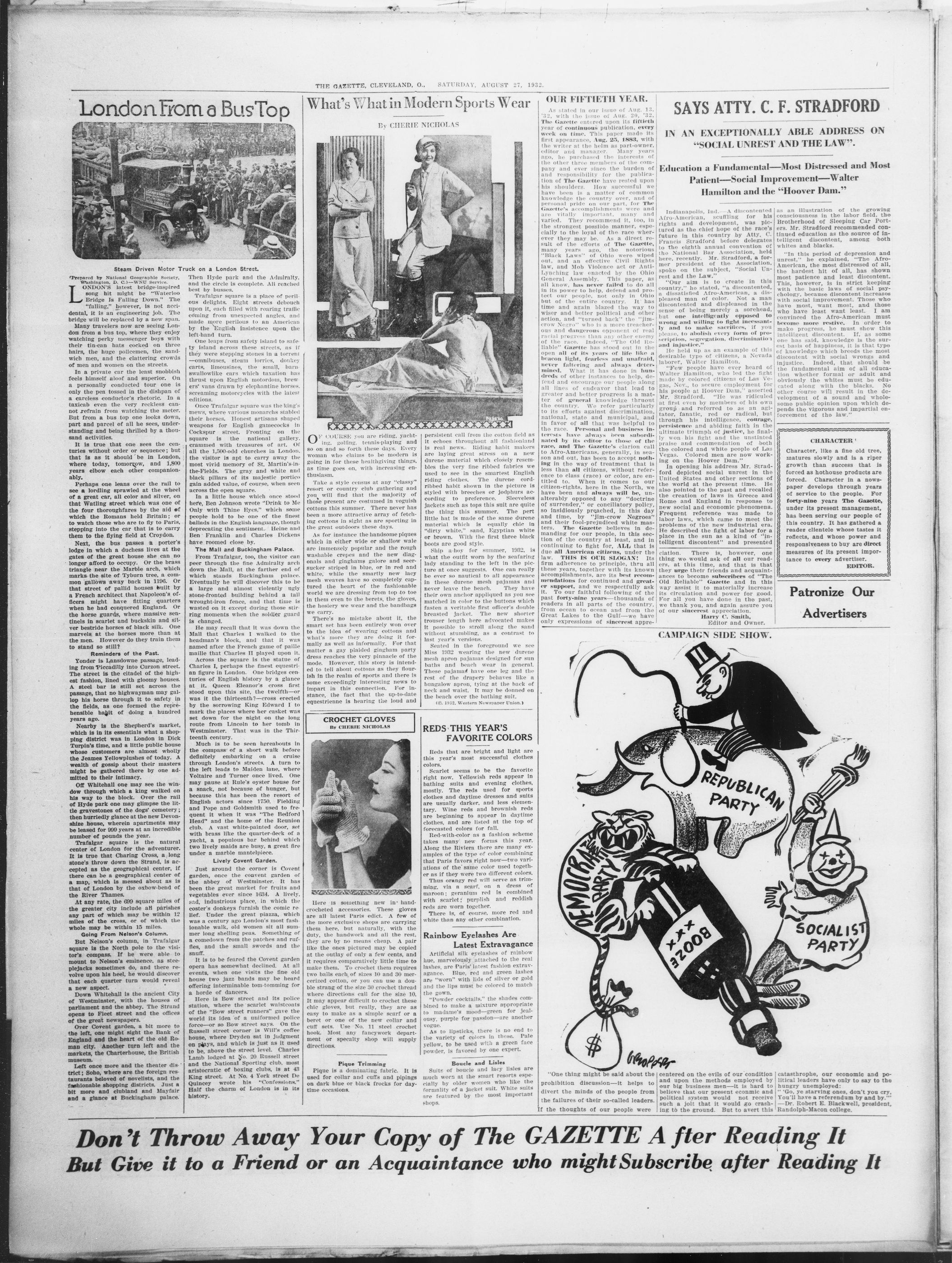
London From a BusTop
Re Ee aa
Ss ie = — ~— a
‘(Prepared by National Geographic Society,
Washington, D. C)—WNU Service.
ONDON'S latest bridge inspired
I song hit might be “Waterloo
Bridge Is Failing Down.” The
“falling,” however, is not acct
dental, it is an enzineering job. The
bridge will be replaced by a new span.
Many travelers now are seeing Lon-
don from a bus top, where they enjoy
watching perky messenger boys with
their tincan hats cocked on three
hairs, the huge policemen, the sand
wich men, and the clattering crowds
‘of men and women on the streets.
In a private car the least snobbish
feels himself aloof and superior. On
a personally conducted tour one {s
only the pea tossed in the dishpan of
a careless conductor’s rhetoric. In a
taxieab even the very reckless ean-
not refrain from watching the meter.
But from a bus top one looks down,
part and parcel of all he sees, under-
standing and being thrilled by a thow-
sand activities.
It is true that one sees the cen
turies without order or sequence; but
that 18 as ft should be in London,
where today, tomorow, and 1,800
years elbow each other companion
ably.
Perhaps one leans over the rail tc
see a lordiing sprawled at the whee!
of a great car, all color and silver, ob
that Watling street which was one of
the four thoroughfares by the aid ef
which the Romans held Britain; or
to watch those who are to fly to Paris,
stepping into the car that is to carry
them to the flying field at Croydon,
Next, the bus passes a porter's
lodge in which a duchess lives at the
gates of the great house she can no
longer afford to occupy. Or the brass
triangle near the Marble arch, which
marks the site of Tyburn tree, a com-
mon gallows away back in 1196. Or
that street of pallid houses built by
a French architect that Napoleon's of.
ficers might have fitting quarters
when he had conquered England. Or
the horse guards, where massive sen-
tinels in scarlet and buckskin and sil-
ver bestride horses of black silk. One
marvels at the horses more than at
the men. However do they train them
to stand so still?
Reminders of the Past.
Yonder is Lansdowne passage, lead:
ing from Plecadilly into Curzon street.
‘The street is the citadel of the high-
est fashion, lined with gloomy houses.
A steel bar is still set across the
passage, that no highwayman may gal-
lop his horse through it to safety in
the fields, as one formed the repre
hensible habit of doing a hundred
years ago.
Nearby is the Shepherd's market
which is in its essentials what a shop.
ping district was in London in Dick
‘Turpin's time, and a little public house
whose customers are almost wholly
the Jeames Yellowplushes of today.
wealth of gossip about their masters
might be gathered there by one ad
mitted to their intimacy.
Of Whitehall one may see the win:
dow through which a king walked on
his way to the block. Over the rail
of Hyde park one may glimpse the lit:
tle gravestones of the dogs’ cemetery ;
then hurriedly glance at the new Devon-
shize house, wherein apartments may
be leased for 909 years at an incredible
number of pounds the year.
‘rafalgar square is the natural
center of London for the adventurer.
It is true that Charing Cross, a long
stone's throw down the Strand, is ac-
cepted as the geographical center, if
there can be a geographical center of
& map, which is messed about as is
that of London by the oxbow-bend of
the River Thames.
‘At any rate, the 699 square miles of
the greater city include aM parishes
any part of which may be within 12
miles of the cross, or of which the
whole may be within 15 miles.
Going From Nelson’s Column.
But Nelson’s column, in Trafalgar
square is the North pole to the visi
tor’s compass. If he were able to
‘mount to Nelson's eminence. as stee-
plejacks sometimes do, and there re
‘yolve upon his heel, he would discover
that each quarter turn would reveal
a new aspect. ‘
Down Whitehall is the ancient City
of Westminster, with the houses of
parliament and the abbey. The Strand
‘opens to Fleet street and the offices
of the great newspapers.
‘Over Covent garden, a bit more to
the left, one might sight the Bank of
England and the heart of the old Ro-
man city. Another turn left and the
markets, the Charterhouse, the British
museum.
‘Left once more and the theater dis:
trict; Soho, where are the foreign res-
taurants beloved of novelists, and the
fashionable shopping districts. Just a
bit more and clubland and Mayfair
and a glance at Buckingham palace.
‘Then Hyde park and the Admiralty,
and the circle is complete. All reached
best by busses.
‘Trafalgar square is a place of peri
ous delights. Eight streets debouch
upon it, each filled with roaring tratlic
coming’ from unexpected antes, and
made more perilous to an American
by. the ‘English insistence upon the
left-hand turn,
‘One leaps from safety iskand to safe
ty island across these streets, as if
théy were stepping stones in a torrent
—omnibuses, steam lorries, donisey
carts, limousines, the small, barn
swallowlike cars which taxation has
thrust upon English motordom, brew
ers’ vans drawn by elephantine horses,
Sereaming motorcycles with the latest
editions.
‘Once ‘Trafalzar square was the kins’
mews, where various monarchs stabled
their horses, Honest artisans shaped
Weapons for English gamecocks in
Cockspur street. Fronting on the
square is the national gallery.
¢rammed with treasures of art, Of
all the 1,00-odd churehes in London,
the visitor is apt to carry away the
most vivid memory of St, Martin's.in-
theFields. ‘The gray and white and
black pillars of its majestic portico
gain added value, of course, when seen
across the open square.
In a little house which once stood
he¥e, Ben Johnson wrote “Drink to Me
Only with Thine Byes,” which some
people hold to be one of the finest
dallads in-the English language, though
deprecating the sentiment... Heine and
Ben’ Franklin and Charles Dickens
have roomed close by.
The Mall and Buckingham Palace.
From ‘Trafalgar, too, the visitor ear
peer through the fine Admiralty arch
down the Mall, at the farther end of
Which stands’ Buckingham palace.
Eventually he will discover this to be
@ large and almost violently uzly
stone-fronted building behind a tall
wrought-iron fence, and that time is
wasted on it except during those stir
ring moments when the soldier guard
is changed.
He may recall that it was down the
Mall that Charles I walked to the
headman's block, and that it was
named after the French game of paille
maille that Charles II played upon it.
‘Across the square is the statue of
Charles 1, perhaps the Gest equestri
an figure in London. One bridges cen.
turies of English history by a glance
at it. Queen Eleanor's cross first
stood upon this site, the twelfth—or
was it the thirteenth?—cross erected
by the sorrowing King Edward I to
mark the places where her casket was
set down for the night on the long
route from Lincoln to her tomb in
Westminster. That was in the Thir-
teenth century.
Much is to be seen hereabouts in
the compass’ of a short walk before
definitely embarking on a eruise
through London's streets, A turn to
the left leads to Maiden lane, where
Voltaire and Turner once lived. One
may pause at Rule’s oyster house for
‘a snack, not because of hunger, but
because this has been the resort of
English actors since 1750. Fielding
and Pope and Goldsmith used to fre-
quent it when it was “The Bedford
Head” and the home of the Reunion
club. A vast white-painted door, set
with brass like the quarter-deck of a
yacht, 2 populous bar behind which
two lively maids are busy, a great fire
under a marble mantelpiece.
Lively Covent Garden.
Just around the corner is Covent
garden, once the convent garden of
the abbey of Westminster. It has
been the great market for fruits and
vegetables ever since 1634. A lively,
sad, industrious place, in which the
coster's donkeys furnish the comle re
lief. Under the great piazza, which
was a century ago London's most fash.
fonable walk, old women sit all sum
mer long shelling peas. Something of
‘a comedown from the patches and ruf-
fles, and the small swords and the
snuff.
It is to be feared the Covent garden
opera has somewhat declined. At all
events, when one visits the fine old
house two jazz bands may be heard
offering interminable tom-tomming for
‘a horde of dancers.
Here is Bow street and its police
station, where the “scarlet waistcoats
‘of the “Bow street runners” gave the
world its idea of a uniformed police
foree—or so Bow street sass. On the
Russell street corner is Will's coffee
house, where Dryden sat in Judgment
on plays, and which is just as it used
to be, above the street level. Charles
Lamb lodged at No. 20 Russell street
‘and the National’ Sporting club, most
aristocratic of boxing clubs, Is at $3
King street. At No. 4 York street De
Quincey wrote his “Confessions.”
Half the charm of London is in its
history.
THE GAZETTE, CLEVELAND, O., SATURDAY, AUGUST 27, 1932.
What’s What in Modern Sports Wear | |
Ry CHERIE NICHOLAS 7
il Pe , “
0 VA ) fF (,, ta bs
Rt) Ay ye 1.
te A rag Kd
4 ia : ei Be » | ;
ey RRR RK eden
Ot ee na
ing, golfing, tennisplaying and
80 on and so forth these days. Every
Woman who claims to be modern is
going in for these healthgiving things,
as time goes on, with increasing en-
thusiasm.
‘Take a style census at any “classy”
resort or country club gathering and
you, will find that the majority. of
thoge present are costumed in voguish
cottons this summer. ‘There never has
been a more attractive array of fetch-
ing cottons in sight as are sporting in
the grent outdoors these days.
As for instance the handsome piques
which in either wide or shallow wale
are immensely popular and the rough
washable crepes and the new diag-
onals and ginghams galore and seer-
sucker striped in blue, or in red and
white, while the smartly new lacy
mesh weaves have so completely cap-
tured the heart of the fashionable
world we are dressing from top to toe
in them even to the berets, the gloves,
the hosiery we wear and the bandbags
we curry.
‘There's no mistake about it, the
smart set has been entirely won over
to the {dea of wearing cottons and
what's more they are doing it for-
mally as well as informally, For that
matter a gay plaided gingham party
dress reaches the very pinnacle of the
mode. However, this story is intend-
ed to tell about cottons as they flour-
ish In the realm of sports and there is
some exceedingly Interesting news to
impart in this connection, For in-
stance, the fact that the up-to-date
equestrienne is hearing the loud and
CROCHET GLOVES
By CHEMIE NICHOLAS
eng
er
f. Ce
DT
fas
*
Here 18 something new in- hand-
crocheted accessories. These gloves
are all latest Paris edict. A few of
the more exclusive shops are carrying
them here, but naturally, with the
duty, the handwork and all the rest,
they are by no means cheap. A pair
like the ones pictured may be copied
at the outlay of only a few cents, and
it requires comparatively little time to
make them. To crochet them requires
two balls each, of sizes 10 and 30 mer-
cerized cotton, or you can use a dou:
ble strang of the size 30 crochet thread
where directions call for the size 10,
It may appear difficult to crochet these
chic gloves, but really, they are as
easy to make as a simple scarf or a
beret or one of the new collar and
euft sets. Use No, 11 steel crochet
hook. Most any fancywork depart-
ment or specalty shop will supply
@irections.
Your Cop
or an Acqu
a ee
persistent call from the cotton field as
ft echoes throughout all fashiontand
is real news, Riding habit’ makers
fare laying great stress on a new
Gurene material which closely resem-
bles the very fine ribbed fabries we
used to see in the smartest English
riding clothes, The durene cord-
ribbed habit shown in the picture Is
styled with breeches or Jodphurs ac-
cording to preference. Sleeveless
Jackets such as tops this suit are quite
the thing this summer. The pert
little hat is made of the same durene
material which 1s equally chie in
“dirty white,” sand, Egyptian white
or brown, With the first three black
boots are good style.
Ship. achoy for summer, 1932, is
what the outfit worn by the seafaring
lndy standing to the left in the pic-
ture at once suggests. One can really
be ever so nautical to all appearance
in these durene mesh pajamas and
never leave the beach, They have
their own anchor appliqued as you see
matched in color to the buttons whieh
fasten a veritable first officer's double
breasted Jacket. ‘The new shorter
trouser length here advocated makes
It possible to stroll along the sand
without stumbling, as a contrast to
last year’s versions.
Seated in the foreground we see
Miss 1982 wearing the new durene
mesh apron pajamas designed for sun
baths and beach wear in general,
‘These pajama have one lex and the
rest of the drapery behaves like a
bungalow apron, tying at the back of
neck and waist. Tt may be donned on
the beach over the bathing suit,
10s 104. Wantere Viewananer Ueiek:>
REDS: THIS YEAR’S
FAVORITE COLORS
Reds that are bright and light are
this year's most successful clothes
colors.
Scarlet seems to be the favorite
right now. Yellowish reds appear in
bathing suits and evening clothes,
mostly. ‘The reds used for sports
clothes and daytime dresses and sults
fare usually darker, and less elemen-
tary. Wine reds and brownish reds
are beginning to appear In daytime
lothes, and are listed at the top of
forecasted colors for fall.
Ted-with-color as a fashion scheme
takes many new forms this year
Along the Riviera there are many ex-
amples of the type of color combining
that Paris favors right now—two var
ations of the’ same color used togeth-
or as if they were two different colors.
‘Thus orangy red will serve as trim:
ming, via a scarf, on a dress. of
maroon; geranium red Is combined
with scarlet; purplish and reddish
reds are worn together.
‘There ts, of enurse, more red and
white than'any other combination.
Rainbow Eyelashes Are
Latest Extravagance
Artificial silk eyelashes of rainbow
hue, marvelously uttached to the real
lashes, are Paris’ latest fashion extray-
agance. Blue, red and green lashes
are “worn” with lids of silver or gold
and the lips must be colored to mateh
the gown,
“Powder cocktails,” the shades com-
bined to make a mixture appropriate
to madame’s mood—green for Jeal-
ousy, purple for passion—are another
vogue.
‘AS to lipsticks, there is no end to
the variety of colors In these. Pale
yellow, to be used with a green face
powder, is favored by one expert.
Boucle and Lisles
Suite of boucle and lacy lisles are
much worn at the smart resorts espe-
cially by older women who like the
formality of a jacket suit. White suits
are featured by the most important
shops.
BReaucle and Lisles
(>%
4
, a7"
er’ a ¢
_ REPUB I
a Neat Ww
Le a) ;
SS ——
SAA 1S
SAV + “SOCiALiS
= 41 / PARTY,
3 re ;
ass ys
ee
OUR FIFTIETH YEAR.
As stated In our issue of Aug. Te.
32, with the fsue of Aug. 20, 732
The Gazette entered upon its fittieth
year of continuous publication, every
week on time, ‘This paper made its
first appearance, Aug. 25, 1883, with
the writer at the helm as part-owner,
editor and manazer. Many years
ago, he purchased the Interests of
the other three members of the com-
pany and ever sinco the burden of
and responsibility for the publica-
tion of The Gazette have rested upon
his shoulders. How successful we
have heen is a matter of common
knowledge the country over, and of
personal pride on our part, for ‘The
Gazette's ‘accomplishments were and
are. vitally Important, many. and
varied. ‘They recommend it, too, in
the strongest possible manner, espe-
cially to the loyal of the race wher-
ever they may be. As _a direct re-
sult of the efforts of The Gazette,
many years ago, the notorious
"Black Laws" of Ohio were wiped
out, and an effective Civil Rights
law, and Mob Violence act or Anti-
Lynching law enacted by the Ohio
General Assembly. ‘This paper, as
all know, his never failed to do all
in its power to help, defend and pro-
tect our people, not only in Ohio
but of the entire country. It has
time and again blazed the way. to
wiser and better politieal and other
action, and “turned back" the ‘“‘Jim-
crow Nexto” who is a more treacher-
ous and dangerous onponent of real
rackil proxress than any other enemy
of the race. Indeed, “The Old. Re-
Hable” Gazette has stood out in the
open all of its years of life like a
beacon Hight, fearless and unafraid,
never faltering and always. deter:
mined, What it has done in. hun.
dreds of other instances to help, de-
fend and encourage our people along
all lines of endeavor that lead to
greater and better progress is a mat-
ter of general knowledge thruont
the country. We refer particularly
to ity efforts against discrimination,
national, state and municipal, and
in favor of all that was helpful to
tho race. Personal and business in-
terests have always been subordi-
nated by its editor to those of the
race, and The Gazette's clarion call
to Afro-Americans, generally, in sea-
son and out, has been to accept noth-
ing in the way of treatment that is
Jess than all citizens, without refer-
ence to class (race) or color, are en-
titled to. When it comes’ to our
citizen-rights, here in the North, we
have been and always will be, un-
alterably opposed to any “doctrine
of surrender,” or conciliatory policy,
80 insidiously preached, in this day
and time, by “jim-erow Negroes”
and their’ fool-prejudiced white mas-
ters. The Gazette believes in de-
manding for our people, in this see-
tion of the country at ieast, and in
continuing to fight for, ALL that is
due all American citizens, under the
law. THIS IS OUR SLOGAN! Its
firm adherence to principle, thru all
these years, together with its known
accomplishments, are its best recom-
mendations for continued and great-
er support, and we respectfully ask
it. To our faithful following of the
Past forty-nine years—thousands of
readers in all parts of the country,
from ocean to ocean and from the
Great Lakes to the Guli—we have
only expressions of sincerest appre-
“One thing might be said about the
[prohibition discussion—it helps to
sven the minds of the people trom
| the failures of their so-called leaders.
If the thoughts of our people were
Y
F L
ight Sub
IN AN EXCEPTIONALLY ABLE ADDRESS ON
“SOCIAL UNREST AND THE LAW”.
Education a Fundamental—Most Distressed and Most
Patient—Social Improyement—Walter
Hamilton and the “Hoover Dam.”
Indianapolis, Ind.—A discontented
Afro-American, scuffing for his
rights and development, was _pic-
tured as the chief hope of the race's
future in, this country by Atty, C.
Francis ‘Stradford before delegates
to the elzhth annual convention of
ihe National Bar Association, held
here, recently. Mr. Stradford, a for-
mner’ president of the Association,
Spoke on the subject, “Social Un-
rest and the Law.”
“our aim is to create in_ this
country,”" ho stated, “a discontented,
a dissatisfied AfrocAmerican, a dis:
pleased man of color. Not’ a man
Ulscontented and displeased in. the
sense of beng merely a sorehead,
jut. one intelligently opposed to
wrong and willing (o fight incessant.
Ty and to make. sacrifices, if) you
please, to abolish every form. of pro-
Scription, sexregation, discriminatio
and injustice.”
He held up as an example of this
desirable type of citizens, a Nevada
laborer, Walter’ Hamilton,
| “Rew people have ever heard of
Walter Hamilton, who ted the fight
made by colored ‘eitizens of Las Ve-
gas, Nev., to seeure employment for
his people at Hoover Dam,” asserted
Mr, Stradford. “He was ridiculed
at frst even by members of his own
group and referred to as an ax
tator, fanatic, red or radical, but
‘through his’ intelligence, courage,
‘persistence and abiding faith in the
ultimate triumph of justice, he final-
ly won-his fight and the ‘unstinted
praise and commendation of both
the colored and white people of Las
Vegas. Colored men are now work-
‘ing on the Hoover Dam.”
In opening his address Mr. Strad-
ford depicted social unrest in the
United States and other sections of
the world at the present time. He
also pointed to the past and recalled
the creation of laws in Greece and
Rome and England in response to
new social and economic phenomena.
Frequent reference was made to
labor laws, which came to meet the
problems of the new industrial era.
He described the fight of labor for a
place in the sun as a kind of “in-
telligent discontent” and presented
jciation. There is, however, one
“ihing we wotid ask’ of all our read
jens, ‘at this time, and that is that
|fiey seen thot friends ene soeater
[steele becerse ssiseclstes of “Vie
[Old Reliable" Gasette and Qh ths
[way assist it to materially snerease
[iu eiteulation ‘and power ‘or Bood.
For ail you have dove a th ‘ect
[wo thank you, and asnin assure 0%
Sf ont nintoveetapnesciaion.
| THaery Cr Slt,
Taltor and Owner.
CAMPAIGN SIDE SHOW.
|such a jolt that it would go crash-
scribe after
as an illustration of the growing
consciousness in the labor field. the
Brotherhood of Sleeping Car Port-
ers. Mr. Stradford recommended con-
tinued education as the source of in-
telligent discontent, among both
whites and blacks.
“In this period of depression and
unrest,” he explained, ‘The Afro-
American, the most distressed of all,
the hardest hit of all, has shown
most patience and least discontent.
This, however, is in strict keeping
with the basi¢ laws of social psy-
chology, because discontent increases
with social improvement. Those who
have most, want most, and those
who have ‘least want least. I am
convinced the Afro-American must
become more restive. In order to
make progress, he must show this
Intelligent discontent. If, as some
one has said, knowledge is the sur-
est basis of happiness, it is that type
of knowledge which breeds the most
discontent with social wrongs and
injustice. Indeed, that should be
the fundamental aim of all educa-
tion whether formal or adult and
obviously the whites must be edu-
cated along with the blacks. No
other course will result in the de-
‘velopment of a sound and whole-
‘some public opinion upon which de-
pends the Vigorous and impartial en-
forcement of the law.”
CHARACTER '
Charester; tke!» ana old eey
oe es onl es
Sonik Gun cies Gat
forced as hothouse products are
dread Ohasasiaciin\e sees
oe ee
et rion teas pone ORE
forty-nine years The Gazette,
under its present management,
has been serving our people of
Se one is oaks
andes llaatale) ghee tart
eee lasts naeeeiand
responsiveness to buy are direct:
measures of its present impor-
tenes to oneey advertiser.
EDITOR.
ee
Patronize Our
Advertisers
| You'll have a referendum by and by."”
Randolph-Macon college.
ling It
ne
Reading It