The Gazette
Saturday, February 18, 1933
Cleveland, Ohio
Page text (machine-generated)
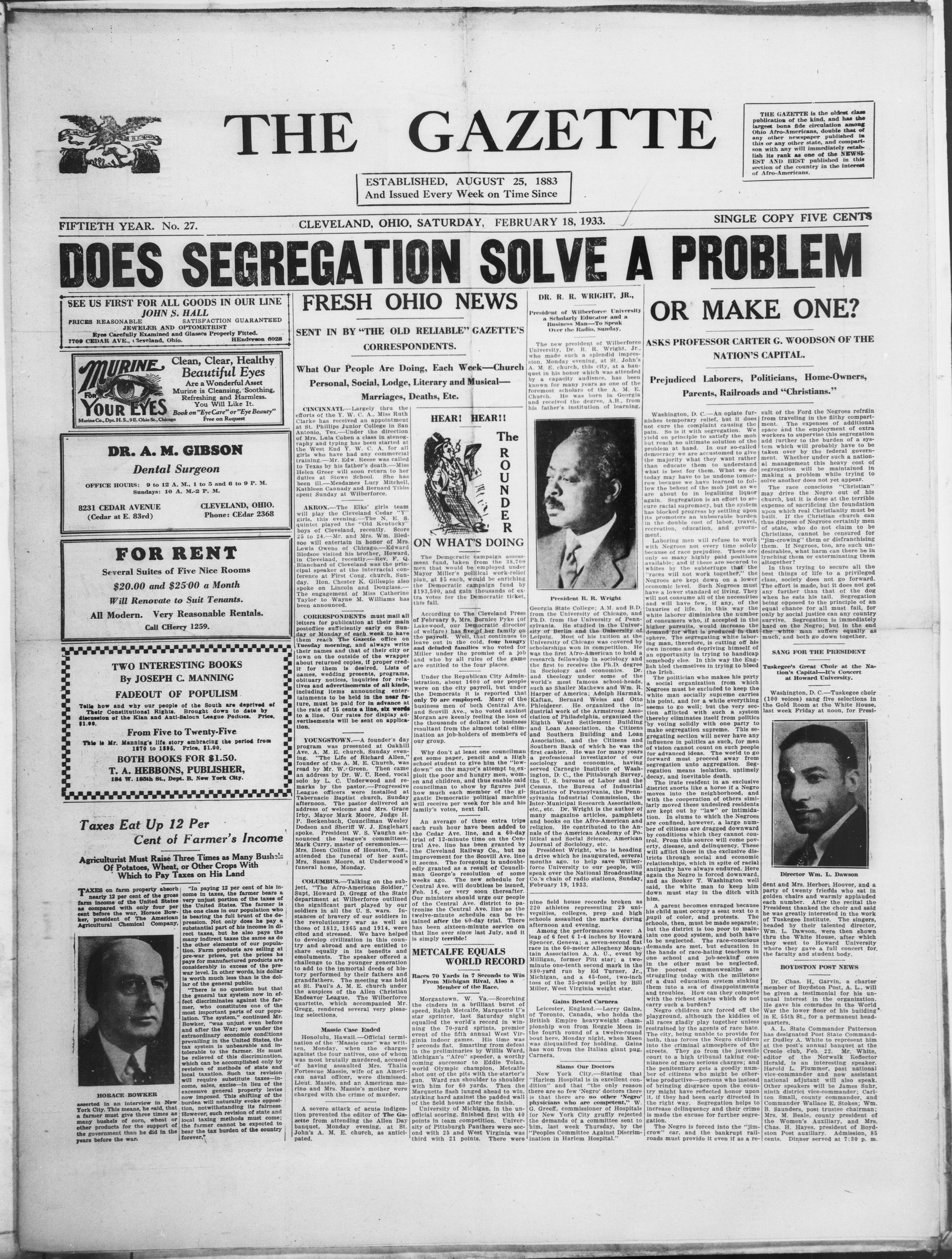
DOES SEGREGATION SOLVE A PROBLEM
IN MEMORIAM
IN STRENGTH
FIFTIETH YEAR. No. 27.
DOES S
SEE US FIRST FOR ALL GOOD
JOHN S. HAR
PRICES REASONABLE SATI
JEWELER AND OPTON
Eyes Carefully Examined and Glass
7709 CEDAR AVE., Cleveland, Ohio.
DES SEC
FIRST FOR ALL GOODS IN OUR
JOHN S. HALL
ASSONABLE SATISFACTION GU
JEWELER AND OPTOMETRIST
Carefully Examined and Glasses Properly F
R AVE., Cleveland, Ohio. HEr
SEE US FIRST FOR ALL GOODS IN OUR LINE
JOHN S. HALL
PRICES REASONABLE SATISFACTION GUARANTEED
JEWELER AND OPTOMETRIST
Eyes Carefully Examined and Glasses Properly Fitted.
7709 CEDAR AVE., Cleveland, Ohio. HEnderson 6028
MURINE
FOR
YOUR EYES
Clean, Clear, Healthy
Beautiful Eyes
Are a Wonderful Asset
Murine is Cleansing, Soothing,
Refreshing and Harmless.
You Will Like It.
Book on "Eye Care" or "Eye Beauty"
Free on Request
MURINE
FOR
YOUR EYES
Murina Co., Dpt. H. S., 9E. Ohio St., Chico
DR. A. M. GIBSON
Dental Surge
OFFICE HOURS: 9 to 12 A. M., 1
Sundays: 10 A. M.-2
Dental Surgeon
E HOURS: 9 to 12 A. M., 1 to 5 and 6 to
Sundays: 10 A. M.-2 P. M.
Surgeon
A. M., 1 to 5 and 6 to 9 P. M.
0 A. M.-2 P. M.
OFFICE HOURS: 9 to 12 A. M., 1 to 5 and 6 to 9 P. M.
Sundays: 10 A. M.-2 P. M.
8231 CEDAR AVENUE CLEVELAND, OHIO
(Cedar at E. 83rd) Phone: CEdar 236
FOR RENT
Several Suites of Five
$20.00 and $25.00
Will Renovate to Suit
All Modern. Very Reason
Call CHerry 12
Several Suites of Five Nice Room $20.00 and $25.00 a Month Will Renovate to Suit Tenants. Modern. Very Reasonable Rent Call CHerry 1259.
of Five Nice Rooms
$25.00 a Month
to Suit Tenants.
By Reasonable Rentals.
Merry 1259.
Several Suites of Five Nice Rooms $20.00 and $25.00 a Month Will Renovate to Suit Tenants. All Modern. Very Reasonable Rentals. Call CHerry 1259.
TWO INTERESTING BOOKS By JOSEPH C. MANNING
FADEOUT OF PO
Tells how and why our people of the
Their Constitutional Rights. Broug
discussion of the Klan and Anti-Saloon
$1.00.
From Five to Tw
This is Mr. Manning's life story embe
1870 to 1895. Price
BOTH BOOKS FOR
T. A. HEBBONS, PU
184 W. 185th St., Dept. B, N
Taxes Eat Up 12 P
Cent of Fail
Agriculturist Must Raise Three
Of Potatoes, Wheat, or O
Which to Pay Taxes
FADEOUT OF POPULISM
and why our people of the South are de-
constitutional Rights. Brought down to o-
n the Klan and Anti-Saloon League Politics.
From Five to Twenty-Five
Mr. Manning's life story embracing the per-
1870 to 1895. Price, $1.00.
BOTH BOOKS FOR $1.50.
T. A. HEBBONS, PUBLISHER.
184 W. 185th St., Dept. B, New York City.
Es Eat Up 12 Per
Cent of Farmer's
Tourist Must Raise Three Times as Ma-
Of Potatoes, Wheat, or Other Crops W
Which to Pay Taxes on His Land
OF POPULISM.
People of the South are deprived of its. Brought down to date by Anti-Saloon League Politica. Price.
e to Twenty-Five
factory embracing the period from 15. Price, $1.00.
KKS FOR $1.50.
INS, PUBLISHER,
Dept. B. New York City.
12 Per
of Farmer's Income
Three Times as Many Bushels eat, or Other Crops With Taxes on His Land
Tells how and why our people of the South are deprived of
Their Constitutional Rights. Brought down to date by
discussion of the Klan and Anti-Saloon League Politics. Price,
$1.00.
From Five to Twenty-Five
This is Mr. Manning's life story embracing the period from
1870 to 1895. Price, $1.00.
BOTH BOOKS FOR $1.50.
T. A. HEBBONS, PUBLISHER,
184 W. 185th St., Dept. B, New York Oty.
Agriculturist Must Raise Three Times as Many Bushels Of Potatoes, Wheat, or Other Crops With Which to Pay Taxes on His Land
TAXES on farm property absorb nearly 12 per cent of the gross farm income of the United States as combined with only four per cent before the war, Horace Bowyer, president of The American Agricultural Chemical Company,
"In paying 12 per cent of his income in taxes, the farmer bears a very unjust portion of the taxes of the United States. The farmer is the one class in our population who is bearing the full brunt of the depression. Not only does he pay
HORACE BOWKER
asserted in an interview in New York City. This means, he said, that a farmer must give three times as many bushels of corn, wheat or other products for the support of the government than he did in the years before the war.
1.
```markdown
```
```markdown
```
CLEVELAND, OHIO.
Phone: CEdar 2368
"In paying 12 per cent of his income in taxes, the farmer bears a very unjust portion of the taxes of the United States. The farmer is the one class in our population who is bearing the full brunt of the depression. He is the special part of his income in direct taxes, but he also pays the many indirect taxes the same as do the other elements of our population. Farm products are selling at pre-war prices, yet the prices he pays for manufactured products are considerably in excess. The war levee rates, his dollar wage is much less than is the dollar of the general public.
"There is no question but that the general tax system now in effect discriminates against the farmer, who constitutes one of the most important parts of our population. The system," continued Mr. Bowker, who constitutes the War; now under the extraordinary economic conditions prevailing in the United States, the tax system is unbearable and intolerable to the farmer. He must be relieved of this discrimination, which can be accomplished by the enactment of state and local taxation. Such tax revision will require substitute taxes—income, sales, excise—in lieu of the excessive general property levies now imposed. This shifting of the burden will naturally evade operation, now attributing its fairness. Such revision of state and local taxing methods must come; the farmer cannot be expected to bear the tax burden of the country forever."
THE GAZETTE
ESTABLISHED, AUGUST 25, 1883 And Issued Every Week on Time Since
CLEVELAND, OHIO, SATURDAY, FEBRUARY 18, 1933.
FRESH OHIO NEWS
What Our People Are Doing, Each Week—Church Personal, Social, Lodge, Literary and Musical—
CINCINNATI—Largely thru the efforts of the Y. W. C. A., Miss Ruth Clarke has received an appointment at St. Phillips Junior College in San Antonio, Tex.—Under the direction of Mrs. when she and typing was be married at the West End Y. W. C. A. for all girls who have had any commercial training—Mr. Edw. Reese was called to Texas by his father's death—Miss Helen Greer will soon return to her duties at the Schoe School—Messy McNeil—Messy Lucy Mitchell, Kathleen Cannady and Bernard Tibbs spent Sunday at Wilberforce.
AKRON.—The Elks' girls team will play the Cleveland Cedar "Y" girls, this evening.—The N. E. S. quintet played the "Old Kentucky" boys of Cleveland, recently. Score 25 to 24. Mr. and Mrs. W. Lewis, entertainment director of Mrs. Lewis Oweners of Chicago—Edward Bledsoe visited his brother, Howard, in Cleveland, recently.—Rev. F. Q. Blanchard of Cleveland was the principal speaker at the interracial conference at First Cong. church, Sunday. Hon. Chester K. Gilliesbole also attended. The engagement of Miss Catherine Taylor to Wayne M. Williams has been announced.
CORRESPONDENTS must mail all letters for publication at their main postoffice sufficiently early on Sunday or Monday of each week to have them reach The Gazette office on Tuesday morning, and always write their names and that of their city or on the outside of the wrapper about returned copies, if proper credit for them is desired. Lists of names, wedding presents, programs, obituary notices, inquiries for relatives and advertisements of all kinds, including items announcing entertainments to be held in the near future, must be mailed to the office of 15 cents a line, six words to a line. Our rates for display advertisements will be sent on application.
YOUNGSTOWN. —A founder's day program was presented at Oakhill Ave. A. M. E. church, Sunday evening. "The Life of Richard Allen," founder of the A. M. E. Church, was read by Mr. W./Green. Then came an address by Dr. W. C. Reed, vocal solo by L. C. Underwood and remarks by the pastor. —Progressive League officers were installed at Tabernacle Baptist church, Sunday afternoon. The pastor delivered an address of welcome and Mrs. Grace Browne, president of the P. Beckenbach, Councilman Wesley Dodson and Sheriff W. J. Englehart spoke. President W. S. Vaughn announced the league's committees. Mark Curry, master of ceremonies.—Mrs. Ilen Collins of Houston, Tex., attended the funeral of her aunt, Mrs. Susan Moore, at Underwood's funeral home, Monday.
COLUMBUS.—Talking on the subject, "The Afro-American Soldier," Supt. Howard D. Gregg of the State department at Wilberforce outlined the significant part played by our soldiers in all the U. S. wars. Instances of bravery of our soldiers in the revolutionary war as well as the war in the Civil War 655 were cited and stressed. We have helped to develop civilization in this country and abroad and are entitled to share equally in its benefits and emoluments. The speaker offered a challenge to the younger generation to add to the immortal deeds of history performed by their fathers and grandfathers. The meeting was held at the M. E. Church and the auspices of the Allen Christian Endeavor League. The Wilberforce quartette, which accompanied Mr. Gregg, rendered several very pleasing selections.
Massie Case Ended
Honolulu, Hawaii—Official termination of the "Massie case" was written, Monday, when the charges against the four natives, one of whom was most brutally murdered, accused of having assaulted Mrs. Thalia Fortescue Massie, wife of an American naval officer, were dismissed. Lieut. Massie, and an American marine and Mrs. Massie's mother were charged with the crime of murder.
A severe attack of acute indigestion prevented the editor of The Gazette from attending the Allen Day banquet, Monday evening, at St John's A. M. E. church, as anticipated.
HEAR! HEAR!!
The
ROUNDER
ON WHAT'S DOING
The Democratic campaign assessment fund, taken from the 38,700 men that would be employed under Mayor Miller's political work-relief plan, at $5 each, would be enriching the Democratic campaign fund by $193,500, and gain thousands of extra votes for the Democratic ticket, this fall.
According to The Cleveland Press of February 9, Mrs. Bernice Pyke (of Lakewood, our Democratic director of welfare) has five of her family on the payroll. Well, that continues to be true, as in a case where and deluded families who voted for Miller under the promise of a job and who by all rules of the game are entitled to the four places.
Under the Republican City Administration, about 1600 of our people were on the city payroll, but under the Democrats it is reported that only 70 are employed. Many of the business men of both Central Ave. and Scovill Ave., who voted against Morgan are keenly feeding the loss of the thousands of jobs that the president from the almost total elimination as job-holders of members of our group.
Why don't at least one councilman get some paper, pencil and a High school student to give him the "low-down" on the mayor's attempt to exploit the poor and hungry men, women and children, and thus enable said councilman to show by figures just published that the gigantic Democratic political machine will receive per week for his and his family's votes, next fall.
An average of three extra trips each rush hour have been added to the Cedar Ave. line, and a 60-day trial of 12-minute time on the Central Ave. line has been granted by the Cleveland Railway Co., but no improvement for the Scovill Ave. line it seems. The foregoing is undoubtedly granted as a result of Councilman George's resolution of some weeks ago. The new schedule for Central Ave. will doubtless be issued, Feb. 16, or very soon thereafter. The police would like our people of the Central Ave. district to patronize the Central Ave. line so the twelve-minute schedule can be retained after the 60-day trial. There has been sixteen-minute service on that line ever since last July, and it is simply terrible!
METCALFE EQUALS
WORLD RECORD
Races 70 Yards in 7 Seconds to Win
From Michigan Rival, Also a
Member of the Race.
Morgantown, W. W. —Scorching
the cinders in a brilliant haze with
metalcite. Metalcite, U.S. sur-
printer, last Saturday night
equalized the world's record in win-
ning the 70-yard sprints, premier
event of the fifth annual West Virginia indoor games. His time was
7 seconds flat. Smarting from defeat
in the preliminaries by Willis Ward,
Michigan's "Afro" speeder, a worthy
coming star of the Olympic champion, Metalcite
shot out of the pits with the starter's
gun. Ward ran shoulder to shoulder
with him for 60 yards. Then the
Marquette flash lunged ahead to win,
striking hard against the padded wall of the field house after the finish.
University of Michigan, in the un-
derated field, with 40 points in team competition. University of Pittsburgh Panthers were second with 25 and West Virginia was third with 21 points. There were
DR. R. R. WRIGHT, JR.,
President of Wilberforce University
a Scholarly Educator and a
Business Man—To Speak
Over the Radio, Sunday.
The new president of Wilberforce
University, Dr. R. R. Wright, Jr.,
who made such a splendid impression,
Monday evening, at St. John's
A. M. E. church, this city, at a banquet in his honor which was attended by a capacity audience, has been known for many years as one of the foremost scholars of the U. of M. He was born in Georgia and received the degree, A.B., from his father's institution of learning.
[Picture of a man in a suit and tie].
President B. B. Wright
Georgia State College; A.M. and B.D. from the University of Chicago, and Ph.D. from the University of Pennsylvania. He studied in the University of Berlin and the University of Leipzig. Most of his tuition at the University of Chicago was covered by the first Afro-American to hold a research fellowship in sociology and the first to receive the Ph.D. degree in Sociology and economics. Dr. and theology under some of the world's most famous school-heads, such as Shaaller Mathews and Wm. R. Harper of America; Adolph Harmak Kaftan, Bernard Weiss and Otte Krauss, the first African-American to hold the industrial work of the Armstrong Association of Philadelphia, organized the Eighth Ward Settlement Building and Loan Association, the Citizens and Southern Building and Loan Association, and the Citizens and Southern Bank of which he was the first cashier. He was for many years a professional investigator of our service to the Carnegie Institute of Washington, D. C., the Pittsburgh Survey, the U. S. bureaus of Labor and the Census, the Bureau of Industrial Statistics of Pennsylvania, the Pennsylvania Industrial Commission, the Inter-Municipal Research Association, etc., etc. Dr. Wright is the author of many magazine articles, pamphlets and books on the Afro-American and African cultures of the universities of the American Academy of Political and Social Science, American Journal of Sociology, etc.
President Wright, who is heading a drive which he inaugurated, several months ago, to help save Wilberforce University to our people, will speak over the National Broadcasting Co.'s chain of radio stations, Sunday, February 19, 1933.
nine field house records broken as 220 athletes representing 29 universities, colleges, prep and high schools assaulted the marks during afternoon and evening.
Among the 8-foot performances were: a leap of 8 feet 6-14 inches by Howard Spencer, Geneva; a seven-second flat race in the 60-meter Allegheny Mountain Association A. A. U., event by Milligan, former Pitt star; a two-minute one-tenth second mark in the 880-yard run by Ed Turner, Jr., Michigan, and a 45-foot, two-inch toss of the 35-pound pellet by Bill Miller, West Virginia weight star.
Gains Bested Carnera
Leicester, England.—Larry Gains, of Toronto, Canada, who holds the British Empire heavyweight championship won from Reggie Meen in the fourth round of a twelve-round bout here. Monday night, when Meen was fitted for fencing, Gains has won from the Italian giant gug Carnera.
Slams Our Doctors
New York City.—Stating that "Harlem Hospital is in excellent condition" and that "the only reason there are so few 'Negro' doctors there is that there are no other 'Negro physicians who are competent,'" W.G. Greeff, commissioner of Hospitals for New York City gruffly rejected the demands of a committee sent to him, last week Thursday, by the "Peoples Committee Against Discrimination in Harlem Hospital."
SINGLE COPY FIVE CENTS
OR MAKE ONE?
ASKS PROFESSOR CARTER G. WOODSON OF THE NATION'S CAPITAL.
Prejudiced Laborers, Politicians, Home-Owners, Parents, Railroads and "Christians."
Washington, D. C.—An opiate furnishes temporary relief, but it does not cure the complaint causing the pain. So is it with segregation. We yield on principle to satisfy the mob but reach no ultimate solution of the problem at hand. In our democracy we are accustomed to give priority to what they want rather than educate them to understand what is best for them. What we do today may have to be undone tomorrow because we have learned to follow the behest of the mob just as we are about to in legalizing liquor again. Segregation is an effort to secure racial supremacy, but the system has blocked progress by its prioritization of desirable burden in the double cost of labor, travel, recreation, education, and government.
Laboring men will refuse to work with Negroes not every time solely because of race prejudice. There are only so many highly paid positions available; and if these are secured to whites by the subterfuge that the "races will not work together," Negroes are kept down by lower income. Either Negroes must be a lower standard of living. They will not consume all of the necessities and will have few, if any, of the luxuries of life. In this way the white laborer diminishes the number of consumers who, if accepted in the higher pursuits, would increase the demand for what is produced in that sphere. The segregating white laboring man, therefore, is cutting off his own income and depopulating the workforce somebody else. In this way the English bled themselves in trying to bleed the Irish.
The politician who makes his party a social organization from which Negroes must be excluded to keep the white man socially supreme carries his point, and for a while everything seems to go well; but the very secession of the Negroes thereby eliminates itself from politics by voting solidly with one party to make segregation supreme. This segregating section will never have any influence in politics as such, for men of vision cannot count on such people for advanced ideas. The world to go forward must proceed away from segregation in the form of Segregation means isolation, untimely decay, and inevitable death.
The irate resident in an exclusive district snorts like a horse if a Negro moves into the neighborhood, and with the cooperation of others similarly moved these undesired residents are kept out by "law" or intimidation. In slums to which the Negroes are confined, however, a large number of citizens are dragged downward by conditions which they cannot control. From this source will come poverty, disease, and delinquency. These will afflict those in the social and economic relationships, which in spite of racial antipathy have always endured. Here again the Negro is forced downward, and as Booker T. Washington well said, the white man to keep him down must stay in the ditch with him.
A parent becomes enraged because his child must occupy a seat next to a pupil of color, and protests. The schools, then, must be made separate; but the district is too poor to maintain one good system, and both have to deal with the demands are met, but education in the hands of race-hating teachers in one school and job-seeking ones in the other must be neglected. The poorest commonwealths are struggling today with the millstone of a dual education system sinking them into a sea of disappointments. The schools are struggling with the richest states which do not carry such a burden?
Negro children are forced off the playground, although the kiddies of all races gladly play together unless restrained by the agents of race hate. The city, being unable to provide for both, thus forces the Negro children into the criminal atmosphere of the streets. They go from the juvenile court to a high tribunal taking cognizance of more serious charges; and the penitentiary gets a goodly number of citizens who might be otherwise productive—persons who instead might be degraded upon the country might have received honor upon it, if they had been early directed in the right way. Segregation helps to increase delinquency and their crime is made the excuse for further segregation. The Negro is forced to return the "jim-crow" car, and the bankrupt railroads must provide it even if as a re
THE GAZETTE is the oldest class publication of the kind, and has the largest bona fide circulation among Ohio Afro-Americans, double that of any other newspaper published in this or any other state, and compares with any will imminent establishment in the NEWSLETTER BEST published in this section of the country in the interest of Afro-Americans.
THE COPY FIVE CENTS
BLEM
KE ONE?
RTER G. WOODSON OF THE
'S CAPITAL.
Politicians, Home-Owners,
ands and "Christians."
sult of the Ford the Negroes refrain from traveling in the filth compartment. The expenses of additional space and the employment of extra workers to supervise this segregation add further to the burden of a state that cannot be taken over by the federal government. Whether under such a national management this heavy cost of segregation will be maintained in making a problem while trying to solve another does not yet appear.
The race conscious "Christian" may drive the Negro out of his church, but it is done at the expense of the state, the foundation real which Christianity must be built. If the Christian church can thus dispose of Negroes certainly men of state, who do not claim to be Christians, cannot be censured for "jim-crowning" them or distranchising them. If Negroes, too, are such undesirables, what harm can there be in burying them or exterminating them altogether.
In thus trying to secure all the best things of life to a privileged class, society does not go forward. The effort is made, but it does not get any further than that of the dog when he eats his tail. Segregation being opposed to the principle of an equal chance for all must fall, for only by social justification is immediately hard on the Negro; but in the end the white man suffers equally as much, and both go down together.
SANG FOR THE PRESIDENT
Tuskegee's Great Choir at the Nation's Capital—It's Concert at Howard University.
Washington, D. C.—Tuskegee choir (100 voices) sang five selections in the Gold Room at the White House, last week Friday at noon, for Presi-
Director Wm. L. Dawson
dent and Mrs. Herbert Hoover, and a party of twenty freiess who sat in golden chairs and warmly applauded each number. After the recital the President thanked the choir and said he was greatly interested in the work of Tuskegee Institute. The singers, headed by their talented director, were shown through the White House after they went to Howard University where they gave a full concert for the faculty and student body.
BOYDSTON POST NEWS
Dr. Chas. H. Garvin, a charter member of Boydston Post, A. L., will be given a testimonial for his unusual interest in the organization. He gave his comrades in the World War the lower floor of his building in E. 55th St., for a permanent headquarters. A. L. State Commander Patterson has designated Post State Commandant at the post's annual banquet at the post's annual banquet at the Creole club, Feb. 22. Mr. White, editor of the Norwalk Reflector Herald, is an interesting speaker. Harold L. Plummer, past national vice-commander and now assistant national adjutant will also speak. Other speakers will be James Suhr, ninth district vice-commander; Carlton Small, county commander, and commander Wallace E. Stokes; Wm. C. Browne, town treasurer; Mrs. M. Beale, county president of the Women's Auxiliary, and Mrs. Chas. H. Hayes, president of Boydston Post auxiliary. Admission, 85 cents. Dinner served at 7:30 p. m.
---
PUBLISHED EVERY SATURDAY
One Year ..... $2.00
Six Months ..... 1.00
Subscribers are requested to remit
by postoffice money order or
registered letter.
Entered at the postoffice in Cleveland, Ohio, as second-class mail matter.
Address all communications to
HARRY C. SMITH
Editor and Proprietor
THE GAZETTE
226 W. Superior Ave., Cleveland, O.
(Bell 'Phone: CHerry 1259)
Member Ohio Legislature: 1894 to
1896; 1896 to 1898; 1900 to 1902
10,000,000 Afro-Americans.
325,000 in Ohio.
75,000 in Cleveland.
SATURDAY, FEBRUARY 18, 1933
Only the state department of Wilberforce University, known as the "Combined Normal and Industrial Department," is owned and subject to the authority of the state of Ohio. All the rest of Wilberforce University is owned and controlled by the A. M. E. Church (connection).
THE WEAVER BILL
The House of Representatives, on Thursday afternoon of last week, passed by a vote of 104 to 1 Hon Chester K. Gillespie's bill authorizing the Cuyahoka County commissioners to pay Joseph Weaver $15,000. Now it will be acted upon by the State Senate. If favorably, as all sincerely hope and expect, and Gov. Geo. White sign it, a small measure of compensation will be given Joe for the 25 months' incarceration, 22 of which were spent in the Ohio penitentiary death-cell the innocent of the crime (murder) on which he was "convicted." If he finally receives the $15,000 there is no doubt but that he will liberally compensate his attorneys, Messrs. Nathan Cook and Wm. Marsteller, who stuck to him from start to finish and saved his life when nearly all others had deserted him. They did this, too, without pay of any kind, for Joe had nothing to give them. No human being would want to go to thrue what Joe Weaver did, from the day of his "conviction" to that of his liberation, for any amount of money. Indeed, it is simply impossible for him, of any other innocent person so mistreated, to ever be properly compensated for such a harrowing experience. We do not for a single moment believe the members of the Ohio State Senate and our Governor will hesitate a moment to give Mr. Gillespie's Weaver bill the same prompt and favorable action given it by the Ohio House of Representatives, everyone of those 104 members of which acted so willingly, so promptly and so wisely in the matter. Thanks, gentlemen—for all fair-minded persons in the state of Ohio.
According to The Cleveland Plain Dealer, recently, Mayor Ray T. Miller said:
"Regardless of the outcome of the Civil Service examination, held a short time ago, for any purchase will become commissioner, next month. We will ignore the Civil Service list."
Well, well, WELL! A Civil Service law is just as sacred as any other law, and any one violating it, or any other law, is a law-breaker, often a criminal. Mayor Miller will not only make himself the leading law-breaker of this city but he will also violate his oath of office when he what he announces as his intention to do.
Is it any wonder that crime flourishes in a city where its Chie Executive does not obey the law but even flouts it and ignores his oath or office? Why prosecute the many petty law-breakers and let the "big fish," even if office-holders, clothe themselves with immunity?
Police! Police!! Catch the big ones first and then go after the "small fry."
Congressman Martin J. Sweeney says,
"One phase of Mayor Ray T. Miller's 'new' direct relief plan is absurd. In it he contemplates building a road from Edgewater blvd. to the bath house, a distance of 1000 ft. This project the mayor states will give work to 9,000 men. This is really ridiculous and so impractical that if he tried it, men would be packed in like sardines."
Well, that former famous Notre Dame football bench-warmer, the mayor, is still "carrying the ball" on the bench. But he and "Boss" W. Burr Gongwer are hot after jobs for the Democratic "faithful" and a good big campaign fund for this fall. Republican members of the City Council should reject the mayor's
new direct relief plan, and promptly too.
A VERY VICIOUS BILL!
What seems to be the first move of the Ohio khu klux klan to carry out its vicious program, directed against our people of Ohio, made at a state meeting of the miserable organization in Columbus, a trifle over a year ago, is bill No. 341, introduced in the House of Representatives, recently, by the Hon. Mr. Kasch of Akron. It will be found elsewhere in this paper. Our only member in the State Assembly is Representative Chester K. Gillespie of this city. Recognizing the seriousness of the "very vicious" blow, directed at the state department at Wilberforce by the Kasch bill, Mr. Gillespie is calling on all of our people, and their friends in the state of Ohio, to get in touch with their member or members of the lower branch of the State Assembly, explaining to them the miserable attack outlined in House Bill No. 341, and politely but firmly asking their assistance in our effort to kill the bill in the House committee, to which it has been referred, before it reaches the House, if possible. There is no earthly good excuse for any such legislation at this time for the very good reason that the curriculum of the state department at Wilberforce complies with instructions given the institution by the State Education Department, like all other state educational institutions. Mr. Kasch's effort, or that of any other member of the State Assembly, to thus undertake to usurp authority invested in the State Education Department ought to be estopped, promptly, and the best place to do this is in the House committee to which the bill No. 341 has been referred. Whether he realizes it or not, he is trying to establish with his bill a precedent that the Ohio House of Representatives should not permit because of its future probable effect upon other state educational institutions. So get in touch with your member or members of the lower branch of the State Assembly just as soon as possible.
OUTHWAITE
The Only School of the Kind in the City That Denies Opportunity to Our Boys.—Attention, N. A. A. C. P.!
It is time that the thinking people in this city became aware of the situation which exists at Outhwaite School.
When this school first became a center for average boys, it was planned to serve those boys who were three years or more age for their grade. It was that that these boys would be happier if placed in groups together where the fundamental subjects could be stressed. It was indicated that these boys be given the same opportunity that the children of other taxpayers receive. After completing the eighth grade at Outhwaite these boys went to East Technical High school where some succeeded and some failed, as is true with all classes.
When Outwaithe was transferred to the department of special schools, however, opportunities open to children of other taxpayers were no longer open to these boys. A small number are sent to school during high school when the sixth grade is completed. The fate of the others is a tragedy. They mark time in Outwaithe for several years and then are given a card which states that they have completed the work offered there but are eligible for no other school. The door of further education is closed to these boys simply because they are unfortunate enough to reside in the Outwaithe district. Perhaps the boy's parents wish education to cease, but he can no farther. Why should such a school exist only in that district? Overage, or as they are now called ungraded Z groups, are not peculiar to the section in which Outwaithe is located. Large numbers of them are cared for in other sections of city, but the majority discriminated against as in the Outwaithe-Longwood district.
In other sections where the group is large enough, they work together until they complete the sixth grade. Then these pupils are sent to junior high school and whatever educational opportunities they can make use of are taken to school. In February, 36 boys and girls in an ungraded Z group were sent to a west side junior high. Their P. L. R.'s (Probable Learning Rate) ranged from 100 to 65. Investigation will show that the range is no lower at Outwahte than in similar groups. The Board of Education maintains special centers to which the mentally defective are sent. Thomas Edison is maintained at great expense to care for problem boys. If Outwahte is being used for either of these purposes, it is grossly unfair to the normal boys who attend and should be investigated. It is not designed, equipped or run as a for mental defectives or de-
The argument has been advanced that when these boys were permitted to attend East Technical they dropped out without completing the course. Pupils do not enter public high schools pledged to complete eight years' work. Groups who refuse admission because they might do so. Some boys who have finished the regular elementary school are sent to Outhwaite' instead of to junior high. No junior or senior high school in any other section of the city has the right to refuse pupils from any elementary school. Who has the right to say that because a child lives in a certain section of the city, he must leave school with a card that says 'no farther'. In long similar groups in other section of the city receive all educational advantages why should these boys be denied them? A Mother.
THE GAZETTE, CLEVELAND, O.
OHIO'S MOB
OR ANTI-LYNCHING LAW
IN EFFECTIVE
Against the Mob and Lynch
Work of a Member
His Ohio Civ
Our mob-violence or anti-lynch
legislature in 1894 and re-introduced
Smith, editor of The Gazette, just the
law. The Ohio Supreme Court had
nationality of the law and it has been
and New Jersey have followed Ohio
anti-lynching laws which are copies
own states and at least one border
anti-lynching laws, in recent years.
MO
Section
6278. "Mob" and "lynching" defined.
6279. "Serious injury" defined.
6280. Damages in case of assault.
6281. Damages in case of lynching.
6282. Damages recoverable by legal
6283. Person suffering death or inj.
6284. Limitations of action.
6285. Order to include recovery and
6286. Guardian's custody, etc., fees.
6287. County's right of action again.
6288. County's right of action again.
6289. Non-relief from prosecution.
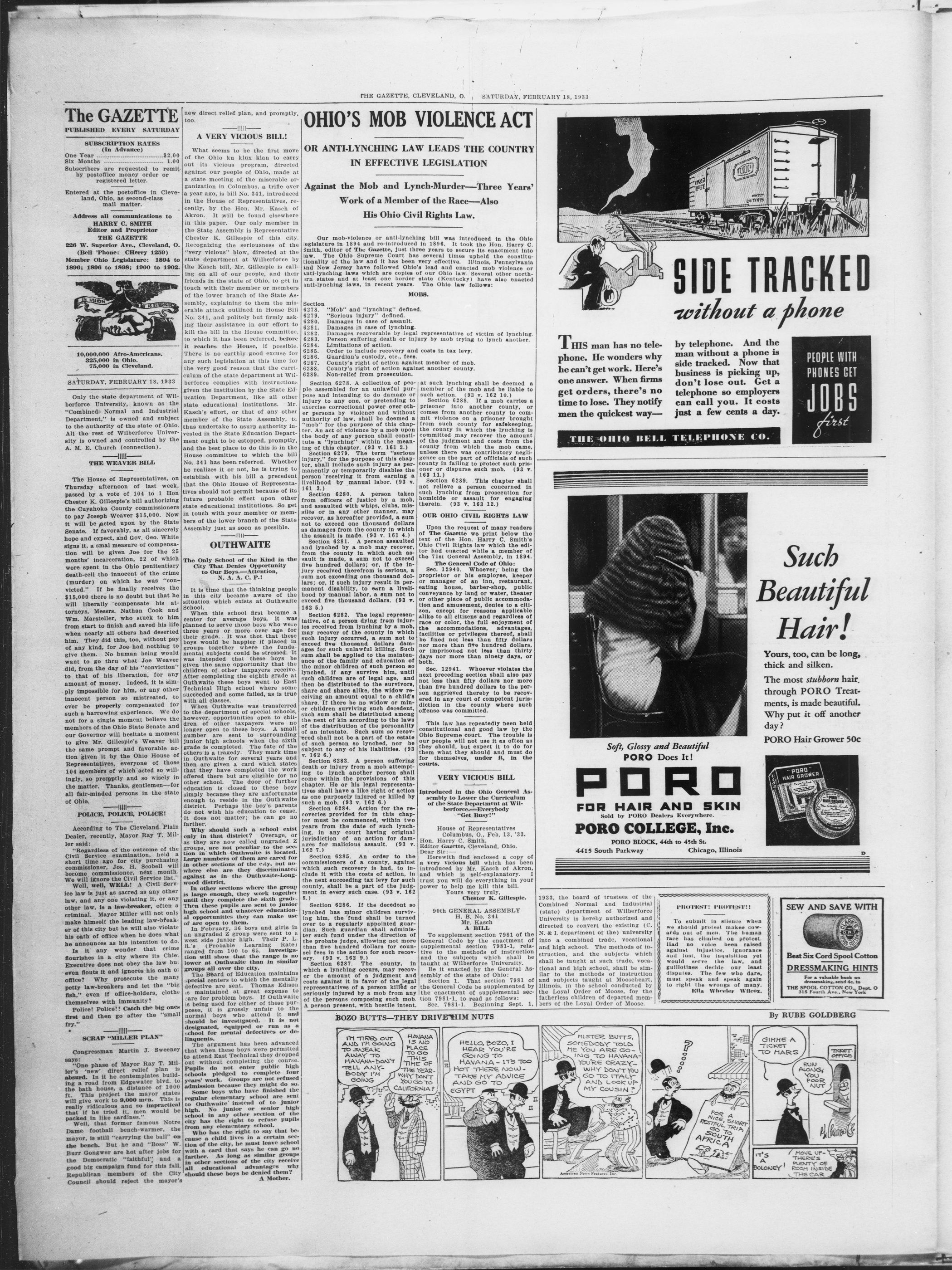
OHIO'S MOB VIOLENCE ACT
OR ANTI-LYNCHING LAW LEADS THE COUNTRY IN EFFECTIVE LEGISLATION Against the Mob and Lynch-Murder-Three Years' Work of a Member of the Race-Also His Ohio Civil Rights Law.
Our mob-violence or anti-lynching bill was introduced in the Ohio legislature in 1894 and re-introduced in 1896. It took the Hon. Harry C. Smith, editor of The Gazette, just three years to secure its enactment into law. The Ohio Supreme Court has several times uphold the constitutionality of the law and it has been very effective. Illinois, Pennsylvania and New Jersey have followed Ohio's lead and enacted mob violence or anti-lynching laws. In other northern states and at least one border state (Kentucky) have also enacted anti-lynching laws, in recent years. The Ohio law follows:
Section 6278. A collection of people assembled for an unlawful purpose and intending to do damage or injury to any one, or pretending to exercise correction power over other persons by violence and without authority of law, shall be deemed a "mob" for the purpose of this chapter. An act of violence by a mob upon the body of any person shall constitute a "mob" for the purpose of this chapter. (93 v. 161.2.)
"Mob" and "lynching" defined. "Sorious injury" defined. Damages in case of assault. Damages in case of lynching. Damages recoverable by legal representative of victim of lynching. Person suffering death or injury by mob trying to lynch another. Limitations of action. Order to include recovery and costs in tax levy. Guardian's custody, etc., fees. County's right of action against member of mob. County's right of action against another county. Non-relief from prosecution.
Section 6278. A collection of people assembled for an unlawful purpose and intending to do damage or injury to any one, or pretending to exercise correction power over other persons by violence and without authority of law, shall be deemed a "mob" for the purpose of this chapter. An act of violence by a mob upon the body of any person shall constitute a "mob" for the purpose of this chapter. (93 v. 161.2.)
at such lynching shall be deemed a member of the mob and be liable to such action. (93 v. 162.10.)
Section 6288. If a mob carries a prisoner into another county, or comes from another county to commit violence on a prisoner brought from such county for safekeeping the county in which the lynching is committed may recover the amount of the judgment and costs from the county from which the mob came.
Section 6279. The term "serious injury," for the purpose of this chapter, shall include such injury as permanently or temporarily disables the person receiving it from earning a livelihood by manual labor. (93 v. 161 3.)
Section 6280. A person taken from officers of justice by a mob, and assaulted with whips, clubs, missiles or in any other manner, may recover, as here provided, a sum not to exceed one thousand dollars as damages from the county in which the assault is made. (93 v. 161 4.)
Section 6281. A person, a mob may recover, from the county in which such assault is made, a sum not to exceed five hundred dollars; or, if the injury received therefrom is serious, a sum not exceeding one thousand dollars; or, if such injury result in permanent disability, to earn a livelihood by manual labor, a sum not to exceed five thousand dollars. (93 v. 162 5.)
Section 6282. The legal representative, of a person dying from injuries received from lynching by a mob may recover of the county in which such injury occurred, a sum not to exceed five thousand dollars damages for such unlawful killing. Such sum shall be applied to the maintenance of the family and education of the minor children of such person so lynched, if any survive him, until such children are of legal age, and then be distributed to the survivors, share and share alike, the widow receiving an amount equal to a child's share. If there be no widow or minor children surviving such decedent, such sum shall be distributed among the next of kin according to the laws of the distribution of the personalities of such persons, and wed shall not be a part of the estate of such person so lynched, nor be subject to any of his liabilities. (93 yr. 162. 6.)
Section 6283. A person suffering death or injury from a mob attempting to lynch another person shall come within the provisions of this chapter. He or his legal representatives shall have a like right of action as one purposely injured or killed by suction man v. 623 10. Section 6284. Action for the recoveries provided for in this chapter must be commenced, within two years from the date of such lynchings, in any court having original jurisdiction of an action for damages for malicious assault. (93 v. 162 7.)
Section 6285. An order to the commissioners of a county, against which such recovery is had, to include it with the costs of action, in the case of unlawful taxation, shall be a part of the judgment in every such case. (93 v. 162 8.)
Section 6286. If the decedent so lynchened has minor children surviving him, the fund shall be turned over to a regularly appointed guardian. Such guardian shall administer such fund under the direction of the probate judge, allowing not more than four lawyers for counsel fees in the action for such recovery. (63 v. 162 9.) Section 6287. The county, in which a lynching occurs, may recover the amount of a judgment and costs against it in favor of the legal person. A person seriously injured by a mob from any of the persons composing such mob A person present, with hostile intent.
BOZO BUTTS—THEY
I'M TIRED OUT
AND I'M GOING
TO SNEAK
AWAY TO
HAVANA-DON'T
TELL ANY-
BODY I'M
GOING
I'M TIRED OUT AND I'M GOING TO SUEAK AWAY TO HAVANA-DON'T TELL ANY-BODY I'M GOING
HAVANA IS NO PLACE TO GO THIS TIME OF THE YEAR-WINN'DON'T YOU GO TO CALIFORNIA?
HELLO, BOZO, I HEAR YOU'RE GOING TO HAVANA - IT'S TOO HOT THERE NOW- TAKE MY ADVICE AND GO TO EGYPT
MISTER BUTTS, SOMEDODY TOU- HE YOU ARE GO-ING TO HAVANA- YOU'RE CRAZY- WHY DON'T YOU GO TO ITALY AND LOOK UP MY COUSIN?
FOR A NICE, SHART RESTFUL TRIP, GO TO SOUTH AFRICA
IT'S A BOLONEY!
MOVE UP- THERE'S PLENTY OF ROOM INSIDE THE CAR
VIOLENCE ACT
NEW LEADS THE COUNTRY
THE LEGISLATION
Bunch-Murder—Three Years’
or of the Race—Also
Evil Rights Law.
The bill was introduced in the Ohio
Council in 1896. It took the Hon. Harry C.
three years to secure its enactment into
its several times uphold the constitu-
tion very effective. Illinois, Pennsylvania
's lead and enacted mob violence or
of our Ohio law. Several other north-
state (Kentucky) have also enacted
The Ohio law follows:
OBS.
d.
All representative of victim of lynching.
bury by mob trying to lynch another.
and costs in tax levy.
Just member of mob.
Just another county.
at such lynching shall be deemed a member of the mob and be liable to such action. (93 v. 162 10.) Section 6288. If a mob carries a prisoner into another county, or comes from another county to commit violence on prisoner brought into the county for safekeeping, the county in which the lynching is committed may recover the amount of the judgment and costs from the county from which the mob came, unless there was contributory negligence on the part of officials of such county in failing to protect such prisoner or dispurse such mob. (93 v. 162 10.) Section 6289. This chapter shall not relieve a person concerned in such lynching from prosecution for homicide or assault for engaging therein. (93 v. 163 12.)
OUR OHIO CIVIL RIGHTS LAW
Upon the request of many readers of The Gazette we print below the text of the Hon. Harry C. Smith's Ohio Civil Rights law which the editor had enacted while a member of the 71st General Assembly, in 1894.
The General Code of Ohio:
Sec. 12940. Whoever, being the proprietor or his employee, keeper or manager of an inn, restaurant, house, hotel, business conveyance by land or water, theater or other place of public accommodation and amusement, denies to a citizen, except for reasons applicable alike to all citizens and regardless of race or color, the full enjoyment of the accommodations, advantages, facilities or privileges thereof, shall be fined not less than fifty dollars nor more than five hundred dollars, nor less than ten hundred days nor more than ninety days, or both.
Sec. 12941. Whoever violates the next preceding section shall also pay not less than fifty dollars nor more than five hundred dollars to the person aggrieved thereby to be recovered in any court of competent jurisdiction in the county where such offense was committed.
This law has repeatedly been held constitutional and good law by the Ohio Supreme court. The trouble is our people will not use it as often as they should and it is to do for them what they should and must do for themselves, under it, in the courts.
VERY VICIOUS BILL
Introduced in the Ohio General Assembly to Lower the Curriculum of the State Department at Wilberforce—Everybody "Get Busy!"
House of Representatives
Columbus, O., Feb. 13, '33.
Hon. Harry C. Smith,
Editor Gazette, Cleveland, Ohio.
Dear Sir:
Herewith find enclosed a copy of a very vicious bill which has been introduced by Mr. Kasch of Akron, and which is self-explanatory.
I trust you will do everything in your power to help me kill this bill.
Yours very truly,
Chester K. Gillespie.
90th GENERAL ASSEMBLY
H. B. No. 341
Mr. Kasch
A BILL
To supplement section 7981 of the General Code by the enactment of supplemental section 7981-1, relative to the nature of instruction and the subjects which shall be taught at Wilberforce University.
Be it enacted by the General Assembly of the state of Ohio:
sembly of the state of Ohio:
Section 1. That section 7981 of
the General Code be supplemented by
the enactment of supplemental sec-
tion 7981-1, to read as follows:
Sec. 7981-1. Beginning Sept. 1.
DRIVE HIM NUTS
HELLO, BOZO, I
HEAR YOU'RE
GOING TO
HAVANA - IT'S TOO
HOT THERE NOW-
TAKE MY ADVICE
AND GO TO
EGYPT
MOB8.
SATURDAY, FEBRUARY 18, 1933
```markdown
```
FIRST
124 YM15
M
THIS man has no telephone. He wonders why he can't get work. Here's one answer. When firms get orders, there's no time to lose. They notify men the quickest way—
Soft, Glossy and
PORO D
FOR HAIR A
Sold by PORO Deal
PORO COLL
PORO BLOCK, 4
4415 South Parkway
THE OHIO BELL TELEPHONE CO.
1
1933, the board of trustees of the Combined Normal and Industrial (state) department of Wilberforce University is hereby authorized and directed to convert the existing (C. N. & I. department of the) university into a combined trade, vocational and high school. The methods of instruction, and the subjects which shall be taught at such trade, vocational and high school, shall be similar to the methods of instruction and subjects taught at Mooseheart, Illinois, in the school conducted by the Loyal Order of Moose, for the fatherless children of departed members of the Loyal Order of Moose.
MISTER BUTTS,
SOMEDODY TOLD
HE YOU ARE GO-
ING TO HAVANA-
YOU'RE CRAZY-
WHY DON'T YOU
GO TO ITALY
AND LOOK UP
MY COUSIN?
SIDE TRACKED without a phone
by telephone. And the man without a phone is side tracked. Now that business is picking up, don't lose out. Get a telephone so employers can call you. It costs just a few cents a day.
RAL TELEPHONE CO.
and Beautiful
Does It!
RO
AND SKIN
Dealers Everywhere.
LEGE, Inc.
44th to 45th St.
Chicago, Illinois
---
Such Beautiful Hair!
D
By
GIMM
TICKET
TO M
GIMME A TICKET TO MARS
TICKET OFFICE
RUN ALONG;
YOU POOR NUT
---
PROTEST! PROTEST!!
To submit in silence when we should protest makes cowards out of men. The human race has climbed on protest. Had no voice been raised against injustice, ignorance and lust, the inquisition yet would see the law, and guillotines decide on least disputes. The few who dare, must speak and speak again to right the wrongs of many.
Ella Wheeler Wilcox.
PEOPLE WITH PHONES GET JOBS first
Yours, too, can be long thick and silken.
The most stubborn hair through PORO Treatments, is made beautiful. Why put it off another day?
PORO Hair Grower 50c
"PORO"
HAIR GROWER
THE GROUND
THE GROUND
The Certified Label
The Certified Label
SEW AND SAVE WITH
Best Six Cord Spool Cotton
DRESSMAKING HINTS
For a valuable book on
dressmaking, send 4c. to
THE SPOLL COTTON CO., Dept. O
315 Fourth Ave., New York
By RUBE GOLDBERG
Cor. Cedar Ave. and E. 77th St.
A HOME FOR YOUNG MEN!
RESTAURANT - HOME COOKING
Individual Beds $2.50-$3.00
EN迪科特 9094
WHITMORE CARNEY
Real Estate Mortgage
Loans
12543 EUCLID AVE.
Phone GARL. 4253
JOHN P. GREEN
Attorney-at-Law
Notary Public
OFFICE NOW
At 614 East 107th St.
Cleveland, O.
'Phone, Glen, 8458
Take St. Clair Car to E. 106th St.
O. K. Printing Co.
W. J. Foster - John M. Smith
Commercial and Job
PRINTING
PROMPT SERVICE
3113 Central Ave.
Cor. E. 31st St.
PRospect 7813
Lost 20 Lbs.of Fat In Just 4 Weeks
Lost 20 Lbs.of Fat In Just 4 Weeks
Mrs. Mae West of St. Louis, Mo., writes: "I'm only 28 yrs. old and weighed 170 lbs. until taking one box of your Kruschen Salts just 4 weeks ago. I now weigh 150 lbs. I also have more energy and furthermore I've never had a hungry mom. Fat folks should take one half teaspoonful of Kruschen Salts in a glass of hot water in the morning before breakfast—it's the SAFE, harmless way to reduce as tens of thousands of men and women know. For your health's sake ask for and get Kruschen at any drugstore—they are not cheap. But is it a trifle and if after the first bottle you are not joyfully satisfied with results—money back.
How To Care For Varicose Veins
How To Care For Varicose Veins
Apply a generous amount of Emerald Oil to the swollen veins and sores. Let it penetrate. Feel the magic relief! Now bind your leg with a bandage three inches wide and long enough to give the necessary support, winding it upward from the ankle to the knee, the way the blood flows in the veins. Stops the pain. Begins at once to heal the ulcers, and broken veins. Just follow the simple directions and you are sure to be helped. Your druggist won't keep your money unless you are.
ASSASSIM
A Drinker of Hashish!
In eleventh-century Persia, a secret order was founded by Hassan ben Sabbah, indulging in the use of the Oriental drug hashish, and, when under its influence, in the practice of secret murder. The murderous drinker of hashish came to be called habbash in the Arabic and from that origin comes our English word assasin!
Write for Free Booklet, which suggests how you may obtain a command of English writing knowledge a word origins included in
WEBSTER'S NEW INTERNATIONAL DICTIONARY
"The Supreme Authority"
G. & C. MERRIAM
COMPANY
SPRINGFIELD
MASS.
Guitar Duo
We feature the HAWAIIAN
and SPANISH music for all occasions. Popular and Classic.
Jimmy Jones Maurice Landers
1823 Central 'Phone, PR. 6999.
Where To Purchase The Gazette
O. K. PRINTING CO., 8118 Central Ave.
NOTICE TO SUBSCRIBERS
Subscribers not receiving T
ty us at once. We desire every
Send or bring locals and all
office, Suite 302, Johnson Block
site the Hotel Cleveland entrance
call there, please.
We advise our readers to
advertise before making
advertise in this paper should H
the fact that they advertise in
they want it.
All reading matter for pub
Gazette must be in the office
week, at the latest. Display adve
WEDNESDAYS!
HARRY
220 West Superior Ave
(Opposite, Hotel O
Notary Public.
Classified Advert
members not receiving The Gazette regularly should not face. We desire every copy delivered promptly, or bring locals and all business matters to The Gazette at 302, Johnson Block, 226 Superior Ave., West, oppo- tential Cleveland entrance. If you wish to see the editor please. Advise our readers to carefully examine The Gazette's events before making purchases. Business men who in this paper should have the patronage of our people, that they advertise in The Gazette is assurance that it. Indicating matter for publication in current issues of The must be in the office by noon, WEDNESDAY, of that the latest. Display advertisements accepted until 4 p.m., DAYS!
HARRY C. SMITH,
2226 West Superior Avenue, Cleveland, Ohio.
(Opposite, Hotel Cleveland entrance)
Public.
Bell 'Phone: CHerry 1259.
Certified Advertising Department
Cleveland's Greatest corporation will be in foundation. At press working to completetees. By "club," he said, and not a place give a boy the mereance he may need.
In Lafayette Centerium (until to seat Friday, were jammed witness the semi-mov show. The gyms are overflow. Mr. Kern, Board of Education'sters, was introduce Walker, president and given an enthuse. Some of the classes gave a bridge party, ing. It has entries
Subscribers not receiving The Gazette regularly should notify us at once. We desire every copy delivered promptly.
Send or bring locals and all business matters to The Gazette office, Suite 302, Johnson Block, 226 Superior Ave., West, opposite the Hotel Cleveland entrance. If you wish to see the editor call there, please.
We advise our readers to carefully examine The Gazette's advertisements before making purchases. Business men who advertise in this paper should have the patronage of our people. The fact that they advertise in The Gazette is assurance that they want it.
All reading matter for publication in current issues of The Gazette must be in the office by noon, WEDNESDAY, of that week, at the latest. Display advertisements accepted until 4 p. m., WEDNESDAYS!
HARRY C. SMITH,
226 West Superior Avenue, Cleveland, Ohio.
(Opposite, Hotel Cleveland entrance)
Notary Public.
Bell 'Phone: CHerry 1259.
Classified Advertising Department
FOR RENT — A nice comfortable,
modern five-room cottage. Two bed-
rooms. In the East End and near
carline. Large attic, cellar and yard.
Call, Cherry 1259.
FOR RENT. — Five nice rooms
(up) at 2417 E. $2d St. Front and
back entrance, electric lights, gas,
etc. Rent, $20 per month. Call
Cherry 1259, before 6 p. m.
CLEVELAND Social and Personal
S. G. Shannon, E. 126th St., who has been quiet ill, is improving.
Mrs. Thelma McWorter, E. 130th St., has been confined for the past week.
Mr. and Mrs. Grady Cloud, E. 62d St., have a fine boy, born last week Wednesday.
Mrs. Wm. Webster, E. 86th St., left Tuesday, for Lowesville, Va., to attend the funeral of her mother, Mrs. Maria Johnson.
Miss Mildred Wilson, E. 126th St., has returned from Detroit where she did some telling evangelistic work. She expects to return there soon.
An enjoyable benefit musicale was given for the Child-Parent Health Ark, 2234 E. 70th St., at St. Johh's A. M. E. church, Tuesday evening.
The National Guards of Cedar "Y" and a basketball team of Ashtabula played a very exciting game in Elks' auditorium, E. 55th St., Monday evening. Score 29 to 20 in favor of the Guards.
Charlie Ross, a recent Central High graduate and a member of its school band, gave a birthday party, recently, for about 50 friends, a number of whom were also recent graduates.
Former City Manager Daniel E. Morgan addressed a large meeting of the 18th Ward Republican Club in Temple Baptist church, last week Friday evening. Pres. Harold T. Gassaway presided.
church, last week Fri-
res. Harold T. Gassa-
E. $3d St., who was
only has been able to
the private car serv-
New York Central Rail-
pioneer employee of
gladly welcomed Mrs.
of Abell Ave. back
today, from a three-
side hospital. The
not been able to prop-
r case. She is doing
, daughter of Rev.
bell S. Brown, is a
enville High school
of our students in
the cases of several
local public school
ye, president of the
Association of Bolton
and over its recent
celebration in the
when a very inter-
was rendered. The
in its 33d year.
Southernaires' pro-
AM will present a
broadcast in honor of
Tom O. Queen, E. 83d St., who was quite ill, recently, has been able to resume work in the private car service of the New York Central Railroad. He is a pioneer employee of the company.
Mt. Pleasant gladly welcomed Mrs. N. E. McMorries of Abell Ave. back home, last Monday, from a three-week stay in Lakeside hospital. The doctors have not been able to properly diagnose her. She is doing nicely.
Miss Alice E., daughter of Rev. and Mrs. Russell S. Brown, is a teacher in Glenville High school. She is also a teacher in her class as in the cases of several others of our local public school teachers.
Mrs. Chas. Frye, president of the Parent-Teacher Association of Bolton school, presided over a celebration in the school auditorium when a very interesting program was rendered. The organization is in its 33d year.
Sunday, the Southernaires' program thru WTAM will present a founders day broadcast in honor of Wilberforce University. President R. R. Wright will speak. He left Cleveland, Tuesday morning, for Cincinnati where he spoke, in the evening, at Brown A. M. E. chapel.
The M. H. A. club sincerely regrets the loss of two of its members, Mr. and Mrs. A. Arrington who located in New York. He was president and they were among the founders of the club. They will be greatly missed. H. Bush, vice-pres., F. Waller, sec.; A. Pryor, reporter.
The local branch of our National Association of Musicians elected the following named officers, recently, as Cedar "Y": G. H. Ambrose, pres.; P. G. Lowery, vice-pres., Mrs. B. G. Lowery, vice-pres., Mrs. B. G. Lowery, vice-pres., following several very successful terms. Meetings the first Sunday in each month.
Luther King, tenor, who sang a leading role in the premier of "Tom-Tom," at the stadium, last summer, sang three groups of songs, including spirituals (French, Italian and modern English numbers) in the East Cleveland Women's clubsub, on Thursday. Several selections by a trio, composed of Miss C. O. Neal, Luther Wideman and Mr. King were also rendered.
The Allen Day banquet at St. Johns A. M. E. church, Monday, was exceptionally well attended. President R. R. Wright of Wilberforce Univer-
---
---
HALE SMITH'8,
8806 Quincy Ave.
FRANK L. HANDY'8,
8603 Cedar Ave.
THE GAZETTE, CLEVELAND, O. SATURDAY, FEBRUARY 18, 1933
Incorporation papers for a local boys' club probably will be made in a few days, Judge George B. Harris told St. James Forum, Sunday afternoon. He spoke on "Protecting
Gazette
Cleveland's Greatest Asset." The incorporation will be in the form of a foundation. At present the Judge is working to complete a board of trustees. By "club," he means club, he said, and not a place to sleep or to give a boy the mere material assistance he may need.
In Lafayette Center school auditorium (built to seat 500), last week Friday, were jammed 798 persons to witness the semi-monthly community show. The gyms accommodated the overflow. Mr. Kern, director of the Board of Education's community centers, was introduced by Harry J. Walker, president of the Council, and given an enthusiastic greeting. Some of the classes at the center were also hosted by the church. It has entries in the golden gloves contests at public hall and many nationalities are represented in its activities, working together harmoniously.
Dr. A. M. Gibson, of, 8231 Cedar Ave., whose advertisement will be found elsewhere in the paper, is a native of Cleveland and the son of one of our oldest and most highly esteemed residents. Dr. Gibson is a first-class dentist of yours' experience.
Our readers will please The Guzette greatly if they will patronize The May Co., in preference to any other store of the kind in the city, when it comes to making purchases that can be secured in that store. If you want to see the store, it is entitled to our trade, it sure is The May Co. Tell your friends and acquaintances.
Mt. Pleasant M. E. church, under the direction of Mrs. Hattie Seawright, has launched a quilt contest in which there are nine participants. First prize, a beautiful hand-made quilt, will be given the person turning in the largest amount of money over $10, on March 2, when a musician will be given. Mt. Pleasant Entre Nous club must, last Friday evening, and elected the following officers: Ella Ferguson, pres.; Fleata Harris, vice-pres.; Theo. Brown, see.; Freddie Campelli, assist.; Mrs. N. Moore, assist.; Mrs. J. Fannin, assist. The club, thus far this year, has supplied the coal for the M. E. church. Next Saturday, it will give a supper at Mrs. Seawright's, E. 130th St., to help Miss Ferguson who is in the contest.
I Do the Very Best I Can.
I do the very best I know how:
the very best I can; an I mean
to keep doing so until the end.
If the end brings me out all
rigit, what is said against me
won't amount to anything. If the
end brings me out wrong, ten
angels swearing I was right would
make no difference. — Abraham
Lincoln.
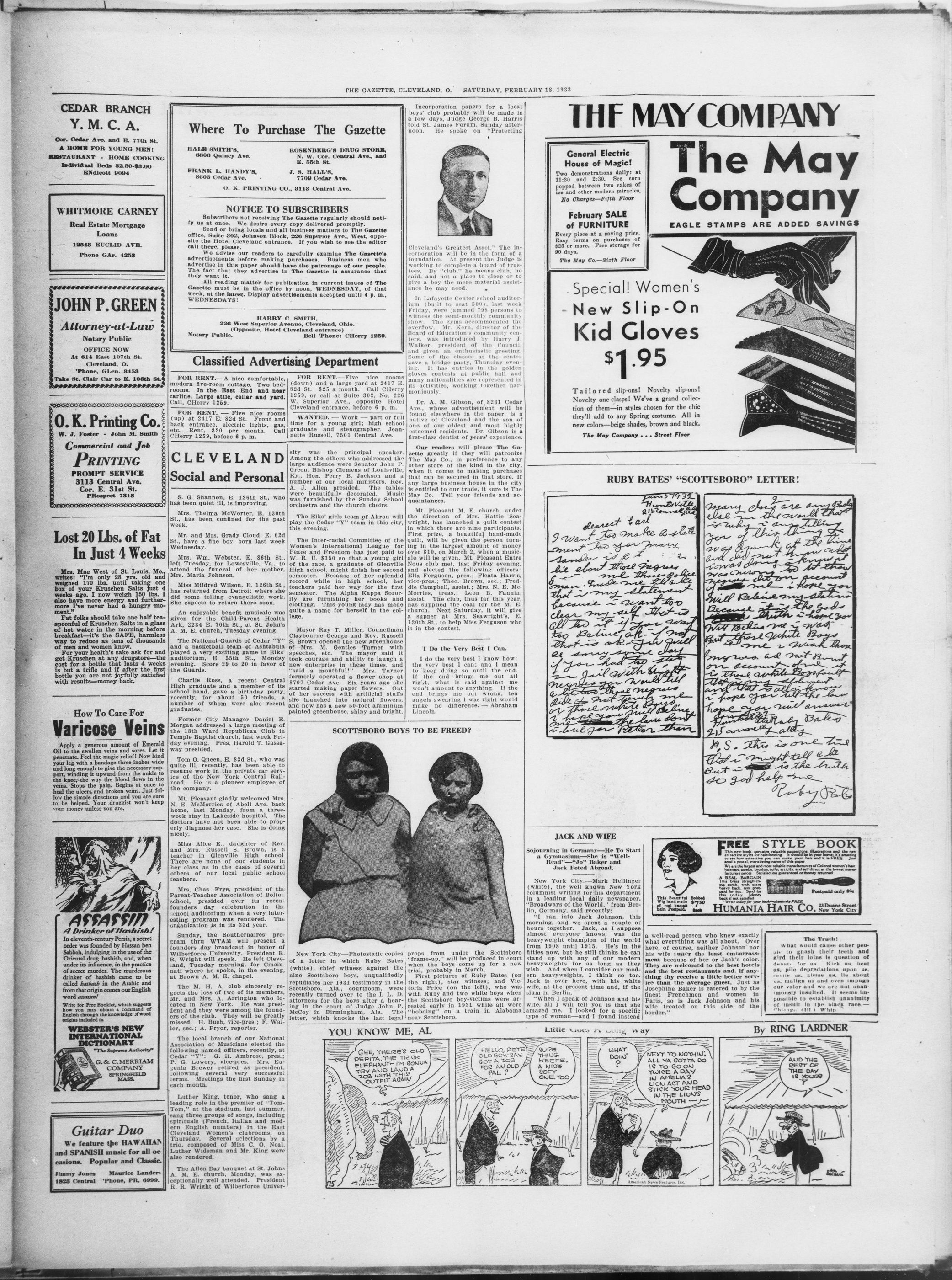
SCOTTSBORO BOYS TO BE FREED?
```markdown
```
props from under the Scottsboro "frame-up," will be produced in courts when the boys come up for a new battle. First pictures of Ruby Bates (on the right), star witness; and Victoria Price (on the left), who was with Ruby and two white boys when the Scottsboro boy-victims were arrested early in 1931 while all were near Scottsboro, a train in Alabama near Scottsboro.
YOU KNOW ME, AL
GEE, THERE'S OLD
PEPITA, THE TRICK
ELEPHANT-IM GONJA
TRY AND LAUD A
JOB WITH THIS
OUTFIT AGAIN
ROSENBERG'S DRUG STORE,
N. W. Cor. Central Ave., and
E. 55th St.
J. S. HALL'S,
7709 Cedar Ave.
FOR RENT.—Five nice rooms (down) and a large yard at 2417 E. 82d St. $25 a month. Call Cherry 1259, or call at Suite 302, No. 226 W. Superior Ave., opposite Hotel Cleveland entrance, before 6 p. m.
WANTED.—Work — part or full time for a young girl; high school graduate and stenographer. Jeanette Russell, 7501 Central Ave.
sity was the principal speaker. Among the others who addressed the large audience were Senator John P. Green, Bishop Clemens of Louisville, Ky., Hon. Perry B. Jackson and a number of our local ministers. Rev. A. J. Allen presided. The tables were beautifully decorated. Music was furnished by the Sunday School orchestra and the choir chairs.
The Elks' girls team of Akron will play the Cedar "Y" team in this city, this evening.
The Inter-racial Committee of the Women's International League for Peace and Freedom has just paid to W. R. U. $150 so that a young girl of the race, a graduate of Glenville High school, might finish her second semester. Because of her splendid record while in high school, her teachers paid her way for the first semester. The Alpha Kappa Sorority, uniting women in clothing. This young lady has made quite a name for herself in the college.
Mayor Ray T. Miller, Councilman Claybourne George and Rev. Russell S. Brown opened the new greenhouse of Mrs. M. Gentles Turner with speeches, etc. The mayor said it took courage and ability to launch a new enterprise in these times, and "said a mouthful!" Mrs. Turner formerly operated a flower shop at Cedar Ave. Six years ago she started a business of her success with artificial stuffs she launched into natural flowers, and now has a new 50-foot aluminum painted greenhouse, shiny and bright.
New York City—Photostatic copies of a letter in which Ruby Bates (white), chief witness against the nine Scottsboro boys, unqualifiedly repudiates her 1931 testimony in the Scottsboro, Ala., courtroom, were recently turned over to the I. L. D. attorneys for the boys after a hearing in the court of Judge John P. McCoy in Birmingham, Ala. The letter, which knocks the last legal
PETER H. BURKE
HELLO, PETE
OLD GOV. SAY,
GOT A JOB
FOR AN OLD
PAL?
SURE
THING,
KEEFE,
A NICE
SOFT
ONE, TOO
Two demonstrations daily: at 11:30 and 2:30. See corn popped between two cakes of ice and other modern miracles. No Charges—Fifth Floor
February SALE of FURNITURE
Every piece at a saving price.
Easy terms on purchases of $25 or more. Free storage for 90 days.
Special! New Sl Kid G $1.9
dearest to you
I want to make
ment to you
Sander is a
lie about those
me
man made me
that is my
because I will
clear my self
All told it if you
too bad in that
be sorry soon
if for had to
in jail with
necesses you will
a lie about those
dile is not true
in those white
I hope you give
me the
tulip for Peter
dearest & all
I want too make a slave
ment too for Mary
Sander is it?
lie about those ingrates
of me those police
man. trade me till he
that is my statement
because i want too
clear my self that is
All too it if you want
too belinet all if not
that is ok. Jail guilt
as sorry some day
if you had two days
in jail With slight
negries you would tell
the too those ingrates
kill it not touch me
or those white boys
I hope you guilt being
the law don't
but for better than
many cloaks are any body
else for the world that
is why i am telling
you of this thing
way of quirk of the time
and did not know what
was doing in person it
was curious on account
negors did not
me i hope you
Will behave my stature
Because it is the gods
which i hope you
Will behave me i was
But before White Boys
in one r Wash then
my wife are not burnt
on account of me it
is three white boys default
that is affront and that all know
i hope you tell the law
hope you will answer
Hunt Ville
215 corwell all y
P. S. This is one time
that i might tell a lie
but is the truth
so god help me
Ruby Pate
JACK AND WIFE
Sojourning in Germany—He To Start a Gymnasium—She is "Well-Read"—"Jo" Baker and Jack Feted Abroad.
New York City—Mark Hellinger (white), the well-known New York columnist, writing for his department in a leading local daily newspaper, "Broadways of the World," from Berlin, Germany, said recently:
"I ran into Jack Johnson, this morning, and we spent a couple of hours together. Jack, as I suppose almost everyone knows, was the heavyweight champion of the world from the fifties now, but he still thinks he can stand up with any of our modern heavyweights for as long as they wish. And when I consider our modern heavyweights, I think so too. Jack is over here, with his white wife, at the present time and, if the slum in Berlin, "What break of Johnson and his wife, all I will tell you is that she amazed me. I looked for a specific type of woman—and I found instead
---
THE MAY COMPANY
February SALE
of FURNITURE
Every piece at a saving price.
Easy terms on purchases of
$25 or more. Free storage for
30 days.
The May Co.—Sixth Floor
Special! Women's
New Slip-On
Kid Gloves
$1.95
Tailored slip-onl Novelty slip-onl Novelty one-clasps! We've a grand collection of them in styles chosen for the chie they'll add to any Spring costume. All in new colors—beige shades, brown and black. The Max Company Street Floor
RUBY BATES' "SCOOT"
jam 5 1932
Huntville
91520mm wide
dearest & all
want to make a statement
to you many
under is a
about those figures
and those police
made me will take
it in my statement
cause i want to
on my self that is
told it if you want
believe off if not
not to ok. For sure
sorry some day
for had to stay
in jail With doubt
ties you would tell
these negroes
not truth me
those white boys
ple you guilt being
the law don't
ful for better than
RUBY BATES' "SCOTTSBORO" LETTER!
GOES A LONG WAY
WHAT DOIN'?
NEXT TO NOTHING
ALL YA GOTTA D
IS TO GO ON
TUJICE A DAY
IN AMELIA'S
LION ACT AND
STICK YOUR HE
IN THE LIONS'
MOUTH
The May Company
EAGLE STAMPS ARE ADDED SAVINGS
a well-read person who knew exactly what everything was all about. Over here, of course, neither Johnson nor his wife under the least embarrassment because of her or Jack's color. They are welcomed to the best hotels and the best restaurants and, if anything they receive a little better service than the average guest. Just as Josephine Baker is catered to by the finest Frenchmen and women in Paris, so is Jack Johnson and his wife treated on this side of the border."
---
AUD THE
BEST OF
THE DAY
IS YOURS?
What would cause other people to gnash their teeth and gird their loins is question of debate for us. Kick us, beat us, pile depredations upon us, revil us, abuse us, lie about us, malign us and even impugn our valor and we are not unanimously insulted. It seems impossible to establish unanimity of insult in the black race.—Chicago (UU) White.
Don't Throw Away Your Copy of The GAZETTE After Reading It But Give it to a Friend or an Acquaintance who might Subscribe After Seeing It
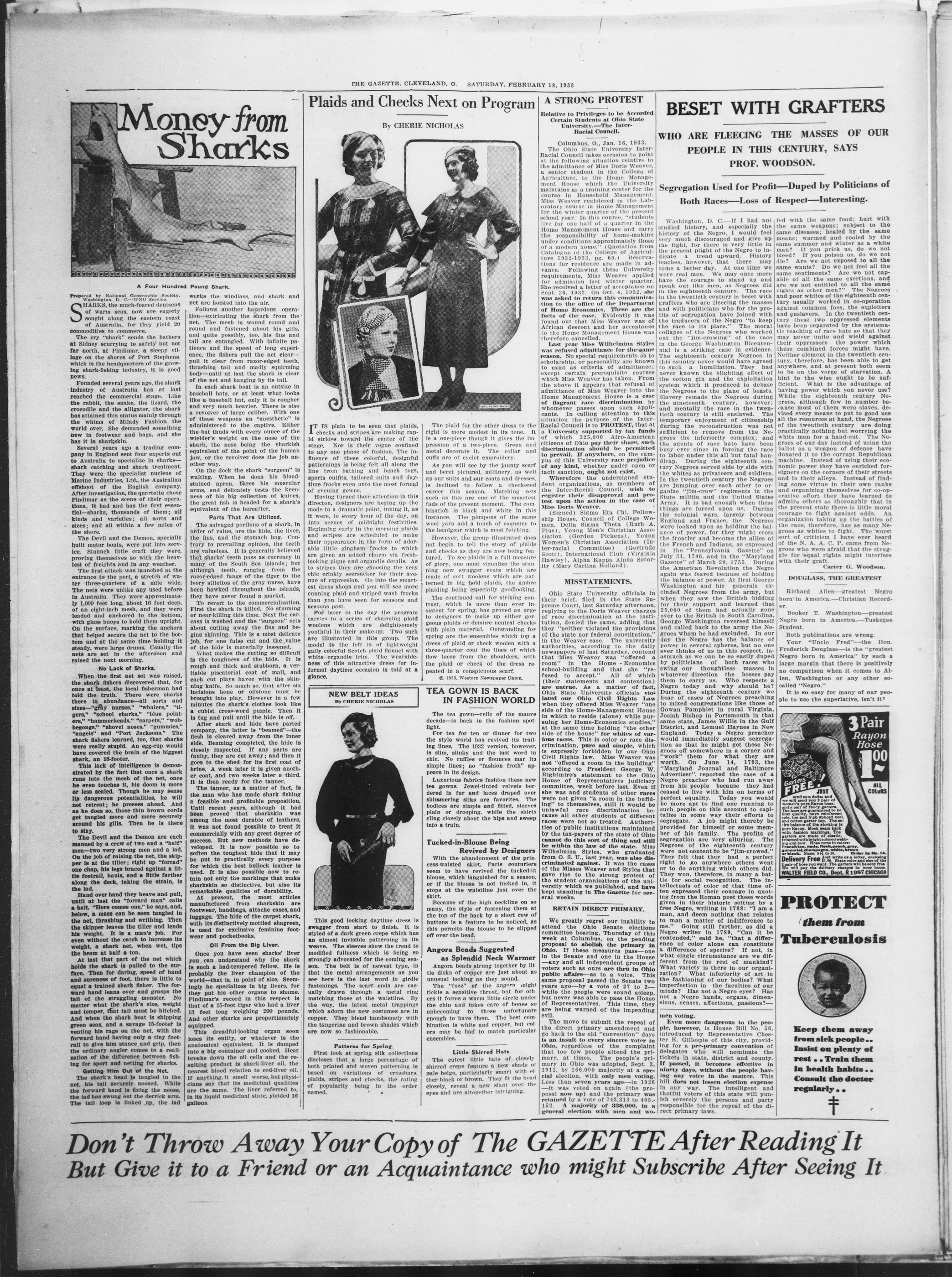
Money from
Sharks
A Four Hundred Pound Shark.
Prepared by National Geographic Society,
Washington, D. C.—WNU Service.
SHARKS, the much-feared denizens of warm seas, now are eagerly sought along the eastern coast of Australia, for they yield 20 commodities to commerce.
The cry "shark" sends the bathers at Sidney scurrying to safety but not far north, at Pindimar, a sleepy village on the shores of Port Stephens which is the headquarters of the growing shark-fishing industry, it is good news.
Founded several years ago, the shark industry of Australia has at last reached the commercial stage. Like the rabbit, the snake, the lizard, the crocodile and the alligator, the shark has attained this status mainly through the whims of Milady Fashion the world over. She demanded something new in footwear and bags, and she has it in sharkskin.
Several years ago a trading company in England sent four experts out to Australia to specialize in sharks—shark catching and shark treatment. They were the specialist nucleus of Marine Industries, Ltd., the Australian offshoot of the English company. After investigation, the quartette chose Pindarim as the scene of their operations. It had and has the first essential—sharks, thousands of them; all kinds and varieties; all sorts and sizes; and all within a few miles of the shore. The Devil and the Demon, specially built motor boats, were put into service. Staunch little craft they were, proving themselves so with the heaviest of freights and in any weather.
The first attack was launched at the entrance to the port, a stretch of water three-quarters of a mile wide. The nets were unlike any used before in Australia. They were approximately 1,000 feet long, about 16 feet deep, of an eight-inch mesh, and they were leaded and anchored to the bottom, with glass buoys to hold them upright. On the surface, marking the anchors that helped secure the net to the bottom and at the same time holding it steady, were large drums. Usually the nets are set in the afternoon and raised the next morning.
No Lack of Sharks.
When the first net set was raised, the shark fishers discovered that, for once at least, the local fisherman had told the truth. There were sharks there in abundance—all sorts and sizes—"gray nurses," "whalers," "tigers," "school sharks," "blue pointers," "hammerheads," "carpets," "wobegongs," "clawed noses," "gummies," "angels" and "Port Jackson." The shark fishers learned, too, that sharks were really stupid. An egg-cup would have covered the brain of the biggest shark, an 18-footer.
This lack of intelligence is demonstrated by the fact that once a shark runs into the mesh of the net, once he even touches it, his doom is more or less sealed. Though he may sense its dangerous potentialities, he will not retreat; he presses ahead. And as he does so, those thin brown cords get tangled more and more securely around his gills. Then he is there to stay.
The Devil and the Demon are each manned by a crew of two and a "half" men—two very strong men and a lad. On the job of raising the net, the skipper is at the tiller; right up "forrad" one chap, his legs braced against a little footrail, hauls, and a little farther along the deck, taking the strain, is the lad. Hand over hand they heave and pull, until at last the "forrad man" calls a halt. "Here comes one," he says, and, below, a mass can be seen tangled in the net, thrashing and writening. The skipper leaves the tiller and lends his weight. It is a man's job. For even without the catch to increase its weight, a shark net, when wet, tips the beam at half a ton.
At last that part of the net which holds the shark is pulled to the surface. Then for daring, speed of hand and sureness of foot, there is little to equal a trained shark fisher. The forward hand leans over and grasps the tail of the struggling monster. No matter what the shark's size, weight and temper, that tail must be hitched. And when the shark boat is shipping green seas, and a savage 15-footer is venting his rage on the net, with the forward hand having only a tiny football to give him stance and grip, then the ordinary angler comes to a realization of the difference between fishing for sport and netting for sharks.
Getting Him Out of the Net.
The shark's head is tangled in the net, his tall securely noosed. While the forward hand is fixing the noose, the lad has swung out the derrick arm. The tail loop is linked up, the lad
works the windlass, and shark and net are hoisted into the air. Follows another hazardous operation—extricating the shark from the net. The mesh is wound round and round and fastened about his gills, and quite possibly, too, his fins and tail are entangled. With infinite patience and the speed of long experience, the fishers pull the net clear—pull it clear from razor-edged teeth, thrashing tail and madly squirming body—until at last the shark is clear of the net and hanging by its tail. In each shark bait is an outsize in baseball bats, or at least what looks like a baseball bat, only it is rougher and very much heavier. There is also a revolver of large caliber. With one of these weapons an "anesthetic" is administered to the captive. Either the bat thuds with every ounce of the welder's weight on the nose of the shark, the nose being the sharkish equivalent of the point of the human jaw, or the revolver does the job another way.
On the dock the shark "surgeon" is waiting. When he dons his blood-stained apron, Bares his muscular arms, and delicately tests the keenness of his big collection of knives, the great fish is headed for a shark's equivalent of the hereafter.
Parts That Are Utilized.
The salvaged portions of a shark, in order of value, are the hide, the liver, the fins, and the stomach bag. Contrary to prevailing opinion, the teeth are valleless. It is generally believed that sharks' teeth pass as currency in many of the South Sea islands; but although teeth, ranging from the razor-edged fangs of the tiger to the ivory stilettos of the gray nurse, have been hawked throughout the islands, they have never found a market.
To revert to the commercialization. First the shark is killed. No stunning or near-killing this time. Next the carcass is washed and the "surgeon" sets about cutting away the fins and begins skimming. This is a most delicate job, for one false cut and the value of the bida is materially lessened.
What makes the cutting so difficult is the toughness of the hide. It is rough and thick and stubborn, a veritable piscatorial coat of mall, and each cut plays havoc with the skinning knife. So much so, that after six incisions hone or oilstone must be brought into play. However in a few minutes the shark's clothes look like a cubist cross-word puzzle. Then it is tug and pull until the hide is off. After shark and hide have parted company, the latter is "beamed"—the flesh is cleared away from the inner side. Beaming completed, the hide is closely inspected. If any parts are faulty, they are cut away; and then it goes to the shed for its first coat of brine. A week later it is given another coat, and two weeks later a third. It is then ready for the tanner.
The tanner, as a matter of fact, is the man who has made shark fishing a feasible and profitable proposition, Until recent years, although it had been proved that sharkskin was among the most durable of leathers, it was not found possible to treat it commercially with any great degree of success. But new methods have developed. It is now possible so to soften the toughest hide that it may be put to practically every purpose for which the best bullock leather is used. It is also possible now to retain not only the markings that make sharkskin so distinctive, but also its remarkable qualities of durability. At present, the most articles manufactured from sharkskin are footwear, handbags, attache cases, and luggage. The hide of the carpet shark, with its distinctively mottled shagreen, is used for exclusive feminine footwear and pocketbooks.
Oil From the Big Liver.
Once you have seen sharks' liver you can understand why the shark is such a bad-tempered fellow. He is probably the liver champion of the world—that is, in point of size. Seeingly he specializes in big livers, for they put his other organs to shame. Pindimar's record in this respect is that of a 15-foot tiger who had a liver 13 feet long weighing 200 pounds. And other sharks are proportionately equipped.
This dreadful-looking organ soon loses its entity, or whatever is the anatomical equivalent. It is dumped into a big container and cooked. Hent breaks down the oil cells and the resulting product is shark-liver oil, the nearest blood relation to cod-liver oil. If anything, it smell worse, but physicians say that its medicinal qualities are the same. The liver referred to, in its liquid medicinal state, yielded 16 gallons.
THE GAZETTE, CLEVELAND, O. SATURDAY, FEBRUARY 18, 1932
Plaids and Checks Next on Program
By CHERIE NICHOLAS
IT IS plain to be seen that plaids, checks and stripes are making rapid strides toward the center of the stage. Nor is their vogue confined to any one phase of fashion. The influence of these colorful, designful patternings is being felt all along the line from bathing and beach togs, sports outfits, tailored suits and daytime frocks even unto the most formal of evening gowns.
Having turned their attention in this directon, designers are keying up the mode to a dramatic point, tuning it, as it were, to every hour of the day, on into scenes of midnight festivities. Beginning early in the morning plaids and stripes are scheduled to make their appearance in the form of adorable little gingham frocks to which are given an added charm via fresh-looking pique and organdie details. As to stripes they are choosing the very chic crinkly seersucker for their avenue of expression. Go into the smartest dress shops and you will see more cunning plaid and striped wash frocks than you have seen for seasons and seasons past.
For later in the day the program carries to a series of charming plaid woolens which are delightfully youthful in their make-up. Two such are illustrated in this group. The model to the left is of lightweight gally colorful Scotch plaid flannel with white organdie trim. The wearability of this attractive dress for informal daytime occasion is told at a glance.
NEW BELT IDEAS
By CHERIE NICHOLAS
This good looking daytime dress is swagger from start to finish. It is styled of a dark green crepe which has an almost invisible pattern in its weave. The sleeves show the trend to modified fullness which is being so strongly advocated for the coming season. The belt is of newest type, in that the metal arrangements as you see here is the last word in girdle fastenings. The scarf ends are casually drawn through a metal ring matching those at the waistline. By the way, the latest metal trappings which adorn the new costumes are in copper. They blend handsomely with the tangerine and brown shades which are now so fashionable.
Patterns for Spring
First look at spring silk collections discloses that a large percentage of both printed and woven patterning is based on variations of crossbars, plaids, stripes and checks, the rating of popularity being in the order named.
The plaid for the other dress to the right is more modest in its tone. It is a one-piece though it gives the impression of a two-piece. Green and metal decorate it. The collar and cuffs are of eyelet embroidery.
As you will see by the jaunty scarf and beret pictured, millinery, as well as our suits and our coats and dresses, is inclined to follow a checkered career this season. Matching sets such as this are one of the smartest fads of the present moment. The combination is black and white in this instance. The pompons of the same wool yarn add a touch of coquetry to the headgear which is most fetching.
However, the group illustrated does not begin to tell the story of plaids and checks as they are now being featured. To see plaids in a full measure of glory, one must visualize the stunning new swagger coats which are made of soft woollen which are patterned in big bold plaids, the ambre plaiding be especially goodlooking.
The continued call for striking contrast, which is more than ever insistent for spring, has proved an urge to designers to make up either gorgeous plaids or demure neutral checks with plain material. Outstanding for spring are the ensembles which top a dress of plaid or check woolen with a three-quarter coat the lines of which flow loose from the shoulders, with the plaid or check of the dress repeated in a conspicuous scarf.
TEA GOWN IS BACK
IN FASHION WORLD
The tea gown—relic of the mauve decade—is back in the fashion spotlight.
For tea for ten or dinner for two the style world has revived its trailing lines. The 1932 version, however, is slim, slinky and the last word in chic. No ruffles or flouncements mar its simple lines; no "fashion froth" appears in its design.
Luxurious fabrics fashion these new tea gowns. Jewel-tinted velvets bordered in fur and laces draped over shimmering silks are favorites. The bodices are simple and fitted, sleeves plain or drooping, while the skirts cling closely about the hips and sweep into a train.
Tucked-in-Blouse Being
Revived by Designers
With the abandonment of the princess-waisted skirt, Paris couturiers seem to have revived the tucked-in blouse, which languished for a season, or if the blouse is not tucked in, it stops at the waistline just over the skirt.
Because of the high neckline on so many, the style of fastening them at the top of the back by a short row of buttons is a feature to be noticed, as this permits the blouse to be slipped off over the head.
Angora Beads Suggested
as Splendid Neck Warmer
Angora beads strung between by lit
the disks of copper are just about as
unusual looking as they sound.
The "fuzz" of the angora might
tickle a sensitive throat, but for oth-
ers it forms a warm little circle under
the chin and takes care of bones so
unbecoming to those unfortunate
enough to have them. The best com-
bination is white and copper, but col-
ors may be bad to match particular
ensembles.
Little Shirred Hats
The cutest little hats of closely shirred crepe feature a new shade or pale beige, particularly smart with elf black or brown. They fit the face closely, reveal a new slant over the eyes and are altogether intriguing.
BESET WITH GRAFTERS
WHO ARE FLEECING THE MASSES OF OUR PEOPLE IN THIS CENTURY, SAYS PROF. WOODSON.
Segregation Used for Profit—Duped by Politicians of Both Races—Loss of Respect—Interesting.
men voting.
Even more dangerous to the people, however, is House Bill No. 56, introduced by Representative Chester K. Gillespie of this city, providing for a pre-primary convention of delegates who will nominate the tickets in state, district and county. If passed, it becomes effective in ninety days, without the people having any voice in the matter. This bill does not lessen election expense in any way. The intelligent and thotful voters of this state will punish severely the persons and party responsible for the repeal of the direct primary laws.
A STRONG PROTEST
Relative to Privileges to be Accordeed Certain Students at Ohio State University.-The Inter- Racial Council.
Columbus, O., Jan. 16, 1933. The Ohio State University Inter-Racial Council takes occasion to point at the following situation relative to the admittance of Miss Doris Weaver, a senior student in the College of Agriculture, to the Home Management House which the University maintains as a training center for the course. Miss Weaver registered in the Laboratory course in Home Management for the winter quarter of the present school year. In this course, "students live for one half of a quarter in the Home Management House and carry the responsibility of home-making under conditions approximately those of a modern home." (Quotation from Catalogue of the College of Agriculture, 60). Reservations for residence are made in advance. Following these University requirements, Miss Weaver applied for admission last winter quarter. She received a letter of acceptance on Sept. 26, 1932. On Oct. 4, 1932, she was asked to return this communication to the office of the Department of Home Economics. These are the facts of the case. Evidently it was African descent and her acceptance to the Home Management House was therefore cancelled.
Last year Miss Wilhelmina Styles was refused admittance for the same reason. No special requirements as to scholarship, or personality are known to exist as criteria of admittance; except certain prerequisite courses which Miss Weaver has taken. From the experience of admittance of Miss Weaver into the Home Management House is a case of fragrant race discrimination by whomever passes upon such applicants. In calling attention to this situation the purpose of the Inter-Racial Council is to PROTEST, that at a University supported by tax funds, which is 25% of the total citizen of Oh pay their share, such discrimination should be permitted to prevail. If anywhere, on the campus of this University race prejudice of any kind, whether under open or tacit sanction, ought not exist. Wherefore the undersigned student organizations, as members of the Inter-Racial Council, wish to register their approval and proclaim their action in the case of Miss Doris Weaver.
(Signed) Sigma Eta Chi, Fellowship House, Council of College Women, Delta Sigma Theta (Ruth A Plus), Young Men's Christian Association (Gordon Pickens), Young Women's Christian Association (Inter-racial Committee) (Gertrude Scott), International Club (Virginia Hawley), Alpha Kappa Alpha Sorority (Mary Carolina Holland).
MISSTATEMENTS.
Ohio State University officials in their brief, filed in the State Supreme Court, last Saturday afternoon, replying to the Doris Weaver charges of race discrimination at the institution, denied the same, adding that they "neither violated the provisions of the state nor federal constitution," in the Weaver case. The university authorities, according to the daily newspapers of last Saturday, contend that Miss Weaver was "offered a room" in the Home - Economics school-building and that she "refused to accept. All of our statements and attention" are untrue. As a matter of fact, Ohio State University officials violated our Ohio Civil Rights Law when they offered Miss Weaver "one side of the Home-Management House in which to reside (alone) while pursuing her Home-Economics studies," at the same time holding "the other side of the house" for whites of various races. This is color and race discrimination, pure and simple, which is expressly forbidden by our Ohio Civil Rights law. Miss Weaver was not a student in the building" according to President George Rimmire's statement to the Ohio House of Representatives judiciary committee, week before last. Even if she was and students of other races were not given "a room in the building" to themselves, still it would be unlawful race discrimination because all other students of different races were not so treated. Authorities of public institutions maintained by the tax-payers of the state of Ohio cannot do this sort of thing and still be within the law of the state. Miss Wilhelmina Styles, who graduated from O. S. U., last year, was also disillusioned. It was the cases of the Miss Weaver and Styles that gave rise to the strong protest of the student organizations of the university which we published, and have kept standing in The Gazette for several weeks.
RETAIN DIRECT PRIMARY
We greatly regret our inability to attend the Ohio Senate elections committee hearing, Thursday of this week at Columbus, on the pending proposal to abolish the primary in Ohio. If these measures pass—one in the Senate and one in the House—any and all independent groups of voters such as ours are thru in Ohio public affairs—as to a voice. This same proposal passed the Senate two years ago by a vote of 27 to 2—people who people asleep, but never was able to pass the course of Representatives. This time, they are being warned of the impending evil.
The move to submit the repeal of the direct primary amendment and go back to the old "convention" days is an insult to every sincere voter in Ohio, regardless of the complaint that too few people attend the primary, at times. The people's primary in Ohio was adopted, Sept. 3, 1912, by 166,000 majority at a special election, with only men voting. Less than seven years ago—in 1926—it was voted on again (the proposal now up) and the primary was retained by a vote of 743,313 to 405,152. A majority of 338,000, in a general election with men and we
fed with the same food; hurt with the same weapons; subject to the same diseases; healed by the same means; warmed and cooled by the same summer and winter as a white man? If you prick us, do we not bleed? If you poison us, do we not die? Are we not exposed to all the same wants? Do we not need same weapons? Are we not capable of all the same exertions, and are we not entitled to all the same rights as other men?" The Negroes and poor whites of the eighteenth century usually worked in co-operation against common foes, the exploiters and enslavers. In the twentieth century these two oppressed elements have been separated by the systematic teaching of this number of unfit men and wield against their oppressors the power which these combined forces might have. Neither element in the twentieth century, therefore, has been able to get anywhere, and at present both seem to be on the verge of starvation. A hint to the wise ought to be sufficient. What is the advantage of having power which you never use? Negroes, although few in number, because most of them were slaves, devised every means to put to good use all the resources at hand, the Negroes of the twentieth century are doing practically nothing but worrying the white man for a hand-out. The Negroes of our day instead of using the ballot as a weapon of defense have donated it to the corrupt Republican economic power they have infringed on signers on the corners of their streets and in their alleyes. Instead of finding some virtue in their own ranks and organizing themselves for co-operative effort they have learned to admire others so thoroughly that in the present state there is little moral courage to fight against odds. An organization taking up the battles of the race, therefore, has as many Negroes as any sort of criticism I have ever heard of the N. A. A. C. P, came from Negroes who were afraid that the struggle for equal rights might interfere with their graft.
Carter G. Woodson.
DOUGLASS: THE GREATEST
Richard Allen—greatest Negro born in America.—Christian Recorder.
Booker T. Washington—greatest Negro born in America.—Tuskegee Student.
Both publications are wrong.
Your "Uncle Fred"—the Hon. Frederick Douglass—is the "greatest Negro born in America" by such a large margin that there is positively no comparison when it comes to Allen, Washington or any other so-called "Negro."
It is so easy for many of our people to use the superlative, isn't it?
3 Pair Rayon Hose
ALL COLURS
send us a dollar and we will send you 3 pairs of women's guxe Rayon hose, and a pair of fancy garters. The hose are guaranteed to be have a certain color sole, toe and high spliced neel, and cotton garter top. The entire balance of the stocking is pure Rayon. Mock seam back with fashion markings. The garters are made of elastic, trimmed with bright colored web-in-line bow. Hose comes in color: French tan, nude, flesh, peach, gray, gunmetal, champaign, white, brown or black. Sizes: 8½ to 10. Order by No. 14. Delivery Free $1.00. State color and size of the 3 pair of hose you want. The garters will be sent free. We will pay the delivery charges to your home. WALTER FIELD CO., Dept. R 1997 CHICAGO
Keep them away from sick people.. Insist on plenty of rest . . Train them in health habits . . Consult the doctor regularly . .