The Gazette
Saturday, November 24, 1934
Cleveland, Ohio
Page text (machine-generated)
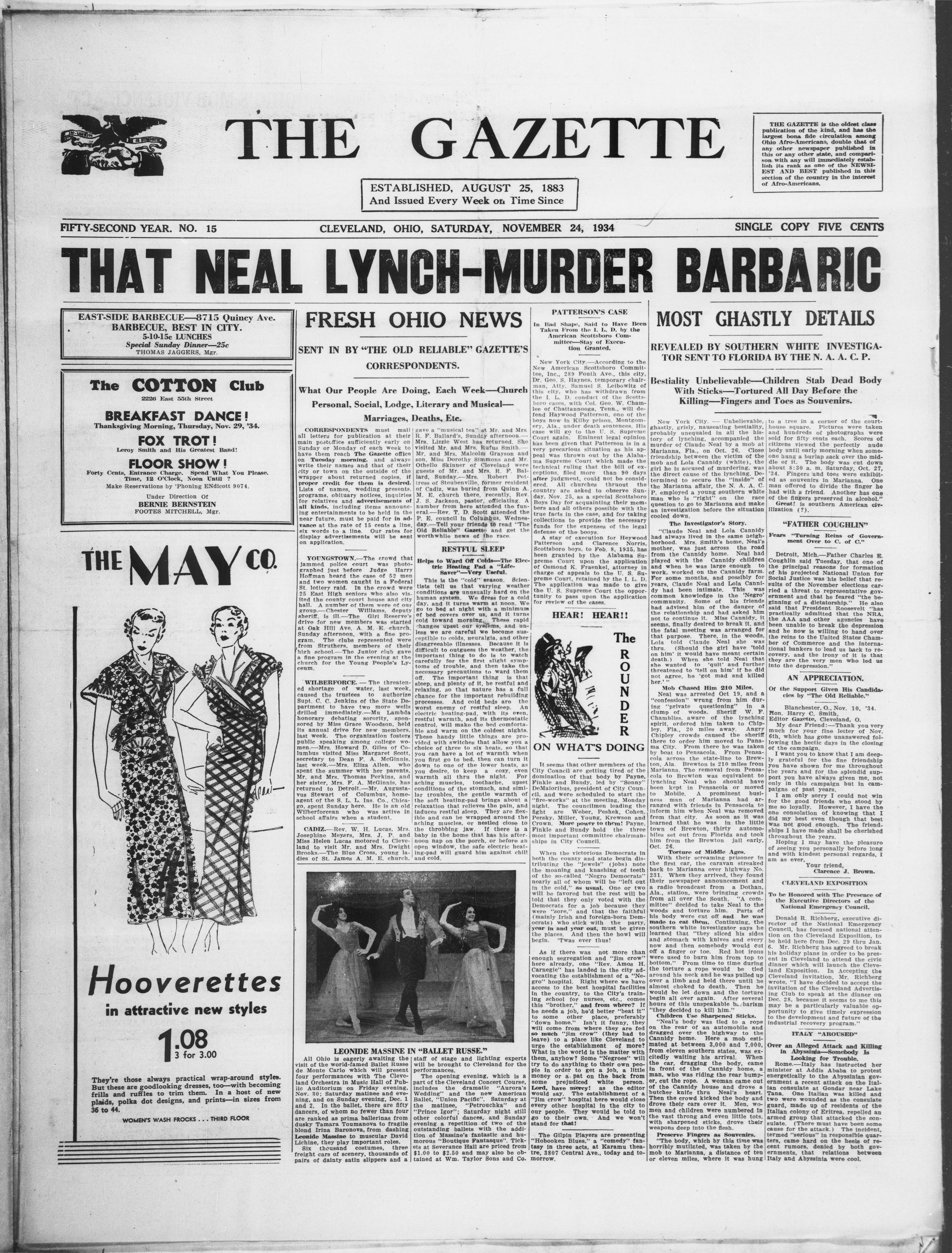
THAT NEAL LYNCH-MURDER BARBARIC
IN UNION
IS SINCE 1785
FIFTY-SECOND YEAR
THAT
EAST-SIDE BARBECUE
BARBECUE,
5-10-15
Special Sun
THOMAS
The COTT
2226 East
BREAKFAST
Thanksgiving Morning
FOX
Leroy Smith and
FLOOR
Forty Cents, Entrance Ch
Time, 12 O'C
Make Reservations
Under
BERNIE
FOOTES M
THE M
Hoov
in attract
They're those always
But these are goodlook
frills and ruffles to
plaids, polka dot des
36 to 44.
DE BARBECUE—8715 Quincy
BARBECUE, BEST IN CITY.
5-10-15c LUNCHES
Special Sunday Dinner—25c
THOMAS JAGGERS, Mgr.
COTTON CLU
2226 East 55th Street
BREAKFAST DANCE!
Giving Morning, Thursday, Nov. 29, 7
FOX TROT!
Leroy Smith and His Greatest Band!
FLOOR SHOW!
Ls, Entrance Charge. Spend What You B
Time, 12 O'Clock, Noon Until ?
Reservations by 'Phoning ENdicott 9074.
Under Direction Of
BERNIE BERNSTEIN
FOOTES MITCHELL, Mgr.
MAY
oooverett
attractive new sty
1.08
3 for 3.00
Those always practical wrap-around
dresses are goodlooking dresses, too—with h
and ruffles to trim them. In a host
polka dot designs, and prints—in si
FIFTY-SECOND YEAR. NO. 15
EAST-SIDE BARBECUE—8715 Quincy Ave.
BARBECUE, BEST IN CITY.
5-10-15c LUNCHES
Special Sunday Dinner—25c
THOMAS JAGGERS, Mgr.
100
They're those always practical wrap-around styles. But these are goodlooking dresses, too—with becoming frills and ruffles to trim them. In a host of new plaids, polka dot designs, and prints—in sizes from 36 to 44.
WOMEN'S WASH FROCKS . . . THIRD FLOOR
---
THE GAZETTE
ESTABLISHED, AUGUST 25, 1883 And Issued Every Week on Time Since
CLEVELAND, OHIO, SATURDAY, NOVEMBER 24, 1934
FRESH OHIO NEWS
SENT IN BY "THE OLD RELIABLE" GAZETTE'S CORRESPONDENTS.
What Our People Are Doing, Each Week—Church Personal, Social, Lodge, Literary and Musical— Marriages, Deaths, Etc.
CORRESPONDENTS must mail all letters for publication at their main postoffice sufficiently early on Sunday or Monday of each week to have them reach The Gazette office on Tuesday morning, and always write their names and that of their city or town on the outside of the wrapper about returned copies, if proper credit for them is desired. Lists of names, wedding presents, programs, obituary notices, inquiries for relatives and advertisements of all kinds, including items announcing entertainments to be held in the near future, must be paid for in advance at the rate of 15 cents a line, six words to a line. Our rates for display advertisements will be sent on application.
YOUNGSTOWN. The crowd that jammed police court was photographed just before Judge Harry Hoffman heard the case of 52 men and two women caught in a Federal St. lottery raid. In the crowd were 25 East High seniors who also visited the county court house and city jail. The group,—Chester Williams, deputy sheriff, is ill.—The Girl Reserve's drive for new members was started at Oak Hill Ave. A. M. E. church. Sunday afternoon, with a fine program. The clubs represented were from Struthers, members of their club. The club also saw a fine program in the evening at the church for the Young People's Lyceum.
WILBERFORCE. — The threatened shortage of water, last week, caused the trustees to authorize Supt. C. C. Jenkins of the State Department to have two more well drilled immediately.—Mu Lambda honorary debating sorority, sponsored by Miss Grace Woodson, held its annual drive for new members, last week. The organization fosters a tradition of service among men.—Mrs. Howard D. Giles of Columbus visited Miss Margaret Scott, secretary to Dean F. A. McGinnis, last week.—Mrs. Eliza Allen, who spent the summer with her parents, Mr. and Mrs. Thomas Perkins, and her sister, Mrs. F. A. McGinnis, has returned to Detroit.—Mr. Augustus Stewart of Columbus, home to his wife L. L. Martin, go, spent Sunday here. He is an old Wilberforcean who was active in school affairs when a student.
CADIZ—Rev. W. H. Lucas, Mrs Josephine Meyers, Mrs. J. P., and Miss Helen Lucas motored to Cleveland to visit Mr., and Mrs. Dwight Brooks.—The Blue Cross, young ladies of St. James A. M. E. church.
LEONIDE MASSINE I
Ballet
LEONIDA MASSINE IN "BALLET RUSSE."
All Ohio is eagerly awaiting the visit of the world-famed Ballet Russe de Monte Carlo which will present four performances with The Cleveland Orchestra in Music Hall of Public Auditorium on Friday evening, Nov. 30; Saturday matinee and evening, and on Sunday evening, Dec. 1 and 2. In the ballet, there are fifty dancers, of whom no fewer than four are ranked as prima ballerinas from dusky Tamara Toumanova to fragile blond frida Kahlo. In the ballet, there are unfolding ballet with motion of Massine's fantasies morous "Boutique Fanta ets at Severance Hall are $1.00 to $2.50 and may tained at Wm. Taylor S
---
gave a "musical tea" at Mr. and Mrs. R. F. Ballard's, day afternoon... Mrs. Lizzie West has returned. She visited Mr. and Mrs. Rufus Smith. Mr. and Mrs. Malcolm Grayson and son, Miss Dorothy Simmons and Mr. Othello Skinner of Cleveland were guests of Mr. and Mrs. R. F. Ballard, Sunday—Mrs. Robert Petress of Steubenville, former resident of Cadiz, was buried from Quinn A. M. E. church there, recently. Rev J. S. Jackson pastor, officiating A. M. E. church at Steubenville. Aral—Rev. T. D. Scott attended the P. E. council in Columbus, Wednesday—Tell your friends to read "The Old Reliable" Gazette and get the worthwhile news of the race.
RESTFUL SLEEP
Helps to Ward Off Colds—The Elec
tric Heating Pad—The affe-
tic Heating Pad—The Elec
This is the "cold" season. Scientists tell us that varying weather conditions are unusually hard on the human system. We dress for a cold day, and it turns warm at noon. We go to bed at night with a minimum of bed covers over us, and it turns cold toward morning. These rapid changes upset our systems, and unless we are careful we become susceptible to colds, neuralgia, and other disagreeable illnesses. Because it is difficult to outgues the weather, the important thing to do is to watch items of trouble, and then take the necessary precautions to ward them off. The important thing is that sleep, and plenty of it, be restful and relaxing, so that nature has a full chance for the important rebuilding processes. And cold beds are the worst enemy of restful sleep. An electric heating-pad, with its even, restful warmth, and its thermostatic control, will make the bed comfortable and warm on the coldest nights. These handy little things are provided with socks, that allow a person to three to six adults, so that you can have a lot of warmth when you first go to bed, then can turn it down to one of the lower heats, as you desire, to keep a cozy, even warmth all thru the night. For aching muscles, toothache, upset conditions of the stomach, and similar troubles, the gentle warmth of the soft heating-pad brings about a relaxation that relieves the pain, and induces restful sleep. They are flexible and can be wrapped around the aching muscles, or needed close to a relaxation that relieves the pain. If there is a baby in the house that has his afternoon nap on the porch, or before an open window, the safe electric heating-pad will guard him against chill and cold.
N "BALLET RUSSE."
staff of stage and lighting experts will be brought to Cleveland for the performances.
The opening evening, which is a part of the Cleveland Concert Course, includes the dramatic *Aurora's* song *And the New Anora Ballet*, *Union Pacific*, *Saturday at the matinee*, *Petrouchka* and *Prince Igor*; *Saturday night still other colorful dances, and Sunday evening a repetition of two of the outstanding ballets with the addition of Massine's fantastic and humorous *Boutique* show. Seven Hall are priced from $1.00 to $2.50 and may also be obtained at Wm. Taylor Sons and Co.
---
PATTERSON'S CASE
In Bad Shape, Said to Have Beer
Taken From the I. L. D. by the
American Scottsboro Com-
munity of Benevention Granted.
New York City.—According to the New American Scottsboro Committee, Inc., 289 Fourth Ave., this city, Dr. Geo. S. Haynes, temporary chairman, Atty. Samuel S. Leibowitz of this city, who has withdrawn from the I. L. D. conduct of the Scottsboro cases, with Col. Geo. W. Chamble of Chattannooga, Tenn., will defend Haywood Patterson, one of the Montgomery Ala. under death sentences. His case will go to the U. S. Supreme Court again. Eminent legal opinion has been given that Patterson is in a very precarious situation as his appeal was thrown out by the Alabama Supreme Court which made the technical ruling that the bill of exceptions, filed more than 90 days after judgment, could not be considered. All churches throut the country are asked to observe Sunday, Nov. 25, as a special Scottsboro Boy, for acquaint ing their memoirs and facts of their true facts in the case, and for taking collections to provide the necessary funds for the expenses of the legal defense of the boys.
A stay of execution for Heywood Patterson and Clarence Norris, Scottsboro boys, to Feb. 8, 1935, has been granted by the Alabama Supreme Court upon the application of Osmond K. Frenkel, attorney in charge of appeals to the U. S. Supreme Court, retained by the I. L. D. The application was made to give the U. S. Supreme Court the opportunity to pass upon the application for review of the cases.
HEAR! HEAR!!
The
ROUNDER
ON WHAT'S DOING
It seems that other members of the City Council are getting tired of the domination of that body by Payne Finkle and Bundy, led by "Sonny" DeMaioribus, president of City Council, and were scheduled to start the "fire-works" at the meeting, Monday night. The councilmen leading the fight are Weber, Peshek, Cohen Persky, Miller, Young, Krewson and Crown. More power to them! Payne Finkle and Bundy hold the three most important committee chairmanships in City Council.
When the victorious Democrats in both the county and state begin distributing the "jewels" (jobs) note the moaning and knashing of teeth of the so-called "Negro Democrats" nearly all of whom will be "left out in the cold." as usual. One or two will be favored but the rest will be told that they only voted with the Democrats for a job because they were "sore," and that the faithful (mainly Irish and foreign-born Democrats) who stick with the party, year in and year out, must be given the places. And then the howl will begin. "Twas ever thus!
As if there was not more than enough segregation and "jim crow" here already, one "Rev. Amos H. Carnegie" has landed in the city advocating the establishment of a "Negro" hospital. Right where we have access to the best hospital facilities in the country, to the City's training school for nurses, etc., comes his "brother," and from where he saw a job, "he had to some other place, preferably "down home." Isn't it funny, they will come from where they are fed so much "jim crow" (they had to leave) to a place like Cleveland to urge the establishment of more? What in the world is the matter with them, anyhow? Some "Negroes" will try to do anything to their own people in order to get a job, a little money or a pat on the back from some prejudiced white person. He would say, "he will say. The establishment of a "jim crow" hospital here would close every other hospital in the city to our people. They would be told to go to their own. And we won't stand for that!
The Glipin Players are presenting "Hoboken Blues," a "comedy" fantasy in three acts, at Karamu theatrical 7 Central Ave. today and tomorrow.
SINGLE COPY FIVE CENTS
RBARIC
HASTLY DETAILS
OUTHERN WHITE INVESTIGA-
LORIDA BY THE N. A. A. C. P.
table—Children Stab Dead Body
Tortured All Day Before the
Ragers and Toes as Souvenirs.
MOST GHASTLY DETAILS
REVEALED BY SOUTHERN WHITE INVESTIGATOR SENT TO FLORIDA BY THE N. A. A. C. P.
Bestiality Unbelievable—Children Stab Dead Body With Sticks—Tortured All Day Before the Killing—Fingers and Toes as Souvenirs.
New York City. — Unbelievable, grisly, maseating bestiality, probably equaled in all the history of lynching, accompanied the murder of Claude Neal by a mob at Marianna, Fla., on Oct. 26. Close friendship between the victim of the mob and Lola Cannidy (white), the girl he is accused of murdering, was the direct cause of the lynching. Determined to secure the "inside" of the Marianna affair, the N. A. A. C. P. employed a young southern white man who is "fright" on the race question to go to Marianna and make an investigation before the situation cooled down.
to a tree in a corner of the court-house square. Pictures were taken and hundreds of photographs were sold for fifty cents each. Scores of citizens viewed the perfectly nude body until early morning when someone hung a burlap sack over the middle of it. The body was cut down about 8:30 a. m. Saturday, Oct. 27. 34. Fingers and toes were exhibited as souvenirs in Marianna. One man offered to divide the finger he had with a friend. Another has one who is "fright" on the race question to go to Marianna and make an investigation before the situation cooled down.
Great! is southern American civilization (?).
"Claude Neal and Lola Cannidh had always lived in the same neighborhood. Mrs. Smith's home, Neal's mother, was just across the road from the Cannidh home. Neal had played with the Cannidh children and when he was large enough to work, worked on the Cannidh farm. For some months, and possibly for years, Claude Neal and Lola Cannidh had been intimate. This was common knowledge in the 'Negro' community. Some of his friends had advised him of the danger of the relationship and had asked him not to continue it. Miss Cannidy, it seems, finally desired to break it, and the fatal meeting was arranged for that purpose. There, in the woods, Lola told Claude Neal she was thru. (Should the girl have 'told on him' it would have meant certainty) the Neal that she wanted to 'quit' and further threatened to 'tell on him' if he did not agree, he 'got mad and killed her.'
Mob Chased Him 210 Miles.
Neal was arrested Oct 19, and a "confession" wrung from him during "private questioning" in a clump of woods. Sheriff W. F. Chambliss, aware of the lynching spirit, ordered him taken to Chipley, Fla., 20 miles away. Angry crowd crowds caused them to detach from the house to Pensacola City. From there he was taken by boat to Pensacola. From Pensacola across the state-line to Brewton, Ala. Brewton is 210 miles from Marianna. The removal from Pensacola to Brewton was equivalent to lynching Neal who should have been kept in Pensacola or moved to Mobile. A prominent business man of Marianna had arranged with friends in Pensacola to inform him when Neal was removed from the house. As soon as he was in the little town of Brewton thirty automobiles set out from Florida and took him from the Brewton jail early, Oct. 26.
---
The Investigator's Story.
Torture of Middle Ages.
With their screaming prisoner in the first car, the caravan streaked back to Marianna over highway No. 231. When they arrived, they found a radio broadcast from a radio broadcast from a Dothan, Ala, station, were bringing crowds from all over the South. "A committee" decided to take Neal to the woods and torture him. Parts of his body were cut off and he was made to eat them. Continuing, the southern white investigator says he learned that "they sliced his sides and stomach with knives and every now and then somebody would cut off a finger or toe. Red hot irons were used to burn him from top to bottom. From time to time during the burn, he was pulled around his neck and he was pulled up over a limb and held there until he almost choked to death. Then he would be let down and the torture begin all over again. After several hours of this unspeakable barbarism "they decided to kill him."
Children Use Sharpened Sticks.
"Neal's body was tied to a rope on the rear of an automobile and dragged over the highway to the Cannibis home. Here a mob estimated at between 3,000 and 7,000, from eleven southern states, was excitedly waiting his arrival. When the car, dragging the body, came in front of the Cannibis home, a man, who was riding the rear bumper, cut the rope. A woman came out of the house and dragged the butcher knife thru. Neal's heart. Then the crowd kicked the body and drove their cars over it. Men, women and children were numbered in the vast throng and even little tots, with sharpened sticks, drove their weapons deep into the flesh.
Preserve Fingers as Souriens.
"The body, which by this time was horribly muttled, was taken by the mob to Marianna, a distance of ten or eleven miles, where was hung
THE GAZETTE is the oldest class publication of the kind, and has the largest bona fide circulation among Ohio Afro-Americans, double that of any other newspaper published in this or any other state, and comparison with any will immediate in the NEWSIEST AND BEST published in this section of the country in the interest of Afro-Americans.
to a tree in a corner of the courthouse square. Pictures were taken and hundreds of photographs were sold for fifty cents each. Scores of citizens viewed the perfectly nude body until early morning when someone hung a burlap sack over the middle of it. The body was cut down about 8:30 a. m. Saturday, Oct. 27, '34. Fingers and toes were exhibited as souvenirs in Marianna. One man offered to divide the finger he had with a friend. Another has one of the fingers preserved in alcohol." Great! is southern American civilization (?).
"FATHER COUGHLIN"
Fears "Turning Reins of Government Over to C. of C."
Detroit, Mich.—Father Charles E. Coughlin said Tuesday, that one of the principal reasons for formation of his projected National Union for Social Justice was his belief that results of the November elections carried a threat to representative government and that he feared "the beginning of a dictatorship." He also said that President Roosevelt "has practically admitted that the NRA, the AAA and other agencies have been unable to break the depression and he now is willing to hand over the reins to the United States Chamber of Commerce and the internationallyankers to lead us back to recovery, and many of it is that they are the very men who led us into the depression.
AN APPRECIATION.
Of the Support Given His Candidacies by "The Old Reliable."
Blanchester, O., Nov. 10, '34.
Mon. Harry C. Smith,
Editor Gazette, Cleveland, O.
My dear Friend:—Thank you very much for your fine letter of Nov. 6th, which has gone unanswered following the hectic days in the closing of the campaign.
I know that I am deeply grateful for the fine friendship you have shown for me throughout the years and for the splendid support you have always given me, not only in this campaign but in campaigns of past years.
I am only sorry I could not win for the good friends who stood by me so loyally. However, I have the one consolation of knowing that I did my best even though that best was not good enough. The friendships I have made shall be cherished throughout the years.
Hoping I may have the pleasure of seeing you personally before long and being the most personal regards, I am as ever.
CLEVELAND EXPOSITION
To be Honored with The Presence of the Executive Directors of the National Emergency Council.
Donald R. Richberg, executive director of the National Emergency Council, has focused national attention on the Cleveland Exposition, to be held here from Dec. 29 thru Jan. 6. Mr. Richberg has agreed to break his holiday plans in order to be present in Cleveland to attend the civic dinner which will launch the Cleveland Exposition. In Accepting the Cleveland Exposition, Mr. Richberg wrote, "I have decided to accept the invitation of the Cleveland Advertising Club to speak at the dinner on Dec. 28, because it seems to me this may be a particularly valuable opportunity to give timely expression to the development and future of the industrial recovery program."
ITALY "AROUSED"
Over an Alleged Attack and Killing
In Virginia—Somebody Is
Looking
Rome—Italy has instructed her minister at Addis Ababa to protest energetically to the Abyssinian government a recent attack on the Italian consulate at Gondar near Lake Tana. One Italian was killed and two were wounded as the consulate guard, made up of residents of the Italian colony of Eritrea, repelled an armed group that attacked the consulate. (There must have been some cause for the attack.) The incident, caused by "sickness" of the officers, came hard on the heels of recent rumors, denied by both governments, that relations between Italy and Abyssinia were cool.
The GAZETTE
PUBLISHED EVERY SATURDAY
SUBSCRIPTION RATES
(In Advance)
One Year ..... $2.00
Six Months ..... 1.00
subcribers are requested to remit
by postoffice money order or
registered letter.
Entered at the postoffice in Cleveland, Ohio, as second-class mail matter.
Address all communications to
HARRY C. SMITH
Editor and Pro proprietor
THE GAZETTE
826 W. Superior Ave., Cleveland, O.
(Bell 'Phone: CHerry 1259)
Member Ohio Legislature: 1894 to 1896; 1896 to 1898; 1900 to 1902.
IN UNION
UNION IS ENGAGED
10,000,000. Afro-Americans.
825,000 in Ohio.
75,000 in Cleveland.
SATURDAY, NOVEMBER 24, 1934
It looks to us as if Premier Mussolini undoubtedly has in mind the lambasting the Abyssinian soldiers gave an invading Italian army, years ago, when it sought to take over that country, then under King Menelik, and is endeavoring to "pick a quarrel" with Abyssinia while the Italian army is at its zenith, with the hope that the result of such proceedings at this time would favor Italy.
It is gratifying to report that more of our people are being seen at lectures and concerts of interest to the general public. Opportunities for cultural advancement will become less as our world depression continues. Therefore it behooves our people to take advantage of every opportunity for enlightenment that the community affords. The Gazette is pleased to report that they are becoming more in evidence at public entertainments. They will always find themselves most welcome where the purpose of the gathering is generally most commendable.
---
Dispatches to the daily newspapers of the country, a few days ago, said that President Roosevelt, when on his recent trip south, left the Hermitage, home of President Andrew Jackson, to visit the tomb of Jackson in the garden. After being "greeted by lusty cheers" from southerners, the President is quoted as saying: "I LOVE THE CONFEDERACY." It is difficult to believe that he said anything of the kind. The "Confederacy" was composed of traitors to this government, and sponsored the South's part in the war of the rebellion. How could President Franklin D. Roosevelt "love" the traitors' controlling organization, the "Confederacy?"
---
Congressman Oscar De Priest went down to defeat in the recent election landslide and will be replaced by Arthur W. Mitchell, also a member of the race. We do not know how Mr. Mitchell will conduct himself in the public limelight, but he can hardly be worse than Mr. De Priest. Oscar talks endlessly at $150 per speech. If he knew enough to quit on the platform after speaking ten minutes, he would have gained a reputation for wisdom. But the longer De Priest talks, the more stupid his remarks become; and he has the habit of rattling on at great length. Mr. De Priest's electorate should see to it that their defeated congressman does not stage a return engagement.
A Rev. Amos H. Carnegie, styling himself "founder of the national board of trustees of the Negro hospital fund," has landed in this city and is advocating "a 300-bed 'jimcrow' hospital, nurses' home and teaching center" for Cleveland, which he says has been "endorsed by a large group of Clevelanders." This latter is not true. Somebody ought to tell the "brother" he is in the wrong pew. This city is not in need of anything of the kind, and what is more, is not going to have anything of the kind because Cleveland has better facilities for all three things he mentions, open to ALL people, than he can possibly establish, if permitted to try. The taxpayers of this city do not propose to take on any such additional burden.
SHOULD BE RE-ELECTED.
When the local branch of the N. A. A. C. P. holds its annual election, early next month, it is a foregone conclusion that Miss Pearl Mitchell will be returned to the presidency. She has worked hard and deserves a second term. So far as the executive committee is concerned, we believe that no one should be placed in that body who is not sincerely in favor of the race's advancement.
Nor should any individual be elevated to the governing board who has done absolutely nothing in recent years for the organization. There is a tendency for certain politicians to seek to get their names on the N. A. A. C. P. roster in order to parade their connections at election time. These gentlemen can well be retired. On the other hand we have in Cleveland some public officials who are honestly progressive and are anxious to serve in the fight against racial discrimination. It would be a pity if any of these real friends were ousted because of the hostility of individuals of a different political faith. Any member presuming to act on such a short-sighted policy deserves to be severely reprimanded.
A TIMELY WARNING
At the County League of Republican clubs' meeting in the Western Reserve Republican Club's rooms in E. 55th St., last week Friday evening, Representative Chester K. Gillespie cited the vote given the Democratic candidate for sheriff (Sulzmann), at the recent election, as a warning that our people of this city and county" must be given more consideration by the Republican party", stressing the point that he was not complaining about his own fate in the election because he was well pleased "at the handsome vote" he was given.
"But the fact remains," Gillespie said. "that the so-called colored wards gave generous majorities to other Republicans while they polled (?) big votes for Sulzmann. I want to tell you what the Democrats are doing elsewhere. In New York City they have elected two 'Negroes' to judgeships paying $12,000 a year. In Chicago they elected a 'Negro' congressman. All over the country Democrats elected 'Negroes' to state legislatures and city councils. Even electing two justices of the peace, in Durham, North Carolina. When Clarence George ran for municipal judge, last year, he had three double-crosses that was ever given any man. I am telling you that the Republican party must give more consideration to my people."
Chester's warning is timely and better be heeded by local Republicans. Our people furnish nearly one third of the total Republican vote of this city, the largest vote given the party by any one race or group here, and receive far less "consideration", or recognition, than any other potent factor of the party in the city and county.
What Chester said, and more, as to the recognition given Afro-Americans through the country by the Democrats, at the recent election, is TRUE! Something Republican party managers, and Republicans generally, will do well to remember, particularly those here in Cleveland.
But what he said about the "double-crossing" of Clayborne George's candidacy for a municipal judgement, last year, is NOT wholly true because our people of this city, remembering George's double-crossing of them in the "Blossom" matter, did not give his candidacy anything like the support he anticipated or, would have received but for that and his abject failure to properly function as councilman for several years. And there were other contributing causes for their failure to support his candidacy. His stinging defeat, last year, was merited, as far as our people of this community were concerned.
Since, he has pursued the same course. Recall his unwarranted, absolutely inexcusable and very harmful announcement in a local daily newspaper, soon after the mayor was sworn into office, to the effect that they (our people of this community) were NOT asking for or expecting representation in his cabinet. THAT WAS NOT TRUE, and George knew it! His defeat, last year, is only a forerunner of what awaits him from them, if he ever again has the temerity to run for public office. They cannot forget "The Blossom Triplets" and "The Twelvetree Trio" anymore than they can forget the double-crossing they received from the individuals of their own race they worked so hard to elect members of Cleveland's City Council.
The next Republican candidate for mayor of this city will agree to give us representation in his cabinet, especially since we are entitled to two members because of our large vote in the party, or a Democrat will be elected. There is going to be a political house-cleaning in this ballwick, next fall. Mark our prediction!
At the conclusion of Gillespie's talk, Atty, David Copland, defeated candidate for state senator, reminded him that Republicans had voted "Negroes" into the City Council; had nominated two for the Legislature and had done many other things for the race. That is one side only, Friend Copland. What about the scores of Republicans of other races or classes "Negroes" in this community have helped to elect to City Council, the state legislature and every other office in the city, county and state, and "the many other things they have done" for THEM? Also, what about the strenuous campaigning the writer and others of his race in this city did for Mr. Copland during his several candidacies in recent years? You are "headed" wrong, Friend Copland. About face and go the other way.
THE GAZETTE, CLEVELAND, O. SATURDAY, NOVEMBER 24, 1934
BOHN'S "HOUSING HOOIE"
In his talk at St. James Forum, this city, last Sunday afternoon, Councilman Ernest J. Bohn handed our people some more "housing hooie" when he said what he did about "the poor having to live in the cast-off houses of those who earned higher incomes", knowing full well that is what is and will continue to be the case of all the poor white and Colored residents of the Cedar-Central housing area. The rental of the houses the Government will build in that area will be too high for the poor (lowest income group) to pay. That has been clear (and acknowledged for many months by those in charge) from the very inception of the so-called "slum clearance program". Therefore, why continue, Mr. Bohn, to try to mislead those poor people into believing that the opposite is true? They are moving and will continue to move into "the cast-off houses of those who earn higher incomes", or live in the streets. We live in that section of the city and know whereof we speak. The "slum clearance program" for that area was never intended to care for the poor that lived in it but, as a matter of fact, was intended to oust them, particularly our people, for the studied purpose of replacing them with a higher income group or class of people of the other race. That is the real truth as to the purpose of the so-called "slum clearance program" for all three areas—Cedar-Central, Central-Scovill and Scovill-Woodland, the last two of which we do not believe the Government will ever start because the Cedar-Central area is bound to prove the biggest "white elephant" the Government ever sponsored. Local architects, engineers, builders and others, who started the scheme, and then "wished" it on the Government, will be the beneficiaries, not the poor people (lowest income group) of the area. Councilman Ernest Bohn could be "in better business" than trying to continue misleading poor and helpless people of his own class or race, and ours, too. Lord, have mercy!
Prime Sport News
Poreda Flattened by Louis.
Chicago, Ill.—Joe Louis, our Detroit heavyweight boxer, ran his string of victories to 10 when he knocked out Stanley Poreda of Jersey City, in the first round of a scheduled 10-round bout, last week Wednesday night. Louis, less than a year out of the amateur ranks, bore in to start the fight, sending Poreda, a three-time champion, the war for a count of eight. A left cross to the jaw sent him down for the full count a minute later. Louis weighed 193 $\frac{1}{2}$, Poreda, 208 $\frac{1}{4}$.
"Gorilla" Jones May Be Through.
"Gorilla" Jones May Be Through.
San Francisco, Cal.—According to reports of the physician who operated on Jones, well-known Akron, O., middleweight now in Los Angeles, the former N. B. A. champion may be forced to hang up the mittens for all time. In his last bout, Jones was defeated by Oscar Rankin, red-headed "Afro" youth who in his next bout won the Pacific Coast middleweight crown from Swede Berglund at the Olympic in Los Angeles. Two other young athletes to win the Young Peter Jackson is king of the lightweights and John Henry Lewis tops the lightheavyweights.
"No Contest."
Carl Jacoby and John Reddy, members of the Cleveland boxing commission, ruled the bout between Sammy Slaughter and Mickey Dugan at Gray's armory, Monday night, "no contest." Only 365 saw the fight. Slaughter had been doling out a lot of body punishment to Dugan for two rounds but had been warned by Referee Charley O'Connell against hit-and-run charges. He bout in the third and elevated Dugan's hand as victor on a foul. The commissioners overruled him, however, since no bout here may be decided on a foul. Mickey was no match for Sammy, a light-heavy-weight, and a good one, too. But for a violation of the rules by Referee Charley O'Connell and the laxness (for the "home boy") of two Cleveland Boxing Commission members, seated at the ringside, Sammy Slaughter of Terre Haute, Ind. had been knocked out by Mickey Dugan of Cleveland. Slaughter had floored Dugan with body punches just before the second round ended. The count had reached eight when the bell sounded.
All of our readers in this community will please "The Old Reliable" Gazette greatly if they will patronize The May Co. in preference to other large stores in the city because it gives employment to a goodly number of our people and asks for your patronage thru the columns of The Gazette. Be sure to read their advertisement elsewhere in this paper.
YOU KNOW ME, AL
At Sea, S. S. Berengaria
Well, if I was to tell you all that has happened it would be one of these here books because it's a laugh a minute to hear these English talk. They sound just like in a mauvie show and when I first hear them I think they are kidding. Last night they wanted me to appear in the ship's concert which ain't a concert at all, but a lot of bunk. There in a golf pro on board who wanted to drive a ball off my head you can see you was nutty. There in a golf pro off his head he had a ninja's along. As far as I can see a woman would be a sucker to let Boby Jones hit a ball off her head not alone her own husband. Well, I am going to play bridge again this afternoon with these hee-card sharpers.
MODERN science, with its tendency to make life more mechanical and complex, quite often simplifies the daily routine for blind persons rather than complicates it.
This is the opinion of Mrs. Josephine Eever, who not only teaches Braille at the Cleveland Society for the Blind, but also operates the society's private telephone switchboard without being able to see her work.
One of the modern devices which Mrs. Eever says has proved sim-
```markdown
```
ple in operation for the sightless is the dial telephone.
**Dialing Easy**
"Most blind persons learn to use the dial system as readily as the sighted," she states.
"The dial has just ten holes, one for each finger except the forefinger, which has two. By learning the arrangement of the alphabet and the numbers, it is easy to locate the proper dialing opening merely by placing one's hands on the dial."
Mrs. Enever operates the society's telephone switchboard as quickly and efficiently as a sighted person by using her sense of touch rather than sight.
The switchboard is a regular cordless type on which calls are announced by a dropping shutter and an accompanying buzz. The glass that usually covers the shutters has been removed, so that Mrs. Enever feels which shutter has fallen instead of steering it. So quick and sensitive
1960
Several of the prominent members of the Executive Committee of the State Survey of Infantile Paralysis are shown above as they attended a meeting of the committee last week in Columbus committee asking that the names and addresses of all cases of this disease in this county be sent to the Cleveland Rotary Club, Hotel Statler. Members of the state committee shown above are:
The survey, the first of its kind and magnitude ever attempted in the country, is expected to reveal the number of cases of infantile paralysis in Ohio; their present physical and economic condition and the facilities available for their care.
As part of the survey now being conducted by 2,000 volunteer workers throughout the state, Harry D. Sims, president of the Cleveland Rotary Club, is heading the committee of forty which is doing the work for Cuyahoga County.
"The Old Reliable Gazette desires and active agent and correspondent in every city and town in Ohio and neighboring states having a number of Afro-American residents. Only a little time on Fridays or Saturdays is required to make some money.
Our especially desirable of hearing from persons in the following named cities: Springfield, Columbus, Toledo, Steubenville, Zanesville, Wilmington, Xenia, Washington C. H. Lancaster, Piqua, Lima, O., and other places, particularly in Ohio, where we have none.
Write to the editor of The Gazette, 226 West Superior Ave., Cleveland, O., and terms will be promptly. Our readers will oblige us greatly by sending sons in the cities named, and others in the state, to whom we can write relative to the matter.
Jack Keefe.
Jack Keefe.
Blind Ohioan Uses Touch To Operate Phone Board
A woman operating a typewriter.
WELL, LET'S PLAY FOR FIVE CENTS A POINT TODAY. WE'LL BE IN SOUTHAMPTON TOMORROW
DON'T DO IT, SACK. HERE IS WHERE THEY GIVE YOU THE WORLD, THEY JUST LET YOU WIN GEFORE
ALL RIGHT, GO AHEAD
WELL, BOYS, I WIN FIVE HUNDRED
American News Features, Inc.
Dialing Easy
AN OPPOKUNAL.
Editor.
is her action that she can locate the proper shutter as swiftly by touch as other operators can by sight.
To complete the call she operates one of 55 keys on the board before her, the arrangement of which she has learned by heart. Small holes cut into the top of the keys help her differentiate between terminals of interconnecting and outside trunk lines.
Uses Braille Directory
When it is necessary to take down information over the telephone, Mrs.
Mary E.
Enever uses a small Braille machine that looks like a typewriter with six keys. At her convenience she transcribes the messages, which are written in raised characters, into typed form on an ordinary typewriter. Literally at her finger tips is a card file of names, addresses and telephone numbers, all in Braille, serving her instead of the usual telephone directory. Recently Mrs. Enever taught a sifted girl to operate the board and noted that, even with the advantage of sight, the girl had the same difficulties in mastering the board that she had experienced when she started. Mrs. Enever's work is particularly important because of the large number of orders for articles made by the blind received over the telephone. In addition, the switchboard is the nerve center of activities at the society, which is the social and educational center for 850 blind persons in Cleveland.
committee asking that the names and addresses of all cases of this disease in this county be sent to the Cleveland Rotary Club, Hotel Stat-
Members of the state committee shown above are:
Seated (left to right): Hon. George White, governor of Ohio; Emile E. Watson, state chairman; Miss Amanda Thomas, Franklin county chairman.
Standing (left to right): Thomas J. Donnelly, secretary, Ohio Federation of Labor; Tabor, Master of the Arts; Grange; Warren F. Perry, secretary, Ohio Manufacturers' Association; Dr. J. H. J. Upham, dean, Ohio State University College of Medicine and chairman of the Board of Trustees, American Medical Association.
Province of The Southwest,
Little Rock, Ark., Aug. 25, '32.
Hon. Harry C. Smith,
Missouri
Editor, Gazette, Cleveland, O.
Dear Friend:—Continue to live in time, The Gazette! It has been a welcome friend in the business from its first issue until now within its fiftieth birthday. We boast of being among the oldest continuous subscribers of The Gazette, not the largest but the best in ideas and ideals, and the most reliable and dependable of race journals.
As long as you live, will live The Gazette. Every day you continue in good health with our good wishes.
Very sincerely yours.
very sincerely yours,
(Bishop) E. Thomas and
Mrs. Nettie M. Demby.
It Must Have Been Lu
ONTDO
BACK.
RE IS
THERE
GIVE
THE
KS THEY
LET
WIN
FORCE
ALL
RIGHT,
GO
AHEAD
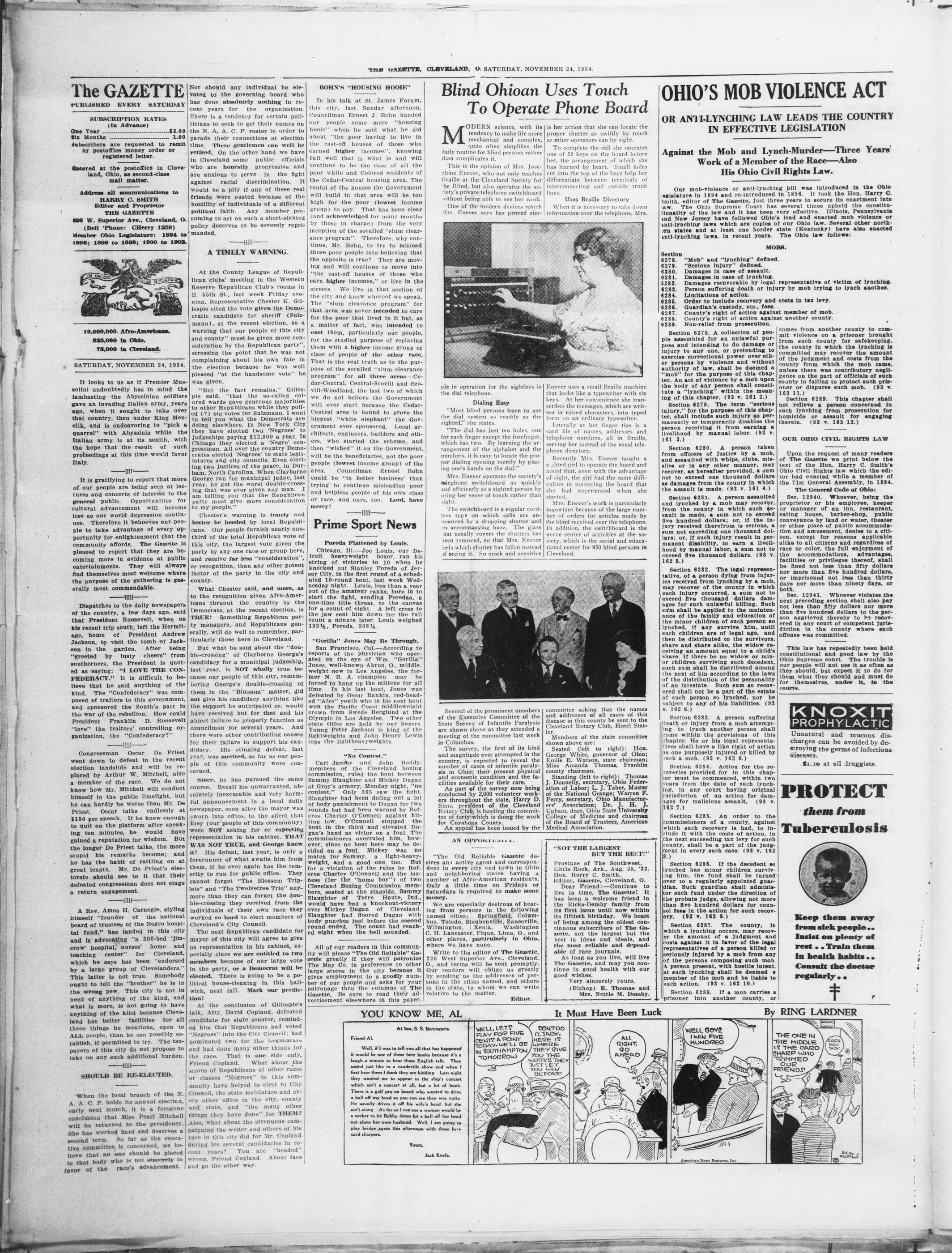
OHIO'S MOB VIOLENCE ACT
OR ANTI-LYNCHING LAW LEADS THE COUNTRY IN EFFECTIVE LEGISLATION
Against the Mob and Lynch-Murder—Three Years' Work of a Member of the Race—Also His Ohio Civil Rights Law.
Our mob-violence or anti-lynching bill was introduced in the Ohio legislature in 1894 and re-introduced in 1896. It took the Hon. Harry C. Smith, editor of The Gazette, just three years to secure its enactment into law. The Ohio Supreme Court has several times upheld the constitutionality of the law and it has been very effective. Illinois, Pennsylvania and New Jersey have followed Ohio's lead and enacted mob violence or anti-lynching laws which are copies of our Ohio law. Several other northern states and at least one border state (Kentucky) have also enacted anti-lynching laws, in recent years. The Ohio law follows:
Section
6278. "Mob" and "lynching" defined.
6279. "Serious injury" defined.
6280. Damages in case of assault.
6281. Damages in case of lynching.
6282. Damages recoverable by legal representative of victim of lynching.
6283. Person suffering death or injury by mob trying to lynch another.
6284. Limitations of action.
6285. Order to include recovery and costs in tax levy.
6286. Damage's custody, etc., fees.
6287. County's right of action against member of mob.
6288. County's right of action against another county.
6289. Non-relief from prosecution.
Section 6278. A collection of people assembled for an unlawful purpose and intending to do damage or injury to any one, or pretending to exercise correctional power over other persons by violence and without authority of law, shall be deemed a "mob" for the purpose of this chapter. An act of violence by a mob upon the body of any person shall constitute a "lynching" within the meaning of this chapter. (93 v. 163 11.)
Section 6289. This chapter shall
Section 6279. The term "serious injury," for the purpose of this chapter, shall include such injury as permanently or temporarily disables the person receiving it from earning a livelihood by manual labor. (93 v. 161 3.)
Section 6280. A person taken from officers of justice by a mob, and assaulted with whips, clubs, missiles or in any other manner, may recover, as hereafter provided, a sum not to exceed one thousand dollars as damages from the county in which the assault is made. (93 v. 161 4.)
Section 6281. A person assaulted and lynched by a mob may recover, from the county in which such assault is made, a sum not to exceed five hundred dollars; or, if the injury received thereon is serious as exceeding one thousand dollars; or, if such injury result in permanent disability, to earn a livelihood by manual labor, a sum not to exceed five thousand dollars. (93 v. 162 5.)
Section 6282. The legal representative, of a person dying from injuries received from lynching by a mob, may recover of the county in which such injury occurred, a sum not to exceed five thousand dollars damages for such unlawful killing. Such sum shall be applied to the maintenance of the family and education of the minor children of such person so lynched, if any survive him, until such children are of legal age, and then be distributed to the survivors, share and share alike, the widow receiving an amount equal to a child's share, or children surviving such decedent, such sum shall be distributed among the next of kin according to the laws of the distribution of the personality of an intestate. Such sum so recovered shall not be a part of the estate of such person so lynched, nor be subject to any of his liabilities. (93 v. 162 6.)
Section 6283. A person suffering death or injury from a mob attempting to lynch another person shall come within the provisions of this chapter. He or his legal representatives shall have a like right of action as one purposely injured or killed by a mob. (93 v. 162 6.)
Section 6284. Action for the recoveries provided for in this chapter must be commenced, within two years from the date of such lynching, in any court having original jurisdiction of an action for damages for malicious assault. (93 v. 162 7.)
Section 6285. An order to the commissioners of a county, against which such recovery is had, to include it with the costs of action, in the next succeeding tax levy for such county, shall be a part of the judgment in every such case. (93 v. 162 8.)
Section 6236. If the decedent so lynched has minor children surviving him, the fund shall be turned over to a regularly appointed guardian. Such guardian shall administer such fund under the direction of the probate judge, allowing not more than five hundred dollars for counsel fees in the action for such recovery. (93 v. 162 9.)
Section 6237. The county, in which a lynching occurs, may recover the amount of a judgment and the amount of a representation of a person killed or seriously injured by a mob from any of the persons composing such mob. A person present, with hostile intent, at such lynching shall be deemed a member of the mob and be liable to such action. (93 v. 162 10.)
Section 6238. If a mob carries a prisoner into another county, or
MOBS.
comes from another county to commit violence on a prisoner brought from such county for safekeeping, the county in which the lynching is committed may recover the amount of the judgment and costs from the county from which the mob came, unless there was contributory negligence on the part of officials of such county in failing to protect such prisoner or dispurse such mob. (93 v. 163 11.)
Section 6289. This chapter shall not relieve a person concerned in such lynching from prosecution for homicide or assault for engaging therein. (93 v. 163 12.)
OUR OHIO CIVIL RIGHTS LAW
Upon the request of many readers of The Gazette we print below the text of the Hon. Harry C. Smith's Ohio Civil Rights law which the editor had enacted while a member of the 71st General Assembly, in 1994. The General Code of Ohio: Sec. 12940. Whoever, being the proprietor or his employee, keeper or manager of an inn, restaurant, eating house, barber-shop, public house, or other place of public accommodation and amusement, denies to a citizen, except for reasons applicable alike to all citizens and regardless of race or color, the full enjoyment of the accommodations, advantages, facilities or privileges thereof, shall be fined not less than fifty dollars nor more than five hundred dollars, or imprisoned not less than thirty dollars nor more than ninety days, or have
Sec. 12941. Whoever violates the next preceding section shall also pay not less than fifty dollars nor more than five hundred dollars to the person aggrieved thereby to be recovered in any court of competent jurisdiction in the county where such offense was committed.
This law has repeatedly been held constitutional and good law by the Ohio Supreme court. The trouble is our people will not use it as often as they should, but expect it to do for them what they should and must do for themselves, under it, in the courts.
KNOXIT
PROPHYLACTIC
Unnatural and mucous discharges can be avoided by destroying the germs of infectious diseases.
$1.10 at all druggists.
PROTECT them from Tuberculosis
Keep them away from sick people.. Insist on plenty of rest . . Train them in health habits . . Consult the doctor regularly . .
By RING LARDNER
THE ONE IN THE MIDDLE IS THE CARD SHARP WHO TRIMMED OUR FRIENDS
GOOD GAME SACK
BICONA BOONFAN
LIQUID - TABLETS
SALVE-NOSE DROPS
Y. M. C. A.
Cev. Cedar Ave. and E. 77th St.
A HOME FOR YOUNG MEN!
RESTAURANT - HOME COOKING
Individual Beds $2.50-$3.00
EN迪cots 9094
2322 E. 55th St.
(South of Central Ave.)
ALL SEATS 10c AT ALL TIMES
Best Pictures, Short Subjects
DOUBLE BILL, EVERY DAY
Program Changed, Sunday,
Wednesday and Friday.
O. K. Printing Co.
W. J. Foster - John M. Smith
Commercial and Job
PRINTING
PROMPT SERVICE
3113 Central Ave.
Cor. E. 31st St.
PRSpect 7818
WHEN YOU NEED a LAWYER
LEGAL ADVICE
Call at Suite 302,
No. 226 W. Superior Ave.,
Cleveland, O.
CHerry 1259.
FOUNTAIN
4737 Woodland Ave.
Every Day
Every Body
10c
QUINCY
Quincy Ave. and E. 83rd St.
Sun.-Mon., Nov. 25-26
Warren Williams in
"THE DRAGON MURDER
CASE."
Tues.-Wed., Nov. 27-28
Warner Baxter in
"GRAND CANARY."
Thurs.-Fri.-Sat., Nov. 29-30—Dec. 1
Robert Montgomery in "HIDE OUT."
Special Matinee at 2 P. M.
"The Supreme Authority"
WEBSTER'S NEW INTERNATIONAL DICTIONARY
Hard's the EVIDENCE
Hundreds of Supreme Court judges concur in highest praise of the work as their authority.
A Library in one Volume
Hundreds of Supreme Court Judge concur in highest praise of the work and their authority, and the President and Department Heads of all leading Universities and Colleges give their endorsement.
The Government Printing Office at Washington uses the New International Edition and amity厚. High Officials in all branches of the Government indorse it.
The College voted overwhelmingly in favor of Webster as standard of pronunciation in the course of its accreditation by the Chicago Woman's Club.
Get The Best
At Your
Bookstore, or
send for free illu-
tated booklet.
B. A. C. MERRIAM
COMPANY
Springfield, Mass.
Do not fall to read the Quincy and Fountain theater advertisements else-
where in this paper and patronize
them. Their pictures are good, the
theaters are neat, clean, cool and
comfortable, and courteous treatment
is always accorded patrons. Then,
too, they ask your patronage thru
the columns of "The Old Reliable"
Gazette. Watch for their advertis-
ments, each week. They have great
shows, next week.
---
Where to Purchase THE GAZETTE
ROSENBERG'S
DRUG
STORE,
N. W. Cor. Central
Ave., & E. 55th St.
O. K. PRINTING CO., PERSKY
3113 Central Ave. Cor. E. Goo
NOTICE TO SUBSCRIBERS
Subscribers not receiving T
ty us at once. We desire every
Send or bring locals and all
office, Suite 302, Johnson Block,
site the Hotel Cleveland entrance
call there, please.
We advise our readers to o
advertisements before making a
advertise in this paper should ha
The fact that they advertise in
they want it.
All reading matter for publ
Gazette must be in the office b
week, at the latest. Display adver
WEDNESDAYS!
HARRY C
226 West Superior Ave
(Opposite, Hotel C
Notary Public.
Classified Advert
Subscribers not receiving The Gazette regularly should notify us at once. We desire every copy delivered promptly.
Send or bring locals and all business matters to The Gazette office, Suite 302, Johnson Block, 226 Superior Ave., West, opposite the Hotel Cleveland entrance. If you wish to see the editor call there, please.
We advise our readers to carefully examine The Gazette's advertisements before making purchases. Business men who advertise in this paper should have the patronage of our people. The fact that they advertise in The Gazette is assurance that they want it.
All reading matter for publication in current issues of The Gazette must be in the office by noon, WEDNESDAY, of that week, at the latest. Display advertisements accepted until 4 p. m., WEDNESDAYS!
HARRY C. SMITH,
226 West Superior Avenue, Cleveland, Ohio.
(Opposite, Hotel Cleveland entrance)
Notary Public.
Bell 'Phone: CHerry 1250.
Classified Advertising Department
FOR SALE.—Bedroom set, a Way-
Sagless spring and a medium size
"charter oak" refrigerator cheap
Address Box B, The Gazette office,
226 W. Superior Ave., City.
CLEVELAND
Social and Personal
Mr. and Mrs. Malcolm Grayson and son, Dorothy Simmons and Othello Skinner visited in Cadiz, Sunday.
Rev. W. H. Lucas, Mrs. Josephine Meyers, Mrs. J. P. and Miss Helen Lucas of Cadiz motored to this city, Sunday, to visit Mr. and Mrs. Dwight Brooks of the Mt. Pleasant district.
The local branch of our History Association's enjoyable dinner-meeting was held, last evening. "The Missouri Compromise" was interestingly discussed by Dr. Arthur C. Cole of the Graduate School of W. R. U.
Israel S. Powell, one of our very promising young attorneys, is spending two weeks at his old home in Baker, La., to be with his parents, Thanksgiving, and to study the field in his home-state with a view to locating and practicing.
Mrs. Loretta Woods, 5811 Ensign Ave., learned, last week, that a relative in Michigan had died and left her $10,000 and a home. She left immediately for Detroit to claim the "Godsend." Mrs. Woods is the mother of three sets of twins. Her husband is employed by the N. Y. Central Railroad.
It is currently reported that Bundy's restaurant, in Thackery Ave., has been closed. Payne pulled out of it, several weeks ago, and opened one in the Phillis Wheatley building; it said. Many voters in Vards 17 and 18 voted for ficturing for next fall to come so as to get a chance to oust those two "Blossom Triplets", something that ought to be done.
All of our readers in this community will please "The Old Reliable" Gazette greatly if they will patronize The May Co., in preference to other large stores in the city, because it gives employment to a goodly number of our people and asks for your patronage thru the columns of The Gazette. Be sure to read their advertisement elsewhere in this paper.
, Congressman - Elect Arthur W, Mitchell of Chicago in a communication from Hot Springs, Ark, to the race press, informs the latter that some old guard southern Democratic members in the U. S. House of Representatives have privately intimated their objection to him as a colleague, saying that they "don't mind having a Republican 'Negro' around, but that a Democratic 'Negro' congressman is different." Illuminating!
Every precinct in Ward 12 was given to Sulzmann, Democrat; all but one was given him in Ward 11, and only five in Ward 17. How come, Bundy? Was the "sick individual" straddling again? Of the thirteen precincts in Bundy's ward, seven were given to Sulzmann, one even and two to were given the Republic cancels for abberth. And we are told that Bundy arose from his "sick" bed to lead his ward-workers (job-holders).
The Jeffersonian Women's Democratic League entertained at a victory banquet at Anders Restaurant, Monday evening. An enthusiastic crowd of three hundred men and women, members and guests, enjoyed the repast and speeches. The principal speakers were Congressman Robert Crosser, Mrs. T. M. Blake, county Treasurer John J. Boyle, guest of honor. Miss T. M. Blake is president of the league, many of whom have been affiliated with the Sweeney-Boyle group of local Democrats. Mrs. Lula Deas and Allen H. Dorsey, of our group, were present.
Immediate investigation of charges of open prostitution and unrestricted street solicitation in the E. 55th St. area between Cedar and Woodland Aves, and between E. 14th and E. 55th Strs., was ordered, Wednesday, by Police Chief George J. Matowitz, who said he had ordered Deputy Inspector Martin J. Horrigan to interview the Rev. J. Horrigan, the Director of Woodland Center, who made the charges. "We'll throw as many men as are needed into the district to clean up conditions," he said. The Rev. Mr. Barry's statements were part of a report on the activities of the Center, which, he said, had an attendance of more than 10,000 monthly.
Resolutions urging the appointment of Common Pleas Judge George
SCHROEDER'S
NEWS
STORE,
Cuyahua Bldg.
Opposite the
Post Office.
S DRUG STORE,
105th St. and
Fading Ave.
7709 Cedar Ave.
J. S. HALL'S.
The Gazette regularly should not-
copy delivered promptly.
business matters to The Gazette
220 Superior Ave., West, oppo-
e. If you wish to see the editor
carefully examine The Gazette's
purchases. Business men who
have the patronage of our people.
The Gazette is assurance that
application in current issues of The
day noon, WEDNESDAY, of that
artisements accepted until 4 p. m.,
D. SMITH,
venue, Cleveland, Ohio.
Cleveland entrance)
Bell 'Phone: CHerry 1250.
Rising Department
WANTED—Young man, honest,
energetic and intelligent who has
had experience as a solicitor and
collector. Must be neat in appearance
and affable. Address The Gazette,
Box A, No. 226 W. Superior Ave.
B. Harris to one of the two vacancies
soon to occur on that bench and
of Assistant County Prosecutor Norman
Judge George B. Harris.
S. Minor to the Municipal Court vacancy to be created by the promotion of Judge Frank S. Day to the Common Pleas bench were voted, Tuesday night, by the Harlan Club, an organization of our attorneys.
Do not overlook the fact that the Temple Theater, E. 55th St. near Central Ave., is showing some mighty fine pictures, these days.
Doings of the Race
Nearly 100,000 of our people are "on relief" in Mississippi, announces Administrator Harry L. Hopkins.
Miss Corinne Johnston of Chicago has been appointed a stenographer in the U. S. Department of Labor at Washington, D. C.
Wm. R. Hill, a special clerk in the Indianapolis post office, has been promoted to weighmaster in the Illinois Street station, that city.
Young Lloyd Patterson, with his wife, designs the stage sets for the famous Meyerhold Theater in Moscow, Russia. He graduated from Hampton, Va. Institute, class of '31.
Congressman Oscar DePriest's unfortunate participation in a triangular political fight, some months ago, in his district was the main cause of his defeat at the recent election, it is said.
The new dormitory, Pfeifer Hall, and the new heating plant, costing
ATTENTION!
Business men and women particularly should recognize the fact that advertising with circulars, bills and cards, distributed by hand or otherwise, are of little use in convincing a purchaser, and more often give him the impression that the thing advertised is an article of low quality. Those who seek to sell seemingly lose sight of the fundamental idea in advertising, namely, to give the thing advertised a legible appearance through a legitimate medium. Purchasers as a rule pay little attention to circular and handbill advertising because the medium through which it is advertised shares none of the responsibility as to the reliability of the thing advertised.
PEOPLE WHO PUT
THE GUY WHO
WARRIES THAT LA
MOVIE TITLE THE
APPEARS IN EVE
FILM ANNOUNCE
THAT MALCOLM
AND BESS WILL
LIVE FOREVER A
EVER IN THE
EVERLASTING
SUNSHINE OF
THEIR NEW FO
THE GAZETTE, CLEVELAND, O. SATURDAY, NOVEMBER 24, 1934.
PEOPLE WHO PUT YOU TO SLEEP—NUMBER EIGHTY-THREE
THE GUY WHO WRITES THAT LAST MOVIE TITLE THAT APPEARS IN EVERY FILM ANNOUNCING THAT MALCOLM AND BESS WILL LIVE FOREVER AND EVER IN THE EVERLASTING SUNSHINE OF THEIR NEW-FOUND HAPPINESS!
AND SO CAME THE DAWN OF A NEW DAY WHEN AN INFINITE PEACE SETTLED OVER THE FERTILE VALLEY WHERE OUR TWO CHILDREN OF FATE WERE TO WORK OUT THEIR DESTINY AS THE DIS-TANT WATERFALL ECHOED ITS APPROVAL ... AND THE SWEET MUSIC OF THEIR GREAT LOVE WAS HANDED DOWN TO THE AGES THROUGH THE VOICE OF A LITTLE CHILD
EXIT
ISN'T THAT CLOSING TITLE JUST DARLING!
IT'S A BOLONY!
AND SO THAT LIVED IN SUNSET JOY!
WEAVER'S
APOTHECARY
SHOP,
8604 Quincy
Ave.
SEE US FIRST FOR ALL GOODS IN OUR LINE
JOHN S. HALL
PRICES REASONABLE SATISFACTION GUARANTEED
JEWELER AND OPTOMETRIST
Eyes Carefully Examined and Glasses Properly Fitted.
7709 CEDAR AVE., Cleveland, Ohio. HEnderson 6028
$150,000, gifts of Mrs. Henry Pfeifer of New York City to Bennett College for Women, Greensboro, N. C., were dedicated with appropriate ceremonies, Nov. 17 and 18, '34.
Gene Toomer, poet and artist, was married last September at Taos, New Mexico, to Miss Marjorie Content (white), daughter of one of Wall Street's (N. Y.) leading brokers. She is his second wife, the first being Miss Margery Latimer (white), novelist.
A. E.
A Note to Women
If you suffer from painful menstruation every month, do this:
sensation every moment, do this:
Get a bottle of CARDUI from the drug store. Take it regularly for a while. If it helps you as thousands of women have reported it helped them, then you will feel stronger, healthier, and happier.
OCR
OCR
CARDUI
FOR WOMEN
Try Cardui for severe pains, cramps, nervousness at monthly periods. Take it just as the directions on each bottle say. Sold at drug stores. Of course, if Cardui does not benefit YOU, consult a physician.
GEM
MICROMATIC
BLADE
SINGERDGE
MICROMATIC
GEM
BLADES
DOUBLEGE
A.
NORMAN S. MINOR
Such Drawing Power!
A WELL
PLEASING
ALWAYS
PORO
PORO
PORO
Hair That All But Sparkles!
Use Poro Brilliantine to Give the Finishing Touch!
TOILET
PRODUCTS
FOR EVERY
DETAIL OF
LADIES'
TOILETRY
R LINE
RANTEED
Ed.
Jersey 6028
L GOODS IN OUR LINE
HALL
SATISFACTION GUARANTEED
OPTOMETRIST
d Glasses Properly Fitted.
o. HEnderson 6026
Speeds up shaves! Steps up comfort!
Theone-piece Gem Razor loads, cleans, shaves in a jiffy. Nothing to take apart! Opens and closes with a finger twirl. Dual Alignment locks the blade unbudgingly at five points —can't vibrate. Made of 50% thicker surgical steel, Gem Micromatic Blades are heavy enough to take the 4840 stroppings we give 'em. You pay less for Gem Blades because you need so few. GemSafetyRazorCorp.,Brooklyn,N.Y.
or and Blades
RACE PREJUDICE
RACE PREJUDICE!
"I am convinced myself that there is no more evil thing in this present world than race prejudice; none at all!
"I write deliberately—it is the worst single thing in life now. It justifies and holds together more baseness, cruelty and abomination than any other sort of error in the world."
1 Do the Very Best I. Can.
I do the very best I know how;
the very best I can; and I mean
to keep doing so until the end.
If the end brings me out all
right, what is said against me
won't amount to anything. If the
end brings me out wrong, ten
angels swearing I was right would
make no difference. — Abraham
Lincoln.
RIGHTY-THREE
DAWN
HEN
GETTLED
VALLEY
EXIT
PORO
BARILLASTING
29
A WELL-GROOMED, PLEASING APPEARANCE ALWAYS ATTRACTS!
POR
FOR HAIR AND S
By PORO AGENTS Every
PORO
Sold By PORO AGENTS Everywhere
For Complete List Write
PORO COLLEGE
4415 SOUTH PARKWAY
PORO BLOCK, 44th to 45th St.
CHICAGO, ILL.
---
TWO INTERESTING BOOKS By JOSEPH C. MANNING
FADEOUT OF H
Tells how and why our people of
Their Constitutional Rights. Br
discussion of the Klan and Anti-Saldo
$1.00.
From Five to T
This is Mr. Manning's life story o
1870 to 1895. Pri
BOTH BOOKS F
T. A. HEBBONS, P
184 W. 185th St., Dept. B
THE LELAND D. FRENCE
FADEOUT OF POPULISM
and why our people of the South are de-
constitutional Rights. Brought down to de-
of the Klan and Anti-Saloon League Poiltie
From Five to Twenty-Five
Mr. Manning's life story embracing the peri-
1870 to 1895. Price, $1.00.
BOTH BOOKS FOR $1.50.
T. A. HEBBONS, PUBLISHER,
184 W. 185th St., Dept. B, New York City.
ELAND D. FRENCH FUNERAL
Tells how and why our people of the South are deprived of Their Constitutional Rights. Brought down to date by discussion of the Klan and Anti-Saloon League Poetics. Price, $1.00.
THE LELAND D. FRENCH FUNERAL HOME
2118 East 46th St.
The PERSONAL BRUSH of thousands
Certified
TAKAMINE
TOOTH BRUSH
2 for 25¢
DR. A. M. GIBSON
Dental Su
OFFICE HOURS: 9 to 12 A.M.
Sundays: 10 A.M.
Dental Surgeon
E HOURS: 9 to 12 A. M., 1 to 5 and 6 to
Sundays: 10 A. M.-2 P. M.
OFFICE HOURS: 9 to 12 A. M., 1 to 5 and 6 to 9 P. M.
Sundays: 10 A. M.-2 P. M.
8231 CEDAR AVENUE
(Cedar at E. 83rd)
CLEVELAND, OHIO
Phone: GAr. 373
By RUBE GOLDBERG
By RUBE GOLDE
Is your skin smooth and your complexion pleasing?
Does your hair frame your face in soft, natural waves?
IF NOT . . .
Consult a PORO AGENT today. She will provide every beauty need for hair and skin.
R O R AND SKIN GENTS Everywhere
---
OF POPULISM
of the South are deprived of
Brought down to date by
Saloon League Politics. Price,
to Twenty-Five
very embracing the period from
Price, $1.00.
S. PUBLISHER,
St. B. New York City.
NCH FUNERAL HOME
An Institution of Personal
Service. Finest Equipment,
Within the Reach of Every-
one.
LELAND D. FRENCH
AGNES G. FRENCH
J. EVERETT HARRIS
REGINAL WOODS
HEnderson 3257-3258
RUSH of thousands
OF DENTISTS
Now available at your
druggist
► Compact brushing head.
► Sturdy bristles.
► Rigid Natural handle.
The ideal tooth brush for
modern brushing methods.
Make This YOUR
Personal Tooth Brush
Surgeon
A. M., 1 to 5 and 6 to 9 P. M.
A. M.-2 P. M.
CLEVELAND, OHIO.
Phone: GAr, 3731
By RUBE GOI.DBERG
Don't Throw Away Your Copy of The GAZETTE After Reading It But Give it to a Friend or an Acquaintance who might Subscribe After Seeing It
NORTH PASSE Tanikla
Alamnokobu Lanceu Falai
Lapu Guat Holap
Northeast Islands
Farutu Bust
Lalai
Bansingo Mol
Northeast Pass
Faasu Fananar
Fanust Tanamar
Scheisen
Felo
Small Bush EliKanibu
Foahlele Reef Kalu Kau (looks) Famu Boquet Alureimo
Lelam-ul Fakun Reef Kau (looks) Famu Fefan Uman Faranan Yonamam Fainu Zien
Piaanu Pass Torres Alamnokobu Lanceu Falai
Faasu Fananar
Faasu Fananar
Tol Tauk Tafanu
Faasu Fananar
Faasu Fananar
PACIFIC OCEAN
Faleu Fourup
Lo Neuruk Pass Potu Uddad Ulda Pase Messenon Gurv
Kuop Islands (Royalist islanda) Hacq Auvergne Booth (looks)
Coral reef
GREENWICH
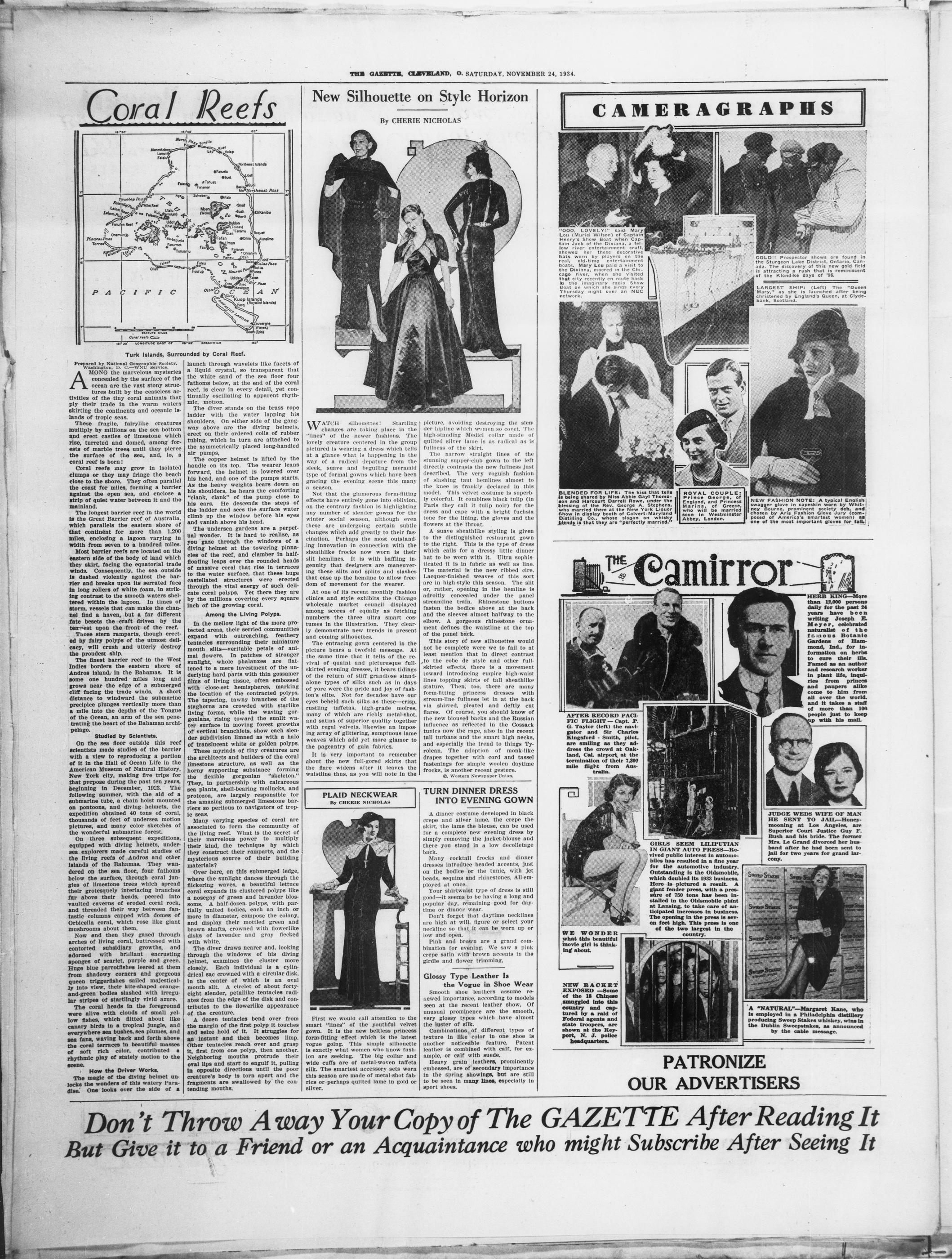
Turk Islands, Surrounded by Coral Reef.
Prepared by National Geographic Society.
Washington, D.C. (CA) 2021
MONG the marvelous mysteries concealed by the surface of the ocean are the vast stony structures built by the ceaseless activities of the tiny coral animals that ply their trade in the warm waters skirting the continents and oceanic islands of tropic seas.
These fragile, fairylike creatures multiply by millions on the sea bottom and erect castles of limestone which rise, turreted and domed, among forests of marble trees until they pierce the surface of the sea, and, lo, a coral reef is born!
Coral reefs may grow in isolated clumps or they may fringe the beach close to the shore. They often parallel the coast for miles, forming a barrier against the open sea, and enclose a strip of quiet water between it and the mallipop.
launch through waves a liquid crystal, so the white sand of fathoms below, at the reef, is clear in ever tinually oscillating a mic. motion.
The diver stands ladder with the waist shoulders. On either way above are the erect on their order tubing, which in turn the symmetrically pail airpumps.
The copper helm handle on its top, forward, the helm his head, and one of As the heavy weight his shoulders, he he "clank, clank" of the his ears. He descends.
The longest barrier reef in the world is the Great Barrier reef of Australia, which parallels the eastern shore of that continent for more than 1,200 miles, enclosing a lagoon varying in width from seven to a hundred miles. Most barrier reefs are located on the eastern side of the body of land which they skirt, facing the equatorial trade winds. Consequently, the sea outside is dashed violently against the barrier and breaks upon its serrated face in long rollers of white foam, in striking contrast to the smooth waters sheltered within the lagoon. In times of storm, vessels that can make the channel find a haven, but a far different fate besets the craft driven by the ternrest upon the front of the reef. Those stern ramparts, though erected by fair polyps of the utmost delicacy, will crush and utterly destroy the proudest ship.
The finest barrier reef in the West Indies borders the eastern shore of Andros island, in the Bahamas. It is some one hundred miles long and grows near the edge of a submerged cliff facing the trade winds. A short distance to windward the submarine precipice plunges vertically more than a mile into the depths of the Tongue of the Ocean, an arm of the sea penetrating the heart of the Bahaman archipelago.
Studied by Scientists.
On the sea floor outside this reef scientists made studies of the barrier with a view to reproducing a portion of it in the Hall of Ocean Life in the American Museum of Natural History, New York city, making five trips for that purpose during the past ten years, beginning in December, 1923. The following summer, with the aid of a submarine tube, a chain hoist mounted on pontoons, and diving helmets, the expedition obtained 40 tons of coral, thousands of feet of undersea motion pictures, and many color sketches of the wonderful submarine forest.
On three subsequent expeditions, equipped with diving helmets, undersea explorers made careful studies of the live reefs of Andros and other islands of the Bahamas. They wandered on the sea floor, four fathoms below the surface, through coral jungles of limestone trees which spread their grotesque interlacing branches far above their heads, peered into vaulted caverns of eroded coral rock, and threaded their way between fantastic columns capped with domes of Orbicella coral, which rose like giant mushrooms about them.
Now and then they gazed through arches of living coral, buttressed with contorted subsidiary growths, and adorned with brilliant encrusting sponges of scarlet, purple and green. Huge blue parrotfishes leered at them from shadowy corners and gorgeous queen triggerfishes sailed majestically into view, their kite-shaped orange-and-green bodies slashed with irregular stripes of startlingly vivid azure.
The coral heads in the foreground were alive with clouds of small yellow fishes, which flitted about like canary birds in a tropical jungle, and everywhere sea bushes, sea plumes, and sea fans, waving back and forth above the coral terraces in beautiful masses of soft rich color, contributed a rhythmic play of stately motion to the scene.
How the Driver Works.
The magic of the diving helmet unlocks the wonders of this watery Paradise. One looks over the side of a
launch through wavelets like facets of a liquid crystal, so transparent that the white sand of the sea floor four fathoms below, at the end of the coral reef, is clear in every detail, yet continually oscillating in apparent rhythmic, motion.
The diver stands on the brass rope ladder with the water lapping his shoulders. On either side of the gangway above are the diving helmets, erect on their ordered coils of rubber tubing, which in turn are attached to the symmetrically placed long-handled air pumps.
The copper helmet is lifted by the handle on its top. The wearer leans forward, the helmet is lowered over his head, and one of the pumps starts. As the heavy weights bears down on his shoulders, he hears the comforting "clank, clank" of the pump close to his ears. He descends the steps of the ladder and sees the surface water climb up the window before his eyes and vanish above his head.
The undersea gardens are a perpetual wonder. It is hard to realize, as you gaze through the windows of a diving helmet at the towering pinnacles of the reef, and clamber in half-floating leaps over the rounded heads of massive coral that rise in terraces to the water surface, that these huge castellated structures were erected through the vital energy of such delicate coral polyps. Yet there they are by the millions covering every square inch of the growing coral.
Among the Living Polyps.
In the mellow light of the more protected areas, their serrated communities expand with outreaching, feathery tentacles surrounding their miniature mouth alts—reritable petals of animal flowers. In patches of stronger sunlight, whole phalanxes are flattened to a mere investment of the underlying hard parts with thin gossamer films of living tissue, often embossed with close-set hemispheres, marking the location of the contracted polyps. The tapering, tawny branches of the staghorns are crowded with starlike living forms, while the waving gorgonians, rising toward the sunlit water surface in moving forest growths of vertical branchlets, show each slender subdivision limned as with a halo of translucent white or golden polyps.
These myriads of tiny creatures are the architects and builders of the coral limestone structure, as well as the horny supporting substance forming the flexible gorgonian "skeleton." They, in partnership with calcareous sea plants, shell-bearing mollucks, and protozoa, are largely responsible for the amazing submerged limestone barriers so perilous to navigators of tropic seas.
Many varying species of coral are associated to form the community of the living reef. What is the secret of their marvelous power to multiply their kind, the technique by which they construct their ramps, and the mysterious source of their building materials?
Over here, on this submerged ledge, where the sunlight dances through the flickering waves, a beautiful lettuce coral expands its cluster polyps like a nosegray of green and lavender blossoms. A half-dozen polyps, with partially united bodies, each an inch or more in diameter, compose the colony, and display their mottled green and brown shafts, crowned with flowerlike disks of lavender and gray flecked with white.
The diver draws nearer and, looking through the windows of his diving helmet, examines the cluster more closely. Each individual is a cylindrical sac crowned with a circular disk, in the center of which is an oval mouth slit. A circle of about forty-eight slender, petalillike tentacles radiates from the edge of the disk and contributes to the flowerlike appearance of the creature.
A dozen tentacles bend over from the margin of the first polyp it touches and seize hold of it. It struggles for an instant and then becomes limp. Other tentacles reach over and grasp it, first from one polyp, then another. Neighboring mouths protrude their oval lips and start to engulf it, pulling in opposite directions until the poor creature's body is torn apart and the fragments are swallowed by the contending mouths.
THE GAZETTE, CLEVELAND, O. SATURDAY, NOVEMBER 24, 1934
By CHERIE NICHOLAS
WATCH silhouettes! Startling changes are taking place in the "lines" of the newer fashions. The lovely creature centered in the group pictured is wearing a dress which tells at a glance what is happening in the way of a radical departure from the sleek, suave and beguiling mermaid type of formal gowns which have been gracing the evening scene this many a season.
Not that the glamorous form-fitting effects have entirely gone into oblivion, on the contrary fashion is highlighting any number of slender gowns for the winter social season, although even these are undergoing certain subtle changes which add greatly to their fascination. Perhaps the most outstanding innovation in connection with the sheathlike frocks now worn is their slit helmets. It is with baffling ingenuity that designers are maneuvering these slits and splits and slashes that ease up the helmine to allow freedom of movement for the wearer.
At one of its recent monthly fashion clinics and style exhibits the Chicago wholesale market council displayed among scores of equally as fetching numbers the three ultra smart costumes in the illustration. They clearly demonstrate new trends in present and coming silhouettes.
The entracing gown centered in the picture bears a twofold message. At the same time that it tells of the revival of quaint and picturesque full-skirted evening dresses, it bears tidings of the return of stiff grandiose stand-alone types of silks such as in days of yore were the pride and joy of fashion's elite. Not for decades have our eyes beheld such silks as these—crisp, rustling taffetas, high-grade moires, many of which are richly metal-shot, and satins of superior quality together with regal velvets, likewise an imposing array of glittering, sumptuous lame weaves which add yet more glamor to the pageantry of gala fabrics.
It is very important to remember about the new full-gored skirts that the flare widens after it leaves the waistline thus, as you will note in the
PLAID NECKWEAR
By CHERIE NICHOLAS
First we would call attention to the smart "lines" of the youthful velvet gown. It is the new beltless princess form-fitting effect which is the latest vogue going. This simple silhouette is exactly what women who know fashion are seeking. The big collar and wide cuffs are of metal-woven taffeta silk. The smartest accessory sets worn this season are made of metal-shot fabrics or perhaps quilted lame in gold or silver.
picture, avoiding destroying the slender hipline which women so covet. The high-standing Medici collar made of quilted silver lame is as radical as is fullness of the skirt.
The narrow straight lines of the stunning supper-club gown to the left directly contrasts the new fullness just described. The very voguish fashion of slashing taut hemlines almost to the knee is frankly declared in this model. This velvet costume is superly colorful. It combines black tulip (in Paris they call it tulip noir) for the dress and cape with a bright fuchsia tone for the lining, the gloves and the flowers at the throat.
A suave sheathlike styling is given to the distinguished restaurant gown to the right. This is the type of dress which calls for a dressy little dinner hat to be worn with it. Ultra sophisticated it is in fabric as well as line. The material is the new ribbed cire. Lacquer-finished weaves of this sort are in high-style this season. The slit or, rather, opening in the hemline is adroitly concealed under the panel streamline train. Rhinestone buttons fasten the bodice above at the back and the sleeves almost halfway to the elbow. A gorgeous rhinestone ornament defines the waistline at the top of the panel back.
This story of new silhouettes would not be complete we were to fail to at least mention that in direct contrast to the robe de style and other full-skirted effects, there is a movement toward introducing empire high-waist lines topping skirts of tall sheathlike stature. Then, too, there are many form-fitting princess dresses with stream-line fullness let in at the back via shirred, pleated and deftly cut flares. Of course, you should know of the new blonded backs and the Russian influence as reflected in the Cossack tunics now the rage, also in the recent tall turbans and the smart high necks, and especially the trend to things Tyrolean. The adoption of monk-like drapes together with cord and tassel fastenings for simple woolen daytime frocks, is another recent gesture.
$\textcircled{10}$. Western Newspaper Union.
TURN DINNER DRESS
INTO EVENING GOWN
A dinner costume developed in black crepe and silver lame, the crepe the skirt, the lame the blouse, can be used for a complete new evening dress by simply removing the jacket-blouse and there you stand in a low decolletage back.
Many cocktail frocks and dinner dresses introduce beaded accents, just on the bodice or the tunic, with jet beads, sequins and rhinestones. All employed at once.
Your shirtwaist type of dress is still good—it seems to be having a long and popular day, remaining good for daytime or dinner wear.
Don't forget that daytime necklines are high at will, figure or select your neckline so that it can be worn up or low and open.
Pink and brown are a grand combination for evening. We saw a pink crepe satin with brown accents in the girdle and flower trimming.
Glossy Type Leather Is
the Vogue in Shoe Wear
Smooth shoe leatherss assume renewed importance, according to models seen at the recent leather show. Of unusual prominence are the smooth, very glossy types which have almost the luster of silk.
Combinations of different types of texture in like color in one shoe is another noticeable feature. Patent leather is combined with calf, for example, or calf with suede.
Heavy grain leatherss, prominently embossed, are of secondary importance in the spring showings, but are still to be seen in many lines, especially in sport shoes.
THE WEDDING OF MARY AND JOHN
BLENDED FOR LIFE: The kiss that tells it is being shared by Miss Abbie Gaymom Thompson, who is the bride of the blessing of the Re George A. Stephens, who married them at the New York Liquor store in display booth or in-the-window. Diana Blends is in "whisky blends is that they are "perfectly married."
Camirro
THE
THE Camirror
GIBLIS SEEM LILIPUTIAN IN GIANT AUTO PRESS—Revived public interest in automobiles has resulted in a fine year for the automotive industry, which produced the 1933 bushfire, which doubled its 1933 bushfire. Here is pictured a result. A giant fender press, with a pressure of 750 tons has been installed in the Oldsmobile plant at Lansing, to take care of an emergency. The opening in the press is seven feet high. This press is one of the two largest in the
country.
A "Nation is empire produc
the Du
TE After R
subscribe After
OUR ADVERTISERS
"OOO, LOVELY!" said Mary Lou (Muriel Wilson) of Captain Jake, a naval jack of the Dixiana, a low river entertainment craft, showed her these decorative boats, real, old-time entertainment boats. Mary Lou paid a visit to the Dixiana, moored in the Chicago River, that city recently en route back to the imaginary radio Show on which she sings every Tuesday night over an NEC network.
ROYAL COUPLE:
Prince George, of England, and Princess Marina of Greece, of Greece, and not soon in Westminster Abbey, London.
PATRONIZE
GOLD!! Prospector shows are found in the Sturgeon Lake District, Ontario where a gold field is attracting a rush that is reminiscent of the Klondike days of '96.
LARGEST SHIP: (Left) The "Queen is launched after being christened by England's Queen, at Clydebank, Scotland.
THE FILM OF "THE MARRIAGE OF THE WESTERN WOMAN" BY JOHN W. HARRIS, AUTOGRAPHED BY JOHN W. HARRIS, AUTOGRAPHED BY JOHN W. HARRIS.
NEW FASHION NOTE: A typical English glove wove into a plain, prominent society deb, and chosen by Aiis Fashion Glove Jury (composed of one of the most important gloves for fall).