The Gazette
Saturday, January 26, 1935
Cleveland, Ohio
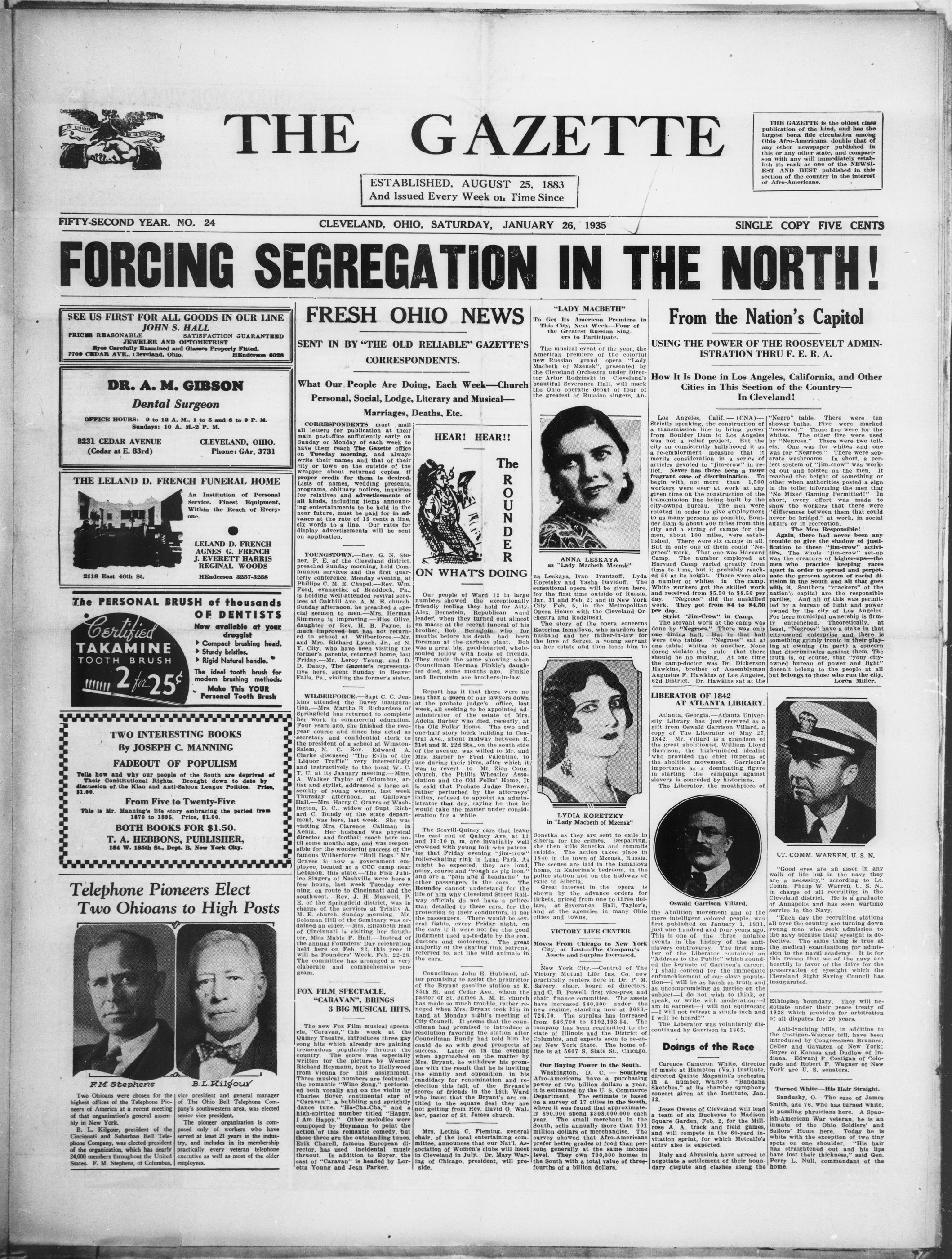
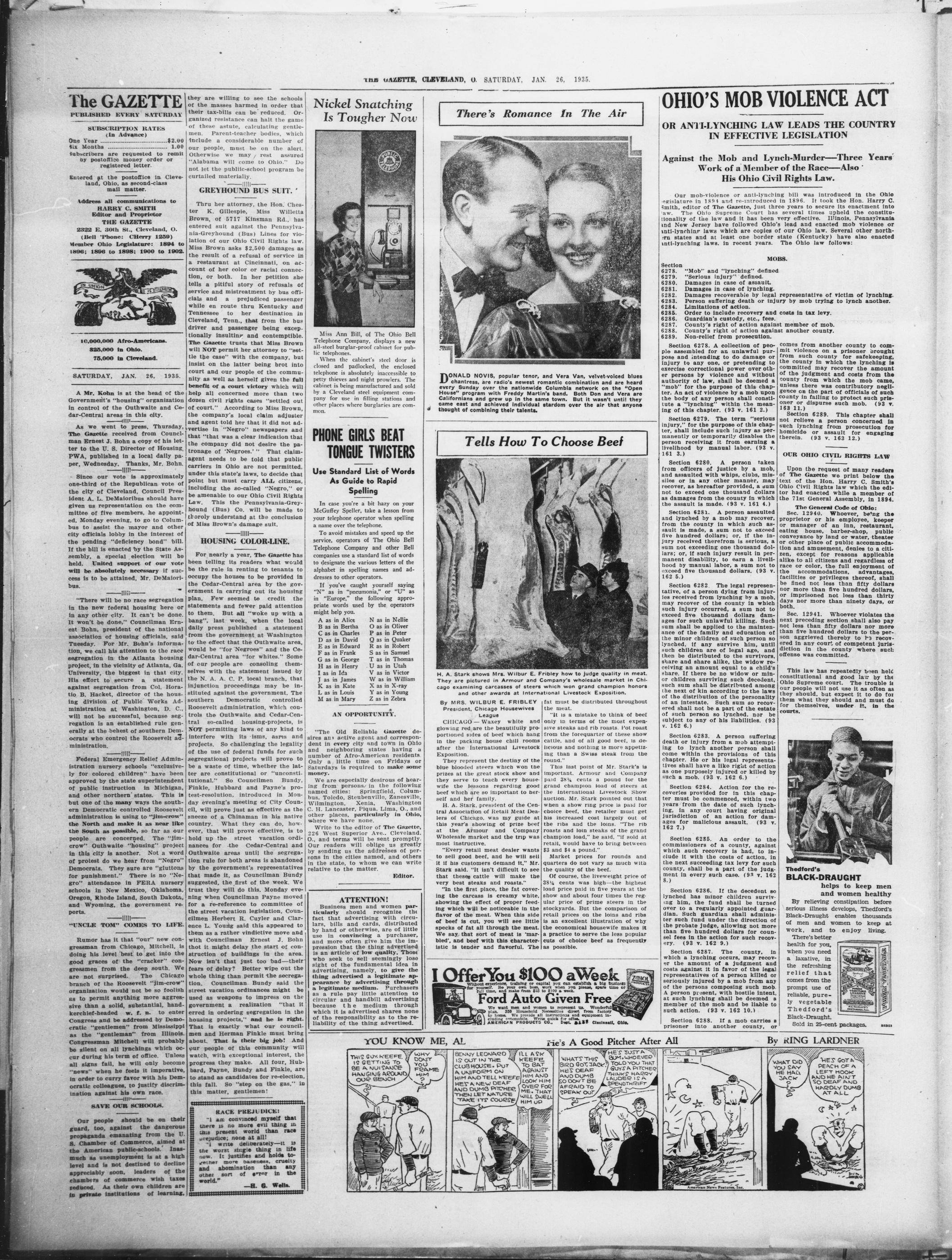
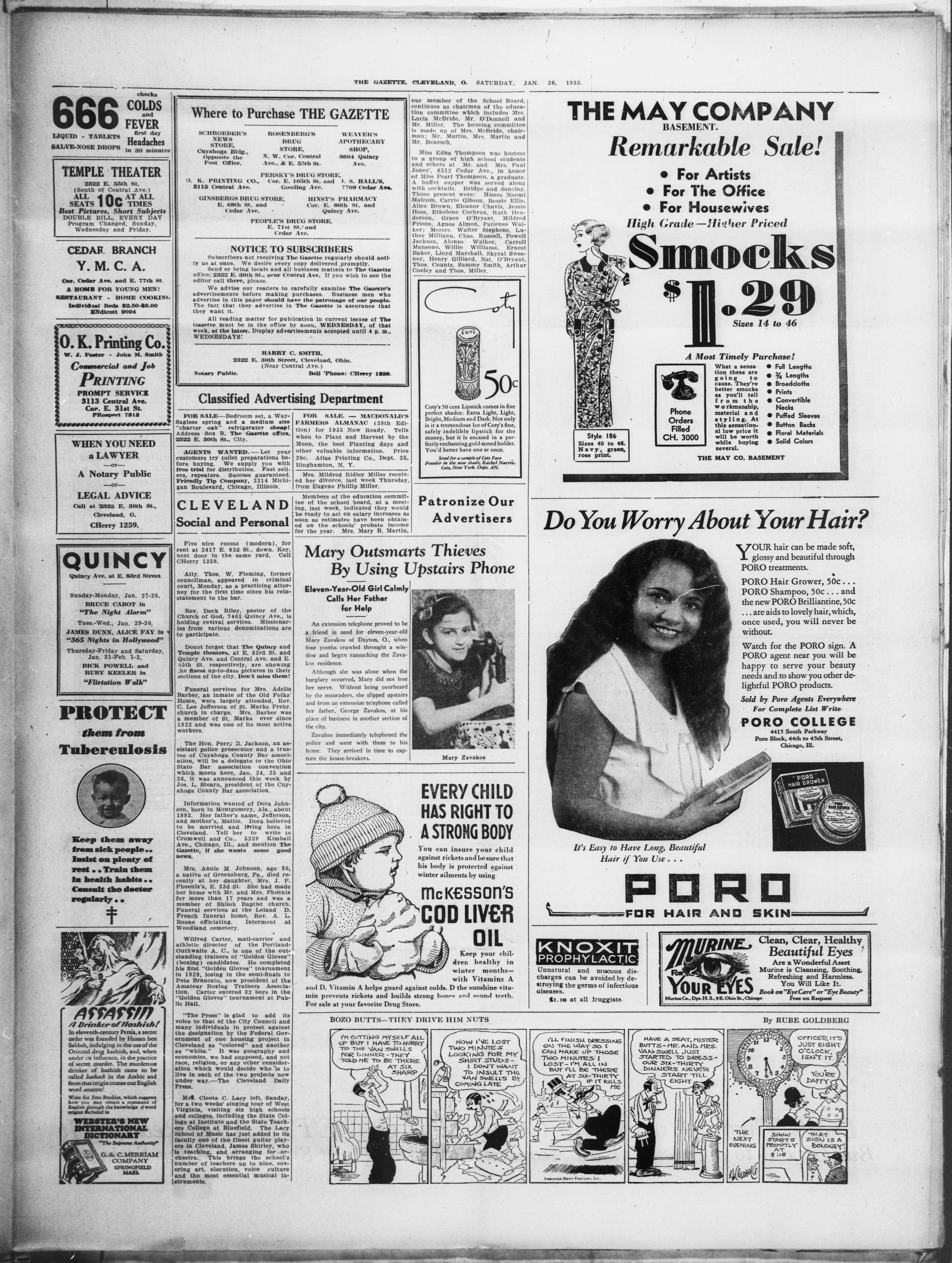
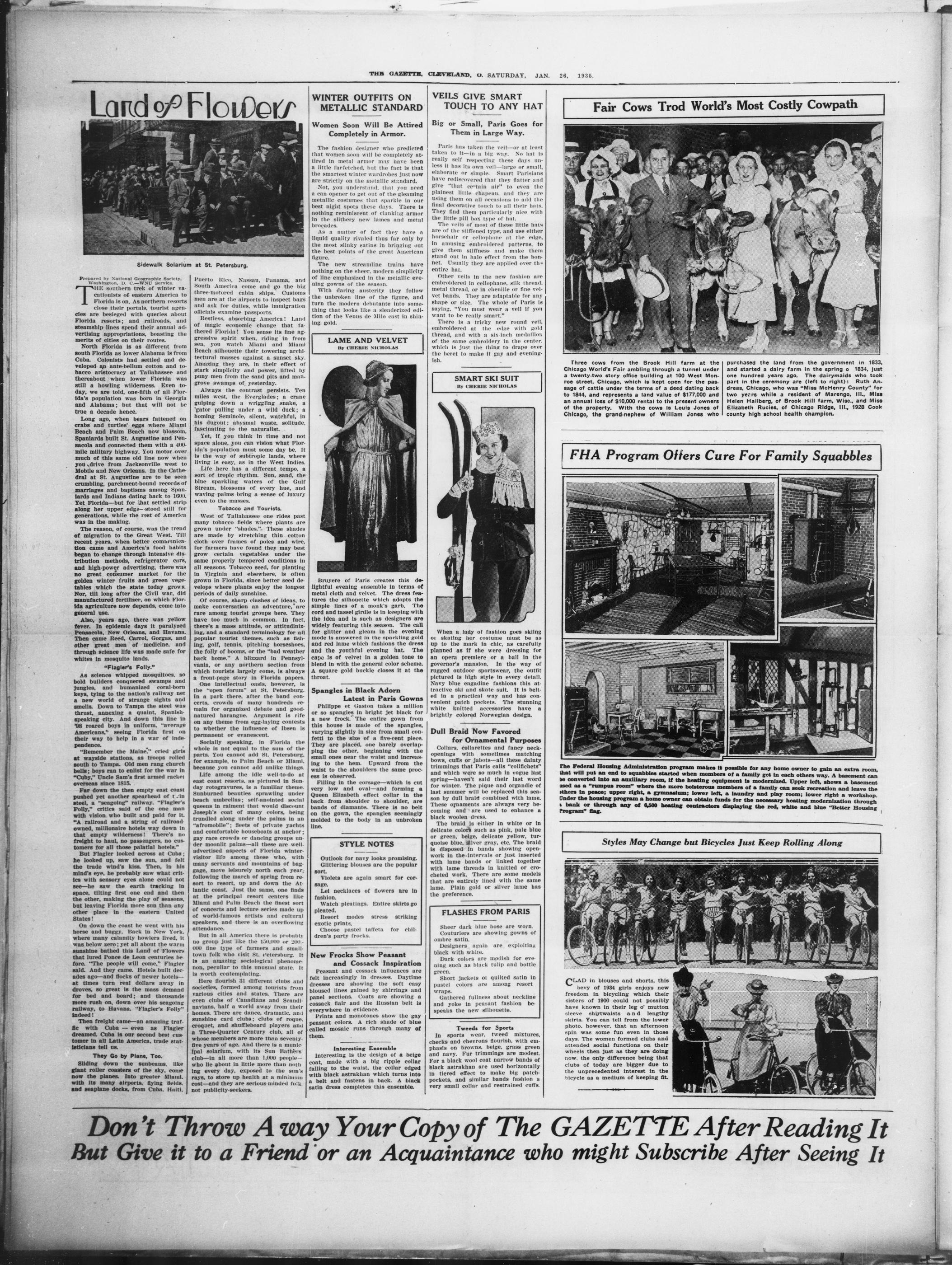
Page text (machine-generated)
FORCING SEGREGATION IN THE NORTH!
IN UNION IS STRONGER
FIFTY-SECOND YEAR. NO
FORCIN
SEE US FIRST FOR ALL G
JOHN S. H.
PRICES REASONABLE SA
JEWELER AND OP
Eyes Carefully Examined and G
7709 CEDAR AVE., Cleveland, Ohio.
SECOND YEAR. NO. 24
ORCING
FIRST FOR ALL GOODS IN OUR
JOHN S. HALL
ASONABLE SATISFACTION GU
JEWELER AND OPTOMETRIST
Carefully Examined and Glasses Properly F
AVE., Cleveland, Ohio.
FIFTY-SECOND YEAR. NO. 24
SEE US FIRST FOR ALL GOODS IN OUR LINE
JOHN S. HALL
PRICES REASONABLE SATISFACTION GUARANTEED
JEWELER AND OPTOMETRIST
Eyes Carefully Examined and Glasses Properly Fitted.
7709 CEDAR AVE., (Cleveland, Ohio. HEnderson 6028
DR. A. M. GIBSON
Dental Surgeon
OFFICE HOURS: 9 to 12 A. M., 1 to 5 and 6 to 9 P. M.
Sundays: 10 A. M.-2 P. M.
8231 CEDAR AVENUE CLEVELAND, OHI
(Cedar at E. 83rd) Phone: GAr, 37
THE LELAND D. FRENCH FUNERAL HOME
2118 East 46th St.
The PERSONAL BRUS
Certified
TAKAMINE
TOOTH BRUSH
2 for 25¢
TWO INTERESTS
By JOSEPH C. H.
FADEOUT OF B
Tells how and why our people of
Their Constitutional Rights. Brief
discussion of the Klan and Anti-Sale
$1.06.
From Five to T
This is Mr. Manning's life story e
1870 to 1895. Pre
BOTH BOOKS F
T. A. HEBBONS, B
184 W. 185th St., Dept. B
Telephone Pioneer
Two Ohioans to
TWO INTERESTING BOOKS
By JOSEPH C. MANNING
FADEOUT OF POPULISM
and why our people of the South are de-
constitutional Rights. Brought down to c
of the Klan and Anti-Saloon League Politic
From Five to Twenty-Five
Mr. Manning's life story embracing the per-
1870 to 1895. Price, $1.00.
BOTH BOOKS FOR $1.50.
T. A. HEBBONS, PUBLISHER,
184 W. 185th St., Dept. B, New York City.
Phone Pioneers Elec-
to Ohioans to High
Tells how and why our people of the South are deprived of Their Constitutional Rights. Brought down to date by discussion of the Klan and Anti-Saloon League Politics. Price, $1.66.
Telephone Pioneers Elect Two Ohioans to High Posts
F.M. Stephens B.L. Kilgour
Two Ohioans were chosen for the highest offices of the Telephone Pioneers of America at a recent meeting of that organization's general assembly in New York.
B. L. Kilgour, president of the Cincinnati and Suburban Bell Telephone Company, was elected president of the organization, which has nearly 24,000 members throughout the United States. F. M. Stephens, of Columbus,
---
CLEVELAND, OHIO.
Phone: GAr, 3731
ENCH FUNERAL HOME
An Institution of Personal
Service. Finest Equipment,
Within the Reach of Everyone.
LELAND D. FRENCH
AGNES G. FRENCH
J. EVERETT HARRIS
REGINAL WOODS
HEnderson 3257-3258
RUSH of thousands
OF DENTISTS
Now available at your
druggist
► Compact brushing head.
► Sturdy bristles.
► Rigid Natural handle.
The ideal tooth brush for
modern brushing methods.
Make This YOUR
Personal Tooth Brush
TESTING BOOKS
C. MANNING
OF POPULISM
of the South are deprived of
Brought down to date by
-Saloon League Politics. Price,
to Twenty-Five
Memory embracing the period from
Price, $1.00.
S FOR $1.50.
S, PUBLISHER,
pt. B, New York City.
Meers Elect
to High Posts
vice president and general manager of The Ohio Bell Telephone Company's southwestern area, was elected senior vice president.
The pioneer organization is composed only of workers who have served at least 21 years in the industry, and includes in its membership practically every veteran telephone executive as well as most of the older employees.
THE GAZETTE
ESTABLISHED, AUGUST 25, 1883 And Issued Every Week on Time Since
FRESH OHIO NEWS
SENT IN BY "THE OLD RELIABLE" GAZETTE'S CORRESPONDENTS.
CORRESPONDENTS must mall all letters for publication at their main postoffice sufficiently early on Sunday or Monday of each week to have them reach The Gazette office on Tuesday morning, and always write their names and that of their city or town on the outside of the wrapper about returned copies, if proper credit for them is desired. Lists of names, wedding presents, programs, obituary notices, inquiries for relatives and advertisements of all kinds, including items announcing entertainments to be held in the near future, must be paid for in advance at the rate of 15 cents a line, six words to a line. Our rates for display advertisements will be sent on application.
YOUNGSTOWN—Rev. G. N. Stoner, P. E. of the Cleveland district, preached Sunday morning, held Communion services and the first quarterly conference, Monday evening, at Phillips C. M. E. Chapel—Rev. Wm. Ford, evangelist of Braddock, Pa. (Mrs. Herman Simmons) and acres at Oak Hill Ave. A, M. E. church, Sunday afternoon, he preached a special sermon to men—Mrs. Herman Simmons is improving—Miss Olive, daughter of Rev. H. B. Payne, is much improved but has not returned to school at Wilberforce—Mr. and Mrs. Richard Lynch, Jr., of N. Simmons, who have been visiting the former's Friday—Mr. Leroy Young, and D. D. Dancy, The Gazette's representative here, spent Sunday in Beaver Falls, Pa., visiting the former's sister.
WILBERFORCE.—Supt C. C. Jenks attended the Davey inauguration.—Mrs. Martha B. Richardson of Springfield has returned to complete her work in commercial education. Four years ago, she finished the two-year course and since has acted as secretary and confidential clerk to the president of a school at Winston Salem, N. C.—Rev. Edward A. Clarke discussed "The Evils of the Liquor Traffic" very interestingly and instructively to the local W. C. T. u. at its January meeting.—Mme. A. Walker Taylor of Columbus, artist and stylist, addressed a large assortment of young women, last week Thursday.—Mrs. Harry C. Graves of Washington, D. C. widow of Supt. Richard C. Bundy of the state department, was here, last week. She was visiting Mrs. Clarence Caliman in Xenia. Her husband was physical director and football coach here until some months ago, and was responsible for the wonderful success of the famous Wilberforce "Bull Dogs." Mr. Graves is now a government employee, located at a CCC camp near Lebanon, this state. The Fisk Ibile Singers of Nashville were here a few hours, last week Tuesday evening, en route to Cincinnati and the southwest.—Rev. J. H. Maxwell, P. E. of the Springfield district, was in charge of the services at the University.—Rev. James Turner, Soloman Hill of the Seminary was ordained an elder.—Mrs. Elizabeth Hall of Cincinnati is visiting her daughter, Miss Mable F. Hall.—Instead of the annual Founders' Day celebration held here on Feb. 22, this year it will be Founders' Week, Feb. 22-28. The committee has arranged a very elaborate and comprehensive program.
FOX FILM SPECTACLE.
"CARAVAN", BRINGS
3 BIG MUSICAL HITS
The new Fox Film musical spectacle, "Caravan," this week at the Quincy Theatre, introduces three gay song hits which already are gaining tremendous popularity through the country. The score was especially written for the picture by Werner Richard Heymann, brot to Hollywood from Vienna for this assignment. Three musical numbers are featured: the romantic "Wine Song," performed both vocally and on the violin by Charles Boyer, continental star of the musical "Ha-Cha and sprightly dance tune," "Ha-Cha and high-spirited number titled "Happy," I Am Happy." Other melodies were composed by Heymann to point the action of this romantic comedy, but these three are the outstanding tunes. Erik Carrell, famous European director, has used incidental music throut. In addition to Boyer, the cast of "Caravan" is headed by Loretta Young and Jean Parker.
A
ON WHAT'S DOING
Our people of Ward 12 in large numbers showed the exceptionally friendly feeling they hold for Attty Alex, Bernstein, Republican ward leader, when they turned out almost en masse at the recent funeral of his brother, Bore Bernstein, who for months before his death had been in prison. Bernstein told who she was a great big, good-hearted, whole-souled fellow with hosts of friends They made the same showing when Councilman Herman Finkle's daughter died, some months ago. Finkle and Bernstein are brothers-in-law.
Report has it that there were no less than a dozen of our lawyers down at the probate judge's office, last week, all seeking to be appointed administrator of the estate of Mrs. Adelia Barber who died, recently, at the Old Folks' Home. The two and a half years behind in Central Ave., about midway between E. 21st and E. 22d Sts, on the south side of the avenue, was willed to Mr. and Mrs. Barber by Fred Valentine, to use during their lives, after which it was to revert to Mt. Zion Cong. church, the Phillis Wheatley Association and the Old Folks' Home. It is said that Probate Judge Brewer, rather perturbed by the attorneys' request to have an investigator that day, saying he that he would take the matter under consideration for a while.
The Scovill-Quincy cars that leave the east end of Quincy Ave. at 11 and 11:10 p. m. are invariably well crowded with young folk who patronize that Friday evening "jim-crow" roller-skating rink in Luna Park. As might be expected, they are loud noisy, course and "rough as pig iron," and are a "pain and if headache" to other passengers in the cars. The Rounder cannot understand for the life of him why Cleveland Street Railway officials do not have a police man detailed to these cars, for the protection of their conductors, if not several fights, every Friday night, or the cars if it were not for the good judgment used up-to-date by the conductors and motormen. The great majority of the skating rink patrons referred to, act like wild animals in the cars.
Councilman John E. Hubbard, after promising to assist the proprietor of the Bryant gasoline station at E. $55th St. and Cedar Ave., whom the pastor of St. James A. M. E. church has made so much trouble, rather reneged when Mrs. Bryant took him in hand at Monday night's meeting of City Council. It seems that the councilman had promised to introduce a resolution favoring the station after Councilman Bundy had told him he could do so with good prospects of success. Later on in the evening when approached on the matter by Mrs. Bryant, he wished his promptness, that he might the emmity and opposition, in his candidacy for renomination and reelection this fall, of the Bryant's scores of friends in the 18th Ward who insist that the Bryant's are entitled to the square deal they are not getting from Rev. David O. Walker, pastor of St. James church.
Mrs. Lethia C. Fleming, general chair, of the local entertaining committee, announces that our Nat'l Association of Women's clubs will meet in Cleveland in July. Dr. Mary Warwis of Chicago, president, will preside
"LADY MACBETH"
To Get Its American Premiere in This City, Next Week—Four of the Greatest Russian Singers to Participate.
The musical event of the year, the American premiere of the colorful new Russian grand opera, "Lady Macbeth of Mzensk", presented by the Cleveland Orchestra under Director Artur Rodzinski in Cleveland's beautiful facility, will mark the Ohio operatic debut of four of the greatest of Russian singers, An-
ANNA LESKAYA
as "Lady Macbeth Mzensk"
na Leskaya, Ivan Ivantzoff, Lyda Koretsky and Yasha Davidoff. The sensational opera will be given here, for the first time outside of Russia, Jan. 31 and Feb. 2; and in New York City, Feb. 5, in the Metropolitan Opera House with the Cleveland Orchestra and Rodzinski. The story of the opera concerns Katerina Izmaleva, who murders her husband, her father-in-law for the love of Serget, a young servant on her estate, and then loses him to
LYDIA KORETZKY
in "Lady Macbeth of Mzensk"
Sonetka as they are sent to exile in Siberia for the crimes. Despairing, she then kills Sonetka and commits suicide. The action takes place in 1840 in the town of Mzensk, Russia. The scenes are laid in the Izmailova home, in Katerina's bedroom, in the police station and on the highway of exile in Siberia. Great interest in the opera is shown by the advance orders for tickets, priced from one to three dollars, at Severance Hall, Taylor's, and at the agencies in many Ohio cities and towns.
VICTORY LIFE CENTER
Moves From Chicago to New York City, at Last—The Company's Assets and Surplus Increased.
New York City—Control of The Victory Mutual Life Ins. Co. now practically centers here in Dr. P. M. Savory, chair, board of directors, and C. B. Powell, first vice-pres. and chair, finance committee. The assets have increased $40,000 under the image, funding now at $88,726.70. The surplus has increased from $46,700 to $102,193.54. The company has been readmitted to the state of Illinois and the District of Columbia, and expects soon to re-enter New York State. The home office is at 5607 S. State St., Chicago.
Our Buying Power in the South.
Washington, D. C. — Southern Afro-Americans have a purchasing power of two billion dollars a year, it is estimated by the U. S. Commerce Department. The estimate is based on a survey of 17 cities in the South, where it was found that approximately $80,000 spend $308,000,000 each year. The small merchant in the South, sells annually more than 101 million dollars of merchandise. The survey showed that Afro-Americans have a purchasing power of more than sons generally at the same income level. They own 700,000 homes in the South with a total value of three-fourths of a billion dollars.
SINGLE COPY FIVE CENTS
NORTH!
The Nation's Capitol
ER OF THE ROOSEVELT ADMIN-
TION THRU F. E. R. A.
Los Angeles, California, and Other
is Section of the Country—
In Cleveland!
From the Nation's Capitol
From the Nation's Capitol
USING THE POWER OF THE ROOSEVELT ADMINISTRATION THRU F. E. R. A.
How It Is Done in Los Angeles, California, and Other Cities in This Section of the Country— In Cleveland!
Los Angeles, Calif. — (CNA)—Strictly speaking, the construction of a transmission line to bring power from Boulder Dam to Los Angeles was not a relief project. But the city so consistently ballybounced it as a re-employment measure that it merits consideration in a series of articles devoted to "jim-crow" in relief. Never has there been a more fragrant case of discrimination. To begin with, not more than 150 workers, not more than 40 at any given time on the construction of the transmission line being built by the city-owned bureau. The men were rotated in order to give employment to as many persons as possible. Boulder Dam is about 500 miles from this city and a string of camps for the men, about 100 miles, were established. There were six camps in all. But in only one of them could "Negroes" work. That one was Harvard Camp. The number employed at Harvard Camp varied greatly from time to time, but it probably reached its height. There were also a number of whites in the camp. White workers got the skilled work and received from $5.50 to $8.50 per day. "Negroes" did the unskilled work. They got from $4 to $4.50 per day.
Strict "Jim-Crow" in Camp. The servant work at the camp was done by "Negroes." There was only one dining hall. But in that hall were two tables. "Negroes" sat at one table; whites at another. None dared violate the rule that there should be no mixing. At one time the camp-doctor was Dr. Dickerson Hawkins, brother of Assemblyman Augustus F. Hawkins of Los Angeles, 62d District. Dr. Hawkins sat at the
Atlanta, Georgia—Atlanta University Library has just received a gift from Oswald Garrison Villard, a copy of The Liberator of May 27, 1842. Mr. Villard is a grandson of the great abolitionist, William Lloyd Garrison, the high-minded idealist who provided the chief impetus of the abolition movement. Garrison's actions as a militant in starting the campaign against slavery is conceded by historians. The Liberator, the mouthpiece of
the Abolition movement and of the more intelligent colored people, was first published on January 1, 1831, just one hundred and four years ago. This is one of the three notable events in 'the history of the anti-slavery controversy. The first number of the Liberator contained an "Address to the Public" which sounded the keynote of Garrison's career: "I shall contend for the immediate or slave population—I will be as harsh as truth and uncompromising as justice on the subject—I do not wish to think, or speak, or write with moderation—I am in earnest—I will not equivocate—I will not retreat a single inch and I will be heard!" The Liberator was voluntarily discontinued by Garrison in 1865.
Carence Cameron White, director of music at Hampton (Va.) Institute, directed Quinto Maganini's orchestra in a number, White's "Bandana Sketches," at its chamber symphony concert given at the Institute, Jan. 12.
Jesse Owens of Cleveland will lead a team of six Buckeyes to Madison Square Garden, Feb. 2, for the Milrose A. A. track and field games, and will compete in the 60-yard invitation sprint, for which Metcalfe's entry also is expected.
Italy and Abyssinia have agreed to negotiate a settlement of their boundary dispute and clashes along the
---
LIBERATOR OF 1842
AT ATLANTA LIBRARY
Oswald Garrison Villard.
Doings of the Race
THE GAZETTE is the oldest class publication of the kind, and has the largest bona fide circulation among Ohio Afro-Americans, double that of any other newspaper published in this or any other state, and comparison with any will immediately be made. EWESIEST AND BEST published in this section of the country in the interest of Afro-Americans.
"Negro" table. There were ten shower baths. Five were marked "reserved." Those five were for the whites. The other five were used by "Negroes." There were two toilets. One was for whites and one was for "Negroes." There were separate washrooms. In short, a perfect system of "jim-crow" was worked out and foisted on the men. It reached the height of something or more than a sign in the toilet informing the man that "No Mixed Gaming Permitted!" In short, every effort was made to show the workers that there were "differences between them that could never be bridged," at work, in social affairs or in recreation.
The Men Responsible:
Again there had never been any trouble to get the justification to these "jim-crow" activities. The whole "jim-crow" set-up was the creature of higher-ups—the men who practice keeping races apart in order to spread and perpetuate the present system of racial division in the South and all that goes with it. Southern "crackers" at the nation's capital are the responsible parties. And all of this was permitted by the city of Los Angeles owned by the city of Los Angeles. For here municipal ownership is firmly entrenched. Theoretically, at least, "Negroes" have a stake in that city-owned enterprise and there is something grimly ironic in their playing at owning (in part) a concern that discriminates against them. The truth is, of course, that "your city-owned bureau of power and light" doesn't belong to the people at all but belongs to those people. Lorren Miller
U.T. COMM. WARREN, U. S. N.
"Good eyes are an asset in any walk of life but in the navy they are a necessity," according to Lt. Comm. Philip W. Warren, U. S. N., in charge of all recruiting in the Cleveland district. He is a graduate of Annapolis and has seen wartime service in the Navy. Each day the recruiting stations all over the country are turning down young men who seek admission to the navy because their eyesight is defective. The same thing is true at the medical examinations for admission to the naval academy. It is for this reason that we of the navy are heartily in favor of the drive for the preservation of eyesight which the Cleveland Sight Saving Council has inaugurated.
Ethiopian boundary. They will negotiate under their peace treaty of 1928 which provides for arbitration of all disputes for 20 years.
Anti-lynching bills, in addition to the Costigan-Wagner bill, have been introduced by Congressmen Brunner Celler and Gavagen of New York; Guyer of Kansas and Dudlow of Indiana. Edward P. Costigan of Colorado and Robert F. Wagner of New York are U. S. senators.
Turned White—His Hair Straight.
Sandusky, O.—The case of James Smith, age 76, who has turned white, is puzzling physicians here. A Spanish-American War veteran, he is an inmate of the Ohio Soldiers' and Sailors' Home here. Today he is white with the exception of two tinty hairs on his head. His hair has straightened out, and he have lost their thickness." said Gen. Perry L. Null, commandant of the home.
One Year $2.00
six Months 1.00
subscribers are requested to remit
by postoffice money order or
registered letter.
Entered at the postoffice in Cleveland, Ohio, as second-class mail matter.
Address all communications to
HARRY C. SMITH
Editor and Proprietor
THE GAZETTE
2322 E. 30th St., Cleveland, O.
(Bell 'Phone: CHerry 1259)
Member Ohio Legislature: 1894 to
1896; 1896 to 1898; 1900 to 1902
IN UNION IS STRONG
10,000,000 Afro-Americans.
825,000 in Ohio.
75,000 in Cleveland.
SATURDAY, JAN. 26, 1935.
A Mr. Kohn is at the head of the Government's "housing" organization in control of the Outhwaite and Cedar-Central areas in this city.
As we went to press, Thursday
The Gazette received from Councilman Ernest J. Bohn a copy of his letter to the U. S. Director of Housing PWA, published in a local daily paper, Wednesday. Thanks, Mr. Bohn.
Since our vote is approximately one-third of the Republican vote of the city of Cleveland, Council President A. L. DeMaioribus should have given us representation on the committee of five members, he appointed, Monday evening, to go to Columbus to assist the mayor and other city officials lobby in the interest of the pending "deficiency bond" bill. If the bill is enacted by the State Assembly, a special election will be held. United support of our vote will be absolutely necessary if success is to be attained, Mr. DeMaioribus.
"There will be no race segregation in the new federal housing here or in any other city. It can't be done. It won't be done," Councilman Ernest Bohn, president of the national association of housing officials, said Tuesday. For Mr. Bohn's information, we call his attention to the race segregation in the Atlanta housing project, in the vicinity of Atlanta, Ga. University, the biggest in that city. His effort to secure a statement against segregation from Col. Horatio B. Hacker, director of the housing division of Public Works Administration at Washington, D. C., will not be successful, because segregation is an established rule generally at the behest of southern Democrats who control the Roosevelt administration.
---
Federal Emergency Relief Administration nursery schools "exclusively for colored children" have been approved by the state superintendent of public instruction in Michigan, and other northern states. This is but one of the many ways the southern Democratic controlled Roosevelt administration is using to "jim-crow" the North and make it as near like the South as possible, so far as our people are concerned. The "jim-crow" Outhwaite "housing" project in this city is another. Not a word of protest do we hear from "Negro" Democrats. They sure are "gluttones for punishment." There is no "Negro" attendance in FERA nursery schools in New Mexico, Oklahoma, Oregon, Rhode Island, South Dakota, and Wyoming, the government reports.
Rumor has it that "our" new congressman from Chicago, Mitchell, is doing his level best to get into the good graces of the "cracker" congressmen from the deep south. We are not surprised. The Chicago branch of the Roosevelt "jim-crow" organization would not be so foolish as to permit anything more aggressive than a solid, substantial, handkerchief-headed w. f. n. to enter Congress and be addressed by Democratic "gentlemen" from Mississippi as the "gentleman" from Illinois. Congressman Mitchell will probably be silent on all lynchings which occur during his term of office. Unless all signs fail, he will only become "news" when he feels it imperative, in order to curry favor with his Democratic colleagues, to justify discrimination against his own race.
SAVE OUR SCHOOLS.
Our people should be on their guard, too, against the dangerous propaganda emanating from the U. S. Chamber of Commerce, aimed at the American public-schools.' Inasmuch as unemployment is at a high level and is not destined to decline appreciably soon, leaders of the chambers of commerce wish taxes reduced. As their own children are in private institutions of learning,
they are willing to see the schools of the masses harmed in order that their tax-bills can be reduced. Organized resistance can halt the game of these astute, calculating gentlemen. Parent-teacher bodies, which include a considerable number of our people, must be on the alert. Otherwise we may / rest assured "Alabama will come to Ohio." Do not let the public-school program be curtied materially.
GREYHOUND BUS SUIT.
Thru her attorney, the Hon. Chester K. Gillespie, Miss Willetta Brown, of 5717 Kinsman Rd., has entered suit against the Pennsylvania-Greyhound (Bus) Lines for violation of our Ohio Civil Rights law. Miss Brown asks $2,500 damages as the result of a refusal of service in a restaurant at Cincinnati, on account of her color or racial connection, or both. In her petition she tells a pitiful story of refusals of service and mistreatment by bus officials and a prejudiced passenger while en route thru Kentucky and Tennessee to her destination in Tennessee, Tenn., that from the bus driver and passenger being exceptionally insulting and contemptible. The Gazette trusts that Miss Brown not permit her attorney to "settle the case" with the company, but insist on the latter being brot into court and our people of the community as well as herself given the full benefit of a court victory which will help all concerned more than two dozen civil rights cases "settled out of court." According to Miss Brown, the company's local claim adjuster and agent told her that it did not advertise in "Negro" newspapers and that "that was a clear indication that the company did not desire the patronage of 'Negroes.'" That claim-agent needs to be told that public carriers in Ohio are not permitted, under this state's laws, to decide that point but must carry ALL citizens, including the so-called "Negro," or be amenable to our Ohio Civil Rights Law. This the Pennsylvania-Greyhound (Bus) Co. will be made to thoroughly understand at the conclusion of Miss Brown's damage suit.
HOUSING COLOR-LINE.
For nearly a year, The Gazette has been telling its readers what would be the rule in renting to tenants to occupy the houses to be provided in the Cedar-Central area by the government in carrying out its housing plan. Few seemed to credit the statements and fewer paid attention to them. But all "woke up with a bang", last week, when the local daily press published a statement from the government at Washington to the effect that the Outhwaite area, would be "for Negroes" and the Cedar-Central area "for whites." Some of our people are consoling themselves with the statement issued by the N. A. A. C. P. local branch, that injunction proceedings may be instituted against the government. The southern Democratic controlled Roosevelt administration, which controls the Outhwaite and Cedar-Central so-called housing-projects, is NOT permitting laws of any kind to interfere with its isms, asms and projects. So challenging the legality of the use of federal funds for such segregational projects will prove to be a waste of time, whether the latter are constitutional or "unconstitutional." So Councilmen Bundy, Finkle, Hubbard and Payne's protest-resolution, introduced in Monday evening's meeting of City Council, will prove just as effective as the sneeze of a Chinaman in his native country. What they can do, however, that will prove effective, is to hold up the street vacation ordinances for the Cedar-Central and Outhwaite areas until the segregation rule for both areas is abandoned by the government's representatives that made it, as Councilman Bundy suggested, the first of the week. We trust they will do this. Monday evening when Councilman Payne moved for a re-reference to committee of the street vacation legislation, Councilmen Herbert R. Cuyler and Clarence L. Young said this appeared to them as a rather vindictive move and with Councilman Ernest J. Bohn that it might delay the start of construction of buildings in the area. Now isn't that just too bad—their fears of delay? Better wipe out the whole thing than permit the segregation. Councilman Bundy said the street vacation ordinances might be used as weapons to impress on the government a realization "that it erred in ordering segregation in the housing projects," and he is right. That is exactly what our councilmen and Herman Finkle must bring about. That is their big job! And our people of this community will watch, with exceptional interest, the progress they make. All four, Hubbard, Payne, Bundy and Finkle, are to stand as candidates for re-election this fall. So "step on the gas," in this matter, gentlemen!
RACE PREJUDICE
"I am convinced myself that there is no more evil thing in this present world than race prejudice; none at all!
"I write deliberately—it is the worst single thing in life now. It justifies and holds together more baseness, cruelty and abomination than any other sort of error in the world."
THE GAZETTE, CLEVELAND, O. SATURDAY. JAN. 26. 1935.
THIS GUY KEEFE. IS GETTING TO BE A NUISANCE HANGING ABOUND OUR BENCH
WHY DON'T YOU FRAME HIM?
BENNY LEONARD IS OUT IN THE CLUB HOUSE. PUT A UNIFORM ON HIM AND TELL KEEFE HEY A NEW DEAF AND DUMB PITCHER THEN LET NATURE TAKE ITS COURSE
I'll ASK KEEFE TO GAT AGAINST HIM AND LOOK HIM OVER FOR ME. THAT WILL SWELL HIM UP
WHAT'S THIS BIRD GOT JACK? HES DEAF AND DUMB SO DON'T BE AFRAID TO SPEAK OUT
HE'S SUSTA BUM WHOEVER TOLD YOU THAT GUYS A PITCHER THINKS HARRY LAUDER IS A SPENDTHRIFT
WHAT DID YOU SAY HE HAD JACK?
HE'S GOT A PEACH OF A LEFT HOOK AND HE HAUNT SO DEAF AND HARDLY DUMB AT ALL
American News Features, Inc.
Nickel Snatching Is Tougher Now
PUBLIC
TELEPHONE
Miss Ann Bill, of The Ohio Bell Telephone Company, displays a new all-stel burglar-proof cabinet for public telephones. When the cabinet's steel door is closed and padlocked, the enclosed telephone is absolutely inaccessible to petty thieves and night prowlers. The cabinet is being manufactured and sold by a Cleveland steel equipment company for use in filling stations and other places where burglaries are common.
PHONE GIRLS BEAT TONGUE TWISTERS
In case you're a bit hazy on your McGuffey Speller, take a lesson from your telephone operator when spelling a name over the telephone.
To avoid mistakes and speed up the service, operators of The Ohio Bell Telephone Company and other Bell companies use a standard list of words to designate the various letters of the alphabet in spelling names and addresses to other operators.
If you've caught yourself saying "N" as in "pneumonia," or "U" as in "Europe," the following appropriate words used by the operators might help you.
A as in Alice N as in Nellie
B as in Bertha N as in Oliver
C as in Charles P as in Peter
D as in David Q as in Quaker
E as in Edward R as in Robert
F as in Frank S as in Samuel
G as in George T as in Thomas
H as in Henry U as in Utah
I as in Ida V as in Victor
J as in James W as in William
K as in Kate X as in X-ray
L as in Louis Y as in Young
M as in Mary Z as in Zebra
AN OPPORTUNITY.
"The Old Reliable Gazette desires and active agent and correspondent in every city and town in Ohio and neighboring states having a number of Afro-American residents. Only a little time on Fridays or Saturdays is required to make some money.
We are especially desirous of hearing from persons/ in the following named cities: Springfield, Columbus, Toledo, Steubenville, Zanesville, Wilmington, Xenia, Washington C. H. Lancaster, Piqua, Lima, O., and other places, particularly in Ohio, where we have none.
Write to the editor of The Gazette, 226 West Superior Ave., Cleveland, O., and terms will be promptly. Our readers will oblige us greatly by sending us the addresses of persons in the cities named, and others in the state, to whom we can write relative to the matter.
Editor.
ATTENTION!
Business men and women particularly should recognize the fact that advertising with circulars, bills and cards, distributed by hand or otherwise, are of little use in convincing a purchaser, and more often give him the impression that the thing advertised is an article of low quality. Those who seek to sell seemingly lose sight of the fundamental idea in advertising, namely, to give the thing advertised a high quality by advertising through a legitimate medium. Purchasers as a rule pay little attention to circular and handbill advertising because the medium through which it is advertised shares none of the responsibility as to the reliability of the thing advertised.
There's Romance In The Air
THE FIRST WEDDING OF MARY MAY AND JOHN MAY
DONALD NOVIS, popular tenor, and Vera Van, velvet-voiced blues chantress, are radio's newest romantic combination and are heard every Sunday over the nationwide Columbia network on the "Open House" program with Freddy Martin's band. Both Don and Vera are cameos and grew up in the same town. But it wasn't until they came east and grew up in the stardom over the air that anyone thought of combining their talents.
THE BEEF
H. A. Stark shows Mrs. Wilbur E. Fribley how to judge quality in meat. They are pictured in Armour and Company's wholesale market in Chicago examining carcasses of steers which won grand champion honors, and other awards at International Livestock Exposition.
H. A. Stark shows Mrs. Wilbur E. Fribley how to judge quality in meat. They are pictured in Armour and Company's wholesale market in Chicago examining carcasses of steers which won grand champion honors and other awards at International Livestock Exposition.
By MRS. WILBUR E. FRIBLEY [fat must be distributed throughout President, Chicago Housewives] the meat.
I Offer You $100 a Week
Without experience, fathing or capital you can establish a big business
for you, your own book work you please, spare time or
full time, and make from $25 to $100 a week
Ford Auto Given Free
We want man and women to represent us. Wonderful
plan. $50 Household Needless direct from factory
to home. We provide all instructors and equipment in-
charge. We provide a guide for driving.
AMERICAN PRODUCTS CO. Dept. 828 Cincinnati, Ohio
CHICAGO — Waxey white and glowing red are the beautifully proportioned sides of beef which hang in the packhouse chill rooms after the International Livestock Exposition.
They represent the destiny of the blue blooded steers which won the prizes at the great stock show and they serve to teach every housewife the lessons regarding good beef which are so important to her self and her family.
H. A. Stark, president of the Central Association of Retail Meat Dealers of Chicago, was my guide at this year's showing of prize beef at the Armour and Company Wholesale market and the trip was most instructive.
"Every retail meat dealer wants to sell good beef, and he will sell it if his customers demand it," Mr. Stark said. "It isn't difficult to see that these cattle will make the very best steaks and roasts."
"In the first place, the fat covering the carcass is creamy white, showing the effect of proper feeding which will be noticeable in the flavor of the meat. When this side of beef is cut, you will see little specks of fat all through the meat. We say that sort of meat is 'marbled', and beef with this characteristic is tender and flavorful. The
"It is a mistake to think of beef only in terms of the most expensive steaks and roib roats. Pot roast from the forequarter of these show cattle, and of all good beef, is delicious and nothing is more appetizing than a Swiss steak from the round."
This last point of Mr. Stark's is important. Armour and Company paid 8¾ cents a pound for the grand champion load of steers at the International Livestock Show auction. Mr. Stark pointed out that when a show ring price is paid for choice beef, the retailer must get his increased cost largely out of the ribs and the loins. "The rib roasts and loin steaks of the grand champion load," he said, "if sold at retail, would have to bring between $3 and $4 a pound."
Market prices for rounds and quarters do not vary as much with the quality of the beef.
Of course, the liveweight price of $38\frac{1}{4} cents was high—the highest load price paid in five years at the show and about four times the regular price of prime steers in the stockyards. But the comparison of retail prices on the loins and ribs is an excellent illustration of why the economical housewife makes it a practice to serve the less popular cuts of choice beef as frequently as possible.
OHIO'S MOB VIOLENCE ACT
OR ANTI-LYNCHING LAW LEADS THE COUNTRY IN EFFECTIVE LEGISLATION
Against the Mob and Lynch-Murder—Three Years' Work of a Member of the Race—Also His Ohio Civil Rights Law.
Our mob-violence or anti-lynching bill was introduced in the Ohio legislature in 1894 and re-introduced in 1896. It took the Hon. Harry C. Smith, editor of The Gazette, just three years to secure its enactment into law. The Ohio Supreme Court has several times upheld the constitutionality of the law and it has been very effective. Illinois, Pennsylvania and New Jersey have followed Ohio's lead and enacted mob violence or anti-lynching laws which are copies of our Ohio law. Several other northern states and at least one border state (Kentucky) have also enacted anti-lynching laws, in recent years. The Ohio law follows:
Section 6278. "Mob" and "lynching" defined
6279. "Serious injury" defined.
6280. Damages in case of assault.
6281. Damages in case of lynching.
6282. Damages recoverable by legal representative of victim of lynching.
6283. Person suffering death or injury by mob trying to lynch another.
6284. Limitations of action.
6285. Order to include recovery and costs in tax levy.
6286. Guardian's custody, etc., fees.
6287. County's right of action against member of mob.
6288. County's right of action against another county.
6289. Non-relief from prosecution.
Section 6278. A collection of people assembled for an unlawful purp and intending to do damage injury to any one or retending to exercise correctional power over other persons by violence and without authority of law, shall be deemed a "mob" for the purpose of this chapter. An act of violence by a mob upon the body of any person shall constitute a "lynching" within the meaning of this chapter. (93 v. 163 1.)
comes from another county to commit violence on a prisoner brought from such county for safekeeping, the county in which the lynching is committed may recover the amount of the judgment and costs from the county from which the mob came, unless there was contributory negligence on the part of officials of such county in failing to protect such prisoner or disperse such mob. (93 v. 163 11.)
Section 6279. The term "serious injury," for the purpose of this chapter, shall include such injury as permanently or temporarily disables the person receiving it from earning a livelihood by manual labor. (93 v. 161 3.)
Section 6280. A person taken from officers of justice by a mob, and assaulted with whips, clubs, missiles or in any other manner, may recover, as hereafter provided, a sum not to exceed one thousand dollars as damages from the county in which the assault is made. (93 v. 161 4.)
Section 6281. A person assaulted and lynched by a mob may recover, from the county in which such assault is made, a sum not to exceed five hundred dollars; or, if the injury occurred theft is serious, a sum not exceeding one thousand dollars; or, if such injury result in permanent disability, to earn a livelihood by manual labor, a sum not to exceed five thousand dollars. (93 v. 162 5.)
Section 6282 The legal representative, of a person dying from injury received from lynching by a mob may recover of the county in which such injury occurred, a sum not to exceed five thousand dollars damages for such unlawful killing. Such sum shall be applied to the maintenance of the family and education of the minor children of such person so lynched. If any survive him, until such children are of legal age, and then be distributed to the survivors, share and share alike, the widow receiving an amount equal to a child's share. If there be no widow or minor children surviving such decedent, such will be distributed among the next of kin according to the law of the distribution of the personality of an intestate. Such sum so recovered shall not be a part of the estate of such person so lynched, nor be subject to any of his liabilities. (93 v. 162 6.)
Section 6283. A person suffering death or injury from a mob attempting to lynch another person shall come within the provisions of this chapter. He or his legal representatives shall have a like right of action as one purposely injured or killed by such a mob. (93 v. 162 6.)
Section 6284. Action for the recoveries provided for in this chapter must be commenced, within two years from the date of such lynching, in any court having original jurisdiction of an action for damages for malicious assault. (93 v. 162 7.)
Section 6285. An order to the commissioners of a county, against which such recovery is had, to include it with the costs of action, in the next succeeding tax levy for such county, shall be a part of the judgment in every such case. (93 v. 162 8.)
Section 6286. If the decedent so lynched has minor children surviving him, the fund shall be turned over to a regularly appointed guardian. Such guardian shall administer such fund under the direction of the probate judge, allowing not more than five hundred dollars for counsel fees for such recovery. (93 v. 162 9.)
Section 6287. The county, in which a lynching occurs, may recover the amount of a judgment and costs against it in favor of the legal representatives of a person killed or seriously injured by a mob from any of the persons composing such mob. A person present, with hostile intent, at such lynching shall be deemed a member of the mob and be liable to such action. (93 v. 162 10.)
Section 6288. If a mob carries a prisoner into another county, or
MOBS.
comes from another county to commit violence on a prisoner brought from such county for safekeeping, the county in which the lynching is committed may recover the amount of the judgment and costs from the county from which the mob came, unless there was contributory negligence on the part of officials of such county in failing to protect such prisoner or disperse such mob. (93 v. 163 11.)
Section 6289. This chapter shall not relieve a person concerned in such lynching from prosecution for homicide or assault for engaging therein. (93 v. 163 12.)
OUR OHIO CIVIL RIGHTS LAW
Upon the request of many readers of The Gazette we print below the text of the Hon. Harry C. Smith's Ohio Civil Rights law which the editor had enacted while a member of the 71st General Assembly, in 1894.
The General Code of Ohio:
Sec. 12940. Whoever, being the proprietor or his employee, keeper or manager of an inn, restaurant, eating house, barber-shop, public theater or other place of public accommodation and amusement, denies to a citizen, except for reasons applicable alike to all citizens and regardless of race or color, the full enjoyment of the accommodations, advantages, facilities or privileges thereof, shall be fined not less than fifty dollars nor more than five hundred dollars, or imprisoned not less than thirty days nor more than ninety days, or both.
Sec. 12941. Whoever violates the next preceding section shall also pay not less than fifty dollars nor more than five hundred dollars to the person aggrieved thereby to be recovered in any court of competent jurisdiction in the county where such offense was committed.
This law has repeatedly been held constitutional and good law by the Ohio Supreme court. The trouble in our people will not use it as often as they should, but expect it to do for them that they should and must do for themselves, under it, in the courts.
A
helps to keep men and women healthy
By relieving constipation before serious illness develops, Thedford's Black-Draught enables thousands of men and women to keep at work, and to enjoy living.
There's better health for you, when you need a laxative, in the refreshing relief that comes from the prompt use of reliable, purely vegetable Thedford's Black-Draught.
BLACK DRAIGHT VEGETABLE
BLACK VEGETABLE
VEGETABLE
LAITIME
N.A.N.
TEMPLE THEATER
2322 E. 55th St.
(South of Central Ave.)
ALL AT ALL
SEATS 10c TIMES
Best Pictures, Short Subjects
DOUBLE BILL, EVERY DAY
Program Changed, Sunday,
Wednesday and Friday.
CEDAR, BRANCH
Y. M. C. A.
Cor. Cedar Ave. and E. 77th St.
A HOME FOR YOUNG MEN!
RESTAURANT - HOME COOKING
Individual Beds $2.50-$3.00
EN迪cott 9094
O. K. Printing Co.
W. J. Foster - John M. Smith
Commercial and Job
PRINTING
PROMPT SERVICE
3113 Central Ave.
Cor. E. 31st St.
PRespect 7818
WHEN YOU NEED
a LAWYER
or
A Notary Public
LEGAL ADVICE
Call at 2322 E. 30th St.,
Cleveland, O.
CHerry 1259.
QUINCY
Quincy Ave. at E. 83rd Street
Sunday-Monday, Jan. 27-28,
BRUCE CABOT in
"The Night Alarm"
Tues.-Wed., Jan. 29-30,
JAMES DUNN, ALICE FAY in
"365 Nights in Hollywood"
Thursday-Friday and Saturday,
Jan. 31-Feb. 1-2,
DICK POWELL and
RUBY KEELER in
"Flirtation Walk"
PROTECT
them from
Tuberculosis
Keep them away from sick people.. Insist on plenty of rest . . Train them in health habits.. Consult the doctor regularly..
ASSASSIN
A Drinker of Hashish!
In eleventh-century Persia, a secret order was founded by Hassan ben Sabbah, indulging in the use of the Oriental drug hashish, and, when under its influence, in the practice of secret murder. The murderous drinker of hashish came to be called hashab in the Arabic and from that origin comes our English word assasin!
Write for Free Booklet, which suggests how you may obtain a command of English through the knowledge of word origins included in
WEBSTER'S NEW INTERNATIONAL DICTIONARY
"The Supreme Authority"
G. & C. MERRIAM
COMPANY
SPRINGFIELD
MASS.
Where to Purchase THE GAZETTE
SCHROEDER'S
NEWS
STORE,
Cuyahoga Bldg.,
Opposite the
Post Office.
ROSENBERG'S
DRUG
STORE,
N. W. Cor. Central
Ave., & E. 55th St.
WEAVER'S
APOTHECARY
SHOP,
8604 Quincy
Ave.
PERSKY'S DRUG STORE,
O. K. PRINTING CO.,
8113 Central Ave.
Cor. E. 105th St. and
Gooding Ave.
I. S. HALL'S,
7709 Cedar Ave.
GINSBERGS DRUG STORE,
E. 68th St. and
Cedar Ave.
HINST'S PHARMACY
Cor. E. 86th St. and
Quincy Ave.
PEOPLE'S DRUG STORE,
E. 71st St. and
Cedar Ave.
NOTICE TO SUBSCRIBERS
Subscribers not receiving T
ty us at once. We desire every
Send or bring locals and all
office. 2322 E. 30th St., near Cen
editor call there, please.
We advise our readers to
advertise before making
advertise in this paper should h
The fact that they advertise in
they want it.
All reading matter for publ
Gazette must be in the office b
week, at the latest. Display adver
WEDNESDAYS!
HARRY C
2322 E. 30th Street
(Near Cent
Notary Public.
Classified Advert
Subscribers not receiving The Gazette regularly should notify us at once. We desire every copy delivered promptly.
Send or bring locals and all business matters to The Gazette office, 2322 E. 30th St., near Central Ave. If you wish to see the editor call there, please.
We advise our readers to carefully examine The Gazette's advertisements before making purchases. Business men who advertise in this paper should have the patronage of our people. The fact that they advertise in The Gazette is assurance that they want it.
All reading matter for publication in current issues of The Gazette must be in the office by noon, WEDNESDAY, of that week, at the latest. Display advertisements accepted until 4 p. m., WEDNESDAYS!
Classified Advertising Department
FOR SALE—Bedroom set, a Way-
Sagless spring and a medium size
"charter oak" refrigerator cheap!
Address Box B, The Gazette office,
2322 E. 30th St., City.
AGENTS WANTED.—Let your
customers try toilet preparations
before buying. We supply you with
free trial for distribution. Fast sellers, repeaters. Success guaranteed.
Friendly Tip Company, 3214 Michigan Boulevard, Chicago, Illinois.
CLEVELAND
Social and Personal
Five nice rooms (modern), for rent at 2417 E. 82d St., down. Key, next door in the same yard. Call CHerry 1259.
Atty. Thos. W. Fleming, former councilman, appeared in criminal court, Monday, as a practicing attorney for the first time since his reinstatement to the bar.
Rev. Dock Riley, pastor of the Church of God, 7401 Quincy Ave., is holding revival services. Missionaries from various denominations are to participate.
Donot forget that The Quincy and Temple theaters, at E. 83rd St. and Quincy Ave. and Central Ave. and E. 65th St. respectively, are showing the finest up-to-date pictures in their sections of the city. Don't miss them!
Funeral services for Mrs. Adelia Barber, an inmate of the Old Folks' Home, were largely attended, Rev. C. Lee Jefferson of St. Marks Prebychurch in charge. Mrs. Barber was a member of St. Marks ever since 1922 and was one of its most active workers.
The Hon. Perry B. Jackson, an assistant police prosecutor and a trustee of Cuyahoga County Bar association, will be a delegate to the Ohio State Bar association convention which meets here, Jan. 24, 25 and 26, it was announced this week by Jos. L. Stearn, president of the Cuyahoga County Bar association.
Information wanted of Dora Johnson, born in Montgomery, Ala., about 1892. Her father's name, Jefferson, and mother's, Mattie. Dora believed to be married and living here in Cleveland. Tell her to write to Cromwell and Co., 5229 Kimball Ave., Chicago, Ill., and mention The Gazette, if she wants some good news.
Mrs. Annie M. Johnson, age 80, a native of Greensburg, Pa., died recently at her daughter, Mrs. J. P. Phoenix's, E. 33d St. She had made her home with Mr. and Mrs. Phoenix for more than 17 years and was a member of Shiloh Baptist church. Funeral services at the Leland D. French funeral home, Rev. A. L. Boone officiating. Interment at Woodland cemetery. Wilfred Carter, mail-carrier and athletic director of the Portland-Outhwaite A. C., is one of the outstanding trainers of "Golden Gloves" (boxing) candidates. He completed his first "Golden Gloves" tournament in 1929, losing in the semi-finals to the president of the Amateur Boxing Trainers, Association. Carter entered 32 boys in the "Golden Gloves" tournament at Public Hall.
"The Press" is glad to add its voice to that of the City Council and many individuals in protest against the designation by the Federal Government of one housing project in Cleveland as "colored" and another as "white." It was geography and economics, we had supposed, and not race, religion, or any other consideration which would decide who is to live in each of the two projects now under way.—The Cleveland Daily Press.
Mrs. Cleota C. Lacy left, Sunday, for a two weeks' singing tour of West Virginia, visiting six high schools and colleges, including the State College at Institute and the State Teachers College at Bluefield. The Lacy School of Music has just added to its faculty one of the finest guitar players in Cleveland, James Shirley, who is teaching, and arranging for or- orchestra. This brings the school's number of teachers up to nine, covering art, elocution, voice culture and the most essential musical instruments.
---
The Gazette regularly should not copy delivered promptly. Business matters to The Gazette Central Ave. If you wish to see the carefully examine The Gazette's purchases. Business men who have the patronage of our people. The Gazette is assurance that publication in current issues of The day noon, WEDNESDAY, of that writements accepted until 4 p. m.,
D. SMITH,
Att, Cleveland, Ohio.
Central Ave.)
Bell 'Phone: CHerry 1250.
Rising Department
FOR SALE. — MACDONALD'S FARMER'S ALMANAC (38th Edition) for 1935 Now Ready. Tells when to Plant and Harvest by the Moon, the best Planting days and other valuable information. Price 20c. Atlas Printing Co., Dept. 25, Binghamton, N. Y.
Mrs. Mildred Ridley Miller received her divorce, last week Thursday, from Eugene Phillip Miller.
Members of the education committee of the school board, at a meeting, last week, indicated they would be ready to act on salary increases as soon as estimates have been obtained on the schools' probate income for the year. Mrs. Mary B, Martin,
Mary Outsmarts The By Using Upstate Eleven-Year-Old Girl Calmly Calls Her Father for Help
Mary Outsmarts Thieves By Using Upstairs Phone
An extension telephone proved to be a friend in need for eleven-year-old Mary Zavakos of Dayton, O., when four youths crawled through a window and began ransacking the Zavakos residence.
Although she was alone when the burglar occurred, Mary did not lose her nerve. Without being overheard by the mauraders, she slipped upstairs and from an extension telephone called her father, George Zavakos, at his place of business in another section of the city.
Zavakos immediately telephoned the police and went with them to his home. They arrived in time to capture the house-breakers.
EVER
HAS
A STR
You can
against rise
his body
winter ailn
McK
CO
and D. Vitamin A helps guard against colds.
min prevents rickets and builds strong bone
For sale at your favorite Drug Store.
BOZO BUTTS—THEY DRIVE H
I'M CUTTING MYSELF ALL
UP BUT I HAVE TO HURRY
TO THE VAN SWELLS
FOR DINNER—THEY
TOLD ME TO BE THERE
AT SIX
SHARP
and D. Vitamin A helps guard against colds. D the sunshine vitamin prevents rickets and builds strong bones and sound teeth. For sale at your favorite Drug Store.
I'M CUTTING MYSELF ALL UP BUT I HAVE TO HURRY TO THE VAN SWELLS FOR DINNER- THEY TOLD ME TO BE THERE AT SIX SHARP
NOW I'VE LOST TWO MINUTES LOOKING FOR MY SHIRT STUDS- I DON'T WANT TO INSULT THE VAN SWELLS BY COMING LATE
I'LL FINISH DRESSING ON THE WAY SO I CAN MAKE UP THOSE TWO MINUTES I LOST- I'M ALL IN BUT I'LL BE THERE AT SIX-THIRTY IF IT KILLS ME
HAVE A SEAT, MISTER BUTTS-MR. AND MRS. VAN-SWELL JUST STARTED TO DRESS- OUR SIX-THIRTY DINNERS NEVER START TILL EIGHT
OFFICER, IT'S JUST EIGHT O'CLOCK, ISN'T IT
YOU'RE DAFFY
THE NEXT EVENING
SHOW START'S PROMPTLY AT 8:15
THAT SIGN IS A BOLONEY!
THE GAZETTE, CLEVELAND, O. SATURDAY, JAN. 26, 1935.
ZETTE
EAVER'S
OTHECARY
our member of the School Board,
continues as chairman of the educa-
tion committee which includes Mrs.
Lucia McBride, Mr. O'Donnell and
Mr. Miller. The housing committee
is made up of Mrs. McBride, chair-
man; Mr. Martin, Mrs. Martin and
Mr. Benesch.
Miss Edna Thompson was hostess to a group of high school students and others at Mr. and Mrs. Paul Jones', 6512 Cedar Ave., in honor of Miss Pearl Thompson, a graduate. A buffet supper was served along with cocktails. Bridge and dancing. Those present were: Misses Naomi Malcom, Carrie Gibson, Bessie Ellis, Alice Brown, Eleanor Chassie, Jessie Hess, Ethelene Cochran, Ruth Henderson, Grace O'Bryant, Mildred Frison, Agnes Almon, Patiene Walters, Messrs, Walter Stephen, Luther Messrs, as well as Cassell, Powell Jackson, Alonzo Walker, Carroll Mansono, Willie Williams, Ernest Baker, Lloyd Marshall, Skyral Sweeney, Henry Gilliam, Nat, O'Bryant, Thos, Counts, Sammy Smith, Arthur Cooley and Thos, Miller.
Coty
50c
Coty's 50 cent Lipstick comes in five perfect shades: Extra Light, Light, Bright, Medium and Dark. Not only is it a tremendous lot of Coty's fine, safely indelible lipstick for the money, but it is encased in a perfectly enchanting gold-toned holder. You'd better have one at once.
Send for a sample of Coty Face
Powder in the new shade, Rachel Nacrée.
Coty, New York, Dupont, AN.
1940
You can insure your child against rickets and be sure that his body is protected against winter ailments by using
Mary Zavakos
EVERY CHILD HAS RIGHT TO A STRONG BODY
McKESSON'S COD LIVER
Keep your children healthy in winter months with Vitamins A
THE MAY COMPANY
BASEMENT.
Remarkable Sale!
• For Artists
• For The Office
• For Housewives
High Grade—Higher Priced
Smocks
$1.29
Sizes 14 to 46
A Most Timely Purchase!
Phone Orders
Filled
CH. 3000
What a sensation these are going to cause. They're better smocks as you'll tell from the workmanship, material and styling. At this sensation- al low price it will be worth while buying several.
• Full Lengths
• ¾ Lengths
• Broadcloths
• Prints
• Convertible Necks
• Puffed Sleeves
• Button Backs
• Floral Materials
• Solid Colors
Style 186
Sizes 40 to 46.
Navy, green,
rose print.
THE MAY CO. BASEMENT
Do You Worry About Your Hair?
Ana M.
It's Easy to Have Long, Beautiful
Hair if You Use . . .
PO
FOR HAIR
KNOXIT
PROPHYLACTIC
PO
FOR HAIR
KNOXIT
PROPHYLACTIC
Unnatural and mucous dis-
charges can be avoided by de-
stroying the germs of infectious
diseases.
$1.10 at all druggists.
PORO
MURINE
FOR
YOUR EYES
Clean, Clear, Healthy
Beautiful Eyes
Are a Wonderful Asset
Murine is Cleansing, Soothing,
Refreshing and Harmless.
You Will Like It.
Book on "Eye Care" or "Eye Beauty"
Free on Request
Murine Co., Dpt. H. S., 9 E. Ohio St., Chicago
YOUR hair can be made soft, glossy and beautiful through PORO treatments.
PORO Hair Grower, 50c... PORO Shampoo, 50c... and the new PORO Brilliantine, 50c ... are aids to lovely hair, which, once used, you will never be without.
Watch for the PORO sign. A PORO agent near you will be happy to serve your beauty needs and to show you other delightful PORO products.
Sold by Poro Agents Everywhere For Complete List Write
PORO COLLEGE
4415 South Parkway
Poro Block, 44th to 45th Street,
Chicago, Ill.
"PORO"
HAIR GROWER
Don't Throw Away Your Copy of The GAZETTE After Reading It But Give it to a Friend or an Acquaintance who might Subscribe After Seeing It
Sidewalk Solarium at St. Petersburg.
Prepared by National Geographic Society.
Puerto Rico, Nassau, Panama, and
close their portals, tourist agencies are besieged with queries about Florida resorts; and railroads, and steamship lines spend their annual advertising appropriations, boasting the merits of cities on their routes. North Florida is as different from south Florida as lower Alabama is from Cuba. Colonists had settled and developed an ante-bellum cotton and tobacco aristocracy at Tallahassee and thereabout when lower Florida was still a howling wilderness. Even today, we are told, one-fifth of all Florida's population was born in Georgia and Alabama; but that will not be true a decade hence.
Long ago, when bears tatted on crabs and turtles' eggs where Miami Beach and Palm Beach now blossom, Spaniards built St. Augustine and Pensacola and connected them with a 400-mile military highway. You motor over much of this same old line now when you drive from Jacksonville west to Mobile and New Orleans. In the Cathedral at St. Augustine are to be seen crumbling, parchment-bound records of marriages and baptisms among Spaniards and Indians dating back to 1600. Yet Florida—but for that settled strip along her upper edge—stood still for generations, while the rest of America was in the making.
The reason, of course, was the trend of migration to the Great West. Till recent years, when better communication came and America's food habits began to change through intensive distribution methods, refrigerator cars, and high-power advertising, there was no great consumer market for the golden winter fruits and green vegetables which the state today grows. Nor, till long after the Civil war, did manufactured fertilizer, on which Florida agriculture now depends, come into general use. Also, years ago, there was yellow fever. In epidemic days it paralyzed Pensacola, New Orleans, and Havana. Then came Reed, Carrol, Gorgas, and other great men of medicine, and through science life was made safe for whites in mosquito lands.
As science whipped mosquitoes, so bold builders conquered swamps and jungles, and humanized coral-born keys, tying to the nation's railway net a new world of strange sights and smells. Down to Tampa the steel was thrust, annexing a quaint, Spanish-speaking city. And down this line in '88 roared boys in uniform, "average Americans," seeing Florida first on their way to help in a war of independence.
"Remember the Maine," cried girls atwayside stations, as troops rolled south to Tampa. Old men rung church bells; boys ran to enlist for the war in "Cuby." Uncle Sam's first armed racket overseas since 1815.
Far down the then empty east coast pushed yet another spearhead of t. in steel, a "seagolng" railway, "Flagler's Folly," critics said of the one man with vision who built and paid for it. "A railroad and a string of railroad-owned, millionaire hotels down in that empty wilderness! There's no freight to haul, no passengers, no customers for all those palatial hotels."
But Flagler looked across at Cuba; he looked up, saw the sun, and felt the trade wind's kiss. Then, in his mind's eye, he probably saw what critics with sensory eyes alone could not see—he saw the earth tracking in space, tilting first one end and then the other, making the play of seasons, but leaving Florida more sun than any other place in the eastern United States!
On down the coast he went with his horse and buggy. Back in New York, where many calamity howlers lived, it was below zero; yet all about the warm sunshine bathed this Land of Flowers that lured Ponce de Leon centuries before. "The people will come," Flagler said. And they came. Hotels built decades ago—and flocks of newer hotels—at times turn real dollars away in droves, so great is the mass demand for bed and board; and thousands more rush on, down over his seagoing railway, to Havana. "Flagler's Folly" indeed!
Then freight came—an amazing traffic with Cuba — even as Flagler dreamed. Cuba is our second best customer in all Latin America, trade statisticians tell us.
They Go by Plane. Too.
Sliding down the sunbeams, like giant roller coasters of the sky, come now the planes. Into greater Miami, with its many airports, flying fields, and seaplane docks, from Cuba, Haiti.
"Flagler's Folly."
Puerto Rico, Nassau, Panama, and South America come and go the big three-motored cabin ships. Customs men are at the airports to inspect bags and ask for duties, while immigration officials examine passports. Restless, absorbing America! Land of magic economic change that fathered Florida! You sense its fine aggressive spirit when, riding in from sea, you watch Miami and Miami Beach silhouette their towering architectural masses against a sunset sky. Amazing they are, in their effect of stark simplicity and power, lifted by puny men from the sand pits and mangrove swamps of yesterday.
Always the contrast persists. Ten miles west, the Everglades; a crane gulping down a wriggling snake, a 'gator pulling under a wild duck; a chiming Seminole, silent, watchful, in his dugout; abysmal waste, solitude, fascinating to the naturalist.
Yet, if you think in time and not space alone, you can vision what Florida's population must some day be. It is the way of subtropic lands, where living is easy, as in the West Indies. Life here has a different tempo, a sort of tropic rhythm. Sun, sand, the blue sparkling waters of the Gulf Stream, blossoms of every hue, and waving palms bring a sense of luxury even to the masses.
Tobacco and Tourists.
West of Tallahassee one rides past many tobacco fields where plants are grown under "shades." These shades are made by stretching thin cotton cloth over frames of poles and wires, for farmers have found they may best grow certain vegetables under the same properly tempered conditions in all seasons. Tobacco seed, for planting in Virginia and elsewhere, is often grown in Florida, since better seed develops where plants enjoy the longest periods of daily sunshine. Of course, sharp clashes of ideas, to make conversation an adventure, are rare among tourist groups here. They have too much in common. In fact, there's a mass attitude, or attitudinizing, and a standard terminology for all popular tourist themes, such as fishing, golf, tennis, pitching horseshoes, the folly of booms, or the "bad weather back home." A blizzard in Pennsylvania, or any northern section from which tourists largely come, is always a front-page story in Florida papers.
One intellectual oasis, however, is the "open forum" at St. Petersburg. In a park there, after the band concerts, crowds of many hundreds remain for organized debate and good-natured harangue. Argument is rife on any theme from egg-laying contests to whether the influence of Ibsen is permanent or evanescent. Socially speaking, in Florida the whole is not equal to the sum of the parts. You cannot add St. Petersburg, for example, to Palm Beach or Miami, because you cannot add unlike things.
Life among the idle well-to-do at east coast resorts, as pictured in Sunday rotogravures, is a familiar theme, Sunburned beauties sprawling under beach umbrellas; self-anointed social queens in raiment that would discount Joseph's cost of many colors, being trundled along under the palms in an "afromobile"; fleets of private yachts and comfortable houseboats at anchor; gay race crowds or dancing groups under moonlit palms—all these are well-advertised aspects of Florida wintervisitor life among those who, with many servants and mountains of baggage, move leisurely north each year, following the march of spring from resort to resort, up and down the Atlantic coast. Just the same, one finds at the principal resort centers like Miami and Palm Beach the finest sort of concerts and lecture series made up of world-famous artists and cultural speakers, and there is an overlowing attendance.
But in all America there is probably no group just like the 150,000 or 200,000 fine type of farmers and small-town folk who visit St. Petersburg. It is an amazing sociological phenomenon, peculiar to this unusual state. It is worth contemplating.
Here flourish 31 different clubs and societies, formed among tourists from various cities and states. There are even clubs of Canadians and Scandinavians, half a world away from their homes. There are dance, dramatic, and sunshine card clubs; clubs of roque, croquet, and shuffleboard players and a Three-Quarter Century club, all of whose members are more than seventy-five years of age. And there is a municipal solararium, with its Sun Bathers club—in all more than 1,000 people—who lie about in little more than nothing every day, exposed to the sun's rays, to store up health at a minimum cost—and they are serious-minded folk not publicity-seekers.
THE GAZETTE, CLEVELAND, O. SATURDAY. JAN. 26. 1935
WINTER OUTFITS ON METALLIC STANDARD
Women Soon Will Be Attired Completely in Armor.
The fashion designer who predicted that women soon will be completely attired in metal armor may have been a little faretched, but the fact is that the smartest winter wardrobes just now are strictly on the metallic standard. Not, you understand, that you need a can opener to get out of the gleaming metallic costumes that sparkle in our best night spots these days. There is nothing reminiscent of clanking armor in the silvery new lames and metal brocades. As a matter of fact they have a liquid quality rivaled thus far only by the most slinky satins in bringing out the best points of the great American figure. The new streamline trains have nothing on the sheer, modern simplicity of line emphasized in the metallic evening gowns of the season.
With daring austerity they follow the unbroken line of the figure, and turn the modern debutante into something that looks like a slenderized edition of the Venus de Milo cast in shining gold.
THE FASHION WEEKLY
Bruyere of Paris creates this delightful evening ensemble in terms of metal cloth and velvet. The dress features the silhouette which adopts the simple lines of a monk's garb. The cord and tassel girdle is in keeping with the idea and is such as designers are widely featuring this season. The call for glitter and gleam in the evening mode is answered in the sparkling gold and red lame which fashions the dress and the youthful evening hat. The cape is of velvet in a golden tone to blend in with the general color scheme. A square gold buckle closes it at the throat.
Spangles in Black Adorn
Latest in Paris Gowns
Philippe et Gaston takes a million or so spangles in bright jet black for a new frock. The entire gown from this house is made of the spangles, varying slightly in size from small confetti to the size of a five-cent piece. They are placed, one barely overlapping the other, beginning with the small ones near the waist and increasing to the hem. Upward from the waist to the shoulders the same process is observed. In the corsage—which is cut very low and oval—and forming a Queen Elizabeth effect collar in the back from shoulder to shoulder, are bands of diamante. There is no belt on the gown, the spangles seemingly molded to the body in an unbroken line.
STYLE NOTES
Outlook for navy looks promising.
Glittering blouses are the popular
sort.
Viollets are again smart for corsage.
Lei necklaces of flowers are in
fashion.
Watch pleatings. Entire skirts go
pleated.
Resort modes stress striking
exotic prints.
Choose pastel taffeta for
children's party frocks.
New Frocks Show Peasant
and Cossack Inspiration
Peasant and cossack influences are felt increasingly in dresses. Daytime dresses are showing the soft easy bloused lines gained by shirrings and panel sections. Coats are showing a cossack flair and the Russian belt is everywhere in evidence.
Prints and monotones show the gay peasant colors. A rich shade of blue called mosaic runs through many of them.
Interesting Ensemble
Interesting is the design of a beige coat, made with a big ripple collar failing to the waist, the collar edged with black astraknah which turns into a belt and fastens in back. A black satin dress completes this ensemble.
VEILS GIVE SMART
TOUCH TO ANY HAT
Big or Small, Paris Goes for Them in Large Way.
Paris has taken the veil—or at least taken to it—in a big way. No hat is really self respecting these days unless it has its own veil—large or small, elaborate or simple. Smart Parisians have rediscovered that they flatter and give "that certain air" to even the plainest little chapeau, and they are using them on all occasions to add the final decorative touch to all their hats. They find them particularly nice with the little pill box type of hat.
The veils of most of these little hats are of the stiffened type, and use either horsehair or cellophane at the edge, in amusing embroidered patterns, to give them stiffness and make them stand out in halo effect from the bonnet. Usually they are applied over the entire hat.
Other veils in the new fashion are embroidered in cellophane, silk thread, metal thread, or in chenille or fine velvet bands. They are adaptable for any shape or size. The whole of Paris is saying, "You must wear a veil if you want to be really smart."
There is a tricky new round velf, embroidered at the edge with gold thread, and with a six-inch medallion of the same embroidery in the center, which is just the thing to drape over the beret to make it gay and eveningish.
SMART SKI SUIT
By CHERIE NICHOLAS
When a lady of fashion goes skiing or skating her costume must be as up to the mark in chic, as carefully planned as if she were dressing for an opera premiere or a ball in the governor's mansion. In the way of rugged outdoor sportswear, the outfit pictured is high style in every detail. Navy blue engagined fashions this attractive ski and skate suit. It is belted in a practical way and has convenient patch pockets. The stunning white knitted accessories have a brightly colored Norwegian design.
Dull Braid Now Favored
For Ornamental Purposes
Collars, collarrettes and fancy neck-
openings with sometimes matching
bows, cuffs or jabots—all these dainty
trimmings that Paris calls "colifchetts"
and which were so much in vogue last
spring—haven't said their last word
for winter. The pique and organde of
last summer will be replaced this season
by dull braid combined with lame.
These ornaments are always very be-
coming and are used to enhance a
black woolen dress.
The braid is either in white or in
delicate colors such as pink, pale blue
or green, beige, delicate yellow,
turquoise, silver gray, etc. The braid
is disposed in bands showing open-
work in the-intervals or just inserted
with lame bands or linked together
with lame threads in knitted or
crocheted work. There are some models
that are entirely lined with the same
lame. Plain gold or silver lame has
the preference.
FLASHES FROM PARIS
Sheer dark blue hose are worn.
Couturiers are showing gowns of
owns.
Gathered fullness about neckline and yoke in peasant fashion bespeaks the new silhouette.
Tweeds for Sports
In sports wear, tweed mixtures, checks and chevroons flourish, with emphasis on browns, beige, grass green and navy. Fur trimming is modest. For a black wool coat narrow bands of black astrakhan are used horizontally in tied effect to make big patchpockets, and similar bands fashion a very small collar and restrained cuffs.
Fair Cows Trod World's Most Costly Cowpath
THE CATTLE EXPO
Three cows from the Brook Hill farm at the Chicago World's Fair ambling through a tunnel under a twenty-two story office building at 100 West Monroe street, Chicago, which is kept open for the passage of cattle under the terms of a deed dating back to 1844, and represents a land value of $177,000 and an annual loss of $10,000 rental to the present owners of the property. With the cows is Louis Jones of Chicago, the grand-nephew of William Jones who
purchased the land from the government in 1833, and started a dairy farm in the spring o 1834, just one hundred years ago. The dairymails who took part in the ceremony are (left to right): Ruth Andreas, Chicago, who was "Miss McHenry County" for two years while a resident of Marengo, III., Miss Helen Hallberg, of Brook Hill farm, Wisc., and Miss Elizabeth Rucies, of Chicago Ridge, III., 1928 Cook county high school health champion.
FHA Program Offers Cure For Family Squabbles
THE CAFE
The Federal Housing Administration program makes it possible for any home owner to gain an extra room, that will put an end to squabbles started when members of a family get in each others way. A basement can be converted into an auxiliary room, if the heating equipment is modernized. Upper left, shows a basement used as a "rumpus room" where the more boisterous members of a family can seek recreation and leave the others in peace; upper right, a gymnasium; lower left, a laundry and play room; lower right a workshop. Under the housing program a home owner can obtain funds for the necessary heating modernization through a bank or through any of 6,500 heating contractors displaying the red, white and blue "Better Housing Program" flag.
Styles May Change but Bicycles Just Keep Rolling Along
THE BICYCLE GROUP
5
CLAD in blouses and shorts, this bevy of 1934 girls enjoys new freedom in bicycling which their sisters of 1900 could not possibly have known in their leg o' mutton sleeve shirtwaists and lengthy skirts. You can tell from the lower photo, however, that an afternoon spin was some fun even in those days. The women formed clubs and attended social functions on their wheels then just as they are doing now, the only difference being that clubs of today are bigger due to the unprecedented interest in the bicycle as a medium of keeping fit.