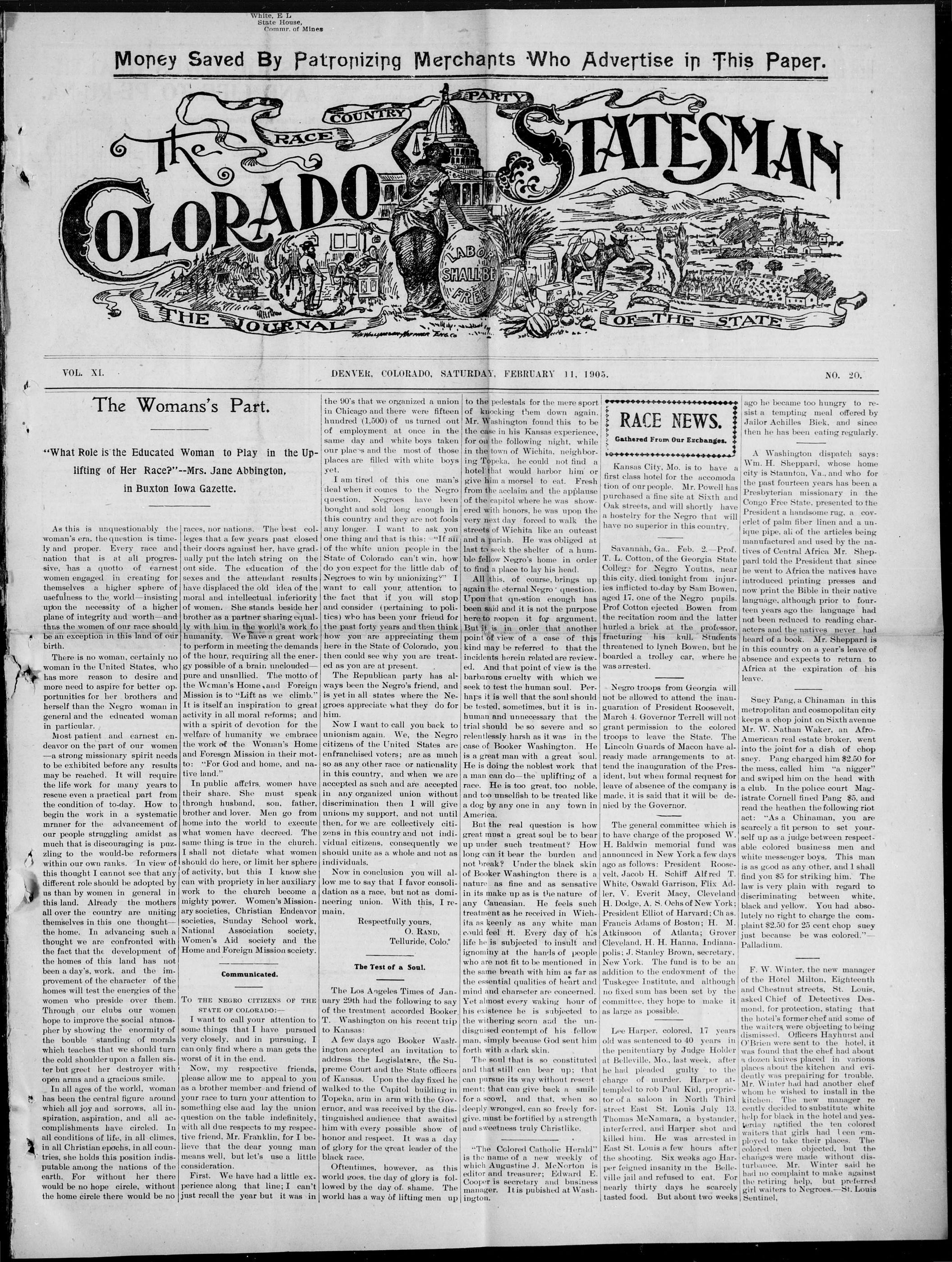
Colorado Statesman
Saturday, February 11, 1905
Denver, Colorado
Page text (machine-generated)
Money Saved By Patronizing Merchants Who Advertise in This Paper.
THE COUNTRY PARTY
RACE
COLORADO STATESMAN
LABOR SHALL BE FREE
THE JOURNAL
OF THE STATE
The Wom
"What Role is the Educated lifting of Her Race?" in Buxton I
The Womans's Part.
"What Role is the Educated Woman to Play in the Uplifting of Her Race?"--Mrs. Jane Abbington, in Buxton Iowa Gazette.
As this is unquestionably the woman's era, the question is timely and proper. Every race and nation that is at all progressive, has a quotto of earnest women engaged in creating for themselves a higher sphere of usefulness to the world—insisting upon the necessity of a higher plane of integrity and worth—and thus the women of our race should be an exception in this land of our birth.
There is no woman, certainly no woman in the United States, who has more reason to desire and more need to aspire for better opportunities for her brothers and herself than the Negro woman in general and the educated woman in particular.
Most patient and earnest endeavor on the part of our women—a strong missionary spirit needs to be exhibited before any results may be reached. It will require the life work for many years to rescue even a practical part from the condition of to-day. How to begin the work in a systematic mrnner for the advancement of our people struggling amidst as much that is discouraging is puzzling to the would-be reformers within our own ranks. In view of this thought I cannot see that any different role should be adopted by us than by women in general in this land. Already the mothers all over the country are uniting themselves in this one thought—the home. In advancing such a thought we are confronted with the fact that the development of the homes of this land has not been a day's, work, and the improvement of the character of the homes will test the energies of the women who preside over them. Through our clubs our women hope to improve the social atmosphere by showing the enormity of the double standing of morals which teaches that we should turn the cold shoulder upon a fallen sister but greet her destroyer with open arms and a gracious smile.
In all ages of the world, woman has been the central figure around which all joy and sorrows, all inspiration, aspiration, and all accomplishments have circled. In all conditions of life, in all climes, in all Christian epochs, in all countries, she holds this position indisputable among the nations of the earth. For without her there would be no hope circle, without the home circle there would be no
VOL. X1.
Saved By Pat
RACI
ORAD
THE JOURNAL
mans's Part.
Woman to Play in the Up-
--Mrs. Jane Abbington,
owa Gazette.
races, nor nations. The best colleges that a few years past closed their doors against her, have gradually put the latch string on the out side. The education of the sexes and the attendant results have displaced the old idea of the moral and intellectual inferiority of women. She stands beside her brother as a partner sharing equally with him in the world's work for humanity. We have a great work to perform in meeting the demands of the hour, requiring all the energy possible of a brain unclouded—pure and unsullied. The motto of the Woman's Home, and Foreign Mission is to "Lift as we climb." It is itself an inspiration to great activity in all moral reforms; and with a spirit of devotion for the welfare of humanity we embrace the work of the Woman's Home and Foresign Mission in their motto: "For God and home, and native land."
In public affairs, women have their share. She must speak through husband, son, father, brother and lover. Men go from home into the world to execute what women have decreed. The same thing is true in the church. I shall not dictate what women should do here, or limit her sphere of activity, but this I know she can with propriety in her auxiliary work to the church become a mighty power. Women's Missionary societies, Christian Endeavor societies, Sunday School work, National Association society, Women's Aid society and the Home and Foreign Mission society.
Communicated.
TO THE NEGRO CITIZENS OF THE
STATE OF COLORAD:—
I want to call your attention to some things that I have pursued very closely, and in pursuing, I can only find where a man gets the worst of it in the end.
Now, my respective friends, please allow me to appeal to you as a brother member and friend of your race to turn your attention to something else and lay the union question on the table indefinitely, with all due respects to my respective friend, Mr. Franklin, for I believe that the dear young man means well, but let's use a little consideration.
First. We have had a little experience along that line; I can't just recall the year but it was in
White, E L
State House,
Commr. of Mines
the 90's that we organized a union in Chicago and there were fifteen hundred (1,500) of us turned out of employment at once in the same day and white boys taken our places and the most of those places are filled with white boys vet.
I am tired of this one man's deal when it comes to the Negro question. Negroes have been bought and sold long enough in this country and they are not fools any longer. I want to ask you one thing and that is this: "If all of the white union people in the State of Colorado can't win, how do you expect for the little dab of Negroes to win by unionizing?" I want to call your attention to the fact that if you will stop and consider (pertaining to politics) who has been your friend for the past forty years and then think how you are appreciating them here in the State of Colorado, you then could see why you are treated as you are at present.
The Republican party has always been the Negro's friend, and is yet in all states where the Negroes appreciate what they do for him.
Now I want to call you back to unionism again. We, the Negro citizens of the United States are enfranchised voters; are as much so as any other race or nationality in this country, and when we are accepted as such and are accepted in any organized union without discrimination then I will give unions my support, and not until then, for we are collectively citizens in this country and not individual citizens, consequently we should unite as a whole and not as individuals.
Now in conclusion you will allow me to say that I favor consolidation as a race, but not as domineering union. With this, I remain.
Respectfully yours.
O. RAND,
Telluride, Colo.*
The Test of a Soul.
The Los Angeles Times of January 29th had the following to say of the treatment accorded Booker T. Washington on his recent trip to Kansas:
A few days ago Booker Washington accepted an invitation to address the Legislature, the Supreme Court and the State officers of Kansas. Upon the day fixed he walked to the Capitol building in Topeka, arm in arm with the Governor, and was received by the distinguished audience that awaited him with every possible show of honor and respect. It was a day of glory for the great leader of the black race.
Oftentimes, however, as this world goes, the day of glory is followed by the day of shame. The world has a way of lifting men up
to the pedestals for the mere sport of knocking them down again. Mr. Washington found this to be the case in his Kansas experience, for on the following night, while in the town of Wichita, neighboring Topeka, he could not find a hotel that would harbor him or give him a morsel to eat. Fresh from the acclaim and the applause of the capitol where he was showered with honors, he was upon the very next day forced to walk the streets of Wichita like an outcast and a pariah. He was obliged at last to seek the shelter of a humble fellow Negro's home in order to find a place to lay his head.
All this, of course, brings up again the eternal Negro question. Upon that question enough has been said and it is not the purpose here to reopen it for argument. But it is in order that another point of view of a case of this kind may be referred to that the incidents herein related are reviewed. And that point of view is the barbarous cruelty with which we seek to test the human soul. Perhaps it is well that the soul should be tested, sometimes, but it is inhuman and unnecessary that the trial should be so severe and so relentlessly harsh as it was in the case of Booker Washington. He is a great man with a great soul. He is doing the noblest work that a man can do—the uplifting of a race. He is too great, too noble, and too unselfish to be treated like a dog by any one in any town in America.
But the real question is how great must a great soul be to bear up under such treatment? How long can it bear the burden and not break? Under the black skin of Booker Washington there is a nature as fine and as sensitive in its make up as is the nature of any Caucasian. He feels such treatment as he received in Wichita as keenly as any white man could feel it. Every day of his life he is subjected to insult and ignominy at the hands of people who are not fit to be mentioned in the same breath with him as far as the essential qualities of heart and mind and character are concerned. Yet almost every waking hour of his existence he is subjected to the withering scorn and the undisguised contempt of his fellow man, simply because God sent him forth with a dark skin.
The soul that is so constituted and that still can bear up; that can pursue its way without resentment; that can give back a smile for a scowl, and that, when so deeply wronged, can so freely forgive, must be fortified by a strength and sweetness truly Christlike.
"The Colored Catholic Herald" is the name of a new weekly of which Augustine J. McNorton is editor and treasurer; Edward E. Cooper is secretary and business manager. It is published at Washington.
Kansas City, Mo. is to have a first class hotel for the accomodation of our people. Mr. Powell has purchased a fine site at Sixth and Oak streets, and will shortly have a hostelry for the Negro that will have no superior in this country.
Savannah, Ga., Feb. 2.—Prof. T. L. Cotton, of the Georgia State College for Negro Youtns, near this city, died tonight from injuries inflicted to-day by Sam Bowen, aged 17, one of the Negro pupils. Prof Cotton ejected Bowen from the recitation room and the latter hurled a brick at the professor, fracturing his kull. Students threatened to lynch Bowen, but he boarded a trolley car, where he was arrested.
Negro troops from Georgia will not be allowed to attend the inauguration of President Roosevelt, March 4. Governor Terrell will not grant permission to the colored troops to leave the State. The Lincoln Guards of Macon have already made arrangements to attend the inauguration of the President, but when formal request for leave of absence of the company is made, it is said that it will be denied by the Governor.
The general committee which is to have charge of the proposed W. H. Baldwin memorial fund was announced in New York a few days ago as follows: President Roosevelt, Jacob H. Schiff Alfred T. White, Oswald Garrison, Flix Adler, V. Everit Macy, Cleveland H. Dodge, A. S. Ochs of New York; President Elliot of Harvard; Ch as. Francis Adams of Boston; H. M. Atkinsoon of Atlanta; Grover Cleveland, H. H. Hanna, Indianapolis; J. Stanley Brown, secretary, New York. The fund is to be an addition to the endowment of the Tuskegee Institute, and although no fixed sum has been set by the committee, they hope to make it as large as possible.
Lee Harper, colored, 17 years old was sentenced to 40 years in the penitentiary by Judge Holder at Belleville, Mo., last week, after he had pleaded guilty to the charge of murder. Harper attempted to rob Paul Kid, proprietor of a saloon in North Third street East St. Louis July 13. Thomas McNamara, a bystander, interfered, and Harper shot and killed him. He was arrested in East St. Louis a few hours after the shooting. Six weeks ago Harper feigned insanity in the Belleville jail and refused to eat. For nearly thirty days he scarcely tasted food. But about two weeks
NO. 20.
ago he became too hungry to resist a tempting meal offered by Jailor Achilles Biek, and since then he has been eating regularly.
A Washington dispatch says: Wm. H. Sheppard, whose home city is Staunton, Va., and who for the past fourteen years has been a Presbyterian missionary in the Congo Free State, presented to the President a handsome rug, a coverlet of palm fiber linen and a unique pipe, all of the articles being manufactured and used by the natives of Central Africa Mr. Sheppard told the President that since he went to Africa the natives have introduced printing presses and now print the Bible in their native language, although prior to fourteen years ago the language had not been reduced to reading characters and the natives never had heard of a book. Mr. Sheppard is in this country on a year's leave of absence and expects to return to Africa at the expiration of his leave.
Suey Pang, a Chinaman in this metropolitan and cosmopolitan city keeps a chop joint on Sixth avenue Mr. W. Nathan Waker, an Afro-American real estate broker, went into the joint for a dish of chop suey. Pang charged him $2.50 for the mess, called him "a nigger" and swiped him on the head with a club. In the police court Magistrate Cornell fined Pang $5, and read the heathen the following riot act: "As a Chinaman, you are scarcely a fit person to set yourself up as a judge between respectable colored business men and white messenger boys. This man is as good as any other, and 1 shall find you $5 for striking him. The law is very plain with regard to discriminating between white, black and yellow. You had absolutely no right to charge the complaint $2.50 for 25 cent chop suey just because he was colored."—Palladium.
F. W. Winter, the new manager of the Hotel Milton, Eighteenth and Chestnut streets, St. Louis, asked Chief of Detectives Desmond, for protection, stating that the hotel's former chef and some of the waiters were objecting to being dismissed. Officers Hayhurst and O'Brien were sent to the hotel, it was found that the chef had about a dozen knives placed in various places about the kitchen and evidently was preparing for trouble. Mr. Winter had had another chef whom he wished to install in the kitchen. The new manager recently decided to substitute white help for black in the hotel and yesterday notified the ten colored waiters that girls had been employed to take their places. The colored men objected, but the changes were made without disturbance. Mr. Winter said he had no complaint to make against the retiring help, but preferred girl waiters to Negroes.—St. Louis Sentinel,
HER BLOOD TOO THIN
GENERAL DEBILITY RESULTS FROM IMPOVERISHED BLOOD.
The Remedy That Makes New Blood Banishes Weakness, Headaches, Indigestion and Nervous Troubles.
Hundreds of women suffer from headaches, dizziness, restlessness, languor and timidity. Few realize that their misery all comes from the bad state of their blood. They take one thing for their head, another for their stomach, a third for their nerves, and yet all the while it is simply their poor blood that is the cause of their discomfort.
If one sure remedy for making good, rich blood were used every one of their distressing ailments would disappear, as they did in the case of Mrs. Ella F. Stone, who had been ailing for years and was completely run down before she realized the nature of her trouble.
"For several years," said Mrs. Stone, "I suffered from general debility. It began about 1896 with indigestion, nervousness and steady headaches. Up to 1900 I hadn't been able to find any relief from this condition. I was then very thin and bloodless. An enthusiastic friend, who had used Dr. Williams' Pink Pills, urged me to give them a trial and I finally bought a box.
"I did not notice any marked change from the use of the first box, but I determined to give them a fair trial and I kept on. When I had finished the second box I could see very decided signs of improvement in my condition. I began to feel better all over and to have hopes of a complete cure.
"I used in all eight or ten boxes, and when I stopped I had got back my regular weight and a good healthy color and the gain has lasted. I can eat what I please without discomfort. My nervousness is entirely gone, and, while I had constant headaches before, I very rarely have one now. I cheerfully recommend Dr. Williams' Pink Pills to women who suffer as I did."
Mrs. Stone was seen at her pretty home in Lakewood, R. I., where, as the result of her experience, Dr. Williams' Pink Pills are very popular. These famous pills are sold by all druggists. A book that every woman needs is published by the Dr. Williams Medicine Company, Schenectady, N. Y. It is entitled "Plain Talks to Women," and will be sent free on request.
When a young man embraces a girl he shows his love for her in a round-about way.
TEA
We choose to sell tea; and it goes from Alaska to Mexico.
It's the tea!
Your grocer returns your money if you don't like Schilling's Best.
The right man in the right place often adds to the number of the sheriff's boarders.
Mother Gray's Sweet Powders for Children.
Successfully used by Mother Gray, nurse in the Children's Home in New York, cure Constipation, Feverishness, Bad Stomach, Teething Disorders, move and regulate the Bowels and Destroy Worms. Over 30,000 testimonials. At all Druggists, 25c. Sample FREE. Address A.S. Olmsted, LeRoy, N.Y.
A man who lets his wife get up of a cold morning and light the fire will never set the world ablaze.
TO CURE A COLD IN ONE DAY
Take Laxative Bromo Quinine Tablets. All drugs refuse the refund if it fails to cure. E. W. Grove's signature is on each box. 25c.
A woman may believe only half what she hears, but she always hears twice as much as a man.
$36.00 per M. Lewis' 'Single Binder,' straight 5c cigar, costs the dealer some more than other 5c cigars, but the higher price enables the factory to use higher grade tobacco. Lewis Factory, Peoria, Ill.
The accident of birth carries no insurance with it.
$100 Reward, $100.
The readers of this paper will be pleased to learn that there is at least one drended disease that aக்குa has been able to cure in all its stages, and that is Catarrh. Hall's Catarrh Cure is the only positive cure now known to the medical fraternity. Catarrh being a constitutional disease, requires a constitutionally, acting directly upon the blood and mucous surfaces of the system, thereby destroying the foundation of the disease, and giving the patient strength by building up the constitution and assisting nature in doing its work. The proprietors have so much faith in its curative powers that they offer One Hundred Dollars for any case that it fails to cure. Send for list of testimonials. Address F. J. CHENEY & CO., Toledo, O.
Hold by all Druggists, 75c.
Take Hall's Family Pills for constipation.
The boy who turns out to be as smart as his mother predicts is truly a wonder.
TEA
Moneyback means that the tea is good and well worth the money.
Can't mean anything else.
Your grocer returns your money if you don't like Schilling's best.
"I see they are making watches now that are only an eighth of an inch thick." "A watch as thin as that must look awfully run down."
The Great Nor
ST.
JACOBS
OIL
DANGER OF COLD
SOLICITUDE FELT FOR MILITIA
Congressman Fears They Will Suffer If Quartered in Tents—But the Washington Post Thinks Tents Pretty Good for Soldiers.
"A military member of the inauguration committee" has been quoted as saying that the weather in early March next will be "too cold to allow the quartering of the troops in tents." Herein the gentleman refers to the quartering of such militia as may come to Washington for the purpose of participating in the inauguration of President Roosevelt. It is a proposition which will interest survivors of the Civil War.
During the midwinter campaigns of the early '60s, in the Ozarks, the Appalachian ranges, among the snows and storms of Virginia, Kentucky, Tennessee, North Carolina, Alabama, Arkansas and Mississippi, the soldier who had a tent, thought himself especially fortunate. Although he had to pitch it in a blizzard, and to dig through frozen crusts for the material of his camp fire, the right to use a tent for purposes of sleep appealed to him as the accomplished dream of happiness. Now, however, we are told that here in Washington, after every leisurely preparation, with all conceivable equipment of comfort and security, a tent will be "too cold" for the reserve soldiery of the United States—and in March at that!
It may be so. But in that case, either the tents of to-day are miserable travesties on the tents of forty years ago or the soldiers of 1905 are infinitely more deserving of solicitude than were their grandfathers, who fought and bled and shivered and starved on every storm-swept mountain side within the sphere of war. Just how this is, we do not undertake to say. Indeed, we fear the worst.—Washington Post.
THERE IS JUST ONE SURE WAY.
Dodd's Kidney Pills build up Run-down People. They make healthy Kidneys and that means healthy people. What Mr. and Mrs. J. L. Duffey say:
Nora, Ind., Feb. 6th.—(Spectai)—That the sure way of building up run-down men and women is to put their kidneys in good working order is shown by the experience of Mr. and Mrs. Joseph L. Duffey of this place. Both were weak and worn and disspirited. They used Dodd's Kidney Pills and to-day both enjoy the best of health.
Mr. Duffey says: "I was very weak and almost going. I tried everything which people said was good but got no benefit till I tried Dodd's Kidney Pills. They helped me in every way and I am strong and well now."
Mrs. Duffey says: "I was no bad that if anybody would lay down a string I felt I could not step over it. Since taking Dodd's Kidney Pills I can run and jump fences." Healthy kidneys insure pure blood; Dodd's Kidney Pills insure healthy kidneys.
The Russian Peasant.
The Rev. Dr. George Washburn, who lived in Constantinople for forty-six years and has just retired from the presidency of Roberts College, had traveled much in Russia and made a close study of the Russian peasant. To the casual observer the moujik is uncouth and uninteresting, but he is, in Dr. Washburn's opinion, the most interesting peasant in all Europe. In religion he is an idealist. He has little knowledge of the scriptures, although the Russian government favors their circulation, but when he studies the Bible, the teaching of the brotherhood of man is that which most appeals to him. In many instances this ideal teaching has been followed to what would in this country be considered absurd lengths.
The peasants believe most thoroughly in their religion, and carry that belief to the extreme that they consider the Russian orthodox church the only true Christian faith. It is argued by them that the Christian religion was first given to the Latin races, but those races failed to extend it throughout the world. Then the Germanic races received the mission, but they, too, in Russian opinion, have failed. Now, it is held, the time is ripe for the Slavonic races to take up the work and the true Slav confidently expects that in order to carry out the mission, it will be his duty to conquer all Europe.
Mistress—Mary, these banisters always seem dusty. I was at Mrs. Johnson's today and hers are as bright and smooth as glass. Mary—She has three small boys, mum.
TEA
Get ½-lb. Schilling's Best,
and follow directions.
In every package of Schilling's Best Tea is a
bottlet: How to Make Good Tea.
The shorter a man is of brains the
longer he is on collars.
"Dr. David Kennedy's Favorite Remedy
saved my life! I had dyspepsia and kidney disease."
Ex beinator Albert Merritt, Park Place, N. Y. #a bottle.
Straws and whiskers show which
way the wind blows.
The old monk cure, strong, straight, sure, has for a large part of a century battled with and conquered
Aches and Pains
the world over. Price 25c.
and 50c.
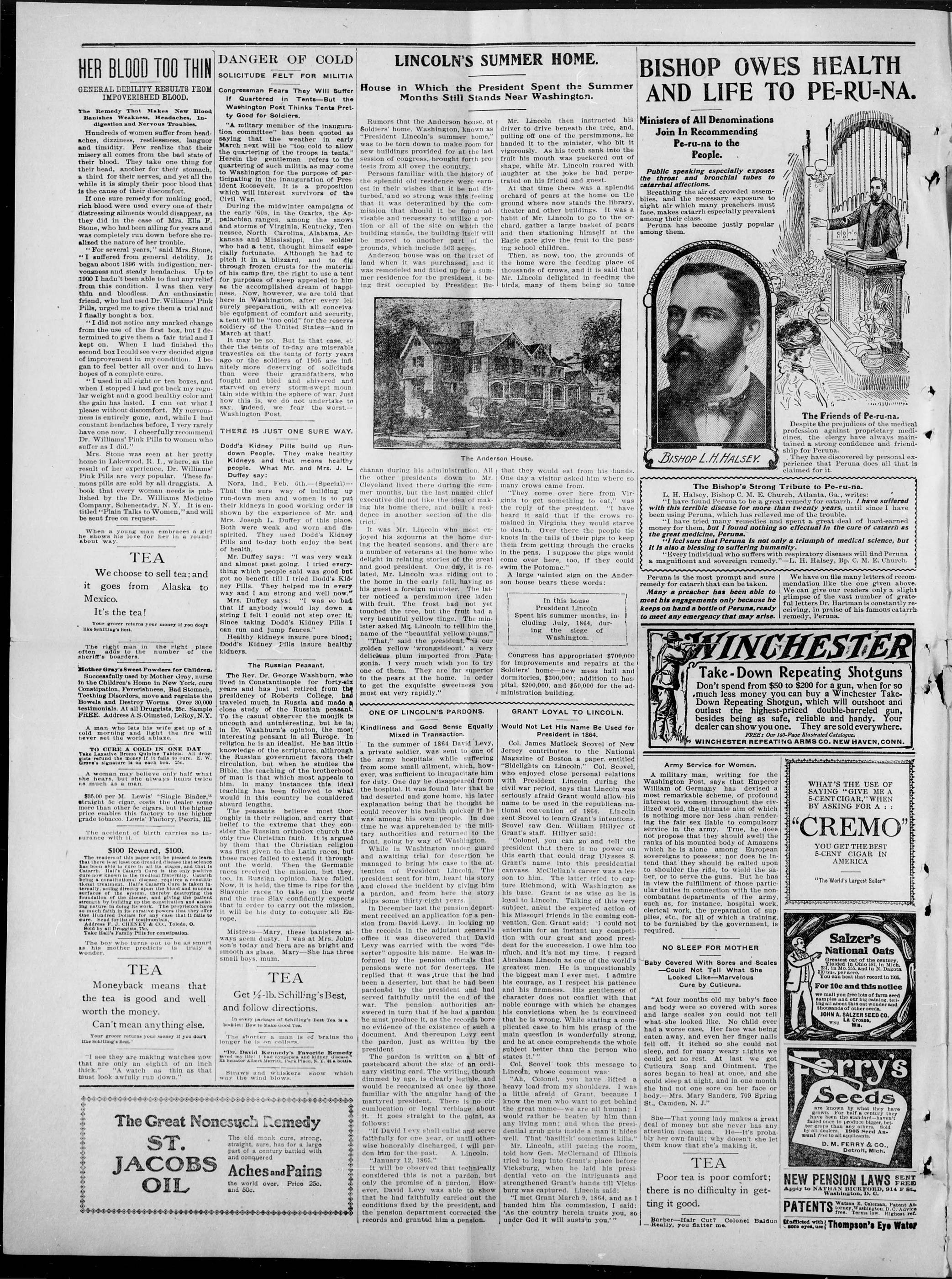
LINCOLN'S SUMMER HOME.
Rumors that the Anderson house, at Soldiers' home, Washington, known as "President Lincoln's summer home," was to be torn down to make room for new buildings provided for at the last session of congress, brought forth protests from all over the country. Persons familiar with the history of the splendid old residence were earnest in their wishes that it be not disturbed, and so strong was this feeling that it was determined by the commission that should it be found advisable and necessary to utilize a portion or all of the site on which the building stands, the building itself will be moved to another part of the grounds, which include 503 acres. Anderson house was on the tract of land when it was purchased, and it was remodeled and fitted up for a summer residence for the president, it being first occupied by President Bu
The Ander
The Anderson House.
chanan during his administration. All the other presidents down to Mr. Cleveland lived there during the summer months, but the last named chief executive did not like the idea of making his home there, and built a residence in another section of the district.
It was Mr. Lincoln who most enjoyed his sojourns at the home during the heated seasons, and there are a number of veterans at the home who delight in relating stories of the great and good president. One day, it is related, Mr. Lincoln was riding out to the home in the early fall, having as his guest a foreign minister. The latter noticed a persimmon tree laden with fruit. The frost had not yet touched the tree, but the fruit had a very beautiful yellow tinge. The minister asked Mr. Lincoln to tell him the name of the "beautiful yellow plums."
"That," said the president, "is our golden yellow 'wrongsideout,' a very delicious plum imported from Patagonia. I very much wish you to try one of them. They are far superior to the pears at the home. In order to get the exquisite sweetness you must eat very rapidly."
Kindliness and Good Sense Equally Mixed in Transaction.
In the summer of 1864 David Levy, a private soldier, was sent to one of the army hospitals while suffering from some small ailment, which, however, was sufficient to incapacitate him for duty. One day he disappeared from the hospital. It was found later that he had deserted and gone home, his later explanation being that he thought he could recover his health quicker if he was among his own people. In due time he was apprehended by the military authorities and returned to the front, going by way of Washington. While in Washington under guard and awaiting trial for desertion he managed to bring his case to the attention of President Lincoln. The president sent for him, heard his story and closed the incident by giving him a pardon, and from here the story skims some thirty-eight years.
In December last the pension department received an application for a pension from David Levy. In looking up the records in the adjutant general's office it was discovered that David Levy was carried with the word "deserter" opposite his name. He was informed by the pension officials that pensions were not for deserters. He replied that it was,true that he had been a deserter, but that he had been pardoned by the president and had served faithfully until the end of the war. The pension authorities answered in turn that if he had a pardon he must produce it, as the records bore no evidence of the existence of such a document. And thereupon Levy sent the pardon, just as written by the president
The pardon is written on a bit of pasteboard about the size of an ordinary visiting card. The writing, though dimmed by age, is clearly legible, and would be recognized at once by those familiar with the angular hand of the martyred president. There is no circumcution or legal verbiage about it. It goes straight to the point, as follows:
"If David I evy shall enlist and serve faithfully for one year, or until otherwise honorably discharged, I will pardon him for the past. A. Lincoln.
"January 12, 1865."
It will be observed that technically considered this is not a pardon, but only the promise of a pardon. However, David Levy was able to show that he had faithfully carried out the conditions fixed by the president, and the pension department corrected the records and granted him a pension.
---
Mr. Lincoln then instructed his driver to drive beneath the tree, and, pulling off one of the persimmons, he handed it to the minister, who bit it vigorously. As his teeth sank into the fruit his mouth was puckered out of shape, while Mr. Lincoln roared with laughter at the joke he had perpetrated on his friend and guest.
At that time there was a splendid orchard of pears at the home on the ground where now stands the library, theater and other buildings. It was a habit of Mr. Lincoln to go to the orchard, gather a large basket of pears and then stationing himself at the Eagle gate give the fruit to the passing school children.
Then, as now, too, the grounds of the home were the feeding place of thousands of crows, and it is said that Mr. Lincoln delighted in feeding the birds, many of them being so tame
son House.
that they would eat from his hands. One day a visitor asked him where so many crows came from.
"They come over here from Virginia to get something to eat," was the reply of the president. "I have heard it said that if the crows remained in Virginia they would starve to death. Over there the people tie knots in the tails of their pigs to keep them from getting through the cracks in the pens. I suppose the pigs would come over here, too, if they could swim the Potomac."
A large painted sign on the Anderson house bears these words:
In this house
President Lincoln
Spent his summer months, including July, 1864, during the siege of Washington.
Congress has appropriated $700,000 for improvements and repairs at the Soldiers' home—new mess hall and dormitories, $300,000; addition to hospital, $200,000, and $50,000 for the administration building.
Would Not Let His Name Be Used for President in 1864.
Col. James Matlock Scovel of New Jersey contributes to the National Magazine of Boston a paper, entitled "Sidelights on Lincoln." Col. Scovel, who enjoyed close personal relations with President Lincoln during the civil war period, says that Lincoln was seriously afraid Grant would allow his name to be used in the republican national convention of 1864. Lincoln sent Scovel to learn Grant's intentions. Scovel saw Gen. William Hillyer of Grant's staff. Hillyer said:
"Colonel, you can go and tell the president that there is no power on this earth that could drag Ulysses S. Grant's name into this presidential canvass. McClellan's career was a lesson to him. The latter tried to capture Richmond, with Washington as his base. Grant is as wise as he is loyal to Lincoln. Talking of this very subject, anent the expected action of his Missouri friends in the coming convention, Gen. Grant said: 'I could not entertain for an instant any competition with our great and good president for the succession. I owe him too much, and it's not my time. I regard Abraham Lincoln as one of the world's greatest men. He is unquestionably the biggest man I ever met. I admire his courage, as I respect his patience and his firmness. His gentleness of character does not conflict with that noble courage with which he changes his convictions when he is convinced that he is wrong. While stating a complicated case to him his grasp of the main question is wonderfully strong, and he at once comprehends the whole subject better than the person who states it.'"
Col. Scovel took this message to Lincoln, whose comment was:
"Ah, Colonel, you have lifted a heavy load from my shoulders. I was a little afraid of Grant, because I know the men who want to get behind the great name—we are all human; I would rather be beaten by him than any living man; and when the presidential grub gets inside a man it hides well. That 'basilisk' sometimes kills." Mr. Lincoln, still pacing the room, told how Gen. McClernand of Illinois tried to leap into Grant's place before Vicksburg, when he laid his presidential veto on the intriguants and strengthened Grant's hands till Vicksburg was captured. Lincoln said:
"I met Grant March 9, 1864, and as I handed him his commission, I said: 'As the country herein trusts you, so under God it will sustain you.'"
---
Spent the Summer Washington.
BISHOP OWES HEALTH AND LIFE TO PE=RU=NA.
"I have found Peruna to be a great remedy for catarrh. I have suffered with this terrible disease for more than twenty years, until since I have been using Peruna, which has relieved me of the trouble.
"I have tried many remedies and spent a great deal of hard-earned money for them, but I found nothing so effectual in the cure of catarrh as the great medicine, Peruna.
"I feel sure that Peruna is not only a triumph of medical science, but it is also a blessing to suffering humanity."
"Every individual who suffers with respiratory diseases will find Peruna a magnificent and sovereign remedy."—L. H. Halsey, Bp. C. M. E. Church.
WINCHESTER
Take-Down Repeating Shotguns
Don't spend from $50 to $200 for a gun, when for so much less money you can buy a Winchester Take-Down Repeating Shotgun, which will outshoot and outlast the highest-priced double-barreled gun, besides being as safe, reliable and handy. Your dealer can show you one. They are sold everywhere.
FREE: Our 160-Page Illustrated Catalogue.
WINCHESTER REPEATING ARMS CO. NEW HAVEN, CONN.
Ministers of All Denominations Join In Recommending Pe-ru-na to the People.
Public speaking especially exposes the throat and bronchial tubes to catarrhal affections. Breathing the air of crowded assemblies, and the necessary exposure to night air which many preachers must face, makes catarrh especially prevalent among their class. Peruna has become justly popular among them.
BISHOP L.H.HALSEY.
The Bishop's Strong
L. H. Halsey, Bishop C. M. E. Chu
"I have found Peruna to be a great
with this terrible disease for more tha
been using Peruna, which has relieved
"I have tried many remedies and
money for them, but I found nothing
of the great medicine, Peruna.
"I feel sure that Peruna is not on
it is also a blessing to suffering huma
"Every individual who suffers with
a magnificent and sovereign remedy."
Peruna is the most prompt and sure
remedy for catarrh that can be taken.
Many a preacher has been able to
meet his engagements only because he
keeps on hand a bottle of Peruna, ready
to meet any emergency that may arise.
WINC
Take-Down
Don't spend from $50
much less money you
Down Repeating Sho
outlast the highest
besides being as sa
dealer can show you o
FREE: Our M
WINCHESTER REPEATI
Army Service for Women.
A military man, writing for the Washington Post, says that Emperor William of Germany has devised a most remarkable scheme, of profound interest to women throughout the civilized world, the ultimate aim of which is nothing more nor less than rendering the fair sex liable to compulsory service in the army. True, he does not propose that they should swell the ranks of his mounted body of Amazons which he is alone among European sovereigns to possess; nor does he intend that they should be called upon to shoulder the rifle, to wield the saber, or to serve the guns. But he has in view the fulfillment of those particular duties in connection with the noncombatant departments of the army, such as, for instance, hospital work, clerical work, the preparation of supplies, etc., for all of which a training, to be furnished by the government, is required.
NO SLEEP FOR MOTHER
Baby Covered With Sores and Scales
—Could Not Tell What She
Looked Like—Marvelous
Cure by Cuticura.
"At four months old my baby's face and body were so covered with sores and large scales you could not tell what she looked like. No child ever had a worse case. Her face was being eaten away, and even her finger nails fell off. It itched so she could not sleep, and for many weary lights we could get no rest. At last we got Cuticura Soap and Ointment. The sores began to heal at once, and she could sleep at night, and in one month she had not one sore on her face or body.—Mrs. Mary Sanders, 709 Spring St., Camden, N. J."
She—That young lady makes a great deal of money but she never has any attention from men. He—it's probably her own fault; why doesn't she let them know that she's making it.
TEA
Poor tea is poor comfort; there is no difficulty in getting it good.
Barber—Hair Cut? Colonel Baldun—Really, you flatter me.
...
The Friends of Pe-ru-na.
Despite the prejudices of the medical profession against proprietary medicines, the clergy have always maintained a strong confidence and friendship for Peruna.
They have discovered by personal experience that Peruna does all that is claimed for it.
Tribute to Pe-ru-na.
church, Atlanta, Ga., writes:
cat remedy for catarrh. I have suffered than twenty years, until since I have met me of the trouble.
and spent a great deal of hard-earned so effectual in the cure of catarrh as only a triumph of medical science, but sanity.
with respiratory diseases will find Peruna.
"—L. H. Halsey, Bp. C. M. E. Church.
We have on file many letters of recommendation like the one given above. We can give our readers only a slight glimpse of the vast number of grateful letters Dr. Hartman is constantly receiving, in praise of his famous catarrh remedy, Peruna.
HESTER
Repeating Shotguns
50 to $200 for a gun, when for so you can buy a Winchester Take-
hotgun, which will outshoot and
st-priced double-barreled gun,
safe, reliable and handy. Your
one. They are sold everywhere.
160-Page Illustrated Catalogue.
TING ARMS CO. NEW HAVEN, CONN.
WHAT'S THE USE OF
SAYING "GIVE ME A
5-CENT CIGAR," WHEN
BY ASKING FOR A : :
"CREMO"
YOU GET THE BEST
5-CENT CIGAR IN
AMERICA
"The World's Largest Seller"
Salzer's National Oats
Greatest oat of the century.
Yielded in Ohio 187, In Mich.
Zeal, than o. 355, and in N. Dakota
310 bus., per acre.
You can beat that record in 1905.
For 10c and this notice
we mall you free lots of farm seed
samples and our big catalog, tell-
ing all about hay, oatswonder
and thousands of other seeds.
JOHN A. SALZER SEED CO.
La Crosse,
Wis.
Ferry's Seeds
are known by what they have
grown. For half a century they
have been the standard—haven't
failed once to produce bigger, better
crop than any other sold
by all dealers. 1905 Seed An-
nual free to all applicants.
D. M. FERRY & CO.
Detroit, Mich.
NEW PENSION LAWS SENT FREED
Apply to NATHAN BICKFORD, 914 F St.
Washington, D. C.
PATENTS
Watson E. Coleman, Patent At-
torney, Washington, D. C. Advice
free. Terms low. Highest ref.
Afflicted with
effects eyes, use
Thompson's Eye Water
---
Established 1880. Successor to A. Ward
DR. C. ARMBRUSTER,
Practical and Scientific Optician.
913 17th St., Denver, Colo.
Eyes tested free. Manufacturing and
repairing of all Opera goods. Opera,
Race and field Glasses, Telescopes, Microscopes, Miners Glasses, Compasses,
Thermometers, Hydrometers, Etc.
Dental work is so perfect that it can't be improved on by any dentist at any price. See Dr. Dawson's special inducements this month-$5 set of teeth; $15 for the best set of teeth; $20 tooth for gold crown and bridge work; $50 for silver fillings; gold $1 up; airt and gas used; no pain; 50c to remove tartar; opens teeth; Sundays. ALBANY DENTAL PARLOR. Union block. Arapaea st. oppoite P.
W. J. ADDIE
Choice old California wines and brandies from the Hermitage Vineyard, also bottled beer, Kentucky whisky, cigars and tobacco. 228 16th street. Telephone 2677.
The Minnehaha.
LOUIS PELOW, Proprietor.
Liquors and Cigars. Pabst
Beer on Draught.
Cor. 18th & Curtis Sts. Denver, Colo.
BANKRUPT STOCK
BANKRUPT STOCK
```markdown
```
BY
THE
Welton Trunk Mf'g. C.
2240 Welton Street.
Phone Olive 1456.
Until Entire Stock is Disposed of. Old Trunks taken in exchange.
Dennis Gibbons
Coor's
Celebrated
Golden Beer
On Draught .
441 W. Colfax Av. Denver, Colo.
Complete Violin Outfits for Beginners.
Violin
Size, Size and Full Size, $5.00, $6.00 and $7.00 each.
A full line of Violins, Violas 'Cellos, Double Basses, Guilars, Mandolins, etc., etc.
Musical merchandise of every description
L. RUSCHENBERG & CO.
820 16th St, Denver, Colo.
Suite 200, 202, Upstairs.
O.K. Barber Shop
O.K. Barber Shop
UP-TO DATE BARBERS.
BATHS, PLAIN AND VAPOR
All kinds of Tonics. Large stock
of Cigars and Tobacco. Laundry received and returned at
this No.
J. A. WHITTAKER, JOE SCHAVO.
E. D. Fountain, Proprietor
Battle Creek Sanitarium.
Battle Creek! What memories that name conjures up—memories of other days—even the pioneer days, when the redmen of the northern lake region bent the bow and smeared their faces with keal—braided their flowing locks with feathers of the porcupine and wild eagle, that they might appear more wild, if possible, than before. And as they painted the cheeks and braided the hair, the squaw-women sharpened the flint arrow heads and shaped new bows, that their lords might do battle to the death with other redmen.
And here at Battle Creek, way up in Michigan, a great battle one day did occur, and when it was over, and the sun kissed the range to the far west, the tom-toms were muffled and the squaw-women wrapped their heads in vart-colored blankets and wept, for with the going down of the sun, many braves passed to the proverbial happy hunting grounds.
But that was many, many moons ago, as the Indians measure time, and a new era has long since dawned. True, it is "Battle Creek" to-day, just as it was decades ago, but, instead of the cry of the savage, is heard the hum of industry; the throb of life; the greeting of men and women of the Anglo Saxon race—the shouts of happy boys and girls, who know of Battle Creek's former history only by tradition. And here on the site of the famous battle between the red-men stands now one of the fairest cities of the great Northwest; a city sought out among thousands, for in it dwell, month after month, as the years come and go, men and women who find within the charmed circle that which they have long sought elsewhere—health.
When one speaks of health, the mind naturally wings itself to Battle Creek, for up there health is to be found as at few other places on earth. Forty years ago there began in Battle Creek a return to nature movement, with purposes and principles in many respects similar to those which led to the famous "Brook Farm Experiment" twenty years before and to the Grahamite movement of that period. This movement, while religious, was avowedly non-sectarian, and was in a broad sense philanthropic, altruistic and reformatory. The immediate results were the establishment of a monthly journal now known as Good Health and shortly afterwards the erection of a health institution called "The Health Reform Institute." The chief features of the institute at this early period were diet reform, dress reform and the use of water as a curative agent.
In 1876 the present management took charge of the institution and with the consent and co-operation of the Board of Directors (the institution having been incorporated ten years before), a thorough reorganization was effected. Broader plans were introduced, the methods of treatment were placed upon a substantial and thoroughly scientific foundation, and the name was changed to the Battle Creek Sanitarium. Since this time the growth of the institution has been constant and rapid.
From year to year accommodations for patients and facilities for treatments were enlarged to meet the increasing patronage until February, 1902, when a great fire swept away the two principal buildings of the establishment. The erection of a new building was speedily begun, and the following year, May 31, 1903, the present fireproof main building, erected at a cost of more than $600,000, was dedicated. The cost of the entire establishment, including equipment, twenty dormitories, cottages and other buildings has amounted to more than $1,200,000.
The Battle Creek Sanitarium as it stands to-day is recognized the world over as the most complete and thoroughly equipped establishment of its sort and the headquarters for physiologic therapeutics or natural methods. Connected with the Sanitarium is a Training School for Nurses, in which from two to three hundred nurses are constantly under training. These principles and methods have penetrated to the remotest parts of the civilized world, and scores of men and women who have been trained in these methods are devoting their lives to medical missionary work in heathen lands.
The Battle Creek Sanitarium may be regarded as an epitome of the "return-to-nature" idea in practical operation. Its success in the restoration of sick people to health brings to it annually many thousands of men and women, many of whom have been pronounced incurable, but who, nevertheless, with rare exceptions, return a few months later to their homes prepared to enter again upon the battle of life.
There are many sanitariums in the world, but few, if any, that are conducted on the same plane as that at Battle Creek. This haven of rest and health is in no sense a money-making scheme, and every cent that is made from patients who are able to pay for their accommodations is used to help those who have nothing but broken health. All over this country, and even beyond the seas, branch institutions are springing up—creepers from the mother plant at Battle Creek. One point in view is down on State street, in the center of the metropolis of the Middle West, Chicago, where hundreds of the city's poor are cared for as tenderly as if in the parent institution at Battle Creek.
In a few brief paragraphs one can tell but little of the good work of the Battle Creek Sanitarium, but a postal card will bring pamphlets that will tell all—all except the knowledge obtained by actual experience, and that experience must be had at Battle
Creek to be appreciated to its full worth. This institution at Battle Creek was not built up in a day—it took years of toil to reach the perfected state, and the work has but begun—the great work is to come from rising generations who are imbibing ideas from the Battle Creek home, and what it stands for.
For Three Decades.
For more than three decades the present institution has been the center of a wonderful educational, philanthropic and reform movement which has finally culminated in success undreamed of a few years ago, and in this connection a brief history is most opportune. In February, 1902, the two main buildings of the Sanitarium were destroyed by fire. For a short time the days were dark for those who had worked so hard to build it up. But strong hearts are not to be awed by misfortune, and a new building sprung from the ashes upon the old site.
The dedication took place May 31, and June 1, 1903. An elaborate program was carried out and many men of national reputation made speeches and highly complimented the managers and their co-workers on their good work. Invitations were sent to all patients, rich and poor, who had ever been at the Sanitarium. Many responded in person, and hundreds sent letters of regret.
One of the prettiest sights in connection with the whole event was the procession of nurses and matrons which formed on the college grounds, opposite the new Sanitarium building, and marched through the audience to reserved seats at the right and left of the speakers' stand. The matrons in their usual cream white uniform, the nurses in blue and white, and the gentlemen nurses clad in new white-duck suits presented a sight which moved the audience to one simultaneous burst of applause.
Sanitary Ideas.
As before stated there are many sanitariums in the world, but none just like that at Battle Creek, it being the first of the kind, so far as known, where an attempt has been made, and crowned with success, to bring together in one place and under one management all rational healing agencies, giving special prominence to those physiological or natural healing agents the scientific knowledge of which has been chiefly developed within the last century, especially hypotherapy, electrotherapy, massage, exercise, diet, sunlight, mental and moral influences, rest, and general health culture.
Of course the first thing to be taken into consideration was the construction of the building to be occupied, for much depended upon that. But after it had been discussed pro and con a plan entirely satisfactory was adopted and the structure to-day plays no small part in the healing process that goes on from day to day at Battle Creek.
A Return to Nature Movement.
The philosophy of the Battle Creek Sanitarium may be defined as the return-to-nature idea. The doctors teach the use of natural foods, natural life, the use of natural agents in the treatment of disease. A great amount of attention is given to dietetics. Fruits, nuts and nut preparations, cereal foods and easily digestible vegetables are the basis for the delicious menus which are daily served in the great Sanitarium dining room, at which sit down hundreds of intelligent men and women from all parts of the United States and even from foreign countries. Milk, eggs and other dairy products are also freely used. Great care is taken to provide the very best and choicest of everything edible, of which the physicians approve.
During the year which has just closed a vast amount of these things were required to provide for the army of patients who visited the sanitarium, for several thousand sufferers housed there during the twelve months of 1904. As to the expense for the past year it was considerable, amounting to a total of $327,139.99, divided as follows: Nut foods, 50 tons, $26,768.80; cereal foods, 101,994 pounds, $9,521.19; bread, 65,026 pounds, $2,657.43; canned goods, 3,699 cases, $10,506.65; fruit juices, etc., made on the place, 11,430 gallons, $2,030.90; fresh fruit, 5,783 bushels, $10,203.46; vegetables, 5,137 bushels, $3,695.20; sundry grocery items, 41,558 pounds, $3,396.38; eggs, 25,201 dozen, $6,789.65; butter, made on the place, 29,961 pounds, $5,951.59; cream, 68,678 quarts, $10,323.70; milk, 57,366 quarts, $1,692.45; coal, 5,714 tons, $20,000.00; labor, $213,553.59; total, $327,189.99.
The amount of charity dispensed during the past ten years at this sanitarium amounted to $585,610. To care for the patients an average of 725 men and women were employed during each year, and an average of 550 patients are under treatment at this sanitarium every day in the year. We have given our readers only a brief glance at the workings of this unique establishment. Another article would be required to give something of the details of the daily routine of a guest at the Sanitarium, and of the methods which have given to this institution its world-wide reputation as a Mecca for sick folks.
Must Marry to Get Prize.
An artillery volunteer won recently at a shooting match at Blackpool, England, a prize consisting of a wedding ring, gratuitous marriage ceremony, a wedding equipage, a polished cradle, and a bassinet. But he must marry within twelve months to get the prize.
The Marquis of Linlithgow has been appointed secretary of Scotland in the place of Andrew Graham Murray.
The United States government did not take possession of the Santo Domingo custom house as was reported.
By a vote of 45 to 10 the California Assembly passed a bill receding the Yosemite valley to the federal government.
The New Mexico Legislature has passed a bill prohibiting roping contests. It was backed by most of the cattlemen.
A strong fight is being waged in Kansas by the Standard Oil Company against the proposed state refinery. Charges of bribery are freely made.
The Sultan of Zanzibar recently arrived in Paris. He refused to ride in a carriage, saying he preferred the ordinary omnibus conveyance to his hotel.
It is now expected that the famous Simpson tunnel under the Alps in Switzerland will be completed and opened for traffic on the 30th of April next.
There will be indoor trotting races at the annual horse fair to be held at the Madison Square Garden in New York City during the last week in April.
Twenty Porto Rico girls, who were brought over and employed by a St. Louis manufacturing company, have just departed for home. They get homesick.
A joint resolution indorsing President Roosevelt's stand on railroad legislation was unanimously adopted by the Illinois Senate after having passed the House.
On February 5th President Diaz formally opened the new hospital in the City of Mexico in the presence of a great and brilliant company, including many physicians.
The State Senate of Missouri, which is Democratic, adopted the resolution previously passed by the House indorsing President Roosevelt's stand on railroad legislation.
At Palm Beach, Florida, on the 4th inst. the Challenger lowered the world's motor boat record by running a mile in 2:05 4:5 against the wind and 2:04½ with the wind.
The insurrection in the province of Cordoba in Argentina appears to be suppressed. Vice President Alcorta and other prisoners held by the insurgents have been released.
Henry L. Wilson, for some time minister to Chill, is at his own request to be transferred and probably will be given a European mission. His successor has not been appointed.
John D. Rockefeller is to present the Young Men's Christian Association of Brooklyn with $100,000 if the association raises an additional sum of $200,000 before January 1, 1905.
For the first time in the memory of man, Vineyard Haven, the sheltered harbor of the island of Martha's Vineyard, on the Massachusetts coast, was completely frozen over on the 4th inst. The President has declined to grant the application for pardon filed in behalf of Diller B. and Samuel A. Groff, convicted of conspiracy to defraud the government in connection with the postoffice cases.
On the steamer Shinano Maru, which recently arrived at Victoria, B. C., from Yokohama, were three Japanese naval officers en route to London to superintend the construction of a 16,000-ton battleship being built in England.
The proposition to authorize the Interstate Commerce Commission to fix railroad rates was opposed by the report of the committee on internal trade and improvements made to the New York Chamber of Commerce, the report being adopted.
General Matsumara, according to the Tokio correspondent of the London Daily Telegraph, recently died at the front from congestion of the brain. He commanded the operations at 203-Meter hill, and was decorated and promoted for heroism.
The London Telegraph correspondent states that 140 of the persons arrested on January 22d started for Siberia on Monday. Others will follow. It is reported that 100,000 trans-Caucasian non-conformists intend to emigrate to California.
A corps of automobile owners has been organized for the German army, the members of which, with their machines, are liable to be-called out for war duty. They will wear an olive green uniform, not unlike that of United States army officers.
According to statistics gathered by a New York insurance Company, the sum of $10,000,000 was embezzled in the United States in 1904. New York state headed the list with embezzlements amounting to $1,851,585. California was next with a total of $1,058,825.
A great religious revival is in progress in London. It was opened on the 4th inst., by Reuben A. Torrey and Charles M. Alexander, the American evangelists, who addressed an audience that filled Royal Albert hall, the largest auditorium in the city, holding 11,000 people.
The wife of Maxim Gorky, the Russian author, has been permitted to visit him in the fortress of Sts. Peter and Paul. Gorky is suffering from a slight indisposition due to imprisonment. He is receiving every attention, a high officer having been specially detailed to look after him.
Following the complaint of Anthony Comstock of New York, concerning demoralizing French pictures being received in America through the French mails, the State Department at Washington is seeking the co-operation of the French government to prevent the mailing of objectionable photographs or pictures.
The Northern railroad of Costa Rica, an American corporation, will take possession of the Costa Rica Railway Company, an English corporation, on July 1, 1905, and both companies will be operated under one management. Minister Merry says this will tend to advance American interests, investments and commerce in Costa Rica.
DIRECTORY
Twenty-third street and Washington avenue. Rev. W. W. S. Dyett, pastor. Services at 11 a. m. and 7:30 p. m. Sunday school at 2:30 p. m. Mra. H. W. Wade, superintendent.
Arapahoe and Twentieth streets, Rev.
I. E. Forde, pastor. Services at
11 a. m. and 7:30 p. m.; Sunday School
at 2:30 p. m., J. A. Jones, Supt.
ROCKY MOUNTAIN LODGE, NO.
2320, G. U. O. OF F.
ARAPAHOE LODGE, NO. 2956, G. U.
D. OF O. F.
Meets every Monday in the month at
Odd Fellows' Hall, 1832 Arapahoe st.
GEO. D. HALL, P. S.
P. O. Box 895.
DISTRICT GRAND LODGE, NO. 33,
G. U. O. OF O. F.
Meets the first Tuesday in September,
1898, at Trinidad, Colorado.
M. V. P. GEORGE D, HALL,
District Grand Master.
M. V. P. GEO. S. CONTEE.
District Grand Secretary, 2612 Welton
Street Denver Colorado.
DENVER PATRIARCHY, NO. 67.
Meets the fourth Tuesday in each
month at Odd Fellows' Hall, 1832 Arapahoe street
A. F. & A. M., meets first and third Tuesday in each month. T. R. Herron, W. M. Wm. Sprague, Secretary, 2546 Clarkson street.
RED CROSS COMMANDERY NO. 11,
Knights Templar, meets first Thursday in each month. J. R. Contee, E. C. William Sprague, Recorder.
BALL AND CONCERT PROGRAMS, BILL AND LETTER HEADS, CALLING CARDS, WEDDING CARDS, ENVELOPES A. F. & A. fion. F. T. Denver; W. retary, Den FAR WEST Meets third William Spr DAN Meets first month. GE St. C. C.; coln, K. of Columbin meets second nights of e street. MR
A. F. & A. M., Colorado and Jurisdiction.
F. T. Bruce, Grand Master,
Denver; William Sprague, Grand Secretary,
Denver, Colorado.
FAR WEST CHAPTER NO. 6, R.A.M.
Meets third Thursday in each month,
William Sprague, secretary.
Meets at 1712 Curtis street the first and third Fridays of each month, GEO. A. LOGAN, 2044 Curtis St., C. C.; J. W. TAYLOR, 2222 Lincoln, K. of R. and S.
Columbine Court No. 279 I. O. O. C. meets second and fourth Tuesday nights of each month at 1712 Curtis street.
MRS. J. A. TAYLOR, W. C.
2222 Lincoln Ave.
MRS. TULIP BANKS, R. D.
3525 Blake Street.
HOUSEHOLD OF RUTH. NO. 378
G. U. O. OF O. F.
Meets the first and third Tuesdays n each month at Odd Fellc vs' Hall, 1832 Arapahoe street.
GOOD SAMARITANS, GRAND
WESTERN LODGE NO. 2.
Meets first and third Fridays of each
month, in Odd Fellows' Hall 1832 Arapahoe
st. R. M. JOHNSON, W. C.,
N. HUGHES, R. S.
QUEEN ESTHER COURT NO. 1.
Meets at 1327 Lawrence street on first
Monday evening in each month, 7:30
p. m. All members in good standing
are invited to attend.
SUSIE PARKER, M. A. M.
GEORGIA THRASHLEY, Scc..
318 Downing Ave.
QUEEN OF THE WEST TEMPLE
NO. 1, S. M. T.
Meets first and third Thursday nights
of each month at 1832 Arapahoe street.
MRS. WALTER COOPER, W. P.
MISS EDITH HAYES, Secretary.
TRUE REPORT
Meet first and third Mondays
each month at Odd Fellows' hall.
Arapahoe St. T. J. RILEY, W. M.
MRS. M. E. RILEY, Secretary, 802
Cooper Building.
AETNA COMPANY NO. 1.
Aetna Company No. 1, U. R. of K.
P., meets the second and fourth Friday nights of each month at 1712 Curtis street. A cordial welcome is extended to all Sir Knights in good standing.
G. A. LOGAN, Captain,
2044 Curtis Street.
L. P. WOOD, Recorder,
2422 Walnut street
ASK FOR
H. F. BUSSEY'S CREAD
H. F. C.
DO YOU KNOW
THAT The Colorado Statesman
Is Now Prepared To Do
All Kinds of Job Printing?
Commercial, Fraternal. Church, Book and Stationery Jobs a Specialty
AND EVERYTHING IN THE PRINTING LINE TURNED OUT
NEATEST STYLE PROMPTLY ON SHORT NOTICE.
We have supplied our office with job press and type of up-to-date style and our work will be on a par with the Very Best
Give Us a Trial and We will Give You Satisfaction
PRICES AS REASONABLE AS THOSE OF ANY JOB OFFICE IN DENVER.
The Colorado Statesman
1824 CURTIS STREET
ROOM 25.
ZION BAPTIST.
```markdown
```
Meets every Thursday in the month at Odd Fellow's Hall, 1712 Curtis Street. GEO. S. CONTEE. P. S.
C. A. BURTON W. P. R.,
1623 Lincoln Avenue.
MASSIVE MASSEMEN
ROCKY MT. LODGE NO.1.
RED CROSS COMMANDERY NO. 11,
Knights Templar, meets
first Thursday in each
month. J. R. Contee, E.
William Sprague, Recorder.
M. W. GRAND LODGE.
DAMON LODGE No.5, K. of P.
MILITARY
M. S. E. MANN
Worthy Recorder.
Aetna Company No. 1.
COLORADO STATESMAN
6. H. HOBSON City Editor
PUBLICATIONS ERIES
1824 Curtis Street Room 2U
SUBSCRIPTION RATES:
One Year $2.00
Six Months. 1.00
Three Months. .50
PAYABLE IN ADVANCE.
Remittances should be made by ExpPass
Money Order, Postoffice Money
Order, Registered Letter or Bank Draft,
Postage stamps will be received the
same as cash for the fractional parts
of a dollar. Only 1-cent and 2-cent
stamps are accepted.
Reading notices, ten lines or less, 10
cents per line. Each additional line
over ten lines, 5 cents per line.
Display advertising rates, 25 cents per
square. A square contract ten笔
line. No discounts allowed on less
than three months' contract. Cash
must accompany all orders from parties
unknown to us. Further particul-
ation is applicable.
It occasionally happens that napkins sent
to subscribers are lost or stolen. In
case you do not receive any number
when due inform us by postal card,
and we take carefully forward a du-
plicate of the missing number.
Communications to receive attention must be newsy, upon important subjects plainly written only upon one side of the paper; must reach us Tuesdays if possible, anyway not later than Wednesdays, and bear the signature of the author. No manuscript returned, unless stamps are sent for postage.
All communications of a personating nature that are not complimentary will be withheld from the columns of this paper.
Entered as second-class matter at the postoffice in the city of Denver, Colorado.
We call attention to our ministers to the result they might possibly have upon general public opinion, and especially in the way of bringing our people in closer business touch with the whites. The thought causes us to wonder if our churches and their ministers make as much effort along this line as they should. we have long felt that a minister who would devote his active efforts to encouraging temporal improvement among the colored people would be discharging an important duty to God. But many of our ministers appear to believe that the only great question engaging them is the outward success of the particular body they are leading, and that their duty to the general public and the race is only incidental. It seems to us that out of the church, should grow many movements designed to put the Negro on higher ground. They ought to urge their congregations to the support of all such endeavors.
Let us remember that it does not pay to stand still and complain. Attend to your own business well. Fault finding accomplish very little. It will always pay to have and to keep a teacher and a minister with good morals. The teacher, or misister, who is not trying to do all he can to build up the community in which he is at work should either begin at once or give up his job. It is very wrong to keep your family in a house that has but one room. A roomy and comfortable house makes a pleasenter wife and better children. The comfort of the place the husband prepares for his wife and daughters shows how much he cares for them. Be sure to plant and to keep for their comfort plenty of corn, peas, potatoes, syrup, hay, hogs, cows, chickens etc. A few acres well cultivated. It will pay to own your home and improve it. Raising your own manure is the way to build up the farm. The good farmer always cultivates his land in a way to leave it in better shape than he found it.—Tuskegee Student.
SOCIAL STRIFE
As men grow older, they are supposed to grow wiser. Just how old a man must be before he begins to get wise, is hard to tell, for we have seen some old men who had not yet reached the point, while some, quite young, seem to know a thing or two. However, keen observation or long experience, one or the other, will generally bring the average mind to clear convictions and steady actions We have often wondered why colored folks do not see the error of so much fun of the high priced sort. We wear everything that comes out and eat the best in the land—as often as we can get hold of it.
We have receptions and seires a la mode, when the aggregate
---
wealth of a hundred guests would fall below one thousand dollars. We also have banquets. We do not condemn banquets of a great or national characater, but we do condemn those for an insignificant purpose which bodes no good for the welfare of the Negro.
Well whose business is it? you may ask. Ours. We are the rightful guardians of the race's welfare. We discuss social waste or private extravigance because it cripples the race. We are losing jobs all over the country and finding no new ways to get ahead. We want the people to get into the habit of saving money and of making business for themselves. The more business we do, the more money we will all make. No man who makes less than seventy dollars a month can afford to keep up with the social whirl. We ought to form a society for the prevention of social extravagance. It would be both entertaining and profitable. Our business men, above all, should take this means of helping others into business, and give up trying by way of the social route. We are socially spoiled. Our young folks come up imbiding notions that keep the old folks on the verge of both mental and financial collapse, and one calamity or the other usually overtakes them.
The man who saves his money is the man who amounts to something in the long run. The man who spends his money as he goes is sure to find a place down the road where rocks and ruts remind him that all life is not smooth. We want thrifty, careful, saving, business men. Society's mad devotees leave us nothing but aching heads and empty pockets. A warning is needed, for we are losing ground in the mad chase after pleasure.
Why Jap Actor Balked.
In "The Second Fiddle," Louis Mann's new comedy, there is a small part cast for a Japanese. A real Jap was secured to play the part. From the moment of his admission at the stage door he showed a keen interest in the rehearsal, he thrust the special edition containing the war news in his pocket and applied himself to the mastering of his lines. On discovering that his name in the play was to be "Huishi," the bland smile forsook his face and approaching Mr. Mann he inquired if he could not be called by his own name.
"Why?" asked Mr. Mann, "what objection can you have to Huishi?"
"Huishi mean, what you call
"Hulsi mean what you call cow.
I no cow. I Japanese gentleman!"
The actor conciliated him, and on the distinct understanding that he was not in any sense regarded as a cow the Jap resumed his task and divided his attention wonderingly between the "business" and a pair of pink property corsets.
Rather a Puzzler
While stumping the state during the last gubernatorial campaign, Gov. Frazier of Tennessee entered the office of a village hotel, where he discovered a corpulent German seated at a table, writing. Suddenly the Teuton paused in his task, frowned, scratched his head, chewed the end of his pen, and looked so obviously worried that Mr. Frazier good-naturedly asked:
"My friend, can I be of any service to you?"
"Yah," was the prompt and relieved reply; "please tell me vedder you puts an 'e' behindt 'before'?"
It was several seconds before the affable candidate grasped the man's meaning and gave the desired information.—New York Times.
Four o'Clock.
"What time is it, please?"
One day I said
To the little flowers
In the garden bed
And where we will sit
As the big gray rock.
Till one blossom answered,
"It's four o'clock."
"How do you know?"
I asked the flower;
"You have no watch
That the sun will tell
Do you hear a bell
Or a tick, tock, tock.
That you close your eyes
When it's four o'clock."
But the pretty blossom
Would not say
How I knew knew
The time of day
It nodded its head
To the big gray rock.
And sleepily murmured,
"It's—four—o'clock."
Parts With English Estates
The duke of Life is one of the few land owners in Great Britain who do not believe in the accumulation of vast estates. For some years he has steadily parted with his land as opportunity afforded, holding that one man cannot control large tracts of territory to the best advantage of the community. He is probably the only total abstainer among the dukes in the house of lords.
Keeps it from His Wife.
Kaliphan- Is he modest?
Bocker—Very. He doesn't let his right hand know when he puts his foot in it.—New York Sun.
```markdown
```
THE WAR AGAINST THE BALLOT CROOK
Denver, Feb. 6.—The struggle to suppress the ballot-stuffing conspiracy in Denver and to prevent the consummation of the theft of the recent election by the ballot crooks is still vigorously pushed by one side and vigorously opposed by the other.
The Democratic press has carefully avoided testimony damaging to the Adams side, and emphasized and magnified to the fullest extent the evidence showing errors on the part of the experts. The truth has not been good enough and therefore it has been stretched and distorted and shaped up to please those who are opposed to Mr. Peabody, and it must also be confessed the leading Democratic papers have done their utmost to fire the minds of the lawless element and to bring on disorder if not violence. They have not openly urged it but they have indirectly done so, but the good sense of the people will prevail and whoever is seated the verdict will be accepted in good faith, except by the radical and fire-eating element which it is of course impossible to please at any time.
The Republican experts classified certain ballots as written by one or two persons and others as doubtful. The Democratic attorneys took some of the names and sent canvassers to various precincts and where they could find a person whose ballot had been erroneously included in the lot classified as written by one or two persons, they would put him on the stand. In doing so they have so far found something like forty mistakes of this kind. This can doubtless be increased to 200 or 300 by the time the contest closes. This was of course to be expected. The Democrats have, however, undertaken to stir up public sentiment in their favor by claiming that these were not errors but a plain conspiracy on the part of the Peabody experts to injure Mr. Adams' chances.
They also are trying their best to make every voter whose name is in the list of ballots written by one on two hands, believe that the placing of their ballots in this list was a direct and personal insult, that it charges each with a desire to defraud. This is of course absurd, but everything seems to be regarded as fair in an election contest by these attorneys. The experts did not charge that these people were guilty of any wrong. They reported what they found. The bogus ballot writer of the Big Mitt used the names of both real and imaginary people, mostly real.
This was proven in the eighth precinct of the Seventh ward, the Democratic officials or which have lately been sent to jail. In this precinct the lights were blown out and all the Republican ballots but twenty-one taken out and prepared Democratic ballots put in their place. Sixty-two out of perhaps 150 Republican voters swore in court that they voted the Republican ticket at this precinct. This with the positive evidence of witnesses who saw the exchange made convicted the guilty Democratic official who was sent to jail.
Another instance was disclosed by the Supreme Court, where a Democratic judge was caught taking ballots from his pocket and adding to the pile. The ballots were found when the box was opened.
These two instances prove conclusively that a system of prepared ballots was used. This has been supported by the testimony of the handwriting experts. It was done in some way or another in nearly every precinct in town, and the fact that some experts made mistakes occasionally will not destroy or set aside this established fact.
A large proportion of the witnesses have failed to identify their ballots. The Adams witnesses have proven that there were large numbers of ballots written by Democratic judges. Most of them under the pretense of being for illiterate voters, but the books in such instances invariably fall to show that illiterates were assisted. In one instance an alleged Republican watcher was placed upon the stand and testified that she had canvassed the precinct and found all the voters were there as per the poll book. She was positive there was no fraudulent ballots in the box. Upon cross examination she admitted that she was a Democrat and had hired out to the Republicans as a Republican watcher, and thus added another link to the chain of conspiracy. Every poll was in command of the Democratic election officials. In some places they bought with money or influence the silence of the Republican watcher, in this instance they run in a Democrat as a Republican. There was, in fact, no limit to their ingenuity in carrying out the various details of the conspiracy. All the noise and wild charges of a lawless conspiracy to unseat Adams will fall flat. The few errors found committed by the experts will not remove the great central fact that has been so clearly set before the people that $g_i$
gantic conspiracy was organized and successfully executed to fraudulently defeat the Republican ticket.
While the Democratic papers are publishing long lists of names on which ballots were voted and calling upon the voters to say whether they voted or not, which is not the point in the hand-writing matter—the Republican papers are publishing long lists of mythical voters with their addresses who were voted by the Democratic repeaters in the lower seven wards of the city.
The Adams papers are trying to show that the Peabody side hinge their contest on the ballots found in the boxes written by one person, while the Peabody papers are showing that the repeater vote was, if anything, greater than the bogus ballot-writer vote. And so the investigation progresses. The people will be sure of one thing, however it may turn out, that Mr. Peabody has done the state a great service in showing up these frauds. It has never been done before and it will not be done again in many years, should it occur, for it has cost an enormous sum of money and a large amount of labor to collect the evidence of these gigantic frauds. Ballot box stuffers, like other criminals, cover up their crimes so far as possible, and it is next to impossible to place the hand upon the criminal or the bogus ballots. In this case the criminals were reckless because they had the promise of the same protection which they received before.
If the fraudulent precincts are thrown out in Denver to the number of 104—those investigated—Mr. Peabody would have a plurality of 689 over Adams in the state, including Adams. To this will doubtless be added the gain from fraudulent precincts thrown out in Boulder, Adams, Pueblo, Las Animas and Conejos counties, which will make Mr. Peabody's majority over Adams 3,302. Several of the alleged fraudulent precincts in Denver could be returned to the "genuine" column and still leave Mr. Peabody with a majority over Adams.
If Mr. Peabody is seated the days of the Big Mitt conspiracy in Denver are over. If he is not, the ballot crooks will look upon their work as having been successfully done and inasmuch as Frank Adams will be at the head of the Denver Police Department for three years more at least and with a Democratic mayor, there is not the slightest doubt that the organization of the Bigg Mitt conspiracy will be continued and that it will do its utmost to defeat the Republicans two years hence to secure a United States senator and the state ticket, by the same methods it secured the election of Mr. Teller and Mr. Adams.
Rumors are heard on all sides of the probability of one of the crooks now in jail making a confession which will entangle the heads of the conspiracy. So far the confession has not materialized, but it would not be surprising to hear of it at any time as some of the incarcerated Big Mitters are complaining bitterly at the treatment they have received at the hands of the managers of the conspiracy.
The assembly is working with the eight-hour law proposition and will bring forth a "fair, just and equitable" measure as promised by the Republican platform. It is hardly to b expected that any bill they could possibly bring forth would be satisfactory to the Democratic press and it must, therefore, be expected that whatever is done will meet with the severe and wholesale denunciation of that part of the Democratic organization. Representative Stephen says that the labor unions and the employers evinced so little interest in the bill at the start that none of them even offered a suggestion. They have now both been given a chance to be heard by the committee and the law as it will be when finished will represent as near as possible the combined views of both sides.
The Peabody-Adams contest has seriously interfered with the work of the session but the solons promise to make up for it when the contest is over. No citizen with the good of the state at heart and who has any pride in the advancement of the state along proper civic lines will begrudge the time or money spent in exposing and bringing to justice the political pirates who have so long disgraced the state and brought denunciation and ridicule upon the people. No cost is too great to restore a clean, honest ballot in Colorado and to make known to the world that the people of this state are not incapable of self-government.
Fire at Birmingham.
Birmingham, Ala., Feb. 5.—Fire which at one time threatened to destroy millions of dollars worth of property was extinguished early to-day after it had caused losses to the amount of $240,000, divided among a score or more firms in the principal business section of the city.
COPYRIGHT
ROOSEVELT'S NAUGURATION
ROOSE INAUGU
Washington, D. C., and Return
$46.75
ebruary 28, March 1-2, 1905. Return Leaving Wa
Limit can be extended to March 18
Trains via. Omaha and Chicago, 4:30 P. M.;
Trains via. Kansas City and St. Louis, 1:30 P.
March 1-2, 1905. Return Leaving Washington March 8.
Limit can be extended to March 18.
a. Omaha and Chicago, 4:30 P. M.; 10:30 P. M.
b. Kansas City and St. Louis, 1:30 P. M. 8 P. M.
ebruary 28, March 1-2, 1905. Return Leaving Washington March 8. Limit can be extended to March 18.
Trains via. Omaha and Chicago, 4:30 P. M.; 10:30 P. M.
Trains via. Kansas City and St. Louis, 1:30 P. M. 8 P. M.
For further information apply to J. C. FERGUSON, General Agent, 941 17th St., Denver.
C. & C. LIC DIRECT IN Wines and Liquors for M 2205 CHAM Denver,
& C. LIQUOR CO., DIRECT IMPORTERS. Liquors for Medicinal Use Our Specialty. 2205 CHAMPA STREET. Colorado.
Wines and Liquors for Medicinal Use Our Specialty. 2205 CHAMPA STREET.
Believed To Be "Missing Link." Prof. Van Sickle, who for some months has been making geological charts of the northern part of Java, cables the Academy of Science in Amsterdam that he feels certain that he has discovered the long-looked-for missing link. He does not claim the honor of the discovery himself, but says that some weeks ago he was informed by a Dutch merchant, Ven Beuren, that he had discovered a new species of monkeys in a dense forest in which he had lost his way. The professor started out to look into the discovery of the merchant, and while watching for the animals to appear he heard a peculiar, half human voice. Looking up, he saw an enormous nest and two ape-like animals looking down upon him.
The natives of that part of the isl and have long known the presence of these apes, which they call "Ash Petruzi." Unlike any other apes, they bathe frequently and the females wear strange necklaces of twigs and red berries, and nurse their young singing half-articulated words. They have, in fact, a language, but it consists of very few words.
Routed Burglars with Fire.
Trying to capture a burglar with a cannon firecracker was the exciting experience of Isaac Taylor and Chas. Taylor at their home, at Mount Vernon, Ohio. Mr. Taylor was awakened by the burglar and he told his son Charles to get the shotgun. As the son was slow in finding the gun, the father quickly got a cannon firecracker and dropped it out of an upper story window on the robber's head. The robber let out a terrible yell as the cracker exploded and made a hasty retreat in the darkness, with both the Taylors after him. The robber escaped and the chase was given up. Bloodstains on the grass near the house indicate that the would-be burglar was injured by the explosion of the cracker.
A good tombstone inscription to add to your collection is given in a recent book. It is said to be of seventeenth century date, and runs as follows:
"Here lies the body of Thomas Wooden,
The kindest of husbands, the best of men."
And directly under the inscription the explanation, "His name was Wooden cook, but that would not come in the rhyme."
A word to der vise is sufficient, eggs specially if you call him a liar.
Laziness chenereally attacks eery part of a man except his tongue.
Der busy bee vas a goot idea, but he keeps it up so long dot somevunl else eats his honey.—George V. Hobart in New York Journal.
---
Now on, yes. Every time.
UNION PACIFIC
OVERLAND
J. D. CRACO
Denver.
Poetic License.
A Prize in the liquor lottery is a common occurrence at the Western Wine Depot. No blanks there—nothing but the Simon pure article in whisky, whether you prefer Rye, Bourbon, Scotch or Irish, for way up brands are the rule there. If you haven't made a personal test of our best brands, you have missed some of the best things going. Don't forget our specials, 8 year old McBrayey, 75c quart. All California wines, 75 cents gallon and up. Western Wine Depot, 939 Fifth Street Corner Curtia
N. M. CAMPIGLIA
Colorado
HER NAP IN CHURCH.
Habit Was the Result of Confidence in the Pastor.
```markdown
```
There is no greater stickler in this district for constant church attendance than a certain lady who resides in northeast Washington not many squares from the Congressional Library.
There is one little sin, however—if it is allowable to call it a sin—that this devotee to regular church service frequently allows to get possession of her, and that is the fault of taking a furtive nap frequently during the preacher's discourse.
A friend twitted her upon this weakness the other day. "Why is it, Mrs. C.," she said, "that you, such a regular churchgoer, should go to sleep in church so often? I feel that I have the right as an old friend to let you know that people are beginning to notice it."
"Well, my dear," was the response, "you know I have every confidence in our beloved pastor. I know that he will preach a first-class sermon without having my eye on him all the time, and I am not afraid to trust him. So don't wake me up when I am nodding in church unless I should happen to snore. In that case you are at liberty to stab me with your hatpin."—Washington Star.
Colors of the Campaign.
The current campaign is a sort of rouge et noir affair as far as the color of the leaders' hair is concerned. In red the Democrats have it by a large majority. Judge Parker has red hair; so also have Mr. Littleton of Brooklyn, who nominated him; "Billy" Sheehan of New York, Gov. Montague of Virginia, John Sharp Williams of Mississippi and Senator Carmack of Tennessee. The Republicans are mostly black from Roosevelt down, save where time has silvered the locks of the grave and reverend seniors.
Where Balfour Rests.
Premier Balfour has his pleasant sallies with members of parliament now and then. John Morley took him to task some weeks ago for lax attendance in the house of commons. Mr. Balfour denied that there was any disinclination on his part to attend the sittings or to listen to the debates. On the contrary, he declared, some of the moments of greatest repose that he could snatch from a somewhat strenuous and laborious official career were those spent on the treasury bench listening to his oratorical friends.
Continuous.
Nell—Yes, he actually had the impudence to kiss me.
Belle—The idea! Of course, you were indignant?
Nell—Oh yes. Every time.
J. W. Jackson is numbered with the sick.
James Martin is much improved from his illness.
Mrs. Meridith Lee is very sick with pneumonia.
Mrs. F. M. Lenza of 1115 Clark street; is suffering with a severe cold.
Mrs. George B. Pash was a very interesting caller at this office last Tuesday.
R. B. Anderson returned to his home in Leadville Tuesday after a very pleasant visit.
Mrs. James Martin will leave Monday for Los Angeles, Calif., in the interest of her health.
Mrs. Eliza Dishman, who has been very sick for the past two weeks is much better.
Rocky Mountain Lodge No. 2320, G. U. O. of O. F., will celebrate its 23rn anniversary in the near future.
Wm. A. Watkins of 2350 Curtis street who has been suffering with a severe attack of tonsilitis is much improved.
Austin E. Sharp who has been an employee at Clark'e drug store for several years is sick with la gripe at the Emergency hospital.
Rapid steps are being taken towards organizing a new Temple of the S. M. T. It will be known as Rhodes' Queen Esther Temple No. 5. S. M. T.
Wm. Henry and James Lytle were convicted last week of burglary and larceny for which they will serve a term of from one to three years in the penitentiary.
Lone Star Chapter, No. 15, O. E. S., will give a Valentine entertainment at Bouner's hall, 27th and Arapahoe streets, Tuesday February 14. A good program will be rendered. Music after the program and a good time for all. Refreshments will be served. Admission 25 cts.
A Biblical debate between Prof. C. Lightner and Evangelist J. S. Christian, C. O., will take place at 2 o'clock tomorrow afternoon, (Feb. 12th) at 1438 31st street. Subject; "Jesus Christ did command His followers to keep the 7th day or the Sabbath day." Affirmative, Prof. Lightner; negative, Evangelist Christian. All are invited to attend.
Douglass Day celebrated in music, song and banquet Feb. 15, 1905, at Bourner's hall. Visitors are expected from other points in the state. 200 tickets have been issued, buy yours now. Tickets on sale at No. 911-21st St., No. 1022 19th St., Mrs. Sides' restaurant and No. 1834 Arapahoe St., may be secured also from members of the People's Sunday Alliance. $1.00 per plate to all.
The Imperial Social Club which has been opened at 1909 Champa street, is one of the finest and best equipped in the West. It has every convenience necessary that goes to make up a first-class resort. Edward Gilmore, president and D. B. Faw, secretary of the club, are two of Denver's well known young men and therefore need no introduction to the public. They greet all with a cordial welcome and treat them royally which is a guarantee for success.
The first ball given by the Elks this year at Manitou hall, Feb. 24th. Admission 35 cents. Don't miss it. As this will be one of the grandest balls of the season Prof, Harris' orchestra will render all the latest selections. The name "Elk" alone means all that is necessary to assure you the time of your life. The following committee will spare no pains in making this one of the swellest balls of the season. Frank L. King, chairman; J. W. Levell, H. J. M. Brown, Pearl Mason, J.F Clark, J. J. Williams, C. L. Shafer, H. R. King, Lewis Epps.
Local Notices.
Hair cut 15 cents, 1847 Blake street
FOR RENT. A nicely furnished front room modern conveniences, at 2344 Grant Ave. Gentleman preferred.
The Church of the Living God at 1435 31 street. Sunday preaching at 11 a.m. and 7:30 p. m. Bible reading at 6 p. m. Evangelist and President J. S. Christian,
WANTED—Colored woman for general house work in very small family. 519 Corona or Phone Blue 2324.
M. E. HOUSTON,
Denver Record-Stockman.
Furnished house for rent at 221 So. Water street. Inquire at 219 So. Water street. Gas and Home Comfort range and everything convenient.
C. BRANFORD.
The Big Company.
Denver, Colo., Jan., 27, 1905. The Union Mutual Benefit & Life Association, Arapahoe Bldg., City. Gentlemen--I am in receipt of your check for $9.35 in payment of my claim for illness. This is the second claim I have had against your company, both of which were met with equal promptness. I shall always recommend the Union Mutual as one of honorable business methods. Mrs. Emma PRICE, 2737 California street.
The Strong Company.
Denver, Colo., Jan., 31, 1905. The Union Mutual Benefit & Life Association., Gentlemen: Your check for $19.30 duly received. I believe that yours is a very reliable company and I recommend it to all who desire safe and profitable insurance. I thank you for your promptness and courtesy.
ROBERT TOLBERT,
2133 Lincoln Ave.
A BANKRUPT PIANO STOCK
Piano
116 High Grade Pianos bought at 60 cents on the dollar. R. T. Cassell, proprietor of the Columbine Music Co., recently purchased in Kansas City, 116 Pianos, dealer's stock who was forced to the wall. The stock is now here and placed on sale. A chance to buy a piano at $75 to $100 less than regular price. So that all may have an opportunity, no matter how limited their income is, to buy at this sale, we will sell you this week a good piano for $6 down, $1 per week. Come in and get first choice on these wonderful piano bargains. A few prices picked at random from this stock: An upright for $65, one upright for $88, one upright for $125, a $300 piano, less than nine months' use, $195; a $400 instrument for $235, less than a year old; a $450 piano, less than ten months old, $265; a good square piano for $50; a good organ for $25.
Free—A three months' course of music lessons.
Columbine Music Co.
920-922-924 15th Street.
Open Evenings. Charles Block.
TIMBER LAND, ACT JUNE 3. 1878—NOTICE FOR PUBLICATION.
U. S. Land Office, Denver, Colo..
New Clifton Bar and Cafe.
PHONE MAIN 2456.
1701 Arapahoe St. Denver, Colo.
DUTY.
She wore her duty as a crown,
And in her passing up and down,
One came who laughed to see her wear
Such trifle with so grand an air.
She took it off. "One cannot be
A laughing stock for such as he."
Behold! her feet once swift to go.
Move now reluctantly and slow.
She walks a prisoner, looking down
At that which binds her limbs in pain.
Who wears not duty as a crown,
Must drag it as a chain.
Good Housekeeping.
men an opportuni Shoe at
The young men an opportunity to secure the Nettleton Shoe at $3.65 a Pair.
We make a cl and all broken lines lose on the deal. C
919
16th Street.
like a clean sweep ten lines GO, E- deal. Come quick
We make a clean sweep each season and all broken lines GO, Even if we do lose on the deal. Come quick.
[Picture of a man in a suit and tie].
JAMES F. CLARK
STERN SHOE
MPA ST.
THE EASTERN
1518 CHAMPA ST.
THE EASTERN SHOE STORE 1518 CHAMPA ST DENVER
1
Our Men's Shoes the price in the city. R. S. WEINER The Romeo S. V
Shoes cannot be the city. S. WEINER, Sec'y. and Tr. O S. Weiner
Our Men's Shoes cannot be duplicated for the price in the city.
WESTERN AGENTS
Wm. Lanahan
xxxx Monogra
Arapahoe an
anahan & Sons B
Monogram Rye
rapahoe and 19th Street
9.
"Do you know
Wm. Lanahan & Sons Baltimore
The Deacon- Do you little boy. you go to Heaven if you s The Kid-Ah go on wi dis is a Baxte Bullhead Cigar.
The Deacon—Do you know little boy, you won't go to Heaven if you smoke? The Kid—Ah go on wid yer- dis is a Baxter's Bullhead Cigar."
```markdown
```
PHONE MAIN 3019.
OUR
February Shoe Sale
OFFERS
en an opportunity to secure be at
a clean sweep each season lines GO, Even if we do Come quick. Broadhurst and Barnett Shoe Co.
THE TWO JIMS
SOCIAL CLUB
Denver's Favorite
Pleasure Resort.
Whist, Pool, Chess, Checker and
other pastime games.
1859 Champa St., Denver. Colo
ERN SHOE STORE
ST. DENVER.
We Positively give the best value for the money in the City of Denver.
$2.25 and $2.50 Shoes for Ladies. shoes cannot be duplicated for city. EINER, See'y. and Treas. S. Weiner Liquor Co.
man & Sons Baltimore Program Rye Whisky. Joe and 19th Streets.
you know
you won't
you smoke?"
on wid yer-
axter's
gar."
PHONE 2275 MAIN.
DENVER, COLO
A. S.
Abraham Lincoln
Long have I thought of one great man to sing
Beffitingly, but ever do I stay
My baffled wits and cast the song away
As a both presumption; yet would I bring
Some truth worth—yet would I touch one string
Of Lincoln's soul in its sublimities—
And drop a hopeless hand upon the were
A Great American
Americans will ever note the anniversary of Lincoln's birthday with peculiar reverence. As Emerson wrote of him at the time of his death, "he was the true history of the American people of his time—a true representative of his continent—the father of his country, with the pulse of 20,000,000 throbbing in his heart
Americans will ever note the anniversary of Lincoln's birthday with peculiar reverence. As Emerson wrote of him at the time of his death, "he was the true history of the American people of his time—a true representative of this continent—the father of his country, with the pulse of 20,000,000 throbbing in his heart.
The thought of their minds was articulated by his tongue."
When Lincoln died, a grateful people, moved by a common impulse, placed him beside the immortal Washington. There he will abide. These are our two greatest Americans.
"Born as lowly as the Son of God," says Henry Watterson, "reared in pentry and squalor, with no gleam of light or fair surroundings, it was reserved for this strange being, late in life, without name or fame, to be snatched from obscurity, raised to supreme command at the supreme moment and intrusted with the destiny of a nation."
Truly it is hard for a man to divest himself of the belief in "special providences" in the affairs of nations when he contemplates the rise of Lincoln. He seems to have been driven on to the fulfillment of his destiny by unseen forces till a tragic fate sealed his immortal glory.
His Little Friend
Lincoln Never Too Busy to Note and Show Kindness to Children.
I was in Washington, staying at Willard's hotel with my father and mother and three little brothers, when Mr. Lincoln arrived there, on the 23d of February, 1861. I remember hanging over the banisters among a group of children and nurses to catch a glimpse of the tall, awkward man who, they told me was the new president; and afterward I resented so violently the unkind criticism of a little Southern friend that we had to be separated and finally borne off weeping, writes H. M. P., in the Boston Christian Register.
Owing to a habit I had of standing close to n.y father's elbow while he and his friend talked. I had gathered that this new great man was one who had an especially great and difficult task before him; and I was rejoiced and somewhat awed to learn that I was to be allowed to go down into the parlor the following evening when a reception was to be held. The little boys were envious of my promotion—at least I inferred as much from the remarks they made while Trudi was curling my hair and tying my blue sash; but I paid no attention to them and was very serious and full of dignity. When mamma was ready I slipped my hand into hers and walked demurely down the long corridor leading to the parlors. I remember that Virgie, my opponent of the day before, was lurking in a doorway to insult me as I passed; but I held my head very high and refused to see her.
"He is our president, isn't he, mamma? I said. And mamma said. "Yes."
Mrs. Lincoln and her sister, who had accompanied her to Washington, were standing in a line with the president, and as he had drawn a little apart, talking earnestly with a group of the Republican senators and members who made up most of the gathering, my eyes were drawn first to them. Very likely remarks I heard then or afterward have tinged my recollections, but it seems to me that I thought them stiff and ill at ease, and dressed oddly in heavy velvet brocaded silks of the same pattern—a noticeable one, but of different colors—Mrs. Lincoln in blue and her sister, who was taller, in dark red. The two ladies took my proffered hand, as my mother presented me, and dropped it again limply, apparently having no time to waste on children, but it mattered not at all to me, for my head was thrown back and my gaze riveted on the kind, dark face with rugged features and sad, deep-set eyes which towered above me. In a moment more the towering head had bent toward me, and, Mr. Lincoln lifted me in his arms, and, holding me while I gazed gravely into his eyes, kissed me. Then he set me down, smiling and saying
as if in apology, "I always kiss little girls."
But he still held my hand, and so entirely had I been won that I would gladly have stayed by him the rest of the evening. It was a comfort, when I was drawn reluctantly away, to feel that my new friend was not too busy with the men who were eagerly crowding about him to remember to give the little clinging hand a parting squeeze.
I was allowed no more public appearances, and had only glimpses of my president—I no longer said "our"
—until the night of the inauguration ball. I don't know how it happened that I was allowed to attend that function; but go I did, and had the unspeakable delight of hearing the kind voice, which did not sound harsh to my ears, say, "Why, this is my little friend!" while the lank form bowed as if on hinges above my curls, in deference, as I thought, to the splendors of my party dress.
Mrs. Lincoln wore a low-necked, short-sleeved gown, and seemed less attractive perhaps because, standing near her, so beautiful that she drew all eyes, was Mrs. Stephen A. Douglas. I gazed at that lovely oval face with deep devotion—she was the image of my favorite Madonna—and was rewarded by a beaming smile of recognition.
Another lady, who seemed to me a sort of fairy floating about the ball room on her wave of crinoline crested with tulle, and wearing by way of a crown a wreath of full-blown roses, was Mme. Bouligny.
I remember vaguely my interest in finding a little girl like myself at this grown-up function—the daughter of Mr. Charles Francis Adams—and our peering at each other curiously around the white satin and amethysts of her mother. But the real joy of the evening lay in the fact that my president remembered me; that was something not to be forgotten.
A few weeks later my grandfather came to visit us, and prevailed upon my mother to let him take not only myself, but my two little brothers, to one of the president's levees. There was a great crowd. As I was with my aunt in the ladies' dressing room, I escaped the worst of it, and Lionel was so small—only 5 years old—that grandfather could easily carry him, but poor Oliver was half suffocated, and might have been seriously injured if a quick-witted man in the crowd had not lifted him up above his head and given the word to hand him on to the ladies' dressing room. Standing near the door of that room, I watched his progress down the long hall over the heads of the closely packed men, now head first, now feet, but always smiling, however he was tossed about. He told me that in spite of himself he gave more than one epauletted and gold-laced general a rousing kick, but when his victim found who his assailant was he was greeted with a cheery, "Oh, it's you, is it?" and good-naturedly passed along.
I despaired of seeing my president that day, but after a while I did. It seemed to me that he looked very tired—child as I was, I noticed it—but he did not forget to smile on his little friend.
We children were passed behind, he receiving line into the Blue Room, where we found Mr. Douglas, who tempted us to a frolic, calling my beautiful Mrs. Douglas in to see us. That delightful old gentleman, Mr. Francis P. Blair, who was an old friend and had dubbed my younger brother "Puck," was there also, and we enjoyed our new experience greatly. Finally Lionel was tired, and spying grandfather beyond the moving line of people, he started to reach him and, taking advantage of the first opening that offered in the closely packed ranks, emerged on hands and knees between the feet of the president, whose long legs might easily have seemed to so small a boy those of the Colossus of Rhodes. Mr. Lincoln, who had been shaking hands for two long hours, must have been very tired, but he laughed, picked Lionel up and set him on his feet, erying, "Well, done, Puck!" while grandfather made haste to the rescue, and, gathering the rest of us together, took us safely home.
Shortly after this we left Washington, and I never again saw my dear president.
This story of Lincoln seems to be a new one. It was related at an old settlers' meeting at Mount Pleasant, Iowa, by the late Senator James Marlan of Iowa, who served as secretary of the interior under Mr. Lincoln, and whose daughter Mary is the wife of Robert Lincoln, ex-secretary of war, and now a leading lawyer and capitalist of Chicago.
Some politicians had called on President Lincoln to urge the appointment of some of their friends to positions in a certain department. By way of refusal the president told the following story:
"Gentlemen, the conditions in that department put me in mind of the time that a young friend and myself tried to court the two daughters of a peppery widow living near our homes. The old lady kept a lot of hounds.
"We had not been in the house long before one of the hounds came into the room and lay down by the fire. In a little while another one came to the door. He didn't get in, for the old lady gave him a kick, saying:
"Get out of here! There's too many dogs in here now!"
"We concluded to court some other girls."—Youth's Companion.
Manufacturer of Fine Cigars. Sole agent for the celebrated "Herbert Spencer" Cigar.
Telephone 1396.
2400-4 Larimer Street,
Denver Colo.
STAR-WANO
COAL AND FEED CO
Wholesale and Retail Dealers in Hay, Grain, Coal, Wood, Flour and Grain.
SACK COAL AND KINDLING OUR SPECIALTY.
Terms Strictly Cash 1224 21st St
THE
Ward Auction CO
1728-30 Arapahoe St.
Private Residence Sales a Specialty Regular Sales Mondays, Wednesdays and Saturdays.
Furniture and bankrupt Stocks bought for cash or sold on commission.
J. B. H.
H. C. RADCLIFF.
Ladies' shampooing at home. $1; at
shop, 50 cents. Baths for ladies and
gentlemen. All orders will be prompt
attended to. Ladies' and children'
hair cutting and shampooing a specs
The Denver Republican
Is clean, truthful, reliable and progressive
It prints more new than any other paper in Colorado. It stands for the best interests of the state and enjoys the confidence and esteem of all intelligent readers
THE New York Herald-Denver Republican news service gives the only complete and accurate accounts of the Russo-Japanese war.
Special Correspondents at the seat of war and in all foreign capitals
```markdown
```
DAILY AND SUNDAY BY
MAIL—Postpaid, per month,
75c.
WEEKLY—Postpaid, per
year, $1.00.
SUSTAINED BY SUPREME COURT
Murderers May Be Hanged in Colorado
—Four Men Now Under Death
Sentence.
Denver, Feb. 7.—The long-expected decision in the Youngblood murder case was handed down by the Supreme Court yesterday.
It upheld the constitutionality of the capital punishment law in Colorado on applications for new trials by Fred Arnold, Newton A. Andrews and Charles O. Peters, the three lads convicted of the murder of Mrs. Amanda Youngblood, which occurred New Year's Eve, 1903.
The law was upheld and the execution of the death sentence imposed by the lower court was sustained. The date for the execution was set for the week beginning May 21st next.
Azel D. Galbraith, convict of the murder of his wife and child in Russell Gulch last March, will also hang, it is expected, as a result of this decision. He was sentenced to hang the week beginning October 16th last, but has been reprieved at various times to allow time for the constitutionality of the law under which he was sentenced to be settled.
His last reprieve was granted by Governor Adams January 14th and was for forty-five days. This will expire during the first week in March.
Galbraith's crime was one of the most consummate atrocity. Infatuated with Lottie Russell, a Denver woman, he rid himself of his wife and boy by shooting them to death in their cabin in Russell gulch last march. The shooting occurred in the early morning while Mrs. Galbraith was asleep.
When he had shot, his wife, Galbraith called in his young son who was playing outside, and told him to lie down on the bed. This the child did and the flendish father then shot him. Galbraith covered the two bodies in the bed and came to. Denver. The crime was not discovered for several weeks. Galbraith made a full confession.
The Supreme Court made several other orders affecting Colorado murders yesterday. Joseph Burns, who killed his wife, Nonan Burns, in Denver last fall, was denied a writ of supersedeas and an order previously entered for stay of sentence was vacated.
He was taken to Canon City last night to serve a sentence of eight to ten years.
Jacob Zipperian of La Plata county, convicted of the murder of Matt Lux-singer in November, 1903, is to have a new trial.
John Lynch of Gunnison county, convicted of voluntary manslaughter, is also to have a new trial. The opinion upholding the constitutionality of the hanging law was written by Chief Justice Gabbert and concurred in by the entire bench. The murder for which the three boys were tried was one of the most atrocious ever committed in Denver. About midnight on New Year's Eve, 1903, they went to the home of the Young-bloods in Valverde, fully armed. They aroused the family by asking to be allowed to enter the house and use the telephone.
When the door was opened by Mr. Youngblood he was assailed by the three ruffians. His aged wife ran to his rescue and was shot down in cold blood. A son who attempted to assist his parents was shot and dangerously wounded, and lay for weeks between life and death in the county hospital. The Youngbloods had but recently come to Denver from the South, and kept a small grocery in Valverde, living in the rear of the store. The boys were arrested the next day and confessed to the whole affair.
The trial resulted in their conviction, Andrews and Peters were tried in one case and Arnold had a separate trial. The cases were appealed to the Supreme Court on the following assignments of error:
"First—The insufficiency of the information under the testimony to justify a verdict of murder in the first degree.
"Second—The validity of the capital punishment act.
"Third—Alleged errors in giving and refusing instructions.
"Fourth—Inadmissibility of testimony.
"Fifth—Overruling motion of Defendant Peters for change of venue."
Points of the Decision.
Denver, Feb. 7.—Following are the main points passed upon by the Supreme Court in maintaining the validity of the law restoring capital punishment in Colorado:
If legislative journals show affirmatively, either by implication or otherwise, that the provisions of the constitution with regard to the passage of bills have not been observed a bill is invalidated.
If legislative journals are merely silent on the question it must be presumed that the fundamental law on the passage of bills has been compiled with.
The objections urged against the validity of the bill are not supported by the legislative journals of either branch of the General Assembly.
While the speaker of the House identified that the amendments of the bill were not printed for the use of the house, this testimony is not to be considered.
Kuropatkin Still Commands.
St. Petersburg, Feb. 7.—The Associated Press is authorized to announce that not the slightest information has been received at the war office regarding the alleged illness or resignation of General Kuropatkin. On the contrary, the war office's information indicates no change whatever in the headquarters' staff in Manchuria and that the departure of General Grippenburg for St. Petersburg is due to illness.
Snow at EL Paso.
El Paso, Texas, Feb. 6.—The heaviest snowfall in three years, the second appearance of snow during that entire time, occurred here to-day starting in at noon and continuing all day, still falling to-night. Being unusual for this section, much uneasiness is felt for stock on the ranges and it is feared that there has been much suffering.
DOINGS AT WASHINGTON
Full Section for Homestead.
The 640-acre homestead bill introduced by Representative Brooks, applying to lands in Colorado east of the 105th meridian, was favorably reported to the House by the committee on public lands.
The bill as finally agreed to, provides that homesteads in eastern Colorado may include 640 acres, the lands to be in compact form, and in no instance over two miles in extreme length, or one mile in length along the course of any stream.
Persons who have heretofore made homestead entry under the existing law may, in eastern Colorado, make entry of additional land* sufficient to bring their total acreage to 640, and a settler in the region affected whose entry has not yet passed to patent shall have the right to relinquish his claim and make a new homestead under the act.
Persons now owning lands in eastern Colorado may enter other lands contiguous to their present holdings until their aggregate holdings reach 640 acres, and residence upon the original homestead will be accepted as equivalent to residence upon the additional land until five years after first entering the same.
Homesteaders whose entries were made prior to January 1st last, who shall be entitled to additional entry under this bill shall have thirty days' preference right to make additional entries.
At the time of making final proof entrymen under this bill must prove affirmatively that they have resided on the land continuously for five years, and have made improvements to the extent of $1 per acre for each acre in the entry, and proof of such improvements must be filed in local land office annually, showing at least 30 cents' worth of work per acre per year, though proof in excess of 30 cents in any one year shall apply on requirements for subsequent years.
Homesteaders under this act who served in the Civil, Spanish or Philippine wars and have been honorably discharged, will be entitled to deduction from the time of residence equal to the length of service in army or navy, or if discharged on account of disability, shall have a deduction equal to the terms of enlistment, but all homesteaders of all classes must reside upon, improve and cultivate their entries for at least three years.
The Senate adopted a resolution calling on the secretary of the interior for reasons for postponing the opening of the Uintah Indian reservation in Idaho. The attorney general has rendered an opinion in which he holds that drawbacks may be allowed on exported flour made in part from imported wheat.
The Senate passed the House joint resolution authorizing the director of the census to publish additional statistics relating to cotton. It also provides for gathering statistics relating to marriage and divorce.
Emperor Nicholas received at Tsarskoe-Selo a deputation of five workmen from the various printing works. He questioned each man closely regarding the character of work and the hours of employment, expressed satisfaction with those who had conscientiously performed their duty and said he hoped to visit the establishment in person.
Senator Long made a speech in committee of the whole in favor of the statehood bill as it stands. He devoted attention especially to Oklahoma's claims to statehood, saying that by every test and standard it is entitled to admission to the Union. Mr. Long described the conditions in Indian territory as most unwholesome, saying there were no fewer than 60,000 white children in that territory who had no school facilities. Mr. Long also advised the consolidation of Arizona and New Mexico into one state.
Representative French of Idaho has introduced a bill providing that homestead settlers whose lands are arid, and who have settled thereon with the expectation of obtaining water for irrigation from government or private irrigation works in course of construction, but who have, through no fault of their own, been unable to secure such water, may obtain leave of absence for not exceeding one year at a time, until they can procure water and develop their land in accordance with the law. Such leaves of absence will not operate against their entries.
Through his counsel, Judge Swayne on the 3d inst., made formal response in the Senate to the articles of impeachment voted by the House of Representatives. The answer was a formidable document in point of size. Each of the twelve articles of impeachment was answered at length. In every case the fact charged was admitted, but explained from Judge Swayne's point of view, and, in addition, it was contended that even if the conditions were true as charged, they were not of a character to justify proceedings for impeachment for "high crimes and misdemeanors." The answer was read by former Senator Thurston, and when he concluded the Senate issued an order requiring the House to file its formal reply by the next Monday and directed that all the pleadings should be in by February 9th so that the trial might proceed on February 10th.
The feature of the debate in the House on the 7th inst. on the freight rate bill was the speech of Mr. McCall of Massachusetts, who, in opposing the proposed legislation, declared that it was not to be imagined that the Supreme Court would stand between the government and its victims, following that utterance up with the statement that the court usually reflected the policy of the party in power. The views of the speakers as to legislation needed were many and varied, but with the exception of Mr. McCall and Mr. Sibley of Pennsylvania, all were agreed that the time had arrived for the granting of relief. The names of William J. Bryan and President Roosevelt figured prominently in the discussion, the allegation being made from the Democratic side of the chamber that the president in his recent message to Congress on the subject rate legislation only reiterated the views of Mr. Bryan and the declarations of the Democratic party in three national platforms.
WOULD EXPEL PLATT
ON THE CHARGE OF CONSPIRACY
Mr. Post of Michigan Files With President of the Senate a Petition to Have New York Senator Expelled. —Alleges He Is Party to an Illegal Combine of Express Companies.
Washington, Feb. 8.—C. W. Post o. Battle Creek, Michigan, who has interested himself largely in the establishment of a parcels post system, to-day filed with President pro tem Frye of the Senate a petition for the expulsion of Senator Thomas C. Platt from the Senate.
The petition is based on the assertion that Mr. Platt as executive officer of the United States Express Company is a party to a conspiracy to maintain identical rates among express companies for articles shipped over their lines, and he asserts that Platt has declared that he will oppose all legislation injuriously affecting this company's interests.
Mr. Post charges the six express companies of the United States with conspiring to violate the anti-trust act by monopolizing the express business of the country and fixing the rates. He alleges that "by reason of unlawful combination the express companies have maintained charges for all the different kinds of business, far in excess of reasonable rates, and they have been collecting and are now annually collecting from the people of the United States, and from the banks, trust companies and other financial institutions and from publishers of books and others having frequent occasion to require the service of express companies, hundreds of thousands of dollars over and above just compensation for the service which they render."
He then mentions the Post check currency bills which have for several years been before Congress, and says that by the plans proposed in them much of the business of sending small sums of money through the malls, which is now transacted by the express companies, would be taken from them to their injury, but the benefit of the people of the United States and the government, which itself pays many thousands of dollars every year to the express companies for services, which it is one of the objects of such bills to render unnecessary."
Mr. Post charges that in his capacity of president of the United States Express Company, Senator Platt is participating in the conspiracy charged.
SPECIAL MESSAGE.
President Recommends Thorough Survey of the Philippines.
Washington, Feb. 9.—The President has sent a special message to Congress which is, in part, as follows:
"Circumstances have placed under the control of this government the Philippine archipelago. The islands of that group present as many interesting and novel questions with respect to their ethnology, their fauna and flora and their geology and general resources as any region of the world. At my request the National Academy of Sciences appointed a committee to consider and report upon the desirability of instituting scientific explorations of the Philippine islands."
This report and the draft of a bill providing for surveys accompany the message.
The President further says:
"The scientific surveys which should be taken go far beyond any surveys or explorations which the government of the Philippine islands, however, completely self-supporting, could be expected to make. The surveys, while of course beneficial to the people of the Philippine islands, should be undertaken as a national work for the information not merely of the people of the Philippine islands, but of the people of this country and of the world.
"I recommend, therefore, that provision be made for the appointment of a board of surveys to superintend the national surveys and explorations to be made in the Philippine islands, and that appropriation be made from time to time to meet the necessary expenses of such investigation. It is not probable that the survey would be completed in a less period than that of eight or ten years, but it is well that it should be begun in the near future."
He wishes the survey to be considered as a work in the interest of science and not as an expense of the Philippine government.
Attacks Senator Warren.
Cheyenne, Wyo., Feb. 9.—Wyoming politics took on a somewhat ruffled front yesterday, as the result of a joint resolution introduced by a Democratic senator, S. A. D. Keister, in the Senate. The resolution had been prepared several days in advance and its contents were given up to the recital of certain charges against United States Senator Francis E. Warren. The resolution was offered for passage in the Senate, but it was not read. The clerk got no farther than the opening sentence, when a motion was made to lay the resolution on the table, which was carried by a vote of 18 to 5.
There were six charges in the resolution, the first three being that Senator Warren had kept Charles M. Smith, his brother-in-law; Hiram Sapp, a business associate, and Fred E. Warren, his son, under government pay as clerks on committees. The other charges state that he leased certain buildings in Cheyenne to the government, that he is connected with companies which have illegally fenced in the public domain, and that he used his influence to procure a contract from the government to furnish electric light at Fort D. A. Russell for a company of which he is president.
Chicago Tunnel Scandal.
Chicago, Feb. 9.—One hundred and ten thousand dollars was drawn from the Chicago National Bank on February 1, 1898, a day after the Illinois tunnel ordinance was passed, and carried by three men in an ordinary leather satchel through the busy downtown streets of Chicago to the saloon of Powers & O'Brien, 170 Madison street, where it was divided among some of the aldermen who voted for the actorious measure.
Rocky Mountain Brewery.
McVICAR BOTLING WORKS,
J. T. TURNER. PROP. Beer, Wines, Liquors and Cigars. PHONE, MAIN$8762. FAMILY, TRADE A SPECIALTY. Zangs' Special Brew.
OE ST
er-Ocean Investment
Brokerage Co.
Collateral Bank, 1436 Curtis St
, available securities handled. cash
collateral. Real Estate Loans a sp
2609 ARAPAHOE ST
ecean Investment and
brokerage C.
al Bank, 1436 Curtis Street.
le securities handled. cash advances made on
al. Real Estate Loans a special feature.
ntial.
SHWATER
WHITE
DODY BRO'S SOAP CO.
MAKERS.
COLO.
The Inter-Ocean Broker And Collateral Bank Loans negotiated, available securti all kinds of collateral. Real
And Collateral Bank, 1436 Curtis Street.
Loans negotiated, available securities handled. cash advances made on all kinds of collateral. Real Estate Loans a special feature.
Business Strictly Confidential.
WASH WITH THE DUNWOODY MAK
ASH WATER WITH WHITE
BENWOODY BRO'S SHOW MAKERS.
S. BALDWIN &
hos, Org
Output 18,000 Inst
ey by buying direct from the
terms if desired.
REHOUSES 1639 TREM
THE
Cottage Dining
MRS. NANNIE KING, Prop.
AST 6 TO 10. DINNER
SUPPER 5 TO 9.
OE ST.
FOR THE BEST DRU
GO TO
NK P. MILLE
Druggist and Pharmacist,
Ice Cream and Soda Water.
cor. Washington Ave.
Dear Sir
WASH WATER WITH WHITE
THE DUNWOODY BRO'S SOAP CO.
MAKERS.
D. H. BALD
Pianos,
Yearly Output 18
Save money by buying
urers. Easy terms if desir
DENVER WAREHOUSES
THE
Little Cottage
MRS. NANN
BREAKFAST 6 TO 10.
SUPPER
ALDWIN & CO.,
s, Organs.
but 18,000 Instruments
buying direct from the manufact-
if desired.
USES 1639 TREMONT STREET.
THE
Cottage Dining Room
. NANNIE KING, Prop.
TO 10. DINNER 12 TO 8.
SUPPER 5 TO 9.
Yearly Output 18,000 Instruments Save money by buying direct from the manufacturers. Easy terms if desired.
BREAKFAST 6 TO 10. DINNER 12 TO 8.
SUPPER 5 TO 9.
1936 ARAPAHOE ST. DENVER,
FOR THE BEST DRUGS
GO TO
FRANK P. MILLE
Druggist and Pharmacist,
Ice Cream and Soda Water.
2644 Welton St., cor. Washington Ave. Denver,
THE BEST DRUGS
GO TO
K. P. MILLER,
医 and Pharmacist,
ream and Soda Water.
Washington Ave. Denver, Colo.
2644 Welton St., cor. Washington Ave.
The cuffs and standing collars in this laundry are polished on the edges.
Hardly necessary to tell you how comfortable they will feel.
Tell Your Friend.
The Superior Hand Laundry,
Telephone 2132. 1741-43 Lawrence Street.
J. W. CASEY, Prop,
DENVER. COLA.
The Superior Hand Laundry.
Telephone 2132. 1741-43 Lawrence Street.
J. W. CASEY, Prop,
DENVER. COLS
In many of the baskets of the real man—or, rather, the red woman—appear geometrical figures, the production of which requires correct enumeration of the minute stitches or weaves of the pattern, and so great are the varieties of figures, or parts of figures, each requiring a different enumeration and involving different numbers, that none but accomplished mathematicians could perform the work.
---
---
DENVER
Established 1862.
CATERING
A man in a top hat and suit salutes.
D1. W. J. Cottrell,
PHYSICIAN AND SURGEON.
Diseases of Women A Specialty.
Office Phone 3906 Main.
Phone between office hours 1184 Main.
1020 19th St. Denver, Colo.
DENVEk. COLO
COLQ.
Capital $1,800,000.
DENVER, COLO.
Denver, Colo.
An Ohio Fruit Raiser, 78 Years Old, Cured of a Terrible Case After Ten Years of Suffering.
Sidney Justus, fruit dealer, of Mentor, Ohio, says: 'I was cured by Doan's Kidney Pills of a severe case of kidney trouble, of eight or ten years' standing. I suffered the most severe backache and other pains in the region of the kidneys. These were especially severe when stooping to lift anything.
SIDNEY JUSTUS.
hey trouble, or eight or ten years' standing. I suffered the most severe backache and other pains in the region of the kidneys. These were especially severe when stooping to lift anything, and often I could hardly straighten my back. The aching was bad in the daytime, but just as bad at night, and I was always lame in the morning. I was bothered with rheumatic pains and dropical swelling of the feet. The urinary passages were painful, and the secretions were discolored and so free that often I had to rise at night. I felt tired all day. Half a box served to relieve me, and three boxes effected a permanent cure."
A TRIAL FREE.—Address Foster-
Milburn Co., Buffalo, N. Y. For sale
by all dealers. Price 50 cents.
COLUMBUS DAY.
Italians Would Make It a Legal Holiday in Colorado.
House Bill No. 65, by Mr. Bromley, might be entitled "A Bill for an Act to Remind the People of Colorado." It is a "request" bill, introduced at the solicitation of Mr. Angelo Noce, speaking for a large number of his countrymen. The bill provides that October 12th of each year hereafter shall be a legal holiday, to be known as Columbus Day and observed as a legal holiday.
This has long been a dream of Mr. Noce and the leading spirits among the Italian people in Colorado, who undertook once to raise a statue to the memory of the great Genoese. Denver, as usual, was indifferent, but Pueblo made an attempt to respond and a massive base for such a statue was set up and still awaits the coming of its crown. A Genoese also, though for many years an American citizen and for twenty-four years a resident of Colorado, Mr. Noce has hit upon a happy way of commemorating the memory of Columbus. The fact that the bill was introduced, Friday the 13th, which would seem fairly inviting the wrath of fate, will not affect it, as Columbus started on Friday and discovered land on Friday. Friday has always been a lucky day for this country.
There are in Colorado some 18,000 Italians, most of them very hardworking and industrious people, some of them highly cultured, but the average American child sums up all the sons of the erstwhile mighty Roman empire in the one term of derisio, "Dago," and lets it go at that. Perhaps if, once a year, this self-sufficient young person should hear something of the strugles, the courage, the indomitable perseverance of Columbus, the tragic story of defeat and the more tragic story of success that ended in prison it might make him a little less bumptious, a little better mannered to his dark-eyed, olive-skinned comrades at school.—Denver Times.
A FELLOW FEELING.
Why She Felt Lenient Towards the Drunkard.
A great deal depends on the point of view. A good temperance woman was led, in a very peculiar way, to revise her somewhat harsh judgment of the poor devil who cannot resist his cups and she is now the more charitable. She writes:
"For many years I was a great sufferer from asthma. Finally my health got so poor that I found I could not lie down, but walked the floor whilst others slept. I got so nervous I could not rest anywhere.
"Specialists told me I must give up the use of coffee—the main thing that I always thought gave me some relief. I consulted our family physician, and he, being a coffee fiend himself, told me to pay no attention to their advice. Coffee had such a charm for me that in passing a restaurant and getting a whiff of the fragrance I could not resist a cup. I felt very lenient towards the drunkard who could not pass the saloon. Friends often urged me to try Postum, but I turned a deaf ear, saying, 'That may do for people to whom coffee is harmful, but lot for me—coffee and I will never part.'
"At last, however, I bought a package of Postum, although I was sure I could not drink it. I prepared it as directed, and served it for breakfast. Well, bitter as I was against it. I must say that never before had I tasted a more delicious cup of coffee! From that day to this (more than two years) I have never had a desire for the old coffee. My health soon returned; the asthma disappeared, I began to sleep well and in a short time I gained 20 pounds in weight.
"One day I handed my physician the tablets he had prescribed for me, telling him I had no use for them. He stayed for dinner. When I passed him his coffee cup he remarked: 'I am glad to see you were sensible enough not to let yourself be persuaded that coffee was harmful. This is the best cup of coffee I ever drank,' he continued; 'the trouble is so few people know how to make good coffee.' When he got his second cup I told him he was drinking Postum. He was incredulous, but I convinced him, and now he uses nothing but Postum in his home and has greatly improved in health." Name given by Postum Co., Battle Creek, Mich.
Look in each package for the famous little book, "The Road to Wellville."
The House in committee of the whole took up the Frewen medical bill and after considerable debate on the section referring to a state board of instruction for barbers, that section was stricken out.
Auditor Bent has issued an order that hereafter printing for his office shall go through the hands of the state commissioner of printing. Heretofore the ordering of these supplies, which amount to $5,000 a year, has been done by the auditor himself.
Auditor A. E. Bent has announced the appointment of Morris Lehmann of Telluride to be chief clerk of the insurance department. This position pays $175 a month and formerly was filled by W. S. Daniels, who was promoted to be a deputy auditor at the beginning of the biennial term.
The town of Edith in Archuleta county will be divorced from Colorado and become a portion of New Mexico, and Colorado will lose eight square miles off its southern boundary if a bill presented by Representative McEwen in the House is passed. The bill calls for th adoption of the recent United States geographical survey, which nullifies the survey of 1866 to the disadvantage of the state of Colorado. Action by the State Legislature adopting the survey of the government is necessary before the survey is recognized as official.
Chairman Breckenridge of the House committee on appropriations has almost completed the work on the general appropriation bill. The committee is trying to reduce some of the amounts to be appropriated, on the theory that the state will have much less money to handle in the next two years than it had in the two just passed. The appropriations committee is having some trouble in making up its estimates, for many bills carrying appropriations were sent to other committees, and there has been no means of footing up the totals asked for.
The House committee on terni-
nance, medical affairs and public health
has been giving hearings on local op-
tion bills. Speaking before the com-
mittee Bishop Lawrence said: "Thirty-
nine states have some kind of prohibi-
tory legislation. In Tennessee pro-
hibitory legislation prevails in all
parts of the state, except eleven cities.
The bill presented to the Colorado
Legislature contains the result of 100
years of study of the question. Mrs
Wilkinson, president of the Florence
Crittenton home, urged the passage of
the bill or of any measure that would
restrict the sale of liquor. In the Crit
tenton home it was found almost im-
possible to save those girls who had
acquired the drink habit.
The statistics of bills introduced in the House show that the Fifteenth General Assembly will be most remarkable in one respect. Five members of the House did not introduce a bill. In past legislatures there have sometimes been a case where more than one member failed to put in a bill, but history does not record a similar occurrence to five members failing to do so. The five members to put in no bills were Griffith, McIntyre, McGuire, Bolsinger and Street, Mulqueen, O'Connell, Veldez, Johnson and Sherwin put in one bill each. On the other hand, Bromley introduced thirty-five bills, Keezer thirty-three and Thomas thirty-one. Three members thus introduced ninety-one bills of the 408 put in, almost one-fourth of the total. And all three of these members were from Denver.
A labor bill introduced by Senator De La Vergne and said to have been drafted by President J. C. Craig of the citizens' alliance contains some very stringent features. The empowering of incorporated unions to make binding wage contracts with employers, with a penalty for violation of contract, and the compelling of incorporated unions to disclose proceedings at secret meetings, when called upon to do so by employers, are some of the features of the bill. Certified copies of the true minutes of a meeting must be furnished corporations employing any number of men belonging to the union when such demand is made. If an incorporated union violates a wage contract a forfeiture of $100 or any larger sum agreed upon must be made. Agents for incorporated unions who attempt to act for the incorporated union may be punished by a fine of from $25 to $500 and imprisonment from ten days to six months.
By special order, at 11:30 a. m. on the 7th inst., the Senate paid tribute to the memory of the late Senator Buckley. The resolution adopted was in part as follows: "Realizing the iv reparable loss resulting to the Senate to the constituency he represented and to the state at large, from the death of Senator Buckley, we, his colleagues, members of the Senate of the Fifteenth General Assembly, pause in our discussions, our deliberations, our differences, and in the discharge of our duties, to bear witness to the worth, the integrity, the manhood and the citizenship of our departed brother. As a friend William S. Buckley was true, steadfast and reliant. A vigorous partisan, he fought from the open with honest, manly weapons. As a husband and father, Senator Buckley approached the domain of the perfect man. In the world of affairs the word of Senator Buckley was his bond. Respected and honored by his associates, and beloved by his employees, his large business interests moved onward without friction or failure. As a senator he strove for the right as he was given to see it. He labored incessantly for the welfare of his district and for the good of his state. Although sorely afflicted with the insidious malady that caused his death, he was always at his post of duty, performing the tasks his position imposed upon him, and working faithfully while strength and life remained." Addresses were made in eulogy of the late senator by Senators Drake, De Long, Harris, Cornforth, Campbell, Hughes and Kennedy, and Govenor Adams. A committee was appointed to see that the late senator's desk is decorated with flowers every day during the remainder of the session.
COLORADO NEWS ITEMS
The American De Forest Wireless Telegraph Company has begun the installation of its plant at Denver.
The thirteenth annual banquet of the Denver Bar Association will be held at the Brown Palace hotel February 21st.
Grading will be commenced immediately on the Farmington branch of the Denver & Rio Grande, below Durango.
George Bauer of the Bauer Mercantile Company and Bauer Bank at Mancos, died at a sanitarium in Guadalajara, Mexico, January 31st.
The Grand Aerie of the Fraternal Order of Eagles will be held in Denver next August and is expected to attract nearly 35,000 visitors.
Colorado College, at Colorado Springs, has an endowment fund of $400,000, and will make a vigorous effort to increase it to $1,000,000.
George H. Crosby, formerly of Denver, has been appointed freight traffic manager for the Burlington in place of the late Thomas Miller, who died recently.
The United States Senate has confirmed the nominations of F. M. Downer as superintendent, Wilbur Hodgson assayer and J. W. Milson melter and refiner of the Denver mint.
Ray B. Leese was unanimously re-appointed secretary of the State Board of equalization and clerk of the Board of Auditors at a recent meeting of the board.
The Pueblo police magistrates have decided that the law prohibiting minors from entering saisons must be enforced against newsboys engaged in selling papers.
George W. Berger, a prominent blacksmith of Greeley, committed suicide February 2d by taking chloroform. There was nothing in his business or domestic relations to explain the act.
John U. and Bruce E. Watkins of the firm of Watkins Brothers at Pueblo, are informed that they are heirs with five others to an estate in Pittsburg, Pennsylvania, valued at $16,000,000.
Postmaster O. W. Richardson of Longmont died on the 6th inst. at the age of 72 years. He had been postmaster for six years. During the civil war he served in the Twelfth Illinois cavalry.
The new Fremont county hospital at the poor farm near Canon City has been completed at a cost of $30,000. It will accommodate sixty patients and there are six padded cells for insane patients.
The Denver Young Men's Building Association has purchased a building site, 125x125 feet in size, at Sixteenth and Lincoln avenues, which is between the Brown Palace hotel and the Capitol building.
At the recent first annual meeting of the Phillips County Farmers' Institute at Holyoke dry weather farming was discussed and it was planned to make experiments of farming by windmill irrigation.
The Interior Department has withdrawn from all forms of disposal whatever, six townships, embracing 138,240 acres of public lands, in the Glenwood Springs land district, on account of irrigation projects.
On the arrest of Alexander E. Jackson on the charge of robbery in Denver, about $1,800 worth of jewelry and diamonds was recovered. Jackson is a negro, and is said to be an extremely successful sneak thief.
At Denver, on the 5th inst., William H. Tallman, a civil engineer, while standing in a bath tub full of water, reached up to turn on the electric light and received a shock of electricity that caused almost instant death.
Dudley D. Sales, a Denver boy, now studying at the Stanford University, has chosen to participate in the contest for the President Carnot prize, offered for he best speech on the government or history of France.
Trinidad is to have its two principal streets paved. Main street will be paved from Walnut street west to Animas street and Commercial street from First street to the river. Two layers of vitrified brick, with a cement foundation, will be used.
Sam Erickson was killed at the Camp Bird mine, Ouray, January 30th, by falling 100 feet down a shaft. He was a Finn, 32 years of age, and single. Two sisters and a brother reside in Michigan, and his father and mother are still in Finland.
At Canon City a few days ago twenty-seven drummers for all kinds of business landed on the afternoon and night trains the same day. The inns of the place were able to take care of them without unlocking the Hotel de Canon City.
The Salida Board of Trade recently adopted resolutions indorsing the scheme of A. G. Fitzgerald, who is driving a tunnel to tap the Poncha hot springs. It is expected that the tunnel will also tap deposits of gold and silver ore and mica.
Arthur Lewis, a Missouri Pacific trainman, while going back to flag a train after accident near Eads, a station east of Pueblo, was attacked by a ravenous pack of coyotes and only escaped by brandishing a lighted fuse and retreating to the caboose.
A convention of the El Paso county Sunday school association will be held at Colorado Springs March 23d, 24th and 25th. The annual convention of the Colorado Sunday School association will also be held in Colorado Springs May 30th, 31st and June 1st. Work on the large Rockwood power dam on the Animas river above Durango has been completed. The concrete work on the foundation for the power house is finished also, and the construction of the building will be commenced as soon as a bridge being built by the D. & R. G. is completed.
At Boulder, January 31st, P. J. Werley, a prominent business man, fell on an icy sidewalk and broke both the bones of his left leg above the ankle. On the same day Peter Jackson, a miner of Gold Hill, fell between two rocks on his way home from his mine and broke one of his hip bones. It was only by chance that his cries were heard after he had been lying for some time. He was taken to the University hospital at Boulder.
"I suffered for years with my feet. A friend recommended ALLEN'S FOOT-EASE. I used two boxes of the powder, and my feet have been entirely comfortable ever since. ALLEN'S FOOT-EASE is certainly a god-send to me. Wm. L. Swornstedt, Washington, D. C." Sold by all Druggists, 25c.
You may have observed that the average man seems willing to do the things he is constantly telling others they should do.
A Well Deserved Tribute.
The awarding of the Grand Prize to the Winchester Repeating Arms Co., New Haven, Conn., at the St. Louis Exposition, confers upon this company the highest mark of distinction attained by any manufacturer of guns or ammunition in the world. Should you have made any overall award in the event of this class of manufacturers, the only award of a Grand Prize was to the Winchester Repeating Arms Co.; and given as it was in competition with the leading manufacturers of all countries, it testifies in a most decided way to the superiority of Winchester restless arms, should be announced in the Woche des Reröffens. The Winchester Repeating Arms Co. at this exposition is firstly in line with the honors received in the past. At the Paris Exposition, Winchester arms and ammunition received the Grand Prix; and wherever they have been exhibited they have always been given the highest position. This latest addition is superiority of the natural result of thirty years of careful and successful endeavor in maintaining the high quality of Winchester rifles, shotguns and ammunition.
Mother (firmly, to little daughter who is about to have a tooth drawn) Now, May, if you cry I'll never take you to a dentist's again!
TEA The aroma of tea-fine tea is almost enough to define the word to a dead man.
The fellow that is going to do wonderful things to-morrow keeps quiet about what he did yesterday.
Earlest Green Onions.
The John A. Salzer Seed Co., La Crosse, Wis., always have something new, something valuable. This year they offer among their new money making vegetables, an Earlest Green Eating Onion. It is a winner, Mr. Farmer and Gardener!
JUST SEND-THIS NOTICE AND 16c.
and they will send you their big plant and seed catalog, together with enough seed to grow
1,000 fine, solid Cabbages.
1,000 rare, luscious Radishes,
1,000 gloriously brilliant Flowers.
In all over 10,000 plants—this great offer
is made to get you to test their warranted
vegetable seeds and
ALL FOR BUT 16C POSTAGE,
providing you will return this notice, and
if you will send them 26c in postage, they will add to the above a big package of Salzer's Fourth of July Sweet Corn—the earliest on earth—10 days earlier than Cory, Peeper'o'Day, First of All, [W.N.U.]
It's awful tiresome to have to be as bad as you feel you ought, to live up to your reputation.
Mrs. Winslow's Soothing Syrup.
For children teething, softens the guns, reduces inflammation, alays pain, cures wind colds. 226 a bottle.
If you are going to have the world at your feet, don't let your foot slip.
I do not believe Piso's Cure for Consumption has an earl for coughs and colds—JOHN F. BOYER, Trinity Springs, Ind., Feb. 15, 1900.
The coming man seldom arrives on schedule time.
A GUARANTEED CURE FOR FILES.
Ichning, Blind, Bleeding or Protruding Piles. Your druggist will refund money if PAZO OINTMENT fails to care you in 6 to 14 days. 50c.
Girls beg the question when they try to induce mee to propose.
TEA
is an insubstantial thing but
a most substantial comfort.
Some women are afraid in the dark and others are more afraid in the light.
900 DROPS
CASTORIA
Women in Our Hospitals
Appalling Increase in the Number of Operations Performed Each Year-How Women May Avoid Them.
Miss Ruby Mushrush MrsFred Seydel
Lydia E. Pinkham's Vegetable Compound Succeeds Where Others Fail.
32 YEARS SELLING DIRECT
We are the largest manufacturers of vehicles and harness in the world selling to consumers exclusively.
We Have No Agents
but ship anywhere for examination and approval, guaranteeing safe delivery. You are out nothing if not satisfied as to style, quality and price. We make 200 styles of vehicles and 65 styles of harness.
No. 638. Combination Buggy with extra stick seat and 4 in. rubber tires. Price complete $638.00. A good as sells for $80 more.
Elkhart Carriage @ Harness Mfg. Co., Elkhart, Indiana.
Our large Catalogue is FREE. Send for it.
No. 387. Canopy Top Surrey. Price complete $73. At good as sells for $80 more.
ASK FOR WESTERN SEEDS
I FROM THE OLD RELIABLE COLORADO SEED HOUSE BARTELDES & COMPANY.
Illustrated Catalogue Free Denver, Colorado
Going through the hospitals in our large cities one is surprised to find such a large proportion of the patients lying on those snow-white beds women and girls, who are either awaiting or recovering from serious operations.
Why should this be the case? Simply because they have neglected themselves. Ovarian and womb troubles are certainly on the increase among the women of this country—they creep upon them unawares, but every one of those patients in the hospital beds had plenty of warning in that bearing-down feeling, pain at left or right of the womb, nervous exhaustion, pain in the small of the back, leucorrhoea, dizziness, flatulency, displacements of the womb or irregularities. All of these symptoms are indications of an unhealthy condition of the ovaries or womb, and if not heeded the penalty has to be paid by a dangerous operation. When these symptoms manifest themselves, do not drag along until you are obliged to go to the hospital and submit to an operation—but remember that Lydia E. Pinkham's Vegetable Compound has saved thousands of women from surgical operations.
When women are troubled with irregular, suppressed or painful menstruation, weakness, leucorrhoea, displacement or ulceration of the womb, that bearing-down feeling, inflammation of the ovaries, backache, bloating (or flatulency), general debility, indigestion, and nervous prostration, or are beset with such symptoms as dizziness, lassitude, excitability, irritability, nervous-
32 YEARS SELL
We are the largest manufacturers of
ing to co.
We Have
but ship an
amination
guaranteeing
ery. You are
ing if not sa
style, qua
price. We
styles of ve
65 styles o
Our large Co
FREE. 60
No. 636. Combination Buggy with extra
stick seat and 3 in. rubber tires. Price
complete $68.00. As good as sells
for $30 more.
Elkhart Carriage @ Harness
ASK FOR WESTE
I FROM THE
OLD RELIABLE COLORADO
Illustrated Catalogue Free
CASTORIA
For Infants and Children.
The Kind You Have
Always Bought
Bears the
Signature
of
Chat. H. Hitchner.
In Use
For Over
Thirty Years
CASTORIA
THE CENTAUR COMPANY, NEW YORK CITY.
DEGGS' CHERRY COUGH SYRUP cures coughs and colds.
ness, sleeplessness, melancholy, "allgone" and "to-want-to-be-left-alone" feelings, they should remember there is one tried and true remedy.
The following letters cannot fail to bring hope to despairing women.
Mrs. Fred Seydel, 412 N. 54th Street, West Philadelphia, Pa., writes:
Dear Mrs. Pinkham:—
"I was in a very serious condition when I wrote to you for advice. I had a serious woman and ovarian trouble and I could not carry a child to maturity, and was advised that an operation was my only hope of recovery. I could not bear to think of going to the hospital, so wrote you for advice. I did as you instructed me and took Lydia E Pinkham's Vegetable Compound; and I am not only a beautiful baby girl six months old. I advise all sick and suffering women to write you for advice, as you have done so much for me."
Miss Ruby Mushrush, of East Chicago, Ind., writes:
Dear Mrs. Pinkham:—
"I have been a great sufferer with irregular menstruation and ovarian trouble, and about three months ago the doctor, after using the X-Ray on me, said I had an abcess on the ovaries and would have to have an operation. My mother antes me to try Lydia E. Pinkham, a naturopath. Compound as a last resort, and it not only saved me from an operation, but made me entirely well."
Lydia E. Pinkham's Vegetable Compound at once removes such troubles. Refuse to buy any other medicine, for you need the best.
Mrs. Pinkham invites all sick women to write her for advice. Her advice and medicine have restored thousands to health. Address. Lynn. Mass.
Pound Succeeds Where Others Fall.
BELLING DIRECT
vehicles and harness in the world sell-
somers exclusively.
No Agents
where for ex-
and approval,
g safe deliv-
out noth-
ished as to
city and
make 200
cicles and
harness.
Catalogue is
and for it.
No. 327. Canopy Top Surrey. Price complete
$73. As good as sells for $25 more.
Mfg. Co., Elkhart, Indiana.
ERN SEEDS
SEED HOUSE BARTELDES
& COMPANY.
Denver, Colorado
Denver Directory
STOVE REPAIRS of every known make of stove, furnace or range, Geo. A. rutilen, 1331 Lawrence, Denver. Phone 725. BLACKSMITH'S and wagonmaker supplies, wholesale and retail. Moore Hardware & Iron Co., 15th & Warce, Denver. WE DEVELOP Any size film 2x per roll postage paid. The Smith Photo Supply Co., 1535 Stout St. BROWN PALACE HOTEL Absolutely fireproof European plan, $1.50 and upward. AMERICAN HOUSE Two blocks from Union depot. One test $2 per day hotel in the West. Anne Lean Plan. COLUMBIA HOTEL 3 blocks from Union Depot, up 17th St. Prices $1.50 to $2.00. American Plan. Oxford Hotel