Colorado Statesman
Saturday, June 22, 1907
Denver, Colorado
Page text (machine-generated)
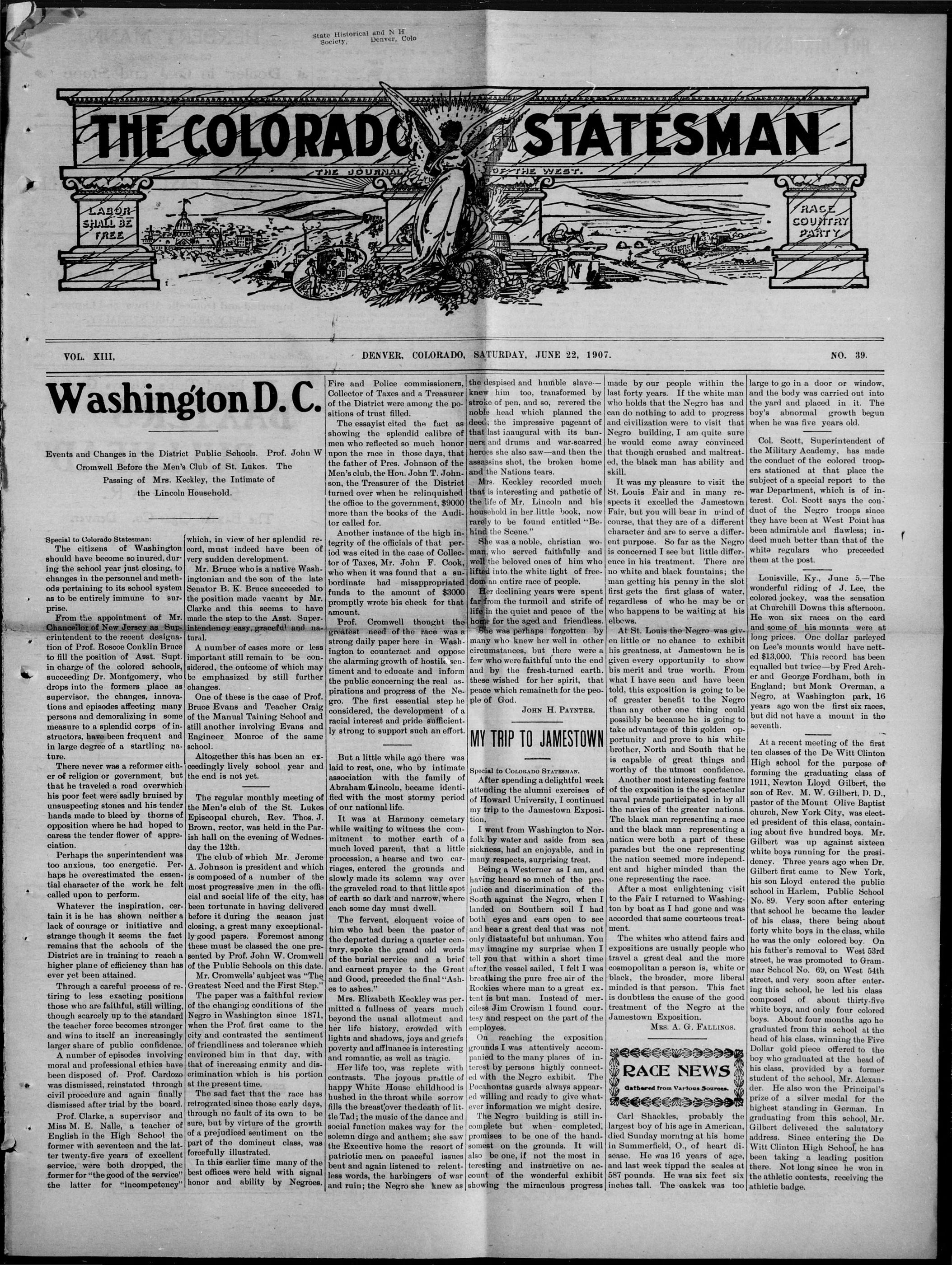
THE COLORADO STATESMAN
THE JOURNAL OF THE WEST.
LABOR SHALL BE FREE
RACE COUNTRY PARTY
WashingtonD.C.
Events and Changes in the District Public Schools. Prof. John W Cromwell Before the Men's Club of St. Lukes. The Passing of Mrs. Keckley, the Intimate of the Lincoln Household.
VOL. XIII,
Washing
Events and Changes in the District
Cromwell Before the Men's
Passing of Mrs. K.
the Lincoln
Special to Colorado Statesman:
The citizens of Washington should have become so inured, during the school year just closing, to changes in the personnel and methods pertaining to its school system as to be entirely immune to surprise.
From the appointment of Mr. Chancellor of New Jersey as Superintendent to the recent designation of Prof. Roscoe Conklin Bruce to fill the position of Asst. Supt. in charge of the colored schools, succeeding Dr. Montgomery, who drops into the formers place as supervisor, the changes, innovations and episodes affecting many persons and demoralizing in some measure to a splendid corps of instructors, have been frequent and in large degree of a startling nature.
There never was a reformer either of religion or government, but that he traveled a road overwhich his poor feet were sadly bruised by unsuspecting stones and his tender hands made to bleed by thorns of opposition where he had hoped to caress the tender flower of appreciation.
Perhaps the superintendent was too anxious, too energetic. Perhaps he overestimated the essential character of the work he felt called upon to perform.
Whatever the inspiration, certain it is he has shown neither a lack of courage or initiative and strange though it seems the fact remains that the schools of the District are in training to reach a higher plane of efficiency than has ever yet been attained.
Through a careful process of retiring to less exacting positions those who are faithful, still willing, though scarcely up to the standard the teacher force becomes stronger and wins to itself an increasingly larger share of public confidence.
A number of episodes involving moral and professional ethics have been disposed of. Prof. Cardozo was dismissed, reinstated through civil procedure and again finally dismissed after trial by the board.
Prof. Clarke, a supervisor and Miss M. E. Nalle, a teacher of English in the High School the former with seventeen and the latter twenty-five years of excellent service, were both dropped, the former for "the good of the service" the latter for "incompetency"
which, in view of her splendid record, must indeed have been of very sudden development.
Mr. Bruce who is a native Washingtonian and the son of the late Senator B. K. Bruce succeeded to the position made vacant by Mr. Clarke and this seems to have made the step to the Asst. Superintendency easy, graceful and natural.
A number of cases more or less important still remain to be considered, the outcome of which may be emphasized by still further changes.
One of these is the case of Prof. Bruce Evans and Teacher Craig of the Manual Taining School and still another involving Evans and Engineer Monroe of the same school.
Altogether this has been an exceedingly lively school year and the end is not yet.
The regular monthly meeting of the Men's club of the St. Lukes Episcopal church, Rev. Thos. J. Brown, rector, was held in the Parish hall on the evening of Wednesday the 12th. The club of which Mr. Jerome A. Johnson is president and which is composed of a number of the most progressive men in the official and social life of the city, has been tortunate in having delivered before it during the season just closing, a great many exceptionally good papers. Foremost among these must be classed the one presented by Prof. John W. Cromwell of the Public Schools on this date. Mr. Cromwell's subject was "The Court of New York."
The paper was a faithful review of the changing conditions of the Negro in Washington since 1871, when the Prof. first came to the city and contrasted the sentiment of friendliness and tolerance which environed him in that day, with that of increasing enmity and discrimination which is his portion at the present time.
The sad fact that the race has retrograted since those early days, through no fault of its own to be sure, but by virtue of the growth of a prejudiced sentiment on the part of the dominant class, was forcefully illustrated.
In this earlier time many of the best offices were held with signal honor and ability by Negroes.
DENVER, COLORADO, SATURDAY, JUNE 22, 1907.
Fire and Police commissioners, Collector of Taxes and a Treasurer of the District were among the positions of trust filled.
The essayist cited the fact as showing the splendid calibre of men who reflected so much honor upon the race in those days, that the father of Pres. Johnson of the Men's club, the Hon. John T. Johnson, the Treasurer of the District turned over when he relinquished the office to the government, $9000 more than the books of the Auditor called for.
Another instance of the high integrity of the officials of that period was cited in the case of Collector of Taxes, Mr. John F. Cook, who when it was found that a subordinate had misappropriated funds to the amount of $3000 promptly wrote his check for that amount.
Prof. Cromwell thought the greatest need of the race was a strong daily paper here in Washington to counteract and oppose the alarming growth of hostile sentiment and to educate and inform the public concerning the real aspirations and progress of the Negro. The first essential step he considered, the development of a racial interest and pride sufficiently strong to support such an effort.
But a little while ago there was laid to rest, one, who by intimate association with the family of Abraham Lincoln, became identified with the most stormy period of our national life.
It was at Harmony cemetary while waiting to witness the commitment to mother earth of a much loved parent, that a little procession, a hearse and two carriages, entored the grounds and slowly made its solemn way over the gravelled road to that little spot of earth so dark and narrow, where each some day must dwell.
The fervent, eloquent voice of him who had been the pastor of the departed during a quarter century, spoke the grand old words of the burial service and a brief and earnest prayer to the Great and Good, preceded the final "Ashes to ashes."
Mrs. Elizabeth Keckley was permitted a fullness of years much beyond the usual allotment and her life history, crowded with lights and shadows, joys and griefs poverty and affluance is interesting and romantic, as well as tragic.
Her life too, was replete with contrasts. The joyous prattle of happy White House childhood is hushed in the throat while sorrow fills the breast over the death of little Tad; the music of the dance and social function makes way for the solemn dirge and anthem; she saw the Executive home the resort of patriotic men on peaceful issues bent and again listened to relentless words, the harbingers of war and ruin; the Negro she knew as
the despised and humble slave—knew him too, transformed by stroke of pen, and so, revered the noble head which planned the deed; the impressive pageant of that last inaugural with its banners and drums and war-scarred heroes she also saw—and then the assassins shot, the broken home and the Nations tears.
Mrs. Keckley recorded much that is interesting and pathetic of the life of Mr. Lincoln and his household in her little book, now rarely to be found entitled "Behind the Scene."
She was a noble, christian woman, who served faithfully and well the beloved ones of him who lifted into the white light of freedom an entire race of people.
Her declining years were spent far from the turmoil and strife of life in the quiet and peace of the home for the aged and friendless.
She was perhaps forgotten by many who knew her well in other circumstances, but there were a few who were faithful unto the end and by the fresh-turned earth, these wished for her spirit, that peace which remaineth for the people of God. JOHN H. PAYNTER.
MY TRIP TO JAMESTOWN
Special to COLORADO STATESMAN.
After spending a delightful week attending the alumni exercises of of Howard University, I continued my trip to the Jamestown Exposition.
I went from Washington to Norfolk by water and aside from sea sickness, had an enjoyable, and in many respects, surprising treat.
Being a Westerner as I am, and having heard so much of the prejudice and discrimination of the South against the Negro, when I landed on Southern soil I had both eyes and ears open to see and hear a great deal that was not only distasteful but unhuman. You may imagine my surprise when I tell you that within a short time after the vessel sailed, I felt I was breathing the pure free air of the Rockies where man to a great extent is but man. Instead of merciless Jim Crowism I found courtesy and respect on the part of the employes.
On reaching the exposition grounds I was attentively accompanied to the many places of interest by persons highly connected with the Negro exhibit. The Pocahontas guards always appeared willing and ready to give whatever information we might desire. The Negro building is still incomplete but when completed, promises to be one of the handsomest on the grounds. It will also be one, if not the most in teresting and instructive on account of the wonderful exhibit showing the miraculous progress
made by our people within the last forty years. If the white man who holds that the Negro has and can do nothing to add to progress and civilization were to visit that Negro building, I am quite sure he would come away convinced that though crushed and maltreated, the black man has ability and skill.
It was my pleasure to visit the St. Louis Fair and in many respects it excelled the Jamestown Fair, but you will bear in mind of course, that they are of a different character and are to serve a different purpose. So far as the Negro is concerned I see but little difference in his treatment. There are no white and black fountains; the man getting his penny in the slot first gets the first glass of water, regardless of who he may be or who happens to be waiting at his elbows.
At St. Louis the Negro was given little or no chance to exhibit his greatness, at Jamestown he is given every opportunity to show his merit and true worth. From what I have seen and have been told, this exposition is going to be of greater benefit to the Negro than any other one thing could possibly be because he is going to take advantage of this golden opportunity and prove to his white brother, North and South that he is capable of great things and worthy of the utmost confidence. Another most interesting feature of the exposition is the spectacular naval parade participated in by all the navies of the greater nations. The black man representing a race and the black man representing a nation were both a part of these parades but the one representing the nation seemed more independent and higher minded than the one representing the race.
After a most enlightening visit to the Fair I returned to Washington by boat as I had gone and was accorded that same courteous treatment.
The whites who attend fairs and expositions are usually people who travel a great deal and the more cosmopolitan a person is, white or black, the broader, more liberal minded is that person. This fact is doubtless the cause of the good treatment of the Negro at the Jamestown Exposition.
MRS. A. G. FALLINGS.
RACE NEWS
Gathered from Various Sources.
Carl Shackles, probably the largest boy of his age in American, died Sunday morning at his home in Summerfield, O., of heart disease. He was 16 years of age, and last week tippad the scales at 587 pounds. He was six feet six inches tall. The caskek was too
NO. 39
large to go in a door or window, and the body was carried out into the yard and placed in it. The boy's abnormal growth begun when he was five years old.
Col. Scott, Superintendent of the Military Academy, has made the conduct of the colored troopers stationed at that place the subject of a special report to the war Department, which is of interest. Col. Scott says the conduct of the Negro troops since they have been at West Point has been admirable and flawless; indeed much better than that of the white regulars who preceeded them at the post.
Louisville, Ky., June 5.—The wonderful riding of J. Lee, the colored jockey, was the sensation at Churchill Downs this afternoon. He won six races on the card and some of his mounts were at long prices. One dollar parleyed on Lee's mounts would have netted $13,000. This record has been equalled but twice—by Fred Archer and George Fordham, both in England; but Monk Overman, a Negro, at Washington park, 16 years ago won the first six races, but did not have a mount in the seventh.
At a recent meeting of the first ten classes of the De Witt Clinton High school for the purpose of forming the graduating class of 1911, Newton Lloyd Gilbert, the son of Rev. M. W. Gilbert, D. D., pastor of the Mount Olive Baptist church, New York City, was elected president of this class, containing about five hundred boys. Mr. Gilbert was up against sixteen white boys running for the presidency. Three years ago when Dr. Gilbert first came to New York, his son Lloyd entered the public school in Harlem, Public School No. 89. Very soon after entering that school he became the leader of his class, there being about forty white boys in the class, while he was the only colored boy. On his father's removal to West 53rd street, he was promoted to Grammar School No. 69, on West 54th street, and very soon after entering this school, he led his class composed of about thirty-five white boys, and only four colored boys. About four months ago he graduated from this school at the head of his class, winning the Five Dollar gold piece offered to the boy who graduated at the head of his class, provided by a former student of the school, Mr. Alexander. He also won the Principal's prize of a silver medal for the highest standing in German. In graduating from this school, Mr. Gilbert delivered the salutatory address. Since entering the De Witt Clinton High School, he has been taking a leading position there. Not long since he won in the athletic contests, receiving the athletic badge.
MAIN PART OF LAND CONVENTION
GIVEN OVER TO WESTERN
DELEGATES.
EASTERNERS' EYES OPENED
"We Have Had No Land Frauds Save Those Imported by The Government," Says Arnold.
Denver, June 13.—It was a stormy session this morning; a sort of indication of what is to come. The speakers of yesterday afternoon had, with the exception of Senator Teller, been apologists for the government, but today the tables were turned and the protests of the ranchmen were sounded with emphasis. That is where the trouble began. It was impossible to name any definite action, either for or against the federal policy, because a weeding out process is necessary before the accredited delegates can be learned. New tickets arrived just at adjournment and were distributed.
Addresses by Thomas J. Walsh of Montana, C. P. Arnold of Wyoming and Congressman R. W. Bonynge of Colorado were the features of the morning.
Organized permanently, with Dr. J. M. Wilson of Wyoming in the chair, the convention knuckled down to real business to-day.
United States Senator Francis E. Warren of Wyoming, president of the National Wool Growers' Association, reached Denver last night from Washington. The senator is very close to President Roosevelt and is here in the interests of the administration. Since Wyoming has sent to the convention 150 delegates, practically all opposed to the public lands policies of the administration, the mission of Senator Warren is apparently significant.
"I believe when we have weeded out the various phases of the big questions and get right down to the issues we will find that the West and President Roosevelt are not far apart—that both are for the settlers and for homebuilding. I believe that the results of the convention will be salutary to the West; that what will be done will make for the development of this vast domain."
Secretary of the Interior James R. Garfield, special envoy of President Roosevelt, was given the honor of first addressing the convention yesterday afternoon. Mr. Garfield is a comparatively young man, with a head full of hard horse sense. He handled himself well before the big gathering and talked straight at the delegates. That he made a strong impression was apparent from the close attention paid to what he had to say and the frequent applause of some of his climaxes.
"I am out here to meet and mingle with you people of the West, so that I can learn first hand from you the conditions and what you want," declared Mr. Garfield. "If the administration is wrong on any of its policies, I want to know it that I may correct the wrong. Let us understand each other."
"I am here to hear the discussions and to learn what you want. I shall not have much to say to you, but want to hear what you have to say. This convention will do much good in clearing up many things and bringing us all to a better understanding."
Richard A. Balkinger, commissioner of the General Land Office at Washington, followed Mr. Garfield with an address upon the functions of his department. He decied the administration and aroused applause by his slap at the land speculators who have been thriving in the West. These pests, he declared, had to go, and he told how he had put many of them out of business.
The sentiment of the delegates with reference to the questions that are to come up for discussion has undergone some change since the big convention met. There is a lack of any fighting spirit. The delegates have got together in a way and are looking at the big questions and the administration's policies with more tolerance, because they are understanding what the President is striving at for the West. They know that the President wants to know what they want and that he is going to give them the relief as far as he is able under the public land laws.
Among other addresses today, besides that of Congressman Bonyenga, was one by Congressman Frank W. Mondell of Wyoming and another by Ethelbert Ward of Colorado. Senator Thomas H. Carter also addressed the convention this forenoon. Following these addresses there will be a general debate, limited to ten minutes to each speaker. This feature of the convention will be full of interest and fire. Mr. Walsh, the first speaker of the day, was greeted with wild shrieks of aplause throughout his address.
When he had concluded, Murdo Mackenzie demanded to know if it was the purpose of the convention to hear only one side of the question. He declared that, so far, such had been the evident intention. Senator Teller replied on behalf of the program committee, saying that it had not been by design that such an arrangement had been made. He said that the committee had tried to divide things evenly. A voice in the back of the auditorium asked if a meeting of the program committee had ever been called.
"It was impossible to get the members together," replied Senator Teller. "Only the Colorado members gathered." Then someone asked if Senator Burkett of Nebraska had not filed a written protest against the program, and Senator Teller admitted that such was the case, but said that this was the only fault found with the schedule.
Mackenzie grew angry and wanted to press his point, but cries of "Sit down," "Sit down, Mackenzie," from all parts of the house, silenced him. With difficulty order was brought out of chaos, and C. P. Arnold, introduced as "a small ranchman of Wyoming," undertook to deliver an address. "Wyoming," said he, "boasts of 8,000,000 acres of wooded area, and yet the government claims 9,500,000 acres in that state. Thirty per cent. of the land which has been put in forest reserves is not even wooded area. "The Wyoming ranchman does not say he is an angel; but if you can find
any body of men under the flag of more unblemished reputation, I'd like to know it.
"We have had no land frauds in our state save those imported by government inspectors and land agents.
"The Wyoming ranchman only asks of you that you will not turn him over to an absentee landlord. He is willing that the Chief Executive of the Nation shall tell him how many children he shall have in his family; that he shall tell him how he shall spell, etc., but he demands that his brindle cow shall have the right to breath at will upon the public domain."
In his extemporaneous address on "The Public Land Policy: Past and Present," Congressman Bonynge said: "It is not in accord with the constitution for the government to control the public lands. This function should belong to the states, under the republican system.
"I am one who believes that when the constitution was framed a new nation was born. I do not believe that whenever the national government can discharge a duty better than a state can, it is the place of the national government to do it.
"I look upon the Nation as a government in which the people East and West are interested. I do not regard it as foreign.
**Asks No Change in Land Laws.**
"I ask no change in the land laws. Here in the West we will, under our old system, build up commonwealths that all the Nation will be proud of."
"When the confederation was formed there were but six colonists with definite boundaries. The other seven laid claim to vast and indefinite areas as far west as the Mississippi river. Many boundaries were in dispute. Then the settlement was made on the basis that disputed lands be property of the United States for public domain.
"In the address by the commissioner of the Land Office Saturday," said her "he stated that there are in round numbers 611,000,000 acres of land still belonging to the United States, the title to which is vested in the government Let us see what is proposed to be done Firstly, out of the 611,000,000 acres, all ready about 150,000,000 are in forest reserves. It is now suggested that coal lands be withdrawn from entry by individuals and mined and owned by the government. This step would mean that another 64,000,000 acres would be taken from the people. Adding these figures we have over 200,000,000 acres Now, it is further argued that 300,000,000 acres of grazing land shall be leased, making over 500,000,000 acres virtually and practically withdrawn from the people of the United States
Will Soon Be Withdrawn.
"Thus you see five-sixths of all public land is withdrawn if these plans go through.
"We are thus reversing the time honored policy of our country.
"We believe in preservation of the forests and conservation of the water, but we also believe that the forestry reserve policy has been unduly extended."
Mr. Bonynge's reference to President Roosevelt signing the bill by the last congress to prevent withdrawals of certain lands awoke the convention to life. But he did not go so far as to say that the President did not have the constitutional right to make these withdrawals. "The President did not sign the law until after he had made his famous order setting aside millions of acres of public lands and putting them in forestry reserves. He had been restoring these withdrawals gradually."
R. A. Ballinger said in his brief speech that many of the provisions of the land laws should be changed or modified. In speaking of the "dry" farming lands, he said that a settler should not be required to take them up under the homestead law.
"The land policy of our government for the past half century," said Mr. Ballinger, "has been and still is, in a general sense, covered by the following classification:
"First—That the arable and irrigable lands are for the landless settler.
"Second—That the lands containing gold, silver, copper and other metals are free and open to exploration and occupation by all citizens under the regulations prescribed by law.
"Third—That the coal and timber lands are to be conserved and disposed of for the 'use and necessities of the citizens of the United States,' in furtherance of national development.
"It is unfortunately true that a great many people consider the public lands as a source of rightful plunder, which has been attempted to be justified, because the people did not generally take notice of it and the government was inactive in punishing the illegal acquisition of it."
Henry M. Teller, senior United States senator from Colorado, was the last speaker of the afternoon.
"Every move on the part of the government during the past ten years," said Senator Teller, "has been designed to make it more difficult for a man to get a home.
"The ideal community is where every man may own his own home.
"I object to landlordism by the rich and by the government. But if we must have either, I prefer the former to governmental landlordism.
"I will show you where the government officials are disobeying the laws. They say they are enforcing them, but I will be better pleased when I see them enforced.
"We must get the land of the country into the hands of the men who want to live on it.
"They talk of the glory of following the plow. There is no glory, unless the man owns the plow and owns the land which he plows.
"The state has certain rights which the government is bound to respect."
Tucker Loses in Bankruptcy Case.
Leavenworth, Kan.—The jury in the case of the Uncle Sam Oil Company, in which H. H., Tucker, Jr. sought to have the receiver, appointed by the State Supreme Court, removed, returned a verdict finding against Tucker. The receivership, therefore, stands. The verdict was written out by Judge Amidon in the United States District Court, and it was agreed to by the jury upon the court's instructions.
FAILED IN SMALL THINGS.
Congressman Evidently Was No Here to His Wife.
There is a certain congressman who, whatever authority he may hold in the councils of state, is of comparatively minor importance in his own household. Indeed, it has been unkindly intimated that his wife is "the whole thing" in their establishment. Representative and Mrs. Blank had been to Baltimore one afternoon When they left the train at Washington, on their return, Mrs. Blank discovered that her umbrella, which had been intrusted to the care of her husband, was missing.
"Where's my umbrella?" she demanded.
"I'm afraid I've forgotten it, my dear," meekly answered the congressman. "It must still be in the train."
PURIFIED LIFE INSURANCE.
Benefits from Now Law, Which Remains Substantially Unchanged.
Through the influence of Gov. Hughes, the New York Legislature decided to make no radical changes in the new insurance law. It was pointed out by Gov. Hughes that the New York law has already accomplished widespread reforms, with proportionate benefits to policyholders, and that it should be given a thorough trial before any amendments were seriously considered. It is estimated that the cost of the mismanagement of the past did not average more than 20 cents to each policyholder, while the benefits to present and future policyholders will amount to many times more and be cumulative besides. The speed craze of the big companies and the excessive cost of securing new business was the most extravagant evil of the old managements. Under the new regime the cost of new business has already been greatly reduced, along with other economies.
The showing made by the Equitable Life Assurance Society in its report for 1906 was a strong argument against meddling with the new law. In the Equitable alone there was a saving of over $2,000,000 in expenses, besides an increase in the income from the Society's assets amounting to as much more. The ratios of the Equitable's total expenses to its total income was 19.42% in 1904, 17.38% in 1905, and only 14.48% in 1906. The dividends paid to Equitable policyholders in 1906 amounted to $7,289,734, which was an increase of more than 9% over 1905.
While the Equitable made a better showing than any other big company, all reported radical economies and under such conditions the Legislature wisely decided to leave the law substantially as it stands.
GOOD IDEA FOR MATCHES.
Double Enders Popular Among Smokers in Mexico.
"Mexico may be behind us in some things, but she has us lashed to the wheel when it comes to making matches," said a man just in from the land of the Montezumas as he handed out a wax lucifer with a head on each end.
"I saw nothing but double ended matches while I was away, and I can tell you that they save one's record with the Recording Angel. If you dig down in your pocket and find one match the chances are that you are sure of a light, because if one end goes out the other is left. These old time matches, just revived, that splutter brilliant sparks may be all right when it comes to pleasing the baby, but the fellow who puts on the market a double ended match will find a ready demand."
Not Partial to Nursing.
Not long ago a young Irishman was seeking work in western Illinois, and among those to whom he applied was a farmer near Cairo. The farmer was attracted by the Celt's frank, cheery manner, and, while he was not in need of help, he asked, after a pause:
"Can you cradle?"
"Cradle!" repeated the Irishman "Sure, I can! But, sir," he added, per suavely, "couldn't ye give me a job out-of-dures?" -Harper's Weekly.
WENT TO TEA
Tea drinking frequently affects people as badly as coffee. A lady in Salisbury, Md., says that she was compelled to abandon the use of coffee a good many years ago, because it threatened to ruin her health and that she went over to tea drinking, but finally, she had dyspepsia so bad that she had lost twenty-five pounds and no food seemed to agree with her.
She further says: "As this time I was induced to take up the famous food drink, Postum, and was so much pleased with the results that I have never been without it since. I commenced to improve at once, regaled my twenty-five pounds of flesh and went some beyond my usual weight."
"I know Postum to be good, pure, and healthful, and there never was an article, and never will be, I believe, that does so surely take the place of coffee, as Postum Food Coffee. The beauty of it all is that it is satisfying and wonderfully nourishing. I feel as if I could not sing its praises too loud." Real "The Road to Wellville," in pkgs. "There's a Reason."
THREE BLOWN INTO ETERNITY.
Boiler on Engine Explodes With Terrific Force.
Florence, Colo.—The boiler on engine No. 1140 of a Denver & Rio Grande westbound train exploded just as the train rounded a curve one mile east of Florence at 5:30 the morning of June 19th. The engineer, fireman and head brakeman were instantly killed. The body of the engineer, Thomas Ewing, was blown sixty-five yards to the right of the cab. The body of the fireman, N. J. O'Brien, was found 100 yards back of the engine close to the track.
There were about ten cars of rails in the train, and about the tenth car the body of the fireman struck the rails. He sild along until he struck one of the standards of the car and fell from there to the ground, his body being picked up just at the side of the track. The head brakeman, who was evidently riding on the fireman's side of the cab, was C. B. Gooch. He was found fifty yards to the left of the train. His back was badly scalded and he was internally injured. Ewing, the engineer, had a wife and three children living at Pueblo. Some years ago he was night marshal at Florence. N. J. O'Brien, the fireman, was evidently throwing a shovelful of coal into the fire at the time of the explosion. His body is badly burned all over and he must have traveled over the tender and a distance of fully ten car lengths before he fell from the train. Head Brakeman Gooch lived a few minutes after his body was found. Gooch and O'Brien also lived in Pueblo and O'Brien leaves a widow and
Gooch and O'Brien also lived in Pueblo and O'Brien leaves a widow and two children. Gooch was single.
Boiler Flew Far.
The crown sheet of the boiler was found about twenty yards from where the explosion took place, but the boiler bounded ahead, struck the rails about 100 feet ahead of where it burst and bounded from there to a field at the right of the track. From here it took another jump and eventually landed about eighty yards from where the trucks were left standing uninjured upon the track.
John Martz, the conductor in charge of the train, claims that while riding in the caboose at 5:32 o'clock he heard the terrific explosion and the sudden jar of the train, and, as he looked out, he saw the bodies of the three men sailing through the air.
An examination of the boiler by engineers of experience shows that the water was very low. The crown sheet was burned badly and the heads of many of the rivets burned off.
Ewing, the engineer, was a member of the local lodge of Masons of Florence and also a member of the Pueblo lodge of Elks. But little appears to be known of Brakeman Gooch, he having been a new man on this division.
Tramps Held Up Train.
Minturn, Colo.—A half-hundred hooes, without money or food and folled in their attempts to "make" the several previous trains which passed through here during the day, held up Denver & Rio Grande freight No. 63. They defied the train crew, officials and entire town to put them off and for more than two hours were in complete charge of the train.
Firearms were necessary to drive off the hoboes, Marshal Henry Becker and Trainmaster E. L. Stratford, heading a squad of a dozen railroad men and citizens armed with rifles and shotguns, attacked the train, firing into the air as they advanced. The tramps were unarmed and unable to offer resistance and began to unload from every nook and corner of the train.
They were finally lined up at the point of guns on the prairie several hundred yards from the track and threatened with death if any attempted to break from the ranks and board the train. The freight finally pulled out two hours late and the hoboes were walked down the railroad track for a mile and told not to return under penalty of death.
The tramps ranged in ages from eighteen to sixty, and are believed to have come from the grading camp four miles below Minturn. They came in afoot, in groups of three and four, and their actions threw the people into a state of terror. They tried to board several trains during the day, but were beaten off by the trainmen and fights resulted.
Toward evening they met in the yards and, it is believed, voted to take No. 63, by storm. The train had no sooner been stopped than the tramps scrambled aboard and made themselves comfortable on the rods, roofs, inside the box cars and any other place they could find room. Conductor McLaughlin refused to move a wheel until the undesirables had been unloaded, and after the armed posse had driven them off McLaughlin made a careful examination of the train before he pulled out.
The tramps are said to be camped several miles down the river and further trouble is anticipated. The officers and residents of the town are prepared for an attack.
Gold Nuggets in Macky's Effects.
Boulder, Colo.-The Macky auditorium building at the University of Colorado will not replace the present main building, according to Dean F. B. R. Hellems, but will be erected on another part of the campus. The main is the oldest building of the university, having been erected in 1875, and around it cluster all the history and sentiment of the school.
T. V. Wilson, executor of the Macky estate, opened the private compartment boxes at the Boulder First National Bank and found a large quantity of gold, paper money in packages of a thousand dollars and a number of bottles filled with gold nuggets, besides a large number of stocks and bonds. One hundred thousand dollars in cash is on deposit in the bank. Among the stocks and bonds so far listed is a quarter interest in the Steamboat Springs Townsite Company worth $50,000, $55,000 worth of Federal Gas Company bonds, $20,000 of the Boulder Elks' bonds, $28,000 worth of stock of the Colorado Telephone Company, and $17,000 worth of the Boulder First National Bank stock. The balance of the personality is expected to be listed tomorrow.
Dealer in Coal and Stone Red Flagstone a Specialty.
VILLA DE LA MEDINA
EAST TURNER
Tel. 2449.
ER. J. H.
TELEPHONE MAIN 4271.
N. & W. LIQUOR
DEALERS IN
Led and Domestic Wines and Li
FAMILY TRADE OUR SPECIALTY.
1118 BROADWAY.
Delivered.
The Brand That's Always G
AXTER'S
BULLHEA
H. J, HESPER.
TEL
THE N. 8
Imported and D
FAMILY
"BAX"
"BAXTER'S BULLHEAD"
5 c CIGAR.
The Baxt
F. B
FINE SPR
Drssmaking.
the Baxter Cigar Co. Denver
F. Benjamin & Co.
SPRING MILLIN
smaking. Hair Goods a Speci
The Baxter Cigar Co. Denver.
F. Benjamin & Co.
FINE SPRING MILLINERY.
Drssmaking. Hair Goods a Specialty.
In Creole Braids twenty-five cents and up.
Pompadours fifty cents.
BROADWAY PHARMA BANTA BROS, Props.
THE BROA BANT
THE BROADWAY PHARMACY
BANTA BROS, Props.
Corner 19th, Welton and Broadway.
Drugs, Toilet Articles, Perfumes. Prescriptions a Specialty
GOODS DELIVERED. PHONE MAIN
Ladies' and Gent's Clothing Cleaned and Repaired
Toilet Articles, Perfumes. Prescriptions a S DELIVERED. PHONE and Gent's Clothing Cleaned and L
Drugs, Toilet Articles, Perfumes. Prescriptions a Specialty GOODS DELIVERED. PHONE MAIN 149 Ladies' and Gent's Clothing Cleaned and Repaired.
C. HILSMAN.
Has removed from B
1914 Arapahoe
see all of
A full Line of New
moved from his old stand at 1907 Lawrence St.
14 Arapahoe street, where he will be pleased
see all of his old Customers and friends.
of New and Misfit Clothing for S
5370. Res. Phon
L. S. MOORE,
Has removed from his old stand at 1907 Lawrence street to 1914 Arapahoe street, where he will be pleased to see all of his old Customers and friends.
A full Line of New and Misfit Clothing for Sale Cheap.
L.
Wines, I
Pabst Mil
1763 Curtis St.
Wines, Liquors and Cigars. Pabst Milwaukee BeerXonDraught. 1763 Curtis St. Denver, Colorado.
DENVER'S LEADING BRAND OF BOTTLED BEER
Columbine Beer
Is guaranteed absolutely pure
Try a Sample Case and you will use no other
TELEPHONE 1285
The Ph. Zang Brewing Co.
Producers
Fresh Beer Delivered Daily to all parts of the city
Quaries at Beach Hill, Colo.
All Goods Delivered.
2053 Larimer Street.
Phone Main 5370.
WM. EHMKE,
MANAGER
T TURNER HALL.
2132-2148 ARAPAHOE ST.
MAIN 4271.
LIQUOR CO.
ERS IN
c Wines and Liquors.
OUR SPECIALTY.
ADWAY.
's Always Good R'S LHEAD"
ar Co. Denver. min & C. MILLINERY. Goods a Specialty.
AY PHARMACY
OS, Props.
on and Broadway.
es. Prescriptions a Specialty
PHONE MAIN 149
ing Cleaned and Repaired.
... THE TAILOR ...
and at 1907 Lawrence street to
here he will be pleased to
customers and friends.
Fit Clothing for Sale Cheap.
Res. Phone York 1458.
MOORE, and Cigars. BeerXonXDraught. Denver, Colorado.
Tel. 2449.
Yards:
1st and Larimer Sts.
Denver.
J. H. WEIOHHAND
Denver, Colo.
Denver, Colorado
THE COLORADO STATESMAN.
JOS. D. D. RIVERS.....Proprietor S. H. HOBSON.....City Editor
1824 Curtis Street, Room 25.
SUBSCRIPTION RATES:
One year .....$2.00 Six Months .....1.00
Three Months ......60
PAYABLE IN ADVANCE.
Remittances should be made by Express Money Order, Postoffice Money Order, Registered Letter or Bank Draft. Postage stamps will be received the same as cash for the fractional part of a dollar. Only 1-cent and 2-cent stamps taken.
Reading notices, ten lines or less, 10 cents per line. Each additional line over ten lines, 5 cents per line.
Display advertising 50 cents per square. A square contains ten agate lines. No discounts allowed on less than three months' contract. Cash must accompany all orders from parties unknown to us. Further particulars on application.
It occasionally happens that papers sent to subscribers are lost or stolen. In case you do not receive any number when due, inform us by postal card and we will cheerfully forward a duplicate of the missing number.
All communications of a personating nature that are not complimentary will be withheld from the columns of this paper.
Entered as second-class matter at the postoffice in the city of Denver, Colorado.
THE AMERICAN MAGAZINE.
EVERY Negro who reads for the purpose of keeping abreast of public thought, especially as it concerns the Negro race, ought to read the series of articles now running in the American Magazine, written by Ray Stannard Baker, under the title of "Following the Color Line." The series began in April and promises to be a thorough and exhaustive treatise on race relations, South and North. Because the articles are truthful and fair, picturing conditions, good, bad and indifferent, just as they are, they are of great worth to the Negro, whose best life and best effort is usually given scant portrayal in a widely circulated public vehicle. Ten thousand Negroes ought to buy the American Magazine through this year, in appreciation of the good that it is doing. It costs 10 cents per copy or $1 a year, and is obtainable at news stands and book stores.
PATTERSON ON TILLMAN.
THERE is always some satisfaction in learning what a prominent man has to say upon the race question, whether one learns anything else thereby or not. Perhaps the lawyer instinct, which enables a man to say much without disclosing the true base of his thought, is responsible for the fact that we do not know just where to place our thumb on Senator Patterson of the Rocky Mountain News, who recently discussed Senator Tillman, the ante-bellum muck raker, in one of his signed editorials. We give Senator Patterson credit for mildly rebuking Senator Tillman, as well as the utterances of the Rev. Dr. Coyle of Central Presbyterian church, and more severely condemning the lack of protest upon the part of other spokesmen, local and throughout the North. But at the same time we cannot reconcile these apparent rebukes with his approval of Southern disfranchising methods and other things of which Senator Tillman is the exponent. Senator Patterson's expressions, now and heretofore, have caused us to look upon him as not particularly unfriendly to the Negro, but rather upon our side, yet we always recognize that vague reserve which seems to intimate that he does not wish or mean to positively oppose the course assumed by Southern political leaders. And therein the characteristics of the astute lawyer and politician loom up.
It is to be regretted that many men of prominence and influence, like Senator Patterson do not recognize the fact that there are many phases of the race problem which are not political and which should not receive political treatment of any sort. The recognition of this truth and a sincere determination to face it without dodging, would make the race problem far less difficult. The race problem is in large part of a solution of social economies, whose solution requires the application of honest and just principles where political madness and insane social fears are applied now. Justice is the source of all truth and the acme of all wisdom. Laws which are not just and equal in their application are not truly American and are not the honest fruit of the tree of liberty. They may avail for an era, but they will bear their thistles rather than their figs. The Negro demands equality before the law, not social intimacy with the white man. Purely social ethics are not subject to legal control. Consequently they have nothing to do with politics. Many good white people in the North and some in the South look upon Senator Tillman as a political freak, remarkable for his bold and radical devotion to low, selfish and non-progressive principles and ideas, viciously expressed. Many good people wonder that his ideas command respect, North or South, and wisely doubt that they should be dignified with constant denunciation. The more he is silently ignored the more a freak he becomes, regardless of the fact that he represents the dominant political forces in his state and maintains a freakish popularity on the lecture platform. In reality Senator Tillman is no greater enemy to the Negro than he is to the country; nor is any other man who preaches the necessity of political or social friction between different elements of our national citizenship, whatever questions of race, color or creed may be involved. And we feel that our expressions upon these points are clearer than those of Senator Patterson, whose general fairness and great ability we respect.
IS THE NEGRO PATRIOTIC?
EXPRESSIONS in a studied editorial by Paul Thieman of the Denver Post, brings this question to the fore. Is the Negro patriotic? At first thought many will think the question absurd, but under the proper definition of patriotism it may not prove to be so absurd as it may at first appear. The Negro's record in the wars in which this country has engaged, as well as his conduct as a soldier in the conciliatory campaigns carried on in our newly acquired possessions in the Pacific islands, has won him deserved praise and given him a reputation for reliability as a militant defender of the nation second to that of no other element in our mixed American citizenship. From the days of the Revolution to the present, he has made a mark in the American army which nobody has had any difficulty to interpret, and not once has the charge of cowardice or backwardness been laid at his door. Whether in the regular army or as a volunteer, the Negro has made almost an ideal soldier, and through all the trials and tests that come to a soldier, in barracks or upon the battlefield, he has borne himself well. But does all this prove patriotism? He has been loyal, without a doubt, and has done his whole duty so far as his intellect and physical ability made it possible.
But it is a characteristic of the Negro's nature to be faithful to his environment. In Civil War times he was the faithful protector of the families of the men who were fighting to keep him in slavery. This was true of those upon whom the responsibility fell, as house servants or trusted field hands on their master's plantations. But at the same time their black brothers of the North were marching and fighting in Union ranks to put down the rebellion and to abolish the slavery which was its cause. True that the united hopes and prayers of the Negro were with those whose success meant their liberty, but upon either side, under strange stress of necessity and of opposing intests, they were equally trusted. The Negro is not naturally bellicose, but he is naturally enthusiastic, and the stir of war and patriotic sentiment appeal directly to his natural love for tests of faithfulness. But the Negro's faithfulness as a soldier in the army of the United States is not appreciated at its true worth and he knows it. Many people may give him the credit of words, but neither the government nor the nation at large honors him according to his merit or as they honor his white compatriot. It is the ever recurring story of racial conflict and discrimination that will not down. It is the ghose that banishes the dream of a heterogeneous Republic. It is the climax of a devotion that is always accepted for its service and is then robbed of its glory and scoured. If patriotism is "love for the nation, for the people who occupy the country and for their institutions, and the pride of the amalgamated race," then truly, is the American Negro really patriotic?
The Future of the Submarine Impossible to Imagine
By JOHN P. HOLLAND.
Inventor of the Holland Type of Submarines.
HERE is a great future for the submarine. At best, it is now but in the initial stage of development. I am now hard at work on plans which I am designing for one of a speed of 30 knots an hour, one that is to be 100 feet in length, with a beam of ten feet, and which I believe can maintain pace with any fleet and accompany it across any ocean. This vessel will be propelled by gasoline, and will be intended for work on the high seas and for coast defense.
T
It is safe to say that when the first submarine torpedo boat goes into action she will bring us face to face with the most puzzling problem ever met in warfare. She will present the unique spectacle, when used in attack, of a weapon against which there is no defense. You can pit sword against sword, rifle against rifle, cannon against cannon, ironclad against ironclad. You can send torpedo boats against torpedo boats and destroyers against destroyers. But you can send nothing against the submarine boat, not even itself. You cannot fight submarines with submarines. The fanciful descriptions of the submarine battle of the future have one defect. You cannot see under water, hence you cannot fight under water, hence you cannot defend yourself against an attack under water, except by running away. If you cannot run away you are doomed. Wharves, shipping at anchor, the buildings in seaport towns cannot run away. Therefore the sending of a submarine against them means their inevitable destruction.
No; as nearly as the human mind can now discern, the submarine boat is indeed a weapon against which no means that we possess at present can prevail. She can pass by anything above or beneath the waves, destroy wharves and shipping and warships at will, throw shells into the city when suitably armed, and then make her way out again to sea. She can lie for days at the bottom of the harbor, leaving only when she has used up all her stored power except what is required to carry her back to the open, where she can come to the surface, a mere speck on the water, and renew her power. She would never have to expose herself for more than a second at a time during all her work of destruction in the harbor. This would be when she would rise to discharge her gun at the city. The recoil of the gun would send her down again and out of sight. The chance of hitting her would be one in a million, even if the harbor were a floating battery, which it would not be very long while the submarine was at work. Her torpedoes she could discharge without coming to the surface at all.
Weakness of Orthodoxy
By PROF. CHAS. ZUEBLIN,
University of Chicago.
Weakness of Orthodoxy
By PROF. CHAS. ZUEBLIN, University of Chicago.
People are temperamentally orthodox or heterodox in their beliefs, but the danger with the orthodox man is that when he changes his mind he is sure to land in some other orthodoxy. A man who has dropped the orthodoxy relating to the belief in future happiness will start in talking about single tax at a funeral if asked to speak a few words of comfort. The heterodox man is always outside the camp, and, as the saying is, he is against the government. But regardless of our temperament, it is our business to be evolutionists. It is salutary to make an examination of self before declaiming against an old orthodoxy, to see if our enthusiasm has not landed us into a new one. We may find a taint of something we attack in others—only along another line.
The orthodoxy of religion is known by devotion. The orthodoxy of politics is expressed in loyalty. The orthodoxy of the economic system is known by class consciousness. The ordinary person cannot give a reason for his devotion to a religious belief. He is orthodox in it, that's all. He thinks he believes in the church dogma, but he is simply devotedly biased.
In social life the orthodoxy of fashion prevails. Shop girls must dress as the leisure class dictate, regardless of the conveniences and comforts of her work and station. Why should not a man go to a dinner in his shirt sleeves instead of a claw hammer if he is more comfortable that way? it's the orthodoxy of conventionality that we all subscribe to. Imagine a man asking how one could feel like a gentleman if he had erred as to the sort of necktie he wore.
We hear much of the orthodoxy of liberty. Tom Paine and others led us all astray. They thundered that man must be a free agent, and that was true liberty. We have been crying this in an orthodox fashion ever since. Think of that sort of liberty that leaves a man on the verge of starvation a free agent to barter away his life and services by contract. The orthodoxy of the old English law, too, that we stand by so stanchly. Why, that old law has always come tagging after an industrial revolution. Socialists don't escape their orthodoxy. How many go about with a copy of Carl Marx, declaring it their bible, when they don't know any more about it than the other bible. Examine yourself. Let us who really believe in the brotherhood of man, keep our minds open that we may grow with the movement, and then the movement will grow.
Americans Slaves to Convention
By AMELIA RIVES.
Americans Slaves to Convention
By AMELIA RIVES.
We Americans are we fearless enough; aren't we afraid of something, after all? We are afraid of ourselves, of each other. How few of us dare to live out our primitive instincts, to test the true ideals of life. It seems to me that to find the supreme laws, the big statutes of the moral code—that is to say, the spiritual order of our lives—we must test the validity of conventions. As a matter of fact we are actually afraid of being without them, we cling to them like lifebelts in the big sea of experience, instead of striking out and learning to swim for ourselves, to make our bodies work for the spirit.
Courage, faith in the Great Spirit that can do no evil, endurance to suffer, realizing that the light of the spirit is discovered only when it is most needed, in darkness the supreme laws, the big statutes of the moral code. It is very sad that we must suffer so much to arrive at a spiritual knowledge, but it does not last. We must not evade any shadow of experience, even the vague panic of the senses, for when we are confronted with awe of something we do not understand it leaves us in a richer state of knowledge.
Copyright, 1907, by
L. ADLER BROS. & CO.
Negilee Suits for the Races Don't spoil a high priced suit at the track-We have a fine line at $10 to $20
JOHN H. HARRIS
Headquarters for Cooks, Waiters and Railroad Porters.
2149 Curtis Sreet.
Phone Main 8232.
LAWRENCE STEPHEN. Denver.
Scholl's Modern
Hand Laundry
1841 ARAPANOE-PHONE 817
Finest hand work in the city. 2317-19 Lari
2317-19 Larimer Street
"Get the Habit" Put a Dollar in Your Pocket.
THE STORB THAT SAVES YOU A $
NO MORE
250
NO LESS
THE HENNING - EDDY SHOE CO.
838 FIFTEENTH STREET.
TEENTH STREET. DENVER, COLO
COSMOPOLITAN CAFE
JACK SHELBUN, Proprietor.
SUPERIOR SERVICE
PRIVATE DINING ROOM
1922 LAWRENCE ST.
PHONE MAIN 3785.
Colorado
All things that are supposed to come to him who waits are subject to change without notice.
Say Women Cooks Are Best.
Some of the most famous diners, of whom the late Sir Henry Thompson was not the least, have held that a first-rate woman cook is the superio. of any "chef" that ever drew his thousands a year. Half the nonsense that is talked about "chefs" and half the money that is paid them, flows from the determination of plutocratic persons to get rid of large sums in a manner that is pretty sure to be talked about.—London Daily News.
There is a plot for a summer novel in this advertisement which recently appeared in the Lucknow (India) Daily Telegraph. "Will any gentleman, educated, European, marry (immediately) a young lady to save her from a hateful marriage?"
Mrs. C. A. Burns is now located at 2515 Curtis street.
Sherman Overton of the Denver club, is off on his vacation.
Robert Russ of Hose Company No. 3 is taking his vacation.
Mesdames Kinney and Hodges are home from the mountains.
Little Mary Colston who has been quite ill, is much improved.
Mrs. Morris Campbell of 834 So. Tremont street is on the sick list.
Mrs. Geo. S. Contee is down from the mountains this week on business.
Wm. H. Duncan of Colorado Springs, was in the city Monday on business.
Miss Bertha Larkins arrived in the city Thursday from Cheyenne, Wyo.
Dr. W. J. Cottrell left Wednesday for Kansas City for a much needed rest.
Central Baptist church is now out of debt and will burn the mortgage next week.
Mrs. S. Keene passed through the city this week from California enroute to Boston.
H. J. Foster arrived home Friday from a month's trip through the South and East.
Mrs. L. Britt who has been in the county hospital for several weeks is able to be out.
Born, to Mr. and Mrs. Henry Gentry, 26220 Welton street, twins. Mother and babies doing nicely.
Sam Edwards who was shot in Kansas City a few days ago by Leon Jordan, died Thursday morning.
B, B. Johnson and family arrived in the city Friday of last week from El Paso, Texas, to remain.
Dr. T. Ernest McClain left Thursday for Nashville, Tenn., where he is to be married next Wednesday.
Mrs. W. B. Townsend of Pueblo, is in the city the guest of her sister, Mrs. Finley of 2319 Champa street.
Mrs. Nettie Asberry returned Thursday from Omaha, where she visited her brother, B. B. Craig and wife.
Mrs. Msry Morgan and her niece Miss Minnie McConnell of Dunlap, Kansas have arrived in the city to remain.
Mr. McVey and children of Boulder passed through the city Wednesday enroute to Kansas to visit his mother.
Jack Shelbun has opened up a first-class cafe at 1922. Lawrence street where he solicits the patronage of the public.
Mrs. Wm. Richardson of Kansas City arrived Saturday to join her husband and is the guest of Mrs. J. C. Gentry, 3714 Franklin street.
Mrs. M. E. Travick has returned from Colorado Springs where she went as a delegate to the Womens Federation of clubs which met there last week.
J. P. H. Johnson, who has been with the Hendrie and Bolthoff Machine Co., for the past 25 years will leave Monday for Chicago and other points on a month's vacation.
Mrs. J. M. Howell and Mrs. R. H. Dunn of Manhattan, Kans., spent a few days in the city last week as guests of Mrs. Mae Nichols, they were enroute for Colorado Springs.
Mrs. L. E. Cash of St. Louis, arrived in the city, Tuesday to join her husband. She was accompanied by Miss V. Mack one of the prominent teachers of St. Louis. They are here to spend the summer.
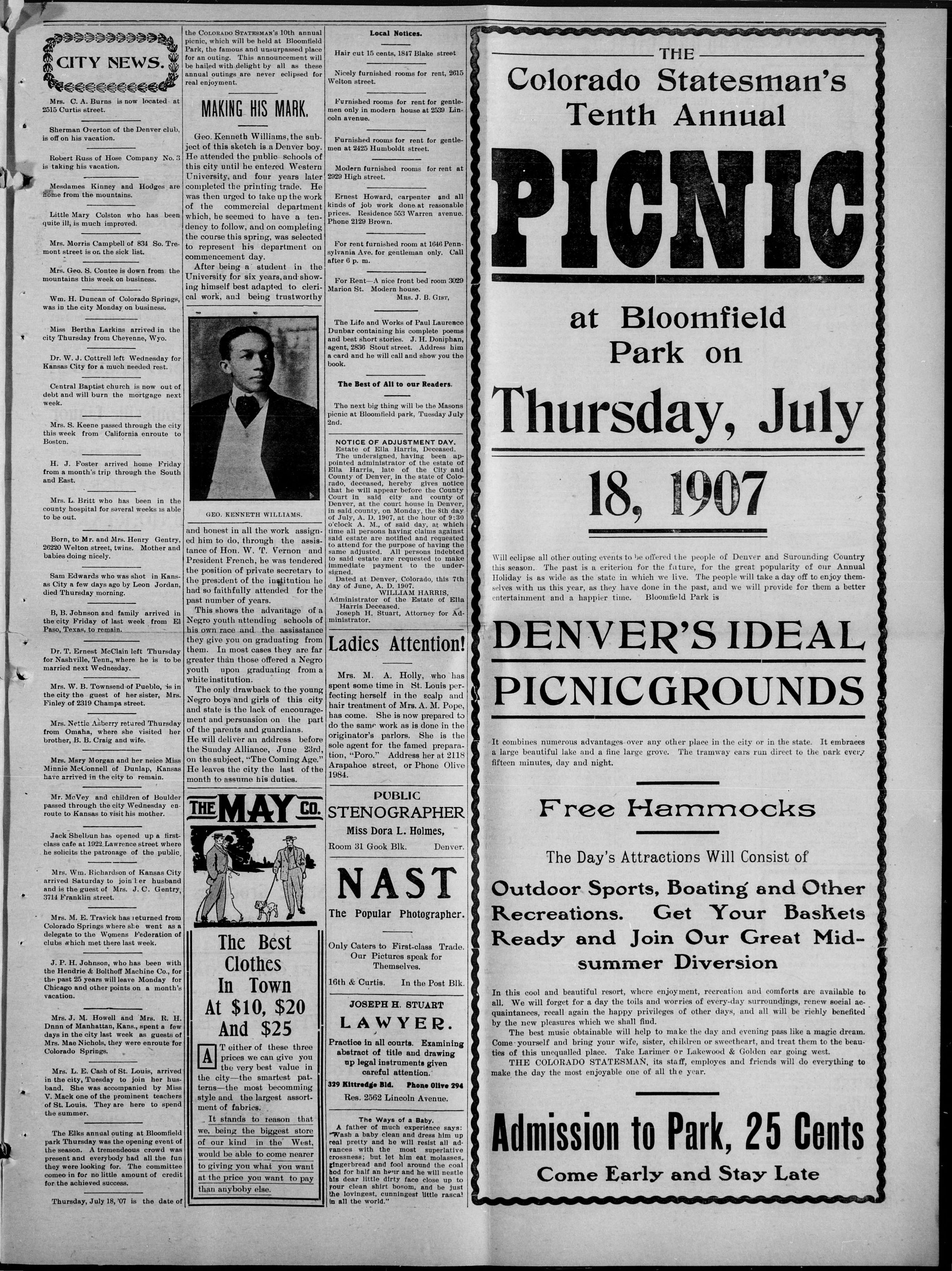
The Elks annual outing at Bloomfield park Thursday was the opening event of the season. A tremendous crowd was present and everybody had all the fun they were looking for. The committee come in for no little amount of credit for the achieved success.
Thursday, July 18, '07 is the date of
the COLORADO STATESMAN's 10th annual picnic, which will be held at Bloomfield Park, the famous and unsurpassed place for an outing. This announcement will be hailed with delight by all as these annual outings are never eclipsed for real enjoyment.
MAKING HIS MARK
Geo. Kenneth Williams, the subject of this sketch is a Denver boy. He attended the public schools of this city until he entered Western University, and four years later completed the printing trade. He was then urged to take up the work of the commercial department which, he seemed to have a tendency to follow, and on completing the course this spring, was selected to represent his department on commencement day. After being a student in the University for six years, and showing himself best adapted to clerical work, and being trustworthy
THE NEW YORK TIMES
and honest in all the work assigned him to do, through the assistance of Hon. W. T. Vernon and President French, he was tendered the position of private secretary to the president of the institution he had so faithfully attended for the past number of years. This shows the advantage of a Negro youth attending schools of his own race and the assistance they give you on graduating from them. In most cases they are far greater than those offered a Negro youth upon graduating from a white institution.
The only drawback to the young Negro boys and girls of this city and state is the lack of encouragement and persuasion on the part of the parents and guardians. He will deliver an address before the Sunday Alliance, June 23rd, on the subject, "The Coming Age." He leaves the city the last of the month to assume his duties.
A man and a dog walk in the park.
The Best Clothes In Town At $10, $20 And $25
A It either of these three prices we can give you the very best value in the city—the smartest patterns—the most becomming style and the largest assortment of fabrics.
It stands to reason that we, being the biggest store of our kind in the West, would be able to come nearer to giving you what you want at the price you want to pay than anyboby else.
Local Notices.
Hair cut 15 cents, 1847 Blake street
Colorado Statesman's Tenth Annual
Nicely furnished rooms for rent, 2615 Welton street.
Furnished rooms for rent for gentlemen only in modern house at 2539 Lincoln avenue.
Furnished rooms for rent for gentlemen at 2425 Humboldt street.
PICNIC
Modern furnished rooms for rent at 2929 High street.
Ernest Howard, carpenter and all kinds of job work done at reasonable prices. Residence 553 Warren avenue. Phone 2129 Brown.
For rent furnished room at 1646 Penn-
sylvania Ave. for gentleman only. Call
after 6 p. m.
For Rent—A nice front bed room 3029
Marion St. Modern house.
MRS. J. B. GIST.
The Life and Works of Paul Laurence Dunbar containing his complete poems and best short stories. J. H. Doniphan, agent, 2836 Stout street. Address him a card and he will call and show you the book.
The Best of All to our Readers
Thursday, July
The next big thing will be the Masons picnic at Bloomfield park, Tuesday July 2nd.
NOTICE OF ADJUSTMENT DAY.
Estate of Ella Harris, Deceased.
The undersigned, having been appointed administrator of the estate of Ella Harris, late of the City and County of Denver, in the state of Colorado, deceased, hereby gives notice that he will appear before the County Court in said city and county of Denver, at the court house in Denver, in said county, on Monday, the 8th day of July, A. D. 1907, at the hour of 9:30 o'clock A. M., of said day, at which time all persons having claims against said estate are notified and requested to attend for the purpose of having the same adjusted. All persons indebted to said estate are requested to make immediate payment to the undersigned.
Will eclipse all other outing events to be offered the people of Denver and Surrounding Country this season. The past is a criterion for the future, for the great popularity of our Annual Holiday is as wide as the state in which we live. The people will take a day off to enjoy themselves with us this year, as they have done in the past, and we will provide for them a better entertainment and a happier time. Bloomfield Park is
Dated at Denver, Colorado, this 7th day of June, A. D. 1907.
WILLIAM HARRIS,
Administrator of the Estate of Ella
Harris Deceased.
Joseph H. Stuart, Attorney for Administrator.
DENVER'S IDEAL PICNICGROUNDS
Ladies Attention!
Mrs. M. A. Holly, who has spent some time in St. Louis perfecting herself in the scalp and hair treatment of Mrs. A. M. Pope, has come. She is now prepared to do the same work as is done in the originator's parlors. She is the sole agent for the famed preparation, "Poro." Address her at 2118 Arapahoe street, or Phone Olive 1984.
It combines numerous advantages over any other place in the city or in the state. It embraces a large beautiful lake and a fine large grove. The tramway cars run direct to the park every fifteen minutes, day and night.
PUBLIC
Free Hammocks
STENOGRAPHER Miss Dora L. Holmes, Room 31 Gook Blk. Denver.
The Day's Attractions Will Consist of
NAST
Outdoor Sports, Boating and Other Recreations. Get Your Baskets Ready and Join Our Great Midsummer Diversion
The Popular Photographer.
Only Caters to First-class Trade Our Pictures speak for Themselves. 16th & Curtis. In the Post Blk
In this cool and beautiful resort, where enjoyment, recreation and comforts are available to all. We will forget for a day the toils and worries of every-day surroundings, renew social acquaintances, recall again the happy privileges of other days, and all will be richly benefited by the new pleasures which we shall find.
JOSEPH H. STUART LAWYER. Practice in all courts. Examining abstract of title and drawing up legal instruments given careful attention.
THE COLORADO STATESMAN, its staff, employs and friends will do everything to make the day the most enjoyable one of all the year.
329 Kittredge Bld. Phone Olive 294 Res. 2562 Lincoln Avenue.
A father of much experience says: Wash a baby clean and dress him up real pretty and he will resist all advances with the most superlative crossness; but let him eat molasses, gingerbread and fool around the coal hod for half an hour and he will nestle his dear little dirty face close up to your clean shirt bosom, and be just the loveliest, cunningest little rascal in all the world."
EALTH NOTES/§490.000 GIFT weno. eee F | ects to witaoe mad ttn
ee PSE
er RE i ele
ace
as e s Ee ek
Per x Rtas ete 2
Bes ee oa a ee
gpa Oe con
| JRRITABIEE!* |
3S : . iG FEN: - : f
SHUPERUP TIONS.
NERWOUSNESS:
ee ee
Spring Catarrh is a well de-
ee Sones eran The
ore TAU Balirar racine
taken in time will promptly
arrest the course of the disease
known as Spring Catarch.
SSS>
ff —— TR
N Le )
rs
bi BD
a
Paint Buyirg \\ 41 !cntpscted
Made Safe tle
White Lead and
Linszed Oil need TS
no argument, no @@ N
advertising to Ss
maintain them. an
selves as the best OF "
and most economic- ny
al paint yet known to
man. Thedifficulty has \
been for the buyer to be \ \
always sure of the purity \\
Of the white lead and oil AN
We have registered the
trade mark of the Dutch Boy painter
to be the final proof of quality, gen-
uineness and ald to paint buyers
everywhere. When this trade mark
appears on the keg, you can be sure
that the contents is Pure White
Lead made by the Old Dutch Process,
SEND FOR BOOK
idan the paint wabjecks Fave upon seanet
NATIONAL LEAD COMPANY
fm ehichever af th foto
Seeteites is Seatet poe,
No Yor Buffel, Clergtands
Pitamaat,. "tlcngo, Pat eae BANS
Seakiaddatisare Sues Me
Best lubricant for"axles in the
world—long wearing and very ad-
hesive. :
Makes a heavy load draw like a
light one. Saves half the wear on
wagon and team, and increases the
earning capacity of your outtit.
Ask your dealer for Mica Axle
Grease.
STANDARD K
Om Co.
Aneerpersied
+— Positively cured by
these Little Pills.
CARTERS ‘They also relieve De.
ER gestion and To tearty
Eating. A perfect rem
edy for Dizziness, Nausea,
PES. leer San cna
‘Tongue, Pain in the Side,
‘PORPTD LIVER. ‘They
regulate tho Bowels. Purely Vogotabio,
‘SMALL PILL, SMALL DOSE, SMALL PRICE,
Genuine Must Bear
CARTERS Fac-Simile Signature
WER | (Lecce Mo
~ JREFUSE SUBSTITUTES,
$400,000 GIFT
UNIVERSITY OF COLORADO GETS
HANDSOME ENDOWMENT.
MACKY THE BENEFACTOR
By Terms of a Will Large Sums of
Money Are Given to Aid Educa-
tion in Colorado.
‘The University of Colorado is richer
by $400,000 through the death of a
wealthy Boulder citizen, who be-
tation that amount to the institu-
tlon for a building. He did not make {t
a condition that the edifice be named
for him or place any other restriction
on his bequest, simply stating that the
residue of his estate, which will
amount to about $400,000, be given to
the regents to “erect such proper bulld-
ing as they deem best.”
Andrew J. Macky is the name of the
institution’s benefactor.
ne harles Dudley and Dr. O. J. Pfeltter,
‘the Denver member of the board of ra:
gents, are both out of the city, so tt
Las impossible to secure official ex-
pression of opinion regarding the prob-
able use of the fortune.
The law department has long wanted
a building of its own, and it will prob-
ably endeavor to secure one from this
fund.
dvstice John Campbell, dean of the
law school, when told of the good newa
today was delighted and stated that
the department would make an effort
to be recognized in the expenditure of
the money, but of course could not teil
how the regents would regard the prop
osition,
Terms of Will.
By the terms of the will of the late
A. J. Macky, which was opened by
County Judge Henderson at Boulder,
in the presence of three brothers and
a sister of the deceased, his
sole surviving relatives, the Unt
‘versity of Colorado will get 2
$400,000 building and the city of Bout
der a $50,000 home for dependent chil
dren. The sister, Mrs. Snow, and thre?
brothers, who are residents of Micht
gap and well advanced in years, and
Mrs. Cecilia Dickerson are given $10,
000 each,
The specific amounts for the relw
tives and the $50,000 for the home cre
the only ones, bequeathing a certain
amount. After’ these are paid the unk
versity will get the remainder. Cashter
W. H. Allison of the First National
Bank of Boulder, of which the Geceas2d
was the president, expressed the con:
viction this morning that the estate
would realize more thin $500,009,
which would leave at least $400,000 for
the regents of the university to build
on the campus “such proper building
as they deem best.”
‘The assets of the estate are easily
convertible into cash. | Macky’s hoid-
ings embraced but little real estate
and were mostly in stocks and bonds.
From one who was present at the read:
ing of the will it was learned that no
dissent or marks of surprise were ox
pressed by any of the hears, although
the: intelligence of the disposition vf
his estate is in a measure a surprise
to the citizens of Boulder.
His Death Regretted.
‘The funeral of Mr. Macky occurred
under the auspices of Columbian Lodge
No. 14, A. F, and A. M., and Boulder
Lodge No. 566, B. P.O. B. It was the
most largely attended funeral held in
that city for years. Interment was by
the side of his wife, who-4dlied fifteen
years ago.
Macky was seventy-three years old.
He was one of the pioneers of Boulder
county, having come here in 1859. His
early labors were along the lines of his
trade as a carpenter. Later he held
the offices of postmaster, county treas
urer, city treasurer and clerk of the
District Court,
| Mr. Macky’s illness was precipitated
by the hardships of the trip to Los An-
-geles with the Shriners, he being a
‘member of the El Jebel delegation
which went from Denver.
| President James H. Baker of tha
University said this morning that it
was not known to what use the money
would be put, as the matter is practl
‘cally a complete surprise to himself
and the entire faculty.
_ “I do not know the provisions of tha
will, nor is the amount definitely set-
tled, although I understand {t will be
about $400,000, and until these things
aro clear in my mind can make no pro-
dictions,” he said. “A law building,
science building and administration
building are badly needed.”
‘The faculty has been active in an ef-
fort to get a law school for the collega
for many months, but there is a rumor
current in Boulder that Simon Guggen-
heim will provide this for the univer
sity.
Don’t Want Much.
New York.—According to a_state-
ment made public the requests for
gifts sent to Miss Helen Gould aggre
gate nearly $2,000,000 a week. They
range all the way from the asking for
$16 for a set of false teeth to $1,000,000
to start a colony in Cuba,
‘Miss Gould gave an itemized list of
a week's requests recently to Frana
Kaltenbern, the orchestra leader. A
movement is on foot among the musio
lovers of this city to make Kalten-
bern’s orchestra music a permanent
feature in New York. For this, sub-
scriptions from wealthy persons would
be necessary, Miss Gould was ore of
those consulted. She encouraged Kal-
tenbern, but incidentally cited the
fact that this was not the only thing
she was asked to encourage. Then she
gave him the list,
In the week referred to Miss Gould
received 231 requests for money out-
right. Out of these 199 left the
amount to her good will and discre-
tion. Miss Gottld was asked in this
week for $500 to help form an anti-sa-
loon league in Idaho. She received
forty-three requests for ald for
churches, twenty-seven for educational
Institutions and twenty-six for lbra-
ries, More than thirty were for help for
charitable institutions, Four persons,
presumably young women, wanted
Misa Gould to help them buy trousseaux
leven persons wanted pianos and
twelve wanted Miss Gould to buy
their inventions.
CROP REVIEW 39 YEARS AGO.
wae,
Denver—A unique feature of the
case of 8. W. Brown et al. versus th»
city of Denver, which is occupying sev
eral weeks in the District Court, is 1
letter written thirty-nine years ago by
W. R. Thomas, now a professor in the
agricultural College at Fort Collins.
At the time the letter was written
Professor Thomas was an editorial
writer on a Denver daily p>per ani
was one of the best informed men ot
the state in regard to water rights, As
the case in question is to determine
the rights of the farmers to city ditch
water, he was called as a witness.
‘The ancient letter which brought
about his testimony was discovere.!
among the files in the state museum
at the capitol building and bears the
date of publication, May 20th, 1868.
It is two columns in lenth and it fis
ures what a moure of water the farm:
ers were getting from the city ditch at
that date. When Professor Thomas
took the stand, having been called by
Charles Allen, attorney for the elty
he testified to the acreage of land in
those days under the city ditch,
Following is a portion of the letter:
“Among the Farmers. An Editorial
Letter. The Platte Valley From Den
ver to the Mountains. May 18, 1868.
“In beginning a serfes of letters on
the agricultural resources of Colorado,
I know of no better section to com:
mence with than that portion of the
Platte valley which lies between Den.
ver and the mountains,
The facts and figures which I will
sive will neither be guess work nor
estimates—unless so stated—but arc
taken from the information by conyer
sation with those who are able to stai=
them as accurately as possible. My de:
sire is to give my readers as correct
information as it is possible to do, and
neither labor nor pains will be spare1
to accomplish my object.
The Valley.
“The portion of the valley over
which I have just passed is one of the
most settled and best cultivated «in
Colorado. Its length from the eanon
where the river leaves the mountains
to the Larimer street bridge 1s sald 10
be twenty miles, which is probably cor
ret, or nearly so. The width of the
valley will average from a mile to a
mile and a half, through which the
river winds, leaving broad bottom on
either side for the first ten or twelve
miles from the city, when it hugs more
closely to the eastern bluffs and leaves
the best of the farming land on tha
west side. Above the mouth of Plum
creek on the east side there is but one
form under cultivation, while on the
other side the farms extend to the very
gate of the canon. As to the richness
of the soil I can convey a better idea
by stating ‘what has been done,’ as [
will before completing this communi-
cation.
The Crops.
“Never looked finer and never was
there a better promise of an abundant
harvest. The farmers are nearly all
through sowing, and those who are not
are most busily at work. A few days
will probably see every grain of see1
covered.
“Beginning on the east side of the
river at the mouth of Plum creek, the
farmers who have put in crops are:"'D.
Gregory, A. S. Babcock, J. 8. Bsttack,
R. J. Lyman, R. H. Lee, 1. B. Ames,
R. S, Little, L. W. Bacon, J. M. Brown,
Peter Magnus, Thomas Lockhart,
‘Thomas Skerritt, H. P. Bennett, Ricit-
ard Beeson, Rufus Clark, J. H. Shreve,
Jacob Masterson, Jack Smith, A. F. S.
Middauh, E . Millison, R. Richardson,
and I. P. Van Normen."
Professor Thomas continued in his
letter to tell exactly what crops each
person had planted and how much of
each kind. His testimony of days gone
by proved of great interest to those in.
the courtroom.
After Twenty Years.
Now Lore re moter pend her ti
children, whom she had not seen for
twenty years and has long believed
dead, will be reunited as soon as Mrs.
Charles W. Foster of No. 145 West
Twenty-third street, reaches Los An
Beles.
As a girl of fifteen, Mrs. Foster ran
away with and married Augustus J.
Hill of Holyoke, Massachusetts, and
they, lived together happily for five
years, Without any known reason the
husband deserted his wife and two lit-
tle children—a boy and a girl—teaving
them penniless.
Mrs. Hill set out'to make a living for
herself and children and at the sug-
gestion of her husband's family eave
the children into their care. She later
received a letter that both had died of
scarlet fever. Her letters asking for
particulars was never answered.
‘The deserted wife married again af-
ter obtaining a divorce. She had
heard that her two children were not
dead and began a search for them, em-
ploying detectives and inserting adver
tisoments in newspapers. Last De
cember a Christmas present came for
Mrs. Foster, wrapped in a copy of a
Los Angeles newspaper. Mrs. Foster
glanced over the paper and saw an an-
nouncement of the marriage of Miss
Caroline Hill to Robert W. Sturges,
She wrote, and the correspondence
that followed revealed the fact. that
Mrs. Sturges and her brother Frank
were the children of Mrs. Foster, and
they will be reunited next week.
Three Are Drowned.
Albuquerque, N. M—A triple drown:
ing occurred in the Rio Grande at the
Indian puebla_Isleta, twelve miles
south of this. Following are the dead:
Mrs. Juanita Abeytad, and Indian
woman, aged forty-two; Juan Abeyta,
her eight-year-old son, ‘and Manuclita
Chewawa, Indian girl, six years old
‘The drowning of the three was
caused by the capsizing of one of the
small flat-bottomed ferry boats used by
the Indians in crossing the river.
‘Three women, four children and ons
young man got in the boat, the ferry-
man refusing to cross with’so large a
cargo. A sudden movement of one of
the occupants caused the boat to tura
turtle in midstream. ‘The ferryman
swam out in the swollen stream and
with the assistance of the other ferry
oat, which at once came to the rescue.
managed to save all but the woman
and two children. The body of Mra.
Abeyta, who was the wife of one of the
leading men of the puebla, and the girl,
wete recovered, but the corpse of the
boy could not be found.
TABLE DELICACIES
RECIPES REC nnED BY GOOD
cooks.
Fruit Punch a Pleasant Mixture for
Warm Afternoons—Utilizing Left-
Over Meat—To Revive Crisp-
ness of Cereals.
| Fruit Punch—One-half can grated
pineapple, one-half dozen oranges,
one-half dozen lemons; strain the juice
of the oranges and lemons, add the
pineapple; sweeten to taste. Ice to
chill, then pour into a punch bowl and
serve in glasses. .
Left-Over Dish.—Use a cupful of
cold meat (boiled is better than roast-
jed or fried) and some broth or gravy.
Cut the meat in dices; place in the
broth on the stove to heat. Take flour,
shortening, and baking powder, as for
rich biscuit; mix and roll out, cutting
‘into rounds rather thinner than for
‘biscuit. Cut out the center of every
other round (use a napkin ring for
this), moisten the top of a whole one
with a little water, and place one of
the rings upon it, fill with the hot
meat and set in a hot oven to bake.
Reserve a portion of the gravy to pour
over them when done. If you have no
gravy to begin with, put the meat on
to boil a few minutes in water, well
seasoned with pepper and salt, with a
small spoonful of butter; then thick-
en slightly before dipping into the
little patties. If carefully and daintily
baked these are attractive and appe-
tizing.
Make Cereals Crisp.—When cereals
lose their crispness put them on the
radiator in the original paper pack-
age for an hour or so. The heat is
sufficient to make them as crisp as
when fresh, and saves gas necessary
for heating the oven. ‘The flavor is
not Injured if the packages are left
on the radiator over night, but im-
proved by the gentle heat. Crackers
that have lost their freshness also
can be made crisp and delicious in
this simple way.
Bread in Hash.—A few pieces of
bread chopped with the meat and po-
tatoes in making hash lends a pleasing
variety.
Boston Madelines—One and one-
half tumblers of sugar, one and one-
half tumblers of flour, one-half tumbler
cornstarch, one-half tumbler butter,
three-fourths tumbler milk, yolks of
eight or nine eggs, two teaspoons bak-
ing powder, Flavor with orange ex-
tract. Bake In deep patty tins. Make
frosting from yolks of two eggs with
suger beaten, into which add grated
orange peel.
Put Veal in Dripping Pan.—Instead
ot frying your breaded yeal chops in
the ordinary way, put them in a drip-
ping pan, with a little lard or butter,
and bake in the oven. 7
Brown Sauce.
‘Two ounces of butter, two pounds ot
beef, two onions, a quarter of a pound
of lean bacon, two cloves, one bay
leaf, pepper, salt and two quarts of
water.
Put two ounces of butter in the dot-
tom of a stewpan, with the bacon cut
into small bits and the beef into very
thin slices, with two small onions, a
little pepper, salt, cloves, bay leaf and.
a little water, just enough to keep it
‘trom burning; stir over the fire for ten
or 12 minutes, then let it simmer until
it looks brown and rich; fill up the
stewpan with two quarts of water end
when boiling draw it to the side of the
range, skim off all the fat and allow.
to simmer slowly for an hour and a
half.
‘To Protect Linings.
When you get that new coat with
the fancy lining which is sure to wear
shabby at the bottom before the rest
of the lining is at all worn, get ribbon
to match the outside material in cotor
and-make a facing of it. It ts easity
replaced when it becomes shabby; or
one can have the facing match the tin-
ing.
Strawberry Nectar.
To one quart of mashed strawber
ries, add the juice of one lemon, two
tablespoons of orange juice, and three
pints of water. Let it stand three
hours; then strain upon three-quar-
ters of a pound of powdered sugar
and stir until dissolved. Serve ice
cold.
No Right to Wear Them,
fused to allow the girls to wear caps
and gowns, which he says are wholly
wrong in schools below the college
tank.
‘Piigateal- @upnhhe-
Soubrette—Yes, De Ham says he
used tu support Miss Verne in “Romeo
and Juljet."”
Comedian—He’s right. They had
such a flimsy balcony a supe had to
stand behind and hold it up.
——________
Z ‘THE
Ward Auction Co
The Old and Only.
1728-30 Arapahoe St,
‘Denver, - - Colorado,
Private Residence
Sales a Specialty
Regular Sales every day in the
- week (except Sunday)
TELEPHONE 1675,
Furniture and bankrupt Stocks
‘bought for cash or sold on com.
mission.
Re a
CAMPBELL BROS.
SUCCESSORS TO
JOHN L. LARSON,
Staple Groceries and Fresh Meats.
1864 Curtis Srreet, Cor. 19th.
Phone 8028 Bata, Denver, olorodo
Eee
FL.OOD’S MARKET Denver,
The Largest Anti-Trust Meat Market in tho West.
WHOLESALE AND RETAIL
Restaurant, Hotel and Boarding House
Business given Special Attention ....
TEL. 2 AIN 3824, 1016-1017 15TH BT
STE sa,
# PASTIME ‘SOCIAL CLUB w
A RESORT FOR LADIES AND GENTLEMEN,
——— rea LEMEN,
REWLY FUENISHED. PHONE MAIN 8046
DICH FRAZIER, Manages,
182 Arapahoe BS ‘ Denver, Colorado}
‘ma
: $23 SIXTEENLH ST.
3
fade 3
: Summer 3
:
OXFORDS
¢ are here 3
We are showing an 4
$ endless variety at
#53.50 & $4.00 Pe
: 3
i ;
i
REEETEEEEEE EEE SEE ELE TEE EES
J. W. Rummell,
WINES LINNIADS 2 CirANe
7 7
Weiner’s Saloon,
19th and Arapahoe.
We treat the boys right.
The Inter-Ocean Investment
and Brokerage Co.
AND COLLATERAL BaNK,
1436 Curtis Street,
Loans negotiated, available securities
handled, cash advances made on all
kinds of collateral securities,
Real Estate Loans a
special feature,
Business Strictly Confidential.
ae
J. T. JOHNSON,
Btate Agent for
Minnesota Grain Belt Been
Also Western Agent for D. Carnegie
& Co. Swedish Porter, Gothenburg,
Sweden,
1644 LarimerSt Denver, Cole
Hourss9 tella.m. 1 tod,TioGp. m
Bunday, 10 to 11:30. m,2todp,m.
PHONES: OFFICE, MAIN B5es,
RESIDENCE, YORK 129.
DR. P. E. SPRATLIN,
1023 19TH STREET.
RESIDENCE, 2240 CLARKSON 87.
Denver, : : Colorado.
L. Rushenenberg & Co
Importers and Jobbers in
MUSICAL MERCHANDISE.
_TELEPHONE OLIVE 029
RES PHONE BLUE 2167
High Class Violin Repairing.
620 FIFTEENTH sr.
SUIT 210 UPSTAIRS.
|Penver, - Colorado,
— a
For Fine Missouri Apple Jack
| and Corn Whiskey
COME TO THB
OLD RELIABLE
24th and Larimer Sts.
Louisville Liquor
COMPANY.
Joseph Berger, Manager.
____ Phone Main 5818.
W. P. HORAN,
UNDERTAKER
PHONE 1368.
| 1527 Cleveland Place.
Denver, - - — Colorao.
| THE BEST ICE CREAM AND
CANDIES AT
O. P. Baur & Co.,
CATERERS and
CONFECTIONERS,
PHONE 168.
151% Curtis St. Denver, abn.
2 hirst Parlors
a + J. L. PENNINGTON, Prop.
Fine Wines, Liquors & Cigars
TELEPHONE ote MAIN.
1163 Curtis Bi Denver, Osim
Prominent Roll.
Miss Sue Brette—What sort of a role did you have in that last piece?
Foote Lighte—Why, I had a roll of stage money as big as a good-sized roll of carpet.—Yonkers Statesman.
The Break-Down Sort
"Jingley seems to be very fond of walking."
"Not at all. You know he's just brought one of those cheap motor cars they're manufacturing—"
"Yes, that's what I mean."—Catholic Standard and Times.
A Capable Woman.
"There is no place filled by man," remarked Mrs. Strongmind, "that woman cannot fill."
"It wouldn't be so bad," rejoined her husband, "if she would only let it go at that. I saw one today who was filling two men's places."
"Where?" queried Mrs. S.
Where: queried Mrs. S.
"In a street car," answered the wretch as he made a hurried exit from the room.—Chicago News.
It Tastes Just the Same.
"You say you were in the saloon at the time of the assault referred to in the complaint?" asked the lawyer.
"I was, sir."
"Did you take cognizance of the barkeeper of the time?"
"I don't know what he called it, but I took what the rest did."—June Lippincott's.
Oblivious.
"Good-night!" she sighed, and yet once more
"Good-night!" He cried "Adieu!"
The parlor clock struck 1 before
The flight of time struck two.
Catholic Standard and Times
Nothing Doing
"I have a little book here that I think will interest you," said the agent, as he sat down on the farm house porch to rest. "It is entitled, 'How to Be Your Own Lawyer.'" "Reckon I don't want no sick book ez that," replied the old farmer. "They ain't no sense in a man larnin' how t' rob hisself, by grass!"—Chicago News.
No Chance for "Uncle."
"Mr. Archibald," said the kind old landlady, "didn't I hear you say that you always soaked your overcoat every spring to keep germs out of it?" "You certainly did, ma'am," chuckled the young man, who was in the habit of putting his overcoat up for the price of a straw hat. "Well, you won't have to worry over the germs this season." "Think not?" "No, indeed. I thought about soaking the overcoat and I reached the conclusion that it was too mild to kill the germs, so I just put it into the washboiler and boiled it." And the dear old lady is still wondering why the young man changed his boarding house so suddenly.—Chicago News.
Denver Directory
HAYWOOD TROUT FLIES--Ask your dealer,
Guns, Athletic Supplies, Tackle. The
Harry Spindle, Goods Co., 505 17th St.
Opp. Denver Club.
THE DENVER PAINT AND VARNISH CO.
The Acme Quality Line. 1520 Blake St.
Denver.
THE INDEPENDENT GLASS COMPANY
Plate and Window Glass, 1520 Blake St.
Denver.
BON I. LOOK Dealers in all kinds of mcr-
mailed free. Corner 16th and Blake, Denver.
STOVE REPAIRS of every known make
of stove, furnace or range. Geo. A.
Pullen, 1331 Lawrence, Denver. Phone 725.
THE FAMOUS J. H. WILSON STOCK SADDLES
Ask your dealer for them. Take no other.
BROWN PALACE HOTEL Absolute!
European Plate $15.00 and U.S.
European Plan. $1.50 and Upward.
AMERICAN HOUSE 2 blocks from
Union Depot
Best $2 a day hotel in the West. Americas
plan.
THE COLORADO SADDLERY CO.
Factory 1801-9 Market St., Denver. Harness in every style. Saddles of every description. Ask your dealer for "the Smoothest Line in the West."
Words and music sent FREE on receipt of your name and address with name of one or more persons thinking of using a Plano, Organ or Talking Machine.
THE KNIGHT-LOKE PIANO CO.
513-521 Sixteenth St., Denver, Colo.
Send your name with the ad. for list of fine instruments or organs. Planos from $75 up. Organs from $15 up. Organs from $15 up. Planos can be played by anyone. $450 up. Organs on easy terms to buy buyer. Victor talking business sold at factory prices on easy terms. Write for catalog of different instruments.
WAS
S225
NOW
S127
THE KNIGHT CAMPBELL MUSIC COMPANY.
1625-31 California St. Denver, Colo.
JOIN THE NAVY
which enlists for four years young men of good character and send physical con-
sition between the ages of 17 and 25 as apprentice seamen; opportunities for adv-
ancement; pay $16 to $19 in month per-
month, blacksmiths, copper-
smiths, yoomen (clerks), carpenters, ship-
fitters, firemen, musclans, cooks, etc., en-
listed in special mining, etc., and pay
28 years. Retire-
ment on three-fourths pay and allow-
ances after 30 years service approach
must be American edition $45 worth of
clothes free to recruits. Upon discharge
travel allowance 4 cents per mile to place
of enlistment. Bonus for month pay
and $1.36 per month increase in pay
upon re-enlistment within four months
of discharge; $5 per month increase on
second enlistment; $2 per month increase
each succeeding enlistment, whether ser-
vice is continuous or not.
U. S. NAVY RECRUITING STATIONS:
Room 22, Innomer Building, Denver, Colo.
55 Rank. Rids., Colo. Sbps., Colo.
HE ALSO WAS A COLLECTOR.
Cleveland Artist Came Back with Counter Proposition.
A local newspaper artist got a letter one day from a man over in Indiana who said he was making a collection of sketches, says the Cleveland Plain Dealer. "I have drawings from well known newspaper artists in nearly every state in the union," the Indiana man wrote, "but I have none from Ohio. I have seen some of your work and I think it is good. If you will send me some little sketch for my collection I shall have it framed."
The artist noticed from the letterhead that the Indiana man was connected with a bank in one of the small towns in the state of literature. That gave him a hunch, and he wrote back as follows:
"I am making a collection of ten dollar bills. I haven't secured specimens from every state in the union, but I have several tens and a few twenties, and I am particularly anxious to have a ten dollar bill from Indiana. I notice that you are employed in a place where ten dollar bills are kept, and if you send me one for my collection I shall be glad to have it framed."
BLACK, ITCHING SPOTS ON FACE.
Physician Called It Eczema in Worst Form—Patient Despaired of Cure—Cuticura Remedies Cured Her.
"About four years ago I was afflicted with black splotches all over my face and a few covering my body, which produced a severe itching irritation, and which caused me a great deal of suffering, to such an extent that I was forced to call in two of the leading physicians of ——. After a thorough examination of the dreaded complaint they announced it to be skin eczema in the worst form. Their treatment did me no good. Finally I became despondent and decided to discontinue their services. My husband purchased a single set of the Cuticura Remedies, which entirely stopped the breaking out. I continued the use of the Cuticura Remedies for six months, and after that every splotch was entirely gone. I have not felt a symptom of the eczema since, which was three years ago. Mrs. Lizzie E. Sledge, 540 Jones Ave., Selma, Ala., Oct. 28, 1905."
SYMPATHY FOR THE FISH.
Upton Sinclair's Amazing Parable on
Charity of the Rish.
Upton Sinclair, in an address before a body of Chicago Socialists, said of charity:
"The average charity, the charity of the rich, seems rather futile to me. The rich oppress the poor enormously, then they help them slightly. It is like the young lady angler.
"'Why,' said a man to this young lady, 'do you always carry a bottle of liniment with you on your fishi...g excursions?'
She sighed.
"I am sorry,' she said plaintively, 'for the poor little fish. And so, when I take one off the hook, I always rub its cut mouth with some liniment.'"
Libby's
Vienna Style
Sausage
Libby's
Food
Products
Sausage
unequalled for their delicious taste. They are put up in most convenient form for ready serving, requiring only a few minutes preparation. They have a fine flavor and freshness which will please every one.
An Appetizing Dish — Drop a tin of Libby's Vienna Sausage in boiling water until heated (about 15 minutes) and serve as taken from the tin on a small plate garnished with lettuce leaves.
An Easy Recipe — Injust upon getting Libby's Libby, McNelll & Libby, Chicago
FREE
To convince any
Paxton Antibiotics will
improve her health
and do all we claim
We will
send her absolutely free a individual
box of Paxtine with book of instructions
and genuine testimonials. Send
your name and address on a postal card.
PAXTINE
cleanses and heals
and treats
micro-
membrane afe-
fections, such as nasal cataract,
pelvic
caerarth and inflammation caused by
nine ills; sore eyes, sore throat
and mouth, by direct local treatment
Its curative power over these troubles is extra-
ordinary and inflammation caused by
Thousands of women are using and re-
commending it every day. 60 cents at
drummets or by mail. Remember, however,
IT COSTS WORKING TO TRY IT.
THE R. PAXTON CO., Boston, Mass.
At very small expense you can cure your work horses' sore shoulders, sore necks or sore backs and not lose a single day's work. Security Gall Salve will do it, and after the first application he will be out of pain. This is also good policy, for he will surely do more work without running down. If your stock gets cut from barb wire, or anything else, be sure and use Security Antiseptic Healer. It will cure a cut very quickly. Dealers everywhere. Security Remedy Co., Minneapolis, Minn
COLORADO NEWS ITEMS
The fruit crop in Colorado is coming out on top despite the frosts and bad reports.
Peter Christianson, a prominent business man of Morrison, recently died after an illness from paralysis.
O. W. Yeager died of Bright's disease, aged fifty-one. He had been an honored citizen of Longmont for years.
The Sisters in charge of St. Francis' Seminary at Longmont are superintending the furnishing of the building, and expect to open the school September 1st.
The new hotel committee at Boulder has decided to name the new structure the "Boulderado," being made out of the words Boulder and Colorado. Work is beiling pushed rapidly.
Pueblo captured the 1908 convention of the State Federation of Colored Women's Clubs. President Ida-Joyce Jackson of Colorado Springs, and other officers, hold over until next year.
A Denver girl was kidnapped on the main business street the other day and "spirited away" to Pueblo. The girl is 17 years old, but didn't call for help until she was 100 miles from home.
Costello and Sleiverson, two Oak Creek merchants before the County Court charged with the illegal sale of liquor, were discharged, the jury considering the evidence against them insufficient to sustain the charge. The defense offered no evidence.
A fire at Robinson, near Breckenridge, which originated in a mine boarding house last Sunday, destroyed ten buildings and for a time threatened to wipe out the entire place. Loss $25,000. Elmer Koffman was severely burned while trying to save his property.
Perahs the largest fish ever caught in a running stream in Boulder county was landed by L. E. Avery. The fish was caught in Boulder creek about three miles from town. It was a rainbow trout, twenty-two and one-half inches in length, and welighed four and a half pounds.
The Wellington association is constructing a dam for the purpose of storing water on the high ground north-west of Boulder for irrigating purposes. The dam is to be about 600 feet long, have a base of 100 feet and be fifty feet high. The reservoir will cover about thirty acres and will irrigate several thousand acres.
J. H. and E. C. Williams are going to make 600 acres of desert land bloom with fine products, according to plans and specifications recorded at Trinidad. The papers state that three reservoirs, with combined capacity of 34,500,000 cubic feet, together with numerous ditches, will be built. The land is near Aguilar, and has never been used for anything, except the grazing of sheep.
What is said to have been the first frame building erected in Fort Collins, is being moved to make room for a hardware store, 75x125 feet, which Judge Jay Boughton is building. The old building was erected in the winter of 1872-3 by Judge Boughton, he doing most of the work on it. It was built for the use of the secretary of the colony, and later used as a printing office. When Judge Boughton was elected county judge in 1876 he occupied it as a court room and office. Andrew J. Macky, a wealthy banker of Boulder, died last week and after providing for a number of relatives, he willed the remainder of his fortune to the State University, and for the purpose of building a hospital and home for dependent children and widows, the latter to be erected at Boulder. The bequest to the university provides for the erection and maintenance of a Macky building to be devoted to some branch of education. The sum of $300,000 is available for this building and $50,000 for the children's and widow's home.
The Anti-Saloon League claims to have secured evidence of violations of the gambling and Sunday-closing laws against nearly every saioonkeeper in Arapahoe county, and District Attorney Smith filed twenty-nine complaints in the County Court. The men for whom warrants were issued are: Charles Lawlin, Fort Logan, four cases; Harry Livingston, Fort Logan, four cases; H. Ullind, Fort Logan, two cases; Patrick Slyney, Fort Logan; James Buck, Petersburg; C. A. Hortman, Petersburg, five cases; Frank A. Beandle, Petersburg, seven cases; J. E. Crawford, Littleton, two cases; Henry Heinley, Littleton, two cases; Lewis Stickline, Sullivan.
E. H. Chase, a feeble old man of 76 years, was taken before Judge Lewis in the federal court in Denver recently on a bench warrant issued because he did not appear before the federal grand jury when summoned. The old man lives in Pagosa Springs, and although he has made his home in Colorado for thirty years he told the court that he had never before visited Denver. He explained his failure to obey the summons to his lack of money. He presented such a pititable appearance that Judge Lewis dismissed him without punishment. He testified before the grand jury and was allowed three days' witness fees in addition to five cens per mile mileage.
A new forage plant has been introduced in Boulder, which, it is claimed, is even better than alfalfa, especially on sandy and dry soil. Its botanical name is papsalum dilatatum, the common name being large water grass, and also golden crown grass. It is claimed this grass, which is a native of South America, has transformed the sandy, barren coast of northern New South Wales into a thriving country. It is said to grow bunchy, about four to six feet high, bears grazing well and makes good hay, and stays green the whole year round. It is claimed to be exceedingly good for milch cows, as it is rich in milk-producing properties. As high as eighteen tons of hay to the acre are credited to it. The roots go as deep as tour and even six feet into the ground. It never keeps out, and an acre of it will keep a cow in feed. It is also said to be a good fertilizer because of the leaves near the ground which drop off and rot and thus enrich the earth. Dr. Ambrook of this place has, after much trouble, been able to get a pound of seed of this plant and has given it to some of the farmers here for the purpose of testing it.
CASTORIA
For Infants and Children.
The Kind You Have Always Bought
Bears the Signature of
Chat H. Hitchter.
In Use For Over Thirty Years CASTORIA
THE GENTAUR COMPANY, NEW YORK CITY.
The Dodging Period
of a woman's life is the name often given to "change of life." Your menes come at long intervals, and grow scantier until they stop. The change lasts three or four years, and causes much pain and suffering, which can, however, be cured, by taking
WINE OF CARDUI
Woman's Refuge in Distress
It quickly relieves the pain, nervousness, irritability, miserableness, fainting, dizziness, hot and cold flashes, weakness, tired feeling, etc. Cardui will bring you safely through this "dodging period," and build up your strength for the rest of your life. Try it.
You can get it at all druggists in $1.00 bottles.
"EVERYTHING BUT DEATH I suffers," writes Virginia Robson, of Easton, Md., "until I took Cardui, which cured me so quickly it surprised my doctor, who didn't know I was taking it."
LIVE STOCK AND ELECTROTYPES
MISCELLANEOUS
In great interest or sale at the lowest price by A. K. KELLOGG SEWSPAPER CO., 11 W. Adams St., Chicago
Racked with Pain, Day and Night, for Years.
Wm. H. Walter, engineer, of Chatsworth, Ills., writes: "Kidney disease was lurking in my system for years. I had torturing pain in the side and back and the urine was dark and full of sediment. I was racked with pain day and night, could not sleep or
was lurking in my system for years. I had torturing pain in the side and back and the urine was dark and full of sediment. I was racked with pain day and night, could not sleep or eat well, and finally became crippled and bent over with rheumatism. Doan's Kidney Pills brought quick relief, and in time, cured me. Though I lost 40 pounds, I now weigh 200, more than ever before."
Sold by all dealers. 50 cents a box. Foster-Milburn Co., Buffalo, N. Y.
Would Take What They Had.
A gentleman purchased at a post office a large quantity of stamped envelopes, newspaper wrappers and other postal requisities.
Finding them somewhat difficult to carry, he asked one of the counter clerks if he could supply him with a small quantity of string.
"We are not permitted by the department to supply string," was the reply.
"Then give me a bit of red tape," was the sarcastic retort.
The string was supplied.
Sheer white goods, in fact, any fine wash goods when new, owe much of their attractiveness to the way they are laundered, this being done in a manner to enhance their textile beauty. Home laundering would be equally satisfactory if proper attention was given to starching, the first essential being good Starch, which has sufficient strength to stiffen, without thickening the goods. Try Deflance Starch and you will be pleasantly surprised at the improved appearance of your work.
Quaker Wit.
A Quaker riding in a carriage with a fashionable woman decked with a profusion of jewelry, as a substitute, perhaps, for her scantiness of clothes, heard her complaining of the cold. Shivering in her lace bonnet and shawl, she exclaimed, "What shall I do to get warm?"
"I really don't know," replied the Quaker solemnly, "unless thou put on another breastpin."—Sunday Magazine.
$100 Reward, $100.
The readers of this paper will be pleased to learn that there is least one dreaded disease that science has been able to cure in all its stages, and that is the Cataract Cure. Hall's Cataract Cure is now known to the medical fraternity. Cataract being a constitutional disease, requires a constitutional treatment. Hall's Cataract Cure is taken internally, acting directly upon the blood and mucus in the eye, and restoring the foundation of the disease, and giving the patient strength by building up the constitution and assisting nature in doing its work. The prophetors have one Hundred Dollars for any case that it fails to cure. Send for list of testimonials.
Address F. J. CHENEY & CO., Toledo, O.
Sold by all Druggles, Thc.
Rake Hall's Family Pills for constipation.
Willing to Reason.
"Of course," declared the pretty
widow, "I am inconsolable."
"Naturally."
"However, as you know, I was never
a fanatic on any point."
Ladies Can Wear Shoes
One size smaller after using Allen's Foot-Ease. A certain cure for swollen,sweating, hot, aching feet. At all Druggists, 25c. Accept no substitute. Trial package FREE. Address A. S. Olmsted, Le Roy, N. Y.
No man that imparteth his joys to his friend, but he joyeth the more; and no man that imparteth his griefs to his friend, but he grieveth the less.
Mrs. Winslow's Soothing Syrup.
For children teething, softens the gums, reduces inflammation, always pain, cure wind colic. 25c a bottle.
Wisely and slow; they stumble that run fast—Shakespeare.
WORKING WOMEN, WHAT THEY SHOULD KNOW
A. B.
Lydia E. Pinkham's Vegetable Compound Succeeds Where Others Fail.
"Really—er—I'm afraid you overheard what I—er—said about you," stammered the gossip who had been caught redhanded. "Perhaps I—er—was a bit too severe—"
"Oh, no," replied the other woman, "you weren't nearly as severe as you would have been if you knew what I think of you."
The extraordinary popularity of fine white goods this summer makes the choice of Starch a matter of great importance. Defiance Starch, being free from all injurious chemicals, is the only one which is safe to use on fine fabrics. Its great strength as a stiffener makes half the usual quantity of Starch necessary, with the result of perfect finish, equal to that when the goods were new.
The Web of Life.
Life is the daily web of character we unconsciously weave. Our thoughts, imaginations, purpose, motives, love, will, are the under threads; and the passing moment is the suttle, swiftly, ceaselessly, relentlessly, weaving those threads into a web; and that web is life.—S. D. Gordon.
The greatest cause of worry on ironing day can be removed by using Defiance Starch, which will not stick to the iron. Sold everywhere, 16 oz. for 10c.
Man is not the creature of circum stances; circumstances are the creatures of men.—Disraeli.
WORKING
WHAT THEY
MRS. SADIE ABBOTT
Women for the most part spend
their lives at home, and it is these
women who are willing and ambitions
that their homes shall be kept neat
and pretty, their children well dressed
and tidy, who do their own cooking,
sweeping, dusting and often washing,
ironing and sewing for the entire
family, who call for our sympathy.
Truly the work of such a woman is "never done" and is it any wonder that she breaks down at the end of a few years, the back begins to ache, there is a displacement, inflammation or ulceration of the abdominal organs, a female weakness is brought on, and the struggle of that wife and mother to continue her duties is pitiful.
Lydia E. Pinkham's Vegetable Compound, made from native roots and herbs, is the exact medicine a woman needs whose strength is overtaxed. It keeps the feminine organs in a strong and healthy condition. In preparing for childbirth and recuperating therefrom it is most efficient. It carries a woman safely through the change of life and in making her strong and well assists her to be a good wife and mother.
Mrs. Sadie Abbott, of Jeannette, Pa., writes:
Dear Mrs. Pinkham—
"I suffered severely with pain every month and also a pain in my left side. My doctor said I was not a good friend advised Lydia E. Pinkham's Vegetable Compound and I wrote you in regard to my condition. I followed your advice and am a perfectly well woman. The pains have all disappeared and I cannot recommend your medicine too highly."
CASTORIA For Infants and Children. The Kind You Have
Wife (severely, to husband)—My dear, you have had enough wine now. Husband—You're right, my dear, all ways right. Here, waiter, bring me some whisky!—Translated for Talent from Fliegende Blatter.
DODD'S
KIDNEY
PILLS
FOR ALL KIDNEY DISEASES
FOR RHEUMATISM
BRIGHT'S DISEASE
DIABETES. BACKACHE
1375 "Guarantee"
READERS of this paper desire to buy any thing advertised in its columns should insist upon having what they ask for, refusing all substitutes or imitations.
W. N. U., DENVER, NO. 25, 1907.
WOMEN,
SHOULD KNOW
MRS. PREE McKITRICK
Mrs. Pree McKitrick, of La Farge,
Wis., writes:
Dear Mrs. Pinkham;
"For six years I suffered from female weakness. I was so irregular that I would go from three weeks to six months, so I thought I would give Lydia E. Pinkham's Vegetable Compound a trial.
"Now I am once more well and can do my work without a pain. Any one who wishes, can write to me and I will answer all letters gladly."
Women should remember that Lydia E. Pinkham's Vegetable Compound holds the record for the greatest number of actual cures of female ills. Every suffering woman in the United States is asked to accept the following invitation. It is free, will bring you health and may save your life.
Mrs. Pinkham's Invitation to Women.
Women suffering from any form of female weakness are invited to promptly communicate with Mrs. Pinkham, at Lynn, Mass. From the symptoms given, the trouble may be located and the quickest and surest way of recovery advised. Out of her vast volume of experience in treating female ills Mrs. Pinkham probably has the very knowledge that will help your case. Her advice is free and always helpful.
Sound Succeed Where Others Fail.
The Dodging Period
Is Now Prepared To Do
All Kinds of Job Printing?
Commercial, Fraternal. Church, Book and Stationery Jobs a Specialty
BALL AND CONCERT PROGRAMS, BILL AND LETTER HEADS, OALLING CARDS, WEDDING CARDS, ENVELOPES AND EVERYTHING IN THE PRINTING LINE TURNED OUT IN NEATEST STYLE PROMPTLY ON SHORT NOTICE.
We have supplied our office with job press and type of up-to-date style and our work will be on a par with the Very Best
Give Us a Trial and We will Give You Satisfaction
PRICES AS REASONABLE AS
THOSE OF ANY JOB OFFICE
IN DENVER.
The Colorado
Statesman
1824 CURTIS STREET
ROOM 25.
---
For the MODISH WOMAN
American women have much to learn from their sisters in Paris as to the art of wearing tailor-made gowns, for it is certain that no women in the world equal the Parisiennes in this difficult art. Nature has made them exceedingly careful of details, and this in every walk of life, and from early youth they are taught to regard dress as an affair of paramount importance. To a Parisienne it is a matter of vital importance that the dainty little purse carried in the hand should harmonize with some other detail—with the sporting-looking little necktie, perhaps, or with the embroideries on the waistcoat of pale-hued suede. Everything has its own meaning and nothing is too small to lack importance. It is natural to French-women to look at the subject from this point of view and this is why they can—when they wish to do so—dress perfectly on a comparatively small income.
A peculiarity of the Parisian evening gowns this season is the close resemblance which they bear to tea-gowns. There is the same graceful flow of supple material and the same vague outline. The Parisiennes revel in this particular mode and invest it with exceeding charm and grace. They never permit their picture gowns
THE LADY IN A GREAT DRESS
THE FASHION OF THE TWENTIETH CENTURY
Original Designs for Smart Gowns.
to look in the least like robes de chambre, and in this they display much cleverness, for a semi-loose robe has a tiresome way of looking bedroom unless worn with great discretion.
The picture styles which are making themselves so strongly felt in the world of fashion this year are specially prominent where evening dresses are concerned, not so much with regard to gowns for dinners of ceremony as for those to be worn at bridge parties and receptions amongst intimate friends. A leading feature of the new bridge gowns is the hanging sleeve, which can hardly be called "angel," but which is of that order. This sleeve almost invariably falls back from the elbow, leaving the lower part of the arm quite bare. From elbow to shoulder it is often nearly tight, but the real picture sleeve falls in graceful folds all the way down.
Lace of every sort is as fashionable as ever, if not more so. You may see thick guipure doing duty on the costume to left in our large illustration. The bodice is of lace, while braces and trimmings to the full sleeves are of taffeta, fringes decorating the sash ends, which are held with enamel buttons at the waist, and the plain full skirt is of voile. The other dress shows cinnamon brown cloth in combination with black and white striped silk, small bands of Irish lace being used to trim the bodice, the hat being of brown with brown shaded roses in clusters on either side.
Roses have taken unto themselves every conceivable tone, the most fashionable being, of course, blue, and these are usually allied to black centers and accompanied by black leaves, a wreath of the latter appearing with considerable success round the base of the crown of an open-brimmed crinoline straw hat.
But to turn to dresses of the commoner sort and of the greater utility.
All combinations of black and white prominent, and a mode which
threatens to become universal includes a three-quarter coat of the simplest style in combination with a short skirt, both being made of black and white striped coarse fibered material of homespun description. Such a costume is suitable, however, only for most work-a-day occasions, and lends itself to be crowned only by straw hats trimmed with ribbons and wings or rosettes of silk, and will no doubt look its very best when worn with a white batiste or lawn shirt and permitted to take its walks in the country. Black and white check appears in every size and form; smooth of face and rough of face, it alike finds devotees, and an easy means of answering the question of what to wear at the immediate moment in the mornings can be settled by a kilted skirt of black and white check, a small coat of whatever shape that may best please and best suit you, with a white waistcoat embroidered with black braid and fastened with white pearl buttons, and a white lawn frilled shirt, crowned with a green straw hat trimmed with green rosettes, and a short green spotted veil thrown over the crown, to fall just to the nape of the neck. The veil must be short if the dress be short, the veil long if the dress be long. Here lies one of the
CHRISTIE
rules not to be forgotten by those who realize the advantage of graceful proportion. And again I remember that this special virtue may be accredited to the short-waisted dress, so that the lines of the waist be chosen with special care.
CHURCHILL'S MAIDEN EFFORT.
First Speech in Parliament Hit the Mark in Spite of Faults of Delivery.
The first time I noticed Lord Randolph Churchill in the house of commons was on a May day in 1875, says a writer in Blackwood's Magazine. Sir Charles Dilke had been making merry at the expense of Woodstock, then represented by one known in the Parliamentary arena simply as a cadet of the ducal house of Marlborough.
From the third bench behind that on which ministers ought to have been sitting, rose a well groomed young man, with protuberant eyes, pale face and a ponderous mustache, with which as he spoke he nervously toyed. Members asking each other: "Who's this?" learned that it was the member for Woodstock rising to defend the corporation of the borough that sent him to parliament.
Though assisted by notes, on which the speech was fully written out, the young member was so nervous, his voice was badly pitched, his delivery so faulty that there was difficulty in following his argument. But here and there flashed forth a scathing sentence that made it worth while to attempt to catch the rest. When he sat down Lord Randolph had made his mark, had established himself as a personality in an assembly in which within ten years he was predominant.
The Genuine Test.
"Do you believe that man is a real musical critic?"
"Of course he is. Does anybody ever know what he is talking about?"—Baltimore American.
---
S & N
GARMENT STORE
925-16TH ST. — OPP. JOSLINS
OUR JUNE CLEARING SALE
Is proving about the most successful sale we have ever had. Every day we offer some new bargains, and we advise our customers to call at once, some of the best bargains may not last long. Below we mention
Ten Special Bargains
s's light cloth Eton Jacket Suits, size
.00.
Uses All-Wool Fancy Eton Jacket Suits,
by braid or straps of silk trimmings,
$17.50.
Uses Black Taffeta Silk Eton Suits, en-
mmed; worth $32.50.
Off a lot of White Lawn Waists, oo-
lidery or lace trimmed styles; were $1.
of 10 styles of White Lawn Waists,
short, short and long sleeves, lace or emb-
are are this seasons styles; worth $1.50.
of several styles of fancy White J
short sleeve styles; worth $3.00.
side flounce, full width Wash Petty
worth $1.00.
Town Dressing Sacques and Kimono
a $1.00.
Immended Corset Covers; worth 35c.
black or Brown Hose; worth 15c.
FOR ANY GARMENT YOU MAY
places the lowest.
Smith & Hiller, 925
OPE
THE
TWO JIMS'
SOCIAL CLUB
$5.95 for Misses' light cloth Eton Jacket Suits, sizes 10, 12, 14, 16; worth $10.00.
$9.95 for Ladies All-Wool Fancy Eton Jacket Suits, Jackets satin lined, fancy braid or straps of silk trimmings; regular prices $16.75 and $17.50.
$22.50 for Ladies' Black Taffeta Silk Eton Suits, elegantly tailored and trimmed; worth $32.50.
50c for choice of a lot of White Lawn Waists, odd and broken lots, embroidery or lace trimmed styles; were $1.25 and $1.50.
98c for choice of 10 styles of White Lawn Waists, open front and back styles, short and long sleeves, lace or embroidery trimmed, or both, are this seasons styles; worth $1.50.
$1.95 for choice of several styles of fancy White Jap Silk Waists,
open back, short sleeve styles; worth $3.00.
open back, short sleeve styles; worth $5.00.
75c for extra wide flounce, full width Wash Petticoats, in neat stripes; worth $1.00.
75c for Fine Lawn Dressing Sacques and Kimonos, light colors only; worth $1.00.
TRY US FOR ANY GARMENT YOU MAY NEED. You will find our prices the lowest.
Silversmith & Hiller, 925 16th St.
OPP. JOSLIN'S
Denver's Favorite Pleasure Resort.
Whist, Pool, Chess, Cheekoas and Other Pastime Games.
PHONE 2275 MAIN.
1859 Champa St Denver, Colo.
John Car
@ Bro.,
OCKERY
The John Carson @ Bro.,
CROCKERY CO.
Liberal discounts on all lines including Dinner Ware, Fancy China and Cut Glass.
This Special Sale
is meeting a hearty response for all classes and to any who have a wedding present or graduating gift to purchase this is a rare opportunity.
JOHN CARSON & CROCKERY CO.
New Address 734 15th St. Cor. Stout THE JOHN CARSON & BRO., CROCKERY CO.
THURSDAY, JULY 18TH IS THE DATE OF THE BIG PICNIC AT BLOOMFIELD PARK
FAMOUS RETORTS CHARACTERIZED BY BREVITY.
Stories of Noted Men Who Were Quick to Seize Up an Opportunity to Make a
Brevity has been the marked char-acteristic of many happy retorts. What could be more crushing, more grimly witty, than the reply attributed to Tallyrand on an occasion when a certain notorious personage, ill and in great pain, said that he was suffering the torments of the lost. Swiftly came the wicked retort: "Deja"—already?
Of a different complexion, but equally exemplifying the soul of wit, was the reply, which has been attributed to various painters, to a questioner who wished to know the vehicle with which the painter mixed his colors. Dr. John Brown tells the story of Opie.
"Pray, Mr. Opie, may I ask what you mix your colors with?" said a brisk dilettante student to the great painter. "With brains, sir,' was the gruff reply—and the right one."
Single word replies, more or less witty, says the London Globe, are fairly common. A patient whom the famous Dr. Aberneth had advised to take a walk on an empty stomach calmly replied: "Whose?" A recent example was the answer of the late Dean Hole to a boring Cockney fellow travelling on the Great Northern railway. "What comes after Titchin?" asked the bore. "Scratchin," came the swift retort, and thereafter the conversation flagged. Many brief and telling replies are laid to the account of Douglas Jerrold. It will suffice to recall one. "What's going on?" said a bore, stopping Jerrold in the street. "I am," and the speaker suited the action to the word.
Akin to this was the answer of John Wesley to the blustering swaggerer who pushed against him on the path, with the insulting remark: "I never make way for a fool." "I always do," said Wesley, quietly stepping aside, and then placidly pursuing his way.
Brief and witty was the reply of a Catholic cleric to an opponent in argument who had declared his disbelief in purgatory. "You might go farther and fare worse," was the ecclesiastic's parting shot.
The wit of more than one of Dr. Johnson's crushing retorts was enhanced by brevity, but examples are to familiar to be quoted. Johnson came down like a sledge hammer on Scotland and things Scottish. Less familiar, perhaps, is the retort in which a Scotchman scored. An Englishman in Scotland was abusing the country, complaining of the state of the larder and wondering where he could get less to eat.
"I could tell ye a place whaur ye wad get less," said the Scot, who was listening to the trade. "Where's that?" asked the other.
"Oh, just whaur an Englishman's been!" said the Scotsman dryly.
Brevity as the soul of wit is exemplified in many popular sayings. Wit is by no means an inevitable ingredient in proverbs. Many of them are of doubtful sense, and some are foolish, yet there is a certain spice. The definition of proverbs by Howell as "Sayings which combine sense, shortness and salt," is in the main true. Though truth may be altogether absent and wit barely perceptible, yet there must be a certain "salt" which gives life and savor to the saying.
It would be difficult to find sayings more telling than some of the shortest—such, for instance, as "Forewarned, forearmed," "Extremes meet," or the ancient "Inter malleum et incudem" (Between the hammer and the anvil). Many sayings which in English are short were briefer still in their original classical form.
That the soul of wit was exemplified most strikingly among the Greeks is only what we should expect. It is curious to remember that our word "laconic" preserves the memory of the reputation for conciseness of speech borne by the people of one part of Greece—the Laconians or Spartans. When Philip of Macedon threatened them, "If I enter Laconia I will level your city to the dust," they made the famous reply: "If."
The Value of a Smile.
It is wonderful what an effect a bright look or smile may have on one we meet. If we only knew just how much good it may do, we should always try to carry smiles about with us.
The little woman who goes about the street with such a bright, happy face and cheery word for all she knows, seems to have the effect of sunshine, says Chicago Journal. When she does her shopping everyone seems to brighten and respond to her nappy greeting as naturally as a flower opens to the sunlight.
A little smile, a look of sympathy, are things that cost nothing, and we know from our experience how just one may brighten a whole day.
Life is hard at best, so let us do all we can to brighten the lives of others, and thus brighten our own lives.
Have you, heard the story of the section boss? He calls down the road and he says:
"How many of yez are there down there?"
"Three," comes the answer.
"Well, half of yez come up here and help me."