Colorado Statesman
Saturday, August 31, 1907
Denver, Colorado
Page text (machine-generated)
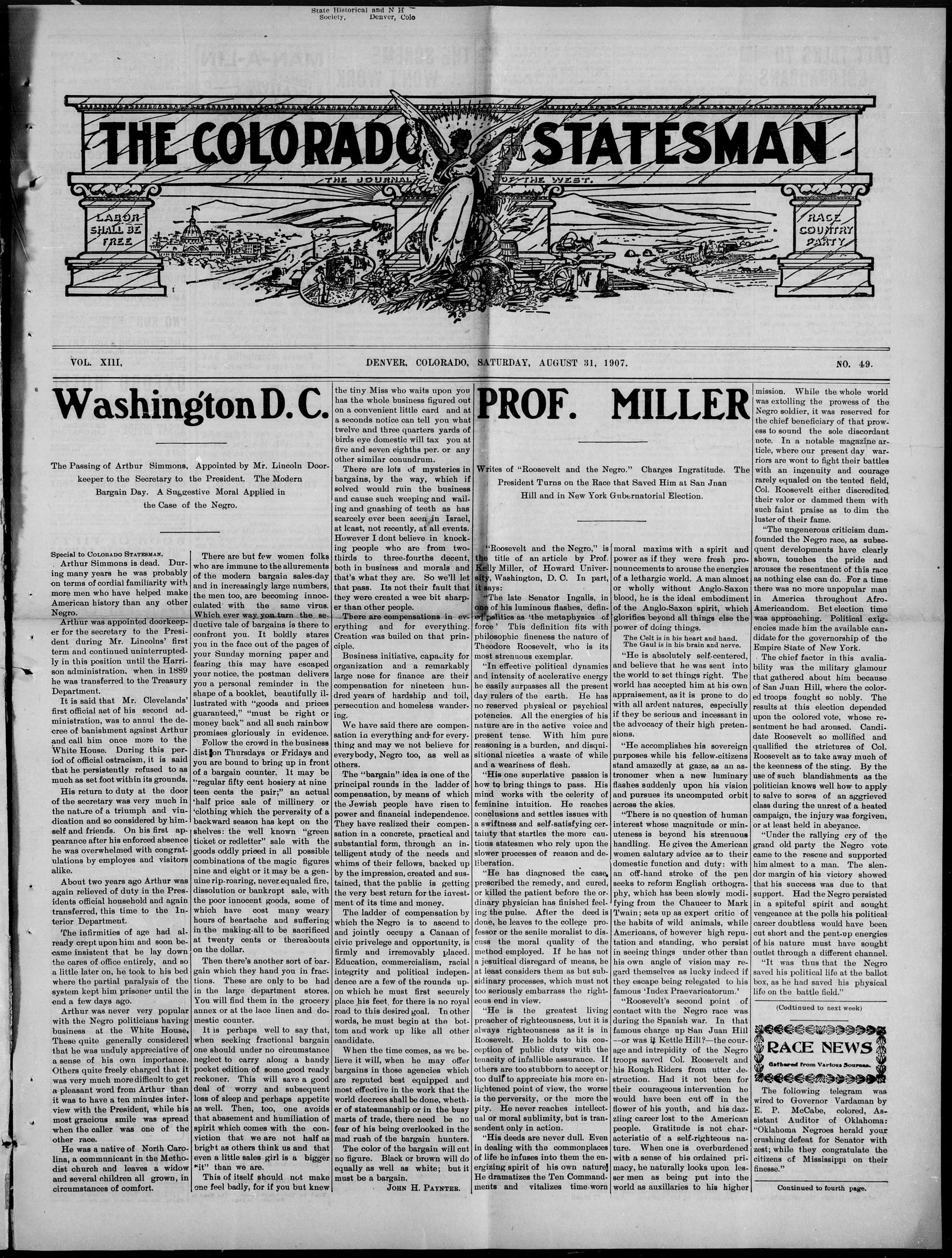
THE COLORADO STATESMAN
THE JOURNAL OF THE WEST.
LABOR SHALL BE FREE
RAGE COUNTRY PARTY
Washington D.C.
The Passing of Arthur Simmons, Appointed by Mr. Lincoln Door keeper to the Secretary to the President. The Modern Bargain Day. A Suggestive Moral Applied in the Case of the Negro.
VOL. XIII,
Washing
The Passing of Arthur Simmons,
keeper to the Secretary to
Bargain Day. A Sugge
the Case of
Special to COLORADO STATESMAN.
Arthur Simmons is dead. During many years he was probably on terms of cordial familiarity with more men who have helped make American history than any other Negro.
Arthur was appointed doorkeeper for the secretary to the President during Mr. Lincoln's first term and continued uninterruptedly in this position until the Harrison administration, when in 1889 he was transferred to the Treasury Department.
It is said that Mr. Clevelands' first official act of his second administration, was to annul the decree of banishment against Arthur and call him once more to the White House. During this period of official ostracism, it is said that he persistently refused to as much as set foot within its grounds.
His return to duty at the door of the secretary was very much in the nature of a triumph and vindication and so considered by himself and friends. On his first appearance after his enforced absence he was overwhelmed with congratulations by employes and visitors alike.
About two years ago Arthur was again relieved of duty in the Presidents official household and again transferred, this time to the Interior Department.
The infirmities of age had already crept upon him and soon became insistent that he lay down the cares of office entirely, and so a little later on, he took to his bed where the partial paralysis of the system kept him prisoner until the end a few days ago.
Arthur was never very popular with the Negro politicians having business at the White House. These quite generally considered that he was unduly appreciative of a sense of his own importance. Others quite freely charged that it was very much more difficult to get a pleasant word from Arthur than it was to have a ten minutes interview with the President, while his most gracious smile was spread when the caller was one of the other race.
He was a native of North Carolina, a communicant in the Methodist church and leaves a widow and several children all grown, in circumstances of comfort.
There are but few women folks who are immune to the allurements of the modern bargain sales-day and in increasingly large numbers, the men too, are becoming innoculated with the same virus. Which ever way you turn the seductive tale of bargains is there to confront you. It boldly stares you in the face out of the pages of your Sunday morning paper and fearing this may have escaped your notice, the postman delivers you a personal reminder in the shape of a booklet, beautifully illustrated with "goods and prices guaranteed," "must be right or money back" and all such rainbow promises gloriously in evidence.
Follow the crowd in the business dist on Thursdays or Fridays and you are bound to bring up in front of a bargain counter. It may be "regular fifty cent hosiery at nine teen cents the pair;" an actual half price sale of millinery or 'clothing which the perversity of a backward season has kept on the shelves: the well known "green ticket or redletter" sale with the goods oddly priced in all possible combinations of the magic figures nine and eight or it may be a genuine rip-roaring, never equaled fire, dissolution or bankrupt sale, with the poor innocent goods, some of which have cost many weary hours of heartache and suffering in the making-all to be sacrificed at twenty cents or thereabouts on the dollar.
Then there's another sort of bargain which they hand you in fractions. These are only to be had in the large department stores. You will find them in the grocery annex or at the lace linen and domestic counter.
It is perhaps well to say that, when seeking fractional bargain one should under no circumstance neglect to carry along a handy pocket edition of some good ready reckoner. This will save a good deal of worry and subsequent loss of sleep and perhaps appetite as well. Then, too, one avoids that abasement and humiliation of spirit which comes with the conviction that we are not half as bright as others think us and that even a little sales girl is a bigger "it" than we are.
This of itself should not make one feel badly, for if you but knew
DENVER, COLORADO, SATURDAY, AUGUST 31, 1907.
the tiny Miss who waits upon you has the whole business figured out on a convenient little card and at a seconds notice can tell you what twelve and three quarters yards of birds eye domestic will tax you at five and seven eighths per. or any other similar conundrum.
There are lots of mysteries in bargains, by the way, which if solved would ruin the business and cause such weeping and wailing and gnashing of teeth as has scarcely ever been seen in Israel, at least, not recently, at all events. However I dont believe in knocking people who are from two-thirds to three-fourths decent, both in business and morals and that's what they are. So we'll let that pass. Its not their fault that they were created a wee bit sharper than other people.
There are compensations in everything and for everything. Creation was builed on that principle.
Business initiative, capacity for organization and a remarkably large nose for finance are their compensation for nineteen hundred years of hardship and toil, persecution and homeless wandering.
We have said there are compensation in everything and for everything and may we not believe for everybody, Negro too, as well as others.
The "bargain" idea is one of the principal rounds in the ladder of compensation, by means of which the Jewish people have risen to power and financial independence. They have realized their compensation in a concrete, practical and substantial form, through an intelligent study of the needs and whims of their fellows, backed up by the impression, created and sustained, that the public is getting the very best return for the investment of its time and money.
The ladder of compensation by which the Negro is to ascend to and jointly occupy a Canaan of civic privilege and opportunity, is firmly and irremovably placed. Education, commercialism, racial integrity and political independence are a few of the rounds upon which he must first securely place his feet, for there is no royal road to this desired goal. In other words, he must begin at the bottom and work up like all other candidate.
When the time comes, as we believe it will, when he may offer bargains in those agencies which are reputed best equipped and most effective in the work that the world decrees shall be done, whether of statesmanship or in the busy marts of trade, there need be no fear of his being overlooked in the mad rush of the bargain hunters. The color of the bargain will cut no figure. Black or brown will do equally as well as white; but it must be a bargain.
JOHN H. PAYNTER.
PROF. MILLER
Writes of "Roosevelt and the Negro." Charges Ingratitude. The President Turns on the Race that Saved Him at San Jnan Hill and in New York Gubernatorial Election.
"Roosevelt and the Negro," is the title of an article by Prof. Kelly Miller, of Howard University, Washington, D. C. In part, it says:
"The late Senator Ingalls, in one of his luminous flashes, defined politics as 'the metaphysics of force' This definition fits with philosophic fineness the nature of Theodore Roosevelt, who is its most strenuous exemplar.
"In effective political dynamics and intensity of accelerative energy he easily surpasses all the present day rulers of the earth. He has no reserved physical or psychical potencies. All the energies of his nature are in the active voice and present tense. With him pure reasoning is a burden, and disquisitional niceties a waste of while and a weariness of flesh.
"His one superlative passion is how to bring things to pass. His mind works with the celerity of feminine intuition. He reaches conclusions and settles issues with a swiftness and self-satisfying certainty that startles the more cautious statesmen who rely upon the slower processes of reason and deliberation.
"He has diagnosed the case, prescribed the remedy, and cured, or killed the patient before the ordinary physician has finished feeling the pulse. After the deed is done, he leaves to the college professor or the senile moralist to discuss the moral quality of the method employed. If he has not a jesuitical disregard of means, he at least considers them as but subsidiary processes, which must not too seriously embarrass the righteous end in view.
"He is the greatest living preacher of righteousness, but it is always righteousness as it is in Roosevelt. He holds to his conception of public duty with the tenacity of infallible assurance. If others are too stubborn to accept or too dull to appreciate his more enlightened point of view, the worse is the perversity, or the more the pity. He never reaches intellectual or moral sublimity, but is transendent only in action.
"His deeds are never dull. Even in dealing with the commonplaces of life he infuses into them the energizing spirit of his own nature. He dramatizes the Ten Commandments and vitalizes time-worn
moral maxims with a spirit and power as if they were fresh pronouncements to arouse the energies of a lethargic world. A man almost or wholly without Anglo-Saxon blood, he is the ideal embodiment of the Anglo-Saxon spirit, which glorifies beyond all things else the power of doing things.
The Celt is in his heart and hand.
The Gaul is in his brain and nerve.
"He is absolutely self-centered, and believe that he was sent into the world to set things right. The world has accepted him at his own appraisement, as it is prone to do with all ardent natures, especially if they be serious and incessant in the advocacy of their high pretensions.
"He accomplishes his sovereign purposes while his fellow-citizens stand amazedly at gaze, as an astronomer when a new luminary flashes suddenly upon his vision and pursues its uncomputed orbit across the skies.
"There is no question of human interest whose magnitude or minuteness is beyond his strenuous handling. He gives the American women salutary advice as to their domestic function and duty: with an off-hand stroke of the pen seeks to reform English orthography, which has been slowly modifying from the Chaucer to Mark Twain; sets up as expert critic of the habits of wild animals, while Americans, of however high reputation and standing, who persist in seeing things under other than his own angle of vision may regard themselves as lucky indeed if they escape being relegated to his famous 'Index Praevaricatorum.'
"Roosevelt's second point of contact with the Negro race was during the Spanish war. In that famous charge up San Juan Hill—or was it Kettle Hill?—the courage and intrepidity of the Negro troops saved Col. Roosevelt and his Rough Riders from utter destruction. Had it not been for their courageous intervention he would have been cut off in the flower of his youth, and his dazzling career lost to the American people. Gratitude is not characteristic of a self-righteous nature. When one is overburdened with a sense of his ordained primacy, he naturally looks upon lesser men as being put into the world as auxillaries to his higher
NO. 49.
mission. While the whole world was extolling the prowess of the Negro soldier, it was reserved for the chief beneficiary of that prowess to sound the sole discordant note. In a notable magazine article, where our present day warriors are wont to fight their battles with an ingenuity and courage rarely equaled on the tented field, Col. Roosevelt either discredited their valor or dammed them with such faint praise as to dim the luster of their fame.
"The ungenerous criticism dumfounded the Negro race, as subsequent developments have clearly shown, touches the pride and arouses the resentment of this race as nothing else can do. For a time there was no more unpopular man in America throughout Afro-Americandom. But election time was approaching. Political exigencies made him the available candidate for the governorship of the Empire State of New York.
The chief factor in this availability was the military glamour that gathered about him because of San Juan Hill, where the colored troops fought so nobly. The results at this election depended upon the colored vote, whose resentment he had aroused. Candidate Roosevelt so mollified and qualified the strictures of Col. Roosevelt as to take away much of the keenness of the sting. By the use of such blandishments as the politician knows well how to apply to salve to sores of an aggrieved class during the unrest of a heated campaign, the injury was forgiven, or at least held in abeyance.
"Under the rallying cry of the grand old party the Negro vote came to the rescue and supported him almost to a man. The slender margin of his victory showed that his success was due to that support. Had the Negro persisted in a spiteful spirit and sought vengeance at the polls his political career doubtless would have been cut short and the pent-up energies of his nature must have sought outlet through a different channel.
"It was thus that the Negro saved his political life at the ballot box, as he had saved his physical life on the battle field."
(Codtimed to next week)
RACE NEWS
Gathered from Various Sources.
The following telegram was wired to Governor Vardaman by E. P. McCabe, colored, Assistant Auditor of Oklahoma: "Oklahoma Negroes herald your crushing defeat for Senator with zest; while they congratulate the citizens of Mississippi on their finesse."
Continued to fourth page.
TAFT TALKS TO COLORADOANS
BIG WAR SECRETARY COMES TO DENVER AND IS GIVEN A ROUSING WELCOME.
SAYS BRYAN IS AFRAID
STANDS UP FOR RCOSEVELT AND
OUTLINES POLICY HE WOULD
PURSUE AS PRESIDENT.
Denver.—Secretary William H. Taft delivered a speech from the steps of the capital building at 4 o'clock Thursday afternoon before a gathering that might have better been measured by the acre.
Rain was descending gently when the party appeared. An adjournment to the Broadway theater was discussed but frowned upon as meaning too much delay. So the program was commenced, and soon the rain ceased. It was an attentive crowd, but not particularly demonstrative.
While the rain was falling Taft had been introduced, and as there were many umbrellas up he climbed up on a large table so as to be plainly seen. Mr. Walsh and Mr. Vivian took turns holding an umbrella over his bare head until the sun came forth.
Just as Taft arose to speak little ten-year-old Margaret De Seller of 781 South Logan avenue ran forward and presented him with a bouquet. Her family used to live in Cincinnati and all of its members are personal friends of the Taft family. Governor Buchtel introduced Secretary Taft, who said:
Secretary Taft's Speech.
"Ladies and Gentlemen: I thought Colorado was in need of irrigation. This seems to indicate that all that work has been in vain, and also no necessity for such reclamation.
"It is a great pleasure to be here in this great state of Colorado. It is a great pleasure to encounter the fresh hospitality that seems to expand as one goes west in this country until you reach this city near the high peaks of the Rockies.
"You have in Colorado—we all have throughout this country—the greatest prosperity that any country in the world has ever known. This condition of enormous wealth—the accumulation of wealth in the hands of individuals—has never before been seen in the history of the world.
"While everybody is comfortable the people have arisen with revelations of dishonesty in business, in politics, and have insisted that the agents of political life, and the men in the business of politics, especially those enjoying public franchises, should live honestly and carry on their business with a high degree of integrity.
Avenue of Greatest Abuse.
"Now, perhaps, that avenue in which the greatest abuse has been proved to the public has been proved in respect to the management of the great interstate railways of this country.
"This abuse appears as far back as 1887, and in order to overcome it the old interstate commerce law of that year was passed. It created a commission to determine whether the rates were reasonable. When it issued an order the railway company made its enforcement impossible, except by going into court and by the commission's proving in court the right to make the order. As a consequence the railway companies laughed att the power of that commission. Mr. Roosevelt in 1904, realizing the weakness of that commission, recommended to Congress that the commission should have the power to fix rates—and that an order, when made, should be effective.
Barred From Coal Business.
"The first argument was that it was socialistic. Second, that this commission was not able to fix rates; that it required skill and only skilled men could fix the rates, the managers of the railroads. The trouble was that the argument proved too much. Only certain individuals could fix the rates, and they were the individuals on whom it would be an injustice and partiality and discrimination to allow the commission to fix the rates—this was at the bottom of the whole trouble. Of course, the public or Congress would have said it was unconstitutional, on the ground that a constitutionally delegated power can not be delegated, but there is an exception to that rule, and that is that if the original power can not be enjoyed without delegating it, then there is an implication under the original grant that it is to be delegated.
"In other words, Congress itself could not fix rates. Therefore, if that power is to be enjoyed at all, it is for the commission to determine what it shall do, and then do it. That principal has really been upheld by a number of state courts, and there is a dicum in the United States court sustaining it.
"Now our friends, the railroads, say
it is only a fake law, and they say that the Elkins law is really at the bottom of all these prosecutions. It is true that the present prosecutions are under the Elkins law, but the rebates which were given before this could not be punished under the rate bill. But the fact is, that the Elkins bill was unworthy in one respect. The Elkins bill took away the imprisonment penalty, and that is the reason why it passed so smoothly, without the opposition of the railroads.
"I am not fierce. I am not bloody, and I do not want to criticise the railroad people. I submit to you a fair, honest question for the suppressing of the violation of law, whether just six months' imprisonment of any prominent trust man, who is engaged in receiving rebates, won't have more effect in settling this rebate question, then a fine?
Must Live Up to Franchises.
"I am not opposed to the railway companies. They have displayed brilliancy of management in many ways, but they have received from the public franchises, and the first principle of that franchise was that they should furnish equal facilities to all. It is generally admitted that they do not.
"Now, perhaps that avenue in which the greatest abuse has been proven to the public has been proven in respect to the management of the great interstate railways of the country.
"The Standard Oil company said, 'We can increase your receipts $100,000 a month, and if you do not give us a rebate we will go to your competitor.' The railroad company in a sense was bulldozed into it. Now I remark that by way of explanation and not by way of an excuse.
"They have got to understand the law must be enforced; the law is for the rich as well as the poor, for the powerful as well as the lowly.
"We have heard a great deal about overcapitalization. That means the issue of stocks and bonds on the credit of a company at a price below par, and loading a company up with debt and liability which it ought not to bear. Those who are in on the ground floor get the stock and bonds cheap and sell them to the public at a much higher price. So far as the injury done to persons who buy the stocks and bonds, that is done under state charters, but so far as it interferes with utility facilities or interstate transportation, that is within the regulative power of Congress.
Will Certify Stocks:
"Hence it is that a company engaged in interstate commerce shall not issue bonds or stock without the certificate of the interstate commission, and when it does that any honest man can buy, because he is certain that these stocks and bonds are liable to be used for lawful purposes.
"Another thing, examinations by the interstate commerce commission show that a large part of interstate railway business of nearly one-half of the United States, the western part of the United States, is under the control of one management, and that has been secured by the issuing of stocks and bonds of one company to buy the stock of another until they have gradually become amalgamated.
"If that system were continued, it would put the railways of the entire county under one management, and make us tremble, as we well might, that one man should exercise the power that involves. Therefore, there ought to be a provision of the law forbidding one interstate railroad from buying in the stock of another interstate commerce competing line; forbiding them from having the same directors, or a part of the same directorate as another interstate commerce competing line.
"Now, Mr. Bryan says that the interstate commerce act loses all of its, or a good deal of its strength by reason of a judicial feature that went in there. Well, with all deference to that great authority, I am bound to say that he is surely in error. A railway company is like anybody else. It is a collection of individuals. It has the right under the fourteenth amendment and other amendments of the constitution to enjoy its own property, and that means anyone who holds property to use or operate it for a fair profit. Therefore, if the administrative tribunal requires it to use its property without profit at all, that is confiscatory of the property and it has the right to go into court for its constitutional protection against such confiscation.
"Now, I come to the subject of trusts, which are the result of great combinations of capital. I do not say that a combination of capital is a trust, though it has sometimes been called so, whether it be illegal or not. Sometimes a trust means an illegal combination; sometimes it only means a large combination, without respect to its illegality.
"No government would be justified in preventing the assembling of great capital, such as people deposit in small sums in savings banks, buying shares of stock, and those who gather in great corporations to to the business in such a way that the cost of the production of things necessary to the people is reduced. But when they combine capital to monopolize the market in such a way that they raise the prices as well as reduce the cost of production, and putthe difference in their own pockets, then they are engaged in what the anti-trust law declares to be unlawful.
"What I wish to make clear is that combinations of capital are useful to the public, and are not to be condemned merely because they are combinations of capital. When they are used as a system coercion and prevent others from getting on in their business as competitors, then they become unlawful under the anti trust act. One method is, a great trust will say to its customers, or will say to the customers of a competitor. 'Why, we make the most of this product; if you do not buy from us, and if you do not refuse to buy from our competitors, then when you are in need of the product we will selit to you at a very high price, which is prohibitory of profit on your part.' In that way they treat the customers of small competitors to this system of coercion. They sometimes put that in the contract of sale, sometimes by a wink, sometimes in other underhand ways, but that is a very common method of driving a competitor out of the business. An-
other method is, a great combination of capital will go into one corner of a states and find a small competitor there, and they will put down the price of the product far below what we can manufacture it at and keep it down until they have driven him out of the business, although in other parts of the country they get a much higher price for the article. That is an instance of unlawful monopoly and unlawful trust. There have been more prosecutions of trusts under Theodore Roosevelt than under all the other administrations before him put together. His administration has been extremely successful in suppressing that kind of a trust.
"I believe in the suppression of a great many corporations which agree to maintain prices, and not sell below a certain price.
"Mr. Bryan inquires why some of the trusts have not been imprisoned
"The Standard Oil and the sugar trust have been prosecuted for taking rebates under the Elkins law. Under that law no imprisonments have been made; they are only fined—that is the result of the $29,000,000 fine imposed by Judge Landis in Chicago the other day. Now, as large as that fine is, if it had been forty or fifty days for the local manager of that Standard Oil Company, or the president, it would have been much more effective, and the execution of that judgment would have been much easier.
Jurors Are Sensitive.
"There is difficulty in securing conviction of the men engaged in this trust business by a jury in the early enforcement of the law, because you find jurors are rather sensitive about sending men to jail who are otherwise respectable. We had an instance of that in New York. We prosecuted the tobacco trust for monopolizing the licorice business. The president of the two companies came to the district attorney and said, 'We will plead guilty if you will agree on a fine.' That matter was brought to the attention of the Cabinet to know what steps to take. The Cabinet said: 'Send them to jail for the sake of example.' Well, they went right ahead, and the jury, as they had the right to do under the anti-trust laws, found the corporation guilty, and these two presidents, who admitted on the stand that they had done the very acts upon which the conviction of the company was based, stultified themselves and were acquitted.
"Now that is what we have to encounter in prosecution. It won't last always. Ultimately, if this thing is continued, some shining mark will be hit, and when they are hit the effect will be substantially for good. I do not want to be thought to be bloody, but I do think that the enforcement of the law and the imposition of a severe penalty in two or three instances will effect wonders.
"Now, Mr. Bryan wants to know what we are going to do with the trusts? Well, I say I am in favor of prosecuting them, or when they merit that prosecution, an action for injunction is the policy we can follow against every company or every trust against which we can get any evidence.
Power of Government
"I believe in the power of the American government to enforce its laws against combinations of capital or combinations of anyone else, and that is the method I would pursue. Mr. Bryan says that he is in favor of extirpation of trusts, root and branch. I am in favor of making it possible to combine capital for the usefulness of the public, and I am in favor of suppressing unlawful combinations and punishing those who are guilty.
Policy of Roosevelt.
"The policy of Mr. Roosevelt and the path that he is to follow is as clear as the noonday to him. It is, that he must take these steps which will bring to justice the man whose guilt he has evidence of, and it does not make any difference who it hurts. What he is engaged in doing is prosecuting men in respect to evidence that is fresh, to bring them to justice and if that creates a panic in Wall Street then we will have to stand it.
"Now, I have heard the criticism that he has out-Bryaned Bryan. While I do not quite know what that means unless it means that both he and Mr. Bryan have seen and recognized certain evils which have grown out of our present prosperity and both are in favor of suppressing them. Yet anyone who has intimately studied the government under Mr. Roosevelt and the government which would be, but I think never will be, under Mr. Bryan, cannot fail to note the difference.
No Law for Rich or Poor Alone.
"You cannot make a law that will be effective against the rich and non-effective against the poor. It is not within your power to do so. They have attempted to do it in Oklahoma in their new constitution. They have got a provision by which a jury is required to pass on a question of whether the court's order of injunction has been violated.
"But when you come to a railway company, or a corporation subjected to an administrative tribunal called a commission, that commission can first issue the order as an administrative tribunal, and await its disobedience by the railway company, against whom there is a charge for having violated this order, and can then turn itself into a court. That is what the constitution says. It can exercise the powers of a court, transmitting itself into a court, and fine this corporation, without a jury, not exceeding $500 a day during the time the order is violated.
Afraid of Individual
"What I say in respect to Mr. Bryan's form of government is that he is so afraid of the individual, and is so afraid to put power in the individual that represents the public, that you will have a nerveless government that cannot work and cannot do anything to compel obedience to the law.
"You cannot weaken the courts without enabling the rich man a more effective chance to escape. Through the very rents that Mr. Bryan would make in order that what he considers the poor and lowly and unfortunate may escape, the wrongdoer, too, may escape.
THE SCHEME WON'T WORK
STATE BOARD PROMPTLY REJECTS PROPOSITION OF LAND GRABBERS IN COLORADO.
SALES FEW AND SMALL
RAILROAD MEN, POLITICIANS AND LAWYERS FAIL TO BUY SCHOOL LANDS FOR SONG.
Denver—George W. Vallery, general manager of the Colorado Midland, and John F. Vallery, general agent for the Burlington in Denver, 640 acres near Hudson, Colorado, on the Burlington. J. Ernest Mitchell, attorney and real estate man, Littleton, thirty-five acres of town ground in Littleton, which has been partly divided into residence lots. Thomas Herrington, the handy Denver attorney, acting for others, 640 acres near Florence. John F. Church, politician in Weld county, 640 acres of coal land about Erie, the coal zone. J. S. Brown and Morris Workman, Tracey, Minnesota, 1,280 acres of coal land near Yampa, Routt county, in the richest coal zone of that part of the state. The Sanford Cattle Company, big live stock concern in northern Colorado, 320 acres of agricultural land.
Speculation Charged.
The foregoing application to purchase state school lands were rejected by the state board in special meeting, on the ground that the applicants were after the land for speculative purposes and for the further reason that the prices offered by them were too low. The Vallerys wanted a section near Hudson. They set no price for it, but the appraiser valued it at $10.20 an acre. However, it was suggested that the land had been taken into an irrigation district and water would be accessible within two years. The district has voted to issue $1,500,000 in bonds to build an irrigation system to reclaim 50,000 acres there.
Similar conditions surrounded the land which Thomas Herrington of Denver wanted to buy near Florence at $5 an acre. Mr. Herrington represents the Beaver Land & Water Company, which has projected an irrigation system to cost $125,000 and owns and controls 12,000 acres of land there. The land sought by Herrington has a value now of $25 an acre and a prospective value of $150 an acre. It was suspected by the board that John F. Church wanted to buy section 16, township 1 north, range 68 west, a section containing rich deposits of coal, for speculative purposes. It was appraised at $25 an acre. The surface is good agricultural land. It was further suspected that the Denver Land Company might have some connection with it.
Wanted Town Lots.
J. Ernest Mitchell would have had a snap had his application gone through. There are thirty-five acres in the tract he sought to buy. It lies in the town of Littleton, east of the Santa Fe railroad track, and is desirable residence property. He offered from $75 to $100 an acre. It is worth at least $200 an acre. Patrick Sullivan was sold 4,480 acres near Hayden, Routt county, for $3.50 an acre. Frederick T. Henry was sold section 10, township — north, range 886 west, for $5 an acre. This is also in Routt.
Plant to Treat Ore.
Central City, Colo.—At a meeting of the stockholders of the Evergreen Gold and Copper Mines Company held last week the question of the erection of some kind of a plant for the treatment of the Evergreen ore, which the company has had in mind for more than a year, was thoroughly discussed. On this matter the stockholders were divided, some being in favor of the erection of a smetter and the rest wanting a concentrator. The matter was finally left with the board of directors and at a subsequent meeting of that body held in Denver it was practically decided that a concentrator should be erected. As soon as the size of the plant is determined construction work will be commenced. It is the intention of the Evergreen people to have the concentrator in operation some time during the fall.
Of late very little work has been done in the Evergreen property, operations being resumed a short time before the stockholders' meeting. The work now under way is at the 200-foot level, where a large dike is being crosscut. Some good ore has been encountered in this dike, which runs from thirty to sixty per cent copper and carries gold and silver values to the extent of $10 a ton.
New Hotel at Grand.
Denver.—Word has been received in Denver that Emil Ziehl, president of the Ziehl Realty Company, has been spending the past week at Grand Lake, Colorado, to perfect plans for the erection of one of the finest country hotels in the state, together with other improvements which will make the resort even more attractive than at the present time. Although the report has not yet been confirmed, it is intimated that the venture is already backed to a considerable extent by Chicago capital.
Besides the building of a modern hotel, it is said that a twenty-five mile pipe line will be constructed from Hot Sulphur Springs, so that the invigorating waters from that section of the state may be made use of at Grand Lake. In addition to this it is proposed that a roller-coaster track be constructed from the summit to the base of Mount Baldy, which is but a short distance from the town.
The expense of the undertaking will probably be in the neighborhood of $100,000.
MAN-A-LIN
THE IDEAL LAXATIVE
MADE FROM
CORRECTIVE
AND
ADJUVANTS.
Copyright, 1898, by The Manailin Co.
MAN-A-LIN Is An Excellent Remedy for Constipation
MAN-A-LIN Is An Excellent Remedy for Constipation
There are many ailments directly dependent upon constipation, such as biliousness, discolored and pimped skin, inactive liver, dyspepsia, overworked kidneys and headache.
Remove constipation and all of these ailments disappear.
MAN-A-LIN can be relied upon to produce a gentle action of the bowels, making pills and drastic cathartics entirely unnecessary.
A dose or two of Man-a-lin is advisable in slight febrile attacks, la grippe, colds and influenza.
THE MAN-A-LIN CO.,
COLUMBUS, OHIO, U. S. A.
Puzzled.
The bard from the city had sold sufficient verses to spend a week in a rural boarding house. Waving off the swarms of June bugs and mosquitoes, the bard sat penning his lines by the yellow light of a kerosene lamp.
"How I love this madrigal!" he mused to himself.
The horny-handed farmer, who sat greasing his boots, looked up in surprise.
"Gracious!" he drawled. "Where is she?"
"Who?" asked the astonished bard.
"Why, the gal yeou just said yeou loved."
Stopped "Seeing Things."
Enthusiastic Nature Lover (to Reformed Tramp)—Ah, my friend, how well you must know the face of nature, and know it in all its moods. Have you ever seen the sun sinking in such a glare of glory that it swallows up the whole horizon with its passionate fire? Have you seen the mist gliding like a specter down the shrinking hillside, or the pale moon struggling to shake off the grip of the ragged storm cloud? Reformed Tramp—No, sir; not since I signed the pledge.
The Motor Face.
A few days ago a well known personage was motoring in Derbyshire when a policeman stopped him, relates the London Tattler.
"You'll have to take off that mask," said the officer, "it's frightening everyone who sees it."
"But I'm not wearing one," explained the unfortunate offender.
It's a
Good Time now
to see what a good "staying" breakfast can be made without high-priced
Meat
TRY
A Little Fruit,
A Dish of Grape-Nuts and Cream,
A Soft-Bolled Egg,
Some Nice, Crisp Toast,
Cup of Postum Food Coffee.
That's all, and all very easy of digestion and full to the brim with nourishment and strength.
REPEAT FOR LUNCHEON OR SUPPER,
We predict for you an increase in physical and mental power.
Read the "little health classic," "The Road to Welville," in pkgs.
A Ready Answer.
Small Boy (rushing into the house)
—Oh, papa, the pigs are out.
Father—Well, why don't you set the dog on them?
Small Boy—Oh, he is sittin' on 'em.
—The Circle.
New Use for the Honk, Honk.
Mistress—What on earth are you doing with the auto horn?
Bridget—Oi always carry wan, mum, to warn the mistress to kape out av me way.—Leslie's Weekly.
Denver Directory
THE DENVER PAINT AND VARNISH CO.
The Acme Quality Line. 1520 Blake St.
Denver.
BON L. LOOK Dealers in all kinds of marm-
chandise. Mammoth catalog
mailed free. Corner 16th and Blake, Denver.
THE PALACE J. H. WILSON STOCK SADDLES
Ask your dealer for them. Take no other.
STOVE REPAIRS of every known make
of stove (until 1831). Pullen, 1831 Lawrence, Denver. Phone 725.
DENVER COM. HAY AND GRAIN on com-
co. Wholesale HAY and GRAIN on mission.
A WESTMAN, Proprietor, 1535 Nineteenth Street.
BROWN PALACE HOTEL Absolutely
Fire-proof
European Plan. $1.60 and Upward.
AMERICAN HOUSE 2 blocks from
Union Depot.
Best $2 a day hotel in the West. American
plan.
"NO RUB" WASHING TABLETS
save time, labor, clothes
soap. Guest wanted. Big
wages. Free sample. NO RUB, 1313 Curtis, Denver.
THE COLORADO SADDLERY CO.
Factory 1801-9 Market St., Denver. Harness in every style. Saddles of every description. Ask your dealer for "the Smoothest Line in the West."
E. E. BURLINGAME & CO.,
ASSAY OFFICE AND CHEMICAL
LABORATORY
Established in Colorado, 1866. Samples by maill
express will receive prompt and careful attention
Gold & Silver Bullion
Refined. Melted and Assayed
Concentration Tests
100 lbs. or car load lots.
Write for terms.
1736-1738 Lawrence St., Denver, Colo.
BOOK OF FIFTY
"OLD FAVORITE SONGS"
Words and music sent FREE on receipt of your name and address with name of one or more persons thinking of using a Plano, Organ or Talking Machine
THE KNIGHT-LOOKE PIANO CO.
513-521 Sixteenth St., Denver, Colo.
PIANOS AND ORGANS
Send your name with
your list of fine
bargains to the
organisers.
Pianos from
$75 up. Organs from
$10 up. Organs from
$15 up. Pianos can be
played
by anyone, $450 up.
Organs sold
easy terms to
buyer. Victor talking
about factory
prices
easy terms.
Write for catalog of
our different
instruments.
WAS
S225
NOW
S127
THE KNIGHT-
CAMPAIGN MUSIC
COMPANY.
1625-31 California St.,
Denver, Colo.
Fall Goods
Write to us for printed
information with
FARM WAGONS, LOW WHEELED
FARM TRUCKS, ALL KINDS OF SINGLE
AND DOUBLE FAMILY RIGS,
REVERSIBLE DISC PLOWS, and all
other kinds. WINDMILLS, PUMPS,
GASOLINE ENGINE PRESSES,
SCRAPERS.
All kinds of WOODEN TANKS for
stock watering or for storage of water.
Also other implements or supplies
which you need this fall.
We are a Colorado institution,
and will endeavor to make things interesting
for you.
1612 15th St. Denver, Colo.
A NEW TRIUMPH IN DIP MAKING
DOUBLE STRENGTH, LOW COST,
LESS FREIGHT
PURE AND CONCENTRATED
COOPER'S
FLUID DIP
Absolutely free from any crude substance.
Contains no tar oils. Infallible in curative
effect. No injury to sheep or wool. Requires
a rotating boiler water. No sediment. No
suiting. Makes cold water whether hard,
brackish, alkali or salty.
ITS USE PERMITTED in all OFFICIAL DIPPINGS
CURES MANG and LICE ON CATTLE OR HOGS
MUCH CHEAPER THAN BACOCC AND CRUDE
LIQUID DIP3
NO DEARER THAN LINE AND SULPHUR
1 gal. makes 120 gal. for Scab, official strength
or 200 gals. for ticks, lice, etc.
1 gal. Can 1.75, 5 gal. Can 8.50, 10 gal. brl. 75.00
ON ALL AGENTS.
WANTED YOUNG MEN FOR THE NAVY
GO TO SEA--Young men from 17 to 35 years of
age assigned to a U. S. Naval Vessel and Apprentice
Seamen to Naval Training Station. Special Training
Training Schools for men enlisting in those branches.
TRAINING STATION ROOM 2. FIONES
BLDG. 18th p. and S. 20th p.
THE COLORADO STATESMAN.
JOS. D. D. RIVERS.....Proprietor S. H. HOBSON .....City Editor
1824 Curtis Street, Room 25.
SUBSCRIPTION RATES:
One year .....$2.00 Six Months .....1.00
Three Months ......60
PAYABLE IN ADVANCE.
Remittances should be made by Express Money Order, Postoffice Money
Order, Registered Letter or Bank Draft. Postage stamps will be received the
same as cash for the fractional part of a dollar. Only 1-cent and 2-cent stamps
taken.
Reading notices, ten lines or less, 10 cents per line. Each additional line
over ten lines, 5 cents per line.
Display advertising 50 cents per square. A square contains ten agate
lines. No discounts allowed on less than three months' contract. Cash must
accompany all orders from parties unknown to us. Further particulars on ap-
plication.
All communications of a personating nature that are not complimentary will
be withheld from the columns of this paper.
Entered as second-class matter at the postoffice in the city of Denver,
Colorado.
STOCK UP!
SHIFTLESSNESS is a common charge hanging over the heads of a certain portion of the colored population, and that charge is true altogether too often. Thoughtlessness shares largely in this condition Providing for the needs of a coming season is a principle too little appreciated by us. There is always a coal famine in certain households when the dead of winter makes suffering sure. With a little forethought, a little energy, and a little sacrifice of foolish, frivolous pleasures when the weather is warm, a fairly adequate supply of coal might be laid in when prices are low. Even one ton ahead would be an advantage, and three or four tons would put the shivers out of sight. Make a weekly deposit with some reliable coal company, if you can't save otherwise, and see what a comfortable investment it will be. There is talk of coal shortage the coming winter. Such a thing is possible at any time, but not with those who prepare beforehand. Stock up!
AN UNDESIRABLE CANDIDATE.
CONGRESSMAN-AT-LARGE George W. Cook is reported to have declared that Colorado is not logically for Taft as a candidate for the presidency, but stands more in line for Uncle Joe Cannon or Vice President Fairbanks. This statement is based upon the belief that Colqrado's material interests will fare better at the hands of a stalwart Republican of the old school, than they will at the hands of one who has already expressed opposition to the recognized needs of one of her infant industries and one who only pledges himself to an experimental course in political economy. We are of the opinion that General Cook has made a long-headed observation upon the general line-up of presidential candidates, without expressing every reason why Colorado should prefer Republicanism of the dye-in-the-wool sort.
In his public addresses Secretary Taft is making it plain at once that he is the supposed "heir apparent" to the throne in the White House, and the only officially recognized and accepted candidate who will stand for an exact continuance and non-deviating reproduction of all the plans and policies of the present administration. There is nothing else which he makes plain, and so far as independent and original policies are concerned, he does not seem to stand for near so much as other men whom the people recognize as possible candidates, even though they have not made such positive and self-assured bids for the nomination. If the Republican party is the party of old, the party of splendid achievement and lofty ambition, the party of stable and known principles founded on ideals of justice, unassailable honor and untainted glory, it will choose as its next standard bearer a man who leaves out no part of its creed from his platform of belief, and who is willing that the people in all parts of the country who serve in the ranks of that party shall themselves express the principles of faith by which the administration should be guided and shall themselves select the candidate on whose known strength and wisdom they can rely for the performance of the duties which they have foreseen.
Opposition to principles deemed necessary for the highest development of the beet sugar industry, a corrective attitude toward labor, disclosing no great sympathy with or knowledge of the needs of the common people and unreserved committal to a certain character of class distinction which is a growing menace to that system of social ethics which makes a republic the ideal of people who love freedom, are some of the things that make Secretary Taft an undesirable candidate, not only to Colorado, but to other states of the Union. There is a certain amount of spontaneous enthusiasm due to follow in the wake of an administration which, for dash and fearlessness, has been so popular as the present administration has been, but popular enthusiasm was never known to be so blind in this country that it did not know or care who was to be the next rider on that relay upon which depended the safety and security of all, together with their lives, their fortunes and their sacred honor.
RACE HATRED.
HERE is a term that we often run across in discussions of racial relations in the United States, and especially in the accounts of those turbulent clashes which so often occur between white and black people in certain sections of the country. There is a general presumption that race hatred is a kind of excuse or palliation for the frenzied assaults and the fierce mob vengeance which have such well established places in the American social order. The misdeed of a single Negro in almost any quarter of almost any city in the United States will call out a crowd of white men ready to wreak summary vengeance upon the friendless wretch quicker than anything else that can happen. The officers of the law, while themselves sympathizing with the vengeance-seeking, race-hating rabble, are often compelled to protect a black prisoner from these so-called outbreaks of the populace. A culprit of any other race not white, as the Chinaman, East Indian or Japanese, is almost as readily assailed by the white men in numbers, who thus seeks to revenge offences against his race. The impression given out in all these instances is that there exists a natural race enmity which is shared equally by those of opposite blood, and that any excuse for aroused passion is sufficient to set them to fighting. But race hatred is in fact a white man's disease. He owns all the hatred which primarily comes into play and becomes the incipient cause of race riots and bloody campaigns of carnage which are of such frequent occurrence in this country.
Despite his long years of untold suffering at the hands of the white man, the Negro, as a race, does not possess a settled hatred against the white man. There may be, now and then, individual Negroes who profess hatred of the white race, but as a whole the Negro race is totally lacking of any settled feeling of malice or undercurrent of racial hatred which is ready to spend itself upon the white man Negroes despise and resent the white man's injustice and oppression, but with all that, they still possess wise and patient spirit of toleration, not at all akin to cowardice or fear, which would still hold the white man in friendship and fellowship if the white man's own sense of manliness and righteousness would so allow. And we think this a remarkable characteristic of the Negro. It is apparent not only among the humbler classes, but among the very highest and best people of the race. Upon necessity the bravest of our Negro people would fight the white man to his death, but neither the highly intelligent Negro nor he Negro of the cabin or the field is, in his heart and without personal cause, an enemy to the white race. We doubt that any other race on earth is so imbued with these low feelings of race animosity and race hatred as is the white man, and the absence of it demonstrates not so much a lack of reverence for and pride in one's own race as the possession of an innate principle of adherence to the highest and most natural claims of human brotherhood. To realize the truth of this strange condition is to wonder at the weakness of the greatest race of the modern world.
Marriage Not End and Aim Of Woman's Existence
By MRS, STUYVESANT FISH,
Wife of the Railroad Magnate.
WOULD rather be a great actress one all the wealth or social position I can woman with a profession has achieved life of growth and power. It is to the development of one's individual after all.
I sincerely believe women can intellectually if they determine to imitate with the individual woman entirely woman may become anything she will that the great force, the one eternal energy which command of every human being. Any woman progress can, by summoning this force to her desires in this world.
Any woman may be what she wills to be. Yourself. No one can make you what you are not of character within yourself you can compel co.
It is all a mistake—the tradition that keeps sists she is able to fill only one place—that our keeper. It is a great mistake to insist that man of a woman's existence. For centuries women great ambition of life was to marry and settle. A girl should be taught first to develop the brain.
No woman should be ashamed to be called be an old maid than marry a man who is not of companionable.
So many girls and women commit the men, only because they are afraid they will be single. It is absurd that a woman who does not should be considered an old maid.
The idea of bringing girls out in society to marrying them off is vulgar. The entire education wrong. Tradition has hampered women. But women themselves are largely responsible for the world.
Women do not stand by each other as memorial that if women the world over would unite, manding their rightful heritage the position of exalted.
What do we find in the present state? Woman is the first to pronounce judgment against the opposite is true. Men stand by each other urge women to unite to help one another.
rather be a great actress or writer, wealth or social position I could come with a profession has achieved some growth and power. It is the power development of one's individuality is uncerely believe women can be wholly if they determine to improve the individual woman entirely. I find may become anything she will to be, the one eternal energy which we human being. Any woman who ammoning this force to her aid, riscal.
may be what she wills to be. You can make you what you are not. If yourself you can compel condition.
take—the tradition that keeps a woman fill only one place—that of the that mistake to insist that marriage. For centuries women have been was to marry and settle down.ught first to develop the best that could be ashamed to be called an old marry a man who is not one's equity and women commit the folly of they are afraid they will be ridiculed that a woman who does not marry an old maid.
singing girls out in society simply this vulgar. The entire education has hampered women. But above are largely responsible for their own stand by each other as men do. In the world over would unite and successful heritage the position of the sex and in the present state? Women to pronounce judgment against her. Men stand by each other to the be to help one another.
WOULD rather be a great actress or writer or artist than have all the wealth or social position I could command, because the woman with a profession has achieved something, she lives a life of growth and power. It is the power that counts and the development of one's individuality is the greatest thing after all.
I sincerely believe women can be wholly emancipated intellectually if they determine to improve themselves. It rests with the individual woman entirely. I firmly believe that a woman may become anything she wills to become. I believe that the great force, the one eternal energy which we call God, is at the command of every human being. Any woman who has it in her to progress can, by summoning this force to her aid, rise to any height she desires in this world.
Any woman may be what she wills to be. You are what you make yourself. No one can make you what you are not. If you have the force of character within yourself you can compel conditions to serve you.
It is all a mistake—the tradition that keeps a woman down and insists she is able to fill only one place—that of the domestic, the house-keeper. It is a great mistake to insist that marriage is the end and aim of a woman's existence. For centuries women have been taught that the great ambition of life was to marry and settle down. That is all wrong. A girl should be taught first to develop the best that is in herself, her mind.
No woman should be ashamed to be called an old maid. Far better be an old maid than marry a man who is not one's equal—one who is not companionable.
So many girls and women commit the folly of marrying inferior men, only because they are afraid they will be ridiculed if they remain single. It is absurd that a woman who does not marry before she is 30 should be considered an old maid.
The idea of bringing girls out in society simply for the purpose of marrying them off is vulgar. The entire education of women has been wrong. Tradition has hampered women. But above all else, I believe women themselves are largely responsible for their own false position in the world.
Women do not stand by each other as men do. I say most emphatically that if women the world over would unite and stand together in demanding their rightful heritage the position of the sex would soon be very exalted.
What do we find in the present state? Women slander each other. Woman is the first to pronounce judgment against her sister. With men the opposite is true. Men stand by each other to the bitter end. I would urge women to unite to help one another.
How to Make Home Happy
By MADAME.
some very simple rules; in fact, their very sin of much wonder that these rules are not more of the primary rules is that the wife should alness" (with a capital "B") is the chief factor. The recognition of this fact is of paramount i make for happiness. No matter what delays ments there may be, or other tantalizing uphements, they should always be put down to the
happ rules; in fact, their very simplicity that these rules are not more generals is that the wife should always real "B") is the chief factor in her this fact is of paramount importance. No matter what delays or breaks, or other tantalizing upheavals or always be put down to the cares
some very simple rules; in fact, their very simplicity makes it a matter of much wonder that these rules are not more generally followed. One of the primary rules is that the wife should always recognize that "Business" (with a capital "B") is the chief factor in her husband's existence. The recognition of this fact is of paramount importance and will always make for happiness. No matter what delays or breakings of appointments there may be, or other tantalizing upheavals of domestic arrangements, they should always be put down to the cares of "Business."
Another important rule is never to suggest that Edward is unwell, or to make inquiries as to why he is not in the very best of spirits. It is much better to let Edward relieve his own mind on this subject, and a little sympathy will do far more than minute inquiries; in fact, a kiss on his literary, scientific, or commercial brow (as the case may be) will be more grateful to the supposed patient than questions as to why is he looking so ill, or "What's the matter with you, dear?"
Again, the wise wife does not see everything, or at least she does not pretend to see everything, and is not at all curious. For instance, if George says he attended his masonic lodge on Wednesday there is no reason in the world why he did not attend it, even if the counterfoil of two theater stalls happen to float out of his dress waistcoat pocket when it is turned upside-down during his absence! No doubt the circumstantial evidence seems to be strongly against George, but these counterfoils may have been given to him by some friend who did not wish to carry them home. That is very probably the simple solution of the whole question, and some foolish wives would go on worrying about such a trifle as this the whole day long, and probably tax George with not having attended his masonic lodge, and there would be a great deal of unpleasantness in consequence. No, the wise wife who wishes to have a happy home knows very well that a man, if he is worth having as a husband, will, if he has ever done anything that he would not care for his wife to know, repent in time, and of his own accord relate the entire matter, as his conscience will not allow him to retain it. The best way is to be amiable over mysteries such as that referred to, never forgetting that the word "amiable," if traced to its source, means lovable, and how can anyone expect to be beloved, if they are not lovable, in other words, Amiable? Who on earth can love a Mrs. Caudle for instance, and that women are becoming more lovable every day is proved by the fact that one has to go back to such an extinct type as Mrs. Caudle for an example of—shall we say an over-talkative married woman. Now-a-days such a type does not exist.
By way of a final of advice, it is well never to accuse one's husband of neglect, no one is more sensible of the fact, if he is guilty, then he is himself, and an accusation of "it is now nearly six weeks since you took me out" is not likely to lead to anything except a silly rejoinder to the effect that it was impossible to take you in. Tom will no doubt in a very short time see the folly of his ways and thoroughly repent of his bad behavior, and the wife will have preserved her dignity throughout, which, of course, is a very important point!
I
Punch years ago gave the sapient advice that the best way to make home happy is to leave it, but this advice was meant only to be applied to male members of the household. The wife who wishes to make home happy has only to follow
Continued from first page
Three white men are charged with assaulting Mrs. Vanhook, a colored lady of Springfield, Ill., as she was returning from a music hall
A widow in Mississippi has brought a damage suit of $100,000 against a railroad company which supplied a special train to carry the lynchers to the scene of the crime.
Mary Beckett, a 14-year-old colored girl was removed from a tree near Maysville, Ky., and sent to Lexington, Ky., to the reform school. The girl has lived in the woods for several weeks and could not be induced to return home.
Governor Patterson turned out of the penitentiary in Tennessee, a few days ago, ten colored lads ranging in age from 10 to 14. Unfortunately the State of Tennessee has no reform school for child criminals of the colored population.
New York is soon to have an Afro-American stock broker. He will not carry his office under his hat, nor has he rented a room in an obscure part of the city, but his office will be in the heart of the Wall street district, right down among the "bulls" and "bears." His name is Robert W. Taylor, who for fourteen years has held the responsible position of financial secretary of the Tuskegee Institute.
Ashville, N. C., Aug. 26.—Another jar full of money belonging to the late W. J. Cleveland of Salem, N. Y., known as a hermit on account of the secluded life he led, has been unearthed by Henry J. Cleveland, a brother, who has been here for several weeks searching, and has found about $12,000. Money was found hidden in many places, and several jars with money were found buried in the ground underneath the Cleveland's home, where he had lived for 20 years. Cleveland was 80 years old and had for 20 years denied himself to all callers. He lived in the mountains about 12 miles from Ashville with an old Negro servant, and owned several hundred acres of land.
The committee having in charge of getting up a Consistory of the Arabic Order of the Mystic Shrine will meet every Friday at Goens' barber shop, 1226 18th street, and wish each Mason in good standing to attend. It's one opportunity in a life time.
Comm: { J. L. LITTLE,
O. C. GOENS, Secy.
L. C. CONNELL, Depty.
LAWYER.
Practice in all courts. Examining abstract of title and drawing up legal instruments given careful attention.
329 Kittredge Bld. Phone Olive 296
Res. 2562 Lincoln Av.
Ladies Attention!
Mrs. M. A. Holly, who has spent some time in St. Louis perfecting herself in the scalp and hair treatment of Mrs. A. M. Pope, has come. She is now prepared to do the same work as is done in the originator's parlors. She is the sole agent for the famed preparation, "Poro." Address her at 2118 Arapahoe street, or Phone Olive 1984.
Had Landed Her Game.
Two matrons met by chance at a reception. As they ate strawberries and drank champagne they talked of their daughters, both this season's debutantes.
"Dear Helen is going everywhere," said the first matron, twitching her shoulders to keep up her ermine stole.
"She is invited simply everywhere. She keeps me on the go."
She sipped her icy wine and added:
"Your daughter doesn't go out at all, does she?"
"Oh, no," said the second matron.
"You see, she became engaged at Christmas, and doesn't have to."
ONE OF BOYHOOD'S WOES.
Simple Recital of a Tragedy of the Baseball Field.
Over in the vacant lot back of Jimmie Jones' home the Mudlarks and the Terrors were engaged in a baseball duel to the death. It was the last half of the eighth inning. The score stood five to four in favor of the Mudlarks. Jimmie Jones, the best pitcher of them all, was in the box for the Mudlarks, and the way he sped them through was working havoc with the hopes of the Terrors.
The Terrors were at bat. A man passed to first, an error, and they had a runner at third. Jimmie Jones settled down to pitch, and struck the next two batters out. A run would tie the score. Grimly the Mudlarks settled to the task of shutting out the Terrors. Tense excitement reigned. Jimmie Jones stood, serene and strong as an adamant wall, and the best batter of the Terrors approached the batter's box.
A Mudlark rooter's thin and strained voice arose: "Tree twisters and a fanout. Jimmie! De boys are all wid you!"
Deliberately Jimmie Jones twirled the ball in his fingers preparatory to speeding through a deceptive shoot. The base-runner at third danced forward and back again, ready to take desperate chances to tie the score. Seldom had so critical a stage been reached on the field. Still Jimmie stood, twirling the ball. The hopes of the Mudlarks rested with him.
At length Jimmie Jones gave a final twirl to the ball, swung his arm about like a windmill, and prepared to send the whizzing sphere across the plate.
But a sound broke the stillness. Across the back fence that skirted the field a woman's voice came clear, shrill, not to be denied:
"Jimmie Jones, you come home and rock your little brother to sleep this minute!"
Slowly the tense muscles of Jimmie Jones relaxed. The ball stopped in midair. The great arm of the Mudlarks' star pitcher dropped as if paralyzed. A look of great pain came upon his face and his fingers grew nerveless and limp.
"Never mind her, Jimmie," shouted the Mudlark rooter. "Finish out de game."
But Jimmie Jones was undone. He put his suspenders back on his shoulders, passed the ball to the umpire, and with his proud head bowed made his way to where his coat lay in a pile. "Youse fellers don't know me mudder." was all he said. "Git anudder pitcher."
He walked off the field, leaped the back fence and was lost to view, while the Terror batsman drove a three-bagger and the cheers of the Terrors apprised Jimmie of the full force of the tragedy.
Eagle Kite Fooled Kingfishers.
Seven boys entered their miniature airships for the annual kite-flying contest, open to children of the public and parochial schools, which took place the other afternoon in Genesee Valley park.
Interest was lent to the contest by an odd incident, showing that the birds of the air may be fooled by the cleverness of man. Aling Brown had a kite made in imitation of an American eagle, and when it spread its wings to the breeze and rode away into the air it looked like a real "king of the air."
Indeed, so perfect was the imitation that as the beautiful kite soared over one of the trees in the park in rising, two large kingfishers saw the strange fowl, and, uttering their shrill cry of battle, left the tree and followed the kite high into the air. They wheeled and circled around their new enemy, but such was their awe of the majestic bird they did not venture to push hostilities to the actual point of contact. This eagle kite took the first prize—Rochester Herald.
Saved Wounded Pigeon.
The archdeacon of London, in an address on the growth of what he called the "instinct of rescue," told of something he had done recently that had given him great pleasure. Coming out of the house of commons one day, he noticed a pigeon that had been run over lying in the road. He called the attention of a police constable to the little heap of crippled feathers, and asked what were best to be done. "Best to kill it," said the constable. "But I couldn't do that," said the archdeacon. Picking up the bird, he put it inside his coat and took it patient. He managed to set the broken bone of the leg, and after tending the patient tenderly for two months, had the pleasure of seeing it restored to its former condition and fly joyously away to rejoin its comrades on the roof of the house of commons.
Stage Money.
Representatives of the theater trust, searching abroad for talent, chanced upon a London dance hall singer. "We will give you $50,000 a week, a ten years' contract, you need appear only 20 minutes each night and you have an individual press agent," they told her. "But will you 'ire me a lawyer by the year to hattend to me divorce haffairs?' she asked. They agreed to this readily, and the uplift of the stage was assured.
Very Appropriate.
"'Pullman Porter,'" commented the stranger. "That's a queer name for cigarettes. Why do they bear that name?" "Because they are silver-tipped, sir," replied the tobaccoist.
CITY NEWS.
Mrs. E. H. Driggs spent Sunday in Idaho Springs.
O. T. Jackson of Boulder transacted business in Denver this week.
Mrs. N. Carper arrived home Wednesday from a trip to California.
Bert Ball and wife of Omaha are in the city. They may remain permanently.
Miss Cecil Ray left Sunday for a visit with her parents in Baker City, Oregon.
Miss Rose Easley of Kansas City, is in the city the guest of her brother, John Easley.
A. P. Curtis will leave to day for Poncha Springs, where he has accepted a good position.
Dr. J. H. P. Westbrook has purchased a beautiful modern brick residence at 3020 Welton street.
N. Carper who is employed at the gas company had the misfortune of spraining his arm this week.
Mr. and Mrs. O'Neilus Carter of Lawrence, Kansas are in the city, the guests of their brother Mr. Carter.
Mrs. H. J. Ashberry, Mrs. A. Finley and G. Wallingford are in Pueblo, the guest of Mrs. W. B. Townsend.
W. T. McAllister and wife of Pueblo, is in the city the guest of his brother, T. McAllister of 1886 Vine street.
Mrs. Bessie Sprague and little daughter of Omaha, are in the city the guest of her mother, Mrs. Allie Spencer.
Mrs. D. L. Steward and son of Little Rock, Ark., aee in the city the guest of Mrs. C. W. Miles of 2630 Welton street.
Mr. and Mrs. R. D. Porter and their guest, Mrs. A. Hicks took a trip to Corona on the "Moffat Road" last Sunday.
Mrs. Anna Freeman entertained a few friends at a dancing party last Monday evening. A delightful time was had by all.
A. G. Campbell of the Bohm & Allen Jewelery company is back to his post of duty after an enjoyable vacation of two weeks.
Prof. Jack Johnson, the whistologist of Hose Co., No. 3, and his partner, Sargt. Thomas Martin, are defeating all comers at whist.
Mrs. E. P. Graves of Lincoln, Neb., who has been visiting Mrs. Rease of 1834 Curtis street for two weeks returned to her home Tuesday.
Mrs. Ada Lee of Rocky Ford, Colo., and Mrs. Leather Grant of Trinidad, Colo., are in the city the guest of Mrs. W. G. Campbell of 2835 Stout street.
Rev. G. W. Tolson of Boulder, was in the city this week. His many friends in Denver will be pleased to learn that he is rapidly improving from his recent illness.
The entertainment given at Shorter church last Monday night by Prof. Jackson and Miss Sophia Fine of Western University was one of the most enjoyable events of the week.
Miss Edith R. Jackson of Ft. Madison Iowa, who has been the guest of Mrs. Walton, 2940 Arapahoe street, will leave to-day for Colorado Springs and Pueblo to visit with relatives and friends.
Miss Kidd and Miss Ashford two prominent school teachers of Little Rock, Ark., arrived in the city Wednesday for a few weeks vacation and are the guests of Mr. and Mrs. L. W. George 2932 Welton street.
Quarterly meeting at Shorter A. M. E. church on Sunday, Sept. 1st. Preaching at 11 a. m., Baptism a 2:30 p. m. Preaching at 3 p. m. by Rev. Holmes of Scott M. E. church. Sacrament of the Lord's supper at close of sermon. Preaching at 8 p. m.
Miss Blanche Ross entertained a number of friends at a house party at 2515 Curtis street, Thursday evening of last week, the honored guest being Miss Ethel Jackson of Kansas City, M.). The house was very tastfully decorated for the occasion which was one of the most enjoyable social functions of the week.
---
James G. Trimble, father of Mrs. J. H. P. Westbrook, has purchased five lots at 15th and Humboldt streets. It is an investment of much consideration and we are pleased to note that Mr. Trimble intende to invest quite extensively in Denver real estate, which will add much prestige to the influence of the race.
Misses Jessie Andrews, Jennie Hicks, and Vinita Westfield entertained Monday night at the home of the latter in honor of Miss Sophia Fine of Kansas City, Mo. A lovely time was had. Miss Fine left with a very pleasant opinion of Denver and its young people and hopes to return next summer to renew her enjoyable times.
Isiah T. Montgomery and Mr. and Mrs. Charles Banks of Mound Bayon, Miss, and Editor E. B. Booze of Colorado Springs, accompanied by J. W. Jackson called to see us Monday. Mr. Montgomery is the founder of his home town while Mr. Banks is a cashier in a bank at that place. They were shown the many points of interest by Mr. Jackson and expressed themselves as being delighted with Denver, and Colorado as well.
Mrs. John H. Short of 2312 Curtis street, was hostess Thursday afternoon, August 22nd at one of the most elaborate 7-course luncheons of the season. Mrs. E. R. Coleman of St. Louis, Mo., was the guest of honor. The table was beautifully decorated with pink and white carnations and the sparkling cut glass and fine linen completed the decoration. Pink and white being the color scheme. The guests included were, Mrs. E. R. Coleman, St. Louis; Mrs. Gus Watkins and Miss Zoe Richardson, Des Moines; Mrs A.Hicks, Columbia, Mo.Mrs. Frank Turner, Mrs. Monroe Tompkins. Mrs. Arthur Newsom, Mrs. Fred Ratley, Mrs. Richard Porter and Mrs. Charles Wicks.
After a two-months' vacation, Owen Caswell, head caterer of the Bauer's Catering company, arrived home last Sunday evening. During his absence, Mr. Caswell took in the interesting points on the Pacific coast, besides crossing the "deep blue" to Honolulu, where he spent several weeks enjoying the sights. On the ship which he took voyage was his old friend Jim Ball, formerly of this city, and the royal treatment accorded him by Mr. Ball and the rest of the crew was of a nature that will ever be a lustre in his memory. You can bet your last copper, however, that the many people who had the pleasure of greeting Mr. Caswell, never met a more cosmopolitan and genial good fellow than he.
Royal Clark died Tuesday at the family residence, 2516 Washington Ave. The funeral was held from the residence, Wednesday afternoon. He leaves a mother, brother and sister and many friends to mourn his loss.
Miss Mayme Dorsey and Miss Ethel Reese prominent members of Kansas City's smart crowd are sojourning in Denver taking the rest cure. This being the first visit of the young ladies to the city of lights they find many things of interest. It seems that their rest cure arrangement has already been disturbed by Denver society, for on Monday evening they were the guests at dinner of David Stossier the exclusive society and club man. No doubt the young ladies will be deluged with Denver hospitality as the swagger set is always on the qu vive for just such charming personality of which these two young ladies are so richly endowed and we may expect to see many of those smart little dinners, nifty motor drives and all the other diversions that belong to Denver's high brow society. They are stopping a 623 22nd street.
Local Notices.
Hair cut 15 cents, 1847 Blake street
For Rent—A large front room and rear room. Mrs. R. H. George, 2344 Tremont Place. Phone Olive 1414.
Go to Haisner Liquor Co. for fine wines, liquors and cigars, 2202 Larimer street. Headquarters for Pullman porters and waiters.
Ernest Howard, carpenter and all kinds of job work done at reasonable prices. Residence 553 Warren avenue. Phone 2129 Brown.
The Life and Works of Paul Laurence Dunbar containing his complete poems and best short stories. J. H. Doniphan, agent, 2836 Stout street. Address him a card and he will call and show you the book.
Copyright, 1907, by
L. ADLER BROS. & CO.
Early Selections are always Best
Johnson-Noel Co 1005 16TH ST. OPP. TABOR GRAND.
New Fall May Special Clothes for Men $15.00
THE MAN who recognizes the wide difference in ready for service cloths will be very favorably impressed with the many features of merit embodied in our new May Special clothes included in this vast army of correctly tailored clothes are the new shades of brown—also grays in club check effects, stripes and broken plaids. We are also showing a splendid line of top coats. All the May Special clothes are made by us in one of the
$15.00
you that much value in wear—choice.....
A
HILL HANDY WINDOW.
DIRECTIONS:—Raise window to notch, open stop then lower window and open to you, detatch cord bearing weight and fasten to hook on window casing, lift rod and fasten to catch in casing; draw down upper] sash, turn inside stop down flat and open window to you and detach cord bearing weight and lift rod as described above.
After washing windows outside close in same manner after adjusting weights and hanging rods. This is all done without removing screens.
For further information call on or write the Inventor or Agent.
ROOM 31 GOOD BLOCK.
PHONE WHITE 3392. DENVER, COLO.
Onas Gray's Fiddle
The country telephone system had been extended to the wildest and most obscure part of the county. And one night just after supper the "central" at the county seat answered a ring from that line.
"Hello, hello. Yes, this is the county seat. Speak up, please. Now who is it you want? The sheriff? All right, I'll call you."
The officer looked up towards his shotgun when told that Shumake Ridge wanted to talk to him. "I wonder now what on earth they want this time. Guess some fellow has got drunk and broke up a dance."
Soon the high officer was in connection with Shumake Ridge.
"Well, this is the sheriff. What is it?"
"Come down here, Mr. Sheriff, a dead man's been found. He ain't been dead long. When you git here, come to my house. This is Pritchard Culpepper talking. Say, send the coroner, too."
By ten o'clock that night the sheriff, one of his deputies and the coroner were on the road to Shumake Ridge, lying in the far southwest corner of the county. Down there the people were uneducated. They lived among themselves. Their houses were of logs and rough lumber, located on poor soil. The ground in several places in that community had been soaked with human blood.
The sheriff and his party traveled toward the Ridge at a steady trot, and just as the grayness of a new day spread over the Kentucky hills they approached their destination. The officers smelled meat frying as they passed the cabins, and saw the lank, rough-looking men going toward the horse-lots to feed. The cabin home of Pritchard Culpepper was found, located on the side of a hill behind a large walnut tree. Several men stood in silence in front of his house, others leaned against the fence, whittling. The moan of a girl came from the house. "Who is the dead man?" the sheriff asked.
"Hit's up yonder in the woods. Hain't no one teched it. My two boys has been gyardin' it all night to keep the hawgs away."
The horses were fed and after the officers had swallowed a cup of the sloppy coffee in the kitchen, they followed Culpepper up a path through the bushes. A crowd came along behind. Up in the stunted woods on a ridge they found the body. The two Culpepper sons sat, one at the head and the other at the feet, each with a lantern.
A girl, whose face showed marks of weeping, followed the officers, and when she halted near the body she threw her arms around a small tree and cried, and the tenderness of her weeping told the crowd that these tears were coming straight from her heart. The coroner examined the body. Two pistol shots had gone through the breast. There was no evidence of suicide. No pistol was found.
"Well," spoke the sheriff, "go ahead now, Prichard, and tell me all you know of this case."
"Well, sheriff, Onas Gray is the man's name. He has been amongst us about nine weeks. He came from over on Ash creek to learn the people of Shumake Ridge to play the fiddle and sing. He seemed a good feller, and was thought a right smart of by ever-body. Befo' he had been here a week him and the girl there by the tree took a liking to one 'tother, and have been goln' together all the time. She lives over yonder across the field with her daddy, and Onas went there all the time.
"Onas Gray had some habits that sometimes us folks couldn't understand, but hit was just because we hadn't been around his class of people before. Last night he got up from the supper table, tuck his fiddle and walked up the path. We didn't know where he was goin', as it was a different route from the way to the girl's house. The last we seen of him he was goin' into these woods.
"Sometime after dark I heerd two pistol shots, about a second apart, and then I heerd a noise that sounded like somebody runnin' off through the woods—heerd bresh breakin' and leaves rattlin'. Me and the family hurried up hero, and Onas was layin' here, dead, but still warm. We looked for the fiddle but it was gone. I put my two boys here to gyard the body, and went to the store down the road and tellyphoned you."
The girl knelt by the body and took a hand and wept over it, moaning, and from her walls came these words, all the while: "Oh, he's gone! He's gone forever! I'll never see him any more. I don't keer to live now 'cause he's gone!"
The sheriff and his men spent a day and night looking for clews, but went back to the county seat with none. The body of Gray was dressed in a suit of cheap store clothes and buried in a walnut box over at Cedar Hill. The girl was the chief mourner, for the poor man had no known relative in that section.
The strong, pure love of the girl for Gray was evident in many ways. Each day after the burial she strolled over the paths to Cedar Hill and there would sit by the grave until the sun went down. And all the time she
"Wy, hits Onas Gray."
"Where's the body?"
wondered at the deep mystery of his death. But in her mind she could find no one to whom the crime could be laid.
A few months sometimes vanishes to a great extent the sorrow from a heart, but with the girl time had but little effect. She sat in the doorway of her home one afternoon and saw dark clouds in the west. She knew it was to be a heavy rain and would run into the grave, as the mound had sunk below the surface of the ground, and she saw the crevices the last time she was there. As night drew nearer, her mind was taken more and more with this fear, and at last she arose, bridled and saddled her horse, and rolling up an oil cloth, galloped toward the graveyard in the distance.
Darkness found her at the grave, and it was protected from the slight sprinkle of rain by the oil cloth.
The rain shifted around to the south and the girl got on her horse and started towards home. While passing a cabin about two miles from her home she noticed a dance was about to begin. She saw the young men choosing their dancing partners. She saw one of the Culpepper boys take his seat on a box in the corner, with a fiddle in his hand. And when she heard him tune it, she rode closer to the cabin. Before the first piece had been completed the girl's face was white and her heart thumped hard.
"So help me Gawd! That's his fiddle! That's his fiddle! Yonder it is. Joe Culpepper has it! Oh, how many times have I heard Onas play that fiddle and even that same piece!" The girl, after listening to the second selection, hitched her horse and crept up to the rear of the cabin.
Joe Culpepper sat there and as he saw off the music and called for the sets, the girl placed her face to a large crack in the wall, within half a foot of his ear, and said in a rough voice:
"You killed Onas Gray. That's his fiddle."
Then she ran through the bushes, mounted her horse and rode home in a lope.
The music stopped with a suddenness that brought confusion to the dancers. Joe Culpepper, deathly pale, arose, put the fiddle in its flowered cloth clip, and walked out the door. When about to leave the yard he yelled back: "I am sick, boys. Can't play no more. Got to go."
In three days the sheriff came and took Joe Culpepper to the county seat. The trial passed and after the death sentence had been pronounced on him, the sheriff visited the jail.
"Joe, why did you do that awful thing?"
"I jest wanted his fiddle and knowed no other way to git it."
PRECEPT AND PRACTICE.
Professor's Illustration of Theory That Mind Is Marvelous Thing.
"The mind is a marvelous thing," said Prof. Zachariah Terwillinger to his psychology class, according to the New York Sun. "Let us consider," went on the worthy sage, "the process expressed in the good old homely phrase, 'making up one's mind.' I am on the threshold of an important decision. What I determine to do may have a grave bearing on my future. First I ponder over the matter carefully. I look at it in every aspect, examining it searchingly in all light, from all angles. By the indefinable processes of reasoning I arrive at a certain conclusion. But that is not all.
"As a man of discretion, it behooves me to secure counsel. I listen carefully to judgments, noting zealously each person's individual bias. Then I assort and catalogue these outside ointints.
"I next step aside psychically and view the array. Having, as I modestly beg to claim, a plastic although notably individual mind, I am able thus to project myself into the personalities of others, and view my own impressions and my own status as they might view them. This, young gentlemen, is an especially valuable exercise. I urge you to cultivate the faculty.
"Finally, I give one last, sweeping survey to the whole subject. Then I decided; my mind is made up irrevocably. No stress, no threats could after that decision; no cajolery, no urging could modify it. For there is nothing so valuable as firmness.
"This illustration has been taken from actuality. I have come to an ulalterable decision."
The students departed much impressed. The professor, with a glow of self-satisfaction, sought his home. Mrs. Terwillinger met him at the door.
"Zachariah," she said, "have you made up your mind on that matter?" "Yes, my dear, I have thought it over, and decided to say no." "Really?" There was a touch of irony in the good lady's tone. "Well, I've thought it over, too, and I've decided you must accept. It would be nonsense to—'"
Mrs. Terwillinger's aspect was omnious.
"Very well, my dear," interjected the professor quickly and meekly. "All right; do not let us have any words. Of course, I shall accept; of course."
BOTTLED GOODS—WHISKEY, WINES, BEER, ETC., AS SPECIALTY. Pure drugs, hot an cold drinks, toilet articles and cigars—Prescriptions carefully compounded by Registered Pharmist. Prompt delivery to any part of city.
PASTIME SOCIAL CLUB
A RESORT FOR LADIES AND GENTLEMEN.
1763 Curtis St.
OPEN DAY AND NIGHT
COTTRELL'S
DR. W. J. C
Physician and Su
BOTTLED GOODS—WHISKEY, W
Pure drugs, hot an cold
cigars—Prescriptions care
istered Pharmist. Prompt o
2100 Arapahoe St.
PASTIME S
A RESORT FOR LADI
NEWLY FURNISHED.
DICK FRAZI
1821 Arapahoe St
THE Broadhurst and Barnett SHDE CO.
All the
Summer
OXFORDS
are here
We are showing an
endless variety at
$3.50 & $4.00 Pr.
For Fine Missouri Apple Jack and Corn Whiskey
OLD RELIABLE
24th and Larimer Sts.
Louisville Liquor
COMPANY.
Joseph Berger, Manager.
Phone Main 5818.
hirst Parlors
J. L. PENNINGTON, Prop.
Fine Wines, Liquors & Cigars
TELEPHONE 810 MAIN.
1745 Curtis St. Denver, Cola
L. Rushenenberg & Co
Importers and Jobbers in
MUSICAL MERCHANDISE.
TELEPHONE OLIVE 923
RES PHONE BLUE 2167
High Class Violin Repairing.
829 FIFTEENTH ST.
SUIT 210 UPSTAIRS.
Denver, Colorado.
Res. Phone York 1458 MOORE, and Cigars. BeerXonXDraught. Denver, Colorado.
PHONE MAIN 8280
PHARMACY
COTTRELL,
Geon, Proprietor.
NES, BEER, ETC., A SPECIALTY.
drinks, toilet articles and
fully compounded by Reg-
delivery to any part of city.
Asst. D. J. COTTRELL.
Denver, Colorado
SOCIAL CLUB
SES AND GENTLEMEN.
PHONE MAIN 8044
Denver, Colorado
Ward Auction Co
The Old and Only.
1728:30 Arapahoe St.
Denver, Colorado
Private Residence
Sales a Specialty
Regular Sales every day in the
week (except Sunday)
TELEPHONE 1675.
Furniture and bankrupt Stocks
bought for cash or sold on
commission.
J. T. JOHNSON.
State Agent for
Minnesota Grain Belt Beer
Also Western Agent for D. Carnegie
& Co. Swedish Porter, Gothenburg,
Sweden.
1644 Larimer St. Denver, Cola.
Hours 9 to 11 a. m. 1 to 4, 7 to 6 p. m.
Sunday, 10 to 11:30 a. m., 2 to 4 p. m.
PHONES: OFFICE, MAIN 8598.
RESIDENCE, YORK 123.
DR. P. E. SPRATLIN,
1023 19TH STREET.
RESIDENCE, 2230 CLARKSON ST.
Denver, Colorado
W. P. HORAN,
UNDERTAKER
PHONE 1368.
1527 Cleveland Place.
The Inter-Ocean Investment and Brokerage Co.
AND COLLATERAL BANK.
1436 Curtis Street.
Loans negotiated, available securities handled, cash advances made on all kinds of collateral securities.
Real Estate Loans a special feature.
Business Strictly Confidential.
O. P. Baur & Co. CATERERS and CONFECTIONERS.
1513 Curtis St. Denver, Colo.
J. W. Rummell,
WINES, LIQUORS & CIGARS
PHONE 9432 MAIN.
2257 Welton St. Denver, Colo.
NEWS OF THE WEEK
Most Important Happenings of the Past Seven Days.
Interesting Items Gathered From al Parts of the World Condensed Into Small Space for the Benefit of Our Readers.
Personal.
Emmet Dalton, the ex-Coffeyville bandit, who is out of the Kansas penitentiary on a parole, is employed as night clerk at a Topeka hotel.
Secretary Taft in his speech at Oklahoma City advised the people of the territory to vote against the adoption of the proposed constitution.
The Army of the Philippines in session at Kansas City, elected Capt. H. A. Crow, of Connellisville, Pa., as commander-in-chief.
Secretary of War Taft opened the republican campaign in Kentucky with an address at Louisville on the race problem and general political issues from a southern standpoint.
Postmaster McElroy of the national house of representatives, is dead at Delaware, Ohio. He was 75 years old.
The German empress was recently injured by a fall which will confine her to her bed for several weeks.
James A. Finley, of Chanute, has been appointed judge of the Seventh Kansas district by Gov. Hoch.
The wife of Lieut. Von Bredow of the German army, a daughter of Senator Newlands, of Nevada, died recently in Berlin.
Attorney General Bonaparte has been invited to address the Missouri State Bar association at its annual meeting in Kansas City in September.
Dr. Elwood Mead, formerly state engineer of Wyoming, has been appointed by the British government to the position of chief of irrigation for Australia at a salary of $15,000 per annum.
Mrs. Mary Baughman, aged 105 years, died recently at her home near Springfield, Mo.
Prof. Oren Root, of Hamilton college, Utica, N. Y., brother of Secretary of State Root, is dead.
Miscellaneous.
Gov. Comer, of Alabama, has given the railroads of the state until October 1 to comply with the new rate law. After that date he will call the legislature and urge the enactment of more drastic laws.
Secretary Cortelyou has announced a new plan to relieve the financial stringency. Funds of the government will be deposited at points where the stringency occurs instead of in a lump sum in New York as heretofore. The object is to keep the speculators from profiting by government aid.
Ex-Senator J. R. Burton, of Abilene, and L. C. Housel and J. H. Yetter, of the Topeka Capital, have purchased the Salna, Kan., Union. The paper will be made a daily and Mr. Burton will have editorial charge.
The final report of the investigating committee regarding the frauds in connection with Pennsylvania's new capital building has been submitted to Gov. Stuart with a recommendation that the attorney general b instructed to begin proceedings against the guilty parties at once.
J. P. Stillings and W. J. Sevier farmers living near Chandler, Mo., engaged in a street duel with revolvers at Liberty, Mo., resulting in the death of Stillings.
The Dick Bros. brewery of Quincy, Ill., has confessed judgment of ouster and paid into the Kansas supreme court the sum of $1,520.40.
Four persons were killed and eight injured in a wreck on the Brimingham, Mineral roadalroad near Birmingham, Ala.
A Denver and Rio Grande passenger train was derailed near Fernleaf, Col., recently and 20 persons were injured. The cruise of the battleships to the Pacific coast will commence between the first and fifteenth of December.
The fleet on its trip to the Pacific will consume 100,540 tons of coal.
The annual reunion of the National Association of Mexican War Veterans was recently held at Jamestown, Va.
A Philadelphia inventor believes he has found a process by which the heat of the sun can be converted into power and predicts that it will displace coal.
Venezuela's third rejection of the proposition to submit the American claims to arbitration is embarrassing the state department and congress will be asked to decide as to the measures to be taken.
Evander Melver, a wealthy contractor of Chicago, was recently murdered and robbed on the streets of that city.
Suit has been filed in Texas to oust the International Harvester Company of America from that state and for $1,000,000 penalty.
Two Frisco passenger trains met head-on just east of Red Fork, I. T., and caused the death of four persons and the injury of 30 others.
A fire in Cincinnati recently burned over several acres of ground and caused a property loss or $750,000.
Japan is said to have purchased 1,000 of the most improved torpedoes of an English company at an expense of $5,000,000.
The attorneys general of the Mississippi valley states met in St. Louis to formulate plans for a national conference of attorneys general.
Heavy loss of life is reported from central Japan because of floods.
A revolt of the insane prisoners in Clinton prison at Dannemora, New York, resulted in the death of one convict and the serious wounding of several others by the guards.
The paymaster of a manufacturing concern in Philadelphia was recently held up in broad daylight and robbed of a satchel containing $6,000.
Frank Gratton attorney for the Kansas board of railroad commissioners has filed a complaint with the board be ordered to put in immediate effect a passenger rate of two cents per mile.
The town of Ridgeway, Pennsylvania, reports 90 cases of typhoid fever, 12 cases of spinal meningitis and 16 cases of infantile paralysis in the care of local physicians. Secretary Cortelyou has decided that the Wall street flurry is only affecting speculators and he will not lend government aid at this time. James M. Shumaker, former superintendent of public buildings and grounds at Harrisburg, Pa., has issued a statement saying that he is ready to tell all he knows regarding the capitol graft scandal. He charges that the whole steal grew out of an attempt to cover up a treasury shortage. A Beloit, Wisconsin, surgeon recently operated upon two of his sons for appendicitis. This is the fourth operation he has performed in his own family.
It is reported that the investigation by Japan of the Prebiloff incident of June 19, shows that the Japanese fishermen offered no resistance and the firing by American guards was unprovoked.
Loaded with rifles and floating the Spanish flag a German vessel has been captured off the Moroccan coast by a French cruiser and her commander taken prisoner.
Gov. Hoch has transmitted a letter to the state board of railroad commissioners demanding to know if they intend to order a flat two-cent passenger rate in the state. He intimates that a special session of the legislature will be called unless such action is taken.
At a conference at Sagamore Hill between the president and representatives of the navy department, it was decided that the Atlantic fleet of battleships should start for the Pacific in December next.
The cases against Doss Galbraith and Hill Gooch, charged with being leaders of the Springfield, Mo., mob which lynched three negroes April 14, 1906, have been dismissed.
The members of the appropriation committee who will pass upon the canal estimates for the next year are to visit the isthmus and inform themselves as to the needs of the work before congress meets.
Owing to a strike of 400 meat wagon drivers New York is threatened with a meat famine.
The Russian and Japanese governments have finally agreed to raise their respective legations in Tokio and St. Petersburg to the rank of embassies.
Seven men were killed in a boiler explosion on board a barge at Hoboken, N. J.
The farmers unions of Oklahoma and Indian territory, with 100,000 members, have merged.
Five thousand men have been laid off on the new line of the Panama railroad owing to lack of funds.
The Baltimore & Ohio railroad company has issued orders that all employees who drink liquor while on duty shall be discharged.
The provincial governor of Cuba has issued a decree that civilians may be compelled to appear as witnesses before a general court-martial of the army.
The real estate in the rural districts of the United States are said to have increased in value about $750,000,000 by the establishing of rural free delivery service.
A conference between the president and Secretaries Taft, Root and Meyer was recently held at Sagamore Hill. The topic under discussion was not disclosed of when the conference ended.
The majority of the county attorneys of Kansas recently held a secret conference in Topeka with Attorney General Jackson. The principal topic discussed was methods of enforcing the liquor laws of the state.
At an anarchist's congress in Amsterdam one of the speakers advocated a "reign of terror" in the United States as a means of readjusting social conditions.
The comptroller of the currency has issued a call for a statement as to the condition of national banks at the close of business August 22.
An attendant at the Bailey sanitarium at Lincoln, Neb., died from the effects of carbolic acid thrown in his face while he slept by an insane patient.
The Canal Record, a weekly newspaper, is to be published at Panama as the official organ of the canal authorities.
An American syndicate has been organized with a capital of $50,000,000 to develop the Mexican oil fields.
The British steamer Barnstable ran into and sank a tug boat off Sparrows Point, Md. Five men were drowned. Two signal corps companies are to be stationed at both Fort Riley and Fort Leavenworth and buildings for their accommodation are to be constructed.
J. D. ORACO. N. M. CAMPIGLIA. Phone Main 4885. C. & C. LIQUOR CO., DIRECT IMPORTERS, Wines and Liquors for Medicinal Use Our Specialty. 2205 CHAMPA STREET.
Largest Anti-Trust Meat Market in the West.
Restaurant, Hotel and Boarding House Businees Given Special Attention.
HERBERT MANN;
Wholesale and Retail
der in Coal and Stone
Red Flagstone a Specialty.
PHONE 1468. Yards:
lo. 1st and Larimer Stn.
AMPBELL BROS.
Dealer in Coal and Stone
Red Flagstone a Specialty.
Quarles at PHONE 1468. Yards:
Beach Hill, Colo. 1st and Larimer Stn.
CAMPBELL BROS.
SUCCESSORS TO
JOHN L. LARSON,
Staple Groceries and Fresh Meats.
Staple Groceries and Fresh Meats.
1864 Curtis Srreet, Cor. 19th.
Know DR. DAMERON has reduced his prices for all Dental Work?
Of Teeth for $5.00; $10 Sets for $7.00; $15 Sets for Crownns only. $5.00 Gold Teeth, $4.00; Silver up; Gold and Platina, $1.00 up. Painless EXALBANY DENTAL PARLORS, Opp. the P. O. DR. DAMERON, Prop.
Do You Know DR. DAMERON has reduced his prices for all Dental Work?
$7.00 Sets of Teeth for $5.00; $10 Sets for $7.00; $15 Sets for $10; Gold Crowns only. $5.00 Gold Teeth, $4.00; Silver Fillings, 50c up; Gold and Platina, $1.00 up. Painless Extracting.
ALBANY DENTAL PARLORS,
Arapahoe street, Opp. the P. O.
DR. DAMERON, Prop
LADIES GO TO
WLAND'S FOR SAILOR HATS.
HOWLAND'S
Use Miller's Favorite
Veterinary Liniment for your Horse
For flesh wounds, galls of all kinds, sprains,
bruises, scratches or grease heels, sweeney,
weakness of joints, contraction of the
muscles, swellings, tumors, and in
the early stage of fistula.
PREPARED ONLY BY
FRANK P. MILLER, Pharmist,
2644 Welton St. Cor. Wash. Av.
Phone Main 2306.
DENVER, COLORADO.
SOCIAL CLUB
Whist, Pool, Chess, Checkaas and Other Pastime Games.
1859 Champa St Denver, Colo.
HER
Dealer
Red
Quaries at
Beach Hill, Colo.
Staple Groc
1864
Phone 3028 Main.
Do You Know
$7.00 Sets of Teeth
$10; Gold Crowns
Fillings, 50c up; G
tracting.
Arapahoe street, Opp. t
LA
HOV
FOR
16th STREET.
```markdown
```
S
S0
1015.1017 15th St
Denver, Colorodo
OPP. DANIELS & FISHER'S
Use Miller's Favorite
DENVER
Superior Laundry
ALL HAND WORK.
J. W. CASEY, Proprietor.
Telephone 2132.
1735 Lawrence St. Den
Denver.
THE
TWO JIMS'
Denver's Favorite Pleasure Resort.
PHONE 2275 MAIN.
Willie's Deep Interest in Playmate's Health Explained.
This story is well in keeping with the spirit of the age, says the New York Tribune. A Bronx man tells it about his little boy. The neighbor's young hopeful was very ill, and Willie and the other youngsters in the block had been asked not to make any noise in the streets. The neighbor's bell rang one day and she opened it to find Willie standing bashfully on her front steps.
"How is he to-day?" he inquired in a shy whisper.
"He's better, thank you, dear, and what a thoughtful child you are to come and ask."
Willie stood a moment on one foot and then burst forth again, "I'm orful sorry Jimmy's sick."
The mother was profoundly touched. She could find no further words to say, but simply kissed him. Made still bolder by the caress, Willie began to back down the steps, repeating at intervals his sorrow for his playmate's illness. At the bottom step he halted and looked up. "If Jimmy should die," he asked, "kin I have his drum?"
FOR SELFISH ENDS.
The Efforts Being Made by the American Medical Association.
The Political activity of the American Medical Association has become so pronounced as to cause comment in political circles especially as the avowed purpose of the Doctors of the "Regular" or Allopathic school, of which the Association is chiefly composed, is to secure the passage of such laws as will not only prevent the sale of so-called "Patent" medicines, but will restrict the practice of medicine and healing to the "schools" now recognized. This in many states would prevent the growing practice of Osteopathy, and in nearly every state would prevent the healers of the Christian Science and mental science belief from practicing those sciences in which the faith of so many intelligent people is so firmly rooted.
The American Medical Association has a "Committee on Legislation," and the committee has correspondents in practically every township—some 16,000 correspondents in all. This committee at the last session of the American Medical Association held in June of this year expressed a hope that a larger number of physicians than heretofore will offer themselves as candidates for Congress at the first opportunity. In its annual report this Committee said: "To meet the growing demands of the movement, however, particularly if the work of active participation in State legislation is undertaken, a larger clerical force must be employed."
This is almost the first time in the history of the United States that any organized class has frankly avowed the purpose of capturing legislatures and dominating legislation in their own selfish interests.
The American Medical Association has about 65,000 members of whom 27,000 are "fully constituted members" and the rest are members because of their affiliation with state or local societies. The Association owns real estate in Chicago valued at $111,781.91 and its total assets are $291,567.89. Its liabilities, at the time of the annual report which was made at the June meeting, amounted to only $21,906. The excess of assets over liabilities is increasing at the rate of about $30,000 a year, and the purpose of the organization is to dominate the field of medicine, and by crushing all competitions by securing the passage of prohibitive legislation, compa all of the people of the United States to pay a doctor's fee every time the most simple remedy is needed.
Deaths from X-Rays.
The death of Dr. Weigel, a surgeon of Rochester, from a disease due to the constant use of the X-rays makes the fourth who has lost his life from this cause, says the Christian Advocate.
The others were an assistant of Thomas Edison, a Boston physician and a woman of San Francisco named Fleischman. In the case of Dr. Weigel since 1904, when his right hand and all but the thumb and a finger of the left hand were removed, there had been four operations in trying to save his life. The first removed a part of the right shoulder; then a part of the muscles covering the right breast.
Mystery completely envelops the cause of death, the disease being unknown to medical science, though it is believed to involve some great principle of life. Dr. Weigel was president of the Rochester Academy of Medicine and the American Orthopaedic society.
Bobbin Boys' Wages.
John B. Lennon, treasurer of the American Federation of Labor, delivered recently an address on strikes. Turning to the amusing features of the strike question, Mr. Lennon said: "I remember a strike of bobbin boys, a just strike, and one that succeeded. These boys conducted their fight well, even brilliantly. Thus the day they turned out they posted in the spinning room of their employers' mill a great placard inscribed with the words: "The wages of sin is death, but the wages of the bobbin boys is worse."
Group of St. Mary's Churches.
Group of St. Mary's Churches. There are in London a round dozen churches named after St. Mary, nearly all of them belonging to a single group closely packed together, showing that they all came from the one great parish of Aldermary.
COLORADO NEWS ITEMS
COLORADO NEWS ITEMS
The W. C. T. U. has dedicated the water fountain at Boulder.
A land slide blocked the Rio Grande two days near Glenwood Springs.
Daniel Drummond, an old-timer in Colorado, recently died at Boulder.
Vice President Fairbanks likes Colorado so well he is here again to spend a few weeks.
Denver is again making an effort to secure one or both of the big national political conventions.
The Elks at Canon City have been fined $300 on the charge of selling liquor at their club house.
The Short Line trainmen out of Colorado Springs have been given a 5 per cent. raise in wages.
Half a dozen loungers in a Denver saloon were held up recently and made to turn their coin over to a "lone bandit."
Wife deserters who come before county commissioners in Pueblo county must work on the county roads as punishment.
A Littleton man bought a nice gold-coated brick of lead the other day, for which he paid $500. He is now wondering how he was lead to do it.
General William J. Palmer, who entertained the survivors of the "Fighting Fifteenth," at his home in Colorado Springs last week, is the hero of the hour.
James McClaire, the insane man for whom search was made, was captured in the hills near Cripple Creek by Sheriff Henry Von Phil and brought back to this city. He will be tried for insanity.
By the accidental discharge of a pump shotgun at Fort Collins, Wallace McGowan, a seventeen-year-old lad, had his right leg so badly lacerated that amputation above the knee was necessary.
The Clover Leaf dairy, the only dairy in Loveland, goes out of business. This will leave Loveland, a city of 6,000 people, without a milk supply. The stock of the dairy has been sold to Boulder parties and will be moved there.
Gustave R. Ohlin of Denver, an active politician and twice candidate for the nomination of state auditor on the Democratic ticket, has been appointed immigration agent of Arizona. His appointment was made by the commissioner of immigration at Washington, and he will begin his duties on September 1st.
On Labor day, September 2d, the mayor of Loveland will extend to the visitors to its thirteenth annual corn roast a cordial welcome and a feast. A program of sports and excellent racing has been arranged. Very low rates and special trains via the C. & S from Denver and Greeley, leaving Loveland in the evening, will be provided.
The constitutionality of an act of the last Legislature, providing for the payment of salaries of under sheriffs and deputies by the county, will be tested by the county commissioners of Cripple Creek. Notice to this effect was served on the sheriff, and a friendly suit was invited and declined. A majority of the board is Republican. The sheriff and his officers are Democrats. The sheriff has formerly paid his deputies.
Col. L. H. Eicholtz of Denver was recently in Greeley as the guest of several pioneers. Thirty-eight years ago he was in charge of a construction gang which built the Denver Pacific and brought into Greeley the first load of colonists, unloading them where only sage brush grew and the buffalo and coyote roamed. He was the owner of the first lot sold in the townsite of Greeley and was amazed at the growth the city has made during the last three decades.
The opinion of the leading coal men in Trinidad is that higher coal prices are in immediate probability. Eastern firms have placed larger orders than ever and more miners are needed in nearly ever mine in this district. The shortage of men, together with the delay caused by the Colorado & Southern strike, is making itself felt here and the demand promises soon to be much larger than can be supplied. Employment agencies are scouring the country for men, and several have sent to Italy for recruits.
Forty thousand young trout have been placed in the Cloud and Hermit lake, in the Sangre de Cristo range, above West Cliff. These lakes are supplied by the perpetual snow on the Continental divide. The fish are from the Leadville hatchery and were taken to the lake by John Leary and J. C. Stahl, the government range rider. It was a difficult feat to get the young trout to the lakes, for the canads had to be packed on horses for seven miles. This is the first time fish have ever been placed in these waters.
Cascade, the prettiest resort in Ute pass, is the scene of a remarkable gathering. More than 300 young women, college girls and those more matronly, are camped on the spot, ready to enjoy an outing that will extend into one month. They represent the Christian associations of woman's colleges of the country and their gathering at Cascade is of national interest. In connection with the outing a convention will be held. President William F. Slocum of Colorado College, is one of those who are on the program to speak.
Owing to the dangerous condition of the Sugar Loaf reservoir dam, owned by the Colorado Fuel & Iron Company, Turquoise lake will be drained and a big concrete dam will be built. Several years ago the Colorado Fuel & Iron Company procured a large acreage near Sugar Loaf mountain and built a dam there for the purpose of storing its water for use at the Mirnequa plant at Pueblo. As a result of the erection of the dam a beautiful lake was formed, which is now filled with trout and is one of the pleasure resorts of Leadville. During the present summer the outlet gates have been working badly and several times it was feared that the entire dam would go out. In order to prevent the possibility of such a disaster the company will drain the lake and put in a concrete dam. It is expected that the work of draining the lake will begin in November.
PUT IT IN GOOD LIGHT.
One Comforting Thought in the Death of the Chickens.
A lady who had recently moved to the suburbs was very fond of her first brood of chickens. Going out one afternoon she left the household in charge of her eight-year-old boy. Before her return a thunderstorm came up. The youngster forgot the chicks during the storm, and was dismayed after it passed to find that half of them had been drowned. Though fearing the wrath to come, he thought best to make a clean breast of the calamity, rather than leave it to be discovered.
"Mamma," he said, contritely, when his mother had returned, "mamma, six of the chickens are dead."
"Dead!" cried his mother. "Six! How did they die?"
The boy saw his chance.
"I think—I think they died happy," he said.—Harper's Weekly.
Punctured His Eloquence.
A lawyer in Johnstown, N. Y., while defending a little boy who had been apprehended in the act of making a surreptitious entrance under the fair grounds fence, drew for the jury a most pathetic picture of the prisoner's "poor old widowed mother with the tears streaming down her face and her gray head bowed in sorrow at the thought of her little boy being incarcerated." The youthful offender cut in at this point with "Please, sir, Mr. Lawyer, my mother ain't a widow." "Shut up, darn you," said the lawyer. "I'm trying this case, not you."—Law Notes.
Laundry work at home would be much more satisfactory if the right Starch were used. In order to get the desired stiffness, it is usually necessary to use so much starch that the beauty and fineness of the fabric is hidden behind a paste of varying thickness, which not only destroys the appearance, but also affects the wearing quality of the goods. This trouble can be entirely overcome by using Defiance Starch, as it can be applied much more thinly because of its greater strength than other makes.
An Inherited Tendency.
A Cleveland society woman gave a party to nine friends of her young son, aged six. To add to the pleasure of the occasion she had the ices frozen in the form of a hen and ten chickens. Each child was allowed to select his chicken as it was served. Finally she came to the son of a prominent politician.
"Which chicky will you have, Bertie?" she asked.
"If you please, Mrs. H. I think I'll take the mamma hen," was the polite reply.-Lippincott's.
A. Different Loaf.
"Why," exclaimed little Johnny, when he heard his father telling about somebody who was looking after the loaves and fishes, "that's just what mamma says about Uncle Henry!" "Says about Uncle Henry?" repeated his father, in astonishment. "What do you mean?" "Why, pa, don't you know," said Johnny, "mamma says Uncle Henry only loafs and fishes."
Due Process of Law.
At the time of the famous Eastman trial in Cambridge, Mass., two Irishmen, standing on a street corner, were overheard discussing the trial. One of them was trying to enlighten the other concerning a jury.
"Bedad!" he explained. "You're aristated. Thin if ye gets th' shmartest lawyer, ye're innicint; but if tu' other man gets th' best lawyer, ye're guilty." — Life.
Places of Interest Neglected.
Two of the most attractive places for instruction in New York city are the Metropolitan Museum of Art and the American Museum of Natural History, yet there are thousands of residents of New York who have never been in them, and more than half of their daily visitors are strangers in the city.
BAD DREAMS
Frequently Due to Coffee Drinking.
One of the common symptoms of coffee poisoning is the bad dreams that spoil what should be restful sleep. A man who found the reason says: "Formerly I was a slave to coffee. I was like a morphine fiend, could not sleep at night, would roll and toss in my bed and when I did get to sleep was disturbed by dreams and hobgoblins, would wake up with headaches and feel bad all day, so nervous I could not attend to business. My writing looked like bird tracks, I had sour belchbings from the stomach, indigestion, heartburn and palpitation of the heart, constipation, irregularity of the kidneys, etc.
"Indeed, I began to feel I had all the troubles that human flesh could suffer, but when a friend advised me to leave off coffee I felt as if he had insulted me. I could not bear the idea, it had such a hold on me and I refused to believe it the cause.
"But it turned out that no advice was ever given at a more needed time for I finally consented to try Postum and with the going of coffee and the coming el Postum all my troubles have gone and health has returned. I eat and sleep well now, nerves steadied down and I write a fair hand (as you can see), can attend to business again and rejoice that I am free from the monster coffee."
Ten days' trial of Postum in place of coffee will bring sound, restful, refreshing sleep. "There's a Reason." Read "The Road to Wellville," in pgs. Some physicians call it "a little health classic."
WHAT THE WOMEN WORE.
Of Course the Story Teller Didn't Really Mean Just That.
A gentleman recently returned from that quiet little Maryland resort, Ocean City, has a tale to tell of conditions that are really sensational. And the worst of it was that he did not know they were sensational at all. He was out calling the other evening, and the conversation started with the shirtwaist man, who, the returned wanderer said, was to be found in great quantities at the summer resort. Then he told about the habit everybody down there had contracted of going without hats. This is the way he told it to an interested company:
"You see everybody down there going about just the same. The men never wear coats; they go about in just their shirts and trousers, and the women are just like them."
VERY BAD FORM OF ECZEMA.
Suffered Three Years—Physicians Did No Good—Perfectly Well After Using Cuticura Remedies.
"I take great pleasure in informing you that I was a sufferer of eczema in a very bad form for the past three years. I consulted and treated with a number of physicians in Chicago, but to no avail. I commenced using the Cuticura Remedies, consisting of Cuticura Soap, Ointment and Pills, three months ago, and to-day I am perfectly well, the disease having left me entirely. I cannot recommend the Cuticura Remedies too highly to anyone suffering with the disease that I have had. Mrs. Florence E. Atwood, 18 Crilly Place, Chicago, III., October 2, 1905. Witness: L. S. Berger."
Nature's Gift Wasted.
A Scotchman who recently took the street car trip on the gorge route, the New York side of Niagara river, was much disgusted with the hawkers of views and "Teddy bears," who make the afternoon hideous and do their best to spoil nature's grandeur. As he alighted from the car he looked angrily at the shouting venders and then at the Whirlpool rapids. "What's the use of having a big river like that," he asked, "if you don't drown those fellows in it?"
Sheer white goods, in fact, any fine wash goods when new, owe much of their attractiveness to the way they are laundered, this being done in a manner to enhance their textile beauty. Home laundering would be equally satisfactory if proper attention was given to starching, the first essential being good Starch, which has sufficient strength to stiffen, without thickening the goods. Try Defiance Starch and you will be pleasantly surprised at the improved appearance of your work.
No Peace Conference.
"Are you going to strike, ma?" asked the little boy, as he tremblingly gazed upon the uplifted shingle. "That's just what I'm going to do." "Can't we arbitrate, ma, before you strike?" "I am just going to arbitrate," she said, as the shingle descended and raised a cloud of dust from the seat of a pair of pantaloons—"I am just going to arbitrate, my son, and this shingle is the board of arbitration."
Peculiar Medical Remedy.
It was stated at an inquest on a peasant in a Servian village that the man died from swallowing too many bullets, which he was accustomed to take, in common with all the peasants in that district whenever he felt ill.
It Cures While You Walk.
Allen's Foot-Ease is a certain cure for hot, sweating, callous, and swollen, aching feet. Sold by Brugger, priced $29.25. Address Allen S. Olmsted, Trial Pair FREE. Address Allen S. Olmsted, Le Roy, N. Y.
Man's True Worth.
It is not what he has, nor even what he does, that directly expresses the worth of a man, but what he is.— Henrl F. Amiel.
SICK HEADACHE
CARTERS
ITTLE
IVER
PILLS.
INDIANA MARK
They also relieve Distress from Dyspepsia, Indigestion and Too Hearty Eating. A perfect remedy for Dizziness, Nausea, Cough and Taste in the Mouth, Coated Tongue, Pain in the Side, TORPID LIVER.
They regulate the Bowels. Purely Vegetable.
SMALL PILL, SMALL DOSE, SMALL PRICE.
The horse can draw the load without help, if you reduce friction to almost nothing by applying
Paint Secrets
A paint manufacturer always prefers to keep secret the fact that
FREE To convince any woman that Paxtine Antenote will improve her health and do all we claim for it. We will send her absolutely free a large trial box of Paxtine with book of instructions and genuine testimonials. Send your name and address on a postal card. PAXTINE cleanses and heals mucous membrane at
I would like very much to personally meet every reader of this paper who owns any horses that have sore shoulders and tell him about Security Gall. I am impossible to see I am going to tell you through the paper.
You and I both know that horses working with animals are as much work without running down as when they are free from pain. I also know perfectly well that you do not know how to do it. You do not know it. If you did you would buy a box of your dealer at once and cure them up for you. You do not know how to do it. You could kung you could rely on. You can rely absolutely on me. If you prefer, I do it work every time, or if you prefer, I do it work every time, sample can free. Just write for it—it will go to you.
Also I want to tell you that Security Antispice Healer is as good for barb wire cuts as Security Antispice Healer is for barb wire cuts we carry them in 25c, 60c and $1.00 size. Use them for your needs. I guarantee you perfect satisfaction.
W. N. U., DENVER, NO. 35, 1907.
$25,000 (To any one who can prove W.L. Douglas does not make & sell Reward than any other manufacturer.
THE REASON W.L. Douglas shoes are worn by more people in all walks of life than any other make, is because of their quality. The selection of the leather and other materials for each part of the shoe, and every detail of the making is looked after by the most completeorganization of superintendents, foremen and managers of the leather and other materials in the shoe industry, and whose workmanship cannot be excelled.
If I could take you into my large factories at Brockton, Mass., you would then understand why they hold their shoes fit your, wear longer and are of greater value than any other make.
My $4 Gilt Edge and $5 Gold Bond Shoes cannot be equalled at any prices.
CAUTION! The genuine have W. L. Douglas name and price stamped on bottom. Take
No Substitute. Ask your dealer for W. L. Douglas shoes. If he cannot supply you, send
direct to factory. Shoes sent everywhere by mail. Catalog free. W.L.Douglas, Brockton, Mass
does cannot be equalled at any price.
has name and price stamped on bottom. Take
douglas shoes. If he cannot supply you, send
d Catalog free. W.L.Douglas, Brockton, Mass
Nothing pleases the eye so much
as a well made, dainty
Shirt
Waist
Nothing pleases the eye so much as a well made, dainty
Shirt
Waist
Suit
if properly laundered.
To get the best results it is necessary to use the best laundry starch.
Defiance
Starch
gives that finish to the clothes that all ladies desire and should obtain. It is the delight of the experienced laundress. Once tried they will use no other. It is pure and is guaranteed not to injure the most delicate fabric. It is sold by the best grocers at 10c a package. Each package contains 16 ounces. Other starches, not nearly so good, sell at the same price per package, but they contain only 12 ounces of starch. Consult your own interests. Ask for DEFIANCE STARCH, get it, and we know you will never use any other.
Defiance Starch Company, Omaha, Neb.
Impudence of Hoi Polloi.
A noted English artist was standing at the edge of the road, waiting for his horse, and he was dressed in his usual peculiar style—mustard-colored riding suit, vivid waistcoat and bright red tie. A man, who had evidently been reveling, happened to lurch round the corner of the street. He stared at the famous artist for a minute in silence, then he touched his cap and asked in a tone of deep commiseration, "Beg pardon, guv'nor, was you in mournin' for anybody?"
Starch, like everything else, is being constantly improved, the patent Starches put on the mark* 25 years ago are very different and inferior to those of the present day. In the latest discovery—Deflance Starch—all injurious chemicals are omitted, while the addition of another ingredient, invented by us, gives to the Starch a strength and smoothness never approached by other brands.
Golf Player Lightning's Victim.
During a thunderstorm near Glasgow a golf player named George Harrie was struck and killed by lightning, which ripped off his clothing, including his boots, and extracted all his teeth. It made a hole three feet deep where he had been standing.
Important to Mothers.
Examine carefully every bottle of CASTORIA, a safe and sure remedy for infants and children, and see that it
Bears the Signature of
In Use For Over 30 Years.
Sacred Deer of Japan
Deer are relatively plenty in various parts of Japan, and in such show places as Maru and Miyajima are held as sacred, becoming so tame as to eat from the hands of visitors. They are generally smaller in size than the American deer.
That an article may be good as well as cheap, and give entire satisfaction, is proven by the extraordinary sale of Defiance Starch, each package containing one-third more Starch than can be had of any other brand for the same money.
School Children Plant Trees.
Every year the school children of Sweden plant about 600,000 trees.
Mrs. Winslow's Soothing Syrup.
For children teething, softens the gums, reduces inflammation, allays pain, cures wind colic. 250 a bottle.
DODD'S
KIDNEY
PILLS
FOR ALL KIDNEY DISEASES
FOR RHEUMATISM
BRIGHT'S DISEASE
DIABETES, BACKAKE
LR 375 "Guaranteed"
he has substituted something else for white lead in his paint, but when the substitution is discovered he defends the adulteration as an improvement. There is no mystery about good paint. Send for our handsome booklet. It will tell you why our Pure White Lead (look for the Dutch Boy Painter on the keg) makes the best paint, and will also give you a number of practical painting hints.
For sale by first class dealers
NATIONAL LEAD COMPANY
New York, Boston, Buffalo, Cleveland,
Cincinnati, Chicago, St. Louis,
Philadelphia, Detroit, Chicago, Co.)
Pittsburgh (National Lead & Oil Co.)
fections, such as nasal catarrh, pelvic
nausea, sore eyes, sore throat and
mouth, by direct local treatment. Its cur-
ative power over these troubles is extra-
ordinary. It is used in Thousands of women are using and
recommending it every day. 50 cents at
the grocery store. IT COSTS YOU NOTHING TO IT
THE K. PAXTON CO., Boston, Mass.
SORE SHOULDERS
SECURITY REMEDY CO., Minneapolis, Minn.
EAST COLOR EYELET USED EXCLUSIVELY
THAT The Colorado Statesman
Is Now Prepared To Do
All Kinds of Job Printing?
Commercial, Fraternal. Church, Book and Stationery Jobs a Specialty
BALL AND CONCERT PROGRAMS, BILL AND LETTER HEADS, CALLING CARDS, WEDDING CARDS, ENVELOPES AND EVERYTHING IN THE PRINTING LINE TURNED OUT IN NEATEST STYLE PROMPTLY ON SHORT NOTICE.
We have supplied our office with job press and type of up-to-date style and our work will be on a par with the Very Best
Give Us a Trial and We will Give You Satisfaction
PRICES AS REASONABLE AS
THOSE OF ANY JOB OFFICE
IN DENVER.
The Colorado
Statesman
1824 CURTIS STREET
ROOM 25.
---
DAINTYFROCKS
THE WORLD'S FINEST FASHION
The first frock displayed is suited to expression either in linen, pique or alpaca, while the bands could be appropriately chosen of cotton braid, fanciful galon, or glace silk, and the vest should be of one of those cretonnes with blurred blossoms upon their surface, which fashion favors conspicuously lately. The mushroom hat is of violet straw with a violet silk bow at the left side and a bunch of violet panies at the right. The other sketch shows a frock of striped pique with trimmings of cotton cords and a vest and under sleeves of embroidered lawn.
AN more distinctive possibilities of the coat and skirt as adapted to the differing require- ering thread run along it, and for neatness' sake the top is turned down half an inch on to the right side, the first gathering going through the double thickness.
To join flounce on to upper, divide it first into halvés, then quarters; do the same with the skirt, and then pin quarter to quarter, drawing the gathering threads up and twisting them round the pins when the material is drawn the requisite length between each, thus regulating the fullness evenly. Tack on carefully, and then machine on to wrong side of skirt, after which press. Finish off the ends of the V trimming of lace neatly, so
Dress of Flowered Cotton Volle.
that they do not look unsightly when the loose overskirt blows back.
We now come to the fashioning of the bodice. This has a seamless back and full fronts, both gathered into a narrow "American" yoke—viz. one cut all in one piece. The lining of the bodice is a fitting one, and must have blinding "pockets" run up the side seams, and darts for the bones to be put into; these can then easily be drawn out when the dress requires cleaning or washing.
Two long crossway pieces of the volle, some 18 inches in width, make the fichu-like bretelles that drape the shoulders; these two pieces are joined together down the back, coming into a sharp point at the waist and forming a V between the shoulders, which is filled up with gathered spotted muslin after the manner of the vest in front. Bodice and fichu are caught together half way down the fronts, and nearly the whole length down the side, by slip-stitching under the inch-wide hem that balances the velvet trimmings of the front. A lace collar is laid on just under the third band of bebe velvet, and can either be carried round the back, concealing the point of the V, or a lace motif can be made.
The sleeves are small puffs over a fitting lining, and with turn-back cuffs of the volle interlined with muslin, trimmed with rows of velvet. The under sleeves correspond with the vest. For a woman of medium height, nine and a half yards of 42-inch material would fashion the costume, while five yards of lace and about a couple of dozen yards of bebe ribbon velvet would suffice for the trimming.
AN more distinctive possibilities of the coat and skirt as adapted to the differing requirements of the "sweet seventeen" ingenuue be imagined than that which is herewith sketched for you? The costume is of biscuit colored tweed faintly checked, and introducing near the hem of the trimly-hanging walking skirt a band of pale blue cloth, headed with deeply
C
scalloped silken braid matching the tweed in tone. On the charming coatee the blue cloth and the braid also figure effectively, and there is, too, a waistcoat of the soft blue, fastening in a series of scallops, and all edged with narrow black and white braid, and a tiny ruffling of lace, the buttons, too, being in blue and black and white rimmed round with gold. Every detail is, indeed, worth studying, and then the hat, too, is charming, simply and smartly trimmed as it is with groups of white wings.
The cotton volles have come to rival printed chiffons in the delicacy of their colorings and beauty of pattern and are essentially a fabric for festive attire, and their cost being so little they appeal to the home dressmaker as particularly suited to the creation of an economical yet apparently costly costume. Our illustration demonstrates the possibilities of this cloth. It will be noted that the trimmings are arranged in the simplest manner, and the method of putting them on will be here explained in due course.
We will proceed now with the cutting out: The skirt pattern consists of one-half of the top of the underskirt, one-half of the flounce, and half of the overskirt.
This last-named is cut practically on the same principle as the underskirt, only with the front edge to the selvedge and the bias seam at the back, whereas the underskirt has the front and back seams both slightly on the bias, the latter more so than the former, but neither so much so as is the central back seam of the overskirt. The full flounce in its turn demands that the overskirt shall be heavily gored so as to get plenty of width at the hem and thus fall easily in with the folds of the flounce.
For the back seam of skirt place a length of Prussian binding along the seam when tacking the two parts together; machine one edge of this in, when doing the seam; afterwards fell the other edge down over the raw edges of the seam, and thus neaten and strengthen it all at the same time. The binding should match the color of the volle, and if it is impossible to get this, a length of sarcee or narrow glace ribbon will be nearly as serviceable and possibly easier to obtain.
The back seam of the overskirt should be what is called a "French" seam—that is, it should first be stitched with the raw edges facing the right side of the material, then this should be folded face to face and another seam tacked, of a depth sufficient to enclose the narrow turns of the first one.
The flounce has two rows of gath-
$11,500 of the Frisco Strike COUNTERMANDED SHOES They were made to sell at $3.50, $4 and $5
You Know Our Price
For Men $2.
Over 200 Styles of Wear and 170 Styles of Mesh. We carry more styles and kits. West of New York.
SAVE A DOLLAR
The Henning Shoe
GARME
925-16TH ST.
FINAL CLEAR
OF
LADIES SUMMER
Lack of room compels us we must have the space for the cost are not considered in this shelves and racks. You can no that are
$2.50 NO MORE
NO LESS
Over 200 Styles of Women's Shoes and Oxford
and 170 Styles of Men's Shoes and Oxford
more styles and kinds of $2.50 shoes than
West of New York City and you
SAVE A DOLLAR ON EVERY PAIR
nning Shoe Co. 838 15th S
GARMENT STORE
925-16TH ST. - OPP JOSLIN'S
AL CLEAN UP S
OF ALL
ES SUMMER GARME
of room compels us to close out each season
ve the space for the New Fall Garments.
considered in this sale, we make prices to
racks. You can now buy Ladies' Garmer
Over 200 Styles of Women's Shoes and Oxford and 170 Styles of Men's Shoes and Oxford. We carry more styles and kinds of $2.50 shoes than any store West of New York City and you
The Henning Shoe Co. 838 15th Street, Denver.
S&N
GARMENT STORE
925-16TH ST. - OPP JOSLIN5
Lack of room compels us to close out each season's stock, as we must have the space for the New Fall Garments. Profits and cost are not considered in this sale, we make prices to empty our shelves and racks. You can now buy Ladies' Garments at prices that are 1-2. 1-3 and 1-4
below the season's prices and
ments that can be worn right in
All prices and discounts
in effect until Saturday Night,
A money saving opportunity
you through the summer and ea
extra
Skirt, Waist, Petticoat,
Now is a good time to
Silversmith &
Scholl's M
Han
1841 A
season's prices and 3/4 of the stock is compo-
can be worn right into this fall.
prices and discounts mentioned in this ad w
til Saturday Night, August 31st.
mey saving opportunity to buy a few garme
the summer and early fall. If you need o
t, Waist, Petticoat, Jacket, Raincoat or a
new is a good time to buy it at a very small co
smith & Hiller, 925 1
OPP. J
Scholl's Modern
Hand Laundry
1841 ARAPANDE-PHONE 817
below the season's prices and $ \frac{3}{4} $ of the stock is composed of garments that can be worn right into this fall.
A money saving opportunity to buy a few garments to help you through the summer and early fall. If you need or want an extra
Skirt, Waist, Petticoat, Jacket, Raincoat or a Suit
Now is a good time to buy it at a very small cost.
Silversmith & Hiller, 925 16th St. OPP. JOSLIN'S
Scholl's Modern Hand Laundry
1841 ARAPANOE-PHONE 817
Finest hand work in the city. 2317-19 Lari
BLAND
DEAR
Ales, Wines, Lice
19th and Art
Denver,
BLAND BROS.,
DEALERS IN
Wines, Liquors and
19th and Arapahoe Streets.
Ales, Wines, Liquors and Cigars, 19th and Arapahoe Streets.
P.
LAWRENCE STEPHEN. Denver.
Phone Main 6692 Family Trade
The Haisner Liquor C
Fine Wines, Liquors and Cigar
The Haisne Fine Wines, Li
The Haisner Liquor Co.
M. HAISNER Formerly with the Sunnyside Liquor Co
2200-2 Larimer St.
er St.
For Men
Phone Main 6692
en's Shoes and Oxford's
en's Shoes and Oxford's.
s of $2.50 shoes than any store
ork City and you
ON EVERY PAIR.
No. 838 15th Street, Denver.
IT STORE
OPP JOSLINS
AN UP SALE
ALL
ER GARMENTS
to close out each season's stock, as
New Fall Garments. Profits and
e, we make prices to empty our
buy Ladies' Garments at prices
the stock is composed of gar-
this fall.
mentioned in this ad will remain
August 31st.
try to buy a few garments to help
fall. If you need or want an
acket, Raincoat or a Suit
y it at a very small cost.
iller, 925 16th St.
OPP. JOSLIN'S
Modern
Laundry
PANOE-PHONE 817
2317-19 Larimer Street
BROS.,
ERS IN
Liquors and Cigars,
Oahoe Streets.
Colorado.
THE CALUMET
SOCIAL CLUB.
LAWRENCE STEPHEN, Manager.
A FIRST-CLASS RESORT.
ELEGANTLY FURNISHED.
DEALERS IN
Our Reading Room Comprize all
the latest Papers, Books
and Magazines.
Headquarters for Cooks, Waiters
and Railroad Porters.
2149 Curtis Sreet.
Phone Main 8232.
Denver. - - Colorado.
Family Trade a Specialty
r Liquor Co. Liquors and Cigars
Denver, Colo
For Women
Colorado.
ECLIPSE CONSIDERED WORLD'S GREATEST RACE HORSE.
Was Never Beaten, Never Whipped, and Never Felt Distressed—His Record One of Victory from Beginning to End.
What horse has proved itself the greatest racer in the history of the world? Most experts would undoubtedly at once answer "Eclipse!" says the Montreal Standard.
The great son of Marske and Spiletta was foaled at Cranbourne Lodge, England, in 1764. The duke of Cumberland was his breeder, and he was purchased when a yearling by a meat salesman named Wildman. He was an ugly-headed legy colt, thick in the wind, of violent temper, and unmanageable spirit. The method of his training would startle the careful owners of to-day. "He was sent for some time to a rough rider named George Elter, or Elters," says Mr. Cook, in his recent review of Eclipse's wonderful victories, "who almost worked him to death by riding him about all day, and sometimes kept him out all night on poaching expeditions." This treatment, which would have killed most thoroughbreds, added strength and muscle to Eclipse. And when in 1769 he began to race his strength and spirit were unimpaired. "Jack Oakley, who rode in nearly all his races," Mr. Cook tells us, "never attempted to hold him, but sat quietly in his saddle and let him go as he pleased, with the result that he cut down his field at the start that he cut down his field at; for the farther he went the more he seemed to enjoy himself, so that he must have had a combination of speed, stride, endurance and weight-carrying ability over a distance which can never have been surpassed in the history of the horse before or since." In one sense Eclipse's great qualities were a disadvantage to him. So far superior was he to all competitors that the betting was generally 100 to 1 on him, and he was early withdrawn from racing because no one would enter a horse against him. The one and only horse that ever pressed him was Bucephalus, whose constitution was irreparably ruined by the contest. Never was there such a career! A record of victory from beginning to end, and victory won with consumate and contemptuous ease. "Eclipse," says Mr. Lawrence, "was never beaten, never had a whip flourished over him, or felt the tickling of a spur, or was ever for a moment distressed, outfooting, outstirding and outlasting every horse which started against him."
O'Kelly, the owner, whose name is always linked with the name of Eclipse, bought the famous horse of Wildman after his first race. He must have had a strong faith both in the horse and in his own judgment. He gave 1,750 guineas for him—at that time an exceedingly high price—and was abundantly justified by the result. Eclipse stood at stud at Clay Hill and brought his owner £25,000 in fees. In 23 years there were numbered among his descendants 344 winners, with a total in stakes to their credit of more than £158,000. And the blood of Eclipse is still the aristocracy of the turf.
His name has passed into a proverb: "Eclipse first and the rest nowhere!" It was after the first heat of Eclipse's first race that O'Kelly made his memorable bet. "Desirous of adding to his gains," writes Mr. Cook, "and being perfectly confident that this great horse could race as well as he could gallop, he made a heavy wager (which was naturally taken up with considerable eagerness) that he would place all the horses in the second heat. When asked to name their order he pronounced the famous sentence: 'Eclipse first and the rest nowhere,' as he was sure that all the other horses would be 'distanced' (i. e. beaten by more than 200 yards), and therefore would not be placed by the judges." He won his bet and assured for his horse the eternal celebrity which only a proverb can confer.
Imitation Blizzard at Home.
"If you want to get a cheap imitation of a Kansas blizzard here in New York," said the western woman, "take half a dozen small ears of green corn, put them in a kettle and shut down the lid. Then let the water boil and boil.
"Pretty soon that lid will begin to rise gently up and down and the water and the corn and I don't know what else will go to moaning and sighing and sobbing so like the fierce north wind coming at the rate of 60 miles an hour across the miles and miles of frozen prairie that you forget the thermometer has risen to somewhere near the boiling point, and go in and crawl under the blankets to try and get warm again."—N. Y. Press.
Extra Good.
"We got fine filtered water in our office," said one of two office boys who were comparing notes on a downtown corner.
"Pooch! That's nothin'," replied the other, "We've got this here lithiagraph water in ours."—Kansas City Times.
The International Marriage.
"The American girl, who could possibly find her wanting?"
"Why, possibly a jury of her peers might."