Colorado Statesman
Saturday, February 18, 1911
Denver, Colorado
Page text (machine-generated)
THE COLORADO STATESMAN
THE JOURNAL OF THE WEST.
LABOR SHALL BE FREE
RACE COUNTRY PARTY
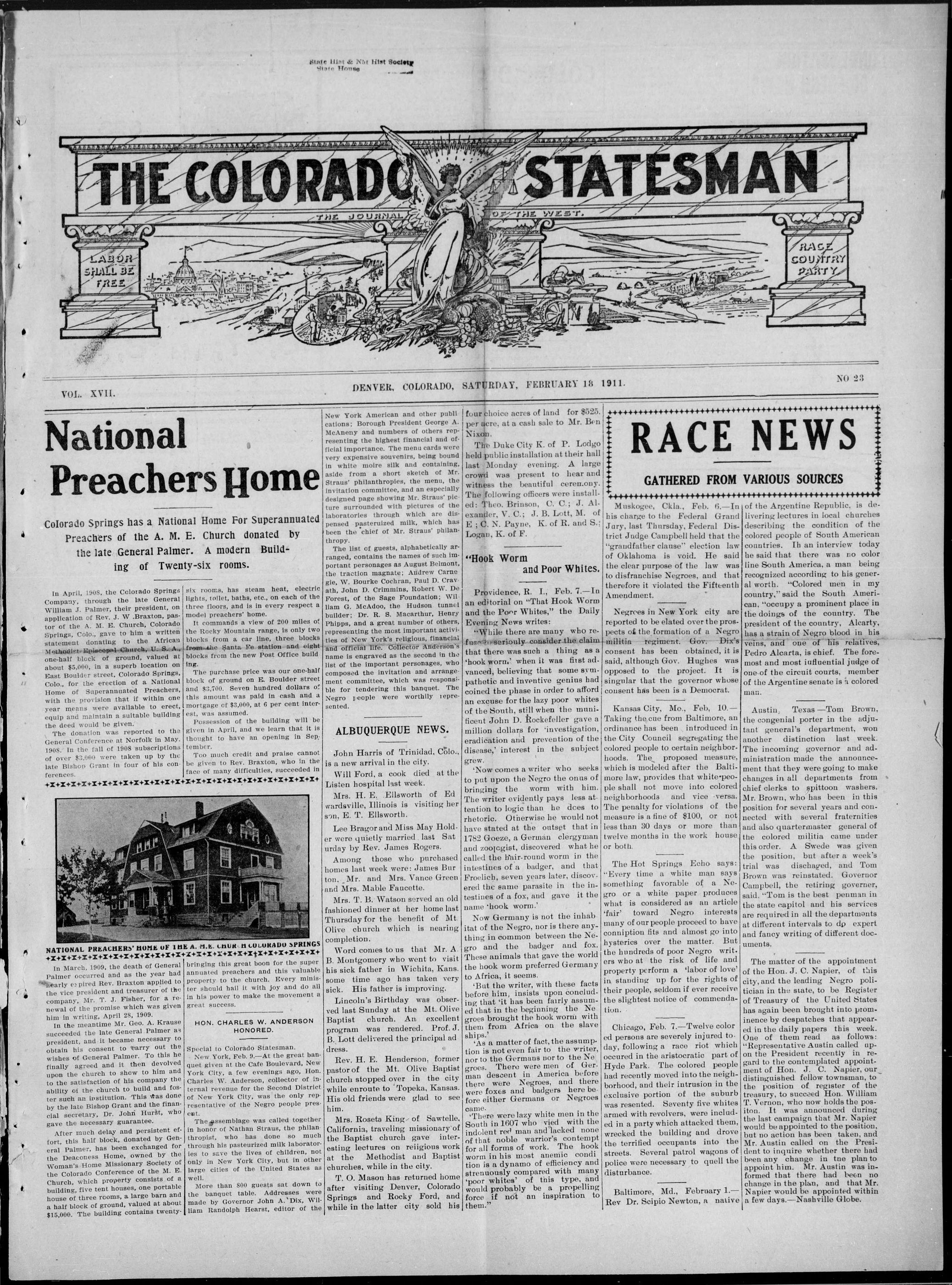
National Preachers Home
Colorado Springs has a National Home For Superannuated Preachers of the A. M. E. Church donated by the late General Palmer. A modern Building of Twenty-six rooms.
NATIONAL PREACHERS' HOME OF THE A. M.E. CHURCH IN COLORADO SPRINGS
NATIONAL PREACHERS' HOME OF THE A. M. E. CHURCH COLORADO SPRINGS
In April, 1908, the Colorado Springs Company, through the late General William J. Palmer, their president, on application of Rev, J. W. Braxton, pastor of the A. M. E. Church, Colorado Springs, Colo., gave to him a written statement donating to the African Methodist Episcopal Church, U. S. A., one-half block of ground, valued at about $5,000, in a superb location on East Boulder street, Colorado Springs, Colo., for the erection of a National Home of Superannuated Preachers, with the provision that if within one year means were available to erect, equip and maintain a suitable building the deed would be given.
The donation was reported to the General Conference at Norfolk in May, 1908. In the fall of 1908 subscriptions of over $3,000 were taken up by the late Bishop Grant in four of his conferences.
NATIONAL PREACHERS' HOME OF THE
In March, 1909, the death of General Palmer occurred and as the year had nearly expired Rev. Braxton applied to the vice president and treasurer of the company, Mr. T. J. Fisher, for a renewal of the promise which was given him in writing, April 28, 1909.
In the meantime Mr. Geo. A. Krause succeeded the late General Palmer as president, and it became necessary to obtain his consent to carry out the wishes of General Palmer. To this he finally agreed and it then devolved upon the church to show to him and to the satisfaction of his company the ability of the church to build and foster such an institution. This was done by the late Bishop Grant and the financial secretary, Dr. John Hurst, who gave the necessary guarantee.
After much delay and persistent effort, this half block, donated by General Palmer, has been exchanged for the Deaconess Home, owned by the Woman's Home Missionary Society of the Colorado Conference of the M. E. Church, which property consists of a building, five tent houses, one portable house of three rooms, a large barn and a half block of ground, valued at about $15,000. The building contains twenty-
six rooms, has steam heat, electric lights, toilet, baths, etc., on each of the three floors, and is in every respect a model preachers' home.
It commands a view of 200 miles of the Rocky Mountain range, is only two blocks from a car line, three blocks from the Santa Fe station and eight blocks from the new Post Office building.
The purchase price was our one-half block of ground on E. Boulder street and $3,700. Seven hundred dollars of this amount was paid in cash and a mortgage of $3,000, at 6 per cent interest, was assumed.
Possession of the building will be given in April, and we learn that it is thought to have an opening in September.
Too much credit and praise cannot be given to Rev. Braxton, who in the face of many difficulties, succeeded in
E A. M.E. CHURCH COLORADO SPRINGS
bringing this great boon for the super annuated preachers and this valuable property to the church. Every minister should hail it with joy and do all in his power to make the movement a great success.
HON. CHARLES W. ANDERSON
HONORED.
Special to Colorado Statesman
New York, Feb. 9. At the great banquet given at the Cafe Boulevard, New York City, a few evenings ago, Hon. Charles W. Anderson, collector of internal revenue for the Second District of New York City, was the only representative of the Negro people present.
The assemblage was called together in honor of Nathan Straus, the philanthropist, who has done so much through his pasteurized milk laboratories to save the lives of children, not only in New York City, but in other large cities of the United States as well.
More than 800 guests sat down to the banquet table. Addresses were made by Governor John A. Dix, William Randolph Hearst, editor of the
New York American and other publications; Borough President George A. McAenny and numbers of others representing the highest financial and official importance. The menu cards were very expensive souvenirs, being bound in white moire silk and containing, aside from a short sketch of Mr. Straus' philanthropies, the menu, the invitation committee, and an especially designed page showing Mr. Straus' picture surrounded with pictures of the laboratories through which are dispensed pasteurized milk, which has been the chief of Mr. Straus' philanthropy.
The list of guests, alphabetically arranged, contains the names of such important personages as August Belmont, the traction magnate; Andrew Carnegie, W. Bourke Cochran, Paul D. Cravath, John D. Crimmins, Robert W. DeForest, of the Sage Foundation; William G. McAdoo, the Hudson tunnel builder; Dr. R. S. Macarthur, Henry Phipps, and a great number of others, representing the most important activities of New York's religious, financial and official life. Collector Anderson's name is engraved as the second in the list of the important personages, who composed the invitation and arrangement committee, which was responsible for tendering this banquet. The Negro people were worthily represented.
ALBUOUERQUE NEWS.
John Harris of Trinidad, Colo. is a new arrival in the city.
Will Ford, a cook died at the Listen hospital last week.
Mrs. H. E. Ellsworth of Edwardsville, Illinois is visiting her son, E. T. Ellsworth.
Lee Bragor and Miss May Holder were quietly married last Saturday by Rev. James Rogers.
Among those who purchased homes last week were: James Burton, Mr. and Mrs. Vance Green and Mrs. Mable Faucette.
Mrs. T. B. Watson served an old fashioned dinner at her home last Thursday for the benefit of Mt. Olive church which is nearing completion.
Word comes to us that Mr. A. B. Montgomery who went to visit his sick father in Wichita, Kansas, some time ago has taken very sick. His father is improving.
Lincoln's Birthday was observed last Sunday at the Mt. Olive Baptist church. An excellent program was rendered. Prof. J. B. Lott delivered the principal address.
Rev. H. E. Henderson, former pastor of the Mt. Olive Baptist church stopped over in the city while enroute to Topeka, Kansas. His old friends were glad to see him.
Mrs. Roseta King of Sawtelle, California, traveling missionary of the Baptist church gave interesting lectures on religious work at the Methodist and Baptist churches, while in the city.
T. O. Mason has returned home after visiting Denver, Colorado Springs and Rocky Ford, and while in the latter city sold his
four choice acres of land for $525. per acre, at a cash sale to Mr. Ben Nixon.
The Duke City K. of P. Lodgo held public installation at their hall last Monday evening. A large crowd was present to hear and witness the beautiful cerem.ony. The following officers were installed: Theo. Brinson, C. C.; J. Alexander, V. C.; J. B. Lott, M. of E; C. N. Payne, K. of R. and S.; Logan, K. of F.
"Hook Worm and Poor Whites.
Providence, R. L., Feb. 7.—In an editorial on "That Hook Worm and the Poor Whites," the Daily Evening News writes:
"While there are many who refuse seriously consider the claim that there was such a thing as a 'hook worm,' when it was first advanced, believing that some sympathetic and inventive genius had coined the phase in order to afford an excuse for the lazy poor whites of the South, still when the munificent John D. Rockefeller gave a million dollars for 'investigation, eradication and prevention of the disease,' interest in the subject grew.
'Now comes a writer who seeks to put upon the Negro the onus of bringing the worm with him. The writer evidently pays less attention to logic than he does to rhetoric. Otherwise he would not have stated at the outset that in 1782 Goeze, a German clergyman and zooogist, discovered what he called the hair-round worm in the intestines of a badger, and that Froelich, seven years later, discovered the same parasite in the intestines of a fox, and gave it the name 'hook worm.' Now Germany is not the inhabitat of the Negro, nor is there anything in common between the Negro and the badger and fox. These animals that gave the world the hook worm preferred Germany to Africa, it seems.
'But the writer, with these facts before him, insists upon concluding that 'it has been fairly assumed that in the beginning the Negroes brought the hook worm with them from Africa on the slave ships.'
'As a matter of fact, the assumption is not even fair to the writer, nor to the Germans nor to the Negroes. There were men of German descent in America before there were Negroes, and there were foxes and badgers here before either Germans or Negroes came.
'There were lazy white men in the South in 1607 who vied with the indolent red man and lacked none of that noble warrior's contempt for all forms of work. The hook worm in his most anemic condition is a dynamo of efficiency and strenuously compared with many 'poor whites' of this type, and would probably be a propelling force if not an inspiration to them.'
RACE NEWS GATHERED FROM VARIOUS SOURCES
Muskogee, Ckla., Feb. 6.—In his charge to the Federal Grand Jury, last Thursday, Federal District Judge Campbell held that the "grandfather clause" election law of Oklahoma is void. He said the clear purpose of the law was to disfranchise Negroes, and that therefore it violated the Fifteenth Amendment.
Negroes in New York city are reported to be elated over the prospects of the formation of a Negro militia regiment. Gov. Dix's consent has been obtained, it is said, although Gov. Hughes was opposed to the project. It is singular that the governor whose consent has been is a Democrat.
Kansas City, Mo., Feb. 10. Taking the cue from Baltimore, an ordinance has been introduced in the City Council segregating the colored people to certain neighborhoods. The proposed measure which is modeled after the Baltimore law, provides that white people shall not move into colored neighborhoods and vice versa. The penalty for violations of the measure is a fine of $100, or not less than 30 days or more than twelve months in the work house or both.
The Hot Springs Echo says: "Every time a white man says something favorable of a Negro or a white paper produces what is considered as an article 'fair' toward Negro interests many of our people proceed to have connionation fits and almost go into hysteries over the matter. But the hundreds of poor Negro writers who at the risk of life and property perform a 'labor of love' in standing up for the rights of their people, seldom if ever receive the slightest notice of commendation.
Chicago, Feb. 7.—Twelve colored persons are severely injured today, following a race riot which occured in the aristocratic part of Hyde Park. The colored people had recently moved into the neighborhood, and their intrusion in the exclusive portion of the suburb was resented. Seventy five whites armed with revolvers, were included in a party which attacked them, wrecked the building and drove the terrified occupants into the streets. Several patrol wagons of police were necessary to quell the disturbance.
Baltimore, Md., February 1.—Rev Dr. Scipio Newton, a native
of the Argentine Republic, is delivering lectures in local churches describing the condition of the colored people of South American countries. Ih an interview today he said that there was no color line South America, a man being recognized according to his general worth. "Colored men in my country," said the South American, "occupy a prominent place in the doings of the country. The president of the country, Alcarty, has a strain of Negro blood in his veins, and one of his relatives, Pedro Alcarta, is chief. The foremost and most influential judge of one of the circuit courts, member of the Argentine senate is a colored man.
Austin, Texas —Tom Brown, the congenial porter in the adjutant general's department, won another distinction last week. The incoming governor and administration made the announcement that they were going to make changes in all departments from chief clerks to spittoon washers. Mr. Brown, who has been in this position for several years and connected with several fraternities and also quartermaster general of the colored militia came under this order. A Swede was given the position, but after a week's trial was discharged, and Tom Brown was reinstated. Governor Campbell, the retiring governor, said, "Tom is the best penman in the state capitol and his services are required in all the departments at different intervals to do expert and fancy writing of different documents.
The matter of the appointment of the Hon. J. C. Napier, of this city, and the leading Negro politician in the state, to be Register of Treasury of the United States has again been brought into prominence by despatches that appeared in the daily papers this week. One of them read as follows: "Representative Austin called upon the President recently in regard to the contemplated appointment of Hon. J. C. Napier, our distinguished fellow townman, to the position of register of the treasury, to succeed Hon. William T. Vernon, who now holds the position. It was announced during the last campaign that Mr. Napier would be appointed to the position, but no action has been taken, and Mr. Austin called on the President to inquire whether there had been any change in the plan to appoint him. Mr. Austin was informed that there had been no change in the plan, and that Mr. Napier would be appointed within a few days.—Nashville Globe.
CONDENSATION OF FRESH NEWS
THE LATEST IMPORTANT DIS PATCHES PUT INTO SHORT, CRISP PARAGRAPHS.
SHOWING THE PROGRESS OF EVENTS IN OUR OWN AND FOREIGN LANDS.
WESTERN
A general rain has fallen in Nebraska and western Kansas. This was the first rain of consequence in five months.
Fire destroyed the garage of the Atchison Motor Company, Atchison, Kan., with a loss of $50,000. Twenty autos burned.
The gasoline schooner Oshkosh was wrecked on the south spit of the Columbia river, Portland, Ore., and seven lives were lost.
Three persons were drowned when a Sheboygan, Wis., street car went through an open draw into the Sheboygan river.
A convention of women held in the state house in Pierre, S. D., took first steps toward the organization of a "woman's party."
Overcome by an irresistible desire to shoot something, John Cash, a street vender from Denver, shot and killed Frank Harris, at Los Angeles. William Keohn, the highwayman who terrorized St. Paul for three weeks in December last, was sentenced to state prison for sixty years. Declaring persons guilty of small thefts are unknown to the authorities, citizens of Fort Lupton, Colo., are planning a vigilance committee to drive thieves out of town. The inter-marriage of whites with Japanese or any other race is prohibited in a bill passed by the Legislature of Nevada. It makes the performance of such a marriage by a minister or justice of the peace a misdemeanor.
The most brutal and revolting crime ever committed in Nevada has been perpetrated in northern Washoe county, four men being butchered, their bodies being stripped and piled in a heap in the snow and left for beasts to prey upon.
The summer hotel at Moclips, Wash., containing 325 rooms, one-half of which was washed into the sea, probably will have to be abandoned, as a large part of the remaining wing is hanging over the water and may fall with high tide.
David Leahy, private secretary to Gov. Stubbs, was summoned before the bar of the state Senate of Kansas to give his authority for statements made in a newspaper article written by him that "political crookedness is rampant in the Legislature."
The power salmon sloop W. 1832 which is the number of the fishing license issued to the boat by the state of Washington, was found bottom up in Admiralty Inlet on the west coast of Whidby Island. All who were in the sloop when it was struck by last Sunday's furious storm must have perished.
Western members of the Senate, representing sheep and wool growing states, are considerably concerned over that part of the proposed reciprocity treaty with Canada which provide for free admission into the United States of Canadian sheep. The President, in transmitting the proposed treaty to Congress, called attention to the fact that Canada raises comparatively few wool sheep and that her textile manufacturers are unimportant. The Western senators familiar with the sheep and wool growing business are apprehensive that with the stimulus which will be given to the growth of the industry in Canada by removing the duty on the admission of sheep into the United States, the raising of sheep there will increase at the expense of the industry in this country,
SPORT.
Outfielder Frank Schulte of the Chicago National league baseball club, champion home-run batsman for 1910, has signed a three-year contract with Chicago.
The "Tommy Burns bill" to permit ten-round prize fights in the state of Washington has been introduced in the House by Representative Wray, of Seattle, and referred to a friendly committee.
Frank Work, the veteran sportsman, who for nearly seventy years has been known throughout the country as an owner and campaigner of fast horses, celebrated his ninety-second birthday at his home in New York.
The Denver Athletic Club boxing and wrestling tournament closed in a whirlwind of classy work. It ended the most successful tournament ever conducted by the club. Winners were picked as a result of the finals and the prizes distributed.
WASHINGTON.
Col. Enoch H. Crowder will become judge advocate general of the army, with the rank of brigadier general.
The Senate committee on interstate commerce, after a spirited contest, decided to give additional hearings on the House bill to prevent speculation in cotton futures.
President Taft's reciprocity agreement with Canada was ratified in the House through the support of an almost solid Democratic vote. The McCall bill, carrying the agreement into effect, was passed, 221 to 92.
Postmaster General Hitchcock, in asking Congress for an appropriation of $1,000,000 for the establishment of 500 additional postal savings banks, declares the forty-eight banks already established have proven entirely successful.
As the result of many conferences the friends of the resolution for direct election of senators determined upon a decided move forward. Senator Borah voiced his purpose in a formal notice that he soon would ask the Senate to sit until a vote should be reached.
Claiming that Russia has violated the treaty of 1832 with the United States by denying Jewish citizens of this country the privilege extended to other American travelers Representative Parsons of New York introduced a resolution in the House calling upon President Taft to declare the treaty void.
Through the injection of the race question into the hitherto comparatively commonplace discussion in the Senate of the resolution providing for the election of senators by direct vote, Senator Root of New York and Senator Bacon of Georgia lifted that controversy to a plane of almost sensational interest.
Carrying forward his campaign for Canadian reciprocity, President Taft, at Columbus, Ohio, made a direct appeal to the American farmer on that issue. He declared that the impression that reciprocity with the Dominion would injure the farmer was without foundation and by statistics he sought to lend actual proof to his assertions.
Secretary Dickinson has given notice to the Pacific Mail Steamship Company and the California & Atlantic Steamship Company of the termination of the existing arrangement whereby those carriers are allowed 70 per cent of the total freight charge on goods transported between New York and San Francisco via the Panama railroad.
The McCall bill carrying into effect the Canadian reciprocity agreement reached the floor of the House and probably will be passed before adjournment immediately. When the voting began it became apparent that the lines were being tightly drawn between those favoring and those opposing the trade agreement. As finally corrected, the vote to take up the bill was 197 to 120. The bill will be passed, it is said, by even a large majority.
GENERAL
Right Rev. Ozi W. Whitaker, bishop of the Protestant Episcopal diocese of Pennsylvania, died in Philadelphia. Charles H. Markham of Chicago, president of the Illinois Central, was elected president of the Central of Georgia. Mr. and Mrs. Hyman Berkowitz and their five children were killed by illuminating gas in their home in the Chetto in Philadelphia. The condition of Miss Clara Barton, founder of the Red Cross, who has been ill with bronchitis at her home in Glen Echo, Md., a suburb of Washington, is greatly improved. The United States Steel Corporation announced in New York that the unfilled steel tonage on the books Jan. 21 last amounted to 3,110,919; against 2,674,757 tons on the books of the company Dec. 31.
Thomas J. Ham, one of the oldest newspaper men in Pennsylvania and probably the last survivor of the dinner given to Charles Dickens in New York in 1852, by newspaper editors and publishers, died at Lakewood, New Jersey, following a stroke of paralysis. He was seventy-five years old. The Roosevelt dam, part of the Salt River Irrigation project, has been completed, and will be opened March 18th. The exercises in connection with the opening will continue three days. Former President Roosevelt will be present, with Mrs. Roosevelt, Miss Ethel and his son, Archie.
The high cost of living received a setback when eggs in the Kansas City market declined two cents a dozen and hog prices went twenty cents a hundred pounds lower. Eggs were fourteen to sixteen cents wholesale, which is sixteen cents lower than at the beginning of the year. Hogs are selling $1.25 lower than last year; cattle fifty cents to one dollar lower, and sheep $2 lower.
Milton J. Durham, former comptroller of the treasury and former congressman from the Eighth district of Kentucky, died in Lexington of pneumonia. Judge Durham was eighty-seven years old. He was a leading Odd Fellow, having once served as grandsire of the order in the United States.
Shortly after midnight Frank Coffyn broke the world's record for altitude in a Wright biplane in Augusta, Ga. He rose 800 feet. The previous night record was held by the late Arch Hoxsey, with 250 feet.
COLORADO STATE NEWS
COMING EVENTS IN COLORADO.
MN State University Assoc-
sion Convention, Denver
Would Pay $510,000.
Washington.—Senator Guggenheim introduced a bill appropriating $510, 400 to Paul Mulock of Leadville, to be full satisfaction and compensation for use by the United States of certain inventions of his used in rifling for firearms.
Disband to Reorganize.
Loveland. — The fire department, consisting of a hose company and a hook and ladder company, decided to disband as separate organizations, and to reorganize as the Loveland fire department.
Farmers Own Coal Mine.
Eaton.—Through the work of the Farmers' Union, fifty Eaton farmers have taken an interest in the Farmers' Union coal mine at Erie. The farmers shipped in their first carload and laid it down for $3.35 a ton. The coal is said to be of excellent quality.
For Grain Experiments.
Keota.—This locality has begun negotiations to secure a government experiment station. The idea is to try various methods of planting, cultivating and other farm work and also to experiment in growing grains and grasses suitable for eastern Weld county.
Triple Tragedy in Denver.
Denver.—William McCrary shot himself through the head and the bullet, continuing on its course, struck the head of Arthur Knowles, his friend, inflicting a mortal wound. Mrs. Julia Sohn, said to have been McCrary's "affinity," drank earloble acid, after hearing of her lover's suicide; and she is at the county hospital where she is expected to die.
To Start Stanley Lake Job.
Denver.—Contracts and relinquishments have been signed which assures the commencement of work on the Standley Lake irrigation project, immediately northwest of Denver, inside of ten days. Final word was sent to Paris by cable which will release a portion of the $2,000,000 which will be furnished by the French bank to finance the completion of the project.
Big Irrigation Company.
Pueblo.—An irrigation project which will cost $3,000,00 to $5,000,000 will be started within ninety days on land adjoining Pueblo on the north and east. The new company will be known as the Pueblo, Fountain, Chino & Squirrel Creek irrigation Company. Articles of incorporation have been filed. The company will secure water from the Chino and Squirrel creeks and three reservoirs will contain more than 2,000,000 acre-feet when filled.
To Water More Land.
Montrose.-C. T. Pease, project engineer of the Gunnison tunnel, announces that work is to begin immediately upon the new canal, which will be taken from the south canal and conveyed along the side of the Uncompahgre valley as far as Delta, to water a large amount of land above the present irrigation system. This is made possible by the recent appropriation of $1,500,000 for the Gunnison project.
Cornerstone Is Laid.
Denver.—The cornerstone of the magnificent Denver postoffice was laid at the corner of Eighteenth and Stout streets. The new structure, which, it is said, will without exception be the handsomest public building in the world, occupies the entire block bounded by Stout, Champa, Eighteenth and Nineteenth streets. The contractors say that the building will be completed in schedule time, or December 1, 1911. The cornerstone was laid by the Grand Masonic lodge of Colorado under the auspices of the Denver Chamber of Commerce.
Race for American Supremacy.
Greleey.—A race for American supremacy in tunnel driving through granite is being run by Contractor James McLewlee of the Laramie-Poudre tunnel, against the work of engineers in driving the aqueduct of the Los Angeles water company through the Sierra Nevada mountains. The Colorado men are in the lead, having made 609 feet of tunnel last month, against 604 feet made by the Los Angeles workmen. It is expected that during March the Laramie-Poudre tunnel will be driven at least 720 feet, which will be a world's record. Several hundred men are at work on the east portal and as soon as snow melts work will be resumed on the west portal.
Good Roads Movement.
Cañon City.—The good road's movement in this section of the state received a wonderful stimulus recently by a visit of a number of prominent men of the state identified in the good roads movement. The visit was of special importance to Cañon City and Fremont county, inasmuch as it was for the express purpose of inspecting the proposed extension of the roadway from this city to Salida and other points in the state.
LITTLE COLORADO ITEMS.
Small Happenings Occurring Over the State Worth Telling.
Colorado's population now numbers about 900,000.
Lee J Allen was found dead in his room in Telluride.
Work on the cannery for Milliken will begin at once.
Pueblo is after the next state convention of the Y. M. C. A.
Fire originating in a hotel in Grand Junction did $20,000 damage. Interest is being renewed in the mineral springs near Loveland.
The East Crow creek shack near Barnsville was burned recently. The Rocky Mountain store at Williamsburg was burglarized recently. A $75,000 ice and storage plant is being erected in Grand Junction. Thomas Hall, a prominent ranchman and pioneer of Castle Rock, is dead. Frederick Kruse, former mayor of Central City and a Colorado pioneer, is dead. Fresh ranch eggs have dropped in price from 45 cents a dozen to 25 cents. Mrs. L. H. Newman, aged 74, a wealthy resident of Evans since 1879, is dead.
The annual snowfall of the ranges in northern Colorado is above the normal amount.
The county of Jackson is offering $50 each for grown wolves and $20 each for cubs.
Thirteen families from Kansas have rented sugar beet land in the vicinity of Grand Junction.
Much interest is taken in the farmers' institute to be held at Fort Collins February 23-25.
T. H. Wisden, aged 83, of Montrose, died from the effects of injuries received in a runaway.
Fire supposed to have been of incendiary origin destroyed the home of Charles Georgii at Pierce.
The fourth annual convention of the Knights of Pythias of the Western Slope was held in Montrose.
The Greeley women have organized an automobile club with a charter membership of thirty.
"Don't drink" is the personal message from President Taft to the Sunday school children of Grand Junction.
Progress on the Laramie-Poudre tunnel is hampered this month by the fact that a soft material has been encountered.
Within a week work will begin on the construction of a $3,000 brick vaudeville and moving picture theater in Boulder.
The Denver & Rio Grande railroad shows an increase in net earnings of $164,140 for December, 1910, over December, 1909.
H. B. Scammeli, a graduate of the Colorado Agricultural College, has been appointed assistant entomologist of Minnesota.
Howell brothers of Montrose report the sale of their herd of Short Horn cattle to Heald brothers of Ridgway for $20,000.
The fears of the Grand valley cichardists that the warm weather would prematurely develop fruit were oispelled by a snowstorm.
"All together" will be the slogan with which the residents of the Grand valley will battle with spring frosts to save the $3,000,000 fruit crop. The jury in the damage case of Melvin Deering against the city of Salida brought in its verdict in the District Court awarding damages to the amount of $10,000. At a meeting of the Colorado State Automobile Association in Denver, Ralph W. Smith was elected president, Elmer E. Sommers, secretary and manager, and John W. Springer, treasurer. More than 300 people, 312 to be exact, sang the praises of their native adopted state at the Albany hotel in Denver on the occasion of the first annual banquet of the Illinois Society of Colorado.
Homesteaders in eastern Weld county have offered to donate land for experiment farming if a portion of the Carnegie endowment fund for scientific research is placed there, as promised.
Careful investigation shows that fully 13,000 acres in the vicinity of Nunn, which settlers supposed would be included within the boundaries of the Greeley-Poudre irrigation district is outside of it.
Forty managers, superintendent and master mechanics in the eleven beet sugar factories of the Great Western Sugar Company are in Denver to take part in the big annual "get-to-gather" meeting with the heads of the corporation for the purpose of discussing improvements for the coming year.
The Western Union Telegraph Company is working on a plan for the pensioning of employees who have been with the company for a certain number of years.
THE
BROADTURST
CARTER
SINCE CO.
Denver Agents for the
Meton Shoe
FOR MEN
7, and $8, Pair
King Restaurant
Tuesday--Duck Supper
Thursday--Chicken Supper
Friday--Fish Supper
Oysters Served in All Styles
FRANKLIN, Proprietor
6 ARAPAHOE STREET
Everything Neat and Clean
CHAS. McBRIDE
GRAVEL ROOFING
Repairing and Recoating
CEMENT WORK
We Are Denver
Nettleto
FOR I
$6, $7, an
Home Cooking
Home Cooking Restaurant
Juesday=-Duck Supper
Thursday=-Chicken Supper
Friday=-Fish Supper
Oysters Served in All Styles
MRS. M. J. FRANK
1936 ARAPA
Best of Service Eve
MRS. M. J. FRANKLIN, Proprietor
1936 ARAPAHOE STREET
Best of Service Everything Neat and Clean
Tin and Shingle Painting
Phone Main 6602 DENVER
The Prior Fur
1814 Curti
We buy and sell new
Furniture, also repair
shades. Sewing Ma
repaired a specialty.
or Furniture Co.
1814 Curtis Street
d sell new and second hand
also repair work. Window
sewing Machines sold and
specialty.
The Prior Furniture Co. 1814 Curtis Street
We buy and sell new and second hand Furniture, also repair work. Window shades. Sewing Machines sold and repaired a specialty.
W. J. MURPHY
OFFICE BUFFET
18 STREET—CORNER 18TH STREET
MISKIES, 10c. PER DRINK
ONE MAIN 2393, DENVER
POST OFFICE
1763 CURTIS STREET—CO
ONDED WHISKIES,
PHONE MAIN 239
THE ZOBEL E
SAMPLE
POST OFFICE BUFFET
1763 CURTIS STREET-CORNER 18TH STREET
BONDED WHISKIES, 10c. PER DRINK
PHONE MAIN 2393, DENVER
1004 Nineteenth Street, Corner of Curtis FINE WINES, LIQUORS AND CIGARS COORS' CELEBRATED BEER ON TAP
GOOD things to Eat at the GEM BAKERY Strictly Home Cooking
Fruit Basket
CHONKES
MILBRIE
CRAVEL
ROOFING
Phone Champa 392
B. H. SHEVLIN
823 Sixteenth Street
Cash or Credit
W. J. MURPHY
1
Would Build Moffat Tunnel.
With the Massachusetts statutes and decisions, relating to the construction of the Hoosac tunnel, before him, Representative Gaines M. Allen cut clear from all legal obstructions when might have been thrown across his pathway when he drew up the bill providing for state construction of the Moffat tunnel. Representative Allen had the legislative and judicial guides of Massachusetts to follow in the preparation of his bill, and he affirms that direct constitutional authority for the construction of the Moffat tunnel by the state of Colorado is in no sense necessary to validate the act. In the method of payment for construction work he carefully followed the system employed in the construction of ditches and reservoirs for irrigation. The bill appropriates $5,000,000 for the construction of the tunnel, or so much thereof as may be necessary.
The Slatery bill provides for the creation of a State Auditing Board.
creation of a State University. One of the most important county division matters now before the Legislature is the one proposed to be created by the three precincts of Rouse, Pryor and Midway. It would also include the mining camps of Delagua, Hastings, Berwind, Tobasco, Tercio and other coal camps to the number of twenty-seven, centering about Aguilar, which town desires to be the county seat. The people of Aguilar have pledged $15,000 for the erection of court house and jail. The proposed new county has a population of 14,000.
In the mater of local option Senator Hecker presented two bills to amend the present liquor laws by giving to all incorporated town and cities, which have a population of 2,000 and under, the absolute right to pass upon the "wet" and "dry" question, regardless of whether action was taken by the county in which the municipalities are situated. Under these bills, by a majority vote, saloons could be conducted in cities notwithstanding the county, as a whole, voted "dry." The Dowd bill, directing the state treasurer to repay to the internal improvement fund $150,000 and interest which was borrowed from the fund for the capital building fund in 1891, passed the house. A bill by Representative Durfee appropriating $10,000 for the maintenance of summer normal schools at Greeley and Gunnison, was referred to the committee on appropriations.
Favorable report was made by the committee of the House on Senator Hilts' bill providing that unexpended balances of appropriations be transferred to the respective funds from which they were drawn.
That a state tax commission is sorely needed to alter, revise or amend the revenue laws of Colorado is the opinion of Senator Cros, who introduced a bill providing for the submission of a constitutional amendment for this purpose at the next general election.
The Van Tilborg bill provides that the deputy labor commissioner shall be state boiler inspector and shall have the appointment of four deputy inspectors, who shall receive $5 per day and mileage in the sum of $50 per month.
All of the "sacred paramounts," bequeathed by the late extra session to the Eighteenth General Assembly for enactment, including registration, public utilities commission, bank guarantee, headless ballot and anti-pass measures, have been introduced and docketed in either House or Senate. Senator Cary's bill to re-establish the Ninth judicial district was passed on third reading. This act was amended by excluding Jackson county from the re-established district, leaving that county as a part of the Eighth district.
A commission of public corrections, to take over the control of the penitentiary, state reformatory insane asylum, industrial schools for boys and girls, state homes for mental and physical defectives, as well as to exercise paroling and correctional functions, is the object of a bill in the preparation of which Senators Carringer, Stephen and Hilts collaborated.
The Van Tilborg bill seeks to prohibit employers from demanding of their employees, present or prospective, that they renounce membership in labor unions and other organizations as a condition of employment. It is known as an anti-blacklist measure. There are doubts as to its constitutionality. If this bill passes the House and is signed by the governor, it means an end to all such organizations as the Cripple Creek Mine Owners' Association, at least in regard to the enforcement by such associations of the card system of employing labor which has been in vogue in the Cripple Creek district for the last seven years. But a number of senators expressed the opinion that the act will not stand the test of the law.
The bill, copied from the Illinois act of 1899, makes it a felony to bring workmen to Colorado under false pretenses for the purpose of breaking a strike, or of taking the places of workmen locked out of employment. Under penalty of imprisonment and a maximum fine of $2,000, no person, firm, or corporation, can bring strike-breakers into Colorado under armed guard.
Senator Skinner's resolution for the installation of a window in the Supreme Court chamber to the late Chief Justice Steele was unanimously adopted.
TAFT ANGRY; CANADA SCARED
INTERNATIONAL EXCITEMENT
CAUSED BY ALLUSION TO
CANADIAN ANNEXATION.
REMARKS MADE IN JOCULAR
SPIRIT TAKEN SERIOUSLY
BY FOREIGNERS.
Washing-on.—The semi-jocular remark which Champ Clark, the Democratic speaker-to-be, made in the House Wednesday in the debate on the Canadian reciprocity agreement, that he believed the Stars and Stripes would one day float over the entire Western hemisphere, stirred up most unexpected trouble.
President Taft took occasion to write to Representative McCall, introducer of the reciprocity bill, disclaiming and deprecating the annexation talk, and to follow it up with personal remarks even more emphatic to his visitors.
The news that Mr. Clark's allusions had created excitement in Canada and in England occasioned great surprise and considerable amusement at the capitol. The man most surprised of all was Mr. Clark himself.
Mr. Clark's entire speech on reciprocity was delivered in a half humorous, half taunting vein. The House was in a gale of laughter most of the time.
This humorous exchange reflected the spirit of the debate during the time Mr. Clark was on his feet, and no one gave serious consideration to h's remarks regarding the possible annexation of Canada.
They regarded his statements in the nature of a compliment to the Canadian people, in that he would be glad to see the friendship that exists at present between the Canadians and the people of the United States so ripen in the future that all might some day be under one flag.
There was a further touch of facetiousness to the debate when one of the Republicans asked Mr. Clark if he would like to be the first President of the magnificent union he was creating, and he replied, amid a burst of laughter, that he certainly would. The excitement abroad was attributed at the capitol in part to the fact that several English and Canadian newspaper correspondents were in the press gallery following the debate when Mr. Clark spoke. His remarks may have appealed to them as the most important feature of the story and have been cabled accordingly. In "skeletonizing" his remarks for cable purposes, the semi-humorous character of the debate probably was entirely lost sight of.
Friends of the reciprocity measure were inclined to take the view that opponents of the agreement had simply seized upon what was regarded here as an entirely personal and harmless statement to make capital against the ratification of the agreement.
A declaration similar to that made by Mr. Clark was contained in the opening speech last Monday in favor or the reciprocity bill in the House, denvered by Representative Hill of Connecticut, a member of the ways and means committee, and a member of the administration party.
The White House is said to regard the remarks of Mr. Clark as most unfortunate and the President has made it known that he would like to have it understood throughout the world that his administration had no thought whatever of annexation when the reciprocity agreement was arranged.
Fight Ahead for Senate.
Washington.—As the result of many conferences in cloakrooms and other places in the Capitol, the friends of the resolution for direct election of senators determined upon a decided move forward. Senator Borah voiced his purpose in a formal notice that he soon would ask the Senate to sit until a vote should be reached.
Distribution of Pure Milk
New York.—To provide pure milk for children the Sinking Fund Commission has authorized the leasing of twelve sites for depots. The work of distributing the milk supply is to be under the jurisdiction of the Board of Health.
Pope Suffering from Influenza.
Rome.—Pope Plus X. is suffering from a slight attack of influenza and is confined to his bed. The disease has affected his throat.
Common Court Holds Session.
Washington. In the court room of the United States Court of Customs Appeals, the recently established Commerce Court held its first public session. The jurisdiction of this court extends over all litigation involving transportation.
Philadelphia. Alfred Shrubb, the English runner, defeated Johnny Hayes of New York in a twelve-mile match race at the American Athletic Club.
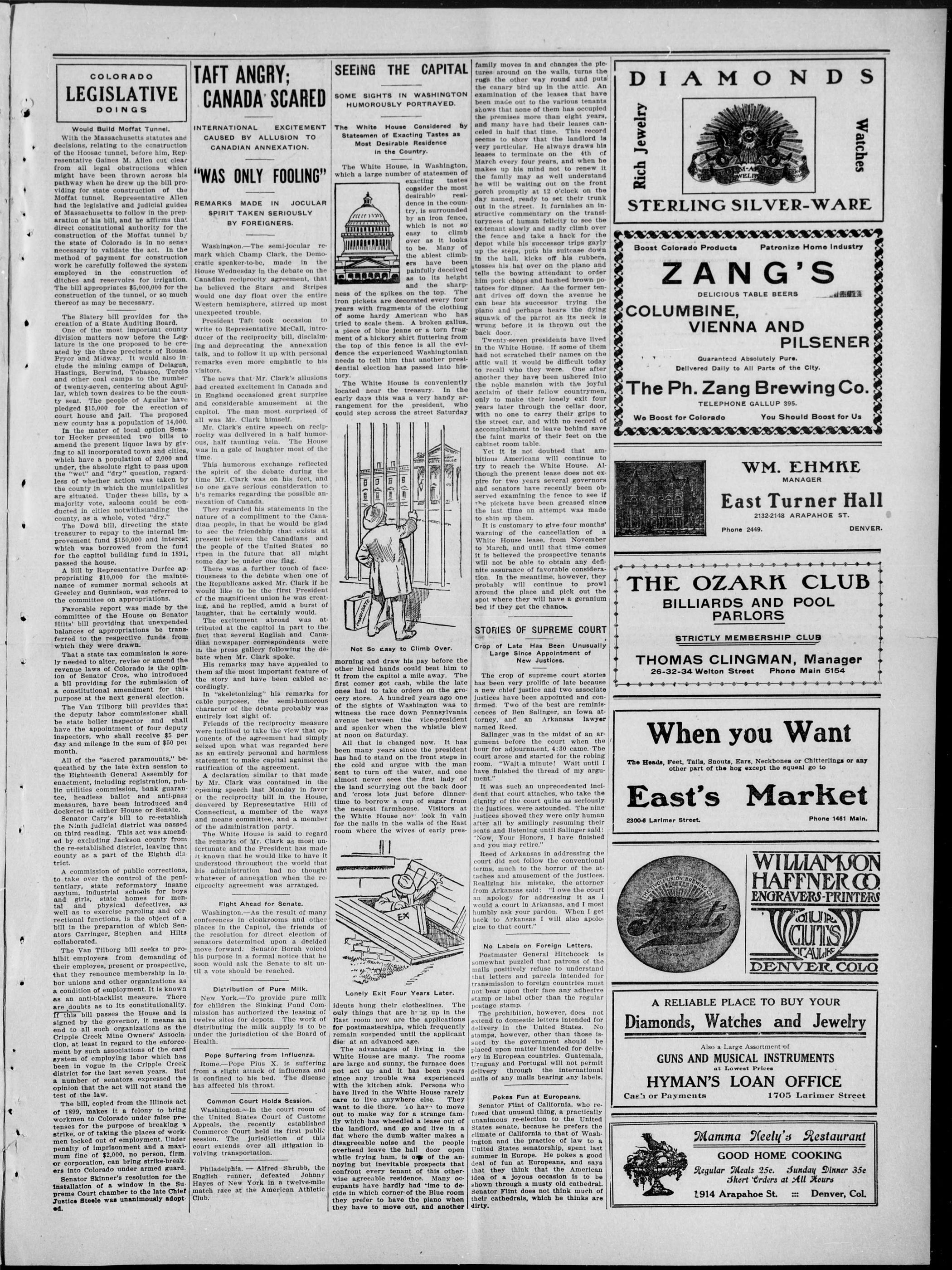
SEEING THE CAPITAL
SEEING THE CAPITAL
SOME SIGHTS IN WASHINGTON
HUMOROUSLY PORTRAYED.
The White House Considered by Statesmen of Exacting Tastes as Most Desirable Residence in the Country.
The White House, in Washington, which a large number of statesmen of exacting tastes consider the most desirable residence in the country, is surrounded by an iron fence, which is not so easy to climb over as it looks to be. Many of the ablest climbers have been painfully deceived as to its height and the sharp-
U.S. CAPITOL
ness of the spikes on the top. The iron pickets are decorated every four years with fragments of the clothing of some hardy American who has tried to scale them. A broken gallus, a piece of blue jeans or a torn fragment of a hickory shirt fluttering from the top of this fence is all the evidence the experienced Washingtonian needs to tell him that another presidential election has passed into history.
The White House is conveniently located near the treasury. In the early days this was a very handy arrangement for the president, who could step across the street Saturday
CAMOUFLAGE
Not So Easy to Climb Over.
morning and draw his pay before the other hired hands could beat him to it from the capitol a mile away. The first comer got cash, while the late ones had to take orders on the grocery store. A hundred years ago one of the sights of Washington was to witness the race down Pennsylvania avenue between the vice-president and speaker when the whistle blew at noon on Saturday.
All that is changed now. It has been many years since the president has had to stand on the front steps in the cold and argue with the man sent to turn off the water, and one almost never sees the first lady of the land scurrying out the back door and 'cross lots just before dinnertime to borrow a cup of sugar from the nearest farmhouse. Visitors at the White House now look in vain for the nails in the walls of the East room where the wives of early pres-
Lonely Exit Four Years Later.
identes hung their clotheslines. The only things that are being up in the East room now are the applications for postmasterships, which frequently remain suspended until the applicant dies at an advanced age.
The advantages of living in the White House are many. The rooms are large and sunny, the furnace does not act up and it has been years since any trouble was experienced with the kitchen sink. Persons who have lived in the White House rarely care to live anywhere else. They want to die there. To have to move out to make way for a strange family which has wheeled a lease out of the landlord, and go and live in a flat where the dumb wafter makes a disagreeable noise and the people overhead leave the hall door open while frying ham, is one of the annoying but inevitable prospects that confront every tenant of this otherwise agreeable residence. Many occupants have hardly had time to decide in which corner of the Blue room they prefer to have the piano when they have to move out, and another
family moves in and changes the pictures around on the walls, turns the rugs the other way round and puts the canary bird up in the attic. An examination of the leases that have been made out to the various tenants shows that none of them has occupied the premises more than eight years, and many have had their leases canceled in half that time. This record seems to show that the landlord is very particular. He always draws his leases to terminate on the 4th of March every four years, and when he makes up his mind not to renew it the family may as well understand he will be waiting out on the front porch promptly at 12 o'clock on the day named, ready to set their trunk out in the street. It furnishes an instructive commentary on the transitoryness of human felicity to see the ex-tenant slowly and sadly climb over the fence and take a hack for the depot while his successor trips gayly up the steps, puts his suitcase down in the hall, kicks off his rubbers, tosses his hat over on the piano and tells the bowing attendant to order him pork chops and hashed brown potatoes for dinner. As the former tenant drives off down the avenue he can hear his successor trying the piano and perhaps hears the dying squawk of the parrot as its neck is wrung before it is thrown out the back door.
Twenty-seven presidents have lived in the White House. If some of them had not scratched their names on the attic wall it would be difficult today to recall who they were. One after another they have been ushered into the noble mansion with the joyful acclaim of their fellow countrymen, only to make their lonely exit four years later through the cellar door, with no one to carry their grips to the street car, and with no record of accomplishment to leave behind save the faint marks of their feet on the cabinet room table.
Yet it is not doubted that ambitious Americans will continue to try to reach the White House. Although the present lease does not expire for two years several governors and senators have recently been observed examining the fence to see if the pickets have been greased since the last time an attempt was made to shin up them.
It is customary to give four months' warning of the cancellation of a White House lease, from November to March, and until that time comes it is believed the prospective tenants will not be able to obtain any definite assurance of favorable consideration. In the meantime, however, they probably will continue to prowl around the place and pick out the spot where they will have a geranium bed if they get the chance.
STORIES OF SUPREME COURT
Crop of Late Has Been Unusually Large Since Appointment of New Justices.
The crop of supreme court stories has been very prolific of late because a new chief justice and two associate justices have been appointed and confirmed. Two of the best are reminiscences of Ben Salinger, an Iowa attorney, and an Arkansas lawyer named Reed.
Salinger was in the midst of an argument before the court when the hour for adjournment, 4:30 came. The court arose and started for the robing room. "Wait a minute! Wait until I have finished the thread of my argument."
It was such an unprecedented incident that court attaches, who take the dignity of the court quite as seriously the justices, were astounded. The nine justices showed they were only human after all by smilingly resuming their seats and listening until Salinger said: "Now, Your Honors, I have finished and you may retire."
Reed of Arkansas in addressing the court did not follow the conventional terms, much to the horror of the attaches and amusement of the justices. Realizing his mistake, the attorney from Arkansas said: "I owe the court an apology for addressing it as I would a court in Arkansas, and I most humbly ask your pardon. When I get back to Arkansas I will also apologize to that court."
No Labels on Foreign Letters.
Postmaster General Hitchcock is somewhat puzzled that patrons of the mails positively refuse to understand that letters and parcels intended for transmission to foreign countries must not bear upon their face any adhesive stamp or label other than the regular postage stamp. The prohibition, however, does not extend to domestic letters intended for delivery in the United States. No stamps, however, other than those issued by the government should be placed upon matter intended for delivery in European countries. Guatemala, Uruguay and Portugal will not permit delivery through the international mails of any mails bearing any labels.
Pokes Fun at Europeans.
Senator Flint of California, who refused that unusual thing, a practically unanimous re-election to the United States senate, because he prefers the climate of California to that of Washington and the practice of law to a United States senatorship, spent last summer in Europe. He pokes a good deal of fun at Europeans, and says that they think that the American idea of a joyous occasion is to be shown through a musty old cathedral. Senator Flint does not think much of their cathedrals, which he thinks are dirty.
DUM-M-AFDE
WELRING
STERLING S
Boost Colorado Products
ZAN
DELICIOUS
COLUMBINE,
VIENN
Guaranteed A
Delivered Daily to
The Ph. Zang
TELEPHONE
We Boost for Colorado
RLING SILVER-W
Colorado Products Patronize Home
ZANG'S
DELICIOUS TABLE BEERS
MBINE,
VIENNA AND
PILS
Guaranteed Absolutely Pure.
Delivered Daily to All Parts of the City.
Ph. Zang Brewin
TELEPHONE GALLUP 395.
for Colorado You Should Bo
STERLING SILVER-WARE
Boost Colorado Products Patronize Home Industry
ZANG'S
DELICIOUS TABLE BEERS
COLUMBINE,
VIENNA AND
PILSENER
Guaranteed Absolutely Pure.
Dellivered Daily to All Parts of the City.
The Ph. Zang Brewing Co.
TELEPHONE GALLUP 395.
We Boost for Colorado You Should Boost for Us
A
C OZARK C
HILLIARDS AND POOL
PARLORS
THE OZA BILLIARDS PAR
THE OZARK CLUB
BILLIARDS AND POOL
PARLORS
STRICTLY MEMBERSHIP CLUB
THOMAS CLIN
26-32-34 Welton St
When y
The Heads, Feet, Tails, Snouts, Ea
other part of the hog
East's
MAS CLINGMAN, Ma
12-34 Welton Street Phone Main
When you Wear
eet, Tails, Snouts, Ears, Neckbones or Chitts
other part of the hog except the squeal go t
st's Mark
Street. Pho
THOMAS CLINGMAN, Manager
26-32-34 Welton Street Phone Main 5154
When you Want
The Heads, Feet, Talls, Snouts, Ears, Neckbones or Chitterlings or any other part of the hog except the squelg go to
THE TWOLI UNION BREWING CO.
Fatti
DEHVECK COLOD
A RELIABLE PLACE
Diamonds, Watch
Also a Large
GUNS AND MUSIC
at Lower
HYMAN'S LO
Cash or Payments
RELIABLE PLACE TO BUY YOUR
Lands, Watches and Jew
Also a Large Assortment of
INS AND MUSICAL INSTRUMENTS
at Lowest Prices
MAN'S LOAN OFFICE
payments 1705 Larim
A RELIABLE PLACE TO BUY YOUR Diamonds, Watches and Jewelry
GOOD HOME COOKING
Regular Meals 25c. Sunday Dinner 35e
Short Orders at All Hours
1914 Arapahoe St. Denver, Col.
---
2300-6 Larimer Street.
Fruit Basket
G SILVER-WARE
Products Patronize Home Industry
NG'S
JICIOUS TABLE BEERS
NE,
INNA AND
PILSENER
anted Absolutely Pure.
aily to All Parts of the City.
ang Brewing Co.
PHONE GALLUP 395.
do You Should Boost for Us
WM. EHMKE
MANAGER
East Turner Hall
2132-2148 ARAPAHOE ST.
Phone 2449. DENVER.
ZARK CLUB
RDS AND POOL
PARLORS
CLINGMAN, Manager
on Street Phone Main 5154
you Want
outs, Ears, Neckbones or Chitterlings or any
the hog except the squeal go to
Market
Phone 1461 Main.
WILLIAMSON
HAFFNER CO.
ENGRAVERS-PRINTERS
UNIP
CUTKS
TAULKS
DENVER, COLO
PLACE TO BUY YOUR
Watches and Jewelry
a Large Assortment of
MUSICAL INSTRUMENTS
t Lowest Prices
S LOAN OFFICE
1705 Larimer Street
THE COLORADO STATESMAN
CLASSIC BRILLIANT TREE
PACIFIC COUNTRY PARTY
JOS. D. D. RIVERS ..... Proprietor
1824 Curtis Street, Room 25.
JOS. D. D. RIVERS ..... Propriator
1824 Curtis Street, Room 25.
SUBSCRIPTION RATES:
It occasionally happens that papers sent to subscribers are lost or stolen. Case you do not receive any number when due, inform us by postal card and we will cheerfully forward a duplicate of the missing number.
Remittances should be made by Express Money Order, Postoffice Money Order, Registered Letter or Bank Draft. Postage stamps will be received the same as cash for the fractional part of a dollar. Only 1-cent and 2-cent stamps are.
Display advertising 25 cents per square. A square contains ten agate lines.
Reading notices, ten lines or less, 10 cents per line. Each additional line or ten lines, 5 cents per line. Discounts allowed on less than three months' contract. Cash must accord with all orders from parties unknown to us. Further particulars on application.
All communications of a personating nature that are not complimentary will withheld from the columns of this paper.
Communications to receive attention must be newsy, upon important sucks, plainly written only upon one side of the paper; must reach us Tuesday, possible, anyway not later than Wednesdays, and bear the signature of the author. No manuscript returned, unless stamps are sent for postage.
Entered as second-class matter at the postoffice in the city of Denver, Colorado.
One Year ..... $2.00
Six Months ..... 1.00
Three months ..... .60
PAYABLE IN ADVANCE.
It occasionally happens that papers sent to subscribers are lost or stolen.
In case you do not receive any number when due, inform us by postal card and
we will cheerfully forward a duplicate of the missing number.
Remittances should be made by Express Money Order, Postoffice Money
order, Registered Letter or Bank Draft. Postage stamps will be received the
same as cash for the fractional part of a dollar. Only 1-cent and 2-cent stamps
taken.
Display advertising 25 cents per square. A square contains ten agate lines.
No discounts allowed on less than three months' contract. Cash must accompany all orders from parties unknown to us. Further particulars on application.
All communications of a personating nature that are not complimentary will be withheld from the columns of this paper.
Communications to receive attention must be newsy, upon important subjects, plainly written only upon one side of the paper; must reach us Tuesdays, if possible, anyway not later than Wednesdays, and bear the signature of the Author. No manuscript returned, unless stamps are sent for postage.
Entered as second-class matter at the postoffice in the city of Denver, Colorado.
DO THE PEOPLE LIKE IT?
WE wonder if the people of Colorado like all this noise that is being made over the election of a United States Senator to fill out the unexpired term of the late Senator Hughes. Such a contingency was not foreseen when Legislature was elected, and the unexpected requirement seems to have given an over-anxious wing of the Democratic majority nearly mad. Legislative deadlocks are not unusual things, but the noise that is being made over this one in Colorado shows what splendid acoustic properties the Colorado house of Democracy possesses. But what a bedlam it raises in the eyes of all the people! It affords another comparison with the ways of Republican legislatures.
It should disclose to the people of Colorado the difference between orderly conservative administrations and the irresponsible, haphazard sort which occasionally are voted into control. If what these Democrats are saying of one another is half true, they have no men entirely fit for the honor over which they are fighting.
The people might bear the embarassing spectacle if they could get the aid of it out of their ears. Then when they remember that the next Legislature will be called upon to elect another United States Senator they can begin to imagine how long this unseemly racket is to be kept up, provided the sign of Democracy is continued.
Are the conservative, orderly people of Colorado so much in the mind that all this rabble can be called representative of the public sense?
Are the things which give birth to revolutions in South America and Egypt appropriate ingredients of Colorado character also?
Is a party that cannot govern itself fit to be trusted to govern the people? And can it be possible that progressive Colorado will be satisfied with her future course shaped by those who spend the greater part of the devising ways to increase the demoralizing din of their quarrelsome people?
WE wonder if the people of Colorado like all this noise that is being made over the election of a United States Senator to fill out the unexpired term of the late Senator Hughes. Such a contingency was not foreseen when the Legislature was elected, and the unexpected requirement seems to have driven an over-anxious wing of the Democratic majority nearly mad. Legislative deadlocks are not unusual things, but the noise that is being made over this one in Colorado shows what splendid acoustic properties the Colorado house of Democracy possesses. But what a bedlam it raises in the ears of all the people! It affords another comparison with the ways of Republican legislatures.
It should disclose to the people of Colorado the difference between orderly, conservative administrations and the irresponsible, haphazard sort which occasionally are voted into control. If what these Democrats are saying of one another is half true, they have no men entirely fit for the honor over which they are fighting.
The people might bear the embarassing spectacle if they could get the din of it out of their ears. Then when they remember that the next Legislature will be called upon to elect another United States Senator they can begin to imagine how long this unseemly racket is to be kept up, provided the reign of Democracy is continued.
Are the conservative, orderly people of Colorado so much in the minority that all this rabble can be called representative of the public sense?
Are the things which give birth to revolutions in South America and Hayti appropriate ingredients of Colorado character also? Is a party that cannot govern itself fit to be trusted to govern the people? And can it be possible that progressive Colorado will be satisfied to see her future course shaped by those who spend the greater part of their time devising ways to increase the demoralizing din of their quarrelsome going?
A WORLD-WIDE RACE ISSUE.
MR. MELVILLE E. STONE, president of the Associated Press and an experienced traveler, recently returned from the Far East, has brought home Americans some interesting facts regarding the tendency of white men adopt a course of conduct in their relations with the people of the continent calculated to aggravate the problem of race prejudice by greatly broadening the field over which its baneful influence extends, with a warning that the continuance of the tendency means the recognition and acceptance of an issue which threatens to destroy the friendship of advancing nations and create a moral conflict world-wide in its influence. The European job, he says, and his coadjutor in this country are criminal yoke-fellowship, "from Bombay to Yokohama there is not a social club at any port
MR. MELVILLE E. STONE, president of the Associated Press and an experienced traveler, recently returned from the Far East, has brought home to Americans some interesting facts regarding the tendency of white men to adopt a course of conduct in their relations with the people of the Orient calculated to aggravate the problem of race prejudice by greatly broadening the field over which its baneful influence extends, with a warning that the continuance of the tendency means the recognition and acceptance of an issue which threatens to destroy the friendship of advancing nations and create a moral conflict world-wide in its influence. The European snob, he says, and his coadjutor in this country are criminal yoke-fellows. For, "from Bombay to Yokohama there is not a social club at any port or treaty point where a native, whatever his culture or refinement, will be admitted." In Calcutta he attended a ball at Government House, and noted that while native princesses were dancing with white men, a score of native gentlemen stood about as "wall flowers." Lady Minto explained that "no white woman would think of dancing with a native; it would mean social ostracism."
In the Philippines "a ruffian American soldier, recruited from the slums of New York, shoves a native gentleman from the sidewalk of Manila with an oath, calling him a 'nigger', yet that 'nigger' is very likely a cultivated gentleman, educated at Sorbonne in Paris."
In Yokahama early concessions were given to English and Russian merchants for race track, cricket field and golf links. When the city expanded this land became the center of the town, which now has a population of nearly a million. The town authorities wished to use it, and to give another piece of land in the suburbs to which convenient trains now ran. The foreigners demurred, and the town compromised by paying for the improvements on the cricket field and furnishing a new one free of cost. The foreigners also declined to pay taxes on their buildings, and this question is now before The Hague court of arbitration. Yet no native Japanese gentleman has ever been permitted to enter the club house or grand stand, or to play upon the cricket field.
These conditions, says Mr. Stone, cannot long endure. Politically, we are in grave danger, and Americans will do well to ponder the following facts:
Commercially, with their industry and frugality, the members of the yellow race are fast outstripping us. They have ceased buying flour from us because they are grinding Indian and Manchurian wheat with Chinese labor. Pig iron, manufactured at Hankow, they are delivering to Seattle cheaper than we can produce it. In India, with American machinery, they are making shoes so cheaply that the manufacturers of Lynn can no longer compete with them. On the political side Mr. Stone says that the Asian has discovered that a yellow man behind a gun is quite as effective as a white man. To all this must be added the growing race question in South Africa, where the Union of South African States has been recently established.
The policy of perpetual exclusion and the ban of never-ending inferiority grind harder as races progress. While progressive and thoughtful men are beginning to talk of a world civilization which shall link the people of all nations in one great bond of fellowship, race prejudice, the incurable malady of the masses of the white population of the earth continues to effectually bar the way and to invite its destruction by the sympathetic union of all the other peoples.
Too Friendly Chicago Salesman Learns Lesson of "Road"
SALESMAN'S desire to extend his acquaintance is laudable, but he must use judgment in the manner in which he does it.
A
John L. Vance (which is not his name), the head salesman of a large Chicago house, had just returned the night before from a trip through Kansas. He was seated at his desk dictating when two detectives from the Central station presented themselves for admission.
"Are you John L. Vance?" they asked.
"I am," was the reply.
"And is this — Michigan avenue?"
"It is."
"I am sorry," said one of the detectives, showing his star, "but we will have to ask you to accompany us to the station. We have had a telegram from the sheriff at McPherson, Kan., giving us your full name and address, asking us to hold you on charge of fraud."
Mr. Vance was dumfounded. He had only been in McPherson over night, had failed to sell his man any goods, had paid his hotel bill, and left town the following morning. At the police station he convinced the chief that there must be some mistake, and was released upon his promise to return the following morning, at which time further details were expected.
When Vance arrived at his office in the morning there was a telegram on his desk from a clothing firm at McPherson which read as follows: "Unless you wire money, will imprison you for obtaining goods under false pretenses." The sender of the telegram Vance had never heard of. Nor did the description received from McPherson at the police station during the day fit him. The chief was satisfied of the mistake and dismissed his suspect.
Then Vance began to think. He remembered that on the train as he was nearing McPherson his companion in the smoker had been a dapper young man with whom he had exchanged cards, after a few minutes of conversation. It afterwards developed that this man had presented the card and obtained a suit of clothes, asking the dealer to send the bill around to the hotel the following evening. His expense funds were expected, was the man's excuse for not paying cash. He had missed his check in the last town.
THE
The merchant consulted a "rating" book, and as Mr. Vance's firm was well rated the credit was granted. Needless to say, neither the dapper young man nor the suit of clothes were to be found in the hotel the following evening. The register showed that Mr. Vance had left that morning.
It is nothing new for any intelligent and thinking person to be told that the average prowling dog and cat is not a safe companion for children or a proper inmate of our homes, but the writer begs most emphatically to take exception to the opinion of the learned specialist who places all of these faithful fireside companions under the ban.
Some
Felines
Not
Disease
Carriers
By MRS. S. S. KELLOGG
Take, for instance, the beautiful Persian and other fine breeds of cats which adorn so many homes these days and also are to be found in many of the fine catteries of the city.
They never see the outside of homes unless in harness or carefully guarded; must they, perforce, be banished from the face of the earth because the prowlers are dangerous?
Will the learned doctor be a little fairer and discriminate between those that are dangerous and those that are not? It would seem, were these family pets to be entirely eliminated, as if there would be a lack of the home environment of which poets have for so many years gang.
Leave us a few just a little longer, doctor, for there are many among us who love dogs and cats and need them for friends.
Should a woman balk at the idea of living with her mother-in-law and carry her objection so far as to part with her husband on that account?
Wife's Duty to Follow Her Husband
By SAMUEL R. RICE of Denver
Duty to Follow Her Husband
By SAMUEL R. RICE
of Denver
She cannot in our community, at least, maintain a valid divorce suit on the ground of being deserted by her husband.
Recently a Denver wife asked for a legal separation on the ground that her husband insisted that they make their home at his mother's. To this she would not agree, and the pair went their several ways.
One of our judges before whom the suit was filed could not see the plaintiff's side and refused to grant a decree. Instead he read the woman a lecture, saying it was a wife's duty to follow her husband and make her home with him.
The plaintiff instead of being deserted, had herself committed desertion and had no real basis for bringing the action.
The church bells whose tolling we are so much accustomed to hear seem indispensable for announcing the time of meetings and church services.
Loud
Church
Bells
Annoy
Many Sick
By OLIVER CLARENCE MALROSE
Among the Mohammedans, instead of the bell, a man, a priest, stands on top of the temple to announce the time of service.
Among the Hebrews in little Russian towns they formerly had "synagogue callers"—stentors—whose main duty was to walk from street to street to call the people to the synagogue.
But in modern times a clock or watch is found in every house and hovel, and the "synagogue caller" has been dispensed with, as every Hebrew knows the exact hours when services are held.
Why not dispense with the tolling of stupendous bells which frequently annoy the unfortunate sick in their immediate vicinity and let those who wish to attend services advert to the clock or watch?
End of Season Sale
We are offering all
LADIES' CLOTH COATS, LADIES' FUR
COATS, LADIES' WINTER SUITS,
Many of our
SKIRTS, WAISTS, DRESSES, and
all FUR NECK PIECES
AND MUFFS AT
ONE-HALF
This means you buy them now for a great deal less than we paid
for them, but as we must have the space for spring and summer garments, we are forced to sacrifice prices in the fall and winter goods.
It will pay you to look this stock over. We will take pleasure to
show the garments.
S&N
GARMENT STORE
925-16TH ST. OPP. JOSLINS
Silversmith & Hiller
925 16th St.
The Right Kind of Reading Matter
The home news; the doings of the people in this town; the gossip of our own community, that's the first kind of reading matter you want. It is more important, more interesting to you than that given by the paper or magazine from the outside world. It is the first reading matter you should buy. Each issue of this paper gives to you just what you will consider
The Right Kind of Reading Matter
Four Hundred Years Before Peary.
The north pole is the place of greatest dignity in the world; and the people who dwell near it "have a wonderful excellency, and an exceeding preregative above all nations of the earth." How blessed we may think this nation to be; for they are in perpetual light, and never know what darkness meaneth, by the benefit of twilight and full moons, as the learned in astronomy do very well know, which people, if they have the notice of their eternity by the comfortable light of the Gospel, are they blessed and of all nations most blessed. Why then do we neglect the search of this excellent discovery, against which there can be nothing said to hinder the same?—From Hakuyt's Voyages (Sixteenth Century).
In Mexican Cemeteries.
Guanajuato, in Mexico, has a municipal cemetery, with accompanying hall of mummified horrors. These catacombs are simply tiers of masonry pigeonholes, divided like the letter boxes in our postoffice, only, say, seven feet in depth and eighteen inches in width and height. The coffin in each sealed up with a slab of marble duly inscribed. The interments of the first class cost 100 pesos and give the corpse permanent tenure, while those of the second class cost twenty-five pesos and carry only a five-year occupancy, after which the cubby hole is cleared out and rented to another tenant.—Victor Rosewater in Leslie's.
Marlonette Theater.
One of the features of the theatrical exposition which took place in Munich recently was the marionette theater, of which an American, who attended one of the performances, writes: "The Munich zoo, where the exhibition took place, swarmed with theatrical people, artisls and patrons of the stage. Every person found something to interest him, but the puppet theater was the chief attraction for us. We saw two performances—Offenbach's 'Pretty Maid of Elizando' and 'King Viola and Princess Clarinetette', by Muhlmann and Scherber. So closely did spoken words harmonize with the acting of the figures and so exactly did the manipulators of the strings and wires make the action suit the word that one fancied he saw living pygmies on the stage."
A Restroom.
A room the woman of the house calls the "restroom" is papered in soft gray and has green hangings. The furniture is light oak with green soft pillows here and there and the big sofa is upholstered in green. The window shades are dark enough to subdue the light. Thus the room is in most admirable taste and soothes the nerves. When the woman of the house is tired she runs to the restroom for a few minutes and gets her mental balance.
Disraeli and the Cabman.
To be recognized by a cabman sets the seal on truly famous. Disraeli was really and truly famous. Lady Dorothy Nevill calls to mind a Beaconsfield bonst. He was getting into a hansom when the driver opened the trap door. "I know who you are, sir," he said, "I have read all your books, bar 'Lothair.'" But there is a reserve to every medal. Beaconsfield once suffered a setback. "I walked with Gladstone on Tuesday," wrote Lord Houghton, "and when he left me a gentleman came up and said, 'Might I ask if that was Mr. Disraeli?' Such is fame."—London Chronicle.
Your Task.
Thus man is made equal to every event. He can face danger for the right. A poor, tender, painful body, he can run into flame or bullets or pestilence, with dury for his guide. He feels the insurance of a just employment. I am not afraid of accidents, so long as I am in my place. It is strange that superior persons should not feel that they have some better resistance against cholera than avoiding green peas and salads. Life is hardly respectable—is it?—if it has no generous, guaranteeing task, no duties or affections, that constitute a necessity of existing. Every man's task is his life preserver. The conviction that his work is dear to God and cannot be spared, defends him.—Emerson.
200 Miles an Hour.
Two hundred miles an hour is Grahame-White's estimate of the speed an aeroplane must attain before it will come into general commercial use. He adds that wood will have to give way to steel in aeroplane construction. Trains, he says, make 80 and 90 miles an hour, and the bird man must do better to win commercial patronage. He adds: "It's when we get the rate of 150 or 200 miles an hour that the fun will begin. It will be perfectly possible for passengers to endure such swift movement, because they will be in a tight chamber, like a submarine boat, where they will not feel the wind.
Couldn't Understand It.
"This stock," said the promoter, "is fully paid up and nonassessable."
"Well, if it's fully paid up," replied the man who was inexperienced in such matters, "I can't see why you want me to put money into it. Wouldn't that be unfair to the people who paid it up?"
Mrs. R. K. DePriest is on the sick list this week.
H. J. Foster left Wednesday for Salt Lake City to remain.
Mr. B. T. Cook of Brush, Colo., was in the city this week on business.
cartoon lecture March 2nd, for the benefit of Shorter and Scott churches. This will be a high class entertainment and we urge all lover of humor, sentiment, pathos and son in caricature to attend this entertainment.
Rev. A. M. Ward will deliver the Communion sermon Sunday afternoon.
Mrs. J. T. Thrower is visiting Sergt. and Mrs. Thrower of Fort Russell, Wyo.
Mrs. William Jones of Pueblo is visiting Mrs. L. F. Brown of 2328 Walnut street.
Mrs. Mary Hollis of Council Bluffs, Iowa, is the guest of her son, Harry Polk, 3118 Stout street.
D. Long has opened a fine cafe, the Manhattan, at 2507 Larimer. Everything first-class.
Something for nothing. Refreshments free at East Turner Hall March 8th. Why the Soda Boys of course.
Mr. Holley is a recent arrival in the city and is the guest of his mother and other relatives.
Mrs. Frank Hall left Thursday for Clarkville, Mo., to be at the bedside of her grandmother, who is very ill.
The rivival meeting at Campbell Chapel is in full blast. Rev. T. L. Scott, the evangelist, is conducting the meeting. The public is invited.
The many friends of Henry Pienn will be pleased to know that he is able to be out again, after a severe attack of pneumonia.
Mrs. William Wright of 830 Acoma street received the sad news last week of the death of her aunt, Mrs. Jane Bolin of Fort Smith, Ark.
Meet me at East Turner hall March 8th, the Soda Boys will entertain.
Joe Kelley, formerly of this city, was shot and killed at Muskogee, Gkla., last Sunday night. Mrs. Kelley left the city Monday to look after the remains.
Sergt. and Mrs. York of troop A, 9th cavalry of Fort Russell, Wyo., were in the city this week visiting friends. They are very much impressed with Denver.
Tuesday night of last week Lone Star Chapter, O. E. S. entertained at the residence of Mrs. Mollie Barnes of 2938 Glenarm Place. Refreshments were served and the evening was delightfully spent.
Believe me, Fizz Boys entertainment for mine at East Turner Hall, March 8th
March 8th is the date of the Soda Dispensers ball at East Turner hall. There is no organization in Denver that can beat the Soda Dispensers for the royal entertainments of the public and the one on March 8th promises to eclipse all former attempts.
Corporal White, camp No. 4, United Spanish War Veterans, entertained a large crowd at East Turner hall last Tuesday night at dancing. An interesting feature of the evening was the "Money hunt." $5.00 in silver ranging from 25c to $1.00 which was hid and the finders were rewarded the same for their trouble.
A sacred drama and cantata will be given by the St. Mary's Altar Guild of the Church of the Redeemer, assisted by the Azalia Hackley chorus, in the People's Presbyterian Church, Twenty-third avenue and Washington street, Thursday evening, March 16, 1911, at 8:15. Admission 25 cents; children under 12 years 15 cents, at the door.
A representative of the Colorado Statesman had the pleasure of viewing the interior of the beautiful home of Mr. and Mrs. Harry Polk of 3118 Stout street. It is nicely furnished and the walls are handsomely decorated with beautiful pictures. Mr. and Mrs. Polk are two of Denver's enterprising citizens and their residence is a credit to the Queen City of the West.
SCOTT CHAPEL NOTES.
Rev. A. F. Ragatz, pastor of Christ M. E. Church will give his famous
cartoon lecture March 2nd, for the tenefit of Shorter and Scotts churches. This will be a high class entertainment and we urge all lovers of humor, sentiment, pathos and song in caricature to attend this entertainment.
Rev. A. M. Ward will deliver the Communion sermon Sunday afternoon. This will be the last quarterly conference. Rev. J. J. Cabbell will be here in the morning and afternoon and will leave for the Springs the same afternoon, where he goes to preach for the key, Stephens at night.
The pastor will leave for the seat of the Annual Conference March 6th, which meets in Wichita, aKns., on the ninth. Members and friends who have pledged to give something for the benevolences are urged to hand the same in before the above date.
The Ladies' Aid Society had an enthusiastic meeting last Thursday afternoon. They have planned to give a novel entertainment on Tuesday evening, March 28th. The admission will be a penny for every year you have been married and ten cents for those who have not been married.
The Misses Bessie Jacobs and Edna Swish arrived on the city last week. Miss Jacobs has been teaching a district school in the state of Missouri. The subject for Sunday evening will be "Gods Waiting Ones." The services last Sunday were enthusiastic and well attended. We wish to thank our many friends for this encouragement.
Sunday, the 26th will be Benevolence Day. A souvenir will be given to each one paying a dollar or more on the benevolence.
NOTES OF THE PEOPLE'S PRESBY
TERIAN CHURCH.
The pastor has been called away on ecclesiastical business in Kansas, to be gone a fortnight. He will occupy the pulpit the first Sunday in March at both diets of the services. The friends and congregation are asked to keep up the interest of the church by their attendance and finance for these two weeks of the pastor's absence.
Sermon Topics—19th inst.
11 a. m.—"A New Heaven and a New Earth."
6:45 p. m.—Y. P. C. E.
-7:30 p. m.—"Preaching."
A strong presentation of the truth will be the feature of the morning discourse by an educated and cultured college man. He hails from one of the best universities of the country. The evening discourse will be no means a lesser light. Come and hear them.
Last Sunday night the following persons were publicly received as full members into the church after their baptismal vows were confirmed: Madames Vera Finney, Allie Passmore, Louis Moore; Misses Florence Crawford, Lena Daniels and Messrs. J. H. Gibbs, J. H. Maddox. The sacrament of baptism was administered to Misses Daniels, Lora McIntyre. Mrs. Moore.
A grand musical entertainment followed by the serving of refreshments will take place Wednesday night next, Washington's birthday. Each buyer of a ticket will get a saucer of cream free. Elder William G. Campbell is manager of same. If he fails this time in his effort it will be the first. Let everybody rally and help this brother in the undertaking.
Events of the future at this church. Episcopal cantata, musical recital extraordinary by choir and other talents of the sister churches, trained by Prof. H. Watson. Banquet under the auspices of the Sunday Alliance. Dates, March 16th, 23rd and 30th.
MISS HATTIE MALONEY MAKES
$4.00 THE FIRST DAY.
The Afro-American Fraternal Life and Benefit Association pays you your sick and accident benefits while you are sick or hurt, not waiting until you are well. Five, ten and fifteen dollars per week sick and accident policies for $1.00, $2.00 and $3.00 per month.
We are still crying for agents. One perfectly new agent, Miss Hattie Maloney, wrote an application to-day, making just $4.00 for herself for the first days work. Come on and work for a good concern. Stop complaining about hard times. See J. H. Morris, cur general agent, at noon any day. 1020 19th street, Denver, Colo.
If you are going to buy property, do not do it until you have the title examined, so you may know if you are buying a good title or a lawsuit. Lawyer W. B. Townsend will tell you all about it at 209 Kittedge Building.
FOR DELICATE BREAD
EXCELLENT RECIPES THAT ARE
WELL WORTH NOTING.
Whole Wheat Crisps (especially good for children)—One cup rich cream, sweet or sour, one-quarter cup sugar, one salt spoonful sugar, two cups fine granulated wheat flour, or enough to make a stiff dough.
Knead fifteen minutes, or till stiff enough to roll out thin as a wafer. Cut with a biscuit cutter, and bake on ungreased tins in a very hot oven. The sugar will sweeten the sour cream sufficiently.
Rice Crusts—Cook one cup of cold boiled rice in the double boiler in milk enough to make a thin mixture, and until the rice is very soft. Add one tablespoon full of sugar, a little salt, one egg and flour enough to make it hold together. Spread on the pan, having the mixture one-third of an inch thick. Bake in hot oven. Split and eat with syrup.
Wafer Biscuit (for invalids)—One pint flour, one tablespoonful butter, one saltspoonful salt, white of one egg, warm new milk enough to make a stiff dough.
Mix salt with flour; rub in the butter, add the beaten white of egg and milk enough to make a stiff dough. Beat half an hour with a rolling pin without ceasing. Break off a little piece of dough at a time and roll it out as thin as paper. Cut into large rounds. Prick with small wooden skewer and bake quickly without burning.
Gluten Wafers (gluten is a preparation of wheat flour without the starch—Half a cup of sweet cream and one saltspoonful of salt. Stir in gluten flour enough to make a stiff dough. Knead and roll out very thin. Cut into rounds and bake a delicate brown on an ungreased tin.
Hasty Puddling—Put one quart of water on to boil. Mix one pint of corn meal, one teaspoonful of salt and one tablespoonful of flour with one pint of cold milk. Stir this gradually into the boiling water and boil half an hour, stirring often. Eat it hot with milk and only in cold weather.
To Launder Wool Caps.
To Launder Wool Caps.
Wash cap in luk warm water with ivory soap that has been boiled to a jelly, add a little borax, do not rub cap, just squeeze with hands, as rubbing pulls cap out of shape. Rinse in lukwarm water with a little borax; do not hang cap on clothes line; make a head form as near to the shape of the cap and the size of the head to be worn on, as possible. Make firm by sewing a piece of muslin the shape of cap. Stuff form with excelsior or clothes; have form stuffed tight and evenly; if cap has shrunk, make form larger than cap; if inclined to stretch make smaller; put cap on form to dry in a hot place. If above directions are followed your cap will not look as if it had been laundered, but it will look as if it just came from the store, and will not be out of shape.
Baked Fish Wi' Oatmeal Balls.
For this dish the middle cut of a good cod is the best. A convenient size is about two pounds in weight. Wash it, remove the skin and allow it to stand with a little salt sprinkled over it for a few hours. Then dry it and place in a large pudding dish that has been well buttered. Pour one cupful of milk and the same of water, and bake for half an hour. Mix together half a pound of oatmeal, six ounces of chopped suet, and seasoning of salt, pepper and chopped parsley. Blind with a beaten egg and a little water. Make into small balls, cover with fine dry oatmeal, and dip into the pudding dish. Allow all to cook for another half hour.
Hickory Nut Ice Cream.
Pound one pound of shelled hickory nut meats in a mortar until they are a fine paste; add them to a quart of cream and set one side while you prepare a custard made from a pint of milk, three eggs and a cup of sugar; keep stirring until it thickens, so that it will not curdle; take from the fire, add another cup of sugar, and set where it will cool; when quite cold add the cream with the hickory nut meats, then freeze.
Creamed Celery and Egg.
A leftover of creamed celery was re-warmed by setting dish in cold water and letting come 'to boil, then pushed to less hot place on stove. Just before removing from heat two leftover hard-boiled eggs were chopped and cut into the cream. Served on toast as a supper dish.
Hot Milk Cake.
One cupful of sugar, two eggs, one cupful of flour, pinch of salt, one teaspoonful baking powder, and one-half cupful of hot milk. Beat well and bake. A little grated chocolate may be added for a dark cake or a few nuts or cocoanut.
Splendid Cake
Two cups sugar, one cup butter, four eggs, four cups flour, one cup warm water, one-half teaspoon soda, one teaspoon cream of tartar, one teaspoon extract lemon, one-half teaspoon vanilla. One-half of above for one cake.
DON'T MISS THIS OPPORTUNITY.
For sale, 80 acres, good house, barn, chicken house,15 acres plowed; four miles from Delta; center of fruit belt. Inquire at this office.
KEEP OFF THE DATE.
The Soda Dispensers at East Turner Hall Wednesday evening, March 8th.
Two nicely furnished rooms for rent at 719 W. 8th avenue. Phone South 2411.
Furnished rooms for rent in a modern house, 2352 Humboldt street. Phone York 4632. Mrs. J. S. Mason. Men preferred.
Brickler's New Barber Shop is located at 2208 Larimer street. Shave, 10c. Hair Cut, 25c; Children, 15c.
Furnished house for rent at 2239
Arapahoe street, and furniture for sale.
Furnished 6-room house for rent,
cheap. No children. Call at this office.
For rent—A three room brick at
413 29th street with basement. Rent
$13.50. Apply room 415 Kittredge
building. F. S. Taggert.
The Major's Tip.
When Maj. Banks was the best known figure around the race tracks of Cincinnati and the middles west, he was extremely generous in tipping off his friends to "sure winners." One man who enjoys his confidence and played the horses according to the major's advice, lost all his money and finally succeeded in reducing himself to the point where he had to sell out his grocery business.
Hours: 8 to 10 a. m., 2 to 5 and 7 to 8 p. m., and by appointment.
Phone: Maj. 1144.
Dr. J. H. P. Westbrook
Nose, Throat and Lung Diseases
Over The Elite Drug Store.
2100 ARAPAHO STREET.
ERNEST HOWARD Carpenter and Contractor
Job and Repair Work a Specialty
Res. 353 W. Warren Ave.
Phone South 1862
Shop 1021 Twenty-First St.
Phone Main 1144
That.....
SALE
Of Ours
Is creating quite an excitement. People were waiting for bargain sales—for cut price events, but they never expected anything so great as this. Think of Adler's Collegiate Suits and Overcoats for Men at $9.75. Why there isn't a store on 16th st, that will duplicate them under $15 to $20. Think of Women's Red Cross 'Shoes, the $4 and $5 kinds, for $2.55. Think of anything for man, woman, boy or girl—come here expecting to buy it for a fourth—a third—a half less than you can buy it elsewhere, and you'll not leave disappointed. Our entire $200,000 stock is included in the sale.
Michaelson's
THE BIG STORE
CORNER FIFTEENTH & LARIMER
FORD'S
HAIR POMADE
THE OLD RELIABLE DRESSING FOR
KINKY OR CURLY HAIR. IT'S USE MAKES
STUBBORN, HARSH HAIR SOFTER, MORE
PLIABLE AND GLOSSY, EASY TO COME AND
PUT UP IN ANY STYLE THE LENGTH WILL
PERMIT. WRITE FOR TESTIMONIES, TELLING
HOW THIS REMARKABLE REMEDY MAKES
SHORT, KINNY HAIR GROW LONG AND
WAVY. BEST POMADE ON THE MARKET
FOR DANDRUFF, ITCHING OF THE SCALP
AND FALLING OUT OF THE HAIR.
BEWARE OF IMITATIONS, GET THE
GENUINE, PUT UP IN 25* AND 50* BOTTLES
WITH CHARLES FORD'S
NAME ON EVERY PACKAGE.
• SOLD BY DRUGGISTS.
• IF YOUR DRUGGIST CANNOT SUPPLY
YOU, WE WILL SEND IT TO YOU DIRECT
AT THE FOLLOWING PRICES, SMALL SIZED
BOTTLE, 25* LARGE SIZED BOTTLE, 50*
THE OZONIZED OX MARROW CO.
216 LAKE ST. DEPT. 30 CHICAGO, ILL.
AGENTS WANTED.
---
CHARLES S. WEST
WEST
CONFEC
ICE CREAM
WEST BROS CONFECTIONERY and ICE CREAM PARLOR
Baur's Ice Cream
EVERYTHING
clean. Prom
attention. The pat
respectfully solicite
be sold in any qua
with you. ::
All the latest Soda Fountain
hours. Also a fi
2741 WELT
Near Fif
Phone Champa 2188
DID YOU
Neef Bro
It's made right,
None better ma
This is a Strictly
EVERYTHING is neat and clean. Prompt and courteous attention. The patronage of the public respectfully solicited. Ice cream will be sold in any quantity, to take home with you.
latest Soda Fountain Drinks and Chilli service hours. Also a fine grade of Cigars
41 WELTON STREET
Near Five Points
EVERYTHING is neat and clean. Prompt and courteous attention. The patronage of the public respectfully solicited. Ice cream will be sold in any quantity, to take home with you. All the latest Soda Fountain Drinks and Chili served at all hours. Also a fine grade of Cigars
DID YOU EVER TRY
ef Bros.' Be
made right, and tastes ri
one better made anywhere
is a Strictly Colorado Prod
DID YOU EVER TRY Neef Bros.' Beer?
It's made right, and tastes right. None better made anywhere and This is a Strictly Colorado Production BE SURE AN TRY IT.
Railroad Men and Waiters' Club
We lead, others follow. Home for Railroad and Club Men. A welcome to visitors. All the latest magazines and papers will be found in the Library room.
road Men and Wai Club
lead, others follow. Home for Railroad and
. A welcome to visitors. All the latest mag
papers will be found in the Library room.
We lead, others follow. Home for Railroad and Club Men. A welcome to visitors. All the latest magazines and papers will be found in the Library room.
FRANK BURNLEY, Manager
2149 Curtis Street Denver, C
Phone Main 8232
Phone Main 8232
The Carson Crockery Co.
Denver's Largest Exclusive China Store. 732-736 FIFTEENTH STREET.
To make room for new Dinnerware patterns arrive have decided to put on sale at half price
Four Patterns in Semi Porcelain Neat Borders and Hand Decora
As the stock is limited, come early and avoid being
take room for new Dinnerware patterns arriving
ted to put on sale at half price
our Patterns in Semi Porcelain
at Borders and Hand Decorati
ock is limited, come early and avoid being d
To make room for new Dinnerware patterns arriving daily, we have decided to put on sale at half price
Four Patterns in Semi Porcelain in Neat Borders and Hand Decorations
As the stock is limited, come early and avoid being disappointed.
Thin Lead-blown Water Glasses, 90c values, dozen.....50c
Deep Needle - etched Water Glasses, $1.00 and $1.25 values, dozen.....75c
Teaspoons, Electric Silver Plate, 50c values, dozen.....30c
Dessert Spoons, Electric Silver Plate, $1.00 value, dozen.....60c
$10 Electrolier, with 12 in. Art Glass Dome, Pedestal and Frame in Brushed Brass, Copper, Verde and Gunmetal Finishes. Special ... $7.50
Automobile Service.
Phone Main 7339.
Gas Mantles,
Imported and Domestic.
Automatic Regulators for Gas Ranges.
Controller, with 12 in. Art Glass Dome, Peel
in Brushed Brass, Copper, Verde
Unmetal Finishes. Special . . .
Service. Gas Mantles
In 7339. Imported and
Automatic Regulators for Gas Ranges.
$10 Electrolier, with 12 in. Art Glass Dome, Pedestal and Frame in Brushed Brass, Copper, Verde and Gunmetal Finishes. Special . . . $7.50
Automobile Service. Gas Mantles,
Phone Main 7339 Imported and Domestic.
Automatic Regulators for Gas Ranges.
C. W. JACQUES
All Kinds of Light-Giving and Rep
Gas Irons Cost 1/4-Cent per
2053-55-57 WELTON STREET,
Uses of Light-Giving and Gas-Saving Burners Adjus
Repaired
Cons Cost 1/4-Cent per Hour. Satisfaction Guan
WELTON STREET, DENVER, CO
A
---
---
JOHN W. WEST
T BROS.
ECTIONERY
and
EAM PARLOR
Johnston's Candies
HING is neat and
Prompt and courteous
patronage of the public
licited. Ice cream will
quantity, to take home
tain Drinks and Chili served at all
a fine grade of Gigars
LTON STREET
Five Points
Denver, Colorado
J EVER TRY ros.' Beer? ht, and tastes right. made anywhere and ly Colorado Production
en and Waiters' Club
w. Home for Railroad and Club visitors. All the latest magazines found in the Library room.
n Crockery Co.
in Semi Porcelain in
Hand Hand Decorations
me early and avoid being disappointed.
Teaspoons, Electric Silver Plate,
50c values, dozen.....30c
Dessert Spoons, Electric Silver
Plate, $1.00 value, dozen.....60c
in. Art Glass Dome, Pedestal and
Glass, Copper, Verde
s. Special . . .
Gas Mantles,
Imported and Domestic.
Regulators for Gas Ranges.
JACQUES
and Gas-Saving Burners Adjusted and
Repaired.
Super Hour. Satisfaction Guaranteed
DENVER, COLORADO.
A MOST TOUCHING APPEAL
falls short of its desired effect if addressed to a small crowd of interested listeners. Mr. Business Man, are you wasting your ammunition on the small crowd that would trade with you anyway, or do you want to reach those who are not particularly interested in your business? If you do, make your appeal for trade to the largest and most intelligent audience in your community, the readers of this paper. They have countless wants. Your ads will be read by them, and they will become your customers. Try it and see.
---
Denver, Colo.
```markdown
```
Always Staunch And True
The Denver Republican has always avoided the fallacies and knaveries of yellow journalism, and its steadily increasing Circulation proves conclusively that its policy of telling the plain Truth without exaggeration or misrepresentation, standing fast for the Right, is heartily approved with growing force by the intelligent Public to which it appeals. To read it is a liberal Education, and the citizen who goes without it does a positive harm to himself, to his family, and to the community.
In no other way can the investment of 2 1/2 cents per day for that is all The Republican costs any subscriber—bring such rich results in that Knowledge which is both Power and Pleasure. Information, instruction and entertainment fill its columns and it leaves a good taste in the mouth of the reader. It stands for Law and Order in the State—for Peace, Prosperity and Happiness in the Home. If you are not already enrolled among its splendid list of Patrons send on your subscription and give it a fair trial at 75 cents per month for Daily and Sunday.
The
WARD AUCTION
COMPANY
Sales Daily at 2 p.m. Office Furniture a Specialty.
PRIVATE SALES AT ALL TIMES
HAVE MOVED TO—
1723-39 GLENARM ST.
PHONE MAIN 1675.
# 2023年10月18日星期五
Miss M. Cowden Hair Dressing Parlor
Shampoo, cutting and curling. Scalp treatment, hair tonics, hair straightening, manicuring. Stage wigs for rent; theatrical use and masquerades. Goods delivered out of the city. All shades of hair matched by sending sample of hair; also combings made up.
Cheapest Switches 50 Cents
1219 21st St. Denver, Colo.
NAST
The Popular Photograher. Only Caters to First-class Trade. Our Pictures speak for Themselves.
Job Printing
We are here to serve you with anything in the line of printed stationery for your business and personal use. □ □ □ □
See Us Before Going Else-where
Letter Heads Bill Heads
Envelopes Cards
Wedding Invitations
Posters or Announcements
Of All Kinds
The best quality of work at prices that are RIGHT
NEW NEWS OF YESTERDAY by E. J. Edwards
Divine Sat at Lincoln's Feet
Incident of McKinley's Death
Incident of McKinley's Death
Dr. John P. Gulliver, Hearing Him Speak, Was Tremendously Impressed and Believed Him Divinely Selected to Lead.
After Abraham Lincoln had delivered his now traditional speech at Cooper's Union, in New York, in February, 1860, he was urged to speak in Connecticut, Rhode Island and New Hampshire. At that time these three New England states held their elections in the early spring; and as the spring elections of 1860 were thought likely to reveal what popular feeling was on the question then uppermost in the minds of the people, there was a special eagerness on the part of the young Republican party, then about to enter upon its second presidential campaign, to carry these three states. Mr. Lincoln was willing to speak three times in Connecticut, once in Rhode Island, and, if possible, once in New Hampshire. One of the towns selected in Connecticut for a speech was Norwich, the home of the Republican candidate for governor, William A. Buckingham.
One of the men who sat upon the platform the night that Lincoln delivered his Norwich speech was Rev. Dr. John Gulliver. At that time he was one of the most distinguished clergymen in his denomination—the Congregational. He afterwards was president of Knox college, in Lincoln's own state, and later a distinguished professor in Andover seminary, holding that position until his death in 1894.
"I had been much impressed by the scanty reports of the speeches made by Mr. Lincoln in his debates with Douglas," said Dr. Gulliver, "and I was especially impressed by the report which appeared in the New York Tribune of the Cooper Union address. But I must say that I was not prepared for what I saw and heard at the meeting in our own Breed hall. Mr. Lincoln had not spoken five minutes before he had me completely under his sway. I sat amazed at the profound logic, irresistible and complete, with which he presented his subject. And I caught my self wondering—as doubtless many another wondered that right—how it had happened that this lawyer of the prairies, unschooled and untutored, had obtained such mastery of the English language and of argument—mastery that rose to heights which appeared to me to be sublime.
Mortally Wounded, the Chief Executive Smilingly Welcome a Buffalo Physician Who Previous Day Had Pair Him High Compliment.
I believe it was practically the unanimous opinion of those who were near President McKinley at the time of his visit to Buffalo in September, 1901, that at no time during his term as president did he seem so thoroughly happy. He was buoyant, his spirits were high, he was looking forward to an important departure in our economic policy, he had been showered with evidences of the profound esteem and the real affection that the people generally entertained for him. He felt he had obtained the full confidence of his fellow countrymen—that they believed absolutely in his sincerity and integrity of purpose, and his desire to serve the whole people impartially and with fairness.
Especially did the president seem to realize all this the day before he was shot down, and he did not hesitate to express his sense of gratitude over the discovery. He had a grateful word for everybody who was presented to him that day and sometimes several words.
In the course of the afternoon a prominent physician of Buffalo was presented to the president. There was the usual interchange of formallities, and then the physician presumed upon the good nature of the president to take a little more of his time.
"Mr. President," he said, "I want to take this opportunity to say to you that there is no member of your party who more sincerely admires your courage as president, or who has higher personal respect for you, than I. I am not in any sense a politician, and so I can say this to you without an imputation or suspicion that I have some favor to ask. I have no favor to ask of you except the one that I believe is in the hearts of all sincere Americans, and that is, that you shall continue through the remainder of your term as president to bring to your great office the dignity and high achievement which have so far characterized your administration."
Probably nothing that was said to the president that day touched him more deeply than the words of this physician, and before he would permit the latter to give way to the guests behind him, the president spoke with feeling and with cordial appreciation of what the physician had said to him. The following day the president,
Best Editorial of G.W. Curtis
"I was so greatly affected by the speech that when I returned home and went to bed I found it impossible to go to sleep. I lay awake for hours thinking of the speaker and his speech. And finally I was possessed by the thought that I must see him again—must talk with him. Then it occurred to me that he was going to take the six o'clock train in the morning for Providence, where he was to speak in the evening, and I determined to meet him at the station.
"I got up at once and dressed, hitched up my old gray horse, and in the early morning drove down to the railroad station. It was a dark, gloomy morning, with a mist rising from the river. Alone, I paced the station platform for about half an hour, and then, through the gloom and the mist, I saw him come around the corner into the alley which led to the station. His tall, gaunt form boomed up grotesquely in the mist. He was unattended, and he swung a carpet bag in his hand as he took giant strides towards the station.
"I introduced myself to Mr. Lincoln,
Spurred on by Horace Greeley, He Produced a Masterpiece When Depressed in Mind and Suffering From a Severe Cold.
"Literary workmanship is a peculiar thing," said George William Curtis, one day, when he was in a reminiscent mood. "I have sometimes labored over a paragraph, or even a phrase, in the hope that I could get the perfect verbal expression that I wanted, only to find that the more severe my labor, the greater my care, the more certainly I missed the mark I was striving for.
"On the other hand, I have sometimes written off-hand, so to say, with no especial definite purpose in mind, only to find that I had written at my best—that there was an ease and spontaneity in what I had written and something of my personality or individuality in it. As a result of experiences of this sort I have sometimes wondered whether for prose writing, the swift, spontaneous manner of expressing thought is not best after
mortally wounded, lay awaiting the arrival of the physicians and surgeons who had been summoned to his side. As these men arrived one after another and bent over him, the wounded man looked searchingly into each new face. tI was a habit of McKinley's to look intently into the face of every person he met, that he might remember its owner should they two chance to meet again.
Finally, all the men of medicine and surgery who had been summoned were present, with one exception, and at last he, too, arrived with all possible speed and bent over the president. For an instant the latter looked piercingly at him, then his eyes lighted up in recognition, a smile parted his lips, and he began to speak, faintly, yet clearly.
"Doctor," he said, "it was good of you to come. I remember well what you said to me yesterday, and among other things you told me was this: that you had no favor to ask of me. Today I am not so fortunate—I have to ask a professional favor of you. But before you begin to render me that favor I want to thank you for coming.
Again the president smiled into the face bent over him. Then he gently closed his eyes and patiently awaited the services of the physicians and surgeons.
(Copyright, 1910, by E. J. Edwards. All Rights Reserved.)
Bismarck was not without superstition, and this always was noticeable on the eve of the new year. From nine o'clock to night until midnight he would not take water in any circumstances from a glass. It was an ancient tradition in the chancellor's family that any one who set the legend at defiance would pass through a serious illness. If another tradition is true, the observance of the family legend must have been a sore trouble to the iron chancellor, for the Paris contemporary from which we take the foregoing says that Bismarck not only loved war, but beer and wines, especially French wines. He was not averse to punch and grog, but on New Year's eve grog was under the ban, for it contains water.
The age of universal peace had dawned.
"Git yer af'noon entry!" bawled the newsboy, yawning.
"All 'bout ther' bein' nothin' doin'!"
told him how I had been seized with the idea to meet him at the station, and ended by asking if I could ride a short distance with him. With the utmost good humor—though I afterwards learned he had had but two hours' sleep and had planned to do some resting on the train—he told me that we could sit together while we rode and talk about the matters that were in everybody's mind. And he talked to me for nearly an hour upon the great issue that was before the country. And I sat, content, at his feet. And it seemed to me that I was in the presence of the greatest nature I had ever met.
"He left the train at Plainfield," continued Dr. Gulliver, "where it was necessary to change cars for Providence. I caught the early train back, and I remember thinking over and over again on the return: 'This man has been selected of God to lead the United States in the great struggle for a supreme issue.' And when he was nominated for president three months later at Chicago, I felt that my prophetic forecast had been accurate—how marvelously accurate we all know now."
(Copyright, 1910, by E. J. Edwards, All Rights Reserved.)
all—although, of course, such a method would not serve poetry.
"You may recall that for a time I did editorial work upon the New York Tribune. It was at a time when Horace Greeley had an ambition to gather around him in the Tribune office almost everyone who had gained with the public some reputation above the ordinary as a writer. My arrangements with him permitted me to make occasional lecture trips. Some of these trips, especially those undertaken in winter, made great drafts upon my strength, so that it often happened I returned home completely worn out, although really a rest of a day or two out me in fighting shape again.
"Well, from the particular trip I have in mind I returned to New York depressed in mind and body and bringing a severe cold with me, contracted in the inclement weather that had been my portion the entire two weeks out. I was very glad to be so near my own fireside once more, but as the Tribune office lay on my pathway thither I stopped in there for a minute, not expecting to do any work, but to get my mail and notify Mr. Greeley of my return.
"As soon as Mr. Greeley say me he cried out to me in his piping voice: 'George, I am glad you have got here. I want you to write a leader for tomorrow morning's paper'—and he proceeded to outline the subject, which dealt with a delicate foreign situation.
"But, Mr. Greeley," I remonstrated, "I am in no condition to write anything. I am used up; I am half sick with a bad cold. And, furthermore, I know very little, or almost nothing, about the subject."
"Greeley waved my protests aside. 'Never mind, George, never mind,' he piped, 'you can do it. Turn it over in your mind for a few minutes, then get started, and the editorial will come all right. When you have finished it send it up, and then you can go home."
"Well, tired as I was, half sick as I was, little as I knew about the subject, I decided I would do the best I could, for I saw that Greeley really wanted me to write the editorial. So open' perhaps half an hour in the library looking up data, and then I 'started in,' as Greeley called it. It was a little hard at first, but at all I forgot all about my cold, all about my poor aching body, all about everything except the editorial, and my pen traveled rapidly back and forth across the paper. I had not worked so fast—so spontaneously—in months. In a little over an hour I finished the editorial, read it over once, marked it, sent it up to the composing room, and then went home.
"The next morning I hardly dared to look at the Tribune for fear that I should be ashamed of my editorial. But instead of that, on reading it in cold type, when I had got my courage screwed up to that point, I found that it was the best editorial I had ever written. It was clear, concise, spontaneous, effective. And a day or two later, when Greeley saw me again, he cried enthusiastically:
"George, I told you you could do it if you got started. You never wrote a better editorial, and never will."
"I wish," concluded Mr. Curtis, "that some one would explain to me how it was that I, in that condition, without taking much thought, and no especial pains, nevertheless was able to write as I like to write, and as Greeley, who was a very competent judge, liked to have his editors write."
(Copyright, 1910, by E. J. Edwards. All Rights Reserved.)
Honor for American Woman
HONORABLE
Mrs. Grubb, wife of General Grubb, who was formerly United States minister to Spain, is the only woman in the United States who has been honored with the Spanish order of the Order of Noble Ladies of Maria Luisa. She received it recently from the queen of Spain. Mrs. Grubb now resides at Edgewater, N. J.
SAVING TIME WITH THE WASH
By This Scheme It Really Seems
That a Person Can Do Two
To the housewife who must do most of her own work here is a saving of time. Fold evenly and shake well a sheet, which lay smoothly on the ironing board. On this iron your daintily embroidered waisties and underwear. After a waist is half ironed, move sheet along and finish waist. A little experience will show you how to run iron on along the hems and edges without extra effort. Turn sheet over, already folded as above, and iron another waist. Lo and behold, you have two articles smoothly ironed. Never sprinkle the sheets. The dampness from the other articles dampens them sufficiently. On pillow cases iron all your handkerchiefs and napkins, collars, etc. You will be surprised at the rapidity with which your basket empties and at the scheming you can do to iron two things at once. Do not iron long on the same sheet or pillow case—you will find it yellowed and worn thin. Only iron till it is nicely smooth. All unstarched articles iron much easier when just taken from the line. Old ginghams, such as kitchen aprons and old house dresses, iron smoothly when just dry, and unsprinkled, even though starched. While the woman is finishing the wash you can be hustling the iron over these things.
FIXING THE TOUGH CHICKEN
One of the Best Ways by Which Venerable Bird May Be Made Tender and Palatable.
When the "chicken" ordered by telephone turns out to be a venerable hen or rooster, do not despair. There are several ways of transforming it into a respectable family piece de resistance. In fact, by the following method such fowls have been made as tender as spring chickens: Let the bird, after drawing, seasoning and stuffing, simmer until over half done. Then place it in the oven with a piece of pork laid over its breast. Pour the liquor over and around the roast in the pan. Finish the cooking in a very hot oven, basting frequently with the drippings. When ready to serve skim off any superfluous fat that may be in the pan before preparing the gravy. The pork prevents the fowl from becoming dry, and if a small onion is also added it will have a more savory flavor. The simmering lessens its toughness. In fact, slow simmering is just the thing for any tough meat, but it should simmer, not boll. Bolling will toughen the tenderest of meat.
USEFUL LAUNDRY BENCH
The bench should be strongly made and the cross-piece should be about five or six inches wide, upon which the clothes may be laid while being transferred from one tub to another. Provide faucets for the tubs, as it is easier to let the water run off than to break one's back lifting the tubs. The wringer may be placed on the cross-bar.
Tapioca Prune Dessert.
Put four tablespoonfuls of instantaneous tapioca into a double boiler, and a quarter of a tablespoonful of salt and two cupfuls of milk. Cook for a quarter of an hour. Remove from the fire and add two tablespoonfuls of sugar, one tablespoonful of butter and two well-beaten eggs. Turn into a buttered pudding dish and bake in a moderate oven for 30 minutes. Have ready a cupful of prunes that have been steamed till tender and rubbed through a sieve. Spread this puree over the tapioca. When cold, cover with whipped and sweetened cream. Sprinkle a little pink sugar over the top.
Cocoa Pudding.
Put a quarter of a pound of stale breadcrumbs into a saucepan with half a pint of milk, stirring while it boils until it becomes a thick paste; add a cupful of sugar, a tablespoonful of butter, a tablespoonful of prepared cocoa and a little vanilla seasoning. Remove the mixture from the fire. Stir in the yolks and whites of two eggs beaten separately. Put into a buttered pudding dish and bake for half an hour.
Walnut Taffy.
Place over the fire in a kettle three pounds of sugar and one pint of water. When the sugar is dissolved then the sirup comes to a boil add one half teaspoonful cream tartar and cook to the crack degree. Spread in a buttered pan a pound and a half of shelled nuts, hickory or walnuts. Pour the boiling candy over them and when cool break into places.
Pumice Stone for Pans.
When washing kitchen utensils, sugn as skillets, frying pans, etc., scour with a flat piece of pumice stone, which can be procured at any drug store for a few cents, and lasts for some time. You will find it a good help in keeping such articles bright and clean.
1519 CURTIS STREET
Ice Cream,
Ices, Candies
MUSIC
VOCAL-PIANO-ORGAN
Voice Culture a Specialty
(Voice -- Song -- Speech)
Madam Seiler and Emil
Behnke's Methods
TERMS MODERATE
Apply
Hewetson-Watson
2631 Humboldt St.
Phone York 2341 Denver
Phones, Office Main 5595.
Residence, York 123.
Hours: 9 to 11 a.m., 1 to 4, 7 to 8 p.m.
Sundays: 10 to 11:30 a.m., 2 to 4 p.m.
Dr. P. E. Spratlin
Good Block-1557 Larimer St.
Residence 2230 Clarkson St.
Denver, Colorado.
Phone Main 7241
Money to Loan on Good Security.
J. A. WHITTAKER & CO.
REAL ESTATE
City Property and Farm Lands
City Property to Trade for Lands. Garden tracts for Sale and Trade.
TRADES A SPECIALTY.
918 Nineteenth St Denver, Colo.
CREDIT
YES
PHONE
MAIN
6516
T. H. Wearne
Furniture
CARPETS, STOVES AND
WINDOW SHADES
First Class Repairing and
Upholstering
1449-55 Welton Street
For Sale
Vacant lots in parts of the City from $35 up. erms so small you can pay out and not miss the money. Why not put some of that cigar money in a pair of lots.
The Colored Amer. Loan & Realty Co.
Phone Main 5554, 913 21 St.
THE BEST ICE CREAM AND CANDIES AT
O.P. BAUR & CO.
CATERERS AND
CONFECTIONERS
Phone: 168.
1512 Curtis Street, Denver, Colo.
Turn Over
a New Leaf
By subscribing
for THIS PAPER
First President's First Political Tour
SULGRATE MANOR HOUSE
ANCESPAN HOME OF THE
WASHINGTONS (1845-1894)
WASHINGTON AND HIS FAVORITE HORSE
N
O. 13," a long-lost diary in Washington's own hand, has at last come to light. This unique journal, which runs from October 1, 1789, to March 10, 1790, is occupied with the first political tour made by the first president. In a coach drawn by two horses Washington, accompanied by three friends and attended by six servants, went through Connecticut, Massachusetts, Maine and parts of New Hampshire. He thus sets the example of "swinging around the circle," a practice now common in the United States.
"Exercised in my carriage in the forenoon," begins the diary. Then follows a list of the company "that dined with us today."
Here is a peep at his home life: "Am giving sitting to John Ramage, who is drawing a miniature of me for Mrs. Washington." Ramage had a great vogue in the revolutionary era. He was fashion's petted and pampered artist. Born in Ireland, he early drift-
WASHINGTON AND HIS FAVOR
ed into the British army, saw service in Canada. Coming to New York city, he painted the belles and beaux, was lionized in select circles. Ramage's scarlet coat must have caught Washington's eye. The artist wore a white silk waistcoat, black satin breeches, knee buckles, white silk stockings, silver shoe buckles, cocked hat, well-powdered curls and on the street carried a gold-headed cane. As a fop of the day, when he talked he offered a gold snuff box; you took a pinch and vowed Ramage was a deuced good fellow. Sunday, 4th—Went to St. Paul's in the forenoon. Monday, 5th—Exercised on horseback between the hours of eight and eleven, and between five and six in the afternoon on foot. "Had a conversation with Colonel Hamilton on the propriety of my making a tour through the eastern states during the recess of congress, to acquire knowledge of the face of the country, the growth of agriculture thereof."
"And the temper and disposition of the people," adds Washington in his diary, "toward the new government who thought it a very desirable plan," he goes on, stringing out his sentence, "and he advised it, accordingly."
"Upon consulting Mr. Jay on my intended tour into the eastern states, he highly approved it, but observed that a similar visit would be expected by those of the southern," writes the distinguished diarist.
It may be added that Washington later made this trip "to the southern." He started in 1791, went 1,900 miles, was gone three months, and used the same span of horses throughout the journey.
Thursday, 15th—Commenced my journey about nine o'clock for Boston, and a tour through the eastern states. The chief justice, Mr. Jay, and the secretaries of the treasury and war departments, accompanied me some distance out of the city. About ten it began to rain and continued to do so until about eleven, when we arrived at the house of Mr. Hoyatt, who keeps a tavern at Kingsbridge, where we, that is, Major Jackson, Mr. Lear and myself, with six servants, which composed my retinue, dined. After dinner, through frequent light showers, we proceeded to the tavern of a Mrs. Haviland at Rye—who keeps a very neat and decent inn.
These words show Washington's formal style admirably. He continues:
"The road, for the greater part of the way, was very rough and stoney, but the land strong and well covered with grass and the luxuriant crop of Indian corn intermixed with pumpkins which were yet ungathered in the fields. We met four droves of beef cattle for the New York market, about 30 in a drove, some of which were very fine, also a large flock of sheep for the same place. We scarcely passed a farmhouse that did not abound ("abd" Washington writes it) in geese. Their cattle seemed to be of a good quality, their hogs large but rather long-legged. No dwelling house is seen without a stone or brick chimney and rarely any without a shingled roof—nearly the sides are of shingles also.
generally the sides are of sling. "The distance of this day's travel was 31
miles," writes Washington in Diary No. 13. He speaks of the stoney country, "Immensely stoney," he calls it. "We find," he adds, "their crops of wheat and rye have been abundant—though of the first they had sown rather sparingly on account of the destruction which had of late years been made in that grain by what is called the Hessian fly."
Friday, 16th Washington tells that the next day "moon halt" was made at Norwalk, to feed the horses. "Part is very rough road," he goes on. "The superb landscape, however, which is to be seen from the meeting house of the latter, is a rich regalia. We found all the farmers busily engaged in gathering, grinding and expressing the juice of their apples, the crop of which, they said, is rather above mediocrity. The average crop of wheat, they add, is about 15 bushels to the acre from their fallow land, often 20, and from
that to 25. The destructive evidences of the British cruelty are yet visible both in Norwik and Fairfield, as there are chimneys of many burnt houses standing in them yet. The principal export from Norwalk is horses and cattle, salted beef and pork, lumber and Indian corn to the West Indies, and in a small degree, flour and wheat."
Saturday, 17th—At sunrise we left Fairfield and breakfasted at Stratford, which is ten miles beyond. "There are two decent-looking churches in this place," says the diarist. "There is a busy manufactory of duck and have lately turned out 400 bolts." He speaks of "stoney ground" and continues with remarks on wayside churches.
Once in a while Washington records the beauties of nature. Here is one of his longest notes: "But one of the prettiest things of this kind is at Stamford, occasioned by damming the water for their mills; it is nearly 100 yards in width, and the water now being of the proper height, and the rays of the sun striking on it as we passed, had a pretty effect upon the foaming water as it fell."
Here is the entry on New Haven: "The city of New-haven," which Washington writes with a hyphen and a small "h," "occupies a good deal of ground, but is thinly though regularly laid out and built. The number of souls in it is said to be about 4,000. There is an Episcopal church and three Congregational meeting houses, and a college, in which there are at this time about 120 students, under the auspices of Doctor Styles. The harbour of the place is not good for large vessels—abt. 16 foot belong to it. The linen industry does not appear to be of so much importance as I had been led to believe. In a word, I could hear but little of it." The following day, Sunday, the president went to the Episcopal church and in the afternoon to the Congregational meeting houses. He tells of a dinner at Brown's tavern with leittenant governor, mayor and speaker. "Drank tea at the mayor's (Mr. Sherman). On further inquiry I find that there has been abt.—(the diarist leaves a blank)—yards of coarse linen manufactured at this place since it was established and that a glass factory is on foot here for the manufacture of bottles.
"The officers of the Continental Army called," Washington adds. "This state could, this year, with ease pay an additional 100,000 £ tax, over what was paid last year."
Monday, 19th—The noted traveler records that his coach was "under way at 6 a. m. and breakfast was taken 13 miles up the road, at 8:30." En route he sees extensive haystacks in the marsh lands, sandy roads, rail fences now taking the place of stone. "At Wallingford we see the white mulberry growing, raised from the seed to feed the silkworm. We also saw samples of lustering, exceeding good, which had been manufactured from the cocoon raised in this town and silk thread, very fine. This, except for the weaving, is the work of private families, without interference from other businesses, and is likely to turn out a beneficial amusement."
MONUMENT ERECTED AT
BIRTHPLACE OF WASHINGTON
Tuesday, 20th—The president visited the woolen mills at Weathersfield. He explains: "(It) seems to be going on, with spirit. Their broadcloths are not of the first quality, as yet, but they are good, as are their coatings, cassimeres, serges and everlastings. Of the first, that is, broadcloth, I ordered a suit, to be sent to me at New York—and of the latter, a whole piece, to make breeches for my servants. All parts of this business are performed at the manufactory, except the spinning—this is done by the country people, who are paid by the cut.
"Hartford is more compactly built than Middletown and contains more souls, the computed number of which amount to about double. The number of houses in Middletown are said to be 50 or 60. These, reckoning eight to the house, would make 2,000 at least. The depth of water, which vessels can make to the last place, is about ten feet, and is as much as there is over Saybrook bar.
"At Middletown there is one Episcopal church and two Congregational churches. In Hartford there is none of the first and two of the latter. Dined and drank tea at Colonel Wadsworth's, and about 7 o'clock received from and answered address of the town of Hartford.
"There is a great equality in the people of this state. Few or no opulent men and no poor, and great similitude in their buildings—the general fashion of which is a chimney always of brick or stone and a door in the middle, with a staircase running up by the side of the latter, two flush storries, with a very good show of sash and glass windows—the size generally is from 30 to 50 feet in length and from 20 to 30 in width—exclusive of a back shed, which seems to be added as the family increases. The farms, by the contiguity of the houses, are small, not averaging more than 100 acres. They are worked chiefly by oxen, which have no other feed than hay, with a horse and sometimes two before them, both in plow and cart. In their light lands, and in their sleighs they work horses, but find them much more expensive than oxen. Springfield is on the east side of Connecticut river; before you come to which a large branch, called sawam, is crossed by a bridge. It stands under the hill on the interval land, and has only one meeting house, 28 miles from Hartford.
"Set out at 7 and for the first eight miles, ride over an almost uninhabitable plain, much mixed with sand."
Saturday, 24th—Dressed by 7 and set out by 8—at 10 arrived at Cambridge, according to appointment. But most of the militia, living a little out of town, were not in line till after 11. Washington's modest description of the civic honors follows: "We passed through the citizens classed in their different professions and under their own banners till we came to the state house from which across the street an arch was thrown, in front of which was this description:
"To the Man Who Unites All Hearts," and on the other, "To Columbia's Favorite Son," and on the other side thereof, next the state house, in a panel decorated with a trophy composed of the arms of the United States of the commonwealth of Massachusetts and our French allies, crowned with a wreath of laurel, was this inscription: "Boston Relieved, March 17th, 1776." This arch was handsomely decorated and over the center of it a canopy was erected 20 feet high with the American eagle perched on the top. After passing through the arch and entering the state house at the south end, and ascending to the upper floor and returning to a balcony at the north end, three cheers were given by a vast concourse of people who by this time had assembled at the arch—then followed by an ode composed in honor of the president and well sung by a band of selected singers—after this three cheers—followed by the different professions and mechanics, in the order they were drawn up, with their colors, through a lane of the people, which had thronged about the arch, under which they passed. . . . The procession being over I was conducted to my lodgings at a Widow Ingersoll's (which is a very decent and good house) by the lieutenant governor, council, accompanied by the vice president, where they took leave of me."
Next day, being Sunday, Washington went to the Episcopal church in the morning and listened to Dr. Parker, and in the afternoon he visited the Congregational church.
The diarist also indulges that dignity with which the name of Washington is ever surrounded. The day before he expected the governor to welcome him at the public reception; had engaged to take dinner with him, but as Governor Hancock did not appear at the arch Washington did not care to dine with him.
On Sunday the disconcerted magistrate came to Washington's lodgings and pleaded indisposition as an excuse for absence at the arch. Washington adds, "But as it was expected that he, the governor, expected to receive a visit from the president"—and Washington in fine sarcasm underscores the word "receive"—"he was resolved, at all hazards, to pay his compliments today," adds the president. The perplexed governor next sent a committee to Washington. "I informed them, in explicit terms," records the president, "that I would not see the governor unless it was at my own lodgings."
Governor Hancock's conduct was severely censured by public opinion. It was generally held that inordinate dignity, as chief magistrate of Massachusetts, and not bodily illness, was the secret cause of his failure to call on the president. The rebuke of official pride administered by Washington, who refused to see Governor Hancock except at the president's lodgings, decided the question of superior dignity.
LOW COLONIST RATES Via The Denver & Rio Grande Railroad
FROM
Denver
Colorado Springs
Pueblo
Florence
Canon City
Salida
Buena Vista
Leadville
Glenwood Springs
Delta
Grand Junction
Montrose
Gunnison
Tickets on Sale March 10th to April 10th, 1911, Inc. $25
kets on
the March
to April
th, 1911,
Inc.
525
TO
San Francisco
Los Angeles
San Diego
San Jose
Marysville
Sacramento
Stockton
Portland
Tacoma
Seattle
Spokane
Vancouver, B. C.
Victoria, B. C
Daily Lines of Pullman Tourist Sleep-
ing Cars leave Denver daily
via
REAL GORGE
THE RAILWAY
THE HERDER
AND
THE EDGARDE
RAILROAD
The Denver & Rio Grande
San Francisco and Los Angeles without change
FRANK A. WADLEIGH
General Passenger Agent, Denver,
Colorado.
Private Dining Room. Phone, Main 7413.
In Connection
There Are Also
Nicely
Furnished
Rooms
The
Newport Annex
Cafe and Lunch Room
Phone, Main 7413.
Private Dining Room.
In Connection There Are Also Nicely
Furnished Rooms
And the Old
Reliable
Newport Thirst
Parlors
Richard Frazier and Tom Lewis, Props.
SHORT ORDERS AT ALL HOURS.
And the Old
DENVER, COLO
1841-45 Arapahoe Street.
WINTER TRIPS TO THE GULF COAST
THE RESORTS on the Gulf Coast and in Florida furnish ideal winter climate, unsurpassed by any in the world—every day a summer day. Attractions without number and opportunities unequaled for out-of-door life and pleasure abound. Golf links the finest; tennis on clay courts; riding and motoring to your heart's delight over picturesque roads through luxuriant tropical scenery; yachting, rowing and fishing at sea; surf bathing in winter at a summer temperature.
Our lines form the most direct route to all points south. Through Standard Sleeping Cars between Denver and Fort Worth, connecting with cars to Galveston, New Orleans, Jacksonville, San Antonio and City of Mexico.
Special round-trip Winter Tourist Fares, allowing liberal limits and stop-overs, are on sale daily until April 30, 1911, to the principal resort points in Texas, Louisiana, Mississippi, Georgia, Florida, Cuba and Mexico. There are also attractive fares to the City of Mexico via the Gulf Tours, going or returning through Florida and Cuba.
We will be pleased to furnish you, on request, with detailed information regarding these attractive winter fares and also to send you a copy of our interesting folder, "Summit to the Sea," and other literature descriptive of these resorts, hotel rates, etc.—Write today.
WINTER TRIPS TO THE GULF COAST
HE RESORTS on the Gulf Coast and in Florida furnish ideal winter climate, unsurpassed by any in the world—every day a summer day. Attractions without number and opportunities unequaled for out-of-door life and pleasure abound. Golf links the finest; tennis on clay courts; riding and motoring to your heart's delight over picturesque roads through luxuriant tropical scenery; yachting, rowing and fishing at sea; surf bathing in winter at a summer temperature.
Our lines form the most direct route to all points south. Through Standard Sleeping Cars between Denver and Fort Worth, connecting with cars to Galveston, New Orleans, Jacksonville, San Antonio and City of Mexico.
Special round-trip Winter Tourist Fares, allowing liberal limits and stop-overs, are on sale daily until April 30, 1911, to the principal resort points in Texas, Louisiana, Mississippi, Georgia, Florida, Cuba and Mexico. There are also attractive fares to the City of Mexico via the Gulf Tours, going or returning through Florida and Cuba.
We will be pleased to furnish you, on request, with detailed information regarding these attractive winter fares and also to send you a copy of our interesting folder, "Summit to the Sea," and other literature descriptive of these resorts, hotel rates, etc.—Write today.
COLORADO
AND
SOUTHERN
T. E. FISHER,
General Passenger Agent,
Denver, Colorado.
Colorado & Southern Lines
THE
MONARCH LIQUOR
Colorado & Southern Lines
THE
MONARCH LIQUOR
COMPANY
THE MONARCH
LIQUOR CO.
TELEPHONE
CHAMPA 1231
1516
COURT PLACE
IMPORTED & DOMESTIC WINES & LIQUORS
Do You Know That The Colorado Statesman Is Prepared to Do All Kinds of Job Printing?
Commercial, Fraternal, Church, Book and Stationery Jobs a Specialty
Ball and Concert Programs, Bill and Letter Heads, Calling Cards, Wedding Cards, Envelopes and Everything in the PrintingLine Turned Out in Neatest and Best Style Promptly on Short Notice.
We have supplied our office with job press and type of up-to-date style and our work will be on a par with the
Very Best
Give Us a Trial and We Will Give You Satisfaction
PRICES AS REASONABLE
AS THOSE OF ANY JOB
OFFICE IN DENVER.
THE
Colorado
Statesman
1824 Curtis Street
Victoria has often been compared with California, and, indeed, is almost a duplicate in nearly every respect of that state, the Murray Valley, which contains the bulk of the irrigable country, being remarkably similar to the Sacramento valley.
Happy at 103.
William Head, who yesterday celebrated at Windsor Workhouse his hundred and third birthday, when asked if he would like to go for his usual walk into the village of Old Windsor replied: "No, thank you. As this is my birthday I prefer to spend it at home." He looks upon the workhouse as his home, and spent happy day there. He rose at 7 o'clock and had his usual pipe before breakfast. Then the master brought him two presents of tobacco which had arrived for him. For dinner the old man had boiled beef, vegetables and bread. He spent the afternoon with his friends at the workhouse, and having had a good tea, went to bed at 7 o'clock—London Daily Mail.
Quebec's Dual Language Law.
Quebec's Dual Language Law:
A duel language law, respecting contracts with public utility companies, has been enacted in the province of Quebec, Canada. It provides that all passenger tickets, baggage checks, way bills, bills of lading, printed telegraph forms and contract forms, made, furnished or delivered by a railway, navigation, telegraph, teleprone, transportation, express or electric power company, as well as all notices of regulations posted up in its stations, carriages, boats, offices, factories or workshops, shall be printed in both French and English—Popular Mechanics.
An ingenious Scheme.
The musical code would be a distinct novelty in wireless telegraphy, yet no one can deny it is merely a subtle development of the art of the ordinary bugler. The "tunes" could be heard also, no matter how much confusion was attempted by the operator of ordinary wireless systems. The manner in which these musical notes are caused is very ingenious. The continuous train of waves still travels outward from the sending aerial to the receiver, but by means of a controlling effect produced when a key is depressed on the keyboard the waves are alternately brought to great strength and diminished until quite feeble.
Mrs. Barlow Brings Tommy to Tears.
"The camel," answered Mr. Barlow, "is chiefly found in those burning climates which you have heard described. His height is very great, rising to 14 or 15 feet, reckoning to the top of his head; his legs are long and slender, his body not large, and his neck of amazing length. This animal is found in no part of the world that we are acquainted with, wild or free; but the whole race is enslaved by man and brought up to drudgery from the first moment of their existence."
Here the interest and concern which had been long visible in Tommy's face could no longer be repressed, and tears began to trickle down his face.
—From "Sanford and Merton."
The Seer's Tomb.
In the course of some excavations which have been made among the ruins of a convent church at Salon, in Provence, France, the workmen have come upon an ancient tomb which is believed to be that of Nostradamus, a famous French physician and astrologer. Michel de Notre Dame, to give him his proper name, was born at St. Remi, Provence, in 1503, and after qualifying as a doctor of medicine established himself at Salon, near Alx, in Provence. During the terrible outbreaks of plague in that region he acquired considerable renown for his devotion and skill in treating those stricken with the disease. Afterward he achieved a reputation as a seer, and in 1555 published a book of rhymed prophecies under the title of "The Centuries," and the apparent fulfillment of some of them greatly in creased his influence.
SUMMONS IN DIVORCE.
The People of the State of Colorado, to the Defendant above named, Greeting: You are hereby required to appear in an action brought against you by the above-named plaintiff in the County Court of the City and County of Colorado, to answer the complaint therein within thirty days after the service hereof if you are served within this State, or within fifty days after the service hereof if you personally outside the State of Colorado, or, if served by publication, within sixty days from the date of the last day of the service hereof, the same as though you were present. This is an action brought to obtain a decree of divorce on the grounds of nonpayment of the last year last past and that defendant, without obtaining a divorce from plaintiff, has mahered at the Court that the defendant, and further relief as may seem to the Court just and equitable from the complaint, a copy of which is hereunto attached, and the evidence adduced upon the trial.
Witness, Thomas L. Bonflis, Clerk of the County Court, in and for the said City and County of Denver, at his office in Denver, this 27th day of January, A. D. 1911, and the seal of said Court hereunto be affixed.
THOMAS L. BONFILS,
(Seal) Clerk of the County Court,
By K. P. MACE, Deputy.
5
THE foundation of the gown at the left is green satin, covered with white mousseline de soie, which is finished at the bottom with a deep hem of the satin.
The long loose empire tunic is of black tulle, beaded with jet and bordered with bands of black satin; the corset is of jet embroidery.
The corsage is of fine white lace, trimmed with bands or embroidery, set in with fagoting. The sleeves are
Color Schemes for Bedrooms That Will Be Change From Designs So Long in Use.
The modern girl is rather tired of the pale rose and blue bedrooms of the past, and welcomes any new color scheme that is attractive. Here are a few suggestions that have become commonplace:
Walls of soft cream color with a stencil design in mauve shades. Hanging of ashes of roses linen, and furniture of wicker work stained a soft brownish purple. Band of cream colored linen with the stenciled designs may be appliqued on the hangings of the room, such as the curtains and cushion covers, and the rugs on the floor should be soft Oriental colors.
Another attractive room could be arranged in the pale shades of the clematis. The walls are colored in the tints of this bloom in its lilac nues, and the woodwork should be in the same shade of clematis, with a gray tone in its depths. Soft illac curtains, bedspread and covers should be in the same shade stenciled in pearl gray, while the furniture might be of either gray enamel or brown wood. Or cretonnes in the clematis or wistaria designs could be used.
An all-gray room is charming, but a little cold unless it has here and there cushions touched with color. The walls of such a room are tinted or papered in a warm gray, with a cream ceiling which should be brought down to the picture molding. Gray enameled furniture is used, and the cushions, covers and curtains are gray, stenciled in soft shades of lilac and green, with soft brown. The rugs that cover a gray stained floor are of gray-green hues, and the pictures on the walls should be framed in gray-stained wood and white enamel.
Proper Way to Fasten a Klimono. The kimono is one of the things that has "come back." The Duchess of Sutherland is teaching her English and American friends how to wear the Japanese garment. The robe, she says, should be fastened from left to right. Only when used as a shroud for the dead is it fastened from right to left. The kimono is a favorite gift for Orientals to bestow on each other, and the wealthy women in Tokyo announce the new year with a cluster of flowers and a box of exquisite workmanship in which nests a kimono. They give the same present year after year, much as the western women give handkerchiefs, gloves or hoslery.
Silk Jackets.
For those girls and women who go in "seriously" for sports in the winter time some of the houses are showing very practical skating and tobogganing toggery. This includes always heavy knickerbockers of waterproofed tweed, of whipcord or of covert cloth to be worn under the short skirt. The knitted caps that may be converted into regular hoods coming down over the neck are in favor. For those who do not wish to increase the apparent size of their figures with bulky knitted or crocheted jackets or vests of wool, there are warm but thin jackets knitted from silk thread.
finished at the elbows with suffs of the jet embroidery. The foundation of the gown at the right is soft violet satin, finished by a deep flouce of satin of a lighter shade. It is trimmed with flower motifs of appliqué embroidery and velled with violet mousselina de soie. A little ball fringe finishes the skirt, the round neck and the sleeves; the girdle, with rosette, is of the lighter satin like the flouce.
Vassar Robe Is Cut Along Old Lines and Yet Is Something of a Novelty.
Neatest and newest in long negligees for girls is the Vassar robe of dark blue cashmere or flanellette, which is made with a deep yoke and three-quarter straight sleeves cut in one, the seven-gored skirt being so sharply slanted that it fits without fulness into the yoke. Also made with cut in one piece sleeves is a square-necked, center-seamed back negligee. This model, which is prettiest when developed in some soft worsted or silken fabric and bordered with fancy ribbon, has narrow underarm forms in addition to four full length gores. A diagonal front, closing at the waist line, shows a pointed guimpe of muslin embroidery matching the under-sleeves, supplementing the cloth elbow sleeves, which are slashed half way to the shoulders.
An attractive modification of the kimono has three shoulder plaits in front and a bias back attached to a bolero-shaped deep yoke. The bell sleeves, the loose fronts and the girdle are bordered with narrow ribbon. This model is dainty in albatross of pale tint, bordered with white satin ribbon or of white chudda with colored ribbon. On Americanized lines is a pretty kimono which is closely plaited across the shoulders at front and back and is charming when developed in white crepe de chine or pongee lined with tinted cashmere and having facings, cuffs and sash of soft silk matching the shade of the lining.
Pongee is a favorite material for Pullman robes of regulation Japanese shape, supplemented by a hood which will completely conceal disheveled locks, and a capacious pocket for toilet articles. In this connection it may be said that a Pullman robe should be of some light shade, as in case of accident the wearer is more likely to be noticed and consequently promptly rescued.
HAT FOR YOUNG GIRL
1
A charming little hat for a girl, in white felt, lined with black velvet, trimmed withermine.
COAL
Rex Canon City
Hecla Maitland
Capital Pinnacle
DOHME COAL CO. 1536 STOUT ST.
Tel. Main 1329
A Beautiful Hat Pin with Each Purchase
THE
B.L. JAMES
M. & M. CO.
PAINTS, OILS, VARNISHES, GLASS
PAINTING, GRAINING, GLAZING, PAPER HANGING,
DECORATING AND HARD WOOD FINISHING.
WALL
PAPER
1517-23 ARAPAHOE ST DENVER
ARTISTS
MATERIALS
J. R. CONTEE, PRESIDENT.
R. E. HANDY, LICENSED EM-
BALMER.
THE
Douglass
Undertaking
Company
1023 19th Street
Incorporated—Bonded to the City.
Phone—Main 6123.
A. E.
CURTIS M. HARRIS,
Funeral Director.
TELEPHONE 1216
THE A. E. MEEK
Trunk & Bag Co.
Manufacturers and Dealers in
Trunks & Valises
REPAIRING OUR SPECIALTY
Cor. 16th & Lawrence Streets
Denver, Colorado
---
DAY OR NIGHT.
PHONE MAIN 6243
A. M. LAWHORN
UNDERTAKERS
A first-class Mortuary establishment.
First aid to the bereaved in the time of death of their loved ones.
Prices below competitors. Pollite service.
Parlors 1921 Arapahoe St.
LICENCED EMBALMER
WE MANUFACTURE
OUR OWN GOODS
TRUNKS TRAVELING PAGE
A.E. MEEK & CO.
COR LAWRENCE & 16TH STS
DENVER, CO.
MEEK