Colorado Statesman
Saturday, February 25, 1911
Denver, Colorado
Page text (machine-generated)
THE COLORADO STATESMAN
THE JOURNAL OF THE WEST.
LABOR SHALL BE FREE
RACE COUNTRY PARTY
MEMORIAL SERVICES
IN HONOR OF THE LATE BISHOP ABRAM GRANT AT FT. RUSSELL, WYOMING, SUNDAY, FEBRUARY 19. AN INTERESTING PROGRAM.
VOL. XVII.
MEMOR
SE
IN HONOR OF THE LATE
FT. RUSSELL, WYOMING,
AN INTERESTI
```markdown
```
Memorial services in honor of the late Bishop Grant were observed at Fort D. A. Russell, Wyoming, Sunday evening, February 19th, in the recreation room of Troop D, 9th Cavalry. Among the large attendance were several officers and their families. Included in the excellent program was the following paper by Mrs. E. G. Priolean, and an original poem by Sergeant Lucian B. Watkins:
```markdown
```
Sunday, February 19, 1911, in Recreation Room, Troop D. 9, Cavalry, 7 P. M., in Honor of the Late Bishop Abram Grant.
PROGRAM.
1. Song—No. 225 Triumphant Song
2. Reading Scripture Lesson—90
Psalm.
3. Invocation.
4. Song—No. 524.
5. Grant as a Bishop—Chaplain
Priolean.
6. Solo—"One Sweetly Solemn
Thought." Pvt. Tolbot, Troop I.
7. Grant, "As a Race Man." Chief
Mus. Wade Hammond.
8. An Original Poem—Sergt. Lucian
B. Watkins.
9. Instrumental Duet.—Prin. Mus.
Elbert Williams and Wife.
10. Paper—1st Class Priv. J. H.
Washington.
11. Quartette—Mrs. Vaughn, Miss
Tora, Sergt. Watkins, Corpl. Brown.
12. Paper—Mrs. Prioleau.
13. Solo—By Corp. Brown, Troop B
Words and Music by Capt. Young.
14. Song—No. 138.
15. Doxology and Benediction.
BISHOP ABRAM GRANT AS I KNEW
HIM.
On being asked to write of Bishop Grant as I knew him, I thought that I had been assigned an easy task, for I was fortunate enough to have him as a personal friend and neighbor since the year 1905, but with pen poised I searched for words to paint a picture of him, and I found, alas, that I had known him too well, and the words at my command seemed for inadequate to describe Bishop Grant as I knew him.
```markdown
```
Such benevolence, such unselfishness, such humility, yet withal such nobility, is seldom found moulded in one character as they shone forth from the life of Bishop Grant, illuminated by the radiance of true Christianity. He was a great man, a grand man and yet so congenial, so simple, so free from ostentation, that the least of his following were perfectly at ease in his presence. In stature he rose head and shoulders above other men as he walked in their midst, he used to boast laughingly that he wore the same number of hat as Daniel Webster wore. In thought, in influence, in tact, he rose above them, yet in sympathy, in humility he dwelt with them; ever ready and cheerfully willing to hear their complaints and give them succor.
He was welcomed by kings and potentates, yet at his door the lowliest were welcome.
He was a gospel preacher. All his sermons had but one theme; "Come to Christ." When he rose in the pulpit he prayed but for one result; not that he might be accounted an eloquent preacher, not that his sermon might excel in construction and delivery, but that he might bring souls to Christ, and he measured the success of his effort by the number of hearts that were touched or turned to God. In a little book he kept the names of all those who, after listening to his simple explanation of the Gospel were constrained to live better lives or were happily converted to Christianity, and Oh, what a host of stars must shine brilliantly forth from his crown of reward as he sings with the heavenly hosts the Gospel songs that he loved so well. And how he did love the Gospel songs. No duty was too urgent for him to forsake it, if you but sat at the piano and began playing the heart reaching Gospel hymns. He would get books and bringing all who were in the house, would form a choir and would sit and sing with tears in his eyes, and when you were tiring of your efforts, he had but just begun to enjoy fully the sweetness of the music. In fact, he could not find no one whose zeal for them equalled his own enough for them to furnish the music, so he bought a music box of the same style as that owned by Troop "," and then he could hear the Gospel songs to his heart's content.
The way to Christ as directed by him was so easy to find. These are his expressions: "How must I come to Christ? You must first be sorry for your sins. How sorry must I be? So sorry that you wish never to be guilty of sin again. When you feel this way and ask God to create in you a clean heart and give you strength to overcome, then you are saved."
Oh, that there might be more men among us, and especially of our race, possessed of the good qualities that made this man great, that we might be cheered as we walk among men, by more faces like unto his, which like that of Ernest in Hawthorne's Great Stone Face,shineforth with the Christ-like beauty of kindness, benevolence and love. How bright then would be the pathway through life, how easy then to be optimistic, how less weary would grow the feet of the poor pilgrim as he journeys.
Goldsmith in describing the village preacher in the Deserted Village, paints my ideal of a true minister of the Gospel, and as Bishop Grant approaches so nearly my ideal, I will cite it as a character sketch of him:
A man he was to all the country dear. And passing rich with forty pounds a year.
Remote from towns he ran his Godly race.
Nor ore had changed, nor wished to
charge his place:
change his place
Unskillful he to fawn or seek for power
DENVER, COLORADO. SATURDAY, FEBRUARY 25 1911.
By doctrines fashioned to the varying hour;
For other aims his heart had learned to prize,
More bent to raise the wretched than to rise.
His house was known to all the vagrant train.
He child their wanderings, but relieved their pain;
The long remembered beggar was his guest,
Whose beard descending swept his aged breast.
The ruined spendthrift now no longer proud,
Claimed kindred there and had his claims allowed;
The broken soldier, kindly bade to stay,
Sat by his fire, and talked the night away;
Wept o'er his wounds, or tales of sorrow done,
Shouldered his crutch, and showed how fields were won.
Pleased with his guests, the good man learned to glow,
And quite forgot their vices in their woe;
Careless their merits or their faults to scan,
His pity gave, ere charity began.
Denver's city market in the early morn
Thus to relieve the wretched, was his pride,
And e'en his fallings leaned to Virtue's side;
But in his duty prompt at every call,
He watched hnd wept, he prayed and
felt for all;
And as a bird each fond endearment
tries,
To tempt its new fledged offspring to
the skies,
He tried each art, reproved each dull
delay,
Allured to brighter worlds and led
the way.
Beside the bed where parting life was
laid.
And sorrow, guilt and pain by turns, dismayed,
The reverend champion stood. At has control,
Despair and anguish fled the struggling soul,
Comfort came down the trembling wretch to raise,
And his last faltering accents whispered praise.
At church with meek and unaffected grace,
His looks adorned the venerable place;
Truth from his lips prevailed with double sway.
And fools, who came to scoff, remained to pray.
The service past, around the pious man,
With steady zeal, each honest rustic ran:
E'en children, followed, with endearing wile.
And plucked his gown, to share the good man's smile.
His ready smile, a parent's warmth expressed.
Their welfare pleased him, and their cares distressed;
To them his heart, his love, his griefs were given.
But all his serious thoughts had rest in heaven.
As some tall cliff, that lifts its awful form.
Swells from the vale and mid-way leaves the storm.
BISHOP ABRAM GRANT.
Another beacon star of life has set
Behind the dim horizon of the west,
Sad Ethiopia's weeping eyes are wet
With tears of mourning for her
loved and blest.
In poverty she gave him to the earth
And saw his manly march to noble
worth.
In birth she gave him but a lowly
place,
And crooned to him in hullabies of
prayer,
While sorrow wrapped its shade about his race
In darkened days of "hope deferred"—despair.
Up from his crade—lo, the oxen cart,
He reared a throne within the human
heart.
He lived a Joseph to the cause of
right;
A Daniel prayed he in the evil's den;
His glowing soul illumined the blackest night
And left its glory in the lives of men.
Beside the way where trod his faithful feet;
Fair lily virtues blossom pure and sweet.
Upon a well-won prestige he rose
Into the honors of the favored few;
The Christian path of righteousness he chose
Led to the graces of thet God he knew.
Fond Admiration grasped his busy hand—
His life was love. His sympathies were spread
Unto all breathing beings every-
where;
He he'd withehld his shelter or his bread
From any who would ask of him a share.
Against all wrong he strove to have it cease.
That in its place might grow the Palm of Peace.
The moon of memory lays its beauty beams
Upon the breathless silence of his grave;
The sun of time has caught the golden gleams
That twinkle from the many joys he gave.
Behind the veil of evening—he is there.
Transfigured in his robe he'll stand
—Amen.
MACKEY'S ENGINE CAUSES MUCH FAVORABLE TALK
A recent article in the Sentinal informed a new of the citizens of Steamboat Springs that a "getrich-quick" scheme had been sprung for the purpose of swelling the exchequer of James Mackey, with the patenting of a rotary steam engine. That this assertion was totally untrue was shown this morning at the Electric Light plant when W. E. and Don Carver put the working model of the Mackey engine to a thorough test with both compressed air and steam. The engine worked like a charm and is the wonder of all machinists and engineers who have seen it.
During the time the engine was in operation at the light plant the scooke holders in the company stood around and asked all sorts of questions as to the operation of the engine, the names of the various parts of the machine all of which were satisfactorily answered by Mr. Carver.
While the engine which Don Carver brought back from Denver is but a miniature model, it shows the engine in the completeest detail and the manner in which the steam is generated, and the great saving made thereby. To the habitual knocker of any good enterprise that springs up it would be a good idea to take a look at this engine in operation and an opinion could then be formed whether the machine is any good or not.
Mr. Mackey is always working on various inventions and spent considerable time on the perfection of the engine. When he showed the model to a number of people in town they immediately became "engine and stock crazy," and the result was that Mr. Mackey went to Denver, accompanied by W. E. Carver and Proctor Doling, and together had a working model made. The plans for the engine met with the approval of the master mechanic of the foundry to which the plans and specifications were submitted and great things were then predicted for the engine. After the working model had gotten well under way. Mr. Mackey sent for Don Carver and he went to Denver to assist in putting the finishing touches on the engine. It has all the earmarks of a discovery of inestimable value to the steam power using world.
RACE NEWS
Georgetown, Ky., Feb. 19.—Caswell McCatten, a Negro, was sent to the penitentiary for life for stealing a turkey from the roost of a Scott county farmer. This being his third conviction for similar offenses, he was given the life term under the habitual criminal act.
The Supreme Court of Tennessee has handed down a decision enjoining the Colored Knights of Pythias for colored people. Or, as they have termed themselves, Grand Lodge Knights of Pythias of North America, South America, Europe, Asia, Africa and Australia.
bale fell on him, severely injuring him internally and causing him a severe case of lumbago. The jury returned a verdict for the paintiff, assessing his damages at $313.68.
Los Angeles, Cal., Feb. 10.—When Mrs. Elda R. Kenneby knocked on the front door of a humble cottage in Shenandoah, Va., one morning, eight years after she became the bride of Robert L. Kennedy, in Cleveland, Ohio, it was with the purpose of making a surprise visit to her mother-in-law, whom she never had seen before. She got the surprise however, a colored woman opened the door,
Stanford, Ky., February 16.—A squad of Negroes heavily armed, last night, prepared to resist any attempt of a white mob to lynch Louis Gregory and Curly Johnson held for the robbery of three white tobacco farmers on the Danville Pike last Monday night. The action of the Negroes had the effect of warding off an attempt to lynch the prisoners.
Tuskegee, Ala., Feb. 12.—Last week Booker T. Washington received from King Frederick and Queen Louise of Denmark their autograph photographs in acknowledgment of his work "Up From Slavery," which they had the pleasure of reading recently. It will be recalled that Washington was the guest of King Frederick and Queen Louise at dinner last September while in Denmark.
Kansas City, Mo., Feb. 14. In the lower house of the council last week the proposed measure advocating the segregation of the whites and blacks in Kansas City was defeated. The ordinance, which had been introduced by Alderman C. J. Gilman, was returned to the lower house by the Public Improvement Committee with the recommendation that it not pass. After considerable argument relative to the validity of the measure the position of the committee was sustained by a strict party vote, Alderman Thomas J. Pendergast being the only Democrat to vote with the Republicans.
McAlester, Okla., Feb. 10. John D. Davis, colored, brought suit in the district court against the Chicago, Rock Island and Pacific railway for $2,000 damages alleging that while in the company's employ he was ordered to unload a heavy bale of waste from a car, that the skids slipped causing him to fall, and that the heavy
NO 24
bale fell on him, severely injuring him internally and causing him a severe case of lumbago. The jury returned a verdict for the paintiff, assessing his damages at $313.68.
Los Angeles, Cal., Feb., 10.—When Mrs. Elda R. Kenneby knocked on the front door of a humble cottage in Shenandoah, Va., one morning, eight years after she became the bride of Robert L. Kennedy, in Cleveland, Ohio, it was with the purpose of making a surprise visit to her mother-in-law, whom she never had seen before. She got the surprise however, a colored woman opened the door. She learned later that her husband had been reared by white people. Kennedy is very dark, but every one thought he was a white man. Mrs. Kennedy never suspected, she said, that he was not a white man. The wife has just been given a divorce here on the grounds of cruelty. She told on the stand of the shock she received at Shenandoad.
The colored students of the Howard Medical School will not consent to hear the lectures on mental disorders provided for them by the authorities at the Government Hospital for the insane, as a solution of the problem of separate lectures, after the whites of the Georgetown and George Washington Universities had "cut" their classes because of the presence of the Negroes. Therefore, the Howard University young men standing on their dignity, will do without the knowledge of mental disorders served by people whose mental apparatus is so disordered that no benefit of any practical character would have been derived from the "Jim Crow" lectures.
Springfield, Ill., Feb. 14.—Representative Edward Green, the only Negro in the Illinois Assembly, has held up a joint resolution asking the Illinois delegation in Congress to support the resolution calling for a constitutional amendment to provide for the election of senators by direct vote of the people. Representative Green told the Judiciary Committee that if Congress adopted the resolution now pending the effect will be practically to disfranchise the Negro in every State in which their is a "grandfather" clause in the constitution. The resolution went through the State Senate without a dissenting vote, but when it was sent over to the House Green moved it be committed to the Judiciary Committee and there he made a fight which held it up for a week at least, and probably for good.
CONDENSATION OF FRESH NEWS
THE LATEST IMPORTANT DIS
PATCHES PUT INTO SHORT,
CRISP PARAGRAPHS.
STORY OF THE WEEK
SHOWING THE PROGRESS OF EVENTS IN OUR OWN AND FOREIGN LANDS.
WESTERN
During the recent cold spell the temperature has stood at twelve degrees below zero at Cripple Creek, Colo.
Governor Carroll vetoed the Oregon primary bill which had passed both houses of the Iowa Legislature.
The President has tendered to Representative Albert F. Dawson of Iowa the office of secretary to the President.
W. H. Corbett, president of the Willamette Iron Works of Portland, Ore. one of the largest plants of its kind on the Pacific coast, is dead.
Reports from the Pan Handle of Texas state that throughout north Texas where peach and apple trees are in blossom and vegetation of all sorts has been green for two weeks, the temperature touched freezing. Railway traffic is blocked.
Twenty-two women and men are lying in a hospital at Elko, Nev., being treated for injuries received when six cars of a Southern Pacific passenger train, eastbound, left the rails about one mile west of Palisade The injuries of three may be fatal.
The United States Army transport Buford, which will carry a cargo of provisions for the relief of the famine victims in North China, will sail from Seattle March 10th, according to an announcement made by the relief committee of the Seattle Commercial Club.
Using one of his hydro-areoplanes, Glen Curtis alighted on the water alongside the armored cruiser Pennsylvania, at San Diego, Cal., and was hoisted on board. Soon afterward the aeroplane was dropped back into the water and the aviator flew away to his hanger on North Island.
Two hundred lawyers in all parts or the country acted as a jury to determine the proper fees to be allowed attorneys in a Kansas case, and one firm which asked $40,000 will get $2,500; another firm that sought $30,000 will receive $7,500, and a third who asked $3,000 will get what he asked. Twenty years after the crime was committed, Gov. Cruce has honored the requisition for James Bremen, a wealthy farmer of Kiowa county, Oklahoma, to be returned to Woods county, Kansas, to stand trial for the murder of Sam Woods, the founder of Woodsdale, Kan., and a pioneer of Stephens county.
That twenty-five million of the hundred million dollars rehabilitation fund raised for the Gould lines would be used to double track the Rio Grande from Denver to Salt Lake was the statement made at Salt Lake by a high official of the Gould system. The work, he added, would be finished by 1915.
FOREIGN.
The Morning Post of London, says there are isolated cases of the bubonic plague at Glasgow and East Anglea.
The shaft of the silver mine owned by Cyrus W. Baker of Denver, at Winnipipe, is now down fifty feet and the ore is improving in value.
A special dispatch from St. Petersburg says a rumor is current that a whole army corps of 36,000 men is preparing to re-occupy Kulja, a district of Chinese Turkestan.
There is noticeable activity by the Chinese government to stay the spread of the plague, and sanitary measures are being strictly enforced in all the towns where a few weeks ago the disease was allowed full swing. Instructions have been issued that every village burn its dead.
Relations between the government and the navy at Lisbon have reached almost the breaking point as a result of a demand from the navy for the reinstatement and appointment to command of the battleship Almirante Reis of Capt. Jose Cerejo, one of the naval heroes of the revolution.
SPORT.
Art Edenfield, wrestling champion of Kansas, threw Jack Brauman of Denver twice within an hour at Wichita.
Ad Wolgast, lightweight champion has been matched to fight George Memsic twenty rounds March 17th at Los Angeles.
In a wrestling match here Frank Gotch threw Frank McGrath in 22 minutes and Otto Belger in 11 minutes, at Williamentic, Conn.
Willie Gibbs of Philadelphia and Tominy Dixon of Memphis, featherweights, fought ten fast rounds to a draw in Kansas City.
WASHINGTON.
All the developments now favor a vote in the Senate on the Canadian reciprocity agreement before adjournment, March 4th.
In the court room of the United States Court of Customs Appeals, the recently established Commerce Court held its first public session.
The Supreme Court of the United States found the mayor and certain members of the council of Clay Center, Kan., guilty of contempt of court for destroying the subject matter of a litigation before it.
Representative Amos Lawrence Alen, who succeeded the late Speaker Thomas B. Reed as congressman from the First district in Maine, is critically ill with pneumonia and is not expected to live.
When the plans of the two battleships to be appropriated for by this session of Congress are submitted for final approval, it will be recommended that the motive power be derived from fuel oil exclusively.
The text of a new treaty with Japan, designed to replace that of 1894 and drawn with the special design of eliminating the restrictions upon immigration contracted in that treaty, has been laid before the Senate by President Taft.
The House completed the naval appropriation bill and will pass it. As agreed to when read for amendment, it provides for two new battleships, two fleet colliers, four torpedo boat destroyers and four submarine torpedo boats.
Representative Martin introduced a bill for the relief of the confederated bands of Ute Indians of Colorado, providing that "jurisdiction be conferred on the Court of Claims to render final judgment on all claims of the confederated Utes."
The Senate committee on agriculture authorized a favorable report upon Senator Guggenheim's bill authorizing the secretary of agriculture to enforce a quarantine against importations of potatoes affected with blight and other potato diseases.
The House passed the Warren bills previously passed in the Senate to grant rights of way across the Fort Russell, Wyo., military reservation to the Colorado Railroad Company for a branch of the Colorado & Southern branch of the Burlington system and for a Laramie county public road.
The United States Supreme Court dismissed the suit of Clarence H. Verner et al., plaintiffs in error, vs. the Denver Union Water Company, the Denver Water Company, the Farmers' Loan & Trust Company, defendants in error, the ground for dismissal stated by the court being want of jurisdiction.
Colorado, Washington, Idaho and Oklahoma, the only states not now represented by memorial tablets in the Washington monument, are to be invited to join their sister states in thus honoring the memory of George Washington at a meeting of the Washington National Monument Society. Arizona and New Mexico probably will be invited to participate.
GENERAL.
The Tennessee Packing & Provision Company, a $2,000,000 corporation of Nashville, has been thrown into bankruptcy.
W. S. O'Brien, forty-two years old, one of the best known trainers of trotting horses in the United States, died at Waukegan, Ill.
Fire destroyed the Calumet elevator, a six-story structure, in Chicago, containing 500,000 bushels of grain, causing a loss of $500,000.
As the result of a mutiny, seventy-seven students, mostly third class men, at the Lexington, Virginia Military Institute have been expelled.
Six nuns driven out of Portugal by the Republican government which dehroned King Manuel have arrived in New York en route to Baker City, Ore.
The "Full Crew" act of Arkansas has been held to be constitutional by the United States Supreme Court. All railroads in the state must carry full crews. An explosion occurred in the gas purifier house of the Danville, Va., municipal gas plant, wrecking the two-story brick structure and putting the plant out of commission. The West no longer has a monopoly on irrigation. The agricultural East, with its abundant annual rainfall, has found it profitable to emulate the example of the West, and is learning the value of irrigation. Even the swampy lands of the South are now being successfully cropped through artificial application of water.
Increased activity in the securities of the so-called Gould railway companies served to again call attention to rumors of further absorption of these properties by Standard Oil-Kuhn Loeb interest, a step which was marked recently with George Gould's announcement of his forthcoming retirement from from the presidency of the Missouri Pacific.
Mrs. William A. Clark, wife of former Senator Clark of Montana, was successfully operated on for appendicities in Roosevelt hospital in New York. Senator Clark was at the hospital while the operation was being performed.
Seven persons lost their lives in a fire which destroyed the home of J. D. Hardin in Sutton, W. Va. Only Mr. Hardin escaped, the six remaining members of his family and a little girl who made her home with the Hardins perishing in the flames. Natural gas caused fire.
Greeley.—By the confession of Henry Gooch, a homesteader of Grover, arrested by Sheriff McAfee, the mystery over the disappearance of valuable cattle belonging to Grover farmers is cleared. Gooch admitting that he has stolen, killed and disposed of seventeen steers and cows during the last few weeks.
Natural Gas at Iliff.
Iliff—I. A. Collard who recently struck a flow of artesian water on his farm adjoining Iliff at a depth of 400 feet reports enough natural gas to heat and light his buildings. Mr. Collard and other property owners in that locality are considering the organization of a company to bore a deep well in Iliff and believe that there are good prospects for oil here.
Dispute Over Sadie Mine.
Greeley.-By a decision of the Federal Court to be given probably about April 1, will be determined the ownership of a valuable mining property in the business district of Central City, known as the Sadie A mine, claimed by Greeley and Denver men and by parties who made up the company years ago known as the St. Louis No. 2 company.
New Irrigation District.
Pueblo.—Plans are being made for the establishment of a new irrigation district to be located near here and in a few days a petition to organize the Pueblo County Municipal Irrigation district will be presented to the county commissioners by O. L. Brown, H. M. Shoup and Edward Case. The proposed district will comprise about 60,000 acres south of the Arkansas river and east of here. The water rights to be acquired comprise water from the western slope which will be diverted into the Arkansas, and direct flow waters with old priorities.
To Educate State Farmers.
Fort Collins.—Colorado's Agricultural college on wheels has started from Fort Collins to carry education to the farmers of the state. Never before has there been an attempt to send out such a well equipped institute train in the interest of the farmers of the West as that prepared under the direction of C. H. Hinnman, director of institute of the college, and which has started on a five weeks' tour. These exhibits occupy four cars. In one of them women will find exhibits of interest to them in the homemaking; the department of domestic science showing how to cook food, how to choose the proper cuts of meat, how to decorate the home and to do other things which will fall upon the wives and daughters.
The department of animal husbandry is carrying along one of its champion hogs to show the farmer what scientific feeding and proper care will produce in this branch of the industry, and the dairy department will show what can be done by the proper handling of a cow with an exhibit of fifty-eight pint bottles of milk, compared to eighteen bottles from the ordinary cow.
In the horticultural exhibits are samples of fruit and vegetables, the result of proper care of orchards and gardens, and C. L. Fitch, Colorado's potato expert, will show what kind of potatoes can be raised in Colorado sall, also his model potato cellar for the storage of spuds.
For the first time many Coloradoans will have an opportunity to see the Grimm alfalfa, which promises so much for the state. Two specimen plants growing in pots are on the train.
In the veterinary science exhibits is one of the most complete collections of tubercular lesions prepared by Dr. B F. Kaupp, pathologist at the college, and one of the most prominent veterarians in the country. This exhibit shows the effect of tuberculosis on the various animals. The department of irrigation engineering has prepared, under the direction of F. D. House, head of the department, a complete reproduction, miniature, of ditches, head gates and other apparatus for the carrying and measuring of water on the farm, and the department of mechanical engineering will show examples of work in wood and machinery construction done by the students in that department.
In fact, every department of the college, together with the school of agriculture, where the boys and girls of the lower grades can get practical training for farm work, is represented in the exhibits, comprising an agricultural college in itself on wheels. In addition to the practicable exhibits, there is an immense quantity of literature especially prepared to aid the farmers to a clear understanding of everything shown on the car, and also in following their own particular industry.
Western Slope Development Congress Grand Junction. — The official call for the Western Slope Development Congress, to be held in Delta March 22nd, and 23rd, has been issued by President Horace T. De Long, and copies will be sent to all chief men of Colorado, Wyoming, New Mexico, Arizona and Utah and to all commercial bodies, associations and clubs in those states who are interested in the upbuilding of the Western states in general and the western slope in particular.
LITTLE COLORADO ITEMS.
Small Happenings Occurring Over the State Worth Telling.
Twelve inches of snow fell at Boulder.
Twenty-three carloads of sheep left Fort Collins recently.
Cantaloupe Growers' Association has been formed at Delta. Fruita has commenced the construction of a $28,000 sewer system. Judge James L. McCain, a Colorado pioneer, is dead at Greeley. New numbers have been placed on doors of residences in Monte Vista.
doors of residences in Monte Vista.
Peter Pressler, a pioneer of Colorado aged fifty-three, died at Cripple Creek recently.
Wm. H. Madden, a railroad man of Salida, committed suicide by shooting himself.
John Tate, a traveling man, was recently held up in Colorado Springs and relieved of $25.
Mrs. George Buckley of Montrose is the only woman brick manufacturer in the United States.
The Ladies' Civic Club of Durango have inaugurated a movement to beautify the city.
The Boulder Booster Association will attempt to double its present membership of 175.
The Boulder County Commissioners have appropriated $1,000 to aid in advertising that community.
At a recent election a school district was voted for Vollmar and a school house will be built.
Irrigationists are rejoicing over the recent snowfall at the head of the Poudre river and on the Grand.
Farmers in the vicinity of Plateville and Fort Lupton are being urged to plant more early cabbage than ever before.
The Denver Glee Club will hold a series of entertainments in Cheyenne, Wyo., extending over a period of three weeks.
A bill has passed Congress lengthening the time allowed homesteaders for making entry and establishing residence.
The disappearance of Sam Gliorio, a merchant at Segundo, has caused considerable mystery among his relatives and friends.
Three big steam shovels are at work on the grade for the Colorado & Southern extension from Wellington to Cheyenne.
Encouraging developments continue at the oil well near Lamar and there is every evidence of an extensive flow of oil.
Work on excavation has begun on the new armory for the Windsor militia company. The building will cost about $9,000.
To replace the schoolhouse burned at Bracewell recently, the district has voted to erect a $3,000 building and the contract has been let.
Many Montrose farmers and ranch men are either using the road drag or arranging to accomplish similar results this spring.
Rev. G. A. Monroe, pastor of the First Congregational church of Grand Junction has ordered regular paid advertisements in the newspapers.
The Trinidad baseball season was given its starter when a number of the business men and interested fans met for the purpose of organization.
Miss Beda Bogue of Holly was awarded first prize in the annual state high school essay contest under the auspices of the Sons of the Revolution of Colorado, at Denver.
Greeley and Denver men are behind a project, contemplated several years, by which a factory for car seals will be erected at Greeley, giving employment eventually to a force of 600.
The President has reappointed the following Colorado postmasters: Jessie L. Thurston, Carbondale; Francis M. Teague, Las Animas; Robert W. Wrenn, Seibert.
Three members of a gang, which the police say was organized to raid freight cars in the Burlington yards in Denver and steal lead and copper bullion, have been arrested.
Several officers of the State Fair Association will go to Denver from over the state to meet the appropriations committee of the Legislature and discuss proposed appropriation of $25,000 for the fair.
Work of surveying for the ditch of the new West Sterling irrigation district has begun, and, according to L.L. Stimson, construction engineer, the ditch, to be about sixty miles long, will cost $100,000.
In one of the fastest and most exciting bouts witnessed in Pueblo, Eddie Johnson of Salt Lake knocked out Kid Taylor of Pueblo in the ninth round of a scheduled 10-round battle. The contest was the wind-up of a German-American club smoker.
All farming animals, excepting sheep showed an increase in average value per head on January 1, 1911, compared with their value on that date in 1910, according to the Department of Agriculture. Mules showed the greatest increase in value, it being $5.78, the present value being $125.62 per head.
Thirty-eight new members have been elected to the Denver Chamber of Commerce, making the total membership to date 1,200. A campaign is being waged to make the total membership 1,500 by March 15.
Railway mail clerks in Denver and Colorado have presented a resolution to the Denver Chamber of Commerce, heartily indorsing the idea of bringing to Denver the fourteenth railway mail service division authorized by the national House of Representatives recently.
M-AL
WELF
STERLING S
Boost Colorado Products
Z AN
DELICIOUS T
COLUMBINE,
VIENN
Guaranteed A
Dellvered Daily to A
The Ph. Zang
TELEPHONE
We Boost for Colorado
RLING SILVER-W
Colorado Products Patronize Home
ZANG'S
DELICIOUS TABLE BEERS
IMBINE,
VIENNA AND
PILS
Guaranteed Absolutely Pure.
Dellvered Daily to All Parts of the City.
Ph. Zang Brewin
TELEPHONE GALLUP 395.
for Colorado You Should Bo
SILVER-WARE
Products Patronize Home Industry
NG'S
JICIOUS TABLE BEERS
NE,
INNA AND
PILSENER
Inteed Absolutely Pure.
Daily to All Parts of the City.
ang Brewing Co.
PHONE GALLUP 395.
do You Should Boost for Us
STERLING SILVER-WARE
Boost Colorado Products Patronize Home Industry
ZANG'S
DELICIOUS TABLE BEERS
COLUMBINE,
VIENNA AND
PILSENER
Guaranteed Absolutely Pure.
Dellivered Daily to All Parts of the City.
The Ph. Zang Brewing Co.
TELEPHONE GALLUP 395.
We Boost for Colorado You Should Boost for Us
人王人
WM. EHMKE
MANAGER
East Turner Hall
2132-2148 ARAPAHOE ST.
Phone 2449. DENVER.
C OZARK CLUB
MILLIARDS AND POOL
PARLORS
ZARK CLUB
RDS AND POOL
PARLORS
THE OZA
BILLIARDS
PARI
THE OZARK CLUB
BILLIARDS AND POOL
PARLORS
STRICTLY MEMBERSHIP CLUB
THOMAS CLIN
26-32-34 Welton Street
When y
The Heads, Feet, Talls, Snouts, Ea
other part of the hog
East's
MAS CLINGMAN, Ma
12-34 Welton Street Phone Main
When you Wai
eet, Talls, Snouts, Ears, Neckbones or Chit
ther part of the hog except the squeal go t
st's Marl
r Street. Pho
CLINGMAN, Manager
on Street Phone Main 5154
you Want
outs, Ears, Neckbones or Chitterlings or any
the hog except the squeal go to
Market
THOMAS CLINGMAN, Manager
26-32-34 Welton Street Phone Main 5154
When you Want
When you Want
The Hends, Feet, Talls, Snouts, Ears, Neckbones or Chitterlings or any other part of the hog except the squelg go to
THE MOUNTAIN BREWING CO.
FULLY COLORED
DRAWN BY JOHN H.
A RELIABLE PLAY
Diamonds, Watch
Also a Larger
GUNS AND MUSIC
at Lowe
HYMAN'S LO
Cash or Payments
RELIABLE PLACE TO BUY YOUR
Bonds, Watches and J
Also a Large Assortment of
INS AND MUSICAL INSTRUMENT
at Lowest Prices
MAN'S LOAN OFFICE
payments 1705 Larim
PLACE TO BUY YOUR
Watches and Jewelry
a Large Assortment of
MUSICAL INSTRUMENTS
at Lowest Prices
S LOAN OFFICE
1705 Larimer Street
A RELIABLE PLACE TO BUY YOUR Diamonds, Watches and Jewelry Also a Large Assortment of GUNS AND MUSICAL INSTRUMENTS at Lowest Prices HYMAN'S LOAN OFFICE Cash or Payments 1705 Larimer Street
GOOD HOME COOKING
Regular Meals 25c. Sunday Dinner 35c
Short Orders at All Hours
1914 Arapahoe St. Denver, Col.
---
2300-6 Larlmer Street.
lo dolce
tiamo
lo dolce
tiamo
WILLIAMSON
HAFFNER CO.
ENGRAVERS-PRINTERS
CUTS
STAULKS
DENVER, COLO
Phone 1461 Main.
I GUERBS
IT'S UP
TO ME!
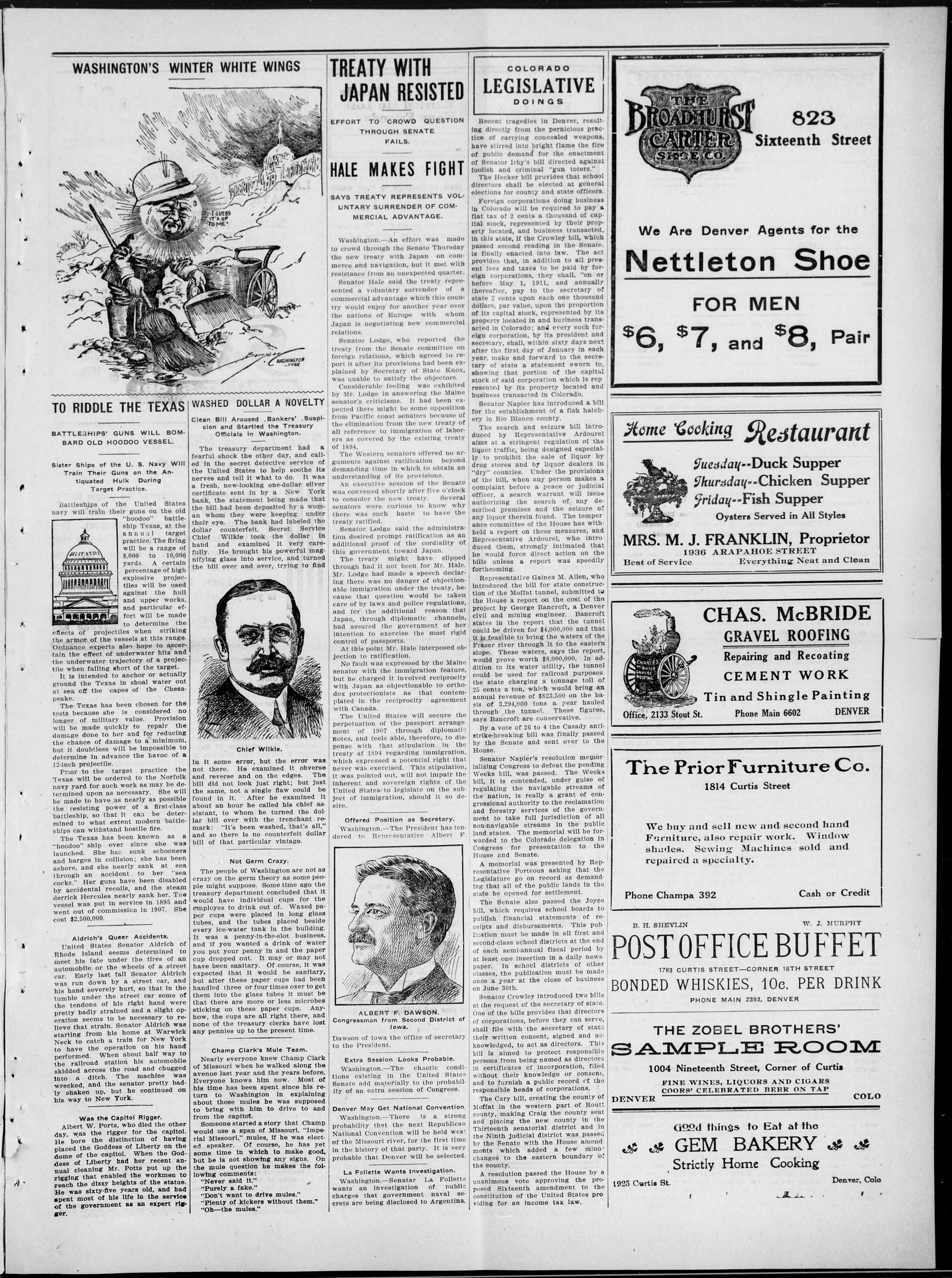
BATTLEHIPS' GUNS WILL BOM
BARD OLD HOODOO VESSEL.
Sister Ships of the U. S. Navy Will Train Their Guns on the Antiquated Hulk During Target Practice.
Battleships of the United States navy will train their guns on the old "hoodoo" battle-ship Texas, at the annual target practice. The firing will be a range of 8,000 to 10,000 yards. A certain percentage of high explosive projectiles will be used against the hull and upper works, and particular effort will be made to determine the
battleship Texas, at the annual target practice. The firing will be a range of 8,000 to 10,000 yards. A certain percentage of high explosive projectiles will be used against the hull and upper works, and particular effort will be made to determine the effects of projectiles when striking the armor of the vessels at this range. Ordnance experts also hope to ascertain the effect of underwater hits and the underwater trajectory of a projectile when falling short of the target. It is intended to anchor or actually ground the Texas in shoal water out at sea off the capes of the Chesapeake.
The Texas has been chosen for the tests because she is considered no longer of military value. Provision will be made quickly to repair the damage done to her and for reducing the chance of damage to a minimum, but it doubtless will be impossible to determine in advance the havoc of a 12-inch projectile.
Prior to the target practice the Texas will be ordered to the Norfolk navy yard for such work as may be determined upon as necessary. She will be made to have as nearly as possible the resisting power of a first-class battleship, so that it can be determined to what extent modern battleships can withstand hostile fire.
The Texas has been known as a "hoodoo" ship ever since she was launched. She has sunk schooners and barges in collision; she has been ashore, and she nearly sank at sea through an accident to her "sea cocks." Her guns have been disabled by accidental recoils, and the steam derrick Hercules nearly sank her. The vessel was put in service in 1895 and went out of commission in 1907. She cost $2,500,000.
Aldrich's Queer Accidents.
United States Senator Aldrich of Rhode Island seems determined to meet his fate under the tires of an automobile or the wheels of a street car. Early last fall Senator Aldrich was run down by a street car, and his hand severely hurt, so that in the tumble under the street car some of the tendons of his right hand were pretty badly strained and a slight operation seems to be necessary to relieve that strain. Senator Aldrich was starting from his home at Warwick Neck to catch a train for New York to have the operation on his hand performed. When about half way to the railroad station his automobile skidded across the road and chugged into a ditch. The machine was wrecked, and the senator pretty badly shaken up, but he continued on his way to New York.
Was the Capltol Rigger.
Albert W. Ports, who died the other day, was the rigger for the capitol. He bore the distinction of having placed the Goddess of Liberty on the dome of the capitol. When the Goddess of Liberty had her recent annual cleaning Mr. Potts put up the rigging that enabled the workmen to reach the dizzy heights of the statue. He was sixty-five years old, and had spent most of his life in the service of the government as an expert rigger.
Clean Bill Aroused. Bankers' Suspicion and Startled the Treasury Officials in Washington.
The treasury department had a fearful shock the other day, and called in the secret detective service of the United States to help soothe its nerves and tell it what to do. It was a fresh, new-looking one-dollar silver certificate sent in by a New York bank, the statement being made that the bill had been deposited by a woman whom they were keeping under their eye. The bank had labeled the dollar counterfeit. Secret Service Chief Wilkie took the dollar in hand and examined it very carefully. He brought his powerful magnifying glass into service, and turned the bill over and over, trying to find
so you
in it some error, but the error was not there. He examined it obverse and reverse and on the edges. The bill did not look just right; but just the same, not a single flaw could be found in it. After he examined it about an hour he called his chief assistant, to whom he turned the dollar bill over with the trenchant remark: "It's been washed, that's all," and so there is no counterfeit dollar bill of that particular vintage.
Not Germ Crazy.
The people of Washington are not as crazy on the germ theory as some people might suppose. Some time ago the treasury department concluded that it would have individual cups for the employees to drink out of. Waxed paper cups were placed in long glass tubes, and the tubes placed beside every ice-water tank in the building. It was a penny-in-the-slot business, and if you wanted a drink of water you put your penny in and the paper cup dropped out. It may or may not have been sanitary. Of course, it was expected that it would be sanitary, but after these paper cups had been handled three or four times oxer to get them into the glass tubes it must be that there are more or less microbes sticking on these paper cups. Anyhow, the cups are all right there, and none of the treasury clerks have lost any pennies up to the present time.
Champ Clark's Mule Team.
Nearly everyone knew Champ Clark of Missouri when he walked along the avenue last year and the years before. Everyone knows him now. Most of his time has been spent since his return to Washington in explaining about those mules he was supposed to bring with him to drive to and from the capitol.
Someone started a story that Champ would use a span of Missouri, "Imperial Missouri," mules, if he was elected speaker. Of course, he has yet some time in which to make good, but he is not showing any signs. On the mule question he makes the following comments:
"Punishment of kickers without them."
"Oh—the mules."
TREATY WITH JAPAN RESISTED
EFFORT TO CROWD QUESTION
THROUGH SENATE
FAILS.
HALE MAKES FIGHT
HALE MAKES FIGHT
SAYS TREATY REPRESENTS VOL
UNTARY SURRENDER OF COM-
MERCIAL ADVANTAGE.
Washington.—An effort was made to crowd through the Senate Thursday the new treaty with Japan on commerce and navigation, but it met with resistance from an unexpected quarter. Senator Hale said the treaty represented a voluntary surrender of a commercial advantage which this country would enjoy for another year over the nations of Europe with whom Japan is negotiating new commercial relations. Senator Lodge, who reported the treaty from the Senate committee on foreign relations, which agreed to report it after its provisions had been explained by Secretary of State Knox, was unable to satisfy the objectors.
Considerable feeling was exhibited by Mr. Lodge in answering the Maine senator's criticisms. It had been expected there might be some opposition from Pacific coast senators because of the elimination from the new treaty of all reference to immigration of laborers as covered by the existing treaty of 1894.
The Western senators offered no arguments against ratification beyond demanding time in which to obtain an understanding of its provisions.
An executive session of the Senate was convened shortly after five o'clock to consider the new treaty. Several senators were curious to know why there was such haste to have the treaty ratified.
Senator Lodge said the administration desired prompt ratification as an additional proof of the cordiality of this government toward Japan.
The treaty might have slipped through had it not been for Mr. Hale. Mr. Lodge had made a speech declaring there was no danger of objectionable immigration under the treaty, because that question would be taken care of by laws and police regulations, and for the additional reason that Japan, through diplomatic channels, had assured the government of her intention to exercise the most rigid control of passports. At this point Mr. Hale interposed objection to ratification. No fault was expressed by the Maine senator with the immigration feature, but he charged it involved reciprocity with Japan as objectionable to orthodox protectionists as that contemplated in the reciprocity agreement with Canada.
The United States will secure the perpetuation of the passport arrangement of 1907 through diplomatic notes, and feels able, therefore, to dispense with that stipulation in the treaty of 1894 regarding immigration, which expressed a potential right that never was exercised. This stipulation, it was pointed out, will not impair the inherent and sovereign rights of the United States to legislate on the subject of immigration, should it so desire.
Offered Position as Secretary.
Washington.—The President has tendered to Representative Albert F.
A. H.
ALBERT F. DAWSON.
Congressman from Second District of
Iowa.
Dawson of Iowa the office of secretary
to the President.
Washington.—The chaotic conditions existing in the United States Senate add materially to the probability of an extra session of Congress.
Denver May Get National Convention.
Washington.—There is a strong probability that the next Republican National Convention will be held west of the Missouri river, for the first time in the history of that party. It is very probable that Denver will be selected.
La Follette Wants Investigation.
Washington.—Senatar La Follette wants an investigation of public charges that government naval secrets are being disclosed to Argentina.
Recent tragedies in Denver, resulting directly from the pernicious practice of carrying concealed weapons, have stirred into bright flame the fire of public demand for the enactment of Senator Irbys bill directed against foolish and criminal "gun toters." The Hecker bill provides that school directors shall be elected at general elections for county and state officers.
Foreign corporations doing business in Colorado will be required to pay a flat tax of 2 cents a thousand of capital stock, represented by their property located, and business transacted, in this state, if the Crowley bill, which passed second reading in the Senate, is finally enacted into law. The act provides that, in addition to all present fees and taxes to be paid by foreign corporations, they shall, "on or before May 1, 1911, and annually thereafter, pay to the secretary of state 2 cents upon each one thousand dollars, par value, upon the proportion of its capital stock, represented by its property located in and business transacted in Colorado; and every such foreign corporation, by its president and secretary, shall, within sixty days next after the first day of January in each year, make and forward to the secretary of state a statement sworn to, showing that portion of the capital stock of said corporation which is represented by its property located and business transacted in Colorado.
Senator Napier has introduced a bill for the establishment of a fish hatchery in Rio Blanco county.
The search and seizure bill introduced by Representative Ardourel aims at a stringent regulation of the liquor traffic, being designed especially to prohibit the sale of liquor by drug stores and by liquor dealers in "dry" counties. Under the provisions of the bill, when any person makes a complaint before a peace or judicial officer, a search warrant will issue authorizing the search of any described premises and the seizure of any liquor therein found. The temperance committee of the House has withheld a report on these measures, and Representative Ardourel, who introduced them, strongly intimated that he would force direct action on the bills unless a report was speedily forthcoming.
Representative Gaines M. Allen, who introduced the bill for state construction of the Moffat tunnel, submitted to the House a report on the cost of the project by George Bancroft, a Denver civil and mining engineer. Bancroft states in the report that the tunnel could be driven for $4,000,000 and that it is feasible to bring the waters of the Fraser river through it to the eastern slope. These waters, says the report, would prove worth $8,000,000. In addition to its water utility, the tunnel could be used for railroad purposes. the state charging a tonnage toll of 25 cents a ton, which would bring an annual revenue of $823,500 on the basis of 3,294,000 tons a year hauled through the tunnel. These figures, says Bancroft are conservative.
By a vote of 26 to 4 the Casady anti-strike-breaking bill was finally passed by the Senate and sent over to the House.
Senator Napier's resolution memorializing Congress to defeat the pending Weeks bill, was passed. The Weeks bill, it is contended, under guise of regulating the navigable streams of the nation, is really a grant of congressional authority to the reclamation and forestry services of the government to take full jurisdiction of all non-navigable streams in the public land states. The memorial will be forwarded to the Colorado delegation in Congress for presentation to the House and Senate.
A memorial was presented by Representative Porteous asking that the Legislature go on record as demanding that all of the public lands in the state be opened for settlement.
The Senate also passed the Joyce bill, which requires school boards to publish financial statements of receipts and disbursements. This publication must be made in all first and second-class school districts at the end of each semi-annual fiscal period by at least one insertion in a daily newspaper. In school districts of other classes, the publication must be made once a year at the close of business on June 30th.
Senator Crowley introduced two bills at the request of the secretary of state. One of the bills provides that directors of corporations, before they can serve, shall file with the secretary of state their written consent, signed and acknowledged, to act as directors. This bill is aimed to protect responsible persons from being named as directors in certificates of incorporation, filed without their knowledge or consent, and to furnish a public record of the responsible heads of corporations.
The Cary bill, creating the county of Moffatt in the western part of Routt county, making Craig the county seat and placing the new county in the Thirteenth senatorial district and in the Ninth judicial district was passed by the Senate with the House amendments which added a few minor changes to the eastern boundary of the county.
A resolution passed the House by a unanimous vote approving the proposed Stateteenth amendment to the constitution of the United States providing for an income tax law.
THE BROADHURST CARTER SHOE CO.
823
Sixteenth Street
We Are Denver Agents for the
Nettleton Shoe
FOR MEN
$6, $7, and $8, Pair
Home Cooking Restaurant
Juesday--Duck Supper
Thursday--Chicken Supper
Friday--Fish Supper
Oysters Served in All Styles
MRS. M. J. FRANKLIN, Proprietor
1936 ARAPAHOE STREET
Best of Service Everything Neat and Clean
The Prior Furniture Co. 1814 Curtis Street
We buy and sell new and second hand Furniture, also repair work. Window shades. Sewing Machines sold and repaired a specialty.
B. H. SHEVLIN W. J. MURPHY
POST OFFICE BUFFET
1763 CURTIS STREET-CORNER 18TH STREET
BONDED WHISKIES, 10c. PER DRINK
PHONE MAIN 2393, DENVER
THE ZOBEL BROTHERS' SAMPLE ROOM
GOOD things to Eat at the GEM BAKERY Strictly Home Cooking
Tues
Thu
Fri
MRS. M. J. F.
1936 A
Best of Service
CHARLES
MARRIAGE
ENGINE
ROOFING
Office, 2133 Stout St
The Prior
182
We buy and s
Furniture, also
shades. Sewi
repaired a spe
Phone Champa 392
B. H. SHEVLIN
POST OFF
CHAS. McBRIDE
GRAVEL ROOFING
Repairing and Recoating
CEMENT WORK
Tin and Shingle Painting
Phone Main 6602 DENVER
ior Furniture Co.
1814 Curtis Street
and sell new and second hand
also repair work. Window
sewing Machines sold and
specialty.
ure Co.
cond hand
Window
sold and
Cash or Credit
W. J. MURPHY
OFFICE BUFFET
W. J. MURPHY
THE COLORADO STATESMAN
JOS. D. D. RIVERS ..... Proprietor
1824 Curtis Street. Room 25.
JOS. D. D. RIVERS ..... Proprietor
1824 Curtis Street. Room 25.
SUBSCRIPTION RATES:
PAYABLE IN ADVANCE.
papers that papers sent to subscriber any number when due, inform a duplicate of the missing.
be made by Express Money or Bank Draft. Postage standard part of a dollar. Only 5 cents per square. A square in lines or less, 10 cents per 10 per line. In less than three months' contracts unknown to us. Further in of a personating nature that are columns of this paper.
receive attention must be newly upon one side of the paper; later than Wednesdays, and if returned, unless stamps are sent class matter at the postoffice.
One Year ..... $2.00
Six Months ..... 1.00
Three Months ..... .60
PAYABLE IN ADVANCE.
It occasionally happens that papers sent to subscribers are lost or stolen. In case you do not receive any number when due, inform us by postal card and we will cheerfully forward a duplicate of the missing number.
Remittances should be made by Express Money Order, Postoffice Money Order, Registered Letter or Bank Draft. Postage stamps will be received the same as cash for the fractional part of a dollar. Only 1-cent and 2-cent stamps taken.
Display advertising 25 cents per square. A square contains ten agate lines.
No discounts allowed on less than three months' contract. Cash must accompany all orders from parties unknown to us. Further particulars on application.
All communications of a personating nature that are not complimentary will be withheld from the columns of this paper.
Communications to receive attention must be newsy, upon important subjects, plainly written only upon one side of the paper; must reach us Tuesdays, if possible, anyway not later than Wednesdays, and bear the signature of the author. No manuscript returned, unless stamps are sent for postage.
Entered as second-class matter at the postoffice in the city of Denver, Colorado.
COMING OUR WAY.
not going to the bow-wows with any hard trials and tribulation of the conflict.
in Oklahoma the United St. guardfather clause" of the elective nature, and indictments have a minence for endeavoring to negotiation ordinance, which souls district and particular sections and tenants who endeavored a city court, because of its deart all over again, with a haction of judicial antagonism, the selection of a site for theAMA canal, San Francisco has thereby assured to colored celebration.
southern senators, aided by misan endorsement of state disfiction for a constitutional amnesties senators by popular vote, the country is being made to agrophobists will descent to nation has already declared to to travel from now on, thank the misplaced judgment of the line matters appear to this manner, and although the color, the general tendency which is just should materially
EVERYTHING is not going to the bow-wows with the colored brother, after all. He has many hard trials and tribulations, but gradually some good things come out of the conflict.
For instance, over in Oklahoma the United States District Court has declared void the "grandfather clause" of the election law recently passed by a Democratic legislature, and indictments have been found against numerous persons of prominence for endeavoring to enforce it. Back in Baltimore the famous segregation ordinance, which sought to confine white and colored residents to district and particular sections of the city, and to punish owners, landlords and tenants who endeavored to mix colors, has been declared invalid by a city court, because of its defective title. The antimixers will have to start all over again, with a handicap of aroused sentiment and the presumption of judicial antagonism against them. In the fight in Congress for the selection of a site for the exposition to celebrate the opening of the Panama canal, San Francisco has won over New Orleans, and decent treatment is thereby assured to colored people who shall desire to participate in that celebration.
The scheme of Southern senators, aided by misguided Republican "progressives," to couple an endorsement of state disfranchisement of colored voters with the proposition for a constitutional amendment authorizing the election of United States senators by popular vote, is getting all the publicity it deserves, and the country is being made to see to what base depths the narrow-minded Negrophobists will descent to accomplish the things which advanced civilization has already declared to be unjust. The scheme will have a hard road to travel from now on, thanks to Senator Carter and Depew, and in spite of the misplaced judgment of Senator Borah of Idaho and his class. All along the line matters appear to be adjusting themselves quite satisfactorily in this manner, and although there is much to grind and discourage the man of color, the general tendency to right what is wrong and to protect that which is just should materially strengthen his spirit of optimism.
THE COLORED Y. M. C. A
defiance of Julius Rosenwald, led Y. M. C. A. building on pieces, in making a similar gift to any other city that saw York Independent, the week because of liberty and justice, seek the advantage of this gift, if none of our Northern cities people ride freely in our state public schools as others, a
THE splendid munificence of Julius Rosenwald, the Chicago Jew, in giving $25,000 for a colored Y. M. C. A. building on condition that $75,000 be raised from other sources, in making a similar gift to Philadelphia and in offering the same amount to any other city that shall choose to meet the condition, leads the New York Independent, the weekly magazine, which has done so much for the cause of liberty and justice, to declare: "The cities which we would have seek the advantage of this gift are those in the South. It would be well if none of our Northern cities, where no Jim Crow laws exist, where colored people ride freely in our street cars, where Negro children attend the same public schools as others, and nobody hurt thereby, should ask for this gift because none should exclude their brother man from Christian associations."
In the flurry of popular enthusiasm and feverish zeal aroused by the unprecedented generosity of Mr. Rosenwald and the motive behind it, which, as expressed by him, is to help a race that is suffering much as his own race has suffered, criticism of the vehicle employed to carry this blessing to the colored people has not been absent.
The Y. M. C. A. itself, notwithstanding its great work and magnificent success as a Christian institution serving the needs of society as represented by the white people, does not deserve an unlimited measure of credit for compliance, in two instances, with the terms of the condition imposed by the non-Christian but Christ-like donor, for it has persistently bowed to that social mandate which insists that colored people may participate only in that form of Christian fellowship which recognizes the necessity of separate relations. The name of the Y. M. C. A. is as much a denominational asset, protected by law, civil and ecclesiastical, as is the name of any church denomination, and all institutions adopting its name must expect to be governed by it, and to affiliate with it in such manner as its regulations may prescribe. Yet an institution which separates into distinct branches upon the basis of the color of their membership cannot consistently be said to exemplify a true Christian fellowship. With such a handicap, imposed by custom and various social conditions, it has seemed to a pity that the colored people cannot realize the objects for which Mr. Rosenwald's sublime charity creates the opportunity under an independent name, established and projected under their own institutional authority.
If we are to be separated in religious and semi-religious affairs, why not make the separation complete and absolute? Would it not be wiser than to encourage the permanent acceptance of the designation of the "Colored Y. M. C. A"? The independent title would not necessarily sacrifice the assistance we stand so much in need of. The object to be attained would be none the less moving. The chief object of such an institution is the formation of a moral and religious center, with educational, social and amusement features capable of successfully combatting the baser attractions which lure young men. These organizations among white men have taken on many of the features of social clubs, though exerting a far greater moral influence. Their educational and social advantages should be a great help to young colored men who are primarily religious and aspiring. But the weight of a title imposing an obligation to recognize a social principle and a restricted relation which are neither moral nor Christian in their true aspect, must grow greater as the thirst for truth and knowledge and love increases.
When a Fellow Is Married He Loses Many Friends
By ALICE MONTGOMERY
H, the modern trend of the young men we
cently in the all-embracing comfort of a deco
cozy drawing room and prate of marriag
friends! It is the one topic. They rehe
point of view. They wallow in its intricate
mysteries.
"It is our last resort," they say resig
to happen some day, and as woman is ther
the pursued, why, the responsibility of ther
from our shoulders. We are mere pupu
citedly, straightening themselves for a moment from
tions in the flush of their new discovery. "Mere p
a string controlled by a woman. When the appointe
beckons and we follow. It may be the voice of natu
stirring of the life force, or it may be—oh, call it wha
thing is certain—we obey. And, hang it all, think of w
up in the doing of it. When a fellow is married he lo
At first they drop in casually and try to pretend thir
were, and admire the new fixings, and make pretty sp
but somehow it is not the same, and they feel it, a
try to right it, but it won't go. There is a feminine com
barrier that can't be ignored, and so gradually your be
engagements and gather new interests, and you are not.
And you feel an outcast. And then in sheer self-d
throw in your lot with the other married people and wa
struggling in the marriage toils, and often it isn't a
marriage isn't all beer and skittles—it has its drawback
"And then, too," these same young men continue
subject, "how we fellows have to toil and spin to m
round. There is no limit to the yards of bills that
the first of the month, and as for appreciation—the
nowadays. The women just take all they can get as
in a sort of deign the queen kind of way that makes y
for not giving them more.
end of the young men who lie back complac-
embracing comfort of a deep armchair in some
room and prate of marriage to their women
the one topic. They rehearse it from every
they wallow in its intricacies and glory in it.
A last resort," they say resignedly. "It is boun-
d day, and as woman is the pursuer and man,
the responsibility of the initiative is lifted
ers. We are mere puppets," they say ex-
selves for a moment from their lounging pos-
new discovery. "Mere puppets, dangling to
man. When the appointed day is come, she
may be the voice of nature, or it may be the
it may be—oh, call it what you will—but one
and, hang it all, think of what we have to give
a fellow is married he loses his best friend
y and try to pretend things are just as they
wings, and make pretty speeches to your wife
same, and they feel it, and you feel it, and
to. There is a feminine constraint, an invisible
and so gradually your best chums have other
interests, and you are not included, of course.
And then in sheer self-defense you have to
her married people and watch some poor chap
oilis, and often it isn't a pretty sight. Say
littles—it has its drawbacks."
Same young men continue, warming to their
have to toil and spin to make the wheels go
to the yards of bills that have to be met at
as for appreciation—there is no such thing
take all they can get as a matter of course,
kind of way that makes you feel pretty mean
H, the modern trend of the young men who lie back complacently in the all-embracing comfort of a deep armchair in some cozy drawing room and prate of marriage to their women friends! It is the one topic. They rehearse it from every point of view. They wallow in its intricacies and glory in its mysteries.
O
"It is our last resort," they say resignedly. "It is bound to happen some day, and as woman is the pursuer and man the pursued, why, the responsibility of the initiative is lifted from our shoulders. We are mere puppets," they say ex-
citedly, straightening them tions in the flush of their a string controlled by a w beckons and we follow. It stirring of the life force, or thing is certain—we obey. up in the doing of it. When At first they drop in casual were, and admire the new f but somehow it is not the try to right it, but it won't g barrier that can't be ignored engagements and gather new And you feel an outcast. throw in your lot with the o struggling in the marriage marriage isn't all beer and a "And then, too," these subject, "how we fellows round. There is no limit to the first of the month, and nowadays. The women just in a sort of deign the queen for not giving them more.
citedly, straightening themselves for a moment from their lounging positions in the flush of their new discovery. "Mere puppets, dangling to a string controlled by a woman. When the appointed day is come, she beckons and we follow. It may be the voice of nature, or it may be the stirring of the life force, or it may be—oh, call it what you will—but one thing is certain—we obey. And, hang it all, think of what we have to give up in the doing of it. When a fellow is married he loses his best friends. At first they drop in casually and try to pretend things are just as they were, and admire the new fixings, and make pretty speeches to your wife, but somehow it is not the same, and they feel it, and you feel it, and try to right it, but it won't go. There is a feminine constraint, an invisible barrier that can't be ignored, and so gradually your best chums have other engagements and gather new interests, and you are not included, of course. And you feel an outcast. And then in sheer self-defense you have to throw in your lot with the other married people and watch some poor chap struggling in the marriage toils, and often it isn't a pretty sight. Say, marriage isn't all beer and skittles—it has its drawbacks."
"And then, too," these same young men continue, warming to their subject, "how we fellows have to toil and spin to make the wheels go round. There is no limit to the yards of bills that have to be met at the first of the month, and as for appreciation—there is no such thing nowadays. The women just take all they can get as a matter of course, in a sort of deign the queen kind of way that makes you feel pretty mean for not giving them more.
A.
But all this time the women, who have a deeper insight into things marital and a keener intuition, smile whimsically into the embers. They know the men are having the time of their lives, and, incidentally, one of their own missions, that of affording entertainment, is being fulfilled. If the men were not really enjoying themselves, why on earth were they there at all, and why that particular topic, if it wasn't of paramount interest?
Much Benefit by Sleeping Out of Doors
By A. MORGAN
Milwaukee, Wis.
I have been sleeping outdoors on my back porch some six years and do not come in for zero temperatures or snow or rain. I use a sanitary folding couch and have a waterproof canvas cover which keeps the mattress dry in the day time and serves as an excellent top cover tucked in over all clothing and mattress at night. I use an extra mattress over the thin one which came with the couch.
For covers I use four heavy all-wool blankets and one comforter and over all this the waterproof cover acts as a protection from rain, snow and wind. About ten
minutes before retiring I p water should be steaming h water keep the bed nice and I use a wool stocking cing and protecting the eyes. I was weak and sickly pounds and am strong as Sa I sleep like a child and tite.
minutes before retiring I put in two or three quart water should be steaming hot when put into the bags water keep the bed nice and warm all night.
I use a wool stocking cap pulled down to the end ing and protecting the eyes.
I was weak and sickly when I started this game a pounds and am strong as Sandow.
I sleep like a child and get up in the morning wit tite.
put in two or three quart water bags. The
it when put into the bags. The bags of hot
warm all night.
up pulled down to the end of my nose, cover-
when I started this game and have gained 50
dow.
get up in the morning with a ravenous appe-
minutes before retiring I put in two or three quart water bags. The water should be steaming hot when put into the bags. The bags of hot water keep the bed nice and warm all night.
I use a wool stocking cap pulled down to the end of my nose, covering and protecting the eyes.
I was weak and sickly when I started this game and have gained 50 pounds and am strong as Sandow.
I sleep like a child and get up in the morning with a ravenous appetite.
Nothing can induce me to sleep indoors again.
The consumer in this country not only pays the tariff, but he pays in many other ways where he gets the worst of it.
How the Public Loses Much Money
By PROF. W. C. LANGDON
University of California
Take, for instance, the buying of articles where a fraction of a cent comes in. The American housewife in this era of high prices is often forced to buy in small lots. She goes to market and purchases, say, a half-dozen eggs, at 35 cents per dozen, but there being no half-pennies, must tender 18 cents. In the same way she expends 13 cents for half a dozen oranges instead of $12\frac{1}{2}$ cents.
many articles selling at a fight be bought.
While it may seem a trifle is thus taken from the earnin to a vast sum annually.
The condition could be
The same rule applies to dry goods, many articles selling at a figure where there is no even division if a fraction be bought.
many articles selling at a figure where there is no evention be bought.
While it may seem a trivial loss, I can tell you that is thus taken from the earnings of the poor and middle to a vast sum annually.
The condition could be easily remedied by the coini
are where there is no even division if a frac- tional loss, I can tell you that the aggregate that ages of the poor and middle class will amount easily remedied by the coining of half-pennies.
While it may seem a trivial loss, I can tell you that the aggregate that is thus taken from the earnings of the poor and middle class will amount to a vast sum annually. The condition could be easily remedied by the coining of half-pennies.
Last summer the south park commissioners installed a number of feeding stations for birds in Jackson and Washington parks.
Birds That Stay During Winter Months
By J. HOWARD MOORE
Chicago
During the winter months now these stations are kept well stocked with food, consisting of seeds of various kinds, with which suet is mixed.
As a result a number of birds are spending the winter here that usually fly south for the cold months.
Besides the bluejays, which have been here regularly for several winters, and the robins, which appear off and on every
winter, there are several K (snow birds), shrikes, creee ducks and a flock of 45 or 5 the berries of the fruit and
winter, there are several Kentucky cardinals, a mooch (snow birds), shrikes, creepers, downy woodpeckers, ducks and a flock of 45 or 50 cedar waxwings. These are the berries of the fruit and wild viburnum.
nuttucky cardinals, a mocking bird, juncoes ers, downy woodpeckers, nuthatches, wild cedar waxwings. These last feed chiefly on wild viburnum.
winter, there are several Kentucky cardinals, a mocking bird, juncoes (snow birds), shrikes, creepers, downy woodpeckers, nuthatches, wild ducks and a flock of 45 or 50 cedar waxwings. These last feed chiefly on the berries of the fruit and wild viburnum.
End of Season Sale
We are offering all.
LADIES' CLOTH COATS, LADIES' FUR
COATS, LADIES' WINTER SUITS,
Many of our
SKIRTS, WAISTS, DRESSES, and
all FUR NECK PIECES
AND MUFFS AT
ONE-HALF
This means you buy them now for a great deal less than we paid
for them, but as we must have the space for spring and summer gar-
ments, we are forced to sacrifice prices in the fall and winter goods.
It will pay you to look this stock over. We will take pleasure to
show the garments.
S&N
CARMENT STORE
925-16TH ST. OPP. JOSLINS
The Right Kind of Reading Matter
the news; the doings of the people in this
gossip of our own community, that's
kind of reading matter you want. It is
important, more interesting to you than
can by the paper or magazine from the
world. It is the first reading matter
and buy. Each issue of this paper gives
just what you will consider
The home news; the doings of the people in this town; the gossip of our own community, that's the first kind of reading matter you want. It is more important, more interesting to you than that given by the paper or magazine from the outside world. It is the first reading matter you should buy. Each issue of this paper gives to you just what you will consider
The Right Kind of Reading Matter
The Right Kind of Reading Matter
Dr. Knapp declared that the United States losses every year two billion dollars through losses by agricultural shortcomings that can be remedied. The demonstration work, corn clubs for boys, and canning and poultry clubs for girls, have increased the people's earning power and made them better citizens.
THE HAMPTON NORMAL AND AGRICULTURAL INSTITUTE,
HAMPTON, VIRGINIA.
(Special to The Colorado Statesman.) Hampton, Va., Feb. 10.—The annual two-day session of the Hampton Institute Farmers' Conference, including a remarkably fine exhibition of Negro farmers' home and field products, directed by Charles K. Graham and Roy R. Clark of the Hampton Agricultural Department, brought together in most helpful relation some 500 white and colored men, who are daily improving home, farm, school, and community life throughout the South.
Professor Hurd spoke on "Transition in Agriculture" and "Corn Production." He advocated deep soil preparation and shallow cultivation for corn. Thomas C. Walker, Gloucester, Va., a Hampton graduate and lawyer-farmer who has helped his people buy and improve land, urged the farmers to secure property while they have the opportunity.
About two hundred dollars were dis attributed among Negro adults and children for prize exhibits of corn and cereals, vegetables, canned nad preserved fruits, domestic arts and science goods, and public school manual training.
Hampton Institute is making possible the extension of Gen. Samuel C. Armstrong's ideas through its annual Farmers' Conference.
John B. Peirce, Wellville, Va., a Hampton graduate who has been most helpful to Virginia Negro farmers as a demonstration agent, delivered a forceful, Christian, common-sense plea for improving the country schools and homes. He urged the Hampton students to make unusual sacrifice for their race.
"In't it awful? According to the papers, there just seems to be one revolution after another." "Yes; that's the way the world goes round."—Judge.
"My largest item of expense is on account of advertising." "Indeed! I was not aware that you were in business." "I'm not. But my wife reads the ads in the newspapers."
Hon. William H. Mann, the agricultural governor of Virginia, Dr. Seamau A. Knapp, Washington, D. C., the master spirit of the Farmers' Co-operative Demonstration Farm Work; Prof. William D. Hurd, the director of extension work at the Massachusetts Agricultural College, Amherst, Mass.; Dr. Nelson A. Mayo, the well known veterinarian of Blacksburg, Va.; T. O. Sany, Burkeville, Va., state agent of the U. S. Department of Agriculture, these men spoke words of hope and wisdom
Alfred Goodwin, Defendant.
The People of the State of Colorado, to the Defendant above named, Greeting;
We are hereby required to appear in an action brought against you in the above-named plaintiff in the County Court, or the City and County of Denver, State of Colorado, to the complaint therein within thirty days after the service hereof if you are served this State, or within fifty days after the service hereof if you are personally outside the State of Colorado, or, if served by publication, with the last publication, or trial will be held the same as though you were present.
Members of the Hampton Agricultural Department delivered helpful and practical addresses on "Potato Raising," "Fertilizers," "Hog Diseases," "Poultry Production," "Flies and Mosquitoes," and "Be Culture."
Governor Mann said: "We have in Virginia 25,612,000 acres of land. We are cultivating less than 4,000,000. We have not enough people in Virginia—only 2,061,000. If we had as many people in proportion as Massachusetts, 12,000,000, Virginia would be the empire state of the Union.
which is an action brought to obtain a decree, a decree of consent, non-support, and desertion for more than one year last past and that deed was from plaintiff, has married one ida Anderson; and such other and further deeds from plaintiff, have married just and equitable from the complaint; copy of which is hereunto attached; and the evidence adduced upon the trial.
"If the farmers of Virginia averaged 61% bushels of corn to the acre, as did the boys who undertook the demonstration work for 1910, Virginia alone would produce annually 150,000, 000 bushels of corn."
Witness, Thomas L. Bonfilis, Clerk of the County Court, in and for the said City and County of Denver, at his office in Denver, this 27th day of January, A. D. 1911, and the seal of said Court hereunto affixed.
THOMAS L. BONFILS.
(Seal) Clerk of the County Court.
* By K. P. MACE, Deputy.
Hampton Farmers' Conference. (Special to The Colorado Statesman)
Silversmith & Hiller
925 16th St.
The Way of the World.
Enough Said.
SUMMONS IN DIVORCE
Mrs. John Davis still continues quite ill.
Mr. F. T. Bruce still continues very ill at his home, 2231 Glenarm Place.
R. L. Lewis is now permanently employed at the Central Savings bank.
Mrs. R. K. DePriest is able to be up after several days illness.
BISHOP GRANT MEMORIAL.
Memorial services in honor of the late Rt. Rev. Bishop Abram Gray were held at Shorter's A. M. E. Church last Sunday, at both morning and evening services. At the morning service Rev. A. M. Ward, the pastor, or livered an eulogy on Bishop Gran following the reading of the obituary by Wayman Ward and the singing some of the favorite songs of the bish
J. L. Morris, a mining man of Idaho Springs, was in the city this week.
Mrs. Wm. Walton of 2946 Arapahoe street is numbered among the sick this week.
Something for nothing. Refreshments free at East Turner Hall March 8th. Why the Soda Boys of course.
Mrs. Thomas Dickerson left the city Tuesday for a two months visit with her son at Speed, Kans.
Mrs. Fred Ratley arrived home this week, after a very pleasant visit in St. Louis and Kansas City.
Little Portia, daughter of Mr. and Mrs. W. B. Washington of 1760 Washington avenue is quite sick.
J. L. Breese and R. E. Bryant of Kansas City, were in the city this week with a special party.
First Sergeant Wm. Barnes has been confined to his home two weeks, suffering with cancer of the stomach.
Emmet Easter died Sunday and was buried Tuesday from the residence of his parents very worthy people who reside on Downing.
Meet me at East Turner hall March 8th, the Soda Boys will entertain.
Miss Lizzie Cowen, who has been very sick with rheumatism at St. Joseph's hospital, returned to her nome last Tuesday.
Mrs. Mo'lie Conley was operated on at St. Joseph's hospital last Saturday. Her sister, Mrs. Robinson of Aspen, arrivxed in the city last week.
Mrs. O. Rand of Cañon City, in company with her brother, Ed Mathews, arrived in the city Tuesday. They are the guests of Mrs. M. A. Cole of 3046 Walnut street.
Charles Cunningham, Felix Wells, Rufus Stewart and William Edwards were arrested this week, being a gang of opium smugglers. Stewart and Edwards were arrested in El Paso, Texas, and whether or not they were colored we have been unable to learn.
Believe me, Fizz Boys entertainment for mine at East Turner Hall, March 8th
Benjamin Easter, one of Denver's most worthy citizens and property owners, who has been confined to his home with penumonia, is, the Colorado Statesman is glad to say on the mend, thanks to the good nursing of his estimable wife.
The guests registered at the Hotel Abyssenia this week are: Mr. and Mrs. Whitted, Danville, Ill.; Mr. Allen, St. Joseph, Mo.; Rev. W. Boaman, Boulder, Colo.; Attorney Theophile C. Grand Pre, Chicago, Ill.; and Mr. and Mrs. Clarence Dotson of New York City, who will appear at the Pantages theater next week.
A sacred drama and cantata will be given by the St. Mary's Altar Guild of the Church of the Redeemer, assisted by the Azalia Hackley chorus, in the People's Presbyterian Church, Twenty-third avenue and Washington street, Thursday evening, March 16, 1911, at 8:15. Admission 25 cents; children under 12 years 15 cents, at the door.
A large crowd attended the musical entertainment at Bethlehem Baptist Church Thursday night of last week. Two beautiful tea-sets were given away to the persons holding the lucky ticket numbers. The winners of the prizes were: Mrs. M. E. Morrison and Dora Loveless, the numbers being 1 and 46. The committee wish to thank the friends who assisted them in this entertainment.
Nicely furnished rooms in modern house; gentleman preferred, 2218 Clarkson street. Phone York 6121.
Memorial services in honor of the late Rt. Rev. Bishop Abram Grant were held at Shorter's A. M. E. Church last Sunday, at both morning and evening services. At the morning service Rev. A. M. Ward, the pastor, delivered an eulogy on Bishop Grant, following the reading of the obituary by Wayman Ward and the singing of some of the favorite songs of the bishou were interspersed with the exercises. At the evening services ten-minute talks upon the character and the great work that Bishop Grant had done for Methodism and the race were made by different persons.
Mrs. Thos. Campbell spoke of him as an educator; J. C. Porter, as a Christian and churchman; C. A. Franklin as a public man. The exercises throughout were very interesting and inspiring. In the person of Bishop Grant a grand good, noble and useful man has gone to his rest, but the good he has done will ever be remembered by thousands of people. Peace to his ashes.
SCOTT'S CHAPEL NOTES.
The Rev. A. M. Ward of Shorter's preached a soul-stirring sermon last Sunday afternoon to an enthusiastic and appreciative audience. We wish to sincerely thank our sister churches for their timely assistance in helping us by their presence and finance. Rev. Cabbell the district superintendent left before the service for Colorado Springs, where he goes to hold the fourth quarterly conference for the People's M. E. church.
The Cartoon entertainment at Shorter's for the benefit of Shorter's and Scott's promises to be something rare and out of the ordinary. Do not forget the date, Thursday, March 2nd. The admission is very reasonable and everybody ought to attend. The Rev. Ragatz is a skilled artist along this special line. The program will be interspersed with music by our local talent.
Mrs. Emma Anderson has been appointed superintendent of the Junior League. Parents are requested to send their little ones to the church at 3 p. m.
The Ladies' Aid Society made one hundred invitation bags last Thursday afternoon, which were distributed Sunday afternoon. You are urgently and cordially invited to attend this novel entertainment, Feb. 28. Refreshments will be served free for the admission which is a penny for every year you have been married and ten pennies for all single persons.
The serman topics for Sunday are "Christ's Commission to His Church" in the morning and at night "What of the Night?" March 5th will be the last Sunday before conference. We urge our friends to attend these services and give us one strong lift.
Mrs. P. E. Campbell and daughter, Wannita, are on the slick list.
Sunday will be Benevolence day. A handsome souvenir will be given to each contributor. We urge our members and friends to come to our rescue at this time.
Mesdames Caldwell and Wallace and Miss E. A. Antony will read papers Sunday evening at the League service. Mr. Cornelius Rice will sing a solo. Mrs. Suggs will read a paper also. Since Mrs. Ada Castry, by the force of circumstances, could not be with us for the past four or five weeks we have had to depend upon volunteer service. She is the energetic president.
The Ladies' Aid Society is planning for their Spring Fair which promises to be greater than ever.
Mr. C. J. Collier, the newly appointed district steward, will soon move into his new residence, which is being finished near Elitch's Gardens. Mr. Collier is one of the substantial members of Scott's.
Mr. T. S. Clinkscale, the recording steward, redered a very accurate account of his stewardship last Saturday evening at the quarterly conference and was highly complimented for his faithfulness in keeping the church's account with the pastor.
BUGLE CALL NO.1.
Shorter Chapel, A. M. E. Church.
To The Members: It has been the custom of the church for years to put forth a special effort for the saving of souls. At this time every member is called upon to rally to the cause. In keeping with this time-honored custom we will begin this year's series of special meetings on Sunday, March 5, and close Sunday, March 19. The services of the Rev. J. S. Payne of Boulder, the sweet singer of the Colorado conference, have been engaged.
It is the earnest desire of the pastor that every member belonging to Shorter contribute his part in whatever way he can to bring success to this effort. Yours for the glory of God and the salvation of men. A. MILTON, WARD, Pastor.
Y. M. C. B.
Dr. J. H. P. Westbrook speaks at Y. M. C. B. Sunday at Zion church. This will be another treat. Special plans will be presented for the organizing of a Bible class. Now this is a class much needed among our men and boys, and they should be present Sunday to learn of it.
MISS HATTIE MALONEY MAKES
$4.00 THE FIRST DAY.
The Afro-American Fraternal Life and Benefit Association pays you your sick and accident benefits while you are sick or hurt, not waiting until you are well. Five, ten and fifteen dollars per week sick and accident policies for $1.00, $2.00 and $3.00 per month.
We are still crying for agents. One perfectly new agent, Miss Hattie Maloney, wrote an application to-day, making just $4.00 for herself for the first days work. Come on and work for a good concern. Stop complaining about hard times. See J. H. Morris, cur general agent, at noon any day. 1020 19th street, Denver, Colo.
Criticious Her Sex
Mrs. Newell Dwight Hillis, wife of the minister, says in an article in the Outlook, that American women are not a success as home-makers. The American woman has been reared upon a false conception, she thinks. Has been set upon a pedestal and worshiped and has come to believe that she is a superior sort of being. She questions whether the talkative, self-assertive American girl is as well fitted for the work of the world as the English and German girls.
Misiudged Brilliant Son.
Lord Ampthill once found Bismarck reading Anderson's story on the Ugly Duckling, which relates how a duck hatched a swan's egg, and how the cygnet was jeered at by his putative brethren, the ducklings, until one day a troop of lordly swans, floating down the river, saluted him as one of their race. "Ah," observed Bismarck, "it was a long time before my poor mother could be persuaded that in hatching me she had not produced a goose."
Power Going to Waste.
It was asserted a few days ago before the Massachusetts gas and electric light commission that within 175 miles of Boston water capable of yielding 300,000 horse power is going to waste.
Firemen Recover Pet.
The pet cat belonging to the Kings' land firemen has been found and restored to its owners. The animal had been in the habit of going out to fires on the escapes and was lost at Stoke Newington a fortnight ago. Recently it was seen at Highbury, and being recognized by its collar studded with firemen's buttons, was taken to the nearest fire station and thence sent on to Kingsland. They have a similarly intelligent cat at the general post office, Paris. He gets into the mail cart and accompanies the bags to the station and takes frequent long journeys in the mail van. Recently, however, he was sealed up in a mail bag and got as far as Marselles—London Globe.
Alaska's Wealth of Coal
In coal resources Alaska stands supreme along the entire Pacific coast. There is, indeed, plenty of coal in the state of Washington, and Vancouver island has probably more coal under it than ever had England, but for a high-class anthracite or bituminous coal the present and future generations of the Pacific coast must turn to Alaska, as that is the only place it exists. The high grade, smokeless coal so essential for the Pacific squadron of our navy exists only in Alaska. —Columbian.
Unknown Inventors.
Many indispensable instruments may be referred to whose inventors are unknown. These devices were thought out ages ago and the memory of their makers has perished, but the world is indebted to their simple contrivances in a greater degree than it is to many wonderful inventions of modern times.
So Many Trout They Trip Fishermen.
Salmon trout fishing in the Sandy river is the leading sport just now. The fish have been running in great schools in such numbers that fishermen wading in the riffles were thrown off their feet.
At the falls, near the mouth of Bull Run river, the fish were so thick that they were pulled out by d ozens. George Moulton and Oscar Carlson on Sunday brought home a wagon load which they snagged by means of a hook on a throw line. At almost every cast fish would be hooked and dragged ashore. Settlers are salting large quantifies for winter use.—Gresham Correspondent Portland Oregonian.
DON'T MISS THIS OPPORTUNITY.
For sale, 80 acres, good house, barn, chicken house,15 acres plowed; four miles from Delta; center of fruit belt. Inquire at this office.
KEEP OFF THE DATE.
The Soda Dispensers at East Turner Hall Wednesday evening, March 8th
Two nicely furnished rooms for rent at 719 W. 8th avenue. Phone South 2411.
Furnished rooms for rent in a modern house, 2352 Humboldt street. Phone York 4632. Mrs. J. S. Mason. Men preferred.
Brickler's New Barber Shop is located at 2208 Larimer street. Shave, 10c. Hair Cut, 25c; Children, 15c.
Furnished house for rent at 2239 Arapahoe street, and furniture for sale.
Furnished 6-room house for rent, cheap. No children. Call at this office.
For rent—A three room brick at 413 29th street with basement. Rent $13.50. Apply room 415 Kittredge building. F. S. Taggert.
If you are going to buy property, do not do it until you have the title examined, so you may know if you are buying a good title or a lawsuit. Lawyer W. B. Townsend will tell you all about it at 209 Kittredge Building.
Stimulated Interest.
Harlow—Jimson seems to have a wonderful amount of adaptability.
Barlow—You bet he has. Why, I once saw him get excited over a game of chess.
That....
SALE
Of Ours
Is creating quite an excitement. People were waiting for bargain sales—for cut price events, but they never expected anything so great as this. Think of Adler's Collegian Suits and Overcoats for Men at $9.75. Why there isn't a store on 16th st, that will duplicate them under $15 to $20. Think of Women's Red Cross Shoes, the $4 and $5 kinds, for $2.85. Think of anything for man, woman, boy or girl—come here expecting to buy it for a fourth—a third—a half less than you can buy it elsewhere, and you'll not leave disappointed. Our entire $200,000 stock is included in the sale.
Michaelson's
THE BIG STORE
CORNER FIFTEENTH AND LARIMER
Hours 8 to 10 a. m., 2 to 5 and 7 to 8
p. m., and by appointment.
Phone Main 1144.
Dr. J. H. P. Westbrook
Specialty of
Nose, Throat and
Lung Diseases
Over The Elite Drug Store.
2100 ARAPAHOE STREET.
Job and Repair Work a Specialty
Res. 353 W. Warren Ave.
Phone South 1862
Shop 1021 Twenty-First St.
Phone Main 1144
FORD'S
HAIR POMADE
THE OLD RELIABLE DRESSING FOR KINKY OR CURLY HAIR. IT'S USE MAKES STUBBORN, HARSH HAIR SOFTER, MORE PLIABLE AND GLOSSY, EASY TO COMB AND PUT IN ANY STYLE THE LENGTH WILL PERMIT. WRITE FOR TESTIMONIES, TELLING HOW THIS REMARKABLE REMEDY MAKES SHORT, KINKY HAIR GROW LONG AND WAYY. BEST POMADE ON THE MARKET FOR DANDRUFF, ITCHING OF THE SCALP AND FALLING OUT OF THE HAIR. BEWARE OF IMITATIONS, GET THE GENUINE, PUT UP IN 25* AND 50* BOTTLES WITH CHARLES FORD'S NAME ON EVERY PACKAGE.
* SOLD BY DRUGGISTS. *
IF YOUR DRUGGIST CANNOT SUPPLY YOU, WE WILL SEND IT TO YOU DIRECT AT THE FOLLOWING PRICES. SMALL SIZED BOTTLE. 25* LARGE SIZED BOTTLE. 50* THE OZONIZED OX MARROW CO.
216 LAKE ST. DEPT. 30 CHICAGO, ILL.
AGENTS WANTED.
---
CHARLES S. WEST WEST CONFECTION
VEST BROS CONFECTIONERY and ICE CREAM PARLOR
Baur's Ice Cream
EVERYTHING
clean. Prompt
attention. The patron
respectfully solicited.
be sold in any quantity
with you. :: ::
All the latest Soda Fountain Drink
hours. Also a fine
2741 WELTO
Near Five
Phone Champa 2188
DID YOU E
Neef Bro
It's made right, a
None better made
This is a Strictly C
EVERYTHING is neat and clean. Prompt and courteous attention. The patronage of the public respectfully solicited. Ice cream will be sold in any quantity, to take home with you. The latest Soda Fountain Drinks and Chili serve hours. Also a fine grade of Cigars.
41 WELTON STREET
Near Five Points
Champa 2188 Denver, C
DID YOU EVER TRY
Ref Bros.' Bee
is made right, and tastes right one better made anywhere it is a Strictly Colorado Prod
EVERYTHING is neat and clean. Prompt and courteous attention. The patronage of the public respectfully solicited. Ice cream will be sold in any quantity, to take home with you. All the latest Soda Fountain Drinks and Chili served at all hours. Also a fine grade of Cigars
DID YOU EVER TRY Neef Bros.' Beer?
It's made right, and tastes right. None better made anywhere and This is a Strictly Colorado Production BE SURE AN TRY IT.
Railroad Men and Waiters' Club
We lead, others follow. Home for Railroad and Club Men. A welcome to visitors. All the latest magazines and papers will be found in the Library room.
Railroad Men and Wail Club
lead, others follow. Home for Railroad and
A welcome to visitors. All the latest mag
papers will be found in the Library room.
We lead, others follow. Home for Railroad and Club Men. A welcome to visitors. All the latest magazines and papers will be found in the Library room.
FRANK BURNLEY, Manager
2149 Curtis Street Denver, C
Phone Main 8232
The Carson Crockery C
The Carson Crockery
Denver's Largest Exclusive China Store.
732-736 FIFTEENTH STREET.
To make room for new Dinnerware patterns arriving
have decided to put on sale at half price
Four Patterns in Semi Porcelain
Neat Borders and Hand Decorati
As the stock is limited, come early and avoid being d
take room for new Dinnerware patterns arriving
led to put on sale at half price
Our Patterns in Semi Porcelain
at Borders and Hand Decorati
ock is limited, come early and avoid being d
To make room for new Dinnerware patterns arriving daily, we have decided to put on sale at half price
Four Patterns in Semi Porcelain in Neat Borders and Hand Decorations
As the stock is limited, come early and avoid being disappointed.
Thin Lead-blown Water Glasses, 90c values, dozen.....50c
Deep Needle - etched Water Glasses, $1.00 and $1.25 values, dozen.....75c
Teaspoons, Electric Silver Plate, 50c values, dozen.....30c
Dessert Spoons, Electric Silver Plate, $1.00 value, dozen.....60c
$10 Electrolier, with 12 in. Art Glass Dome, Pedestal and Frame in Brushed Brass, Copper, Verde and Gunmetal Finishes. Special ... $7.50
Automobile Service. Gas Mantles,
Phone Main 7339. Imported and Domestic.
Automatic Regulators for Gas Ranges.
Castrolier, with 12 in. Art Glass Dome, Peel
in Brushed Brass, Copper, Verde
Unmetal Finishes. Special
Service. Gas Mantles
In 7339. Imported and
Automatic Regulators for Gas Ranges.
$10 Electrolier, with 12 in. Art Glass Dome, Pedestal and Frame in Brushed Brass, Copper, Verde and Gunmetal Finishes, Special $7.50
C. W. JACQUES
All Kinds of Light-Giving and Gas Repaire
Gas Irons Cost 1/4-Cent per Hou
2053-55-57 WELTON STREET,
Us of Light-Giving and Gas-Saving Burners Adjus
Repaired.
Cons Cost 1/4-Cent per Hour. Satisfaction Guan
WELTON STREET. DENVER, CO
All Kinds of Light-Giving and Gas-Saving Burners Adjusted and Repaired.
Gas Irons Cost 1/4 Cent per Hour. Satisfaction Guaranteed
2053-55-57 WELTON STREET. DENVER, COLORADO.
A MO
falls she
dressed
listener
you waa
small o
you an
those w
ested in
make y
---
---
JOHN W. WEST
T BROS.
ECTIONERY
and
Johnston's Candies
HING is neat and Prompt and courteous patronage of the publiclicited. Ice cream will quantity, to take home
tain Drinks and Chili served at all a fine grade of Cigars
HILTON STREET
Five Points
Denver, Colorado
YOU EVER TRY
ros.' Beer?
right, and tastes right.
made anywhere and
tly Colorado Production
en and Waiters' Club
w. Home for Railroad and Club visitors. All the latest magazines found in the Library room.
n Crockery Co.
Dinnerware patterns arriving daily, we
at half price
in Semi Porcelain in
Hand Hand Decorations
time early and avoid being disappointed.
Teaspoons, Electric Silver Plate,
50c values, dozen.....30c
Dessert Spoons, Electric Silver
Plate, $1.00 value, dozen.....60c
in. Art Glass Dome, Pedestal and
Glass, Copper, Verde
s. Special ..... $7.50
Gas Mantles, Imported and Domestic. Ranges
and Gas-Saving Burners Adjusted and Repaired. per Hour. Satisfaction Guaranteed DENVER, COLORADO.
A MOST TOUCHING APPEAL
falls short of its desired effect if addressed to a small crowd of interested listeners. Mr. Business Man, are you wasting your ammunition on the small crowd that would trade with you anyway, or do you want to reach those who are not particularly interested in your business? If you do, make your appeal for trade to the largest and most intelligent audience in your community, the readers of this paper. They have countless wants. Your ads will be read by them, and they will become your customers. Try it and see.
---
Denver, Colo.
```markdown
```
Always Staunch And True
The Denver Republican has always avoided the fallacies and knaveries of yellow journalism, and its steadily increasing Circulation proves conclusively that its policy of telling the plain Truth without exaggeration or misrepresentation, standing fast for the Right, is heartily approved with growing force by the intelligent Public to which it appeals.
To read it is a liberal Education, and the citizen who goes without it does a positive harm to himself, to his family, and to the community.
In no other way can the investment of 21/2 cents per day for that is all The Republican costs any subscriber—bring such rich results in that Knowledge which is both Power and Pleasure. Information, instruction and entertainment fill its columns and it leaves a good taste in the mouth of the reader. It stands for Law and Order in the State—for Peace, Prosperity and Happiness in the Home. If you are not already enrolled among its splendid list of Patrons send on your subscription and give it a fair trial at 75 cents per month for Daily and Sunday.
The
WARD AUCTION
COMPANY
Sales Daily at 2 p.m. Office Furniture a Specialty.
PRIVATE SALES AT ALL TIMES
HAVE MOVED TO—
1723-39 GLENARM ST.
PHONE MAIN 1675.
Miss M. Cowden Hair Dressing Parlor
Shampoo, cutting and curling. Scalp treatment, hair tonics, hair straightening, manicuring. Stage wigs for rent; theatrical use and masquerades. Goods delivered out of the city. All shades of hair matched by sending sample of hair; also combings made up.
Cheapest Switches 50 Cents
1219 21st St. Denver, Colo.
NAST
The Popular Photograhper Only Caters to First-class Trade Our Pictures speak for Themselves.
Job Printing
We are here to serve you with anything in the line of printed stationery for your business and personal use. □ □ □ □
Letter Heads Bill Heads
Envelopes Cards
Wedding Invitations
Posters or Announcements
Of All Kinds
The best quality of work at prices that are RIGHT
---
WASHINGTON GOSSIP
Have Hopes for Lakes-to-Gulf Canal
Uncle Sam Would Have Us Eat Venison
Men Hold Trump Card in Social Game
Increase in Our Foreign Criminals
WASHINGTON.—The fact that congress continues to nurse various projects for artificial waterways may probably be taken to indicate that sooner or later some of these canals will be constructed. The rivers and harbors bill, as amended by the senate, and as it will probably stand when finally passed, directs the national waterways commission to make a careful study of the advisability and feasibility of the proposed canal from Lake Erle, by way of Fort Wayne, or by some other direct and feasible route, to the southern end of Lake Michigan, and of a canal from the Ohio river, at a point near Pittsburg, to Lake Erle. The commission is also directed to look into the feasibility and practicability of a canal to connect the Anacostia river, here at the national capital, with Chesapeake bay, or some tributary of that bay.
In the case of the proposed canal from the Ohio river to Lake Erie, the bill provides that the expense of investigating as to its feasibility and practicability shall be borne by the lo-
I DON'T JUST SEE WHERE I M GOING TO BE BENEFITED BY THIS SCHEME
UNCLE JIM WILSON, of the department of agriculture, hopes to put venison, that luxury of the rich, on the table of every citizen in our country, and at a less cost than that of beef. He aims to accomplish this by convincing farmers that they can raise small herds of deer or elk or antelope on land that is at present absolutely valueless and with practically no attention after the start is once made.
In many parts of the country there are tracts of land which can be more profitably used for raising venison than any other purpose.
The propagation of game is as legitimate a business as the growing of beef or mutton, and, according to the department, the producer should be permitted under reasonable regulation, to dispose of his product at any time, either for breeding purposes or for food. This some of the state laws now prohibit.
WHICH SHALL IT BE!
THERE is a story abroad in Washington, whether true or not, that the pampered men of the capital go about accepting invitations and then at the last moment turn a flipflap if they get a card from a hostess where there is apt to be more fun going on. Anyway, it is the men of Washington who hold all the trump cards in the social game, as one may infer from this declaration of a dashing young American baroness who left here not a great while ago:
"Sorry to go to Turkey? Sorry to set up housekeeping in Constantinople? Not a bit of it! Why, my dear, things will be changed completely. Over there I will not have the delirium fidgets wondering whether I'll have men enough to go around if I give a dance or a dinner—no, indeed, it will be just the other way about. I'll be
ELLIS ISLAND
THIS is the land of the free and the home of the brave. It is the haven of the down-troiden and the hope of the oppressed. It is the asylum of the homeless and the opportunity of the willing. Millions in overcrowded Europe cast longing eyes hitherward and annually hundreds of thousands succeed in reaching our shores. We have room for them. There are work and opportunity here for each of them—if they are of the right sort. Our broad acres and our prosperous cities can care for another hundred millions as easily as they support those who are here. All we ask is that they be earnest in the desire to be good Americans capable of self-support, healthy of mind and body. But, unfortunately, in our generous hospitality we are imposed upon. This great country of ours in fairness to
cal interests affected. No such provision is put in with respect to the investigation of the proposed canal connecting Lake Erie with Lake Michigan. By the terms of the new rivers and harbors bill, the waterways commission is to have two years from the 4th of March in which to investigate these projects. In making the investigations the commission is authorized to call upon the engineer corps of the army to furnish data.
Nearly every observer with a large range of vision is convinced that sooner or later, a canal connecting Lake Erie with the lower end of Lake Michigan will be built, and that a canal will eventually connect Lake Erie or Lake Michigan with the Ohio river. Persons who have devoted some study to this subject of artificial waterways are disposed to believe that when the country is ready for a canal connecting the Ohio river with one of the great lakes the demand will be for a canal extending from Lake Michigan, through Indiana to the Ohio river.
There are many reasons for believing that as soon as the Panama canal is completed, the building of artificial waterways here at home will be undertaken on a large scale. It is generally assumed that the lakes-to-the-gulf waterway will be the first of the projects put through.
The flesh of young antelope is said to be much superior to ordinary venison. That of mature animals, particularly the males, has a strong flavor; but this may be greatly improved by domestication. A full grown pronghorn weighs from 100 to 125 pounds, and will dress from 65 to 80 pounds. The deer family stands next to the cattle and sheep family in general utility. The flesh is a valuable food. Venison was more common than beef on the tables of medieval Europe and was the flesh most commonly eaten by early settlers and frontiersmen in North America. Its dietetic value is enhanced by the fact that it is especially adapted to invalids who require a nourishing, yet easily digested food.
The American elk, with all its claims of attention, is fast disappearing from the earth, with scarcely an effort for its preservation or domestication, the department declares. By domestication it does not mean simply taming, but a course of intelligent breeding and protection. A series of experiments has furnished the scientists with sufficient evidence to say confidently that this business may become of great importance to the country.
pickling and choosing, and each dear man will be fidging properly as to whether I'll choose him or his brother. Turkey for me! The men here are spoiled foolish. To be sure, you have enough of 'em and to spare; the only trouble is if they are so generally willing to consult their own convenience without regard to the anxiety they cause the women who entertain."
This baroness enjoyed the reputation of scaring the wits out of the other dames who were contemplating dinners or dances.
"For pity's sake," they used to wall, "does anybody know if the Baroness Blank has any notion of doing anything such-and-such a night? If she has, away will flock the men to her side—it will never do to pick the night she hits upon for any of her doings."
Wherefore, putting two and two together, the baroness' departure was not accompanied with more grief than one could weep for—even though she did do things up so beautifully, and besides was a very kind and considerate personage when the debtantes and near-debutantes were concerned.
ourselves should not be made the dumping ground of the mentally incompetent, the physically incapable, the morally perverted, and against these objectionables the barriers should be made higher and more nearly impenetrable. We try at Ellis Island to maintain some sort of supervision of immigration and we do turn back many whose presence among us would be a danger and a burden. But we should go further than this.
What stronger object lesson of the necessity for careful esplonage on immigration do we need than the report of the New York state superintendent of prisons, Cornelius V. Collins? He tells us that, notwithstanding the growth of the parole system, our prison population is increasing rapidly; that our state prisons are shockingly overcrowded, and that—here's the point—more than 64 per cent. of this prison increase is directly traceable to the trend of foreign criminals to the United States.
Our government can do nothing more beneficial to the country than to prevent the incoming of foreigners of criminal record or tendency
---
An Eleventh Hour Decision
By NELLIE C. GILLMORE
Margaret Brooms had finished the serious part of breakfast and sat toying with her tea and toast when the postman's whistle sounded shrilly at the front door. She arose eagerly and hurried out. The letter was from a girl friend in Chicago whom she was going to visit and she broke the seal with a little smile of anticipation.
Doris Belknap had written hastily:
"The Maples, Aug. 3.—Dearest Margaret: Can you not hurry up a bit and reach here by the seventh, instead of the tenth? All the others are coming earlier, and I don't want you to miss any of the gay times we have planned. You will be glad to know that Robert Wyatt has consented to lend his august presence at the week-end, and I shall send him to the train to meet you—you little minx!
"Be sure to bring your tennis suit, golf outfit and motor bonnet. We shall have to live outdoors, you know. Don't fall to come. Devotedly, Doris."
Robert Wyatt! Margaret's blood ran swift for a moment as she recalled the little note he had sent her the week before—and which she was still hesitating to answer. For the answering involved practically her future.
Five years before, Ted Horton had said goodbye to her on the very step on which she was now standing and his last words had been: "Wait for me, Maggie. Some day I'll come home worthy of you. But until that time I cannot tell you all that is in my heart or ask you to make any promises."
But year after year had drifted away, and never a word. No doubt, he had long since forgotten his boyish romance, and was perhaps even now, the husband of some other woman. A youth of 20—a girl of 17. What mattered it? The thought brought her a little pang, but pride came to the rescue and she resolutely turned her thoughts into a new channel. There was not another man of her acquaintance whom she admired more than she did Robert Wyatt.
Obeying a sudden impulse she tucked Doris' letter in her belt and hurried upstairs to her desk. After repeated attempts, she succeeded in framing a satisfactory reply to Wyatt's note. She would marry him, she said, early in October as he wished, and go with him to his eastern home. Then she sat down before her trunk and with shaking fingers lifted the lid and took out a packet of yellowed letters. One after another she burned them until she came to the last. That she would keep, together with the crisp, curling lock of brown hair inclosed within it. Some foolish impulse caused her to lift it for a second to her hot cheek and hold it there, while the tears welled to her eyes.
An hour later, dressed for the street, she went hurrying along the deserted avenue toward the post office, the letter to Robert Wyatt clasped in her hands. But as luck would have it, she caught her foot in a loose board at the crossing, tripped and almost fell. The letter dropped from her fingers and floated off in a puddle of muddy water left by the recent rain. When Margaret had regained her equilibrium she stood watching its course with a variety of emotions depicted upon her pretty, flushed face. Suddenly she laughed, at jerky little laugh of sheer relief. She made no effort to recover the missive, but waited till it had appeared beneath the murky waters; then she turned and hurried home.
The train was an hour late, and assailed by the pangs of hunger, Margaret rose as the last call for lunchon was announced and made her way into the dining car. She sat down at a vacant table and wrote her order hastily. When she looked up, she met the glowing eyes of Robert Wyatt fixed upon her ardently.
"Thought I'd run down the road to meet you. Your telegram reached the Maples last night. When I couldn't find you in the Pullman, I came on in here, and—"
"And now you must sit down and have lunchon with me. I'm so glad you came. It's such a bore to travel alone."
Her words, and the cordial tone in which they were uttered, made Wyatt's heat beat faster. As he sat down he tried to meet her eyes, but she evaded his glance with a conscious flush, and they fell into lively conversation about everything under the sun but the thing which was uppermost in both minds.
The car filled rapidly, until the two seats at their own table, alone, remained. Before either was aware of it, a waiter was seating a faded little woman in rusty black in one of them.
"Why—why Robert!" she cried beamingly, "where did you come from? I'm so glad you were able to get off after all. I guess you looked for me in the sleeper, but I'm riding in the day coach. It's a saving of two dollars, you know. And these days money doesn't grow on trees. Why there have been times when I've sewed the best part of a couple of days to make that much."
Margaret smiled in sympathy. She glanced inquiringly toward Wyatt who was to her astonishment, scowling darkly. It was evident that the newcomer was an old acquaintance, for she had addressed him by his first name, and was chatting intimately, but he made no effort to introduce them.
"When you wrote that you'd be too busy to meet me. I thought I'd just put
off my trip for awhile. But Sally said in her letter that Ted would be there this morning and she'd get him to come to the station. Of course, I'll be glad to see him anyway, but I'm mighty pleased to think you came down piece of the way after all."
"I won't be able to take you to the house. If Teddy's there it will be all right; he'll look after you. Otherwise, I can put you in a taxicab." The man's tone was cold, deprecating and Margaret's bewilderment continued to increase. But she said nothing, devoting herself assiduously to her salad.
The little woman called for a plate of soup and continued to address herself to Robert Wyatt, from whom she elicited merely monosyllabic replies. In a little while they were pulling into the city, and Margaret rose and hurried to collect her belongings.
As she stepped from the train she looked full into the face of Ted Horton. A little older, somewhat stouter, a great deal handsomer than in the old days. But he was the same Ted for all that. A glad light leapt to his eyes.
"Maggie!" he said.
Maggie, he said.
"Is it really you, Ted? Why, I thought—I thought—"
"That t I was several continents away? And so I was until recently. I got in today at 11. Hello, Robert! Haven't forgotten your cousin, have you?"
The two men shook hands heartily. There was genuine pleasure in Horton's manner, but Wyatt seemed a trifle constrained. He had not forgotten his cousin's devotion to Margaret Broome and the report of the gossips before Horton went to Australia. But he had dimly hoped it was the result of some misunderstanding between them and had pressed his suit untiringly in the years that ensued. Now, it would seem that they were still on friendly terms, at least, and the discovery occasioned him no little mental disquietude.
"I'm looking for Aunt Ella, Robert. Came down to take her up to mother's. She's on this train, isn't she?" Before Wyatt could answer the faded little woman had reached them and had been recognized by Horton.
"Why—why—you precious little lady!" he cried, warmly kissing the wrinkled cheeks, both of them, and tucking her arm within one of his own while he filled the other with boxes and bundles and papers from her overburdened hands. "Are you hungry? Have you had anything? If not we can go right in to the depot cafe here and get a little lunch before we start on our drive. Of course you know Miss Margaret Broome? No? This is my Aunt Ella, Maggie. You've heard me speak of her a hundred times; to be more conventional, Mrs. James Wyatt."
Margaret smiled and held out her hand, stifling her surprise as best she could. Robert's mother?
"I'm so glad to know you," she said cordially, "and—and I'm coming to see you real soon if you'll let me."
"Now, I'm sure that's mighty kind of you, Miss Margaret, and I know we'll be good friends. Ted's talked about you so much it seems to me I've always known you."
Margaret blushed to the roots of her hair as her eyes met Ted Horton's. He had managed to edge close to her in the interval of waiting and she heard his whispered words distinctly.
"You haven't forgotten, Maggie? I came as soon as I could—and you've never been out of my thoughts a single instant. May I see you and talk it over—tonight?"
Robert Wyatt was pushing his way back through the hurrying crowds and she answered quickly in an undertone: "This evening—at eight—at Doris Belknap's."
She shook hands again with the little old lady and Wyatt, drawing her arm in his with a slight show of impatience, guided her quickly out to a taxicab. Shut in from the outside world, feverish with his pent-up feelings, he returned suddenly to the girl at his side and said unsteadily: "You never replied to my letter, Margaret. I've spent a year in the last few days waiting to learn my fate."
"I—I thought it best—not to write, Robert," she said, slowly, "but to tell you in person that—that there is some one else."
"Teddy Horton!!" Wyatt's voice was hoarshe; the bitterness of it was unmistakable and in the eyes that searched her averted face anxiously.
"I've always liked you immensely, as a friend, but—"
"But you love—Horton"
The sound of the words, even on the lips of the man who had suddenly grown repulsive to her, filled Margaret with a strange joy.
"Yes," she said, dreamily, "I've always—loved him."
A constrained silence fell between them. Wyatt shrank into his corner, gazing grimly through the window at the flying buildings.
Margaret, staring happily through the opposite one, caught a fleeting glance of candid gray eyes, smiling merrily into the faded little face upturned to them, and she drew a little fluttering breath of sheer delight. Then she leaned back against the cushions and closed her eyes with a soft-uttered sigh of infinite content.
Ice Cream,
Ices, Candies
MUSIC
VOCAL-PIANO-ORGAN
Voice Culture a Specialty
(Voice -- Song -- Speech)
Madam Seiler and Emil
Behnke's Methods
TERMS MODERATE
Apply
Hewetson-Watson
2631 Humboldt St.
Phone York 2341 Denver
Phones, Office Main 5595.
Residence, York 123.
Hours: 9 to 11 a.m., 1 to 4, 7 to 8 p.m.
Sundays: 10 to 11; 30 a.m., 2 to 4 p.m.
Dr. P. E. Spratlin
Good Block-1557 Larimer St.
Residence 2230 Clarkson St.
Denver, Colorado.
Phone Main 7241
Money to Loan on Good Security.
J. A. WHITTAKER & CO.
REAL ESTATE
City Property and Farm Lands
City Property to Trade for Lands. Garden tracts for Sale and Trade.
TRADES A SPECIALTY.
918 Nineteenth St Denver, Colo.
CREDIT
YES
PHONE
MAIN
6516
T. H. Wearne
Furniture
CARFETS, STOVES AND
WINDOW SHADES
First Class Repairing and Upholstering
1449-55 Welton Street
For Sale
Vacant lots in parts of the City from $35
up. Germs so small you can pay out and
not miss the money. Why not put some
of that cigar money in a pair of lots.
The Colored Amer.
Loan & Realty Co.
Phone Main 5554, 913 21 St.
THE BEST ICE CREAM AND
CANDIES AT
O.P. BAUR & CO.
CATERERS AND
CONFECTIONERS
Phone: 168.
1512 Curtis Street, Denver, Colo.
Turn Over
a New Leaf
By subscribing
for THIS PAPER
New News of Yesterday by E. J. Edwards
Gen. Grant as a Tobacco User
Carlyle Named Nag"Yankee"
Described As Always Smoking, He Told How, Though Lighting His Cigar Frequently, the Number He Consumed Was Small.
After, Judge Charles J. Folger, while secretary of the treasury, had been nominated for governor of New York, in 1882, it was made apparent that, by reason of certain factional quarrels in the Republican party for which he was not responsible, the danger was grave that Grover Cleveland, then mayor of Buffalo, would defeat him at the November election. It was necessary for those who were managing the Republican campaign to call forth the utmost resources of the party, and for that reason they decided to urge General Grant to preside at a great campaign meeting which was to be held at the Metropolitan opera house, in New York city.
Gen. George H. Sharpe, who in the Civil war had served upon the staff of General Meade, where he had been brought into close relations with General Grant and who afterwards was speaker of the assembly at Albany, and Capt. Frederick C. Wagner, who gained a great reputation in New York at the time of the draft riots in 1863, were appointed a committee to call upon General Grant, and ask him to preside at the meeting. As a result of that interview, these two Republicans incidentally learned something of which they before had had no knowledge. They obtained from General Grant a full explanation as to his smoking habits.
It happened in this way: The committee said to General Grant that the party would esteem it a great honor if he would preside at the ratification meeting at the Metropolitan opera house. Thereupon, the general took a cigar which had been lighted, but had gone out, from his lips, lighted it, and said:
"It would give me the greatest pleasure to preside at this meeting, but I have an imperative engagement at Philadelphia with Mr. Drexel I cannot break it. I will, however, gladly write a letter, telling of my earnest hope of the election of Judge Folger as governor."
By this time the fire in General Grant's cigar had deadened, and he again lighted it, and began a little chat with his friends.
At last one of the committee ventured to say: "General, I see you still are fond of the cigar."
Taking the cigar from his lips, General Grant pointed to it. "Look at that cigar," he said. "You see, it's burned away about an inch. Now, I lighted that cigar when I came to this office a little before ten o'clock this morning. It is now a little after twelve. I suppose it has gone out and been relighted ten times. That one cigar will last me until three o'clock.
Famous Scotch Author Told Emerson He Bought Steed With Money From American Sales of
In college days we were told that although many other English writers professed to regard the United States either with condescension or with contempt, at least so far as literature was concerned, Thomas Carlyle was especially friendly to this country, and numbered among the closest of his intimates several Americans, principally Ralph Waldo Emerson.
It is a well known fact that Carlyle was especially attracted to Emerson because the Sage of Concord, was the first American to speak with approval, even with enthusiasm, of the writings of Carlyle. And when Emerson made his first visit to England in 1833, he called upon Carlyle and was most cordially received, the beginning of a personal intimacy which was maintained by correspondence for many years.
Shortly after he arrived in London Emerson set out to call upon Carlyle at his home in Cheyne Row, near the Chelsea hospital, London. Just before he reached the house, he saw a horse led up to the door, and the long-legged and gaunt Scotchman descend the steps, mount the horse and ride away. Emerson must have been somewhat astonished, since he had in all probability never dreamed of Carlyle as a man who took any exercise. At all events, Emerson, calling again a few hours later, was fortunate in finding Carlyle at home, and after a little, ventured to speak to Carlyle about his horseback ride.
"Did ye take heed o me?" Carlyle exclaimed. "Weel, I sometimes get astride me horse and take a canter, and sometimes I walk the city streets. Did ye hear how I got me horse?"
Of course, Emerson was interested, saying that he would be pleased to learn the story.
"Ye can't imagine the name he has," said Carlyle, "so I'll tell ye. His name is 'Yankee,' and a Yankee he is, for it was with Yankee money he was bought. It's the sole quadruped in all London that is 'Yankee' by name.
"Some of my books were better
Refused to Fight McKinley
I may light it twenty times before then.
"I usually have a cigar in my mouth, but the greater part of the time it is unlighted. When I am alone it goes out. When somebody comes to talk with me I light it. This is a cigar made of Mexican tobacco; some people would call it pretty strong. But if you are all day smoking one cigar, you don't need to bother about the strength.
"I have heard a great deal said about my having been an inveterate smoker during the war. But this was due chiefly to the fact that while I usually had a cigar between my lips, a good deal more than half the time it was out. They pictured me as smoking cigars when I was riding horseback. I often had a cigar in my mouth then, but it was rarely lighted. No, I am not a great smoker of cigars. I mean by that that I do not light one with another and keep it up all day. But I must say that I probably light a cigar more frequently than any other man who uses tobacco in this way. Let me offer you a Mexican cigar."
General Grant took from a drawer in his desk a box of cigars, and having opened it, passed it to his friends. Each one took a cigar. One of the two kept his cigar as a memorial. The other attempted to smoke his.
Indignation of Amos J. Cummings Was
Aroused When He Was Asked to
Help Defeat His Friend
Early in 1890 the Democratic legislature of Ohio, in redistricting the state for the national house of representatives, carved out a very peculiar, irregular and ragged district, so far as boundaries were concerned, which was to be the new district in which William McKinley was to be the Republican candidate for congress. The accusation was commonly made that the district had been so bounded and defined as to bring within it such a large proportion of Democratic voters as would make the defeat of McKinley inevitable. Whether that was the purpose or not of those who redistricted McKinley's home district, it was the result, and for the first time William McKinley was defeated for re-election to congress. That occurred in the fall of 1890.
It so happened that at this congressional election the late Amos J. Cummings was a candidate for re-election as a Democrat from one of the New York city districts. There was only nominal Republican opposition to Cummings, since he had gained great popularity with all his constituents, being
bought by your Yankee friends, than they were in England or in Scotland. They said to me that some of the people in America had a better understanding of the meaning in my books than my friends in England.
"Weel, however that may be, the booksellers sold my books in Yankee land, and they sent me much money in payment therefor. So, at that time my doctor said to me, 'Drive away your dyspepsia by horseback riding.' And I searched the marts, and made infinite inquiry, and at last they showed me a horse that was worth while, they said.
"Weel, when I tried him, I found they had told me the truth, so I said: 'Horse, it is with Yankee money I buy ye, and for that reason Yankee' shall be your name.' And so it is that I ride my horse 'Yankee,' and think of my American friends."
When Emerson heard this anecdote first hand he for the first time realized that Thomas Carlyle was a man of infinite humor. And when he returned to America he recounted the incident to Thoreau, who, in his journal, states briefly the fact that Emerson told him that Carlyle rode about on a horse which he had named "Yankee."
(Copyright, 1910, by E. J. Edwards. All Rights Reserved.)
New and Pleasant Occupation
A curious profession for a woman is that of dinner-taster. She is a product of Parisian refinement, and spends a portion of each day visiting houses and tasting dishes intended for dinner. She suggests improvements, and shows the cook new ways of preparing dishes. The duties are pleasant and the compensation ample.
A Flirt.
"But I love another from the bottom of my heart."
"I was in hopes I could find a place in your heart."
"Well, there's plenty of room at the top."
The Modern Warrior.
"There goes a chap who has taken part in 50 battles."
"Plainsman?"
"No; filmsman."
and after a few whiffs thought he understood why General Grant let his cigar go out so frequently that he was able to make one cigar do him during the business hours of the day. For those black Mexican cigars were of unsurpassed strength and richness. (Copyright, 1910, by E. J. Edwards. All
New Science of Shoeoolgy.
The very latest index finger pointing out what sort of person our neighbor is has just been pointed by Dr. Garre of Basle, Switzerland, in his new science, "Scarpology." "Scarpology" is a word derived from the Italian and Greek and signifies the science of shoes, in other words, "Shoeology."
As a man of science, Dr. Garre starts scientifically thus: "Scarpology is the art of reading character or weaknesses of men and women* by the way they use their shoes. The eyes are the mirror of the soul, declare the poets, but show me one of your shoes after two months' wear, and I will tell you your character."
According to Dr. Garre, the heel of the shoe worn evenly shows a man of energy, a good worker; and in a woman, a good mother. If worn on the outside only, the wearer is a man of initiative; if the outside tread is excessive, it may perhaps denote a tendency to trusting to chance. If this mark of wear be on the inside, it denotes a weak or irresolute man, but a sweet disposition in a woman.
as ready to serve a Republican as a Democrat. Cummings had great admiration for Major McKinley, and in his first two terms in congress had established a warm friendship with him. After Cummings' renomination for congress, he met two or three of his Republican friends, and they invited him to take luncheon with them, for he had long been very friendly with them. After the luncheon was ended, the party slowly strolled from the clubhouse, when, all of a sudden, a man stopped Cummings and endeavored to whisper in his ear.
"Talk out loud," said Cummings. "Tell me what you have got to say right here."
"But it is about politics," said the man, whom all recognized as a Democratic politician, "and these men are Republicans."
"That doesn't make any difference," Cummings replied. "They are friends of mine. What is it you want?" "Well, Amos, word has just been received at headquarters that the managers out in McKinley's district want you to go out there and make several speeches for the Democratic candidate for congress." "What! I go out into McKinley's district and stump against him? I tell you that man is one of the few Republican members of congress who has every Democratic member for a friend. He has never played false with the Democrats or with anybody else."
Cummings' voice was now at high pitch. "It's the biggest fool business that I have known Democrats to do since I knew anything about politics," he cried, indignantly. "Here they have gone to work in Ohio and banked up a district for the purpose of killing McKinley, politically. They are going to defeat him, but I'll have no part in it. You go back to headquarters and tell them that Cummings says that they are going to defeat McKinley for congress, but in that defeat will come his victory, for he will be surely elected next year governor of Ohio, and will as certainly be elected president of the United States."
The amazed politician ventured mildly to suggest: "Suppose they insist, after I tell them what you have said, on your going to Ohio and stumping against McKinley?"
"If they do," shouted Cummings, "you can tell them for me that they can all go to h—. I'd rather be defeated for congress than take the stump against William McKinley in that dirty game."
After McKinley became president, he was told of Cummings' denunciation of the Ohio politics which was meant to defeat McKinley for congress, and there was no member of the Democratic party in congress more cordially received at the White House than Amos J. Cummings.
(Copyright, 1910, by E. J. Edwards. All Rights Reserved.)
Very Much That Way.
"So Scribbles has settled in a Kansas town?"
"Yes"
"Did he find a literary atmosphere out there?"
"Oh, yes. He hadn't been in town a week before a cyclone swooped down on the Carnegie library and filled the air with flying books."
Tommy—Say, pop, what's the difference between a talk and a conversation?
Mr. Henpeck—A whole heap. Your mother converses with visitors, but she talks to me.—Exchange.
"Do you really believe this man is a live wire?"
WILL TEMPT INVALID
DAINTY IDEAS FOR MENU OF
THE SICK ROOM.
Oyster Tea Something Decidedly New for Supper or Luncheon—Vermicelli Toast Both Appetizing and Nourishing.
Oyster Tea.—To eight oysters, chopped very fine, add a cup of milk, put over the fire in a double boiler and bring slowly to the boiling point. Let it cook slowly for five minutes. Then strain through a fine sieve and flavor with a half saltspoonful of salt. Have a dainty porridge bowl heated in boiling water. Wipe dry, and pour into it the oyster tea. This makes a nourishing supper or luncheon dish, served with thin slices of dry, golden brown toast.
Vermicelli Toast—Heat a half pint of milk in a double boiler. Put one tablespoonful of butter and one of flour in a saucepan and rub them together. Let this bubble gently over the fire for two or three minutes. Then add the hot milk, a little at a time, making a smooth cream. In the meantime, have two slices of bread thoroughly dried in the oven and toast them to a golden brown. Soak the toast in boiling milk, lay it on a small china platter or serving plate, and pour the cream dressing over it. Have the yolk of one hard boiled egg ready and quickly press it through a wire sleeve over the cream toast. With a little care you can make a very attractive dish with the broken, crinkled threads of yolk. Care should be taken not to serve too ample a portion of a dish of this sort. One small piece of toast daintily covered with the cream and a little egg yolk would sometimes appeal to the patient where a larger portion might seem distasteful.
Chicken Panada.—This can be made from the remains of a roasted fowl. Cut the chicken meat carefully from the bones, making sure to avoid gristle and bone. Chop one cupful of pieces of the chicken very fine. Boil the bones and gristle of the chicken, making a pint of broth. In the meantime soak one-half cupful of bread crumbs in enough milk to cover them. Then press the crumbs through a sieve and mix with the chopped chicken. Pour the pint of chicken broth on this mixture. Flavor with pepper and salt as desired. Boil for one minute and serve very hot. This panada should be of the consistency of a thick gruel. A little of it served hot in a dalty soup plate or bouillon cup is a pleasant change from the regular meat broths.
Velvet Creams.—Soak a half box of gelatin in a half cupful of cold water for a half an hour. Add to this a cupful of sherry, and set the dish containing the mixture in boiling water over the fire. Heat this till the gelatin dissolves and add a teaspoonful of lemon juice and a half cupful of sugar. Stir for a few minutes. Strain through a cloth into a pan set in a dish of cracked ice and water to cool. When it starts to jelly add one and a quarter cupfuls of cream and stir till it thickens. Pour into a cut glass lemonade cup or any other attractive dish from which it is to be served. Serve as a dessert for supper or luncheon with cream.
Favorite Recipes
Favorite Recipes
A tiny bit of butter is often an improvement to cake frostings, especially coffee, chocolate, maple or caramel. A slight sprinkling of orange juice gives a delicate "finishing touch" to light wheaten pancakes served with butter and sugar. Lemon juice is often used in this way in European households. A fruit salad in which bananas are used with marshallows, arranged in a circle upon a dessert platter and served with whipped cream, make another nice dessert. Slices of orange may be served with afternoon tea instead of lemon. They should be about the same size as slices of lemon. Eclair shells filled with chicken salad, liberally dressed with mayonnaise, are a favorite dish at Sunday teas in an old New York home.
Austrian Pancakes.
Materials.—One quart of sherry wine jelly flavored with cinnamon, the yolks of four eggs and one cup of thick cream whipped stiff.
Way of Preparing.—Make the wine jelly and when it is cold but not stiff add the yolks of the eggs beaten until thick. Place the mixture in a double boiler, return to the fire and cook and stir all the time until it begins to thicken like a boiled custard. Remove from the fire and beat until cold. Place in a mold and set in a cold place to harden. Serve with the whipped cream.—National Food Magazine.
Ginger Cookies.
One cup of brown sugar, one cup of molasses, one cup of lard, one cup of boiling water, into it dissolve one tablespoon of soda; one teaspoon of ginger, and flour to make soft dough. Roll out and bake same as cookies.
Quick Dishwashing.
The dishwasher who would get through quickly invests in a soap shaker and a chain for cleaning pots and pans. She also has on hand over the sink a box of borax and a bottle of ammonia for cutting grease.
LOW COLONIST RATES
Tickets on Sale March 10th to April IOth,1911, Inc. $25
ELECTRIC L
CARS TO
Via Salt Lake C
ern Park
For full particul
ervations, etc
Grande Agent
FRANK A
General Passer
C
ELECTRIC LIGHTED TOURIST
CARS TO SAN FRANCISCO
Via Salt Lake City and the New West-
ern Pacific Railway.
For full particulars, train service, res-
ervations, etc., call on any Rio
Grande Agent, or address
FRANK A. WADLEIGH
General Passenger Agent, Denver,
Colorado.
Private Dini
Private Dining Room Newpor Cafe and
The Newport Annex Cafe and Lunch Room
Furnished
Rooms
And the Old
Reliable
Richard Frazier and Tom Lewis, Props.
Parlors
ATER T
THE GULF COAST
in the Gulf Coast and in
nursurpassed by any in the
attractions without numb
life and pleasure abound;
riding and motoring
roads through luxuriant
fishing at sea; surf baths
most direct route to all po-
ties between Denver and Fo-
rst New Orleans, Jacksonville.
Water Tourist Fares, allow
daily until April 30, 1911, t
ta, Mississippi, Georgia,
attractive fares to the C
turning through Florida
to furnish you, on request,
attractive winter fares to
folder, "Summit to
are descriptive of these.
Write today.
ER TRIPS
GULF COAST
Gulf Coast and in Florida furnish ideal
passed by any in the world—every day a
tions without number and opportunities
and pleasure abound. Golf links the fini-
ding and motoring to your heart's de-
through luxuriant tropical scenery;
at sea; surf bathing in winter at a
direct route to all points south. Through
Green Denver and Fort Worth, connecting
New Orleans, Jacksonville, San Antonio and
Tourist Fares, allowing liberal limits and
until April 30, 1911, to the principal resort
Mississippi, Georgia, Florida, Cuba and
active fares to the City of Mexico via the
ing through Florida and Cuba.
Finish you, on request, with detailed infor-
active winter fares and also to send you
WINTER
TO THE GUIDE
THE RESORTS on the Gulf Coast winter climate, unsurpassed by any summer day. Attractions with unequaled for out-of-door life and please est; tennis on clay courts; riding and light over picturesque roads through yachting, rowing and fishing at sea; summer temperature.
Our lines form the most direct route. Standard Sleeping Cars between Denver with cars to Galveston, New Orleans, City of Mexico.
Special round-trip Winter Tourist Fast stop-overs, are on sale daily until April points in Texas, Louisiana, Mississippi, Mexico. There are also attractive fares. Gulf Tours, going or returning through.
We will be pleased to furnish you, onation regarding these attractive winter a copy of our interesting folder, "Sur Sea," and other literature descriptive sorts, hotel rates, etc.—Write today.
WINTER TRIPS TO THE GULF COAST
THE RESORTS on the Gulf Coast and in Florida furnish ideal winter climate, unsurpassed by any in the world—every day a summer day. Attractions without number and opportunities unequaled for out-of-door life and pleasure abound. Golf links the finest; tennis on clay courts; riding and motoring to your heart's delight over picturesque roads through luxuriant tropical scenery; yachting, rowing and fishing at sea; surf bathing in winter at a summer temperature.
Our lines form the most direct route to all points south. Through Standard Sleeping Cars between Denver and Fort Worth, connecting with cars to Galveston, New Orleans, Jacksonville, San Antonio and City of Mexico.
Special round-trip Winter Tourist Fares, allowing liberal limits and stop-overs, are on sale daily until April 30, 1911, to the principal resort points in Texas, Louisiana, Mississippi, Georgia, Florida, Cuba and Mexico. There are also attractive fares to the City of Mexico via the Gulf Tours, going or returning through Florida and Cuba.
We will be pleased to furnish you, on request, with detailed information regarding these attractive winter fares and also to send you a copy of our interesting folder, "Summit to the Sea," and other literature descriptive of these resorts, hotel rates, etc.—Write today.
General Passenger Agent,
Denver, Colorado.
Colorado & Sou
THE
MONARCH
& SOUTHERN
THE
RCH LIC
Southern Lines THE CH LIQUOR
Colorado & Southern Lines
MONARCH LIQUOR COMPANY
FROM
Denver
Colorado Springs
Pueblo
Florence
Canon City
Salida
Buena Vista
Leadville
Glenwood Springs
Delta
Grand Junction
Montrose
Gunnison
ROAD GORGE
DENVER AND
BROOKLYN
RAILROAD
In Connection There Are Also Nicely
Furnished Rooms
And the Old Reliable
Newport Thirst
1841-45 Arapahoe Street.
T. E. FISHER.
Daily Lines of Pullman Tourist Sleep ing Cars leave Denver daily via
The Denver & Rio Grande
San Francisco and Los Angeles without change
SHORT ORDERS AT ALL HOURS.
TO
San Francisco
Los Anneles
San Diego
San Jose
Marysville
Sacramento
Stockton
Portland
Tacoma
Seattle
Spokane
Vancouver, B. C
Victoria, B. C
Phone, Main 7413.
DENVER, COLO.
COLORADO
AND
SOUTHERN
Do You
Know That
Ohe
Colorado
Statesman
Is Prepared to Do
All Kinds of
Printing?
—
Commercial,
Fraternal,
Church, Book
and Station-
ery Jobs a
Specialty
Ball and Concert Pro-
grams, Bill and Letter
Heads, Calling Cards,
Wedding Cards, Envel-
opes and Everything in
the Printing Line Turned
Out in Neatest and Best
Style Promptly on Short
Notice.
We have supplied
our office with job
press and type of
up-to-date style
and our work will
be om a par with
the
Very Best
Give Us a Trial
and We Will Give
Jabot Designs
S\N me
/ . lb
j q ha \
\\\ i -\
4h \ = |
i pal \\\
IK: =I
He 5 =
(| Ne \ Dp ir \
( i 4
a7 heh\ Ned =\
7 EN \ \ee | C\
| fl\\ /> Ips
hy Hal \\ EB
iG a /, —
; S| \ WS ra\\<\
4 1S , fas
ERE are three Jabots that are new Y
and chic in effect, three qualities Gy
that you cannot afford to ignore. The yy i
Jabot, especially in this season of low ES I \
revers, is almost a necessity, and in | |
the delightful form pictured here it 18 | H\\\
a luxury. Al) Ti
A new plisse Is shown at the left iS
Sheer linen forms scallops on each i
side of a narrow strip of lace. Valen \
clennes edges the rounded sections. Pp e.
The same little shop on the Rue de la \ \
Paix 1s showing exquisite , colored \ | |
models of the same type. These are = NY
worn with colored suits. A pale lav- COAL i]
ender looks extremely well with any ee Ih
of the purple suits; white touched UR ns KH
with hand embroidery in black looks QA,
stunning with the mixed suitings now
so popular, Heru lace 1s combined 5
with these batiste forms, and fre.
quently coinspots of lingn thread are
TRANSPARENT YOKE !S HERE
Takes the Place of Low Neck Dress
and Is Welcomed Almost
Unanimously.
Except for actual evening dress, the
low neck is not seen now. Fash-
fon decrees ‘nstead—and good sense
for once joins her—that the transpar-
ent yoke and high collar be worn in-
stead.
‘This yoke may be pleated or tucked,
but more frequently {t is perfectly
plain, without a suggestion of ruching
or ornamentation of any kind. Of
course the collar must be boned, but
the bones are made as few and as in-
conspicuous as possible, so that the
yoke and the collar seem simply fitted
Jelosety, though not tightly, to the
figure.
| ‘These yokes are usually of net,
though chiffon and even tulle or ma-
line are occasionally seen, particularly
the first; and they are, nine times out
of ten, dead white. If you have not
the sort of skin that can stand pure
white next to-It, insert a tiny fold of
|ceru or fesh-colored chiffon under the
ton of your collar, but do not let it
“de apparent
This style 18 especially seen in
‘dressy gowns in the darker colors—
|inost of all in black. The color con
trast Is striking, and is usually most
‘attractive and becoming. Although
‘one would not think so, it looks espe-
cially well on middle-aged women who
have not lost their fresh complexions
‘and whose hair is white or gray. Noth
{ng could be more distinguished in
appearance than a draped black silk
gown, simply trimmed, with one of
these white net yokes and collars,
on a woman of this type.
‘The collar is as high as can be
Hborne with comfort (and as tight
also), and is slightly pointed under
the cars, In general, ft has not even
a line of black at the top, but Is, as
I have said, absolutely plain through-
out.—Exchange.
How to Color Purple.
‘To color purple, for 15 pounds of
cotton take 4 pounds of logwood chips
and boil them in two pails of water.
Dissolve 1 pound of alum in a pall of
hot Water and add to the first solution.
Put in the cotton and boll in the
dye for one hour, Drain and hang
to dry.
‘To color yellow and green, for 5
pounds of cotton dissolve 8 ounces of
sugar of lead in 4 quarts of warm
water and dissolve 5,ounces of bi-
chromate of potash in three quarts of
warm water. Put the cotton cloth in
the lead solution first, wring {t out and
put into the bichromate of potash so-
lution, Repeat until the right shade
4s reached. ‘To color green dip the
sellow cloth after dyeing into a s0-
jution of bluing, making it as deep as
liked.
Ribbons in Demand.
All the:world fs talking about the
tremendous vogue for ribbons. It
forms the plece de resistance on near-
iy all the fashionable tollet accesso-
ries, There are many novelties in
moire, satin and velvet ribbons, the
shot and reversible being perhaps the
most in demand.
like effect. Insertion 1s used to trim
the ends. Black velvet ribbon slipped
through lace slides {s the unexpected
touch that the French so thoroughly
appreciate and introduce on the acces:
sories.
Why not make one of these for
your blouse or shirtwaist? They fill
in the gap at the front of a coat. ‘They
are certainly representative of little
cost and great effect.
RENOVATING THE TULLE VEIL
Few Moments’ Care and Trouble Will
Restore Adornment to Orig-
inal Beauty.
Tulle veils that have become limp
may be renovated by pressing them
with a warm iron, having firat-placed
a handkerchief between the {fron and
the tulle. Lace veils and scarfs should
be soaked in a strong lather of white
soap and soft water and allowed to
simmer gently In a saucepan over a
fire for about twenty minutes.
The vells should be lifted out and
squeezed tightly, but not rubbed, then
rinsed out in cold water. ‘The seconé
lot of water should be faintly tinged
with blue and have in it a small quan-
tity of hot starch. Clear the vells of
any particles of the starch by clap-
ping well between the hands; then
pin on a clean white cloth and allow
to dry.. In this manner they will look
as fresh and clean as when new, and
they may be washed any number of
times. Vells should always be ironed
with a handkerchiet or piece of fine
linen between, as they are much bet-
ter and wear longer if they do not
come in direct contact with the iron
IN BLACK AND WHITE.
aes
Cr,
<n, o
Rl
cy \
4 a4 “Ny
7 aa
; MH I
f A A
Sig |) an =)
Hiatt
i Sl oY.
Peel wa)
ff iA
NAPIER as
i ht HH me
NDS? ¥ )
AAP tll Y
Ata |
Juv
CEA =
saat
Truly this is a velvet season, and
one sees it worked up into every sort
of costume, but none are so perfectly
beautiful as the evening gowns. A
stunning example is portrayed in the
accompanying sketch, which shows a
skirt of black panne velvet, wonder
fully draped on sides and veiled with
a white lace tunic. The bodice of
white net and lace ts trimmed -with
broad bands over shoulders and deer
girdle of black velvet Joined to them
in jumper fashion
It is predicted that stripes will be
worn a good deal this spring
Faney Hercules and Titan braids are
the elect this season.
IN THE WINTER DAYS
Rex Canon City
Hecla Maitland
Capita! Pinnacle
DOHME COAL CO. [37onne {325
A Beautiful Hat Pin with Each Purchase
SUBSTITUTES FOR GREEN VEGE
TABLES OF SUMMER.
Stuffed Onion One of the Best That
Can Be Recalled—Varied Methods
of Serving the Always Accept-
able Potato.
| The days are here when the aver-
age housewife who must cater for her-
self is put upon her mettle as a mar-
keter. Gone for the most part are the
tender peas, beans and tomatoes that
made the summer bill of fare so oasy
to plan. Sweet corn is no more, and
the shrinkage in possibilities seems
general.
Onions we have always with us,
however, and they are excellent in
other ways besides plain boiled or
fried, as they commonly figure in the
household plan. For instance, they
can be stuffed, the sweét Bermuda
eee being specially good for the
purpose. Here is one popular formula.
| Large specimens are selected and
| boiled until nearly tender but not
quite so. The inside is taken out,
leaving just a shell. Mince the part
tpken out with three cooked sausages,
a hard-botled egg, two tablespoonfuls
of bread crumbs, seasoning as liked,
an ounce of butter, four drops of ta-
basco and a little minced parsley. The
shells are filled with this mixture,
cracker crumbs scattered over the top,
a tiny bit of thin bacon is put on each,
after which they are baked 30 min-
utes, or until agreeably soft.
Potatoes, the dependable, will figure
henceforward more than they
have done during the past
months of abundance. They have
the culinary virtue of being in-
finitely variable. For instance, when
boiled and baked and fried, they have
become a little wearisome and the
homely tubers are no longer young
enough to carry a sauce gracefully
try them baked with eggs. For a mod-
erate sized dish in this style you will
need four cold-botled potatoes and six
hard-boiled eggs, all cut in slices about
a fourth of an inch thick.
| Put a layer of the potatoes in the
Saas dish, which must be well but-
tered, seasoning with salt, or salt and
| Depper, cover with a layer of the eggs.
Repeat this and pour over the result
Ba cups of thin white sauce. Cover
with cracker crumbs soaked in butter
|and bake until brown on top. This is
a substantial autumn dish.
| For thoge to whose digestions the
stuFdy sausage filling would be ana-
thema, this more delicate method may
appeal.
Cook and scoop out the vegetables
ee before, but stuff with a filling made
of equal parts of chicken (cooked),
soft stale bread crumbs and the re-
moved part of the onions. This should
be slightly seasoned with salt and
pepper if liked, and is to be moisten-
ed with a little cream or melted but-
ter. Sprinkle with crumbs soaked in
butter and bake as described above.
PPLPPLDDDLDLOSIOS SHEP OTT T ITP TTT TIT OTIC TTT TTT TT YY ve
gaa DAY OR NIGHT.
babe
gi PHONE MAIN 6243
“ — . .
f z
+ re UNDERTAKERS }
ie A first-class Mortuary cei
% —3. ment. 3
: aa First aid to the bereaved in the
he time of death of their loved ones.
\ Prices below competitors. Polite
ugh | service.
' ‘ |
las pi anth) Parlors 1921 Arapahoe St. ;
- +
a ss} ~LICENCED EMBALMER 3}
CURTIS M. HARRIS,
‘Funeral Director. 3
SEA SET ETE ETE ETT TEE T EEE TTT ETT EET EES
TELEPHONE 1216
THE A. E. MEEK We)M*N'GtzownGo0D§
Trunks & Vales SORE
REPAIRING OUR SPECIALTY nes Ppa 7
Cor. 16th & Lawrence Streets Nt sel _
FotAst yes}
X, THE & % | g
wi GL JAMES pecs
j ip incre
il re M&M. CO Ber lee
BIE PAINTS OILS, VARNISHES GLASS. sSeeeeeeeeeathooe
<x} PAINTING, GRAINING, GLAZING. PAPER HANGING, 2.
SHY DECORATING AND HARD WOOD FINISHING ee | PB
ee eal
fe AW oT
Tommaso SN gee
frome | <> gee
yore taf Sis) ai eae 0s aR ele
Home-Made Cheese From Buttermilk.
To make a simple, home-made
cream cheese from buttermilk, put
several gallons of buttermilk into a
kettle or boller over the fire and heat
slowly till {t curdles, but do not let it
get warmer than the hands can bear
if placed in it. When ready, remove
from the fire and set on the back of
the stove till the curd separates from
the whey. Then strain through a
sieve or cheese cloth. Work the curd
fine with the hands, salting it a lit-
tle, then add gradually enough heavy
cream to blend with it to the proper
consistency, mixing it in very thor-
oughly.
Chocolate Loaf Cake.
Beat to a cream one-half cup of but-
ter and a cup and a quarter of sugar.
Add the yolks of three eggs, well
beaten, and then alternately a cup and
a half of flour sifted with a teaspoon-
ful of baking powder and one-half cup
of milk. Beat thoroughly, then fold
in the whites of the tlre eggs beaten
to a stiff froth, a quarter cake of cho-
colate, which should have been melted
in the oven or over hot water and a
teaspoonful of vanilla.
Economical Family Pudding.
Bruise with a wooden spoon through
a colander six large or 12 middle-sized
potatoes, beat four eggs, mix with a
pint of good milk, stir in a potato,
6 ounces sugar and flavoring;. butter
a dish, make half an hour. The recipe
is simple and economical. Cold poto-
toes which may have been kept two
or three days till a sufficient quantity
ia collected will answer quite well.
J, R. CONTEE, PRESIDENT. THE
«wipe ucewee — DOUgass
ee Undertaking
NRE RC
Ty fe RNY Stee CS <efeo |
on
| 1023 19th Street Inepreerated. Conces oe =
Marking Linen.
When using marking ink to put in-
itials, etc., on linen do your work first
with an ordinary lead pencil and then
use the marking ink over the work.
The pencil will prevent the ink from
spreading and giving the linen a blot-
ted appearance.
Cold Day Dish.
One pound kidney beans cooked
slow for three hours; when soft put
one can tomatoes, cook for ten minu-
tes, then adding one pound ground
round steak, small plece red pepper,
salt to taste; cook for five minutes;
then it {s ready to serve; this is fine.
Stuffed Doughnuts.
Materials.—One pint of raised bread
dough, one-half of a cup of sugar, one
teaspoon of vanila, one tablespoon of
putter, two eggs and one tumbler of
red raspberry jam.