Colorado Statesman
Saturday, March 4, 1911
Denver, Colorado
Page text (machine-generated)
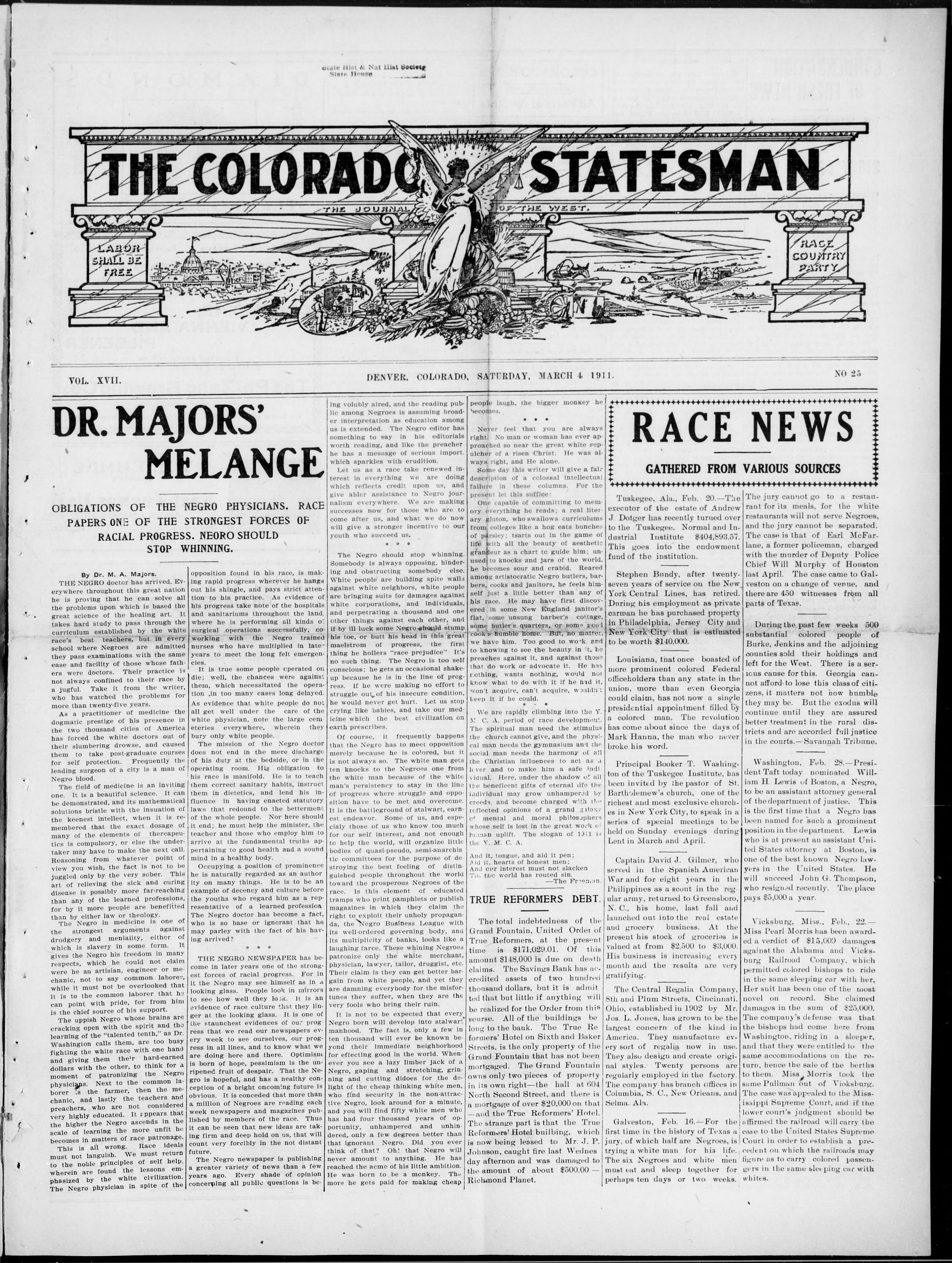
THE COLORADO STATESMAN
THE JOURNAL OF THE WEST.
LABOR SHALL BE FREE
RACE COUNTRY PARTY
DR. MAJORS' MELANGE
OBLIGATIONS OF THE NEGRO PHYSICIANS. RACE PAPERS ONE OF THE STRONGEST FORCES OF RACIAL PROGRESS. NEORO SHOULD STOP WHINNING.
VOL. XVII.
DR. MAJ
ME
OBLIGATIONS OF THE
PAPERS ONE OF THE
RACIAL PROGRESS
STOP V
By Dr. M. A. Majors.
THE NEGRO doctor has arrived. Everywhere throughout this great nation he is proving that he can solve all the problems upon which is based the great science of the healing art. It takes hard study to pass through the curriculum established by the white race's best teachers, but in every school where Negroes are admitted they pass examinations with the same ease and facility of those whose fathers were doctors. Their practice is not always confined to their race by a jugful. Take it from the writer, who has watched the problems for more than twenty-five years.
As a practitioner of medicine the dogmatic prestige of his presence in the two thousand cities of America has forced the white doctors out of their slumbering drowse, and caused them to take post-graduate courses for self protection. Frequently the leading surgeon of a city is a man of Negro blood.
The field of medicine is an inviting one. It is a beautiful science. It can be demonstrated, and its mathematical solutions bristle with the insuation of the keenest intellect, when it is remembered that the exact dosage of many of the elements of therapeutics is compulsory, or else the undertaker may have to make the next call. Reasoning from whatever point of view you wish, the fact is not to be juggled only by the very sober. This art of relieving the sick and curing disease is possibly more far-reaching than any of the learned professions, for by it more people are benefitted than by either law or theology. The Negro in medicine is one of the strongest arguments against drudgery and meniality, either of which is slavery in some form. It gives the Negro his freedom in many respects, which he could not claim were he an artisan, engineer or mechanic, not to say common laborer, while it must not be overlooked that it is to the common laborer that he can point with pride, for from him is the chief source of his support.
The uppish Negro whose brains are cracking open with the spirit and the learning of the "talented tenth," as Dr. Washington calls them, are too busy fighting the white race with one hand and giving them their hard-earned dollars with the other, to think for a moment of patronizing the Negro physicians. Next to the common laborer is the farmer, then the mechanic, and lastly the teachers and preachers, who are not considered very highly educated. It appears that the higher the Negro ascends in the scale of learning the more unfit he becomes in matters of race patronage. This is all wrong. Race ideals must not languish. We must return to the noble principles of self help, wherein are found the lessons emphasized by the white civilization. The Negro physician in spite of the
opposition found in his race, is making rapid progress wherever he hangs out his shingle, and pays strict attention to his practice. As evidence of his progress take note of the hospitals and sanitariums throughout the land, where he is performing all kinds of surgical operations successfully, coworking with the Negro trained nurses who have multiplied in late years to meet the long felt emergencies. It is true some people operated on die; well, the chances were against them, which necessitated the operation, in too many cases long delayed. As evidence that white people do not all get well under the care of the white physician, note the large cemeteries everywhere, wherein they bury only white people.
The mission of the Negro doctor does not end in the mere discharge of his duty at the bedside, or in the operating room. His obligation to his race is manifold. He is to teach them correct sanitary habits, instruct them in dietetics, and lend his influence in having enacted statutory laws that redound to the betterment of the whole people. Nor here should it end; he must help the minister, the teacher and those who employ him to arrive at the fundamental truths appertaining to good health and a sound mind in a healthy body.
Occupying a position of prominence he is naturally regarded as an authority on many things. He is to be an example of decency and culture before the youths who regard him as a representative of a learned profession. The Negro doctor has become a fact, who is so base or ignorant that he may parley with the fact of his having arrived?
☆ ☆ ☆
THE NEGRO NEWSPAPER has become in later years one of the strongest forces of racial progress. For in it the Negro may see himself as in a looking glass. People look in mirrors to see how well they look. It is an evidence of race culture that they linger at the looking glass. It is one of the staunchest evidences of our progress that we read our newspapers every week to see ourselves, our progress in all lines, and to know what we are doing here and there. Optimism is born of hope, pessimism is the unripened fruit of despair. That the Negro is hopeful, and has a healthy conception of a bright oncoming future is obvious. It is conceded that more than a million of Negroes are reading each week newspapers and magazines published by members of the race. Thus it can be seen that new ideas are taking firm and deep hold on us, that will count very forcibly in the not distant future. The Negro newspaper is publishing a greater variety of news than a few years ago. Every shade of opinion concerning all public questions is be-
DENVER, COLORADO, SATURDAY, MARCH 4 1911.
ing volubly aired, and the reading public among Negroes is assuming broader interpretation as education among us is extended. The Negro editor has something to say in his editorials worth reading, and like the preacher he has a message of serious import, which sparkles with erudition.
Let us as a race take renewed interest in everything we are doing which reflects credit upon us, and give abler assistance to Negro journalism everywhere. We are making successes now for those who are to come after us, and what we do now will give a stronger incentive to our youth who succeed us.
***
The Negro should stop whinning. Somebody is always opposing, hindering and obstructing somebody else. White people are building spite walls against white neighbors, white people are bringing suits for damages against white corporations, and individuals, and perpetrating a thousand and one other things against each other, and if by ill luck some Negro should stump his toe, or butt his head in this great maelstrom of progress, the first thing he hollers "race prejudice". It's no such thing. The Negro is too self conscious; he gets an occasional shake-up because he is in the line of progress. If he were making no effort to struggle out of his insecure condition, he would never get hurt. Let us stop crying like babies, and take our medicine which the best civilization on earth prescribes.
Of course, it frequently happens that the Negro has to meet opposition merely because he is colored, but it is not always so. The white man gets ten knocks to the Negroes one from the white man because of the white man's persistency to stay in the line of progress where struggle and opposition have to be met and overcome. It is the battleground of stalwart, earnest endeavor. Some of us, and especially those of us who know too much for our self interest, and not enough to help the world, will organize little bodies of quasi-pseudo, semi-anarchistic committees for the purpose of destroying the best feeling of distinguished people throughout the world toward the prosperous Negroes of the race. Is this element of educated tramps who print pamphlets or publish magazines in which they claim the right to exploit their unholy propaganda, the Negro Business League with its well-ordered governing body, and its multiplicity of banks, looks like a laughing farce. These whining Negroes patronize only the white merchant, physician, lawyer, tailor, druggist, etc. Their claim is they can get better bargain from white people, and yet they are damning everybody for the misfortunes they suffer, when they are the very fools who bring their ruin.
It is not to be expected that every Negro born will develop into stalwart manhood. The fact is, only a few in ten thousand will ever be known beyond their immediate neighborhood for effecting good in the world. Whenever you see a lazy limber jack of a Negro, gaping and stretching, grinning and cutting didoes for the delight of the cheap thinking white men, who find security in the non-attractive Negro, look around for a minute, and you will find fifty white men who has had four thousand years of opportunity, unhampered and unhindered, only a few degrees better than that ignorant Negro. Did you ever think of that? Oh! that Negro will never amount to anything. He has reached the acme of his little ambition. He was born to be a monkey. The more he gets paid for making cheap
people laugh, the bigger monkey he becomes.
* * *
Never feel that you are always right. No man or woman has ever approached so near the great white sepulcher of a risen Christ. He was always right, and He alone.
Some day this writer will give a fair description of a colossal intellectual failure in these columns. For the present let this suffice:
One capable of committing to memory everything he reads; a real literary alum, who swallows curriculums from colleges like a hog eats bunches of parsley; tsarts out in the game of life with all the beauty of aesthetic grandeur as a chart to guide him; unused to knocks and jars of the world, he becomes sour and crabid. Reared among artistocratic Negro butlers, barbers, cooks and janitors, he feels himself just a little better than any of his race. He may have first discovered in some New England janitor's flat, some unsung barber's cottage some butler's quarters, or some good cook's humble home. But, no matter we have him. Too good to work and to knowing to see the beauty in it, he preaches against it, and against those that do work or advocate it. He has nothing, wants nothing, would not know what to do with it if he had it, won't acquire, can't acquire, wouldn't keep it if he could.
We are rapidly climbing into the Y. M. C. A. period of race development. The spiritual man need the stimulus the church cannot give, and the physical man needs the gymnasium and the social man needs the harmony of all the Christian influences to act as a lever and to make him a safe individual. Here, under the shadow of all the beneficent gifts of eternal life the individual may grow unhampered by creeds, and become charged with the reflected opinions of a grand galaxy of mental and moral philosophers whose self is lost in the great work of human uplift. The slogan of 1851 is the Y. M. C. A.
And it, tongue, and aid it pen; Aid it, hearts of honest men; And our interest must not slacken Tin, the world has routed sin.
—The Freeman.
TRUE REFORMERS DEBT
The total indebtedness of the Grand Fountain, United Order of True Reformers, at the present time is $171,029.01. Of this amount $148,000 is due on death claims. The Savings Bank has accredited assets of two hundred thousand dollars, but it is admitted that but little if anything will be realized for the Order from this course. All of the buildings belong to the bank. The True Reformers' Hotel on Sixth and Baker Streets, is the only property of the Grand Fountain that has not been mortgaged. The Grand Fountain owns only two pieces of property in its own right—the hall at 604 North Second Street, and there is a mortgage of over $20,000 on that—and the True Reformers' Hotel. The strange part is that the True Reformers' Hotel builbing, which is now being leased to Mr. J. P. Johnson, caught fire last Wednesday afternoon and was damaged to the amount of about $500.00 — Richmond Planet.
RACE NEWS GATHERED FROM VARIOUS SOURCES
Tuskegee, Ala., Feb. 20.—The executor of the estate of Andrew J. Dotger has recently turned over to the Tuskegee. Normal and Industrial Institute $404,893.57. This goes into the endowment fund of the institution.
Stephen Bundy, after twenty-seven years of service on the New York Central Lines, has retired. During his employment as private carman he has purchased property in Philadelphia, Jersey City and New York City that is estimated to be worth $140,000.
The jury cannot go to a restaurant for its meals, for the white restaurants will not serve Negroes, and the jury cannot be separated. The case is that of Earl McFarlane, a former policeman, charged with the murder of Deputy Police Chief Will Murphy of Houston last April. The case came to Galveston on a change of venue, and there are 450 witnesses from all parts of Texas.
During the past few weeks 500 substantial colored people of Burke Jenkins and the adjoining
Louisiana, that once boasted of more prominent colored Federal officeholders than any state in the union, more than even Georgia could claim, has not now a single presidential appointment filled by a colored man. The revolution has come about since the days of Mark Hanna, the man who never broke his word.
Principal Booker T. Washington of the Tuskegee Institute, has been invited by the pastor of St. Bartholemew's church, one of the richest and most exclusive churches in New York City, to speak in a series of special meetings to be held on Sunday evenings during Lent in March and April.
Captain David J. Gilmer, who served in the Spanish American War and for eight years in the Philippines as a scout in the regular army, returned to Greensboro, N. C., his home, last fall and launched out into the real estate and grocery business. At the present his stock of groceries is valued at from $2,500 to $3,000. His business is increasing every month and the results are very gratifying.
The Central Regalia Company, 8th and Plum Streets, Cincinnati, Ohio, established in 1902 by Mr. Jos. L. Jones, has grown to be the largest concern of the kind in America. They manufacture every sort of regalia now in use. They also design and create original styles. Twenty persons are regularly employed in the factory. The company has branch offices in Columbia, S. C., New Orleans, and Selma, Ala.
Galveston, Feb. 16. For the first time in the history of Texas a jury, of which half are Negroes, is trying a white man for his life. The six Negroes and white men must eat and sleep together for perhaps ten days or two weeks.
NO 25
The jury cannot go to a restaurant for its meals, for the white restaurants will not serve Negroes, and the jury cannot be separated. The case is that of Earl McFarlane, a former policeman, charged with the murder of Deputy Police Chief Will Murphy of Houston last April. The case came to Galveston on a change of venue, and there are 450 witnesses from all parts of Texas.
During the past few weeks 500 substantial colored people of Burke, Jenkins and the adjoining counties sold their holdings and left for the West. There is a serious cause for this. Georgia cannot afford to lose this class of citizens, it matters not how humble they may be. But the exodus will continue until they are assured better treatment in the rural districts and are accorded full justice in the courts.—Savannah Tribune.
Washington, Feb. 28.—President Taft today nominated William H. Lewis of Boston, a Negro, to be an assistant attorney general of the department of justice. This is the first time that a Negro has been named for such a prominent position in the department. Lewis who is at present an assistant United States attorney at Boston, is one of the best known Negro lawyers in the United States. He will succeed John G. Thompson, who resigned recently. The place pays $5,000 a year.
Vicksburg, Miss., Feb., 22. Miss Pearl Morris has been awarded a verdict of $15,000 damages against the Alabama and Vicksburg Railroad Company, which permitted colored bishops to ride in the same sleeping car with her. Her suit has been one of the most novel on record. She claimed damages in the sum of $25,000. The company's defense was that the bishops had come here from Washington, riding in a sleeper, and that they were entitled to the same accommodations on the return, hence the sale of the berths to them. Miss Morris took the same Pullman out of Vicksburg. The case was appealed to the Mississippi Supreme Court, and if the lower court's judgment should be affirmed the railroad will carry the case to the United States Supreme Court in order to establish a precedent on which the railroads may figure as to carry colored passengers in the same sleeping car with whites.
CONDENSATION OF FRESH NEWS
THE LATEST IMPORTANT DIS PATCHES PUT INTO SHORT, CRISP PARAGRAPHS.
SHOWING THE PROGRESS OF EVENTS IN OUR OWN AND FOREIGN LANDS.
WESTERN
Premature explosion of dynamite blast on the bank of the Columbia rived at the Dalles, Ore., killed four workmen.
Lieutenant S. B. West, U. S. A., of Port Davis, Alaska was frozen to death while stalking trail five miles from Tishou.
Muskogee, Okla.—Con Comisky of Chicago knocked out Jack Burns of Cripple Creek in the third round before the Empire Athletic Club.
The first considerable flurry of snow in San Francisco in fifteen years gave the youngsters of the city a chance to play for a few minutes at snowballing. The heights around San Francisco remained white for half an hour.
With world's records broken for rapid and low cost of construction, the boring of the great five-mile Elizabeth tunnel, the most important feature of the new $26,000,000 municipal water project of Los Angeles has been completed.
Information has been received in El Paso of the wreck of El Paso & Southwestern-Rock Island Chicago express, near Pasturea, N. M. The engine and four cars left the track and were overturned. A number of passengers were injured.
Blowing out one side of the building and wrecking the safe, robbers between $4,000 and $5,000 from the First State bank of Barry, Texas. The robbers escaped with a stolen rig which was found abandoned at Corsicana.
A battle lasting three hours was fought at Reno, Nev., between a posse of state police and a band of Indians suspected of the murder of four wealthy ranchmen in January. Four Indian bucks, two squaws and two children were killed and one squaw and three children captured.
Four more bodies in addition to the eleven removed, making fifteen in all, were taken from the Belmont mine at Tonopah, Nev., through the new shaft. The remains of the last four are frightfully mutilated and it is believed they came from the bottom of the shaft, which is 1,196 feet deep.
As the result of a revolver battle in Seattle between two policemen and two holdups, Patrolman J. T. Davis was killed, John Ford, a young highwayman, was probably fatally wounded, and Alexander Nest, another highwayman, was wounded and captured
Two masked and heavily armed robbers held up the express car on an Iron Mountain train within the city limits of St. Louis, escaping with several packages and the money box, which they removed from the safe after binding, and gagging the messenger.
What appears to be the last hope of Abraham Ruef, political boss of San Francisco during the regime of Mayor Eugene E. Schmitz, of escaping his sentence of fourteen years in San Quentin, was dissipated when the State Supreme Court vacated its recent order granting Ruef a rehearing. Ruef was convicted on one of the seventy-odd indictments charging bribery of supervisors returned during the bribery graft investigation in 1907.
Suicide by poison as a method of official execution is provided in a bill submitted to the Nevada State Legislature by the code commission. The suicide clause, which is a part of the proposed criminal practice act drawn up by the commission, provides that a criminal condemned to death may take his choice between hanging and suicide. If he elects the latter method, the state will furnish him a bottle of hydrocyanic acid, one drop of which will produce instant death, and permit him to take the poison. If he fails to do so, hanging will be resorted to.
FOREIGN
The shaft of the silver mine owned by Cyrus W. Baker of Denver, at Winnipesag, is now down fifty feet and the ore is improving in value.
In a fight near Mukden between Chinese and Japanese who are enforcing anti-plague precautions along the Antung railway, several Japanese were killed.
The foreign office announces that China's answer to four out of the six points of the Russian note relative to the treaty of 1881 is wholly satisfactory and that the remaining two can be easily adjusted. Further pressure on China, it is said, is not contemplated.
SPORT.
The Australian swimmer, Longworth, covered 121 yards in one minute and five seconds at Sydney, N. S. W. This is a new world's record
GENERAL.
Chicago.—Twenty-seven members of the Chicago American baseball club have departed for Mineral Wells, Tex. Robbers entered a bank at Walnut, Ill., and after breaking into the safe, escaped with between $2,000 and $4,000.
Washington.—John Lee Carroll, governor of the state of Maryland from 1876 to 1880, died at his home in Washington.
Damage to strawberries and other crops in Louisiana, as a result of recent cold weather will reach half a million dollars.
Mrs. O. H. P. Belmont has announced that she would open within a short time a school in New York for teaching girls to farm.
Hazleton, Pa. — Supposed to have been caused by the explosion of a lamp, fire burned two houses at Oneida and five persons perished.
The scheme of a better syndicate to introduce pool selling into baseball games of the National and American Leagues will be promptly and thoroughly investigated by federal and state authorities in New York, and it is not unlikely that it will be stopped. Edward Mahoney, district passenger agent of the Chicago, Milwaukee & St. Paul railroad, says that two solid steel trains of the most modern construction, carrying "Milwaukee" sleeping cars, will be operated each way, from Chicago to Seattle, beginning May 28th.
President Taft has accepted an invited to attend the dedication ceremonies of the National Home of the Printing Pressmen and Assistants' union in June next. The home is now being completed at Hale Springs, Tenn. Col. Theodore Roosevelt and W. J. Bryan also have been invited.
Mrs. Maldwin Drummond, formerly Mrs. Marshall Field, Ir., of Chicago, was robbed of a fortune fn jeweis aboard a transatlantic liner. Diamonds, pearls and other gems to the value of approximately $130,000 disappeared from her stateroom on the steamship Amerika of the Hamburg-American line.
WASHINGTON.
Confirmation of press dispatches telling of a battle between the Nevada state police and twelve Shoshone Indians has been received in Washington.
The agricultural appropriation bill has been reported to the Senate. It carries $16,980,196, an increase of $256,685 over the amount of the bill as it was passed by the House.
So probable is it that an extra session will be necessary to get action on the Canadian reciprocity agreement, that President Taft has fixed April 4th as the date such a session may be called.
The mints will stop making gold coins as soon as President Taft signs the bill which Congress has passed permitting the secretary of the treasury to issue gold certificates against gold bullion and foreign gold coin.
During January 36,361 immigrants were admitted to the United States—24,120 men and 12,241 women. Of this total 6,054 were Hebrews, the largest number of any race. Southern Italy furnished the next largest number, 5,377.
As further protection to the lives of railway mail service employees, the Postoffice Department has notified all railroads that from July 1, 1911, wooden mail cars run between the engine and a steel car or between steel cars will not be accepted.
Slides of earth from the heights above the Culebra cut on the Panama canal are continuing. The slide which occurred on the night of February 9th just opposite the Y. M. C. A. club house at Culebra carried 550,000 cubic yards of loose earth into the cut.
President Taft has made it plain that he will not be deterred from his determination to call an extra session of Congress to secure action on the Canadian reciprocity agreement by any vote which the Senate may take on the question unless it is plain to him that such vote is a real test on the merits of the agreement and not merely an attempt to avoid an extra session.
The Senate defeated the resolution proposing an amendment to the constitution to provide that senators be elected by direct vote of the people. Fifty-four senators stood for the resolution and thirty-three against it. Though this division showed so large a majority to favor popular election, the number was not sufficient by four to carry the motion, which required a two-thirds vote.
The House committee on insular affairs has unanimously agreed to a report on the Martin friar lands resolution, completely exonerating the Philippines commission and all other officers connected with the transaction complained of, "of all criticism for selling and leasing public lands and friar lands to persons not citizens of the islands, and in tracts greater than specified in the statute of 1902."
The new Japanese treaty of trade and navigation was ratified after a two hours' executive session of the Senate. While the apprehension of Western senators that the treaty might let down the bars to coole labor was not entirely removed, these senators contented themselves with expressing their solicitude. They interposed no objection to ratification. President Taft nominated William H. Lewis of Boston, a negro, to be an assistant attorney general of the Department of Justice.
COLORADO NEWS Gathered From All Parts of the State
Federal Building Soon. Greeley.—It is expected that work on the new federal building will begin early next summer and that it will be a duplicate of the recently completed federal building at Kearney, Neb.
Erie Starts Campaign.
Erie.For the purpose of developing thousands of acres of unoccupied farm land in the vicinity of Erie into a substantial farming district the Erie Commercial Club will start an aggressive campaign.
Strawberries Frosted.
Amite City, La.—Damage to strawberries and other crops in this vicinity as a result of cold weather the last few days will reach half a million dollars.
Potato Shipments.
Greeley.—Cold weather has no effect on the shipments of potatoes out here now, as the old method of heating potato cars with stoves has been replaced by a packing of paper and straw with splendid results.
Bill for New Judge Sidetracked
Washington.—It is believed certain the Guggenheim bill which passed the Senate, to appoint an additional federal judge for Colorado, cannot be passed in the House this session.
Converts Brave Icy Water.
Carbondale.—Braving a raging snow storm and the bitter cold, eight converts of the Christian church here, five women and three men, waded out into the Crystal river, fending off ice cakes with their hands, and were baptized.
Biggest Snow in 26 Years.
Fort Collins.—Prosperity for northern Colorado is assured by the biggest snowstorm for twenty-six years. It has been snowing several days and there have fallen $18\frac{1}{4}$ inches, according to the weather bureau at the experiment station of the Agricultural college.
Ladies Wield Spade and Pick.
Grover—Tired of waiting for the men of the congregation to provide a new church, the women of the Ladies' Aid society began excavating for the new building, each wielding a spade with good results. The unique sight drew the men, who were rapidly impressed on the excavation. The society will push the work.
Complete Road July 1st.
Greeley. — The Greeley-Hudson branch of the Burlington railroad will be completed by July 1st, next, also the date set for the completion of the Wellington-Cheyenne branch. The information was given out from a reliable source. Work with a large force of men is going on along the Wellington branch and active work on the Hudson soon will be started.
Milliken Gets Flour Mill.
Milliken.—Articles of incorporation for the organization of the Royal Milling and Elevator Company, with a capitalization of $250,000 were filed with the state secretary in Denver with George A. Hodgson as president; David Roberts, vice president and general manager; R. M. Benton, secretary-treasurer, and J. W. Haskett and George B. Lang as the other two directors. The purpose of the company is to erect a flouring and cereal mill at Milliken, on the Denver, Laraunie & Northwestern railroad, with a daily capacity of 500 barrels. Work on the erection of the mill, which is to cost in the neighborhood of $50,000 will be commenced at once, and the mill will be completed in time to take care of the present year's crops.
Dry Farming Congress Special.
Colorado Springs.—Prof. H. M. Cottrell, firmer member of the faculty of the Colorado Agricultural College at Fort Collins, and now industrial commissioner of the Rock Island railroad and George W. Martin, general agent in Denver of that line, have arranged a schedule for the tour of a train to be known as the International Dry Farming Congress special, which will have for its object the arousing of interest in the forthcoming session of the Congress at Colorado Springs, and will serve to further the education of the farmers of eastern Colorado. This train will leave Colorado Springs Monday, March 13th, and will proceed eastward, stopping at all important points en route. Agriculture is the only industry prevailing in eastern Colorado along this route. At the state line the Colorado men who accompany the train will turn back and the train will be taken in charge by Kansas educators who will conduct it through their state.
Big Denver Reservoir.
Denver.—Representatives of the Denver Reservoir & Irrigation Company in this city have received assurances by telegram from General Manager F. D. Lucas of the company and William Kenefick, general contractor for the works, who are in New York, to the effect that representatives of the French bank that is lending $2,000,000 for the completion of the project will arrive in Denver at once. Work will begin immediately and pushed to completion.
LITTLE COLORADO ITEMS.
Small Happenings Occurring Over the State Worth Telling.
Palisade is to have a new electric light plant.
John Stokes, one of Pueblo's oldest citizens, is dead.
Fruita will have a local option election on April 4th.
Virgil W. Stoddard, a pioneer of Loveland, died suddenly at his home.
It is probable Denver will get the National Republican convention in 1912.
Mrs. Alden Cantonwine, a pioneer of Longmont, is dead. She was 42 years old.
A baseball team is being organized in Grand Junction to play the Boston Red Sox.
The Denver police are endeavoring to put a stop to gambling among Greek residents.
Fire destroyed the plant of the Colorado City Ice & Coal Company, with a loss of $15,000.
In the Telluride mining section there is from eight to thirty feet of snow on the level.
The last work on the Orchard Mesa irrigation system, Grand Junction, has been completed.
For every 27,000 tons of coal mined last year in Colorado the life of a miner was sacrificed.
Freeman Butler, aged 76, a pioneer of that section, died at his home near Windsor, of paralysis.
The Wellington section is enjoying the novelty of sleighing for the first time in several years.
Mrs. Mary J. Higby, aged 79, and one of the pioneers of the Greeley district, died of pneumonia.
The students of the Grand Junction high school have set March 15th as the date for the first cross-country run.
The Gunnison County Stock Growers' Association will give its annual ball and banquet in Gunnison March 31th.
Drillers at the oil well, a mile east of Lamar, have penetrated the oil sand and will shoot the well in a few days.
Two thoroughbred Llewellyn setters, valued at $4,000 and belonging to Chas. Woodford of Pueblo, have been stolen.
Gross earnings of the Denver City Tramway Company for its fiscal year ending December 30, 1910, were $3,595,157.
Mrs. Etta Smart, cashier in a dry goods store in Colorado Springs, has been arrested charged with theft of $2,000.
An election providing a bond issue of $24,500 for the erection of a new high school building was held in Grand Junction recently.
A. Hughes, a farmer residing near Boone, has been awarded damages of $15 against the Twin Lakes Land and Water Company.
An attempt will be made by ten boosters for the Y. M. C. A. to raise $2,000 to be used in organizing an association at Montrose.
Thos. Jenkins and Eugene Hawkey, two boys who were lost in the Royal Gorge during a recent snowstorm have been found.
Gifford Pinchot will come to Colorado to help the citizens to properly celebrate the new state holiday—Colorado day, August 1. That is, he will come—maybe.
Special trains of tourist cars to handle the colonist business which is expected to develop from the East to the Pacific coast will be used by the Union Pacific.
A district meeting of the Religious Educational Association will be held in Greeley April 6th to 10th. It will be the first of its kind held in this section of the United States.
The official report of the Colorado State Board of Barber Examiners for the two years ending November 30, 1910, states that there are 2,669 barbers doing business in the state.
Beet growers in the Loveland district have signed contracts for 7,000 acres for the coming season. Only 9,000 acres was grown last year. The total acreage desired this year is 10,000 to 11,000.
The grand jury that held sessions in Denver a couple of months ago made a sad mess of things. Practically every indictment of significance returned by that body has been quashed in the District Court.
The society ladies of Montrose, who compose the membership of the Civic Improvement League, will turn scavengers this spring to demonstrate to the public that it is possible to keep city alleys clean and sightly.
The Western Slope Traffic bureau, composed of all fruit growers' associations in western Colorado, has been formed to combat the proposed advance in fruit rates from Colorado common points to New Orleans.
The president nominated J. W. Hawley of Trinidad for register of the Pueblo land office and George Sauer as postmaster at Hugo.
Beginning about March 10th, the Union Pacific railroad will operate all southbound freight trains over the new Denver-Northern line from Sand Creek to La Salle.
Representative Taylor has introduced a bill authorizing the secretary of the interior to sell to the city of Boulder 800 acres of land for park purposes.
---
M-AL
WELP
STERLING S
Boost Colorado Products
ZAN
DELICIOUS
COLUMBINE,
VIENN
Guaranteed A
Delivered Daily to
The Ph. Zang
TELEPHONE
We Boost for Colorado
RLING SILVER-W
Colorado Products Patronize Home
ZANG'S
DELICIOUS TABLE BEERS
IMBINE,
VIENNA AND
PILS
Guaranteed Absolutely Pure.
Dellvered Daily to All Parts of the City.
Ph. Zang Brewin
TELEPHONE GALLUP 395.
for Colorado You Should Be
STERLING SILVER-WARE
Boost Colorado Products Patronize Home Industry
ZANG'S
DELICIOUS TABLE BEERS
COLUMBINE,
VIENNA AND
PILSENER
Guaranteed Absolutely Pure.
Dellivered Daily to All Parts of the City.
The Ph. Zang Brewing Co.
TELEPHONE GALLUP 395.
We Boost for Colorado You Should Boost for Us
0
C OZARK C
MILLIARDS AND POOL
PARLORS
THE OZA BILLIARDS PAR
THE OZARK CLUB BILLIARDS AND POOL PARLORS STRICTLY MEMBERSHIP CLUB
THOMAS CLIN
26-32-34 Welton St
When y
The Heads, Feet, Tails, Snouts, Ea
other part of the hog
East's
MAS CLINGMAN, Ma
12-34 Welton Street Phone Main
When you Wear
eet, Tails, Snouts, Ears, Neckbones or Chitt
other part of the hog except the squeal go to
st's Mark
r Street. Pho
THOMAS CLINGMAN, Manager
26-32-34 Welton Street Phone Main 5154
When you Want
When you Want
The Heads, Feet, Tails, Snouts, Ears, Neckbones or Chitterlings or any other part of the hog except the squelg go to
THE EASY UNION BREWING CO.
Soda
EST. 1870
A RELIABLE PLACE
Diamonds, Watch
Also a Larger
GUNS AND MUSIC
at Lower
HYMAN'S LO
Cash or Payments
RELIABLE PLACE TO BUY YOUR
Bonds, Watches and J
Also a Large Assortment of
BONS AND MUSICAL INSTRUMENTS
at Lowest Prices
MAN'S LOAN OFFICE
payments 1705 Larin
A RELIABLE PLACE TO BUY YOUR Diamonds, Watches and Jewelry Also a Large Assortment of GUNS AND MUSICAL INSTRUMENTS at Lowest Prices HYMAN'S LOAN OFFICE Cash or Payments 1705 Larimer Street
Mamma Neely's Restaurant
GOOD HOME COOKING
Regular Meals 25c. Sunday Dinner 35c
Short Orders at All Hours
1914 Arapahoe St. Denver, Col.
---
2300-6 Larimer Street.
SILVER-WARE
Products Patronize Home Industry
NG'S
CIOUS TABLE BEERS
NE,
INNA AND
PILSENER
Inteed Absolutely Pure.
Daily to All Parts of the City.
ang Brewing Co.
PHONE GALLUP 395.
do You Should Boost for Us
WM. EHMKE
MANAGER
East Turner Hall
2132-2148 ARAPAHOE ST.
Phone 2449. DENVER.
ZARK CLUB
RDS AND POOL
PARLORS
LINGMAN, Manager
n Street Phone Main 5154
you Want
outs, Ears, Neckbones or Chitterlings or any
the hog except the squeal go to
Market
WILLIAMSON
HAFFNER CO.
ENGRAVERS-PRINTERS
CUTS
STAUNKS
DENVER, COLO
PLACE TO BUY YOUR
Watches and Jewelry
a Large Assortment of
MUSICAL INSTRUMENTS
at Lowest Prices
5 LOAN OFFICE
1705 Larimer Street
Phone 1461 Main.
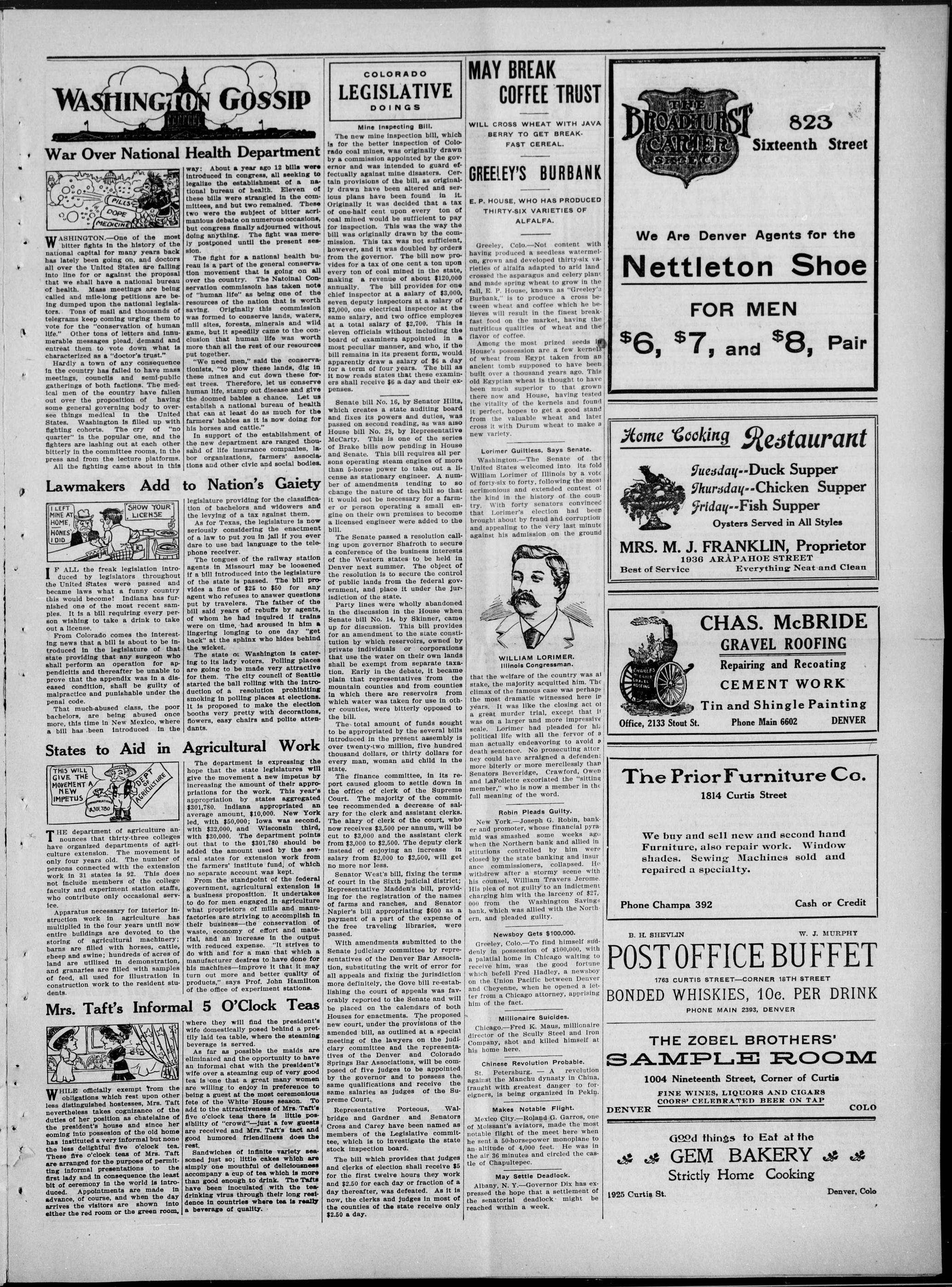
WASHINGTON GOSSIP
War Over National Health Department
Lawmakers Add to Nation's Gaiety
States to Aid in Agricultural Work
States to Aid in Agricultural Work
Mrs. Taft's Informal 5 O'Clock Teas
Mrs. Taft's Informal 5 O'Clock Teas
PILLS
DOPE
MEDICINE
WASHINGTON.—One of the most bitter flights in the history of the national capital for many years back has lately been going on, and doctors all over the United States are falling into line for or against the proposal that we shall have a national bureau of health. Mass meetings are being called and mile-long petitions are being dumped upon the national legislators. Tons of mail and thousands of telegrams keep coming urging them to vote for the "conservation of human life." Other tons of letters and innumerable messages plead, demand and entreat them to vote down what is characterized as a "doctor's trust."
Hardly a town of any consequence in the country has failed to have mass meetings, councils and semi-public gatherings of both factions. The medical men of the country have fallen out over the proposition of having some general governing body to oversee things medical in the United States. Washington is filled up with fighting cohorts. The cry of "no quarter" is the popular one, and the fighters are lashing out at each other bitterly in the committee rooms, in the press and from the lecture platforms. All the fighting came about in this
I LEFT MINE AT HOME, HONES I DID
SHOW YOUR LICENSE
IF ALL the freak legislation introduced by legislators throughout the United States were passed and became laws what a funny country this would become! Indiana has furnished one of the most recent samples. It is a bill requiring every person wishing to take a drink to take out a license.
From Colorado comes the interesting news that a bill is about to be introduced in the legislature of that state providing that any surgeon who shall perform an operation for appendicitis and thereafter be unable to prove that the appendix was in a diseased condition, shall be guilty of malpractice and punishable under the penal code.
That much-abused class, the poor bachelors, are being abused once more, this time in New Mexico, where a bill has been introduced in the
THIS WILL GIVE THE MOVEMENT A NEW IMPETUS DEPT OF AGRICULTURE $301,780 THE department of agriculture announces that thirty-three colleges have organized departments of agriculture extension. The movement is only four years old. The number of persons connected with the extension work in 31 states is 92. This does not include members of the college faculty and experiment station staffs, who contribute only occasional service.
Apparatus necessary for interior instruction work in agriculture has multiplied in the four years until now entire buildings are devoted to the storing of agricultural machinery; barns are filled with horses, cattle sheep and swine; hundreds of acres of land are utilized in demonstration, and granaries are filled with samples of feed, all used for illustration in construction work to the resident students.
A
WHILE officially exempt from the obligations which rest upon other less distinguished hostesses, Mrs. Taft nevertheless takes cognizance of the duties of her position as chateaine of the president's house and since her coming into possession of the old home has instituted a very informal but none the less delightful five o'clock tea. These five o'clock teas of Mrs. Taft are arranged for the purpose of permitting informal presentations to the first lady and in consequence the least bit of ceremony in the world is introduced. Appointments are made in advance, of course, and when the day arrives the visitors are shown into either the red room or the green room,
way: About a year ago 12 bills were introduced in congress, all seeking to legalize the establishment of a national bureau of health. Eleven of these bills were strangled in the committees, and but two remained. These two were the subject of bitter acrimonious debate on numerous occasions, but congress finally adjourned without doing anything. The fight was merely postponed until the present session.
The fight for a national health bureau is a part of the general conservation movement that is going on all over the country. The Natoinal Conservation commissoln has taken note of "human life" as being one of the resources of the nation that is worth saving. Originally this commission was formed to conserve lands, waters, mill sites, forests, minerals and wild game, but it speedily came to the conclusion that human life was worth more than all the rest of our resources put together.
"We need men," said the conservationists, "to plow these lands, dlg in these mines and cut down these forest trees. Therefore, let us conserve human life, stamp out disease and give the doomed bables a chance. Let us establish a national bureau of health that can at least do as much for the farmers' bables as it is now doing for his horses and cattle."
In support of the establishment of the new department are ranged thousand of life insurance companies, labor organizations, farmers' associations and other civic and social bodies.
legislature providing for the classification of bachelors and widowers and the levying of a tax against them. As for Texas, the legislature is now seriously considering the enactment of a law to put you in jail if you ever dare to use bad language to the telephone receiver. The tongues of the railway station agents in Missouri may be loosened if a bill introduced into the legislature of the state is passed. The bill provides a fine of $25 to $50 for any agent who refuses to answer questions put by travelers. The father of the bill said years of rebuffs by agents, of whom he had inquired if trains were on time, had aroused in him a lingering longing to one day "get back" at the sphinx who hides behind the wicket.
The state of Washington is catering to its lady voters. Polling places are going to be made very attractive for them. The city council of Seattle started the ball rolling with the introduction of a resolution prohibiting smoking in polling places at elections. It is proposed to make the election booths very pretty with decorations, flowers, easy chairs and polite attendants.
The department is expressing the hope that the state legislatures will give the movement a new impetus by increasing the amount of their appropriations for the work. This year's appropriation by states aggregated $301,780. Indiana appropriated an average amount, $10,000. New York led, with $50,000; Iowa was second, with $32,000, and Wisconsin third, with $30,000. The department points out that to the $301,780 should be added the amount used by the several states for extension work from the farmers' institute fund, of which no separate account was kept.
From the standpoint of the federal government, agricultural extension is a business proposition. It undertakes to do for men engaged in agriculture what proprietors of mills and manufactories are striving to accomplish in their business—the conservation of waste, economy of effort and material, and an increase in the output with reduced expense. "It strives to do with and for a man that which a manufacturer desires to have done for his machines—improve it that it may turn out more and better quality of products," says Prof. John Hamilton of the office of experiment stations.
where they will find the president's wife domestically posed behind a prettily laid tea table, where the steaming beverage is served.
As far as possible the maids are eliminated and the opportunity to have an informal chat with the president's wife over a steaming cup of very good tea is one that a great many women are willing to enjoy in preference to being a guest at the most ceremonious fete of the White House season. To add to the attractiveness of Mrs. Taft's five o'clock teas there is little possibility of "crowd"—just a few guests are received and Mrs. Taft's tact and good humored friendliness does the rest.
Sandwiches of infinite variety seaoned just so; little cakes which are simply one mouthful of deliciousness accompany a cup of tea which is more than good enough to drink. The Tafts have been inoculated with the tea-drinking virus through their long residence in countries where tea is really a beverage of quality.
COLORADO LEGISLATIVE DOINGS
Mine Inspecting Bill.
The new mine inspection bill, which is for the better inspection of Colorado coal mines, was originally drawn by a commission appointed by the governor and was intended to guard effectually against mine disasters. Certain provisions of the bill, as originally drawn have been altered and serious plans have been found in it. Originally it was decided that a tax of one-half cent upon every ton of coal mined would be sufficient to pay for inspection. This was the way the bill was originally drawn by the commission. This tax was not sufficient, however, and it was doubled by orders from the governor. The bill now provides for a tax of one cent a ton upon every ton of coal mined in the state, making a revenue of about $120,000 annually. The bill provides for one chief inspector at a salary of $3,000, seven deputy inspectors at a salary of $2,000, one electrical inspector at the same salary, and two office employees at a total salary of $2,700. This is eleven officials without including the board of examiners appointed in a most peculiar manner, and who, if the bill remains in its present form, would apparently draw a salary of $6 a day for a term of four years. The bill as it now reads states that these examiners shall receive $5 a day and their expenses.
Senate bill No. 16, by Senator Hilts, which creates a state auditing board and fixes its powers and duties, was passed on second reading, as was also House bill No. 28, by Representative McCarty. This is one of the series of Brake bills now pending in House and Senate. This bill requires all persons operating steam engines of more than 5-horse power to take out a license as stationary engineer. A number of amendments tending to so change the nature of the bill so that it would not be necessary for a farmer or person operating a small engine on their own premises to become a licensed engineer were added to the bill.
The Senate passed a resolution calling upon governor Shafroth to secure a conference of the business interests of the Western states to be held in Denver next summer. The object of the resolution is to secure the control of public lands from the federal government, and place it under the jurisdiction of the state.
Party lines were wholly abandoned in the discussion in the House when Senate bill No. 14, by Skinner, came up for discussion. This bill provides for an amendment to the state constitution by which reservoirs, owned by private individuals or corporations that use the water on their own lands shall be exempt from separate taxation. Early in the debate, it became plain that representatives from the mountain counties and from counties in which there are reservoirs from which water was taken for use in other counties, were bitterly opposed to the bill.
The total amount of funds sought to be appropriated by the several bills introduced in the present assembly is over twenty-two million, five hundred thousand dollars, or thirty dollars for every man, woman and child in the state.
The finance committee, in its report caused gloom to settle down in the office of clerk of the Supreme Court. The majority of the committee recommended a decrease of salary for the clerk and assistant clerks. The alary of clerk of the court, who now receives $3,500 per annum, will be cut to $3,000 and the assistant clerk from $3,000 to $2,500. The deputy clerk instead of enjoying an increase in salary from $2,000 to $2,500, will get no more nor less.
Senator West's bill, fixing the terms of court in the Sixth judicial district; Representative Madden's bill, providing for the registration of the names of farms and ranches, and Senator Napier's bill appropriating $600 as a payment of a part of the expense of the free traveling libraries, were passed.
With amendments submitted to the Senate judiciary committee by representatives of the Denver Bar Association, substituting the writ of error for all appeals and fixing the jurisdiction more definitely, the Gove bill re-establishing the court of appeals was favorably reported to the Senate and will be placed on the calendars of both Houses for enactments. The proposed new court, under the provisions of the amended bill, as outlined at a special meeting of the lawyers on the judiciary committee and the representatives of the Denver and Colorado Springs Bar Associations, will be composed of five judges to be appointed by the governor and to possess the same qualifications and receive the same salaries as judges of the Supreme Court.
Representative Porteous, Walbridge and Gardner and Senators Cross and Carey have been named as members of the Legislative committee, which is to investigate the state stock inspection board.
The bill which provides that judges and clerks of election shall receive $5 for the first twelve hours they work and $2.50 for each day or fraction of a day thereafter, was defeated. As it is now, the clerks and judges in most of the counties of the state receive only $2.50 a day.
MAY BREAK COFFEE TRUST
WILL CROSS WHEAT WITH JAVA
BERRY TO GET BREAK-
FAST CEREAL.
GREELEY'S BURBANK
E. P. HOUSE, WHO HAS PRODUCED THIRTY-SIX VARIETIES OF ALFALFA.
Greeley. Colo.-Not content with having produced a seedless watermelon, grown and developed thirty-six varieties of alfalfa adapted to arid land crossed the asparagus and celery plant and made spring wheat to grow in the fall. E. P. House, known as "Greeley's Burbank," is to produce a cross between wheat and coffee which he believes will result in the finest breakfast food on the market, having the nutritious qualities of wheat and the flavor of coffee.
Among the most prized seeds in House's possession are a few kernels of wheat from Egypt taken from an ancient tomb supposed to have been built over a thousand years ago. This old Egyptian wheat is thought to have been much superior to that grown there now and House, having tested the vitality of the kernels and found it perfect, hopes to get a good stand from the valuable wheat and later cross it with Durum wheat to make a new variety.
Lorimer Guiltless, Says Senate.
Washington.—The Senate of the United States welcomed into its fold William Lorimer of Illinois by a vote of forty-six to forty, following the most acrimonious and the extended contest of the kind in the history of the country. With forty senators convinced that Lorimer's election had been brought about by fraud and corruption and appealing to the very last minute against his admission on the ground
WILLIAM LORIMER.
Illinois Congressman.
that the welfare of the country was at stake, the majority acquitted him. The climax of the famous case was perhaps the most dramatic witnessed here in years. It was like the closing act of a great murder trial, except that it was on a larger and more impressive scale. Lorimer had pleaded for his political life with all the fervor of a man actually endeavoring to avoid a death sentence. No prosecuting attorney could have arraigned a defendant more bitterly or more mercilessly than Senators Beveridge, Crawford, Owen and LaFollette excoriated the "sitting member," who is now a member in the full meaning of the word.
Robin Pleads Guilty.
New York.—Joseph G. Robin, banker and promoter, whose financial pyramid was smashed some weeks ago when the Northern bank and allied institutions controlled by him were closed by the state banking and insurance commissioners, collapsed. He withdrew after a stormy scene with his counsel, William Travers Jerome. His plea of not guilty to an indictment charging him with the larceny of $27,000 from the Washington Savings bank, which was allied with the Northern, and pleaded guilty.
Newsboy Gets $100,000.
Greeley, Colo.—To find himself suddenly in possession of $100,000, with a palatial home in Chicago waiting to receive him, was the good fortune which befell Fred Hadley, a newsboy on the Union Pacific between Denver and Cheyenne, when he opened a letter from a Chicago attorney, apprising him of the fact.
Millionaire Suicides
Chicago.—Fred K. Maus, millionaire director of the Scully Steel and Iron Company, shot and killed himself at his home here.
Chinese Revolution Probable.
St. Petersburg. — A revolution against the Manchu dynasty in China, fraught with greatest danger to foreigners, is being organized in Pekin.
Makes Notable Flight.
Mexico City.—Roland G. Garrus, one of Moissant's aviators, made the most notable flight of the meet here when he sent a 50-horsepower monoplane to an altitude of 4,000 feet. He was in the air 36 minutes and circled the castle of Chapultepec.
May Settle Deadlock.
Albany, N. Y.—Governor Dix has expressed the hope that a settlement of the senatorial deadlock might be reached within a week.
THE BROADHURST CARRIER SHOE CO.
823
Sixteenth Street
We Are Denver Agents for the
Nettleton Shoe
FOR MEN
$6, $7, and $8, Pair
Home Cooking Restaurant
Tuesday--Duck Supper
Thursday--Chicken Supper
Friday--Fish Supper
Oysters Served in All Styles
MRS. M. J. FRANKLIN, Proprietor
1936 ARÅPAHOE STREET
Best of Service Everything Neat and Clean
The Prior Furniture Co. 1814 Curtis Street
We buy and sell new and second hand Furniture, also repair work. Window shades. Sewing Machines sold and repaired a specialty.
POST OFFICE BUFFET
1763 CURTIS STREET-CORNER 18TH STREET
BONDED WHISKIES, 10c. PER DRINK
PHONE MAIN 2393, DENVER
Good things to Eat at the GEM BAKERY Strictly Home Cooking 1925 Curtis St. Denver, Colo
Tues
Thurs
Fri
MRS. M. J. F.
1936 A
Best of Service
CHAMBERED
MACHINE
CARRIER
WORKING
Office, 2133 Stout St.
The Prior
187
We buy and s
Furniture, also
shades. Sewi
repaired a spe
Phone Champa 392
B. H. SHEVLIN
POSTOFF
1763 CURTIS ST
SONDED WHISK
Repairing and Recoating
CEMENT WORK
Tin and Shingle Painting
Phone Main 6602 DENVER
For Furniture Co.
1814 Curtis Street
and sell new and second hand
also repair work. Window
sewing Machines sold and
specialty.
ure Co.
cond hand
Window
sold and
Cash or Credit
W. J. MURPHY
FFICE BUFFET
UFFET
THE COLORADO STATESMAN
JOS. D. D. RIVERS ..... Proprietor
1824 Curtis Street, Room 25.
JOS. D. D. RIVERS ..... Proprietor
1824 Curtis Street, Room 25.
SUBSCRIPTION RATES:
June Year ..... $2.00
July Months ..... 1.00
August Months ..... 60
PAYABLE IN ADVANCE.
It occasionally happens that papers sent to subscribers are lost or stolen. In case you do not receive any number when due, inform us by postal card and we will cheerfully forward a duplicate of the missing number.
Remittances should be made by Express Money Order, Postoffice Money Order, Registered Letter or Bank Draft. Postage stamps will be received the same as cash for the fractional part of a dollar. Only 1-cent and 2-cent stamps taken.
One Year ..... $2.00
Six Months ..... 1.00
Three Months ..... .60
PAYABLE IN ADVANCE.
It occasionally happens that papers sent to subscribers are lost or stolen.
In case you do not receive any number when due, inform us by postal card and we will cheerfully forward a duplicate of the missing number.
Remittances should be made by Express Money Order, Postoffice Money Order, Registered Letter or Bank Draft. Postage stamps will be received the same as cash for the fractional part of a dollar. Only 1-cent and 2-cent stamps taken.
Display advertising 25 cents per square. A square contains ten agate lines.
Reading notices, ten lines or less, 10 cents per line. Each additional line
over ten lines, 5 cents per line.
No discounts allowed on less than three months' contract. Cash must accom-
many all orders from parties unknown to us. Further particulars on application.
All communications of a personating nature that are not complimentary will
be withheld from the columns of this paper.
Communications to receive attention must be newsy, upon important sub-
jects, plainly written only upon one side of the paper; must reach us Tuesdays,
possible, anyway not later than Wednesdays, and bear the signature of the
author. No manuscript returned, unless stamps are sent for postage.
Entered as second-class matter at the postoffice in the city of Denver,
Colorado.
Reading notices, ten lines or less, 10 cents per line. Each additional line over ten lines, 5 cents per line.
No discounts allowed on less than three months' contract. Cash must accompany all orders from parties unknown to us. Further particulars on application.
All communications of a personating nature that are not complimentary will be withheld from the columns of this paper.
Communications to receive attention must be newsy, upon important subjects, plainly written only upon one side of the paper; must reach us Tuesdays, if possible, anyway not later than Wednesdays, and bear the signature of the author. No manuscript returned, unless stamps are sent for postage.
Entered as second-class matter at the postoffice in the city of Denver, Colorado.
GETTING ITS BUMPS.
THE SEGREGATION fever broke out in Kansas City just in time for the health commissioner to meet it with a good, strong dose of cream of tartar, which dried up the eruptions at once. The ordinance with that Baltimore sea, which was recently introduced in the lower house of the City Council, was recommended not to be passed by the Public Improvement Committee
THE SEGREGATION fever broke out in Kansas City just in time for the health commissioner to meet it with a good, strong dose of cream of tartar, which dried up the eruptions at once. The ordinance with that Baltimore idea, which was recently introduced in the lower house of the City Council, was recommended not to be passed by the Public Improvement Committee to which it had been referred. The recommendation was sustained by the House, the Republican members voting to sustain it, and the Democratic members, with one exception, voting against sustaining it and in favor of segregation. The committee gave several public hearings on the ordinance, and the chairman declared that every person, black and white, who appeared at these hearings to discuss the ordinance was inspired by selfish or personal motives. Of course there is no general public sentiment favoring such a law, for there is no good reason calling for it. One Democratic councilman declared that he wanted such a law because a Negro had once moved into a house next door to his mother. And men who call themselves honest citizens seek to make such narrow doctrine the basis of good American law. A certain class of real estate dealers is also interested in this silly effort for the sake of creating a false assurance of increased value for properties in their hands. Like objects are sought to be attained elsewhere by special provisions and reservations, which, if put to final test, would probably meet with similar disaster. It is hard to prove that the public welfare demands that one man be degraded and another raised by the means of a city ordinance or by private contract. The segregation idea appears to be but a passing fad, after all, and the bumps it is receiving as it passes do not indicate that it is liable to stay very long in one place.
SENATOR BORAH.
THE RESOLUTION under debate in the United States Senate two weeks ago, proposing an amendment to the Constitution to provide for the popular election of Senators, is supposed to have its greatest champion in Senator Borah of Idaho, who delivered what was called the strongest speech in its behalf yet heard in Congress.
The argument against the resolution upon the ground that, in its present form, it is a subtle scheme to secure constitutional sanction of laws in Southern states disfranchising Negroes, thus making it a race question, was not avoided by him, but, on the contrary, he met it squarely with the declaration that his Republican colleagues who had raised the question and were endeavoring to arouse hostile race feeling, were not sincere. He argued that the Republican party is doing nothing and has done nothing sincerely in many years to help the Negro overcome his difficulties; that there is as much prejudice against the Negro in the North as there is in the South, and that the attitude of the Republican party toward him has been that of a subterfuge and pretense of doing what only the Negro himself could do.
He declared that the failure of the resolution would be of no benefit to the Negro, and that the Republican party would continue to do nothing substantial in his behalf. It must be remembered that Senator Borah is a Republican and one of the new brand called "progressive."
That he saw fit to make such a plain contession of Republican delinquency and such a bold declaration of Republican duplicity proves that he has progressed in frankness, at least, beyond his fellows. He can find a great many Negroes who have suspected this thing for a long time and who are willing to admit that he told a great deal of truth, yet he will not find many who will honor him for "peaching" on his crowd, nor who will think his Republicanism untainted. The Colorado Statesman recognizes the fact that legislation of special benefit to the Negro can hardly be expected, but it still hopes and believes that legislation which is manifestly unfair and permanently detrimental to the Negro and his interests may be prevented. We fail to see, however, how the Democratic party, or Republicans like Senator Borah, could be depended upon to give the Negro a fair deal. There are Republicans and some men who call themselves progressive Republicans are not Repubilicans at all. We do not mean to say that Senator Borah is of the latter class. He reminds us greatly of the late Senator Wolcott of Colorado. He is brilliant, forceful, eloquent and heartless. He has made himself a power in the Senate by the strength of his oratory. But if it has ever been claimed for him that he has any real sympathy or any heart at all for the common classes of the people, the more unfortunate and helpless classes, black or white, who are bound by conditions of caste or labor, the claim has been far-fetched.
We sometimes say there is no sentiment in politics, but there must be some sentiment, some practical sympathy, in government, or government becomes a tyranny. There is more tyranny in the government of the United States, and in the government of the several states, than most politicians admit, and it is this despotic tendency against which the under classes cry. If the proposal to elect Senators by direct vote has any virtue in it, its sponsors should be content to rest it upon the single and direct proposition alone, and should not saddle it with a sweeping innovation that will give greater license to those who are inclined to legalize tyranny of any sort. The Republican party of late years probably has been guilty of much empty pretension toward the Negro, but if Senator Borah is the true monthpiece of progressive Republicans, then there is small choice for the unvoiced masses between the two evils.
Young Woman Made Her Way by Selling Fudge
By MAUDE E. BERNARD
OT so very long ago a young girl in the northern part of New York state decided to go to college, but when ways and means were discussed it was found that she would have to supplement in some way the limited amount the family could afford to give her. Fortunately her faith in herself and in human nature in general was her chief asset and she finally convinced her parents that if she only could get in the college she could do the rest. She was not quite sure how this feat was going to be accomplished, but her courage was high.
N
During the first few weeks she discovered that the college girls' fondness for candy was no fable and she made some fudge and other candies from her own recipes, which had in her home town been considered superior to anything that could be bought, and offered the candy for sale among the girls.
It met with instant success, and she made more, which she disposed of with such rapidity that in a short time the demand had grown among the girls in the college and their friends to such an extent that she found it necessary to open a place of business outside the college.
Still she had her way to pay through college and could not take large financial risks, so she rented a space under the stairs in one of the busiest business buildings and used a kitchen table for a counter. In this she displayed her various goods done up in attractive boxes with each box labeled with the contents and weight and price. She could not afford to keep a salesgirl behind the counter while she was obliged to be absent, and here is where her great faith in human nature served her.
.
She tacked a card up, saying, "Make your purchase and leave the money," and she declares she never lost a cent or a piece of candy. Today this same girl has a chain of candy shops throughout the country and she is fully convinced that the secret of her success is the faith she had in the old college days with the little stand under the stairs.
Shoes Afford Hiding Place for Germs
By ROSCOE WILTON
The elusive germ discovered in everything conceivable has been caught hiding in another stronghold by British scientists recently and the humble instrument of his propagation proves to be nothing more than an old shoe.
The shoe dealer and the cobbler are to be subjected to medical inspection if the health officers of Manchester carry out their threats because, they declare, millions of germs are conveyed from one person to another by the common practice of trying on shoes and also by the transfer of germs from one shoe to another while in the cobbler's hands. In cases of tetanus, scarlet fever or eczema erysipelas, every one is extremely careful to burn or disinfect the clothing, but so often the shoes are overlooked and these diseases are readily conveyed by the wearer to his neighbors, especially in the case of scarlet fever.
The germ hunter is ever active and it seems to the man who is in love with the good old times when we all drank out of the same rusty tin cup at the spring, that we are not going to be permitted to breathe in the same room with another after a time, but will each wear our own little breath purifier.
A man in Ohio recently went the limit when he insisted upon carrying his own car strap, so that when he had to "hang" he would not be forced to use the device which had been besmirched by the germy hands of his fellow travelers.
And yet the precautions which we take and which our fathers never heard of are doubtless the only reason why we can live in our congested overpopulated quarters and contrive to keep alive at all—so look out for your shoes.
We must all realize that this life is full of sorrow, and if you personally have had the good luck to escape your share of it you are a very fortunate person. But do not, on that account, allow yourself to grow cold hearted and unsympathetic to others, those poor others.
Lighten the Burdens of Heavy Laden By REUBEN SCHOFIELD
Their lot is often so hard, so lonely, so full of misery.
We are here to heal the wounds and bind the broken heart. And the only way we can do this is by being kind, loving and sympathetic.
A few words of love will do more to help a sufferer than money sometimes, for heart sickness is much harder to help than hunger and poverty.
Show an interest in others; try to help them; go out of your way to lighten the burden of the heavy laden.
Do not hesitate to whisper your kindly thoughts in their ears. Don't pass by on the other side.
If you are strong, then be merciful.
Remember that we all look at life from a different standpoint and what might appear to you a mere grain of mustard seed in the path is an almost insurmountable obstacle to your weaker sister or brother. The more one shrinks the more necessary for you to step in and help.
People who inveigh against vivisection as a rule have no scientific knowledge and their clamor is based solely on a false sentimentality.
Much
Good
Is Derived
From
Science
By DR. ARTHUR N. CUSHING
University of London
Of course there are the cranks who also lift up their voices, but where would the world be today if men of science and real humanity were influenced by such as these.
I declare that all the progress of the past 40 years that the medical profession has witnessed has come through experimenting with the lower order of animals.
Every cure of any importance that has been developed in that length of time has been gained through vivisection. The knowledge gained by prior experiments with brutes has saved tens of thousands of human lives.
End of Season Sale
We are determined to close out all Ladies' Winter Garments during this month.
We are offering all LADIES' CLOTH COATS, LADIES' FUR COATS, LADIES' WINTER SUITS,
Many of our SKIRTS, WAISTS, DRESSES, and all FUR NECK PIECES AND MUFFS AT
This means you buy them now for a great deal less than we paid for them, but as we must have the space for spring and summer garments, we are forced to sacrifice prices in the fall and winter goods. It will pay you to look this stock over. We will take pleasure to show the garments.
S&N
Silversmith & Hiller
GARMENT STORE
925-16TH ST. — OPP. JOSLINS
925 16th St.
Silversmith
& Hiller
GARMENT STORE
925-16TH ST. — OPP. JOSLINS
925 16th St.
JOHN W. WEST
CHARLES S. WEST JOHN W. WEST
WEST BROS.
CONFECTIONERY
and
ICE CREAM PARLOR
Baur's Ice Cream Johnston's Candies
Baur's Ice Cream
EVERYTHING is neat and clean. Prompt and courteous attention. The patronage of the public respectfully solicited. Ice cream will be sold in any quantity, to take home with you. All the latest Soda Fountain Drinks and Chili served at all hours. Also a fine grade of Cigars
2741 WELTON STREET
Near Five Points
Phone Champa 2188 Denver, Colorado
The Right Kind of Reading Matter
The home news; the doings of the people in this town; the gossip of our own community, that's the first kind of reading matter you want. It is more important, more interesting to you than that given by the paper or magazine from the outside world. It is the first reading matter you should buy. Each issue of this paper gives to you just what you will consider
The Right Kind of Reading Matter
---
A MO
falls she
dressed
listener
you w
small
you an
those w
ested i
make
A MOST TOUCHING APPEAL
falls short of its desired effect if addressed to a small crowd of interested listeners. Mr. Business Man, are you wasting your ammunition on the small crowd that would trade with you anyway, or do you want to reach those who are not particularly interested in your business? If you do, make your appeal for trade to the largest and most intelligent audience in your community, the readers of this paper. They have countless wants. Your ads will be read by them, and they will become your customers. Try it and see.
---
PERE COLORADG\e7¢ STATESMAN
PARE COLORADC 274 STATESMAN
ie linn ara tig en
SS ath GSaecnt
Ene eens SS are
Pe eiiiocse Ce A AAO 1G weep Lee
cpa I tat SCN aa ars aoe Foon
—" hee tS oe
ees P ‘y ee —
Mrs. Minnie Winters is rapidly re- RUTH JONES: The funeral of lit
covering an attack of la grippe. Ruth, who died at her uncle's re
SS dence, John N. Early's, 2368 Jas:
AGG Mrabklin arived in tiwiclnl me Moers ee eee
Wednesday from St. Paul, Minn. co eae CoO ee ore
¥ = Monday, 27th inst.; at 1 o’clock. S$!
no Ee was a member of the choir and mu
H. D. Menefee of Pocatello was in| thought”of, which was proven by
the city Monday. many beautiful floral offerings. §
—_—_——_———_. girls, who were her close friends act
pelleve'me, Fizz Boys entertainment | Dallbearers. She leaves to mou
tor mine at East Turner Hall, March | her loss a devoted mother, Mrs. No
am bitt of Hast 16th avenue, who was t
IN toatend the services and many r
a o WADA atives and friends. Rev, Williams ¢
J. L. Bruce and L. E. Johnson of | ficiated, She was laid to rest at Ri
Lincoln were in the city last Sunday. |erside, Douglass Undertaking Co.
—————— charge of arrangements.
Mrs. R. H. Warfield of 2549 Glen- ee ee
MAREE Sec pae, # A sacred drama and cantata will |
arm Place is suffering from neuralgia. eval Tale aoe celealen Cees LALA
Mrs. S. L. Peters of Barnum pre:
sented her husband with a fine son
last Tuesday.
Mrs. Jennette Bailey {s on the sick
list. Mrs. Bailey has been visiting rel-
atives and friends in Texas.
R. Philips, janitor at the Nedley
apartments, No. 2044 California, is
quite sick.
Mr, and Mrs. J. W. Levell are now
at home to their many friends at 626
W. 14th avenue.
Henry Martin of Colorado Springs
was 4 visitor in our city last week.
He is an employe in the postoffice.
Meet me at East Turner hal! March
8th, the Soda Boys will entertain.
Mrs. Harry Cowell, who was success
fully operated on at Mercy hospital
several weeks ago was able to return
home Wednesday,
Capt. Silas H. Johnson of Hose Co.
No. 3, Denver Fire Department, cele
brated his birthday last Saturday, Feb.
25th, Can you guess his age?
Mr. Ralph Rice is rapidly gaining
his strength after what was thought
to be a serious accident of a few
weeks ago when a motor cycle ran in-
to/him.
Mr. and Mrs. D. L. Miller of 3706
Lafayette street are rejoying over the
recent arrival of a fine baby girl. Mr.
Miller isthe only colored baker in the
city, and holds many positions of note
with the Bakers’ union.
‘The stork that visited 331 Garfield
street on Tuesday of last week at the
invitation of Mr. and Mrs. B. R. Page.
upon his departure overlooked a val:
uable package, which, when examined,
was found to contain a fine baby girl.
Something for nothing. Refresh:
ments free at East Turner Hall March
8th. Why the Soda Boys of course.
S. E. Cook and H. J. Foster are in
California with the officials of the
United Copper Securities Company
Salt Lake City will be their future
headquarters, which will necessitate
the removal of Mrs. 8. E. Cook to
that city, to the sorry of her many
friends.
ol Sela
‘The death of M. L. Hackley, which
occurred Wednesday, 22nd inst., re-
moved from our midst one of the old
est residents of Colorado and Denver.
He leaves many relatives and friends
to mourn his loss. His remains were
shipped to Benton Harber, Mich4 for
interment, accompanied by his son,
Ira. *
‘The number of tickets ajready sold
for the Soda Dispensers ball Wednes-
day, March Sth, is a borometer that
‘assures a packed house and those who
miss it will miss the grandest treat
of the season. The committee is spar-
ing neither pains nor expense to make
the event the climax of all former at-
* tempts.
Rey. Jas, K. Polk Taylor, who gave
480 acres of rich farming land for a
sanatorium for colored consumptives,
which has been named the Charles
Sumner National Tuberculosis Asso-
ciation, was in the city Monday on
business. Rev. Taylor was born a
slave in the South and by economy he
had amassed a tidy sum of money and
property. In the anouncements sen.
‘out by the asociation Rev. R. F. Coyle,
Father Wm. O’Ryan, Dean H. Martyn
Hart and Rabbi W. S. Friedman are
named as having offered their serv-
ices as a board of directors.
RUTH JONES: The funeral of little
Ruth, who died at her uncle's resi
dence, John N. Early's, 2368 Jassa.
mine street, Park Hill, Feb. 21st, oc
curred at Campbell’s A. M. E. church
Monday, 27th inst.; at 1 o'clock, She
was a member of the choir and much
thought "of, which was proven by the
many beautiful floral offerings. Six
girls, who were her close friends acted
as pallbearers. She leaves to mourn
her loss a devoted mother, Mrs. Nes
b'tt of East 16th avenue, who was too
iil toatend the services and many rei-
tives and friends. Rey. Williams of.
ficlated, She was laid to rest at Riv-
‘erside, Douglass Undertaking Co. in
charge of arrangements.
A sacred drama and cantata will be
given by the St. Mary’s Altar Guild of
the Church of the Redeemer, assisted
by the Azalia Hackley chorus, in the
People’s Presbyterian Church, Twenty
third avenue and Washington street,
‘Thursday evening, March 16, 1911, at
8:15, Admission 25 cents; children un-
der 12 years 15 cents, at the door.
HOTEL ABYSSINIA NEWS.
Registered at the Hotel Abyssinia:
Mr. and Mrs. Crawley, Cheyenne
Wyo.; Mr, and Mrs. Franklin, Fort
Logan, Colo.; Mrs. Hale, Littleton,
Colo.; Mr, Banks, Chicago, IIL; Mr.
Frank Day, Chicago, Ill; Mr. E. M
McKenzie, Chicago, I,; Mr. G. Wag:
ner, Chicago, [ll.; Mr. C, R. Thomp-
son, Chicago, Ill; Mr. B. J. Tolbert,
Chicago, Il; Mr. N. G. Walker, Chi-
cago, Ill; Mr. A. W. Wilson, Chicago,
IL; Mr. Iram Allen, St. Joseph, Mo.;
Mr, 'T, S. Rector, Denver, Colo.; Sergt
‘Thomas D. Shelton, Fort Russell, Wyo.
K Troop, 9th cavalry.
NOTES OF THE PEOPLES’ PRESBY-
TERIAN CHURCH.
The Rev. J. A. Thos.-Hazell, S. T. B..
having returned from Topeka, Kas.,
where he was assisting Rev. I. C.
Nicholson in a series of meetings at
Calvary Presbyterian, church in which
were nearly forty conversions and
nearly thirty accessions to the church.
will occupy his own pulpit tomorrow.
Sunday, March 5th.
Sermon Topics:
11 a, m., “The Philosophy of Insects
vs, the Ignorance of Man.”
6:45 p. m., “Advertising Christ A Ne-
cessity in the Economy of Human Ser-
vitude.”
Prayer meeting topic next Wednes-
day night “Second Coming of Christ.”
‘The pastor was very agreeably sur-
prised on his return to find in his
study a most handsome, thoughtful
and costly gift in the nature of a glass
front bookcase by all the departments
of the church ag an evidence of the
appreciation of the invaluable services
‘rendered by him as a spiritual ad
viser in the community at large.
Thanks to the contributors.
Words are meagre to gratitude to
the brethren secured by Elder Dr.
Crosthwait who had charge of the pul-
pit during the pastor’s absence. Thay
these men rendered most acceptable
services is evidenced by the unbroken
testimony of the faithful members and
loyal officers.
We regret to note the sickness of
some of our best members. Among
them are Madames Laura Hill, Ethel
Allen and Miss G. M. Striplin. Speedy
restoration to health is the wish of
the church and friends. Mr. Webster
and employe of the chemist depart
ment by the government from Wash-
ington, D. C., comes to the People’s
church highly recommended by one of
the leading divines of the Nationa!
capital. This gentleman is a qualified
member of our choir and church.
‘The Hazel Chapter of the Westmin-
ister Guild will socially convene with
Mrs. Thos. Vaughn, 2753 Glenarm
Place, next Tuesday night at 8 o'clock,
All members are urged to be present
Friends of the cause are cordially in-
vited. If you are without a church
home, COME, we can help you. If
you are looking for church work,
COME, you can help us.
SCOTT'S CHAPEL NOTES.
Mr, F. D. McPherson received the sad
intelligence of the sudden death of his
father last Sunday. His father resid-
ed in Nashville, Tenn., and was in his
seventies when the end came. Mr. Mc-
Pherson telegraphed the money for
the funeral. He has our deepest sym:
pathy in this sad hour of bereavement.
‘The Ladies’ Aid entertainment giv
en last Tuesday was a great success
from every viewpoint. A neat sum
was realized and everyone seemed to
enjoy the novel affair.
‘The stewards are anxious to pay up
the pastor in full before he shall leave
for conference. Only a small balance
remains to be paid. We earnestly so-
Veit the attendance of all members
and friends all day Sunday,
Sunday will be the last day that the
members and friends will have to pay
up their obligation on the Benevo
lence, Monday evening the pastor will
leave for the seat of the annual con
ference at Wichita, Kans, All are urged
to pay up Sunday and receive the sou:
venir that will be distributed to every:
one who will contribute something to
this department of the chureh.
‘The choir will render an Easter can:
teta. Prof. Watson has begun to
train the voices for their spectal
parts, We urge all members of the
choir to attend the practices regular-
ly.
‘The attendance dropped below nor
mal last Sunday on the account of the
severity of the weather, but the spirit
of true worship was there among the
few that ventured out to the house
of worship and were well paid for
their attendanc.
Th Sunday topics will be “The Two
Commandments,” in the morning and
the evening, “Admiration or Adora
tion.” The night message will be the
Farewell message.
For rent, modern furnished rooms.
Apply to Z. Hooper, 2507 Lafayette
street.
Nicely furnished rooms in modern
house; gentleman preferred, 2218
Clarkson street. Phone York 6121.
Furnished house for rent at 2239
Arapahoe street, and furniture for
sale.
For rent—A three room brick at
413 29th street with basement. Rent
$13.50.. Apply room 415 Kittredge
vuilding. F, S. Taggert.
Furnished rooms for rent in a mod-
ern house, 2352 Humboldt street.
Phone York 4632. Mrs. J. S. Mason.
Men preferred.
Brickler’s New Barber Shop is lo-
cated at 2208 Larimer street. Shave,
10c. Hair Cut, 25c; Children, 15¢.
FOR RENT.
2343 Ogden St., 5 room lower flat with
bath and électric lights and furnace.
Apply 2417 Ogden.
FOR RENT.
2345 Ogden, 4 room, upper flat with
bath and electric light and furnace.
Apply 2417 Ogden.
If you are going to buy property, do
not do it until you have the title ex:
‘amined, so you may know if you are
buying a good title or a lawsuit. Law-
yer W. B. Townsend will tell you all
about it at 209 Kittedge Building.
DON'T MISS THIS OPPORTUNITY.
For sale, 80 acres, good house, barn,
chicken house,15*acres plowed; four
miles from Delta; center of fruit belt
Inquire at this office.
KEEP OFF THE DATE.
The Soda Dispensers at East Tur-
ner Hall Wednesday evening, March
ath
MISS HATTIE MALONEY MAKES
$4.00 THE FIRST DAY.
The Afro-American Fraternal Life
‘and Benefit Association pays you your
sick and accident benefits while you
ere sick or hurt, not waiting until
you are well. Five, ten and fifteen
dollars per week sick and accident
policies for $1.00, $2.00 and $3.00 per
month.
We are still crying for agents. One
perfectly new agent, Miss Hattie Ma-
loney, wrote an application to-day,
making just $4.00 for nerself for the
first days work, Come on and work
for a good concern. Stop complaining
about hard times. See J. H. Morris,
cur general agent, at noon any day.
1020 19th street, Denver, Colo.
Illinois Leads in Corn.
Illinois is the largest corn-growing
state in the Union,
French Wine Consumption.
France's annual consumption ot
wine is about 100 bottles per capita
SUMMONS IN DIVORCE.
STATE OF COLORADO, “}
Clty and County of Denver. (ss.
In the County Court.
Virginia Goodwin, Plaintiff,
‘vs.
Alfred Goodwin, Defendant.
The People of the State of Colorado, to
the Defendant above named, Greéet-
ing:
You are hereby required to appear
in an action brought-against you by
the above-named plaintiff In the Coun-
ty’ Court of the ‘City and. County of
Denver, State of Colorado, and answer
the complaint therein within thirty
days after the service, hereof if you are
served within this State, or within fifty
days after the service hereof if served
personally outside the State of Colo-
Fado, or, if served by publication. with-
in sixty days from the date of the last
publication, or trial will be had the
Sameras though you were present.
‘This is an_action brought to obtain
a decree of divorce on the grounds of
hon-support and. desertion for more
than one year last past and that de-
fendant, without obtaining a divorce
from. plaintiff, has married one Ida
Anderson; and such other and further
fellef as may seem to the Court just
And equitable from the complaint, a
copy of which is hereunto attached.
and) the ‘evidence adduced upon the
trial.
Witness, Thomas 1. Bonfils, Clerk
of the County. Court, In and for. the
Said City and County of Denver, at his
Office In Denver, this 27th day of Janu-
ary. A.D. 1911, and the seal of said
Court hereunto ‘affixed.
THOMAS L. BONFILS,
(Seal) _ Clerk of the County Court.
‘By K. P. MACE, Deputy,
- Reception and
««BALL«-
MARCH 8, ‘ll
9
Sy All you can eat aud drink
iar s “FREE”
BORE) = The motto of our organi-
we zation is “PROGRESS”
The Soda- Dispensers Progressive
and Mutual Benefit Association
Will entertain their many friends, The public is cordiclly
invited to join in the festivities. The feature of the ever-
ing;a design of Ice Carved by the most skilled artists in
the West. Decorated with Flowers and Fruit, anda large
Soda Fountain.
One Admission to all, 50 Cents.
Children under 10 Vears Free.
Grand March at 11 D.M. ai Soda Fountains.
ENTERTAINING COMMITTEE:—J. ‘W. Levell, Chairman,
J. W. Watkins, Pearl Mason, Loyd Hall and Ernest Parks.
MUSIC BY POST OFFICE ORCHESTRA. <
R. E. Webster and Ben Goodman, Managers.
Schumann's Tribute to Schubert.
It will be years, perhaps, before the
symphony is firmly established in Ger-
man, but there is no danger that it
will be forgotten or neglected; it
bears in itself the germ of eternal
youth.
To Protect Plumbing.
Paper, being a non-conductor of
heat, makes the best possible cover
for kitchen or laundry pipes that are
‘apt to freeze, Wind around tightly,
fastening into place with a string.
Her Grievance.
First Angel—"What is that spirit
fussing about?” Second Angel—“She
says her hatpins stick out beyond her
halo.”"—Harper’s Bazar.
Uncertain Work.
“Wouldn't you Ike to be a king
when you grow up, my son?” “No,
pa, I'd rather have a steady job.”—
‘Woman's Home Companion.
All Are Worshipers.
Gold is an idol worshiped in all cli-
mates without a single temple; and by
all classes without a single hypo-
crite.
Reason for His Delay.
| “What makes you so late?” “I had
words with the teacher.” “Indeed?”
“Yes; I couldn't spell them.”—Lippin-
cott’s.
By Way of Variety.
“How did you enjoy the vaudeville
performance?” “It was good. They
had performing cats, a baseball play-
er, a champion pugilist, a trained
cockatoo, and, I give you my word,
they even had an actor doing a turn.”
—Louisville Courier-Journal.
That.....
Of Ours
Se eee eee
Ly eit ig dann ba
Me oc athas war tner aver a=
Reese oink s ctese os ae yreen
See ee” aitataca’ over
eee ata. wap were
eee eA ets thee will anoucate
Bee ak oe gant asian catwrom
Se ise Sot ae as aoe &
peer mie Clee
Be ee ve pus satis nats
ae see toe cee wnt
ee ar iksatvec'coa way Wane
2 appre Matias
Be oe owner tenes
sake rioasie
oe
Machaclsows-
THE BIG STORE
CORNER FIFTEENTH & LARIMER
NNTANATAAAANAAA AAS ee ad
; 3
| The Carson Crockery Co. |
: Denver's Largest Exclusive China Store.
;
; 732-736 FIFTEENTH STREET.
;
; A :
;
; To make room for new Dinnerware patterns arriving daily, we
; have decided to put on sale at half price
; f sea
: Four Patterns in Semi Porcelain in
; Neat Borders and Hand Decorations
;
; As the stock is limited, come early and avoid being disappointed.
} Thin Lead-blown Water Glasses, | Teaspoons, Electric Silver Plate,
R —-90c values, dozen.........-.50¢ 50c values, dozen...........300
f Deep Needle - etched Water i % %
; peep sses, $1.00 and $1.25 values, | Dessert Spoons, Electric Silver ;
f OZEN . se ee ee eer eee ene eo PEC Plate, $1.00 value, dozen... .60¢
;
5 $10 Electrolier, with 12 in. Art Glass Dome, Pedestal and 4
f Frame in Brushed Brass, Copper, Verde $7 50 i
f and Gunmetal Finishes. Special . . - .
; :
Bee ERE EK RK KE EEK ERE KALA LSSSNSAS SS SSS SSS OSS
Hours’ § to 10 a, m., 2 to § and 7 to 8
p.m, and by appointment.
Phone Main 1144.
Dr. J. HP. Westbrook
Specialty of
Nose, Throat and
Lung Diseases
over The Ellte Drug Store.
2100 ARAPAHOE STREET.
RS a DR SRE IT
ERNEST HOWARD
Carpenter and Contractor
Job and Repajr Work a Specialty
Res. 353 W. Warren Ave.
Phone South 1862
Shop 1021 Twenty-First St.
Phone Main 1144
3 Pai °
Railroad Men and Waiters
ee Cl
We lead, others follow. Home for Railroad and Club
Men. A welcome to visitors. All the latest magazines
and papers will be found in the Library room.
FRANK BURNLEY, Manager
2149 Curtis Street Denver, Colo.
Phone Main 8232
ANG er wall
t ff \| A i ed) AN
if te 4 ee “aa A |
\\ ie ))
©
THE OLD RELIABLE DRESSING FOR
KINKY OR CURLY HAIR.IT'S USE MAKES
‘STUBBORN, HARSH HAIR SOFTER, MORE.
PLIABLE AND GLOSSY, EASY TO COMB AND
PUT UPIN ANY STYLE THE LENGTH WILL
PERMIT. WRITE FOR TESTIMONIES, TELLING
HOW THIS REMARKABLE REMEDY MAKES
‘SHORT, KINKY HAIR GROW LONG AND
WAVY. BEST POMADE ON THE MARKET
FOR DANDRUFF, ITCHING OF THE SCALP
AND FALLING OUT OF THE HAIR.
BEWARE OF IMITATIONS,GET THE
GENUINE, PUT UP IN 25+AND 50¢ BOTTLES
with CHARLES FORD'S
NAME ON EVERY PACKAGE.
» SOLD BY DRUGGISTS.*
IF YOUR DRUGGIST CANNOT SUPPLY
YOU,WE WILL SEND IT TO YOU DIRECT
‘AT THE FOLLOWING PRICES, SMALL SIZED
BOTTLE,25¢ LARGE SIZED BOTTLE.S0+
THE GZONIZED OX MARROW C2.
216 LAKE SE.DEPT. 30° CHICAGO, ILL.
AGENTS WANTED.
NE AME 1 dee cr ere
Automobile Service. Gas Mantles,
Phone Main 7339. Imported and Domestic.
Automatic Regulators for Gas Ranges.
Cc. W. JACQUES
All Kinds of Light-Giving and Gas-Saving Burners Adjusted and
Repaired.
Gas Irons Cost 1%4-Cent per Hour. Satisfaction Guaranteed
2053-55-57 WELTON STREET, DENVER, COLORADO.
SS
eel Dros. Deer:
"T's made right, and tastes right.
None better made anywhere and
This is a Strictly Colorado Production
) BE SURE AN TRY IT.
Always Staunch And True
Always Staunch And True
The Denver Republican has always avoided the fallacies and knaveries of yellow journalism, and its steadily increasing Circulation proves conclusively that its policy of telling the plain Truth without exaggeration or misrepresentation, standing fast for the Right, is heartily approved with growing force by the intelligent Public to which it appeals. To read it is a liberal Education, and the citizen who goes without it does a positive harm to himself, to his family, and to the community.
In no other way can the investment of 2 1/2 cents per day for that is all The Republican costs any subscriber—bring such rich results in that Knowledge which is both Power and Pleasure. Information, instruction and entertainment fill its columns and it leaves a good taste in the mouth of the reader. It stands for Law and Order in the State—for Peace, Prosperity and Happiness in the Home. If you are not already enrolled among its splendid list of Patrons send on your subscription and give it a fair trial at 75 cents per month for Daily and Sunday.
The
WARD AUCTION
COMPANY
Sales Daily at 2 p.m. Office Furniture a Specialty.
PRIVATE SALES AT ALL TIMES
HAVE MOVED TO—
1723-39 GLENARM ST.
PHONE MAIN 1675.
Miss M. Cowden Hair Dressing Parlor
Shampoo, cutting and curling. Scalp treatment, hair tonics, hair straightening, manicuring. Stage wigs for rent; theatrical use and masquerades. Goods delivered out of the city. All shades of hair matched by sending sample of hair; also combings made up.
Cheapest Switches 50 Cents
1219 21st St. Denver, Colo.
NAST
The Popular Photograher.
Only Caters to First-class Trade.
Our Pictures speak for Themselves.
Job Printing
See Us Before Going Else-where
We are here to serve you with anything in the line of printed stationery for your business and personal use. □ □ □ □
Letter Heads Bill Heads
Envelopes Cards
Wedding Invitations
Posters or Announcements
Of All Kinds
The best quality of work at prices that are RIGHT
---
---
Such a Thing as Luck
By M. J. PHILLIPS
(Copyright, 1911, by Associated Literary Press.)
"And so, William Adolphus," said Brinkley Aldrich, "you're discharged."
"You don't mean I'm canned?" wailed William Adolphus McGuire, otherwise known as "Wad." "Aw, say, Mister Aldrich, give me another chance."
The lawyer shook his head. "Nothing doing, William Adolphus. I can't bother with you any more. First, you lost that draft going down street——"
"I didn't mean to do it," interrupted the weeping Wad.
"And then you struck my mother in the face with a ball of paper——"
"I didn't know she was coming; I was showing Snags Raymond, the elevator kid, the forward pass."
"And now you've banged into Mr. Colliston and knocked him down. The old gentleman recognized you as my office boy, and went away angry. His business was worth a thousand dollars a year to me."
"Aw, Mister Aldrich," pleaded 'Wad; "can't you make 'lowances for a guy havin' hard luck?"
It was the wrong thing to say. Since Brinkley Aldrich had graduated with both scholarship and athletic honors from college, he had dominated circumstances. Everything came out as he planned, because he possessed ability above the ordinary, left nothing to chance, and was a tireless worker. "Luck" he regarded as the excuse of the weak and the indolent and the stupid.
"Hard luck!" he snorted now. "Hard luck! There's no such thing as luck, William Adolphus. A chap either does things—or he doesn't. He alone deserves the credit, or he alone is to blame. There are laziness and incompetence and thickheadedness, but hard luck—bah! You know better than that!"
William Adolphus did not pursue the subject further. "I dunno what I'll do," he sniffed. "I can tell the old lady you gave me two days' vacation; but if I don't start out to work Monday morning, she'll break my back!"
Aldrich handed him four silver dollars. "There's your pay," he observed. "I'm sorry for your plight, but you need a lesson. Maybe a licking from your mother will drive this pernicious 'hard luck' idea out of your head. And you'll never be successful till that happens."
Wad took the money and forgot to weep. A full week's pay and two days' vacation were tangible. This being "canned" had some advantages, after all. "Say, Mister Aldrich," he said at parting, as he jingled the money in his pocket, "if you change your mind, send for me, will you?" Aldrich promised, with a smile. The earth might stop and begin spinning backward; the sky might fall. They were possibilities, and it was also possible that he might change his mind in this matter. But once the evidence had been gathered, welighed, and a decision reached, any of the three phenomena had an equal chance of coming to pass.
The young attorney caught an afternoon train for his mother's place, Cornwall-on-the-Lake. The roar and clash of the city's manifold noises had seemed more sharp than ever when he left his office and walked to the station. It was freezing hard; and there had been no snow for two weeks. That meant there would be famous skating on the lake. His pulses bounded with pleasurable anticipation. It was too early for the homeward rush of commuters and the train was only comfortably filled. Aldrich selected a seat half way down the daycoach and stretched out his long legs. His bag went into the rack overhead; his overcoat was disposed over the back of the seat beside him.
A two hours' run and Cornwall Junction came into sight. There he was to change to a branch line; the lake was still twenty miles away. As the train stopped he rose and stretched forth his hand for his bag. At that precise moment the brakeman opened the forward door. A cinder sailed down the aisle, dodged divers and sundry other passengers, and struck Aldrich in the right eye.
It was a small cinder—not nearly so large as the head of a pin. But it was laden with weighty possibilities. It was sharp, and it cut a bit, just enough to become painful. Aldrich sat down, his grip in his lap, and began rubbing the tear-laden and protesting eye. No use; the cinder stuck.
Other passengers were disembarking. They streamed out the front door while the incoming ones charged on the vacated seats from the rear. At the conductor's warning cry Aldrich got up, still rubbing his eye, and hastened down the aisle.
On the door it occurred to him that he had forgotten his overcoat, which would never have happened had it not been for the cinder. He turned back to get it. He did not know that his seat had already been pre-empted by a young man who had dropped a suitcase and a bag into it and placed a strikingly pretty young woman beside them with the words:
"Keep watch of the truck, sis, while I see if there's a parlor car."
Aldrich almost forgot the hurt in his eye as he reached for the overcoat and said: "I beg your pardon"
He got no further. The gloved hands of the girl closed on the whisk-
ing garment. "What are you doing with my brother's coat?" she asked, coldly. "But it isn't," repiled the surprised lawyer. "It's mine, please," he added as the engine bell tolled. The girl simply tightened her grip. "I suppose those are yours?" indicating the bags which had rested against the coat. "No; I have my bag. But I forgot the coat." He jerked gently. The train had started to move. His antagonist, who was more than twenty, braced herself and jerked in turn. Aldrich, caught unawares, banged against the metal arm of the seat. Other passengers began to notice the controversy. The lawyer was hotly aware that amused faces were turned in his direction.
"Strange you should forget your coat and not your bag," safd the girl, with meaning scorn. Her cheeks were glowing and she was handsomer than ever. "And equally strange that it should be black, silk-lined and silk-faced, just like my brother's."
Aldrich looked out of the window despairingly. The train was well under way; the snow-covered landscape was slipping by rapidly. He had missed his connection at the junction; but he wanted to get away. If he could but secure the coat and escape into the smoker! "I rode from the city in this seat," he explained patiently. "I can prove it's my coat; there's a pair of brown kid gloves in the pocket."
The girl looked down. A brown kid glove was protruding from the uppermost pocket. Another coincidence," she commented. "My brother also wears brown gloves, as you see!"
"Hello; what's all this?" said a voice behind.
The girl turned joyfully. "Oh, George," she said, "this gentleman—the accent on the word made Aldrich wince—has mistaken your coat for his. And he's trying to take it away from me!"
"Well, well!" George's voice shook strangely. "Funny I hadn't noticed it—seeing I'm wearing my own coat. And the robber is Aldrich, naughty-three. Brink, you old pirate!"
Aldrich sat at his desk Monday morning, engaged in a day dream, despite the fact that the outer office was full of clients. His feet rested among scattered papers on the surface of the mahogany; his hands were clasped behind his head.
Thus ran his musings: "She's a darling! And to think she's old George Mellody's sister. Dorothy Mellody—Dorothy Mellody—Dorothy! Mighty pretty name that."
His eyes became more alert. "Princeville isn't any farther from the city than Cornwall. I can go up there for the week-end occasionally—if they'll ask me. I must make up to old George. And to think that if it hadn't been for that blessed cinder I wouldn't have met her! If that isn't luck, the greatest of luck—"
He stopped and glanced over his shoulder guiltily; but there were no grubby hands rustling his papers; no shrill whistle in the outer office.
His feet came down off the desk. He reached for a sheet of paper and a pen, and wrote rapidly. With an honest, shame-faced grin he read what he had written: "Dear Wad—Come back to work. I have changed my mind; there is such a thing as luck, after all." He signed his name, sealed the note, and rang for a messenger.
"There!," he said, squaring his shoulders. And then: "Dorothy Melody. By love, that's a pretty name!"
Hospital Fighters.
Into a hospital came two men with battered faces. "Street fight?" said the surgeon in charge. It was. Under the doctor's directions orderlies moved beds and patients around until the newcomers were separated the length of the ward.
"In this case that precaution may not be necessary," he said, "but after a street brawl it very often is. Before we learned the peculiarities of those people it happened more than once that two men who were mortal enemies were brought in and laid out side by side. Each saw his advantage and was foxy enough to keep still until they were left alone in adjoining cots, then they sailed into each other tooth and nail, trying to finish the job that had been interrupted in the street. Once or twice they nearly succeeded. Now chance patients with pugilistic tendencies are placed so far apart that a neighborly interchange of uppercuts is out of the question."
Six Horse-Power Horse.
A correspondent of a French Newspaper, desiring to ascertain the actual strength of a powerful horse, visited several of the stables that use the finest horses in Paris, and in those of a good trucking company he selected an eight-year-old Percheron which for three years had been engaged continually in hauling cut stone for building purposes. This horse seemed to him the most powerful in Paris. He tested the animal and it was able to haul a block of stone about 20 feet cube, weighing $13\%$ tons, placed upon a car that weighed $4\%$ tons, making a total weight of $17\%$ tons. This is a task to which six horses would ordinarily be put.
RUMMAGE SALES ARE FILTHY
Means of Raising Money for Charity Which Is Severely Condemned by Washington Physicians.
In Washington one of the chief expedients for raising funds for churches and charitable work is a "rummage sale." For months before the sale comes off the committee on ways and means for the different organizations scour the city from richest to poorest homes, asking for old furniture, pictures, clothing, kitchen utensils, dishes, books, anything, in fact, that people have to give away that people a little less better off in the world than they will be willing to pay a scandalously low sum for. This sort of way of raising money is very severely condemned by local physicians, who say that it is one of the fruitful sources of spreading disease.
So it is just a little odd to read that the Duchess of Marlboro, Consuelo Vanderbilt, at Sunderland House, gave what is styled in the London papers as "one of the most brilliant charity functions of the season," and what do you suppose this "brilliant function" was? No, more nor less than a rummage sale of dresses, household' furnishings and furniture, jewels, hats and all sorts of things gathered from society women for sale. These clothes had been collected during a number of months and taken to the home for prisoners' wives and children, and there made over for sale.
This is a charity which is entirely maintained by our American Duchess Consuelo, and the funnates of the home are allowed to remain in it throughout the entire term for which their male relatives are imprisoned. While the duchess is taking care of them in this home these women are taught all kinds of domestic duties, including dressmaking, millinery, etc. One of the remarkable things in connection with this function is an elaborate description of the even more elaborate toilets worn by the highbrowed ladies, duchesses, countesses and on down to plain honorables and misses who attended the function. Tea was served to all the guests in the wonderful oak-paneled dining-room. Now what do you think of that?
BIG COST OF WAR DEFENSE
Over Two Billions of Dollars Have Been Spent in Decade for Preparations.
Representative Tawney of Minnesota has presented some startling figures on the cost of "preparation for war."
The aggregate expenditures of the United States on account of preparation for war in the last ten years have been $2,192,036,580.
The amount of money appropriated to prepare for war since 1902 has been a little more than $400,000,000 less than the aggregate bonded debt of the United States on August 15, 1865, just after the close of the Civil war.
Five Panama canals could be constructed with the money a decade of war preparations has cost, with a goodly balance left over.
War preparation for the same decade has been four times the aggregate of the loss to the people of the United States and Canada on account of all the great fires during the 85-year period from 1820 to 1905. Preparation for war since 1912 has cost the government four times as much as the war with Spain.
CHAT OF THE CAPITAL.
Miss Anna H. Shortridge, law clerk in the office of the solicitor of the state department, has resigned her position to go to Chicago, where she will engage in the practice of law.
The navy department has been making extensive experiments with electric cookers and cooking, and is eminently pleased with results obtained. The navy will probably install electric cooking devices in the submarines and on some of the larger vessels.
Representative Longworth is now the dean of the Ohio delegation in congress. He was elected first to the Fifty-ninth congress, and is the only Republican in the Ohio delegation to the Fifty-ninth congress. He will serve in the Sixty-second.
Mrs. John Hay, wife of former secretary of State Hay, has just presented to the Wright memorial dormitory committee at Yale university the sum of $5,000. She contributed the money for a memorial suite of rooms in the dormitory in memory of her son, Adelbert S. Hay, of the class of 1898.
A marriage down in Loudoun county, Virginia, the other day recalled the John Brown trial. William Martin, the oldest surviving member of the jury that convicted John Brown and who is now eighty years of age, was married to Mrs. Betty Ferguson, a year his senior.
Thomas Harrison, eighty-two years old, has just celebrated his sixty-third year as clerk in the naval observatory. Mr. Harrison says that he has outlived two generations of men since he came to the observatory in 1848. In this period the nation has grown from 23,000,000 to 92,000,000 in the United States.
A place has been found for the bust of former President Roosevelt. This bust was made some time ago, but all the niches in the senate chamber were filled, and the architect of the capitol could not see his way clear to making any more holes in the wall. It has now been decided to place the busts of Roosevelt and Fairbanks on either side of the main entrance of the senate chamber.
HIGH SALARIED WOMAN
SHE DRAWS $3,000 A YEAR FROM
THE GOVERNMENT.
Miss Estelle J. Reel Is Paid This Com-
fortable Sum for Superintending
the Nation's 279 Indian
Schools.
Time was, and that not so very
many years ago, when there was not
single woman on the pay roll of our government. To Miss Clara Barton belongs the distinction of being the first woman regularly and permanently employed by the government with her name on the regular government pay roll. Since that long
a single woman on the pay roll of our government. To Miss Clara Barton belongs the distinction of being the first woman regularly and permanently employed by the government with her name on the regular government pay roll. Since that long ago day many thousands of girls and women have been given employment by that kindly and genial person whom we have learned to call "Uncle Sam." He now opens wide the doors of the great government buildings to women as well as to men, and when one is in Washington one may see hundreds of women and girls hurrying to their work in the government buildings.
The highest salaried woman in the employ of our government is Miss Estelle Reel, who is paid the comfortable salary of $3,000 per year for superintending the 279 Indian schools maintained by our government. While Miss Reel's home is in Washington she cannot stay there very long at one time, since she visits each one of these 279 schools at least once each year. She must travel thousands of miles in order to do this and her responsibilities are many. There are nearly 2,500 employees in these schools, and Miss Reel must have oversight of them. She disburses fully $3,000,000 per year.
Many of the Indian government schools are far from railroad lines, and Miss Reel knows what it is to spend hours in the saddle traveling from school to school. She visits iso-
Miss Estelle Rael
lated Indian reservations in the wilds of the desert and one fastnesses of the mountains. Miss Reel probably knows and understands the Indian better than any other white woman in our country. All of her expenses are paid by the government so that her salary is largely clear gain; but those who know just what her work is feel sure that she earns all that she receives. Miss Reel has been filling her present position for the past 12 years, but previous to that time she served her county and state in different ways. Her first public service was that of district school superintendent. Then she became a county superintendent of schools. Then Miss Reel aspired to the office of superintendent of schools for the state of Wyoming. There was a good deal of opposition partly because of the fact that a woman had never before filled this office, and there were those who felt that the duties of the position could not be discharged by a woman. One of the duties of the state superintendent of schools was the auctioneering off of certain lands, and it was felt that this was beyond the ability of a woman. Miss Reel did not think so and carried forward her campaign so well that she was elected to the position and carried out all of its duties with such marked success that even many of those who at first opposed her were ready to admit that she was in every way capable of "filling the bill." It was her excellent work as a state superintendent of schools that helped Miss Reel to the position of the highest salaried woman in the employ of the United States government.
Miss Reel is a native of Plitsfield, ill., and received her first education in that town.
Cinnamon Cigarettes
It has been discovered that the school children of Washington have been stunting their growth by smoking cinnamon cigarettes. In fact, it is said that scores of the children have become regular cinnamon cigarette fiends, and are regular patrons of the stores where the cigarettes can be obtained. The cigarettes are made to resemble tobacco and are filled with cinnamon; and physicians say that the cinnamon, if anything, is more harmful than the tobacco. Major Sylvester, chief of police, investigated, and rounded up the stores selling the harmful things, and they promised to quit. Probably there are other cities where cinnamon cigarettes are slyly smoked by the children, and parents will do well to investigate.
1519 CURTIS STREET Ice Cream, Ices, Candies
MUSIC
VOCAL-PIANO-ORGAN
Voice Culture a Specialty
(Voice - Song - Speech)
Madam Seiler and Emil
Behnke's Methods
TERMS MODERATE
Apply
Hewetson-Watson
2631 Humboldt St.
Phone York 2341 Denver
```markdown
```
Phones, Office Main 5595.
Residence, York 123.
Hours: 9 to 11 a.m., 1 to 4, 7 to 8 p.m.
Sundays: 10 to 11:30 a.m., 2 to 4 p.m.
Dr. P. E. Spratlin
Good Block-1557 Larimer St.
Residence 2230 Clarkson St.
Denver, Colorado.
Phone Main 7241
Money to Loan on Good Security.
J. A. WHITTAKER & CO.
REAL ESTATE
City Property and Farm Lands
City Property to Trade for Lands. Garden tracts for Sale and Trade.
TRADES A SPECIALTY.
18 Nineteenth St Denver, Colo.
CREDIT
YES
PHONE
MAIN
6316
T. H. Wearne
Furniture
CARFETS, STOVES AND
WINDOW SHADES
First Class Repairing and Upholstering
1449-55 Welton Street
For Sale
Vacant lots in parts of the City from $35 up. Terms so small you can pay out and not miss the money. Why not put some of that cigar money in a pair of lets.
The Colored Amer.
Loan & Realty Co.
Phone Main 5554. 913 21 St.
THE BEST ICE CREAM AND
CANDIES AT
O.P. BAUR & CO.
CATERERS AND
CONFECTIONERS
Phone: 168.
1512 Curtis Street, Denver, Colo.
Turn Over
a New Leaf
By subscribing
for THIS PAPER
New News of Yesterday
Sherman's Simulated Anger
Origin of World Famous Hymn
Craftiness of Great Statesman Illustrated by His Pretense of Rage for Edification of Groups of Constituents.
John Sherman, great statesman though he was, could be at times as crafty a politician as the next one; and I know of no better anecdote illustrating this point than the hitherto unpublished one of the manner in which Sherman simulated anger for the edification of a protesting group of constituents.
During the entire period that he had a seat in the lower house of congress, which stretched from 1879 to 1887, Benjamin LeFevre of Sidney, Ohio, was one of the most popular men in that body. He had as many friends on the Republican side as he had among the Democrats, and by reason of his personal popularity he was one of the conspicuous members of the house.
On a very hot day in April, 1881, Ben LeFevre went to President Garfield with the request that the latter appoint a new postmaster in a certain town in LeFevre's district.
"Why, Ben," said the president, "you know I cannot appoint a Democrat postmaster, even to oblige you."
"I don't want you to appoint a Democrat, General," replied LeFevre, also a veteran of the civil war. "I ask you to appoint a good Republican, a man who left a leg on the battlefield, and a staunch supporter of you."
"What is the matter with the present postmaster, Ben?" the president asked.
"It's a personal matter; the man has gone out of his way to insult me, and I don't propose to stand it. The man I ask you to appoint is as good a Republican, and he was a brave soldier, besides."
The president hesitated a moment. "Ben," he went on, "if you'll do what I tell you, I think you can get your postmaster appointed and confirmed. John Sherman is out of town today. You go right to the capitol, call out Senator Pendleton, tell him I am going to send the name of the man you want appointed postmaster to the senate immediately, and ask him to get the confirmation through at once. Then, if that is done, hurry back here with the commission, and I'll sign it."
As soon as a driver could urge a sweating horse up to the capitol, Ben LeFevre was at the senate chamber and in consultation with Senator George H. Pendleton, Democrat. The senator agreed to expedite confirmation. A few moments later the appointment was received by the senate and Senator Pendleton moved that the senate go into executive session. In that session he made a personal plea, saying that the appointee was a good Republican—none better in the district—and he would take it as a personal favor if there was immediate confirmation. His appeal was heeded, and an hour later the commission of the new postmaster was signed. On the following morning, Senator
Rev. Dr. Benjamin Adams' Story of How Anna Warner Wrote "One More Day's Work for Jesus."
The Rev. Dr. Benjamin Adams, for many years a clergyman in the Methodist Episcopal church, was in his early life a warm friend of the Warner sisters, Susan and Anna, who gained wide reputation as writers of fiction about the middle of the nineteenth century, Susan Warner, in fact, being the author of one of the most successful novels ever published in America, "The Wide, Wide World." Next to "Uncle Tom's Cabin" it is, "perhaps the most widely circulated story of American authorship," as one authority put it.
"I have many tender recollections of the sisters," said Dr. Adams to me, "but I think the most vivid of them all centers about the hymn that one of the sisters wrote. I have told the anecdote occasionally to my parishioners, but I believe that the story has never found its way into print.
"In my early days as a Methodist minister, I was a circuit rider, my circuit covering much of the mountainous region stretching back into New York state from West Point and Newburgh. The Warner sisters lived upon an island in the Hudson river, just off West Point. Whenever it was possible in my circuit riding, I reached the home of the sisters on Sunday evening. They were women of beautiful character, gentle, sympathetic, kindly, and had gained the confidence of the West Point cadets, many of whom used to attend a Bible class which Anna Warner taught.
"I remember that the day on which the incident happened was a dreadfully wet, cold Sunday, with occasional sleet, so that my circuit riding was very wearisome. I think I rode about 40 miles that day, I certainly preached five or six times. And it touched my heart to see those rude, poverty-stricken mountainers, who assembled to hear me, paying me devout attention,
Why Gould Clung to Morosini
Sherman, having returned to Washington, saw in his newspaper the announcement of the new postmaster in LeFevre's district. The senator made haste to visit the postoffice department. When he was closeted with the postmaster general he asked: "What is this I see about the appointment of a postmaster in Ben LeFevre's district? It was done over my head; I wasn't consulted."
The postmaster general thought the better way was to tell Senator Sherman the whole story. When he finished Sherman exclaimed: "I want to express my indignation at this unusual discourtesy to me." Then, in a lower tone of voice, he asked: "Have you observed my indignation? If you have"—his voice rose again—"then I strike this table with my hand while denouncing this action."
Sotto voice: "Did you observe me strike the table with my hand? Now"—his voice pitched high again—"in my anger I pace up and down the room while I protest vehemently against this deliberate discourtesy to me." Aside: "Do you hear me protest indignantly? Do you behold my angry stride?"
"Very well"—and Sherman's voice sank to a whisper—"and yet I want to tell you, confidentially, that I'm glad the one-legged soldier's got the job. But there will be a rumpus among the Republicans of LeFevre's district, and they will come to see you, and when
Giovanni Enabled Jay to Escape From Legal Predicament by Removing Evidences of Certain Stock Transactions.
For many years there were all sorts of surmises and conjectures to explain the queer intimacy and kindly protecting association which characterized the relations of Jay Gould with Giovanni Morosini. Mr. Borosinil died two years ago, leaving an estate estimated at six million dollars, and this was regarded as the fruits of his close association with Jay Gould, and as a great fortune to be accumulated by a man who was believed to have begun life as a sailor before the mast.
The explanation which was commonly accepted as the true one for this business and personal intimacy was that at some critical time in Jay Gould's career, when his life was threatened, or when he was in danger of bodily injury, Mr. Mososini had protected him so as to avert the danger, and thereafter became Gould's personal bodyguard.
But this was not the explaantion Mr. Mososini himself gave to a personal friend upon an occasion when he and this friend were brought for several days into very cordial and intimate relations.
Jay Gould, at a time the Wabash
and appearing not to heed the cold, so that at last I said to myself: 'As long as people, even two or three, will come over the wet and rocky roads to hear me, I shall not complain of cold and fatigue.' "But I was very tired when night came, and I reached the Warner sisters' home. There was a bright light in the room as I entered, and the place looked cheery and comfortable; but it was not half as comfortable as was the warm greeting of the sisters. They insisted that I be careful not to sit in wet clothing, that I go to my room and put on dry garments, and then come down and have a cup of tea and some bread and butter—a Sunday night supper—with them. "When I re-entered the living room a little later and threw myself in an easy chair, Anna Warner said to me: 'Dr Adams you seem very tired.'
"I am tired," I replied; 'almost ex-hausted. 'And yet I ought not to complain, and do not complain, for it has been one more day's work for Jesus.'
"A few minutes later I was refreshed with a cup of warm tea and food, and then, after a little conversation, I retired for the night.
"In the morning as I came to breakfast, Anna Warner passed me a sheet of paper."
"Dr. Adams," she said, 'you said last night that you were happy because your work yesterday was one more day's work for Jesus. As I thought over what you said, there came to me, suddenly, an inspiration, which you will find on this sheet of paper. I wrote it in a few minutes.'
"I looked at the sheet and found that what she had written was the hymn beginning:
"One more day's work for Jesus, One less of life for me."
"I do not need to tell you any more; the hymn is sung wherever Christians praise God and voice their love for Jesus."
(Copyright, 1910, by E. J. Edwards. All Rights Reserved.)
they do I want you to say to them that Senator Sherman was so vehement in denouncing the discourtesy shown to him in the matter of this appointment that he actually struck this table with his hand and paced up and down this room in his anger."
The postmaster general promised to report the scene faithfully. A few days later, when a group of protesting Republicans from Ben LeFevre's district called on him he fulfilled his promise to the best of his ability. And with his description of Senator Sherman's conduct in that very room in regard to the objectionable appointment the protestants were obliged to be content.
(Copyright, 1910, by E. J. Edwards. All Rights Reserved.)
Nickel to Take Place of Paper.
Nickel to Take Place of Paper.
One of Edison's latest suggestions is the use of thin sheets of nickel in the place of paper for books. He says he can make by an automatic process plates of nickel one-twenty-thousandth of an inch thick, tough and flexible, at a cost of a dollar and a quarter a pound. The nickel plates are perfect for printing purposes, and are practically indestructible.
First New Woman—It is very important to get all cooks interested in the suffrage movement. Second New Woman—Why so?
Second New Woman
First New Woman—Because every cook controls two votes—her own and that of her mistress."—Life.
railroad was in the hands of a receiver, in the middle seventies of the last century, made a trip of inspection over the road, having in mind its purchase, a purpose which he subsequently carried out. Some ten or twelve men of financial and railway authority accompanied Mr. Gould upon this trip, and among them was Mr. Morosini. The excursion lasted the better part of a week, and in that time Mr. Morosini found himself greatly attracted to one of the members of the party. With this man, who has for years been a leading railroad authority, Mr. Morosini became confidential, narrating many interesting anecdotes of Mr. Gould, all of which made it clear that Morosini understood Gould perfectly, and especially Gould's disposition to give confidence to no man.
"Many persons have wondered," said Mr. Morosini, one evening, "why Mr. Gould and I are on terms of friendship. Some of the explanations they give have made me smile. There isn't one of them that is correct. But I don't mind telling you, provided you won't say anything about it, as long as Mr. Gould and I are living. If you should happen to outlive us, you may tell then.
"You remember that I was the auditor of the Erie railroad at the time when Mr. Gould and Jim Fisk, who then owned it, were printing stock certificates as fast as the printing press could run, and selling them, fraudulently, as charged. It was my duty to keep a record of those transations.
"Afterwards, the great fight was begun to oust Gould and Fisk from the control of the road, and the New York courts got after them, and the offices of the road were removed to New Jersey in order to escape jurisdiction in New York. I was instructed to remove from the books all evidences of the stock certificate transactions, and I obeyed orders. I was told to tear the leaves out of the books and destroy them, and I did tear the leaves out. "Of course, Mr. Gould did not want to know personally anything about this, so that if he were put upon the witness stand he could testify to that effect. I was presumed to have destroyed the leaves. But Mr. Gould has never known whether I did that or not. That is my secret. Now, if I kept those leaves, why, you can easily see that to have produced them at any one of several periods might have caused Mr. Gould considerable trouble.
"I won't even tell you what I did with those leaves—whether I destroyed them or not—and nobody will ever know. But as long as I had that secret it was, of course, to Mr. Gould's advantage to have me keep on good terms with him. I don't know whether that is the real reason, or not, of the beginning and continuance of our friendship, but I don't know of any other. And I suppose I have been as good a personal friend of his as he ever permits anybody to be."
(Copyright, 1910, by E. J. Edwards. All Rights Reserved.)
On the Trail.
"I'm gunning for railroads," announced the trust-buster. "Then come with me," whispered the near-humorist. "I can show you some of the tracks."
Of Course They Can.
"But can these college girls cook?" "The man who says they can't is billious. They can all make fudge and some of them can make welshrabbits."
SQME KITCHEN HINTS
WORTH BEING POSTED WHERE
THEY CAN BE SEEN.
Some Directions That Are Household Words, and Some That Set Forth Ideas That Are New and Valuable.
Here are a few rules that it would be well to cut out and paste up in your kitchen. They are hints about affairs of that very important region of the home:
1. Wash a saucepan in plenty of hot water; but never wash cake tins or frying pans. Wipe them well with a piece of paper, which is afterward burned, and polish them with a dry cloth.
2. Stand saucepan, fish kettles, etc., in front of the fire for a few minutes after washing them so that they may be thoroughly dried inside. This makes them last longer and helps to keep them in good condition.
3. Pudding cloths, jelly bags and so on should be well washed, scalded and hung up to dry. It is not necessary to iron them, but they should be smoothed and folded before they are replaced in the drawer.
4. Add a little soda to the water in which you wash plates and dishes. The soda loosens the grease on them and gives the china a good shiny surface.
5. Never add soda to the water in which you wash silver. Use a wooden tub, with plenty of hot water and soap, and dry the articles with a soft cloth. If silver is carefully washed and dried, once a week will be found often enough to clean it with powder and a leather. Silver should be kept in a balze lined drawer or basket, for if it is laid on hardwood it is apt to be scratched.
6. Never put the handles of knives into hot water or they will split. If a knife has been used for cutting onions or any other strong-scented vegetable dig the blade of it once or twice into garden mold to remove the smell before it is washed.
7. If a pan is burned or blackened rub the inside of it with a hard crust of bread dipped in salt and afterward wash it with hot soda and water.
8. Be very careful to keep the lids of saucepans clean, for the flavor of one dish may cling to a lid which has not been washed and spoil a second dish which is prepared in the same pan.
9. After washing up wipe out the dish tub and allow it to stand by the fire till it is dry. The dishtub should be scrubbed with boiling water and soap at least once a week.
Che Home
To keep butter sweet in warm weather pack the butter in a crock; make brine strong enough to bear up an egg, and pour over it.
To remove indelible ink: Take a small lump of cyanuret of potash, rub it on the ink stain, first dipping it in water, then rinse the cloth in cold water.
When baking cake, should the oven become too hot, set a basin of cold water in it.
For chapped hands: Wash your hands in sugar water; dry them with corn meal, night and morning.
Cleaning Compounds.
Mix one ounce of borax and one ounce gum camphor with one quart boiling water. When cool add one pint of alcohol. Bottle and cork tightly. When wanted for use shake well and sponge the garments to be cleaned. This is an excellent mixture for cleaning soiled black cashmere and woolen dresses, coat collars and black felt hats.
Molded Cranberry Jelly.
Molded cranberry jelly is made as follows: Cook one quart of cranberries and one cup of water ten minutes. Add two cups of sugar and cook ten minutes longer. Rub through a strainer into china mold. When cold turn out on plate.
Marshmallow Frosting.
Boll one-half cup sugar and one-quarter cup water until it "strings" or "threads." Pour this sirup over one beaten white of egg and one-quarter pound of marshmallows cut into fine pieces. Beat until they are melted and frosting is thick enough to spread.
Peppermints.
One cup sugar, one-quarter cup water, cook three minutes, flavor with one teaspoon vanilla, beat until it almost sugars, then put on greased paper with tablespoon.
Currant Jelly Sauce.
Boll three-quarters cup sugar and three-quarters cup water together four minutes. Then pour onto one-third cup currant jelly which has been beaten until soft with a silver fork.
LOW COLONIST RATES
Tickets on Sale March 10th to April IOth,1911, Inc. $25
Daily Lines of Pullman Tourist Sleeping Cars leave Denver daily via
The Denver & Rio Grande
San Francisco and Los Angeles without change
ELECTRIC LIGHTED TOURIST
CARS TO SAN FRANCISCO
Via Salt Lake City and the New Western Pacific Railway.
For full particulars, train service, reservations, etc., call on any Rio Grande Agent, or address
FRAKN A. WADLEIGH
General Passenger Agent, Denver, Colorado.
The Newport Annex Cafe and Lunch Room
Furnished Cafe and Rooms
Richard Frazier and Tom Lewis, Props.
And the Old
Reliable
SHORT ORDERS AT ALL HOURS.
ER TRIPS
GULF COAST
Gulf Coast and in Florida furnish ideal
passed by any in the world—every day a
actions without number and opportunities
and pleasure abound. Golf links the fin-
diding and motoring to your heart's de-
through luxuriant tropical scenery;
g at sea; surf bathing in winter at a
direct route to all points south. Through
Green Denver and Fort Worth, connecting
New Orleans, Jacksonville, San Antonio and
Tourist Fares, allowing liberal limits and
until April 30, 1911, to the principal resort
Mississippi, Georgia, Florida, Cuba and
active fares to the City of Mexico via the
ing through Florida and Cuba.
Finish you, on request, with detailed infor-
cive winter fares and also to send you
WINTER T
TO THE GULF C
THE RESORTS on the Gulf Coast and in the winter climate, unsurpassed by any in the summer day. Attractions without numb unequaled for out-of-door life and pleasure abound; tennis on clay courts; riding and motorising light over picturesque roads through luxurious yachting, rowing and fishing at sea; surf baths, summer temperature.
Our lines form the most direct route to all point Standard Sleeping Cars between Denver and Foy with cars to Galveston, New Orleans, Jacksonville City or Mexico.
Special round-trip Winter Tourist Fares, allow stop-overs, are on sale daily until April 30, 1911, points in Texas, Louisiana, Mississippi, Georgia Mexico. There are also attractive fares to the Gulf Tours, going or returning through Florida.
We will be pleased to furnish you, on request, mation regarding these attractive winter fares a copy of our interesting folder, "Summit to the Sea," and other literature descriptive of these sorts, hotel rates, etc.—Write today.
T. E. FISHER.
WINTER TRIPS TO THE GULF COAST
THE RESORTS on the Gulf Coast and in Florida furnish ideal winter climate, unsurpassed by any in the world—every day a summer day. Attractions without number and opportunities unequaled for out-of-door life and pleasure abound. Golf links the finest; tennis on clay courts; riding and motoring to your heart's delight over picturesque roads through luxuriant tropical scenery; yachting, rowing and fishing at sea; surf bathing in winter at a summer temperature.
Our lines form the most direct route to all points south. Through Standard Sleeping Cars between Denver and Fort Worth, connecting with cars to Galveston, New Orleans, Jacksonville, San Antonio and City of Mexico.
Special round-trip Winter Tourist Fares, allowing liberal limits and stop-overs, are on sale daily until April 30, 1911, to the principal resort points in Texas, Louisiana, Mississippi, Georgia, Florida, Cuba and Mexico. There are also attractive fares to the City of Mexico via the Gulf Tours, going or returning through Florida and Cuba.
We will be pleased to furnish you, on request, with detailed information regarding these attractive winter fares and also to send you a copy of our interesting folder, "Summit to the Sea," and other literature descriptive of these resorts, hotel rates, etc.—Write today.
General Passenger Agent,
Denver, Colorado.
Colorado & Southe
THE
MONARCH LIC
Southern Lines
Colorado & Southern Lines
THE
MONARCH LIQUOR
COMPANY
TELEPHONE
CHAMPA 1231
1516
COURT PLACE
IMPORTED & DOMESTIC WINES & LIQUORS
FROM
Denver
Colorado Springs
Pueblo
Florence
Canon City
Salida
Buena Vista
Leadville
Glenwood Springs
Delta
Grand Junction
Montrose
Gunnison
BOWL GOOSE
BOWL GOOSE
DENVER
BOWL GOOSE
AND
DEER ISLAND
EXIT ROAD
In Connection There Are Also Nicely
Furnished Rooms
And the Old Reliable
Newport Thirst
1841-45 Arapahoe Street.
T. E. FISHER.
San Francisco
Los Angeles
San Diego
San Jose
Marysville
Sacramento
Stockton
Portland
Tacoma
Seattle
Spokane
Vancouver, B. C
Victoria, B. C
Phone, Main 7413.
VINEGAR
DENVER, COLO.
COLORADO
AND
SOUTHERN
Do You Know That
The Colorado Statesman
Is Prepared to Do All Kinds of
Job
Printing?
Commercial, Fraternal, Church, Book and Stationery Jobs a Specialty
Ball and Concert Programs, Bill and Letter Heads, Calling Cards, Wedding Cards, Envelopes and Everything in the PrintingLine Turned Out in Neatest and Best Style Promptly on Short Notice.
We have supplied our office with job press and type of up-to-date style and our work will be on a par with the
Very Best
Give Us a Trial and We Will Give You Satisfaction
PRICES AS REASONABLE
AS THOSE OF ANY JOB
OFFICE IN DENVER.
THE
Colorado
Statesman
1824 Curtis Street
Newest Turban Hat
A Rich Oriental Brocade Forms the Material for This Turban Hat. It Is
Equally Fashionable in Fur or Velvet.
Invigorating Bath is One of the Best—
Youthful Society Good for the
Middle-Aged.
An invigorating bath that is especially good for pale, under-nourished women is made of 50 grams of sulphate of potassium, 100 grams of subcarbonate of soda and 40 grams of gelatin.
Dissolve the gelatin in a quart of boiling water and then add this and the salts to the hot bath.
A toilet water that is both reviving and beautifying, and that is said to be the great Bernhardt's secret of beauty and youth, is made from this formula:
Alcohol 1/2 pint
Spirits of camphor 2 ounces
Spirits of ammonia 2 ounces
Sea salt 5 ounces
Boiling water to make a quart.
Put all in a bottle and shake thoroughly. The bottle must be shaken before the lotion is used and the liquid rubbed into the skin with the hands. For the stout woman of middle age Turkish and electric baths are valuable, the heat and steam and massage of these helping to keep down weight, but the thin one must build herself up with olive oil, delicate food, rest and placid thoughts. For the rest, I would advise all women nearing their rubicon to cultivate youthful society, for the presence of youth keeps the spirit young, and it is a great provision for age to be on friendly, even tender, terms with the coming generation. Pray let them practice the fascinations, too—the sort of womanly sweetnesses, the dear and forgivable coquettes, that win and hold friends and adorers to the end.
The yanity is forgivable, for it is the duty of all women, whatever their ages, to wish to be admired and loved. —Katherine Morton.
From Handkerchiefs
Innumerable are the dress accessories that can be made from handkerchiefs. Besides the more usual jabots and aprons, here are a few of them:
Oversleevees or sleeve protectors take a handkerchief apiece, preferably one with a colored border.
Combing jackets, to throw over the shoulders while fixing the hair, are made of three handkerchiefs.
The handkerchief blouse calls for the daintily embroidered but rather heavy variety.
Quaint little dusting caps for the maid who does her own housekeeping are simply bandanna handkerchiefs run on an elastic.
Black Velvet Bags.
The gold mesh purse, which is so dear to the heart of women, has been almost supplanted by the black velvet bag.
They are made of thick velvet and are framed in gold or silver. They are variously shaped, but all are suspended from the arm by heavy silken cords and tassels, very long, so that the bag drops to the knees. Some are elaborately beaded, but generally the fabric is of so fine a quality that it needs no other embellishment than its own elegance.
FOR BOTH DAY AND EVENING
Light Gray Cloth Coat Designed to Serve Two Purposes, If Wearer Desires.
In light gray cloth this makes a really useful coat that may be worn on occasions in the day time, and also serves for evening wear as well; white cashmere satin is used for the lining throughout.
The large collar and cuffs are of Paisley silk in terra-cotta shades, with an edging of plain terra-cotta. Gray
CARLTON
silk cord ornaments and buttons form the fastening. A small vest of white silk is attached under the fronts and buttons with small silver buttons to the throat.
Materials required: Five yards 48 inches wide, one and one-fourth yard Paisley silk 22 inches wide, five yards lining satin 44 inches wide, three cord ornaments, one-fourth yard plain silk on the cross.
Frocks for Warm Weather.
A number of smart little frocks may be found in dark blue or black for trotting or traveling. Some of these have collars and gulimpes, but the bare throat idea promises to have even a greater popularity this summer than it had last year, and it behooves the woman who hasn't already bleached and massaged her throat to go to work on it now.
The Fur Scarf.
The fur scarf holds its place with the one of satin, but it must be large and rich to be fashionable. It is sometimes lined with a contrasting fur and again the lining is of right colored satin or brocade.
USE FOR OLD SHADES
NEED NOT BE THROWN AWAY
WHEN WORN OUT.
Many Practical Ways In Which They May Be Utilized—Excellent for Cutting Out Dress Pat-
Housewives are telling us that the roller shades of today are fragile and short lived compared to the substantial Holland shades we all bought a decade ago. The spring breaks too easily—a single snap or jar when set too tensely will rupture it—render the whole shade useless unless you care to bother with measurements and supply a new roller to suit. When the body of the 'curtain itself is a little worn and punctured it doesn't seem to pay. The shade is a discard and the wastefulness apparent.
But there are several practical uses for window shades that are past ordinary use—the cheap paper ones as well as those of standard material.
The latter is excellent for cutting out dress patterns that you wish to preserve against the ravages of time and constant handling.
Besides being strong and easily rolled, it yields readily to the pressure of hot fliatrons, thus having the advantage over the filmsy delicate tissue paper in which most patterns are offered for sale. When smoothed or ironed out on dress goods for cutting, it "stays put" and requires less pinning and readjusting. Some dress patterns, entirely out of the province of fads, are good for years when cut out of something more durable than newspapers or the like. Foundation sleeve patterns, glove fitting waist, and princess patterns would easily fall into this class.
There are few abrupt changes in the styles of aprons, underwear, infants' clothes, and the like, and here again one pattern cut out of something stout and durable may save you much shopping.
Holland window shade material also makes excellent stencils for practical use as well as for preserving the pattern. And a little of this is generally on hand when the regular gelatin paper is not available.
One housewife has used old window shades in a more ingenious way. Being too narrow for any of the windows in her new home, she had one of them fastened under the pantry shelf, where it could be drawn down waste of time than turning the leaves cooking recipe came to hand that particularly appealed to her she would draw down this shade and paste it under the proper heading. It is far harder than a cookbook, for she can run her eye over the whole rapidly and spot the recipe required with less commodiously. Whenever a good new of a big cookbook entails.
Intact parts of this window shade material afford a good foundation for scrapbooks or more particularly books in which to keep your embroidery and crochet patterns. Cut the leaves of average book size, and punch several holes down the edge large enough for fish cord or baby ribbon to pass through. Lace back and forth across the back edge through opposite holes to get a fairly secure binding. It is better to sew your samples or patterns to the leaves than to keep them lying loose. Then you will always know just where to find them instead of going through the whole collection.
To Enamel Woodwork.
Whenever you want to apply an enamel finish, lightly rub with a medium grade of sand paper. There are several liquid paint and varnish removers on the market if the old paint is in a bad condition. Many women are able and have the time to give the finish in a room a coat of enamel paint. Dust and dirt do not adhere to this finish, and it is a great labor saver as well as a delight to the eye.
Honey Drop Cookies.
One-half cup butter, one-half cup granulated sugar, one cup honey, beaten yolks two eggs, grated rind of one lemon, three tablespoons lemon juice, whites of two eggs beaten dry, three cups sifted flour, one teaspoon soda, more flour if needed. Mix in the usual manner. Drop the dough by teaspoonfuls upon a buttered baking pan and shape in smooth rounds. Bake in a moderate oven. For a change add one-half cup or more of cocoanut.
Steak In Buttered Crumbs.
Prepare enough dry bread crumbs and fill a cup, turn onto a platter, cut a pound and a half slice of rump or round stead in palm-sized slices, which butter on both sides and salt and pepper and thoroughly cover with crumbs; broil over a bed of red-hot coals; be careful not to scorch even; serve with browned potatoes, celery relish, stewed tomato, macaroni and tomato or creamed cabbage.
Almond Candy.
Boll one cup sugar, one-third cup of water without stirring until amber color. Just before taking from fire add one-quarter teaspoon cream tartar. Pour candy over blanched almonds in a buttered pan.
Apple Lemon Ple.
Mix in order given, two small apples (chopped), one heaping cup sugar, one egg, one-quarter cup cracker crumbs, grated rind and juice of one lemon. Bake with two crusts. Makes one ple.
COAL
Rex Canon City
Hecla Maitland
Capital Pinnacle
DOHME COAL CO. 1536 STOUT ST.
Tel. Main 1329
A Beautiful Hat Pin with Each Purchase
THE
B.L. JAMES
M. & M. CO.
PAINTS, OILS, VARNISHES, GLASS
PAINTING, GRAINING, GLAZING, PAPER MANGING,
DECORATING AND HARD WOOD FINISHING.
WALL
PAPER
1517-23 ARAPAHOE ST. DENVER
ARTISTS
MATERIALS
J. R. CONTEE, PRESIDENT.
R. E. HANDY, LICENSED EM-
BALMER.
THE
Douglass
Undertaking
Company
1023 19th Street
Incorporated—Bonded to the City.
Phone—Main 6123.
A. E.
TELEPHONE 1216
THE A. E. MEEK
Trunk & Bag Co.
Manufacturers and Dealers in
Trunks & Valises
REPAIRING OUR SPECIALTY
Cor. 16th & Lawrence Streets
Denver, Colorado
---
DAY OR NIGHT.
PHONE MAIN 6243
A. M. LAWHORN
A first-class Mortuary establishment.
First aid to the bereaved in the time of death of their loved ones.
Prices below competitors. Polite service.
Parlors 1921 Arapahoe St.
LICENCED EMBALMER
WE MANUFACTURE
OUR OWN GOODS
TRUNKS & TRAVELLING BAKERY
A.E. MEEK & CO.
COR. LAWRENCE & 16TH STS
DENVER, Colo.