Colorado Statesman
Saturday, March 11, 1911
Denver, Colorado
Page text (machine-generated)
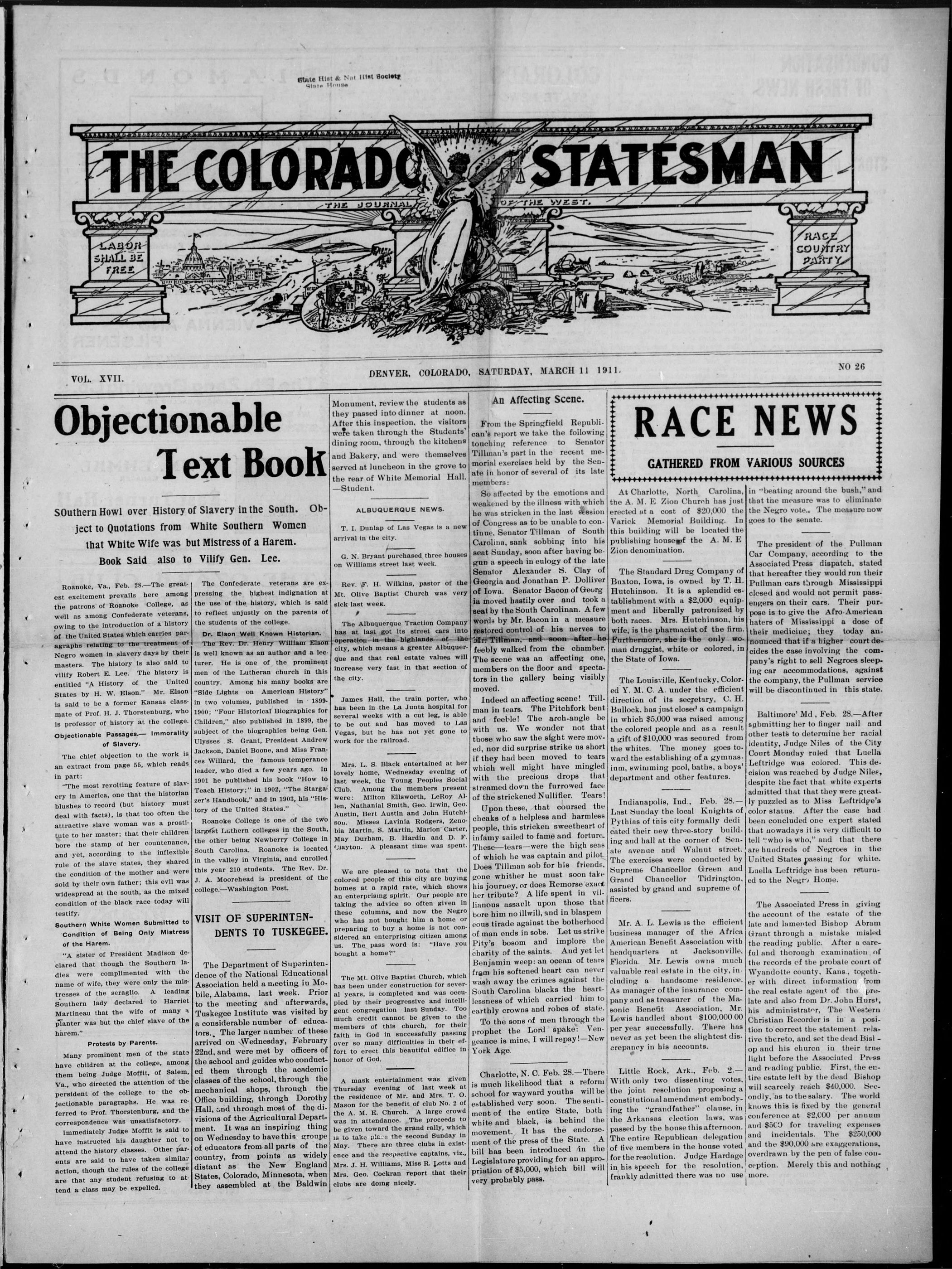
THE COLORADO STATESMAN
THE JOURNAL OF THE WEST.
LABOR SHALL BE FREE
RACE COUNTRY PARTY
Objectionable Text Book
SOuthern Howl over History of Slavery in the South. Object to Quotations from White Southern Women that White Wife was but Mistress of a Harem. Book Said also to Vilify Gen. Lee.
VOL. XVII.
Objectio
SOuthern Howl over History o
ject to Quotations from
that White Wife was b
Book Said also to
Roanoke, Va., Feb. 28.—The greatest excitement prevails here among the patrons of Roanoke College, as well as among Confederate veterans, owing to the introduction of a history of the United States which carries paragraphs relating to the treatment of Negro women in slavery days by their masters. The history is also said to vilify Robert E. Lee. The history is entitled "A History of the United States by H. W. Elson." Mr. Elson is said to be a former Kansas classmate of Prof. H. J. Thorstenburg, who is professor of history at the college. Objectionable Passages.—Immorality of Slavery. The chief objection to the work is an extract from page 55, which reads in part:
"The most revolting feature of slavery in America, one that the historian blushes to record (but history must deal with facts), is that too often the attractive slave woman was a prostitute to her master; that their children bore the stamp of her countenance, and yet, according to the inflexible rule of the slave states, they shared the condition of the mother and were sold by their own father; this evil was widespread at the south, as the mixed condition of the black race today will testify.
Southern White Women Submitted to Condition of Being Only Mistress of the Harem.
"A sister of President Madison declared that though the Southern ladies were complimented with the name of wife, they were only the mistresses of the seraglio. A leading Southern lady declared to Harriet Martineau that the wife of many a planter was but the chief slave of the harem."
Protests by Parents.
Many prominent men of the state have children at the college, among them being Judge Moffit, of Salem, Va., who directed the attention of the persistent of the college to the objectionable paragraphs. He was referred to Prof. Thorstenburg, and the correspondence was unsatisfactory.
Immediately Judge Moffit is said to have instructed his daughter not to attend the history classes. Other parents are said to have taken similar action, though the rules of the college are that any student refusing to attend a class may be expelled.
The Confederate veterans are expressing the highest indignation at the use of the history, which is said to reflect unjustly on the parents of the students of the college.
Dr. Elson Well Known Historian.
The Rev. Dr. Henry William Elson is well known as an author and a lecturer. He is one of the prominent men of the Lutheran church in this country. Among his many books are "Side Lights on American History" in two volumes, published in 1899-1900; "Four Historical Biographies for Children," also published in 1899, the subject of the biographies being Gen. Ulysses S. Grant, President Andrew Jackson, Daniel Boone, and Miss Frances Willard, the famous temperance leader, who died a few years ago. In 1901 he published his book "How to Teach History;" in 1902, "The Stargazer's Handbook," and in 1903, his "History of the United States."
Roanoke College is one of the two largest Luthern colleges in the South, the other being Newberry College in South Carolina. Roanoke is located in the valley in Virginia, and enrolled this year 210 students. The Rev. Dr. J. A. Moorehead is president of the college.—Washington Post.
VISIT OF SUPERINTENDENTS TO TUSKEGEE
The Department of Superintendence of the National Educational Association held a meeting in Mobile, Alabama, last week. Prior to the meeting and afterwards, Tuskegee Institute was visited by a considerable number of educators. The larger number of these arrived on Wednesday, February 22nd, and were met by officers of the school and guides who conducted them through the academic classes of the school, through the mechanical shops, through the Office building, through Dorothy Hall, and through most of the divisions of the Agricultural Department. It was an inspiring thing on Wednesday to have this groupe of educators from all parts of the country, from points as widely distant as the New England States, Colorado, Minnesota, when they assembled at the Baldwin
DENVER, COLORADO, SATURDAY, MARCH 11 1911.
Monument, review the students as they passed into dinner at noon. After this inspection, the visitors were taken through the Students' dining room, through the kitchens and Bakery, and were themselves served at luncheon in the grove to the rear of White Memorial Hall. —Student.
ALBUQUERQUE NEWS
T. I. Dunlap of Las Vegas is a new arrival in the city.
G. N. Bryant purchased three houses on Williams street last week.
Rev. F. H. Wilkins, pastor of the Mt. Olive Baptist Church was very sick last week.
The Albuquerque Traction Company has at last got its street cars into operation in the highlands of the city, which means a greater Albuquerque and that real estate values will increase very fast in that section of the city.
James Hall, the train porter, who has been in the La Junta hospital for several weeks with a cut leg, is able to be out and has moved to Las Vegas, but he has not yet gone to work for the railroad.
Mrs. L. S. Black entertained at her lovely home, Wednesday evening of last week, the Young Peoples Social Club. Among the members present were: Milton Ellsworth, LeRoy Allen, Nathanial Smith, Geo. Irwin, Geo. Austin, Bert Austin and John Hutchison. Misses Lavinia Rodgers, Zenobia Martin, S. Martin, Marion Carter, May Durham, B. Hardin and D. F. Cjayton. A pleasant time was spent.
We are pleased to note that the colored people of this city are buying homes at a rapid rate, which shows an enterprising spirit. Our people are taking the advice so often given in these columns, and now the Negro who has not bought him a home or preparing to buy a home is not considered an enterprising citizen among us. The pass word is: "Have you bought a home?"
The Mt. Olive Baptist Church, which has been under construction for several years, is completed and was occupied by their progressive and intelligent congregation last Sunday. Too much credit cannot be given to the members of this church, for their faith in God in successfully passing over so many difficulties in their effort to erect this beautiful edifice in honor of God.
A mask entertainment was given Thursday evening of last week at the residence of Mr. and Mrs. T. O. Mason for the benefit of club No. 2 of the A. M. E. Church. A large crowd was in attendance. The proceeds to be given toward the grand rally, which is to take place the second Sunday in May. There are three clubs in existence and the respective captains, viz., Mrs. J. H. Williams, Miss R. Lotts and Mrs. Geo. Cockran report that their clubs are doing nicely.
An Affecting Scene.
From the Springfield Republican's report we take the following touching reference to Senator Tillman's part in the recent memorial exercises held by the Senate in honor of several of its late members:
So affected by the emotions and weakened by the illness with which he was stricken in the last session of Congress as to be unable to continue, Senator Tillman of South Carolina, sank sobbing into his seat Sunday, soon after having begun a speech in eulogy of the late Senator Alexander S. Clay of Georgia and Jonathan P. Dolliver of Iowa. Senator Bacon of Georgia moved hastily over and took a seat by the South Carolinian. A few words by Mr. Bacon in a measure restored control of his nerves to Mr. Tillman, and soon after he feebly walked from the chambers. The scene was an affecting one, members on the floor and spectators in the gallery being visibly moved.
Indeed an affecting scene! Tillman in tears. The Pitchfork bent and feeble! The arch-angle be with us. We wonder not that those who saw the sight were moved, nor did surprise strike us short if they had been moved to tears which well might have mingled with the precious drops that streamed down the furrowed face of the strickened Nullifier. Tears!
Upon these, that coursed the cheeks of a helpless and harmless people, this stricken sweetheart of infamy sailed to fame and fortune. These—tears—were the high seas of which he was captain and pilot. Does Tillman sob for his friends, gone whither he must soon take his journey, or does Remorse exact her tribute? A life spent in villianous assault upon those that bore him illwill, and in blasphemous tirade against the botherhood of man ends in sobs. Let us strike Pity's bosom and implore the charity of the saints. And yet let Benjamin weep: an ocean of tears from his softened heart can never wash away the crimes against the South Carolina blacks the heartlessness of which carried him to earthly crowns and robes of state. To the sons of men through the prophet the Lord spake: Vengeance is mine, I will repay!—New York Age.
Charlotte, N. C. Feb. 28. There is much likelihood that a reform school for wayward youths will be established very soon. The sentiment of the entire State, both white and black, is behind the movement. It has the endorsement of the press of the State. A bill has been introduced in the Legislature providing for an appropriation of $5,000, which bill will very probably pass.
RACE NEWS
GATHERED FROM VARIOUS SOURCES
At Charlotte, North Carolina, the A. M. E Zion Church has just erected at a cost of $20,000 the Varick Memorial Building. In this building will be located the publishing house of the A. M. E Zion denomination.
The Standard Drug Company of Buxton, Iowa, is owned by T. H. Hutchinson. It is a splendid establishment with a $2,000 equipment and liberally patronized by both races. Mrs. Hutchinson, his wife, is the pharmacist of the firm. Furthermore, she is the only woman druggist, white or colored, in the State of Iowa.
in "beating around the bush," and that the measure was to eliminate the Negro vote. The measure now goes to the senate.
The president of the Pullman Car Company, according to the Associated Press dispatch, stated that hereafter they would run their Pullman cars through Mississippi closed and would not permit passengers on their cars. Their purpose is to give the Afro-American haters of Mississippi a dose of their medicine; they today announced that if a higher court decides the case involving the company's right to sell Negroes sleep-
The Louisville, Kentucky, Colored Y. M. C. A. under the efficient direction of its secretary, C. H. Bullock, has just closed a campaign in which $5,000 was raised among the colored people and as a result a gift of $10,000 was secured from the whites. The money goes toward the establishing of a gymnasium, swimming pool, baths, a boys' department and other features.
Indianapolis, Ind., Feb. 28. Last Sunday the local Knights of Pythias of this city formally dedicated their new three-story building and hall at the corner of Senate avenue and Walnut streets. The exercises were conducted by Supreme Chancellor Green and Grand Chancellor Tidrington assisted by grand and supreme of ficers.
Mr. A. L. Lewis is the efficient business manager of the Africa American Benefit Association with headquarters at Jacksonville, Florida. Mr. Lewis owns much valuable real estate in the city, including a handsome residence. As manager of the insurance company and as treasurer of the Masonic Benefit Association, Mr. Lewis handled about $100,000.00 per year successfully. There has never as yet been the slightest discrepancy in his accounts.
Little Rock, Ark., Feb. 2. With only two dissenting votes, the joint resolution proposing a constitutional amendment embodying the "grandfather" clause, in the Arkansas election laws, was passed by the house this afternoon. The entire Republican delegation of five members in the house voted for the resolution. Judge Hardage in his speech for the resolution, frankly admitted there was no use
.
NO 26
in "beating around the bush," and that the measure was to eliminate the Negro vote. The measure now goes to the senate.
The president of the Pullman Car Company, according to the Associated Press dispatch, stated that hereafter they would run their Pullman cars through Mississippi closed and would not permit passengers on their cars. Their purpose is to give the Afro-American haters of Mississippi a dose of their medicine; they today announced that if a higher court decides the case involving the company's right to sell Negroes sleeping car accommodations, against the company, the Pullman service will be discontinued in this state.
Baltimore' Md, Feb. 28.—After submitting her to finger nail and other tests to determine her racial identity, Judge Niles of the City Court Monday ruled that Luella Leftridge was colored. This decision was reached by Judge Niles, despite the fact that white experts admitted that that they were greatly puzzled as to Miss Leftridge's color status. After the case had been concluded one expert stated that nowadays it is very difficult to tell "who is who," and that there are hundreds of Negroes in the United States passing for white. Luella Leftridge has been returned to the Negro Home.
The Associated Press in giving the account of the estate of the late and lamented Bishop Abram Grant through a mistake misled the reading public. After a careful and thorough examination of the records of the probate court of Wyandotte county, Kans., together with direct information from the real estate agent of the prelate and also from Dr. John Hurst, his administrator, The Western Christian Recorder is in a position to correct the statement relative thereto, and set the dead Bishop and his churcn in their true light before the Associated Press and reading public. First, the entire estate left by the dead Bishop will scarcely reach $40,000. Secondly, as to the salary. The world knows this is fixed by the general conference at $2,000 per annum and $500 for traveling expenses and incidentals. The $250,000 and the $90,000 are exaggerations, overdrawn by the pen of false conception. Merely this and nothing more.
CONDENSATION OF FRESH NEWS
THE LATEST IMPORTANT DISP
PATCHES PUT INTO SHORT,
CRISP PARAGRAPHS.
SHOWING THE PROGRESS OF EVENTS IN OUR OWN AND FOREIGN LANDS.
WESTERN
General Manager Earle of the El Paso smelter announces the smelter will shut down on account of inability to get ore from Mexico.
The Montana Assembly, on the seventy-ninth joint ballot, elected Henry L. Myers, Democrat, United States senator to succeed Senator Thomas H. Carter.
At Houston because of Colonel Roosevelt's attitude toward Jefferson Davis, Judge Norman G. Kittrell declines to serve on the reception committee when the Colonel arrives.
A world's aviation record was broken between Laredo, Texas, and Eagle Pass when Lieut. Benjamin Foulols, United States army, and Aviator Philip C. Parmalee drove an army aeroplane 106 miles in 2 hours and 7 minutes.
Thirty-five western railroads decided to make no appeal from the recent decision of the interstate commerce commission denying the roads the right to increase freight rates. They will accept the decree of the commission as final. Advanced rates will be withdrawn.
Captured just when plans for assasinating Mayor N. S. Pratt of Spokane are thought to have reached maturity, John Steele and Stuart Moffett, now in jail, are considered by the police as the murderers of Captain John T. Sullivan, and accomplices in a plot to kill President Taft during the next month.
At Hot Springs, Ark.. after trying to enforce the anti-gambling laws for several months the so-called lid was suddenly lifted in plain Monte Carlo fashion. This followed the Sunday baseball programmes indulged in by major league squads and as a result there is rejoicing among the liberal element, but considerable dissatisfaction and threats from the reform set who had calculated on keeping all so-called clubs and gambling houses closed.
POLITICAL.
Some Democratic members of the new House of Representatives are laying plans for an onslaught on the Republican attitude toward extending the scope of pension expenses. Representative Cullop of Indiana announced his intention to reintroduce at the extra session a bill providing for a pension of $1 a day for every man who served ninety days in the Civil War and was mustered in and mustered out, and the same amount for every man who served sixty days in the Mexican war of whom about 5,000 are said to be living.
The resignation of Richard A. Ballinger of Seattle as secretary of the interior has been accepted by President Taft and Walter L. Fisher of Chicago was appointed as his successor. In his letter of acceptance the President expressed deep regret and bitterly denounced the enemies of Ballinger. In giving his consent to the secretary's retirement, Mr. Taft takes occasion to declare with emphasis his unchanging faith in the integrity, the motives and the official standards of Mr. Ballinger, and his unmeasured indignation at the methods of those who assailed him, declaring that he has been "the subject of one of the most unscrupulous conspiracies for the defamation of character that history can show.
FOREIGN.
The Mexican revolutionists have control of the railroad north, south and west of Chihuahua, according to a telegram to the State Department. English papers hint that unless the United States protects foreign interests in Mexico, England will be appealed to and complications will ensue.
At Ottawa, Ont., the reciprocity agreement was indorsed, the loyalty to Great Britain affirmed, annexation scouted, the development of Canada proclaimed and friendship between farmer and manufacturer recommended to Canada in the House of Commons by Sir Wilfrid Laurier, prime minister of the dominion, in the first speech he has delivered in the recciprocity debate.
Two regiments of infantry, the Thirtieth from the Presidio at San Francisco under Colonel Charles T. Chubb, and the Eighth, from Monterey, commanded by Colonel Charles Mason, have been ordered to the Mexican border. Mexico.—Because of the suspension of traffic on railroads leading into Chihuahua, Mexico, for some time, that city is said to be in a state of siege with the revolutionists and the besiegers, and foodstuffs are reported selling at prices equaled only by those charged in boom mining camps.
SPORT.
There is keen disappointment over the retirement of Barney Oldfield from the racing game for one year. Philadelphia National league baseball team has begun its spring practice in Birmingham at Rockwood Park. The weather is cool. Pat Moore, of Philadelphia, who took Tommy Murphy's place in a ten-round bout with Tommy Maloney in New York, easily won the bout. Athletic activities at the University of Wisconsin are booming. The appointment of John R. Richards, the old-time Wisconsin athlete, as football coach and the resumption of the seven-game schedule indicate that the Badgers may regain their former prominent place in intercollegiate football.
WASHINGTON
Fifty-six years of service "in the rear of the army" won for David Robertson the unique distinction of being retired at full pay with the rank of sergeant.
One hundred and twenty-nine vacancies in West Point cadetships in thirty-eight states are to be filled by June 14th, through examination to be held May 2nd.
Announcement has been made that Charles D. Hilles, assistant secretary of the treasury, is to succeed Charles D. Norton as secretary to the President on April 4th.
The Senate passed four appropriation bills, providing for the expenditure of more than $500,000,000. They were the postoffice, naval, suncry civil and general deficiency bills.
Secretary of State Knox has announced that John Hays Hammond would represent the United States as special ambassador at the court of St. James at the coronation of King George V. next June. There is strong probability that Representative Taylor of Colorado may be the next chairman of the House public lands committee. Mr. Taylor is already a member of that committee, but Representative Robinson of Arkansas is entitled to the place by seniority.
GENERAL.
Fred K. Maus, millionaire director of the Scully Steel and Iron Company, shot and killed himself at his home in Chicago.
Serious revolutionary disturbances in Paraguay have been reported to the State Department by Edwin V. Morgan, United States minister to Paraguay and Uruguay.
In Minneapolis, one of the most disastrous fires the city has ever known, destroyed the Syndicate block on Nicollet avenue between Fifth and Sixth streets. The total loss is estimated at $1,000,000.
The United States army transport Buford, loaded with provisions for the famine sufferers in North China, has sailed for Chinkian, flying the pennants of the National Red Cross, the Christian Herald of New York and the Seattle Commercial Club.
According to cable advices received from Costa Rica, Dr. Rudolph Epsinosa, well known throughout Central America, and forty-four others are to be shot by the Estrada government in Nicaragua for alleged complicity in the plot against the administration.
Dr. Frederick A. Cook, the Arctic explorer, has given out the text of a telegram which he said he had sent to President Taft protesting against the Peary bill being signed by the President. The telegram accuses the discoverer of the North pole of gross immorality, exploitation of the public and other irregularities, personal and commercial.
Half the farmers living along the rural free delivery lines of mail out of Baynesville, Ky., have pulled down their mail boxes and refuse to accept their mail from a negro carrier recently appointed. Many of the farmers apply at the postoffice here for their mail and announce their intention of continuing to do so until a white man should be made carrier.
The most extensive movement of troops and war vessels executed in this country in time of peace is now under way by order of the President, the objective being the country north of the Mexican boundary and the waters of the two oceans at either end of it. Twenty thousand soldiers—more than one-forth of the army of the United States—of all arms of the service are moving toward the Mexican border; four armored cruisers, comprising the Fifth division of the Atlantic fleet. have been ordered from northern waters to the naval station at Guantanamo, Cuba. Most of the Pacific fleet is or shortly will be on its way to assemble at San Pedro and San Diego, Cal., and 2,000 marines are preparing to make the Guantanamo station their temporary headquarters. It was officially announced at the White House and at the War and Navy Departments that the purpose of this great mobilization, unprecedented save in war times, is the training of officers and men under service conditions, and practice in co-operation between the land and naval forces.
The United States government begin a fight against what is alleged to be one of the most complete monopolies in the country, when suit was filed against thirty-five concerns engaged in the manufacture of incandescent electric lights. The National Electric Lamp Company, which has its headquarters at Cleveland, and the General Electric Company of New York, are named as two of the defendants and are charged with being the keystone of a trust that has ramifications in every state in the Union.
COLORADO STATE NEWS
New Orchard Company.
Boulder.—Articles of incorporation of the Hogsett Orchard Company, capitalized for $50,000, have been filed. The company will operate in and around Loveland.
Cut Mayor's Salary.
Boulder.—By unanimous vote city council has cut the mayor's salary, which was raised to $1,200 at the beginning of the last fiscal year, to the original $400 per annum, and the $800 thus saved applied on payment of old street warrants.
Expect Influx of Homeseekers.
Greeley.—From now on indications are, an unusually large number of homeseekers will arrive in northern Colorado, because of the low rates to the Pacific coast during this month. The railroads have arranged stopover privileges for the travelers and it is believed many of them will remain and make their homes here after looking over the agricultural land.
Civil Service Vacancy.
Denver.—Vacancies in the position of laboratory helper at $600 a year in the United States bureau of chemistry at Denver will be filled by a civil service examination to be held March 29th in Denver, Fort Collins, Grand Junction, Leadville, Pueblo and Trinidad. The appointee will not be required to perform chemical work, but must qualify to do manual labor.
Miners Must Move.
Louisville.—County Judge Ingram directed a verdict in favor of the Northern Coal & Coke Company against the miners who are occupying the company's grounds at Marshall and Louisville, which means that the company can force twenty-three miners and their families to move their houses off the company's property around the Gorham mine.
Rock Island Demonstration Train.
Colorado Springs.—The special Dry Farming Congress demonstration train of the Rock Island railroad will leave Colorado Springs March 13th for a tour of the lines of that system in eastern Colorado. Towns at which stops will be made are Falcon, Peyton, Calhan, Ramah, Sima, Mattison, Limon, Genoa, Arriba, Bovina, Flagier, Siebert, Vona, Stratton and Burling-
Colorado and South Dakota Debate
Boulder.—For the first time in the history of the institution the Universities of Colorado and South Dakota are to debate between April 12th and May 1st on the question: "Resolved, That the conservation of the natural resources of this country should be left with the government of the states, rather than with the federal government." Colorado's team will have the affirmative side.
Sugar Factory at Brighton.
Greeley.—Farmers from the southern part of Weld county report that they are assured a sugar factory will be built at Brighton this spring by Michigan capitalists owning and operating sugar factories in that state. Three thousand acres have been contracted by the farmers of southern Weld county, in the vicinity of Brighton, which the company required before it would build a factory. It is said that for the present, the old factory, used for several years in making syrup, will be used. It is understood that it is the intention of the company to build a cooperative organization and that in time the factory will be turned over to the beet growers to manage. Indications are, it is said, that 4,500 acres will be pledged before April.
The New Rangely Oil Fields.
While a number of Denver people are interested in the new high grade Rangely oil field of Rio Blanco county, a still larger number of Eastern people have gotten there "ahead of the railroads," and considerable quiet acquisition of properties has taken place. Chief among them are the Barber Asphalt Company of New York, owners of the Uintah railroad from Mack, Colo., to Dragon, Utah; the Southern Pacific railroad syndicate and capitalists from Iowa, Indiana, Illinois and other Eastern states.
Within a year the county is expected to have ample railroad facilities. The Grand River, Meeker & Salt Lake railway, now graded five miles northward out of New Castle, will penetrate Rlo Blanco county from east to west, through the heart of the Rangely oil field; the Moffat road, as projected, will serve the northwestern portion; the Uintah railway last week announced an extension of nine miles up the White river towards Rangely.
Contractor to Try to Break Records.
Greeley.—Workmen are making about twenty-three feet a day through solid granite on the east portal of the Laramie-Poudre tunnel. The distance bored in February was 420 feet, which is a good showing considering the fact that soft rock was encountered and that it was a short month. Contractor McLellwe is going after the world's record this month and, if no mishap is encountered, prospects are excellent for success.
LITTLE COLORADO ITEMS.
Small Happenings Occurring Over the State Worth Telling.
Eaton Commercial Club has been organized with 130 members.
Mrs. P. Tague of Red Cliff has been appointed county judge of Eagle county.
A petition to dissolve the municipal corporation of North Longmont has been filed.
A movement has been started to build a school of psychic research at Crystola.
Leonora Acosta, 3 years old, died at Trinidad of hydrophobia. She was bitten by a dog.
Dan Patch, the famous pacer, will give exhibition heats during the next state fair at Pueblo.
The contract for the construction of the $25,000 school building at Longmont has been awarded.
The Senate has confirmed the nomination of Dewey C. Bailey as United States marshal for Colorado.
L. J. Seville has been appointed postmaster at Eden, Pueblo county, vice F. S. Barnard, resigned.
More than 150 members were added to the Y. M. C. A. by the nine-day campaign at Colorado Springs.
Gov. Shafroth has announced the appointment of W. H. McDonald, commander of the G. A. R., for the department of Colorado and Wyoming.
Over 100 delegates from over the state attended the eighth annual conference of the Daughters of the American Revolution held in Pueblo.
Ninety potatoes, which weighed over 120 pounds, formed part of a load brought to Greeley. The potatoes averaged one and one-third pounds each. C. B. Wade, cashier of the City National bank of Temple, Texas, has been made mayor of Byron, Colo., by decree of the Colorado Supreme Court.
With twenty-five men at work the new cement and steel bridge over the Platte, between Evans and La Salle, is going up in almost record breaking time.
The Farmers' union held an enthusiastic meeting at Eaton and endorsed the road bill presented in the Legislature by F. G. Madgen, representative from that county.
Flax is a new crop to be grown in Weld county by a number of progressive farmers, who believe it can be made a highly profitable crop for the oil which it contains.
W. G. Hubbell, editor of the Fort Lupton Press, was nominated for mayor on the Taxpayers' anti-saloon ticket, with Dr. Monesmith, H. F. Johnson and S. McComb for trustees.
At Windsor since the heavy snowfall of the last two weeks there has been renewed activity in all lines of business and the section is optimistic over prospects for the coming season.
A proposition to irrigate 1,200 acres near Fort Lupton for garden truck has been presented to the Commercial Club by engineers of the Northern Colorado Power Company and is considered feasible.
Nearly 20,000 farmers from the agricultural districts along the lines of the Colorado & Southern and Santa Fe railroads visited the agricultural demonstration car during the two weeks of its itinerary through the northern and eastern sections of the state.
The Interstate Commerce Commission will give a hearing at Pueblo April 8 in a case brought by the Commerce Club against the Santa Fe railroad, in which the club asks a reduction of 10 cents per hundred pounds on dried beans from California to Pueblo.
Blaine Rickard of Evans nearly severed the little finger from his right hand when he picked up a handful of snow to make a snowball, in which there was a large piece of glass. He started to mold the snow into shape when the glass put a sudden end to the operation.
Through a local agent 100 Italian families from all over Colorado are making arrangements to form a colony to farm land twenty miles south of Pueblo. They will settle on the Pueblo and Rocky Ford Land Company tracts and a new townsite will be platted.
At Grand Junction Father Conway of St. Joseph's Catholic church announced that 300 babies from New York city will be imported into Colorado within the next three weeks, and that Grand Junction Catholics will be expected to adopt their portion of the orphans. Plans are being made by many families here for adoption of some of the children.
George Sykes, an apple man of Chicago, is in the city for a few days, and he says that Colorado should devote her time to the raising of the Jonathan apple, as she excels all other states in the production of that variety. Mr. Sykes says the Jonathans which Colorado raises are in great demand all over the East and that no other apple produced in this state is equal to it.
The sundry civil appropriation bill as passed carried building appropriation items as follows: Colorado—Denver, continuation of building, $1,000,000; Colorado Springs, completion of federal building, $20,000; Durango, for site, $10,000; Fort Collins, site and completion of building, $40,000; Fort Morgan, site, $10,000; La Junta, site and commencement, $10,000.
The officials of the Western Slope Development Congress have issued a comprehensive call for the second annual convention of the Congress to be held at Delta, Colo., March 22-23.
M A
WELF
STERLING S
Boost Colorado Products
Z AN
DELICIOUS T
COLUMBINE,
VIENN
Guaranteed A
Delivered Dally to A
The Ph. Zang
TELEPHONE
We Boost for Colorado
ORLING SILVER-WARE
Colorado Products Patronize Home Industry
ZANG'S
DELICIOUS TABLE BEERS
IMBINE,
VIENNA AND
PILSENER
Guaranteed Absolutely Pure.
Delivered Daily to All Parts of the City.
Ph. Zang Brewing Co.
TELEPHONE GALLUP 395.
for Colorado You Should Boost for Us
STERLING SILVER-WARE
Boost Colorado Products Patronize Home Industry
ZANG'S
DELICIOUS TABLE BEERS
COLUMBINE,
VIENNA AND
PILSENER
Guaranteed Absolutely Pure.
Delivered Daily to All Parts of the City.
The Ph. Zang Brewing Co.
TELEPHONE GALLUP 395.
We Boost for Colorado You Should Boost for Us
WM. EHMKE
MANAGER
East Turner Hall
2132-2148 ARAPAHOE ST.
Phone 2449. DENVER.
C OZARK CLUB
WILLIARDS AND POOL .
PARLORS
THE OZA
BILLIARDS
PARI
THE OZARK CLUB
BILLIARDS AND POOL
PARLORS
STRICTLY MEMBERSHIP CLUB
THOMAS CLIN
26-32-34 Welton Street
When y
The Heads, Feet, Tails, Snouts, Ea
other part of the hog
East's
2300-5 Larimer Street.
MAS CLINGMAN, Manager
2-34 Welton Street Phone Main 5154
When you Want
sreet, Tails, Snouts, Ears, Neckbones or Chitterlings or any
other part of the hog except the squeal go to
List's Market
or Street. Phone 1461 Main.
THOMAS CLINGMAN, Manager
26-32-34 Welton Street Phone Main 5154
When you Want
The Heads, Feet, Tails, Snouts, Ears, Neckbones or Chitterlings or any other part of the hog except the squelg go to
THE SOCIAL WORKING SOCIETY
A RELIABLE PLACE
Diamonds, Watch
Also a Larger
GUNS AND MUSIC
at Lower
HYMAN'S LO
Cash or Payments
RELIABLE PLACE TO BUY YOUR
Bands, Watches and Jewelry
Also a Large Assortment of
BANDS AND MUSICAL INSTRUMENTS
at Lowest Prices
MAN'S LOAN OFFICE
payments 1705 Larimer Street
A RELIABLE PLACE TO BUY YOUR Diamonds, Watches and Jewelry
Also a Large Assortment of GUNS AND MUSICAL INSTRUMENTS at Lowest Prices
HYMAN'S LOAN OFFICE
Cash or Payments 1705 Larimer Street
Mamma Neely's Restaurant
GOOD HOME COOKING
Regular Meals 25c. Sunday Dinner 35c
Short Orders at All Hours
1914 Arapahoe St. Denver, Col.
GOOD HOME COOKING
Regular Meals 25c. Sunday Dinner 35c
Short Orders at All Hours
1914 Arapahoe St. Denver, Col.
---
```markdown
```
```markdown
```
WILLIAMSON
HAFFNER CO.
ENGRAVERS-PRINTERS
OUR
CUTS
TAULKS
DENVER, COLO
Public Meeting Held.
The committee on mines of the House of Representatives held a public hearing on the coal mine bill formulated by a commission named by Gov. Shafroth to investigate the matter of safeguarding miners employed in coal mines of the state. Several representatives of mine owners and mine workers appeared to offer suggestions and amendments. The bill provides for the maintenance of a chief inspector and seven deputies, each deputy assigned to a district composed of twenty-one coal mines. There were few suggestions that would change in any important respect the bill as it now stands.
Pearson's Recall Bill.
Representative Pearson's recall bill, carrying with it the Skinner amendment for the submission of the question of recalling judges and district attorneys to the electorate, was passed by the House on second reading, after nearly a week of consideration. In speaking of his motion Skinner held up the usual argument that if the recall question is not put up to the people by the Legislature, they will take the matter into their own hands under the initiative and referendum.
A concurrent resolution introduced in the House by Representatives Bott, Bacon, McPelin, Goodfriend and Slattery calls for an investigation of the Winfield Scott Stratton estate, which was entrusted to the executors ten years ago for the purpose of constructing the Myron Stratton home at Colorado Springs, for the worthy poor of the state.
Want New Bounty Law.
At a meeting of the fish and game commission in the House chamber at the capitol, it was decided to have Commissioner Thomas Holland draw up a draft of a bounty bill and submit it to the Legislature in preference to the measure already introduced by Representative Mann. Mr. Mann's bill does not provide for the repealing of the bounty law, in effect since 1893. Should Mann's measure pass and become a law, and the old law still remain in force, it would enable killers of predatory animals to collect double bounty—one bounty for each law. It was also advocated to make the fishing season from May 1st to December 31st, instead of as at present, May 25th to November 30th. Close season on ducks will be advised and a continuance of the present seasons on deer, except to shorten the spring shooting season fifteen days. It was decided to bring these points to the attention of the Legislature and ask for favorable action.
The committee appointed to investigate the State Board of Stock Inspection held a meeting. It was announced that an accountant would be appointed and that the work of going over the books of the board would be begun at once. Senator Cross was named as chairman of the committee and Representative Walbridge, secretary. When Senate bill No. 207, which provides for the five license inspectors, came up for consideration a number of the Democratic senators sought to head off all debate by calling for a vote. Senator Hecker, however, obtained the floor and denounced the passage of such a law as an outrageous effort to create new jobs regardless of the best interests of the state. All of the Republicans voted against this bill, but it was passed by a vote of 20 to 10. The proposed new Colorado state flag provided for in a bill now before the Legislature has not met with unanimous approval.
Sitting as a committee of the whole, the Senate passed on second reading Senate bill No. 193, by Senator Hilts, and Senate bill No. 155, by Senator Gove. The first of these bills provides for a new law governing storage in warehouses and the issuing of warehouses receipts. This law has been passed in a number of states and is intended to be a uniform law in all states of the Union. A petition, signed by practically all of the warehouse companies in Denver, was read by Senator Hilts urging the passage of the bill. The other bill makes changes in the law governing the administering of estates in counties of more than 100,000 population. It provides that estates shall be administered by the public administrator in cases where there are no relatives. The present law provides that a creditor may act as administrator of an estate.
A bill for an act providing for the completion of a wagon bridge being constructed by the state of Colorado, across the Río Grande river, at the town of Alamosa, between the counties of Conejos and Costilla, and to appropriate money for the payment of the same, has been introduced in the House.
That the eight-hour labor law would advance the price of coal to consumers, would reduce the production in Colorado, and keep out good capital were some of the arguments used by representatives of the Colorado coal mining companies against the pending measure, before the labor committee of the Senate, at a public hearing in the Senate chamber.
Out of respect for Senator Thomas J. McCue, whose father, Patrick McCue, died, the Senate took a recess of one afternoon.
PRESIDENT SAYS MORE PEACEFUL
DIAZ IS ASSURED MEXICO
NEED NOT BE
UNEASY.
RESIDENTS SKEPTICAL
MANY PROFESS TO SEE IN THE FUTURE NOTHING BUT INTERVENTION.
Mexico City.—Setting at rest all rumors that the United States is preparing for intervention in Mexico, President Taft sent to President Diaz a telegram in which he says the military maneuvers being conducted along the frontier in Texas have no significance which should cause concern to Mexico.
A calm and dispassionate view of the mobilization appears to have been taken here by Mexicans.
No excitement followed the appearance of the news. Dailies in Spanish as well as the American morning newspaper, give much space to the details of the movement.
Mexico City.—President Taft's message was transmitted to the department of foreign relations by Fred M. Deering, chare d'affaires of the American embassy.
Following is the text of President Taft's message:
"I have the honor to advise your excellency that I am in receipt of instructions from my government, directing me to inform his excellence, President Diaz, through the medium of your excellency, that the President of the United States wishes to express the hope that no misapprehensions will result from unfounded and sensational newspaper conjectures as to the military maneuvers about to take place in Texas and elsewhere, and to give to President Diaz assurance that the maneuvers have no significance that should cause concern to the friendly neighbors of the United 'States to the South."
To the foregoing General Diaz replied, through Minister Creel and the American Embassy, acknowledging receipt and expressing gratitude "for the courtesy of explaining in such explicit terms the situation."
In some quarters nevertheless, the explanation given out from the White House as to the significance of President Taft's order was viewed with skepticism. This was particularly true as relating to American residents in the city, many of whom, professed to see in it the first step in a move toward intervention.
Leading Mexicans who were approached for opinions declined for the most part to talk for publication, but privately expressed confidence in the good intentions of the American government.
Militia To Take Part.
Washington.—Militia officers of all states will be invited to participate in the operations of the army at San Antonio, Texas. This announcement was made by the War Department and was coupled with the statement that the invitation will be extended with a view to giving the officers of the National Guard practical field experience. There are about 8,000 of these officers, but as the acceptance of the invitations is to be optional it cannot be foretold how many will avail themselves of the opportunity to participate.
Panama's Shipping Problem.
Washington. After hearing all the interests involved, Secretary Dickinson has determined the tentative outline of a contract which the government-owned Panama railroad will offer to its co-carriers of freight between Pacific and Atlantic ports, providing for a proportionate division of rates. It was determined to substitute commodity rates for the present flat rate of $8 a ton for all classes of freight shipped from San Francisco to New York via the Panama route.
McLean Sued for $180,000.
Washington—Suit to recover $180,000, the alleged purchase price of the so-called Hope diamond, has been filed in the Supreme Court of the District of Columbia against Mr. and Mrs. Edward B. McLean by Louis C. Cartier and Pierre C. Cartier, jewelers, of New York and Paris, trading under the name of Cartier.
"Hack" and Roller Win.
Kansas City.—George Hackenschmid defeated Henry Ordeman and Dr. B. F. Roller threw "Americus" in a double event wrestling bill given by the Empire Athletic Club here.
Chinese Continue to Starve.
Washington. That there is no abatement in the crying needs of the starving people of China is indicated by advices received by the state department. As a further measure of relief the American National Red Cross cabled $2,000 to the American consul general at Shanghai.
Storm Stops Traffic.
San Francisco.—Storm conditions in California are somewhat improved but railroad traffic is still far from normal. The coast lines are still tied up.
GIVE-LIVES TO OFFICE
GIVE-LIVES TO OFFICE
QUINTET OF SENATORS LONG IN
THE PUBLIC SERVICE.
Cullom, Hale, Frye, Aldrich and Gallinger Have Been in Congress for 172 Years—Illinois Solon is the Oldest.
At the head of the United States senate in point of service stand five men who have been in the public service practically all their lives. It is doubtful if any other legislative body in the world possesses in its membership such a notable quintet of legislators. They
are Senators Hale and Frye of Maine, Aldrich of Rhode Island, Cullom of Illinois, and Gallinger of New Hampshire. It will be noted that four of the five come from New England, which accounts, in part, for the preponderance of influence which has been possessed by that section of the country in the upper house of congress. The senatorial careers of Senators Hale and Aldrich, however, have come to a close.
Practically all of these men have had a varied political service. Senator Cullom, who is now 82 years old, entered public life in 1853, 58 years ago. Senator Frye, now in his eighty-first year, held his first elective office in 1861. Senator Hale, now 75 years of age, was elected to the legislature of Maine in 1867. Senator Gallinger is 74, and entered upon a public career in 1872. Senator Aldrich, who is now 70 years old, is the baby of the lot, and held his first office in 1871.
All of them have been in public life almost continuously since they first entered it. Their combined ages are 382 years, or an average in excess of 76 years. They have spent, all told, 172 years in congress, or an average in excess of 34 years each, of which 138 years, or an average in excess of 27 years each, have been passed in the senate.
Senator Cullom began his public life as city attorney of Springfield, Ill., in 1853. In 1861 Senator Frye became a member of the lower house of the legislature of the state of Maine, serving two terms. In 1856 Senator Cullom was a presidential elector on the Fillmore ticket in Illinois and the same year became a member of the house of the Illinois legislature. In 1860 he was re-elected and the following year became speaker of the house. In 1865 he was elected to the Thirty-ninth congress and served continuously until 1871, when he was again elected to the Illinois legislature and again became speaker of the house in 1873. In the meantime, Senator Frye had retired from the Maine legislature to become mayor of his home city of Lew-
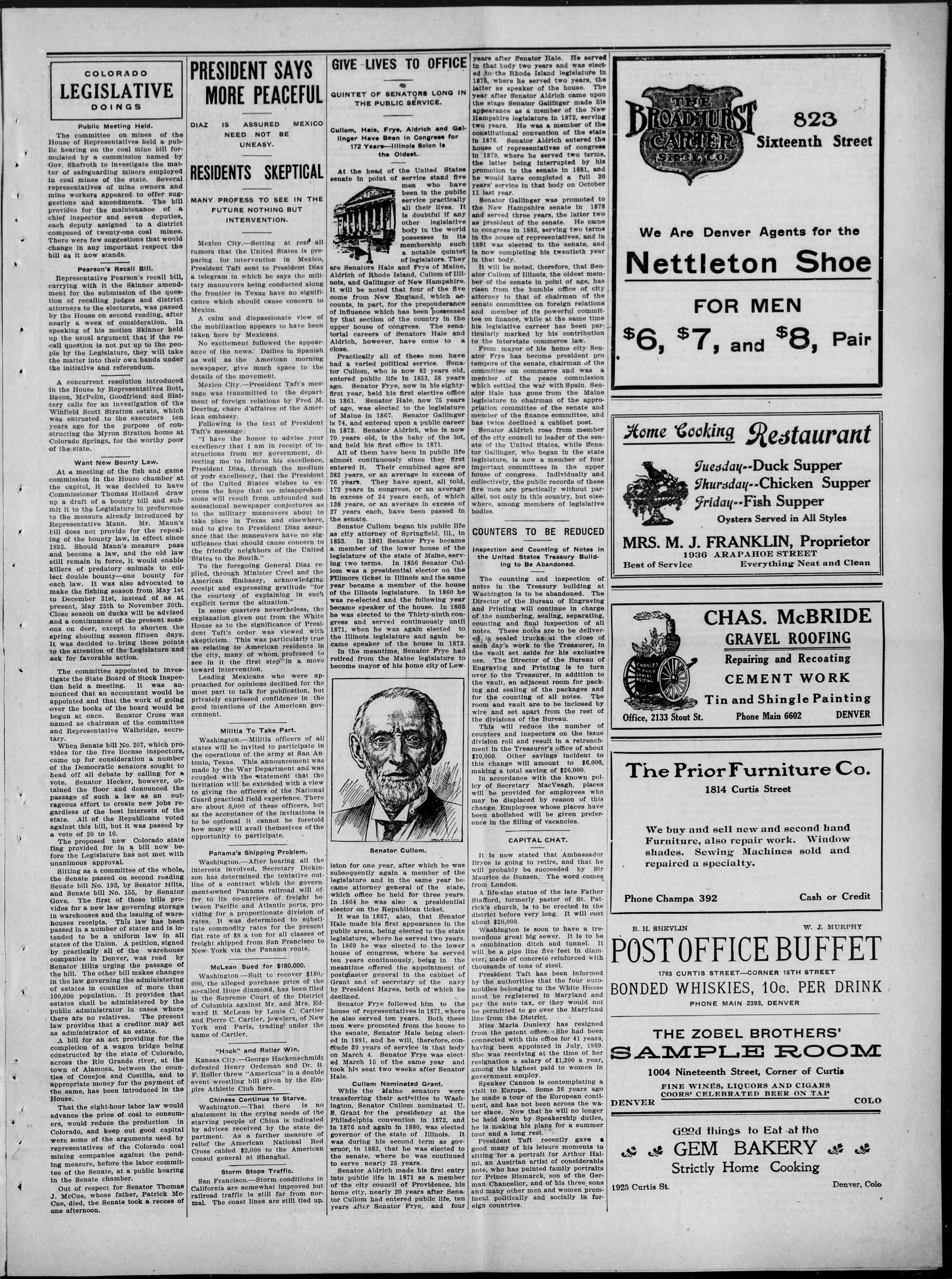
Senator Cullom.
liston for one year, after which he was subsequently again a member of the legislature and in the same year became attorney general of the state, which office he held for three years. In 1864 he was also a presidential elector on the Republican ticket.
It was in 1867, also, that Senator Hale made his first appearance in the public arena, being elected to the state legislature, where he served two years. In 1869 he was elected to the lower house of congress, where he served ten years continuously, being in the meantime offered the appointment of postmaster general in the cabinet of Grant and of secretary of the navy by President Hayes, both of which he declined.
Senator Frye followed him to the house of representatives in 1871, where he also served ten years. Both these men were promoted from the house to the senate, Senator Hale being elected in 1881, and he will, therefore, conclude 20 years of service in that body on March 4. Senator Frye was elected March 15 of the same year and took his seat two weeks after Senator Hale.
Cullom Nominated Grant.
While the Maine senators were transferring their activities to Washington, Senator Cullom nominated U. S. Grant for the presidency at the Philadelphia convention in 1872, and in 1876 and again in 1880, was elected governor of the state of Illinois. It was during his second term as governor, in 1883, that he was elected to the senate, where he was continued to serve nearly 25 years.
Senator Aldrich made his first entry into public life in 1871 as a member of the city council of Providence, his home city, nearly 20 years after Senator Cullom had entered public life, ten years after Senator Frye, and four
years after Senator Hale. He served in that body two years and was elected to the Rhode Island legislature in 1875, where he served two years, the latter as speaker of the house. The year after Senator Aldrich came upon the stage Senator Gallinger made his appearance as a member of the New Hampshire legislature in 1872, serving two years. He was a member of the constitutional convention of the state in 1876. Senator Aldrich entered the house of representatives of congress in 1879, where he served two terms, the latter being interrupted by his promotion to the senate in 1881, and he would have completed a full 30 years' service in that body on October 11 last year.
Senator Gallinger was promoted to the New Hampshire senate in 1878 and served three years, the latter two as president of the senate. He came to congress in 1885, serving two terms in the house of representatives, and in 1891 was elected to the senate, and is now completing his twentieth year in that body.
It will be noted, therefore, that Senator Culom of Illinois, the oldest member of the senate in point of age, has risen from the humble office of city attorney to that of chairman of the senate committee on foreign relations and member of its powerful committee on finance, while at the same time his legislative career has been particularly marked by his contribution to the interstate commerce law.
From mayor of his home city Senator Frye has become president protempore of the senate, chairman of the committee on commerce and was a member of the peace commission which settled the war with Spain. Senator Hale has gone from the Maine legislature to chairman of the appropriation committee of the senate and member of the finance committee, and has twice declined a cabinet post.
Senator Aldrich rose from member of the city council to leader of the senate of the United States, while Senator Gallinger, who began in the state legislature, is now a member of four important committees in the upper house of congress. Individually and collectively, the public records of these five men are practically without parallel, not only in this country, but elsewhere, among members of legislative bodies.
COUNTERS TO BE REDUCED
Inspection and Counting of Notes in the United States Treasury Building to Be Abandoned.
The counting and inspection of notes in the Treasury building at Washington is to be abandoned. The Director of the Bureau of Engraving and Printing will continue in charge of the numbering, sealing, separating, counting and final inspection of all notes. These notes are to be delivered in sealed trucks at the close of each day's work to the Treasurer, in the vault set aside for his exclusive use. The Director of the Bureau of Engraving and Printing is to turn over to the Treasurer, in addition to the vault, an adjacent room for packing and sealing of the packages and for the counting of all notes. The room and vault are to be enclosed by wire and set apart from the rest of the divisions of the Bureau.
This will reduce the number of counters and inspectors on the issue division roll and result in a retrenchment in the Treasurer's office of about $20,000. Other savings incident to this change will amount to $6,000, making a total saving of $26,000.
In accordance with the known policy of Secretary MacVeagh, places will be provided for employees who may be displaced by reason of this change. Employees whose places have been abolished will be given preference in the filling of vacancies.
CAPITAL CHAT.
It is now stated that Ambassador Bryce is going to retire, and that he will probably be succeeded by Sir Maurice de Bunsen. The word comes from London.
A life-size statue of the late Father Stafford, formerly pastor of St. Patrick's church, is to be erected in the district before very long. It will cost about $20,000.
Washington is soon to have a tremendous great big sewer. It is to be a combination ditch and tunnel. It will be a pipe line five feet in diameter, made of concrete reinforced with thousands of tons of steel.
President Taft has been informed by the authorities that the four automobiles belonging to the White House must be registered in Maryland and pay the auto tax, or they would not be permitted to go over the Maryland line from the District.
Miss Maria Dunlevy has resigned from the patent office. She had been connected with this office for 41 years, having been appointed in July, 1869. She was receiving at the time of her resignation a salary of $1,200 a year, among the highest paid to women in government employ.
Speaker Cannon is contemplating a visit to Europe. Some 36 years ago he made a tour of the European continent, and has not been across the water since. Now that he will no longer be held down by Speakership duties, he is making his plans for a summer tour and a long rest. President Taft recently gave good many of his leisure moments to sitting for a portrait for Arthur Halmi, an Austrian artist of considerable note, who has painted family portraits for Prince Bismarck, son of the German Chancellor, and of his three sons and many other men and women prominent politically and socially in foreign countries.
THE BROADHURST CARTER SHOE CO.
823
Sixteenth Street
We Are Denver Agents for the
Nettleton Shoe
FOR MEN
$6, $7, and $8, Pair
Home Cooking Restaurant
Tuesday--Duck Supper
Thursday--Chicken Supper
Friday--Fish Supper
Oysters Served in All Styles
MRS. M. J. FRANKLIN, Proprietor
1936 ARAPAHOE STREET
Best of Service Everything Neat and Clean
The Prior Furniture Co. 1814 Curtis Street
We buy and sell new and second hand Furniture, also repair work. Window shades. Sewing Machines sold and repaired a specialty.
B. H. SHEVLIN W. J. MURPHY POST OFFICE BUFFET 1763 CURTIS STREET-CORNER 18TH STREET BONDED WHISKIES, 10c. PER DRINK PHONE MAIN 2393, DENVER
GOOD things to Eat at the GEM BAKERY Strictly Home Cooking
Jues
Thurs
Fri
MRS. M. J. F.
1936 A
Best of Service
CHARLES
MARSHALL
COWELL
POSTING
Office, 2133 Stout St.
The Priory
187
We buy and sell
Furniture, also
shades. Sewi
repaired a spe
Phone Champa 392
B. H. SHEVLIN
POST OF
CHAS. McBRIDE
GRAVEL ROOFING
Repairing and Recoating
CEMENT WORK
Tin and Shingle Painting
Phone Main 6602 DENVER
ior Furniture Co.
1814 Curtis Street
and sell new and second hand
also repair work. Window
sewing Machines sold and
specialty.
ior Furniture Co.
1814 Curtis Street
and sell new and second hand
also repair work. Window
sewing Machines sold and
specialty.
392 Cash or Credit
W. J. MURPHY
OFFICE PHEEET
W. J. MURPHY
THE COLORADO STATESMAN
CABIN MARIE FALE
CABIN MARIE FALE
JOE. D. D. RIVERS ..... Proprietor
1824 Curtis Street, Room 25.
SUBSCRIPTION RATES:
One Year ..... $2.00
Six Months ..... 1.00
Three months ..... .60
PAYABLE IN ADVANCE.
It occasionally happens that papers sent to subscribers are lost or stolen.
In case you do not receive any number when due, inform us by postal card and
we will cheerfully forward a duplicate of the missing number.
Remittances should be made by Express Money Order, Postoffice Money
Order, Registered Letter or Bank Draft. Postage stamps will be received the
same as cash for the fractional part of a dollar. Only 1-cent and 2-cent stamps
taken.
Display advertising 25 cents per square. A square contains ten agate lines.
No discounts allowed on less than three months' contract. Cash must accompany all orders from parties unknown to us. Further particulars on application.
All communications of a personating nature that are not complimentary will be withheld from the columns of this paper.
Communications to receive attention must be newsy, upon important subjects, plainly written only upon one side of the paper; must reach us Tuesdays, if possible, anyway not later than Wednesdays, and bsar the signature of the author. No manuscript returned. unless stamps are sent for postage.
Entered as second-class matter at the postoffice in the city of Denver, Colorado.
THE PROGRESSIVE FAD.
THE best way to kill a bad law is to enforce it. The stern infliction of the unjust principle arouses public sentiment against it and brings about the deadly repeal. The best way to ruin a good principle is to overdo it. The evasive and excessive extension of a thing which may be good within reason, the bounds, creates public nausea, and an accumulation of errors built upon originally sound purpose destroys and sacrifices the virtue of the whole direct. The movement which developed the title of progressiveness in politics has become a fair illustration of these assertions. When men of liberal and independent ideas begin to assert themselves and to advance their opinion within Republican ranks, protesting that they were yet Republicans, will right the best interests of the Republican party through just and greatly added reforms, they found hosts of patient listeners and thousands of read flowers. With many conditions of public discontent to nourish and justify their pleas, they had only to stand by their daring principles and depend on a rising sentiment to push the old-time standpatters to the defense of a time that seemed to be growing out of date. The enlistment of men of the influence and undoubted integrity in the progressive cause so enhancement of movement as to make it a prevailing issue in Republican ranks in nearly every state in the union and carried its influence well over into other party organizations. Exultant enthusiasm and unrestrained ambition have not upgrated up in the wake of the more conscientious leadership, and, aided and benefited by the shrewd designs of those who profess no adherence to the Republican cause, as well as those secret interests which, primarily assassinated and believing the doom of the Republican party sealed, seek to entrench their lives with the coming victors, they are making so-called progression to the edge of party revolution, and abandoning those fundamental tenets without which the Republican party would be a dead and stinking carcas. The doggish right to amend the Constitution of the United States in such a way as to extend authority of the several states over that of the federal government matters of distinctly national concern, was led by a progressive Republican and had the endorsement of nearly every Senator aspiring to be a leader in the progressive cause. It was in substance and in fact a revival of the doctrine of states-rights, with Republicans leading the fight to overthrow the principles that gave birth and long life to the Republican party. Whatever is there between the right of a state to arbitrarily disfranchise particular part of its population and the right of a state to enslave that same part of its population? How does the one act interfere with the constitution authority of the United States more than the other act interferes with the authority? Yet progressive Republicanism, in its wild excess, sought to reintegrate and establish that exploded theory. It was not a direct profession of their part, but a concession made in the endeavor to win a less important principle. But the concession involved a sacrifice of the final dependence of the forced American for equality of citizenship and legal protection. And it is principle which the nation cannot afford to abandon, however it may defend and neglect its rigid enforcement under prevailing but lessening difficulties, but the wisdom of conservative Republicanism checked the over-ambition of deluded progression in this case, and gave the country a chance to consider the inadvisability of a haste in the wild chase after reforms.
THE best way to kill a bad law is to enforce it. The stern infliction of an unjust principle arouses public sentiment against it and brings about its ready repeal. The best way to ruin a good principle is to overdo it. The extravagant and excessive extension of a thing which may be good within reasonable bounds, creates public nausea, and an accumulation of errors built upon an originally sound purpose destroys and sacrifices the virtue of the whole object. The movement which developed the title of progressiveness in politics has become a fair illustration of these assertions. When men of liberal and independent ideas began to assert themselves and to advance their opinions within Republican ranks, protesting that they were yet Republicans, who sought the best interests of the Republican party through just and greatly needed reforms, they found hosts of patient listeners and thousands of ready followers. With many conditions of public discontent to nourish and justify their pleas, they had only to stand by their daring principles and depend upon a rising sentiment to push the old-time standpatters to the defense of a regime that seemed to be growing out of date. The enlistment of men of wide influence and undoubted integrity in the progressive cause so enhanced the movement as to make it a prevailing issue in Republican ranks in nearly every state in the union and carried its influence well over into other party organizations. Exultant enthusiasm and unrestrained ambition have now sprung up in the wake of the more conscientious leadership, and, aided and abetted by the shrewd designs of those who profess no adherence to the Republican cause, as well as those secret interests which, primarily assailed, and believing the doom of the Republican party sealed, seek to entrench themselves with the coming victors, they are making so-called progression the badge of party revolution, and abandoning those fundamental tenets without which the Republican party would be a dead and stinking carcas. The dogged fight to amend the Constitution of the United States in such a way as to extend authority of the several states over that of the federal government in matters of distinctly national concern, was led by a progressive Republican and had the endorsement of nearly every Senator aspiring to be a leader in the progressive cause. It was in substance and in fact a revival of the doctrine of states-rights, with Republicans leading the fight to overthrow the settled principles that gave birth and long life to the Republican party. What difference is there between the right of a state to arbitrarily disfranchise a particular part of its population and the right of a state to enslave that same part of its population? How does the one act interfere with the constituted authority of the United States more than the other act interferes with that authority? Yet progressive Republicanism, in its wild excess, sought to rehabilitate and establish that exploded theory. It was not a direct profession on their part, but a concession made in the endeavor to win a less important principle. But the concession involved a sacrifice of the final dependence of the colored American for equality of citizenship and legal protection. And it is a principle which the nation cannot afford to abandon, however it may defer and neglect its rigid enforcement under prevailing but lessening difficulties. But the wisdom of conservative Republicanism checked the over-ambitious flight of deluded progression in this case, and gave the country a chance to consider the inadvisability of a haste in the wild chase after reforms.
CRITICISING LIBERIA
THE AMERICAN Negro is long on advice and short on practice. Since Liberia has been brought into world-notice by the international difficulty through which she is struggling, the American Negro, and particularly the American Negro press, has been prolific with pat and pompous suggestion intended to set the dark sister right in her course and to show her how easy it is to play the political game with all the world, when one has acquired the experience, the assurance and the wisdom of the black apoleons of the new world. The New York Age, the Indianapolis Freemason several other of the more prominent moulders of world opinion, have been leading lectures to the Liberians and telling them how to run their country, commission to the superior wisdom and dictation of accidental American Negro statesmen is a necessary ingredient of the humble and submissive do
THE AMERICAN Negro is long on advice and short on practice. Since Liberia has been brought into world-notice by the international difficulties through which she is struggling, the American Negro, and particularly the American Negro press, has been prolific with pat and pompous suggestions intended to set the dark sister right in her course and to show her how easy a thing it is to play the political game with all the world. when one has once acquired the experience, the assurance and the wisdom of the black Napoleons of the new world. The New York Age, the Indianapolis Freeman and several other of the more prominent moulders of world opinion, have been reading lectures to the Liberians and telling them how to run their country. Submission to the superior wisdom and dictation of accidental American Negro statesmen is a necessary ingredient of the humble and submissive dose which the Liberians are called upon to swallow by these arrogant doctors of international diplomacy.
We do not wish to contend that the Liberian government is an absolute political success, either in a domestic or a diplomatic sense, but we do believe that it has exhibited the highest grasp of the problem of independent self-government of which the pure Negro anywhere in the world can boast. The American Negro has never known the necessity for such absolute self-reliance as has been the constant obligation of the Liberian for more than two centuries, and he absolutely ignorant of the grind of the crucible in which the genius of world diplomacy is mixed, shaped and fashioned. When Minister Crum, in a speech to the Liberians, alluded to Liberia as only a name among the governments of the world, he inadvertently and unwittingly offended the pride of men and the memory of martyrs who have done much for the development of the Negro's claim for recognition in a universal brotherhood of civilized peoples and nations. The financial and political difficulties of the Liberians are almost unavoidable growths, which would have beset any other people similarly situated and likewise unsupported by immigration or other re-enforcing influences. Their internal and international problems call for the wisest statesmanship on their own part and the highest sense of toleration, justice and sympathy on the part of all other people and all other nations whose interests or aspirations are touched by their relations with or hopes for Liberia and what she represents in the world's family of the future. The American Negro, in his lethargic condition of dependent ease, can give nothing of value to the Liberian, unless he patriotically determines to throw in his lot with him, and by proffered sacrifice of self or fortune, adds materially to the life blood upon which a hungry and growing nation must feed.
There Is No Royal Road to Vast Fortunes
By GEORGE BRANDEN
HE world at large, longing for wealth as the symbol of ease and cheerful indolence as one great hungry, but stupid giant, certainly fails to realize how much real, genuine hard work the men whose names are associated with fabulous work have done and in many cases are doing right now.
T
And moreover it is not spasmodic work, done in fits and starts against their will; their great success is not always a matter of luck and in many cases not even a matter of supreme ability; it is rather a matter of supreme energy and capacity for genuine hard work.
It seems a strange arraignment of things which allots wealth to the man who does not enjoy idleness and chafes at inaction and decrees that the man who sighs for ease and luxurious surroundings shall never realize on his sighs. But that is most certainly the arrangement. The men of great wealth frequently have the fortune of a hundred because they have the energy of a hundred and give their capacity for work full play. An intimate glimpse into the lives of some of the millionaires would tend sometimes to silence a part of the ever-present cry of "thief, oppressor, predatory force," etc.
Take, for example, George Westinghouse, whose name appears often on your electrical fans, on the car brakes, if you notice them, and on many things electrical which you happen to see. Along the main line of a railroad just east of Pittsburg you pass hundreds of yards of great smoky, noisy shops and on every one you read the name Westinghouse in large letters until you wonder if the man controls all the manufacturing establishments in Pittsburg.
If you had never seen this man and knew nothing of him you would probably picture him as a bulky, diamond-studded person with an apolectic complexion who does not know the topography of his own plant and would yawn if you asked him how many men he employed—one of those mythical creatures which exist chiefly in the public imagination spending their only moments of real activity on the Muldoon physical culture farm.
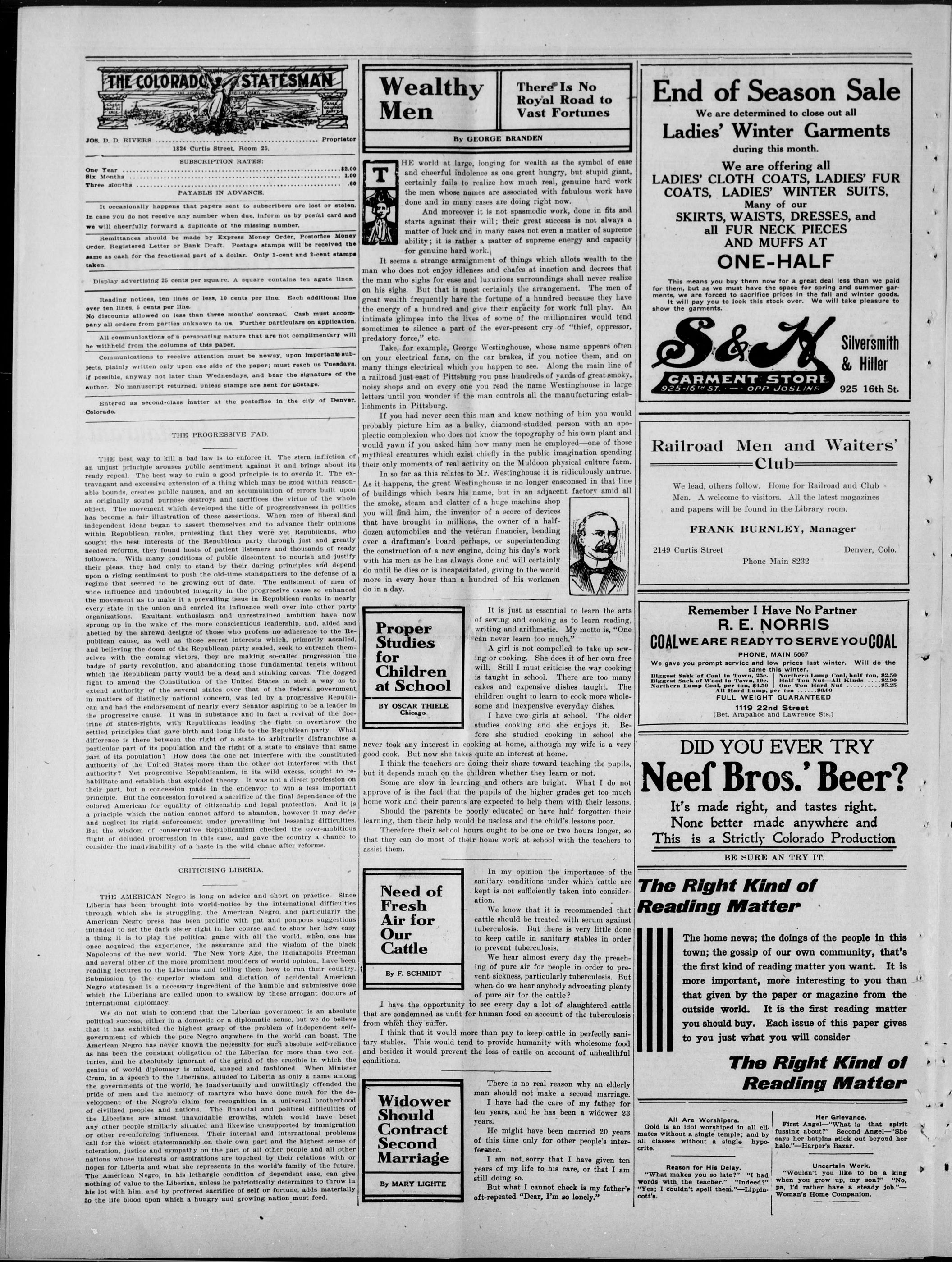
In so far as this relates to Mr. Westinghouse it is ridiculously untrue. As it happens, the great Westinghouse is no longer ensconced in that line of buildings which bears his name, but in an adjacent factory amid all the smoke, steam and clatter of a huge machine shop you will find him, the inventor of a score of devices that have brought in millions, the owner of a half-dozen automobiles and the veteran financier, bending over a draftman's board perhaps, or superintending the construction of a new engine, doing his day's work with his men as he has always done and will certainly do until he dies or is incapacitated, giving to the world more in every hour than a hundred of his workmen do in a day.
A. B.
Proper Studies for Children at School BY OSCAR THIELE Chicago
It is just as essential to learn the arts of sewing and cooking as to learn reading, writing and arithmetic. My motto is, "One can never learn too much."
A girl is not compelled to take up sewing or cooking. She does it of her own free will. Still I must criticise the way cooking is taught in school. There are too many cakes and expensive dishes taught. The children ought to learn to cook more wholesome and inexpensive everyday dishes.
I have two girls at school. The older studies cooking and she enjoys it. Before she studied cooking in school she never took any interest in cooking at home, although my wife is a very good cook. But now she takes quite an interest at home.
I think the teachers are doing their share toward teaching the pupils, but it depends much on the children whether they learn or not.
Some are slow in learning and others are bright. What I do not approve of is the fact that the pupils of the higher grades get too much home work and their parents are expected to help them with their lessons.
Should the parents be poorly educated or have half forgotten their learning, then their help would be useless and the child's lessons poor.
Therefore their school hours ought to be one or two hours longer, so that they can do most of their home work at school with the teachers to assist them.
Need of Fresh Air for Our Cattle
By F. SCHMIDT
In my opinion the importance of the sanitary conditions under which cattle are kept is not sufficiently taken into consideration.
We know that it is recommended that cattle should be treated with serum against tuberculosis. But there is very little done to keep cattle in sanitary stables in order to prevent tuberculosis.
We hear almost every day the preaching of pure air for people in order to prevent sickness, particularly tuberculosis. But when do we hear anybody advocating plenty of pure air for the cattle?
I have the opportunity to see every day a lot of slaughtered cattle that are condemned as unfit for human food on account of the tuberculosis from which they suffer.
I think that it would more than pay to keep cattle in perfectly sanitary stables. This would tend to provide humanity with wholesome food and besides it would prevent the loss of cattle on account of unhealthful conditions.
Widower Should Contract Second Marriage By MARY LIGHTE
There is no real reason why an elderly man should not make a second marriage.
I have had the care of my father for ten years, and he has been a widower 23 years.
He might have been married 20 years of this time only for other people's interference.
I am not sorry that I have given ten years of my life to his care, or that I am still doing so.
But what I cannot check is my father's oft-repeated "Dear, I'm so lonely."
End of Season Sale
We are determined to close out all Ladies' Winter Garments
We are offering all
LADIES' CLOTH COATS, LADIES' FUR
COATS, LADIES' WINTER SUITS,
Many of our
SKIRTS, WAISTS, DRESSES, and
all FUR NECK PIECES
AND MUFFS AT
ONE-HALF
This means you buy them now for a great deal less than we paid
for them, but as we must have the space for spring and summer gar-
ments, we are forced to sacrifice prices in the fall and winter goods.
It will pay you to look this stock over. We will take pleasure to
show the garments.
S & H
GARMENT STORE
925-16TH ST. — OPP. JOSLINS
Silversmith
& Hiller
925 16th St.
Silversmith
& Hiller
GARMENT STORE
925-16TH ST. - OPP. JOSLINS
925 16th St.
Railroad Men and Waiters' Club
We lead, others follow. Home for Railroad and Club Men. A welcome to visitors. All the latest magazines and papers will be found in the Library room.
FRANK BURNLEY, Manager
2149 Curtis Street Denver, Colo.
Phone Main 8232
Denver, Colo.
2149 Curtis Street
Phone Main 8232
Remember I Have No Partner R. E. NORRIS
COAL WE ARE READY TO SERVE YOU COAL
PHONE, MAIN 5067
We gave you prompt service and low prices last winter. Will do the same this winter.
Biggest Sack of Conl in Town, 25c. | Northern Lump Conl, half ton, $2.50
Biggest Sack of Wood in Town, 10c. | Half Ton Nut—All Kinds ... $2.90
Northern Lump Conl, per ton, $4.50 | One Ton Hard Nut ... $5.25
All Hard Lump, per ton ... $6.00
FULL WEIGHT GUARANTEED
1119 22nd Street
(Bet. Arapahoe and Lawrence Sts.)
DID YOU EVER TRY Neef Bros.' Beer?
DID YOU EVER TRY Neef Bros.' Beer?
It's made right, and tastes right. None better made anywhere and This is a Strictly Colorado Production BE SURE AN TRY IT.
The Right Kind of Reading Matter
The home news; the doings of the people in this town; the gossip of our own community, that's the first kind of reading matter you want. It is more important, more interesting to you than that given by the paper or magazine from the outside world. It is the first reading matter you should buy. Each issue of this paper gives to you just what you will consider
The Right Kind of Reading Matter
Her Grievance.
First Angel—"What is that spirit fussing about?" Second Angel—"She says her hatpins stick out beyond her halo."—Harper's Bazar.
All Are Worshipers. Gold is an idol worshiped in all climates without a single temple; and by all classes without a single hypocrite.
Uncertain Work.
"Wouldn't you like to be a king when you grow up, my son?" "No, pa, I'd rather have a steady job."—Woman's Home Companion.
"What makes you so late?" "I had words with the teacher." "Indeed?" "Yes; I couldn't spell them."—Lippin-cott's.
"Wouldn't you like to be a king when you grow up, my son?" "No, pa, I'd rather have a steady job."—Woman's Home Companion.
Dr. Huff was called to look after Mr. E. Posey this week.
Fireman Oglesby's little daughter, Corine, is confined with illness.
Mrs. Sallie Robinson returned to her home in Aspen last Monday night.
son, J. C. Cooper, A. Campbell, Lewis, P. E. Spratlin, B. P. Johnso H. Brown of Glenwood Sprin Colo., is in the city on business.
THE SODA BOYS.
East Turner hall was packed to fullest capacity last Wednesday night.
Mrs. Carrie Washington was operat ed on at St. Joseph's hospital Tuesday.
Henry Banks of 1329 Logan avenue was unable to work last week, on account of illness.
Mrs. George E. Contee, who has been suffering with the la gripe for two weeks, is able to be out.
Mrs. Ward, wife of Rev. Ward of Shorter's Chapel, who has been sick, is now improving.
We are pleased to anounce that C. H. Harris, who has been very ill at his home, 1336 So. Acoma street, is well again.
Mr. O. Powell of Lawrence, Kans., arrived in the city last Friday and is the guest of his cousin, Miss Mable Lewis of 1115 Inca street.
Mrs. M. G. Stokes returned home this week after a three months' trip to Los Angeles, Calif., where she went for the benefit of her health.
The funeral of Mr. B. Henderson was held Sunday from the People's Presbyterian church. Rev. J. A. Thos. Hazell preached. Undertaker A. M. Lawhorn in charge.
Look out for the 23rd at the People's Presbyterian church. See the screaming farce "On Account of the Lobster" and hear the Select Chorus of twenty-five voices.
Tickets are out for the banquet of the People's Sunday Alliance to be held at the chapel of People's Presbyterian church on March 30th, to celebrate its 11th anniversary.
Mrs. Mary Evans died Monday morning at the County hospital. She was the grand mother of Mrs. Walter May Chapman. Her funeral was held Wednesday afternoon at 2 p. m. from the parlors of Undertaker A. M. Lawhorn. Rev. A. M. Ward preached.
A sacred drama and cantata will be given by the St. Mary's Altar Guild of the Church of the Redeemer, assisted by the Azalia Hackley chorus, in the People's Presbyterian church, Twenty-third avenue and Washington street, Thursday evening, March 16, 1911, at 8:15. Admission 25 cents; children under 12 years 15 cents, at the door.
Dr. E. L. Faulkner, one of the most prominent physicians of the city will deliver an interesting paper before the East End Literary Society next Friday evening, March 17, and earnest request is extended to everybody to hear this paper of interest. Bethlehem Baptist church, 2716 Larimer.
Wednesday evening the Rev. J. A. Thos.-Hazell united into wedlock Mr. William J. Baker of this city and Miss Elizabeth McCllan of Los Angeles, Cal. The ceremony took place in the study of the pastor in the presence of a few intimate friends of the groom. We wish the newly married couple every success in their marital undertaking.
Registered at the Hotel Abyssinia;
Mr. Day, better known as Ray La
Da, son of King of Abyssinia; Mr. G.
D. Duncan, minister to Abyssinia; Mr.
Henry Lewis, Denver, Colo., Mr. S. B.
Corbin, Chicago, Ill.; Mr. A. W. Wilson, Chicago, Ill.; Mr. H. I. McKengle, Chicago, Ill.; Mr. S. G. Thompson, St.,
Louis, Mo.; Mr. H. Brown, Glenwood Springs, Colo.; Mr. C. R. Thompson, Chicago, Ill.; Rev. J. P. Watson, Pueblo, Colo.; Rev. Hughes, Pueblo, Colo.; Mr. Jorn Liles, New York; Mr. F. S. Wagner, Chicago, Ill.; Mr. W. H. Young, Colorado Springs.
On Friday evening of last week Mrs. Wm. Sprague was hostess at a 6 o'clock tea in honor of Mrs. P. Locke of Kansas City, Mo. The prettily gowned ladies, the repartee, and the daly repast, served to make the evening one of long remembrance. The guests invited to meet Mrs. Locke were: Mesdames M. Keelan, D. Jackson, G. Ingram, C. Smithea, A. Gaines, R. K. DePriest, Wm. Hickman, C. Joseph, M. Quoin, H. Gatewood, H. John-
son, J. C. Cooper, A. Campbell, L. Lewis, P. E. Spratlin, B. P. Johnson. H. Brown of Glenwood Springs, Colo., is in the city on business.
THE SODA BOYS.
East Turner hall was packed to its fullest capacity last Wednesday night. The occasion being the annual ball of the Soda Dispensers' Mutual Benefit and Progressive Association. No event has equalled this elaborate affair in attendance, artistic decorations and mirth, for which the entertaining committee, as well as the members of the association, is being warmly congratulated from all sides. The colors, yellow and white, were represented with abundance of flowers. The grand march took place at 11 o'clock, led by the soda dispensers and was a spectacular scene, especially that of the gorgeous gowns worn by the ladies. Refreshments consisted of the best in the market were served free to everybody, while all kinds of soft drinks were served from a beautifully decorated soda fountain by expert soda dispensers. It will go down in social history as one of the grandest and most enjoyable events ever pulled off in Denver. The entertaining committee comprised J. W. Levell, chairman; John Watkins, Ernest Parks, Loyd Hall and Pearl Mason, Boys, accept the congratulations of the Colorado Statesman on your great success.
Mr. Dan Strosier and Mock Smart have resigned their positions with the Rocky Mountain Athletic Association and gone in business for themselves at 821 20th street. The rumor that Mr. Walker or the Rocky Mountain Athletic Association are in any way interested is entirely without foundation and is untrue. VICTOR WALKER.
SHORTER'S GREAT REVIVAL
The revival at Shorter started with a great outlook this week. The Rev. J. S. Payne of Boulder, the great evangelist and sweet singer of the Colorado conference is conducting this series of meetings. The first week has been very successful. The pastor urges that all redable their efforts for the closing next week. Sunday's services will be conducted by the pastor at the usual hours. Special work will be done with the young people in the Sunday school and in the In Endeavor League.
NOTES OF THE PEOPLE'S PRESBY
TERIAN CHURCH.
Sermon Topics, Sunday, March 12th 11 a. m., "A Model Churchman." 6:45 n. m., Y. P. S. C. E.
7:30 p.m. "Playing the Fool."
7:30 p. m. Playing the Foo.
At both diet of the services we propose to deliver two extrordinarily strong discourses. That our church year ends with March and that we are now breaking up the hollow ground for a New Year's work, it would pay every member to hear the truth. Visitors are cordially invited to attend these services.
The Guild will meet with Miss Florence Crawford, 2247 Glenarm Place, next Tuesday night. Miss Vera Finney will read a paper under the auspices of the Foreign Missionary Enterprise, by Julson and Newell, 1812.
Communion of the Lord's Supper, baptism and public reception of members will take place the last Sunday night of the month, being the last Sabbath of the year. Our church books will be closed 31st inst. Delinquent members are respectfully urged to square up with the year.
A CALL TO ARMSI
The Y. M. C. B. seemed to open fire on the enemy, Sin, at its meeting last Sunday afternoon at Shorter Chapel, Jim Good heart of the Sunshine Rescue Mission was the commanding officer, and led a gallant charge. He was ably followed by the Christian workers in song and prayer. Eight young men came forward for prayer.
Such work is in keeping with the spirit of the Y. M. C. A. work and the Y. M. C. B. does not intend to let its share go undone. Sunday afternoon at 4 o'clock another splendid meeting of the same sort will be conducted by the Rev. A. M. Ward. The singing is to be made a special feature. If you are a Christian it is your duty to be present to help carry on the good work. If you are a sinner you should come to make sure your soul's salvation.
Owing to the revival services held by the Y. M. C. B. on the next two Sunday afternoons the Taka Art Club which was to conduct the Ladies' Day exercises tomorrow has kindly consented to give their excellent program on the first Sunday in April. The great evangelist from Kansas
City, the Rev. Geo. McNeal, who will conduct Central's revival next week, will be the leader of the Y. M. C. B campaign for next Sunday, the 19th. Don't fail to hear him.
Y. M. C. B. meetings are held at Shorter Chapel at 4 p. m. for the next three months.
Meet the Y. M. C. B. Bible class tonight at 8 o'clock at 2712 Welton. This class is to be the moving force in the Y. M. C. B. and you should be one of the workers in the movement.
DON'T MAKE A MISTAKE.
From several towns comes news of another battle between the so-called wets and drys. This time the battle will be fought to a finish at Boulder and Colorado Springs. Speaking frankly of the matter, it is hoped that the colored people of these cities will look well before they vote. No one will deny the fact that the employment of our people at these places are for the most part as waiters in hotels and clubs and to vote for any measure that would reduce the already too small a number would appear to be anything but common sense. Especially so at Colorado Springs, where a large number of our people are employed in the above mentioned capacity.
It is hard to conceive how any one who depends upon a demand for their services would for a moment think of opposing such a lawful and business-like proposition as set forth by the liquor people of Colorado Springs, is almost unconceiveable. We had just as well be frank with one another and admit that it is foolish to complain of not being able to secure employment and then to satisfy some selfish whims, vote to render the servives of our waiters unnecessary thus crippling every business enterprise that out people are conducting. There is and will be for some time to come a demand upon our people for religious and charitable contributions a call to which they are known to respond. But if they are deprived of a chance to secure employment, "which is likely if the so-called drys win." How can they contribute to any cause, and if there is no business in a city that requires the services of our people, but a small number will be found therein. It is therefore hoped that the warning be heeded. Don't make a mistake.
NOTICE
The change in phone service of Dr. J. H. P. Westbrook. His patients can reach him at night over Phone Champa 570.
Dear Sir: We were called upon to take charge of the remains and conduct the funeral of Mr. Hackley. We met the body in Benton Harbor Monday evening, took the remains to our parlors and buried the body yesterday, conducting the funeral from the residence of daughter. Would say body was in fine shape and your work complimented upon by relatives.
Fraternally yours,
BAITINGER & KINGSLEY CO.
Seven room modern house fine neighborhood; rent $25. See Dr. Westbrook.
For rent, modern furnished rooms. Apply to Z. Hooper, 2507 Lafayette street.
Nicely furnished rooms in modern house; gentleman preferred, 2218 Clarkson street. Phone York 6121.
Brickler's New Barber Shop is located at 2208 Larimer street. Shave, 10c. Hair Cut, 25c; Children, 15c.
FOR RENT.
2345 Ogden, 4 room, upper flat with bath and electric light and furnace. Apply 2417 Ogden.
A NEW AND WELCOME VISITOR,
THE CAPITOL BREWING CO.
For a good and wholesome drink
don't forget the Capitol beer. It stands
among the best and acknowledges no
superior. If you have not drank it
be sure to order it.
There is more in our brew than a drink;
There is more in a drink than mere pleasure;
There is health and strength throughout life's length,
With happiness beyond measure.
MISS HATTIE MALONEY MAKES
$4.00 THE FIRST DAY.
The Afro-American Fraternal Life and Benefit Association pays you your sick and accident benefits while you are sick or hurt, not waiting until you are well. Five, ten and fifteen dollars per week sick and accident policies for $1.00, $2.00 and $3.00 per month.
We are still crying for agents. One perfectly new agent, Miss Hattie Maloney, wrote an application to-day, making just $4.00 for herself for the first days work. Come on and work for a good concern. Stop complaining about hard times. See J. H. Morris, cur general agent, at noon any day. 1020 19th street, Denver, Colo.
DON'T MISS THIS OPPORTUNITY.
For sale, 80 acres, good house, barn, chicken house, 15 acres plowed; four miles from Delta; center of fruit belt. Inquire at this office.
If you are going to buy property, do not do it until you have the title examined, so you may know if you are buying a good title or a lawsuit. Lawyer W. B. Townsend will tell you all about it at 209 Kittedge Building.
New Industry in Prospect.
In China the fiber of the sunflower stalk is woven into beautiful fabrics and it is believed that by the use of the proper machinery it might be used most profitably in this country.
The Koh-I-Noor.
The Koh-i-nor diamond originally welghed 800 karats, but by successive cuttings has been reduced to 106 karats.
Use for Egg Shells.
Egg shells, instead of being thrown away, should be dried in the oven and kept for cleaning bottles.
Foundation or Good manner.
"Good manners," said Archbishop Temple, "demand three things: self-control, self-denial, and self-respect."
Old Galley a Curlosity.
A Turkish state galley, 250 years old, with seats for 48 rowers, has been discovered in the disused part of the Yall klosk, Constantinople. The hull is richly gilt and inlaid with mother-of-pearl. It is proposed to preserve the ship in a museum.
SUMMONS IN DIVORCE.
The People of the State of Colorado, to the Defendant above named, Greeting;
You are hereby required to appear in an action brought against you by the Court of the City and County Court of the City and County of Denver, State of Colorado, and answer the complaint therein within thirty days after the service thereof you served within this State, or within fifty days after the service thereof if served personally outside the State of Colorado, or, if served by publication with no notice of the publication, or trial will be had the same as though you were present.
This is an action brought to obtain a decree of divorce on the grounds of nonpayment and desertion for more than one year last past and that defendant, without obtaining a divorce from plaintiff, has married one third of the debt relief as may seem to the Court just and equitable from the complaint, a copy of which is hereunto attached, and the evidence adduced upon the trial.
Witness, Thomas L. Bonfills, Clerk of the County Court, in and for the said City and County of Denver, at his office in Denver this 27th day of January, 2014, the seal of said court affirmed.
THOMAS L. BONFILS,
(Seal) Clerk of the County Court.
By K. P. MACE, Deputy.
Hours: 10 to 11 a. m., 2 to 5 and 7 to 9
p. m. and by Appointment.
Dr. J. H. P. Westbrook
COR. 21ST AND ARAPAHOE STS
Day Phone Main 1144.
Night Phone Champa 570.
ERNEST HOWARD
Carpenter and Contractor
Job and Repair Work a Specialty
Res. 353 W. Warren Ave.
Phone South 1862
Shop 1021 Twenty-First St.
Phone Main 1144
FORD'S
HAIR POMADE
THE OLD RELIABLE DRESSING FOR KINKY OR CURLY HAIR. IT'S USE MAKES STUBBORN, HARSH HAIR SOFTER, MORE PLIABLE AND GLOSSY, EASY TO COME AND PUT UP IN ANY STYLE THE LENGTH WILL PERMIT. WRITE FOR TESTIMONIES, TELLING HOW THIS REMARKABLE REMEDY MAKES SHORT, KINNY HAIR GROW LONG AND WAVY, BEST POMADE ON THE MARKET FOR DANDRUFF, ITCHING OF THE SCALP AND FALLING OUT OF THE HAIR. BEWARE OF IMITATIONS, GET THE GENUINE, PUT UP IN 25* AND 50* BOTTLES WITH CHARLES FORD'S NAME ON EVERY PACKAGE.
• SOLD BY DRUGGISTS.
• IF YOUR DRUGGIST CANNOT SUPPLY YOU, WE WILL SEND IT TO YOU DIRECT AT THE FOLLOWING PRICES, SMALL SIZED BOTTLE, 25* LARGE SIZED BOTTLE, 50* THE OZONIZED OX MARROW CS.
216 LAKE ST., DEPT. 30 CHICAGO, ILL.
AGENTS WANTED.
The CAPITOL BREWING COMPANY
The purity of Capitol Beer is demonstrated by its superior flavor and strength-giving qualities. It's capital.
HAVE A CASE SENT HOME.
The Capitol Brewing Co.
Phone Champa 356.
Delivered Anywhere.
To make room for new Dinnerware patterns arriving daily, we have decided to put on sale at half price
Four Patterns in Semi Porcelain in Neat Borders and Hand Decorations
As the stock is limited, come early and avoid being disappointed.
Thin Lead-blown Water Glasses, 90c values, dozen.....50c
Deep Needle - etched Water Glasses, $1.00 and $1.25 values, dozen.....75c
Teaspoons, Electric Silver Plate, 50c values, dozen.....30c
Dessert Spoons, Electric Silver Plate, $1.00 value, dozen.....60c
$10 Electrolier, with 12 in.
Frame in Brushed Brass,
and Gunmetal Finishes.
THE ZOBEL
SAMPLE
1004 Nineteenth Str
STROLLER, with 12 in. Art Glass Dome, P
in Brushed Brass, Copper, Verde
unmetal Finishes. Special . . .
THE ZOBEL BROTHE
AMPLE ROO
Nineteenth Street, Corner of
$10 Electrolier, with 12 in. Art Glass Dome, Pedestal and Frame in Brushed Brass, Copper, Verde and Gunmetal Finishes. Special . . . $7.50
THE ZOBEL BROTHERS'
SAMPLE ROOM
1004 Nineteenth Street, Corner of Curtis
FINE WINES, LIQUORS AND CIGARS
COORS' CELEBRATED BEER ON TAP
---
CHARLES S. WEST
WEST CONFECTIONARY ICE CREAM
WEST BRO
CONFECTIONERY
and
ICE CREAM PARLOR
Baur's Ice Cream Johnston's C
EVERYTHING clean. Prom attention. The patr respectfully solicite
EVERYTHING is neat and clean. Prompt and courteous attention. The patronage of the public respectfully solicited. Ice cream will
EVERYTHING is neat and clean. Prompt and courteous attention. The patronage of the public respectfully solicited. Ice cream will be sold in any quantity, to take home with you. All the latest Soda Fountain Drinks and Chili served at all hours. Also a fine grade of Cigars
DENVER
Teaspoons, Electric Silver Plate,
50c values, dozen.....30c
Dessert Spoons, Electric Silver
Plate, 1.00 value, dozen.....60c
Art Glass Dome, Pedestal and
hopper, Verde
special . . . $7.50
BROTHERS'
E ROOM
et, Corner of Curtis
JOHN W. WEST BROS.
---
COLORADO
Always Staunch And True
The Denver Republican has always avoided the fallacies and knaveries of yellow journalism, and its steadily increasing Circulation proves conclusively that its policy of telling the plain Truth without exaggeration or misrepresentation, standing fast for the Right, is heartily approved with growing force by the intelligent Public to which it appeals.
To read it is a liberal Education, and the citizen who goes without it does a positive harm to himself, to his family, and to the community.
In no other way can the investment of 2 1/2 cents per day for that is all The Republican costs any subscriber—bring such rich results in that Knowledge which is both Power and Pleasure. Information, instruction and entertainment fill its columns and it leaves a good taste in the mouth of the reader. It stands for Law and Order in the State—for Peace, Prosperity and Happiness in the Home. If you are not already enrolled among its splendid list of Patrons send on your subscription and give it a fair trial at 75 cents per month for Daily and Sunday.
The
WARD AUCTION
COMPANY
Sales Daily at 2 p.m. Office Furniture a Specialty.
PRIVATE SALES AT ALL TIMES
HAVE MOVED TO—
1723-39 GLENARM ST.
PHONE MAIN 1675.
---
Miss M. Cowden Hair Dressing Parlor
Miss M. Cowden Hair Dressing Parlor
Shampoo, cutting and curling. Scalp treatment, hair tonics, hair straightening, manicuring. Stage wigs for rent; theatrical use and masquerades. Goods delivered out of the city. All shades of hair matched by sending sample of hair; also combings made up.
Cheapest Switches 50 Cents
1219 21st St. Denver, Colo.
NAST
The Popular Photograhper Only Caters to First-class Trade Our Pictures speak for Themselves.
Job Printing
See Us Before Going Else-where
We are here to serve you with anything in the line of printed stationery for your business and personal use. □ □ □ □
Letter Heads Bill Heads
Envelopes Cards
Wedding Invitations
Posters or Announcements
Of All Kinds
The best quality of work at prices that are RIGHT
---
NATIONAL CAPITAL AFFAIRS
Mine Rescue Squads Reduce Deaths
Dog in Arms Rouses a Congressman
Protest Made at Hatien Bank Move
Protest Made at Hatien Bank Move
HE'S TALKED AN HOUR
THINK OF IT- GENTLE-MEN- THIS - B-II-L-L CALLS FOR 30 CENTS- I-T-S DAY-LIGHT ROBBERY!
WASHINGTON.—The craze for statistics has invaded the most sacred of precincts. It has attacked, assaulted, indicted and convinced the most parloous of statisticians themselves—the members of congress.
Proof, by statistics furnished right on the floor of the house, that the speeches there cost more than the total amounts of many of the items under discussion has left the entire aggregation in chronic terror that, when their most flowery orations are being speeded on their way to the morgue of the Congressional Record, some treacherous antagonist may arise, reverse his cuffs and read off evidence that the honorable gentleman's silence would be golden.
Like the famous discovery of dry farming in the west, because of the hoofprint of a mule, the economy of words in congress was precipitated by horseshoes.
The state department had an item
DEATHS of coal miners in explosions last year were reduced 25 per cent. by the rescue system in augmented by the federal government. For many years this rescue work was left to the different states and was indifferently done. As the death rate grew about ten per cent, annually, the federal government decided it was time to take charge of this work itself. Six stations have been established. One of these is at Trinidad, Colo.; another at Rock Springs, Wyo., and others in various parts of the coal producing country.
These stations are old Pullman sleeping cars, in which four men spend all their time, night and day, never going further than a few minutes' walk from the car. In charge of the party is a mining engineer. The others are a practical miner, a hospital attendant capable of giving first aid to the injured and a cook. The car is equipped with rescue apparatus ready for Immediate use and there are
THE idle rich woman, who fondles her poodle dog, leaving the care of her children to servants, has been delivered a stinging slap by a western representative. He has nothing to say against the poodle, but his mistress he believes to be un-American. The American home is being undermined by this kind of woman, he thinks. She constitutes a grave national problem which should be speedily solved.
"Poodle dogs are usurpers, and should be returned to their proper place in the home," said he.
"While I was passing in front of a residence that cost hundreds of thousands of dollars, an elaborately dressed woman came out," he said. "She carried in her arms a costly poodle dog, and as she stepped into her carriage, two of her servants, wearing high silk hats, bowed almost to their knees. One assisted her to enter the carriage while the other draped her
ANOTHER financial situation in Latin-America which is seriously engaging the attention of the state department, with a view to protecting American interests, is the confused monetary condition of Haiti. It is proposed by Haiti to substitute for the Haitien National bank, a French corporation which controls the financial dealings of the country, a similar banking concession to be granted to a group of German, French and American bankers, the German interests predominating.
Some time ago the United States protested against the proposed arrangement on the ground that American interests were not properly protected. Since then the Haltien government has made some modifications
of $237.66 for horseshoeing. Missouri representatives declared they were from the "show me state." The secretary of state couldn't show the shoes, which had been worn out. There was a quarter of an hour of oratory when up rose a representative from Pennsylvania. "Gentlemen," he said, "it costs $10,000 an hour to run this house, and we have already spent $2,500 worth of words trying to skin a $237 item. Let's quit."
The total of the year's appropriation for the upkeep of the house was $4,567,824.10. Actual working days number 90, and the average time of a day's work is five hours. The normal 2,160 hours in 90 days would make the house expense run into $2,114.73 per hour, on a 24-hour basis. But allowing only five hours of honest work per day, the expense amounts to $10,573.65 per hour.
The salary roll of the members amounts to $2,989,050. Their mileage is $154,000. The clerks cost $598,500 for those who are credited to members, and $133,800 for clerks of committees. There are a number of minor items, among them the salary of $1,200 that goes to the chaplain who prays for congress's wisdom. He is about the poorest paid of all, considering the size of his job.
sleeping apartments for the men.
When news comes of a mine disaster an engine is attached to the car and it is rushed to the scene of the disaster.
Upon arrival, the mining engineer in charge of the government rescue squad and apparatus takes charge of the mine and from the general manager down to the mule driver, all obey his orders and do it on the jump. He organizes rescue parties, equipping each man with an oxygen helmet enabling him to withstand any kind of poisonous gases for two hours. Then, with his helmeted squad behind him, the mining engineer enters the mine and begins a search for dead and dying miners.
The rescue parties carry pulmotors, with which to revive dying miners with oxygen. Fifteen lives are said to have been saved last year by use of this device.
In West Virginia last year there was a mine owner who had no faith in the pulmotors. He insisted on going into the mine with the rescue party and did not wear a helmet. He was found unconscious from the effect of noxious gases, but by the application of the pulmotor was revived and taken out alive. He immediately ordered a consignment of the little oxygen pumps and had his men instructed in their use.
dress about her feet. A moment later a negro servant came out wheeling a baby carriage, and I crossed the street to find out that the baby carriage held the woman's little son. The thought of the woman holding the poode dog, where the child should have been, while she gave the animal its morning outing, seemed inhuman to me, when I thought of the child being taken out by the servant.
"But, finally, I decided that the poode was more to be pitted than the child. It was in worse company. But the sad part about the whole incident was that a mother could go smilingly away from her baby boy, while she cuddled and patted the insignificant little dog as her side. Poodles are all right as pets for children, and, incidentally, for older people. But before they are allowed to take the places of children in our homes, I would rather see every poode in the nation drawn and quartered.
"The only kind of a home which is worth while is the home where the mother gives her first and best thought to her children. Too often in America today rich women care nothing for their offspring, but would rather bestow their foolish affection on pets that really amount to notting."
In its original plan, but the changes have not been sufficient, in the opinion of the state department, to warrant the withdrawal of the American protest.
In connection with the national bank concession Haiti is trying to float a loan to fund its interior debt. The course which will be adopted in regard to Haitien bonds in this relation is of interest to the United States government because many American creditors of Haiti have been paid in bonds of that government. So if such bonds are scaled down the people who received them on the basis of their former value, in the opinion of the state department, will have grounds for a claim in equity.
The possibility of American bankers participating in the loan also causes the state department to believe that it is the moral duty of this government to scrutinize closely the transaction to see that no contract is entered into which cannot be backed up by the United States in case at some future time Halti falls to fulfill her obligations.
His Only Brief
By CARL JENKINS
(Copyright, 1911, by Associated Literary Press.)
Fred Fairlee's friends looked upon the affair as a joke. It was all right to go to college and stumble through a classical course, after a fashion, but to take up law and slide through with it and then open an office for practice—why, they couldn't believe what their ears heard.
Fred Fairlee was the son of a millionaire widow, and he had money of his own. A college course was the thing, in order that he might cheer for Harvard, Yale or Princeton, when the regattas and football games came off, but why should he study law, and hang out a shingle and wait for clients?
It was a fad of his mother's. In the long past there had been a jurist among the Fairlees. He had risen to such heights that he had been mentioned in the Log Cabin history of Kentucky. Things had dated back to him. No one in the family since his time had been a jurist, and it had been decided before Fred was 15 years old that he should pick up the mantel of his ancestor and wrap it around him. Later on he started out to be a jurist, simply to oblige his mother. There were four or five years of football, rowing, boxing, suppers, vacations and study, and behold the jurist! That is, Fred wasn't quite a jurist yet, but on the high road to it.
Even his mother, who knew so little of law, argued that he must first set up an office and win a case or two. Fred was a good boy to a good mother, and he made a start. He was modest about it, however. He began at the foot of the ladder, by opening his office in a suburban village, near which was the family summer residence. It was one floor up and only—one room. There was at least one law book—possibly two. There was a set of boxing gloves, a lifting machine, a pair of Indian clubs and a gun or two. The old-time jurists didn't have such outfits to begin with, and that's the reason it took them so long to get their fame.
For five long months Attorney F. Fairlee drove, walked, fished, rowed, hunted and waited for a client. He was doing better than he had any reason to expect when his mother busted in on him one day with the glad exclamation:
"Oh, Fred, I've found you a client!"
"Do I have to pay him anything for bringing the case to me?" was asked.
"You will make a great name!"
"That's what I am often."
"That's what I am after."
"Your client is a young lady!"
"By George, but I never expected to live to see the day!"
"Be serious, Fred. Your legal reputation is at stake. You must have heard of Miss Lossing. The family lives three miles from us. She has been at the house, but never when you were there. She's tall and willow and blonde, and the family is among the best."
"Oh, that girl, eh?" mused Fred.
"On three occasions she's almost run me down in her auto. And what's the matter with her?"
"A farmer with a load of hay ran into her auto and upset it and bruised her all over and did $200 damages. She wants to bring suit. I was calling at the house yesterday and told her about you, and she will come in with me in three days. Oh, Fred, it's the chance of your lifetime!"
"Thanks, mother, dear, I believe you. It's going to be an easy case to win. Handsome young lady out for a spin. Farmer with a load of hay. Young lady is happy, but the farmer has a grouch. Sees the opportunity to crowd her into the ditch. Does crowd. Her auto wrecked and her nervous system shattered by the shock. Jury won't be out ten minutes. Heavy damages and a moral lesson to the farmers of all America. Say, mother, you're a brick!"
Two or three days later, chaperoned by Mrs. Fairlee, the client appeared at the law office. She instantly looked good to the coming jurist. The more he looked at her the more pleased he was with her as a client. It wasn't a formal affair. That is, Mr. Fairlee didn't try to look as wise as a horned owl and go into all the little legal details of the case. Miss Lossing said she had been bruised. She was not asked the exact number of her bruises. Her auto had been damaged. She was not asked to figure the costs to a cent. She had screamed as the auto went over. The number of screams was not solemnly recorded. When her case had been stated and she had looked up in a pathetic way and asked the young attorney what he thought the chances were of winning, he heartily and promptly replied:
"Miss Lossing, we'll win in a canter—that is, in a boat's length—that is, by a neck. Why, the case is won before being begun. You must rest easy and leave it all to me." Mr. Fairlee got down his law book and his sporting calendar and began work at once. The case should be rigidly prepared. In two days he found it necessary to drive out to the Lossing manor and ask his client two or three questions. Three days later he had to go again. Then his client had to come in with his mother, and the trio lunched at a hotel as they went over the case.
When the farmer was served with a warrant Mr. Fairlee had to make another drive, to tell Miss Lossing that he was hustling on the case, and was sure of winning. Then he had to drive out again to tell her that the opposing counsel had asked for and been granted an adjournment, but it would make no difference with the verdict when the trial came on. That is, if it made any difference, it would be in her favor. Then there were two or three times he drove out that no mention was made of the suit at all, but all the talk was social.
According to the way Attorney Fairlee figured out the case, the farmer would sooner or later come to him and offer at least $500 and the most abject apology to settle the case out of court. According to the farmer, he would fight it to the last ditch. He got two adjournments, and then the case was ready for trial. Between the two adjournments there was more driving out to the manor, but even lawsuits cannot go on forever. There came a day when the attorney drove out to find his client in tears. He thought she had quite recovered from the nervous shock, but it looked as if she hadn't. He was rather pleased. It meant a heavier verdict in her favor. When Miss Lossing could control her emotions she asked:
"Mr. Fairlee, is there any law about driving on the highway?" "You must keep to the right."
"Does that apply to women?"
"Of course."
"But if a woman is on the left-hand side and doesn't feel like crossing over—"
"Oh, she mustn't feel that way."
"I know that an old woman driving a milk wagon should cross over, but if it's a girl, and she is in her auto, she shouldn't be obliged to, should she?
"Miss Lossing," said Mr. Fairlee.
"I understood that when you met Farmer Jones you were on the right-hand side of the road."
"I—I thought I was, but I guess I wasn't."
"And he drove into your auto?"
"I—I guess I drove into his load of hay!"
Mr. Fairlee, attorney-at-law and coming Log Cabin jurist, rose up and paced back and forth for two minutes and then delivered himself of this opinion:
"Miss Lossing, we are beaten on our case higher than a kite!"
"Oh, I'm so sorry!"
"But it is just as well. I have decided to drop the law and take up—"
"What?" she whispered.
"This!" he replied, as he reached for her hand and continued to hold it until her mother was heard coming out on the veranda.
Famous French Hunting Dogs. Like their masters the aristocratic feerhounds of France were much dispersed in the days of the guillotine; but unlike them they made friends among the common people. So animals with pedigrees going back to Louis XI took up contented lives in homes of peasants. Thus they passed the period of the emigration, but not without certain damage to their heredity. Some pure old races were preserved only through a small pack or pair of dogs. Such is the race of Saintonge. In 1789 it was on the point of disappearing. If it exists still it is thanks to a physician of Saintes, Doctor Clemot, to whom the Marquis de la Porte-aux-Loups entrusted three dogs. On the return of the marquis from the emigration Doctor Clemot gave back the increased family, and these are the ancestors of all the pure Saintonge hounds of today.
Wants Aeroplane to Deliver Fish.
Who says the aeroplane has not reached the commercial stage? If anyone has any doubt about the aeroplane reaching the commercial stage, all he has to do is to go to Flushing, New York, and see Frank H. Baker, who has a fish market there.
"I have advertised for an aeroplane to deliver fish," said Baker. "I have as yet had no replies. I never used an aeroplane in the business before and have not worked out the system for delivery, but I have advertised and hope that someone will come along with an aeroplane fit for fish delivery."
Peculiarities of Nations.
No nation loves nature so much as the German. The Italian travels to get somewhere; the German to travel. The country walk for its own sake is a German discovery. The Englishman's ideal is a park, the German's a wood, and the Frenchman loves his boulevard.—Hamburger Zeitung.
"I hear that Dicksle has his business in a hole."
"Why, I heard he was making money at it."
"So he is. You see, his business is digging sewers."
She Liked the Process.
Gerald—You accepted me last night, and now you say you refuse me.
May—Well, I'll tell you what—you propose again and we'll make it best two out of three.—Stray Stories.
Ice Cream, Ices, Candies
MUSIC
VOCAL-PIANO-ORGAN
Voice Culture a Specialty
(Voice -- Song -- Speech)
Madam Seiler and Emil
Behnke's Methods
TERMS MODERATE
Apply
Hewetson-Watson
2631 Humboldt St.
Phone York 2341 Denver
Phones, Office Main 5595.
Residence, York 123.
Hours: 9 to 11 a.m., 1 to 4, 7 to 8 p.m.
Sundays: 10 to 11:30 a.m., 2 to 4p.m.
Dr. P. E. Spratlin
Good Block-1557 Larimer St.
Residence 2230 Clarkson St.
Denver, Colorado.
Phone Main 7241
Money to Loan on Good Security.
J. A. WHITTAKER & CO.
REAL ESTATE
City Property and Farm Lands
City Property to Trade for Lands. Garden tracts for Sale and Trade.
TRADES A SPECIALTY.
918 Nineteenth St Denver, Colo.
CREDIT
?
YES
PHONE
MAIN
6316
T. H. Wearne
Furniture
CARPETS, STOVES AND
WINDOW SHADES
First Class Repairing and Upholstering
1449-55 Welton Street
For Sale
Vaccine lots in parts of the City from $35 up. Terms so small you can pay out and not miss the money. Why not put some of that cigar money in a pair of lots.
The Colored Amer. Loan & Realty Co.
Phone Main 5554, 913 21 St.
THE BEST ICE CREAM AND CANDIES AT
O.P. BAUR & CO.
CATERERS AND
CONFECTIONERS
Phone: 168.
1512 Curtis Street, Denver, Colo.
TurnOver
a New Leaf
By subscribing
for THIS PAPER
NEW NEWS OF YESTERDAY by E. J. Edwards
Made Public His Resignation
Made Public His Resignation
ThoughtJohnSherman a Thief
How Gen. Jacob D. Cox of Ohio Com pelled Grant to Permit Him to Retire From the Cabinet.
Jacob D. Cox, major general in the Union army, governor of Ohio, secretary of the interior in Grant's first cabinet, president of the Wabash railroad, member of congress, president of the University of Cincinnati, military historian, and eminent in microscopy, was born in Montreal in 1828. That was because his parents were living there temporarily, his father having been engaged to construct the great Notre Dame cathedral after various European engineers had failed ignominiously in the task. General Cox, who died in 1900, would therefore have been eligible to the presidency; and in his own state of Ohio, after he had been elected governor, there were many Republicans who believed that in due time he would become a prominent candidate for the Republican nomination for president.
General Cox was elected governor of Ohio while still in active command in the Union army, and he resigned that command so that he might be inaugurated as governor in 1866. Between him and General Grant, and especially between him and General Sherman, a warm friendship, which ripened into close intimacy, was established. It was in part due to this friendship that President Grant, in 1869, asked General Cox to enter his first cabinet as secretary of the interior. A year and a half later General Cox resigned the office of secretary of the interior, and, while leading Republicans knew that this act was due to a difference of view between him and President Grant respecting the administration of the interior department, nevertheless there was never a clear understanding on the part of the American public as to what the difference was.
Yet the matter was easy to explain. When General Cox became secretary of the interior he decided that the department should be administered as far as possible along the lines of real civil service. He objected earnestly to making the department an asylum for hack politicians; he wanted efficiency and merit the standard in his department. President Grant, however, was unable to resist the importance of certain place-hunting Republican politicians, and at last a clear issue was raised between him and his secretary of the interior.
While this issue was still on General Cox sought out two of his brothers for consultation and advice. "In my view," said the general, "the administration of the treasury department, and also that of the interior, should be based wholly upon merit and efficiency. It is a view which
African Methodists of Atlanta Wanted "Some of the Money That Had Stuck to the Hands" of Their Guest.
Once in his long career as a member of congress, secretary of the treasury, and secretary of state, John Sherman was publicly charged with having allowed some portion of government money which passed through his hands to stick to his palms. Curiously enough, that accusation was made at a religious meeting in the city of Atlanta at a time when Mr. Sherman was secretary of the treasury and a visitor there. It is a bit of new news that is vouchered for by Rt. Rev. Benjamin J. Kelley, now Roman Catholic bishop of Savannah, and for a decade a pastor in the Georgia metropolis.
"As is well known, President Hayes was sincerely anxious to bring about a good feeling in the south," said Bishop Kelley, "and for that reason he made a former confederate lieutenant colonel from Tennessee, David McKendree Key, his first postmaster general. For that reason, also, it was thought advisable that Secretary of the Treasury Sherman, about the middle of his term in that office, should visit the south and come into personal touch with the business men of that section. His itinerary included the city of Atlanta, which at that time gave promise of becoming a very influential industrial center.
"It so happened that at the time of Sherman's visit to Atlanta a great meeting of members of the African Methodist Episcopal church was being held in the city. When the elders heard that the distinguished brother of General Sherman had reached the city, they immediately got busy, and a committee of the colored brethren called upon him and asked him to honor them by attending one of their meetings. The secretary replied he would be greatly pleased to attend the meeting—and he named the one and the hour—when he would take opportunity to show his sympathy for the work his callers were doing.
"There was a great crowd at that
Smart Yankees and Leopold
does not prevail at Washington. I cannot therefore be responsible for the administration of a department which is subject to the beck and call of politicians."
His brothers approving of his position, the general wrote out his resignation as secretary of the interior and forwarded it to President Grant. The general expected that it would be accepted at once or speedily, but to his surprise the president pocketed the resignation and for some weeks gave every indication of having forgotten that he had ever received it. It was presumed that the president was anxious to avoid an early break in his cabinet, and especially upon an issue of the kind that prompted the resignation.
At last General Cox tired of waiting for the president to act, and one morning a warm personal friend and confidant of the general's called upon Mr. Charles Nordhoff, at that time associate editor of the New York Evening Post, of which William Cullen Bryant was the editor.
"I have here a copy of the letter sent by General Jacob D. Cox to President Grant, resigning his office as secretary of the interior," said the friend. "The letter was sent to President Grant some time ago, but he has
How Henry L. Sanford and Another Man Persuaded His Majesty to Exploit the Riches of the Congo.
"While chatting in the most informal and friendly way with the prince of Wales, I think about ten years before he became King Edward VII., he asked me about several Americans whose achievements had interested him," said Senator Chauncey M. Depew to me recently.
"We were at Hamburg. When there the prince became a man among men, visiting the springs under the thin disguise of an incognito, and he was always glad to meet and talk in an informal manner with Americans who had gained some reputation at home. In the course of our conversation the prince suddenly turned to me and said:
"Mr. Depew, did you ever know Henry L. Sanford?"
"The name seemed familiar to me, but for the moment I could not place the man, and the prince, seeing that I hesitated, added: 'He was for a good many years United States minister at Belgium.'"
"Oh, yes,' I replied. 'While I never met Mr. Sanford, I know him by repu-
meeting, the word having been passed along that John Sherman would be there, and at the proper moment, the presiding elder arose and said: 'Brethren, the Lord be praised that we have this great meeting; the Lord be praised that John Sherman, brother of General Sherman, whom so many of you remember, is with us tonight. John Sherman is President Hayes's treasurer of the United States. All the millions and millions of dollars the government has passes through his hands—sometimes three or four million dollars a day. Now, you can't expect a man to have millions of dollars pass through his hands without having some of the money stick to them. And so I say, Brother Sherman, let us colored Methodists have some of the money that has stuck to your hands; put it in the contribution box to help along the school we are going to endow.'
"The appeal created a great shouting of 'Amen!' But it so happened that at the last moment an imperative matter, that came up suddenly, made it necessary for Mr. Sherman to stay away from the meeting. He insisted, however, that some of the subordinates who were with him should attend the meeting. This they did, and to their unconcealed joy when they heard the accusation so ingeniously made that government money had stuck to John Sherman's hands. And when the contribution box passed before them they felt so grateful to the presiding elder that they put many dollars into it.
"After the meeting was over they could not get back to Secretary Sherman fast enough to tell him what the colored 'brother' had sald about him. For a moment Mr. Sherman was greatly disturbed, but when he learned all the circumstances surrounding the accusation, he, too, was intensely amused. At last he asked:
"I hope you put some money into the contribution box?"
"They told him that they did.
"Then that is sufficient,' John Sherman replied drily. 'That will wipe away the stain of the government money that has stuck to my hands.' (Copyright, 1910, by E. J. Edwards. All Rights Reserved.)
not acted upon it. I am authorized to give it to you for publication."
Of course, Mr. Nordhoff was only too glad to have the opportunity to publish in the columns of the Evening Post the first announcement of the first resignation from President Grant's cabinet, excepting that E. B. Washburne, who was secretary of state for two weeks, it having been understood when the appointment was made that it was only temporary. And the publication of this nationally important information forced President Grant to accept finally General Cox's resignation.
It may not be out of the way to add that though General Cox, as a cabinet officer, could not agree with the president, and forced him to accept his resignation from the interior department, their personal relations were not involved, and they remained warm friends to the end.
(Copyright 1910, by E. J. Edwards. All Rights Reserved.)
Sheen Flock Diminishing.
Because sheep need such extensive ranges in order to get enough to eat, sheep flocks are uniformly diminishing in all countries, even in Argentina, where sheep farming was believed to be one of the best sources of wealth for an indefinite time. Only in districts where the immense area of pasture land is out of proportion to the lands available for tilling it can sheep be kept at a profit.
tation. He was minister to Belgium at the time of our Civil war, and for many years after. He was a very active, enterprising man, and had some of the characteristic traits of the real Yankee. If I remember correctly, he came from Connecticut.'
"Well, it was Henry L. Sanford, your minister to Belgium," said the prince, 'who first persuaded King Leopold to attempt to exploit the riches of the Congo region in Africa. The king had learned to have great confidence in Mr. Sanford, and, I have been told, was an admirer of his earnest, progressive business methods. Perhaps you have been told that King Leopold is thought by business men to have very great business ability.'
"It was, of course, greatly intersted," Mr. Depew continued, "in this revelation of the relation Henry L. Stanford had towards the attempt of King Leopold to promote or exploit the vast riches, and especially the rubber industry of the Congo region. I suppose the prince observed my interest, for he went on:
"I have been told that Leopold became so enthusiastic over the possibilities of obtaining great wealth from the exploration of the Congo region that he sank every penny of his personal fortune in the attempt. I have also been told that Mr. Sanford, who did not risk a great deal, afterwards lost his fortune in a great land development speculation in Florida. Whether the latter be true or not, I do not know, but I have no reason to doubt the statement made to me that it was a typical American promoter, Mr. Sanford, who persuaded King Leopold first to venture into the Congo region.
"But that is not all. Leopold, having sunk practically all of his personal fortune in the Congo, was advised and even persuaded by another American promoter to attempt a second exploitation of the riches of the Congc; I do not recall the promoter's name but I do remember well an incident connected with this exploitation, which, as you know, has resulted in making the king a very rich man.
"After this American promoter had explained his plan for the second attempt in the Congo region, and after he had greatly excited Leopold by his statement of the enormous wealth that was in the Congo—especially in rubber—Leopold said:
"It will be necessary for us to raise a large amount of money if we are to undertake this work. I haven't the money, and we haven't the money in Belgium, but I know where the money can be found. It is in France. The people of France have great accumulations of savings, and the way to tempt them to invest their savings in any company is one which I know well.
"We must have certificates of stock, or bonds, elaborately engraved with fine, seductive pictures upon them; and these must be brilliantly colored. If we do this, then the French people, when they see the certificates, will be strongly attracted to them. Nothing tempts them like a beautifully engraved and highly colored certificate. I will see that this is done."
"And King Leopold saw that this was done,' added the prince, with a twinkle in his eyes, and by means of those highly ornamental and seductive certificates much the greater part of the money he needed for the exploitation of the Congo was speedily obtained in France."
(Copyright, 1910, by E. J. Edwards. All Rights Reserved.)
More Greenbacks Than Gray Matter. Maud—So Alice is going to marry that young DeMillion. Quite a feather in her cap.
Ethel—Yes, a goose feather.
HOW TO COOK ONIONS
THEY NEED NOT ALWAYS BE
PLAIN BOILED OR FRIED.
Formula for Stuffing Them With Sausage and Egg—Variations in Preparing Potatoes and Cauliflower.
The days are here when the average housewife who must cater for herself is put upon her mettle as a marketer. Onions we always have with us, and they are excellent in other ways besides plain boiled or fried, as they commonly figure in the household plan. For instance, they can be stuffed, the sweet Bermuda onions being specially good for the purpose. Here is one popular formula:
Large specimens are selected and boiled until nearly tender, but not quite so. The inside is taken out, leaving just a shell. Mince the part taken out with three cooked sausages, a hard-boiled egg, two tablespoonfuls of bread crumbs, seasoning as liked, an ounce of butter, four drops of tabasco and a little minced parsley. The shells are filled with this mixture, cracker crumbs scattered over the top, a tiny bit of thin bacon is put on each, after which they are baked 30 minutes, or until agreeably soft.
Potatoes, the dependable, have the culinary virtue of being infinitely variable. For instance, when boiled and baked and fried they have become a little wearisome and the homely tubers are no longer young enough to carry a sauce gracefully, try them baked with eggs. For a moderatesized dish in this style you will need four cold-boiled potatoes and six hard-boiled eggs, all cut in slices about a fourth of an inch thick.
Put a layer of the potatoes in the baking dish, which must be well buttered, seasoning with salt and pepper, and cover with a layer of the eggs. Repeat this, and pour over the result two cups of thin white sauce. Cover with cracker crumbs soaked in butter, and bake until brown on top.
For those to whose digestions the sturdy sausage fillings would be anathema, this more delicate method may appeal.
Cook and scoop out the vegetables as before, but stuff with a filling made of equal parts of chicken (cooked), soft stale bread crumbs, and the removed part of the onions. This should be slightly seasoned with salt and pepper, if licked, and is to be moistened with a little cream or melted butter. Sprinkle with crumbs soaked in butter and bake as described above.
In cooking cauliflower, try simmering it tender in half milk and half water, it greatly improves the flavor and appearance of the flower. Afterward the liquor, which will have boiled down in the process, for this vegetable should never be cooked with the lid on the vessel, may be thickened with butter and flour, after which one has a tasty sauce without further trouble.
CARD INDEX FOR KITCHEN
Every Housewife Will Be Glad to Have This Service for Filing Away Her Recipes.
The housewife whose kitchen is full of modern appliances will hail with delight the new kitchen card index for favorite recipes, cleaning devices and other useful information which each new cook has to be taught.
The young housewife may start with a few cards in a small index set on the kitchen dresser, then as she accumulates more and more useful information or gets better recipes for the same things she can discard and enlarge her files until she has enough to fill up one drawer or a small cabinet which may be put on a shelf in a convenient spot.
Then when she wants to clean something and is not quite sure how to do it, she opens the drawer, finds the name of the article, and there is the very latest idea, clipped perhaps from the daily paper or supplied by a friend, telling her how to do the cleaning and exactly what the results will be.
A small index may be made at home out of a stiff shoe box, or in fact any cardboard box, divided off by strips or cardboard with a letter clearly inscribed at the top.
Between these 26 partitions, put blank cards, which may be bought at any stationer's shop, and write or typewrite on them clearly the recipe you want to remember, or paste your newspaper clippings on them in alphabetical order, and your index is complete.
Tanpt Then, Scotch Recipe.
Three-quarters pound of cheese, four eggs, two ounces of butter, four slices of bread, cayenne, salt; melt the cheese with half the butter and some seasoning in a stew pan. Make four slices of toast, cut off the crusts and butter them. Poach the eggs as neatly and evenly as possible, pour over the toast the cheese, then on each slice lay an egg, putting a tiny piece of butter and a dust of cayenne and salt over each. Serve very hot, sufficient for four persons.
Use for Coffee Cans.
Many people use the tin cans which coffee comes in for holding other articles. To save time in loosening the tops buy some of the knob handles which are used on kettle covers and screw them into the center of the can cover.
LOW COLONIST RATES
Tickets on Sale March 10th to April 10th,1911, Inc. $25
ELECTRIC L
CARS TO
Via Salt Lake C
ern Park
For full particu
ervations, etc
Grande Agent
FRANK A
General Passer
C
ELECTRIC LIGHTED TOURIST
CARS TO SAN FRANCISCO
Via Salt Lake City and the New Western Pacific Railway.
For full particulars, train service, reservations, etc., call on any Rio Grande Agent, or address
FRANK A. WADLEIGH
General Passenger Agent, Denver, Colorado.
Private Dim
Private Dining Room Newpo Cafe and
The Newport Annex Cafe and Lunch Room
Furnished Rooms Cafe Richard
Richard Frazier and Tom Lewis, Props.
TER T
THE GULF COAST
in the Gulf Coast and in
the restrictions without numb
life and pleasure abound;
riding and motorizing
roads through luxuriant
fishing at sea; surf bath
first direct route to all po-
ties between Denver and Fo-
rst New Orleans, Jacksonville
Letter Tourist Fares, allow-
ably until April 30, 1911, tla-
ta, Mississippi, Georgia,
attractive fares to the C
turning through Florida
furnish you, on request,
attractive winter fares a
t folder, "Summit to
the descriptive of these
Write today.
SHORT ORDERS AT ALL HOURS.
DENVER, COLO.
ER TRIPS
TO GULF COAST
Gulf Coast and in Florida furnish ideal
passed by any in the world—every day a
actions without number and opportunities
and pleasure abound. Golf links the fin-
ding and motoring to your heart's de-
through luxuriant tropical scenery;
ing at sea; surf bathing in winter at a
Direct route to all points south. Through
Green Denver and Fort Worth, connecting
by Orleans, Jacksonville, San Antonio and
Tourist Fares, allowing liberal limits and
until April 30, 1911, to the principal resort
Mississippi, Georgia, Florida, Cuba and
active fares to the City of Mexico via the
ing through Florida and Cuba.
Finish you, on request, with detailed infor-
active winter fares and also to send you
Parlors
WINTER
TO THE GUIDE
THE RESORTS on the Gulf Coast winter climate, unsurpassed by a summer day. Attractions with unequaled for out-of-door life and please est; tennis on clay courts; riding and light over picturesque roads through yachting, rowing and fishing at sea; summer temperature.
Our lines form the most direct route. Standard Sleeping Cars between Denver with cars to Galveston, New Orleans, Cay or Mexico.
Special round-trip Winter Tourist Fast stop-overs, are on sale daily until April points in Texas, Louisiana, Mississippi, Mexico. There are also attractive fare. Gulf Tours, going or returning through
We will be pleased to furnish you, a mation regarding these attractive wint a copy of our interesting folder, "Sun Sea," and other literature descriptive sorts, hotel rates, etc.—Write today.
WINTER TRIPS TO THE GULF COAST
THE RESORTS on the Gulf Coast and in Florida furnish ideal winter climate, unsurpassed by any in the world—every day a summer day. Attractions without number and opportunities unequaled for on-of-door life and pleasure abound. Golf links the finest; tennis on clay courts; riding and motoring to your heart's delight over picturesque roads through luxuriant tropical scenery; yachting, rowing and fishing at sea; surf bathing in winter at a summer temperature.
Our lines form the most direct route to all points south. Through Standard Sleeping Cars between Denver and Fort Worth, connecting with cars to Galveston, New Orleans, Jacksonville, San Antonio and City of Mexico.
Special round-trip Winter Tourist Fares, allowing liberal limits and stop-overs, are on sale daily until April 30, 1911, to the principal resort points in Texas, Louisiana, Mississippi, Georgia, Florida, Cuba and Mexico. There are also attractive fares to the City of Mexico via the Gulf Tours, going or returning through Florida and Cuba.
We will be pleased to furnish you, on request, with detailed information regarding these attractive winter fares and also to send you a copy of our interesting folder, "Summit to the Sea," and other literature descriptive of these resorts, hotel rates, etc.—Write today.
T. E. FISHER. General Passenger Agent, Denver, Colorado.
Southern Lines
Colorado & Sou
THE
MONARCH
& SOUTHERN
THE
ARCH LIC
Colorado & Southern Lines
THE
MONARCH LIQUOR
COMPANY
TELEPHONE
CHAMPA 1231
1516
COURT PLACE
IMPORTED & DOMESTIC WINES & LIQUORS
FROM
Denver
Colorado Springs
Pueblo
Florence
Canon City
Salida
Buena Vista
Leadville
Glenwood Springs
Delta
Grand Junction
Montrose
Gunnison
BOND GORDY
DRIVEN AND
LEED (GRAND
RAILROAD
In Connection There Are Also Nicely
Furnished Rooms
And the Old
Newport Thirst
1841-45 Arapahoe Street.
Daily Lines of Pullman Tourist Sleeping Cars leave Denver daily via
The Denver & Rio Grande
San Francisco and Los Angeles without change
San Francisco
Los Angeles
San Diego
San Jose
Marysville
Sacramento
Stockton
Portland
Tacoma
Seattle
Spokane
Vancouver, B. C
Victoria, B. C
Phone, Main 7413.
COLORADO
AND
SOUTHERN
Do You Know That
The Colorado Statesman
Is Prepared to Do All Kinds of
Job
Printing?
Commercial, Fraternal, Church, Book and Stationery Jobs a Specialty
Ball and Concert Programs, Bill and Letter Heads, Calling Cards, Wedding Cards, Envelopes and Everything in the Printing Line Turned Out in Neatest and Best Style Promptly on Short Notice.
We have supplied our office with job press and type of up-to-date style and our work will be on a par with the
Very Best
Give Us a Trial and We Will Give You Satisfaction
PRICES AS REASONABLE
AS THOSE OF ANY JOB
OFFICE IN DENVER.
THE
Colorado
Statesman
1824 Curtis Street
1
2
3
4
FIGURE No. 1 shows the design complete and ready to transfer on the material used. To transfer the pattern, place a piece of transfer or impression paper face down on the material. Then with great care place the design correctly on the material and make it perfectly firm with thumb tacks on all the four corners.
After this is done, go over each part
Designers Turn From Combs to Make Attractive Tortoise Pins for the Hair.
Since the modern coiffure leaves little room for shell combs, tortoise shell designers are bending their energies to making attractive halfpins with heavy heads and curved wavy lines.
One of the newest pins has a pronounced outward curve at the top on the order of a hooked handle. This enables it to slip over the puffs and curls so much worn.
One good looking pin for heavy hair has the top in a semi-circular curve like a double coll. There is no carving, only the handsome marking of fine shell.
Another set of crook tops is divided in four waving bands. Sometimes these are plain shell, those for evening wear studded with brilliants or designs in paste. New and smart is the bar-shaped top to hairpins. A barette comes to match. The open lines of these are sometimes plain, again studded with rhinestones or decorations in gold or silver.
A handsome barette of moderate dimensions is an oblong piece of light shell of exquisite marking studded with entwined scrolls and loops of raised gold dots. The newest real shell hairpins are quite small and light, as it is no longer fashionable to have the head look like a walking arsenal. These are lost so easily that the average woman wears imitation shell. The real ones will drop less easily from the hair if the nuggets are decidedly curved.
To keep shell in good condition it should be rubbed daily with a piece of chamois skin to prevent that ugly blur making headway. When the shell is once dimmed it must be sent to the manufactory for repolishing. If a number of tortoise shell articles are to be polished it will be cheaper to send them direct to a manufacturer of shell goods than to a jeweler.
One of the New Bags
The newest hand bags are quite small, doubtless in contrast to the mammoth ones we have been carrying. The favorite shape is oblong, about seven inches wide and five deep. The special favorites for spring are in colored leather in shades of mauve, pricot, blue, violet and red. They usually carry on the outer flap three small initials in gold or in a darker shade than the leather. Most of these bags, though small, have on one side compartment for mirror and vanity case and on the other a place for handkerchief and cardcase. Others have a special chain so it can be easily pulled out in a crowd, instead of fishing in a crowded bag.
Bralsed Lambs' Tongues.
Braised Lambs Tongues
The lambs' tongues should first be simmered in salted boiling water for an hour, then drained, skinned, trimmed and placed in a braising pan. Pour over them a pint each of brown and tomato sauce; add a quarter of a bay leaf, a teaspoonful of onion juice, a clove and sufficient salt and pepper to season. Cover closely and cook for two hours in a moderate oven.
of the design very carefully with a sharp lead pencil. The embroidery of this bag is very simple, as can be seen by the sketch.
Figure No. 3 shows the flower in detail. The embroidery being worked in solid, the rest is done in outline, as shown in figure 4.
This design might be worked out effectively in old blue with a natural pongee or linen.
GOLDEN GOWNS THE FASHION
Abundance of Yellow Metal In Woman's Fabrics Foreconsequence of King George's Coronation.
Gold is employed lavishly in several gowns that have been made recently for Mrs. Orme Wilson, tissues and threads of gold, bosses of gold, borders of gold. Mrs. Wilson has stolen a march on her rivals for social supremacy, and is in advance of the fashion, for the abundance of the yellow metal in women's fabrics this year is a foreconsequence of King George's coronation. Indeed, gold it to be used even in the manufacture of materials for summer frocks. A leading man dressmaker says: "It is to be a great year for dress. Everything will be costly. It would seem that velvet on a ground of chiffon or ninon would be too heavy for summer wear, but this will not be the case, for it is being made so light as to almost look like a shimmer of satin. All clothes will be of wonderful colorings and pompadour designs. Brocade cloths of gold will have large pompadour patterns embroidered in many colors, which, of course, must harmonize, as do different colored flowers in a bouquet. A kind of mustard shade is to be worn for evening cloaks, woven with gold threads. The color of the year undoubtedly will be a radish-red —that is, a shade between red and petunia. All empire styles will be in vogue, and gowns draped with chiffon will no longer have the tunic effect, as the chiffon folds extend almost to the hem."
OF LIBERTY AND LACE
This new model is of pink liberty with fichu of white lace. The tucked front is of pink gauze ornamented with knots of pink liberty ribbon.
The girdle and neck band are of pink liberty.
Violets for Hats.
Violets will be the most popular flower trimming in the millinery realm. Immense bunches of purple beauties nestling, in a bed of green leaves gives a youthful as well as spring-like appearance to the hat.
SOME FINE FRITTERS
SEVERAL WAYS OF MAKING THESE TASTY ARTICLES.
Recipes That Include Those That Are Concocted With Oysters, Currant Jam, Pineapple, Salmon, Orange and Cranberry.
Plain Fritter Batter.—Beat till light four eggs, adding to them four large tablespoonfuls of sugar, half a cupful of creamed butter, pinch of salt, two cupfuls—one pint—of milk and two-thirds of a cupful of flour. Use a perfectly smooth frying pan, or the cakes will stick; butter it, and when hot pour in enough batter to cover the bottom. When done spread with jelly, sprinkle with powdered sugar and serve at once on a hot platter. These may also be buttered, with a mixture of powdered sugar and cinnamon spread between and over them; when served in layers they are cut like a pie.
Oyster Fritters.—Nothing so appeals to the epicure as oyster fritters; to a cupful of the liquid add one of sweet milk, four eggs, a saltspoonful of salt and enough flour to make a stiff batter; add a pint of chopped oysters and fry in deep fat. Serve at once garnished with white celery tips.
Currant Jam Fritters.—Currant jam fritters are a dream of richness; make the usual batter, and to every cupful and one-half of it add a cupful of the jam, adding sugar to the latter before mixing. Drop by spoonfuls from the spoon into hot fat; sprinkle with sugar and serve with cocoa.
Pineapple Fritters.—Pineapple fritters are a luscious morsel; grate the fruit fine, saving the juice, and adding sufficient water to make it one pint; sift one pint of flour—using juice to make the batter—one-half teaspoonful of salt and yolk of one egg. Drop by spoonful into hot fat; drain, dust with powdered sugar and serve. Salmon Fritters.—The salmon fritters are most appetizing and are more substantial than those of fruit; they are made by stirring into the plain batter enough boned salmon to make one-half the quantity of batter; drain on unglazed brown paper and serve on lettuce leaves or garnished with parsley.
Orange Fritters.—The richness and flavor of the orange fritter is proverbial. Place one cupful of sifted flour in a bowl, add a pinch of salt, then the yolk of one egg, well beaten with one teaspoonful of olive oil; when mixed to a smooth batter add gradually enough water to make stiff enough not to run from the spoon. Beat the white of the egg light and fold into the batter. Put five or six slices of orange into this batter, cover well, then drop into smoking fat and fry a delicate brown; remove, drain, dust with sugar and serve.
Cranberry Fritters.—Cranberry muffins are a novel and delicious variation for the daily menu; sift together two cupfuls of flour, three heaping teaspoonfuls of baking powder, one-half cupful of sugar and one teaspoonful of salt. Beat two eggs, add one and one-half cupfuls of sweet milk and stir into the dry ingredients; then add two tablespoonfuls of melted butter and one cupful of halved berries. Bake 20 minutes in a hot oven. They may also be served with a sauce.
Currant Jam Popovers.—To make, use two cupfuls each of flour and milk, two eggs (beaten until stiff), one-half teaspoonful of salt, two of melted butter; bake in cups. When done, cut a little slit in each with a sharp knife and insert a spoonful of currant jam. Serve with sweetened whipped cream.—The Housekeeper.
GETTING RID OF INSECTS
They Will Depart If Wooden Furniture and Crevices Are Washed With Weak Solution of Alum.
A housekeeper of long experience says she no longer is troubled with insects, pests of any kind since an old cook told her to wash her shelves, floors, bed-slats, bureau drawers, the woodwork around sink and all crevices with a rather weak solution of alum water.
This same housekeeper does her own patching of iron pots and pans. She mixes a pound of salt and two pounds of wood aches to a thick paste and fills in the break in the iron. She then sets it away to dry, when, it becomes as hard as the iron itself and the leak stops.
Another of her contrivances for softening hard water for washing clothes was the night before wash day to put about a peck of wood ashes in the bottom of a barrel and fill it up with the hard water. By morning the gentle alkali has softened the water as no modern washing powder does as safely or any better.
Real Butter Scotch.
Allow to one pound of brown sugar one teacupful of water and a quarter cupful of butter. Put in a saucepan over the fire and boll, watching carefully, until it begins to turn brown. The moment it reaches a golden brown turn into a shallow buttered tin. Never stir or touch with a spoon.
Cake Hint.
A cake had been set away and forgotten until it was as hard as the proverbal brick. It was wrapped in a cloth wrung out of hot water and then had an outside covering of paper. Let it remain so for about 24 hours, and it will be as moist as if freshly made. This recipe has been 'tested.
COAL
Rex Canon City
Hecla Maitland
Capital Pinnacle
Routt Co.
DOHME COAL CO. 1536 STOUT ST.
Tel. Main 1329
A Beautiful Hat Pin with Each Purchase
THE
B.L. JAMES
M. & M. CO.
PAINTS, OILS, VARNISHES, GLASS.
PAINTING, GRAINING, GLAZING, PAPER HANGING,
DECORATING AND HARD WOOD FINISHING.
WALL
PAPER
1517-23 ARAPAHOE ST DENVER
ARTISTS
MATERIALS
J. R. CONTEE, PRESIDENT.
R. E. HANDY, LICENSED EM-
BALMER.
THE
Douglass
Undertaking
Company
1023 19th Street
Incorporated—Bonded to the City.
Phone—Main 6123.
A. E.
CURTIS M. HARRIS,
Funeral Director.
TELEPHONE 1216
THE A. E. MEEK
Trunk & Bag Co.
Manufacturers and Dealers in
Trunks & Valises
REPAIRING OUR SPECIALTY
Cor. 16th & Lawrence Streets
Denver, Colorado
---
DAY OR NIGHT.
PHONE MAIN 6243
A. M. LAWHORN
A first-class Mortuary establishment.
First aid to the bereaved in the time of death of their loved ones.
Prices below competitors. Polite service.
Parlors 1921 Arapahoe St.
LICENCED EMBALMER
WE MANUFACTURE OUR OWN GOODS
TRUNKS TRAVELLING BAKERY
A.E. MEEK & CO.
COR. LAWRENCE & 16TH STS
DENVER, COLOR
MEEK