Colorado Statesman
Saturday, April 1, 1911
Denver, Colorado
Page text (machine-generated)
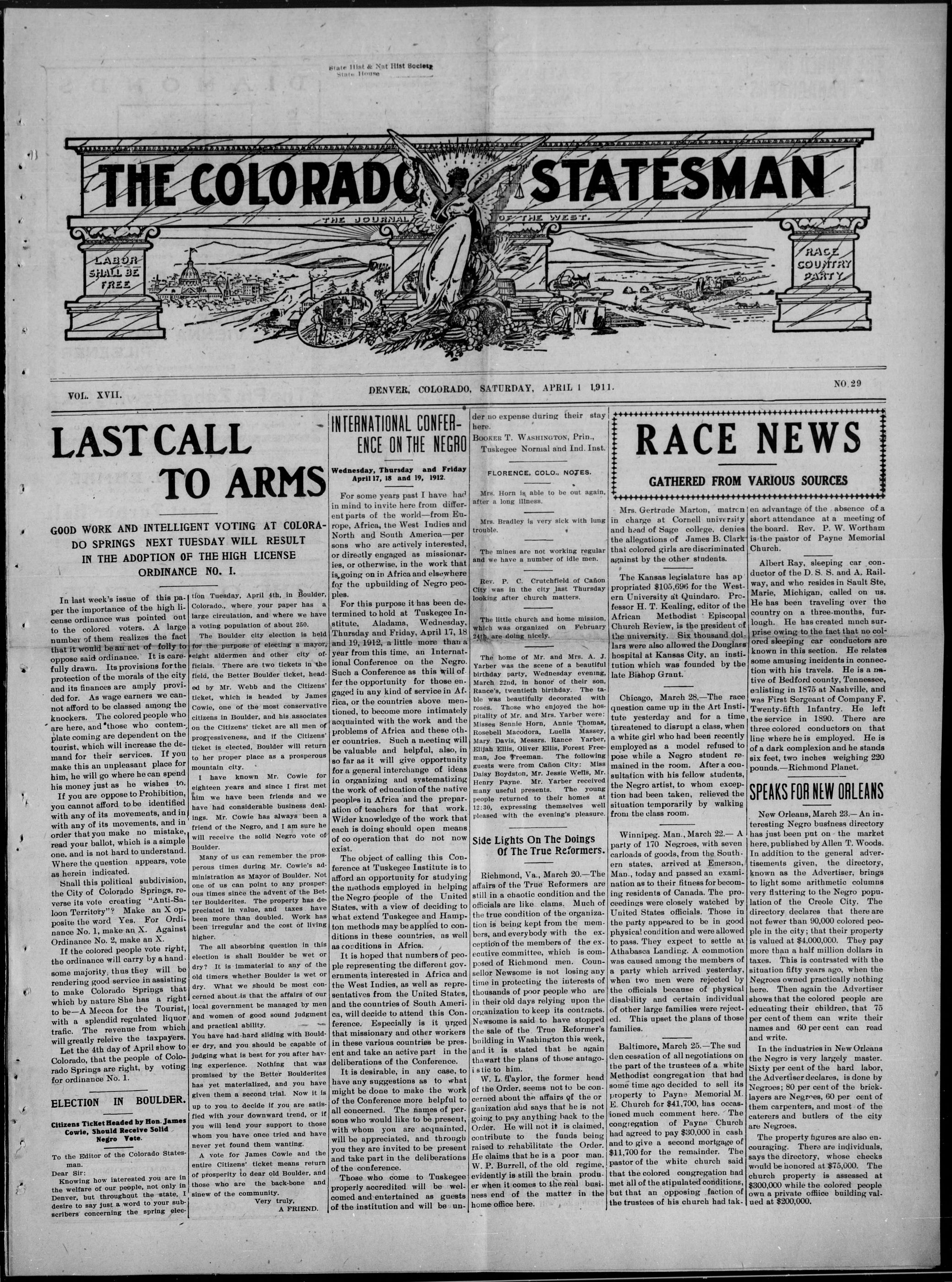
THE COLORADO STATESMAN
THE JOURNAL OF THE WEST.
LABOR SHALL BE FREE
RACE COUNTRY PARTY
LAST CALL TO ARMS
GOOD WORK AND INTELLIGENT VOTING AT COLORADO SPRINGS NEXT TUESDAY WILL RESULT IN THE ADOPTION OF THE HIGH LICENSE ORDINANCE NO. I.
VOL. XVII.
LAST CAL
T
GOOD WORK AND INTELLIGENCE
DO SPRINGS NEXT TU
IN THE ADOPTION OF
ORDINANCE
In last week's issue of this paper the importance of the high license ordinance was pointed out to the colored voters. A large number of them realizes the fact that it would be an act of folly to oppose said ordinance. It is carefully drawn. Its provisions for the protection of the morals of the city and its finances are amply provided for. As wage earners we cannot afford to be classed among the knockers. The colored people who are here, and those who contemplate coming are dependent on the tourist, which will increase the demand for their services. If you make this an unpleasant place for him, he will go where he can spend his money just as he wishes to.
If you are oppose to Prohibition, you cannot afford to be identified with any of its movements, and in with any of its movements, and in order that you make no mistake, read your ballot, which is a simple one, and is not hard to understand. Where the question appears, vote as herein indicated.
Shall this political subdivision, the City of Colorado Springs, reverse its vote creating "Anti-Saloon Territory"? Make an X opposite the word Yes. For Ordinance No. 1, make an X. Against Ordinance No. 2, make an X.
If the colored people vote right, the ordinance will carry by a handsome majority, thus they will be rendering good service in assisting to make Colorado Springs that which by nature She has a right to be—A Mecca for the Tourist, with a splendid regulated liquor trafic. The revenue from which will greatly releive the taxpayers.
Let the 4th day of April show to Colorado, that the people of Colorado Springs are right, by voting for ordinance No.1.
Citizens Ticket Headed by Hon. James Cowie, Should Receive Solid Negro Vote.
To the Editor of the Colorado Statesman.
Dear Sir:
Knowing how interested you are in the welfare of our people, not only in Denver, but throughout the state, I desire to say just a word to your subscribers concerning the spring elec-
tion Tuesday, April 4th, in Boulder, Colorado., where your paper has a large circulation, and where we have a voting population of about 250.
The Boulder city election is held for the purpose of electing a mayor, eight aldermen and other city officials. There are two tickets in the field, the Better Boulder ticket, headed by Mr. Webb and the Citizens' ticket, which is headed by James Cowie, one of the most conservative citizens in Boulder, and his associates on the Citizens' ticket are all men of progressiveness, and if the Citizens' ticket is elected, Boulder will return to her proper place as a prosperous mountain city.
I have known Mr. Cowie for eighteen years and since I first met him we have been friends and we have had considerable business dealings. Mr. Cowie has always been a friend of the Negro, and I am sure he will receive the solid Negro vote of Boulder.
Many of us can remember the prosperous times during Mr. Cowie's administration as Mayor of Boulder. Not one of us can point to any prosperous times since the advent of the Better Boulderites. The property has depreciated in value, and taxes have been more than doubled. Work has been irregular and the cost of living higher.
The all absorbing question in this election is shall Boulder be wet or dry? It is immaterial to any of the old timers whether Boulder is wet or dry. What we should be most concerned about is that the affairs of our local government be managed by men and women of good sound judgment and practical ability. You have had hard sliding with Boulder dry, and you should be capable of judging what is best for you after having experience. Nothing that was promised by the Better Boulderites has yet materialized, and you have given them a second trial. Now it is up to you to decide if you are satisfied with your downward trend, or if you will lend your support to those whom you have once tried and have never yet found them wanting.
A vote for James Cowie and the entire Citizens' ticket means return of prosperity to dear old Boulder, and those who are the back-bone and sinew of the community.
Very truly,
A FRIEND.
DENVER, COLORADO, SATURDAY, APRIL 1 1,911.
INTERNATIONAL CONFERENCE ON THE NEGRO
Wednesday, Thursday and Friday April 17, 18 and 19, 1912.
For some years past I have had in mind to invite here from different parts of the world—from Europe, Africa, the West Indies and North and South America—persons who are actively interested, or directly engaged as missionaries, or otherwise, in the work that is going on in Africa and elsewhere for the upbuilding of Negro peoples.
For this purpose it has been determined to hold at Tuskegee Institute, Aladama, Wednesday, Thursday and Friday, April 17, 18 and 19, 1912, a little more than a year from this time, an International Conference on the Negro. Such a Conference as this will offer the opportunity for those engaged in any kind of service in Africa, or the countries above mentioned, to become more intimately acquainted with the work and the problems of Africa and these other countries. Such a meeting will be valuable and helpful, also, in so far as it will give opportunity for a general interchange of ideas in organizing and systematizing the work of education of the native peoples in Africa and the preparation of teachers for that work. Wider knowledge of the work that each is doing should open means of co operation that do not now exist.
The object of calling this Conference at Tuskegee Institute is to afford an opportunity for studying the methods employed in helping the Negro people of the United States, with a view of deciding to what extend Tuskegee and Hampton methods may be applied to conditions in these countries, as well as conditions in Africa. It is hoped that numbers of people representing the different governments interested in Africa and the West Indies, as well as representatives from the United States, and the countries of South America, will decide to attend this Conference. Especially is it urged that missionary and other workers in these various countries be present and take an active part in the deliberations of the Conference.
It is desirable, in any case, to have any suggestions as to what might be done to make the work of the Conference more helpful to all concerned. The names of persons who would like to be present, with whom you are acquainted, will be appreciated, and through you they are invited to be present and take part in the deliberations of the conference.
Those who come to Tuskegee properly accredited will be welcomed and entertained as guests of the institution and will be un-
der no expense during their stay here.
BOOKER T. WASHINGTON, Prin.,
Tuskegee Normal and Ind. Inst.
FLORENCE, COLO., NOTES.
Mrs. Horn is able to be out again, after a long illness.
Mrs. Bradley is very sick with lung trouble.
The mines are not working regular and we have a number of idle men.
Rev. P. C. Crutchfield of Cañon City was in the city last Thursday looking after church matters.
The little church and home mission, which was organized on February 24th, are doing nicely.
The home of Mr. and Mrs. A. J. Yarber was the scene of a beautiful birthday party, Wednesday evening, March 22nd, in honor of their son, Rance's, twentieth birthday. The table was beautifully decorated with roses. Those who enjoyed the hospitality of Mr. and Mrs. Yarber were: Misses Sennie Horn, Annie Thomas, Rosebell Macodora, Luella Massey, Mary Davis, Messrs. Rance Yarber, Elljah Ellis, Oliver Ellis, Forest Freeman, Joe Freeman. The following guests were from Cannon City: Miss Daisy Boydston, Mr. Jessie Wells, Mr. Henry Payne. Mr. Yarber received many useful presents. The young people returned to their homes at 12:30, expressing themselves well pleased with the evening's pleasure.
Side Lights On The Doings Of The True Reformers
Richmond, Va., March 20.—The affairs of the True Reformers are still in a chaotic condition and the officials are like clams. Much of the true condition of the organization is being kept from the members, and everybody with the exception of the members of the executive committee, which is composed of Richmond men. Counsellor Newsome is not losing any time in protecting the interests of thousands of poor people who are in their old days relying upon the organization to keep its contracts. Newsome is said to have stopped the sale of the True Reformer's building in Washington this week, and it is stated that he again thawt the plans of those antago- istic to him.
W. L. Taylor, the former head of the Order, seems not to be concerned about the affairs of the organization and says that he is not going to pay anything back to the Order. He will not it is claimed, contribute to the funds being raised to rehabilitate the Order. He claims that he is a poor man. W. P. Burrell, of the old regime, evidently is still the brain producer when it comes to the real business end of the matter in the home office here.
RACE NEWS
Mrs. Gertrude Marton, matrcn in charge at Cornell university and head of Sage college, denies the allegations of James B. Clark that colored girls are discriminated against by the other students.
The Kansas legislature has appropriated $105,696 for the Western University at Quindaro. Professor H. T. Kealing, editor of the African Methodist Episcopal Church Review, is the president of the university. Six thousand dollars were also allowed the Douglass hospital at Kansas City, an institution which was founded by the late Bishop Grant.
on advantage of the absence of a short attendance at a meeting of the board. Rev. P. W. Wortham is the pastor of Payne Memorial Church.
Albert Ray, sleeping car conductor of the D. S. S. and A. Railway, and who resides in Sault Ste. Marie, Michigan, called on us. He has been traveling over the country on a three-months, furlough. He has created much surprise owing to the fact that no colored sleeping car conductors are known in this section. He relates some amusing incidents in connection with his travels. He is a ma
Chicago, March 28.—The race question came up in the Art Institute yesterday and for a time threatened to disrupt a class, when a white girl who had been recently employed as a model refused to pose while a Negro student remained in the room. After a consultation with his fellow students, the Negro artist, to whom exception had been taken, relieved the situation temporarily by walking from the class room.
Winnipeg. Man., March 22.—A party of 170 Negroes, with seven carloads of goods, from the Southern states, arrived at Emerson, Man., today and passed an examination as to their fitness for becoming residents of Canada. The proceedings were closely watched by United States officials. Those in the party appeared to be in good physical condition and were allowed to pass. They expect to settle at Athabasca Landing. A commotion was caused among the members of a party which arrived yesterday, when two men were rejected by the officials because of physical disability and certain individual of other large families were rejected. This upset the plans of those families.
Baltimore, March 25.—The sudden cessation of all negotiations on the part of the trustees of a white Methodist congregation that had some time ago decided to sell its property to Payne Memorial M. E. Church for $41,700, has occasioned much comment here. The congregation of Payne Church had agreed to pay $30,000 in cash and to give a second mortgage of $11,700 for the remainder. The pastor of the white church said that the colored congregation had met all of the stipulated conditions, but that an opposing faction of the trustees of his church had tak-
NO.29
en advantage of the absence of a short attendance at a meeting of the board. Rev. P. W. Wortham is the pastor of Payne Memorial Church.
Albert Ray, sleeping car conductor of the D. S. S. and A. Railway, and who resides in Sault Ste. Marie, Michigan, called on us. He has been traveling over the country on a three-months, furlough. He has created much surprise owing to the fact that no colored sleeping car conductors are known in this section. He relates some amusing incidents in connection with his travels. He is a native of Bedford county, Tennessee, enlisting in 1875 at Nashville, and was First Sergeant of Company F, Twenty-fifth Infantry. He left the service in 1890. There are three colored conductors on that line where he is employed. He is of a dark complexion and he stands six feet, two inches weighing 220 pounds.—Richmond Planet.
SPEAKS FOR NEW ORLEANS
New Orleans, March 23.—An interesting Negro business directory has just been put on the market here, published by Allen T. Woods. In addition to the general advertisements given, the directory, known as the Advertiser, brings to light some arithmetic columns very flattering to the Negro population of the Creole City. The directory declares that there are not fewer than 90,000 colored people in the city; that their property is valued at $4,000,000. They pay more than a half million dollars in taxes. This is contrasted with the situation fifty years ago, when the Negroes owned practically nothing here. Then again the Advertiser shows that the colored people are educating their children, that 75 per cent of them can write their names and 60 per cent can read and write.
In the industries in New Orleans the Negro is very largely master. Sixty per cent of the hard labor, the Advertiser declares, is done by Negroes; 80 per cent of the brick-layers are Negroes, 60 per cent of them carpenters, and most of the caterers and butlers of the city are Negroes.
The property figures are also encouraging. There are individuals, says the directory, whose checks would be honored at $75,000. The church property is assessed at $300,000 while the colored people own a private office building valued at $200,000.
After a prolonged debate the Senate, by a vote of twenty-two to thirteen, passed on third reading the Carpenter bill with the Parrish amendment, which places reservoir rights on the rule of priority and repeals that provision of the act of 1901 prohibiting the owners of reservoirs from impounding any water from the natural streams when it is required in ditches for direct irrigation. The amendment bill will now go to the House for final enactment or rejection. Senators Cross, Stephan, Tobin and Crowley, who have waged vigorous opposition to the bill and its amendment, declare that, if the bill is enacted by the House, petitions to invoke the referendum will be circulated and filed with the secretary of state within ninety days of adjournment of the Legislature.
Throughout the debate, which virtually covered the entire domain of irrigation jurisprudence, the supporters of the amended Carpenter bill laid stress upon the claim that the act of 1901 is unconstitutional in that it subordinates senior reservoir appropriations to junior ditch appropriations; while the opponents of the measure waged their fight against its passage from the viewpoint that, if enacted, it will place the future agricultural development of the state under the control of the reservoir companies, will greatly assist the government in its assertion of title to water in this state for use in reclamation projects in other states and that the water from the natural streams of Colorado can be appropriated for agricultural purposes, impounded in reservoirs and used for the generation and sale of power.
The Legislative committee that is investigating the charges made against Judge Greeley W. Whitford by the State Federation of Labor spent one day in reviewing the tessitomy given by the sixteen coal miners in the contempt proceedings which terminated in their being sentenced to jail for a term of one year. The search and seizure bill introduced by Representative Ardourel of Boulder and advocated by the Prohibition people of the state, was defeated by a vote of twenty-nine to twenty-six in the House. This bill, which gave the same rights to officers to search for and seize liquor in dry territory that is given in seizing gambling devices, was held up by the temperance committee until a report was demanded by members of the House.
The Moffat Tunnel.
Senator Gove is in receipt of the following telegram from John A. Porter of Denver, who is on the Pacific coast in reference to the tunnel and its construction;
"The passage of pending tunnel bill in Colorado Legislature is certainly of the greatest importance to Denver and the entire state. Judging by by many surveys made by the Moffat road, it would seem very unwise to limit the length of proposed tunnel to five miles when one approximately a mile longer could be located at the most advantageous place considered from both an engineering and financial point of view. A tunnel entering the Divide almost in a direct line from Tolland would avoid possible competition from a deeper one, would materially short distance and avoid climbing on maximum grade a winding line from Tolland to mouth of a five-mile tunnel. The state should not hesitate at additional cost to obtain a safer and more far-reaching investment.—John A. Porter."
The opponents of the tunnel have secured an amendment to the bill that would defeat the purpose, requiring the Moffat road interests to deposit securities with the state to guarantee the tunnel bonds. And this in addition to the provisions already in the measure making the road itself security for the cost of construction.
With the recommendation that they be placed before the committee of the whole for favorable consideration and final passage, the bills making the State Normal school at Greeley a teachers' college and providing for a normal school training as a condition to the granting of certificates by county superintendents, were reported by the Senate committee on education and educational institutions.
By a vote of twenty to fourteen, the Senate ordered the hybrid bank guarantee law on the calendar for special consideration. This bill is a mixture of Senator Gove's measure for a rigid banking code and of Senator Crowley's bill to enact the mutual bank guarantee act of Texas. The measure was reported favorably by the banking committee three weeks ago. When the report was made, it was stated that a motion would be made to strike from the hybrid bill all of the Texas bank guarantee features and to retain the Gove provisions which seek to make bank guarantee rest on sound banking operations.
Edwin McCrillis, secretary of the State Board of Live Stock Inspection Commissioners, was put through a three hour examination by the joint legislative committee from the House and Senate, aided by representatives from the attorney general's office. The committee is making a thorough investigation of the charges made against the stock board, following which a public report will be made of the methods employed by officers and employees of the board.
GUARDING THE MONEY
GOVERNMENT! CASH NOW CAR
RIED IN BOMB-PROOF VAN.
Uncle Sam recently put in commission a fort on wheels which is used daily to transport millions in bank notes and stamps from the bureau of engraving and printing to the treasury department in Washington where it is stored for safe keeping.
U.S. CAPITOL
Not only is the big van really bomb-proof in itself, but just to make sure that neither thieves nor cranks will ever succeed in accomplishing a hold-up, seven heavily-armed guards ride to and fro with the treasure of millions.
The van is made of hardened steel with heavy locks and bars. Four of the guards occupy seats on the rear of the wagon, two sit on the seat with the driver, while another follows on horseback. The guards are all former members of the United States army.
All this extra precaution, says Popular Mechanics, is due to the change in the system of making money. Until recently the money was printed at the bureau of engraving and printing but sent to the treasury minus the seal and the number so that it was not real money until handled in the treasury.
Now one machine does all the work, including the stamping of the seal and number. These figures, the round seal to the right and the number to the left of the face of a paper bill, stamped in blue, are what make the bills legal tender. Hence when the money passes through the wonderful cutting and stamping machine, which also counts the bills out in lots of 100, it is ready to spend, and any one who got hold of it would have the real thing.
The van now carries daily to the treasury $7,000,000 in bank notes, certificates and stamps. Of this amount $3,000,000 is in silver certificates, $2,000,000 in national bank notes, $1,500,000 in postage stamps and $500,000 in internal revenue stamps. Returning to the bureau from the treasury the van carries blank paper for the notes and stamps.
Last year $12,000,000,000 in stamps and $3,000,000,000 in certificates were transported from the bureau to the treasury without the loss of one stamp or certificate.
"This is a remarkable record," said Director Ralph, "but there is no telling when the unforeseen may happen. This guard should have been organized years ago."
The United States government is now in possession of the largest and finest safe in the world. It is located deep underground below the United States treasury building at Washington, and in this huge strong box it is the intention to keep in storage at all times not less than $500,000,000 in currency. Of course this new governmental depository of wealth is not a safe in the ordinary interpretation of the word, but rather a vault nearly 54 feet in length, close to 20 feet wide and about 16 feet in height.
This new vault, which cost the government more than $34,000, was made necessary by the passage by congress a few years ago of what is known as the emergency currency act, which provides that in order to have the means at hand to frustrate future panics the comptroller of the currency must henceforth keep on hand at all times bank notes or paper money to the value of half of the capital stock of all the United States national banks in existence. This meant the creation of a new reserve reservoir of $500,000,000, and since the government vaults were already taxed to their capacity to provide for the keeping of the funds on hand it was necessary to provide a new treasury house.
The new vault in the sub-basement of the treasury building is two stories high, and in order to provide storage facilities in the form desired the entire interior is given over to a series of huge double file cases of sheet steel. These cases are apportioned into pigeonholes—more than 15,000 of them in all—each just large enough to accommodate the standard-size package containing $1,000 sheets of money, each sheet being made up of four bills. Thus each pigeonhole that is filled with one-dollar notes holds $4,000, whereas the denomination be $10 the contents of the pigeonhole will total $40,000.
The exterior walls of the new vault are of the heaviest steel construction and the door and the portholes provided for ventilation are closed by heavy steel doors fitted with the latest approved locks of the heaviest and most intricate construction, but the main safeguard for this subterranean wealth lies in an electric protective system that cost $9,000, and which enmeshes the entire vault in a close-drawn network of electric wires—more than 17 miles of wire in the aggregate—which sounds alarms at any interference. This system is tested every fifteen minutes day and night. The only means of reaching the new vault is by a secret elevator guarded by treasury watchmen.
PENSION FROM REVOLUTION
Commissioner Reports That There Is Still One Living Beneficiary From Revolutionary War.
According to the annual report of the commissioner of pensions, recently made public, the only pensioner remaining on the rolls because of the Revolutionary war is Mrs. Phoebe M. Palmeter, aged 89, of Brookfield, N. Y., who was pensioned by a special act of congress as the daughter of Jonathan Wooley, who served in a New Hampshire company.
The last "widow pensioner" of the Revolutionary war was Esther S. Damon of Plymouth Union, Vt., who died November 1, 1906, aged 92. The last survivor of the Revolutionary war was Daniel F. Bakeman, who died at Freedom, Cataraugus county, New York, April 5, 1869, aged 109 years 6 months and 8 days. The last surviving pensioned soldier of the war of 1812 was Hiram Cronk, of Ava, N. Y., who died May 13, 1905, aged 105 years. The names of 338 widows of the war of 1812 were on the pension roll June 30 last, according to the pension commissioner.
While the number of pensioners on the rolls of the United States decreased during the past fiscal year by more than 25,000, the average annual value of each pension at the close of the year was slightly more than two dollars greater than a year previously, when it was $169.82.
Of the 921,083 persons on the pension roll at the close of the past year, nearly ten per cent, $9,828 being the exact number, reside in Pennsylvania, according to the report, while Ohio was a close second, being only 600 behind, followed in order by New York, Illinois, Indiana, Missouri, Massachusetts and Michigan. Nevada is lowest on the list, with only 453 pensioners to its credit.
The disbursements for pensions during the year amounted to $159,974, 056.08, a decrease as compared with the previous year of $1,999,647.69. The annual value of the pension roll at the end of the year was $156,332,391.82.
BLIND CHAPLAIN OF HOUSE
Rev. Henry U. Couden Lost His Eyesight From Bullet Wound Received In War.
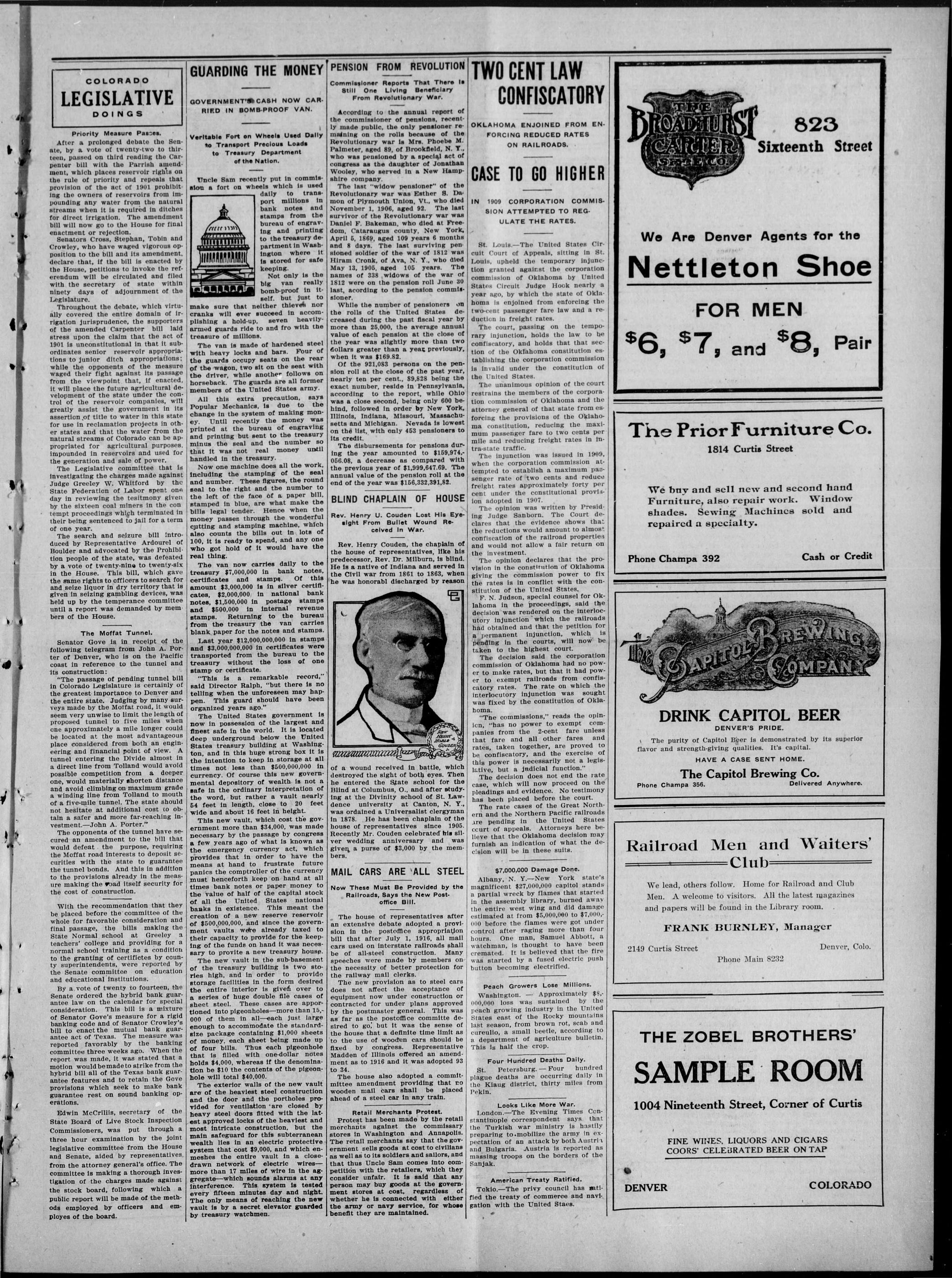
Rev. Henry Couden, the chaplain of the house of representatives, like his predecessor, Rev. Dr. Milburn, is blind. He is a native of Indiana and served in the Civil war from 1861 to 1863, when he was honorably discharged by reason
R. W. HEDDY
PUBLISHER
GOUDEN
of a wound received in battle, which destroyed the sight of both eyes. Then he entered the State school for the Blind at Columbus, O., and after studying at the Divinity school of St. Lawrence university at Canton, N. Y., was ordained a Universalist clergyman in 1878. He has been chaplain of the house of representatives since 1905. Recently Mr. Couden celebrated his silver wedding anniversary and was given a purse of $3,000 by the members.
MAIL CARS ARE ALL STEEL
New These Must Be Provided by the Railroads, Says the New Post-office Bill.
The house of representatives after an extensive debate adopted a provision in the postoffice appropriation bill that after July 1, 1916, all mall cars used on interstate railroads shall be of all-steel construction. Many speeches were made by members on the necessity of better protection for the railway mall clerks.
The new provision as to steel cars does not affect the acceptance of equipment now under construction or contracted for under plans approved by the postmaster general. This was as far as the postoffice committee desired to go, but it was the sense of the house that a definite time limit as to the use of wooden cars should be fixed by congress. Representative Madden of Illinois offered an amendment as to 1916 and it was adopted 93 to 34.
The house also adopted a committee amendment providing that no wooden mail cars shall be placed ahead of a steel car in any train.
Retail Merchants Protest.
Protest has been made by the retail merchants against the commissary stores in Washington and Annapolis. The retail merchants say that the government sells goods at cost to civilians as well as to its soldiers and sailors, and that thus Uncle Sam comes into competition with the retailers, which they consider unfair. It is said that any person may buy goods at the government stores at cost, regardless of whether he is connected with either the army or navy service, for whose benefit they are maintained.
TWO CENT LAW CONFISCATORY
OKLAHOMA ENJOINED FROM EN
FORCING REDUCED RATES
ON RAILROADS.
CASE TO GO HIGHER
IN 1909 CORPORATION COMMISSION ATTEMPTED TO REGULATE THE RATES.
St. Louis.-The United States Circuit Court of Appeals, sitting in St. Louis, upheld the temporary injunction granted against the corporation commission of Oklahoma by United States Circuit Judge Hook nearly a year ago, by which the state of Oklahoma is enjoined from enforcing the two-cent passenger fare law and a reduction in freight rates. The court, passing on the temporary injunction, holds the law to be confiscatory, and holds that that section of the Oklahoma constitution establishing the corporation commission is invalid under the constitution of the United States.
The unanimous opinion of the court restrains the members of the corporation commission of Oklahoma and the attorney general of that state from enforcing the provisions of the Oklahoma constitution, reducing the maximum passenger fare to two cents per mile and reducing freight rates in intra-state traffic. The injunction was issued in 1909, when the corporation commission attempted to establish a maximum passenger rate of two cents and reduce freight rates approximately forty per cent under the constitutional provision adopted in 1907. The opinion was written by Presiding Judge Sanborn. The Court declares that the evidence shows that the reductions would amount to almost confiscation of the railroad properties and would not allow a fair return on the investment.
The opinion declares that the provision in the constitution of Oklahoma giving the commission power to fix the rates is in conflict with the constitution of the United States. F. N. Judson, special counsel for Oklahoma in the proceedings, said the decision was rendered on the interlocutory injunction which the railroads had obtained and that the petition for a permanent injunction, which is pending in the courts, will now be taken to the highest court. The decision said the corporation commission of Oklahoma had no power to make rates, but that it had power to exempt railroads from confiscatory rates. The rate on which the interlocutory injunction was sought was fixed by the constitution of Oklahoma.
"The commissions," reads the opinion, "has no power to exempt companies from the 2-cent fare unless that fare and all other fares and rates, taken together, are proved to be confiscatory, and the exercise of this power is necessarily not a legislative, but a judicial function."
The decision does not end the rate case, which will now proceed on the pleadings and evidence. No testimony has been placed before the court.
The rate cases of the Great Northern and the Northern Pacific railroads are pending in the United States court of appeals. Attorneys here believe that the Oklahoma decision may furnish an indication of what the decision will be in these suits.
$7,000,000 Damage Done.
Albany, N. Y.—New York state's magnificent $27,000,000 capitol stands a partial wreck by flames that started in the assembly library, burned away the entire west wing and did damage estimated at from $5,000,000 to $7,000,000 before the flames were got under control after raging more than four hours. One man, Samuel Abbott, a watchman, is thought to have been cremated. It is believed that the fire was started by a fused electric push button becoming electrified.
Peach Growers Lose Millions.
Washington. — Approximately $5,000,000 loss was sustained by the peach growing industry in the United States east of the Rocky mountains last season, from brown rot, scab and cureulio, a small beetle, according to a department of agriculture bulletin. This is half the crop.
Four Hundred Deaths Daily.
St. Petersburg. — Four hundred plague deaths are occurring daily in the Klaug district, thirty miles from Pekin.
Looks Like More War.
London. — The Evening Times Constantinople correspondent says that the Turkish war ministry is hastily preparing to mobilize the army in expectation of an attack by both Austria and Bulgaria. Austria is reported as massing troops on the borders of the Sanjak.
American Treaty ratified.
Tokio - The privy council has ratified the treaty of commerce and navigation with the United States.
THE BROADTURST CARTER SHOE CO.
823
Sixteenth Street
We Are Denver Agents for the
Nettleton Shoe
FOR MEN
$6, $7, and $8, Pair
The Prior Furniture Co. 1814 Curtis Street
We buy and sell new and second hand Furniture, also repair work. Window shades. Sewing Machines sold and repaired a specialty.
Phone Champa 392
The CAPIT
DRINK
The purity of Capita flavor and strength-giving
HAVE
The Ca
Phone Champa 356.
Railroad M
We lead, others foll
Men. A welcome t
and papers will be
CAPITOL BREWING COMPANY
DRINK CAPITOL BEER
DENVER'S PRIDE.
The purity of Capitol Beer is demonstrated by its
and strength-giving qualities. It's capital.
HAVE A CASE SENT HOME.
The Capitol Brewing Co.
Champa 356.
Delivered A
Broad Men and Wai
Club
lead, others follow. Home for Railroad and
. A welcome to visitors. All the latest mag-
papers will be found in the Library room.
The CAPITOL BREWING COMPANY
The purity of Capitol Beer is demonstrated by its superior flavor and strength-giving qualities. It's capital.
HAVE A CASE SENT HOME.
The Capitol Brewing Co.
Phone Champa 356. Delivered Anywhere.
We lead, others follow. Home for Railroad and Club Men. A welcome to visitors. All the latest magazines and papers will be found in the Library room.
FRANK BURNLEY, Manager
2149 Curtis Street Denver,
THE ZOB
SAMP
1004 Nineteenth
THE ZOBEL BROTHER
AMPLE ROO
Nineteenth Street, Corner of
1004 Nineteenth Street, Corner of Curtis
FINE WINES, LIQUORS AND CIGARS COORS' CELEBRATED BEER ON TAP
---
DENVER
Phone Main 8232
Cash or Credit
BEER
ed by its superior
tal.
E.
Co.
delivered Anywhere.
Waiters'
road and Club
test magazines
room.
Denver, Colo.
THERS'
DOOM
er of Curtis
COLORADO
THE COLORADO STATESMAN
CAUGH MALE FALE
ANNA COUNTER PARTY
JOS. D. D. RIVERS ..... Proprietor
1824 Curtis Street, Room 25.
SUBSCRIPTION RATES:
One Year ..... $2.00
Six Months ..... 1.00
Three months ..... .60
PAYABLE IN ADVANCE.
It occasionally happens that papers sent to subscribers are lost or stolen.
In case you do not receive any number when due, inform us by postal card and we will cheerfully forward a duplicate of the missing number.
Remittances should be made by Express Money Order, Postoffice Money Order, Registered Letter or Bank Draft. Postage stamps will be received the same as cash for the fractional part of a dollar. Only 1-cent and 2-cent stamps taken.
Display advertising 25 cents per square. A square contains ten agate lines.
Reading notices, ten lines or less, 10 cents per line. Each additional line ever ten lines, 5 cents per line.
No discounts allowed on less than three months' contract. Cash must accompany all orders from parties unknown to us. Further particulars on application.
All communications of a personating nature that are not complimentary will be withheld from the columns of this paper.
Communications to receive attention must be newsy, upon important subjects, plainly written only upon one side of the paper; must reach us Tuesdays, if possible, anyway not later than Wednesdays, and bear the signature of the author. No manuscript returned, unless stamps are sent for postage.
Entered as second-class matter at the postoffice in the city of Denver, Colorado.
THE GOOD TIME EVIL.
THE NEW YORK AGE thrusts its editorial pencil under the short ribs of "the leading colored men in Washington" along with a query as to what they have done to call the attention of the administration to an incident, reported in recent news despatches regarding the stopping of colored American emigrants bound for Canada.
It seems that Canada is bidding for other American settlers for her wheat lands in the Northwest, but Canadian officials near Manitoba turned back a party of colored Americans as undesirable settlers. If the report is reliable, the incident is of sufficient importance to call for governmental inquiry, for the act was a breach of the established rights of the citizens of either country to cross the border in travel at will. The Age seems to think that the leading colored men in Washington should assume the obligations of a secondary diplomatic corps, lest the President and his cabinet forget their duties in cases of particular interest to the colored people, but bluntly alleges that these leading colored men "spend so much of their time eating and gossiping that they have but little of it left to devote to important matters."
Our "representatives" at Washington, quite naturally, have acquired the habits and quite generally assume the alms of diplomats and statesmen, but nobody should seek to impose upon them the obligation to carry their assumed authority into actual, independent action. Their activities are most appropriately confined to the social side of our artificial diplomacy, and it is theirs to give banquets and make brilliant speeches, and not to bear the brunt of actual contest that may put them by the ears with the powers that be.
It is the good time side of things toward which our statesmen most naturally lean. And our statesmen at Washington are not altogether alone in this embarrassing tendency. Our diplomatic instincts are not nearly so well developed as our appetites and our love for oratorical pyrotechnics. Let us have a conference on the ills of the race and we will open it with a prayer meeting, prolong it with a speech-making contest and close it with a banquet. No condition of life is quite serious enough for us to get away from the good time idea. The churches depend upon it for a living. Our societies and most of our intellectual improvement institutions give it important consideration. It enters largely into our efforts looking toward business development, and we take to burlesque theatricals like young ducks take to water.
We are all so busy having a good time that many a great opportunity is wasted. And that which is a race trait need not be invidiously blamed on the imitation cabinet at Washington. It applies as well to New York and to Denver.
THE CRIME OF IDLENESS.
THROUGHOUT the entire development of humanity's complex social order, no provision has been made for the idler, the loafer, the drone. Outside of human experience, where, we often are compelled to look for examples, the bee family furnishes a solitary and striking precept when the drone is fallen upon by the hive en masse, and is literally devoured alive.
But men tolerate the idler and the loafer because it is humane to do so, and because the charge for his keep is presumed to fall ordinarily upon some of his own relations. This presumption does not hold good in modern experience, because, strangely enough, with the development of society, the loafer has developed also. Despite his natural aversion to productive labor, he thinks occasionally with his head, and it requires but little thought on his part to put himself in touch with the outeroppings of legitimate social conditions.
The sporting spirit, the gambling mania, is the great connecting link between society and the loafer, and it is the one great artery through which he systematically sucks his substance. The "natural born" idler, sometimes found in rural districts, and who is the jest of the farmers or of the country village, suffers under, or perhaps, enjoys, some physical affliction, but the highly developed loafer whose habitat is the dives and dens of the modern city, comes nearer to being a perserve criminal, in whose classification society has been altogether too tardy.
Honest labor, with hand or brain, is the fundamental social need; it is the system of basic energy upon which all society depends and is developed. It is the true source of all individual success as well as of human progress. Indeed, it is necessary for the natural perpetuation of health and happiness. But just as all other criminals are developed against the moral and social order, so comes the idler, the loafer, the tout, the gambler, in opposition to, and as an enemy of, this fundamental society need. His development is rapid, as it needs to be to entice the lazy. His one ambition is to become a professional gambler.
The industrious man who labors steadily throughout the day and week, and who has a tendency to seek the excitement of sporting life at night or at the week's end, becomes the natural, steady prey of the professional gambler. The victim is waited for, badgered, cailed and enticed; he is lured and encouraged with occasional winnings, but in the end is robbed. Foolish working men, following a false disposition of sporting bravado, consent to become thus the perpetual source of sustenance for idlers, loafers, gamblers and thieves.
That the system is criminal there can be no doubt. That legal control should be exercised over all those who contribute to its continuance ought to be apparent.
The dive keepers and those who give them protection and support are the chief promoters. The idlers and hangers on, the loafers, bummers and runners, the indolent gamsters and tough young sports are the apprentices.
City Man
Towers Over
Country Cousin
By ADA MAY KRECKER
LTHOUGH there is much said and written of the return to nature and the call of the country and of the wild, the people after all are collecting more numerously than ever into the cities. And this although metropolitan life nearly always entails the sacrifice of many favorite creature comforts.
A
For the every-day person the city means flats instead of houses and public sidewalks for lawns and shade trees and smoke and dust for tonic pure fresh air and sundry other equally untoward exchanges. Country people often are startled at the inconveniences the city folk put up with, the little quarters they live in and the makeshifts they have for beds, bed chambers and other apartments and other furniture.
They miss their fresh milk and eggs and large rooms and porches and sunshine and gardens and flowers. They are saddened by the wan, furrowed faces of the city people. The city girls look faded to them and the men look worried, and everybody seems rushed and flurried and nervous.
Things are bleak and unkempt. There is too little green. There is too much that is big and unsightly and noisy and grimy.
Many people of course regard his daily program as distinctly unwholesome and make a great many uncomplimentary observations on his habits. They think he should go to bed earlier and not do so much in a day nor play so late at night nor choose the diversions that furnish his recreation. They think he is losing vitality and stamina, bodily and mentally and morally.
And yet with all his faults the city man stands a stage higher in civilization and in evolution than his hearty country cousin. He has more than vegetable necessities and animal enjoyments. He needs superphysical pleasures. His life is pitched to a higher key. His vibrations are less sluggish. Hence his rapid pace, his tense life. Hence his willingness to forego sleeping room and cream and sunlight.
The relish of the city man for his art, music and drama, be they as crude as they will, is simply an extension of the sphere of superphysical
enjoyments. It is only when vitality is below par that he feels the call to the rural life and its bucolic animal delights. Then he lapses from the higher mental level of consciousness which is a comparatively recent achievement of the race down to the the heavy mindless brute existence which preceded the thought life by incalculable ages and therefore is by that measure the stronger. He wishes then to be as one world weary Chicago girl phrased it, "a human potato."
A. H.
Thirty-six hundred dollars a day, or $1,098,000 a year, is to be given to the steel trust by the new Chicago building code. This sum is to be required of the builders of small flats.
Steel Used in Small Flat Buildings
By A. WAGNER URMSTON
In every new two-story brick flat building to be erected in Chicago steel beam supporters, columns and girders are required for each floor and roof, which requires an extra expenditure of about $300 in each building. No exceptions are made in the new code.
The man who builds a brick two flat building, 22 feet by 50 feet, must put in these steel supports, where formerly wood posts and girders through the basement with the partitions above have been considered sufficiently strong for buildings of this kind.
The additional expense for this steel work will average about $300 each for two-story flat buildings of various dimensions and on an average of 12 buildings a day means $3,600 a day, or for 305 days in the year $1,098,000 a year—to be expended for steel for the benefit of the steel trust.
This is an unnecessary expense in most cases for builders of the moderate priced flat buildings.
Who is to blame? This will bear investigating.
Unkind Flings at the Maiden
A letter recently published, signed by "Carrots," closes with an unkind fling at the "maiden lady." But why the "old maid" jest? When one sees on every hand such "mortal homely" and utterly unattractive women who are married it is difficult to believe that any woman, if she cared to, might not wed.
Unkind Flings at the "Maiden Lady"
By H. L. MARSH
St. Paul, Minn.
Lady"
By H. L. MARSH
St. Paul, Minn.
The men who would be at all desirable as life partners seem to me to be exceedingly scarce.
So it should be more commendable than otherwise when a woman of discrimination chooses single blessedness to yoking up with some man. Although married and never having belonged to the class mentioned, I always am indignant when I hear that term applied derisively. I contend that women have as good right to their liberty and the single life as has one of the masculine gender.
Anyway, these are perilous times for the married folk.
A wife never knows what morning she'll wake up and find herself beaten to a pulp or some kind of widow (sod or grass) with perhaps several helpless offspring to be supported by her own labor.
But, as one girl remarked: "A woman will stop rubbing the place where her husband struck her long enough to ridicule an 'old maid.'"
Making jokes at the expense of the farmer may appear amusing, but, after all, the countryman has the cleverest of them "backed up an alley" when it comes to genuine fun, an easy living and a good strong bank roll.
Making Jokes at Expense of Farmer Amusing
By C. T. CROFTON
Savana, Mass.
The farmer happens just now to be in position to enjoy the fun immensely, for is it not he who is producing the 40-cent bacon and butter that the city man buys? The city people may be able to trim Uncle Hiram when he comes to town, but let them come out to the tall grass and he will "put one over" on them, "by crickey."
LYM Down Town Millinery Co.
SUNSHINE
OPPOSITE D. & F.'s
1120 - 1122 Sixteenth St.
O
Purchase Your Spring MILLINERY NOW
Our store is filled with everything in popular priced Millinery, at both wholesale and retail; in fact, we'll guarantee that no stock of Millinery goods has ever been displayed in Denver before to equal ours in magnitude, assortment and low prices. The great volume of our business permits us to make low prices.
Call and Be Convinced
S&N GARMENT STORE 925-16TH ST. OPP. JOSLINS We Are Now Ready to Fit You Out with a New Spring Suit, Coat, Dress, at Prices That Will Interest You. And You Can Buy Them on Easy Payment Plan If You Wish. We Sell Hundreds of Garments That Way, Let Us Explain It to You.
NEW SUITS FROM $15.00 TO.....$35.00
NEW COATS FROM $9.95 TO.....$25.00
NEW DRESSES FROM $9.95 TO.....$25.00
Just now we are offering some $20.00 and $22.50 Spring Suits at a special price of $16.75. Among them, are black and cream suits. Our $9.95 Dresses are made of taffetta silk, striped messaline, wool ges, wool Panama and wool batiste and can be had in black and all popular colors.
NEW WAISTS, NEW SKIRTS AND NEW PETTICOATS
Are Here at Our Usual Low Prices.
SEE THE NEW WHITE DRESSES
WE ARE SHOWING AT $4.95, $6.95 AND $8.75.
The making alone is worth the price we ask for the Dress.
SILVERSMITH & HILLER, 925 Sixteenth St.
To make room for new Dinnerware patterns arriving daily, we have decided to put on sale at half price
Four Patterns in Semi Porcelain in Neat Borders and Hand Decorations
As the stock is limited, come early and avoid being disappointed.
Thin Lead-blown Water Glasses, 90c values, dozen.....50c
Deep Needle - etched Water Glasses, $1.00 and $1.25 values, dozen.....75c
Teaspoons, Electric Silver Plate, 50c values, dozen.....30c
Dessert Spoons, Electric Silver Plate, $1.00 value, dozen.....60c
Glasses, $1.00 and $1.25 values,
dozen ..... 75c
Dessert Spoons, Electric Silver
Plate, $1.00 value, dozen.....60c
$10 Electrolier, with 12 in. Art Glass Dome, Pedestal and
Frame in Brushed Brass, Copper, Verde
and Gunmetal Finishes. Special ..... $7.50
CHARLES S. WEST JOHN W. WEST
WEST BROS.
Confectionery and Ice Cream Parlor
Baur's Ice Cream Johnston's Candies
Cafe in conection. We make a specialty of Fried Chicken, Steaks,
Chops and Everything good to eat. Try a meal
and be convinced.
All the latest Soda Fountain Drinks and Chili served at all hours.
Also a fine grade of Cigars.
2741 Welton Street
Near Five Points
PHONE CHAMPA 2188 DENVER, COLORADO
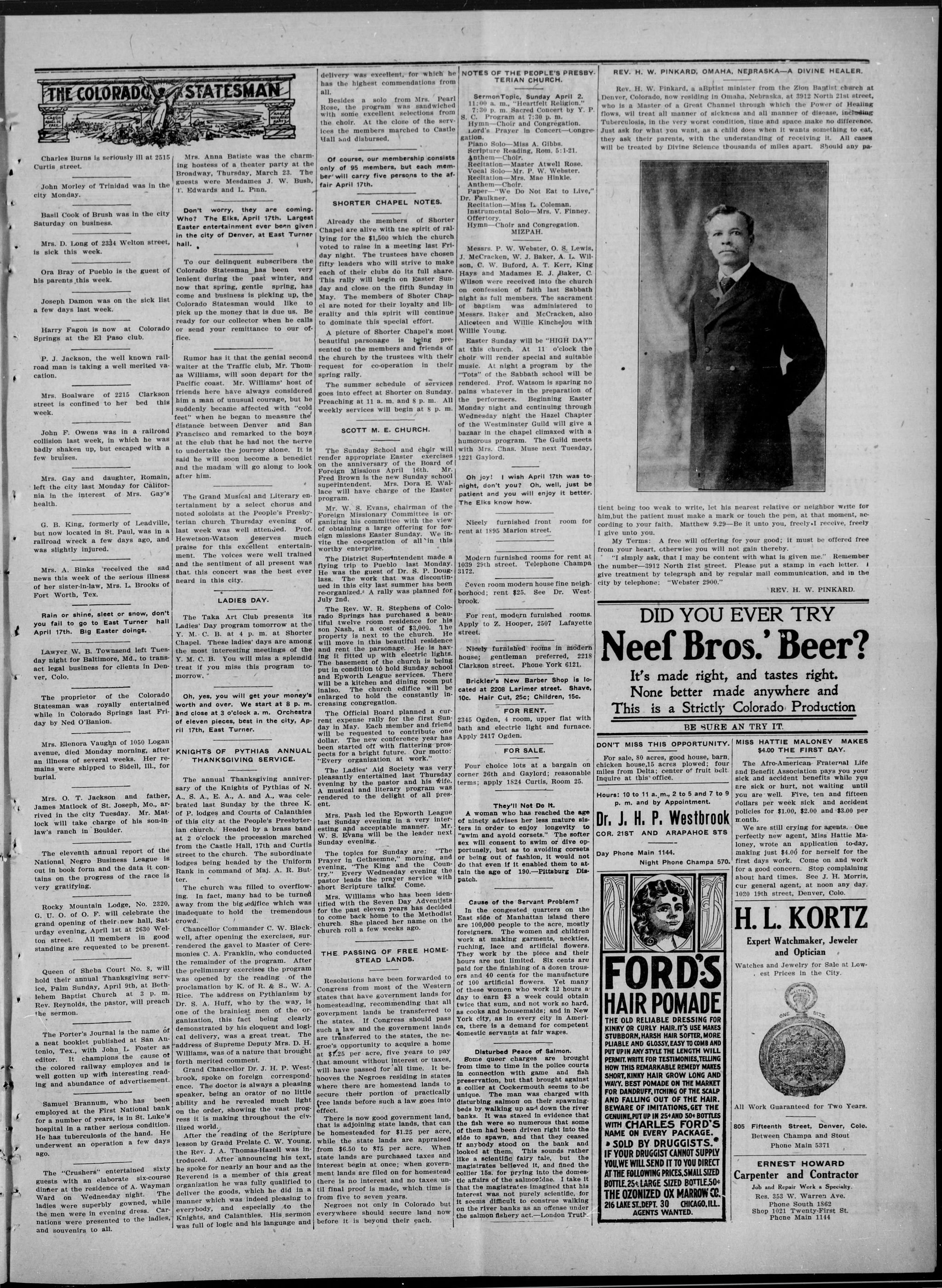
Charles Burns is seriously ill at 2515 Curtis street.
John Morley of Trinidad was in the city Monday.
Basil Cook of Brush was in the city Saturday on business.
Mrs. D. Long of 2334 Welton street, is sick this week.
Mrs. Anna Batiste was the ching hostess of a theater party at Broadway, Thursday, March 23. Guests were Mesdames J. W. B. T. Edwards and L. Pinn.
Don't worry, they are coming Who? The Elks, April 17th. Last Easter entertainment ever been given in the city of Denver, at East Tu hall.
Ora Bray of Pueblo is the guest of his parents this week.
Joseph Damon was on the sick list a few days last week.
Harry Fagon is now at Colorado Springs at the El Paso club.
P. J. Jackson, the well known railroad man is taking a well merited vacation.
Mrs. Boalware of 2215 Clarkson street is confined to her bed this week.
John F. Owens was in a railroad collision last week, in which he was badly shaken up, but escaped with a few bruises.
Mrs. Gay and daughter, Romain, left the city last Monday for California in the interest of Mrs. Gay's health.
G. B. King, formerly of Leadville, but now located in St. Paul, was in a railroad wreck a few days ago, and was slightly injured.
Mrs. A. Binks received the sad news this week of the serious illness of her sister-in-law, Mrs. L. Brooks of Fort Worth, Tex.
Rain or shine, sleet or snow, don't you fail to go to East Turner hall April 17th. Big Easter doings.
Lawyer W. B. Townsend left Tuesday night for Baltimore, Md., to transact legal business for clients in Denver, Colo.
The proprietor of the Colorado Statesman was royally entertained while in Colorado Springs last Friday by Ned O'Banion.
Mrs. Elenora Vaughn of 1050 Logan avenue, died Monday morning, after an illness of several weeks. Her remains were shipped to Sidell, ill., for burial.
Mrs. O. T. Jackson and father, James Matlock of St. Joseph, Mo., arrived in the city Tuesday. Mr. Matlock will take charge of his son-in-law's ranch in Boulder.
The eleventh annual report of the National Negro Business League is out in book form and the data it contains on the progress of the race is very gratifying.
Rocky Mountain Lodge, No. 2320, G. U. O. of O. F. will celebrate the grand opening of their new hall, Saturday evening, April 1st at 2630 Welton street. All members in good standing are requested to be present.
Queen of Sheba Court No. 8, will hold their annual Thanksgiving service, Palm Sunday, April 9th, at Bethlehem Baptist Church at 3 p. m. Rev. Reynolds, the pastor, will preach the sermon.
The Porter's Journal is the name of a neat booklet published at San Antonio, Tex., with John L. Foster as editor. It champions the cause of the colored railway employees and is well gotten up with interesting reading and abundance of advertisement.
Samuel Brannum, who has been employed at the First National bank for a number of years, is in St. Luke's hospital in a rather serious condition. He has tuberculosis of the hand. He underwent an operation a few days ago.
The "Crushers" entertained sixty guests with an elaborate six-course dinner at the residence of A. Wayman Ward on Wednesday night. The ladies were superbly gowned, while the men were in evening dress. Carnations were presented to the ladies, and souvenirs to all.
Mrs. Anna Batiste was the charming hostess of a theater party at the Broadway, Thursday, March 23. The guests were Mesdames J. W. Bush, T. Edwards and L. Pinn.
Don't worry, they are coming. Who? The Elks, April 17th. Largest Easter entertainment ever been given in the city of Denver, at East Turner hall.
To our delinquent subscribers the Colorado Statesman has been very lenient during the past winter, and now that spring, gentle spring, has come and business is picking up, the Colorado Statesman would like to pick up the money that is due us. Be ready for our collector when he calls or send your remittance to our office.
Rumor has it that the genial second waiter at the Traffic club, Mr. Thomas Williams, will soon depart for the Pacific coast. Mr. Williams' host of friends here have always considered him a man of unusual courage, but he suddenly became affected with "cold feet" when he began to measure the distance between Denver and San Francisco and remarked to the boys at the club that he had not the nerve to undertake the journey alone. It is said he will soon become a benedict and the madman will go along to look after him.
The Grand Musical and Literary entertainment by a select chorus and noted solistis at the People's Presbyterian church Thursday evening of last week was well attended. Prof. Hewetson-Watson deserves much praise for this excellent entertainment. The voices were well trained and the sentiment of all present was that this concert was the best ever neared in this city.
LADIES DAY.
The Taka Art Club presents its Ladies' Day program tomorrow at the Y. M. C. B. at 4 p. m. at Shorter Chapel. These ladies' days are among the most interesting meetings of the Y. M. C. B. You will miss a splendid treat if you miss this program tomorrow.
Oh, yes, you will get your money's worth and over. We start at 8 p. m. and close at 3 o'clock a. m. Orchestra of eleven pieces, best in the city, April 17th, East Turner.
KNIGHTS OF PYTHIAS ANNUAL
THANKSGIVING SERVICE.
The annual Thanksgiving anniversary of the Knights of Pythias of N. A., S. A., E. A., A. and A., was celebrated last Sunday by the three K. of P. lodges and Courts of Calanthies of this city at the People's Presbyterian church. Headed by a brass band at 2 o'clock the procession marched from the Castle Hall, 17th and Curtis street to the church. The subordinate lodges being headed by the Uniform Rank in command of Maj. A. R. Butter.
The church was filled to overflowing. In fact, many had to be turned away from the big edifice which was inadequate to hold the tremendous crowd.
Chancellor Commander C. W. Blackwell, after opening the exercises, surrendered the gavel to Master of Ceremonies C. A. Franklin, who conducted the remainder of the program. After the preliminary exercises the program was opened by the reading of the proclamation by K. of R. & S., W. A. Rice. The address on Pythianism by Dr. S. A. Huff, who by the way, is one of the brainiest men of the organization, this fact being clearly demonstrated by his eloquent and logical delivery, was a great treat. The address of Supreme Deputy Mrs. D. H. Williams, was of a nature that brought forth merited comment.
Grand Chancellor Dr. J. H. P. Westbrook, spoke on foreign correspondence. The doctor is always a pleasing speaker, being an orator of no little ability and he revealed much light on the order, showing the vast progress it is making throughout the civilized world.
After the reading of the Scripture lesson by Grand Prelate C. W. Young, the Rev. J. A. Thomas-Hazell was introduced. After announcing his text, he spoke for nearly an hour and as the Reverend is a member of this great organization he was fully qualified to deliver the goods, which he did in a manner which was indeed pleasing to everybody, and especially to the Knights, and Calanthies. His sermon was full of logic and his language and
delivery was excellent, for which he has the highest commendations from all.
Besides a solo from Mrs. Pearl Rose, the program was sandwiched with some excellent selections from the choir. At the close of the services the members marched to Castle Hall and disbursed.
Of course, our membership consists only of 95 members, but each member will carry five persons to the affair April 17th.
SHORTER CHAPEL NOTES.
Already the members of Shorter Chapel are alive with the spirit of rallying for the $1,500 which the church voted to raise in a meeting last Friday night. The trustees have chosen fifty leaders who will strive to make each of their clubs do its full share. This rally will begin on Easter Sunday and close on the fifth Sunday in May. The members of Shoter Chapel are noted for their loyalty and liberality and this spirit will continue to dominate this special effort.
A picture of Shorter Chapel's most beautiful parsonage is being presented to the members and friends of the church by the trustees with their request for co-operation in their spring rally.
The summer schedule of services goes into effect at Shorter on Sunday. Preaching at 11 a. m. and 8 p. m. All weekly services will begin at 8 p. m.
SCOTT M. E. CHURCH.
The Sunday School and chirg will render appropriate Easter exercises on the anniversary of the Board of Foreign Missions April 16th. Mr. Fred Brown is the new Sunday school superintendent. Mrs. Dora E. Wallace will have charge of the Easter program.
Mr. W. S. Evans, chairman of the Foreign Missionary Committee is organizing his committee with the view of obtaining a large offering for foreign missions Easter Sunday. We invite the co-operation of all in this worthy enterprise.
The District Superintendent made a flying trip to Pueblo last Monday. He was the guest of Dr. S. P. Douglass. The work that was discontinued in this city last summer has been re-organized. A rally was planned for July 2nd.
The Rev. W. R. Stephens of Colorado Springs has purchased a beautiful twelve room residence for his son Nash, at a cost of $3,000. The property is next to the church. He will move in this beautiful residence and rent the parsonage. He is having it fitted up with electric lights. The basement of the church is being put in condition to hold Sunday school and Epworth League services. There will be a kitchen and dining room put inalso. The church edifice will be enlarged to hold the constantly increasing congregation.
The Official Board planned a current expense rally for the first Sunday in May. Each member and friend will be requested to contribute one dollar. The new conference year has been started off with flattering prospects for a bright future. Our motto: "Every organization at work."
The Ladies' Aid Society was very pleasantly entertained last Thursday evening by the pastor and his wife. A musical and literary program was rendered to the delight of all present.
Mrs. Pash led the Epworth League last Sunday evening in a very interesting and acceptable manner. Mr.W. S. Evans will be the leader next Sunday evening.
The topics for Sunday are: "The Prayer in Gethsemne," morning, and evening, "The King and the Country." Every Wednesday evening the pastor leads the prayer service with short Scripture talks. Come.
Mrs. Williams who has been identified with the Seven Day Adventists for the past eleven years has decided to come back home to the Methodist church. She placed her name on the church roll a few weeks ago.
THE PASSING OF FREE HOME STEAD LANDS.
Resolutions have been forwarded to Congress from most of the Western states that have government lands for homesteading, recommending that all government lands be transferred to the states. If Congress should pass such a law and the government lands are transferred to the states, the negroe's opportunity to acquire a home at $1.25 per acre, five years to pay that amount without interest or taxes, will have passed for all time. It behooves the Negroes residing in states where there are homestead lands to secure their portion of practically free lands before such a law goes into effect.
There is now good government land, that is adjoining state lands, that can be homesteaded for $1.25 per acre, while the state lands are appraised from $6.50 to $75 per acre. When state lands are purchased taxes and interest begin at once; when government lands are filed on for homestead there is no interest and no taxes until final proof is made, which time is from five to seven years.
Negroes not only in Colorado but everywhere should secure land now before it is beyond their each.
NOTES OF THE PEOPLE'S PRESBY
TERIAN CHURCH.
SermonTopic, Sunday April 2.
11:00 a. m., "Heartfelt Religion."
7:30 p. m. Sacred Concert by Y. P.
S. C. Program at 7:30 p. m.
Hymn—Choir and Congregation.
Lord's Prayer in Concert—Congregation.
Recitation—Master Atwell Rose.
Vocal Solo—Mr. P. W. Webster.
Recitation—Mrs. Mae Hinkle.
Anthem—Choir.
Paper—"We Do Not Eat to Live,"
Dr. Faulkner.
Recitation—Miss L. Coleman.
Instrumental Solo—Mrs. V. Finney.
Offertory.
Hymn—Choir and Congregation.
MIZPAH.
Messrs. P. W. Webster, O. S. Lewis,
J. McCracken, W. J. Baker, A. L. Wilson,
C. W. Buford, A. T. Kerr, King Hays and Madames E. J. Baker, C. Wilson were received into the church on confession of faith last Sabbath night as full members. The sacrament of baptism was administered to Messrs. Baker and McCracken, also Aliceteen and Willie Kinchelou with Willie Young.
Easter Sunday will be "HIGH DAY" at this church. At 11 o'clock the choir will render special and suitable music. At night a program by the "Tots" of the Sabbath school will be rendered. Prof. Watsom is sparing no pains whatever in the preparation of the performers. Beginning Easter Monday night and continuing through Wednesday night the Hazel Chapter of the Westminster Guild will give a bazaar in the chapel climaxed with a humorous program. The Guild meets with Mrs. Chas. Muse next Tuesday, 1221 Gaylord.
Oh joy! I wish April 17th was tonight, don't you? Oh, well, just be patient and you will enjoy it better. The Elks know how.
Nicely furnished front room for rent at 1895 Marion street.
Modern furnished rooms for rent at
1039 29th street. Telephone Champa
3172.
Seven room modern house fine neigh-
borhood; rent $25. See Dr. West-
brook.
For rent, modern furnished rooms.
Apply to Z. Hooper, 2507 Lafayette
street.
Nicely furnished rooms in modern
house; gentleman preferred, 2218
Clarkson street. Phone York 6121.
Brickler's New Barber Shop is loca-
ted at 2208 Larimer street. Shave,
10c. Hair Cut, 25c; Children, 15c.
FOR RENT.
2345 Ogden, 4 room, upper flat with bath and electric light and furnace Apply 2417 Ogden.
FOR SALE
Four choice lots at a bargain on corner 26th and Gaylord; reasonable terms; apply 1824 Curtis, Room 25.
They'll Not Do It.
A woman who has reached the age of ninety advises her less mature sisters in order to enjoy longevity to "swim and avoid corsets." The softer sex will consent to swim or dive opportunely, but as to avoiding corsets or being out of fashion, it would not do that even if it enabled them to attain the age of 190—Pittsburg Dispatch.
Cause of the Servant Problem?
Cause of the Servant Problem
In the congested quarters on the East side of Manhattan island there are 100,000 people to the acre, mostly foreigners. The women and children work at making garments, neckties, ruching, lace and artificial flowers. They work by the piece and their hours are not limited. Six cents are paid for the finishing of a dozen trousers and 40 cents for the manufacture of 100 artificial flowers. Yet many of these women who work 12 hours a day to earn $3 a week could obtain twice that sum, and not work so hard, as cooks and housemaids; and in New York city, as in every city in America, there is a demand for competent domestic servants at fair wages.
Disturbed Peace of Salmon.
Disturbed Peace or Salmon.
Some queer charges are brought from time to time in the police courts in connection with game and fish preservation, but that brought against a collier at Cockermouth seems to be unique. The man was charged with disturbing salmon on their spawning-beds by walking up and down the river banks. It was stared in evidence that the fish were so numerous that some of them had been driven right into the side to spawn, and that they ceased if anybody stood on the bank and looked at them. This sounds rather like a scientific fairy tale, but the magistrates believed it, and fined the collier 15s. for prying into the domestic affairs of the salmonidae. I take it that the magistrates imagined that his interest was not purely scientific, for it seems difficult to construe walking on the river banks as an offense under the salmon fishery act—London Truth.
Rev. H. W. Pinkard, a aBptist minister from the Zion Baptist church at Denver, Colorado, now residing in Omaha, Nebraska, at 3912 North 21st street, who is a Master of a Great Channel through which the Power of Healing flows, will treat all manner of sickness and all manner of disease, including Tuberculosis, in the very worst condition, time and space make no difference. Just ask for what you want, as a child does when it wants something to eat, they ask their parents, with the understanding of receiving it. All cases will be treated by Divine Science thousands of miles apart. Should any pa-
THE MAYOR OF BOSTON
tent being too weak to write, let his nearest relative or neighbor write for him, but the patient must make a mark or touch the pen, at that moment, according to your faith. Matthew 9.29—Be it unto you, freely I receive, freely I give unto you.
My Terms: A free will offering for your good; it must be offered free from your heart, otherwise you will not gain thereby.
"I simply ask, that I may be content with what is given me." Remember the number—3912 North 21st street. Please put a stamp in each letter. I give treatment by telegraph and by regular mail communication, and in the city by telephone: "Webster 2900."
DID YOU EVER TRY Neef Bros.' Beer? It's made right, and tastes right. None better made anywhere and This is a Strictly Colorado Production
BE SURE AN TRY IT.
DON'T MISS THIS OPPORTUNITY.
For sale, 80 acres, good house, barn,
chicken house,15 acres plowed; four
miles from Delta; center of fruit belt.
Inquire at this office.
Hours: 10 to 11 a.m., 2 to 5 and 7 to 9
p. m. and by Appointment.
Dr. J. H. P. Westbrook
COR. 21ST AND ARAPAHOE STS
FORD'S
HAIR POMADE
THE OLD RELIABLE DRESSING FOR
KINKY OR CURLY HAIR. IT'S USE MAKES
STUBBORN, HARSH HAIR SOFTER, MORE
PLIABLE AND GLOSSY, EASY TO COMB AND
PUT UP IN ANY STYLE THE LENGTH WILL
PERMIT. WRITE FOR TESTIMONIES, TELLING
HOW THIS REMARKABLE REMEDY MAKES
SHORT, KINNY HAIR GROW LONG AND
WAKY. BEST POMADE ON THE MARKET
FOR DANDRUFF, ITCHING OF THE SCALP
AND FALLING OUT OF THE HAIR.
BEWARE OF IMITATIONS, GET THE
GENUINE,PUT UP IN 25*AND 50*BOTTLES
WITH CHARLES FORD'S
NAME ON EVERY PACKAGE.
• SOLD BY DRUGGISTS.
• IF YOUR DRUGGIST CANNOT SUPPLY
YOU,WE WILL SEND IT TO YOU DIRECT
AT THE FOLLOWING PRICES,SMALL SIZED
BOTTLE,25*LARGE SIZED BOTTLE,50*
THE OZONIZED OX MARROW CO.
216 LAKE ST.,DEPT. 30 CHICAGO,ILL.
AGENTS WANTED.
EVER TRY os.' Beer? and tastes right. de anywhere and Colorado Production
MISS HATTIE MALONEY MAKES $4.00 THE FIRST DAY.
The Afro-American Fraternal Life and Benefit Association pays you your sick and accident benefits while you are sick or hurt, not waiting until you are well. Five, ten and fifteen dollars per week sick and accident policies for $1.00, $2.00 and $3.00 per month.
We are still crying for agents. One perfectly new agent, Miss Hattie Maloney, wrote an application to-day, making just $4.00 for herself for the first days work. Come on and work for a good concern. Stop complaining about hard times. See J. H. Morris, cur general agent, at noon any day. 1020 19th street, Denver, Colo.
H. L. KORTZ
Expert Watchmaker, Jeweler and Optician
Watches and Jewelry for Sale at Low-
est Prices in the City.
805 Fifteenth Street, Denver, Colo.
Between Champa and Stout
Phone Main 5371
Job and Repair Work a Specialty.
Res. 353 W. Warren Ave.
Phone South 1862
Shop 1021 Twenty-First St.
Phone Main 1144
REV. H. W. PINKARD.
Always Staunch And True
The Denver Republican has always avoided the fallacies and knaveries of yellow journalism, and its steadily increasing Circulation proves conclusively that its policy of telling the plain Truth without exaggeration or misrepresentation, standing fast for the Right, is heartily approved with growing force by the intelligent Public to which it appeals.
To read it is a liberal Education, and the citizen who goes without it does a positive harm to himself, to his family, and to the community.
In no other way can the investment of 2 1/2 cents per day for that is all The Republican costs any subscriber—bring such rich results in that Knowledge which is both Power and Pleasure. Information, instruction and entertainment fill its columns and it leaves a good taste in the mouth of the reader. It stands for Law and Order in the State—for Peace, Prosperity and Happiness in the Home. If you are not already enrolled among its splendid list of Patrons send on your subscription and give it a fair trial at 75 cents per month for Daily and Sunday.
The
WARD AUCTION
COMPANY
Sales Daily at 2 p.m. Office Fur-
niture a Specialty.
PRIVATE SALES AT ALL TIMES
HAVE MOVED TO—
1723-39 GLENARM ST.
PHONE MAIN 1675.
Miss M. Cowden
Hair Dressing Parlor
Shampoo, cutting and curling.
Scalp treatment, hair tonics,
hair straightening, manicuring.
Stage wigs for rent; theatrical
use and masquerades.
Goods delivered out of the city. All shades of hair matched by sending sample of hair; also combings made up.
Cheapest Switches 50 Cents
1219 21st St. Denver, Colo.
NAST
The Popular Photograhper. Only Caters to First-class Trade. Our Pictures speak for Themselves.
Job Printing
See Us Before Going Else-where
We are here to serve you with anything in the line of printed stationery for your business and personal use. □ □ □ □
Letter Heads Bill Heads
Envelopes Cards
Wedding Invitations
Posters or Announcements
Of All Kinds
The best quality of work at prices that are RIGHT
---
NATIONAL CAPITAL AFFAIRS
Not a Penny for Pressing Trousers
Attempts at Suicide Ignored in Army
Judge Denounces Sunday Entertainers
Aerial bombing on a beach.
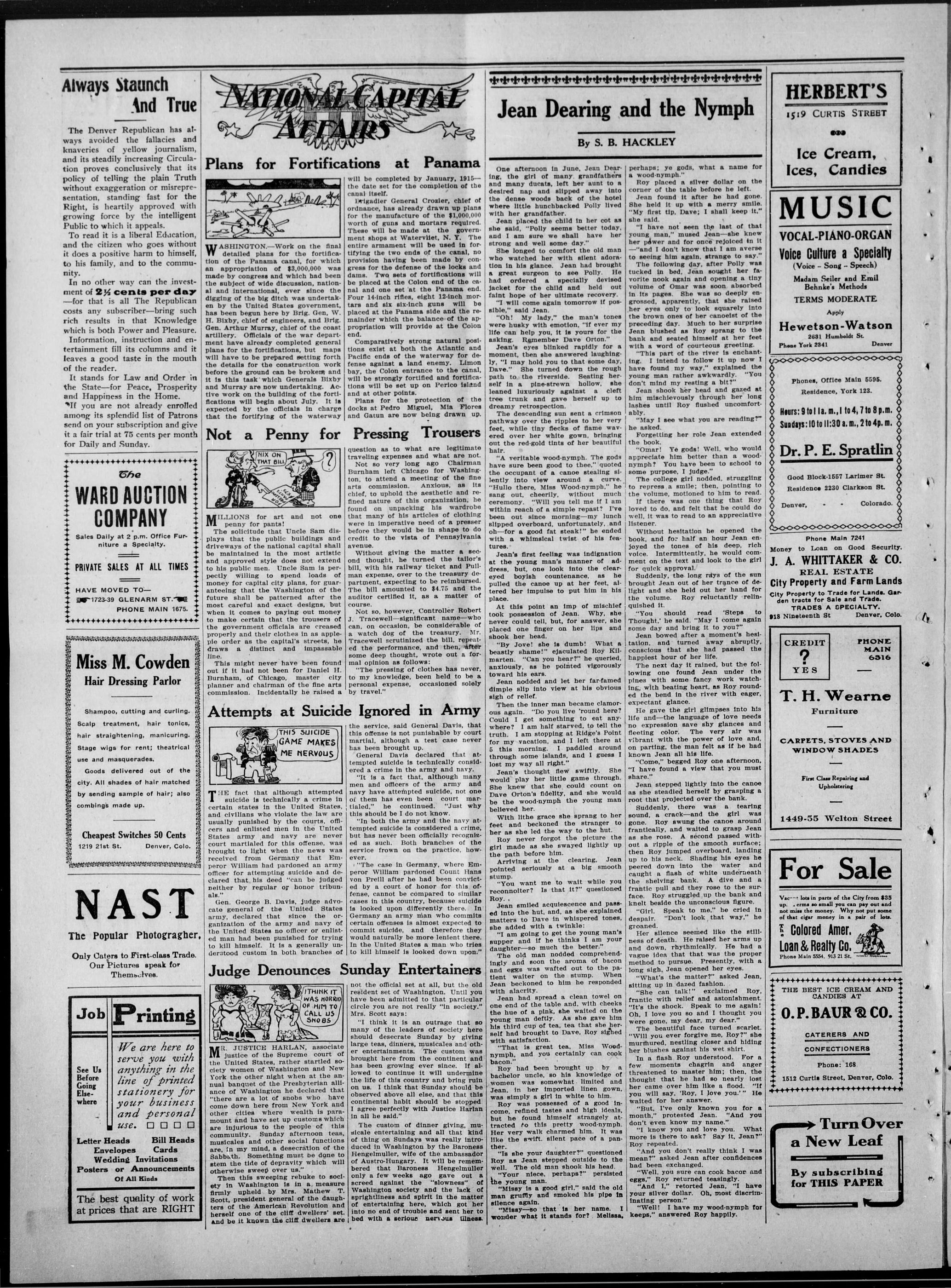
WASHINGTON.—Work on the final detailed plans for the fortification of the Panama canal, for which an appropriation of $3,000,000 was made by congress and which had been the subject of wide discussion, national and international, ever since the digging of the big ditch was undertaken by the United States government, has been begun here by Brig. Gen. W. H. Bixby, chief of engineers, and Brig. Gen. Arthur Murray, chief of the coast artillery. Officials of the war department have already completed general plans for the fortifications, but maps will have to be prepared setting forth the details for the construction work before the ground can be broken and it is this task which Generals Bixby and Murray are now undertaking. Active work on the building of the fortifications will begin about July. It is expected by the officials in charge that the fortifying of the waterway
NIX ON THAT BILL?
MILLIONS for art and not one penny for pants!
The solicitude that Uncle Sam displays that the public buildings and driveways of the national capital shall be maintained in the most artistic and approved style does not extend to his public men. Uncle Sam is perfectly willing to spend loads of money for capital city plans, for guaranteeing that the Washington of the future shall be patterned after the most careful and exact designs, but when it comes to paying out money to make certain that the trousers of the government officials are creased properly and their clothes in as appleple order as the capital's streets, he draws a distinct and impassable line.
This might never have been found out if it had not been for Daniel H. Burnham, of Chicago, master city planner and chairman of the fine arts commission. Incidentally he raised a
THIS SUICIDE GAME MAKES ME NERVOUS
THE fact that although attempted suicide is technically a crime in certain states in the United States, and civilians who violate the law are usually punished by the courts, officers and enlisted men in the United States army and navy are never court martialed for this offense, was brought to light when the news was received from Germany that Emperor William had pardoned an army officer for attempting suicide and declared that his deed "can be judged neither by regular or honor tribunals."
Gen. George B. Davis, judge advocate general of the United States army, declared that since the organization of the army and navy of the United States no officer or enlisted man had been punished for trying to kill himself. It is a generally understood custom in both branches of
I THINK IT
WAS HORRID
OF HIM TO
CALL US
SNOBS
MR. JUSTICE HARLAN, associate justice of the Supreme court of the United States, rather startled society women of Washington and New York the other night when at the annual banquet of the Presbyterian alliance of Washington he declared that "there are a lot of snobs who have come down here from New York and other cities where wealth is paramount and have set up customs which are injurious to the people of this community. Sunday afternoon teas, musicales and other social functions are, in my mind, a desecration of the Sabbath. Something must be done to stem the tide of deprivacy which will otherwise sweep over us."
Then this sweeping rebuke to society in Washington is in a, measure firmly upheld by Mrs. Mathew T. Scott, president general of the daughters of the American Revolution and herself one of the cliff dwellers' set. and be it known the cliff dwellers are
will be completed by January, 1915—the date set for the completion of the canal itself.
Brigadier General Crozier, chief of ordinance, has already drawn up plans for the manufacture of the $1,000,000 worth of guns and mortars required. These will be made at the government shops at Watervilet, N. Y. The entire armament will be used in fortifying the two ends of the canal, no provision having been made by congress for the defense of the locks and dams. Two sets of fortifications will be placed at the Colon end of the canal and one set at the Panama end. Four 14-inch rifles, eight 12-inch mortars and six six-inch guns will be placed at the Panama side and the remainder which the balance of the appropriation will provide at the Colon end.
Comparatively strong natural positions exist at both the Atlantic and Pacific ends of the waterway for defense against a land enemy. Limon bay, the Colon entrance to the canal, will be strongly fortified and fortifications will be set up on Perico island and at other points. Plans for the protection of the docks at Pedro Miguel, Mia Flores and Gatun are now being drawn up.
question as to what are legitimate
traveling expenses and what are not.
traveling expenses and what are not.
Not so very long ago Chairman Burnham left Chicago for Washington, to attend a meeting of the fine arts commission. Anxious, as its chief, to uphold the aesthetic and refined nature of this organization, he found on unpacking his wardrobe that many of his articles of clothing were in imperative need of a presser before they would be in shape to do credit to the vista of Pennsylvania avenue.
Without giving the matter a second thought, he turned the tailor's bill, with his railway ticket and Pullman expense, over to the treasury department, expecting to be reimbursed. The bill amounted to $4.75 and the auditor certified it, as a matter of course.
Not so, however, Controller Robert J. Tracewell—significant name—who can, on occasion, be considerable of a watch dog of the treasury. Mr. Tracewell scrutinized the bill, repeated the performance, and then, after some deep thought, wrote out a formal opinion as follows:
"The pressing of clothes has never, to my knowledge, been held to be a personal expense, occasioned solely by travel."
the service, said General Davis, that this offense is not punishable by court martial, although a test case never has been brought up.
General Davis declared that attempted suicide is technically considered a crime in the army and navy.
"It is a fact that, although many men and officers of the army and navy have attempted suicide, not one of them has even been court martialed," he continued. "Just why this should be I do not know.
"In both the army and the navy attempted suicide is considered a crime, but has never been officially recognized as such. Both branches of the service frown on the practice, however.
"The case in Germany, where Emperor William pardoned Count Hans von Prell after he had been convicted by a court of honor for this offense, cannot be compared to similar cases in this country, because suicide is looked upon differently there. In Germany an army man who commits certain offenses is almost expected to commit suicide, and therefore they would naturally be more lenient there. In the United States a man who tries to kill himself is looked down upon."
not the official set at all, but the old resident set of Washington. Until you have been admitted to that particular circle you are not really "in society." Mrs. Scott says:
"I think it is an outrage that so many of the leaders of society here should desecrate Sunday by giving large teas, dinners, musicales and other entertainments. The custom was brought here from the continent and has been growing ever since. If allowed to continue it will undermine the life of this country and bring ruin on us. I think that Sunday should be observed above all else, and that this continental habit should be stopped. I agree perfectly with Justice Harlan in all he said."
The custom of dinner giving, musicale entertaining and all that kind of thing on Sundays was really introduced in Washington by the Baroness Hengelmuller, wife of the ambassador of Austro-Hungary. It will be remembered that Baroness Hengelmuller only a few weeks ago gave out a screed against the "slowness" of Washington society and the lack of sprightfulness and spirit in the matter of entertaining here, which got her into no end of trouble and sent her to bed with a serious nervous illness.
---
Jean Dearing and the Nymph
By S. B. HACKLEY
One afternoon in June, Jean Dearing, the girl of many, grandfathers and many ducats, left her aunt to a desired nap and slipped away into the dense woods back of the hotel where little hunchbacked Polly lived with her grandfather.
Jean placed the child in her cot as she said, "Polly seems better today, and I am sure we shall have her strong and well some day."
She longed to comfort the old man who watched her with silent adoration in his glance. Jean had brought a great surgeon to see Polly. He had ordered a specially devised jacket for the child and held out faint hope of her ultimate recovery.
"I will come again tomorrow if possible," said Jean.
"Oh! My lady," the man's tones were husky with emotion, "if ever my life can help you, it is yours for the asking. Remember Dave Orton."
Jean's eyes blinked rapidly for a moment, then she answered laughingly, "I may hold you to that some day, Dave." She turned down the rough path to the riverside. Seating herself in a pine-strewn hollow, she leaned luxuriously against a cleft tree trunk and gave herself up to dreamy retrospection.
The descending sun sent a crimson pathway over the ripples to her very feet, while tiny flecks of flame wavered over her white gown, bringing out the red-gold tints of her beautiful hair.
"A veritable wood-nymph. The gods have sure been good to thee," quoted the occupant of a canoe stealing silently into view around a curve. "Hullo there, Miss Wood-nymph," he sang out, cheerly, without much ceremony. "Will you tell me if I am within reach of a simple repast? I've been out since morning—my lunch slipped overboard, unfortunately, and oh—for a good fat steak!" he ended with a whimsical twist of his features.
Jean's first feeling was indignation at the young man's manner of address, but, one look into the clear-eyed boyish countenance, as he pulled the canoe up at her feet, altered her impulse to put him in his place.
At this point an imp of mischief took possession of Jean. Why, she never could tell, but, for answer, she placed one finger on her lips and shook her head.
"By Jove! she is dumb! What a beastly shame!" ejaculated Roy Killmarten. "Can you hear?" he queried, anxiously, as he pointed vigorously toward his ears.
Jean nodded and let her far-famed dimple slip into view at his obvious sigh of relief.
Then the inner man became clamorous again. "Do you live 'round here? Could I get something to eat anywhere? I am half starved, to tell the truth. I am stopping at Ridge's Point for my vacation, and I left there at 5 this morning. I paddled around through some islands, and I guess I lost my way all right."
Jean's thought flew swiftly. She would play her little game through. She knew that she could count on Dave Orton's fidelity, and she would be the wood-nymph the young man believed her.
With lithe grace she sprang to her feet and beckoned the stranger to her as she led the way to the hut.
Roy never forgot the picture the girl made as she swayed lightly up the path before him.
Arriving at the clearing, Jean pointed seriously at a big smooth stump.
"You want me to wait while you reconnoiter? Is that it?" questioned Roy.
Jean smiled acquiescence and passed into the hut, and, as she explained matters to Dave in whispered tones, she added with a twinkle:
"I am going to get the young man's supper and if he thinks I am your daughter—so much the better."
The old man nodded comprehendingly and soon the aroma of bacon and eggs was wafted out to the patient waiter on the stump. When Jean beckoned to him he responded with alacrity.
Jean had spread a clean towel on one end of the table and, with cheeks the hue of a pink, she waited on the young man deftly. As she gave him his third cup of tea, tea that she herself had brought to Dave, Roy sighed with satisfaction.
"That is great tea, Miss Woodnymph, and you certainly can cook bacon."
Roy had been brought up by a bachelor uncle, so his knowledge of women was somewhat limited and Jean, in her imported linen gown, was simply a girl in white to him.
Roy was possessed of a good income, refined tastes and high ideals, but he found himself strangely attracted to this pretty wood-nymph. Her very walk charmed him. It was like the swift, silent pace of a panther.
"Is she your daughter?" questioned Roy as Jean stepped outside to the well. The old man shook his head.
"Your niece, perhaps?" persisted the young man.
"Missy is a good girl." said the old man grumfy and smoked his pipe in silence again.
"Missy—so that is her name. I wonder what it stands for? Melissa,
perhaps; ye gods, what a name for a wood-nymph."
Roy placed a silver dollar on the corner of the table before he left.
Jean found it after he had gone.
She held it up with a merry smile.
"My first tip, Dave; I shall keep it," she said.
"I have not seen the last of that young man," mused Jean—she knew her power and for once rejoiced in it—"and I don't know that I am averse to seeing him again, strange to say."
The following day, after Polly was tucked in bed, Jean sought her favorite nook again and opening a tiny volume of Omar was soon absorbed in its pages. She was so deeply engrossed, apparently, that she raised her eyes only to look squarely into the brown ones of her canoeist of the preceding day. Much to her surprise Jean blushed as Roy sprang to the bank and seated himself at her feet with a word of courteous greeting.
"This part of the river is enchanting. I intend to follow it up now I have found my way," explained the young man rather awkwardly. "You don't mind my resting a bit?"
Jean shook her head and gazed at him mischievously through her long lashes until Roy flushed uncomfortably.
"May I see what you are reading?" he asked.
Forgetting her role Jean extended the book.
"Omar! Ye gods! Well, who would appreciate him better than a wood-nymph? You have been to school to some purpose, I judge."
The college girl nodded, struggling to repress a smile; then, pointing to the volume, motioned to him to read.
If there was one thing that Roy loved to do, and felt that he could do well, it was to read to an appreciative listener.
Without hesitation he opened the book, and for half an hour Jean enjoyed the tones of his deep, rich voice. Intermittently, he would comment on the text and look to the girl for quick approval.
Suddenly, the long rays of the sun brought Jean out of her trance of delight and she held out her hand for the volume. Roy reluctantly relinquished it.
"You should read 'Steps to Thought,' he said. "May I come again some day and bring it to you?" Jean bowed after a moment's hesitation, and turned away abruptly, conscious that she had passed the happiest hour of her life. The next day it rained, but the following one found Jean under the pines with some fancy work watching, with beating heart, as Roy rounded the bend in the river with eager, expectant glance. He gave the girl glimpses into his life and—the language of love needs no expression save shy glances and fleeting color. The very air was vibrant with the power of love and, on parting, the man felt as if he had known Jean all his life. "Come," begged Roy one afternoon, "I have found a view that you must share."
Jean stepped lightly into the canoe as she steadied herself by grasping a root that projected over the bank. Suddenly, there was a tearing sound, a crack—and the girl was gone. Roy swung the canoe around frantically, and waited to grasp Jean as she rose. A second passed without a ripple of the smooth surface; then Roy jumped overboard, landing up to his neck. Shading his eyes he peered down into the water and caught a flash of white underneath the shelving bank. A dive and a frantic pull and they rose to the surface. Roy struggled up the bank and knelt beside the unconscious figure. "Girl. Speak to me," he cried in despair. "Don't look that way," he groaned.
Her silence seemed like the stillness of death. He raised her arms up and down, rhythmically. He had a vague idea that that was the proper method to pursue. Presently, with a long sigh, Jean opened her eyes.
"What's the matter?" asked Jean, sitting up in dazed fashion.
"She can talk!" exclaimed Roy, frantic with relief and astonishment. "It's the shock. Speak to me again! Oh, I love you so and I thought you were gone, my dear, my dear."
The beautiful face turned scarlet. "Will you ever forgive me, Roy?" she murmured, nestling closer and hiding her blushes against his wet shirt.
In a flash Roy understood. For a few moments chagrin and anger threatened to master him; then, the thought that he had so nearly lost her came over him like a flood. "If you will say, Roy, I love you." He waited for her answer.
"But, I've only known you for a month," protested Jean. "And you don't even know my name."
"I know you and love you. What more is there to ask? Say it, Jean?" Roy repeated.
"And you don't really think I was mean? asked Jean after confidences had been exchanged.
"Well, you sure can cook bacon and eggs," Roy returned teasingly.
"And I," retorted Jean, "I have your silver dollar. Oh, most discriminating person."
"Well! I have my wood-nymph for keeps," answered Roy happily.
1519 CURTIS STREET
Ice Cream,
Ices, Candies
MUSIC
VOCAL-PIANO-ORGAN
Voice Culture a Specialty
(Voice - Song - Speech)
Madam Seiler and Emil
Behnke's Methods
TERMS MODERATE
Hewetson-Watson
2631 Humboldt St.
Phans York 2841 Denver
Phones, Office Main 5595.
Residence, York 123.
Hours: 9 to 11 a.m., 1 to 4, 7 to 8 p.m.
Sundays: 10 to 11:30 a.m., 2 to 4p.m.
Dr. P. E. Spratlin
Good Block-1557 Larimer St.
Residence 2230 Clarkson St.
Denver, Colorado.
Phone Main 7241
Money to Loan on Good Security.
J. A. WHITTAKER & CO.
REAL ESTATE
City Property and Farm Lands
City Property to Trade for Lands. Garden tracts for Sale and Trade.
TRADES A SPECIALTY.
918 Nineteenth St Denver, Colo.
CREDIT
?
YES
PHONE
MAIN
6316
T. H. Wearne
Furniture
CARPETS, STOVES AND
WINDOW SHADE
First Class Repairing and Upholstering
1449-55 Welton Street
For Sale
Vacant lots in parts of the City from $35 up. Terms so small you can pay out and not miss the money. Why not put some of that cigar money in a pair of lots.
The Colored Amer.
Loan & Realty Co.
Phone Main 5554, 913 21 St.
THE BEST ICE CREAM AND
CANDIES AT
O.P. BAUR & CO.
CATERERS AND
CONFECTIONERS
Phone: 168
1512 Curtis Street, Denver, Colo.
Turn Over
a New Leaf
By subscribing
for THIS PAPER
New News of Yesterday
One Vote Became a Majority
One Vote Became a Majority
Could Not Decide Upon the Manner in Which the President's Inability to Perform His Duties Should Be Declared.
William Windom, federal representative and senator from Minnesota, one of the early advocates of reciprocity and the gold standard, and candidate for the Republican presidential nomination in the three national conventions of the party held in the twelve years beginning with 1880, was also secretary of the treasury in two cabinets—Garfield's and Benjamin Harrison's.
About a year before Mr. Windom returned to Washington as a member of President Harrison's official family, he spoke at length to me of his recollections of the period when his first presidential chief lay desperately ill, and his cabinet was in daily doubt whether the president would survive the wound, or die.
"Many were the incidents connected with Garfield's illness that impressed me greatly," said Senator Windom, "but the one that left with me the most vivid impressions occurred the latter part of July, or it may have been about the first week in August.
"You may remember that all through the president's illness the members of his cabinet remained constantly in Washington. We had many informal discussions as to what our duty was under the circumstances, and upon one occasion Mr. Blaine, the secretary of state, said to two or three of us that he was anxious to discuss with us personally and unofficially what seemed to him to be a very important contingency that might arise. He then went on to say that he had been reading the clause in the Constitution which defined the office and responsibilities of the president, and that he had been trying to discover some precedent, or at least a hint, in the discussions that took place in the convention that framed the Constitution which might serve as a guide to the cabinet should it have to face the contingency that he had in mind.
"I asked Mr. Blaine if he had reference to the clause in the Constitution which declares that in case of the death or disability of the president to perform the business of his office, the vice-president shall assume office. I remember perfectly Mr. Blaine's reply, which followed a grave nod of his head.
"We have had two cases where this clause of the Constitution has applied," he said. 'Each of them, however, was a case involving the death of a president. It was the unquestioned right of the vice-president to succeed, although I have learned that at the time of John Tyler's accession there were many who thought he should sign him.
How One Lone Delegate in Republican Convention of 1880 Finally Brought About Nomination of James
"Mr. Quay, you would put me under a great obligation if you would give me information respecting the personality and purpose of that vicious delegate from your state who is casting the solitary vote reported by the secretary of this convention for James A. Garfield," said Roscoe Conkling at the Chicago Republican convention of 1880, to Matthew Stanley Quay, the leader of the Pennsylvania delegation.
"I can't explain, Senator," Mr. Quay replied. "He is a delegate from the Hazleton district, and he is disobeying the instructions of that district,—which commanded him to vote for the nomination of General Grant. Why he is voting for Garfield I don't know. But it is only one vote, and that doesn't mean anything."
"Sometimes one vote becomes a majority vote," Senator Conkling answered grimly.
And so, curiously enough, it happened in this case. The lone delegate from the anthracite coal region of the Keystone state cast his vote with such unvarying regularity for James A. Garfield that at last attention became fixed upon the delegate and the man he was voting for, and by one of those curious psychological moods that often descend upon a crowd, the name of James A. Garfield fired the imagination of the delegates and the majority vote of the convention had been much prolonged in a vain attempt to decide upon one' of the prominent candidates.
The name of this original Garneld man, in the real meaning of that term, was Alexander Greer, a banker of Luzerne, Pa., a man of high character, who, when he was elected a delegate to the national convention, was presumed to be in full accord with the sentiment of his district, which favored the nomination of General Grant for a third term. So, when his solitary insistence upon Garfield had at last turned the convention in that direction, the report was sent broadcast that Mr. Greer had been induced to
Yankee Surprised Bessemer
Yankee Surprised Bessemer
self.' "Vice-president, acting as president." There has never been a case when the question of the inability of a president to perform his duties has been raised. It may be easy enough to determine whether a president is completely incapable of performing the duties of his office or not. That can be established by medical authority. But who is to make the announcement? Who is to call upon the vice-president?
"Then Mr. Blaine went on to say that in his opinion—and he presumed in that of all us—President Garfield was totally incapacitated, and would remain in that condition for some time, even though ultimately he should get well. Suppose then some great emergency, like the imperative need of issuing pardon, or warlike complications should arise—an emergency which called for the assembling of congress. Would it be perfectly within the meaning of the Constitution if the vice-president were called upon to act as president? And Mr. Blaine ended by insisting that the cabinet should be prepared for an emergency of that kind.
"The result of this unofficial taking of counsel was that the suggestion was made that there should be informal and purely personal consultation with the attorney general, Wayne Mac Veagh. Mr. Blaine did broach the subject to the attorney general, and,
How Abram S. Hewitt Demonstrated to Steel Process Inventor That He Had Divided His Wealth With the Nations.
Sometimes the statement is made when a man of great wealth dies, that, while he amassed millions for himself, he enriched the world to a much greater extent than he did himself. And whenever I see this statement made I always call to mind the anecdote that the late Abram S. Hewitt told me of Sir Henry Bessemer.
Abram S. Hewitt is numbered among New York's best and most famous mayors. He was chairman of the Democratic national committee that managed the Tilden presidential campaign; his efforts as trustee and secretary gave Cooper Union the world-wide fame it enjoys today as an educational institution, and for nearly half a century Mr. Hewitt was a power in the iron and steel trade. As a manufacturer he gained an encyclopedic knowledge of commercial, industrial and financial statistics not only of his own time, but of earlier times as well; and as an authority in
vote for Garfield with this temptation before his eyes; that, in the event of Garfield's election, Mr. Greer would be appointed to an important position in the treasury department. "That is to be Greer's reward," was the common saying; and following Garfield's triumph at the polls, this opinion seemed to be justified when it was learned that the new president had offered Mr. Greer the post of assistant secretary of the treasury. But instead of accepting the offer, as it was commonly believed he would, Mr. Greer declined the appointment, and when asked for the reason replied:
"I do not want any political office. I could not afford to accept any appointment. I could not afford to give up my business or my association with my bank."
"Then it is not true that you went to the Chicago convention determined to support Garfield because you had an ambition for an office in the treasury?"
"General Garfield did not know me; I had never seen him until the Chicago convention was organized," was the reply. "I went to the convention expecting fully to obey the instructions of my district convention and vote for General Grant for president. But when General Garfield made his speech placing John Sherman in nomination for president, I was so tremendously impressed by the personality, the magnificent physique, the superb voice and the wonderful rhetoric and eloquence of Garfield that I said to myself, "This man, in my opinion, is the man who should be nominated for president of the United States by the Republican party." I backed that opinion with my vote, even when I received telegrams and powerful personal appeals urging me to change my vote to General Grant; and as I continued to vote alone I grew more and more convinced that my lone ballot would eventually point the way to Garfield's nomination.
"I was right in that belief. I have never regretted my vote for Garfield. And in the triumph of Garfield in the convention I received all the payment, or reward, that I shall ever care for." (Copyright, 1910, by E. J. Edwards. All Rights Reserved.)
though I did not hear the conversation that took place between them, I was authoritatively informed that the attorney general was of the opinion that the vice-president, in case the disability of the president was unquestioned, could rightfully assume the duties of president; the Constitution was unmistakable on this point. 'But,' the attorney general asked: 'If the vice-president gets the presidency in that way, how in the world is he to be taken out of it in case the president recovers and is once more able to perform the duties of the office to which he was elected?'
"That question was a puzzler," continued Senator Windom, "and there were so many other complications that eventually we informally decided to take no action unless a most imperative emergency arose. I have always been thankful that an emergency of the sort did not arise. Yet I think that congress ought to indicate by statute the manner in which the inability of his office shall be declared, and the manner in which his ability to resume the office may be legally set forth."
set forth
(Copyright, 1910, by E. J. Edwards. All
Right Reserved.)
Not Scorching.
"You son looks all fagged out. Perhaps it is the studies that he is pursuing." "No, it must be something else. At the rate he is pursuing his studies that pursuit would not fag him out in a thousand years."
the steel trade he came to know intimately the inventor of the Bessemer process of steel making.
"About twenty-five years after Sir Henry Besserman had invented his process of converting iron into steel, I was a guest at his home some distance from the city of Birmingham," said Mr. Hewitt not long before his death, which occurred in 1903, when he was eighty-one years of age. "Some time previous to calling on Sir Henry I had made the statement that in twenty-five or thirty years the United States would be supreme among all the nations of the world in the production of iron and steel—a prophecy that has come true, as you know. Sir Henry had heard of my forecast, and was inclined to doubt its accuracy. But he was eager to talk the matter over with me, and almost as soon as I had reached his home he took me for a chat over my statement into his library, a beautiful room that contained one of the choicest collection of the classics I have ever seen, as well as a complete library telling of the production of iron and steel throughout the world.
"There, while Sir Henry listened attentively, I told him why I believed my country would eventually lead, and be independent of, the entire world in the production of iron and steel. I quoted the statistics I had at hand in support of my contention, and, finally, I added: 'And, Sir Henry, you will be responsible for the prestige which we shall obtain, for had it not been for your discovery of the process by which perfect steel can be made cheaply, we should not now be able to compete with you in the manufacture of steel and would probably have to import all our steel.' "Sir Henry smiled indulgently; it was plain that I had not succeeded in convincing him.
"Well,' I said, 'perhaps I can convince you on another matter that has been interesting me greatly of late. But first tell me, off-hand, if you can, about how many millions of pounds your invention has brought to you personally. I do not ask the question out of idle curiosity.' "For perhaps five minutes Sir Henry was absorbed in mental calculation. Then he said: 'Mr. Hewitt, I should say, off-hand, that my process of steel manufacturing has brought me about four million pounds.' "That is twenty million dollars in American money,' I replied. Then I took a pencil and paper and began to do some figuring, based on my knowledge of the statistics of steel production and of commerce and manufacture. I made a rapid computation and handed the paper to Sir Henry.
"You will see by my figures," I explained, "that your invention, within a quarter of a century, has increased the material wealth of the world by an amount practically equivalent to the cash capital of the commercial nations of the world as that was a hundred years ago, or at the time of the close of our Revolutionary war."
"For a long time Sir Henry looked blankly at the figures. 'You amaze me,' he said, at last. I know that you are familiar with the statistics you have employed to arrive at this result. Yet it doesn't seem credible."
"Nevertheless, the story those figures tell is the truth," I answered. "And of the increased wealth of the world—hundreds of millions in all—resulting from your great invention, you have received only twenty, million dollars. Surely, you have divided your great wealth with all the nations."
(Copyright, 1910, by E. J. Edwards. All Rights Reserved.)
TO MAKE PEANUT BUTTER
Way by Which Tendency to Stick to Roof of Mouth May Be Removed.
Many persons have formed a dislike for peanut butter because of its tendency to stick to the roof of the mouth. This objection may be entirely surmounted by spreading ordinary butter first on the bread and then spreading on a thin layer of peanut butter, placing another buttered (with ordinary butter) slice of bread on top. This makes a most delicious as well as nutritious sandwich.
Peanut butter should be stirred often in order to mix the oil and the peanuts, so that when the bottom of the jar is reached all the oil will not have been used.
It might be mentioned also that peanut butter can now be purchased much cheaper in bulk and by placing it in ordinary jelly jars it will keep as well and as long as that purchased in individual sealed jars.
Cut Your Blankets.
Have you ever stopped to think how unsatisfactory a double blanket is? The sunning and airing which all woolen fabrics need frequently is most inconvenient when a blanket is uncut. In washing, the weight causes undue stretching in wringing and drying. In varying the covering on a bed, it is much better to be able to add one thickness at a time. Single blankets can be more easily stored in summer. In fact, there seems no more reason why blankets should be kept in pairs than towels—simply because they are woven so! Yet so prevalent is the unsanitary and uneconomical habit, that a word of reminder from an experienced housewife seems in place—Ladies' World.
Rice.
Take as much rice as you wish to cook, wash thoroughly until the kale and glucose is removed, add just enough cold water to cover the rice; cover and put over a low gas fire and when it begins to boil add just enough hot water if necessary to keep it slightly moistened. About twenty minutes is sufficient. Let stand five minutes longer and every kernel will be dry and separate. Salt should never be added while cooking it, as it toughens rice. I have taken my lessons in cooking from the Japanese people, and as they eat rice every day and have for centuries back, they ought to know the proper way in which it is cooked.
A Novel Relish.
Guests at an informal luncheon were at first puzzled by a dainty-looking relish brought on with the meat. Not until tasted was the secret revealed, when they discovered that the crisp, brown little tubes, about two inches in length, were of celery. Large, firm stalks were chosen, and after being cut were dipped in egg and cracker crumbs, fried in deep fat or sauted in butter, and were served with a brown sauce. In the original instance this vegetable was served with fowl. It is also nice with fish, creamed in the chafing dish with oysters, etc.
Hungarian Stew.
Take the left-over meat and gravy from a beef roast and make stew. Add a bay leaf and one onion to the stew to flavor it, then make fresh baking powder biscuits and when biscuits are done break them in two (do not cut them). Lay them on a platter and pour the stew over the biscuits and serve while warm. Chicken can be fixed this way also.
Cauliflower Fritters.
Soak and boll the cauliflower in the usual way, then separate into flowers. Dip each piece in a thin batter, plunge into boiling fat and fry a delicate brown. Serve very hot on a napkin. If preferred, the pieces may be dipped in a mixture of salt, pepper, vinegar and oil and then fried.
Turkey Fritters.
A nice way of using cold turkey is to cut the meat from the bone, cut in small pieces about two inches long, season with pepper and salt and dip in batter, fry in boiling lard or dripping till a nice golden color. Garnish with parsley and serve very hot.
Delicious Cream Tomato Soup.
Delicious Cream Tomato Soup.
Take one quart of tomatoes, let come to a boil, add a pinch of soda to keep milk from curdling, one tablespoon of butter; then add one quart of milk (canned milk may be used) and let just come to a boil. Add salt and pepper to taste.
To bake potatoes quickly, boil them in salted water for ten minutes, then put them in the oven. The boiling water will heat them through and they will cook in a short time.
To Clean Hair Brushes.
Take a tablespoon of ammonia into tepid water, tip the brushes up and down until clean. Then dry with the brushes downward and they will look like new.
To Wash Chamols
To wash a piece of chamois put in tepid water with soap, pearline or borax, rinse well in clear water, and while drying pull frequently from all sides to make it soft and pliant.
LOW COLONIST RATES Via The Denver & Rio Grande Railroad
Tickets on Sale March 10th to April 10th,1911, Inc. $25
ELECTRIC L
CARS TO
Via Salt Lake C
ern Pa
For full particu
ervations, etc
Grande Agent
ELECTRIC LIGHTED TOURIST
CARS TO SAN FRANCISCO
Via Salt Lake City and the New Western Pacific Railway.
For full particulars, train service, reservations, etc., call on any Rio Grande Agent, or address
Private Din
Newpo Cafe and
The Newport Annex Cafe and Lunch Room
Rooms Richard
Richard Frazier and Tom Lewis, Props.
```markdown
```
Parlors
ATER T
THE GULF COAST
in the Gulf Coast and in
insurpassed by any in the
extractions without numb
life and pleasure aboun-
dads through luxuriant
washing at sea; surf bate-
st direct route to all po-
ties between Denver and Fo-
New Orleans, Jacksonvill
Water Tourist Fares, allow-
ily until April 30, 1911,
Omaha, Mississippi, Georgia
attractive fares to the G
curring through Florida
furnish you, on request,
attractive winter fares
folder, "Summit to
the descriptive of these
Write today.
ER TRIPS
GULF COAST
Gulf Coast and in Florida furnish ideal
passed by any in the world—every day a
tions without number and opportunities
and pleasure abound. Golf links the fini-
ing and motoring to your heart's de-
through luxuriant tropical scenery;
g at sea; surf bathing in winter at a
direct route to all points south. Through
Green Denver and Fort Worth, connecting
New Orleans, Jacksonville, San Antonio and
Tourist Fares, allowing liberal limits and
until April 30, 1911, to the principal resort
Mississippi, Georgia, Florida, Cuba and
active fares to the City of Mexico via the
tung through Florida and Cuba.
Finish you, on request, with detailed infor-
mative winter fares and also to send you
WINTER TO THE GULF
THE RESORTS on the Gulf Coast winter climate, unsurpassed by summer day. Attractions with unequaled for out-of-door life and please est; tennis on clay courts; riding and light over picturesque roads through yachting, rowing and fishing at sea; summer temperature.
Our lines form the most direct route Standard Sleeping Cars between Denver with cars to Galveston, New Orleans, Cay, or Mexico.
Special round-trip Winter Tourist Fast stop-overs, are on sale daily until April points in Texas, Louisiana, Mississippi Mexico. There are also attractive fare Gulf Tours, going or returning through
We will be pleased to furnish you, mation regarding these attractive wins a copy of our interesting folder, "Sun Sea," and other literature descriptive sorts, hotel rates, etc.—Write today.
WINTER TRIPS TO THE GULF COAST
THE RESORTS on the Gulf Coast and in Florida furnish ideal winter climate, unsurpassed by any in the world—every day a summer day. Attractions without number and opportunities unequaled for out-of-door life and pleasure abound. Golf links the finest; tennis on clay courts; riding and motoring to your heart's delight over picturesque roads through luxuriant tropical scenery; yachting, rowing and fishing at sea; surf bathing in winter at a summer temperature.
Our lines form the most direct route to all points south. Through Standard Sleeping Cars between Denver and Fort Worth, connecting with cars to Galveston, New Orleans, Jacksonville, San Antonio and City of Mexico.
Special round-trip Winter Tourist Fares, allowing liberal limits and stop-overs, are on sale daily until April 30, 1911, to the principal resort points in Texas, Louisiana, Mississippi, Georgia, Florida, Cuba and Mexico. There are also attractive fares to the City of Mexico via the Gulf Tours, going or returning through Florida and Cuba.
We will be pleased to furnish you, on request, with detailed information regarding these attractive winter fares and also to send you a copy of our interesting folder, "Summit to the Sea," and other literature descriptive of these resorts, hotel rates, etc.—Write today.
T. E. FISHER,
General Passenger Agent,
Denver, Colorado.
Southern Lines THE CH LIQUOR
Colorado & Sou
THE
MONARCH
& SOUTHERN
THE
ARCH LIG
Colorado & Southern Lines
THE
MONARCH LIQUOR
COMPANY
TELEPHONE
CHAMPA 1231
1516
COURT PLACE
IMPORTED & DOMESTIC WINES & LIQUORS
FROM
Denver
Colorado Springs
Pueblo
Florence
Canon City
Salida
Buena Vista
Leadville
Glenwood Springs
Delta
Grand Junction
Montrose
Gunnison
ROAD GOBOE
DEVELOPMENT
DEVELOPMENT
DEVELOPMENT
RAILROAD
In Connection There Are Also Nicely
Furnished Rooms
And the Old Reliable
Newport Thirst
1841-45 Arapahoe Street.
T. E. FISHER,
Daily Lines of Pullman Tourist Sleeping Cars leave Denver daily via
The Denver & Rio Grande
San Francisco and Los Angeles without change
FRANK A. WADLEIGH
General Passenger Agent, Denver,
Colorado.
SHORT ORDERS AT ALL HOURS.
San Francisco
Los Angeles
San Diego
San Jose
Marysville
Sacramento
Stockton
Portland
Tacoma
Seattle
Spokane
Vancouver, B. C
Victoria, B. C
Phone, Main 7413.
DENVER, COLO.
COLORADO
AND
SOUTHERN
Do You Know That
The Colorado Statesman
Is Prepared to Do All Kinds of
Job
Printing?
Commercial, Fraternal, Church, Book and Stationery Jobs a Specialty
Ball and Concert Programs, Bill and Letter Heads, Calling Cards, Wedding Cards, Envelopes and Everything in the PrintingLine Turned Out in Neatest and Best Style Promptly on Short Notice.
We have supplied our office with job press and type of up-to-date style and our work will be on a par with the
Very Best
Give Us a Trial and We Will Give You Satisfaction
PRICES AS REASONABLE
AS THOSE OF ANY JOB
OFFICE IN DENVER.
THE
Colorado
Statesman
1824 Curtis Street
NOTICE OF STOCKHOLDERS' MEETING
To the Stockholders of the Western Loan and Investment Association: You are hereby notified that the amount of the loan and investment Association will be held on Tuesday, May 17, 1911, at the hour of 0 o'clock, the Western Loan and investment Association will be held on Tuesday, May 17, 1911, at the hour of 0 o'clock, the Western Newsaper Union building, 1824 Curtis street, Denver, Colorado, for the election of officers and for the association and for the transaction of any and all other business which may properly come before said association. L. C. CO. President. CONTEE
SYNOPSIS OF STATEMENT AND
COEFFICIENT OF STATE
OF AUTHORITY
STATE OF COLORADO,
Insurance Department,
National Surety Company of New York,
N. Y.
Assets $5,211,997.26
Liabilities 2,694,834.59
Capital 1,500,000.00
Surplus 1,197,162.67
STATE OF COLORADO,
Insurance Department,
Certificate of Authority for the Year
October 29, 1912.
Ending February 28, 1912
Office of the Secretary of Insurance.
It is hereby certified that the National Surety Company, a corporation organized under the laws of New York, Nose, Nose, Nose, New York, has compiled with the requirements of the laws this state applicable to said company, and the company is hereby authorized to transact business as a company with its charter or articles of incorporation within the State of Colorado, subject to the provisions and requirements of the law, until the last day of February, 1912, one thousand nine hundred and twelve.
In testimony whereof, I, W. I. Clayton, Commissioner of Insurance of the State of Colorado, have hereunto set my hand and affixed my seal of office, at the City of Denver, this 25th day of March, A. D. 1911. LASTON
Published in the Colorado Statesman
and the Security of Commissioner of Insurance
SYNOPSIS OF STATEMENT AND
COLLECTION OF STATE
OF AUTHORITY
Insurance Department.
German Fire Insurance Company of
Wheeling, W. Vn.
Assets ..... $694,331.80
Liabilities ..... 259,782.58
Capital ..... 200,000.00
Surplus ..... 234,549.22
STATE OF COLORADO,
Insurance Department.
Certificate of Authority for the Year
December 29, 1912.
Office of Commissioner of Insurance.
It is hereby certified that the German Fire Insurance Company, a corporation organized under the laws of West Germany at the location of Wheeling, has compiled with the requirements of the laws of this state applicable to said company, and the company is hereby authorized to transact business on company accordance with its charter or articles of incorporation, within the State of Colorado, subject to the provisions and requirements of the law, until the date of the filing of our Lord one thousand nine hundred and twelve.
In testimony whereof, I, W. L. Clay, Commissioner of I, have hereunto set my hand and affixed my seal of office on this day of March, A. D. 1911, 25th day of March, A. D. 1911.
Published in the Colorado Statesman by authority of Commissioner of Insurance.
SYNOPSIS OF STATEMENT AND COPY OF CERTIFICATE OF AUTHORITY.
Assets ..... $144,297.89
Liabilities ..... 12,206.08
Capital ..... 100,000.00
Surplus ..... 32,091.81
STATE OF COLORADO,
Insurance Department.
Certificate of Authority for the Year
Ending February 29, 1912.
Ending February 28
Office of Insurance of Missouri Insurance,
it is hereby certified that the Union Health and Accident Company,
a corporation organized under the laws of Colorado, whose principal
ownership is that of the company, compiled with the requirements of the laws
of this state applicable to said company, and the company is hereby
authorized to transact business as an agent of the State of Colorado with
its charter or articles of incorporation, within the State of Colorado, subject
to the provisions and requirements of the law, until the last day of February
thousand nine hundred and twelve.
In testimony whereof, I, W. L Clayton, Commissioner of Insurance of the State of Colorado, have hereunto set my hand and affixed my seal of office, at the City of Denver, this 25th day of March, A. D. 1911.
Published in the Colorado Statesman
by Authority of Commissioner of Insurance
Immolation to the Dead.
It was an ancient America that imbolation to the dead was carried to its greatest extent. "In Mexico every great man's chaplain was slain that he might perform for him the religious ceremonies in the next life as in this. Among the Indians of Vera Pax, when a lord was dying they immediately killed as many slaves as he had, that they might precede him and prepare the house for their master. By the Mexicans the number of the victims was proportioned to the grandeur of the funeral, and amounted sometimes, as several historians affirm, to two hundred. In Peru, when an Inca died his attendants and favorites, amounting sometimes, it is said, to a thousand, were immolated on his tomb."
Housing of Working Girls.
The housing of working girls is a problem that is being much discussed in England, and several books have been written on the subject within the last month. The hotel, or, as they call it in England, "hostel," that shall be under inspection and carried on in a business like way, has been suggested, while others would have the home idea predominate and think this comes best from private effort. As the great army of tramps has its counterpart in the women who are submerged in a great city like London it would seem that innocent girls can be better protected where there is some sort of public supervision. The promiscuous lodging house is certainly a great menace in any country to the young girl coming from the country to work in the city.
The prevalent modes in hairdressing eliminate the necessity of the use of rats or puffs. No false hair is required in either of the models illustrated.
Most Charming New Effects Are Those Made of Chiffon, Finished With Ruffle.
There are few girls who do not regard their collections of fine scarfs as among the most treasured of their possession, and there are so many occasions when these scarfs are useful, not to mention the mere joy of possession, that a girl can always be sure of pleasing her young friends by gifts of attractive scarfs, especially if they are unique or in the very latest fashion.
Among the most charming new scarfs which a girl who is a good needlewomen may make are those of chiffon, finished with a narrow ruffle of the same, which is set on with hemmistitching. The scarfs are of rainbow chiffon in the loveliest shades, ranging from white to quite deep tints. They are long and wide and are so picturesque as to prove an addition to any toilette. One of American Beauty tints, shading to the faintest pink, was especially lovely. The ruffle which edged the scarf was not more than five inches wide. While hemmistitching around the edges makes the scarf more valuable as a gift, it does not add to its picturesqueness, and a girl who is an adept at hemmistitching but who can do fine plain sewing may omit the hemmistitching and still produce a highly attractive scarf.
Another style of scarf which is much admired at the moment, and which has genuine beauty that will keep it popular among persons of taste for a long time is the beaded chiffon scarf with gathered ends. These scarfs are made of chiffon, but in the plain colors, and they are beaded or in the colored crystal beads. Some of them have quite heavy designs carried out 'n subtle shades of color on backgrounds of white or pale toned chiffons. The ends are gathered to a point and finished with tassels of knotted silk and beads. Sometimes larger beads are used for these tassels than those employed on the scarf, while on other scarfs a great many of the strands of small beads are gathered together to make the heavier strands for the tassel.
LIKE ARTIFICIAL FLOWERS
Women of Fashion Prefer Them to the Real Thing in the Way of Posies.
Chrysanthemums, violets, carnations, poinsettia, all the lovely flowers favored by fashion, are reproduced this season in artificial form. Not only are they perfect in appearance, but they are scented. Thus, the woman who has all her gowns, laces, furs, etc., fragrant of violets may wear her favorite flower of a much more lasting nature than those nature offers her, redolent, too, of sweet perfume.
This custom of reproducing the beauties of nature's flowers by artificial means is no modern one. In the tombs of the Egyptians artificial flowers were discovered, made out of dyed linen. Although they had lain for 3,000 years, they kept some semblance of their original appearance.
In the Rococo days, when all luxury was carried to a pitch of extravagance, elegant ladies preferred imitation flowers to real ones. A famous artist in artificial flower making was engaged to give Marie Antoinette and her ladies lessons in his art.
Red to Be Worn.
There are indications that considerable red of a bright hue will be worn during the coming spring, particularly in connection with black and white. This gay note is in evidence in the new neckwear. Windsors and four-in-hands, to be worn with embroidered linen collars, are shown in scarlet silk with a border of black and white. Sometimes the border consists of a narrow frill which finishes the bias ends of a natty four-in-hand, again it is a broad band on a Windsor scarf that is tied in a double bow.
A parasol to match this combination is one of the new productions, alternate panels being of the plain and striped silk.
Bowknot of Brilliant.
Bowknots of brillants are very smart indeed and have supplanted the pearl brooch of other days. They are shown with a background of black or dark-colored velvet, or a heavy corded silk. Some have the center of the ribbon done in blue enamel with a row of the brillants just on the edge.
Easily Done if a Little Thought Is Devoted to Its Appearance and Furnishings.
Now, when week-end visits are so universal, even the most retiring families are apt to find frequent use for their guest room.
Fortunately, the old-fashioned "spare" room is a thing of the past. And well it is so. Guests are no longer left to shiver in its closed and unfriendly shadows, nor to gaze in distress upon the horrors of photographile art which haunted its walls, nor to toss in despair upon its more or less furrowed bed.
The metamorphosis of the "spare" room into the guest room is only another of the delightful improvements of modern life. The modern room has now become a thing of joy. A clever hostess, instead of making it a receiving room for every family horror, now strives to fill it with all that is soothing and artistic.
A charming scheme for such a room is in mauve and gray. The paint should be of ivory and the faintly patterned paper have a frieze of drowsy mauve poppies and the rug have cream and mauve tones.
This scheme is not so expensive as one might think, for good mauve and green pottery can be had at low prices, while mauve and green-patterned chintzes are easy to get.
Little landscapes, which tone in with the color scheme, should be hung on the walls in narrow or silver frames. A well-appointed writing desk, with dainty stationery, is a necessity of every guest room, as well as a little framed card stating post and meal hours.
There should be plenty of room unlittered with the household bric-a-brac, so that a guest may place her own belongings about her and feel instantly at home. Then flood the room with sunshine, and you have a guest room full of enticement and charm, instead of the bleakness of the old-fashioned spare room, where one's friendship was sorely strained if one stopped longer than a night.
FOR THE YOUNG GIRL
A simple little dress such as this might be made in any fine woolen material.
The skirt is slightly high-waisted and gathered into a band of galloon; another band draws the fulness in below knees; the lower part is then set plainly to band.
The Magyar bodice has a square lace yoke outlined with galloon; the material is gathered to it; the sleeves are drawn up to bands, which have lace cuffs set to them.
Materials required: 5 yards 46 inches wide, 4 yards galloon, % yard lace.
Hand Embroidery.
When making pieces of hand embroidery try adding a mark of your own. Small cross stitch designs are pretty and not too noticeable.
COAL
Rex Canon City
Hecla Maitland
Capital Pinnacle
Routt Co.
DOHME COAL CO. 1536 STOUT ST.
Tel. Main 1329
A Beautiful Hat Pin with Each Purchase
THE
B.L. JAMES
M. & M. CO.
PAINTS, OILS, VARNISHES, GLASS.
PAINTING, GRAINING, GLAZING, PAPER HANGING,
DECORATING AND HARD WOOD FINISHING.
WALL
PAPER
1517-23 ARAPAHOE ST. DENVER
ARTISTS
MATERIALS
J. R. CONTEE, PRESIDENT.
R. E. HANDY, LICENSED EMBALMER.
THE Douglass Undertaking Company
1023 19th Street
Incorporated—Bonded to the City.
Phone—Main 6123.
STUDENT OF GRADUATE
CURTIS M. MARKIS,
Funeral Director.
TELEPHONE 1216
THE A. E. MEEK
Trunk & Bag Co.
Manufacturers and Dealers in
Trunks & Valises
REPAIRING OUR SPECIALTY
Cor. 16th & Lawrence Streets
Denver, Colorado
Remember I H R. E. N
DAY OR NIGHT.
PHONE MAIN 6243
A. M. LAWHORN
A first-class Mortuary establishment.
First aid to the bereaved in the time of death of their loved ones.
Prices below competitors. Polite service.
Parlors 1921 Arapahoe St.
LICENCED EMBALMER
WE MANUFACTURE OUR OWN GOODS
TRUNKS TRAVELING BEDS
A.E.MEek & CO.
COR. LAWRENCE & 16 STS
DENVER, Colo.