Colorado Statesman
Saturday, April 22, 1911
Denver, Colorado
Page text (machine-generated)
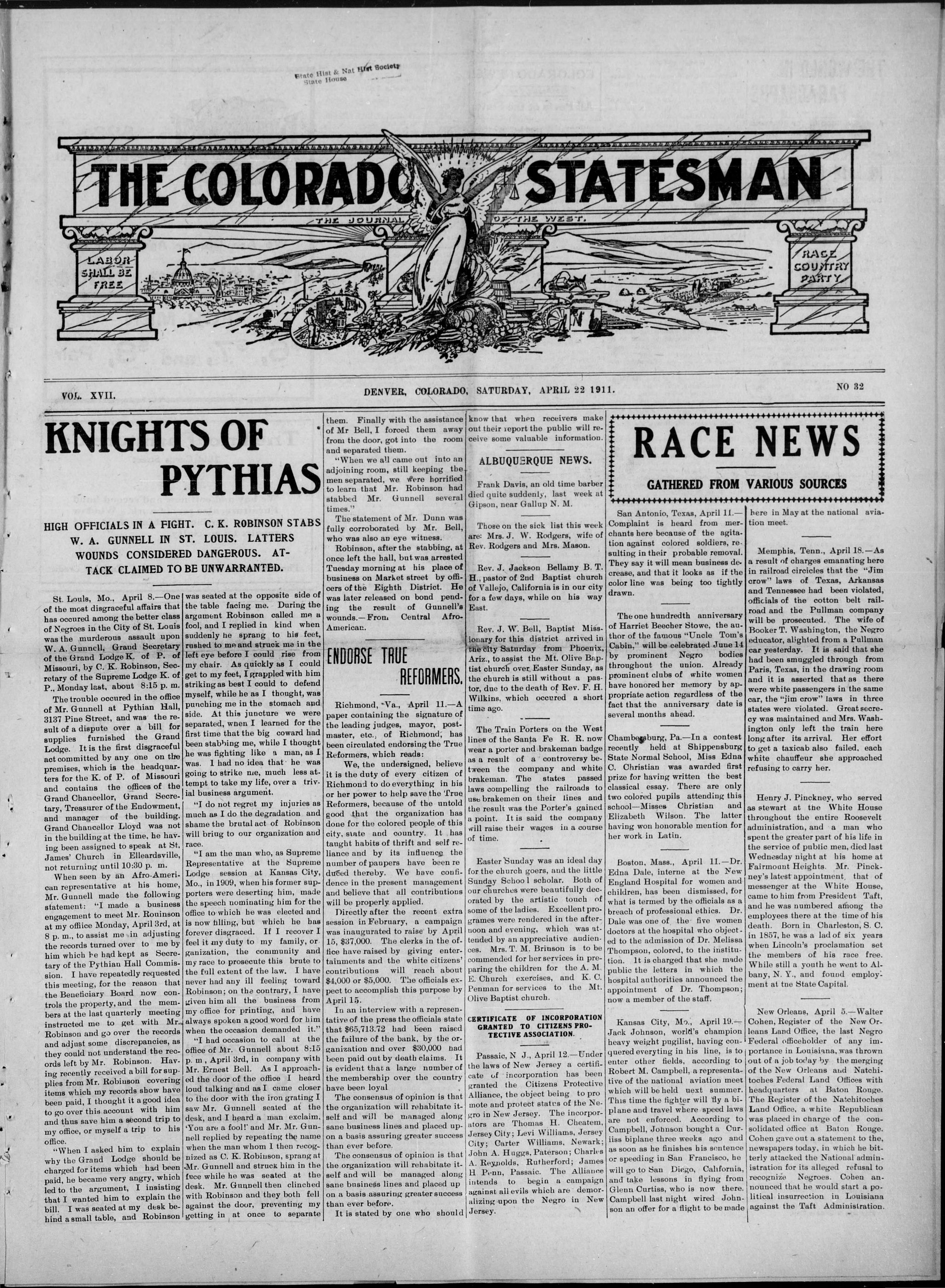
THE COLORADO STATESMAN
THE JOURNAL OF THE WEST.
LABOR SHALL BE FREE
RACE COUNTRY PARTY
KNIGHTS OF PYTHIAS
HIGH OFFICIALS IN A FIGHT. C. K. ROBINSON STABS W. A. GUNNELL IN ST. LOUIS. LATTERS WOUNDS CONSIDERED DANGEROUS. AT- TACK CLAIMED TO BE UNWARRANTED.
VOL. XVII.
KNIGHT
P
HIGH OFFICIALS IN A FIGH
W. A. GUNNELL IN S
WOUNDS CONSIDERED
TACK CLAIMED TO
St. Louls, Mo., April 8.—One of the most disgraceful affairs that has occured among the better class of Negroes in the City of St. Louis was the murderous assault upon W. A. Gunnell, Grand Secretary of the Grand Lodge K. of P. of Missouri, by C. K. Robinson, Secretary of the Supreme Lodge K. of P. Monday last, about 8:15 p. m.
The trouble occured in the office of Mr. Gunnell at Pythian Hall, 3137 Pine Street, and was the result of a dispute over a bill for supplies furnished the Grand Lodge. It is the first disgraceful act committed by any one on the premises, which is the headquarters for the K. of P. of Missouri and contains the offices of the Grand Chancellor, Grand Secretary, Treasurer of the Endowment, and manager of the building. Grand Chancellor Lloyd was not in the building at the time, he having been assigned to speak at St. James' Church in Elleardsville, not returning until 10:30 p. m.
When seen by an Afro-American representative at his home, Mr. Gunnell made the following statement: "I made a business engagement to meet Mr. Rouinson at my office Monday, April 3rd, at 8 p. m., to assist me in adjusting the records turned over to me by him which he had kept as Secretary of the Pythian Hall Commission. I have repeatedly requested this meeting, for the reason that the Beneficiary Board now controls the property, and the members at the last quarterly meeting instructed me to get with Mr. Robinson and go over the records and adjust some discrepancies, as they could not understand the records left by Mr. Robinson. Having recently received a bill for supplies from Mr. Robinson covering items which my records show have been paid, I thought it a good idea to go over this account with him and thus save him a second trip to my office, or myself a trip to his office.
"When I asked him to explain why the Grand Lodge should be charged for items which had been paid, he became very angry, which led to the argument, I insisting that I wanted him to explain the bill. I was seated at my desk behind a small table, and Robinson
was seated at the opposite side of the table facing me. During the argument Robinson called me a fool, and I replied in kind when suddenly he sprang to his feet, rushed to me and struck me in the left eye before I could rise from my chair. As quickly as I could get to my feet, I grappled with him striking as best I could to defend myself, while he as I thought, was punching me in the stomach and side. At this juncture we were separated, when I learned for the first time that the big coward had been stabbing me, while I thought he was fighting like a man, as I was. I had no idea that he was going to strike me, much less attempt to take my life, over a trivial business argument.
"I do not regret my injuries as much as I do the degradation and shame the brutal act of Robinson will bring to our organization and race.
"I am the man who, as Supreme Representative at the Supreme Lodge session at Kansas City, Mo., in 1909, when his former supporters were deserting him, made the speech nominating him for the office to which he was elected and is now filling, but which he has forever disgraced. If I recover I feel it my duty to my family, organization, the community and my race to prosecute this brute to the full extent of the law. I have never had any ill feeling toward Robinson; on the contrary, I have given him all the business from my office for printing, and have always spoken a good word for him when the occasion demanded it."
"I had occasion to call at the office of Mr. Gunnell about 8:15 p.m., April 3rd, in company with Mr. Ernest Bell. As I approached the door of the office I heard loud talking and as I came closer to the door with the iron grating I saw Mr. Gunnell seated at the desk, and I heard a man exclaim, 'You are a fool!' and Mr. Mr. Gunnell replied by repeating the name when the man whom I then recognized as C. K. Robinson, sprang at Mr. Gunnell and struck him in the face while he was seated at the desk. Mr. Gunnell then clinched with Robinson and they both fell against the door, preventing my getting in at once to separate
DENVER. COLORADO, SATURDAY, APRIL 22 1911.
them. Finally with the assistance of Mr Bell, I forced them away from the door, got into the room and separated them.
"When we all came out into an adjoining room, still keeping the men separated, we were horrified to learn that Mr. Robinson had stabbed Mr. Gunnell several times."
The statement of Mr. Dunn was fully corroborated by Mr. Bell, who was also an eye witness.
Robinson, after the stabbing, at once left the hall, but was arrested Tuesday morning at his place of business on Market street by officers of the Eighth District. He was later released on bond pending the result of Gunnell's wounds.—From Central Afro-American.
ENDORSE TRUE REFORMERS.
Richmond, Va., April 11.—A paper containing the signature of the leading judges, mayor, postmaster, etc., of Richmond, has been circulated endorsing the True Reformers, which reads:
We, the undersigned, believe it is the duty of every citizen of Richmond to do everything in his or her power to help save the True Reformers, because of the untold good that the organization has done for the colored people of this city, state and country. It has taught habits of thrift and self reliance and by its influence the number of paupers have been reduced thereby. We have confidence in the present management and believe that all contributions will be properly applied.
Directly after the recent extra session in February, a campaign was inaugurated to raise by April 15, $37,000. The clerks in the office have raised by giving entertainments and the white citizens' contributions will reach about $4,000 or $5,000. The officials expect to accomplish this purpose by April 15.
In an interview with a representative of the press the officials state that $65,713.72 had been raised the failure of the bank, by the organization and over $30,000 had been paid out by death claims. It is evident that a large number of the membership over the country have been loyal
The consensus of opinion is that the organization will rehabitate itself and will be managed along sane business lines and placed upon a basis assuring greater success than ever before.
The consensus of opinion is that the organization will rehabilitate itself and will be managed along sane business lines and placed up on a basis assuring greater success than ever before.
It is stated by one who should
know that when receivers make out their report the public will receive some valuable information.
ALBUQUERQUE NEWS.
Frank Davis, an old time barber died quite suddenly, last week at Gipson, near Gallup N. M.
Those on the sick list this week are: Mrs. J. W. Rodgers, wife of Rev. Rodgers and Mrs. Mason.
Rev. J. Jackson Bellamy B. T. H., pastor of 2nd Baptist church of Vallejo, California is in our city for a few days, while on his way East.
Rev. J. W. Bell, Baptist Missionary for this district arrived in the city Saturday from Phoenix, Ariz., to assist the Mt. Olive Baptist church over Easter Sunday, as the church is still without a pastor, due to the death of Rev. F. H. Wilkins, which occured a short time ago.
The Train Porters on the West lines of the Santa Fe R. R. now wear a porter and brakeman badge as a result of a controversy between the company and white brakeman. The states passed laws compelling the railroads to use brakemen on their lines and the result was the Porter's gained a point. It is said the company will raise their wages in a course of time.
Easter Sunday was an ideal day for the church goers, and the little Sunday School scholar. Both of our churches were beautifully decorated by the artistic touch of some of the ladies. Excellent programs were rendered in the afternoon and evening, which was attended by an appreciative audiences. Mrs. T. M. Brinson is to be commended for her services in preparing the children for the A. M. E. Church exercises, and K. C. Penman for services to the Mt. Olive Baptist church.
CERTIFICATE OF INCORPORATION
GRANTED TO CITIZENS PRO-
TECTIVE ASSOCIATION.
Passaic, N J., April 12.—Under the laws of New Jersey a certificate of incorporation has been granted the Citizens Protective Alliance, the object being to promote and protect status of the Negro in New Jersey. The incorporators are Thomas H. Cheatem, Jersey City; Levi Williams, Jersey City; Carter Williams, Newark; John A. Huggs, Paterson; Charles A. Reynolds, Rutherford; James H. Penn, Passaic. The Alliance intends to begin a campaign against all evils which are demoralizing upon the Negro in New Jersey.
RACE NEWS
San Antonio, Texas, April 11.—Complaint is heard from merchants here because of the agitation against colored soldiers, resulting in their probable removal. They say it will mean business decrease, and that it looks as if the color line was being too tightly drawn.
The one hundredth anniversary of Harriet Beecher Stowe, the author of the famous "Uncle Tom's Cabin," will be celebrated June 14 by prominent Negro bodies throughout the union. Already prominent clubs of white women have honored her memory by appropriate action regardless of the fact that the anniversary date is several months ahead.
here in May at the national aviation meet.
Memphis, Tenn., April 18.—As a result of charges emanating here in railroad circles that the "Jim crow" laws of Texas, Arkansas and Tennessee had been violated, officials of the cotton belt railroad and the Pullman company will be prosecuted. The wife of Booker T. Washington, the Negro educator, alighted from a Pullman car yesterday. It is said that she had been smuggled through from Paris, Texas, in the drawing room and it is asserted that as there were white passengers in the same car, the "jim crow" laws in three states were violated. Great secrec-
Chambersburg, Pa.—In a contest recently held at Shippensburg State Normal School, Miss Edna C. Christian was awarded first prize for having written the best classical essay. There are only two colored pupils attending this school—Misses Christian and Elizabeth Wilson. The latter having won honorable mention for her work in Latin.
Boston, Mass., April 11.—Dr. Edna Dale, interne at the New England Hospital for women and children, has been dismissed, for what is termed by the officials as a breach of professional ethics. Dr. Dale was one of the five women doctors at the hospital who objected to the admission of Dr. Melissa Thompson, colored, to the institution. It is charged that she made public the letters in which the hospital authorities announced the appointment of Dr. Thompson; now a member of the staff.
Kansas City, Mo., April 19. Jack Johnson, world's champion heavy weight pugilist, having conquered everyting in his line, is to enter other fields, according to Robert M. Campbell, a representative of the national aviation meet which will be held next summer. This time the fighter will fly a biplane and travel where speed laws are not enforced. According to Campbell, Johnson bought a Curiiss biplane three weeks ago and as soon as he finishes his sentence or speeding in San Francisco, he will go to San Diego, California, and take lessons in flying from Glenn Curtiss, who is now there. Campbell last night wired Johnson an offer for a flight to be made
NO 32
here in May at the national aviation meet.
Memphis, Tenn., April 18.—As a result of charges emanating here in railroad circicles that the "Jim crow" laws of Texas, Arkansas and Tennessee had been violated, officials of the cotton belt railroad and the Pullman company will be prosecuted. The wife of Booker T. Washington, the Negro educator, alighted from a Pullman car yesterday. It is said that she had been smuggled through from Paris, Texas, in the drawing room and it is asserted that as there were white passengers in the same car, the "jim crow" laws in three states were violated. Great secrecy was maintained and Mrs. Washington only left the train here long after its arrival. Her effort to get a taxicab also failed, each white chauffeur she approached refusing to carry her.
Henry J. Pinckney, who served as stewart at the White House throughout the entire Roosevelt administration, and a man who spent the greater part of his life in the service of public men, died last Wednesday night at his home at Fairmount Heights. Mr. Pinckney's latest appointment, that of messenger at the White House, came to him from President Taft, and he was numbered among the employees there at the time of his death. Born in Charleston, S. C. in 1857, he was a lad of six years when Lincoln's proclamation set the members of his race free. While still a youth he went to Albany, N. Y., and found employment at the State Capital.
New Orleans, April 5.—Walter Cohen, Register of the New Orleans Land Office, the last Negro Federal officeholder of any importance in Louisiana, was thrown out of a job today by the merging of the New Orleans and Natchitoches Federal Land Offices with headquarters at Baton Rouge. The Register of the Natchitoches Land Office, a white Republican was placed in charge of the consolidated office at Baton Rouge. Cohen gave out a statement to the newspapers today, in which he bitterly attacked the National administration for its alleged refusal to recognize Negroes. Cohen announced that he would start a political insurrection in Louisiana against the Taft Administration
REBELS ARE ACTIVE BUT NO
FIGHTING IS NOW
GOING ON.
WOUNDED PUT TO DEATH
BOTH FEDERALS AND INSURRECTOS WOUNDED IN BATTLE ARE BEING KILLED
Washington—Recent developments indicated to President Taft that peace in Mexico may not be a dream, and there is reason to believe the Mexican authorities will adopt a "definite, restrictive policy along the borders," to prevent conflicts.
Advices from Mexico show that the rebels are still active and threatening at several points. There is decisive fighting.
The most important report afloat is that the rebels near Juarez had demanded the surrender of that city.
Senior Manuel de Zamacona, the new Mexican ambassador, was presented to the President and declarations of friendship were exchanged.
Information was given out at the White House that the rough draft of Mexico's formal note in reply to the State Department's demand that American border towns be not endangered by Mexican battles has been placed in the hands of Ambassador Wilson at Mexico City.
Mr. Wilson reported that the note as drafted was satisfactory and it is expected to reach the State Department in final form soon.
A sub-committee of the House committee on foreign affairs will confer with the President and Secretary Knox on the Mexican situation.
Delegate Ralph Cameron of Arizona said he had received a letter from a business man at Douglas, saying Mexicans, both federal and insurrectos, who were wounded at Agua Prieta were "being put to death" by the victors. The Red Cross has no confirmation of this report.
In a speech to the President, Senior Zamacona said peace would be declared in Mexico soon.
Washington.—Edward A. Mosely,
secretary of the Interstate Commerce
T.
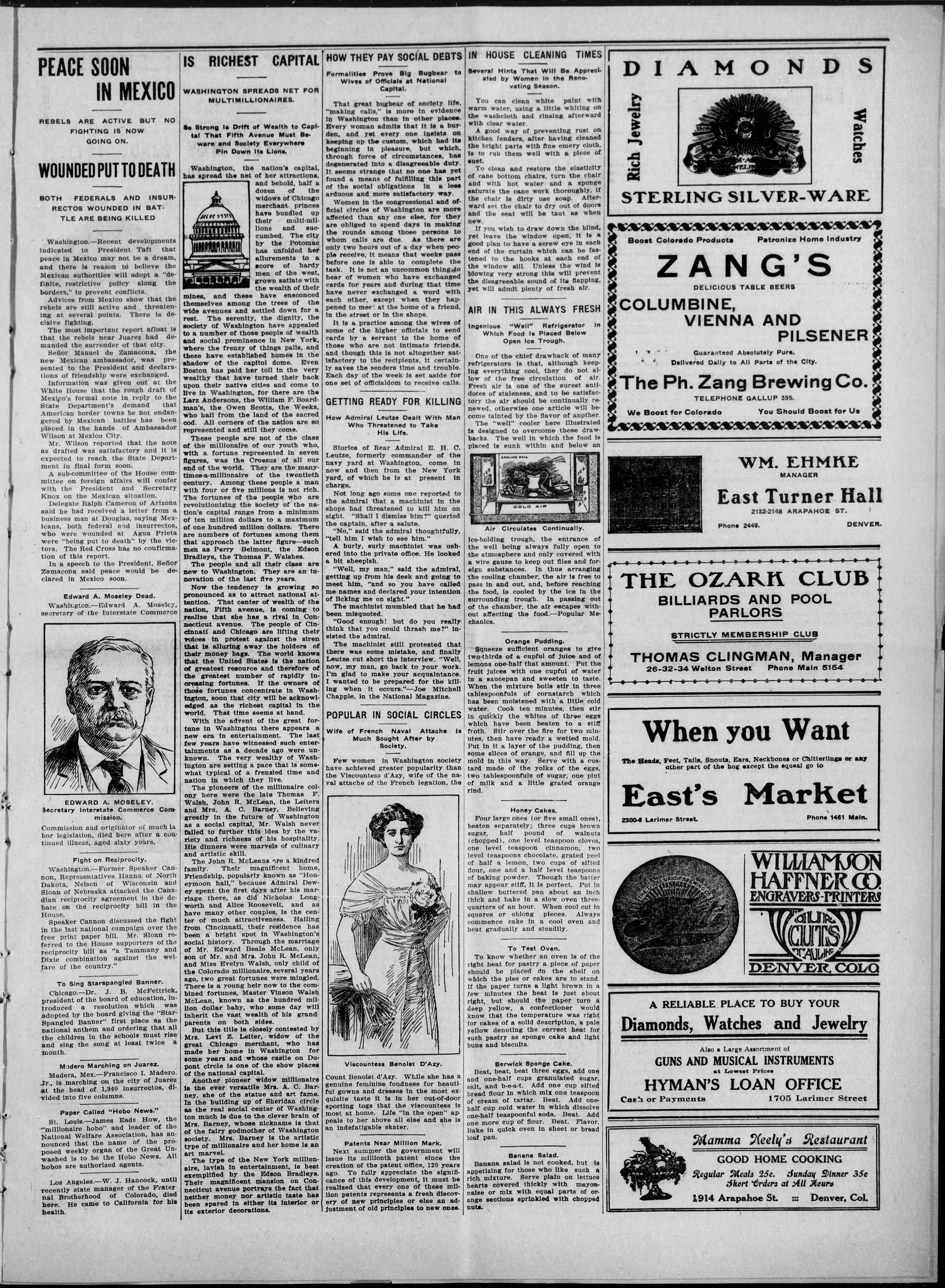
EDWARD A. MOSELEY.
Secretary Interstate Commerce Commission.
EDWARD A. MOSELEY.
Secretary Interstate Commerce Commission.
Commission and originator of much la bor legislation, died here after a con tinued illness, aged sixty years.
Eight on Reciprocity.
Washington.—Former Speaker Cannon, Representatives Hanna of North Dakota, Nelson of Wisconsin and Sloan of Nebraska attacked the Canadian reciprocity agreement in the debate on the reciprocity bill in the House.
Speaker Cannon discussed the fight in the last national campaign over the free print paper bill. Mr. Sloan referred to the House supporters of the reciprocity bill as "a Tammany and Dixie combination against the welfare of the country."
To Sing Starspangled Banner.
Chicago—Dr. J. J. B. McFettrick, president of the board of education, introduced a resolution which was adopted by the board giving the "Star-Spangled Banner" first place as the national anthem and ordering that all the children in the schools must rise and sing the song at least twice a month.
Madero Marching on Juarez.
Madera, Mex.—Francisco I. Madero, Jr., is marching on the city of Juarez at the head of 1,940 insurrectos, divided into five columns.
Paper Called "Hobo News."
St. Louis.—James Eads How, the "millionaire hobo" and leader of the National Welfare Association, has announced that the name of the proposed weekly organ of the Great Unwashed is to be the Hobo News. All hobos are authorized agents.
Los Angeles.—W. J. Hancock, until recently state manager of the Fraternal Brotherhood of Colorado, died here. He came to California for his health.
RICHEST CAPITAL
WASHINGTON SPREADS NET FOR MULTIMILLIONAIRES.
So Strong Is Drift of Wealth to Capital That Fifth Avenue Must Beware and Society Everywhere Pin Down Its Lions.
Washington, the nation's capital, has spread the net of her attractions, and behold, half a dozen of the widows of Chicago merchant princes have bundled up their multi-millions and succumbed. The city by the Potomac has unfolded her allurements to a score of hardy men of the west, grown satile with the wealth of their
(16873377)
mines, and these have ensconced themselves among the trees of the wide avenues and settled down for a rest. The serenity, the dignity, the society of Washington have appealed to a number of those people of wealth and social prominence in New York, where the frenzy of things palls, and these have established homes in the shadow of the capitol dome. Even Boston has paid her toll in the very wealthy that have turned their back upon their native cities and come to live in Washington, for there are the Larz Andersons, the William F. Boardman's, the Owen Scotts, the Weeks, who hall from the land of the sacred cod. All corners of the nation are so represented and still they come.
These people are not of the class of the millionaire of our youth who, with a fortune represented in seven figures, was the Croesus of all our end of the world. They are the many times a-millionaire of the twentieth century. Among these people a man with four or five millions is not rich. The fortunes of the people who are revolutionizing the society of the nation's capital range from a minimum of ten million dollars to a maximum of one hundred million dollars. There are numbers of fortunes among them that approach the latter figure—such men as Perry Belmont, the Edson Bradleys, the Thomas F. Walshes. The people and all their class are new to Washington. They are an innovation of the last five years.
Now the tendency is growing so pronounced as to attract national attention. That center of wealth of the nation, Fifth avenue, is coming to realize that she has a rival in Connecticut avenue. The people of Cincinnati and Chicago are lifting their voices in protest against the sienn that is alluring away the holders of their money bags. The world knows that the United States is the nation of greatest resource and therefore of the greatest number of rapidly increasing fortunes. If the owners of those fortunes concentrate in Washington, soon that city will be acknowledged as the richest capital in the world. That time seems at hand.
With the advent of the great fortune in Washington there appears a new era in entertainment. The last few years have witnessed such entertainments as a decade ago were unknown. The very wealthy of Washington are setting a pace that is somewhat typical of a frenzied time and nation in which they live.
The pioneers of the millionaire colony here were the late Thomas F. Walsh, John R. McLean, the Leiters and Mrs. A. C. Barney, Believing greatly in the future of Washington as a social capital, Mr. Walsh never failed to further this idea by the variety and richness of his hospitality. His dinners were marvels of culinary and artistic skill.
The John R. McLeans are a kindred family. Their magnificent home, Friendship, popularly known as "Honeymoon hall," because Admiral Dewey spent the first days after his marriage there, as did Nicholas Longworth and Alice Roosevelt, and as have many other couples, is the center of much attractiveness. Hailing from Cincinnati, their residence has been a bright spot in Washington's social history. Through the marriage of Mr. Edward Beale McLean, only son of Mr. and Mrs. John R. McLean, and Miss Evelyn Walsh, only child of the Colorado millionaire, several years ago, two great fortunes were mingled. There is a young heir now to the combined fortunes, Master Vinson Walsh McLean, known as the hundred million dollar baby, who some day will inherit the vast wealth of his grandparents on both sides.
But this title is closely contested by Mrs. Levi Z. Leiter, widow of the great Chicago merchant, who has made her home in Washington for some years and whose castle on Dupont circle is one of the show places of the national capital.
Another pioneer widow millionaire is the ever versatile Mrs. A. C. Barney, she of the statue and art fame. In the building up of Sheridan circle as the real social center of Washington much is due to the clever brain of Mrs. Barney, whose nickname is that of the fairy godmother of Washington society. Mrs. Barney is the artistic type of millionaire and her home is an art marvel.
The type of the New York millionaire, lavish in entertainment, is best exemplified by the Edson Bradleys. Their magnificent mansion on Connecticut avenue portrays the fact that neither money nor artistic taste has been spared in either its interior or its exterior decorations.
HOW THEY PAY SOCIAL DEBTS
Formalities Prove Big Bugbear to Wives of Officials at National Capital.
That great bugbear of society life, "making calls," is more in evidence in Washington than in other places. Every woman admits that it is a burden, and yet every one insists on keeping up the custom, which had its beginning in pleasure, but which, through force of circumstances, has degenerated into a disagreeable duty. It seems strange that no one has yet found a means of fulfilling this part of the social obligations in a less arduous and more satisfactory way.
Women in the congressional and official circles of Washington are more affected than any one else, for they are obliged to spend days in making the rounds among those persons to whom calls are due. As there are only two hours out of a day when people receive, it means that weeks pass before one is able to complete the task. It is not an uncommon thing to hear of women who have exchanged cards for years and during that time have never exchanged a word with each other, except when they happened to mee' at the home of a friend, in the street or in the shops.
It is a practice among the wives of some of the higher officials to send cards by a servant to the home of those who are not intimate friends, and though this is not altogether satisfactory to the recipients, it certainly saves the senders time and trouble. Each day of the week is set aside for one set of officialdom to receive calls.
GETTING READY FOR KILLING
How Admiral Leutze Dealt With Man Who Threatened to Take His Life.
Stories of Rear Admiral E. H. C. Leutze, formerly commander of the navy yard at Washington, come in now and then from the New York yard, of which he is at present in charge.
Not long ago some one reported to the admiral that a machinist in the shops had threatened to kill him on sight. "Shall I dismiss him?" queried the captain, after a salute.
"No," said the admiral thoughtfully, "tell him I wish to see him."
A burly, surly machinist was ushered into the private office. He looked a bit sheepish.
"Well, my man," said the admiral, getting up from his desk and going to meet him, "and so you have called me names and declared your intention of licking me on sight."
The machinist mumbled that he had been misquoted.
"Good enough! but do you really think that you could thrash me?" insisted the admiral.
The machinist still protested that there was some mistake, and finally Leutze cut short the interview. "Well, now, my man, go back to your work. I'm glad to make your acquaintance. I wanted to be prepared for the killing when it occurs."—Joe Mitchell Chapple, in the National Magazine.
POPULAR IN SOCIAL CIRCLES
Wife of French Naval Attache Is Much Sought After by Society.
Few women in Washington society have achieved greater popularity than the Viscountess d'Azy, wife of the naval attache of the French legation, the
THE LADY OF THE MIDDLE-STREET
Viscountess Benoist D'Azy.
Count Benoist d'Azy. While she has a genuine feminine fondness for beautiful gowns and dresses in the most exquisite taste it is in her out-of-door sporting togs that the viscountess is most at home. Life "in the open" appeals to her above all else and she is an indefatigable skater.
Patents Near Million Mark.
Next summer the government will issue its millionth patent since the creation of the patent office, 120 years ago. To fully appreciate the significance of this development, it must be realized that every one of these million patents represents a fresh discovery of new principles or else an adjustment of old principles to new ones.
Several Hints That Will Be Appreciated by Women in the Renovating Season.
You can clean white paint with warm water, using a little whiting on the washcloth and rinsing afterward with clear water.
A good way of preventing rust on kitchen fenders, after having cleaned the bright parts with fine emery cloth, is to rub them well with a piece of suet.
To clean and restore the elasticity of cane bottom chairs, turn the chair and with hot water and a sponge saturate the cane work thoroughly. If the chair is dirty use soap. Afterward set the chair to dry out of doors and the seat will be taut as when new.
If you wish to draw down the blind, yet leave the window open, it is a good plan to have a screw eye in each end of the curtain which can be fastened to the hooks at each end of the window sill. Unless the wind is blowing very strong this will prevent the disagreeable sound of its flapping, yet will admit plenty of fresh air.
AIR IN THIS ALWAYS FRESH
Ingenious "Well" Refrigerator in Which Food Is Placed Below Open Ice Trough.
One of the chief drawback of many refrigerators is that, although keeping everything cool, they do not allow of the free circulation of air. Fresh air is one of the surest antidotes of staleness, and to be satisfactory the air should be continually renewed, otherwise one article will become tainted by the flavor of another. The "well" cooler here illustrated is designed to overcome these drawbacks. The well in which the food is placed is sunk within and below an
Air Circulates Continually. ice-holding trough, the entrance of the well being always fully open to the atmosphere and only covered with a wire gauze to keep out flies and foreign substances. In thus arranging the cooling chamber, the air is free to pass in and out, and, before reaching the food, is cooled by the ice in the surrounding trough. In passing out of the chamber, the air escapes without affecting the food.—Popular Mechanics.
Orange Pudding.
Squeeze sufficient oranges to give two-thirds of a cupful of juice and of lemons one-half that amount. Put the fruit juices with one cupful of water in a saucepan and sweeten to taste. When the mixture boils stir in three tablespoonfuls of cornstarch which has been moltened with a little cold water. Cook ten minutes, then stir in quickly the whites of three eggs which have been beaten to a stiff froth. Stir over the fire for two minutes, then have ready a wetted mold. Put in it a layer of the pudding, then some slices of orange, and fill up the mold in this way. Serve with a custard made of the yolks of the eggs, two tablespoonfuls of sugar, one pint of milk and a little grated orange rind.
Honey Cakes.
Four large ones (or five small ones), beaten separately; three cups brown sugar, half pound of walnuts (chopped), one level teaspoon cloves, one level teaspoon cinnamon, two level teaspoons chocolate, grated peel of half a lemon, two cups of sifted flour, one and a half level teaspoons of baking powder. Though the batter may appear stiff, it is perfect. Put in shallow buttered pan about an inch thick and bake in a slow, oven three-quarters of an hour. When cool cut in squares or oblong pieces. Always commence cake in a cool oven and heat gradually and steadily.
To Test Oven.
To know whether an oven is of the right heat for pastry a piece of paper should be placed on the shelf on which the plies or cakes are to stand. If the paper turns a light brown in a few minutes the heat is just about right, but should the paper turn a deep yellow, a confectioner would know that the temperature was right for cakes of a solid description, a pale yellow denoting the correct heat for such pastry as sponge cake and light buns and biscuits.
Berwick Sponge Cake.
Beat, beat, beat three eggs, add one and one-half cups granulated sugar, salt, and b-e-a-t. Add one cup sifted bread flour in which mix one teaspoon of cream of tartar. Beat. Add one-half cup cold water in which dissolve one-half teaspoonful soda. Beat. Add one more cup of flour. Beat. Flavor. Bake in quick oven in sheet or bread loaf pan.
Banana Salad.
Banana salad is not cooked, but is appetizing for those who like such a rich mixture. Serve plain on lettuce hearts covered thickly with mayonnaise or mix with equal parts of orange sections sprinkled with chopped nuts.
M-A
WELH
STERLING S
Boost Colorado Products
Z AN
DELICIOUS T
COLUMBINE,
VIENN
Guaranteed A
Delivered Dally to A
The Ph. Zang
TELEPHONE
We Boost for Colorado
RLING SILVER-W
Colorado Products Patronize Home
ZANG'S
DELICIOUS TABLE BEERS
MBINE,
VIENNA AND
PILS
Guaranteed Absolutely Pure.
Delivered Daily to All Parts of the City.
Ph. Zang Brewin
TELEPHONE GALLUP 395.
for Colorado You Should Bo
SILVER-WARE
Products Patronize Home Industry
NG'S
CIOUS TABLE BEERS
NE,
INNA AND
PILSENER
Inteed Absolutely Pure.
Rally to All Parts of the City.
ang Brewing Co.
PHONE GALLUP 395.
do You Should Boost for Us
STERLING SILVER-WARE
Boost Colorado Products Patronize Home Industry
ZANG'S
DELICIOUS TABLE BEERS
COLUMBINE,
VIENNA AND
PILSENER
Guaranteed Absolutely Pure.
Delivered Dally to All Parts of the City.
The Ph. Zang Brewing Co.
TELEPHONE GALLUP 395.
We Boost for Colorado You Should Boost for Us
```markdown
```
WM. EHMKE
MANAGER
East Turner Hall
2132-2148 ARAPAHOE ST.
Phone 2449. DENVER.
C OZARK CLUB
HILLIARDS AND POOL
PARLORS
ZARK CLUB RDS AND POOL PARLORS
THE OZARK C
BILLIARDS AND POOL
PARLORS
STRICTLY MEMBERSHIP CLUB
THOMAS CLIN
26-32-34 Welton St
When y
The Heads, Feet, Tails, Snouts, Ea
other part of the hog
East's
MAS CLINGMAN, Ma
12-34 Welton Street Phone Main
When you Wear
feet, Tails, Snouts, Ears, Neckbones or Chitts
other part of the hog except the squeal go to
list's Mark
r Street. Pho
CLINGMAN, Manager
on Street Phone Main 5154
In you Want
outs, Ears, Neckbones or Chitterlings or any
the hog except the squeal go to
Market
Phone 1461 Main.
THOMAS CLINGMAN, Manager
26-32-34 Welton Street Phone Main 5154
The Heads, Feet, Talls, Snouts, Ears, Neckbones or Chitterlings or any other part of the hog except the squelg go to
THE OVON UNION BREWING CO.
1850-1910
PLACE TO BUY YOUR
Watches and Jewelry
a Large Assortment of
MUSICAL INSTRUMENTS
at Lowest Prices
S LOAN OFFICE
1705 Larimer Street
A RELIABLE PLACE
Diamonds, Watch
Also a Larger
GUNS AND MUSIC
at Lower
HYMAN'S LO
Cash or Payments
RELIABLE PLACE TO BUY YOUR
Bands, Watches and J
Also a Large Assortment of
INS AND MUSICAL INSTRUMENT
at Lowest Prices
MAN'S LOAN OFFICE
payments 1705 Larim
A RELIABLE PLACE TO BUY YOUR Diamonds, Watches and Jewelry Also a Large Assortment of GUNS AND MUSICAL INSTRUMENTS at Lowest Prices HYMAN'S LOAN OFFICE Cash or Payments 1705 Larimer Street
GOOD HOME COOKING
Regular Meals 25c. Sunday Dinner 35e
Short Orders at All Hours
1914 Arapahoe St. Denver, Col.
---
Rich Jewelry
2300-6 Larimer Street.
```markdown
```
WILLIAMSON
HAFFNER CO.
ENGRAVERS-PRINTERS
CUTS
TAULKS
DENVER, COLO
THE COLORADO STATESMAN
JOS. D. D. RIVERS ..... Proprietor
1824 Curtis Street, Room 25.
SUBSCRIPTION RATES
One Year ..... $2.00
Six Months ..... 1.00
Three Months ..... .60
PAYABLE IN ADVANCE.
It occasionally happens that papers sent to subscribers are lost or stolen. In case you do not receive any number when due, inform us by postal card and we will cheerfully forward a duplicate of the missing number.
Remittances should be made by Express Money Order, Postoffice Money Order, Registered Letter or Bank Draft. Postage stamps will be received the same as cash for the fractional part of a dollar. Only 1-cent and 2-cent stamps taken.
Display advertising 25 cents per square. A square contains ten agate lines.
Reading notices, ten lines or less, 10 cents per line. Each additional line over ten lines, 5 cents per line.
No discounts allowed on less than three months' contract. Cash must accompany all orders from parties unknown to us. Further particulars on application.
All communications of a personating nature that are not complimentary will be withheld from the columns of this paper.
Communications to receive attention must be newsy, upon important subjects, plainly written only upon one side of the paper; must reach us Tuesdays, if possible, anyway not later than Wednesdays, and bear the signature of the author. No manuscript returned. unless stamps are sent for postage.
Entered as second-class matter at the postoffice in the city of Denver, Colorado.
SECRETARY DICKINSON'S VIEWS.
SECRETARY OF WAR DICKINSON is a Southerner who tries to square his inborn sentiments of race distinction and eternal difference with a high-minded idea of justice. In his speech before the Southern Commercial Congress at Atlanta he declared that the commercial development of the South can follow only on the suppression of mob violence. He appealed for a greater reverance and an impartial enforcement of the law as a primary step to the future greatness of the South.
"There never was a time in any Southern state in the last thirty years," said he, "That a Negro could not be speedily and adequately punished for any offense, for the white people controlled absolutely the administration of the law. It does not help us to point out race prejudice and acts of violence to Negroes in the North. No respectable public sentiment justifies such violence there."
Then, as a final solution of the race problem in the South, Mr. Dickinson suggested the possibility of the voluntary removal of the mass of young Negroes to a country of their own, fostered and guarded by the United States. "When they grow in wealth and education," said he, "and still find themselves confined in their aspirations by insurmountable barriers which bar their social and political progress and deny them the opportunities of citizenship open to all others, an ambition to free themselves from such conditions may, if sustained by a liberal governmental policy, lead to such a movement."
There are both force and logic in these views, however prone we may be at present to combat them.
BACK TO BROWNSVILLE.
WHAT a persistent, uncompromising, relentless, hard-hearted old taskmaster Father Destiny is! If he once gets it into his head that we mortals have a certain thing to do there is no escaping the smallest item of his whim. We may rebel, denounce and oppose it with all our weak power and to our very last breath; we may scheme and intrigue and seek to placate it with paltry substitutes; but the thing that old Father Destiny has ordered keeps coming until if finally overwhelms us, with all of our stubborn and defiant opposition, and finally brings us to acknowledge that it is all for the best.
Four years ago the black soldiers were driven out of Brownsville, Texas; under an order that practically disgraced them, and under conditions which made it seem improbable that either they or their kin would find quarters anywhere in that state; and surely not at Brownsville again during the present generation. Certainly the white people of the Brownsville district had no fear of it, and there was no thought of it in all Texas.
Now comes on this Mexican insurrection, with its peculiar international conditions, and President Taft's sudden order mobilizing a large part of the regular army in Texas, along the Mexican border, with headquarters at San Antonio. A white regiment was already stationed at Brownsville, having succeeded the unfortunate Twenty-fifth at that post after the "shooting up" of the town in the summer of 1906, and there seemed no prospect nor desire on any side for anything but white soldiers there for years to come.
The famous Tenth cavalry was sent to San Antonio, along with other troops. But General Destiny was on duty with the war board at Washington, with no other than a Texas congressman as his aide. The congressman from the Brownsville district, in the absence of the congressman from the San Antonio district, took it upon himself on behalf of the white people of San Antonio to visit President Taft and request that the Negro soldiers be taken away from San Antonio. The request was referred to the war department officials, who were directing the army manoeuvers. Soon an order was issued directing the commanding officer to the mobilization army in Texas to withdraw the white soldiers doing duty all along the Mexican border and replace them with the soldiers of the Tenth cavalry. The border territory includes Brownsville, and under the order the white soldiers of that garrison are to be replaced by the black fighters of the famous Tenth cavalry. The witless congressman from this district threw a boomerang when he demanded the removal of the Negro soldiers from San Antonio, for they now go direct to his own home district. Of course, he is having all kinds of epileptic fits over the unexpected outcome of his request, but the order has gone forth, and it is virtually a war order that permits of no vacillation in deference to petty local or personal prejudices. But it all happened because of the fact that it is destined that all parts of this country shall learn to accept the possibility of the presence of Negro soldiers with as much reason and acquiescence as they accept the possibility of the presence of white soldiers. There is no use fighting, opposing or raving over these conditions. They are embedded in the soil, out of which shall grow the future welfare of the country, and no temporary blight or transplanting of departmental roots will alter or change the permanent character of the military growth to which this country is destined.
O EFFORT has yet been made to crystallize thought on the "ideal of a short workday." Evolution will, from time to time, make conditions which will dictate to the thoughtful and progressive mind what should constitute a rational workday.
The onward trend from the condition of the worker toiling in drudgery to the more intelligent method whereby he or she may utilize his or her brain value coequal with his or her brawn value, indicates that working men and women, whether in factory, mill or commission house, who are now enjoying shorter workday than was the custom 30 years ago, are greater producers than formerly, and are doing it in a more satisfactory and intelligent way.
About the time that the ten-hour workday became prevalent the workers, especially in the hardest kinds of employment, hoped to live to see the introduction of eight hours' work as a maximum of toil in the 24-hour day, and in many instances the change has not only taken place, but has proved its utility.
When those yet working ten and twelve hours per day have their hours of labor reduced to the eight-hour maximum, the change will carry with it new wishes, greater desires and higher aspirations. Intelligent workmanship begets intelligent thought and vice versa. So the increased leisure time will be as intelligently applied for social and economic betterment, as will be apparent in the improved workday output of the toiler. With this new condition will come a better citizenship, a desire for a brighter home life, and in time, circumstances may make it necessary, in order to measure up to the improved civil and mental stature, to reduce the standard or recognized working day below the maximum eight hours, and it will not be surprising if the not remote future fixes the workday at six hours, but I question if for many centuries the workday will be made shorter than six hours.
The recognized business hours of a number of professions are already placed at about five or six hours per day, and while in several of those professions men and women do certain kinds of work connected therewith, outside of their regular workday, the labor, mental or otherwise, is not of a regulation nature, is almost voluntary, at least to the extent of being undertaken or not undertaken in any one day, and may be termed more a labor of love than the customary task or workday allotment of labor.
There should only be such reduction of the actual working hours below eight per day as to give all willing to work opportunity to supply the needs of the public, economically but wisely practiced, and such a reduc-
tion can only amount to public or general good when accompanied by the intelligent betterment already referred to and which should be in proportional ratio—that is to say, the workday should only be shortened in proportion to the cultivated tastes of the public for the proper application of the so-called leisure time, because if the ratio failed morality would suffer and the necessary progress to continue anything like ideal life would be destroyed.
PRESIDENT
City Girl Living in Country
By MRS. H. H. GENRICH
So much has been written, such an abundance of sympathy offered, so many guide posts in view, all for the country girl going to the city. Not one word in case the order should be reversed—the city girl going to the country to reside. The first leaves stagnation in a sleepy village, people who have a perpetual grouch, small gossip, the church that is the standard of, not what the man or woman may be, but what their efforts are to make the populace think they are (how they succeed is quite a different argument). In short, she leaves a place where ambition and untiring energy are strangers. The other leaves all that's gay and bright, hustle and real life, streets that throng with business girls who are alive and alert—good healthy red blood racing in their veins. She is living the best she knows in the hope that some day she will be a private secretary with a salary double the amount she now receives.
Her life is clean, morally, mentally, physically. She does not find it necessary to walk the streets and act coquettish and court admiration. When she walks she is in a hurry—she is going some place and she must be there at a certain time.
Then again statistics claim that divorce is more common in country towns than in cities—a plausible thing, as the country girl before marriage spends the greater part of her time in visiting her acquaintances and roaming the streets. After marriage she cannot attend to household duties, so they are slighted. You see her constantly on the streets, consequently the breach widens, then separations, and divorce.
Taking facts into consideration, the country girl is blessed when she enters the city gates if she has the right make of character. The city girl, on the other hand, who goes to the country to live is doomed to more loneliness, heartaches than she ever experienced on a slumming expedition.
I may be able to offer a suggestion of value to those who want to sleep in fresh air, yet have no sleeping porch. We have a spare bedroom that we use for sleeping quarters, with no furniture or pictures. It is simply a big empty room except for two beds, one of a large size and a small one for the baby.
We have hot water heat and keep the radiator covered with a wool blanket pinned tight around it and keep the valve open just enough to cause a free circulation, to as to keep the water from freezing.
On the north we have two large French windows that are usually open and on the east a small window that is always open. This affords us much fresh air.
We use the bathroom as a dressing room, as it is always warm, and we keep the door to our bedroom closed all the time, the window on the east never being closed. We have a boy two years old and he has not slept in a heated room since he was six weeks old.
N
Working Men and Women Now Produce More
By GEORGE BRABBIT
So much has been written, such an abundance of sympathy offered, so many guide posts in view, all for the country girl going to the city. Not one word in case the order should be reversed—the city girl going to the country to reside. The first leaves stagnation in a sleepy village, people who have a perpetual grouch, small gossip, the church that is the standard of, not what the man or woman may be, but what their efforts are to make the populace think they are (how they succeed is quite a different argument). In short, she leaves a place where ambition and untiring energy are
I may be able to offer a suggestion of value to those who want to sleep in fresh air, yet have no sleeping porch. We have a spare bedroom that we use for sleeping quarters, with no furniture or pictures. It is simply a big empty room except for two beds, one of a large size and a small one for the baby.
We have hot water heat and keep the radiator covered with a wool blanket pinned tight around it and keep the valve open just enough to cause a free circulation, to as to keep the water from freezing. On the floor we have two large French
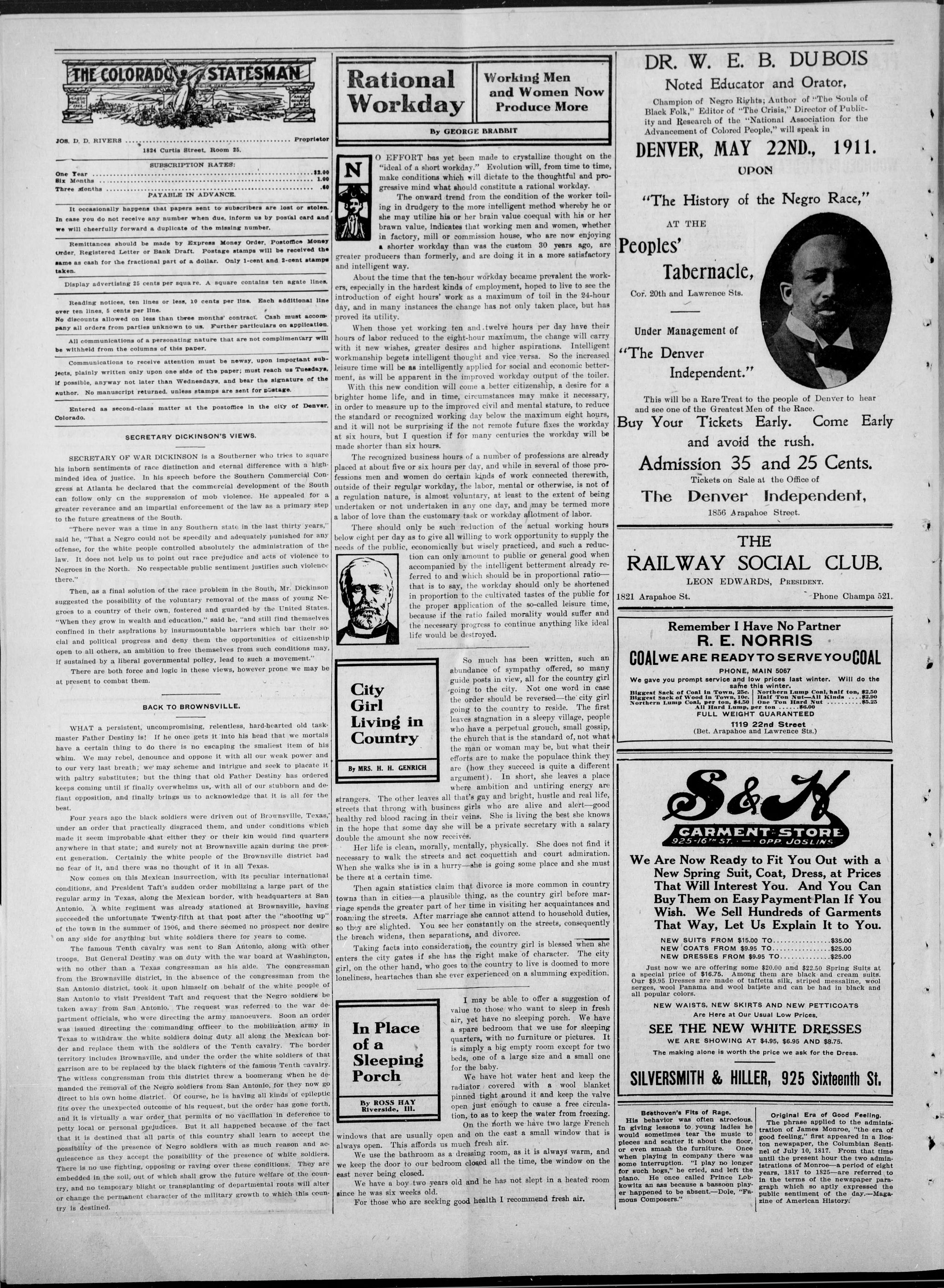
Noted Educator and Orator. Champion of Negro Rights; Author of "The Souls of Black Folk," Editor of "The Crisis," Director of Publicity and Research of the "National Association for the Advancement of Colored People," will speak in
DENVER. MAY 22ND., 1911.
"The History of the Negro Race,"
[Picture of a man in a suit and bow tie].
AT THE
Cor. 20th and Lawrence Sts.
Under Management of
"The Denver
Independent."
This will be a Rare Treat to the people of Denver to hear and see one of the Greatest Men of the Race.
Buy Your Tickets Early. Come Early and avoid the rush.
Admission 35 and 25 Cents.
Tickets on Sale at the Office of
The Denver Independent,
1856 Arapahoe Street.
Phone Champa 521.
1821 Arapahoe St.
PHONE, MAIN 5087
We gave you prompt service and low prices last winter. Will do the
same this winter.
Biggest Sack of Coal in Town, 25c. Northern Lump Coal, half ton, $2.50
Biggest Sack of Wood in Town, 10c. Half Ton Nut—All Kinds ... $2.90
Northern Lump Coal in Town, 10c. Half Ton Nut—All Kinds ... $5.25
All Hard Lump, per ton ... $6.00
FULL WEIGHT GUARANTEED
1119 22nd Street
(Bet. Arapahoe and Lawrence Sts.)
S&N
CARMENT STORE
925-16TH ST. OPP JOSLINS
We Are Now Ready to Fit You Out with a New Spring Suit, Coat, Dress, at Prices That Will Interest You. And You Can Buy Them on Easy Payment Plan If You Wish. We Sell Hundreds of Garments That Way, Let Us Explain It to You.
NEW SUITS FROM $15.00 TO.....$35.00
NEW COATS FROM $9.95 TO.....$25.00
NEW DRESSES FROM $9.95 TO.....$25.00
Just now we are offering some $20.00 and $22.50 Spring Suits at a special price of $16.75. Among them are black and cream suits. Our $9.95 Dresses are made of taffetta silk, striped messaline, wool gres, wool Panama and wool batiste and can be had in black and all popular colors.
NEW WAISTS, NEW SKIRTS AND NEW PETTICOATS
Are Here at Our Usual Low Prices.
SEE THE NEW WHITE DRESSES
WE ARE SHOWING AT $4.95, $6.95 AND $8.75.
The making alone is worth the price we ask for the Dress.
SILVERSMITH & HILLER, 925 Sixteenth St.
Beethoven's Pits or Rage.
His behavior was often atrocious. In giving lessons to young ladies he would sometimes tear the music to pieces and scatter it about the floor, or even smash the furniture. Once when playing in company there was some interruption. "I play no longer for such hogs," he cried, and left the plano. He once called Prince Lobkowitz an ass because a bassoon player happened to be absent.—Dole, "Famous Composers."
Original Era of Good Feeling.
The phrase applied to the administration of James Monroe, "the era of good feeling," first appeared in a Boston newspaper, the Columbian Sentel of July 10, 1817. From that time until the present hour the two administrations of Monroe—a period of eight years, 1817 to 1825—are referred to in the terms of the newspaper paragraph which so aptly expressed the public sentiment of the day. Magazine of American History.
THE COLORADO STATESMAN
Guy Stills is on the sick list.
J. L. Riggs and R. D. Fall of Kansas City were visitors here Monday.
Jack Dempsey is suffering with a severe cold.
Mrs. A. G. Elliott of 4311 Clayton street is on the sick list.
tors: J. J. Houston, Tom Cohler Charles Harris and O. T. Jackson.
Mrs. Bruce Johnson, a former resident of Denver, but who for seven years has been a resident of Grand Junction, died at that place Sunday morning, April 9th, of heart trouble of which she had long been a sufferer. She was buried Monday from the Seventh Day Adventist church, of which
Harry Hayden and W. H. Spriggs were callers at the Colorado Statesman office Monday.
Ira Franklin is the new headwaiter at the Colorado Triffic Club. He succeeds George Groves.
Mrs. B. F. Foley of Oakland, Calif., is visiting her son, A. T. Kerr, 2932 Welton street.
L. L. Jones of the U. B. F.'s has been appointed deputy national commander of that order.
C. Pullman arrived in the city last Saturday from Victor, Colo., to remain two weeks with his family.
Wm. Brasher, who has been suffering with rheumatism for several days, is improving slowly.
Mrs. A. H. Hall of 4729 Claude Court is quite sick this week suffering from stomach trouble.
Rev. J. W. Braxton of Colorado Springs was in the city the latter part of last week on church business.
Hear the Aeolian Quartette and Madam Herndon at the May Flower Carnival, East Turner Hall, May 4th.
The Twentieth Century Whist Club will meet tonight at the residence of Mr. and Mrs. Martin's on East 30th avenue.
Rev. J. C. C. Owens, our presiding elder of the A. M. E. church has returned from Kansas City, where he has been on business.
Mrs. Cora Holland of Kansas City Mo., arrived in the city last Friday and is the guest of her sister, Mrs. Allie Spencer of 2819 California street.
G. A. Smith, a clerk in the postoffice, left the city this week for Abilene, Kansas, where he will spend his vacation visiting relatives.
The Colorado Statesman is pleased to state that Mrs. Unity Hall and Letter-carrier John C. Porter, who are at Mercy hospital are getting along nicely and expect to return home in a few day.
Hon. W. B. Townsend returned to the city Sunday from Baltimore where he has been on legal business. Whilst away he visited New York and is chuck full of news concerning the metropolis. His wife, who has been visiting friends in Omaha accompanied him home.
Mr. and Mrs. Jas Mackey wish to announce the engagement of their eldest daughter, Miss Inez Ulrica Mackey, to Henry Jos. Harris of Brooklyn, N. Y. The marriage to take place in San Diego, Calif., the latter part of June.
Sunday was an ideal Easter day. All of our churches were tastefully decorated for the services commemorative of this gladsome occasion. The Christ the Savior has risen. The beautiful flowers, the caroling of feathered songsters and the sermons preached by the pastors were elevating to the highest degree. All the churches were well attended.
Rice Lodge No. 39, I. B. P. O. E., entertained a large crowd at East Turner hall last Monday night the occasion being its annual Easter ball. It was a great demonstration of exquisite Easter costumes which furnished an excellent and admiring view in the grand march. It was an evening of bliss from start to finish.
The Mutual Laundry Company held the third meeting Saturday, April 15, in their office, 2100 Arapahoe. Mr. Clinkscal having withdrawn from the promotion. The other directors postponed the completion of articles of incorporation until next meeting, April 22, when a prospective manager would reach the city from the East. Direc-
---
tors: J. J. Houston, Tom Cohen, Charles Harris and O. T. Jackson.
Mrs. Bruce Johnson, a former resident of Denver, but who for several years has been a resident of Grand Junction, died at that place Sunday morning, April 9th, of heart trouble, of which she had long been a sufferer. She was buried Monday from the Seventh Day Adventist church, of which she was a member. Her sorrowing husband has the sympathy of the Colorado Statesman.
Thomas Berry, George Elkins and Curtis Harris will entertain at the May Flower Carnival at East Turner Hall, May 4th.
Miss Mattle Cowden, our popular hair dresser, was tendered a birthday party Tuesday evening at the residence of Mrs. W. C. Cowden at 368 Steel streetet. The evening was spent very pleasantly in different games, dainty refreshments were served in abundance. Miss Cowden modestly refrained from mentioning her age, but the Colorado Statesman extends happy felicitations of the day.
The Colorado African Colonization Society held a ratification meeting at Shorter's A. M. E. church Tuesday evening to thank the Liberian government for setting aside 50,000 acres of land for the use of colonists, from the United Staes. President J. N. Walker and Rev. W. C. Williams were the principal speakers. Resolutions of thanks were adopted and a copy sent to the Liberian government, also one was sent to President Taft.
NOTICE TO ALL WAITERS.
You are hereby notified to attend a meeting of the Afro-American Waiters Ascociation, Thursday evening, April 27th, at new Odd Fellows' hall, 2630 Welton street. W. H. SPRIGGS, Secretary.
Three hundred years ago King James authorized the version of the English Bible as we have it today. Tomorrow the Ter-Centennial anniversary of this sacred book will be observed by all the churches and christian organizations in the city of Denver. All the colored churches and organizations will hold their celebration at Shorter Chapel at 3:00 p. m., under the auspices of the Y. M. C. B. An excellent program of information and interest will be presented.
The papers to be read are:
"Sources of Our Bible," Mr. -O. S. Skinner.
"English and King James Versions," Mrs. A. E. Edwards.
"Revised Version and Literary Standing." The Rev. J. N. Wallace. The music will be in charge of the Shorter and Zion choirs united. Much needed and valuable information upon the backbone of our religion and its sacred writings will be presented in these papers, and no one should miss acquiring such knowledge. Three o'clock is the hour.
BETHLEHEM BAPTIST CHURCH
NOTES.
Easter Sunday was a high day with the church, the services began at six o'clock with early prayer meeting and at eleven the pastor was feeling at his best and preached a strong convincing sermon on the resurrection of Christ, which was highly enjoyed by all present. At one o'clock the Sunday school rendered a fine program. The Easter Coronation under the management of Mrs. Lala Johnson, the little folks vied with each other as to who would recite and sing the best.
The choir closed the services of the day with a sweet song service. The Sunday school and Mission Circle token collections for Foreign Mission of the National Baptist Foreign Mission board. Easter has come and gone, now our attention is turned to our financial campaign that closes June the 18th. Every person that claims membership in this church are expected to do his and her duty at this time. We want to pay off the balance on the church lots and break ground this summer. No persons will be authorized to solicit money for the church, whose book, list or card does not bear the cut of the new church building. The names of the different leaders will be given in a few days. Let those who never helped Bethlehem do so in this rally.
The City Mission Union will meet with Bethlehem Thursday, April 27th, at 10 a.m. The Mission circle of the
church will meet at the home of the president, Mrs. M. E. Morrison, 834 Fox street Wednesday evening, April 26th at 8 p. m. A good program will be rendered, after which refreshments will be served. You are invited to all our services, 2716 Larimer street. A. E. REYNOLDS, Pastor.
"For Sweet Charity's Sake," May Flower Carnival May 4, 1911, East Turner Hall.
NOTES OF THE PEOPLE'S PRESBYTERIAN CHURCH.
Sermon Topics, Sunday, April 23d. 11 a. m., "Why the People Perish." 6:45 p. m., election of officers, Y. P. C. E. 7:30 p. m., "Ecce Homo." Next Wednesday night in lieu of the regular prayer meeting, Mr. R. J. Buchanan will entertain us with his "Travel Sketches," illustrated by finely colored views with dissolving stereopticon. The auditorium will be thrown open to all our members and friends for the night. The exhibition is free. Let everybody avail himself of this opportunity. Mr. Buchanan comes to us highly recommended. For twenty-five years he has been a member of Central Presbyterian church. His travels are extensive. His experience is ripe and varied.
Report to the Presbytery of Denver last Tuesday of the People's Church and which was received with much appreciation shows a Sabbath School membership of sixty, including officers and teachers; church membership around the hundred mark; raised for all purposes $3,123.68 plus $12 for miscellaneous. The Guild, Sabbath School, Sewing Circle and Christian Endeavor have contributed much toward this glowing report. Guild meets with Mrs. Maddox, 2425 Humboldt next Tuesday night.
At a recent congregational meeting the members voted unanimously to substantially increase the pastor's salary. The "Gold Medal" and a certificate will be awarded at the services tomorrow to Mrs. Emma Wilson and Miss Fannie Wilson for having attended regularly and punctually the Sabbath School every Sunday during the past church year, which closed March 31st. Every quarter the faithful scholars will be awarded the prize according to the "Little Cross and Crown System," which is in vogue in our school. Every scholar can earn it if he wills. The services last Sunday were beyond the ordinary. The Easter carol at night was in a class by itself. Instruction class for church membership will begin next Wednesday at 5 o'clock for the children and 7 p.m. for adults. All persons looking forward for membership with this church are invited to join the same. Public reception of members will take place June 4th.
SCOTT M. E. CHURCH.
The Easter programs by the Sunday school and the choir were the best rendered since the organization of the church. The offering for Foreign Missions was $28.44. The committee on decoration is highly complimened for the artistic way they decorated the church.
The sacred cantata, Gethsemane, will be rendered Sunday evening. There will be no preaching. Mr. Watson has practiced the choir for this grand event for the past six weeks and it promises to be something out of the ordinary. All seats free. Come early as the program will be promptly started at 8 o'clock.
Mrs. Lizzie Froman and Miss E. A. Antony read very interesting and well prepared papers on Missions last Sunday evening. The solos by Miss Pierson and Miss Jessi Young were of a high grade. The choir handled the anthems in a masterly way. Miss Lela Rice the organist is always at her post of duty.
Mr. Fred Brown, the superintendent of the Sunday school is infusing new life in his work. He gave each little tot an easter chicken which tickled their fancy. Mr. Brown obtained some very beautiful decorations from Joslin's Dry Goods Company. Thanks.
Mesdames Wallace, Evans and Forney deserve special mention for the very acceptable way they trained the young people for their respective parts on the Sunday school program.
The subject of Sunday morning sermon will be "The Crowned Savior." This will be a special message and a sequel to the Resurrection. Come!
GETHSEMANE TO CALVARY
A Sacred Cantata Will Be Rendered at Scott's M. E .Church by the Choir and Asisted by One of the Leading Sopranos of the West, Sunday Evening at 8 O'clock. Come Early in Order to Obtain a Seat.
PART I.
1. Introduction ..... Instrumental
2. Chorus ... Go to Dark Gethsemane
3. Recit (Bass) ..... Then Jesus Came.
4. Chorus ..... Tis Midnight.
5. Recit (Soprano or Tenor) ..... Then Judas Came.
6. Recit (Contralto) ..... Then They Took His Away.
7. Air (Contralto) ..... O Lord of All.
8. Quartette and Chorus ..... He Was Despised
9. Recit (Tenor) ..... And Pilate Said.
10. Chorus ..... Crucify Him.
PART II
Crucifixion.
11. March to Calvary .. Instrumental
12. Chorus .. Then They Put on Him.
13. Solos (Sop., Con., Tenor and Bass and Chorus) .. O Sacred Head.
14. Recit (Bass) .....
... And Jesus When He Had Cried.
15. Chorus and Solos (Con., Tenor and Bass) .. O Come and Mourn.
16. Recit (Bass) .....
... And Behold the Vell Was Rent.
17. Chorus .....
... Truly This Was the Son of God.
The Head Once Crowned With Thorns.
22. Chorus .....
...In the Cross of Christ I Glory.
Do not miss this musical treat. H.
Watson, choirmaster; Miss Lella Rice,
organist. James N. Wallace, B. D.,
pastor.
Rooming house, 7 rooms, with bath,
for sale at 2024 Champa street.
Two modern furnished rooms for
rent at 2024 Champa street.
FOR RENT.
2345 Ogden, 4 room, upper flat with bath and electric light and furnace. Apply 2417 Ogden.
Nicely furnished front room for rent at 1895 Marion street.
For rent, modern furnished rooms. Apply to Z. Hooper, 2507 Lafayette street.
Nicely furnished rooms for rent at 2034 Arapahoe street. Telephone Champa 1338.
One nice, large and small furnished room for rent, with bath. Room for man and wife for light housekeeping or two gentlemen at $3.00 per month. Phone Champa 2528 or address 1919 Welton street.
Brickler's New Barber Shop is located at 2208 Larimer street. Shave, 10c. Hair Cut, 25c; Children, 15c.
DON'T MISS THIS OPPORTUNITY.
For sale, 80 acres, good house, barn, chicken house,15 acres plowed; four miles from Delta; center of fruit belt. Inquire at this office.
FOR SALE
Four choice lots at a bargain on corner 26th and Gaylord; reasonable terms; apply 1824 Curtis, Room 25.
Hard Task for Mankind.
To become a good man is truly difficult, fashioned without fault.—Horace.
Sugar in Mortar.
Sugar is now being used to increase the adhesive power of mortar.
J. H. BIGGINS
Furniture Repairing and Upholstering. All work Cash.
PHONE YORK 4583
2231 Washington St. Denver.
FORD'S HAIR POMADE
THE OLD RELIABLE DRESSING FOR
KINKY OR CURLY HAIR. IT'S USE MAKES
STUBBORN, HARSH HAIR SOFTER, MORE
PLIABLE AND GLOSSY, EASY TO COMB AND
PUT UP IN ANY STYLE THE LENGTH WILL
PERMIT. WRITE FOR TESTIMONIES, TELLING
HOW THIS REMARKABLE REMEDY MAKES
SHORT, KINKY HAIR GROW LONG AND
WAVY. BEST POMADE ON THE MARKET
FOR DANDRUFF, ITCHING OF THE SCALP
AND FALLING OUT OF THE HAIR.
BEWARE OF IMITATIONS, GET THE
GENUINE, PUT UP IN 25* AND 50* BOTTLES
WITH CHARLES FORD'S
NAME ON EVERY PACKAGE.
SOLD BY DRUGGISTS.
IF YOUR DRUGGIST CANNOT SUPPLY
YOU,WE WILL SEND IT TO YOU DIRECT
AT THE FOLLOWING PRICES,SMALL SIZED
BOTTLE,25¢ LARGE SIZED BOTTLE,50¢
THE OZONIZED OX MARROW CO.
216 LAKE ST.,DEPT. 30 CHICAGO,ILL.
AGENTS WANTED.
The F.F.F. CLOTHING CO.
New Store"
and Know How!!
at least 25 per cent on
s and Furnishing Goods.
at the "Workingman's
o. Try us, and you will
"The New S
Dress Men-and K
We also save you at least 25
your Clothing, Hats and Furni
High Class Goods at the "W
Price" is our Motto. Try us,
like us.
"The New Store" Dress Men-and Know How!!
We also save you at least 25 per cent on your Clothing, Hats and Furnishing Goods. High Class Goods at the "Workingman's Price" is our Motto. Try us, and you will like us.____
AN'S
LYMA
Down Town
Millinery Co.
THE ROSE HAT
Purchase Your Spring MILLINERY NOW
Our store is filled with everything in popular priced Millinery, at both wholesale and retail; in fact, we'll guarantee that no stock of Millinery goods has ever been displayed in Denver before to equal ours in magnitude, assortment and low prices. The great volume of our business permits us to make low prices.
Call and Be Convinced
5% MONEY for HOMES
SIMPLE INTEREST
A SWELL COLORED DRILL TEAM.
Dr. J. H. P. Westbrook
COR. 21ST AND ARAPAHOE STS
Day Phone Main 1144.
Night Phone Champa 570.
---
822 Fifteenth St.
OPPOSITE D. & F.'s
1120 - 1122 Sixteenth St.
A
We are still issuing sick and accident insurance. Also unexcelled oldline, straight life policies. If the agents miss you, let us know about it. We want twelve more young men to take a part in our nonparalled drill team. See Captain Langston at the Statesman Printing office, President T. S. Rector, Secretary Victor Waker, Medical Director Dr. E. L. Faulkner, General Counsellor W. B. Townsend, General Agent J. H. Morris, or any member of the board of directors for particulars. Hustling agents wanted to handle our fast selling certificates.
WELTON TRUNK MFG. CO.
TRUNKS, SUIT CASES, BAGS AND TRAVELERS' NECESSITIES
H. L. KORTZ
Watches and Jewelry for Sale at Lowest Prices in the City.
WALTHAM
ONE SIZE
All Work Guaranteed for Two Years.
805 Fifteenth Street, Denver, Colo.
Between Champa and Stout
Phone Main 5371
SUITS
$12.50 to $25
Denver, Colo.
5% MONEY for HOMES SIMPLE INTEREST Interest charged only on balance due on loan each year; therefore interest payments decrease annually.
MONTHLY PAYMENT
NOT MORE THAN RENT
Easiest method of paying for improved property. Loans made in any good town. Literature free. Write today. Dept. B.
THE COLORADO CONTRACT
INVESTING CO.,
Suite 405, Quincy Bldg.
Denver, Colorado.
WHY PAY RENT?
Own your home at a monthly payment less than rent. We will loan you money at 5 per cent. simple interest per annum to buy, build, improve or pay off mortgage on real estate. $9.65 per month is the average return payment, interest and principal, on a thousand ($1,000.00) dollar loan. Other amounts in proportion.
We also loan on Business Property.
See our representative or call on or
address, COLORADO CONTRACT INVESTING COMPANY, Incorporated.
Suite 410-411 Quincy Building, Denver
Phone, Main 8078, Denver Colo., or
Raymond A. Clark, 3657 Zuni, Phone
Gallup 857, Representative.
MISS BEATRICE LEWIS
Dressmaking and Ladies' Tailoring
SATISFACTION GUARANTEED
2339 Gilpin Street. Denver.
Hours: 10 to 11 a. m. 2 to 5 and 7 to 9
p. m. and by Appointment.
1519 CURTIS STREET
Ice Cream,
Ices, Candies
MUSIC
VOCAL-PIANO-ORGAN
Voice Culture a Specialty
(Voice -- Song -- Speech)
Madam Seiler and Emil
Behnke's Methods
TERMS MODERATE
Apply
Hewetson-Watson
2631 Humboldt St.
Phone York 2341 Denver
15
Phones, Office Main 5595.
Residence, York 123.
Hours: 9 to 11 a.m., 1 to 4, 7 to 8 p.m.
Sundays: 10 to 11:30 a.m., 2 to 4 p.m.
Dr. P. E. Spratlin
Good Block-1557 Larimer St.
Residence 2230 Clarkson St.
Denver, Colorado.
Phone Main 7241
Money to Loan on Good Security.
J. A. WHITTAKER & CO.
REAL ESTATE
City Property and Farm Lands
City Property to Trade for Lands. Garden tracts for Sale and Trade.
1918 Nineteenth St Denver, Colo.
CREDIT
?
YES
PHONE
MAIN
6316
T. H. Wearne
PHONE
MAIN
6316
Furniture
CARPETS, STOVES AND
WINDOW SHADES
First Class Repairing and Upholstering
1449-55 Welton Street
For Sale
Vacant lots in parts of the City from $35 up. Terms so small you can pay out and not miss the money. Why not put some of that cigar money in a pair of lots.
The Colored Amer.
Loan & Realty Co.
Phone Main 5554. 913 21 St.
THE BEST ICE CREAM AND
CANDIES AT
CATERERS AND
CONFECTIONERS
Phone: 168
1512 Curtis Street, Denver, Colo.
Turn Over
a New Leaf
By subscribing
for THIS PAPER
---
WASHINGTON GOSSIP
Illinois Is Ahead in Absenteeism
President Loves Innocent Jest
As Breeding Ground for Alaska
Lack of Horses Alarms Officers
TO WASHINGTON
I THINK ITS FIERCE TO HAVE TO GO TO WASHINGTON TO COLLECT ONE'S SALARY IT SHOULD BE SENT TO 'M-AN-IN-CLUDE MILAGE
WASHINGTON.—Illinois still holds the national championship for long distance statesmanship in congress. The complete congressional record for the last session just issued establishes the state's claim to this distinction beyond any doubt.
No other delegation even approaches the mark set by Illinois in the number of congressmen absent at all times, the number of roll calls missed by each and the total number of days each was away during the session.
While none of the Illinois representatives achieved the distinction of representing his district without once appearing at the capital, there were several who outdid all former feats and approached remarkably close to this goal. Unfortunately they were handicapped by the provision of the law for the payment of mileage. A member may draw his salary of
LIFE is a jest, and all things show it:
I thought so once, and now I know it."
sang the poet Gay; and although the president appreciates the necessity of upholding the dignity of the chief executive, still, like Oliver Cromwell, he "loves an innocent "Jest."
He was to attend a fashionable bazaar held at the New Willard for sweet charity's sake, and started out accompanied by Capt. Butt and two secret service guards, Messrs. Sloan and Wheeler writes Joe Mitchell Chapple in the National.
The party was cordially welcomed by the reception committee, and were about to be permitted to enter the hall when the president whimsically decided to pay his way in like the other patrons of the charity. Walking up to a desk where the tickets were on sale, he inquired: "How much are the tickets?"
I'll die if THEY SEND ME TO ALASKA - IT MUST BE AWFUL COLD UP THERE
An odd plan is on foot to make the Colorado mountains a sort of proving ground for agriculture in Alaska. Of course, there are a good many kinds of agriculture in Alaska that do not need proving. They are already an established success, both scientifically and commercially. Hundreds of tons of potatoes, oats and cabbage are grown and sold in the territory each year and there are a dozen other successful crops.
But Alaskan nights are too cool to mature string beans and corn, for instance, and the question is whether hardy, cold-restraint varieties could not be produced by selective breeding that would give Alaskans all the fresh luxuries from their garden that the states have. There are farms in the Colorado mountains near Denver that have an elevation of nearly 10,000 feet and the conditions at this altitude in Colorado are almost identical with condi-
I NEVER WAS VERY ANXIOUS TO JOIN THE ARMY - THEY SHOULD USE AUTOS
ARMY officers and department of agriculture experts are uneasy over the lack of proper horses in the country for use of the cavalry and artillery in case of war.
A comprehensive report on the subject has been published by the bureau of animal industry of the war department. It appears that there is much trouble in finding suitable horses for the army in time of peace, to say nothing of the demands that would be made in case of war of any magnitude.
In this country now are about 23,000,000 horses. It would seem that out of this number there would be an ample number for the equipment of the cavalry and for artillery and other army uses in case of war, but in an article on breeding horses for the United States army, prepared by Capt. Casper H. Conrad of the Third cav-
$7,500 a year, his $1,500 allowance for clerk hire, and $125 for stationery without coming to Washington, but it is necessary for him to appear at least once in order to receive his traveling allowance of 20 cents a mile. It is doubtful if an absolutely perfect record of nonattendance ever will be made even by one of the Illinois champions, unless this irksome requirement of the mileage provision should be modified. The generous allowance makes it a real object for a congressman to come to Washington at least once each session. Unsophisticated persons may suppose representatives who attend a session of congress only a few days of the entire period refrain, as a matter of propriety, from drawing their entire salary, or perhaps return it to the treasury.
For the information of such be it stated the cashier in the office of the sergeant at arms was asked if any member of the house had not drawn his salary for the last congress or had refunded it for any reason.
"Members of the house refund salary!" exclaimed the official. "Never knew it to happen, and I've been here sixteen years."
"Two dollars," replied the young lady in charge sweetly. Plunging into his spacious trousers' pocket, the presidential right hand brought forth two one dollar bills, which he passed to the ticket seller, and nodding to his trio of companions, he entered the hall. "Lend me two dollars, Jack," whispered Captain Butt to Wheeler, "left my money at home." "So did I," mourned Wheeler. (The party were attired in dress suits.) "Never mind, I'll take care of you both," hastily offered Jimmie Sloan, with becoming magnanimity. The others breathed a sigh of relief as he approached the desk. "Three tickets, please," he announced calmly, producing a crisp five-dollar bill.
"Another dollar, please," gently remarked the young lady at the booth.
"Another dollar! H—how m—much did you say those tickets were?" demanded James.
"Two dollars each."
Jimmie was blushing a rosy red when Wheeler came to the rescue.
A passing bell-boy was taken by the collar and a few of the morning's tips were removed from his inside pocket.
Then four silver quarters were placed triumphantly upon the table, and the three passed inside.
tions at 1,000 feet elevation near the arctic circle. That is the days are warm and sunshiny, but the nights are almost*cold even in summer, while the severe winters are apt to kill all but the hardest perennials. A bill was recently introduced into congress for the establishment of just such work in Colorado and also for experiments that would breed drought-resistant vegetables for the desert.
The methods employed in this experimental work are exceedingly interesting. If for instance, it was decided to find a wheat that would mature in a very cold climate like that in the hill country north of the arctic circle, this is how it would be done: First, the hardiest seed of all the hardiest varieties would be obtainable from Russia, Scandinavia, Canada and Alaska. Then it would be planted in a place where it would be unlikely to mature. There might be just one stalk that, from some mysterious strain of breeding or force of circumstance, would stand unharmed by the autumn frosts. Its seed would be treasured and the next year each grain would be carefully planted and guarded so that the strain should be increased, and still further and severer tests made on it until it was so hardened that a full annual crop was assured.
alry and published by the department of agriculture, doubt is expressed on the subject. The army type is said to be scarce and hard to obtain. Capt. Conrad recommends legislation by the states generally to prevent the breeding of unsound horses.
lation by the states generally to prevent the breeding of unsound horses. In 1908 the government established the system of remount depots for the army. Under this system the government buys the horse young, at three to four years old, and after breaking them issues them to the troops. This system has been found preferable to purchasing the animals when matured. But what the army officers want, and also the department of agriculture, is a system of government supervision of the breeding of horses for the army. Chief George M. Rommel of the animal husbandry division of the bureau of animal industry, has devised a plan whereby from 2,000 to 2,500 well-bred animals would be available for the army every year. This would about supply the demands in time of peace.
It is proposed to divide the country into four districts and to rear Morgans, thoroughbreds, standardbreds and saddlers. In time the best type would be discovered
TRY THESE FRITTERS
MAKE THEM QUICKLY AND FRY
IN VERY HOT FAT.
Two Recipes for the Batter and Half
a Dozen for as Many Variet
ies of the Dell-
cacy.
Before warm weather comes try
some of the following recipes for frit-
ters. These should be quickly made,
thoroughly beaten and fried in very
hot fat—hot enough to give off a blue
smoke.
Fritter Batter, No.1—Into a deep
bowl put one egg, one cupful of milk,
one teaspoonful of salt and one cupful
of flour. Beat until smooth, but not
frothy. If to be used for a sweet dish
add a teaspoonful of sugar.
Fritter Batter, No. 2—To the well-beaten yolks of two eggs and one-half cupful of milk, one-fourth teaspoonful of salt, one cupful of flour and one tablespoonful of melted butter. Beat until smooth, set aside for an hour or longer. When ready to use add the whites of the eggs, beaten very stiff. Apple Fritters—Pare and core four tart apples and cut in slices one-fourth inch thick crosswise. Sprinkle with two tablespoonfuls of lemon juice and powdered sugar and let stand for an hour. Drain, dip in batter No. 2 and fry a light brown, drain on brown paper, sprinkle with sugar and serve hot.
Apple Fritters, No.-Make a batter like the second recipe and add one cupful of chopped apple. Drop in large spoonfuls into hot fat and fry to a light brown. Serve with maple strup or any preferred sauce. Peach or pineapple may be used instead of apples.
Banana Fritters-Peel and mash fine three bananas. Mix one cupful of flour, one teaspoonful of baking powder, two tablespoonfuls of sugar and one of salt. Beat one egg light, add one-third cupful of milk and the dry ingredients, then add the bananas and one teaspoonful of lemon juice. Drop into deep boiling fat, drain and sprinkle with powdered sugar.
Fruit Fritters—Almost any kind of fruit, either fresh or canned, may be used in fritters. Cut up and sprinkle with sugar, add a little grated lemon rind and let stand for two or three hours. Then drain, and if sliced, dip them in the batter before frying. If chopped fine, stir into the batter as directed for apple fritters and fry by spoonfuls.
Celery Fritters—Mix one cupful of finely chopped celery with one cupful of batter and drop by tablespoonfuls into deep, hot fat. When well browned drain and sprinkle with finely chopped parsley.
Clam Fritters—Chop fine two dozen small soft clams, strain their liquor into a pint bowl and add enough milk to fill the bowl. Add to the chopped clams one well-beaten egg and a salt spoonful each of salt and paprika. Mix well and add to the clam liquor and milk, then add a cupful of flour sifted with a heaping teaspoonful of baking powder. Drop by spoonfuls into deep, hot fat.
Apple Croquettes.
Put over the fire in a saucepan one cup of stale bread crumbs and a half cup of milk. Cook, stirring constantly until smooth, then add one large apple chopped fine and a dozen almonds, ground; the yolks of two eggs beaten with a tablespoonful of sugar, tablespoonful of lemon juice and the grated yellow rind of half a lemon. Cook until thickened, then turn out on a platter to cool. When quite cold form into croquettes, rill in fine crumbs and fry in smoking hot fat. Serve with caramel sauce, maple syrup or powdered sugar.
Excellent Cookies.
Eight tablespoons of sugar, six tablespoons of melted butter, four tablespoons of milk, two eggs, two teaspoons of baking powder and flour to thicken. Stir the butter into the sugar; beat the eggs lightly and add them to the butter and sugar, stirring well, and then add the milk. Sift the powder with a little flour, stir it in and add more flour, enough to admit of rolling out. Place the dough on a well floured board, roll it thin, cut the cookies out and, if liked, dip each in granulated sugar as soon as possible after being cut. Bake in a quick oven.
Brussels Sprouts.
Brussels sprouts will be used freely by the economical housewife while they are cheap and good. To prepare this vegetable properly the sprouts should be blanched in cold water after boiling. If this is not done they will be almost as coarse as cabbage. The ideal sauce is browned butter. It is much nicer than the cream sauce, so often used, and a great many other vegetables that are constantly being served with cream sauce would be better with browned butter or maitre d'hotel sauce.
Bacon Omelet.
Three eggs beaten light, one-half teaspoon baking powder mixed well with one-half cup milk, a little pepper. Add to the beaten eggs. Take four rather thin slices of bacon, and after cutting off the rind, put the bacon through a food grinder. Turn into a hot frying pan and cook it a little before adding the egg mixture. Mix it all together in the pan, then cook as any other omelet. This amount will serve three persons.
P
shoe Without a
be worth considering; the question
it is the main question for you the
shoe is by letting our expert fit
few minutes to select the right size
in the style you want.
WHY SUFFER
NOT TORTURE?
NG'S $2.50 8
ES---820 and 927 Fliff
FERRY
TAILOR
pays the high up-town rent
it the tailor? No
Just guess who it is---
The Customer
a chance and we will give you the s
Our Spring and Summer Styles are
es are moderate. We do all sewing
Respectfully,
The Shoe Without a Pinch
Is the only shoe worth considering; the question of the right fit for your foot is the main question for you to settle. Find out what that shoe is by letting our expert fitters try, and it will only take a few minutes to select the right shoe when you have decided on the style you want.
WHY SUFFER FOOT TORTURE?
HENNING'S $2.50 SHOES
TWO STORES----820 and 927 Flfteenth St.
N. FERRY TAILOR
Who pays the high up-town rent?
Is it the tailor? No!
Just guess who it is---
The Customer
Give us a chance and we will give you the satisfaction. Our Spring and Summer Styles are all in. Our prices are moderate. We do all sewing in our shop.
Respectfully,
N. Ferry
1905 Curtis Street
L: JAMES
M & M. CO.
OILS, VARNISHES, GLASS.
FINING, GLAZING, PAPER HANGING,
AND HARD WOOD FINISHING.
PAHOE ST. DENVER
ARTISTS
MATERIALS
DO YOU EVER T
' Bros.' B
made right, and tastes
better made anywhe
a Strictly Colorado F
THE
B.L. JAMES
M. & M. CO.
PAINTS, OILS, VARNISHES, GLASS.
PAINTING, GRAINING, GLAZING, PAPER HANGING.
DECORATING AND HARD WOOD FINISHING.
WALL
PAPER
1517 23 ARAPAHOE ST. DENVER
ARTISTS
MATERIALS
DID YOU EVER TRY Neef Bros.' Beer?
It's made right, and tastes right. None better made anywhere and This is a Strictly Colorado Production BE SURE AN TRY IT.
The Denver Republican has always avoided the fallacies and knaveries of yellow journalism, and its steadily increasing Circulation proves conclusively that its policy of telling the plain Truth without exaggeration or misrepresentation, standing fast for the Right, is heartily approved with growing force by the intelligent Public to which it appeals.
To read it is a liberal Education, and the citizen who goes without it does a positive harm to himself, to his family, and to the community.
In no other way can the investment of 2% cents per day—for that is all The Republican costs any subscriber—bring such rich results in that Knowledge which is both Power and Pleasure.
Information, instruction and entertainment fill its columns and it leaves a good taste in the mouth of the reader.
It stands for Law and Order in the State—for Peace, Prosperity and Happiness in the Home.
If you are not already enrolled among its splendid list of Patrons send on your subscription and give it a fair trial at 75 cents per month for Daily and Sunday.
The WARD AUCTION COMPANY
Sales Daily at 2 p.m. Office Furniture a Specialty.
PRIVATE SALES AT ALL TIMES
HAVE MOVED TO—
1723-39 GLENARM ST.
PHONE MAIN 1675.
Miss M. Cowden Hair Dressing Parlor
Shampoo, cutting and curling. Scalp treatment, hair tonics, hair straightening, manicuring. Stage wigs for rent; theatrical use and masquerades. Goods delivered out of the city. All shades of hair matched by sending sample of hair; also combings made up.
Cheapest Switches 50 Cents
1219 21st St. Denver, Colo.
NAST
The Popular Photograher.
Only Caters to First-class Trade. Our Pictures speak for Themselves.
Job Printing
We are here to serve you with anything in the line of printed stationery for your business and personal use.
See Us Before Going Elsewhere
Letter Heads Bill Heads
Envelopes Cards
Wedding Invitations
Posters or Announcements
Of All Kinds
The best quality of work at prices that are RIGHT
New News of Yesterday by E. J. Edwards
Lesson in a Shuttle Road
Lesson in a Shuttle Road
Small Boy and Noted Author
Small Boy and Noted Author
John W. Garrett Cited Charleston Example As Instance of the South's Former Haphazard Manner of Developing Railways.
In the latter part of March of the year 1883 I spent a week or ten days in Charleston, South Carolina. On the second day after my arrival there was seated at my hotel dining room table a stranger, a new arrival, of about middle height and of powerful build, with an unusual depth of chest. The perfect balance and poise of his massive head upon his shoulders was especially noticeable. The outline of the head was round, rather than long. His face was broad; his mouth revealed great firmness, although there was in his smile a suggestion of gentleness and kindliness. His eyes, which were dark blue, were set far apart, and the breadth of his forehead indicated great intellectual power. His hair was not plentiful, although he was not bald, and in his early manhood he must have been of sandy complexion. He seemed to be a man of sixty-five years of age.
"Have you come from the north?" he asked; and when I replied that I had, he asked me if I came by the coast line.
I saw that he was familiar with railroad matters, and disposed to talk of them, so, I ventured to ask him how it happened that a city the size of Charleston, and a seaport at that, had no central railway station. The main station was then some two miles outside the city, and passengers were conveyed back and forth by means of a shuttle train.
"Well, that shuttle train furnishes one explanation of why the Confederacy did not succeed," was the reply. Then, noting, apparently that I was wondering how a shuttle railroad two miles long could have had anything to do with the failure of the Confederacy, he continued, and his manner was that of a modest, kindly gentleman:
"Do you know of any important city of the north, especially any seaport, that would have been content even in early railroad days with railroad communication that required the use of a shuttle train? This little shuttle line personifies the haphazard manner in which industry and railway development in the south in the days before the war were universally carried on, a circumstance that is easily explained by the fact that the south was then almost exclusively an agricultural region. So it came about, when the war broke out, that the Confederacy found itself with nothing more than makeshift means of communication at its command. There was not one railroad in the entire south that was worthy of the name when compared with the railroads of the north, and judged by the standards of today the northern roads of war times were poor, as a whole. Yet if there had been a railroad of northern standard running between Richmond and Lynchburg, for example, Lee could
Henry C. Robinson's Proud Memory of the Time When Charles Dickens Spoke to Him in Hart-
The late Henry C. Robinson of Hartford, Conn., one of the leaders of the New England bar, Republican candidate for governor of Connecticut in 1876, and prominently identified for years with the New York, New Haven and Hartford railroad as counsel and director, was accustomed to say in the latter part of his life that the two incidents of his career of which he was especially proud were these—he had been a member of the famous class of 1853 at Yale, of which Andrew D. White, afterwards president of Cornell university and minister to Germany, was valedictorian, and he was one of the very few boys in the United States to whom Charles Dickens spoke on his first visit to America.
"I am sure that at no other time during that visit did Dickens speak to any American boy as he spoke to me," Mr. Robinson told me. "What he said was not much, but it was Charles Dickens who said it, and he said it to me, and that was enough.
"I was between eleven and twelve years of age when Dickens came to Hartford in 1842. He had been spending a day or two in Springfield, Mass., and he insisted upon making the trip from Springfield to Hartford by the little steamboat which at that time plied between the two cities upon the Connecticut river. He told his friends that he wanted to see the Connecticut, for it was one of the American rivers of which he had heard much.
"We knew in Hartford the hour at which Dickens would arrive, and there was a great throng at the steamboat landing waiting to see him. I was not able to be there, for I was at school when he arrived. But I heard that he was staying at the City hotel, which at that time was the leading hostelry in the city, and was located only three or
Hill's High Idea of Ethics
have transported his whole army by it from Richmond, after evacuation, to Lynchburg, and it would have taken a long time to dislodge him, once he was in Lynchburg. He could have made a union there with Joe Johnston's army, then in North Carolina; he could have given Grant a great deal of trouble. But he had no good railway service at his disposal, and he fell at Appomattox. So it was elsewhere in the south—the southern commanders were greatly handicapped by lack of proper railroad facilities; they had to contend with such things as this shuttle railroad in Charleston; and so, I say, this shuttle service furnishes one explanation of the fall of the Confederacy."
It was clear to me that my table mate was a railway man of experience, and my curiosity being aroused, I made inquiries at the hotel office concerning him.
"Oh," said the clerk, "that is John W. Garrett, president of the Baltimore and Ohio railroad."
When next I was seated with my table companion I said:
"Mr. Garrett, until this afternoon I did not dream that I had been talking with the creator and builder-up of the great Baltimore and Ohio railroad system. If I had known it, I might have been a little embarrassed."
"Well," replied Mr. Garrett smiling kindly, "it has always been my belief that when strangers who are upon their travels meet, it is a great deal better that they should not know anything about one another, provided they are satisfied that they have some points of common interest. For in
Why He Would Not Present Case Against the Income Tax Clause of the Wilson Bill to Supreme Court.
Now that David Bennett Hill, three times governor of and one term United States senator from New York, has passed away, it is possible to narrate several incidents connected with his career that have both historic importance and dramatic interest. They have remained unchroniced hitherto because of Governor Hill's policy of complete silence in all things political relating to himself, a policy that one of the staunchest friends he ever had—Judge Alton B Parker—declared recently caused much unnecessary criticism to be heaped upon its author.
In 1894 the house of representatives passed the tariff bill now historically known as the Wilson bill. It contained a clause providing for the levying of an income tax without doing that in accordance with the census; that is to say, in proportion to the population of each state. Senator
four minutes' walk from the old state house. So, as soon as I was out of school, I went to the hotel, determined to stand on the sidewalk in front of it until I had caught a gimpse of Charles Dickens.
"I think I must have stood there about an hour—it may have been a little longer—when, looking up at one of the windows opening upon the room at the side of the main entrance of the hotel, I saw Charles Dickens standing there. I knew him instantly from the photographs I had seen of him. I was attracted by his peculiar waistcoat of very vivid color, from the pockets of which dangled a prodigious watch chain. He alternately tossed the chain in his hands and twisted it around his fingers. I also noticed his eyes, because they were very blue. After a while he put his hands into his pockets, and stood looking across the street, not noticing me at first. He looked at me steadily for I do not know how many minutes. I stared at him steadily in return. I remember that I thought: 'This is the man who told me about Sam Weller,' who was one of the great favorites of my boyhood days.
"I wonder what Dickens thought of me! He certainly looked me through and through. We must have been, in fact, a spectacle, the lad and the famous author staring at each other.
"At last Dickens spoke, and the words have been treasured in my memory ever since. This is what he said, and I heard him distinctly, although he spoke through the window: 'Go away, little boy, go away.' Then he waved his hand gently, smiled upon me, and with that benediction I departed.
"I did not see him again until 1867, when he made his second visit to America. He had changed greatly in physical appearance, excepting that his eyes retained that brilliant blue tint, the bluest eyes I ever saw."
(Copyright 1910 by E. J. Edwards. All
(Copyright, 1819, by E. J. Edwards. All Rights Reserved.)
that way they can meet upon common ground." Perhaps it should be added that the railroad which Mr. Garrett headed for a quarter of a century from 1858 until his death in 1884, was of the greatest service to the United States government during the Civil war in the transportation of troops and materials. And during the entire period of Mr. Garrett's presidency he was without a superior in the world of railway transportation. (Copyright, 1910, by E. J. Edwards. All Rights Reserved.)
Household Debate.
"I could have done better than to marry you."
"You bring that question up at in-pportune times, my dear. Suppose we place a regular weekly evening on the calendar to be devoted to its discussion."
Backwood Thrift.
Silas—There goes Old Man Hardapple with a hundred patches on his trousers. I swan, such trousers are a sin."
Cyrus—H'm! Must be some of those sins that are handed down from father to son."
Different.
"It is the little things in this world that cause us the most trouble." "Not in my business," replied the shoe clerk; "it's the big things, the owners of which want to put into little shoes."
Figg—That was a mighty appropriate text the parson took for poor Brassie's funeral sermon.
Fogg—What was it?
Figg—"He has finished his course."
Hill not only regarded this clause of the income tax as unconstitutional, because the constitution provides that an income tax must be levied according to the census, but, in addition, he felt that were a tax of that kind levied and collected, the tendency would be seriously to threaten the equality of the states in their representation in their federal senate. Senator Hill therefore prepared a speech which has now gone upon record as one of the ablest of all the speeches delivered in the senate since the time of the Civil war. In this matter he stood almost alone among his Democratic associates, and the senate passed the Wilson bill, much amended, but with the original income tax clause unchanged. This was the tariff bill which President Cleveland refused to sign, characterizing it as a bill of perfidy and dishonor. After the bill had become law, it was determined to make a speedy test of the constitutionality of the income tax clause, and when those who had united to forward this important judicial proceeding consulted as to who, among the lawyers of the United States, could make the ablest argument before the Supreme court, all were of the opinion that Senator Hill was the man. The senator was therefore approached and asked, practically in these words, whether he would accept a retainer to argue the case:
"Senator, we have unanimously agreed that you, better than any other lawyer of whom we have knowledge, would make a convincing argument before the Supreme court. We have therefore decided to ask you to accept a retainer simply to make that argument, and we are prepared to offer you a retainer of $5,000."
For some moments the senator was silent. He seemel to be considering the proposition from all sides. At last he said:
"I should greatly like to make the argument before the Supreme court. I would be willing to make it without a retainer; I regard the subject as of vital consequence. But it does not seem to me as though it would square with my view of the ethics of senatorial service if I were to accept your retainer. I made my appeal as a senator to my colleagues in the senate. I spoke with earnestness and in all sincerity. A majority of the senate, however, disagreed with me. Now, if I, having been defeated in the senate, were to make an argument before the Supreme court upon this issue, it would seem as though, having been defeated in the senate, I at once resorted to the Supreme court. No, I do not think that I would be justified in accepting this retainer, although I say again that I should greatly like to make the argument."
After this refusal the party sought other counsel, who argued the case before the Supreme court, and won it. And when the opinion was read it was discovered that it practically adopted the line of argument made by Hill in the federal senate. (Copyright, 1910, by E. J. Edwards. All Rights Reserved.)
"Having any luck with them?"
"Yes, indeed. Two of them are laying every day now."
$50 ROUND TRIP
San Francisco, Los Angeles and San Diego, Cal. FROM MAIN LINE COLORADO POINTS ON THE
"The Scenic Line of the World."
AND
$65 One Way Through Portland
TICKETS ON SALE APRIL 18, 19, 20, 1911. FINAL
JUNE 30, 1911.
Through Electric - Lighted Pullman Observa
AND Way Through Portland
E APRIL 18, 19, 20, 1911, FINAL
JUNE 30, 1911.
Electric - Lighted Pullman Observa
AND
through Portland or Seattle
18, 19, 20, 1911. FINAL RETURN LIMIT,
JUNE 30, 1911.
Lighted Pullman Observation Cars
and
$65 One Way Through Portland or Seattle
TICKETS ON SALE APRIL 18, 19, 20, 1911. FINAL RETURN LIMIT,
JUNE 30, 1911.
Through Electric-Lighted Pullman Observation Cars
and
Electric-Lighted Tourist Cars
between
Denver and San Francisco
via
Denver & Rio Grande
and Western Pacific
For descriptive literature, reserva-
tions, etc., see
RIO GRANDE AGENT
or address Frank A. Wadleigh, General Passenger Agent, Denver,
Colorado.
Private Dining Room. The Newport Cafe and Lu
The Newport Annex Cafe and Lunch Room
Furnished Rooms Cafe Richard
Richard Frazier and Tom Lewis, Props.
Parlors
TER TR
THE GULF CO
S on the Gulf Coast and in Florida, state, unsurpassed by any in the world. Attractions without number and outdoor life and pleasure abound. Golf courts; riding and motoring to unique roads through luxuriant treasured fishing at sea; surf bathing at sea.
The most direct route to all points of Cars between Denver and Fort Worth, New Orleans, Jacksonville, S.
Winter Tourist Fares, allowing 15 mile daily until April 30, 1911, to the Louisiana, Mississippi, Georgia, Florida also attractive fares to the City of or returning through Florida and is needed to furnish you, on request, with these attractive winter fares and a testing folder, "Summit to the literature descriptive of these ree.—Write today.
ER TRIPS
GULF COAST
Gulf Coast and in Florida furnish ideal
passed by any in the world—every day A
tions without number and opportunities
and pleasure abound. Golf links the fini-
ding and motoring to your heart's de-
through luxuriant tropical scenery;
g at sea; surf bathing in winter at a
direct route to all points south. Through
Green Denver and Fort Worth, connecting
by Orleans, Jacksonville, San Antonio and
Tourist Fares, allowing liberal limits and
until April 30, 1911, to the principal resort
Mississippi, Georgia, Florida, Cuba and
active fares to the City of Mexico via the
ing through Florida and Cuba.
Finish you, on request, with detailed infor-
cive winter fares and also to send you
WINTER TO THE GULF
THE RESORTS on the Gulf Coast winter climate, unsurpassed by summer day. Attractions with unequaled for out-of-door life and please; tennis on clay courts; riding and light over picturesque roads through yachting, rowing and fishing at sea; summer temperature.
Our lines form the most direct route. Standard Sleeping Cars between Denver with cars to Galveston, New Orleans, City of Mexico.
Special round-trip Winter Tourist Fast stop-overs, are on sale daily until April points in Texas, Louisiana, Mississippi Mexico. There are also attractive fare. Gulf Tours, going or returning through
We will be pleased to furnish you, mation regarding these attractive wins a copy of our interesting folder, "Sur Sea," and other literature descriptive sorts, hotel rates, etc.—Write today.
WINTER TRIPS TO THE GULF COAST
THE RESORTS on the Gulf Coast and in Florida furnish ideal winter climate, unsurpassed by any in the world—every day a summer day. Attractions without number and opportunities unequaled for out-of-door life and pleasure abound. Golf links the finest; tennis on clay courts; riding and motoring to your heart's delight over picturesque roads through luxuriant tropical scenery; yachting, rowing and fishing at sea; surf bathing in winter at a summer temperature.
Our lines form the most direct route to all points south. Through Standard Sleeping Cars between Denver and Fort Worth, connecting with cars to Galveston, New Orleans, Jacksonville, San Antonio and City of Mexico.
Special round-trip Winter Tourist Fares, allowing liberal limits and stop-overs, are on sale daily until April 30, 1911, to the principal resort points in Texas, Louisiana, Mississippi, Georgia, Florida, Cuba and Mexico. There are also attractive fares to the City of Mexico via the Gulf Tours, going or returning through Florida and Cuba.
We will be pleased to furnish you, on request, with detailed information regarding these attractive winter fares and also to send you a copy of our interesting folder, "Summit to the Sea," and other literature descriptive of these resorts, hotel rates, etc.—Write today.
T. E. FISHER,
General Passenger Agent,
Denver, Colorado.
Colorado & Sou
NO & SOUTHERN
THE
ARCH LION
Southern Lines
Colorado & Southern Lines
THE
MONARCH LIQUOR
COMPANY
TELEPHONE
CHAMPA 1231
1516
COURT PLACE
IMPORTED & DOMESTIC WINES & LIQUORS
In Connection There Are Also Nicely
Furnished Rooms
And the Old Reliable Newport Thirst Parlors
1841-45 Arapahoe Street.
Electric-Lighted Tourist Cars
between
Denver and San Francisco
via
Denver & Rio Grande
and Western Pacific
For descriptive literature, reserva-
tions, etc., see
RIO GRANDE AGENT
or address Frank A. Wadleigh, General Passenger Agent, Denver,
Colorado.
SHORT ORDERS AT ALL HOURS.
AND
Phone, Main 7413.
DENVER, COLO.
COLORADO
AND
SOUTHERN
A. BRADSHAW
AROUND THE CORNER 1443-1447 Stout St.
FROM THE OLD STAND
CARSON'S
Having bought the entire stock of a manufacturer in Statuary Busts and Vases, we are going to place them on sale
These will make elegant Easter gifts at a small cost. Displayed in Fifteenth Street windows. Come early and get your share.
BARBERSHOP
AROUND THE CORNER FROM THE OLD STAND 1443
CARSON
Week Offering
Having bought the entire stock of a
Vases, we are going to place them on sale
MONDAY, A
at 1/2 Their A
$7.50 STATUES, 26 INCHES HIGH
$2.50 BUSTS, 18 INCHES HIGH,
$1.00 BUSTS, 12 INCHES HIGH,
75c BUSTS, 9 INCHES HIGH, A
These will make elegant Easter gifts
teenth Street windows. Come early and
THE CARSON C
DENVER'S LARGEST EXCLUS
732-736 Fiftee
NOTICE OF STOCKHOLDERS' MEETING.
Denver, 550-5500.
To the Stockholm office of the Western Loan and Investment Association: You are hereby notified that the annual meeting of the stockholm loan and investment Association will be held on Tuesday, May 17, 1911, at the hour of 8 o'clock, p. M. of said day, at a room in the northwest building, 1824 Curtis street, Denver, Colorado, for the election of officers and directors of the said association and all other business which may properly come before said association.
L C. CONNELL.
J. R. CONTEE. President.
Secretary.
SUMMONS.
STATE OF COLORADO.】 City and County of Denver, iss. In the County Court. In the Matter of Ernest Slevert, Plaintiff, vs. Anna A. Slevert, Defendant. The People of the State of Colorado to Anna A. Slevert, the Defendant above named, Greeting. You are hereby required to appear in the Court against you by the above-named plaintiff in the County Court of City and County of Denver, State of Colorado, and answer the complaint thereof, if served within the State of Colorado; or, if served out of the State of Colorado, or by publication, within fifty days after the complaint thereof, if served of service, or judgment will be taken against you according to the prayer of the complaint; and if the service be made by publication, within days said fifty days last herein specified for appearance and answer will be allowed before the taking of judgment as aforesaid. The said complaint will to obtain a decree on the grounds of desertion for the term of six years as will more fully appear from the complaint filed in said Court in审判 to which persons have served.
And you are hereby notified that if you fail to appear and to answer the said complaint, the said complaint will apply to the Court for relief demanded in his said complaint. You under my hand at Denver, in said County, this 30th day of March, A. D. 1311. J. A. LOVELLI. Attorney for Plaintiff.
ERNEST HOWARD Carpenter and Contractor
Job and Repair Work a Specialty
Res. 353 W. Warren Ave.
Phone South 1862
Shop 1021 Twenty-First St.
Phone Main 1144
THE DENVER SAFE DEPOSIT CO.
GEN J.W. DENVER
DENVER, COLO.
Boxes, $2.50, $3.50, $5 per Year
The Strongest Vulets. Standard
Keys. You are invited to call
and inspect our doors and locks.
E. H. NORTON, Gen. Mgr.
1534 California Street
Opp Denver Dry Goods Co.
PHONE MAIN 4843
J. GIBSON SMITH
322 Seventeenth Street
DENVER, - - COLORADO
Corsets
Gents' Furnishings
Millinery
Millinery season now here. Everybody knows Bradshaw's can sell you good hats for less money than any place in city. We also have a complete line of Hossery and Underwear, including extra large size. We are in our own building, have not rent to pay.
3-1447 Stout St.
SON'S
in Art Ware
a manufacturer in Statuary Busts and
sale
APRIL 24th
Actual Values
HIGH, AT.....$3.75
H, AT.....$1.00
H, AT.....50c
AT.....30c
Gifts at a small cost. Displayed in Fif-
nd get your share.
CROCKERY CO.
EXCLUSIVE CHINA STORE.
eighteenth Street.
SYNOPSIS OF STATEMENT AND
COPY OF CERTIFICATE
IN AUTHORITY.
STATE OF COLORADO.
Insurance Department.
National Surety Company of New York,
N. Y.
Assets $5,211,997.26
Liabilities 2,604,834.59
Capital 1,500,000.00
Surplus 1,107,162.67
STATE OF COLORADO.
Insurance Department.
Certification Authority for the Year
Ending February 29, 1912.
Office of Commissioner of Insurance.
It is hereby certified that the National Surety Company, a co-
lord of New York, and the laws of New York, whose principal office is located at New York, has compiled with the requirements of the laws
this state applicable to sales and
authorized to transact business as an insurance company in accordance with its charter or articles of incorporation,
to the provisions and requirements of the law, until the last day of February, in the year of our Lord one thousand
in testimony whereof, I, W. L. Clayton, Commissioner of Insurance of the State of Colorado, have hereunto set my hand and seal of office
the City of Denver, this 25th day of March, A. D. 1911.
(Seal) W. L. CLAYTON. Commissioner of Insurance. ALEX. W. GRANT. Deputy. Published in the Colorado Statesman by authority of Commissioner of Insurance.
SYNOPSIS OF STATEMENT AND
COPY OF CERTIFICATE
STATE OF COLORADO
Insurance Department.
German Fire Insurance Company of
Wheeling, W. Va.
Wheeling, W. Vn.
Assets $694,331.80
Liabilities 259,782.58
Capital 200,000.00
Surplus 234,549.22
STATE OF COLORADO,
Insurance Department
Certificate of Accreditation for the Year
Certification February 29, 1912.
Office of Commissioner of Insurance.
It is hereby certified that the German Fire Insurance Company, a corporation organized under the laws of Germany, is located at Wheeling, has compiled with the requirements of the laws of this state applicable to said company, and the company is hereby hereby authorized to insure issuance as an insurance company in accordance with its charter or articles of incorporation, within the State of Colorado, subject to the provisions and requirements of the laws of the state in which the company, in the year of our Lord one thousand nine hundred and twelve.
In testimony whereof, I, W. L. Clay-
town Community College,
State of Colorado, have hereunto set
my hand and affixed my seal of offi-
cial seal of the City of Colorado,
this 25th day of March, A. D. 1911.
(Seal) W. L. CLAYTON,
Commissioner of Insurance.
ALEX W. GRUNT.
Deputy.
Published in the Colorado Statesman
by authority of Commissioner of Insurance.
SYNOPSIS OF STATEMENT AND
COPY OF CERTIFICATE
Insurance Department
The Union Henriet and Accident Com-
pany of Dover, Colo.
pany of Denver, Colo.
Assets ..... $144,297.89
Liabilities ..... 12,206.08
Capital ..... 100,000.00
Surplus ..... 32,091.81
STATE OF COLORADO,
Insurance Department.
Certificate of Authority for the Year
Ending February 29, 1912.
Office of Commissioner of Insurance.
It is hereby certified that, upon the accession and Accident Company, a corporation organized under the laws of Colorado, whose principal officers are appointed with the requirements of the laws of this state applicable to said company, is authorized to transact business as an insurance company in accordance with its charter or articles of incorporation to the provisions and requirements of the law, until the last day of February, 2015, with nine hundred and twelve.
In testimony whereof, I. W. I. Clay
State of Colorado, have hereunto set
my hand and affixed my seal of or-
fice of March, A. D. 1911,
35th day of March, A. D. 1911.
(Seal) W. L. CLAYTON,
Commissioner of Insurance.
ALEX. W. GRANT.
Deputy.
Published in the Colorado Statesman
by authority of Commissioner of Insurance.
Home Dresses
THE NEW YORK CITY MAIL.
7
THE first might be made in any fine woolen material, and has the
fine woolen material, and has the skirt prettily made with a panel down front and trimmed with a deep band of embroidery taken round skirt from each side of panel; the fullness at the upper edge is gathered in at waist. A collar of the embroidery trims the bodice at edge of yoke, points are cut at the lower part, these are crossed over tucked ninon, which is also used for yoke, bands of embroidery edge the sleeves; a satin waistband is worn.
Materials required: $4\frac{1}{2}$ yards 46 inches wide, 3 yards embroidery, $\frac{1}{4}$ yard tucked ninon.
For a simple dress such as is shown in the second illustration, fine serge would be exceedingly nice. The narrow skirt is trimmed at foot by a band of striped material cut on the cross, this is also used for revers and cuffs on the cross-over bodice, which
NEW DESIGN OF HEADDRESS | DAINTY DRESS FOR THE HOME
Semi-Transparent Gold Tinsel the Basis for Really Pretty Adornment.
An odd and becoming headdress to be worn in the evening, especially at the theater, where hair is likely to be mussed from the chiffon scarf or hat, is a cap-like arrangement of semi-transparent gold tinsel.
This fits closely over the back of the hair and around the face are turban folds of shimmering tissue to match, or sometimes yellow chiffon is used. The hair comes from under this cap in soft curls or loose waves.
Another smart evening coiffure has a wide band of black velvet ribbon brought round the hair about the middle of the head. This band is embroidered with detached violets in colored jewels, different shades of amethysts usually. There are also forget-me-nots in blue stones, and seagods in coral.
Soft turban bands of gold tissue are held round the head by slides of French jewelry. These slides are also effective when gauze folds the color of the frock are used.
A New Button.
The enameled button which has become so much the vogue has really reached artistic merit. It is strange how the pendulum of fashion swings around. These buttons that were in such high favor in other days have come into their own again, and deservedly so, for they are infinitely more beautiful than buttons of any other design. One sees them in the palest of greens and gold enamel, rimmed with cut steel pearls, silver and chased gold.
A Yellow Bathroom.
It was a pleasant surprise recently to find instead of the conventional blue or green bathroom a cozy room in yellow and brown. The woodwork was buff and on the floor was a rich brown linoleum, covered with a brown and yellow rag rug. The curtains were of ecru scrim, the bath mat a pretty yellow.
Baby's Hair Ribbons.
When the hair of the wee girl begins to get long and curly the young mother wants it tied up in a big bow. When selecting these choose a delicate shade and one which is becoming or it will detract instead of adding to baby's appearance. Boys' hair should never be tied.
Newest Letter Paper
Some of the prettiest note paper has a very narrow border of blue, pink, gray, lavender or red and one initial at the top set in a ring of color the exact shade of the border. Correspondence cards also are thus bordered and are very pretty.
Serge Dresses.
Dresses of white serge, plain or with black hair-line stripe, and trimmed with broad silk braid are very fashionable.
1
has the right side of front cut in a point where a button is sewn; figured ninon is used for the yoke and undersleeves, it is drawn up to collar band, and tucked for the sleeve. A leather band finishes the waist.
Material required: 4 yards serge 48 inches wide, $1\frac{1}{2}$ yards striped material for trimming, 1 yard ninon.
Fine cloth is used for a becoming little dress, which has an overskirt cut with a point in front, and simply hemmed; the underskirt is quite plain, and turned up with a deep hem. The bodice is prettily trimmed with fine tucks on the shoulder, also at the lower part of front, a collar of lace edged with satin turns back from a yoke of soft silk, the cuffs to match. Satin ribbon should be used to finish the waist.
Materials required: $4\frac{1}{2}$ yards cloth 48 inches wide, $\frac{1}{4}$ yard silk, $\frac{1}{4}$ yard satin, 1 yard lace.
Of Thistle Mauve Crepe With Trimmings That Give It Unique Distinction.
A dainty dress with one-sided effect is illustrated here; it is made up in thistle mauve crepe meteor, and has a panel of figured silk let in down the right side of front, getting gradually wider as it reaches the hem; a narrow trimming edges the panel.
The bodice has one side of the crepe, the other of the silk, which is
THE LADY'S DRESS
carried in a slanting direction to opposite side and edged with trimming; from right to left below arm satin of a little darker shade is draped. A waistband of ribbon tied in a bow at sides finishes the waist.
Materials required: 4 yards crepe meteor 42 inches wide, $2\frac{1}{2}$ yards silk 22 inches wide, 1 yard satin 22 inches wide, about 5 yards trimming.
Embroideries for Spring Gowns.
There is a great deal of openwork embroidery used on the new thin frocks, and one sees the old favorites, Irish, cluny and valenciennes, well represented; but there is a noticeable mingling of fine and heavy lace and embroidery, beautiful motifs of Venetian worked in among valenciennes and embroidered net or linen, etc.
```markdown
```
A. E.
CURTIS M. HARRIS,
Funeral Director.
Spring
THAT ARE BOU
In our Perini Special there is
the tasty dresser. Our lasts
style, comfort and durability.
Spring Pumps
THAT ARE BOUND TO PLEASE
Perini Special there is a rare nicety that ap-
ply dresser. Our lasts are new, combining
comfort and durability. Special price, pair
Spring Pumps
In our Perini Special there is a rare nicety that appeals to the tasty dresser. Our lasts are new, combining style, comfort and durability. Special price, pair $3.00
Spring Neckwear
For Saturday and Monday just received a special assortment of Dutch Collars, Jabots and Linen Collars; will be sold at the special price of, each.....35c
THE Perin
1021 SIXTEENTH STR
THE Derini Brothers
16 SIXTEENTH STREET--OPP. POSTOFFICE
S. WEST JOHN
WEST BROTHERS
Sectionery and Ice Cream H
Ice Cream Johnston's C
Connection. We make a specialty of Fried Chicken
Chops and Everything good to eat. Try a meal
and be convinced.
Test Soda Fountain Drinks and Chili served at
THE Perini Bros. CO. 1021 SIXTEENTH STREET--OPP. POSTOFFICE
CHARLES S. WEST
WEST
Confectionery and
Baur's Ice Cream
Cafe in conection. We make a
Chops and Everything
and be
All the latest Soda Fountain Drie
Baur's Ice Cream Johnston's Candies
Cafe in conection. We make a specialty of Fried Chicken, Steaks, Chops and Everything good to eat. Try a meal and be convinced.
All the latest Soda Fountain Drinks and Chili served at all hours.
Also a fine grade of Cigars.
2741 We
Near Fi
PHONE CHAMPA 2188
UP-TO-DATE M
All New Goods Just A
Mrs. R.
DEAL
Ladies' Ready
2741 Welton Street
Near Five Points
HAMPA 2188 DENVER, C
O-DATE MILLINERY ST
New Goods Just Arrived from New Y
Mrs. R. Newma
DEALER IN
dies' Ready Made Garm
All New Goods Just Arrived from New York
MILLINERY A SPECIALTY
Phone Main 7534
J. R. CONTEE, PRESIDENT.
R. E. HANDY, LICENSED EMBALMER.
INTEE, PRESIDENT.
NDY, LICENSED EM-
BALMER.
THE
Dougl
Underta
Compa
J. R. CONTEE, PRESIDENT.
R. E. HANDY, LICENSED EM-
BALMER.
THE
Douglass
Undertaking
Company
1023 19th Street
Incorporated—Bonded to the City.
Phone—Main 6123.
DAY OR NIGHT.
PHONE MAIN 6243
A. M. LAWHORN
A first-class Mortuary establishment.
First aid to the bereaved in the time of death of their loved ones.
Prices below competitors. Polite service.
Parlors 1921 Arapahoe St.
LICENCED EMBALMER
Pumps
NDT TO PLEASE
a rare nicety that appeals to
are new, combining
Special price, pair $3.00
Hosiery Special
200 dozens of Women's Medium and Lightweight Full Fashioned Silk Lisle Hose. plain black or colored tops; special, per pair . . . . 35c
Three pairs for $1.00.
Bros. CO.
ET--OPP. POSTOFFICE
BROS.
Ice Cream Parlor
Johnston's Candies
specialty of Fried Chicken, Steaks,
food to eat. Try a meal
convinced.
ks and Chili served at all hours.
DENVER, COLORADO
LLINERY STORE
Arrived from New York
Newman
ER IN
Made Garments
2117 Larimer Street
THE
Douglass
Undertaking
Company
JOHN W. WEST