Colorado Statesman
Saturday, June 10, 1911
Denver, Colorado
Page text (machine-generated)
THE COLORADO STATESMAN
THE JOURNAL OF THE WEST.
LABOR SHALL BE FREE
RACE COUNTRY PARTY
The Man Farstest Down
LIFE AND LABOR ON THE CONTINENT. THE SECOND ARTICLE WRITTEN BY BOOKER T. WASHINGTON BASED ON OBSERVATIONS AbROAD.
VOL. XVII.
The Man
thes
LIFE AND LABOR ON THE
ARTICLE WRITTEN BY
BASED ON OBSER
There is a region in northwestern Hungary where in the course of a day's ride one may pass through, one after another, villages inhabited by as many as five different races—Rurhenians, Jews, Rumanians, Hungarians and Germans. A racial map of the dual Empire shows districts in which the bulk of the inhabitants are of one race, dotted with villages in which the fragments of other races still survive, some of them, like the Turks, so few in number that they are not separately counted as part of the population. Under these circumstances travel in this part of the world is made interesting but not easy.
Fortunately, I had letters of introduction to Dr. Albert W. Clark head of the Austrian branch of the American Board of Missions at Prague, and he introduced me to some of the native assistants who spoke English, and kindly assisted me in finding what I most desired to see of the city and the people. Through him I had an opportunity to get inside of some of the tenements in which European people live, and to see some of the working people in their homes. I did not have an opportunity to explore the parts of the city in which the very poor people live; in fact, I was told that there was nothing in Prague that corresponds to the slums of cur English and American cities. There is much poverty, but it is poverty of a self-respecting sort—not of those who have been defeated and gone under, but of those who have never got up.
I found the average Bohemian work-man living in two rooms and working for wages considerably less than the same kind of labor would have brought in America. There is, however, very little use in comparing the wages that men earn unless you are able to compare all the surrounding conditions. During my stay in Prague I had an opportunity to see something close at hand of the life of the farming population. Under the guidance of one of Dr. Clark's assistants I drove out one day to a little village where there were a number of people who had come under the influence of the American Mission in Prague, and where I was assured I should find a welcome.
It was not perhaps, the best place to get an idea of what is most characteristic in Bohemian county life. I had hoped to see something of the local customs of the country people; but, though it was a holiday when I made my visit, I did not see a single peasant costume.
One of the most interesting places that I visited during my stay in this village was a dairy farm which was conducted by a Jew. He was evidently one of those of the lower or middle class—a type one hears much of in Europe—who, with very little knowledge or skill in the actual work of agriculture, have succeeded by their superior business skill in getting possession of the land, and reducing the peasant to a position not much better than that of a serf. This man not only kept a dairy farm, but he operated two or three brick-yards besides, and had other extensive business interests in the village. Although he was a man of wealth and intelligence, he had his dwelling in the midst of a compound around which were grouped houses for his laborers, cowstalls, a wheelwright and blacksmith shop, places for pigs, chickens and dogs, the whole in a condition of indescribable disorder and filth.
The greater part of the work on the farm seemed to be done by women, most of whom were barefoot or wore wooden shoes. I do not think I had seem any one wearing wooden shoes before since the days of slavery. They had remained in my mind as the symbol of poverty and degradation; but they are worn everywhere in country districts in Europe. In fact, I remember one instance, when I visited an agricultural school finding one of the teachers working in the garden wearing wooden shoes. The people who worked on this farm all lived as far as I could see, in one little ill-smelling, and filthy room. There was no sign in the homes which I visited of those household industries for which Hungarian peasants are noted, and which should help to brighten and make comfortable the simplest home.
I believe there are few plantations in our Southern States where even in the small one-room cabins, one would not find the colored peo-
DENVER, COLORADO, SATURDAY, JUNE 10 1911.
ple living in more real comfort and more cleanliness than was the case here. Even in the poorest Negro cabins in the South I have found evidences that the floor was sometimes scrubbed, and usually there was a white counterpane on the bed or some evidence of an effort to be tidy.
It was interesting to me to learn that the Bohemians' in their own country suffer from some of the same disadvantages as the Negro in the South. For example, the educational fund is divided between the races—the Germans and the Czech—just as the money for education is divided in the South between the whites and the blacks, but, as is true in the South, it is not divided equally between the races.
For example, in the city of Prague there is one gymnasium (school) to every 62,000 Czech inhabitance, while the Germans have one gymnasium for every 6,700 inhabitants. Of what are called the real schools in which the education is more practical than that of the gymnasia, there is one for every 62,000 Bohemian inhabitants while the Germans have one for every 10,000 inhabitants. For a number of years past, although the Bohemians represent seventy per cent of the population, they have received only a little more than one-half of the money appropriated for secondary education, both in the gymnasia and the real schools. The salaries of teachers in the elementary schools range from $155 to $400 per year; in the schools in which the German language is taught, however, teachers receive an added bonus for their services.
To overcome their disadvantages in this direction the Czechs have supplemented the work of the public schools by industrial schools which are maintained by the contributors of the people in the same way that the Negroes in many parts of the South have supplemented the work of the public schools in order to increase the terms of the school year and to introduce industrial training of various sorts.
More than this, the masses of the people in Bohemia are limited and restricted in all their movements in ways of which no one in America who has not passed through the hands of the immigration inspectors at Ellis Island has any comprehension. For example, the people of Austria have had for a number of years freedom of conscience, and, in theory at least, every one is allowed to worship according to his own inclination and convictions. Nevertheless it seems to be as much a crime in Austria to say anything that could be construed as disrespectful to the Catholic church as
it would be to insult the name of the Emporer. I heard a story of a woman who ran a small store in which she was using copies of a Catholic newspaper with which to wrap up articles which she had sold to her customers. She was warned by the police that if she continued to use this paper for that purpose she would be liable to arrest. Afterwards packages were found in her store which were wrapped in this paper; she was arrested and the case was carried to the highest court, but the sentence which had been imposed upon her stood, and she was compelled to serve a term in prison as punishment for this offense. It was only with the greatest difficulty, Dr. Clarke informed me that he succeeded in getting permission from the Government to establish a branch of the Young Men's Christian Association in Prague.
I myself had some experience of these restrictions when I spoke before an audience composed largely of young Bohemian workmen in the rooms of this same Young Men's Christian Association. In order that I might be permitted to make this address it was necessary to announce the subject to the officers of the Government three days before I arrived in the city, and at the meeting I had the unusual experience of having my words taken down by a Government official who was present to see that I did not say anything that would disturb the public peace.
Not knowing what else I could say to this audience that would interest them, I told briefly the story of my own life and of the work that we are trying to do for our students at Tuskegee. I told them also that the institution (Hampton Institute) in which I had gained my education had been established by the same American Board of Missions which was responsible for the existence of the Young Men's Christian Association in Bohemia.
In order that my hearers might understand what I said, it was necessary for the secretary of the Association, a Bohemian who spoke very good English, to translate my words sentence by sentence. In spite of these difficulties, I do not think I ever spoke to an audience of laboring people who were more intelligent or more appreciative. It was a great pleasure and satisfaction to me to be able to speak to this audience. I felt, as I think they did, that we had something in common which others perhaps, could not entirely understand, because each of us belonged to a race which, however different in other respects, was the same in this, that it was struggling upward.—Outlook
RACE NEWS GATHERED FROM VARIOUS SOURCES
The Eighth Regiment, Chicago, will benefit to the extent of $100.,000, appropriated by the Illinois Senate, in event the bill for the same is otherwise successful. The amount to be used in constructing an armony.
Tuskegee, Ala., May 30.—Sheriff W. C, Daniels, of Macon County, Ala., in which the Tuskegee Normal and Industrial Institute is located, reports, that at the commencement exercises of Tuskegee Institute, held on May 25, although there were at least six thousand colored people on the school grounds during the day, he did not make a single arrest, nor did he find a single disorderly or intoxicated man or woman among the six thousand.
Newport, R. I., May 30.—The New England African Methodist Episcopal Conference voted here Saturday to advise the Secretary of the Navy "that there has come to our knowledge that there exists at navy recruiting stations an impossibility for Negroes to enlist except as coal passers or mess attendants, that the Negro is discriminated against aboard the receiving ships Hancock at New York and Franklin at Norfolk, that on several baltleships the Negro is segregated ann that he has no opportunity to parade or rise. It is petitioned that these conditions be investigated."
To help gather a thousand delegates and 10,000 colored visitors to form an "On to Africa Congress," is the latest move among the Springfield (Mo.) Negroes, arising directly out of the Ethiopian Afro-American Franchise Protective League, which is to have a branch in that city. The congress is scheduled to meet in Muskogee on August 4, 1912, and the plans formulated are exhaustive and specific in every detail, being laid down in the call, which is to be issued to the race.
In Washington it seems that insane white patients object to being used as subjects for lectures at which Negro medical students are present, and in the hall where musical and dramatic entertainments are given, the white "loonies" occupy the main floor and the Negro "daffies" are compelled to go up in the gallery. When the color-line invades the insane asylums, jails, penitenitaries, poorhouses and bread-lines, it is se-
NO 39
curing a grip that stamps it as America's most distinctive institution.
Cambridge, Mass.—Announcement is made that the Harvard Union, the largest and most popular of Harvard University student organizations has extended an invitation to Booker T. Washington of the Tuskegee Institute, to speak to the students of the University in November coming. The list of those invited to speak before the Union during the coming year is unusually large and representative.
A company of Negroes, of Zanesville, O., has begun a pottery movement. Zanesvill and vicinity are great pottery centers. Many Negroes find employment in the 27 potteries there. There are skilled workmen among them, warranting the movement. The sum of $40,000 is expected to be raised. The company is known as the Betterware Company. It is well officered. Shares are being sold.
At the annual games of the New York Postoffice Clerks Association which were held Sunday at Celtic Park, Gwyan Henry, the national champion runners at 220 yards, who hails from a little town in Texas, was rebuked for objecting to running in a race with colored contestants. When he saw C. Nicholson, the crack runner on the Laetitia Athletic Club of Brooklyn, preparing to enter the contest he protested to Starter McHugh, declaring that he would not run against a colored man. An argument lasting for nearly ten minutes, ensued, and the Texan was finally informed that he was not down South but in New York, and would either compete against Nicholson or get out. Henry decided to forget that he was from Texas for a few moments and temporarily buried his race prejudice. He came first in the race and the colored runner a close second.
OAKLAND, CAL
Mrs. A. A. Ealy of Denver left Oakland last Monday after a ten months' visit, much improved in health. Her many friends and acquaintances will miss her very much.
Stephan Greer, formerly of Denver, is now with the Western Pacific dining car service and making good. "Steve" has just purchased a beautiful six-room cottage (modern) at 1675 West 9th street, and expects to make Oakland his future home. He sends regards to Denver friends.
A party of Oaklandites were out sight-seeing last week in Angy Nuby's touring car, and expressed themselves as having the time of their life. When you get Angy's car, that is what you can expect.
LATEST NEWS EPITOMIZED
FROM TELEGRAPHIC REPORTS THAT COVER THE WEEK'S EVENTS.
OF MOST INTEREST
OF MOST INTEREST
KEEPING THE READER POSTED
ON MOST IMPORTANT
CURRNET TOPICS.
WESTERN.
As a result of a street shooting in Sioux Falls, S. D., two persons are dead.
A. G. Rushlight, regular Republican, has been chosen mayor of Portland, Oregon.
W. R. Greene of Audubon, Iowa, has been elected congressman of the Ninth Iowa district to succeed Walter I. Smith.
At Tulsa, Okla., the government thermometer registered 106 degrees in the shade during one of the recent hot days.
Mrs. Maria Martinez Rodriguez of Bakersfield, Cal., is said to be the oldest person in the United States, being 123 years old.
Reports from the bedside of former Gov. Haskell, at Muskogee, Okla., say he is much improved and is considered out of danger.
Congressman Alexander C. Mitchell of the Second Kansas district of Lawrence, can live but a few days, his relatives believe.
Attorneys representing Nat Goodwin have filed suit at Los Angeles to recover from Edna Goodrich, the actor's recently divorced wife, stocks, bonds and real estate valued at more than $250,000.
A. D. Dutton, ninety-two years old, who attributes his longevity to his regular habit of eating beans, has been married to Miss Rebecca Jane Galway, twenty-four years old at Muldrow, Okla.
Mehitable G. Trowbridge, ninety years old, a sister of President Garfield, died in Los Angeles, Cal., recently. Mrs. Garfield, the widow of the President, at present on Long Island, has been notified by telegraph.
Fifty postoffices have been designated as postal savings depositories to open July 3, making the total of such offices 500. Western offices designated are: Delta, Colo.; Caldwell, ida.; Apaheim, Pacific Grove, Sausalito and Watsonville, Calif.; Ashland, Oregon; Coffax and Prosser, Washington.
WASHINGTON.
Postal savings bank service will be established at Denver July 1st.
President Taft cabled his congratulations to King George V. of Great Britain and King Frederick VIII of Denmark. The English monarch is 46 years old and the ruler of Denmark 68.
The United States Steel Corporation is to be put upon the anti-trust grill at last. Not only will the government move to dissolve it as an illegal combination, but its principal officers are in danger of criminal prosecution.
A saving of about $250,000 annually and a gain in general efficiency are the expected results of the proposed reduction from five to three in the number of divisional headquarters in the army, not including the Philippines.
Senators Dillingham, Gamble, Jones and Kenyon, Republicans, and Fletcher, Johnston, Kern and Lea, Democrats, will constitute the sub-committee to conduct the new investigation into the bribery charges against Senator Lorimer.
The wool tariff revision bill has been introduced in the House by Chairman Underwood of the ways and means committee and debate on it begun. The measure was accompanied bya report from the Democrats of the committee in its favor, while Republicans unanimously reported against it.
The Finance committee's report of the reciprocity bill to the Senate will feature the beginning of the third month of the extra session. The hearings, which have continued almost a month, will close and the committee will go into executive session to determine the disposition of the measure.
A move that is 'strongly suggestive of railroad operations on the scale of the Northern Securities Company of St. Paul, was outlined by J. J. Hill, chairman of the Great Northern Railway Company, when in a statement he announced the execution of a $600,000,000 first and refunding mortgage to secure bonds for the Great Northern and Chicago, Burlington & Quincy railroad.
Secretary MacVeagh has announced that Charles P. Montgomery, for many years chief of the customs division of the Treasury Department, is to go with the American Sugar Refining Company as the head of its customs service.
Investigation by the Geological Survey of the erosion of numerous drainage basins show the surface of the country is being removed at the average rate of about an inch in 760 years. Though trivial when spread over the United States, it becomes stupendous as a total.
FOREIGN.
In Cuba a movement to put an end to the national lottery is under way.
General Porfirio Díaz, who arrived at Havana on the steamer Yipiranga from Vera Cruz, resumed his voyage for Havre.
Lawrence Hargrave, a box kite inventor of Sydney, N. S. W., claims to have constructed an aeroplane which he calls "fool proof."
Twenty-eight Mexican "liberals" who were opposed to Madero were shot at sunrise on Saturday and Sunday in the Altar district, near Compania and Altar, Mexico.
King George's imperial crown and the new crown which has been designed for Queen Mary for the coronation are being exhibited by Garaards, the crown jewelers. The value of the crowns is $7,500,000.
SPORT.
WESTERN LEAGUE STANDING
G. W. L. Pet.
Denver 41 27 14 658
Lincoln 40 25 15 625
Phoenix 30 23 15 608
Sloux City 31 24 17 585
St. Joseph 44 21 23 477
Omaha 42 20 22 476
Topeka 42 20 22 476
Des Moines 44 6 38 136
Outfielder Dan Hoffman of the St.
Louis Americans has been released to
Indianapolis of the American association.
New York took the lead in the Nati-
onal League pennant race by defeating Chicago in the final game of the
series, 7 to 1.
Pakey McFarland of Chicago had
everything his own way in a ten-round
bout in Cleveland with Phil Knight
of Leavenworth, Kan.
Marcel Penot, the French aviator,
who fell from a height of fifty feet
while giving an exhibition at San
Diego de Losa Banos, June 1st, died.
Battling Nelson, former lightweight champion is scheduled to fight "Bud" Anderson on July 4 at Vancouver, Wash. Nelson will train at Portland. A boxing circuit after the manner of a vaudeville circuit, has been formed with Milwaukee, Kansas City, Indianapolis, Memphis and New Orleans included. News has just reached New York of the death in Gloucestershire, England, of Dr. Edward Grace, the oldest of the Grace brothers, famous the world over as cricket players. Dr. Grace was seventy years old. Announcement was made from National league headquarters in New York that Umpire Jack Doyle had been temporarily relieved from duty—"for not knowing the rules," the official announcement runs—and that Robert Ensille, who has been acting as extra umpire, would for the present take his place.
GENERAL
The Kansas City Electric Light and Railway Company has been placed in hands of receivers.
Among the bills signed by Governor Deneen of Illinois was one doing away with the public drinking cup.
The new Chicago & Northwestern passenger station has been formally opened. The cost of the building was $23,750,000.
At Kirksville, Mo., the temperature reached 105 in the shade. The same degree of heat was recorded at Phillipsburg, Kans.
Jack Johnson, the world's champion heavyweight, will take all his jewels along when he and his wife sail for England for the coronation.
Fire destroyed the two nine-story grain elevators and a large malting house of the Schrier Brewing Company, at Sheboygan, Wis. Loss, $300,000. After July no passenger steamer carrying fifty or more passengers to sail as far as 200 miles, will be permitted to leave nort unless equipped with wireless apparatus. J. D. Bren, cashier of the University of Minnesota, who reported that he had ben robbed by three men of $14,000 near the campus, has been arrested and charged with embezzlement. The National Steamship line steamer Taboga struck a rock off Punta Mala and sank a short time afterward. Of the 100 passengers on board only forty are known to have been saved. The scene of the accident is about 100 miles from Panama, the nearest telegraph station.
Heat records for the year have been broken in the northwest, highest temperature was reached at Pittsburgh, Kans., where it was 105. Other high marks were Joplin and Topeka, 97; Oklahoma City, 95, and Wichita, 94. Excessive heat was also reported from northern Arkansas.
After serving as a hostelry for over three-quarters of a century the old Galt house, famous in the history of the South, went under the acutioneer's hammer, bringing only $81,000. The original cost of the building and its contents is said to have been upwards of $1,000,000.
Present indications point to this year's cotton crop as the largest the country ever has produced, according to government experts. The crop will be greater by about 2,500,000 bales than the average and larger by nearly 400,000 bales than the biggest crop the country ever raised—that of 1904.
A government investigation of conditions in the lumber industry, looking toward the prosecution of the so-called "lumber trust," has begun before a special grand jury in the federal District Court in Chicago.
COMING EVENTS.
June 20-30.-Western General Conference Women's Christian Association, Denver
June 28.-Colorado Association of Letter Carriers' convention, Boulder
June 20-21.-National Association for Study and Prevention of Tuberculosis, Denver
Clifton Gets Interurban.
Clifton.—The Grand Junction & Grand River Railway Company have announced that the interurban line would be extended from Grand Junction to this city at once. Later the company expects to extend the line to Palisade and into the Plateau valley.
Milliken Cannery Completed.
Milliken.—Costing $10,000 the Milliken cannery has been completed and turned over to the stockholders. It will start Aug. 1, seventy-five acres of tomatoes, twenty of pumpkins and five acres of squash having been planted for it.
$100,000 Hospital Completed.
Grand Junction.—The new $100,000 St. Mary's hospital in this city, built by the Sisters of Charity of Leavenworth, who also erected St. Joseph's hospital in Denver, is now complete. It is the most up-to-date hospital between Denver and Salt Lake City.
Electric Line for Otero County.
La Junta.—A representative of the Pueblo Light Power & Traction Company has appeared before the commissioners of Otero county asking for a franchise for a power line down the valley from the western edge of the county to La Junta. The commissioners have taken the matter under advisement.
Las Animas in Good Roads.
Trinidad.—As a further, evidence of their desire to promote good roads for Las Animas county, the commissioners have let several important contracts, one for the construction of hard road between here and Aguilar. This will farm a part of the great highway which is to cross the state from the extreme southern end through Denver to Cheyenne, Wyo.
Bulger, Soldier of Fortune, Alive.
El Paso, Texas.—Captain Bulger, soldier of fortune, Mexican insurrection, farmer, ranchman and town builder of Denver and Fort Collins, who sought the dangers of the battlefield and the glories of a soldier's death, is not dead. According to the story brought here by his colonel, Antonio Villareal, Bulger, although wounded, will live, unless complications arise.
Nisbet First Jury Commissioner.
Denver.—Alexander Nisbet, former sheriff of Denver county, is the first jury commissioner in the state under the Gove bill passed by the Eighteenth General Assembly. This bill became a law and the judges of the District Court of Denver, as provided in the bill, met and united upon Nisbet as the man for the place. The position carries a salary of $3,000 per year, provides for an assistant jury commissioner at not more than $1,200 a year, and one or more clerks at a salary of not more than $1,200 a year.
Secures $100,000 Gypsum Mill.
Hotchkiss.—A deal has been completed between George O. Harper, a Milwaukee capitalist, and the ranchers in this vicinity for the construction of a $350,000 railroad which will be run from the Maher country to this city for the purpose of opening up rich gypsum claims along the Gunnison river in Red canon and starting in operation a new $100,000 gypsum mill here. The deal as it stands will mean half a million dollars in new improvements for this section of which $125,000 has been subscribed by the ranchers between this city and Crawford. The richest field of gypsum in the state is located south of here along the Gunnison river in Red canon.
Postmasters Get More Pay.
Washington.—Commencing July 1, increases of $200 per annum will be made in the salaries of the postmasters at Cortez, Limon and Yuma and of $300 at Marble. Increases of $100 per annum will be granted the postmasters at Akron, Alamosa, Arvada, Blanca, Cañon City, Cheyenne Wells, Creede, Del Norte, Dolores, Edgewater, Englewood, Fowler, Golden, Mancos, Manzanola, Montclair, Monte Visto, Olathe, Ordway, Pagosa Springs, Salida, Steamboat Springs and Walsenburg.
Decreases of $200 per annum will be made in the salaries of the postmasters at Crested Butte and Platteville and of $100 at Eaton, Florence, Glenwood Springs, Hayden, Idaho Springs, Julesburg, Lafayette, Lousville, Loveland, New Windsor, Silverton and Telluride.
Work Progressing on Standley Lake. Denver.—Of the $2,000,000 supplied by the Banque Franco-Americaine for the rejuvenation and completion of the Standley lake and allied projects of the Denver Reservoir Irrigation Company, over $600,000 has been expended since March 15th, the date on which the funds became available. Estimates of the future cost of the work, which will be completed October 1st, contemplate the expenditure of $300,000 per month, according to Receiver Arthur Day.
LITTLE COLORADO ITEMS.
Small Happenings Occurring Over the State Worth Telling.
Pueblo's Western League baseball season has opened.
The Gunnison river is at high-water mark for the season.
The Grand Junction police in one day rounded up 107 hoboes.
The Windsor Gun Club has been organized and will hold weekly matches.
A movement has been started to erect a Masonic club house in Denver.
The first water system ever operated in Olathe has been put in commission.
Mrs. Mary C. Ewing, aged 82, a resident of Greeley for twenty-five years, is dead.
Work on the Burlington railroad between Greeley and Hudson will begin July 1st.
The thirty-five mile railroad from Hotchkiss into Red cafion now seems to be assured.
The Weld County Farmers' Union, with a membership of 3,000, has been formally organized.
Denver is to have a festival of the Mountains and Plains the last week in September.
President Taft has been invited to attend Colorado Springs' anniversary celebration July 31.
For the seventh time, John Conlon has been elected president of the Denver Board of Aldermen.
The Gunnison Stock Growers' Association has decided to organize a county fair association.
Odd Fellows of northern Colorado have organized the Northern Colorado Odd Fellows Association.
From the effects of an overdose of laudanum, Charles Murray fell dead in a saloon in Cripple Creek.
Gunnison lodge, No. 39., I. O. O. F., is rapidly increasing in membership, now numbering above 100.
Gov. Shafroth will be the principal speaker at the dedication of the pioneer monument in Denver, June 24.
Mystery surrounds the killing of James Baer, who was shot to death in Trinidad by an unknown party.
The Cheyenne Indians defeated the Fort Collins Lamb Feeders in a game at Cheyenne by a score of 11 to 3.
The President, has nominated as postmaster Dan C. Moore, Fort Lupton; Jessie D. Field, Hotchkiss.
Lee W. Kelso of Denver has been appointed stenographer in the Navy Department with station at Cavite.
Five Mexicans who were arrested in Fort Collins on charges of bootlegging were convicted and fined from $100 to $300.
Charles Blanchard, postmaster at Brandon, has been arrested on a charge of embezzling the funds of the office.
The Steamboat Springs Townsite Company expects to spend several thousand dollars in improvements of the springs.
Within the next six weeks a twenty-mile link will be added to the Colorado-New Mexico highway between Trinidad and Raton.
Preliminary steps have been taken for reorganizing and financing the Glenwood Hot Springs Company by eastern capital.
Chas. Campbell of Cripple Creek, charged with murder committed in 1903, was found guilty of involuntary manslaughter.
Since the 1st of January Wm. Carlyle of Cortez has marketed over $160 worth of eggs, and from a flock of less than 200 hens.
The City Council of La Salle accepted the offer of J. B. McCutcheon to give the city a tract of ground to be made into a park.
Governor Shafroth at the eleventh hour placed his veto upon the bill providing for the registration of all cases of tuberculosis in Colorado.
Sixty veterinarians from all parts of the state attended the semi-annual meeting of the Colorado Veterinary Medical Association at Fort Collins.
The two-year-old baby girl of J. F. Bell of Delta is dead and the mother and father are in a critical condition from some poison thought to have been eaten in strawberries.
Hugh M. Smith was awarded $5,000 damages against the city of Pueblo in District Court for injuries received several months ago by a fall from his bicycle at the Union avenue bridge.
Representatives Rucker and Taylor have introduced bills similar in terms, proposing to grant an additional million acres of land to the state of Colorado under the provisions of the Carey desert land act.
A reduction of four hours and fifteen minutes in the time of Denver & Rio Grande and Western Pacific passenger trains between Denver and San Francisco will be made in a new schedule to be adopted June 18th.
Charles A. Johnson, president of the Chamber of Commerce, is in Washington to urge President Taft to stop at Denver on his visit to the West in September. Isaac Cox, who, while out on bond of $10,000 for the killing of William Trubey, April 23, at Durango, was shot and fatally wounded, is at the hospital in a critical condition. General Daniel Brush, commanding the Department of Colorado, U. S. army, has been trasferred to San Francisco to take charge of the Department of California.
823
Sixteenth Street
We Are Denver Agents for the
Nettleton Shoe
FOR MEN
$6, $7, and $8, Pair
We buy and sell new and second hand Furniture, also repair work. Window shades. Sewing Machines sold and repaired a specialty.
Phone Champa 392
DRINK C
The purity of Capita
flavor and strength-giving
HAVE
The Ca
Phone Champa 356.
Railroad M
We lead, others foll
Men. A welcome to
and papers will be
CAPITOL BREWING COMPANY
DRINK CAPITOL BEER
DENVER'S PRIDE.
The purity of Capitol Beer is demonstrated by its
and strength-giving qualities. It's capital.
HAVE A CASE SENT HOME.
The Capitol Brewing Co.
Champa 356.
Delivered A
Broad Men and Wai
Club
lead, others follow. Home for Railroad and
n. A welcome to visitors. All the latest mag
papers will be found in the Library room.
THE CAPITOL BREWING COMPANY
The purity of Capitol Beer is demonstrated by its superior flavor and strength-giving qualities. It's capital.
HAVE A CASE SENT HOME.
The Capitol Brewing Co.
Phone Champa 356. Delivered Anywhere.
Railroad Men and Waiters'
We lead, others follow. Home for Railroad and Club Men. A welcome to visitors. All the latest magazines and papers will be found in the Library room.
FRANK BURNLEY, Manager
2149 Curtis Street Denver,
THE ZOB
SAMP
1004 Nineteenth
THE ZOBEL BROTHER
AMPLE ROO
Nineteenth Street, Corner of
1004 Nineteenth Street, Corner of Curtis
FINE WINES, LIQUORS AND CIGARS
COORS' CELEBRATED BEER ON TAP
DENVER CO
R COL
Phone Main 8232
Cash or Credit
BEER
ed by its superior
tal.
E.
Co.
delivered Anywhere.
Waiters'
road and Club
test magazines
room.
Denver, Colo.
HERS'
DOOM
er of Curtis
COLORADO
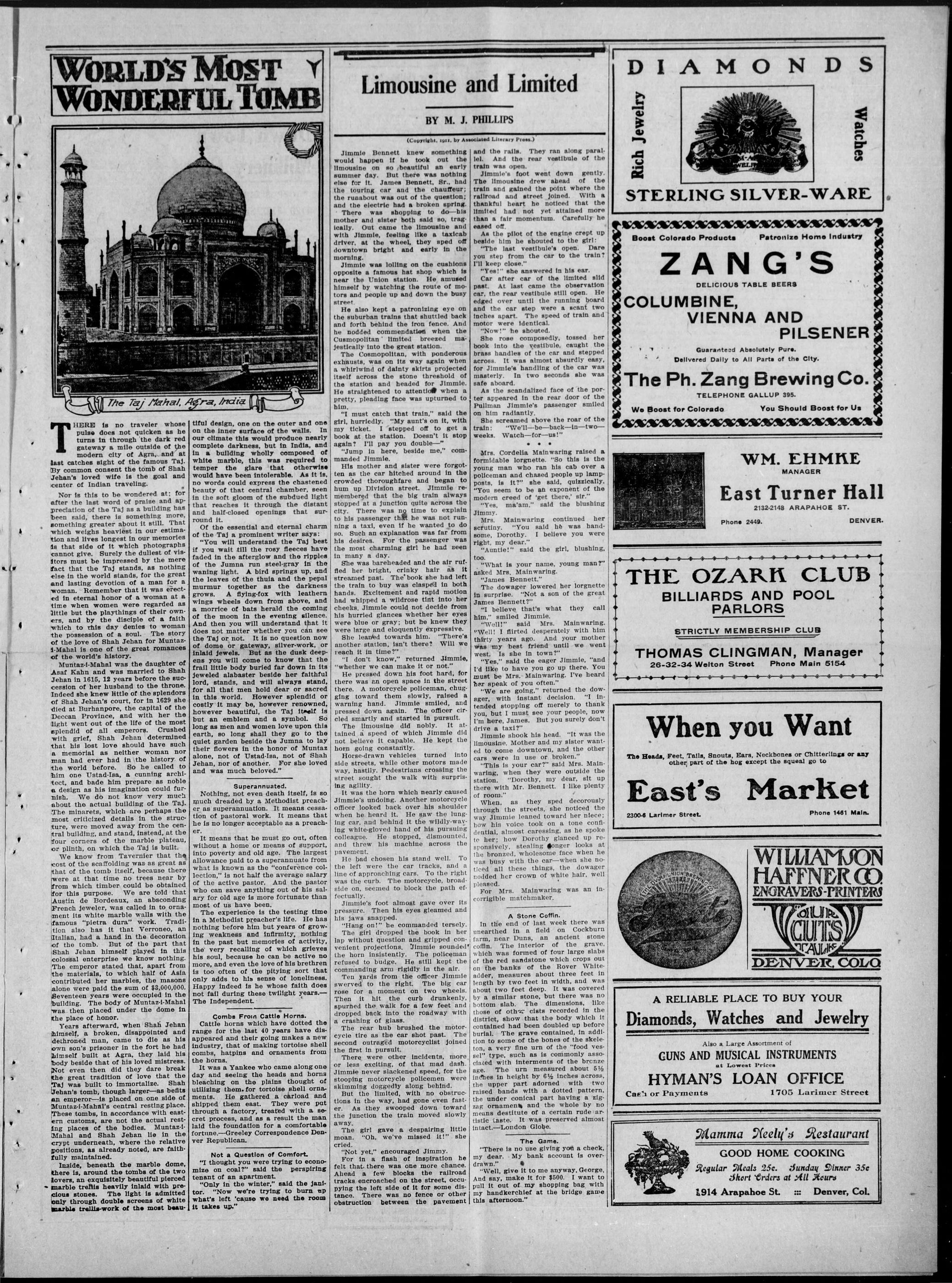
WORLD'S MOST WONDERFUL TOMB
The Taj Mahal, Agra, India
last catches sight of the famous Taj
By common consent the tomb of Shah
Jehan's loved wife is the goal and
center of Indian traveling.
Nor is this to be wondered at; for after the last word of praise and appreciation of the Taj as a building has been said, there is something more, something greater about it still. That which weighs heaviest in our estimation and lives longest in our memories that side of it which photographs cannot give. Surely the dullest of visitors must be impressed by the mere fact that the Taj stands, as nothing else in the world stands, for the great and lasting devotion of a man for a woman. Remember that it was erected in eternal honor of a woman at a time when women were regarded as little but the playthings of their owners, and by the disciple of a faith which to this day denies to woman the possession of a soul. The story of the love of Shah Jehan for Muntaz-i-Mahal is one of the great romances of the world's history.
Muntaz-i-Mahal was the daughter of Asaf Kahn and was married to Shah Jehan in 1615, 12 years before the succession of her husband to the throne. Indeed she knew Little of the splendors of Shah Jehan's court, for in 1629 she died at Burhanpure, the capital of the Deccan Province, and with her the light went out of the life of the most splendid of all emperors. Crushed with grief, Shah Jehan determined that his lost love should have such a memorial as neither woman nor man had ever had in the history of the world before. So he called to him one Ustad-Isa, a cunning architect, and bade him prepare as noble a design as his imagination could furnish. We do not know very much about the actual building of the Taj. The minarets, which are perhaps the most criticized details in the structure, were moved away from the central building, and stand, instead, at the four corners of the marble plateau, or plinth, on which the Taj is built.
We know from Tavernier that the cost of the scaffolding was as great as that of the tomb itself, because there were at that time no trees near by from which timber could be obtained for this purpose. We are told that Austin de Bordeaux, an absconding French jeweler, was called in to ornament its white marble walls with the famous "pietra dura" work. Tradition also has it that Verroneo, an Italian, had a hand in the decoration of the tomb. But of the part that Shah Jehan himself played in this colossal enterprise we know nothing. The emperor stated that, apart from the materials, to which half of Asia contributed her marbles, the masons alone were paid the sum of $3,000,000. Seventeen years were occupied in the building. The body of Muntaz-i-Mahal was then placed under the dome in the place of honor.
Years afterward, when Shah Jehan himself, a broken, disappointed and dethroned man, came to die as his own son's prisoner in the fort he had himself built at Agra, they laid his body beside that of his loved mistress. Not even then did they dare break the great tradition of love that the Taj was built to immortalize. Shah Jehan's tomb, though larger—as befits an emperor—is placed on one side of Muntaz-i-Mahal's central resting place. These tombs, in accordance with eastern customs, are not the actual resting places of the bodies. Muntaz-i-Mahal and Shah Jehan lie in the crypt underneath, where the relative positions, as already noted, are faithfully maintained.
Inside, beneath the marble dome, there is, around the tombs of the two lovers, an exquisitely beautiful pierced marble trellis heavily inlaid with precious stones. The light is admitted only through double screens of white marble trellis-work of the most beau-
tiful design, one on the outer and one on the inner surface of the walls. In our climate this would produce nearly complete darkness, but in India, and in a building wholly composed of white marble, this was required to temper the glare that otherwise would have been intolerable. As it is, no words could express the chastened beauty of that central chamber, seen in the soft gloom of the subdued light that reaches it through the distant and half-closed openings that surround it. Of the essential and eternal charm of the Tai a prominent writer says:
of the Taj a prominent writer says: "You will understand the Taj best if you wait till the rosy fleeces have faded in the afterglow and the ripples of the Jumna run steel-gray in the waning light. A bird springs up, and the leaves of the thula and the pepal murmur together as the darkness grows. A flying-fox with leathern wings wheels down from above, and a morrice of bats herald the coming of the moon in the evening silence. And then you will understand that it does not matter whether you can see the Taj or not. It is no question now of dome or gateway, silver-work, or inlaid jewels. But as the dusk deepens you will come to know that the frail little body buried far down in its jeweled alabaster beside her faithful lord, stands, and will always stand, for all that men hold dear or sacred in this world. However splendid or costly it may be, however renowned, however beautiful, the Taj itself is but an emblem and a symbol. So long as men and women love upon this earth, so long shall they go to the quiet garden beside the Jumna to lay their flowers in the honor of Muntaz alone, not of Ustad-Isa, not of Shah Jehan, nor of another. For she loved and was much beloved."
Superannuated
Nothing, not even death itself, is so much dreaded by a Methodist preacher as superannuation. It means cessation of pastoral work. It means that he is no longer acceptable as a preacher.
It means that he must go out, often without a home or means of support, into poverty and old age. The largest allowance paid to a superannuate from what is known as the "conference collection," is not half the average salary of the active pastor. And the pastor who can save anything out of his salary for old age is more fortunate than most of us have been.
The experience is the testing time in a Methodist preacher's life. He has nothing before him but years of growing weakness and infirmity, nothing in the past but memories of activity, the very recalling of which grieves his soul, because he can be active no more, and even the love of his brethren is too often of the pitying sort that only adds to his sense of loneliness. Happy indeed is he whose faith does not fail during these twilight years.—The Independent.
Comba Frog Cattle Horns.
Cattle horns which have dotted the range for the last 40 years have disappeared and their going makes a new industry, that of making tortoise shell combs, hatpins and ornaments from the horns.
It was a Yankee who came along one day and seeing the heads and horns bleaching on the plains thought of utilizing them. for tortoise shell ornaments. He gathered a carload and shipped them east. They were put through a factory, treated with a secret process, and as a result the man laid the foundation for a comfortable fortune.—Greeley Correspondence Denver Republican.
Not a Question of Comfort.
"I thought you were trying to economize on coal?" said the perspiring tenant of an apartment.
"Only in the winter," said the janitor. "Now we're trying to burn up what's left 'cause we need the room it takes up."
Limousine and Limited
BY M. J. PHILLIPS
(Copyright 1911 by Associated Literary Press.)
Jimmie Bennett knew something would happen if he took out the limousine on so beautiful an early summer day. But there was nothing else for it. James Bennett, Sr., had the touring car and the chauffeur; the runabout was out of the question; and the electric had a broken spring. There was shopping to do—his mother and sister both said so, tragically. Out came the limousine and with Jimmie, feeling like a taxicab driver, at the wheel, they sped off downtown bright and early in the morning. Jimmie was loiling on the cushions opposite a famous hat shop which is near the Union station. He amused himself by watching the route of motors and people up and down the busy street.
He also kept a patronizing eye on the suburban trains that shuttled back and forth behind the iron fence. And he nodded commendation when the Cusmopolitan Limited breezed majestically into the great station. The Cusmopolitan, with ponderous exhausts, was on its way again when a whirlwind of dainty skirts projected itself across the stone threshold of the station and headed for Jimmie. He straightened to attention when a pretty, pleading face was upturned to him.
"I must catch that train," said the girl, hurriedly. "My aunt's on it, with my ticket. I stepped off to get a book at the station. Doesn't it stop again? I'll pay you double—"
"Jump in here, beside me," commanded Jimmie.
His mother and sister were forgotten as the car hitched around in the crowded thoroughfare and began to hum up Division street. Jimmie remembered that the big train always stopped at a junction quite across the city. There was no time to explain to his passenger that he was not running a taxi, even if he wanted to do so. Such an explanation was far from his desires. For the passenger was the most charming girl he had seen in many a day.
She was bareheaded and the air ruffled her bright, crinky hair as it streamed past. The book she had left the train to buy was clasped in both hands. Excitement and rapid motion had whipped a wildrose tint into her cheeks. Jimmie could not decide from his hurried glances whether her eyes were blue or gray; but he knew they were large and eloquently expressive.
She leaped towards him. "There's another station, isn't there? Will we reach it in time?"
"I don't know," returned Jimmie, "whether we can make it or not."
He pressed down his foot hard, for there was an open space in the street there. A motorcycle policeman, chugging toward them slowly, raised a warning hand. Jimmie smiled, and pressed down again. The officer circled smartly and started in pursuit. The limousine did nobly. It attained a speed of which Jimmie did not believe it capable. He kept the horn going constantly.
Horse-drawn vehicles turned into side streets, while other motors made way, hastily. Pedestrians crossing the street sought the walk with surprising agility.
It was the horn which nearly caused Jimmie's undoing. Another motorcycle officer looked back over his shoulder when he heard it. He saw the lunging car, and behind it the wildly-waying white-gloved hand of his pursuing colleague. He stopped, dismounted, and threw his machine across the pavement.
He bad chosen his stand well. To the left were the car tracks, and a line of approaching cars. To the right was the curb. The motorcycle, broadside on, seemed to block the path effectually.
Jimmie's foot almost gave over its pressure. Then his eyes gleamed and his jaws snapped.
"Hang on!" he commanded tersely. The girl dropped the book in her lap without question and gripped convenient projections. Jimmie sounded the horn insistently. The policeman refused to budge. He still kept the commanding arm rigidly in the air. Ten yards from the officer Jimmie swerved to the right. The big car rose for a moment on two wheels. Then it hit the curb drunkenly, spurred the walk for a few feet and dropped back into the roadway with a crashing of glass. The rear hub brushed the motorcycle tire as the car shot past. The second outraged motorcyclist joined the first in pursuit. There were other incidents, more or less exciting, of that mad dash. Jimmie never slackened speed, for the stooping motorcycle policemen were skimming doggedly along behind.
But the limited, with no obstructions in the way, had gone even faster. As they swooped down toward the junction the train moved slowly away.
The girl gave a despairing little moan. "Oh, we've missed it!" she cried.
"Not vet." encouraged Jimmy.
For in a flash of inspiration he felt that there was one more chance. Ahead a few blocks the railroad tracks encroached on the street, occupying the left side of it for some distance. There was no fence or other obstruction between the pavement
and the rails. They ran along parallel. And the rear vestibule of the train was open.
Jimmie's foot went down gently. The limousine drew ahead of the train and gained the point where the railroad and street joined. With a thankful heart he noticed that the limited had not yet attained more than a fair momentum. Carefully he eased off.
As the pilot of the engine crept up beside him he shouted to the girl:
"The last vestibule's open. Dare you step from the car to the train? I'll keep close."
"Yes!" she answered in his ear.
Car after car of the limited slid past. At last came the observation car, the rear vestibule still open. He edged over until the running board and the car step were a scant two inches apart. The speed of train and motor were identical.
She rose composedly, tossed her book into the vestibule, caught the brass handles of the car and stepped across. It was almost absurdly easy, for Jimmie's handling of the car was masterly. In two seconds she was safe aboard.
As the scandalized face of the porter appeared in the rear door of the Pullman Jimmie's passenger smiled on him radiantly.
She screamed above the roar of the train: "We'll-be-back-in-two-weeks. Watch-for-us!"
Mrs. Cordella Mainwaring raised a formidable lorgnette. "So this is the young man who ran his cab over a policeman and chased people up lamp-posts, is it?" she said, quizzically. "You seem to be an exponent of the modern creed of 'get there', sir."
"Yes, ma'am," said the blushing Jimmy.
Mrs. Mainwaring continued her scrutiny. "You said he was hand-some, Dorothy. I believe you were right, my dear." "Auntie!" said the girl, blushing, too. "What is your name, young man?" asked Mrs. Mainwaring. "James Bennett." The dowager lowered her lorgnette in surprise. "Not a son of the great James Bennett?"
"I believe that's what they call him," smiled Jimmie.
"Well!" said Mrs. Mainwaring.
"Well! I flirted desperately with him thirty years ago. And your mother was my best friend until we went west. Is she in town?"
"Yes," said the eager Jimmie, "and I'd like to have you go up there. You must be Mrs. Mainwaring. I've heard her speak of you often."
"We are going," returned the dowager, with instant decision. "I intended stopping off merely to thank you, but I must see your people, now I'm here, James. But you surely don't drive a taxi?"
Jimmie shook his head. "It was the limousine. Mother and my sister wanted to come downtown, and the other cars were in use or broken."
"This is your car?" said Mrs. Mainwaring, when they were outside the station. "Dorothy, my dear, sit up there with Mr. Bennett. I like plenty of room."
When, as they sped decorously through the streets, she noticed the way Jimmie leaned toward her niece; how his voice took on a tone confidential, almost caressing, as he spoke to her; how Dorothy glanced up responsively, stealing longer looks at the bronzed, wholesome face when he was busy with the car—when she noticed all these things, the dowager nodded her crown of white hair, well pleased.
For Mrs. Mainwaring was an incorrigible matchmaker.
A Stone Coffin.
In the end of last week there was unearthed in a field on Cockburn farm, near Duns, an ancient stone coffin. The interior of the grave, which was formed of four large slabs of the red sandstone which crops out on the banks of the Rover Whiteadder, measures about three feet in length by two feet in width, and was about two feet deep. It was covered by a similar stone, but there was no bottom slab. The dimensions, like those of other cists recorded in the district, show that the body which contained had been doubled up before burial. The grave contained, in addition to some of the bones of the skeleton, a very fine urn of the "food vessel" type, such as is commonly associated with interments of the bronze age. The urn measured about $5\frac{1}{2}$ inches in height by $6\frac{1}{2}$ inches across, the upper part adorned with two raised bands with a dotted pattern, the under conical part having a zigzag ornament, and the whole by no means destitute of a certain rude artistic taste. It was preserved almost intact.—London Globe.
"There is no use giving you a check, my dear. My bank account is overdrawn."
"Well, give it to me anyway, George, And say, make it for $500. I want to pull it out of my shopping bag with my handkerchief at the bridge game this afternoon."
. . .
The Game.
M.A. WELRIT
STERLING S
Boost Colorado Products
Z AN
DELICIOUS T
COLUMBINE,
VIENN
Guaranteed A
Delivered Daily to A
The Ph. Zang
TELEPHONE
We Boost for Colorado
RLING SILVER-WARE
Colorado Products Patronize Home Industry
ZANG'S
DELICIOUS TABLE BEERS
MBINE,
VIENNA AND
PILSENER
Guaranteed Absolutely Pure.
Dellvered Daily to All Parts of the City.
Ph. Zang Brewing Co.
TELEPHONE GALLUP 395.
for Colorado You Should Boost for Us
WM. EHMKE
MANAGER
STERLING SILVER-WARE
Boost Colorado Products Patronize Home Industry
ZANG'S
DELICIOUS TABLE BEERS
COLUMBINE,
VIENNA AND
PILSENER
Guaranteed Absolutely Pure.
Delivered Daily to All Parts of the City.
The Ph. Zang Brewing Co.
TELEPHONE GALLUP 395.
We Boost for Colorado You Should Boost for Us
East Turner Hall
2132-2148 ARAPAHOE ST.
Phone 2449. DENVER.
C OZARK CLUB
MILLIARDS AND POOL
PARLORS
THE OZARK C
BILLIARDS AND POOL
PARLORS
STRICTLY MEMBERSHIP CLUB
THOMAS CLIN
26-32-34 Welton St
When y
The Heads, Feet, Tails, Snouts, Ea
other part of the hog
East's
MAS CLINGMAN, Manager
22-34 Welton Street Phone Main 5154
When you Want
eet, Tails, Snouts, Ears, Neckbones or Chitterlings or any
other part of the hog except the squeal go to
st's Market
r Street. Phone 1461 Main.
THOMAS CLINGMAN, Manager
26-32-34 Welton Street Phone Main 5154
When you Want
The Heads, Feet, Tails, Snouts, Ears, Neckbones or Chitterlings or any other part of the hog except the squelg go to
THE NWU UNION BREWING CO.
Fruit
CREAMER CO.
A RELIABLE PLACE
Diamonds, Watch
Also a Larger
GUNS AND MUSIC
at Lowes
HYMAN'S LO
Cash or Payments
RELIABLE PLACE TO BUY YOUR
Bands, Watches and Jewelry
Also a Large Assortment of
BANDS AND MUSICAL INSTRUMENTS
at Lowest Prices
MAN'S LOAN OFFICE
payments 1705 Larimer Street
A RELIABLE PLACE TO BUY YOUR Diamonds, Watches and Jewelry
Mamma Neely's Restaurant
GOOD HOME COOKING
Regular Meals 25c. Sunday Dinner 35c.
Short Orders at All Hours
1914 Arapahoe St. Denver, Col.
GOOD HOME COOKING
Regular Meals 25c. Sunday Dinner 35c
Short Orders at All Hours
1914 Arapahoe St. Denver, Col.
---
```markdown
```
2300-6 Larimer Street.
Phone 1461 Main.
WILLIAMSON
HAFFNER CO.
ENGRAVERS-PRINTERS
OUR
CUTS
TAILS
DENVER, COLO.
THE COLORADO STATESMAN
JOS. D. D. RIVERS ..... Proprietor
1824 Curtis Street, Room 25.
SUBSCRIPTION RATES:
PAYABLE IN ADVANCE
seems that papers sent to subscriber have any number when due, inform a duplicate of the missing one.
be made by Express Money or Bank Draft. Postage stampical part of a dollar. Only 5 cents per square. A square or a lines or less, 10 cents per line or line.
a less than three months' conti- ties unknown to us. Further proof of a personating nature that are columns of this paper.
receive attention must be new upon one side of the paper; later than Wednesdays, and be returned, unless stamps are sent.
class matter at the postoffice.
One Year ..... $2.00
Six Months ..... 1.00
Three Months ..... 60
PAYABLE IN ADVANCE
It occasionally happens that papers sent to subscribers are lost or stolen.
In case you do not receive any number when due, inform us by postal card and
we will cheerfully forward a duplicate of the missing number.
Remittances should be made by Express Money Order, Postoffice Money
Order, Registered Letter or Bank Draft. Postage stamps will be received the
same as cash for the fractional part of a dollar. Only 1-cent and 2-cent stamps
Display advertising 25 cents per square. A square contains ten agate lines.
over ten lines, 5 cents per line.
No discounts allowed on less than three months' contract. Cash must accompany all orders from parties unknown to us. Further particulars on application.
All communications of a personating nature that are not complimentary will be withheld from the columns of this paper.
Communications to receive attention must be newsy, upon important subjects, plainly written only upon one side of the paper; must reach us Tuesdays, if possible, anyway not later than Wednesdays, and bear the signature of the author. No manuscript returned, unless stamps are sent for postage.
Entered as second-class matter at the postoffice in the city of Denver, Colorado.
THE GRUBSTAKE IDEA.
REPUBLICAN is booming a new
for the raising of a grubstake fi
ent and under the supervision of
to raise a fund of $10,000 to equi
over the old grubstake plan, the
formerly held by railroads, smo
e support prospectors have ope
ent is based primarily upon the
brief industry is only partially a
recovery of the insistent and the
apple Creek and Leadville are
a systematic prospecting, and besides
accurre to the state thereby whi
for colored people to copy. Some
prospectors and miners in the
did not a few of them became
going to the lure of the city, gave
probably made big mistakes in
are some good colored prospector
s proposition to grubstake on
bad venture on the part of a
throughout the state. This w
wons already on foot, but the man
wanted and worth a special o
of $10.00 each ought to put a
person, and that prospector, care
wing that a failure to make good
make him rich in money and
zealously. The effort should
the same to all men, the pres
nis is undoubted, and the revi
well worth the effort and the rea
blish the opinions of our read
THE DENVER REPUBLICAN is booming a new adaptation of an old idea in a proposition for the raising of a grubstake fund by private subscription, with the endorsement and under the supervision of the Denver Chamber of Commerce.
The proposition is to raise a fund of $10,000 to equip and start prospectors into the mountains under the old grubstake plan, the subscribers thus taking the places, as backers, formerly held by railroads, smelter and other big corporate interests, of whose support prospectors have of late been deprived. Of course, the new movement is based primarily upon the public interest in the belief that Colorado's chief industry is only partially developed, and that vast riches yet await the discovery of the insistent and tireless prospector. Other bonanza strikes like Cripple Creek and Leadville are believed to be certain to follow scientific and systematic prospecting, and besides the personal fortunes realized, the benefits to accrue to the state thereby will be immense.
This is a good idea for colored people to copy. Some years ago there were numerous adept colored prospectors and miners in those mining districts most famed in this state, and not a few of them became comparatively well-to-do financially, and, yielding to the lure of the city, gave themselves good starts in other callings. They probably made big mistakes in leaving the mountains. Never the less, there are some good colored prospectors yet in Colorado, and a well-worked-ot business proposition to grubstake one or more of them each season would not be a bad venture on the part of an aggregation of colored subscribers in Denver or throughout the state. This would not necessarily discourage mining operations already on foot, but the main idea is that a find of unusual proportions is wanted and worth a special effort on the part of independent speculators.
Fifty subscriptions of $10.00 each ought to put a good colored prospector into the hills for a season, and that prospector, carefully and fairly selected by majority choice, knowing that a failure to make good would pay him poorly, and that success would make him rich in money and reputation. would doubtless go about his task zealously. The effort should be repeated year after year, for the chance is the same to all men, the presence of vast undiscovered treasure in our mountains is undoubted, and the reward, either in riches or experience, would be well worth the effort and the little capital contributed. We would be glad to publish the opinions of our readers upon this subject.
GRANDFATHER CRIPPLED
LAUSE, a popular old gentleman, one of his legs chopped off, he is suffering greatly from his widely known throughout rest by white and colored peo cause of adjusting the polit as to remove the possibility acerning the running of the port. there is some fear that the
GRANDFATHER CLAUSE, a popular old gentleman from the South, had the misfortune to have one of his legs chopped off in Oklahoma two weeks ago, and at this writing he is suffering greatly from nervous shock.
The old gentleman is widely known throughout the country, and is regarded with equal interest by white and colored people, because of his long and active service in the cause of adjusting the political relations of the two races in such a manner as to remove the possibility of all friction between them upon matters concerning the running of the government, which they are taxed equally to support.
At his advanced age there is some fear that the accident will terminate in the old gentleman's death, but as he has several legs left yet on which to stand, and as the doctors are resorting to every scientific method known to graft on and restore the severed limb, there is still some chance to save the old man's life and enable him to get along without using a crutch. But the judge of the United States District Court for Oklahoma wielded the ax that lopped off grandpop's "feelers," and his honor pleads justification and self-defense for the act of amputation to which he ruthlessly resorted.
His honor says that Grandfather Clause was endeavoring, by innuendo and subterfuge, to take from citizens of the United States the right to vote, because of race and previous condition, and that the procedure is in direct conflict with the provisions of the Fifteenth Amendment to the Federal Constitution, and on this ground he is retaining possession of grandfather's severed leg until such time as a higher court shall command him to turn it over to the doctors for splicing or order it to be cremated and buried. In the event of the latter decision the urn or coffin will be ordered large enough to accommodate the entire corpse. On the face of the evidence in the case, the plea of the district judge seems to be well founded. In fact, the logic of the jurist is as plain as the nose on a toper's face, but that is not saying that there are not toopers who will deny that grandfather's proboscis is a blot and a disfiguration on the moral physiognomy of the nation.
Grandfather Clause is nothing if he is not an insidious and specific foe to the Negro voter just because he is a Negro. He does not care how much property the Negro may own, how much money he may have to pay in taxes or how much he may know. If he or his father or his grandfather was not a voter prior to 1865, he inherits no voting rights which a white man is bound to respect, according to the ingenious deductions of the veneerable philosopher with the chopped-on "feeler." To be sure, to be exactly fair, he applies the same rule to all voters, white as well as black, but somehow the white voters all seem to have had grandfathers and great-grandfathers who voted early and often, and therefore they easily pass the test. The smothering of the Fifteenth Amendment is, of course, an attack upon the Constitution of the United States, made from behind the skeletons and ghosts of the sainted grandfathers of the Clause family, white, and though their charging ranks are crowded, they are too full of holes to be hit and halted by anything less spiritual than a two-edged decree and a legal broadside from a United States tribunal, that will cut off all their legs and dissipate their bodies, skulls and cross-bones, in the blue air of enlightenment.
SCOTT M. E. CHURCH.
Dr. Randolph will preach Sunday morning and the Rev. J. D. Rice will preach Sunday night. The district superintendent will hold the first quarterly conference at the People's M. E. Church, Colorado Springs, Sunday. You are invited to hear these divines.
The Epworth League will render a literary and musical program Sunday evening, June 18th, on the occasion of Children's Day. The pastor will preach a sermon on Christian education in the morning and the Sunday school program will be rendered during the morning services.
The Ladies' Aid fair and dinner went beyond our most sanguine expectations. The amount reported up to date is $$6.10. When all the tickets have been reported and goods laid away are paid for the net sum will be something over one hundred dollars. This was the most successful fair that has been given during the short history of the church. We wish to thank the ladies and friends who made this undertaking a success.
Three new members connected themselves with the church Sunday. They are Mrs. Pierson and daughter, Miss Jessie Pierson, Mr. John F. Thomas of Nashville, Tenn.
Mr. Maddox led the League last Sunday evening to the delight of all who were privileged to be with us. Mr. Maddox is a brilliant young man who is attending the High School in St. Louis, Mo. Mrs. Claudie Pash is putting new spiritual life in her department.
The Rev. W. C. Williams, the eloquent preacher of Campbells A. M. E. Church delighted his audience Sunday afternoon on the occasion of our first quarterly conference. He brought his loyal members to our rescue.
The Sunday class has been discontinued and two classes Nos. 4 and 5, have been combined and the Rev. J. D. Rice will serve as leader. The Wednesday night meetings are growing in interest. The pastor comments upon a chapter from the Bible in a very practicable way and these talks are finding responses in appreciative hearts. Dr. I. Garland Penn, assistant secretary of the Epworth League, writes that he will attend the meeting of the Board of Control which meets at Boulder in this month. Dr. Penn will stop over in Denver and lecture for us.
Mrs. Ada Castry won the first prize offered by the Ladies' Aid Society for the highest number of tickets sold and the pastor the second. The prizes were a beautiful hand worked sofa pillow and a "Twilight" scene picture. Third prize a water pitcher.
BUY GOOD BOOKS CONCERNING
THE NEGRO-START A LIBRARY.
I have the following books which I sell at reasonable figures. Drop me a card and I will call on you.
Souls of Black Folk, Dubois; $1.00.
Negro in Business, Washington; $1.00.
United Negro, J. W. E. Bowen; I. G.
Penn; $1.00. Studies on Slavery,
Fletcher; $1.50. Progress of a Race,
Nichols; 75c. Africa and the Ameri-
can Flag, 75c. School History of Negro
Race, Johnson; 50c. Story of the
Jubilee Singers, Marsh; 50c, 75c and
$1.00. Negro Troops in the Rebellion,
Williams; $1.00. Complete Works of
Paul Lawrence Dunbar, $1.75, $2.50
and $3.50. The Black Phalanx, Wilson;
$1.50. History of Slavery (published in 1863), $2.50. The Underground Railroad, Still; $2.50. Working With the Hands, Washington;
$1.00. History of the Colored Race,
Aliender, $1.50. American Slave
Code, Goodell; $1.00.
J. H. DONIPHAN Agent,
1721 Marion St.
The phrase applied to the administration of James Monroe, "the era of good feeling," first appeared in a Boston newspaper, the Columbian Sentel of July 10, 1817. From that time until the present hour the two administrations of Monroe—a period of eight years, 1817 to 1825—are referred to in the terms of the newspaper paragraph which so aptly expressed the public sentiment of the day—Magazine of American History.
Beethoven's Fits of Rage.
His behavior was often atrocious. In giving lessons to young ladies he would sometimes tear the music to pieces and scatter it about the floor, or even smash the furniture. Once when playing in company there was some interruption. "I play no longer for such hogs," he cried, and left the plano. He once called Prince Lobkowitz an ass because a bassoon player happened to be absent—Dole, "Famous composers."
Why, of Course!
Mrs. Chugwater—"Josiah, what is Chinese junk?" Mr. Chudwater—"It's a dish of chop suey. Haven't I told you that once or twice before?"—Chicago Tribune.
TRUNKS, SUIT CASES, BAGS
AND TRAVELERS'
NECESSITIES
Phone Champa 2048 2253 Welton St.
THE DENVER SAFE DEPOSIT CO.
BEN J. W. DENVER
DENVER, COLO.
In Denver.
Boxes, $2.50, $3.50, $5 per Year
The Strongest Vaults. Standard
Keys. You are invited to call
and inspect our doors and locks.
E. H. NORTON, Gen. Mgr.
1534 California Street
Oak Denver Dry Goods Co.
P. Chiolero, Pres. and Manager
J. C. Chiolero, Vice-President
S. Chiolero, Treasurer
C. A. Grosso, Secy.
Chiolero Importing Mercantile & Investment Company (BRANCH)
MANUFACTURES OF
LA FLOR DE CHIOLERO
LA FLOR DE CERES
HIGH GRADE
CIGARS
UNION MADE
DELICATESSEN, WINES,
LIQUORS AND
CIGARS
Telephone Champa 1844
1859 ARAPAHOE ST.
Denver, Colo.
THE TIVOLI UNION BREWING CO.
Tivoli
DENVER, COLO.
FORD'S
HAIR POMADE
THE OLD RELIABLE DRESSING FOR KINKY OR CURLY HAIR. IT'S USE MAKES STUBBORN, HARSH HAIR SOFTER, MORE PLIABLE AND GLOSSY, EASY TO COMB AND PUT UP IN ANY STYLE THE LENGTH WILL PERMIT. WRITE FOR TESTIMONIES, TELLING HOW THIS REMARKABLE REMEDY MAKES SHORT, KINKY HAIR GROW LONG AND WAVY. BEST POMADE ON THE MARKET FOR DANDRUFF, ITCHING OF THE SCALP AND FALLING OUT OF THE HAIR. BEWARE OF IMITATIONS, GET THE GENUINE, PUT UP IN 25* AND 50* BOTTLES WITH CHARLES FORD'S NAME ON EVERY PACKAGE.
SOLD BY DRUGGISTS.
IF YOUR DRUGGIST CANNOT SUPPLY
YOU,WE WILL SEND IT TO YOU DIRECT
AT THE FOLLOWING PRICES,SMALL SIZED
BOTTLE,25¢ LARGE SIZED BOTTLE,50¢
THE OZONIZED OX MARROW CO.
216 LAKE ST.,DEPT. 30 CHICAGO,ILL.
AGENTS WANTED.
LYM Down Town Millinery Co.
OPPOSITE D. & F.'s
1120 - 1122 Sixteenth St.
C
EIGHTER SALE Light the stock of goods owned Hazen at 2707 Welton street sale at astonishing Low Prices.
SLAUGHTER We have bought the s by Stevenson & Hazen at which is now on sale at asto
SLAUGHTER SALI we have bought the stock of goodenson & Hazen at 2707 Well now on sale at astonishing Lo
SLAUGHTER SALE
We have bought the stock of goods owned by Stevenson & Hazen at 2707 Welton street which is now on sale at astonishing Low Prices.
Now is the time to buy for the future as well as for the present.
Come and see for yourselves.
I. N. MOBERLY,
2707 Welton St. Denver.
Now is the time to buy for the future as well as for the present.
Come and see for yourselves.
I. N. MOBERLY,
2707 Welton St. Denver.
Beer, Wines, Liquor
2605 and 2609 Arapahoe Stre
Wines, Liquors and C
d 2609 Arapahoe Street DENVER
Liquors and Cigars pahoe Street DENVER, COLO.
Beer, Wines, Liquors and Cigars 2605 and 2609 Arapahoe Street DENVER, COLO.
Remember I Have No Partner R. E. NORRIS
COAL WE ARE READY TO
PHONE, MAIN
We gave you prompt service and low price
same this win
Biggest Sack of Coal in Town, 25c. | Nort
Biggest Sack of Wood in Town, 10c. | Half
Northern Lump Coal, per ton, $4.50 | One
All Hard Lump, per ton
FULL WEIGHT GUAR
1119 22nd
(Bet. Arapahoe and Law
MACK SMART
Manager.
A SOCI
WE ARE READY TO SERVE YOU
PHONE, MAIN 5067
You prompt service and low prices last winter. We
same this winter.
Back of Coal in Town, 25c.
Back of Wood in Town, 10c.
Cump Coal, per ton, $4.50
All Hard Lump, per ton ..... $6.00
FULL WEIGHT GUARANTEED
1119 22nd Street
(Bet. Arapahoe and Lawrence Sts.)
THE
CAPITO
CLUB
MART
Manager.
A SOCIAL CL
READY TO SERVE YOU COAL
PHONE, MAIN 5067
Use and low prices last winter. Will do the
same this winter.
wn, 25c. | Northern Lump Coal, hnlf ton, $2.50
wn, 10c. | Half Ton Nut—All Kinds ... $2.90
wn, $4.50 | One Ton Hard Nut ... $5.25
Lump, per ton ... $6.00
WEIGHT GUARANTEED
1119 22nd Street
(pahoe and Lawrence Sts.)
THE
CAPITOL
CLUB
A SOCIAL CLUB.
PHONE CHAMPA 2540.
. ST. DENVE
KER. CHAS. CRONIN. BE
Cars Stand at St. James Hotel, Curtis St.
7, Thomas
mobole,
maker
Cars
Taxicab Service Co.
TELEPHONE
Champa 1292
DAY OR NIGHT
rates to Dancing and Theatre Parties Prices on
M. L. WALKER. CHAS. CRON
Cars Stand at St. James H
CHAS. CRONIN. BERT SMITH
St. James Hotel, Curtis St.
Taxicab Service Co.
TELEPHONE
Champa 1292
DAY OR NIGHT
and Theatre Parties Prices on applica-
week. Taxicabs and Touring Cars
DAY OR N
Special rates to Dancing and Theatre
tion for cars by day or week. Tax
Special rates to Dancing and Theatre Parties Prices on application for cars by day or week. Taxicabs and Touring Cars
The
921 20TH. ST.
Pierce Arrow, Thoma Flyer, Oldsmobile, Studabaker Ford Garcia
MILK
Purchase Your Summer MILLINERY NOW
Our store is filled with everything in popular priced Millinery, at both wholesale and retail; in fact, we'll guarantee that no stock of Millinery goods has ever been displayed in Denver before to equal ours in magnitude, assortment and low prices. The great volume of our business permits us to make low prices.
Call and Be Convinced
J. T. TURNER, Prop. Zang's Special Brew Family Trade a Specialty
THE
DENVER, COLO.
$
THE COLORADO STATESMAN
Rocky Mountain Lodge of Odd Fellows, G. U. O. O. F. It's Bloomfield Park for mine, Wednesday, June 14th.
Mrs. Green of Colorado Springs is the guest of Mrs. N. Skillern.
E. M. Reeves of 957 South Clarkson street has ben on the sick list for the past week.
a Christian and a member of Zion Baptist church. She leaves to mourn her loss a husband, A. W. Robins and a son and daughter, Elbert W. a Hazel. Mr. and Mrs. Buchanan a relatives. Funeral services were fr Zion Thursday. Rev. Overs delivers an eloquent sermon of the deceased Christian life. Interment Fairmount Douglass Undertaking Co. in charge arrangements.
Allen Lawhorn, the nephew of A. M.
Lawhorn, was a guest in the city this
week.
Frank Moss will leave next week for
Harrisonville, Mo., to visit his mother
and sister.
W. H. Ramsey, a brother-in-law of R.
L. Lewis arrived in the city Thursday
of last week from New York City.
Rice Lodge of Elks elected Victor
Walker a delegate to the Elks' Grand
Lodge at Boston, Mass., which convenes in August.
Mr. Geo. Hayden is rapidly improving. He fell while working on the new postoffice building last week and broke several ribs.
Miss V. Gonzales Porter, the daughter of Mr. and Mrs. George Porter of Omaha, Neb., graduated from Fisk University this year.
Mrs. Frank Hall returned home Wednesday from Kansas City and Clarksville, Mo., where she has been for the past four months.
Chas. F. West received the sad news last week of the death of his sister, Mrs. C. Grant, who died in Lawrence, Kansas.
Misses Percie and Jennie Stafford, sisters of Mrs. F. D. Jackson, arrived in the city this week from Emporia, Kansas, to remain during the summer.
Thomas Martin, lieutenant of Hose Co. No. 3 was taken to St. Joseph hospital last Wednesday, suffering with blood poison in his hand.
Help us and we will help you. Boost the Odd Fellows building fund. Join us in our Mid-Summer Outing at Bloomfield Park, Wednesday, June 14th.
The Southern Land Development Company has opened a branch office in this city, 1014 19th street. Rev. A. E. Reynolds agent in charge. Anyone desiring information concerning land in Old Mexico call and see him.
Queen City Musical Association rehearsal will be held at Scott's M. E. churcvh on Tuesday, 13th, at 8 p. m. sharp. Names will be enrolled for orchestra and band. Note the change of day.
Forty colored waiters passed through this city Monday from Kansas City enroute to Salt Lake City, whehe they will be employed in one of the finest hotels there, to be opened at an early date.
Mrs. John W. Bush leaves Monday, June 12th for Evergreen, Colo., accompanied by her son, Herman, who has just returned with excellent report in studies from Lincoln Institute, Jefferson City, Mo. Mr. Bush joins them later in July.
Mrs. Ada Webster gets the custody of her daughter, Hortense, and the father, John White, was ordered by the court to pay $12 per month for the daughter's support. This ends a long contested case in district court for the possession of the daughter. Lawyer Townsend represented Mrs. Webster.
We note with pleasure the receipt of an invitation to the commencement exercises of the College of Law of the University of Colorado, held on the 7th inst., through the kindness of Mr. A. William Lewis, one of our deserving citizens, who graduated with the class. The Colorado Statesman extends heartiest congratulations for a successful career in this gentleman's profession.
Mrs. Levenia Robinson, the beloved wife of Albert W. Robinson of 2214 Clarkson street, departed this life Tuesday morning, June 6th. She was born in Prince William county, Va., came to Denver 26 years ago, and was a prominent worker in church society,
---
a Christian and a member of Zion Baptist church. She leaves to mourn her loss a husband, A. W. Robinson and a son and daughter, Elbert W. and Hazel. Mr. and Mrs. Buchanan are relatives. Funeral services were from Zion Thursday. Rev. Overs delivered an eloquent sermon of the deceased Christian life. Interment Fairmount. Douglass Undertaking Co. in charge of arrangements.
TRIP TO EUROPE
Embark with a crowd of Young Tourists on Thursday, 15th., from Old Colony Hall, 28th avenue and Downing. Lots of fun on board.
Fine orchestra music. Round trip
35 cents.
Ship sails at 8:15 sharp.
The regular meeting of the Rocky Mountain Lodge, No. 1, A. F. and A. M., for the election of officers for the ensuing year, was held Monday night. The following persons were elected: Samuel A. Bondurant, worshipful master; Jeff Waldon, senior warden, George A. Derry, junior warden; John R. Contee, treasurer; Wm. Sprague, secretary; F. T. Bruce, T. S. Rector and George S. Contee, members of the board of trustees. In addition to the election of officers and the transaction of all other business for which the meeting was called, the annual reports of Worshipful Master, C. A. Franklin and Secretary W, G. Sprague and treasurer J. R. Contee, were read showing the lodge to be in an unusual prosperous condition.
First picnic of the season, Bloomfield Park, Wednesday, June 14th. Rocky Mountain Lodge Odd Fellows, of course.
The piano recital given at Shorter A. M. E. Church last Thursday night by the pupils of Miss Belle d'Autremont drew a big crowd and to say that the program was pleasing to everybody was evident by the vigorous applause and flattering comment. The recital is one of a series which is held from time to time and the marked progress shown by the pupils reflects no little amount of credit on their instructor. Miss d'Autremont, whose ability as such is too well known for further comment. We are indeed proud of the musical talent that is being developed in the pupils and we heartily congratulate both them and their teacher who justly merits the praise they have received.
TRIP TO EUROPE
Embark with a crowd of Young Tourists on Thursday, 15th., from Old Colony Hall, 28th avenue and Downing. Lots of fun on board.
Fine orchestra music. Round trip 35 cents.
Ship sails at 8:15 sharp.
BETHLEHEM BAPTIST CHURCH NOTES.
Rev. J. B. Bell, general missionary for New Mexico and Arizona, will preach for us Sunday night, at 8 p. m. Rev. Bell is the acknowledged money raiser and church builder of the Southwest and he is here to assist Rev. Reynolds in his financial campaign. The rally will be at Central Baptist church, June 18th at 3 p. m. Rev. A. M. Ward, pastor of Shorter's A. M. E. church will preach the rally sermon. We are depending on the pastors and congregation to come to our assistance at this time for this is our greatest struggle.
REV. A. E. REYNOLDS,
Pastor.
TRIP TO EUROPE.
Embark with a crowd of Young Tourists on Thursday, 15th., from Old Colony Hall, 28th avenue and Downing. Lots of fun on board. Fine orchestra music. Round trip 35 cents. Ship sails at 8:15 sharp.
SPECIAL SUNDAY DINNER AT
WEST BROS.'
Bakel Salmon Cutlet with egg sauce .....25
Fried Spring Chicken, with rice fritters .....50
Pot Roast with new potatoes and brown gravy .....25
Cold Boiled Ham and potato salad ..25
Breaded Pork Chops with tomato sauce .....25
New Asparagus on Toast .....15
Stewed Tomatoes with green peppers .....10
New Cherry Pie .....05
Strawberry Short Cake .....15
GRIMM & SON
HIGH GRADE ICE CREAM & ICES Brick Cream and Individuals a Specialty 855 Eleventh St. Phone Champa 384 DENVER, COLORADO
YIP'S Restaurant
Noodles and Chop Suey
First-Class in Every Respect
Private Rooms for Ladies. Best trac
Solicited.
TELEPHONE MAIN 4393
2342 Larimer St. Denver
TWO WONDER
And hundreds will wonder how we can do it.. Our answer
cause this is our way of advertising, giving part of this ex
patrons by low prices.
LACES AND INSERTIONS
A lot that will pay you many times over to see. Wh
per yard 2c
TELEPHONE MAIN 4393
Timer St. Denver, Colo.
NO WONDERS
will wonder how we can do it. Our answer: Simply be-
our way of advertising, giving part of this expense to our
prices.
ACES AND INSERTIONS
will pay you many times over to see. While they last,
TWOWONDERS
And hundreds will wonder how we can do it. Our answer: Simply because this is our way of advertising, giving part of this expense to our patrons by low prices.
LACES AND INSERTIONS
A lot that will pay you many times over to see. While they last,
per yard 2c
WASH GOODS
Dress Ginghams and Lawns, a snap at this season of the year that can't be matched. Be sure and see this bunch at $7½c
THIS COUPON
men, presented when you order a Tailor-made Suit of all Wool material from $15 and up, is worth $1. Get busy before the Fourth.
J. A. EDDY
2625 Welton Street
J. A. EDDY.
THINGS TO EAT AT THE GEM BAKERY CTLY HOME COOKING. Denver, Colo.
GOOD THINGS
GEM B
STRICTLY H
STRICTLY HOME COOKING.
All members of the joint committee of U. B. F's and S. M. T. will meet at 1832 Arapahoe street, Wednesday evening, June 14th. G. D. Hall, chairman.
Nicely furnished front room for rent at 1895 Marion street.
Nicely furnished rooms for rent at 2034 Arapahoe street. Telephone Champa 1338.
One nice, large and small furnished room for rent, with bath. Room for man and wife for light housekeeping or two gentlemen at $3.00 per month. Phone Champa 2528 or address 1919 Welton street.
Brickler's New Barber Shop is located at 2208 Larimer street. Shave, 10c. Hair Cut, 25c; Children, 15c.
Two modern furnished rooms for rent at 2024 Champa street.
A nice full dress suit for sale, size No. 36. See G. W. Davis, 1348 Fox St.
FOR SALE—Cheap; a large-sized picture of Paul Laurence Dunbar. Enquire at the Colorado Statesman office
When a man can make money just a little bit faster than he can manage to let go of it, and can hold onto the surplus so that another can never separate him from it even with a steel crowbar, then he is it—any old way you try to solve the problem of money and man.
MISS BEATRICE LEWIS
Dressmaking and Ladies' Tailoring
SATISFACTION GUARANTEED
2339 Gilpin Street. Denver.
J. H. BIGGINS
Furniture Repairing and Upholstering. All work Cash.
PHONE MAIN 4610
2231 Washington St. Denver.
---
Fruit Bowl
1925 Curtis St.
Money and Man.
S&N
GARMENT STORE
925-16TH ST. OPP/JOSLINS
SHORT ORDER HOUSE
J. A. EDDY
2625 Welton Street
Denver, Colo.
Hours: 10 to 11 a. m., 2 to 5 and 7 to 9 p. m. and by Appointment.
Dr. J. H. P. Westbrook
COR. 21ST AND ARAPAHOE STS
Many Odd Garments Will Be Sold for Less Than Half Regular Price
Here is the Way We LADIES' SUITS
Offer the Stock of
$9.75 for All-Wool Serge Suits that
formerly sold for $15.00 and
$17.50.
$12.50 for All-Wool Serge and
Worsted Suits that formerly
sold for $20.00
$16.50 for all Ladies' Suits that
formerly sold for $25.00
and $27.50.
$19.50 for all other Suits; former
sales for $30.00 to $40.00.
ALL LADIES' SILK DRESSES
**LOT NO. 1 at $9.05—**
Contains Taffeta Silk, Foulard Silk
and Fancy Figured Silk Dresses that
formerly sold for $12.50 to $15.00.
**LOT NO. 2 at $9.05—**
Contains Messaline Silk, Taffeta Silk
and Fancy Foulard Silk Dresses that
formerly sold for $18.00 to $22.50.
ALL DRESSES
Made of Volle, Serge, Panama Cloth and
All-Wool Batiste, will be sold for
exactly
ONE-HALF FORMER PRICES.
All White Lawn, White and Colored
Lingerie, White and Colored Linen and
all Gingham Dresses are on sale for
ONE-FOURTH OFF REGULAR PRICES
FIRST OF THE SEASON!
PICNIC
Under the Auspices Of
Rocky Mountain Lodge No. 2320,
G. U. O. of O. F.
All are Invited to Spend
GOOD M
Refreshments W
Boost Our Te
Bloomfield
WEDNES
JUNE
Invited to Spend a Day W
GOOD MUSIC
reshments Will be S
Boost Our Temple Fun
boomfield Pa
WEDNESDAY,
JUNE 14.
ssion
All are Invited to Spend a Day With Us. GOOD MUSIC Refreshments Will be Served. Boost Our Temple Fund.
Admission
GASAWAY WALTON
AUTO SERVICE
Call Main 5038. Stand 19th & Market Sts
Standard B
Manufacturers of
Soda Water, Mine
Ginger
ALSO NEEF'S LAGER BEE
PHONE
Our Annual Ju
Ladies' W
Is On: Every G
Offered at Big
an Old Price R
ets, Skirts, Dresses, W
and Muslin Underga
, 35 and 50% O
AUTO SERVICE.
38. Stand 19th & Market Sts. Special Rates for Par
Standard Bottling Co.
Manufacturers of all Kinds
Lada Water, Mineral Waters,
Ginger Ale
ALSO NEEF'S LAGER BEER FOR FAMILY USE
PHONE 66.
Our Annual June Clearance
Ladies' Wearing Ap
Is On: Every Garment in the
Offered at Big Price Reduction
an Old Price Remains—Entire
irts, Dresses, Waists, Pettys
Muslin Undergarments
and 50% Off the Regular
Call Main 5038. Stand 19th & Market Sts. Special Rates for Parties and Balls.
Soda Water, Mineral Waters and Ginger Ale ALSO NEEF'S LAGER BEER FOR FAMILY USE. PHONE 66.
Our Annual June Clearance Sale of Ladies' Wearing Apparel
Our Annual June Clearance Sale of Ladies' Wearing Apparel
Is On: Every Garment in the House Is Offered at Big Price Reductions. Not an Old Price Remains—Entire Stock of
THE FASHION OF THE TWENTIETH CENTURY
& HILLER: 925
ILLER: 925 Sixteenth
Under the Auspices Of Lodge No. 2320
Spend a Day With Us.
D MUSIC
Will be Served.
Temple Fund.
Field Park
NESDAY,
JE 14.
25c.
Bottling Co.
Makers of all Kinds
Mineral Waters and
Burger Ale
BEER FOR FAMILY USE.
PHONE 66.
Real June Clearance Sale of
Wearing Apparel
Garment in the House Is
Big Price Reductions. Not
the Remains—Entire Stock of
, Waists, Petticoats,
ergarments
Off the Regular Prices
ALL LONG COATS
Made of All-Wool Serge, Diagonal or
One-FOURTH OFF REGULAR PRICES
All Cream Coats and all Black or
Twill Coats
One-FOURTH OFF REGULAR PRICES
All $1.25 Waists for .....85e
All $1.50 and $1.75 Waists for .....98e
All $2.00 and $2.50 Waists for .....$1.39
All $2.95 and $3.75 Waists for .....$1.95
ALL SILK WAISTS
Black Cotton Petticoats, Kimonos and Muslin Undergarments are on sale for ONE-FOURTH OFF REGULAR PRICES
SEPARATE SKIRTS
Are assorted into several lots, at prices fully ONE-THIRD below former regular prices.
fully ONE-THIRD price former
regular prices
LOT NO. 1 contains Skirts that former-
ly sold for $4.00 and $4.95 ..... $2.75
Sale Price
LOT NO. 2 contains Skirts that former-
ly sold for $5.95 and $6.95 ..... $3.95
Sale Price
LOT NO. 3 contains Skirts that former-
ly sold for $7.50 to $8.75 ..... $4.95
Sale Price
LOT NO. 4 contains Skirts that former-
ly sold for $8.75 and $9.75 ..... $6.50
Sale Price
25 Sixteenth St.
25c.
Always Staunch And True
Always Staunch And True
The Denver Republican has always avoided the fallacies and knaveries of yellow journalism, and its steadily increasing Circulation proves conclusively that its policy of telling the plain Truth without exaggeration or misrepresentation, standing fast for the Right, is heartily approved with growing force by the intelligent Public to which it appeals.
To read it is a liberal Education, and the citizen who goes without it does a positive harm to himself, to his family, and to the community.
In no other way can the investment of 2½ cents per day for that is all The Republican costs any subscriber—bring such rich results in that Knowledge which is both Power and Pleasure. Information, instruction and entertainment fill its columns and it leaves a good taste in the mouth of the reader. It stands for Law and Order in the State—for Peace, Prosperity and Happiness in the Home. If you are not already enrolled among its splendid list of Patrons send on your subscription and give it a fair trial at 75 cents per month for Daily and Sunday.
The
WARD AUCTION
COMPANY
Sales Daily at 2 p.m. Office Furniture a Specialty.
PRIVATE SALES AT ALL TIMES
HAVE MOVED TO—
1723-39 GLENARM ST.
PHONE MAIN 1675.
```markdown
```
Miss M. Cowden Hair Dressing Parlor
Shampoo, cutting and curling. Scalp treatment, hair tonics, hair straightening, manicuring. Stage wigs for rent; theatrical use and masquerades. Goods delivered out of the city. All shades of hair matched by sending sample of hair; also combings made up.
Cheapest Switches 50 Cents
1219 21st St. Denver, Colo
NAST
The Popular Photograher,
Only Caters to First-class Trade.
Our Pictures speak for
Themselves.
Job Printing
We are here to serve you with anything in the line of printed stationery for your business and personal use. □ □ □
See Us Before Going Elsewhere
Letter Heads Bill Heads
Envelopes Cards
Wedding Invitations
Posters or Announcements
Of All Kinds
The best quality of work
at prices that are RIGHT
NATIONAL CAPITAL AFFAIRS
Law Goes After Immigrant Swindlers
New Naval Fighter Mighty Submarine
New Naval Fighter Mighty Submarine
Big Pay for Woman Committee Clerk
Domestic Service Bureau Is Planned
IS THIS ALL THE MONEY YOU HAVE?
STEAMSHIP AGENT TICKETS ARE ALL PRICES
WASHINGTON.—Though the ways of graft are many, and many are the grafters, probably the most contemptible and most plentiful in this class are those who prey on ignorance and poverty. The Department of Justice has undertaken with notable success a war against those swindlers of our citizens, but it has not yet endeavored to protect the immigrant anxious to become a citizen. Perhaps our lawmakers are to blame. As an illustration of this misuse L. Glick takes the grafting steamship agent or petty banker.
A poor man who has come from the "old country" but a short time before will spend the earnings of one or two years' labor to purchase transportation to the United States for some relative in a foreign land. The understanding is that he will go by direct route from the country he is leaving to his destination. Of course the agent may overcharge. This may be called legitimate graft, as he has to meet with competition, and the overcharge does not amount to much. But that is not all. The emigrant, whether he be Italian, Jew, Greek, or another, receives his ticket; sells what little belongings he has and presents
THE largest and most formidable submarine ever constructed for the United States government will be given a trial trip soon. If the craft proves a success it will have a large bearing on the future of the navy, will tend to increase the importance of sub-surface war vessels, and at the same time to lessen the importance of the great battleship.
It is the intention to cruise to New York with the boat on her trial trip. Later it is expected the strange craft will be sent across the Atlantic.
Among the features of the new submarine are hydroplanes. These correspond to the planes of an aeroplane. They are assigned for the purpose of steadying the boat and holding it even when under the water. Another feature is the drop keel, which weighs several tons, and can be released in case of an accident, thus adding to the buoyancy of the vessel. On the bottom of the boat are wheels calculated to protect the bottom when the vessel drops down to the bed of the ocean. Various other features are important in the construction of this type of submarine. Enough storage air is provided for 48 hours under water. The vessel is provided with
IT IS a "girl from the golden west" who draws the largest salary ever paid by the United States to a woman. Leona M. Wells of Wyoming has been appointed assistant secretary of the committee on appropriations, and with that position goes a salary of $2.500. She has another advantage over nearly all the other women, for she can go home and vote just like any other citizen of Wyoming.
For several years she has been rated as one of the most efficient of government employees and has served on both the claims and the military affairs committees, the routine of which she quickly mastered, making herself valuable to the members of the committee by always having much desired information ready for their use.
She made such a hit with the claims
SOCIETY women interested in philanthropic work carried on through the 'Gentlewomen's league, one of the social organizations of Washington, are deeply interested in a movement proposed and started by Mrs. Julia James that has for its object the establishment of an intelligence bureau to be operated as an auxiliary of the league. The new branch of the organization is to be incorporated under the name of the National Co-operative Intelligence bureau. It will undertake to supply employees of all kinds to Washington homes, from social secretaries, linguists, readers and companions, to all manner of domestic help. It will have offices centrally located. There will be a fee charged those supplied with employees and a nominal fee charged the persons placed in positions. The bureau will undertake to give its indorsement to the moral character of the employees supplied
himself with his family, bundle and ticket to the foreign agent. The agent scrutinizes the ticket with great care, apparently, and in a sad voice informs the emigrant there is required more money. Such a scene occurs at every stop-over. This besides being robbed for food and lodgings for which the kind relative across the seas has already paid double.
After much delay he arrives at the seaport and here they take what is left. They let him keep his family. After more delay, he is set on board a ship bound for Canada, generally the port is Halifax. Perhaps the steamship companies know why the immigrant is sent to the United States via Canada, but they won't tell. He arrives at Halifax penniless and is debarred. The fact that he is bound for some town in the United States does not make things any pleasanter for him with the Canadian officials.
His relative is communicated with and while negotiations for his release from the immigrant station are pending the Canadian government charges him for board. If his relative can borrow enough money it becomes only a costly experience but often he must go back home and our country loses another citizen. These steamship agents are to be found in the foreign quarters of every large American city. In the Ghetto and Little Italy you will find them most abundant. Some of them have been immigrants themselves, but do not hesitate to fleece old-time friends of their childhood.
powerful gasoline engines, which propel her when running at the surface. But under the water the power is furnished by storage batteries. Its length is 161 feet and its displacement about 535 tons. The government contract calls for 14 knots speed, but it is expected to make 16. This is when the submarine is traveling on the surface. The submerged speed called for by the contract is nine and a half knots.
It is designed to travel alone. The armament consists of six torpedo tubes and room aboard is provided for ten torpedoes. The crew will consist of about 22 members. Lieut. Kenneth Whiting of the navy is now in command.
If the Seal bears out all the representations made concerning it, it is easy to see that naval warfare will be to a large extent revolutionized.
committee that they included an item in the general deficiency fund of last year allowing her $2,000 for extra work. Pending before the committee when Mrs. Wells did this extra work were 50,000 claims, some of them grown old and mossy since first presented.
She prepared a list of these 50,000 claims, giving a short history of each and showing what action had been taken. This was printed, and is a valuable reference document.
Attorneys appearing before the claims committee were sorry to see Mrs. Wells transferred, for they often sought her knowledge of claims to aid them in presenting the cause of clients.
In her new position Mrs. Wells will have more work and more responsibility. The appropriations total about a billion dollars. She was born in Illinois and went to Wyoming in 1899. A year later she came to Washington and has been here ever since. Mrs. Wells is devoted to outdoor amusements, and while not a rampant suffragette, she is proud of being able to go home and vote for her friends.
THE LARGE ONE WILL DO — I DON'T WANT TO TEMPT JOHN —
as well as to their capabilities to perform their particular kind of work.
All applicants for positions will be required to file a brief statement of where they have filled positions, and before they are indorsed and placed in other positions the officers of the bureau will make a thorough and systematic investigation. If the investigation of the character of the applicant proves unsatisfactory she will not be listed.
The bureau has the indorsement of some of the best known clergymen, professional and business men of the city.
63 DEAD IN MEXICO CITY
EARTHQUAKE VISITS CAPITAL ON FETE DAY—MOST VICTIMS ARE SOLDIERS.
SCORES ARE INJURED
WORST SHOCK IN TWENTY
YEARS—PROPERTY DAMAGE
AMOUNT TO MILLION.
Mexico City.—Sixty-three killed, seventy-five wounded, property loss $100,000.
These are the net results of the earthquake which rent the capital and injected a note of tragedy into what was expected to be a day of unalloyed rejoicing.
When the work of searching the ruins is completed it is possible that the list of dead will be lengthened somewhat, as hiding throughout the city, there doubtless are many wounded, who, with traditional fear of the authorities and government hospitals, are anxious to evade discovery.
It was 4:36 o'clock when the first shock was felt. According to the meteorological observatory, the greatest intensity was reached at the end of the first minute, but the instruments continued to record the shocks for four minutes more.
More than half of the dead accounted for are soldiers. They were caught beneath the falling walls of the artillery barracks in San Cosma, near the Mexican Central station.
Another place where the earthquake took its toll of death in considerable numbers was at the city power plant of the Street Car Company. Here six were killed and six wounded.
Two others were found in the debris, consisting partly of steel rails, which had been stacked in the iron and wood departments, and which collapsed. The victims were inhabitants of little shacks built along the side of the structure.
With these two exceptions the death list was made up of single cases, or in some instances of two and three, caught beneath falling walls in the poorer buildings of the district most seriously affected.
Although the shock was felt in all parts of the city, few realized the magnitude of the catastrophe until late in the foreonow, as the casualities were confined to a comparatively small area. Accustomed as the residents are to earthquakes and to their harmlessness on former occasions, they were slow to learn that this was the most serious shock in twenty years. In the barracks where the soldiers were killed twelve women also lost their lives. They were the wives of the artillerymen. These women have the privilege of spending the nights within the walls of the barracks. The barracks was an old structure, built a generation or more ago, but unlike many of the older edifices, its walls were comparatively thin. Seventy-two soldiers were sleeping in the house. Approximately, half were quartered in the first floor, the rest on the second.
The outer wall fell away and the roof, crashing down on the sleeping men, hurled them down through the floor on their comrades below. The bodies of thirty soldiers have been recovered. Three are missing and sixteen were wounded, a few dangerously. Those who escaped began the work of rescue at once. Women whose soldier husbands were in the pile waited in groups while little brown children clung to their dresses and stared curiously at the scene. Three blocks from the barracks the yards of the Mexican Central station, at which Madero had been scheduled to enter, presented another spectacle of the shock's intensity. There a long wall separating these yards from those of the Mexican railway, was thrown down. A Mexican locomotive engineer was lying by his engine, crushed to death.
A warehouse of the Mexican Central is almost a wreck, one wall and a portion of the building having collapsed. About one-third of the roundhouse was torn down. No casualties were reported here.
Army Positions for Civilians.
Washington.—Information relative to the manner of appointment of civilians to second lieutenant of cavalry, field artillery and infantry, has been issued by the War Department, whereby civilians may enter the army. Examinations will be held at military posts beginning September 5th.
Robbers Get $9,000.
Tooele, Utah.—After binding and
gagging S. I. Shafer, cashier of the
Tooele Commercial bank, two robbers
fled with $9,000.
Receivers Accept Appointment.
Kansas City.—Fred F. Harvey, who, with Robert J. Dunham of Chicago, was appointed receiver of the Metropolitan Street Railway Company of this city by the Federal Court has formally accepted the appointment after a conference with Mr. Dunham. His bond of $50,000 was approved.
Bryan's Daughter Marries.
Lincoln, Neb.—Miss Grace Bryan, youngest daughter of William Jennings Bryan, and Richard Lewis I. Hargreaves have married.
.
The Shoe Without a Pinch
Is the only shoe worth considering; the question of the right fit for your foot is the main question for you to settle. Find out what that shoe is by letting our expert fitters try, and it will only take a few minutes to select the right shoe when you have decided on the style you want.
WHY SUFFER FOOT TORTURE?
HENNING'S $2.50 SHOES
TWO STORES----820 and 927 Fifteenth St.
N. FERRY TAILOR
Who pays the high up-town rent?
Is it the tailor? No!
Just guess who it is---
The Customer
Give us a chance and we will give you the satisfaction. Our Spring and Summer Styles are all in. Our prices are moderate. We do all sewing in our shop.
Respectfully,
N. Ferry
1905 Curtis Street
JAMES
M&M. CO.
MILS, VARNISHES, GLASS.
LING, GLAZING, PAPER HANGING,
D HARD WOOD FINISHING.
HOE ST DENVER
ARTISTS
MATERIALS
YOU EVER
Bros.' H
de right, and taste
etter made anywh
Strictly Colorado
THE
B.L. JAMES
M. & M. CO.
PAINTS, OILS, VARNISHES, GLASS.
PAINTING, GRAINING, GLAZING, PAPER MANGING,
DECORATING AND MARD WOOD FINISHING.
WALL
PAPER
1517-23 ARAPAHOE ST. DENVER
ARTISTS
MATERIALS
DID YOU EVER TRY Neef Bros.' Beer?
It's made right, and tastes right. None better made anywhere and This is a Strictly Colorado Production BE SURE AN TRY IT.
Ice Cream, Ices, Candies
Phones, Office Main 5595.
Residence, York 123.
Hours: 9 to 11 a.m., 1 to 4, 7 to 8 p.m.
Sundays: 10 to 11:30 a.m., 2 to 4p.m.
Dr. P. E. Spratlin
Good Block-1557 Larimer St.
Residence 2230 Clarkson St.
Denver, Colorado.
CREDIT
YES
PHONE
MAIN
6316
T. H. Wearne
Furniture
PHONE
MAIN
6316
CARPETS, STOVES AND
WINDOW SHADES
First Class Repairing and Upholstering
1449-55 Welton Street
For Sale
Vacant lots in parts of the City from $35
up. Terms so small you can pay out and
not miss the money. Why not put some
of that cigar money in a pair of lots.
The Colored Amer.
Loan & Realty Co.
Phone Main 5554, 913 21 St.
MORRISON HIGH SCHOOL
THE BEST ICE CREAM AND CANDIES AT
O.P. BAUR & CO.
CATERERS AND
CONFECTIONERS
Phone: 168.
1512 Curtis Street, Denver, Colo.
H. L. KORTZ
Expert Watchmaker, Jeweler
and Optician
Watches and Jewelry for Sale at Low-
est Prices in the City.
MALTHAM
ONE SIZE
All Work Guaranteed for Two Years.
805 Fifteenth Street, Denver, Colo
Between Champa and Stout
Phone Main 5371
J. GIBSON SMITH
Again We Say Subscribe for THIS PAPER
New News of Yesterday by E. J. Edwards
Wrote Novels to Gain Rest
Wrote Novels to Gain Rest
Stephen A. Douglas Admitted During the Famous Debate That He Dreaded to Hear His Opponent Begin an Anecdote.
One of the commission that was sent to Hawaii in 1898 by President McKinley to establish a government for those islands when they were annexed to the United States was the late Robert R. Hitt of Illinois, an influential member of the lower house of congress from 1881 until a year before his death in 1906.
A few days before Mr. Hitt started for Hawaii I had an opportunity to renew my acquaintance with him, which had begun when he was assistant secretary of state in 1881 under James G. Blaina. In the course of our conversation Mr. Hitt took a small memorandum book from a vest pocket and made one or two entries in short hand.
"I reported the Lincoln-Douglas debates in shorthand," he explained, "and ever since I have used that mode of writing. It has been of great value to me. I used it constantly when I was in the state department, and I expect to make much use of it while in Hawaii."
"Your ability to write in shorthand must have been put to a severe test at the time you reported the Lincoln-Douglas debates." I said.
"No, it was not very difficult work. The chief thing I had to contend against was the noise of the crowds; many of the meetings were held in the open air, and there was a continual noise all about, as is liable to be the case in open air gatherings. Both Mr. Lincoln and Mr. Douglas were easy speakers for a competent shorthand writer to report. Lincoln, I think, was a little the easier, for he spoke less rapidly than did Mr. Douglas. Both of them enunciated clearly enough.
"I have been told," continued Mr. Hitt, "that I owe it to history to write my personal recollections of that great debate, especially as I am probably the only person now living who was present at all of the debates. But
Dr. William A. Hammond's Story of How He Turned to Writing of Fiction, Following Example of Dr. A. Wier Mitchell.
The late Dr. William Alexander Hammond was surgeon-general of the United States army during a portion of the time when the Civil war was being fought, and thereafter until his death, which occurred in 1900, he was looked upon generally as one of the world's foremost authorities upon nervous diseases. He was also a very voluminous writer on medical subjects.
But, lo and behold, in the early eighties, Dr. Hammond blossomed out as a novelist, and there was no little astonishment thereat, and a good deal of conjecture as to how he had found time for such work. For he was being constantly consulted upon his specialty, he was engaged in teaching in a university medical school, and he was constantly publishing medical treatises, some of which were translated and published in France and other European nations.
Soon after the publication of his second novel, "Lal," which attracted the most attention of all his works of fiction, and which gained the common estimate that in none of his other books had he come so near the high-water mark as a novelist, I chanced to meet Dr. Hammond and asked him why he had taken up novel writing and how he had found the time necessary to engage in such endeavor.
"I found time because I took time," was the reply. "And I took the time because of an experience of my friend, Dr. A. Wier Mitchell of Philadelphia.
"Both Dr. Mitchell and myself have made a specialty of diseases of the nervous organs. I believe we are commonly called alienists. Dr. Mitchell stands at the very head of the specialists in nervous diseases.
"When Dr. Mitchell first blossomed out as a writer of fiction I was curious to know why he had taken up a line of human endeavor so far removed from his own, and I bluntly made inquiry of him. His reply was that he had discovered that by writing down what his fancy dictated in the quiet of his library after a hard day's work he found that he soothed his own nerves, quieted his brain, and, after an hour or two thus spent, was in a perfectly normal condition and able to obtain sound sleep. Quite accidentally he had made the discovery, in an idle moment picking up his pen and writing down what his fancy dictated.
"I was sure that what Dr. Mitchell had found good treatment for nerve weariness I should find equally advantageous, and I determined to try
Politics of One Vanderbilt
Politics of One Vanderbilt
I was so occupied in taking my short-hand notes that I did not have a good opportunity to observe the speakers or to take much heed of the crowds. I do remember, however, one incident which at the time struck me as very interesting, and of which I have frequently thought. There have been occasional reports of Senator Douglas' estimate of the effect of Lincoln's speeches upon the crowds that heard them, but so far as I know there is no report telling of the effect of the debates upon Mr. Douglas himself. Yet I know from his own lips what that effect was.
"I think it was after the fifth debate—there were seven in all—when some one asked Mr. Douglas in my presence how Lincoln's speeches affected him, and whether at any time he thought that he had been overmatched by his opponent or not.
Commodore Would Not Recognize Brother-In-Law for Two Years Because the Latter Voted Against Henry Clay for President.
In his later years, when he was undeniably the railroad king of America, few persons knew what was the politics of Commodore Vanderbilt, or whether he had any at all. But in the earlier part of his career, and especially when he was gaining the sobriquet of Commodore, through his work in building up the largest fleet of river and coastwise vessels in the world, he left no opportunity for doubt as to where he stood upon the political issues of the day. Then the Commodore was a staunch Whig. He was also an enthusiastic admirer of Henry Clay, and he was a strong protectionist of the Henry Clay school of protection.
On the other hand Samuel Barton, who had been a boyhood playmate of the commodore's and had eventually become the latter's brother-in-law and
the experiment. One night, after a day of great labor, I went to my library, put two or three cigars upon my library table and as I smoked them let my fancy have full sway. Almost instantly I found that the operation of the mind which the play of fancy makes possible served as a real brain rest. Moreover, it was a physical rest. So I speedily contracted the habit of writing fiction after my regular day's work was over. Sometimes I write until an hour or two after midnight. Then a delicious languor, perfectly normal, comes to me, and I go to bed as certain of sound sleep as is a lad who has played out of doors all day. In just this way I have written my two novels, and I hope to write others in the same way." Which he did. (Copyright, 1911, by E. J. Edwards. All Rights Reserved.)
The Latest: "Starve the Fly."
The campaign against the fly is progressive with the years. Thirty years ago we had the playful slogan, "Shoo, fly, don't bother me." Later came the more vigorous "Swat the fly." This spring it is "Starve the fly." The Detroit board of health has issued a pamphlet urging people to screen their doors and windows, to keep the screens over articles of food and to shut files out of the sickroom. To these admonitions the Washington health officer adds one to keep the stables clean. The purpose of all this, of course, is to deprive the fly of his usual sustenance, to prevent the accumulation of germs upon his feet and so to prevent him from carrying disease from one place to another. Did you ever examine a common house fly under a microscope? If not, do so at the first opportunity. You will certainly experience the sensation of having found a real enemy, so vicious does the enlarged image of the alleged innocent insect appear. He will be seen to have all the equipment for a vast mischief, neglected until now because of its smallness to the ordinary vision.
Czar to Make Long Trip.
The threat that he would never visit Denmark as long as King Christian lived, made years ago by the czar of Russia, is recalled by the news that he has made plans for an extensive European journey which will include the country which King Christian's death made free to him. The trip will be the longest he has ever taken in Europe and will carry him through Finland, Scandinavia, including the cities of Copenhagen, Christiania and Stockholm, and thence to Berlin to visit the German emperor and to Italy. The date for the czar's departure on the tour has not been fixed, but it will probably be this month.
"Mr. Douglas answered that there had not been a moment when he had been afraid of Lincoln as a debater. All through he had been confident of his ability to hold his own in the give and take of debate and in the presentation of arguments. He hesitated for a moment, thinking apparently, and then continued:
"I, of course, have perceived that Mr. Lincoln is very strong with the crowd, but I have felt that I have held my own with the crowd as well as he has. There is one thing, however, of which I stand constantly in dread. When Lincoln begins to tell a story I begin to get apprehensive. Every one of his stories seems like a whack upon my back—that is exactly the effect that the allegories and anecdotes, of which he is master, have upon me. Nothing else—not any of his arguments or any of his replies to my questions—disturbs me. But when he begins to tell a story, I feel that I am to be overmatched."
(Copyright, 1911, by E. J. Edwards. All Rights Reserved.)
intimate friend in adult life, was as staunch a Democrat as there was to be found in the east. He idolized Andrew Jackson, was a great admirer of Martin Van Buren, and stood firmly by his Jeffersonian principles when engaged in occasional political arguments with the commodore.
In the early forties Mr. Barton received the offer of the Democratic nomination for congress in the district of which Staten Island, the birthplace and residence of both himself and the commodore, constituted the chief part. The commodore at that time had greatly enlarged his steamboat operations. In view of these commercial enterprises, Mr. Barton sought his brother-in-law and said to him:
"Cornel, the Democrats say that I can be nominated for congress in our district. If I am nominated I am pretty sure to be elected. I thought I would come and see you and ask you what you think about it."
"Weil, if you want to go to congress, why don't you go?" replied the commodore.
"Then you wouldn't have any objections?" asked Mr. Barton.
"I don't care whether you go to congress or not," retorted the commodore. "I won't give you any support, because you are a Democrat, but I won't oppose you."
Thus satisfied that the commodore was indifferent to his election to congress, Mr. Barton accepted the nomination and was elected. Two years later there came the great presidential campaign in which Henry Clay was the candidate of the Whigs and James K. Polk of the Democrats. Commodore Vanderblit was intensely interested in the campaign. He was sure that Henry Clay would be elected, and he used all the influence he had to bring support to the Clay ticket.
After the election, and while he was still feeling deeply the defeat of his political idol, the commodore learned that his brother-in-law had voted for the Democratic candidate. At their first meeting thereafter the commodore's pent up wrath broke forth. "So you voted against Henry Clay," he cried. "Well, when you voted against Henry Clay you voted against me. I don't want to have anything more to do with you."
With those few words the interview ended. For a little over two years Commodore Vanderbilt did not speak to or in any way recognize his brother-in-law. Then he became as intimate as ever with him; and from that day until his death no man ever knew the commodore to permit his political opinions to influence his personal conduct.
(Copyright, 1911, by E. J. Edwards, All Rights Reserved.)
The Naked Truth.
Both Fred Shireman, chief clerk, and Jud Carter, night clerk at the Seelbach hotel, are becoming bald-headed, and both have until recently been quite proud of the fact. According to a friend, it took a negro bellboy at the hotel to take the conceit out of them a few days ago. A traveling man, who had not been stopping at the hotel for some time, pulled up at the desk the other day.
pulled up at the end of his head. He gazed at both over the rim of his gold spectacles for a minute. "Gracious goodness," he said, "you fellows will soon be combing your hair with a towel. What's the trouble?"
"Excessive brain work," said Shireman. "Isn't that right, Carter?" "Correct," corroborated Carter. "Only thinking men become bald-headed." Then he turned and winked at a negro bellhop. "Fact, isn't it, Sam?" he said.
The negro boy grinned. "Well, now, boss," he said, "I don't know foh suah 'bout that. My ole dad he always 'low dat an empty bahn don' need no covah."—Louisville Times.
Clear Enough.
"I am willing to admit, sir, that I may possibly be wrong."
"Then it is evident that you have found out that you are not right."
San Francisco, Los Angeles and San Diego, Cal. FROM MAIN LINE COLORADO POINTS ON THE
"The Scenic Line of the World."
$65 One Way Th
TICKETS ON SALE APRIL
JU
Through Electric - Lig
AND
Way Through Portland
DATE APRIL 18, 19, 20, 1911. FINAL DATE
JUNE 30, 1911.
Electric-Lighted Pullman Observa
and
Electric-Lighted T
between
Denver and San
via
Denver & Ri
and Western
For descriptive liter
tions, etc.
RIO GRAND
or address Frank A.
eral Passenger Ap
Colorado
TICKETS ON SALE APRIL 18, 19, 20, 1911. FINAL RETURN LIMIT, JUNE 30, 1911.
Through Electric-Lighted Pullman Observation Cars and Electric-Lighted Tourist Cars between Denver and San Francisco via Denver & Rio Grande and Western Pacific For descriptive literature, reservations, etc., see RIO GRANDE AGENT or address Frank A. Wadleigh, General Passenger Agent, Denver, Colorado.
In Connection
There Are Also
Nicely
Furnished
Rooms
And the Old
Reliable
Newport Cafe and Lu
Parlors
SHORT ORDERS AT
eet.
U WILL LIKE O
in Serv
YOU WI Train
Train Service
Colorado Springs, Cripple Creek and Trinidad an account of iis frequency pron pleasing accommodations. LS. BALLASTED TRACK D
Denver, Colorado Springs, Cripple Creek, Pueblo and Trinidad
The Colorado and Southern Railway.
THE
MONARCH LIQUOR
COMPANY
THE MONARCH
LIQUOR CO.
TELEPHONE
CHAMPA 1231
1516
COURT PLACE
IMPORTED & DOMESTIC WINES & LIQUORS
D. W. REEVES, Manager. W. P. JONES, Proprietor.
FULL LINE OF CIGARS AND TOBACCO.
Five Points Barber Shop
2727 WELTON STREET.
PHONE CHAMPA 471. DENVER, COLO.
Rooms
Newport Thirst
1841-45 Arapahoe Street.
AND
through Portland or Seattle
18, 19, 20, 1911. FINAL RETURN LIMIT,
JUNE 30, 1911.
Lighted Pullman Observation Cars
and
Electric-Lighted Tourist Cars
between
Denver and San Francisco
via
Denver & Rio Grande
and Western Pacific
For descriptive literature, reserva-
tions, etc., see
RIO GRANDE AGENT
or address Frank A. Wadleigh, Gen-
eral Passenger Agent, Denver,
Colorado.
Private Dining Room. Phone, Main 741
The Newport Annex
Cafe and Lunch Room
Richard Frazier and Tom Lewis, Props.
VINEGAR
SHORT ORDERS AT ALL HOURS.
DENVER, COL
ILL LIKE OUR
Service
BETWEEN
Springs, Cripple Creek, and Trinidad of iis frequency promptness and accomodations. LASTED TRACK DINING CARS.
Phone, Main 7413. Annex ch Room
ALL HOURS.
DENVER, COLO.
OUR
Service
The Creek,
notness and
NING CARS.
THE
COLORADO
AND
SOUTHERN
A. BRADSHAW
BROADWAY
AROUND THE CORNER FROM THE OLD STAND 1443
CARS
June the month of Weddings
tional values in Cut Glass suitab
AROUND THE CORNER 1443-1447 Stout St.
FROM THE OLD STAND
CARSON'S
June the month of Weddings is here and we offer exceptional values in Cut Glass suitable as gifts for the June Bride.
$3.00 7-inch Cut Glass
Bowls for.....$1.75
$3.75 8-inch Cut-Glass
Bowls for.....$2.25
$5.50 3-pint Lankard $3.50
$1.50 6 pint Water Set
.....$7.50
(Including Plateau)
We also have a large variety of gifts in Cut glass
Perfume Bottles, Powder
Boxes, Bon-Bon Dishes,
Sweet Pea Holders etc.
Also many dainty novelties in Hand Painted China, Nick
The Carson C
Denver's Largest Exclusive China
Established in 1890.
Eagle Bottli
The Carson Crockery Co.
Denver's Largest Exclusive China Store - 15th and Stout Sts.
Established in 1890. Telephone 3673
Eagle Bottling Works
A. D. SIMMONS, Proprietor.
2836 WELTON ST., DENVER.
1712 LARIMER ST. TELEP
N. Weisman's Loan
Money to Loan on *
DIAMONDS, JEWERLY, WATCHES AND GU
TRUNKS, VALISES, ETC.
DIAMONDS, JEWERLY, WATCHES AND GUNS, CLOTHING,
TRUNKS, VALISES, ETC.
Business Strictly Confidential. DENVER, COL
McCRAY
Refrigerators
have such a vigorous circulation of cold air that a damp cloth will dry out in one of them as readily as tho' it were placed in the sun on a windy day.
Open the door of a McCray Refrigerator and feel the dry, cold air, as sweet and pure as a mountain top breeze.
If you are thinking of buying a refrigerator, it will pay you to inspect the exclusive sanitary features of the McCray.
REFRIGERATORS — for Residences, Grocers, Florists, Hotels.
Display Cases and Counters—COOLERS
For Markets and Storage—BUILT-TO-ORDER Work a Specialty.
O. L. GAMBREL, Manager.
1528 Court Place, Denver.
McCRAY
Corset Gents' Furnishings
Milinery season now here. Everybody knows Bradshaw's can sell you good hats for less money than any place in city. We also have a complete line of Hoisery and Underwear, including extra large size. We are in our own building, have not rent to pay. 443-1447 Stout St.
SON'S
dings is here and we offer excep-
suitable as gifts for the June Bride.
TABLE
Nickle and Brassware.
Crockery Co.
China Store -- 15th and Stout Sts.
Telephone 3673
ttling Works
TELEPHONE MAIN 2889.
n's Loan Office
key to Loan on *
ATCHES AND GUNS, CLOTHING,
, VALISES, ETC.
DENVER, COLO.
M. C. COOK
Chili and Lunch Parlor
Cakes - Pies - Ice Cream
2622 Welton St., Denver, Colo.
D. REASE
The Great Professional Shoe Shiner of Denver. Located, 1844 Arapahoe. Also Hat Cleaning, Cigars, Tobacco, Candy and Soft Drinks.
EXPRESS
AND MOVING VAN
DON REEVES
Prompt Attention Given to All Orders
Night Call Phone, York 3352, Resi-
dence, 1609 Clarkson St.
DENVER, COLO.
ERNEST HOWARD
Carpenter and Contractor
Job and Repair Work a Specialty
Res, 353 W. Warren Ave.
Phone South 1802
Shop 1021 Twenty-First St.
Phone Main 1144
---
Millinery
FIRST-CLASS
Ribbon Designs
V
WE seem to be developing more and more, a fancy for flower forms made of ribbon, for all occasions where ribbon is an accessory of decoration. We may have borrowed the original idea from the French, but America boasts the most original and prolific designer of ribbon garnitures. Ora Lue, of New York, has recently discovered for the hostesses off that opulent city, a new world in the possibilities of ribbons and for decorative purposes. Dinner tables and drawing rooms of the coming season promise to blossom with unfading flower forms that charm both by their beauty and ingenuity. These forms, used in conjunction with asparagus ferns, smilac and other lasting foliage, make the hostess think twice, when choosing decorations for any social function. The same ribbon serves for many occasions and forms and it is said even its color may be changed.
Four designs are given here to be used at a June wedding where the
In Heavy Blue Serge, Costume for Young Girl Called Forth Much Admiration.
Such a pretty little Eton suit for a young girl was seen the other day. It was a heavy blue serge, in the dark regulation shade.
The skirt was made quite plain, coming slightly higher than the normal waist line to give the continuous line so becoming to the feminine figure.
It was the little jacket, however, which was novel and unusual. It had a deep sailor collar in back, in pointed revers in the front. This collar was of natural colored pongee, edged first with a paint line of brilliant coral silk and below that with a wide black silk braid.
Two huge buttons fastened it at the side, while the almost long sleeves were finished with turn-back cuffs which carried out the same trimming idea expressed on the collar.
Tiniest Pearls Liked.
Ropes of pearls with tasseled ends were much seen a few seasons ago, but it was thought the fashion would be fleeting. It has, however, proved permanent so far, and has brought along with it the revival of an old plan for making use of the tiniest pearls. There is a fashionable demand for threaded pearl bracelets and other jewelry of strung pearls, devised after the fashion in which children thread beads. The effect is light and graceful and the ornaments are popular among young women. Annie Douglas Graham, fliancee of Jay Gould, has many of the trinkets in her wedding outfit for the hair, throat, wrist and corsage.
Immense Wrist Bags.
New wrist bags of black velvet carried at Nice, by smart women are of an immense size—really larger than anything of the sort ever seen before. Walking, they would seem a real burden; sitting in one's carriage, laden on the lap, they are highly ornamental. Flat, and mounted with velvet-covered fittings, they are susupended from a chain of fine cut steel; so slender, it seems quite inadequate to their size; cut steel is woven into the velvet in a deep border and old Gothic designs, trimming both sides allike—Vogue.
Starching Linens.
For linen articles, table linen, dresser scarfs, or sheer linen waists add a tablespoonful of starch to two gallons water, and they will iron with a stiffness like new; remember always to iron linen on wrong side first. Wash starch vessel in hot suds, never cold water; use pieces old underwear with a few buttons on to save finger nails from bruises.
#
color scheme is white and green The rosette, made of white messa line, is shown mounted with smilax and asparagus fern. The effect is de lightful. Narrow ribbons are used as well as wide ones and innumerable graceful forms seem to lie asleep in the brain of this ingenious man. Let a whisper reach them that they are needed and they rush to his finger tips. Many professional women, milliners and others, are taking up this work of ribbon for decoration and it may prove a new profitable accomplishment for them. Ribbons will not supplant natural flowers entirely, but they will bring about a new order of things. Fewer blossoms will be used and greater effectiveness given to those that so appear.
We shall be spared the little hurt that lurks in the doping fading flower because those that are used will be placed in vases while ribbons and foliage will make a marvelous back ground for them.
JULIA BOTTOMLEY.
1
A dressey little blouse is this, that might be made in any soft material. Lace is used for the yoke, edged with a band of silk, to which the material is gathered; two tucks are taken over each shoulder. The sleeves are small puffs set to lace cuffs, headed by bands of silk.
Materials requiled: 1½ yard 42 inches wide, 1¼ yard silk 22 inches wide, 3¼ yard silk, 1½ dozen buttons.
Practical Novelties.
A most convenient collar box covered with cretonne is of octagonal shape and has a groove in a little inside flap for holding the elusive buttons, which can be easily slid in and out.
Among the most useful and attractive of the numerous bags shown are those of tapestry woven in pictures. Some of these are for carrying slippers, fan or opera glasses. One particularly well adapted to the latter purpose is made of a three-inch wide strip of tapestry interlined with stiffening. This continuous strip forms the sides and bottom of the bag, the front and back of which are of plain fabric which is gathered at the top with a cord.
A new voluminous darning bag of cretonne has applied pockets and a needle case on the outside. A particularly dainty and unique fancy bag is in the form of a Chinese lantern.
Old Novelty Revived.
Some of the shops are displaying black overseam kid gloves having the stitching, Paris points and weils in white. These goods are an old novelty revived and are selling to some extent. Silk gloves are beginning to occupy a prominent place in the fashion, the demand for silks opening up much earlier than usual. As with the leather goods, black and white form the bulk of the silk glove sales.
10th Avenue Hotel
10th Avenue Hotel
RESTING PLACE FOR COLORED GENTS MEALS AT ALL HOURS Pool Room in Connection
Gorner West 10th and O
Denver,
Supply Your-Home
Tivol
Bottle
The Empire
Phone C
At 10th and Osage, Near Bur
Denver, Colorado
Your-Home with the Cen
Tivoli Beer
Bottled by
Empire Bottling
Phone Gallup 245
Corner West 10th and Osage, Near Burnham Shops Denver, Colorado
Supply Your-Home with the Celebrated Tivoli Beer
The Empire Bottling Co.
Phone Gallup 245
A. B.
CURTIS M. HARRIS, Funeral Director.
HARRIS,
Director.
Summer Pump
IT ARE BOUND TO PLEA
Special there is a rare nicety tha
ter. Our lasts are new, combinin
and durability. Special price, pa
Summer
THAT ARE BOU
In our Perini Special there is
the tasty dresser. Our lasts
style, comfort and durability.
Summer Pumps
In our Perini Special there is a rare nicety that appeals to the tasty dresser. Our lasts are new, combining style, comfort and durability. Special price, pair $3.00
Summer Neckwear
For Saturday and Monday just received a special assortment of Dutch Collars, Jabots and Linen Collars; will be sold at the special price of, each 35c
THE Peri
1021 SIXTEENTH STR
THE
rini Brow
SEVENTH STREET--OPP. POST
EST
JO
ST BRO
onery and Ice Cream
Cream Johnston
n. We make a specialty of Fried C
and Everything good to eat. Try a
and be convinced.
da Fountain Drinks and Chili serve
THE Perini Bros. CO. 1021 SIXTEENTH STREET--OPP. POSTOFFICE
WEST
Confectionery and
Baur's Ice Cream
Cafe in conection. We make a
Chops and Everything
and be
All the latest Soda Fountain Dr
Baur's Ice Cream Johnston's Candies
Cafe in conection. We make a specialty of Fried Chicken, Steaks, Chops and Everything good to eat. Try a meal and be convinced.
All the latest Soda Fountain Drinks and Chili served at all hours.
Also a fine grade of Cigars.
2741 Welton Street
Near Five Points
PHONE CHAMPA 2188 DENVER, COLORADO
2741 Welton Street
Near Five Points
A 2188 DENVE
J. R. CONTEE, PRESIDENT.
R. E. HANDY, LICENSED EMBALER.
1023 19th Street
h Street
Incorporated—Borne
Phone—M
CHARLES S. WEST
age, Near Burnham Shops
Colorado
with the Celebrated
Beer
ed by
Bottling Co.
Pullup 245
DAY OR NIGHT.
PHONE MAIN 6243
A. M. LAWHORN
UNDERTAKERS
A first-class Mortuary establishment.
First aid to the bereaved in the time of death of their loved ones.
Prices below competitors. Polite service.
Parlors 1921 Arapahoe St.
LICENCED EMBALMER
Pumps
ND TO PLEASE
a rare nicety that appeals to
are new, combining
Special price, pair
$3.00
Hosiery Special
200 dozens of Women's Medium and Lightweight Full Fashioned Silk Lisle Hose, plain black or colored tops; special, per pair . . . . 35c
Three pairs for $1.00.
Bros.
CO.
ET--OPP. POSTOFFICE
BROS.
Ice Cream Parlor
Johnston's Candies
specialty of Fried Chicken, Steaks,
food to eat. Try a meal
convinced.
kks and Chili served at all hours.
DENVER, COLORADO
THE
Douglass
Undertaking
Company
JOHN W. WEST