Colorado Statesman
Saturday, August 26, 1911
Denver, Colorado
Page text (machine-generated)
THE COLORADO STATESMAN
THE JOURNAL OF THE WEST.
LABOR SHALL BE FREE
RAGE COUNTRY PARTY
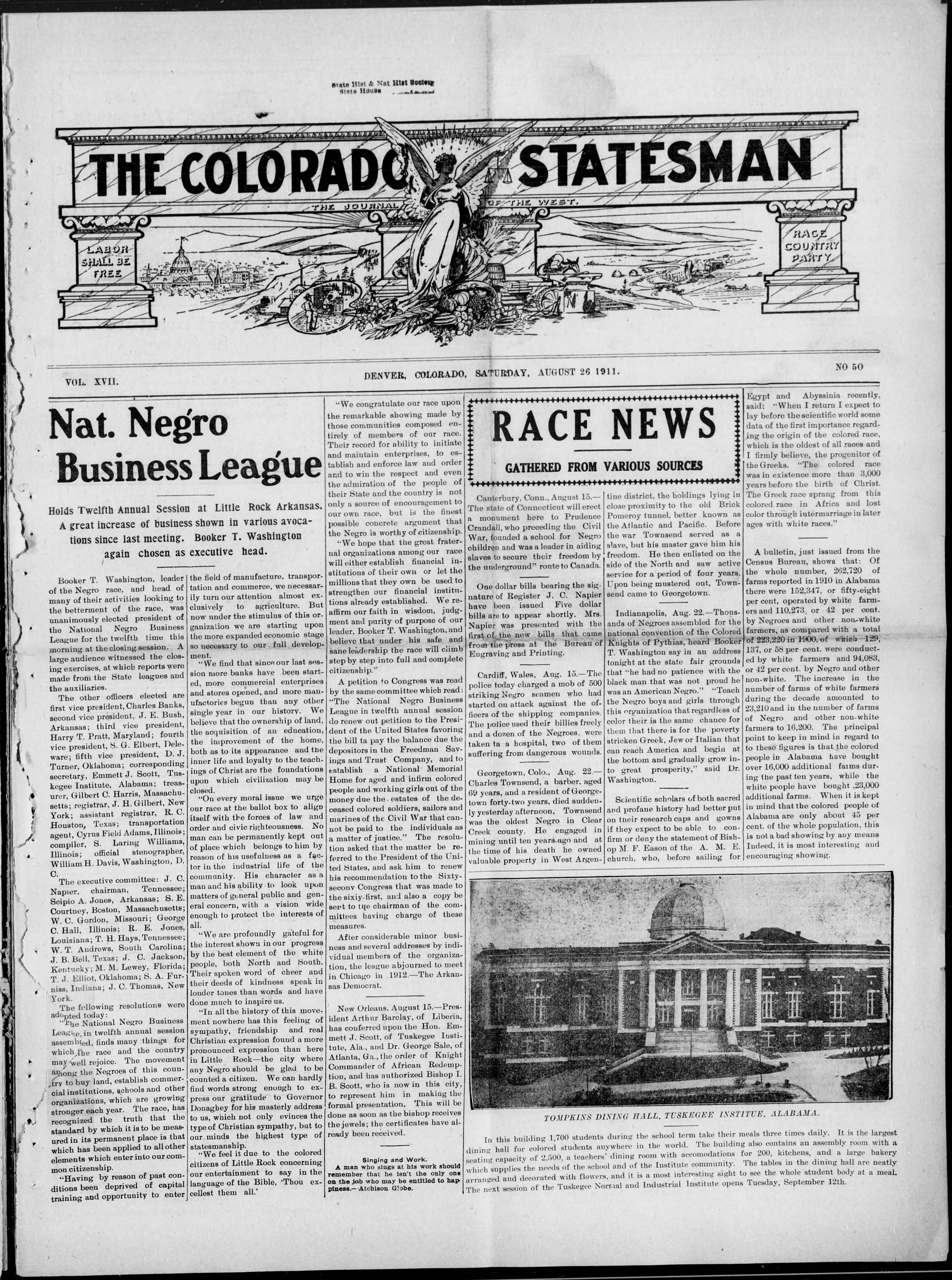
Nat. Negro Business League
Holds Twelfth Annual Session at Little Rock Arkansas. A great increase of business shown in various avocations since last meeting. Booker T. Washington again chosen as executive head.
VOL. XVII.
Nat. Neg
Business
Holds Twelfth Annual Session
A great increase of busines
tions since last meeting.
again chosen as
Booker T. Washington, leader of the Negro race, and head of many of their activities looking to the betterment of the race, was unanimously elected president of the National Negro Business League for the twelfth time this morning at the closing session. A large audience witnessed the closing exercises, at which reports were made from the State leagues and the auxiliaries.
The other officers elected are first vice president, Charles Banks, second vice president, J. E. Bush, Arkansas; third vice president, Harry T. Pratt, Maryland; fourth vice president, S. G. Elbert, Delaware; fifth vice president, D. J. Turner, Oklahoma; corresponding secretary, Emmett J. Scott, Tuskegee Institute, Alabama; treasurer, Gilbert C. Harris, Massachusetts; registrar, J. H. Gilbert, New York; assistant registrar, R. C. Houston, Texas; transportation agent, Cyrus Field Adams, Illinois; compiler, S. Laring Williams, Illinois; official stenographer, William H. Davis, Washington, D. C.
The executive committee: J. C. Napier, chairman, Tennessee; Scipio A. Jones, Arkansas; S. E. Courtney, Boston, Massachusetts; W. C. Gordon, Missouri; George C. Hall, Illinois; R. E. Jones, Louisiana; T. H. Hays, Tennessee; W. T. Andrews, South Carolina; J. B. Bell, Texas; J. C. Jackson, Kentucky; M. M. Lewey, Florida; T. J. Elliot, Oklahoma; S. A. Furniss, Indiana; J. C. Thomas, New York.
The following resolutions were adopted today:
The National Negro Business League, in twelfth annual session assembled, finds many things for which the race and the country may well rejoice. The movement among the Negroes of this country to buy land, establish commercial institutions, schools and other organizations, which are growing stronger each year. The race, has recognized the truth that the standard by which it is to be measured in its permanent place is that which has been applied to all other elements which enter into our common citizenship.
"Having by reason of past conditions been deprived of capital training and opportunity to enter
the field of manufacture, transportation and commerce, we necessarily turn our attention almost exclusively to agriculture. But now under the stimulus of this organization we are starting upon the more expanded economic stage so necessary to our full development. "We find that since our last session more banks have been started, more commercial enterprises and stores opened, and more manufactories begun than any other single year in our history. We believe that the ownership of land, the acquisition of an education, the improvement of the home, both as to its appearance and the inner life and loyalty to the teachings of Christ are the foundations upon which civilization may be closed.
"On every moral issue we urge our race at the ballot box to align itself with the forces of law and order and civic righteousness. No man can be permanently kept out of place which belongs to him by reason of his usefulness as a factor in the industrial life of the community. His character as a man and his ability to look upon matters of general public and general concern, with a vision wide enough to protect the interests of all.
"We are profoundly grateful for the interest shown in our progress by the best element of the white people, both North and South. Their spoken word of cheer and their deeds of kindness speak in louder tones than words and have done much to inspire us.
"In all the history of this movement nowhere has this feeling of sympathy, friendship and real Christian expression found a more pronounced expression than here in Little Rock—the city where any Negro should be glad to be counted a citizen. We can hardly find words strong enough to express our gratitude to Governor Donaghey for his masterly address to us, which not only evinces the type of Christian sympathy, but to our minds the highest type of statesmanship.
"We feel it due to the colored citizens of Little Rock concerning our entertainment to say in the language of the Bible, 'Thou excelest them all.'
DENVER, COLORADO, SATURDAY, AUGUST 26 1911.
"We congratulate our race upon the remarkable showing made by those communities composed entirely of members of our race. Their record for ability to initiate and maintain enterprises, to establish and enforce law and order and to win the respect and even the admiration of the people of their State and the country is not only a source of encouragement to our own race, but is the finest possible concrete argument that the Negro is worthy of citizenship.
"We hope that the great fraternal organizations among our race will either establish financial institutions of their own or let the millions that they own be used to strengthen our financial institutions already established. We reaffirm our faith in wisdom, judgment and purity of purpose of our leader, Booker T. Washington, and believe that under his safe and sane leadership the race will climb step by step into full and complete citizenship."
A petition to Congress was read by the same committee which read: "The National Negro Business League in twelfth annual session do renew out petition to the President of the United States favoring the bill ta pay the balance due the depositors in the Freedman Savings and Trust Company, and to establish a National Memorial Home for aged and infirm colored people and working girls out of the money due the estates of the deceased colored soldiers, sailors and marines of the Civil War that cannot be paid to the individuals as a matter of justice." The resolution asked that the matter be referred to the President of the United States, and ask him to renew his recommendation to the Sixty-seconv Congress that was made to the sixiy-first, and also a copy be sent to the chairman of the committees having charge of these measures.
After considerable minor business and several addresses by individual members of the organization, the league abjourned to meet in Chicago in 1912.—The Arkansas Democrat.
New Orleans, August 15.—President Arthur Barclay, of Liberia, has conferred upon the Hon. Emmett J. Scott, of Tuskegee Institute, Ala., and Dr. George Sale, of Atlanta, Ga., the order of Knight Commander of African Redemption, and has authorized Bishop I. B. Scott, who is now in this city, to represent him in making the formal presentation. This will be done as soon as the bishop receives the jewels; the certificates have already been received.
**QUIRKING**
A man who plays at his work should remember that he isn't the only one on the job who may be entitled to happiness. - Atchison Globe.
RACE NEWS
TOMPKINS DINING HALL, TUSKEGEE INSTITUE, ALABAMA.
In this building 1,700 students during the school term take their meals three times daily. It is the largest dining hall for colored students anywhere in the world. The building also contains an assembly room with a seating capacity of 2,500, a teachers' dining room with accomodations for 200, kitchens, and a large bakery which supplies the needs of the school and of the Institute community. The tables in the dining hall are neatly arranged and decorated with flowers, and it is a most interesting sight to see the whole student body at a meal. The next session of the Tuskegee Norraal and Industrial Institute opens Tuesday, September 12th.
Canterbury, Conn., August 15. The state of Connecticut will erect a monument here to Prudence Crandall, who preceding the Civil War, founded a school for Negro children and was a leader in aiding slaves to secure their freedom by the underground" route to Canada.
One dollar bills bearing the signature of Register J. C. Napier have been issued Five dollar bills are to appear shortly. Mrs. Napier was presented with the first of the new bills that came from the press at the Bureau of Engraving and Printing.
Cardiff, Wales, Aug. 15. The police today charged a mob of 500 striking Negro seamen who had started on attack against the officers of the shipping companies. The police used their billies freely and a dozen of the Negroes, were taken ta a hospital, two of them suffering from dangerous wounds.
Georgetown, Colo., Aug. 22. Charles Townsend, a barber, aged 69 years, and a resident of Georgetown forty-two years, died suddenly yesterday afternoon. Townsend was the oldest Negro in Clear Creek county. He engaged in mining until ten years ago and at the time of his death he owned valuable property in West Argen-
tine district, the holdings lying in close proximity to the old Brick Pomeroy tunnel, better known as the Atlantic and Pacific. Before the war Townsend served as a slave, but his master gave him his freedom. He then enlisted on the side of the North and saw active service for a period of four years. Upon being mustered out, Townsend came to Georgetown.
Indianapolis, Aug. 22.—Thousands of Negroes assembled for the national convention of the Colored Knights of Pythias, heard Booker T. Washington say in an address tonight at the state fair grounds that "he had no patience with the black man that was not proud he was an American Negro." "Teach the Negro boys and girls through this organization that regardless of color their is the same chance for them that there is for the poverty stricken Greek, Jew or Italian that can reach America and begin at the bottom and gradually grow into great prosperity," said Dr. Washington.
Scientific scholars of both sacred and profane history had better put on their research caps and gowns if they expect to be able to confirm or deny the statement of Bishop M. F. Eason of the A. M. E. church, who, before sailing for
NO 50
Egypt and Abyssinia recently, said: "When I return I expect to lay before the scientific world some data of the first importance regarding the origin of the colored race, which is the oldest of all races and I firmly believe, the progenitor of the Greeks. "The colored race was in existence more than 3,000 years before the birth of Christ. The Greek race sprang from this colored race in Africa and lost color through intermarriage in later ages with white races."
A bulletin, just issued from the Census Bureau, shows that: Of the whole number, 262,720 of farms reported in 1910 in Alabama there were 152,347, or fifty-eight per cent, operated by white farmers and 110,273, or 42 per cent. by Negroes and other non-white farmers, as compared with a total of 223,220 in 1900, of which 129, 137, or 58 per cent. were conducted by white farmers and 94,083, or 42 per cent. by Negro and other non-white. The increase in the number of farms of white farmers during the decade amounted to 23,210 and in the number of farms of Negro and other non-white farmers to 16,200. The principal point to keep in mind in regard to these figures is that the colored people in Alabama have bought over 16,000 additional farms during the past ten years, while the white people have bought .23,000 additional farms. When it is kept in mind that the colored people of Alabama are only about 45 per cent. of the whole population, this is not a bad showing by any means Indeed, it is most interesting and encouraging showing.
THE WORLD IN PARAGRAPHS
A BRIEF RECORD OF PASSING EVENTS IN THIS AND FOR-EIGN COUNTRIES.
IN LATE DISPATCHES
DOINGS AND HAPPENINGS THAT MARK THE PROGRESS OF THE AGE.
Western Newspaper Union News Service.
WESTERN.
A large forest fire is reported at Jardine, Mont., on the edge of the Yellowstone Park.
Business men of Spokane have raised $2,300 to finance a national apple show there the coming November.
One thousand delegates attended the eighth annual encampment of the Spanish War Veterans at Oklahoma City.
Orders have been issued at the Union Pacific headquarters to lay off 2,500 men, the order to take effect immediately.
United Spanish War Veterans, at their annual encampment, at Oklahoma City, went on record as opposed to the army canteen.
Eight dead, forty injured and $150,000 property damage is the result of the tornado which struck northeast of Minot, N. D.
A tornado passed over Huron, Neb., wrecking the high school building, court house, Catholic church, Catholic parsonage and school buildings.
A terrific windstorm along the international boundary line of North Dakota blew down houses on the heads of their inmates and whipped crops in places into shreds. Many persons are reported killed and injured. Damage is heavy on both sides.
Twenty-two sawmills in Louisiana and two in Texas have been closed and 8,000 men are idle as a move, it is said, in the fight waged by sawmill operators against the unionizing of their employees by the Brotherhood of Timber Workers.
At the offices of the Southern Pacific Company in San Francisco it has been announced that 6,000 men would be dropped from the payrolls of the Pacific system of the railway before the end of September. Two thousand will be dropped immediately.
A private in the signal corps at Fort Omaha, Neb., who is said to have deliberately cut off the index finger of his right hand in order that he might gain his discharge from the army, will instead be given a term of imprisonment and then taught to shoot with his second finger. This, at least, is the plan outlined by one officer of the courtmartial which will hear the evidence against him.
GENERAL
Heavy rains have fallen over southern Kansas.
The first city in New Jersey to try the commission form of government is Trenton.
The Lake Shore railroad has approved a plan to expend $11,000,000 in Toledo, Ohio, soon, according to reports.
W. G. Beatty, in a Wright biplane, beat the world's record for duration while carrying a passenger, at Chicago.
From the principal cranberry growing center in the Wareham, Mass., country comes news that the cranberry crop this year will amount to 13,000 barrels, or eleven per cent more than last year.
According to an order just issued by the Florida East Coast railway, all employees on the Key West extension work must send their families out of the path of the equinoxial storms for two months.
The jurors who convicted Capt. Peter C. Hains, U. S. A., of the murder of William E. Annis, in New York three years ago this month, it was learned, have sent a petition to Gov. Dix asking the pardon of Hains.
The National Association of Railroad Commissioners, which has been investigating the subject of express rates, may issue a recommendation that Congress take action leading to the abolition of express companies. This prediction is made by railroad officials and others.
Although the cost will exceed $1,000,000 and the house will have to stand tenantless for more than two years, John D. Rockefeller has begun the actual work of remodeling his residence at Pacantico hills, near Tarrytown, N. J., in order that when the alterations shall have been completed ten new guest chambers will be available.
Mrs. E. H. Harriman has given $50,000 to Dr. F. K. Ainsworth, chief surgeon of the Southern Pacific system, for the establishment and endowment of a bacteriological and pathological laboratory for the benefit of the employees of the company.
According to his announced plan to give away his fortune before his death, Dr. D. K. Pearson's has turned over his home in Hinsdale to that town for a public library, art gallery and park. The property is worth $35,000. He will spend the remainder of his life in a sanitarium.
FOREIGN.
Violent outbreaks against Jews have occurred in Mornmouthshire, England, and are giving the authorities great concern, as this is altogether a new phase in British life.
When the announcement was made from the board of trade offices in London that the railway strike had been settled and that the men would return to work immediately, a great wave of relief swept over the entire country.
The election campaign has gained full headway throughout Ontario, the great industrial province of Canada, by the visit of Sir Wilfred Laurier, the premier, and R. L. Borden, the opposition leader. On all sides it is now recognized that reciprocity is the issue.
Two hundred thousand railway employees throughout the United Kingdom are on strike and traffic everywhere is badly disorganized. The leaders of the Amalgamated Society of Railway Servants declare that 220,000 men, or nearly half the total employees of the railways of England, Ireland, Scotland and Wales, have answered their call to stop work. Managers of the railways say these figures are greatly exaggerated.
SPORT.
WESTERN LEAGUE STANDING.
P. W. I. Pct.
Denver .....120 80 40 667
Lincoln .....118 67 51 .568
Pueblo .....120 67 53 .558
St. Joseph .....119 65 54 .546
Omaha .....119 59 60 .496
Sioux City .....119 56 63 .471
Topeka .....119 47 72 .355
Des Molnes .....118 36 82 .305
Sportsmen are organizing a gun club in Platteville, Colo., and plan to lease two or three lakes, sow quantities of wild rice about them, and have fine duck shooting.
The former record was made by Amerigo at Mulhausen, Germany, when he carried a passenger 3 hours, 19 minutes, 37 seconds. Beatty's time was 3 hours, 42 minutes, 22 seconds.
Jim Flynn, the Pueblo fireman and conqueror of Al Kaukmann, is in New York, where he is scheduled to meet Carl Morris, the Oklahoma fighter, in a ten-round contest about the middle of next month.
La Junta, Colo., was successful in the first of the tri-city matches of trapshooters for a loving cup. The match was between La Junta, Dodge City, Kan., and Pueblo shooters. The Dodge City men state that they intend to win the cup if it takes all summer.
Harry Riede, the Aspen "Whirlwind," and "Kid" Dix of New York will in all probability clash in a twenty-round-bout Labor Day. They have been offered two dates, but have not yet accepted either offer. Both boys are doing active training in Denver at present, but will accept the offer of the club which will give the best inductions.
WASHINGTON.
Statehood for Arizona and New Mexico now only awaits the perfunctory approval of President Taft.
Postmaster General Hitchcock has, in all, designated ninety first-class offices as postal savings banks. Last order was for seventy.
The first session of the Sixty-second Congress has ended. The session record of measures introduced is 14, 038 bills and 484 resolutions in the House and 3,296 bills and 58 resolutions in the Senate. Only a few of these were passed.
The Democratic House of Representatives met defeat in its supreme effort to pass the wool and free list bills over the President's vetoes and virtually fixed upon adjournment of Congress at an early date. The vote was 227 to 129.
Three short messages were sent to Congress by the President, one urging a further appropriation to complete the work of raising the wreck of the battleship Maine, a second asking Congress to determine whether the wrecks of the Spanish vessels sunk by the American navy shall be given away and the third transmitting reports of engineers of surveys on the Great Lakes.
The House adopted, 282 to 27, the conference report on the campaign publicity bill. The report already has been adopted by the Senate and the measure will go to the President at once. It requires that all candidates for the Senate or House in general elections,' primaries or nominating conventions, shall file statements of their expenses not more than fifteen or less than ten days before the election or nominations.
Representing the commissioner of the General Land Office, Frederick R. Dudley, has gone west to confer with state land boards and state engineers in regard to the operation of the Carey desert land act. Mr. Dudley, who will hold conferences in all of the public land states in which the Carey act is in operation, is chief of the lands and railroads division of the General Land Office and has immediate charge of Carey act applications. On a basis acceptable to Mr. Taft, statehood for New Mexico and Arizona was approved by the Senate through the passage of the Flood Smith resolution presented by Senator William Alden Smith, chairman of the committee on territories. The resolution was adopted, 53 to 8.
A new altitude mark for aviatora was set by Oscar A. Brindley at Chicago by arising 11,726 feet in a Wright biplane. The world's record was 10,761 feet made by M. Loridan at Mourmelon, France, July 8, 1911.
Western Newspaper Union News Service.
COMING EVENTS.
September 4-9 — Arkansas Valley
Fair, Rocky Ford.
Sept. 6-9 — Hotchkiss Fair—Hotchkiss
September 11-16—Fremont County
Fair, Cañon City.
September 11-16—Annual State Reun-
lon of Elks—Ouray.
Sept. 18-21—Annual meeting Masonic
Bodies of Colorado—Denver.
Sept. 18-23—Colorado State Fair—Pu-
tillo.
cohoafe Springs.
Sept.—30—Sau Luis Valley Fair—
Alamoga.
Anaheim
Oakland 4, 5, 6 and 7—El Paso County
Fair, Calgary
15. Fair-Calihan.
19. Fair-Calihan. Annual Show.
Colorado Electric Club. Denver.
Froze to Death on Pike's Peak.
Colorado Springs.—Caught in one of the most severe snowstorms that has raged on Pike's peak for years and dressed in light summer clothing, W. A. Skinner and wife, of Dallas, Tex., were frozen to death near the summit of the peak. Their bodies were found side by side the next day by Z. C. Crow, who was walking down the mountain.
Mr. Taft to Visit Denver.
Washington.—Plans have been completed for President Taft's coming trip through the West and to the Pacific coast. The journey will be almost as extensive as that taken by the President on his famous "swing around the circle" in 1909, when he traveled more than 13,000 miles and visited thirty-three states. He will break ground for the Panama canal exposition at San Francisco, make scores of addresses and attempt to scale the 14,000 feet of Mount Rainier's slope. Among his stops will be Denver, where he expects to make one of his important speeches.
Federal Court Makes Ruling
Denver.—A decision was hounded down by Judge R. E. Lewis, after nine years in the Federal Court in the United States government's $4,000,000 damage suit against the Rio Grande and wealthy lumber corporations of Colorado and New Mexico for alleged illegal timber cutting.
The decision is a big victory for the Rio Grande in every point except one. Judge Lewis held that adjacent lands to a railroad right-of-way from which timber may be cut for railroad uses under the terms of a congressional grant, may not reasonably be over three miles from the right-of-way, or in certain instances six.
For all timber out at a greater distance than three miles from the Rio Grande right-of-way it must pay the government. In some cases the Rio Grande went as far as nineteen miles and persons connected with the road have admitted that the damages may reach as high as $500,000. That is considerably less than $4,000,000, however, and the Rio Grande officials felt some relief when they read the decision.
Judge Lewis ruled that a master in chancery must estimate the damage and will appoint one.
Judge Lewis then held that the contract with the Santa Fe and the Union Pacific not to invade the territory of either, did not operate as a surrender of rights under the congressional grant of June 8, 1872.
It is further held, contrary to the contention of the government attorneys, that the San Juan railroad from Antonito to Durango and Silverton was entitled to cut timber under the terms of the grant.
It is held that lands in the Ute Indian Reservation, from which the Rio Grande cut timber, was subject to the terms of the grant and the government cannot recover there.
It is held that the lands were adjacent to the Rio Grande in all cases with three miles of the right-of-way.
Bob Harris Must Hang.
La Junta—Judge Essex denied motions for new trials in the cases of Robert Harris and Joseph Harris for the murder of two Rocky Ford policemen, J. B. Craig and Jacob Kipper, July 4.
The Judge then told Robert Harris the jury had found him guilty of murder in the first degree and recommended hanging, asking: "Have you anything to say as to why sentence should not be pased upon you at this time?"
Robert Harris said: "Yes, sir. At the time this happened I did not have murder in my heart." Judge Essex then sentenced him to be hanged at Cañon City during the week ending Dec. 9 next. Ninety days were allowed to file a bill of exceptions and arrest of judgment.
In the case of Joseph Harris, now eighty-one, the motions for a new trial and arrest of judgment were overruled. He was asked if he had anything to say why sentence should not be pronounced upon him and replied: "I have stated all the facts. I thank God that I am not going to the penitentiary a guilty man." The judge said: "Your act made it possible for Bob Harris to do what he did." He then sentenced Harris to fifteen to twenty-five years in the penitentiary.
Small Happenings Occurring Over the State Worth While.
Western Newspaper Union News Service.
Tomato Day has been set for Sept.
4 at Fort Lupton.
Recent heavy rains at Briggsdale assure a big potato crop.
Proceedings will be started to rid Denver of the billboard nuisance.
Ouray County Pioneer Association celebration is to be held on Sept. 4.
Thieves entered the office of Justice Corson, at Pueblo, and stole $162.
The Northern Colorado Railway Co. has asked for the appointment of a receiver.
Prospects never were more rosento for the Prowers County Fair than at present.
At Steamboat Springs oil, gas and water have been found at a depth of 500 feet.
Jesse C. Bayless, for twenty-five years resident of Colorado, died in Boulder.
The Senate has confirmed the nomination of Robert R. Hanna, postmaster at Windsor.
The property of the Glenwood Hot Springs Company has been sold at mortgage sale.
Palisade will enter the race for Apple Queen at the apple show to be held in Denver in November.
Work has been started on the highway between Lafayette and Longmont. The road will cost $1,400 per mile.
Cantaloupe growers of La Junta are busy shipping a bumper crop. The melons are unexcelled this year.
Negotiations for the settlement of the srtike in the northern Colorado field fields have been called off.
For the power for an electric lighting plant, Fort Collins proposes to use the waters of the Poudre river. Palisade has already shipped 115 carloads of fruit this season, and forty-two of them were shipped in one week.
The corner stone of the new Capital Heights Presbyterian church, in Denver, was laid with appropriate ceremony.
John Mott, well known in Colorado criminology, is in jail at Victor charged with the killing of Richard Mooney.
Ten thousand head of elk will be brought from the Jackson's Hole country in Wyoming to the mountains in Colorado.
The Erie Commercial Club is working on a project by which it hopes to divert the Denver-Estes Park automobile road through Erie.
The President signed the Guggenheim bill granting the state of Colorado an additional million acres of land under the Carey desert land act. W. R. Haskell, aged thirty-seven, a conductor on the Denver, Laramie & Northwestern, had his left leg crushed by his own train at Utah Junction. He may die.
In an attempt to save her nine-year-old son from the attack of a vicious bulldog, Mrs. Margaret Meyers of Denver, was so severely bitten that she will probably die.
Returns of $500 an acre are reported by two Japanese farmers at Ione station, near Platteville, for cabbage shipped from fifteen acres and yielding ten to twelve tons an acre.
Richard Mooney, aged 65 years, a pioneer of Victor, died of injuries received when he fell fifteen feet at a railing which guarded the sidewalk, which was high above the ground
The government will intervene in the controversy between water users of the eastern and western slopes over the diversion of water from the Grand river to reservoirs on the eastern slope.
Supervisor John B. McGauran will introduce a resolution before the board of supervisors in Denver, providing for the erection of a memorial tablet where Ralph Johnstone, the aviator, fell last summer.
An order issued by Justice George W. Musser of the Supreme Court will lead to the release on bond of thirteen of the strikers now in the Denver county jail for violation of the injunction issued by Judge Greeley W. Whitford.
The beet sugar industry is only ten years old in Colorado, but it has developed in that time to a point where the factories are making annual disbursements for labor, raw material, freight charges and other expenses of $15,000,000.
The authorities of Mancos are baffled over the finding of the lifeless body of Mrs. Amella E. Nichelson of Aztec, New Mexico, in a room she had engaged with two bullet holes in her body, one through the head and the other near the heart.
Estimates on the Greeley potato crop at the present time vary all the way from 60 per cent of a normal yield to one made by well-known dealers, who say that if weather conditions are right there will be a normal crop, or about 8,000 car loads.
A campaign to awaken interest in the Coloardo exhibit of fruit, grains and vegetables to be sent to the American Land and irrigation Exposition—better known as the New York Land Show—in Madison Square Garden, New York, November 3 to 12, inclusive, has been started by the Denver Chamber of Commerce.
A suit brought by the Rio Grande Southern Railway Company against the Telluride Power Company for $180,000 damages to the railway line, has been settled out of court and the suit dismissed.
THE
BROADHURST
CARTER
SHOE CO.
NETTLETO
FOR M
$6, $7 and
The Prior Fur
1814 Curt
We buy and sell new
Furniture, also repa
shades. Sewing Ma
repaired a specialty.
BETTLETON SHOP
FOR MEN
$7 and $8, H
e Prior Furniture
1814 Curtis Street
e buy and sell new and second h
furniture, also repair work. Wine
ades. Sewing Machines sold
paired a specialty.
$6, $7 and $8, Pair
The Prior Furniture Co. 1814 Curtis Street
We buy and sell new and second hand Furniture, also repair work. Window shades. Sewing Machines sold and repaired a specialty.
Phone Champa 392
DRINK CAPITOL
DENVER'S
The purity of Capitol Beer is
flavor and strength-giving qualitie
HAVE A CASE
The Capitol B
Phone Champa 356.
Railroad Men
Clu
We lead, others follow. Hon
Men. A welcome to visitors
and papers will be found in
DRINK CAPITOL BEER
DENVER'S PRIDE.
The purity of Capitol Beer is demonstrated by its
and strength-giving qualities. It's capital.
HAVE A CASE SENT HOME.
The Capitol Brewing Co.
Champa 356.
Delivered A
Broad Men and Wai
Club
lead, others follow. Home for Railroad and
. A welcome to visitors. All the latest mag
papers will be found in the Library room.
The Borough Council
The purity of Capitol Beer is demonstrated by its superior flavor and strength-giving qualities. It's capital.
HAVE A CASE SENT HOME.
The Capitol Brewing Co.
Phone Champa 356.
Delivered Anywhere.
We lead, others follow. Home for Railroad and Club Men. A welcome to visitors. All the latest magazines and papers will be found in the Library room.
FRANK BURNLEY, Manager
2149 Curtis Street Denver,
Phone Ma
THE ZOBEL
SAMPLE
1004 Nineteenth Street
Phone Main 8232
THE ZOBEL BROTHER
AMPLE ROO
Nineteenth Street, Corner of
1004 Nineteenth Street, Corner of Curtis
FINE WINES, LIQUORS AND CIGARS
COORS' CELEBRATED BEER ON TAP
R COL
Only Your Home with the Celebr
Tivoli Beer
Bottled by
The Empire Bottling Co.
Supply Your Home w
Tivoli
Bottled
The Empire B
Phone Gall
Supply Your Home with the Celebrated Tivoli Beer
The Empire Bottling Co. Phone Gallup 245
DENVER
823 Sixteenth St.
We Are Denver Agents for the
ON SHOE
EN
$8, Pair
rniture Co.
Street
and second hand
er work. Window
chines sold and
TOL BEER
PRIDE.
demonstrated by its superior
s. It's capital.
RENT HOME.
Brewing Co.
Delivered Anywhere.
and Waiters'
b
e for Railroad and Club
All the latest magazines
the Library room.
BROTHERS'
ROOM
t, Corner of Curtis
With the Celebrated
Beer
by
Sottling Co.
p 245
Cash or Credit
Denver, Colo.
COLORADO
Midsummer Hats
THE HAT
COMFORTABLE IN SUMMER LATEST PARISIAN NOVELTY
UST why all the feminine world, from Maine to California, wake up some morning determined to
possess a certain kind of hat, no one has ever been able to tell. But this state of things comes to pass time and again. And now every one wants a white felt hat. And every one wants fluffy white feathers about the hat, or big bows and drapes of white taffeta and a bit of white silk fringe for trimming. This demand is varied by another for white trimmed with royal purple, vivid green or black silk velvet. Other all white hats are trimmed with rich silk braid. With these are worn the floating silk vell of large mesh, white canvas shoes or slippers, and cool looking linen dresses made very plain. Washable gloves in white complete the daimtiest of summer costumes. The half bleached linen suits, of crash, are worn by the nearest women. Styles and Delft blues and pea-greens, with occasional pale pink, and many white linen suits, array our summer
Coats and Skirts of Fine Shantung Silk Have Won Deserved Appreciation.
Cool, comfortable coats and skirts are being made of the finer, softer weaves of shantung silk, chosen in the natural biscuit shade, and also of soft satins—the uncrushable kinds—and a favorite fabric called "silk serge," which closely resembles our old friend, "satin marvelleux." A pretty model is of delft blue satin trimmed in quite a new way, with long silk ribbons chosen in a darker shade of blue.
The skirt opens on the left side in panel effect, revealing a long end of ribbon, and caught across with a dull silver button.
The coat is treated in a similar way, with a trimming of satin ribbons and silver buttons, and is finished with a pleated side flair of fine white batiste.
A high-crowned hemp hat to watch the gown has a brim of irregular shape, which is turned off the face and lined with black velvet, and is trimmed in a daring manner with one large dark crimson rose.
A New Rouge.
The woman who finds that a dash of rouge adds greatly to her appearance, and yet who wants above all things to avoid the suggestion of artificial coloring, can hardly do better than make a trial of a new rouge prepared under reliable management, and put up in smart little nickel cases without any name to attract curious or prying eyes, and of just the right size to slip inside the wrist bag. Another novelty is the form, for this is a powdered rouge to be shaken out of little perforations in the screw top upon a bit of absorbent cotton, to make it spread smoothly; or even the flat of one's finger tips may be used to rub it in. Like most of the latest and most popular rouges, it is rather on the mauve in tint before applied, but when spread upon the cheeks becomes exactly the shade of the blood coursing under the skin and as nearly impossible to detect as anything I have seen. It is the least obstructive way of carrying rouge possible.—The Vogue.
Parisian Ivory Sets.
Paristan ivory is the name given to imported celluloid and in the rich, creamy material are seen any number of lovely conveniences for the dressing table. Glove stretchers, powder and rouge boxes, pin trays and hand mirrors are some of the dainty trifles. The same articles in domestic celluloid often show the rich cream and such fittings are more used in summer than those of silver.
girls and matrons in costumes irresistibly charming. There is almost no trimming on these linen suits, except a little hand-embroidered design or insertions of cluny or crocheted lace. A little party of women in these costumes reminds one of a bevy of white pigeons or a bouquet of flowers showing a few dainty colors set in a background of white.
Their costumes are altogether comfortable and with them the white felt hat is just the right finishing touch. Some of the hats have very little trimming, just a band of black velvet—a drape of white taffeta or a collar and facing of braid. These hats are as effective as the panama, as they are soft enough to allow the brim to be turned in any fashion. They are far less expensive than the Panama, however, and their life is shorter. But, however, they are undoubtedly as beautiful in their effect as any headwear our women have worn.
JULIA BOTTOMLEY.
A
Broderte Anglaise in ninon witt
black velvet.
Embroidered Fur Sets.
An odd fur set made up as a guide for the women who wish to know the modes which are likely to prevail next winter, in order to have their remodeling done now at the low summer rates, is of seal. On both muff and wide, short scarf are insets of royal blue silk worked in the giddest of Chinese colorings. As a further bit of ornamentation rows of small brass balls are attached, near the edges, three or four in a group.
Frocks for Girls.
Young girls have foulard, pongee and shantung frocks with baby irish on venise lace as bands or in all-over for yoke and undersleeves. The girl or sash is important.
URGES CONTROL OF INSURANCE
REPORT OF SPECIAL COMMITTEE
OF U. S. INSURANCE
COMMISSION.
METHODS CRITICIZED
ONLY FEW COMPANIES ARE
FOUND TO BE FAIR TO
POLICY HOLDERS.
Western Newspaper Union News Service.
Milwaukee, Wis.—In the report of the special committee of the insurance commissioners of the United States important legislation for the control of insurance companies doing an industrial, health and accident business is proposed. The basis for the legislation proposed is given in reports on the examination of fourteen companies in which nearly 2,000 settlements effected by these companies are discussed and criticised. In discussing the settlement of these calims the report says:
"Of the specific claims examined, where the amount involved is considerable, the percentage of scaled or rejected claims is high; indeed, very much too high to be explained by error of judgment or carelessness.
"Indeed, the committee feels warranted in concluding that when dealing with companies doing an industrial, health or accident business, the policy holder public of the country has too frequently been the victim of inconscionable practices in the claim departments of the companies criticised in this report.
"Promises of reformation made at the hearing are, therefore, not enough. This convention should take action which will guarantee the just treatment of policy holders in the future."
The companies whose examination was the occasion for the report follows:
Standard Accident Insurance Company, Detroit.
United States Health and Accident Insurance Company, Saginaw. Massachusetts Accident Company, Boston. Great Easter Casualty Company, New York. Federal Casualty Company, Detroit. Equitable Accident Company, Boston. Continental Casualty Company, Hammond, Ind. North American Accident Insurance Company, Chicago.
National Casualty Company, Detroit. Fidelity Accident Company, Saginaw. General Accident F. and L. Insurance Corporation. American Assurance Company, Philadelphia.
Phoenix Preferred Accident Company, Detroit.
German Commercial Accident Company, Philadelphia.
The report says of one company
"It is impossible in language fitted to an official document aptly to characterize what seems to have been the practices and methods of the industrial department of this corporation in settling with its policy holders. It appears to have resorted to every possible means, not merely to protect itself against imposition, for which it could not be criticised, but also, and more particularly, to cut and shave down claims apparently without conscience and certainly without right." "Three or four others merely show in reasonably isolated cases either errors in adjustment, or that the bad practices of competitors were sometimes followed. About half the companies examined show serious conditions in their claim departments, particularly in the adjustment of specific claims of considerable amounts; while at least two of such companies call for immediate and emphatic reforms."
The report concludes with twenty-four recommendations, the most important of which are:
That a standard of health and accident provision law be enacted; that pro rating for change for occupation should be permitted only when the insured has actually changed his occupation; that the policy fee be abolished; that all industrial agents and collectors be licensed by the state; that frequent examinations for the covering not only financial conditions but also treatment of policy holders be conducted either by the individual states or by a committee of the convention and that publicity be given to the results of all such examinations.
Secretary Wilson Is Coming.
Denver.—James Wilson, secretary of Agriculture, has promised to come Colorado early next month. Will reach Denver September 6.
Rochester, N. Y.-The parade of the Grand Army of the Republic was disappointing as to attendance, except from the state of New York, which was large. Less than 10,000 men were in line, with fifty-eight bands and drum corps.
New York.-The unemployed in the United States will meet in Washington, D. C., from September 1 to 4 in annual convention.
FACTS ABOUT CANNING
HOME WORK, BOTH ECONOMICAL AND DESIRABLE.
Some Few Things That Must Be Remembered If Work is to Be a Success—Complete Sterilization a Requisite.
There seems to be a belief by the general public that there is something mysterious in the commercial canning process. The great secret of this process is a careful observation on two things, absolute cleanliness and complete sterilization.
It is possible for every housewife to run a small canning factory in her own kitchen and on the farm that is both economical and desirable.
Before Sealing.
Fruits and vegetables can be "pu-up" in glass jars or tin cans at home much cheaper than they can be purchased in the form of commercial canned goods, and the flavor, texture, and general quality of the home-made product can be made superior to the product of the average factory. All forms of bacteria are killed by complete sterilization. This is nothing more than enclosing the product to be sterilized in jars or cans that can be sealed air-tight, and submitting them to heat of sufficient degree, for a time long enough to destroy the bacteria that cause the raw material to spoil.
Sterilization is readily accomplished by the use of boiling water, and there are three different ways in which this can be done. While the parent bacteria can be killed at a temperature of boiling water, their spores retain their vitality for a long time even at that temperature.
Smaller factories, and the different home-canning outfits usually make use of the "open-kettle" process. Here the cans are submerged in boiling water and kept at that temperature for a time sufficient to destroy bacteria and spores.
The third process, known as fractional sterilization, is that of keeping cans or jars in boiling water for a specified time upon each of two or three consecutive days.
The process of boiling upon consecutive days is the safest method, and is much to be preferred in home canning. The first day's boiling kills practically all the bacteria, but does not kill all of the spores.
As soon as the jars or cans cool, these spores develop, and a new lot
"After Sealing."
of bacteria begin their destructive work on the contents.
The second day's boiling kills this new lot of bacteria before they have had time to produce spores.
Boiling the third day is not always necessary, but it is advisable in order to be sure that sterilization is complete.
The product to be canned, the various utensils used, the cans or jars, and the entire surroundings cannot be too clean. Cleanliness is half the secret of making the canning business a success.
Molasses Doughnuts.
Two eggs well beaten, 1 tablespoon melted lard, $1\frac{1}{2}$ cups molasses, $1\frac{1}{4}$ cups sour milk, salt, cinnamon and nutmeg to suit taste. Mix in flour enough to handle easily, fry in deep, hot fat. This was sent in years ago by Josie P., but it seems to me there should be some soda added don't you? Here is another not from the column: One cup molasses, 1 egg, 1 rounded tablespoon of butter, 2-3 cup of milk, 2 teaspoons of cream of tartar, 1 of soda, $1\frac{1}{2}$ teaspoon nutmeg and ginger, or cinnamon, little salt and flour to roll and handle nicely.
Laundering Plaited Jabots.
It is often difficult to get the plaits of one's dainty jabot ironed to suit. If a few moments with thread and needle in hand are spent before putting the jabot into the wash, the laundering will be simplified. Tack the plaits into place and then launder the dainty linen. A wondrous amount of trouble is saved by this simple expedient.
If there is a bit of Irish lace on your jabot, after it is laundered, pick out the figures with a fine crochet hook. This really pays well
WEST
Confectionery and
Baur's Ice Cream
Cafe in conection. We make a
Chops and Everything
and be
All the latest Soda Fountain Dr
Also a fine p
2741 W
Near F
PHONE CHAMPA 2188
10th Ave
H. HEUER,
RESTING PLACE FO
WEST BROS.
Confectionery and Ice Cream Parlor
Baur's Ice Cream Johnston's Candies
Cafe in conection. We make a specialty of Fried Chicken, Steaks,
Chops and Everything good to eat. Try a meal
and be convinced.
All the latest Soda Fountain Drinks and Chili served at all hours.
Also a fine grade of Cigars.
2741 Welton Street
Near Five Points
PHONE CHAMPA 2188 DENVER, COLORADO
H. HEUER, PROPRIETOR RESTING PLACE FOR COLORED GENTS MEALS AT ALL HOURS Pool Room in Connection
Corner West 10th and O
Denver,
N. FE
TAI
Who pays the hi
Is it the t
Just guess
The C
Give us a chance and we
tion. Our Spring and S
Our prices are moderate.
shop.
Resp
At 10th and Osage, Near Bur-
Denver, Colorado
. FERRY
TAILOR
Do pays the high up-town re-
s it the tailor? No.
Just guess who it is---
The Customer
Is a chance and we will give you the s
Our Spring and Summer Styles are
services are moderate. We do all sewing
Respectfully,
Corner West 10th and Osage, Near Burnham Shops Denver, Colorado
N. FERRY TAILOR
Who pays the high up-town rent?
Is it the tailor? No!
Just guess who it is---
The Customer
Give us a chance and we will give you the satisfaction. Our Spring and Summer Styles are all in. Our prices are moderate. We do all sewing in our shop.
Respectfully,
N. Ferry
1905 Curtis Street
Standard B
Manufacturer
Soda Water, Mil-
ging
ALSO NEEF'S LAGER B
PHO
DID YOU
Neef Bro
It's made right,
None better ma-
This is a Strictly
Hard Bottling
Manufacturers of all Kinds
Water, Mineral Water
Ginger Ale
NEEF'S LAGER BEER FOR FAMILY
PHONE 66.
DO YOU EVER T
'Bros.' B
made right, and tastes
better made anywhere
a Strictly Colorado P
Standard Bottling Co.
Manufacturers of all Kinds
Soda Water, Mineral Waters and
Ginger Ale
ALSO NEEF'S LAGER BEER FOR FAMILY USE.
PHONE 66.
DID YOU EVER TRY Neef Bros.' Beer?
It's made right, and tastes right. None better made anywhere and This is a Strictly Colorado Production
BE SURE AN TRY IT.
Established In 1890.
Eagle Bottle
A. D. SIMMONS
Manufacturers of Soda Water
Root and
2836 WELTON
1712 LARIMER ST.
N. Weisman's
Money to
DIAMONDS, JEWERLY, WATER
TRUNKS, VA
Business Strictly Confidential.
190. Eagle Bottling Works
A. D. SIMMONS, Proprietor.
Pers of Soda Water, Ginger Ale, Mine
Root and Birch Beer
2836 WELTON ST., DENVER.
ST. TELEPHON
Teisman's Loan O
Money to Loan on *
NEWERLY, WATCHES AND GUNS,
TRUNKS, VALISES, ETC.
Confidential. D
Established In 1890. Telephone 3673
Manufacturers of Soda Water, Ginger Ale, Mineral Water,
Root and Birch Beer
2836 WELTON ST., DENVER.
1712 LARIMER ST. TELEPHONE MAIN 2889.
Turn Over
a New Leaf
By subscribing
for THIS PAPER
---
CHARLES S. WEST
BROS.
Ice Cream Parlor
Johnston's Candies
specialty of Fried Chicken, Steaks,
good to eat. Try a meal
convinced.
nks and Chili served at all hours.
grade of Cigars.
Hilton Street
ave Points
DENVER, COLORADO
venue Hotel
PROPRIETOR
FOR COLORED GENTS
MESSAGE, Near Burnham Shops
Colorado
ERRY
TALOR
high up-town rent?
sailor? No!
who it is----
customer
will give you the satisfac-
summer Styles are all in.
We do all sewing in our
fectfully,
Bottling Co.
of all Kinds
General Waters and
Bever Ale
BEER FOR FAMILY USE.
E 66.
EVER TRY
os.' Beer?
and tastes right.
de anywhere and
Colorado Production
Telephone 3673
Mining Works
INS, Proprietor.
Ginger Ale, Mineral Water,
Birch Beer
ST., DENVER.
TELEPHONE MAIN 2889.
Loan Office
Loan on *
HES AND GUNS, CLOTHING,
LISES, ETC.
DENVER, COLO.
Hours: 10 to 11 a. m., 2 to 5 and 7 to 9
p. m. and by Appointment.
Dr. J. H. P. Westbrook
COR. 21ST AND ARAPAHOE ST8
Day Phone Main 1144.
Night Phone Champa 570.
JOHN W. WEST
THE COLORADO STATESMAN
JOB. D. D. RIVERS ..... Proprietor
1824 Curtis Street, Room 25.
SUBSCRIPTION RATES:
PAYABLE IN ADVANCE
ens that papers sent to subscriber any number when due, inform a duplicate of the missing one.
be made by Express Money or Bank Draft. Postage stampsional part of a dollar. Only 25 cents per inch. Reading no less than three months' conti- ties unknown to us. Further p- of a personating nature that are columns of this paper.
receive attention must be newly upon one side of the paper; later than Wednesdays, and be returned. unless stamps are seen.
class matter at the postoffice.
One Year ..... $2.00
Six Months ..... 1.00
Three months ..... .60
PAYABLE IN ADVANCE.
It occasionally happens that papers sent to subscribers are lost or stolen. In case you do not receive any number when due, inform us by postal card and we will cheerfully forward a duplicate of the missing number.
Remittances should be made by Express Money Order, Postoffice Money Order, Registered Letter or Bank Draft. Postage stamps will be received the same as cash for the fractional part of a dollar. Only 1-cent and 2-cent stamps
Display advertising 25 cents per inch. Reading notices, 5 cents per line.
No discounts allowed on less than three months' contract. Cash must accompany all orders from parties unknown to us. Further particulars on application.
All communications of a personating nature that are not complimentary will be withheld from the columns of this paper.
Communications to receive attention must be newsy, upon important subjects, plainly written only upon one side of the paper; must reach us Tuesdays, if possible, anyway not later than Wednesdays, and bear the signature of the author. No manuscript returned. unless stamps are sent for postage.
Entered as second-class matter at the postoffice in the city of Denver, Colorado.
THE COST OF PLEASURE.
has unequaled measure of hard work, than any other race of people, that other people have—the situation—but he apes them or succeeds imitation off with a joke, a neediness is a virtue up to a degree which has its limitations, beyond welfare of the easy-going and selfish we are living governs the nature of its irresistible and indiscriminate demands and laugh away in their unnatural pleasures some time. But the Negro is not put at heart and his less-interested endeavor. The Negro is living too tough for improvement by hard work, most important institutions, dearest serious side of our well which they provide the public for their financial sustenance. Individuals among us make the extreme, the already extreme pastime and irreparable war, the lack of the inculcation of our youth, who are to become and proper education which the Negro can ever measure up to other people. The dependence on business and his institution, his independence and self-sustenance, the establishment and support, the newspapers, his own commercial, incoming more and more imperious and all-important ends only threeulgence in unlimited pleasure begin to teach these facts.
Notwithstanding his unequaled measure of hardships, the Negro has more fun, more pleasure, than any other race of people on earth. He doesn't have the same comforts that other people have—the conveniences and privileges of wealth and station—but he apes them or substitutes something else for them, and passes the imitation off with a joke, a laugh and a ready forgetfulness. Light-heartedness is a virtue up to a certain point, but there can be no doubt that it has its limitations, beyond which it becomes an evil and a menace to the welfare of the easy-going and self-indulgent victim. The spirit of the age in which we are living governs the welfare of all people within the world-radius of its irresistible and indiscriminating influence and those who disregard its demands and laugh away its seeming incongruities must pay the cost of their unnatural pleasures some day, no matter how far distant that day may be. But the Negro is not putting off his day of payment so far as his light heart and his less-interested and jocund observers would lead him to believe. The Negro is living too much for pleasure and by pleasure and not enough for improvement by hard, patient and sober endeavor. Many of our most important institutions, devoted professionally and fundamentally to the most serious side of our welfare and being, depend upon the idle pleasure which they provide the public for an important part of the revenue necessary for their financial sustenance. Many individuals and aggregations of individuals among us make their living by catering to and encouraging, to the extreme, the already extravagant propensity of the rogo toward pleasurable pastime and irreparable wastefulness.
The cost of it all is the lack of the inculcation of serious ideas and aspirations in the minds of our youth, who are to become the race of the future; the lack of that special and proper education which is necessary and must be acquired before the Negro can ever measure up to the spirit of the age and hold his own with other people. The dependence of the Negro, as a race, upon the white man, his business and his institutions, is becoming more and more out of date, and his independence and self-sustenance is becoming more and more required. The establishment and support of his own business institutions, his own newspapers, his own commercial, industrial and agricultural enterprises, is becoming more and more imperative and vital. He can reach these serious and all-important ends only through the sacrifice of his idle and inordinate indulgence in unlimited pleasures, and all true teachers of the race must soon begin to teach these facts.
THE JESTERS.
is one of the fixed institutions appointed comedian of the cow laugh. He was always a jester series that have marked the art of these compulsory fun-male clear clear that he who jests for, almless and unaccountable the comedians of our day, who writers of old, inherit the same when the humor of life chan
The King's fool was one of the fixed institutions of early European monarchies. He was the appointed comedian of the court, and it was his business to make the King laugh. He was always a jester but seldom a fool, and many are the tragic stories that have marked the annals of the early courts, in which the real lives of these compulsory fun-makers are revealed to the world, and the fact made clear that he who jests for a living is not always the frivolous, wayward, aimless and unaccountable being that his calling makes him appear. The comedians of our day, who are the legitimate successors of the royal jesters of old, inherit the same experiences, and the day seems to come to all when the humor of life changes to the serious, the solemn, the tragic side. With the laughter of the people still ringing in their ears, it seems to be the fate of our modern jesters to turn to see that other Great Joker, Death, mocking and echoing all the ribaldry of a lifetime as he prepares to score the "hit" that never fails. For the comedian must see the final curtain fall, and hear the ghoulish jesters shout, "He laughs best who laughs last-" There is something pathetic in the successive taking off of three of our foremost fun-makers in the last three years—Ernest Hogan, George Walker, Bob Cole. With his strong mentality attending him to the end, Ernest Hogan became a physical wreck, a victim of tuberculosis. And although he had made a comfortable fortune in his lifetime, the personal comforts and liberties of his last months were limited by meagre allowances from a benefit fund provided by friends and fellow actors.
George Walker's mind gave away, although the thousands who had seen and heard him in his happy stage portrayals, doubtless imagined that mental worry and care were as far from his natural make-up as they are from the most careless of tramps. He is said to have managed all the business arrangements of the Williams and Walker partnership, and his reputation for keen financial direction was of the highest. Something more than fun-making was at the bottom of his aliment.
And now Bob Cole puts off the comedy role for the tragic. Less than a year ago, while robust and strong, he suffered a mental breakdown. The team of Cole and Johnson had done a vast amount of work in the three years immediately preceding. As humorous song-writers, playwrights and vaudeville headliners, their output told a story of hard work and mental strain such as few men, of similar station, undergo. The life of the comedian became something more than a playground. Bob Cole was the originator of ideas, the writer of plots and verses, the humor student. And he was not only ambitious, but apparently exhaustless of startling innovations and ideas and tireless. But suddenly the stroke fell, and he was sent to a hospital and then to a sanitarium. His treatment benefited him and he seemed on the way to recovery, and when he was taken to the mountains in Northern New York in July, relatives and friends thought that he would soon again be fit to return to his chosen work. But he alone probably realized that the Grim Jester was mocking him. He died by drowning in a small creek, on August 2, probably the result of his own voluntary act. He was the third of three star fun-makers who worked themselves to death. All aspired to the achievement of serious results, and in their endeavor to conquer the world of laughter, found only life's deepest tragedy.
By WELLS ANDREWS, M. D.
RESS has a great influence. The two cardinal points reference to their clothing, such as may serve to retrain that its form be so an abdominal compression action. Hence the physician to adopt under-suide them to eschew tightly fitting high-heels whenever the occasion offers, seldom in such matters fashion and the end of the chapter to reign over cost.
The injuries that may be inflicted in the dress of girls are shown in the ing functions. The results of error the period when the young lady exert that imposed by the requirements of.
Were young men to be so lace quately clothed, so suffocated, so excease.
Defects of clothing, though the chest and shoulders, are not upper part of the body. The feet which fashion denies. They cannot except at the cost of suffering, so the infliction of positive disease. mits the legs to be covered with materials. The circulation of blood comes further impeded by the press and the debilitating effects of cold state, too, thus occasioned is an exercise, and so adds to the general.
has a great influence on the physicardinal points to be here born, their clothing are, first, that they serve to retain the necessary form be so arranged as to oo compression nor any interference the physician should try to adopt underclothing of meridian to eschew compressing corsetting high-heeled shoes. This offers, seldom as our counselion and the modiste will proclaim over common sense and it may be inflicted by the abe are shown in the effects of tight results of errors of this kind of young lady exchanges the easy requirements of fashionable life to be so laced, so imperfectly suffocated, so exposed, their body, though most signal about shoulders, are not confined to the body. The feet require warmth. They cannot be compressed if suffering, some distortion or active disease. Fashion also pall recovered with only the thinning insulation of blood to the feet be led by the pressure of tight sheath effects of cold. The crippled is an obstacle to efficiency to the general debility.
RESS has a great influence on the physical health of girls. The two cardinal points to be here borne in mind with reference to their clothing are, first, that the material should be such as may serve to retain the necessary warmth, and, second, that its form be so arranged as to occasion neither undue abdominal compression nor any interference with muscular action. Hence the physician should try to induce his girl patients to adopt underclothing of merino, as well as to persuade them to eschew compressing corsets, elastic garters and tightly fitting high-heeled shoes. This advice we should give whenever the occasion offers, seldom as our counsel may be followed, for in such matters fashion and the modiste will probably continue to the end of the chapter to reign over common sense and the doctor.
The injuries that may be inflicted by the absurd modes prevalent in the dress of girls are shown in the effects of tight lacing on-the breathing functions. The results of errors of this kind are most apparent at the period when the young lady exchanges the easy garb of girlhood for that imposed by the requirements of fashionable life.
Were young men to be so laced, so imperfectly exercised, so inadequately clothed, so suffocated, so exposed, their bodily vigor would soon cease.
Defects of clothing, though most signal about the chest and shoulders, are not confined to the upper part of the body. The feet require warmth, which fashion denies. They cannot be compressed except at the cost of suffering, some distortion and the infliction of positive disease. Fashion also permits the legs to be covered with only the thinnest materials. The circulation of blood to the feet becomes further impeded by the pressure of tight shoes and the debilitating effects of cold. The crippled state, too, thus occasioned is an obstacle to efficient exercise, and so adds to the general debility.
as little for your meals as he can.
I have been out harvesting in Nebraska. There I worked only ten to eleven hours a day, with home-cooked food, the best a man ever could get. I went with a machine from one farm to another, staying on the average of two days on each place. The farms being small, it only took about two days to finish a place. You were not expected to work so hard, but the pay ran only from $2 to $2.50 a day, whereas in Kansas it runs as high as $4 a day.
I have been out harvesting in to eleven hours a day, with home-coget. I went with a machine from average of two days on each place. about two days to finish a place. Y but the pay ran only from $2 to $2 as high as $4 a/day.
I had about nine full weeks o and the beauty of it was the fact th day's rest while the machine was be City boys musn't think that th work day in and day out for six we
harvesting in Nebraska. The farm, with home-cooked food, the baker machine from one farm to another each place. The farms being ash a place. You were not exposed from $2 to $2.50 a day, where the full weeks of it in the vicinity was the fact that now and then the machine was being moved to the think that they are strong enough for six weeks in the hot b
I had about nine full weeks of it in the vicinity of Wymore, Neb.. and the beauty of it was the fact that now and then you could get a half day's rest while the machine was being moved to the next place. City boys mustn't think that they are strong enough to get out and work day in and day out for six weeks in the hot broiling sun.
arrow increases in number very often seen at Elgin. One mile south find a sparrow. The best of scavengers among all vegetables, just sprouting, be the button that it is the insects after. Industrious this little fellow ision and confidence in himself from both in and out of the city in those who condemn him.
The English sparrow increases excitement, as can be seen at Elgin pital you can hardly find a sparrow. Sparrows are the best of scaver you find your young vegetables, ju you can bet your last button that it that the sparrow is after. Just think how industrious this is full of life, ambition and confid the sparrow, watch him both in and is more energetic than those who co
The English sparrow increases in number very rapidly and likes the excitement, as can be seen at Elgin. One mile south or west of the hospital you can hardly find a sparrow.
Sparrows are the best of scavengers among all bird kind, and should you find your young vegetables, just sprouting, being picked to pieces, you can bet your last button that it is the insects rather than the plant that the sparrow is after.
Just think how industrious this little fellow is. Like a bantam, he is full of life, ambition and confidence in himself. Stop talking about the sparrow, watch him both in and out of the city, and you will find he is more energetic than those who condemn him.
from west to east around the Jupiter is approximately 400,000,0 is the earth, he apparently travels w the "inside track," distance him an 4,332 days, or approximately twel
As one writer said around the sun, but owing tely 400,000,000 miles fartherently travels westward while it stance him and leave him behi-ximately twelve years.
from west to east around the sun, but owing to the fact that Jupiter is approximately 400,000,000 miles farther from the sun than is the earth, he apparently travels westward while in reality we, being on the "inside track," distance him and leave him behind. Jupiter's year is 4,332 days, or approximately twelve years.
D
Highest Wages for Greatest Amount of Work
By G. A. CROSBY
Terre Haute, Ind.
Defense of
Scrappy
Little
English
Sparrow
By B. J. GUSTIN
Aurora, Ill.
Little Facts About Jupiter and Venus By W. SCHARDT Willimns Bay, Wis.
Dress Has Great Influence on Physical Health
it influence on the physical health of girls. It points to be here borne in mind with ref-thing are, first, that the material should be so to retain the necessary warmth, and, second, so arranged as to occasion neither undue session nor any interference with muscular the physician should try to induce his girl underclothing of merino, as well as to per-hew compressing corsets, elastic garters and ch-heeled shoes. This advice we should give seldom as our counsel may be followed, for the modiste will probably continue to the ever common sense and the doctor. Be inflicted by the absurd modes prevalent in the effects of tight lacing on-the breath-of errors of this kind are most apparent atady exchanges the easy garb of girlhood for events of fashionable life. So laced, so imperfectly exercised, so inade- so exposed, their bodily vigor would soon
It has been my experience in the wheat fields that where the highest wages are paid there also the greatest amount of work is demanded. Where the hours of labor are from 4:50 in the morning until 8:30 at night a city chap can stand the strain for only one or two days at the most. Kansas pays high wages, but the hours are long and the board is not always so extra. For there the farmer does not feed you, as the harvest hands generally work for the owners of the thrashing machine and naturally he wants to get as much work out of you as he can and pay
e can.
ing in Nebraska. There I worked only ten
some-cooked food, the best a man ever could
from one farm to another, staying on the
place. The farms being small, it only took
ice. You were not expected to work so hard,
2 to $2.50 a day, whereas in Kansas it runs
weeks of it in the vicinity of Wymore, Neb.
fact that now and then you could get a half
was being moved to the next place.
that they are strong enough to get out and
six weeks in the hot broiling sun.
Those who hate the English sparrow I advise to take a trip to Elgin, and visit the grounds of the Illinois State hospital. There they will see sparrows, robins, bluejays, blackbirds, wrens, swallows of all descriptions, song and night birds, living in perfect harmony. Each kind is there by the thousands. Why? Because they have trees to nest in, particularly the pines. In the city we have no trees to speak of outside of the parks, and if the park commissioners would plant some pine trees you would find that the robin, the thrush, the bluejay, the lark and others would return
creases in number very rapidly and likes the Elgin. One mile south or west of the hossparrow. scavengers among all bird kind, and shouldoles, just sprouting, being picked to pieces, that it is the insects rather than the plantous this little fellow is. Like a bantam, he confidence in himself. Stop talking about in and out of the city, and you will find he who condemn him.
The bright star in the southern sky is the planet Jupiter and the one in the west is Venus. Jupiter is in Libra and Venus is in Leo, while Saturn is in Aries and can be seen early in the morning. Mars, in Aquarius, now rises about midnight and is a beautiful sight just before daylight. No man will regret the loss of a few winks if he gets up to see him. Jupiter's moons could be seen through a good pair of opera glasses three weeks ago and probably can be now under favorable atmospheric conditions.
As one writer says, all planets travel the sun, but owing to the fact that 10,000,000 miles farther from the sun than travels westward while in reality we, being on him and leave him behind. Jupiter's year is twelve years.
PETER H.
A. E.
A. M. LAWHORN
UNDERTAKERS
CARSON'S
SPECIAL VALUES IN PORTABLE LAMPS AND BRASS JARDINIERS. For a few days we offer an elegant electric lamp, heavy spun brass and copper bases fitted with a nice 10-inch green dome shade and heavy silk cord, well worth $6.50; sale price, $4.00, com-
In Brass Jardiniers we offer regular $2.00 values, beautifully finished and fitted with ball
Regular $3.00 values, beautifully finished and fitted, with ball feet; sale price, $1.50 each.
Our line of Dinnerware never was as varied or complete as it is at the press- simple needs of the kitchen as well as the higher priced ware suitable for the dining room. The Carson Crockery Company.
REBUILDING SALE
S&H
GARMENT STORE
925-16TH ST. OPP JOSLINS
Silk, Wool Batiste and all Wash
Dresses at less than cost of material,
White and Colored Wash
Dresses, former prices
$3.95 and $4.00 . . . $1.00
for White and Colored
Wash Dresses that formerly
sold for $6.75 and $7.50.
for White and Colored
Wash Dresses that formerly
sold for $8.75 and $10.00.
WASH SKIRTS.
White, tan or black, former
prices $1.75 and $2.00, now.
Natural Linene and White Linene
Skirts, former price $3.50 and
$4.00, now. $1.95
WHITE PETTICOATS.
And White, Pink and Light Blue
Lawn Shirts price
$1.50 and $1.75 now..... 98c
AT THESE PRICES YOU CAN AF-
FORD TO BUY SEVERAL GAR-
MENTS FOR NEXT SEASON.
$12.50 and $15.00 Dresses, $4.95.
Taffeta Silk, Fancy Foulard Silk,
White and Colored Lingerie and
All Gift Dresses, the former
sold for $12.50 and $15.00
sale price..... $4.95
Dresses, $4.95.
Y Foulard Silk
and Lingerie and
that formerly
d $15.00 $4.95
Silk and Serge Coats, former
prices $15.00 and
$18.00, now
Silk and Serge Coats, former
prices $20.00 and
$25.00
Summer Cares
$8.95
$12.50
nckets, $5.00.
$12.50 and $15 Jackets, $5.00.
Black Jackets, Cream Serge Jackets,
Cream Jackets, Cream Serge Jackets,
Covert Cloth Jackets, former
prices $12.50 and $14.00, $5.00
SILVERSMITH &
FRIDAY AND
Grand clean-up of odds and ends
troductory Sale will be the greatest st
Wonders never cease until this g
tory
DIG UP, RAKE UP and be sure
Wind-up. Watch our windows.
Mothers, get your children ready
ble duty
READ RE
Friends, keep your eyes on our
pen every few days that will benefit
J. A. EDDY,
SMITH & HILLER, 925 16th St.
AND SATURDAY
of odds and ends and broken lines from the Great In-
e the greatest stunt ever pulled off at Five Points.
Please until this grand let-lose event has passed into his-
UP and be sure to be in on this Grand Bargain Feast
windows.
For children ready for school now, when dollars do dou-
READ READ
our eyes on our windows, as something is going to hap-
that will benefit you.
DODY, 2625 WELTON
THE
CAPITOL
CLUB
A SOCIAL CLUB.
FRIDAY AND SATURDAY
Grand clean-up of odds and ends and broken lines from the Great Introductory Sale will be the greatest stunt ever pulled off at Five Points.
Wonders never cease until this grand let-lose event has passed into history
DIG UP, RAKE UP and be sure to be in on this Grand Bargain Feast Wind-up. Watch our windows.
Mothers, get your children ready for school now, when dollars do double duty
Friends, keep your eyes on our windows, as something is going to hap pen every few days that will benefit you.
MACK SMART
Manager. A S
921 20TH. ST.
---
```markdown
```
In a few days the entire front of our room will be torn out--new windows, up-to-date; will take the place of our old ones. Before the dirt begins to fly We want to
WASH SKIRTS.
1
921 20TH. ST.
A first-class Mortuary establishment.
First aid to the bereaved in the time of death of their loved ones.
Prices below competitors. Polite service.
Parlors 1921 Arapahoe St.
LICENCED EMBALMER
Denver's Largest Exclusive China Store.
732-36 Fifteenth Street.
$5.00 Silk Petticoats $1.35.
Soft Sole Silk Petticoats and Fancy
Line Silk Petticoats and Fancy
Persian and Dresden Silk Petticoats,
former price $5.00. now ..... $1.98
$25.00, $30.00 and $25.00 Suits
now $10.00.
Balance of Silk Petticoat or Diagonal
Cloth Suits, Cream with
Black Stripe Serge Suits, all
Silk Pongee or Cloth of Gold
Suits that formerly sold for $25
to $35, choice now ..... $10.00
CLEAN UP OF SUMMER WAISTS.
For one hour of Fancy and
Tailored White Waists, former
prices $1.25 and $1.50.
for choice of all $1.75 and
$2.00 Fancy White Waists.
Among them are low and high
neck, short or long sleeve styles.
All better Waists in Silk, Marquise
Lingerie are on sale now for—
In summer weights—must be closed out at once. Linen and Poplin Coats, former price $8.75 and $12.50. $4.95
# TREES
Broadleaf Caps, former
price $8.75 and $9.95 now...
Silk Ponge Caps, former
price $13.50, now...
PHONE CHAMPA 2540
DAY OR NIGHT.
PHONE MAIN 6243
LONG COATS.
DENVER, COLO.
Mrs. Fannie Beaseley is confined to her bed from illness.
Mrs. C. F. Hall was numbered among the sick the first of the week.
Charlie Thomas, who has been ill with heart trouble for two weeks, is able to be out.
day by the True Reformers carried large crowd and the way they all to it, no better time could have been less than was enjoyed by those who were on this great scenic. Trip Mr. A. Cash, who was chairman of the committee in charge, rightly deserves justified comment in making the coming a success.
Mrs. J. R. Contee and her guest Mrs. Nero, took in the sights of the Loop Thursday.
Mrs. W. H. Gentry of 2927 Larimer street, who was very ill last week is improving.
Charles Burdine, one of the oldest clerks in the postoffice, is enjoying his annual vacation.
Mrs. A. C. Cash arrived home Sunday from St. Louis after an absence of several months.
Mrs. L. Huff of Anaconda, Mont., is visiting her sister, Mrs. A. Ellis of 2246 Glenarm Place.
A. G. Campbell, an employee of the Bohm-Allen Jewelry Co., is enjoying his vacation.
Quite a number of Denverites attended the Frontier celebration at Cheyenne this week.
Wm. E. Snowden of the Denver Union Water Co., left this week for a two weeks' vacation.
Centennial Lodge No. 4, A. F. and A.M., will give its second annual Emancipation celebration at Luna Park September 21st, 1911.
Mrs. Lula Craig, principal of the school at Nicodemus, Kansas, who was a delegate to the N. N. E. C., is still in the city.
Mrs. S. C. Rogers and Mrs. J. Silas Harris of Kansas City, Mo., were pleasant callers at our office Thursday morning.
Misses Blanche Kelley and Ivy Hayden of Springfield, Mo., will spend Sunday at Colorado Springs and Manitou.
Mr. M. Woods and family of Marshall, Texas, is spending the summer in cool Colorado, stopping at 2233 Champa street.
Mrs. J. A. Wisdom of Portland, Ore., arrived in the city Thursday morning to visit her sister, Mrs. H. Pope of 3118 Stout street.
A delegation from Corporal White Camp No. 4 left Thursday for Cheyenne, to muster in 16 members of the 9th Cavalry in the camp.
Mrs. Dora Elexander left Thursday for Texarkana, Texas, after a pleasant two months' visit with her sister, Mrs. Anna Franklin, 2233 Champa street.
Mr. and Mrs. M. S. Parish and little daughter of Birmingham, Ala., are among our new arrivals, while here Mrs. Parish will attempt to regain her health.
J. R. Stafford passed through the city last Sunday from Kansas City, en route to Ft. Russell, Wyo. He will be the guest of Chaplain and Mrs. Prioleau.
Mr. and Mrs. B. W. Whitten and daughter of Oakland, California, stopped over in Denver this week while en route to Cleveland, Ohio. They were the guests of Mrs. A. A. Ealy.
Mrs. S. C. Rogers and Mrs. J. Silas Harris returned to their home in Kansas City, Mo., last Thursday. They were entertained at many social functions while in the city.
After attending the Negro Educational Congress and taking a trip on the Moffat road, on the True Reformers' excursion, Miss Katherine Jones and sister, Capitolta, returned to Rocky Ford Monday. While in the city they were the guests of Mrs. Grimes, 2428 Emerson street.
Miss Effie S. Green of Stockton, Kas, has spent two weeks in the city of Denver attending the Congress and visiting the many places of interest here. She will visit at Colorado Springs, Manitou and Pike's Peak before returning home, which will enable her to tell the boys and girls she will teach this coming school year of the wonders in the Rockies.
The excursion to Tolland last Thurs-
---
day by the True Reformers carried a large crowd and the way they all tell it, no better time could have been had than was enjoyed by those who went on this great scenic. Trip Mr. A. C. Cash, who was chairman of the committee in charge, rightly deserves the justified comment in making the outing a success.
The Golden Chest M. M. & T. Co. held their annual meting August 21, in the Goode block and elected the following directors and officers: Directors, J. R. Lewis, J. W. Jackson, Dr. P. E. Spratlin, C. A. Franklin, Rev W. C. Williams, G C Sample and Rev J W. Hurst of Kansas City, Officers, J. R. Lewis, president; J. W. Jackson vice presiden; G. C. Sample, secretary and treasurer.
SOCIAL EVENTS.
Mrs. M. N. Keelan entertained at breakfast Friday morning in honor of Mrs. Berry Craig of Chicago.
Wednesday from 2 to 4 o'clock Mrs. L. B. Blagburn entertained at whist in honor of Mrs. H. W. Scott of Topeka. A dainty lunch was served.
A reception was given in honor of Mrs. H. W. Scott Thursday afternoon by Mrs. Albert Stevens. Many ladies responded to invitations.
Mrs. Rosie Hyman entertained Misses Hemrione Jones of Leadville and Vivian Rivers at dinner last Wednesday afternoon.
Mrs. C. A. Franklin elaborately entertained on last Wednesday evening in honor of her house guest, Miss Clara Coleman of Texas.
On last Friday evening Mrs. Edward Hamilton entertained a few friends at her residence, 2432 Emerson, in honor of Miss Pearl McNeal of Topeka.
Mrs. S. H. Hobson of 2942 California street royally entertained at dinner last Tuesday in honor of her cousins, Misses Blanche Kelley and Ivy Hayden of Springfield, Mo.
Mr. and Mrs. Claude Bodenhamer of 2944 California street entertained at cards last Monday night in honor of Misses Ivy Hayden and Blanche Kelley of Springfield, Mo. A very delightful evening was spent by all.
J. H. Maddox entertained, Mrs. James Adams and Mrs. Callie Edwards at a five-course dinner, Sunday evening at West Bros. Mrs. Adams left Tuesday morning to join her husband in Cripple Creek.
Mrs. J. W. Levell of 626 West 14th avenue entertained Monday at a four-course luncheon in honor of Mrs. H. W. Scott of Topeka, Kansas. The house was decorated with ferns and roses. Mrs. Scott is the guest of Mrs. Albert Stevens, 724 Courtland Place.
Mrs. George S. Contee, Mrs. Gertrude Stewart and Miss Nannie Stewart delightfully entertained Thursday afternoon from 4 to 6 in honor of the visiting ladies, at the residence of Mrs. Contee, 2612 Welton.
Miss Leota Wilson, a teacher of Kansas City, was the guest of honor at a beautiful party given by Mrs. C. E. Jackson at Dania hall, last Thursday evening. The evening was spent in music and dancing.
Mrs. F. D. Ratley of 2147 Humboldt street entertained at breakfast Wednesday morning in honor of Mrs. J. V. Rogers, J. S. Harris of Kansas City, Mo.; Mrs. Callie Edwards of St. Louis, Mo.; Mrs. H. W. Green and Mrs. Campbell of Colorado Springs, and Miss Payne, Kansas City.
An Adamless Eden supper was the form of entertainment given in honor of Mrs. M. E. Nero of Kansas City, Mo., the house guest of Mrs. J. R. Contee, Sunday afternoon at 5 o'clock. The ladies invited to meet her were Mesdames Wright, Abernathy, Jordon, Garret, Campbell, Skillern, Stewart and Miss Sprague and Brown all voted the visiting guest a most charming one.
Mrs. G. S. Contee of 2612 Welton street was hostess Thursday morning at a prettily appointed breakfast, in honor of Mrs. S. C. Rogers of Kansas City. The table was adorned with beautiful flowers and cut glass and around the table were Mesdames Rogers, J. Silas Harris, Kansas City, Mo.; Miss Minnie Payne, Chilicothe, Mo.; Mrs. Eva Monroe of Springfield, Ill.
Miss E. Goff, Louisville, Ky.; Mesdames D. Patton, Laura Gunnell, Gertrude Stewart and Mattie Ball.
A reception in honor of Mrs. S. A. Galines of Pasadena, Calif., was given by Mesdames A. A. Waller and G. B. Burrell at 2606 Gilpin street, last Thursday afternoon. The house was beautifully decorated for the occasion with flowers and potted plants, which harmonized with the rich and costly gowns worn by the ladies who responded to the invitations, to greet the guest of honor. Dainty refreshments were served and vocal and instrumental music helped to make the event one that brought out flattering comments by those in attendance.
One of the charming receptions of the week took place at the palatial home of Mr. and Mrs. N. N. J. Skillern on last Monday evening, where Mesdames V. B. Walker, E. T. McClain, Charles Overier and N. J. Skillern jointly entertained in honor of Mesdames S. C. Rogers, C. Edwards and J. Silas Harris of Kansas City, Mo., Mrs. L. H. Campbell, Colorado Springs; Miss L. P. Huff of Kentucky, and Miss J. Cooper of Chicago. The rich and classy decorations presented a lovely scene, while the piano which pealed forth its melodious tunes was mastered by Miss Jessie Andrews. The fancy menu was served by thoughtful and clever assistants.
SHORTER CHAPEL.
There remain only two more Sundays before the sitting of the Colorado annual conference. The pastor ably assisted by his leaders and auxiliaries is making every effort to complete his annual reports.
Tomorow is known as Special Conference Claims Day. The pastor looks for the members and friends to respond to his appeal for a good showing in the dollar money rolls.
The Rev. J. W. Braxton of the Preachers' home at Colorado Springs will occupy the pulpit morning and evening tomorrow.
Most hospitable entertainment for the conference visitors has been secured through the efforts of the various societies, and all look forward to the best conference in the history of the church.
SCOTT M. E. CHURCH NOTES.
Rev. A. M. Ward will preach the rally sermon Sunday afternoon at 3 p. m. The services were well attended last Sunday, both morning and evening. The pastor preached in the morning and the Rev. J. B. F. Shaw, president of the Meridian Academy, Meridian Miss. Delivered a very interesting lecture on the progress of the Negro in the Southland. Dr. Shaw is an orator of the first water. He held his audience spellbound. He left Monday for Colorado Springs.
The Echo Meeting of the St. Louis Educational and Missionary Convention was an enthusiastic affair. The special feature of the evening was the singing of Mrs. J. R. Wightr to Topeka, Kansas. The pastor told of the wonderful meeting at St. Louis and also delivered the address he delivered before that great convention. Revs. Over and Bray spoke words of encouragement. Delicious refreshments were served by the Epworth League. Mrs. Dawson, E. Lewis, Mrs. Pash, Castry and Mrs. Rice deserve special mention for their untiring services. The Rev. J. D. Rice was masster of ceremonies. The entertainment was under the auspices of the Social and Literary department of the Epworth League.
The Rev. H. R. Gipson, Pueblo, writes that he is making rapid strides in getting our people together in that city. He has purchased a church building which is being filled to its capacity on Sunday evenings. He has one of the best choirs in the city. The Rev. Gipson halls from the Savannah Conference and has a splendid record in that Confeenrece.
The programs of the District Conference are out. The Conference will be held in Colorado Springs September 14-17. Dr. J. C. Sherrill, a returned missionary from Africa and also the present president of George R. Smith College will visit the Conference and deliver his famous address "The Stewart Missionary Foundation for Africa; Its Purpose and Work." Dr. Sherrill will visit Denver after the meeting of the District Conference and preach and lecture for us.
The Epworth League did itself proud last Sunday evening in the way they handled the subject of the evening. Mr. E. Lewis led the meeting. Dr. Shaw addressed the young people to the great delight of all present. Mrs. Bell Freeman will visit Mrs. Hickman in Barnum for a few days before she will leave for her home in Manhattan, Kansas. She will join her husband in September in Manhattan. He has been spending his vacation in Washington in the employ of the government.
The Lincoln Conference carried away the banner for the masterly addresses delivered during the session at St. Louis: Dr. I. Garland Peun publicly stated that three of the greatest addresses were delivered by men from the Lincoln Conference. We are coming in this pioneer field.
The pastor will preach both morning and evening Sunday. You are invited to hear these discourses which are a series taken from the Book of Acts and the Old Testament.
The Second Annual Picnic of the Rocky Mountain Athletic association was postponed to Labor Day, Monday, Sept. 4, on account of rain. Brickler's New Barber Shop is located at 2208 Larimer street. Shave, 10c. Hair Cut, 25c; Children, 15c.
NO KITCHENETTE FOR HER
One Woman's Wants for Various Requirements in the "Heart of the Home."
An article in a recent household magazine gives an enthusiastic description of a compact kitchenette, so tiny that it is modeled after a ship's kitchen and takes up almost as little room. The writer tells with what difficulty she stowed herself away, in order to visit with the owner while luncheon was being prepared. At first I felt a pang of envy, contrasting the order and neatness which prevailed there with the somewhat chaotic condition which met my eyes as I looked up from the magazine I had picked up to fill in the moments until the high school boy should arrive in his usual starved condition. When he came, however, I wondered how he would fit into that tiny kitchenette, for the high school boy is long of limb and broad of shoulder and still growing.
I envied no more, for our kitched is the Heart of the House. On the kitchen table the high school boy builds his aeroplanes and telegraph instruments, and solves his algebra problems, and conjugates his Latin verbs; with chemistry and physics, all with mother's sympathetic interest and help. A perfect kitchen companion in the jolly, whistling high school boy, with his slang, his popular songs and his interest in everything, from modern aeronautics and wireless telegraphy back to Alexander the Great and Julius Caesar. You can't lose your hold on every part of your boy's life, if he and his chums are under your feet in the kitchen on holidays and stormy days. Where is there room, play tell, for taffy pulls and pocom in a kithchenette?
On the fireless cooker in the corner (cooker made by said high school boy) the ten-year-old boy finds subjects and predicates, with mother's help, cons his spelling and "bounds North America." In the chalked ring in the center he "knuckles down tight," and he may even spin his top here, build his kites and mend his sled.
Baby boy gets his first lesson here, too, builds his blocks and runs his choo-choo train, "cranks his auto" with meat grinder and bread mixer, learns his letters from oven door and cereal carton, and his numbers from clock and scale dial and calendar.
Even the master of the house warms his back at the hot water boiler in the corner after his drives, as he answers the "Queen of the Kitchen's" inquiries about different patients he has visited that morning.
There is even room for the high school boy's chum, "the yaller dog," and four-year-old's kitten; yes, there is even a comfortable chair for the neighbor who runs in "to borrow" and stay to chat.
No, a kitchenette would never do for us.—E. Roberts in Boston Cooking School Magazine.
GOOD IDEA FOR WASH DAY
One Woman's Plan Which Saves Much Time and Labor and Offers Convenience.
The manner in which one housekeeper solved her laundry problem may help some other reader. On Monday the clothes were gathered together, sorted and all stains removed; the white clothes were put to soak in the afternoon and after supper were placed on the stove to boil with washing powder and soap—they were stirred several times during the boiling process. After twenty minutes they were taken from the stove, put in a tub, cold water poured over them and left until morning. The tubs of rinse water were now filled for use on the following day. In the morning as soon as breakfast was over, the clothes that had been boiled were rubbed on the board, while the towels and similar articles were put on to boil. The first clothes were soon ready for the line, and the washing was finished in the early morning hours before the heat of the day made the work oppressive. Another point in favor of this plan is that in summer the greater part of the boiling of the clothes is done at night when the kitchen is unoccupied, and as a result the room is not so warm during the remainder of the washing.—The Designer.
Bouillon in Cups.
Six pounds of beef finely chopped, 4 quarts of cold water, 1 pound of bones, cracked, 2 heaping teaspoonfuls of salt, 1 teaspoonful of finely chopped red or green pepper, 1 onion stuck with cloves, 2 stalks of celery cut in dice, 1 chopped carrot, 6 whole peppers, 3 cloves, 1 bay leaf, 1 blade of mace, $ \frac{1}{4} $ cupful of sherry wine, 3 tablespoonfuls of butter.
Cover the meat and bones with cold water; simmer slowly for 5 hours. Fry vegetables in the butter, add to stock with seasonings, except sherry wine. Cook for one hour longer, strain, cool, remove fat and clear. Add sherry and serve in bourillon cups.
Orange Ice Cream.
Beat the yolks of 2 eggs until light, add $1\frac{1}{2}$ cups of sugar and 1 pint of hot milk and stir and cook in a double boiler until the mixture coats the spoon. Chill, add the juice of 3 large oranges and 1 lemon and $1\frac{1}{2}$ dozen drops of vanilla and freeze.
Cleaning Flat Irons.
Flat irons that have become rough or rusty can be made bright and clean again if rubbed vigorously on a coarse cloth after coating with paraffin.—Woman's World.
Rally! Rally! for Church Roofing!
SUNDAY, AUGUST 27th, AT 3 p. m.
Now is the time that we need your assistance. "Come over in Macedonia and help us! The cry is imperative! The Church and Parsonage must be roofed before winter. The cause is a worthy one. "He that giveth to the poor lendeth to the Lord." If you cannot give your dollars you can at least give your penniles. All will be graciously accepted. Bring them and lay them upon God's altar that His house may
Scotts Methodist Episcopal Church is situated in a stragetic point to reach our people. It must be made attractive. The Trustees will begin immediately after this effort to make the needy repairs. The Rev. A. M. Ward, the great financier of the West will deliver the message, and the brother ministers of the city will make the appeal. The Choir will promote at 3 o'clock. The Choir will order special music for the occasion.
We urge all who have subscribed to pay their subscription Sunday afternoon. We urge those who have not had the opportunity to subscribe to come and help us. The following persons have subscribed the amounts placed after their names:
E. Lewis, $5.00; Mrs. Anna B. Dawson, $5.00; Geo. Pash, $5.00; Mrs. Claudia Pash, $5.00; Mrs. Ruth Pash, $2.50; Geo. Townsley, $10.00; Fred Brown and wife, $5.00; W. S. Evers, $10.00; Mrs. E. Burrell, $5.00; Mrs. Annie Ledetter, $5.00; J. N. Wallace, $5.00; Mrs. E. Evans, $2.50; Mrs. C. H. Winters, $2.50; L. H. Lightener, $2.50; Wm. Whitson, $2.50; Mrs. Pearl Patten, $2.50; Mrs. E. P. Johnson, $2.50; Mrs. Jennett Bailey, $2.50; Mrs. H. W. Pilerson, $2.50; Wm. Whitson, $2.50; the following have subscribed 50 cents: Mrs. Laila Berry, Mrs. Elvira Dixon, Mrs. Ella Owens, Mrs. Miss Erna Addison, Mrs. Frances E. Williams, C. H. Winters, Miss Jessie Pierson, Mrs. D. L. Jones. The following subscribed 50 cents: Sam Sharp, Mrs. D. James, Mrs. Wallace, $2.00; Miss Onie Wallace, $2.00. There are others who have promised to help, but have not given their names in. We urge them to be ready.
The city ministers with their congregations are urged to be present and take some active part in this grand effort.
W. S. Evans, Chairman Trustee Board.
C. J. COLLIER, Secretary.
E. BURRELL, Treasurer.
JAMES N. WALLACE, B. D., Pastor.
Watch Th
This Space
AT WEST
green Pep-
10
15
vivh Rice
50
30
40
35
THE
TISHLER TAILORING
ESTABLISHMENT
Watch This Space
SPECIAL SUNDAY BILL AT WEST BROS.
Sliced Cucumber and Green Pepper .....10
Egg Noodle Soup .....15
Fried Spring Chicken, with Rice
Fritters .....50
Beer, a la Mode .....30
Chicken a la Neuburg .....40
Small Steak, Spanish .....35
Veal Steak, Pan Gravy .....30
Candied Sweet Potatoes .....15
Spaghetti, Italian .....15
Ceuliflower in Cream .....15
Peach and Apple Pie .....05
Five-room house for rent, 320 24th street. Apply at 1824 Curtis street, Room 25.
Wait for the Trolly Ride to be given by the Ushers' Club of Shorter church, August 31st.
Furnished rooms for rent, 1272 Kalamath street. Call Ellsworth 1476.
For rent, nicely modern furnished rooms. Apply Mrs. Laura A. Mitchell. 2301 Lawrence street.
Dressmaking and Ladies' Tailoring
SATISFACTION GUARANTEED
2339 Gilpin Street. Denver.
for rent.
For Rent.—Nicely furnished rooms at Mrs. A. Singleton, 2443 Tremont Place. Phone Champa 278.
Nicely furnished rooms for rent. Apply 2660 Lawrence street.
McCRAY Refrigerators
---
---
FORD'S
HAIR POMADE
THE OLD RELIABLE DRESSING FOR KINKY OR CURLY HAIR. IT'S USE MAKES STUBBORN, HARSH HAIR SOFTER, MORE PLIABLE AND GLOSSY, EASY TO COMB AND PUT UP IN ANY STYLE THE LENGTH WILL PERMIT, WRITE FOR TESTIMONIES, TELLING HOW THIS REMARKABLE REMEDY MAKES SHORT, KINKY HAIR GROW LONG AND WAVY. BEST POMADE ON THE MARKET FOR DANDRUFF, ITCHING OF THE SCALP AND FALLING OUT OF THE HAIR. BEWARE OF IMITATIONS, GET THE GENUINE, PUT UP IN 25+ AND 50+ BOTTLES WITH CHARLES FORD'S NAME ON EVERY PACKAGE.
SOLD BY DRUGGISTS.
IF YOUR DRUGGIST CANNOT SUPPLY
YOU, WE WILL SEND IT TO YOU DIRECT
AT THE FOLLOWING PRICES, SMALL SIZED
BOTTLE, 25¢ LARGE SIZED BOTTLE,50¢
THE OZONIZED OX MARROW CO.
216 LAKE ST. DEPT. 30 CHICAGO, ILL.
AGENTS WANTED.
1031 17TH ST.
Room 1, Iron Building
Denver, Colo.
J. H. BIGGINS
Furniture Repairing and Upholstering. All work Cash.
PHONE MAIN 4610
2231 Washington St. Denver
MISS BEATRICE LEWIS
CABINET
are in use in all the Pure Food Laboratories of the U. S. Dept. of Agriculture.
This fact is of interest to thoughtful people who are considering the purchase of a refrigerator.
The officials who determined the choice after close study of all makes, decided on the McCray on account of the exclusive sanitary features of the McCray System.
Come in and let us show you.
REFRIGERATORS — for Residences,
Grocers, Florists, Hotels.
Display Cases and Counters—COOLEERS
For Markets and Storage—BUILT-TO-
ORDER Work a Specialty.
O. L. GAMBREL, Manager.
152S Court Place, Denver.
S.P. HECKLER'S CASH GROCERY
S.P. HECKLER'S CASH GROCERY
Fresh Vegetables Every Day. All Kinds of Groceries and Salt Meats
2362 TREMONT PLACE
Telephone Main 5371
DIAMONDS
H: ZALINSKY. President
D. REASE
The Great Professional Shoe Shiner of Denver. Located, 1844 Arapahoe. Also Hat Cleaning, Cigars, Tobacco, Candy and Soft Drinks.
ERNEST HOWARD
Carpenter and Contractor
Job and Repair Work a Specialty
Res. 353 W. Warren Ave.
Phone South 1862
Shop 1021 Twenty-First St.
Phone Main 1144
THE WOLF UNION BREWING CO.
1900
Fanta
DENVER, CO.
OUR ADVERTISING COLUMNS
are read by the people because it gives them news of absorbing interest. People no longer go looking about for things they want—they go to their newspaper for information as to where such things may be found. This method saves time and trouble. If you want to bring your wares to the attention of this community, our advertising columns
Should Contain Your Ad
Don't Take It For Granted
that just because you are in business, everybody is aware of the fact. Your goods may be the finest in the market but they will remain on your shelves unless the people are told about them.
ADVERTISE
If you want to move your merchandise. Reach the buyers in their homes through the columns of THIS PAPER and on every dollar expended you'll reap a handsome dividend.
---
Expert Watch Repairing Diamonds and Cut Glass
34 Years Experience
THE H. L. KORTZ JEWELRY
COMPANY
Watches, Clocks, Silverware, Etc.
805 Fifteenth Street. Denver, Colo.
Phones, Office Main 5595.
Residence, York 123.
Weurs: 9 to 11 a.m., 1 to 4, 7 to 8 p.m.
Sundays: 10 to 11:30 a.m., 2 to 4 p.m.
Dr. P. E. Spratlin
Good Block-1557 Larimer St.
Residence 2230 Clarkson St.
Denver, Colorado.
THE BEST ICE CREAM AND
CANDIES AT
O. P. BAUR & CO.
CATERERS AND
CONFECTIONERS
Phone: 168
1512 Curt's Street, Denver, Colo.
OFFICERS
OFFICERS
P. Chilero, Pres. and Manager
J. C. Chilero, Vice-President
S. Chilero, Treasurer
C. A. Grosso, Secy.
The Chiolero Importing Mercantile & Investment Company (BRANCH)
LA FLOR DE CHIOLEDO
LA FLOR DE CERES
HIGH GRADE
CIGARS
UNION MADE
DELICATESSEN, WINES,
LIQUORS AND
CIGARS
Teleplione Champa 1844
1859 ARAPAHOE ST.
Denver, Colo.
WILLIAMSON
HAFFNER CO.
ENGRAVERS-PRINTERS
CUTS
STAUNKS
DENVER, COLO
---
UNCLE SAM'S PAPER MONEY CONSIDERED STANDARD.
Central and South American Republics Regard it as Model—Policy of United States in Fighting Counterfeiters.
To say that Americans make the best bank notes in the world may sound at first rather boastful, and yet any history of the art and indus-
at first rather boastful, and yet any history of the art and industry of note engraving which failed to record that fact would be incomplete. Paul Revere was the first American bank note artist, and from the time of the chartering of the Bank of North America under the direction of Robert Morris, 1781, up to the present, American engravers have excelled not only in the artistic quality of their designs, but in their provisions against counterfeiting.
The American style of bank note has become the standard in the countries of Central and South America. The experience of the Brazilian government led the way in this, after varkous disappointments. First the much vaunted Austrian system was tried, the notes being engraved and printed in England under that system. They proved a complete failure. Counterfeiters flourished. The Brazilians tried bank notes made in France, and these were promptly and extensively imitated as soon as the counterfeiters could get their plates and paper ready. Brazil tried German and English establishments, but still without securing protection to the bank note circulation, and at last turned to the United States and found a type of bills practically impossible to counterfeit. So it is no boast but a mere record of fact to state that Americans make the best bank notes in the world.
The governments of continental Europe depend exclusively upon color work to protect their paper currency, and several of the large banks of issue have civil engineers in charge of their bureau of engraving and printing—though what connection there may be between engineering and engraving is a mystery. Many Italian bank notes are easy to counterfeit. The Bank of Spain has of late abandoned its own plant, because its notes were imitated so successfully that counterfeits were accepted by the bank without question. A private concern now does the work. The Bank of Greece now uses the American method, having had sad experiences with notes of Austrian, German and English fashioning.
A myth that probably will never tells us that the notes of the Bank of England cannot be counterfeited. As a matter of fact, they can be imitated readily enough, for little attempt is made to protect the notes beyond the use of a water mark paper. The water mark can be easily copied. Nevertheless, the shadow of the hangman still seems to deter English counterfeiters.
The custom of circulating soiled bank notes, of course, gives the counterfeiter his best opportunity. Forgery is much more readily detected in a crisp, stiff, new bill than in a rumped and dirty one. The United
THE MUSICIAN
Washing Paper Money.
States government recently has begun to wash old notes, press them and restore them to circulation.
In China the provision against forgery is simple to the point of severity — "Counterfeiters hereof will be executed. Persons giving information of counterfeiters will be rewarded with taels 250, and, in addition, will receive the property belonging to the criminal."
Another great government has placed much dependence upon death as a deterrent toimitators of its promises to pay. When Jacob Perkins of Newburyport, Mass., invented the method of transferring designs from hardened steel plates to steel cylinders and retransferring to flat plates, thus enabling the engraver to devote the time necessary to accomplish his best work in the original and reproduce it at will, the new process aroused international interest. Mr. Perkins and his associates went to London in 1819, at the instance of the British minister at Washington, to help the Bank of England issue notes not easily counterfetted. But the conservative old bank refused to adopt the new method, preferring, as one of the Americans sald, to rely upon the hangman rather than the engraver. Nevertheless, the English began in time to follow American methods.
Head of Bureau of Engraving Makes Over Eleven Billions of Them Each Year.
Joseph E. Ralph makes 11,100,000,000 stamps every year. Mr. Ralph is the head of the bureau of engraving and printing at Washington, which prints all the stamps and the paper currency. Recently ten postoffice inspectors went to the brueau and checked up the number of stamps printed there within a month and the total was 1,768,285,000. The bureau prints an average of 42,000,000 stamps a day. As these pass through the machine the number printed is automatically registered. Later the stamps are counted and when delivered to the postoffice department they are checked up. All the time that he has been printing these stamps, Mr. Ralph has never had one unaccounted for.
For many years the stamp contract was given each year to a private business concern in New York. One day the head of the bureau of engraving decided to put in a bld for the work, and it was so much lower than the other blds that it got the contract. It has held it ever since. Business is transacted between the departments just as it is between individuals. The treasury department bills the postoffice department for its stamp work and the postoffice department makes out a voucher which eventually goes through the treasury
W. H.
Joseph E. Ralph. of the United States. Though he underbid the private contractor by a considerable amount the director of the cagraving bureau is making money by the printing of the stamps.
CQW LIVES IN BOVINE LUXURY
Swedish Masseur, Shower Bath and Electric Fan Are Now Among Her Comforts.
Not content with a life of ease and inaction, quietly munching grass on the broad lawns back of the white house. Pauline Wayne II., officially designated as the milk producer for the president and his family, has been housed in a brand-new stable fitted up with every modern convenience.
The stable is situated at a convenient distance from the white house grounds, so that Pauline will not get unduly tired traversing the distance twice a day. Pauline's abode is fitted up with conveniences which usually are found only in dwellings for human beings.
The stable is built of brick and steel. The floors are concrete and the walls cement, so arranged that the entire structure can be flooded with water. There are patent automatic filling feed and watering basins, electric lights and a shower bath. And the shower bath is for Pauline. Every evening Pauline is brought home, rubbed down and masaged by a special Swedish attendant who will see that the bovine lady does not get too fleshy from want of exercise. Following this she is bedded in sterilized hay and fanned to sleep by an electric fan.
THE "CURE" LABEL STANDS
Makers of Medicines May Falsify All Statements Except List of Ingredients Contained.
Sweetened water or pills composed of colored mud may be labeled "cures" and sold as medicine with impunity under the national pure food and drugs act, according to a decision rendered by a majority of the United States Supreme court. Provided there is no misstatement on the bottle or package as to its content, the manufacturer is free to sell his goods.
The court acknowledged that "In a certain sense the statement on the label was false or, at least, misleading," but it held that the language of the pure food law is such that the statement contained therein as to the meaning of misbranding "is aimed not at all possible false statements, but only at such as determine the identity of the article, possibly including its strength, quality and purity."
Trust Suits on Hand.
An indication of Uncle Sam's activity in the prosecution of "trusts" was evidenced in a compilation of the suits now pending under the Sherman law. Twenty-seven cases are now in the courts. They involve lumber, ice, sugar, church seats, milk, meat, bath tubs, paying bricks, incandescent lights, wholesale grocers, butter, eggs, box board, steel wire, magazines and various forms of transportation.
M. A. ALTAM
OF WELBY COUNTY
DEVINCT
COLLEGE
STERLING SI
Boost Colorado Products
Z AN
DELICIOUS TART
COLUMBINE,
VIENNA
Guaranteed Absor
Delivered Daily to All
The Ph. Zang
TELEPHONE G
We Boost for Colorado
BARLING SILVERWATER
Colorado Products Patronize Home
ZANG'S
DELICIOUS TABLE BEERS
JUMBINE,
VIENNA AND
PILS
Guaranteed Absolutely Pure.
Delivered Daily to All Parts of the City.
Ph. Zang Brewing
TELEPHONE GALLUP 395.
t for Colorado You Should Boo
BERT PLESS
MANAGER
EAST TURNER
2132-2148 Arapa
Phone 2449
Mamma Neely's Re
GOOD HOME COOK
Regular Meals 25c. Sunday
Short Orders at All Hours
1914 Arapahoe St. De
LEE YOUNG
ries, Meats, Hay, Grains
FRESH VEGETABLES EVERY DAY
and Avenue and Milwaukee S
Phone York 881
BRADSHA
STERLING SILVERWARE
Boost Colorado Products Patronize Home Industry
ZANG'S
DELICIOUS TABLE BEERS
COLUMBINE,
VIENNA AND
PILSENER
Guaranteed Absolutely Pure.
Delivered Daily to All Parts of the City.
The Ph. Zang Brewing Co.
TELEPHONE GALLUP 395.
We Boost for Colorado You Should Boost for Us
HOTEL DE VILLE
2132-2148 Arapahoe St.
Phone 2449 Denver
Mamma Neely's Restaurant
GOOD HOME COOKING
Regular Meals 25c. Sunday Dinner 35c
Short Orders at All Hours
1914 Arapahoe St. Denver, Col.
LEE YO
Groceries, Meats,
FRESH VEGETABL
Second Avenue and
Phone Yo
A. BRAD
LEE YOUNG
Groceries, Meats, Hay, Grain, Etc. FRESH VEGETABLES EVERY DAY
Second Avenue and Milwaukee Street Phone York 881
A. BRADSHAW
THE BANK
AROUND THE CORNER FROM THE OLD STAND 1443
AROUND THE CORNER FROM THE OLD STAND 1443-1447 Sto
PHONE MAIN 3762
McVICAR BOTTLING W
J. T. TURNER, Preprietor
AR BOTTLING V
J. T. TURNER, Preprietor
ZANG'S SPECIAL BREW
FAMILY TRADE A SPECIALTY
Beer, Wines, Liquors and
2605 and 2609 Arapaboe Street
Wines, Liquors and C
Arapahoe Street
Beer, Wines, Liquors and Cigars 2605 and 2609 Arapahoe Street Denver, Colorado
#
SILVERWARE
Patronize Home Industry
G'S
LE BEERS
AND
PILSENER
Ultately Pure.
Parts of the City.
Brewing Co.
LLUP 395.
You Should Boost for Us
T PLESSNER
MANAGER
TURNER HAR
2148 Arapahoe St
449 Den
Neely's Restaurant
HOME COOKING
25c. Sunday Dinner 350
orders at All Hours
Arapahoe St. :: Denver, Col
OUNG
Hay, Grain, Etc.
EVERY DAY
Milwaukee Street
k 881
SHAW
Corsets Gents' Furnishings
Millinery season now here. Everybody knows Bradshaw's can sell you good hats for less money than any place in city. We also have a complete line of Holsery and Underwear, including extra large size. We are in our own building, have not rent to pay.
1447 Stout St.
N 3762
LING WORK
Preprietor
Oors and Cigars
Denver, Colorado
The Denver Republican has always avoided the fallacies and knaveries of yellow journalism, and its steadily increasing Circulation proves conclusively that its policy of telling the plain Truth without exaggeration or misrepresentation, standing fast for the Right, is heartily approved with growing force by the intelligent Public to which it appeals. To read it is a liberal Education, and the citizen who goes without it does a positive harm to himself, to his family, and to the community.
In no other way can the investment of 2% cents per day
—for that is all The Republican costs any subscriber—bring such rich results in that Knowledge which is both Power and Pleasure.
Information, instruction and entertainment fill its columns and it leaves a good taste in the mouth of the reader.
It stands for Law and Order in the State—for Peace, Prosperity and Happiness in the Home.
If you are not already enrolled among its splendid list of Patrons send on your subscription and give it a fair trial at 75 cents per month for Daily and Sunday.
The
WARD AUCTION
COMPANY
Sales Daily at 2 p.m. Office Furniture a Specialty.
PRIVATE SALES AT ALL TIMES
HAVE MOVED TO—
1723-39 GLENARM ST.
PHONE MAIN 1675.
Miss M. Cowden Hair Dressing Parlor
Shampoo, cutting and curling. Scalp treatment, hair tonics, hair straightening, manicuring. Stage wigs for rent; theatrical use and masquerades. Goods delivered out of the city. All shades of hair matched by sending sample of hair; also combings made up.
Cheapest Switches 50 Cents
1219 21st St. Denver, Colo.
NAST
The Popular Photograhper. Only Caters to First-class Trade. Our Pictures speak for Themselves.
Job Printing
See Us Before Going Else-where
We are here to serve you with anything in the line of printed stationery for your business and personal use. □ □ □ □
Letter Heads Bill Heads
Envelopes Cards
Wedding Invitations
Posters or Announcements
Of All Kinds
The best quality of work at prices that are RIGHT
NEW NEWS of YESTERDAY
When Seward Wept In Public
Chapter In Warrior's Career
Famous Statesman Broke Down and
Sobbed While Delivering the Eulogy on His Friend, Thomas
Rusk of Texas.
General Thomas L. Clingman, who from 1843 to 1858, with the exception of one term, represented North Carolina in the lower house of congress and was a member of the senate when the Civil war began, resigning that office to return to North Carolina and become a Confederate brigadier-general, used frequently to re-visit Washington in the late seventies and early eighties. He did not come upon any political errand, for he eschewed politics at the close of the Civil war. He was an enthusiastic prophet with respect to the mineral wealth of his state; the first man, in fact, to make this wealth known. If any one were willing to chat with him he would sit by the hour describing the treasures of platinum and of precious stones, even diamonds, which he was sure were within the bowels of the North Caroline mountains. Notwithstanding his snow-white beard and the wrinkles which time had left on his face, he seemed to be mentally as active as ever, and there was no faltering in his step.
"Of all the great statesmen of the North that I have known," once said General Clingman to me, "the one I always recall with the greatest satisfaction, is William H. Seward. I made his acquaintance before I entered the senate, and that acquaintance, in due time, ripened into something like friendship. Did you know that, in Seward's time, there was no northern member of the senate who was on more friendly terms with the southern members of congress generally? And that reminds me of the first and only time I saw Senator Seward weep in public.
"Seward became a member of the senate in 1849. Three years before Texas had sent to the senate as its first representative in that body Sam Houston and Thomas J. Rusk, who had stood second to Houston in the war which had established the independence of Texas. Between Rusk and Seward there soon sprang up a friendly relation that gradually ripened into a real intimacy, and this relation was a nine days' wonder to many, for Seward had then become recognized as the leading anti-slavery Whig in the senate, while Rusk represented a
How William T. Sherman, When a Young Lieutenant, Confirmed the News of the Discovery of Gold in California.
"I was one of those who sailed from New York as soon as the news came of the discovery of gold in California and I spent several years in California," said Mr. Dudley E. Jones, president of one of the largest of the industrial companies of Arkansas, to me recently. Mr. Jones was a native of New York state, and while still hardly past his majority he was tempted to California and lived in the very heart of the gold mining excitement.
"Much has been said and written about the discovery of gold at Sutter's mill," continued Mr. Jones. "I was there in October, 1849, and I was there agin in 1903, and Suttler's ranch and mill near the Sacramento river looked in 1903 to me exactly as they looked in 1849. The only change that I noticed was that indicating the approach of the suburbs of Sacramento City to that historic spot. It has always seemed to me that one of the real heroes associated with the discovery of gold in California and the making of that discovery known to the world has not been recognized by the people of this generation as he should be. Perhaps this is because he gained other fame 15 years later. However, I will tell you the story exactly as I had it, authoritatively, not only from one, but from many persons back in the old gold days.
"At the time of the outbreak of our war with Mexico a portion of the American army was sent to California. A little garrison was stationed at Monterey, and it was under the command of Colonel Mason.
"One day there floated into the little garrison rumors that gold had been discovered near the Sacramento river, and that it promised to be a rich find. Coloney Mason regarded this as very important news, and felt that the government at Washington should receive this news at the earliest possible moment. He therefore got together a few pack mules. He procured them with some difficulty, because pack mules at that time were a very valuable asset for the miners. Thn he called one of his young lieutenants to him and said:
"I want you to go as speedily as possible up the Sacramento valley to a place called Coloma and learn whether these stories about the discovery of gold up there are correct. If you find them true, return to Monterey as soon as possible."
Lost Invitation Beat Blaine
Lost Invitation Beat Blaine
slave state. But strange as this intimacy seemed, it continued unbroken to the day of Rusk's death in 1856, when he committed suicide in a moment of temporary mental aberration. "Of course the customary memorial services were held in the senate, and Seward delivered one of the eulogies. In fact his was the chief eulogy, and I have always regarded it as a classic. But the most remarkable thing in connection with its deliverance was that, suddenly, Senator Seward broke down. He was convulsed with his grief. He buried his face in his handkerchief and sobbed. It was so affecting that many of his colleagues also were moved to tears.
"A few days later, when I congratulated Seward on his eulogy of his friend, I suggested that there must have been something of an unusual character to bring two such men as himself and Rusk together on terms of intimacy.
"Shortly after President Pierce's administration began," he told me, "I
Dr. Burchard Was Substituted for Dr. Thomas Armitage at Clergymen's Reception and Uttered the Famous Fatal Words.
Rev. Dr. Thomas Armitage was, in his lifetime, recognized as the ablest and most influential Baptist clergyman in the United States. Although he was an Englishman by birth, not coming to the United States until he was near his majority, nevertheless there was no native-born American who ever exceeded him in patriotic ardor, nor was there any clergyman who gave service of greater value to the Union at the time of the Civil war. He was for years the pastor of the Fifth Avenue Baptist church in New York, commonly known as John D. Rockefeller's church, although during his pastorate Mr. Rockefeller was not a member of the congregation.
Dr. Armitage was an intimate personal friend of the first American cardinal, Archbishop McCloskey, and he was at the time of the Civil war in very intimate relations with Archbishop John Hughes, whom President Lincoln sent to Europe as a special
"That young lieutenant was off on an hour's notice. He made a forced march to Coloma and back, within a few days reporting to Colonel Mason that gold had certainly been found at Coloma, and in abundance; Colonel Mason thereupon summoned a courier in whom he had every confidence, and handing him certain dispatches for the government at Washington, commanded him to make every effort to reach Fort Brown (now Brownsville) at the mouth of the Rio Grande river, as soon as possible. There the nearest mail communications with Washington could be reached. These dispatches reported to the government authorities at Washington that a lieutenant in whom Colonel Mason had every confidence had investigated the reports of the finding of gold at Coloma and that what the lieutenant said about this discovery could be relied upon.
"In due time the report reached Washington and was published. It set the whole country in a fever, but the name of the young lieutenant who had vouchered for the discovery of a very great gold field was speedily forgotten. You would like to know his name. It was William T. Sherman. And, relatively speaking, I think that his quick journey from Monterey to Coloma was beset by almost as many difficulties as was his march from Atlanta to the sea which made him world famous 16 years later."
(Copyright, 1911, by E. J. Edwards. All Rights Reserved.)
Hurt Spawning, Not Voyaging. Herodotus told of fishes bruising and hurting their sides while swimming up the Nile in spawn. It is often stated and nearly always believed that salmon get hurt in many ways when en route to their spawning places. in central Idaho an examination of many salmon shows that at the time the salmon came to the spawning beds all were in fine fix—not a scratch or bruise to be found. But in a few days scratches and sores and bruises were enough and plenty. Most of these injuries were got from nuzzling and bellyng gravel for spawn nests, or else from fighting, which was fierce and continuous. Soon after the several days of spawning both bucks and roes died invariably, infallibly.
A Sigh for the Plumber
"Blessings brighten as they take their flight," said the ready-made philosopher.
"Yes," replied Mr. Growcher. "I'd give a good deal to go home now and have them tell me that the water pipes are frozen."
was informed that a personal and very loyal friend for whom I had secured appointment in one of the government departments was in danger of removal. I was very anxious that he should be retained. One day I mentioned my apprehension to Senator Rusk and told him why I was so anxious that this friend should be retained in the department. He had been of great service to me in New York politics, and at considerable personal sacrifice. I knew, also, that if he were removed from this place he would be in actual want.
"Senator Rusk begged me to relieve my mind of all apprehension. "I shall make the retention of this friend of yours the test of my loyalty to President Pierce's administration," he said. He was as good as his word, and now you understand why I felt so keenly the passing of Thomas Rusk."
(Copyright, 1911, by E. J. Edwards. All Rights Reserved.)
An Extreme Measure.
"Bings" wife is a great fault-finder, I understand."
"Yes; she even made poor Bings put a knocker on the front door."
plenipotentially, representing the president, in the winter of 1861-2. Dr. Armitage was, therefore, very widely recognized by American Roman Catholics as one of the clergymen of the Protestant denominations who, like Henry Ward Beecher, maintained intimate personal and social relations with the leading prelates of the Church of Rome in America.
I had heard that but for what seemed to be a slight accident or misunderstanding Dr. Armitage. Instead of Rev. Dr. Burchard, would have spoken for 800 clergymen at the reception given to James G. Blaine in New York city near the close of the presidential campaign in 1864, the reception at which Dr. Burchard spoke the words "Rum, Romanism and Rebellion," which caused Mr. Blaine to lose the presidential election. I met Dr. Armitage a year of two before his death, which occurred in 1896, and asked him if the reports which I had heard were accurate.
"Yes," he replied. "That strange and adverse fate which prevented Blaine—as a like destiny had prevented Henry Clay—from becoming president was responsible for the accident which brought about my non-appearance as spokesman for the clergymen at the reception for Mr. Blaine.
"This reception, as you may remember, was a suddenly arranged affair. It was the understanding of those who planned it that I was to be invited to speak before the candidate. It so happened that I was in Philadelphia at the time, attending a great meeting of Baptists called especially to commemorate the services of Rev. Dr. Peddie. Therefore when Stephen B. Elkins, who had arranged for the reception, sent the invitation to me to act as spokesman it did not reach me. Haste was necessary, so it was determined to call upon Rev. Dr. Burchard, who was a good man and an earnest man but curiously lacking in tact.
"When I read the dispatch from New York to the effect that the clergymen were to attend the Blaine reception and that Dr. Burchard was to speak to them, I was instantly dominated by the conviction that I ought to be in New York to meet Dr. Burchard and find out what he was going to say. I boarded the earliest possible train for New York and upon my arrival was taken by cab to the Fifth Avenue hotel. I was too late. The reception was almost over.
"But even then, had I been told what Dr. Burchard had said, I should have challenged him on the spot. I should have made an effort to clear the atmosphere immediately, and it would have been possible for me to do so because the great leaders of the Roman Catholic church in the United States knew of the warm personal relations which existed between Cardinal McCloskey, Archbishop Hughes and myself.
"Unfortunately, I did not learn what Dr. Burchard had said until it was too late to repair the damage. As you know full well, his expression was instantly caught up and published widely, and I knew from that moment that Mr. Blaine was doomed." (Copyright, 1911, by E. J. Edwards. All Rights Reserved.)
Costs Money to Live in Brazil. You can find some tiptop cost of living in Bahia, Brazil. Southward P. Warner, our consul there, says that, with economy and no entertaining, a small family of four can make out about this way: Rent, $75; provisions, $150; servant, $30; fuel for cooking, $10; lighting, $10; water, $5; laundry, $25—or more than $300 a month for just those items. And we all know how the incidentals make the real total when the first-of-the-month bills come in—New York Press.
"There is one trade, at least, where a freeze-out means work for the men."
"What might that be?"
"Cutting, ice."
REDUCED ROUND-TRIP
Summer to the PACI THE DENVER &
Summer Tourist R
to the PACIFIC COAST
THE DENVER & RIO GRANDE RAIL
"The Scenic Line of the World"
$50.00
From All Main Line Points in Color
to Pacific Coast Destinations
From All Main Line Points in Colorado to Pacific Coast Destinations
Tickets on sale daily to Sept.
30th, 1911. Final return limit,
31st, 1911.
Standard and Tourist Public Sleeping Cars are operated through to San Francisco and Angeles without change.
Through electric-lighted trainsisting of steel coach, Pullman Tourist Sleeping Cars is operated Denver to San Francisco via San City and THE WESTERN BRAILWAY without change of cost.
For information regarding travel, reservations, etc.
CALL ON LOCAL, RIO GRAF
AGENT
or address
FRANK A. WADLEIGH, Genesee senger Agent, Denver, Colorado
In Connection There Are Also Nicely
The Newport A Cafe and Lunch
Rooms And the Old
Newport Thirst
Parlors
1841-45 Arapahoe Street.
YOU WI
Train
Denver, Colorado
Pueblo
Particularly on account
pleasing
BLOCK SIGNALS. BAL
YOU WILL LIKE OUR
Train Servi
BETWEEN
Denver, Colorado Springs, Cripple C
Pueblo and Trinidad
Particularly on account of iis frequency promptm
pleasing accommodations.
OCK SIGNALS. BALLASTED TRACK DINI
YOU WILL LIKE OUR Train Service
Denver, Colorado Springs, Cripple Creek, Pueblo and Trinidad
pleasing accommodations.
BLOCK SIGNALS. BALLASTED TRACK DINING CARS.
The Colorado and Southern
Railway.
COLORADO
AND
SOUTHERN
THE
MONARCH LIQUOR
COMPANY
THE MONARCH LIQUOR COMPANY
```markdown
```
THE
MONARCH LIQUOR
COMPANY
TELEPHONE
CHAMPA 1231
1516
COURT PLACE
IMPORTED & DOMESTIC WINES & LIQUORS
D. W. REEVES, Manager. W. P. JONES, Proprietor.
FULL LINE OF CIGARS AND TOBACCO.
Five Points Barber Shop
2727 WELTON STREET.
PHONE CHAMPA 471. DENVER, COLO.
Furnished Rooms
Reliable
Parlors
Tourist Fares
FIC COAST VIA
RIO GRANDE RAILROAD
$50.00
Main Line Points in Colorado
Pacific Coast Destinations
Tickets on sale daily to September
30th, 1911. Final return limit, October
31st, 1911.
Standard and Tourist Pullman
Sleeping Cars are operated daily
through to San Francisco and Los
Angeles without change.
Through electric-lighted train con-
sisting of steel coach, Pullman and
Tourist Sleeping Cars is operated daily
Denver to San Francisco via Salt Lake
City and THE WESTERN PACIFIC
RAILWAY without change of cars.
For information regarding train ser-
vice, reservations, etc.,
FRANK A. WADELEIGH, General Passenger Agent, Denver, Colorado.
Private Dining Room. Phone, Main 741
The Newport Annex
Cafe and Lunch Room
Richard Frazier and Tom Lewis, Props.
```markdown
```
WILL LIKE OUR
Service
BETWEEN
To Springs, Cripple Creek,
and Trinidad
of iis frequency promptness and
ing accommodations.
ILLASTED TRACK DINING CARS.
THE CH LIQUOR
Phone, Main 7413. Annex ch Room
ALL HOURS.
DENVER, COLO.
I R
ice
Creek,
tness and
ING CARS.
COLORADO
AND
SOUTHERN
Do You Know That
The Colorado Statesman Is Prepared to Do All Kinds of Job Printing?
Commercial, Fraternal, Church, Book and Stationery Jobs a Specialty
Ball and Concert Programs, Bill and Letter Heads, Calling Cards, Wedding Cards, Envelopes and Everything in the PrintingLine Turned Out in Neatest and Best Style Promptly on Short Notice.
We have supplied our office with job press and type of up-to-date style and our work will be on a par with the
Very Best
Give Us a Trial and We Will Give You Satisfaction
PRICES AS REASONABLE
AS THOSE OF ANY JOB
OFFICE IN DENVER.
THE
Colorado
Statesman
1824 Curtis Street
AFRO-AMERICAN CULLINGS
No institutions have more keenly felt the effects of the increased cost of living than have our church schools. They have been caught between two fires as it were; they have had to pay more for supplies and equipment than ever before, and yet the general stringency precludes the possibility of charging any more than formerly for the advantages and opportunities offered to the student. Many of these schools will, through the efforts of their managers and directors, levy a heavier assessment on the general public and especially on the various churches who support them. This policy may tide them over for a while—but only for a while. And, further, this policy may lead in time to that condition of "riding a free horse to death." It occurs to us that one sensible plan for these institutions to follow is this: Many of them own from 30 to 150 acres of land. This land has heretofore played only a subordinate part in the support of these institutions. Why not make this land productive? Use it as a support to the school and as a means of giving the student the best sort of education? Schools owning this land could get in touch with the agricultural department of the government or with some experiment station and thus become an industrial school in ways other than on paper. These schools draw largely upon country districts for their students. What finer opportunity could be desired for training "in right methods" of farming? This education could and should be a part and a real part of the work done. We appreciate the difficulties that these schools have to face. A dozen youngsters come up from the country with the most preposterous ideas about education and life. If they are turned loose on a course leading through algebra, Latin, French and Greek, they are happy and so are their parents. Their loyalty and support are assured. If these youngsters should be introduced to the plow, and other farming paraphernalia, it is just possible that there would be walling and gnashing of teeth on the part of both students and parents. Heroic beginning of this sort may be postponed from time to time, as has been the case in the past, but events are gradually showing the need of just such a start. We were in conversation recently with one of the promoters of a denominational school. This denomination has bought and paid for 50 acres of land near a growing city. Buildings have been erected and work will begin in the fall. My informant regretted that in electing a principal, they had to elect a man who is only a normal graduate! Next year, he thought, they would send and get a man versed in Greek, Hebrew, German and French! "Now, don't that beat h—ll," we said to ourselves! That 50 acres of land could be developed into a model farm helping to defray the expenses of the school and giving valuable instruction in work that the world wants and is willing to pay for. Another fact worthy of note in this connection is this: Within a radius of a hundred miles of the town where this new school is to be erected there are eight denominational schools, all doing identically the same sort of work. Two of them are giving and are prepared to give training in the higher branches of education. The others are for the most part doing the work of well-organized and efficient country schools, and are not doing it nearly so well. Our activity in establishing new schools—schools that duplicate the work of one another—suggests a possible result similar to that in the story of Midas. This latter got all the gold he wanted, but all of his gold was absolutely worthless and injurious to him.—Dallas Express.
We fear sometimes that those who are endeavoring to educate themselves and their children, or who are trying to make progress in various ways, have in mind the effort to bring themselves and their children to a point of superiority over others, rather than the keeping in mind the fact that this education is for lifting the particular individuals that the whole people may be lifted higher. The proper progress is made only when all education, for whatever people, has for its end and purpose the betterment in a larger way of a race and individual. Education that is selfish is no education at all.—Negro School News.
Army officers are really the dictators as to what enlisted men shall stand for promotion, and they are not in the main in favor of the promotion of enlisted men, white or black. They stickle for the West Point graduation in the officers, and negroes have so much trouble getting into West Point as cadets and out of it as officers that only three have done so—H. O. Flipper, Charles Young and J. W. Alexander. Major Young is now the only West Pointer we have in the army. Army officers should have less power over the designations of enlisted men for promotion.—Rochester Sentinel.
Every member of the Afro-American race should resolve to be a monitor, and see to it that every other one of us behave and deport ourselves as becoming a lady or gentleman in every particular. Such a crusade as this will
go a long way to solve the problem and help us in ways we little dream of at present. There in infinitely too much laxity along that line among us as a race variety in this city, and who knows but what much discrimination and prejudice on the part of the white people against the race has had its rise in that fact.—Philadelphia Courant.
A white preacher from somewhere in the south has written a book in which he attempts to incite division between the blacks and yellows of the race, claiming/ the light shades are gobbling all the best places in life from the darker ones. He calls the dark people to arise in mutiny and annihilate their yellow kindred.—Cincinnati Pilot.
"Is dat Ca'line Jackson?" asked a masculine voice at the far end of the phone. "Yes, dis am her," was the response. "Well, Ca'line, will you ma'ry me 'bout nex' Sadday night?" "Cose I will," returned the courted one, "if I could git my weddin' dress ready. Who is you?"
Hot headed, rowdy negroes would do well to take the advice given from time to time in these columns to be careful in all their conduct, be polite to everybody, both white and black, and in all cases attend only to their own business, thus keeping out of trouble. "Orange (S. C.) Recorder.
The Freeman is firmly of the opinion that if affairs are conducted rightly in the home that all will end well, even the conduct of the children who may be temporarily absent from home and far away from their parents.—Indianapolis Freeman.
Years ago when colored women looked after the cleanliness of stores, residences, offices, etc., almost exclusively, they were referred to as scrubwomen. White women nowadays who perform the same service are referred to as care-takers. When a colored man gets a few tables, knives, forks, stoves and chairs together and opens up, he calls his place an eating house. A white man possessed of the same paraphernalia calls his place a cafe. The colored man gets together his shaving effects and he has a barber shop. Under the same circumstances a white man declares he has a torsorial parlor, and thus it is the "man and brother" is playing the minors in the music, but time shows that he is stepping up.—Dallas Express.
At the recent commencement at Wilberforce university there were 72 graduates for diplomas and certificates as follows: Classical, 4; scientific, 1; academic, 5; theological, 9; normal, 15; commercial, 11; sewing, 9; vocal music, 13; millinery, 15; domestic science, 10; shoemaking, 1. Besides a diploma quite a number of the young ladies received two certificates for completing the industrial courses.—Exchange.
Teach your children the necessity of an education, if he acquires it for a refined servant.—Exchange.
The science of physical development and the living of the radiant life is overcoming the drug science in many instances.—Exchange.
Five hundred dollars has been offered for the arrest of Cashier R. T. Hill of the True Reformers' bank of Richmond, Va. Mr. Hill disappeared several months ago, and incidentally about $14,000 of the bank's funds disappeared about the same time. The bank was wrecked. Mr. Hill's family thinks he is insane. When Hill is caught—as he will be—his lawyer will probably file a plea of insanity. We're imitating the white folks right along.
The preacher should be a moral teacher and a moral doer; a man to lead the people by teaching them what is right, and setting the cleanest and unblemished examples before them, then their followers would be a greater per cent, the better. But, if some of our ministers carouse and practice all manner of immorality, how do they expect to face a congregation, rebuke them about their wrong-doing and sin? This class of ministers must get right themselves before advising the people. —Palestine Plaindealer.
The editor of "The Bee" has just ordered a new six-seat touring car for immediate delivery, providing the manufacturer will accept a slight draft on the future in payment. A negro who does not own an automobile in Washington is isolated. That is why we have ordered a car big and fine.—Washington Bee.
"United together we stand, divided we fall." This is a true saying and one that will do much good if adhered to by all bodies, all races, communities, etc. We must know that when we begin to contend with one another, or in the better term, begin to contend with ourselves, we will not make much headway. The time we waste contending could be used to a great advantage in going forward.—Helena (Ark.) Reporter
GRACE CAMPBELL, SUCCESSFUL
PROBATION APPOINTEE AT NEW
YORK, DECLARES GIRLS' DEVELOPMENT AND RECLAMA-
TION IS IMPOSSIBLE WITHOUT MENTAL TRAINING
—WHITE OR BLACK
ALL ARE HUMAN.
Grace Campbell is her name, and
at the criminal courts building she
is known as one of the most successful
probation officers. She is the first
and only one of her race, and she
has attracted a great deal of attention
by her work in the Tombs.
"Miss Campbell is doing fine work
here, and there isn't any one who
won't respond to her sympathy. She
is an ideal disciplinarian."
This is Probation Officer D. E Kimball's tribute to her feminine coworker.
When I saw Miss Campbell at the National League for the Protection of Colored Women she explained how she had been drawn to the work through her interest in kindergarten teaching in Chicago and Washington.
Like her father and mother, Miss Campbell was a graduate of the Howard university, at Washington. Her father is a minister and was born in British West Indies. Her mother was a Washington woman. Miss Campbell has large, soft, brown eyes and a quantity of black hair. It is her eyes that make the most eloquent appeal, although her soft, well-modulated voice is almost as persuasive.
"Do you think there is any difference in the attitude of the colored girl and the white girl, when you appeal to them to reform?" I inquired. "No," she replied, "I think human nature is the same, no matter what the color of the skin. I consider that mental deficiency is one of the greatest causes of crime in all races. I believe that there ought to be schools for the mentally deficient, where the nature of the defect might be studied, as well as the possibility of educating the delinquents in some work that would appeal to them and thus make useful citizens of them, instead of treating them as criminals and exposing them to further temptation in institutions.
"The most stubborn cases, I find, respond to sympathy and the proper kind of discipline. Investigation shows that the colored girl is very often a victim of an employment agent who has lured her from her southern home with promises of plenty of work. The girl, flattered by these assurances, leaves her home with little or no money, few clothes and absolutely destitute of experience. She reaches the big city penniless, and has no place to go. Of course the lure of the north for southern colored woman is just the same for the southern white woman who hopes to obtain employment here.
"But where there is protection for the white girl there is not so much for the negro. The National League for the Protection of Colored Women first of all tries to prevent the colored woman from coming north, but then if she has made the mistake and arrives here we try to find a place for her as soon as we possibly can. My work at the docks puts me in touch with many of these girls, for I am not at the court the whole day. ``I know that the temptations of these innocent colored girls from rural districts are great. The lost address to a friend or a decent lodging house is one source of a girl's downfall. She must be properly sheltered the first night she arrives in the city, or perhaps an agent, seeking girls for purposes of which the victims are ignorant, come into possession of them and then follows the life of misery and disgrace.
"The girls who find their way to the night courts are often the victims of these spurious employment agents. If they can only be reached in time a few words will put them on the right road. We find proper lodgings for them and legitimate work is supplied by the league, which has associations in Philadelphia, New York, Memphis and Baltimore. The same good work is done in these other cities.
"The majority of people forget that the colored race is not naturally vicious or shiftless, but that lack of proper training and the fact that they have been so long oppressed militates against their development."—Viola Justin in New York Daily Mail.
LEGS BAR TO PEANUT SELLING
BONHAM, TEXAS, MAKES DOUBLE AMPUTATION VENDING QUALIFICATION.
Bonham, Texas—The city council has just passed an ordinance providing that no one may sell peanuts on the street of Bonham until he has suffered the amputation of both legs. The purpose of the ordinance is to permit an aged negro, who has lost both legs to "freeze out" all able-bodied competitors in the peanut-selling line.
THE CACTUS, NOT THE VINE.
"The clinging type of girls is disap pearing," she said.
"Yes," he replied, "modern woman with her numerous hatpins, is more like a cactus than a vine."
Don't Worry----But Hurry Sept.4 Monday APicnic AT BLOOMFIELD PARK $5 Worth of Fun for 25c in Money
YOU KNOW YOU ALWAYS GET THE BEST OF EVERYTHING WHEN YOU SEE THESE LETTERS
R. M. A. C. A.
The Rocky Mountain Athletic Ass'n
From 12 M (day) Until 2 A. M. Next Morning.
Transfer on any car. Cars run by special arrangement until 2 a. m. Don't make yourself late. You can get all you want to eat and drink at the Park.
ORCHESTRA OF NINE PIECES—BEST IN CITY.
BLITZ
MOTOR SHOP
BATH
HAGLE
SOCIAL CLUB
Call Main 5038. Stand 19th & Market Sts. Special Rates for Parties and Balls.
YIP'S Restaurant
$
Pierce Arrow, Thomas Flyer, Oldsmobole, Studabaker Garford Cars
Special rates to Dancing and Theatre Parties Prices on application for cars by day or week. Taxicabs and Touring Cars
J. R. CONTEE, PRESIDENT.
R. E. HANDY, LICENSED EMBALMER.
THE Douglass Undertaking Company
1023 19th Street
Incorporated—Bonded to the City.
Phone—Main 6123.