Colorado Statesman
Saturday, September 2, 1911
Denver, Colorado
Page text (machine-generated)
THE COLORADO STATESMAN
THE JOURNAL OF THE WEST.
LABOR SHALL BE FREE
RACE COUNTRY PARTY
THE MAN FAR THEST DOWN
THE WOMAM WHO WORK IN EUROPE. SIXTH ARTICLE BY BOOKER T. WASHINGTON.
VOL. XVII.
THE MA
THEST
THE WOMAM WHO WORKS
TICLE BY BOOKER
I had an opportunity to visit the evil effects of the drinking habit upon the English women of the lower classes when I visited some of the police courts in poorer parts of London. When I remarked to a newspaper acquaintance in London that I wanted to see as much as I could, while I was I was in the city, of the life of the poorer people, he advised me to visit the Worship Street and Thames police station stations. The Worship street is situated in one of the most crowded parts of London, in close proximity to Bethnal Green and Spitalfields, which have for many years been the homes of the poorer working classes, and especially of those poor people known as house-workers and casuals, who live in garretts and make paper boxes, artificial flowers, etc., or pick up such odd jobs as they can find. The Thames station is situated a little way from London Dock and not far from the notorious Ratcliff Highway, which until a few years ago was the roughest and most dangerous part of London.
Perhaps I ought to say, at the outset, that two things in regard to the London police courts especially impressed me: first, the order and dignity with which the court is conducted; second, the care with which the judge inquires into all the facts of every case he tries, the anxiety which he shows to secure the rights of the defendant, and the leniency with which those found guilty are treated. In many cases, particularly those in which men or women were charged with drunkenness, the prisoners were allowed to go with little more than a mild and fatherly reprimand.
After listening for several hours to the various cases that came up for hearing, I could well understand that the police have sometimes complained that their efforts to put down crime were not supported by the magistrates, who they say, always take the side of culprits.
The statistics of London crime shows that, while only half as many women as men are arrested on the charges of "simple drunkenness" and "drunkenness with aggravations," more than three times as many women as men are arrested on the charge of "habitual" drunkenness. Another thing that impressed me was that the
American police courts deal much more severely with women. This is certainly true in the Southern States, where almost all the women brought before the police courts are Negroes. The class of people to whom I have referred represent, as a matter of course, the lowest and most degraded among the working classes. Nevertheless they represent a very large element in the population, and the very existence of this hopeless class, which constitute the dregs of life in the large cities, is an indication of the hardship and bitterness of the struggle for existence in the classes above them.
I have attempted in what I have already said to indicate the situation of the women at the bottom in the complex life of the largest and, if I may say so, the most civilized city in the world, where women are just now clamoring for all rights and priviliges of men. But there are parts of Europe where, as far as I have been able to lean, women have as yet never heard that they had any rights or interests in life separate and distinct from those of their children. In Vienna I saw hundreds of women at work as helpers in the construction of buildings; they mixed the mortor, loaded it in tubs placed it on their heads, and carried it up two or three stories to men at work on the walls. The women who engage in this sort of labor wear little round mats on their heads, which support the burdens which they carry. Some of these women are still young, simply, simply grown girls fresh from the country, but the majority of them look like old women.
Not frequently I ran across women hauling carts through the streets. Sometimes there would be a dog harnessed to the cart beside them. That, for example, is the way in which the countrywomen sometimes bring their garden truck to market. More often, how ever, they will be seen bringing their garden products to market in big baskets on their heads or swung ever their shoulders. While I was studying the different kinds of work which women are doing in Austria-Hungary I was reminded of the complaint that I had heard sometimes from women in America, that they were denied their rights in respect to laber, that men in America wanted to keep women in the house
DENVER, COLORADO, SATURDAY, SEPTEMBER 2 1911.
tied down to house duties.
In Southern Europe, at any rate there does not seem to be any disposition to keep women tied up in houses. Apparently they are permitted to do any kind of labor that men are permitted to do; and they do, in fact, perform a great many kinds of labor that we in America think fit only for men. I noticed, moreover, as a rule, that it was only the rough, unskilled labor which was allotted to them. If women worked on the stone quarries, men did the part of the work that required skill. Men used the tools, did the work of blasting the rock. If women worked on the buildings, they did only the roughest kind of work. I did not see any women laying brick, nor did I see anywhere women carpenters or stone-masons.
In America Negro women and children are employed very largely at harvest time in the cottonfields, but I never saw in America, as I have seen in Austria, women employed as section hands on a railway, or digging sewers, hauling coal, carrging the hod, or doing the rough work in brick yards, kilns, cement factories.
The emigration to America has left an enormous surplus of women in Europe. In England, for instance, the woman stand in the proportion of sixteen to fifteen to the men. In some parts of Italy there are cities, it is said, where all the able-bodied men have left the country and gone to America. The changes brought by emigration have not, on the whole, it seems to me, affected the life of women favorably. But the same thing is true with regard to the changes brought about by the growth of cities and the use of machinery. Men have profited by the use of machinery more than women. The machines have taken away from the women the occupations they had in the homes, and this has driven them to take up other forms of labor, of more or less temporary character, in which they are overworked and underpaid.
There must be a new distribution of the occupations. Too many women in Europe are performing a kind of labor for which they are naturally fitted and for which they have no special training. There are too many women in the ranks of unskilled labor. My own conviction is that what the workingwomen of Europe need most is a kind of education that will lift a larger number of them into the ranks of skilled labor—that will teach them to do something, and to do that something well.
The Negro women in America have a great advantage in this respect. They are everywhere admitted to the same schools to which men are admitted. All the Negro colleges are crowded with women. They are admitted to the
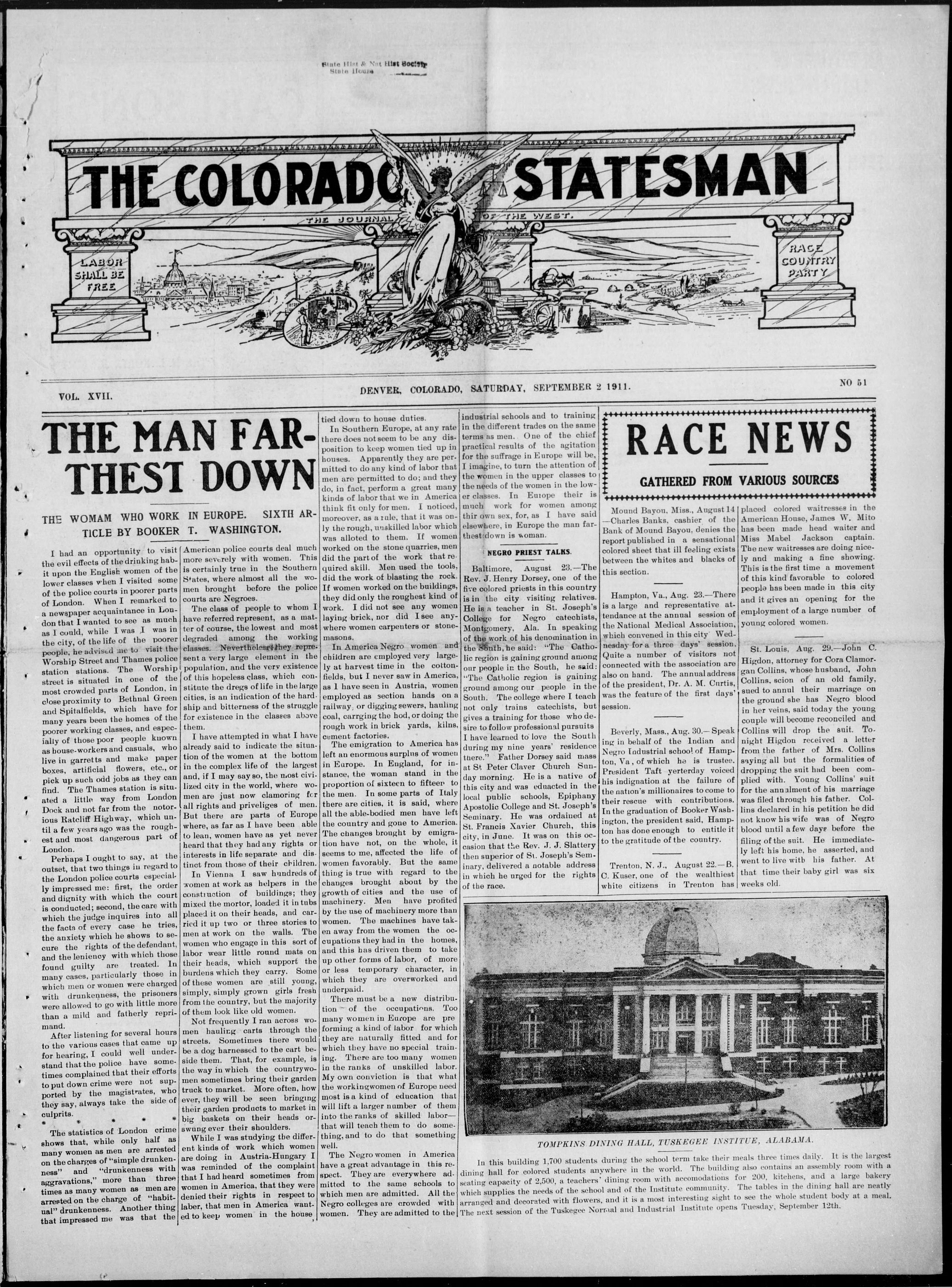
TOMPKINS DINING HALL, TUSKEGEE INSTITUE, ALABAMA.
In this building 1,700 students during the school term take their meals three times daily. It is the largest dining hall for colored students anywhere in the world. The building also contains an assembly room with a seating capacity of 2,500, a teachers' dining room with accomodations for 200, kitchens, and a large bakery which supplies the needs of the school and of the Institute community. The tables in the dining hall are neatly arranged and decorated with flowers, and it is a most interesting sight to see the whole student body at a meal. The next session of the Tuskegee Norraal and Industrial Institute opens Tuesday, September 12th.
industrial schools and to training in the different trades on the same terms as men. One of the chief practical results of the agitation for the suffrage in Europe will be, I imagine, to turn the attention of the women in the upper classes to the needs of the women in the lower classes. In Europe their is much work for women among their own sex, for, as I have said elsewhere, in Europe the man farthest down is woman.
NEGRO PRIEST TALKS
Baltimore, August 23.—The Rev. J. Henry Dorsey, one of the five colored priests in this country is in the city visiting relatives. He is a teacher in St. Joseph's College for Negro catechists, Montgomery, Ala. In speaking of the work of his denomination in the South, he said: "The Catholic region is gaining ground among our people in the South, he said: "The Catholic region is gaining ground among our people in the South. The college where I teach not only trains catechists, but gives a training for those who desire to follow professional pursuits I have learned to love the South during my nine years' residence there." Father Dorsey said mass at St Peter Claver Church Sunday morning. He is a native of this city and was educated in the local public schools, Epiphany Apostolic College and St. Joseph's Seminary. He was ordained at St. Francis Xavier Church, this city, in June. It was on this occasion that the Rev. J. J. Slattery then superior of St. Joseph's Seminary, delivered a notable address in which he urged for the rights of the race.
RACE NEWS
Mound Bayou, Miss., August 14
—Charles Banks, cashier of the Bank of Mound Bayou, denies the report published in a sensational colored sheet that ill feeling exists between the whites and blacks of this section.
Hampton, Va., Aug. 23.—There is a large and representative attendance at the annual session of the National Medical Association, which convened in this city Wednesday for a three days' session. Quite a number of visitors not connected with the association are also on hand. The annual address of the president, Dr. A. M. Curtis, was the feature of the first days' session.
Beverly, Mass., Aug. 30.—Speaking in behalf of the Indian and Negro Industrial school of Hampton, Va., of which he is trustee. President Taft yerterday voiced his indignation at the failure of the nation's millionaires to come to their rescue with contributions. In the graduation of Booker Washington, the president said, Hampton has done enough to entitle it to the gratitude of the country.
Trenton, N. J., August 22.—B. C. Kuser, one of the wealthiest white citizens in Trenton has
NO 51
placed colored waitresses in the American House, James W. Mito has been made head waiter and Miss Mabel Jackson captain. The new waitresses are doing nicely and making a fine showing. This is the first time a movement of this kind favorable to colored people has been made in this city and it gives an opening for the employment of a large number of young colored women.
St. Louis, Aug. 29.—John C. Higdon, attorney for Cora Clamorgan Collins, whose husband, John Collins, scion of an old family, sued to annul their marriage on the ground she has Negro blood in her veins, said today the young couple will become reconciled and Collins will drop the suit. Tonight Higdon received a letter from the father of Mrs. Collins saying all but the formalities of dropping the suit had been complied with. Young Collins' suit for the annalment of his marriage was filed through his father. Collins declared in his petition he did not know his wife was of Negro blood until a few days before the filing of the suit. He immediately left his home, he asserted, and went to live with his father. At that time their baby girl was six weeks old.
AN EPITOME OF LATE LIVE NEWS
CONDENSED RECORD OF THE
PROGRESS OF EVENTS AT
HOME AND ABROAD.
SAYINGS, DOINGS, ACHIEVE
MENTS, SUFFERINGS, HOPES
AND FEARS OF MANKIND.
Western Newspaper Union News Service.
WESTERN.
Five Italians residing five miles from Pueblo, Colo., have been arested charged with bootlegging. The potato crop in Colorado is not short, but even if it were it would make little difference. Ireland is to have a bumper crop. It has been announced from the offices of the Canadian Northern that the road would build into Spokane, Wash., from Kamloops, B. C. Census figures show that the value of farms in the United States was 35,859 million dollars in 1910, compared with 17,357 millions in 1900, an increase in ten years of 106 per cent. The state of Idaho and the United States government have agreed to exchange about 600,000 acres of land in that state so that each may have its lands in a more compact body than at present.
Colorado land men and immigration agents expect large homeseekers' business in the state between September 15 and October 15 on account of the low colonists' rates to the Pacific coast during that period.
The Texas Cattle Raisers' Association, who control 6,000,000 head of cattle are planning to make a fight on the big packers of the country, and will either bring about a raise in the price of cattle or reduce the price of meat.
Fruit growers on the Western slope of Colorado fear a shortage of refrigerator cars for handling their fruit crop this year and have asked the Denver Chamber of Commerce to take the matter up and endeavor to provide in some way against a damage of the crop by reason of lack of cars.
The Jews of the nation have started a movement to make up the short age in the funds of the National Jewish Hospital for Consumptives, at Denver, according to Rabbi W. S. Friedman, one of the members of the board of directors, who has returned home from a meeting at Atlantic city.
A highway from Lincoln, Neb., to the western Colorado line, which will follow closely the route of the Burlington railroad, is the joint project of the several Nebraska counties through which it will pass. Not for several years, in all probability will the road be completed, but its construction has been definitely determined.
The governors of thirteen Western states will greet 85,000,000 people east of the Rockies this fall, when a governor's special train, carrying the executives of Idaho, Washington, Oregon, California, Montana, Nevada Utah, Wyoming, North and South Dakota, Colorado, Nebraska and Minnesota will assemble at Omaha in October and journey to the land shows at Chicago, Pittsburg and New York city with side trips to every Eastern capital, and wind up at St. Paul in December.
That chaos would follow the granting of the demands of the Federation of Shop Employees of the Harriman lines; that it would abridge or deprive the corporations of the ability to fulfill the duties imposed upon them by the law, and that the officers deliberately so betraying their trusts as to agree to such an arrangement would be universally condemned by public opinion, was the statement made by Julius Kruttschnitt, at San Francisco, vice president and director of maintenance and operation of the Harriman lands.
SPORT
CLUBS.
Denver.....84 44 -65
St. Joseph.....70 55 -56
Lincoln.....70 56 -55
Pueblo.....68 58 -54
Omaha.....62 64 -49
Sioux City.....60 67 -47
Topeka.....50 77 -39
Des Molines.....41 84 -32
Packey McFarland and Ad Wolgast will fight ten rounds at Milwaukee.
September 15.
Carl Morris, the Oklahoma "White Hope," with his wife, and his trainer, Con Riley, have gone to New York's city to join his manager, F. B. Ufer, who is there making final preparations for Morris bout with Jlm Flynn, the Pueblo fireman.
"Porky" Flynn had a shade the better of Joe Jeannette, colored heavy weight, in a ten-round bout at the Fairmont Athletic Club in New York. It was the first fight in this city under the new boxing laws and for the first time in years the public witnessed a ring contest without the slightest danger of police interference. With 300 horses quertered at the Readville, Mas., race track, representing most of the prominent stables in the country, the best grand circuit races in years are expected.
POLITICAL.
That President Taft considers the issues of the campaign of 1912 already laid down was made apparent when he told callers at the summer cottage at Beverly of five subjects which will form the basis of his six week's speaking tour in the West. Where local conditions do not dictate his address, the President expects to discuss one of these five questions: The tariff, the arbitration treaties, Canadian reciprocity, conservation, which includes the national policy in Alaska, and reform of the currency system.
WASHINGTON
George von L. Meyer, secretary of the United States navy, after a visit of several days in Paris, left for Austria.
General business of the country is in good condition, as reflected by the official report of the American Railway Association.
An order that will eliminate from the mails absolutely the Red Cross stamps and the McNamara defense fund stamps, because on their faces they are called "stamps," has been issued by Postmaster Hitchcock.
Four hundred dollars an acre is the maximum government price placed on Western coal lands under the policy of per ton valuation. Until the new plan of selling coal lands was adopted, these areas were purchasable at $10 to $20 an acre.
FOREIGN.
The political situation in Portugal is taking a serious turn. The Republican party is completely divided. Lieteuant Zolotnehin, a Russian military aviator, fell with his aeroplane while making a flight at St. Petersburg and was killed. Twenty-three persons were crushed to death and fifty-nine injured by the falling of a church at Venlew, near Wengrowitz, Russia, during a service. From all parts of Canada reports show the intensity of the election struggle which is now under full headway, and they reflect also the position and progress of the various elements on the main issue, reciprocity between Canada and the United States.
GENERAL.
Following a plan for retrenchment, railroads of the country in the last year have laid off 81,870 men.
Edward Bennett, graduate of Oxford, killed his three small children and then took his own life at Thomaston, Maine.
Latest reports from the Charleston, S. C., hurricane place the number of dead at fifteen and the property damage at two millions.
Elmhurt, Wis., was almost wiped out by fire which destroyed a sawmill, 1100,000 worth of timber, six stores and fourteen residences.
Efforts to sell a few hundred bales of August cotton in the market in New York sent the price down to 12.20, or 78 points lower.
At Minneapolis all cold records for August for twenty years, with the exception of one day were broken when the thermometer registered forty-six degrees above zero.
Mrs. Nancy Eedy, ninety-six years old, was married for the sixth time at Troy, Mo., to Reed Inlow, twenty-four years old. The bride's fifth husband died six weeks ago on the county poor farm at Troy.
Shortly before John W. Gates died in Paris he made a codicil to his will, in which he left $1,000,000 in cash to his son, Charles G. Gates, together with a trust fund of $2,000,000. Mrs. Gates gets $37,000,000.
Seven persons known to be dead, many injured and property loss of more than $1,000,000 is the damage wrought by the storm which struck Charleston, S. C., isolating that city from the rest of the world.
W. L. Park, vice president of the Illinois Central road says that the officials of that road have determined not to deal with the Federated Shop Employes, representatives of whom now in Chicago from the South.
For the first time in many seasons the federal treasury is making no preparations to meet the autumnal demands for money for moving crops. Neither do treasury officials expect the usual crop moving season demand for bills of small denomination.
Vaccination against typhoid fever has been made compulsory for every officer and enlisted man in the United States army under forty-five years old. The only exceptions allowed are those who have had the disease, or who have already been vaccinated.
Because the Baltimore & Ohio Railroad Company will not grant him several flat cars to carry the "walking delegates" to the "hobo convention" to be held in Washington, James Eads How, the "wealthy hobo" who is making all arrangements, is organizing a spectacular march of tramps from Baltimore to Washington.
A deficit of $22,000,000 on ordinary accounts for August already is shown in the government finances, in comparison with a deficit of $14,000,000 last year. Customs receipts show a decrease of $4,000,000 as compared with a year ago. The government's total expenditures for the same period are more than $2,000,000 greater.
Mrs. Charles Ochal nearly killed her husband at their home in Braddock, Pa., because, she says, he told her she was in the same class with days and forced her to sleep under the bed with the family's pet canine
COLORADO NEWS
Gathered From
All Parts of the State
Western Newspaper Union News Service.
COMING EVENTS.
September 12-15 — Morgan County
Fair—Fort Morgan.
Sept. 15-16—Annual State Reun-
ion. Elkhorn. Elkhorn.
Sept. 18-21—Annual meeting Masto-
nies of Colorado—Denver.
Sept. 18-23—Colorado State Fair—
Pueblo.
September 21—Elbert County Fair—Elbert.
September 18-22—Weld County Fall
—Greely.
September 19-22—Western Slope Fair Montrose.
September 22-22-Annual meeting order of Eastern Star-Glenwood Springs.
Sept. 22-23—Knights Templar Concerts-Colorado Springs.
September 24-25—Las Animas County Fair-Arinidad.
September 25-30—Mesa County Industrial and Fruit Association—Grand Jury.
September 28-30 -Sedgwick County
Fair -Julesburg.
Sept. 28-30—San Luis Valley Fair—
Alamoga.
October 4, 5, 6 and 7—El Paso County Fair—Caliban.
ty Fair—Caltha-
October 16-22—International Dry
Farm Congress and International
Congress of Farm Women—Colorado
Springs.
Oct. 14-21.-Second Annual Show. Colorado Electric Club. Denver.
Important Homestead Ruling.
Denver.—A ruling affecting home-stead entries has been received by Register C. D. Ford, of the United States land office, from Samuel Adams, acting secretary of the Department of the Interior. According to the statute, entrymen must take up residence on their claims within six months from the date of entry. Some title on proof of residence for a period of the six months to build and take up actual residence. It has been the practice in the land offices to give these entrymen the credit for the whole six months just as though they had begun their residence right after date of entry. As the statute provides that a patent shall not be issued on a homestead claim until the expiration of five years from the date of entry, they were permitted to secure title on proof of residence after a period of four years and six months, the first six months making the period of five years.
The acting secretary says this practice is erroneous and notifies land office registers and receivers that the period of five years required before patent is secured must date from the day actual residence is taken up on the claim, not from the day entry was made.
Colorado Fruit Crop
Apples, boxes ..... 2,500,000
Peaches, boxes ..... 1,000,000
Other fruit, carloads..... 1,500
Total value of fruit crop.....$6,000,000
The magnitude of the fruit industry in the state from the standpoint of profits to the grower can not be fully appreciated unless it is known how small a part of the state is required to produce the millions of dollars that are realized annually. Not more than 50,000 acres are new bearing fruit in the state. The income averages more than $100 an acre, and in many cases runs above $500 an acre.
The importance of the fruit industry in the development of the state can be better realized when it is known that at least 150,000 additional acres of land are capable of producing fruit almost if not quite equal to that now being produced in the developed districts. There were planted last year, 10,280 additional acres of apples, mostly on the Western slope, and in the Montezuma valley. There is no section of the state that has made more rapid progress in fruit growing in the past five years than the Montezuma valley of southwestern Colorado. The yield of apples in this section will be above 300 cars, or twice as much as has ever been grown in that section. Pears, peaches, grapes and other fruits grow there lavishly.
Though the Western Slope country suffered considerable damage from the frost last spring, the fruit growers in that section will be made richer by close to $4,000,000 for their crops. Mesa, Delta, Garfield and Montroscounties have for years produced apples and peaches that have been recognized as the standard of excellence. The Cañon City district and the Arkansas valley suffered but slightly from frost and the crops in these sections will be record breakers. Reports from Cañon City are to the effect that the crop there will be the largest and best ever harvested. It is estimated that 1,000 cars of all varieties of fruits will be shipped from the district, bringing the growers nearly $1,000,000.
It is only recently that much attention has been paid to the scientific culture of apples on the Eastern slope, particularly in northern Colorado and around Denver. As a result, Boulder county will get about $300,000 for its fruits this year. Larimer county will get more than $200,000 from apples alone. Weld and Adams county will get about $3,000 each from apples and large sums from small fruits.
President Taft is Coming.
Denver. — Denver will entertain President W. H. Taft Tuesday, October 3rd. If satisfactory to the nation's chief executive, the Public Lands convention will be extended several days that he may address the delegates. President Taft will arrive in Denver at 7:20 in the morning and will remain here until midnight, when he will continue on his tour of the country, on which he will pass through twenty-four states.
LITTLE COLORADO ITEMS.
Small Happenings Occurring Over the State Worth While.
Western Newspaper Union News Service.
A picnic of all the state societies in Denver will be held on Labor Day.
Citizens of La Salle have offered to donate a site for a canning factory.
W. E. Meek, a resident of Colorado Springs for thirty-eight years, is dead.
Eaton people have invited President Taft to visit that city on his western trip.
The Cañon City apple crop promises to be the largest and best ever harvested.
J. P. Carraher killed himself by shooting at a rooming house in La Junta.
The City Council of Trinidad has ordered the streets of that town sprinkled with oil.
C. L. Seymour of Buffalo, N. Y., died in Meeker following an operation for appendicitis.
Grand Valley will celebrate Fruit Day September 20. The fruit crop is in fine condition.
The annual conference of the Methodist church will open in Colorado Springs Aug. 30.
Herbert Carlson was killed in Tom Boy mine at Telluride by being caught in the shafting.
Myers Lant, fifteen years old, of La Junta, was fatally injured by the explosion of powder.
In the Bohemian community, near Ramah lightning killed three cows belonging to Mike Dzurochin.
Erie is preparing to feed 5,000 visitors on biscuits October 10. The object is to advertise Erie wheat. F. E. Armstrong of Colorado Springs was killed in a Denver & Rio Grande accident near Salt Lake, Utah. At the Davis Wolgamott place, near Hayden, lightning struck the big granary, smashing it to kindling wood. It is estimated that 3,500 people have visited Estes Park this summer and as yet the park is full of tourists. Albert Compton of Fort Collins was arrested in Denver charged with raising checks and returned to Fort Collins. Nearly one thousand employees of the Colorado & Southern took part in the "family reunion" at Dome Rock recently.
That the $250,000 sanatorium of the Foresters of America will be built in Colorado and almost certainly in Boulder is announced. Florence Glassy, of Fort Morgan, is winner of the $10 state prize for the best temperance essay in a contest conducted by the State W. C. T. U. A $12,000 blaze destroyed the lumber yards, hardware store and residence of C. O. Cooper at Nucia, in the western part of Montrose county. William Stacy, aged 70, of Devers Texas, who stopped in Pueblo a few days ago, while on his way to California on an extended pleasure trip died. Reservoir filings on government land cannot be made for speculative purposes, and the Department of Justice intends to see that this practice is stopped.
J. F. McCreery, secretary of the Weld county and the Greeley Commercial clubs, has invented an exhibit box for grain, which promises to be widely used.
Thousands of acres, twelve miles southeast of Greeley, are being brought under cultivation by means of wells sunk deep enough to tap the underflow.
With a bumper apple crop and a yield of small fruits far above normal, Boulder county growers expect this season to double last year's receipts from their orchards.
Fruit shipping season now in full plast in Delta county. Ranchers, warehouse men and train crews are working over time to handle the splendid crop just beginning to move from this section.
Announcement has been made that the Santa Fe railroad will inaugurate about December 1st, a special extrafare train between Chicago and the Pacific coast, cutting five and one hours from the eastbound running no.
Manager W. A. Groom, of the Boulder Fruit Growers' Association, predicts the most successful year in Boulder county's history. Already three carloads of apples have gone to Texas. The crop has been unusually large.
At a meeting at Cedaredge, at which more than 150 fruit growers were present, the proposition of selling fruit through the various associations on consignment, as heretofore, which has been so unsuccessful, was strongly rotested against.
The first school of pharmacy to be established in Colorado will be opened next fall at the State University at Boulder, under H. C. Washburn, B. S., Ph. C., who for seven years has been a member of the faculty of the University of Oklahoma.
A common house fly with a body one inch long and measuring two inches from tip to tip of its wings is in captivity at Erie. It is believed to be the largest of its kind in Colorado. It was captured while taking a drink from a glass of beer.
Robert Lee, marshal of Segundo, a C. F. & I. Co. camp, fourteen miles west of Trinidad, is lying in the Minnequa hospital in Pueblo in a serious condition as the result of an attack made upon him while he was on his way home from Valdez, a neighboring camp.
S.P. HECKLER'S CASH GROCERY
Fresh Vegetables Every Day. All Kinds of Groceries and Salt Meats
2362 TREMONT PLACE
Telephone Main 5371
DIAMONDE
H: ZALINSKY. President
D. REASE
The Great Professional Shoe Shiner of Denver. Located, 1844 Arapahoe. Also Hat Cleaning, Cigars, Tobacco, Candy and Soft Drinks.
ERNEST HOWARD
Carpenter and Contractor
Job and Repair Work a Specialty
Res. 353 W. Warren Ave.
Phone South 1862
Shop 1021 Twenty-First St.
Phone Main 1144
BROOKLUNCH BREWING CO.
NEW YORK
OUR ADVERTISING COLUMNS
are read by the people because it gives them news of absorbing interest. People no longer go looking about for things they want—they go to their newspaper for information as to where such things may be found. This method saves time and trouble. If you want to bring your wares to the attention of this community, our advertising columns
Should
Contain Your
Ad
Don't Take It
For Granted
that just because you are in business, everybody is aware of the fact. Your goods may be the finest in the market but they will remain on your shelves unless the people are told about them.
ADVERTISE
if you want to move your merchandise. Reach the buyers in their homes through the columns of THIS PAPER and on every dollar expended you'll reap a handsome dividend.
---
Expert Watch Repairing Diamonds and Cut Glass
34 Years Experience
THE H. L.. KORTZ JEWELRY
COMPANY
Watches, Clocks, Silverware, Etc.
805 Fifteenth Street. Denver, Colo.
Phones, Office Main 5595.
Residence, York 122.
Hours: 9 to 11 a.m., 1 to 4, 7 to 8 p.m.
Sundays: 10 to 11:30 a.m., 2 to 4 p.m.
Dr. P. E. Spratlin
Good Block-1557 Larimer St.
Residence 2230 Clarkson St.
Denver, Colorado.
THE BEST ICE CREAM AND
CANDIES AT
O. "P. BAUR & CO.
CATERERS AND
CONFECTIONERS
Phone: 168.
1812 Curtis Street, Denver, Ote.
OFFICERS
P. Chiolero, Pres. and Manager
J. C. Chiolero, Vice-President
S. Chiolero, Treasurer
C. A. Grosso, Secy.
The
Chiolero
Importing Mercantile
& Investment
Company
(BRANCH)
LA FLOR DE CHIOLERO
LA FLOR DE CERES
HIGH GRADE
CIGARS
UNION MADE
DELICATESSEN, WINES,
LIQUORS AND
CIGARS
Telephone Champa 1844
1859 ARAPAHOE ST.
Denver, Colo.
BURM-ALFRED
JEWELRY
STERLING SIN
Boost Colorado Produets
Z AN
DELICIOUS TAB
COLUMBINE,
VIENNA
Quaranteed Absor
Delivered Daily to All
The Ph. Zang
TELEPHONE GA
We Boost for Colorado
BARLING SILVERWARE
Colorado Products Patronize Home Industry
ZANG'S
DELICIOUS TABLE BEERS
UMBINE,
VIENNA AND
PILSENER
Guaranteed Absolutely Pure.
Delivered Daily to All Parts of the City.
Ph. Zang Brewing Co.
TELEPHONE GALLUP 395.
t for Colorado You Should Boost for Us
BERT PLESSNER
MANAGER
EAST TURNER HALL
2132-2148 Arapahoe St.
Phone 2449 Denw
Mamma Neely's Restaurant
Boost Colorado Products Patronize Home Industry
ZANG'S
DELICIOUS TABLE BEERS
COLUMBINE,
VIENNA AND
PILSENER
Guaranteed Absolutely Pure.
Delivered Daily to All Parts of the City.
The Ph. Zang Brewing Co.
TELEPHONE GALLUP 395.
We Boost for Colorado You Should Boost for Us
2132-2148 Arapahoe St.
Phone 2449 Denver
GOOD HOME COOKING
Regular Meals 25e. Sunday Dinner 35e
Skort Orders at All Hours
1914 Arapahee St. Denver, Col
LEE YOUNG
Sries, Meats, Hay, Grain, Etc
FRESH VEGETABLES EVERY DAY
and Avenue and Milwaukee Street
Phone York 881
BRADSHAW
Regular Meals 25c. Sunday Dinner 35c Short Orders at All Hours
LEE YO
Groceries, Meats,
FRESH VEGETABL
Second Avenue and
Phone Yo
A. BRAD
LEE YOUNG
Groceries, Meats, Hay, Grain, Etc.
FRESH VEGETABLES EVERY DAY
Second Avenue and Milwaukee Street
Phone York 881
A. BRADSHAW
THE BANK
AROUND THE CORNER FROM THE OLD STAND 1443
THE CORNER OLD STAND 1443-1447 Stout St.
AROUND THE CORNER FROM THE OLD STAND 1443-1447 Stout St.
PHONE MAIN 3762
J. T. TURNER, Proprietor ZANG'S SPECIAL BREW
FAMILY TRADE A SPECIALTY
Beer, Wines, Liquors and
2605 and 2609 Arapahoe Street
Wines, Liquors and Cigars
Arapahoe Street Denver, Colorado
Beer, Wines, Liquors and Cigars 2605 and 2609 Arapahoe Street Denver, Colorado
```markdown
```
#
Corsets Gents' Furnishings
Millinery season now here. Everybody knows Bradshaw's can sell you good hats for less money than any place in city. We also have a complete line of Hoisery and Underwear, including extra large size. We are in our own building, have not rent to pay.
Old Style
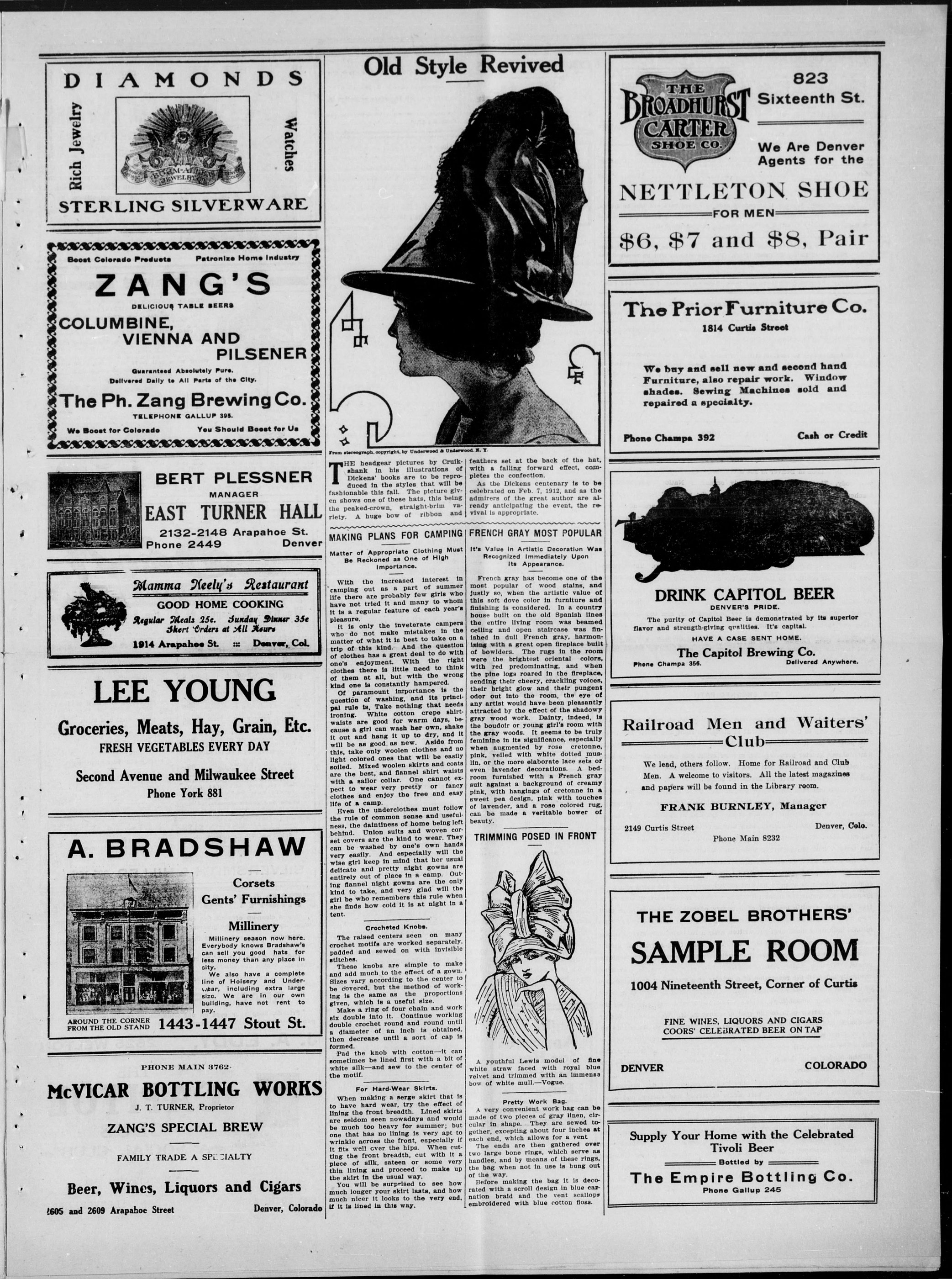
From stereograph, copyright, by Underwood & Underwood. M. Y.
THE headgear pictures by Cruikshank in his illustrations of Dickens' books are to be reproduced in the styles that will be fashionable this fall. The picture given shows one of these hats, this being the peaked-crown, straight-brim variety. A huge bow of ribbon and
feathery with pletes
As celeb admin ready vival
Matter of Appropriate Clothing Must Be Reckoned as One of High Importance.
With the increased interest in camping out as a part of summer life there are probably few girls who have not tried it and many to whom it is a regular feature of each year's pleasure.
It is only the inveterate campers who do not make mistakes in the matter of what it is best to take on a trip of this kind. And the question of clothes has a great deal to do with one's enjoyment. With the right clothes there is little need to think of them at all, but with the wrong kind one is constantly hampered.
Of paramount importance is the question of washing, and its principal rule is, Take nothing that needs ironing. White cotton crepe shirt waists are good for warm days, because a girl can wash her own, shake it out and hang it up to dry, and it will be as good as new. Aside from this, take only woolen clothes and no light colored ones that will be easily solled. Mixed woolen skirts and coats are the best, and flannel shirt waists with a sailor collar. One cannot expect to wear very pretty or fancy clothes and enjoy the free and easy life of a camp.
Even the underclothes must follow the rule of common sense and usefulness, the daintiness of home being left behind. Union suits and woven corset covers are the kind to wear. They can be washed by one's own hands very easily. And especially will the wise girl keep in mind that her usual delicate and pretty night gowns are entirely out of place in a camp. Outing fannel night gowns are the only kind to take, and very glad will the girl be who remembers this rule when she finds how cold it is at night in a tent.
Crocheted Knobs.
The raised centers seen on many crochet motifs are worked separately, padded and sewed on with invisible stitches. These knobs are simple to make and add much to the effect of a gown. Sizes vary according to the center to be covered, but the method of working is the same as the proportions given, which is a useful size.
Make a ring of four chain and work six double into it. Continue working double crochet round and round until a diameter of an inch is obtained, then decrease until a sort of cap is formed. Pad the knob with cotton—it can sometimes be lined first with a bit of white silk—and sew to the center of the motif.
For Hard-Wear Skirts.
When making a serge skirt that is to have hard wear, try the effect of lining the front breadth. Lined skirts are seldom seen nowadays and would be much too heavy for summer; but one that has no lining is very apt to wrinkle across the front, especially if it fits well over the hips. When cutting the front breadth, cut with it a piece of silk, sateen or some very thin lining and proceed to make up the skirt in the usual way. You will be surprised to see how much longer your skirt lasts, and how much nicer it looks to the very end, if it is lined in this way.
feathers set at the back of the hat, with a falling forward effect, completes the confection.
As the Dickens centenary is to be celebrated on Feb. 7, 1912, and as the admirers of the great author are already anticipating the event, the revival is appropriate.
It's Value in Artistic Decoration Was Recognized Immediately Upon
French gray has become one of the most popular of wood stains, and justly so, when the artistic value of this soft dove color in furniture and finishing is considered. In a country house built on the old Spanish lines the entire living room was beamed ceiling and open staircase was finished in dull French gray, harmonizing with a great open fireplace built of bowlers. The rugs in the room were the brightest oriental colors, with red predominating, and when the pine logs roared in the fireplace, sending their cheery, crackling voices, their bright glow and their pungent odor out into the room, the eye of any artist would have been pleasantly attracted by the effect of the shadowy gray wood work. Dainty, indeed, is the boudor or young girl's room with the gray woods. It seems to be truly feminine in its significance, especially when augmented by rose cretonne, pink, velled with white dotted muslin, or the more elaborate lace sets or even lavender decorations. A bedroom furnished with a French gray suit against a background of creamy pink, with hangings of cretonne in a sweet pea design, pink with touches of lavender, and a rose colored rug, can be made a veritable bower of beauty.
TRIMMING POSED IN FRONT
1
A youthful Lewis model of fine white straw faced with royal blue velvet and trimmed with an immense bow of white mull.—Vogue.
A very convenient work bag can be made of two pieces of gray linen, circular in shape. They are sewed together, excepting about four inches at each end, which allows for a vent The ends are then gathered over two large bone rings, which serve as handles, and by means of these rings, the bag when not in use is hung out of the way. Before making the bag it is decorated with a scroll design in blue carnation braid and the vent scallops embroidered with blue cotton floss.
THE
BROADHURST
CARTER
SHOE CO.
NETTLETO
FOR M
$6, $7 and
The Prior Fur
1814 Curti
We buy and sell new
Furniture, also repair
shades. Sewing Ma
repaired a specialty.
BETTLTON SHOP
FOR MEN
$7 and $8, H
the Prior Furniture
1814 Curtis Street
to buy and sell new and second h
furniture, also repair work. Wine
ades. Sewing Machines sold
paired a specialty.
NETTLETON SHOE
$6, $7 and $8, Pair
The Prior Furniture Co.
1814 Curtis Street
We buy and sell new and second hand Furniture, also repair work. Window shades. Sewing Machines sold and repaired a specialty.
Phone Champa 392
DRINK CAPITOL
DENVER'S
The purity of Capitol Beer is
flavor and strength-giving qualities
HAVE A CASE
The Capitol B
Phone Champa 356.
Railroad Men
Clu
We lead, others follow. Hon
Men. A welcome to visitors,
and papers will be found in
DRINK CAPITOL BEER
DENVER'S PRIDE.
The purity of Capitol Beer is demonstrated by its
and strength-giving qualities. It's capital.
HAVE A CASE SENT HOME.
The Capitol Brewing Co.
Champa 356.
Delivered A
Broad Men and Wai
Club
lead, others follow. Home for Railroad and
A welcome to visitors. All the latest mag
papers will be found in the Library room.
THE HISTORY OF THE CITY OF BOSTON
The purity of Capitol Beer is demonstrated by its superior flavor and strength-giving qualities. It's capital.
HAVE A CASE SENT HOME.
The Capitol Brewing Co.
Phone Champa 356.
Delivered Anywhere.
Railroad Men and Waiters'
We lead, others follow. Home for Railroad and Club Men. A welcome to visitors. All the latest magazines and papers will be found in the Library room.
FRANK BURNLEY, Manager
2149 Curtis Street Denver, C
Phone Main 8232
THE ZOBEL
SAMPLE
1004 Nineteenth Street
THE ZOBEL BROTHER
AMPLE ROO
Nineteenth Street, Corner of
1004 Nineteenth Street, Corner of Curtis
FINE WINES, LIQUORS AND CIGARS
COORS' CELEBRATED BEER ON TAP
Y Your Home with the Celebr
Tivoli Beer
Bottled by
Supply Your Home with
Tivoli B
Bottled
The Empire B
Phone Gall
Supply Your Home with the Celebrated Tivoli Beer
The Empire Bottling Co. Phone Gallup 245
DENVER
Sixteenth St.
We Are Denver Agents for the
ON SHOE
EN
$8, Pair
rniture Co.
Street
and second hand
work. Window
machines sold and
TOL BEER
PRIDE.
demonstrated by its superior
s. It's capital.
PENT HOME.
Brewing Co.
Delivered Anywhere.
and Waiters'
b
e for Railroad and Club
All the latest magazines
the Library room.
BROTHERS'
ROOM
t, Corner of Curtis
With the Celebrated
Beer
by
Sottling Co.
pp 245
Cash or Credit
Denver, Colo.
COLORADO
THE COLORADO STATESMAN
JOS. D. D. RIVERS ..... Proprietor
1824 Curtis Street, Room 25.
SUBSCRIPTION RATES:
PAYABLE IN ADVANCE.
is that papers sent to sub-
smity any number when due, in-
cluding a duplicate of the missin-
g.
is made by Express Money
or Bank Draft. Postage is
personal part of a dollar. Only
cents per inch. Reading.
less than three months' co-
ments unknown to us. Further,
a personating nature that
makes of this paper.
receive attention must be ne-
tupon one side of the paper
better than Wednesdays, and
turned, unless stamps are ne-
cessary matter at the postoffice.
One Year ..... $2.00
Six Months ..... 1.00
Three Months ..... .60
It occasionally happens that papers sent to subscribers are lost or stolen. In case you do not receive any number when due, inform us by postal card and we will cheerfully forward a duplicate of the missing number.
Remittances should be made by Express Money Order, Postoffice Money Order, Registered Letter or Bank Draft. Postage stamps will be received the same as cash for the fractional part of a dollar. Only 1-cent and 2-cent stamps
Display advertising 25 cents per inch. Reading notices, 5 cents per line.
No discounts allowed on less than three months' contract. Cash must accompany all orders from parties unknown to us. Further particulars on application.
All communications of a personating nature that are not complimentary will be withheld from the columns of this paper.
Communications to receive attention must be newsy, upon important subjects, plainly written only upon one side of the paper; must reach us Tuesdays, if possible, anyway not later than Wednesdays, and bear the signature of the author. No manuscript returned. unless stamps are sent for postage.
Entered as second-class matter at the postoffice in the city of Denver, Colorado.
THE EDUCATORS
always that the Negro Nation never is not a regularly organized is a regularly organized tools which meets all the Denver meeting did not entry, but that fact need not be an educational congress for the congress here important educational source in itself be beneficial to the county to the discussion of school need but a portion of the class. Some bright people are just ordinary business lessons were of undoubted progress can accomplish and why it should not have
The New York Age says that the Negro National Educational Congress recently in session in Denver is not a regularly organized or truly representative body. That "there is a regularly organized National Association of teachers in Colored Schools which meets all the needs of Negro teachers."
It is possible that the Denver meeting did not exactly represent the educational forces of the country, but that fact need not necessarily impair its usefullness or legitimacy as an educational congress. The various papers and discussions provided for the congress here implied that the meeting was rather intended as an educational source in itself, which sought to gather and disseminate knowledge beneficial to the country at large. The program was not at all confined to the discussion of school matters, but the schools and their influence formed but a portion of the bussiness engaging the attention of the Congress. Some bright people were in attendance, some school teacher and some just ordinary business folk, and the exchange of ideas and their resulting lessons were of undoubted benefit. If the Negro National Educational Congress can accomplish any good, in a field all its own, there is no reason why it should not have unrestricted license to do so.
THE CROOKED PATH
nely inspired comparison
achievement of all things
try to demoralization and
severence, greater effort
in goal than it does to zi
or uncharted course
IT was indeed a divinely inspired comparison which made narrow and straight the way to the achievement of all things right and true. The irregular path is the sure way to demoralization and loss. It requires greater watchfulness, greater perseverance, greater effort and greater ability to keep a straight line to a known goal than it does to zigzag and wobble and loiter and slide and wander over an uncharted course.
It is too bad that the ccolored people have a low appreciation for things legitimate and a blind tolerance for the semblance of honors illegitimately gained. It is too bad that we are greatly inclined to snatch at the shadow of things and delight ourselves with the false belief that we have attained the substance. It impairs and demoralizes our standards of actual worth and fastens upon us the irrevocable badge of inferiority.
We attain what we consider great results all too easily, and we accept and honor those who merely make pretensions as if they were the actual equals of those who achieve by well proved worthiness and merit alone. A Southern newspaper takes several Negro colleges or incorporated schools to task for their prolific bestowal of honorary educational degrees upon men who have no such exceptional qualities as should merit those degrees. The initials indicating those degrees, written after a Negro's name, giveno actual assurance that he is a man who has enjoyed more than a grammar school education or who has been more than ordinarily prominent in active achievements. When a white man is honored with such degrees, he has most assuredly achieved the reputation of a scholar or a statesmen or philosopher of unusual mark. Our willingness to accept abbreviated merit in everything makes us poor competitors against those who have struggled along the straight and narrow path to the goal of actual merit. We must set higher standards and urge our boys and girls to reach them. If we do not do so, we may not expect our race to get very high in this competitive battle of life. The extravagant color which we are prone to give to ordinary conditions render us unable to appreciate actual superiority and make us the prey of our own folly.
If we could begin reforming ourselves by cutting out our extravagant social pretensions, with their vast waste of money and energy, and apply the saving to the prudent extension of legitimate business efforts, we would have one foot planted in the right path. If we would cease the practice of extravagant flattery of ordinary things, the worship of pigmies as sages, the dubbing of struggling tradesmen, farmers, craftsmen and professional men as captains of industry, of every barn-storming minstrel as a star comedian and demand worth, measured by the highest standard, we would soon begin to gain a better knowledge of the straight and narrow way by which men and peoples progress and excel.
US never before in the history of this country have we much conventional talk on the subject of honesty. As some one has characterized the movement, we seem once to have discovered the Ten Commandments. We teaching honesty almost as if it were a new cure-all just to the pharmacopoeia.
Not long ago a young friend came to me with a discourse and dejected pose. He had lost his place in a great house because of the influence of a recent moneyracy. At the time he was employed by the house another own age entered the service. They were of the same department, and with this tie of strangeness to the place they had become acquainted readily.
In I had known from childhood. I knew his sterling convinced of his capacity and equipment for his work. I specially when he told me that while he had been "let ing fellow had been retained in the service. I questioned reasons for this and I got the true story of the move. I call him, was of the shyster type, quick, apt and degree. He possessed a shifty diplomacy and tacting him no warm friends, made numerous pleasant aim. He was a "good fellow," neither trusted nor dissiates.
You were in positions of trust," I said. "Could you for preference on the score of honesty and dependable point," exclaimed my young friend. "No, for you see under bond."
In explanation he showed me how impossible it was house for the average worker whose honesty might be this honesty recognized by any one as a part of his there was a time clock at the entrance doors. A supereral eye upon the working force of the office. An audiwork of every one whose cupidity or carelessness might concern. And above all, those men responsible in any under bond with a surety company.
Edency of the business world today is toward fostering of its determination not to recognize honesty.
time, of all others, should we concern ourselves with cent of honesty? Has it come to the point that we areesty as a lost virtue, as the critic lectures on the lost arts?
ERHAPS never before in the history of this country have we had so much conventional talk on the subject of honesty.
As some one has characterized the movement, we seem all at once to have discovered the Ten Commandments. We are preaching honesty almost as if it were a new cure-all just added to the pharmacopoeia.
Not long ago a young friend came to me with a discouraged face and dejected pose. He had lost his place in a great counting house because of the influence of a recent money stringency. At the time he was employed by the house another young man of his own age entered the service. They were of the same age, in the same department, and with this tie of strangeness to the place appealing to them they had become acquainted readily.
My young man I had known from childhood. I knew his sterling worth and was convinced of his capacity and equipment for his work. I was surprised especially when he told me that while he had been "let out" the other young fellow had been retained in the service. I questioned him as to possible reasons for this and I got the true story of the move.
Jones, as I shall call him, was of the shyster type, quick, apt and conscienceeless to a degree. He possessed a shifty diplomacy and tact which, while making him no warm friends, made numerous pleasant acquaintances for him. He was a "good fellow," neither trusted nor distrusted by his associates.
"But both of you were in positions of trust," I said. "Could you make no showing for preference on the score of honesty and dependability?"
"That's the point," exclaimed my young friend. "No, for you see both of us were under bond."
Still further in explanation he showed me how impossible it was in this counting house for the average worker whose honesty might be impeachable to have this honesty recognized by any one as a part of his working capital. There was a time clock at the entrance doors. A superintendent kept a literal eye upon the working force of the office. An auditor checked up the work of every one whose cupidity or carelessness might involve loss to the concern. And above all, those men responsible in any way for moneys were under bond with a surety company.
The whole tendency of the business world today is toward fostering dishonesty because of its determination not to recognize honesty.
Why in this time, of all others, should we concern ourselves with the wordy preachment of honesty? Has it come to the point that we are lecturing on honesty as a lost virtue, as the critic lectures on the lost arts?
Civilization naturally imposes dissimulation and the small hypocrisies. Honesty comes only of training in right thinking and under circumstances which give opportunities for exercising the virtue. Continue to preach honesty to the young man who has been walled in until dishonesty on his part is an impossibility and in another generation he will sneer at the doctrine as he would at a game law to preserve the mastodon!
when she looks up to some older woman teacher or friend, which approaches adoration. Upon her conduct she molds things she regards as inspired, and from her counsel, if she will receive, at this plastic period, an untold influence the girl becomes a self-reliant woman, this experience, but there will always be weak sisters who must cling, then to a woman who possesses the useful attributes of maternal element naturally belongs to a woman'saches out to what is weaker than herself. To one who really gives herself, and in the giving comes to love the usual bounty. Necessary as is this type of friendship to the race, a danger lurks therein. There are some primitive instinct of self-sacrifice has not yet given individualism which counts it wrong to submerge one's the vain effort to live another's life. It is well to aid it is essential that a strong woman's friendship for a neither eventuate in futile self-sacrifice nor degenerate action in flattering inferior.
every young girl when she looks up to some older woman teacher or friend with an affection which approaches adoration. Upon her conduct she molds her own; her sayings she regards as inspired, and from her counsel, if it be beneficent, she will receive, at this plastic period, an untold influence for good. If the girl becomes a self-reliant woman, this experience passes for all time, but there will always be weak sisters who must cling, if not to a man, then to a woman who possesses the useful attributes of the sturdy oak.
The protective or maternal element naturally belongs to a woman's maturer life. It reaches out to what is weaker than herself. To one who needs help she gladly gives herself, and in the giving comes to love the object of her spiritual bounty. Necessary as is this type of friendship to the ethical economy of the race, a danger lurks therein. There are some women in whom the primitive instinct of self-sacrifice has not yet given way to the saner individualism which counts it wrong to submerge one's own personality in the vain effort to live another's life. It is well to aid and support, but it is essential that a strong woman's friendship for a weaker one shall neither eventuate in futile self-sacrifice nor degenerate into a mere satisfaction in flattering dependence of an inferior.
r, one for spring, and one Scotch homespun skeleton or the hot season. It last four times as long as one suit, and so be a sav- and give one comfort during each season, which is the the whole body should be exposed to as much fresh air
One for winter, one for spring, and one Scotch homespun skeleton coat and trousers for the hot season.
Three suits will last four times as long as one suit, and so be a saving of 25 per cent. and give one comfort during each season, which is the main thing.
To be healthy the whole body should be exposed to as much fresh air as possible.
P
stringency. At young man of his own age age, in the same department appealing to them they had My young man I had worth and was convinced of was surprised especially without" the other young fellow him as to possible reasons Jones, as I shall call conscienceless to a degree, which, while making him acquaintances for him. He trusted by his associates. "But both of you were make no showing for prefer ness?" "That's the point," ex both of us were under bond Still further in explain in this counting house for impeachable to have this he working capital. There was intendent kept a literal eye for checked up the work of involve loss to the concern. way for moneys were under The whole tendency of dishonesty because of its de Why in this time, of the wordy preachment of h lecturing on honesty as a
PABLO MAYORAL
Kind of Woman That Women Like Best By DR. GRACE E. CROSS
every young girl when she lea-
with an affection which appu-
her own; her sayings she m
it be beneficent, she will re-
rence for good. If the girl
passes for all time, but then
if not to a man, then to a
the sturdy oak.
The protective or mate
maturer life. It reaches our
needs help she gladly gives
object of her spiritual boun-
the ethical economy of the
women in whom the primit-
way to the saner individual
own personality in the vain
and support, but it is esser
weaker one shall neither evi-
into a mere satisfaction in
dependence of an inferior.
Light Apparel for Hot Summer Days
By R. E. LIDGERWOOD
One for winter, one for coat and trousers for the heat Three suits will last for ing of 25 per cent. and give main thing. To be healthy the whole as possible.
Business World of Today Fosters Dishonesty
By JOHN A. HOWLAND
It would be a difficult task indeed to epitomize in one type the kind of woman that women like. For, not only do the needs of different individuals vary, but a woman's choice of friends changes with the phases of her own development. There are, in woman's nature, two distinct elements, one or the other of which is apt, at some time, to determine the sort of friend she chooses. These are the dependent or immature, and the protective or maternal. Dependence belongs naturally to youth, though it may exist later in unequal friendships. There is a time in the life of nearly
The hot season has caused much suffering, and called forth letters and arguments for and against men wearing shirt waists in public places. A word of advice from merchants whose business it is to supply seasonable apparel may not be amiss. Men who find it necessary to remove their coats on account of discomfort have not given summer apparel sufficient attention to understand how to dress to avoid misery during the hot season.
For economy and comfort a man should have at least two weights of business suits and three are better.
A. E.
CARSON'S
SPECIAL VALUES IN PORTABLE LAMPS AND BRASS JARDINIERS.
For a few days we offer an elegant electric lamp, heavy spun brass and copper bases fitted with a nice 10-inch green dome shade and heavy cord, well worth $6.50; sale price, $4.00, complete.
In Brass Jardiniers we offer regular $2.00 values, beautifully finished and fitted with ball feet; sale price, $1.50 each; sale price, beautifully finished and fitted with ball feet; sale price, $1.50 each.
Our line of Dinnerware never was as varied or complete as it is at the present time. We can supply you with the simple needs of the kitchen as well as the higher priced ware suitable for the dining room.
Company, Denver's Largest Exclusive China Store. 732-36 Fifteenth Street.
The Carson Crockery Company,
REBUILDING SALE
S&N
GARMENT STORE
925-16TH ST. - OPP JOSLINS
DRESSES MUST GO
Silk, Wool Batiste and all Wash
Dresses at less than cost of materials, White and Colored Wash
Dresses, former prices
$3.95 and $1.00... $1.00
for White and Colored
Wash Dresses that formerly sold for $6.75 and $7.50.
$3.00 for White and Colored
Wash Dresses that formerly sold for $8.75 and $10.00.
WASH SKIRTS.
White, tan or black, former prices $1.75 and $2.00, now... 98c
Natural Linene and White Linen Skirts, former price $3.50 and $4.00, now... $1.95
WHITE PETTICOATS.
And White, Pink and Light Blue
Brown Slips, former price
$1.50 and $1.75, now.....98c
AT THESE PRICES YOU CAN AFFORD TO BUY SEVERAL GARMENTS FOR NEXT SEASON.
$12.50 and $15.00 Dresses, $4.95.
Taffetta Silk, Fancy Foulard Silk,
White and Colored Lingerie and
A Fine Dresses, that formerly
sold for $12.50 and $14.00) $4.95
sale price $12.50 and $15 Jackets, $5.00.
Black Silk Jackets, Pongee Silk
Jackets, Cream Serge Jackets,
Covert Cloth Jackets, former
prices $12.50 and $14.00, $5.00
SILVERSMITH &
FRIDAY AND
Grand clean-up of odds and ends
troductory Sale will be the greatest st
Wonders never cease until this gr
tory
DIG UP, RAKE UP and be sure the
Wind-up. Watch our windows.
Mothers, get your children ready,
ble duty
READ RE
Friends, keep your eyes on our w
pen every few days that will benefit y
J. A. EDDY,
AND SATURDAY
of odds and ends and broken lines from the Great In-
ce the greatest stunt ever pulled off at Five Points.
Please until this grand let-lose event has passed into his-
UP and be sure to be in on this Grand Bargain Feast
windows.
children ready for school now, when dollars do dou-
READ READ
ur eyes on our windows, as something is going to hap-
hat will benefit you.
FRIDAY AND SATURDAY
Grand clean-up of odds and ends and broken lines from the Great Introductory Sale will be the greatest stunt ever pulled off at Five Points.
Wonders never cease until this grand let-lose event has passed into history
DIG UP, RAKE UP and be sure to be in on this Grand Bargain Feast Wind-up. Watch our windows.
Mothers, get your children ready for school now, when dollars do double duty
Friends, keep your eyes on our windows, as something is going to happen every few days that will benefit you.
THE CAPITOL CLUB A SOCIAL CLUB.
MACK SMART
Manager.
921 20TH. ST.
---
"
In a few days the entire front of our room will be torn out--new windows, up-to-date, will take the place of our old ones. Before the dirt begins to fly We Want to
JOHN H. HARRIS
921 20TH. ST.
DAY OR NIGHT.
PHONE MAIN 6243
A. M. LAWHORN
UNDERTAKERS
A first-class Mortuary establishment.
First aid to the bereaved in the time of death of their loved ones.
Prices below competitors. Polite service.
LICENCED EMBALMER
Parlors 1925 Arapahoe St.
```markdown
```
Solid Colored Taffeta and Messala
Silk Petticoats and Fancy
Persian and Dresden Silk Petticoats,
former price $5.00 now
$1.98
$2.00, $30.00 and $55.00 Suits
now $10.00.
Balance of Cream Serge or Diagonal
Cloth Suits, Cream with
Baskin-Rock Cream or Cream
Suits that formerly sold for $25
to $35, choice now
$10.00.
CLEARUP OF SUMMER WAISTS.
for one lot of Fancy and
Tallored White Waist, former
prices $1.25 and $1.50.
for choice of all $1.75 and
$2.00 Fancy White Waist.
Ample body for the neck,
short or long sleeve styles.
All better Waistls in Silk, Marquise
and Lingerie are on sale
In summer weights—must be closed out at once. Linen and Poplin Coats, former price $8.75 and $12.50, now $4.95
Silk and Serge Coats, former prices $15.00 and $8.95, now $12.50
Silk and Serge Coats, former prices $20.00 and $12.50, now SUMMER CAPES.
Broadcloth Capes, former price $8.75 and $9.95, now.
Pink Ponge Capes, former price $12.50, now $5.00
HILLER 025 16th St
2625 WELTON
PHONE CHAMPA 2540.
DENVER, COLO.
THE COLORADO STATESMAN
CARSON
MORGAN
TALE
DANA
COUART
BARY
```markdown
```
Mrs. Martha Hall of Boulder is in the city.
Jonas B. Biggins left this week for Chicago, Pittsburg and New York for a visit of a month or six weeks.
Mr. and Mrs. Jack Dempsey are now keeping house at 2418 Downing avenue.
Mrs. C. Terry of Chicago is in the city the guest of Mrs. T. L. Williams 2813 Glenarm Place.
Mrs. Lizzie Deneal entertained a number of friends at City Park Tuesday afternoon.
Mrs. Charles Barnes, who was operated on at St. Luke's hospital last week, is improving.
Mr. and Mrs. Eugene Carter of 2530 Franklin street are snugly located at 1266 Emerson street.
Undertaker A. M. Lawhorn has moved into his beautiful new quarters at 1925 Arapahoe street.
Mr. Charles Trotter of 2139 Curtis street is planning a six months' visit in the South and abroad in the near future.
The father and mother of Eugene and Misses Eva and Stella Carter are their guests. Mr. and Mrs. Carter are of Galesburg, Ill.
Mrs. O. L. Boyd left Thursday to join her husband in Santa Fe, N. M., where they will make their future home.
C. W. Curtis, brother of Mrs. J. T. Thrower has been visiting in the city for ten days. Mr. Curtis is a clerk in the Municipal Court in Chicago.
Mrs. Louis George entertained a number of friends Wednesday evening at cards in honor of her sister-in-law, Mrs. C. Allen, of Chicago.
Miss Lucille Lyles of Colorado Springs and Miss Mamie Eliott of Emporia, Kansas, were visitors in the city this week, while here were the house guests of Miss Eleanor V. De Neal.
J. J Manuel, who shot and killed Rev A. E. Reynolds, in the latter's study last Tuesday night, did so in a "fit of passion and with felonious intent" was verdict of the coroner's jury.
Mrs. Belle Freeman, who has been visiting friends in the city for the past four weeks, left Friday for Manhattan, Kansas, where she will be joined by her husband, who has been in Washington all the summer.
J. C. Wright and Mrs. Marie Lacey of Memphis, Tennessee, were married last Sunday evening at the residence of Mr Wharton, 1412 Fox street. Rev W. H. Fugitt officiating. The Colorado Statesmen extends congratulations to the newly wedded couple.
Mrs. Annie Baptist entertained a few friends at cards last Friday evening in honor of Dr Shannon of Kansas City, Mo. The guests were: Mr. and Mrs. Charles Muse, Dr. and Mrs. McClain and Mr. Ward of Chicago and Felix Woods.
Mrs. John Short of 716 29th street gave an elaborate breakfast last Wednesday morning in honor of Mrs. F. Mitchell and Mrs. Mattie Crane of F. Kansas City and Mrs. C. Ellsbury of Little Rock, Arkansas. The table was beautifully decorated in pink and white.
Mrs. John W. Bush was called home the second time since June, from Evergreen, Colo., on account of her husband's illness, with heart trouble, rheumatism and Bright's disease. Mr. Bush will be at the residence of Mr. and Mrs. John Short, 716 29th street, until able to travel to Hot Springs, Arkansas.
At Zion Baptist Church next Monday, Labor Day, you can get one of the best dinners in the city. Dinner begins at 12 o'clock. The following persons will be in charge of the tables: C. M. Hughs, Club No. 6; L. H. Walton, Club No. 8; Mrs. Annie Baptiste, Club No. 23, and Mrs. T. E. McClaim, Club No. 27. Don't fail to get your dinner at the church next Monday.
Mrs. Hattie Campbell, stepmother of Morris Campbell died Sunday afternoon after an illness of several years
of cancer. The funeral was held from the parlors of Undertaker A. M. Lawhorn, Tuesday afternoon at 2 o'clock, Rev. A. M. Ward officiating Mrs. Campbell leaves many friends to mourn her loss. Interment at Riverside cemetery.
Last Thursday evening was made a red letter day among Denver's elite by Mr. and Mrs. Chas. E. Jackson who entertained at Dania hall in honor of their niece Miss Leota U. Wilson of Kansas City, Kans. The hall was beautifully decorated with hanging baskets and cut flowers which made a pretty setting for the daintily gowned ladies and gentlemen in evening dress. Mrs. Jackson was assisted by Mesdames De Priest, Sprague, Johnson, C. A. Jackson and Wm. Parks.
The funeral service of the late John Allen Swanger was held from the school house in Fort Logan. A great tribute was paid to the remains of this young man by the white people of Fort Logan. A large audience of white and colored people gathered to hear the funeral oration by the pastor of Scott's. Mrs. Salina Allen, the grandmother and other relatives wish to thank the many friends who helped them so liberally in putting away their dead. The young man was loved by both white and colored in Fort Logan.
Mrs. Mildred Hall, the beloved wife of Frank Hall of 1017 Bannock street died last Sunday afternoon at Mercy hospital, after an operation for appendicitis. Mrs. Hall had many friends both white and colored who were grieved to learn of her sudden death. She leaves a husband, mother, sister, cousin and a host of friends to mourn her loss. The funeral was conducted from St. Leo Catholic church, Friday morning. Interment at Mount Olivet cemetery. A. M. Lawthorn in charge. The pallbearers were Wm. Crummer. Orlando Jackson, J. Wright and Geo Groves. The sister of Mrs. Hall arrived from Kansas City Thursday afternoon to attend the funeral.
Rev. A. E. Edwards, pastor of Central Baptist church was shot and instantly killed shortly after 8 o'clock Tuesday night, at the parsonage, 2414 California street, by J. J. Manuel. The shooting accured over domestic troubles. Mr. Manuel has been a resident of Denver for the past twenty years and is highly respected by both white and colored citizens. He was an active member of Central Baptist church.
"IMMORAL LIFE LEADS TO VIO
"A dissolute life commonly leads to a desperate death."
That is the statement of J. J. Manual, Negro, who killed the Rev. Alexander Edwards for alleged intimacy with his wife.
Manuel was asked for a statement of why he had killed the negro pastor of the Central Baptist church. He tore a leaf from a small note book and wrote the sentence:
"A dissolute life commonly leads to a desperate death."
That was all that Manuel would say.
From the statements made by Manuel to the police Tuesday night, immediately following the killing of Edwards, the preacher had led the life that leads to a desperate death. Mrs. Edwards, wife of the preacher, had confirmed some of the rumors she had heard of her husband. Manuel heard them. His wife is alleged to have confessed. He secured a revolver, and locating the minister, he says he secured a confirmation of what he had heard.
Manuel is a hard working Negro. He has been married eleven years. During the session of the legislature last winter he was one of the janitors. He has since been employed as a caretaker for the Park Land company.—The News.
SHORTER CHAPEL SUNDAY SERVICES AND NOTES.
Sunday will be the closing day of Shorter's fourth years' work under the pastorate of Rev. A. M. Ward. He will preach his closing sermons both morning and evening. All services Sunday will begin fifteen minutes earlier. Sunday school at 9:45 a. m., preaching at 10:45 a. m., at which time the pastor will administer the monthly communion. Christian Endeavor at 6:45 p. m., and preaching at 7:45 p. m.
As Sunday is the last day, the pastor desires all members that have not turned in their dollar money to be prepared to do so. All friends desirous of paying dollar money may see the pas-
Wednesday, Sept. 6th, the annual conference will convene at 9 a.m. Bishop H. B. Parks, successor to the late Bishop Grant, presiding. The annual sermon will be preached by the Rev. J. C. Bell, after which the Holy communion will be administered by the bishop, assisted by Dr. John Hurst, other general officers and elders of the conference. The public is cordially invited to attend the sessions of the conference and assist in extending a generous welcome to all visitors.
NOTES OF THE PEOPLE'S PRESBY
TERIAN CHURCH.
Sermon Topics, Sunday Sept. 3, 1911.
11 a. m.—"A Call to Be on the Lord's Side."
8 p. m.—"Sparks from the First Universal Races' Congress Held in London."
The Rev. J. A. Thos.-Hazell, S.T.B..
will preach at both diets
The Rev. J. A. Thos.-Hazel, S.T.B., of the People's Presbyterian church will occupy his pulpit for the first time tomorrow. He has just returned from an extended trip of three months through Great Britain and Europe. During his stay in London, the Hon. Secretary of the First Universal Races' Congress specially commissioned him to lecture on "The Work and Objects of Congress" before the "School of Higher Thought Center" at Cheniston Gardens. By special invitation he lectured to a large and overflowing audience at Main Hall, Marylebone Presbyterian church on "The Negroes' Contribution to Civilization." An enviable honor was his to be a member of the Preparatory committee whose function it was to overture the Executive council on vital facts to be considered by Congress. He conspicously participated in debating the subjects of Congress. Many social functions he had the pleasure of attending as guest. Among them being a reception by the Worshipful Company of Fishmongers Fishmongers' Hall, London Bridge; Congress banquet by the Hon. Secretary G. Spiller at the Criterion, Piccadilly Circus; banquet by Mrs. Elmer Black, vice president of U. S. Committee of Congress at Claridge's Hotel; Reception by Mr. and Mrs. J. E. Milholland, 4 Prince of Wales Terrace; lunch and tea by the Countess of Warwick, Warwick Castle; dinned by Rev. R. C. Gille, M. A. and wife of Marylebone Presbyterian church. Among the distinguished persons present at these festivities were the Archbishops of Canterbury and Westminster; Bishop of London, Ripeon, Corfe, Winchester, Oxford, etc.; the American Ambassador and Mrs. Whitelaw Reld; the Russian Ambassador and Countess Beckendorf, etc.; the Dukes and Duchesses of Bedford, Norfolk, Sutherland, etc.; the Earls and Countesses of Shaftesbury, Bathurst, etc.; Lords and Ladies Handlipp, Kerr, Weardale, etc.; Sirs and Ladies Truscott, Barclay, Johnson, etc.; Madames Balfour, Chamberain, Hon. Lloyd George, etc., etc.
SCOTT M. E. CHURCH NOTES.
Two hearts were made happy last Saturday evening at the parsonage by the pastor. Mr. Prince E. Williams and Miss Daisy B. Allen were the contracting parties.
The funeral of the late Mrs. Lillian Carter who resided at 2938 Welton street was conducted from Scott's last Friday afternoon. Mrs. Carter leaves to mourn her loss a devoted husband, a mother and two sisters. She died triumphant in the faith. She was a member of the Baptist church in Atchinson, Kansas for a number of years.
Dr. R. A. Randolph will deliver the message Sunday morning and the Rev. J. D. Rice will preach in the evening. You are invited to hear these divines.
Scott's and the Presbyterian church united in having their annual outing for the Sunday school at Washington park. The young people had a great time. The tables fairly groaned under the many delicacies of the season. The District superintendent left for Colorado Springs Thursday where he goes to visit the Colorado annual conference which met there this week. He will go from there to Pueblo, where he holds the quarterly conference for the Rev. H. R. Gipson, the energetic pastor of our church there.
The Rev. W. R. Stephens, A.B., has been invited to preside over the annual conference in session at Colorado Springs during the Freedmens' Aid anniversary. Dr. M. C. B. Mason, that peerless orator will deliver the principal address on this occasion. Dr. Mason will preach at the People's M. E. church Sunday morning.
The official board vote to begin immediately to shingle the church. The trustees will award the contract to the lowest bidder. The church roofing rally was a great success. The Rev. Ward delivered the rally sermon to a responsive audience. Zion and Shorter were represented by their pastors. We thank these brethren for their presence and help.
Mrs. Anna McPherson and her little granddaughter, Goldie, will arrive in the city from the mountains in a few days where they have spent a most delightful summer.
The Ladies' Aid will soon have their selm-annual election and will begin planning for their big annual Thanksgiving dinner and bazaar. The effort will go for the rennovation of the church on the interior. Mrs. Forney, the president, who is in Cleveland, Ohio, writes that her brother is better and that she will be home soon.
Mr. and Mrs. Collier of Clark, Mo., left for their home last Tuesday. They have been visiting their son and daughter, C. J. Collier and Mrs. Beulah Brown for the past two weeks. They report a delightful time while in our city.
SPECIAL SUNDAY BILL AT WEST BROS.
Sliced Tomatoes and Green Peppers .....15
Chicken Okra Creole .....15
Wiener Schnitzel .....35
Chicken Cutlett, Supreme Sauce .....35
Salisbury Steak, Mushroom Sauce .....35
Smothered Spring Chicken, Pan Gravy .....50
New Corn and String Bean Succotash .....15
Asparagus Tips on Toast .....25
Escoloped Potatoes .....15
Combination Salad, French Dressing .....25
Peach Roll, Home-made Sauce .....15
Restaurant for sale. In first class condition and good trade. Apply Mamma Neely, 1914 Arapahoe street.
Fort Rent—Two furnished rooms. Men preferred. Apply 2218 Clarkson street, Phone York 6121.
Three-room apartment for rent, modern in every respect. Reasonable, 2802 Welton street.
Earnest Howard, the carpenter, is now prepaired to sell coal and kindling by the sack or ton. All kinds of coal, and prompt delivery; 1021 21st St., Phone Champa 752.
FRIENDS ALL WANT IT.
Mrs. D. B. Simmons of Silex, Ark., writes: "I tried one bottle of Ford's Hair Pomade and found it to be the best preparation I have ever used. It stopped my hair from falling out and breaking off and my hair is now as soft as it can be and is longer than it has been for a long time. My friends all want it.
Ford's Hair Pomade, the old, reliable dressing for stubborn, curly hair makes harsh hair more pliable, glossy and easy to comb. Try it and Ford's Royal White Skin Lotion, for the complexion. For sale by druggists, accept no other, see that it is Ford's and manufactured by the Ozonized Ox Marrow Company, Chicago, Ill.
The Second Annual Picnic of the Rocky Mountain Athletic association was postponed to Labor Day, Monday, Sept. 4, on account of rain.
Brickler's New Barber Shop is located at 2208 Larimer street. Shave, 10c. Hair Cut, 25c; Children, 15c.
Centennial Lodge No. 4, A. F. and A M., will give its second annual Emancipation celebration at Luna Park September 21st, 1911.
Five-room house for rent, 320 24th street. Apply at 1824 Curtis street, Room 25.
Furnished rooms for rent, 1272 Kalamath street. Call Ellsworth 1476.
For rent, nicely modern furnished rooms. Apply Mrs. Laura A. Mitchell, 2301 Lawrence street.
For Rent.—Nicely furnished rooms at Mrs. A. Singleton, 2443 Tremont Place. Phone Champa 278.
Nicely furnished rooms for rent. Apply 2660 Lawrence street.
THE TISHLER TAILORING ESTABLISHMENT
1031 17TH ST.
Room 1, Iron Building
Denver, Colo.
J. H. BIGGINS
Furniture Repairing and Upholstering. All work Cash.
PHONE MAIN 4610
2231 Washington St. Denver
THE
B.L. JAMES
M. & M. CO.
PAINTS. OILS. VARNISHES. GLASS.
PAINTING. GRAINING. GLAZING. PAPER HANGING.
DECORATING AND HARD WOOD FINISHING.
WALL
PAPER
1517-23 ARAPAHQE ST. DENVER
ARTISTS'
MATERIALS
Watch This Space
Scientific Phenomenon.
While a plumb-line may be straight, it is, curiously enough, not always vertical. Irregularities of density in the crust of the globe may produce this phenomenon. A remarkable instance in point was found in the island of Porto Rico, where the deviation from the vertical is so great that in mapping the island the northern and southern coast lines, as shown in the older maps, had each to be moved inward half a mile.
```markdown
```
McCRAY Refrigerators
have such a vigorous circulation of cold air that a damp cloth will dry out in one of them as readily as tho' it were placed in the sun on a windy day. Open the door of a McCray Refrigerator and feel the dry, cold air, as sweet and pure as a mountain top breeze. If you are thinking of buying a refrigerator, it will pay you to inspect the exclusive sanitary features of the McCray.
McCRAY
REFRIGERATORS — for Residences, Grocers, Florists, Hotels.
O. L. GAMBREL, Manager.
1528 Court Place, Denver.
FORD'S
HAIR POMADE
MAKES HARSH, KINNY OR CURLY HAIR
GLOSSY, SOFTER AND MORE PLABLE,
EASY TO GME AND PUT UP IN ANY STYLE
THE LENGTH WILL PERMIT, UNEXCEELED
FOR PREVENTING HAIR FROM FALLING OUT DANDFUFF AND ITching
OF SCALE BEWARE OF IMITATIONS, GET THE GENIUM, PUT UP IN
25* AND 50* BOTTLES WITH CHARLES FORD'S NAME ON
EVERY PACKAGE
TRY FORD'S ROYAL WHITE
SKIN LOTION FOR THE COMPLEXION,
MAKES THE SKIN WHITER IMMEDIATELY
UPON APPLICATION. WILL NOT IRRITATE
THE MOST DELICATE SKIN. UNEXCELLED
FOR ECZEMA, SALT RHEUM, PIMPLES,
ROUGH SKIN AND DECKLES. . . . . . .
SOLD BY DRUGGISTS. IF YOUR DRUGGIST CANNOT
SUPPLY YOU, WE WILL SEND IT TO YOU DIRECT
THE FOLLOWING Prices. SMALL SIZED BOTTLE 25* LARGE SIZED BOTTLE 50*. THE OZONIZED OX MARROLL CO.
232 LAKE HILL CO., AGENTS WANTED.
MISS BEATRICE LEWIS
SATISFACTION GUARANTEED
2339 Gilpin Street. Denver.
They Couldn't Help It.
A crosseyed man in a street car turned around and bowed to a friend coming in, and almost every man in the car bowed to him.
Certain of Success.
I mean to make myself a man, and if I succeed in that *f* shall succeed in everything.—Garfield.
Easy Thing to Do.
People who are extravagant on themselves are often wonderfully ingenious in devising plans of economy for others.
Straight Current Most Deadly
Straight Current Most Deadly:
Volt for volt, the direct or straight current is more deadly than the alternating current. There is always tiny bleeding in the brain in bad electric shock, so it is a mistake to lay the shocked ones with the head low, for this increases the many little deadly bleedings in the brain.
Work in Harmony.
In Brazil monkeys and parrots not only roost in the same trees but work for mutual benefit. The parrots gnaw the big nuts loose from the tree, let them fall in order to crack them and the monkeys tear the husks asunder, gather the nuts and divide them with the parrots.
Disturbing to a Precise Man.
"This place removed' is a sign you see often enough in empty store windows, but," said a precise man, "I can never get used to it. Of course we know well enough what it means; it is the business that has been removed; but it always disturbs me just the same."
Industry of Orchid Collecting.
In the Brazilian state of Pernambuco orchid collecting has developed into a large industry which affords employment to many foreigners as well as natives. From there orchids are either shipped direct to foreign ports or are sent to coast firms which act as agents for business houses all over the world.
Value of Wisdom.
It was remarked by Seneca that a wise man is provided for occurrences of every kind; the good he controls, the bad he vanquishes; in prosperity he betrays no presumption, and in adversity he feels no despondency. The wisdom he possesses enables him to bear up with heroism under all reverses.
Fish as Brain Food.
The saying that fish is the best brain food comes of an old tongue windbag years ago saying: "Thought is impossible without phosphorus." So a Swiss chemist, knowing that fish contained phosphorus, put two and two together, and brought forth a saying that will never die.
Strange Coincidence.
Partick churches (near Glasgow, Scotland), suffered from the failure of the electric light the other Sunday night—just at the height of a thunderstorm, when it was most needed. One minister had just read the first two lines of the hymn, "As darker, darker fall around, The shadows of the night—" when plump went out the light and the church was in darkness for a quarter of an hour.
UNITED STATES PATENT OFFICE.
=
| = a :
fet meee "Waive
ah a as Brig
SHS a eer
aaa aL ' i hoa Le ad
re STP io co gel re
ONE MILLION PATENTS|UNCLE SAM HAS GREAT NA\
WORLD SUPREMACY. Bl ae ee, eI ME a
United States Has Doubly Outdis-
tanced Its Next Competitor in
Recorded Invention—Amaz-
Ing Growth of Office.
One million patents in less than a
rentury is the record of Yankee gen-
TA nt moar WW a8 bh ington
bea having issued
patent —_No.
1,000,000. One million patents in less
than a century {8 a record not even
approached by any other nation.
France comes nearest the United
States In the inventive genius of her
people with less than half the num-
ber of patents granted in America.
‘The millionth patent is for a punc-
ture-proof tire for automobiles and
other vehicles, depending upon rubber
springs for its resiliency, and ts the
invention of an Akron, Ohio, man,
It has often been said that no other
people on earth have ever showed the
inventive genius seen in the United
States. The steamboat, the telegraph,
the telephone, the aeroplane and other
wonderful inventions, all products of
the Yankee brain, are all well known
‘Thousands of labor saving devices,
such as the sewing machine, cotton
gin, mower and reaper—all the re-
sults of American inventive genius—
have done more to alleviate the con-
dition of mankind than any other fac-
tor outside of the abolition of slav-
ery.
Looking back over the wonderful
progress in the mechanical and fine
arts, it will be noticed that the inven:
tive faculty of the American people
has kept pace with the wonderful
growth of the nation. While Amert-
cans are of heterogeneous stocks, all
authorities agree they have become
amalgamated by the talents and abil
ity of their statesmen and industrial
pioneers. Millions of people from for-
eign shores have been assimilated be-
cause of the Mberal form of govern-
ment and because of the equal oppor-
tunities offered. But every step for-
ward in this country has been either
directly due to or 1s closely allied with
(hat wonderful faculty for delving into
untried fields pecullar to Americans.
‘The granting of a patent in the old
days, when the nation was young, was
a matter of great importance, whether
ie was for making pot and pearl ashes
or wooden nutmegs; ff, indeed, those
silent testimonials to Yankee smart-
ness ever got the grace of government
favor.
‘The patent office as {t stands today
was created by act of Congress of July
4, 1836, and the first commissioner was
Henry L. Ellsworth, of Connecticut.
From that time until the present the
patent laws have provided for a search
system—that {s, they provide that a
search be made to see If any patent of
like nature has been issued, so as to
prevent duplication. But before that
time there was little {f any searching
done, because there was no provision
made and practically no force to make
a search
‘The present series of patents began
in 1836, and since that time patents
fave been numbered consecutively
Prior to July 4, 1836, there had been
issued 9,902 patents. The first patent
of the present series was granted to
John Ruggles, July 13, 1836, for a lo-
comotive engine, and 1s patent No. 1
All patents, both foreign and do:
mestic, thus must be searched, and if
nothing is found to confifct with the
idea of which patent is requested, the
grant !s made. For all this work
Uncle Sam charges the modest fee of
$35—$15 upon filing the application
and the other $20 when notice is re-
ceived that patent will be granted
From the first federal patent grant
in 1790, to the present commissioner
in 1911, {6 a long Jump. It Is just 121
years ago. Many changes have taken
plage during this time. When the first
patent was issued the president of
the United States made the grant,
while the record was written by a
clerk in the state department. Then
followed the patent board, composed
of the secretary of state, the secre-
tary of war and the attorney general
‘This board was continued until 1836,
when the first commissioner of pat-
ents was appointed.
Since 1836 the work of the patent of-
fice has increased by leaps and
bounds; and today, when the number
of patents granted each year averages
more than thirty thousand, the inven.
tive bump of the Yankee may almost
be seen growing, it {s developing #0
fast.
UNCLE SAM HAS GREAT NAVY
Its Remarkable Increase in Efficiency
Since the Memorable Battle
of Santéago.
From that day at Santiago when the
American fleet destroyed the battle-
ships of Spain the nation has taken a
growing interest and pride in iis new
navy. “At the close of the Spanish
war,” writes Lieut-Com. Walter B.
Tardy, U. 8. N., In the Engineering
Magazine, “the press and the people
were satisfied with their navy. It had
been successful, and thus efficiency
was taken for granted. But when
stock was eventually taken the small
percentage of hits made became
known and naval officers realized that
something must be done to justify the
public confidence.”
In this direction let us see what has
been done. “The Texas,” writes Com:
mander Tardy, “was one of the Amer-
ican ships in the battle of Santiago.
Less than 8 per cent of all the shells
fired in this battle by the American
fleet hit the enemy. There is no rec-
ord that a single 12nch or 13-inch
shell took effect. The ranges were
less than 3,000 yards. Recently the
New Hampshire used the old Texas
as a target. She fired at ranges from
10,000 to 11,500 yards and landed
whole salvos on the Texas whenever
she wished.
“Recently the Michigan, an all-big-
gun ship, made 22 124nch hits at
ranges of 10,000 yards while steaming
at 15 knots, the target being only
60 feet long by 30 feet high. She fired
48 121nch shells. Her percentage of
hits, therefore, was about 45. The
rate of firing was about two shots per
minute per gun. This in a moderate-
ly rough sea, while the sea was
smooth at Santiago.”
A CITY OF ROME’S GRANDEUR
Wealthy Builder Declares That the
Capital of the Nation Wil! Be
Beautiful.
“Washington will in a few years be
surrounded by villas, as 1s every other
capital of the world,” says George H.
Karle, Jr. in discussing his plan to
build a villa on his estate near the
capital city,
“There are no more beautiful places
in the world than many on the out-
skirts of the nation’s capital, yet the
rich who come here fail to take ad
vantage of these natural beauties. [
can foresee the erection of villas on
the Marland and Virginia shores with-
in the next fifteen years which will
eclipse the grandeur of anclent Rome.
“I mean to build a place on the farm
which I have bought, and when I get
old enough to retire, will live there
part of the year.”
For many years Mr. Earle has had
an {dea that the greatest building
boom which this country s to have in
the next decade will be the villa move-
ment in and about Washington. Land
about the city 1s six hundred or seven
hundred feet higher than Washington,
explained Mr. Earle, and in the sum:
mer would be as cool as in the moun.
tains, he belleves.
To Erect Statue of Columbus.
‘The first plece of statuary to greet
the eyes of visitors to the nation’s
capital after the new union station is
‘opened will be a monument to Chris-
topher Columbus by a Chicago sculp-
tor, The model of the memorial, de-
signed by Lorado Taft, has just been
completed and work on the original is
to commence soon. The statue will
be placed im the plaza around the new
station.
Marriage No Bar to Him.
Although White House precedent
generally decrees that the aids to the
president shall be unmarried, an ex-
ception will be made in the case of
Lieut. Commander Leigh C. Palmer,
U. 8. N., naval ald to President Taft.
who will continue his duttes at the
White House after his marriage to
Mrs, Bessie Draper McKeldin of At-
lanta, Ga.
More Pay for Rural Carriers.
‘The 40,000 odd rural free delivery
carriers in the United States are to
recelve salary inereases. The order
provides for $4,000,000, an increase ot
$100 over the present salary of $900
for all carriers on standard routes
During the current year the rural
service will cost the government about
$40,000,000.
} Reain Were Killed illeaally.
Charges that the North American
Commercial company killed, illegally,
over 100,000 yearling seals, valued at
over $1,000,000, during {ts lease ot
the Pribliof Islands, were made by
Charles Elliott, a seal expert, before
the house committee in Washington
PRICE ADVANCES ONE CENT A
POUND OVER THE
COUNTRY.
COLORADO CROP HEAVIER THAN
LAST YEAR—NO REPORTS
RECEIVED.
‘Weatern Newspaper Union News Service,
New York.—There is concern shown
in grocery circles over the high prices
now prevailing in the sugar market.
There has been another advance in
grapalated to $6.25, representing a full
cent rise in the last few weeks, ana
the highest level in many years,
Coming at the height of the canning
season, this advance {s of vital inter-
est to consumers all over the country.
It is attributed primarily to @ poor
sugar beet crop in Europe, following
prolonged drought this summer.
To make matters worse, the Cuban
crop, which furnishes the bulk of raw
material for American refineries, also
proved short, and prices began to soar.
Warsighted dealers bought large
supplies some months ago, leaving the
market almost bare of stock, and raw
sugars, in consequence, have made
new high records, while many opera-
tors in the street predict that the end
is not yet in sight.
W. A. Dixon, vice president of the
Great Western Sugar Company, says
that Colorado sugar manufacturers
have no advice ou the sugar market
situation, further than press reports,
and know nothing about what effect
the increased price of cane sugar in
the New York market will have on the
Colorado beet sugar output.
The beet crop In Colorado this year
is considerably larger than that of last
year, and the prices paid the farmers
for their beets is the same. ‘There has
been an inerease in Denver in the re-
tail price of beet sugar, about the same
as the increase in the price of cane
‘sugar.
Army Invents Aeroplane Destroyer.
Washington—A new _ six-pounder
gun, equipped with specially adapted
high explosive projectiles and shrap-
nel shells to demolish aeroplanes and
balloons in battle, has been perfected
by the United States army. It can be
elevated at any angle and possesses a
maximum effective range of seven
miles.
The construction of the new rifle
has just been completed at the Rock
Island, {lL, arsenal. Experiments
with it will begin at the Sandy Hook
proving grounds within a fortnight.
‘The army thus is in advance of the
navy toward the solution of the prob:
lem of defense against airships.
Promlet:Reate Annexation.
Mount Forest, Ont.—The declaration
that President Taft and his friends
have had the idea of future annexation
of Canada in their minds was made in
the address of Sir James Whitney,
premier of Ontario.
He asserted that the reciprocity
agreement was intended by its advo-
cates in the United States “to ham-
string and kill anything in the nature
of the concentration and consolidation
of the British empire.”
Sir James added that back in the
minds of President Taft and his
friends was the idea that Canada
might one day form a part of the
North American republic.
Madero Is Nominated.
Mexico City.—With no dissenting
voice, Francisco I. Madero was nomi-
nated by the Progressive party for
president of Mexico, Francisco Vas-
quez Gomez, his old running mate and
erstwhile agent of the revolution at
Washington, was grilled by partisans
of three other candidates for the vice
presidency.
Miaerantitor tina ray Ola.
Los Angeles.—Justice Chesbrought
issued a warrant for General Harri
son Gray Otis, editor of the Los An-
geles Times, charging him with pub-
lishing obscene articles tn that news:
paper. Warrants were also issued for
Harry Andrews, managing editor of
the Times.
Will Not Sell Ships.
Washington.—It is unequivocally de-
nied that the United States contem:
plated selling any of its warships to
Turkey.
Taft Sends Advance Guard.
Beverley, Mass.—So far have plans
for President Taft’s Western trip ad-
vanced that immediately L. C. Wheel-
‘er, the advance guard of the secret
service, will start out to make prepa-
“rations for the President's reception
on the proposed trip.
Ringside Seats Ten Per.
Chicago—The prices of ringside
seats for the Wolgast-McFarland fight
at Milwaukee on September 15, was
fixed at $10.
FOR CAKES AND PIES
RECIPES FOR FILLINGS THAT ARE
MOST DELICIOUS.
Cream, Apricot, Cocoanut, Melba and
Other Varieties That Are Well
Worth Trying.
Cream Filling for Layer Cake.—One
cup powdered sugar, one-fourth cup
hot water, Let them simmer, beat
white of an egg and mix with the
above. When cold add one-half cup
chopped raisins, one-half cup chopped
walnuts, one tablespoon grated cocoa-
nut.
Cream Filling.—Seven-eighths cup
sugar, one-Half cup flour, one-eighth
teaspoon salt, two eggs, two cups
scalded milk, one teaspoon vanilla or
one-half teaspoon lemon extract. Mix
dry ingredients, add eggs slightly
beaten and pour on gradually scalded
milk. Cook 15 minutes in double boil-
er, stir constantly until thickened, aft-
erward occasionally. Cool and flavor.
Filling for Cake.—Two cups sugar,
one cup sour cream. Boil until it
threads, Add teaspoonful flour sift-
ed twice, two-thirds cup chopped
raisins. This is good for filling for
cakes or frosting.
Apricot. Filling.—Pick over and
wash two-thirds cup dried apricots.
Put in a saucepan, cover with cold wa-
ter and let soak over night, or for sev-
‘eral hours. Cook slowly in water in
which they have been soaking until
soft, adding more water, if necessary,
to prevent burning. Sweeten to taste,
and add a few grains salt. Force
through a strainer, using a wooden po-
tato masher, Cool, and add orange
juice to taste. Bake chocolate cake
mixture in individual tins. Scoop out
a portion from the center of each cake
and fill cavities thus made with apri-
cot filling. Then frost cakes with any
white frosting.
Stewed dried apricots are frequent-
ly served as an accompaniment to
bread and buter for the family supper.
It they are forced through a strainer
and then flavored with orange juice,
they are much more delicious, One
hardly recognizes them in their new
dress
Cocoanut Cream Filling.—Mix one-
half cup sugar, 2% tablespoons flour
and a few grains salt; then add one
egg, beaten slightly. Scald one cup
milk and pour, gradually, on the mix-
ture, stirring constantly. Cook 15
minutes in double boiler, stirring con-
stantly until the mixture thickens, aft.
erward occasionally. Cool slightly,
add one-fourth cup shredded cocoanut
and one-half teaspoonful vanilla. Use
as a filling for a cake cream pie.
Sprinkle the upper layer of the pie
with shredded cocoanut and powdered
sugar before baking.
It the mixture 1s stirred until it be
gins to thicken, there is no danger of
having a lumpy filling.
Melba Filling.—Scald an earthen
bow! by pouring hot water into it,
then chill by pouring cold water into
ft. Put one-half cup butter In bowl
and work, using a wooden spoon, un-
til butter is soft and waxy, allowing
water to run from cold water into
bowl during the entire working. To
butter thus prepared, add, gradually,
while beating constantly, one cup pow-
dered sugar. Add cream filling, which
has been cooled, made as for cocoa-
nut cream filling, omitting the cocoa-
nut, Add 1% squares melted, un-
sweetened chocolate. Spread between
layers of sponge cake and on top;
then ornament top with the remaining
mixture, forced through a pastry bag
and tube.
Nut and Raisin Filling.—Put one-
half cup sugar and three tablespoons
boiling water in a smooth granite
saucepan, place on front of range and
stir, to prevent sugar from adhering
to pan, until melted. Let boil, with-
out stirring, until the syrup will
thread when dropped from tip of
spoon. Beat the white of one egg and
pour on syrup, very gradually, beat-
ing constantly until the right consis-
tency to spread; then add one-fourth
cup raisins, seeded and cut in small
pieces and one-fourth cup English wal-
nut meats broken in small pieces.
Banana Filling.—Make filling same
as for nut and raisin filling, omitting
nuts an@ raisins and doubling the
recipe. Put between layers of cake
and cover with thin slices of banana.
Frost the top with remaining mix:
The Housewo:ker’s Hands.
If you are obliged to have your
hands in water for a long time, so
that the fingers become shrunken, dip
them in vinegar or pour it over the
hands and they will be restored to nor:
mal condition. To properly protect
the ends of the fingers the nails
should extend a little beyond the tips.
When the nails are too short the skin
is apt to become rough directly un
der the nails, which makes {t almost
impossible to keep them clean. The
white crescents at the base of the
nail can be brought Into view by gent:
ly pressing back the cuticle every day.
File the nail to correspond with the
sbape of the crescent.
Bouquet Salad.
‘Use a good head of cabbage lettuce,
arrange the white leaves in a bunch
resembling the matured head in the
center of a flat dish, garnish with
slices of tomato and hard-boiled eggs.
Just before serving cover the whole
with plain French dressing. Use a
spoon and pour the dressing on care-
fully so that all part will be moist-
ened without being disarranged. May:
onnaise may be used on the eggs and
tomato If preferred, in which case the
dressing should be put on the eggs ip
“he cun unde: tha Volks.
CHARLES S&S. WEST JOHN W. WEST
WEST BROS.
.
Confectionery and Ice Cream Parlor
Baur’s Ice Cream Johnston’s Candies
Cafe in conection. We make a specialty of Fried Chicken, Steaks,
Chops and Everything good to eat, Try a meal
‘and be convinced.
All the latest Soda Fountain Drinks and Chili served at all hours.
Also a fine grade of Cigars
2741 Welton Street
Near Five Pointe
PHONE CHAMPA 2188 DENVER, COLORADO
10th Avenue Hotel
——_—____— H. HEUER, PROPRIETOR ————————_
RESTING PLACE FOR COLORED GENTS
MEALS AT ALL HOURS
Pool Room in Connection
Gorner West 10th end Osage, Near Burnham Shops
Denver, Colorado
Who pays the high up-town rent?
Is it the tailor? No!
Just guess who it is-~
The Customer
Give us a chance and we will give you the satisfac:
tion. Our Spring and Summer Styles are all in.
Our prices are moderate. We do all sewing in our
shop.
Respecthulis,
N. Ferry
1905 Curtis Street
LAASAAAANSAANNSAAALAAA LVN VVVH VHS SVS LN VN LVN VAP WB,
Standard Bottling Co.
Manaeicescers er railficinas
Soda Water, Mineral Waters and
Ginger Ale
ALSO NEEF’S LAGER BEER FOR FAMILY USE.
PHONE 66.
CKALAASARAAAASAAANAAANSNSNNAANSN NAAN NSNNSNNNSNNNNNNS
DID YOU EVER TRY
N "B
Neef Bros. Beer?
It’s made right, and tastes right.
None better made anywhere and
This is a Strictly Colorado Production
—_—_—_———_———_——_——=={={={[{T===s""
BE SURE AN TRY IT.
—SNANANANANAN NANA N NSN NNN NNSA NNN WN NN
Established In 1890. Telephone 3673
Eagle Bottling Works ;
A. D. SIMMONS, Proprietor,
Manufacturers of Soda Water, Ginger Ale, Mineral Water,
Root and Birch Beer
2836 WELTON ST., DENVER.
SASAAAAAA NANA SASANANALN KLAN NAAN ANS
SSRI IIIT SNNAANNNNN LN NNN ANNAN NNN NNNKNNN NWN
4712 LARIMER ST. TELEPHONE MAIN 2889.
N. Weisman’s Loan Office
Money to Loan on *
DIAMONDS, JEWERLY, WATCHES AND GUNS, CLOTHING,
TRUNKS, VALISES, ETC.
Business Strictly Confidential. _ DENVER, COLO.
NANANANN NAN ANNAN ALN NSANANNANNNNNS
re
Hours: 10 to 11a. m., 2 to 5 and7 to®
Turn Over i cy woennee
a New Leaf
(DE. J. HOP, Westhrook
By subscribing COR. 218T AND ARAPAHOE STS
for THIS PAPER a
Day Phone Main 1144.
Hours: 10 to 11 a. m., 2 to 5 and 7 to®
P. m. and by Appointment.
Dr. J. H. P. Westhrook
COR. 218T AND ARAPAHOE STS
Day Phone Main 1144.
Night Phone Champa 570.
The Denver Republican has always avoided the fallacies and knaveries of yellow journalism, and its steadily increasing Circulation proves conclusively that its policy of telling the plain Truth without exaggeration or misrepresentation, standing fast for the Right, is heartily approved with growing force by the intelligent Public to which it appeals.
To read it is a liberal Education, and the citizen who goes without it does a positive harm to himself, to his family, and to the community.
In no other way can the investment of 2% cents per day for that is all The Republican costs any subscriber—bring such rich results in that Knowledge which is both Power and Pleasure. Information, instruction and entertainment fill its columns and it leaves a good taste in the mouth of the reader. It stands for Law and Order in the State—for Peace, Prosperity and Happiness in the Home. If you are not already enrolled among its splendid list of Patrons send on your subscription and give it a fair trial at 75 cents per month for Daily and Sunday.
The
WARD AUCTION
COMPANY
Sales Daily at 2 p.m. Office Fur-
niture a Specialty.
PRIVATE SALES AT ALL TIMES
HAVE MOVED TO—
1723-39 GLENARM ST.
PHONE MAIN 1675.
---
Miss M. Cowden Hair Dressing Parlor
Shampoo, cutting and curling. Scalp treatment, hair tonics, hair straightening, maniouring. Stage wigs for rent; theatrical use and masquerades. Goods delivered out of the city. All shades of hair matched by sending sample of hair; also combings made up.
Cheapest Switches 50 Cents
1219 21st St. Denver, Colo.
NAST
The Popular Photograher
Only Caters to First-class Trade.
Our Pictures speak for
Themselves.
Job Printing
We are here to serve you with anything in the line of printed stationery for your business and personal use. □ □ □
See Us Before Going Elsewhere
Letter Heads Bill Heads
Envelopes Cards
Wedding Invitations
Posters or Announcements
Of All Kinds
The best quality of work at prices that are RIGHT
---
New News of Yesterday
Henry Clay As a Campaigner
Henry Clay As a Campaigner
Turning Point In His Career
James Burnie Book's Story of the Speech That Resulted in the Great Kentuckian's Return to
James Burnie Beck, who represented the state of Kentucky in the United States senate from 1876 until his death in 1890, and was a member of the house of representatives from 1866 to 1874, was a man of impressive personality. He was of powerful physical build. His muscles were like steel. His head, large, round, and set firmly upon his shoulders, was surmounted by curly iron-gray hair. In the senate Mr Beck was recognized as an authority upon the tariff and financial questions, but in the cloakroom or in private company he was the center of interest chiefly because of his recollections of the early political life of Kentucky and of Henry Clay told with real dramatic force and no little skill of description.
"Many times I saw Henry Clay while a political canvass was in progress in Kentucky," said Mr. Beck, who had been a law partner of John C. Breckinridge, the south's presidential candidate in 1860 and vice-president during Buchanan's administration. "I practiced law for some years at Lexington so that I had abundant opportunity to see and hear Mr. Clay. He was always a very effective speaker, but we all noticed that in the latter years of his public life he seemed to have a greater influence over young men than with men of his own age who had been prominent in the Whig party. But the finest exhibition of his powers as a campaigner which Mr. Clay ever made, so far as my personal observations were concerned, occurred in 1848, between the time he was defeated by Zachary Taylor for the Whig presidential nomination and his reelection to the United States senate in the fall of that year.
"Clay lost the presidential nomination that year partly because the Kentucky Whig leaders would not cause the state delegation to support his nomination. Clay was furious at their action, and as a result these Whigs set out to defeat Clay's re-election to the senate.
"That move aroused the old lion that was in Clay. He determined to give the Whig leaders the fight of their lives; and in line with this determination there appeared one day in the Louisville Courier Journal an advertisement to the effect that Henry Clay would address the citizens of Kentucky on the public square at Lexington a certain date upon the issues of the day. This happened shortly before the legislature which was to choose a senator was to be elected.
"Well, this brief advertisement was enough to set the state wild with ex-
How James Parton Came to Write the Anecdotal Life of Horace Greeley, Which Was His First Book.
One of the most popular of American biographers of yesterday was James Parton, a name that today means little or nothing in literature to the average American. But there was a time—in the late fifties and through the sixties of the last century—when James Parton's "Life of Horace Greeley," his "General Butler in New Orleans," his life of Andrew Jackson and his life of Benjamin Franklin were read and discussed in thousands of American households.
"In the sense that his works have had a larger popular sale than those of any other American biographer, I think I am safe in saying that Parton is the most popular of all his fellow biographers," said Henry B. Stanton, husband of Elizabeth Cady Stanton, the woman's rights pioneer, and intimate friend of Parton's for years, and himself well-known as an anti-slavery advocate and newspaper editor. "And do you know," continued Mr. Stanton, "It is all due to one little idea that Mr. Parton enjoys the reputation that is his today?" The year was 1877.
"Parton first engaged in journalistic work, taking a position on the Home Journal, the paper which Nathaniel P. Willis, founded in 1846. Here he worked for a number of years. Then, one day, as a matter of office routine he read some quaintly humorous stories of Horace Greeley's life both as an editor and as a politician. He had observed that everything that was written about Greeley was eagerly read by the people, and, instantly, on reading these stories, the thought popped into Parton's mind that if any one were to write a life of Greeley, telling all the anecdotes possible about Greeley's boyhood, his early struggles and of those days when Greeley was a tramp printer, the book ought to become very popular.
"The more Parton thought about this idea the more p.suuded he became that here lay a great opportunity for some writer to make a reputation and, probably, a fortune. Finally, the idea forcing him on, he laid a plan
Lincoln's Postmaster General
citement, and on the day announced for the speech the town of Lexington was crowded to overflowing with people from all parts of the state. The public square was one dense mass of men and women, and there were many women.
"When Mr. Clay appeared upon the platform he had only to look at that immense crowd and bestow upon it that singularly fascinating smile of his, to which he owed so much of his personal popularity, for it was an index to his nature, to set the crowd wild. And with delight it remained until he raised his hand, when silence gradually fell upon that vast assemblage. And then he began his speech.
"In that wonderful voice of his, which was peculiarly adapted to outdoor speaking, he began in a conciliatory tone, saying that he spoke for the great Whig party. Gradually, and with the utmost skill, he approached the main purpose of his address, which was to attack and beat down the Whigs who were opposing his reelection to the senate. Soon he had
Characteristics That Made Montgom
ery Blair so Successful Illustrated
by Little Story Told by
James H. Marr.
Of the members of President Lincoln's cabinet three gained fame, and will always be prominently associated in history with the Lincoln administration and the conduct of the Civil war—William H. Seward, secretary of state; Salmon P. Chase, secretary of the treasury, who left the cabinet to become chief justice of the United States, and Edwin M. Stanton, secretary of war. And yet perhaps the service of Montgomery Blair as postmaster general from 1861 to September, 1864, was in its way quite as important as was the service of Seward, or Chase, or Stanton, since it devolved upon Blair to maintain and improve the postal service in the critical years of Lincoln's administratolin—in the years when the postal service was the only means of communication between the armies of the north and the loved ones "back home."
One of the men who knew Mr. Blain well was James Henry Marr, who at the time of his death in the middle eighties was the oldest man in point of continuous service in the government departments, he having entered the postoffice department in Jackson's administration and continued therein through all succeeding administrations into Cleveland's.
for an anecdotal life of Greeley before his employer, Nathaniel P. Willis. Willis at once saw the probabilities of the idea, and, furthermore, told Parton that he was just the man to write the life. But Parton hesitated, saying that in order to write such a life as he had in mind it would be necessary for him to visit New Hampshire, Greeley's native state; Vermont and Pennsylvania, and get the anecdotes at first hand from old people who knew Greeley in the days of his obscurity. That, of course, would take some months, said Parton, adding that he, a hard-working newspaper man, had neither the time nor the money for such work.
"Willis, however, had become very enthusiastic over Parton's idea, and at once replied that he would advance the money necessary to collect the material for the book; that the money could be paid back out of the receipts from the life. Parton eagerly accepted the proffer of help and spent weeks in New Hampshire, searched all over Vermont for old people who had known the great editor in his youth, and likewise hunted up Greeley material in Pennsylvania, so that when he finally returned to New York he was filled to the brim with good anecdotal 'stuff' about Greeley, which he promptly put into book form, awaking one morning not so very long after to find himself famous as the author of 'The Life of Horace Greeley.'
"That life was published in 1855, and before the year was out the book had brought in to its author nearly $7,000, mighty good royalty money in those days. But the book did more than to ease its author's financial situation. The immense popularity of the book—its sale was helped by the prominent part Greeley took in organizing the Republican party the year after it was published—made Parton feel convinced that he could do good biographical work indefinitely, so he gave up his salaried position as a routine newspaper man and became a biographer and historian—probably the most popular of all our biographers to date, because he learned how to catch the popular fancy with the anecdotal style of biography."
(Copyright, 1911, by E. J. Edwards. All Rights Reserved.)
his listeners under his complete control; they began to look around to see if there were any anti-Clay Whigs among them, and discovering one or two such, the Clay adherents made as though to attack them, and those men were compelled to flee to a place of safety.
"Thus he held his audience spellbound as he went from point to point, and when he came to the conclusion of his speech he simply said that he would willingly leave it to the legislature of Kentucky to say whether he, as a representative of the Whig party, should be chosen to represent the state of Kentucky in the United States senate. That said he stood there smiling and triumphant, and it was with difficulty he escaped from the overwhelming demonstration made by the crowd.
"That evening I heard John J. Crittenden, that great Kentucky Whig, say: 'This speech will crumble all Whig opposition to Clay's election to the senate. He will be chosen by the unanimous vote of the Whig members. No one will care or dare to oppose him any longer.' And he was so chosen."
(Copyright, 1911, by E. J. Edwards. All Rights Reserved.)
"I knew Mr. Blair before he became postmaster general," said Mr. Marr to me one day in the early eighties. "I first met him during Buchanan's administration and about the time he was the counsel for the defendant in the famous Dred Scott case. About that time he got into the habit of dropping into the postoffice department whenever he was in Washington—his home was near by in Maryland—and many a half hour he spent chatting with me at my desk. He was an exceedingly gentle mannered man, and yet it was easy to see that he was a man of firm determination. If he was gentle, he certainly was not meek.
"When I picked up my paper one morning in 1861 and read that Mr. Blair had been appointed postmaster general by Lincoln I was overjoyed; by that time he and I had become firm friends, and I was chief clerk in the office of the first assistant postmaster general. At the first opportunity I called upon him to pay my respects and give him my congratulations. He received me like an old friend. He told me to draw my chain up to his desk. He looked at me with a little twinkle in his eye, recalling, I am sure, the many chats we had. At last he spoke.
"Mr. Marr," said he, "don't you think the government can get along without you?
"For a moment I wondered whether politics were not going to make it necessary for some one to be appointed in my place. But I replied bravely:
"Yes, the government can get along without me, but how could I after my long service in this department, get along without the government?" "Mr. Blair bestowed upon me his most cordial smile. 'Well, Mr. Marr,' he said, firmly, the government is not going to get along without you while I am here.' Then he looked at me intently.
"Mr. Marr," he said, 'did it ever occur to you that the postoffice is the only department of the government with which all of the people all of the time are brought into personal touch with their country and their government at Washington? For, you see, the postoffice is everywhere; the postmaster is the only visible representative of the government at Washington that literally millions of people are brought in contact with. They don't see the tax collector, because most of our taxes are indirect; they don't see the soldier, although I am apprehensive that they may speedily see too many of them. But the flag of the United States floats officially over every postoffice in the country.
"Now, don't you think, Mr. Marr, that you and I ought to do everything we can while we are in this department to bring the people into even closer touch with their government? It's a great opportunity for both of us. Will you help me? I shall need all the help I can get!"
"That," continued Mr. Marr, "was the way in which one of the greatest postmaster generals I have personally known—and I have known them all since 1835—counseled with one of his subordinates a few days after he became postmaster general. And because he ran the department in that spirit, free delivery of mail was introduced in the cities, and sorting of the mails on postal cars was begun, and other improvements looking to bringing the people into closer touch with their government at Washington were made."
(Copyright, 1911, by E. J. Edwards, All Rights Reserved.)
Silent Communication.
"Do you believe in telepathy? "Well," replied Miss Cayenne, "I am convinced that thoughts are sometimes conveyed without words. For instance, when I step on a hotel pizza full of women who look startled and whose conversation suddenly ceases, I know exactly whom they have been talking about."
Denver, Colorado Springs, Pueblo, Canon City, Leadville, Glenwood Springs, Delta, Grand Junction, Gunnison, Montrose and all intermediate cities. Reduced rates are also authorized from other points in Colorado and New Mexico.
TO
San Francisco, Los Angeles, Sacramento, San Diego, Bakersfield, Fresno, San Jose, Santa Barbara, Redding, Marysville and all points on main line of Western Pacific, Southern Pacific and San Pedro Rys, and to Portland, Oregon, Wash., Vancouver, Victoria, Bakersfield points in same territory.
Stopover of five days will be allowed on the D. & R. G. R. R. at and west of Canon City and at Elko, Reno, Las Vegas, Lovelock, Shafter, Winnemucca, Nev., and all points in California, at all points in Northern and Northern Pacific at and west of Billings, at all points on the O. S. L. and O. W. R. & N., Peconello and west and at all points on Southern Pacific between Portland, Ore., and Weed, Cal.
DAILY LINES OF PULLMAN TOURIST SLEEPING CARS will leave Denver vin
DENVER & RIO GRANDE
Running through to San Francisco and Los Angeles without change.
ELECTRIC - LIGHTED T O U R I S T SLEEPING CARS SAN VIRGINIACO YIA SALT LAKE CITY AND WESTERN PACIFIC RAILWAY.
Open-top Observation cars through the canons; seats free. For information regarding train service, reservations, etc., call on
LOCAL RIO GRANDE AGENT or address
Frank A. Wadleigh, General Passenger Agent, Denver, Colo.
In Connection
There Are Also
Nicely
Furnished
Rooms
And the Old
Reliable
Newport Thirst
Parlors
141-45 Arapahoe Street.
YOU WILL
Train
Denver, Colorado
Pueblo
Particularly on account
pleasing
BLOCK SIGNALS. BAR
Connection
There Are Also
Nicely
Rurnished
Rooms
and the Old
Reliable
port Thirst
Parlors
Arapahoe Street.
The Newport
Cafe and Lun
Richard Frazier and T
SHORT ORDERS AT
YOU WILL LIKE OUR
Train Serv
BETWEEN
Denver, Colorado Springs, Cripple
Pueblo and Trinidad
Particularly on account of iis frequency prom
pleasing accommodations.
OCK SIGNALS. BALLASTED TRACK D
YOU WILL LIKE OUR Train Service
Denver, Colorado Springs, Cripple Creek, Pueblo and Trinidad
The Colorado and Southern Railway.
THE
MONARCH LION
THE MONARCH LION
THE
MONARCH LIQUOR
COMPANY
TELEPHONE
CHAMPA 1231
1516
COURT PLACE
IMPORTED & DOMESTIC WINES & LIQUORS
D. W. REEVES, Manager. W. P. JONES, Proprietor.
FULL LINE OF CIGARS AND TOBACCO.
Five Points Barber Shop
2727 WELTON STREET.
PHONE CHAMPA 471. DENVER, COLO.
Great Northern and Northern Pacific at and west of Billings, at all points on the O, S, L, and O W, R, & N. Pentelico and west and at all points on Southern Pacific between Portland, Ore., and Weed, Cal.
DAILY LINES OF PULLMAN TOURIST SLEEPING CARS will leave Denver vin
DENVER & RIO GRANDE
Running through to San Francisco and Los Angeles without change.
ELECTRIC LADIO TO OUR LIST SLEEPING CARS TO SAN FRANCISCO VIA SALT LAKE CITY AND WESTERN PACIFIC RAILWAY.
Open-top Observation cars through the station; free. For information regarding train service, reservations, etc., call on
LOCAL RIO GRANDE AGENT or address
Frank A. Wadleigh, General Passenger Agent, Denver, Colo.
The Newport Annex Life and Lunch Room Richard Frazier and Tom Lewis, Prop
```markdown
```
SHORT ORDERS AT ALL HOURS.
DENVER, CO
ALL LIKE OUR
Service
BETWEEN
Springs, Cripple Creek,
and Trinidad
of its frequency promptness and
accomodations.
ASTED TRACK DINING CARS.
BETWEEN
THE
H LOUOR
FROM
MARS
ver via
GRANDE
n Francisco and
nut change.
TO URIST
SAN FRAN-
LAKE CITY
PACIFIC
Y.
DE AGENT
General Passenger
, Colo.
Phone, Main 7413.
Annex
Bach Room
in Lewis, Props.
ALL HOURS.
DENVER, COLOR
UR
ice
Creek,
notness and
NING CARS.
COLORADO
AND
SOUTHERN
Commercial, Fraternal, Church, Book and Stationery Jobs a Specialty
Ball and Concert Programs, Bill and Letter Heads, Calling Cards, Wedding Cards, Envelopes and Everything in the PrintingLine Turned Out in Neatest and Best Style Promptly on Short Notice.
We have supplied our office with job press and type of up-to-date style and our work will be on a par with the
Very Best
Give Us a Trial and We Will Give You Satisfaction
PRICES AS REASONABLE
AS THOSE OF ANY JOB
OFFICE IN DENVER.
THE
Colorado
AFRO-AMERICAN CULLINGS
The Southwestern Christian Advocate has undertaken the job of teaching the Philadelphia Inquirer something about the rather curious relation between slave and master in slavery days. It is all over old Jim Jones, who was born to be a slave. Dr. Jones observes:
"Incidentally an aged negro, a few days ago, was the occasion of a lively debate in the United States senate. He was the body servant of Jefferson Davis during the times that tried men's souls. This negro has been on the pay roll of the United States for years, doing practically nothing. During the past several years he has not even 'reported.' An effort to strike his name from the government pay rolls, along with others, provoked the dignified gentlemen of the upper house to a use of sharp words (By the way, sharp words are not unusual in that august body.) At any rate, the chief point of interest about this negro, and the one that gives him the 'pull' with the southern senators, is that he was entrusted by Jefferson Davis with the keeping of the great seal of the Contederacy. Only Mr. Davis and this negro knew the whereabouts of the seal Mr. Davis died years ago. The negro was charged never to reveal the secret. He has not done so. Doubtless there are few southerners or negroes who do not believe the story. But some of our friends across the border hesitate to accept the statement. To them it is rather fishy. For an instance, the Philadelphia Inquirer is among the doubters. In referring to the story of the negro, Mr. Davis and the great seal, the Inquirer says: 'It looks very much as if it were either a figment of his imagination or a cunningly devised tale to secure support through life. Why Davis should have confided the secret to his servant does not appear. If it had been done for the purpose of revealing it later, that would be intelligible; but that Mr. Davis felt it incumbent to unburden his mind to one of those whom he had labored to enslave seems a little out of the picture.'
"Now, Mr. Inquirer, you are off. If there is one thing the days of slavery proved beyond a quibble it was that the negro could be trusted. The negro yearned for freedom, prayed for it, sang about it, and, too, loved the Yankee soldier, his brass buttons, his blue jacket, and, above all, the flag, and yet the negro protected the families of those who fought to keep him in slavery. Personal honor means much with the average negro. Individual responsibility placed upon a negro has seldom been betrayed. Write this characteristic down as one of the claims of the negro to manhood. Likely enough Jefferson Davis had the negro to hide the seal and enjoined him never to tell the secret. Thus the negro's lips were sealed. But one could unseal them. Jefferson Davis could have told the negro to bring the seal and he would have said, 'Yes, sah' But now that Mr. Davis' own lips are sealed, no man can speak the word of power to the negro. This whole story is clear to him who knows the character of the negro. Even the negro in the rough is worthy of serious study. Know him and you will concede that he is a part of the human family, with virtues peculiarly racial, but virtues nevertheless."
The following news item indicates that in the matter of founding and operating schools we are at last getting down to bed-rock. The item follows:
An industrial school for negroes is to be established at Texarkana. It will be or rather a large scale and will be patterned after the school of Booker Washington at Fuskegee, Ala. Wealthy local white men are behind the enterprise and will give it all necessary financial aid. Among them are Mayor De Loach of the Texas side, Mayor Kline of the Arkansas side, President E. A. Frost of the State National bank, President W. L. Wood of the Board of Trade, Cashier E. L. King of the City National bank, and others. A site has been secured two miles south of the city for a consideration of $15,000, and it is announced that the construction of the necessary buildings will be begun in a short time. There are 125 acres in the site and it is proposed to raise enough foodstuffs on it to supply the students. Besides farming, the boys will be taught carpentering, brickmaking and bricklaying, shoemaking, stock raising, upholstering and other trades, while the girls will be taught cooking, washing, ironing, sewing, etc. Prof. Rufus S Stout, formerly of Little Rock, who has had large experience in teaching such lines, is president of the school. He has decided to name the institution the Interstate industrial college of Texarkana, Ark.-Tex.
Farmers, cotton-selling time is near at hand. Get your crops out, pay your debts, save the other and do not throw it away foolishly. Several years of this saving and perseverance will put you on the plane of independence.
Idleness is a vice generator Keep busy and avoid perhaps serious trouble.
Robert Coates is the janitor of the Democratic cloak rooms of the house of representatives, and though his skin is black, he has a friend in every southern member of congress. Northern men are surprised at the good fellowship displayed when Coates meets Tom Heflin, or Finis Garrett, or Claude Kitchin, or Ollie James, or Tom Sisson, or Bill Old field. No man has a heartier greeting from these and such as these, the first day of a session, and no man gets a kindler farewell from them the last day of a session than Coates. He is a character, this Coates, and something of a genius. He has invented and secured several patents for inventions. He found that in a single year 1,832 persons had been killed or seriously injured by runaway horses hitched to vehicles. So Coates set about the invention of a brake by means of which a child can detach the team from the carriage in a twinkling. Then he invented and got a patent for a combined plow and harrow that is pronounced a valuable labor and time-saving implement. Nor is that all; he has invented and obtained a patent for an overshoe for a horse that renders it impossible for the animal to fall down, though traveling on the most solid and the smoother ice. The shoe will last for ages, and only the spikes need to be replaced. It is a positive economy to supply the horse with it. And there is not a southern member of congress who will not be delighted if Coates shall make a fortune as fruit of his inventive genius.—Ex.
A. J. Berry, a porter for 35 years at the Thousand Island house, Alexander Bay, died a few weeks ago and left an estate of $100,000, which he had obtained by saving his tips and investing them. Mr. Berry is a good example of what a man can do by saving his earnings and investing them. Though a porter, and it's no disgrace to be one, he must have been a man of thrift, energy and business sense, which are characteristics of the magnates and capitalists of America. It is generally conceded that it's not so much of what you make as the amount saved, and above all the wisdom of its investment. Many are known to make money, earn large salaries, fortunate in being "in the money," but at the end, they are none the better off and die with a big name and an empty pocket book. Again we say, Mr. Berry's business actions are worthy of example.
Of the whole number, 245,509, of farms reported in 1910, there were 207,206, or 84 per cent., operated by white farmers, and 38,249, or 16 per cent by negro and other non-white farmers, as compared with a total of 224,623 in 1900, of which 190,728, or 85 per cent., were conducted by white farmers, and 33,895, or 15 per cent., by negro and other on-white. The increase in number of farms of white farmers during the decade amounted to 16,532, and in the number of farms of negro and other non-white farmers to 4,354.—U. S. Census Bureau.
There are many of our professional men, especially ministers, who make themselves nuisances by standing around on the streets and around nego business houses arguing religious and political questions. Such idleness is time and breath thrown away. Go home to your wives or read up on different subjects and learn something about them, then call a debating society to settle these questions elsewhere than the sidewalk pulpit.—Palestine Plaindealer.
Don't worry too much over the desire to become rich in land and money. Give your wife and children a comfortable house to live in and passable clothes to wear, not necessarily extravagant; have some pride around your home and in the tidy appearance of your loved ones. Be a good Christian hearted husband and father at home (not a good pretender) and God will give you a share of his houses, land and some of the cattle, too, that feed upon the hills.—Orangeburg (S. C.) Recorder.
The most important and vital factors in the development of a race are physical strength, intelligence and morality, these three, but the greatest of these is morality. The individual or race possessed of either or both of the first two, and that utterly ignores the third, can never attain to the full status of man, nor reach the zenith of full racial development or the pinnacle of civilization.—Clarksburg (W. Va.) Clarion.
"About all they (children) have learned is how to spend what the old folks have spent a lifetime in accumulating, and they generally do it in much less time."—The (Newberry) Herald and News.
"Faith is the venture of the will acting on the suggestion of the mind."—Afro-American Presbyterian
"Paying high rent is against the poor man; he would find it much cooler out in the country."—The Charleston Messenger.
HOW TO MAKE BATTER CASES
FOR VARIOUS MIXTURES.
Full Instructions for Cooking Swiss Steak, Potato Waffles and Boiled Meat Pudding.
Mixing Batter Cases—Beat up one egg, add a quarter of a teaspoonful or salt, half a cupful of milk, one cupful of flour and a dessert-spoonful of olive oil. Mix till smooth and glossy. Add three tablespoonfuls of milk and allow to stand in a cool place for one hour. Dip a timbale iron into hot fat, let it stand for two or three minutes, then drain and dip into the batter to half an inch of the top of the iron; return at once to the fat and hold there until the batter is crisp and lightly colored, then remove from the iron and turn upside down on paper to drain. All kinds of sweet and savory mixtures may be served in these batter cases.
Swiss Steak.—One pound of steak, one cupful of flour, salt and pepper, four skinned tomatoes, one sliced onion, water. Have the steak cut two inches thick, and pound into it the flour with the sanitary steak shredder. Put the steak into a skillet, with some lard, and brown on both sides. Then cover with water, adding the sliced onions, tomatoes sliced and cover closely and let simmer for three hours. Just before the steak is done add salt and pepper to taste. When done the gravity is already made and is delicious. Swiss steak is best when prepared with the sanitary steak shredder, as it makes it so very tender and very juicy. The shredder weighs half a pound, and may also be used for other purposes that will readily suggest themselves to the intelligent housewife, as a fruit or vegetable chopper, potato masher or noodle cutter, each impression cutting a noodle 24 inches long. It is practically indestructible, and will last a lifetime.
Potato Waffles—Peel some potatoes thinly and slice them on a potato slicer. Allow them to lie in cold water for half an hour, then dry them thoroughly. Fry them a few at a time in smoking hot fat, drain, sprinkle over with a little salt and pepper, and serve at once.
Boiled Meat Pudding—Sift half a pound of flour into a basin, add to it a pinch of salt and or three teaspoonful of baking powder, then chop a quarter of a pound of suet very finely and mix it in, rubbing it into the flour with the fingers. Add as much cold water as will wet it, and make it up into a stiff piece o paste, then roll it out on a floured board into a round piece. Grease a pudding mold, line it neatly with the paste which cut even around the edges; mix together on a plate one teaspoonful flour, one teaspoonful of salt and a half a teaspoonful of popper. Cut one pound of lean meat in thin slices, dip them in the seasoning and place them in the mold, and pour in a tecapulf of water for gravy. Wet the edges of the paste on the mold, roll out the scraps that remain large enough to cover the dish, place it on, press down at the edges and sprinkle a little flour over the top. Now dip a pudding cloth in boiling water, tie it tightly over the top, and plunge the pudding in plenty of boiling water, then boil it for two and three-quarter hours. Remove the cloth, and turn the pudding over on a dish. Liver and bacon mixed, or mutton, makes a good pudding of this kind.
Ham Potatoes
Cut the odd pieces of a boiled ham in small cubes. Slice boiled potatoes while hot and place a layer on the bottom of a baking dish. Add a layer of ham and a few fried slices onions if desired, and alternate until full, with potatoes dotted with generous lumps of butter forming the top layer. Place in oven to heat thoroughly, beat three eggs with three cups of milk and seasoning to taste. Pour over the ham and potatoes, dust with dry bread crumbs and place in the oven until the eggs partially set. This is a meal in itself.
Sugared Cherries.
Sugared cherries are delicious. Use large, firm cherries for this dish. Have in front of you a soup plate containing the whites of three eggs mixed with five tablespoonfuls of cold water, another plate filled with sifted powdered sugar at your right, the bowl of cherries at your left. Dip each cherry in the water and white of egg, turn it over and over in the sugar and lay on a chilled platter to dry. When all are done sift more powdered sugar over the fruit, and arrange carefully on a glass dish.
Cheese Custard.
Cut bread into slices, one inch thick; remove the crusts and cut into cubes. Butter baking dish and put in a layer of bread cubes, then a layer of grated cheese; proceed until two cups of cheese have been used. Mix together one beaten egg, one-half teaspoon of salt, one-fourth spoonful of paprika and one and one-half cups of milk. Pour over cheese and bake until nicely browned. Serve at once.
Canned Grapes.
Make a heavy sirup and have glass jars hot, fill full of grapes, pour sirup over grapes, seal as usual, and the grapes will keep perfectly and be whole and taste like fresh fruit.
Don't Worry----But Hurry Sept.4 Monday A Picnic AT BLOOMFIELD PARK $5 Worth of Fun for 25c in Money
YOU KNOW YOU ALWAYS GET THE BEST OF EVERYTHING WHEN YOU SEE THESE LETTERS
R. M. A. C. A.
The Rocky Mountain Athletic Ass'n
From 12 M (day) Until 2 A. M. Next Morning.
Transfer on any car. Cars run by special arrangement until 2 a. m. Don't make yourself late. You can get all you want to eat and drink at the Park.
ORCHESTRA OF NINE PIECES—BEST IN CITY.
GASAWAY WALTON
AUTO
All Main 5038. Stand 19th & Market
YI
Resta
AUTO SERVICE.
1938. Stand 19th & Market Sts. Special Rates for Parties and Ball
YIP'S
Restaurant
Call Main 5038. Stand 19th & Market Sts. Special Rates for Parties and Balls.
YIP'S Restaurant
Fruit Bowl
Noodles and Chop Suey
First-Class in Every Respect
Private Rooms for Ladies. Best
Solicited.
TELEPHONE MAIN 4393
2342 Larimer St. De
M. L. WALKER. CHAS. CRONIN
Cars Stand at St. James Hotel, Curt
TELEPHONE MAIN 4393
2 Larimer St. Denver, Colo.
LKER. CHAS. CRONIN BERT SMITH
Cars Stand at St. James Hotel, Curtis St.
Row, Thomas
Holdsmobole,
Tabaker
Rd Cars
Taxicab Service Co.
TELEPHONE
Champa 1292
DAY 0
Special rates to Dancing and T
tion for cars by day or week
J. R. CONTEE, PRESIDENT.
DAY OR NIGHT
rates to Dancing and Theatre Parties Prices on applica-
cars by day or week. Taxicabs and Touring Cars
CONTEE, PRESIDENT. THE
Douglass
Special rates to Dancing and Theatre Parties Prices on application for cars by day or week. Taxicabs and Touring Cars
R. E. HANDY, LICENSED EMBALMER.
1023 19th Street
---
Pierce Arrow, Thoma Flyer, Oldsmobile, Studabaker Ford Garcs
AND SHORT ORDER HOUSE
$
Incorporated—Bonded to the City.
Phone—Main 6123.