Colorado Statesman
Saturday, September 9, 1911
Denver, Colorado
Page text (machine-generated)
THE COLORADO STATESMAN
THE JOURNAL OF THE WEST.
LABOR SHALL BE FREE
RACE COUNTRY PARTY
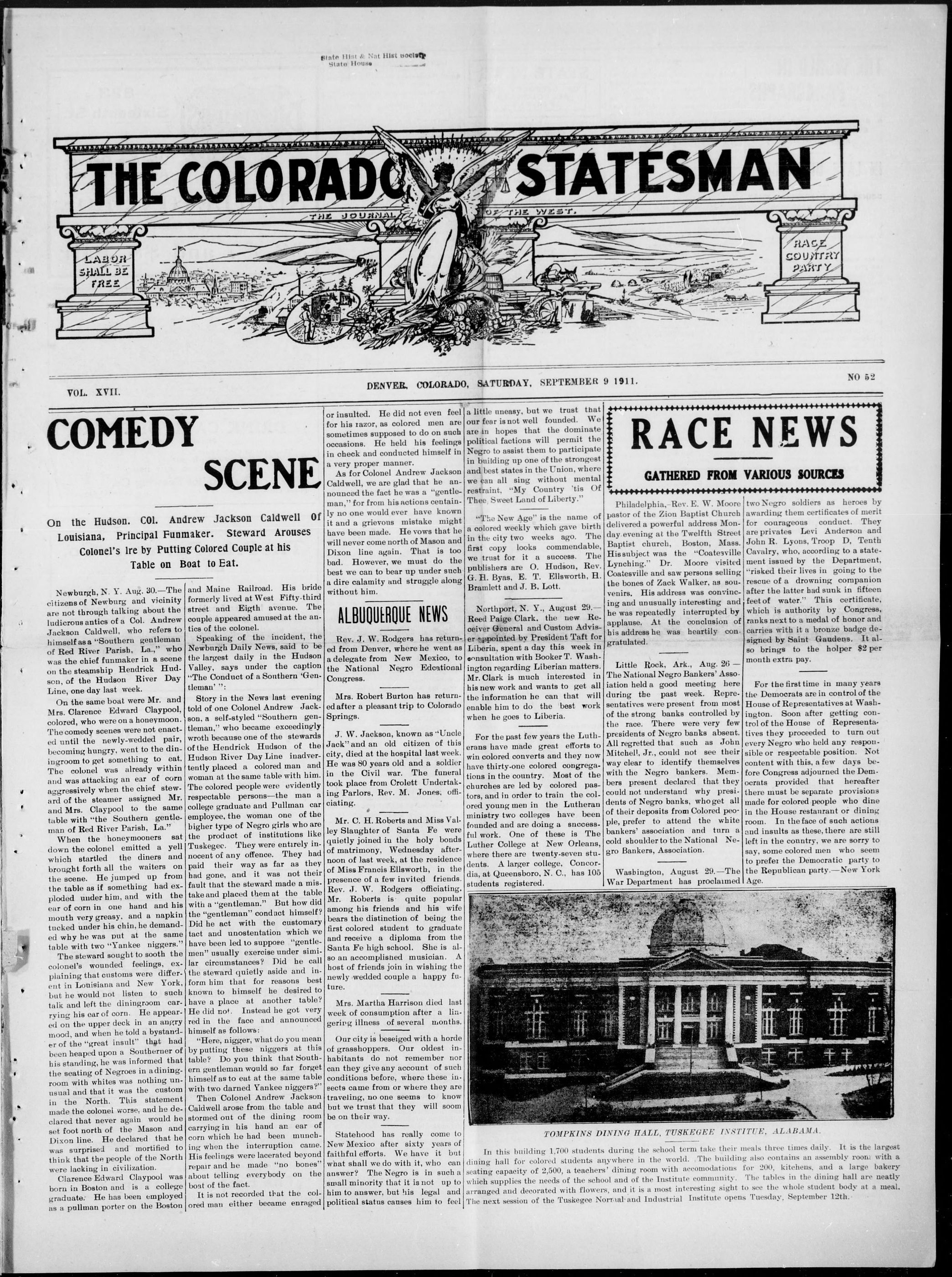
On the Hudson. C01. Andrew Jackson Caldwell Of Louisiana, Principal Funmaker. Steward Arouses Colonel's lre by Putting Colored Couple at his Table on Boat to Eat.
VOL. XVII.
COMEDY
On the Hudson. Col. Andrew Louisiana, Principal Funmaker Colonel's lre by Putting O Table on Boat
Newburgh, N. Y. Aug. 30.—The citizens of Newburg and vicinity are not through talking about the ludicrous antics of a Col. Andrew Jackson Caldwell, who refers to himself as a "Southern gentleman of Red River Parish, La," who was the chief funmaker in a scene on the steamship Hendrick Hudson, of the Hudson River Day Line, one day last week.
On the same boat were Mr. and Mrs. Clarence Edward Claypool, colored, who were on a honeymoon. The comedy scenes were not enacted until the newly-wedded pair, becoming hungry, went to the diningroom to get something to eat. The colonel was already within and was attacking an ear of corn aggressively when the chief steward of the steamer assigned Mr. and Mrs. Claypool to the same table with "the Southern gentleman of Red River Parish, La." When the honeymooners sat down the colonel emitted a yell which startled the diners and brought forth all the waiters on the scene. He jumped up from the table as if something had exploded under him, and with the ear of corn in one hand and his mouth very greasy, and a napkin tucked under his chin, he demanded why he was put at the same table with two "Yankee niggers."
The steward sought to soothe the colonel's wounded feelings, explaining that customs were different in Louisiana and New York, but he would not listen to such talk and left the diningroom carrying his ear of corn. He appeared on the upper deck in an angry mood, and when he told a bystander of the "great insult" that had been heaped upon a Southerner of his standing, he was informed that the seating of Negroes in a dining-room with whites was nothing unusual and that it was the custom in the North. This statement made the colonel worse, and he declared that never again would he set foot north of the Mason and Dixon line. He declared that he was surprised and mortified to think that the people of the North were lacking in civilization. Clarence Edward Claypool was born in Boston and is a college graduate: He has been employed as a pullman porter on the Boston
---
SCENE
and Maine Railroad. His bride formerly lived at West Fifty-third street and Eigth avenue. The couple appeared amused at the antics of the colonel. Speaking of the incident, the Newburgh Daily News, said to be the largest daily in the Hudson Valley, says under the caption "The Conduct of a Southern 'Gentleman'":
Story in the News last evening told of one Colonel Andrew Jackson, a self-styled "Southern gentleman," who became exceedingly wroth because one of the stewards of the Hendrick Hudson of the Hudson River Day Line inadvertently placed a colored man and woman at the same table with him. The colored people were evidently respectable persons—the man a college graduate and Pullman car employee, the woman one of the higher type of Negro girls who are the product of institutions like Tuskegee. They were entirely innocent of any offence. They had paid their way as far as they had gone, and it was not their fault that the steward made a mistake and placed them at the table with a "gentleman." But how did the "gentleman" conduct himself? Did he act with the customary tact and unostentation which we have been led to suppose "gentlemen" usually exercise under similar circumstances? Did he call the steward quietly aside and inform him that for reasons best known to himself he desired to have a place at another table? He did not. Instead he got very red in the face and announced himself as follows:
"Here, nigger, what do you mean by putting these niggers at this table? Do you think that Southern gentleman would so far forget himself as to eat at the same table with two darned Yankee niggers?" Then Colonel Andrew Jackson Caldwell arose from the table and stormed out of the dining room carrying in his hand an ear of corn which he had been munching when the interruption came. His feelings were lacerated beyond repair and he made "no bones" about telling everybody on the boat of the fact. It is not recorded that the colored man either became enraged
State Hist & Nat Hist society
State House
ADC
THE JOURNAL
DENVER, COLORADO
or insulted. He did not even feel for his razor, as colored men are sometimes supposed to do on such occasions. He held his feelings in check and conducted himself in a very proper manner.
As for Colonel Andrew Jackson Caldwell, we are glad that he announced the fact he was a "gentleman," for from his actions certainly no one would ever have known it and a grievous mistake might have been made. He vows that he will never come north of Mason and Dixon line again. That is too bad. However, we must do the best we can to bear up under such a dire calamity and struggle along without him.
ALBUOUEROUE NEWS
Rev. J. W. Rodgers has returned from Denver, where he went as a delegate from New Mexico, to the National Negro Educational Congress.
Mrs. Robert Burton has returned after a pleasant trip to Colorado Springs.
J. W. Jackson, known as "Uncle Jack" and an old citizen of this city, died at the hospital last week. He was 80 years old and a soldier in the Civil war. The funeral took place from Crolett Undertaking Parlors, Rev. M. Jones, officiating.
Mr. C. H. Roberts and Miss Valley Slaughter of Santa Fe were quietly joined in the holy bonds of matrimony, Wednesday afternoon of last week, at the residence of Miss Francis Ellsworth, in the presence of a few invited friends. Rev. J. W. Rodgers officiating. Mr. Roberts is quite popular among his friends and his wife bears the distinction of being the first colored student to graduate and receive a diploma from the Santa Fe high school. She is also an accomplished musician. A host of friends join in wishing the newly wedded couple a happy future.
Mrs. Martha Harrison died last week of consumption after a lingering illness of several months.
Our city is beseiged with a horde of grasshoppers. Our oldest inhabitants do not remember nor can they give any account of such conditions before, where these insects came from or where they are traveling, no one seems to know but we trust that they will soon be on their way.
Statehood has really come to New Mexico after sixty years of faithful efforts. We have it but what shall we do with it, who can answer? The Negro is in such a small minority that it is not up to him to answer, but his legal and political status causes him to feel
TOMPKINS DINING HALL, TUSKEGEE INSTITUE, ALABAMA.
In this building 1,700 students during the school term take their meals three times daily. It is the largest dining hall for colored students anywhere in the world. The building also contains an assembly room with a seating capacity of 2,500, a teachers' dining room with accomodations for 200, kitchens, and a large bakery which supplies the needs of the school and of the Institute community. The tables in the dining hall are neatly arranged and decorated with flowers, and it is a most interesting sight to see the whole student body at a meal. The next session of the Tuskegee Normal and Industrial Institute opens Tuesday, September 12th.
a little uneasy, but we trust that our fear is not well founded. We are in hopes that the dominate political factions will permit the Negro to assist them to participate in building up one of the strongest and best states in the Union, where we can all sing without mental restraint, "My Country 'tis Of Thee, Sweet Land of Liberty."
"The New Age" is the name of a colored weekly which gave birth in the city two weeks ago. The first copy looks commendable, we trust for it a success. The publishers are O. Hudson, Rev. G. H. Byas, E. T. Ellsworth, H. Bramlett and J. B. Lott.
Northport, N. Y., August 29. Reed Paige Clark, the new Receiver General and Custom Adviser appointed by President Taft for Liberia, spent a day this week in consultation with Booker T. Washington regarding Liberian matters. Mr. Clark is much interested in his new work and wants to get all the information he can that will enable him to do the best work when he goes to Liberia.
For the past few years the Lutherans have made great efforts to win colored converts and they now have thirty-one colored congregations in the country. Most of the churches are led by colored pastors, and in order to train the colored young men in the Lutheran ministry two colleges have been founded and are doing a successful work. One of these is The Luther College at New Orleans, where there are twenty-seven students. A larger college, Concordia, at Queensboro, N. C., has 105 students registered.
RACE NEWS
Philadelphia, -Rev. E. W. Moore pastor of the Zion Baptist Church delivered a powerful address Monday evening at the Twelfth Street Baptist church, Boston, Mass. His subject was the "Coatesville Lynching." Dr. Moore visited Coatesville and saw persons selling the bones of Zack Walker, as souvenirs. His address was convincing and unusually interesting and he was repeatedly interrupted by applause. At the conclusion of his address he was heartily congratulated.
Little Rock, Ark., Aug. 26 — The National Negro Bankers' Association held a good meeting here during the past week. Representatives were present from most of the strong banks controlled by the race. There were very few presidents of Negro banks absent. All regretted that such as John Mitchell, Jr., could not see their way clear to identify themselves with the Negro bankers. Members present declared that they could not understand why presidents of Negro banks, who get all of their deposits from Colored people, prefer to attend the white bankers' association and turn a cold shoulder to the National Negro Bankers, Association.
Washington, August 29. —The War Department has proclaimed
NO 52
two Negro soldiers as heroes by awarding them certificates of merit for courageous conduct. They are privates Levi Anderson and John R. Lyons, Troop D, Tenth Cavalry, who, according to a statement issued by the Department, "risked their lives in going to the rescue of a drowning companion after the latter had sunk in fifteen feet of water." This certificate, which is authority by Congress, ranks next to a medal of honor and carries with it a bronze badge designed by Saint Gaudens. It also brings to the holper $2 per month extra pay.
For the first time in many years the Democrats are in control of the House of Representatives at Washington. Soon after getting control of the House of Representatives they proceeded to turn out every Negro who held any responsible or respectable position. Not content with this, a few days before Congress adjourned the Democrats provided that hereafter there must be separate provisions made for colored people who dine in the House restaurant or dining room. In the face of such actions and insults as these, there are still left in the country, we are sorry to say, some colored men who seem to prefer the Democratic party to the Republican party.—New York Age.
THE WORLD IN PARAGRAPHS
A BRIEF RECORD OF PASSING EVENTS IN THIS AND FOR- EIGN COUNTRIES.
IN LATE DISPATCHES
DOINGS AND HAPPENINGS THAT
MARK THE PROGRESS
OF THE AGE.
Western Newspaper Union News Service.
WESTERN.
Six women and six men compose
the jury to try the first case for the
September term of Superior Court at
Bellingham, Wash.
Holding up two men who were
guarding high-grade ore in the assay
office of the Mammoth mine at Natio-
nal, Nev., a pair of bandits got
away with $8,000 worth of treasure.
While she was operating a washing
machine run by a gasoline engine at
her home at Bennington, Kas., Mrs.
Charles Simpson's arm was torn off.
A belt broke, catching Mrs. Simpson's
arm and severing it at the clbow.
An ancient city has been dug up in western Texas, at Alpine, a small town in Brewster county, showing that an earthquake or some cataclysm buried a city of quite a large population.
A male flirt decoy to arrest women who ogle men is wanted by the Denver Fire and Police Board. This is going Los Angeles one better, the California city recently having appointed a woman to catch mashers.
The Standard Oil Company of New Jersey, the corporation which has been the storm center of anti-trust agitation throughout the country for years, has passed out of existence so far as its present form and functions are concerned.
Justice Chesbrough of Los Angeles issued a warrant for General Harrison Gray Otis, editor of the Los Angeles Times, charging him with publishing obscene articles in that newspaper. Warrants were also issued for Harry Andrews, managing editor of the Times.
Revenge for playmates who considered her too "stuck up" is believed to have been the motive which led vandals to snip from the head of Barbara Weaver, fifteen years old, of Oklahoma City, two beautiful braids of silken auburn hair. When Miss Weave or awoke the braids lay on the floor
On the Washita river, eight miles west of Chickasha, Okla., 300 members of the Caddo, Delaware and Wichita tribe of Indians are holding their annual green corn dance. The Indians have been dancing without intermission for several days and nights. When one is exhausted another takes his place in the circle.
Eleven lives lost, fourteen persons injured, two of whom are not expected to live, and the Juneau hotel and the McGrath building in ashes are the results of a fire which started in the hotel at Juneau, Alaska, and was subdued only after the Douglas fire department had sent men and engines to assist the local fire fighters.
FOREIGN.
A French aviator, M. Le Jarrestier, while flying at Huelva, Spain, fell 250 feet and was killed. The motor exploded.
The Chilean steamer Lucapel has been wrecked near Lima and is a total loss. Eighty-one persons were drowned.
More than 100,000 Chinese drowned, many more homeless and seventy-five per cent of the crops in the Yang-Tse-Kiang river valley destroyed is the toll of death and ruin claimed by the floods resulting from recent overflows.
The great flood which is devastating a part of the Chinese empire extends from Ishang to Shanghai, about 700 miles. The banks of the Yangtse-Kiang have been obliterated, except in the highlands and around the walled cities and towns. Thousands have drowned.
SPORT.
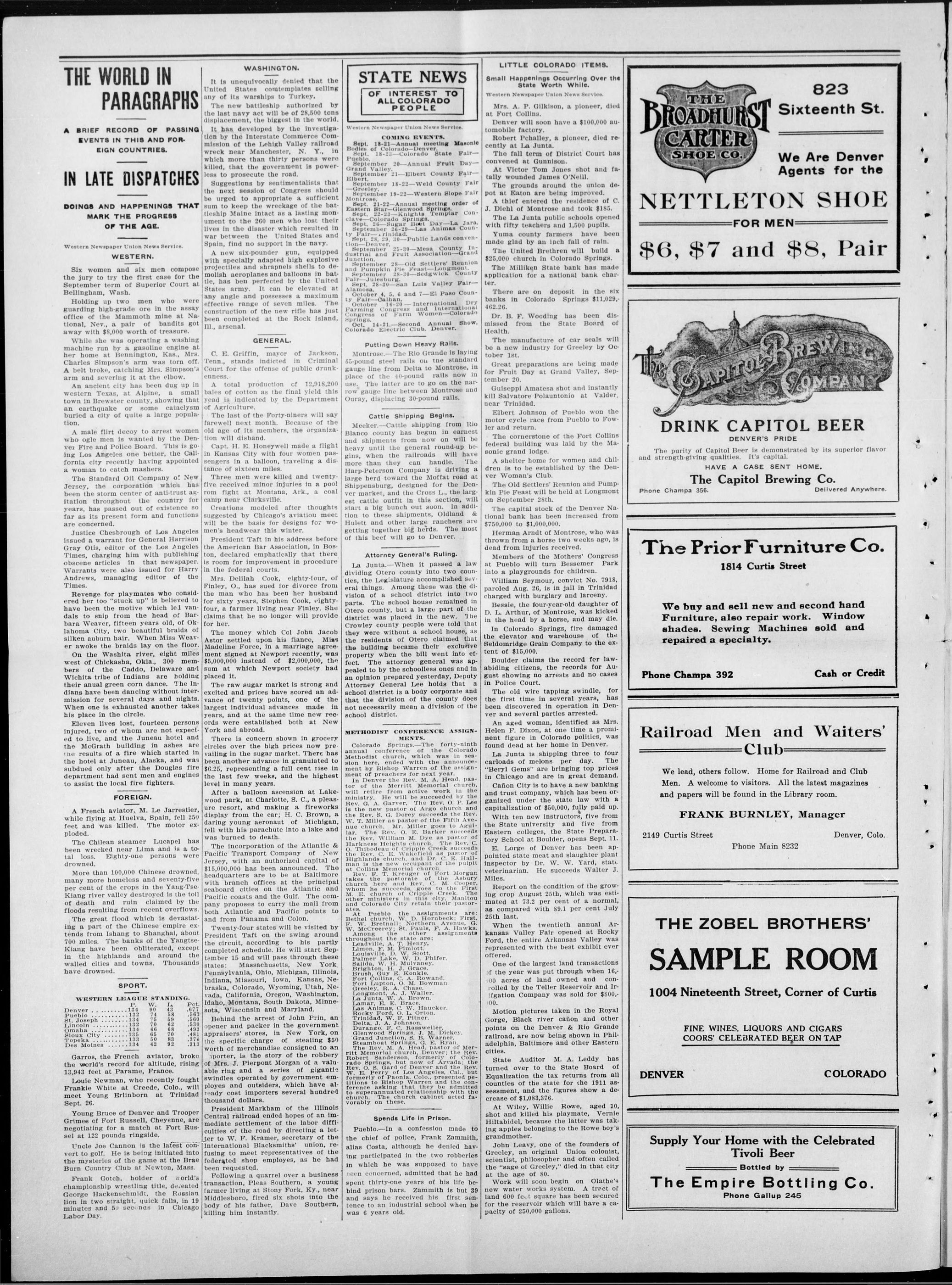
WESTERN LEAGUE STANDING.
P. W. L. Pct.
Denver 134 90 43 .677
Pueblo 132 74 58 .561
St. Joseph 134 74 59 .540
Lincoln 132 70 62 .530
Omaha 134 66 68 .493
Sloux City 135 65 70 .481
Topeka 135 50 83 .378
Des Moines 134 42 92 .313
Garros, the French aviator, broke the world's record for altitude, rising 13,943 feet at Parame, France.
Louie Newman, who recently fought Frankie White at Creede, Colo., will meet Young Erlinborn at Trinidad Sept. 26.
Young Bruce of Denver and Trooper Grimes of Fort Russell, Cheyenne, are negotiating for a match at Fort Russel at 122 pounds ringside.
Uncle Joe Cannon is the latest convert to golf. He is being initiated into the mysteries of the game at the Brae Burn Country Club at Newton, Mass.
Frank Gotch, holder of world's championship wrestling title, deceased George Hackenschmidt, the Russian lion in two straight, quick falls, in 19 minutes and 50 seconds in Chicago Labor Day.
WASHINGTON.
It is unequivocally denied that the United States contemplates selling any of its warships to Turkey. The new battleship authorized by the last navy act will be of 28,500 tons displacement, the biggest in the world. It has developed by the investigation by the Interstate Commerce Commission of the Lehigh Valley railroad wreck near Manchester, N. Y., in which more than thirty persons were killed, that the government is powerless to prosecute the road. Suggestions by sentimentalists that the next session of Congress should be urged to appropriate a sufficient sum to keep the wreckage of the battleship Maine intact as a lasting monument to the 260 men who lost their lives in the disaster which resulted in war between the United States and Spain, find no support in the navy.
A new six-pounder gun, equipped with specially adapted high explosive projectiles and shrapnel shells to demolish aeroplanes and balloons in battle, has been perfected by the United States army. It can be elevated at any angle and possesses a maximum effective range of seven miles. The construction of the new rifle has just been completed at the Rock Island, Ill., arsenal.
GENERAL.
C. E. Griffin, mayor of Jackson, Tenn., stands indicted in Criminal Court for the offense of public drunkenness. A total production of 12,918,200 bales of cotton as the final yield this yead is indicated by the Department of Agriculture. The last of the Forty-niners will say farewell next month. Because of the old age of its members, the organization will disband. Capt. H. E. Honeywell made a flight in Kansas City with four women passengers in a balloon, traveling a distance of sixteen miles. Three men were killed and twenty-five received minor injuries in a pool rom fight at Montana, Ark., a coal camp near Clarksville.
Creations modeled after thoughts suggested by Chicago's aviation meet will be the basis for designs for women's headwear this winter.
President Taft in his address before the American Bar Association, in Boston, declared emphatically that there is room for improvement in procedure in the federal courts.
Mrs. Delliah Cook, eighty-four, of Finley, O., has sued for divorce from the man who has been her husband for sixty years, Stephen Cook, eighty-four, a farmer living near Finley. She claims that he no longer will provide for her.
The money which Col John Jacob Astor settled upon his fiance, Miss Madeline Force, in a marriage agreement signed at Newport recently, was $5,000,000 instead of $2,000,000, the sum at which Newport society had placed it.
The raw sugar market is strong and excited and prices have scored an advance of twenty points, one of the largest individual advances made in years, and at the same time new records were established both at New York and abroad.
There is concern shown in grocery circles over the high prices now prevailing in the sugar market. There has been another advance in granulated to $6.25, representing a full cent rise in the last few weeks, and the highest level in many years.
After a balloon ascension at Lakewood park, at Charlotte, S. C., a pleasure resort, and making a fireworks display from the car; H. C. Brown, a daring young aeronaut of Michigan, fell with his parachute into a lake and was burned to death.
The incorporation of the Atlantic & Pacific Transport Company of New Jersey, with an authorized capital of $15,000,000 has been announced. The headquarters are to be at Baltimore with branch offices at the principal seaboard cities on the Atlantic and Pacific coasts and the Gulf. The company proposes to carry the mail from both Atlantic and Pacific points to and from Panama and Colon.
Twenty-four states will be visited by President Taft on the swing around the circuit, according to his partly completed schedule. He will start September 15 and will pass through these states: Massachusetts, New York Pennsylvania, Ohio, Michigan, Illinois, Indiana, Missouri, Iowa, Kansas, Nebraska, Colorado, Wyoming, Utah, Nevada, California, Oregon, Washington, Idaho, Montana, South Dakota, Minnesota, Wisconsin and Maryland.
Behind the arrest of John Prim, an opener and packer in the government appraisers' stores, in New York, on the specific charge of stealing $50 worth of merchandise consigned to an aporter, is the story of the robbery of Mrs. J. Plerpont Morgan of a valuable ring and a series of gigantic swindles operated by government employees and outsiders, which have already cost importers several hundred thousand dollars. President Markham of the Illinois Central railroad ended hopes of an immediate settlement of the labor difficulties of the road by directing a letter to W. F. Kramer, secretary of the International Blacksmiths' union, refusing to meet representatives of the federated shop employees, as he had been requested.
Following a quarrel over a business transaction, Pleas Southern, a young farmer living at Stony Fork, Ky., near Middlesboro, fired six shots into the body of his father, Dave Southern, killing him instantly.
Western Newspaper Union News Service
COMING EVENTS.
Sept. 18-21—Annual meeting Masonic
Bodies of Colorado—Denver,
Sept. 18-23—Colorado State Fair—
Pueblo,
September 20—Annual Fruit Day—
Grand Valley.
September 21—Elbert County Fair— Elbert.
September 18-22—Weld County Fair
—Greeley.
September 19-22—Western Slope Fair
Montrose.
September 24-29—Las Animas Coun-
Sept. 29, 30, 39—Public Lakes conven-
Sept. 28, 29, 30—Public Lands convention—Denver,
September 25-30—Mesa County Industrial and Fruit Association—Grand Junction.
September 28—Old Settlers' Reunion and Pumpkin Pie Feast—Longmont.
September 28-30—Sedgwick County Fruit Festsburg.
Sept. 28—San Luis Valley Fair—Alamosa.
Aganiosa.
October 4, 5, 6 and 7—El Paso Coun-
try, Californii
October 16-20—International Dry Farming Congress and International Congress of Farm Women—Colorado Springs
Oct. 14-21.-Second Annual Show.
Colorado Electric Club. Denver.
Putting Down Heavy Rails.
Montrose.-The Rio Grande is laying 65-pound steel rails on the standard gauge line from Delta to Montrose, in place of the 40-pound rails now in use. The latter are to go on the narrow gauge line between Montrose and Ouray, displacing 30-pound rails.
Cattle Shipping Begins.
Meeker.—Cattle shipping from Rio Blanco county has begun in earnest and shipments from now on will be heavy until the general round-up begins, when the railroads will have more than they can handle. The Harp-Peterson Company is driving a large herd toward the Moffat road at Shippensburg, designed for the Denver market, and the Cross L., the largest cattle outfit in this section, will start a big bunch out soon. In addition to these shipments, Oldland & Hulett and other large ranchers are getting together big herds. The most of this beef will go to Denver.
Attorney General's Ruling.
La Junta.—When it passed a law dividing Otero county into two counties, the Legislature accomplished several things. Among these was the division of a school district into two parts. The school house remained in Otero county, but a large part of the district was placed in the new. The Crowley county people were told that they were without a school house, as the residents of Otero claimed that the building became their exclusive property when the bill went into effect. The attorney general was appealed to by the schoolless ones and in an opinion prepared yesterday, Deputy Attorney General Lee holds that a school district is a body corporate and that the division of the county does not necessarily mean a division of the school district.
METHODIST CONFERENCE ASSIGNMENTS
Colorado Springs.—The forty-ninth annual conference of the Colorado Methodist church, which was in session here, ended with the announcement by Bishop Warren of the assignment of preachers for next year.
In Denver the Rev. M. A. Head, pastor of the Merritt Memorial church, will retire from active work in the ministry. He will be succeeded by the Rev. G. A. Garver. The Rev. O. P. Lee is the new pastor of Argo church and the Rev. S. G. Dorey succeeds the Rev. W. T. Miller as pastor of the Fifth Avenue church. Mr. Miller goes to Aguilar, The Rev. O. E. Barker succeeds the Rev. William M. Dye as pastor of Harkness Heights church. The Rev. C. O. Thibodeau of Cripple Creek succeeds the Rev. C. E. Wakefield as pastor of Highlands church, and Dr. C. E. Hallman is the new occupant of the pulpit at Collins Memorial church.
Rev. F. T. Kreuger of Fort Morgan takes the pastorate of the Asbury church here and Rev. C. M. Cooper, whom he succeeds, goes to the First M. E. church of Cripple Creek. The other ministers in this city, Manitou and Colorado City retain their pastor-
At Pueblo the assignments are:
Bethel church, W. D. Hornbeck, First;
F. W. N. Noyes, First;
W. McCreeley, St. Pauls, F. A. Hawks.
Among the other assignments
throughout the state are:
J. H. Hutte, Limon;
Limon, F. M. Plimott;
Louisville, D. W. Scott;
Palmer Lake, W. V. Phifer.
St. Louis, F. M. Rowman.
Brighton, H. J. Grace.
Brush, Guy E. Konkle.
Fort Collins, C. A. Rowand.
Fort Browns, C. A. Rowman.
Greeley, R. A. Chase.
Longmont, A. J. Wailer.
La Junta, B. Brown.
Lamar, E. E. Braun.
Las Animas, C. W. Haucker.
Rocky Ford, O. L. Orton.
T. F. Hiderer.
Delta, J. A. Johnson.
Durango, F. C. Rassweller.
Glenwood Springs, J. M. Dickey.
Grand Junction, F. W. Warner.
Bristol, B. G. E. E.
The Rev. M. A. Head, pastor of Merritt Memorial church, Denver; the Rev. Robert Sanderson, formerly of Colo-ron; the Rev. S. Gard of Denver and the Rev. O. S. Gard of Denver and the Rev. W. E. Perry of Los Angeles, Cal., but formerly of Paonia, Colo., presented petitions to Bishop Warren and the conference asking he be better manned and related relationship with the church. The church cabinet acted favorably on these.
Spends Life in Prison.
Pueblo.-In a confession made to the chief of police, Frank Zamith, alias Costa, although he denied having participated in the two robberies in which he was supposed to have been concerned, admitted that he had spent thirty-one years of his life behind prison bars. Zamith is but 39 and says he received his first sentence to an industrial school when he was 6 years old.
Small Happenings Occurring Over the State Worth While.
Western Newspaper Union News Service.
Mrs. A. P. Gilkison, a pioneer, died at Fort Collins.
Denver will soon have a $100,000 automobile factory.
Robert Pchallley, a pioneer, died recently at La Junta.
The fall term of District Court has convened at Gunnison.
At Victor Tom Jones shot and fatally wounded James O'Neill.
The grounds around the union depot at Eaton are being improved.
The La Junta public schools opened with fifty teachers and 1,500 pupils. Yuma county farmers have been made glad by an inch fall of rain.
The United Brethren will build a $25,000 church in Colorado Springs.
The Milliken State bank has made application for a national bank charter.
There are on deposit in the six banks in Colorado Springs $11,029,462.26.
Dr. B. F. Wooding has been dismissed from the State Board of Health.
The manufacture of car seals will be a new industry for Greeley by October 1st.
Great preparations are being made for Fruit Day at Grand Valley, September 20.
Guiseppl Amatesa shot and instantly kill Salvatore Polauntonio at Valder, near Trinidad.
Elbert Johnson of Pueblo won the motor cycle race from Pueblo to Fowler and return.
The cornerstone of the Fort Collins federal building was laid by the Masonic grand lodge.
A shelter home for women and children is to be established by the Denver Woman's Club.
The Old Settlers' Reunion and Pumpkin Pie Feast will be held at Longmont on September 28th.
Herman Arndt of Montrose, who was thrown from a horse two weeks ago, is dead from injuries received.
William Seymour, convict No. 7918, paroled Aug. 26, is in jail in Trinidad charged with burglary and larceny. Bessie, the four-year-old daughter of D. L. Arthur, of Montrose, was kicked in the head by a horse, and may die. In Colorado Springs, fire damaged the elevator and warehouse of the Seldomridge Grain Company to the extent of $15,000. Boulder claims the record for lawabiding citizens, the records for August showing no arrests and no cases in Police Court. The old wire tapping swindle, for the first time in several years, has been discovered in operation in Denver and several parties arrested. An aged woman, identified as Mrs. Helen F. Dixon, at one time a prominent figure in Colorado politics, was found dead at her home in Denver.
La Junta is shipping three to four carloads of melons per day. The "Beryl Gems" are bringing top prices in Chicago and are in great demand. Canon City is to have a new banking and trust company, which has been organized under the state law with a capitalization of $50,000, fully paid up. With ten new instructors, five from the State university and five from Eastern colleges, the State Preparatory School at Boulder, opens Sept. 11. E. Lorge of Denver has been appointed state meat and slaughter plant inspector by Dr. W. W. Yard, state veterinarian. He succeeds Walter J. Miles. Report on the condition of the growing crop August 25th, which was estimated at 73.2 per cent of a normal, as compared with 89.1 per cent July 25th last.
When the twentieth annual Arkansas Valley Fair opened at Rocky Ford, the entire Arkansas Valley was represented with the best exhibit ever offered.
One of the largest land transactions of the year was put through when 16,000 acres of land owned and controlled by the Teller Reservoir and Irrigation Company was sold for $800,000.
Motion pictures taken in the Royal Gorge, Black river cannon and other points on the Denver & Rio Grande railroad, are now being shown in Philadelphia, Baltimore and other Eastern cities.
State Auditor M. A. Leddy has turned over to the State Board of Equalization the tax returns from all counties of the state for the 1911 assessment, and the figures show a decrease of $1,083,376.
At Wiley, Willie Rowe, aged 10, shot and killed his playmate, Vernie Hiltabidel, because the latter was taking apples belonging to the Rowe boy's grandmother.
John Leavy, one of the founders of Greeley, an original Union colonist, scientist, philosopher and often called the "sage of Greeley," died in that city at the age of 80.
Work will soon begin on Olathe's new water works system. A tract of land 600 feet square has been secured for the reservoir which will have a capacity of 250,000 gallons.
THE
BROADHURST
CARTER
SHOE CO.
NETTLETO
FOR M
$6, $7 and
The Capitol
DRINK CAPITOL
DENVER'S
The purity of Capitol Beer is de-
and strength-giving qualities. It's ca-
HAVE A CASE S
The Capitol B
Phone Champa 356.
The Prior Fur
1814 Curti
We buy and sell new
Furniture, also repair
shades. Sewing Ma-
repaired a specialty.
BETTLETON SHOP
FOR MEN
$7 and $8, H
CAPITOL BREWING COMPANY
DRINK CAPITOL BEER
DENVER'S PRIDE
Security of Capitol Beer is demonstrated by its superior-giving qualities. It's capital.
HAVE A CASE SENT HOME.
The Capitol Brewing Co.
Compa 356.
Delivered
The Prior Furniture
1814 Curtis Street
We buy and sell new and second h
furniture, also repair work. Wine
ades. Sewing Machines sold
paired a specialty.
$6, $7 and $8, Pair
THE CAPITOL BREWING COMPANY
The purity of Capitol Beer is demonstrated by its superior flavor and strength-giving qualities. It's capital.
HAVE A CASE SENT HOME.
The Capitol Brewing Co.
Phone Champa 356. Delivered Anywhere.
The Prior Furniture Co. 1814 Curtis Street
We buy and sell new and second hand Furniture, also repair work. Window shades. Sewing Machines sold and repaired a specialty.
Phone Champa 392
Railroad Men
Clu
We lead, others follow. Hon
Men. A welcome to visitors.
and papers will be found in t
Broad Men and Wai Club
lead, others follow. Home for Railroad and
A welcome to visitors. All the latest mag
papers will be found in the Library room.
We lead, others follow. Home for Railroad and Club Men. A welcome to visitors. All the latest magazines and papers will be found in the Library room.
FRANK BURNLEY, Manager
2149 Curtis Street Denver, C
Phone Main 8232
THE ZOBEL E
SAMPLE
1004 Nineteenth Street
THE ZOBEL BROTHER
AMPLE ROO
Nineteenth Street, Corner of
1004 Nineteenth Street, Corner of Curtis
FINE WINES, LIQUORS AND CIGARS
COORS' CELEBRATED BEER ON TAP
Only Your Home with the Celebr
Tivoli Beer
Bottled by
The Empire Bottling
Supply Your Home with
Tivoli B
Bottled
The Empire E
Phone Gall
Supply Your Home with the Celebrated Tivoli Beer
The Empire Bottling Co. Phone Gallup 245
DENVER
823 Sixteenth St.
We Are Denver Agents for the
ON SHOE
EN
$8, Pair
BREWING
COMPANY
TOL BEER
PRIDE
constrated by its superior flavor
ital.
ENT HOME.
Brewing Co.
Delivered Anywhere.
Furniture Co.
Street
and second hand
work. Window
machines sold and
and Waiters'
club
e for Railroad and Club
All the latest magazines
the Library room.
BROTHERS'
ROOM
t, Corner of Curtis
with the Celebrated
Beer
by
ottling Co.
p 245
Cash or Credit
Denver, Colo.
COLORADO
S.P. HECKLER'S CASH GROCERY
S.P. HECKLER'S CASH GROCERY
Fresh Vegetables Every Day. All Kinds of Groceries and Salt Meats
2362 TREMONT PLACE
Telephone Main 5371
DIAMONDE
H: ZALINSKY, President
D. REASE
The Great Professional Shoe Shiner of Denver. Located, 1844 Arapahoe. Also Hat Cleaning, Cigars, Tobacco, Candy and Soft Drinks.
ERNEST HOWARD
Carpenter and Contractor
Job and Repair Work a Specialty
Res. 353 W. Warren Ave.
Phone South 1862
Shop 1021 Twenty-First St.
Phone Main 1144
PENNOLIU UNION BREWING CO.
1855
FILI
DENVER, COLOR
OUR
ADVERTISING
COLUMNS
are read by the people because it gives them news of absorbing interest. People no longer go looking about for things they want—they go to their newspaper for information as to where such things may be found. This method saves time and trouble. If you want to bring your wares to the attention of this community, our advertising columns
Should
Contain Your
Ad
Don't Take It
For Granted
that just because you are in business, everybody is aware of the fact. Your goods may be the finest in the market but they will remain on your shelves unless the people are told about them.
ADVERTISE
if you want to move your merchandise. Reach the buyers in their homes through the columns of THIS PAPER and on every dollar expended you'll reap a handsome dividend.
Expert Watch Repairing Diamonds and Cut Glass
34 Years Experience
THE H. L. KORTZ JEWELRY
COMPANY
Watches, Clocks, Silverware, Etc.
805 Fifteenth Street. Denver, Colo.
Phones, Office Main 5595.
Residence, York 123.
Hours: 9 to 11 a.m., 1 to 4, 7 to 8 p.m.
Sundays: 10 to 11:30 a.m., 2 to 4 p.m.
Dr. P. E. Spratlin
Good Block-1557 Larimer St.
Residence 2230 Clarkson St.
Denver, Colorado.
THE BEST ICE CREAM AND
CANDIES AT
O. P. BAUR & CO.
CATERERS AND
CONFECTIONERS
Phone: 168.
1512 Curtis Street, Denver, Colo.
OFFICERS
OFFICERS
P. Chiolero, Pres. and Manager
J. C. Chiolero, Vice-President
S. Chiolero, Treasurer
C. A. Grosso, Secy.
The
Chiolero
Importing Mercantile
& Investment
Company
(BRANCH)
MANUFACTURES OF
LA FLOR DE CHIOLERO
LA FLOR DE CERES
HIGH GRADE
CIGARS
UNION MADE
DELICATESSEN, WINES,
LIQUORS AND
CIGARS
Telephone Champa 1844
1859 ARAPAHOE ST.
Denver, Colo.
WILLIAMSON
HAFFNER CO.
ENGRAVERS-PRINTERS
ONLINE
CUTTS
TRAILS
DENVER, COLO
---
FROM ABROAD
WAS ONE OF THE PRINCIPAL SPEAKERS AT THE UNIVERSAL RACES CONGRESS—PRAISES DU BOIS AND MULHOLLAND FOR CONSERVATISM—THINKS MEETING WILL HELP RACES.
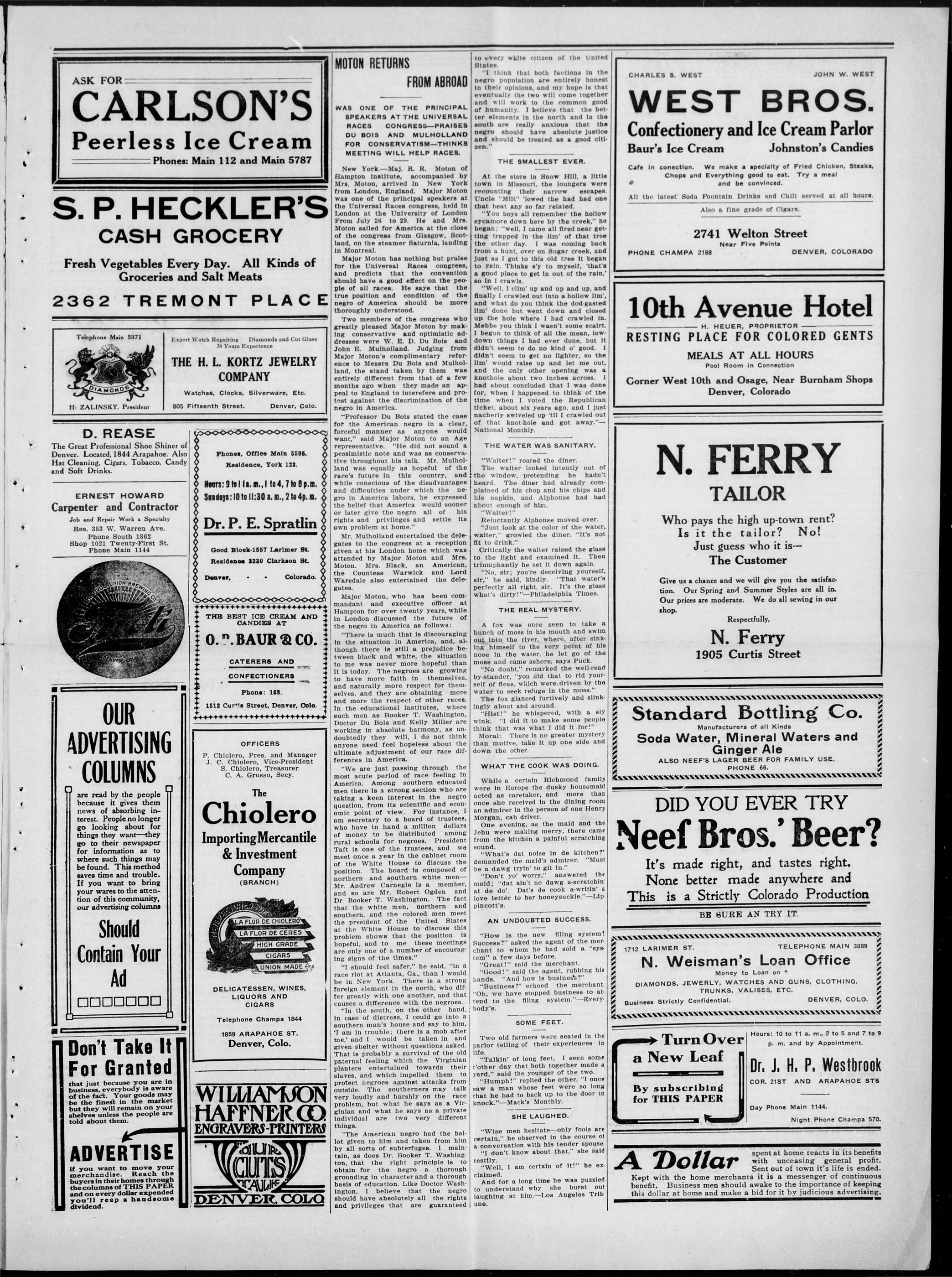
New York.—Maj. R. R. Moton of Hampton institute, accompanied by Mrs. Moton, arrived in New York from London, England. Major Moton was one of the principal speakers at the Universal Races congress, held in London at the University of London From July 26 to 29. He and Mrs. Moton sailed for America at the close of the congress from Glasgow, Scotland, on the steamer Saturnla, landing in Montreal.
Major Moton has nothing but praise for the Universal Races congress, and predicts that the convention should have a good effect on the people of all races. He says that the true position and condition of the negro of America should be more thoroughly understood.
Two members of the congress who greatly pleased Major Moton by making conservative and optimistic addresses were W. E. D. Du Bois and John E. Muhholland. Judging from Major Moton's complimentary reference to Messrs Du Bois and Muhholland, the stand taken by them was entirely different from that of a few months ago when they made an appeal to England to interefere and protest against the discrimination of the negro in America.
"Professor Du Bois stated the case for the American negro in a clear, forceful manner as anyone would want," said Major Moton to an Age representative. "He did not sound a pessimistic note and was as conservative throughout his talk. Mr. Mulholland was equally as hopeful of the race's future in this country, and while conscious of the disadvantages and difficulties under which the negro in America labors, he expressed the belief that America would sooner or later give the negro all of his rights and privileges and settle its own problem at home."
Mr. Mulholland entertained the delegates to the congress at a reception given at his London home which was attended by Major Moton and Mrs. Moton. Mrs. Black, an American, the Countess Warwick and Lord Waredale also entertained the delegates.
Major Moton, who has been commandant and executive officer at Hampton for over twenty years, while in London discussed the future of the negro in America as follows:
"There is much that is discouraging in the situation in America, and, although there is still a prejudice between black and white, the situation to me was never more hopeful than it is today. The negroes are growing to have more faith in themselves, and naturally more respect for themselves, and they are obtaining more and more the respect of other races. In the educational institutes, where such men as Booker T. Washington, Doctor Du Bois and Kelly Miller are working in absolute harmony, as undoubtedly they will, I do not think anyone need feel hopeless about the ultimate adjustment of our race differences in America.
"We are just passing through the most acute period of race feeling in America. Among southern educated men there is a strong section who are taking a keen interest in the negro question, from its scientific and economic point of view. For instance, I am secretary to a board of trustees, who have in hand a million dollars of money to be distributed among rural schools for negroes. President Taft is one of the trustees, and we meet once a year in the cabinet room of the White House to discuss the position. The board is composed of northern and southern white men—Mr. Andrew Carnegie is a member, and so are Mr. Robert Ogden and Dr. Booker T. Washington. The fact that the white men, northern and southern, and the colored men meet the president of the United States at the White House to discuss this problem shows that the position is hopeful, and to me these meetings are only one of a number of encouraging signs of the times."
"I should feel safer," he said, "in a race riot at Atlanta, Ga., then I would be in New York. There is a strong foreign element in the north, who differ greatly with one another, and that causes a difference with the negroes. "In the south, on the other hand, in case of distress, I could go into a southern man's house and say to him, 'I am in trouble; there is a mob after me,' and I would be taken in and given shelter without questions asked. That is probably a survival of the old paternal feeling which the Virginian planters entertained towards their slaves, and which impelled them to protect negroes against attacks from outside. The southerners may talk very loudly and harshly on the race problem, but what he says as a Virginian and what he says as a private individual are two very different things.
"The American negro had the ballot given to him and taken from him by all sorts of subterfuges. I maintain, as does Dr. Booker T. Washington, that the right principle is to obtain for the negro a thorough grounding in character and a thorough basis of education. Like Doctor Washington, I believe that the negro should have absolutely all the rights and privileges that are guaranteed
to every white citizen of the United States.
"I think that both factions in the negro population are entirely honest in their opinions, and my hope is that eventually the two will come together and will work to the common good of humanity. I believe that the better elements in the north and in the south are really anxious that the negro should have absolute justice and should be treated as a good citizen."
THE SMALLEST EVER.
At the store in Snow Hill, a little town in Missouri, the loungers were recounting their narrow escapes. Uncle "Milt" 'lowed the had had one that beat any so far related.
"You boys all remember the hollow sycamore down here by the creek," he began; "well, I came all fired near getting trapped in the lim' of that tree the other day. I was coming back from a hunt, over on Sugar creek, and just as I got to this old tree it began to rain. Thinks s'y to myself, 'that's a good place to get in out of the rain,' so in I crawls.
"Well, I clim' up and up and up, and finally I crawled out into a hollow lim', and what do you think the dod-gasted lim' done but went down and closed up the hole where I had crawled in. Mebbe you think I wasn't some scairt. I begun to think of all the mean, low-down things I had ever done, but it didn't seem to do no kind o' good. I didn't seem to get no lighter, so the lim' would raise up and let me out, and the only other opening was a knothole about two inches across. I had about concluded that I was done for, when I happened to think of the time when I voted the Republican ticket, about six years ago, and I just nacherly swiveled up 'tll I crawled out of that knot-hole and got away."—National Monthly.
THE WATER WAS SANITARY
"Walter!" roared the diner.
"Walter!" roared the diner.
The waiter looked intently out of the window, pretending he hadn't heard. The diner had already complained of his chop and his chips and his napkin, and Alphonse had had about enough of him.
"Walter!"
Reluctantly Alphonse moved over.
"Just look at the color of the water, waiter," growled the diner. "It's not fit to drink."
Critically the waiter raised the glass to the light and examined it. Then triumphantly he set it down again.
"No, sir; you're deceiving yourself, sir," he said, kindly. "That water's perfectly all right, sir. It's the glass what's dirty!"—Philadelphia Times.
THE REAL MYSTERY.
A fox was once seen to take a bunch of moss in his mouth and swim out into the river, where, after sinking himself to the very point of his nose in the water, he let go of the moss and came ashore, says Puck. "No doubt," remarked the well-read by-stander, "you did that to rid yourself of fleas, which were driven by the water to seek refuge in the moss." The fox glanced furtively and slinkingly about and around. "Hist!" he whispered, with a sly wink. "I did it to make some people think that was what I did it for!" Moral: There is no greater mystery than motive, take it up one side and down the other.
WHAT THE COOK WAS DOING.
While a certain Richmond family were in Europe the dusky housemaid acted as caretaker, and more than once she received in the dining room an admirer in the person of one Henry Morgan, cab driver.
One evening, as the maid and the Jehu were making merry, there came from the kitchen a painful scratching sound.
"What's dat noise in de kitchen? demanded the maid's admirer. "Must be a dawg tryin' to git in."
"Don't yo worry," answered the maid; "dat ain't no dawg a-scratchin' at de do." Dat's de cook a-writin' a love letter to her honeysuckle"—Lip pincott's.
AN UNDOUBTED SUCCESS
"How is the new filing system! Success?" asked the agent of the merchant to whom he had sold a "system" a few days before.
"Great!" said the merchant.
"Good!" said the agent, rubbing his hands.
"And how is business?"
"Business?" echoed the merchant.
"Oh, we have stopped business to attend to the filing system."—Everybody's.
SOME FEET.
Two old farmers were seated in the parlor telling of their experiences in life.
"Talkin' of long feet. I seen some other day that both together made a yard," said the younger of the two.
"Humph!" replied the other. "I once saw a man whose feet were so long that he had to back up to the door to knock."—Mack's Monthly.
SHE LAUGHED.
"Wise men hesitate—only fools are certain," he observed in the course of a conversation with his tender spouse. "I don't know about that," she said testily. "Well, I am certain of it!" he exclaimed. And for a long time he was puzzled to understand why she burst out laughing at him—Los Angeles Tribune.
WEST
Confectionery and
Baur's Ice Cream
Cafe in conection. We make a
Chops and Everything
and be
All the latest Soda Fountain Dr
Also a fine g
2741 We
Near F
PHONE CHAMPA 2188
10th Ave
H. HEUER,
RESTING PLACE FO
Cafe in conection. We make a specialty of Fried Chicken, Steaks, Chops and Everything good to eat. Try a meal and be convinced.
All the latest Soda Fountain Drinks and Chili served at all hours.
Also a fine grade of Cigars.
2741 Welton Street
Near Five Points
PHONE CHAMPA 2188 DENVER, COLORADO
MEALS AT ALL HOURS Pool Room in Connection
Gorner West 10th and O
Denver,
N. FE
TAI
Who pays the h
Is it the t
Just guess
The C
Give us a chance and we
tion. Our Spring and S
Our prices are moderate.
shop.
At 10th and Osage, Near Bur-
Denver, Colorado
. FERRY
TAILOR
Do pays the high up-town re-
sults it the tailor? No.
Just guess who it is---
The Customer
is a chance and we will give you the s-
Our Spring and Summer Styles are
ices are moderate. We do all sewing
Corner West 10th and Osage, Near Burnham Shops Denver, Colorado
N. FERRY
TAILOR
Who pays the high up-town rent?
Is it the tailor? No!
Just guess who it is---
The Customer
Give us a chance and we will give you the satisfaction. Our Spring and Summer Styles are all in. Our prices are moderate. We do all sewing in our shop.
Respectfully,
N. Ferry
1905 Curtis Street
Standard B
Manufacturer
Soda Water, Milk
Ginger
ALSO NEEF'S LAGER B
PHO
DID YOU
Neef Bro
It's made right,
None better ma
This is a Strictly
Hard Bottling
Manufacturers of all Kinds
Water, Mineral Water
Ginger Ale
NEEF'S LAGER BEER FOR FAMILY
PHONE 66.
O YOU EVER T
'Bros.' B
made right, and tastes
better made anywhere
a Strictly Colorado P
Standard Bottling Co.
Manufacturers of all Kinds
Soda Water, Mineral Waters and
Ginger Ale
ALSO NEEF'S LAGER BEER FOR FAMILY USE.
PHONE 66.
DID YOU EVER TRY Neef Bros.' Beer?
It's made right, and tastes right.
None better made anywhere and
This is a Strictly Colorado Production
BE SURE AN TRY IT.
1712 LARIMER ST. TELEPHONE MAIN 3889
N. Weisman's Loan Office
Money to Loan on *
DIAMONDS, JEWERLY, WATCHES AND GUNS, CLOTHING,
TRUNKS, VALISES, ETC.
Business Strictly Confidential. DENVER, COLO.
ST. TELEPHON
Teisman's Loan O
Money to Loan on *
EWERLY, WATCHES AND GUNS,
TRUNKS, VALISES, ETC.
Confidential.
1712 LARIMER ST. TELEPHONE MAIN 3889
N. Weisman's Loan Office
Money to Loan on *
DIAMONDS, JEWERLY, WATCHES AND GUNS, CLOTHING,
TRUNKS, VALISES, ETC.
Business Strictly Confidential. DENVER, COLO.
TurnOver a New Leaf By subscribing for THIS PAPER
A Dollar
Kept with the home merchant benefit. Business men should this dollar at home and make
Kept with the home merchants it is a messenger of continuous benefit. Business men should awake to the importance of keeping this dollar at home and make a bid for it by judicious advertising.
HOME AND NOW
CHARLES S. WEST
BROS.
Ice Cream Parlor
Johnston's Candies
a specialty of Fried Chicken, Steaks,
good to eat. Try a meal
convinced.
links and Chili served at all hours.
grade of Cigars.
Hilton Street
ave Points
DENVER, COLORADO
venue Hotel
PROPRIETOR
FOR COLORED GENTS
MESSAGE, Near Burnham Shops
Colorado
ERRY
TALOR
high up-town rent?
tailor? No!
who it is---
customer
will give you the satisfac-
Summer Styles are all in.
We do all sewing in our
Bottling Co.
of all Kinds
General Waters and
Bever Ale
BEER FOR FAMILY USE.
NE 66.
EVER TRY
os.' Beer?
and tastes right.
de anywhere and
Colorado Production
TELEPHONE MAIN 3889
Loan Office
Loan on *
HES AND GUNS, CLOTHING,
CLISES, ETC.
DENVER, COLO.
Hours: 10 to 11 a. m., 2 to 5 and 7 to 9
p. m. and by Appointment.
Dr. J. H. P. Westbrook
COR. 21ST AND ARAPAHOE STS
Day Phone Main 1144.
Night Phone Champa 570.
spent at home reacts in its benefits
with unceasing general profit.
Sent out of town it's life is ended.
ts it is a messenger of continuous
awake to the importance of keeping
bid for it by judicious advertising.
---
JOHN W. WEST
THE COLORADO STATESMAN
JOB. D. D. RIVERS ..... Proprietor
1824 Curtis Street. Room 25.
JOB. D. D. RIVERS ..... Proprietor
1824 Curtis Street, Room 25.
SUBSCRIPTION RATES:
PAYABLE IN ADVANCE.
letters that papers sent to subscriber give any number when due, inform a duplicate of the missing one.
be made by Express Money or Bank Draft. Postage is national part of a dollar. Only 25 cents per inch. Reading n.
a less than three months' contracts unknown to us. Further proof of a personating nature that are columns of this paper.
receive attention must be newly upon one side of the paper; later than Wednesdays, and be returned, unless stamps are sent.
class matter at the postoffice.
One Year ..... $2.00
Six Months ..... 1.00
Three Months ..... .60
It occasionally happens that papers sent to subscribers are lost or stolen. In case you do not receive any number when due, inform us by postal card and we will cheerfully forward a duplicate of the missing number.
Remittances should be made by Express Money Order, Postoffice Money Order, Registered Letter or Bank Draft. Postage stamps will be received the same as cash for the fractional part of a dollar. Only 1-cent and 2-cent stamps
Display advertising 25 cents per inch. Reading notices, 5 cents per line.
No discounts allowed on less than three months' contract. Cash must accompany all orders from parties unknown to us. Further particulars on application.
All communications of a personating nature that are not complimentary will be withheld from the columns of this paper.
Communications to receive attention must be newsy, upon important subjects, plainly written only upon one side of the paper; must reach us Tuesdays, if possible, anyway not later than Wednesdays, and bear the signature of the author. No manuscript returned, unless stamps are sent for postage.
Entered as second-class matter at the postoffice in the city of Denver, Colorado.
DEMOCRATIC PROSPECTS
full of hope for an outcome acceptable to them and their party. In way that the national house, with a substantial working majority ended, they have tried hard to place the country at large. The age of the Canadian recolproc by a Republican president and they hastily proposed general to create a debatable issue where the elections to be held during that country is desirous of seriously reduce the cost of life of corporate monopolies, and such reductions upon a basic rent tariff commission. The nation is therefore the real issue democrats and Republicans, and sent Taft's vetoes of bills of special conditions and particularly history in many sections of the largely upon their power to intellectual revolution regardless of through Republican resources tariff commission's report will be placed before the Democrats' provisions of be forced into the two parties of tariff or free democratic opportunity has so their presidential candidate appear, seem to favor Government of Princeton University, feel some desire to know how to their party's choice, for price in the next presidential of Goodrow Wilson has been Gov. single colored man to office. The messenger who had long filled announced that he did so only did not because of political intention was born in Georgia and under President Wilson, did not and Yale makes no distinction, strategic prospects when colored in DATE of the Democratic party.
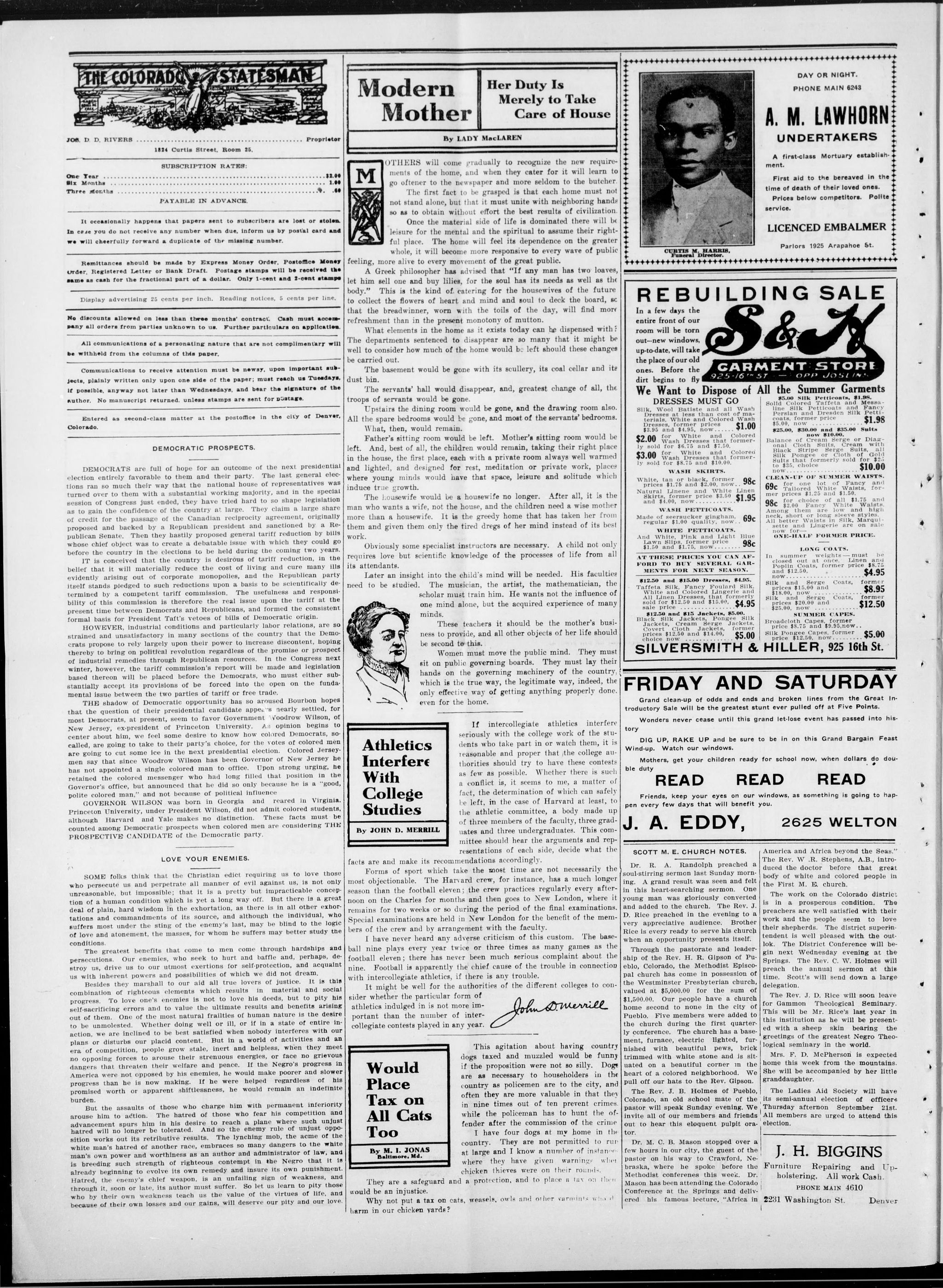
DEMOCRATS are full of hope for an outcome of the next presidential election entirely favorable to them and their party. The last general elections ran so much their way that the national house of representatives was turned over to them with a substantial working majority, and in the special session of Congress just ended, they have tried hard to so shape legislation as to gain the confidence of the country at large. They claim a large share of credit for the passage of the Canadian reciprocity agreement, originally proposed and backed by a Republican president and sanctioned by a Republican Senate. Then they hastily proposed general tariff reduction by bills whose chief object was to create a debatable issue with which they could go before the country in the elections to be held during the coming two years. IT is conceived that the country is desirous of tariff reduction, in the belief that it will materially reduce the cost of living and cure many ills evidently arising out of corporate monopolies, and the Republican party itself stands pledged to such reductions upon a basis to be scientifically determined by a competent tariff commission. The usefulness and responsibility of this commission is therefore the real issue upon the tariff at the present time between Democrats and Republicans, and formed the consistent formal basis for President Taft's vetoes of bills of Democratic origin.
HOWEVER, industrial conditions and particularly labor relations, are so strained and unsatisfactory in many sections of the country that the Democrats propose to rely largely upon their power to increase discontent, hoping thereby to bring on political revolution regardless of the promise or prospect of industrial remedies through Republican resources. In the Congress next winter, however, the tariff commission's report will be made and legislation based thereon will be placed before the Democrats, who must either substantially accept its provisions of be forced into the open on the fundamental issue between the two parties of tariff or free trade.
THE shadow of Democratic opportunity has so aroused Bourbon hopes that the question of their presidential candidate appears nearly settled, for most Democrats, at present, seem to favor Government Woodrow Wilson, of New Jersey, ex-president of Princeton University. As opinion begins to center about him, we feel some desire to know how colored Democrats, so called, are going to take to their party's choice, for the votes of colored men are going to cut some ice in the next presidential election. Colored Jerseymen say that since Woodrow Wilson has been Governor of New Jersey he has not appointed a single colored man to office. Upon strong urging, he retained the colored messenger who had long filled that position in the Governor's office, but announced that he did so only because he is a "good, polite colored man," and not because of political influence.
GOVERNOR WILSON was born in Georgia and reared in Virginia. Princeton University, under President Wilson, did not admit colored students, although Harvard and Yale makes no distinction. These facts must be counted among Democratic prospects when colored men are considering THE PROSPECTIVE CANDIDATE of the Democratic party.
LOVE YOUR ENEMIES
that the Christian edict reeperpetrate all manner of evils possible; that it is a pretty bion which is yet a long way othom in the exhortation, as theents of its source, and altho sting of the enemy's last, m the masses, for whom he suffits that come to men comemies, who seek to hurt and ountement exorcises for self
SOME folks think that the Christian edict requiring us to love those who persecute us and perpetrate all manner of evil against us, is not only unreasonable, but impossible; that it is a pretty but impracticable conception of a human condition which is yet a long way off. But there is a great deal of plain, hard wisdom in the exhortation, as there is in all other exhortations and commandments of its source, and although the individual, who suffers most under the sting of the enemy's last, may be blind to the logic of love and atonement, the masses, for whom he suffers may better study the conditions.
The greatest benefits that come to men come through hardships and persecutions. Our enemies, who seek to hurt and baffle and, perhaps, destroy us, drive us to our utmost exertions for self-protection, and acquaint us with inherent powers and possibilities of which we did not dream.
Besides they marshall to our aid all true lovers of justice. It is this combination of righteous elements which results in material and social progress. To love one's enemies is not to love his deeds, but to pity his self-sacrificing errors and to value the ultimate results and benefits arising out of them. One of the most natural frailties of human nature is the desire to be unmolested. Whether doing well or ill, or if in a state of entire inaction, we are inclined to be best satisfied when nobody interferes with our plans or disturbs our placid content. But in a world of activities and an era of competition, people grow stale, inert and helpless, when they meet no opposing forces to arouse their strenuous energies, or face no grievous dangers that threaten their welfare and peace. If the Negro's progress in America were not opposed by his enemies, he would make poorer and slower progress than he is now making. If he were helped regardless of his promised worth or apparent shiftlessness, he would remain an indefinite burden.
But the assaults of those who charge him with permanent inferiority arouse him to action. The hatred of those who fear his competition and advancement spurs him in his desire to reach a plane where such unjust hatred will no longer be tolerated. And so the enemy rule of unjust opposition works out its retributive results. The lynching mob, the acme of the white man's hatred of another race, embraces so many dangers to the white man's own power and worthiness as an author and administrator of law, and is breeding such strength of righteous contempt in the Negro that it is already beginning to evolve its own remedy and insure its own punishment. Hatred, the enemy's chief weapon, is an unfailling sign of weakness, and through it, soon or late, its author must suffer. So let us learn to pity those who by their own weakness teach us the value of the virtues of life, and because of their own losses and our gains, will deserve our pity and our love.
Her Duty Is Merely to Take Care of House
OTHERS will come gradually to recognize the new requirements of the home, and when they cater for it will learn to go oftener to the newspaper and more seldom to the butcher.
The first fact to be grasped is that each home must not stand alone, but that it must unite with neighboring hands so as to obtain without effort the best results of civilization.
Once the material side of life is dominated there will be leisure for the mental and the spiritual to assume their rightful place. The home will feel its dependence on the greater whole, it will become more responsive to every wave of public feeling, more alive to every movement of the great public.
A Greek philosopher has advised that "If any man has two loaves, let him sell one and buy lilies, for the soul has its needs as well as the body." This is the kind of catering for the housewives of the future to collect the flowers of heart and mind and soul to deck the board, so that the breadwinner, worn with the toils of the day, will find more refreshment than in the present monotony of mutton.
What elements in the home as it exists today can be dispensed with? The departments sentenced to disappear are so many that it might be well to consider how much of the home would be left should these changes be carried out.
The basement would be gone with its scullery, its coal cellar and its dust bin.
The servants' hall would disappear, and, greatest change of all, the troops of servants would be gone.
Upstairs the dining room would be gone, and the drawing room also. All the spare bedrooms would be gone, and most of the servants' bedrooms.
What, then, would remain.
Father's sitting room would be left. Mother's sitting room would be left. And, best of all, the children would remain, taking their right place in the house, the first place, each with a private room always well warmed and lighted, and designed for rest, meditation or private work, places where young minds would have that space, leisure and solitude which induce true growth.
The housewife would be a housewife no longer. After all, it is the man who wants a wife, not the house, and the children need a wise mother more than a housewife. It is the greedy home that has taken her from them and given them only the tired dregs of her mind instead of its best work.
Obviously some specialist instructors are necessary. A child not only requires love but scientific knowledge of the processes of life from all its attendants.
Later an insight into the child's mind will be needed. His faculties need to be studied. The musician, the artist, the mathematician, the
By LADY MacLAREN
OTHERS will come gradually to recognize the new requirements of the home, and when they cater for it will learn to go oftener to the newspaper and more seldom to the butcher.
M
The first fact to be grasped is that each home must not stand alone, but that it must unite with neighboring hands so as to obtain without effort the best results of civilization.
Once the material side of life is dominated there will be leisure for the mental and the spiritual to assume their rightful place. The home will feel its dependence on the greater whole, it will become more responsive to every wave of public feeling, more alive to every movement of the great public.
A Greek philosopher has advised that "If any man has two loaves, let him sell one and buy lilies, for the soul has its needs as well as the body." This is the kind of catering for the housewives of the future to collect the flowers of heart and mind and soul to deck the board, so that the breadwinner, worn with the toils of the day, will find more refreshment than in the present monotony of mutton.
What elements in the home as it exists today can be dispensed with? The departments sentenced to disappear are so many that it might be well to consider how much of the home would be left should these changes be carried out.
The basement would be gone with its scullery, its coal cellar and its dust bin.
The servants' hall would disappear, and, greatest change of all, the troops of servants would be gone.
Upstairs the dining room would be gone, and the drawing room also. All the spare bedrooms would be gone, and most of the servants' bedrooms.
What, then, would remain.
Father's sitting room would be left. Mother's sitting room would be left. And, best of all, the children would remain, taking their right place in the house, the first place, each with a private room always well warmed and lighted, and designed for rest, meditation or private work, places where young minds would have that space, leisure and solitude which induce true growth.
The housewife would be a housewife no longer. After all, it is the man who wants a wife, not the house, and the children need a wise mother more than a housewife. It is the greedy home that has taken her from them and given them only the tired dregs of her mind instead of its best work.
Obviously some specialist instructors are necessary. A child not only requires love but scientific knowledge of the processes of life from all its attendants. Later an insight into the child's mind will be needed. His faculties need to be studied. The musician, the artist, the mathematician, the
The musician, the artist, the most important scholar must train him. He wants not the influence of one mind alone, but the acquired experience of many minds.
Mary Crawford
These teachers it should be the mother's business to provide, and all other objects of her life should be second to this.
Women must move the public mind. They must sit on public governing boards. They must lay their hands on the governing machinery of the country, which is the true way, the legitimate way, indeed, the only effective way of getting anything properly done, even for the home.
If intercollegiate athletics interfere seriously with the college work of the students who take part in or watch them, it is reasonable and proper that the college authorities should try to have these contests as few as possible. Whether there is such a conflict is, it seems to me, a matter of fact, the determination of which can safely be left, in the case of Harvard at least, to the athletic committee, a body made up of three members of the faculty, three graduates and three undergraduates. This committee should hear the arguments and representations of each side, decide what the
Athletics Interfere With College Studies By JOHN D. MERRILL If intercollegiate seriously with the college dents who take part in reasonable and proper thorities should try to as few as possible. When a conflict is, it seems fact, the determination be left, in the case of the athletic committee of three members of the uates and three undergritte should hear the presentations of each si facts are and make its recommendations accordingly.
Forms of sport which take the most time are not necessarily the most objectionable. The Harvard crew, for instance, has a much longer season than the football eleven; the crew practices regularly every afternoon on the Charles for months and then goes to New London, where it remains for two weeks or so during the period of the final examinations. Special examinations are held in New London for the benefit of the members of the crew and by arrangement with the faculty. I have never heard any adverse criticism of this custom. The baseball nine plays every year twice or three times as many games as the football eleven; there has never been much serious complaint about the nine. Football is apparently the chief cause of the trouble in connection with intercollegiate athletics, if there is any trouble.
Forms of sport which take the most time are not necessarily the most objectionable. The Harvard crew, for instance, has a much longer season than the football eleven; the crew practices regularly every afternoon on the Charles for months and then goes to New London, where it remains for two weeks or so during the period of the final examinations. Special examinations are held in New London for the benefit of the members of the crew and by arrangement with the faculty.
I have never heard any adverse criticism of this custom. The baseball nine plays every year twice or three times as many games as the football eleven; there has never been much serious complaint about the nine. Football is apparently the chief cause of the trouble in connection with intercollegiate athletics, if there is any trouble.
It might be well for the authorities of the different colleges to con-
It might be well for the author sider whether the particular form of athletics indulged in is not more important than the number of intercollegiate contests played in any year.
John D. Merrill
Would Place Tax on All Cats Too
By M. I. JONAS
Baltimore, Md.
This agitation about having country dogs taxed and muzzled would be funny if the proposition were not so silly. Dogs are as necessary to householders in the country as policemen are to the city, and often they are more valuable in that they in nine times out of ten prevent crimes while the policeman has to hunt the offender after the commission of the crime I have four dogs at my home in the country. They are not permitted to run at large and I know a number of instances where they have given warnings when chicken thieves were on their rounds.
They are a safeguard and a protection, and to place a tax on them would be an injustice.
Why not put a tax on cats, weasels, owls and other varmints who d harm in our chicken yards?
They are a safeguard and a protection, and to place a tax on them would be an injustice. Why not put a tax on cats, weasels, owls and other varmints who harm in our chicken yards?
A. B.
HARRIS,
director.
REBUILD
REBUILDING SALE
S&H
GARMENT STORE
925-16TH ST. OPP JOSLINS
Silk, Wool Batiste and all Wash
Dresses at less than cost of
materials, White and Colored Wash
Dresses, former prices $1.00
$3.00 for White and Colored
Wash Dresses that former-
ly sold for $8.75 and $10.00.
WASH SKIRTS.
White, tan or black, former
prices $1.75 and $2.00, now.... 98c
Natural Linene and White Linen
Skirts, former price $3.50
and $4.00, now.... $1.95
WASH PETTICOATS.
Made of seersucker gingham,
regular $1.00 quality, now.... 69c
WHITE PETTICOATS.
And White, Pink and Light Blue
Lawn Slips, former price
$1.50 and $1.75, now.... 98c
AT THESE PRICES YOU CAN AFFORD TO BUY SEVERAL GARMENTS FOR NEXT SEASON.
$12.50 and $15.00 Dresses, $4.95.
Taffeta Silk, Fancy Foulard Silk,
White and Colored Lingerie and
All White Dresses, that formerly
sold for $12.50 and $15.00, now.... $4.95
sale price.....
SUNMER CAPES.
Broadeloth Capes, former price $8.75 and $9.95, now..
Silk Pongee Capes, former price $12.50, now... $5.00
SMITH & HILLER, 925 16th St.
AND SATURDAY
of odds and ends and broken lines from the Great In-
prise the greatest stunt ever pulled off at Five Points.
Please until this grand let-lose event has passed into his-
UP and be sure to be in on this Grand Bargain Feast
windows.
For children ready for school now, when dollars do dou-
READ READ
our eyes on our windows, as something is going to hap-
that will benefit you.
DODY, 2625 WELTON
$12.50 and $15 Jackets, $5.00.
Black Silk Jackets, Pongee Silk
Jackets, Cream Serge Jackets,
Covert Cloth Jackets, former
prices $12.50 and $14.00,
choice now $5.00
SILVERSMITH &
FRIDAY AND
Grand clean-up of odds and ends
troductory Sale will be the greatest stu
Wonders never cease until this gr
tory
DIG UP, RAKE UP and be sure the
Wind-up. Watch our windows.
Mothers, get your children ready
ble duty
READ RE
Friends, keep your eyes on our w
pen every few days that will benefit
FRIDAY AND SATURDAY
Grand clean-up of odds and ends and broken lines from the Great Introductory Sale will be the greatest stunt ever pulled off at Five Points.
Wonders never cease until this grand let-lose event has passed into history
DIG UP, RAKE UP and be sure to be in on this Grand Bargain Feast Wind-up. Watch our windows.
Mothers, get your children ready for school now, when dollars do double duty
Friends, keep your eyes on our windows, as something is going to hap pen every few days that will benefit you.
J. A. EDDY,
SCOTT M. E. CHURCH NOTES.
Dr. R. A. Randolph preached a soul-stirring sermon last Sunday morning. A grand result was seen and felt in this heart-searching sermon. One young man was gloriously converted and added to the church. The Rev. J. D. Rice preached in the evening to a very appreciative audience. Brother Rice is every ready to serve his church when an opportunity presents itself.
Through the pastorate and leadership of the Rev. H. R. Gipson of Pueblo, Colorado, the Methodist Episcopal church has come in possession of the Westminster Presbyterian church, valued at $5,000.00 for the sum of $1,500.00. Our people have a church home second to none in the city of Pueblo. Five members were added to the church during the first quarterly conference. The church has a basement, furnace, electric lighted, furnished with beautiful pews, brick trimmed with white stone and is situated on a beautiful corner in the heart of a colored neighborhood. We pull off our hats to the Rev. Gipson.
The Rev. J. B. Holmes of Pueblo, Colorado, an old school mate of the pastor will speak Sunday evening. We invite all of our members and friends out to hear this eloquent pulpit orator. Dr. M. C. B. Mason stopped over a few hours in our city, the guest of the pastor on his way to Crawford, Nebraska, where he spoke before the Methodist conferences this week. Dr. Mason has been attending the Colorado Conference at the Springs and delivered his famous lecture, "Africa in
---
---
CURTIS M. HARRIS
Emerald Director.
In a few days the entire front of our room will be torn out--new windows, up-to-date, will take the place of our old ones. Before the dirt begins to fly
WASH SKIRTS.
DAY OR NIGHT.
PHONE MAIN 6243
A. M. LAWHORN
A. M. LAWHORN
UNDERTAKERS
A first-class Mortuary establishment.
First aid to the bereaved in the time of death of their loved ones.
Prices below competitors. Polite service.
Parlors 1925 Arapahoe St.
$5.00 Silk Petticoats
Soho Collection and Messala
Silk Petticoats and Fancy
Persian and Dresden Silk Petticoats,
former price $5.00, now $1.98
$25.00, $30.00 and $25.00 Suits
now $10.00
Balance of Cream Serge or Diagonal
Cloth Suits, Cream with
Black Stripe Serge Suits all
Silk Sugge or Clue or Gold
Suits the formerly sold for $25
to $55 choice now $10.00
CLEAN-UP OF SUMMER WAISTS.
69c for one lot of Fancy and
Tailored White Waist, former
prices $1.25 and $1.50
98c for choice of $1.75 and
90c for choice of White Waist,
neck short or low high and
neck short or long sleeve styles.
All better Waistis in Silk, Marquise
sette and Lingerie are on sale
for one price.
ONE-HALE FORMER PRICE.
LONG COATS.
In summer weights—must be closed out at once. Linen and Serge Coats, former price $4.75 and $12.50. now $4.95
Silk and Serge Coats, former prices $15.00 and $8.95
$18.00, now
Silk and Serge Coats, former prices $20.00 and $12.50
America and Africa beyond the Seas." The Rev. W. R. Stephens, A.B., introduced the doctor before that great body of white and colored people in the First M. E. church.
The work on the Colorado district is in a prosperous condition. The preachers are well satisfied with their work and the people seem to love their shepherds. The district superintendent is well pleased with the outlok. The District Conference will begin next Wednesday evening at the Springs. The Rev. C. W. Holmes will preach the annual sermon at this time. Scott's will send down a large delegation.
The Rev. J. D. Rice will soon leave for Gammon Theological Seminary. This will be Mr. Rice's last year in this institution as he will be presented with a sheep skin bearing the greetings of the greatest Negro Theological seminary in the world.
Mrs. F. D. McPherson is expected home this week from the mountains. She will be accompanied by her little granddaughter.
The Ladies Aid Society will have its semi-annual election of officers Thursday afternoon September 21st. All members are urged to attend this election.
J. H. BIGGINS
Furniture Repairing and Upholstering. All work Cash.
PHONE MAIN 4610
2231 Washington St. Denver
THE COLORADO STATESMAN
Mrs. M. Bell is indisposed.
Mr. Cromwell Pond of Chicago took quite ill while in our city this week.
fully decorated with flowers and glass, eight courses were served.
Mrs. Nora Fairbanks at home M day afternoon. Thirty-five ladies w
.
L. E. Jones, Lincoln, Neb., and R. H Smith, Omaha, were sight-seeing in our city this week
Emmett Garvin left the city Wednesday from Lincoln, Neb., to remain permanently.
Mrs. Reynolds, wife of Rev. Reynolds, is confined to her bed this week with illness.
Miss Jennie Hicks was hostess at luncheon Monday afternoon to 20 young ladies.
Messrs. George Groves and Frank Moore of the C. & S. dining car service were in Trinidad last week.
Mrs. I. Carey of Chicago is in the city, the guest of her sister, Mrs. N. J. Skillern, her stay is indefinite.
Miss Taylor, a teacher of Kansas City, Mo., returned home to take up her work after spending a pleasant vacation with us.
Titus N. Alexander and wife of Reno, Nevada, passed through the city last Friday, en route to New York city.
Mrs. Jessie Taylor returned home Wednesday from a delightful trip to Indianapolis, Chicago, Kansas City and Leavenworth, Kansas.
Miss Mayme Davis became unconscious from the heat and crowd while attending Rev. Edward's funeral, but was soon revived by the doctor.
Mrs. E. C. McCarroll entertained at cards, Wednesday afternoon in honor of Mrs. Smith of Leadville and Mrs. Josie Wright of Topeka.
Mrs. E. L. Faulkner returned home last Saturday accompanied by her mother, Mrs. Jennie L. Hadley of Nashville, Tenn.
Mrs. Jacobs of Welton street gave a reception Tuesday at which were present several of our society ladies. The guest of honor being Mrs. Callie Edwards of Kansas City, Mo.
Mrs. John Wright of Topeka, Mrs. Lena Jordan and Mrs. Annis Garrett of Kansas City left for their respective homes Thursday night.
The annual conference of the 5th Episcopal District convened at Shorter A. M. E. chapel Wednesday morning, Sept. 6th, Bishop Parks presiding.
Miss Lizzie Garrison of Colorado Springs and Miss Florence Green of Leavenworth, Kansas, are visiting their cousin, Mrs. Genevieve Parks of 2546 South Broadway.
The directors of the Choral Society met at the residence of Mr. Wm. Russ on last Sunday evening. Much business of importance was transacted, after which a splendid repast was served by the genial host.
Mrs. Isaac James and her niece, Miss Officer who have been the guests of Mrs. De Loach, mother of Mrs. James, for several weeks, returned to Kansas City, their home, today.
Mrs. George Ingram entertained 12 ladies last Friday morning at 10 o'clock breakfast. Misses Cora Joseph and India Moore of Kansas City were the guests of honor. The house was most beautifully decorated in natural flowers.
Mrs. Ruth West at home Wednesday afternoon in honor of her sister, Mrs. George Tedings of Ohio. The house was most artistically decorated. The color scheme, red, was beautifully carried out in both parlor and dining room.
Harry Cowell returned from Waco, Texas, Saturday to remain a few days preparatory to moving to the above place. Mr. and Mrs. Cowell's many friends very much regret their departure, as they are among Denver's best citizens and extensive property owners.
Mrs. T. E. Vaughn of 2734 Glenarm entertained at dinner Sunday of last week. Miss Lula Hensley, Ft. Smith, Ark.; Miss Myrtle Brooks, of Leavenworth, Kansas, and Miss Vernita Westfield. The table was beauti-
fully decorated with flowers and cut glass, eight courses were served.
Mrs. Nora Fairbanks at home Monday afternoon. Thirty-five ladies were present. The house was beautifully and lavishly decorated in wax morning glories. A three-course luncheon was served. Music was furnished by Misses Edna Freeman and Dimple Gatewood. All departed declaring Mrs. Fairbanks an excellent hostess.
The Swastika Whist Club was entertained at the residence of Mrs. Josephine Cassells Monday afternoon in honor of Mrs. Armand, who has been visiting in our city. The color scheme of yellow and white were carried out in the decoration, refreshments and even in the prizes.
Dr. J. H. P. Westbrook returned home last week from Indianapolis, Ind., where he attended the Sixteenth bi-ennial session of the Knights of Pythias. Mrs. Westbrook, who has been visiting her brother in Brooklyn, N. Y., returned home with him.
Queen City Musical Chorus meets at Scott M. E. church, 26th avenue and Clarkson street, on Tuesday evenings, 8 o'clock. Members are specially requested to attend the rehearsals regularly as preparations for series of entertainments begins. Absentees failing to report in person during this month will be removed from membership.
The Sunshine Club entertained Monday evening at the residence of Mrs. Lottie Russ of 2612 South Logan. Quite a number of outside guests responded to the invitation. Refreshments were served in abundance, while delightful strains of music permeated the atmosphere. The Sunshine is noted for its hospitality and good cheer.
The picnic given at Bloomfield park on Labor Day by the Rocky Mountain Athletic Association was attended by one of the largest crowds of the season. There was fun galore, it was a case of eat, drink, dance and be merry for tomorrow you may cash in your checks. This popular club established a precedent which others should follow.
By the death of Rev. A. E. Edwards a vacancy occurred on the advisory board of the Colorado Negro Industrial School of Pueblo. The vacancy has been filled by the appointment of Rev. I. H. Harper as president Rev. Harper will leave the city tomorrow morning, accompanied by his private secretary, M. J. Harris, on a business trip through Oklahoma, Kansas and Missouri.
Mr. and Mrs. J. R. Stafford, aunt and uncle of Mrs. J. D. Rivers, after spending several days in the city, departed for Kansas City, Kas., their home, Wednesday. Mr. and Mrs. Stafford spent some time with their daughter, Mrs. Prioleau and husband at Ft. Russell, who came to the city with them and departed for their home Wednesday. Mr. Stafford is in the government meat inspection department. They are among the most intelligent and thrifty members of the race in the Sunflower State.
Miss Vernita Westfield entertained Monday morning at an elaborate breakfast in honor of Miss Lulu Hensley of Fort Smith, Ark. The table was beautifully decorated in pink and white flowers. Seated at the table were Miss L. Hensley, Miss M. Moore of Texas, Miss N. Peck of Ohio, Mr. T. Schivers of Chicago, Mr. E. Parks of Denver, Mr. W. Randolph of Oklahoma, Dr. W. E. Chambers of Tennessee. The guests of honor wore a beautiful white Marquisette embroidered in pink. Miss Moore wore white broadcloth tailored suit. Miss Peck's gown was white lace over green and the hostess wore a white lingerie dress over pink.
SCHOOL OPENING.
With the opening of our public schools comes the glorious opportunity of the thousands of little fellows to pursue their intellectual training.
That the public schools are a blessing cannot be gainsaid. Without them many a son or daughter would probably now be in ignorance, and thus be cut short of a chance to make life one long success. In Denver we have a public school system of which we can proudly boast. Its equipment and facilities are unsurpassed by that of any city of its size.
We trust that among its vast attendance may be a creditable representation of our race.
NOTES OF THE PEOPLE'S PRES-
BYTERIAN CHURCH.
Sermon Topics, Sunday Sept. 10.
11 a. m.—"The Phenomenon of Pentecost."
8 p. m.—"Mankind in Council."
The pastor wishes to thank Revs. Holmes and Over for their invaluable services rendered this congregation during the absence of the minister.
Taking all things into consideration, both the officers and members are to be complimented for holding the work together for the past three months. It is quite a credit to the Guild and Missionary societies for the part they have played in carpeting the church and decorating the choir loft. We hereby solicit the presence of the public to the Recital Monday night, 11th inst.
The Westminster Guild meets with Mrs. Hill Tuesday night, 2456 Glen-arm. All members are urged to attend.
CARD OF THANKS.
I am sincerely grateful to the many friends who were so kind to me in my deep sorrow, during the illness and death of my dear wife, also for the beautiful floral offerings.
FRANK HALL.
RESOLUTIONS
Whereas on Tuesday, August 29th, 1911 our Father in Heaven saw fit to summons home our beloved pastor and leader, we the officers and members of the Central Baptist Sunday school do grasp this oppoortunity to pay our last brief tribute of respect to this, our departed friend.
We know that eulogies of this nature cannot repair the great loss we now sustain or restore to us our beloved and departed friend. Yet our expression of heartfelt sympathy is not inconsistent without grief. In the death of Dr. A. E. Edwards we have lost a successful pastor and a courageous and fearless general, whose vacancy requires strenuous and pains taking efforts to fill.
But our affliction is God's will. He has called him but not wholly, for his success here among us as our leader, will even stand as a monument in our memory. Death is but the path that must be trod, if man would ever pass to God.
Every ceremony with reference to the dead is but a lesson to the living. A little time and we, his sheep, one by one shall follow him, as Pilgrims through the gate of fear which opens on eternity.
Farewell—Alone unto our Father's will. One thought, hath reconciled. That he whose love exceedeth all. Hath taken home his child.
And over in the beautiful land by the river, its sweet consolation to feel that among that beloved and blessed host he will greet us.
Be it therefore resolved, That we extend to the bereaved family our sincere regrets and sympathy and that copies of these condolences be forwarded to the three colored papers of the city and to the National Baptist convention.
Respectfully,
DR. S. A. HUFF,
Rev. W. H. FUGITT,
GRACE CATLETT,
MRS. J. M. MASON,
MRS. JNO. JACKSON,
J. M. MASON, Supt.
LUCILE SMITH, Secy.
SPECIAL SUNDAY BILL AT WEST BROS.
Mount Cross Ripe Olives ..... 15
Puree of Tomato, with Croutons ..... 15
Fried Oysters ..... 30
Escolaped Oysters ..... 30
Shrimps, Creamed on Toast ..... 50
Steinloak Steam, Mushroom Sauce ..... 50
Chicken Cutlet, with Spaghetti ..... 30
Fried Spring Chicken, Rice Fritters ..... 50
Spaghetti, with Tomatoes ..... 10
Candied Sweet Potatoes ..... 10
Stuffed Green Peppers ..... 15
Chicken Salad ..... 35
Lobster Salad ..... 40
Home Made Apple Dumplings, Hard Sauce ..... 15
Scientific Phenomenon.
While a plumb-line may be straight, it is, curiously enough, not always vertical. Irregularities of density in the crust of the globe may produce this phenomenon. A remarkable instance in point was found in the island of Porto Rico, where the deviation from the vertical is so great that in mapping the island the northern and southern coast lines, as shown in the older maps, had each to be moved inward half a mile.
Easy Thing to Do.
People who are extravagant on themselves are often wonderfully ingenious in devising plans of economy for others.
FRIENDS ALL WANT IT.
Mrs. D. B. Simmons of Silex, Ark., writes: "I tried one bottle of Ford's Hair Pomade and found it to be the best preparation I have ever used. It stopped my hair from falling out and breaking off and my hair is now as soft as it can be and is longer than it has been for a long time. My friends all want it.
Ford's Hair Pomade, the old, reliable dressing for stubborn, curly hair makes harsh hair more pliable, glossy and easy to comb. Try it and Ford's Royal White Skin Lotion, for the complexion. For sale by druggists, accept no other, see that it is Ford's and manufactured by the Ozonized Ox Marrow Company, Chicago, Ill.
MOVING TO THE CITIES
NEGROES ARE RAPIDLY LEAVING THE COUNTRY ACCORDING TO CENSUS REPORT.
Washington.—Preliminary statistics showing the consistent and constant cityward movement of the white and negro population of the nine southern cotton states, based upon the returns for the censuses of 1910, 1900 and 1890 are contained in a comparative statement prepared under the supervision of Mr. William C. Hunt, chief statistician for population, in the bureau of the census, and issued by Acting Census Director Falkner. The figures are preliminary and subject to necessary revision later, but it is believed that there will be no material change in the percentages stated.
The nine cotton states concerned are Alabama, Arkansas, Florida, Georgia, Louisiana, Mississippi, North Carolina, South Carolina and Tennessee.
Of the white people of these states 18.9 per cent. lived in urban areas in 1910, 14 per cent. in 1900, and 11.6 per cent. in 1890. Of the total negro population of the same states the percentages living in urban areas were 17.7 per cent. in 1910, 14.7 per cent. in 1900, and 11.8 per cent. in 1890.
It appears from these percentages that the changes in proportion of the total negro population of these states living in the urban sections have been about the same as those in the proportion of the total whites who live in cities. Both white and negro show a decided movement toward the city. From an urban proportion of 11.9 per cent, in 1890 the whites have increased to 18.9 per cent, in 1910. During the same period, the urban proportion of negroes increased from 11.9 per cent, to 17.7 per cent.
While the proportion of whites and negroes living in city and country can be readily measured, some care is required in stating the rate of increase. This difficulty arises from the fact that portions of the rural area are continually changing into urban districts. Urban population as defined by the census office, is composed of those groups that live in cities and other incorporated places having at least 2,500 inhabitants. In order to obtain a definite measure of the rate of increase it is necessary that the rate pertain to the same area for each census period. Rates of increase, calculated for the places that were classed as urban or rural in 1890, are as follows:
The white population of the 1890 cities increased 27.6 per cent. between 1890 and 1900 and 46.5 per cent. between 1900 and 1910. Similar rates of increase for the urban negroes are 23.3 per cent. in the decade 1890 to 1900 and 30.5 per cent. in the decade 1900-1910. For the rural sections of 1890 the rate of increase for the white population was 18.7 between 1890 and 1900, and 17.3 between 1900 and 1910. The increase of the negroes in the same rural sections was 17.5 between 1890 and 1900 and 8.3 between 1900 and 1910.
A comparison of these rates of increase brings out clearly the cityward trend of both races, but shows it to be even greater for whites than for negroes. The rate of increase for the urban whites advanced from 27.6 to 46.6, or a difference of 19 per cent., while the rate for the urban negroes advanced from 23.2 to 30.5, or a difference of 7.2 per cent.
The rate of increase in the rural sections was less for both races in the decade ending in 1910 than for that ending in 1900, but the decline in the rate of increase was very much greater for the negroes than for the whites. For the whites the change was from 18.7 per cent, in the first decade to 17.3 in the last ten years, a difference of 1.4 per cent. For the negroes the change was from 17.5 per cent, to 8.3 per cent., a difference of 9.2 per cent.
NO CAUSE TO COMPLAIN.
"Gee, but I was sick last night!" he groaned.
"Effect of the heat?" we inquired, sympathetically.
"Must have been—and yet it wasn't so hot as it had been."
"Something you ate, maybe?"
"Couldn't have been. I wasn't hungry yesterday and I didn't eat much—just a little sweet corn and some cucumbers and a slice of melon. I don't overload my stomach this hot weather, No, and it wasn't anything I drank, either. I leave the booze alone when the mercury is up where it is. All I drank was buttermilk and lemonade, and I had some ice cream the next time I got thirsty. No, sir, I've been careful, and I guess I'll have to see a doctor."—Cleveland Plain Dealer.
THE PUZZLED PORTER.
A passenger on a New York-Cleveland sleeper, on awakening in the morning, found under his berth one black shoe and one brown one. He called the porter and directed his attention to the error. The porter scratched his woolly head in utter bewilderment. "Well," said the exasperated passenger, "what's the matter?" "Now, if dat don't beat all!" exclaimed the porter. "Dat's de second time d mownin' dat dat mistake's happened."—Metropolitan Magazine.
DID HIS BEST.
A Toledo darky was charged with the non-support of his wife. "What have you to say for yourself, Rastus?" asked the judge. "Well, jedge." replied the defendant, "I done got her more washings a week than any other cullid lady in the block."—Toledo Blade.
WIT AND HUMOR
The manager turned to the new boy.
"Here, George," he said, "go into the next room and look up 'collaborate.' I'm not quite sure about the spelling."
The boy disappeared, but did not return. The manager put the letter aside and took up some other duties. Presently he remembered the boy and went out to look for him. He found him studying the big dictionary with great intentness.
"What are you doing, George?" he asked.
The boy looked round.
"I forgot the word you told me, sir," he replied, "an' I'm lookin' through the book to find it." The manager gasped.
"How far have you got?"
"I'm 'ust finishing the second page, sir."—Cleveland Plain Dealer.
ADVERTISING ADAM.
Members of congress write the sketches of their lives that appear in the congressional directory, though not many outside of Washington know that.
In the present directory Representative Adam Littlepage, of West Virginia, has an autobiography that lays over anything ever printed in that book.
They were talking about this in Charleston.
"Adam laid it on pretty thick," said one man. "He shouldn't have done that."
"Why not?" asked another. "He knew what he was doing. Why, you can't beat him for governor next time. He's already sent out 2,000 copies of that book to show the folks back home what the government thinks of him."
—Saturday Evening Post.
NOT THE TAILOR'S FAULT.
Gov. W. R. Stubbs of Kansas, apropos of a bill he was promoting, said at a recent banquet:
"The opponents of this bill find fault with it. Well, in that, they remind me of Jack Hughes.
"The tailor brought Jack home a new suit the other day. Jack went upstairs to try it on. Then, ten minutes later, he shouted down to his wife:
"'That fool tailor's made a botch out of the vest.'
'How, John?' Mrs. Hughes asked.
'Why', said Jack, 'he's put a button too many at the top and a buttonhole too many at the bottom.'"—Washington Star.
A SLIGHT MISTAKE.
Oliver Herford once entered a doubtful looking restaurant in a small New York town and ordered a lamb chop. After a long delay the waiter returned, bearing a plate on which reposed a dab of mashed potatoes and a much overdone chop of microscopical proportions, with a remarkably long and slender rib attached. This the waiter set down before him and then hurried away.
"See here!" called Herford, "I ordered a chop."
"Yes, sir," replied the man, "there it is."
"Ah, so it is," mused Herford, peering at it closely. "I thought it was a crack in the plate."—Toledo Blade.
MANAGING HUBBY.
Wife—I shall need ten dollars today.
Husband—Good gracious! I gave you ten dollars yesterday, ten dollars the day before, and ten dollars the day before that.
Wife—I need the ten dollars, or I would not ask it. I wish to get a new dress.
Husband—Oh! Well, you do need another dress, that's a fact. Here's the money. You can get a dress for ten dollars?"
Wife—No; but this ten and the other three tens make forty. Goodby, dear.
NO ALLEVIATION
Senator Bankhead, in a recent address in Fayette, Ala., said of a bill he disliked:
"It seems to offer you some redress and satisfaction; but consider it closely and you'll find that it gives you nothing at all. It is like the remark of the waftress in the cheap boarding house.
"Mamie,' a boarder protested to her 'this roast beef is overdone."
"No, it ain't, sor,' she replied, 'it's done over. It's the same roast you had yesterday.'"—Los Angeles Times.
A GOOD DEFENSE
A party of Manila army women were returning in an automobile from a suburban excursion when the driver unfortunately collided with another vehicle. While a policeman was taking down the names of those concerned an "English-speaking" Filipino law student asked one of the ladies how the accident happened. "I'm sure I don't know," she replied. "I was asleep when it occurred." Proud of his knowledge of the Anglo-Saxon tongue, the youth said: "Ah! Then, madam, you will be able to prove aULLABY!"—Philippines Monthly
Fort Rent—Two furnished rooms. Men preferred. Apply 2218 Clarkson street, Phone York 6121.
Three-room apartment for rent, modern in every respect. Reasonable, 2802 Welton street.
Earnest Howard, the carpenter, is now prepaired to sell coal and kindling by the sack or ton. All kinds of coal, and prompt delivery; 1021 21st St., Phone Champa 752.
The Second Annual Picnic of the Rocky Mountain Athletic association was postponed to Labor Day, Monday, Sept. 4, on account of rain.
Brickler's New Barber Shop is located at 2208 Larimer street. Shave, 10c. Hair Cut, 25c; Children, 15c.
Centennial Lodge No. 4, A. F. and A. M., will give its second annual Emanciation celebration at Luna Park September 21st, 1911.
Five-room house for rent, 320 24th street. Apply at 1824 Curtis street, Room 25.
Furnished rooms for rent, 1272 Kala-amath street. Call Ellsworth 1476.
For rent, nicely modern furnished rooms. Apply Mrs. Laura A. Mitchell, 2301 Lawrence street.
For Rent.—Nicely furnished rooms at Mrs. A. Singleton, 2443 Tremont Place. Phone Champa 278.
Nicely furnished rooms for rent. Apply 2660 Lawrence street.
Room and board for gentleman at Mrs. George Ingram, 2612 28th avenue.
FORD'S
HAIR POMADE
MAKES HARSH, KINNY OR CURLY HAIR
GLOUSSY, SORTER AND MORE PLIABLE,
EASY TO COMB AND PUT UP IN ANY STYLE
THE LENGTH MILL PERMIT UNEXCEILLED
MAKES HARM, HIRRY OR CURLY HAIR
GLOSSY, SOFTER AND MORE PLURABLE,
EASY TO GOBB AND PUP UP IN ANY TYPE
THE LENGTH WILL PERMIT UNEXCEELED
FOR PREVENTING HAIR FROM FALLING OUT DANORUF AND ICHING
OF SCALP BEWARE OF IMITATIONS, GET THE GENUINE, UP IN 25 AND 50 BOTTLES WITH CHARLES FORD'S NAME ON EVERY PACKAGE
TRY FORD'S ROYAL WHITE
SKIN LOTION FOR THE COMPLEXION.
MAKES THE SKIN WHITER IMMEDIATELY
UPON APPLICATION. WILL NOT IRRITATE
THE MOST DELICATE SKIN. UNEXCELLED
FOR ECZEMA, SALT RHEUM, PIMPLES,
ROUGH SKIN AND FRECKLES.
SOLD BY DRUGGISTS. IF YOUR DRUGGIST CANNOT
SUPPLY YOU, WE WILL RUN YOU TO DIRECT AT THE
FOLLOWING Prices, SMALL SIZED BOTTLE. 25*LARGE SIZED BOTTLE.
THE OZONIZED OX MARROW CO.
232 LAKE ST. DEPT. 280. CHICAGO, WI.
WANTED
THE
TISHLER TAILORING
ESTABLISHMENT
1031 17TH ST.
Room 1, Iron Building
Denver, Colo.
MISS BEATRICE LEWIS
Dressmaking and Ladies' Tailoring
SATISFACTION GUARANTEED
2339 Gilpin Street. Denver.
Mc CRAY
Refrigerators
have such a vigorous circulation of cold air that a damp cloth will dry out in one of them as readily as tho' it were placed in the sun on a windy day.
Open the door of a McCray Refrigerator and feel the dry, cold air, as sweet and pure as a mountain top breeze.
If you are thinking of buying a refrigerator, it will pay you to inspect the exclusive sanitary features of the McCray.
McCRAY
REFRIGERATORS — for Residences, Grocers, Florists, Hotels.
Display Cases and Counters—COOLERS
For Markets and Storage—BUILT-TO-ORDER Work a Specialty.
O. L. GAMBREL, Manager.
152S Court Place, Denver.
Styles in Coiffures
FIG.1
FIG.3
FIG.2
IT IS only in recent years that Americans have taken the matter of dressing the hair into such serious consideration, as to call upon history and art for inspiration. But, once awakened to the desirability of variety as well as beauty in coiffures, it was inevitable that American enterprise should ransack the world for ideas and win first place in the number and beauty of the designs produced. Not even the French excel us. For Americans are not satisfied with artifice that is too apparently artifice, however attractive. They must have artifice that is lost sight of in its results. French hair-dressers, brought to this country, have to add to their knowledge of methods, the American "finishing touch," and to learn also to cater to individual taste. They must ring many changes on every style.
Once launched a new colfurce taken up with truly American enthusiasm, and alas! before its course is run, is even more than likely to be exaggerated beyond all resemblance to the original beautiful model, and to loose its identity. This stage marks its finish. But the producers of designs, (of whom there are very few) are ready with something new with the recurrence of each spring and fall. And let no woman, however beautiful, neglect to occasionally change the style of her colfurce or forget that her crowning glory has been the admiration of men for ages.
The demure and lovely Flemish colfurce came in with the spring and soon became a furore with youthful wearers. Smooth coils of hair arranged across the back of the head and over the ears, and uncovered brow with hair parted in the middle
FISCHUS IN ALL MATERIALS
Dainty Shoulder Fixings May Be Made at Home With Comparatively Small Outlay.
Shoulder fixings which offer the utmost possibilities for home making and much elegance at small cost are the fuschus, which are now being made in every material from dotted muslin to satin and velvet.
One of these lovely shoulder deckings was shaped exactly like the fischu mantelle of our granmammas. It was of a thin chiffon silk in a pale violet with embroideries of pale blue. One slip was of violet gauze trimmed with blue, and the other was a little blue batiste affair simply tucked. Tall slim figures, or short ones, are equally glorified by these dainty fischus, which to have the real old fashioned stamp, and, consequently, the new one, must fall in long rounded ends at the front. Shoulders, however, must not be too square, or these little manteleets and draperies lose their charm. The model of the bigger fischu, the one that covers all the shoulders and falls like a cape at the back, with ends in some degree of length, offers a very good notion for the first fall evening wrap for a dressy frock. The fixing in this form is especially adapted to the needs of the young matron, but, as indicated, this very feminine prettiness is most charming with sloping shoulders.
Feather Economies.
One of the economies which have been adopted in Paris, to some extent, is the imitation ostrich plume of vegetable silk. This is designed to represent not only the ordinary curled feather, but the uncurled "pleureuse" as well. Though it is hardly likely to deceive the most credulous, it is quite effective and costs about one-tenth as much as the real article.
Another and even prettier scheme is the ostrich plume which is fashioned of lace of the finest and fillestem description. This, of course, makes no attempt to deceive any one or even to look sufficiently like the original to more than suggest it. Still it is an attractive and pliant invention which provides a pretty trimming for a hat, and for those who cannot afford the costly and almost prohibitive ostrich plume it makes a satisfactory substitute.
Ottoman Silks
Ottoman silks are having a considerable vogue as a trimming, being especially used for collar facings and revers. The big demand in Paris has been for cream white, deep yellow tan, and coronation red. These three colors have been used in combination with both navy blue and black worsteds and silks.
or at one side a few straying curly locks about the face, are its features. It requires an abundant supply of natural hair or the use of switches, but is not difficult to arrange. Its latest adaptation is the massing of soft braided strands across the back of the head as shown in Fig. 1. The ears, as in nearly all the newest coifures, are covered.
The always beautiful Greek coifure is shown in Fig. 2, combined with the Flemish. The Psyche knot is placed low at the back of the head; two soft, flat coils of hair at the sides blend in to it and cover the ears. The hair about the face is arranged in loose curls, confined by a band terminating in ornaments. These ornaments are so placed as to seem to support the coils. The hair at the top of the head is not parted, but lies in a broad strand across, from side to side.
It would be difficult to accomplish this coiffure without the help of one or two pieces of artificial hair made for the purpose.
In Fig. 3 is shown a very clever coiffure for one who admires, but cannot wear the plainer Flemish model; we cannot all possess clear cut features and a shapely head. In this model, short curls fall between the coils of hair at the sides. There is no front parting. The hair is waved over the head with a light fringe of curls over the forehead. This coiffure is very generally becoming and there is no gain-saying the charm of curls. Also (an interesting item to most Americans) this entire coiffure or any portion of it may be bought, ready to pin on; which fact solves the problem of either too little natural hair, or too little time.
JULIA BOTTOMLEY.
A PICTURE HAT.
In leghorn, covered with spotted net, and trimmed with wild flowers and nattler blue velvet ribbons.
New Idea for Negligees.
One of the latest fancies for a dainty negligee is to use two thicknesses of mousseline or thin India silk, white for the outside and a delicate color underneath. They are separately made, and are only caught together at the hems. They are most exquisitely elusive in the shading, and are trimmed with five ruffles of three-inch footing. The neck is pointed in the front and the back. The sleeves are rather loose and ruffled from the elbow to the shoulder, with the footing. From the point at the back of the neck there is a square bow with long ends hanging. At the front there is just a big square bow of the same, also edged with the footing. The shade known as leaf-green under the white makes an excellent combination.
Embroidered Fur Sets
An odd fur set made up as a guide for the women who wish to know the modes which are likely to prevail next winter, in order to have their remodeling done now at the low summer rates, is of seal. On both muff and wide, short scarf are insets of royal blue silk worked in the giddest of Chinese colorings. As a fur ther bit of ornamentation rows of small brass balls are attached near the edges, three or four in a group
NEW IDEAS IN COOKING
BERKSHIRE MUFFINS OF CORN-
MEAL, FLOUR AND RICE.
Recipes for Sausage Baked With Beans and for Several Kinds of Mayonnaise That May Be New to Our Readers.
Berkshire Muffins.—One cup cornmeal, one cup flour, one cup boiled rice, three teaspoons baking powder, one teaspoon salt, one-fourth cup sugar, one and one-fourth cups hot milk, two eggs, one tablespoon melted butter. Scald the meal with the hot milk and let stand five minutes; add the boiled rice and flour, baking powder, salt and sugar sifted together thoroughly; add the yolks of the eggs beaten until thick, the butter and well beaten egg whites. Bake in hot buttered gem pans 25 minutes.
Sausage Baked With Beans.—Let one quart of pea beans soak over night in soft water; wash, drain and cook until very tender, but not broken, in boiling water, changing the water at least twice. Put the beans into a baking dish with links of sausage here and there, using in all about a pound of sausage. Dissolve two teaspoons of salt in a quart of boiling water and pour over the beans, adding more if needed to cover. Bake five or six hours. Serve hot with tomato cups. Press the "leftover" closely into an oval shaped dish, taking no care to retain the shape of the beans. When cold turn from the dish and cut into slices. Garnish with celery leaves or parsley. Serve with a beet or tomato salad.
Some Mayonnaise.—Prepare the mayonnaise with the lemon juice instead of vinegar and when ready to serve fold in a dressing made of one pint of oil, a cup of whipped cream and a few grains of salt and pepper. Use double cream, whip until solid and measure after whipping.
Green—Cook together a cup of peas, two or three leaves each of mint and lettuce, a root of spinach and a sprig of parsley, until the peas are tender. Drain and press through a fine sleeve. If the pulp be moist, cook and stir until dry. When cold add to mayonnaise dressing, using such quantity as is needed to secure the tint desired. Omit the mint leaves when the sauce is for fish.
Red.—Cook a can of tomato puree (cooked tomatoes strained) until reduced to two tablespoons; add when cold to mayonnaise dressing, using such quantity as is needed to secure the desired tint.
Jelly for Meats.—To a cup of mayonnaise dressing beat in gradually from two tablespoons to one-third of a cup of chilled but liquid aspie Jelly.
A Delicious Bird Pie.
Squabs, pigeon, quail or a young chicken may be used in the following recipe. Cut the birds down the back, then rub in halves, wash and wipe dry. Rub each piece with catsup, a little salt and pepper and roll in flour, fry in butter until a nice brown on both sides (use plenty of butter). As each piece is browned lay in pan to be baked. Add a tablespoon of flour to butter your fried birds in. When rubbed smooth, add two cups cold water and stir until it thickens. Add a shake of celery salt and thyme to liquid and pour over birds. A few thin strips of bacon are a pleasant addition.
Make a crust as follows: One cup flour, one teaspoon baking powder, a pinch of salt. Rub into flour a tablespoon of butter or lard; add enough milk to make it roll easily. Roll thin, cover ple. Invert a cup in center of pan to support crust that it may not get liquid soaked. Rub crust with milk to insure its baking a pretty brown; cut hole in center and bake 30 minutes.
To Cook Smelts.
French cooks improve the humble smelty by serving it with various sauces, such as shrimp, anchovy or crayfish sauce. For a shrimp sauce to serve with smelts, add some anchovy essence, lemon juice, a little lobster coral and cayenne to melted butter. Stir in a few picked shrimps and serve in a sauce boat beside the smelts, which should have been fried in deep fat to an appetizing brown. Before frying trim and clean the fish and treat them as usual with egg and bread crumbs. French cooks use flour also, dipping them first in the flour, then in egg, and finally in crumbs. Smelts are much better for being boned and the flesh will hold together nicely if fastened with tiny skewers. Use a frying basket to cook them in.
Crystallized Fruit
Pick out the finest of any kind of fruit; leave in the stones; beat the whites of a three eggs to a stiff froth, lay the fruit in it with the stems upward, drain them and beat the part that drips off again, select them one by one and dig them into a cup of finely powdered sugar; cover a pan with a sheet of fine paper, place the fruit on it and set in a lukewarm oven. When the iceing on the fruit becomes firm pile them on a dish and set them in a cool place until ready to serve.
Bagout of Duck
Cut the remains of cold duck into neat pieces, lay them in a stew pan with the gravity that was left. Simmer slowly over the fire for 15 minutes, then dish up, and garnish with small croutons. The juice of an orange in the gravity is an improvement.
BURGESS SWIMS OVER CHANNEL
GOES FROM ENGLAND TO FRANCE
IN 27 HOURS, 35
MINUTES.
COVERS SIXTY MILES
SOON AFTER START FOG SETTLES DOWN OVER CHANNEL —TIDE STRONG.
Western Newspaper Union News Service.
Deal, Eng.—Capt. Matthew Webb's feat of swimming the English channel thirty-six years ago was duplicated by William T. Burgess, a native of Yorkshire, but now a naturalized Frenchman. It was Burgess' sixteenth attempt, he having first essayed the task in 1904.
Burgess started from South Foreland, Dover, landing at Le Chatelet, a little village two miles east of Cape Cris Nez, accomplishing the passage in twenty-seven hours and thirty-five minutes. A motorboat accompanied the swimmer. It is estimated that Burgess, owing to the zigzag course he was compelled to take because of the baffling tides, covered sixty miles in crossing the twenty-mile channel. Soon after the start a dense fog settled down over the channel and no further tidings of his progress were received ashore until the announcement was made that he had accomplished the task and landed in France.
Throughout the trip Burgess was favored by a calm sea, but a strong tide was running and a severe strain was put on the swimmer to get past the Goodwin sands. Twice he was attacked by sickness and several times was only held to his task by the strongest will power and the encouraging words of the men in the boat. He remained on French soil just long enough to telegraph word of his success to his wife and partake of refreshments in a bathing box. Then he returned to England by motorboat to rest and sleep.
When he landed at Deal ,Burgess with difficulty made his way through the cheering throngs to a hotel.
A crowd soon assembled and many persons plunged in and escorted the plucky swimmer ashore, encouraging him with cheers. When Burgess regained his feet, he stumbled a few steps and then was seized, raised shoulder high and carried to a bath house to the strains of "Marseillaise" sung wildly by the crowd.
For the trip across the channel Burgess was well greased. He wore a pair of goggles and a rubber bathing cap. A party of eleven accompanied him in a motor-boat. Soon after the start the wind freshened, and the swimmer had a nasty experience in a lumpy sea. The water penetrated his goggles and first affected the right eye, though finally both eyes became inflamed.
By nightfall the wind had subsided altogether and there was an oily calm on the water. Burgess had recovered and was swimming powerfully. He was bright and cheery, and from time to time chatted with the men who were in the boat.
The next flood tide sent him right back toward England over the dreadful ridge shoal, where he noticed the chill of shallow water. He asked that soundings be taken, and it was found that the depth was twenty-one fathoms. He concluded that it was nearer England than France. The swimmer Weidmann dived in and accompanied Burgess from 9 o'clock until after midnight. The night was ideal with a bright moon, but there was a haze on the water. Burgess took hot milk, grapes and chocolate at half hour intervals.
Two Millionaires Indicted.
New York.—Separate indictments, accusing Nathan Allen of Kenosha, Wis., and John R. Collins of Memphis, Tenn., reputed millionaires, of smuggling gems valued at thousands of dollars into the port of New York, have been brought to light in the offices of United States District Attorney Wise.
Allen, a leather manufacturer, is charged with having concealed about his clothing a pearl valued at $10,000 when he landed from the Lusatiana, on June 22, 1909, also a gem studded gold bracelet, fashioned in the design of a snake.
Collins, a coal operator of Tennessee, was a fellow passenger with Allen, and the indictment charges him with having smuggled valuable articles.
Pastor Refuses $1,000 Fee.
Newport, R. I.—One thousand dollars to marry John Jacob Astor and Miss Force was refused by Edward C. Johnson, D.D.
Grahame-White Breaks Record.
Boston.—A remarkable speed of 27 minutes 351-5 seconds for 33 miles, over water, carrying a passenger, was made in an airplane by Claude Grahame-White. Grahame-White succeeded in winning the Boston Light race.
Bailey Not to Run.
Austin, Tex.-The authoritative announcement is made here that Senator Joseph W. Bailey will not be a candidate for re-election.
MORM-ATLEN
JEWELRY CO.
STERLING SI
Boost Colorado Products
Z AN
DELICIOUS TAB
COLUMBINE,
VIENNA
Guaranteed Absc
Delivered Dally to All
The Ph. Zang
TELEPHONE G
We Boost for Colorado
BARLING SILVERW
Colorado Products Patronize Home
ZANG'S
DELICIOUS TABLE BEERS
JUMBINE,
VIENNA AND
PILSE
Guaranteed Absolutely Pure.
Delivered Dally to All Parts of the City.
Ph. Zang Brewin
TELEPHONE GALLUP 395.
at for Colorado You Should Boo
NG SILVERWARE
Products Patronize Home Industry
ANG'S
PULICIOUS TABLE BEERS
INE,
ENNA AND
PILSENER
Guaranteed Absolutely Pure.
Daily to All Parts of the City.
Zang Brewing Co.
TELEPHONE GALLUP 395.
rado You Should Boost for Us
STERLING SILVERWARE
Boost Colorado Products Patronize Home Industry
ZANG'S
DELICIOUS TABLE BEERS
COLUMBINE,
VIENNA AND
PILSENER
Guaranteed Absolutely Pure.
Dellvered Daily to All Parts of the City.
The Ph. Zang Brewing Co.
TELEPHONE GALLUP 395.
We Boost for Colorado You Should Boost for Us
BERT PLESSNER
MANAGER
EAST TURNER HALL
2132-2148 Arapahoe St.
Phone 2449 Denver
THE MUSEUM OF THE ARTS
Mamma Neely's Re
GOOD HOME COOK
Regular Meals 25e. Sunday
Shert Orders at All He
1914 Arapahoe St. ::: De
LEE YOUNG
ries, Meats, Hay, Grains
FRESH VEGETABLES EVERY DAY
and Avenue and Milwaukee S
Phone York 881
BRADSHA
Mamma Neely's Restaurant
GOOD HOME COOKING
Regular Meals 25c. Sunday Dinner 35c.
Short Orders at All Hours
14 Arapahoe St. Denver, Col.
E YOUNG
Meats, Hay, Grain, Etc.
VEGETABLES EVERY DAY
nue and Milwaukee Street
Phone York 881
RADSHAW
Mamma Neely's Restaurant
GOOD HOME COOKING
Regular Meals 25c. Sunday Dinner 35c
Short Orders at All Hours
1914 Arapahoe St. Denver, Col.
LEE YO
Groceries, Meats,
FRESH VEGETABL
Second Avenue and
Phone Yo
A. BRAD
LEE YOUNG
Groceries, Meats, Hay, Grain, Etc.
FRESH VEGETABLES EVERY DAY
Second Avenue and Milwaukee Street
Phone York 881
A. BRADSHAW
THE BANK
AROUND THE CORNER 1443
FROM THE OLD STAND
THE CORNER OLD STAND 1443-1447 Sto
1443-1447 Stout St.
AROUND THE CORNER FROM THE OLD STAND 1443-1447 Stout St.
PHONE MAIN 3762
McVICAR BOTTLING
J. T. TURNER, Proprietor
AR BOTTLING V
J. T. TURNER, Proprietor
AR BOTTLING WORKS J. T. TURNER, Proprietor ZANG'S SPECIAL BREW
FAMILY TRADE A SPECIALTY
Beer, Wines, Liquors and
605 and 2609 Arapahoe Street
Wines, Liquors and C
Arapahoe Street
s, Liquors and Cigars
Street Denver, Colorado
Beer, Wines, Liquors and Cigars 2605 and 2609 Arapahoe Street Denver, Colorado
Corsets Gents' Furnishings
Millinery season now here. Everybody knows Bradshaw's can sell you good hate for less money than any place in city. We also have a complete line of Hoisery and Underwear, including extra large size. We are in our own building, have not rent to pay.
The Denver Republican has always avoided the fallacies and knaveries of yellow journalism, and its steadily increasing Circulation proves conclusively that its policy of telling the plain Truth without exaggeration or misrepresentation, standing fast for the Right, is heartily approved with growing force by the intelligent Public to which it appeals. To read it is a liberal Education, and the citizen who goes without it does a positive harm to himself, to his family, and to the community.
In no other way can the investment of 2% cents per day for that is all The Republican costs any subscriber—bring such rich results in that Knowledge which is both Power and Pleasure. Information, instruction and entertainment fill its columns and it leaves a good taste in the mouth of the reader. It stands for Law and Order in the State—for Peace, Prosperity and Happiness in the Home. If you are not already enrolled among its splendid list of Patrons send on your subscription and give it a fair trial at 75 cents per month for Daily and Sunday.
The
WARD AUCTION
COMPANY
Sales Daily at 2 p.m. Office Furniture a Specialty.
PRIVATE SALES AT ALL TIMES
HAVE MOVED TO—
1723-39 GLENARM ST.
PHONE MAIN 1675.
Miss M. Cowden
Hair Dressing Parlor
Shampoo, cutting and curling.
Scalp treatment, hair tonics,
hair straightening, manicuring.
Stage wigs for rent; theatrical
use and masquerades.
Goods delivered out of the city. All shades of hair matched by sending sample of hair; also combings made up.
Cheapest Switches 50 Cents
1219 21st St. Denver, Colo
NAST
The Popular Photograher
Only Caters to First-class Trade.
Our Pictures speak for
Themselves.
Job Printing
We are here to serve you with anything in the line of printed stationery for your business and personal use. □ □ □
See Us Before Going Else-where
Letter Heads Bill Heads
Envelopes Cards
Wedding Invitations
Posters or Announcements
Of All Kinds
The best quality of work
at prices that are RIGHT
New News of Yesterday
Earned Fortune With His Pen
Came to McKinley's Aid
Prof. Elias Loomis of Yale Made More Than $300,000 by Writ ing Textbooks Which Had Great Sale.
One of the largest, if not actually the largest, bequest made to any American university by an officer of the university was the estate which by his will Prof. Elias Loomis, who died in 1889, bequeathed to Yale University.
Professor Loomis was an eccentric and yet very greatly respected member of the Yale faculty for more than a generation. There is no alumnus of Yale whose degree was received between the early sixties and the late eighties who does not recall affectionately and yet with a slight smile of humorous recollection this quaint and eccentric professor vastly learned in natural philosophy, mathematics and especially astronomy. Among men of science the world over Professor Loomis ranked with Dan, the great geologist; Hadley, the Greek scholar and father of Arthur Hadley, president at this time of Yale; and Sillman, one of the world's great authorities upon chemistry. The United States government recognized Professor Loomis as the foremost meteorologist of the United States, and when the government established its first weather bureau this was not done until after consultation with Professor Loomis.
Professor Loomis was a man of singular taciturnity. If he could express his thought in a single word, he would do that. Moreover, he led almost a hermit's life. The world of Yale University saw nothing of him except at chapel, at Sunday services, and in the lecture room. After lectures were ended or the recitations brought to a close, Professor Loomis would depart quietly, always unaccompanied, from the lecture room, crossing New Haven green to his lodging room, which faced the green. He always wore a conspicuous black and white checked necktie, gathered into a bow knot of mathematical accuracy; his linen was immaculate.
Within the time specified by statute after the death of Professor Loomis his will was offered for probate. It contained only two bequests, and one of these was a partial one. He bequeathed his entire estate to
Friends Relieved His Financial Distress, but It Was Messages of Confidence That Kept Him in Public Life.
One of the well-known incidents in the career of William McKinley was his financial failure during his first term as governor of Ohio. Out of the difficulties of that disaster he was helped by his friends; and how his friends flocked to his assistance, and what was the thing that really kept McKinley in public life at this time, when he was seriously thinking of retiring under the burden of his personal misfortune, are made plain on the authority of E. Prentiss Bailey, the veteran newspaper proprietor and editor of Utica, N. Y., who now holds the record for the longest consecutive service in the office of any one daily newspaper in the United States. For years Mr. Bailey has enjoyed the confidence of leading men of both great political parties.
"One day in 1893, when I was dining at my hotel in New York city," said Mr. Bailey, "there walked into the room and sat down at my table my old friend, H. H. Kohlsaat of Chicago, then part owner of the Inter-Ocean of that city. We were in the midst of breakfast and the morning newspapers when, suddenly, Mr. Kohlsaat threw down the paper over which he had been glancing, exclaiming as he did so: "This is dreadful news—dreadful!" "Then, though he was so excited that he could hardly speak, Mr. Kohlsaat told me that he had just read a dispatch from Columbus, Ohio, which reported that Governor William McKinley was bankrupt—that his own fortune was lost and that of his wife had been greatly impaired—and that the governor had decided to give up public life and to turn everything that he possessed over to his creditors.
"No man who knows William McKinley as I do can have the slightest doubt that if financial ruin has come upon him he has not been himself responsible for it," declared Mr. Kohlsaat, adding, 'His friends must now come to his support."
"With that, Mr. Kohlsaat rose from the table and left the room. After a while he returned and explained that he had just telegraphed his sympathy to McKinley and told him that 'one-half of all I have in the world is yours, yours in whatever way may best serve you in this great emergency.' Mr. Kohlsaat was still greatly agitated, and without resuming his breakfast, shortly excused himself and went away.
"The next time I saw him—a few years later—he told me of McKinley's experience immediately following the
Only One Postmaster Then
Yale College, one-half of the estate to pass immediately into the possession of the college; in the other half his sons were to have a life interest, the income from it being divided between them, and after that interest lapsed, the entire estate was to go to Yale for the purpose of establishing as great and fully equipped an astronomical observatory as the amount of the estate would permit.
Every one around Yale gasped when he learned the provisions of the will. Had this quiet professor, who had led a lonely life, been able to save out of his salary a sum as great as twenty-five thousand dollars? That was the estimate of the value of the estate commonly made from the nature of the bequest. But when the estate was inventoried and the administrators made their reports to the probate court, a most amazing state of affairs was disclosed. The quiet professor had amassed not $25,000, but a fortune a little in excess of $300,000; his investments had been made with wisdom, most of them were what are called quick assets. And one after another of his old faculty associates went about asking how had it been possible for Professor
Until Grant's Second Term the Persons in Charge of Offices Were but Deputies of the Postmaster General.
"Do you know that until the latter part of Grant's second administration there was only one postmaster in the United States?" The questioner was James Henry Marr, who had entered the postoffice department as a clerk under Amos Kendall, Jackson's last postmaster general, risen to first assistant postmaster general under President Grant, and at the time he put this question was chief clerk to the first assistant postmaster general in Cleveland's first administration.
"Yes," continued Mr. Marr, from the foundation of the federal government until the latter part of Grant's second administration—nearly 100 years—the country had but one official postmaster,
publication of the news that he had lost his fortune. Telegrams by the hundred poured in upon the governor. Many came from Democrats who were his bitter political enemies; many others were sent by persons with whose names McKinley was not familiar; and and all offered financial assistance, almost every one urged him not to give up public life, and every one of the dispatches—and the letters that soon began to flow in—assured him that he stood high in the estimation of the American people, and that his misfortune would speedily make that fact apparent to him.
"Several men of financial ability, as is well known, undertook the management of McKinley's affairs and financed him out of his embarrassment. Undoubtedly, many persons believe that it was the action of these men that persuaded McKinley to remain in public life. But it was not, and I have Mr. Kohlsaat's word for it. It was, rather, the many messages of confidence that came from all parts of the country that persuaded McKinley that it was his duty to remain in public life as long as the people wished him to continue there. After these messages had poured in upon him, and he had had time to realize what they meant, he felt that he could not justly resist those touching evidences of widespread confidence in his personal integrity."
(Copyright, 1911, by E. J. Edwards. All Rights Reserved.)
Thackeray's Mistakes.
Thackeray probably wrote the prettiest and most legible hand of any distinguished author; a commentator on the MSS, shown at the Thackeray exhibition describes it as being "as free from reproach as his English." But the master of the easiest and most flexible style in English fiction occasionally made careless and irritating slips. He wrote "different to," which is a common and quite unaccountable mistake, and "compared to," which is as bad. No one would think of saying or writing "compare this to that," yet you find "compared to" in print every day in the week. And he also fell into the common error of making the surname plural instead of the prefix—the "Miss Potters," for instance, in "The Newcomes," instead of the "Misses Potter." Would anybody write the "Mr. Potters?" Why should the ladies be so mishandled.
The Retort.
"I don't see how you can enjoy grand opera when you can't understand the words."
"Didn't you ever enjoy a dish of hash without knowing what was in it?"
Loomis to accumulate so large an estate as that. It was known that he had inherited nothing and that, however the estate was gained by him, it was the result of his own savings or work.
Not until some time after the probating of the estate did the true explanation of the manner in which his fortune had been accumulated begin to be made in a sort of confidential way to the inner circle at Yale college. Then it was said: "Professor Loomis was one of the most successful of the writers of American text books, not only from the scholarly point of view, but from that of business. His text books upon mathematics and astronomy, his text books upon meteorology and allied sciences, had a sale wherever the English language was spoken, a sale the magnitude of which was known only to Professor Loomis and his publishers." And in clearing up the estate evidence was also obtained among some of Professor Loomis' papers tending to show that at the time when he began to write text books he had no other purpose in view than the making of Yale University the beneficiary of all of his earnings from the books, subject to a life interest in a part of the estate which his sons were to have.
(Copyright, 1911, by E. J. Edwards. All Rights Reserved.)
though during that period there were many individuals who were that postmaster. The postmaster of the United States during all that time was always none other than the postmaster general.
"But at one time during that period, if it had not been for John C. Calhoun, the law which designated the postmaster general as the postmaster of the United States would have been regarded as a dead letter and treated accordingly.
"A short time after Mr. Calhoun had resigned the vice-presidency of the United States and been elected senator from South Carolina—that was in 1832—he one day entered the office of the postmaster general, Amos Kendall. Mr. Calhoun's long, dark hair was brushed straight back from his forehead; his eyes looked like two burning coals of fire. I was with Mr. Kendall; Mr. Calhoun spoke most courteously to me—he was courteous to everybody—and then turned to the postmaster general.
"Mr. Postmaster General," he said, "I have just noticed a disposition to make out improperly commissions to those appointed to take charge of post-offices throughout the country. Mr. Postmaster General, you are the only postmaster in the United States; your successor will be the only postmaster; all men appointed to take immediate charge of the various postoffices throughout the country are, under the law, deputy postmasters, and nothing more. The man in charge of the postoffice at New York is a deputy postmaster; so is the man in charge of the postoffice at Philadelphia. Let us say that, probably by inadvertence, a commission has just been made out appointing a man postmaster. I desire to have that corrected. No man under the law can qualify or take charge of a postoffice under the designation of "postmaster." Until now, so far as I know, no commission has been made out since I have been in public life by which any one has qualified to take charge of any postoffice in the country except under the title of "deputy postmaster." And if it is possible for me to prevent it, no commission shall be made out in any other way."
"Mr. Kendall thanked the great Calhoun for calling the matter to his attention, and assured him that all commissions to appointees to take charge of postoffices should be made out in strict accordance with the law; and that way they were made in every case, to my personal knowledge, as long as Calhoun lived.
"Furthermore, I had occasion not long ago to look over the records relating to the appointment of men to take charge of postoffices. I found that as late as Gen. Grant's second administration the postmaster general was the sole postmaster of the United States, all the so-called postmasters throughout the country being set down in the records as deputy postmasters. But in Grant's second administration the law was changed so it became legal to drop the word 'deputy,' and the unique distinction that the postmaster general had enjoyed for nearly a century of legally being the country's only postmaster was lost to him."
(Copyright, 1911, by E. J. Edwards. All Rights Reserved.)
Would Kill Her.
Sympathetic Visitor—Mrs. A. what do you suppose makes you suffer so?
Mrs. A.—I don't know. I'm sure, and I believe nothing but a post mortem will ever show.
S. V.—You poor thing! You are so weak you could never stand that.
Good Enough for the Doctor.
Mr. Ghout—All my money cannot give me health, doctor?"
Dr. Bolus—No, perhaps not; but it is of inestimable value, nevertheless. It gives us physicians great confidence.—Stray Stories.
Denver, Colorado Springs, Pueblo, Canon City, Lendville, Glenwood Springs, Delta, Grand Junction, Gunnison, Montrose and all intermediate cities. Reduced rates are also authorized from other points in Colorado and New Mexico.
TO
San Francisco, Los Angeles, Sacramento, San Diego, Bakersfield, Fresno, San Jose, Santa Barbara, Redding, Marysville and all points on main line of Western Pacific, Southern Pacific and San Pedro Rys, and to Portland, Ore, Tacoma, Wash., Vancouver, Victorian, B.
Stopovers of five days will be allowed on the D. & R. G. R. r. and west of Cannon City and at Elko, Reno, Las Vegas, Lovelock, Shafter, Winnemucca, Nev., and all points in California, at all points on the Great Northern and Northern Pacific at and west of Billings, at all points on the O. S. L. and O. W. R. & N. Poentello and west and at all points on Northern Pacific between Portland, Ore., and Weed, Cal.
DAILY LINES OF PULLMAN TOURIST SLEEPING CARS will leave Denver vin
DENVER & RIO GRANDE
Running through to San Francisco and Los Angeles without change.
ELECTRIC - LIGHTED TO OUR IST SLEEPING CARS TO SAN FRANCISCO MIA SAN MARK CITY AND WESTERN PACIFIC RAILWAY.
Open-top Observation cars through the canons; seents free. For information regarding train service, reservations, etc., call on
LOCAL RIO GRANDE AGENT or address
Frank A. Waddleigh, General Passenger Agent, Denver, Colo.
In Connection There Are Also Nicely
The Newport Cafe and Lun
Rooms
and the Old
Reliable
Transport Thirst
Parlors
SHORT ORDERS AT
And the Old
Newport Thirst
Parlors
1841-45 Arapahoe Street.
YOU W
Train
Denver, Colorado
Pueblo
Particularly on account
pleasii
BLOCK SIGNALS. BAI
YOU WILL LIKE O
Train Serv
BETWEEN
Denver, Colorado Springs, Cripple
Pueblo and Trinidad
Particularly on account of iis frequency prom
pleasing accommodations.
OCK SIGNALS. BALLASTED TRACK DI
YOU WILL LIKE OUR Train Service
Denver, Colorado Springs, Cripple Creek, Pueblo and Trinidad
Particularly on account of iis frequency promptness and pleasing accommodations.
BLOCK SIGNALS. BALLASTED TRACK DINING CARS
The Colorado and Southern Railway.
MONARCO
THE MONARCH LIQUOR COMPANY
MONARCH LIQUOR COMPANY
THE MONARCH
LIQUOR CO
TELEPHONE
CHAMPA 1231
IMPORTED & DON
D. W. REEVES, Manager.
FULL LINE O
Five Point
IMPORTED & DOMESTIC WINES &
W. REEVES, Manager. W. P. JON
FULL LINE OF CIGARS AND TOBACCO
Five Points Barber
2727 WELTON STREET.
ONE CHAMPA 471. D
IMPORTED & DOMESTIC WINES & LIQUORS
Furnished Rooms
Reliable
Parlors
Great Northern and Northern Pacific at and west of Billings, at all points on the O., S. L., and O. W. R. & N. Poe catello and west and at all points on Southern Pacific between Portland, Ore., and Weed, Cal.
DAILY LINES OF PULLMAN TOURIST SLEEPING CARS will leave Denver via DENVER & RIO GRANDE Running through to San Francisco and Los Angeles about change. ELECTRIC LIGHTED TO OUR ST SLEEPING CARS TO SAN FRANCISCO VIA SALT LAKE CITY AND WESTERN PACIFIC RAILWAY.
Open-top Observation cars through the canyon tree. For information regarding train service, reservations, etc., call on LOCAL RIO GRANDE AGENT or address
Frank A. Wadleigh, General Passenger Agent, Denver, Colo.
The Newport Annex Cafe and Lunch Room Richard Frazier and Tom Lewis, Props.
Fruit Bowl
WILL LIKE OUR
Service
BETWEEN
To Springs, Cripple Creek,
and Trinidad
t of iis frequency promptness and
ing accommodations.
ILLASTED TRACK DINING CARS.
THE CH LIQUOR MPANY
DOMESTIC WINES & LIQUORS
W. P. JONES, Proprietor.
F CIGARS AND TOBACCO.
s Barber Shop
WELTON STREET.
DENVER, COLO.
FROM
Phone. Main 7413.
DENVER, COLB.
COLORADO
WEST
SOUTHERN
1516
COURT PLACE
Commercial, Fraternal, Church, Book and Stationery Jobs a Specialty
Ball and Concert Programs, Bill and Letter Heads, Calling Cards, Wedding Cards, Envelopes and Everything in the Printing Line Turned Out in Neatest and Best Style Promptly on Short Notices.
We have supplied our office with job press and type of up-to-date style and our work will be on a par with the
Very Best
Give Us a Trial and We Will Give You Satisfaction
PRICES AS REASONABLE
AS THOSE OF ANY JOB
OFFICE IN DENVER.
THE Colorado Statesman
1824 Curtis Street
Room 25
---
AFRO-AMERICAN CULLINGS
No one who has kept trend with the current affairs for the last forty years would deny for one moment that the negro people have made great progress along many lines. They have abler educated ministers who preach the gospel in the highest and best sense. They compare very favorably in that respect with any other people. But it must be admitted that this number is in the minority rather than the majority.
There are far too many who do not do anything but talk and beat the air. And the Voice regrets to say that these have a greater following than the intelligent God-sent ministers. It is a case "where ignorance is bliss 'tis folly to be wise." They tear down rather than build up. But there is a large minority who do credit to any race anywhere and the Voice is delighted to say that the number is fast increasing. They are not those who believe that all you have to do is to open your mouth and it will be filled by some miraculous power, but that you must prepare by hard study in some theological seminary or college. And they are making it less popular for the ignorant ministers who put their hands in their ears and whooo and imagine they have preached a good sermon when finished. Then, too, the younger race is being educated and are growing intelligent, and will not have that kind of stuff. And hence it is only a question of time before that kind of ignorant and superstitious talk must give way for truth and spirituality. For those who worship God must do so in spirit and truth.
We have many doctors and some lawyers being graduated yearly, and many of them are doing good work for their race and community in which they live. They do not belong to the criminal class. Very seldom you hear of any of this class of negroes committing any crime. They are self-respecting and law-abiding. The only fault we find is their lack of unity among themselves. But we see some improvements along this line. The Voice seems to think there is better understanding among them. They seem to understand one another and work for the highest good of their patients.
As to what the negro editors are doing, we only refer to the address delivered by Mr. Booker T. Washington in New York before the Negro National Business league.
He told the truth when he said "that no people" ought to receive the patronage of our people. He said, without these papers negro enterprises never could have made the progress which they have. The true negro paper not only serves its own race, but both races. For it cements the friendship between them. Of course there are exceptions. There are those that are calamity howlers, that always see the dark side rather than the bright. But the Voice is an optimist and believes that the law-abiding and God-fearing among our white neighbors want us of succeed, and not withstanding the rabid talks of the politician, we believe that the best white people wish us well and that we will secure every right guaranteed us by the state and federal constitution. The Voice further believes that industrious, law-abiding and God-fearing as many of our people are, need have any fear of the future. Let us not then be discouraged when things don't come our way at all times.—Pledmont Voice.
The Record is in hearty accord with the results achieved by Booker T. Washington. It looks like pin-headed judgment to be constantly assailing some non-essential idea. Booker T. Washington is easily the most constructive negro in this country. This is best illustrated not only by the courtesy with which he is treated everywhere, but also by the generous response made to the appeals he makes.
Booker T. Washington represents an idea, a substantial idea, an idea of constantly enlarging growth. There may be things said and done by him with which we may not agree, but are those things of sufficient importance to cause the maligning and villifying insinuations that some delight in casting? Brethren, there is no use in begging the question, the man who succeeds in giving the negro the largest opportunity and preparation in meeting the requirements of this strenuous life is the man whom the negro needs.—Dayton (O. J.) Record.
Hon. William H. Lewis, assistant attorney general, has been compelled to decline many cordial invitations to address audiences in various cities in the States. Lewis finds the duties of his office so exacting that to require all his time. And he feels that it is up to him to prove that a colored man can successfully fill the next highest office in the department of justice. It's all work with William H. Lewis, and the race should feel proud of his application to duty.—Washington Bee.
The best policy for every colored man is to attend to your business—a good road to stay out of trouble.
The noise-maker is not always the true and confidential leader. He is usually the man at the foot.
An eastern magazine published two letters from the south touching upon the negro, and incidentally illustrating the two standpoints from which the black man in the south is usually viewed. The first letter quotes from a recent editorial in the New Orleans Item as follows: "The negro is with us without his consent or ours, by force of circumstances lying far behind us. As an ignorant, untrained, undisciplined brutal element of our population, he has not been a success. Schooling, discipline and encouragement in good tendencies may improve him condition." The other letter was from the secretary of the Board of Trade of Little Rock, Ark., a man who is working for the material and spiritual growth of his community and the south, and who is not afraid that the negro will out distance him in the race of life. The letter follows: "Say something when you can about the acquirement of real estate by the negroes. The negroes on the farm are improving steadily. Yesterday we had a call here from Dave Nelson, sixty-eight years old, who owns eighty acres of bottom land—cotton land—sixteen miles from Little Rock. He is worth about ten thousand dollars and is a fine farmer; but the point I want to bring out is that he is bringing in his first year's crop of Elberta peaches in addition to cotton, and these peaches will average four bushels to the tree. Nelson is as black as the ace of spades, but is a good farmer and a good citizen."
A committee of prominent, colored citizens honored Mayor Gaynor of New York by presenting him with a loving cup as an evidence of the esteem and respect he is held in by the colored citizens of the metropolis. During the administration of Mayor Gaynor he has been especially solicitous of the welfare and interest of the colored portion of New York's population. This friendly attitude has commended itself to the better thinking class of colored citizens and, to show the mayor their appreciation of his broad policy, it was decided by the committee to make a presentation to his honor. The presentation occurred in the Aldermanic chamber at the city hall. The delegation was headed by Bishop Alexander Walters, the distinguished prelate of the A. M. E. church, and a force in the moral and intellectual life of the metropolis. The movement on the part of the colored citizens in honoring Mayor Gaynor is regarded as an interesting move and efforts are being made to make the incident one of national note. An elaborate and interesting program had been prepared and several addresses expressive of the good will of the colored people toward Mayor Gaynor were made. Bishop Walters, who headed the delegation and whose opinion is valued highly on political matters, looks upon Mayor Gaynor as one of the best city officials New York has had in a long time. This opinion is the prevailing one in the metropolis among the colored citizens.
Dr. Booker T. Washington, who was booked to make a tour through Maryland this summer, has postponed his tour and has decided to make a tour through Texas instead, the last of September. Dr. Washington is planning to make his tour through Texas especially interesting, and hopes to touch the life of the negro population in the state from all of its phases. Dr. Washington said that the trip will be an educational pilgrimage and will be taen to become acquainted with the life affecting the colored people of the state. Texas is said to be an interesting state and the trip through Texas by Dr. Washington will be one calculated to inspire the colored citizens.
There are 21,130 school children in Jefferson county, Arkansas. They are divided as follows: White—males, 2,449; females, 2,246. Negroes—males, 7,619; females, 7,892. The negroes outnumber the whites over three to one. There is no race friction whatever in that county. Perhaps both races have resolved to get along as well as possible.
Booker T. Washington will not be allowed to speak in the representative hall at the state's capitol during his visit to Austin, Texas. A resolution allowing him the privilege was introduced by Representative Schluter of Travis. The resolution was put down by the majority of the house.
Some of our people are on the standstill and have sat down on their past "rep." If you stop, it will die out. Keep striving and pursuing.—Palestine Plaindealer.
Our people are branching off into every enterprise, and they are succeeding.
The boy and girl should be taught to save some of their earnings, for they are very essential during the rainy days.
A little talk, a little encouragement and some advice are all good for a people striving for name and respect.
Officer of Order Charged with Wrecking Bank.
ALL BUT ONE GAVE BAIL IN SUM OF $3,000 EACH—HE GAVE LEG BAIL.
Richmond, Va.—The grand jury indicted "the big five" general officers of the Grand Fountain of the Order of True Reformers, the negro fraternal order, for alleged complicity in the looting and wrecking of the True Reformers' bank.
The officers indicted are W. L. Taylor, grand master; Edward L. Ellis, Jr. vice-grand master; W. P. Burrell, grand secretary; J. C. Robertson, general attorney, and Reuben T. Hill, cashier of the True Reformers bank, who is now a fugitive under indictment for grand larceny of indefinite sums. The grand jury estimates the amount of shortage at $290,000. The membership of the Order of True Reformers is spread over 28 states.
All of the indicted men, except Hill, the fugitive from justice, were bailed in the sum of $3,000 each for their appearance for trial.
THEY SAT IN SHADY SEATS.
All the shady seats in Union square were taken, says the New York World. There were plenty of vacant ones in the sun, but it was a scorching hot day. A young man and girl strolled into the park from Broadway and, finding no place to rest, obtained by strategem what they could not get by fair means.
Standing near enough to the sitters to be heard, the young man remarked: "It's pretty nearly time he passed over."
"Who?" innocently asked the girl, not seeing what he was getting at.
"Why, Wilbur Wright. He's going to circle the Metropolitan tower today. Starts from Garden City. It's five minutes to one now; let's go see him. He's to be there at one."
The report that one of the Wrights was to do an open-air stunt spread rapidly, and as the Metropolitan tower could not be seen from the choice spot in which the youth had elected to sit, more than half of those occupying the benches started off.
Two of the coolest, shadiest seats were then selected by the youth, and he and his companion sat down.
HIS REASON.
A well known temperance lecturer often makes use of the following illustration:
"I can perhaps sympathize," he says, "with the real connoisseur of wines, with him who sips slowly, with proper enjoyment of the bouquet and the flavor, a small glass of vintage Bordeaux, champagne or Bourgogne. But after all, few men drink like that.
"Most men drink like the China man who explained, as he bought a quart of flery, execrable, cheap whisky:
"Me no drinkee for drinkee; me drinkee for drunkee."—Detroit Free Press.
NOT OF THAT PROFESSION
George L. Shronk, one of Atlantic City's champion lifeguards, was discussing his profession.
"Funny things happen to us guards sometimes," said Mr. Shronk. "A funny thing happened to my friend Tim last week.
"A society belle from Spruce street went in the water wearing one of those fashionable wigs. A big wave went over her, and when she came up the wig was floating out to sea. She turned and ran to Tim.
"Oh, save my hair!" she yelled. "Save my hair!"
"Pardon me, lady," says Tim. "I'm a life-saver, not a hair restore."
DIFFERENCE OF OPINION.
The professor of law was quizzing his class. Singling out a somnolent student in the rear of the room, he addressed a question to him. Confused, the student rose, and bent his ear to catch the stage whispers of his friends seated about him.
"Well, you ought to be able to answer," snapped the professor, "with all the aid you are receiving back there!"
"Professor," came the quick reply, "I could, but there's a difference of opinion back here."—Everybody's.
OH, THE CHUMP
They were sitting in the park in the dusk of the evening.
"I'm so chilly, Algernon," she murmured. "Won't you please put something around me?"
"Certainly, dear," he replied. "What would you like to have me put around you?"
"Oh, anything—"
So he went and borrowed a shawl and put it around her. Wasn't he the original bonehead?
A COLD DAY.
Mrs. De Silke—I wish to give a memorial of some kind to the church, in memory of a relative. What would you suggest?
Struggling Pastor—A—er—an appropriately decorated—er—new church furnace, madam, and a—a few tons of coal.
We are receiving advance shipments of Fall and Holiday China, Cut Glass and Silverware, almost every day, and it would be impossible to enumerate in detail the many pretty things we have to offer.
We have arranged a BARGAIN SQUARE on the First Floor, the prices are 10c, 15c, 25c, 50c, 75c and $1.00 for your choice of any article on the tables. We have endeavored to give such good values that the tables will be the talk of the town.
A few minutes spent in looking over our stock of pretty things suitable for anyone in the family will be time well spent, and money in your pocket.
Denver's Largest Exclusive China Store.
732-736 FIFTEENTH STREET.
THE
CAPITOL
CLUB
A SOCIAL CLUB.
MACK SMART Manager.
ASAWAY WALTON
AUTO SERVICE.
Stand 19th & Market Sts. Special Rates for Parties and Balls.
YIP'S
estaurant
GASAWAY
AUTO S
Call Main 5038. Stand 19th & Market S
YII
Resta
EAGLE
BATHS
EAGLE
SOCIAL CLUB
AUTO SERVICE.
Call Main 5038. Stand 19th & Market Sts. Special Rates for Parties and Balls.
YIP'S Restaurant
Noodles and Chop Suey
First-Class in Every Respect
Private Rooms for Ladies. Best trade
Solicited.
TELEPHONE MAIN 4393
2342 Larimer St. Denver
M. L. WALKER. CHAS. CRONIN
TELEPHONE MAIN 4393
Marimer St. Denver, Colo.
R. CHAS. CRONIN BERT SMITH
Cars Stand at St. James Hotel, Curtis St.
Taxicab Service Co.
TELEPHONE
Champa 1292
DAY C
Special rates to Dancing and Th
tion for cars by day or week
J. R. CONTEE, PRESIDENT.
DAY OR NIGHT
TEE, PRESIDENT. THE Douglass
Special rates to Dancing and Theatre Parties Prices on application for cars by day or week. Taxicabs and Touring Cars
R. E. HANDY, LICENSED EM-
BALMER.
A horse-drawn carriage
1023 19th Street
---
A. B.
921 20TH. ST.
Fruit Basket
Pierce Arrow, Thomas Flyer, Oldsmobole, Studabaker Garford Cars
```markdown
```
PHONE CHAMPA 2540.
DENVER, COLO.
SHORT ORDER HOUSE
$
Incorporated—Bonded to the City. Phone—Main 6123.