Colorado Statesman
Saturday, January 27, 1912
Denver, Colorado
Page text (machine-generated)
THE COLORADO STATESMAN
THE JOURNAL OF THE WEST.
LABOR SHALL BE FREE
RACE COUNTRY PARTY
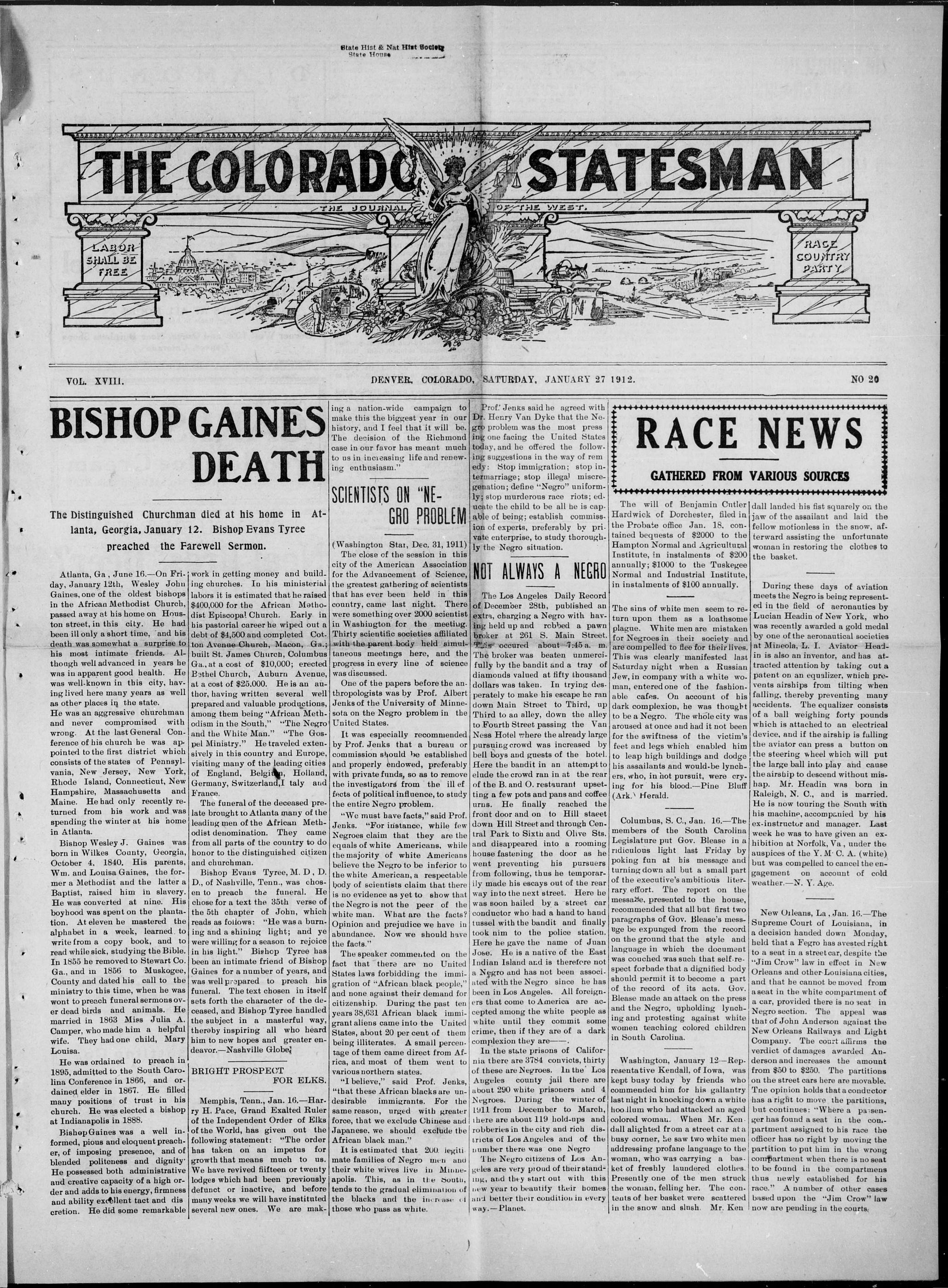
BISHOP GAINES DEATH
The Distinguished Churchman died at his home in Atlanta, Georgia, January 12. Bishop Evans Tyree preached the Farewell Sermon.
VOL. XVIII.
BISHOP
The Distinguished Churchma
lanta, Georgia, January
preached the F
Atlanta, Ga, June 16.—On Friday, January 12th, Wesley John Gaines, one of the oldest bishops in the African Methodist Church, passed away at his home on Houston street, in this city. He had been ill only a short time, and his death was somewhat a surprise to his most intimate friends. Although well advanced in years he was in apparent good health. He was well-known in this city, having lived here many years as well as other places in the state. He was an aggressive churchman and never compromised with wrong. At the last General Conference of his church he was appointed to the first district which consists of the states of Pennsylvania, New Jersey, New York, Rhode Island, Connecticut, New Hampshire, Massachusetts and Maine. He had only recently returned from his work and was spending the winter at his home in Atlanta.
Bishop Wesley J. Gaines was born in Wilkes County, Georgia, October 4, 1840. His parents, Wm. and Louisa Gaines, the former a Methodist and the latter a Baptist, raised him in slavery. He was converted at nine. His boyhood was spent on the plantation. At eleven he mastered the alphabet in a week, learned to write from a copy book, and to read while sick, studying the Bible. In 1855 he removed to Stewart Co. Ga., and in 1856 to Muskogee, County and dated his call to the ministry to this time, when he was wont to preach funeral sermons over dead birds and animals. He married in 1863 Miss Julia A. Camper, who made him a helpful wife. They had one child, Mary Louisa.
He was ordained to preach in 1895, admitted to the South Carolina Conference in 1866, and ordained elder in 1867. He filled many positions of trust in his church. He was elected a bishop at Indianapolis in 1888. Bishop Gaines was a well informed, pious and eloquent preacher, of imposing presence, and of blended politeness and dignity. He possessed both administrative and creative capacity of a high order and adds to his energy, firmness and ability excellent tact and discretion. He did some remarkable
work in getting money and building churches. In his ministerial labors it is estimated that he raised $400,000 for the African Methodist Episcopal Church. Early in his pastorial career he wiped out a debt of $4,500 and completed Cotton Avenue Church, Macon, Ga., built St. James Church, Columbus Ga., at a cost of $10,000; erected Bethel Church, Auburn Avenue, at a cost of $25,000. He is an author, having written several well prepared and valuable productions, among them being "African Methodism in the South," "The Negro and the White Man." "The Gospel Ministry." He traveled extensively in this country and Europe, visiting many of the leading cities of England, Belgium, Holland, Germany, Switzerland, I taly aud France.
The funeral of the deceased prelate brought to Atlanta many of the leading men of the African Methodist denomination. They came from all parts of the country to do honor to the distinguished citizen and churchman.
Bishop Evans Tyree, M. D., D. D., of Nashville, Tenn., was chosen to preach the funeral. He chose for a text the 35th verse of the 5th chapter of John, which reads as follows: "He was a burning and a shining light; and ye were willing for a season to rejoice in his light." Bishop Tyree has been an intimate friend of Bishop Gaines for a number of years, and was well prepared to preach his funeral. The text chosen in itself sets forth the character of the deceased, and Bishop Tyree handled the subject in a masterful way, thereby inspiring all who heard him to new hopes and greater endeavor.—Nashville Globe
BRIGHT PROSPECT
Memphis, Tenn., Jan. 16.—Harry H. Pace, Grand Exalted Ruler of the Independent Order of Elks of the World, has given out the following statement: "The order has taken on an impetus for growth that means much to us. We have revived fifteen or twenty lodges which had been previously defunct or inactive, and before many weeks we will have instituted several new ones. We are mak-
DENVER, COLORADO, SATURDAY, JANUARY 27 1912.
ing a nation-wide campaign to make this the biggest year in our history, and I feel that it will be. The decision of the Richmond case in our favor has meant much to us in increasing life and renewing enthusiasm."
SCIENTISTS ON "NE- GRO PROBLEM
(Washington Star, Dec. 31, 1911) The close of the session in this city of the American Association for the Advancement of Science, the greatest gathering of scientists that has ever been held in this country, came last night. There were something over 2000 scientist in Washington for the meeting. Thirty scientific societies affiliated with the parent body held simultaneous meetings here, and the progress in every line of science was discussed. One of the papers before the anthropologists was by Prof. Albert Jenks of the University of Minnesota on the Negro problem in the United States. It was especially recommended by Prof. Jenks that a bureau or commission should be established and properly endowed, preferably with private funds, so as to remove the investigators from the ill effects of political influence, to study the entire Negro problem.
"We must have facts," said Prof. Jenks. "For instance, while few Negroes claim that they are the equals of white Americans, while the majority of white Americans believe the Negro to be inferior to the white American, a respectable body of scientists claim that there is no evidence as yet to show that the Negro is not the peer of the white man. What are the facts? Opinion and prejudice we have in abundance. Now we should have the facts."
The speaker commented on the fact that there are no United States laws forbidding the immigration of "African black people," and none against their demand for citizenship. During the past ten years 38,631 African black immigrant aliens came into the United States, about 20 per cent of them being illiterates. A small percentage of them came direct from Africa, and most of them went to various northern states.
"I believe," said Prof. Jenks, "that these African blacks are undesirable immigrants. For the same reason, urged with greater force, that we exclude Chinese and Japanese, we should exclude the African black man."
It is estimated that 200 legitimate families of Negro men and their white wives live in Minneapolis. This, as in the South, tends to the gradual elimination of the blacks and the increase of those who pass as white.
)
Prof. Jenks said he agreed with Dr. Henry Van Dyke that the Negro problem was the most pressing one facing the United States today, and he offered the following suggestions in the way of remedy: Stop immigration; stop intermarriage; stop illegal misregenation; define "Negro" uniformly; stop murderous race riots; educate the child to be all he is capable of being; establish commission of experts, preferably by private enterprise, to study thoroughly the Negro situation.
NOT ALWAYS A NEGRO
The Los Angeles Daily Record of December 28th, published an extra, charging a Negro with having held up and robbed a pawn broker at 261 S. Main Street. This occurred about 7:45 a.m. The broker was beaten unmercifully by the bandit and a tray of diamonds valued at fifty thousand dollars was taken. In trying desperately to make his escape he ran down Main Street to Third, up Third to an alley, down the alley to Fourth Street passing the Van Ness Hotel where the already large pursuing crowd was increased by bell boys and guests of the hotel. Here the bandit in an attempt to elude the crowd ran in at the rear of the B. and O. restaurant upsetting a few pots and pans and coffee urns. He finally reached the front door and on to Hill stacet down Hill Street and through Central Park to Sixth and Olive Sts, and disappeared into a rooming house fastening the door as he went preventing his pursuers from following, thus he temporarily made his escays out of the rear way into the next street. Here he was soon hailed by a street car conductor who had a hand to hand tussel with the bandit and finally took nim to the police station. Here he gave the name of Juan Jose. He is a native of the East Indian Island and is therefere not a Negro and has not been associated with the Negro since he has been in Los Angeles. All foreigners that come to America are accepted among the white people as white until they commit some crime, then if they are of a dark complexion they are——.
In the state prisons of California there are 3784 convicts, thirty of these are Negroes. In the Los Angeles county jail there are about 290 white prisoners and 4 Negroes. During the winter of 1911 from December to March, there are about 119 hold-ups and robberies in the city and rich districts of Los Angeles and of the number there was one Negro The Negro citizens of Los Angeles are very proud of their standing, and they start out with this new year to beautify their homes and better their condition in every way. - Planet.
RACE NEWS GATHERED FROM VARIOUS SOURCES
The will of Benjamin Cutler Hardwick of Dorchester, filed in the Probate office Jan. 18, contained bequests of $2000 to the Hampton Normal and Agricultural Institute, in instalments of $200 annually; $1000 to the Tuskegee Normal and Industrial Institute, in instalments of $100 annually.
The sins of white men seem to return upon them as a loathsome plague. White men are mistaken for Negroes in their society and are compelled to flee for their lives. This was clearly manifested last Saturday night when a Russian Jew, in company with a white woman, entered one of the fashionable cafes. On account of his dark complexion, he was thought to be a Negro. The whole city was aroused at once and had it not been for the swiftness of the victim's feet and legs which enabled him to leap high buildings and dodge his assailants and would-be lynchers, who, in hot pursuit, were crying for his blood.—Pine Bluff (Ark.) Herald.
Columbus, S. C., Jan. 16.—The members of the South Carolina Legislature put Gov. Blease in a ridiculous light last Friday by poking fun at his message and turning down all but a small part of the executive's ambitious literary effort. The report on the message, presented to the house, recommended that all but first two paragraphs of Gov. Blease's message be expunged from the record on the ground that the style and language in which the document was couched was such that self-respect forbade that a dignified body should permit it to become a part of the record of its acts. Gov. Blease made an attack on the press and the Negro, upholding lynching and protesting against white women teaching colored children in South Carolina.
Washington, January 12—Representative Kendall, of Iowa, was kept busy today by friends who commended him for his gallantry last night in knocking down a white hooilum who had attacked an aged colored woman. When Mr. Kendall alighted from a street car at a busy corner, he saw two white men addressing profane language to the woman, who was carrying a basket of freshly laundered clothes. Presently one of the men struck the woman, felling her. The contents of her basket were scattered in the snow and slush. Mr. Ken
NO 20
dall landed his fist squarely on the jaw of the assailant and laid the fellow motionless in the snow, afterward assisting the unfortunate woman in restoring the clothes to the basket.
During these days of aviation meets the Negro is being represented in the field of aeronautics by Lucian Headin of New York, who was recently awarded a gold medal by one of the aeronautical societies at Mineola, L. I. Aviator Headin is also an inventor, and has attracted attention by taking out a patent on an equalizer, which prevents airships from tilting when falling, thereby preventing many accidents. The equalizer consists of a ball weighing forty pounds which is attached to an electrical device, and if the airship is falling the aviator can press a button on the steering wheel which will put the large ball into play and cause the airship to descend without mishap. Mr. Headin was born in Raleigh, N. C., and is married. He is now touring the South with his machine, accompanied by his ex-instructor and manager. Last week he was to have given an exhibition at Norfolk, Va., under the auspices of the Y. M. C. A. (white) but was compelled to cancel the engagement on account of cold weather.—N. Y. Age.
New Orleans, La, Jan. 16.—The Supreme Court of Louisiana, in a decision handed down Monday, held that a Fegro has avested right to a seat in a street car, despite the "Jim Crow" law in effect in New Orleans and other Louisiana cities, and that he cannot be moved from a seat in the white compartment of a car, provided there is no seat in Negro section. The appeal was that of John Anderson against the New Orleans Railways and Light Company. The court affirms the verdict of damages awarded Anderson and increases the amount from $50 to $250. The partitions on the street cars here are movable. The opinion holds that a conductor has a right to move the partitions, but continues: "Where a passenger has found a seat in the compartment assigned to his race the officer has no right by moving the partition to put him in the wrong compartment when there is no seat to be found in the compartment thus newly established for his race." A number of other cases based upon the "Jim Crow" law now are pending in the courts.
Painting Which is at Head of East Senate Stairway,Portrays Black Seamen as Cowards.
THEIR BRAVERY RECALLED
REV. REVERDY C. RANSOM TELLS OF PATRIOTISM AND COURAGE OF BLACK SEAMEN IN DAYS GONE BY.
Washington.—Since the mutilation of Powell's "The Battle of Lake Erie," which is regarded as one of the most valuable paintings at the head of the east senate stairway in Washington, many negroes have been heard to declare that the painting has always been an eyesore to intelligent negroes, and that it is looked upon by them as a slander on the negro in the United States navy. Among those sharing such an opinion is the Rev. Reverdy C. Ransom, pastor of Bethel A. M. E. church, who speaks of the painting as follows:
"The Battle of Lake Erie," by W. H. Powell, which was mutilated by an act of vandalism in Washington last week, calls attention to a fact that has long been an offense to many lovers of truth. This painting, described as 'one of the largest and most valuable paintings,' is on the walls of the rotunda of the capitol at Columbus, O., as well as in the east senate stairway at Washington. It has, for a generation, been an eyesore to intelligent negroes. Whatever may be its merits as a work of art, it is a painted life which mistakes the facts of history. This painting represents the white man as standing up in the boat in a bold and fearless attitude while the negro seamen are portrayed as cowering in fear.
"In the summer of 1813 Captain (afterwards Commodore) Perry wrote a letter to Commodore Chauncey, in which he complained that an indifferent lot of men had been sent him. Among other things, he said: 'The men that came by Mr. Champlin are a motley set of blacks, soldiers and boys. I cannot think you saw them before they were selected.' Commodore Chauncey replied in part as follows: 'I regret that you are not pleased with the men sent you by Messrs. Champlain and Forrest, for, to my knowledge, a part of them are not surpassed by any seamen we have in our fleet; and I have yet to learn that the color of the skin, on the cut and trimmings of the coat, can affect a man's qualification or usefulness. I have fifty blacks on board of this ship and many of them are among my best men.'
Crime of Vandalism Not Excused.
"Perry's former prejudice did not prevent him from speaking highly of the bravery and good conduct of the negroes who formed a considerable part of his crew. 'They seemed to be absolutely insensible to danger,' he said.
"Ntthan Shaler, commander of the private-armed schooner 'Gov. Tomkins,' wrote to his agent in New York a letter dated:
"At Sea, January 1, 1813.
"Before I could get our light sails in, and almost before I could turn round, was under the guns, not of a transport, but of a large frigate! . . . Her first broadside killed two men and wounded sx others. The name of one of my poor fellows who was killed ought to be registered in a book of fame and remembered with reverence as long as bravery is considered a virtue. He was a black man by the name of John Johnson. A 24-pound shot struck him in the hip and took away all the lower part of his body. In this state the poor brave fellow lay on deck and several times exclaimed to his shipmates: "Fire away, boys; no haul a color down." The other was also a black man by the name of John Davis, and was struck in much the same way. He fell near me, and several times requested to be thrown overboard, saying he was only in the way of the others."
"Nothing we have said must be construed as excusing or pallating the crime of vandalism. I sincerely hope that the vandal in question will be apprehended and suitably punished. But the fact remains that Powell's 'Battle of Lake Erie' with its terror-stricken negro tars, is an offense to intelligent negroes, and a slander upon the negro in the United States navy."
AFRICANS IN PHILADELPHIA.
Philadelphia, Pa.—Dressed in bright colored shawls and wearing high turbans on their heads, two colored women, genuine Africans, are attracting much attention in the vicinity of Tenth and Lombard streets. Their names are Akwadre Otto, wife of Mensh Otto, of 911 Lombard street, and her sister, Leovadre Cebillah. Aside from their peculiar dress, the faces of both women are badly scarred, which were placed there by their parents, and are called "family marks." The women are from Dahomey, on the west coast of Africa, and arrived in the city on the steamship Merion. The husband is the only one who can speak English, the others merely make a peculiar sound when they converse with each other.
NEGRO STATE FAIR
COST ABOUT $11,000
ACCORDING TO REPORT OF PRESIDENT R. R. WRIGHT OF THE GEORGIA COLORED FAIR ASSOCIATION.
Macon, Ga.—President Wright has just figured out the expense in holding the Colored State Fair at Macon Nov. 8-18. It amounts to $10,980.27. Of this $2,891.06 was given for premiums for agricultural and industrial exhibits. The agricultural exhibits came from about twenty counties and the industrial exhibits from about forty counties. There were exhibits of one kind or another from eighty-three counties. The area from which exhibits came has increased from year to year
The colored people both in agricultural and industrial lines are gradually being awakened to the importance of improving their agricultural and industrial output. In order to interest them the fair association spent for labor $3,448.14 in the employment of about ninety persons throughout the state and at the fair. The employees spent two or three months traveling by railway or private conveyance in order that they might arouse and instruct the people along the lines which the fair association is striving to emphasize. In addition to this the fair put out in advertising paper $715.46, and in newspaper advertising $501.21
The expense for free attractions, decorations, water, taxes and rent, etc., was $2,424.40. The association has up to date been able to meet all of its expenses and pay all of its debts. It has not sought to be a money making affair, but merely an educational enterprise. It brought to the fair association this year some of the ablest colored men and white men in the country such as Dr. John E. White, Judge George Hillyer of Atlanta, Dr. James H. Dillard of New Orleans, Dr. J. D. Hammond of Augusta, United States Register of the Treasurer J. C. Napier and former Register W. T. Vernon. All of these men and others made addresses. In addition to this, there was brought a large and interesting government exhibit representing the most interesting exhibit shown at fairs and expositions by the government. This was the first time in the history of colored fairs that such an exhibit has been sent by the general government and the securing of the exhibit was regarded as a tribute to the reputation of the fair association.
Among the interesting features of the fair was the fact that the Central railroad, through Vice President Winburn and J. F. Jackson, agricultural agent, offered premiums for the best corn exhibits by colored boys in the counties along the Central lines. There were two premiums this year. The $100 premium was won by J. L. Reddick of Bibb county, who raised 112 bushels to the acre, and the boys' prize, a $80 scholarship in the Georgia State Industrial College, was won by Lawrence James of Houston county. Since then clubs have been organized in Putnam, Lee, Polk, Laurens, Taylor, Washington, Upson, Meriwether, Jefferson, Early, Bulloch, Morgan, Bibb, Effingham, Wilkinson, Henry, Screven, Chatham, Randolph, Richmond, Sumter, Emanuel, Dougherty, Terrell and Burke counties. These will take part in the exhibits at the colored state fair next year.
Perhaps among the most interesting agricultural exhibits were those made by M. L. Yopp and E. D. Ashley, who won the premiums offered by the Macon, Dublin and Savannah railway through J. T. Wright, vice president and general manager. The first prize of $75 was won by Moses L. Yopp of Dublin and the second was won by E. D. Ashley of Bullards. Yopp's exhibit from Laurens was unique. His cotton attracted the attention of everyone who visited the fair.
President Wright and his associates in the Colored State Fair are greatly gratified with the aid that has been given them by the Central and Macon, Dublin and Savannah railways. He claims to have been inspired in this by J. F. Jackson, agricultural agent of the Central railroad, who is taking great interest in the corn clubs in the state.
The next fair will likely be held in Macon about the same time next November.
HOWARD IS PRESIDENT OF LIBERIAN REPUBLIC
HE SUCCEEDS ANOTHER NEGRO NAMED BARCLAY IN OFFICE.
Monrovia, Liberia.—Daniel Howard was inaugurated as president of the republic of Liberia, succeeding another negro named Barclay, who for eight years had occupied the office. A procession headed by the members of the legislature, led by the speaker of the senate and the house of representatives, escorted Howard to the chamber of representatives. Here the new president, after taking the oath, read his inaugural address, in which he set forth his ideas on reform and advanced several schemes for the development of the country.
He made special reference to the present political situation of Liberia and its relations to the great powers and said that the uncertainty of the past had given way to the positive assurance that Liberia's integrity would remain intact.
AFRO-AMERICAN CULLINGS
A race without a history is not unlike "the Man Without a Country," whose desolate life Dr. Edward Everett Hale has so graphically pictured in his book of that title. So, a race with no written history—no background, no great characters, no great achievements in war and peace, for hope and inspiration of itself and of its children—is poor indeed. Even savage races, before and since "we have the letters Cadmus gave," one of the most priceless possessions mankind possesses, have invented all sorts of devices to perpetuate the memory of their own existence, and what they said and what they did. From this same sentiment has grown that high and noble characteristic of mankind only among living creatures of reverential care and treatment of the old and infirm of the family, of the tribe, of the nation, and which has given us the soulful maxim, "old men for counsel; young men for war." Standing in the dark shadows after Joab, the Captain of the Host, had finally murdered Abner, King David said: "Know ye not that there is a prince and a great man fallen this day in Israel?" It is natural for great men to appreciate great men. So we as a race sorrowed over the death of Daniel Alexander Payne and of Frederick Douglass; so we as a nation sorrowed over the death of Lincoln, of Sumner and of Grant. In speaking of the great success of the fifth annual Georgia State Fair at Macon, last November, in a personal letter to our Mr. Fortune, President R. R. Wright said, among other things, of the collection of photographs of distinguished negroes, made a feature of the exhibits. "I want to get you to come to our fair next year and speak upon the distinguished men the negro race has produced. We had a great many responses and a great many pictures. It was the first time in the history of negro fairs that three denominations of currency, signed by the four negro registers—Bruce, Lyons, Vernon and Napler—have been exhibited. I feel that this is a step in the direction of calling the world to the prominent men of the race." It is a step in the right direction; there should be more steps taken like it. For instance, we have no history of the reconstruction period from the negro viewpoint, other than that given by George W. Williams in his "History of the Negro Race in America." Senator B. K. Bruce loomed large in that period, which the story of his life would cover. His distinguished son, Prof. R. C. Bruce, may tell it for us some day—New York Age.
It is interesting to note that the white waiters are busying themselves with a petition to the American Federation of Labor asking for recognition as a labor organization. The opinion of the head waiter at Hotel Schenley is worth consideration. He says that the waiters want a wage of $10 per week and a ten per cent commission on all his sales. This, he adds, would relieve the patron of his moral obligation to tip, and at the same time act as a stimulus to the waiter to serve as many patrons as possible and serve them as well as possible. We suggest that negro waiters get awake to this idea, and find some way to organize and join the American Federation, which will welcome them as members and afford them an impartial protection. Gifted as they are with the innate sense of what constitutes service, the negro waiter should easily hold his own in the field of competition. It requires but little effort to secure the needed protection at the hands of the Federation; so let the colored man take the tide while it serves.—Pittsburg Courier.
When some young and thoughtful man comes forward with honest criticism with respect to the business methods in use in many of our churches, instead of crying him down and discouraging all effort in throwing the light upon present methods, those responsible for present methods should be foremost in welcoming the criticism, and in turning on all the light possible, that the sanity and efficiency of their methods may be made thoroughly manifest. When it is contended that the quality of moral and spiritual leadership in those who dominate affairs in our churches and societies is not what it should be no man should be more interested in a full and thorough investigation of affairs than the men serving in such capacities of leadership—Baltimore Afro-American Ledger.
John Arthur Johnson, champion heavyweight of the world, is back in his native land once more, returning recently from Europe, where he appeared with great success in the leading variety houses. The champion is in excellent health and one of the first things he did upon reaching New York was to deny the rumor that he had retired from the ring. Johnson says he has no idea of retiring and is willing to meet all comers, his only stipulation being that he dictate terms as to what end of the purse he is to receive. The champion is in Chicago, where he is spending the holidays with his niece.
The merciless money sharks are devouring their prey in a most greedy way and are putting their victims under a lifetime burden. Our people, mostly those who are ignorant, are falling in the hands of these usury dealers and they are being robbed in an unlimited manner.
Several days ago a negro went to the office of one of these sharks to pay up. He entered the cash on his book and asserted to the negro that he did not give receipts for money and made him understand that hereafter do not ask for any more receipts.
They are loaning their money at 100 per cent. We know of a case where a negro borrowed $15 and paid $15 interest. These traps are set for people of our race and they are getting the money out of them.
We advise the people of our race who are obliged to borrow, borrow from a bank and let the shark alone. They take the advantage of your ignorance and rob you; and as long as you deal with them your nose will be "on the grinding stone," a hewer of wood and a drawer of water.—Palestine Plaindealer.
Gordon Isham, an East Tennessee negro farmer, raised 187 hogs this year which averaged 380 pounds in weight and were the best marketed so far this year at Morristown.
Isham realized $4,618.90 from his hogs at the wholesale price of 6½ cents a pound.
It is safe to bet that negro has no trouble with his white neighbors. It is also safe to bet that he enjoys the respect of every one of them.
A man who raises corn enough to fatten that many hogs hasn't any time to get into trouble. And now that his hogs are marketed he is doubtless busy fixing up his fences, repairing his sheds, caring for his cattle, fertilizing his land and preparing for next year's crops.
He has learned the secret of thrift and happiness. Work has solved the life problem with him, and it lies within the reach of thousands of other negroes to make similar successes if they will but resist the lure of idleness and shiftlessness and devote themselves to a fixed task with a white man's constancy.—Nashville Tennessee.
Fisk University is receiving subscriptions toward a $300,000.00 endowment fund for improvements. No college or institute in America is worthier of support than this school. Long ago it has proved its value to the colored race. The record of Fisk is known throughout the world. It deserves every dollar that will be sent and more.
There are hundreds of graduates in various professions all over this country that have been benefited by Fisk and this would be a splendid time to pay a debt of graduates by sending a mite toward meeting the $300,000. Men of our race, wishing to do something tangible for education and uplift of the race; the training of young men and women for the higher walks of life, could do nothing better than to contribute to this deserving college.
Fisk College believes in the broad education of men and women and puts a premium on the highest development of a student. Again we say, Fisk is worthy of a donation, no matter how small or large. Illinois Chronicle.
A great many people do not have anything to eat today because they ate it all up yesterday. We once owned a beautiful chrome-colored dog that had more sense than his master. That dog was never hungry. The rise in the price of meats never worried him. How did he manage it? Simply enough. He never squandered or threw one away. When he was fed he would eat his fill and then gather up the fragments, dig a small hole in the yard some place and bury them. He knew every place in the yard where his food was buried. When he was hungry and there was nothing doing at the kitchen, he would dig up some of his food and eat it. He would never disturb his reserved food as long as his portion went to him from the kitchen when he wanted it. Prof. Franklin H. Glding, of Columbia university, said in a recent address, that "one of the possibilities of human betterment is that all the people in the world should have enough to eat." Very true; but it will never be until people learn to save the fragments.—New York Age.
No man can be a good leader who is not a good follower. No man who is self-centered, narrow and jealous can ever make a successful leader. There are few men capable of real leadership and it is quite amazing that such a few who aspire to leadership are not cognizant of that fact. "Leaders are born not made." The people choose their leaders and they know the man who is capable of leadership without his labeling himself as such. True leadership is recognized without much stir on the part of him possessed with that great quality and will burst forth despite all of the attempts to crush it out. True leadership cannot be imprisoned.-Charleston (W. Va.) Mountain Leader.
CAPITOL BREWING COMPANY
DRINK CAPITOL BEER
DENVER'S PRIDE
The purity of Capitol Beer is demonstrated by its superior flavor and strength-giving qualities. It's capital.
HAVE A CASE SENT HOME.
The Capitol Brewing Co.
Phone Champa 356.
Delivered Anywhere.
C. H. BECKER,
Dealer in Fuel and Feed
EXPRESS
Cor. 20th Ave. and Lafayette St.
Telephone York 2371. Denver, Colo
WM. WALTON.
COAL, W
Poultry Feed of a
EXPRESS NO 54
22 Downing Street.
FIREPROOF
PALM
T. H.
Newly Built
Hot a
2130 ARAPAHOE ST.
The Charm
Twentieth
Is the
DRUGS, CHEMICALS
WE SEE
Prescription
Phone us and we will del
JAMES E.
PHO
INSURE Y
Against Every
DEAELR IN
AL, WOOD and FEED
Feed of all Kinds. Prompt Delivery.
PRESS NO 547. PHONE YORK 6350.
Street. Denver, C
STEAM HEAT
PALMER HOTEL
T. H. JOHNSON, Proprietor.
Newly Built and Newly Furnished
Hot and Cold Baths
AHOE ST. DENVER, COLO.
Champa Pharmac
Twentieth and Champa,
Is the place to get your
CHEMICALS AND PATENT MEDICINE
WE SERVE HOT DRINKS.
Descriptions Our Specialty.
And we will deliver the goods to all parts of the city.
JAMES E. THRALL, PROPR.
PHONE MAIN 2425.
RE YOUR WAGER
Best Every Accident, Every Sickness
COAL, WOOD and FEED Poultry Feed of all Kinds. Prompt Delivery. EXPRESS NO 547. PHONE YORK 6350. 1922 Downing Street. Denver, Colo
The Champa Pharmacy
Twentieth and Champa,
Is the place to get your
DRUGS, CHEMICALS AND PATENT MEDICINES
WE SERVE HOT DRINKS.
Prescriptions Our Specialty.
Phone us and we will deliver the goods to all parts of the city.
JAMES E. THRALL, PROPR.
PHONE MAIN 2425.
INSURE YOUR WAGES
Against Every Accident, Every Sickness
LIBERAL POLICIES, LIBERAL COMPANY
43 YEARS OLD. $20,000,000.00 ASSETS.
Pacific Mutual
208
Walter Macph
When
THE HEADS, FEET, TA
CHITTERLINGS OR
EXCEPT
East's
Mutual Insurance Co
208 Colorado Bldg.
Pacific Mutual Insurance Co. 208 Colorado Bldg.
Walter Macpherson, District Manager
THE HEADS, FEET, TAILS, SNOUTS, EARS, NECKBONES OR
CHITTERLINGS OR ANY OTHER PART OF THE HOG
EXCEPT THE SQUEAL, GO TO
A Dollar
Kept with the home m
benefit. Business men
this dollar at home and
A Dollar spent at home reacts in its benefits with unceasing general profit. Sent out of town it's life is ended. Kept with the home merchants it is a messenger of continuous benefit. Business men should awake to the importance of keeping this dollar at home and make a bid for it by judicious advertising.
STEAM HEAT
THE COLORADO STATESMAN
JOS. D. D. RIVERS.....Proprietor
1824 Curtis Street, Room 25.
JOS. D. D. RIVERS.....Proprietor
1824 Curtis Street, Room 25.
SUBSCRIPTION RATES:
One Year .....$2.00
Six Months .....1.00
Three Months .....60
PAYABLE IN ADVANCE.
Entered as second-class matter at the postoffice in the city of Denver, Colorado.
All communications of a personating nature that are not complimentary will be withheld from the columns of this paper.
It occasionally happens that papers sent to subscribers are lost or stolen. In case you do not receive any number when due, inform us by postal card and we will cheerfully forward a duplicate of the missing number.
Communications to receive attention must be newsy, upon important subjects, plainly written only upon one side of the paper; must reach us Tuesdays, if possible, anyway, not later than Wednesdays, and bear the signature of the author. No manuscript returned, unless stamps are sent for postage.
Remittances should be made by Express Money Order, Postoffice Money Order, Registered Letter or Bank Draft. Postage stamps will be received the same as cash for the fractional part of a dollar. Only 1-cent and 2-cent stamps taken.
Display advertising, 50 cents per square. A square contains ten agate lines.
Reading notices, ten lines or less, 10 cents per line. Each additional line over ten lines, 5 cents per line.
No discounts allowed on less than three months' contract. Cash must accompany all orders from parties unknown to us. Further particulars on application.
PRESENT A SOLID FRONT.
A house divided against itself ever and wherever we find a man contest which involves our political duty to sink personal difference if need be, and to faithfully stand for which he contends until the vii.
With unconquered prejudice a brains of the late slaveholding class have combined and are persistent fluence, in and out of Congress, to Government, through every remilitary progress and perpetuate his power.
Every scheme, device, fraud, we are being perpetrated to destroy the deny, resist, nullify and cheat him rights and privileges as an American.
It is, therefore, absolutely necessary dissentions and minor differences
sided against itself must surely fail, for we find a man of the race en-
selves our political and civil right, personal differences, ignore that we faithfully stand with closed ranks, ends until the victory is won. We ordered prejudice and subtle maligny, slaveholding class, their sympathies, and are persistently exerting the best of Congress, through every avail-
ough every remification of life, to deterate his poverty and degradation, device, fraud, violence and cool,
related to destroy the legitimate friv-
ry and cheat him of his constitut-
iges as an American citizen.
he, absolutely necessary that we lay
minor differences and present a so-
A house divided against itself must surely fall, therefore whenever and wherever we find a man of the race engaged in an honest contest which involves our political and civil rights, it is our imperative duty to sink personal differences, ignore that man's individuality, if need be, and to faithfully stand with closed ranks by the principles for which he contends until the victory is won.
With unconquered prejudice and subtle malignity the wealth and brains of the late slaveholding class, their sympathizers and henchmen, have combined and are persistently exerting their all-powerful influence, in and out of Congress, through every avenue of the States' Government, through every remification of life, to retard the Negro's progress and perpetuate his poverty and degradation.
Every scheme, device, fraud, violence and cool, calculating murder are being perpetrated to destroy the legitimate fruits of freedom; to deny, resist, nullify and cheat him of his constitutionally guaranteed rights and privileges as an American citizen.
It is, therefore, absolutely necessary that we lay aside our internal dissentions and minor differences and present a solid front.
THE GREATEST PROBLEM
People disagree seriously reg of matters and things engaging the march of civilization; those things by some, being almost entirely ign others, who themselves are absorb portance to them.
It is from an individual or a consider the affairs of life, without mentals upon which continued success. Matters of selfish importance are one than other matters, of wider applitted to attain, because the power for its own enlargement and unmexorable laws of natural adjustment often declared to be the best indicator and the prosperity of many is like fication of the well-being of all, and complicated interests, it is easy good in the advancement of one or others of greater fundamental imp.
Industrialism and commercial tives of governing directorates thru moral and social advancement wification of their younger sisters, longer popular in politics. Those parties powerful or ignominious are.
Labor questions, assuming to a false division of sentiment and political contests. Commercialism labor vote, and lesser social forces division. The pleas of the moralis as are appeals to a wooden Joss.
The greatest problem with whole professing freedom and indivi the country back to its first principle upon the right of every man to "piness."
to see seriously regarding the complex feelings engaging the minds of men; those things considered present most entirely ignored or given but ourselves are absorbed with problems.
of individual or a clannish standpoint of life, without caring to go deep with continued success and happiness; importance are often pushed into obscurity, of wider application and great because the power concentrated belief and unmindful of evil in natural adjustment. The success of one the best indication of the possibility of many is likewise made to appeal well-being of all. So in this free gatherings, it is easy for statesmen to enact of one or more of those in fundamental importance, are neglected and commercialism are the all-around directorates throughout the world; advancement wait upon the recent younger sisters. Social and moral politics. Those which formerly or ignominious are now mere platoons, assuming to fill the gap, are sentiment and cut but a sorry one. Commercialism is powerful endanger social forces dwindle to numbness of the moralist and the sentiments wooden Joss.
A problem with which we have to freedom and individual sovereignty; to its first principles which were on every man to "life, liberty and
People disagree seriously regarding the comparative importance of matters and things engaging the minds of men in the forward march of civilization; those things considered pre-eminent and vital by some, being almost entirely ignored or given but passing notice by others, who themselves are absorbed with problems of far greater importance to them.
It is from an individual or a clannish standpoint that most men consider the affairs of life, without caring to go deep into the fundamentals upon which continued success and happiness must be founded. Matters of selfish importance are often pushed into greater prominence than other matters, of wider application and greater virtue, are permitted to attain, because the power concentrated behind them is greedy for its own enlargement and unmindful of evil influences or the inexorable laws of natural adjustment. The success of the individual is often declared to be the best indication of the possibilities of the many, and the prosperity of many is likewise made to appear as an exemplification of the well-being of all. So in this free government of vast and complicated interests, it is easy for statesmen to see the country's good in the advancement of one or more of those interests even while others of greater fundamental importance, are neglected.
Industrialism and commercialism are the all-absorbing twin motives of governing directorates throughout the world in this age, and moral and social advancement wait upon the recognition and glorification of their younger sisters. Social and moral questions are no longer popular in politics. Those which formerly made political parties powerful or ignominious are now mere platform reminiscences. Labor questions, assuming to fill the gap, are made to create but a false division of sentiment and cut but a sorry figure in all great political contests. Commercialism is powerful enough to divide the labor vote, and lesser social forces dwindle to numbers too small for division. The pleas of the moralist and the sentimentalist are as vain as are appeals to a wooden Joss.
The greatest problem with which we have to contend, as a people professing freedom and individual sovereignty, is how to bring the country back to its first principles which were declared to be based upon the right of every man to "life, liberty and the pursuit of happiness."
Of Lord Tennyson's Brother.
The "high-jinks of the high-nosed" (to use another phrase of his) angered him, as did all persons "who go about with well-cut trousers and ill-arranged ideas."—Athenaeum.
How Virginia Town Got Its Name.
Front Royal is the name of a town in Warren county, Va. At first it bore the title "Royal Oak," because of an immense tree upon its commons. One day the colonel of militia
Iron ores are chiefly oxides, and native iron is almost unknown except in the meteorites occasionally picked up.
---
must surely fall, therefore when of the race engaged in an honest and civil rights, it is our impera-
ses, ignore that man's individuality, with closed ranks by the principles history is won.
and subtle malignity the wealth and their sympathizers and henchmen, only exerting their all-powerful in-
through every avenue of the States' nation of life, to retard the Negro's lay and degradation.
Violence and cool, calculating murder the legitimate fruits of freedom; to of his constitutionally guaranteed an citizen.
Necessary that we lay aside our internal and present a solid front.
According the comparative importance the minds of men in the forward is considered pre-eminent and vitalored or given but passing notice byand with problems of far greater im-
elannish standpoint that most men are caring to go deep into the funda-ness and happiness must be founded. Often pushed into greater prominence location and greater virtue, are per-concentrated behind them is greedy handful of evil influences or the in-
t. The success of the individual ision of the possibilities of the many,wise made to appear as an exempli-
So in this free government of vast for statesmen to see the country’s more of those interests even while importance, are neglected.
Ism are the all-absorbing twin moughout the world in this age, and sit upon the recognition and glori-Social and moral questions are no which formerly made political life now mere platform reminiscences. Fill the gap, are made to create but but but a sorry figure in all great is powerful enough to divide the dwindle to numbers too small for and the sentimentalist are as vain
which we have to contend, as a peo-dual sovereignty, is how to bring males which were declared to be based life, liberty and the pursuit of hap-
How Virginia Town Got Its Name.
Front Royal is the name of a town in Warren county, Va. At first it bore the title "Royal Oak," because of an immense tree upon its commons. One day the colonel of militia became confused while drilling his troops and gave his regiment the queer command, "Front the Royal!" Such is the origin of the modern name given in a bulletin of the geological survey.
E ALL know that the nations of the world are beginning to enter into a change of all things, political, economic and social. The nations must expand and find new territory for their surplus populations because the countries cannot produce enough foodstuffs for their support. The ground which for years has produced a hundredfold is exhausted. The nations seek virgin soil and in doing so will come to blows. Africa will be the theater of future conflicts. Civilization, which is progress in all things, is like a mighty wave that rolls onward all obstacles. It sweeps before
it all that was, mankind, animals and plants, and puts in their stead whatever is needed for its support. We know how progress drove the red man, the beasts of the forest, the trees thereof before its tireless march until they became extinct. The same thing will occur as the plains of Siberia, of South America shall be settled and cultivated. The original inhabitants will disappear. The tents of the Lapps and Patagonians will make room for cities, their feeding and hunting grounds become farms. With them will vanish those wild animals and plants which are now their support.
This must occur in Africa as well. The original inhabitants will be driven farther and farther until with the help of various diseases, which accompany progress, the black race will be no more. The white race will dwell in cities where formerly the Matabele had his hut. Farms will flourish where stood the primeval forest with its animal life.
It may take hundreds of years before this shall be accomplished. Then a mighty hand will call a a halt and progress is at its end. Civilization will have killed itself.
As the physician gives stimulants to his dying patient to prolong life, so will silence come to the help of the exhausted ground, until it becomes utterly unproductive. Progress is dead.
Migration of nations, wars, as of old, will be the rule, the stronger surviving. A new race will inhabit a new earth, which will resemble the old one only in its outlines.
the explorer of wilds is due to the fact that men in such enterprises are brothers and companions of alarms.
The more settled and wealthier portions of civilization are full of email, dried up, spidery souls who have retired on a settled income. They are fatal to life of any kind and particudarly to young life; hence most of the youth emigrate.
They go west. The west is greater than the east because the east is settled and the west is unsettled. In the east are old religions, old customs, old families, old laws and old institutions—all full of rats and fever. In the west is fresh air.
One reason a king cannot be a great soul is because he cannot lose his job. Another reason is that "the king can do no wrong." Take away a man's right to sin and you assassinate his moral character.
It is even better, morally, to be a gambler than to be endowed.
"It is not," says Carl Hilty, "for the needs of luxury that God is to be had, but for daily bread."
sun; and the sturdy cedars that thrive upon the cruel mountain tops—which same may be transported into unwonted luxury with no loss of hardihood. Just such a nature I would seek in the man I marry.
A man who has struggled through vicissitudes, having lost no whit of his smiling nature, who is strong enough to brave any storm of misfortune, keeping ever the beauty of his nature beyond destruction, who has attained a measure of success and who can live in it with no sacrifice of the virility of his manhood.
With such a man marriage would be contentment, and contentment is happiness.
W
mighty wave that it all that was, mankind, an ever is needed for its support the beasts of the forest, the they became extinct. The's of South America shall be tants will disappear. The t room for cities, their feeding them will vanish those wild port. This must occur in Aff driven farther and farther a accompany progress, the bla
Man Living From Hand to Mouth By FRANK CRANE
the explorer of wilds is due brothers and companions of. The more settled and email, dried up, spidery souls are fatal to life of any kind of the youth emigrate. They go west. The w is settled and the west is untoms, old families, old laws a In the west is fresh air. One reason a king cann job. Another reason is that man's right to sin and you a It is even better, morall "It is not," says Carl to be had, but for daily brea
Man Who Keeps on Smiling By JANE L. RUSSELL
sun; and the sturdy cedars which same may be transpor dihood. Just such a nature. A man who has struggle his smiling nature, who is tune, keeping ever the beau attained a measure of success the virility of his manhood. With such a man marr is happiness.
Horses Turn Heads to Cold Winds By E. W. WOODS
---
End of Progress Is Seen in Years to Come
By T. RAYLE RUCE
that the nations of the range of all things, possessions must expand and the nations because the stuffs for their support produced a hundredfold in oil and in doing so weater of future conflict, which is progress that rolls onward all of animals and plants, and support. We know how proper the trees thereof before the same thing will occur the settled and cultivated tents of the Lapps a living and hunting growth of animals and plants.
Africa as well. The order until with the help black race will be no min cities where form Farms will flourish with its animal life. It may take hundreds accomplished. Then aid and progress is atilled itself. Is the physician given to prolong life, so we exhausted ground, active. Progress is defiigration of nations, male, the stronger surfait a new earth, which in its outlines.
In the nations of the world are beginning to take of all things, political, economic and social. Must expand and find new territory for their homes because the countries cannot produce for their support. The ground which for a hundredfold is exhausted. The nations and in doing so will come to blows. Africa of future conflicts.
which is progress in all things, is like a rolls onward all obstacles. It sweeps before animals and plants, and puts in their stead what-
We know how progress drove the red man, trees thereof before its tireless march until one thing will occur as the plains of Siberia, settled and cultivated. The original inhabitants of the Lapps and Patagonians will make and hunting grounds become farms. With animals and plants which are now their supraca as well. The original inhabitants will be until with the help of various diseases, which race will be no more. The white race will cities where formerly the Matabele had his arms will flourish where stood the primeval rush its animal life.
May take hundreds of years before this shall be published. Then a mighty hand will call a bad progress is at its end. Civilization will end itself.
One physician gives stimulants to his dying prolong life, so will silence come to the help strausted ground, until it becomes utterly unuse. Progress is dead.
ation of nations, wars, as of old, will be the stronger surviving. A new race will new earth, which will resemble the old ones outlines.
People are inclined to complain a good deal over the precariousness of life. We hate to live from hand to mouth. Yet it is precisely from this element of our earthly career that our noblest qualities come.
Endow a man so that he never has to worry about money, remove him from all temptations, insure him against ever falling ill and his soul will shrivel up like a bean.
The strong, free, sweet souls are those who every day are stepping out into the dark.
All that manly charm which plays like a halo around the soldier, the cowboy and
due to the fact that no of alarms.
and wealthier portions of souls who have retired and particudarly
the west is greater than unsettled. In the east is old institutions-
cannot be a great soul is that "the king can do a assassinate his morally, to be a gambler or Hilty, "for the new read."
to the fact that men in such enterprises arealarms. healthier portions of civilization are full ofwho have retired on a settled income. Theyand particudarly to young life; hence mostit is greater than the east because the easttitled. In the east are old religions, oldcusd old institutions—all full of rats and fever.
to be a great soul is because he cannot lose his"the king can do no wrong." Take away aassinate his moral character. to be a gambler than to be endowed. Hilty, "for the needs of luxury that God is."
There are husbands and husbands. And, like any other plant in the universe, each one thrives as his particular nature responds to his environment. "The well-fed man—" speaking in the broader sense of the term, or the comfortable man, is a mere hothouse plant that blooms and looks pleasant amid the warmth and beauty of a conservatory, and when set in the open degenerates into only a suggestion of its former bloom.
Let me hunt for the wind berries that hold their heads above the snow; the blossoms that brave the winds and storms and
ars that thrive upon it exported into unwonted there I would seek in the angled through vicissitus strong enough to be beauty of his nature be access and who can live id. marriage would be cont
that thrive upon the cruel mountain tops—
led into unwonted luxury with no loss of hard
I would seek in the man I marry.
through vicissitudes, having lost no whit of
strong enough to brave any storm of misforty
of his nature beyond destruction, who has
and who can live in it with no sacrifice of
age would be contentment, and contentment
I have noticed that horses when they
are compelled to remain in the open cold
turn their heads to the wind, and it seem
to me that they stand in this way because
they thus present the least heat surface o
their body to the cold.
And also in this attitude they secure the greatest possible natural protection from their hairy coats, inasmuch as the wind forces the individual hairs more closely against the body.
If this looks reasonable to teamster they should turn their horses' heads to the cold wind every time possible.
---
Helen's Independence
Helen looked up at the conductor with a flushed face. "I'm sorry," she said, "but I'm afraid that I have no money."
"I guess you can find it if you have to," he snorted as he passed on. "Look again—and hurry up."
He went out on the rear platform for a moment, but soon he followed another incoming passenger up the aisle.
"I really can't find a single coin," said Helen, looking up from her disordered purse.
"That's all right," was the more gracious response. "A gent out on the platform staked you."
"Was it that man in the soft hat?" she asked as she caught sight of Harvey Tennant trying to look unconcerned.
"Sure thing," he assented. "Shall I send him in?"
"I do not care to be under obligations to the gentleman," she said coldly. "Please stop the car."
It was intolerable that after last night Harvey should presume to pay her car fare. Had it been a total stranger she would have been grateful, but a man who only the night before had assured her that she could not get along without him! She would show him that she could, and she swept off the car with a majestic dignity that caused Tennant to smile. "Look here, Nell," he protested as he followed her to the sidewalk, "you must not be here alone. It is one of the toughest districts in town."
"So I judge from its inhabitants," she said with a meaning glance at him. "It seems that they take pleasure in annoying unprotected women."
"That's just the trouble," he said placidly, though his face reddened. "Don't be foolish. Let me lend you a nickel. You can send it back tonight. It is only what I would do for any woman in the same fix."
"I do not have to trespass upon your chivalry," she declared, with a scornful accent upon the last word. "I am amply able to take care of myself."
"I believe*we discussed that to no purpose last night," he said coldly. "I adhere to my original opinion."
"And I to mine," she sniffed, as she began to walk on. Harvey dropped back a few paces and followed her. The dozen blocks bordering the freight yards bore a most unsavory reputation. No gently-bred woman was safe from insult.
And just because he had ventured to criticise her boldness in venturing out alone on her charity visits she had broken their engagement the night before with the scornful statement that she was amply able to take care of herself and would have naught of a husband who already showed such a disposition to bully.
He did not have long to wait for his revenge. On the next block a crowd of half-drunken loafers reeled from a saloon. Helen shrank to the edge of the sidewalk and by her very precaution attracted their attention.
“There's me mussis,” shouted one as he lurched toward her. “Como here, me dear, and let hubby have a few coins for his beer.”
As he staggered toward her Helen raised her hands to ward him off, and in doing so dropped her bundles. With a wild yell the rest of the crowd drove after the parcels just as Harvey dashed up.
A few well-directed kicks scattered the crowd, but the first speaker was less easily disposed of. The idea that Helen was his wife had entered his drunken brain and refused to be dislodged and he made an attempt to clasp her in his arms while demanding of the new comer why he should seek to separate a loving pair.
Harvey's answer was a blow that sent him sprawling, but he scrambled to his feet in an instant and staggered toward his assailant, waving a cotton hook that had dangled from his belt.
With a scream Helen sought to throw herself between the two men, but Harvey thrust her quickly aside. The man in his drunken insanity would make no distinction and it was a fight man to man. He had had some experience on the mat. Had been the wrestling champion of his club for two seasons, and he maneuvered for an opening. It was no easy matter for he had seen fights among the longshoremen and know that a cotton hook was far more dangerous than a knife. It was some time before he could find his opening, but at last he closed in with a rush, pinioning his adversary's arms close to his side. After that the fight was a short one. Once at a disadvantage the rough collapsed and through a sudden turn of his thoughts became lachrymose. Harvey tearfully lamenting the loss of his wife while he assisted Helen to regain such bundles as had been left her.
"I presume that you will not refuse car fare now," he said as he straightened out his overcoat.
"Don't you think we could have a cab?" she suggested, "because you see, Harvey—we can hold hands in a cab."
Contemptible.
"They say he failed for $50,000." "Well, he always was a fellow that would do almost anything for a little money. I wouldn't think of fallin' for as little as that."
WERE STARS
75
We're not singing in the cho
orus in the Overcoat business.
We feature them as "Headliners" this season.
Our trade connections and our facilities are such that we can claim, in all good faith, to give better values than any other shop in this city.
You will readily convince yourself by comparison.
A 1-4 Off
On Suits and Overcoats should certainly be an inducement that you can't afford to let pass.
GREAT REDUCTIONS IN ALL OTHER LINES.
THE Johnson-Noel CO
1005 SIXTEENTH STREET
MRS. DAVIS' Wonderful French Hair Grower.
It will grow hair on bald heads and bare temples. Do you want your hair to grow beautiful. Have you any scalp diseases? Itching, tetter, eczema, dandruff, falling hair or dead looking hair. If so this hair dressing cures any disease of the scalp and increases the growth of the hair. It will look healthier and glossier. You will be surprised to see the result in one week's use.
PRICE 50 CENTS PER JAR
Send Money Order to MRS.
LUCIE DAVIS, Sole Manufacturer.
PHONE MAIN 5371
KORTZ JEWELRY & C. L. CO.
A. L. KORTZ
WALTHAM
ONE SIZE
Watchmaker and Jeweler
WATCH REPAIRING A SPECIALTY.
ALL WORK GUARANTEED.
903 15th St., Denver, Colo.
A. W. Lewis
Attorney and
Counselor at Law
1941 Arapahoe St.
DENVER, COLORADO
J. H. BIGGINS
Furniture Repairing and Upholstering. All work Cash.
PHONE MAIN 4610
2231 Washington St. Denver
Mrs. Mary Brown, 2815 Arapahoe street, is very ill.
Mrs. Francis Turner, 1863 Curtis, is able to sit up.
Mrs. E. Williams of 1868 Marion street remains quite ill.
Mrs. Ed Banks, who was sick last week, is able to be out.
tist church will preach. A. E Reynolds, pastor, Daniel Rease, secretary
Those who did not put in their appearance at Dania hall on Tuesday evening last, on the occasion of the second annual entertainment of Press Lodge, No. 12, K. of P., missed treat that they may never have an opportunity of getting again. The hat was very tastily decorated and the success attending this event reflected
Mrs. Lizzie Carter, 2256 Cleveland place, remains seriously ill.
I. T. Fullbright, 1013 Zuni street, has a son suffering with blood poisoning.
Mrs. Nora Fairbanks and son, Victor, left Wednesday on a business trip to Chicago.
Mrs. Eliza Holley left last Wednesday to visit her daughter, Cora, in Cheyenne, Wyo.
T. B. Perkins left Thursday for California for his health. He was accompanied by his wife, Madame Perkins.
Mrs. Panzy Nelson, 2121 Arapaheo street, suffered severely this week, necessitating the services of a physician.
Mr. A. W. Collier's hand is much improved and his physician is hopeful of saving that necessary limb for future use.
The little daughter of Mr. and Mrs. Gaskins, 1904 Marion street, has been quite sick, but is much improved at this writing.
Joseph Lewis of Arizona was assisted this week by the Sunshine Club. Mr. Lewis, who is ill, was en route to his home in Hannibal, Mo.
Mrs. May Smith and son James of 2358 Tremont place left Friday for Los Angeles, C.L., where she will join her husband, James F. Smith.
The semi-annual password for the Knights of Pythias is now in the possession of Grand Chancellor Westbrook, and all lodges square on the books are entitled to same.
Mrs. Anna E. Bailey of 2803 Lawrence street, the mother of Mrs. E. L. Wright, was stricken with a stroke of apoplexy last Sunday and is very low.
The Building Laborers' Union No. 1 will give a grand opening at the Eureka hall, 2233-35 Arapahoe street Monday evening, February 5th. The public is invited. Good music.
There will be a chitterling and fish and chicken supper given every Saturday night, while chitterlings are in season at the residence of Mrs. J. J. Brown, 2803 Arapahoe street. The public invited. Phone Champa 2013.
Ed Banks has been sick, threatened with pneumonia.
Rocky Mountain Athletic Association will give their second annual entertainment at Eureka hall, 2235 Arapahoe street, Monday, February 12th. Ben Goodman's orchestra will furnish the music.
Mr. John Scott, 2100 Arapahoe, met with an accident at the stock yards, where he was employed, by a horse stepping on and seriously injuring his foot, which may require time for him to fully recover from the accident.
R. T. Talbert of 1659 Lafayette street, who has been employed at the Union Depot for a number of years, has secured the possession of the boot-black stand at the depot, through the courtesy of Mr. Vick Roy.
Mrs. A. S. Hamilton, who was called to Houston, Texas, last week on account of the serious illness of her mother, arrived just a few hours before her mother's death, who died Friday, January 19th. Mrs. Hamilton will return home in a few days.
The Free Will Club of Bethlehem Baptist church will hold its grand dollar rally, Sunday afternoon at 3 o'clock at Bethlehem, 2716 Larimer street. Everybody cordially invited. Rev. A. D. Williams of Central Bap-
tist church will preach. A. E Reynolds, pastor, Daniel Rease, secretary.
Those who did not put in their appearance at Dania hall on Tuesday evening last, on the occasion of the second annual entertainment of Progress Lodge, No. 12, K. of P., missed a treat that they may never have an opportunity of getting again. The hall was very tastily decorated and the success attending this event reflects the highest credit upon the management which consisted of the officers and members of the above lodge. The music was delightful, the same comparing very favorably with the fine gowns of the ladies, who tripped the light fantastic till the wee sma' hours of the morning. The Colorado Statesman wishes long life for the lodge and continued success for future events.
Lawyer Townsend is a successful lawyer. He practices in all of the courts. This week he defended two cases in the United States court, won his cases and was highly complimented by the judge of that court for the shrewd manner in which he conducted the cases, in the West Side criminal court. Lawyer Townsend defended a colored woman charged with robbing a white man. He cleared his client and he also cleared a man from the charge of non support (penitentiary offense) Thursday. Ability will win and if a colored lawyer should have the business of the colored people when he shows that he is competent as Lawyer Townsend has shown since he located in our city.
The literary work of the Self Improvement Club this year is a study of English literature. The drama is the subject of the program Monday, January 29.
The Earliest or Pre-Elizabethan Drama ..... Mrs. Cora Jackson. Shakespeare ..... Miss Ida Cox. Drama of the Nineteenth and Twentieth Centuries ..... Mrs. Alice Webb. Technique of the Drama .....
Mrs. Georgia Contee
Melodrama ..... Mrs. Eva Tompkins
The Opera ..... Mrs. Eliza Dishman
Best Known Modern Playwrights...
Mrs. Hattie Williams.
Best Known Modern Actors...
Mrs. Mildred Abernathy.
Best Known Modern Actresses...
Mrs. Lizzie De Neal
THE ALLIANCE NOTES AND COM
MENTS.
The following program is arranged
for Sunday afternoon, Jan. 28th. This
is the last of the bi-monthly meetings
of the present month and the program
carries as a feature the fourth paper
of the Historical Research series.
1. Current Literature and Comment.
2. Instrumental Selection .....
..... Mrs. Minnie Hayes.
3. Select Reading .....
..... Miss Elsie von Dickersohn.
4. Teenor Solo ... Mr. P. W. Webster.
5. Paper—"The Negro as Shown in
Biblical History." .....
..... Mrs. Maud Kerr, Essayist.
ANNOUNCEMENTS General Discussion.
The alliance wishes to put emphasis upon the announcement that on Feb. 4th will occur a joint debate which carries much weight and is of importance to the people of this community and the whole race. The debaters are both speaking from conviction and upon a subject which they believe of vital importance.
Resolved: That a lack of political liberty is a more fundamental evil than industrial inefficiency of our economic needs.
Affirmative, C. W. Buford.
Negative, C. A. Franklin.
The subject matter is certainly timely and vital. The speakers are, both of them, well nown in the community for public activity and platform ability. Each in his own way commands attention and each usually gets a hearing and convince someone of the righteousness of their pleadings. What they will have to say will be worth your while. Each speaker will be allowed 30 minutes in which to present his side, divided as they may mutually agree and when it is over—well—come and hear and see for yourself
Brickler's New Barber Shop is located at 2208 Larmer street. Shave, 10c. Hair Cut, 25c; Children, 15c.
Two nicely modern furnished rooms for rent at 2803 Lawrence street. Phone Champa 1339.
Five-room house for rent, 320 24th street. Apply at 1824 Curtis street, Room 25.
STAG PARTY.
At Dania hall on the 20th the young men of the city gave a stag party, which brought together about one hundred of our men for a social evening, which was pleasantly spent with wit, singing and speech making. A bountiful repast was served, which consisted of all the delicacies of the season. It was indeed surprising to see so many men together enjoying themselves as they did with out one discordant word or anything to occur to mar the pleasure of the party. The promoters of the party deserve much credit for the success of the party and its good management.
THE COLORADO STATESMAN ON
THE LOOKOUT.
While everything is rising, and the cost of living is soaring, The Colorado Statesman has been in search of a place where the consumers can purchase groceries of every description at wholesale prices, and at last it found the ideal place. The Consumers' Wholesale House, corner Sixteenth and Blake streets is the place. The proprietor, Mr. Bon I. Look has been in business on that corner for twenty years and his sympathy for the middle classes causes him to assist them by placing his goods at their disposal at wholesale prices.
The Colorado Statesman cannot remedy the conditions, but it can and will keep an eye on every place where our readers can purchase groceries for a reasonable price.
SCOTT'S CHURCH NOTES.
A cordial invitation is extended to all cold members of Scott's to attend the revival services now in progress at Scott's. Two happy souls are rejoicing in the God of their salvation. One is a convert and the other is a reclaimed one. Let the prayers of the Christians go up unceasingly for the enemies of the Cross.
Pastor Wallace, assisted by the Holy Spirit, is conducting the meetings. Truly the church is being revived. The clubs who worked so valiantly for the success of the recent rally have been pressed into the service. The captains are captains of salvation. We invite all Christians to "come over in Macedonia and help us."
Several names of loved ones were handed in last Sunday night for prayer. We are praying for the ones who handed the names in as well as those whose names appear on the cards. Let those who wish their friends saved come into the meetings and help save them.
Mrs. Wallace and the children arrived home safe and sound, but much tired and fatigued. All the trains were late and this caused them not to arrive home until 9:30 p.m. Friday night. She sends her best regards to all inquiring friends.
Subjects for Sunday are: "Influence Example," "Having your conversation honest among the Gentiles; that whereas they speak against you as evil doers, they may by your good works which they shall behold, glorify God in the day of visitation. 1 Peter 2:12. Sunday evening: The Faith That Saves," "Sirs, what shall I do to be saved? And they said, believe on the Lord Jesus Christ, and thou shalt be saved." Acts 16:30, 31. You should bear these subjects. They will do your soul good.
The little Junior choir filled the choir stand Sunday morning. Mrs. Mary L. Hicks directed the children in the absence of Mrs. Florstein Dooley. They are making heavenly music. You should hear them sing.
Mrs. Anna B. Dawson is on the sick list this week. She is suffering with la grippe.
Sunday afternoon our members and friends are requested to attend the Quarterly meeting at Campbell's A. M. E. church. The pastor has been invited to deliver the sacramental sermon.
Mrs. Onie Wallace, the pastor's mother will keep house after the first of the month. At this time the regular weekly ladies societies will resume meeting at the parsonage.
FRIENDS ALL WANT IT.
Mrs. D. B. Simmons of Silex, Ark., writes: "I tried one bottle of Ford's Hair Pomade and found it to be the best preparation I have ever used. It stopped my hair from falling out and breaking off and my hair is now as soft as it can be and is longer than it has been for a long time. My friends all want it.
Ford's Hair Pomade, the old, reliable dressing for stubborn, curly hair makes harsh hair more pliable, glossy and easy to comb. Try it and Ford's Royal White Skin Lotion, for the complexion. For sale by druggists, accept no other, see that it is Ford's and manufactured by the Ozonized Ox Marrow Company, Chicago, Ill.
Knew What He Wanted.
A certain small Chicago boy perpetually begged for coffee, and an elderly friend advised his reluctant mother to quench his desire for the forbidden beverage by giving him coffee at will—but strong, black, and without cream of sugar. "How do like coffee?" the child was asked, when this suggestion had been obeyed. "It would be first rate if it had cream and sugar in it," the knowing little shaver replied.
The Book Said So.
The geography class was in session. One small pupil astonished the class by stating that in a certain section of South America there were talking monkeys. When the teacher questioned the statement the youngster opened his geography and triumphantly read: "This region is inhabited by a species of monkey; properly speaking, apes."—The Delineator.
Interesting to Astronomers
No way has been yet found in which the sun's corona with its unknown gases may be properly studied except during a total eclipse. The wonderful halo that the sun wears is one of the most interesting objects in the heavens to astronomers, and it is important to know all that can be known about these strange lights that shoot out millions of miles beyond the sun.
HAIR POMADE
MAKES HARSH, KINNY OR CURLY HAIR
GLOSSY, SOFTER AND PLIABLE,
EASY TO GMB AND PUP UP IN ANY STYLE
THE LENGTH WILL PERMIT UNEXCEELED
FOR PREVENTING HAIR FROM FALLING OUT DANORF AND TICHING
OF SCALE BEWARE OF IMITATIONS, GET THE GENUINE. UP IN 25* AND 50* BOTTLES WITH CHARLES FORD'S NAME ON EVERY PACKAGE
TRY FORD'S ROYAL WHITE
SKIN LOTION FOR THE COMPLEXION.
MAKES THE SKIN WHITER IMEDIATELY
UPON APPLICATION. WILL NOT IRRITATE
THE MOST DELICATE SKIN. UNEXCEELED
FOR ECZEMA, SALT RHEUM, PIMPLES,
ROUGH SKIN AND FRECKLES.
SOLD BY DRUGGISTS. IF YOUR DRUGGIST CANNOT
SUPPLY YOU, WE WILL SEND IT TO YOU DIRECT AT
THE FOLLOWING Prices, SMALL SIZED BOTTLE, 25* LARGE BOTTLE,
50% THE OZONIZED OX MARROW CO.
232 LAKE ST. DO. GA. CHICAGO, ILL
GENTS WANTED
Your Printing
If it is worth doing at all, it's worth doing well.
First classwork at all times is our motto.
Let us figure with you on your next job.
THE TISHLER TAILORING ESTABLISHMENT
1031 17TH ST.
Room 1, Iron Building
Denver, Colo.
Counting Your Money
will occupy your entire time when you become a regular advertiser in THIS PAPER. Unless you have an antipathy for labor of this kind, call us up and we'll be glad to come and talk over our proposition.
GRAND OPENING
EUREKA HALL
The first entertainment hall erected by colored people in Denver
-WILL TAKE PLACE
Saturday, February 5
5 ARAPAHOE STREET
Spices of the Building Laborer's Union No. 1
and a brand new, spring floor, smooth management means to make this hall Denver invited to be present.
Drugs and Medicines
GO TO
MEYER'S
Reading East Side Druggist
Phones: York 462, York
es. We deliver anything, any time, any place.
REPAIRING
1023 EIGHTEENTH ST.
equipped Outfit in the West to Produce the Good
.60c 75c, $1.00
.50c 65c, 75c
.25c, 35c, 50c
.50c
.15c to 25c
.15c to 25c
Oak Lether.
Resolving from heel to heel, ent new bottom and heel ... $1.5
SHOES MADE TO ORDER.
Tailor Made ... WE CAN FIT ANY KIND OF DEFORMED FOOT.
PAIRING WHILE YOU WAIT
R CAMBERS
1023
Eighteenth
Through Sleeping
Car Service
By Way of
MEYER & RIO GRANDE RAILROAD
Monday, February 5
AT 2235 ARAPAHOE STREET Under the Auspices of the Building Laborer's Union No.1
Goo music and a brand new, spring floor, smooth as glass. The management means to make this hall Denver's choice. You are invited to be present.
For Drugs and Medicines GO TO
The Leading East Side Druggist
2601 Humboldt Street Phones: York 462, York 481
Order by Phones. We deliver anything, any time, any place.
SHOE REPAIRING
THE SEWING MACHINE
WALTER CAMBERS
New Through Sleeping Car Service
THE DENVER & RIO GRANDE RAILROAD
"The Scenic Line of the World."
January 28, 1912, the Denver & Rio Grande will resume car service via the BURLINGTON ROUTE and INES.
Man and Tourist Sleeping Cars are now operated Omaha, Kansas City, St. Louis, San Francisco and Rio Grande and following connections:
Effective January 28, 1912, the Denver & Rio Grande will resume through sleeping car service via the BURLINGTON ROUTE and ROCK ISLAND LINES.
Through Pullman and Tourist Sleeping Cars are now operated between Chicago, Omaha, Kansas City, St. Louis, San Francisco and Los Angeles via Rio Grande and following connections:
---
Effective January 28, 19
through sleeping car servi
ROCK ISLAND LINES.
Through Pullman and
between Chicago, Omaha, K
Los Angeles via Rio Grande
BOYAL, GOOSE
BROOKLYN, NEW
DENVER
AND
BED ORANGE
RAILROAD
1023
Eighteenth St.
eping
RAILROAD
de will resume
ROUTE and
now operated
Francisco and
WESTERN CONNECTIONS
Western Pacific Railway
San Pedro, Los Angeles and Salt
Lake Railroad
Southern Pacific
EASTERN CONNECTIONS
Missouri Pacific Railway
Rock Island Lines
Burlington Route
EASTERN CONNECTIONS
Missouri Pacific Railway
Rock Island Lines
Burlington Route
For reservations and full particulars inquire of LOCAL RIO GRANDE AGENT or Frank A. Wadleigh, General Passenger Agent, Denver, Colo.
By Way of
The
CIVIL WAR
FIFTY YEARS AGO
THIS WEEK
January 21, 1862.
The Union reconnoisance in force by General McClernand in the direction of Columbus, Kentucky, returned to Cairo. The expedition, consisting of nearly five thousand men, left Cairo ten days ago and penetrated to a point within a mile and a half of the Confederate defenses about Columbus. The Confederates, seeing the enemy in such force, expected and prepared for an attack. The Union force withdrew, after ascertaining the position, extent and strength of the Confederate defenses. The expedition resulted in the acquisition of valuable information concerning roads that were not marked on the maps in the possession of the Federal officers, as well as a knowledge of the Confederate position.
Adjutant-General Harding reported the number of citizens of Missouri that had enlisted in the Union army for three years at 33,882. Lieutenant Ammen, commanding the United States gunboat Seneca, reported to Commodore Dupont that the negroes in the neighborhood of Port Royal, South Carolina, which was in the hands of the Federal army and navy, were anxious to be furnished with guns.
January 22, 1862.
The Memphis Argus published the following: "We are every day called upon to publish the farcical freaks of the Federal legislation which transpire in the Lincoln congress, as a part of the extraordinary history of the times. . . . We notice . . . a bill which one Mr. Hutchins, of Ohio, has announced he will soon introduce into the lower house of that august body. The measure very humanely proposes that the enlightened and Christian north shall assume complete control over the ignorant and barbarous south, reducing all her states to the condition of a territorial or provincial government, and then immediately abolish slavery within their limits. . . . But, happily for the south, the issue is not now one of legislation, but of the sword, not of the ballot, but of the bayonet."
Marble Nash Taylor, loyal provisional governor of North Carolina, made the arrival of General Burnside an occasion to issue a proclamation from Hatteras, North Carolina, congratulating the people of the state on their deliverance from thraldom by the "invincible arms of the republic," calling upon them to co-operate with the army in restoring their rights, so recently lost, and appointing the 22d of February as the day on which the ordinances of the provisional convention of November 18 should be submitted to the people for ratification. He also called for an election of United States congressmen for the same day, to fill the vacancies then existing in the representation of North Carolina in that body.
January 23, 1862.
Major-General Halleck, commanding the department of the Missouri, threw into jail citizens of St. Louis who endeavored, by legal process, to escape his general order No. 24, under which sympathizers of the south were obliged to pay assessments for the benefit of the southwestern fugitives. Samuel Engler, a prominent merchant, refusing to pay his assessment, suffered a seizure of his property to the extent of his assessment and a penalty of twenty-five per cent added. Upon an attempt to recover the property by replevin, both he and his attorney were seized and thrown into the military prison, and subsequently expelled the Union lines, with orders not to return without special permission. General Halleck justified his action under the plea of martial law.
A force of one hundred Confederate cavalry entered Blandville, Kentucky, and carried off the books and records of the county. The captain of the band assured the citizens that any who had suffered at the hands of the Union soldiers or who should be made to suffer, would be reimbursed out of levies on Union sympathizers. The Confederate steamer Calhoum was captured off the southwest pass of the Mississippi river by one of the blockading squadron. The Confederates deserted the vessel after firing her, but the fire was extinguished by the Union sailors and the steamer taken off. A stone fleet was sunk by the Federals in the channels of Charlestown harbor to further block the entrances to the port.
January 24. 1862.
A large meeting in honor of the late General Zollicoffer, killed in the battle at Mill Springs, Ky., on January 19, was held in the St. Charles hotel, New Orleans. The following resolutions were adopted: "Resolved, that we have received the intelligence of the death of General Felix K. Zollicoffer, with feelings of the profoundest sorrow, and lament his untimely end as an irreparable loss to the cause for which he heroically gave his life. In private life, or in discharging his public duties, we always found him an incorruptible patrol. Cool and collected amdist troubles, he was unfaltering in the execution of his purpose. No man, since General Andrew Jackson, enjoyed, so completely, the con-
fidence and undivided esteem of the people of Tennessee.
"Resolved, That we mourn his death as a great public loss, which is only relieved by the recollection that he fell fighting bravely at the head of his column, against the invaders of his country."
Two blockade runners, endeavoring to run the blockade off Pas a l'Outre, at the mouth of the Mississippi, went ashore and were burned by their crews, who escaped. The schooners were laden with cotton.
The Union light boat stationed near the middle ground at the entrance to the Chesapeake, broke from its moorings and went ashore at Pleasure House Beach, near Cape Henry. The vessel and crew fell into the hands of the Confederates.
January 25. 1862.
William H. Seward, secretary of state for the United States, issued an order to the marshal of the District of Columbia directing him "not to receive into custody any persons claimed to be held to service or labor within the District, or elsewhere, and not charged with any crime or misdemeanor, unless upon arrest or commitment, pursuant to law, as fugitives from such labor or service," and "not to retain any such fugitives in custody beyond a period of thirty days from their arrest and commitment, unless by special order of competent civil authority." The order was to be enforced ten days after its issuance, and had no relation to arrests made by military authority.
Governor Pierpont declared vacant all the civil offices on the eastern shore of Virginia, beyond the Chesapeake, recently occupied by a Federal force, and the commanding general of the force issued orders for an election of such officers.
The Confederate prisoners taken with the capture of Hatteras Inlet, North Carolina, who had been released on parole after a period of confinement in Fort Warren, Boston harbor, were released from their parole, having been exchanged for a like number of Union prisoners.
Henry S. Foote of Mississippi offered peace resolutions in the Confederate congress at Richmond.
January 26, 1862.
General Halleck issued an order commanding the president and officers of the St. Louis Chamber of Commerce, private organization of business men, to take the oath of allegiance to the United States. If any one of them shall have failed to do so within ten days, his office shall be declared vacated, and any attempt on his part to perform its functions will subject him to arrest for contempt and punishment according to the laws of war," was the import of the threat contained in the order.
Fifteen thousand men paraded the streets of New Orleans in celebration of the first anniversary of the Independence of Louisiana, the state having seceeded on January 26, 1861. The parade was followed by a banquet in the St. Charles hotel, at which the governor and high state officials were present.
A reconnoisance of two Federal regiments and a company of cavalry from Camp George Wood, near Munfordville, Ky., developed the presence of Gen. Hindman's Confederate brigade three miles beyond Horse Cave. The railroad track was found destroyed in places to a point within four miles of the Federal position, the roads were barricaded with trees felled by the Confederates, and the reservoirs in the countryside were reeking with the stench of dead horses and hogs and cattle the Confederates had killed, in their program of making the Union advance as difficult as possible.
January 27, 1862.
The Reverend Bishop Ames of the Methodist Episcopal church, and Hamilton Fish of New York where appointed by the president as commissioners to visit the Confederate prisons and tend to the necessities and wants of the Union soldiers held there. The Norfolk Day Book commented as follows on the appointments: "The Hon. Edwin M. Stanton, who succeeds General Cameron in King Lincoln's war office, favors us with a remarkable document, the cool effrontery of which excites our unqualified admiration. The exquisite modesty of this proposition to send official inspectors of our defences and general condition entitles Mr. Stanton to the reputation of being the most impudent man among all King Lincoln's proverbially impudent subjects."
In the Western Virginia Legislature a proposition was introduced to provide that no slave should be brought into the state, and that all children born of slave parents after the first of January, 1865, should be free, and placed under an apprenticeship by the state. The proposition was referred to the committee on General Provisions.
Diplomatic correspondence passed between Earl Russell and Secretary Seward, in which the former condemned in strong terms the fact that the British schooner James Campbell, captured for a breach of the blockade, had been brought into New York with the English flag flying below the American flag. Secretary Seward replied that the unseemly act was occasioned by a misapprehension of his duties on the part of the Federal officer in charge of the prize, and that orders had been issued to prevent a repetition of the offense.
The president of the United States issued General Order No. 1, commanding a general advance against the Confederate forces in the field on February 22. (Copyright, 1911, by W. G. Chapman.)
Sherlock's Elopement
By JAMES HAWKINS
Sherlock watched the dapper figure elamber over the side. He had seen him several times over at the hotel. Some one had said he was a South American revolutionist awaiting a favorable opportunity to dash across the Gulf. At any rate he was decidedly too attentive to Leigh Granger to suit Bert Sherlock.
Apparently the little man was not accustomed to yachts for he stumbled on the ladder and would have fallen back into the boat had not one of the sailors boosted him aboard.
"The senor skipper?" demanded the intruder as he arranged his disordered dress.
"The same," admitted Sherlock, with a bow. "How can I serve you?" "Much—very much," gesticulated the other. "I am Jesus Maria Juan Santiago Alvora."
"All of that? murmured Sherlock in mock amazement. The other searched the grave face for possible mockery but finding none there continued: "I see you know not who that is."
"The name is imposing—but unfamiliar," apologized Sherlock. "You see I am recently arrived. I am not yet familiar with the notabilities."
"Very true," assented Alvora graciously. "You are not to be blamed. But over there," he added with a majestic sweep toward the southern horizon. "they know and fear the name. It brings terror to the bravest hearts."
"I can imagine," agreed Sherlock politely.
"Yes," beamed Alvoro. "I have come to see you upon business. Your owner—he is here?"
"My owner?" echoed Sherlock.
"There is a flag they fly when the owner he is present. I have watch three day. He is not here?"
"The owner's flag is not flying," he assented.
"He will be here soon, yes?" asked Alvoro.
"Perhaps. I cannot say."
"Three day: a week—two weeks?"
"What is it you want?" demanded Sherlock.
"I would charter your beautiful boat," explained Alvoro. "I would elope."
"Elope? You mean escape?" suggested Sherlock—"from your enemies."
"I have said 'elope'" declared Alvoro, kissing his finger tips. "I would elope with a goddess."
"And you want to hire the boat?"
"Yes," he exclaimed. "I must have a boat. You will take us to Bunoventa. I shall make a revolution."
"I guess I can fix it," declared Sherlock. It would be at least a week before Frederick Granger would be gone and he could make his presence known to Leigh.
"Tomorrow you shall be at the point," exclaimed Alvoro. "I shall ride to the point. Two of my men shall be there to help yours; we shall seize her. Once aboard, ho for Bunovental She shall marry me then and I shall be dictator."
"Perhaps her parents will object," suggested Sherlock. "It might get me into trouble on my return."
"No," was the eager answer. "She only objects."
"What's the lady's name?" demanded Sherlock.
"Granger," announced Alvoro proudly. "You mus' know him. Yes?"
"I know him," admitted Sherlock. "He is with you?"
"Mos' hearty. His the idea is. She like a young man of the north. Granger say 'you shall take her on to your own land. She will marry the Presidente and forget the other.'"
"I'm with you," declared Sherlock.
"We'll make it an elopement to live in history for quickness and dispatch."
"You are my fren, my bes' fren," declared Alvoro.
"You shall be what you call admiral."
"That's a go, too," agreed Sherlock.
"but look here. I can't have your men on board. I've a big crew. They can follow on a fruit steamer."
"Jus' so," agreed Alvoro. "Be then at the point at 2. I will pay $500 in gold. Also shall you be admiral."
He tumbled into the waited boat and Sherlock watched him across to the dock. Then, with a short laugh he turned on his heel and went into the cabin.
This, then, was the reason his own suit had been received with no favor. Granger was fitting out a filibustering expedition. His daughter should marry the successful leader of the revolution and the Granger list of fruit steamers would escape the heavy harbor dues.
Late that evening the Enid left her anchorage and drew off toward the point, a promontory some three miles to the south of the hotel heavily wooded with cocoanuts and palms. He anchored on the further side, and at noon he and his mate ashore and concealed themselves in the bushes.
It was a long wait until the senor and Leigh Granger made their appearance on horseback, followed by the senor's body servant. At the sight of the boat Alvoro's eyes lighted up. He reined in his horse and turned to his companion.
"It was today," he began, "that you was tell me that you marry me. Say, is it not yes?" "Never," was the firm answer. "I have told you repeatedly that I shall never marry you." "An' I tell you that you shall," he shouted as he forced his horse against
"My owner?" echoed Sherlock.
"Perhaps. I cannot say."
hers. The shock half unsented her and as she reeled in the saddle two men with masks over their faces sprang toward her.
For a moment she fought them off, but she was no match for two muscular men, and before Alvoro could discount and come to their assistance they were carrying her to the boat.
They placed her, fainting, in the stern. Alvoro leaped into the bow and with strong strokes they pulled toward the yacht. It was the work of a moment to pass Leigh over the side and boost Alvoro after her. In another moment the tender was slung and the screw began to churn the blue water.
Alvoro pranced up and down the deck in jubilation of spirits. Already, in imagination, he could see himself, the victor of the army, ruling in the executive mansion at Marino.
Already two of the Granger fruiters had started from New Orleans with small arms and field pieces. For a year his agents had been working to perfect an organization. It needed only arms and the men. Both were on the way. He peered toward the south while yet the Florida coast was in sight, vainly seeking a gilpimp of the promised land.
Suddenly eight bells rang and the new watch came on deck. The skipper came out of the chart house and stood looking down. At a signal two of the men sprang upon the little man and bore him to the deck.
In spite of his diminutive size he was no coward, and he fought fiercely to draw his guns, but it was no use. Presently he lay panting on the deck, bound hand and foot.
Sherlock came and stood over him. "The elopement is getting along famously," he smiled cheerfully.
"This is treason," stormed the little man. "I am mos' surprise that you should act thus."
"I don't think I care to be admiral, thank you," was the retort. "I think I would rather marry that young woman in the cabin."
"But she is mine," stormed Alvoro. "You shall be a thief to take her."
"Seems to me we helped you to do a little stealing a short time ago," suggested Sherlock. "If the shoe gets on the other foot it ought to fit as easy."
"But she is mine," pleaded Alvoro. "Her father have gave her to me. He will be annoyed."
"I can quite understand that," laughed Sherlock. "He will certainly be annoyed with you."
"Non, with you," insisted Alvoro. "He is a mos' big man. He is a millionaire."
This last was in a hushed whisper that brought the smile to Sherlock's lips. "I'm a millionaire, too," he explained pleasantly.
"You are- Sherlock?" gasped Al voro.
"At your service," agreed Sherlock.
"But your flag said it was not you," gasped the senor. "You should have had your flag if you were on board."
"There were purely personal reasons why I did not want to fly the pennant," explained Sherlock.
The senor resorted to Spanish to relieve his feelings. Sherlock, who spoke the tongue, smiled. "I don't blame you," he laughed. "It's turning the tables. Now, look here. You've been useful to me. I tell you what I'll do. You show me the part of the coast where you can get the boats that are waiting for you, and I'll put you off. That will make it a nice little honeymoon trip for us."
"Who will marry you?" exulted Alvoro. "You forget."
"Why, Miss Granger," explained Sherlock.
"You have no minister," was the triumphant retort.
"I shipped one last night," laughed Sherlock. "Would you like to come down and witness the ceremony?"
Alvoro glanced at his bonds. At a sign from Sherlock a sailor stepped forward and undid the lashings, at the same time feeling for any concealed weapons. Together the two men made for the cabin, where Leigh sat.
For a moment Alvoro hung in the doorway, then he went forward and bowed low over the girl's hand.
"I had hoped," he said, "that it would be our nuptials we would celebrate. I felicitate you, though my heart—it breaks."
With a smile the girl thanked him and turned toward Bert. Alvoro sprang forward. "At least," he said gallantly, "it should be mine to give away the bride. Your father he has give you to me. Now I give you to Senor Sherlock."
He drew from his pocket a handsome ring. "It was all provided," he explained. "To the victor belongs the spoils." The girl looked at Sherlock, who nodded, and with the ring intended for so different a groom, the wedding was celebrated.
Alvoro insisted upon champagne at the dinner that followed. He was of too mercurial a temperament to grieve over disappointed hopes. At last he sprang to his feet.
"I offer a toast," he cried: "To yourselves and myself; to the runaways and the revolutionist. May I have plenty of fights and may you have none."
And the old clergyman, sitting apart, whispered gently, "Amen."
★ ★ ★
The Prior Furniture Co. 1814 Curtis Street
We buy and sell new and second hand Furniture, also repair work. Window shades. Sewing Machines sold and repaired a specialty.
Railroad Men
We lead, others follow. I
Men. A welcome to visito
and papers will be found
Broad Men and Wai Club
lead, others follow. Home for Railroad and
A welcome to visitors. All the latest mag
papers will be found in the Library room.
We lead, others follow. Home for Railroad and Club Men. A welcome to visitors. All the latest magazines and papers will be found in the Library room.
FRANK BURNLEY, Manager
2149 Curtis Street Denver,
THE ZOBEL
SAMPLE
1004 Nineteenth Str
Phone Main 8232
THE ZOBEL BROTHER
AMPLE ROO
Nineteenth Street, Corner of
1004 Nineteenth Street, Corner of Curtis
FINE WINES, LIQUORS AND CIGARS COORS' CELEBRATED BEER ON TAP
Colorado Products Patronize Home I
ZANG'S
DELICIOUS TABLE BEERS
UMBINE,
VIENNA AND
PILSE
Guaranteed Absolutely Pure.
Delivered Daily to All Parts of the City.
Ph. Zang Brewing
TELEPHONE GALLUP 395.
Just for Colorado You Should Boost
N. FERRY
TAILOR
Who pays the high up-town rent?
Is it the tailor? No!
Just guess who it is---
The Customer
Give us a chance and we will give you the satisfaction. Our Fall and Winter Styles are all in. Our prices are moderate. We do all sewing in our shop.
Respectfully,
Boost Colorado Products
Z A N
DELICIOUS T
COLUMBINE,
VIENNA
Guaranteed A
Dellivered Dally to A
The Ph. Zang
TELEPHONE
We Boost for Colorado
N. FE
TAI
Who pays the high
Is it the ta
Just guess
The Cu
Give us a chance and we w
tion. Our Fall and
Our prices are moderate.
shop.
Respe
Boost Colorado Products Patronize Home Industry
ZANG'S
DELICIOUS TABLE BEERS
COLUMBINE,
VIENNA AND
PILSENER
Guaranteed Absolutely Pure.
Dellvered Dally to All Parts of the City.
The Ph. Zang Brewing Co.
TELEPHONE GALLUP 395.
We Boost for Colorado You Should Boost for Us
N. FERRY TAILOR
Who pays the high up-town rent?
Is it the tailor? No!
Just guess who it is---
The Customer
Give us a chance and we will give you the satisfaction. Our Fall and Winter Styles are all in Our prices are moderate. We do all sewing in our shop.
N. Ferry 1905 Curtis Street
Turn Over
a New Leaf
By subscribing
for THIS PAPER
---
DENVER
and Waiters'
ub
Home for Railroad and Club
ers. All the latest magazines
n the Library room.
BROTHERS'
E ROOM
eet, Corner of Curtis
Patronize Home Industry
G'S
ABLE BEERS
A AND
PILSENER
Absolutely Pure.
All Parts of the City.
Brewing Co.
GALLUP 395.
You Should Boost for Us
ERRY
OLOR
high up-town rent?
tilor? No!
who it is---
customer
will give you the satisfac-
Winter Styles are all in
We do all sewing in our
tfully,
Hours: 10 to 11 a. m., 2 to 5 and 7 to 9 p. m. and by Appointment.
Dr. J. H. P. Westbrook
COR. 218T AND ARAPAHOE ST8
Night Phone Champa 578
Cash or Credit
Denver, Colo.
COLORADO
DELIVERED TO SUBSCRIBERS AT SIXTY CENTS A MONTH.
A reduction of more than 20 per cent on former rates.
At this price THE REPUBLI-CAN is the cheapest and best paper published in Denver.
Neither money nor labor will be spared to make THE REPUBLI-CAN, as it has always been in the past, the best and most reliable paper in the West.
THE REPUBLICAN'S news service has no equal. The Associated Press, supplemented by the splendid New York Herald news service, gives our readers every morning all the news gathered from every part of the world.
THE ILLUSTRATED SUNDAY MAGAZINE section of THE REPUBLICAN contains stories by the leading authors and humorists of the day and many pages of photographs of great interest.
SEND IN YOUR SUBSCRIP
TION TODAY
Please fill out and forward this
blank.
THE REPUBLICAN PUBISHING CO.
DENVER, COLO.,
Send to my address until I order
it discontinued, THE DENVER REP
UBLICAN, Daily and Sunday.
Address
SIXTY CENTS A MONTH
The
WARD AUCTION
COMPANY
Sales Daily at 2 p.m. Office Furniture a Specialty.
PRIVATE SALES AT ALL TIMES
HAVE MOVED TO—
1723-39 GLENARM ST.
PHONE MAIN 1675.
Miss M. Cowden Hair Dressing Parlor
Shampoo, cutting and curling. Scalp treatment, hair tonics, hair straightening, manicuring. Stage wigs for rent; theatrical use and masquerades. Goods delivered out of the city. All shades of hair matched by sending sample of hair; also combings made up.
Cheapest Switches 50 Cents
1219 21st St. Denver, Colo.
NAST
The Popular Photograher. Only Caters to First-class Trade Our Pictures speak for Themselves.
WILLIAMSON
HAFFNER CO.
ENGRAVERS-PRINTERS
CUTS
STAULS
DENVER, COLO
HILL AND MUDGE DENY RUMOR
STORY THAT BURLINGTON WILL PURCHASE GOULD LINES IS FALSE.
TRAFFIC ALLIANCE SURE
SUCH ARRANGEMENT IS OBJECT OF NEGOTIATIONS NOW ON.
New York. Of the rumor that the Burlington is considering purchase of an interest in the Gould roads, James J. Hill, who is in New York, said that there was absolutely no truth in it. He added that the Burlington would not undertake to buy control of any road west of Denver, but that, as for some years, it would continue to exchange traffic with these roads. He also characterized as nonsense the report that the Great Northern will take over the Northern Pacific's interest in the Burlington.
Mr. Hill did not have anything to say regarding a traffic alliance between the Burlington or its subsidiary, the Colorado & Southern, and the Rock Island on one hand and the Western Pacific on the other.
Such a traffic arrangement is the true object of the negotiations that are on affecting the Western Pacific and its attainment is regarded as altogether probable by persons best informed on Hill railroad affairs.
The probability of such an arrangement has been the basis for the recent recovery in Denver & Rio Grande and for the present strength in Rock Island.
Chicago.—President Mudge of the Rock Island railway discredits rumors that his road contemplates acquisition of an interest in the Denver & Rio Grande and Western Pacific, which has been rumored. If such a movement is afoot, he states, it is without his knowledge.
"Any change in ownership," said Mr. Mudge, "would be for the purpose primarily of securing a traffic alliance, and we have that already. Besides, we have an even larger traffic interchange with the Harriman lines, connecting with them at El Paso."
Children Save Train; Are Rewarded.
San Francisco.—One hundred dollars each was the reward sent to seven-year-old Alleen Martin and her fourteen-year-old sister, Alma, who prevented a Southern Pacific passenger train from being wrecked by a broken rail near Alta, Jan. 13. The reward was sent by E. E. Calvin, vice president and general manager of the Harriman lines in California, and it was accompanied by a letter expressing the appreciation of the company for the quick witted action of the girls. Little Alleen, who is a daughter of a section foreman, was walking along the track when she detected the rail, broken in three places. She knew that a passenger train was soon due and she telephoned the agent at Towie, telling him to notify the train crew. He told her that the train had gone, and she started down the track to signal it. On the way she met her sister and the two children succeeded in having the train stopped. Roadad men said that had the train struck the broken rail a bad accident would have resulted.
Taft Will Veto Steel Measure.
Washington.—President Taft intimated to Congressmen Payne, Dalzell and McCall, minority members of the House ways and means committee, that he would veto the Democratic revision of the steel schedule unless the tariff board reports in favor of it. The Senate public lands committee has favorably reported the Borah bill reducing the term of residence before issue of patent upon homesteads from five to three years.
To Prosecute Butter Trust.
New York.—Just after a 3-cent drop in the price of butter in New York announcement was made that District Attorney Whitman will immediately begin an investigation of the charges that the price of this commodity is being manipulated by a combination of produce merchants.
English Bantam Wins.
Milwaukee, Wis.—Jimmy Walsh, English bantamweight, defeated Young Krause of Milwaukee in six rounds here.
Made World's Bowling Record.
Rochester, N. Y.—What is believed to be a world's record for one game by a two-man team was established by Reisky and Kondolf, bowling against two other teams for a side bet. Reisky rolled 276 and Kondolf 266 for a total of 533.
Big Price for Painting
New York.—A painting by Corot sold for $85,000 after animated bidding at an auction here to a well known western collector.
BOOK ON THE MUSEUM
FORTIETH VOLUME NOW OUT
GIVES MANY NEW FACTS.
Adventures of Famous Explorers Into
Hitherto Unknown Fields Given
In Interesting Style—Mammals Get Big Share.
The National museum in Washington has just issued the fortieth volume of its proceedings. These books are always of the greatest interest to the natural history world, since they are filled from cover to cover with important and absolutely new information regarding animals, plants, rocks and minerals and the native
U.S. CAPITOL
tribes of mankind from all parts of the world. Not only are the facts new or just discovered, but they present shadowings of the dim, yet fascinating, borderland of partial knowledge; truths suspected, but not yet demonstrated; the guesses of today, which may become the established facts of to-morrow. No one can peruse the articles which this National museum volume contains without wishing to know more about the strange things with which they deal.
The mammals collected by Dr. W. L. Abbott in Borneo and the neighboring islands are described by Dr. Marcus W. Lyons, Jr., who writes as well of the country, inhabitants, life, etc. Dr. Abbott is one of those wonderful Americans who spend their lives in the tropical wilds of the old world and know more about the jungle than the natives themselves.
The article contains an interesting account of how the sun bears of the Tanjong Pamukang country destroy the palm trees by climbing to the top and eating out the "heart" of the palm. At one place, in a grove of about ninety trees, it was discovered that more than half had been destroyed in this manner. There is no way for the natives to put a stop to this destruction, however, as the Dutch authorities took away all their guns some time ago, and so the bears have everything their own way. A fight between a hawk and a flying lemur, resulting in the capture of both participants, is recorded in an interesting manner.
The Dyaks of southwestern Borneo hunt nearly all the game in the vicinity of their settlements with spears, except in the case of the orang-outang, which is hunted with guns. It seems these wild people are very fond of the meat of the orang and consequently those animals are very scarce in the neighborhood of Dyak camps.
Mr. Hollister, assistant curator of the division of mammals, United States National museum, also has a mammal paper on the long-tailed shrews of the eastern United States, with descriptions of new species. For the benefit of the unenlightened, it might be remarked that the shrew is one of the smaller insectivores, resembling closely in appearance its first cousin, the mole.
When Hoffman Phillips was minister to Abyssinia and lived at the capitol of King Menelek at Addis Abeba, he got together a remarkable collection of writings, utensils, ornaments, art objects, costumes, etc., of the Abyssinians, which later came into the possession of the National museum. As this is probably the first collection of this kind brought to America, the illustrated description of it by Dr. Walter Hough is decidedly worth reading, especially as he points out the singular survivals of the ancient culture of northern Africa, the adjoining part of Asia and eastern Europe, which linger on in Abyssinia and are discernible in the various objects of this collection.
Several articles of interest come under entomology, the scientific study of insects. One on the collection of bees of the National museum, by T. D. A. Cockerell of the University of Colorado, deals chiefly with the study of the Asiatic bees collected by Dr. Abbott, and forms the second paper in a series being prepared by Dr. Cockerell. There are papers on millipeds, members of the same class of many-footed insects as the centipedes, also wasps, moths and ichneumon flies. Dr George P Merrill, head curator of geology of the museum, discusses the supposed origin of some extraordinary musses of natural glass, called moldavites. These strange glassy pebbles are about the size and shape of walnuts and the color of dark green bottle glass, but resemble pieces of larva, strangely marked and etched. Whether they came from volcanoes or fell from the sky is a question no one can answer at present.
The volume also contains other articles on fishes, birds, insects, crinoids, crustaceans, etc. These are chiefly technical and describe new forms in the collections of the National museum. The publication has 670 pages, 622 plates and 40 text figures.
Threatened War.
The other day an excited Italian flung a brick at an employee at the Turkish embassy in Washington Immediately a horrible possibility of war between Turkey and Italy right here in the Capital City suggested itself to Chief of Police Sylvester, and he stationed a policeman directly in front of the Turkish embassy, and one is to stand there night and day until the present trouble between Turkey and Italy is settled.
BEAUTIFUL WASHINGTON GIRL
Miss Margaret Gage In Descendant of
Kings
Mrs. Harley Calvin Gage has published a pamphlet showing her royal descent and colonial ancestry. It takes thirty-two pages to give a complete list of the noted ancestors of Mrs. Gage, with some biographical notes concerning them. In the English line Mrs. Gage traces her ancestors back to Alfred the Great, who was born in 849. In Portugal she finds ancestors beginning with Queen Philippa, who was the daughter of John of Gaunt. In Germany Mrs. Gage's family line begins with Charlemagne, and he, too, is the first in the French line of Mrs. Gage's ancestors. In Spain Mrs. Gage traces her ancestry to Sancho III., who was emperor and king of Navarre and who died in 1035.
Mrs. Gage's pedigree covers an unbroken period of more than 1,400 years, including not only kings and emperors, but princes, dukes, earls and knights of almost every country of Europe. In the colonial line she traces her ancestry back to Thomas Dudley, colonial governor of Massachusetts, and other men and women distinguished in the colonial history of the United States. Mrs. Gage was Mary Eldora Mott, daughter of Hon. Ashley Mott. She was born at Caid-
Miss Margaret Vivian Gage.
well manor in Vermont. She was married in Minneapolis to Harley Calvin Gage, son of Calvin Gage, a prominent citizen of New Hampshire.
Mrs. Gage came to Washington from Boston eighteen months ago, accompanied by her daughter Margaret, whom she is introducing to society. They have a home on DuPont circle, where they have done some delightful entertaining.
Miss Margaret Vivian Gage, whose picture is shown, has been pronounced one of the most beautiful girls in Washington—in fact, she is named as one of the three who are considered the most beautiful of Washington women. The other two are Miss Katherine Jennings and Gladys Hinckley. Members of the diplomatic corps who have seen the beautiful women of the courts of Europe, say they have never seen one more beautiful than Miss Gage. Miss Gage has been educated in fashionable private schools of New York and Washington. She has also studied in Italy, France and Germany, and is an accomplished linguist. She is a fine and fearless equestrienne.
CATCH 410 COUNTERFEITERS
That's the Number Uncle Sam's Secret Service Sleuths Captured Last Year.
According to the annual report of John E. Wilkie, chief of the Government Secret Service, it has been a busy year for the operatives who devote their time to chasing counterfeiters. His figures show that 410 were rounded up in various parts of the country and 218 of them have been convicted. The others are yet to be tried.
One or the most notable arrests of the year was that of Harry Porter, the famous Denver "Dollar Man." It took nearly four years to run Porter to bay.
Perhaps the most interesting feature of the report of Chief Wilkie is his statistics on the nationality of counterfeiters. Of the 418 crooks his record shows that 281 are native Americans. Italy holdsecond place with seventy-five, then comes Russia with thirteen and Austria-Hungary with the same number. Germany and Poland had three each and Canada two, while Ireland, England, Scotland, Bohemia and France each have one. Chief Wilkie considers the greatest piece of work of the department during the year was the nipping in the bud of the plans of "counterfeiters to unload millions in Mexican currency in this country. Next in importance he considers the arrest and conviction of the "Black Hand" artists in New York. This was one of the most dangerous gangs the country ever has known.
Wilkie has spent much of his time relajusting affairs in the customs service, as in addition to being head of the secret service he is now head of the customs agents and is trying to put that service on a firm basis. He has brought order out of chaos in the short time he has been in charge.
Want National Park on Volcano.
Kilaueou, in Hiawaii, the largest active volcano in the world and at the same time the safest, is recommended to become part of a national park by Governor Frear of the territory to the secretary of the interior. The proposed park would include the volcano and the country surrounding it.
MONARCH LIQUOR COMPANY
IMPORTED & DOMESTIC WINES & LIQUORS
D. W. REEVES, Manager. W. P. JONES, Proprietor.
FULL LINE OF CIGARS AND TOBACCO.
Remember I Save You One Dollar on Your Furnace.
Put This Dollar in the Bank.
The Cincinnati Furnace and House Cleaning Co.
FURNACES CLEANED, FLOORS WAXED, KALSOMINING AND WHITE
WASHING CELLARS.
LAWN CUTTING, CEMENT PATCH WORK.
BEST WORK QUICK SERVICE
JAS. TERRY. 1209 E. Thirteenth Ave. Phone York 4328.
Eureka COAL 4.00 Per Ton
We Will Save You Money if You Leave Your Order Before Coal Prices Go Up.
All kinds of carpenter work and jobbing. Store and office work a specialty .. Phone Main 1925
RUDOLPH BROTHERS
SANITARY GROCERY, BAKERY AND MEAT MARKET. Imported and Domestic Table Delicacies. Fresh Fruits and Vegetables. Our Own Bakery. Finest Goods in the City. 2758-2760 Downing Avenue Phone York 320
In Connection
There Are Also
Nicely
Furnished
Rooms
Rooms
And the Old Reliable Newport Thirst Parlors
1841-45 Arapahoe Street.
TELEPHONE
CHAMPA 1231
IMPORTED & DO
D. W. REEVES, Manager
FULL LINE
Five Point
2727
PHONE CHAMPA 471.
Remember | Save
Put T
The Cincinnatti Fur
FURNACES CLEANED, FLO
W
LAWN CUTTLE
BEST WORK
JAS. TERRY.
2029 CHAMPA STREET
Eureka
GAS COK
We Will Save You Money
Contract
All kinds
jobbing. S
specialty ::
1846 Arapahoe St.
DIAMONDE
Telephone Champa 1473
RUDOLPH
SANITARY G
ME
Imported and Domestic
Vegetables. Our Own
2758-2760 Downing Avenue
Richard Frazier and Tom Lewis, Props.
SHORT ORDERS
THE
ARCH LIC
COMPANY
SHORT ORDERS AT ALL HOURS.
DENVER, COLB.
THE
CH LIQUOR
MPANY
THE MONARCH
LIQUOR CO.
DOMESTIC WINES
Manager. W. P.
LINE OF CIGARS AND TO
Paints Barb
2727 WELTON STREET.
71.
Save You One Dollar on Y
Put This Dollar in the Bank
Furnace and House
FLOORS WAXED, KALS
WASHING CELLARS.
UTTING, CEMENT PATCH
QUIN
1209 E. Thirteenth Ave.
ET
W. O. SIMOND
a COAL
COKE $5.00 PER
Money if You Leave You
Prices Go Up.
DOMESTIC WINES & LIQUORS
W. P. JONES, Proprietor.
OF CIGARS AND TOBACCO.
Kits Barber Shop
WELTON STREET.
DENVER, COLO.
You One Dollar on Your Furnace.
This Dollar in the Bank.
Enace and House Cleaning Co.
ERS WAXED, KALSOMINING AND WHITE
WASHING CELLARS.
G, CEMENT PATCH WORK.
QUICK SERVICE
9 E. Thirteenth Ave. Phone York 4328.
D. SIMONDS
COAL 4.00
Per Ton
E $5.00 PER TON
If You Leave Your Order Before Coal
Prices Go Up.
HOKLAS & CO.
Factors and Bu
Is of carpenter w
Store and office
∴ ∵ Phone M
St. D
ors and Builders
of carpenter work and
store and office work a
Phone Main 1925
Expert Watch Repairing Diamonds and Cut Glass
34 Years Experience
THE ZALL JEWELRY
COMPANY
Watches, Clocks, Silverware, Etc.
805 Fifteenth Street. Denver, Colo.
LPH BROOK
Y GROCERY, BAKERY
MEAT MARKET.
Eestic Table Delicacies
Own Bakery. Finest C
nue
BROTHERS
PROCERY, BAKERY AND
AT MARKET.
Table Delicacies. Fresh Fruits and
Bakery. Finest Goods in the City.
Phone York 320
1516
COURT PLACE
PHONE MAIN 5964
DENVER, COLO.
Do You Know That
The Colorado Statesman
Is Prepared to Do All Kinds of
Job
Printing?
Commercial, Fraternal, Church, Book and Stationery Jobs a Specialty
Ball and Concert Programs, Bill and Letter Heads, Calling Cards, Wedding Cards, Envelopes and Everything in the PrintingLine Turned Out in Neatest and Best Style Promptly on Short Notice.
We have supplied our office with job press and type of up-to-date style and our work will be on a par with the
Very Best
Give Us a Trial and We Will Give You Satisfaction
PRICES AS REASONABLE
AS THOSE OF ANY JOB
OFFICE IN DENVER.
THE
Colorado
Statesman
1824 Curtis Street
In Masquerade
In striking costumes of historic periods, the belles and beaux of New York society made socially memorable the Daisy Masquerade Ball, given by Mrs. William F. Draper, in honor of her debutante daughter Margaret. Two costumes that were greatly admired are shown in the illustration.
MUST BE WORN WITH GRACE
Enormous Fur Scarf is Decidedly a Thing of Beauty or It is the Reverse.
The most striking fur fad of the season is the enormous scarf, usually straight but occasionally pointed at the ends, very supple and light, very wide, long enough to wind round the body in any manner desired and still fall almost to the ground. The graceful wearing of these fur scarfs is an art and difficult of mastery. Perhaps that is why the Parisienne has taken up the cult so enthusiastically. She loves a mode that must be taken seriously, that falls lamentably if not carried off with verve and understanding, and these great scarfs afford opportunity for subtle skill in draping and in handling. When not worn gracefully they are bunglesome and awkward. To be able to buy one is not all. One must be able to wear it becomingly, coquettishly, after it is bought. Here is another of the styles for the slender woman. The fat woman and the new fur scarf are hopelessly incompatible.
Graceful Ruffles.
Ruffles have come into fashion again.
Slender women and young girls will welcome these dainty trimmings for their evening dresses.
Some of the newest frocks from Paris have a narrow ruffle around the bottom of the skirt.
Many show the same mode of adorning plain bodices.
A pretty model for a debutante, especially if she be a slender slip of a girl, is a frock of figured net made up over a slip of satin in a delicate shade.
Narrow ruffles are being applied to the new gowns in many different ways.
The surplice effect is obtained sometimes with a broad piece of embroidery laid on over the shoulders and edged with a narrow ruffle of lace or hemstitched batiste or handkerchief linen.
Ruffles of embroidery or lace sailor collars, cuffs and the broad brim of lingerie hats.
Frocks for Growing Girls.
The mothers of growing daughters should be very careful about the fit of their frocks, especially to have all parts loose enough, for girls in their teens are apt to pine for a small waist and will endure tortures from a tight band rather than own up to any discomfort. This as a matter of course leads to lacing, and they will contrike in some way to pull in or make smaller even the corded waists that they wear. The shoulders of a frock should also be loose, to prevent stooping.
Popularity of Veils.
Vells are being worn with all kinds of hats and also toques. The most fashionable are in net with lace patterns, but different kinds of craquelin net are fancied in colors as well as black and white, the latter being often preferred even for dark hats and toques made of fur. Vells are arranged so as to come well down under the chin and to cover the ears and the throat, and are fastened at the nape of the neck as well as to the hat.—Millinery Trade Review.
EVENING DRESS.
This design has an under-dress of soft satin in a deep shade of mauve, this is quite plain; fawn-colored ninon forms the tunic and overbodice; it is fulled in at the waist, and the lower edge is finished with deep mauve fringe. A dainty trimming of chiffon flowers and foliage is sewn above; this also trims the upper edge of bodice, which has a tucker and under-sleeves of cream ninon. The sleeves are left unsewn at the outside where pieces of ribbon and buttons connect them. A sash of satin ribbon is taken round the waist; fringed ends are left hanging down the left side of front.
New Jumper
Blessed be the one who invented the jumper. It serves such a multitude of needs; it fits in with so many occasions. The newest one is quite smart and looks so different from the ones we have had that it could easily be passed off under a new name.
It is not round at the neck, nor does it have kimono sleeves; it is V-shaped back and front and its two fronts cross over just above the waist and go to the back, where they finish in a flat bow.
It is worn over a blouse of dotted net or shadow lace, which is either unlined or dropped over a slip of flesh-colored pink chiffon cloth or china silk.
Spring Model.
A new waist counted among "advance spring models" has a deep V which is edged all around with a wide flat net plaiting which is cut in sharp points. The waist is made of chiffon on any color to match the suit, and it has a yoke of chiffon and shadow lace. The elbow sleeves have deep pointed frills like the V neck
LIKE THROWING AWAY MONEY
American Cook Wastes Liquids From Which French Cook Would Make Appetizing Meal.
"Only water," says the American and English cook, pouring off the liquid from asparagus and cauliflower and onions and potatoes, and thereby sending down her kitchen sink that of which a French woman would make an appetizing meal.
In French and Italian kitchens the soup pot stands always on the stove, and into it goes every bit of water from the following vegetables: Onions, peas, beans, turnips, parsnips, carrots, potatoes, asparagus, artichokes, cauliflower and cabbage. The liquid from "greens," such as beet tops, spinach, dandelion and kale cannot be used for soup, but the water from spinach is excellent as a sauce for fish, if slightly thickened and flavored with butter.
The soup pot, receiving all this contribution of savory liquid, does not need the great quantities of meat that make it so expensive an item in American and English economics. The bone from a porterhouse or sirloin steak, well cracked, is sufficient, or, from a leg of lamb that has been cooked rare, or from any roasted or broiled meat.
Endless variations can be made on this foundation of a bone and water. A cupful of dried Lima beans and half a head of cabbage, chopped, together with a bit from the dinner of the day before, like string beans or carrots, will give a very good Milanese soup, of which Italians are so fond. A teaspoonful of Extract of Beef diluted with a quart of the essence of the pot will produce fine consome. In August, when peas are getting too old and coarse to be eaten as a vegetable, strain a quart of them into the pot, after cooking them thoroughly, add the water in which they were boiled, thicken very slightly, and you will have a purée of peas that cannot be improved upon.
Clear vegetable soup can be produced by putting a cup of finely chopped parsley, onion and celery into the pot and simmering half an hour "Croutons," little cubes of toasted bread, should be dropped in at the last moment. Rich vegetable soup is made by adding to the pot two or three fresh tomatoes, several onions, a bunch of carrots, two potatoes diced and a few stalks of celery. Any vegetables left from a dinner should be cut into little bits and dropped into the soup pot.
Raw string beans, chopped and cooked an hour in the pot, and a handful of water cress, added half an hour before serving, makes an unusual soup, which is typically French
TO KEEP PARLOR RUG FLAT
By Use of Cleverly Contrived Snap-Button Exasperating Hummocks Are Eliminated.
An ingenious somebody has thought of a way to keep the parlor rug from humping itself into exasperating hummocks when the bridge table is dragged over it, and the bedroom rug from curling meanly at its edge so that you stumble over it and break your eyeglasses against the door jamb. The new device is nothing more nor less than a cleverly contrived snap-button and catch—much larger, of course, than the tiny affair which tailors use to fasten skirt openings. The button is tacked to the floor and the catch switched to the wrong side of the ring—and there you are. It is the work of only a moment to unfasten the snap-catch and loosen the rug for a shaking out of doors.
Dry Cleaning for White Articles. Place the blouse or lace to be cleaned on a white sneet and rub block magnesia over all parts as you would soap. After covering it entirely with magnesia, fold the sheet in many thicknesses around it. Pound on one side, then on the other; this drives the magnesia through the material. Leave in the powder for some hours, repeat the process and shake out-of-doors until entirely free from the powder. The garment will come out thoroughly clean and a little pressing will make it look like new. Fine illusion may be cleaned in this way; also white felt hats.-Dellineator.
A White Plum Pudding.
Beat to a cream a half cup sugar and three-quarters cup butter. Add four eggs well beaten, a saltspoonful salt, two cups milk and a quart of flour mixed with one-half cup shredded citron, one-half cup seeded raisins, one-half cup currants, a teaspoonful grated nutmeg and a teaspoonful vanilla. Just before turning into the mold stir in two even tablespoonfuls baking powder. Boll or steam two hours and serve with any good sauce.
Use a Stand For Pie:
Never set a pie on a flat surface when remove from the oven. Use a flatiron stand or wire teapot stand. This prevents steamed and soaked and soggy under pie crust. Three table forks placed so that the tines meet in one point in the center will let the air circulate under when one has not the stand.
Clean the Irons.
When heating flatirons it is a good plan to lift and wipe them after being on the stove a few seconds, as the moisture caused by the first heating causes them to become rusty if they are left until they are thoroughly heated. This will also save the labor of cleaning them when ironing.
DAY OR NIGHT.
A. M. LA
Undert
A first-class Mortuary establishment
time of death of loved ones. Prices be
LAWRENCE JONES,
LOUIS HUBBARD, F
PARLORS 1925 Arap
WHAT
Are you a member of THE ROCKY M
TION? If not, why not? You can only give
liquors. I will give thirteen reasons why you
1 THE ROCKY MOUNTAIN is the
ATHLETIC ASSOCIATION
A. M. LAWHORN Undertakers
A first-class Mortuary establishment. First aid to the bereaved in the time of death of loved ones. Prices below competitors. Polite service LAWRENCE JONES, Licenced Embalmer LOUIS HUBBARD, Funeral Director
Are you a member of THE ROCKY MOUNTAIN ATHLETIC ASSOCIATION? If not, why not? You can only give one reason, why not, to-wit: The sale of liquors. I will give thirteen reasons why you should be.
has nice, clean, steam-heated rooms for Men only. patrons the professional and business Men of the Race. employs Negro mechanics and arti Sailors.
12 THE ROCKY MOUNTAIN
ATHLETIC ASSOCIATION
13 THE ROCKY MOUNTAIN
ATHLETIC ASSOCIATION
contributes more to charity than any other hospital in beetex except the charitable carriage of the purest wines and liquors, and finest wines and liquors. We wear Havana cigars, that money can buy.
A. BRAD
ADSHAW A complete line of Dry goods
A. BRADSHAW
THE BROADWAY
443-1447 Stout St. PA PHARMACY
AROUND THE CORNER FROM THE OLD STAND 1443
THE CHAMPA
AROUND THE CORNER FROM THE OLD STAND 1443-1447 Stout St.
THE CHAMPA PHARMACY
TWENTIETH AND CHAMPA.
Is the place to get your Drugs, Chemicals and Patent Medicines. We serve Hot Drinks. Perfumes, box candies and box paper or specialties. Get our prices before buying elsewhere.
JAMES E. THRALL, Prop.
PHONE MAIN 2425.
The Right Kind of Reading Matter
The home news; the doings of the people in th
Kind of matter
The Right Kind of Reading Matter
The home news; the doings of the people in this town; the gossip of our own community, that's the first kind of reading matter you want. It is more important, more interesting to you than that given by the paper or magazine from the outside world. It is the first reading matter you should buy. Each issue of this paper gives to you just what you will consider
The Right Kind of Reading Matter
PHONE MAIN 6123—Day or Night
PARLORS 1023 NINETEENTH STREET.
THE DOUGLASS
UNDERTAKING
COMPANY
J. R. CONTEE
Pres. and Mgr.
Licensed
Embalmers
R. E. Handy
and
Frank Rogers
CURTIS M. HARRIS
Asst. Manager
and Funeral
Director.
Lady Assistant
POLITE SERVICE TO ALL.
Ambulance and Carriages Furnished for All Occasions
is the only club (not religious) in the United States where gambling is absolutely prohibited. gives physical training to its mem-
gives physical training to its mem-
teaches its members to be gentlemen in deportment,
prohibits loud, profane or obscene lan-
dings.
will not sell liquors to one of its mem-
bers, because the time is under the influ-
ence of drink
pays $255.00 per month in salaries to men who support families.
acts as a clearing house for the unemployed of the race, its endorsement being inflicted on railways in and out. Denver, and all commercial houses employing Negroes.
At Lowest Prices
Call and see our stock of Corsets Gents' Furnishings
Millinery