Colorado Statesman
Saturday, February 17, 1912
Denver, Colorado
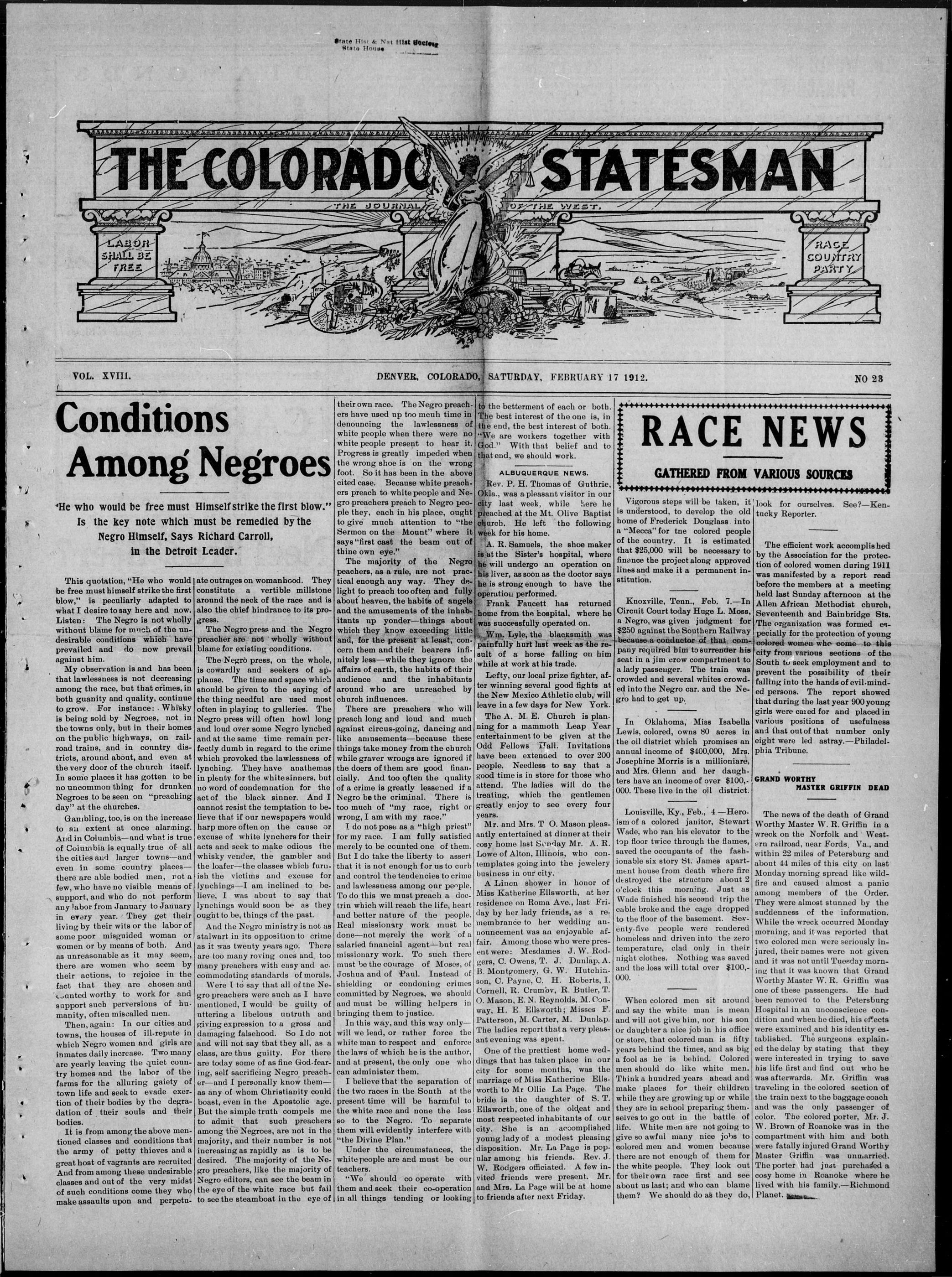
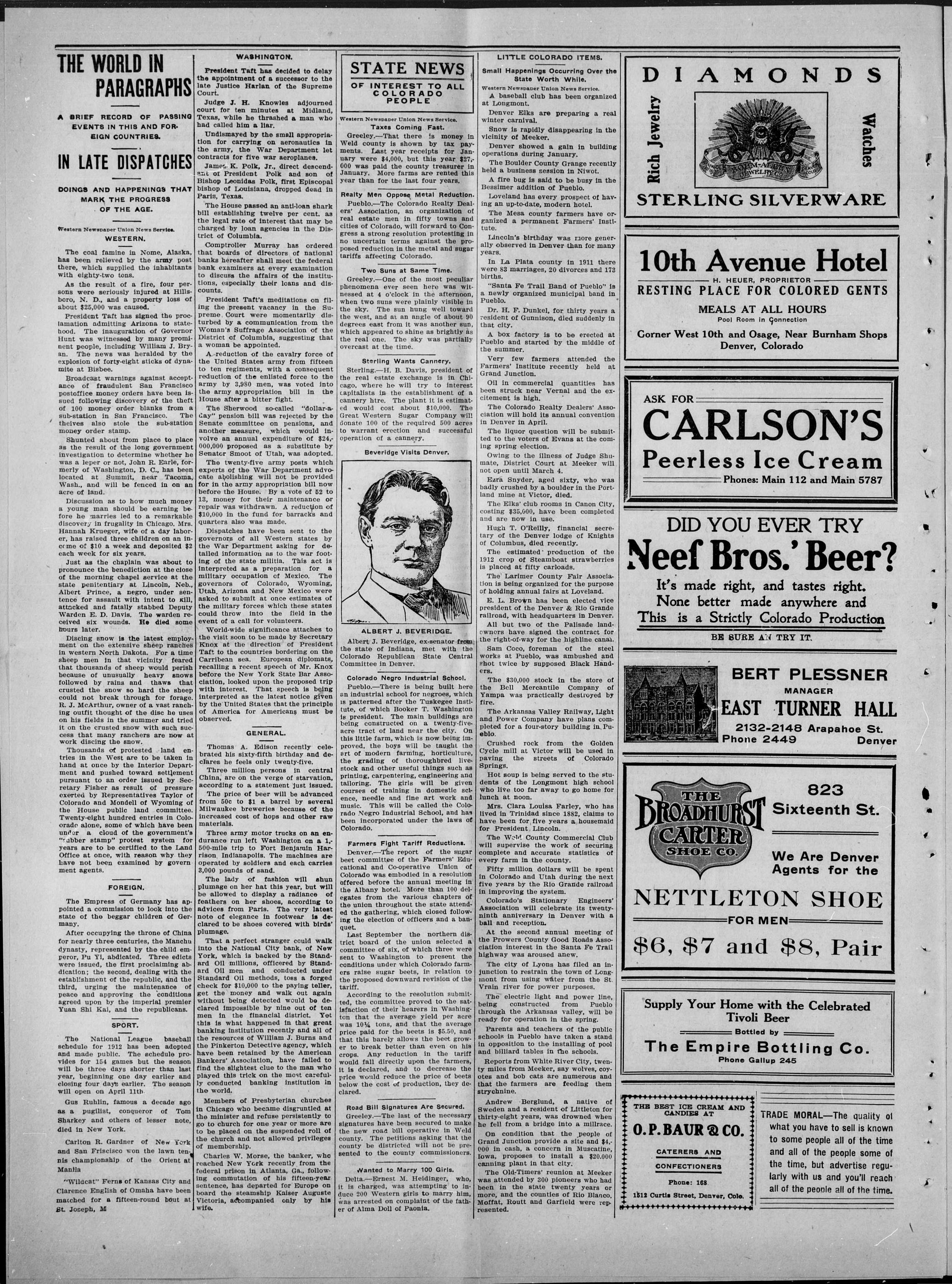
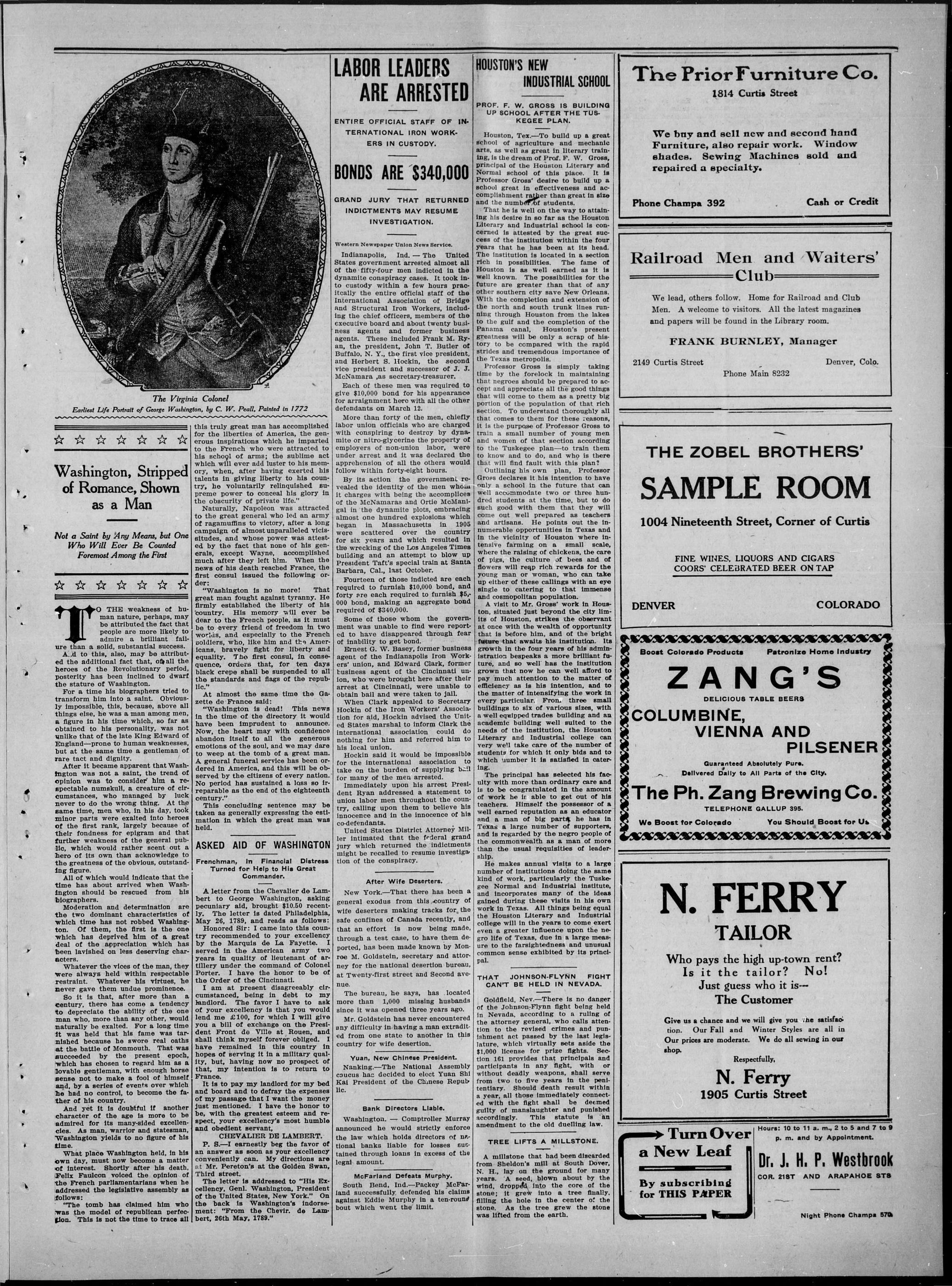
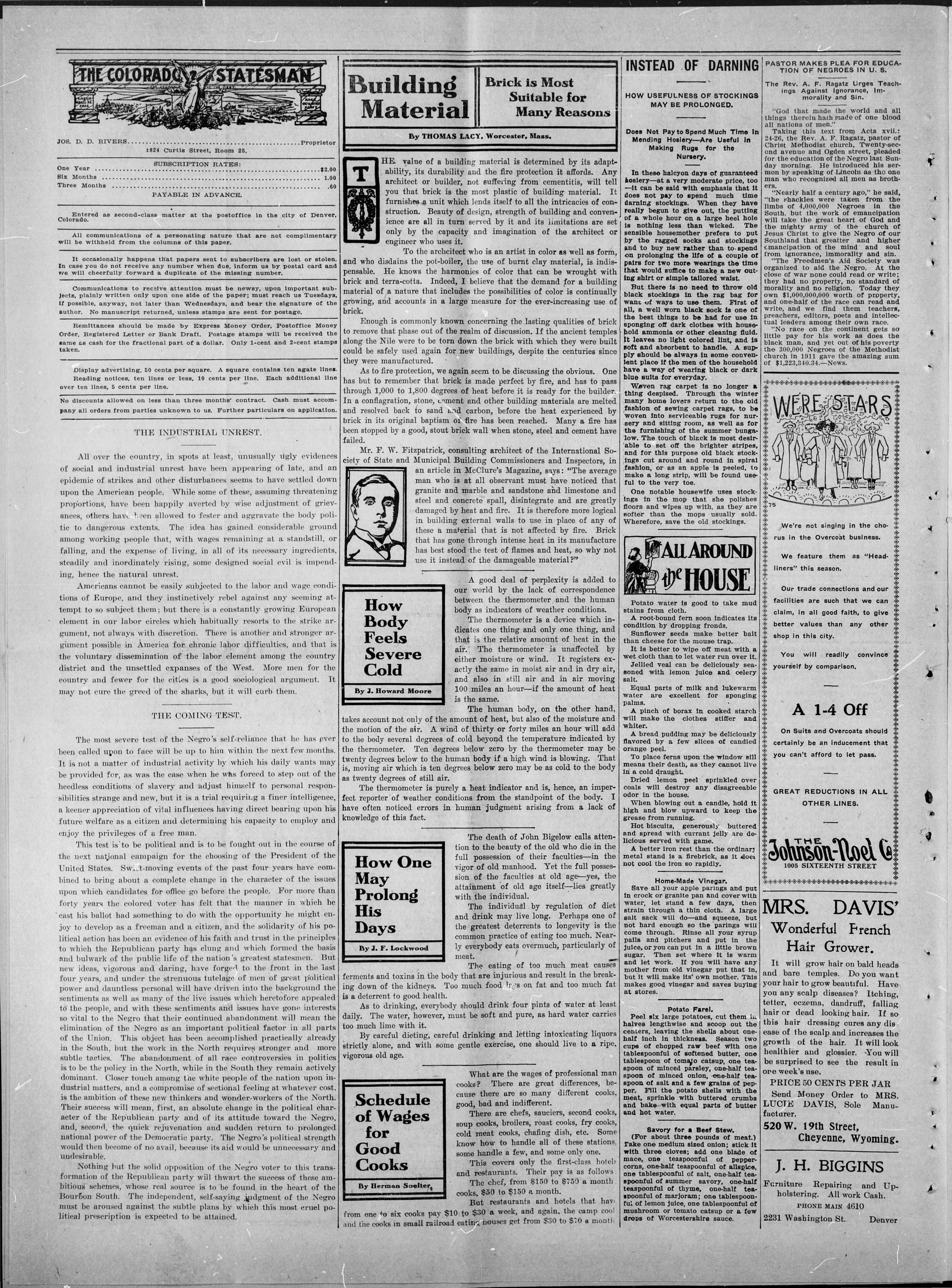
Page text (machine-generated)
THE COLORADO STATESMAN
THE JOURNAL OF THE WEST.
LABOR SHALL BE FREE
RAGE COUNTRY PARTY
VOL. XVIII.
DENVER, COLORADO, SATURDAY, FEBRUARY 17 1912.
NO 23
Conditions Among Negroes
He who would be free must Himself strike the first blow." Is the key note which must be remedied by the Negro Himself, Says Richard Carroll, in the Detroit Leader.
This quotation, "He who would be free must himself strike the first blow," is peculiarly adapted to what I desire to say here and now. Listen: The Negro is not wholly without blame for much of the undesirable conditions which have prevailed and do now prevail against him.
My observation is and has been that lawlessness is not decreasing among the race, but that crimes, in both guanity and quality, continue to grow. For instance: Whisky is being sold by Negroes, not in the towns only, but in their homes on the public highways, on railroad trains, and in country districts, around about, and even at the very door of the church itself. In some places it has gotten to be no uncommon thing for drunken Negroes to be seen on "preaching day" at the churches.
Gambling, too, is on the increase to an extent at once alarming. And in Columbia—and what is true of Columbia is equally true of all the cities and larger towns—and even in some country places—there are able bodied men, not a few, who have no visible means of support, and who do not perform any labor from January to January in every year. They get their living by their wits or the labor of some poor misguided woman or women or by means of both. And as unreasonable as it may seem, there are women who seem by their actions, to rejoice in the fact that they are chosen and counted worthy to work for and support such perversions of humanity, often miscalled men.
Then, again: In our cities and towns, the houses of ill-repute in which Negro women and girls are inmates daily increase. Two many are yearly leaving the quiet country homes and the labor of the farms for the alluring gaiety of town life and seek to evade exertion of their bodies by the degradation of their souls and their bodies.
It is from among the above mentioned classes and conditions that the army of petty thieves and a great host of vagrants are recruited And from among these undesirable classes and out of the very midst of such conditions come they who make assaults upon and perpetu-
ate outrages on womanhood. They constitute a vertible millstone around the neck of the race and is also the chief hindrance to its progress. The Negro press and the Negro preacher are not wholly without blame for existing conditions.
The Negro press, on the whole, is cowardly and seekers of applause. The time and space which should be given to the saying of the thing needful are used most often in playing to galleries. The Negro press will often howl long and loud over some Negro lynched and at the same time remain perfectly dumb in regard to the crime which provoked the lawlessness of lynching. They have anathemas in plenty for the white sinners, but no word of condemnation for the act of the black sinner. And I cannot resist the temptation to believe that if our newspapers would harp more often on the cause or excuse of white lynchers for their acts and seek to make odious the whisky vender, the gambler and the loafer—the classes which furnish the victims and excuse for lynchings—I am inclined to believe, I was about to say that lynchings would soon be as they ought to be, things of the past.
And the Negro ministry is not as stalwart in its opposition to crime as it was twenty years ago. There are too many roving ones and, too many preachers with easy and accommodating standards of morals.
Were I to say that all of the Negro preachers were such as I have mentioned, I would be guilty of uttering a libelous untruth and giving expression to a gross and damaging falsehood. So I do not and will not say that they all, as a class, are thus guilty. For there are today some of as fine God-fearing, self sacrificing Negro preacher—and I personally know them—as any of whom Christianity could boast, even in the Apostolic age. But the simple truth compels me to admit that such preachers among the Negroes, are not in the majority, and their number is not increasing as rapidly as is to be desired. The majority of the Negro preachers, like the majority of Negro editors, can see the beam in the eye of the white race but fail to see the steamboat in the eye of
their own race. The Negro preachers have used up too much time in denouncing the lawlessness of white people when there were no white people present to hear it. Progress is greatly impeded when the wrong shoe is on the wrong foot. So it has been in the above cited case. Because white preachers preach to white people and Negro preachers preach to Negro people they, each in his place, ought to give much attention to "the Sermon on the Mount" where it says "first cast the beam out of thine own eye."
The majority of the Negro peachers, as a rule, are not practical enough any way. They delight to preach too often and fully about heaven, the habits of angels and the amusements of the inhabitants up yonder—things about which they know exceeding little and, for the present at least, concern them and their hearers infinitely less—while they ignore the affairs of earth, the habits of their audience and the inhabitants around who are unreached by church influences.
There are preachers who will preach long and loud and much against circus-going, dancing and like amusements—because these things take money from the church while graver wrongs are ignored if the doers of them are good financially. And too often the quality of a crime is greatly lessened if a Negro be the criminal. There is too much of "my race, right or wrong. I am with my race."
I do not pose as a "high priest" for my race. I am fully satisfied merely to be counted one of them. But I do take the liberty to assert that it is not enough for us to curb and control the tendencies to crime and lawlessness among our people. To do this we must preach a doctrin which will reach the life, heart and better nature of the people. Real missionary work must be done—not merely the work of a salaried financial agent—but real missionary work. To such there must be the courage of Moses, of Joshua and of Paul. Instead of shielding or condoning crimes committed by Negroes, we should and must be willing helpers in bringing them to justice.
In this way, and this way only—will we lead, or rather force the white man to respect and enforce the laws of which he is the author, and at present, the only one who can administer them.
I believe that the separation of the two races in the South at the present time will be harmful to the white race and none the less so to the Negro. To separate them will evidently interfere with "the Divine Plan." Under the circumstances, the white people are and must be our teachers. "We should co operate with them and seek their co-operation in all things tending or looking
to the betterment of each or both. The best interest of the one is, in the end, the best interest of both. "We are workers together with God." With that belief and to that end, we should work.
ALBUQUERQUE NEWS.
Rev. P. H. Thomas of Guthrie, Okla., was a pleasant visitor in our city last week, while here he preached at the Mt. Olive Baptist church. He left the following week for his home.
A. R. Samuels, the shoe maker is at the Sister's hospital, where he will undergo an operation on his liver, as soon as the doctor says he is strong enough to have the operation performed.
Frank Faucett has returned home from the hospital, where he was successfully operated on.
Wm. Lyle, the blacksmith was painfully hurt last week as the result of a horse falling on him while at work at his trade.
Lefty, our local prize fighter, after winning several good fights at the New Mexico Athletic club, will leave in a few days for New York. The A. M. E. Church is planning for a mammoth Leap Year entertainment to be given at the Odd Fellows Hall. Invitations have been extended to over 200 people. Needless to say that a good time is in store for those who attend. The ladies will do the treating, which the gentlemen greatly enjoy to see every four years. Mr. and Mrs. T O. Mason pleasantly entertained at dinner at their cosy home last Sunday Mr. A. R. Lowe of Alton, Illinois, who contemplates going into the jewelery business in our city.
A Linen shower in honor of Miss Katherine Ellsworth, at her residence on Roma Ave., last Friday by her lady friends, as a remembrance to her wedding announcement was an enjoyable affair. Among those who were present were: Mesdames J. W. Rodgers, C. Owens, T. J. Dunlap, A. B. Montgomery, G. W. Hutchinson, C. Payne, C. H. Roberts, I. Cornell, R. Crumbv, R. Butler, T. O. Mason, E. N. Reynolds, M. Conway, H. E. Ellsworth; Misses F. Patterson, M. Carter, M. Dunlap. The ladies report that a very pleasant evening was spent.
One of the prettiest home weddings that has taken place in our city for some months, was the marriage of Miss Katherine Ellsworth to Mr Ollie La Page. The bride is the daughter of S.T. Ellsworth, one of the oldeat and most respected inhabitants of our city. She is an accomplished young lady of a modest pleasing disposition. Mr. La Page is popular among his friends. Rev. J. W. Rodgers officiated. A few invited friends were present. Mr. and Mrs. La Page will be at home to friends after next Friday.
RACE NEWS
Vigorous steps will be taken, it is understood, to develop the old home of Frederick Douglass into a "Mecca" for the colored people of the country. It is estimated that $25,000 will be necessary to finance the project along approved lines and make it a permanent institution.
Knoxville, Tenn., Feb. 7.—In Circuit Court today Huge L. Moss, a Negro, was given judgment for $250 against the Southern Railway because a conductor of that company required him to surrender his seat in a jim crow compartment to a lady passenger. The train was crowded and several whites crowded into the Negro car. and the Negro had to get up.
look for ourselves. See?—Kentucky Reporter.
The efficient work accomplished by the Association for the protection of colored women during 1911 was manifested by a report read before the members at a meeting held last Sunday afternoon at the Allen African Methodist church, Seventeenth and Bainbridge Sts. The organization was formed especially for the protection of young colored women who come to this city from various sections of the South to seek employment and to prevent the possibility of their falling into the hands of evil-minded persons. The report showed that during the last year 900 young
In Oklahoma, Miss Isabella Lewis, colored, owns 80 acres in the oil district which promises an annual income of $400,000. Mrs. Josephine Morris is a millionaire, and Mrs. Glenn and her daughters have an income of over $100,-000. These live in the oil district.
Louisville, Ky., Feb., 4—Heroism of a colored janitor, Stewart Wade, who ran his elevator to the top floor twice through the flames, saved the occupants of the fashionable six story St. James apartment house from death where fire destroyed the structure about 2 o'clock this morning. Just as Wade finished his second trip the cable broke and the cage dropped to the floor of the basement. Seventy-five people were rendered homeless and driven into the zero temperature, clad only in their night clothes. Nothing was saved and the loss will total over $100,-000.
When colored men sit around and say the white man is mean and will not give him, nor his son or daughter a nice job in his office or store, that colored man is fifty years behind the times, and as big a fool as he is behind. Colored men should do like white men. Think a hundred years ahead and make places for their children while they are growing up or while they are in school preparing themselves to go out in the battle of life. White men are not going to give so awful many nice jobs to colored men and women because there are not enough of them for the white people. They look out for their own race first and see about us last; and who can blame them? We should do as they do,
look for ourselves. See?—Kentucky Reporter.
The efficient work accomplished by the Association for the protection of colored women during 1911 was manifested by a report read before the members at a meeting held last Sunday afternoon at the Allen African Methodist church, Seventeenth and Bainbridge Sts. The organization was formed especially for the protection of young colored women who come to this city from various sections of the South to seek employment and to prevent the possibility of their falling into the hands of evil-minded persons. The report showed that during the last year 900 young girls were cared for and placed in various positions of usefulness and that out of that number only eight were led astray.—Philadelphia Tribune.
GRAND WORTHY
MASTER GRIFFIN DEAD
The news of the death of Grand Worthy Master W. R. Griffin in a wreck on the Norfolk and Western railroad, near Fords, Va., and within 22 miles of Petersburg and about 44 miles of this city on last Monday morning spread like wildfire and caused almost a panic among members of the Order. They were almost stunned by the suddenness of the information. While the wreck occurred Monday morning, and it was reported that two colored men were seriously injured, their names were not given and it was not until Tuesday morning that it was known that Grand Worthy Master W. R. Griffin was one of these passengers. He had been removed to the Petersburg Hospital in an unconscience condition and when he died, his effects were examined and his identity established. The surgeons explained the delay by stating that they were interested in trying to save his life first and find out who he was afterwards. Mr. Griffin was traveling in the colored section of the train next to the baggage coach and was the only passenger of color. The colored porter, Mr. J. W. Brown of Roanoke was in the compartment with him and both were fatally injured Grand Worthy Master Griffin was unmarried. The porter had just purchased a cosy home in Roanoke where he lived with his family.—Richmond Planet.
THE WORLD IN PARAGRAPHS
A BRIEF RECORD OF PASSING EVENTS IN THIS AND FOR- EIGN COUNTRIES.
IN LATE DISPATCHES
DOINGS AND HAPPENINGS THAT MARK THE PROGRESS OF THE AGE.
WESTERN.
The coal famine in Nome, Alaska, has been relieved by the army post there, which supplied the inhabitants with eighty-two tons.
As the result of a fire, four persons were seriously injured at Hillsboro, N. D., and a property loss of about $25,000 was caused.
President Taft has signed the proclamation admitting Arizona to statehood. The inauguration of Governor Hunt was witnessed by many prominent people, including William J. Bryan. The news was heralded by the explosion of forty-eight sticks of dynamite at Bisbee.
Broadcast warnings against acceptance of fraudulent San Francisco postoffice money orders have been issued following discovery of the theft of 100 money order blanks from a sub-station in San Francisco. The theives also stole the sub-station money order stamp.
Shunted about from place to place as the result of the long government investigation to determine whether he was a leper or not, John R. Earle, formerly of Washington, D. C., has been located at Summit, near Tacoma, Wash., and will be fenced in on an acre of land.
Discussion as to how much money a young man should be earning before he marries led to a remarkable discovery in frugality in Chicago. Mrs. Hannah Krueger, wife of a day laborer, has raised three children on an income of $10 a week and deposited $2 each week for six years.
Just as the chaplain was about to pronounce the benediction at the close of the morning chapel service at the state penitentiary at Lincoln, Neb., Albert Prince, a negro, under sentence for assault with intent to kill, attacked and fatally stabbed Deputy Warden E. D. Davis. The warden received six wounds. He died some hours later.
Discising snow is the latest employment on the extensive sheep ranches in western North Dakota. For a time sheep men in that vicinity feared that thousands of sheep would perish because of unusually heavy snows followed by rains and thaws that crusted the snow so hard the sheep could not break through for forage. R. J. McArthur, owner of a vast ranching outfit thought of the disc he uses on his fields in the summer and tried it on the crusted snow with such success that many ranchers are now at work discing the snow.
Thousands of protested land entries in the West are to be taken in hand at once by the Interior Department and pushed toward settlement pursuant to an order issued by Secretary Fisher as result of pressure exerted by Representatives Taylor of Colorado and Mondell of Wyoming of the House public land committee. Twenty-eight hundred entries in Colorado alone, some of which have been under a cloud of the government's "rubber stamp" protest system for years are to be certified to the Land Office at once, with reason why they have not been examined by government agents.
FOREIGN
The Empress of Germany has appointed a commission to look into the state of the beggar children of Germany.
After occupying the throne of China for nearly three centuries, the Manchu dynasty, represented by the child emperor, Pu Yi, abdicated. Three edicts were issued, the first proclaiming abdication; the second, dealing with the establishment of the republic, and the third, urging the maintenance of peace and approving the conditions agreed upon by the imperial premier Yuan Shi Kai, and the republicans.
SPORT.
The National League baseball schedule for 1912 has been adopted and made public. The schedule provides for 154 games but the season will be three days shorter than last year, beginning one day earlier and closing four days earlier. The season will open on April 11th.
Gus Ruhlin, famous a decade ago as a pugillist, conqueror of Tom Sharkey and others of lesser note, died in New York.
Carlton R. Gardner of New York and San Friscisco won the lawn tennis championship of the Orient at Manlia
"Wildcat" Ferns of Kansas City and Clarence English of Omaha have been matched for a fifteen-round bout at St. Joseph, M
WASHINGTON.
President Taft has decided to delay the appointment of a successor to the late Justice Harlan of the Supreme Court.
Judge J. H. Knowles adjourned court for ten minutes at Midland, Texas, while he thrashed a man who had called him a liar.
Undismayed by the small appropriation for carrying on aeronautics in the army, the War Department let contracts for five war aeroplanes.
James K. Polk, Jr., direct descendant of President Polk and son of Bishop Leonidas Polk, first Episcopal bishop of Louisiana, dropped dead in Paris, Texas.
The House passed an anti-loan shark bill establishing twelve per cent, as the legal rate of interest that may be charged by loan agencies in the District of Columbia.
Comptroller Murray has ordered that boards of directors of national banks hereafter shall meet the federal bank examiners at every examination to discuss the affairs of the institutions, especially their loans and discounts.
President Taft's meditations on filing the present vacancy in the Supreme Court were momentarily disturbed by a communication from the Woman's Suffrage Association of the District of Columbia, suggesting that a woman be appointed.
A reduction of the cavalry force of the United States army from fifteen to ten regiments, with a consequent reduction of the enlisted force to the army by 3,980 men, was voted into the army appropriation bill in the House after a bitter fight.
The Sherwood so-called "dollar-a-day" pension bill was rejected by the Senate committee on pensions, and another measure, which would involve an annual expenditure of $24,000,000 proposed as a substitute by Senator Smoot of Utah, was adopted. The twenty-five army posts which experts of the War Department advocate abolishing will not be provided for in the army appropriation bill now before the House. By a vote of 52 to 13, money for their maintenance or repair was withdrawn. A reduction of $10,000 in the fund for barracks and quarters also was made.
Dispatches have been sent to the governors of all Western states by the War Department asking for detailed information as to the war footing of the state militia. This act is interpreted as a preparation for a military occupation of Mexico. The governors of Colorado, Wyoming, Utah, Arizona and New Mexico were asked to submit at once estimates of the military forces which these states could throw into the field in the event of a call for volunteers.
World-wide significance attaches to the visit soon to be made by Secretary Knox at the direction of President Taft to the countries bordering on the Carribean sea. European diplomats, recalling a recent speech of Mr. Knox before the New York State Bar Association, looked upon the proposed trip with interest. That speech is being interpreted as the latest notice given by the United States that the principle of America for Americans must be observed.
GENERAL
Thomas A. Edison recently celebrated his sixty-fifth birthday and declares he feels only twenty-five.
Three million persons in central China, are on the verge of starvation, according to a statement just issued.
The price of beer will be advanced from 50c to $1 a barrel by several Milwaukee breweries because of the increased cost of hops and other raw materials.
Three army motor trucks on an endurance run left Washington on a 1,500-mile trip to Fort Benjamin Harrison. Indianapolis. The machines are operated by soldiers and each carries 3,000 pounds of sand.
The lady of fashion will shun plumage on her hat this year, but will be allowed to display a radiance of feathers on her shoes, according to advices from Paris. The very latest note of elegance in footwear is declared to be shoes covered with birds' plumage.
That a perfect stranger could walk into the National City bank, of New York, which is backed by the Standard Oil millions, officered by Standard Oil men and conducted under Standard Oil methods, toss a forged check for $10,000 to the paying teller, get the money and walk out again without being detected would be declared impossible by nine out of ten men in the financial district. Yet this is what happened in that great banking institution recently and all of the resources of William J. Burns and the Pinkerton Detective agency, which have been retained by the American Bankers' Association, have failed to find the slightest clue to the man who played this trick on the most carefully conducted banking institution in the world.
Members of Presbyterian churches in Chicago who became disgruntled at the minister and refuse persistently to go to church for one year or more are to be placed on the suspended roll of the church and not allowed privileges of membership.
Charles W. Morse, the banker, who reached New York recently from the federal prison in Atlanta, Ga., following commutation of his fifteen-year sentence, has departed for Europe on board the steamship Kaiser Auguste Victoria, accompanied only by his wife.
Western Newspaper Union News Service.
Taxes Coming Fast.
Greeley.—That there is money in Weld county is shown by tax payments. Last year receipts for January were $4,000, but this year $27,000 was paid the county treasurer in January. More farms are rented this year than for the last four years.
Realty Men Oppose Metal Reduction.
Pueblo.—The Colorado Realty Dealers' Association, an organization of real estate men in fifty towns and cities of Colorado, will forward to Congress a strong resolution protesting in no uncertain terms against the proposed reduction in the metal and sugar tariffs affecting Colorado.
Two Suns at Same Time.
Greeley.—One of the most peculiar phenomena ever seen here was witnessed at 4 o'clock in the afternoon, when two suns were plainly visible in the sky. The sun hung well toward the west, and at an angle of about 90 degrees east from it was another sun, which appeared to shine as brightly as the real one. The sky was partially overcast at the time.
Sterling Wants Cannery.
Sterling.—H. B. Davis, president of the real estate exchange is in Chicago, where he will try to interest capitalists in the establishment of a cannery htre. The plant it is estimated would cost about $10,000. The Great Western Sugar Company will donate 100 of the required 500 acres to warrant erection and successful operation of a cannery.
Beveridge Visits Denver.
ALBERT J. BEVERIDGE.
Albert J. Beveridge, ex-senator from the state of Indiana, met with the Colorado Republican State Central Committee in Denver.
Colorado Negro Industrial School.
Pueblo.—There is being built here an industrial school for negroes, which is patterned after the Tuskegee Institute, of which Booker T. Washington is president. The main buildings are being constructed on a twenty-five-acre tract of land near the city. On this little farm, which is now being improved, the boys will be taught the art of modern farming, horticulture, the grading of thoroughbred livestock and other useful things such as printing, carpentering, engineering and tailoring. The girls will be given courses of training in domestic science, needle and fine art work and music. This will be called the Colorado Negro Industrial School, and has been incorporated under the laws of Colorado.
Farmers Fight Tariff Reductions.
Denver.—The report of the sugar beet committee of the Farmers' Educational and Co-operative Union of Colorado was embodied in a resolution offered before the annual meeting in the Albany hotel. More than 100 delegates from the various chapters of the union throughout the state attended the gathering, which closed following the election of officers and a banquet.
Last September the northern district board of the union selected a committee of six, of which three were sent to Washington to present the conditions under which Colorado farmers raise sugar beets, in relation to the proposed downward revision of the tariff.
According to the resolution submitted, the committee proved to the satisfaction of their hearers in Washington that the average yield per acre was $10\%$ tons, and that the average price paid for the beets is $5.50, and that this barely allows the beet grower to break better than even on his crops. Any reduction in the tariff would fall directly upon the farmers, it is declared, and to decrease the price would reduce the price of beets below the cost of production, they declared.
Road Bill Signatures Are Secured.
Greeley.—The last of the necessary signatures have been secured to make the new road bill operative in Weld county. The petitions asking that the county be districted will not be presented to the county commissioners.
Wanted to Marry 100 Girls.
Delta—Ernest M. Heidinger, who it is charged, was attempting to induce 200 Western girls to marry him, was arrested on complaint of the father of Alma Doll of Paonia.
LITTLE COLORADO ITEMS.
Small Happenings Occurring Over the State Worth While.
Western Newmaner Union News Service.
A baseball club has been organized at Longmont.
Denver Elks are preparing a real winter carnival.
Snow is rapidly disappearing in the vicinity of Meeker.
Denver showed a gain in building operations during January.
The Boulder County Grange recently held a business session in Niwot.
A fire bug is said to be busy in the Bessimer addition of Pueblo.
Loveland has every prospect of having an up-to-date, modern hotel.
The Mesa county farmers have organized a permanent Farmers' Institute.
Lincoln's birthday was more generally observed in Denver than for many years.
In La Plata county in 1911 there were 83 marriages, 20 divorces and 173 births.
"Santa Fe Trail Band of Pueblo" is a newly organized municipal band in Pueblo.
Dr. H. F. Dunkel, for thirty years a resident of Gunnison, died suddenly in that city.
A box factory is to be erected at Pueblo and started by the middle of the summer.
Very few farmers attended the Farmers' Institute recently held at Grand Junction.
Oil in commercial quantities has been struck near Vernal and the excitement is high.
The Colorado Realty Dealers' Association will hold its annual convention in Denver in April.
The liquor question will be submitted to the voters of Evans at the coming spring election.
Owing to the illness of Judge Shumate, District Court at Meeker will not open until March 4.
Ezra Snyder, aged sixty, who was badly crushed by a boulder in the Portland mine at Victor, died.
The Elks' club rooms in Canon City, costing $35,000, have been completed and are now in use.
Hugh T. O'Reilly, financial secretary of the Denver lodge of Knights of Columbus, died recently.
The estimated production of the 1912 crop of Steamboat strawberries is placed at fifty carloads.
The Larimer County Fair Association is being organized for the purpose of holding annual fairs at Loveland. E. L. Brown has been elected vice president of the Denver & Rio Grande railroad, with headquarters in Denver.
Sam Coco, foreman of the steel works at Pueblo, was ambushed and shot twice by supposed Black Handers.
The $30,000 stock in the store of the Bell Mercantile Company of Yampa was practically destroyed by fire.
The Arkansas Valley Railway, Light and Power Company have plans completed for a four-story building in Pueblo.
Crushed rock from the Golden Cycle mill at Victor will be used in paving the streets of Colorado Springs.
Hot soup is being served to the students of the Longmont high school who live too far away to go home for lunch at noon.
Mrs. Clara Louisa Farley, who has lived in Trinidad since 1882, claims to have been for five years a housemaid for President, Lincoln.
The Weld County Commercial Club will supervise the work of securing complete and accurate statistics of every farm in the county.
Fifty million dollars will be spent in Colorado and Utah during the next five years by the Rio Grande railroad in improving the system.
Colorado's Stationary Engineers' Association will celebrate its twenty-ninth anniversary in Denver with a ball and reception.
At the second annual meeting of the Prowers County Good Roads Association interest in the Santa Fe Trail highway was aroused anew.
The city of Lyons has filed an injunction to restrain the town of Longmont from using water from the St. Vrain river for power purposes.
The electric light and power line, being constructed from Pueblo through the Arkansas valley, will be ready for operation in the spring.
Parents and teachers of the public schools in Pueblo have taken a stand in opposition to the installing of pool and billiard tables in the schools.
Reports from White River City, twenty miles from Meeker, say wolves, coyotes and bob cats are numerous and that the farmers are feeding them strychnine.
Andrew Berglund, a native of Sweden and a resident of Littleton for thirty-eight years, was drowned when he fell from a bridge into a millrace.
On condition that the people of Grand Junction provide a site and $4,000 in cash, a concern in Muscatine, Iowa, proposes to install a $20,000 canning plant in that city.
The Old-Timers' reunion at Meeker was attended by 300 pioneers who had been in the state twenty years or more, and the counties of Rio Blanco, Moffat, Routt and Garfield were represented.
FOREM-ALFEN
JEWELRY CO.
FREM-ALFEN
JEWELRY CO.
10th Avenue
H. HEUER, P
RESTING PLACE FOR
MEALS AT A
Pool Room in
Gorner West 10th and Osara
Denver,
ASK FOR
CARLS
Peerless I
Phones:
DID YOU BE
Neef Bro
It's made right, a
None better made
This is a Strictly C
BELLING SILVERVIEW
Avenue H
H. HEUER, PROPRIETOR
PLACE FOR COLORE
MEALS AT ALL HOURS
Pool Room in Connection
at 10th and Osage, Near Bur
Denver, Colorado
ARLSON
less Ice C
Phones: Main 112 and
DO YOU EVER T
f Bros.' B
made right, and tastes
better made anywhere
a Strictly Colorado P
ING SILVERWARE
Avenue Hotel
HEUER, PROPRIETOR
ACE FOR COLORED GENTS
ALS AT ALL HOURS
Pool Room in Connection
and Osage, Near Burnham Shops
Denver, Colorado
RLSON'S
less Ice Cream
Phones: Main 112 and Main 5787
YOU EVER TRY
Bros.' Beer?
right, and tastes right.
er made anywhere and
trictly Colorado Production
STERLING SILVERWARE
RESTING PLACE FOR COLORED GENTS
Corner West 10th and Osage, Near Burnham Shops Denver, Colorado
ASK FOR CARLSON'S Peerless Ice Cream Phones: Main 112 and Main 5787
DID YOU EVER TRY Neef Bros.' Beer?
It's made right, and tastes right. None better made anywhere and This is a Strictly Colorado Production BE SURE AN TRY IT.
BERT PLESSNER
MANAGER
EAST TURNER HAL
BERT PLESSNER
MANAGER
EAST TURNER HALL
2132-2148 Arapahoe St.
Phone 2449 Denver
THE
BROADHURST
CARTER
SHOE CO.
LETON SHOE
FOR MEN
and $8, Pair
Home with the Celebrated
Tivoli Beer
Bottled by
Oire Bottling Co.
Phone Gallup 245
NETTLETO
FOR M
$6, $7 and
Supply Your Home w
Tivoli
Bottled
The Empire B
Phone Gall
BETLETON S
FOR MEN
$7 and $8,
Your Home with the Cel
Tivoli Beer
Bottled by
Empire Bottling
Phone Gallup 245
NETTLETON SHOE
$6, $7 and $8, Pair
Supply Your Home with the Celebrated Tivoli Beer
The Empire Bottling Co. Phone Gallup 245
THE BEST ICE CREAM AND CANDIES AT
CATERERS AND
CONFECTIONERS
Phone: 168.
1512 Curtis Street, Denver, Colo.
, Denver, Cole.
---
THE HOTEL
823 Sixteenth St.
We Are Denver Agents for the
TRADE MORAL—The quality of what you have to sell is known to some people all of the time and all of the people some of the time, but advertise regularly with us and you'll reach all of the people all of the time.
SESE,
am Se
SE Rr 2
Shei LO BE NS
Lira le a ae ee EN
bie aa a »
greet Sve eee
io ee J (panes
i. ees a ae po ges
Re oe ae Be tf Sa
LE ae
Reece a ee SR a a Se
Ye Me ee ea
Yo ae Sees, hi Rae
Hailey 434 Ji aes)
he loo SA c ee
a ae ae as
Doerner Se ee ety i y
Ree e He Ae Ree =
Ai See ea /
Wes ae a Se ie JG
eee ear es
Wee ae poe ae a
OE Ae z Oa Bye eM
Wie A ee re
Wee Ree OSG
Ca ‘ (Rie eee eee AO)
Nit a eS
NE a
The Virginia Colonel
Earliest Life Portrait of George Washington, by C. W. Peall, Painted in 1772
La
Washington, Stripped
of Romance, Shown
as a Man
cena |
Not a Saint by ng Means, But. Ona
Who Will Ever Be Counted
Rorerioat Arongithe First
kn Se ere
Re re a
——EEE~— SSS
7° ‘THE weakness of hu-
man nature, perhaps, may
be attributed the fact that
people are more likely to
people are more likely to
admire a brilliant fail-
ure than a solid, substantial success.
A. to this, also, may be attribut-
ed the additional fact that, ofall the
heroes of the Revolutionary period,
posterity has been inclined to dwarf
the stature of Washington.
For a time his biographers tried to
transform him into a saint. Obvious-
ly impossible, this, because, above all
things else, he was a man among men,
a figure in his time which, so far as
obtained to his personality, was not
unlike that of the late King Edward of
England—prone to human weaknesses,
but at the same time a gentleman of
rare tact and dignity.
After it became apparent that Wash-
fmgton was not a saint, the trend of
opinion was to consider him a re-
spectable numskull, a creature of cir
cumstances, who managed by luck
never to do the wrong thing. At the
same time, men who, in his day, took
minor parts were exalted into heroes
of the first rank, largely because of
their fondness for epigram and that
further weakness of the general pub-
Me, which would rather scent out a
hero of its own than acknowledge to
tho greatness of the obvious, outstand-
ing figure.
All of which would indicate that the
time has about arrived when Wash-
ington should be rescued from his
‘biographers.
Moderation and determination are
the two dominant characteristics of
which time has not robbed Washing:
ton. Of them, the first is the one
which has deprived him of a great
deal of the appreciation which has
‘een lavished on less deserving char-
acters.
‘Whatever the vices of the man, they
were always held within respectable
restraint, Whatever his virtues, he
mever gave them undue prominence.
So it is that, after more than a
eentury, there has come a tendency
to depreciate the ability of the one
‘man who, more than any other, would
naturally be exalted. For a long time
dt was held that his fame was tar-
nished because he swore real oaths
‘at the battle of Monmouth. That was
wucceeded by the present epoch,
‘which has chosen to regard him as a
flovable gentleman, with enough horse
sense not to make a fool of himself
and, by a series of events over which
hhe had no control, to become the fa-
ther of his country.
‘And yet it is doubtful if another
character of the age is more to be
admired for its many-sided excellen-
cles. As man, warrior and statesman,
‘Washington yields to no figure of his
time.
‘What place Washington held, in his
‘own day, must now become a matter
‘of interest. Shortly after his death,
(Felix Faulcon voiced the opinion. of
‘the French parliamentarians when he
addressed the legislative assembly as
follows:
“The tomb has claimed him who
twas the model of republican perfec:
tion. This is not the time to trace all
this truly great man has accomplished
for the liberties of America, the gen-
erous inspirations which he imparted
to the French who were attracted to
his schogl of arms; the sublime act
which will ever add luster to his mem-
ory, when, after having exerted his
talents in giving liberty to his coun-
try, he voluntarily relinquished su-
preme power to conceal his glory in
the obscurity of private life.”
Naturally, Napoleon was attracted
to the great general who led an army
of ragamuffins to victory, after a long
campaign of almost unparalleled vicis-
situdes, and whose power was attest-
ed by the fact that none of his gen-
erals, except Wayne, accomplished
much after they left him. When the
news of his death reached France, the
first consul issued the following or-
der:
“Washington is no more! ‘That
great man fought against tyranny. He
firmly established the liberty of his
‘country. His memory will ever be
dear to the French people, as it must
be to every friend of freedom in two
worlds, and especially to the French
soldiers, who, like him and the Amer-
icans bravely, nett ton ipa” end
equality. The first consul, in conse
quence, orders that, for ten days
black crepe shall be suspended to all
the standards and flags of the repub-
Iie.”
‘At almost tho same time the Ga-
zette de France said:
“Washington is dead! This news
in the time of the directory it would
have been imprudent to announce.
Now, the heart may with confidence
abandon itself to all the generous
emotions of the soul, and we may dare
to weep at the tomb of a great man.
A general funeral service has been or-
dered in America, and this will be ob-
‘served by the citizens of every nation.
‘No period has sustained a lass so ir-
reparable as the end of tho eighteenth
century.”
This concluding sentence may be
taken as generally expressing the est!-
mation in which the great man was
held.
ASKED AID OF WASHINGTON
Frenchman, in Financial Distress
Turned for Help to His Great
Commander.
A letter from the Chevallier de Lam-
bert to George Washington, asking
pecuniary aid, brought $10.50 recent-
ly. The letter is dated Philadelphia,
May 26, 1789, and reads as follows:
Honored Sir: I came into this coun-
try recommended to your excellency
by the Marquis de La Fayette. I
served in the American army two
years in quality of lieutenant of ar-
tillery under the command of Colonel
Porter. I have the honor to be of
the Order of the Cincinnatl.
I am at present disagreeably cir-
cumstanced, being in debt to my
Yandlord. The favor I have to ask
of your excellency is that you would
lend me £100, for which I will give
you a bill of exchange on the Presi-
dent Front de Ville at Rouen, and
shall think myself forever obliged. I
have remained in this country in
hopes of serving it in a military qual-
ity, but, having now no prospect of
that, my intention {s to return to
France.
It is to pay my landlord for my bed
and board and to defray the expenses
of my passage that I want the money
just mentioned. I have the honor to
be, with the greatest esteem and re-
spect, your excellency’s most humble
and obedient servant,
CHEVALIER DE LAMBERT.
P. S.—I earnestly beg the favor of
an answer as soon as your excellency
conveniently can. My directions are
at Mr. Pereton’s at the Golden Swan,
Third street.
‘The letter is addressed to “His Ex-
cellency, Genl. Washington, President
of the United States, New York.” On
the back {s Washington's indorse-
ment: “From the Chevir. de Lam
bert, 26th May, 1789.”
ENTIRE OFFICIAL STAFF OF IN-
TERNATIONAL IRON WORK-
ERS IN CUSTODY.
BONDS ARE $340,000
GRAND JURY THAT RETURNED
INDICTMENTS MAY RESUME
INVESTIGATION.
Weatorn Newspaper Union News Service.
Indianapolis, Ind.—The United
States government arrested almost all
of the fifty-four men indicted in the
dynamite conspiracy cases. It took in-
to custody within a few hours prac-
itcally the entire official staff of the
International Association of Bridge
and Structural Iron Workers, includ-
ing the chief officers, members of the
executive board and about twenty busi-
ness agents and former business
agents. ‘These included Frank M. Ry-
an, the president, John T, Butler of
Buffalo, N. ¥., the first vice president,
and Herbert 8. Iockin, the second
vice president and successor of J. J.
McNamara ,as secretary-treasurer.
Each of these men was required to
give $10,000 bond for his appearance
for arraignment here with all the other
defendants on March 12.
More than forty of the men, chiefly
labor union officials who are charged
with conspiring to destroy by dyna-
mite or nitro-glycerine the property of
employers of non-union labor, were
under arrest and it was declared the
apprehension of all the others would
follow within forty-eight hours.
By its action the government re-
vealed the identity of the men whou
it charges with being the accomplices
of the McNamaras and Ortie McManl-
gal in the dynamite plots, embracing
almost one hundred explosions which
began in Massachusetts in 1905
were scattered over the country
for six years and which resulted in
the wrecking of the Los Angeles Times
buliding and an attempt to blow up
President Taft’s special train at Santa
Barbara, Cal., last October.
Fourteen of those indicted are each
required to furnish $10,000 bond, and
forty sre each required to furnish $5,
000 bond, making an aggregate bond
required of $340,000.
Some of those whom the govern-
ment was unable to find were report-
ed to have disappeared through fear
of inability to get bond.
Ernest G. W. Basey, former business
agent of the Indianapolis Iron Work-
ers’ union, and Edward Clark, former
business agent of the Cincinnati un-
ion, who were brought here after their
arrest at Cincinnati, were unable to
obtain bail and were taken to jail.
‘When Clark appealed to Secretary
Hockin of the Iron Workers’ Associa-
tion for aid, Hockin advised the Unit-
ed States marshal to inform Clark thé
international association could do
nothing for him and referred him to
his local union.
Hockin said it would be impossible
for the international association to
take on the burden of supplying bell
for many of the men arrested.
Immediately upon his arrest Presl-
dent Ryan addressed a statement to
union labor men throughout the coun-
try, calling upon them to believe his
innocence and in the innocence of his
co-defendants. 5
United States District Attorney Mil-
ler intimated that the federal grand
jury which returned the indictments
might be recalled to resume investiga
tion of the conspiracy.
After Wife Deserters.
New York.—That there has been a
general exodus from this.country of
wife deserters making tracks for, the
safe confines of Canada recently, and
that an effort is now being made,
through a test case, to have them de-
ported, has been made known by Mon-
roe M, Goldstein, secretary and attor-
ney for the national desertion bureau,
at Twenty-first street and Second ave-
nue.
The bureau, he says, has located
more than 1,000 missing husbands
since it was opened three years ago.
Mr. Goldstein has never encountered
any difficulty in/having a man extradit-
ed from one state to another in this
country for wife desertion.
Yuan, New Chinese President.
Nanking.—The National Assembly
caucus hac decided to elect Yuan Shi
Kai President of the Chinese Repub
lic.
Bank Directors Liable.
Washington. — Comptroller Murray
announced he would strictly enforce
the law which holds directors of nP-
tional banks Mable for losses sut-
tained through loans in excess of the
legal. amount.
McFarland Defeats Murphy.
South Bend, Ind.—Packey McFar-
{and successfully, defended his claims
against Eddie Murphy in a ten-roun?
bout which went the limit.
HOUSTON'S NEW
INDUSTRIAL SCHOOL
enn Suet eer cee SPCR ISS Ta Oana
School of agriculture and mechanic
arts, as well as great in literary train-
ing, ls the dream of Prof. F. W. Gross,
principal of the Houston Literary and
Normal school of this place. It is
Professor Gross’ desire to build up a
Schovl great in effectiveness and ac-
pate Pe pease Beene coe
and the numbéFAt students.
‘That he is well on the way to attain-
Ing his desire in so far as the Houston
Literary and Industrial school is con-
cerned is attested by the great suc-
cess of the institution within the four
years that he has been at its head.
The institution is located in a section
Tich in possibilities. The fame of
Houston is as well earned as it is
well known. The possibilities for the
future are greater than that of any
other southern city save New Orleans.
With the completion and extension of
the north and south trunk lines run-
ning through Houston from the lakes
to the gulf and the completion of the
Panama canal, Houston's present
Breatness will be only a scrap of his-
tory to be compared with the rapid
strides and tremendous importance of
the Texas metropolis.
Professor Gross is simply taking
time by the forelock in maintaining
that negroes should be prepared to ac-
cept and appreciate all the good things
that will come to them as a pretty big
portion of the population of that rich
section. To understand thoroughly all
that comes to them for these zeasons,
it is the purpase of Professor Gross to
train a small number of young men
and women of that section according
to the Tuskegee plan—to train them
to know and to do, and who is there
‘that will find fault with this plan?
Outlining his own plan, Professor
Groes declares it his intention to have
only a school in the future that can
well accommodate two or three hun-
dred students at the time, but to do
such good with them that they will
come out well prepared as teachers
and artisans. He points out the in-
numerable opportunities in Texas and
in the vicinity of Houston where in-
tensive farming on a small scale,
where the raising of chickens, the care
of pigs, the culture of bees and of
flowers will reap rich rewards for the
young man or woman, who can take
up either of these callings with an eye
single to catering to that immense
and cosmopolitan population.
‘A visit to Mr. Gross’ work in Hous-
ton, situated just beyond the city lim-
its of Houston, strikes the observant
at once with the wealth of opportunity
that is before him, and of the bright
future that awaits his institutian. Its
growth in the four years of his admin-
istration bespeaks a more brilliant fu-
ture, and so well has the institution
grown that now he can well afford to
pay much attention to the matter of
efficiency as is his intention, and to
the matter of intensifying the work in
every particular, Fron. three small
buildings to six of various sizes, with
a well equipped trades building and an
academic building well suited to the
needs of the institution, the Houston
Literary and Industrial college can
very well take care of the number of
students for which it only bids and to
which uumber it is satisfled in cater
ing.
| ‘The principal has selected his fac-
ulty with more than ordinary care and
is to be congratulated in the amount
‘of work he ir able to get out of his
teachers. Himself the possessor of a
well earned reputation as an educator
and a man of big partq he has in
Texas a large number of supporters,
and is regarded by the negro people of
the commonwealth as a man of more
than the usual requisities of leader-
ship.
He makes annual visits to a large
number of institutions doing the same
kind of work, particularly the Tuske-
gee Normal and Industrial institute,
and incorporates many of the ideas
gained during these visits in his own
work in Texas. All things being equal
the Houston Literary and Industrial
college will in the years to come exert
even a greater influence upon the ne-
gro life of Texas, due in a large meas,
ure to the farsightedness and unusual
common sense exhibited by its princt-
pale
THAT JOHNSON-FLYNN FIGHT
CAN'T BE HELD IN NEVADA.
Goldfield, Nev.—There is no danger
of the Johnson-Flynn fight being held
in Nevada, according to a ruling of
the attorney general, who calls atten-
tion to the revised crimes and pun-
ishment act passed by the Inst legis-
Inture, which virtually sets aside the
$1,000 license for prize fights. Sec-
tion 161 provides that principals and
participants in any fight, with or
without deadly weapons, shall serve
from two to five years in the penl-
tentiary. Should death result within
a year, all those immediately connect-
ed with the fight shall be deemed
guilty of manslaughter and punished
accordingly. ‘This statute is ‘an
amendment to the old duelling law.
TREE LIFTS A MILLSTONE.
A millstone that had been discarded
from Sheldon’s mill at South Dover,
N. H., lay on the ground for many
years. ‘A seed, blown about by the
wind, droppdd into the core of the
stone; it grew into a tree finally,
filling the hole in the center of the
stone, As the tree grew the stone
was lifted from the earth.
The PriorFurniture Co.
1814 Curtis Street
We buy and sell new and second hand
Furniture, also repair work. Window
shades. Sewing Machines sold and
repaired a specialty.
Phone Champa 392 : Cash or Credit
Railroad Men and Waiters
SS Club—
We lead, others follow. Home for Railroad and Club
Men. A welcome to visitors. All the latest magazines
and papers will be found in the Library room.
FRANK BURNLEY, Manager
2149 Curtis Street i Denver, Colo.
Phone Main 8232
THE ZOBEL BROTHERS’
1004 Nineteenth Street, Corner of Curtis
FINE WINES, LIQUORS AND CIGARS
COORS' CELEBRATED BEER ON TAP
DENVER COLORADO
ey Colorado Products ae eee as
- ZANG’S
§ COLUMBINE,
7 VIENNA AND
PILSENER
¢ The Ph. Zang Brewing Co. §
See. epee
Who pays the high up-town rent?
Is it the tailor? No!
Just guess who it is-~
The Customer
Give us a chance and we will give you the satisfac:
tion. Our Fall and Winter Styles are all in
Our prices are moderate. We do all sewing in our
shop.
Respectfully,
N. Ferry
1905 Curtis Street
eee> Turn Over
a New Leaf
—=_——s
By subscribing
- for THIS PAPER
Hours: 10 to 11 a. m., 2 to 5 and 7 to®
p.m. and by Appointment.
Dr. J. H. P. Westbrook
COR. 218T AND ARAPAHOE STS
Night Phone Champa 570
THE COLORADO STATESMAN
JOS. D. D. RIVERS.....Proprietor
1824 Curtis Street, Room 25.
JOS. D. D. RIVERS.....Proprietor
1824 Curtis Street, Room 25.
SUBSCRIPTION RATES:
One Year ..... $2.00
Six Months ..... 1.00
Three Months ..... .60
PAYABLE IN ADVANCE.
Entered as second-class matter at the postoffice in the city of Denver, Colorado.
All communications of a personating nature that are not complimentary will be withheld from the columns of this paper.
It occasionally happens that papers sent to subscribers are lost or stolen. In case you do not receive any number when due, inform us by postal card and we will cheerfully forward a duplicate of the missing number.
Communications to receive attention must be newsy, upon important subjects, plainly written only upon one side of the paper; must reach us Tuesdays, if possible, anyway, not later than Wednesdays, and bear the signature of the author. No manuscript returned, unless stamps are sent for postage.
Remittances should be made by Express Money Order, Postoffice Money Order, Registered Letter or Bank Draft. Postage stamps will be received the same as cash for the fractional part of a dollar. Only 1-cent and 2-cent stamps taken.
Display advertising, 50 cents per square. A square contains ten agate lines. Reading notices, ten lines or less, 10 cents per line. Each additional line over ten lines, 5 cents per line.
No discounts allowed on less than three months' contract. Cash must accompany all orders from parties unknown to us. Further particulars on application.
THE INDUSTRIAL UNREST
country, in spots at least, unusu- industrial unrest have been appeari- uss and other disturbances seems to in people. While some of these, as been happily averted by wise and been allowed to fester and aggra- extents. The idea has gained o people that, with wages remaining expense of living, in all of its nec- nomately rising, some designed so natural unrest. not be easily subjected to the lab and they instinctively rebel again at them; but there is a constantly poor circles which habitually resor- with discretion. There is another America for chronic labor diffi- semination of the labor element unsettled expanses of the West. for the cities is a good sociolog- greed of the sharks, but it will c
All over the country, in spots at least, unusually ugly evidences of social and industrial unrest have been appearing of late, and an epidemic of strikes and other disturbances seems to have settled down upon the American people. While some of these, assuming threatening proportions, have been happily averted by wise adjustment of grievances, others have been allowed to fester and aggravate the body politic to dangerous extents. The idea has gained considerable ground among working people that, with wages remaining at a standstill, or falling, and the expense of living, in all of its necessary ingredients, steadily and inordinately rising, some designed social evil is impending, hence the natural unrest.
Americans cannot be easily subjected to the labor and wage conditions of Europe, and they instinctively rebel against any seeming attempt to so subject them; but there is a constantly growing European element in our labor circles which habitually resorts to the strike argument, not always with discretion. There is another and stronger argument possible in America for chronic labor difficulties, and that is the voluntary dissemination of the labor element among the country district and the unsettled expanses of the West. More men for the country and fewer for the cities is a good sociological argument. It may not cure the greed of the sharks, but it will curb them.
THE COMING TEST.
re test of the Negro's self-reliance face will be up to him within the industrial continuity by which h
The most severe test of the Negro's self-reliance that he has ever been called upon to face will be up to him within the next few months. It is not a matter of industrial activity by which his daily wants may be provided for, as was the case when he was forced to step out of the heedless conditions of slavery and adjust himself to personal responsibilities strange and new, but it is a trial requiring a finer intelligence, a keener appreciation of vital influences having direct bearing upon his future welfare as a citizen and determining his capacity to employ and enjoy the privileges of a free man.
This test is to be political and is to be fought out in the course of the next national campaign for the choosing of the President of the United States. Swift-moving events of the past four years have combined to bring about a complete change in the character of the issues upon which candidates for office go before the people. For more than forty years the colored voter has felt that the manner in which he cast his ballot had something to do with the opportunity he might enjoy to develop as a freeman and a citizen, and the solidarity of his political action has been an evidence of his faith and trust in the principles to which the Republican party has elung and which formed the basis and bulwark of the public life of the nation's greatest statesmen. But new ideas, vigorous and daring, have forged to the front in the last four years, and under the strenuous tutelage of men of great political power and dauntless personal will have driven into the background the sentiments as well as many of the live issues which heretofore appealed to the people, and with these sentiments and issues have gone interests so vital to the Negro that their continued abandonment will mean the elimination of the Negro as an important political factor in all parts of the Union. This object has been accomplished practically already in the South, but the work in the North requires stronger and more subtle tactics. The abandonment of all race controversies in politics is to be the policy in the North, while in the South they remain actively dominant. Closer touch among the white people of the nation upon industrial matters, and a compromise of sectional feeling at whatever cost, is the ambition of these new thinkers and wonder-workers of the North. Their success will mean, first, an absolute change in the political character of the Republican party and of its attitude toward the Negro, and, second, the quick rejuvenation and sudden return to prolonged national power of the Democratic party. The Negro's political strength would then become of no avail, because its aid would be unnecessary and undesirable.
Nothing but the solid opposition of the Negro voter to this transformation of the Republican party will thwart the success of these ambitious schemes, whose real source is to be found in the heart of the Bourbon South. The independent, self-saying judgment of the Negro must be aroused against the subtle plans by which this most cruel political prescription is expected to be attained.
By THOMAS LACY, Worcester, Mass.
value of a building material is determine-
ly, its durability and the fire protection
direct or builder, not suffering from ce-
that brick is the most plastic of build-
ishes a unit which lends itself to all the
section. Beauty of design, strength of buil-
are all in turn served by it and its in-
by the capacity and imagination of the
deer who uses it.
No the architect who is an artist in color
of the pot-boiler, the use of burnt clay
knows the harmonies of color that can
otta. Indeed, I believe that the deman-
ure that includes the possibilities of co-
ounts in a large measure for the ever-
commonly known concerning the lasting
case out of the realm of discussion. If ther
are to be torn down the brick with whi-
sed again for new buildings, despite the
fractured.
Protection, we again seem to be discussing
uber that brick is made perfect by fire
1,800 degrees of heat before it is read-
n, stone, cement and other building ma-
k to sand and carbon, before the hea-
mal baptism or fire has been reached.
good, stout brick wall when stone, steel
fitzpatrick, consulting architect of the
Municipal Building Commissioners and
an article in McClure's Magazine, se-
man who is at all observant must
granite and marble and sandstone a
steel and concrete spall, disintegrate
damaged by heat and fire. It is there
in building external walls to use in
these a material that is not affecte-
that has gone through intense heat it
has best stood the test of flames and
use it instead of the damageable man-
HE value of a building material is determined by its adaptability, its durability and the fire protection it affords. Any architect or builder, not suffering from cementitis, will tell you that brick is the most plastic of building material. It furnishes a unit which lends itself to all the intricacies of construction. Beauty of design, strength of building and convenience are all in turn served by it and its limitations are set only by the capacity and imagination of the architect or engineer who uses it.
To the arch and who disdains the pot-benpensable. He knows the h brick and terra-cotta. Inde material of a nature that in growing, and accounts in a brick. Enough is commonly k to remove that phase out of along the Nile were to be to could be safely used again they were manufactured. As to fire protection, we has but to remember that h through 1,000 to 1,800 degree In a conflagration, stone, ce and resolved back to sand brick in its original baptism been stopped by a good, stout failed. Mr. F. W. Fitzpatrick, ciety of State and Municipa
and who disdains the pot-boiler, the use of burnt clay material, is indispensable. He knows the harmonies of color that can be wrought with brick and terra-cotta. Indeed, I believe that the demand for a building material of a nature that includes the possibilities of color is continually growing, and accounts in a large measure for the ever-increasing use of brick.
Enough is commonly known concerning the lasting qualities of brick to remove that phase out of the realm of discussion. If the ancient temples along the Nile were to be torn down the brick with which they were built could be safely used again for new buildings, despite the centuries since they were manufactured.
As to fire protection, we again seem to be discussing the obvious. One has but to remember that brick is made perfect by fire, and has to pass through 1,000 to 1,800 degrees of heat before it is ready for the builder. In a conflagration, stone, cement and other building materials are melted and resolved back to sand and carbon, before the heat experienced by brick in its original baptism of fire has been reached. Many a fire has been stopped by a good, stout brick wall when stone, steel and cement have failed. Mr. F. W. Fitzpatrick, consulting architect of the International Society of State and Municipal Building Commissioners and Inspectors, in
an article in McClure's Magazine, says: "The average man who is at all observant must have noticed that granite and marble and sandstone and limestone and steel and concrete spall, disintegrate and are greatly damaged by heat and fire. It is therefore more logical in building external walls to use in place of any of these a material that is not affected by fire. Brick that has gone through intense heat in its manufacture has best stood the test of flames and heat, so why not use it instead of the damageable material?"
How
Body
Feels
Severe
Cold
By J. Howard Moore
takes account not only of the the motion of the air. A w to the body several degrees of the thermometer. Ten deg twenty degrees below to the is, moving air which is ten as twenty degrees of still air The thermometer is pufect reporter of weather con have often noticed errors i knowledge of this fact.
only of the amount of heat, but also of air. A wind of thirty or forty miles inal degrees of cold beyond the tempera Ten degrees below zero by the then how to the human body if a high wind which is ten degrees below zero may be as of still air. Meter is purely a heat indicator and is, weather conditions from the standpoint and errors in human judgment arising fact.
takes account not only of the amount of heat, but also of the moisture and the motion of the air. A wind of thirty or forty miles an hour will add to the body several degrees of cold beyond the temperature indicated by the thermometer. Ten degrees below zero by the thermometer may be twenty degrees below to the human body if a high wind is blowing. That is, moving air which is ten degrees below zero may be as cold to the body as twenty degrees of still air.
The thermometer is purely a heat indicator and is, hence, an imperfect reporter of weather conditions from the standpoint of the body. I have often noticed errors in human judgment arising from a lack of knowledge of this fact.
How One May Prolong His Days By J. F. Lockwood
ferments and toxins in the b ing down of the kidneys. " is a deterrent to good health As to drinking, everybody daily. The water, however, too much lime with it. By careful dieting, car strictly alone, and with son vigorous old age.
ins in the body that are injurious and re
kidneys. Too much food loss on fat in
good health.
ing, everybody should drink four pints,
however, must be soft and pure, as he
with it.
dieting, careful drinking and letting in
d with some gentle exercise, one shou
ferments and toxins in the body that are injurious and result in the breaking down of the kidneys. Too much food loses on fat and too much fat is a deterrent to good health.
As to drinking, everybody should drink four pints of water at least daily. The water, however, must be soft and pure, as hard water carries too much lime with it.
By careful dieting, careful drinking and letting intoxicating liquors strictly alone, and with some gentle exercise, one should live to a ripe, vigorous old age.
Schedule of Wages for Good Cooks By Herman Soelter.
But restaurants and cooks pay $10 to $30 a week, and again small railroad eating houses get from $3
But restaurants and hotels that have from one to six cooks pay $10 to $30 a week, and again, the camp cool and the cooks in small railroad cating houses get from $30 to $70 a month.
from one to six cooks pay and the cooks in small railro
T
A. H.
Brick is Most Suitable for Many Reasons
building material is determined by its adaptability and the fire protection it affords. Any older, not suffering from cementitis, will tell us the most plastic of building material. It which lends itself to all the intricacies of con- of design, strength of building and conven- curum served by it and its limitations are set facility and imagination of the architect or its it.
Atect who is an artist in color as well as form, older, the use of burnt clay material, is indis- harmonies of color that can be wrought with aid, I believe that the demand for a building includes the possibilities of color is continually large measure for the ever-increasing use of down concerning the lasting qualities of brick the realm of discussion. If the ancient temples down the brick with which they were built for new buildings, despite the centuries since again seem to be discussing the obvious. One brick is made perfect by fire, and has to pass fires of heat before it is ready for the builder. Element and other building materials are melted and carbon, before the heat experienced by a fire has been reached. Many a fire has brick wall when stone, steel and cement have consulting architect of the International So- building Commissioners and Inspectors, in McClure's Magazine, says: "The average is at all observant must have noticed that marble and sandstone and limestone and concrete spall, disintegrate and are greatly by heat and fire. It is therefore more logical ing external walls to use in place of any of material that is not affected by fire. Brick stone through intense heat in its manufacture stood the test of flames and heat, so why not lead of the damageable material?"
A good deal of perplexity is added to our world by the lack of correspondence between the thermometer and the human body as indicators of weather conditions. The thermometer is a device which indicates one thing and only one thing, and that is the relative amount of heat in the air. The thermometer is unaffected by either moisture or wind. It registers exactly the same in moist air and in dry air, and also in still air and in air moving 100 miles an hour—if the amount of heat is the same. The human body, on the other hand,
amount of heat, but also of the moisture and end of thirty or forty miles an hour will add if cold beyond the temperature indicated by sees below zero by the thermometer may be human body if a high wind is blowing. That agrees below zero may be as cold to the body only a heat indicator and is, hence, an imperfections from the standpoint of the body. I human judgment arising from a lack of
The death of John Bigelow calls attention to the beauty of the old who die in the full possession of their faculties—in the vigor of old manhood. Yet the full possession of the faculties at old age—yes, the attainment of old age itself—lies greatly with the individual.
The individual by regulation of diet and drink may live long. Perhaps one of the greatest deterrents to longevity is the common practice of eating too much. Nearly everybody eats overmuch, particularly of meat.
The eating of too much meat causes
body that are injurious and result in the break- too much food lies on fat and too much fat body should drink four pints of water at least must be soft and pure, as hard water carries ful drinking and letting intoxicating liquors be gentle exercise, one should live to a ripe.
What are the wages of professional man cooks? There are great differences, because there are so many different cooks, good, bad and indifferent.
There are chefs, sauciers, second cooks, soup cooks, broilers, roast cooks, fry cooks, cold meat cooks, chafing dish, etc. Some know how to handle all of these stations, some handle a few, and some only one.
This covers only the first-class hotels and restaurants. Their pay is as follows.
The chef, from $150 to $750 a month, cooks, $50 to $150 a month.
But restaurants and hotels that have 10 to $30 a week, and again, the camp cool d eating, houses get from $30 to $70 a month.
INSTEAD OF DARNING
HOW USEFULNESS OF STOCKINGS MAY BE PROLONGED.
Does Not Pay to Spend Much Time In Mending Hosiery—Are Useful in Making Rugs for the
In these halcyon days of guaranteed hoslery—at a very moderate price, too—it can be said with emphasis that it does not pay to spend much time darning stockings. When they have really begun to give out, the putting of a whole hour on a large heel hole is nothing less than wicked. The sensible housemother prefers to put by the ragged socks and stockings and to buy new rather than to spend on prolonging the life of a couple of pairs for two more wearings the time that would suffice to make a new outing shirt or simple tailored waist.
But there is no need to throw old black stockings in the rag bag for want of ways to use them. First of all, a well worn black sock is one of the best things to be had for use in sponging off dark clothes with household ammonia or other cleaning fluid. It leaves no light colored lint, and is soft and absorbent to handle. A supply should be always in some convenient place if the men of the household have a way of wearing black or dark blue suits for everyday.
Weven rag carpet is no longer a thing despised. Through the winter many home lovers return to the old fashion of sewing carpet rags, to be woven into serviceable rugs for nursery and sitting room, as well as for the furnishing of the summer bungalow. The touch of black is most desirable to set off the brighter stripes, and for this purpose old black stockings cut around and round in spiral fashion, or as an apple is peeled, to make a long strip, will be found useful to the very toe.
One notable housewife uses stockings in the mop that she polishes floors and wipes up with, as they are softer than the mops usually sold. Wherefore, save the old stockings.
ALL AROUND
the HOUSE
Potato water is good to take mud
stains from cloth.
A root-bound fern soon indicates its
condition by dropping fronds.
Sunflower seeds make better bait than cheese for the mouse trap.
It is better to wipe off meat with a wet cloth than to let water run over it.
Jellied veal can be deliciously seasoned with lemon juice and celery salt.
Equal parts of milk and lukewarm water are excellent for sponging palms.
A pinch of borax in cooked starch will make the clothes stiffer and whiter.
A bread pudding may be deliciously flavored by a few slices of candied orange peel.
To place ferns upon the window sill means their death, as they cannot live in a cold draught.
Dried lemon peel sprinkled over coals will destroy any disagreeable odor in the house.
When blowing out a candle, hold it high and blow upward to keep the grease from running.
Hot biscuits, generously buttered and spread with currant jelly are delicious served with game. A better iron rest than the ordinary metal stand is a firebrick, as it does not cool the iron so rapidly.
Home-Made Vinegar.
Save all your apple parings and put in crock or granite pan and cover with water, let stand a few days, then strain through a thin cloth. A large salt sack will do—and squeeze, but not hard enough so the parings will come through. Rinse all your syrup palls and pitchers and put in the juice, or you can put in a little brown sugar. Then set where it is warm and let work. If you will have any mother from old vinegar put that in, but it will make its' own mother. This makes good vinegar and saves buying at stores.
Potato Farel.
Peel six large potatoes, cut them in halves lengthwise and scoop out the centers, leaving the shells about one-half inch in thickness. Season two cups of chopped raw beef with one tablespoonful of softened butter, one tablespoon of tomato catsup, one teaspoon of minced parsley, one-half teaspoon of minced onion, one-half teaspoon of salt and a few grains of pepper. Fill the potato shells with the meat, sprinkle with buttered crumbs and bake with equal parts of butter and hot water.
Savory for a Beef Stew.
(For about three pounds of meat.) Take one medium sized onion; stick it with three cloves; add one blade of mace, one teaspoonful of pepper-corns, one half teaspoonful of allspice, one tablespoonful of salt, one half teaspoonful of summer savory, one half teaspoonful of thyme, one-half teaspoonful of marjoram; one tablespoonful of lemon juice, one tablespoonful of mushroom or tomato catsup or a few drops of Worcestershire sauce.
PASTOR MAKES PLEA FOR EDUCATION OF NEGROES IN U. S.
The Rev. A. F. Ragatz Urges Teachings Against Ignorance, Immorality and Sin.
"God that made the world and all things therein hath made of one blood all nations of men."
Taking this text from Acts xvii.: 24-26, the Rev. A. F. Ragatz, pastor of Christ Methodist church, Twenty-second avenue and Ogden street, pleaded for the education of the Negro last Sunday morning. He introduced his sermon by speaking of Lincoln as the one man who recognized all men as brothers.
"Nearly half a century ago," he said, "the shackles were taken from the limbs of 4,000,000 Negroes in the South, but the work of emancipation will take the great heart of God and the mighty army of the church of Jesus Christ to give the Negro of our Southland that greater and higher emancipation of the mind and soul from ignorance, immorality and sin.
"The Freedmen's Aid Society was organized to aid the Negro. At the close of war none could read or write; they had no property, no standard of morality and no religion. Today they own $1,000,000,000 worth of property, and one-half of the race can read and write, and we find them teachers, preachers, editors, poets and intellectual leaders among their own race.
"No race on the continent gets so little pay for his work as does the black man, and yet out of his poverty the 300,000 Negroes of the Methodist church in 1911 gave the amazing sum of $1,223,340.34—News.
```markdown
```
WERE STARS
75
We're not singing in the cho-
rus in the Overcoat business.
We feature them as "Headliners" this season.
Our trade connections and our facilities are such that we can claim, in all good faith, to give better values than any other shop in this city.
You will readily convince yourself by comparison.
A 1-4 Off
On Suits and Overcoats should certainly be an inducement that you can't afford to let pass.
GREAT REDUCTIONS IN ALL OTHER LINES.
THE Johnson-Noel C
1005 SIXTEENTH STREET
MRS. DAVIS' Wonderful French Hair Grower.
It will grow hair on bald heads and bare temples. Do you want your hair to grow beautiful. Have you any scalp diseases? Itching, tetter, eczema, dandruff, falling hair or dead looking hair. If so this hair dressing cures any disease of the scalp and increases the growth of the hair. It will look healthier and glossier. You will be surprised to see the result in one week's use.
PRICE 50 CENTS PER JAR
Send Money Order to MRS.
LUCLE DAVIS, Sole Manufacturer.
520 W. 19th Street.
Cheyenne, Wyoming.
J. H. BIGGINS
Furniture Repairing and Upholstering. All work Cash.
PHONE MAIN 4610
2231 Washington St. Denver
THE COLORADO STATESMAN
Mrs. Victor Walker is confined with El Jebel Temple. His assistants we all capable.
```markdown
```
Mr. Moses Cook remains quite feeble.
Mr. and Mrs. T. D. Brandon are proud parents of a fine baby boy.
Mrs. Frank Burnley of 2343 Ogden street is very ill.
Mrs. F. T. Bruce, who has been very ill, is improving slowly.
Johnnie Watkins of 2427 Court Place is ill, threatened with pneumonia.
Mrs. L. S. Kennedy of Pueblo is in the city for an indefinite stay.
Mrs. I O'Rand left last Tuesday for Dallas, Texas, to join her husband.
Mrs. Virgil Graves of 1017 Bannock street is ill with a slight attack of pneumonia.
Troy Brandon has gone to Walsenburg, his wife and son will join him later.
The Wednesday Afternoon Study Club met with Mrs. W. B. Townsend last week.
Mrs. J. M. Mason, who took seriously ill at church last Sunday eve, is slowly improving.
Walter Cooper, 2733 Marion street, was taken very sick last week while at work, suffering with rheumatism.
Andrew Ross, an old employee of the Denver Athletic Club, is suffering with tonsilitis in an aggravated form.
Mr. A. C. Lindsay, recently of New York, is in charge of the Elite Auto Service and will be found in front of the Elite Drug Store.
Last Thursday afternoon the Douglass Undertaking ambulance moved Mrs. Geo. Clark from 1879 Lafayette street to 1351 Grant street.
Born—To Mr. and Mrs. George Clark last Wednesday a bouncing baby boy. Mother and son doing well. Dr. S. A. Huff, attending physician.
Mrs. Edna Clark of Cheyenne is visiting Mrs. Ratley, her grandmother, and other relatives, at 2834 Welton street.
The Bon Ton Club entertains the public at dancing the night of Washington's birthday. Free punch and checking. The best music.
Don't fail to hear Mrs. Lena Mason at the Young men's meeting at Shorter's Sunday at 3 p. m. J. D. Roberts will sing. Don't Miss this big meeting.—Bert Patrick, secretary.
The Republican State convention will convene at Colorado Springs, March 27 to elect delegates to the National convention, and Denver will have the nominating assembly which meets August 1st.
An extremely attractive party was given by the Phi Sigma fraternity, last Thursday evening at the residence of Mr. and Mrs. Robert Russ, 2612 South Logan street. The house was beautifully decorated in the club colors.
The social committee of the Christian Endeavor of Shorter's A. M. E. Church gave a St. Valentine's affair at the residence of Miss Elsie Von Dickersohn Wednesday evening. A very pleasant time was had.
Keep off the date, Thursday night, March 7th. Grand character ball given by the XX Century Art Club, at Dania Hall. Prizes.
LAURA HILL, Pres.
MAUD KERR, Sec.
There is no better laundry in Denver than the Denver Sanitary Laundry Company at 1082 Broadway. Their work is first class at reasonable prices. Give them a trial and be convinced.
Owen Caswell, the capable head man of the Baur Catering Co., received much praise for the capable manner in which he managed the culinary end end at the Lincoln Day banquet at
---
El Jebel Temple. His assistants were all capable.
Mrs. E. J. Goodall of Fort Collins, Colo., who has been visiting her husband, several days will return to her home the first of next week. Mrs. Goodall was a pleasant caller at our office last Monday.
Mr. and Mrs. Harry Cowell arrived in the city last Wednesday on business and pleasure and remained here until Monday, when they returned to Waco, Texas, which place they now call home.
Robert Holmes died at St. Francis hospital, Colorado Springs, Feb. 13. The remains were shipped to this city for burial. He was a member of Rocky Mountain Lodge, No. 2320, G. U. O. of O. F. A wife and two children survive him. The funeral will be held tomorrow from the Douglass Undertaking parlors at 2 o'clock. Interment at Riverside.
Eureka hall was well filled last Wednesday night to witness the Valentine entertainment given by Queen of the West Temple No. 1, S. M. T. It was a unique affair and all present speak in the highest terms of the manner in which the entertainment was conducted by the committee in charge.
The 103d anniversary of the birth of Abraham Lincoln was more generally observed in this city than for many years. All banks and public buildings were closed at Feb. 12th is a legal holiday. Many flags were displayed on business houses and private residences.
A. Ford, an old and prominent citizen of Fort Collins spent the week in the city visiting his many friends and attending to private business. He made the Colorado Statesman a pleasant call and made ye editor happy by renewing his subscription.
Rev. Lena Mason, after an absence of ten years, returned to the city last week and delivered a stirring sermon at Shorter's Sunday evening. Mrs. Mason conducted revival services at Campbell's all this week to crowded houses.
The German American Indemnity Company deserves the patronage of the general public, especially that of the colored population, for there is no other concern in Denver of its kind that is more generous to the race than this company, which furnishes employment to several people of our race, among whom is Charles A. Atwood, who is among the solicitors of the company.
The banquet given at El Jebel Temple Monday evening by the prominent Republicans of the state in celebration of the one hundred and third anniversary of Abraham Lincoln's birthday, the great emancipator and friend of the common people was the greatest in the history of the state. Senator Beveridge of Indiana delivered the principal address which was listened to with rapt attention, he was the guest of honor. Other prominent persons made short addresses.
Rev. A. M. Ward, pastor of Shorter's A. M. E. church, received a telegram Sunday morning while conducting the Men's Bible class in his church, announcing the death of his aged father, who died in Sweet Springs, Missouri. It was indeed a sad event, as it was not known whether it was his father or his wife's father, as both of their fathers were sick. Rev. Ward and brother left that afternoon to be present at the funeral. Mrs. Elliott preached in the morning and the Rev. Lena. Mason filled the pulpit in the evening. The Colorado Statesman joins with Shorter's members in condolence.
THE MINISTERS' ALLIANCE.
The ministers of the city churches met last Tuesday in the study of the People's Presbyterian church and elected officers for the ensuing year. The following were elected: The Rev. J. A. Thomas-Hazell, president. The Rev. D. E. Over, vice president; the Rev. R. L. Pope, secretary and treasurer. Program committee: D. E. Over, A. M. Ward, J. C. C. Owens. The ministers will meet every Tuesday during this month with the People's Presbyterian church. The two new pastors were introduced and their names placed on the membership roll.
$100,00 Deposit With the State to Insure Policy Holders.
Bert Patrick, their hustling agent, is doing a great business. See him. Phone York 4018.
CAMPBELL CHAPEL, A. M. E.
CHURCH.
("STRANGERS' HOME.")
Corner of Lawrence and 23rd Streets.
The Midwinter Revival, which is now on at Campbell, has had a propitious beginning. During the past week overflowing crowds have been attracted, a number unsaved have been led to accept Christ and a host of believers inspired and strengthened.
The pastor is being ably assisted by Mrs. Lena Mason of Hannibal, Mo., who is widely known as an evangelist and public speaker, she having conducted evangelical meetings in nearly every large city in the Union.
Sunday will doubtless be a high water mark, as the campaign for souls will be kept up throughout the day. A juvenile evangelical service will be held at the Sunday school hour (9:30) when an effort will be made to have every unsaved child present accept Christ. At 11 a. m., Rev. Robert L. Pope, the new pastor, will deliver a sermon on "Lost Opportunities," when a special appeal will be made to the young men. At 6:30 p. m., the Allen Christian Endeavor League will keep up the firing line and Mrs. Lena Mason will deliver a special sermon on "The Christian Soldier" at the evening hour.
On Thursday evening of next week Mrs. Mason will hold SPECIAL MEETING FOR WOMEN and at 3 p. m., Sunday, the 25th, a SPECIAL MEETING FOR MEN will be held. To all these services every Christian is URGED to COME and BRING your UNSAVED FRIEND.
To Whom It May Concern:
I wish to thank the German Ameri-
can Indemnity Co. for the full payment
of my claim for sickness for one
month, amounting to $50 (fifty do-
lars.
Yours truly,
ROBERT ARBUCKLE,
2946 Marion St.
SCOTT M. E. CHURCH NOTES.
Rally, rally February 24th all day. The pastor must be paid in full before going to conference. On this same day will be the fourth quarterly conference. At three o'clock the Rev. R. L. Pope new pastor of Campbells A. M. E. church will preach the sacramental sermon. He is a friend of the pastor's father-in-law. You should hear him preach on this occasion. Every member is urgently requested to contribute one dollar on thi sday. Every friend will be asked to contribute sometbing as a tribute to the pastor's three years of faithful service at Scotts.
A letter from Mrs. Dora E. Wallace states that Thomas and Wendell are riding horse back down in "Old Alabama." Le Roy continues in poor health. Two big fat hogs were killed last Monday a week ago and Thomas and Wendel wanted to know all about them. The pastors friends and loyal members are coming to his assistance in raising the benevolences and traveling expenses, for which he is very grateful.
Miss Luella Perry and Esther Ragni made splendid stewards last Sunday evening in collecting the Freedmens' aid money. Our young ladies are not ornaments in the church but workers.
Plans are being put forth in preparing for Easter. The Sunday school will have the grandest program ever given at Scott's. The choir will take the entire evening service with a fine program. Miss Lela Rice, Mrs. Mary L. Hicks and Mrs. Florstein Dooley are the planners.
We would be very pleased to have the entire choir on the rostrum the afternoon of the quarterly conference. Let the choir get ready now with sweet songs. The pastor will deliver his farewil sermon on March 3rd in the evening. Every member and friend is urged to be present. Things new and old will be delineated on that evening never to be forgotten. The $1,500 rally will be pushed to the front ranks of all claims after the sitting of the annual conference. Let the captains get ready now with their plans. We want to wipe out this threatening obligation and then plan to renovate the building. The Ladies Aid Society had a good attendance last Thursday. The Woman's Home Missolnary Society met at the parsonage this week and packed a box of clothing and bedding for Geo. R. Smith College. Mrs. Claudie Pash has been the leader in getting up the box.
I fell very grateful to the German American Indemnity Co. for the prompt payment of my claim for one week's sickness amounting to $9.28, (nine dollars and twenty-eight cents).
Yours respectfully,
MRS. BACACA CLAY,
2061 W. 12th St.
Brickler's New Barber Shop is located at 2208 Larimer street. Shave, 10c. Hair Cut, 25c; Children, 15c.
Two nicely modern furnished rooms for rent at 2893 Lawrence street. Phone Champa 1399.
Five-room house for rent, 320 24th street. Apply at 1824 Curtis street, Room 25.
For Rent—A modern room for a man and wife. Apply W. B. Washington, 1760 Clarkson street.
For rent, a six-room modern house at 2844 Arapahoe street, $18. Inquire at 1112 33rd street.
Wanted—A girl who would like a good home. Apply at 4311 Clayton St., A. G. Elliott.
Mrs. D. B. Simmons of Silex, Ark., writes: "I tried one bottle of Ford's Hair Pomade and found it to be the best preparation I have ever used. It stopped my hair from falling out and breaking off and my hair is now as soft as it can be and is longer than it has been for a long time. My friends all want it.
Ford's Hair Pomade, the old, reliable dressing for stubborn, curly hair makes harsh hair more pliable, glossy and easy to comb. Try it and Ford's Royal White Skin Lotion, for the complexion. For sale by druggists, accept no other, see that it is Ford's and manufactured by the Ozonized Ox Marrow Company, Chicago, Ill.
In the Matter of Nelle Morrison, Plaintiff,
vs.
Andrew J. Morrison, Defendant/
The people of the State of Colorado, to
the Defendant above named, Greeting:
You are hereby required to appear in an action brought against you by the above named plaintiff in the County Court of the State of Colorado, and the State of Colorado, and answer the complaint therein within thirty days after the service hereof, if served within the State of Colorado; or, if served out of the State of Colorado, or by publication of the days after the service hereof, exclusive day of service; or judgment will be taken against you according to the prayer of the complaint; and if the service hereof be made by publication, then ten days may be imposed, specified for appearance and answer will be allowed before the taking of judgment as aforesaid.
The said action is brought to obtain a degree of divorce upon the ground of desertion, non-support and cruelty; a full statement of plaintiff's cause of action will more fully appear from the defendant if such action, to which reference is hereby here made, a copy of which is hereto attached.
And you are hereby notified that if you fail to appear and to answer the said complaint as above required, the said plaintiff will apply to the Court for relief demanded in her said complaint. Given under my hand at Denver, Colorado, in said County, this 21st day of August, A. D. 1911.
HAIR POMADE
MAKES HARSH, KINNY OR CURLY HAIR
GLOSSY, SOFTER AND MORE PLABLE,
EASY TO GMB AND PUP UP IN ANY STYLE
THE LENGTH WILL PERMIT UREXCELLED
FOR PREVENTING HAIR FROM FALLING OUT, DAMBROU AND TICHING
OF SCALE BEWARE OF INITIATION, GET THE GENUINE, UP IN 25
AND 50 BOTTLES WITH CHARLES FORD'S NAME ON
EVERY PACKAGE
TRY FORD'S ROYAL WHITE
SKIN LOTION FOR THE COMPLEXION.
MAKES THE SKIN WHITER IMMEDIATELY
UPON APPLICATION. WILL NOT IRRITATE
THE MOST DELICATE SKIN. UNEXCELLED
FOR ECZEMA, SALT RHEUM, PIMPLES,
ROUGH SKIN AND FRECKLES.
SOLD BY DRUGGISTS. IF YOUR DRUGGIST CANNOT
SUPPLY YOU WE WILL送你 TO YOU DIRECT AT
THE FOLLOWING Prices. SMALL SIZED BOTTLE. 25LARGE BOTTLE.
50% THE OZONIZED OX MARROW CO.
232 LAKE ST. DEPT. 280
CHICAGO, IL
WANTED
THE TIVOLI UNION BREWING CO.
Fioli
DENVER, COLOR
S. A. HUFF,
M'FG.
A. C. LINDSY,
CHAUFFEUR.
ELITE AUTO CO.
Trip or Hour Service.
Stand at Elite Drug Store, 21St
and Arapahoe Sts.
PHONE
MAIN 2701.
RES. PHONE
CHAMPA 618.
THE
TISHLER TAILORING
ESTABLISHMENT
1031 17TH ST.
Room 1, Iron Building
Denver, Colo.
The CAPITOL BREWING COMPANY
The purity of Capitol Beer is demonstrated by its superior flavor and strength-giving qualities. It's capital.
HAVE A CASE SENT HOME.
The Capitol Brewing Co.
Phone Champa 356. Delivered Anywhere.
2601 Humboldt Street Phones: York 462, York 481
Order by Phones. We deliver anything, any time, any place.
SHOE REPAIRING 1023 EIGHTEENTH ST.
THE SEWING MACHINE
Sewed Soles .....60c 75c, $1.00
Nailed Soles .....50c 65c, 75c
Heels .....25c, 35c, 50c
Rubber Heels .....50c
Turn Rips .....15c to 25c
Patches .....15c to 25c
THE B.L. JAMES
M. & M. CO.
PAINTS, OILS, VARNISHES, GLASS
PAINTING, GRAINING, GLAZING, PAPER MANGING,
DECORATING AND HARD WOOD FINISHING.
WALL
PAPER
1517-23 ARAPAHOE ST DENVER
ARTISTS
MATERIALS
The Denver Sanitary Laundry. PHONE MAIN 5670.
AFRO-AMERICAN CULLINGS
Many of our secret orders have made investments in temples, sanitariums and banks in several cities. This is all good. But there is one form of investment which would pay a bigger dividend in general usefulness than any yet made, and that is the purchase of large bodies of farm land. There is no sort of doubt that the great mass of negroes must work out their salvation in the country and on farms. In many parts of the state many negroes are beginning to feel "the east wind" because of inability to secure land by renting or otherwise. This situation is going to grow in acuteness as time passes.
Now, suppose our numerous secret orders were to come together, form a great holding company, and instead of investing $200,000 or $300,000 in building sites widely scattered, should invest that much in country land.. This would form a perpetual source of income by giving opportunity and employment to hundreds of negro families and be the means of creating negro towns. This is the era of big business and numbers eliminate chance. Concert of effort on the part of our secret orders points the way for the man and brother to create and operate big business and get results that help thousands.
More negro farmers are borrowing money from the banks this year than ever before. Bankers living in the credit zones of the state have heretofore been furnishing money to the credit merchant at a nominal rate of interest, who in turn furnish farmers with supplies at a rate of interest which would require an expert accountant to compute. The credit merchant was getting results while the banker got the caboot! The latter, therefore, has come to himself and opened his doors wide to any negro who can raise cotton. That's fine for the banker, but for the negro farmer? Well, when the latter was being run by the credit merchant he was, metaphorically speaking, in hell! And now that he is borrowing from the banker the negro has moved up into purgatory, from which, of course, there is always a favorable chance of escape. It's fine to borrow money with which to operate a farm, but it is far better not to have to borrow any, but make the farm pay its way. Many a man, of course, who is being granted this new privilege will make good while it is perfectly safe to say that some will never again be able to hear "the tap of the drum!"—Dallas Express.
There are two phases of race patronage business to which sufficient prominence has not been given. The negro business man must be prepared to do business. Second, in our fervor to patronize him we ought not to change up suddenly, and quit while head over heels in debt to him. More negro business men have been wrecked in this way than in any other. Trusted friends have been extended credit, and when they got in good and strong have quit apparently by common understanding and gone back to "de white folks." Quit if you will, but quit in good standing. If you are not going to do this, don't start.
It cost $8,000 and 33 days of steady digging day and night of 20 men, in eight-hour shifts, to recover the body of James Hartnett, a Brooklyn negro. December 7 a well he was helping to dig at 87 Clifton place, Brooklyn, caved in and buried Hartnett. When recovered the body was standing upright in the hoisting bucket, 44 feet down in the pit. There were two men in the well when the cave-in began. When the signal was given the white man went up first, and then, on the second lift, the black man was caught by the falling earth and crushed. The bodies of princes have cost less than $8,000 to recover from the place they were killed in order that they might have Christian burial.
The skilled statisticians who spend so much of their time on percentages have discovered that the colored people did not increase as fast as the white people did, the past ten years. Now please put your ear to the ground and hear the approach of the crowd who have found that the colored race is dying out. What we have never been able to learn is where in the dell the joy comes from in thinking of the colored race as a dying race.
The negro citizens of Nashville have cause to feel proud of the progress that is being made by our energetic business men. There are signs of progress here deserving of emulation. We take special pride in referring to the new theater that is nearing completion, and the new improvements being made by the management of The Palms Creamery.
Freed from chattel slavery at great cost of blood and treasure, enlightened at uncounted millions of cost to the state, it were time the colored man was learning the great lesson of self-help. It must come to him, that he who would be free himself must strike the blow. He must come to learn that God helps those alone who help themselves.-Dallas Express.
The negro must take more seriously to heart the fact that he is compared to the whites, not making show enough. He has the education and the money and therefore is without excuse for not doing more in the material world. Here in Dallas, he has more churches and schools than anything else. This is not true of the white man. He has more factories, stores, shops, and other bread-winning labor-using enterprises than churches and schools. He reasons that his offspring must have a means of support—a way to get what is needed for earthly comfort before going into the heaven and hell business, and we are much of the opinion that the black man might profit by his example. Let us establish a few more enterprises which offer us a means of livelihood, for if we do not live we will not need anything in this world—and blame little in the world to come.
With the colored man, religion is still a reality—a pretty costly one of course—rather than a diverting recreation as it is with some other folks. Isn't it rather an ominous symptom that in every town or city where the negro lives, he has five times as many churches—non-producing plants—as he has stores and other places of business? With the whites whom we so closely and often so foolishly imitate—it is just the other way. Again the bulk of negroes are more concerned about fine churches than they are about fine or comfortable homes. And in this respect we present a striking variation from the line of conduct of the man whom we imitate. The ruling passion of one is fine churches here and a good home in the sweet perhaps. With the other it is a good home first, here and now, and a fine church as an incident.—"Old Hickory."
The census returns for 1900 show that there is in New York city a foreign born white population of 1,260,918. From the color of them, as we observe them in all sorts, places and conveyances, more than half of them appear to be mulattoes, and twice as numerous as the census numbers give. Where did they get their red, brown yellow and olive complexions? They are Europeans for the most part, but 4,260 years after the flood their African and Asiatic blood still being seen and reckoned with. The laws of anthropology have and do play some provoking tricks on mankind. The four colors of them who went out of the Garden of Eden, following the four rivers, appear and disappear with the revolution of the years, simply because the races refuse to remain separated in the metes and bounds of their habitation as fixed for them.
State fairs, mostly of the agricultural character, have always been popular among all sorts of people in the old world and the new world. In Asia they are called bazars. The negro state fairs of North Carolina, South Carolina and Georgia have become annual and very helpful in character. They show the white and colored white people what the black and colored black people are doing as independent factors in the citizenship. The Savannah Morning News says that President R. R. Wright has figured out the money cost of the Colored State fair at Macon, November 8-18 at $10,980.27, and that all the cost has been paid. The fair was a great success in point of exhibits, attendance and prominence of men who attended it.—New York Age.
The Hon. Daniel Howard, the new president of Liberia, said in his inaugural address that all boundary disputes have been settled satisfactorily, and that the country now looks forward to a period of prosperity. We hope so. It has a good foundation in nationality, recognized by all European, American and Asiatic states, and it has a good and helpful friend in the United States. It has abundant resources at home, and should have abundant credit abroad, and would have by a proper development and conservation of its resources at home. —New York Age.
The most dangerous negro in the community is the negro who "tattles" to white folks. Generally that type of a negro is untrustworthy and unreliable. He is a menace to society and the community in which he lives. We have discovered long ago that much of the trouble which arises at times between the races can be traced to this class of negroes.—Alexandria (Va.) Advance-Messenger.
The negro must come into his enjoyment of the wealth, the culture, the freedom and the opportunities and privileges of American life, along with the white American, share and share alike, in full payment of the implied obligation assumed with his adoption into the country, or America must weaken and destroy itself with self-repression and internal revulsion.
The "Japs" who replaced the negro waiters on the Great Northern dining cars "did not make good."—Seattle Searchlight.
MAYOR BLANK- ENBURG TO AID NEGROES
Interested in Movement to Improve Industrial Conditions.
PRESENT EVILS SET FORTH
DELEGATION WAITS ON MAYOR—COLORED AND WHITE MINISTERS OF QUAKER CITY INTERESTED IN MOVEMENT.
Philadelphia.—Mayor Blankenburg has become deeply interested in the movement to bring about better industrial conditions among the negroes of Philadelphia, and last Friday when a delegation of colored and white citizens waited on the city's executive he stated that he would give the visitors every aid in their efforts to improve conditions. One of the speakers was James Samuel Stemons, who told of the many avenues of employment being closed against the negro in Philadelphia.
In a petition which the delegation presented to Mayor Blankenburg it was set forth that the ultimate object in view was to make it possible for negroes to obtain employment among lines other than those of beggarly paid menials, to which they are now almost wholly restricted throughout the north.
The petition further sets forth that growing discrimination against negroes is a most portentous phase of the entire race situation in this country. In effect, the petition asked for summary justice being inforced for offenses committed by "a vicious element" in the negro race, but fair dealing toward the better and law-abiding negro citzens.
In the petition was the following declaration:
"We affirm that the cumulative effects of such high-handed antagonism to social order have been unbounded in augmenting popular feeling against the entire colored race, with the concomitant hardships of lynching, mob violence, segregation and exclusion from the broader fields of labor. The church is the medium through which this league is acting, and it is our purpose ultimately to enlist every colored minister and every colored congregation in every community in this movement for civic decency and political honesty."
Mayor Blankenburg, in response to the petition, said that the objects of the league were most laudable and that he would be glad to give his aid toward their consummation. Certain conspicuous crimes among negroes, and particularly in the line of speak easles, he said, were being suppressed.
The delegation promised to keep the mayor informed of the league's work.
Among the prime movers in the delegation for improving the condition of negroes in this city were said to be the following white and colored pastors of churches of various denominations:
White members—Revs. Dr. Edwin Heyl Delk, Dr. Frank P. Parkin, Dr. A. J. Rowland, Dr. Alpha G. Kynett, D. F. Lockerbie, E. F. Randolph.
Negro members—Revs. Dr. John W. Lee, Dr. P. A. Wallace, Dr. James H. Scott, Dr. C. Albert Tindley, J. Luther Martin, James Samuel Stemons, Dr. W. G. Parkes, Dr. G. W. Gaines, G. Edward Dickerson, Dr. Henry L. Phillips, Father A. C. V. Cartier, Rev. John R. Logan, Dr. William A. Credit, Dr. Refiben H. Armstrong, Dr. E. W. Moore, A. R. Jackson, Dr. R. William Fickland.
NEGRO AVIATOR GETS MEDAL
LUCIAN HEADIN HONORED BY
AERONAUTICAL SOCIETY—HAS
INVENTED EQUALIZER WHICH
PREVENTS AIRSHIPS FROM
TILTING WHEN FALLING—NOW
TOURING SOUTH.
New York.—During these days of aviation meets the negro is being represented in the field of aeronautics by Lucian Headin of New York, who was recently awarded a gold medal by one of the aeronautical societies at Mineola, L. I. Aviator Headin is also an inventor, and has attracted attention by taking out a patent on an equalizer, which prevents airships from tilting when falling, thereby preventing many accidents. The equalizer consists of a ball weighing 40 pounds which is attached to an electrical device, and if the airship is falling the aviator can press a button on the steering wheel which will put the large ball into play and cause the airship to descend without mishap.
Mr. Hendin was born in Raleigh, N. C., and is married. He is now touring the south with his machine, accompanied by his ex-instructor and manager. Last week he was to have given an exhibition at Norfolk, Va., under the auspices of the Y. M. C. A. (white), but was compelled to cancel the engagement on account of cold weather. He is in Charleston, S. C., this week.
MISSISSIPPI'S POPULATION
OUT OF 1,793,114 THE NEGROES NUMBER 1,099,487 — PAPER SPEAKS OF PROGRESS RACE IS MAKING IN STATE AND THE WORK BEING DONE IN INTEREST OF EDUCATION.
Mobile, Ala.—"The fact that Mississippi has a greater proportion of her population of the negro race has been a subject of considerable comment by some of the other states of the nation," says the Mobile Register, "but when it is known that Mississippi is putting forth a greater effort to educate her colored people than any other state in the Union, and with remarkable success, it is a subject of still more considerable comment.
"The last census showed that Mississippi has a total population of 1,797,114, and that of this number 1,099,487 are negroes, besides there are more than 1,000 not classified. At first these figures are startling when it is seen that there are a great many more negroes in the state than whites, but it will be remembered that the negro of Mississippi is many degrees in intelligence and civilization ahead of his brother in Africa, and that the white citizenry of Mississippi is making an effort to raise the status of the Mississippi colored man. She has succeeded in doing this to such a great extent that now numbered among the leading farmers and business men of the state are some colored people. One negro came to Meridian eight years ago with a capital of $3, and today he is said to be worth at least $30,000 in real estate and personal property.
"A fair illustration of what is being done for the negroes of Mississippi is the work being done in this county of Lauderdale and in Meridian. Few people know that there is being taught in every public school for colored people in Lauderdale county all of the branches of manual training as taught in the leading schools of the country. In the eight grades of school the colored pupils are required to take a manual training course from early childhood up and the results are wonderful, so declare the superintendents of education and others connected with the work of the colored schools. Among the branches taught are sewing, cooking, basketry, drawing, carpentry, school gardening and beautifying school grounds, laundrying, preserving, fancy work, making models of farm implements, millinery, canning, wood and iron work, etc. There is a great deal of interest and pride being taken in the work by the negro children who attend the public schools.
DECREASE SHOWN BY THE NEGROES
Washington.—In an address delivered at the Tulane university of Louisiana in March, 1910, a prominent railway man, after pointing out that in the ten years from 1890 to 1900 the white population of the south increased by 17.2 per cent, said: "There is reason to believe that the conditions which affected the relative rates of increase of white and negro population in the south between 1890 and 1900 are still operative and that, as time goes on, the negro population of the section will constitute a decreasing proportion of the whole." This forecast is borne out by the statistics of white and negro population for 1910 just made public by the United States census office.
In the states south of the Ohio and Potomac rivers and east of the Mississippi there was an increase in the ten years between 1900 and 1910 of 17.5 per cent. in white population and an increase of only 8.7 per cent. in negro population. The rate of increase in negro population for the United States, as a whole, from 1900 to 1910 was 11.3 per cent., as compared with 18 per cent. for the preceding ten years.
In 1900 the negroes in the southeastern states constituted 38.1 per cent. of the total population. In 1910 they constituted 37.9 per cent. of the total. In each one of these states the negro population in 1910 constituted a smaller proportion of the total than in 1900 and in two of them—Kentucky and Tennessee—the actual number of negroes was smaller in 1910 than in 1900. The decrease in the negro population in Kentucky in the ten years amounted to 23,050, or 8.1 per cent., and the decrease in Tennessee was 7,155, or 1.5 per cent. The census office states the percentage of negroes to the total population in these states in the two census years as follows:
State 1900 1910
Virginia .35.7 32.6
North Carolina .33.0 31.6
South Carolina .58.4 55.2
Georgia .46.7 45.1
Florida .43.6 41.0
Kentucky .13.3 11.4
Tennessee .23.8 21.7
Alabama .45.2 42.5
Mississippi .58.5 56.2
BLANC MANGE.
Put into a double boiler one quart of sweet milk and let come to a boil. Beat together four eggs, four tablespoonfuls of cornstarch, a fourth of a cupful of milk, and add to the boiling milk. Cook for a few minutes. Dip cups in cold water, then fill with the custard. When firm turn out and serve with cream and sugar or with raspberry syrup. Raisins or candied fruit make a nice addition.
Parlors
1841-45 Arapahoe Street.
SHORT ORDERS AT ALL
hoe Street.
DEN
THE
ONARCH LIQUOR
COMPANY
MONARCH LIQUOR COMPANY
TELEPHONE
CHAMPA 1231
IMPORTED & DO
D. W. REEVES, Manager
FULL LINE
Five Point
2727
PHONE CHAMPA 471.
Remember I Save
Put T
The Cincinnatti Fur
FURNACES CLEANED, FLO
WA
LAWN CUTTIE
BEST WORK
JAS. TERRY.
RERTED & DOMESTIC WINES & LIQUOR
REVES, Manager. W. P. JONES, B.
FULL LINE OF CIGARS AND TOBACCO.
Pe Points Barber S
2727 WELTON STREET.
CHAMPA 471. DENVE
Remember I Save You One Dollar on Your Furnace.
Put This Dollar in the Bank.
Cinnatti Furnace and House Clean
CLEANED, FLOORS WAXED, KALSOMINING A
WASHING CELLARS.
LAWN CUTTING, CEMENT PATCH WORK.
ST WORK
QUICK SERV
ERRY. 1209 E. Thirteenth Ave. Pho
PA STREET PHONE
W. O. SIMONDS
Creka COAL 4.0
GAS COKE $5.00 PER TON
Save You Money if You Leave Your Order
Prices Go Up.
IMPORTED & DOMESTIC WINES & LIQUORS
D. W. REEVES, Manager. W. P. JONES, Proprietor.
FULL LINE OF CIGARS AND TOBACCO.
Remember I Save You One Dollar on Your Furnace.
Put This Dollar in the Bank.
The Cincinnatti Furnace and House Cleaning Co.
FURNACES CLEANED, FLOORS WAXED, KALSOMINING AND WHITE,
WASHING CELLARS.
LAWN CUTTING, CEMENT PATCH WORK.
BEST WORK
QUICK SERVICE
JAS. TERRY. 1209 E. Thirteenth Ave. Phone York 4328.
2029 CHAMPA STREET PHONE MAIN 5964
Eureka GAS COK We Will Save You Money
GAS COKE $5.00 PER TON We Will Save You Money if You Leave Your Order Before Coal Prices Go Up.
Contractors and Builders
All kinds jobbing. Specialty :
All kinds of carpenter work and jobbing. Store and office work a specialty .. Phone Main 1925
All kinds of carpenter work and jobbing. Store and office work a specialty .. Phone Main 1925
1846 Arapahoe St.
DIAMOND6
Telephone Champa 1473
RUDOLPH
SANITARY C
MIL
Imported and Domestic
Vegetables. Our Own
2758-2760 Downing Avenue
UDOLPH BROTHER
ANITARY GROCERY, BAKERY AND
MEAT MARKET.
and Domestic Table Delicacies. Fresh
ries. Our Own Bakery. Finest Goods in
Downing Avenue Ph
SANITARY GROCERY, BAKERY AND MEAT MARKET. Imported and Domestic Table Delicacies. Fresh Fruits and Vegetables. Our Own Bakery. Finest Goods in the City. 2758-2760 Downing Avenue Phone York 320
And the Old
Newport Thirst
Richard Frazier and Tom Lewis, Props.
SHORT ORDERS AT ALL HOURS.
DENVER, COLB.
THE
CH LIQUOR
MPANY
THE MONARCH
LIQUOR CO.
1516
COURT PLACE
DOMESTIC WINES & LIQUORS
W. P. JONES, Proprletor.
OF CIGARS AND TOBACCO.
ts Barber Shop
HWELTON STREET.
DENVER, COLO.
You One Dollar on Your Furnace.
Is Dollar in the Bank.
Furnace and House Cleaning Co.
CIGARS WAXED, KALSOMINING AND WHITE,
WASHING CELLARS.
G, CEMENT PATCH WORK.
QUICK SERVICE
9 E. Thirteenth Ave.
Phone York 4328.
D. SIMONDS
COAL 4.00
Per Ton
E $5.00 PER TON
If You Leave Your Order Before Coal
prices Go Up.
HOKLAS & CO.
of carpenter work and store and office work a
Phone Main 1925
DENVER, COLO.
Expert Watch Repairing Diamonds and Cut Glass 34 Years Experience THE ZALL JEWELRY COMPANY
Watches, Clocks, Silverware, Etc.
805 Fifteenth Street. Denver; Colo.
H BROTHERS
ROCERY, BAKERY AND
AT MARKET.
Table Delicacies. Fresh Fruits and
Bakery. Finest Goods in the City.
Phone York 320
PHONE MAIN 5964
FROM his earliest boyhood George Washington's life was closely associated with the old Mount Vernon estate. When Lawrence Washington returned from the West Indian campaign, in which he had served under Admiral Vernon, he gave to his estate the name of that gallant commander. Soon after this he married the daughter of a retired Royal Governor of the Bermuda Islands. Into the refined and elegant associations of this home the boy George came as a favorite visitor. During these years the seeds of that love of the place which later led him to spend lavishly on its improvement were planted.
The WARD AUCTION COMPANY
George Washington Once Lived in Old New York
Great Statesman and Patriot Had Residence There, and Citizens Today Are Proud of the Fact
---
final Trumbull portrait of him, painted from life, the oldest portrait owned by the city, and now hanging in the governor's room of the New York city hall.
Flippant young Manhattanites make merry over the tiny watery blue eyes and red nose of that dignified gentleman and the enormous hand, which rests on the wooden horse, a caricature of the spirited war charger. In the background of the portrait is shown the old Kennedy house, now No. 1 Broadway, where Washington held his first headquarters during the earliest days of the Revolution. He then removed to the Richmond Hill mansion, at the corner of Varick and Charlton streets, afterward the home of Aaron Burr. It was during these days that his troops drilled in the City Hall park, then the "Fields," or "Commons," and here on July 9, 1776, on horseback, surrounded by patriotic soldiers, the general listened to the first public reading of the Declaration of Independence in New York city; for that one time New York was slower than Philadelphia.
NAST
After the disastrous defeat of the Battle of Long Island, August 27, 1776, Washington was forced to abandon the city. During the Battle of Harlem Heights, September 16, and for five weeks afterward the Jumel mansion, in One Hundred and Sixtieth street, near Amsterdam avenue, then known as the Roger Morris house, sheltered him. For seven years, until 1783, the British lion swished his proud tail and roared through our New York streets, but on November 25 of that year General Washington returned to his own. The previous night the Van Cortlandt Manor house, in Van Cortlandt park, opened its hospitable doors to the victorious general, and you may see the room he occupied, the bed in which he slept.
WILLIAMSON
HAFFNER CO.
ENGRAVERS-PRINTERS
ON UR CUTS
TAULKE
DENVER, COLO
He entered the city on Evacuation day at the head of his ragged but triumphant soldiers after Lord Howe and his troops had sullenly departed. Quaint little Fraunces tavern, at Broad and Pearl streets, then came in for its share of the glory, for that very night the patrols gave Washington a banquet, which ended with the toast, "May the remembrance of this day be a lesson to princes." Again, on December 4, a farewell dinner was given by Washington to his officers in the "Long Room," and here
A Big Gift to the Public THE DENVER REPUBLICAN
DELIVERED TO SUBSCRIBERS AT SIXTY CENTS A MONTH.
A reduction of more than 20 per cent on former rates.
At this price THE REPUBLI-CAN is the cheapest and best paper published in Denver.
Neither money nor labor will be spared to make THE REPUBLI-CAN, as it has always been in the past, the best and most reliable paper in the West.
THE REPUBLI-CAN'S news service has no equal. The Associated Press, supplemented by the splendid New York Herald news service, gives our readers every morning all the news gathered from every part of the world.
THE ILLUSTRATED SUNDAY MAGAZINE section of THE REPUBLICAN contains stories by the leading authors and humorists of the day and many pages of photographs of great interest.
SEND IN YOUR SUBSCRIP
TION TODAY
Please fill out and forward this
blank.
THE REPUBLICAN PUBISHING Co.
DENVER, COLO.,
Send to my address until I order
it discontinued, THE DENVER RE
PUBLICAN, Daily and Sunday.
Address......
SIXTY CENTS A MONTH
Sales Daily at 2 p.m. Office Furniture a Specialty.
HAVE MOVED TO-
1723-39 GLENARM ST.
PHONE MAIN 1675.
Miss M. Cowden Hair Dressing Parlor
```markdown
```
Shampoo, cutting and curling. Scalp treatment, hair tonics, hair straightening, manicuring. Stage wigs for rent; theatrical use and masquerades. Goods delivered out of the city. All shades of hair matched by sending sample of hair; also combings made up.
Cheapest Switches 50 Cents
1219 21st St. . Denver, Colo.
The Popular Photograher. Only Caters to First-class Trade. Our Pictures speak for Themselves.
THE HORSE RACE
Washington Leaving Mount Vernon to Answer the Call of His Country From Historic Picture by Howard Pyle
NTIMATELY associated with the years 1789 and 1790, when Washington, as first president of the United States, was living in New York city, is the orig-
I
you may read the tablets describing the affecting scene on his departure to his home in Mount Vernon.
But on April 30, 1789, little old New York went wild with joy when the idol of the nation returned to be its president, and the pomp and ceremony of that first inauguration took place in the old Federal hall, now marked by the Subtreasury building, in Wall street. Here you may see the very stone on which the president stood while taking the oath of office, and the Bible is owned by St. John's lodge, in the Masonic Temple.
The fine mahogany furniture of Sheraton design used at that time is shown in the Governor's room of the city hall, the high-backed inaugural chairs, and the desks and armchairs used by the cabinet and the senators. The flag that waved over all this rejoicing is carefully preserved in a glass case.
Two different houses were used by Washington during the year 1789 and 1790 as presidential mansions—the first, a beautiful colonial house belonging to Walter Franklin, a wealthy merchant, that stood at No. 1 Cherry street, now shadowed by the gloomy Brooklyn bridge pier; the second was at No. 39 Broadway.
Each day he drove in courtly style to the federal hall, in Wall street, and so thoroughly did he acquire the habit that he is everlastingly glued to the spot in the bronze statue on the subtreasury steps.
On Sundays the president worshipped at St. Paul's chapel, in the commodious box pew, as large as a room in our modern apartments, being of sufficient area to admit of the
Washington's State Coach.
comfortable stretching of his long, dignified legs, and far enough removed from the pulpit to encourage a few yawns or a sly nap unheeded by the rector.
As we celebrate the birthday of Washington, patriotic New Yorkers will point with a pride that is pardonable to the four buildings still in fine preservation, which were honored by his presence—the Jumel mansion, the Van Cortlandt Manor house, St. Paul's chapel and Fraunces' tavern. Can proud Philadelphia or boastful Boston show more?
Historic and Beautiful Ground. There is no more historic ground in the country than that around Valley Forge. The very mention of the revolution suggests Valley Forge, the scene of its greatest crisis. And the work of beautifying and improving it is continually progressing. But recently it was that congress was urged to pass a bill granting $100,000 for the erection of suitable memorial arches. Already a memorial chapel and a museum are under way, in addition to historic buildings that are maintained as nearly as possible in their original condition.
PUZZLED HOUSEWIFE WILL FIND
THIS OF INTEREST.
Elaborate Menu Composed of Some Old Dishes In New Form and Some That Are Really New—Rector Leaf.
Rector Leaf.—Remove pulp from four grapefruit, add one-half cupful powdered sugar, two teaspoonfuls of orange curacao, one teaspoonful of each lemon juice and Kirsch, and a speck of salt. Chill and serve in coupe glasses with mint leaves.
Cream of Watercress Soup.—Wash, pick over and finely chop one bunch watercress, add to three cupfuls of white stock, bring to a boiling point and let simmer ten minutes; then strain through double thickness cheese cloth. Melt three and one-half tablespoonfuls of butter, add four tablespoonfuls of flour and add to stock. Cook until mixture thickens, add one cupful of heavy cream, season with salt and pepper and color green. Serve with thin triangular pieces of toasted bread.
Scallops en Brochette.—Clean scallops, cook until they begin to shrivel, drain and dry. Put on skewers alternating with small slices of bacon. Cook in hot oven until bacon is crisp and brown. Arrange on serving-dish and garnish with cucumber cups filled with cubes of cucumber, lemon and parsley.
Sweetbreads.—Parboil four pairs of sweetbreads in white wine to which is added one onion, ten slices carrot, three stalks celery, one teaspoonful salt and one-fourth teaspoon pepper-corns 20 minutes. Drain sweetbreads and glaze in butter to which is added beef extract. Arrange on pieces of sautéed bread and pour over a thick sauce made of four tablespoons each of butter and flour, two-thirds cup each chicken stock and cream, yolk two eggs, salt, pepper, cayenne and lemon juice to taste. Dip a fork in beef extract and trail through the sauce. Garnish with strips of cooked ham and green peppers.
A Basket of Mushrooms.—Cook long strips of macaroni in boiling salted water, drain but do not rinse with cold water. Stick small wooden skewers at equal distances in a circular mound of cooked hominy. Cover skewers with macaroni and weave long basket. Fill with stewed mushrooms prepared as follows: Clean one pound mushrooms, remove caps and slice in pieces. Saute in five tablespoons butter three minutes. Sprinkle with salt and pepper, dredge with flour and pour over one-half to three-fourths cup cream. Cook five minutes.
Porcupine Salad.—Remove skins from eight small tomatoes and let stand until chilled. Arrange lettuce leaf on a plate, in center put one tablespoon salad dressing, on dressing place a tomato which has been stuck with small strips of celery and green peppers at regular intervals. Sprinkle with finely chopped parsley.
Waltham Salad Dressing.—Mix two teaspoons each salt and sugar, one teaspoon mustard and one-eighth teaspoon pepper. Add one egg slightly beaten, one-fourth cup vinegar and one cup sour cream. Cook in double boiler until mixture thickens.
Siberian Charlotte.—Line individual moulds with lady fingers brushed over with rum. Cover bottom of mould with orange ice to the depth of one-half inch; then add enough whipped cream sweetened and flavored with vanilla to fill mould. Place small moulds in a pail or larger mould. Cover, pack in salt and ice, and let stand one and one-half hours.
Lady Fingers.—Beat whites three eggs until stiff, add gradually one-third cup powdered sugar and continue the beating. Then add yolks two eggs beaten until thick and lemon-colored, and one-fourth teaspoonful vanilla. Cut and fold in one-third cup flour mixed with one-eighth teaspoon salt. Shape on a tin sheet covered with unbuttered paper, using a pasty bag and tube. Sprinkle with powdered sugar and bake in a slow oven.
Scalloped Fish.
Take any boiled fresh fish, as trout or whitefish; pick into flakes and be careful to free from all bones. Scatter the shredded fish in the bottom of an earthen dish, cover with a layer of cracker crumbs, then a layer of fish put in a little pepper and salt, if necessary; add a teaspoonful of melted butter, then another layer of crumbs, then of fish, seasoning, and so on until the dish is nearly full. Have a layer of crackers on top, and over the whole pour enough milk to cover. Put a small plate on top and bake for 40 minutes in a hot oven. Before serving take off the plate to let it brown-
English Dumplings for Stew.
These are very simple, but ten times out of twelve uneatable. The following are always a success: Take one cup of flour (or more, according to quantity needed), two heaping teaspoons baking powder, half teaspoon salt, mix with about three-quarters cup of milk to make a dough very soft. Flour palms of hands and, handling as lightly as possible, drop in pieces on top of stew (size desired). Leave cover over stewpan for 15 minutes, cover for another 15 minutes and send to table immediately.
$25.00 COLONIST FARES
FROM
All Main Line Points
AND ALL POINTS ON
Marshall Pass Line, Salida to Grand Junction
ON THE
Denver & Rio Grande in Colorado
TO
California and the Pacific Northwest
VIA
THE DENVER & RIO GRANDE RAILROAD
AND
THE WESTERN PACIFIC RAILWAY
The Royal Gorge—Feather River Cañon Route.
By depositing tickets with agent,
stop,overs of five days will be allowed
at and west of Cañon City on the Denver
& Rio Grande Railroad in Colorado and Utah, and at Elko, Hazen,
Reno, Las Vegas, Lovelock, Shafter,
Winnemucca, Nev., and all points in
California; at all points on the Great
Northern at, and west of Billings,
Mont.; at all points on O. S. L. and
O.-W. R. & N. Co., and all points on
Southern Pacific between Portland,
Ore., and Weed, Cal.
Colonist tickets will be honored over the Rio Grande via Glenwood Springs or via Gunnison and Montrose.
For detailed information, inquire of nearest agent. Frank A. Wadleigh,
General Passenger Agent, Denver,
Colorado.
2735 Welton S
The Central Bottling
Agents for the
CAPITOL BEER----
Try a case, 2 doz. pints for $1.10, deliver
Family Liquors, Win
Genuine Goods at
A glass of good wine will improve your
FIREPROOF
PALMER
Welton St. M
Central Bottling & Distri
Agents for the famous
COL BEER---IT'S CA
pints for $1.10, delivered promptly;
by Liquors, Wines, and Co
quine Goods at Popular P
ne will improve your Sunday dinner
LMER HOT
2735 Welton St. Main 6363
The Central Bottling & Distributing Co. Agents for the famous CAPITOL BEER---IT'S CAPITAL Try a case, 2 doz. pints for $1.10, delivered promptly; empties called for.
A glass of good wine will improve your Sunday dinner, and aid digestion.
Newly Built and Newly Fur Hot and Cold Baths
Built and Newly Furnished
Hot and Cold Baths
ST.
Champa Pho
Twentieth and Champa
Is the place to get your
CIMICALS AND PATENTS
WE SERVE HOT DRINKS
Scriptions Our Spo
we will deliver the goods to all p
S E. THRALL,
PHONE MAIN 2425.
When You W
SEET, TAILS, SNOUTS, EARS, B
INGS OR ANY OTHER PART OF
Newly Built and Newly Furnished Hot and Cold Baths
The Champa
Twentieth and
Is the place to
DRUGS, CHEMICALS AND
WE SERVE HOME
Prescriptions O
Phone us and we will deliver the g
JAMES E. THR
PHONE MAIN
When You
THE HEADS, FEET, TAILS, SNOU
CHITTERLINGS OR ANY OTHER
Prescriptions Our Specialty. Phone us and we will deliver the goods to all parts of the city. JAMES E. THRALL, PROPR. PHONE MAIN 2425
When You Want
THE HEADS, FEET, TAILS, SNOUTS, EARS, NECKBONES OR
CHITTERLINGS OR ANY OTHER PART OF THE HOG
EXCEPT THE SQUEAL, GO TO
East's Market
st's Mar STREET PH
2300-6 LARIMER STREET
The Purpose of an Advertisement
is to serve your needs. It will help sell your goods—talk to the people you want to reach. An advertisement in this paper is a reference guide to those whose wants are worth supplying.
A Dollar
Kept with the home merchants in benefit. Business men should awake this dollar at home and make a bid
home merchants it is a messess men should awake to the imome and make a bid for it by ju
Kept with the home merchants it is a messenger of continuous benefit. Business men should awake to the importance of keeping this dollar at home and make a bid for it by judicious advertising.
2130 ARAPAHOE ST.
BENNINGTON
DENVER
BROOKLYN
HALIFAX
St. Main 6363
& Distributing Co.
the famous
---IT'S CAPITAL
delivered promptly; empties called for.
Vines, and Cordials
at Popular Prices
our Sunday dinner, and aid digestion.
Newly Furnished Cold Baths
A Pharmacy
and Champa,
to get your
D PATENT MEDICINES
HOT DRINKS.
Our Specialty.
the goods to all parts of the city.
IRALL, PROPR.
AIN 2425.
You Want
OUTS, EARS, NECKBONES OR
THER PART OF THE HOG
Market
PHONE 1461 MAIN
has not affected our job printing prices. We're still doing commercial work of all kinds at prices satisfactory to you.
spent at home reacts in its benefits with unceasing general profit. Sent out of town it's life is ended. s it is a messenger of continuous awake to the importance of keeping bid for it by judicious advertising.
STEAM HEAT
DENVER, COLO.
PHONE 1461 MAIN
THE HIGH COST OF LIVING
Do You Know That The Colorado Statesman Is Prepared to Do All Kinds of Job Printing?
Commercial, Fraternal, Church, Book and Stationery Jobs a Specialty
Ball and Concert Programs, Bill and Letter Heads, Calling Cards, Wedding Cards, Envelopes and Everything in the PrintingLine Turned Out in Neatest and Best Style Promptly on Short Notice.
We have supplied our office with job press and type of up-to-date style and our work will be on a par with the
Very Best
Give Us a Trial and We Will Give You Satisfaction
PRICES AS REASONABLE
AS THOSE OF ANY JOB
OFFICE IN DENVER.
THE
Colorado
Statesman
1824 Curtis Street
V
IT is in the management of stripes that the artist in apparel has the best opportunity to show the value of ingenuity. Stripes will make up into the most ordinary or the most striking effects. When not well matched and given the right direction, they are a detriment to the outlines of the figure, but may be so used as to improve it.
In millinery, striped materials are mainly used for attaining brilliant effects. They are therefore most effective in black and white or other strong contrasts. They look best on frames with rather severe outlines and high bows of striped ribbons are therefore much used on plain felt or velvet covered hats. As a rule striped materials are more successfully
Its Presence in Wardrobe Simplifies Immensely the Question of Appropriate Dress.
Many women are simplifying the clothes problem nowadays by including in their wardrobe one plain tailored suit cut on mannish lines and devoid of any suggestion of trimming. So many occasions arise when just such a suit is the only appropriate thing to wear if one would not only look smart, but feel perfectly comfortable as well, that few women can forego the comfort of it.
The new materials are indescribably handsome in themselves this spring. Take the hair-line striped worsteds, for instance, in the various shades of plum, navy-blue, purple, and gray combined with black. These materials tailor perfectly and lend themselves so well to the new vogue of trimming with bands of self-material set on contrariwise that they are counted as ultra-smart.—Harper's Bazar
School Frocks for Girls.
The young girl's simple frock for school wear is made of light weight wool material or of the serviceable mohair, and designs are most simple with smartness added in the way of plain satin or silk pipings, bands or collars and rows of small buttons. Buttons always give a smart and dashing look when used plentifully, and dozens of tiny metal buttons, set in rows, are used for the brightening of little girl's dresses. Soft sashes of satin or chiffon, weighted with fringe, are also used on the models designed for young misses in their teens, and these sashes lend a graceful and charming touch. Skirts are usually in tunic style, or with band trimmings that suggest the tunic, and bodices cross over in surplice fashion, fastening with cord loops or fancy buttons. These dark school frocks are made dainty and girlish by the addition of narrow, hand embroidered collar and cuff sets.
Richelieu Embroidery
Richelieu embroidery is a style of work where the figures forming the design are outlined with buttonhole stitch.
The material inside the outline is then cut away with sharp-pointed scissors and the empty space is filled in with buttonhole bars, bridges or other fancy stitches.
It is an elaborate form of Roman embroidery and is sometimes called "cut work." It is very durable and exceedingly handsome. Alliance embroidery in a combination of shadow work and eyelet embroidery in the same design. This alliance of two kinds of embroidery is often used on gowns and hats.
Laced-Edged Dollies.
In making a set of round dolllies for gifts one woman made the discovery that by stitching narrow hems in the edges with a rather long machine stitch she could very easily crochet linen thread lace on the edges, catching a loop of the linen thread in each machine stitch.
A simple wreath of scattered daisies and leaves was embroidered on each linen circle, then a two-inch edge of lace, resembling torchon, was crocheted about the edge of each. The effect is wonderfully good. The work is easily done, making a charming set for gifts.
used as a trimming than as an entire covering for hats.
A fine exception to this rule is shown in the hat of black and white striped silk, faced with black velvet, pictured here. The handsome fancy feather carries out the idea of stripes with the monotony destroyed by a mottled white stripe and a base of pure white marabout. The hat is an exquisite piece of millinery art.
In the second hat pictured a black crown and white brim are finished with a made quill of white velvet striped with black soutache braid. Either of these hats may be worn with almost any sort of gown and upon almost any occasion. They are both smart and practical.
JULIA BOTTOMLEY.
Worth Has Been Primarily Responsible for the Great Popularity Accorded This Fashion.
It would be difficult to estimate the amount of money put into German rhinestones for this season's use on gowns. Worth was a leader in the lavish display of these crystals during September in Paris, and the Americans have not only brought back gowns that are heavy with these glittering stones, but the manufacturers have brought back ornaments in most ingenious shapes made of the strass stones and ask a high price for them.
There are bowknots made entirely of the stones, with danglers from the edges; these are applied to the front of a bodice and sometimes they catch the drapery at the left knee. The short sleeves are made entirely of the stones strung on supple thread; girdles, wings and medallions are built up of them ready to put at any spot where they will do the most good. Fringes of rhinestones, which are most expensive, are pretty at the edges of bodices and sleeves, and short panels of them are used for the skirt and the back of bodices.
So-called necklaces of rhinestones set in sliver are sold by the yard to outline the edge of the decolletage, and unless you have seen this you cannot image how attractive it is under the V-shaped decolletage.
DRESS FOR SMALL GIRL
Soft woollen materials, cashmere, satin or Shantung, may be made up in this style. The bodice has pieces laid over the shoulders, which are arranged in cross-over effect; they are edged with braiding, which is continued down each side of front of skirt. The sleeves and front are finely tucked and trimmed with braiding. Material required: 3 yards 46 inches wide.
Reaching a Compromise
Putting Jeffrey Webber and style together in one thought would have struck all his friends as a most startling act of lunacy, something in the light of touching a match to a bundle of excelsior and daring it to burn.
All his life he had shied at neckties on the theory that if the beneficent powers above had dowered a man with chin whiskers it was rank extravagance for him to adorn himself with unseen finery. Likewise he could not understand the blind foolishness of masculine individuals who turned from celluloid collars which one could wash daily and thus save unnecessary laundry bills: As for clothes—they were merely required for covering.
This, then, was the problem Antoinette Webber had to wrestle with when she came back from boarding school and began to get the family aranged for her wedding.
Being a woman, her mother was quite amenable to new ideas, but when Antoinette tackled Jeffrey he figuratively stood up on his hind legs and roared a war cry.
"Dress suit!" he choked. "Me! At my age! Cracky! Never!"
"Now, father," Antoinette began soothingly, quite as though she held a tablespoonful of bitter medicine in one hand and was prying open his teeth with the other. "I want you to look your best when Horace and his friends get hers—"
"Look my best!" her father roared again. "Dressed up like a monkey on a stick!"
"And you've got to wear a tie," Antoinette broke in, firmly.
They revived Antionette's father with tender care, but he never was the same man after that. He gloomed around the premises, surveying with a hostile eye the housecleaning preparations for the coming wedding and he developed a jumpiness at everything unusual and suspicious.
Antionette was in despair. She was marrying into rather a fashionable family and the thought of Horace's college friends and his family arriving to find that while her father had a heavy bank account he had no sense of sartorial values was a tragedy.
"Horace and his party won't get here till the day itself," Antoinette told her mother in one of their hopeless conferences. "They won't notice dad so much then, but in the evening, at the wedding—mother, I'll just die if he wears that baggy old gray sack suit and his celluloid collar and no tiel."
"Then I'm afraid you're due to die, daughter, "said Mrs. Webber, who had been married to Antoinette's father long enough to know.
"I won't!" snapped Antoinette, with the blind faith of youth in its powers.
"I'll manage it somehow. I'm not going to have the only wedding I'll have in my whole life spoiled by father's ridiculous stubbornness!"
She and her father eyed each other warily toward the last, like gladiators before the fight. Her father ostentiously bought a new celluloid collar and a fresh ten cent collar button and a new pair of calfskin boots.
The day of the wedding Antoinette's father, the only incongruous spot in a refurbished, decorated house, filled with frills and fluff, went upstairs to get ready for the evening's fray. Laying out his new collar and collar button and simply tossing his old gray clothes over a chair, he stepped into the bathroom for his ablutions. He was absent 20 minutes.
When he came back to his room he blinked. On the bed were spread some strange black things. The coat was low cut and had long tails. Patent leather pumps stood flendishly beside a pair of silk socks. There were also some weird stand-up linen collars and a box of white ties and a large bosomed shirt. There was nothing else in the way of clothes in the room.
Nobody paid any attention to his ravings and poundings, for everybody was dressing the bride or was getting dressed. Choking, gasping, hectic with rage, Antoinette's father danced in his bathrobe, poking a finger now and then at the hated garments.
Finally the wedding went on. Everybody was present but the bride's father. After the ceremony and congratulations the bride herself headed a search party for him.
Holding her trailing satin skirt in one hand, Antoinette, accompanied by Horace, ran him down at last in the most secluded corner of the haymow. There he sat, hunched up, smoking a pipe fiercely. He had on the clothes, swathed, bunched around him, the dress shirt and the high collar and all—but the collar button gleamed defiantly between the strands of his whiskers, proclaiming his last stand—no necktie! He glared at his daughter and his newly achieved son-in-law.
"Father," begged the bride tremulously, "come down, please! It's time to go in to supper. There's scalloped oysters and—"
"I've put on these clothes," her father interrupted her sternly, "because I'm a law abiding citizen and you took the others away, but I'll be everlastingly goldurned if I'm going to exhibit myself in 'em before sensible human beings! If you want the wedding check I've written out for you, Antionette, you see that I gift them oysters and other dewdads right out here." So they compromised on that basis.
DAY OR NIGHT.
A. M. LAWHORN Undertakers
A first-class Mortuary establishment, time of death of loved ones. Prices be
LAWRENCE JONES, B
LOUIS HUBBARD, FU
PARLORS 1925 Arapa
W H
Are you a member of THE ROCKY M
TION? If not, why not? You can only give
liquors. I will give thirteen reasons why you s
1 THE ROCKY MOUNTAIN Is the o
ATHLETIC ASSOCIATION
Class Mortuary establishment. First aid to the bereaved
birth of loved ones. Prices below competitors. Polite.
AWRENCE JONES, Licenced Embalmer
LUIS HUBBARD, Funeral Director
DRS 1925 Arapahoe Street
WHY?
A member of THE ROCKY MOUNTAIN ATHLETIC A
why not? You can only give one reason, why not, to-wit:
I will give thirteen reasons why you should be.
Admishment. First aid to the bereaved in the
Prices below competitors. Polite service
NES, Licenced Embalmer
RD, Funeral Director
Arapahoe Street
WHY?
LOCKY MOUNTAIN ATHLETIC ASSOCIA-
only give one reason, why not, to-wit: The sale of
why you should be.
A firs-class Mortuary establishment. First aid to the bereaved in the time of detachment of loved ones. Prices below competitors. Polite service LAWRENCE JONES, Licenced Embalmer LOUIS HUBBARD, Funeral Director PARLOBS 1925 Aranahoe Street
W H Y ?
Are you a member of THE ROCKY MOUNTAIN ATHLETIC ASSOCIATION? If not, why not? You can only give one reason, why not, to-wit: the sale of liquors. I will give thirteen reasons why you should be.
1. **THE ROCKY MOUNTAIN** is the only club (not religious) in the ATHLETIC ASSOCIATION United States where gambling is absolutely prohibited.
2. **THE ROCKY MOUNTAIN** gives you extra training to its mem-
2 THE ROCKY MOUNTAIN
3 THRIETL ASSOCIATION
4 ATHELITIC ASSOCIATION
5 THE ROCKY MOUNTAIN
6 ATHELITIC ASSOCIATION
7 THE ROCKY MOUNTAIN
8 ATHELITIC ASSOCIATION
bers. teaches its members to be gentlemen in
ment
prohibits loud, profane or obscene language.
will not sell liquors to one of its members who the time is under the influ-
patronizes the professional and business Men of the Race. employs Negro mechanics and arti sans. as a clearing house for the unemployed of the race, its endorsement being sufficient with all the railways in and out of Denver, and all the commercial houses employing Negroes.
12 THE ROCKY MOUNTAIN
ATHLETIC ASSOCIATION
13 THE ROCKY MOUNTAIN
ATHLETIC ASSOCIATION
contributes more to charity than any or-
ganization, and carries nothing but the highest grade of
the purest wines and liquors, and finest
cigars. The dear Havana cigars
that money can buy.
A. BRAD
BRADSHA
ADSHAW
A complete line of
Dry goods
At Lowest Prices.
A. BRADSHAW
THE MUSEUM
Corsets
Gents' Furnishings
Millinery
443-1447 Stout St.
UPA PHARMACY
ETH AND CHAMPA.
S, Chemicals and Patent Medicines. We
nes, box candies and box paper
s before buying elsewhere.
AROUND THE CORNER FROM THE OLD STAND 1443
THE CHAMPA
TWENTIETH AN
Is the place to get your Drugs, Chem
serve Hot Drinks. Perfumes, bo
or specialties. Get our prices before
THE CORNER
THE OLD STAND
1443-1447 Stour
E CHAMPA PHARMA
TWENTIETH AND CHAMPA.
Please to get your Drugs, Chemicals and Patent Medical Drinks. Perfumes, box candies and boxies. Get our prices before buying elsewhere.
Is the place to get your Drugs, Chemicals and Patent Medicines. We serve Hot Drinks. Perfumes, box candies and box paper or specialties. Get our prices before buying elsewhere.
JAMES E. THRALL, Prop.
PHONE MAIN 2425.
The Right Kind of Reading Matter
The home news; the doings of the people in t
Right Kind of ling Matter The home news; the doings of the peop
Kind of matter
The Right Kind of Reading Matter
The home news; the doings of the people in this town; the gossip of our own community, that's the first kind of reading matter you want. It is more important, more interesting to you than that given by the paper or magazine from the outside world. It is the first reading matter you should buy. Each issue of this paper gives to you just what you will consider
The Right Kind of Reading Matter
PHONE MAIN 6123—Day or Night
PARLORS 1023 NINETEENTH STREET.
THE DOUGLASS
UNDERTAKING
COMPANY
J. R. CONTEE
Pres. and Mgr.
Licensed
Embalmers
R. E. Handy
and
Frank Rogers
CURTIS M. HARRIS
Asst. Manager
and Funeral
Director.
Lady Assistant
POLITE SERVICE TO ALL.
Ambulance and Carriages Furnished for All Occasions
Call and see our stock of
Millinery