Colorado Statesman
Saturday, February 24, 1912
Denver, Colorado
Page text (machine-generated)
THE COLORADO STATESMAN
THE JOURNAL OF THE WEST.
LABOR SHALL BE FREE
RAGE COUNTRY PARTY
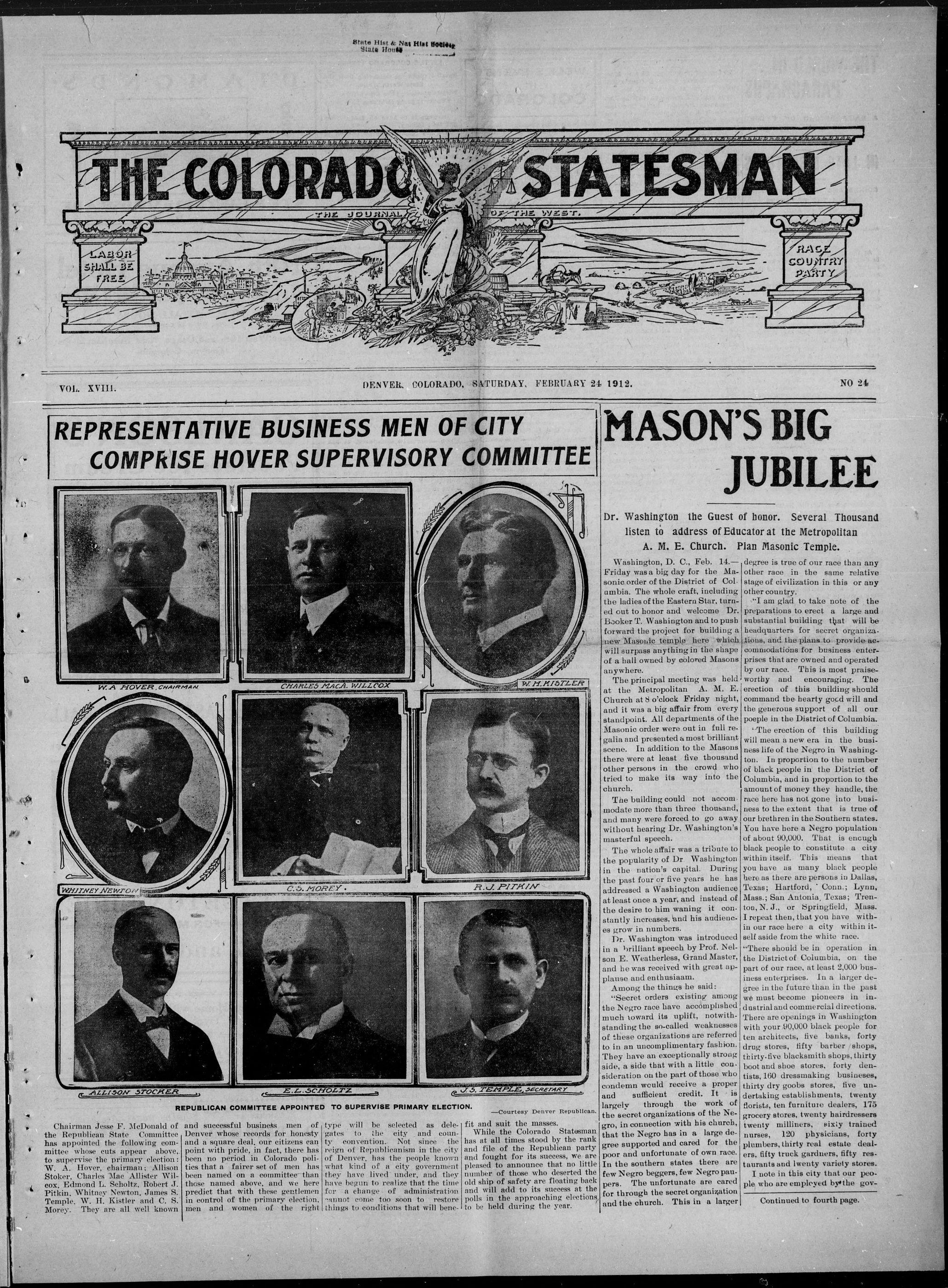
REPRESENTATIVE BUSINESS MEN OF CITY COMPRISE HOVER SUPERVISORY COMMITTEE
W. A. HOVER, CHAIRMAN
CHARLES MACA. WILLCOX
W. H. KISTLER
WHITNEY NEWTON
C. S. MOREY
R. J. PITKIN
ALLISON STOCKER
E. L. SCHOLTZ
J. S. TEMPLE, SECRETARY
VOL. XVII1.
REPRESENTATIVE
COMPRIS
W. A. HOVER, CHAIR
WHITNEY NEWTON
ALLISON STOCKER
Chairman Jesse F. McDonald of the Republican State Committee has appointed the following committee whose cuts appear above, to supervise the primary election: W. A. Hover, chairman; Allison Stoker, Charles Mae Allister Wilcox, Edmond L. Scholtz, Robert J. Pitkin, Whitney Newton, James S. Temple, W. H. Kistler and C. S. Morey. They are all well known
and successful business men of Denver whose records for honesty and a square deal, our citizens can point with pride, in fact, there has been no period in Colorado politics that a fairer set of men has been named on a committee than those named above, and we here predict that with these gentlemen in control of the primary election, men and women of the right type will be selected as delegates to the city and county convention. Not since the reign of Republicism in the city of Denver, has the people known what kind of a city government they have lived under, and they have begun to realize that the time for a change of administration cannot come too soon to restore things to conditions that will bene- fit ha ha ha am am pl pl nu nu o o po po
type will be selected as delegates to the city and county convention. Not since the reign of Republicanism in the city of Denver, has the people known what kind of a city government they have lived under, and they have begun to realize that the time for a change of administration cannot come too soon to restore things to conditions that will bene-
fit and suit the masses.
While the Colorado Statosman has at all times stood by the rank and file of the Republican party and fought for its success, we are pleased to announce that no little number of those who deserted the old ship of safety are floating back and will add to its success at the polls in the approaching elections to be held during the year.
MASON'S BIG JUBILEE
Dr. Washington the Guest of honor. Several Thousand listen to address of Educator at the Metropolitan A. M. E. Church. Plan Masonic Temple.
Washington, D. C., Feb. 14.—Friday was a big day for the Masonic order of the District of Columbia. The whole craft, including the ladies of the Eastern Star, turned out to honor and welcome Dr. Booker T. Washington and to push forward the project for building a new Masonic temple here which will surpass anything in the shape of a hall owned by colored Masons anywhere.
degree is true of our race than any other race in the same relative stage of civilization in this or any other country.
"I am glad to take note of the preparations to erect a large and substantial building that will be headquarters for secret organizations, and the plans to provide accommodations for business enterprises that are owned and operated by our race. This is most praise-
The principal meeting was held at the Metropolitan A. M. E. Church at 8 o'clock Friday night, and it was a big affair from every standpoint. All departments of the Masonic order were out in full regalia and presented a most brilliant scene. In addition to the Masons there were at least five thousand other persons in the crowd who tried to make its way into the church.
The building could not accommodate more than three thousand, and many were forced to go away without hearing Dr. Washington's masterful speech.
The whole affair was a tribute to the popularity of Dr. Washington in the nation's capital. During the past four or five years he has addressed a Washington audience at least once a year, and instead of the desire to him waning it constantly increases, and his audiences grow in numbers.
Dr. Washington was introduced in a brilliant speech by Prof. Nelson E. Weatherless, Grand Master, and he was received with great applause and enthusiasm.
Among the things he said:
"Secret orders existing among the Negro race have accomplished much toward its uplift, notwithstanding the so-called weaknesses of these organizations are referred to in an uncomplimentary fashion. They have an exceptionally strong side, a side that with a little consideration on the part of those who condemn would receive a proper and sufficient credit. It is largely through the work of the secret organizations of the Negro, in connection with his church, that the Negro has in a large degree supported and cared for the poor and unfortunate of own race. In the southern states there are few Negro beggers, few Negro paupers. The unfortunate are cared for through the secret organization and the church. This in a larger
NO 24
degree is true of our race than any other race in the same relative stage of civilization in this or any other country.
"I am glad to take note of the preparations to erect a large and substantial building that will be headquarters for secret organizations, and the plans to provide accommodations for business enterprises that are owned and operated by our race. This is most praiseworthy and encouraging. The erection of this building should command the hearty good will and the generous support of all our people in the District of Columbia. The erection of this building will mean a new era in the business life of the Negro in Washington. In proportion to the number of black people in the District of Columbia, and in proportion to the amount of money they handle, the race here has not gone into business to the extent that is true of our brethren in the Southern states. You have here a Negro population of about 90,000. That is enough black people to constitute a city within itself. This means that you have as many black people here as there are persons in Dallas, Texas; Hartford, Conn.; Lynn, Mass.; San Antonia, Texas; Trenton, N. J., or Springfield, Mass. I repeat then, that you have within our race here a city within itself aside from the white race.
"There should be in operation in the District of Columbia, on the part of our race, at least 2,000 business enterprises. In a larger degree in the future than in the past we must become pioneers in industrial and commercial directions. There are openings in Washington with your 90,000 black people for ten architects, five banks, forty drug stores, fifty barber shops, thirty-five blacksmith shops, thirty boot and shoe stores, forty dentists, 160 dressmaking businesses, thirty dry goobs stores, five undertaking establishments, twenty florists, ten furniture dealers, 175 grocery stores, twenty hairdressers twenty milliners, sixty trained nurses, 120 physicians, forty plumbers, thirty real estate dealers, fifty truck gardeners, fifty restaurants and twenty variety stores. In this city that our
I note in this city that our people who are employed by the gov-
Continued to fourth page.
THE WORLD IN PARAGRAPHS
A BRIEF RECORD OF PASSING EVENTS IN THIS AND FOR- EIGN COUNTRIES.
DOINGS AND HAPPENINGS THAT
MARK THE PROGRESS
OF THE AGE.
At the opening of an aviation meet in Oakland, Cal., one man was killed and six others seriously injured in an accident.
Flames that destroyed a farmhouse rear Sapulpa, Okla., cremated two children and probably fatally burned three others.
Death by shooting was selected by Harley McWhinney when the court at Salt Lake, before passing sentence, asked him his preference.
It is estimated that fifty residences were destroyed by a fire which swept the portion of Houston, Texas, inhabited by the working classes.
Aviator Horace F. Kearney, after a mile a minute flight across the bay from Oakland, successfully threaded a maze of electric wires and landed in one of San Francisco's streets.
Senator Guggenheim introduced a bill providing that but forty acres of an enlarged homestead shall be cultivated instead of eighty acres, as is provided for by the present law.
Poisoned by her mother, who gave her strychnine, believing it to be quinine, Miss Agnes Johnson, nineteen, the beautiful daughter of a wealthy contractor of Pasadena, Cal., died
Headquarters for the National Irrigation Congress have been opened here by Arthur Hooker, secretary of the congress. The time of the meeting in Salt Lake next fall will be designated soon by the board of control.
After being prepared for burial and apparently devoid of life for two days, the three-year-old daughter of Michael Maholecheche, who lives on a farm near Black Duck, Minn., was discovered to be alive as the burial services were about to be held.
The Seminole National bank, Seminole, Gaines county, Tex., was robbed of $3,500 by two mounted men, who rode up in front of the bank during the absence of the cashier and with drawn revolvers compelled the assistant cashier, to hand over all the money in sight. The robbers escaped.
To develop more thoroughly the fertilizer and potash resources of the United States, Secretary Wilson has ordered the establishment at Reno, Nev., of a government laboratory, where natural materials supposed to contain potash will be examined without cost. Those sending samples must prepay transportation charges.
The total area of the public domain that up to date has been classified as applicable to the provisions of the enlarged homestead act, amounts to nearly two hundred million acres. Last month, 30,000 acres in Montana and Oregon were designated as lands from which 320-acre homesteads may be selected, and more lands are being classified every month.
WASHINGTON.
A bill authorizing the withdrawal of sovereignty of the United States from the Philippines has been introduced in in Congress.
The Department of Agriculture will participate in the National Corn Exposition to be held at Columbia, S. C., next January.
Only Congress and not the Supreme Court of the United States may object to the initiative and referendum method of legislation in the states, so the court decided.
The nomination of former Gov. Myron T. Herrick of Ohio as ambassador of the United States to France, to succeed Robert Bacon, resigned, was confirmed by the Senate.
An official order for changing the stars of the national ensign and the union jack in use by the navy to show the addition of two new states to the Union has been issued by the Navy Department.
Plans for a military government for the Panama canal zone modeled after that of Gibraltar are being drawn by the War Department. Between 5,000 and 8,000 troops are to be stationed permanently on the zone. The fortresses guarding the ends of the canal will be made the most powerful in the world.
Maj. Gen. Fred C. Ainsworth, adjutant general of the army, was stripped of his office by order of President Taft, and will appear before a court-martial on charges said to embrace conduct prejudicial to good order and discipline and insubordination.
Democratic members of the House committee on postoffices and post roads have agreed to incorporate in the appropriation bill provisions for a general parcels post. They also have agreed upon a general domestic rate of twelve cents and a maximum package of eleven pounds.
SPORT.
In ten fierce rounds, Pierce Matthews of Denver won over Dennis Magirl of Denver at Springfield, Mo.
It is almost a certainty that the Jim Flynn-Jack Johnson battle for the heavyweight championship of the world will be staged at Las Vegas, N. M.
Jack ("Twin") Sullivan of Boston and Howard Morrow of Syracuse, fought ten rounds to a draw in Cleveland. Morrow was a surprise, as he "got to" Sullivan frequently and effectively. He had Sullivan's eye and nose bleeding. Morrow's best work was in covering, avoiding many heavy blows.
FOREIGN.
Thirty thousand bales of cotton burned in one of the big warehouses in Bombay.
Believing that all the insurrections against the government are largely a result of the publication of sensational news, President Madero and his cabinet have appealed to the permanent committee in congress to suspend that article of the constitution providing for a free press and have been given a negative reply.
Two hundred Mexican revolutionists were killed in an attack on San Pedro, garrisoned by 200 federal troops and 100 rurales. Four thousand peons surrounded the town. They attacked a portion of the city left unguarded by the defendants. All of the seventy rebels leading the attack fell at the first fire. More than 100 who followed were mowed down with the second volley. The Vasquistas beat a retreat. Two assaults were made on the town.
A reflex of the threatened national coal strike will go into effect Feb. 29 in Scotland, unless meantime the owners accept the principle of a minimum wage for all men and boys employed underground, is seen in notices given by the blast furnace owners throughout Scotland to their workmen. The contracts of the workmen are thus terminated Feb. 29. The furnace owners are of opinion that a national coal strike is inevitable. It will affect about 800,000 men.
GENERAL.
In an explosion and panic in a moving picture show at Albrightsville, W. Va., twenty-nine persons were injured.
Sheriff Nancy A Williams of Laclede county is the first and only woman sheriff in Missouri. She recently took several prisoners to the penitentiary.
Earl Sandt, a youthful aviator, the first bird-man to fly over the Great Lakes from the United States to Canada, came to grief when his machine turned turtle and he fell 2,000 feet to the ice.
Figures compiled by the Census Bureau show that England has one bank for each 3,000 inhabitants, France one for each 5,000. Italy one for each 7,000 and the United States one for each 67,000.
Having secured only one victim in the first attempt to slaughter three negroes as they were being taken from the court house to the jail at Shelbyville, Tenn., a mob broke into the sheriff's office, where two wounded blacks had been taken, and fired upon them.
Sugar consumption in the United States in the calendar year 1911 exceeded that of any earlier year. The total quantity consumed in continental United States was, according to the latest estimate of the bureau of statistics, Department of Commerce and Labor, 7,670,000,000 pounds, or an average of 81.78 pounds per capita.
Five men contemplate crossing the Atlantic ocean in the air above that sea during the coming summer. Two of these will, if they make the attempts, fly in aeroplanes, two in immense dirigible balloons, and one will be content with the spherical balloon. Of the five, each is a man skilled in his own style of flying.
Death by the hand of the law voids all life insurance policies of the criminal. The Supreme Court so held in the fight of the children of James S. McCue, mayor of Charlotteville, Va., who was executed for the murder of his wife in 1905. A policy for $15,000 was carried by McCue in the Northwestern Mutual Life Insurance Company of Wisconsin.
Lleut. Col. George W. Goethals, in charge of the work on the Panama canal, has a plan of his own to test the canal before it is formally opened. "When the canal has been completed," he said at the War Department, "or when I think things are ready to send a ship through, I'm going to pick out some old scow that has done good service there and have a test of my own. Starting at the Atlantic, I'm going to head for the Pacific via the canal. If I get through I'll wire the President that the first ship has successfully made the passage. If I don't get, through I'll say nothing about it." By driving nails into the spine of his wife, Stanley Vekamas, a Pole, of Wilkesbarre, Pa., sought to bring about her death and hide the cause so that he could marry another. He was arrested and his wife taken to a hospital hovering between life and death.
The anthracite mine workers' special committee in Pennsylvania will present to the operators demands for a new working contract. On the operators' answer hinges the question whether there will be a strike of 180,000 mine workers in the hard coal regions.
WEEK'S EVENTS IN COLORADO
Western Newspaper Union News Service.
COMING EVENTS IN COLORADO.
March 4-6--Western Slope W. C. T. U.
March 11-16--Denver Automobile Show.
March 11-16 —Denver Automobile Show,
Denver
JJ Convention, Colorado Springs
School Convention, Colorado Springs
State Teachers' College, Greeley
Believes There Is Smelter Trust.
Washington.—Information as to the existence of a smelter trust is asked of the attorney general in a resolution introduced by Representative Martin of Colorado.
Children Form Farmers' Club.
Meeker.—At Petrolite, on the government road about fifteen miles from Meeker, the children have formed what they call the Government Road Agricultural Society, and have elected a president, vice president, treasurer, secretary and directors. The club has seventeen charter members.
Denver-Cripple Creek Road.
Cripple Creek.—Work will be started soon on the proposed road to run from Sedalia, twenty-five miles south of Denver, to West Creek, on the boundary line of Tellier county. A road already connects Cripple Creek with West Creek and completion of the proposed road will shorten the distance between Denver and Cripple Creek by about forty miles.
Estes Goes to Penitentiary.
Greeley—E. J. Estes was sentenced to from seven to nine years in the state penitentiary, following a plea of guilty of forgery. He boarded a train for Canon City shortly afterward in custody of Sheriff S. J. McAfee. Estes went to the station without being handcuffed. In spite of the blizzard more than 100 of his friends were there to bid him farewell.
State Must Return Santa Fe Tax.
Washington.—In a decision handed down in the Supreme Court by Justice Holmes, Colorado was declared to have exerted unconstitutional privilege in collecting from the Atchison, Topeka & Santa Fe railway a tax of $7,629 under a statute of 1907, which applies a license tax to foreign corporations. Under the terms of the statute itself, the judgment will have the effect of requiring the state treasurer to return the amount to the railway company. Justice Holmes declared the tax exacted of the Santa Fe is obviously unconstitutional. He cited various cases involving telegraph companies and the Pullman company, wherein those concerns were absolved from all but the original license fee to do business in various states on ground that the greater part of their business was outside any single state.
Organize to Aid Farmers.
Denver.—Organization of the Farmers' Finance Company was completed at a meeting of the Chamber of Commerce agricultural committee, when officers were elected. The purpose of the company is to further the development of the semi-arid districts of the state. The primary object of the company is to give relief to farmers of eastern Colorado, and other semi-arid portions of the state, who have been unable to make their farms pay. This aid, it is expected, will enable each of the farmers to get a new start along the right lines, without doing business with loan sharks.
The railroads running through the so-called "dry farming" lands of eastern Colorado have announced that they will co-operate with the new company and it is expected that the roads will subscribe a goodly portion of the $100,000 stock to be issued as soon as the company is incorporated.
New Road for Rifle.
Meeker.—A contract has been let for the immediate construction of a railroad from Rifle to Harvey gap, which will tap the coal beds at that place. March 1 will see the first ground broken, and the road will be practically completed and in operation within sixty days from that date. S. E. Becket, one of the heaviest stockholders, who will be superintendent of the new line, has arrived on the scene with his family and household goods. He states that the new road is being financed entirely by Eastern capital, and that it has nothing to do either with the Rio Grande or the Midland, except that it will make connections with these two roads at Rifle. The Garfield Coal Company, of which E. E. Whitney is president, is constructing the line. The coal bed to be tapped by this line is one of the largest in the state and contains a high grade of coal.
More Land for Sugar Beets.
Grand Junction.—Over 6,000 acres have already been signed up for the beet sugar factory for next season. This is four times as much as was contracted a year ago at this time. The Western Sugar and Land Company expects to secure the largest acreage in its history, and may be able to make a run of six months during the season. It is expected to secure an acreage of from 8,500 to 9,000 acres this year, as many new sections will come under water for the first time.
LITTLE COLORADO ITEMS.
Small Happenings Occurring Over the State Worth While.
Western Newspaper Union News Service.
Denver is going to have a new union depot.
Durango is to have an $800,000 sugar beet factory.
A glove factory will be opened in Loveland March 1.
The worst February storm for years recently visited Breckenridge.
Georgetown is to have a plant for the manufacture of concrete brick.
Buckingham is making a hard fight against the division of Weld county.
An unusually heavy snow fall is reported in the mountains west of Salida.
There were 1,000 fewer deaths in Denver in 1911 than in the preceding year.
Richard Richardson, one of the earliest settlers of Cripple Creek, is dead.
Western slope convention of W. C. T. U. will be held in Delta March 4 to 6.
A man, his wife and four sons are in jail in Walsenburg awaiting sentence by the court.
Four children of Diego Seracina, an Italian miner of Segundo, have died within a week.
The Louden Irrigation district has decided to enlarge the capacity of its ditch at Loveland.
Kersey farmers and business men will co-operate in the organization of a commercial club.
Mr. and Mrs. John Camp of Platteville, recently celebrated their golden wedding anniversary.
A new Sunday closing ordinance has been passed by the City Council of Colorado Springs.
Ben Peck, aged sixty-three, at one time county assessor of Routt county, is dead at Hayden.
The Longmont Commercial Association has sent a graff exhibit to the Kansas City Land Show.
The twelfth district convention of the W. C. T. U. will be held in Salida February 29 to March 1.
Mrs. Hannah Dutton, sixty-five, the largest woman in Colorado, weighing 450 pounds, died in Rifle.
Civil Service examinations will be held March 13 and 14 for school teachers in the Philippines.
For failure to take out a city license to run an employment agency in Pueblo, a Japanese was fined $100.
State Treasurer Kennehan has announced that his office will accept no transportation from the railroads.
A heavy snow slide occurred on Ruby mountain, near West Argentine, and considerable damage was done.
W. E. Wilson, convicted of wife beating at Pueblo, was sentenced to serve out a $100 fine on the city wood pile.
Nearly every portion of the state has been visited by heavy snowfall, ranging in depth from one inch to seven feet.
Fred W. Springer, a prominent young man of Trinidad, was instantly killed when he was struck by an automobile.
In Weld county there is an entire school district owned by one man and the pupils in the district are all his children.
Rev. G. W. Noble, a veteran of the Civil War and for over fifteen years a minister of the Methodist church, died at Collbran.
Kid Parker of Denver knocked out Kid Anaya of Fort Collins, in the seventh round of a scheduled ten-round bout at Fort Lupton.
The Colorado Midland road has ordered two extra trains put into service daily between Denver, Grand Junction and Salt Lake.
The state auditor has refused to pay the employees of the penitentiary until the warrants have the O. K. of the Civil Service Commission.
The tenth annual convention of the Colorado Retail Hardware and Implement Dealers' Association is being held in Denver this week.
All races on the Western slope are to be classified and purses arranged so that owners of strings of horses may enter at every county fair.
The Uinta railroad in the western part of the state, destined for the Vernal section of Utah, is letting contracts for standard gauge ties.
Five members of the Baldwin family, the father and four sons, were sentenced at Walsenburg to terms ranging from three to ten years in the penitentiary for robberies in southern Colorado.
Homesteaders in the Little Beaver section, near Meeker, will be allowed to retain their homesteads, as the case wherein the government threatened to dispossess between 300 and 500 farmers has been settled. The State Land Board has relinquished its claim.
The young women of Loveland have organized a Girl Scout movement and will make the Boy Scouts hustle to keep ahead of them in membership.
Guy H. Ward pleaded guilty in the District, Court in Sterling to embezzling the sum of $9,218.70 and was sentenced to the penitentiary for a term of from four to six years.
William Catanach, an agent of the Australian government, is in Colorado to secure 100 irrigation farmers to aid his government in developing thousands of acres of dry land
FOREM-AMERICAN
JEWELRY GUILD
STERLING SI
10th Avenue
H. HEUER, PR
RESTING PLACE FOR
MEALS AT A
Pool Room in
Corner West 10th and Osage
Denver, C
ASK FOR
CARLS
Peerless Ic
Phones: M
DID YOU E
Neef Bro
It's made right, a
None better made
This is a Strictly C
BELLING SILVERVIEW
Avenue H
H. HEUER, PROPRIETOR
PLACE FOR COLORED
MEALS AT ALL HOURS
Pool Room in Connection
at 10th and Osage, Near Bur
Denver, Colorado
ARLSON
Hardless Ice Cream
Phones: Main 112 and
D YOU EVER T
f Bros.' B
made right, and tastes
better made anywhere
a Strictly Colorado F
STERLING SILVERWARE
Corner West 10th and Osage, Near Burnham Shops Denver, Colorado
CARLSON'S Peerless Ice Cream Phones: Main 112 and Main 5787
DID YOU EVER TRY Neef Bros.' Beer?
It's made right, and tastes right. None better made anywhere and This is a Strictly Colorado Production BE SURE AN TRY IT.
BERT PLES
MANAGER
EAST TURNER
2132-2148 Ara
Phone 2449
2132-2148 Arapahoe St.
Phone 2449 Denver
THE
BROADHURST
CARTER
SHOE CO.
NETTLETO
FOR M
$6, $7 and
Supply Your Home w
Tivoli
Bottled
The Empire B
Phone Gall
TLETON S
FOR MEN
$7 and $8,
Your Home with the Ce
Tivoli Beer
Bottled by
Empire Bottling
Phone Gallup 245
$6, $7 and $8, Pair
Supply Your Home with the Celebrated Tivoli Beer
The Empire Bottling Co.
Phone Gallup 245
THE BEST ICE CREAM AND
CANDIES AT
O.P. BAUR & CO.
CATERERS AND
CONFECTIONERS
Phone: 168
1512 Curtis Street, Denver, Cole.
t, Denver, Colo.
THE HOTEL
ILVERWARE
venue Hotel
PROPRIETOR
FOR COLORED GENTS
ALL HOURS
Connection
age, Near Burnham Shops
Colorado
SON'S
ice Cream
Main 112 and Main 5787
EVER TRY
os.' Beer?
and tastes right.
de anywhere and
Colorado Production
RT PLESSNER
MANAGER
TURNER HALL
2-2148 Arapahoe St.
2449 Denver
823
Sixteenth St.
We Are Denver Agents for the
ON SHOE
MEN
1 $8, Pair
with the Celebrated
Beer
d by
Bottling Co.
llup 245
TRADE MORAL—The quality of what you have to sell is known to some people all of the time and all of the people some of the time, but advertise regularly with us and you'll reach all of the people all of the time.
POSTAL SERVICE SHOWS A PROFIT
First Time in History, According to Report of Cabinet Officer.
RAISE IN RATES IS FAVORED
President Concourse in Recommendation of Commission on Second-Class Mail Matter—Again Suggests Adoption of Parcel Post System.
Washington, Feb. 22.—For the first time in the history of the postal service that department of the government showed a profit for the fiscal year ending June 30, 1911, according to the annual report of Postmaster General Hitchcock transmitted to congress today. Accompanying the document was the report of the commission on second-class mail matter appointed by joint resolution of congress on March 4 of last year and a brief message of the president, in which he called attention to the principal features of the two reports.
Would Increase Second-Class Rates.
The report of the commission on second-class mail matter makes the following recommendations:
1. The rate of 2 cents a pound on copies mailed by publishers to subscribers, to news agents, and as sample copies, and by news agents to their subscribers or to other news agents.
2. The rate of 1 cent for each 4 ounces for copies mailed by other than publishers and news agents; that is, the present transient rate.
3. The present free-in-county privilege retained, but not extended.
The commission also recommended that the cent-a-copy rate for newspapers other than weeklies and for periodicals not exceeding 2 ounces in weight, and the 2-cent-a-copy rate for periodicals exceeding 2 ounces in weight, when mailed at a city letter-carrier office for local delivery, be abolished.
As to the effect and adequacy of the proposed increase of 1 cent a pound in postage the commission says:
"Such an increase will not, in the opinion of the commission, bring distress upon the publishers of newspapers and periodicals, or seriously interfere with the dissemination of useful news or information. A reasonable time should be allowed, after the rate is fixed, before it is put into effect. While the new rate will be very far from compensating the government for the carriage and handling of second-class matter, it will to some extent relieve the existing burden and result in a more equitable adjustment of rates."
Both the president and the postmaster general concur in the recommendations and regarding the proposed increase in newspaper postage the president says: "The proposed increase of 1 cent a pound in the second-class postage rate, I believe, to be most reasonable, and if sufficient time is allowed before the change goes into effect it should work little serious injury to the business of the periodical publishers, while equalizing, at least in a measure, the burdens of postal taxation."
Rates Should Be More Equal. Commenting further on the proposed increase, the president says: "The postal service is now, for the first time in years, operated upon a self-sustaining basis, and in my judgment this is a wise policy; but it should not be carried out at the expense of certain classes of mail matter that pay revenue largely in excess of their cost. It is not just that some classes of mail should be excitably taxed to meet a deficiency caused by other classes, the revenue from which is much below their cost of handling and carriage. Where such inequalities exist they should be removed as early as practicable. The business enterprises of the publishers of periodicals, however, have been built up on the basis of the present second-class rate, and therefore it would be manifestly unfair to put into immediate effect a large increase in postage. That newspapers and magazines have been potent agencies for the dissemination of public intelligence and have consequently borne a worthy part in the development of the country all must admit; but it is likewise true that the original purpose of congress in providing for them a subvention by way of nominal postal charges in consideration of their value as mediums of public information ought not to prevent an increase, because they are now not only educational but highly profitable. There is no warrant for the great disparity between existing postage rates on periodicals and the cost of the service the government performs for them. The aggregate postal revenues for the fiscal year 1911 were $237,879,823.60, derived mainly from the postage collected on the four classes of mail matter. It is carefully estimated by the postoffice department that the revenue derived from mail matter of the first class is approximately one and one-half times the cost of handling and carriage; that the returns from third and fourth class matter are slightly in excess of their cost of handling and carriage; and that while second-class matter embraces over 65 per cent. of the entire weight of all the mail carried, it, nevertheless, yields little more than 5 per cent. of the postal revenues."
The commission on second-class
mail matter consisted of Hon. Charles E. Hughes, associate justice of the Supreme Court of the United States; President A. Lawrence Lowell of Harvard University, and Mr. Harry A. Wheeler, president of the Association of Commerce of the city of Chicago. In commenting on their findings the president says:
"The report discloses a most exhaustive and critical inquiry into the subject of second-class mail matter after adequate notice to all the parties in interest. Extensive hearings were held by the commission, at which the Postmaster General and the Second and Third Assistant Postmasters General appeared and submitted formal statements presenting the various contentions of the Post Office department, together with all the relevant official data and evidence relating to the cost of handling and transporting second-class mail matter. Certain of the leading magazines were represented by counsel, while various other publications appeared by representatives.
"The findings of the commission confirm the view that the cost of handling and transporting second-class mail matter is greatly in excess of the postage paid, and that an increase in the rate is not only justified by the facts, but is desirable."
Cost Inquired Into.
"The commission reports that the evidence submitted for its consideration is sufficient to warrant a finding of the approximate cost of handling and transporting the several classes of second-class mail known as paid-at-the-pound-rate, free-in-county, and transient matter, in so far as relates to the services of transportation, post-office cars, railway distribution, rural delivery, and certain other items of cost, but that it is without adequate data to determine the cost of the general post-office service and also what portion of the cost of certain other aggregate services is properly assignable to second-class mail matter. It finds that in the fiscal year 1908, the period for which the statistics for the Post Office Department were compiled, the cost of handling and transporting second-class mail, in the items of transportation, post-office cars, railway distribution, rural delivery, and certain miscellaneous charges, was approximately 6 cents a pound for paid-at-the-pound-rate matter, and for free-in-county and transient matter each approximately 5 cents a pound, and that upon this basis, as modified by subsequent reductions in the cost of railroad transportation, the cost of paid-at-the-pound-rate matter, for the services mentioned, is now approximately $5\frac{1}{2}$ cents a pound, while the cost of free-in-county and transient matter remains as formerly, namely, each at approximately 5 cents a pound.
The commission suggests that the department "maintain an adequate cost system, so that the effect of the new rates may be closely observed and a proper basis may be secured for the consideration of any future proposals."
President Taft again concurs in the recommendation of the Postmaster General for the adoption of a parcel post system, suggesting the inauguration of such a service on rural routes and in the city delivery service first.
Ownership of Telegraph Opposed.
Hitchcock's recommendation for government ownership of the telegraph lines under the supervision of the postal service is not approved of by the president. Regarding this he says:
"There is only one recommendation in which I can not agree—that is one which recommends that the telegraph lines in the United States should be made a part of the postal system and operated in conjunction with the mall system. This presents a question of government ownership of public utilities which are now being conducted by private enterprise under franchises from the government. I believe that the true principle is that private enterprise should be permitted to carry on such public utilities under due regulation as to rates by proper authority rather than that the government should itself conduct them. This principle I favor because I do not think it in accordance with the best public policy thus greatly to increase the body of public servants. Of course, if it could be shown that telegraph service could be furnished to the public at a less price than it is now furnished to the public by telegraph companies, and with equal efficiency, the argument might be a strong one in favor of the adoption of the proposition. But I am not satisfied from any evidence that if these properties were taken over by the government they could be managed any more economically or any more efficiently or that this would enable the government to furnish service at any smaller rate than the public are now required to pay by private companies."
The report of the Postmaster General is full of statements of changes in the organization and methods of the postal service made since the last annual report, and of tentative drafts of legislation embodying certain recommendations of the department which need legislation to carry them out. It also calls attention to the fact that the revenues for the fiscal year ended June 30, 1911, amounted to $237,879, $23.60 and that the expenditures amounted to $237,660,705.48, making a surplus of $219,118.12.
The report shows that the postal savings system was begun experimentally in January, 1911, and that it has now been extended so as to include 7,500 presidential post offices, which includes practically all of the post offices of that class. Preparations are also being made to establish the system at about 40,000 fourth-class offices. The deposits in 11 months have reached a total of $11,000,000, distributed among 2,710 national and state banks.
TIME ALLOWED IS OF UTMOST IMPORTANCE.
Too Long or Too Short Application of Fire Will Spoil Any Dish—Follow These Rules and Success Is Certain.
Loaf bread, 45 to 60 minutes; rolls and biscuits, 10 to 20 minutes; graham gems, 30 minutes; gingerbread, 20 to 30 minutes; sponge cake, 45 to 60 minutes; plain cake, 30 to 40 minutes; fruit cake, 2 to 3 hours; cookies, 10 to 15 minutes; bread pudding, 1 hour; rice and tapoca, 1 hour; Indian pudding, 2 to 3 hours; steamed pudding, 1 to 3 hours; steamed brown bread, 3 hours; custards, 15 to 20 minutes; ples, 30 to 45 minutes; plum pudding, 2 to 3 hours.
Time for Cooking Vegetables.—Greens, dandelions, $1\frac{1}{2}$ hours; spinach, 20 to 30 minutes; string beans, 1 to 2 hours; green peas, 20 to 30 minutes; beets, 1 to 3 hours; turnips, 1 to 3 hours; squash, 1 hour; potatoes boiled, 20 to 30 minutes; potatoes baked, 1 hour; corn, 20 minutes; carrots, $\frac{3}{4}$ to 1 hour; asparagus, 15 to 25 minutes; cabbage, 1 to 3 hours.
Time for Broiling.—Steak, 1 inch thick, 4 to 6 minutes; steak, $1\frac{1}{2}$ inches thick, 8 to 15 minutes; fish, small and thin, 5 to 8 minutes; fish, thick, 15 to 25 minutes; chicken, 20 to 30 minutes.
Time for Cooking Meats—Beef
undone, per pound, 9 to 10
minutes; beef, fillet of, 20 to 40 minutes;
mutton, leg, per pound, 10 to 12 minutes;
mutton, stuffed shoulder, per
pound, 18 minutes; veal, loin of, plain,
per pound, 15 to 18 minutes; veal,
stuffed, per pound, 20 minutes; pork,
spare ribs, per pound, 15 to 30
minutes; pork, loin or shoulder, per
pound, 20 to 30 minutes; liver, baked
or brushed, 1 to 1½ hours; corned
beef, per pound, 25 to 30 minutes;
boiled (simmered) beef, per pound,
20 to 30 minutes; ham, per pound,
after water boils, 15 to 20 minutes;
bacon, per pound, 15 minutes; chicken,
baked, 3 to 4 pounds, 1 to 2 hours;
turkey, 10 pounds, 3 hours; goose, 8
pounds, 3 hours; duck, tame, 40 to 60
minutes; duck, wild, 30 to 40 minutes;
grouse, pigeons and other large birds,
30 minutes; small birds, 10 to 15
minutes; venison, per pound, 15 minutes;
fish, long and thin, 6 to 9
pounds, 1 hour; fish, thick, 6 to 8
pounds, 1½ to 2 hours; fish, small, 20
to 30 minutes.
FOR THE HOUSE MISTRESS
Suggestions That Will Prove of Practical Value In Conduct of Establishment.
After the rugs or carpets are cleaned and ladd on the floor the colors often look dingy. A solution made of bits of soap dissolved in a gallon of warm rainwater and a tablespoonful of ammonia added, if applied a little at the time with a good scrubbing brush, will brighten the colors wonderfully. Only the top of the carpet gets wet and in 12 hours the room is ready for use.
Housekeepers who only have a weekly allowance for household expenses sometimes find it a drain on their purses to buy fruit to preserve for winter use. If they will count the cost of each can or jar of fruit preserves and jot it down in a notebook, then as each bottle is used through the winter put the price of it in money in a small box kept for the purpose, when summer time comes money for the winter's preserves will be in readiness. A certain portion of wall space in the hallway of a house where every member of the family passed by many times a day was reserved for changes in decoration. There was first hung a map of the United States, then a poster of some new public building, an inexpensive print of some famous painting and a poster of special interest, etc. This proved to be a never-ending source of interest throughout the year.
Fruit Cake.
Take one pound of flour, one pound of brown sugar, one-half pound of citron, two pounds of raisins, one pound of currants, three-fourths pound of butter, one pound of almonds, one ounce of mace, one cup of molasses, one half teaspoonful of soda stirred in the molasses and five eggs. Stir the sugar and butter to a cream, then add white and yolks of eggs, beaten separately. Stir in the flour gradually, then the molasses and spices, and lastly the fruit. This makes three loaves. Bake in a moderate oven.
Fancy Fried Potatoes
Wash and pare potatoes, slice thin (using vegetable slicer) into a bowl of cold water. Let stand two hours, changing water twice. Drain, plunge in a kettle of boiling water and boll one minute. Drain again and cover with cold water. Take from water and dry between towels. Fry in deep fat until light brown, keeping in motion with a skimmer. Drain on brown paper and sprinkle with salt.
Left-Overs In Borders
Left-overs of meat well prepared, seasoned and moistened with a little gravy, taste well in a border of hot mashed potato. If more is liked, serve it from a small bowl and never poured around the potato. Mem.: It is not stylish to say gravy. Everything of its kind is sauce now, whether it goes with fish, fowl or fruit.—Alice E. Whitaker.
TWO HUNDRED BUILDINGS BURN
—THOUSAND PEOPLE ARE
MADE HOMELESS.
NO LIVES ARE LOST
CITY DIVIDED BY BAYOU WHICH SAVES FURTHER DESTRUCTION OF PROPERTY.
Western Newspaper Union News Service.
Houston, Tex.—In the wake of the most destructive fire in the history of Houston, smoother wreckage covers an area about one and a half miles in length and varying in width from 200 yards to half a mile in the northeastern section of the city.
More than a dozen of the city's most important industrial enterprises are in ruins; 200 or more dwellings and store buildings are in ashes and approximately 1,000 persons are homeless.
An accurate statement of the monetary loss is not possible, but the most conservative is that it will reach $7,000,000. The insurance carried will not exceed 40 per cent.
Except for a few who suffered minor burns and bruises, no casualties attended the fire.
Breaking forth suddenly in an untenanted rooming house known locally as the "mad house," and at a time when a fierce gal was sweeping from the northwest, the flames made rapid headway. The flames pounced upon adjoining structures and from them swept toward the southeast, generally making clean and desolate its route, but occasionally sparing a structure, sometimes a mere shanty and again a place of pretension.
Four hours later the area of destruction had been defined, but the work of the fire fighters was not then nor is it yet ended, for all over the blackened districts are piles of debris still burning.
Buffalo bayou, dividing the city, running east and west, checked the fire, for except an occasional dip across the stream, the line of destruction ended there.
Two of the plants thus threatened were those of the Texas Oil Company and the Houston Packing Company. The latter was damaged to a considerable extent.
Several times the roof of the oil plant was ignited by flying brands, but the incipient blazes were quickly extinguished.
The industrial plants destroyed include three cotton compresses, together with 55,000 bales of cotton, a syrup factory, a pencil factory, two rice mills, a cotton pickery and three lumber yards. The compresses and cotton alone were valued in excess of $5,000,000.
St. Patrick's Catholic Church and academy also were destroyed. Quick action was taken for the relief of those rendered homeless and nightfall found the victims with their immediate needs cared for. Outside aid will not be needed in caring for those made homeless.
Storm Damages Texas Panhandle.
Dallas, Texas.—Heavy wind storms accompanied in some sections of Texas by heavy rainfall, did thousands of dollars damage by wrecking buildings and demoralizing telegraph and telephone service. In the Panhandle the storm accompanied by four inches of snow, disarranged railroad schedules.
Storm Sweeps Middle West.
Chicago.—A blinding snowstorm, backed by a fifty-mile gale, swooped down on the Middle West, blocked traffic, played pranks with the routine of human afairs and swept eastward in the direction of northern Ohio, Pennsylvania and New York. A temperature ranging between twenty-nine and twenty-four degrees made the wind and snow bearable and no suffering was reported. Several deaths in wrecks are attributed indirectly to the storm. The storm reached its greatest intensity in Chicago and northern and central Illinois, although eastern Iowa and Missouri, southern Wisconsin, Michigan and Indiana felt the blizzard to a considerable extent.
Farmer Freezes to Death:
Severy, Kas. Alex Barge, a farmer living near here, was frozen to death during the storm recently. His body was found.
Salt Lake Gambling Ordinance.
Salt Lake.—The anti-gambling ordinances to go into effect here March 1 apply to private card games for prizes and the chief of police said that bridge whist at afternoon teas would receive attention from his department as promptly as poker in a saloon.
Freezes to Death in Chicago.
Chicago.—John Harmon, a laborer was a victim of the storm here. His body was found frozen in a snow drift in the yard of his home.
The Prior Furniture Co. 1814 Curtis Street
We buy and sell new and second hand Furniture, also repair work. Window shades. Sewing Machines sold and repaired a specialty.
Phone Champa 392
Railroad M
We lead, others fol
Men. A welcome t
and papers will be
road Men and Wai Club
lead, others follow. Home for Railroad and
A welcome to visitors. All the latest mag
papers will be found in the Library room.
Railroad Men and Waiters'
We lead, others follow. Home for Railroad and Club Men. A welcome to visitors. All the latest magazines and papers will be found in the Library room.
FRANK BURNLEY, Manager
2149 Curtis Street Denver,
THE ZOB
SAMP
1004 Nineteent
THE ZOBEL BROTHER
AMPLE ROO
Nineteenth Street, Corner of
1004 Nineteenth Street, Corner of Curtis
FINE WINES, LIQUORS AND CIGARS COORS' CELEBRATED BEER ON TAP
R COL
Colorado Products Patronize Home
ZANG'S
DELICIOUS TABLE BEERS
UMBINE,
VIENNA AND
PILSE
Boost Colorado Prod
Z A
DELIC
COLUMBIN
VIE
Boost Colorado Products Patronize Home Industry
Guaranteed Absolutely Pure. Delivered Daily to All Parts of the City.
The Ph. Za TELE
We Boost for Colorad
Ph. Zang Brewing
TELEPHONE GALLUP 395.
Post for Colorado
You Should Boost
N. FERRY
TAILOR
Who pays the high up-town rent?
Is it the tailor? No!
Just guess who it is---
The Customer
Give us a chance and we will give you the satisfaction. Our Fall and Winter Styles are all our prices are moderate. We do all sewing in our shop.
Respectfully,
N. FERRY TAILOR
Who pays the high up-town rent?
Is it the tailor? No!
Just guess who it is---
The Customer
Give us a chance and we will give you the satisfaction. Our Fall and Winter Styles are all in Our prices are moderate. We do all sewing in our shop.
Respectfully,
N. Ferry
1905 Curtis Street
SUBSCRIBING
THIS PAPER
Night Pho
DENVER
and Waiters'
ub
home for Railroad and Club
ss. All the latest magazines
n the Library room.
BROTHERS'
E ROOM
eet, Corner of Curtis
Phone Main 8232
Patronize Home Industry
G'S
ABLE BEERS
A AND
PILSENER
Brewing Co.
GALLUP 395.
You Should Boost for Us
ERRY
OLOR
high up-town rent?
tilor? No!
who it is---
customer
will give you the satisfac-
Winter Styles are all in
We do all sewing in our
futfully,
Hours: 10 to 11 a. m., 2 to 5 and 7 to 9
p. m. and by Appointment.
Dr. J. H. P. Westbrook
COR. 21ST AND ARAPAHOE STS
Night Phone Champa 579
Cash or Credit
Denver, Colo.
COLORADO
THE COLORADO STATESMAN
JOS. D. D. RIVERS.....Proprietor
1824 Curtis Street, Room 25.
One Year ..... $2.00
Six Months ..... $2.00
Three Months ..... $2.00
PAYABLE IN ADVANCE.
Entered as second-class matter at the postoffice in the city of Denver, Colorado.
All communications of a personating nature that are not complimentary will be withheld from the columns of this paper.
It occasionally happens that papers sent to subscribers are lost or stolen. In case you do not receive any number when due, inform us by postal card and we will cheerfully forward a duplicate of the missing number.
Communications to receive attention must be neway, upon important subjects, plainly written only upon one side of the paper; must reach us Tuesdays, if possible, anyway, not later than Wednesdays, and bear the signature of the author. No manuscript returned, unless stamps are sent for postage.
Remittances should be made by Express Money Order, Postoffice Money Order, Registered Letter or Bank Draft. Postage stamps will be received the same as cash for the fractional part of a dollar. Only 1-cent and 2-cent stamps taken.
Display advertising, 50 cents per square. A square contains ten agate lines.
Reading notices, ten lines or less, 10 cents per line. Each additional line over ten lines, 5 cents per line.
No discounts allowed on less than three months' contract. Cash must accompany all orders from parties unknown to us. Further particulars on application.
JUST THINK OF IT.
made that in less than nine more moth the streams are to disappear transparent atmosphere is to cool cheers is to give way to the liquor was intended for bathing purpure some folks think it should just not forgotten that Colorado is Nature that ozone and is nature in which we stake our unassailable ra
LENT.
In all political complexions and ability to speak for all and to all mistake in catering to ignorance initiality and good sense in public and Christians agreed with mass of church goers of different persistitions during the forty day on by followers of the establishment and Lutheran to be a season of all kinds are to be suppressed out forward. But at the dinner ring off of in the bill of fare of the cloth and sacraments, but not with the function of first impulse no argument—eating. According death and taxes—be he of one the blood and sinnes of the race are becomingly quiet yet some sidestep either of these extremes season. If any one think that Dunt twirl their thumbs for forty o What the church is needing in real spiritual life and vigor. All ought to strive to be and t
PREDICTION is made that in less than nine months Colorado will be a "dry" state. Not that the streams are to disappear and irrigation fail; not that the already transparent atmosphere is to become more rarefied; but that the cup that cheers is to give way to the liquid that cleanses. This idea of drinking what was intended for bathing purposes has caught on so hard in the South that some folks think it should just naturally come on West. But it should not be forgotten that Colorado is Nature's sanitarium, and that medical science agrees that ozone and whisky are inseparable ingredients of that elixir of life on which we stake our unassailable reputation.
LENT.
This paper serves all political complexions and religious faiths and therefore feels at liberty to speak for all and to all. We believe that certain churches make a mistake in catering to ignorance in the pulpit and advised intelligence, spirituality and good sense in preachers and members alike. We belive the public and Christians agreed with us. The advent of Lent effects another class of church goers of different persuasion than orthodox, who are very superstitious during the forty days preceding Easter. This time is looked upon by followers of the established churches, such as the Anglican, Catholic and Lutheran to be a season when the desire for feasting and amusements of all kinds are to be suppressed and things of a more spiritual nature put forward. But at the dinner hour it would be difficult to detect any falling off of in the bill of fare of the churchmen. He may talk of missions, alter cloth and sacraments, but nothing short of a volcanic eruption could interfere with the function of first importance among us as a race—which admits of no argument—eating. Accordingly, marketing is as inevitable among us as death and taxes—be he of one faith or another.
Pleasure also is in the blood and sinews of the race. While the first days and last days of Lent are becomingly quiet yet some of our choice representatives of the church sidestep either of these extremes and goes in for fun in the middle of the season. If any one think that Denver's four hundred is going to sit down and twirl their thumbs for forty days, he is going to be forced to guess again. What the church is needing in our day is an increased supply of sincerity and real spiritual life and vigor. None can say, "I am better than thou." But all ought to strive to be and to do more in the cause of real religion.
FREDERICK DOUGLASS.
he forgetting Frederick Douglass, the amount of interest we manifest today. Many years ago it was a war and listen to the tales and expedition Denver pioneer, who was a friend before the war when the latter of the Union, and was campaigning a men of radical, abolition view the wrongs of slavery. For more slaves, Douglass continued to be hearing the cause of the Negro man, his silver tongue was forever sting with the thoughts of a sensitive and then turned their eager gaze at American Negro's life thus far he has always been so full of uncle seldom pauses to look back at all too easily the steps he them, in his eagerness to get hurt to careful biographers or commissionist, in books, in stories, in books and memories. Better for and an insurrection and died an regeneration knows too little alone, do not remember and honor device he performed for the last
IS the Negro race forgetting Frederick Douglass? It would seem so, if reference is had to the amount of interest we manifested in him and his lifework in the present day. Many years ago it was a valued privilege for any intelligent Negro to sit and listen to the tales and experiences related by the late H. O. Wagoner, a Denver pioneer, who was a friend and companion of Douglass in those days before the war when the latter was the most prominent Negro abolitionist in the Union, and was campaigning through the North in conjunction with white men of radical, abolition views, urging upon the attention of the nation the wrongs of slavery. For more than twenty years after the emancipation of the slaves, Douglass continued to be a grand figure before this country, championing the cause of the Negro more eloquently than any other man. But when his silver tongue was forever stilled and his keen brain no longer throbbed with the thoughts of a sensitive soul, his race mourned him for a brief season and then turned their eager gaze to the horizon, looking for his successor. The American Negro's life thus far has been such a needful one and the present has always been so full of uncertain experiment and dreadful groping that he seldom pauses to look back over the course that he has traveled, forgetting all too easily the steps he has climbed, and the architects who built them, in his eagerness to get further on.
So we have had no careful biographers or commentators to paint true pictures of the great abolitionist, in books, in stories, in songs, such as would lay hold upon our hearts and memories. Better for Douglass' memory, and worse for us, had he led an insurrection and died an early martyr. For it is true that the present generation knows too little about him, and that the Negro people, as a whole, do not remember and honor him to a degree commensurate with the service he performed for the lasting benefit of his race.
THE BURDEN OF POVERTY.
grace to be poor, but mighty a world has changed so much situation in present day conditions ourselves with excuses for poverty humanity are individually poor, only common is not a disgrace. becomes so abject and mean as the common level invite the im in this uncommon condition as ds of voluntary beggary. an extends over an entire race creates and firmly establishes
THAT it is no disgrace to be poor, but might inconvenient, is an old saying. However, the world has changed so much since this old saying was invented that its application in present day conditions is supremely doubtful. We like to console ourselves with excuses for poverty and for failures, and because the masses of humanity are individually poor, it is easy to agree that a condition so universally common is not a disgrace.
But poverty often becomes so abject and mean as to be uncommon, and those who fall below the common level invite the impatience and disgust of the many, who look upon this uncommon condition as due to the utter carelessness and shamelessness of voluntary beggary.
When this condition extends over an entire race or a nation, there can be no doubt that it creates and firmly establishes in the minds of other peoples and other nations a decided measure of contempt, which is nothing short of disgrace. Charity and pity may soften convictions, but the spirit of this hard-hearted, commercial age writes disgrace after the name of every poverty-stricken man or nation. But this is true and natural only when that poverty can be helped, and because of laziness or shamelessness, and will not help itself. This is the fate of the profligate, the wasteful, the almess, the careless, the thoughtless and the criminal. A great part of the burden of the Negro race is its poverty. After we point with pride to the progress that the race has made in fifty years, we must still acknowledge that we are burdened with poverty. What a comparatively few individuals may acquire in the way of wealth will not materially reduce the burden. The standing of the race is fixed by the conditions surrounding the masses, and individual Negroes of wealth cannot fully escape the force of that conviction lying against their race because of its poverty. The obligation, therefore, is general, to build the whole race to a higher level. The wealthy Negro's obligation is to use his wealth to extend business, commercial and educational enterprises among his people. The obligation of the poor is to reduce their wastefulness, restrain their appetites for extravagant eating and living, and for indulgence in immoderate pleasures; to save, save, save at every turn, and to strive and strive for the possession of land and of homes and for the creation of business relations which will tend to lift their race out of the slough of poverty and give it a foothold in the great world of wealth.
By DR. CHAS. E. PAGE. Boston
TH depends upon the individual's inclination that the sum of eating cannot be settled by a mere yes or no reply need by the experience of any number of individuals, to say, so far as regards the feeding of the thousands are accustomed to eating three times a day and would be kindly to the proposed change. Eating, like every natural function, should be a pleasure and not a pen and the average person would regard it as a punishment at any one of his regular meals, and hence the enforce- of the regimen would not lead to good results.
In practice I favor the three-meal plan, but always with that in case of lack of appetite, or in face of any actual or meals should be omitted until convalescence, and the hunger. Personally, I eat three or four times a day with action, and without experiencing any sort of inconven- day out, and year after year. I take breakfast at a hotel- k, and am apt to lunch there about three. Dinner at if I get there), and by "leaving a place," or need for it, supper at ten to twelve sends me to bed to sleep like a be said, however, in this connection, that whoever has ancient day's ration at any hour of the day, cannot with satisfaction eat again on going to bed. But, rightly (moderate meals of really wholesome food), nothing fits a bottle-babe to the octogenarian, for good sleep and a like a moderate supper on retiring. All animal kind eater eating. We should never eat when tired, nor get eating, on penalty of great risk from an attack of indi- ce, "Practical Guide to Health," published some years allowing on diet, appetite, etc.; "Learn to distinguish and mere appetency; you may have the latter without anger without appetite. Never eat without an appetite; It is a species of self-abuse which is inexcusable for it no pleasure in it, and it prevents the speedy return site. This does not mean, however, that one must wait
O MUCH depends upon the individual's inclination that the question of eating cannot be settled by a mere yes or no reply nor indeed by the experience of any number of individuals, that is to say, so far as regards the feeding of the thousands who are accustomed to eating three times a day and would not take kindly to the proposed change. Eating, like every other natural function, should be a pleasure and not a penance, and the average person would regard it as a punishment to omit any one of his regular meals, and hence the enforcement of the regimen would not lead to good results.
In my private practice I favor the three-meal plan, but always with the qualification that in case of lack of appetite, or in face of any actual illness, the meal or meals should be omitted until convalescence, and the return of normal hunger. Personally, I eat three or four times a day with pleasure and satisfaction, and without experiencing any sort of inconvenience, day in and day out, and year after year. I take breakfast at a hotel about eleven o'clock, and am apt to lunch there about three. Dinner at home about seven (if I get there), and by "leaving a place," or need for it, I find a moderate supper at ten to twelve sends me to bed to sleep like a well-nursed babe.
It remains to be said, however, in this connection, that whoever has already had a sufficient day's ration at any hour of the day, cannot with safety or ultimate satisfaction eat again on going to bed. But, rightly managed (meaning moderate meals of really wholesome food), nothing fits anyone, from the bottle-babe to the octogenarian, for good sleep and a fresh awakening, like a moderate supper on retiring. All animal kind naturally sleep after eating. We should never eat when tired, nor get tired shortly after eating, on penalty of great risk from an attack of indigestion.
In my treatise, "Practical Guide to Health," published some years ago, occurs the following on diet, appetite, etc.: "Learn to distinguish between hunger and more appetency; you may have the latter without hunger, but not hunger without appetite. Never eat without an appetite; never a mouthful. It is a species of self-abuse which is inexcusable for sick or well. There is no pleasure in it, and it prevents the speedy return of a normal appetite. This does not mean, however, that one must wait
till ravenously hungry by any means; we should always eat when we need food, if we can get it. The system should always be kept fairly well saturated, so to say, with nutriment; but this should never be carried to the point of incipient nausea by any means. If the rule be rightly interpreted, this is about the way to put it: Eat when you are hungry, drink when you are thirsty and go to bed when you are sleepy; that is, never wait till you are exhausted for want of food, drink or nervous repose. Better eat too much than too little, habitually; but enough is better and, in the long run, more agreeable than excess."
ing the fight due their own client. I have known mer- marreling with competitors as to neglect their own busi- of soldiers who were strong on dress parade, splendid communications and orderly in retreat.
Soldier of all history was Grant and he could fight with- He "demanded" things and the things he "demanded" and unconditional surrender." When the demand was free was neither bickering, scolding nor quarreling. He enemy and gave them back their horses to cultivate their grant the only great man there. General Lee knew how quarrel. He was great in defeat, and securing the best men, he surrendered, without quarreling with his foe or. The field whereon Grant and Lee met on that day sense the "Temple of Liberty." Thank God, the jingle heard there, nor was the place desecrated by jangling routes.
is meant by "Blessed is he who can fight without quar-
sel, while neglecting the fight due their own client. I have known merchants so busy quarreling with competitors as to neglect their own business. I have read of soldiers who were strong on dress parade, splendid in tactics and communications and orderly in retreat.
The greatest soldier of all history was Grant and he could fight without quarreling. He "demanded" things and the things he "demanded" were "immediate and unconditional surrender." When the demand was complied with there was neither bickering, scolding nor quarreling. He fed the starving enemy and gave them back their horses to cultivate their fields. Nor was Grant the only great man there. General Lee knew how to fight, but not to quarrel. He was great in defeat, and securing the best he could for his men, he surrendered, without quarreling with his foe or cursing his enemy. The field whereon Grant and Lee met on that day was in the highest sense the "Temple of Liberty." Thank God, the jingle of gold was not heard there, nor was the place desecrated by jangling words or petty disputes.
This is what is meant by "Blessed is he who can fight without quarreling."
tints of red of the Baldwin and Northern Spy. They come pretty near it, that is all.
in Baldwin and Northern Spy. They come pretty near it, but grinding works in the world were multiplied ten thoughn't turn out pigment enough in a year to do what change from season to season.
It is busy everywhere all the time. In the life of a leafish day by day, following with its tints from budding ears from the branch.
In valleys and the hills, the growing grains, the flowering ole.
If all the paint grinding works in the world were multiplied ten thousand times they couldn't turn out pigment enough in a year to do what nature does in a change from season to season.
Nature's brush is busy everywhere all the time. In the life of a leaf it applies the brush day by day, following with its tints from budding time until it flutters from the branch.
It touches the valleys and the hills, the growing grains, the flowering plants.
S
ment of the regi
In my private practice the qualification that in case illness, the meal or meals she return of normal hunger. P pleasure and satisfaction, amience, day in and day out, an about eleven o'clock, and an home about seven (if I get t I find a moderate supper at well-nursed babe.
It remains to be said, I already had a sufficient day safety or ultimate satisfacti managed (meaning moderate anyone, from the bottle-bab fresh awakening, like a naturally sleep after eating tired shortly after eating, on gestion.
In my treatise, "Practi ago, occurs the following o between hunger and mere a hunger, but not hunger with never a mouthful. It is a s sick or well. There is no plea of a normal appetite. This
PETER H. BURGESS
General
Grant
Knew
How to
Fight
By Former United States Senator
William E. Mason
sel, while neglecting the fight chants so busy quarreling winess. I have read of soldier in tactics and communication.
The greatest soldier of a out quarreling. He "demand were quarremling and uncomplied with there was need the starving enemy and fields. Nor was Grant the o to fight, but not to quarrel. he could for his men, he sur cursing his enemy. The fief was in the highest sense the of gold was not heard there words or petty disputes.
This is what is meant b reling."
Pretty Colors by Nature's Paint Brush
By L. M. RICARD
tints of red of the Baldwin a that is all.
If all the paint grinding sand times they couldn't tu nature does in a change from
Nature's brush is busy it applies the brush day by time until it flutters from the
It touches the valleys and plants.
Never is it idle.
I have known one man to hate another man because of the color of his hair. Another one said to me: "I hate a man who parts his hair that way." Another one said to me of a very good man: "I can't like him, he eats with his knife." I knew a preacher, who was a great theologian and thought his theology was religion, who couldn't help quarrelling with everyone he met of a different theology. He was quarrelling all the time and thought he was "fighting the good fight."
I have known lawyers who constantly quarreled with opposing clients and coun-
Nature paints in the most striking colors and shades and tints with a delicacy never achieved by the brush in the hands of the artist. The highest ambition of the manufacturerer of paints is to produce colors which look like nature's. They never succeeded.
Grass has a green of its own. So has the leaf and so has the distant ocean. None of these has ever been reproduced and put in cans with a price label on them.
Winter apples now repose on the shelves of the paint chemists. Honor awaits the man who can combine colors to produce the
Sydney, Australia, February 13. Sam McVey, the California pugilist and heavyweight champion of Australia, has signed articles for a match with James Barry, the Chicago heavyweight, to be fought on March 9, and also for a match with Sam Langford, to be fought on Easter Monday, April 8.
Richmond, Va., Feb. 13.—Floyd Ross, Vice Grand Worthy Master of the True Reformers, and Chief of the St. Louis Division, is now the head of the order, succeeding the late W. R. Griffin who was accidently killed in a railroad wreck near Fordo, Va., last week. Mr. Ross assumed the duties of Grand Master this week.
Among the emphatic protests sent to President Taft in opposition to the appointment of Judge Hook to the Supreme Bench, was a letter by Dr. J. S. Jackson, as financial secretary of the A. M. E. Zion church, voicing the sentiments of over 3,000 ministers and a half a million of communicants. Dr. Jackson has the courage of his convictions on all public questions involving the welfare of his people.
The advance which the Afro-Americans are making in music was strikingly manifested at the annual meeting of the National Association of Musical and Art Clubs recently held in New York. There were twenty clubs represented in the membership from different sections of the United States. Mrs. Harriet Gibbs Marshall, who is widely known for her musical ability, is the national president.
Philadelphia, Pa., Feb. 14.—The turning of the first shovelful of earth preparatory to the erection of the Lincoln Memorial Building of the Mercy Hospital and School of Nurses, took place Monday, and was attended by many of the representative colored and white citizens of this city. Dr. Algernon B. Jackson, head of the Mercy Hospital, is the father of the idea, and the movement to erect a hospital in memory of Abraham Lincoln has met with the popular approval of the people in Philadelphia and elsewhere
A charter has been sought for the Emancipation Commemorative Society of the United States, through a bill introduced into the Senate by Senator Briggs, of New Jersey. Another exposition bill for 1913 has been introduced by Senator Bradley, of Kentucky, appropriating conditionally, $250,000 in aid of a display of the Negro's progress in fifty years of freedom. The State plan, advocated by the National Negro Business League, is favorably considered. The Pennsylvania legislature has appropriated $20,000 in aid of such a display in Philadelphia.
Aaron P. Prioleau, claiming to be rightfully entitled to the seat in Congress held by George S. Legare of the First Congressional District of South Carolina, is making a vigorous contest for the same. He has been making this contest every two years during the past decade, and declares he will keep on contesting until the people of his district are represented in Congress by the man of their choice. He is of the opinion that a stiff fight along this line should be made by the colored citizens of every district in the South where there is a clear Republican majority on a fair count.
The chivalric white ruffians of Hamilton, Ga., who lynched Bertha Hathaway and four others, because some unknown person killed a young planter by the name of Hadley, while he was in the act of forcing his unwelcome attentions upon Bertha Hathaway, are of the
ruffianly chivalry which was ridiculed out of Europe by the writ of Cervantes. How will it be got out of the Southern states? Will the crime of it hatch the death of it? Perhaps. This truth cannot be contradicted nor whistled down the winds, that white men who will protect white womanhood and degrade black and colored womanhood have educated a race of black men who refuse to tolerate the wrong.—New York Age.
```markdown
```
Baltimore, Md., Feb. 14.—Attorney W. Ashbie Hawkins has practically won his contention before the Public Service Commission that steamboat lines using the Chesapeake Bay, discriminate against its colored patrons in the matter of staterooms and meals. W. Cabell Bruce, counsel to the commission, handed down a decision a few days ago upholding the right of the commission to investigate the complaint. When the hearing was held the attorney for one of the offending steamboat companies said that the matter of unequal accommodations for the races was one for the criminal court to determine under the "Jim Crow" law, but Mr. Hawkins declared that the commission had ample authority and the decision of the counsel upholds his contention, and the discriminations may be discontinued.
MASON'S BIG JUBILEE
Continued from first page.
ernment handle $3,000,000 at least annually. We should see to it that a large proportion of this tremendous sum is carefully and permanently invested in business enterprises.
"In Birmingham, Ala., with 52,000 Negroes, they support three banks; in Memphis, with 52,000 Negroes they support two banks; in Richmond, Va., with 47,000 Negroes, they support three banks, in Nashville, with 36,000 Negroes, two banks; in Jacksonville, Fla., with 29,000, three banks, and Jackson, Miss., with 6,000, supports two banks. Certainly you ought to be able to do as well in the District of Columbia.
"In the public schools here you have unusual opportunities to secure education of the best kind for your children. I know of no 90,000 black people anywhere in the world who are provided with such excellent public schools as are the 90,000 black people here. Your children should not only receive an education in the abstract, but they should learn to combine that education with the practical, everyday affairs of life.
"At the head of your school system stands Howard University, an institution that is sending out every year an increasing number of useful men and women to serve their race and their country.
"It is interesting to note to what an extent our people in Washington support and attend churches. At least $150,000 every year goes into the support of these churches I am glad to say that you set an example that the rest of our people throughout the country would do well to follow. I repeat, it is largely through the work of the secret organizations such as you represent and of the churches that the unfortunate of our race are not in any large degree dependent upon the charity of the public."—N. Y. Age.
Cynic Well Answered.
A cynic once observed: "It does not matter whom you take as a bride, because you always find out next day that you have married some one else." To which every happy husband will confidently reply: "It is better to love the real woman you have married than to marry the ideal girl you have loved."
J. H. BIGGINS
Furniture Repairing and Upholstering. All work Cash.
PHONE MAIN 4610
2231 Washington St. Denver
THE COLORADO STATESMAN
Emmert Williams is under care of SCOTT M. E. CHURCH NOTES. the doctor.
```markdown
```
John Mitchell, 3458 Franklin, is on the sick list.
Dr. Westbrook passed another mile-stone February 20th.
R. W. Burnett of 2015 Lawrence street still continues quite ill with kidney trouble.
Mrs. Irene Simon of 2117 Arapahoe street is able to be out after a serious illness.
Hattie Smith of 3417 Humboldt has been discharged by her physician and is rapidly convalescing.
Mr. James B. Gray, 1822 Arapahoe, after one week's confinement to the house has returned to his work.
Mr. and Mrs. A. Colston have put in a new Home Comfort furnace in their home at 2327 Downing avenue.
E. H. Johnson of Chicago is the guest of Mr. and Mrs. John Short of 716 Twenty-ninth street.
T. H. Johnson, proprietor of the Palmer Hotel, 2130 Arapahoe street, is numbered among the sick this week.
Mrs. W. F. Hall of Alamosa, Colo., arrived in the city last Saturday and is the guest of Mrs. R. L. Norman of 3058 High street.
Mrs. Thomas H. Jones of 3347 Delaganey, suffered with ptomaine poisoning last week, but is out of danger at this writing.
Mrs. J. H. P. Westbrook has been named as the representative of her class in the grand rally of the alumni association to raise money for Fisk University.
G. Q. Duncan, formerly of Denver, was in the city last week and in company with Mr. F. W. Day of Chicago, was delightfully entertained by their many friends. Mr. Duncan is now residing in Chicago.
Everybody is invited to attend the celebration of Odd Fellowship of America, founded by Peter Ogden, at Shorter A. M. E. church Friday, March 1, at 8 o'clock. Short speeches will be made by prominent men and women of the order. Odd Fellows are requested to meet with Mocky Mountain lodge No. 2320 at their hall, 2630 Welton street, and march to the church in a body.
Mr. Rufus Bolden and Miss Mary Stone were united in marriage last Tuesday night, February 20, at the home of the bride, 2540 Glenarm Place, Rev. D. E. Over officiating. Both the bride and groom are well known in Denver and have scores of friends who join with the Colorado Statesman in wishing the happy couple a smooth journey through life.
The second annual dance given by the Rocky Mountain Athletic Association at Eureka hall last Thursday night drew a full house, as is always the case when this well known organization pulls off a social event for the general public. There was nothing but enjoyment from start to finish and those who missed it have only themselves to blame.
Henry Reed, an old pioneer of Denver, died Monday after a short illness at the age of 59 years. The funeral will take place from Bethlehem Baptist church, Sunday, at 2 p. m., Rev Raynolds officiating. Mr. Reed leaves a wife, two sisters and a host of friends to mourn his loss. The Colorado Statesman extends sympathy to the bereaved ones. Interment at Riverside cemetery, A. M. Lawhorn in charge.
After a lingering illness, Mrs. Martha Hill died February 15, at her late residence on Newton street, of tuberculosis. Deceased was one of Denver's best known and respected citizens and her loss will be keenly felt in the community. The funeral services were held Sunday afternoon from Shorter A. M. E. church. The remains were interred at Riverside cemetery. Besides a husband, infant daughter, mother, sister and brother, deceased leaves a large circle of friends to mourn her loss.
SCOTT M. E. CHURCH NOTES.
26th and Clarkson Sts.
District Superintendent J. N. Wallace has returned from his last rounds over the district. The quarterly conference at Colorado Springs endorsed the work of both pastor and superintendent and asked for their return for another year. At Pueblo, where our church is being supplied by Dr. Bretnall of the First M. E. church, the quarterly conference heartily endorsed the work of the superintendent and sent a petition to Bishop Quayle asking his return to the district.
The Rev. C. W. Holmes and Dr. B. T. Vincent filled the pulpit at Scotts last Sunday. Their sermons were elevating and uplifting.
Mrs. Ada Gastry called her co-workers together in the parsonage last Thursday evening. The cabinet planned many interesting things for the future entertainment of the Epworthians. The officers recently elected will be installed by the pastor Thursday evening. Refreshments will be served.
Mrs. Anna McPherson is very desirous of having a full attendance at all Ladies' Aid meetings until the meeting of the annual conference, which will be soon.
While at Colorado Springs last Sunday Mrs. Craig entertained very elaborately the pastor of the Peoples' M. E. Church and wife and the district superintendent with a toothsome dined.
The sister churches are cordially invited to attend the services Sunday afternoon. The Rev. R. L. Pope will preach the sacramental sermon. The deaconesses and stewardess boards of both churches are invited to have front seats. We are expecting them to attend in a body. This will be the last quarterly conference and so we are urging all of our members and friends to be sure and come. Let us raise enough money on this occasion to pay the pastor and district superintendent in full. The class leaders are asking their members to give one dollar each to be applied on the Steward's account.
All who have so kindly subscribed on the benevolences and traveling expenses of the pastor are requested to be ready to pay up by the first of the month. Let us begin to lay aside some of it now so as to be ready when the time comes.
The pastor will preach both morning and evening Sunday. All members are urged to be present. The following Sunday evening the pastor will deliver his farewell sermon. The three years' work will be reviewed.
Keep off the date, Thursday night, March 7th. Grand character ball given by the XX Century Art Club, at Dania Hall. Prizes.
LAURA HILL, Pres.
MAUD KERR, Sec.
NOTICE TO STOCKHOLDERS OF THE MUTUAL LAUNDRY CO.
A special meeting of the board of directors of the Mutual Laundry Company will be held at its office and principal place of business at No. 2540 Washington street, Denver, Colorado, on Wednesday evening at eight (8) o'clock, the 28th day of February, 1912, to consider a disposition of the laundry property. All stockholders are requested to be present.
J. J. HOUSTON,
President.
CONDOLENCE
Whereas, It has pleased, the Almighty God to remove from our midst Sister Maria Mayfield,
Be It Resolved, That we, the members of Class No. 5 of Shorter Church, extend to the bereaved relations our deepest sympathy in this sad hour, praying that God in his mercy will lighten their grief and give them consolation.
Be It Further Resolved, That we bow ourselves in humble submission to the unerring providence of Him who is too wise to make a mistake and too good to make a mistake.
The dear one from us is gone,
A voice we love is still:
Resolved, That a copy of these resolutions be sent the relatives and to each paper.
Mrs. Mattie Holly,
Mrs. Mabel Falling,
Mrs. Katie Kelton,
Committee.
Brickler's New Barber Shop is located at 2208 Larimer street. Shave, 10c. Hair Cut, 25c; Children, 15c.
Two nicely modern furnished rooms for rent at 2803 Lawrence street. Phone Champa 1399.
Five-room house for rent, 320 24th street. Apply at 1824 Curtis street, Room 25.
For Rent—A modern room for a man and wife. Apply W. B. Washington, 1760 Clarkson street.
For rent, a six-room modern house at 2844 Arapahoe street, $18. Inquire at 1112 33rd street.
Wanted—A girl who would like a good home. Apply at 4311 Clayton St., A. G. Elliott.
FRIENDS ALL WANT IT.
Mrs. D. B. Simmons of Silex, Ark,
writes: "I tried one bottle of Ford's Hair
Pomade and found it to be the best
preparation I have ever used. It stopped
my hair from falling out and breaking
off and my hair is now as soft as it can
be and is longer than it has been for a
long time. My friends all want it.
Ford's Hair Pomade, the old, reliable
dressing for stubborn, curly hair makes
harsh hair more pliable, glossy and
easy to comb. Try it and Ford's Royal
White Skin Lotion, for the complexion.
For sale by druggists, accept no other,
see that it is Ford's and manufactured
by the Ozonized Ox Marrow Company,
Chicago, Ill.
STATE OF COLORADO, }
City and County of Denver. jss.
In the County Court.
No. 45826.
In the Matter of Nellie Morrison, Plain-
tiff.
Andrew J. Morrison, Defendant
The People of the State of Colorado, to the Defendant above named, Greeting:
You are hereby required to appear in an action brought against you by the above named plaintiffs in the County Court. The Court is given a final order, State of Colorado, and answer the complaint therein within thirty days after the service hereof, if served within the State of Colorado; or if served within the State of Colorado, to be a publication within fifty days after the service hereof, exclusive of the day of service; or judgment will be taken against you according to the prayer of the complaint; and if the service hereof is made by publication to days additional to the said fifty days last hereinabove specified for appearance and answer will be allowed before the taking of judgment as aforesaid.
The said action is brought to obtain in a form of a copy of the order of desertion, non-support and cruelty; a full statement of plaintiff's cause of action will more fully appear from the complaint filed in said Court in said action, to which reference is hereby attached.
And you are hereby notified that if you fail to appear and to answer the said complaint as above required, the said plaintiff will apply to the Court for relief demanded in her sald complaint.
Given under my hand at Denver, Colorado, in said County, this 21st day of August, A. D. B. 1911.
A. J. LOVELL
Attorney for Plaintiff.
FORD'S
HAIR POMADE
MAKES HARSH, KINNY OR CURLY HAIR
GLOSSY, FOOTER AND MORE PLABLE,
EASY TO COMB AND PUT UP IN ANY STYLE
THE LENGTH WILL PERMIT, UNEXCEILLED
FOR PREVENTING HAIR FROM FALLING OUT, DANUROFF and ITCHING OF SCALE BEWARE OF IMITATIONS, GET THE GENUINE, PUT UP IN 25* AND 50* BOTTLES WITH CHARLES FORD'S NAME ON EVERY PACKAGE
TORF D'Royal WHITE
SKIN LOTION FOR THE COMPLEXION.
MAKES THE SKIN WHITER IMMEDIATELY
UPON APPLICATION. WILL NOT IRRITATE
THE MOST DELICATE SKIN. UNEXCELLED
FOR ECZEMA, SALT RHEUM, PIMPLES,
ROUGH SKIN AND FRECKLES.
SOLD BY DRUGGISTS. IF YOUR DRUGGIST CANNOT
SUPPLY YOU, WE WILL SEND IT TO YOU DIRECT AT
THE FOLLOWING Prices, SMALL SIZED BOTTLE, 24LARGE SIZED BOTTLE,
50L THE OZ STORE, 20L MARRIAGE BOTTLE,
232 LAKE ST. DEPT. 900 CHICAGO,ILL
AGENTS WANTED
THE TIVOLI UNION BREWING CO.
Tivoli
DENVER, COLO.
PHONE RES. PHONE
MAIN 2701. CHAMPA 618.
ELITE AUTO CO.
Trip or Hour Service.
Stand at Elite Drug Store, 21St
and Arapahoe Sts.
S. A. Huff, Manager
THE
TISHLER TAILORING
ESTABLISHMENT
1031 17TH ST.
Room 1, Iron Building
Denver, Colo.
---
BREAKFAST DISH
MOST APPTIZING WAY OF PRE-
PARING SAUSAGES.
Cooked In Methods Described, Any Lover of These Delectable Morsels May Partake of Them With Enjoyment.
In vain does the cry of Socrates come to us, down the ages—"Beware of foods that persuade you to eat though not hungry, and of liquors that prevail with you to drink though not thirst."
A breakfast of sausages, wheat cakes and fragrant coffee is all that is needed to make us forget the henpecked sage's warning.
Here are ways of cooking sausages so all lovers of the delectable morsels may eat them safely:
Instead of frying sausages, put them to cook in enough boiling water to almost cover. Add no fat. Simmer gently until the water is evaporated. Enough grease will now be rendered from the meat to fry them, and the casing will be unbroken. Lift the links from the frying pan and roll in flour. Fry until the coating is crisp and brown.
The flour prevents the sausages from breaking open and does not allow the rendered grease to be reabsorbed. If a little ground sage be mixed with the flour, the flavor will be improved.
The new method of paper-bag cookery is excellent for cooking sausage cakes. Shape the cakes, place in bags, press out the air, and cook in hot oven fifteen minutes. Open the bottom of the bag and drain out the fat from the pork. Serve on a hot platter.
Broiled sausages with rice give a well-balanced dish for a wintry day's breakfast. Place small link sausages on the broiler with dripping pan beneath, broil slowly, and serve around a mound of creamed rice. Sausages with baked creamed potatoes—To every pound of bulk sausage meat add an ounce of ground mived herbs. A good mixture to make and keep on hand for such season as this is two ounces of ground sage, a fourth of an ounce of cayenne pepper, one ounce of thyme, one ounce of majoram, and one of celery salt. Shape into cakes and fry for five minutes. Fill a baking dish with diced potatoes, cover with cream, lay the sausage cakes on top, and bake in a hot oven fifteen minutes, or until the cream is absorbed and the meat a good color.
Where sausage is liked but cannot be eaten on account of its richness, it may be made at home and mixed with lean beef or veal in the proportion most approved. Two parts lean meat to one part pork will give a mixture in which the pork flavor will still predominate.
Home-made sausage is much in favor, since the commercial product all contains "filler," presumably some cereal or stale bread. The food-chopper now found in every kitchen does the grinding as well as the butcher's and the particular housekeeper has the satisfaction of knowing just what the ingredients of the sausage are.
Favorite Brown Bread.
Two cups sweet milk and 1 of sour, 2 cups of meal and 1 of flour, 1 cup of molasses and $1\frac{1}{2}$ teaspoons of saleratus, with a pinch of salt. Mix meal and flour. Add the cup of molasses or use half molasses and sugar, then the sour milk and the sweet after. Just before pouring into the dish that you intend to steam in, add the soda. A five-pound lard pall makes a good dish and set on a block or cover inverted in your kettle. Be sure that the water is boiling in the kettle when the mixture is put in, as this is quite thin and wants to set quickly. Do not look at it for at least an hour, and be sure that there is water enough so as not to require refilling before this time at least. Keep it steaming for three hours, and tell me how you like it. (Meal is Indian meal.) Water can be used instead of sweet milk.
Dried Fruit.
Dried fruit tastes just as good when stewed in the oven, and this method has its advantages—the fruit will not dry and burn, it will remain whole, and may be cooked while roasting or baking. Wash the fruit, pour boiling water over it and let it stand in a covered dish until ready to put in the oven. Then add the sugar, cover lightly and let the heat of the oven do the cooking. Prunes are always delicious when stewed in this way.
Novel Hints.
When cooking spinach cook in a cheesecloth bag, easily lifted and drained dry.
Pad the ironing board on both sides. Use one side for white goods, the other for colored.
A teaspoonful of glycerin added to the rinse water makes woolen blankets come out like new.
Removing Lime Deposit from Kettle.
A simple method of removing the incrustation of lime which forms inside a kettle is to place some whiting in it, fill up with water, and boll until the incrustation is loosened, when it may be easily washed out.
To Purify Sinks and Drains.
To one pound of common copperas add one gallon of boiling water and use when dissolved. The copperas is deadly poison and should be carefully labeled. This is one of the best cleansers of pipes and drains.
The CAPITOL BREWING COMPANY
The purity of Capitol Beer is demonstrated by its superior flavor and strength-giving qualities. It's capital. HAVE A CASE SENT HOME.
Order by Phones. We deliver anything, any time, any place.
SHOE REPAIRING
THE SEWING MACHINE
The Denver Sanitary Laundry. PHONE MAIN 5670.
THE
B.L. JAMES
M. & M. CO.
PAINTS, OILS, VARNISHES GLASS
PAINTING, GRAINING, GLAZING, PAPER HANGING,
DECORATING AND HARD WOOD FINISHING.
WALL
PAPER
1517-23 ARAPAHOE ST. DENVER
ARTISTS
MATERIALS
2601 Humboldt Street
Order by Phones. We deliver
SHOE RE
1023 EIGHT
We Have the Best Equipped Outfit
Sewed Soles ..... 60c 75c, $1.00
Nailed Soles ..... 50c 65c, 75c
Heels ..... 25c, 35c, 50c
Rubber Heels ..... 50c
Turn Rips ..... 15c to 25c
Patches ..... 15c to 25c
REPAIRING WH
WALTER CARL
LET US W
Shirts, Collars and
Curtains and Ro
The Denver Sa
PHONE M
1082 Broadway.
A
Resoling from heel to heel, entire
new bottom
and heel ..... $1.50
SHOES MADE TO ORDER.
Tailor Made ..... $10
WE CAN FIT ANY KIND OF
DEFORMED FOOT.
ILE YOU WAIT
MBERS
1023
Eighteenth St.
WASH YOUR
d Cuffs, Blankets,
ough Dry Work.
nitary Laundry.
AIN 5670.
Denver, Colo.
AFRO-AMERICAN CULLINGS
"The Star of Zion calls upon the Age to speak out with reference to a great celebration of our emancipation during the semi-centennial year of 1913."
We are glad to do this. In fact, this paper was the first to give publicity to the open letter of Prof. E. L. Blackshear of Prairie View, Tex., to Dr. Booker T. Washington, to take the lead in the movement for a national celebration of the fiftieth anniversary of negro freedom. We have given the movement our earnest support and have commended Prof. Blackshear's co-operation with Dr. Washington, Maj. Wright, Dr. J. W. E. Bowen, Maj. J. R. Moton and others. It will be recalled probably by the Star of Zion that the executive committee of the National Negro Business league considered this whole matter and reported to the negro press a series of recommendations. A reference to our files enables us to reprint the recommendations put forth by the executive committee of the National Negro Business League. They follow:
"The executive committee, after frankly discussing all phases of the matter, unanimously came to the conclusion that in view of the short time that remains, it would probably be impossible to hold a national exposition, such as was planned, that would reflect credit upon the race or show in any adequate way the progress which has been made by the negro people during their freedom. For that reason, the memoranda which follow were unanimously adopted by the executive committee, and the suggestions contained there are earnestly recommended to the consideration of the negro people throughout the United States, namely:
"1. In view of the fact that the congress of the United States has thus far failed to make provision as suggested by President Taft in his message to congress for a proper celebration of the fiftieth anniversary of the emancipation of the negro in the United States.
"In view of the further fact that should congress now make an appropriation we fear the time would be too short to enable us to carry out a celebration in the form as first planned;
"Therefore we, the executive committee of the National Negro Business league, advise that the race should not await the expected action of congress, and suggest instead of the large central exposition as first planned, that the celebration should take the following form:
"2. That the third week in October, 1913, be set aside for the celebration, and be known as Fiftieth Anniversary week.
"3. That instead of a central exposition, the schools, churches and all other societies and organizations in each community unite and co-operate for the purpose of holding a local celebration; this celebration to take the form of an exposition of the progress in commercial, professional, moral, intellectual and religious directions made by the race in that community.
"4. We suggest that where it is possible these expositions be held in connection with existing county or state fair organizations; it will not be necessary to change the regular date for holding such county or state fairs.
"5. Wherever it seems feasible, the county or the state should be made the unit of organization for the celebration instead of the local community.
"6. We advise that especial effort be made to secure in addition to the physical exposition, a program of appropriate speeches and other literary features; the speakers to be as far as possible the strongest and best men that can be obtained, north or south.
"7. We advise that wherever possible an effort be made to secure city, county or state aid to carry out the plans of the local committee.
"8. We suggest that, in case money is secured from congress, it be apportioned among the states, to be expended under the control of the governor, or some other state authority, in proportion to the number of colored people residing in the different commonwealths.
"9. We believe that the plans here outlined have several advantages over the plans previously proposed: (a) First, it makes it possible to put the whole race to work in planning and preparing for the exposition and celebration suggested. (b) It will enable more people to see the progress the negro has made than would be possible if they had to travel many miles to some central exposition.
"10. In conclusion, we strongly urge that our people begin now to plan and prepare for the Fiftieth Anniversary week, and that this be made at once a means and an occasion for calling attention of the world to the immense progress the negro race in America has made during fifty years of freedom."
We believe that Dr. Washington and his executive committee should again get together and act upon the call from our men throughout the country for a more definite program than the above; such a recommenda-
tion should soon be forthcoming, and we have been informed that it will be. —New York Age.
With all the impetus and pressure brought to bear in favor of industrial education of the negro, this being as it should, there still remains a great friendly feeling and cordial support in favor of the higher education of the negro. Each succeeding year brings a larger number to those colleges that stand for the broad and liberal education of the negro boy and girl.
In every state and in many of the large cities of the south, there are institutions that are turning out men and women thoroughly equipped for the higher duties of life and educational opportunities afforded have been taken advantage of by thousands during the past 30 years.
White philanthropists have proven themselves friendly in founding these schools and colleges, and their sympathy has not lessened, for they are still giving healthy financial aid to worthy ones. The negro's ability to "make good" and public sentiment in this direction has been the cause of many splendid articles written by journalists of the white race, namely H. H. Kohlsaat, Chicago Record-Herald; Oscar Garrison Vilard, New Work Evening Post, and in a few issues ago. The Outlook, with Lyman Abbott, editor-in-chief, and Theodore Roosevelt, contributing editor, has the following to say:
"Many of our readers will recall the romantic campaign of the Jubilee Singers nearly 40 years ago by which they raised $100,000 for Fisk university. The money so laboriously earned was well expended. The negro school started a year after the close of the Civil war, has developed into a true university. That it deserves the name is sufficiently demonstrated by the fact that the general education board, which is very conservative in its judgments, vouches for the standing of this university by its offer of $60,000, provided the university will raise $240,000 more before October, 1912. The time is short, the task difficult. Two circumstances make it especially difficult. The interest of the public is more in vocational and industrial education for the negro than in the so-called higher education. And there is more than one negro university in the south which is really simply a high school. Thus Fisk university has to create an interest where it is lacking and to interest a suspicion which is not wholly unfounded. Neither obstacle ought to operate against Fisk university. If the negro race is not to be absorbed into a deteriorated white race, nor to remain a burden of ignorance and poverty upon the country, if it is to preserve its race integrity and its race existence, it must have leaders of its own; doctors to practice in its families, teachers for its schools, ministers for its churches, writers to interpret it to itself and to the community. And Fisk university—this The Outlook affirms from direct knowledge—is doing this work of educating leaders, and is doing it well. Evidence of this is furnished by the fact that it has the cordial sympathy and the moral support of the citizens of Nashville, who are familiar with its work. One offer of aid has especial interest as coming from a Hebrew to a Christian college. Mr. Julius Rosenwald of Chicago has offered to be one of four to give $12,500 each for current expenses, payable in five yearly installments. Any reader who desires more information on the subject can obtain it by writing to Mr. H. L. Simmons, 95 William street, New York city, or to the President, the Rev. George A. Gates, D. D., Fisk University, Nashville, Tenn."—Illinois Chronicle.
Dr. Washington clearly shows that the negroes are not dying out. His analysis of the preliminary statement issued by the director of the census is most convincing. The negroes have increased 11 per cent, during the last decade while the white people have increased about 15 per cent. The comparison may be disadvantageous to the negro when viewed as a comparison simply, but much of this disadvantage disappears when the large number of white immigrants and their natural increase for the decade is considered. Making all suitable deductions, it will not be found that the native whites exclusive of the immigrant have increased in numbers disproportionately with the negro. So far the showing is good. But when it comes to the summing up of totals for the nation the negro is found to be a decreasing rather than an increasing element. This fact will assuredly rob many of our orators of their thunder and may eventually solve all the negro's problems by the engulfing power of overwhelming numbers. The negro must get busy if he would keep his numerical place in American life.—Southern Ploughman.
The colored man is waking up to the fact that God helps those who help themselves. He has discovered the winning card.
THE WORKERS CONVENTION
CONFERENCE AT TUSKEGEE INSTITUTE ATTENDED BY FIVE HUNDRED PERSONS.
Tuskegee, Ala.—The Workers' Conference followed the annual Tuskegee Negro Conference.
About 500 persons were present at the Workers' Conference, which opened with singing "What a Friend We Have in Jesus," after scripture reading and prayer by President M. W. Gilbert of Selma university.
Dr. Washington at this point delivered an address characteristically strong and interesting.
Mr. M. N. Work stated the following:
"On yesterday the subject for the Farmers' Conference was, 'How I Have Improved My Farming.' The farmers told about the better houses they are now living in. The improved methods of cultivating the soil they are using, etc. We saw from this that the farmers are making money. We are making a great deal of money. The question naturally arists. 'How Can We Save Money?' We are earning something like $500,000,000 a year. We ought to save out of that amount $15,000,000 or $20,000,000."
Mr. Hines, Crenshaw, Ala., said: "This is my third visit to Tuskegee in eleven years. I may deviate from my subject a little bit because I have very little education. I believe that the best way to invest money is to put it in land." He told of how he had bought three years ago a 100-acre farm on which he now owes but very little. He told of the difficulties they had had in securing a good schoolhouse and a good teacher, but they are trying to get together in that community and improve matters.
Prof. W. T. B. Williams, field agent of Jeanes and Slater Funds: "I had hoped to hear from the other folks on this subject. The only way that I am concerned in the investing of the peoples' money is as they invest it in the schools. I have been traveling around through Alabama trying to see what the people are doing. I can tell about my school work. I will tell about a couple of schoolhouses in Morgan county that the people of the community have built. In one place the Jeanes Fund supervisor got the people together and now they have a new schoolhouse costing $500 or $600. The colored people of the community had, of course, raised this money."
E. W. Chenault of Lexington, Ky. said: "The one thing that all the people are interested in at the present time in my city is mining business. The colored people of the state of Kentucky recently bought a mine of coal and iron ore in the most prosperous portion of the coal region of Kentucky. They bought 1,400 acres of the best coal land in eastern Kentucky. This is being operated entirely by colored men. The mine is as close to the railroad as I am to the platform. We are now preparing to operate the mine and we hope to make it the biggest enterprise among our people in the United States with the exception of Tuskegee Institute."
George H. Mays, Mound Bayou, Mississippi, said: "I am not a banker myself but have been for a long while associated with a gentleman, Mr. Charles Banks, who has been associated with Dr. Washington and supports everything for the uplift of Tuskegee and its work. I am engaged in a special campaign at this time in trying to interest people in some work we are doing at Mound Bayou, namely, our oil mill."
Dr. M. W. Gilbert, Selma University: 'I wish to say just at this point that we have a negro bank in Selma of which we are very proud. Before I speak about the bank, however, I wish to tell of two surprises I had in coming to Alabama. One of these is the large number of young people who are trying to get an education in this state. The situation is very hopeful. I don't know how the preachers are in other states, but in Alabama they have stopped making apologies for ignorance."
W. T. B. Williams said that these little schools that Dr. Gilbert objected to sprang up out of the necessity for better schools in local communities.
Dr. Washington asked Dr. Gilbert how much the colored people of Alabama contribute toward the support of Selma University. Dr. Gilbert said about $1,200, mostly from the ordinary people of the state of Alabama.
Mr. P. C. Parks, Georgia, said: "There is one way that the teacher and the preacher can help our people in saving. I was talking to a farmer the other day who once owned a farm worth $10,000. He educated five boys and in educating those boys lost his farm. One boy's education cost between $1,500 and $2,500; $250 of this was spent on the railroads going to a college that was 250 miles away from home. About $500 of this amount was spent in the grades preparing for college. That was $500 spent in education that could have been easily gotten at home if that amount and the $250 spent on the railroad had been used in improving the rural schools in the community."
Professor Parks said that he did not object to that. The trouble with the colored people in many communities, was that they are working and paying for Baptist development, for Methodist interest when the community interest should be bigger than either Baptist or Methodist interest. I don't blame the farmer who is not willing to put his money into some institution 500 miles away instead of into the rural schools at home. Mrs. C. J. Walker, Indianapolis. Ind., said: "I feel, like the first
speaker, that the best way to save money is to invest it in property. That is what I have done. And another thing I believe in is, that in proportion as God blesses us we should reach and help our fellows."
Prof. James Dooley, of Brewton, said: "About five months ago we organized a set of men and purchased 250 acres of land. We purchased 30 acres of land which we divided up into town lots and sold for $35 down and so much each month. Sixteen young single colored men have purchased lots. Our property cost $5,000. We have ten trustees and before a man can be a trustee he must make himself responsible for $100. The first day of January a note of $1,000 fell due. The trustees raised $500 and the banks loaned us the remaining $500, so that we were able to meet the notes.
"Our school started about five months ago with Moses Purifoy of Tuskegee Institute as teacher." J. S. Shanklin, South Carolina, thought that one way the teacher and preacher could help the people to save was by teaching them to eat three good, plain meals a day, every day and make visitors welcome if they happened to come, but to avoid working hard all the week and then spending it all for a big Sunday dinner.
J. H. Garvin, of Winchester, Ky., said: "In teaching the people to save I believe we cannot do very much with people of my age. We should teach the boys and girls. I got an object lesson in this by watching the boys and girls who attend my school. Every day they used to go to the little store around the corner and buy pickles and candy, and such. We calculated that they spent about $5 a day. At first the teachers did not believe it. We started a penny saving society and worked up interest with the boys and girls and with their parents. Our first deposit, I think, was $17. At any rate, after we had been running six weeks we had to our credit $136.40. Just then the holidays were coming on and we talked to the boys and girls because we knew they would want to draw the money out. There was a little rush and $60 was drawn out.'
President John Hope, Atlanta Baptist college, said: "I don't believe I have any distinct message to give about saving. I can tell of the things that were done last year about getting $5,000 from colored people in Georgia for the support of schools that they don't think they have to give money to support. That is the class of schools that is supported by the missionary societies which are supposed our people to have all the money they want."
Dr. Washington read a report of the Tuskegee Institute, savings department, which was started in order to give the Tuskegee students and teachers a chance to save their money. Dr. Washington said that he would not bother the people with details for he himself just went down the list every morning to see that the amount specified on the report was in the bank. The report showed a deposit last Thursday morning of $19,000. This is not the institution's money, but belongs to the students, teachers and people of the community. Mr. Logan, Mr. Washington said, is president and cashier of the bank.
This bank not only gives the pupils a place to deposit their savings, but teaches them how to deal with banks, generally. It is surprising how many educated people don't even know how to deposit a check.
V. H. Tulane, cashier of the Montgomery Penny Savings bank, told some very amusing incidents of people not knowing how to deposit checks.
He thought the habit of saving can be taught by having a bank account and ascertaining every day how one stands in his accounts.
Dr. J. B. Lehman, of Edwards, Miss., delivered an interesting address on emphasizing the material, the industrial, the intellectual and the religious elements of education.
Other adresses were made by Miss White, principal of the Montgomery Industrial Institute; President Johnson of West Point, Miss.; Professor Clark of Baton Rouge, La.; Dr. Anderson of Louisville, Ky.; Presiding Elder Wright of Macon county, Alabama; Rev. William Rankins of Evergreen, Ala.; Rev. W. S. Cannon, of Atlanta, Ga.; H. A. Loveless of Montgomery, Ala.; Rev. Dr. Judkins of Montgomery, Ala.; Rev. Dr. Hicks of Uniontown, Ala., and Rev. W. H. Holloway of Talladega.
The meeting was closed with an inspiring address by Dr. Wilbur F. Crafts, secretary of the International Reform Bureau, of Washington, D. C.
ALL SHE ASKED.
"The late Justice Harlan," said a Washington lawyer, "was an advocate of temperance in eating, in drinking, in the use of tobacco, in all things. "Justice Harlan, praising temperance at a lawyers' banquet, once told a story about a young wife who said to her husband:
"Jack, dear, I do wish you'd stop drinking! Every time you go to one of these banquets of yours you get up the next morning pale and tired; you won't eat anything; you just gulp down nine or ten glasses of water. Do stop drinking, won't you, dear? I know it's bad for you."
"But all great men have been drinking men," Jack grumbled. "Look at Webster; look at Poe; look at Charles Lamb; look—"
"Well," interrupted his wife, "you just promise, dear, that you'll quit drinking till you're great and I'll be satisfied."—Washington Star.
Furnished
Rooms
And the Old
Reliable
Newport Thirst
Parlors
SHORT ORDERS AT ALL
nhoe Street.
DEM
THE
MONARCH LIQUOR
COMPANY
1841-45 Arapahoe Street.
MONARCH LIQUOR COMPANY
TELEPHONE
CHAMPA 1231
IMPORTED & D
D. W. REEVES, Manager
FULL LINE
Five Point
2727
PHONE CHAMPA 471.
Remember I Save
Put T
The Cincinnatti Fur-
FURNACES CLEANED, FLO
W
LAWN CUTT
BEST WORK
JAS. TERRY.
PORTED & DOMESTIC WINES & LIQUOR
EEVES, Manager. W. P. JONES,
FULL LINE OF CIGARS AND TOBACCO.
The Points Barber Shop
2727 WELTON STREET.
CHAMPA 471. DENVER
Remember I Save You One Dollar on Your Furnace.
Put This Dollar in the Bank.
Cincinnati Furnace and House Cleaner
CLEANED, FLOORS WAXED, KALSOMINING AND
WASHING CELLARS.
LAWN CUTTING, CEMENT PATCH WORK.
ST WORK
TERRY. QUICK SERVI
1209 E. Thirteenth Ave. Pho
HIPA STREET PHONE
W. O. SIMONDS
Sureka COAL 4.0
GAS COKE $5.00 PER TON
Save You Money if You Leave Your Order
Prices Go Up.
D. W. REEVES, Manager. W. P. JONES, Proprietor. FULL LINE OF CiGARS AND TOBACCO.
The Cincinnatti Furnace and House Cleaning Co.
FURNACES CLEANED, FLOORS WAXED, KALSOMINING AND WHITE
WASHING CELLARS.
LAWN CUTTING, CEMENT PATCH WORK.
BEST WORK QUICK SERVICE
JAS. TERRY. 1209 E. Thirteenth Ave. Phone York 4328.
2029 CHAMPA STREET PHONE MAIN 5964
Eureka
GAS COK
We Will Save You Money
Contrac
GAS COKE $5.00 PER TON We Will Save You Money if You Leave Your Order Before Coal Prices Go Up.
Contractors and Builders All kinds of carpenter work and jobbing. Store and office work a specialty Phone Main 1925
1846 Arapahoe St.
DIAMONDE
Telephone Champa 1473
RUDOLPH
SANITARY C
MIL
Imported and Domestic
Vegetables. Our Own
2758-2760 Downing Avenue
UDOLPH BROTHER
ANITARY GROCERY, BAKERY AND
MEAT MARKET.
and Domestic Table Delicacies. Fresh
Fries. Our Own Bakery. Finest Goods in
Downing Avenue Pho
RUDOLPH BROTHERS
Imported and Domestic Table Delicacies. Fresh Fruits and Vegetables. Our Own Bakery. Finest Goods in the City. 2758-2760 Downing Avenue Phone York 320
In Connection There Are Also Nicely
Richard Frazier and Tom Lewis, Props.
SHORT ORDERS AT ALL HOURS.
DENVER, COLB.
THE
CH LIQUOR
MPANY
THE MONARCH
LIQUOR CO.
1516
COURT PLACE
DOMESTIC WINES & LIQUORS
W. P. JONES, Proprietor.
OF CIGARS AND TOBACCO.
Us Barber Shop
WELTON STREET.
DENVER, COLO.
You One Dollar on Your Furnace.
Us Dollar in the Bank.
Furnace and House Cleaning Co.
ERS WAXED, KALSOMINING AND WHITE,
SHING CELLARS.
G, CEMENT PATCH WORK.
QUICK SERVICE
9 E. Thirteenth Ave.
Phone York 4328.
D. SIMONDS
COAL 4.00
Per Ton
E $5.00 PER TON
If You Leave Your Order Before Coal
rices Go Up.
HOKLAS & CO.
ors and Builders
DENVER, COLO.
Expert Watch Repairing Diamonds and Cut Glas
34 Years Experience
THE ZALL JEWELRY
COMPANY
Watches, Clocks, Silverware, Etc.
805 Fifteenth Street. Denver, Colo.
BROTHERS
GROCERY, BAKERY AND
FAT MARKET.
Table Delicacies. Fresh Fruits and
Bakery. Finest Goods in the City.
Phone York 320
PHONE MAIN 5964
DELIVERED TO SUBSCRIBERS AT
SIXTY CENTS A MONTH.
A reduction of more than 20 per
cent on former rates.
At this price THE REPUBLI-
CAN is the cheapest and best paper
published in Denver.
Neither money nor labor will be
spared to make THE REPUBLI-
CAN, as it has always been in the
past, the best and most reliable
paper in the West.
THE REPUBLICAN'S news service has no equal. The Associated Press, supplemented by the splendid New York Herald news service, gives our readers every morning all the news gathered from every part of the world.
THE ILLUSTRATED SUNDAY MAGAZINE section of THE REPUBLICAN contains stories by the leading authors and humorists of the day and many pages of photographs of great interest.
SEND IN YOUR SUBSCRIP
TION TODAY
Please fill out and forward this
blank.
THE REPUBLICAN PUBISHING CO.
DENVER, COLO.,
Send to my address until I order
it discontinued, THE DENVER RE
PUBLICAN, Daily and Sunday.
Address......
SIXTY CENTS A MONTH
The
WARD AUCTION
COMPANY
Sales Daily at 2 p.m. Office Furniture a Specialty.
PRIVATE SALES AT ALL TIMES
HAVE MOVED TO—
1723-39 GLENARM ST.
PHONE MAIN 1675.
Miss M. Cowden Hair Dressing Parlor
Shampoo, cutting and curling. Scalp treatment, hair tonics, hair straightening, manicuring. Stage wigs for rent; theatrical use and masquerades. Goods delivered out of the city. All shades of hair matched by sending sample of hair; also combings made up.
Cheapest Switches 50 Cents
1219 21st St. Denver, Colo.
NAST
The Popular Photograher. Only Caters to First-class Trade Our Pictures speak for Themselves.
WILLIAMSON
HAFFNER CO.
ENGRAVERS-PRINTERS
CUTS
TAULKS
DENVER, COLO
WILL OF PEOPLE SHOULD BE COURT OF LAST RESORT, SAYS ROOSEVELT
Ex-President Gives Views on Legislation in Address Before Ohio Constitutional Convention—Favors Strict Government Supervision of “Big Business”—Other Recommendations.
Columbus, O., Feb. 21.—Ex-President Theodore Roosevelt, in an address delivered at the Ohio constitutional convention, in session in this city today, expressed his views regarding state and national legislation. He declared that unless laws enacted by the representatives of the people were subject to recall at the command of the people government was not truly representative. Referring to trusts he declared himself in favor of strict government supervision and curtailment of all special privileges.
we must pay equal attention to the proper distribution of prosperity. This is true. The only prosperity worth having is that which affects the mass of the people. I hold it to be our duty to see that the wage-worker, the small producer, the ordinary consumer, shall get their fair share of the benefit of business prosperity. But it either is or ought to be evident to every one that business has to prosper before anybody can get any bene fit from it. Therefore I hold that he is the real progressive, that he is the
After thanking the members of the convention for the honor extended in inviting him to address the body, he said, among other things:
I believe in pure democracy. With Lincoln, I hold that "this country, with its institutions, belongs to the people who inhabit it. Whenever they shall grow weary of the existing government, they can exercise their constitutional right of amending it." We progressives believe that the people have the right, the power, and the duty to protect themselves and their own welfare; that human rights are supreme over all other rights; that wealth should be the servant, not the master, of the people. We believe that unless representative government does absolutely represent the people it is not representative government at all. We test the worth of all men and all measures by asking how they contribute to the welfare of the men, women and children of whom this nation is composed. We are engaged in one of the great battles of the age-long contest waged against privilege on behalf of the common welfare. We hold it a prime duty of the people to free our government from the control of money in politics. For this purpose we advocate, not as ends in themselves, but as weapons in the hands of the people, all governmental devices which will make the representatives of the people more easily and certainly responsible to the people's will. . .
Belleves in Constitutionalism. I am emphatically a believer in constitutionalism, and because of this fact I no less emphatically protest against any theory that would make of the Constitution a means of thwarting instead of securing the absolute right of the people to rule themselves and to provide for their own social and industrial well-being. All constitutions, those of the states no less than that of the nation, are designed, and must be interpreted and administered, so as to fit human rights. Lincoln so interpreted and administered the national Constitution. Buchanan attempted to reverse, attempted to fit human rights to, and limit them by, the Constitution. It was Buchanan who treated the courts as a fetish, who protested against and condemned all criticism of the judges for unjust and unrighteous decisions, and upheld the Constitution as an instrument for the protection of privilege and of vested wrong. It was Lincoln who appealed to the people against the judges when the judges went wrong, who advocated and secured what was practically the recall of the Dred Scott decision, and who treated the Constitution as a living force for righteousness.
"I hold it to be the duty of every public servant, and of every man who in public or in private life holds a position of leadership in thought or action, to endeavor honestly and fearlessly to guide his fellow-countrymen to right decisions; but I emphatically dissent from the view that it is either wise or necessary to try to devise methods which under the Constitution will automatically prevent the people from deciding for themselves what governmental action they deem just and proper. . . . Constitution-makers should make it clear beyond shadow of doubt that the people in their legislative capacity have the power to enact into law any measure they deem necessary for the betterment of social and industrial conditions. The wisdom of framing any particular law of this kind is a proper subject of debate; but the power of the people to enact the law should not be subject to debate. To hold the contrary view is to be false to the cause of the people, to the cause of American democracy.
Alm of Good Government. The ends of good government in our democracy are to secure by genuine popular rule a high average of moral and material well-being among our citizens. It has been well said that in the past we have paid attention only to the accumulation of prosperity, and that from henceforth
A Colorado woman, bemoaning the loss of a valuable ring, was astonished to see it on the hand of an ice cream vender from whom she was making a purchase. She called the police. The vender politely explained how he got the ring. It was given him some days before by a young woman. The young woman had received it from her sweetheart, who had proved unfaithful, and, to rid herself of his memorial, she gave the ring to the ice cream vender.
we must pay equal attention to the proper distribution of prosperity. This is true. The only prosperity worth having is that which affects the mass of the people. I hold it to be our duty to see that the wage-worker, the small producer, the ordinary consumer, shall get their fair share of the benefit of business prosperity. But it either is or ought to be evident to every one that business has to prosper before anybody can get any benefit from it. Therefore I hold that he is the real progressive, that he is the genuine champion of the people, who endeavors to shape the policy alike of the nation and of the several states so as to encourage legitimate and honest business at the same time that he wars against all crookedness and injustice and unfairness and tyranny in the business world (for of course we can only get business put on a basis of permanent prosperity when the element of injustice is taken out of it.)
What is needed is, first, the recognition that modern business conditions have come to stay, in so far at least as these conditions mean that business must be done in larger units, and then the cool-headed and resolute determination to introduce an effective method of regulating big corporations so as to help legitimate business as an incident to thoroughly and completely safeguarding the interests of the people as a whole.
It is imperative to exercise over big business a control and supervision which is unnecessary as regards small business. All business must be conducted under the law, and all business men, big or little, must act justly. But a wicked big interest is necessarily more dangerous to the community than a wicked little interest. "Big business" in the past has been responsible for much of the special privilege which must be unsparingly cut out of our national life. I do not believe in making mere size of and by itself criminal. The mere fact of size, however, does unquestionably carry the potentiality of such grave wrong-doing that there should be by law provision made for the strict supervision and regulation of these great industrial concerns doing an inter-state business, much as we now regulate the transportation agencies which are engaged in inter-state business. The anti-trust law does good in so far as it can be invoked against combinations which really are monopolies or which restrict production or which artificially raise prices. But in so far as its workings are uncertain, or as it threatens corporations which have been guilty of anti-social conduct, it does harm. Moreover, it cannot by itself accomplish more than a trifling part of the governmental regulation of big business which is needed. The nation and the states must co-operate in this matter. Among the states that have entered this field Wisconsin has taken a leading place.
All business into which the element of monopoly in any way or degree enters, and where it proves in practice impossible totally to eliminate this element of monopoly, should be carefully supervised, regulated and controlled by governmental authority; and such control should be exercised by administrative, rather than by judicial, officers. No effort should be made to destroy a big corporation merely because it is big, merely because it has shown itself a peculiarly efficient business instrument. But we should not fear, if necessary, to bring the regulation of big corporations to the point of controlling conditions so that the wage-worker shall have a wage more than sufficient to cover the bare cost of living, and hours of labor not so excessive as to wreck his strength by the strain of unending toll and leave him unfit to do his duty as a good citizen of the community.
We also maintain that the nation and the several states have the right to regulate the terms and conditions of labor, which is the chief element of wealth, directly in the interest of the common good. You, framers of this constitution, be careful so to frame it that under it the people shall leave themselves free to do whatever is necessary, in order to help the farmers of the state to get for themselves and their wives and children not only the benefits of better farming but also those of better business methods and better conditions of life on the farm. Moreover, shape your constitutional action so that the people will be able through their legislative bodies, or, failing that, by direct popular vote, to
Horseradish will afford instantaneous relief in most obstinate cases of hoarseness. The root, of course, possesses the most virtue, though the leaves are good till they dry, when they lose their strength. The root is best when it is green. The person who will use it freely just before beginning to speak will not be troubled with hoarseness. The root boiled down and sweetened into a thick syrup will give relief in the severest cases.
provide workmen's compensation acts, to regulate the hours of labor for children and for women, to provide for their safety while at work, and to prevent overwork or work under hygienic or unsafe conditions.
How to Achieve Ends Sought. So much for the ends of government; and I have, of course, merely sketched in outline what the ends should be. Now for the machinery by which these ends are to be achieved; and here again remember I only sketch in outline and do not for a moment pretend to work out in detail the methods of achieving your purposes. Let me at the outset urge upon you to remember that, while machinery is important, it is easy to overestimate its importance; and, moreover, that each community has the absolute right to determine for itself what that machinery shall be, subject only to the fundamental law of the nation as expressed in the Constitution of the United States. . . . In the first place, I believe in the short ballot. You cannot get good service from the public servant if you cannot see him, and there is no more effective way of hiding him than by mixing him up with a multitude of others so that they are none of them important enough to catch the eye of the average, workday citizen. The professional politician and the professional lobbyist thrive most rankly under a system which provides a multitude of elective officers, of such divided responsibility and of such obscurity that the public knows, and can know, but little as to their duties and the way they perform them. The people have nothing whatever to fear from giving any public servant power so long as they retain their own power to hold him accountable for his use of the power they have delegated to him.
I believe in providing for direct nominations by the people, including therein in direct preferential primaries for the election of delegates to the national nominating conventions.
I believe in the election of United States senators by direct vote. Just as actual experience convinced our people that presidents should be elected (as they now are in practice, although not in theory) by direct vote of the people instead of by direct vote through an untrammeled electoral college, so actual experience has convinced us that senators should be elected by direct vote of the people instead of indirectly through the various legislatures.
I believe in the initiative and the referendum, which should be used not to destroy representative government, but to correct it whenever it becomes misrepresentative. Here again I am concerned not with theories but with actual facts. If in any state the people are themselves satisfied with their present representative system, then it is of course their right to keep that system unchanged; and it is nobody's business but theirs. But in actual practice it has been found in very many states that legislative bodies have not been responsive to the popular will. Therefore I believe that the state should provide for the possibility of direct popular action in order to make good such legislative failure.
As to the recall, I do not believe that there is any great necessity for it as regards short-term elective officers. On abstract grounds I was originally inclined to be hostile to it. I know of one case where it was actually used with mischievous results. On the other hand, in three cases in municipalities on the Pacific coast which have come to my knowledge it was used with excellent results. I believe it should be generally provided, but with such restrictions as will make it available only when there is a widespread and genuine public feeling among a majority of the voters.
Believes in Popular Government. Many eminent lawyers who more or less frankly disbelieve in our entire American system of government for, by, and of the people violently antagonize this proposal. They believe, and sometimes assert, that the American people are not fitted for popular government, and that it is necessary to keep the judiciary "independent of the majority or of all the people;" that there must be no appeal to the people from the decision of a court in any case; and that therefore the judges are to be established as sovereign rulers over the people. I take absolute issue with all those who hold such a position. I regard it as a complete negation of our whole system of government; and if it became the dominant position in this country, it would mean the absolute upsetting of both the rights and the rule of the people.
I do not say that the people are infallible. But I do say that our whole history shows that the American people are more often sound in their decisions than is the case with any of the governmental bodies to whom, for their convenience, they have delegated portions of their power. If this is not so, then there is no justification for the existence of our government; and if it is so, then there is no justification for refusing to give the people the real, not merely the nominal, ultimate decision on questions of constitutional law.
Growing a little every day; looking out upon life fearlessly and hopefully; doing with our might the common task that stands before us, trying to make ourselves good, and other people happy, rather than ourselves happy, and other people good; treating work as a joy rather than a task; laughing often, worrying about nothing, and loving all men—if this does not bring success, it will bring something better, for it carries with it all that is best in life. —Walter T. Field.
$25.00 COLONIST FARES
All Main Line Points
AND ALL POINTS ON
Marshall Pass Line, Salida to Grand Junction
ON THE
Denver & Rio Grande in Colorado
TO
California and the Pacific Northwest
VIA
THE DENVER & RIO GRANDE RAILROAD
AND
THE WESTERN PACIFIC RAILWAY
The Royal Gorge—Feather River Cañon Route
By depositing tickets with agent, stop,overs of five days will be allowed at and west of Cañon City on the Denver & Rio Grande Railroad in Colorado and Utah, and at Elko, Hazen, Reno, Las Vegas, Lovelock, Shafter, Winnemucca, Nev., and all points in California; at all points on the Great Northern at and west of Billings, Mont.; at all points on O. S. L. and O-W. R. & N. Co., and all points on Southern Pacific between Portland, Ore., and Weed, Cal.
Colonist tickets will be honored over the Rio Grande via Glenwood Springs or via Gunnison and Montrose.
For detailed information, inquire of nearest agent. Frank A. Wadleigh, General Passenger Agent, Denver, Colorado.
2735 Welton S
The Central Bottling
Agents for the
CAPITOL BEER---
Try a case, 2 doz. pints for $1.10, deliver
Family Liquors, Win
Genuine Goods at
A glass of good wine will improve your
Welton St. M
Central Bottling & Distri
Agents for the famous
COL BEER---IT'S CA
points for $1.10, delivered promptly;
by Liquors, Wines, and Co
quine Goods at Popular P
we will improve your Sunday dinner
LMER HOT
The Central Bottling & Distributing Co.
Agents for the famous
CAPITOL BEER---IT'S CAPITAL
Try a case, 2 doz. pints for $1.10, delivered promptly; empties called for.
A glass of good wine will improve your Sunday dinner, and aid digestion.
T. H. JOHNSON, Proprietor.
Newly Built and New
Hot and Col
2130 ARAPAHOE ST.
The Champa
Twentieth and
Is the place to
DRUGS, CHEMICALS AND
WE SERVE HOT
Prescriptions O
Phone us and we will deliver the g
JAMES E. THR
PHONE MAIN
When You
THE HEADS, FEET, TAILS, SNOU
CHITTERLINGS OR ANY OTHER
Built and Newly Furnished Hot and Cold Baths ST.
Champa Pho
Twentieth and Champa
Is the place to get your
CHEMICALS AND PATENTS
WE SERVE HOT DRINKS
Scriptions Our Special
We will deliver the goods to all p
S E. THRALL,
PHONE MAIN 2425.
When You W
SEET, TAILS, SNOUTS, EARS,
INGS OR ANY OTHER PART OR
Twentieth and Champa,
Is the place to get your
DRUGS, CHEMICALS AND PATENT MEDICINES
WE SERVE HOT DRINKS.
Prescriptions Our Specialty.
Phone us and we will deliver the goods to all parts of the city.
JAMES E. THRALL, PROPR.
PHONE MAIN 2425.
When You Want
THE HEADS, FEET, TAILS, SNOUTS, EARS, NECKBONES OR
CHITTERLINGS OR ANY OTHER PART OF THE HOG
EXCEPT THE SQUEAL, GO TO
East's Market
st's Mar STREET
2300-6 LARIMER STREET
The Purpose of an Advertisement
is to serve your needs. It will help sell your goods—talk to the people you want to reach. An advertisement in this paper is a reference guide to those whose wants are worth supplying.
A Dollar
Kept with the home merchants in benefit. Business men should awake this dollar at home and make a bid
Dollar spent at home with unceasing Sent out of town home merchants it is a messess men should awake to the im home and make a bid for it by ju
Kept with the home merchants it is a messenger of continuous benefit. Business men should awake to the importance of keeping this dollar at home and make a bid for it by judicious advertising.
FIREPROOF
ROYAL GORGE
THE RAILWAY
AND
DEVER
AND
BED
GRAND
RAILROAD
St. Main 6363
& Distributing Co.
famous
IT'S CAPITAL
need promptly; empties called for.
es, and Cordials
Popular Prices
Sunday dinner, and aid digestion.
Newly Furnished Baths
Pharmacy
Champa,
get your
PATENT MEDICINES
OT DRINKS.
Our Specialty.
foods to all parts of the city.
RALL, PROPR.
2425.
Market
PHONE 1461 MAIN
has not affected our job printing prices. We're still doing commercial work of all kinds at prices satisfactory to you.
ment at home reacts in its benefits with unceasing general profit. Out of town it's life is ended. It is a messenger of continuous take to the importance of keeping for it by judicious advertising.
STEAM HEAT
DENVER, COLO.
PHONE 1461 MAIN
THE HIGH COST OF LIVING
Do You Know That
The Colorado Statesman
Is Prepared to Do All Kinds of
Job
Printing?
Commercial. Fraternal. Church, Book and Stationery Jobs a Specialty
Ball and Concert Programs, Bill and Letter Heads, Calling Cards, Wedding Cards, Envelopes and Everything in the PrintingLine Turned Out in Neatest and Best Style Promptly on Short Notice.
We have supplied our office with job press and type of up-to-date style and our work will be on a par with the
Very Best
Give Us a Trial and We Will Give You Satisfaction
PRICES AS REASONABLE
AS THOSE OF ANY JOB
OFFICE IN DENVER.
THE
Colorado
Statesman
1824 Curtis Street
THE WOMEN'S HAT
O the astonishment of some of us and the delight of all, American women are developing a liking for soft caps.
veloping a liking for sort caps most of them for indoor wear. The day now begins with the breakfast cap of sheer silk, over-draped with net or lace and trimmed with ribbons and little flowers, and ends with the theater cap of cloth-of-gold or silver, jeweled and feathered. There are all sorts of gradations in material and design.
For the street, made caps of beaver-cloth, velvet satin, plush, many of them fur-trimmed, are fascinating from the standpoint of becomingness and most comfortable for winter wear. At present, at least four caps are required for wear during each 24 hours. The fresh, dainty breakfast cap, the cap for out-of-doors, the sparkling evening cap and the simple and useful sleeping cap. Besides these, there are sweeping caps, plain and easily laundered, which are necessities and not luxuries, and occasion comes for their use.
Most breakfast or morning caps are made with a coft crown of liberty silk over which is draped either net or lace, and a ruffle of lace which makes the frill about the face and neck. All the support such a cap needs is a circle of fine shirring or ribbon wire. The crown is a plaque of silk, overlaid with lace, cut in a circle 18 inches in diameter. This is gathered about the edge and sewed to the wire, or laid in a narrow hem, through which the wire is thrust. The frill of lace is sewed to the wire and the cap finished with a collar and bows of ribbon. Sometimes the frill is turned back across the front, hanging over the ears and neck. Again, the frill at the front is omitted, and the cap finished with a flat band of ribbon extending across the forehead to the ears. Narrow ribbons from No. $1\frac{1}{2}$ to No. 5 are used in rosettes and finished with long hanging loops.
EXERCISE ADDS TO CHARM
Thing for Women to Keep in Mind Is the Necessity for Proper Selection.
It is curious to find that, with all the modern athleticism of girls and their fervid devotion to outdoor sports, they still cannot compete (except at tennis) with the more stolid and muscular male.
At dancing, to be sure, which is nowadays a high form of athleticism, the premiere danseuse not only competes with but outvies the particular youth with whom she gyrates and bounds, but dancing, after all, is more an affair of long practice than of actual muscular strength. The most exquisite dancer of the present time declares that athletics need not make women ungraceful, as so many people fear they do. She protests that the more she dances the more graceful she can make herself, which is easy to believe.
All her movements, however, are on strictly esthetic lines, which tend to make the body supple and beautiful.
The danger to feminine attractions lies in games like hockey and golf, in which the most odd postures must be assumed in order to succeed at all. On a horse a woman can look perfectly graceful and yet perform much the same deeds of prowess as a man.
The prudent girl should choose carefully the kind of exercise which will not rob her of her feminine charm, though it is probable that the woman of the future will be built on robust lines, and that the young man of her period will not fail to find her adorable.
Hat Ornaments.
One of the practical and universally becoming trimmings being put on to straw hats for the south are the wing, plume or aigrettelike ornaments made of shadow lace, tulle or other gauze. While these hat trimmings are usually simple in number, a single ornament such as the ones mentioned being as much as is needed, the size of the ornaments is often very large. These made feather arrangements admit of a great variety of shapes and effects.
Not all the caps have full crowns, although all (so far) are soft. A straight length of goods is gathered at each end, edged with lace and adjusted flat to the hair. The lace is often wired with a very fine silk-covered wire, which holds it out about the face. Such a cap is shown in the picture given here. Such simple headwear is easily made at home and never was anything more worth while. The dainty caps for morning wear, with gay ribbons and little flowers, are alluring and pretty enough to create cheerfulness, even if one wakes with a "morning after" sensation. They cover the hair completely, so that it need not be dressed before breakfast. With a pretty morning jacket and cap, the day is well begun.
Nearly all caps for evening are made of gold or silver net and lace with or without a silk lining. Pearls and mock jewels, little hand-made roses and specially designed feathers are used, with ribbon in their decoration. They are exquisite examples of headwear, wonderfully becoming to their wearers and in no one's way. Oriental turbans of white tulle, apparently wound about the head, are decorated at the front with a small upstanding cochade and jeweled cabochon. All in pure white and finished with sparkling rhinestones they are the most impressive of the innumerable soft caps which are made for evening wear.
Sweeping caps are made of mull or of printed handkerchiefs and are gathered about the head with a drawing string, so that they are easily flattened out for laundering. Night caps are simple, out of sheer mull and fingerlaces. The hair is improved by keeping it covered with such light head coverings. But it is not the practical side of these soft caps which makes the strongest appeal to women. It is their prettiness and becomingness. They are utterly feminine. JULIA BOTTOMLEY.
PRETTY THEATER WAIST.
A woman in a wide-brimmed hat and a long dress.
This attractive waist is of light green marquisette of chiffon cloth with kimono sleeves. It is trimmed with bands of ecrue lace or embroidery and ornamented in front with olives and cord to match this embroidery.
The under sleeves or cuffs are of white lace.
Gilding Laces.
One clever woman who appreciates artistic touches on her gowns and hats discovered while gilding little fancy things for Christmas that laces are made very beautiful by applying to them a coat of gilt paint.
She experimented at first with old bits of lace, and found the result so satisfactory that some yards of coarse imitation Irish lace were gilded and used as trimming on an evening gown.
To do gilding, lay the lace perfectly flat over a clean piece of blotting paper and apply the guilt with a brush.
Let one side dry, turn and repeat the process on the other side.
If necessary, apply two coats of paint.
Silver and copper can be applied in the same way. Lace treated thus is lovely for all sorts of fancy work, besides trimming for gowns and hats.
PROPER CARE OF SHIRTWAIST
Attention to Details While Garment Is Being Ironed Is of First Importance.
Iron the wristbands, neckband and any other stiff starched plaits or bands, first on the right side, then on the wrong side. This will give them the desired smoothness that ironing first on the wrong side would in some cases destroy.
Lay the shirtwaist on the ironing board with the neckband directly in front of the ironer and parallel with the front edge of the table, stretch until smooth, and iron on the right side until partly dry, then on the wrong side, and finish on the right side. Proceed in the same manner with wristbands. Iron prints on the wrong side, if possible, because it gives them more nearly the appearance of new and prevents an undesirable gloss.
When the neckband and cuffs are finished, lay the wrist on the board with the neck at the left hand, and iron the fronts, then the back. It is best to iron both fronts first, because they are often trimmed, and will look better and iron easier if not allowed to become dry. The back, too dry, being plainer, can be dampened with a cloth wrung from warm water.
Iron well into the gathers and until dry. Do not iron across the seams, but close to them on either side, then press the seams by setting the iron directly on them. To iron the sleeve, fold at the seam and begin ironing at the seam side, being careful not to iron across the opposite fold, and thus form a crease.
After ironing one side, loosen the two sides by slipping the hand between them, then turn the sleeve over and iron the other side. Now put the band in the sleeve at the bottom and turn it so that the seam lies on the table and the unironed strip at the back or outside of the sleeve lies above it.
With a small iron smooth out this portion, and, still using a small iron, slip it inside of the sleeve at the arm's eye, and iron the top of the sleeve in the gathers. If possible, iron the gathered portion at the cuff in the same way and iron the sleeves on the sleeve board.
CARE OF HOME TREASURES
Methods of Cleaning That Will Add to Their Appearance and Preservation.
To clean old pewter, experts usually find it best to dip the plates and tankards, as the case may be, in a basinful of hot water in which soda, crystals of borax have been dissolved.
The water should be almost hotter than the hands can bear, and the pewter must be washed with a hard nail brush and plenty of soap. To make it shine there is nothing to equal ordinary metal polish of a reliable make, to which a few drops of petroleum have been added. The dishes must then be washed in warm soapsuds and finally rubbed when dry with powdered whiting, or while still wet with whiting paste.
A paste of whiting, soap and milk is the best for dust-stained alabaster ornaments. The paste must be left to dry on, and then washed away, the surface being then dried with a cloth and then with a flannel.
HAND CORN SHELLER
A very handy device for shelling corn, and especially popcorn, can be made of a 1-inch board on which is fastened a piece of metal lath. The edges of the metal lath are bound with a strip of wood nalled to the board.—Popular Mechanics.
Shelf Papers.
The next time you are cleaning the pantry shelves fold at least three newspapers the longest way of the full sheet, says the Indianapolis Star. Place them on the shelf with the fold in front and fit snugly. The next time you want a clean paper slip the edge of a knife along the fold of the outer sheet and remove the soiled top. The remainder of the sheets will be lerf intact for future use, and much time and labor will be saved to the house wife.
Dressing the Bed.
The bed is receiving a good deal of dressing these days. One of the most splendidly apparelled ones has a cover with brocaded velvet center, a wide band of point de venise, and for the border a band of seal. A huge bow of old rose taffeta with fringed ends is laid across the bed near the foot.
To Wash Chamois Skin.
Wash chamois skin in warm soapsuds, rinse thoroughly in several warm waters, draw it through the hand to press the water out, hang in the air to dry. Pull thoroughly while drying, and when almost dry rub until soft and smooth—Suburban Life.
Waffles
Sift together one quart of flour, one third teaspoonful sugar, two teaspoonsful baking powder. Rub in one third cup butter. Add three eggs whites and yolks beaten separately, and sufficient milk to make a thin batter. Cook in hot greased waffle irons.
A. M. LAWHORN Undertakers
A first-class Mortuary establishment. First aid to the bereaved in the time of death of loved ones. Prices below competitors. Polite service LAWRENCE JONES, Licenced Embalmer LOUIS HUBBARD, Funeral Director
W H Y ?
Are you a member of THE ROCKY MOUNTAIN ATHLETIC ASSOCIATION? If not, why not? You can only give one reason, why not, to-wit: The sale of liquors. I will give thirteen reasons why you should be.
A. BRA
AROUND THE CORNER
FROM THE OLD STAND
THE CHAM
TWENTI
Is the place to get your Drug
serve Hot Drinks. Perfum
or specialties. Get our price
BRADSHA
A complete
Dry go
At Lowest I
Call and see our
Corse
Gents' Furn
Milline
THE CORNER
OLD STAND 1443-1447 Sto
CHAMPA PHARM
TWENTIETH AND CHAMPA.
to get your Drugs, Chemicals and Patent Me
Drinks. Perfumes, box candies and
s. Get our prices before buying elsewhere.
A. BRADSHAW
A complete line of
Dry goods
At Lowest Prices.
Call and see our stock of
Corsets
Gents' Furnishings
Millinery
AROUND THE CORNER
FROM THE OLD STAND
1443-1447 Stout St.
THE CHAMPA PHARMACY
Is the place to get your Drugs, Chemicals and Patent Medicines. We serve Hot Drinks. Perfumes, box candies and box paper or specialties. Get our prices before buying elsewhere.
JAMES E. THRALL, Prop.
PHONE MAIN 2425.
The Right Kind of
Reading Matter
Right Kind of Matter
The Right Kind of Reading Matter
The home news; the doings of the people in this town; the gossip of our own community, that's the first kind of reading matter you want. It is more important, more interesting to you than that given by the paper or magazine from the outside world. It is the first reading matter you should buy. Each issue of this paper gives to you just what you will consider
The Right Kind of Reading Matter
PHONE MAIN 6123—Day or Night
PARLORS 1023 NINETEENTH STREET.
THE DOUGLASS
UNDERTAKING
COMPANY
J. R. CONTEE
Pres. and Mgr.
Licensed
Embalmers
R. E. Handy
and
Frank Rogers
CURTIS M. HARRIS
Asst. Manager
and Funeral
Director.
Lady Assistant
POLITE SERVICE TO ALL.
Ambulance and Carriages Furnished for All Occasions
will not sell liquors to one of its members who at the time is under the influenza pay $355.00 per month in salaries to men who support families, gives one Annual Outing and one Grand Dance each year, bathes in clean, steam-heated rooms for Men only, patronizes the professional and business Men of the Race, employs Negro mechanics and arti skills, acts as a clearing house for the unemployed of the race, its endorsement being sufficient with all the railways in and around the city and all the commercial houses employing Negroes.
contributes more to charity than any organization. It is important not to forget nothing but the highest grade of the purest wines and liquors, and finest grade of domestic and clear Havana olives.
ADSHAW
A complete line of
Dry goods
At Lowest Prices.
Call and see our stock of
Corsets
Gents' Furnishings
Millinery
443-1447 Stout St.
PA PHARMACY
TH AND CHAMPA.
Chemicals and Patent Medicines. We
es, box candies and box paper
before buying elsewhere.
Kind of matter