Colorado Statesman
Saturday, March 2, 1912
Denver, Colorado
Page text (machine-generated)
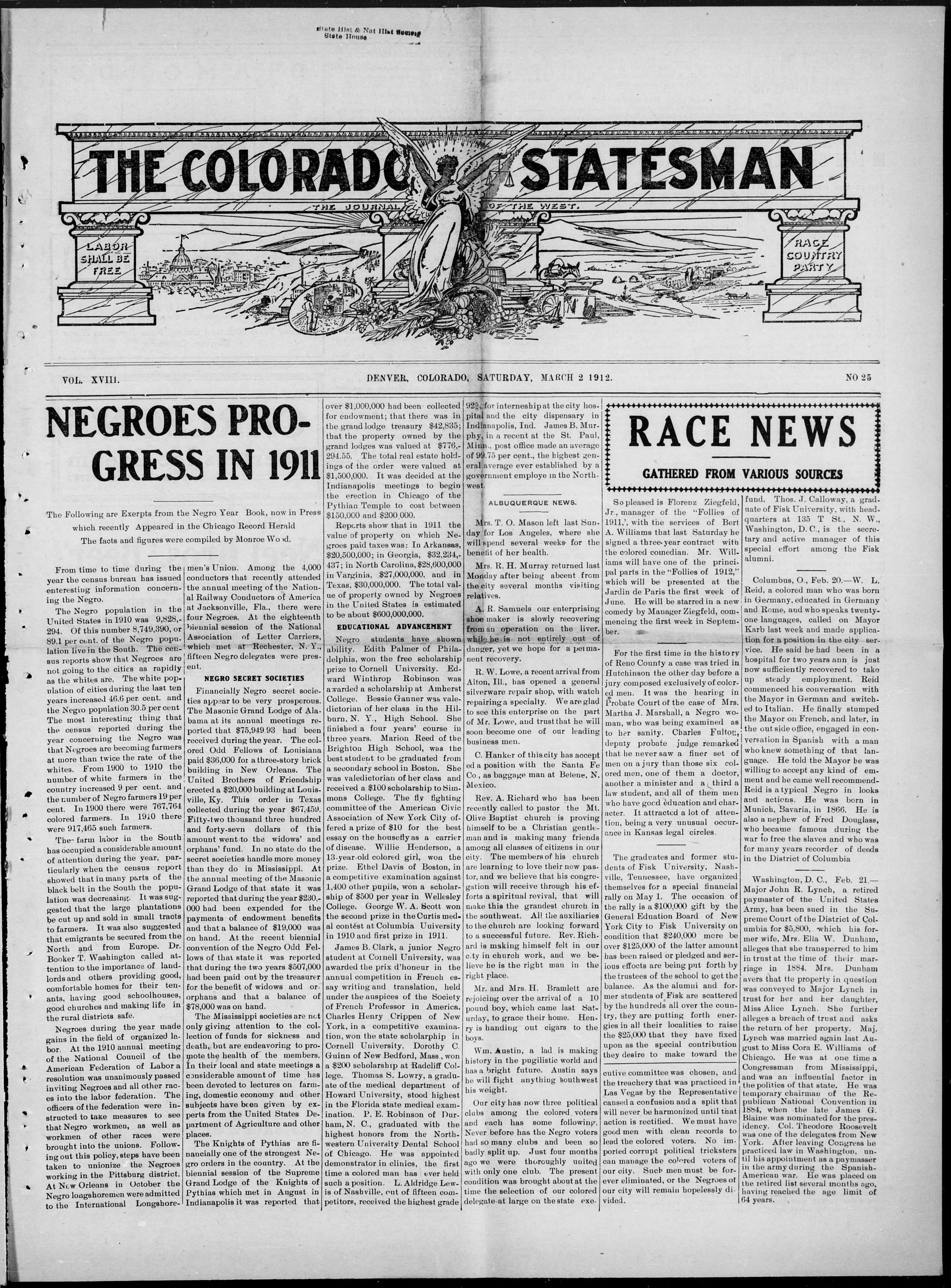
THE COLORADO STATESMAN
THE JOURNAL OF THE WEST.
LABOR SHALL BE FREE
RACE COUNTRY PARTY
NEGROES PROGRESS IN 1911
The Following are Exerpts from the Negro Year Book, now in Press which recently Appeared in the Chicago Record Herald The facts and figures were compiled by Monroe Wood.
VOL. XVIII.
NEGRO
GRES
The Following are Exerpts from the
which recently Appeared in
The facts and figures were
From time to time during the
year the census bureau has issued
entertaining information concerning
the Negro.
The Negro population in the United States in 1910 was 9,828,-294. Of this number 8,749,390, or 89.1 per cent. of the Negro population live in the South. The census reports show that Negroes are not going to the cities as rapidly as the whites are. The white population of cities during the last ten years increased 46.6 per cent. and the Negro population 30.5 per cent The most interesting thing that the census reported during the year concerning the Negro was that Negroes are becoming farmers at more than twice the rate of the whites. From 1900 to 1910 the number of white farmers in the country increased 9 per cent. and the number of Negro farmers 19 per cent. In 1900 there were 767,764 colored farmers. In 1910 there were 917,465 such farmers.
The farm labor in the South has occupied a considerable amount of attention during the year, particularly when the census report showed that in many parts of the black belt in the South the population was decreasing. It was suggested that the large plantations be cut up and sold in small tracts to farmers. It was also suggested that emigrants be secured from the North and from Europe. Dr. Booker T. Washington called attention to the importance of landlords and others providing good, comfortable homes for their tenants, having good schoolhouses, good churches and making life in the rural districts safe.
Negroes during the year made gains in the field of organized labor. At the 1910 annual meeting of the National Council of the American Federation of Labor a resolution was unanimously passed inviting Negroes and all other races into the labor federation. The officers of the federation were instructed to take measures to see that Negro workmen, as well as workmen of other races were brought into the unions. Following out this policy, steps have been taken to unionize the Negroes working in the Pittsburg district. At New Orleans in October the Negro longshoremen were admitted to the International Longshore-
men's Union. Among the 4,000 conductors that recently attended the annual meeting of the National Railway Conductors of America at Jacksonville, Fla., there were four Negroes. At the eighteenth biennial session of the National Association of Letter Carriers, which met at Rechester, N. Y., fifteen Negro delegates were present.
NEGRO SECRET SOCIETIES
Financially Negro secret societies appear to be very prosperous. The Masonic Grand Lodge of Alabama at its annual meetings reported that $75,949.93 had been received during the year. The colored Odd Fellows of Louisiana paid $36,000 for a three-story brick building in New Orleans. The United Brothers of Friendship erected a $20,000 building at Louisville, Ky. This order in Texas collected during the year $67,459. Fifty-two thousand three hundred and forty-sevn dollars of this amount went to the widows' and orphans' fund. In no state do the secret societies handle more money than they do in Mississippi. At the annual meeting of the Masonic Grand Lodge of that state it was reported that during the year $230,000 had been expended for the payments of endowment benefits and that a balance of $19,000 was on hand. At the recent biennial convention of the Negro Odd Fellows of that state it was reported that during the two years $507,000 had been paid out by the treasurer for the benefit of widows and orphans and that a balance of $78,000 was on hand.
The Mississippi societies are not only giving attention to the collection of funds for sickness and death, but are endeavoring to promote the health of the members. In their local and state meetings a considerable amount of time has been devoted to lectures on farming, domestic economy and other subjects have been given by experts from the United States Department of Agriculture and other places. The Knights of Pythias are financially one of the strongest Negro orders in the country. At the biennial session of the Supreme Grand Lodge of the Knights of Pythias which met in August in Indianapolis it was reported that
over $1,000,000 had been collected for endowment; that there was in the grand lodge treasury $42,835; that the property owned by the grand lodges was valued at $776, -294.55. The total real estate holdings of the order were valued at $1,500,000. It was decided at the Indianapolis meetings to begin the erection in Chicago of the Pythian Temple to cost between $150,000 and $200,000.
Reports show that in 1911 the value of property on which Negroes paid taxes was: In Arkansas, $20,500,000; in Georgia, $32,234, -437; in North Carolina, $28,600,000 in Varginia, $27,000,000, and in Texas, $30,000,000. The total value of property owned by Negroes in the United States is estimated to be about $600,000,000.
EDUCATIONAL ADVANCEMENT
Negro students have shown ability. Edith Palmer of Philadelphia, won the free scholarship prize to Cornell University. Edward Winthrop Robinson was awarded a scholarship at Amherst College. Bessie Ganner was valedictorian of her class in the Hilburn, N. Y., High School. She finished a four years' course in three years. Marion Reed of the Brighton High School, was the best student to be graduated from a secondary school in Boston. She was valedictorian of her class and received a $100 scholarship to Simmons College. The fly fighting committee of the American Civic Association of New York City offered a prize of $10 for the best essay on the housefly as a carrier of disease. Willie Henderson, a 13-year-old colored girl, won the prize. Ethel Davis of Boston, in a competitive examination against 1,400 other pupils, won a scholarship of $500 per year in Wellesley College. George W. A. Scott won the second prize in the Curtis medal contest at Columbia University in 1910 and first prize in 1911.
James B. Clark, a junior Negro student at Cornell University, was awarded the prix d'honeur in the annual competition in French essay writing and translation, held under the auspices of the Society of French Professor in America, Charles Henry Crippen of New York, in a competitive examination, won the state scholarship in Cornell University. Dorothy C. Guinn of New Bedford, Mass., won a $200 scholarship at Radcliff College. Thomas S. Lowry, a graduate of the medical department of Howard University, stood highest in the Florida state medical examination. P. E. Robinson of Durham, N. C., graduated with the highest honors from the Northwestern University Dental School of Chicago. He was appointed demonstrator in clinics, the first time a colored man has ever held such a position. L. Aldridge Lewis of Nashville, cut of fifteen competitors, received the highest grade
92g, for interneship at the city hospital and the city dispensary in Indianapolis, Ind. James B. Murphy, in a recent at the St. Paul, Minn., post office made an average of 99.75 per cent., the highest general average ever established by a government employee in the Northwest.
ALBUQUERQUE NEWS.
Mrs. T. O. Mason left last Sunday for Los Angeles, where she will spend several weeks for the benefit of her health.
Mrs. R. H. Murray returned last Monday after being abcent from the city several months visiting relatives.
A. R. Samuels our enterprising shoe maker is slowly recovering from an operation on the liver, while he is not entirely out of danger, yet we hope for a permanent recovery.
R. W. Lowe, a recent arrival from Alton, Ill., has opened a general silverware repair shop, with watch repairing a specialty. We are glad to see this enterprise on the part of Mr. Lowe, and trust that he will soon become one of our leading business men.
C. Hanker of this city has accepted a position with the Santa Fe Co., as baggage man at Belene, N. Mexico.
Rev. A. Richard who has been recently called to pastor the Mt. Olive Baptist church is proving himself to be a Christian gentleman and is making many friends among all classes of citizens in our city. The members of his church are learning to love their new pastor, and we believe that his congregation will receive through his efforts a spiritual revival, that will make this the grandest church in the southweat. All the auxiliaries to the church are looking forward to a successful future. Rev. Richard is making himself felt in our city in church work, and we believe he is the right man in the right place.
Mr. and Mrs. H. Bramlett are rejoicing over the arrival of a 10 pound boy, which came last Saturday, to grace their home. Henry is handing out cigars to the boys.
Wm. Austin, a lad is making history in the pugilistic world and has a bright future. Austin says he will fight anything southwest his weight. Our city has now three political clubs among the colored voters and each has some following. Never before has the Negro voters had so many clubs and been so badly split up. Just four months ago we were thoroughly united with only one club. The present condition was brought about at the time the selection of our colored delegate-at large on the state exe-
RACE NEWS
So pleased is Florenz Ziegfeld, Jr., manager of the "Follies of 1911," with the services of Bert A. Williams that last Saturday he signed a three-year contract with the colored comedian. Mr. Williams will have one of the principal parts in the "Follies of 1912," which will be presented at the Jardin de Paris the first week of June. He will be starred in a new comedy by Manager Ziegfeld, commencing the first week in Septem-
For the first time in the history of Reno County a case was tried in Hutchinson the other day before a jury composed exclusively of colored men. It was the hearing in Probate Court of the case of Mrs. Martha J. Marshall, a Negro woman, who was being examined as to her sanity. Charles Fulton, deputy probate judge remarked that he never saw a finer set of men on a jury than those six colored men, one of them a doctor, another a minister and a third a law student, and all of them men who have good education and character. It attracted a lot of attention, being a very unusual occurrence in Kansas legal circles.
The graduates and former students of Fisk University, Nashville, Tennessee, have organized themselves for a special financial rally on May 1. The occasion of the rally is a $100,000 gift by the Geueral Education Board of New York City to Fisk University on condition that $240,000 more be over $125,000 of the latter amount has been raised or pledged and serious effects are being put forth by the trustees of the school to get the balance. As the alumni and former students of Fisk are scattered by the hundreds all over the country, they are putting forth energies in all their localities to raise the $25,000 that they have fixed upon as the special contribution they desire to make toward the
cutive committee was chosen, and the treachery that was practiced in Las Vegas by the Representative caused a confusion and a split that will never be harmonized until that action is rectified. We must have good men with clean records to lead the colored voters. No imported corrupt political tricksters can manage the colored voters of our city. Such men must be forever eliminated, or the Negroes of our city will remain hopelessly divided.
NO 25
fund. Thos. J. Calloway, a graduate of Fisk University, with headquarters at 135 T St., N. W., Washington, D.C., is the secretary and active manager of this special effort among the Fisk alumni.
Columbus, O., Feb. 20.—W. L. Reid, a colored man who was born in Germany, educated in Germany and Rome, and who speaks twenty-one languages, called on Mayor Karb last week and made application for a position in the city service. He said he had been in a hospital for two years ann is just now sufficiently recovered to take up steady employment. Reid commenced his conversation with the Mayor in German and switched to Italian. He finally stumped the Mayor on French, and later, in the out side office, engaged in conversation in Spanish with a man who knew something of that language. He told the Mayor he was willing to accept any kind of emment and he came well recommend-Reid is a typical Negro in looks and actions. He was born in Munich, Bavaria, in 1866. He is also a nephew of Fred Douglass, who became famous during the war to free the slaves and who was for many years recorder of deeds in the District of Columbia
Washington, D. C., Feb. 21. Major John R. Lynch, a retired paymaster of the United States Army, has been sued in the Supreme Court of the District of Columbia for $5,800, which his former wife, Mrs. Ella W. Dunham, alleges that she transferred to him in trust at the time of their marriage in 1884. Mrs. Dunham avers that tte property in question was conveyed to Major Lynch in trust for her and her daughter, Miss Alice Lynch. She further alleges a breach of trust and asks the return of her property. Maj. Lynch was married again last August to Miss Cora E. Williams of Chicago. He was at one time a Congressman from Mississippi, and was an influential factor in the politics of that state. He was temporary chairman of the Republican National Convention in 1884, when the late James G. Blaine was nominated for the presidency. Col. Theodore Roosevelt was one of the delegates from New York. After leaving Congress he practiced law in Washington, until his appointment as a paymasser in the army during the Spanish-American war. He was placed on the retired list several months ago, having reached the age limit of 64 years.
THE WORLD IN PARAGRAPHS
A BRIEF RECORD OF PASSING EVENTS IN THIS AND FOR- EIGN COUNTRIES.
IN LATE DISPATCHES
IN LATE DISPATCHES
DOINGS AND HAPPENINGS THAT
MARK THE PROGRESS
OF THE AGE.
Bert Franklin of Los Angeles, the former McNamara detective, entered a plea of guilty to the charge of jury bribery.
The Rock Island announced that dating from Feb. 1, all telegraphers on the system have been granted an eight per cent, increase in wages.
A foot of snow has fallen at Lamar, Colo., with the wind blowing constantly. The snow is badly drifted although the ground is entirely covered.
The burning of the Gilman hotel, a landmark of pioneer days, in Portland, Ore., resulted in the death of two men, and three others are missing.
Nine people were seriously injured and several others badly injured when a Rock Island passenger train ran into the rear end of a Wabash passenger at the outskirts of Des Moines, Ia.
Tom Gun, the San Francisco Chinese aviator, had a narrow escape from death at the meet in Oakland when his biplane fell from a height of 150 feet and buried beneath the wreckage.
A company of Mexican federal soldiers led by Commissario Calles of Agua Prieta fought a brief battle with the rebel band which raided the Elias ranch at Douglas, Ariz. The rebels retreated under fire, leaving two dead on the field.
The municipal government and the labor unions of Spokane have united in a project to form a quasi-municipal bank, which will eliminate the contractor from the municipal work of Spokane, according to a statement issued by the commissioner of public works.
In a wreck on the Southern Pacific railroad in west Texas six years ago, James Montgomery, a section hand, rescued a four-year-old daughter of Albert Ambrose of Portland, Ore. Mr. Ambrose died a few weeks ago and in his will he left two tracts of land in Pecos county, Texas, for the section hand. There are about 10,000 acres of ranch land and it is worth from $25,000 to $35,000.
Gov. Oswald West of Oregon has announced that he had obtained a full confession from one of the men implicated in the robbery of the steamer Humboldt, from which, in September, 1910, was stolen $57,000 worth of gold bullion. Twenty-five pounds of this has been recovered and was carried to Salem and placed in the hands of the governor, who turned it over to Steve Connell, a United States Secret service operative.
A small detachment of company K. Texas State militia, engaged in guarding the El Paso electric light plant, was fired upon by parties concealed behind box cars and said to be Mexicans. Maxim silencers were used on the guns and more than twenty shots were fired, one bullet passing through the hat of one of the guardsmen. The forces of Campas have arrived on the river bank, opposite old Fort Bliss, and about one and a half miles northwest of Juarez. They are supposed to be extending a wing around the west side of the city.
WASHINGTON.
The ways and means committee of the House still is deadlocked on the sugar tariff schedule. President Taft has informed Congress that he does not approve of Postmaster General Hitchcock's suggestion that the government buy and operate all telegraph lines as an adjunct of the postal system. An investigation to determine whether there is a "money trust" in the United States, operating through or in connection with the national banks, has been ordered by the House by a vote of 270 to 8.
Japan by 1916 will have wrested the position of third naval power from the United States and this country will have difficulty in maintaining itself in fourth place unless it builds two battleships a year. Secretary Meyer so declared in his testimony before the House naval affairs committee. The secretary urged greater liberality by Congress in dealing with the naval establishment.
A request for American intervention in Mexico was made upon the War Department when the mayor and a delegation of citizens of El Paso, Texas, urgently asked Secretary Stimson to sent troops into Juarez to preserve order and to protect Americans.
The Washington National Monumental Society has sent letters to the governors of states which have not placed memorial stones in the Washington monument, and urging that these states furnish memorials similar to those already placed there
Joe Ketchel, the prize fighter who collapsed after a recent bout with Billy Walters near Waukegan, Ill, died.
Mike Gibbons of St. Paul knocked cut Willie Lewis of New York in the second round of a scheduled ten-round bout in the latter city.
Frank Klaus, the Pittsburg middleweight, who defeated Sailor Petroskey in a one-sided two-round contest in San Francisco has been matched by Promoter James Coffroth to box Jack Dillon of Indianapolis next month.
Jim Flynn, who is to battle with Jack Johnson during the coming summer, blasted the aspirations of Walter MacLachlan for pugilistic honors in a three-round bout at the Star theater in Milwaukee.
FOREIGN.
Reports from San Jose, Costa Rica, state that the earthquake reported has been felt generally over the whole of the high plateau but no serious damage has been done so far.
While the memory of George Washington was celebrated by Americans throughout the civilized world, the new Chinese republic took cognizance of the event and sent a cablegram of greetings to the State Department at Washington.
The chamber of deputies at Rome passed the bill for the annexation of Tripoli by Italy by a vote of 431 to 38, amid enthusiastic cheering from the floor of the chamber and the public gallery.
Jules Vedrines at Pau, France, broke the speed record for monoplanes, flying sixty-two miles in thirty-seven minutes and 124 miles in one hour and fifteen minutes. The previous record for sixty-two miles was made by Bathat at Douzy Jan. 26, when he covered the distance in forty-one minutes and twenty-four seconds.
GENERAL.
Never before in the history of New York has there been such an epidemic of robberies as within the last fortnight.
A Shanghai cablegram to Chicago says General Huang, Chinese minister of war, has ordered shot all soldiers found smoking opium.
Presidential preference primaries are not proving as popular as had been anticipated. Only seven states will hold such elections.
Capt. Theodore F. Townsend, one of the most noted weather experts in this country died at his home at Cape May, N. J. aged seventy-four.
John Harmon, a laborer was a victim of the storm in Chicago. His body was found frozen in a snow drift in the yard of his home.
Almost the entire $38,000,000 left by John W. Gates goes to his widow, Mrs. Dellora Gates, it was learned when the will of Mr. Gates was filed for probate at Geneva, Ill.
President Taft and the German ambassador, Count von Bernstorff, both heartily favor the earliest consummation of an arbitration treaty with Germany.
James Weaver, a prisoner in the Madison county, Ala., jail, stood at the hydrant in his cell and drank himself to death. Fellow prisoners say he drank not less than three gallons of water.
After escaping from the Kansas penitentiary, reforming, marrying and living honestly, Pat Harrison was arrested at Booneville, Ark., and will be returned to the Kansas penitentiary to serve out his term.
The Central and South American tour of American secretary of state has begun auspiciously with big welcoming crowds at Colon and Panama. Knox went ashore at Colon from the armored cruiser Washington and was met by government officials.
Unprecedented prosperity is being enjoyed by the Philippine islands, principally as a result of free trade between them and the United States, and the cry of "hard times" there no longer can be raised, say the members of the Philippine commission in their report for 1911. The United States has shared in this prosperity by increasing its exports to the archipelago to $49,800,000, or more than $12,500,000 during the year.
A blinding snowstorm, backed by a fifty-mile gale swooped down on the Middle West, blocked traffic, played pranks with the routine of human affairs and swept eastward in the direction of northern Ohio, Pennsylvania and New York. A temperature ranging between twenty-nine and twenty-four degrees made the wind and snow bearable and little suffering was reported. Several deaths in wrecks are attributed indirectly to the storm. The storm reached its greatest intensity in Chicago and northern and central Illinois, although eastern Iowa and Missouri, southern Wisconsin, Michigan and Indiana felt the blizzard to a considerable extent.
The storm which brought a heavy snow to the Middle Lake region and rain and thunder on a line south of the Ohio river, is moving rapidly eastward. Snow is falling from the Lake Erie region on the north to Kentucky, and below the snow belt there is rain.
Mrs. Alice G. Rycroft of New York won a verdict of $170,000 against Henry Clay Pierce, the oil magnate, by a jury in the Supreme Court. She charged that Pierce had obtained possession of her securities, valued at the amount sued for, and had converted them to his own use.
COLORADO STATE NEWS
Western Newspaper Union News Service.
COMING EVENTS IN COLORADO.
March 11-16.—Denver Automobile Show.
Denver.
April 29.—Democratic State Convention, Colorado Springs.
May 6-11—State Y. M. C. A. Convention,
Pueblo.
June 18-20—State Sunday School Con-
vention, Colorado Springs.
June 11-July 19—Summer Term, State
Teachers' College, Greeley.
Slot Machines Doomed.
Pueblo.—Every slot machine in Pueblo has been ordered closed by Chief of Police McDermott.
Two New Car Lines for Pueblo.
Pueblo.—The Pueblo Traction Company has opened service on two new car lines, each of which has a park as its objective point.
Seven Hundred Teachers Expected.
Boulder.—Over 700 teachers are expected to attend the northern Colorado Teachers' Institute, which convenes here March 15 and 16.
Loveland Planning Light Plant.
Love!and.—Preliminary surveys for the proposed electric light plant to be owned and operated by the city are being made and soon will be completed.
Dates Fixed for Greeley Fair.
Greeley.—The Weld County Fair Association decided on the fourth week of September each year as a permanent date for the county fair.
Wray Votes New Water System.
Wray.—The question of issuing $60,000 in bonds for a municipal water system was submitted to the electors of Wray and carried by thirty-eight majority. There was great interest and a heavy vote polled.
Expert Predicts Record Fruit Crop
Delta—H. A. Richardson, horticultural expert, who has just returned from a trip over the country, states that the orchards are in splendid condition and if they get through the spring without killing frost, this year's fruit crop in this county will break all records.
Raise Money for Woman's Building.
Boulder.—The largest benefit given by Western college women will be undertaken by the women of the State university in May. Arrangements under way contemplate a monster festival the first week in May for the benefit of the proposed woman's building. With the support of the Boulder and Denver alumnae the undertaking is practically assured success.
Real Highwaymen.
Fort Lupton.—Paul Ingleweison, station agent at Traceville, on the D. L & N., a mile west of here, was held up by two masked highwaymen and robbed of his revolver, watch and $20 in money, then compelled to walk in front of the bandits to the railroad station, where they made him open the railroad safe which contained $100. Ingleweisen was then knocked senseless, bound to a chair and gagged. The robbers made their escape.
Big Irrigation Deal Favored
Greeley.—At a special election held in the Greeley-Poudre Irrigation district at Nunn, Pierce and Canfield land holders in the district voted to ratify the contract recently made between the directors of the district and the Poudre Valley Ditch Company. By the contract the district becomes the owner of the Poudre Valley ditch, Cobb lake and secures 100,000,000 cubic feet of storage in Douglas reservoir. Former stockholders in the ditch reserve the right to carry water in the Poudre Valley ditch and to fill Douglas reservoir to a capacity of 275,000,000 cubic feet.
Of Interest to Homesteaders
Washington.—The House passed the bill, introduced by Congressman Edward T. Taylor of Colorado preventing contests from being filed against homestead entrymen under any reclamation project prior to the time that water is available for irrigation.
This measure is of vital interest to the Grand valley and its progress has been eagerly watched. It is believed that the bill will not have much trouble in getting through the Senate.
This is the most important measure yet offered in behalf of the Grand Valley Project entrymen, as well as the entrymen under all government reclamation projects.
The House also passed Congressman Taylor's bill allowing adjoining owners to purchase isolated tracts of land, subject to the order of a United States commissioner, when the greater portion of such desired land is highly elevated
Field Battery for State Milli]a.
Denver.—The Colorado National Guard is to have a new complete three-inch field battery of three guns, which will cost the federal government $100,000. Its possession by the state means also that the guard will have a new armory in which to store it. Adjt. Gen. Chase has been notified that a requisition by Gov. Shafroth for the battery has been approved. Shipment of it will begin immediately.
LITTLE COLORADO ITEMS.
Small Happenings Occurring Over the State Worth While.
Western Newspaper Union News Service.
Horace W. Ferguson, a pioneer of Evans, is dead.
Denver postoffice is to have two additional mail carriers.
A beet dump will be built in the new farming country east of Eaton.
The Sacred Heart church at Boulder suffered a $500 loss by fire.
The total value of assessable property in Colorado is $1,267,160,062.
ly went to fifteen degrees below zero.
Eastern and southern Colorado are suffering from the effects of the blizzard.
Arbor day Erie will plant a tree for every man, woman and child in the town.
Jerome L. Terry, an employee of the D. & R. G. at Salida, shot and killed his wife.
The turkey trot and the bunny hug dance have been introduced in Grand Junction.
The Mineequa steel works at Pueblo has received an order for 31,000 tons of steel rails.
Not in several years has Colorado experienced as heavy a snowfall as the recent one.
A Congregational church has been organized at Spring Creek, six miles west of Montrose.
Derricks are being erected in the Gross oil field sixteen miles from Steamboat Springs.
The state fish hatchery at Steamboat Springs has just hatched out 750,000 brook trout.
Range cattle in the Meeker country have suffered as the result of the recent cold and snow.
Talian, Archuleta county's famous sub-chief, died recently at his home near Pagosa Junction.
Business men of Weld county declare there is more money in the county than there is borrowers.
Farmers of La Salle plan to shower Congress with postcards requesting passage of the parcels post law.
The National Sugar Manufacturing Company has advanced the price of beets from $5.50 to $6 per ton.
Weld county's new jail is completed and has room for 100 prisoners. The cost of the building was $60,000.
Frank Du Cray of Grand Junction threw Lars Olson of Indianapolis twice in a wrestling match at Montrose.
An armory to cost $5,000 is being built in Johnstown and will be leased by the state for a term of five years.
Holly now has an anti-horseshoef association whose members are constantly on the outlook for evil-doers.
At Windsor, in a fight which resulted from a quarrel over a jug of whiskey, Otto Hinkle had an ear offen.
Chas. H. Lasche, of Valverde sneezed and broke a blood vessel in his side and is now in a serious condition.
Robert Stevens, aged eighty-eight, who had lived in the vicinity of Longmont since 1870, died in that city recently.
In the Greeley district twenty-one thousand five hundred acres have already been pledged for the growing of sugar beets.
L. C. Moore of Leadville has been placed in the federal ward of the Denver jail on the charge of impersonating an officer.
The Colorado Whist League held one of the most successful tournaments in the history of the organization in Denver.
In a wrick on the Colorado Midland recently at Nigger, five coaches were thrown into the Grand river. The engineer was injured.
John Fox, a farmer of Garfield county, was recently fleeced of $2,700 in Denver in a fake match. Police are looking for the sharpers.
An appropriation of $5,000 has been made by the Trinity Lutheran church at Grand Junction for the erection of a church building in that city.
A company will be organized at once to advance money to the farmers in the dairy districts around Elizabeth and Larkspur for the purpose of building silos.
Seized with an epileptic fit as she was about to descend a flight of stairs, Mrs. Pearl H. Lewis of Trinidad fell headlong to the floor below and was almost instantly killed.
Construction of an irrigation system covering 100,000 acres in San Miguel and Montrose counties to be watered principally from the San Miguel river, will be started immediately.
Many farmers in the Wet Mountain district, near Focky Ford, will experiment in the growing of sugar beets the coming season, and if they succeed there will be established there a small beet factory.
The receiver for the Denver Reservoir Irrigation Company and the Farmers' Irrigation Company has been granted permission to negotiate a loan of $25,000. The money will be used for enlarging these projects.
The average price received by the Pallside Fruit Growers' Association for extra and fancy Elbera peaches during the last season was $68\frac{1}{2}$ cents per box and for the general average on all grades was $66\frac{1}{2}$ cents per box. Indications are that every locality in Weld county will have a dairy association within the next few months.
BOHM-ALLEN
JEWELRY C9
10th Aven
H. HEUER, P
RESTING PLACE FOR
Avenue H
H. HEUER, PROPRIETOR
PLACE FOR COLORE
STERLING SILVERWARE
10th Avenue Hotel
H. HEUER, PROPRIETOR RESTING PLACE FOR COLORED GENTS MEALS AT ALL HOURS Pool Room in Connection
Corner West 10th and Osara
Denver, C
ASK FOR
CARLS
Peerless I
Phones: M
DID YOU E
Neef Bro
It's made right, a
None better made
This is a Strictly C
first 10th and Osage, Near Bur-
Denver, Colorado
ARLSON
Heirless Ice Cream
Phones: Main 112 and
DO YOU EVER T
f Bros.' B
made right, and tastes
better made anywhere
a Strictly Colorado P
Corner West 10th and Osage, Near Burnham Shops Denver, Colorado
CARLSON'S Peerless Ice Cream Phones: Main 112 and Main 5787
DID YOU EVER TRY Neef Bros.' Beer?
It's made right, and tastes right. None better made anywhere and This is a Strictly Colorado Production BE SURE AN TRY IT.
BERT PLES
MANAGER
EAST TURNE
2132-2148 Ara
Phone 2449
2132-2148 Arapahoe St.
Phone 2449 Denver
THE
BROADHURST
CARTER
SHOE CO.
NETTLETO
FOR M
$6, $7 and
Supply Your Home w
Tivoli
Bottled
The Empire E
Phone Gall
BETLETON S
FOR MEN
$7 and $8,
Your Home with the Cel
Tivoli Beer
Bottled by
Empire Bottline
Phone Gallup 245
$6, $7 and $8, Pair
Supply Your Home with the Celebrated Tivoli Beer
The Empire Bottling Co. Phone Gallup 245
THE BEST ICE CREAM AND
CANDIES AT
O.P. BAUR & CO.
CATERERS AND
CONFECTIONERS
Phone: 168
1513 Curtis Street, Denver, Cole.
et, Denver, Cole.
THE MUSEUM
nue Hotel
PROPRIETOR
R COLORED GENTS
age, Near Burnham Shops Colorado
SON'S
ice Cream
Main 112 and Main 5787
EVER TRY
os.' Beer?
and tastes right.
de anywhere and
Colorado Production
RT PLESSNER
MANAGER
TURNER HALL
2-2148 Arapahoe St.
2449 Denver
823
Sixteenth St.
We Are Denver Agents for the
ON SHOE
MEN
1 $8, Pair
with the Celebrated
Beer
d by
Bottling Co.
llup 245
TRADE MORAL—The quality of what you have to sell is known to some people all of the time and all of the people some of the time, but advertise regularly with us and you'll reach all of the people all of the time.
. . .
LIBERIA STARTS
ON A NEW ERA
The First Detalal avenue of
Inauguration---Howard
Is President,
RASUUSSES IMEURTANT SUR
TIONS IN INAUGURAL ADDRESS
NATIVE CHIEFS FRIENDLY—
NEARLY TWO HUNDRED THOU-
SAND NATIVES FROM INTERIOR
ATTEND INAUGURAL CERE-
MONIES—PROMISE TO WORK
FOR REPUBLIC’S GOOD.
From a correspondent at Monrovia,
Liberia, the first detailed account of
the inauguration of the black repub-
Mo's new president, Daniel Edward
Howard, has been received in this
country. . The inaugural ceremonies
took place at Monrovia Monday, Jan-
uary 1, and Tuesday, January 2, and
were imposing. Aside from the prom-
inent officials of the republic and rep-
resentatives of foreign nations, the
spectacle was made more picturesque
by the presence of native chiefs, head-
men and retainers.
It was the first inauguration ever
attended by native chiefs, headmen
and’ retainers, and their presence was
significant. They talked nothing but
Peace and prosperity, and promised to
do all in their power to make the new
administration a highly successful one.
Nearly 2,000 natives from the interior
Mstened to President Howard advocate
that they be given equal rights, and on
the second day President Howard and
Vice-President Harmon donned sim-
ilar attire as worn by the native
chiefs, the incident occasioning much
good feeling.
‘The new administration promises to
mark a new era for the republic. ‘The
officials are working together in har-
mony; the native chiefs are now for
peace instead of war, and taking into
consideration that negotilations for re-
ceiving the large loan, which was so
successfully conducted by the United
States government, have been com-
pleted, the consensus of opinion in
Monrovia is that the country has
started on its work of rehabilitation.
‘The prominent officials of the new
Liberian administration are: — Pres!-
dent, Daniel Edward Howard; vice-
president, Samuel George Harmon;
secretary of state, C. D. B. King; sec-
retary of treasury, Thomas W.
Haynes; secretary of war and navy,
Wilmot . Dennis; postmaster general,
Col. Isaac Moort; secretary of interior,
J, J. Morris; attorney general, Samuel
A. Ross; Secretary of education, B.
W. Payne. Walter 1”. Walker is execu-
tive secretary to the president.
The inauguration cormmittee was
headed by H. J. R. Cooper, chairman
of the senate’s committee, and J. J.
Ellis, chairman of the house of repre-
sensatives’ committee.
Among the things sald by President
Howard, who succeeded Arthur Bar-
clay as chief executive, {1 his inaug-
ural address were:
“The great American government
after a silence, far from forgetting and
abandoning the tender infant cast
aside upon the shores of Africa, has
come in un hour of danger t> assist us
on her strong pinions to a nest of
safety. If we but follow ber examples
and heed her teaching of economy,
thrift and industry, and if we are just
iu our dealings with men end nations
we shall never escape her vigilant
eye, nor cease to be the object of
marked manifestation of interest on
her part,
“{ shall do all in my power to main-
tain and strengthen the friendly feel-
jugs now so happily subsisting between
us. . . as well as all the other
governments here represented, and I
shall expect the co-operation of all citi-
zens to that end. 1 am: afraid that
some of us are too prone to the be-
Nef that foreign powers are our en-
emies, and that’some one of them is
always seeking some pretext to thwart
God’s purposes in the founding of Li-
berfa, and to deprive us of our most
sacred heritage. To any mind, how-
ever, our real enemies, our most subtle
foes, our most potent drawback, lle
within and among some of our loud-
est professed patriots. Liberia must
attain to the position of a prosperous
African state, and her sons and daugh-
ters are to be the agents to bring this
about. Let us, therefore, go to work
and do what we contend we are capa-
ble of doing. Let each one do his
part, for {t is only by the concentrated
efforts of the whole that success can
be achieved.
“Our school system needs reorganiz-
ing and perfecting from the bottom
up. The faint attempts now made to
provide educational facilities for the
people at large make only the slight-
est dent in the stronghold of ignor-
ance, and {t {s high time earnest, per-
sistent and unrestrained efforts should
be trained upon the inadequate edu-
cational system. Parents must learn
the virtue of sacrificing for the intel-
lectual improvement of their children,
unless they wish to create a mentally
Oo ioe gens ho deatotc dy gal Al tata! cats edie oe bie cata ag
First, it is the oldest and most effi.
cient state school in the country and
the first and only state college. Sec-
and, {t has been of incalculable bene-
fit to the country in preparing and
sending out useful men and women
ever since its founding, and but for
several reasons at this age of the in-
stitution {t would have realized all
that was ever contemplated of it in
{ts founding.
“The agricultural development ot
the country shall be among our chief
concerns and shall engage our most
serlous attention. With that object
in view we feel that it is imperative
to inaugurate what may be called a
labor bureau, or a system whereby
labor may be engaged under govern:
ment protection. To this end the cre-
ation and appointment of two or more
labor agents in Montserrado county
on each bank of the St. Paul river
should be considered. These agents
should be charged with the duty of
receiving all laborers who may come
down from the interior and hiring
them out to the farmers under prop
er guarantee of payment for services.
“The executive government, through
the interior department, will hold con-
ferences with the chiefs of the dif-
ferent sections in the county from
which labor {s recruited, explain to
them the policy and object of the gov-
ernment to have them furnish labor-
ers regularly, also of the government's
firm determination to see that each la
borer is justly paid for his services.
Each chief so interesting himself to
supply laborers from his section
should receive an annual stipend from
the government or a fixed sum per
capita for each laborer furnished. A
law respecting the government's se-
curing the pay of the laborers should
be so framed that nothing, not even
the homestead exemption, shall pre-
vent the government from entering
suits, if occasion requires, to raise the
sum due each employer should be
fail to pay a laborer at the prop-
er time any amount due him.
“ The financial agreement recently
concluded between the government of
Liberia and certain American and
European capitalists through the
kindly assistance of the state depart:
ment at Washingtok, it is needless to
say, has my strongest endorsement
and approval. The new administra.
ton pledges itself to observe strict-
ly* all of its provisions and to at-
ford all necessary facilities for its
smooth and effective operation.
“The agreement, though in some re-
spects it may appear to place a little
restriction upon us in the manage-
ment, collection and control of our
customs revenues, yet in its political
bearings, I am sure, will prove to be
of incalculable benefit to the repub-
lc. Hence {t becomes the solemn
and imperative duty of every citizen
to glye his individual support to the
government in its efforts to initiate
and prosecute such a meas-
ure, which must tend to our
national preservation and secur-
ity. If the temporary manage-
ment {n the hands of others of a
part of our government machinery will
result in actual and permanent inde-
pendence and {international respect,
which I firmly belleve will be the out-
come, then it becomes our imperative
duty as patriotic citizens to make such
a necessary and noble sacrifice.
Daniel Edward Howard, who was
elected president of Liberia May 2,
1911, and inaugurated the first of the
year, was born in Monrovia, August 4,
1861, While quite an infant his moth-
er died and a grand aunt wés entrust-
ed with his care. The new president's
father was the late Thomas W. How-
ard, who for over twenty-five years
was chief government printer, and
during several political campaigns
chairman and leader of the Whig par-
ty. The Howards belong to one of
the old pioneer families associated
with the historical Elijah Johnson.
The first school ever attended by
Mr. Howard was the Methodist Sem-
inary at Monrovia, now the College of
West Africa. Later he entered the
preparatory department of Liberia Col-
lege and matriculated in the college
proper during the presidency of Prof.
Martin H. Freeman. While attending
college Mr. Howard worked at tho
printing trade until Dr. Edward W.
Blyden took charge of Liberia Col-
lege, who made a rule that students
would either have to give their whole
time to study or leave the institution.
Soon afterwards he was compelled to
quit college.
When the late President Hilary
Johnson entered office he employed
Mr. Howard as his private secretary,
in which capacity he served the entire
eight years of Johnson's administra-
tion. President Johnson was so at-
tached to the young man that in 1886
he appointed him clerk of the supe-
rior court of Montwerrado county and
A DISTINCTION.
“Go the bank teller has disappeared.
Was he short in his cash?”
“No, be was ahead. It was the bank
that was short.”—Boston Transcript.
MORE YOUNG COLORED
MEN SHOULD HEED THE
CALL OF THE LAW
Races and nations, like Individuals,
during the centuries of their develop-
ment and growth, show a decided
predilection toward perfect attainment
along certain lines in preference to
others. The Grecians developed most
pronouncedly in art and in letters;
the Romans in statecraft. Among na-
tions in our day, the English are the.
model law-enforcers ot the globe; the
Germans are the world’s philosophers;
the French are smartest in art, dress,
society and frivolity; the Italians are
the pacemakers in’ music; and the
Americans are distinguished as the
highest development of frenzied finan-
clers,
Among races, the Caucasians are
the world’s -premter builders, inyen-
tors and discoverers; the Chinese
show most tenacity in adhering to
customs that are centuries old; the
Japanese are peerless in successful
Imitation; the American Indians are
the most fearless and cunning of na-
ture’s children; and up to the pres-
ent stage of thelr development, the
negroes of America and Africa have
shown themselves to be the humblest,
most patient and long-suffering of all
humankind—qualities not to be de-
spised, for the Christ has sald, “the
meek shall inherit the earth.” What
the negroes’ most pronounced lean-
ings will be during future decades
of their evolution, is a puzzling ques-
tion.
A onesided development 1s not de-
sirable in race or Individual. Indeed,
such development may prove to be
fraught with grave dangers. For our
part we are anxious that every essen-
tial line of preparation and training
for a people should be stressed in
Keeping with its Importance to our
future well being.
In the early years of our freedom tt
was deemed wise to center our forces
on getting together a Christian min-
istry of ample numbers to take care
of the race's religious training. The
numbers having been secured, we
turned our attentions, assisted of
course by our white friends, toward
Ancreasing the efficiency and adding
to the preparation of that ministry.
In more recent years there was begun
the awakening of our young men to
the necessity of preparation for the
practice of medicine that our physical
Ms might be attended by those within
our ranks; and today large numbers
of our young men are turning thelr:
attentions to this line of professional
preparation.
‘The time is now here for corralling
‘the largest possible number of candi-
dates to prepare for the practice of
Inw. The opportunities for racial help
offered in this field of endeavor are
not being realized with sufficient
welght. _
“The white men chosen from time to,
time to make and administer the laws
of the several commonwealths of
these United States, so far know In-
timately only the depraved, ignorant,
vicfous negroes—those who help to
keep the court dockets filled. To the
minds of these men there Is but a
small per cent. of worthy, law-abiding
negro citizenry. How are they ever
to become better acquainted with us?
How are they ever to realize that a
surprisingly large per cent. of our
people are worthy of citizenship? As
we see it a direct means for bringing
about civic recognition from them,
in many states of these United States,
lies in the production and develop:
ment of able colored law practitioners
to serve us at the bar of justice—
men who will by thelr practice In jur-
{sprudence and their conduct as bar-
risters, focus the attention of the law-
manipulators of the other race on ne-
groes of ability and worth in the
community. To accomplish this
would be a step toward the ends we
seek.
‘The leading objection brought for-
ward to discourage those of our youth
who would prepare as lawyers, is that
the colored lawyer cannot attain em!-
nence as a court practitioner or as a
criminal lawyer. Grant that practical-
ly none of them can do so. It must
be admitted that they can, if they
will, become successful and able as
civil attorneys and. counselors-at-law,
which generally must come before
attaining success In the courts; and
even this alone 1s 2 consummatjon de-
voutly to be wished for by any one
entering upon the practice of law.
Exploited, swindled and misused as
are large numbers of this country’s
colored citizens, lawyers of color to
help them steer clear of these ills,
are a pronounced necessity.
Eyen in the field of politics Is there
some promise of careers for some ne-
gro attorneys. What better example
can we give than this achievements
of onr own Willlam H. Lewis, day.
before-yesterday a student at Harvard,
yesterday a practicing attorney, today
assistant attorney general of the Un!
ted States. What might not a negro |
today he holds the highest positfon
under this government yet occupled
by @ citizen of color.
The young man who’ feela an im-
pelling call to the law, if he has the
proper literary foundation, may by
studying at home books especially pro
pared, or by reading law under the
direction of a successful lawyer, fit
himself within a few years for admit:
tance to the bar, Correspondence
schools have courses prepared that
fully meet all needs of preparation.
Any one with the means for attending
college can find here in the south well
equipped law departments run in con:
nection with some of our best educa
tional institutions, and after taking #
course in one of these, he may ff he
desires round out his preparation in
the Inw school of some northern unt:
versity.
With negro towns being promoted
here and there, giving promise of
negro cities in time not far distant,
young women of the race so inclined
may yet have the opportunity of en-
tering upon the practice of law in
communities and under influences
est calculated to give them large op
portunities for development as legal
lights, state laws affecting such a mat-
ter of course being taken into con:
sideration.
Colored young men, guick of mental
grasp and sharp of wit, must dream
their dreams of acquiring power in
the legal life of this nation. An
army of negro lawyers of strong
hearts, cool heads, and sane In judg:
ment, is needed. Every young man
who feels the call of the law should
resolve to get the preparation re-
quired and enlist for a man’s part in
some of the legal battles of the future.
NEGRO SIGNS NAME;
WHITE MAN HIS X
SERMON ON ILLITERACY AND
NEGLECTED OPPORTUNITIES
FOUND IN FEDERAL CLERK'S
OFFICE WHEN TWO PRISONERS
LEAVE JAIL AND SWEAR OFF
Atlanta—Two federal _ prisoners
were brought into Clerk 0. C. Ful.
ler’s office to swear off their fines of
$100 each.
The men were BE, L, Blalock of
Gwinnett county, white, and Sol. Wil
Mams of Cobb county, a negro. Both
had served short terms In the Fulton
county jail and being unable to pay
their fines went through the cus
tomary formalities of swearing that
they possessed not over $20 which
could be used to pay the fine.
“Mr. Blalock,” called Clerk Fuller,
and he administered the customary
oath.
“Sign your name right here,” con:
tinued the clerk.
“aw, I can't write my name,” re
pMea-the man in a natural tone, as {
such a thing were an every-day occur
rence, and the clerk wrote the name
and let Blalock touch the pen as he
put the cross underneath the neces
sary “his mark” |
“All right, Sol,” called out the clerk
as he told Blalock he might go.
‘The negro, who appeared to be an
ordinary country negro took the oath
and wrote in a fairly legible hand us
full name, “Solomon Williams,” bow-
ed to Mr. Fuller and left the office.
“Do you know that is one of the
commonest things up here that hap-
pens in my office and one of the most
—well, disgusting,” Clerk Fuller add:
ed after pausing for the right word.
“Nearly every negro, young and
old, who comes before me can at least
sign his name, and yet we have a
number of white men from the coun-
try districts who can't write their
names and who don’t seem to feel
the least embarrassment about saying
50.
“That negro man is over 50 years
old and that white man is not 25. The
negto grew to manhood when an edu-
cation was far harder to get than it is
now, and the white man has today
every chance in the world to overcome
his ignorance and lack of knowledge
it he but had the ambition and pride
to do so.”
“Now, there's a sermon in illiteracy
and the need of a compulsory educa-
tion law, A white man who couldn't
write his name—and in jail.
‘A few years ago negro poets and
novelists were represented very near-
ly every month {n some one of the
great magazines,” says T. Thomas
Fortune, “but now we seldom find one
of them so represented. Scattered
through our own newspapers, how-
ever, we find many contributions of
prose and verse that are worthy, and
that foreshadow a good and plenteous
literary harvest in fullness of time.
The race has plenty of tmagination in
the crude, with which the refining
processes are busy. In music, both
vocal and in composition, we have
made and are making a place on the
dramatic stage, in Europe and Amer-
ica, of the most encouraging charac-
ter; and this has been accomplished
in the past decade, which {t took the
preceding twenty years of prepara-
tion to make possible. “The chid is
father to the man,’ and great results
are the products of small beginnings.”
FRATERNAL AFFECTION,
Recruiting Sergeant—Why do you
say you won't enlist unless you're sent
to the Seventy-fifth infantry?
‘Tim Geoghegan—Beca’se I want to
be near me brother that’s in th’ Sey-
enty-sixt’-—Harper’s Weekly.
: THE x
x =
; MONARCH LIQUOR :
: COMPANY :
x x
: Fra, :
© TELEPHONE py Sy) 1516 x
= cHAMPA 1231 4 Gs BS By court place
sd DO Ze Q
ens :
M IMPORTED & DOMESTIC WINES & LIQUORS &
eC) 22852 0808008050805050503
Cc clin ii iia iti iia inti ain ill alin
: D. W. REEVES, Manager. W. P. JONES, Proprietor.
FULL LINE OF CIGARS AND TOBACCO.
2727 WELTON STREET.
PHONE CHAMPA 471. DENVER, COLO.
OF CECE OEOLOLOL OL OTC OL ODOEOED
Remember | Save You One Dollar on Your Furnace.
Put This Dollar in the Bank.
The Cincinatti Furnace and House Cleaning Co.
FURNACES CLEANED, FLOORS WAXED, KALSOMINING AND WHITE
WASHING CELLARS.
LAWN CUTTING, CEMENT PATCH WORK.
BEST WORK QUICK SERVICE
JAS. TERRY. 1209 E. Thirteenth Ave. Phone York 4328.
2029 CHAMPA STREET PHONE MAIN 5964
W. O. SIMONDS
.00
Eureka COAL a =
GAS COKE $5.00 PER TON
We Will Save You Money if You Leave Your Order Before Coal
Prices Go Up.
HOKLAS & CO.
Contractors and Builders
ea ae ee
All kinds of carpenter work and
jobbing. Store and office work a
specialty .. ‘’ Phone Main 1925
1846 Arapahoe St. DENVER, COLO.
Pi Se ee a
FE Dent AN ST oO ped SEP TE
a Hioert Welt Repaldag Dlawonds end Gxt Glas
fs, Sam 34 Years Experience
e. Si
gt THE ZALL JEWELRY
P35 COMPANY
Watches, Clocks, Silverware, Eto.
Telephone Chinspalie7s) 805 Fifteenth Street. Denver, Colo.
RUDOLPH BROTHERS
SANITARY GROCERY, BAKERY AND
MEAT MARKET.
[mported and Domestic Table Delicacies. Fresh Fruits and
Vegetables. Our Own Bakery. Finest Goods in the City.
2758-2760 Downing Avenue Phone York 320
In Connection
‘There Are Also
Nicely
Furnished
Rooms
And the Old
Rellable
Newport Thirst
Parlors
1841-45 Arapahoe Street.
Private Dining Room, Phone, Maln 7413,
Bees The <n
Newport Annex
Cafe and Lunch Room
Richard Frazier and Tom Lewis, Props.
: aS Seay
Cee ee
Satie
SHORT ORDERS AT ALL HOURS.
DENVER, COLO.
FARE COLORADON SAX STATESMARL
AE GEN a ee PAX LLORAS
SI a aie
A ld ee
ae] A dt LPiA= =e
ey OT 2 On gee ear
= fe Ee ONS eT ar
en LARTER AES Ee
Fa) Dy BG Riveaey eter eee ce ein ae) uepieprineen
1421 Curtla Btreot, Room 25,
SUBSCRIPTION RATES:
OHO LOOP 6s iio ncaa aadge sn sha. sesisy sos tessaniiesisngseubeecanecatinessnssssRee
BS nome Sn ne ee, eee Caen Re MI
WMrae. Moulin sccerceest ete ioe rons searicssei ote oc elen Lead
PAYABLE IN ADVANCE.
congEn{gred A# second-class matter at the postostice in the city of Denver,
clorads:
All communications of a pereonoting nature that ere not. complimentary
win Be withheld from the cohimne of thie paper.
Tt oovasionsily Nappeng thet papeis sont to eubsortuers wate lost’ or’ stolen,
In case you 00 not receive aay uraber waren Guo, duform us by postal card and
we will cheerfully forward a duplicate of the missing number,
Communications to recelve attention must be neway, upon tmportant sub:
Jects, plainly written only upon one aide of the paper; mast roach us Tuesdays,
Af possible, anyway, not later than Wedneedays, and bear the signature of the
author, No manuscript returned, uniess stamps are sent for postage.
Remittances should be made hy Express Money Order, Postoftice Money
Order, Registered Letter or Bank Dratt, Postage etamps will be received the
samo as cash for the fractional part of a dollar, Only i-cent and 2-cont stamps
taken,
Display advertising 2 cents per square, A square conteins ten agate lines.
Reading notices, ten lines or less, 10 cente per line. ach additional line
over ten lines, 6 cents per line.
No discounts allowed on less than three months contract, Cash must acoom-
pany all orders from parties unknown to us. Further particulars on application
ENDORSING THE PRESIDENT.
State Central Committee did a v
t for renomination. The party m
ondition if it displayed a lack of
us brought no dishonor upon the
ogressives may clamor for the re:
been incorporated into a national
are still in the debatable stage.
have no reason upon which they «
‘ly fulfilled party platform promi
eft entirely to the national conv
diency for a change of leaders, a
prejudiced by a disloyalty which
uilure,
s apparent and no conviction of a
| Republicans. A choice between
is the natural business of the con
le up, may be trusted to recognize
te success at the polls. Whatever
» first necessary step is the conf
ration.
‘THD Republican State Central Committee did a very wise thing in en-
dorsing President Taft for renomination, The party machinery would be in
a very demoralized condition if it displayed a lack of confidence in an ad-
ministration which has brought no dishonor upon the party, however much’
agitators and over-progressives may clamor for the realization of principles
which have never yet been incorporated into a national Republican platform,
and which, therefore, are still in the debatable stage. Republican organiza-
tions of any character have no reason upon which they can desert a President
who has so thoroughly fulfilled party platform promiges as has President
Taft. It should be left entirely to the national convention to decide the
-necessity or the expediency for a change of leaders, and the fight for dele-
gates should not be prejudiced by a disloyalty which would amount to a
confession of party failure.
No such failure is apparent and no conviction of any such failure exists
in the minds of loyal Republicans. A choice between individual candidates
before the convention is the natural business of the convention, and that con-
vention, however made up, may be trusted to recognize the prevailing needs
for the party’s ultimate success at the polls. Whatever is best will be there
accomplished, but the first necessary step is the confident endorsement of
the existing administration.
THE RECALL OF JUDGES.
PRESIDENT TAFT has declared several times that he is absolutely op-
posed to the principle of the recall, especially as proposed to be applied to
the judiciary, but as a peculiar combination of circumstances has just led
him, unwittingly, to put this exact principle into practice, there are now
good grounds to presume that his convictions upon the subject were not so
absolute as he himself supposed.
‘The President has just filled the vacancy on the United States Supreme
Court bench caused by the death of Justice John M. Harlan, by appointing
Mahlon Pitney, chancellor of the state of New Jersey, to that important
position, But it is confidently asserted, upon trustworthy authority, that
Chancellor Pitney was not President Taft's first choice, and, in fact, that
he never would have been sought out but for the circumstances to which we
have already alluded. About six or eight weeks ago it was considered about
settled that the appointment would go to Judge William C. Hook of the
United States Circuit Court, whose jurisdiction included the state of Okla-
homa, and for whom President Taft entertained very high regard. But it
happened that Judge Hook had, not long since, decided two important cases
in which the rights of certain classes of citizens were involved, as against
the desires of other influential classes or interests of rather selfish char
acter, and in each case he had interpreted the law in favor of those selfish
interests, through which the equal rights of all citizens are often judicially
confused. One case Involved the 2-cent fare law in Oklahoma, and was
decided in favor of the railroads; the other case decided the constitutionality
of the Oklahoma “Jim Crow” car law, and saddled a disgraceful condition
upon the colored citizens of that state. Naturally, interested Oklahomans in
general and colored citizens all over the country in particular registered vig-
orous protests against Judge Hook’s appointment to the Supreme Court
bench.
With these decisions to show conclusively the bent of his judicial mind
in matters wherein the rights of the individual come in conflict with cor-
porate or other powerful and selfish desires, the people most interested had
little regard for Judge Hook's general Jegal acumen, or for those other high
qualities which had won the admiration and respect of President Taft, and
they lost no time in throwing the combined weight of their distrust against
the confidence and asserted good intentions of the President. At just this
time the President could not afford to ignore the bitter and well-founded
protests of a large class of citizens whose ideas of equal liberty had not
entered into his general survey of the judicial capacity of his intended ap-
pointee, nor could be afford to become responsible for or in any way seem-
ingly endorse, that intended appointees’ opinions upon such personally vital
matters. Consequently he recalled the appointment upon which he had
virtually decided, Judge Hook was shelved to appease protesting colored
citizens. The principle of the recall was practically vindicated, even against
‘the judiciary, President Taft himself merely executing the power which the
recall proposes to vest in a majority of the people.
‘The dissent of the people and the rescinding of the authority of the
judge constitutes the recall, and President Taft may now be considered a
convert,
tae Weil D:
ad | Brings
ions
By COURTENAY LEIGH, San Francisco
| IX years ago I overheard the following conversation between
two classmates of a western university, who met on a strange
campus:
a “Why don’t you go out?” said the woman.
ies “I’m too poor to dress well,” explained the man.
2 2 “Too poor to dress well!” repeated the woman. “Why, I
WAL || am too poor not to dress well!”
Dd I watched them as they passed out of hearing—the woman
: erect and radiant in a perfect white linen suit, the man dingy
and apologetic in a frayed and shiny reach-me-down of anti-
quated cut. The woman is now dean in a great college, earning three
times the salary of the man, She is still too poor not to dress well.
Our appearance is all most people know of us. Think over our ac-
quaintances. Are not all but a scant half-dozen represented by certain
symbols as “tight skirt, loads of false hair,” “old man with black skull
cap,” “pretty complexion and clean shirt waists,” “squeaky shoes and a
celluloid collar?” The complex mass of traits and talents which might
endear or render odious the persons within this outer husk is obscured by
these visible signs. Barring onions or blueberry pie, what difference can
it make to us whether they dined on baked beans at a cafeteria or singing
birds’ tongues at the St. Francis? But I have known an estimable man
to be refused in marriage because he had warts on his hands, while his too
large hat bent the tops of his ears, and a brilliant girl dismissed from a
great institution because she persisted in trying to write in a trained
skirt.
The good opinion of our fellows we must have or we perish. True,
if we are starving we cease to care, but we shall not starve if we take
thought and chew. By dint of infinite chewing a very little coarse food
will nourish us and the coarser it is and the longer we chew it the more
will our facial muscles be developed, our good looks
increased, and consequently the approbation of our
neighbors. It has been noted in a report of the Brit-
ich government that many weak-chinned youths turn
to manly strength and beauty after a few years of
masticating hard tack.
‘The pleasure of eating is transitory; the joy of
looking well abides. Power and confidence are donned
with clean, becoming, modest garments. As the auda-
cious lady told her bishop, “The consciousness of being
well dressed gives a peace of mind that religion never
can.”
Plea for
Motion
Pictures
in Public
Schools
By HARRY HEISS
‘before our eyes and we can see the scenery and study the habits, character-
itis and manners of peoples of all other lands.
_ English, ancient and American history is shown with the minutest
-accuracy.
‘The lives of great dramatists, musicians, playwrights and tragedians
‘are also put before our eyes,
Industries of every kind, both foreign and domestic, even the com-
plete metamorphosis of useful, interesting and dangerous insects and
microbes in microscopic forms, current events and almost everything
known to mankind are shown by motion pictures.
On account of the severe censorship most of the films are clean, moral
and would not offend even the most refined taste.
More could be taught by pictures in a very short amount of time
than could be taught by our greatest professors and teachers in a much
longer time.
We don’t stop to consider the vast amount of money, time and talent
used in making these pictures.
A subject rarely if ever costs less than several thousand dollars to
produce and they sometimes run as high as $100,000, because the best
actors obtainable are used to make them, and many very dangerous places
are visited.
One Need | *:
Not s
| Suffer in rial
tab’
Health =
Nor Looks | *!
| thi
en CE
Am
ent a very pleasing appearance 1
noney on her clothes.
She is frequently her own d1
1as tried it knows what charmit
rom almost nothing.
On the other hand, a woms
reatest care in the selection of h
She must plan for plain, nut
frilly” dishes so dear to the femi
Summed up, my solution is |
jurse permits; select your clothin
nd then take the most scrupulou
‘The result will be that you
sent a yery pleasing appearance without expending an undue amount «
money on her clothes.
She is frequently her own dressmaker and milliner and anyone wl
has tried it knows what charming effects have sometimes been create
from almost nothing.
On the other hand, a woman of limited means must exercise th
greatest care in the selection of her meals.
She must plan for plain, nutritious foods and learn to do without ¢]
“frilly” dishes so dear to the feminine heart.
Summed up, my solution is this: Eat the most nutritious food yor
purse permits; select your clothing with an eye to utility as well as sty
and then take the most scrupulous care of your wardrobe.
‘The result will be that you will suffer neither in appearance n¢
health.
Weil Dressing
Brings Peace
of Mind
Motion pictures are not used as much
as they ought to be in public schools and
institutions. A motion picture outfit
wouldn’t cost a very great amount of
money to install in every grammar and
high school, and once installed the cost of
friaintaining it wouid be insignificant.
The getting of proper subjects or films
would be an easy matter, especially such
subjects as pertain directly to our school
work,
‘The works of almost every great author
and poet are now portrayed in motion pic-
tures. Every corner of the world. is put
Every question may have two sides, but
these sides may not always balance. In this
instance my observations lead me to favor
“skimping” in clothing rather than eating.
Clothes*may be—and are—a very val-
uable asset in business, but they fail mate-
rially when it comes to paying the inevi-
table doctor bills that follow resultant ill-
ness from lack of proper nutrition. ‘They
fail also in regaining positions lost through
this cause.
Furthermore, since taste and quick-wit-
tedness seem the birthright of the average
American girl, she is generally able to pre-
WHILE YOU WAIT
a wt Sewed Soles 60 cts. and 75 cts. #
WORK CALLED FOR AND DELIVERED FREE
THE EASTERN SHOE REPAIR
FACTORY
Yellow Front 1527 Chamha St.
PHONE 8453 MAIN
LET US WASH YOUR.
Shirts, Collars and Cuffs, Blankets,
Curtains and Rough Dry Work.
The Denver Sanitary Laundry.
PHONE MAIN 5670.
1082 Broadway. Denver, Colo.
PHONE MAIN 3028 RES, PHONE GALLUP 942
JOHN K. RETTIG
Meats, Fancy and Staple Groceries
1864 CURTIS STREET
Corner Nineteenth, Denver, Colo,
3 oe ® we
ff SA s 4 { 2 )
Sy [THE a. |
ou », J > weSIAAo *
gpl AMES RON a
i cM EM. CO Riess ‘|_|
BIE PAINTS 0) } ) emcees |
SS DECORATING AND HARD WOOD FINISHING." ee i &
hoe ale 2.2 ||
eT eg
REUSE * Sey
Rear Ea
city and County of Denver. ss,
In the County Court,
No. 45926,
In the Matter of Nellie Morrison, Plain-
uff,
Andrew J. Morrison, Defendant,
‘The People of the State of Colorado, to
the Defendant above named, Greet-
ng:
You are hereby required to appear
in an action brought against ydu by the
above named plaintiff in the County
Court of the City and County of Den-
ver, State of Colorado, and answer the
complaint therein within thirty days
after the service hereof, if ‘served
within the State of Colorado; or, if
served out of the State of Colorado, or
by publication, within fifty days after
the service hereof, exclusive of the day
of wervice: or Judgment will be taken
against you according to the prayer of
the complaint; and if the service here-
of be made by publication, then ten
days additional to said fifty’ days last
hereinabove specified for ‘appearance
and answer will be allowed before the
taking of judgment as aforesaid.
The said action is brought to obtain
@ decree of divorce upon the ground of
desertion, non-support and, cruelty; a
full statement of plaintiff's cause of
action will more fully appear from the
complaint filed in said Court In said
action, to which reference is hereby
here tade, a copy of which is hereto
attached,
And you are hereby notified that If
you fail to appear and to answer the
sald complaint as above required, the
sald plaintife will apply to the Gourt
for relief demanded in her said com-
plaint.
Given under my hand at Denver,
Colorado, in said County, this 2ist day
of August, A. D, 1911,
A. J, LOVELL,
Attorney for Plaintiff.
THE
TISHLER TAILORING
ESTABLISHMENT
1031 17TH ST.
Room 1, Iron Building
Denver, Colo.
A. W. Lewis
Attorney and \
Counselor at Law
1941 Arapahoe St.
DENVER, COLORADO
Soeseoesoooroooooooososoooes
2 \AIE IS; |
> IM Aesigss stad \
gh ae Sea ee
3 CAs gS ee
$ it 1 POG
: IOpeen
3 umbOEr WS
ON ite, sy
Slain ae enn
ps OA
We're not singing in the cho-
rus in the Overcoat business.
$ We feature. them ae “Head
: liners” this season.
.
Our trade connections and our
5 facilities are such that we can
$ claim, in all good faith, to give
e (better (vallice aan vany “otier
shop in this city.
You will. readily convince
yourself by comparison,
;
A 1-4 Off
> On Suits and Overcoats should
; certainly be an inducement that
: you can’t afford to let pass.
.
® GREAT REDUCTIONS IN ALL
OTHER LINES.
OUNGNN
3” 1005 SIXTEENTH STREET
;
5
2ODSOHSOOOSOOOSOSSOOS5OO660088
S ee _s
FINECOLORADG eA STATESMAN
At) Bd Aid, a hind te
Seal? Sees acy i
td — Se
Pio eg ai CL AB eS eee oir
Se ee Say! eee eee
eer, _- ad sae Co 2 ag See
es Sei OMe oe
Miss Margaret Robnette is quite ill. Mrs. Tennie Hudson and two litt
daughters, ‘Thelma and Andre,
Mrs. J. M Mason is slowly recoy-| @uanajuate, Mex., arrived in the ci
ferns last Thursday for an indefinite vis
with relatives and friends. Mrs. Hu
son is a former Denver girl and he
Mrs. Fornia of Grant street is pain-| host of friends here who will be gla
fully ill. to make her stay a pleasant one.
Mr. Bert Bray is numbered among] R. w. Burnett, an old resident «
the sick. Denver, died Wednesday night at Me
fe —_ cy hospital, after an illness of sever
Mrs. Geo, Clark is able to be out} Months of Bright’s Disease. He wa
again. one of Denver's most highly respect«
citizens and leaves many friends |
‘ E ; mourn his loss. At this writing th
Miss Elsie Von Dickersohn is slight) runeral arrangements has not been a
ly indisposed. ranged.
Rey. Lena Mason will leave the first] Mrs, Bertha Eppstein, mother «
of next week for Cheyenne, Wyo. Mr. A. M. Eppstein, was buried Mo:
Mrs. Georgia Davidson, 2337 Lari-
mer street, is down with pleurisy.
Mrs. Mary Brown, 2815 Arapahoe,
continues very ill.
Rey. G. T. Rainey spent Sunday in
Pueblo, where he filled the pulpit of
one of the Baptist churches. |
Miss Sadie Maloney of 2214 Arapa-
hoe street, underwent a slight opera-
tion this week.
Henry Brown, 2822 Marion street, is
laying off from work under the care
of a physician.
Mrs, Mary Ridgeway of Chicago, ill,
is the house guest of her friend, Mrs.
John Robnette.
Mr. E. P. Fornia is now in charge
of thé Capitol Apartment. The place
was formally cared for by whites.
Keep off the date, Thursday night,
March 7th. Grand character ball giv-
en by the XX Century Art Club, at
Dania Hall. Prizes.
LAURA HILL, Pres.
MAUD KERR, Sec,
Mrs. Price, from Colorado Springs,
is in the city to be treated by one of
our colored physicians.
‘The little son of Fred Armstrong
had a serious spell Sundey, but is out
of danger at this writing.
Walter Sanford of the Lawhorn Un-
dertaking Company is suffering with
a‘fractured jaw.
The meeting of prominent colored
voters, which was to have convened
in Colorado Springs, March 9th, has
been changed to Monday, March 11th.
‘The boys in the postoffice have
been smoking fine cigars this week.
G. Arthur Smith says his daughter is
just like her mother.
Read Mrs. A. Bradshaw's advertise-
ment on the last page of this paper.
Now is the time to buy the best ging-
ham made at a very low-cost.
The colored voters of the sth Ward
are on guard, and it is expected that
a large vote will be polled at the pri-
maries on March 9th.
"The Alliance will hold its regular
monthly meeting Sunday afternoon at
4 p. m., 2630 Welton street. ‘The pub-
lie is cordially invited to attend,
Dr. C. M. Howe, who has been in
the city for the past fortnight, left
last Thursday night for California.
He will return to Denver about the
12th inst.
On account of illness, Mrs. Lena
Mason was unable to fill the pulpit at
Shorter’s church last Sunday moin-
ing, as had previously been an-
nounced.
Mrs. Jennie Thompson and Mr. Wm.
Coleman, an employe of the Brown
Palace hotel, will be home at 2111
Arapahoe stret, to their friends after
March ist, as Mr. and Mrs. Coleman.
Rev. A. M. Ward of Shorter’s A. M.
E. Church has returned home from
his sad mission to Missouri, where he
was called on account of the death of
his father.
J. W. Wright an employe of the
Rennett Live Stock ranch of Kimell,
Nebraska, passed through the city Fri-)
day en route to Republican, Nebraska,
and in company with Wm. Joplin of |
Nebraska, were pleasant callers at our
office. |
Mrs, Tennie Hudson and two little
daughters, Thelma and Andre, of
Guanajuate, Mex., arrived in the city
last ‘Thursday for an indefinite visit
with relatives and friends. Mrs. Hud-
son is a former Denver girl and has
a host of friends here who will be glad
to make her stay a pleasant one.
R. W. Burnett, an old resident of
Denver, died Wednesday night at Mer-
cy hospital, after an illness of several
months of Bright’s Disease. He was
one of Denver's most highly respected
citizens and leaves many friends to
mourn his loss. At this writing the
funeral arrangements has not been ar-
ranged.
Mrs. Bertha Eppstein, mother of
Mr. A. M. Eppstein, was buried Mon-
day. There are few women whose
life has been a long ray of sunshine
and usefulness. At the sad news of
her death there was sorrow in many
4# heart. The Colorado Statesman
mourns with the bereaved family in
their hour of sadness,
The Colorado Statesman urgenily
requests all colored voters to attend
the Republican primaries on Satur-
day, March 9, 1912, as it is the time
for every Républican to be on guard,
and vote for good, tried and true Re-
Publicans, as by so doing we hope to
elect a fair delegation to the conven-
tion.
‘The local lodges of the Grand United
Order of Odd Fellows, together with
the other branches of the order, ren-
dered a program last Friday night in
commemoration of Peter Ogden, the
founder of Odd Fellowship in America,
at Shorter A. M. B. Church, which
was well filled. ‘The program was in-
teresting from start to finish and re-
flects much credit on the promoters.
A LITTLE ADVICE.
We have heard several complaints
recently about the conduct and ap-
pearance of some of our people who
attend the moving picture shows. Al-
ways look your best and have good
manners and the proprietors of these
places will treat you right.
CAMPBELL CHAPEL. ~-
Corner Lawrence and Twenty-Third
‘Sirante:
eT SOte.
‘The Sunday services at Campbell
will be as follows: 6:30 a. m. Early
Praise service; 9:30 Sunday school,
“The Call of the First Disciples,”
Mark, 1:14-28 and Luke, 5:1-11; 11:00
General class; 6:30 p. m. (Consecra-
tion meeting); 8:00 Closing sermon
of the revival by Mrs. Lena Mason.
Every person who has joined the
church during the series of meetings
is urged to be present and to occupy
front pews at this service.
This is the third week of the re-
vivalvand the old time fire burns with
increasing fervor. The number of con-
versions and accessions has reached
forty-four and the prospects for other
conversions are encouraging.
‘Mrs, Lena Mason has held evangeli-
cal services here upon several other
occasions, and she is as popular in
Denver as ever. Her timely lectures
and Holy Ghost sermons have attract-
ed to her meetings large and enthus-
iastic audiences. Almost every even-
ing the ushers find it impossible to
give even standing room to the many
who come out eager to hear her. She
leaves for Cheyenne Monday morning,
wliere she will conduct evangelical
services for Rey. Washington.
Campbell Chapel is spiritually alive
and the outlook for a fine year’s work
is bright. Rey. Pope, the new pastor
is rapidly getting his people in hand
and he is growing in favor with the
membership daily.
Through their deep interest mani-
fested in the revival, Presiding Elder
J. C. C. Owens and Jas Washington
of Cheyenne, have put the pastor and
congregation under obligation to
them.
SCOTT M. E. CHURCH NOTES.
26th and Clurkson Streets.
Resolutions were adopted endorsing
the administration of the pastor and
district superintendent at the last
quarterly conference Monday evening.
They also spoke in glowing terms of
the faithful service of Mrs. Dora E.
Wallace to the church and community.
The Epworth League, during the in-
stallation of their officers last Thurs-
day evening at the parsonage adopted
restlutions requesting the bishop to
send the pastor to Denver for another
year. These are heart balm to the
faithful shepherds who have labored
So earnestly to establish the kingdon
of Christ amidst so much oppositior
and strife.
Sunday is the last day in which you
will have an opportunity to pay you
benevolences, A great nlumber have
subscribed more than a dollar to elth
er help on traveling expenses or ben
eyolences and some have not sub
scribed anything. Let us all do our
duty. The pastor will preach both
‘morning and evening. Farewell ser-
mon at night. You are cordially invit-
ed to attend all day.
Miss Alberta Middlebrooks led the
Epworth League last Sunday evening.
Miss Middlebrooks is one of the com-
ing young ladies of Scott's,
‘The Rev. R. L. Pope preached a
very acceptable sacramental sermon
last Sunday afternoon to a very appre-
ciative audience. The snow and cold
weather kept a large number away.
We wish to thank those who braved
the sterm and came to help us up the
last round prior to going to confer-
ence,
Mesdames Pash and Holmes delight:
fully entertained the Sunday school
children last Friday afternoon, The
menu was sumptous,
The Ladies Aid Society was enter-
tained by Mrs. Anna McPherson with
a sumptous dinner. This president
knows how to do things in a grand
style. We all certainly did enjoy our-
selves. The aid is getting ready for
its Spring Fair.
‘The following persons have recently
connected themselves with Scott's: H.
W. Pierson ,Mrs. Georgia West, Mrs.
Ella Owens. Forty-five new members
have been added to the church this
pene Still the membership grows.
Baptizing will take place Sunday
morning. Let all candidates be at the
morning service.
The pastor wishes to thank all of
the faithful officers who have stood
by him during the passing year. Also
the loyal and faithful members will al
ways hold a place near and dear to
his heart. The good citizens of Denye
have always come to rescue when the
clouds hung heavily over him. We
will say “Au revoir and not good-bye.”
Women Do Well in Marathon.
A woman's Marathon race took place
from Polegate to Eastbourns, Eng., the
other day. Ont of 18 competitors 10
finished ihe full distance of about four
and a half miles, and the winner led
by only a few inches,
Cynic Well Answered.
A cynic once observed: “It does not
matter whom you take as a bride, be
cause you always find out next day
that you have married some one else.”
To which every happy husband will
confidently reply: “It is better to love
the real woman you have married
than to marry the ideal girl you have
loved.”
Point to Remember,
It was the ballet master who spoke.
The. occasion was the rehearsal in
London of the Walpurgis scene in
Guonod’s “Faust.” He chided: “Loi-
dies, loidies, take yer ‘ands off yer
‘Ips, yer not dancing on 'Ampstead
‘eath; yer dancin’ in ‘ell.”
NPBRAIEE ean? Berke nikoaacs.
A coat of white varnish applied to
straw-matting sultcases and shopping
bags much improves their looks and
usefulness. The varnish causes them
to shed water and makes them wa-
terproof—National Magazine.
Artificlal Turquoise.
From ivory, which shows no grain,
pieces of the size of the torquolse de:
sired are shaped and left for 14 days
in a saturated solution of ammoni-
‘acal copper oxide in water, then rinse
and dry them. If the color ot the tor-
quoise is not deep enough, the opera
tion may be repeated.
Not Knocking, of Course!
“While I do not posittvely assert
that Jones {s a dishonest man,” said
Jones’ acquaintance. “I strongly rec-
ommend people who shzke hands with
him to count their fingers carefully
when he leaves go.”
Pickpocket Specialist.
‘The age of specialism! A pickpock-
et who was arrested in Paris last
week mentioned that he only exer-
cised his profession on the irresistible
pockets of persons watching an aero-
plane—Punch.
Bright LDiahiciaElbnaieo.
Times of general calamity and con.
fusion have ever been productive of
the greatest minds. The purest ove
is produced from the hottest furnace,
and the brightest thunderbolt {s elicit:
ed from the darkest storm.—Lacon.
Fly's Keen Eyesight.
It has been estimated that the eye
of a fly can discern an object one
five-millionth of an inch in diameter.
For Law and Order.
Stricken Pugilist—Hi, police, stop
this sparring match; it’s going to de
generate into a prize fight!—Punch.
Folly.
‘The fool is never so stingy with his
folly as the wise man is with his wis
Jom.
Brickler’s New Barber Shop is lo-
cated at 2208 Larimer street. Shave,
10c- Hair Cut, 25¢; Children, 15c.
= 1c.
a E pay
t Pa 3 ge R VL G?
if py fem hie) Eg een
Oey Uae
FLERE Ow
eZ
DRINK CAPITOL BEER
DENVER’S PRIDE
The purity of Capitol Beer is demonstrated by its superior flavor
and strength-giving qualities. It’s capital.
HAVE A CASE SENT HOME.
The Capitol Brewing Co.
Phone Champa 356. Delivered Anywhere.
Two nicely modern furnished room
for rent at 2803 Lawrence street.
Phone Champa 1399.
* Fiveroom house for rent, 320 24th
street. Apply at 1824 Curtis street,
Room 25,
For Rent—A modern room for a
man and wife. Apply W. B. Wash-
ington, 1760 Clarkson street.
For rent, a six-room modern house
at 2844 Arapahoe street, $18. Inquire
at 1112 33rd street.
Wanted—aA girl who would like a
good home. Apply at 4311 Clayton St.,
A, G. Elliott.
FRIENDS ALL
WANT IT.
Mrs. D. B, Simmons of Silex, Ark.,
writes: “I tried one bottle of Ford’s Hair
Pomade and found it to be the best prep-
aration I have ever used. It stopped
| my hair from falling out and breaking
off and my hair is now as soft as it can
‘be and is longer than it has been for a
long time. My friends all want it
Ford’s Hair Pomade, the old, reliable
Gressing for stubborn, curly hair makes
harsh hair more pliable, glossy and
easy tocomb, Try it and Ford’s Royal
White Skin Lotion, for the complexion.
For sale by druggists, accept no other,
seo that {t is Ford’s and manufactured
by the Ozonized Ox Marrow Company,
Chicago, Dl,
WORK CALLED FOR AND REPAIRING DONE WHILE
DELIVERED YOU WAIT
TELEPHONE MAIN 7377
THE CAPITAL CITY SHOE
REPARIING CO.
SEWED HALF SOLES 60 cts. and 75 cts.
HENRY WARNECKE, President
1511 CHAMPA STREET DENVER, COLO.
—{—_—_—=—X—_————
iDesenat Geico
Sinioneliiye aD eriel
> Boilltry and(Fresh Meats,
Bologua Saunage and
GROCERIES 7a ccm,
‘The Cheapest Grocery and Mare
___ ket on Larimer St. Try and be
a eine For 15 ht
PHONE 4845 Sarat e oestibs eet ciara
2357-59 LARIMER STREET
Beauty Hint.
Red elbows, says the Evening News,
are happily a thorn which may be re-
moved. Saw off the red elbows, soak
them in a bleaching mixture of un-
slaked Ime, steep them in carbolic
acid, and they will never trouble you
again, Cold feet may be treated sim-
larly.
Where Cork Sinks.
Cork, in spite of its buoyancy, wil.
not risé to the surface again from
depth of 200 feet below the ocean's
surface, owing to the great pressure
of water. At any depth short of that
it will gradually work its way back
to the surface.
Midway Theatre
1946 Larimer St.
“ANNEX 2118-20 Larimer
Showing Three Reels of ‘The ~ Very.Best Pictures Made
Complete Change of Program Every Day. We Strive
to Please All. Laboring Men Bring Your Families.
ADMISSION ALWAYS 5 CENTS.
Still to Be Heard From.
Many women have attempted to
scold affection into the hearts of men,
but we have never heard of one who
succeeded.—Chicago Record-Herald.
Precarious Industry.
Ostrich feathers, dependent almost
entirely for their value upon the
fasnions of the day, are one of the
most important products of Cape Col
ony.
Elks Hard to Confine.
_ Soldiers deployed along the north
ern border of Yellowstone park have
fire their rifles continually to keey
the thousands of elk from leaving the
grounds until the open season for
hunting is over,
For Drugs and Medicines
GO TO
MEYER’S
The Leading East Side Druggist
601 Humboldt Street Phones: York 462, York
Order by Phones. We deliver anything, any time, any place.
‘3 r (MAKES HARSH, KINKY OR CURLY KAIR
> (GLOSSY. SOFTER AND MORE PLIABLE,
ing Bee
<< ‘THE LENGTH WILL PERMIT. UREXCELED
FOR PREVENTING HAIR FROM FALLING OUT, DANORUFF AND ITCHING
(OF SCALE BEWARE OF IMITATIONS, GET THE GENUINE, PUT UP IN
‘25¢AND So BOTTLES WTHH CHARLES FORD'S KANE ON
EVERY PACKAGE, oe Cai
veg, TRY FORD'S ROYAL WHITE
‘SKIN LOTION FOR THE COMPLEXION.
MAKES THE SKIN WHITER IMMEDIATELY
UPON APPLICATION. WILL NOT IRRITATE
‘THE MOST DELICATE SKIN. UNEXCELLED
FOR ECZEMA, SALT RHEUM, PIMPLES,
ROUGH SKIN AND FRECKLES. « «
‘SOLD BY DRUGGISTS. IF YOUR DRUGGIST CANNOT
SUPPLY YOU, WE WILL SEND IT TO YOU OIRECT AT THE
FOLLOWING PRES, SMALL SIED BOTTLE, 254 LARGE SED BOTTLE
30, THE OZONIZED OX MARROW CO.
232 LAKE ST..DEPT. 260 CHICAGO, ILL,
SCENTS WANTED.,
SHOE REPAIRING
ee ae
. a oe
| nie. a
ic
eer
it~)
fe vi \i A 2
ete seo a
Se
SM
SL i
OY Sire ae
| PHONE RES. PHONE
MAIN 2701, cuampa 618.
ELITE AUTO CO.
Trip or Hour Service.
Stand at Elite Drug Store, 21St
and Arapahoe Sts.
S. A. Huff, Manager
We Have the Best Equipped§Outfit in the West to Produce the Goods
Sewed Soles ...........60¢ 75c, $1.00; Resoling from heel to heel, entire
Nailed Soles ............50¢ 65c, 75¢ new bottom
Heels... ............250, 35¢, 50¢| and heel mn Ceo
Rubber Heels ....................506 SHOES MADE TO ORDER.
Turn Rips ................18¢ to 25¢ | Tailor Made .........sceeecer eee OO
Patches .................-18¢ to 25¢] WE CAN FIT ANY KIND OF
We Use the Best Oak Lether. DEFORMED FOOT.
REPAIRING WHILE YOU WAIT
WALTER CAMBERS sone
| Eighteenth St.
Furniture Repairing and Up-
holstering, All work Cash.
PHONE MAIN 4610
2231 Washington St. Denver
A UTOPIAN
PRAYER
A Sermon
Thy kingdom come. Thy will be done in earth, as it is in heaven.—Matt. 6:10.
We are in the habit of ridiculing Utopia and the Utopians. If we take visionaries and dreamers at all seriously, we are inclined to regard them only with patronizing pity. They are so impractical, they are ahead of their times and they are neither safe nor sane. They will do for the future and for the millennium, but they will not do now. But, alas, for our consistency, for most of us are repeatedly offering the most Utopian prayer that has ever been spoken by human lips, and this is that prayer: "Thy kingdom come. Thy will be done in earth, as it is in heaven." Let us ask ourselves two questions: First, what does this prayer mean? Second, what are we going to do about it?
First, what does this prayer mean? I take it that the prayer means literally what it says. It means literally "Thy kingdom come. Thy will be done in earth, as it is in heaven." Thau is to say, it means that men and women, just plain mortals, shall do God's will here on earth as God's will is done by angels in heaven. It means that God's will shall be done in the home, in the theater, in the store, in the counting house, in Wall street, in office, in factory, in legislative chambers and in government. It is a prayer that we may on earth see human society organized according to the will of God. It is a prayer that God's will shall be done in the heart of each individual and in every sphere of human activity, and that there shall be the same love, the same co-operation, the same spirit of helpfulness, the same beauty and joy and sweetness and light among men on earth as there is among the angels of heaven.
Is such a thought as this wild, visionary, Utopian? I do not know. I simply know what the Lord's Prayer says, and I know, too, that if God's will is to be done in earth as it is in heaven, there will have to be some very radical changes made in the church, in business, in politics, in government and in industry. We may as well face the fact the prayer is altogether Utopian. And if we offer that prayer genuinely from the heart, with a sincere desire to have it answered, we, too, become Utopians, visionaries, dreamers, seekers after an impractical ideal, unsafe and insane, according to the common judgment of the world.
Second, what are we going to do about it? Naturally, we should suppose that those of us who are so frequently offering this Utopian prayer ought to practice what we pray by doing God's will ourselves and by working for the actual realization of God's kingdom on earth. Unhappily, many who are today praying that God's will be done in earth as it is in heaven will tomorrow plunge greedily and selfishly into the world's work as though God's will had absolutely nothing to do with politics, finance, business or industry. But the Lord's Prayer is not merely for Sunday use; it is for daily use. And in order that this Utopian prayer may be answered and its lofty ideal realized we who offer the prayer must ourselves do God's will in our daily work. The workman must do his best work. The merchant must do an honest business. The manufacturer must treat his employees right. All must learn that they are serving others and not simply squeezing money out of people. For it is God's will that we shall all work together co-operate with each other and minis ter to each other's needs, as children of God, as one great human brother hood.
As individuals we must do God's will, but we must also reconstruct the social order, if God's will is to be done in earth as it is in heaven. We are called to render a social service. We must put away those evils and unjust conditions that needlessly destroy human life and that crush and stunt the souls of men. We have done something along this line; some of us have been working bravely and well, and more and more there is an added emphasis on the need of social betterment. But, after all, what we are really doing is little indeed. We bestow a little charity here and there, and we are satisfied. We are tinkering timidly at the job of reform when we ought to be going at the work resolutely and fearlessly, with expert knowledge at our command, and with a zeal to work with God in establishing that for which Christians—and others—have been praying these many centuries: "The kingdom come. Thy will be done in earth, as it is in heaven." We are putting bits of patches of new cloth on garments. We are dealing to gingerly with the vital problems of our times; we are not, as a Christian people, getting down to the things that are fundamental. Our efforts to get rid of corruption in politics, our endeavors to control the great corporations, our attempts to solve the industrial problems, are all too timid. We talk bravely, but we are afraid to take the necessary drastic measures. Suggest any kind of reforms and we say at once that it is dangerous to undertake them. In the church we are chiefly concerned for "peace and harmony;" in business we are after profits. We must not imperil either by any of our Utopian schemes. But there is the Lord's Prayer, and it is Utopian: "The kingdom come. Thy will be done
in earth, as it is in heaven." We must do better than we have been doing or stop praying.
If this, then, is Christ's own dream, and if this be the meaning of the prayer he has taught us, we, as true followers of Christ, can do nothing more or less than accept the prayer in its real meaning and work honestly and sincerely for the fulfillment of the kingdom of God. If the prayer is Utopian, we shall simply have to become Utopians and make the best of it—let foolish people say what they will. If there is any disgrace in the word Utopia, it is we who have put it there; we have put it there by our own sn, our selfishness and by our lack of genuine Christian faith. It is an affront to God that we should ever look with disdain upon the thought of an ideal social order. Utopia, the millennium, the kingdom of God, are all one and the same. God's great thought, the dream of God's greatest prophets, the vision of God's own son. It is not imaginary, it is not impractical; for nothing stands in the way of its accomplishment except our own selfishness and the lack of faith and will to do. God has opened the way, he has revealed the truth, he has made us see the vision, and we have at hand everything we need for the building of the kingdom of God. We can do marvelous things if only we are committed to the cause.
God's kingdom is coming; that is certain, or Christ would never have asked us to pray for it. Already we see signs of its approach. The spirit of the people is awakening to larger ideals of political righteousness, social service, economic justice, commercial honesty and industrial equity. There is unrest, there is uncertainty, there is hesitancy, there is disturbance; but these are evidences of nobler impulses on the part of man, human responses to the mighty tides of the spirit of God. Before we are through there will be mightier revelations of God's power. God will speak in judgment on those who oppose his will, and all that is unrighteous shall perish. Men who esteem themselves mighty will tremble with fear, some of our cherished institutions will fall to the ground, the church will shake on its foundations, the counsels of men will come to naught, selfish materialism and cruel greed will be judged, humanity will be purged as with fire and God will make it known that his kingdom must be established. Happy shall those be who in that day shall be found on the side of truth and righteousness, their hearts afame with a vision of the kingdom of God, praying earnestly that God's will be done in earth as it is in heaven, and seeking faithfully "first the kingdom of God and his righteousness."
Thy kingdom come! And shall not each one sing it,
On land and sea where'er His banner goes?
Thy kingdom come! Shall we not strive to bring it.
PLAN EDUCATIONAL CAMPAIGN
GREAT TRIP THROUGH FLORIDA TO BE MADE BY BOOKER T. WASHINGTON AND PARTY.
Dr. Booker T. Washington, together with a number of prominent colored people in Florida, and out of Florida, is planning to make an educational campaign through the state of Florida. In some respects this will be the most important educational trips that Dr. Washington has made. M. M. Lewey of Pensacola, Fla., president of the Florida State Negro Business League, is in charge of the trip, and is being liberally assisted by prominent colored people in every part of Florida.
Aside from prominent colored people in Florida who will accompany Dr. Washington, the Florida business men have also invited the persons who have been in charge of Dr. Washington's tours in other states. Those who have accepted invitations from outside of Florida include such prominent persons as Hon. J. C. Napler, register of the U. S. treasury, Washington, D. C.; Maj. R. R. Moton, of Hampton Institute, Va.; W. T. B. Williams, field secretary of the John F. Slater Fund; Dr. George C. Hall of Chicago; the Rev. Richard Carroll, editor of the Ploughman, Columbia, S. C.; John Merrick and C. C. Spaulding of the North Carolina Mutual and Provident Insurance Company, Durham, N. C.; Dr. S. G. Elbert of Wilmington, Del.; Dr. M. W. Gilbert of Selma University, Selma, Ala.; Bishop George W. Clinton of the A. M. E. Zion Church, Charlotte, N. C.; W. T. Andrews, editor of the Defender, Sumter, S. C.; J. B. Bell, the wealthy real estate man of Houston, Tex.; and R. L. Smith, president of the Farmers' Improvement Society of Texas.
Already both men and women at the points to be touched in Florida are hard at work with their preparations. It is expected that Dr. Washington will speak briefly at many points where the train will stop for a few minutes, aside from the points already scheduled.
RARE LUCK.
Mrs. Bloomer—It's shameful! Mr. Silentt, who is deaf and dumb, is going to marry Miss Quiett, and she's deaf and dumb.
Mr. B—What of it?
Mr. B... what do I
"Why, just think. Their children may be deaf and dumb, too."
"That's all right. We'll watch where they settle, and move in next door to 'em."
NOTED QUARTET OF PUGILISTS
THE HEAVYWEIGHT DIVISION
CHAMPION JACK JOHNSON IS MATCHED TO MEET JIM FLYNN, HIS MOST FORMIDABLE OPPONENT, IN JULY-EVENTS IN WHICH LANGFORD, JEANNETTE AND SAM M'VEY HAVE TAKEN PART.
New York.—It is a fact worthy of note that in most walks of life in which individual achievements stand out boldly and above the ordinary the Afro-American is to be found among the foremost. Some have won fame in literature, some as educators and others are noted for special skill in the various professions. For the opportunity afforded to engage in business along many lines a large majority are successful.
But the specific purpose of this comment is to call attention to a quartet of men whose physical prowess has placed them in the lead of all others in their profession without regard to race or creed. They are Jack Johnson, Sam Langford, Joe Jeannette and Sam McVey. These four men are the leading characters in the heavyweight division of pugilism. In the common commercial parlance we would say they have cornered the market.
Jack Johnson, the acknowledged heavyweight champion pugilist of the world, is the center of attraction at the present time in view of the fact that he is matched to fight Jim Flynn some time in July. Flynn is said to be the champion's most formidable white opponent who has the nerve to sign articles of agreement to face Johnson in the ring.
Jack Johnson was the first of his class among the colored fighters, to appear upon the scene after the passing of Peter Jackson. His career as a prizefighter began in Chicago in 1899. He has had a most interesting career. His physical strength, coupled with his knowledge, experience and skill, makes all aspirants for the heavyweight championship title stand in fear of him. He is yet young, ambitious, artful and fearless. If he continues to use good common sense he will long be the world's champion, the pride of his race in this particular and the idol of sporting men the world over.
Of the other three it can be said in brief that Langford received his first lessons in boxing from Jim Walsh in 1901 and has been in the fighting arena ever since. McVey appeared upon the scene two years later, and in 1904 Joe Jeannette offered himself as a fit subject to receive punishment from fistic encounters. Johnson, Langford and Jeannette, the notable big trio, have fought each other many times. Sam McVey for some reason has resided in Paris and other parts of Europe most of the time.
A summary of events in which the four men have taken part reduced to a common denominator would read thus:
Jeannette and Johnson have battled seven times. Joe won once on a foul, and Jack won one decision. The other fight was a draw, and no decisions were rendered in the other five. Johnson has boxed McVey twice. He beat him on both occasions. Jeannette met McVey four times. The first battle went ten rounds to "no decision." Jeannette won the decision in the next one over a twenty round course. The third contest lasted fifty-one rounds. McVey being knocked out. Shortly after they fought thirty rounds. The decision was a draw.
Langford and Jeannette have met about eight times, with varying results. Generally Langford won, but Jeannette had an edge the last time they clashed, which was in September, in New York. Langford and McVey have come together twice. Last April they fought a twenty round draw in Paris. Recently McVey got a decision over Boston Sam in twenty rounds at Sydney.
WORK OF THE LEAGUE
NATIONAL ORGANIZER CHARLES T. MOORE TELLS OF NEGRO BUSINESS INSTITUTIONS IN EXISTENCE.
Turkegeep, Ala.—"Since the organization of the National Business league 12 years ago by Booker T. Washington, president, the negro banks have been increased from two to fifty-six. These banks worked last year on an approximate capitalization of $1,700,000 and transacted a volume of business aggregating $2,000,000.
There are 40 negro insurance companies whose business last year amounted to $1,500,000. Perhaps the largest volume of business was done by an insurance company with headquarters in Durham, N. C. That company had $80,000 reserve fund and reported a surplus deposit of about $30,000 in different banks at the meeting held in December.
Our National league now keeps tab on about 25,000 places of business managed by negroes, including a hosiery mill, a cotton mill, a shirt factory, an oil mill, furniture stores, tanneries, lumber dealers, dry goods stores, shoe stores, haberdashers, groceries, etc., besides hundreds of farmers.
NEGRO FARMERS SHOW EACH OTHER'S PATH TO WEALTH
Tuskegee, Ala.—According to statements made at the annual Tuskegee conference here there are 150,000 more negro farmers in the south than 10 years ago and the negroes have had a large share in adding 21,000 000 acres to the improved land of the south. More than 3,000 farmers were present to hear the discussions.
The product of the negro farmers in Alabama last year is estimated at $40,000,000, which those in attendance were told was the negro's actual contribution to the wealth of the south.
The conference was held in the halls of the institute and Dr. Booker Washington presided. On the walls were mottoes. Some of them read: "Repair old plows and farm tools on rainy days," "Now is the time to begin to save something," and advice about the care of stock and "Living at Home," by raising all that was necessary for the family to eat.
The conference was the elimax of a short course in agriculture conducted at the institute by teachers of the school and Federal Demonstrators Thomas M. Campbell and Washington Tate, negroes, and William Rakestraw, conference agent of the talks of the negro farmers, white landlords and expert farmers, were the exhibits of produce from negro's farms, free entertainment at the institute, free distribution at morning and evening papers and free care for stock brought for exhibit or as motive power of the visitor. The conference was classed as one of the best ever held in the south.
But the real feature was the heart to heart talk of the negro farmers to each other. Many of them told how they had started in a swamp with nothing and subsisted on a hop and corn meal while preparing their land for cultivation and how they now own their own homes and—and while very few referred to totals, it is known that a number of them could have said with accuracy that their holdings are listed for taxation with five figures.
Principal Washington in his opening address dwelt chiefly upon the white and black farmers and honesty between tenant and landlord, and he scored the negroes who rent land and move away before the crop is made, or sell all their cotton when they have pledged to pay rent in the staple.
W. W. Thompson, a white planter, proved conditions on his estate since he offered prizes for the best kept homes, the most productive gardens, the best kept ditches, and the biggest yield of cotton from a one-horse farm.
The need of better school buildings was a prominent topic and farmers who could not read the newspapers given them advised their neighbors "to chip in and build a school in your neighborhood, to be sure of a teacher sent there." Reports indicate that the negro farmers are spending thousands of dollars annually building school houses in the rural districts.
The last day's session was devoted to "How We Can Save." "Buy More Land" was the burden of the reply. It was stated that the negroes of the south were earning $500,000,000 annually and of this they would save $15,000,000 or $20,000,000. "Stick to the soil" was the advice. Between $15,000,000 and $25,000,000 worth of real estate in Pennsylvania is owned by negroes, according to the forthcoming annual report of John L. Rockey, chief of the bureau of industrial statistics in the department of internal affairs. In the 47 wards of Philadelphia negroes own a total of 1,080 parcels of taxable real estate, and exclusive of non-taxable property, with a total tax valuation of $2,801,275.
Among the places in which the largest number of properties are held with the market value of each, are Williamsport, 93, $70,000; Washington, 95, $327,050; Carlisle, 81, $309,500; Darby, 69, $119,300; Scranton, 11, $165,000; Meadville, 27, $38,100; Lewiston, 22, $38,750; Franklin 20, $31,700; Uniontown, 21, $33,325; Ardmore, 24, $96,400; Harrisburg (two wards), 41, $66,800; Langhorne, 26, $22,400; Lancaster, 25, $73,000; Norwood, 8, $115,100; Chester, (two wards), 14, $28,000; Bristol, 17, $11,770; Sewickley, 11, $32-500; Braddock, 35, $156,700; Reading, 18, $62,750; Reading, 18, $62,750; Greee 18, $62,750; Greensburg, 18, $27,900; Three Tuns, 32, $4500; Elizabeth, 28, $32,900.
PROFOUND LINGUIST.
There had been a fatal accident at the railroad crossing in a little Pennsylvania town, and the coroner, a pompous old fellow, who magnified conscientiously both his office and its incumbent, had impaneled a jury for the inquest.
There was only one witness of the accident, an illiterate Slav from the coal mines, who could understand no English. With him the coroner began to struggle.
"Can you speak German?" he asked. The man shook his head.
"Can you speak Italian?" continued the official. Again the man shook his head.
"Can you speak Hungarian?" The same response.
"Can you speak Russian?" finally asked the coroner. Again the man shook his head.
"It's no use, gentlemen," said the coroner, turning to the jury. "We can't proceed with the case. I've spoken to this man in five different languages and can't make him understand me."—Philadelphia Record.
The Prior Furniture Co. 1814 Curtis Street
We buy and sell new and second hand Furniture, also repair work. Window shades. Sewing Machines sold and repaired a specialty.
Phone Champa 392
Railroad M
We lead, others foll
Men. A welcome t
and papers will be
Broad Men and Wai Club
lead, others follow. Home for Railroad and
. A welcome to visitors. All the latest mag
papers will be found in the Library room.
We lead, others follow. Home for Railroad and Club Men. A welcome to visitors. All the latest magazines and papers will be found in the Library room.
FRANK BURNLEY, Manager
Artis Street
Phone Main 8232
THE ZOBEL BROTHER
AMPLE ROO
Nineteenth Street, Corner of
2149 Curtis Street
THE ZOB
SAMP
1004 Nineteenth
1004 Nineteenth Street, Corner of Curtis
FINE WINES, LIQUORS AND CIGARS COORS' CELEBRATED BEER ON TAP
R COL
Colorado Products Patronize Home
ZANG'S
DELICIOUS TABLE BEERS
UMBINE,
VIENNA AND
PILSE
Boost Colorado Prod
Z A
DELICIOUS
COLUMBINE
VIETNAM
Guaranteed Absolutely Pure.
Delivered Daily to All Parts of the City.
The Ph. Za TELE
We Boost for Colorad
Ph. Zang Brewing
TELEPHONE GALLUP 395.
Post for Colorado
You Should Boost
N. FERRY
TAILOR
Who pays the high up-town rent?
Is it the tailor? No!
Just guess who it is---
The Customer
Give us a chance and we will give you the satisfaction. Our Fall and Winter Styles are all
Our prices are moderate. We do all sewing in our shop.
Respectfully,
N. FERRY
TAILOR
Who pays the high up-town rent?
Is it the tailor? No!
Just guess who it is---
The Customer
Give us a chance and we will give you the satisfaction. Our Fall and Winter Styles are all in Our prices are moderate. We do all sewing in our shop.
Respectfully,
N. Ferry
1905 Curtis Street
subscribing
THIS PAPER
Night Pho
DENVER
and Waiters'
club
home for Railroad and Club
. All the latest magazines
the Library room.
BROTHERS'
ROOM
et, Corner of Curtis
Patronize Home Industry
G'S
BLE BEERS
A AND
PILSENER
Brewing Co.
BALLUP 395.
You Should Boost for Us
ERRY
OLOR
wh up-town rent?
tilor? No!
who it is---
customer
will give you the satisfac-
Winter Styles are all in
We do all sewing in our
fultely,
Hours: 10 to 11 a. m., 2 to 5 and 7 to 9 p. m. and by Appointment.
Dr. J. H. P. Westbrook
COR. 218T AND ARAPAHOE ST8
Night Phone Champa 570
Cash or Credit
Denver, Colo.
COLORADO
DELIVERED TO SUBSCRIBERS AT SIXTY CENTS A MONTH.
A reduction of more than 20 per cent on former rates.
At this price THE REPUBLI-CAN is the cheapest and best paper published in Denver.
Neither money nor labor will be spared to make THE REPUBLI-CAN, as it has always been in the past, the best and most reliable paper in the West.
THE REPUBLICAN'S news service has no equal. The Associated Press, supplemented by the splendid New York Herald news service, gives our readers every morning all the news gathered from every part of the world.
THE ILLUSTRATED SUNDAY MAGAZINE section of THE REPUBLICAN contains stories by the leading authors and humorists of the day and many pages of photographs of great interest.
SEND IN YOUR SUBSCRIP
TION TODAY
Please fill out and forward this
blank.
THE REPUBLICAN PUBLISHING CO.
DENVER, COLO.
Send to my address until I order
it discontinued, THE DENVER REPUBLICAN, Daily and Sunday.
SIXTY CENTS A MONTH
The
WARD AUCTION
COMPANY
Sales Daily at 2 p.m. Office Furniture a Specialty.
PRIVATE SALES AT ALL TIMES
HAVE MOVED TO—
1723-39 GLENARM ST.
PHONE MAIN 1675.
Miss M. Cowden
Hair Dressing Parlor
Shampoo, cutting and curling. Scalp treatment, hair tonics, hair straightening, manicuring. Stage wigs for rent; theatrical use and masquerades. Goods delivered out of the city. All shades of hair matched by sending sample of hair; also combings made up.
Cheapest Switches 50 Cents
1219 21st St. Denver, Colo.
NAST
The Popular Photograher,
Only Caters to First-class Trade.
Our Pictures speak for
Themselves.
WILLIAMSON
HAFFNER CO.
ENGRAVERS-PRINTERS
CUTS
TAULKE
DENVER, COLO
AFRO-AMERICAN CULLINGS
"Marriage," said a negro preacher, addressing his congregation, "is a mighty serious affair, specially fur de man. Dar was Peter an' John. Da wasn't married'n men. Peter wouldn't hab married de daughter ob de gubner, an' John he wouldn't hab jined han' wid de prosecutin' 'turney's arnly chile. Dem men was smart, lemme tell yer. Day had hoss sense. Look at all de big men in de Bible what did not get married. Samson, he got married, an' his ole wife paralyzed him. Then Job he got married, an' dinged if de 'oman didn't want him ter cuss God an' die. She didn't care so much 'bout him cussin' God; de dying part was what she was arter. She was a bad 'oman an' would hab got any man inter trouble. Yer all know de story ob Adam. S'pozen he hadn't got married. He'd er done well, lemme tell yer. It was marryin' dat broke him up in business. I might go on ds way citin' facks till your har' would turn white, an' still you young folks would keep on a tinkin' 'bout getting married. Yer's got de notion in yer head, somehow, an' no amount ob reason will get it out." Just then the old man's wife entered the church. "Yas," he continued, "as I was saying, there is nothing' like marryin' a good 'oman. Ef I had nebber married but onct an' had happened to cotch her first my happiness in ds life would have been as eternal as the flowin' of the spring er de glorious rising of the sun. Ise in fabor ob marriage, I is, an' when Paul says, 'He what marries does well,' right dar I agrees wid him."
"Hole on dar," exclaimed the old man's wife. "A pusson come up ter de house jez now an' said dat yer was down heath ginnin me a mighty blast afore all dese people."
"Dat am de wust fabrication, chille, what I eber hear. I'se been stand' here complimentin' yer fur de las' fifteen minutes, an' I's sorry now dat yer wan't here. It would have done yer good. Yes, bredern, if Samson had married de righ 'oman he might had been libin' till yet an' enjoyin' hisse' on de fat ob de laan'. An' dar' s Job. Ef he had married a good 'oman, like my wife, fur instance, she would n't had 'vised him ter cuss God' but—" His wife stepped from the door, and the old man, observing the movement, continued. "She would have hustled him outen de bed an' made him chop wood an' fetch water. As I'se got ter go now an' watch dat smokehouse, de congregation will be dismissed."—Ex.
Real fatherhood as realized by man does not consist in mere physical relationship. Nor is it physical likeness. A person may be physically the son of another; but if all ties of affection are lost, he is as though he were not a son. Affection is all. There may be two children who are in the same family—one a son by nature, the other by adoption. Suppose the son by nature grows up out of all sympathy with the parents. He follows paths directly opposite to those wished for by the parents. He is a continual sorrow to them. But the adopted son grows up in sympathy with the family. He honors its name, sacrifices for it and, instead of bringing to it sorrow, he brings to it honor. This one is the joy of his parents, yet he is not their son by nature. Which one, however, is accounted more the son, or is deserving more of the fatherly love? The second, we agree. His relationship is that of spirit with spirit.—Christian Recorder.
The Savannah Tribune, thinks that "elaborate funeral displays" have become too much of a tax. It says: "How infinitely better would it not be to eliminate so much unnecessary taxation as is placed upon the members whenever a death occurs within their ranks and to increase the monthly dues just a trifle, thereby allowing a slightly larger sick and death benefit and to cut out entirely all street parades and large outlays at funerals." Tell a negro, an Irishman or an Italian that he cannot have a big funeral when he dies, and he will at once lose all interest in the societies that care for the sick and bury the dead. Many people would think life not worth living if they were to have no big funeral when they die
It is the policy of Tuskegee institute to employ its graduates wherever it is found expedient to do so. Thirty-six graduates are now employed as teachers, some of them having charge of divisions. Among the oldest and most valuable teachers will be found many graduates of the institute.—The Southern Letter.
We are pleased to not the determination of our county teachers to improve themselves mentally and to keep abreast of new ideas and thoughts. We are glad to note this spirit, as it shows that our teachers are wide awake. Thorough preparation is absolutely essential if a teacher wishes to succeed in her profession.—Southern Missioner.
A race is like an individual, it will be whatever it will make of itself—no more and no less.—Nashville Clarion.
Ngroes, as a majority, ride on the trains as much as any people, though it be but a short distance. For most of them four or five miles is a good journey. However, it does seem that, as much as many of them have had the opportunity to ride on the trains, it is time they were learning to keep their heads from out the windows. This habit in itself makes many of them unbegrable on the railways. However cold it may be, and however much they may cause others to suffer, they will hoist the windows almost as soon as they sit down, simply to have the opportunity to poke their heads out at the next station.
It would seem sometimes that all their relatives and friends ahead for four or five stations have a knowledge of their being on board. If nobody is at the train to see them pass they will imagine so anyway, and when it rolls up to the station their heads are out the windows, and they are yelling and waving their hands, like a set of fools, at they know not what or whom. We are made to wonder sometimes why conductors will allow so much of this kind of thing. But we remember that many conductors wish to be kind to and lenient with this thoughtless element, and very often only in cases of pressing necessity will force them to put down the windows.
On one occasion a gentleman kindly asked a young man who was sitting just in front of him to put down the window, and the young man insultingly informed him that he would not put down the window. So it is in many case, good and well-behaved people have to be made uncomfortable on the railways by the self-important young Negrose who think they have the right to make it unpleasant for all other passengers aboard the train.
We want all our people who travel on the railroads to learn that glass windows were made to look through and that they can see through them all they want to see while travelling. It will not be necessary to poke their heads out the windows—Southern Ploughman.
The negro preacher should be very attentive to his church duties at all times. He should not bum around on the streets but should be at home or in his study preparing himself for each and every service.
When they spend the majority of their time loafing around gossiping it is impossible for them to instruct the people only in an unintelligent way from which no benefit whatever can be derived.
If your congregation will not support you on account of your inability, then quit preaching and go to the farm or some other honorable labor.
We know some divines who will preach from one to five Sundays to the month and during the week lug around with a drummer's valsse, which is a disgrace to the ministry and the race as a whole.
If you can't preach, let preaching alone. If you can carry the drummer's valise, then carry it and stop disgracing yourself and the ministry. —Palestine Plaindealer.
The sins of white men seem to return upon them as a loathsome plague. White men are mistaken for negroes in their society and are compelled to flee for their lives. This was clearly manifested when a Russian Jew, in company with a white woman, entered one of the fashionable cafes. On account of his dark complexion, he was thought to be a negro. The whole city was aroused at once and had it not been for the swiftness of the victim's feet and legs which enabled him to leap high buildings and dodge his assailants and would-be lynchers, who, in hot pursuit, were crying for his blood.—Pine Bluff (Ark.) Herald.
A great many negro husbands are natural and incorrigible rovers. They have a string of cities, with a family in each, from New York to Chicago, and they keep on moving from one to their families to the other, until the undertaker catches them.
The roving system is not only highly immoral but leads to some very ghastly tragedies; say, when two rovers meet in the same house at the same time and dispute as to which of them is the husband of the woman of the house. It is to be hoped that the system will grow less in favor as the tragedies of it increase in number and ghastliness—New York Age.
Some time ago some one suggested that 5,000 negroes should march to Washington, D. C., and there and then demand President Taft to do something towards putting a stop to mob violence. We hope for two reasons that the suggestion will not be acted upon. First, the expedition would do no good. Second, there are plenty other ways in which the negro can and will play the fool without imitating Coxey's army.
We must be able to differentiate between the man who believes in a square deal for all men, and the man who has no good word or encouragement for any one with a black face—Danyville (Ky.) Torchlight.
Secretary of Jamaican Cricket Club of New York Makes Statement.
CLASS DISTINCTION—JAMAICANS DISCRIMINATED AGAINST ON ACCOUNT OF STATION AND NOT BECAUSE OF COLOR.
New York.—Branding as silly the assertion of T. L. McDonald, a native of Jamaica, to the effect that the color line is drawn in the West Indies between the blacks and mulattoes, R. Roger Melbourne, secretary of the Jamaican Cricket club of New York, comes out in statement that while class distinction exists in Jamaica, there is no discrimination on account of color.
Mr. Melbourne expresses himself on conditions in Jamaica as follows: "I see that a student of Morgan college, Baltimore, Md., while partially agreeing with Mr. O'Connor De Cordova's article in refutation of Miss Mary Ovington's statement in the Sunday Herald 'that the negro is a man only in Europe,' takes exception to the term 'negro' as used by Mr. De Cordova and alleges 'that the mulattoes in Jamaica are a distinct people from the blacks or negroes.'
"When Mr. De Cordova came forward to refute Miss Ovington's statement, mentioning certain conditions in Jamaica, he did not for one moment think that the negro was not also a 'man' in the United States. He came forward out of justice to negroes in general and Jamalcans in particular (he being himself a Jamaican), and that the spirit of the article was taken by the editor was shown by the headline, 'Negro Also a Man in America.'
"Mr. McDonald has made the assertion that mulattoes in Jamaica are a 'distinct people from the blacks or negroes.' That statement is sweeping and misleading. He is muddled in his fragmentary statement, and one would gather that the 'color line' is drawn. He has hopelessly mixed up color line with class distinction.
"In New York city one hears much of the '400,' and in other localities the same class distinction, although during the recent visit of the Duke of Connaught New York '400' dwindled down to 300 or so. So you see in every community there must be the classes. In Jamaica the mass of the population is composed of negroes, and with the masses there are the world over penury and ignorance.
"For convenience sake, according to Mr. McDonald's viewpoint, I will divide the negroes of Jamaica into two groups—the blacks and the mulattoes. There are among the blacks and mulattoes people of prominence socially and otherwise, and the government of the colony are in the hands of these people with a few officials appointed by the colonial office in London.
"That there is no color line in Jamaica is well known; but there is certainly such a thing as class distinction. It is erroneous to think that there is a line drawn between the two groups of people. Among the blacks and mulattoes there are classes. The blacks of culture and refinement would not recognize as their social equal the uncouth mulatto, and vice versa; but both groups of the same class are at par and receive the same social recognition from the white man. Nor is it expected that the cultured of both groups would bring themselves down to the level of the peasant population. To bring it more clearly to the readers, the educated and refined class of Americans look down in sympathy with the ignorant negroes who are the cause of mob law in the south, and would not allow themselves to be put in a class with them.
"Reforms are needed in all governments, and history teems with the names of reformers who have lived centuries ago, down to our times. Reforms mean progress. There are many men who have stood for the rights of the negro in Jamaica who are dead and gone. Mr. Cox is a reformer and is esteemed by Jamalcans at home and abroad, although many think him too radical in his views.
"According to Mr. McDonald, we understand that because Mr. Cox raised a hue and cry against negro oppression he was suspended by the 'aristocrats' from the legislative council. The truth of the matter is that Mr. Cox was suspended by regular parliamentary procedure on account of what was considered an insult to the representative of the king. Indeed, he was censured by his own colleagues and a motion, for suspension and a vote of confidence in the governor, Sir Sydney Oliver, was moved, I think, by the Hon. D. A. Corinaldi, member for the parish of St. James, a representative of the people."
NEGRO DOCTORS PRAISED.
Dallas, Tex.-The negro physicians of Dallas are being especially complimented for their heroic work in the recent epidemic of spinal meningitis. The white physicians had to call on them for a supply of serum and other medicines necessary in combating this disease. The quarantines of all the smaller towns have been raised and schools have reopened and times are normal again.
$25.00 COLONIST FARES
FROM
All Main Line Points
AND ALL POINTS ON
Marshall Pass Line, Salida to Grand Junction
ON THE
Denver & Rio Grande in Colorado
TO
California and the Pacific Northwest
VIA
THE DENVER & RIO GRANDE RAILROAD
AND
THE WESTERN PACIFIC RAILWAY
The Royal Gorge—Feather River Cañon Route.
by depositing tickets with agent, stop,overs of five days will be allowed at and west of Cañon City on the Denver & Rio Grande Railroad in Colorado and Utah, and at Elko, Hazen, Reno, Las Vegas, Lovelock, Shafter, Winnemucca, Nev., and all points in California; at all points on the Great Northern at and west of Billings, Mont.; at all points on O. S. L. and O-W. R. & N. Co., and all points on Southern Pacific between Portland, Ore., and Weed, Cal.
Colonist tickets will be honored over the Rio Grande via Glenwood Springs or via Gunnison and Montrose.
For detailed information, inquire of nearest agent, Frank A. Wadleigh, General Passenger Agent, Denver, Colorado.
2735 Welton S
The Central Bottling
Agents for the
CAPITOL BEER---
Try a case, 2 doz. pints for $1.10, deliver
Family Liquors, Win
Genuine Goods at
A glass of good wine will improve your
Welton St. M.
Rural Bottling & Distrib.
Agents for the famous
COL BEER---IT'S CAL
pints for $1.10, delivered promptly;
by Liquors, Wines, and Co.
Quine Goods at Popular P
ne will improve your Sunday dinner.
ALMER HOTEL
T. H. JOHNSON, Proprietor.
Built and Newly Furni
Hot and Cold Baths
ST.
Champa Phi
Twentieth and Champa
Is the place to get your
CIMICALS AND PATENTS
THE SERVE HOT DRINK
Exceptions Our Spe
we will deliver the goods to all p
S E. THRALL,
PHONE MAIN 2426.
en You V
SEET, TAILS, SNOUTS, EARS, B
INGS OR ANY OTHER PART OF
The Central Bottling & Distributing Co. Agents for the famous CAPITOL BEER---IT'S CAPITAL
Family Liquors, Wines, and Cordials Genuine Goods at Popular Prices A glass of good wine will improve your Sunday dinner, and aid digestion.
PALMER
T. H. JOHNSON,
Newly Built and New
Hot and Col
2130 ARAPAHOE ST.
The Champa
Twentieth and
Is the place to
RUGS, CHEMICALS AND
WE SERVE HOT
Prescriptions O
Phone us and we will deliver the g
JAMES E. THR
PHONE MAIN
When You
THE HEADS, FEET, TAILS, SNOU
CHITTERLINGS OR ANY OTH
Twentieth and Champa,
Is the place to get your
DRUGS, CHEMICALS AND PATENT MEDICINES
WE SERVE HOT DRINKS.
Prescriptions Our Specialty.
Phone us and we will deliver the goods to all parts of the city.
JAMES E. THRALL, PROPR.
PHONE MAIN 2425.
THE HEADS, FEET, TAILS, SNOUTS, EARS, NECKBONES OR
CHITTERLINGS OR ANY OTHER PART OF THE HOG
EXCEPT THE SQUEAL, GO TO
East's Market
st's Mar
STREET
e of an
ment
The Purpose of an Advertisement
is to serve your needs. It will help sell your goods—talk to the people you want to reach. An advertisement in this paper is a reference guide to those whose wants are worth supplying.
A Dollar Kept with the home merchants in benefit. Business men should awa this dollar at home and make a bid
spent at home with unceasing Sent out of town home merchants it is a messess men should awake to the imme home and make a bid for it by juce
Kept with the home merchants it is a messenger of continuous benefit. Business men should awake to the importance of keeping this dollar at home and make a bid for it by judicious advertising.
FIREPROOF
POOL GORGE
THE WAY TO THE
BOUNDARY
THE GRAND
VALBOA
St. Main 6363
& Distributing Co.
famous
IT'S CAPITAL
read promptly; empties called for.
es, and Cordials
Popular Prices
Sunday dinner, and aid digestion.
HOTEL
Proprietor.
Newly Furnished
Baths
DENVER, COLO.
Pharmacy
Champa,
get your
PATENT MEDICINES
AT DRINKS.
Our Specialty.
foods to all parts of the city.
RALL, PROPR.
2425.
u Want
ITS, EARS, NECKBONES OR
ER PART OF THE HOG
PHONE 1461 MAIN
has not affected our job printing prices. We're still doing commercial work of all kinds at prices satisfactory to you.
ent at home reacts in its benefits
h unceasing general profit.
out of town it's life is ended.
is a messenger of continuous
like to the importance of keeping
for it by judicious advertising.
STEAM HEAT
THE HIGH COST OF LIVING
Do You Know That
The Colorado Statesman
Is Prepared to Do All Kinds of
Job
Printing?
Commercial, Fraternal, Church, Book and Stationery Jobs a Specialty
Ball and Concert Programs, Bill and Letter Heads, Calling Cards, Wedding Cards, Envelopes and Everything in the PrintingLine Turned Out in Neatest and Best Style Promptly on Short Notice.
We have supplied our office with job press and type of up-to-date style and our work will be on a par with the
Very Best
Give Us a Trial and We Will Give You Satisfaction
PRICES AS REASONABLE
AS THOSE OF ANY JOB
OFFICE IN DENVER.
THE
Colorado
Statesman
1824 Curtis Street
V
Current events continue to be well represented in the fashions. 'The famous red hat of the new American cardinals has been copied for this summer, and it will prove a fine protection from the sun's rays, besides reminding us of an important event.
COMPARTMENTS IN THE BAG
One of the Newest and Most Welcome of the Many Recent Fads of Fashion.
If you once have owned a fourfold bag you will never again be without one. Into the separate compartments can go buttons, hooks and eyes, thread and sewing utensils and a small piece of work, and there is no wild hunting for the article needed as in a one-piece bag.
"FRUIT" SACHET THE LATEST
Quaint Conceit of the Season Has Made its Way Into Deserved Popularity.
Quite one of the quaintest conceits of the season is the 'fruit' sachet. Instead of the little flat satin perfumed sachets to which one is accustomed one now uses small clusters of grapes in natural colors, purple and green, arranged quite flat with a circle of small leaves around, white cherries, deli-
These bags may be made in any size, but a convenient size is made from a yard and three-quarters of five-inch flowered ribbon with colored satin edges. Cut the ribbon into four strips of equal length, double each strip and overcast the edges together to form a small bag. Turn in the top to the depth of an inch for the heading and run with a double line of sewing for a casing.
Use two yards of number one or baby satin ribbon for a drawstring, cutting in separate yard pieces. Rip the stitches on the outside of the casing between the line of sewing, and run the drawstring through the outside of each of the four bags, tying the ends in a fluffy bow. Start the other drawstrings at the opposite end with two bags to each side and run around the four, using the inner side of the casing. The ends in a bow.
To keep the bags from sliding on the drawstring, tack the two on each side together, running a stitch or two in the frill just above the casing. This makes them draw easily on one string.
Beauty and Happiness.
One of the most beautiful women in the world thinks that by itself it cannot, but says that every woman has a charm—for some man.
"Every woman is charming in some way to somebody," she says.
"Beauty of itself cannot bring happiness; frequently it is a snare to the woman who possesses it. One cannot be beautiful forever, and love that centers only round a woman's beauty turns to hate when she grows old.
"I have known ugly women who charmed men by their grace of manner, their high intelligence, their kindness of heart. You may say that is little consolation to the woman hungry for beauty, but I know how little of a man's heart the woman has who holds him by beauty alone."
The Semidress.
The simple bodice, with the low shoulder finished by a wide hem and the full-length close-fitting sleeves attached to the lining of the bodice, is a feature of some of the newest frocks, although the majority of gowns show the elbow-length peasant sleeve such as we have worn for some time past. This sleeve and the modified peasant sleeve will undoubtedly be worn during the summer. The skirts of all semi-dressy frocks escape the ground all around and are as narrow as ever. They are made either quite simple and trimmed with a row of ball buttons down the entire length of the front, a smart new feature, or they have the knee-deep tunic.—Harper's Bazar.
Dainty Pillows.
Without sacrificing any of the daintiness of her household decorative effects the housewife today rejoices to introduce the note of utility, and sometimes amid the color and glitter of her drawingroom, the result is not a little bizarre as well as pleasing. Cushions on the whole are much darker and more serviceable than they were, and pretty things of a pale soft color and trimmed with lace are reserved for the bedroom or the boudoir. In sitting or smoke rooms, though, the colors are rich, and a thread of gold silver often runs through them.
Qualint Conceit of the Season Has Made Its Way Into Deserved Popularity.
Quite one of the qualint conceits of the season is the "fruit" sachet. Instead of the little flat satin perfumed sachets to which one is accustomed one now uses small clusters of grapes in natural colors, purple and green, arranged quite flat with a circle of small leaves around, white cherries, delicately flushed with pink, tiny apples, some quite green, others rosy, and greenish yellow limes, all are requisitioned. The "fruit" is composed of silk or velvet, hand-tinted, and is filled with sweet-smelling ground spices and perfumed powder, so that it diffuses a fragrant odor and delicately scents the lingerie or garments among which it is placed.
PRETTY LITTLE COAT
A
A child's coat in blue or green of rough cheviot, with the collar and cuffs of white peau de chamois finished with narrow braid.
She Made Her Furs.
Some very pretty afternoon and evening scarfs and muffs have been made by girls, using fur and marabot trimmings left over from former years. One girl had yards of swansdown that had trimmed her first party cloak. She cut the bands in half lengthwise, making a band a little over an inch wide. This she sewed on the edges of a scarf of fawn-color chiffon cloth, with two bands at even intervals between the edges. She made also a big, soft muff to match with the swansdown bands. The hat she wears with these is of white beaver, with a white marabout band and standing feather at the left.—Harper's Bazar.
Smocking and Braiding.
Smocking and braiding are trimming notions that have lately had a revival not only for children's dresses, but also for blouses and matines.
Just a Plume.
Large hat shapes of velvet in all colors require no trimming but the single plume, and with the French curl at the end.
HOME OR SCHOOL LUNCHEON
Proper Proportion of Foods for the Upbuilding of Body and Mind.
The following list of foods and the menus planned from it will assist the mothers in planning a well-balanced lunch for home or school:
Nitrogenous Foods. — Milk, eggs, fish, poultry, cheese, beans, wheat, bread, gelatine.
Fats.—Butter, olive oil, fat of meat, cream, peanut butter, nuts.
Starches and Sugars.—Potatoes and starchy vegetables; sugar, all kinds; sweet chocolate; rice, oatmeal, macaroni, fruits, cornstarch, molasses, maple syrup, taploca, honey.
Monday.—Minced chicken sandwiches; milk, white cookies, orange with sugar.
Tuesday.—Whole wheat bread, roast beef, sliced; cake of sweet chocolate, banana.
Wednesday.—Peanut butter sandwiches, milk, tapioca pudding with fruit.
Thursday.—Brown bread with cheese-and-nut filling, chocolate pudding, molded; milk.
Friday.—Egg sandwiches, milk, hermits, gelatine molded with fruit and nuts.
When the child stays for an afternoon session without coming home at noon a larger amount of food should be given.—Harper's Bazar.
PROTECTION FOR THE TOTS
Cheap and Efficient Screen That May Be Placed Around the Heating Stove.
So many little children who are just toddling about get burned by falling against the heating stove, that every stove where there are children about should have some sort of a screen made about it. For several years we used one made of common 26-inch field fence, made of No. 11 wire.
Simply cut enough of the wire to reach around the stove with about six inches of space between the screen and the stove.
Make a base of 2x4 lumber, as the wire alone is not heavy enough to stay in place. It should not be nailed to the floor, but so it can be raised up or sweeping etc.
If a heavy zinc board is used under the stove the screen can be made to just fit on the outside of it and thus be more firmly fixed in place.
Philadelphia Scrapple.
Use two hogs' heads, hearts and tongues. Skin the heads, cut off jowls, split heads, removing eyes, ears, brain and tongue. Cleanse. Boil until meat drops from bones (tongues and hearts in separate kettle) and bony pieces. Cool and grind in meat chopper, saving liquor. Return meat to liquor, add water to make two gallons liquor, bringing to boil. Thicken with cornmeal, salt and pepper to taste, seasoning with sweet marjoram, being careful not to use too much. Cook two hours. Pour into pans. Set in cool place. Slice and fry in drippings or butter, or serve cold with vinegar, as a relish.
Hint.—All meats should be "put on" in cold water. Let come just to boiling, then remove from water and wash. Kettle should be washed before replacing meat. Use boiling water the second filling. Season one hour before serving.
Steamed Beets.
Beets may be cooked in this way in about the same time that it takes to boil them, and this method is a happy compromise between baking and boiling them. To bake them is not a very economical method when the work must be done by gas, yet by this method they retain every bit of their sweetness and delicate flavor. It is best to use a little water in the pan when baking them, so they are thus partly steamed. Unless they are covered by another pan, in which case the steaming process is more complete, they will need to be turned frequently, but not with a fork, for this makes them bleed. A pancake turner is the best thing to use.
Pot Roast.
Take any kind of meat, put into an iron pot a tablespoonful of meat fryings or butter; let it brown; wash off the roast and put it into the pot. After it begins to fry pour in enough water to half cover the meat; season with pepper and salt, cover and stew slowly. As the meat begins to fry add more water; turn it often and cook about three hours. A half hour before serving add either Irish or sweet potatoes or turnips and let them brown with the meat.
Martha Washington Jumbles.
Stir to a cream one pound each of butter and sugar, and three well-beaten eggs, one pound flour, one wineglass rose water and one teaspoon lemon extract. Roll out thin, cut with a ring cutter, dust over with granulated sugar and bake.
Butter Frosting.
Half pound powdered sugar, butter size of an egg. Put sugar and butter together, then beat the white of an egg stiff and add to the sugar and butter; beat thoroughly. Flavor with vanilla. This will frost two cakes.
Dropped Eggs In Cream.
Put one-half cup of sweet cream in chafing dish; heat the cream and break six eggs in cream, one by one. Sprinkle each with salt and pepper. Cook slowly ten minutes and serve on toast.
DAY OR NIGHT.
A. M. LAWHORN Undertakers
A first-class Mortuary establishment
time of death of loved ones. Prices be
LAWRENCE JONES,
LOUIS HUBBARD, FI
PARLORS 1925 Arap
W H
Are you a member of THE ROCKY M
TION? If not, why not? You can only give
liquors. I will give thirteen reasons why you
1 THE ROCKY MOUNTAIN is the
ATHLETIC ASSOCIATION United
class Mortuary establishment. First aid to the berea
th of loved ones. Prices below competitors. Polite
AWRENCE JONES, Licenced Embalm
UIS HUBBARD, Funeral Director
DRS 1925 Arapahoe Street
A first-class Mortuary establishment. First aid to the bereaved in the time of death of loved ones. Prices below competitors. Polite service LAWRENCE JONES, Licenced Embalmer LOUIS HUBBARD, Funeral Director PARLORS 1925 Arapahoe Street
WHY?
A. BRAD
BRADSHA
A. BRADSHAW
BROOKLYN
AROUND THE CORNER FROM THE OLD STAND 1443
THE CHAMPA
THE CORNER
E OLD STAND 1443-1447 Stout
CHAMPA PHARMA
AROUND THE CORNER FROM THE OLD STAND 1443-1447 Stout St.
THE CHAMPA PHARMACY
TWENTIETH AND CHAMPA.
Is the place to get your Drugs, Chemicals and Patent Medicines. We serve Hot Drinks. Perfumes, box candies and box paper or specialties. Get our prices before buying elsewhere.
JAMES E. THRALL, Prop.
PHONE MAIN 2425.
J. R. DRESSOR WALLACE CLOW
The Colorado Wall Pap Company
The
ado Wall Paper &
Company
Colorado Wall Paper & Paint Company
WALL PAPER, PAINTS, OILS AND GLASS
Interior and Exterior Decorators. We Do House Painting. Coach Colors, Paints and Varnishes. Agents for John W. Masury & Sons. TELEPHONE MAIN 871.
728 W. Colfax, foot of Welton St. Denver, Colo.
PHONE MAIN 6123—Day or Night
PARLORS 1023 NINETEENTH STREET.
THE DOUGLASS
UNDERTAKING
COMPANY
J. R. CONTEE
Pres. and Mgr.
—
Licensed
Embalmers
R. E. Handy
and
Frank Rogers
CURTIS M. HARRIS
Asst. Manager
and Funeral
Director.
—
Lady Assistant
POLITE SERVICE TO ALL.
Ambulance and Carriages Furnished for All Occasions
J. R. DRESSOR
PHONE MAIN 6243
publishment. First aid to the bereaved in the prices below competitors. Polite service
NES, Licenced Embalmer
RD, Funeral Director
Arapahoe Street
is the only club (not religious) in the United States where gambling is absolutely prohibited. gives physical training to its mem-
will not sell liquors to one of its members
for the same time is under the influence
of drink.
Dance each year,
has nice, clean, steam-heated rooms for
men only.
patronizes the professional and business
Men of the Race.
employs Negro mechanics and arti
sans.
acts as a clearing house for the unem-
ployed of the race, its endorsement being
sufficient with all the railways in and
out of Denver and at the commercial
as employing Negroes.
contributes more to charity than any
organization in Denver except the churches.
carries nothing but the highest grade of
the purest wines and liquors, and finest
grade of domestic and clear Havana cigars
that money can buy.
AMOSKEAG GINGHAM
14 YARDS FOR $1.00
THIS WEEK ONLY
WE OWN OUR BUILDING
AND HAVE NO RENT TO
PAY THIS ENABLES
US TO SELL 10 PER
CENT. CHEAPER
443-1447 Stout St.
PA PHARMACY
The All Paper & Paint Company
A. B. CLOW