Colorado Statesman
Saturday, March 16, 1912
Denver, Colorado
Page text (machine-generated)
THE COLORADO STATESMAN
THE JOURNAL OF THE WEST.
LABOR SHALL BE FREE
RACE COUNTRY PARTY
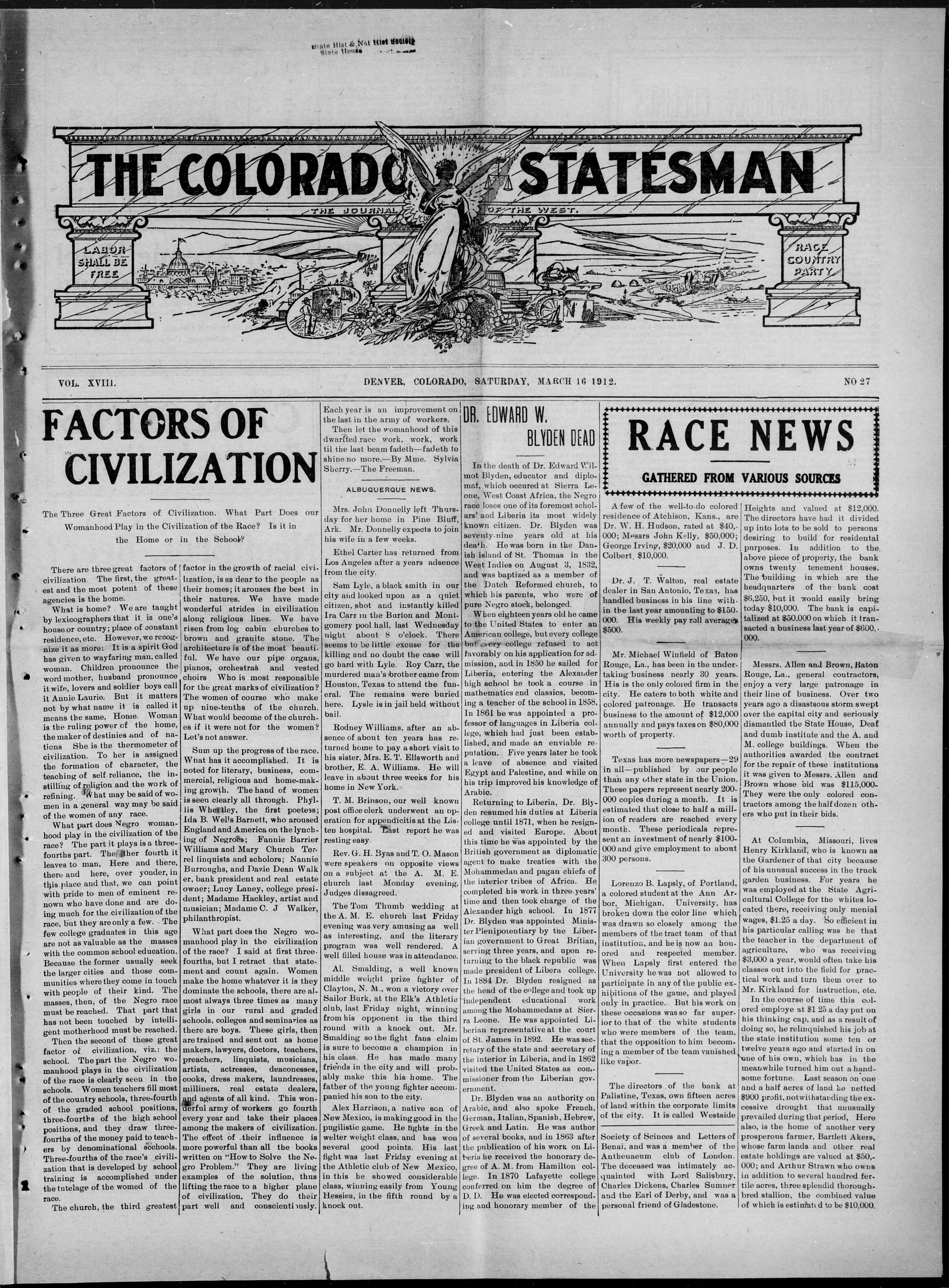
FACTORS OF CIVILIZATION
The Three Great Factors of Civilization. What Part Does our Womanhood Play in the Civilization of the Race? Is it in the Home or in the School?
VOL. XVIII.
FACTOR
CIVILI
The Three Great Factors of Civil
Womanhood Play in the Civi
the Home or
There are three great factors of civilization. The first, the greatest and the most potent of these agencies is the home.
What is home? We are taught by lexicographers that it is one's house or country; place of constant residence, etc. However, we recognize it as more: It is a spirit God has given to wayfaring man, called woman. Children pronounce the word mother, husband pronounce it wife, lovers and soldier boys call it Annie Laurie. But it matters not by what name it is called it means the same. Home. Woman is the ruling power of the home, the maker of destinies and of nations She is the thermometer of civilization. To her is assigned the formation of character, the teaching of self-reliance, the instilling of religion and the work of refining. What may be said of women in a general way may be said of the women of any race.
What part does Negro womanhood play in the civilization of the race? The part it plays is a three-fourths part. The other fourth it leaves to man, Here and there, there and here, over yonder, in this place and that, we can point with pride to men of eminent renown who have done and are doing much for the civilization of the race, but they are only a few. The few college graduates in this age are not as valuable as the masses with the common school education. Because the former usually seek the larger cities and those communities where they come in touch with people of their kind. The masses, then, of the Negro race must be reached. That part that has not been touched by intelligent motherhood must be reached.
Then the second of these great factor of civilization, viz.: the school. The part the Negro womanhood plays in the civilization of the race is clearly seen in the schools. Women teachers fill most of the country schools, three-fourth of the graded school positions, three-fourths of the high school positions, and they draw three-fourths of the money paid to teachers by denominational schools. Three-fourths of the race's civilization that is developed by school training is accomplished under the tutelage of the womed of the race.
The church, the third greatest
factor in the growth of racial civilization, is as dear to the people as their homes; it arouses the best in their natures. We have made wonderful strides in civilization along religious lines. We have risen from log cabin churches to brown and granite stone. The architecture is of the most beautiful. We have our pipe organs, pianos, orchestras and vested choirs Who is most responsible for the great marks of civilization? The women of course who make up nine-tenths of the church. What would become of the churches if it were not for the women? Let's not answer.
Sum up the progress of the race. What has it accomplished. It is noted for literary, business, commercial, religious and home-making growth. The hand of women is seen clearly all through. Phyllis Wheatley, the first poete; Ida B. Wells Barnett, who aroused England and America on the lynching of Negroes; Fannie Barrier Williams and Mary Church Terrel linquists and scholars; Nannie Burroughs, and Dazie Dean Walker, bank president and real estate owner; Lucy Laney, college president; Madame Hackley, artist and musician; Madame C. J Walker, philanthropist.
What part does the Negro womanhood play in the civilization of the race? I said at first three-fourths, but I retract that statement and count again. Women make the home whatever it is they dominate the schools, there are almost always three times as many girls in our rural and graded schools, colleges and seminaries as there are boys. These girls, then are trained and sent out as home makers, lawyers, doctors, teachers, preachers, linquists, musicians, artists, actresses, deaconesses, cooks, dress makers, lauddresses, milliners, real estate dealers, and agents of all kind. This wonderful army of workers go fourth every year and take their places among the makers of civilization. The effect of their influence is more powerful than all the books written on "How to Solve the Negro Problem." They are living examples of the solution, thus lifting the race to a higher plane of civilization. They do their part well and conscientiously.
DENVER, COLORADO, SATURDAY, MARCH 16 1912.
Each year is an improvement on the last in the army of workers. Then let the womanhood of this dwarfed race work, work, work til the last beam fadeth—fadeth to shine no more.—By Mme. Sylvia Sherry.—The Freeman.
ALBUQUERQUE NEWS.
Mrs. John Donnelly left Thursday for her home in Pine Bluff, Ark. Mr. Donnelly expects to join his wife in a few weeks.
Ethel Carter has returned from Los Angeles after a years adsence from the city.
Sam Lyle, a black smith in our city and looked upon as a quiet citizen, shot and instantly killed Ira Carr in the Burton and Montgomery pool hall, last Wednesday night about 8 o'clock. There seems to be little excuse for the killing and no doubt the case will go hard with Lyle. Roy Carr, the murdered man's brother came from Houston, Texas to attend the funeral. The remains were buried here. Lysle is in jail held without bail.
Rodney Williams, after an absence of about ten years has returned home to pay a short visit to his sister, Mrs. E. T. Ellsworth and brother, E. A. Williams. He will leave in about three weeks for his home in New York.
T. M. Brinson, our well known post office clerk underwent an operation for appendicitis at the Listen hospital. Last report he was resting easy.
Rev. G. H. Byas and T. O. Mason were speakers on opposite views on a subject at the A. M. E. church last Monday evening, Judges dissagreed.
The Tom Thumb wedding at the A. M. E. church last Friday evening was very amusing as well as interesting, and the literary program was well rendered. A well filled house was in attendance.
Al. Smalding, a well known middle weight prize fighter of Clayton, N. M., won a victory over Sailor Burk, at the Elk's Athletic club, last Friday night, winning from his opponent in the third round with a knock out. Mr. Smalding so the fight faus claim is sure to become a champion in his class. He has made many friends in the city and will probably make this his home. The father of the young fighter accompanied his son to the city.
Alex Harrison, a native son of New Mexico, is making good in the pugilistic game. He fights in the welter weight class, and has won several good points. His last fight was last Friday evening at the Athletic club of New Mexico, in this he showed considerable class, winning easily from Young Hessiea, in the fifth round by a knock out.
DR. EDWARD W.
BLYDEN DEAD
In the death of Dr. Edward Wilmot Blyden, educator and diplomat, which occured at Sierra Leone, West Coast Africa, the Negro race loses one of its foremost scholars' and Liberia its most widely known citizen. Dr. Blyden was seventy-nine years old at his death. He was born in the Danish island of St. Thomas in the West Indies on August 3, 1832, and was baptized as a member of the Dutch Reformed church, to which his parents, who were of pure Negro stock, belonged.
When eighteen years old he came to the United States to enter an American college, but every college refused to act favorably on his application for admission, and in 1850 he sailed for Liberia, entering the Alexander high school he took a course in mathematics and classics, becoming a teacher of the school in 1858. In 1861 he was appointed a professor of languages in Liberia college, which had just been established, and made an enviable reputation. Five years later he took a leave of absence and visited Egypt and Palestine, and while on his trip improved his knowledge of Arabic.
Returning to Liberia, Dr. Blyden resumed his duties at Liberia college until 1871, when he resigned and visited Europe. About this time he was appointed by the British government as diplomatic agent to make treaties with the Mohammedan and pagan chiefs of the interior tribes of Africa. He completed his work in three years' time and then took charge of the Alexander high school. In 1877 Dr. Blyden was appointed Minister Plenipotentiary by the Liberian government to Great Britian, serving three years, and upon returning to the black republic was made president of Libera college. In 1884 Dr. Blyden resigned as the head of the college and took up independent educational work among the Mohammedans at Sierra Leone. He was appointed Liberian representative at the court of St. James in 1892. He was secretary of the state and secretary of the interior in Liberia, and in 1862 visited the United States as commissioner from the Liberian government.
Dr. Blyden was an authority on Arabic, and also spoke French, German, Italian, Spanish, Hebrew, Greek and Latin. He was author of several books, and in 1863 after the publication of his work on Liberia he received the honorary degree of A.M. from Hamilton college. In 1870 Lafayette college conferred on him the degree of D.D. He was elected corresponding and honorary member of the
RACE NEWS GATHERED FROM VARIOUS SOURCES
A few of the well-to-do colored residence of Atchison, Kans., are Dr. W. H. Hudson, rated at $40, 000; Messrs John Kelly, $50,000; George Irving, $20,000 and J. D. Colbert, $10,000. Heights and valued at $12,000. The directors have had it divided up into lots to be sold to persons desiring to build for residential purposes. In addition to the above piece of property, the bank
Dr. J. T. Walton, real estate dealer in San Antonio, Texas, has handled business in his line within the last year amounting to $150.000. His weekly pay roll averages $500.
Mr. Michael Winfield of Baton Rouge, La., has been in the undertaking business nearly 30 years. His is the only colored firm in the city. He caters to both white and colored patronage. He transacts business to the amount of $12,000 annually and pays taxes on $80,000 worth of property.
Texas has more newspapers—29 in all—published by our people than any other state in the Union. These papers represent nearly 200,000 copies during a month. It is estimated that close to half a million of readers are reached every month. These periodicals represent an investment of nearly $100,000 and give employment to about 300 persons.
Lorenzo B. Lapsly, of Portland, a colored student at the Ann Arbor, Michigan. University, has broken down the color line which was drawn so closely among the members of the tract team of that institution, and he is now an honored and respected member. When Lapsly first entered the University he was not allowed to participate in any of the public exhibitions of the game, and played only in practice. But his work on these occasions was so far superior to that of the white students who were members of the team, that the opposition to him becoming a member of the team vanished like vapor.
The directors of the bank at Palistine, Texas, own fifteen acres of land within the corporate limits of the city. It is called Westside Society of Sciences and Letters of Benai, and was a member of the Antheuaeum club of London. The deceased was intimately acquainted with Lord Salisbury, Charles Dickens, Charles Sumner and the Earl of Derby, and was a personal friend of Gladestone.
NO 27
Heights and valued at $12,000. The directors have had it divided up into lots to be sold to persons desiring to build for residential purposes. In addition to the above piece of property, the bank owns twenty tenement houses. The building in which are the headquarters of the bank cost $6,250, but it would easily bring today $10,000. The bank is capitalized at $50,000 on which it transacted a business last year of $600,000.
Messrs. Allen and Brown, Baton Rouge, La., general contractors, enjoy a very large patronage in their line of business. Over two years ago a disastsous storm swept over the capital city and seriously dismantled the State House, Deaf and dumb institute and the A. and M. college buildings. When the authorities awarded the contract for the repair of these institutions it was given to Messrs. Allen and Brown whose bid was $115,000- They were the only colored contractors among the half dozen others who put in their bids.
At Columbia, Missouri, lives Henry Kirkland, who is known as the Gardener of that city because of his unusual success in the truck garden business. For years he was employed at the State Agricultural College for the whites located there, receiving only menial wages, $1.25 a day. So efficient in his particular calling was he that the teacher in the department of agriculture, who was receiving $3,000 a year, would often take his classes out into the field for practical work and turn them over to Mr. Kirkland for instruction, etc.
In the course of time this colored employee at $125 a day put on his thinking cap, and as a result of doing so, he relinquished his job at the state institution some ten or twelve years ago and started in on one of his own, which has in the meanwhile turned him out a handsome fortune. Last season on one and a half acres of land he netted $900 profit, notwithstanding the excessive drought that unusually prevailed during that period. Here also, is the home of another very prosperous farmer, Bartlett Akers, whose farm lands and other real estate holdings are valued at $50,-000; and Arthur Strawn who owns in addition to several hundred fertile acres, three splendid thoroughbred stallion, the combined value of which is estimated to be $10,000.
AFRO-AMERICAN CULLINGS
With due ceremonial, a new president—Daniel E. Howard—has been installed as the successor of Arthur Barclay in Liberia. Liberia and Abyssinia are now the only areas in Africa not absolutely controlled by European powers. Great Britain, France and Italy have, however, undertaken to preserve the territorial integrity of Menellik's empire, and the United States has taken a friendly interest in the recent reorganization of Liberia's finances.
The scheme for an international loan of $2,500,000, agreed upon one year ago, provides that an American controller, with British, French and German subcontrollers, shall administer the customs. Liberia has welcomed the arrangement, for since on July 26, 1847, the "Free and Independent Republic" was constituted, its government has been in unstable equilibrium betwixt the threatened agrandizement of European powers and the menace of natives—at present numbering perhaps 2,000,000—in the unexplored and mysterious hinterland whose borders have never been precisely determined. What may be called "civilized," Liberia is but a strip of land along the sea front not more than 200 miles in width, inhabited by some 15,000 civilized American Liberians, negroes, with the status of British citizens, and Europeans of diverse nationality.
The appointment of an American controller in chief authority over the customs encourages the Liberians to believe that the United States will guarantee the territorial integrity of their country just as England, France and Italy are on guard to prevent enroachment in Abyssinia. They would like nothing better than to have an American protectorate established at Monrovia, their capital. But though the plantation on the African coast was of American origin and inspiration, the intention of the promoters being to provide a colony for American freedmen, the United States will go no further than the present agreement to reorganize the finances, the national defenses and the agricultural system, and determine the proper boundary. Otherwise, the Liberians will be left free to work out their own political destinies and to improve their rich and niftero almost untouched natural resources.—Editorial, Philadelphia Public Ledger.
In some instances our people pray so long as there is, or has been any spirit in the congregation it will surely leave. It seems that the ones who offer these prayers have no conception whatever of how to pray to derive some benefit therefrom. They seem to think that they have got to "disturb God on his throne" in the way of a nonsensical prayer before they are heard. They will, in most cases, start in at "Our Father," etc., and end God knows where. They pray seemingly only trying to outpray the other good old brother who has just preceded him; caring nothing for how he addresses the Almighty, calling him from God the Father to the Babe born in the manger.
The good brethren get so enthused over their prayers some times they get out of words and repeat from one to fifty times in succession: "Oh Lord, Oh Lord, a-n-d Ah! Oh Lord!" which is good praying but not so regular. These brethren again seemingly pray for that shouting spirit to come to the good old Amen-Sisters; praying in every tone of voice, from a deep bass to high tenor, and from the cradle to the grave, they will finally get the good old sisters to moving about after a two or three hour prayer, then they will say: "Amen, and thank God." At the end of this noble three hour prayer the majority of the people are tired out and before the contribution basket is passed, half the congregation has dispersed. Dear brethren, when you pray—pray for the good that there is in prayer and not for the shouting qualities and the defeat of the brother who has just "disturbed God on his throne."—Palestine Plaindealer.
According to the last count made by the United States government 9,328,294 negroes dwell in this country, and 8,327,345 of them live in the 13 states of the south.
A few years ago five southern states had larger negro than white population, but now, according to statistics only two have more negroes than whites, South Carolina and Mississippi. Mississippi's total population, white and negro, is 1,797,114, of which 1,009,487 are negroes. South Carolina has a total population of 1,515,400, of which 835,843 are negroes.
The negro population of this country has not decreased, but thousands of negroes who desired to remain in the south, on account of climate and other conditions, have been forced to scatter themselves over the country in search of manhood rights.
Many of those who have remained in Virginia have much to be thankful for, as they have practiced the industrial virtues, and instead of being tenants, as they were a few years ago, many now are land owners, and can "sit down under their own vine and fig tree." The negro is steadily acquiring valuable property, and we com-
mend his ambition for so doing. We implore him to continue to be law abiding and take advantage of every opportunity.-Richmond Reformer.
The report of business progress made by the race during the past 12 years, as shown by the statement of Professor Charles H. Moore, national organizer of the National Negro Business league, published in The Age, should encourage the race everywhere not only to support negro business enterprises more and more, but to add to the 25,000 business places we now have as openings appear. The 52 banks with a capitalization of $1,700,000 which last year did $20,000,000 of business, and the 4 insurance concerns, with $1,500,000 business last year, will grow in number and capitalization and money handled in the next ten years more rapidly than in the past ten years, because the foundation has been laid, because the people have been taught now to do it, because the people have before their eyes "the evidence of these things, seen, not heard." Cover the south with negro business enterprises, and edge in one wherever there is an opening in the wherever there is an opening to do a thing is to do it. "If we do not make business openings for our children, whom we are educating every year who will?" should be a question ever present on the negro's tongue.
In many respects St. Paul's is the third largest school in the country for the education of colored youth, and the largest in the Episcopal church. Its enrollment will exceed 500, its faculty 50. It has a property with a gross value of over $200,000. There are seventeen families connected with the school, giving their entire life to the work. There are four other married persons awaiting accommodations. In an organized way the influence of the school reaches every person in the county and may be felt in the lives of its graduates in nearly every state in the Union and in some foreign countries. In this county alone the school has 36 active leagues, conducts an annual fair, a farmers' conference and a teachers' institute. During the past year we have been forced to turn away a large number of students for lack of accommodations and means of support. The majority of these applicants came from the rural districts and seemed to yearn for an opportunity to work for an education. —Lawrenceville (Va.) Southern Missioner.
In addition to having to sustain the shock of battle being waged against the race at large, every negro who is trying to move forward has an individual battle of his own to fight—this is especially true of the negro whose working capital is his brains and who for that reason is in competition with the rest of the world. To illustrate: At Louisville, Ky., the white people are erecting a million dollar hospital, one wing for the white, and the other, with equal appointments, for the colored. White internes and physicians will practice on colored patients, but negro doctors and surgeons will not be permitted to enter. They are barred from practicing on any body.
Unless all signs fail movements of this sort will tend to stimulate negro physicians to establish hospitals and sanitariums of their own. It was once thought to be true, that on the intellectual sea there is room for every sail. If the negro does not find that to be so, he must make it so. If the sea is too narrow it must be enlarged.—Dallas Express.
"Health is wealth," this is an undeniable fact. Those who possess it will do well to throw around themselves all the safeguards in order to retain it, and those who have lost it should exert every effort to regain it.
We are by nature subject to many diseases, and the only way to guard against all stampedes on our health is to make a study of our own physical self.
To have a tuberculosis day in the colored schools of this state is an excellent move, and we endorse it. Every pupil and parent should be made acquainted with the ravages this dread disease is making upon the race and the methods by which it may be prevented.
Every effort should be made to put the young in possession of such facts and literature that will enable them to successfully combat tuberculosis—Richmond Reformer.
To reconcile and unite these antagonistic opinions, and to gain the good will of the people in all sections in his effort to uplift the negro race, Dr. Washington has displayed great ability, unusual tact, marked patience, and unbounded faith in his mission. The great industrial school at Tuskegee stands as a monument to his success in overcoming obstacles that confronted him in his work. "My Larger Education," as a result of the accomplishment in the development of an earnest and sincere educator, is a valuable contribution to the literature of the race question as well as to the field of pedagogical achievement.
WHITE JUDGE TOURS NORTHERN STATES IN INTEREST OF NEGRO SCHOOLS
JUDGE PETER C. PRITCHARD OF ASHEVILLE, N.C., WORKING FOR NATIONAL RELIGIOUS TRAINING SCHOOL.
Springfield, Mass.—Judge Peter C. Pritchard of Asheville, N. C., who was United States senator for eight years; for a number of years served as assistant Supreme court judge of the District of Columbia and was later appointed by President Roosevelt United States circuit judge for the Fourth judicial district, is making a tour of this section of the country in the interest of the National Religious Training school, Durham. He does not confine himself to speaking about the school, but also emphasizes the economic and social conditions in the south and especially his state. After speaking about the enobling scope of the school and the effective plans that have made the chautauqua and summer school a potent force for good and showing the need of the great conference of negro ministers to be held at this institution for one week beginning July 6, 1912, the entertainment being free of charge, he in part said: "The American people by no means appreciate the importance of the conservation of manhood. After the Civil war we in the south were in a very bad condition. We had lost everything and had almost lost our ambition. The more earnest among us, though, went to work immediately to build up conditions, and we have succeeded in bettering the country remarkably. Right here I want to correct a false impression that seems to be very widespread in all section of the country. The whites and the colored people in North Carolina are far from being at sword's points. On the contrary, I feel safe in saying that there is as good a feeling between races in North Carolina as in any state in the Union.
"There is more racial prejudice in the north than in the south, and this can be attributed largely to the fact many of the negroes who come north are ignorant adventurers who think that they can better themselves in this section of the country without working. There has never been a time in the south when the white people were not willing to help the negroes, and that is especially true today. The school which Doctor Shepard has founded is not a denominational one in any sense of the word. His idea has been that the people can best be reached through the ministers of their own race. I am a firm believer in foreign missions, but I don't think that they are as important as converting the Americans at home to the Christian religion."
In touching upon the qualification for citizenship, as he did in the beginning of his address, he aroused pronounced enthusiasm. He said: "The negro can make a first-class citizen and a patriotic citizen. He is as thoroughly American as anyone. I am not a pessimist or an alarmist. But I am afraid that if we don't do something to alleviate our citizenship, the government will be in grave danger. The man who loves his God loves his country, and it is pretty well proved that the negro loves his God. It is well known that even the best educated people in the south at one time wanted to keep the negro in slavery, and my purpose in coming north is to let the people know that the south realizes that it is important to educate the negro and to make a good citizen out of him. There are many undesirable negroes in North Carolina, but we believe that we can make good citizens out of them and we are going to do it. The problem that we have to face in the south is the same that you have to face in this state. There was a time when people in the south felt that their interests were entirely separate from the interests of the people in any other section of the country, but now we all feel that it is just as important to the people of Massachusetts to have good citizenship in North Carolina as it is to the people of that state, and that it is as important to the people of North Carolina to have good citizenship in Massachusetts as it is to the people here. The flood of foreign immigration that is pouring into the country is a good thing, but we must always keep the people who know and can sympathize with our government in as good condition as possible and that is why the training school at Durham has been founded. We must see to it that the homes are in good condition. When I was on the bench I had names on the criminal docket of every race except one and that was the Jew. I attribute this to the fact that the Jews are more careful in home life and they are more particular in the training of their boys and girls at home. In North Carolina we are doing everything we can now to atone for any neglect we may have shown in the past. I firmly believe that we have made more advancement in legislation for education and for the building of roads during the past ten years than any other state in the Union. We realize that legislation cannot made a good man out of a bad man, but we can by legislating do away with liquor and gambling and thus remove the evil influences or at least minimize them. Ninety-five per cent. of all the criminal cases which come before me can be traced in their origin back to the barroom and by removing the barroom we remove a large part of the evil.
"When I first heard of Dr. Shepard's
scheme it seemed to me tremendous. It has succeeded, though; it is surely doing a great work. The negro is an emotional man, especially in matters of religion, and illiterate preachers of their own race do them more harm than good in teaching them the wrong kind of religion. What we want to teach them above everything else is practical religion and good citizenship. We want to show them that they cannot become good business men or succeed in any branch of life unless they have the real kind of religion."
Dr. James E. Shepard, founder and president of this movement, accompanied Judge Pritchard, who is chairman of the advisory board of the school, and spoke of its needs and the forthcoming ministers' conference of his race at his institution, which will discuss and study the social problems and the ways of solving them. He said that invitations have been extended the ministers of his race.
ROSS SUGGEEDS GRIFFIN
NEW HEAD OF TRUE REFORMERS
ASSUMES DUTIES — FORMER
GENERAL SECRETARY BURRELL
THINKS ORDER CAN BE REHAB-
LITATED WITHIN FIVE YEARS.
Richmond, Va.—Floyd Ross, vice-
grand worthy master of the True Re-
formers, and chief of the St. Louis
division, is now the head of the order,
succeeding the late W. R. Griffin, who
was accidentally killed in a railroad
wreck near Fordo, Va.
The news of the death of Grand
Worthy Master Griffin came as a great
shock to the members of the order
throughout the country. The deceased had been at the head of the
True Reformers since last fall and
spent all of his time toward rehabilit-
tating the order.
Funeral services were held over the remains from the Third street A. M. E. church last Thursday, and were attended by the prominent members of the order.
W. P. Burrell, formerly general secretary of the True Reformers, was a visitor in New York this week, and commenting on the accidental death of Grand Master Griffin declared that the order loses a member who had its best welfare at heart. Mr. Burrell viewed the remains of the deceased shortly after the wreck.
"Although I was one of those ousted last fall when Mr. Griffin and a new set of officers were elected, yet I was on good terms with the deceased," declared Mr. Burrell to a representative of The Age. "While he was grand worthy master he appointed me on several different committees, and I co-operated with him to the best of my ability.
"The outlook for the rehabilitation of the True Reformers is good. Under the leadership of the new grand worthy master, Floyd Ross, if a conservative policy is pursued, the order should ultimately get on its feet. There is a debt of $100,000 to be wiped out, which should be done within the next few years."
BUTCHER USING AX ON NEGROES
UNKNOWN MURDERER SPREADING TERROR IN LOUISIANA AND TEXAS.
Beaumont, Tex.—Ethel Love, a negress, her son, and two daughters, were killed in their cabin near Beaumont, the seventh of a series of similar crimes which have occurred within several months in southwestern Louisiana and southeastern Texas and in which the number of persons killed now-total 29.
In each instance the slayer, believed to be the same person, battered the heads of his victims with an ax as they slept. Invariably the weapon used has been left near the bodies, but no other evidence has been found which might lead to an arrest. As a rule the negroes killed are obscure residents of small settlements and no motive can be assigned.
The first occurrence was at Rayne, Louisiana, when a mother and four children were killed. At LaFayette the victims number four. Next came Crowley, La., with a family consisting of father, mother and one child. LaFayette was then next with another family of four; then at Crowley a woman and her three children were killed on January 18. On January 21 a family of five was murdered at Lake Charles. The crime here was the seventh.
As a result, negro residents of the several cities are terror-stricken. Lights are kept burning, prayer meetings are held and male members of the families take turns in keeping watch at night.
POPULATION OF TEXAS.
On the date of the battle of San Jacinto, April 21, 1836, the combined population of Texas, Indians included, was approximately 40,000. Of this number not more than 25,000 were whites.
By 1850 the population had increased nearly six-fold, or to 212,592. In 1860 it was 604,251, an increase for the decade of 184 per cent.; in 1870, 818,579, an increase of 35 per cent.; in 1880, 1,591,749, or 94 per cent.; in 1890, 2,235,523, or 40 per cent.; in 1900, 3,048,710, or 36 per cent.; in 1910, 3,896,542, or 28 per cent.
A recent report of the United States census shows that in Texas the negro race did not increase proportionately as much as the white, and that the negro population of the entire state represented a smaller percentage in 1910 than in 1900.
AMERICAN
JEWELRY
ROWM-ALHEN
JEWELRY CO.
PEKKEN
COLOUR
10th Avenue
H. HEUER, PR
RESTING PLACE FOR
MEALS AT A
Pool Room In
Corner West 10th and Osay
Denver, C
ASK FOR
CARLS
Peerless Ie
Phones: M
DID YOU E
Neef Bro
It's made right, a
None better made
This is a Strictly C
Avenue H
H. HEUER, PROPRIETOR
PLACE FOR COLORE
MEALS AT ALL HOURS
Pool Room In Connection
At 10th and Osage, Near Bur
Denver, Colorado
ARLSON
less Ice C
Phones: Main 112 and
DO YOU EVER T
f Bros.' B
made right, and tastes
better made anywhere
a Strictly Colorado P
ING SILVERWARE
Avenue Hotel
HEUER, PROPRIETOR
ACE FOR COLORED GENTS
ALS AT ALL HOURS
Pool Room In Connection
and Osage, Near Burnham Shops
Denver, Colorado
RLSON'S
less Ice Cream
Phones: Main 112 and Main 5787
YOU EVER TRY
Bros.' Beer?
right, and tastes right.
er made anywhere and
trictly Colorado Production
STERLING SILVERWARE
10th Avenue Hotel
Corner West 10th and Osage, Near Burnham Shops Denver, Colorado
ASK FOR CARLSON'S Peerless Ice Cream Phones: Main 112 and Main 5787
It's made right, and tastes right. None better made anywhere and This is a Strictly Colorado Production BE SURE AN TRY IT.
BERT PLESSNER
MANAGER
EAST TURNER HALL
2132-2148 Arapahoe St.
Phone 2449 Denver
THE
BROADHURST
CARTER
SHOE CO.
LETON SHOE
FOR MEN
and $8, Pair
Home with the Celebrated
Tivoli Beer
Bottled by
pire Bottling Co.
Phone Gallup 245
NETTLETO
FOR M
$6, $7 and
Supply Your Home w
Tivoli
Bottled
The Empire E
Phone Gall
BETLETON S
FOR MEN
$7 and $8,
Your Home with the Cel
Tivoli Beer
Bottled by
Empire Bottling
Phone Gallup 245
$6, $7 and $8, Pair
Supply Your Home with the Celebrated Tivoli Beer Bottled by The Empire Bottling Co. Phone Gallup 245
THE BEST ICE CREAM AND
CANDIES AT
O.P. BAUR & CO.
CATERERS AND
CONFECTIONERS
Phone: 168
1512 Curtis Street, Denver, Cole.
---
---
```markdown
```
PARKS
823 Sixteenth St.
We Are Denver Agents for the
TRADE MORAL—The quality of what you have to sell is known to some people all of the time and all of the people some of the time, but advertise regularly with us and you'll reach all of the people all of the time.
HE RESCUES WHITE BABY FROM
A 60-FOOT WELL, WHEN EVERYBODY ELSE EXCEPT THE
The following heroic deed of a colored boy was taken from the Wills Point (Tex.) Chronicle, a white paper. it is self-explanatory, yet we just can't desist from saying that it tells unmistakably that as true a spirit of heroism and manly qualities lurks in the colored man's breast as does in any other being living, and, in many instances, he seems to possess more. Among other things, the following is noted:
The hero of the hour was Albert Gray, a negro boy of fifteen years of age and the son of Bud Gray. The boy is small for his age and was thus enabled to go head downward into the small hole and fasten a rope around the child's body, by which means it was drawn from its perilous position, a feat requiring rare courage and worthy of a Carnegie medal.
The well was at the home of Vernon Stepp. In drilling it, a rock had been struck some 60 feet down and the well had been abandoned for a new location. Unfortunately it had not been covered over and had not been curbed. It was of the ordinary bored well type, making a hole some 13 or 14 inches in diameter. The baby's Grandmother Stepp saw the little toddler just as its unsteady and unknowing footsteps went into the well and the little baby shot downward to the bottom. The alarm was spread rapidly and soon neighbors and men from town began to assemble, all intent on devising some means by which the child might be rescued, and stout hearts quaked as the baby's piteous voice pleaded out from its narrow prison, "Mamma, tome dit me out." This brought the assurance, however, that the child was still alive, and this assurance gave strength to men and women—some frantic, some cool and delibereate—in their efforts to devise some means of rescue. With the aid of a reflected light the child could be plainly seen and an effort was made to loop a rope about its body, but the little mind could not understand and the little arms fought off the life-saving rope. The frantic mother begged to be lowered into the well to rescue her child and, clad in man's attire, with ropes attached to her feet, she made the attempt, but her shoulders were too broad to allow her entrance in the well.
It was apparent that the only hope was to secure some person whose body was small enough and who was yet brave enough to go into the well, and a messenger had been dispatched to town for this purpose. It was the result of this trip that brought the negro boy to the scene.
He expressed his readiness to undertake the task and was first lowered into the well feet first. In this way he mangaged to catch the arm of the child, but when about half way up the waistband of the child's clothing gave way and the little fellow for the second time dropped to the bottom of the well. Hearts turned sick when the falling child told listening ears what had happened. The boy was drawn out and though his head was bleeding from scratches on the walls of the well, he was ready to try again, and this time his body was lowered in the well head foremost. He carried the end of an extra rope which he fastened securely about the child's body. "All right, pull me out," he called and there was deathly silence as willing hands drew him out, closely followed by the baby, and there were few dry eyes as the little tot, spattered with mud, but still alive, was placed in the arms of its shouting mother. Although it had been in the well for nearly four hours, Dr. M. L. Cox, who had been called soon after the accident and whose wise counsel had much to do with the final rescue, pronounced its injuries apparently confined to a few bruises of no serious consequence.
The negro boy whose courage and heroism made the rescue possible was not forgotten, those present at the well at the time making up a purse of $25, which was swelled considerably by the crowd in town when he reached there, and one negro boy had reflected undying credit on his race. On all sides he was given unstinted praise for his heroic act.
And while men and women told and retold the story of the little child in the well and its rescue, father and mother were almost overcome with joy and the mother pressed her precious babe to her bosom and lavished the mother love upon it even as she had never done before, and thanked God for its delivery.
Fortunately there was no "damp" in the well, and that the child was not seriously hurt by the two falls was marvelous. It can be accounted for only by the narrowness of the walls, which possibly impeded the downward progress, and the further possibility of the air pressure underneath the child breaking in some degree the force of the fall—or was it angels?
JEWEL AMULETS.
Among the curious superstitions connected with precious stones is that cherished in Burma concerning the cat's-eye, which is supposed to secure invulnerability in war.
The very water in which such gems as diamonds, pearls, topaz, sapphires, amethysts and emeralds are immersed is drunk to secure immunity from all evil.
WORK WHICH THEY ARE DOING FOR NEGRO FARMERS IN ALABAMA.
The following is a portion of an article by Rev. A. F. Owens, published in the Montgomery Advertiser.
Five counties in Alabama now have negro demonstration agents to carry on the work of teaching negro farmers better methods of farming by means of demonstration plots. There are at present negro demonstration agents in nearly all the soutern states, with the exception of Virginia, which has seven agents working in eleven counties. There is no other state where so much work is being done by negro agents for negro farmers as in Alabama. The reason so much is being done for the negro farmers in Alabama is undoubtedly due to the influence of Tuskegee Institute, just as the reason that so much is being done for negro farmers in Virginia is due to Hampton Institute, of which the Tuskegee school is an offshoot.
Of the six negro demonstration agents in Alabama, four gained their training at Tuskegee, and the district agent, T. M. Campbell, who has charge of the work among the negroes in Alabama, Mississippi, Louisiana and Oklahoma, is a graduate of the same school. A recent report made by the agricultural department on the work of the demonstration agents in Alabama, shows that the negro farmers, working under the direction of these agents, have made a pretty good showing. The following is a summary of results obtained by some of the negro county demonstration agents in farm demonstration work during the past season:
C. D. Meneefee, Lee county, conducted 59 demonstrations in corn and 60 in cotton, using 123 acres for the former and 300 acres for the latter. The results were an average of 44 bushels of corn per acre and an average of 1,869 pounds of cotton per acre.
Washington A. Ttate, Macon county, had charge of 22 demonstrations in corn and 38 in cotton, using a total of $39\frac{1}{2}$ in corn and 72 acres in cotton. The results were an average of 54.1 bushels of corn per acre and 1,429 pounds of cotton on the same amount of land.
Harry Sims, Wilcox county, supervised one demonstration in corn and 22 in cotton, planting one acre in corn and 35 acres in cotton. The one acre in corn yielded 27 bushels; the 35 acres in cotton yielded an average of 1,399 pounds per acre.
G. W. Patterson, Madison county, had charge of 21 demonstrations in corn and 25 in cotton. The amount of land cultivated in corn was 31 acres, and 56 acres were in cotton. This demonstrator made an average of 43.3 bushels of corn per acre and averaged 910 pounds per acre for cotton.
Some notion of what the demonstration agents have done for the negro farmers may be gathered from the fact that the average yield of corn per acre for negro farmers in 1909, the year the census was taken, was less than eight bushels per acre. The average bushels made this year by negro demonstration farmers in Macon county was 54.1 bushels per acre. This was the best average made by farmers under any of the negro demonstration agents and was nearly eight bushels above the average of the other white and negro demonstration agents throughout the state.
The average yield of seed cotton in Alabama in 1911 was about 600 pounds per acre. The highest average yield made on the farms conducted under a negro agent was in Lee county, where the average was 1,867 pounds of cotton per acre. This was 424 pounds of cotton above the average made on the other demonstration plots in different parts of the state and more than 1,200 pounds more than was made on the average farm.
NEGRO BUSINESS LEAGUE
Boston, Mass.—The local Negro Business league had a red letter night Wednesday of last week. There were about forty present, and a program was arranged which gave a number of men opportunity to tell about the successes they had attained in business. The stories related by many of the men were remarkable, and during the course of the evening the enthusiasm reached a high pitch. Dr. Booker T. Washington, the president of the National Negro Business league, was present as the special guest of the occasion, and delivered a stirring address. The local league is planning for much work during the present winter.
AN OLD FRIEND.
A private soldier once rendered some slight service to the first Napoleon.
"Thank you, captain," said the Emperor, carelessly.
"In what regiment, sire?" was the instant response of the quick-witted private.
"In my guards," replied the Emperor, pleased with the man's ready retort.
This incident, with appropriate variations, also happened to Genghis Ghan, Ivan the Terrible, Attila, Gustavus Adolphus, Louis XIV, Charlemagne, Alexander, King Alfred, Xerxes, Richard the Lion-Hearted and Henry of Navarre.—Success Magazine.
FORMER WIFE OF CLARENCE H.
DURYEA UNITED TO BLACK
CHAMPION.
Pittsburgh, Pa.—Alderman John A.
Fuggassi, after reading the papers,
made a bee-line for the marriage
license office to file a return showing
that he performed the marriage service
which united Jack Johnson, the nego-
chion champion heavyweight fighter, to
Etta H. Duryea, divorced wife of Clarence H. Duryea of Hempstead, L. L.,
a white woman, in this city on January
18, 1911. The ceremony took place
at the negro hotel run by Frank Sutton.
According to the law Fuggassal should have made this return within thirty days. After making his return he declared he had made it a year ago. Johnson wanted the wedding kept a secret at the time in order to avoid "notorlely." Johnson in his affidavit, when he took out the license, gave his age as thirty-two, and swore he had never been married. Johnson in talking over the long distance wire from Chicago to Sutton stated the trouble was all occasioned by "Sig" Hart, his former manager, trying to annoy him by making it appear that when he married Etta he committed bigamy.
"JOHNSON 18 AGGRIEVED."
New York.—On top of the news from Pittsburgh that Alderman John A. Fuggassi, in the presence of several witnesses, one of whom is city detective of Pittsburgh, had married Jack Johnson, in January a year ago, to "Etta H. Duryea, white," and that the alderman then had neglected to make proper report of the marriage to the authorities, came word from Chicago in which Johnson is "aggrieved."
"This story is just one more attempt by my enemies to be ornery against me," so Chicago says Jack said there.
"I married to Mrs. Etta H. Duryea, divorced wife of Clarence H. Duryea, of Hempstead, L. I., and I never had another wife. I did just what the Bible says. 'Take unto yourself a wife.'
"Now comes Pittsburgh authorities to make threats against prosecuting me or anybody else, like dispatches say they threaten, when I got a regular marriage license there on January 18, 1911, and was married the same day to Mrs. Etta Duryea under no fraud or false pretense. Mrs. Duryea had divorced her first husband for desertion, and I say right in the presence of my mother sitting here, I never was married any other time. Detective Cole, Frank Sutton, proprietor of the Hotel Sutton, and Carrie Sutton, his sister, were the witnesses."
The activity of Pittsburgh's district attorney in investigating the case as to why there was no proper return of the marriage license, resulted in a dispatch from Pittsburgh that at the alderman's office assurance was made that the proper papers would be filed immediately.
At Hempstead, L. I., the residents were far from pleased over the fresh publicity that has come to Clarence Duryea, who is the son of John Duryea, who for some years was a wholesale fruit merchant of Manhattan. The woman whom America and Europe during the past year has known as Mrs. Jack Johnson, was at Hempstead less than a week ago to attend the funeral of her father, David Terry of Flatbush, who was buried at Hempstead. She came from Flatbush with a brother and sister and left immediately after the burial services.
She was a tall and very pretty girl of seventeen when she was married to Clarence Duryea here about a dozen years ago. Young Duryea at that time was a soloist in the Garden City Cathedral. Later he went into light opera, and his wife also got a minor position in the company. Two years after they had gone on the stage they separated. Illness caused Duryea to go to the Adirondacks, while Mrs. Duryea continued on the stage. She got her separation from Duryea by charging desertion in Chicago.
The Duryeaes were married as the result of friendship that began when the then Etta Terry used to visit the home of John Whaley, her uncle, whose daughter, Loretta Whaley, eloped with Rev. Jere Knode Cook of St. George's church, Hempstead, in April, 1907. Cook left a wife behind, and he and the Whaley girl went to San Francisco, where they are now living.
A NEWSPAPER FOR NEGRO BUSINESS MEN
At the annual meeting of the Alabama State Business league at Tuskegee, Ala., the first number of the Negro Business League Herald was issued. The paper is published monthly by the National Negro Business league. The editors are Emmett J. Scott, corresponding secretary of the National league and Charles H. Moore, national organizer. In its announcement the editors say:
The Negro Business League Herald is published, as its name states, in behalf of the negro in business. It does not regard itself as the official organ of the National Negro Business league, or of any organization. Its major interest is helping to advance the business and economic condition of the negroes of the United States. It earnestly hopes, to begin with, that it may have the eager support of state negro business leagues and local negro business leagues, as well as all persons who are in any way concerned with business enterprises among the negro people.
REPORT OF PRESIDENT THIRK-
IELD SHOWS THAT INSTITU-
TION IS IN PROSPEROUS CONDITION—MANY IMPROVEMENTS HAVE BEEN MADE.
Washington.—The semi-annual meeting of the board of trustees of Howard University was held this week with Justice Job Barnard, president of the board, in the chair. The board of trustees, comprised of a number of the most distinguished men of the district with several members from other states, were present as follows: Chief Justice Stenton J. Peelee, the Rev. Charles Wood, the Rev. Chas. H. Richards of New York City; Justice Thomas H. Anderson, Justice George W. Atkinson, Dr. John R. Francis, Dr. F. J. Grimke, Dr. Booker T. Washington, William V. Cox, Henry M. Baker, Dr. J. H. N. Waring, Dr. Marcus Wheatland of Newport, R. I., John T. Emlen of Philadelphia, Pa., Hon. J. C. Napler, President W. P. Thirkeld, Secretary Geo. Wm. Cook and Treasurer E. L. Parks.
The report of President Thirkield shows continued prosperity in the university, which is the only institution in the nation where the government directly touches the education of the negro, and the equipment of teachers, physicians, lawyers, and the training of moral and industrial leaders for a race of ten millions. The president commends the large student body for good order and devotion to scholastic work. With over 1,100 men enrolled, most of them rooming in the city, no serious case of infraction of law or order has been reported. The Deans on Sunday meet their departments in the study of the Bible, and classes in Bible study and religious work are regularly conducted under the auspices of the Y. M. C. A. He reports a fine expression of the religious experience of the students as shown on Christmas Eve, when nearly fifty spent several hours singing carols and Christmas hymns about the campus and through the wards of the hospital, and in the alleys of the city.
The attendance in the College of Arts and Sciences has shown a fourfold increase within five years, and the faculty has increased from seven to twenty-four. A decided advance has been made in the department of engineering, made possible by the completion of the new Hall of Manual Arts and Applied Science. For the first time such courses in an institution especially for colored men are available in civil, electrical and mechanical engineering, with competent instructors from the engineering departments of leading universities. These courses enable the university to meet the demand for the skilled mechanic and engineer.
The report also notes the eager response of the student body to the new facilities now offered in chemistry, physics, and biology, as seen in the fact that nearly seven hundred students are regularly instructed in these branches, with practical laboratory work offered in each department. This practical scientific work now requires three professors, one assistant professor, three instructors, besides seven students assistants. The emphasis has been shifted from the traditional to the modern basis of education. It has often been said that while colored students were proficient in the languages, history, etc., they showed no marked adaptation to the sciences; but the eager response of the great body of students to the opportunities here for the first time offered in any large way for laboratory work in the exact sciences reveals their adaptation to these lines of study, and marks an era in the educational life of the negro race.
BLACKS BAPTIZED IN ARCTIC WATER
WITH THERMOMETER NEAR ZERO
27 NEGROES ARE IMMERSED
IN RIVER.
Pittsburg.—With the thermometer
registering four degrees above zero,
27 colored men and women, recent
converts to the Mt. Zion African Methodist Episcopal church of Brownville, near here, were immersed in the icy waters of the Monongahela river today. The immersions were witnessed by several thousand persons who shivered on the river banks and huddled close to fires built by small boys.
In order to get the ceremony under way it was necessary to cut a hole in the ice. Carriages were in waiting and as fast as the converts came out of the water they were wrapped in blankets and driven to their homes.
A DOUBTFUL COMPLIMENT.
William Lawrence, bishop of Massachusetts, delights in telling this story. "Once when there was a vacancy in the Massachusetts bishopric, Phillips Brooks was the most likely candidate. I was walking with President Eliot one day, and, in the course of the observation, I said to him, 'Do you think Brooks will be elected?' "Well, no,' said Dr. Eliot, a second or third rate man would do as well.' "Phillips Brooks was elected, and a short time afterwards Dr. Eliot and I were walking again. "Glad Brooks was elected, aren't you? I asked. "I suppose so,' returned Dr. Eliot, 'but to tell the truth, William, you were my man.'"—Cosmopolitan.
SHORT ORDERS AT ALL
hoe Street.
DEN
THE
MONARCH LIQUOR
COMPANY
1841-45 Arapahoe Street.
MONARCH LIQUOR COMPANY
TELEPHONE
CHAMPA 1231
IMPORTED & DO
D. W. REEVES, Manager
FULL LINE
Five Point
2727
PHONE CHAMPA 471.
Remember I Save
Put
The Cincinnatti Fur
FURNACES CLEANED, FLO
W
LAWN CUTT
BEST WORK
JAS. TERRY.
PORTED & DOMESTIC WINES & LIQUOR
EEVES, Manager. W. P. JONES, B.
FULL LINE OF CIGARS AND TOBACCO.
Pe Points Barber Shop
2727 WELTON STREET.
GHAMPA 471. DENVE
Remember I Save You One Dollar on Your Furnace.
Put This Dollar in the Bank.
Cincinnati Furnace and House Clean
CLEANED, FLOORS WAXED, KALSOMINING A
WASHING CELLARS.
LAWN CUTTING, CEMENT PATCH WORK.
ST WORK
QUICK SERV
TERRY.
1209 E. Thirteenth Ave. Pho
MPA STREET PHONE
W. O. SIMONDS
oreka COAL 4.0
GAS COKE $5.00 PER TON
Save You Money if You Leave Your Order
Prices Go Up.
IMPORTED & DOMESTIC WINES & LIQUORS
D. W. REEVES, Manager. W. P. JONES, Proprietor.
FULL LINE OF CIGARS AND TOBACCO.
Remember I Save You One Dollar on Your Furnace.
Put This Dollar in the Bank.
The Cincinnati Furnace and House Cleaning Co.
FURNACES CLEANED, FLOORS WAXED, KALSOMINING AND WHITE.
WASHING CELLARS.
LAWN CUTTING, CEMENT PATCH WORK.
BEST WORK
QUICK SERVICE
JAS. TERRY. 1209 E. Thirteenth Ave. Phone York 4328.
2029 CHAMPA STREET PHONE MAIN 5964
W.
Eureka
GAS COK
We Will Save You Money
GAS COKE $5.00 PER TON We Will Save You Money if You Leave Your Order Before Coal Prices Go Up.
Contractors and Builders All kinds of carpenter work and jobbing. Store and office work a specialty Phone Main 1925
1846 Arapahoe St.
DIAMOND6
Telephone Champs 1473
RUDOLPH
SANITARY O
MIL
Imported and Domestic
Vegetables. Our Own
2758-2760 Downing Avenue
UDOLPH BROTHER
SANITARY GROCERY, BAKERY AND
MEAT MARKET.
and Domestic Table Delicacies. Fresh
Fries. Our Own Bakery. Finest Goods in
Downing Avenue
SANITARY GROCERY, BAKERY AND MEAT MARKET.
Imported and Domestic Table Delicacies. Fresh Fruits and Vegetables. Our Own Bakery. Finest Goods in the City.
2758-2760 Downing Avenue Phone York 320
In Connection There Are Also Nicely
Furnished Rooms
And the Old Reliable Newport Thirst Parlors
Richard Frazier and Tom Lewis, Props.
THE CH LIQUOR MPANY
THE MONARCH
LIQUOR CO.
1516
COURT PLACE
DOMESTIC WINES & LIQUORS
W. P. JONES, Proprietor.
F CIGARS AND TOBACCO.
S Barber Shop
WELTON STREET.
DENVER, COLO.
You One Dollar on Your Furnace.
The Dollar in the Bank.
Enace and House Cleaning Co.
ERS WAXED, KALSOMINING AND WHITE
BHING CELLARS.
G, CEMENT PATCH WORK.
QUICK SERVICE
9 E. Thirteenth Ave.
Phone York 4328.
D. SIMONDS
COAL 4.00
Per Ton
E $5.00 PER TON
If You Leave Your Order Before Coal
rices Go Up.
HOKLAS & CO.
DENVER, COLO.
Expert Watch Repairing Diamonds and Cut Glass
34 Years Experience
THE ZALL JEWELRY
COMPANY
Watches, Clocks, Silverware, Etc.
805 Fifteenth Street. Denver, Colo.
BROTHERS
PROCERY, BAKERY AND
AT MARKET.
Table Delicacies. Fresh Fruits and
Bakery. Finest Goods in the City.
Phone York 320
DENVER, COLO.
PHONE MAIN 5964
THE COLORADO STATESMAN
JOS. D. D. RIVERS.....Proprieter
1821 Curtis Street, Room 25.
SUBSCRIPTION RATES:
One Year .....$2.00
Six Months .....1.00
Three Months .....60
PAYABLE IN ADVANCE.
Entered as second-class matter at the postoffice in the city of Denver, Colorado.
All communications of a personating nature that are not complimentary will be withheld from the columns of this paper.
It occasionally happens that papers sent to subscribers are lost on stolen. In case you do not receive any number when due, inform us by postal card and we will cheerfully forward a duplicate of the missing number.
Communications to receive attention must be newsy, upon important subjects, plainly written only upon one side of the paper; must reach us Tuesdays, if possible, anyway, not later than Wednesdays, and bear the signature of the author. No manuscript returned, unless stamps are sent for postage.
Remittances should be made by Express Money Order, Postoffice Money Order, Registered Letter or Bank Draft. Postage stamps will be received the same as cash for the fractional part of a dollar. Only 1-cent and 2-cent stamps taken.
Display advertising 25 cents per square. A square contains ten agate lines.
Reading notices, ten lines or less, 10 cents per line. Each additional line over ten lines, 5 cents per line.
No discounts allowed on less than three months' contract. Cash must accompany all orders from parties unknown to us. Further particulars on application.
PRACTICAL POLITICS
EVERY HAND we hear the Negro complaining of lack of hands of the great political parties, or apologizes of those to whom he looks for support. Stop and in politics, as in business, as an individual, or as at no more favors than his ability and industry desire, business he must go after it strenuously with it until he gets it, and like other men he williness as his merit, ability and capital calls for, and is true in politics. The Negro must begin at the top, the primaries and the caucus, and go up there, one will get just what his ability, interest, knowledge is for, and no more.
Time has now come for the Negro to stop whining at departments, but go to the bottom and earn the right to office. Here in Denver, where a voice and vote is denied no one (the Negro included), why should he in the matter? The Colorado Statesman is neither excuse, vilify or praise, when the Negro himself bouquets at anyone. As a newspaper, it stands as a point the way to the light. As long as the Negro be an echo and not a voice, as long as he isatisfied not a vital force in a free government, as long as others go to caucuses and primaries, arrange the date of the slate and name the candidates, why should he mention? The thing for the Negro to do is to be one committee, to be in the ward council and see to it that many of the primary conferences and that he is not late. If our leaders were wise and judicial in instill this point there would be no need of complaint. Negro should not copy the Caucasian's vices, but place ourselves in a position where not only our usefulness and service may be discovered and the history to all concerned.
ON EVERY HAND we hear the Negro complaining of lack of recognition at the hands of the great political parties, or apologizing for the shortcomings of those to whom he looks for support. Stop and reason a moment: In politics, as in business, as an individual, or as a race, he need expect no more favors than his ability and industry demands. If the Negro wants business he must go after it strenuously and wisely and stay with it until he gets it, and like other men he will get just as much business as his merit, ability and capital calls for, and no more. The same is true in politics. The Negro must begin at the foundation of politics, the primaries and the caucus, and go up there, and, as in business, he will get just what his ability, interest, knowledge and power calls for, and no more.
The time has now come for the Negro to stop whining about jobs and appointments, but go to the bottom and earn the right to be respected and hold office. Here in Denver, where a voice and vote and representation is denied no one (the Negro included), why should he command a voice in the matter? The Colorado Statesman is neither throwing plain or excuse, vilify or praise, when the Negro himself is a part stones or bouquets at anyone. As a newspaper, it stands as an unbiased teacher to point the way to the light. As long as the Negro citizens are content to be an echo and not a voice, as long as he is satisfied to be a tool and not a vital factor in a free government, as long as he sits any by which others go to caucuses and primaries, arrange the delegate lists to make the slate and name the candidates, why should he complain at their action? The thing for the Negro to do is to be one on the precinct committee, to be in the ward council and see to it that he is not absent at any of the primary conferences and that he is not overlooked as a delegate. If our leaders were wise and judicial in instructing our people at this point there would be no need of complaint.
The Negro should not copy the Caucasian's vices, but study his virtues, and place ourselves in a position where not only our presence but our usefulness and service may be discovered and the results will be satisfactory to all concerned.
WHAT MAKES COLORADO DEMOCRATIC?
HERE IS A QUESTION that may be considered simple, since heading to the position of the reader relative to the fish is supposed to divide the party herds and keep boats and the swine from the cattle. In the hump Colorado Statesman, Colorado ought to be a Republic
THERE IS A QUESTION that may be considered simple, silly or complex, according to the position of the reader relative to the political fence which is supposed to divide the party herds and keep the sheep from the goats and the swine from the cattle. In the humble opinion of The Colorado Statesman, Colorado ought to be a Republican state of such an assured character that the change of its political trend might be accomplished only through the heedless adoption of fallacious doctrines and policies by its party administrators in direct contradiction to the wiser examples of the Republican party in the nation, whose control remains so generally unbroken. In all of her commercial, industrial and material interests Colorado is in direct touch with those sections of the country which are the natural strongholds of Republicanism, and she possesses no special interests which should lead her out of political harmony with those heavier populated sections.
While it does not follow that the lack of political harmony deprives us of the natural fruits of our own resources to any extent, it does follow that it makes more difficult and precarious our opportunities for the rapid advancement of all those greater interests which must derive support and perhaps initiation from national legislation. But the value of this uncontradicted condition, often preached and illustrated on the stump, has been persistently discounted in late years by local, incidental circumstance, enlarged and manufactured into state issues, and by the negligent work or lack of work, of Republican party leaders, who thus demonstrate the absence of a political shrewdness as great as that possessed by their handicapped opponents. The political confidence of the laboring element is a valuable and necessary asset which the Republican party of the nation endeavors consistently to hold and deserve, and its efforts need to be supplemented by such special work and care on the part of state organizations as local and state conditions require.
The growing Socialist sentiment in the country has no more rational excuse for alignment with the Democratic party under any circumstance than with the Republican party, for both are fundamentally at variance with it, but in Colorado it has been permitted to find false and artful grounds of coalition whereupon the Democratic minority party has successively benefited. That tendency upon the part of certain Republican leaders and newspapers to seorn and ridicule the natural demands of any portion of the laboring element, especially the men who labor in the mines, should be repudiated and redeemed with consistent party pledges, capable of being kept. While the constitutional principles of the lawful and orderly administration of government must be maintained, the conciliation of ever-recurring industrial differences should find some resort under the law for all men who are not absolute outlaws.
The necessity for treating all other elements of the people, naturally affiliated with the Republican party, with like consideration and encouragement, is clear to politicians who honestly endorse and appreciate Republican principles and who comprehend their unlimited possibilities. The unwise and improper treatment of the above enumerated conditions by those charged with the leadership of the Republican party in the state, furnish the most plausible reason why Colorado, at the present time, is practically Democratic.
WING to the extensive use of profane and blasphemous language having become so common seemingly among people in all walks of life, many have been trying to solve the problem why this should be in our advanced stage of civilization. Sometimes ago I noticed an explanation coming from Prof. Thomas R. Launsburg, which is as follows:
Profanity is a brain test. The habit is in consequence subject to the general laws governing intensitiveness. To a very great extent the practice of swearing is specially characteristic of a rude and imperfect civilization.
With the advance of our much because men become p do to its ineffectiveness, with vidual and in the community.
Much must always be a the influence of early train fore, too numerous to lay d in general that a man's inby the extent of his indulge.
I fully indorse the protest, and that it can show but themselves to fall into the l possibility of its diminishing has fully been demonstrated where the opportunities were we should be at the height of.
And if this should be a be a lost chord in our pres period of our advanced civ ages, where the use of pro greater extent than at the p the youths in their early tr present conditions, when it
the advance of culture profanity declines. It declines not so use men become peculiarly sensitive to its viciousness, but they ineffectiveness, with the growth of refinement, both in the indi- in the community.
It must always be allowed in the case of particular persons for once of early training and association. Exceptions are, there- numerous to lay down any positive rule; still, it is safe to say that a man's intellectual development is largely determined extent of his indulgence in profanity.
By indorse the professor's remarks as to profanity being a brain that it can show but a mental weakness amongst those who allow it to fall into the habit; but I beg to differ with him as to the of its diminishing with modern culture and education, which been demonstrated in the past, as there is no time in our history opportunities were greater for education and culture and where be at the height of perfection in this respect.
If this should be a mark of the decrease of profanity it should chord in our present age; but, on the other hand, there is no our advanced civilization or could there be, even in the dark are the use of profane and bad language has existed to any extent than at the present time. As to its being checked among us in their early training, this seems to be impossible under the conditions, when it has permeated among the parents, even in
With the advance of culture profanity declines. It declines not so much because men become peculiarly sensitive to its viciousness, but they do to its ineffectiveness, with the growth of refinement, both in the individual and in the community.
Much must always be allowed in the case of particular persons for the influence of early training and association. Exceptions are, therefore, too numerous to lay down any positive rule; still, it is safe to say in general that a man's intellectual development is largely determined by the extent of his indulgence in profanity.
I fully indorse the professor's remarks as to profanity being a brain test, and that it can show but a mental weakness amongst those who allow themselves to fall into the habit; but I beg to differ with him as to the possibility of its diminishing with modern culture and education, which has fully been demonstrated in the past, as there is no time in our history where the opportunities were greater for education and culture and where we should be at the height of perfection in this respect.
And if this should be a mark of the decrease of profanity it should be a lost chord in our present age; but, on the other hand, there is no period of our advanced civilization or could there be, even in the dark ages, where the use of profane and bad language has existed to any greater extent than at the present time. As to its being checked among the youths in their early training, this seems to be impossible under the present conditions, when it has permeated among the parents, even in
their own homes, and where the children cannot avoid learning it before they leave the cradle.
What is needed to rid the country of profane language is to start in our schools and colleges an education of clean speech, and respect for reverence, which is fast being driven out by blasphemous and filthy tongues, and to assist this the laws of the land that exist throughout the country and which were made to protect us against blasphemy and other forms of low language should be vigorously enforced.
Many Evils of Public Dance Halls By James Flynn
be entered by anyone with a have dancing galore. How they call dancing clubs.
A number of young m winter programme. They many of them as possible to they make arrangements with hotels have ballrooms attach night every week.
The general rule with t a week and one big dance or or monthly subscription levy.
The advantages of the s one else, which tends to make ticipants were strangers, as ondly, it does away with the greatest source of danger.
I do not see why the United States should not ad their elders rests the duty of
by anyone with the price of admission. Yet in Dublin they bring galore. How do they manage? By the formation of what balancing clubs.
Number of young men and women get together and draw up a programme. They then go among all their friends and get as them as possible to join. When a reasonable number are secured arrangements with the proprietor of a ballroom—most of the ballrooms attached—for the right of occupation for a certain week.
General rule with these clubs is to give a "small and early" once and one big dance once a month. Expenses are paid by a weekly subscription levied on the members.
Advantages of the system are apparent. Every one knows every which tends to make the affair far pleasanter than if all the parwere strangers, as is generally the case in a public hall. Seco-does away with the attendance of unescorted girls, probably the source of danger.
Not see why the young men and women of the cities of the states should not adopt this plan. Upon them rather than upon rests the duty of preserving the clean name of their city.
be entered by anyone with the price of admission. Yet in Dublin they have dancing galore. How do they manage? By the formation of what they call dancing clubs.
A number of young men and women get together and draw up a winter programme. They then go among all their friends and get as many of them as possible to join. When a reasonable number are secured they make arrangements with the proprietor of a ballroom—most of the hotels have ballrooms attached—for the right of occupation for a certain night every week.
The general rule with these clubs is to give a "small and early" once a week and one big dance once a month. Expenses are paid by a weekly or monthly subscription levied on the members.
The advantages of the system are apparent. Every one knows every one else, which tends to make the affair far pleasanter than if all the participants were strangers, as is generally the case in a public hall. Secondly, it does away with the attendance of unescorted girls, probably the greatest source of danger.
I do not see why the young men and women of the cities of the United States should not adopt this plan. Upon them rather than upon their elders rests the duty of preserving the clean name of their city.
Married Man Should Have Some Liberty By Ruth Marsh
then all faith and harmony a I was married and kno fond of shouldering a gun a women would say to me: "stand it!" Just as though t the time! I would answer the idea most young girls and a man had no rights left aft Yet when a wife is sick self to tie on his wife's ap help. I say "they" and not ought to be equals in all th and until he can make a
then all faith and harmony are a thing of the past.
with and harmony are a thing of the past.
I married and know whereof I speak. My husband used to be
bouldering a gun and going hunting occasionally. Some young
could say to me: "And you here all alone; why, I would not
Just as though that man had to hang to my apron strings all
I would answer them that he could do a lot worse. That's
most young girls and married women labor under, just as though
no rights left after marrying.
When a wife is sick a man ought not to think too much of him-
on his wife's apron and get busy when they can't afford any
ay "they" and not "he" because people when they are married
equals in all things, but the man ought to be the provider
he can make a home for a wife he ought not to think of.
I was married and know whereof I speak. My husband used to be fond of shouldering a gun and going hunting occasionally. Some young women would say to me: "And you here all alone; why, I would not stand it!" Just as though that man had to hang to my apron strings all the time! I would answer them that he could do a lot worse. That's the idea most young girls and married women labor under, just as though a man had no rights left after marrying.
Yet when a wife is sick a man ought not to think too much of himself to tie on his wife's apron and get busy when they can't afford any help. I say "they" and not "he" because people when they are married ought to be equals in all things, but the man ought to be the provider and until he can make a home for a wife he ought not to think of matrimony.
O
```markdown
```
Advance of Culture Causes Its Decline
By P. EVAN JONES
Since my arrival in this country just one year ago one of the most striking features of the daily press has been the large amount of space devoted to the vice problem and of the many causes discussed.
It seems to me that one of the most prominent is the dance hall. A great many of them are practically the recruiting station for the army of the unfortunates.
Comparisons, we are told, are odious, but the conclusions to which they sometimes lead are anything but odious. In Dublin (my native city) there are no such public dance halls; that is, halls that can
When a man thinks enough of a woman to ask her to be his wife—he means a companion and helpmate for life, for better or for worse. And when he marries his choice does he know what is before him, the obstacles he has to overcome? I think the marriage question is looked at too lightly, especially when people are too young and unable to realize what they are going into. It is easy enough to get married and easy enough to stay married, if people do not form the idea that they are slaving for one another. When they once form that idea they might as well call it off, because
WHILE YOU WAIT
Sewed Soles 60 cts. and 75 cts. WORK CALLED FOR AND DELIVERED FRI
cts. and 75 cts. AND DELIVERED FREE
WORK CALLED FOR AND DELIVERED FREE THE EASTERN SHOE REPAIR FACTORY
Yellow Front 1527 Champa
PHONE 8453 MAIN
LET US WASH YOUR
Shirts, Collars and Cuffs, Blanket
Curtains and Rough Dry Work.
The Denver Sanitary Laundry
PHONE MAIN 5670.
1082 Broadway. Denver.
1527 Champa St.
453 MAIN
WASH YOUR
Bed Cuffs, Blankets,
Bough Dry Work.
Sanitary Laundry.
AIN 5670.
Yellow Front 1527 Champa St. PHONE 8453 MAIN
Shirts, Collars and Cuffs, Blankets, Curtains and Rough Dry Work. The Denver Sanitary Laundry. PHONE MAIN 5670.
PHONE MAIN 3028 RES. PHONE GALLUP 942 JOHN K. RETTIG Meats, Fancy and Staple Groceries
RETTIG Staple Groceries
1864 CURTIS STREET
Corner Nineteenth. Denver, C
THE B.L. JAMES
M. & M. CO.
PAINTS, OILS, VARNISHES, GLASS.
PAINTING, GRAINING, GLAZING, PAPER HANGING.
DECORATING AND HARD WOOD FINISHING.
WALL
PAPER
1517-23 ARAPAHDE ST. DENVER
ARTISTS
MATERIALS
IES
CO
S. GLASS
MANGING.
SHING.
WALL
PAPER
ARTISTS
MATERIALS
THE
B.L. JAMES
M. & M. CO.
PAINTS, OILS, VARNISHES, GLASS
PAINTING, GRAINING, GLAZING, PAPER HANGING,
DECORATING AND HARD WOOD FINISHING
WALL
PAPER
1517-23 ARAPAHOE ST. DENVER
ARTISTS
MATERIALS
A. W. Lewis
Attorney and Counselor at Law
1941 Arapahoe St.
DENVER, COLORADO
MOVING VAN
$1.25 per Hour
STORAGE $2.00 MONTH
FINE WAREHOUSE
Phone. Main 8466 903 18th St.
Furniture Repairing and Upholstering. All work Cash.
PHONE MAIN 4610
2231 Washington St. Denver
THE TIVOLI UNION BREWING CO.
Fuvoli
DENVER, COLO.
---
---
1082 Broadway.
PHONE MAIN 3028
Corner Nineteenth.
THE TISHLER TAILORING ESTABLISHMENT
1031 17TH ST.
Room 1, Iron Building
Denver, Colo.
Brickler's New Barber Shop is located at 2208 Larimer street. Shave, 10c. Hair Cut, 25c; Children, 15c.
Five-room house for rent, 320 24th street. Apply at 1824 Curtis street, Room 25.
Three unfurnished rooms for rent. Mrs. Laura Gunnell, 1226 Champa street. Phone Olive 1208.
FOR RENT—A nice modern front room; gentleman preferred. Apply Mrs. N. Dean, 2218 Clarkson street, phone York 6121.
POLYMER
FORD'S
HAIR POMADE
MAKES HARSH, KINNY OR CURLY HAIR
GLOSSY, SOFTER AND MORE PABLE,
EASY TO GMB AND PUP UP IN ANY STYLE
THE LENGTH WILL PERMIT UNEXCEELED
FOR PREVENTING HAIR FROM FALLING OUT DURING AND ITching OF SCALE BEWARE OF INITIATIONS, GET THE GUIRNE, UP IN 25* AND 50* BOTTLES WITH CHARLES FORD'S NAME ON EVERY PACKAGE
TRY FORD'S ROYAL WHITE
SKIN LOTION FOR THE COMPLEXION
MAKES THE SKIN WHITER IMMEDIATELY UPON APPLICATION, WILL NOT IRRITATE THE MOST DELICATE SKIN, UNEXCELLED FOR ECZEMA, SALT RHEUM, PIMPLES, ROUGH SKIN AND FRECKLES.
SOLD BY DRUGGISTS. IF YOUR DRUGGIST CANNOT SUPPLY YOU, WE WILL送 IT TO YOU DIRECT AT THE FOLLOWING Prices, SMALL SIZED BOTTLE, 25* LARGE SIZED BOTTLE, 50* THE OZONIZED OX MARROW CO. 232 LAKE ST. DEPT. 280 CHICAGO,ILL.
Denver, Colo.
Denver, Colo.
```markdown
```
Mr. D. B. Holly is able to be about again after an acute illness.
The Ushers' Club of Shorter's had their regular meeting Monday evening.
T. P. Langon of Grand Junction, Colo., was a visitor in the city last Tuesday.
order, judging from the result of primary election of last Satur which elected a new city and council committee. New blood has been thused into the Republican party.
Eight colored men and women were elected at the primaries last Satur as committeemen and committeewen, which is a good showing for colored voters. They are C. A. Fr
Mrs. Carl Smith of Cheyenne arrived in the city last Saturday to visit her mother, Mrs. Ida Koontz.
Mrs. Fannie Brown left the city Thursday for California points for an indefinite stay.
Miss May Smith of Oakland, Cal., was in the city this week as guest of Mrs. Louis George, her sister.
Dr. Westbrook received the sad intelligence of the death of a sister at Memphis, Tenn., who was burned to death.
Mrs. Violet Thompson, one of our most highly respected ladies, has been suffering with rheumatism for several weeks.
The Knights of Pythias and Courts of Calanthe, together with the uniform rank, will hold their annual Thanksgiving services from Shorter Chapel Sunday afternoon, March 24.
Letter Carrier John C. Porter is taking his annual vacation. The rest will do him good. Mr. Porter has made an enviable record in the postoffice, of which his numerous friends are proud.
Mrs. M. Baker of 2141 Arapahoe street received the sad news of the illness of her mother, Mrs. Jane Vaughn, and left Tuesday evening for Dallas, Texas. The sympathy of the Colorado Statesman is with her.
Queen City Choir rehearsals will be held on Tuesday, March 19, at 2524 Clarkson street, 8 p. m. Members intending to take part in the rendition of the cantata on April 18 must be regular in their attendance at the rehearsals.
Miss Henrietta Slaughter, niece of Mrs. M. A. Holley of 2118 Arapahoe street, and Pearl Boyd were married Monday evening by Rev. A. M. Ward in the presence of a few intimate friends. This popular young couple have many friends, who wish them pleasant sailing on the matrimonial sea.
William Euper and Richard Wells of Chicago and N. D. White of Evanston, Ill., were in the city last Monday en route to Greeley, Colo., with a private party, consisting of J. C. Shaffer and family. Mr. Shaffer is a Chicago millionaire, publisher of the Chicago Evening Post and Louisville Herald. N. D. White has been butler for the Shaffer family for thirteen years, and was in company with the family to attend the wedding of Kent Shaffer and Miss Helen Phillips of Greeley.
The True Seekers' Club of Zion Baptist gave a novel entertainment last Saturday evening, at the residence of Mrs. E. C. Barber, 3333 Williams street. The principal feature of the evening was a lemon contest. The person having the most seeds in their lemon received a prize of a beautiful cut glass dish. The lucky winner was Miss Percy Stafford. Refreshments were served and everyone spent a very enjoyable evening.
Zion and her sister Baptist churches Central and Bethlehem, again demonstrated their zeal in the cause of supporting missionary work in Africa when they raised at a mass meeting held at Calvary Baptist Church, Sunday last, nearly $120 dollars, which was handed to the Rev. Dr. Jordan, after his strong and soul-stirring appeal for our brethren over the seas. Well done, Baptists! "Ever faithful, ever sure."
COLORED VOTERS UNITED.
For the first time in ten years the major portion of the colored Republican voters of Denver are united. This the Colorado Statesman considers commendable. "In union there is strength" is a trite and true saying. This is the year of all years, when we as a people should be united and do all in our power to elect the national as well as our home ticket. The Republican party in Denver is in first class working
ORIGINAL IN FOOR CONDITION
order, judging from the result of the primary election of last Saturday, which elected a new city and county committee. New blood has been enthused into the Republican party.
Eight colored men and women were elected at the primaries last Saturday as committeemen and committeewomen, which is a good showing for the colored voters. They are C. A. Franklin, Mrs. Parthenia George, William O. Steam, Robert Maxwell, Wm. Compton, K. Compton, Josie Williams, Edna Stone.
At a meeting of the Republican city and county committee held at the Brown Palace hotel Thursday evening William L. Dayton was elected chairman and Mrs. J. D. Whitmore as vice chairman. Primaries to elect delegates to the county convention will be held March 23rd from 4 to 7 o'clock. The county convention will meet March 25th at the Auditorium to elect delegates to the state convention, which will elect eight delegates to the national convention and to the First district congressional convention.
THE CHURCH OF THE REDEEMER.
(Episcopal.)
Twenty-second avenue and Humboldt street.
SUNDAY SERVICES.
7:30 a. m.—Holy Communion.
11 a. m.—First and third Sundays;
Litany and Solemn Communion with sermon; second, fourth and fifth Sundays, Choral Inatius with sermon.
7:45 p. m.—Choral evensong with sermon.
9:45 a. m.—Sunday school.
Fridays, 8 p. m., Litany and lecture.
The vestry meets on the first Wednesday in each month at 8 p. m.
The Women's Guild meets on the first and third Thursdays at 8 p. m.
The Altar Guild of the Blessed Virgin Mary meets on the first and third Wednesday at 8 p. m.
The Brotherhood of the Church of the Redeemer meets on the first Sunday in each month at 4 p. m.
The Sacrament of Holy Baptism will be administered on the second, fourth or fifth Sundays at the 11 o'clock service.
A cordial invitation is extended to all to attend these services.
The Rev. Henry B. Brown, B. D. priest in charge; residence, 2420 Clarkson street; phone, York 5700.
CAMPBELL CHAPEL.
Corner Lawrence and Twenty-third Streets.
Sunday School, 9:30 a. m. The Paralytic Forgiven and Healed, Mark 2:1-12. Preaching, 11 a. m. Sermon on "The Nothing-in-Particular Young Man," by the pastor. Allen Christian Endeavor League, 6:30 p. m., topic, "Success Worth Having and Not Worth Having," Dan. 4:28-37. The discussion will be led by Mrs. Wade. At 8 p. m. a baptismal service will be held, when the pastor will deliver a short sermon and fifteen persons will receive the rite of Holy Baptism. All candidates are urged to be present at the beginning of this service.
Campbell's Spring Rally has been launched and every member is expected to join the working band. Easter is the day.
GRAND MILLINERY OPENING
You are invited to attend the Grand Spring Millinery Opening of Mme. Esther Morris, Thursday and Friday evenings, March 21 and 22. She will have on display a large assortment of eastern patterns, also nobby street and dress hats of every description. Two beautiful presents will be given away—on Thursday evening a beautiful Easter bonnet and Friday evening a cluster of ribbon roses. Ribbon flowers of all kinds are on sale at the Morris Millinery Parlors, 2953 Stout street. Prices, 25c, 50c 75c and $1. Don't forget the opening.
FRIENDS ALL WANT IT.
Mrs. D. B. Simmons of Silex, Ark., writes: "I tried one bottle of Ford's Hair Pomade and found it to be the best preparation I have ever used. It stopped my hair from falling out and breaking off and my hair is now as soft as it can be and is longer than it has been for a long time. My friends all want it.
Ford's Hair Pomade, the old, reliable dressing for stubborn, curly hair makes harsh hair more pliable, glossy and easy to comb. Try it and Ford's Royal White Skin Lotion, for the complexion. For sale by druggists, accept no other, see that it is Ford's and manufactured by the Ozonized Ox Marrow Company, Chicago, Ill.
The CAPITOL BREWING COMPANY
The purity of Capitol Beer is demonstrated by its superior flavor and strength-giving qualities. It's capital.
HAVE A CASE SENT HOME.
The Capitol Brewing Co.
Phone Champa 356. Delivered Anywhere.
TELEPHONE MAIN 7377
THE CAPITAL CITY
REPARIING C
SEWED HALF SOLES 60 cts.
HENRY WARNECKE, Presid
CAPITAL CITY REPARIING CO. OF SOLES 60 cts. HENRY WARNECKE, President STREET
SEWED HALF SOLES 60 cts. and 75 cts.
HENRY WARNECKE, President
1511 CHAMPA STREET DENVER, C
O. SHER
GROCERIES
Dealer in Groceries
visions, Live and D
Poultry and Fresh I
Bologna Sausage
Smoked Meats.
The Cheapest Grocery a
4845
LARIMER
way Th
1946 I
X 2118-20 I
Reels of the Very
age of Program Even
Laboring Men Brin
MISSION ALWAYS 5 G
rugs and M
PHONE 4845
2357-59 LARIMA
Midway T
194
ANNEX 2118-1
Showing Three Reels of the W
Complete Change of Program
to Please All. Laboring Men
ADMISSION ALWAYS
For Drugs and
GO TO
MEYE
The Leading East S
2357-59 LARIMER STREET
Midway Theatre
ANNEX 2118-20 Larimer Showing Three Reels of the Very Best Pictures Made Complete Change of Program Every Day. We Strive to Please All. Laboring Men Bring Your Families. ADMISSION ALWAYS 5 CENTS.
NEYER
Building East Side
s. We deliver anything, a
REPA
1023 EIGHTEENTH S
quipped'Outfit in the West
The Leading East Side Druggist
Order by Phones. We deliver anyt
SHOE REP
1023 EIGHTEEN
We Have the Best Equipped Outfit in the
SHOE REPAIRING
1023 EIGHTEENTH ST.
SEWING MACHINE
Sewed Soles . . . 60c 75c, $1.00
Nailed Soles . . . 50c 65c, 75c
Heels . . . 25c, 35c, 50c
Rubber Heels . . . 50c
Turn Rips . . . 15c to 25c
Patches . . . 15c to 25c
We Use the Best Oak Lether.
REPAIRING WHILE
WALTER CAMB
GINAL IN POOL
PAIRING WHILE YOU
R CAMBER
N POOR
WALTER CAMBERS
WORK CALLED FOR AND DELIVERED
2601 Humboldt Street
MAIN 7377
L CITY SHOE
ING CO.
60 cts. and 75 cts.
CKE, President
MER STREET
Theatre
1946 Larimer St.
18-20 Larimer
The Very Best Pictures Made
From Every Day. We Strive
Men Bring Your Families.
WAYS 5 CENTS.
and Medicines
TO
ER'S
st Side Druggist
anything, any time, any place.
PAIRING
SEVENTH ST.
in the West to Produce the Goods
Resoling from heel to heel, entire
new bottom
and heel ..... $1.50
SHOES MADE TO ORDER.
Tailor Made ..... $10
WE CAN FIT ANY KIND OF
DEFORMED FOOT.
OR CONDITION
GO TO
REPAIRING DONE WHILE
YOU WAIT
DENVER, COLO.
Dealer in Groceries, Provisions, Live and Dressed Poultry and Fresh Meats, Bologna Sausage and Smoked Meats. . . .
The Cheapest Grocery and Market on Larimer St. Try and be convinced. For $15 worth of Premium Tickets returned, 50c worth of groceries free of charge.
Phones: York 462, York 481
1023
Eighteenth St.
SOCIETY IS ANCIENT
BUT HAS PLENTY OF WORK YET TO DO.
Washington Monument Association
Organized at the Capital Sept. 26,
1783, Holds Its Receptions
Regularly Every Year.
Monument Society meeting on New Year's Day at the home of Mr. Theodore W. Noyes, one of the members of the association. The Washington Monument has been finished or thought to be finished so long that probably many of the people of the country
The Washington Monument Society held its annual meeting on New Year's Day at the home of Mr. Theodore W. Noyes, one of the members of the association. The Washington Monument has been finished or thought to be finished so long that probably many of the people of the country no longer remember the inception of the movement or when the work on this wonderful monument was concluded, it being at the time of its erection the tallest building or structure in the world.
The society was a volunteer association, organized in this city Sept. 26, 1783, and the organization proposed to erect in Washington a monument which should be national in character to the memory of Washington. The society organization was the outgrowth of a paragraph in the National Intelligencer, then the leading paper in the city of Washington. This paragraph referred to the resolution of the Continental Congress adopted Aug. 7, 1783, with 10 of the 13 original states represented. This resolution declared that it was the purpose of Congress "that an equestrian statue of General Washington be erected at the place when the residence of Congress shall be established." This resolution was amended by John Marshall in the House of Representatives Dec. 23, 1799, on whose motion the Congress resolved, among other things, "that a marble monument be erected in the United States at the capital at Washington, and that the family be requested to permit his body to be deposited under it, and that the monument be so designed as to commemorate the great events of his military and political life." The resolutions were neither of them ever carried into effect, although they were again moved in Congress on May 9, 1800, again in 1816, 1824 and 1832.
The society, which perfected its organization Sept. 26, 1833, had for its first president John Marshall, the great chief justice, then 78 years of age. On the death of John Marshall ex-President James Madison was elected president, and on the death of President Madison it was provided that the president of the United States should be ex officio president, and it has been the case ever since.
The society barely existed until 1839. On Feb. 22 of that year it was chartered by Congress. Funds were raised by popular subscription, and the money was raised to lay the foundation of the monument in July, 1848, and to carry the shaft to 156 feet in height. There the monument stood unfinished, with scaffolding about it at the time the war of the rebellion broke out, and during that period nothing whatever was done. The period of reconstruction was no better, although the society continued its efforts to raise funds to continue the work and to complete the shaft.
Congress had been repeatedly memorialized to assist in the completion of the monument, and petitions to this effect were introduced in 1872 and 1874. Congress declined to do anything until July 5, 1876, the centennial year. On that day Senator John Sherman offered resolutions, which were adopted by the Senate and later by the House, which provided that Congress would assume the completion of the monument. This was followed by the act of Aug. 21, 1876, creating a joint commission for the completion of the monument. The interior of the monument is lined to a height of perhaps 200 feet with stones representing the states. Stones from six of the states have not yet been placed, but the society hopes that by 1913 every state in the Union will be represented.
Gray-Leaved Plants
Next to green, gray is the restfulest and most satisfactory color to be had in foliage. We now have so many hardy plants with gray foliage that we can choose one for each mouth of bloom and color of flower. Among them are the silvery milfoil, golddust, the white and purple rockcress, the woolly-leaved chickweed, many hardy pinks, Siebold's day lily, Fischer's horned poppy, lavender cotton, woundwort and woolly thyme. Some of these are decidedly silvery. Others incline to a blue cast, which is most pronounced in the globethistles and seaholles. Such colors are so unusual in nature that it is easy to overdo them in gardens.
Learning Through Trials.
God educates men by casting them upon their own resources. Man learns to swim by being tossed into life's m alestm鳃 and left to make his way ashore. No youth can learn to sail his life-craft in a lake sequestered and sheltered from all storms, where other vessels never come. Skill comes through sailing one's craft amidst rocks and bars and opposing fleets, amidst storms and whirls and counter-currents. Responsibility alone drives man to toll and brings out his best.—Newel Dwight Hillis.
Typical "Ol' Virginny" Negro Was Talking to Mr. Taft, but Didn't Know It.
One day recently Mr. Taft was on a shopping expedition in Washington. At his side walked Maj. Archibald Butt, his military aid. A few paces in the rear were two secret service agents. At Fourteenth and F streets stood an aged negro, typical of the halcyon days of "Ol' Virginny." His hair was gray, and he leaned heavily upon a gnarled, unfinished hickory stick. His head was bent by the weight of years; in his lusterless eyes was a look of perplexity. Suddenly he beheld the approaching form of the president and shambled forth from the protecting wall of the Ebbitt house.
"'Scuse me, sah," he said, touching his battered hat politely, as he barred the president's progress; "but kin yo' please be so kind as to 'form me whar am de White House?"
The president smiled; Major Butt looked puzzled; and the secret service men sprang forward.
"Well, uncle," said Mr. Taft amiably; "you walk one block to the treasury just ahead of you; go two short blocks to your right, and then one block to your left. But what takes you to the White House?"
"Wha' fo' am Ah gwine to de White House? Lor' Marse, jus' fo' nothin' cept to see the pres'dent."
"Why, uncle," interrupted Major Butt; "you are talking to the president at this minute."
"Go 'long, chile!' sniffed the old man. 'You all specs Ah don' know de pres'dent, Ah guess. But ye kain't fool ol' Uncle Ned. Ah's got a pictsher ob de pres'dent, an' he done wear glasses an' a fedora hat. Dis yere gemman am de se'tary ob war."
CLAMOR FOR MAINE RELICS
Hundreds of Claimants Have Appeared for Articles Found in Wreck of the Battleship.
Already about 250 claimants have appeared for the relics from the wreck of the battleship Maine which were brought to Washington navy yard on board the collier Leonidas. Under the terms of the law, distribution of the relics is to be made among municipalities, patriotic societies, survivors of the Maine and the relatives of the victims of the disaster.
The articles comprise a strange and incongruous collection, ranging from a few six-inch guns down to brass buttons and crockery. There are plenty of air ports, rubber mats, bits of woodwork, tools—even a sewing machine and a boat anchor. Some six-inch shells are destined for monumental purposes.
To obtain any of these articles formal application must be made to a specially appointed board at the navy department, and only associations and persons within the purview of the act will be recognized as proper applicants.
Quaint Oath.
In the isle of Man many curious and qualit customs still survive, especially in connection with the machinery of the law. The oath administered to the high court judges is a good illustration. It runs:
By this book (a Bible) and the contents thereof, and by the wonderful works that God hath miraculously wrought in the heaven above and the earth beneath in six days and six nights, I do swear, that I will, without respect of favor or friendship, loss or gain, consanguinity or affinity, envy or malice, execute the laws of this isle justly between party and party as indifferently as the herring backbone doth lie in the midst of the fish. So help me God and the contents of this book.
It will be observed that this is not merely an oath, but a declaration of Christian faith, and a reference to what was at one time the great industry of the isle—herring fishing—The Green Bag.
How Sherman Maintains Order.
Vice President Sherman desires to maintain order in the senate, and frequently calls down the body in general terms without singling out any particular man. It often happens that when a dry and prosy speaker has the floor a group of senators will begin telling stories and make a great deal of confusion with their laughter. On one occasion a group was listening to Senator Taylor of Tennessee, and the mirth was rather uproarious. They paid no attention to the gavel of the vice president, nor to the frowns of the speaker.
Finally Sherman sent a note to the group which read, "If that fellow who is making a speech is interfering with one of Bob Taylor's stories, I will call him to order."
Still Better Avoid It.
Profanity is the expression of the vocal underscore; the thunder rumble of the man at bay; the de profundis of supreme crisis; the falsetto high pitch of ecstasy; the double bass of exhaust of the vials of wrath; the involuntary discord of shock and surprise; the dulce heart string solo of philosopher sit by the fire; the gore cry of the barefoot encountering sharp-pointed hardware in the halls of night; the medium of malediction against stalled motor cars, umpies without the proper degree of bias for the home team and nocturnal feline symphony concerts, and the manifestation of murder's sudden metamorphosis into rhetoric, of mayhem's conversion into muterings and of assault and battery's subsistence into picturesque adjectives—Puck.
THE WORLD IN PARAGRAPHS
A BRIEF RECORD OF PASSING EVENTS IN THIS AND FOR- EIGN COUNTRIES.
DOINGS AND HAPPENINGS THAT
MARK THE PROGRESS
OF THE AGE.
WESTERN.
Railroad men of the Kansas division of the Santa Fe report snow ten to twelve feet in drifts near Dodge City, Kan.
Governor Hunt of Arizona announced as one of his policies the working of convicts upon the public roads without guards.
Chairman Adamson of the House commerce committee has introduced a bill providing for a physical valuation of all of the common carriers.
Senator Heyburn of Idaho has been compelled to give up his work in the Senate temporarily and go to Atlantic City on account of trouble with his eyes.
Fifteen head of the finest elk ever taken out of the Jackson Hole, Wyo., country arrived in the Wallowa county forest in Oregon. The elk were transported over the Teton pass on sleds.
Action has been taken by John S. Dawson, attorney general of Kansas, designed to stop "loan sharks" from bringing suits in that state to collect from railroad men living in other states.
Westbound Southern Pacific passenger train was held up by robbers two miles east of Sanderson, Texas, and the robbers detached the engine, mall and baggage cars and made their escape.
What is claimed to be the largest range steer ever sent to market has been shipped to Chicago from Billings, Mont. The animal weighs more than 2,500 pounds and brought $200, which is said to be a record price for a range steer.
The first organized effort ever made by a lay association to prosecute a campaign of education on dental hygiene is now being made by the county committee of the Young Men's Christian Association at Grand Junction, Colo.
Miss Viola Carver, a young and handsome Pasadena, Calif., girl shot and killed J. Edward Edge, a musician and real estate dealer, in Los Angeles because of disappointed love. The shooting was done in the corridor of a downtown office building.
The home of Mrs. C. H. Worden at Manhattan, Kan., was burned while she was visiting a neighbor, and her youngest daughter, Gladys, aged three, was burned to death, and May, aged tive, inhaled smoke and flames and is in a dangerous condition.
Fire of unknown origin almost entirely destroyed the treatment plant in the Mogul Mining company at Plumar, near Hell, S. D. The mill had been handling 400 tons of ore daily. The loss is about $150,000, fully insured, and 200 men were thrown out of employment.
A Denver boy is governor of a real island in the Pacific. It is no make-believe island, but a sure-enough one that belongs to Uncle Sam. Mason Lawrence, son of Albert J. Lawrence of the Lawrence-Hensley Produce Company, is the youthful governor. The island is Bucas, one of the Philippine group.
WASHINGTON.
Free raw wool to follow free sugar has been reported to be on the programme of the House.
The House adopted Martin's resolution providing for investigation of the alleged smelter trust.
Representative Martin of Colorado asked the House for an increase in the appropriation for road building in forest reserves. The amendment increases the appropriation from $250,000 to $500,000.
The government's fight to split the merger of the Union Pacific and Southern Pacific opened in the Supreme Court of the United States, Attorney General Wickersham and his assistants, Frank B. Kellogg and Cordenio A. Severance filed a brief of their argument.
Reforms galore in the nation's public printing, estimated to save millions of dollars, were described to the Senate in a statement by Senator Smoot on the seven years' work of the printing investigation commission in the preparation of the bill revising all the laws relating to printing.
On account of the determined protests and opposition of Western fruit growers, the House committee on coinage, weights and measures, which has been considering the Sulzer bill to regulate the size of boxes used in interstate shipments of apples, has decided to take no further action on the measure this session.
Dr. Harvey W. Wiley, chief of the bureau of chemistry in the Department of Agriculture, has decided to resign his office and accept a business offer which has been under consideration for several weeks.
FOREIGN.
The employing tailors' association in Berlin has decided on a general lockout of men's tailors to become effective at once. In the aggregate the lockout will affect 45,000 tailors in 168 cities.
The situation in the state of Vera Cruz, Mexico, is serious. This was indicated when reports were received that 300 men were killed in a battle between 2,000 Zapatistas and 1,500 federalers and volunteers near Acatlan.
The estimated expenditure on the British navy during the coming year, according to the report of the government, laid on the table of the House of Commons, recently, is $220,427,000, a decrease of $1,535,000 on the amount spent last year.
A special government commission ordered that the whole town of Frank, Alberta, be moved as a protection against rock and snowslides. It has 3,000 inhabitants. Nine years ago in a slide eighty-four lives were lost. For several days rocks and snow have been tumbling down the side of Turtle mountain, at whose base the town lies.
Henri Salvey, the French aviator, arrived at Issy-Les-Moulineaux, a suburb of Paris, in his monoplane, having traveled from London without a stop. He covered the distance of about 222 miles in 2 hours and 57 minutes. He said that having urgent business to transact in Paris, and seeing that the London-to-Paris train and steamboat service was affected by the coal strike, he had decided to make the voyage through the air, in spite of the unfavorable weather.
GENERAL.
A Greentown, Pike county, Pa., boiler blew up, four employees being killed and one fatally injured.
United States District Judge Carpenter refused to take from the jury the case of the ten Chicago meat packers.
Andrew Herd, a well-known athlete, and for years a life guard on the beach at Atlantic City, sneezed himself to death.
Thirty of the men indicted by the federal grand jury for connection with the dynamite conspiracy are in Indianapolis.
The stockholders of the Standard Oil Company of Indianapolis recently voted to increase the capital stock of the indiana corporation from $1,000,000 to $30,000,000.
Philip Lavery, twenty, a millworker of Worchester, Mass, received $17,000 for an invention which prevents a third person from overhearing telephone conversations.
At South Norwalk, Conn., a cat rubbed against a lamp in the home of Joseph A. McElroy. The loss was $25,000. A trunk containing $15,000 worth of jewels was rescued.
Samuel Winterton of Keyport, N. J., holds the world's record for perfect attendance at Sunday school. Next month he will complete fifty consecutive years of perfect attendance. Preparations are being made for the event.
After it had been shown to the satisfaction of the state senators that the blue grass has a flower, the upper house of the Legislature voted to adopt the blue grass as the Kentucky state flower, and the tulip as the state tree.
Colonel Strong, commandant of Fortress Monroe, Va., has officially put under the ban the "grizzly bear," "turkey trot," the "terrapin dandle," the "fuzzy-wuzzy," the "pickaninny dandle" and other similar dances that have enjoyed much vogue.
"Not Guilty" was the plea of forty-six men arraigned in the Federal Court at Indianapolis, Ind., on indictments charging complicity in the alleged conspiracy unlawfully to transport dynamite from state to state. Judge A. B. Anderson overruled all demurriers of the defense but granted thirty days for the filing of exceptions to the ruling.
The Supreme Court of the United States declined to block the secretary of the interior in his refusal to accept applications for land under the timber and stone laws when the applicants do not swear they have seen the land. It was claimed that the laws merely required an affidavit showing that the applicant, "to his best knowledge and belief," believed the lands came under the timber and stone acts.
Under the new apportionment of representatives in Congress, and with the admission of New Mexico and Arizona the electoral college will be reconstructed and a new basis established for representation at the national conventions. Each state has as many electoral votes as it has senators and representatives. In 1909 there were 483 members of the electoral college. Next year there will be 532. So 267 votes will be necessary to elect. Belief of leaders in the textile workers' strike at Lawrence, Mass., that the end is near with a considerable victory for the strikers by the granting of general increases in wages caused no let-up in preparations for continuing the struggle.
The houn' dawg song, which Missouri minstrels have nominated for chief Democratic honors as a campaign hymn, was not born in the Ozark mountains, as the followers of Champ Clark have asserted. According to musicians it is an old German cradle song written prior to 1499.
Western Newspaper Union News Service.
COMING EVENTS IN COLORADO.
April 29.—Democratic State Convention
Colorado Springs.
May 6-11.—State Y. M. C. A. Convention,
Pueblo.
June 18-20.—State Sunday School Con-
vention, Colorado Springs.
June 11-July 19.—Summer Term, State
Teachers' College, Greeley.
Cañon City Wants Y. M. C. A.
Cañon City.—A campaign was inaugurated here under the supervision of State Superintendent D. C. Wade of Denver, to raise $50,000 by public subscription for erection of a Y. M. C. A. building.
Trinidad Foreman Kills Miner.
Trinidad.—In a quarrel over the distribution of groceries at the mine of the Baldy Commercial company, Dave Rauzi, mine foreman, shot and instantly killed Louis Franch, a miner.
Pleasant View Grange Hall.
Boulder.—The Pleasant View grange has voted $2,500 for building a grange hall opposite the Pleasant View school house, on ground owned by the association. The building will be 70x30 and will contain a large assembly hall.
St. Elmo Supports Scenic Highway.
St Elmo.—The St. Elmo Board of Trade has decided that the proposed auto route from Salida via St. Elmo and Pitkin to Gunnison shall be placed under construction as soon as weather conditions permit.
Roosevelt Tunnel Flooded.
Cripple Creek.—A flow of water heavier than at any previous time is coming from the portal of the Roosevelt Deep Drainage canal. It has caused the suspension of work in the bore Water measurements estimate the flow at 15,000 or 16,000 gallons per minute.
Colorado Springs.—District. Judge Owen has granted a writ of mandamus prohibiting erection of the proposed $20,000 court house at Kiowa until a vote of taxpayers establishes the county seat at Elbert county at Kiowa. The county seat has been at Kiowa many years, but no formal action locating the seat has ever been taken.
Would Close Stores Sundays.
Colorado Springs.—The ministers are compiling another Sunday closing ordinance to be submitted to the City Council, several embryo laws having been discussed and laid over by the councilmen. The proposed ordinance provides that no stores be kept open Sunday except for the sale of certain necessities or in an emergency.
Loses Chance for Freedom.
Salida.—Benjamin Cook, a prisoner serving twenty to twenty-four years in the state penitentiary for the murder of Charles A. Cope, a rival hotelkeeper, in Salida three years ago, lost his chance for clemency from the State Pardons Board, when he made a desperate attempt a few days ago to escape from the prison.
Chinaman Can't Compete for Office
Georgetown.-The government has decreed that Georgetown shall not be the home of a foreign-born Chinese officeholder. Leo (Charley) Gow, who recently announced his candidacy for alderman has received notification from chief naturalization examiner of the Department of Commerce and Labor, that his naturalization papers are void because they were issued after the federal statutes were revised.
Two Dead; One Mortally Wounded.
Two Dead; One Mortally Wounded.
Denver.—Patrolman William McPherson and A. J. Loyd are dead as the result of the attempted holdup of Loyd's Valverde saloon by Oscar Cook and a 19-year-old companion, Edward Seiwald. Cook and Seiwald are both under arrest. Cook is dying at St. Joseph's hospital. He is the victim of his youthful companion, who, repugnant at Cook's useless slaughter, fired a bullet into his fellow companion's chest, according to Seiwald's own statement.
Montrose-Paradox Railroad
Montrose. — New York bankers whose names are known all over the United States are organizing a $3,000,000 company to build a railroad from Montrose into Paradox valley. This 100-mile road will form part of a great north-and-south line along the western slope of the Rockies, developing a rich virgin land lying between Gallup, N. M., Paradox and Grand Junction, Colo., and Thermopolis, Wyo. It will connect with several big systems. The Montrose-Paradox road is the first step by Eastern financiers to tap the unlimited resources of the new frontier with its fertile land, wonderful climate and enormous mineral wealth.
Premonition of Danger Saves Forty.
Ouray.—But for the premonition of Manager T. J. York of the Guadaloupe mine, that a heavy snowslides was impending, the lives of forty men employed at the mine would have been placed in jeopard. York ordered the men to leave the mine and take refuge on the opposite side of the gulch, not more than ten minutes before the slide, the most terrific in this district thus far this winter, moved down the mountain, carrying trees, boulders and hundreds of tons of rock and debris.
LITTLE COLORADO ITEMS.
Small Happenings Occurring Over the State Worth While.
Western Newspaper Union News Service.
Loveland reports a heavy fall of snow.
Five feet of snow has fallen at Silverton during the past week.
A Boy Scout organization has been perfected in Grand Junction.
A $20,000 fireproof warehouse is to be erected in Grand Junction.
Loveland is asking for the establishment of an additional rural route.
The Loveland high school will have a baseball team in the field this year.
Thomas Scott Hayden, president of the Denver Union Water Company, is dead.
The first shipment of spring lambs from Gill, 2,400 head, were sent to Chicago.
Clarence Milton Smith, one of the best known newspaper men in Denver, is dead.
Greeley school district's $41,500 bond issue has been sold. The premium is $1,713.95.
Gov. Shafroth has issued a proclamation designating Friday, April 19, as Arbor Day.
Trinidad will not enter a team in the Rocky Mountain Baseball League this year.
The Colorado & Southern has discontinued service between Buena Vista and Hancock.
Water is now flowing into the Sterling reservoir for the first time since its completion.
John W. Springer of Denver has announced himself as a candidate for the United States Senate.
The temperance people of Evans are making a strong fight against the reestablishment of saloons.
The Cripple Creek offices of the Cripple Creek Short Line are being moved to Colorado Springs.
H. A. Danielson, who has lived in Colorado for the past thirty years, died recently at Loveland.
Eight mines belonging to the American Fuel Company in northern Colorado have resumed operation.
The War Department denies that Fort Logan is to be abandoned and the property placed on sale.
G. R. Murphy of Grand Junction was seriously injured recently by being kicked in the stomach by a colt. John L. Church, aged seventy-three, one of the best known men in Boulder county, a Civil War veteran, is dead.
Unless Former Judge Richard Dennis of Eaton gets a stay of execution, he must serve a thirty-day sentence in jail.
Since the Hudson school building was destroyed by fire, a church is being used temporarily to house the pupils.
The San Juan baseball league, comprising Durango, Silverton, Mancos, Cortez, Ignacio and Bayfield has been organized.
Colorado suffragists refuse to help pay for the windows smashed by the English suffragettes on their recent rampage.
The Humane Society is feeding large herds of cattle near Bennett, and hay by the carload is being shipped from Platteville.
John Valentinsic, under arrest at Salida for dynamiting a saloon several weeks ago, has been bound over to the District Court.
The high line of the Colorado & Southern at Ten Mile canon, near Breckenridge, is blockaded, following a big enwoslide.
Women of Fort Lupton will put a third ticket in the field and make the issue at the municipal election for or against the pool hall.
The Union Ladies' Aid Society of Greeley is making good, thick comforts for the needy dry-landers of that part of the country.
One hundred acres have been contracted for by the Milliken canning factory, which will be ready for business in the summer. The Gill Farmers' Union has arranged for a series of lectures on irrigation, cultivation of the soil, dairying, poultry and stock raising. The great warehouse for the storage of apples in Denver, will be begun in April. It will be built of asbestos, will be strictly fireproof and will have a capacity of more than 1,200 cars of apples. To help with the expenses of the May Day festival to be given at Boulder for the purpose of raising money for erection of a woman's club building, the Boulder Alumnae Association will supply 1,500 lunch lunches.
A tri-county baseball league, comprising Rio Blanco, Moffat and Routt counties, is now being agitated by baseball enthusiasts in northwestern Colorado. Ault farmers have contracted to grow 300 acres of peas for canning this season. This is a new venture in the Ault district, where the soil is well adapted to such crops. The great White river ice gorge at Meeker is effectually broken, and for the first time in two months the waters of that stream have resumed their usual course in the main channel.
The Prior Furniture Co. 1814 Curtis Street
We buy and sell new and second hand Furniture, also repair work. Window shades. Sewing Machines sold and repaired a specialty.
Phone Champa 392
Railroad M
We lead, others foll
Men. A welcome t
and papers will be
road Men and Wai Club
lead, others follow. Home for Railroad and
. A welcome to visitors. All the latest mag
papers will be found in the Library room.
We lead, others follow. Home for Railroad and Club Men. A welcome to visitors. All the latest magazines and papers will be found in the Library room.
FRANK BURNLEY, Manager
2149 Curtis Street Denver,
THE ZOB
SAMP
1004 Nineteenth
THE ZOBEL BROTHER
AMPLE ROO
Nineteenth Street, Corner of
THE ZOBEL BROTHERS' SAMPLE ROOM
1004 Nineteenth Street, Corner of Curtis
FINE WINES, LIQUORS AND CIGARS COORS' CELEBRATED BEER ON TAP
R COL
Colorado Products Patronize Home I
ZANG'S
DELICIOUS TABLE BEERS
UMBINE,
VIENNA AND
PILSE
Boost Colorado Prod
Z A
DELIC
COLUMBIN
VIEL
Guaranteed Absolutely Pure. Delivered Daily to All Parts of the City.
The Ph. Za TELEF We Boost for Colorad
Ph. Zang Brewing
TELEPHONE GALLUP 395.
Post for Colorado
You Should Boost
N. FERRY
TAILOR
Who pays the high up-town rent?
Is it the tailor? No!
Just guess who it is---
The Customer
Give us a chance and we will give you the satisfaction. Our Fall and Winter Styles are all in
Our prices are moderate. We do all sewing in our shop.
Respectfully,
Who pays the high up-town rent?
Is it the tailor? No!
Just guess who it is---
The Customer
Give us a chance and we will give you the satisfaction. Our Fall and Winter Styles are all in Our prices are moderate. We do all sewing in our shop.
Respectfully,
N. Ferry
1905 Curtis Street
Turn Over Hours: 10 to 11 a.m., 2 p. m. and by App
SUBSCRIBING
HIS PAPER
Night Phon
DENVER
and Waiters'
ub
ome for Railroad and Club
s. All the latest magazines
in the Library room.
BROTHERS'
E ROOM
et, Corner of Curtis
Phone Main 8232
Patronize Home Industry
G'S
ABLE BEERS
A AND
PILSENER
Brewing Co.
GALLUP 395.
You Should Boost for Us
ERRY
OLOR
h up-town rent?
tilor? No!
who it is---
customer
will give you the satisfac
Winter Styles are all in
We do all sewing in our
finitely,
Hours: 10 to 11 a. m., 2 to 5 and 7 to 9
p. m. and by Appointment.
Dr. J. H. P. Westbrook
COR. 218T AND ARAPAHOE ST8
Night Phone Champa 579
Cash or Credit
Denver, Colo.
COLORADO
DELIVERED TO SUBSCRIBERS AT SIXTY CENTS A MONTH.
A reduction of more than 20 per cent on former rates.
At this price THE REPUBLI-CAN is the cheapest and best paper published in Denver.
Neither money nor labor will be spared to make THE REPUBLI-CAN, as it has always been in the past, the best and most reliable paper in the West.
THE REPUBLICAN'S news service has no equal. The Associated Press, supplemented by the splendid New York Herald news service, gives our readers every morning all the news gathered from every part of the world.
THE ILLUSTRATED SUNDAY MAGAZINE section of THE REPUBLICAN contains stories by the leading authors and humorists of the day and many pages of photographs of great interest.
SEND IN YOUR SUBSCRIPTION TODAY
Please fill out and forward this blank.
THE REPUBLICAN PUBLISHING CO.
DENVER, COLO.,
Send to my address until I order
it discontinued, THE DENVER REPUBLICAN, Daily and Sunday.
Name.....
Address.....
SIXTY CENTS A MONTH
The
WARD AUCTION
COMPANY
Sales Daily at 2 p.m. Office Fur-
niture a Specialty.
PRIVATE SALES AT ALL TIMES
HAVE MOVED TO—
1723-39 GLENARM ST.
PHONE MAIN 1675.
---
Miss M. Cowden Hair Dressing Parlor
Shampoo, cutting and curling. Scalp treatment, hair tonics, hair straightening, manicuring. Stage wigs for rent; theatrical use and masquerades. Goods delivered out of the city. All shades of hair matched by sending sample of hair; also combings made up.
Cheapest Switches 50 Cents
1219 21st St. Denver, Colo.
NAST
The Popular Photograhper. Only Caters to First-class Trade. Our Pictures speak for Themselves.
WILLIAMSON
HAFFNER CO.
ENGRAVERS-PRINTERS
CUTS
TAULKS
DENVER COLO
---
WASHINGTON GOSSIP
May Do Away With Fee at Mt. Vernon
U. S. Soon to Have Big Army Air Fleet
U. S. Soon to Have Big Army Air Fleet
Creates Furore in Washington Society
Speaker Rides in an Automobile Now
MOUNT
VERNON
ADMISSION
25¢
WASHINGTON.—The legislature of Virginia is now considering the propriety of enacting a law which will do away with a 25-cent admission fee charged at the gate to Mount Vernon, the home of Washington. Earnest protests have been made by many citizens of the state against the charging of any fee for admission to the grounds, on the theory that the public generally, without restraint, ought to be free to enter the grounds and inspect the many interesting things that are to be found there. The legislature of Virginia originally incorporated the ladies' society which owns the Mt. Vernon estate, and has made it what it is today, and of course an amendment of that act, cutting out the admission fee, may be made whenever the legislature in its wisdom sees fit. Two years ago, when the legislature was in session, a similar movement was put under way, but there was not legislation. This time the effort has been renewed with increased enthusiasm, and the no-fee bill is now before the house committee on laws,
WITHIN two years the United States army will probably possess 40 aeroplanes. At present it only has seven machines, a number so insignificant as to make comparison with some of the powers of Europe almost impossible. In the development of the so-called "fourth army" of the military service, this country is far behind France and Germany, notwithstanding the fact that the first men to make practicable the flight of heavier-than-air machines were Americans. Even Italy can show greater advancement than this country, although this is due to the fact that she has on her hands a war which gave her an opportunity to demonstrate the usefulness of the flying-machine in actual service. The only thing approaching that opportunity in this country was offered during the period when we massed troops on the Mexican border.
Notwithstanding the fact that our army may possess 40 aeroplanes inside of two years, we will not even approach France in the number of our 'avions,' which is the name applied in that country to military flying machines. The French war department proposes to buy during the present year 350 aeroplanes, the minister of finance having asked for $1,000,000 for the extension of aeronautical service. Twenty machines alone were used at
A woman in a dress stands in front of a mirror, holding a brush. A woman sits on a stool, looking at the mirror.
THE greatest furore has been created in Washington society by the advent of Mrs. C. H. Anthony of Muncle, Ind., who may or may not be making herself a dummy on which to display the art of millinery and marvelous jewelry. Sufflee it to say, the Queen of Sheba would not be one, two, three in the class with Mrs. Anthony as to gorgeousness of raiment and lavishness of gems and jewels. For instance, Mrs. Anthony wears shoes so rackingly costly that she has to put them in the bank vault at night. There is nothing baser in the metal about the person of Mrs. Anthony than gold, and she scorns plain gold, and has it set with jewels to match hat, gown, coat, hose and shoes that she wears them with. Real lace is humiliatingly used to heel her slippers, and her head is topped by $1,000
WHEN he was elected speaker of the house of representatives Champ Clark refused to accept an automobile to be paid for by the government. Such a provision was made by congress during the term of Speaker Cannon, and that gentleman used his government automobile to his heart's content. He became so enamored of the joy of automobiling that at the end of his term he purchased one of his own and puts it to good use. While Champ Clark does not own an automobile or allow the government to furnish him one, he enjoys riding, and, strange to say, he enjoys riding with his predecessor, Joseph G. Cannon. Speaker Clark is seen very often riding about the streets and avenues of Washington in Mr. Cannon's machine. The speaker and the ex-speaker are real good friends.
While Speaker Clark lives almost three miles from the capitol he always walks up in the morning if the weather will permit. He enjoys walk-
which has been giving hearings to men and women representing both sides. The whole country is interested in this proposed change of the articles of incorporation of the ladies' Mt. Vernon society, for in every state there is a chapter of the society, and each of these chapters has had charge of the work of restoring one of the rooms of the old mansion, or one of the outbuildings, or some particular feature of the grounds. The purpose of the society has been to restore the buildings and grounds to the condition they were in the time when Washington was alive. This work has been carried forward pretty well to completion. In the mansion there is now almost 50 per cent. of the original furniture, for instance, while the outbuildings are all to be found there.
The people who want the admission fee abolished say the ladies' society has been making too much money! that it is a close corporation, taking money from the public and expending it without let or hindrance, and presumably piling up a considerable surplus in cash. The ladies' society doesn't plead guilty to these charges. It says the fees are only sufficient to maintain the estate properly, that there are no large surpluses, and that the society has not at any time made it a policy to earn profits from the patriotic impulses of American citizens.
the last French military maneuvers. The new machines will be ordered in lots of 20, 50 and even 100. They will be of different types and will be supplied by all the leading French constructors.
The day has passed when the aeroplane is a mere experiment for military purposes. Only a few days ago an Italian army officer, operating an aeroplane in Tripoll, dropped bombs among the Turks and Arabs and was in return wounded by a rifle bullet. He was using a monoplane and had one passenger with him. The most notable feature of the incident was the fact that he was enabled to continue operation of the machine after he had been wounded. His passenger assisted him and the monoplane was brought back to safety to the Italian camp. Not only were projectiles dropped among the enemy, but the aviator and his companion made sketches of the military works over which they passed.
hats and such like. Her gowns—well, it doesn't take much material to make them, and the least said about them the better. They are of the finest loom and the costiest dyes, and are then overhung with gold and diamonds, turquoise, emeralds, sapphires and pearls. Her coats are the hand-somest and her furs the costiest that have ever been seen in the city of Washington. The heels of the wonderful slippers are set with something like diamonds, and she has these of all colors to wear upon the streets. Mrs. Nicholas Longworth is wedded to cut-glass heels on her shoes and slippers, but has never gone so far as cut-glass solitaires. Mrs. Anthony is wedded to what she terms the "gospel of clothes." There is one thing quite certain, and that is, "Lead us not into temptation" finds no place in her gospel decalogue. With all her love for finery Mrs. Anthony is intensely American, and says American clothes are good enough for her, and she has all her dresses made in Indianapolis.
"American clothes are good enough for me," she declares. "Every gown I own was made in Indianapolis."
ing and declares that the exercise is refreshing and puts him in good condition for the long hours that he is held at the speaker's desk.
When the weather will not permit he rides on the street cars, taking his chances with the strap hangers and the corn grinders.
On his way home at midnight from a recent Democratic caucus, Mr. Clark hung by a strap and was jostled by the crowd in a car that was packed to its fullest capacity.
As he neared his home he remarked, "If it hadn't been so late I would have walked. Walking beats this all to death."
WILL PREVENT SHIPPING ARMS
ACTION OF FAR-REACHING IMPORTANCE CAUSED BY MEXICO'S APPEAL.
CONGRESS GIVES POWER
THE SENATE PASSES MEASURE AND HOUSE CERTAIN TO CONCUR.
Western Newspaper Union News Service.
Washington.—Revolution, filibuster ing expeditions, or the promotion of domestic violence in any country in Pan-America hereafter may not hope for war supplies from the United States.
This principle proclaimed in a concurrent resolution adopted by the Senate at the instance of President Taft, is practically certain to be passed by the House.
Though aimed primarily to meet the inadequacies of the present neutrality laws, to which the Mexican government called attention the resolution gives President Taft power to prohibit at his discretion, through a proclamation, the exportation of munitions of to any country with which the United States is at peace.
Anticipating summary action by the House where Representative Burelson of Texas will take charge of the measure, Treasury and War Department officials issued instructions virtually halting all shipments of arms into Mexico until the resolution is declared effective.
Loopholes for the violation of neutrality laws admittedly are many and professional promoters of revolutions in Latin America through varying devices have succeeded in evading the statutes.
To the Mexican rebels who captured Juarez recently with the sole purpose of possessing a port of entry through which they might import arms unrestrictedly, the resolution will prove a stubborn obstacle.
The action is a departure from the policy of the United States during the Madero revolution, when ports of entry held by the rebels received arms and ammunition if regularly consigned to merchants.
Senator Root used one argument in favor of breaking the precedent, however, that thousands of Americans in Mexico were fleeing from their homes there, imperilled by the very arms which had been shipped into that country by Americans.
Maj. Gen. Wood, chief of staff of the army, said that probably a large border patrol would be required to enforce the new measure.
President Taft pointed out to members of the Taft relations committee and the Texas congressional delegation at a conference that the neutrality laws of the United States were not specific enough and is reported to have said that unless Congress enacted new measures it would be difficult to preserve peace with Mexico.
Over Thousand Arabs Killed.
Benghazi, Tripolitani—More than 1,000 Arabs were killed and another 1,000 wounded in one of the stiffest encounters of the Turco-Italian war, according to Italian advises, when the Italians stormed and occupied two bases northeast of Fojat, which were strongly entrenched and held by a large force of Arabs.
Boston.—The crest of the higher wage movement in New England textile circles reached Fall River and the 25,000 employees of 100 print cloth mills there will receive a five percent. advance March 25th. This brings the total of New England textile workers who will get better pay to 175,000
Justice Pitney Is Confirmed.
Washington.—Mahlon Pitney, nomi-
nated to succeed the late Justice Har-
lan on the Supreme Court bench, was
confirmed by the Senate by a vote of
50 to 26.
Berlin.-The coal miners' strike in the great German coal fields of Westphalia continues to spread. There are over 240,000 men now on strike.
Attempts to Kill Italian King.
Rome.—An attempt was made to
murder King Victor Emanuel. Several
shots were fired but his majesty es-
caped unhurt.
Children Draw for Property.
Children Draw for Property.
Yoakum, Tex.—To distribute his property, valued at $2,000,000 among his eight children, J. A. Lander of this place arranged a lottery with numbered tickets and each ticket corresponding to the number of some part of the estate. The tickets were drawn from a hat by the children.
Liquor Taxes to Aid Aged.
Washington.—Ten per cent. of the taxes collected in Alaska from liquor will be applied for the relief of persons there incapacitated by old age.
$25.00 COLONIST FARES
FROM
All Main Line Points
AND ALL POINTS ON
Marshall Pass Line, Salida to Grand Junction
ON THE
Denver & Rio Grande in Colorado
TO
California and the Pacific Northwest
VIA
THE DENVER & RIO GRANDE RAILROAD
AND
THE WESTERN PACIFIC RAILWAY
By depositing tickets with agent, stop,overs, of five days will be allowed at and west of Cañon City on the Denver & Rio Grande Railroad in Colorado and Utah, and at Elko, Hazen, Reno, Las Vegas, Lovelock, Shafter, Winnemucca, Nev., and all points in California; at all points on the Great Northern at and west of Billings, Mont.; at all points on O. S. L. and O-W. R. & N. Co., and all points on Southern Pacific between Portland, Ore., and Weed, Cal.
Colonist tickets will be honored over the Rio Grande via Glenwood Springs or via Gunnison and Montrose.
For detailed information, inquire of nearest agent, Frank A. Wadleigh, General Passenger Agent, Denver, Colorado.
2735 Welton S
The Central Bottling
Agents for the
CAPITOL BEER----
Try a case, 2 doz. pints for $1.10, deliver
Family Liquors, Win
Genuine Goods at
A glass of good wine will improve your
Welton St. M
Rural Bottling & Distrib
Agents for the famous
COL BEER---IT'S CA
pints for $1.10, delivered promptly.
By Liquors, Wines, and C
quine Goods at Popular P
ne will improve your Sunday dinner
LMER HOT
The Central Bottling & Distributing Co.
Agents for the famous
CAPITOL BEER---IT'S CAPITAL
Try a case, 2 doz. pints for $1.10, delivered promptly; empties called for.
Family Liquors, Wines, and Cordials Genuine Goods at Popular Prices A glass of good wine will improve your Sunday dinner, and ald digestion.
T. H. JOHNSON, Proprietor.
Newly Built and Newly Fu Hot and Cold Baths
Built and Newly Furnished
Hot and Cold Baths
ST.
Champa Pho
Twentieth and Champa
Is the place to get your
CHEMICALS AND PATENTS
WE SERVE HOT DRINKS
Scriptions Our Spare
we will deliver the goods to all p
S E. THRALL,
PHONE MAIN 2425.
En You W
SHEET, TAILS, SNOUTS, EARS,
INGS OR ANY OTHER PART OR
The Champa
Twentieth and
Is the place to
DRUGS, CHEMICALS AND
WE SERVE HOME
Prescriptions O
Phone us and we will deliver the g
JAMES E. THR
PHONE MAIN
When You
THE HEADS, FEET, TAILS, SNOU
CHITTERLINGS OR ANY OTHER
The Champa Pharmacy
Twentieth and Champa,
Is the place to get your
DRUGS, CHEMICALS AND PATENT MEDICINES
WE SERVE HOT DRINKS.
Prescriptions Our Specialty.
Phone us and we will deliver the goods to all parts of the city.
JAMES E. THRALL, PROPR.
PHONE MAIN 2425.
When You Want
THE HEADS, FEET, TAILS, SNOUTS, EARS, NECKBONES OR
CHITTERLINGS OR ANY OTHER PART OF THE HOG
EXCEPT THE SQUEAL, GO TO
East's
STREET PI
2300-6 LARIMER STREET
The Purpose of an Advertisement
is to serve your needs. It will help sell your goods—talk to the people you want to reach. An advertisement in this paper is a reference guide to those whose wants are worth supplying.
A Dollar Kept with the home merchants in benefit. Business men should awake this dollar at home and make a bid
Kept with the home merchants it is a messenger of continuous benefit. Business men should awake to the importance of keeping this dollar at home and make a bid for it by judicious advertising.
home merchants it is a mess less men should awake to the imme home and make a bid for it by ju
FIREPROOF
2130 ARAPAHOE ST.
EVERY GOOD
THING WAS
DEVERED AND
EVER GRADES
RAILROAD
St. Main 6363
& Distributing Co.
the famous
----IT'S CAPITAL
delivered promptly; empties called for.
Vines, and Cordials
at Popular Prices
our Sunday dinner, and aid digestion.
Newly Furnished Cold Baths
A Pharmacy
and Champa,
to get your
D PATENT MEDICINES
HOT DRINKS.
Our Specialty.
the goods to all parts of the city.
IRALL, PROPR.
AIN 2425.
You Want
NOUTS, EARS, NECKBONES OR
OTHER PART OF THE HOG
Market
PHONE 1461 MAIN
has not affected our job printing prices. We're still doing commercial work of all kinds at prices satisfactory to you.
spent at home reacts in its benefits with unceasing general profit. Sent out of town it's life is ended. s it is a messenger of continuous awake to the importance of keeping bid for it by judicious advertising.
STEAM HEAT
DENVER, COLO.
PHONE 1461 MAIN
THE HIGH COST OF LIVING
Do You Know That
The Colorado Statesman is Prepared to Do All Kinds of Job Printing?
Commercial, Fraternal, Church, Book and Stationery Jobs a Specialty
Ball and Concert Programs, Bill and Letter Heads, Calling Cards, Wedding Cards, Envelopes and Everything in the PrintingLine Turned Out in Neatest and Best Style Promptly on Short Notice.
We have supplied our office with job press and type of up-to-date style and our work will be on a par with the
Very Best
Give Us a Trial and We Will Give You Satisfaction
PRICES AS REASONABLE
AS THOSE OF ANY JOB
OFFICE IN DENVER.
THE Colorado Statesman
1824 Curtis Street
Room 25
---
THE FILM OF "THE FLOWER" BY J. A. M. HARRIS, WITH A FILM BY J. A. M. HARRIS, AND A FILM BY J. A. M. HARRIS.
POSTALS REMAIN IN FAVOR | PRETTY EFFECTS ON LINGERIE
NEVER before have women of fashion given so much attention to fancy head dresses, as during the past opera season. This may have helped on the vogue of the lace cap, trimmed with narrow ribbon, and ribbon or millinery flowers, which is worn in the house during the day time. It is a pretty fashion and helps out the breakfast-table appearance most effectively. But the caps, hair bands and other decorative features worn on the head in the evening are much more than pretty. They are rich, brilliant and many of them expensive. Mock jewels and feathers, small, ribbon flower and millinery flowers, with fancy bands, many pendant tassels and fringes and decorated bands of black velvet, these supply the factors wherewith designers make up in-
They Come Suitable for all Occasions and in Designs That Are Remarkably Attractive.
Postals for occasions continue to be more and more fascinating as the seasons go by. With the wording suitable for a tin wedding, anniversary, one card has a colored picture representing a kitchen shelf with the tin dipper, saucepan, etc. A card designed as an invitation to a bridal shower, with spacing arranged for the date, kind of gifts, etc., shows two cunning children under a huge umbrella. A postal card on which to send congratulations upon an engagement has a chubby Cupid sitting in a white wedding slipper, blowing his message through a gold bugle. Bon voyage postals are numerous. The Stars and Stripes make an effective decoration and are often appropriately accompanied by a bar of music and a few words from the national air.
Crochet Buckle.
Why not make for yourself a belt buckle of Irish lace? Any oval or oblong shape may be used for a foundation, or a shape may be cut from heavy cardboard, with slides sewed on the under side when finished.
The foundation is covered first with a layer of cotton wadding, then with black or white silk, according to the outside.
The separate flowers are first crocheted, then a shaped background of the openwork stitch just big enough to cover the buckles neatly. This is stretched tightly over the covered belt buckle and sewed with tiny stitches.
A good-looking buckle for a black and white dress is of the black lace made up over a white satin lining.
Dainty Belt.
With the promise of a partially restored waistline, the girl who likes to embroider can fashion for herself one of the new belts of leather.
One of these in ivory white leather of a thin glaze is embroidered with a narrow scroll design in tiny gold beads. The buckle is also leather covered and much more closely studded with the beads.
Another belt of black suede is embroidered in an intricate cross-stitch design, using threads of dull silver. This, too, has a buckle to match.
These belts may have the edges turned back and stitched, but are firmer, especially the suede ones, if fitted with a heavy silk.
For Young Women.
At this time many younger women affect the wearing of rowan red berries mounted on a bandeau of velvet, while for more elaborate occasions others choose a shot blue and green tissue band that enriches the head, from the center of which rises a diamond star ornament, completed at either side just above the ears by a round diamond button.
True Economy.
Women are slow to learn that the wisest economy often means an outlay of money that may seem reckless squandering. Be consistent in your economy. Don't try to save on the necessities of life. To do so is false economy. But practice your economies on those things you do not actually need—the luxuries of life.
numerable beautiful furbelows for the adornment of the head in lieu of a hat for evening wear, according to fashion's whim.
Many caps of gold and silver tissue, with tinsel lace frills, are worn in the evening also. They are simpler, that is, more easily made, than the jeweled pieces. Ribbon flowers, or very swell and fine millinery flowers complete them. The head-dress of many periods long past have been drawn upon for models of construction. The Egyptian ideas are especially effective, the German bands especially popular. They have been so elaborated that they sometimes suggest bonets rather than bands. The illustration here pictures a Juliet cap of pearl beads and a jeweled band made up with black velvet ribbon.
JULIA BOTTOMLEY.
Most Charming of All Are the Made Flowers of Chiffon, Though Other Features Are Used.
The made flowers are so altogether lovely when they are well used that their vogue goes steadily on. The latest use for them is in lingerie skirts and slips of sheer quality. Flowers for these purposes are made of chiffon, and very airy and dainty are for their purpose. The little flowers are introduced in wreaths that are single or intertwined, in garlands and in little nosegays. The flowers for lingerie are of necessity tiny.
Another feature of the new lingerie is the use of ribbon bows with fringed ends.
Most trimmings are put on flat for underwear, though some persons cling to the gathered lace ruffles, which indeed add little if any bulk.
There is a growing liking for the dainty Bavarian embroidery, with its characteristic tiny hard padded designs. All the daintiness of such underwear is usually left to the embroidery without detracting from its simplicity by the addition of lace.
MILLINERY HINT.
An early spring model in printed silk.
Not Worth the Price.
Don't wrap a child's hair in curlers at night, says a writer in The Housekeeper. Curly hair is not worth what it costs in disturbed and restless sleep. A headful of curlers is just about as comfortable as a pillow filled with clothespins. If you doubt it, watch the frowning face of the child asleep, see the restless turning of the head and in the morning note how she yawns and stretches and hates to get up. If hair that is straight must be curled, do it in the daytime and not at night.
New Neck Bows.
New velvet bows for the neck are made perfectly flat, and instead of the usual crosspiece of velvet there is a wreath of the tiniest satin flowers in blue and pink attached to look like a buckle.
CRULLER PARTY GREAT FUN
Here Is Suggestion for Inexpensive and Most Pleasant Evening's Entertainment.
If you are looking for an easy way to plan an evening of pure fun, then have a cruller party. Word the invitations thus: "Who likes crullers? If you do, then come help make them at the home of _____, on the evening of ____, and be prepared for the kitchen." This is written on the back of a cruller, made out of water-color paper and tinted brown.
The guests gathered quietly on the porch and when the door was opened, it revealed a group of kitchen maids and chefs, much to the delight of the hostess. The guests were ushered immediately into the kitchen and the fun began with the mixing of ingredients, particular work, and one suggested that he see that every one else did their share, as a large sign hung over the table, "No work, no eat."
When the frying was nearly completed each was given some dough and told to design the most artistic cruller possible and fix it absolutely without help. Such fun as this created, especially to those who knew how, but were not permitted to tell, that a particularly fine design was destined to come out an unsignably mass or a too frail affair would be removed in pieces. A late arrival was banded a plate of fearfully and wonderfully made objects and told to decide which was the best form and general appearance. The hostess had collected a number of suggestive advertisements, such as a flour grill, a dish of crullers, a pail of lard, a cookstove. These were mounted on gray cardboard and passepartout in plaid, making unique and attractive souvenirs. While the coffee was being made ready those who had chosen dishwashing were kept busy at the table. The dishes were large reproductions of the invitations and the favors were tiny coffee pots such as come in doll sets. As the crullers and coffee were enjoyed each one told a joking story in some way connected with cooking.
ALL AROUND
the HOUSE
Hot milk added to potatoes when mashing them will keep them from being soggy.
A pinch of salt thrown into the coffee pot will improve the flavor of the coffee.
A piece of flannel dampened in camphor will polish mirrors.
Castor oil becomes tasteless if beaten and thoroughly mixed with the white of an egg.
The best floor covering for a children's playroom is cocoanut matting, which can easily be taken up and shaken twice a week.
When a blanket becomes too thin for the bed do not destroy it. It makes a nice silence cloth or pad for the dining-room table. When packing tie in bottle corks well and put the bottle in the middle of the trunk. If carried solidly in this way they will carry around the world. After the bread is mixed and molded grease the mixing pan in which it is to stand while rising, and the ease with which it can be taken from the pan when making into loaves will be a pleasant feature of the work. Please don't fall to try this at the next bread mixing.
Helpful Hints.
Cocoanut matting may be cleaned with a large coarse cloth dipped in salt and water and then rubbed dry. Knives which have been used for onions and smell of them can be cleaned by drawing them through a piece of carrot two or three times. To remove hot water marks from japaned trays use sweet oil. Rub it in well till all marks disappear, then polish the tray with dry flour and a soft cloth. When gilt frames or molding of rooms have specks of dirt from files and other causes upon them they may be cleaned with white of egg applied with a camel's hair brush. To clean dust stained alabaster ornaments, make a paste of whiting, soap and milk. The paste must be left to dry on and then washed away, the surface being then dried with a cloth and then with a flannel, when the ornaments will be found clean and unharmed.
Russian Vegetable Salad.
Cook some carrots and turnips in boiling salt water, adding a little butter when nearly done. Have one or two beets boiled until tender, then peeled. With a vegetable scoop cut the vegetables into round, olives-shaped and sized balls—about a cupful of each. Have also the same amount of asparagus points and string beans. Cut into small pieces two dozen stoned olives and a tablespoonful each of capers and minced pickle. Add to the vegetables, together with a teapoonful each of chives, tarragon and chervil. Toss lightly together, heap in a salad bowl and cover with mayonnaise. Garnish with olives, pickles and hard-boiled eggs.
Molasses Cookies.
One cup molasses, one cup sugar, one cup melted shortening, preferably beef dripping or cod fat, one cup sweet milk, one teaspoon ginger, one large teaspoon soda, 2 teaspoons salt, flour to roll.
DAY OR NIGHT.
A. M. LAWHORN Undertakers
A first-class Mortuary establishment
time of death of loved ones. Prices be
LAWRENCE JONES,
LOUIS HUBBARD, F.
PARLORS 1925 Arap
W H
Are you a member of THE ROCKY M
TION? If not, why not? You can only give
liquors. I will give thirteen reasons why you
1 THE ROCKY MOUNTAIN is the
ATHLETIC ASSOCIATION United
class Mortuary establishment. First aid to the bereaved
h of loved ones. Prices below competitors. Polite s
AWRENCE JONES, Licenced Embalmer
JIS HUBBARD, Funeral Director
DRS 1925 Arapahoe Street
A first-class Mortuary establishment. First aid to the bereaved in the time of death of loved ones. Prices below competitors. Polite service LAWRENCE JONES, Licenced Embalmer LOUIS HUBBARD, Funeral Director PARLORS 1925 Arapahoe Street
WHY?
12 THE ROCKY MOUNTAIN contrib
ATHLETIC ASSOCIATION ganizat
13 THE ROCKY MOUNTAIN carries
ATHLETIC ASSOCIATION the pun
grade
gars th
A. BRAD
BRADSHA
A. BRADSHAW
THE MARKET
AROUND THE CORNER
FROM THE OLD STAND 1443
THE CHAMPA
TWENTIETH AN
Is the place to get your Drugs, Chem
serve Hot Drinks. Perfumes, bo
or specialties. Get our prices before
JAMES E. TH
PHONE MA
THE CORNER
OLD STAND 1443-1447 Stout
CHAMPA PHARMA
TWENTIETH AND CHAMPA.
to get your Drugs, Chemicals and Patent Medicin
Drinks. Perfumes, box candles and box
s. Get our prices before buying elsewhere.
JAMES E. THRALL, Prop.
PHONE MAIN 2425.
AROUND THE CORNER FROM THE OLD STAND 1443-1447 Stout St.
THE CHAMPA PHARMACY
Is the place to get your Drugs, Chemicals and Patent Medicines. We serve Hot Drinks. Perfumes, box candies and box paper or specialties. Get our prices before buying elsewhere.
OR WALLACE CLOW A.
The
do Wall Paper & I
Company
Colorado Wall Comp
Colorado Wall Paper & Paint Company
WALL PAPER, PAINTS, OILS AND GLASS
Interior and Exterior Decorators. We Do House Painting. Coach Colors, Paints and Varnishes. Agents for John W. Masury & Sons. TELEPHONE MAIN 871.
728 W. Colfax, foot of Welton St. Denver, Colo.
PHONE MAIN 6123—Day or Night
PARLORS 1023 NINETEENTH STREET.
THE DOUGLASS
UNDERTAKING
COMPANY
J. R. CONTEE
Pres. and Mgr.
—
Licensed
Embalmers
R. E. Handy
and
Frank Rogers
CURTIS M.
HARRIS
Asst. Manager
and Funeral
Director.
—
Lady Assistant
POLITE SERVICE TO ALL.
Ambulance and Carriages Furnished for All Occasions
J. R. DRESSOR
Publishment. First aid to the bereaved in the Prices below competitors. Polite service
ONES, Licenced Embalmer
RD, Funeral Director
Arapahoe Street
is the only club (not religious) in the United States where gambling is absolutely prohibited. gives physical training to its mem-
will not sell liquors to one of its mem-
bers, for one time is under the influ-
ence of drunk
has nice, clean, steam-heated rooms for Men only.
acts as a clearing house for the unemployed of the race, its endorsement being sufficient with all the railways in and around the city and commercial houses employing Negroes.
contributes more to charity than any organization in Denver except the churches, carries nothing but the highest grade of the purest wines and honeurs, and finest grade of domestic and clear Havana cigars that money can buy.
ADSHAW
AMOSKEAG GINGHAM
14 YARDS FOR $1.00
THIS WEEK ONLY
WE OWN OUR BUILDING AND HAVE NO RENT TO PAY THIS ENABLES US TO SELL 10 PER CENT. CHEAPER
443-1447 Stout St.
PA PHARMACY
HEATH AND CHAMPA.
Chemicals and Patent Medicines. We
nes, box candies and box paper
s before buying elsewhere.
E. THRALL, Prop.
NE MAIN 2425.
The
All Paper & Pain
mpany
AW
INGHAM
ut St.
ACY
dicines. We
box paper
A. B. CLOW
Paint