Colorado Statesman
Saturday, March 30, 1912
Denver, Colorado
Page text (machine-generated)
PATRONIZE MERCHANTS WHO ADVERTISE IN THIS PAPER
THE COLORADO STATESMAN
THE JOURNAL OF THE WEST.
LABOR SHALL BE FREE
RAGE COUNTRY PARTY
Washington News Letter
Seven Presidential Boom Headquarters in the City. Words of Praise for the Manly stand taken by Attorney General Wickersham.
VOL. XVIII.
Washing
New
Seven Presidential Boom Headquarter
for the Manly stand taken by A
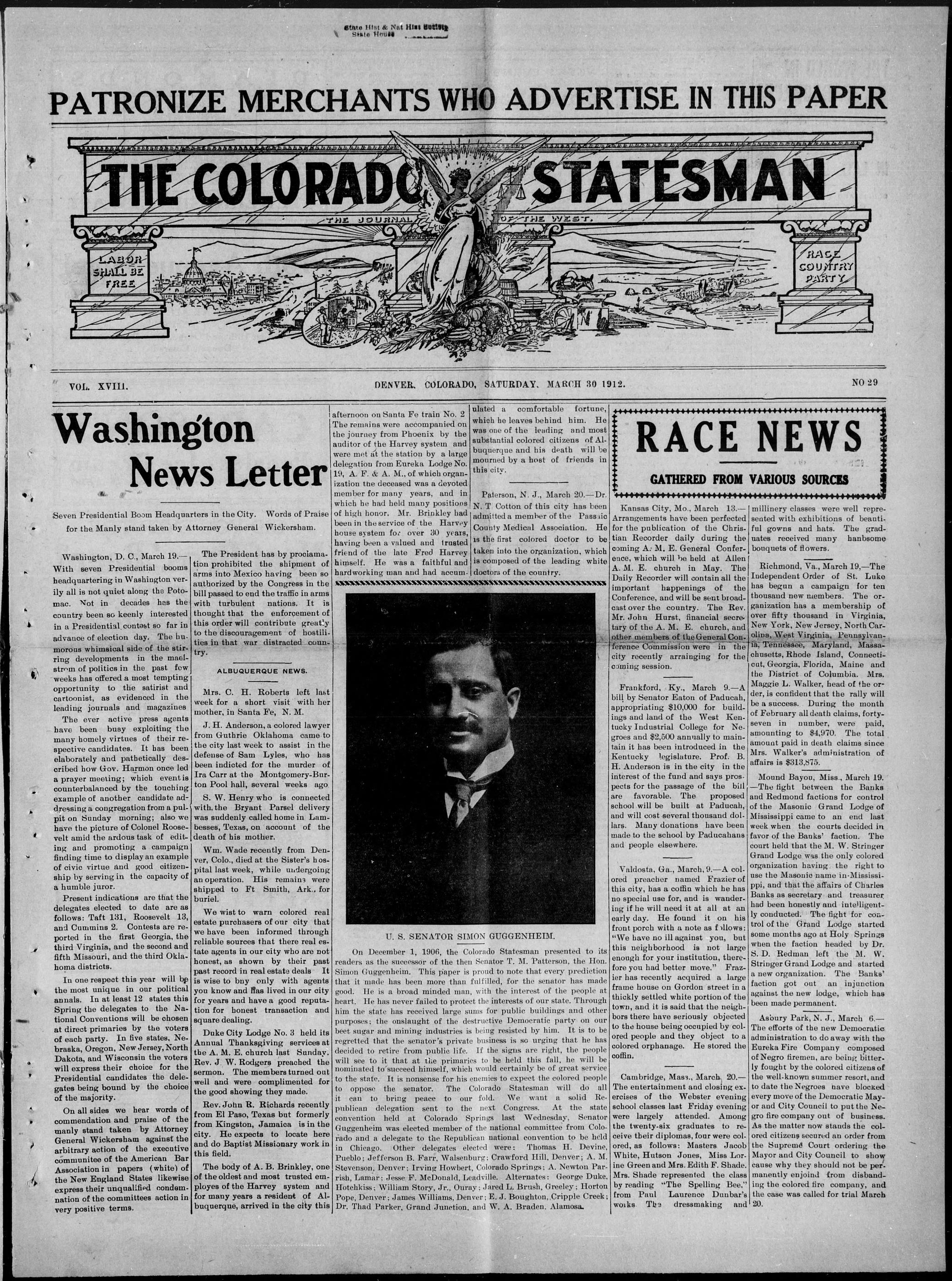
Washington, D. C., March 19. With seven Presidential booms headquartering in Washington verily all is not quiet along the Potomac. Not in decades has the country been so keenly interested in a Presidential contest so far in advance of election day. The humorous whimsical side of the stirring developments in the maelstrom of politics in the past few weeks has offered a most tempting opportunity to the satirist and cartoonist, as evidenced in the leading journals and magazines
The ever active press agents have been busy exploiting the many homely virtues of their respective candidates. It has been elaborately and pathetically described how Gov. Harmon once led a prayer meeting; which event is counterbalanced by the touching example of another candidate addressing a congregation from a pulpit on Sunday morning; also we have the picture of Colonel Roosevelt amid the ardous task of editing and promoting a campaign finding time to display an example of civic virtue and good citizenship by serving in the capacity of a humble juror.
Present indications are that the delegates elected to date are as follows: Taft 131, Roosevelt 13, and Cummins 2. Contests are reported in the first Georgia, the third Virginia, and the second and fifth Missouri, and the third Oklahoma districts.
In one respect this year will be the most unique in our political annals. In at least 12 states this Spring the delegates to the National Conventions will be chosen at direct primaries by the voters of each party. In five states, Nebraska, Oregon, New Jersey, North Dakota, and Wisconsin the voters will express their choice for the Presidential candidates the delegates being bound by the choice of the majority.
On all sides we hear words of commendation and praise of the manly stand taken by Attorney General Wickersham against the arbitrary action of the executive communitee of the American Bar Association in papers (white) of the New England States likewise express their unqualified condemnation of the committees action in very positive terms.
---
The President has by proclamation prohibited the shipment of arms into Mexico having been so authorized by the Congress in the bill passed to end the traffic in arms with turbulent nations. It is thought that the enforcement of this order will contribute greatly to the discouragement of hostilities in that war distracted country.
ALBUQUERQUE NEWS.
Mrs. C. H. Roberts left last week for a short visit with her mother, in Santa Fe, N. M. J. H. Anderson, a colored lawyer from Guthrie Oklahoma came to the city last week to assist in the defense of Sam Lyles, who has been indicted for the murder of Ira Carr at the Montgomery-Burton Pool hall, several weeks ago S. W. Henry who is connected with the Bryant Parsel delivery was suddenly called home in Lambesses, Texas, on account of the death of his mother. Wm. Wade recently from Denver, Colo., died at the Sister's hospital last week, while undergoing an operation. His remains were shipped to Ft Smith, Ark., for burial.
We wist to warn colored real estate purchasers of our city that we have been informed through reliable sources that there real estate agents in our city who are not honest, as shown by their past past record in real estate deals. It is wise to buy only with agents you know and has lived in our city for years and have a good reputation for honest transaction and square dealing.
Duke City Lodge No. 3 held its Annual Thanksgiving services at the A. M. E. church last Sunday. Rev. J. W. Rodgers preached the sermon. The members turned out well and were complimented for the good showing they made.
Rev. John R. Richards recently from El Paso, Texas but formerly from Kingston, Jamaica is in the city. He expects to locate here and do Baptist Missionary work in this field.
The body of A. B. Brinkley, one of the oldest and most trusted employees of the Harvey system and for many years a resident of Albuquerque, arrived in the city this
State Hist & Nat Hist Bureau
State House
HANTS WH
ADC
THE JOURNAL
DENVER, COLORAD
NTS WHO ADV
ORNAL
OF THE
ENVER. COLORADO, SATURDAY. M
DENVER, COLORADO, SATURDAY, MARCH 30 1912.
afternoon on Santa Fe train No. 2 The remains were accompanied on the journey from Phoenix by the auditor of the Harvey system and were met at the station by a large delegation from Eureka Lodge No. 19, A. F. & A. M., of which organization the deceased was a devoted member for many years, and in which he had held many positions of high honor. Mr. Brinkley had been in the service of the Harvey house system for over 30 years, having been a valued and trusted friend of the late Fred Harvey himself. He was a faithful and hardworking man and had accum-
THE NEW YORK TIMES
M.
U. S. SENATOR SIMON GUGGENHEIM
On December 1, 1906, the Colorado Statesman pro readers as the successor of the then Senator T. M. Patterson Simon Guggenheim. This paper is proud to note that even that it made has been more than fulfilled, for the senator good. He is a broad minded man, with the interest of heart. He has never failed to protect the interests of our son the state has received large sums for public building purposes; the onslaught of the destructive Democratic beet sugar and mining industries is being resisted by him regretted that the senator's private business is so urging decided to retire from public life. If the signs are right will see to it that at the primaries to be held this far nominated to succeed himself, which would certainly be of the state. It is important to succeed to the
December 1, 1906, the Colorado Statesman pro-
fess the successor of the then Senator T. M. Patter-
enheim. This paper is proud to note that evi-
ence has been more than fulfilled, for the sena-
tion is a broad minded man, with the interest of our
sage never failed to protect the interests of our
sage has received large sums for public buildi-
ing the onslaught of the destructive Democra-
tic and mining industries is being resisted by him
at the senator's private business is so urging
tire from public life. If the signs are right
at that at the primaries to be held this fall
succeed himself, which would certainly be o
On December 1, 1906, the Colorado Statesman presented to its readers as the successor of the then Senator T. M. Patterson, the Hon. Simon Guggenheim. This paper is proud to note that every prediction that it made has been more than fulfilled, for the senator has made good. He is a broad minded man, with the interest of the people at heart. He has never failed to protect the interests of our state. Through him the state has received large sums for public buildings and other purposes; the onslaught of the destructive Democratic party on our beet sugar and mining industries is being resisted by him. It is to be regretted that the senator's private business is so urging that he has decided to retire from public life. If the signs are right, the people will see to it that at the primaries to be held this fall, he will be nominated to succeed himself, which would certainly be of great service to the state. It is nonsense for his enemies to expect the colored people to oppose the senator. The Colorado Statesman will do all it can to bring peace to our fold. We want a solid Republican delegation sent to the next Congress. At the state convention held at Colorado Springs last Wednesday, Senator Guggenheim was elected member of the national committee from Colorado and a delegate to the Republican national convention to be held in Chicago. Other delegates elected were: Thomas H. Devine, Pueblo; Jefferson B. Farr, Walsenburg; Crawford Hill, Denver; A. M. Stevenson, Denver; Irving Howbert, Colorado Springs; A. Newton Parrish, Lamar; Jesse F. McDonald, Leadville. Alternates: George Duke, Hotchkiss; William Story, Jr., Ouray; Jared L. Brush, Greeley; Horton Pope, Denver; James Williams, Denver; E. J. Boughton, Cripple Creek; Dr. Thad Parker, Grand Junction, and W. A. Braden, Alamosa.
ulated a comfortable fortune, which he leaves behind him. He was one of the leading and most substantial colored citizens of Albuquerque and his death will be mourned by a host of friends in this city.
Paterson, N. J., March 20.—Dr. N. T Cotton of this city has been admitted a member of the Passic County Medical Association. He is the first colored doctor to be taken into the organization, which is composed of the leading white doctors of the country.
THE NEW YORK TIMES
Colorado Statesman presented to its senator T. M. Patterson, the Hon. proud to note that every prediction fulfilled, for the senator has made, with the interest of the people at get the interests of our state. Through aims for public buildings and other destructive Democratia party on our
RACE NEWS
Kansas City, Mo., March 13. Arrangements have been perfected for the publication of the Christian Recorder daily during the coming A. M. E. General Conference, which will be held at Allen A. M. E. church in May. The Daily Recorder will contain all the important happenings of the Conference, and will be sent broadcast over the country. The Rev. Mr. John Hurst, financial secretary of the A. M. E. church, and other members of the General Conference Commission were in the city recently arrainging for the coming session.
Frankford, Ky., March 9.—A bill by Senator Eaton of Paducah, appropriating $10,000 for buildings and land of the West Kentucky Industrial College for Negroes and $2,500 annually to maintain it has been introduced in the Kentucky legislature. Prof. B. H. Anderson is in the city in the interest of the fund and says prospects for the passage of the bill are favorable. The proposed school will be built at Paducah, and will cost several thousand dollars. Many donations have been made to the school by Paducahans and people elsewhere.
一
Valdosta, Ga., March, 9.—A colored preacher named Frazier of this city, has a coffin which he has no special use for, and is wandering if he will need it at all at an early day. He found it on his front porch with a note as follows: "We have no ill against you, but this neighborhood is not large enough for your institution, therefore you had better move." Frazier has recently acquired a large frame house on Gordon street in a thickly settled white portion of the town, and it is said that the neighbors there have seriously objected to the house being occupied by colored people and they object to a colored orphanage. He stored the coffin.
Cambridge, Mass., March 20. The entertainment and closing exercises of the Webster evening school classes last Friday evening were largely attended. Among the twenty-six graduates to receive their diplomas, four were colored, as follows: Masters Jacob White, Hutson Jones, Miss Lorine Green and Mrs. Edith F. Shade. Mrs. Shade represented the class by reading "The Spelling Bee." from Paul Laurence Dunbar's works. The dressmaking and
NO 29
millinery classes were well represented with exhibitions of beautiful gowns and hats. The graduates received many hanbsome bouquets of flowers.
Richmond, Va., March 19,—The Independent Order of St. Luke has begun a campaign for ten thousand new members. The organization has a membership of over fifty thousand in Virginia, New York, New Jersey, North Carolina, West Virginia, Pennsylvania, Tennessee, Maryland, Massachusetts, Rhode Island, Connecticut, Georgia, Florida, Maine and the District of Columbia. Mrs. Maggie L. Walker, head of the order, is confident that the rally will be a success. During the month of February all death claims, forty-seven in number, were paid, amounting to $4,970. The total amount paid in death claims since Mrs. Walker's administration of affairs is $313,875.
Mound Bayou, Miss., March 19. The fight between the Banks and Redmond factions for control of the Masonic Grand Lodge of Mississippi came to an end last week when the courts decided in favor of the Banks' faction. The court held that the M. W. Stringer Grand Lodge was the only colored organization having the right to use the Masonic name in Mississippi, and that the affairs of Charles Banks as secretary and treasurer had been honestly and intelligently conducted. The fight for control of the Grand Lodge started some months ago at Holy Springs when the faction headed by Dr. S. D. Redman left the M. W. Stringer Grand Lodge and started a new organization. The Banks' faction got out an injunction against the new lodge, which has been made permanent.
Asbury Park, N. J., March 6. The efforts of the new Democratic administration to do away with the Eureka Fire Company composed of Negro firemen, are being bitterly fought by the colored citizens of the well-known summer resort, and to date the Negroes have blocked every move of the Democratic Mayor and City Council to put the Negro fire company out of business. As the matter now stands the colored citizens secured an order from the Supreme Court ordering the Mayor and City Council to show cause why they should not be permanently enjoined from disbanding the colored fire company, and the case was called for trial March 20.
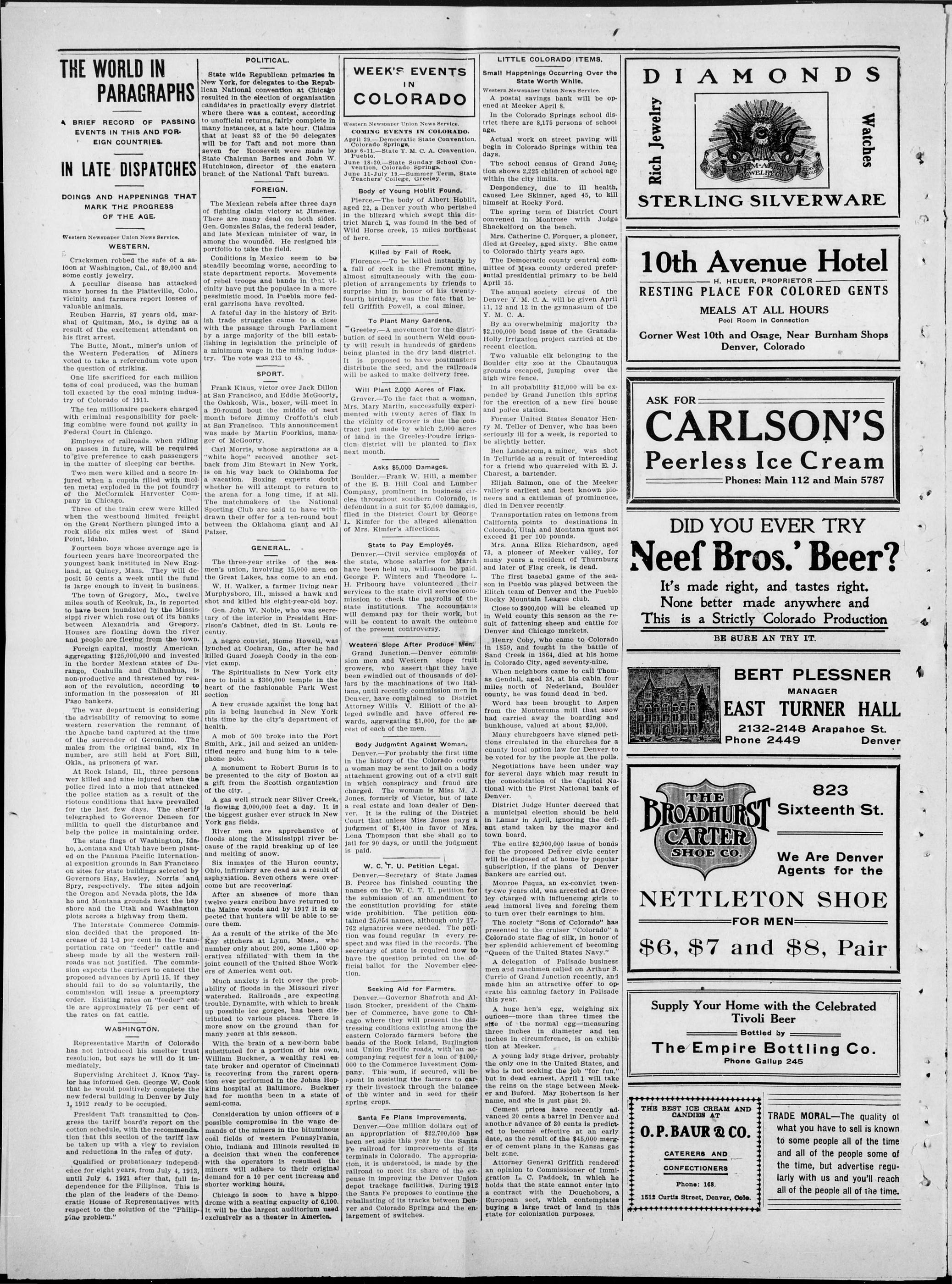
THE WORLD IN PARAGRAPHS
BRIEF RECORD OF PASSING EVENTS IN THIS AND FOR EIGN COUNTRIES.
IN LATE DISPATCHES
DOINGS AND HAPPENINGS THAT
MARK THE PROGRESS
OF THE AGE.
Western Newspaper Union News Service.
Cracksmen robbed the safe of a saloon at Washington, Cal., of $9,000 and some costly jewelry. A peculiar disease has attacked many horses in the Platteville, Colo., vicinity and farmers report losses of valuable animals. Reuben Harris, 87 years old, marshal of Quitman, Mo., is dying as a result of the excitement attendant on his first arrest. The Butte, Mont., miner's union of the Western Federation of Miners voted to take a referendum vote upon the question of striking. One life sacrificed for each million tons of coal produced, was the human toll exacted by the coal mining industry of Colorado of 1911. The ten millionaire packers charged with criminal responsibility for packing combine were found not guilty in Federal Court in Chicago.
Employees of railroads, when riding on passes in future, will be required to give preference to cash passengers in the matter of sleeping car berths. Two men were killed and a score injured when a cupola filled with molten metal exploded in the pot foundry of the McCormick Harvester Company in Chicago. Three of the train crew were killed when the westbound limited freight on the Great Northern plunged into a rock slide six miles west of Sand Point, Idaho. Fourteen boys whose average age is fourteen years have incorcorpated the youngest bank instituted in New England, at Quincy, Mass. They will deposit 50 cents a week until the fund is large enough to invest in business.
The town of Gregory, Mo., twelve miles south of Keokuk, Ia., is reported to have been inundated by the Mississippi river which rose out of its banks between Alexandria and Gregory. Houses are floating down the river and people are fleeing from the town. Foreign capital, mostly American, aggregating $125,000,000 and invested in the border Mexican states of Durango, Coahuila and Chihuahua, is non-productive and threatened by reason of the revolution, according to information in the possession of El Paso bankers. The war department is considering the advisability of removing to some western reservation the remnant of the Apache band captured at the time of the surrender of Geronimo. The males from the original band, six in number, are still held at Fort Sill, Okla., as prisoners of war.
At Rock Island, Ill., three persons wer killed and nine injured when the police fired into a mob that attacked the police station as a result of the riotous conditions that have prevailed for the last few days. The sheriff telegraphed to Governor Deneen for militia to quell the disturbance and help the police in maintaining order. The state flags of Washington, Idaho, Montana and Utah have been planted on the Panama Pacific International exposition grounds in San Francisco on sites for state buildings selected by Governors Hay, Hawley, Norris and Spry, respectively. The sites adjoin the Oregon and Nevada plots, the Idaho and Montana grounds next the bay shore and the Utah and Washington plots across a highway from them.
The Interstate Commerce Commission decided that the proposed increase of 33 1-3 per cent in the transportation rate on "feeder" cattle and sheep made by all the western railroads was not justified. The commission expects the carriers to cancel the proposed advances by April 15. If they should fail to do so voluntarily, the commission will issue a preemptory order. Existing rates on "feeder" cattle are approximately 75 per cent of the rates on fat cattle.
WASHINGTON.
Representative Martin of Colorado has not introduced his smelter trust resolution, but says he will do it immediately.
Supervising Architect J. Knox Taylor has informed Gen. George W. Cook that he would positively complete the new federal building in Denver by July 1, 1912 ready to be occupied.
President Taft transmitted to Congress the tariff board's report on the cotton schedule, with the recommendation that this section of the tariff law be taken up with a view to revision and reductions in the rates of duty.
Qualified or probationary independence for eight years, from July 4, 1913, until July 4, 1921 after that, full independence for the Filipinos. This is the plan of the leaders of the Democratic House of Representatives with respect to the solution of the "Philippine problem."
POLITICAL.
State wide Republican primaries in New York, for delegates to the Republican National convention at Chicago resulted in the election of organization candidates in practically every district where there was a contest, according to unofficial returns, fairly complete in many instances, at a late hour. Claims that at least 83 of the 90 delegates will be for Taft and not more than seven for Roosevelt were made by State Chairman Barnes and John W. Hutchinson, director of the eastern branch of the National Taft bureau.
FOREIGN.
The Mexican rebels after three days of fighting claim victory at Jimenez. There are many dead on both sides. Gen. Gonzales Salas, the federal leader, and late Mexican minister of war, is among the wounded. He resigned his portfolio to take the field.
Conditions in Mexico seem to be steadily becoming worse, according to state department reports. Movements of rebel troops and bands in that vicinity have put the populace in a more pessimistic mood. In Puebla more federal garrisons have revolted.
A fateful day in the history of British trade struggles came to a close with the passage through Parliament by a large majority of the bill establishing in legislation the principle of a minimum wage in the mining industry. The vote was 213 to 48.
SPORT.
Frank Klaus, victor over Jack Dillon at San Francisco, and Eddie Goorty, the Oshkosh, Wis., boxer, will meet in a 20-round bout the middle of next month before Jimmy Croffoth's club at San Francisco. This announcement was made by Martin Foorkins, manager of McGoorty.
Carl Morris, whose aspirations as a "white hope" received another setback from Jim Stewart in New York, is on his way back to Oklahoma for a vacation. Boxing experts doubt whether he will attempt to return to the arena for a long time, if at all. The matchmakers of the National Sporting Club are said to have withdrawn their offer for a ten-round bout between the Oklahoma giant and Al Palzer.
GENERAL.
W. H. Walker, a farmer living near Murphysboro, Ill., missed a hawk and shot and killed his eight-year-old boy. Gen. John W. Noble, who was secretary of the interior in President Harrison's Cabinet, died in St. Louis recently.
A negro convict, Home Howell, was lynched at Cochran, Ga., after he had killed Guard Joseph Coody in the convict camp.
The Spiritualists in New York city are to build a $300,000 temple in the heart of the fashionable Park West section.
A new crusade against the long hat pin is being launched in New York this time by the city's department of health.
A mob of 500 broke into the Fort Smith, Ark., jail and seized an unidentified negro and hung him to a telephone pole.
A monument to Robert Burns is to be presented to the city of Boston as a gift from the Scottish organization of the city.
A gas well struck near Silver Creek, is flowing 3,000,000 feet a day. It is the biggest gusher ever struck in New York gas fields.
River men are apprehensive of floods along the Mississippi river because of the rapid breaking up of ice and melting of snow.
Six inmates of the Huron county, Ohio, infirmary are dead as a result of asphyxiation. Seven others were overcome but are recovering.
After an absence of more than twelve years caribou have returned to the Maine woods and by 1917 it is expected that hunters will be able to secure them.
As a result of the strike of the McKay stitchers at Lynn, Mass., who number only about 200, some 1,500 operatives affiliated with them in the joint council of the United Shoe Workers of America went out.
Much anxiety is felt over the probability of floods in the Missouri river watershed. Railroads are expecting trouble. Dynamite, with which to break up possible ice gorges, has been distributed to various places. There is more snow on the ground than for many years at this season.
With the brain of a new-born babe substituted for a portion of his own, William Buckner, a wealthy real estate broker and operator of Cincinnati is recovering from the rarest operation ever performed in the Johns Hopkins hospital at Baltimore. Buckner had for months been in a state of semi-coma.
Consideration by union officers of a possible compromise in the wage demands of the miners in the bituminous coal fields of western Pennsylvania, Ohio, Indiana and Illinois resulted in a decision that when the conference with the operators is resumed the miners will adhere to their original demand for a 10 per cent increase and shorter working hours.
Chicago is soon to have a hippodrome with a seating capacity of 6,100. It will be the largest auditorium used exclusively as a theater in America.
WEEK'S EVENTS IN COLORADO
Western Newsbarber Union News Service.
COMING EVENTS IN COLORADO.
April 28.—Democratic State Convention,
Colorado Springs.
May 6-11. -State Y. M. C. A. Convention
Pueblo.
June 18-20.-State Sunday School Convention, Colorado Springs.
June 11-July 19.-Summer Term, State Teachers' College, Greeley.
Body of Young Hoblit Found.
Pierce.—The body of Albert Hoblit, aged 22, a Denver youth who perished in the blizzard which swept this district March 7, was found in the bed of Wild Horse creek, 15 miles northeast of here.
Killed by Fall of Rock.
Florence.—To be killed instantly by a fall of rock in the Fremont mine, almost simultaneously with the completion of arrangements by friends to surprise him in honor of his twenty fourth birthday, was the fate that befall Griffith Powell, a coal miner.
To Plant Many Gardens.
Greeley.—A movement for the distribution of seed in southern Weld county will result in hundreds of gardens being planted in the dry land district. It is proposed to have postmasters distribute the seed, and the railroads will be asked to make delivery free.
Will Plant 2.000 Acres of Flax.
Grover.—To the fact that a woman, Mrs. Mary Martin, successfully experimented with twenty acres of flax in the vicinity of Grover is due the contract just made by which 2,000 acres of land in the Greeley-Poudre irrigation district will be planted to flax next month.
Asks $5,000 Damages.
Boulder.—Frank W. Hill, a member of the E. B. Hill Coal and Lumber Company, prominent in business circles throughout southern Colorado, is defendant in a suit for $5,000 damages, filed in the District Court by George L. Kimfer for the alleged alienation of Mrs. Kimfer's affections.
State to Pay Employés.
Denver.-Civil service employés of the state, whose salaries for March have been held up, will soon be paid. George P. Winters and Theodore L. H. Fribourg have volunteered their services to the state civil service commission to check the payrolls of the state institutions. The accountants will demand pay for their work, but will be content to await the outcome of the present controversy.
Western Slope After Produce Men.
Western Slope After Produce Men.
Grand Junction.-Denver commission men and Western slope fruit growers, who assert that they have been swindled out of thousands of dollars by the machinations of two Italians, until recently commission men in Denver, have complained to District Attorney Willis V. Elliott of the alleged swindle and have offered rewards, aggregating $1,000, for the arrest of each of the men.
Body Judgment Against Woman.
Denver.—For probably the first time in the history of the Colorado courts a woman may be sent to jail on a body attachment growing out of a civil suit in which conspiracy and fraud are charged. The woman is Miss M. J. Jones, formerly of Victor, but of late a real estate and loan dealer of Denver. It is the ruling of the District Court that unless Miss Jones pays a judgment of $1,400 in favor of Mrs. Lena Thompson that she shall go to jail for 90 days, or until the judgment is paid.
W. C. T. U. Petition Legal.
Denver—Secretary of State James B. Pearce has finished counting the names on the W. C. T. U. petition for the submission of an amendment to the constitution providing for state wide prohibition. The petition contained 25,054 names, although only 17,762 signatures were needed. The petition was found regular in every respect and was filed in the records. The secretary of state is required now to have the question printed on the official ballot for the November election.
Seeking Aid for Farmers.
Denver.—Governor Shafroth and Allison Stocker, president of the Chamber of Commerce, have gone to Chicago where they will present the distressing conditions existing among the eastern Colorado farmers before the heads of the Rock Island, Burlington and Union Pacific roads, with an accompanying request for a loan of $100,000 to the Commerce Investment Company. This sum, if secured, will be spent in assisting the farmers to carry their livestock through the balance of the winter and in seed for their spring crops.
Santa Fe Plans Improvements.
Denver.—One million dollars out of an appropriation of $22,700,000 has been set aside this year by the Santa Fe railroad for improvements of its terminals in Colorado. The appropriation, it is understood, is made by the railroad to meet its share of the expense in improving the Denver Union depot trackage facilities. During 1912 the Santa Fe proposes to continue the reballasting of its tracks between Denver and Colorado Springs and the enlargement of switches.
LITTLE COLORADO ITEMS.
Small Happenings Occurring Over the State Worth While.
Western Newspaper Union News Service.
A postal savings bank will be opened at Meeker April 8.
In the Colorado Springs school district there are 8,175 persons of school age.
Actual work on street paving will begin in Colorado Springs within ten days.
The school census of Grand Junction shows 2,225 children of school age within the city limits.
Despondency, due to ill health, caused Lee Skinner, aged 45, to kill himself at Rocky Ford.
The spring term of District Court convened in Montrose with Judge Shackelford on the bench.
Mrs. Catherine C. Forquer, a pioneer, died at Greeley, aged sixty. She came to Colorado thirty years ago. The Democratic county central committee of Mesa county ordered preferential presidential primary to be held April 15.
The annual society circus of the Denver Y. M. C. A. will be given April 11, 12 and 13 in the gymnasium of the Y. M. C. A.
By an overwhelming majority the $2,100,000 bond issue of the Granada-Holly Irrigation project carried at the recent election.
Two valuable elk belonging to the Boulder city zoo at the Chautauqua grounds escaped, jumping over the high wire fence.
In all probability $12,000 will be expended by Grand Junction this spring for the erection of a new fire house and police station.
Former United States Senator Henry M. Teller of Denver, who has been seriously ill for a week, is reported to be slightly better.
Ben Lundstrom, a miner, was shot in Telluride as a result of interceding for a friend who quarreled with E. J. Charest, a bartender.
Elijah Salmon, one of the Meeker valley's earliest and best known pioneers and a cattleman of prominence, died in Denver recently.
Transportation rates on lemons from California points to destinations in Colorado, Utah and Montana must not exceed $1 per 100 pounds.
Mrs. Anna Eliza Richardson, aged 73, a pioneer of Meeker valley, for many years a resident of Thurnburg and later of Flag creek, is dead.
The first baseball game of the season in Pueblo was played between the Elitch team of Denver and the Pueblo Rocky Mountain League club.
Henry Coby, who came to Colorado in 1859, and fought in the battle of Sand Creek in 1864, died at his home in Colorado City, aged seventy-nine.
When neighbors came to call Thomas Gendall, aged 38, at his cabin four miles north of Nederland, Boulder county, he was found dead in bed.
Word has been brought to Aspen from the Montezuma mill that snow had carried away the boarding and bunkhouse, valued at about $2,000.
Many churchgoers have signed petitions circulated in the churches for a county local option law for Denver to be voted for by the people at the polls.
Negotiations have been under way for several days which may result in the consolidation of the Capitol National with the First National bank of Denver.
District Judge Hunter decreed that a municipal election should be held in Lamar in April, ignoring the defiant stand taken by the mayor and town board.
The entire $2,900,000 issue of bonas for the proposed Denver civic center will be disposed of at home by popular subscription, if the plans of Denver bankers are carried out.
Monroe Fuqua, an ex-convict twenty-two years old, was arrested at Greeley charged with influencing girls to lead immoral lives and forcing them to turn over their earnings to him.
The society "Sons of Colorado" has presented to the cruiser "Colorado" a Colorado state flag of silk, in honor of her splendid achievement of becoming "Queen of the United States Navy."
A delegation of Palisade business men and ranchmen called on Arthur S. Currie of Grand Junction recently, and made him an attractive offer to operate his canning factory in Palisade this year.
A huge hen's egg, weighing six ounces—more than three times the size of the normal egg—measuring three inches in diameter and ten inches in circumference, is on exhibition at Meeker.
A young lady stage driver, probably the only one in the United States, and who is not seeking the job "for fun," but in dead earnest, April 1 will take the reins on the stage between Meeker and Buford. May Robertson is her name, and she is just past 20.
Cement prices have recently advanced 20 cents a barrel in Denver and another advance of 30 cents is predicted to become effective at an early date, as the result of the $45,000 merger of cement plans in the Kansas gas belt zone.
Attorney General Griffith rendered an opinion to Commissioner of Immigration L. C. Paddock, in which he holds that the state cannot enter into a contract with the Douchobors, a European sect, which contemplates buying a large tract of land in this state for colonization purposes.
FORM-ATERN
JEWELRY CO.
STERLING SIN
10th Avenue
H. HEUER, PR
RESTING PLACE FOR
MEALS AT A
Pool Room in
Corner West 10th and Osage
Denver, C
ASK FOR
CARLS
Peerless Ic
Phones: M
DID YOU E
Neef Bro
It's made right, a
None better made
This is a Strictly C
BELLING SILVERVIEW
An Avenue H
H. HEUER, PROPRIETOR
PLACE FOR COLOR
MEALS AT ALL HOURS
Pool Room in Connection
first 10th and Osage, Near Bu
Denver, Colorado
ARLSON
Hearless Ice C
Phones: Main 112 and
D YOU EVER T
f Bros.' B
made right, and tastes
better made anywhe
a Strictly Colorado
STERLING SILVERWARE
RESTING PLACE FOR COLORED GENTS
Corner West 10th and Osage, Near Burnham Shops Denver, Colorado
ASK FOR CARLSON'S Peerless Ice Cream Phones: Main 112 and Main 5787
DID YOU EVER TRY Neef Bros.' Beer?
It's made right, and tastes right. None better made anywhere and This is a Strictly Colorado Production BE SURE AN TRY IT.
BERT PLEE
MANAGER
EAST TURNER
2132-2148 Ara
Phone 2449
2132-2148 Arapahoe St.
Phone 2449 Denver
THE
BROADHURST
CARTER
SHOE CO.
NETTLETO
FOR M
$6, $7 and
Supply Your Home w
Tivoli
Bottled
The Empire E
Phone Gall
BETLETON S
FOR MEN
$7 and $8,
Your Home with the Co
Tivoli Beer
Bottled by
Empire Bottlin
Phone Gallup 245
$6, $7 and $8, Pair
Supply Your Home with the Celebrated Tivoli Beer Bottled by The Empire Bottling Co. Phone Gallup 245
THE BEST ICE CREAM AND
CANDIES AT
O. P. BAUR & CO.
CATERERS AND
CONFECTIONERS
Phone: 168.
1512 Curtis Street, Denver, Cole.
et, Denver, Cole.
THE HOTEL
ALVERWARE
Anue Hotel
PROPRIETOR
FOR COLORED GENTS
ALL HOURS
Connection
Edge, Near Burnham Shops
Colorado
SON'S
ice Cream
Main 112 and Main 5787
EVER TRY
s.' Beer?
and tastes right.
le anywhere and
Colorado Production
RT PLESSNER
MANAGER
TURNER HALL
2-2148 Arapahoe St.
2449 Denver
823
Sixteenth St.
We Are Denver Agents for the
ON SHOE
MEN
1 $8, Pair
with the Celebrated
Beer
d by
Bottling Co.
llup 245
TRADE MORAL—The quality of what you have to sell is known to some people all of the time and all of the people some of the time, but advertise regularly with us and you'll reach all of the people all of the time.
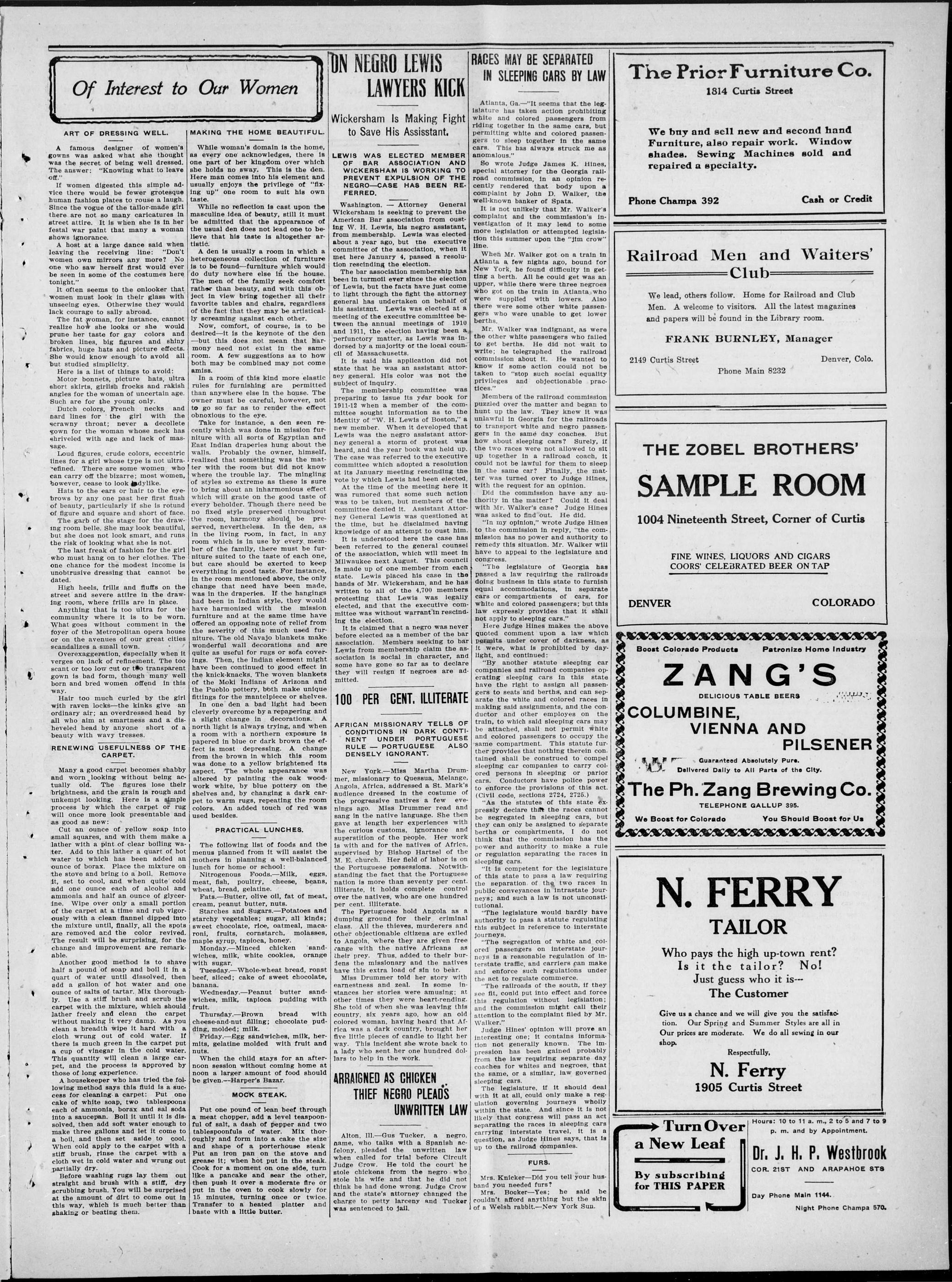
ART OF DRESSING WELL.
A famous designer of women's gowns was asked what she thought was the secret of being well dressed. The answer: "Knowing what to leave off."
If women digested this simple advice there would be fewer grotesque human fashion plates to rouse a laugh. Since the vogue of the tailor-made girl there are not so many caricatures in street attire. It is when she is in her festal war paint that many a woman shows ignorance.
A host at a large dance said when leaving the receiving line: "Don't women own mirrors any more? No one who saw herself first would ever be seen in some of the costumes here tonight."
It often seems to the onlooker that women must look in their glass with unseeing eyes. Otherwise they would lack courage to sally abroad.
The fat woman, for instance, cannot realize how she looks or she would prune her taste for gay colors and broken lines, big figures and shiny fabrics, huge hats and picture effects. She would know enough to avoid all but studied simplicity.
Here is a list of things to avoid:
Motor bonnets, picture hats, ultra short skirts, girlish frocks and rakish angles for the woman of uncertain age. Such are for the young only.
Dutch colors, French necks and nard lines for the girl with the scrawny throat; never a decollete gown for the woman whose neck has shriveled with age and lack of massage.
Loud figures, crude colors, eccentric lines for a girl whose type is not ultra-refined. There are some women who can carry off the bizarre; most women, however, cease to look dylike.
Hats to the ears or hair to the eyebrows by any one past her first flush of beauty, particularly if she is rotund of figure and square and short of face.
The garb of the stage for the drawing room belle. She may look beautiful, but she does not look smart, and runs the risk of looking what she is not.
The last freak of fashion for the girl who must hang on to her clothes. The one chance for the modest income is unobtrusive dressing that cannot be dated.
High heels, frills and fluffs on the street and severe attire in the drawing room, where frills are in place.
Anything that is too ultra for the community where it is to be worm. What goes without comment in the foyer of the Metropolitan opera house or on the avenues of our great cities scandalizes a small town.
Overexaggeration, especially when it verges on lack of refinement. The too scant or too low cut or too transparent gown is bad form, though many well born and bred women offend in this way.
Hair too much curled by the girl with raven locks—the kinks give an ordinary air; an overdressed head by all who aim at smartness and a disheveled head by anyone short of a beauty with wavy tresses.
RENEWING USEFULNESS OF THE CARPET.
Many a good carpet becomes shabby and worn looking without being actually old. The figures lose their brightness, and the grain is rough and unkempt looking. Here is a simple process by which the carpet or rug will once more look presentable and as good as new:
Cut an ounce of yellow soap into small squares, and with them make a lather with a pint of clear boiling water. Add to this lather a quart of hot water to which has been added an ounce of borax. Place the mixture on the stove and bring to a boil. Remove it, set to cool, and when quite cold add one ounce each of alcohol and ammonia and half an ounce of glycerine. Wipe over only a small portion of the carpet at a time and rub vigorously with a clean flannel dipped into the mixture until, finally, all the spots are removed and the color revived. The result will be surprising, for the change and improvement are remarkable.
Another good method is to shave half a pound of soap and boll it in a quart of water until dissolved, then add a gallon of hot water and one ounce of salts of tartar. Mix thoroughly. Use a stiff brush and scrub the carpet with the mixture, which should lather freely and clean the carpet without making it very damp. As you clean a breadth wipe it hard with a cloth wrung out of cold water. If there is much green in the carpet put a cup of vinegar in the cold water. This quantity will clean a large carpet, and the process is approved by those of long experience.
A housekeeper who has tried the following method says this fluid is a success for cleaning a carpet: Put one cake of white soap, two tablespoons each of ammonia, borax and sal soda into a saucepan. Boll it until it is dissolved, then add soft water enough to make three gallons and let it come to a boil, and then set aside to cool. When cold apply to the carpet with a stiff brush, rinse the carpet with a cloth wet in cold water and wrung out partially dry.
Before washing rugs lay them out straight and brush with a stiff, dry scrubbing brush. You will be surprised at the amount of dirt to come out in this way, which is much better than shaking or beating them.
MAKING THE HOME BEAUTIFUL.
While woman's domain is the home, as every one acknowledges, there is one part of her kingdom over which she holds no sway. This is the den. Here man comes into his element and usually enjoys the privilege of "fixing up" one room to suit his own taste.
While no reflection is cast upon the masculine idea of beauty, still it must be admitted that the appearance of the usual den does not lead one to believe that his taste is altogether artistic.
A den is usually a room in which a heterogeneous collection of furniture is to be found—furniture which would do duty nowhere else in the house. The men of the family seek comfort rather than beauty, and with this object in view bring together all their favorite tables and chairs, regardless of the fact that they may be artistically screaming against each other. Now, comfort, of course, is to be desired—it is the keynote of the den—but this does not mean that harmony need not exist in the same room. A few suggestions as to how both may be combined may not come amiss. In a room of this kind more elastic rules for furnishing are permitted than anywhere else in the house. The owner must be careful, however, not to go so far as to render the effect obnoxious to the eye.
Take for instance, a den seen recently which was done in mission furniture with all sorts of Egyptian and East Indian draperies hung about the walls. Probably the owner, himself, realized that something was the matter with the room but did not know where the trouble lay. The mingling of styles so extreme as these is sure to bring about an inharmonious effect which will grate on the good taste of every beholder. Though there need be no fixed style preserved throughout the room, harmony should be preserved, nevertheless. In the den, as in the living room, in fact, in any room which is in use by every member of the family, there must be furniture suited to the taste of each one, but care should be exerted to keep everything in good taste. For instance, in the room mentioned above, the only change that need have been made, was in the draperies. If the hangings had been in Indian style, they would have harmonized with the mission furniture and at the same time have offered an opposing note of relief from the severity of this much used furniture. The old Navajo blankets make wonderful wall decorations and are quite as useful for rugs or sofa coverings. Then, the Indian element might have been continued to good effect in the knick-knacks. The woven blankets of the Moki Indians of Arizona and the Pueblo pottery, both make unique fittings for the mantelpiece or shelves.
In one den a bad light had been cleverly overcome by a repapering and a slight change in decorations. A north light is always trying, and when a room with a northern exposure is papered in blue or dark brown the effect is most depressing. A change from the brown in which this room was done to a yellow brightened its aspect. The whole appearance was altered by painting the oak woodwork white, by blue pottery on the shelves and, by changing a dark carpet to warm rugs, repeating the room colors. An added touch of red was used besides.
PRACTICAL LUNCHES
The following list of foods and the menus planned from it will assist the mothers in planning a well-balanced lunch for home or school:
Nitrogenous Foods.—Milk, eggs, meat, fish, poultry, cheese, beans, wheat, bread, gelatine.
Fats.—Butter, olive oil, fat of meat, cream, peanut butter, nuts.
Starches and Sugars.—Potatoes and starchy vegetables; sugar, all kinds; sweet chocolate, rice, oatmeal, macaroni, fruits, cornstarch, molasses, maple syrup, tapioca, honey.
Monday.—Minced chicken sand-wiches, milk, white cookies, orange with sugar.
Tuesday.—Whole-wheat bread, roast beef, sliced; cake of sweet chocolate, banana.
Wednesday.—Peanut butter sand-wiches, milk, tapioca pudding with fruit.
Thursday.—Brown bread with cheese-and-nut filling; chocolate pudding, molded; milk.
Friday.—Egg sandwiches, milk, hermits, gelatine molded with fruit and nuts.
When the child stays for an afternoon session without coming home at noon a larger amount of food should be given.—Harper's Bazar.
MOCK STEAK.
Put one pound of lean beef through a meat chopper, add a level teaspoonful of salt, a dash of pepper and two tablespoonfuls of water. Mix thoroughly and form into a cake the size and shape of a porterhouse steak
Put an iron pan on the stove and grease it; when hot put in the steak.
Cook for a moment on one side, turn like a pancake and sear the other, then push it over a moderate fire or put in the oven to cook slowly for 15 minutes, turning once or twice. Transfer to a heated platter and baste with a little butter.
ON NEGRO LEWIS LAWYERS KICK
Wickersham Is Making Fight to Save His Assistant.
LEWIS WAS ELECTED MEMBER OF BAR ASSOCIATION AND WICKERSHAM IS WORKING TO PREVENT EXPULSION OF THE NEGRO-CASE HAS BEEN REFERRED.
Washington. — Attorney General Wickersham is seeking to prevent the American Bar association from ousting W. H. Lewis, his negro assistant, from membership. Lewis was elected about a year ago, but the executive committee of the association, when it met here January 4, passed a resolution rescinding the election.
The bar association membership has been in turmoil ever since the election of Lewis, but the facts have just come to light through the fight the attorney general has undertaken on behalf of his assistant. Lewis was elected at a meeting of the executive committee between the annual meetings of 1910 and 1911, the election having been a perfunctory matter, as Lewis was indorsed by a majority or the local council of Massachusetts. It is said his application did not state that he was an assistant attorney general. His color was not the subject of inquiry.
The membership committee was preparing to issue its year book for 1911-12 when a member of the committee sought information as to the identity of "W. H. Lewis of Boston," a new member. When it developed that Lewis was the negro assistant attorney general a storm of protest was heard, and the year book was held up. The case was referred to the executive committee which adopted a resolution at its January meeting rescinding the vote by which Lewis had been elected. At the time of the meeting here it was rumored that some such action was to be taken, but members of the committee denied it. Assistant Attorney General Lewis was questioned at the time, but he disclaimed having knowledge of an attempt to oust him.
It is understood here the case has been referred to the general counsel of the association, which will meet in Milwaukee next August. This council is made up of one member from each state. Lewis placed his case in the hands of Mr. Wickersham, and he has written to all of the 4,700 members protesting that Lewis was legally elected, and that the executive committee was without warrant in rescinding the election.
It is claimed that a negro was never before elected as a member of the bar association. Members seeking to bar Lewis from membership claim the association is social in character, and some have gone so far as to declare they will resign if negroes are admitted.
100 PER GENT. ILLITERATE
AFRICAN MISSIONARY TELLS OF CONDITIONS IN DARK CONTINENT UNDER PORTUGUESE RULE — PORTUGUESE ALSO DENSELY IGNORANT.
New York.—Miss Martha Drummer, missionary to Quessua, Melange, Angola, Africa, addressed a St. Mark's audience dressed in the costume of the progressive natives a few evenings ago. Miss Drummer read and sang in the native language. She then gave at length her experiences with the curious customs, ignorance and superstition of the people. Her work is with and for the natives of Africa, supervised by Bishop Hartsel of the M. E. church. Her field of labor is on the Portuguese possessions. Notwithstanding the fact that the Portuguese nation is more than seventy per cent. illiterate, it holds complete control over the natives, who are one hundred per cent. illiterate.
The Portuguese hold Angola as a dumping ground for their criminal class. All the thieves, murderers and other objectionable citizens are exiled to Angola, where they are given free range with the native Africans as their prey. Thus, added to their burdens the missionary and the natives have this extra load of sin to bear.
Miss Drummer told her story with earnestness and zeal. In some instances her stories were amusing; at other times they were heart-rending. She told of when she was leaving this country, six years ago, how an old colored woman, having heard that Africa was a dark country, brought her five little pieces of candle to light her way. This incident she wrote back to a lady who sent her one hundred dollars to help in the work.
ARRAIGNED AS CHICKEN
THIEF NEGRO PLEADS
UNWRITTEN LAW
Alton, Ill.-Gus Tucker, a negro name, who talks with a Spanish acelony, pleaded the unwritten law when called for trial before Circuit Judge Crow. He told the court he stole chickens from the negro who stole his wife and that he did not think he had done wrong. Judge Crow and the state's attorney changed the charge to petty larceny and Tucker was sentenced to jail.
RACES MAY BE SEPARATED IN SLEEPING CARS BY LAW
Atlanta, Ga.—"It seems that the legislature has taken action prohibiting white and colored passengers from riding together in the same cars, but permitting white and colored passengers to sleep together in the same cars. This has always struck me as anomalous."
So wrote Judge James K. Hines, special attorney for the Georgia railroad commission, in an opinion recently rendered that body upon a complaint by John D. Walker, the well-known banker of Spata.
It is not unlikely that Mr. Walker's complaint and the commission's investigation of it may lead to some more legislation or attempted legislation this summer upon the "jim crow" line.
When Mr. Walker got on a train in Atlanta a few nights ago, bound for New York, he found difficulty in getting a berth. All he could get was an upper, while there were three negroes who got on the train in Atlanta who were supplied with lowers. Also there were some other white passengers who were unable to get lower berths.
Mr. Walker was indignant, as were the other white passengers who failed to get berths. He did not wait to write; he telegraphed the railroad commission about it. He wanted to know if some action could not be taken to "stop such social equality privileges and objectionable practices."
Members of the railroad commission puzzled over the matter and began to hunt up the law. They knew it was unlawful in Georgia for the railroads to transport white and negro passengers in the same day coaches. But how about sleeping cars? Surely, if the two races were not allowed to sit up together in a railroad coach, it could not be lawful for them to sleep in the same car? Finally, the matter was turned over to Judge Hines, with the request for an opinion.
Did the commission have any authority in the matter? Could it deal with Mr. Walker's case? Judge Hines was asked to find out. He did.
"In my opinion," wrote Judge Hines to the commission in reply, "the commission has no power and authority to remedy this situation. Mr. Walker will have to appeal to the legislature and congress.
"The legislature of Georgia has passed a law requiring the railroads doing business in this state to furnish equal accommodations, in separate cars or compartments of cars, for white and colored passengers; but this law expressly provides that it shall not apply to sleeping cars."
Here Judge Hines makes the above quoted comment upon a law which permits under cover of darkness, as it were, what is prohibited by daylight, and continued:
"By another statute sleeping car companies and railroad companies operating sleeping cars in this state have the right to assign all passengers to seats and berths, and can separate the white and colored races in making said assignments, and the conductor and other employees on the train, to which said sleeping cars may be attached, shall not permit white and colored passengers to occupy the same compartment. This statute further provides that nothing therein contained shall be construed to compel sleeping car companies to carry colored persons in sleeping or parlor cars. Conductors have police power to enforce the provisions of this act. (Civil code sections 2724, 2725.)
"As the statutes of this state expressly declare that the races cannot be segregated in sleeping cars, but they can only be assigned to separate berths or compartments, I do not think that the commission has the power and authority to make a rule or regulation separating the races in sleeping cars.
"It is competent for the legislature of this state to pass a law requiring the separation of the two races in public conveyances in intrastate journeys; and such a law is not unconstitutional.
"The legislature would hardly have authority to pass a statute regulating this subject in reference to interstate journeys.
"The segregation of white and colored passengers on interstate journeys is a reasonable regulation of interstate traffic, and carriers can make and enforce such regulations under the act to regulate commerce.
"The railroads of the south, if they see fit, could put into effect and force this regulation without legislation; and the commission might call their attention to the complaint filed by Mr. Walker." Judge Hines' opinion will prove an interesting one; it contains information not generally known. The impression has been gained probably from the law requiring separate day coaches for whites and negroes, that the same, or a similar, law governed sleeping cars. The legislature, if it should deal with it at all, could only make a regulation governing journeys wholly within the state. And since it is not likely that congress will pass an act separating the races in sleeping cars carrying interstate travel, it is a question, as Judge Hines says, that is up to the railroad companies.
FURS.
Mrs. Knicker—Did you tell your husband you needed furs?
Mrs. Bocker—Yes; he said he couldn't afford anything but the skin of a Welsh rabbit—New York Sun.
The Prior Furniture Co. 1814 Curtis Street
We buy and sell new and second hand Furniture, also repair work. Window shades. Sewing Machines sold and repaired a specialty.
Phone Champa 392
Railroad M
We lead, others follow
Men. A welcome to
and papers will be for
Broad Men and Wai Club
lead, others follow. Home for Railroad and
. A welcome to visitors. All the latest mag
papers will be found in the Library room.
Railroad Men and Waiters'
We lead, others follow. Home for Railroad and Club Men. A welcome to visitors. All the latest magazines and papers will be found in the Library room.
FRANK BURNLEY, Manager
Artis Street
Phone Main 8232
THE ZOBEL BROTHER
SAMPLE ROOM
Nineteenth Street, Corner of
2149 Curtis Street
THE ZOBE
SAMPI
1004 Nineteenth
1004 Nineteenth Street, Corner of Curtis
FINE WINES, LIQUORS AND CIGARS COORS' CELEBRATED BEER ON TAP
Colorado Products Patronize Home
ZANG'S
DELICIOUS TABLE BEERS
UMBINE,
VIENNA AND
PILSE
Guaranteed Absolutely Pure.
Delivered Dally to All Parts of the City.
Ph. Zang Brewing
TELEPHONE GALLUP 395.
Post for Colorado You Should Boost
N. FERRY
TAILOR
Who pays the high up-town rent?
Is it the tailor? No!
Just guess who it is---
The Customer
Give us a chance and we will give you the satisfaction. Our Spring and Summer Styles are all our prices are moderate. We do all sewing in our shop.
Respectfully,
Boost Colorado Produ
Z A
DELICIOUS
COLUMBING
VIENNA
Guarant
Delivered Daily
The Ph. Za
TELEPHON
We Boost for Colorado
N. F.
Who pays th
Is it th
Just g
The
Give us a chance an
tion. Our Spring
Our prices are mod
shop.
Guaranteed Absolutely Pure. Delivered Daily to All Parts of the City.
N. FERRY TAILOR
Who pays the high up-town rent?
Is it the tailor? No!
Just guess who it is---
The Customer
Give us a chance and we will give you the satisfaction. Our Spring and Summer Styles are all in Our prices are moderate. We do all sewing in our shop.
Respectfully,
N. Ferry
1905 Curtis Street
Turn Over
a New Leaf
By subscribing
for THIS PAPER
Day Phone Main 1144.
Night Phone
DENVER
and Waiters'
club
come for Railroad and Club
ss. All the latest magazines
n the Library room.
BROTHERS'
E ROOM
eet, Corner of Curtis
Patronize Home Industry
G'S
ABLE BEERS
A AND
PILSENER
Absolutely Pure.
All Parts of the City.
Brewing Co.
GALLUP 395.
You Should Boost for Us
ERRY
OLOR
high up-town rent?
tilor? No!
who it is---
customer
will give you the satisfac-
Summer Styles are all in
We do all sewing in our
fetfully,
Hours: 10 to 11 a. m., 2 to 5 and 7 to 9 p. m. and by Appointment.
Dr. J. H. P. Westbrook
COR. 21ST AND ARAPAHOE STS
Day Phone Main 1144.
Night Phone Champa 570.
Cash or Credit
Denver, Colo.
COLORADO
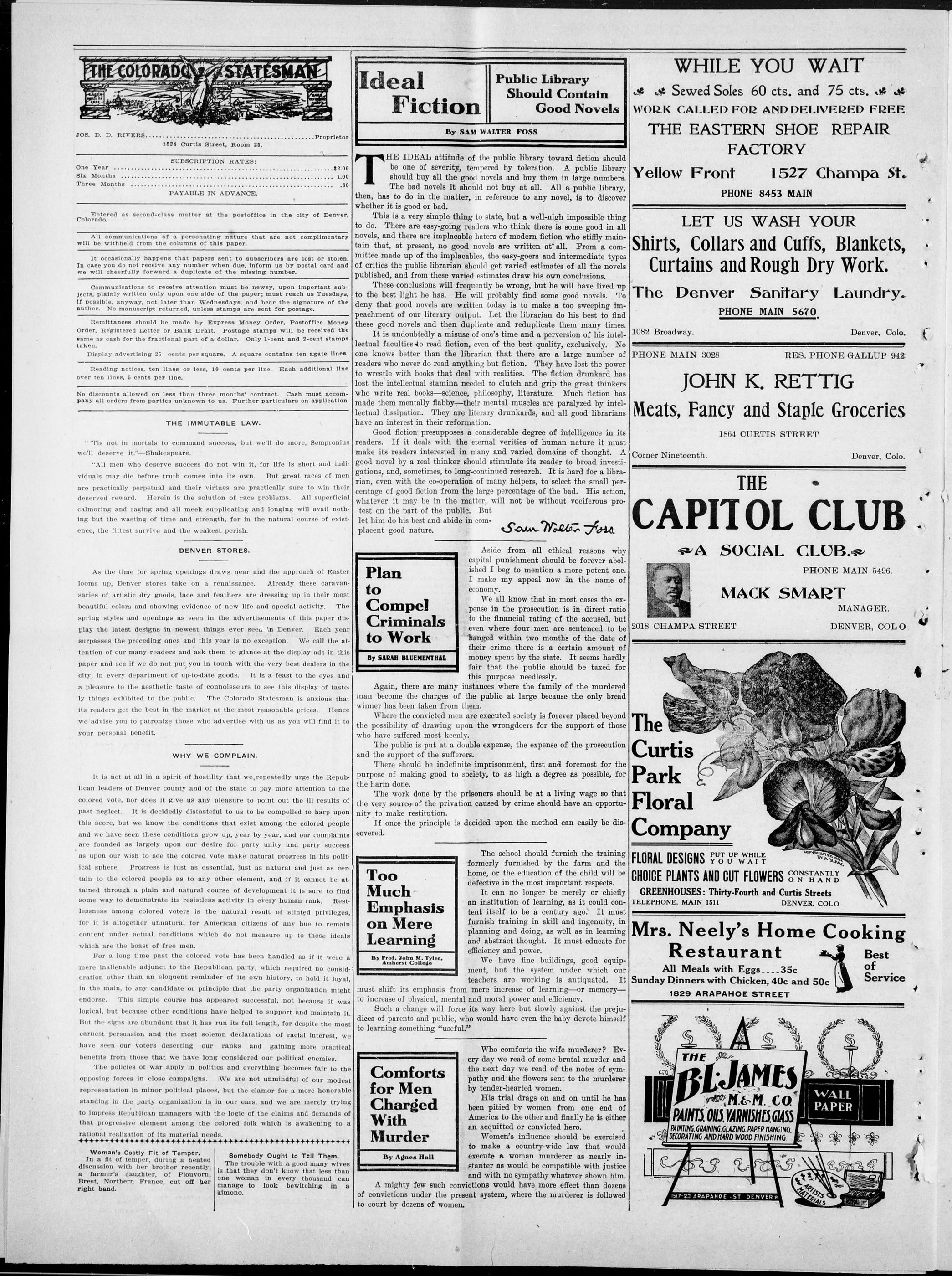
THE COLORADO STATESMAN
JOS. D. D. RIVERS.....Proprietor
1824 Curtis Street, Room 25.
JOS. D. D. RIVERS.....Proprietor
1824 Curtis Street, Room 25.
Entered as second-class matter at the postoffice in the city of Denver, Colorado.
All communications of a personating nature that are not complimentary will be withheld from the columns of this paper.
It occasionally happens that papers sent to subscribers are lost or stolen. In case you do not receive any number when due, inform us by postal card and we will cheerfully forward a duplicate of the missing number.
Communications to receive attention must be newsy, upon important subjects, plainly written only upon one side of the paper; must reach us Tuesdays, if possible, anyway, not later than Wednesdays, and bear the signature of the author. No manuscript returned, unless stamps are sent for postage.
Remittances should be made by Express Money Order, Postoffice Money Order, Registered Letter or Bank Draft. Postage stamps will be received the same as cash for the fractional part of a dollar. Only 1-cent and 2-cent stamps taken.
Display advertising 25 cents per square. A square contains ten agate lines.
Reading notices, ten lines or less, 10 cents per line. Each additional line over ten lines, 5 cents per line.
No discounts allowed on less than three months' contract. Cash must accompany all orders from parties unknown to us. Further particulars on application
THE IMMUTABLE LAW.
"Tis not in mortals to command success, but we'll do more, Sempronius we'll deserve it."—Shakespeare.
"All men who deserve success do not win it, for life is short and individuals may die before truth comes into its own. But great races of men are practically perpetual and their virtues are practically sure to win their deserved reward. Herein is the solution of race problems. All superficial calmming and raging and all meek supplicating and longing will avail nothing but the wasting of time and strength, for in the natural course of existence, the fittest survive and the weakest perish.
DENVER STORES.
As the time for spring openings draws near and the approach of Easter looms up, Denver stores take on a renaissance. Already these caravansaries of artistic dry goods, lace and feathers are dressing up in their most beautiful colors and showing evidence of new life and special activity. The spring styles and openings as seen in the advertisements of this paper display the latest designs in newest things ever seen in Denver. Each year surpasses the preceding ones and this year is no exception. We call the attention of our many readers and ask them to glance at the display ads in this paper and see if we do not put you in touch with the very best dealers in the city, in every department of up-to-date goods. It is a feast to the eyes and a pleasure to the aesthetic taste of connoisseurs to see this display of tastely things exhibited to the public. The Colorado Statesman is anxious that its readers get the best in the market at the most reasonable prices. Hence we advise you to patronize those who advertise with us as you will find it to your personal benefit.
WHY WE COMPLAIN.
It is not at all in a spirit of hostility that we repeatedly urge the Republican leaders of Denver county and of the state to pay more attention to the colored vote, nor does it give us any pleasure to point out the ill results of past neglect. It is decidedly distasteful to us to be compelled to harp upon this score, but we know the conditions that exist among the colored people and we have seen these conditions grow up, year by year, and our complaints are founded as largely upon our desire for party unity and party success as upon our wish to see the colored vote make natural progress in his political sphere. Progress is just as essential, just as natural and just as certain to the colored people as to any other element, and if it cannot be attained through a plain and natural course of development it is sure to find some way to demonstrate its resistless activity in every human rank. Restlessness among colored voters is the natural result of stinted privileges, for it is altogether unnatural for American citizens of any hue to remain content under actual conditions which do not measure up to those ideals which are the boast of free men.
For a long time past the colored vote has been handled as if it were a mere inallenable adjunct to the Republican party, which required no consideration other than an eloquent reminder of its own history, to hold it loyal, in the main, to any candidate or principle that the party organization might endorse. This simple course has appeared successful, not because it was logical, but because other conditions have helped to support and maintain it. But the signs are abundant that it has run its full length, for despite the most earnest persuasion and the most solemn declarations of racial interest, we have seen our voters deserting our ranks and gaining more practical benefits from those that we have long considered our political enemies.
The policies of war apply in politics and everything becomes fair to the opposing forces in close campaigns. We are not unmindful of our modest representation in minor political places, but the clamor for a more honorable standing in the party organization is in our ears, and we are merely trying to impress Republican managers with the logic of the claims and demands of that progressive element among the colored folk which is awakening to a rational realization of its material needs.
Woman's Costly Fit of Temper.
In a fit of temper, during a heated discussion with her brother recently, a farmer's daughter, of Plouvorn, Brest, Northern France, cut off her right band.
Somebody Ought to Tell Them.
The trouble with a good many wives is that they don't know that less than one woman in every thousand can manage to look bewitching in a
Somebody Ought to Tell Them.
The trouble with a good many wives is that they don't know that less than one woman in every thousand can manage to look bewitching in a kimono.
Public Library Should Contain Good Novels
By SAM WALTER FOSS
THE IDEAL attitude of the public library toward fiction should be one of severity, tempered by toleration. A public library should buy all the good novels and buy them in large numbers. The bad novels it should not buy at all. All a public library, then, has to do in the matter, in reference to any novel, is to discover whether it is good or bad.
This is a very simple thing to state, but a well-nigh impossible thing to do. There are easy-going readers who think there is some good in all novels, and there are implacable haters of modern fiction who stiffly maintain that, at present, no good novels are written at all. From a committee made up of the implacables, the easy-goers and intermediate types of critics the public librarian should get varied estimates of all the novels published, and from these varied estimates draw his own conclusions.
These conclusions will frequently be wrong, but he will have lived up to the best light he has. He will probably find some good novels. To deny that good novels are written today is to make a too sweeping impeachment of our literary output. Let the librarian do his best to find these good novels and then duplicate and reduplicate them many times.
It is undoubtedly a misuse of one's time and a perversion of his intellectual faculties to read fiction, even of the best quality, exclusively. No one knows better than the librarian that there are a large number of readers who never do read anything but fiction. They have lost the power to wrestle with books that deal with realities. The fiction drunkard has lost the intellectual stamina needed to clutch and grip the great thinkers who write real books—science, philosophy, literature. Much fiction has made them mentally flabby—their mental muscles are paralyzed by intellectual dissipation. They are literary drunkards, and all good librarians have an interest in their reformation.
Good fiction presupposes a considerable degree of intelligence in its readers. If it deals with the eternal verities of human nature it must make its readers interested in many and varied domains of thought. A good novel by a real thinker should stimulate its reader to broad investigations, and, sometimes, to long-continued research. It is hard for a librarian, even with the co-operation of many helpers, to select the small percentage of good fiction from the large percentage of the bad. His action, whatever it may be in the matter, will not be without vociferous protest on the part of the public. But let him do his best and abide in complacent good nature.
Sam Nolton Foss
Aside from all ethical reasons why capital punishment should be forever abolished I beg to mention a more potent one. I make my appeal now in the name of economy.
Plan to Compel Criminals to Work By SARAH BLUEMENTHAL
Compel Criminals to Work
By SARAH BLUEMENTHAL
We all know that in most cases the expense in the prosecution is in direct ratio to the financial rating of the accused, but even where four men are sentenced to be hanged within two months of the date of their crime there is a certain amount of money spent by the state. It seems hardly fair that the public should be taxed for this purpose needlessly.
Again, there are many instances where the family of the murdered man become the charges of the public at large because the only bread winner has been taken from them.
Where the convicted men are executed society is forever placed beyond the possibility of drawing upon the wrongdoers for the support of those who have suffered most keenly.
The public is put at a double expense, the expense of the prosecution and the support of the sufferers.
There should be indefinite imprisonment, first and foremost for the purpose of making good to society, to as high a degree as possible, for the harm done.
The work done by the prisoners should be at a living wage so that the very source of the privation caused by crime should have an opportunity to make restitution.
If once the principle is decided upon the method can easily be discovered.
The school should furnish the training formerly furnished by the farm and the home, or the education of the child will be defective in the most important respects.
Too Much Emphasis on Mere Learning
By Prof. John M. Tyler,
Amherst College
Much Emphasis on Mere Learning
By Prof. John M. Tyler, Amherst College
It can no longer be merely or chiefly an institution of learning, as it could content itself to be a century ago. It must furnish training in skill and ingenuity, in planning and doing, as well as in learning and abstract thought. It must educate for efficiency and power.
We have fine buildings, good equipment, but the system under which our teachers are working is antiquated. It must shift its emphasis from mere increase of learning—or memory—to increase of physical, mental and moral power and efficiency.
Such a change will force its way here but slowly against the prejudices of parents and public, who would have even the baby devote himself to learning something "useful."
Who comforts the wife murderer? Every day we read of some brutal murder and the next day we read of the notes of sympathy and the flowers sent to the murderer by tender-hearted women.
Comforts for Men Charged With Murder By Agnes Hall
Charged With Murder
By Agnes Hall
His trial drags on and on until he has been pitied by women from one end of America to the other and finally he is either an acquitted or convicted hero.
Women's influence should be exercised to make a country-wide law that would execute a woman murderer as nearly instanter as would be compatible with justice and with no sympathy whatever shown him.
A mighty few such convictions would have more effect than dozens of convictions under the present system, where the murderer is followed to court by dozens of women.
Sewed Soles 60 cts. and 75 cts. WORK CALLED FOR AND DELIVERED FREE THE EASTERN SHOE REPAIR FACTORY Yellow Front 1527 Champa St. PHONE 8453 MAIN
LET US WASH YOUR
Shirts, Collars and Cuffs, Blankets,
Curtains and Rough Dry Work.
The Denver Sanitary Laundry.
PHONE MAIN 5670.
1082 Broadway. Denver, Colo.
PHONE MAIN 3028 RES. PHONE GALLUP 942
JOHN K. RETTIG
Meats, Fancy and Staple Groceries
1864 CURTIS STREET
Corner Nineteenth. Denver, Colo.
THE
Corner Nineteenth.
Denver, Colo.
CAPITOL CLUB
A SOCIAL CLUB.
PHONE MAIN 5496.
MACK SMART
MANAGER.
M
2018 CHAMPA STREET
The
Curtis
Park
Floral
Company
FLORAL DESIGNS PUT UP WHILE YOU WAIT
CHOICE PLANTS AND CUT FLOWERS CONSTANTLY ON HAND
GREENHOUSES: Thirty-Fourth and Curtis Streets
TELEPHONE, MAIN 1511 DENVER, COLO
Mrs. Neely's Home Cooking
All Meals with Eggs----35c Sunday Dinners with Chicken, 40c and 50c 1829 ARAPAHOE STREET
THE
B.L. JAMES
M. & M. CO.
PAINTS, OILS, VARNISHES GLASS
PAINTING, GRAINING, GLAZING, PAPER MANGING,
DECORATING AND HARD WOOD FINISHING.
WALL
PAPER
1517-23 ARAPAHOE - ST DENVER
ARTISTS
MATERIALS
---
THE COLORADO STATESMAN
Miss Nelsine Howard, who has been turn their attention to our next ill, is improving. maries which will be held in the n
```markdown
```
Mrs. J. R. Contee will leave tomorrow for Los Angeles, Call
George Sample still continues very ill with rheumatism.
J. L. Harkins of Kansas City, Mo., was a Denver visitor this week.
Joseph Gordon and Lewis Tipton of Chicago were in the city Wednesday.
George Faw, who has been very ill at Mercy Hospital several weeks, is improving slowly.
B. F. Givens of 2515 Curtis street is confined to his home, suffering with erysipilas.
Ray Clark came down from Lead, South Dakota, last week to attend the funeral of Mls. Fannie Turner, his aunt.
Mrs. Daisy Gentry has gone to St. Paul, Minn., where she will visit for several weeks with her sister, Mrs. Wm. Gentry.
Augustus Morris was granted a decree of divorce from Ida Morris, March 22, 1911. A. W. Lewis, attorney.
Rev. I. H. Harper was one of the Sergeant-at-arms at the Republican Convention, held at Colorado Springs, on Wednesday.
Sam J. McClure, or the Pueblo Eagle, was in the city this week. He is one of the best known politicians in the Little Pittsburg of the West.
Mrs Hattie Overman, one of our very worthy ladies, is slightly on the improve from her recent serious illness, to the delight of her many friends.
Rev. J. E. Ford was in the city this week on his way home from Chicago, where he went to attend his mother's funeral. While in the city he preached at several of the Denver churches.
John Henry came from Salt Lake, Utah last week, having been called here on account of the death of his mother, Mrs. Fannie Turner, who was buried last Sunday.
Mrs. Chester A. Franklin left this week for Ft. Scott, Kan., to be with her sister, who is ill. She will visit Kansas City and Atchison before returning home.
Miss Bessie Brooks, who is well known in Denver and Colorado Springs, of which place she was a resident for a number of years, was married last week to Willis Coleman at Pasadena, Col.
Notice is given that default having been made in certain chattel mortgages given by the Mutual Laundry Company to James W. Furlong, there will be a sale of the chattels, Tuesday, April 2, 1912, at 10 a. m., at 2540 Washington avenue.
The annual exercises of the Knights of Pythias were held at Shorter's A. M. E. church last Sunday afternoon. The members made a very creditable display. Rev. A. M. Ward 'delivered an excellent discourse. He was at his best. The attendance was quite large,
The following war horses were delegates to the Republican county convention: Mrs. P. George, W. O. Steam, J. D. D. Rivers, C. A. Franklin, J. W. Jackson, R. J. Von Dickersohn, Mrs Vernell, Ed Allison, Thos. Dickerson, and to the State convention: C. A. Franklin, Dr. P. E. Spratlin; Alternates, Mrs. P. George and E. Allison.
Prof. Charles Alexander of Boston, Massachusetts, was a visitor in the city this week, en route to California, where he goes to arrange for a course of lectures to be given by Dr. James E. Shepard of Durham, N. C. Prof. Alexander is well known all over the country, having at one time published the Alexander Magazine of Boston. While in Chicago he was entertained at a banquet by the prominent business and professional men of the city.
The State Convention having completed its task the voters can now
---
turn their attention to our next primaries which will be held in the near future, to elect delegates to the City Convention. Mr. Dewey C. Bailey has announced himself a candidate for Mayor on the Rebublican ticket. He is well and favorably known, and if nominated would make an ideal Republican Mayor, the kind that Denver and every other city in the state needs.
The Colorado Statesman will insist that every colored voter turn out and vote at this primary.
Y. M. C. B. Fair, Carnival and Indoor Track Meet
Tuesday and Wednesday Evening
April 2 and 3, 1912.
Shorter Chapel A. M. E. Church,
Admission 4 Cents.
A delightful meeting of the Self Improvement Club was held on Monday at the residence of Mrs. Cora Jackson, 2716 Marion St. Poetry was the subject of the lesson. The program follows:
Instrumental Solo, Mrs. Tompkins;
John Milton and Robert Burns, Mrs. Webb; Byron and Thomas Moore, Mrs. Jackson; Browning and Tennyson, Mrs White; Shelly and Keats, Mrs. Williams; Whittier and Longfellow, Mrs. De Neal; Lowell and Brayant, Miss Cox; Vocal Solo, Mrs. Jones.
The club Histened to interesting remarks by Rev. H. B. Brown, Mrs. J. A. Cassells and Mrs. Atkinson, club visitors. They meet April 1 at the residence of Mrs. Jones, 3763 Franklin St.
The following programme is arranged for the People's Sunday Alliance March 31st, 1912.
1—Current Literature.
2—Male Quartette.
3—Reading, Mrs Thetta Miller.
3—Reading, Mrs Theetta Miner.
4—Instrumental Solo, Mrs Mae Byrd.
5—Essay, "The Negro in Literature,
Ancient and Modern," Miss Nesline
Howard.
6—General Discussion.
Adjournment.
The public is invited, 2630 Welton
street, 4 p. m.
THE CHURCH OF THE REDEEMER
(Episcopal.)
Twenty-seventh Avenue and Humboldt Streets.
The Rev. Henry B. Brown, B. D., priest.
The services of the past Sunday were an advance on those of the preceding Sunday in point of attendance and interest. At the morning service four infants and children received the sacrament of Holy Baptism, and the service was a fitting reminder to those who had previously received this sacrament of the vows and promises that were then made. The sermon of the priest, Father Brown, on "The Sinlessness of Jesus," was appropriately applied to the purity of infants, and the grace received at Holy Baptism.
In the evening the Very Rev. Dean Hart of St. John's Cathedral gave a splendid exegesis of the text, "Gather Up the Fragments," and also practically applied the subject to present day needs. At both services the church was well filled.
On Sunday next, Palm Sunday, there will be the blessing and distribution of palms. The sacrament of Holy Baptism will be again administered, to a class of adults. This will be the third class of candidates in the course of the month to receive this sacrament. This service will begin at 11 o'clock promptly. Candidates and their sponsors are requested to be in their places before the service begins.
Immediately after the baptismal service there will be a choral celebration of the Holy Eucharist and a sermon by the priest on the subject of "Christ's Triumphal Entry Into Jerusalem."
In the evening the Rev. Charles H. Marshall, rector of St. Barnabas' Church, will be the special preacher. Members are advised to come early to these services in order to secure their accustomed seats, for none will be reserved.
The Sunday School scholars will meet on Wednesday and Friday afternoons at 4 o'clock to rehearse their Easter Day programme.
Special Holy Week services will be held on Wednesday evening next. The devotional exercises will be "The Way of the Cross." On Good Friday, morning prayer and pre-communion service will be held at 10 o'clock. The "Three Hours' Service" will be held from 12 to 3 p. m.
The class of candidates for confirmation will meet on Sunday evening at 6:30 o'clock.
A cordial invitation is extended to all to attend these services and a hearty welcome awaits any who are in search of a Church home.
Every Human Is Wanted
Y. M. C. B Fair, Carnival and Indoor Track Meet
Tuesday and Wednesday Evening
April 2 and 3, 1912.
Shorter Chapel A. M. E. Church.
Admission 4 Cents.
of Easter
inery
ALL
NEXT
WEEK
and basement filled to overflow with
and beautiful in Trimmed Hats, Street
Trimmed Hats, Flowers, Ornaments, Laees,
Newbraids and Wire Frames
all invited to see our great showing
ALL THE LOW PRICES WE QUOTE
Sale of Easter Millinery ALL NEXT WEEK
3 large floors and basement filled to overflow with everything new and beautiful in Irimmed Hats, Street Hats, Sailors, Untrimmed Hats, Flowers, Ornaments, Laees, Strawbraids and Wire Frames
ADD 3 CENTS
MADAM M.
Manufact
Madam Holly's Wonder
PHONE CHAMPA 2561
ADD 3 CENTS FOR POSTAGE
M. M. A. HOLLY
Manufacturer Of
Ly's Wonderful Hair Grower
MADAM M. A. HOLLY
WILLIAM P. ROBINSON ELECTED
PRESIDENT OF DENVER
UNION WATER CO.
At a special meeting of the directors of the Denver Union Water Co. William F. Robinson, the general manager of the company was unanimously elected president to fill the vacancy caused by the recent death of Thomas S Hayden. A more fitting tribute could not have been paid to one so deserving and so well qualified for the position. The Colorado Statesman congratulates the company on securing such an efficient man for its president.
Nicely modern furnished room for rent, 1919 Welton street.
Five-room house for rent, 320 24th street. Apply at 1824 Curtis street, Room 25.
THE
TISHLER TAILORING
ESTABLISHMENT
Three unfurnished rooms for rent
Mrs. Laura Gunnell, 1226 Champa
street. Phone Olive 1208.
FOR RENT—A nice modern front
room; gentleman preferred. Apply
Mrs. N. Dean, 2218 Clarkson street,
phone York 6121.
Fort Rent—Three nice unfurnished
rooms. Apply 2929 Glenarm Place.
THE CHURCH OF THE REDEEMER.
(Episcopal.)
MOVING VAN
$1.25 per Hour
Twenty-second avenue and Humboldt street.
11 a. m.—First and third Sundays, Litany and Solemn Communion with sermon; second, fourth and fifth Sundays, Choral Inatius with sermon.
7:45 p. m.—Choral evensong with sermon.
9:45 a. m.—Sunday school.
Fridays, 8 p. m., Litany and lecture.
The vestry meets on the first Wednesday in each month at 8 p. m.
The Women's Guild meets on the first and third Thursdays at 8 p. m.
The Altar Guild of the Blessed Virgin Mary meets on the first and third Wednesday at 8 p. m.
The Brotherhood of the Church of the Redeemer meets on the first Sunday in each month at 4 p. m.
The Sacrament of Holy Baptism will be administered on the second, fourth or fifth Sundays at the 11 o'clock service.
A cordial invitation is extended to all to attend these services.
J. H. BIGGINS
The Rev. Henry B. Brown, B. D. priest in charge; residence, 2420 Clark son street; phone, York 5700.
FRIENDS ALL WANT IT.
Mrs. D. B. Simmons of Silex, Ark, writes: "I tried one bottle of Ford's Hair Pomade and found it to be the best preparation I have ever used. It stopped my hair from falling out and breaking off and my hair is now as soft as it can be and is longer than it has been for a long time. My friends all want it.
Ford's Hair Pomade, the old, reliable dressing for stubborn, curly hair makes harsh hair more pliable, glossy and easy to comb. Try it and Ford's Royal White Skin Lotion, for the complexion. For sale by druggists, accept no other, see that it is Ford's and manufactured by the Ozonized Ox Marrow Company, Chicago, Ill.
---
---
FIRST TREATMENT $1.50
OTHER TREATMENTS EACH $1.00
RATES BY THE MONTH
SUNDAY SERVICES.
SUNDAY SERVICES.
7:30 a.m.—Molyx Communion
9:45 a. m.—Sunday school.
OPPOSITE
DANIELS & FISHER
OIL 60 CENTS
DISCOUNT TO CUSTOMERS
TREATED 10 CENTS
2118 ARAPAHOE STREET
Brickler's New Barber Shop is loca
cated at 2208 Larlimer street. Shave
10c. Hair Cut, 25c; Children, 15c.
FORD'S
HAIR POMADE
MAKES HARSH, KINNY OR CURLY HAIR
GLOSSY. SOFTER AND MORE PLIABLE,
EASY TO GMB AND PUP UP IN ANY STYLE
THE LENGTH WILL PERMIT UREXECELLED
FORD'S
HAIR POMADE
MAKES HARSH, KINNY OR CURLY HAIR
GLOSSY, SOFTER AND MORE PLABLE,
EASY TO COMB AND PUT UP IN ANY STYLE
FOR PREVENTING HAIR FROM FALLING OUT DANDRUFF AND TICING OF SCALE BEWARE OF IMITATIONS, GET THE GENUINE, UP IN 25* AND 50* BOTTLES WITH CHARLES FORD'S NAME ON EVERY PACKAGE
TRY FORD'S ROYAL WHITE
SKIN LOTION FOR THE COMPLEXION.
MAKES THE SKIN WHITER IMEDIATELY
UPON APPLICATION. WILL NOT IRRITATE
THE MOST DELICATE SKIN. UNEXCELLED
FOR ECZEMA, SALT RHEUM, PIMPLES,
ROUGH SKIN AND FRECKLES.
SOLD BY DRUGGISTS. IF YOUR DRUGGIST CANNOT
SUPPLY YOU, WE WILL SEND IT TO YOU DIRECT AT
THE FOLLOWING PRICES, SMALL SIZED BOTTLE
50* THE OZONIZED OX MARROW CO.
242 LAKE STREET, CAGO, TILL
AGENTS WANTED.
1031 17TH ST.
Room 1, Iron Building
Denver, Colo.
STORAGE $2.00 MONTH
FINE WAREHOUSE
Phone. Main 8466 903 18th St
A. W. Lewis
Attorney and Counselor at Law
1941 Arapahoe St.
DENVER, COLORADO
Furniture Repairing and Upholstering. All work Cash.
PHONE YORK 5566
2231 Washington St. Denver.
THE TIVOLI UNION BREWING CO.
MADISON, WI.
Tivoli
DENVER, COLO.
The CAPITOL BREWING COMPANY
The purity of Capitol Beer is demonstrated by its superior flavor and strength-giving qualities. It's capital. HAVE A CASE SENT HOME.
SEWED HALF SOLES 60 cts. and 75 cts.
HENRY WARNECKE, President
2357-59 LARIMER STREET
Showing Three Reels of the Very Best Pictures Made Complete Change of Program Every Day. We Strive to Please All. Laboring Men Bring Your Families. ADMISSION ALWAYS 5 CENTS.
HENRY BECK JOHN ENGSTROM
WINES, LIQUORS AND CIGARS
1644-46-48-50 LARIMER STREET.
PHONE MAIN 1053.
DENVER, COLO.
Western agents for Minneapolis Grain Belt Beer and Carnegie Porter,
Pipps Imported Beer and Book OI.
SHOE REPAIRING 1023 EIGHTEENTH ST.
THE SEWING MACHINE
WALTER CAMBERS 1023 Eighteenth St.
WORK CALLED FOR AND
DELIVERED
TELEPHONE MAIN
THE CAPITAL
REPARIIN
SEWED HALF SOLES 60
HENRY WARNECKE,
1511 CHAMPA STREET
O. SHER GROCERIES
PHONE 4845
REPAIRING DONE WHILE
YOU WAIT
7377
CITY SHOE
G CO.
cts. and 75 cts.
President
DENVER, COLO.
Dealer in Groceries, Provisions, Live and Dressed Poultry and Fresh Meats, Bologna Sausage and Smoked Meats. . . .
The Cheapest Grocery and Market on Larimer St. Try and be convinced. For $15 worth of Premium Tickets returned, 50c worth of groceries free of charge.
AFRO-AMERICAN CULLINGS
£06 NOES: OL NOW /EOFE, OF WHOM:
there are now some 100,000 in the
four Boroughs, have more public en-
tertainments, more elaborate and ex-
pensive, than those of any other city
in the country. This is true because
they make more money and save less
and have more opportunities than the
negroes of other cities.
White, black and colored of New
Yorkers are alike in the disposition to
dress better, feed better and enjoy
lfe more than any other people in the
country. People who spend most.
they make come upon trouble after
a while and fall out, but in New York
there are always others to fall in, so
that there is never any gap. The so-
ber-sides, and old fogies who watch
the passing show and furnish the food
and drink and clothing for {t gather in
the dollars and keep them. They are
the substantial negroes in every com-
munity who do this, and they get more
satisfaction and comfort out of gath-
ering and saving the dollars their
brethren spend than the spenders do.
Indeed, it is more blessed to gather in
and save than to scatter and spend.
But those organizations of ours
that give entertainments should sit
down hard on the disposition to scan-
dalous conduct which has made its ap-
pearance at public receptions. These
organizations have, in the main, a rep-
utation for high and ennobling pur-
poses to maintain, and they cannot af-
ford to allow it to be lowered by con-
duct of their patrons scandalous in
character. A new generation have
come upon the scene in New York,
many of whom have a notion that
loud, boisterous and vulgar conversa-
tion, indelicately suggestive dress,
dances in which the proprieties are
whistled down the winds, and drink-
ing to excess are the things most ap-
proved to be done, and do them—the
wives and daughters and sons should
be protected from the extremes in
these things that corrupt the mind and
encourage extravagant spending in
dress, drinking and eating.
It fs to be regretted that the lessees
and owners of dance halls and gardens
retain the right to sell all the liquor
and cigars and eatables they can, and
do it, to make up the difference in the
small rental demanded for the use of
such halls and gardens. The lessees
make the money on the bar and res-
taurant privileges, and the organiza-
tion scarcely covers expenses by the
admission prices demanded. It is
a fair deduction that 90 per cent.
of the vast sums spent every week
by negroes in public entertainments
goes Into the pockets of the white
lessees and owners of the halls and
gardens who retain the bar and restau-
rant privileges, and who often make
@ scandalous condition in the effort
to sell as much liquor as possible, and
do it. There ts no apparent escape
from this condition in New York ex-
cept that our organizations pool their
money and credit and purchase one
great garden and one great hall of
their own.
Public entertainments that corrupt
the morals of old and young alike,
that put a premium upon intemper-
ance, which lead to display of obscene
talk and vulgar actions—such public
entertainments are dangerous, Our
older men and women should see this,
if the younger do not, and do what
they can to keep the moral standards
high. We believe they desire to do so
and will welcome any assistance we
can give them in helping them to do
80
‘The progress of a race is measured
allke by things the race Is trying to
do and by the things that it has
ceased to do. Among the things that
have fallen into discredit among us
we may mention these: Begging mon-
ey from the whites with which to bury
@ negro. That used to be a rather
common custom In small towns and
villages, We know now that when-
ever the whites have to be appealed
to for funds with which to bury a ne-
gro it 1s In the case of a negro who
fs not worth burying, Another cus:
tom now happily on the decline is
that of solfciting ald from the whites
to enable us to celebrate the 19th of
June, Thoughtful negroes everywhere
are beginning to feel that in a matter
of this sort the negro should pay the
piper or do withont the music, But
what about another habit closely akin
to these two and which in some quar-
ters 1s as strong now among us? We
mean the habit of begging and harass-
ing the white man for funds with
which to buid fine churches, Haven't
we reached the point where the ne-
gro should be content to worship in
only such buildings as he ts able to
erect himself and such as his limited
means will justify? We know the
negro does violence to his self-respect
—to say nothing about what he does
to God—by soliciting for funds to
build churches which in no sense 1s
an Indication of the sort of homes
the race {s content to occupy. In the
pas: of building costly churches we
ave long ago exceeded the speed
Hmit and in the method of getting
‘the funds together for that purpose
we have often outraged common
sense and ordinary decency and self-
respect. A church should in a meas-
ure be an index of the taste, comfort
and well being to be found in the
homes of the majority of Its wor-
RET eeer a aie an aee ge eRe: | Sere ce Mee aes
should do so by reason of being be-
low the general average of such
things. In ninety-nine casef out of a
hundred the church with us ts a gro-
tesque exaggeration. The deserving
leader in these matters is the man
who {s trying to get the race to come
down to the earth. Generally we've
been acting on the theory: First, get
fine churches and everything else will
be added. We've got to turn that rule
around. Common setise, business
sense, and the sense of self-respect all
dictate this reversal—Dallas Express.
‘Those who have kept tab on Hous-
ton's local affairs, especially as they
apply to and affect the negro citizen-
ship, know for a certainty that a
brighter and better day is dawning.
The negro is coming into his own, In
this particular, they as a class are do-
ing much for themselves, but as a
matter of fact the changes that are
being effected daily and which are
bound to inure to the negro’s bet-
terment are being rapidly facilitated
by the daily press of the city, proml-
nent among which is the Houston Post,
which says:
“We come now to the question of
housing the negro people of Houston,
and what we say of Houston is true
of all the larger cities of the south.
The great majority of negroes live in
rented houses owned by white people.
As a rule; these habitations are miser-
able, filthy, insanitary shacks, locat-
ed upon boggy streets. People who
inhabit such places are subjected to
stich conditions of living that disease,
physical and moral, is Inevitable.
The consideration of self-preserva-
tion alone would suggest the crying
necessity for better conditions. If
such filthy quarters result in malig-
nant diseases, the health of the white
people of the community is always im-
periled. Negroes are employed in al-
most every well-todo white home In
the southern cities, and their capacity
to transmit disease is limited only by
the conditions among which they live.
If they are afforded decent surround-
ings, they will have an incentive to
cisanliness and self-respect that is oth-
erwise impossible. This incentive
must be afforded by their white land-
lords.
“A Houston building firm recently an-
nounced that it would erect some mod-
el cottages to be sold upon easy
terms to negroes. ‘This is an example
worthy emulation. The home-owning
negro 1s a good citizen. Home-owner-
ship makes a good citizen of the aver-
age man ,white or black, But one
thing is certain: ‘The public health
of all southern cities will be greatly
improved and the mortality rate ma:
terlally reduced if far-reaching move-
ments be Inaugurated to house the
tenant negroes in clean and sanitary
houses. They are going to be with
us always, and {t 1s but common
sense to encourage them in every pos
sible way to become a helpful, intell!-
gent, moral ‘and respectable influence
in the communities in which they live.
‘This they can not do unless they have
the constant sympathy and aid of their
white fellow citizens.
Governors and other leaders from
several southern states recently con
ferred in Baltimore on labor and in
dustrial conditions in that section.
‘The reawakened south, {ndustrially
and agriculturally expanding at a rate
unknown since the Civil war, needs la
bor. ‘There 1s insistent demand that
European immigrants be steered to
the south to supply this demand.
‘The negro is almost ignored in this
demand for immigration. He is set
‘down as hopeless, trifling, futile, im
posstble, But is it safe to rush to that
conclusion?
‘Though the white population of the
south 1s increasing more rapidly than
the black, and though every decennial
census makes {t more clear that there
1s no possible danger of the black, as
once was feared, coming to predomi
nate—despite all this, the fact remains
that there are some 11,000,000 of col
ored people in the country, and that
they cannot be got rid of. There
‘stands the hard fact.
“Tt may be that the negro is not so
‘desirable a worker in factory or fleld
as the Immigrant; but if the immi
grant takes his place, the negro will
be left on the hands of society, de
manding the means of livelihood, 1
menace to the community in greater
and greater degree Just in proportion
as the hopelessness of his condition
{s made more apparent.
If the south’s 11,000,000 negroes
could be traded off for 11,000,000 of
whites, that Would be a solution. But
‘they cannot be. The negroes are
‘there. ‘They must be provided for;
‘made as useful as possible; made to
support themselves.
"To make the most, the best, of tts
negro workers 1s the first big duty of
‘the south, It is the most difficult
problem before the nation.
It cannot be solved by the effort to
drive the negro out; he will not be
driven out. He must be looked after,
educated in the right way, given a
chance to be self-respecting, encour-
‘aged to improve his condition.—Co-
lumbia Magazine.
No man who weeps at his misfortune
can ever get to be a true philosopher.
ENTIRE COUNTRY REJOICES
OVER DESERVED PROMOTION
OF EMMETT J, SCOTT ELECT-
ED SECRETARY OF TUSKEGEE
INSTITUTE.
Washington, D. C.—There is general
rejoicing throughout the country over
the action of the board of trustees of
‘Tuskegee Institute in electing that
faithful and experienced worker, Mr.
Emmett J. Scott, as secretary of the
school, in the upbuilding of which he
has had so large a part. he place
was created especially for him, and is
a fitting recognition of his eminent
and helpful services to the Institu-
tion covering a period of 15 years.
‘The honor came wholly unsolicited,
as far as Mr, Scott is concerned, and
was, therefore, a complete surprise to
him. Although he accepts the rare
compliment paid him by the heads of
the school, it {s understood that in as-
suming the new dignity he will not
consent to any suggestion that the re-
lations he has long sustained as Dr.
Washington's secretary shall be termi-
nated. Consequently, it has been ar-
ranged that Mr. Scott shall continue
to serve the principal in the same ca-
pacity as of yore, in addition to his
duties as secretary to the schcol,
Mr. Scott is a native of Houston,
Texas, and is a leader in the field of
journalism, as well as in the arena of
education. He won his spurs.on the
Houston Daily Post, and with ©. N.
Love founded the Texas Freeman, the
higher voice of the great southwest
He 1s now editor of the Tuskegee Stu
dent, a paper of wide circulation and
vast influence in educational circles,
and has just launched the Business
League Herald, as the spokesman of
the National Negro Business .League,
of which he is corresponding secre-
tary. Mr, Scott has declined several
flattering offers to go into the federal
service, but was induced by President
‘Taft to accept a place on the United
States commission to adjust the dim-
culties of the Liberian republic, and
had the distinction of being the first
colored man appointed by Mr. Taft
after his inauguration in 1909, On
this commission, in company with
military and civil officers of high rank,
Mr. Scott acquitted himself with
marked credit, and is conceded to
have been the foremost member of
that unique body.
It is felt by Mr. Scott's host of
friends that in his enlarged sphere of
activity, Mr. Scott will prove to be
an even more potent factor than ever
in the forward movements and exten-
sion work of the famous Tuskegee In-
stitute. He is in receipt of a heavy
mail, bearing congratulations.
BEAUTIES AMONG
DESPISED RACES
Paris.—lor the first time In many,
many years a German book, Hans
Heinz Ewers’ “India,” set all France
talking, The great traveler makes the
extraordinary statement that the most
beautiful women in France and Ceylon
come of a race formerly regarded as
political and social partahs. ‘The Eng-
lish have abolished the pariah taint in
Ceylon, and the first French reyolu-
tion removed {t from the Cahets or
Cagotes in France, who, though Chris-
tlans, were obliged to enter church by
@ spectal door, had their own holy wa-
ter fonts, etc, up to the downfall of
French royalty,
The Cahets live now in the tand-
scapes of Gascogne, Gyuene, Bearn,
Brittany and Maine. Their origin 1s
unknown, but the name indicates that
they may be descendants of the Goths,
Cahet being a contraction of canis
goticus—Goth-dog. For more than a
thousand years the rest of France
treated them as outcasts, and they are
still so regarded socially in many of
the rural districts. They are easily
recognized by the missing ear-lob, a
characterization Mkewise found in
many Parisians. Maybe in olden times
many stray Cahets, wishing to escape
prosecution at home, emigrated to the
great town,
It is a fact, though, that nearly all
the great women beauties of France
were and are Cahets, which, says the
author, strangely coincides with the
other fact that the Rodiyas of Ceylon,
until the arrival of the English re-
garded as outcasts, both politically and
socially, produce the most beautiful
women, not only in Ceylon, but in all
India,
“In this connection,” says the au-
thor, “I observed that in the land of
castes, the darker the skin, the lower
the social order,
“This holds good in all India, yet
the Rodiyas are much lighter in color
than the majority of their contempora-
ries, and not only the women, the men,
too, are far better looking than their
contemporaries. Their features are of
a noble cut and their legs are much
better developed.
“Their better physical condition 1s
due to the fact that up to the English
protectorate the superior castes of
India gave their unfaithful women
and their unchaste daughters to the
Rodiyas as the most horrible of pun-
ishments. In this way the despised
race received a goodly admixture of
the best blood of India, many queens
sultanas and princesses being cop
demned to marry Rodiyas.”
HENSEN TELLS OF
TRIP TO THE POLE
Guest of Society for Historical
Research in Yonkers.
ATE BOILED DOG OFTEN
MAN WHO eBoaniview PEARY
TO THE NORTH POLE RELATES
ABOUT THE ARCTIC REGIONS—
CLIMATIC AND ASTRONOMICAL
INCIDENTS OF THE VOYAGE.
Yonkers, N. ¥.—At a recent meet-
Ing of the Negro Society for Historical
Research, with headquarters in this
city, Mr. Matthew A. Hensen, who ac-
companied Commander Peary to the
“north pole, was the principal speaker.
“The exercises were held at Sunny
‘Slope cottage, which {s the residence
of Mr, John E. Bruce, president of the
organization. A special feature of the
“musical program was the part taken
‘by little Miss Cecile Butler and
her brother Willie, who gave sev-
eral piano and violin selections with
rare ability,
| Mr. Hensen told of his travels and
experiences in the arctic regions in a
straightforward, painstaking manner,
drawing here and there many striking
illustrations of the difficulties and
hardships encountered en route to the
icy regions. He is a pleasing speak-
er and possesses a fund of humor. He
said he felt highly honored when he
was asked to speak before the
Historieal society, which is doing a
good work in preserving for fu-
ture reference the achievements of the
negro race.
He had been a globe trotter for
many years, Before he entered the
service of Commodore Peary he made
the trip to China and the orient on
a sailing vessel and was out of the
country for three years. On his re-
turn from this trip he went to South
America, where it was so hot they
had to feed the hens cracked ice to
prevent them from laying hard boil-
ed eggs. Next he entered the service
of Peary and for 20 years had followed
the commander's fortunes on all his
trips to the north pole and shared with
him the hardships which its triumph-
ant discovery entailed.
In 1906 Hugh Lee and himself were
the only men in Peary's party to yol-
unteer to stay with him for another
year, and they, with Peary, made the
famous record trip across the polar ice
in 33 days. Jn the final quest for
the pole they made an average of
26 miles a day, and on reaching the
pole Peary took five sets of observa-
tions to make sure he had actually got
there.
He told in a humorous way how the
party subsisted during this and’ other
trips polarward, They had boiled dog
for breakfast, stewed dog for dinner
and cold boiled dog for supper. Some-
times they shot a musk ox and en-
Joyed a square meal. The Eskimos,
he said, are polygamists, haying as
many wives as they can support. They
have no religion that can be defined.
They believe if a man is good
he will go up into the sky after death
and if bad down into the bowels of the
earth.
‘They are a short lived people. ‘The
men rarely live to be 40 years of
age. The females marry at from
12° to 14 years and at 18 or 19 look
to be 30 or 40. They have a proverb
which he quoted in Eskimo and trans-
lated: “The peacock may be a beau-
tiful bird, but It takes a stork to
deliver the goods.” .
He said the moon shone so brightly
in the arctle regions that it is possible
to hunt the musk ox by its refulgent
light or to read or do any work ordi-
narily performed in the daytime. The
sun at its brightest can be looked at
without danger to the eyes. Its heat Is
not felt. For 110 days the sun never
sets in the arctic regions, and
for the same number of days it never
rises.
Mr. Hensen was asked a number
of questions by members of the so-
ciety, which he answered quickly,
showing that he was familiar with the
geography and topography of the polar
region, where he had spent, off
and on, the best part of 20
years. A reception in Mr. Hensen’s
honor was given at the close of the
program.
ATTORNEY GENERAL SAYS HE’LL
QUIT BAR ASSOCIATION IF
IT OUSTS LEWIS.
Washington, — Attorney General
Wickersham said that he would re-
sign from the American Bar associa-
tion if that organization sustained the
action of its executive committee in
ousting William H. Lewis, a negro,
and an assistant attorney general,
from membership.
‘The attorney general declared that
he was not fighting for the admission
of a negro to the organization, but
was waging a fight against the idea
that the American Bar association
could do a thing which he believes to
be illegal.
SHY ONLY TEN YEARS.
“Weren't you shy when the judge
asked you your age in court?”
“Yes, I was about ten years shy, my
dear.”—Life.
a ee ne ee ee hr eee
THE :
x x
; MONARCH LIQUOR :
COMPANY :
x ie B
x TELEPHONE Jay Aeros, Vet si6 u
S CHAMPA 1231 i <) gf COURT PLACE :
Rea :
< IMPORTED & DOMESTIC WINES & LIQUORS %
Bt Ja JC) 8()8()238( 8080088098000
PEPESEOEOEOEOEOTO FOTO TOTO EO EO TOE OTD EO FOTO TO FOTO FOTO TG
; D. W. REEVES, Manager. W. P. JONES, Proprietor. i
2 FULL LINE OF CIGARS AND TOBACCO.
ee ; i
: Five Points Barber Shop
3 2727 WELTON STREET.
% PHONE CHAMPA 471. DENVER, COLO,
Pes Ih se Secaaw es eeaeeebesconeeseeeh
Remember | Save You One Dollar on Your Furnace.
Put This Dollar in the Bank.
The Cincinnatti Furnace and House Cleaning Co.
FURNACES CLEANED, FLOORS WAXED, KALSOMINING AND WHITE
WASHING CELLARS.
LAWN CUTTING, CEMENT PATCH WORK.
BEST WORK QUICK SERVICE
JAS. TERRY. 1209 E. Thirteenth Ave. Phone York 4328,
2029 CHAMPA STREET wa PHONE MAIN 5964
W. O. SIMONDS
.0O
Eureka COAL 42°
GAS COKE $5.00 PER TON
We Will Save You mena en eve Your Order Before Coal
rices Go Up.
Contractors and Builders
All kinds of carpenter work and
jobbing. Store and office work a
specialty .. * Phone Main 1925
1846 Arapahoe St. DENVER, COLO,
te. Sb onc Hxpert Watch Regain | Diamond snd Cat Gla
go \| THE ZALL JEWELRY
D oeenceee COMPANY
Watches, Clocks, Silverware, Eto.
Pielerore) Chase pai1473. 805 Fifteenth Street. Denver, Colo.
RUDOLPH BROTHERS
SANITARY GROCERY, BAKERY AND
MEAT MARKET.
{mported and Domestic Table Delicacies. Fresh Fruits and
Vegetables. Our Own Bakery. Finest Goods in the City.
2758-2760 Downing Avenue Phone York 320
In Connection
There Are Alse
Nicely
Furnished
Rooms
And the Old
Reliable
Newport Thirst
Parlors
:
1841-45 Arapahoe Street.
Private Dining Room. Phone, Main 7413,
women. The —---<0008
Newport Annex
Tae eee
Cafe and Lunch Room
Richard Frazier and Tom Lewis, Props.
=e
cere ee
ae
SHORT ORDERS AT ALL HOURS.
DENVER, COLO.
DELIVERED TO SUBSCRIBERS AT SIXTY CENTS A MONTH.
A reduction of more than 20 per cent on former rates.
At this price THE REPUBLI-CAN is the cheapest and best paper published in Denver.
Neither money nor labor will be spared to make THE REPUBLI-CAN, as it has always been in the past, the best and most reliable paper in the West.
THE REPUBLICAN'S news service has no equal. The Associated Press, supplemented by the splendid New York Herald news service, gives our readers every morning all the news gathered from every part of the world.
THE ILLUSTRATED SUNDAY MAGAZINE section of THE REPUBLICAN contains stories by the leading authors and humorists of the day and many pages of photographs of great interest.
SEND IN YOUR SUBSCRIP-
TION TODAY
Please fill out and forward this
blank.
THE REPUBLICAN PUBISHING Co.
DENVER, COLO.,
Send to my address until I order
it discontinued, THE DENVER RE-
PUBLICAN, Daily and Sunday.
Name......
Address......
SIXTY CENTS A MONTH
The
WARD AUCTION
COMPANY
Sales Daily at 2 p.m. Office Furniture a Specialty.
PRIVATE SALES AT ALL TIMES
HAVE MOVED TO—
1723-39 GLENARM ST.
PHONE MAIN 1675.
---
Miss M. Cowden Hair Dressing Parlor
Shampoo, cutting and curling. Scalp treatment, hair tonics, hair straightening, manicuring. Stage wigs for rent; theatrical use and masquerades. Goods delivered out of the city. All shades of hair matched by sending sample of hair; also combings made up.
Cheapest Switches 50 Cents
1219 21st St. Denver, Colo.
NAST
The Popular Photograher. Only Caters to First-class Trade. Our Pictures speak for Themselves.
WILLIAMSON
HAFFNER CO.
ENGRAVERS-PRINTERS
QUARTER
CIUTS
TRAILS
DENVER, COLO
The Farm
ASPARAGUS CULTURE.
No farm home vegetable garden should be without a good row or bed of asparagus. It is of the easiest culture and can be grown almost anywhere. It comes on for table use very early in spring before most other plants are ready, and a short row of it will supply a common-sized family with an abundance of this appetizing and healthful green food for four or five weeks at a season when green things are most relished.
Although asparagus will grow and thrive for many years in exposed and neglected situations, yet the best results are secured by planting it in very deep and well-fertilized soil in a favored portion of the garden.
Most persons speak of the "asparagus bed," yet the writer has had the best results with the least amount of labor by setting the plants in a straight row across the garden. In a bed, the plants are hard to cultivate and keep clean, and after a few years the roots become so crowded for space that large growth is not possible. In the row, cultivation is easy. We use the horse cultivator for stirring the soil on each side of the row, and in this way with close working only a very few weeds must be pulled by hand. In fact, perennial vegetable beds in general are going out of date, with hills and straight rows 3 or 4 feet apart to admit of horse tool cultivation taking their place.
Since the asparagus row is to be permanent, it is best to make the soil very fertile and work it deeply. Open as deep a furrow as possible with a two-horse plow, throwing the soil both ways, and then with one good horse to the same plow throw out the soil 6 to 10 inches deep, with plenty of loose soil for filling. In the bottom of the trench is placed a deep layer of decomposed manure, and back over this a good layer of fine soil is plowed and firmed down. On this soil a thinner layer of fertilizer is placed, and is covered lightly with soil. The roots, or one-year-old plants, are set on this about 1 foot apart, and fine soil covered in and over the roots till the first crowns are buried 3 inches.
During the first season after planting the row is given good, clean cultivation, the same as the rest of the garden plants. In the fall the tops are cut away and removed, and the row given a liberal mulch of manure, which the following spring is cultivated into the soil about the roots. Only a few shoots should be cut the second year after planting, but the following spring and thereafter the growth will be large and close cutting may be done. A saving of two years or more can be made in planting roots instead of sowing seed. The roots may be purchased cheaply of private growers, or they may be purchased of all large seed dealers. One hundred plants make a good row for the family garden.
To grow asparagus from seed, plant the seed in spring as early as possible, covering with about an inch of fine soil. Several weeks will be required for the seed to germinate and the young plants to come up. Give clean cultivation from the first, and thin the young plants to stand about 2 inches apart in the row. In the fall, cut the tops away, and the following spring take up the roots to set in the permanent row as described above.
ROAD PROGRESS ANALYZED.
In 1903 the Department of Agriculture listed the reasons for the lack of progress in constructing good highways in the following order:
1. The excellence and the rapid development of our railway systems and our extensive waterways.
2. Our long familiarity with bad roads and the indifference of those in charge of highway affairs.
3. The lack of appreciation of the social, commercial and economic value of good roads, and the fear of increased taxation on the part of the rural population.
4. The wasteful and ineffective system of personal service of the rural population on the highways.
5. The lack of general authority, intelligent supervision, provisions for equitably distributing burden of cost, and business methods in highway construction and maintenance.
Within a few years several of these causes have become inoperative, and several other forces have been aroused to action which will make for much improvement in our highways. Our "extensive" waterways have declined in importance, a large part of their business being taken from them by our railway systems. These, in turn, have consolidated, and, in many cases, have raised rates on the short hauls, in order to offer better terms to those who have long hauls to be undertaken. Our long familiarity with bad roads and the former indifference of those in charge of highway affairs, has been supplanted by a desire to see what good highways are like, and a very lively interest in good roads in most sections of the country.
The lack of appreciation of the values of good roads and fear of increased taxation have been largely removed by campaigns of enlightenment and more equitable systems of taxation. The lack of general authority in
some sections persists and better highway legislation has been the rule in many states, while business methods of highway construction and maintenance are chief topics of conversation where any group of farmers get together. Several factors have appeared which have materially boosted the good roads movement within a few years. Foremost is the work of the automobile dealers and clubs in their work of encouraging the building of good roads. Another factor is the increased interest of railroads, bankers and commercial interests generally whose profits depend upon the increase in general prosperity.
A factor which is not yet powerful is the use of automobile trucks for hauling. These machines are used in many places for suburban deliveries, and their use may be extended in the future. Altogether, the outlook for better highways is more encouraging than ever before.
PROTECTING FRUIT.
Millions of dollars' worth of property is lost and hundreds of men are impoverished annually by destructive storms and frosts which damage fruit trees and destroy part of the crop. Severe frosts will sometimes destroy the crop for several years. Only within a few decades have artificial methods of overcoming destructive atmospheric conditions been tried. The methods have been of three classes; explosives, smudges and heating devices.
European grape growers were the first to try explosives, and they have since been tried with indifferent success in many ways. The method consists of bombarding clouds, bringing probable storms in the mountains before they have time to invade the lowlands where the vineyards are.
Smudge pots for protecting the buds from the sun's rays on clear mornings were first used in France. Small wooden boxes were filled with resinous substances, smothered with earth and fired in early morning to make a cloud for the protection of the fruit. The co-operation of an entire district is necessary in this case. Smudges are also used as heating devices.
Oil heaters have been found to be the best, except in regions where coal is exceptionally abundant. Crude oil can be obtained cheaply in tank lots. The oil is burnt in specially constructed lamps, holding from five to eight quarts of oil. A heater that will hold seven quarts of oil should burn ten hours, which is sufficient. One hundred oil heaters should be used for each acre. An orchard of ten acres should be protected by always having on hand a sufficient number of heaters and a carload of oil. The heaters, if used in the number indicated, will raise the temperature of the orchard as much as 15 degrees.
A temperature of 28 degrees Fahrenheit is considered sufficient to keep the buds from injury in April, when the killing frosts are most to be feared. This temperature should be determined from thermometers hung on the trees, for a thermometer hung on the house will be altered by the heat of the building. Thermostats, which sound an alarm when the mercury has dropped below a given point, are useful.
Protecting orchards from frost has passed out of the experimental stage, and has become a science from which definite results may be obtained from a certain investment of money and labor.
LIVE STOCK JOTTINGS.
At the present prices of all feeds, wheat is about the cheapest and best that can be used for a variety of purposes.
When feeding wheat to horses, give only a very small amount at first and mix it with corn, oats or bran. Wheat can be fed to hogs with safety by scattering it over the ground for them to pick up only a few grains at a time.
Feed the calves some grain and heavy feeds at this season, so they will not become poor and stunted before they go onto new pasture.
A good way to clear a small field of brush and sprouts is to fence it and pasture with sheep, calves and other stock. The animals will keep the sprouts eaten off if confined to the space, and they will manure the ground while killing the undesirable growth.
Hogs will root more in spring when the ground is soft than at any other season. Feeding with shorts, tankage, charcoal, coal, salt and things they relish will reduce the rooting inclination. Rooting in some cases will do the hogs good and the soil good. Rings are to be used only in extreme cases. Rooting is always an indication that the animals do not receive a variety of foods that their appetites demand. Rings may cure the rooting, but they will not cure the demands for foods.
Sows farrowing in spring should be provided with extra dry shelter and bedding. Pigs and other baby animals can endure considerable cold when they are in the dry.
POETRY
of and by Our People
THE HOME-BOUND GYPSY.
A wanderer I ought to be
That's allus on the steady hike,
Yit I ain't never been to see
What other ports an' lands is like;
I only sits upon the oay
Where ships come in an' ships depart,
I longs to board 'em an' to flee
But I ain't got the nerve to start.
I only dreams
A 'nets sets an' schemes
A thousand journeys, more or less;
Long, wondrous trips
In stately ships—
But I won't never go, I guess.
I loves the spicy sort of smells
Them Eastern vessels seems to bring
I loves the tales the sailors tells,
I loves the chanteys that they sing;
I want to ship fer somewheres else
To loaf beneath some other sky,
I'd like to cross the ocean swells,
But lack the courage fer to try.
Within my eyes
Far visions rise,
I feel the trade winds' light caress;
An' yet I wait
An' hesitate—
I'll never get to go, I guess.
I sees the reckless sailormen,
I longs to view the ports they make,
I sees the ships go out, an' then
My heart it follors in their wake;
The world I've never been
Is callin' me across the foam,
But I just looks an' sighs again,
An' turns my timid footsteps home.
Fer I'm the kind
That stays behind
In deep desire an' wishfulness;
I feel the thrash
O ships all—
But I won't never go. I guess.
Berton Braley in the Popular Magazine
COMPENSATIONS.
There are dear compensations for the hours
When winter's wan battallions rule the year,
When all the forest 'neath the great white fear
In shivering submission shrinks and cows,
Imagination with its potent powers,
May limn an April morn with outline clear.
Make on the wind the darting flakes appear.
Like drifting bloom in Maytime apple bowers!
Yeah, when the hearth glows and the chimney roars.
Inside creeps round the battened doors,
Fancy may warm the heart and
the soul.
With midsummer visions of delight!
—Clinton Scollard.
A WINTER SUNSET.
All the valley vaguely lies
Mist and shadow, milky blue;
Flames the splendor of the skies,
Climbing to a wider view.
Like some mighty rose's heart,
Orange, scarlet, crimson, flame,
All vivid colors start,
Every westward cloud the same.
Wave on wave of glowing fire,
Tipped with molten gold each crest,
Mounting skyward ever higher
In the palpitating west.
At their utmost colors fall,
Flag, grow ashen from red gold,
Slowly splendors sink and pale,
All the fiery heart lies cold;
While the shadows ghostly creep,
Shroud the world with vapors gray,
Color visions fading sheep,
Only in the mind to stay.
—Pall Mall Gazette.
AT GOLDSMITH'S GRAVE.
On Goldsmith's grave today
I found a wreath of bay,
Laid by some loving hand; whose, none
may say.
Though since he ceased to be
The surge of time's great sea
Has swept unceasing, green his mem-
ory!
For through his limpid lines,
Unfalling, one divines
A humorous tenderness that sings and
shines.
'Twas his unconscious part
To touch the human heart
With a fine feeling that it is more than
art.
So where his bones repose
In the gray temple close
Shall mingle laurel, ivy and the rose'
—Clinton Scollard.
THE EMIGRANTS.
Europe complains of our riches,
Sets up a howl and a fuss,
Swift her art treasures are passing
Over the sea to us.
Here is a brooding Madonna,
Dream of the painter of old,
Yonder a burgher of Rembrandt
Stands where the shadows enfold.
Here is an Angelus peasant,
Reverent, patient and slow,
Crowding with many another
Over the briny they go.
"Tis the lure of a Croesus
Sends them to fare on the trip,
Nav, these are treasures of Europe
Come on the emigrant ship.
—McLandburgh Wilson.
DREAMS.
If dreams were only true, love,
Never would we part.
Yet, all of life is dream, love,
True to ev'ry heart.
If dreams were only true, love,
I would be with thee.
'Tis not alone at night, love,
Comes thy form to me.
Amidst the toils of day, love,
Always can I see
Thy picture pure and spotless—
Spotless as can be.
Though dreams may not be true, love,
Let her still be true.
Whom dreams do ever keep, love,
Always in my view.
~A. A. A. Wilson.
$25.00 COLONIST FARES
FROM
All Main Line Points
AND ALL POINTS ON
Marshall Pass Line, Salida to Grand Junction
ON THE
Denver & Rio Grande in Colorado
TO
California and the Pacific Northwest
VIA
THE DENVER & RIO GRANDE RAILROAD
AND
THE WESTERN PACIFIC RAILWAY
The Royal Gorge—Feather River Cañon Route.
By depositing tickets with agent, stop,overs of five days will be allowed at and west of Cañon City on the Denver & Rio Grande Railroad in Colorado and Utah, and at Elko, Hazen, Reno, Las Vegas, Lovelock, Shafter, Winnemucca, Nev., and all points in California; at all points on the Great Northern at and west of Billings, Mont.; at all points on O. S. L. and O-W. R. & N. Co., and all points on Southern Pacific between Portland, Ore., and Weed, Cal.
Colonist tickets will be honored over the Rio Grande via Glenwood Springs or via Gunnison and Montrose.
For detailed information, inquire of nearest agent. Frank A. Wadleigh, General Passenger Agent, Denver, Colorado.
2735 Welton S
The Central Bottling
Agents for the
CAPITOL BEER----
Try a case, 2 doz. pints for $1.10, deliver
Family Liquors, Win
Genuine Goods at
A glass of good wine will improve your
FIREPROOF
PALMER
Welton St. Ma
Central Bottling & Distrib
Agents for the famous
COL BEER---IT'S CAL
points for $1.10, delivered promptly;
by Liquors, Wines, and Co
quine Goods at Popular Pr
he will improve your Sunday dinner
LMER HOT
2735 Welton St. Main 6363
CAPITOL BEER---IT'S CAPITAL
Try a case, 2 doz. pints for $1.10, delivered promptly; empties called for.
Family Liquors, Wines, and Cordials Genuine Goods at Popular Prices A glass of good wine will improve your Sunday dinner, and aid digestion.
PALMER HOTEL
T. H. JOHNSON, Proprietor.
Newly Built and Newly Furni Hot and Cold Baths
Built and Newly Furnished
Hot and Cold Baths
ST.
Champa Pharma
Twentieth and Champa,
Is the place to get your
CHEMICALS AND PATENTS
WE SERVE HOT DRINKS
Exptions Our Special
We will deliver the goods to all p
S E. THRALL,
PHONE MAIN 2426.
When You W
SEET, TAILS, SNOUTS, EARS, N
INGS OR ANY OTHER PART OF
Newly Built and Newly Furnished Hot and Cold Baths
The Champa
Twentieth and
Is the place to
DRUGS, CHEMICALS AND
WE SERVE H
Prescriptions O
Phone us and we will deliver the g
JAMES E. THE
PHONE MAIN
When You
THE HEADS, FEET, TAILS, SNOW
CHITTERLINGS OR ANY OTHER
The Champa Pharmacy
Twentieth and Champa,
Is the place to get your
DRUGS, CHEMICALS AND PATENT MEDICINES
WE SERVE HOT DRINKS.
Prescriptions Our Specialty.
Phone us and we will deliver the goods to all parts of the city.
JAMES E. THRALL, PROPR.
PHONE MAIN 2425.
When You Want
THE HEADS, FEET, TAILS, SNOUTS, EARS, NECKBONES OR
EXCEPT THE SQUEAL, GO TO East's Mar
st's Mar STREET PH
East's Market
2300-6 LARIMER STREET PHONE 1461
The Purpose of an Advertisement
is to serve your needs. It will help sell your goods—talk to the people you want to reach. An advertisement in this paper is a reference guide to those whose wants are worth supplying.
A Dollar
Kept with the home merchants in benefit. Business men should awa this dollar at home and make a bi
home merchants it is a messess men should awake to the impure and make a bid for it by jud
Kept with the home merchants it is a messenger of continuous benefit. Business men should awake to the importance of keeping this dollar at home and make a bid for it by judicious advertising.
2130 ARAPAHOE ST.
ROAL GOOSE
DEVELOPED AND
DEVELOPED
ROAL GOOSE
ROAL GOOSE
St. Main 6363
& Distributing Co.
the famous
---IT'S CAPITAL
delivered promptly; empties called for.
ines, and Cordials
t Popular Prices
our Sunday dinner, and aid digestion.
Newly Furnished Cold Baths
Pharmacy
and Champa,
to get your
PATENT MEDICINES
HOT DRINKS.
Our Specialty.
the goods to all parts of the city.
IRALL, PROPR.
AIN 2425.
You Want
OUTS, EARS, NECKBONES OR
THER PART OF THE HOG
Market
PHONE 1461 MAIN
has not affected our job printing prices. We're still doing commercial work of all kinds at prices satisfactory to you.
spent at home reacts in its benefits with unceasing general profit. Sent out of town it's life is ended. s it is a messenger of continuous awake to the importance of keeping bid for it by judicious advertising.
STEAM HEAT
DENVER, COLO.
PHONE 1461 MAIN
THE HIGH COST OF LIVING
Do You Know That The Colorado Statesman Is Prepared to Do All Kinds of Job Printing?
Commercial, Fraternal, Church, Book and Stationery Jobs a Specialty
Ball and Concert Programs, Bill and Letter Heads, Calling Cards, Wedding Cards, Envelopes and Everything in the PrintingLine Turned Out in Neatest and Best Style Promptly on Short Notice.
We have supplied our office with job press and type of up-to-date style and our work will be on a par with the
Very Best
Give Us a Trial and We Will Give You Satisfaction
PRICES AS REASONABLE
AS THOSE OF ANY JOB
OFFICE IN DENVER.
THE
Colorado
Statesman
1824 Curtis Street
THE ANTLER'S GOLD MINING AND MILLING COMPANY PROPERTY IN ROUTT COUNTY, COLORDO.
The property of the Antler's Gold Mining and Milling Company consists of about 200 acres of placer ground and eleven lode claims, in all 310 acres of ground with a large deposit of free filling ore. The metals are free gold and native silver. The gold is predominating. Assays can be picked to run up into the thousands; samples can be picked from the ore that are more than half gold, but the average value cannot be properly determined until the ore can be extracted from greater depth and tested by the car lot. The surface cres, as nearly as can be determined with their present developments, will average between $15 and $20 a ton. The company is going to install a complete plant of machinery in the spring of 40-horse power capacity and sink the main shaft to find the quality and quantity of the ore at considerable depth, and as soon as the mine will justify it, the company will erect a mill to treat the ore at the mine. The ore deposit on the surface is twenty-six feet wide and can be traced for a distance of 1,400 feet, and I am not afraid to say that in a short time will be able to prove the Antler's to be as good a mine as any in this state.
The "Antler's" mine is situated in the Hahn's Peak Mining District, in the county of Routt and state of Colorado, and is the main source of the placer gold in that district. The Hahn's Peak placer was first discovered in the 60's and a great deal of gold was taken out of the gulches by panning and rocking, and later on a hydraulic plant was erected by J. B. Farwell of Chicago, and a great deal of gold has been taken out, but only a small percentage of what exists in the ground yet that can be taken out with a large profit. For the last thirty-five years continuous prospecting has been carried on and hundreds of thousands of dollars have been spent in the search for the source of the placer gold. I came to Hahn's Peak in the spring of 1881, and seeing all the course gold and nuggets taken from the placer I took the gold fever and, together with others, we started the first tunnel in the district to find the lode from where the gold came; but, like many others, we met with continuous failures.
Placer gold can be found on all sides of Hahn's Peak, but the most extensive placer is on the south side, and, therefore, all prospecting has been carrier on on that side, but in the meantime a party of prospectors from Rawlins, Wyoming, came through the country and found some float on the north side of the mountain which assayed $7,000 in gold. Another party, from Denver, found float in the same vicinity assaying $14,000 in gold. Later on Mr. P. C. Coryell of New Castle did some placer mining at the head of Little Red Park, and through it I found the gold was going up the mountain in the vicinity where the richest floats were found. I started to follow the gold up the hill until I got on top of a Flat Top mountain, where the Antler's is now located. But I was not through, my discovery was not completed. I have, since that time, spent eight years and $9,000 dollars to find the ore in place. The ore body is now cut at a depth of fifty-five feet from the surface in place and in a fairly solid position. See what Mr. Newton, editor of the Daily Mining Record and one of the best mining experts, has to say about it:
I have now formed the Antler's Gold Mining and Milling Company with a capitalization of 3,000 shares of stock of the par value of $1 per share and non-assessable. There is only one kind of stock; 100,000 shares of the stock I call capital stock, and 200,000 shares are placed in the treasury for development, machinery, mill and general expenses. No salaries are paid to officers except for actual services. I am only holding 15,000 shares of stock; 85,000 shares are sold to small hard working business men in Denver at 50 cents per share, part cash, and the balance I am to take out of the dividends on the stock held by them until paid, 50 cents per snare, which will give me $42,500 in cash for the mine.
Now the company is offering 50,000 shares of the stock at 10 cents per share, and possibly a few shares will be offered with a raise of 5 to 10 cents per share to raise the necessary money to install a small plant of machinery and to do the necessary development on the mine to justify the installment of a mill.
Now, at the present time this stock is too cheap for the millionaires, and we are not hunting them now, but we will try to have the mine properly opened up by September next, and by the showing we now have the stock should be considerably above par, perhaps $2 per share. Then is the time to draw the attention of capital, now, in the meantime, while this 10-cent stock is on the market, if you have a hundred or two dollars, and not enough to make a start in any kind of business, read this well over until you understand it correctly, and figure for yourself what an investment of $100 is liable to bring you in one year, and, take it on the other hand, with the capitalization of 300,000 shares it is nothing big to expect a dividend of $2 per share annually, which will give $2,000 a year on an investment of $100. If you have not got the amount of money you would like to invest in this stock, send us one-fifth of the amount you want to invest and pay the balance by June 1, 1912. We will receipt you for what money you pay, and if something should come in your way that you are not able to pay up in full by June 1, then we will issue stock to you for the amount paid. This is straight and a square, honest way for all, and we are going to continue business in that way.
If you are in the city, call at our office, 837 Acoma street, and see some of the ore from the mine and let us tell you all about it.
Vice President.
NIELS P. JOHNSON,
Secretary and Treasurer.
The Daily Mining Record of Denver,
under date of July 15, 1911, gives the
following article:
GOLD STRIKE ON THE ANDREW
SMITH IS IMPORTANT.
The excitement attending the recent developments at the Royal Flush did not have time to subside before attention was again directed to Hahn's Peak by a big gold strike made by Andrew Smith on the north side and over toward Little Red Park. I blazed a trail over the fallen timber on the shoulder of the peak from the Royal Flush to the Andrew Smith property, and spent a little time with Mr. Smith and his hard-working wife, who, by the way, has been assisting her husband in the actual mining operations.
Andrew Smith owns a ranch on the road to Three Forks, but he has had the gold fever for many years, and 'tis said has mortgaged his ranch that he might dig for the stuff which would make him wealthier and in short time if he could but strike it right. With his wife, he has worked hard and faithfully, enduring privations together, but from what I saw and learned they have their reward in what looks like a bonanza. The old German and his Swedish wife received us hospitally, incidentally refreshing us after our hard climb with home-made cider, brewed of dried apples and yeast.
The Andrew Smith properties here have been pretty well burrowed with tunnels and open cuts, and a shaft put down to a depth of 56 feet. The shaft cut an ore body, which was 26 feet on its dip, and the material is so solid that—well, I am glad that I do not have to drill in it. It is a quartzite, with conglomerates that showed a fine string of colors from the panning which Mr. Smith made for us. Large chunks of this ore, he said, had assayed four and one-half ounces gold, with silver values ranging from 40 to 80 ounces to the ton. He told me of having found wire silver, and of a gold assay of $1,200 from a piece of sandstone.
STRIKE WILL HAVE BEARING
UPON FUTURE OPERATIONS
UPON FUTURE OPERATIONS.
I don't think that Mr. Smith will bother himself much about whether his find is in place—at least, not for the time being. He has a big deposit in sight, and which should yield into the tens of thousands. It looks like a permanent find, if we are to judge by the solid character and splendid appearance of the rock, and certainly the values should please the most particular. Here's luck to you, Andrew Smith, and I hope you make a million!
I think that I am safe in saying that the Andrew Smith strike is the most important gold strike made on the peak, and it should have an important bearing upon future operations, as well as proving a great insentive for further serious work over in that section.
SCOTT M. E. CHURCH NOTES.
Back again for another year of diligent service to the good people of Denver and Scott's! We are happy to be back in this beautiful city of sunshine. Let us make this the grandest year of them all. Mortgage to be paid off, church renovated, souls saved for the Master's kingdom. The old comforted and the young encouraged. We have nothing but a vision of the grandest, unselfish service before us.
There will be organized a Five Points Literary Society in Scott's in the near future.
There will be inaugurated a Wallace's Academy to help those who are in service or who have been deprived of school privileges. The following branches will be taught: Elementary studies in English, Greek, Latin, French, German, Hebrew. Course in elocution and theology. Please send all applications to the pastor, J. N. Wallace. Terms will be very reasonable.
We wish to thank the Rev. Dr. R. A. Ralph and Dr. B. T. Vincent for the excellent service rendered Scott's during the pastor's absence. The people were well pleased with these eminent divines' sermons.
The Easter exercise promises to be greater than ever. The choir will render special music. The Sunday school will render its program in the morning. The Junior choir will wear white robes donated by Mrs. Luella Williams and Mrs. F. D. McPherson.
Mrs. E P. Forney has been very sick, but is improving at this writing. Sunday will be Trustee day, Mr. John F. Thomas, the new chairman of the Trustee board, is the right man in the right place. He is asking for a large collection for his department Sunday.
The benevolences reported at the conference were $152, more than three times the sum reported the year the pastor came to take charge of the church. Can't we go a step higher this year?
The Rev. C. W. Holmes, ex-pastor of Scott's, will leave about the first of the month for his appointment in Ardmore, Okla. He will speak words of farewell Sunday morning. You ought to hear him. Mrs. Lucy W. Holmes spoke to the Sunday school last Sunday morning.
The subject for the Sunday morning discourse will be "The Crucificin" "And when there comes unto a place called Golgotha, that is to say, a place of a skull, they gave Him vinegar to drink, mingled with gall, and when he had tasted thereof, He would not drink. And they cricified Him." Matt. 27: 33-35. The evening discourse will be "The King and the Country." Strangers are made to feel welcome. It will not be long before our beloved brother J. D. Rice will finish his course at Gammon Theological seminary. The pastor is requesting friends to send donations to him for an ap propriate graduating present. We especially urge the members of Scott's to give liberally.
NOTICE OF ADJUSTMENT DAY.
Estate of John H. Wilson, Deceased,
pointed administrativeatrix of the state of
John H. Wilson, late of the City and
County of Denver, in the State of colo-
nies of the United States, she will appear before the County Court of said City and County of Denver, at the Court House in Denver, in said
April, A. D. 1912, at the hour of 9:30
o'clock a. m., of said day, at which
time all persons having claims against
the estate are required to
attend for the purpose of having
the same adjusted. All persons indebted
to said estate are requested to make
immediate payments to the undersigned.
Dated at Denver, Colorado, this 25th
day of March, A. D. 1912.
CARRY WILSON,
Administratrix of the Estate of John
H. Wilson. Deceased.
FEDERAL OFFICIALS COMPILE
STATISTICS COVERING TEN-
YEAR PERIOD.
AUTO INDUSTRY LEADS
COPPER, TIN AND SHEET IRON INDUSTRIES SHOW REMARKABLE GROWTH.
Western Newspaper Union News Service. Washington. An increased tendency toward diversification in manufacturing industries in the United States was observed by federal officials who have compiled statistics of the relative importance of manufacturing industries. The statistics cover the ten-year period ending with 1909 and were collected by the census bureau.
The report on the investigation says that the less important industries of the country showed greater percentages of increase during the period than the more important ones. By far the highest percentage of increase was noted in the automobile industry. Exceptionally large increases were credited to the copper, tin and sheet iron industries. Large decrease in the average number of wage earners was shown in the iron and steel blast furnaces, sugar and molasses industries. The manufacturing industries of the United States employ as wage earners 6,615,046 people or almost fourteen and one-half per cent. of the total population; the value of the products of these industries is $20,672,052,000 and the value added by their manufacture is $8,530,261,000.
The slaughtering and meat packing industry ranks first in gross value of products with $1,370,568,000; second is foundry and machine shop products with $1,228,475,000; third, lumber and timber products with $1,156,129,000; fourth, iron and steel, steel works and rolling mills with $985,728,000, and fifth, flour mills and grist mill products with $883,584,000.
Homestead Bill Passes
Washington.—An important step toward liberalizing the land laws was taken when the House by an unanimous vote, passed the three-year homestead act substantially as it passed the Senate.
All the essential features of the original bill were retained and what differences exist between the Senate and House measures will be adjusted by the conference committee, which will consist of Senators Smoot, Jones and Newlands and Representatives Taylor, Ferris and Mondell, all favorable to the measure. When finally shaped up by the conference committee, and the conference report accepted, President Taft will sign the bill.
The proposed new law, in brief, reduces the homestead period from five to three years and gives homesteaders five months' leave of absence each year, and six months in which to establish residence after making the original filing. The heirs of a deceased entryman are relieved from residence on the entry upon a showing that the entryman had complied with the law up to the time of death.
Washington Getting Elk
Seattle, Wash.-The King county commissioners appropriated money to bring 100 ekl from Gardner, Mont., to restock the forest at the headwaters of the Snequalle and White rivers.
Stephenson Retains Seat.
Washington.—Senator Stephenson of Wisconsin, octogenarian millionaire banker and lumberman, retains his seat. By a vote of 40 to 34 the Senate declared his election valid and rejected the charge that $107,793 which the senator admitted spending in the Wisconsin primaries had been used corruptly.
Colorado Republicans for Taft.
Colorado Springs.—President William Howard Taft received a solid instructed delegation of eight delegates to the National Republican convention in Chicago here at the Republican State convention, and Senator Simon Guggenheim was elected national committeeman from Colorado.
K. P. Convention for Denver.
New York.—The next biennial convention of the supreme lodge, Knights of Pythias, will be held in Denver from August 6 to 15.
Johnson Fights Knight.
Pueblo, Colo.—Pueblo fight fans witnessed one of the greatest matches between two little fellows ever staged in this city. Eddie Johnson of Pueblo, and Phil Knight of Kansas City, the "Rib Buster," waded through tea rounds of terrific milling and at the end Johnson had a slight advantage.
Mining Congress Dates.
Spokane, Wash.—Dates for the American Mining Congress to be held in Spokane this year have been fixed for Nov. 25-30.
DAY OR NIGHT.
A. M. LAWHORN Undertakers
A first-class Mortuary establishment
time of death of loved ones. Prices be
LAWRENCE JONES,
LOUIS HUBBARD, FU
PARLORS 1925 Arap
W H
Are you a member of THE ROCKY M
TION? If not, why not? You can only give
liquors. I will give thirteen reasons why you
1 THE ROCKY MOUNTAIN is the
ATHLETIC ASSOCIATION United
class Mortuary establishment. First aid to the berea
h of loved ones. Prices below competitors. Polite
AWRENCE JONES, Licenced Embalm
LUIS HUBBARD, Funeral Director
DRS 1925 Arapahoe Street
A first-class Mortuary establishment. First aid to the bereaved in the time of death of loved ones. Prices below competitors. Polite service LAWRENCE JONES, Licenced Embalmer LOUIS HUBBARD, Funeral Director PARLORS 1925 Arapahoe Street
WHY?
Are you a member of THE ROCKY MOUNTAIN ATHLETIC ASSOCIATION? If not, why not? You can only give one reason, why not, to-wit: the sale of liquors. I will give thirteen reasons why you should be.
1 THE ROCKY MOUNTAIN is the only club (not religious) in the ATHLETIC ASSOCIATION United States where gambling is absolutely prohibited.
2 THE ROCKY MOUNTAIN gives physical training to its members.
3 THE ROCKY MOUNTAIN teaches its members to be gentlemen in deportment.
4 THE ROCKY MOUNTAIN prohibits loud, profane or obscene language.
5 THE ROCKY MOUNTAIN will not sell liquors to one of its members who at the time is under the influence of drink.
6 THE ROCKY MOUNTAIN pays $355.00 per month in salaries to men who support families.
7 THE ROCKY MOUNTAIN gives one Annual Outing and one Grand Dance each year.
8 THE ROCKY MOUNTAIN has nice, clean, steam-heated rooms for dining.
9 THE ROCKY MOUNTAIN patronizes the professional and business Men of the Race.
10 THE ROCKY MOUNTAIN employs Negro mechanics and arti saws.
11 THE ROCKY MOUNTAIN acts as a clearing house for the unemployed of the race, its endorsement being
12 THE ROCKY MOUNTAIN
ATHLETIC ASSOCIATION
13 THE ROCKY MOUNTAIN
ATHLETIC ASSOCIATION
A. B RAD
BRADSHA
---
A. BRADSHAW
THE BANK
AROUND THE CORNER FROM THE OLD STAND 1443
THE CHAMPA
THE CORNER
E OLD STAND 1443-1447 Stout
CHAMPA PHARMA
AROUND THE CORNER FROM THE OLD STAND 1443-1447 Stout St.
THE CHAMPA PHARMACY
TWENTIETH AND CHAMPA.
Is the place to get your Drugs, Chemicals and Patent Medicines. We serve Hot Drinks. Perfumes, box candies and box paper or specialties. Get our prices before buying elsewhere.
JAMES E. THRALL, Prop.
PHONE MAIN 2425.
The
ado Wall Paper &
Company
Colorado Wall Comp
Colorado Wall Paper & Paint Company
WALL PAPER, PAINTS, OILS AND GLASS
Interior and Exterior Decorators. We Do House Painting. Coach Colors, Paints and Varnishes. Agents for John W. Masury & Sons. TELEPHONE MAIN 871.
728 W. Colfax, foot of Welton St. Denver, Colo.
PHONE MAIN 6123—Day or Night
PARLORS 1023 NINETEENTH STREET.
THE DOUGLASS
UNDERTAKING
COMPANY
J. R. CONTEE
Pres. and Mgr.
Licensed
Embalmers
R. E. Handy
and
Frank Rogers
CURTIS M. HARRIS
Asst. Manager
and Funeral
Director.
Lady Assistant
POLITE SERVICE TO ALL.
Ambulance and Carriages Furnished for All Occasions
J. R. DRESSOR
PHONE MAIN 6243
Publishment. First aid to the bereaved in the prices below competitors. Polite service
NES, Licenced Embalmer
RD, Funeral Director
Arapahoe Street
is the only club (not religious) in the United States where gambling is absolutely prohibited.
gives physical training to its members.
teaches its members to be gentlemen in deportment.
prohibits loud, profane or obscene language.
will not sell liquors to one of its members who at the time is under the influence of drink.
has $550 per month in salaries to men who support families.
gives one Annual Outing and one Grand Dance each year.
has nice, clean, steam-heated rooms for only patronizes the professional and business Men of the Race.
employs Negro mechanics and artisans.
has a clearing house for the unemployed of the race, its endorsement being sufficient with all the railways in and out of Denver, and all the commercial houses employing Nerocent distribution center or charity than any organization in Denver except the churches.
carries nothing but the highest grade of the purest wines and liquors, and finest grade of domestic and clear Havana cigars.
ADSHAW
Millinery
FOR JUST ONE HALF
WHAT YOU PAY ON
SIXTEENTH STREET.
WE OWN OUR BUILDING
AND HAVE NO RENT TO
PAY THIS ENABLES
US TO SELL 10 PER
CENT. CHEAPER
443-1447 Stout St.
PA PHARMACY
All Paper & Paint mpany
A. B. CLOW