Colorado Statesman
Saturday, April 27, 1912
Denver, Colorado
Page text (machine-generated)
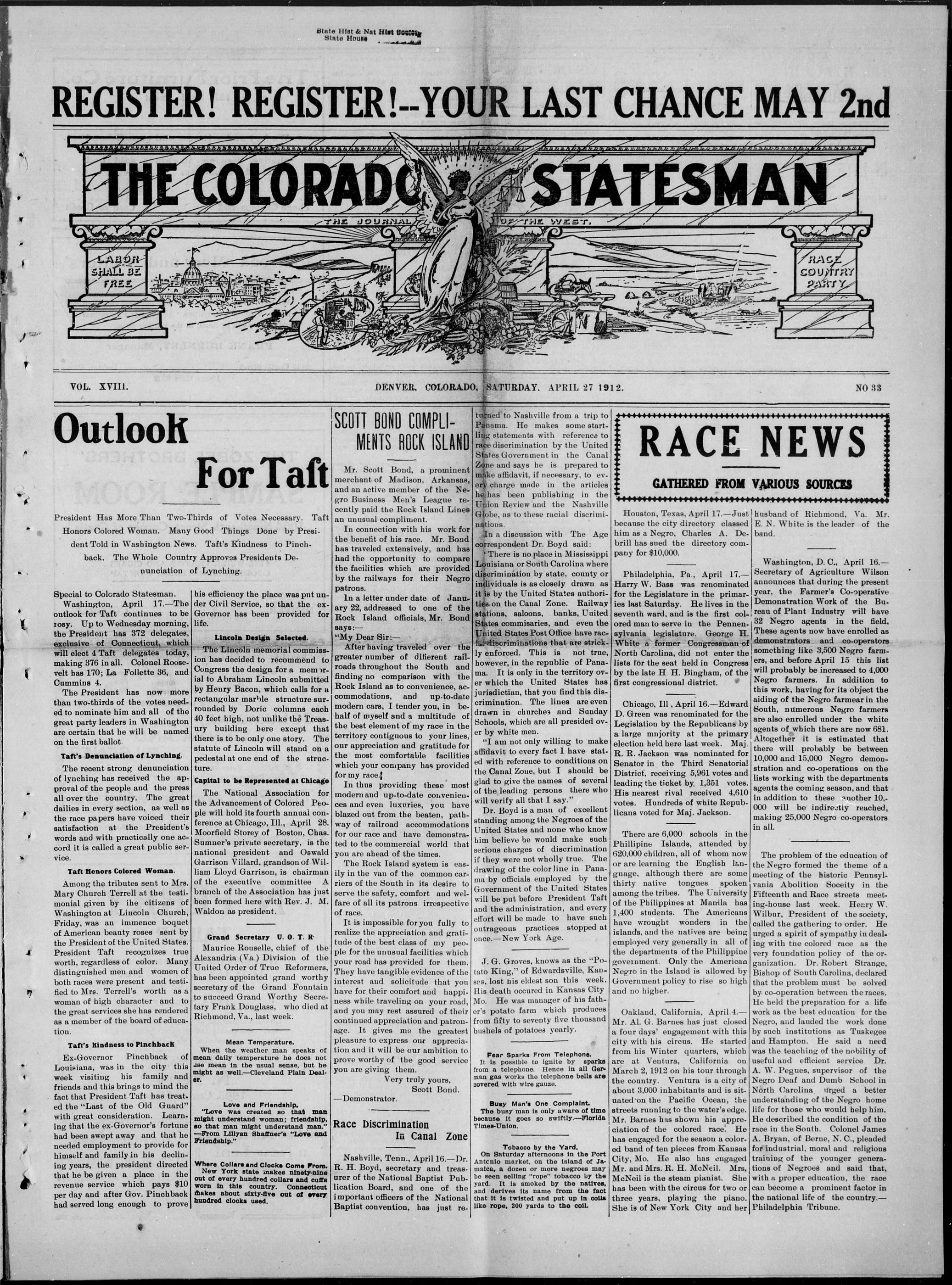
REGISTER! REGISTER!--YOUR LAST CHANCE MAY 2nd
THE COLORADO STATESMAN
THE JOURNAL OF THE WEST.
LABOR SHALL BE FREE
RACE COUNTRY PARTY
President Has More Than Two-Thirds of Votes Necessary. Taft Honors Colored Woman. Many Good Things Done by President Told in Washington News. Taft's Kindness to Pinchback. The Whole Country Approves Presidents Denunciation of Lynching.
VOL. XVII1.
Outlook
President Has More Than Two-T
Honors Colored Woman. Many
dent Told in Washington New
back. The Whole Count
nunciation
Special to Colorado Statesman.
Washington, April 17.—The outlook for Taft continues to be rosy. Up to Wednesday morning, the President has 372 delegates, exclusive of Connecticut, which will elect 4 Taft delegates today, making 376 in all. Colonel Roosevelt has 170; La Follette 36, and Cummins 4.
The President has now more than two-thirds of the votes needed to nominate him and all of the great party leaders in Washington are certain that he will be named on the first ballot.
Taft's Denunciation of Lynching.
The recent strong denunciation of lynching has received the approval of the people and the press all over the country. The great dailies in every section, as well as the race papers have voiced their satisfaction at the President's words and with practically one accord it is called a great public service.
Taft Honors Colored Woman
Among the tributes sent to Mrs. Mary Church Terrell at the testimonial given by the citizens of Washington at Lincoln Church, Friday, was an immense bouquet of American beauty roses sent by the President of the United States. President Taft recognizes true worth, regardless of color. Many distinguished men and women of both races were present and testified to Mrs. Terrell's worth as a woman of high character and to the great services she has rendered as a member of the board of education.
Taft's Kindness to Pinchback
Ex-Governor Pinchback of Louisiana, was in the city this week visiting his family and friends and this brings to mind the fact that President Taft has treated the "Last of the Old Guard" with great consideration. Learning that the ex-Governor's fortune had been swept away and that he needed employment to provide for himself and family in his declining years, the president directed that he be given a place in the revenue service which pays $10 per day and after Gov. Pinchback had served long enough to prove
For Taft
thirds of Votes Necessary. Taft
Good Things Done by Presi-
s. Taft's Kindness to Pinch-
y Approves Presidents De-
of Lynching.
his efficiency the place was put under Civil Service, so that the ex-
Governor has been provided for life.
Lincoln Design Selected.
The Lincoln memorial commission has decided to recommend to Congress the design for a memorial to Abraham Lincoln submitted by Henry Bacon, which calls for a rectangular marble structure surrounded by Doric columns each 40 feet high, not unlike the Treasury building here except that there is to be only one story. The statute of Lincoln will stand on a pedestal at one end of the structure.
Capital to be Represented at Chicago
The National Association for the Advancement of Colored People will hold its fourth annual conference at Chicago, Ill., April 28. Moorfield Storey of Boston, Chas. Sumner's private secretary, is the national president and Oswald Garrison Villard, grandson of William Lloyd Garrison, is chairman of the executive committee. A branch of the Association has just been formed here with Rev. J. M. Waldon as president.
Grand Secretary U. O. T. R.
Maurice Rouselle, chief of the Alexandria (Va.) Division of the United Order of True Reformers, has been appointed grand worthy secretary of the Grand Fountain to succeed Grand Worthy Secretary Frank Douglass, who died at Richmond, Va., last week.
Mean Temperature.
When the weather man speaks of mean daily temperature he does not use mean in the usual sense, but he might as well.—Cleveland Plain Dealer.
Love and Friendship
"Love was created so that man might understand woman; friendship, so that man might understand man." —From Lillyan Shaffner's "Love and Friendship."
Where Collars and Clocks Come From. New York state makes ninety-nine out of every hundred collars and cuffs worn in this country. Connecticut makes about sixty-five out of every hundred clocks used.
State Hist & Nat Hist Geography
State Houses
STER!--YOU
RADO
THE JOURNAL
DENVER, COLORAD
SCOTT BOND COMPLI
MENTS ROCK ISLAND
Mr. Scott Bond, a prominent merchant of Madison, Arkansas, and an active member of the Negro Business Men's League recently paid the Rock Island Lines an unusual compliment.
In connection with his work for the benefit of his race. Mr. Bond has traveled extensively, and has had the opportunity to compare the facilities which are provided by the railways for their Negro patrons.
In a letter under date of January 22, addressed to one of the Rock Island officials, Mr. Bond says:—
"My Dear Sir:
"My Dear Sir:
After having traveled over the greater number of different railroads throughout the South and finding no comparison with the Rock Island as to convenience, accommodations, and up-to-date modern cars, I tender you, in behalf of myself and a multitude of the best element of my race in the territory contiguous to your lines, our appreciation and gratitude for the most comfortable facilities which your company has provided for my race. In thus providing these most modern and up-to-date conveniences and even luxuries, you have blazed out from the beaten, pathway of railroad accommodations for our race and have demonstrated to the commercial world that you are ahead of the times. The Rock Island system is easily in the van of the common carriers of the South in its desire to serve the safety, comfort and welfare of all its patrons irrespective of race.
It is impossible for you fully to realize the appreciation and gratitude of the best class of my people for the unusual facilities which your road has provided for them. They have tangible evidence of the interest and solicitude that you have for their comfort and happiness while traveling on your road, and you may rest assured of their continued appreciation and patronage. It gives me the greatest pleasure to express our appreciation and it will be our ambition to prove worthy of the good service you are giving them.
Very truly yours,
Scott Bond.
—Demonstrator.
Race Discrimination
Nashville, Tenn., April 16.—Dr. R. H. Boyd, secretary and treasurer of the National Baptist Publication Board, and one of the important officers of the National Baptist convention, has just re-
turned to Nashville from a trip to Panama. He makes some startling statements with reference to race discrimination by the United States Government in the Canal Zone and says he is prepared to make affidavit, if necessary, to every charge made in the articles he has been publishing in the Union Review and the Nashville Globe, as to these racial discriminations.
In a discussion with The Age correspondent Dr. Boyd said:
There is no place in Mississippi Louisiana or South Carolina where discrimination by state, county or individuals is as closely drawn as it is by the United States authorities on the Canal Zone. Railway stations, saloons, banks, United States commisaries, and even the United States Post Office have racial discriminations that are strictly enforced. This is not true, however, in the republic of Panama. It is only in the territory over which the United States has jurisdiction, that you find this discrimination. The lines are even drawn in churches and Sunday Schools, which are all presided over by white men.
"I am not only willing to make affidavit to every fact I have stated with reference to conditions on the Canal Zone, but I should be glad to give the names of several of the leading persons there who will verify all that I say."
Dr. Boyd is a man of excellent standing among the Negroes of the United States and none who know him believe he would make such serious charges of discrimination if they were not wholly true. The drawing of the color line in Panama by officials employed by the Government of the United States will be put before President Taft and the administration, and every effort will be made to have such outrageous practices stopped at once.—New York Age.
J. G. Groves, knows as the "Potato King," of Edwardsville, Kansas, lost his eldest son this week. His death occurred in Kansas City Mo. He was manager of his father's potato farm which produces from fifty to seventy five thousand bushels of potatoes yearly.
Fear Sparks From Telephone. It is possible to ignite by sparks from a telephone. Hence in all German gas works the telephone bells are covered with wire gauze.
Busy Man's One Complaint.
Busy Man's One Complaint.
The busy man is only aware of time because it goes so swiftly.—Florida Times-Union.
Tobacco by the Yard.
On Saturday afternoons in the Port Antcnio market, on the island of Jamaica, a dozen or more negroes may be seen selling "rope" tobacco by the yard. It is smoked by the natives, and derives its name from the fact that it is twisted and put up in colls like rope, 200 yards to the coll.
RACE NEWS
Houston, Texas, April 17.—Just because the city directory classed him as a Negro, Charles A. Debrill has sued the directory company for $10,000.
Philadelphia, Pa., April 17.—Harry W. Bass was renominated for the Legislature in the primaries last Saturday. He lives in the seventh ward, and is the first colored man to serve in the Pennsylvania legislature. George H. White a former Congressman of North Carolina, did not enter the lists for the seat held in Congress by the late H. H. Bingham, of the first congressional district.
Chicago, Ill., April 16.—Edward D. Green was renominated for the Legislation by the Republicans by a large majority at the primary election held here last week. Maj. R. R. Jackson was nominated for Senator in the Third Senatorial District, receiving 5,961 votes and leading the ticket by 1,351 votes. His nearest rival received 4,610 votes. Hundreds of white Republicans voted for Maj. Jackson.
There are 6,000 schools in the Phillipine Islands, attended by 620,000 children, all of whom now or are learning the English language, although there are some thirty native tongues spoken among the tribes. The University of the Philippines at Manila has 1,400 students. The Americans have wrought wonders in the islands, and the natives are being employed very generally in all of the departments of the Philippine government. Only the American Negro in the Island is allowed by Government policy to rise so high and no higher.
Oakland, California, April 4. Mr. Al. G. Barnes has just closed a four days' engagement with this city with his circus. He started from his Winter quarters, which are at Ventura, California on March 2, 1912 on his tour through the country. Ventura is a city of about 3,000 inhabitants and is situated on the Pacific Ocean, the streets running to the water's edge. Mr. Barnes has shown his appreciation of the colored race. He has engaged for the season a colored band of ten pieces from Kansas City, Mo. He also has engaged Mr. and Mrs. R. H. McNeil. Mrs, McNeil is the steam pianist. She has been with the circus for two or three years, playing the piano. She is of New York City and her
NO 33
husband of Richmond, Va. Mr. E. N. White is the leader of the band.
Washington, D.C., April 16. Secretary of Agriculture Wilson announces that during the present year, the Farmer's Co-operative Demonstration Work of the Bureau of Plant Industry will have 32 Negro agents in the field. These agents now have enrolled as demonstrators and co-operators something like 3,500 Negro farmers, and before April 15 this list will probably be increased to 4,000 Negro farmers. In addition to this work, having for its object the aiding of the Negro farmear in the South, numerous Negro farmers are also enrolled under the white agents of which there are now 681. Altogether it is estimated that there will probably be between 10,000 and 15,000 Negro demonstration and co-operations on the lists working with the departments agents the coming season, and that in addition to these another 10,000 will be indirectly reached, making 25,000 Negro co-operators in all.
The problem of the education of the Negro formed the theme of a meeting of the historic Pennsylvania Abolition Society in the Fifteenth and Race streets meeting-house last week. Henry W. Wilbur, President of the society, called the gathering to order. He urged a spirit of sympathy in dealing with the colored race as the very foundation policy of the organization. Dr. Robert Strange, Bishop of South Carolina, declared that the problem must be solved by co-operation between the races. He held the preparation for a life work as the best education for the Negro, and lauded the work done by such institutions as Tuskegee and Hampton. He said a need was the teaching of the nobility of useful and efficient service Dr. A. W. Pegues, supervisor of the W. Negro Deaf and Dumb School in North Carolina, urged a better understanding of the Negro home life for those who would help him. He described the condition of the race in the South. Colonel James A. Bryan, of Berne, N. C., pleaded for industrial, moral and religious training of the younger generations of Negroes and said that, with a proper education, the race can become a prominent factor in the national life of the country. Philadelphia Tribune.
THE WORLD IN PARAGRAPHS
4 BRIEF RECORD OF PASSING EVENTS IN THIS AND FOR-EIGN COUNTRIES.
IN LATE DISPATCHES
DOINGS AND HAPPENINGS THAT
MARK THE PROGRESS
OF THE AGE.
Western Newspaper Union News Service.
WESTERN.
Bishop McGovern of Omaha has
been formally installed as bishop of
the Wyoming diocese at Cheyenne.
Three trainmen were instantly killed
when the boiler of a locomotive on
the Western Pacific railroad blew up
near Elko, Nev.
In ten Kansas counties which held
primaries or conventions Roosevelt
forces won in nine and one will send
a split delegation.
Robert Cameron Rogers, poet, lover of nature, journalist, true friend, is dead. He died at his beautiful home in Mission cañon, Santa Barbara, Cal.
Corrected tabulations of the Nebraska presidential vote give: Roosevelt, 31,242; Taft, 10,692; La Follette, 10,279; Clark, 14,031; Harmon, 11,241; Wilson, 9,860.
Forty-seven passengers, all but one citizens of the United States, who arrived in Galveston from Vera Cruz, Mexico, on the steamer Texas, tell of alleged torture and assassination of Americans in Mexico.
Because the foot of his horse exactly matched a plaster of paris cast of the footprint of the horse driven to the spot near Nowata, Okla., where Mrs. Irene Gohen was murdered recently, H. O. Jeffries, editor of the Nowata Advertiser, has been arrested charged with killing the woman.
Word that the fugitive leaders of the Allen gang from Carroll county, Virginia, were headed for southern California, if not already there, has created much activity in the sheriffs' offices of the Los Angeles section of the state. Los Angeles police believe they have arrived.
Work will be begun May 1 by the Chicago, Milwaukee & Puget Sound railway on the construction of a three-mile tunnel through the Cascade mountains near Seattle. The work will cost nearly $5,000,000. The tunnel will shorten the line seven miles and will eliminate the heavy grade at the summit.
Declaring that unless the trouble of the railway carmen, who have been on a strike on a western railroad for several months was mediated, a strike of more than 300,000 shopmen and machinists employed on all western railroads would be called, the officers of the Federation of Federations sent a telegram to President Taft advising him of their intentions. The message was signed by the presidents of twelve unions.
A movement has been started in the Baptist churches of Denver to establish free tuberculosis sanatoriums in various parts of the United States with headquarters in Denver. Funds for establishing the institutions are to be raised by the unique plan of assessing the 5,000,000 Baptists of the United States 10 cents each annually. Articles of incorporation have been filed in the office of the secretary of state of Colorado for the American Baptist Tuberculosis Association. A campaign for funds will be launched immediately. It is planned to have a research station connected with each institution for the study of the causes and prevention of the disease.
WESTERN LEAGUE STANDING.
Clubs— Won, Lost, Pct.
St. Joseph 4 1 .800
Benver 3 1 .750
Topeka 3 2 .600
Wichita 3 2 .600
Omaha 2 2 .500
Des Moines 2 3 .400
Shoux City 1 3 .250
Lincoln 0 4 .000
Ad Wolgast and Joe Rivers have signed an agreement to box twenty rounds for the lightweight championship of the world at Vernon arena, Los Angeles, July 4.
Every team in the Western circuit began its 1912 season Friday, April 19, and in three bames out of four, the home nines won. Omaha defeated Sloux City; St. Joseph beat Des Moines, Denver beat Lincoln and Wichita was the exception to the general rule, defeating Topeka on the latter's grounds.
Pat McIntire of Cleveland has offered Kilbane $15,000 for a twelve-round battle with White. Kilbane says he will take the money providing some other opponent is picked. McIntire says White is the man. Kilbane says nix. And there is where the thing stands now.
FOREIGN
In future women will not be engaged in the Canadian civil service save as stenographers and typewriters, according to a recent ruling.
The relief funds being raised in London for the assistance of the sufferers by the Titanic disaster now amount to upwards of $700,000.
WASHINGTON.
Harry A. Wheeler of Chicago was elected president of the National Chamber of Commerce of the United States.
A bill to provide medals of honor for Captain A. H. Rostron and officers of the Carpathia has been introduced in the House.
Resolutions authorizing $10,000 appropriations for the families of each of the three United States postal clerks who lost their lives on the Titanic, were introduced in the House by Representative Reilly of Connecticut.
Senate and House committees of Congress are now hard at work on the Smoot pension bill, an amended form of the Sherwood bill, which passed the House and was in every feature acceptable to the old soldiers of the country. The Smoot measure was substituted in the Senate for the Sherwood bill.
The seriousness of the inquiry by the Senate investigating committee into the Titanic disaster was disclosed when Senator Smith of Michigan, the chairman, at first flatly refused to let any of the officers and the two hundred-odd members of the crew of the sunken steamship get beyond the jurisdiction of the United States government. The men were all to have sailed on the steamer Lapland. Later it was settled that the greater part of the crew would be permitted to sail on this steamer, but that the twelve men and four officers among the survivors now under subpoena, together with Mr. Ismay, would not be allowed to depart.
The Senate passed bills previously passed by the House, extending the time within which to make proof on desert land entries for three years in cases where through unavoidable delay in the construction of irrigation works, the entryman, without fault of his own, is unable to get water on his land within five years; extending the provisions of the surface entry law to coal lands within state selection, and providing that an entryman under a government reclamation project shall not forfeit his entry on account of absence prior to the date the government furnishes water for its irrigation. The Senate also passed Senator Guggenheim's bill appropriating $25,000 for establishment of a fish cultural station in Colorado, the site to be selected by the Department of Commerce and Labor.
GENERAL
With dramatic suddenness the Senate investigation of the Titanic disaster came to an end so far as the New York hearing was concerned. It has been resumed in Washington.
Insurance men estimate that the total losses to be paid by the various life, accident and marine companies as a result of the sinking of the Titanic will reach approximately $15,000,000. Some companies have been hard hit.
The directors of the Denver & Rio Grande railroad, at a meeting in New York, authorized the execution of a $25,000,000 mortgage on the property of the railroad to secure the recent bond issue. The stockholders will be called on to ratify the execution of the mortgage at a meeting in Denver.
The tender of the "friendly offices" of representatives of the federal government has called a temporary halt to a strike of railroad engineers in the territory east of Chicago and north of the Potomac river, in which it is estimated 52 per cent of the railway traffic of the entire country is handled.
The "king of beggars" is in New York and under lock and key. In possession of a fortune—as some fortunes go—he was picked up on charges of intoxication and disorderly conduct. He calls himself the "king of beggars" and had no objection to telling the police of his career. In Cleveland recently he gathered up $17,000 from sympathetic auditors and the Probate Court of that city appointed a guardian to look after his money.
News from the flooded area of the Mississippi valley in Arkansas, Mississippi and Louisiana continues increasingly grave. Thousands of those who were compelled to flee to higher places when the flood invaded their homes have been cared for, but there are many more in need of aid. It is estimated that fifty towns and villages have left the effects of the flood. Some places are under two to fifteen feet of water. In all 200 lives have been lost.
From the scene of the wreck of the Titanic comes the news by wireless that sixty-four bodies of victims have been recovered and are now on board the cable ship Mackay-Bennett, which is searching the entire region where the catastrophe occurred. Dispatches were mengre, but it was indicated that the sixty-four bodies are possible of identification. Others, the messages say were found impossible of identification and were buried at sea. How many of these there were is not even hinted at.
Five persons were robbed of money, or valuables, or both, by three masked men who went through the sleeper Nottingham of the Rock Island's westbound Golden State Limited, at Sheffield, Ill., forty miles east of Moline. One passenger was robbed of $1,200.
Thirty-two persons are known to be dead, half a score are so severely injured they may die, and a hundred and fifty others were hurt in two tornadoes which swept over southern Illinois in one instance, and across northern Illinois into Indiana in the other.
All Parts of the State
Western Newspaper Union News Service.
COMING EVENTS IN COLORADO.
May 6-11.—State Y. M. C. A. Convention.
Pueblo.
June 18-20.—State Sunday School Convention, Colorado Springs.
June 11-July 19.—Summer Term, State Teachers' College, Greerley.
Baptists Would Bar Nuns.
Denver. - Resolutions protesting against the employment of Catholic nuns in government Indian schools were adopted by the executive board of the Colorado Baptist state convention.
Pioneer Accidentally Killed.
Pueblo.—While experimenting with a shotgun, William A. Kienzha, a pooner, who had lived the life of a recluse at Beulah, thirty miles west of this city, accidentally discharged the weapon and was probably instantly killed.
Colorado Pioneer Dies.
Colorado Springs.—F. E. Dow, founder of Green Mountains Falls, and for thirty-nine years a resident of this city, of which he had been twice mayor, twice clerk and three times treasurer, died at his home after an illness of seventeen months.
To Resume Railroad Building.
Meeker.—It is reported that the construction work on the Larimere, Hahn's Peak & Pacific railroad will be resumed on the first of May. All winter gangs have been working on the tunnels, and a great amount of this work has been completed.
Express Employe Suspected.
Grand Junction.—While detectives and secret operatives, working on the Globe Express robbery case, refuse to divulge results, it is admitted that evidence of a damaging nature had been collected against an express employee and that his arrest would follow.
D. & R. G. Train Wrecks; 6 Injured.
Montrose.—The eastbound narrow gauge passenger train of the Denver & Rio Grande was wrecked on Cedar Hill, three-quarters of a mile from Cimarron. All three coaches of the train were derailed and thrown over on the side against the embankment. Six passengers were badly injured.
Fifteen-Year-Old Boy Suicides.
Trinidad.—Investigation has established that Dwight George, the 15-year-old son of J. D. George, prominent resident of Hoehne in the Sunflower valley and who died at the home of his grandparents in Pueblo, committed suicide by drinking an ounce vial of strychnine.
Predatory Animals Becoming Extinct.
Meeker.—That predatory animals for years the bane of the stockgrower, are rapidly becoming extinct, is evidenced by the quarterly report of the Rio Blanco county's treasurer, just issued. This shows 186 of the pests killed, or a little more than two a day. They were wolves, lions and coyotes.
Gilcrest May Get Saloon.
Gilcrest.—The accidental omission of the liquor clause in a deed to a town lot belonging to Mayor Gilcrest, may bring about establishment of a saloon here, by Andrew Lang, mayor of Platteville. When the Gilcrest Townsite Company deeded its property to purchasers, a clause prohibiting the sale of liquor was included in all but one deed.
Idaho Springs Men on Titanic.
Idaho Springs.—Two former residents of Idaho Springs and Freeland, Harry and Shad Gale, both single, and brothers of Enoch Gale of this city, who were returning to this camp after a long visit to their old home in Cornwall, were passengers on the ill-fated Titanic, and their names do not appear upon the list of those rescued by the Carpathia.
Novel Irrigation Experiment.
Meeker.—An unusual irrigation project, which is being watched by the Western slope with interest, is being tried on what is known here as Blair mesa, twenty-seven miles from Meeker. The major part of the land on this mesa — 800 acres — is owned by Phelps brothers. It is unusually good land, the soil being rich, but it has been impossible to get water to it by ditch from any stream of the county, with the result that the land remained vacant until the Phelps brothers filed on it. The idea of the brothers is to install a turbine pumping plant, with canals and interals, which will automatically raise the water to the level of the land and then distribute it evenly.
Boulder After Match Factory.
Boulder.—The Diamond Match Company will establish five branch factories this year to save the big expense of shipping their goods here from the East. The Boulder Commercial Association is making a strong bid for one of the factories, having offered a building site, and several thousand dollars in stock. A representative of the company will be in Boulder within the next few days to look the situation over.
Small Happenings Occurring Over the State Worth While.
On Arbor Day over 20,000 trees were planted in Denver.
The President nominated Walter I. Burke as postmaster at Sterling.
M. C. McKenzie, a rancher of Yuma county, died at a hospital in Denver.
The Loveland Civic Extension Club has plans on foot for beautifying that city.
The ministers of Colorado Springs are still at work on the proposed Sunday closing ordinance.
A considerable quantity of seed has been delivered to the needy farmers of the Sterling district.
There will be at least a quarter of a million trees and shrubs set out in Otero county this spring.
The first annual banquet of college men of the Western Slope was recently held at Grand Junction, Colo.
Dr. H. W. Kirby of Georgetown has been appointed to the state board of health by Governor Shafroth.
The first Labor Temple west of Omaha is being planned by the Trades and Labor Assembly of Pueblo.
Peter Campon, nineteen years old, was drowned while swimming in the lake at Central park in Trinidad. Forty suspects arrested in connection with the Globe Express robbery at Grand Junction have been released.
Miss Margaret O'Hearn, a teacher of Johnstown, is under arrest charged with whipping a ten-year-old boy with a horsewhip. A small tornado swept the country near Sterling recently and destroyed considerable property and killed many chickens. Apples in the vicinity of Boulder have been damaged 75 per cent by freezes, and cherries and other fruits are said to be a total loss. Subscriptions to date to the Commerce Investment Company for the relief of the destitute farmers of Eastern Colorado total $8,261.50. Work on the excavation and foundation of the new opera house at Idaho Springs is progressing rapidly with a big force of men and teams.
That Pueblo is to have a new $100,000 Pantages theater is the statement made by Harry Beaumont of Denver, district manager of Pantages circuit.
The Senate public buildings committee reported favorably Senator Guggenheim's bill appropriating $10,000 for public building site at Monte Vista.
In a report to the Board of County Commissioners Jack Kent of Nunn recommends that the county send $500 to supply farmers of that section with seed.
If a special election held six years ago, at which it was voted to bond Johnstown for a $20,000 water plant is valid, that town will at once install the plant.
The fruit growers of the Uncompahgre valley are to be forwarned against the coming of Jack Frost this spring through the efforts of the United States weather bureau.
At a meeting of the Weld county baseball league, held in Greeley with representatives from six teams present, a schedule which embraces thirty games was arranged for the season.
Articles of incorporation of the Larimer County Fair Association have been filed in the office of the county clerk at Fort Collins. The capital is $20,000, divided into 2,000 shares at $10 each.
Owing to a crowded District Court docket at Fort Collins, Judge Graham has called upon District Judge Teeler of Denver to assist him, and two courts will be held until the docket is cleared.
Mrs. Maggie Stoneking, widow of James Stoneking, electrocuted by accident March 21 at Greeley, has filed suit for $5,000 damages against the Home Gas & Electric and Northern Colorado Power companies.
Dry land farmers in the vicinity of Nunn have sent a representative to the county commissioners to petition for funds for seed. The farmers ask for Mexican beans, millet, corn and cane, and believe $500 will purchase sufficient seed.
The federal authorities have just brought about the arrest of M. E. and L. A. Hill—known as G. L. Lee & Co—in Salida, Colo. They are charged with using the mails to sell marked cards, loaded dice, "holdouts" and "waxed palms."
Denver is to be the gathering place during the next few weeks of members of the Industrial Workers of the World who are bound for San Diego to take a hand in the war being waged between the organization and the city authorities.
At a meeting of the directors of the Greeley Commercial Club and the Weld County Farmers' Club, Ward Darley, a sugar factory promoter, was practically pledged 6,000 acres of sugar beets. Farmers believe that they should secure more money for their beets and the Commercial club is pledged to render every aid to them to secure a factory. Fruit prospects in the Cañon City district wer never better at this season of the year. Every indication points to a bumper crop of practically all kinds of fruit.
The Prior Furniture Co. 1814 Curtis Street
We buy and sell new and second hand Furniture, also repair work. Window shades. Sewing Machines sold and repaired a specialty.
Phone Champa 392
Railroad M
We lead, others foll
Men. A welcome t
and papers will be
FRANK H
Broad Men and Ward Club
ead, others follow. Home for Railroad and
A welcome to visitors. All the latest mag-
papers will be found in the Library room.
FRANK BURNLEY, Manager
Lis Street De
Phone Main 8232
THE ZOBEL BROTHER
SAMPLE ROOM
Nineteenth Street, Corner of
We lead, others follow. Home for Railroad and Club Men. A welcome to visitors. All the latest magazines and papers will be found in the Library room.
2149 Curtis Street
THE ZOB
SAMP
1004 Nineteenth
1004 Nineteenth Street, Corner of Curtis
FINE WINES, LIQUORS AND CIGARS
COORS' CELEBRATED BEER ON TAP
DENVER CO
R COD
Guaranteed Absolutely Pure. Delivered Daily to All Parts of the City.
N. FERRY TAILOR
Who pays the high up-town rent?
Is it the tailor? No!
Just guess who it is---
The Customer
Give us a chance and we will give you the satisfaction. Our Spring and Summer Styles are all in Our prices are moderate. We do all sewing in our shop.
Cash or Credit
Waiters'
road and Club
test magazines
room.
manager
Denver, Colo.
THERS'
BOOM
er of Curtis
Home Industry
AFRU-AMERICAN CULLINGS
‘The planet Mars is fourth of the ma-
Jor planets, next beneath the earth,
4nd 141.5 million miles from the sun,
the earth being 92.5 million miles from.
the sun. M. Edmund Perrier, a mem-
der of the French academy, has drawn
@ pen sketch of a citizen of Mars,
which looks very much like our water
Dullfrogs of the green color, mostly
head; body and arms, with little legs
and those of the pipe reed sort. Of
the people of Mars M. Perrier says:
“The low atmospheric pressure has
produced a considerable development
of the pulmonary apparatus, and con-
‘sequently the general character of
these Martian vertebrates has been in-
fluenced by this development which
43 unknown on the earth. The men
of Mars are tall because the force of
gravity there is slight; blonde, be-
cause daylight is less intense there;
with perhaps less powerful limbs, they
have some of the characteristics of
our Scandinavian type, although they
probably have larger skulls. Their
large eyes (blue); their strong noses,
their large ears, constitute a type of
‘beauty which we doubtless would not
appreciate except as suggesting a su-
perhuman intelligence.” ‘The company
of the Martians, M. Perrier admits,
would be objectionable to the elegant
pedestrians who throng the French
Doulevards. “But Mars 1s the coun-
try of beauty,” M. Perrier concludes,
“and the Martians know the most no-
ble intellectual satisfactions and the
suayest emotions.” We are surprised
to find by what M. Perrier says of his
study of the people and conditions in
‘the planet Mars that there are no
plack people in the population. The
fact that they are all blondes,
with blue eyes, and with some of the
characteristics of our Scandinavian
type, who live in the extreme north.
and are descendants of the Vikings,
the flerce Norsemen of European his-
tory, who were giants in their day,
contemporary perhaps with the giant
‘anaks of the south, the ancestors of
‘the Ethiopians, whose capital was Kar-
nac, the ruins of which are objects of
interest in the Nile river country,
Seems to bear out the statement that
‘there are no black people in the plan-
et Mars. Still, the matter is of too
much importance to decide without.
exhaustive investigation. The French
and German scientific and philosoph-
deal mind is so devoid of color preju-
dice in estimating facts that we are
sure M. Perrier will take kindly to our
suggestion that he scrutinize more
critically the color of the cuticle and
eyes of the inhabitants of Mars, with
the view of ascertaining if there be or
be not any black people there. We
do not care to believe that there are
no black people in the planet Mars, as
we may have to go through it on the
way to the center of the earth, where
heaven is located, Mars really being
the first station from the earth on the
way to the sun. We would like to
have the point settled before we are
to begin the journey. If there are
no vlack people in the planet Mars,
and if the inhabitants of it hold to the
prejudice against black people that
the white people of the earth do, it
‘Will be seen at once that black pleople
who go to heaven by way of Mars
have an unsuspected fight before
them,
The problem of furnishing employ-
ment for negro boys and girls who
are preparing themselves for efficient
service, recently came home to a cer
fain ministerial friend of ours. The
problem was regarded as one of sut-
ficient importance for him to mention
it in a sermon and to urge his congre-
gation to unite their efforts to the end
that thelr boys and girls might have
a job after they have finished their
schooling, “My boys,” he said, “grew
up and played with the white boys
of the community, each went to his
own school, each went off to his own
college, finished up and returned home,
Jobs were waiting for the white boys
—there was nothing for my boys to
do.” The problem, you see, after look-
ing vaguely tn the distance, had finally
invaded his nelghborhood—his street
—his home! It is seen then that the
man who, by his words and actions,
is doing anything towards making this
problem less acute, is in reality a
Jeader and benefactor of the race—
Dallas Express.
Negro business and professional
men who make thelr money working
for members of their race, and who
seek Negro patronage when their own
Business 1s concerned, should also
sec to it that they and their families
patronize other Negro business men.
Preachors and physicians, for {n-
stance, who are almost if not wholly
supported by members of their race,
should buy their horse feed from ne-
gro merchants and their clothes from
Negro tailors and clothiers and see
to it that their wives and children
buy their shoes from Negro shoe deal-
ers. Negro secret societies should
take the hundreds thousands of dol-
Jars they have lying idle in white
banks and deposit it in Negro banks
where the profits accruing from the
use of this money will be saved to the
advantage and enrichment of the Ne-
Bro race. Negro business men must
patronize each other and in this way
set an example to the thousands of
our people whose patronage they
@eek.—The Colored Alabamian.
Evil habits, like diseases, are con-
tagious; and, if left to thelr ravages
unchecked, will, ere long, consume
their victims. The first Indulgence
may be slightly partaken; but the
habit Increases with practice, and
gains a firmer foothold with each
passing day. When error becomes so
bold by continual adherence, that it
ceases to regard public sentiment, the
participant, therein has advanced a
stage from which redemption is most
difficult; and the infectious one be-
comes a disgusting nulsance, and a
dangerous adjunct to society. Human
interests suffer from contact with
such elements, and the law abiding
are forced to feel the sting of criticism
which their hideous conduct engen-
ders. When self-respect shall have de-
parted from individual breast, there is
none in store for his neighbor; and
the courtesy which otherwise might
be accorded is withheld from lack of
honor. It proves a burdensome task
to correct abuses which have become
long standing; and efforts put forth
in that direction are often futile un-
dertakings. The condition of things
prevailing in this city is sufficient to
cast a mantle of shame over integrity
of their household, and the faces of all
who reverence the wish for the future
upbullding of {ts inmates. Covington,
from an intellectual point of vantage,
is pre-eminent in this section among
the cities of its size; and few there
be if any to equal it Jn general con-
fusion, particularly among the young-
er element of the male population.
Wofully wanting in aspiration, there
is naught of the finer sentiment to
which appeal may be successfully
made; and every deed performed, ap-
parently travels toward destructive
ends. The cause for these commis-
sions does not rest, wholly, to their
beginning; nor should they be whol-
ly blamed for many things existing;
because In many instances the unman-
ly acts which disgrace the community
and blight the future prospects of the
coming generation are the inglorious
fruits of hideous examples. The pul-
pit part of the responsibility for this
cannot be exonerated from a preva-
lence of affairs. It 1s not to be inferred
that {t advised or condoned it, but
the public has been educated to base
religion upon sentiment; and without
affecting it, left deeds to individual
acceptance. Such teachings have giv-
en birth to scandal mongers, slander-
ers and friction breeders, among the
old; carousers, drunkards, and — pro-
fessional reprobates among the young.
In most instances, voluntary actions
bespeak tho heart’s desires; and what-
ever one accomplishes from his own
free will is the conjuring of his
thoughts. Nothing undefiled can flow
from the source of impurities, what-
soever might be our opinions _re-
specting it; and {t would be well to
proclaim the truth in order to remove
obstructions. It 1s {mpossible to cor-
ral the wandering sheep while the
lambs within the fold are at varlance
with each other. The church fs in the
individual, not the structure in which
he worships, and whenever this les-
son can be properly. instilled into the
minds, and become firmly imbedded in
‘the cons‘ ence of professed believers
theory will give the right of way to
practice; and assumption, to reality.
It very often happens that an ailment
exists, and we know the cause there-
of; but, we fail to apply tlie remedy,
even though we be aware that the ap-
plication would effect a cure. The so-
clal life of the colored population here
is endangered by the continuous in-
roads of irresponsible characters, hay-
ing nothing to lose; and before we at-
tempt to win them their errors it 1s
necessary to be free, ourselves, and
live In peace with our neighbors.—
Metropolitan Phalaux, Atlanta.
The statistics of aaticulture for
The statistics of agriculture for
North Carolina have just been recetv-
ed and the lght thrown on the condi-
tion of negro farmers in the state is
indeed most gratifying. The negroes
of the state own 65,000 farms with a
total valuation of $81,425,000. There
is also shown a clear gain during the
last ten years of $52,000,000. In oth-
er words, the negro possessed only
about $29,000,000 in farm property in
1910. In order to make these figures
still more encouraging, it 1s to be
noted that the percentage of increase
for negro farmers is 181 while that
for the entire state Including all races
4s only 130 per cent. If this means
anything it means that the negroes of
the state are buying farms 50 per
cent. faster than any other element of
the population. One calamity howler
says that the negro 1s dying out; an-
other says he {s shiftless and improvi-
dent, but it appears that neither has
carefully examined the record of ne-
gro achievement in land buying and
home building in this and other states
of the south, All he needs {s a man’s
chance to make history. Who says
nay ?—Exchange.
Are you sure that you are in earn-
est about what you say, and that you
are trying from an honest heart to do
the thing that is right, or are you do-
ing what you are from a selfish mo-
tive? Think the matter over and de-
cide for yourself before you go too
far along that Mne—The Interstate
Reporter.
PROGTOR SUGGESTS THREE
WAYS TO HELP NEGROES
KEEP GLEAN
Atlanta, Ga.—Rey. H. H. Proctor in
his prelude at the First Congregation-
al church, colored, spoke on “Some
‘Things That Would Encourage the
Colored People to Take Part in the
Campaign to Clean Up the City.”
‘Among other things, he said:
“In addition to what 1 sald last Sun-
day night in reference to the impor-
tance of our taking part in the cam-
palgn for a cleaner city, I wish tonight
to make three suggestions, which, if
followed, would encourage our people
to take active part in this campaign.
“The first 1s to pave the back al-
leys and provide them water and sew-
er connections. A half-million dollars
spent in this direction would be one
of the best investments our city could
make. The people of the alleys and
those of the front street are bound up
together, for it 1s these alleys that
furnish most of the people who wash,
cook and nurse for the richest people
of the city.
“The second 1s to put in the more
thickly-populated sections, where ne-
groes live, a chain of public bath
houses, where the masses of the race
may have a chance at personal,
physical cleanliness. ‘This is done for
foreigners in Cleveland, O., and for
blacks in Baltimore, Md. Because of
the lack of facilities in many negro
houses it {s Impossible to keen clean.
“The other 1s to open in this city a
school for domestic servants, where
the principles of practical hygiene and
sanitation may be taught in a simple
and effective way. The colored people
hold in their hands the health of this
city, and they should be taught how
to meet the great responsibility that
‘Js theirs tn this respect, It the peo
ple of Atlanta will stand by me, I have
/@ plan by which T can open a schoo!
lke this In this city within the next
| ninety days.”
JUDGES HAVE AGREED TO NAME
HER REGULAR PROBATION OF-
FICER—HAS DONE EFFECTIVE
WORK FOR NATIONAL LEAGUE.
FOR THE PROTECTION OF COL-
ORED WOMEN.
New York.—New York city ts soon
to have a colored regular probation of
ficer in the person of Miss Grace
Campbell, who has been doing some
effective probation work for the Na-
tional League for the Protection of
Colored Women.
Several days ago Miss Hlizabeth
Walton of the league had a conference
with Judges Crain, Mulqueen, Rosal-
sky and Swann on the probation ques-
tion and during their talk the judges
stated that Miss Campbell had done
such effective work they thought it
wise to appoint her as a regular pro-
bation officer. Miss Walton, on be-
half of the league, recommended Miss
Campbell for the appointment, which
will probably be made when the pres-
ent court has a meeting of the judges.
THE WOODS PASTURE.
__ In many sections of the country, in
naturally wooded districts, there Is
“much woodland now not under fence,
and it 1s of very small value to the
owners because It {s not used to the
best advantage. On the farm where
a portion is in mixed timber or brush
this area could be made to yield a
considerable annual profit by using the
same as pasture land for hogs, sheep,
young stock and for any of the farm
animals for a rest and change. In
summer the woods pasture in connec-
tion with an open pasture is appre-
ciated by the animals as a retreat
from the hot sun during the middle
of the day in midsummer. It ts good
“hog range at all seasons.
Land with a thick growth of trees
‘or bushes will not produce any for-
“age crops of consequence owing to the
‘dense shade and the soil being fully
occupied with tree roots. The woods
pasture for nutritious forage should
be thinned out so that the sun can
shine upor. most of the ground at some
time of the day. Light and free air
are necessary for grass and other
low plant growth. By thinning out the
underbrush and undesirable growth,
grass and other useful forage plants
will have a chance to grow, and the
remaining good trees will fare better.
Such a pasture will not support as
many animals as an open field or the
same area and fertility, yet it offers
protection in the heat of summer and
the cold of winter. The grazing an|-
mals will aid in keeping the brush
and sprouts down, and in time, with
seeding, such woods will become a
beauty spot of the farm, as well as
yielding profit. Wood meadow grass
thrives in such locations, Bluegrass
and some others will do fairly well
when not pastured too heavily.
A “FOWL” BALL.
A ball game between two semi-pro-
fessional teams, one colored, was play-
ed on the North side and attracted a
numerous following of negroes, who
went a long way to root for their
team. ‘They occupied a section by
themselves.
A foul ball went in among them and
did not come back, causing a red-
haired contender to go to that part of
the stand and yell:
“Throw that ball back! What do
you think it is—a chicken?"—Chicago
Post
PRETTY SOUTHERN PORTIA
FIGHTING FOR NEGRO’S LIFE
New York.—It was a very natty and
very confident Portia who appeared
before Judge Swann in general ses-
sions, She was Lucile Pugh, bar-
rister, and she came to plead tho
cause of an ink black negro, soon to
be tried on the charge of murder in
‘first degree. Miss Pugh had been as-
signed by Judge Swann as counsel for
the black man at the latter's urgent
‘solicitation, and for the first time in
‘the history of criminal procedure in
‘this city a woman will conduct the
‘defense of a man on trial for his
Ute.
Leroy Poindexter is the prisoner
who has given his life into the hands
of this brown-haired, bright-eyed lit-
tle woman. “She knows all my folks
down in North Carolina,” he said,
“and she'll be very careful for me.”
Poindexter is charged with having
shot and killed Thomas Brown, a
white man, during a quarrel over a
crap game on March 7.
When the negro was arraigned be-
fore Judge Swann to plead to the in-
dictment yesterday, he said he had
no counsel, nor money to hire one.
“But, judge, {f you all send for Miss
Pugh and ask her to be my lawyer,
Ah'd be mighty obliged. She's the
best lawyer in this town and she
knows me and knows how to treat a
No'th Cyarlina nigger.”
Judge Swann summoned Miss Pugh
to his chambers and asked her if she
felt capable of conducting Poindexter’s
defense. Miss Pugh said confidently
she had been practicing law since she
graduated from the New York Unt-
versity Law school in 1908; that she
had supreme court and also one min-
or criminal case. She didn’t see any
Teason why she should not be assign-
ed as counsel for Poindexter.
“The man needs someone who will
have sympathy for him,” sald Miss
Pugh, “and since he seems to have
such confidence in me I should be the
one to conduct his defense.”
Whereupon Judge Swann assigned
Miss Pugh as leading counsel for the
negro and he also assigned State's
Senator James D. McClelland as asso-
clate counsel.
When Poindexter was led into
Judge Swann’s court again to make
his pleading under advice of counsel,
Miss Pugh was there waiting.
The negro’s eyes opened wide with
gratitude when he saw the slender lit-
tle woman standing by the side of the
counsel's desk, and he mumbled some
words of thanks. Then this latter-
day Portia stood by the side of the
black man to make her initial address
in his behalf to the court.
Lucile Pugh, barrister; is only 26
Years old, and of slight, petite build.
She is a North Carolinian.
Miss Pugh’s address to the court
was brief. She said in very crisp and
business-like fashion that she had not
had time to read the indictment
‘through, nor had she seen the records
of the coroner's jury in the case. She
| would ask the indulgence of the court,
‘therefore, to permit her to enter a
plea of “not guilty” with freedom to
withdraw that plea and substitute an-
other within ten days.
“Granted, sald the judge, with his
most courtly bow.
PHILADELPHIANS ORGANIZE
INTEREST IN NEGRO BUSINESS
LEAGUE REVIVED — LEADING
PROFESSIONAL AND BUSINESS
MEN OF QUAKER CITY PER-
FECT ORGANIZATION—DR. A. B.
JACKSON ELECTED PRESI.
DENT.
Philadelphia, Pa.—The Philadelphia
branch of the National Negro Bust:
ness league was revived after hav-
ing been dormant for some few years.
Through the efforts of Dr. A. B, “Jack-
son, several gentlemen had been got-
ten together during the previous week,
and they met again and formed a per-
manent organization.
They elected the following officers:
President, Dr. A. B. Jackson, vice-
president, E. C. Dawkins, groceries
and provisions; auditor, C. Thomas,
real estate; secre‘ary, John W. Har-
ris, real estate; treasurer, C. K.
Brown, produce. The executive com-
mittee consists of the following: Dr.
H. M. Minton, chairman; Hon, Har-
ry W. Bass, attorney-atlaw; William
Geary, interior decorator; Charles Bol-
den, hotel proprietor; P. H. Sumner,
printer, and John A. Austin, cigar
manufacturer.
Others present were ©. R. Taylor,
insurance and printing; P. V. Baugh,
printer; F. Martin{, grocer; C. D, Hol-
comb, coal; R. B. Boger, cigars, and
George M. Geary, interior decorator.
A constitution and by-laws were
adopted and arrangements are being
made for a mass meeting to be held
on the first Thursday evening of next
month at the committee rooms of the
Emanefpation Celebration Commis.
sion. With such men as prime mov-
ers of this association as are here
noted, there seems to be nothing to
prevent this branch becoming one of
the most progressive of the national
body.
HIS PROPER TITLE,
“I beg pardon,” said the reporter,
“but are you Mr. Spudde, the potato
king?”
“Yes, but I don't like that term,”
replied the murphy magnate, testily,
“Ol Kings and cattle kings and the
like are so common. Call me the
votatentate.”"—Harper’s Magazine.
s = By bale 2
6 ih wy da ee 2
STERLING SILVERWARE
10th Avenue Hotel
——____—_ H. HEUER, PROPRIETOR ——_——______
RESTING PLACE FOR COLORED GENTS
MEALS AT ALL HOURS
Pool Room in Connection
Gorner West 10th and Osage, Near Burnham Shops
Denver, Colorado
ASK. Oe
CARLSON’S
Peerless Ice Cream
————— Phones: Main 112 and Main 5787
DID YOU EVER TRY
9
Neef Bros. Beer?
It’s made right, and tastes right.
> None better made anywhere and
This is a Strictly Colorado Production
BE 8URE AN TRY IT.
ys ar eee BERT PEESSNE
See eeC/EAST TURNER HALL
SRR RGOI RH Wi = rapahoe St.
DENIER .,2192;2148 Arapanoe St
SrnEm; nee
B (OADHUR: I Sixteenth St:
_ SHOE CO. | We Are Denver
>, Agents for the
NETTLETON SHOE
== FOR MEN=—————
66, $7 and $8, Pair
Supply Your Home with the Celebrated
Tivoli Beer
=——— Bottled by ————_____—
The Empire Bottling Co.
Phone Gallup 245
PIPE ET TPT et Hot +t +ot44+-
| THE BEST ICE CREAM AND ;
: CANDIES AT e
3
; 0. P. BAUR @ CO. :
ULE. °:
: 3
2 CATERERS AND 3
—— ;
4 CONFECTIONERS 3
ees 2
: Phone: 168
' 1612 Curtis Street, Denver, Colo.
;RADE MORAL—The quality of
what you have to sell is known
to some people all of the time
and all of the people some of
the time, but advertise regu-
larly with us and you'll reach
all of the peoole all of the time.
THE COLORADO STATESMAN
JOS. D. D. RIVERS.....Proprietor
1824 Curtis Street, Room 25.
JOS. D. D. RIVERS.....Proprietor
1824 Curtis Street, Room 25.
One Year ..... $2.00
Six Months ..... 1.00
Three Months ..... .60
PAYABLE IN ADVANCE.
Entered as second-class matter at the postoffice in the city of Denver, Colorado.
All communications of a personating nature that are not complimentary will be withheld from the columns of this paper.
It occasionally happens that papers sent to subscribers are lost or stolen. In case you do not receive any number when due, inform us by postal card and we will cheerfully forward a duplicate of the missing number.
Communications to receive attention must be newsy, upon important subjects, plainly written only upon one side of the paper; must reach us Tuesdays, if possible, anyway, not later than Wednesdays, and bear the signature of the author. No manuscript returned, unless stamps are sent for postage.
Remittances should be made by Express Money Order, Postoffice Money Order, Registered Letter or Bank Draft. Postage stamps will be received the same as cash for the fractional part of a dollar. Only 1-cent and 2-cent stamps taken.
Display advertising 25 cents per square. A square contains ten agate lines.
Reading notices, ten lines or less, 10 cents per line. Each additional line over ten lines, 5 cents per line.
No discounts allowed on less than three months' contract. Cash must accompany all orders from parties unknown to us. Further particulars on application
SENTIMENT IN POLITICS.
LEGITIMATE issues are not always the sole basis or results in political contests. Many elections have been decided purely upon the sentiment involved. This has been the case in the past, at least, but there are growing indications that sentiment in politics is largely a thing of the past. In the local elections personal sentiment may continue to play an important part, but in general elections political parties are relying more and more on cold, scientific principles of government in their appeals to the people. Locally, we may see a cripple elected to office because he is a cripple; or we may see one man elected to office over an apparently better candidate, because of some misfortune which the former has suffered; and sometimes where equal suffrage prevails, a woman candidate for office defeats a man because she is a woman. But even in local affairs these conditions seem to be passing away.
In National affairs perhaps nothing has demonstrated the force of sentiment so much as the conditions arising out of the Civil War. For a long time after the close of the war, an old soldier made a stronger candidate than another man of equal ability but without a war record.
The Negro has profited more than any other class, perhaps, on account of the presence in post-bellum politics of what might be termed a humane sentiment. While permanent and incontestable political rights of the Negroes have never been fully established, many white men have been elected to office and many favorable opportunities and conditions have been opened and established because of the public sentiment which favored giving the Negro a man's chance in the battle of life. This sentiment, long injected into politics as an issue, and still clung to and relied upon by most all the Colored people as a vital political requisite, is going the way of other worn-out expedients, and the Negro is being left to make the most of the chance that has been given him, by reliance upon his own powers.
Political leaders in all parties have contributed to this change, and, hereafter, spell-binders who appeal to Colored Voters on this score may be considered confessedly insincere.
The Negro must wake up to this new condition. The bearing which immediate conditions will have upon his welfare, under one or the other of opposing candidates or parties, must be studied deeply, and he must learn to vote with greater care and wisdom than he has ever heretofore been called upon to exercise.
BACK TO NATURE
WHAT OUTLOOK does the future hold for the social and industrial development of the Negro, in view of the increasing friction between the races, as the world's greatest fields of natural enterprise become absorbed?
Of course, there is vast room yet for world development, but nearly all possible undeveloped resources are practically under Caucasian control or being competed for by scarcely less stronger races. If these controlling races showed less disposition to count other peoples out of the benefits of the general scheme for the progress of humanity, we might feel justified in nursing a hope and a faith in a natural rule of relative development, by which the Negro and other laggard races might eventually improve upon the conditions which were contact with the ruling nations fortunately imposed upon them, but one must blind himself entirely to the ever-increasing menace of race repulsion to rest complacently under such a hope. Here in the United States, in spite of the fact that we are making certain necessary strides in the way of personal or small community improvement, we are in fact but trailing along in the after-current of the white man's independent progress, and, to a great extent, and more and more, are begrudged the fodder to which our services as beasts of burden entitle us.
For us, industrial competition, which is the main source of social development, takes on a phase of limitation and restriction which does not promise to lead us to the heights of human progress but rather threatens to make and keep us a race of serfs. By social development we do not refer to the mere improvement of personal relations between individuals, but to the development of that capacity for community growth which reflects a people's standard of civilization, regardless of their intercourse with other peoples. Restricted industrial activity dwarfs a people's social development, and that is just the condition against which the Negro is struggling.
He may not be struggling in the right direction, however, to overcome these conditions. Perhaps it is time that we had learned that under immediate industrial contact this conflict is inevitable and never ending. Perhaps it is time that we were beginning to learn that the rush of our people from the country toward the cities is the first direct cause of increased friction.
Office and Yards 3940 HUMBOLDT ST.
In the dazzle and glamor of the white man's progress, we rush straight into the flame of his wrath. We must soon learn even that the cry of "injustice" is unavailing.
We must learn that the true source of all development is the country and the land itself. Independent self-development is the only kind that has ever availed any people, and it starts at the grass roots.
So, while the white man leads, the world over, and greedily lays claim to the earth, he cannot absorb it, nor restrict the development of other peoples who apply themselves to the problems of life in the manner which Nature intended.
May Pole Plaiting
[Picture of a man in a suit with a bow tie, facing forward. The background is a plain, light color, oval frame.]]
SPRING CARNIVAL GIVEN BY EVERGREEN CHAPTER NO. 36, O. E. S.
THURSDAY, MAY 16.
OLD COLONY HALL.
Music By Goodman's Orchestra.
Refreshments.
Admission 25 Cents.
O. SHER GROCERIES
Dealer in Groceries, Provisions, Live and Dressed Poultry and Fresh Meats, Bologna Sausage and Smoked Meats. . .
The Cheapest Grocery and Market on Larimer St. Try and be convinced. For $15 worth of Premium Tickets returned, 50c worth of groceries free of charge.
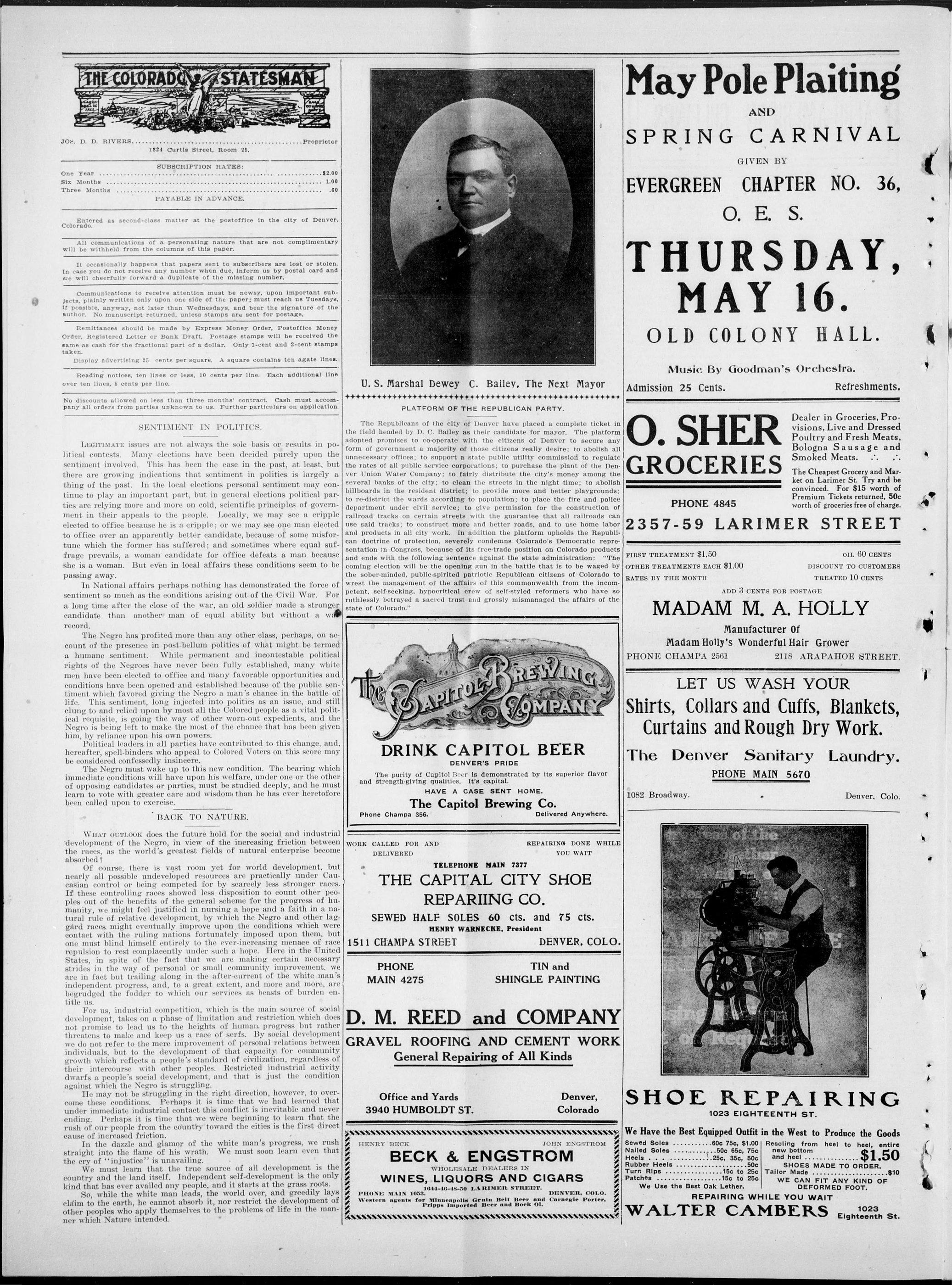
The Republicans of the city of Denver have placed a complete ticket in the field headed by D. C. Bailey as their candidate for mayor. The platform adopted promises to co-operate with the citizens of Denver to secure any form of government a majority of those citizens really desire; to abolish all unnecessary offices; to support a state public utility commission to regulate the rates of all public service corporations; to purchase the plant of the Denver Union Water Company; to fairly distribute the city's money among the several banks of the city; to clean the streets in the night time; to abolish billboards in the resident district; to provide more and better playgrounds; to re-district the wards according to population; to place the fire and police department under civil service; to give permission for the construction of railroad tracks on certain streets with the guarantee that all railroads can use said tracks; to construct more and better roads, and to use home labor and products in all city work. In addition the platform upholds the Republican doctrine of protection, severely condemns Colorado's Democratic representation in Congress, because of its free-trade position on Colorado products and ends with the following sentence against the state administration: "The coming election will be the opening gun in the battle that is to be waged by the sober-minded, public-spirited patriotic Republican citizens of Colorado to wrest the management of the affairs of this commonwealth from the incompetent, self-seeking, hypocritical crew of self-styled reformers who have so ruthlessly betrayed a sacred trust and grossly mismanaged the affairs of the state of Colorado."
PHONE 4845
2357-59 LARIMER STREET
FIRST TREATMENT $1.50
OTHER TREATMENTS EACH $1.00
RATES BY THE MONTH
oil 60 CENTS
DISCOUNT TO CUSTOMERS
TREATED 10 CENTS
MADAM M. A. HOLLY
The CAPITOL BREWING COMPANY
Manufacturer Of Madam Holly's Wonderful Hair Grower PHONE CHAMPA 2561 2118 ARAPAHOE STREET.
LET US WASH YOUR Shirts, Collars and Cuffs, Blankets, Curtains and Rough Dry Work. The Denver Sanitary Laundry. PHONE MAIN 5670
The purity of Capitol Beer is demonstrated by its superior flavor and strength-giving qualities. it's capital.
HAVE A CASE SENT HOME.
The Capitol Brewing Co.
Phone Champa 356.
Delivered Anywhere.
1082 Broadway
Denver, Colo.
the year of the
REPAIRING DONE WHILE
YOU WAIT
1511 CHAMPA STREET DENVER, COLO.
PHONE TIN and
MAIN 4275 SHINGLE PAINTING
GRAVEL ROOFING AND CEMENT WORK General Repairing of All Kinds
Denver, Colorado
We Have the Best Equipped Outfit in the West to Produce the Goods
Sewed Soles .....60c 75c, $1.00
Resoling from heel to heel, entire
Nailed Soles .....50c 65c, 75c
new bottom .....$1.50
Heels .....25c, 35c, 50c
and heel .....$1.50
Rubber Heels .....50c
SHOES MADE TO ORDER.
Turn Rips .....15c to 25c
Tailor Made .....$10
Patches .....15c to 25c
WE CAN FIT ANY KIND OF
We Use the Best Oak Lether.
DEFORMED FOOT.
BECK & ENGSTROM
PHONE MAIN 1053. 1044-46-48-50 LARKMER STREET. DENVER, COLO.
Western agents for Minneapolis Grain Belt Beer and Carnegie Porter,
Pripps Imported Beer and Book 01.
WALTER CAMBERS 1023 Eighteenth St.
THE COLORADO STATESMAN
Mrs. Carrie Duncan left Monday night for her home in Emporia, Kans.
Baby Wallace, the infant of Rev. and Mrs. James N. Wallace, died last Monday at Selma, Ala.
Mr. D. Jones of 229 West Eleventh Ave., is very ill with typhoid pneumonia.
TO ALL REPUBLICANS.
If you don't want to be disfranchise be sure and register May second, the last day that you can register, as ever vote you have will be needed during the forthcoming city election.
The city election is May twenty-first Every Republican should vote for the Republican ticket which is the best the field.
The W. M. M. S. of Shorter's had a pleasant session at the church Thursday afternoon. The refreshments were well selected and everybody had a fine time.
Rev. Ward returned from his sad mission from Missouri, the burial of his wife's father, and is again with us. He has the sympathy of his many friends.
D. B. Faw, who was called to the city Wednesday to be at the bedside of his brother, George, who died Thursday night, returned to Estes Park Wednesday.
The ladies of the Woman's Mite Missionary Society of Shorter's Church are proud of the hand-painted cards presented by Mr. Theo. von Dickersohn, the promising young artist.
Sunday afternoon everybody is invited to attend he Alliance meeting, 2630 Welton street, at 4 p. m. If nothing is doing, the Alliance wants you to get busy and start something.
Class No. 13 of Shorter's Church, J. C. Porter, leader, gave a successful entertainment last Thursday night. A neat sum was realized. The attendance was good.
Mrs. Ellen Johnson, who has been a resident of this city for a number of years, died at her residence on Fox street, Thursday morning. She is survived by two brothers, a daughter, Mrs. J. Burns, and B. C. Curtis, son-in-law.
Mrs. Frankle Barber, who has been a resident of Denver, died in Oakland, Cal., last Monday, and the body was brought to this city Thursday. The funeral services were held yesterday from Zion Baptist church. Rev. D. E. Over delivered the funeral sermon.
The Widows' Entertainment at Shorter's Church Thursday night was a rather unique affair, the situations at times were laughable in the extreme to see the female contingency assuming the role of masculinity. The receipts were very flattering indeed. The ladies of Shorter's certainly set the pace for the men to follow.
In honor of her fifteenth birthday Miss Emma Howard was tendered a surprise last Thursday night by her mother, Mrs. Mattle Howard of 921 Twenty-seventh street. The evening was very enjoyably spent in music, games and dancing. Miss Howard received many presents from her guests as a token of the high esteem in which she is held. After the serving of refreshments the guests departed for their respective homes.
The funeral of George Faw was held from the Douglass Undertaking Parlors last Sunday afternoon amid a large concourse of friends. Mr. Faw was born in Johnson City, Tennessee, April 8, 1865, and with his parents moved to Emporia, Kans., in 1881, where he lived ten years. In 1891 he came to Denver, where he resided until his death. He was employed as chef at the Arno hotel for eighteen years and his employers speak in the highest terms of his ability and faithfulness. He is survived by a father, James Faw, and sister, Mrs. Carrie Duncan, who live in Emporia, Kans., and a brother, D. B. Faw, of Estes Park. The floral tributes were handsome and profuse. Interment at Fairmount cemetery. Rev. Wallace of Scott M. E. Church, officiating.
GRAND OPENING OF COLORED REPUBLICAN HEADQUARTERS AND REPUBLICAN HOUSE-WARMING.
Where? 730 Nineteenth street.
When? Tuesday night, 8 p. m.
April 30, 1912.
There will be the general call to order, followed by the transaction of all business necessary to the success of the organization.
There will be a manifest general and hearty good fellowship together with a discussion of the guaranteed, assured and unanimous attendance and co-operation of all the members of the Republican party.
By order of advisory board.
A. W. LEWIS, Secretary.
TO ALL REPUBLICANS.
If you don't want to be disfranchised be sure and register May second, the last day that you can register, as every vote you have will be needed during the forthcoming city election.
The city election is May twenty-first. Every Republican should vote for the Republican ticket which is the best in the field.
If you have not been registered, or did not vote at the last general election, you must appear before the registrars in your precinct and have your name registered or you cannot vote at the coming election.
If you have changed your place of residence since the last general election, go to the court house for a change of your registration.
The election commissioners will sit daily from nine o'clock in the morning until five o'clock in the afternoon until May eleventh, ten days before election, for the purpose of changing registrations only.
Registration books will be open in your precinct May second, between the hours of nine in the morning and nine in the evening.
CARDS OF THANKS.
We want to thank our many friends for the beautiful flowers and the kindness and sympathy shown during our bereavement in the loss of our little daughter Geneva.
MR. AND MRS. DAVID CARNEGIE.
We wish to express our thanks to our many kind friends for their beautiful floral offerings, and for their sympathy and kindness in our great sorrow and trouble in the death of our dear husband and father.
MRS. MATILDA THRASHLEY AND FAMILY.
The children of Mrs. Cora Joseph feel that they will never be able to thank sufficiently the many, many friends who at the time of the greatest sorrow they have ever known gave so many expressions of sympathy and did so many little acts of kindness in an attempt to alleviate the awful pain.
The same is true of the friends from all parts of the country who sent their messages; and to the ministers who came and spoke consoling words. And such a wilderness of flowers! Some coming from Kansas and Missouri—they were a re-enforcement of all that had been said and done. Kind friends, they were appreciated, for we feel that it was the last loving tribute you could pay to the sweetest character we have ever known—our Mother.
COLORED REPUBLICAN COMMIT
TEE AND HEADQUARTERS.
As a result of the joint action of the Republican Central Committee and representative citizens of the city and county of Denver, the committee and headquarters, hereinafter referred to, were, by E. M. Sabin, approved: Headquarters—No. 730 Nineteenth street, opposite East Denver High School. Committee—J. W. Jackson, chairman. Advisory Board—J. D. D. Rivers, chairman; P. E. Spratlin, Parthenia George, Cecelia Washington, Daisy Jones, John Green, Ida De Priest, Thos. J. Riley, Ed Fountain, Mary Holmes, C. B. Hill, C. A. Franklin, Wm. Kempton, Wm. O. Steam, Robert Maxwell. A. W. LEWIS, Secretary.
QUEEN CITY CHORUS.
The heights by great men reached and kept,
Were not attained by sudden flight;
But they, while their companions slept,
Were rolling upwards through the flight.
The above lines ought to give inspiration to the members of the Choral Society in their efforts to carry out their object—the development of persons possessing musical talent and the improvement of music in general in the community, after their successful rendition of Witty's Cantata "Gethsemane To Calvary," on Monday evening last at Central Baptist Church. Although the attendance was not large, yet the application expressed by the audience gave the performers encouragement to succeed in their rendition. While the music in itself was not difficult, yet quite a test was offered to the director, Mr. Hewetson-Watson, and his chorus, in the interpretation to be given the piece, which they overcame by strict and cheerful obedience to the instructions given and received from time to time.
The organization need not be discouraged when it possesses voices as Mesdames Jones, Ross, Mallory, Fife, Miss Coleman and Messrs. Roberts, Burrell and others, who, while not by any means professionals, are amateurs of the class that with perseverance and constant application to the acquiring of more knowledge of the art of singing, will bring laurels to their race and themselves.
It must be mentioned that the chorus consists purely of local talent, and possibly this has in a large measure to do with the slim patronage (from a numerical standpoint) at its two appearances past; as our people in Denver are still faddists of the old idea—"Nothing good obtainable in LOCAL TALENT"—as is generally noticed from their attendance in full at all foreign introductions, and the paucity at any local events of this type. We
IN OUR Millinery Shop You Can Buy Your Hat for LESS MONEY
IT'S THE TALK OF THE TOWN
WHILE THEY LAST-OVER 1,000 PIECES Beautiful all new Straw Braid at $ 4 \frac{1}{2} c $ per Yard. Worth up to 25c per yard-Yes, it's no mistake. $ 4 \frac{1}{2} c $ Will Be the Price
can only extend our hearty support to the chorus, and hope they will maintain their integrity, untiring effort, zeal and sacrifice, until recognition be given them by the public as a valuable asset in the community, contributing to the educational and artistic tastes of the people. The Cantata will be repeated on Sunday afternoon, the 28th inst., at 5 o'clock, at the People's Presbyterian Church, corner Twenty-third avenue and Washington street. Silver offering requested. Applications for membership will be received up to May 4th by the Secretary, Miss Jessie Young, 1229 Race street. Absentees of long standing are requested to communicate with the Secretary as to their continuance of membership, as in the revising of the list in May their names may be deleted from the roll.
ATTENTION! FRONT EVERYBODY!
Keep off the date of May 30th. "SOLDIERS' NAIONAL MEMORIAL DAY," Corporal White Camp Bugle Corps will sound "Assembly" at Eureka hall, Decoration Day, at 8:30 p. m. Good music and choice refreshments.
CHURCH OF THE HOLY RE-DEEMER.
Twenty-second avenue and Humboldt street.
The Rev. Henry B. Brown, B. D., priest.
The bishop of the diocese, the Right Rev. Charles Olmsted, D. D., will make his Easter visitation on Sunday evening next, the 28th inst., at 7:45 o'clock. He will preach and administer the Sacrament of Confirmation to the extraordinarily large class the priest, Father Brown, will present to him. The service will be a most impressive one and will be of great historic interest and value from the fact that it will be by far the largest on record.
The priest anticipates a very large attendance at this service, and in order to provide ample accommodation for all who may attend, rushed the needed extension of the church, which will be ready for worship on Sunday. Notwithstanding the fact, however, that the seating capacity of the church will be nearly doubled, the building is likely to be taxed to its utmost limit. All are therefore advised to come early, for no seats will be reserved. Sermon subject for 11 o'clock service, "A Little While."
The special offerings will be supplementary to the Easter offerings and will be devoted to the purpose of defraying the cost of the recent internal improvements as well as to meet the claims of the diocese.
The Brotherhood of the Church of the Holy Redeemer will meet on Sunday afternoon at 4:30 o'clock. Have all the men of the church enlisted in this auxiliary work of the church? If not, why not?
The Women's Guild is preparing for a Fête to be held towards the end of May. Watch for further notice.
The entertainment given by the Altar Guild girls at the Chapter House last Friday evening, despite the fact that it was unavoidably postponed from the previous evening and the weather was most unpropitious, was an unqualified success. The program was well received and the living pictures, which formed the chief attraction, were warmly enced.
A new organization, "The Daughters of the King," will be organized on Wednesday evening. Have you found your place in the church's activities? Be a busy bee, and not a drone.
Lookers-on, come in and join the forces that make for truth and righteousness. A hearty welcome awaits you.
ATTENTION! FRONT EVERYBODY!
Keep off the date of May 30th.
"SOLDIERS' NAIONAL MEMORIAL
DAY," Corporal White Camp Bugle
Corps will sound "Assembly" at Eureka hall, Decoration Day, at 8:30 p. m.
Good music and choice refreshments.
Nicely furnished or unfurnished rooms for rent at 2660 Lawrence street. Mrs. R. M. Johnson.
For Rent—Nicely, modern-furnished rooms. Apply Mrs. T. Edwards, 2929 High street.
Five-room house for rent, 320 24th street. Apply at 1824 Curtis street, Room 25.
FOR RENT—A nice modern front room; gentleman preferred. Apply Mrs. N. Dean, 2218 Clarkson street, phone York 6121.
Fort Rent--Three nice unfurnished rooms. Apply 2929 Glenarm Place.
Brickler's New Barber Shop is located at 2208 Larimer street. Shave, 10c. Hair Cut, 25c; Children, 15c.
BATES' TWENTIETH CENTURY
WONDER TEA AND POW-
DERS.
For Sale at Scholtz Drug Stores, Tot-
man's and Elite Drug Stores.
TESTIMONIALS:
Gentlemen: I want to give you a short history of my condition so that others who have the same trouble I had may know there is a cure for rheumatism. In July, 1909, I noticed that I had inflammatory rheumatism. In health I had weighed 152 pounds, I dropped to 120 pounds. After being confined to the bed for two and a half months a friend recommended Bates' Twentieth Century Wonder Powder. In the summer of 1910 I began to take it. At this time, April, 1911, I have been well and robust for five months. My appetite is good and my weight is 140 pounds and not a trace of the old trouble remains. I have taken six bottles of the Twentieth Century Wonder Powder. If you want to refer anyone to me I will gladly express the merits of this medicine. Yours truly,
A. J. LYLE,
Continental Building.
Colorado Springs, Colo.
To Whom It May Concern; I have suffered with my lungs for a long time, after trying different remedies, from which I had lost flesh, and my appetite was more than bad. I tried Bates' Twentieth Century Wonder Tea, being recommended by another sufferer, and to my great happiness I am gaining in weight and my appetite has entirely returned. I feel like a new man; no more drowsy feeling and lack of ambition. How gladly can I sing the praises of Bates' Twentieth Century Tea.
GUS TRAVERS.
GUS E. VAKERS,
526 E. Cimarron St.
A
FORD POMADE
MAKES HARSH, KHINY OR CURLY HAIR
GLOSSY, SOFTER AND MORE PLABLE,
EASY TO GMB AND PUP UP IN ANY STYLE
THE LENGTH WILL PERMIT UNEXCEELED
FOR PREVENTING HAIR FROM FALLING OUT DANUBEF AND ICHING
OF SCALE BEWARE OF IMITATIONS, GET THE GENUINE, UP IN 25* AND $0* BOTTLES WITH CHARLES FORD'S NAME ON
EVERY PACKAGE
TRY FORD'S ROYAL WHITE
SKIN LOTION FOR THE COMPLEXION
MAKES THE SKIN WHITER IMMEDIATELY
UPON APPLICATION. WILL NOT IRRITATE
THE MOST DELICATE SKIN. UNEXCELLED
FOR ECZEMA, SALT RHEUM, PIMPLES,
ROUGH SKIN AND FRECKLES.*
SOLD BY DRUGGISTS. IF YOUR DRUGGIST CANNOT
SUPPLY YOU, WE WILL SEND IT TO YOU DIRECT AT
THE FOLLOWING Prices, SMALL SIZED BOTTLE, 25% LARGE SIZED BOTTLE 50% THE OZO BOTTLE, MARROW CO.
242 LAKE ST. DEPT. 280
CHICAGO,ILL.
AGENTS WANTED.
MOVING VAN
STORAGE $2.00 MONTH
FINE WAREHOUSE
Phone. Main 8466 903 18th St.
J. H. BIGGINS
Furniture Repairing and Upholstering. All work Cash.
PHONE YORK 5566
2231 Washington St. Denver.
THE
TISHLER TAILORING
ESTABLISHMENT.
1031 17TH ST.
Room 1, Iron Building
Denver, Colo.
THE TIVOLI UNION BREWING CO.
WEST BROOK
Tivoli
DENVER, COLO
Shop You Can Buy Your
LESS MONEY
BLOCK OF THE TOWN
Over in Trimmed and Untrimmed Hats.
LESS THAN 1-2 PRICE
priced specially at $3.50 to $4.95
Trimmed Hat Values
LAST—OVER 1,000 PIECES
draw Braid at 4½c per Yard.
yard—Yes, it's no mistake.
Be the Price
SIXTEENTH STREET
Opposite Daniels & Fisher
THE ELKS
I. B. P. O. E. of W.
Monday N
ENTER
EURE
nday Night, Apr
ENTERTAINMENT
EUREKA HA
Monday Night, April 29 ENTERTAINMENT EUREKA HALL
REFRESHMENTS
GOODMAN
OODMAN'S ORCHES
GOODMAN'S ORCHESTRA
ADMISSION 50c
LAOLY
SOCIALCARE
BATHS
EAGLE
SOCIAL CLUB
GASAWAY WALTON
Palace C
ALL MAIN 5038, ST
Special Rate
WE'R
HERE
Hats
If you are blessed with
one sell you an Eddy Foy
to your particular style of
Your clothes bespeak you
An "Adler-Rochester"
you as having good taste
erate.
Palace Car Auto Serr
IN 5038, STAND 19th & MARK
Special Rates for Parties and Balls.
WE'RE
HERE
WITH
BELLS
ON!
are blessed with a Joe Jefferson shape, or
you an Eddy Foy suit. Clown styles are
particular style of beauty.
clothes bespeak your own individuality.
Adler-Rochester" suit for spring wear wi
aving good taste. Let us show you one.
Palace Car Auto Service CALL MAIN 5038, STAND 19th & MARKET STREETS Special Rates for Parties and Balls.
WE'RE HERE WITH BELLS ON! Furnishings
If you are blessed with a Joe Jefferson shape, don't let any-one sell you an Eddy Foy suit. Clown styles are not becoming to your particular style of beauty.
Your clothes bespeak your own individuality.
An "Adler-Rochester" suit for spring wear will distinguish you as having good taste. Let us show you one. Prices moderate.
THE
Johnson-Noel C
1005 SIXTEENTH STREET
Midwa ANNEX 2 owing Three Reels
Bidway Theatre
1946 Lari
NNEX 2118-20 Lari
Three Reels of the Very Best
Midway Theatre
Showing Three Reels of the Very Best Pictures Made Complete Change of Program Every Day. We Strive to Please All. Laboring Men Bring Your Families. ADMISSION ALWAYS 5 CENTS.
April 29
MENT
HALL
HESTRA Public Invited
EAGLE
RACIL CLUB
Serivce
MARKET STREET
1 Balls.
SLAVERY CONDITIONS IN GEORGIA BEFORE THE CIVIL WAR
By R. J. MASSEY.
The institution of African slavery is so intimately connected with the history of Georgia, and has been so closely interwoven with her civilization, that a brief account of its origin, its growth and its sudden abolition should be recorded, not for crimination or exculpation, but that the truth of history may be vindicated. Facts, cold facts, are history, and they never blush to be narrated. Georgia was the first state to prohibit the slave trade with Africa, and she kept that prohibition inviolate, while some of the northern states carried it on long after their own slaves were freed. There was to them no profit in salvery, but there were fabulous gains in the posed of their own slaves by sending them south, and in some instances the young of their slaves were given away.
Their average conditions was indefinitely better than that of the poor, who lived in the slums of the great cities of the north. They had all the necessities of life and many of its comforts, and in the main were more independent and less care, less responsibility than their masters. Young negroes grew up to manhood with the children of their masters, trolicked with them by day and hunted with them by night. They had their own corn shuckings, their harvest suppers and their Christmas dances, where the fiddle, the banjo and their merry laugh were always heard in the field by day and at the fireside by night. The masters were almost universally kind from good policy, if nothing else. It was as much to their interest to keep their slaves in good condition as it was to protect and nourish their horses and cows. It was rare to see a puny, sickly negro child or one that was malformed or diseased. Cornbread, pot liquor, big hominy and plenty of grease saved doctor's bills. There was a trusting companionship between the young people of both races, but the color line was always drawn and dominion war on one side and obedience on the other. Never did a race increase faster than the slaves of Georgia. Nowhere was such ripe'old age to be found among the parents. Good food was abundant on the plantations and comfortable clothing came from the home-made loom and spinning wheel. Negro infants and children were always cared for by their master and mistress, and so were the aged ones who had served out their day and were too old to work. Simple medicines and good physicians were near at hand, and the negro was almost without care or apprehension. The marriage relation was inforced among them and divorces were unknown. The ymultiplied rapidly, in many cases the parents living to see more than a hundred descendants.
NEGRO WAS HAPPY.
That Georgians did not emancipate their slaves was owing to a variety of circumstances. The climate of the south was suited to the negro, and he seemed to be contented and happy here. The southerners had invested more money in slaves than had their northern brethren. The invention of the cotton gin had suddenly stimulated the cultivation of cotton, for which the negro was peculiarly fitted, and the growth of rice, tobacco and sugar cane was equally inviting to his labor. But more than all these reasons was the fear that the slaves were increasing so rapidly as to put the commonwealth in peril if they were freed. They were still affected with the same race traits that they inherited from barbarian ancestors, and it was feared that they could not be controlled as fredmen or as citizens. Still, there was an intelligent number of our people who favored gradual emancipation. This sentiment was slowly, but surely, spreading. Joseph Henry Lumpkin, chief justice of our supreme court, was outspoken as a co-worker with the gradual emancipation policy, inaugurated and advocated by Henry Clay of Kentucky. This policy would doubtless have been adopted by Georgia had her people not resented what seemed like attempts to coerce them. Our people said: "If you let us alone we may do it, but you cannot drive us. We are penned up with these negroes, and know where our safety lies." The common people of Georgia, the yeomanry, the toilers, were no lovers of the negro. They realized he was in their way. The slave-holders owned the best of the land, lived in fine houses, and had the best stock, the best tools, and the best vehicles, while the toilers had to take what they could get. No wonder they were jealous of the institution. And yet these men, poor and struggling for a livelihood in the mountains of north Georgia, or down in the pine woods of the southern counties, did not hesitate to shoulder their rifles and hurry to their country's call. "My country, right or wrong," was their motto. Only one-seventh of the taxpayers of the state were owners of slaves in 1880, and not more than one soldier in ten was interested in slavery. In fact, certain countries in north Georgia sent more soldiers to the field than there were slaves in those counties. Neither Georgia nor the south was responsible for slavery, nor for the traffic in slaves across the seas, for from 1776 down to the present time there was but a single attempt made by a Georgia man to introduce African slaves into a southern port, and that attempt was a failure. A small yacht called Wanderer was seized and condemned and her officers were pursued with unrelenting vigor by a southern
man, General Henry R. Jackson, who was then assistant attorney general of the United States.
BISHOP ELLIOTT'S VIEWS
BISHOP ELLIOTT'S VIEWS.
Bishop C. L. Elliott, D. D., of the Episcopal church, one of the greatest ecclesiastics Georgia ever produced, in defense of African slavery, especially as it existed in Georgia, writes: "My feeling, just now, is that I would defend it against all interference, just as I should defend my children from any one who would tempt them to an improper independence; just as I should defend any relation of life, which man was attempting to break off, or to violate, ere the purposes of God in it had been worked out. At this very moment there are from three to four million Africans (at least five thousand in Georgia) educating for earth, and for heaven, in the so-willified southern states—educating a thousand ways, of which the world knows nothing. As a race they are steadily improving. So far from the institution being guilty of degrading the negro it has elevated him in the scale of being much above his nature and race. A man that has been made out of a barbarian an intelligent and useful laborer out of an ignorant savage, a Christian and a child of God out of a heathen."
A NEGRO WEDDING
As a commentary upon the slaves and their conditions, I add three clippings taken from the newspapers of 1856, the account of a negro wedding, the description of a negro funeral and a break-down:
"June 24, 1855—I send you herein the originals of three invitations to a negro wedding which is to take place on the 27th. The envelopes are in the best style of De La Nue & Co., openwork embossed, and of the finest texture. They inclose an embossed card, inscribed thus:
"Mr. and Mrs. Taylor will be pleased to see you on Wednesday evening, June 27. at 8:20 o'clock
"The superscription is as follows: "Mr. Charles Jackson and lady, present; the second is to be Mr. Henry Cassie and lady, present; and the third is to Mrs. Jane Hawkins. The notes are written in neat Italian handwriting and tied with white satin ribbon, a la mode de Paris. "These invitations were all received by members of my family. Mrs. Hawkins is my cook. Mrs. Jackson is my laudress, Mrs. Cassie is my fille de Chambre. Thehy are all slaves, and their husbands are also slaves owned by some of my neighbors. The happy bridegroom is related to my colored family. They will doubtless have a happy time of it, and I commend to Greeley the case of these oppressed children of Africa. I am sorry that every abolitionist in the land should not have the opportunity of one such wedding.
"A colored man by the name of Samuel Betterson, an original deacon of the Third Colored Baptist church, was buried yesterday afternoon. A very large number of his friends followed him to the grave. We noticed in the procession three uniformed fire companies, two or three female benevolent associations, distinguished by suitable dresses. The Porters' association, of which he was a member, turned out and wore black scarfs and white rosettes. A spectator counted thirty-five carages well-filled, besides a number of other conveyances and many on horseback following the hearse. It is estimated that between 2,000 and 2,500 negroes were in the procession.
"John Guerrard, a colored fireman, and a member of engine company No. 5, was also buried yesterday afternoon. The members of his company were in uniform and a large number of friends following him to the grave.
"We will also add for the information of our northern friends that the funeral processions above noticed were perfectly quiet and orderly, and everything connected with them was conducted with the utmost decorum and propriety."
DESCRIPTION OF DANCE
"At our own settlement (No. 1) I found everything in a high fever of preparation for the ball. A huge boat had just arrived from the cotton plantation at St. Simon laden with the youth and beauty of that section of the estate who had been invited to join the party, and the greeting among the arrivals and welcomers and the heaven defying combination of colors in the gala attire of both surpass all my powers of description. The ball to which, of course, we went, took place in the infirmary. As the room had fortunately but few occupants, they were moved to another apartment, and without any very tender consideration, for there was remote, though visible suffering. The dancing commenced and was continued. I have seen Jim Crow, the veritable James, all the contortions, flings and kicks and capers you have begulled into accepting as indicative of, are spurious, faint, feeble and impotent, in a word, pale northern reproductions of that ineable black conception. It is impossible for words to describe the things these people did with their bodies, and above all with their faces, the whites of their eyes and the whites of their teeth and certain outlines which either, rather naturally and by the grace of heaven, or by the practice of some peculiar dexterity, they bring into prominence and most ludicrous display.
"The languishing elegance of some, the painstaking laboriousness of others, above all the feats of certain enthusiastic banjo players who seemed to me to thump his instrument with every part of his body at once. Considering what the atmosphere was that we had inhaled during the ex-
hibition, it was only wonderful to me that we were not made ill by the double effort not to laugh and, if possible, not to breathe."
AN ATLANTA CASE
The recent death, and the circumstances attending thereunto, of Julia Grimes in this city, can be very appropriately mentioned in connection with the above. Julia was the wife of Cornelius Grimes, a faithful employee of the Atlanta postoffice, and was very much respected by numerous white people of Atlanta. In fact, over her remains, at her house before the burial, and at the funeral ceremonies in the church, numerous ladies, some of very high social standing, wept profusely over the sad event. It is said of her that she probably had more white friends than any one occupying her position in the city. Those who knew her say she attempted on all occasions to do what was right. She was the daughter of an ante-bellum slave, trained as a house servant by her own mistress. The family resided in North Georgia, and when Sherman's army went from Dalton on its famous raid through Georgia, they left home, fleeing to South Georgia. They put in the hands of this faithful servant and her sister household valuables consisting of jewelry, glass and chinaware; in fact, all such articles as were, in those good old times, necessary for the comfort and pleasure of the well-to-do Georgia family were placed in the care and protection of these faithful servants. The family instructed them to "do the best with these things, and save them from the Yankees, if sible." As Sherman approached their place of residence these servants filled up an old-fashioned white-top cupboard two-horse wagon and started south. As they neared Kingston, in Bartow county, the thought occurred to them to seek safety in the Bartow Saltpetre cave. This cave had been the recess from which hundreds of thousands of saltpetre, for gunpowder purposes, had been made for the Confederacy. Here they found cooking utensils of all kinds. They appropriated to their own use as many of these pots and ovens and skillets as they needed and took refuge in the Saltpetre cave. Carrying with them ample provisions, they remained, not "hid out" but "hid in," for over two weeks. During all this time not a soul of the outside world knew where they were with their mistresses' household valuables.
As soon as thought safe, they emerged from their darkness and made their way back, carrying with them every single article entrusted to their keeping. The white family were not only joyful at their return, but were very much surprised, and for this fidelity, the former slaves were suitably rewarded, not only during slavery, but for many years after being declared free, they lived with their former "Marster and Mistiss," enjoying the confidence and love of each other.
This brings to mind the following extract from The Augusta Chronicle: ATLANTA CITIZENS HONOR OLD ANTE-BELLUM NEGRO
"Atlanta, Ga., Feb. 23.—With bowed heads and tearful eyes, a dozen prominent white people attended the funeral of William Harrison, an old antebellum negro, here today. Excepting the undertaker, not a member of the old man's race was present. Everything pertaining to the rites of burial was looked after by his white friends. "William, who was better known as Crump, belonged to the Harrison family of Stewart county. He was born in Virginia, but when a mere boy became the property of Mrs. Burrough K. Harrison, being a gift from her father. • He grew to manhood a slave, and in boyhood was the companion of Captain 'Tip' Harrison and all the other Harrison boys.
"The war came and all the Harrison boys went to the front. Mrs. Harrison, then a widow, was left at home alone with girls—and Crump. But in the latter she found a protector as true and faithful as any knight of old. Visions of freedom weakened not his fidelity, and he toiled by day to provide sustenance for his mistress and her children and by night was ready to defend them with his life.
"Then freedom came, but not to Crump. He remained and continued through life a Harrison, virtually as much a slave as he had ever been. Ante-bellum ties were never broken, though nominally he was a free man.
"Then passing years brought old age and decreptitude. Crump's children wandered off, and two years ago he became a semi-invalid. But he escaped becoming an object of charity. His 'white folks' were left, and all he had to do was to 'come home.'
"The Harrisons had moved to Atlanta, but at the home of Mrs. M. H. Harrison, one of the daughters, the aged negro found a welcome refuge. The he lived, almost as one of the family, the hands of southern gentility administering to his every need. All that he needed was provided.
"Then on yesterday, at the age of sixty-nine, he died. And today all the Harrisons, brothers, sisters, nephews and nieces, twelve in number, gathered about his bier. And the elder ones wept as they laid him away. The nephews served as pall bearers. Rev. Dr. A. R. Holderby, one of the most prominent white clergymen in Atlantn, officiled."
"It is a pity," the minister remarked as he praised the dead and consoled the living, "that all the north cannot view this scene." Everybody in Georgia knows Captain "Tip" Harrison, mentioned above, and every old Confederate in the whole south loves him most sacriously for so many good things he's done for their comfort, benefit and pleasure, especially when he wrote that beautiful poetry, "We're Old-Time Confederates."
Scores of instances, similar to the
above, can be given in which a most hearty "amen" could be said to Dr. Holderby's expression, "It is a pity that all the north cannot view this scene." I only mention one extract from The Constitution:
MINTER WIMBERLY'S CLOSE CALL
"But for the presence of mind and heroic courage of an ante-bellum darky, Hon. Minter Wimberly would not be alive today.
"Yesterday he was inspecting his farm in company with the negro and had occasion to walk across a long trestle. When half way across they heard the whistle of a Southern railway train close behind them. In trying to run over the crossties Mr. Wimberly slipped and fell so violently that his shoulder was dislocated. Suffering so that he could not move, he had about prepared to die when the negro lifted him up and plunged with him in his arms into the creek, a drop of fifteen feet, just in time to avoid the train, which did not stop until after passing over the trestle."
For this noble act Mr. Wimberly at once gave the negro a warranty deed to the house and lot in which he lived as grateful evidence of his appreciation. Would that all the north could appreciate the sacred ties that still remain between the old ante-bellum southern men and women and their old darkles.
THE NEGRO FARMERS
Here is a letter being distributed among the negroes of the Mississippi delta by one of their own race:
Mound Bayou, Miss.
Dear Friend—You will agree with me that Mound Bayou, along with the rest of this section, has experienced the "tightest time" in her history. While some of the causes were not our own, yet there was much that we could have done—that we did not do—which would have made conditions better.
In order that I may, in some degree, help us profit in 1912 by our mistakes in 1911 and the other years past, I am writing you now.
One of the most embarrassing situations is, that we find ourselves without meat in the smokehouse, no meal in the barrel, no home-raised corn in the crib, no cow at the patil, not only our stock without feed, but ours ourselves dependent upon the merchant for supplies. It is a shame, almost a crime, that here in this fertile section, where most anything will grow and land abundant for our use, that we would have been so short-sighted, so foolish, as to be caught in such condition.
The heavy rains and boll weevil are some excuse for not raising enough cotton to meet our expectations, but there is no excuse for our not having raised feedstuff to sustain the life of our stock and cattle and food for our table use.
Laziness, idleness, lack of thrift and foresight are charged against us, and we stand "guilty as charged." The ones who continue in this old rut will find themselves forced against the wall, and will lose in the work we are trying to do here at Mound Bayou—in fact, such persons will not find room anywhere.
Now, let us profit by the mistakes of last year. Let us get down to work, not for a few weeks or a few months, but every hour, every day, every week, every month, until the year closes.
If you will thus engage yourself, you will find time to raise hogs, cows, chickens, hay and truck, and still raise as much cotton as ever. It is a mistake to try to make your cotton crop feed you, clothe you, pay your debts and give you a bank account for the rainy day. It is an idle dream and will not work.
Now, this is plain, hard talk, and you may not like it, but if you will take the medicine this year you will not be annoyed with your present aliment one year hence. Happy will be the fellow who keeps out of debt and clears money out of his first cotton brought to market. Yours for success, CHARLES BANKS.
This is a plain statement of a situation that should command the attention of every man engaged in agriculture.
The negro must be taught to take care of himself. Properly directed, the negro farmer and farm laborer are producers of great wealth. But the negro farmer, drawing inspiration from the white man, is a one-crop man, and during the time between crops his poverty is usually appalling.
The Memphis Commercial Appeal suggests to every white employer of negro labor and to every white man who rents land to negroes that they call the negroes together and read to them this letter of advice, written by one of their own race.
"UNCLE" WAS CAUTIOUS.
A commercial traveler at a railway restaurant in one of our southern towns included in his order for breakfast two boiled eggs. The old darky who served him brought three. "Uncle," said the traveling man, "why in the world did you bring me three boiled eggs? I only ordered two." "Yes, sir," said the old darky, bowing and smiling. "I know you did order two, sir, but I brought three, because I jus' naturally felt dat one of dem might fail you, sir."—Harper's Weekly.
MUSICAL NAME.
Mrs. Towne—So Hirlam Sharp's girl Effie has become a music teacher? Hepsibah—Yes. We call her Eff Sharp—Boston Transcript.
Furnished Rooms
SHORT ORDERS AT ALL
ahoe Street.
THE
MONARCH LIQUOR
COMPANY
1841-45 Arapahoe Street.
THE MONARCH LIQUOR COMPANY
TELEPHONE
CHAMPA 1231
IMPORTED & D.
D. W. REEVES, Manager
FULL LINE
Five Point
272
PHONE CHAMPA 471.
Remember I Save
Put
The Cincinnatti Fur
FURNACES CLEANED, FLOR
W
LAWN CUTT
BEST WORK
JAS. TERRY.
SUPPORTED & DOMESTIC WINES & LIQUOR
EEVES, Manager. W. P. JONES,
FULL LINE OF CIGARS AND TOBACCO.
The Points Barber Shop
2727 WELTON STREET
CHAMPA 471. DENVIL
Remember I Save You One Dollar on Your Furnace
Put This Dollar in the Bank.
Cincinnati Furnace and House Cleaner
CLEANED, FLOORS WAXED, KALSOMINING
WASHING CELLARS.
LAWN CUTTING, CEMENT PATCH WORK.
ST WORK
QUICK SERV
TERRY. 1209 E. Thirteenth Ave. Pho
UPA STREET PHONE
W. O. SIMONDS
Creka COAL 4.0
P.O.
GAS COKE $5.00 PER TON
Save You Money if You Leave Your Order
Prices Go Up.
IMPORTED & DOMESTIC WINES & LIQUORS
D. W. REEVES, Manager. W. P. JONES, Proprietor.
FULL LINE OF CIGARS AND TOBACCO.
Remember I Save You One Dollar on Your Furnace.
Put This Dollar in the Bank.
The Cincinnati Furnace and House Cleaning Co.
FURNACES CLEANED, FLOORS WAXED, KALSOMINING AND WHITE
WASHING CELLARS.
LAWN CUTTING, CEMENT PATCH WORK.
BEST WORK QUICK SERVICE
JAS. TERRY. 1209 E. Thirteenth Ave. Phone York 4328.
2029 CHAMPA STREET PHONE MAIN 5964
W.
Eureka
GAS CO
We Will Save You Money
GAS COKE $5.00 PER TON We Will Save You Money if You Leave Your Order Before Coal Prices Go Up.
Contractors and Builders
All kinds jobbing. Specialty.
All kinds of carpenter work and jobbing. Store and office work a specialty .. Phone Main 1925
All kinds of carpenter work and jobbing. Store and office work a specialty .. Phone Main 1925
1846 Arapahoe St.
DIAMONDE
Telephone Champa 1473
RUDOLPH
SANITARY C
M
Imported and Domesticated
Vegetables. Our Own
2758-2760 Downing Avenue
NDOLPH BROTHER
ANITARY GROCERY, BAKERY AND
MEAT MARKET.
and Domestic Table Delicacies. Fresh
es. Our Own Bakery. Finest Goods in
Downing Avenue Pho
RUDOLPH BROTHERS
SANITARY GROCERY, BAKERY AND MEAT MARKET. Imported and Domestic Table Delicacies. Fresh Fruits and Vegetables. Our Own Bakery. Finest Goods in the City. 2758-2760 Downing Avenue Phone York 320
In Connection There Are Also Nicely
And the Old
Newport Thirst
Parlors
The Newport Annex Cafe and Lunch Room Richard Frazier and Tom Lewis, Props.
C
SHORT ORDERS AT ALL HOURS.
DENVER, COLO.
THE
CH LIQUOR
MPANY
THE MONARCH
LIQUOR CO.
DOMESTIC WINES & LIQUORS
W. P. JONES, Proprietor.
OF CIGARS AND TOBACCO.
Us Barber Shop
HWELTON STREET
DENVER, COLO.
You One Dollar on Your Furnace.
Us Dollar in the Bank.
Face and House Cleaning Co.
ERS WAXED, KALSOMINING AND WHITE
WHING CELLARS.
G, CEMENT PATCH WORK.
QUICK SERVICE
9 E. Thirteenth Ave. Phone York 4328.
D. SIMONDS
COAL 4.00
Per Ton
E $5.00 PER TON
If You Leave Your Order Before Coal
rices Go Up.
HOKLAS & CO.
carpenter work and
arc and office work a
Phone Main 1925
DENVER, COLO.
Expert Watch Repairing Diamonds and Cut Glass
34 Years Experience
THE ZALL JEWELRY
COMPANY
Watches, Clocks, Silverware, Etc.
805 Fifteenth Street. Denver, Colo
BROTHERS
COCERY, BAKERY AND
BET MARKET.
Table Delicacies. Fresh Fruits and
Bakery. Finest Goods in the City.
Phone York 320
Phone, Main 7413.
---
1516
COURT PLACE
PHONE MAIN 5964
DELIVERED TO SUBSCRIBERS AT SIXTY CENTS A MONTH.
A reduction of more than 20 per cent on former rates.
At this price THE REPUBLI-CAN is the cheapest and best paper published in Denver.
Neither money nor labor will be spared to make THE REPUBLI-CAN, as it has always been in the past, the best and most reliable paper in the West.
THE REPUBLICAN'S news service has no equal. The Associated Press, supplemented by the splendid New York Herald news service, gives our readers every morning all the news gathered from every part of the world.
THE ILLUSTRATED SUNDAY MAGAZINE section of THE REPUBLICAN contains stories by the leading authors and humorists of the day and many pages of photographs of great interest.
SEND IN YOUR SUBSCRIPTION TODAY
Please fill out and forward this blank.
THE REPUBLICAN PUBLISHING CO.
DENVER, COLO.
Send to my address until I order
it discontinued, THE DENVER REPUBLICAN, Daily and Sunday.
Name.....
Address.....
SIXTY CENTS A MONTH
The
WARD AUCTION
COMPANY
Sales Daily at 2 p.m. Office Furniture a Specialty.
HAVE MOVED TO—
1723-39 GLENARM ST.
PHONE MAIN 1675.
Miss M. Cowden Hair Dressing Parlor
Shampoo, cutting and curling. Scalp treatment, hair tonics, hair straightening, manicuring. Stage wigs for rent; theatrical use and masquerades. Goods delivered out of the city. All shades of hair matched by sending sample of hair; also combings made up.
Cheapest Switches 50 Cents
1219 21st St. Denver, Colo.
NAST
The Popular Photograher.
Only Caters to First-class Trade.
Our Pictures speak for Themselves.
WILLIAMSON
HAFFNER CO.
ENGRAVERS-PRINTERS
OUR
CUTS
TAULKS
DENVER, COLO.
SOLID GOLD RINGS
Some Are Stamped Out with a Die, Some Cut from Tubes. BUT MOST OF THEM ARE CAST—AS A RULE, THEY ARE FORMED IN MOLDS OF CUTTLEFISH BONE, INTO WHICH THE PATTERN SINKS AS THOUGH PRESSED INTO WAX—MAKING THE MOLDS.
Cuttlefish bone is familiar to most people, as it is seen thrust between the bars of a bird cage for birds to peck at. Birds clean their beaks on it, and they like to eat it. But cuttlefish bone has other and more interesting uses. It is used in the manufacture of tooth powder and of polishing powder and in the making of a prepared food for birds, but perhaps the most interesting of its uses is in the making of molds in which to cast gold rings.
Some gold rings are cast in tiny flasks containing molds of fine sand; others are stamped out with a die. Wedding rings are made from a drawn tube of gold in which the rounded outer shape of the ring is produced on a mandrel, the several sections thus formed being then sawed off even when finished and polished to form a perfect ring. But of the vast number of solid gold rings produced by manufacturing jewelers, including rings to be mounted with stones, 75 per cent are cast in cuttlefish bone molds.
Such a mold can be used but once, and so the manufacturing jeweler uses a lot of cuttlefish bone. The molds may be made in two, three, four or five parts, according to the elaborateness of the ring to be molded. The bone serves both as flask and as molding material.
Suppose the molder is to make for a ring comparatively simple in shape a three part mold. He sits at a bench on which he has brass patterns of the rings to be molded. The manufacturing jeweler has hundreds, many hundreds, of these pattern rings, to which he is continually adding designs. Handy by, the molder has a box of cuttlefish bone. Only bone of the finest quality and finest texture is used, and such bone serves for this purpose admirably. Under pressure of an object upon it this bone breaks down perfectly and with no surrounding fractures or fissures. It takes an impression practically as perfect as a plastic material would do, while at the same time it stands up perfectly around the impression made.
The molder takes a cuttlefish bone in its familiar oval shape and with a little sharp-toothed saw saws off the tapering sides and the ends, leaving a keystone shaped or an oblong block. Then straight across he saws off one end of this block about a quarter of its length from the end, and then the larger piece he saws through from side to side midway of its thickness. Now he has the original block of bone divided into three parts.
He rubs the face of each of these parts perfectly smooth on a metal plate set before him conveniently in the bench, and then the material is ready for use as a mold. The molder turns one of the two bigger blocks over on the bench with the smoothed surface up and picks up the model ring, and with a deft, sure touch he presses this model down for half its thickness all around into the delicately fragile but evenly textured bone—this in the case of a three piece mold at one end of the block, leaving the head or cap of the ring projecting beyond the end edge. Next he picks up the other half of this block, turns its smooth face down and presses that down upon the ring as it lies with half its thickness projecting above the surface of the lower block, and now he has a mold of the ring complete except for the projecting head.
At this stage he picks up that end piece of the bone that he had sawed off and presses that with its smooth face down upon the ring's head, so taking an impression of that, and then he has the mold complete, but with the model ring inside of it.
Now he scores lightly this model outside, across its side edges, and he scores lines from the top block to the sides, so that when he has taken the mold apart he can put it together again precisely as it should be, and then he opens it and takes out the pattern, and if anywhere the molded form should require a touch of smoothing he does that, and then, beginning small and opening out wider, he cuts out in the inner sides of the two halves of the big block from the bend of the ring mold out to the end of the block an opening, the gate, through which the molden gold will be poured when the ring is molded. Then he puts the pieces of the mold together again and blinds them with soft wire, and there's your cuttlefish bone mold perfect and complete.
Sometimes they bind half a dozen or a dozen of such molds together and cut little channels inside from the gate to each one of the separate molds within, and then when they pour the gold they mold a half dozen or a dozen rings at once—New York Sun.
A GOOD AMENDMENT.
Two little girls were hurrying to school in Parsons, Kan., fearful lest they would not arrive there until after the last bell had rung for the morning session. One said:
"Let's kneel right down and pray that we won't be tardy."
"Oh, no," said the other, "let's hike on to school, and pray while we're hikin'."—Boston Globe.
ORIGINAL IN POOR CONDITION
COLORED PEOPLE OF NORTH CAROLINA ARE FIGHTING TUBERCULOSIS
Winston-Salem, N. C.—Additional evidence that the colored people over the state are being aroused in the matter of tuberculosis is given by a letter received from Durham from a colored girl, a recent student at Shaw university. The letter which follows has been sent to the state board of health in order that the writer may receive the printed matter which the state provides without expense to anyone in North Carolina who may apply for information. The letter is as follows:
"In reading the Herald today I learn that you are willing to mail literature to those asking for it on the subject of tuberculosis. I feel very much the need of this offer, since I realize it is my race who are suffering so much from the disease. I feel very much interested in this work and would be very grateful to you for your co-operation. I want to fully understand what my people (the negro race) are to do to reduce the high death rate percent age which we are having yearly. "Please let me know what this literature will cost me, and I will forward you the money so you can send me the goods. "I guess it might be well to add that I am a colored girl, am nineteen years of age, and have attended the Shaw university for the last two years."
GAME TOO BRUTAL
FOR CARL MORRIS
Sapulpa, Okla.—Because, he says, of the "brutality of the game," Carl Morris, erstwhile "white hope," has quit the ring, temporarily at least. He went back to work as an engineer on a switch engine in the Sapulpa railroad yards.
Morris left his engine on the night of July 4, 1910, after Jeffries had been defeated by Johnson with the avowed intention of recovering the championship title for the white race. During his twenty months' career he won eleven battles and lost two, and for the time being, he asserts, he has enough. But, insists the engineer, he will return and defeat Johnson. Just when he does not say.
"Thugs," Morris complains, "pre-dominate among the present-day fighters."
JACK JOHNSON MAY BOX
FLYNN IN OLD BULL RING
Eli Paso, Texas.—That the Johnson-Flynn fight may be staged in the old bull ring at Juarez, is the statement of Jack Curley, who is here. Curley has not yet settled the question of the site for the battle. He has been conferring with the authorities on the Mexican side. It is said that he made tentative arrangements whereby he can secure the use of the bull ring or the race track if he decided to bring the fight here.
HIS ABUSIVE EYES
Aunt Caroline and the partner of her woes evidently found connubial bliss a misnomer, for the sounds of war were often heard down in the little cabin in the hollow. Finally the pair were haled into court and the dusky lad' entered a charge of abusive language against her spouse. The judge, who had known them both all his life, endeavored to pour oil on the troubled waters.
"What did he say to you, Caroline?" he asked.
"Why, jedge, I jes' can't tell you all dat man do say to me."
"Does he ever use hard language?"
"Does yo' mean cussin'? Yassuh, not wif his mouf, but he's always glivin' me dem cussory glances."—Lipincott's Magazine.
DOUBTING HIS VERACITY.
Jim Slocum of Montgomery county was called as a witness to impeach the testimony of a man in that county. Jim was asked if he was acquainted with the reputation of the witness for truth and veracity, Jim said that he guesed maybe he was. "Is it good or bad?"
"Well," said Jim. "I don't want to do the man no injustice, but I will say that if his neighbors were to see him looking as if he was dead they would want some corroborative evidence before they would be willing to bury him."—Kansas City Journal.
WILLING TO OBLIGE.
A farmer's boy and his best girl were seated in a buggy one evening in town, watching the people pass. Near by was a popcorn vendor's stand. "Presently the lady remarked: 'My! that popcorn smells good!'" "That's right," said the gallant. "I'll drive up a little closer so you can smell it better."—Everybody's Magazine.
MAN OUT OF IT.
Female Lawyer—We want a writ of woman confundus. Opposing Counsel (from the east)—
Opposing Counsel (from the east)—What in the world is that?
His Native California Colleague—It's what we used to call mandamus.—Puck.
FROM SLAVE BOY TO STATESMAN
How Frederick Douglass Rose from Obscurity to Fame.
MAN OF PRINCELY VIRTUES—EVENTS IN THE LIFE OF THE GREAT ANTI-SLAVERY ORATOR WHICH FIRED HIS AMBITION AND MADE HIS TEACHINGS EFFECTIVE—PLEADED CAUSE OF SELF AND RACE ELOQUENTLY.
Great men are always a part of a great movement. They are called into the world to play an important part in the arena of thought and action. Few of them, however, are blessed with the span of life which enables them to witness the triumphant consumption of their cause, as was the case of Frederick Douglass. But for the birth of Frederick Douglass in Tuckahoe, Md., in 1817, that obscure village in Talbot county would hardly be known. His early surroundings were such as characterized every slave boy who witnessed the inhuman treatment of fellow slaves and heard stories of the capture of their fore-parents in Africa.
The events in the life of Douglass, his transference to Baltimore, to St. Michael's; his experience with the "slave breaker" Edward Covey and his escape from slavery in 1838, when he assumed the name of "Douglass," partly to hide his identity and partly as a "milestone" in his new life of freedom, are well known. His lectures under the Anti-slavery society at conventions and private gatherings, both in America and Europe, his publication of his newspapers; his "life narrative," "My Bondage and My Freedom;" his "Life and Times," place Frederick Douglass before the American public, and indeed before the world, as one of its effective teachers.
Some will deny him the title, saying that he was not a product of the schools; that he kept no school and could not in any sense be called an educator. If by an educator is meant one whose activities are confined to the narrow regimen of the schoolroom Douglass was not an educator, but if we mean by the term one who carries within himself the princely virtues of the great teachers of mankind, who is an inspiration to all men by his words and work, who had knowledge and sympathy, interest, enthusiasm and aptitude for vicariousness, then Frederick Douglass was in every way an educator.
He believed in the potentiality of every child born into the world, whether white or black. He believed that God had not bestowed his best endowments upon any single race or nation, and so he wrought for himself and his race to make actual what was potential. Mr. Douglass, like a true educator, was a man of large vision. Where there is no vision the people perish. Brutalized himself by American slavery, he sought to aid in the overthrow of the iniquitous system. When, therefore, the opportunity presented itself he threw himself with enthusiasm into the anti-slavery struggle and lost no opportunity to teach men its horrors and to rouse them to its hatred by his burning words. In England and America he pleaded his own and the cause of his people with weeping words and eloquent tears and became perhaps the mightiest single force in teaching the iniquities of slavery because he had been a part of it.
Douglass believed in his selfhood and in his own possibilities, and out of the horrors of slavery he tried to rehabilitate the divine image stamped upon him. He made his good instincts self conscious. He taught lofty notions of personal, social and political life. He was discontented with whatever was on a low plane. He reached the mountain heights because he soared like an eagle that bathes its wings in the noonday sun. No one could se Frederick Douglass, with his head rising "like a snow-capped peak" above those about him, without feeling the influence of his presence.
Frederick Douglass was never ashamed of his color. He believed in his black mother, his dark hued wife and attributed much of his success to his contact with them. He believed that he was part of a great race whose development had been retarded by untoward conditions, but who when their chains were once broken and their complete emancipation insured would rise up and demonstrate the divinity with which they were clothed. Douglass, like every true educator, was an honest patriot. He loved his country. When the Civil war broke out he offered his two sons to his country's cause, while he himself served it with his eloquence.
For these services he was honored. For years he was the most famous character in the District of Columbia, serving as United States marshal, later as recorder of deeds and afterward as minister plenipotentiary to Haiti. While in Haiti differences arose between himself and the state department about the methods of acquiring the Mole St. Nicholas, and rather than sacrifice his manhood Douglass cabled his commission to the president and returned in glory to the banks of the Potomac. He may have failed in diplomacy, but he had retained his self-respect.
Flares of trumpets always notify us when an egotist is around.
When another person talks, it's gossip; when you do it yourself, it's conversation.
$25.00 COLONIST FARES
FROM
All Main Line Points
AND ALL POINTS ON
Marshall Pass Line, Salida to Grand Junction
ON THE
Denver & Rio Grande in Colorado
TO
California and the Pacific Northwest
VIA
THE DENVER & RIO GRANDE RAILROAD
AND
THE WESTERN PACIFIC RAILWAY
The Royal Gorge—Feather River Cañon Route.
By depositing tickets with agent, stop,overs of five days will be allowed at and west of Cañon City on the Denver & Río Grande Railroad in Colorado and Utah, and at Elko, Hazen, Reno, Las Vegas, Lovelock, Shafter, Winnemucca, Nev., and all points in California; at all points on the Great Northern at and west of Billings, Mont.; at all points on O. S. L. and O.-W. R. & N. Co., and all points on Southern Pacific between Portland, Ore., and Weed, Cal.
Colonist tickets will be honored over the Rio Grande via Glenwood Springs or via Gunnison and Montrose. For detailed information, inquire of nearest agent. Frank A. Wadleigh, General Passenger Agent, Denver, Colorado.
2735 Welton S
The Central Bottling
Agents for the
CAPITOL BEER---
Try a case, 2 doz. pints for $1.10, deliver
Family Liquors, Wine
Genuine Goods at
A glass of good wine will improve your
Welton St. MA
Special Bottling & Distrib
Agents for the famous
COL BEER---IT'S CAL
points for $1.10, delivered promptly;
My Liquors, Wines, and Co
Quine Goods at Popular P
we will improve your Sunday dinner
ALMER HOTEL
T. H. JOHNSON, Proprietor.
Built and Newly Furni
Hot and Cold Baths
ST.
Champa Phi
Twentieth and Champa
Is the place to get your
CHEMICALS AND PATENTS
THE SERVE HOT DRINK
Scriptions Our Spo
we will deliver the goods to all p
S E. THRALL,
PHONÉ MAIN 2425.
en You W
SEET, TAILS, SNOUTS, EARS, B
INGS OR ANY OTHER PART OF
2735 Welton St. Main 6363
The Central Bottling & Distributing Co.
Agents for the famous
CAPITOL BEER---IT'S CAPITAL
Try a case, 2 doz. pints for $1.10, delivered promptly; empties called for.
Family Liquors, Wines, and Cordials Genuine Goods at Popular Prices A glass of good wine will improve your Sunday dinner, and aid digestion.
PALMER
T. H. JOHNSON
Newly Built and N
Hot and Col
The Champa
Twentieth and
Is the place to
DRUGS, CHEMICALS AND
WE SERVE HOME
Prescriptions O
Phone us and we will deliver the g
JAMES E. THE
PHONE MAIN
When You
THE HEADS, FEET, TAILS, SNOW
CHITTERLINGS OR ANY OTHER
The Champa Pharmacy
Twentieth and Champa,
Is the place to get your
DRUGS, CHEMICALS AND PATENT MEDICINES
WE SERVE HOT DRINKS.
Prescriptions Our Specialty.
Phone us and we will deliver the goods to all parts of the city.
JAMES E. THRALL, PROPR.
PHONÉ MAIN 2425.
When You Want
THE HEADS, FEET, TAILS, SNOUTS, EARS, NECKBONES OR
CHITTERLINGS OR ANY OTHER PART OF THE HOG
EXCEPT THE SQUEAL, GO TO
East's Market
st's Mar STREET
2300-6 LARIMER STREET
The Purpose of an Advertisement
is to serve your needs. It will help sell your goods—talk to the people you want to reach. An advertisement in this paper is a reference guide to those whose wants are worth supplying.
A Dollar
Kept with the home merchants in
benefit. Business men should aw
this dollar at home and make a bi
Kept with the home merchants it is a messenger of continuous benefit. Business men should awake to the importance of keeping this dollar at home and make a bid for it by judicious advertising.
home merchants it is a mess less men should awake to the im- ome and make a bid for it by ju
FIREPROOF
2130 ARAPAHOE ST.
BODY GOOSE
BODY GOOSE
BODY GOOSE
AND
BODY GOOSE
AND
BODY GOOSE
St. Main 6363
& Distributing Co.
the famous
IT'S CAPITAL
delivered promptly; empties called for.
ines, and Cordials
t Popular Prices
our Sunday dinner, and aid digestion.
HOTEL
ON, Proprietor.
Newly Furnished
old Baths
DENVER, COLO.
Pharmacy
and Champa,
to get your
D PATENT MEDICINES
HOT DRINKS.
Our Specialty.
e goods to all parts of the city.
IRALL, PROPR.
AIN 2425.
You Want
OUTS, EARS, NECKBONES OR
OTHER PART OF THE HOG
Market
PHONE 1461 MAIN
has not affected our job printing prices. We're still doing commercial work of all kinds at prices satisfactory to you.
spent at home reacts in its benefits with unceasing general profit. Sent out of town it's life is ended. s it is a messenger of continuous awake to the importance of keeping bid for it by judicious advertising.
STEAM HEAT
PHONE 1461 MAIN
THE HIGH COST OF LIVING
WORK CALLED FOR AND DELIVERED FREE
Yellow Front 1527 Champa St.
PHONE 8453 MAIN
WHEN YOU WANT THE BEST LIVE CHICKENS Spring Lamb and Fresh Vegetables
WE RENDER OUR OWN LARD
THE BL JAMES
M. & M. CO.
PAINTS, OILS, VARNISHES, GLASS
PAINTING, GRAINING, GLAZING, PAPER MANGING,
DECORATING AND HARD WOOD FINISHING
WALL
PAPER
1517-23 ARAPAHOE ST. DENVER
ARTISTS
MATERIALS
CAPITOL CLUB
The
Curtis
Park
Floral
Company
FLORAL DESIGNS PUT UP WHILE YOU WAIT
COPYRIGHT © 1930 BY A. SLANC
FLORAL DESIGNS PUT UP WHILE YOU WAIT
CHOICE PLANTS AND CUT FLOWERS CONSTANTLY ON HAND
GREENHOUSES: Thirty-Fourth and Curtis Streets
TELEPHONE, MAIN 1511 DENVER, COLO
2601 Lafayette Street
THE
B.L. JAM
M. & M.
PAINTS. OILS. VARNISHES.
PAINTING. GRAINING. GLAZING. PAPER H.
DECORATING AND HARD WOOD FINISH
1517-23 ARAPAHQE ST. DENVER
PHONE MAIN 3028
JOHN K.
Meats, Fancy and
1864 CURT
Corner Nineteenth.
CAPITO A SOCIA
THE
MACK
2018 CHAMPA STREET
The
Phone York 1979
WALL
PAPER
ARTISTS
MATERIALS
RES. PHONE GALLUP 942
RETTIG
Staple Groceries
STREET
Denver, Colo.
L CLUB
CLUB.
PHONE MAIN 5496.
MANAGER.
DENVER, COLO
STATE OF COLORADO, Insurance Department.
SYNOPSIS OF STATEMENT FOR 1911
AND COURT CATEGORIE
OF AUTHORITY.
GENERAL ACCIDENT FIRE & LIFE
MANAGEMENT CORPORATION, LTD.
, of Perth, Scotland.
of Perth, Scotland.
Assets ..... $2,743,955.68
Liabilities ..... 1,996,810.60
Deposit capital ..... 250,000.60
Surplus ..... 497,125.08
S. branch, 55 John St., New York City.
STATE OF COLORADO, Insurance Deposit CERTIFICATE OF AUTHORITY FOR THE YEAR ENDING FEBUARY
28TH, 1913.
Office of Commissioner of Insurance.
It is the certifier that the General Accident Fire Bureau and Liaison Corporation, Ltd., a corporation organized under the laws of the Kingdom of Great Britain whose principal office is in Perth, Scotland, is pled with the requirements of the laws of this State applicable to said company, and the company is hereby authorized to transact business as an insurer in Perth, Scotland, in its Charter or Articles of Incorporation, within the State of Colorado, subject to the provisions and requirements of the law, the last day of February, in the year of our Lord one thousand nine hundred and thirteen.
In testimony whereof, I. W. L. Clayton, Commissioner of Insurance of the State of Colorado have hereunto set my hand and affixed my seal, a gift, at the City of Denver, this 1st day of March, A. D. 1912.
W. L. CLAYTON,
(Seal) Commissioner of Insurance,
EDWIN WINSTERLEY,
Deputy,
Published in the Colorado Statesman by authority of Commissioner of Insurance.
NOTICE OF ADJUSTMENT DAY.
Estate of John H. Wilson, Deceased.
The undersigned having been appointed and appointed by John H. Wilson, late of the City and County of Denver, in the State of Colorado, deceased, hereby gives notice that she will appear before the County Court of City and County of Denver, the Court House in Denver, in said County, on Monday the 29th day of April, A. D. 1912 at the hour of 9:30 at the 27th day of said day, at which all persons having times agreed said estate are notified and requested to attend for the purpose of having the same adjusted. All persons indebted to the State of Colorado are requested to make immediate payment to the unpaid. Dated at Denver, Colorado this 25th day of March, A. D. 1912.
CARRY WILSON.
Administratrix of the Estate of John
H. Wilson, Deceased.
STATE OF COLORADO, Insurance
Department.
SYNOPSIS OF STATEMENT FOR 1911
AND COPY OF CERTIFICATE
PITTSBURG FIRE INSURANCE
COMPANY, of Pittsburgh, Penn.
PANY, of Pittsburgh, Penn.
Assets $560,383.49
Liabilities 183,825.95
Capita 200,000.00
Surplus 175,557.54
STATE OF COLORADO, Insurance De-
partment.
CERTIFICATE OF AUTHORITY FOR
THE YEAR 2018 FOR FERIARY
28TH, 1113
Office of Commissioner of Insurance.
It is hereby certified, that the Pittsburgh Fire Insurance Company, a corporation organized in Pennsylvania, whose principal office is located at Pittsburgh, has complied with the requirements of the laws of this State applicable to said company, and has authorized to transact business as an insurance company in accordance with Charter of Articles of Incorporation, with the State of Pennsylvania, subject to the provisions and requirements of the law, until the last day of February, in the year of our Lord one thousand and ninety-one testimony whosoof, I. W. I. Clayton, Commissioner of Insurance of the State of Colorado, have hereunto set my hand and affixed my office of the City of Denver, this 1st day of March, A. D. 1912
W. L. CLAYTON,
(Seal) Commissioner of Insurance.
EDWIN STARR,
Deputy.
Published in the Colorado Statesman by authority of Commissioner of Insurance.
STATE OF COLORADO, Insurance Department.
SYNOPSIS OF STATEMENT FOR 1911 AND COPY OF CERTIFICATE OF AUTHORITY.
THE UNION HEALTH & ACCIDENT COMPANY, of Denver, Colo. Assets.....$143,161.11 Liabilities.....11,001.46 Capital.....100,000.00 Surplus.....32,159.65 STATE OF COLORADO, Insurance Department.
THE YEAR ENDING FEBRUARY 28TH, 1913.
Office of Commissioner of Insurance.
It is hereby certified, that The Union Health and Accident Company,
corporation organized under the laws of Colorado, whose principal office is located at Denver, has complied with the requirements of the laws of this State applicable to said company, and the company is hereby authorized to transact business as an authorized company in accordance with its Charter or Articles of Incorporation, within the State of Colorado, subject to the provisions and requirements of the law, until the last day of February, in the year of our Lord one thousand nine hundred and thirteen.
In testimony whereof, I. W. L. Clayton, Commissioner of Insurance of the State of Colorado, may my hand and affixed my seal of office, at the City of Denver, this 1st day of March, A. D. 1912. N. W. L. CLAYTON, (Seal) Commissioner of Insurance. EDWIN STARKEY. Deputy. Published in the Colorado Statesman by authority of Commissioner of Insurance.
NOTICE OF STOCKHOLDERS' MEETING.
Denver, Colo., April 20, 1912.
To the Stockholders of the Western
Joan
Loan and Investment Association.
You are hereby notified that the annual meeting of the stockholders of the Western Loan and Investment Association will be held on Tuesday, May 21, 1912, at the hour of 8 o'clock p. m. of said day at room 25, Western Newspaper Union building, 1824 Curtis street, Denver, Colorado, for the election of officers and directors of said association and for the transaction of any and all other business which may properly come before said association.
L. C. CONNELL,
President.
J. R. CONTEE,
Secretary.
FRIENDS ALL WANT IT.
Mrs. D. B. Simmons of Silex, Ark., writes: "I tried one bottle of Ford's Hair Pomade and found it to be the best preparation I have ever used. It stopped my hair from falling out and breaking off and my hair is now as soft as it can be and is longer than it has been for a long time. My friends all want it.
Ford's Hair Pomade, the old, reliable dressing for stubborn, curly hair makes harsh hair more pliable, glossy and easy to comb. Try it and Ford's Royal White Skin Lotion, for the complexion. For sale by druggists, accept no other, see that it is Ford's and manufactured by the Ozonized Ox Marrow Company, Chicago, Ill.
SCOTT M. E. CHURCH NOTES.
A hearty welcome awaits strangers and friends who attend the services at Scott's. The Pastor will preach from Romans 8:17 Sunday morning; "Joint Heirs With Christ." At night a special missionary program will be rendered.
Booklets are being circulated among the members and friends to raise funds to pay off some of our urgent obligations. A beautiful silver tea set will be given to the successful one raising the highest amount over $10.
Mrs. Anna Rice is the chairman of the committee managing this contest.
The quilting party promises to be very laughable and entertaining. Do not fail to attend. The quilt will be given away as a prize.
Mrs. A. C. Peck is a brilliant speaker. You should hear her at the regular Sunday evening services which will be given to the Woman's Home Missionary Society.
The Ladies' Aid Society voted to put in a large supply of dishes for their various social enterprises. The same dishes which they have been renting will be purchased for the spring fair. The Aid will meet every Thursday afternoon until the fair is over.
Still the membership grows. Two more were added to the roll last Sunday evening, Mrs. Guynn and Miss McPherson. Fifty new members this conference year is our slogan. Let every loyal member become a booster.
Miss Esther Raglen led the League with great profit to the members and friends last Sunday evening. Miss Rice's department is conducting the meetings for the month of April. The Rev. J. D. Rice finished his theological course at Gammer Seminary last Thursday, Atlanta, Ga. Rev. Rice is a member of the Lincoln Annual Conference.
MINES AND MINING
Are you interested in mining? If not why not become interested? The Antlers' Gold Mining & Milling Company is offering a block of stock at 10 cents per share. Now is a good opportunity to make an investment. This is not a "hot air" proposition, we have not a developed mine, but a prospect with the best of indications for making a mine as good as any in this state, if not the writer will be the principle loser in the game, as I have spent many years and thousands of dollars to locate this property. Raising a few thousand dollars for development (and that we do not consider very hard) we will be able to proceed with our work. Now join with us and take a chance. If you don't risk something, you cannot gain anything. A small investment in this is liable to give you good returns. If you have not read an account of this company, read the Colorado Statesman of April 6. For further information address A. J. Smith, 837 Acoma street, or the Southwestern Land & Brokerage Company, 1726 Broadway, Denver, Colorado. If you have not the amount of money on hand you wish to invest, send one-fifth and pay the balance in four monthly payments. We will send receipt for money paid and when the full amount is sent us we issue the stock to you, and if you are not able to pay the whole amount, we will issue stock for the sum you have paid in.
A. J. SMITH.
837 Acoma street.
Grapple With Difficulties
I find nothing so singular in life as this: That everything opposing appears to lose its substance the moment one actually grapples with it.— Hawthorne.
Similar.
Society is like a sleeping bag—all right when you're in but not much to look at from the outside.—Chicago Record-Herald.
Many a dangerous temptation comes to us in fine, gay colors that are but skin deep.—Mathew Henry (1662-1714).
Why Sixty Seconds in Hour.
The hour was divided into 60 minutes because no other smaller number has so many divisions as 60. It can be evenly divided by 2, 3, 4, 5, 6, 10, 12, 15, 20 and 30.
Daily Thought.
Every soul has a landscape that changes with the wind that sweeps the sky, with the clouds that return after its rain.—George McDonald.
Unrepresented in the Gospels. Hardly any problem of exegesis is more difficult than to discover in the gospels an administrative or organizing or ecclesiastical Christ.—Francis G. Peabody.
Slamese Grapefruit
In Siam there are three kinds of grapefruit, all seedless. One kind has red meat. Two kinds are sweet and one is sour.
A. M. LAWHORN Undertakers
A first-class Mortuary establishment
time of death of loved ones. Prices be-
LAWRENCE JONES,
LOUIS HUBBARD, FU
PARLORS 1925 Arap
WH
Are you a member of THE ROCKY M
TION? If not, why not? You can only give
liquors. I will give thirteen reasons why you u
1 THE ROCKY MOUNTAIN Is the
ATHLETIC ASSOCIATION United
lutely
Class Mortuary establishment. First aid to the berea-
th of loved ones. Prices below competitors. Polite r
AWRENCE JONES, Licenced Embalme
LUIS HUBBARD, Funeral Director
DRS 1925 Arapahoe Street
WHY?
member of THE ROCKY MOUNTAIN ATHLETIC A
t, why not? You can only give one reason, why not, to-wit:
I will give thirteen reasons why you should be.
A first-class Mortuary establishment. First aid to the bereaved in the time of death of loved ones. Prices below competitors. Polite service LAWRENCE JONES, Licenced Embalmer LOUIS HUBBARD, Funeral Director PARLORS 1925 Arapahoe Street
A. BRAD
BRADSHA
A. BRADSHAW
BROADWAY
AROUND THE CORNER
FROM THE OLD STAND 1443
THE CHAMPA
TWENTIETH AN
Is the place to get your Drugs, Chem
serve Hot Drinks. Perfumes, bo
or specialties. Get our prices before
JAMES E. TH
PHONE MA
THE CORNER
THE OLD STAND 1443-1447 Stout
E. CHAMPA PHARMA
TWENTIETH AND CHAMPA.
e to get your Drugs, Chemicals and Patent Medicinal Drinks. Perfumes, box candies and boxes. Get our prices before buying elsewhere.
JAMES E. THRALL, Prop.
PHONE MAIN 2425.
AROUND THE CORNER FROM THE OLD STAND 1443-1447 Stout St.
THE CHAMPA PHARMACY
Is the place to get your Drugs, Chemicals and Patent Medicines. We serve Hot Drinks. Perfumes, box candies and box paper or specialties. Get our prices before buying elsewhere.
The
ado Wall Paper &
Company
Colorado Wall Comp
Colorado Wall Paper & Paint Company
WALL PAPER, PAINTS, OILS AND GLASS
Interior and Exterior Decorators. We Do House Painting. Coach Colors, Paints and Varnishes. Agents for John W. Masury & Sons. TELEPHONE MAIN 871.
728 W. Colfax, foot of Welton St. Denver, Colo.
PHONE MAIN 6123—Day or Night
PARLORS 1023 NINETEENTH STREET.
THE DOUGLASS
UNDERTAKING
COMPANY
J. R. CONTEE
Pres. and Mgr.
Licensed
Embalmers
R. E. Handy
and
Frank Rogers
CURTIS M. HARRIS
Asst. Manager
and Funeral
Director.
Lady Assistant
POLITE SERVICE TO ALL.
Ambulance and Carriages Furnished for All Occasions
DAY OR NIGHT.
J. R. DRESSOR
PHONE MAIN 6243
Publishment. First aid to the bereaved in the prices below competitors. Polite service
NES, Licenced Embalmer
RD, Funeral Director
Arapahoe Street
WHY?
LOCKY MOUNTAIN ATHLETIC ASSOCIA.
only give one reason, why not, to-wit: The sale of why you should be.
is the only club (not religious) in the United States where gambling is absolutely prohibited.
gives physical training to its members.
will not sell liquors to one of its members who at the time is under the influ-
pays $255.00 per month in salaries to men who support families.
gives one Annual Outing and one Grand Dance each year.
has nice clean, steam-heated rooms for Men only.
patronizes the professional and business
Men of the Race.
employs Negro mechanics and arti
sans.
acts as a clearing house for the unemployed the race. Its endorsement being evident will all the ways, in and out of Denver, and all the commercial houses employing Negroes.
the area serves more than any organization in Denver except the churches.
carries nothing but the highest grade of the purest wines and liquors, and finest grade of domestic and clear Havana clichés.
ADSHAW
Millinery
FOR JUST ONE HALF
WHAT YOU PAY ON
SIXTEENTH STREET.
WE OWN OUR BUILDING AND HAVE NO RENT TO PAY THIS ENABLES US TO SELL 10 PER CENT. CHEAFER
443-1447 Stout St.
PA PHARMACY
WITH AND CHAMPA.
s, Chemicals and Patent Medicines. We
es, box candies and box paper
before buying elsewhere.
. THRALL, Prop.
NE MAIN 2425.
All Paper & Paint mpany
The
```markdown
```
A. B. CLOW