Colorado Statesman
Saturday, June 22, 1912
Denver, Colorado
Page text (machine-generated)
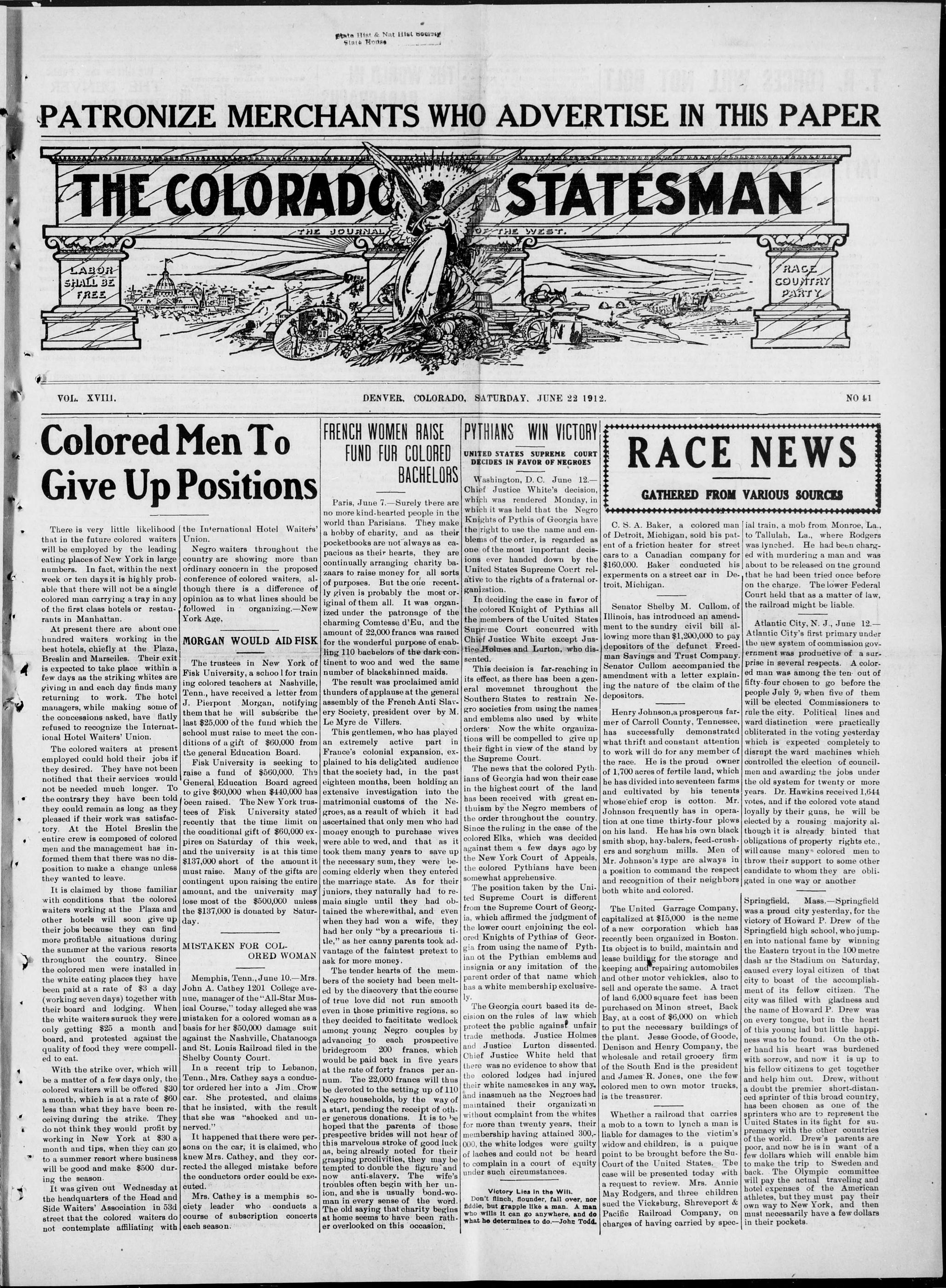
PATRONIZE MERCHANTS WHO ADVERTISE IN THIS PAPER
THE COLORADO STATESMAN
THE JOURNAL OF THE WEST.
LABOR SHALL BE FREE
RAGE COUNTRY PARTY
Colored Men To Give Up Positions
VOL. XVIII.
Colored Give Up
There is very little likelihood that in the future colored waiters will be employed by the leading eating places of New York in large numbers. In fact, within the next week or ten days it is highly probable that there will not be a single colored man carrying a tray in any of the first class hotels or restaurants in Manhattan.
At present there are about one hundred waiters working in the best hotels, chiefly at the Plaza, Breslin and Marseiles. Their exit is expected to take place within a few days as the striking whites are giving in and each day finds many returning to work. The hotel managers, while making some of the concessions asked, have flatly refused to recognize the International Hotel Waiters' Union.
The colored waiters at present employed could hold their jobs if they desired. They have not been notified that their services would not be needed much longer. To the contrary they have been told they could remain as long as they pleased if their work was satisfactory. At the Hotel Breslin the entire crew is composed of colored men and the management has informed them that there was no disposition to make a change unless they wanted to leave.
It is claimed by those familiar with conditions that the colored waiters working at the Plaza and other hotels will soon give up their jobs because they can find more profitable situations during the summer at the various resorts throughout the country. Since the colored men were installed in the white eating places they have been paid at a rate of $3 a day (working seven days) together with their board and lodging. When the white waiters suruck they were only getting $25 a month and board, and protested against the quality of food they were compelled to eat.
With the strike over, which will be a matter of a few days only, the colored waiters will be offered $30 a month, which is at a rate of $60 less than what they have been receiving during the strike. They do not think they would profit by working in New York at $30 a month and tips, when they can go to a summer resort where business will be good and make $500 during the season.
It was given out Wednesday at the headquarters of the Head and Side Waiters' Association in 53d street that the colored waiters do not contemplate affiliating with
the International Hotel Waiters' Union. Negro waiters throughout the country are showing more than ordinary concern in the proposed conference of colored waiters, although there is a difference of opinion as to what lines should be followed in organizing.—New York Age.
MORGAN WOULD AID FISK
The trustees in New York of Fisk University, a school for training colored teachers at Nashville, Tenn., have received a letter from J. Pierpont Morgan, notifying them that he will subscribe the last $25,000 of the fund which the school must raise to meet the conditions of a gift of $60,000 from the general Education Board.
Fisk University is seeking to raise a fund of $560,000. The General Education Board agreed to give $60,000 when $440,000 has been raised. The New York trustees of Fisk University stated recently that the time limit on the conditional gift of $60,000 expires on Saturday of this week, and the university is at this time $137,000 short of the amount it must raise. Many of the gifts are contingent upon raising the entire amount, and the university may lose most of the $500,000 unless the $137,000 is donated by Saturday.
MUSTAKEN FOR COL ORED WOMAN
Memphis, Tenn., June 10.—Mrs. John A. Cathey 1201 College avenue, manager of the "All-Star Musical Course," today alleged she was mistaken for a colored woman as a basis for her $50,000 damage suit against the Nashville, Chatanooga and St. Louis Railroad filed in the Shelby County Court.
In a recent trip to Lebanon, Tenn., Mrs. Cathey says a conductor ordered her into a Jim Crow car. She protested, and claims that he insisted, with the result that she was "shocked and unnerved."
It happened that there were persons on the car, it is claimed, who knew Mrs. Cathey, and they corrected the alleged mistake before the conductors order could be executed.
Mrs. Cathey is a memphis society leader who conducts a course of subscription concerts each season.
DENVER. COLORADO. SATURDAY. JUNE 22 1912.
State Hist & Nat Hist bouring
State House
HANTS WH
ADO
JOURNAL
DENVER, COLORADO
FRENCH WOMEN RAISE FUND FUR COLORED BACHELORS
Paris, June 7.—Surely there are no more kind-hearted people in the world than Parisians. They make a hobby of charity, and as their pocketbooks are not always as capacious as their hearts, they are continually arranging charity bazaars to raise money for all sorts of purposes. But the one recently given is probably the most original of them all. It was organized under the patronage of the charming Comtesse d'Eu, and the amount of 22,000 francs was raised for the wonderful purpose of enabling 110 bachelors of the dark continent to woo and wed the same number of blackshinned maids.
The result was proclaimed amid thunders of applause at the general assembly of the French Anti Slavery Society, president over by M. Le Myre de Villers.
This gentlemen, who has played an extremely active part in France's colonial expansion, explained to his delighted audience that the society had, in the past eighteen months, been holding an extensive investigation into the matrimonial customs of the Negroes, as a result of which it had ascertained that only men who had money enough to purchase wives were able to wed, and that as it took them many years to save up the necessary sum, they were becoming elderly when they entered the marriage state. As for their juniors, they naturally had to remain single until they had obtained the wherewithal, and even when they had won a wife, they had her only "by a precarious title," as her canny parents took advantage of the faintest pretext to ask for more money.
The tender hearts of the members of the society had been melted by the discovery that the course of true love did not run smooth even in those primitive regions, so they decided to facititate wedlock among young Negro couples by advancing to each prospective bridegroom 200 francs, which would be paid back in five years at the rate of forty francs per annum. The 22,000 francs will thus be devoted to the setting up of 110 Negro households, by the way of a start, pending the receipt of other generous donations. It is to be hoped that the parents of those prospective brides will not hear of this marvelous stroke of good luck, being already noted for their grasping proclivities, they may be tempted to double the figure and now anti-slavery. The wife's troubles often begin with her union, and she is usually bond-woman in every sense of the word. The old saying that charity begins at home seems to have been rather overlooked on this occasion.
---
PYTHIANS WIN VICTORY
UNITED STATES SUPREME COURT DECIDES IN FAVOR OF NEGROES
Washington, D.C. June 12. Chief Justice White's decision, which was rendered Monday, in which it was held that the Negro Knights of Pythis of Georgia have the right to use the name and emblems of the order, is regarded as one of the most important decisions ever handed down by the United States Supreme Court relative to the rights of a fraternal organization.
In deciding the case in favor of the colored Knight of Pythias all the members of the United States Supreme Court concurred with Chief Justice White except Justice Holmes and Lurton, who dissented.
This decision is far-reaching in its effect, as there has been a general movemnet throughout the Southern States to restrain Negro societies from using the names and emblems also used by white orders. Now the white organizations will be compelled to give up their fight in view of the stand by the Supreme Court. The news that the colored Pythians of Georgia had won their case in the highest court of the land has been received with great enthuism by the Negro members of the order throughout the country. Since the ruling in the case of the colored Elks, which was decided against them a few days ago by the New York Court of Appeals, the colored Pythians have been somewhat apprehensive.
The position taken by the United Supreme Court is different from the Supreme Court of Georgia, which affirmed the judgment of the lower court enjoining the colored Knights of Pythias of Georgia from using the name of Pythian ot the Pythian emblems and insignia or any imitation of the parent order of that name which has a white membership exclusively.
The Georgia court based its decision on the rules of law which protect the public against unfair trade methods. Justice Holmes and Justice Lurton dissented. Chief Justice White held that there was no evidence to show that the colored lodges had injured their white namesakes in any way and inasmuch as the Negroes had maintained their organization without complaint from the whites for more than twenty years, their membership having attained 300,000, the white lodges were guilty of laches and could not be heard to complain in a court of equity under such circumstances.
Victory Lies in the Will.
Don't flinch, flounder, fall over, nor fiddle, but grapple like a man. A man who wills it can go anywhere, and do what he determines to do—John Todd.
RACE NEWS
C. S. A. Baker, a colored man of Detroit, Michigan, sold his patent of a friction heater for street cars to a Canadian company for $160,000. Baker conducted his experiments on a street car in Detroit, Michigan.
Senator Shelby M. Cullom, of Illinois, has introduced an amendment to the sundry civil bill allowing more than $1,200,000 to pay depositors of the defunct Freedman Savings and Trust Company. Senator Cullom accompanied the amendment with a letter explaining the nature of the claim of the depositors.
Henry Johnson,a prosperous farmer of Carroll County, Tennessee, has successfully demonstrated what thrift and constant attention to work will do for any member of the race. He is the proud owner of 1,700 acres of fertile land, which he has divided into seventeen farms and cultivated by his tenents whose chief crop is cotton. Mr. Johnson frequently has in operation at one time thirty-four plows on his land. He has his own black smith shop, hay-balers, feed-crusher and sorghum mills. Men of Mr. Johnson's type are always in a position to command the respect and recognition of their neighbors both white and colored.
The United Garrage Company, capitalized at $15,000 is the name of a new corporation which has recently been organized in Boston. Its object is to build, maintain and lease building for the storage and keeping and repairing automobiles and other motor vehiclekiles, also to sell and operate the same. A tract of land 6,000 square feet has been purchased on Minon street, Back Bay, at a cost of $6,000 on which to put the necessary buildings of the plant. Jesse Goode, of Goode, Denison and Henry Company, the wholesale and retail grocery firm of the South End is the president and James R. Jones, one the few colored men to own motor trucks, is the treasurer.
Whether a railroad that carries a mob to a town to lynch a man is liable for damages to the victim's widow and children, is a puique point to be brought before the SuCourt of the United States. The case will be presented today with a request to review. Mrs. Annie May Rodgers, and three children sued the Vicksburg, Shreveport & Pacific Railroad Company, on charges of having carried by spec-
NO 41
ial train, a mob from Monroe, La., to Tallulah, La., where Rodgers was lynched. He had been charged with murdering a man and was about to be released on the ground that he had been tried once before on the charge. The lower Federal Court held that as a matter of law, the railroad might be liable.
Atlantic City, N. J., June 12. Atlantic City's first primary under the new system of commission government was productive of a surprise in several respects. A colored man was among the ten out of fifty-four chosen to go before the people July 9, when five of them will be elected Commissioners to rule the city. Political lines and ward distinction were practically obliterated in the voting yesterday which is expected completely to disrupt the ward machines which controlled the election of councilmen and awarding the jobs under the old system for twenty or more years. Dr. Hawkins received 1,644 votes, and if the colored vote stand loyally by their guns, he will be elected by a rousing majority although it is already hinted that obligations of property rights etc., will cause many colored men to throw their support to some other candidate to whom they are obligated in one way or another
Springfield, Mass.—Springfield was a proud city yesterday, for the victory of Howard P. Drew of the Springfield high school, who jumpen into national fame by winning the Eastern tryout in the 100 metre dash ar the Stadium on Saturday, caused every loyal citizen of that city to boast of the accomplishment of its fellow citizen. The city was filled with gladness and the name of Howard P. Drew was on every tongue, but in the heart of this young lad but little happiness was to be found. On the other hand his heart was burdened with sorrow, and now it is up to his fellow citizens to get together and help him out. Drew, without a doubt the premier short-distance spinner of this broad country, has been chosen as one of the sprinters who are to represent the United States in its fight for supremacy with the other countries of the world. Drew's parents are poor, and now he is in want of a few dollars which will enable him to make the trip to Sweden and back. The Olympic committee will pay the actual traveling and hotel expenses of the American athletes, but they must pay their own way to New York, and then must necessarily have a few dollars in their pockets.
T. R. FORCES WILL NOT BOLT
PLAN TO DELAY ACTION SEVERAL WEEKS AND THEN SUMMON ENTIRELY NEW CONVENTION BEING CONSIDERED BY COLONEL.
TAFT GETS CONTESTED DELEGATES
CREDENTIALS COMMITTEE APPROVES SEATING OF 22 OF THE 78 CONTESTED DELEGATES—OTHERS YET TO BE PASSED ON.
Western Newspaper Union News Service.
Chicago.—Roosevelt men have switched tactics. They did not bolt the convention and in caucus formally decided not to do so. They have two plans of action. If the Roosevelt contested delegates are not seated, the Roosevelt forces will remain in the hall, but take no part in the proceedings, even if a compromise candidate is urged. Then, when the convention stands adjourned, the Roosevelt delegates are to hold a convention in the same hall and assert its regularity. The organization of a new party, with Roosevelt at its head, is also mooted. Mean-time the Taft forces, still solid, are awaiting developments, confident of the President's nomination.
Chicago.—Roosevelt men have switched tactics. They did not bolt the convention and in caucus formally decided not to do so. They have two plans of action. If the Roosevelt contested delegates are not seated, the Roosevelt forces will remain in the hall, but take no part in the proceedings, even if a compromise candidate is urged. Then, when the convention stands adjourned, the Roosevelt delegates are to hold a convention in the same hall and assert its regularity. The organization of a new party, with Roosevelt at its head, is also mooted. Mean-time the Taft forces, still solid, are awaiting developments, confident of the President's nomination.
Working slowly through the list of contested delegates referred to it by the Republican national committee, the credentials committee had up to 10 o'clock Thursday night seated twenty-two Taft delegates. This included twelve from Florida, against whom the Roosevelt men made no contest and who were seated unanimously.
should be no "bolt" from the regular convention.
It is the plan of the Roosevelt delegates to make their last stand on the report of the credentials committee. If the seventy-eight delegates, declared by them to be fraudulent, are seated, the Roosevelt forces will remain in the convention until the end, but will not vote.
Of the seventy-eight contested delegates included in Governor Hadley's list of those whom he claimed the national convention "unfairly" indorsed, the following were approved by the credentials committee:
Alabama Ninth district, two.
Arkansas Fifth district, two.
Arizona delegates-at-large, six.
Perfect harmony prevailed in the committee. Roosevelt members advocated passing the Florida, Georgia and other similar cases, but the Taft members of the committee insisted on reopening each case passed on by the national committee.
The Taft delegates-at-large from Georgia, four in number, were seated
W. H.
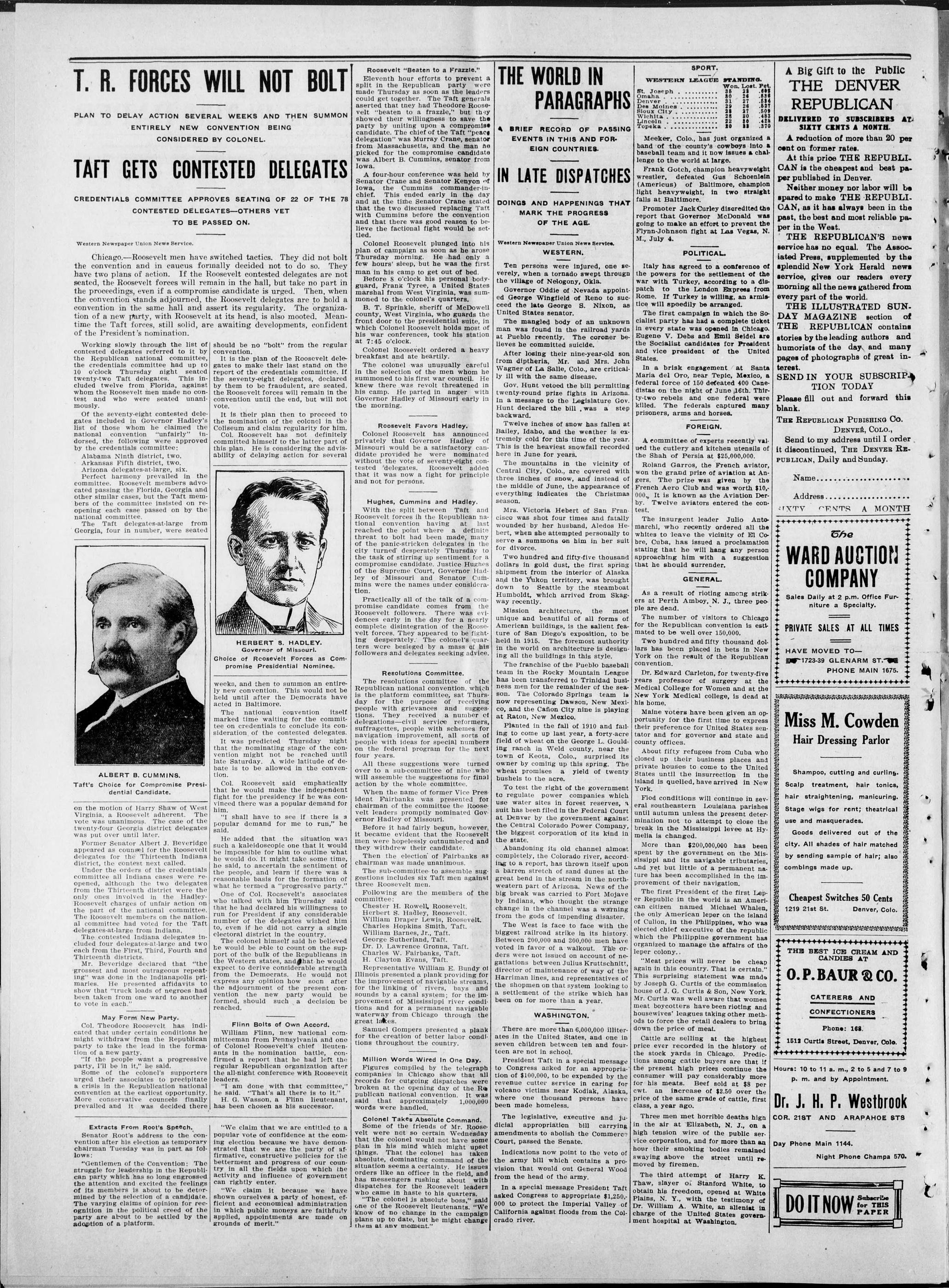
ALBERT B. CUMMINS.
Taft's Choice for Compromise Presidential Candidate.
on the motion of Harry Shaw of West Virginia, a Roosevelt adherent. The vote was unanimous. The case of the twenty-four Georgia district delegates was put over until later.
Former Senator Albert J. Beveridge appeared as counsel for the Roosevelt delegates for the Thirteenth Indiana district, the contest next called.
Under the orders of the credentials committee all Indiana cases were re-opened, although the two delegates from the Thirteenth district were the only ones involved in the Hadley-Roosevelt charges of unfair action on the part of the national committee. The Roosevelt members on the national committee had voted for the Taft delegates-at-large from Indiana.
The contested Indiana delegates included four delegates-at-large and two each from the First, Third, Fourth and Thirteenth districts.
Mr. Beveridge declared that "the grossest and most outrageous repeating" was done in the Indianapolis primaries. He presented affidavits to show that "truck loads of negroes had been taken from one ward to another to vote in each."
Col. Theodore Roosevelt has indicated that under certain conditions he might withdraw from the Republican party to take the lead in the formation of a new party.
"If the people want a progressive party, I'll be in it," he said.
Some of the colonel's supporters urged their associates to precipitate a crisis in the Republication national convention at the earliest opportunity. More conservative counsels finally prevailed and it was decided there
Senator Root's address to the convention after his election as temporary chairman Tuesday was in part as follows:
"Gentlemen of the Convention: The struggle for leadership in the Republican party which has so long engrossed the attention and excited the feelings of its members is about to be determined by the selection of a candidate. The varying claims of opinion for recognition in the political creed of the party are about to be settled by the adoption of a platform.
May Form New Party.
should be no "bolt" from the regular convention.
It is the plan of the Roosevelt delegates to make their last stand on the report of the credentials committee. If the seventy-eight delegates, declared by them to be fraudulent, are seated, the Roosevelt forces will remain in the convention until the end, but will not vote.
It is their plan then to proceed to the nomination of the colonel in the Coliseum and claim regularity for him. Col. Roosevelt has not definitely committed himself to the latter part of this plan. He is considering the advisability of delaying action for several
J.
HERBERT S. HADLEY. Governor of Missouri. Gchoice of Roosevelt Forces as Compromise Presidential Nominee.
weeks, and then to summon an entirely new convention. This would not be held until after the Democrats have acted in Baltimore.
The national convention itself marked time waiting for the committee on credentials to conclude its consideration of the contested delegates.
It was predicted Thursday night that the nominating stage of the convention might not be reached until late Saturday. A wide latitude of debate is to be allowed in the convention.
Col. Roosevelt said emphatically that he would make the independent fight for the presidency if he was convinced there was a popular demand for him.
"I shall have to see if there is a popular demand for me to run," he said.
He added that the situation was such a kaleidoscopic one that it would be impossible for him to outline what he would do. It might take some time, he said, to ascertain the sentiment of the people, and learn if there was a reasonable basis for the formation of what he termed a "progressive party."
One of Col. Roosevelt's associates who talked with him Thursday said that he had declared his willingness to run for President if any considerable number of the delegates wished him to, even if he did not carry a single electoral district in the country.
The colonel himself said he believed he would be able to count on the support of the bulk of the Republicans in the Western states, and that he would expect to derive considerable strength from the Democrats. He would not express any opinion how soon after the adjournment of the present convention the new party would be formed, should such a decision be reached.
Flinn Bolts of Own Accord.
William Flinn, new national committeeman from Pennsylvania and one of Colonel Roosevelt's chief lieutenants in the nomination battle, confirmed a report that he had left the regular Republican organization after the all-night conference with Roosevelt leaders.
"I am done with that committee," he said. "That's all there is to it."
H. G. Wasson, a Flinn lieutenant, has been chosen as his successor.
"We claim that we are entitled to a popular vote of confidence at the coming election because we have demonstrated that we are the party of affirmative, constructive policies for the betterment and progress of our country in all the fields upon which the activity and influence of government can rightly enter.
"We claim it because we have shown ourselves a party of honest, efficient and economical administration in which public moneys are faithfully applied, appointments are made on grounds of merit."
Roosevelt "Beaten to a Frazzle."
Eleventh hour efforts to prevent a split in the Republican party were made Thursday as soon as the leaders could get together. The Taft generals ascerted that they had the Theodore Roosevelt "beaten to a frazzle," but they showed their willingness to save the party by uniting upon a compromise candidate. The chief of the Taft "peace delegation" was Murray Crane, senator from Massachusetts, and the man he picked for the compromise candidate was Albert B. Cummins, senator from Iowa.
A four-hour conference was held by Senator Crane and Senator Kenyon of Iowa, the Cummins commander-in-chief. This ended early in the day and at the time Senator Crane stated that the two discussed replacing Tatt with Cummins before the convention and that there was good reason to believe the factional fight would be settled.
Colonel Roosevelt plunged into his plan of campaign as soon as he arose Thursday morning. He had only a few hours' sleep, but he was the first man in his camp to get out of bed. Before 8 o'clock his personal bodyguard, Frank Tyre, a United States marshal from West Virginia, was summoned to the colonel's quarters. B. T. Sprinkle, sheriff of McDowell county, West Virginia, who guards the front door to the presidential suite, in which Colonel Roosevelt holds most of his war conferences, took his station at 7:45 o'clock. Colonel Roosevelt ordered a heavy breakfast and ate heartily. The colonel was unusually careful in the selection of the men whom he summoned to his first war council. He knew there was revolt threatened in his camp. He parted in anger with Governor Hadley of Missouri early in the morning.
Roosevelt Favors Hadley.
Colonel Roosevelt has announced privately that Governor Hadley of Missouri would be a satisfactory candidate provided he were nominated without the vote of seventy-eight contested 'delegates. Roosevelt added that it was now a fight for principle and not for persons.
Hughes, Cummins and Hadley
With the split between Taft, and Roosevelt forces in the Republican national convention having at last reached the point where a definite threat to bolt had been made, many of the panic-stricken delegates in the city turned desperately Thursday to the task of stirring up sentiment for a compromise candidate. Justice Hughes of the Supreme Court, Governor Hadley of Missouri and Senator Cummins were the names under consideration.
Practically all of the talk of a compromise candidate comes from the Roosevelt followers. There was evidences early in the day for a nearly complete disintegration of the Roosevelt forces. They appeared to be fighting desperately. The colonel's quarters were besieged by a mass of his followers and delegates seeking advice.
Resolutions Committee.
The resolutions committee of the Republican national convention, which is the platform committee, sat Thursday for the purpose of receiving people with grievances and suggestions. They received a number of delegations—civil service reformers, suffragettes, people with schemes for navigation improvement, all sorts of people with ideas for special numbers on the federal program for the next four years.
All these suggestions were turned over to a sub-committee of nine who will assemble the suggestions for final action by the whole committee.
When the name of former Vice President Fairbanks was presented for chairman of the committee the Roosevelt leaders promptly nominated Governor Hadley of Missouri.
Before it had fairly begun, however, it became evident that the Roosevelt men were hopelessly outnumbered and they withdrew their candidate.
Then the election of Fairbanks as chairman was made unanimous. The sub-committee to assemble suggestions includes six Taft men against three Roosevelt men. Following are the members of the committee:
Chester H. Rowell, Roosevelt.
Herbert S. Hadley, Roosevelt.
William Draper Lewis, Roosevelt.
Charles Hopkins Smith, Taft.
William Barnes, Jr., Taft.
George Sutherland, Taft.
Dr. D. Lawrence Gronna, Taft.
Charles W. Fairbanks, Taft.
H. Clayton Evans, Taft.
Representative William E. Bundy of Illinois presented a plank providing for the improvement of navigable streams, for the linking of rivers, bays and sounds by a canal system; for the improvement of Mississippi river conditions and for a permanent navigable waterway from Chicago through the great lakes.
Samuel Gompers presented a plank for the creation of better labor conditions throughout the country.
Million Words Wired In One Day.
Figures compiled by the telegraph companies in Chicago show that all records for outgoing dispatches were broken at the opening day of the Republican national convention. It was said that approximately 1,000,000 words were handled.
Colonel Takes Absolute Command.
Some of the friends of Mr. Roosevelt were not so certain Wednesday that the colonel would not have some plan in his mind which might upset things. That the colonel has taken absolute, dominating command of the situation seems a certainty. He issues orders like an officer in the field, and has messengers rushing about with dispatches for the Roosevelt leaders who came in haste to his quarters.
"The colonel is absolute boss," said one of the Roosevelt lieutenants. "We know of no change in the campaign plans up to date, but he might change them at any moment."
THE WORLD IN PARAGRAPHS
4 BRIEF RECORD OF PASSING EVENTS IN THIS AND FOR- EIGN COUNTRIES.
IN LATE DISPATCHES
DOINGS AND HAPPENINGS THAT MARK THE PROGRESS OF THE AGE.
Western Newspaper Union News Service.
Ten persons were injured, one severely, when a tornado swept through the village of Nelogony, Okla.
Governor Oddie of Nevada appointed George Wingfield of Reno to succeed the late George S. Nixon, as United States senator.
The mangled body of an unknown man was found in the railroad yards at Pueblo recently. The coroner believes he committed suicide.
After losing their nine-year-old son from diphtheria, Mr. and Mrs. John Wagner of La Salle, Colo., are critically ill with the same disease.
Gov. Hunt vetoed the bill permitting twenty-round prize rights in Arizona. In a message to the Legislature Gov. Hunt declared the bill, was a step backward.
Twelve inches of snow has fallen at Bailey, Idaho, and the weather is extremely cold for this time of the year. This is the heaviest snowfall recorded here in June for years.
The mountains in the vicinity of Central City, Colo., are covered with three inches of snow, and instead of the middle of June, the appearance of everything indicates the Christmas season.
Mrs. Victoria Hebert of San Francisco was shot four times and fatally wounded by her husband, Aledos Hebert, when she attempted personally to serve a summons on him in her suit for divorce.
Two hundred and fifty-five thousand dollars in gold dust, the first spring shipment from the interior of Alaska and the Yukon territory, was brought down to Seattle by the steamboat Humboldt, which arrived from Skagway recently.
Mission architecture, the most unique and beautiful of all forms of American buildings, is the salient feature of San Diego's exposition, to be held in 1915. The foremost authority in the world on architecture is designing all the buildings in this style.
The franchise of the Pueblo baseball team in the Rocky Mountain League has been transferred to Trinidad business men for the remainder of the season. The Colorado Springs team is now representing Dawson, New Mexico, and the Cañon City nine is playing at Raton, New Mexico.
Planted in the fall of 1910 and failing to come up last year, a forty-acre field of wheat on the George L. Goulding ranch in Weld county, near the town of Keota, Colo., surprised its owner by coming up this spring. The wheat promises a yield of twenty bushels to the acre.
To test the right of the government to regulate power companies which use water sites in forest reserves, a suit has been filed in the Federal Court at Denver by the government against the Central Colorado Power Company, the biggest corporation of its kind in the state.
Abandoning its old channel almost completely, the Colorado river, according to a report, has thrown itself upon a barren stretch of sand dunes at the great bend in the stream in the northwestern part of Arizona. News of the big break was carried to Fort Mojave by Indians, who thought the strange change in the channel was a warning from the gods of impending disaster. The West is face to face with the biggest railroad strike in its history. Between 200,000 and 300,000 men have voted in favor of a walkout. The orders were not issued on account of negatiations between Julius Kruttschnit, director of maintenance of way of the Harriman lines, and representatives of the shopmen on that system looking to a settlement of the strike which has been on for more than a year.
WASHINGTON.
There are more than 6,000,000 illiterates in the United States, and one in seven children between ten and fourteen are not in school.
President Taft in a special message to Congress asked for an appropriation of $100,000, to be expended by the revenue cutter service in caring for volcano victims near Kodiak, Alaska, where one thousand persons have been made homeless.
The legislative, executive and judicial appropriation bill carrying amendments to abolish the Commerce Court, passed the Senate.
Indications now point to the veto of the army bill which contains a provision that would out General Wood from the head of the army.
In a special message President Taft asked Congress to appropriate $1,250,000 to protect the Imperial Valley of California against floods from the Colorado river.
STANDING.
Won. Lost. Pet.
30 22 586
30 22 586
31 27 586
29 26 527
29 26 527
28 20 483
28 20 483
22 30 428
22 30 428
22 30 428
30 30 370
St. Joseph ..... 35 23 692
Omaha ..... 30 26 538
Denver ..... 31 27 534
Des Molnes ..... 29 26 527
Sloux City ..... 28 27 509
Wichita ..... 28 20 483
Lincoln ..... 22 30 428
Topeka ..... 20 33 370
Meeker, Colo., has just organized a band of the county's cowboys into a baseball team and it now issues a challenge to the world at large.
Frank Gotch, champion heavyweight wrestler, defeated Gus Schoenlein (Americus) of Baltimore, champion light heavyweight, in two straight falls at Baltimore.
Promoter Jack Curley discredited the report that Governor McDonald was going to make an effort to prevent the Flynn-Johnson fight at Las Vegas, N. M., July 4.
POLITICAL
Italy has agreed to a conference of the powers for the settlement of the war with Turkey, according to a dispatch to the London Express from Rome. If Turkey is willing, an armistice will speedily be arranged.
The first campaign in which the Socialist party has had a complete ticket in every state was opened in Chicago. Eugene V. Debs and Emil Seidel are the Socialist candidates for President and vice president of the United States.
In a brisk engagement at Santa Maria del Oro, near Tepic, Mexico, a federal force of 150 defeated 400 Canadistas on the night of June 16th. Thirty-two rebels and one federal were killed. The federals captured many prisoners, arms and horses.
FOREIGN.
A committee of experts recently valued the cutlery and kitchen utensils of the Shah of Persia at $25,000,000.
Roland Garros, the French aviator, won the grand prize of aviation at Angers. The prize was given by the French Aero Club and was worth $10,000. It is known as the Aviation Derby. Twelve aviators entered the contest.
The insurgent leader Julio Antomarchi, who recently ordered all the whites to leave the vicinity of El Cobre, Cuba, has issued a proclamation stating that he will hang any person approaching him with a suggestion that he should surrender.
GENERAL
As a result of rioting among strikers at Perth Amboy, N. J., three people are dead.
The number of visitors to Chicago for the Republican convention is estimated to be well over 150,000.
Two hundred and fifty thousand dollars has been placed in bets in New York on the result of the Republican convention.
Dr. Edward Carleton, for twenty-five years professor of surgery at the Medical College for Women and at the New York Medical college, is dead at his home.
Maline voters have been given an opportunity for the first time to express their preference for United States senator and for governor and state and county offices.
About fifty refugees from Cuba who closed up their business places and private houses to come to the United States until the insurrection in the island is quelled, have arrived in New York.
Flod conditions will continue in several southeastern Louisiana parishes until autumn unless the present determination not to attempt to close the break in the Mississippi levee at Hymella is changed.
More than $200,000,000 has been spent by the government on the Mississippi and its navigable tributaries, and yet but little of a permanent nature has been accomplished in the improvement of their navigation.
The first President of the first Lepar Republic in the world is an American citizen named Michael Whalen, the only American leper on the island of Culion, in the Philippines, who was elected chief executive of the republic which the Philippine government has organized to manage the affairs of the leper colony...
"Meat prices will never be cheap again in this country. That is certain." This surprising statement was made by Joseph G. Curtis of the commission house of J. G. Curtis & Son, New York. Mr. Curtis was well aware that women meat boycotters have been rioting and housewives' leagues taking other methods to force the retail dealers to bring down the price of meat.
Cattle are selling at the highest price ever recorded in the history of the stock yards in Chicago. Predictions among cattle buyers are that if the present high prices continue the consumer will pay considerably more for his meats. Beef sold at $8 per cwt. an increase of $2.50 over the price of the same grade of cattle, first class, a year ago.
Three men met horrible deaths high in the air at Elizabeth, N. J., on a high tension wire of the public service corporation, and for more than an hour their smoking bodies remained swaying above the street until removed by firemen.
The third attempt of Harry K. Thaw, slayer of Stanford White, to obtain his freedom, opened at White Plains, N. Y., with the testimony of Dr. William A. White, an alienist in charge of the United States government hospital at Washington.
A Big Gift to the Public THE DENVER REPUBLICAN
DELIVERED TO SUBSCRIBERS AT
SIXXT CENTS A MONTH.
A reduction of more than 20 per
cent on former rates.
At this price THE REPUBLI-
CAN is the cheapest and best
paper published in Denver.
Neither money nor labor will be
spared to make THE REPUBLI-
CAN, as it has always been in the
past, the best and most reliable
paper in the West.
THE REPUBLICAN'S news service has no equal. The Associated Press, supplemented by the splendid New York Herald news service, gives our readers every morning all the news gathered from every part of the world.
THE ILLUSTRATED SUNDAY MAGAZINE section of THE REPUBLICAN contains stories by the leading authors and humorists of the day and many pages of photographs of great interest.
SEND IN YOUR SUBSCRIPTION TODAY
Please fill out and forward this blank.
THE REPUBLICAN PUBISHING CO.
DENVER, COLO.,
Send to my address until I order
it discontinued, THE DENVER RE-
PUBLICAN, Daily and Sunday.
Name.....
Address.....
SIXTY CENTS A MONTH
The
WARD AUCTION
COMPANY
Sales Daily at 2 p.m. Office Furniture a Specialty.
PRIVATE SALES AT ALL TIMES
HAVE MOVED TO—
1723-39 GLENARM ST.
PHONE MAIN 1675.
Miss M. Cowden Hair Dressing Parlor
Shampoo, cutting and curling. Scalp treatment, hair tonics, hair straightening, manicuring. Stage wigs for rent; theatrical use and masquerades. Goods delivered out of the city. All shades of hair matched by sending sample of hair; also combings made up.
```markdown
```
Cheapest Switches 50 Cents
1219 21st St. Denver, Colo
THE BEST ICE CREAM AND CANDIES AT
CATERERS AND
CONFECTIONERS
Phone: 168.
1512 Curtis Street, Denver, Colo.
Hours: 10 to 11 a. m., 2 to 5 and 7 to 9
p. m. and by Appointment.
Dr. J. H. P. Westbrook
COR. 21ST AND ARAPAHOE STS
Day Phone Main 1144.
Night Phone Champa 570.
DO IT NOW Subscribe for THIS PAPER
"SEE AMERICA FIRST" SPIRIT
THE RAILWAYS
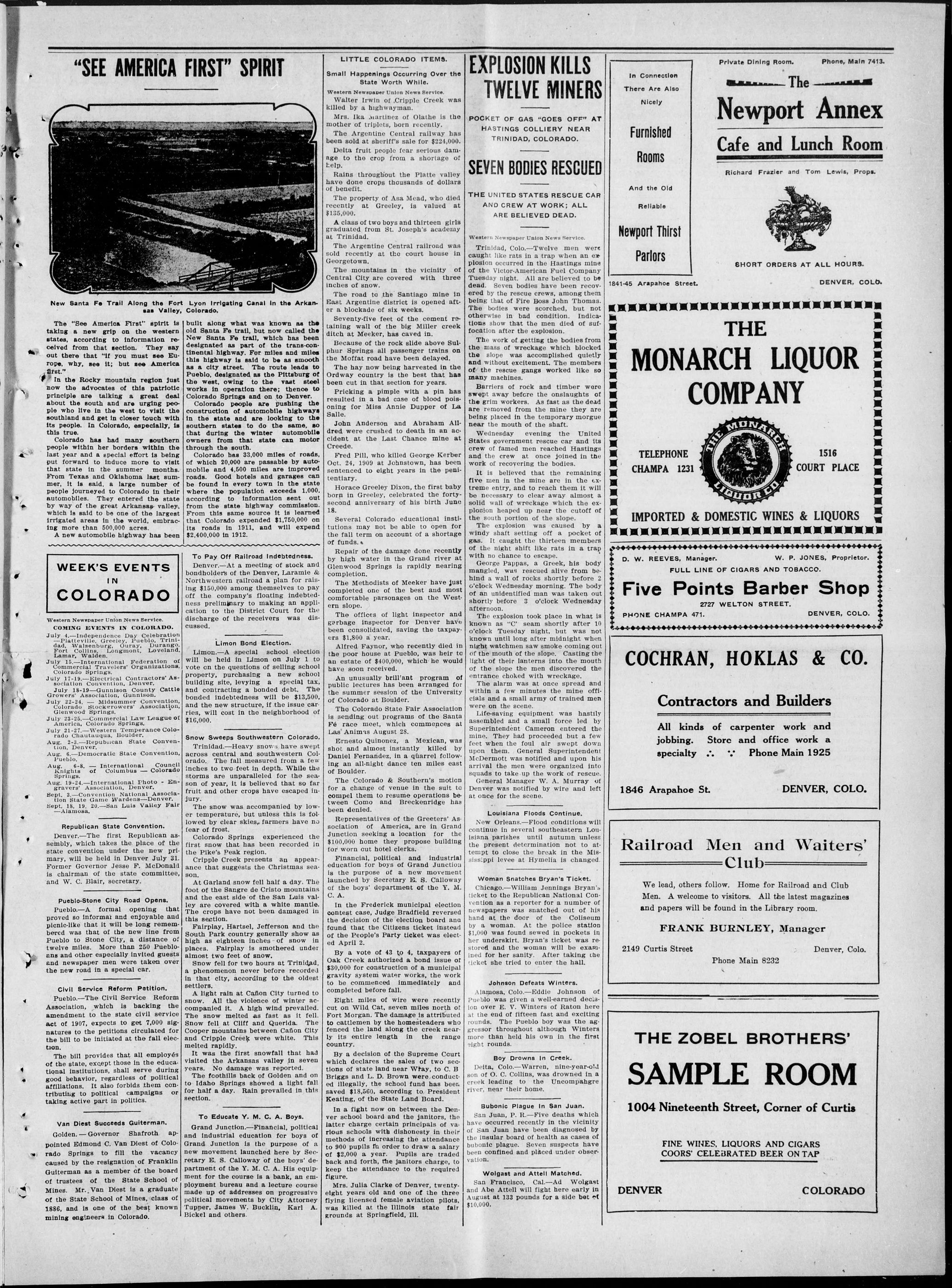
New Santa Fe Trail Along the Fort Lyon Irrigating Canal in the Arkansas Valley, Colorado.
The "See America First" spirit is taking a new grip on the western states, according to information received from that section. They say out there that "if you must see Europe, why, see it; but see America first."
In the Rocky mountain region just now the advocates of this patriotic principle are talking a great deal about the south and are urging people who live in the west to visit the southland and get in closer touch with its people. In Colorado, especially, is this true.
built along what was known as the old Santa Fe trail, but now called the New Santa Fe trail, which has been designated as part of the transcontinental highway. For miles and miles this highway is said to be as smooth as a city street. The route leads to Pueblo, designated as the Pittsburg of the west, owing to the vast steel works in operation there; thence to Colorado Springs and on to Denver.
Colorado people are pushing the construction of automobile highways in the state and are looking to the southern states to do the same, so that during the winter automobile
Colorado has had many southern people within her borders within the last year and a special effort is being put forward to induce more to visit that state in the summer months. From Texas and Oklahoma last summer, it is said, a large number of people journeyed to Colorado in their automobiles. They entered the state by way of the great Arkansas valley, which is said to be one of the largest irrigated areas in the world, embracing more than 500,000 acres. A new automobile highway has been
WEEK'S EVENTS IN COLORADO
Western Newpaper Union News Service.
COMING EVENTS IN COLORADO.
July 14 - Independence Day, Celebration
July 4.—Independence Day Celebration
—Platteville, Greeley, Pueblo, Trinidad,
Wolff Collins, Ocay, Fort Collins, Longmont, Loveland,
Lamar, Walden.
July 15.—International Federation of Commercial Travelers' Organizations, Colorado Springs.
July 15.—International Contractors' Association Convention, Denver.
July 18-19.—Gunnison County Cattle Growers' Association, Gunnison.
Growers Association, Gunnison.
July 22-24. — Midsummer Convention,
Colorado Stockgrowers' Association,
Glenwood Springs.
July 23-25—Commercial Law League of America, Colorado Springs.
July 21-27.—Western Temperance Colorado Chautauqua, Boulder.
Aug. 2-3.—Republican State Convention, Denver.
Aug. 6.—Democratic State Convention, Pueblo.
Aug. 6-8. — International Council
Knights of Columbus — Colorado
Springs.
Aug. 19-24. — International Photo - Engravers' Association, Denver.
Sept. 3. — Convention National Association
Sports Game Wardens—Denver,
Sept. 18, 19. — San Luis Valley Fair
- Alamosa.
Republican State Convention.
Denver.—The first Republican assembly, which takes the place of the state convention under the new primary, will be held in Denver July 31. Former Governor Jesse F. McDonald is chairman of the state committee, and W. C. Blair, secretary.
Pueblo-Stone City Road Opens.
Pueblo—A formal opening that proved so informal and enjoyable and picnic-like that it will be long remembered was that of the new line from Pueblo to Stone City, a distance of twelve miles. More than 250 Pueblans and other especially invited guests and newspaper men were taken over the new road in a special car.
Civil Service Reform Petition.
Pueblo.-The Civil Service Reform Association, which is backing the amendment to the state civil service act of 1907, expects to get 7,000 signatures to the petitions circulated for the bill to be initiated at the fall election.
The bill provides that all employés of the state, except those in the educational institutions, shall serve during good behavior, regardless of political affiliations. It also forbids them contributing to political campaigns or taking active part in politics.
Van Diest Succeeds Guiterman.
Golden. Governor Shafroth appointed Edmond C. Van Diest of Colorado Springs to fill the vacancy caused by the resignation of Franklin Gutterman as a member of the board of trustees of the State School of Mines. Mr. Van Diest is a graduate of the State School of Mines, class of 1886, and is one of the best known mining engineers in Colorado.
built along what was known as the old Santa Fe trail, but now called the New Santa Fe trail, which has been designated as part of the trans-continental highway. For miles and miles this highway is said to be as smooth as a city street. The route leads to Pueblo, designated as the Pittsburg of the west, owing to the vast steel works in operation there; thence to Colorado Springs and on to Denver. Colorado people are pushing the construction of automobile highways in the state and are looking to the southern states to do the same, so that during the winter automobile owners from that state can motor through the south.
Colorado has 33,000 miles of roads, of which 20,000 are passable by automobile and 4,500 miles are improved roads. Good hotels and garages can be found in every town in the state where the population exceeds 1,000, according to information sent out from the state highway commission. From this same source it is learned that Colorado expended $1,750,000 on its roads in 1911, and will expend $2,400,000 in 1912.
To Pay Off Railroad Indebtedness. Denver.—At a meeting of stock and bondholders of the Denver, Laramie & Northwestern railroad a plan for raising $150,000 among themselves to pay off the company's floating indebtedness preliminary to making an application to the District Court for the discharge of the receivers was discussed.
Limon Bond Election
Limon.—A special school election will be held in Limon on July 1 to vote on the questions of selling school property, purchasing a new school building site, levying a special tax, and contracting a bonded debt. The bonded indebtedness will be $13,500, and the new structure, if the issue carries, will cost in the neighborhood of $16,000.
Snow Sweeps Southwestern Colorado.
Trinidad.—Heavy snows have swept across central and southwestern Colorado. The fall measured from a few inches to two feet in depth. While the storms are unparalleled for the season of year, it is believed that so far fruit and other crops have escaped injury.
The snow was accompanied by lower temperature, but unless this is followed by clear skies, farmers have no fear of frost.
Colorado Springs experienced the first snow that has been recorded in the Pike's Peak region.
Cripple Creek presents an appearance that suggests the Christmas season.
At Garland snow fell half a day. The foot of the Sangre de Cristo mountains and the east side of the San Luis valley are covered with a white mantle. The crops have not been damaged in this section.
Fairplay, Hartsel, Jefferson and the South Park country generally show as high as eighteen inches of snow in places. Fairplay is smothered under almost two feet of snow.
Snow fell for two hours at Trinidad, a phenomenon never before recorded in that city, according to the oldest settlers.
A light rain at Cañon City turned to snow. All the violence of winter accompanied it. A high wind prevailed. The snow melted as fast as it fell. Snow fell at Cliff and Querida. The Cooper mountains between Cañon City and Cripple Creek were white. This melted rapidly.
It was the first snowfall that had visited the Arkansas valley in seven years. No damage was reported.
The foothills back of Golden and on to Idaho Springs showed a light fall for half a day. Rain prevailed in this section.
To Educate Y. M. C. A. Boys.
Grand Junction.—Financial, political and industrial education for boys of Grand Junction is the purpose of a new movement launched here by Secretary E. S. Calloway of the boys' department of the Y. M. C. A. His equipment for the course is a bank, an employment bureau and a lecture course made up of addresses on progressive political movements by City Attorney Tupper, James W. Bucklin, Karl A. Bickel and others.
LITTLE COLORADO ITEMS.
Small Happenings Occurring Over the State Worth While.
Western Newspaper Union News Service.
Walter Irwin of Cripple Creek was killed by a highwayman.
Mrs. Ika Martinez of Olathe is the mother of triplets, born recently.
The Argentine Central railway has been sold at sheriff's sale for $224,000.
Delta fruit people fear serious damage to the crop from a shortage of help.
Rains throughout the Platte valley have done crops thousands of dollars of benefit.
The property of Asa Mead, who died recently at Greeley, is valued at $135,000.
A class of two boys and thirteen girls graduated from St. Joseph's academy at Trinidad.
The Argentine Central railroad was sold recently at the court house in Georgetown.
The mountains in the vicinity of Central City are covered with three inches of snow.
The road to the Santiago mine in East Argentine district is opened after a blockade of six weeks.
Seventy-five feet of the cement retaining wall of the big Miller creek ditch at Meeker, has caved in.
Because of the rock slide above Sulphur Springs all passenger trains on the Moffat road have been delayed.
The hay now being harvested in the Ordway country is the best that has been cut in that section for years.
Pricking a pimple with a pin has resulted in a bad case of blood poisoning for Miss Annie Dupper of La Salle.
John Anderson and Abraham Allred were crushed to death in an accident at the Last Chance mine at Creede.
Fred Pill, who killed George Kerber Oct. 24, 1909 at Johnstown, has been sentenced to eight years in the penitentiary.
Horace Greeley Dixon, the first baby born in Greeley, celebrated the forty-second anniversary of his birth June 18.
Several Colorado educational institutions may not be able to open for the fall term on account of a shortage of funds.
Repair of the damage done recently by high water in the Grand river at Glenwood Springs is rapidly nearing completion.
The Methodists of Meeker have just completed one of the best and most comfortable parsonages on the Western slope.
The offices of light inspector and garbage inspector for Denver have been consolidated, saving the taxpayers $1,800 a year.
Alfred Faynor, who recently died in the poor house at Pueblo, was heir to an estate of $400,000, which he would have soon received.
An unusually brill'ant program of public lectures has been arranged for the summer session of the University of Colorado at Boulder.
The Colorado State Fair Association is sending out programs of the Santa Fé race meet, which commences at Las Animas August 28.
Ernesto Quinonez, a Mexican, was shot and almost instantly killed by Daniel Fernandez, in a quarrel following an all-night dance ten miles east of Boulder.
The Colorado & Southern's motion for a change of venue in the suit to compel them to resume operations between Como and Breckenridge has been denied.
Representatives of the Greeters' Association of America, are in Grand Junction seeking a location for the $100,000 home they propose building for worn out hotel clerks.
Financial, political and industrial education for boys of Grand Junction is the purpose of a new movement launched by Secretary E. S. Calloway of the boys' department of the Y. M. C. A.
In the Frederick municipal election contest case, Judge Bradfield reversed the decision of the election board and found that the Citizens ticket instead of the People's Party ticket was elected April 2.
By a vote of 43 to 4, taxpayers of Oak Creek authorized a bond issue of $30,000 for construction of a municipal gravity system water works, the work to be commenced immediately and completed before fall.
Eight miles of wire were recently cut on Wild Cat, seven miles north of Fort Morgan. The damage is attributed to cattlemen by the homesteaders who fenced the land along the creek nearly its entire length in the range country.
By a decision of the Supreme Court which declares the sales of two sections of state land near Wray, to C. B Briggs and L. D. Brown were conducted illegally, the school fund has been saved $18,560, according to President Keating, of the State Land Board.
In a fight now on between the Denver school board and the janitors, the latter charge certain principals of various schools with dishonesty in their methods of increasing the attendance to 900 pupils in order to draw a salary of $2,000 a year. Pupils are traded back and forth, the janitors charge, to keep the attendance to the required figure.
Mrs. Julia Clarke of Denver, twenty-eight years old and one of the three flying licensed female aviation pilots, was killed at the Illinois state fair grounds at Springfield, Ill.
EXPLOSION KILLS TWELVE MINERS
POCKET OF GAS "GOES OFF" AT HASTINGS COLLIERY NEAR TRINIDAD, COLORADO.
SEVEN BODIES RESCUED
SEVEN BODIES RESCUED
THE UNITED STATES RESCUE CAR AND CREW AT WORK; ALL ARE BELIEVED DEAD.
Western Newspaper Union News Service.
Trinidad, Colo.—Twelve men were caught like rats in a trap when an explosion occurred in the Hastings mine of the Victor-American Fuel Company Tuesday night. All are believed to be dead. Seven bodies have been recovered by the rescue crews, among them being that of Fire Boss John Thomas. The bodies were scorched, but not otherwise in bad condition. Indications show that the men died of suffocation after the explosion.
The work of getting the bodies from the mass of wreckage which blocked the slope was accomplished quietly and without excitement. The members of the rescue gangs worked like so many machines.
Barriers of rock and timber were swept away before the onslaughts of the grim workers. As fast as the dead are removed from the mine they are being placed in the temporary morgue near the mouth of the shaft.
Wednesday evening the United States government rescue car and its crew of famed men reached Hastings and the crew at once joined in the work of recovering the bodies.
It is believed that the remaining five men in the mine are in the extreme entry, and to reach them it will be necessary to clear away almost a solid wall of wreckage which the explosion heaped up near the cutoff of the south portion of the slope.
The explosion was caused by a windy shaft setting off a pocket of gas. It caught the thirteen members of the night shift like rats in a trap with no chance to escape.
George Pappas, a Greek, his body mangled, was rescued alive from behind a wall of rocks shortly before 2 o'clock Wednesday morning. The body of an unidentified man was taken out shortly before 3 o'clock Wednesday afternoon.
The explosion took place in what is known as "C" seam shortly after 10 o'clock Tuesday night, but was not known until long after midnight when night watchmen saw smoke coming out of the mouth of the slope. Casting the light of their lanterns into the mouth of the slope the men discovered the entrance choked with wreckage.
The alarm was at once spread and within a few minutes the mine officials and a small army of trained men were on the scene.
Life-saving equipment was hastily assembled and a small force led by Superintendent Cameron entered the mine. They had proceeded but a few feet when the foul air swept down upon them. General Superintendent McDermott was notified and upon his arrival the men were organized into squads to take up the work of rescue. General Manager W. A. Murray of Denver was notified by wire and left at once for the scene.
Louisiana Floods Continue.
New Orleans.—Flood conditions will continue in several southeastern Louisiana parishes until autumn unless the present determination not to attempt to close the break in the Mississippi levee at Hymelia is changed.
Woman Snatches Bryan's Ticket.
Chicago.—William Jennings Bryan's ticket to the Republican National Convention as a reporter for a number of newspapers was snatched out of his hand at the door of the Coliseum by a woman. At the police station $1,000 was found sewed in pockets in her underskirt. Bryan's ticket was restored and the woman will be examined for her sanity. After taking the ticket she tried to enter the hall.
Johnson Defeats Winters.
Alamosa, Colo.—Eddie Johnson of Pueblo was given a well-earned decision over E. V. Winters of Raton here at the end of fifteen fast and exciting rounds. The Pueblo boy was the aggressor throughout although Winters more than held his own in the first eight rounds.
Boy Drowns In Creek.
Delta, Colo.—Warren, nine-year-old son of O. C. Collins, was drowned in a creek leading to the Uncompahgre river, near their home.
Bubonic Plague In San Juan.
San Juan, P. R.-Five deaths which have occurred recently in the vicinity of San Juan have been diagnosed by the insular board of health as cases of bubonic plague. Seven suspects have been confined and placed under observation.
Wolgast and Attell Matched.
San Francisco, Cal.-Ad Wolgast and Abe Attell will fight here early in August at 133 pounds for a side bet ¢10,000.
Furnished Rooms
Reliable
Newport Thirst
Parlors
41-45 Arapahoe Street.
MONAR
CO
SHORT ORDERS AT ALL
ahoe Street.
THE
MONARCH LIQUOR
COMPANY
MONARCH LIQUOR COMPANY
TELEPHONE
CHAMPA 1231
IMPORTED & DO
D. W. REEVES, Manager
FULL LINE
Five Point
2727
PHONE CHAMPA 471.
COCHRAN,
PORTED & DOMESTIC WINES & LIQUOR
EEVES, Manager. W. P. JONES,
FULL LINE OF CIGARS AND TOBACCO.
The Points Barber S
2727 WELTON STREET.
CHAMPA 471. DENVER
CHRAN, HOKLAS &
IMPORTED & DOMESTIC WINES & LIQUORS
COCHRAN. HOKLAS & CO.
Contractors and Builders
All kinds of jobbing. Specialty ..
All kinds of carpenter work and jobbing. Store and office work a specialty .. Phone Main 1925
All kinds of carpenter work and jobbing. Store and office work a specialty .. Phone Main 1925
1846 Arapahoe St.
Railroad M
We lead, others for
Men. A welcome t
and papers will be
Railroad Men and Waiters Club
lead, others follow. Home for Railroad and
n. A welcome to visitors. All the latest maga-
papers will be found in the Library room.
We lead, others follow. Home for Railroad and Club Men. A welcome to visitors. All the latest magazines and papers will be found in the Library room.
FRANK BURNLEY, Manager
2149 Curtis Street Denver.
THE ZOBE
SAMP
1004 Nineteenth
THE ZOBEL BROTHER
AMPLE ROO
Nineteenth Street, Corner of C
1004 Nineteenth Street, Corner of Curtis
FINE WINES, LIQUORS AND CIGARS
COORS' CELEBRATED BEER ON TAP
R COLO
---
In Connection There Are Also Nicely
And the Old
DENVER
Richard Frazier and Tom Lewis, Props.
THE CH LIQUOR MPANY
THE MONARCH
LIQUOR CO.
1516
COURT PLACE
DOMESTIC WINES & LIQUORS
W. P. JONES, Proprietor.
OF CIGARS AND TOBACCO.
s Barber Shop
VELTON STREET.
DENVER, COLO.
HOKLAS & CO.
carpenter work and
rc and office work a
Phone Main 1925
DENVER. COLO.
en and Waiters'
Club
w. Home for Railroad and Club
visitors. All the latest magazines
found in the Library room.
ABEL BROTHERS'
PLE ROOM
th Street, Corner of Curtis
---
DENVER, COLO.
Denver, Colo.
COLORADO
THE COLORADO STATESMAN
JOS. D. D. RIVERS.....Proprietor
1824 Curtis Street, Room 25.
SUBSCRIPTION RATES:
One Year ..... $2.00
Six Months ..... 1.00
Three Months ..... .60
PAYABLE IN ADVANCE.
Entered as second-class matter at the postoffice in the city of Denver,
Colorado.
All communications of a personating nature that are not complimentary will be withheld from the columns of this paper.
It occasionally happens that papers sent to subscribers are lost or stolen. In case you do not receive any number when due, inform us by postal card and we will cheerfully forward a duplicate of the missing number.
Communications to receive attention must be newsy, upon important subjects, plainly written only upon one side of the paper; must reach us Tuesdays, if possible, anyway, not later than Wednesdays, and bear the signature of the author. No manuscript returned, unless stamps are sent for postage.
Remittances should be made by Express Money Order, Postoffice Money Order, Registered Letter or Bank Draft. Postage stamps will be received the same as cash for the fractional part of a dollar. Only 1-cent and 2-cent stamps taken.
Display advertising 25 cents per square. A square contains ten agate lines.
Reading notices, ten lines or less, 10 cents per line. Each additional line over ten lines, 5 cents per line.
No discounts allowed on less than three months' contract. Cash must accompany all orders from parties unknown to us. Further particulars on application.
SOUND THE ASSEMBLY.
If the National Republican Conferences are good things and prop to start a great campaign. The ninetees ought to catch the spatives of the various elements and may soon be too late. The stituting of spineless servants of the long roll has time to begin.
The Chairman of the National Republican Committee evidently believes that conferences are good things and proper preliminary procedure with which to start a great campaign. The chairmen of the state and local committees ought to catch the spirit and get to work among the representatives of the various elements in the party ranks. It is none too early and may soon be too late. The system of cajoling and drifting and substituting of spineless servants is a dead one. Sound the assembly before the long roll has time to begin.
DRIVE OUT THE DIVES
There is a growing necessity in all large cities where there is a rowdy class of loafing and drinking Negroes for the better class of respectable colored people to form law and order organizations to assist the police department to put their hands at the throat of this increasing evil, besides such an organization would make it clear where the better class of colored people stand on the question of criminality among the race.
The trouble heretofore is that the Negro outlaws, degenerates and gamblers who have made necessary the taking of active steps to safeguard womanhood and public safety do not come under the influence of the best class of colored people and therefore are not reached by the pulpits, press, schools or moral efforts of any kind. Their habitat are the dives, gambling hells and low resorts of the city kept by both white and colored proprietors, where the most lewd morals and debased forms of vice are the ordinary routine of life and the rendezvous of experienced crime.
Moral influences do not penetrate these vicious characters or their habitat. The only influence that they comprehend and respect is brute force and the police force must apply that drastic measure, hence the need of such an organized effort as a law and order league in order to preserve our own safety and reputation. While we deplore advocating such steps, yet self protection and the protection of the race are essential and the better thinking element among us see the necessity of such a movement. The daily papers are burdened with the story of crime and we need to see and feel that the law cannot do all, but it depends upon good citizenry to assist in its application and execution. The time has come for action. While others are organized to act against us, let us organize to act for personal and racial protection.
COMPETENT MEN AND WOMEN DESIRABLE.
Never was there a time in the history of our race when thoroughly competent men and women were more desired—one hundred per cent men. We have a lot of forty, fifty and sixty per cent men, but par excellent, accomplished, thoroughly furnished, proof test, prepared men are still at a premium. Has it never occurred to you when you look around for a qualified, strong, clean, reliable, intelligent man or woman that this kind of article is very scarce? Much of our trouble is lack of this kind of material. If you will just investigate for yourself and go into examination among the present list of so-called best people you will be surprised. It is strange that our young men and women cannot or do not learn this one valuable lesson—that position, pay and promotion lie open to those who will fit themselves thoroughly to take responsible places and fill them with credit and honor.
Employees, officers, places, high honors, promotions and noble careers are waiting for men of character and brains right here in Denver. A man thoroughly competent to do good, rapid, exact, careful work, thoroughly honest, industrious, punctual and frugal will rarely have to look far for employment. Work and wages will surely find him out, and the laws of recompense and compensation will assuredly obtain in his favor.
A bungler, a cobbler, a make-appear is certain to give place to a better. Men of affairs are constantly looking for the best, not a makeshift. The fault of incompetence may not have distressing effect in the case of ordinary labor or hostler, but it assumes the proportions of crime when it reaches higher and more responsible positions. A stenographer has no right to expect employment when his or her work is not reliable and their speed and execution dexterous and correct. A position as private secretary calls for exacting pains for detail and alertness in anticipating the needs of employer. A clerical position in office or store or shop calls for thoughtfulness and exactness in computation and quick knowledge of figures and of buying and selling and operating cost. A clergyman or political leader has no right even to assume leadership in things spiritual or political when his life is steeped in ignorance and his mind uncultured by previous training, and so on through every profession and duty.
The days of paid ignorance and incompetence are doomed in the land, the incompetent and unprepared, struggle as they may, must settle down to defeat. Even if their friends hold them up, those who require their services will object. The young men and women who would stem the current must make the preparation for the successful performance of duty. Apologists, trimmers, the makeshifts, get-bys, must mend their ways or go to the dump pile. The age clearly and certainly calls for one hundred per cent men, who will carry their end of the burden, do their share of the world's work, hold their own in competition, excel in comparison, meet new exigencies and win in the struggle. If you cannot meet these serious, trying, taxing conditions, then do not wonder that you are distanced in the race.
SOME of the brainiest business men in America assure us that the human element is entering more and more into the business affairs of the world. They tell us that the days of cutthroat competition are already gone, and that they will never return; that the question of service value is obtruding itself so persistently that it is impossible that it should much longer be disregarded.
It is not necessary that one should be a very close student in order to find positive evidence that such a change is taking place. In a word, we are getting to the point where we are willing to assert with all the force of public opinion that the old rule, "Enough is enough," applies to one class of people quite as much as to another.
Ten or fifteen years ago men ran their business affairs as if the general public had no rights in the matter. The sole inspiration for business was the accumulation of earnings from which to declare dividends, and any apparent desire on the part of the people to penetrate beneath the surface of things was promptly checkmated. "The public be damned" was the rule in many offices that had nothing to do with railway management.
Today there is still a certain amount of this spirit, but it is rapidly being eliminated. The judicial and legislative investigations of big business enterprises have shown man that he cannot ride roughshod over his fellows forever. As a result, the better days are already dawning. As George W. Perkins suggests, the time has come when the "only kind of a trust that can live is one that makes money for its stockholders by manufacturing a commodity that the people need for a less price than they were able to get it for before."
This is but another way of saying that service value is beginning to be an important factor in the commercial world, and, fortunately, the term "service value" does not apply to one class alone. It is not sufficient that a business should be of value to its owners. It must also have a distinct service value to the community, or it is destined to go into the discard.
the Anglo-Norman. This man with his hard feudalistic spirit, knowing nothing of or caring nothing for sympathy, much less brotherhood, as between man and man, believing only in conquest and dominion, upon him the fugus of snobbery grew apace.
Every one of us today who humiliates a man because he is poor or insignificant or toadies to another because he is rich or powerful is imitating the Anglo-Norman.
Beyond any question of doubt snobbery is a large and flourishing growth in this country. But it is somewhat differentiated from the English species. There in general "blood" is the object of worship; here it is more apt to be money. We have, it is true, our devotees of "blood" too, but they are not quite sure of themselves.
Of course there are many degrees of snobbery and it is to be found in the kitchen as well as in the parlor.
How to eradicate it? Ah, I wish I could tell. I fear satire will never do it. For do we not know that Thackeray's great work, "The Book of Snobs," was written in vain?
dent who is forced to spend his few hours of recreation laboriously and zealously accumulating a knowledge of the finer technicalities of law. What about them?
If this theory were put in practice it would with one bold strike obliterate opportunity and ambition.
Attorneys who have attended night school should consider the struggling student and remember all they themselves have endured.
Let us all bear in mind that talent may be stimulated by study, but it cannot be manufactured.
We school and drill our children and youth in schoolma'am mannerism, schoolmaster mind-ankylosis, school-superintendent stiff-joint ceremonialism, factory regulations and office discipline.
Originality is suppressed, individuality is crushed. Mediocrity is at a premium.
Growth of
Snobbery
in
This
Country
By CHARLES JAMES
New York
the Anglo-Norman. This is nothing of or caring nothing between man and man, below him the fugus of snobbery g. Every one of us today or insignificant or toadies w imitating the Anglo-Norman. Beyond any question of growth in this country. But lish species. There in genel is more apt to be money. We but they are not quite sure of Of course there are man in the kitchen as well as in How to eradicate it? never do it. For do we not of Snobs," was written in w
Long Law Courses are Urged By L. N. BLUMENTHAL
dent who is forced to spend zealously accumulating a k What about them? If this theory were put obliterate opportunity and a Attorneys who have att gling student and remember Let us all bear in mind it cannot be manufactured.
School
System
Stifles
Minds
of Young
By Prof. Boris Sides, Harvard University
We school and drill our
ism, schoolmaster mind-an-
monialism, factory regulation
Originality is suppressed
a premium.
Must Have Distinct Service Value to Public
By GRAHAM WOOD
niest business men in A. entering more and more they tell us that the old gone, and that they were obtruding itself so longer be disregarded. What one should be a wizard that such a change is intent where we are will that the old rule, "Exe as much as to another mago men ran their business in the matter. The man of earnings from wives in the part of the people imply checkmated. States that had nothing to certain amount of the judicial and legislative man that he cannot result, the better days of tests, the time has come that makes money for that the people need more." A way of saying that service the commercial work not apply to one class of value to its owner the community, or it is
at business men in America assure us that the lettering more and more into the business affairs tell us that the days of cutthroat competition, and that they will never return; that the extruding itself so persistently that it is impossibly be disregarded.
One should be a very close student in order to such a change is taking place. In a word, where we are willing to assert with all the old rule, "Enough is enough," applies as much as to another.
Men ran their business affairs as if the general matter. The sole inspiration for business earnings from which to declare dividends, the part of the people to penetrate beneath the rapidly checkmated. "The public be damned" that had nothing to do with railway manage-
certain amount of this spirit, but it is rapidly social and legislative investigations of big business that he cannot ride roughshod over his, the better days are already dawning. As the time has come when the "only kind of that makes money for its stockholders by man- the people need for a less price than they."
Of saying that service value is beginning to the commercial world, and, fortunately, the apply to one class alone. It is not sufficient value to its owners. It must also have a community, or it is destined to go into the
Those of us who are of Anglo-Saxon origin or descent are pretty sure to be snobs, whatever we may think. But we cannot help it; it is in the blood.
There is nothing strikes an Englishman or American traveling in Latin countries more than the easy familiarity which exists among the people. It is true there is class distinction, but this does not make for haughtiness on the one hand or servility on the other. This was also the case among the Gaelic peoples until they fell under the influence of the Anglo-Saxon, or probably it would be more correct to say
man with his hard fist
thing for sympathy, m
believing only in conq
grew apace.
may who humiliates a
t to another because he
man.
of doubt snobbery is
But it is somewhat diffi
general "blood" is the c
We have, it is true, oue
of themselves.
many degrees of snobb
in the parlor.
Ah, I wish I could
t know that Thackeray
vain?
man with his hard feudalistic spirit, knowing for sympathy, much less brotherhood, as living only in conquest and dominion, upon a new apace. who humiliates a man because he is poor to another because he is rich or powerful is doubt snobbery is a large and flourishing it is somewhat differentiated from the Engl. "blood" is the object of worship; here it have, it is true, our devotees of "blood" too, of themselves. my degrees of snobbery and it is to be found the parlor. Ah, I wish I could tell. I fear satire will now that Thackeray's great work, "The Book in?
There has recently been much discussion in regard to prolonging the preliminary courses of study for the various professions, notably the legal vocation.
Brilliant paragraphs have been penned by distinguished attorneys. These writers must have undoubtedly admired their theories; but how many have attentively considered the injustice these sentiments would cause if executed?
Elaborate schedules have been proposed, suggesting so many hours for lectures, so many hours for study and so forth, but naught has been said about the poor stu-
and his few hours of
knowledge of the fin
put in practice it woe
ambition.
attended night school
over all they themselves
and that talent may be
d.
his few hours of recreation laboriously and knowledge of the finer technicalities of law.
In practice it would with one bold strike ambition.
ended night school should consider the strug-gall they themselves have endured.
that talent may be stimulated by study, but
The goody-goody schoolma'am, the mandarin-schoolmaster, the philistine-pedagogue, the pedant-administrator with his business capacities, have proved themselves incompetent to deal with the education of the young.
They stifle talent, they stupefy the intellect, they paralyze the will, they suppress genius, they benumb the faculties of our children. The educator, with his pseudo-scientific, pseudo-psychological, pseudagogics can only bring up a set of philistines with firm, set habits—marionettes, dolls.
our children and youth
ankylosis, school-super-
tions and office discipline
assed, individuality is
children and youth in schoolma'am mannerlysis, school-superintendent stiff-joint cereals and office discipline. d, individuality is crushed. Mediocrity is at
Midway Theatre
K 2118-20 Larimer
elts of the Very Best Pictures Made
e of Program Every Day. We Strive
Laboring Men Bring Your Families.
PASSION ALWAYS 5 CENTS.
ANNEX 2118-20 Larimer Showing Three Reels of the Very Best Pictures Made Complete Change of Program Every Day. We Strive to Please All. Laboring Men Bring Your Families. ADMISSION ALWAYS 5 CENTS.
TELEPHONE MAIN 7377
CAPITAL CITY SHOE
REPAIRING CO.
SOLES 60 cts. and 75 cts.
HENRY WARNECKE, President
TELEPHONE
THE CAPITA
REPAIR
SEWED HALF SOLES
HENRY WARN
SEWED HALF SOLES 60 cts. and 75 cts.
HENRY WARNECKE, President
US WASH YOUR
Hairs and Cuffs, Blankets,
and Rough Dry Work.
er Sanitary Laundry.
HONE MAIN 5670
Denver, Colo.
LET US W
Shirts, Collars and
Curtains and Re
The Denver Sa
PHONE M
LET US WASH YOUR Shirts, Collars and Cuffs, Blankets Curtains and Rough Dry Work.
The Denver Sanitary Laundry. PHONE MAIN 5670
ADD 3 CENTS FOR POSTAGE
MADAM M
Manufact
Madam Holly's Wonder
PHONE CHAMPA 2561
STOP, LOOK, READ AND ACT!
M. M. A. HOLLY
Manufacturer Of
y's Wonderful Hair Grower
61 2118 ARAPAHOE STREET.
MADAM M. A. HOLLY
PHONE CHAMPA 2561 2118 ARAPAHOE STREET
The Philip B. Stewart Colored Republican club will run a big excursion to Colorado Springs, July 4, 1912, to attend the State League, to be held at the Temple theater. Tickets will be arranged for via the D. & R. G., one fare round trip, tickets good for six days. The young people will take charge after 10:30 p. m.
FORD'S
HAIR POMADE
MAKES HARSH, KINKY OR CURLY HAIR
GLOSSY, SOFTER AND MORE PLIABLE,
EASY TO COMB AND PUT UP IN ANY STYLE
THE LENGTH WILL PERMIT UNEXCEELED
The long discussion over the bacillus of leprosy (it has been going on ever since Hensen claimed discovery of the specific germ forty years ago) appears to be ended. Work during the last year or two at the leper colonies of Guam and Hawai seems to have proved that the lepra bacillus is the real cause of the disease.
One of the best little tailor shops in the city is conducted by that affable gentleman and competent workman, N. Ferry, 1905 Curtis street. Prices reasonable. Ladies' and gents' clothing cleaned, pressed, repaired and dyed.
A nice home; 4-room house with one, two or three lots, in Colorado City, on boulevard; fine location; on easy terms. Inquire at 1004 Nineteenth street or 4604 Elm Court, Denver, Colo.
Furniture Repairing and Upholstering. All work Cash. PHONE YORK 5566
Situations That Produce Indifference There are situations in which hope and fear run together, in which they mutually destroy one another, and lose themselves in a dull indifference. If it were not so, how could we bear to know of those who are most dear to us being in hourly peril, and yet go on as usual with our ordinary everyday life?
---
WORK CALLED FOR AND DELIVERED
1511 CHAMPA STREET
1082 Broadway
FIRST TREATMENT $1.50
OTHER TREATMENTS EACH $1.00
RATES BY THE MONTH
P. J. JACKSON,
1023 21st St. Secretary.
Hint for Travelers.
Reading the dictionary for pleasure is not an unknown occupation, and there is the testimony of one well known man that, while traveling, he had found one etymological dictionary a "perpetual succession of pleasant surprises." Such a book is good for one who finds it hard to concentrate his mind amid the distractions of a journey.
Don't forget that Harry Jones has moved his barber shop from 1022 19th street to 929 21st street, where he has installed all of the latest and most up-to-date instruments that go to make a first class Tonsorial Parlor. Call and see us and you will be pleased.
FOR SALE
When opals are first taken from the mine they are so soft that they can be picked to pieces with the finger nail.
Cultivate Concentration.
Concentration is the secret of strength.—Emerson.
Situations That Produce Indifference
1946 Larimer St.
REPAIRING DONE WHILE
YOU WAIT
DENVER, COLO.
Denver. Colo.
oil 60 CENTS
DISCOUNT TO CUSTOMERS
TREATED 10 CENTS
CHURCH OF THE HOLY REDEEM
ER, 22ND AVE. AND HUM
BOLT ST.
The Rev. Harry B. Brown, Priest.
On Sunday morning at 11 o'clock.
The sermon subject will be "A
Wider Vision."
Have you been attending the vesper
services at 5 p. m? The Rev. Dr Reager
of New Jersey is expected to deliver
the address on Sunday.
Look for the ad. concerning the
mammouth outing at Dome Rock on
Wednesday, 26th and don't miss gett
ing there.
QUEEN CITY MUSICAL ASSOCIATION.
You really can't afford to miss the Musical and Literary treat to be given at the celebration of our first anniversary at Old Colony Hall, 30th avenue and Downing street, Monday, June 24th. An orchestra will be in attendance and refreshments served. No charges at the door. All are welcome.
FORD'S HAIR POMADE
MAKES HARSH, KINKY OR CURLY HAIR GLOSSY, SOFTER AND MORE PLIABLE, EASY TO COMB AND PUT UP IN ANY STYLE
THE LENGTH WILL PERMIT, UNEXCELLED
FOR PREVENTING HAIR FROM FALLING OUT, DANDBUFF AND ITCHING OF SCALP BEWARE OF IMITATIONS. GET THE GENUINE, PUT UP IN 25* AND 50* BOTTLES WITH CHARLES FORD'S NAME ON EVERY PACKAGE
TORY FORD'S ROYAL WHITE
SKIN LOTION FOR THE COMPLEXION
MAKES THE SKIN WHITER IMMEDIATELY
UPON APPLICATION. WILL NOT IRRITATE
THE MOST DELICATE SKIN. UNEXCELLED
FOR ECZEMA, SALT RHEUM, PIMPLES,
ROUGH SKIN AND FRECKLES.
SOLD BY DRUGGISTS. IF YOUR DRUGGIST CANNOT
SUPPLY YOU, WE WILL SEND IT YOU DIRECT AT THE
BOTTLE OR TOOTH BOTTLE. 25+LAKE SIZED BALL
SO. THE OZIZENI. MARRIOT CO.
232 LAKE ST. DEPT. 280 CHICAGO, IL
AGENTS WANTED.
```markdown
```
J. H. BIGGINS
THE EVOLFUNION BREWING CO.
TRADE MARK
Fanta
DENVER, COLOR.
Miss Lizzie Wallace will leave the city next week for Bois, Idaho, on business.
Miss Cassie Fleming of Colorado Springs will be the guests of Miss Vivian Rivers next week.
Miss Nellie Leftridge, a teacher Enterprise, Iowa, has been visit Mrs. J. W. Levell for the past w Mrs. Levell accompanied her in a rado Springs and Manitou Sunday was the guest of Mrs. Mary Gater was royally entertained. Miss
---
George Davis, an employee of the Ganos Gents' Furnishing Co., is off on a two weeks vacation.
Misses Bessie Jacobs, Carrie Jacobs and Martha Hubbard arrived home Friday to spend their vacation.
Joseph Montier, letter carrier at the Capitol Hill station, has gone to Philadelphia for a month's visit.
MARRIED.—Mr. Brown and Miss Smith. Go with the Odd Fellows to Dome Rock Thursday, August 1st.
Misses Percie and Jennie Stafford and Loyd Hall and Louis Parks spent a very pleasant day at Mt. Morrison last Sunday.
Miss B. Anderson of Springfield, Mo., niece of Mrs. Louis George, is a guest in the city. She is stopping with Mrs. Brookins.
Mr. and Mrs. Henry Brown of 2944 California street, returned Wednesday from a week's sojourn in Colorado Springs.
Something New. Where? The Little Rock at 1867 Curtis street. Chile Parlor and Lunch Room. Grover & Fuller, Proprietors.
Charles Williams and wife of Kansas City are in the city for a short stay. They are enroute to California points
H. J. Foster made a flying trip to Dallas, Texas, last week on business. He returned Sunday and will hereafter be located in Denver.
Ratley Brothers Barber shop at Five Points was entered some time Sunday night by thieves and robbed. Their loss is estimated at fifty dollars.
Betheleham Baptist church had a very successful rally last Sunday afternoon. Rev. A. M. Ward was the preacher at that hour. The attendance was good. $113 was collected.
The sewing circle of Shorter's A. M. E. church gave a very successful fair Tuesday and Wednesday night. There was a good attendance, a neat sum being realized.
A. J. Fallings, clerk in the post-office department, is spending his vacation in Chicago. He informs us he is having a delightful time and has met many of the country's leading colored politicians and educators.
Berry B. Craig, who met with such a sad accident in the Burlington railroad yards, is yet in a bad condition. His many friends sympathize with him and his family.
Mrs Emma Jennings of 2530 Clarkson street entertained Mr. P. A. McFerrin of Chicago, Mrs. Sina Waldon and Mr. Lawrence Jones of Denver at a six-o'clock dinner Wednesday evening.
Mrs. Charles Lightner and children and her sister, Miss Adah Miller, arrived in the city Friday from Weeping Water, Nebr., for a visit with their sister, Mrs. Bert Patrick, 924 24th avenue.
Samuel White, a porter on the Colorado Midland, was so badly injured when caught between two coaches of a passenger train at Basalt last Tuesday he died on the way to Glenwood Springs. He leaves a widow and three children.
The champion drill team under the management of Mrs. L. O. Tucker, appeared in the lecture room of Shorter Chappel Thursday evening to a fairsized audience. In their evolutions they showed great skill and dexterity, which was quite a treat to those who were so fortunate as to attend.
Wm. Stone, the brother of Mrs. Annie Hicks, died at St. Frances Hospital, Colorado Springs, last Sunday morning. The remains were brought to the city by Curtis Harris of the Douglas Undertaking Co., last Monday. Funeral notice later.
---
Miss Nellie Leftridge, a teacher of Enterprise, Iowa, has been visiting Mrs. J. W. Levell for the past week. Mrs. Levell accompanied her in Colorado Springs and Manitou Sunday and was the guest of Mrs. Mary Gater and was royally entertained. Miss Leftridge left for California Tuesday and will stop over in our city on her return trip in a few weeks.
Paul Lawrence Dunbar's complete works containing nearly five hundred pages, is for sale only by subscription by Miss Ruth Montgomery, 2549 Franklin street. All book lovers and those possessing race pride, should add to their collection this truly remarkable book and thus help this worthy young lady who is truly a Denver product. Prices—cloth, $1.75; half morocco, $2.50; full morocco, $3.50. Address Miss Montgomery a card at the above number and she will be pleased to call and show you the book.
The annual recital by the pupils of Miss d'Autremont at Shorter's Wednesday evening was as usual quite a pleasing success. It would be invidious to mention any particular number or performer on the program because each was a gem from a musical point of view. The parents and many friends of the performers were more than pleased, each number enthusiastically applauded. Each participant showed careful training on the part of Miss d'Autremont, their most excellent teacher.
The Masons' annual picnic—Remember it will be the biggest and best of the season. You are invited. Bloomfield Park, July 2nd, 1912.
During the Republican national convention in Chicago there are two citizens from this state who have been very much in the public eye. They are Ex-national Committeeman A. M. Stevenson, "Angel Archie," as he has been affectionately dubbed by his friends, and Isaac H. Harper, ex-preacher, etc. and a politician who is playing the game for all it is worth. Harper has composed a brand new campaign song which has taken the Windy City storm.
For first.class tailor work, cleaning repairing, pressing and dyeing, call or N. Ferry, No. 1905 Curtis street.
Complimentary to her sister, Miss Adah Miller, Mrs. Bert Patrick entertained last Tuesday evening. The color scheme of scarlet and cream was employed with the decorations. Those who accepted Mrs. Patrick's hospitality, besides Miss Miller, were Mrs. Anna Freeman, Mrs. Harry Johnson, Mrs. Georgia McUilough, the Missis Martha and Katherine Hubbard, Viola and Parthenia Lyons, Sonora Finley, Stella Green, Grace and Irene Walker, Eva Cooper, Lola and Bessie Jacobs, Saline Walker, Edna Freeman, Nellie Eubanks Miss Ideet, the home guest of Miss Jennie Hicks, Leona Yokum and Margurite Graves.
Miss Margurite Graves won first prize, a boquet of pink Pionies, and Miss Eva Cooper won the booby. Miss Mrs. Charles Lightener, Mrs. Patrick's sister, assisted very much to the pleasure of the entertainment.
Mrs. Hannah Peake, ninety-five years old, probably the only Colored person ever held as a slave in Colorado, died Tuesday at her home, 1931 Thirty-fifth street. She was brought to Colorado before the Civil war and was held as a slave by two different masters.
Slavery in Colorado has never been legal and she was brought to this state more than sixty years ago by a slave owner, Tilden Johnson, who lived in Missouri and then came to Colorado, making his home in the southern part of the state. Later he sold Mrs. Hannah Peake to John Rue, a Colorado man. After the Civil war she was set free. She later married and came to Denver.
She has lived in Denver over thirty years. She lived at 3531 Blake street and moved recently. She has three daughters, a son, fourteen grand-children and three great-grand-children. She was a "mammy" to Tilden Johnson's children in Missouri and acted as a "mammy" to his children when he moved to Colorado.
NOTICE.
The public is hereby notified that the name of Rice Lodge No. 39 of Elks has been changed to Mountain Lodge of Elks No. 39.
Do you need a suit of clothes at reasonable prices? Only $20 and $25? Then call on N. Ferry, No. 1905 Curtis street. Best goods, best workmanship, best goods for the money.
Off to Beautiful Dome Rock for the
.....Tournament Outing. .....
Under the Auspices of the Woman's
Guild of the Church of the Redeemer,
WEDNESDAY, JUNE 26TH, 1912.
The First and the Best of the Season.
A Day of Pleasure for Everyone.
Musis, Games, Fishing Etc.
Bring Your Lunch Baskets.
Round Trip, Adults, $1.00
Children under twelve, 50 cents.
The Train Leaves at 8:15 a. m.
Mr. Curtis Harris, assistant manager and funeral director of the Douglass Undertaking Company, will leave the city next Wednesday to accept a position at the Hotel Stanley, Estes Park. Mr. Harris, unlike many young men, thinks that it would be
A. E.
CURTIS M. HARRIS more profitable to spend his vacation working than in seeking pleasure. He will continue to direct the funerals for the company, as he can reach the city in four hours after being notified.
SCOTT M. E. CHURCH NOTES.
Twenty-Sixth and Clarkson Streets.
Last Sunday was a high day at Scott's. The new district superintendent, the Rev. Dudley Smith, preached three soul-stirring sermons. In spite of the inclement weather the full claim was raised. Rev. Smith complimented the pastor and officials for the work done during the three months. He was very much pleased with the reports coming from all departments. He left for Colorado Springs Tuesday.
On Monday evening a grand reception was given to the district superintendent by the stewards. Each department was represented very ably by the following speakers: Prof. L. H. Lightner, Rev. J. D. Rice, John F. Thomas, Mrs. Anna McPherson, Mrs. Ada Castry, Mrs. Floratein Dooley, Geo. B. Pash, Miss Lola Rice, Mrs. Claudie Pash, Mrs. Anna Rice, F. D. McPherson. The district superintendent responded in a happy vein. The pastor acted as master of ceremonies. There was much enthusiasm generated by this splendid social function.
All friends of the Rev. J. D. Rice are cordially invited to hear him deliver his graduating sermon Sunday evening, June 23rd. Come early in order to secure a comfortable seat. Rev. Rice is very popular in this city among all the churches because of his broad minded spirit. The choir will sing special music for the occasion.
Four new members were added to the church roll Sunday. The following have cast their lot with us: Wm. Murdock, Hot Springs, Arkansas; Miss Hattie Richardson, Shreveport, Louisiana; Mrs. Amanda Bell, Covington, Tennessee. Remember our slogan, "fifty new members this conference year." We have one-fifth of that number already. We will start a revival some time in September. Let us pull together.
The choir was entertained last Friday evening by its newly elected president, Mrs. Mary L. Hicks, who has served very faithfully for one year. The following are her co-workers: Miss Alberta Middle Brooks, secretary; Chas. L. Smith, treasurer; Cornellius Rice, librarian. Words of praise were spoken concerning their sweet singing Sunday. The junior choir, under the leadership of Mrs. Dooley and Miss Rice, is singing better than ever. Miss Rice has held the position of organist for the past four years. She is second to none. Central Baptist church and Scott's will offer two prizes for the two people selling the highest number of tickets for Aunt Jerusha's quilting party, which is to be given July 1st at Central.
QUEEN CITY MUSICAL ASSOCIATION.
Quite a treat will be afforded the public on Monday, 24th inst., 8 p. m. at Old Colony Hall, 30th avenue and Downing street, at the celebration of the first anniversary of the above organization. A program consisting of choruses, instrumental solos, etc., will be rendered for the purpose of impressing the public with the quality of work that is being carried on. A large gathering is therefore anticipated. There will be no charges at the door. mazy dance.
Nicely furnished rooms for rent at 2037 Stout street.
Nicely furnished rooms for rent at 2318 Arapahoe street.
Five-room house for rent, 320 24th street. Apply at 1824 Curtis street, Room 25.
Fort Rent—Three nice unfurnished rooms. Apply 2929 Glenarm Place.
Brickler's New Barber Shop is located at 2208 Larimer street. Shave, 10c. Hair Cut, 25c; Children, 15c.
FOR RENT—A nice modern front room; gentleman preferred. Apply Mrs. N. Dean, 2218 Clarkson street, phone York 6121.
BATES' TWENTIETH CENTURY WONDER TEA AND POW-DERS
For Sale at Scholtz Drug Stores, Tot
man's and Elite Drug Stores.
TESTIMONIALS:
Denver. Colo.
Gentlemen: I want to give you a short history of my condition so that others who have the same trouble I had may know there is a cure for rheumatism. In July, 1909, I noticed that I had inflammatory rheumatism. In health I had weighed 152 pounds, I dropped to 120 pounds. After being confined to the bed for two and a half months a friend recommended Bates' Twentieth Century Wonder Powder. in the summer of 1910 I began to take it. At this time, April, 1911, I have been well and robust for five months. My appetite is good and my weight is 140 pounds and not a trace of the old trouble remains. I have taken six bottles of the Twentieth Century Wonder Powder. If you want to refer anyone to me I will gladly express the merits of this medicine. Yours truly,
A. J. LYLE,
Continental Building.
Colorado Springs, Colo.
To Whom It May Concern: I have suffered with my lungs for a long time, after trying different remedies, from which I had lost flesh, and my appetite was more than bad. I tried Bates' Twentieth Century Wonder Tea, being recommended by another sufferer, and to my great happiness I am gaining in weight and my appetite has entirely returned. I feel like a new man; no more drowsy feeling and lack of ambition. How gladly can I sing the praises of Bates' Twentieth Century Tea.
GUS TRAVERS,
FRIENDS ALL WANT IT.
Mrs. D. B. Simmons of Silex, Ark., writes: "I tried one bottle of Ford's Hair Pomade and found it to be the best preparation I have ever used. It stopped my hair from falling out and breaking off and my hair is now as soft as it can be and is longer than it has been for a long time. My friends all want it.
Ford's Hair Pomade, the old, reliable dressing for stubborn, curly hair makes harsh hair more pliable, glossy and easy to comb. Try it and Ford's Royal White Skin Lotion, for the complexion. For sale by druggists, accept no other, see that it is Ford's and manufactured by the Ozonized Ox Marrow Company, Chicago, Ill.
WE'RE ONTO THE CURVES
We're Onto All the New Curves in OUTING TOGS!
OUR LINE FOR THIS SUMMER HAVE SCORED A BIG HIT!
You can "slide right into one" of our light weight suits and be delightfully cool and comfortable.
$12.50
TO
$30.00
They're worth every cent we ask for them.
We're showing the best values in STRAW and Panama hats in the city.
This week we are offering $2.50, $3 and $3.50 Straws for $1.65. Secure one while they last.
THE
Johnson-Noel Co
1005 SIXTEENTH STREET
SLITT
BORDER SHOP
BATHS
EAGLE
POOL CLUB
GASAWAY WALTON
IN OUR Millinery Shoe Hat for LEVER
IT'S THE TALK
The Wonderful Values we offer
Splendid Assortment of Trimmed Hats AT LEVER
Hats that sell from $7.50 to $10 priced
Also Other Great T
WHILE THEY LAST
Beautiful all new Straw
Worth up to 25c per yard
4½c Will Be
LYMAN'S
The CAPITOL
DRINK CAPITOL
DENVER
The purity of Capitol Beer is and strength-giving qualities. It's HAVE A CASE
The Capitol
Phone Champa 356.
HENRY BECK
BECK & E
WHOLESALE
WINES, LIQUOR
PHONE MAIN 1053.
Western agents for Minneapolis Gift Pripps Imported
SHOE RE
1023 EIGHT
We Have the Best Equipped Outfit
Palace Car Auto Service
IN 5038, STAND 19th & MARKET
Special Rates for Parties and Balls.
UR Millinery Shop You Can Buy
Hat for LESS MONEY
"S THE TALK OF THE TO
durable Values we offer in Trimmed and Un-
lendid Assortment
Trimmed Hats
AT LESS THAN 1-2 P
sell from $7.50 to $10 priced specially at $3.
Other Great Trimmed Hats
WHILE THEY LAST—OVER 1,000 PIECE
Beautiful all new Straw Braid at 4½c per Y
Worth up to 25c per yard—Yes, it's no mist
4½c Will Be the Price
CALL MAIN 5038, STAND 19th & MARKET STREETS. Special Rates for Parties and Balls.
IN OUR Millinery Shop You Can Buy Your Hat for LESS MONEY
IT'S THE TALK OF THE TOWN The Wonderful Values we offer in Trimmed and Untrimmed Hats.
WHILE THEY LAST-OVER 1,000 PIECES Beautiful all new Straw Braid at $ \frac{4}{2} \mathrm{c} $ per Yard. Worth up to 25c per yard-Yes, it's no mistake. $ 4 \frac{1}{2} \mathrm{c} $ Will Be the Price
CAPITOL BREWING COMPANY
DRINK CAPITOL BEER
DENVER'S PRIDE
Quality of Capitol Beer is demonstrated by its length-giving qualities. It's capital.
HAVE A CASE SENT HOME.
The Capitol Brewing Co.
Campa 356.
Deliver
BECK JOB
BECK & ENGSTRO
WHOLESALE DEALERS IN
WINES, LIQUORS AND CIGARS
1644-46-48-50 LA RIMER STREET,
MAIN 1053.
Agents for Minneapolis Grain Belt Beer and C
Pripps Imported Beer and Bock Ol.
DE REPAIR
1023 EIGHTEENTH ST.
The Best Equipped Outfit in the West to Pro
THE CAPITOL BREWING COMPANY
The purity of Capito' Beer is demonstrated by its superior flavor and strength-giving qualities. It's capital. HAVE A CASE SENT HOME.
PHONE MAIN 1053. 1044-16-48-50 ENRIMER STREET. DENVER, COLO.
Western agents for Minneapolis Grain Belt Beer and Carnegie Porter,
Pririps Imported Beer and Bock Ol.
A man sewing a garment on a large machine.
SHOE REPAIRING
1023 EIGHTEENTH ST.
Sewed Soles . . . 60c 75c, $1.00
Nailed Soles . . . 50c 65c, 75c
Heels . . . 25c, 35c, 50c
Rubber Heels . . . 50c
Turn Rips . . . 15c to 25c
Patches . . . 15c to 25c
We Use the Best Oak Lether.
REPAIRING WE
WALTER CAR
the Best Oak Lether. DEFORME REPAIRING WHILE YOU WAIT LTER CAMBERS
WALTER CAMBERS 1023 Eighteenth St
For Auto Service
BEND '19th & MARKET STREET
for Parties and Balls.
Shop You Can Buy Your
LESS MONEY
BLOCK OF THE TOWN
Over in Trimmed and Untrimmed Hats.
LESS THAN 1-2 PRICE
0 priced specially at $3.50 to $4.95
Trimmed Hat Values
LAST—OVER 1,000 PIECES
Draw Braid at 4½c per Yard.
Yard—Yes, it's no mistake.
Be the Price
SIXTEENTH STREET
Opposite Daniels & Fisher
AFRO-AMERICAN CULLINGS
Writing to the Dallas (Tex.) Express "Old Hickory" says:
press "Old Hickory" says:
We were present recently at a meeting in which one of the speakers, an old friend of ours, discussed some phases of Murray's "Race Ideals," and objected in his own vigorous way to certain conclusions reached by that author. Seeing us in the audience, he stated that he objected to our own position on the same phase of that subject. The doctrine or idea to which our friend objected so strenuously was that of building up race enterprises by race patronage. He took the ground that in advocating the patronage of these enterprises by negroes we are likely to stir up race prejudice, or at least that we would be construed as doing so; and that when the negro boy or girl is taught or urged to spend money with the negro in business, that boy or girl is more than likely to feel hatred towards the white man who is not getting that trade. It is a vital argument and because it may possibly represent the ideas and thoughts of hundreds of others who habitually give negro enterprises "absent treatment," we purpose to examine the argument and see if it has its foundation in fact or fancy. And we do so, not out of any spirit of ill will, for we concede to every man the same right that we claim for ourselves: the right to examine any subject fearlessly and to derive from it any conclusion that may seem to be warranted by the facts in hand, and this to whether that conclusion does or does not coincide with that of the majority. The situation that confronts us as a race today is this: We are very largely a race without jobs. We are preparing thousands of boys and girls for jobs which—so far as they and we are concerned—do not now exist, but must be created. The jobs must be supplied by the race or these boys and girls must remain out of such jobs, and the race must content itself by trying to rise only by remaining "hewers of wood and drawers of water." The white man has jobs in abundance, but as long as human nature remains as it is he is going to give the best of those jobs to his own people, and we don't blame him a bit. Our contention has always been that instead of expecting the white man to furnish these jobs for us and of getting riled at him because he doesn't do so, the best thing for us does to set to work systematically to create and develop these jobs. There is only one way to do this and that is by our supporting them. Until about two decades ago we were laboring under an impression similar to that under which many young convert labor: they get converted, join the church and figure that in six months thereafter they will be in heaven. It used to be thought by many of us that education would solve all of our difficulties. Instead it has added to our difficulties, just as it has done with all people. As education increases we find that "Hills peep over hills, and Alps on Alps arise." We must scale them or remain in the valley. Some of us have our faces turned to the east—to sunrise, not sunset—and our gaze fixed on the horizon in the purple distance! There are hundreds of young men and women in various schools who are studying pharmacy, stenography, bookkeeping, journalism, etc. Is there any likelihood that they can find employment in the white man's business enterprises suitable to their talents? They have about as much show for that as they have of becoming president of the United States. It is just probable that the ownership of land by the negro causes prejudice on the part of some white people. Shall we quit buying land? And if it be true that advocating the patronage of negro enterprises by negroes causes race prejudice shall everybody become silent and not say a mumbling word? What crime does a man commit when he so advises? Is it any crime for a boy to be taught that if he ever expects to hold a job as a clerk, bookkeeper, journalist, bank cashier, etc., he will have to look to his own people for the same, and that he must contribute his share now in helping to build up enterprises of that sort and make a place for himself? Is he likely to conceive any hatred toward the white man on that account? And isn't it better that he should be shown the situation now, rather than make preparation and then become "soured" because the white man won't give him any such place. If my friend is right in his argument, then the idea that gave existence to the National Negro Business league is dead wrong and when a black man establishes a little grocery store one among the negroes the logical method will be for everybody to play "mum" both with tongue and money! And further—and we press this point—if one is stirring up hatred by advocating the support of negro enterprises by negroes, what is that man doing who is actually daring to spend his money with negroes? One reason why thinking negroes are saying and doing so much along this line is this: the "other" man may open up a business and he looks for and gets his trade from everybody. The negro opens up and he must rely for his trade almost en-
tirely upon the negro. Why the better class of white do not hesitate to say that negroes ought to patronize one another. Does the doctrine become dangerous when advocated by a negro? We believe our friend's argument is based upon a vicious fallacy—a fallacy that is rendered untenable by the facts in hand. We believe racial ill will to be far less in evidence where there are thriving negro business enterprises than where the negro has nothing and wants nothing of the sort. But why talk? The facts remain that if a man goes in to swim he runs some risk of being drowned, especially if he is trying to learn how to swim, and that other fact is equally inexorable: he never will learn how to swim until he does get in the water. From everywhere come reports that the negro is going into the commercial waters and challenging all the dangers and perils involved. Other races have done and are doing the same. Why not the negro?
Turner's book, "The Pennsylvania Negro," is a comprehensive and fair historical estimate, and students are reading it with avidity. Recently the papers have been teeming with letters on this work, and although men have drawn conclusions, the consensus is indeed favorable in the matter of accuracy. One striking feature is, the part played by the Quakers in the matter of practical aid and sympathy for the colored people of Pennsylvania and elsewhere. Very many colored people either condemn or fail to award the Quakers their just due. In the first place this sect has always consistently and rigidly lived up to conscience. What they exact from themselves, they demand from others. They have always paid promptly and made others do likewise. When they bargain for work, the bargain must be lived up to. An appointment for a certain hour means that. Some people wince under a restraint, who are themselves lax of habit. All these things foster prejudice; but what is needed is to approach the attitude of the Quakers with a dispassionate mind. The best way is to recount just what they did. It is true that they were to a degree slave holders at the beginning and for the reason of the paucity of unskilled labor. They did not see the enormity of human bondage as quickly as the Germans, because they really began to wage war against the system as early as 1688 in Pennsylvania, but when they did, it became general. Even when chattel ownership was common, it was mollified by the Quakers in ways unlike others. They clothed them better, fed them decently and made it a point to teach them trades and text books.—Pencil Pusher in Philadelphia Tribune.
Mr. J. Pierpont Morgan, the great American financier, talking of the money loss by the wrecking of the Titanic to a Paris reporter, said: "Oh, some one pays. There is no such thing as money losses in existence." That is interesting, from so high an authority. The intrinsic value of the ship and the actual cash and jewelry values that were sunk to the bottom of the sea cannot be recovered, but the compensation will be made by wealth out of the sea in other forms, such as fish for food, salt, pearls, and the like, but the recompensation cannot be got without the expenditure of other values in cost of machinery and of labor. The wealth is not lost, it is true, but is withdrawn from immediate availability for useful purposes.
Years ago a young colored boy named Douglass went to Europe and studied the violin under the celebrated Rapoldi, a pupil of the master Spohr. He returned to America; but what was there in America for a colored man who knew music and who knew it better than his white contemporaries? He could do little, but one thing he did do which bore fruit. He saw a little white boy trying to teach himself to play the fiddle. He taught this little boy and the boy is now David Mannes, director of the New York Music School Settlement. Is it not fitting that David Mannes should be the prime mover in the establishment of a music school for Negroes now conducted in this city by David Irwin Mannes?—The Crisis.
We have had but little spring, and summer is now upon us. And we should not forget to make every preparation to buy a home, because, if a poor man has a chance to lay aside anything toward the purchase price of a home, it is in the summer time. For this is the season which brings to a lower ebb the cost of living. And thus he is enabled to lay aside a few dollars. And we hope that the saving made in this way will be applied on a home.—Omaha Enterprise.
Tom Kennedy and Carl Morris "white hopes," who were once clamoring for Johnson's scalp, have retired to the "also ran" class. A newspaper speculation has it that Johnson himself intends retiring after July 4, but we are of the opinion the wish to father of the thought, for if Johnson wins on that date he has a $30,000 fight, win, lose or draw, with Langford in London, says a dispatch
STUDENTS AT TUSKEGEE INSTITUTE MAKE INDUSTRY A HABIT AND ATTAIN HIGH STANDARDS OF LIVING.
BY ARTHUR M. EVANS.
Tuskegee, Ala.—Industry is the spirit of Tuskegee and military discipline is its system of government. From the moment the rising whistle blows at five o'clock until the "lights out" bell sounds at night, every moment of the time is occupied; work is in the atmosphere; industry is made a habit—the great aim of the school. At Tuskegee refractory students are punished, not by setting them at extra tasks but by giving them no work to do. The great idea of the institute is to drill into the students the principle that labor is a privilege, hence work is never prescribed as a punishment, for that would be an inconsistency. Enforced idleness proves penalty enough, and after less than a day of lounging, a misfit in a busy community, a drone among the workers, the disobedient student generally goes to the commandant and begs to be put to work.
The discipline is admirable. Even since the opening of the school the students have been on a military system of some sort. The first day the student body assembled thirty years ago it marched to chapel, and it has been doing so ever since, drilling in the morning, marching to dinner after a review at noon, marching to chapel at night, marching back to the dormitories after a review procession before the faculty on the platform, assembling on dress parade every Sunday morning and on alternate mornings during the week, marching and drilling and becoming impregnated with the idea of order, system, obedience and discipline.
It is a sight never to be forgotten to see 1,700 students march into the great dining hall at noon, said to be the largest dining room in the country, and stand at attention until grace is sung. Then the silence is broken, chairs are pulled out and conversation starts up with such a roar that the band is kept playing in the balcony to drown the noise. There is nothing boisterous, but 1,700 voices engaged in simultaneous talk make rather a cataract of sound.
Visitors rarely fail to comment upon on the table manners of the students. At Tuskegee table manners are as much a part of the curriculum as is work in the shops or recitations in the classrooms. The man at the head of the table does the serving, assisted by a student on each side. There is none of the grabbing, none of the meat spearing and the bread harpooning that is a far from unusual feature of the life in the boarding clubs of many a northern college. The students are served, and the rule of the school is that each shall eat everything that is placed upon his plate without passing remarks upon the cooking, if, indeed, such averse remarks could be made. The food comes fresh from the institute farm, raised by the students, cooked by the students, served by the students and eaten by the students, and the variety of edibles placed on the table serves as another object lesson of the benefits derived from skillful labor on the soil. The student who goes out from Tuskegee is so accustomed to an excellent table, that, if a farmer, he at once prepares to raise all the vegetables in their season, his farm becomes an object lesson for the surrounding community and gradually leads to a higher standard of living, which is the great object sought, for Tuskegee's real problem is not so much to educate a few thousand boys and girls as to change conditions among the masses of the negro people.
Three or four years ago the University of Cincinnati started to educate the students in its technical courses by providing alternate days for theory and practice, one day being spent in the classroom and the next day in a real factory, where the students would not only learn how to build things, but would have the inspiration coming from the building of things actually to be used. This idea created a furore in the educational world; it was acclaimed as the newest and most advanced idea in technical education. Booker Washington, however, has been applying that idea at Tuskegee for the last thirty years. The students spend one day in the classroom, and one day on the farm or in the shops, where they turn out products that are to be used.
The grea cry among the great technical colleges has been that in the practice work the students build things that are torn down as soon as they are constructed. The energizing force that comes from creating something that is to be utilized is lacking. What inspiration is there in building a model bridge when the student knows it is going to be torn down as soon as the last bolt is in place? Educators in technical institutions have lamented this loudly.
At Tuskegee the boy in the tailoring-shop makes uniforms that are worn by the students. The head of the department still talks of the suit of clothes the boys made for Andrew Carnegie for $15, which the ironmaster pronounced as fine a fit as he had ever worn. In the harness and saddlery-shop the boys manufacture things that are not torn to pieces as soon as they are finished. The head of the shop speaks proudly of the $300 double harness which the boys made for Colonel Roosevelt. In the wagon-shop, the smithy, the broomshop, the brick yard, the canning factory, the foundry.
the mattress-shop, the shoemaking shop, the printing office, the tinsmithshop, in all the 40 different trades and industries, the boys are not only getting an occupational education, but they are deriving the inspiration that comes from making something to be used. At Tuskegee it is deemed as important to turn out inspired cobblers and plumbers as inspired architects and landscape artists.
All the students are required to take academic studies, and the effort is made to correlate all the studies with the industrial training. In English, for example, the boys and girls write essays on their work in the shops. At commencement time, instead of delivering orations on "Over the Alps" or "Standing on the Threshold of Life," the graduating class shows how a meal should be served or how a horse should be shod. It is a practical demonstration of what has been learned, a clinic on industrial education.
The students in the academic department are divided into day and night classes, about one-third of the students being in the night school, which is designed for those who are unable to pay the small charges made by the day school. When a poor student arrives he works during the day and studies at night, and whatever he earns in excess of his board is placed to his credit in the bank. As soon as he has saved enough he enters the day school. The pupils in the day school attend classroom exercises three days a week, and the other three days they spend in the shops. The expenses of day students above the cost of clothing and what can be earned is about $45 or $50 for the nine months' term. Many of the pupils earn all their expenses. The teaching in the academic department, which is about as advanced in work as the second year of a northern high school minus the languages, is done by a faculty of 50 college graduates, many of them from leading universities of the country. The male pupils form two battallons, one of four companies of 90 men each containing the night students, the other of five companies of 90 men each made up from the day students. Drills and inspections take place every day in the week, the day students being divided into two squads, which drill on alternate days. An officers' court passes judgment upon all breaches of discipline not serious enough to be referred to the principal.
The industries are grouped into three departments, the school of agriculture, the industries for girls and the department of mechanical industries. The courses in agriculture are given in Milbank hall, a modern building erected in 1909 at a cost of $26,000. Farming was the first industry started at the institute, and the school farm in thirty years has grown until it embraces 2,300 acres. Of this eighty acres form a truck garden on which is raised produce for the school, eighty acres constitute an orchard, 840 acres form the tract for general farming, while 1,300 acres comprise an area given over to pastures and woodland. The dairy herd contains 227 head of cattle, breeders, yearlings and calves, with 105 milch cows "at the pail." The farm also has 562 hogs, and 145 horses, mules and colts, while the poultry yard contains 3,000 fowls. The farm work is carried on by 228 students, 40 hired men and 18 instructors.
Last year 632 tons of ensilage, 12,000 bushels of sweet potatoes, 3,500 bushels of corn and 3,650 bushels of oats were grown on the general farm, while the truck garden yielded 115,453 pounds of greens, 1,116 dozen bunches of lettuce, 465 bushels of onions, 3,576 watermelons, 358 bushels of beans, 35 bushels of beets, 783 bushels of tomatoes, 321 bushels of rutabagas, 3,150 dozen ears of green corn, 2,064 melons and cantaloupes, 57 bushels of white potatoes and 258 bushels of peas—this enumeration being given as an indication of the variety of the table at Tuskegee and the manner in which the pupils are being saturated in one of the many ideas of Tuskegee that one indication of civilization is a variety of food products.
"One of God's objects in surrounding us with vegetables, with grain, berries and flowers," says Booker Washington, "is to help us to make our bodies better fitted for the uses of life, to make our bodies stronger, to make them more healthful. When I go to church and hear people preach for hours on all kinds of subjects, especially in country districts, where the soil is fitted for growing all kinds of vegetables, all kinds of fowl, how much I wish the minister would take a few hours and teach the people how to fill their bodies with some of the beautiful things with which nature has surrounded them."
THE BEST SCARECROW.
As the best scarecrow is a dead crow, hung up where other crows can see it, it is well to know how to catch the crow, which is a very wary bird. One way that is often successful is to take the chilled or stale eggs from an abandoned sitting hen's nest and make an artificial nest out in the field somewhere so that the crows can see it as they fly over. Around the nest in the grass place two or three set steel traps. The crow will alight near the nest to investigate the eggs as to their eating qualities and will usually step into the traps, which should be concealed under some light grass or earth.
"Jigsworth tells me Mrs. Jigsworth is thinking very seriously of going to Europe."
"I dare say, her thinking about it doesn't make her half as serious as it does Jigsworth."
The
Curtis
Park
Floral
Company
FLORAL DESIGNS PUT UP WHILE
YOU WAIT
CHOICE PLANTS AND CUT FLOWERS CONSTANTLY
ON HAND
GREENHOUSES: Thirty-Fourth and Curtis Streets
TELEPHONE, MAIN 1511 DENVER, COLO
Spring Lamb and Fresh Vegetables
WE RENDER OUR OWN LARD
The Central Bottling & Distributing Co.
Agents for the famous
CAPITOL BEER---IT'S CAPITAL
Try a case, 2 doz. pints for $1.10, delivered promptly; empties called for.
Family Liquors, Wines, and Cordials Genuine Goods at Popular Prices A glass of good wine will improve your Sunday dinner, and aid digestion.
The Champa Pharmacy
Twentieth and Champa,
Is the place to get your
DRUGS, CHEMICALS AND PATENT MEDICINES
WE SERVE HOT DRINKS.
Prescriptions Our Specialty.
Phone us and we will deliver the goods to all parts of the city.
JAMES E. THRALL, PROPR.
PHONE MAIN 2426.
When You Want
THE HEADS, FEET, TAILS, SNOUTS, EARS, NECKBONES OR
CHITTERLINGS OR ANY OTHER PART OF THE HOG
EXCEPT THE SQUEAL, GO TO
The Purpose of an Advertisement
is to serve your needs. It will help sell your goods—talk to the people you want to reach. An advertisement in this paper is a reference guide to those whose wants are worth supplying.
PHONE 1461 MAIN
THE HIGHE
COST O
LIVIN
has not affected our job
printing prices. We're still
doing commercial work
of all kinds at prices sat-
sifactory to you.
Hurst, Jones, Chappell and Connor the Successful Candidates.
DR. RANSOM ELECTED EDITOR—PASTOR OF BETHEL A. M. E. CHURCH, NEW YORK, TO EDIT A. M. E. CHURCH REVIEW—OTHER OFFICERS ELECTED.
Kansas City, Mo.—With four new bishops elected and the officers for the various official positions within the gift of the denomination chosen, the twenty-fourth general conference of the A. M. E. church, which has been in session at Allen A. M. E. church, wound up its final business.
The new bishops—Drs. John Hurst, Joshua H. Jones, W. D. Chappelle and James M. Connor—were formally ordained Sunday afternoon with impressive services.
Each of the new prelates is widely known in the connection. Dr. Hurst was born in Haiti about 50 years ago. He came to this country when a lad, and was connected for a few years with the Haitian legation at Washington. Later he entered Wilberforce university. After his graduation, he was appointed pastor at Elkridge, Md. For sixteen years he was pastor of leading churches in Baltimore and four years ago was elected financial secretary of the denomination. Dr. Jones is about 54 years of age. He was educated at Claffin and Howard universities, and for eight years served as president of Wilberforce university, being succeeded four years ago by Dr. W. S. Scarborough. He is regarded as one of the most eloquent speakers in the denomination.
Dr. Chappelle is about 55 years of age. He was educated at Allen university, Columbia, S. C., of which school he has been president for the past four years. For eight years he served as secretary of the Sunday School Union. Dr. Connor is one of the big men of the southwest. Unlike the others, he has not received a collegiate training. He has served as a member of the financial board of the A. M. E. church for the past four years; is presiding elder of the Little Rock (Ark.) district. He is president of the executive board of Shorter college.
The big surprise of the general conference was the failure of Dr. W. W. Beckett to be elected to the bishopric. Until a few days before election it was generally understood that Dr. Beckett would be one of the newly-elected bishops, and his name was mentioned favorably on every hand. Dr. Chappell, however, who also halls from South Carolina, was aspirant for the highest honor the church could confer, and he made such an effective canvass that he defeated Dr. Beckett by thirty-five votes.
Among the other defeated candidates were the Revs. M. M. Ponton, R. H. W. Leake, F. Jesse Peck, James Dean, R. R. Downs, J. A. Jones, T. N. M. Smith, and I. N. Ross.
The balloting for general officers resulted as follows: John R. Hawkins, a layman, financial secretary, succeeding Bishop Hurst; the Rev. J. W. Rankin, Waxahacie, Tex., missionary secretary, succeeding Dr. W. W. Beckett; Dr. J. I. Lowe, manager of the Book Concern; Dr. W. W. Wright, editor Christian Recorder; Dr. Reverdy C. Ransom, editor A. M. E. Review; Ira Bryant, secretary Sunday School Union; the Rev. J. C. Caldwell, secretary of the Allen Christian Endeavor Union.
In the election of Dr. Reverdy C. Ransom as editor of the A. M. E. Review the pastor of Bethel A. M. E. church, New York, won a signal victory. His strongest opponent was Dr. C. V. Roman of Nashville. So overwhelming was the sentiment in favor of the selection of Dr. Ransom that all his competitors withdrew and he was elected by acclamation.
The next general conference will be held at Philadelphia, where the A. M. E. church was founded in 1816. In connection with the next session the centennial of the denomination will be held.
The report of the commissioner of education, John R. Hawkins, showed that nearly $60,000 had been received from the general treasury of the church toward the support of the sixteen schools and colleges maintained by the denomination during the past four years. This does not take in account the money paid in tuition by the thousands of young men and women who have been enrolled in these schools, the money contributed by churches, conferences and individuals.
WOMAN LAWYER FINALLY LOSES
WHITE COLORED DEATH CASE.
New York.—Miss Lucille Pugh, the young woman attorney from North Carolina, who obtained a disagreement by the jury on the first trial of her client, Leroy Poindexter, a negro, lost her case on the second trial of the prisoner. Poindexter was convicted by a jury of manslaughter in the second degree for killing Thomas Brown, negro, after a dispute over a crap game. Miss Pugh summed up for the defense and scored the police for what she alleged was their unfair antagonism to the prisoner. The jury was out 26 hours. This was the case where she referred to her client as a good "nigger" and wall-meaning "darkey."
A. F. HERNDON, FORTUNE MADE, TO TOUR EUROPE WITH BRIDE
Atlanta.—A. F. Herndon, one of the best-known and most highly respected negroes of Atlanta, left for New York, where he will be married to Jessie F. Gillesple, taking his bride on a wedding trip that will include the principal countries of Europe and which will last four months. Born a slave, commencing life in a community enfeebled by four years of war, handicapped by lack of training and resources. Herndon has achieved in the last forty years a success that is remarkable in the annals of the south, and has placed himself at the head of his race in this city, in a financial way and in all matters of progress.
He numbers his friends among the white people of the city by the score. For many years proprietor of the leading barber shop on Peachtree street, he had for his customers the men who have made history, governors, congressmen, financiers, all of whom liked and respected him. Since going into the insurance and banking business he has steadily mounted in the world, until now, still far from being an old man, he has accumulated a comfortable fortune, built a home that vies in beauty with many show places of the south, and is a force and power for good among his people. Herndon was born in Walton county, near Social Circle, and took his name from the white family that owned his parents. He was only about 10 years old when set free by the close of the Civil war.
At that time he removed to Jonesville, where he grew into early manhood, and it was here that he first practiced his trade. He owned a small barber shop, and by thrift and industry accumulated money. In 1882 he came to Atlanta.
It was then that he established the "Herrdon's" shop that has been a part of the city for so many years. By successful management and his high self-respect he won the aid and friendship of leading white people, and began to lay the foundations for the fortune which he has accumulated.
He was manager of the shop at 66 Peachtree street until a few years ago, when he relinquished that, though still retaining his interest in it, to become president of the Atlanta Mutual Insurance association, which does a prosperous business among the negroes of the state.
When he came to build his home, near the Atlanta university, it is said Herndon consulted no one but, taking the ideas that he liked best, embodied them in a house that is excellent in taste and proportion. It is built of brick, with a white column entrance, and broad piazzas on each side. The yard is beautifully kept and is surrounded by a substantial stone wall. "I designed it and built it myself." Herndon says, when you ask him about it.
Accompanying him to New York Monday was his 15-year-old son by a former marriage, who will make the trip abroad with his father. They will return to Atlanta about October 1.
CRAPS BRAIN TEST
FOR ACCUSED NEGRO
ALLEGED SLAYER OF DEPUTY SHERIFF PLAYS GOOD GAME AND IS ADJUDGED SANE.
Rochester.—The game of craps was used as a brain test. The subject of the experiment was William Twiman, a Scottsville negro, who is in jail awaiting trial on the charge of having murdered Deputy Sheriff Bermingham. Twiman has been posing as an insane person. An alienist suggested if the prisoner could play craps it was a pretty good sign of a fair average mental ability. Steel die pieces were used in the experiment instead of pennies.
The negro brightened up the moment the game began, and he played a winning gait throughout the contest. He watched his opponent sharply and never missed a chance with the dice.
DISCOVER ANOTHER
CONSPIRACY IN HAYTI
FORMER MINISTER AT WASHINGTON IS AMONG THOSE ARRESTED.
Port Au Prince, Hayti.—The Haytiian government has discovered proofs of a conspiracy which has been organized in the town of Aux Cayes by partisans of General Antoine Simon, former president of Hayti, with the complicity of some foreigners. A large number of arrests have been made among the persons captured being H. Pauleus Sannon, former Haytian minister at Washington.
The overwhelming majority of the population disapproves of the intentions of the conspirators.
THEIR TROUBLES.
"I saw that man gazing into your eyes," said Maud.
"Yes," replied Mamie, "I felt complimented until I learned that he is studying to be an oculist. I had the same disappointing experience with a young dentist who was always anxious to make me smile."
SOUTHERN GIRLS TENDED NEGROES
SOUTHERN GIRLS TENDED NEGROES
Red Cross Nurses in Flood District Were Inspiring.
SUFFERING GREATLY DIMINISHES AND RED CROSS QUITS FIELD WORK IN MISSISSIPPI VALLEY —ARMY RELIEF CORPS WILL STAY TWO WEEKS.
New Orleans.—With the departure from New Orleans of Major S. P. Morris, the field work of the American Red Cross in the Mississippi valley in connection with the relief of flood sufferers is practically closed. The large relief corps of the United States army will remain in the flooded territory for at least another two weeks.
The remaining $350,000 of the congressional appropriation of approximately a million and a quarter probably will be expended in a final weekly subsistence disbursement by the army corps, after which the work of feeding and caring for the refugees will be given over to local relief committees. The New Orleans committee has a balance of $18,000 cash and four carloads of clothing on hand and the committee at Baton Rouge has approximately $25,000.
While the task of closing the relief work will be arduous and require considerable money and supplies, generous contributions from outside cities are coming almost daily, and it is not expected that there will be any great suffering among the flood victims.
Major Morris, who has represented the Red Cross in all of the stricken districts from Hickman, Ky., south to the gulf, paid high tribute today to the work of the army corps and citizens generally, adding that the sanitary conditions of the refugee camps may be regarded as of a higher order than under normal conditions.
"There were many inspiring sights in the refugee camps," said Major Morris, "but none more impressive than the kindly acts of the volunteer Red Cross nurses in their daily ministration among negro victims of the flood. The nurses are from the best Louisiana and Mississippi families, and accustomed to being, waited upon by negroes, and gave every possible attention and kindly care to the unfortunate thousands of blacks.
"It was not an uncommon sight to see these noble women fitting shoes and clothing on negro children, and in a thousand other ways helping to relieve the wants and sufferings of the refugees."
SOUTHERN SCHOOLS EXCEL
JENKINS LLOYD JONES TELLS OF PRACTICAL TRAINING HE WITNESSED ON TRIP SOUTH.
Chicago, Ill.—Schools for negro children in the south were pictured as being more practical than Chicago schools by Jenkin Lloyd Jones in a sermon at All Souls' church in Abraham Lincoln Center. Mr. Jones returned from a southern trip a few days ago. Speaking of what he had witnessed, Mr. Jones said:
"Down in Charleston, S. C., the other day, I saw the public school board doing for the colored bys and girls, at the expense of the city, what our boasted system in Chicago falls to do. There the children of the sixth, seventh and eighth grades find themselves in a well-equipped, modern, upto-date building, equipped for manual training such as is provided in the technical training high schools of the north.
"There boys and girls were doing real things, mending their own shoes, washing their own clothes, running the penny lunch counter for the benefit of the school children, planting beans in the five-acre lot, actually building a janitor's lodge on school grounds. Boys of the seventh and eighth grades had already built the brick foundation and were then putting in the timber, handling the 2 by 8 sleepers, setting up the 2 by 4 studding, not a man on the job, black or white, except the white teacher, who directed the work from architectural drawings.
"The school yard had a new fence freshly painted—work done by the boys. In the new building the iron posts in the inside were being cased, polished and stained by grammar grade boys.
"These children, while their time is not too valuable, are giving the three or four hours a day, not the three or four hours a week provided for our Chicago schools for grammar grades on technical lines. Now this was not done to the exclusion of the book tasks, as the blackboards, the singing and the exercises in literature, geography and history, amply showed.
"It is pathetic to think of the overworked children. Drudgery is bad enough for the adult, it is intolerable for the child. But the underworked child, made the victim of indolence, the apathetic child, made such for want of the stimuli that goes with creation, is still more pathetic. There are great revolutionary reforms and recreations hovering over the educational systems of our day."
LIKE ALL THE REST
Old Friend (playfully)—And so you married a Boston girl! Can you always understand her when she talks? Mr. Gotham—Um—not when she talks to the baby.
STINSON PRAISES METHODS OF SOUTH
NEGRO EDUCATOR TELLS NE-
GROES THAT SOUTH IS
BEST PLACE.
Conyers, Ga.—The negro public
school had their commencement sermon preached in Macedonia Baptist church by Rev. Richard D. Stinson, principal of the Atlanta Normal and Industrial Institute. C. L. Maxey has served the colored people here for three years as principal. The congregation was large and seemed to appreciate the sensible and forceful remarks of the speaker.
Among the things Principal Stinson said was: "Practical, useful, everyday Christian education is the salvation of our people. It is appropriate that we should have these sermons and the influence of Christian teachers to shape the life and good behavior of the negro youth. It is encouraging to note how the best people of the south are substantially taking hold of the educational problem for the good of both races.
"The south is laying a foundation for which the world is bound to commend.
"The youth should be taught to have confidence in the community where they live; they should know how to earn an honest living for themselves, and I believe the best people among us are willing to see that every negro child has a decent, English education, which is a substantial foundation for a successful lifework. The negro teacher cannot be too devoted to this cause of helping the masses to a more respectable life.
"I verily believe that the south is a place for the great mass of us—good health, good climate and plenty of honest work for us all to do if we will do it, are some of the essentials for our future welfare. The boards of education in different parts of the state are seeing the wisdom of aiding our people in their educational struggles, for they realize that ignorance is a dangerous element in the life of any people.
"When I realize what the best people of Atlanta have done in helping to establish an industrial school in Atlanta, to aid the cooks, waiters, housekeepers, and, in fact, all of that army who must work with their hands for an honest living—I say when I realize what the people of Atlanta have and are now doing to help the negro youth, I commend the south with all my heart."
VOOBHEES INDUSTRIAL SCHOOL
EMMETT J. SCOTT DELIVERS ANNUAL ADDRESS AT INSTITUTION'S COMMENCEMENT EXERCISES ON "TRAINING FOR SERVICES."
Denmark, S. C.—Emmett J. Scott delivered the annual address at the commencement exercises of Voorhees Industrial school. Cyrus Campfield is principal and Martin A. Menafee treasurer of the school.
Mr. Scott said in part:
"I am to talk to you today on the subject of Training for Service.' I come to urge upon you that you fit yourselves for that service which serves God and one's fellows, that puts aside the temptation to seek the life of ease and personal comfort and financial aggrandizement, and which seeks instead that economic independence, that helping of the weaker man, that co-operation between the races, without which we surely must fall, and for the good of our section and our common country. These are at the very foundation of well ordered, helpful, efficient life.
"Just as Hampton and Tuskegee have stood for those things, so Vorhees, under your modest, efficient, self-sacrificing principal and treasurer, with their devoted helpers, stand for them. Not rights alone, but duties and responsibilities as well, with a sober appreciation of the opportunities and privileges all about to develop into full rounded manhood and womanhood.
"In every section of our country today men and women high in the educational world are seeking an adjustment of education in life. They are beginning to realize that the old order changeth, and that what a man knows is not true to be considered alongside of what he can do. Yours is a rich heritage, for you have had opportunity to study, to work, to be a part of a school whose ideals have come from two great souls: Gen. Samuel Chapman Armstrong, who founded Hampton, and Dr. B. T. Washington, who came from Hampton and founded Tuskegee."
NEGROES RESPOND AS OTHER RACES TO IMPROVED ENVIRONMENT.
Louisville, Ky.—At a meeting here of the King's Daughters (white), the problem of the negro was discussed. Rev. Little spoke at the Fourth Avenue Presbyterian church and in a stereopticon talk, said: "It is a problem of the community. It has been demonstrated that they respond as other races to improved environment, that they are willing to take what chances are offered them. Here in Louisville, where in one of the most congested districts we have opened sewing, cooking, carpentry, basket-work classes with many others, it is possible to see the greatest change and improvement." Dr. Little urged the white people not to be indifferent to the welfare of the colored people.
MEALS AT ALL HOURS Pool Room In Connection
ASK FOR
CAR
Peerless
DID YOU
Neef B
It's made ri
None better
This is a Stri
BE
Supply Your H
The Emp
BUY YOUR BO
10th and Osage, Near Bur
Denver, Colorado
ARLSON
less Ice C
Phones: Main 112 and
DO YOU EVER T
'Bros.' B
made right, and tastes
better made anywhe
a Strictly Colorado P
Corner West 10th and Osage, Near Burnham Shops Denver, Colorado
CARLSON'S Peerless Ice Cream Phones: Main 112 and Main 5787
DID YOU EVER TRY Neef Bros.' Beer?
It's made right, and tastes right. None better made anywhere and This is a Strictly Colorado Production BE SURE AN TRY IT. Supply Your Home with the Celebrated Tivoli Beer
Supply Your Home with the Celebrated Tivoli Beer Bottled by The Empire Bottling Co. Phone Gallup 245
BUY YOUR BOTTLED GOODS OF THE
Beer, Wines,
2605 and 2609 Arapa
Boost Colorado Prod.
Z A
DELI
COLUMBIN
VIE
Guara
Dellivered Da
The Ph. Z
TELE
We Boost for Colorad
The Prior
181
We buy and s
Furniture, also
shades. Sewi
repaired a spe
Boost Colorado Products Patronize Home Industry
ZANG'S
DELICIOUS TABLE BEERS
COLUMBINE,
VIENNA AND
PILSENER
Guaranteed Absolutely Pure.
Delivered Daily to All Parts of the City.
The Ph. Zang Brewing Co.
TELEPHONE GALLUP 395.
We Boost for Colorado You Should Boost for Us
The Prior Furniture Co. 1814 Curtis Street
We buy and sell new and second hand Furniture, also repair work. Window shades. Sewing Machines sold and repaired a specialty.
Phone Champa 392
RUDOLP
SANITARY G
ME
ported and Domestic
Vegetables. Our Own
8-2760 Downing Avenue
SANITARY GROCERY, BAKERY AND MEAT MARKET.
Family Trade a SPECIALTY
Cash or Credit