Colorado Statesman
Saturday, July 6, 1912
Denver, Colorado
Page text (machine-generated)
PATRONIZE MERCHANTS WHO ADVERTISE IN THIS PAPER
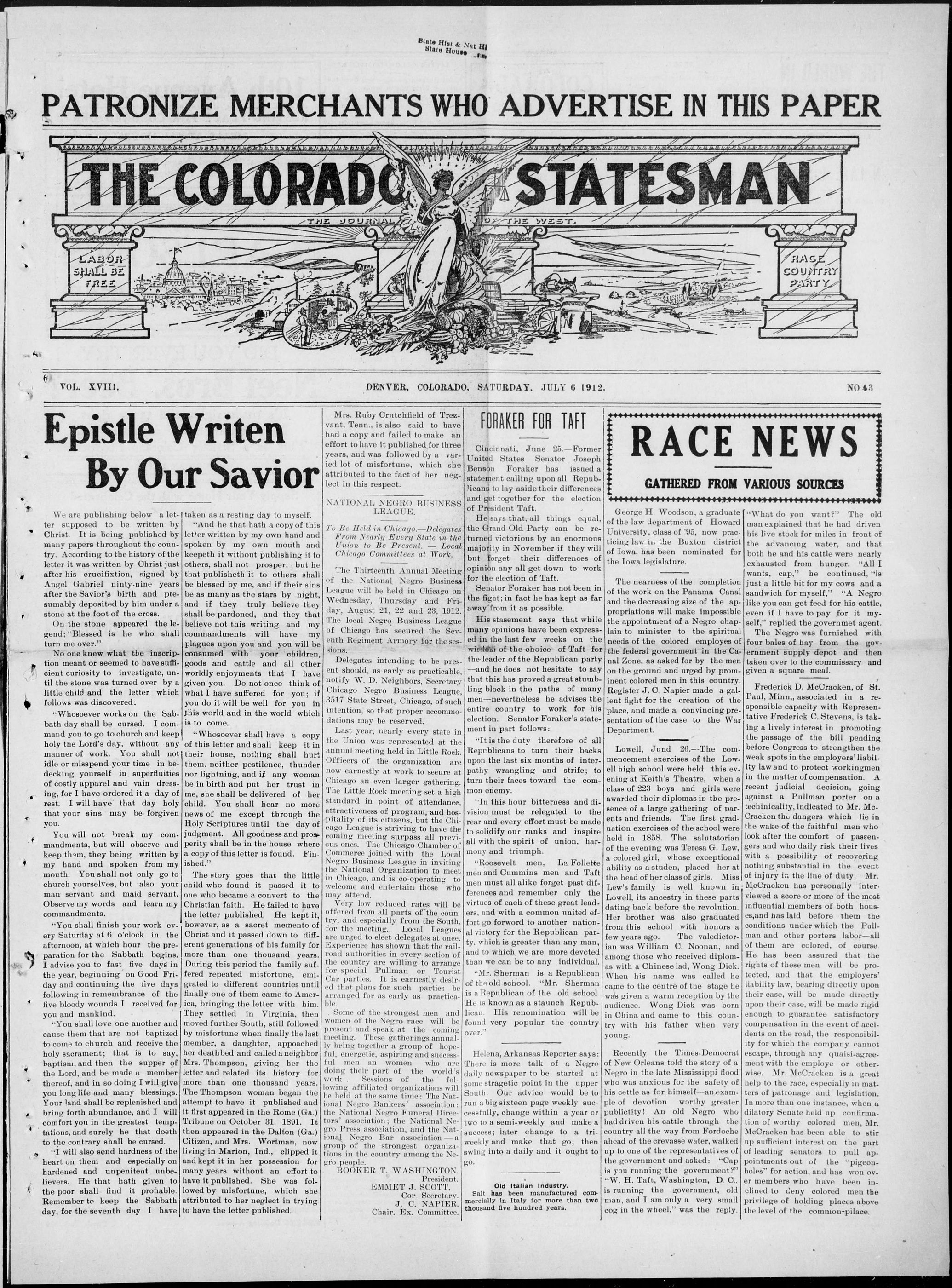
THE COLORADO STATESMAN
THE JOURNAL OF THE WEST.
LABOR SHALL BE FREE
RAGE COUNTRY PARTY
Epistle Writen By Our Savior
We are publishing below a letter supposed to be written by Christ. It is being published by many papers throughout the country. According to the history of the letter it was written by Christ just after his crucifixion, signed by Angel Gabriel ninety-nine years after the Savior's birth and presumably deposited by him under a stone at the foot of the cross.
On the stone appeared the legend; "Blessed is he who shall turn me over."
No one knew what the inscription meant or seemed to have sufficient curiosity to investigate, until the stone was turned over by a little child and the letter which follows was discovered.
"Whosoever works on the Sabbath day shall be cursed. I command you to go to church and keep holy the Lord's day, without any manner of work. You shall not idle or misspend your time in bedecking yourself in superfluities of costly apparel and vain dressing, for I have ordered it a day of rest. I will have that day holy that your sins may be forgiven you.
You will not break my commandments, but will observe and keep them, they being written by my hand and spoken from my mouth. You shall not only go to church yourselves, but also your man servant and maid servant. Observe my words and learn my commandments.
"You shall finish your work every Saturday at 6 o'clock in the afternoon, at which hour the preparation for the Sabbath begins. I advise you to fast five days in the year, beginning on Good Friday and continuing the five days following in remembrance of the five bloody wounds I received for you and mankind.
"You shall love one another and cause them that are not baptized to come to church and receive the holy sacrament; that is to say, baptism, and then the supper of the Lord, and be made a member thereof, and in so doing I will give you long life and many blessings. Your land shall be replenished and bring forth abundance, and I will comfort you in the greatest temptations, and surely he that doeth to the contrary shall be cursed."
"I will also send hardness of the heart on them and especially on hardened and unpenitent unbelievers. He that hath given to the poor shall find it profable. Remember to keep the Sabbath day, for the seventh day I have
taken as a resting day to myself.
"And he that hath a copy of this letter written by my own hand and spoken by my own mouth and keepeth it without publishing it to others, shall not prosper, but he that publisheth it to others shall be blessed by me, and if their sins be as many as the stars by night, and if they truly believe they shall be pardoned, and they that believe not this writing and my commandments will have my plagues upon you and you will be consumed with your children, goods and cattle and all other worldly enjoyments that I have given you. Do not once think of what I have suffered for you; if you do it will be well for you in this world and in the world which is to come.
"Whosoever shall have a copy of this letter and shall keep it in their house, nothing shall hurt them, neither pestilence, thunder nor lightning, and if any woman be in birth and put her trust in me, she shall be delivered of her child. You shall hear no more news of me except through the Holy Scriptures until the day of judgment. All goodness and prosperity shall be in the house where a copy of this letter is found. Finished."
The story goes that the little child who found it passed it to one who became a convert to the Christian faith. He failed to have the letter published. He kept it, however, as a sacred memento of Christ and it passed down to different generations of his family for more than one thousand years. During this period the family suffered repeated misfortune, emigrated to different countries until finally one of them came to America, bringing the letter with him. They settled in Virginia, then moved further South, still followed by misfortune when finally the last member, a daughter, appoached her deathbed and called a neighbor Mrs. Thompson, giving her the letter and related its history for more than one thousand years. The Thompson woman began the attempt to have it published and it first appeared in the Rome (Ga.) Tribune on October 31. 1891. It then appeared in the Dalton (Ga.) Citizen, and Mrs. Wortman, now living in Marion, Ind., clipped it and kept it in her possession for many years without an effort to have it published. She was followed by misfortune, which she attributed to her neglect in trying to have the letter published.
DENVER, COLORADO, SATURDAY, JULY 6 1912.
State Hist & Nut Hl
State House
HANTS WHO
ADO
THE JOURNAL
DENVER, COLORADO, SA
Mrs. Ruoy Crutchfield of Trezvant, Tenn., is also said to have had a copy and failed to make an effort to have it published for three years, and was followed by a varied lot of misfortune, which she attributed to the fact of her neglect in this respect.
NATIONAL NEGRO BUSINESS LEAGUE.
To Be Held in Chicago.—Delegates From Nearly Every State in the Union to Be Present. — Local Chicago Committees at Work.
The Thirteenth Annual Meeting of the National Negro Business League will be held in Chicago on Wednesday, Thursday and Friday, August 21, 22 and 23, 1912. The local Negro Business League of Chicago has secured the Seventh Regiment Armory for the sessions.
Delegates intending to be present should, as early as practicable, notify W. D. Neighbors, Secretary Chicago Negro Business League, 3517 State Street, Chicago, of such intention, so that proper accommodations may be reserved.
Last year, nearly every state in the Union was represented at the annual meeting held in Little Rock. Officers of the organization are now earnestly at work to secure at Chicago an even larger gathering. The Little Rock meeting set a high standard in point of attendance, attractiveness of program, and hospitality of its citizens, but the Chicago League is striving to have the coming meeting surpass all previous ones. The Chicago Chamber of Commerce joined with the Local Negro Business League in inviting the National Organization to meet in Chicago, and is co-operating to welcome and entertain those who may attend.
Very low reduced rates will be offered from all parts of the country, and especially from the South, for the meeting. Local Leagues are urged to elect delegates at once. Experience has shown that the railroad authorities in every section of the country are willing to arrange for special Pullman or Tourist Car parties. It is earnestly desired that plans for such parties be arranged for as early as practicable. Some of the strongest men and women of the Negro race will be present and speak at the coming meeting. These gatherings annually bring together a group of hopeful, energetic, aspiring and successful men an women who are doing their part of the world's work. Sessions of the following affiliated organizations will be held at the same time: The National Negro Bankers' association; the National Negro Funeral Directors' association; the National Negro Press association, and the National Negro Bar association—a group of the strongest organizations in the country among the Negro people.
BOOKER T. WASHINGTON.
President.
EMMET J. SCOTT,
Cor. Secretary.
J. C. NAPIER.
Chair. Ex. Committee.
FORAKER FOR TAFT
Cincinnati, June 25.—Former United States Senator Joseph Benson Foraker has issued a statement calling upon all Republicans to lay aside their differences and get together for the election of President Taft.
He says that, all things equal, the Grand Old Party can be returned victorious by an enormous majority in November if they will but forget their differences of opinion any all get down to work for the election of Taft.
Senator Foraker has not been in the fight; in fact he has kept as far away from it as possible.
His stasement says that while many opinions have been expressed in the last few weeks on the wisdom of the choice of Taft for the leader of the Republican party—and he does not hesitate to say that this has proved a great stumbling block in the paths of many men—nevertheless he advises the entire country to work for his election. Senator Foraker's statement in part follows:
"It is the duty therefore of all Republicans to turn their backs upon the last six months of interpathy wrangling and strife; to turn their faces toward the common enemy.
"In this hour bitterness and division must be relegated to the rear and every effort must be made to solidify our ranks and inspire all with the spirit of union, harmony and triumph."
"Roosevelt men, La Follette men and Cummins men and Taft men must all alike forget past differences and remember only the virtues of each of these great leaders, and with a common united effort go forword to another national victory for the Republican party, which is greater than any man, and to which we are more devoted than we can be to any individual. "Mr. Sherman is a Republican of the old school. "Mr. Sherman is a Republican of the old school He is known as a staunch Republican. His renomination will be found very popular the country over."
Helena, Arkansas Reporter says: There is more talk of a Negro daily newspaper to be started at some stragetic point in the upper South. Our advice would be to run a big sixteen page weekly successfully, change within a year or two to a semi-weekly and make a success; later change to a tri-weekly and make that go; then swing into a daily and it ought to go.
Old Italian industry. Salt has been manufactured commercially in Italy for more than two thousand five hundred years.
RACE NEWS
George H. Woodson, a graduate of the law department of Howard University, class of '95, now practicing law in the Buxton district of Iowa, has been nominated for the Iowa legislature.
The nearness of the completion of the work on the Panama Canal and the decreasing size of the appropriations will make impossible the appointment of a Negro chapplain to minister to the spiritual needs of the colored employees of the federal government in the Canal Zone, as asked for by the men on the ground and urged by prominent colored men in this country. Register J. C. Napier made a gallent fight for the creation of the place, and made a convincing presentation of the case to the War Department.
Lowell, Jund 26.—The commencement exercises of the Lowell high school were held this evening at Keith's Theatre, when a class of 223 boys and girls were awarded their diplomas in the presence of a large gathering of parents and friends. The first graduation exercises of the school were held in 1858. The salutatorian of the evening was Teresa G. Lew, a colored girl, whose exceptional ability as a studen, placed her at the head of her class of girls. Miss Lew's family is well known in Lowell, its ancestry in these parts dating back before the revolution. Her brother was also graduated from this school with honors a few years ago. The valedictorian was William C. Noonan, and among those who received diplomas with a Chinese lad, Wong Dick. When his name was called he came to the centre of the stage he was given a warm reception by the audience. Wong Dick was born in China and came to this country with his father when very young.
Recently the Times-Democrat of New Orleans told the story of a Negro in the late Mississippi flood who was anxious for the safety of his cettle as for himself—an example of devotion worthy greater publicity! An old Negro who had driven his cattle through the country all the way from Fordoche ahead of the crevasse water, walked up to one of the representatives of the government and asked: "Cap is you running the government?" "W. H. Taft, Washington, D. C., is running the government, old man, and I am only a very small cog in the wheel," was the reply.
NO43
"What do you want?" The old man explained that he had driven his live stock for miles in front of the advancing water, and that both he and his cattle were nearly exhausted from hunger. "All I wants, cap," he continued, "is just a little bit for my cows and a sandwich for myself." "A Negro like you can get feed for his cattle, even if I have to pay for it myself," replied the governmet agent. The Negro was furnished with four bales of hay from the government supply depot and then taken over to the commissary and given a square meal.
Frederick D. McCracken, of St. Paul, Minn., associated in a responsible capacity with Representative Frederick C. Stevens, is taking a lively interest in promoting the passage of the bill pending before Congress to strengthen the weak spots in the employers' liability law and to protect workingmen in the matter of compensation. A recent judicial decision, going against a Pullman porter on a technicality, indicated to Mr. McCracken the dangers which lie in the wake of the faithful men who look after the comfort of passengers and who daily risk their lives with a possibility of recovering nothing substantial in the event of injury in the line of duty. Mr. McCracken has personally interviewed a score or more of the most influential members of both houses, and has laid before them the conditions under which the Pullman and other porters labor—all of them are colored, of course. He has been assured that the rights of these men will be protected, and that the employers' liability law, bearing directly upon their case, will be made directly upon their case, will be made rigid enough to guarantee satisfactory compensation in the event of accidents on the road, the responsibility for which the company cannot escape, through any quaisi-agreement with the employee or otherwise. Mr. McCracken is a great help to the race, especially in matters of patronage and legislation. In more than one instance, when a dilatory Senate held up confirmation of worthy colored men, Mr. McCracken has been able to stir up sufficient interest on the part of leading senators to pull appointments out of the "pigeon-holes" for action, and has won over members who have been inclined to deny colored men the privilege of holding places above the level of the common-pilace.
THE WORLD IN PARAGRAPHS
4 BRIEF RECORD OF PASSING EVENTS IN THIS AND FOR-EIGN COUNTRIES.
IN LATE DISPATCHES
DOINGS AND HAPPENINGS THAT
MARK THE PROGRESS
OF THE AGE.
Western Newspaper Union News Service.
WESTERN,'
Miss Anna A. Malley, Socialist lecturer and writer of Everett, will head the Socialist state ticket in Washington.
W. A. Massey, former chief justice of the Supreme Court of Nevada, has been chosen U. S. senator from that state.
In an automobile accident near the outskirts of Los Angeles Mrs. Mabel Muir, 30 years old, of Colorado Springs was killed.
C. W. Smith, formerly connected with many of the largest railroad systems of the East, and at one time president of the Santa Fé, died in Pasadena, Cal.
Two motor-cycle racers were killed and two others seriously injured while riding faster than a mile a minute at the race meet at the San Jose, Calif., Driving park.
William Stewart, Ninth cavalry, Fort Russell, Wyo., was sentenced to twenty-five years in the penitentiary for the murder of William A. Rucker, a fellow soldier.
Within the next six months El Paso, Texas, may secure one of the biggest meat packing plants in the country, backed by one of the biggest packers in the United States.
Claude Wood of Pueblo, Colo., has been awarded $5,000 damages for injuries sustained when he was struck by an auto owned by the Teller Reservoir and Irrigation Company in November, 1910.
The Denver & Rio Grande railroad has let contracts for thirty new engines, to cost about $1,000,000. The construction of this equipment will be started at once, and deliveries will be made early in September.
When T. M. Ferguson, a driver in a trotting race at Santa Cruz, Calif., fell dead from his sulky in the stretcn, Dot McKinney, his mare, finished first in the race, circled the track and trotted to her stable.
Colonel Castulo Herrera, of the rebel garrison in Juarez, Mex., has announced that a message from Chihuahua gave details of the blowing up of a federal troop train by the rebels, and the killing of all the troopers on board twenty coaches.
Testimony that United States Judge Cornelius H. Hanford was under the influence of liquor while on the bench was given to the judiciary sub-committee of the House of Representatives by Edwin J. Brown, lawyer, dentist and Socialist leader in Seattle.
WASHINGTON.
The House adopted a resolution appropriating $1,350,000 to provide for the participating of the regular army in the encampment and maneuvers of the organized militia of the several states.
Admiral Usher cabled the United States Navy Department from Guantanamo that no Cuban rebels had been seen for the last five days. Consequently the American naval vessels are starting for home.
Closing the fiscal year 1912 with a surplus of $36,335,830 the federal treasury opened the new year, July 1, with $99,360,000 in its steel ribbed vaults as a working balance. This is the largest amount of available cash the government has possessed for months.
The federal government closed the fiscal year June 29 with a surplus of $32,000,000, according to estimates based on incomplete returns from the sources of revenue the country over. This amount far exceeded the most sanguine expectations of Secretary McVaagh, who months ago estimated that the surplus would be $10,250,000.
The House passed the army appropriation bill in the same form as last February before the Senate amendments brought it under the veto of President Taft. The amendments affecting the general staff of the army, one of which would have legislated its chief, Major General Leonard Wood, out of office and the provision for a commission to decide upon the number and location of army posts were left out.
The terrible death rate in American coal mines is on the decline, and the bureau of mines is confident the high-tide has been passed. Figures just given out by the bureau show a decrease of 317 deaths from coal mining in the last year, the figures being 2,517 against 2,834 for the previous year. The death rate for 1910 was 3.91 men in every 1,000 employed; in 1911 it was 3.74.
The passage of a Senate bill which would prohibit interstate shipment of prize fight moving picture films was blocked in the House.
SPORT.
WESTERN LEAGUE STANDING.
Clubs Won Lost Pct.
St. Joseph 41 31 569
Iowa City 36 35 598
Wichita 39 35 527
Des Moines 36 33 522
Denver 37 35 514
Omaha 36 35 507
Lincoln 28 40 415
Topeka 28 41 408
Al Palzer, the New York heavyweight with "white hope" aspirations, knocked out Bombardier Wells, the heavyweight champion of England, in the third round of a scheduled ten-round bout at Madison Square garden, New York. Well's seconds threw up the sponge as the Britisher dropped from the effect of a right body blow and lay inert in the ring.
Hugh Mcintosh, the Australian promoter, has written Champion Jack Johnson and offered him $30,000 for a bout to be fought in Kangarooool within the next year. It is supposed Johnson's prospective antagonist is Sam Langford, though the name of that colored fighter is not mentioned. Mcintosh offers to post at once, a forfeit of $10,000 as a guarantee of good faith. Johnson has not yet decided whether he will accept the offer.
FOREIGN.
The Order of the Red Eagle of the second class has been conferred by Emperor William of Germany on Allison V. Armour of New York.
Herr Schadt, a German aviator, was killed at Mulhausen, Germany, while testing a military aeroplane. The airman flying at a height of 250 yards made a curve too sharply and the machine fell to the ground and crushed its occupant.
With a violence hitherto unknown to western annals there was a tornado in Saskatchewan, Canada, that destroyed 300 houses, six grain elevators, 50 buildings in the wholesale and business districts, and caused, according to a late estimate, 200 deaths.
GENERAL
Former United States Senator Anthony Higgins of Delaware is dead. He was seventy-one years old. A new pipe organ, one of the largest in the world, has been installed in the Tabernacle at Zion, Ill. The Independent Telephone Company's plant (automatic) at Omaha, was sold at a receiver's sale for $995,000. Arasmus Page, aged 103, the oldest newsboy in the world, is dead at Jolie, Ill. He worked up to the time of death. Clerks and assistant managers of hotels from thirty-three states gathered in Chicago to attend the annual convention of the Greeters of America. Low tide prevented a heavy loss of life when the steamer Grand Manan, carrying 600 excursionists, struck a dredge in the St. Croix river at Calais, Maine.
J. Henry Alexandre, vice president of the National Hunt and Steeplechase Association and a member of many sporting clubs, died in New York recently.
Leaders in New York estimated that 2,000 sailors and 2,000 firemen and oilers are on strike in that port, and that 4,000 men were out at Boston, Philadelphia, Galveston and Norfolk.
Harriet Quimby, the woman aviator, who was flying with a passenger, W. A. P. Willard, in the aviation meet at Atlantic, Mass., fell from a height of 1,000 feet into Dorchester bay. Both were killed.
In line with the action of other steel concerns the Pennsylvania Steel Company, it has been announced, advanced the price of structural steel and steel bars $1 a ton and also increased its rate on steel billets by $2 a ton.
Rev. Dr. W. D. Farland, a prominent educator of Pittsburg, Pa., who was found guilty of causing the death of his secretary, Elsie Dodds Coe, by an operation, was sentenced to serve one year in jail and fined six and one-fourth cents with costs.
Fifty persons were killed and 275 seriously injured in June by vehicles in the streets of New York city. Automobiles killed twenty-six and injured 153, street cars killed nineteen and injured ninety-nine, and wagons caused the death of fourteen and the injury of twenty-three.
William Marshall Bullitt of Louisville, Ky., will be named by President Taft to succeed Frederick W. Lehmann of St. Louis as solicitor general of the United States, according to a Cabin-t officer who talked with the President. No official announcement has been made, but it is thought Mr. Bullitt nas accepted the place.
The national convention of the Roosevelt third party will be held in Chicago, beginning August 1. Almost simultaneously with the announcement of the nomination of Woodrow Wilson of New Jersey by the Democratic national convention, Senator Joseph Dixon, acting on behalf of Roosevelt, announced that the call was made being.
The United States transport Sheridan, with four companies of troops for St. Michael and Fort Davis, in Alaska, is still imprisoned in the ice which is drifting toward the Arctic ocean. In five days the Sheridan has moved 100 miles westward and may be carried through Bering straits into the Arctic ocean. Seven thousand cases have been reported since the outbreak of bubonic plague in Porto Rico and this is having a serious effect, particularly in San Juan. It is estimated that 5,000 persons have left that city.
COLORADO STATE NEWS
Western Newspaper Union News Service.
COMING EVENTS IN COLORADO.
July 15.—International Federation of
Commercial Travelers' Organizations
Colorado Springs.
July 17-19.—Electrical Contractors' Association Convention, Denver.
July 18-19.—Gunnison County Cattle Growers' Association, Gunnison.
July 22-24. — Midsummer Convention, Colorado Stockgrowers' Association, Gunnison Springs.
July 23-25.—Commercial Law League of America, Colorado Springs.
July 21-27.—Western Temperature Colorado Chautauqua, Boulder.
Aug. 2-3.—Republican State Convention, Denver.
Aug. 6.—Democratic Sts.e Convention, Pueblo.
Aug. 6-8. - International Council
Knights of Columbus - Colorado
Springs.
Aug. 19-24. - International Photo - Engravers Association, Denver.
Sept. 1 Convention National Association
State Name Wardens - Denver.
Sept. 18, 19. - San Luis Valley Fair
- Alamosa.
Elks In New Home.
Greeley.—Greeley's lodge of Elks has moved into its new home, one of the finest, if not the finest, in the state outside of Denver.
Hail Damages Pueblo.
Pueblo.—A hailstorm which did thousands of dollars' worth of damage visited Pueblo and vicinity recently. Some of the stones, almost as large as hen eggs, stripped trees of their foliage, demolished greenhouses caused several runaways and broke hundreds of window panes.
Fight on: "Fake Restaurants."
Denver.—The fire and police board has taken radical steps to eliminate what the members term "take restaurants," the first move being made when thirty proprietors of cafes where liquor is served were cited to appear to show cause why their respective liquor license sshould not be revoked
Summer Rate for Laborers
Hotchkiss.—The counties of Montrose, Delta and Mesa are making strenuous efforts to induce the officials of the Western Passenger Association to establish a summer rate for the fruit laborers and ranch help on the Western slope, and are formulating a united effort for this purpose.
Father and Son Die in Lake.
Idaho Springs.—Calvin S. Hawk, aged 55, and his son Russell, aged 13, were drowned in St. Mary's lake thirteen miles from here while walking along the steep bank near the ice glacier. The boy slipped on a crust of snow into the water, and the father sprang in to rescue him. Neitner was able to reach a landing place and both were drowned.
Caterpillars Block Tramway.
Central City.—within the past two weeks millions of caterpillars have invaded the Russell Gulch, Leavenworth Gulch and Quartz hill section of the county, and the aspen trees have been stripped of their foliage. Nothing of the kind was ever witnessed here before. The tramway line, which hauls ore from the mines was tied up for hours on account of the thousands that were crushed under the wheels. Crews were compelled to walk ahead of the trains and shovess on the rails so that the drivers can get a grip on the track. At the sha't house on the Topeka mine the roof was completely covered.
Will Submit 32 Measures.
Denver.—Thirty-two subjects have been filed in the office of the secretary of state for submission to the people at the next general election under the initiative and referendum. The Direct Legislation League, which has several petitions, the state highway commission and others are to be heard from.
Five constitutional amendments and laws were referred to the people by the Legislature, seven bills passed by the last Legislature have been referred to the people by petition, and eighteen proposed laws and constitutional amendments have been initiated.
Secretary of State Pearce declares he will economize in having the measures printed in the newspapers of the state. There is question whether publication is required in four or five issues, the constitution reading that bills submitted to the people must be printed for four successive weeks.
Most editors contend that it is impossible to publish for four successive weeks without having the advertisement appear in five issues of a weekly newspaper. If it is held that five publications are necessary the state must pay 48 cents an inch additional to every newspaper used. Secretary Pearce says he will not advertise in daily newspapers every day for four weeks, but will select one day of the week and make the publication four times.
Silver Lake Mine Houses Burn.
Silverton.—Buildings at the Silver Lake mine, six miles from here, owned and operated by the American Smelting and Refining Company, were destroyed by fire. Loss estimated at $40,000.
Last of Bond Issue Sold.
San Luis.—The last of an $800,000 bond issue authorized by the San Luis Power and Water Company, a subsidiary of the Costilla Estates Development Company, has been sold.
LITTLE COLORADO ITEMS
Small Happenings Occurring Over the State Worth While.
Western Newspaper Union News Service.
A postal savings bank has been established at Aurora.
One firm in Hotchkiss has contracted for 300 cars of peaches.
Fire recently destroyed property in Loveland to the amount of $5,000.
A new school building is to be constructed at Stewart Mesa, near Paonia.
The Summer Normal school at Gunnison has been opened for the season.
The Cross orchards, west of Clifton, will ship some forty cars of fruit this year.
The new Methodist church at Rogers, Mesa, Delta county, has been dedicated.
The ninth annual convention of the Colorado State Optical Society was held in Pueblo.
Greeley dog owners contribute about $450 a year towards maintaining the city government.
The Grand Junction canning factory has opened for the 1912 season. About forty people are employed.
Forest rangers report the mountains in many sections of the state still piled high with snow.
An irrigation district covering ten thousand acres is being organized in the Grand valley, near Silt.
Farmers in the Maybell and Lay valleys are sure of the greatest crop in the history of the country.
The Union Pacific is figuring on fifty special trains for Knights Templar to the conclave in Denver next year.
Bonds for $5,250 were sold recently by the Clifton school board for the construction of a new high school building.
An average of $100 a day has been paid into the office of the clerk of the Denver District Court, for alimony for June.
Clinton Farrar, a pioneer, who lived at Fort Collins forty-three years, died recently at Boulder, aged seventy-three.
A special election will be held within sixty days to decide whether or not Trinidad is to have commission government.
President Taft has sent to the Senate the nomination of George H. Charlton to be register of the Land Office at Durango.
Education of the people in packing apples will be taken up this year by the Grand Junction, Fruit Growers' Association.
A cloudburst between the forks of Clear Creek and Golden washed out several miles of track from the C. & S. railroad in Clear Creek canon.
Mrs. Sarah Crabb will bring suit against the Salvation army at Greeley for $1,000, the amount left by her husband in his will for the army.
H. F. Manley, aged 54, county clerk and a resident of Hinsdale county for more than 30 years, committed suicide at Lake City by shooting.
The State Land Board has voted to refund about $5,000 to some twenty-five settlers who had made first payments on land in the San Luis valley.
The State Home for Mental Defectives has opened at Arvada under the direction of A. P. Busey, superintendent of the State Insane Asylum at Pueblo.
The state convention of the Prohibition party was held in Denver July 3 and 4 at which Edward W. Mills of Fairmount, W. Va., was the principal speaker.
La Plata county central committee will issue the call for primaries to be held early in August. The call will be for state, district and representative offices.
Fruit prospects never were brighter around Gunnison, Montrose and Palisade than this year, according to Albert McFarland, a fruit grower living about six miles from Montrose.
John Brady, an employé of the Golden Cycle mill at Colorado Springs was instantly killed when a broken belt striking him on the head knocked him against moving machinery.
The earnings of the Moffat road for the fiscal year ended June 30 will be close to $1,200,000, which is considerably greater than the gross revenue for any previous year.
A party of surveyors captured a baby antelope recently near Blanca. Game Warden Walter Campbell secured the little "fawn" and is, bringing it safely to maturity on a "bottle."
Lightning struck the reinforcing station of the Salida Light, Power & Utility Company at Salida, burning out a transformer, it setting fire to the building. The loss is estimated at $1,800.
Twelve head of horses were stolen from Pueblo recently. A number of thefts reported to the police from Cañon City lead them to believe an organized gang of horse thieves who operated in that section of the state four months ago, are again at work.
A strange freak was played by lightning when it struck Gus Anderson's house, five miles east of Lucerne, burning the sheets on the bed in which slept Miss Selma Anderson, eighteen years old, and her aunt. Both escaped unhurt.
The Direct Legislation League of Colorado will send five representatives to the midsummer convention of the Colorado Stock Growers' Association, to be held at Glenwood Springs July 22 to 24, to discuss the several legislative measures initiated by the league.
H. HEUER, PROPRIETOR RESTING PLACE FOR COLORED GENTS MEALS AT ALL HOURS Pool Room in Connection
ASK FOR
CAR
Peerless
DID YOU
Neef B
It's made ri
None better
This is a Stri
BE S
Supply Your H
The Empi
BUY YOUR BO
West 10th and Osage, Near Burnet
Denver, Colorado
FOR
ARLSON
Heirless Ice Cream
Phones: Main 112 and 113
D YOU EVER T
ef Bros.' Be
made right, and tastes
better made anywhere
as a Strictly Colorado Pro
BE SURE AN TRY IT.
Your Home with the Cele
Tivoli Beer
Bottled by
Empire Bottling
Phone Gallup 245
OUR BOTTLED GOODS
Trade
QUALTY
McVicar B
Works
J. T. T
Wines, Liquors and
PHONE MAIN 3762.
609 Arapahoe Street
Denver
Colorado Products
Patronize Hom
ZANG'S
DELICIOUS TABLE BEERS
MBINE,
VIENNA AND
PILS
Corner West 10th and Osage, Near Burnham Shops Denver, Colorado
ASK FOR CARLSON'S Peerless Ice Cream Phones: Main 112 and Main 5787
DID YOU EVER TRY Neef Bros.' Beer?
It's made right, and tastes right. None better made anywhere and This is a Strictly Colorado Production
Supply Your Home with the Celebrated Tivoli Beer Bottled by The Empire Bottling Co. Phone Gallup 245
BUY YOUR BOTTLED GOODS OF THE
Family Trade a SPECIALTY
Beer, Wines,
2605 and 2609 Arapa
Boost Colorado Prod
ZA
DELIC
COLUMBIN
VIEN
Guaranteed Absolutely Pure. Delivered Daily to All Parts of the City.
The Ph. Za
TELE
We Boost for Colorad
The Prior
181
We buy and s
Furniture, also
shades. Sewi
repaired a spe
Ph. Zang Brewing
TELEPHONE GALLUP 395.
for Colorado You Should Be
Prior Furniture
1814 Curtis Street
buy and sell new and second
furniture, also repair work. W
es. Sewing Machines sold
ired a specialty.
The Prior Furniture Co. 1814 Curtis Street
We buy and sell new and second hand Furniture, also repair work. Window shades. Sewing Machines sold and repaired a specialty.
Phone Champa 3922
RUDOLPH
SANITARY G
ME
ported and Domestic
Vegetables. Our Own
8-2760 Downing Avenue
DOLPH BROTHERS
MINIARY GROCERY, BAKERY
MEAT MARKET.
Domestic Table Delicacies. From
Our Own Bakery. Finest Goods
ing Avenue
RUDOLPH BROTHERS
Imported and Domestic Table Delicacies. Fresh Fruits and Vegetables. Our Own Bakery. Finest Goods in the City. 2758-2760 Downing Avenue Phone York 320
Cash or Credit
AFRO-AMERICAN CULLINGS
The making of a man and citizen is the highest and most difficult obligation of the Christian father and mother. The home training of the child is of as much importance in laying the foundation as the training of the schools. Up to a certain age, say twelve years, the child is subject more to the influence of the mother than of the father. Indeed, when the mother gets through with shaping the education of the child the kindergarten, the primary, grammar and high school grades, and turns him over to the father for his higher and finishing education the father, oftener than otherwise instead of undertaking the work himself, pays some one else to do it for him, turns the son over to the preparatory school head master and the university professor for a term of seven years. In the main, the father has very small part in the home training and education of the child, whether boy or girl; the work falls mostly upon the mother. Women, therefore, should have the very highest and best home training and scholastic education to prepare them to be the very best wives and mothers.
The new president of Princeton university, Dr. John Grier Hibben, in his inaugural address, speaking on "The Essentials of Higher Education," stated it as his belief that "the chief end of an education is the making of a man." It is "the progress of developing a power within which enables the human being to dominate the instincts and habits of his animal life." As to higher education this is true in a larger sense than is generally accepted. Only the person with the highest education is capable of overcoming the anima bruta of the heart in conflict with the animisma bruta of the soul—the microbes of the body that thrive upon ignorance and filth and die when in conflict with the animisma of the soul, of the spirit. It is from this viewpoint that President Hibben's definition is most valuable. But for the every day life we adhere to the definition once made in the Southern Workman, that education should aim primarily to fit the person to make a living, to make the most of his opportunities, along the lines of least resistance. Industrial education does this; coupled with a university education it does it in a double and higher sense. Much profit should be gained by a careful study of Dr. Hibben's elaboration of his idea, in the following:
"While man is a part of the natural world he also belongs to the world of mind and of spirit.
"The particular function of education is to give him the power of freedom and to make him sensible of the duties, and worthy the privileges of a person in the midst of a universe of things.
"Personality, however, is not mechanically formed from without, but must be evoked from within. The appeal of the teacher therefore is constantly directed to the inner spirit of the student, that spirit of life which informs the man and puts him into possession of his powers. The forces which find play in the activities of the mind are like the architectonic principle which is at work in the inner nature of a plant, fashioning it into the form of grace and beauty. Thus with the emancipation of a free spirit at the source of his being, the man within begins to develop both in power and in promise.
"An education is won by work; and the labors to be undertaken and the end to be attained may all be summed up in the command—Be a person. This is a command which is not merely the word of the teacher, but is essentially an inner compulsion possessing the solemn authority of self-legislation."
It is not enough to train the mind to think wisely upon the small as well as the large affairs of life, which find expression in thoughts that are spoken and written thence converted into works; it is equally necessary to train the forces of the heart that work silently and crave all manner of food and drink and apparel that may gratify vanity for the time being but bankrupt pride and often character in the long run. The system is full of microbial forces that crave and lust after things that destroy health and make for scandalous expenditures that in turn make for poverty and misery in the end. The educated mind knows best how to control these silent forces that crave and lust after forbidden things, and how to deny them; while the ignorant, untrained mind denies them nothing and is finally devoured by the vanity that "eats, drinks and makes merry because tomorrow it may die." That is not wisdom—New York Age.
Men are needed on guard everywhere, negro men, who have their own best interests at heart, who know their best interests, and therefore have the best interests of their own people and those of the nation at heart. No man can help others who cannot help himself. That is a self-evident truth to all those who do not make a fat living out of others on the pretext of helping them instead; parasites they, who preach loud and long the wisdom of working and saving for the rainy day but who do not work
themselves and save nothing, and must depend upon the charity of those to whom they preach for everything they need; gamblers they, who spend most of their time and talent thinking out how they can make something for nothing, how they can coax out of others, who want "to get rich quick," that they have worked hard for, by the turn of a card or a twist of the stock market, gambling for the most part on "a sure thing," allke the gambler in the Tenderloin and gambler in Wall and Broad streets.
And there is another sort, of the parasite class, who deal in what people must have to eat and drink and wear, who adulterate whatever they have to sell and give short weight and measure, and carry the price on all things as high as they can without arousing the suspicion of the customer; cheats they are, and they are to be found wherever men buy and sell. Men are needed on guard everywhere to keep flying the flag of right thinking and honest living and dealing; to make a positive factor in their lives and the lives of others the Christian philosophy of brotherhood, of friendship, of common faith, without which no work can be properly done, no word safely relied upon. The word of truth and the works of honest men go together; when so united in one person all the community singles him out and says of him, "Now, there's an honest, reliable man who can be depended upon to do what he says he will do." A certificate of character like that in any community is worth a fortune to any man.
Our young men in all sections are going into business for themselves; they should do it and be encouraged in doing it, because a race of servers, of loafing parasites, who make all and spend all of and with others than their own, hewers of wood and drawers of water, with no great enterprises of their own, matured or on the way to maturity, cannot respect itself and need not expect others to do so. Barred out of the manufacturing industries, the wholesale and retail trades, and the banking business, their children denied employment and opportunity for promotion in them, there is nothing left for 10,000,000 people so circumstanced, as Afro-Americans are, to do but to build up manufacturing industries, wholesale and retail trades and banking business of their own. They cannot accept the industrial and business station, place they call it, whiten want them to occupy without sinking finally to the level of the Mexican peon, the Egyptian fellaheen and the Chinese coolle. That they are not doing anything of the sort is shown unmistakably by the report of the twelfth annual convention of the National Negro Business league, held in Little Rock, in August of last year. The report shows that the 12 years of constant work by the business league has had a wonderfully stimulating influence upon the business initiative and development of the negro. The foundation is laid and they are building the superstructure slowly but surely.
We need men on guard everywhere to set the example of making the most of small things as well as great things, such as they have done at Boley, Okla., Mound Bayou, Miss., and other places, and as they are doing in an isolated way in all parts of the country. Our vast industrial population, wage earners, should regard the business ventures of our men as their own ventures, and support them to the utmost of their means and opportunity. They will find it a good investment in the enhanced respect the success of the ventures will insure to the race and in the employment of their sons and daughters in profitable work, with a chance to learn how to conduct business undertakings of their own when they walk out of the schools into the world of affairs, where "the victory is not to the swift, nor yet to the strong, but to him that endureth to the end."—New York Age.
The school has recently installed a six thousand egg capacity incubator. With the smaller incubators which have been in use for some time, this will give an egg capacity of nearly ten thousand. The institute is trying to make its poultry plant of the largest possible service to the students in poultry raising, as well as to the several thousand farmers of the south who gather at the institute from time to time during the year. There are in the poultry yard at the present time 3,950 fowls, of which 1,460 are chicks hatched within the past few weeks. Southern Letter.
Mrs. Rosa Simpson, one of the deaconesses from Galveston, Texas, says that Champion Jack Johnson paid her expenses to the Methodist conference. He met her in Chicago, and took her to his house to see his mother, also telegraphed a friend in St. Paul to meet her and find a nice place for her to stay. She says that Jack did this because of his good heart.—Minneapolis Star.
We have great faith in the final triumph of right and in the words of the prophet, will be content to wait "until the day break and the shadows flee away."—Richmond Planet
DR. THIRKIELD'S SUCCESSOR
CONSENSUS OF OPINION AMONG MEMBERS OF THE RACE IS THAT NEXT PRESIDENT OF HOWARD UNIVERSITY SHOULD BE A NEGRO.
Washington, D. C.—The election of Dr. Wilbur T. Thirkield to the bishopric in the M. E. church will cause a vacancy in the presidency of How... university. Already a number of prominent colored educators have been mentioned for the vacancy. Who will succeed Dr. Thirkield as president of Howard is not merely of interest to the colored people in Washington, where the university is located, but it is of great interest to every one of the 1,200 Howard students, to the several hundred Howard alumni, and to the thousands of colored men and women everywhere interested in the education of the race primarily, and in higher education secondarily.
Dr. Thirkield is a white man. Every president Howard has had has been a white man. Many colored men, and correctly, too, think the next president ought to be a colored man in order to constantly emphasize the need of Howard university as an institution of learning to give hope. There is nothing in the laws and rules establishing and governing Howard to make it a separate institution for colored, yet the entire student body is colored, not a white student to be seen in any department. It is as effectually a colored institution as if made so by congressional action or judicial decision. President Thirkield, although himself white, and although a very successful president, has not been able to attract a single white student in the past several years. The faculty, for the most part, is composed of colored professors and instructors. Howard university by and through the mutations of race prejudice has become, so far as its student body is concerned, distinctly a colored institution, and congress appropriates for it upon this assumption.
There are, however, colored men who claim, and are insisting, that Dr. Thirkield's successor must be a white man for the reason that it is not time to make a colored man president of Howard. The men who advance this argument not only discredit their race and pelittle themselves, but they give white men an argument to use against placing a colored man in any new position whatsoever. If it is not time to elect a colored man president of Howard then the time is not yet ripe for colored trustees for that institution, and those colored men who are now serving as trustees ought to resign in order to be in harmony with the backward movement. If it is not time for a colored president of Howard is it not possible that the colored deans at Howard are serving in positions several years in advance of the race's right to these positions?
The pioneer is always met with the laggard's argument of "it is not time." Catching their cue from race prejudice, and backed up by weak, servile colored men, some white men have always objected to the entrance of every colored man upon any unbeaten path on the ground "it is not time." When R. H. Terrell and E. M. Hewlett were proposed for municipal judges here white men who coveted all the offices, and colored men who lacked race confidence and race pride contended that the time was not ripe for such appointments. The men were appointed, however, and both filled the positions acceptably and well, and in some cases better than any of their white associates. Given the opportunity to succeed as municipal judges has prepared these men for a round higher on the judicial ladder. There is not a single place occupied by colored men today but what was won against and in spite of the "not time" argument. When it was proposed to raise $100,000 for a colored Y. M. C. A. building here the same weak argument of "not time" was used, yet the conception of, the camganiging for, and the raising of that $100,000 was the work of colored men; and now Dr. Moreland, international secretary, and Lewis E. Johnson, local secretary, whose efforts more than any two men are responsible for the success, can behold the completed, furnished, equipped and occupied $100,000 colored Y. M. C. A. building. Who will say it is not time for a colored man to manage this institution? And it is just as reasonable to say that a white man should be in control of and manage the $100,000 Y. M. C. A. building as to say a white man, of a necessity, should be head of Howard university.
One of the favorite, and as they think convincing, arguments of these colored men who favor a white president for Howard is that the president must raise money for the maintenance of the institution, and no colored man can be found equal to such a task. Dr. Booker T. Washington founded Tuskegee and developed it to its present amazing status, raising himself all the several millions that have been expended upon it. Dr. Washington is spoken of as being a colored man. Indeed he himself publicly admits it. The president of Howard university is not called upon to solicit moneys from any source except congress. oCngress appropriates all that is required for the steep and improvement of Howard, in excess of the moneys derived from the institution's endowment fund. The president of Howard makes out and writes with the secretary of the interior each year an estimate of the appropriations required for maintenance and improvements. He goes over these estimates with the secretary, and if he is able to convince the secretary of the interior that the estimates are just, warranted and needed, these estimates, along with other estimates, are trans-
mitted to congress. When the appropriation committee of congress reaches the estimates the president of Howard appears before the committee, explains the estimates and urges their allowance by congress. If no colored man can be found who can do this then Howard university itself has been a failure, and the advancement of the race has been backward rather than forward.
Freedmen's hospital, also a government maintained colored institution, is one of the largest, finest, best equipped and most splendidly managed hospitals in the country. It has a colored man for surgeon-in-chief. Under him the discipline is admirable, and the results attained splendid. As head of this institution he has secured congressional appropriation far in excess of any appropriation ever secured by any white president for Howard university. If it were possible to secure so well equipped colored executive for Freedmen's hospital it follows that somewhere there is a colored man who can meet all emergencies at Howard
The social life about any institution is always an accelerator or a retardence—just as it encompasses or restricts. At Howard there has been an absence of that social life, emanating from or gravitating to the president's home, so characteristic of other similar institutions. In spite of Dr. Thirkeld's interest in and zeal for the institution, and in spite of the fact that he probably has not aimed to socially exclude and seclude himself and family, yet the president's house at Howard has ever been a "beautiful isle of somewhere," and rarely has its threshold been crossed by students, faculty or wives of faculty members in a social way. Such a condition could not obtain were the president a colored man.
Howard university is recognized everywhere as a colored institution of learning. Its faculty, for the most part, is colored. Many of the trustees are colored men. In a few years Howard has gradually, surely, and without compulsion changed from an institution of learning for all classes to one for colored alone. If it is not time now for the selection of a colored educator as president that time will never arrive, in the opinion of those who cling to the servile "not time" argument. If in all these United States no colored man can be found equipped for the presidency of Howard, then Howard, and every other colored institution has been teaching a false theory and instilling into colored young men and women a false hope. If a white man of Dr. Thirkield's caller could prove a success as president of Howard university, then there are many colored men who, if given the opportunity, may be as eminently successful. There is no intention to disparage Dr. Thirkield—only to give full credit to men of our own race.
WAR ON "TIGERS"
URGED BY PASTOR
DR. PROCTOR DEPLORES THEIR DEADLY INFLUENCE OVER COLORED PEOPLE.
Atlanta.—Rev. H, H. Proctor preached at the First Congregational church (colored) on "Blind Tigers and the Men and Women Who Feed Them." "Blind Tigers are working havoc among the colored people of Atlanta," he said. "Whether they operate in the street, in a place of business, in a private house or in a house of evil, their influence is deadly among our people. They promote lawlessness, idleness, vice and crime. They corrupt men and women and destroy boys and girls. The colored people have no greater handicap in this community than this illicit liquor-selling. A visit to the recorder's court tomorrow morning will confirm this.
"But these 'tigers' could not exist unless they were fed. Every man or woman who purchases liquor from them is a feeder of the tiger, and an amendment should be made to the law making the purchaser as guilty as the seller, for one could not operate without the other. Those who rent their property to persons who carry on this business help to feed the tiger; put him in the street, and he could be more easily caught and punished. Those who lend their moral influence to the tiger help to feed him; he who enters this business should be made to feel the weight of the disapproval of all good people."
FAMILIAR QUOTATIONS
One of the most familiar quotations from the Bible which are not to be found there upon research is "the lion lying down with the lamb." The spirit of the reference is correct enough, but turn up the passage in Isaiah and you will find: "The wolf also shall dwell with the lamb, and the leopard shall lie down with the kid, and the calf and the young lion and the fatling together." The popular mind has condensed the zoological miscellany, and to the incorrect version alliteration has no doubt contributed.—Exchange.
JUST "TOO LITTLE NIGGER."
The negro small boy on the plantation had eaten a great deal of watermelon and was suffering from indigestion in consequence. The doctor gravely diagnosed the case as too much watermelon."
"No, sah!" said the old negro mammy. "No sich thing! Nevah was too much watermilion!" Then looking the small negro over, she added: "No, not too much watermilion—too little nigger—"Judge.
FLORAL DESIGNS PUT UP WHILE YOU WAIT
CHOICE PLANTS AND CUT FLOWERS CONSTANTLY ON HAND
GREENHOUSES: Thirty-Fourth and Curtis Streets
TELEPHONE, MAIN 1511 DENVER, COLO
Tesch's Market & Grocery WHEN YOU WANT THE BEST LIVE CHICKENS
Spring Lamb and Fresh Vegetables
WE RENDER OUR OWN LARD
2601 Lafayette Street Phone York 1979
The Central Bottling & Distributing Co. Agents for the famous CAPITOL BEER---IT'S CAPITAL Try a case, 2 doz. pints for $1.10, delivered promptly; empties called for.
Family Liquors, Wines, and Cordials Genuine Goods at Popular Prices A glass of good wine will improve your Sunday dinner, and aid digestion.
The Champa Pharmacy
Twentieth and Champa,
Is the place to get your
DRUGS, CHEMICALS AND PATENT MEDICINES
WE SERVE HOT DRINKS.
Prescriptions Our Specialty.
Phone us and we will deliver the goods to all parts of the city.
JAMES E. THRALL, PROPR.
PHONE MAIN 2425.
When You Want
EXCEPT THE SQUEAL, GO TO
East's
2300-6 LARIMER STREET
st's Mar STREET PH
The Purpose of an Advertisement
needs. tell your to the
is to serve your needs. It will help sell your goods—talk to the people you want to reach. An advertisement in this paper is a reference guide to those whose wants are worth supplying.
applying.
A Dollar
Kept with the home mercha benefit. Business men show this dollar at home and make
home merchants it is a messess men should awake to the imome and make a bid for it by juce
Kept with the home merchants it is a messenger of continuous benefit. Business men should awake to the importance of keeping this dollar at home and make a bid for it by judicious-advertising.
Market
PHONE 1461 MAIN
THE HIG
COST O
LIVIN
has not affected our job printing prices. We're still doing commercial work of all kinds at prices satisfactory to you.
THE COLORADO STATESMAN
JOS. D. D. RIVERS.....Proprietor
1824 Curtis Street, Room 25.
SUBSCRIPTION RATES:
One Year ..... $2.00
Six Months ..... 1.00
Three Months ..... .60
PAYABLE IN ADVANCE.
Entered as second-class matter at the postoffice in the city of Denver, Colorado.
All communications of a personating nature that are not complimentary will be withheld from the columns of this paper.
It occasionally happens that papers sent to subscribers are lost or stolen. In case you do not receive any number when due, inform us by postal card and we will cheerfully forward a duplicate of the missing number.
Communications to receive attention must be newsy, upon important subjects, plainly written only upon one side of the paper; must reach us Tuesdays, if possible, anyway, not later than Wednesdays, and bear the signature of the author. No manuscript returned, unless stamps are sent for postage.
Remittances should be made by Express Money Order, Postoffice Money Order, Registered Letter or Bank Draft. Postage stamps will be received the same as cash for the fractional part of a dollar. Only 1-cent and 2-cent stamps taken.
Display advertising 25-cents per square. A square contains ten agaté lines.
Reading notices, ten lines or less, 10 cents per line. Each additional line over ten lines, 5 cents per line.
No discounts allowed on less than three months' contract. Cash must accompany all orders from parties unknown to us. Further particulars on application.
TO MAKE THE NEGRO WORK.
Did you ever stop to think that the Negro has to be made to work?
As a truth capable of demonstration, it really appears that this is the case. Of course, it is not universally so, but the requirement seems to fit him so well as a general characteristic that the problem is engaging the attention of the world's civilizing and developing forces, especially upon the Negro's native hearth.
Work, industry, hard labor and struggle, are the voluntary obligations assumed by civilization, and civilized society would be short lived if this obligation were not perpetually fulfilled.
That the Indian will not work is proverbial, and because of that fact he has steadily faded before the advancing and overwhelming forces of industry. As a rule, the Negro in Africa does not have to work to live, any more than the American Indian had to work, but he can work and will work under various forms of persuasion, inducement or compulsion. Slavery was compulsory labor, and though its barbarous injustice and accompanying horrors condemned it finally in the eyes of all civilized people, it inculcated in the American Negro the habit of industry and gave him the necessary and acceptable means of protecting and sustaining himself as an independent, emancipated part of society. Here, necessity compels all men to work, and it is well that it does. But the African nature is unchanged, and the white man is taking possession of and developing Africa because the African does not realize that labor is necessary to develop and the mastery of the earth. But the white man is unable to work in tropical Africa, or any where else in the tropics, it seems, and so he is endeavoring to induce the Negro to work, for the development of the Negro's own country, for the benefit and control of the white man. And he reports that he is succeeding. Where slavery or other form of compulsion failed, the principle of adequate compensation, based upon the amount of work accomplished, is leading the native Negro into the ways of regular labor. Regular labor, free labor, voluntary labor—is the source of all human development.
It is well for the Negro that he can and will work
THE BLACK CHAMPION.
We all take a certain interest in legitimate sporting affairs, but we doubt that supremacy in any particular line of sport gratifies any people quite so much as the success of a representative of our race gratifies the Colored people in general. The white people may idolize their pugilists, but, we are inclined to think, not so much nor so generally as we are prone to idolize our black ring champions. The glory of the pugilist is too great a thing in the perspective of a black boy's ambition. He "learns" to sport, because it is a form of play, and with the possibilities of applause and glory opened up to him, such as the prize ring seems to offer, he is very much inclined to adopt a course whose highest pinnacle appears to require no great mental exertion, and only that line of physical activity which can be looked upon as spectacular. The extravagance of our ardor in this line makes possible that dog-fight feature of pugillism known as a "battle royal," furnished only by Negro aspirants for pugillistic recognition.
The Negro loves applause and he will fight like a dog for it, at the behest of the white sporting man. Even from his humble beginning the star of hope points him upward to the world-wide glories of the black championship.
But after all, the glories of pugilism do our race little good. In these days of big purses, pugilistic success means riches, but almost invariably it also means a period of fast living and an early death, usually in want and misery.
George Dixon died in the alcoholic ward of a New York hospital, practically penniless and without friends." He was only thirty-seven years old. But he had been called the greatest fighter of his time. For nearly fifteen years he was practically unbeatable, and he made a fortune for himself and for his white manager, Tom O'Rourke. He was a photographer when he first took the notion to box, and early successes led him into a fast life of ring glory and consequent dissipation, and he died a wasted drunkard.
Peter Jackson died of consumption, a charge upon his friends. But the sporting spirit, if not John Barleycorn, is his master, and if he lives long and prospers, he will have to adopt Rip Van Winkle's method.
These occasional black champions, winning the applause and the money of a great, white, sporting element, are the criterions for the myriad of black followers of the ring, the most of whom reap the usual fate without the glory of which they dreamed.
The Domestic Bourbons
The Domestic Bourbons.
Some men's idea of keeping abreast of the times is to stay home and read the stories in the magazines when it rains on Sunday afternoons, and there isn't any ball game.—Ohio State Journal.
Perfection of Eastern Bells. The softness of the tone of Japanese and Chinese bells is not only due to careful workmanship in their manufacture, but also to the absence of iron clappers.
By MRS. J. E. TABLER, San Francisco
ANY PERSON with little of this world's goods, dependent upon himself for a livelihood, has no more important possession than his health; therefore, he should husband it with the greatest possible care. He may skimp easily enough on his food to a limit, i.e., a point to go beyond which would jeopardize his health. Should his finances be such that he must either go for some time without plain, nourishing food (if he be a person possessing no more than an average constitution), or without some new garment, it would be far wiser for him to again clean and repair his old garment and wear it until he may have a new one, without injury to his health. Moreover, one dressed in clean, well-cared-for clothes is never really poorly dressed, even though the clothes show wear.
Even should a person deprive himself of proper food, and in that way manage to make a good appearance for a time, thus enabling himself to secure a start which would make him a financial success in life, if ill health came with or before the success, as a result of his having undermined his constitution through lack of proper nourishment, what real pleasure or satisfaction could he have?
Another point: every one knows that there is a wonderful satisfaction, which is often beneficial, in appearing prosperous; but, personally, how I appear to myself is quite as important as how I appear to others in making me feel satisfied. I am sure, therefore, that with worn but clean and well-cared-for clothing, and a stomach not asking for what is rightfully its due, I could make a much more self-respecting appearance than I could with the most up-to-date raiment covering an abused and complaining stomach. I know if I were hungry I should make a gaunt and hungry appearance, though I might be ever so well dressed.
I will not attempt to make denial or affirmation as to the reasoning power of brute animals, but I would like to ask whether human beings reason. It seems to me that in the majority of cases they do not. Man in his monumental egotism has placed himself far above animals in intellect and reasoning power, but often he shows himself absolutely devoid of reason. Take, for instance, a man who is all ambition for hoarding up money. He has worked the best part of his years, spent all his energy, denied himself the necessaries of life, sacrificed even his children upon
Many Men Show Lack of Reasoning Power
By E. L. Schreiber, Boston
I will not attempt to make denial of affirmation as to the reasoning power of brute animals, but I would like to ask whether human beings reason. It seems to me that in the majority of cases they do not. Man in his monumental egotism has placed himself far above animals in intellect and reasoning power, but often he shows himself absolutely devoid of reason.
Take, for instance, a man who is all ambition for hoarding up money. He has worked the best part of his years, spent all his energy, denied himself the necessaries of life, sacrificed even his children upon the altar of greed, and accumulates enough filthy lucre to last him 150 years if he should live that long. But does he stop trying to heap up money? Does he realize that he has enough? Does he cease to trample upon his fellow man who is less fortunate than himself? Most decidedly not.
The lower animals take better care of their offspring. Where, then, does man's reason come in?
And at last when he dies some dissolute relative will squander this money that comes to him through inheritance. And this dissolute one will also be totally devoid of reasoning power, as he will spend it all as fast as possible in riotous living and then be destitute and broken down in health in his old age.
I could cite many more instances where man shows lack of reasoning powers. The more I think of these cases, the more my heart goes out to these poor dumb animals who are very much maligned and misjudged through the colossal ignorance of mighty man.
In spite of all that may be said to the contrary one's first duty in life is to one's self. You should see to it that your mental and physical affairs are at all times in prime condition.
One's First Duty in Life to Self By CHARLES GARD
Duty in Life to Self
By CHARLES GARD
The patriot somewhat correctly tells you that your first duty in life is to your country; to be patriotic, to yell yourself hoarse when the flag is raised on the Fourth of July. But your yell will be the squeak of a mouse if you have frittered away your lungs by living and sleeping in canned air.
Again, truthfully said, your first duty is to your family. The great warrior Lee forsook the Union he loved so much for the blood kin he yet loved better. But how can you, with impoverished body, be a good parent or breed up the race or escape seeing your children a curse to themselves if they are constant patrons of the doctor and drug store or are walking hospitals and too early prey for the undertaker?
Your employer properly claims that during business hours your first duty is to the work in hand. Once get your body oxygenated by living right, no small part of which is to live and sleep in the open air, and all work becomes a pleasure instead of drudgery. You will get to work on time, instead of a few minutes late, as is the custom with canned air sleepers, followed by the inevitable promotion, raise in salary and success in life.
After all, one's first duty is to get well and stay well.
A recent article in a prominent magazine dwelt upon the necessity of disinfecting books given out in the public libraries. This is indeed necessary, for many diseases, such as scarlet fever, typhoid fever, diphtheria, consumption and many other affections can be distributed by the books.
Public Books Spread Many Diseases By DR. W. EVAN BAKER Baltimore, Md.
Many times the volumes are read by sick persons, and the very handling of the books by the patients is conducive to spread of contagion, not taking into consideration that patients wet their fingers to turn the pages, as many do. Therefore all books in the libraries should be disinfected. To this end the health department should co-operate by sending the libraries lists of houses from where contagious diseases are reported.
As to methods of disinfecting the books, that could best be done, perhaps, under supervision of the health department.
The magazine which published the article on disinfection said that steam had been found very satisfactory.
```markdown
```
"Hello Bill" PICNIC
MOUNTAIN LODGE OF ELKS No.39, I. B. P. O. E. of W.
WEDNESDAY, JULY 10, '12.
BLOOMFIELD PARK
BATHS
EAGLE
BOCOL CLUB
Palace Car Auto Service
CALL MAIN 5038, STAND 19th & MARKET STREETS
Special Rates for Parties and Balls.
FIRST TREATMENT $1.50 OIL 60 CENTS
OTHER TREATMENTS EACH $1.00 DISCOUNT TO CUSTOMER
RATES BY THE MONTH TREATED 10 CENTS
OIL 60 CENTS
DISCOUNT TO CUSTOMER
TREATED 10 CENTS
ADD 3 CENTS FOR POSTAGE
MADAM M. A. HOLLY
Manufacturer Of Madam Holly's Wonderful Hair Grower PHONE CHAMPA 2561 2118 ARAPAHOE STREET.
THE SEWING MACHINE
SHOE REPAIRING
1023 EIGHTEENTH ST.
We Have the Best Equipped Outfit in the West to Produce the Goods
Sewed Soles ..... 60c 75c, $1.00 | Resolving from heel to heel, entire
Nailed Soles ..... 50c 65c, 75c | new bottom
Heels ..... 25c, 35c, 50c and heel ..... $1.50
Rubber Heels ..... 50c SHOES MADE TO ORDER.
Turn Rips ..... 15c to 25c | Tailor Made ..... $10
Patches ..... 15c to 25c WE CAN FIT ANY KIND OF
We Use the Best Oak Lether. DEFORMED FOOT.
REPAIRING WHILE YOU WAIT
WALTER CAMBERS
1023
Eighteenth St
Harry Cowell was in the city for a few days this week on business.
Mrs. Walter Burt has gone to Seattle to visit her sister.
Miss Marie Harris of St. Louis, Mo., is visiting friends in the city.
ander of 3635 Cornett street, ret to their home in Denver, Colo.
The writer had an occasion to the beautiful ranch of Mr. and M Jackson near Globeville this We were very much surprised elated with the outlook which
The Misses Watkins of Montgomery, Alabama, stopped over Sunday en route to Los Angeles, California.
Mrs. Mary Brown of 2815 Arapahoe street died Saturday morning, June 29th, after month of illness.
L. M. Howson of Chicago was in the city Wednesday with a special party of Elks en route for Portland, Oregon.
Mrs. D. Beckwith of Colorado Springs visited her sister, Miss Geneva Morrison, a few days this week.
Oliver Herbert and Miss Maud Osborn had a quiet marriage Tuesday evening in the presence of a few intimate friends.
Mrs. John Watkins was called to Cheyenne, Wyo., last Saturday on account of the serious illness of her mother.
Mrs. A. C. Cash died in St. Louis, Mo., Wednesday, after several months' illness. Mr. Cash left Thursday for St. Louis.
R. P. Cox, brother of Thos. Cox of 2633 Marion street, arrived in the city last Friday from Brazin, Ind., to remain.
Miss Catherine Jones left the city Wednesday for her home in Rocky Ford, after a very pleasant visit among her old friends.
Mrs. Lee Blagburn left his week for Des Moines, Iowa, on an extended visit with relatives. She will also visit St. Louis and Chicago.
There was a large attendance of the Sunday school of Bethlehem Baptist church to hear the quarterly review led by Dr. J. H. P. Westbrook.
Mrs. W. M. Miller of Kansas City, Kansas, after spending several months in our city, returned home this week. Mrs. Miller made many friends while in our city.
The Masonic picnic at Bloomfield park Tuesday was well attended by a very orderly crowd, who were bent on pleasure. Lovers of Terpsichore tripped the light fantastic to their hearts content.
Curtis Harris has gone to Estes Park for the season, but Madam rumor says that his memory is kept green by a certain dark-eyed lady with a very fetching smile and winsome manners.
The annual entertainment given by Corp. White Camp, U. S. W. V., at Eureka hall, Thursday afternoon and evening, was a delightful and financial success, and enjoyed by all who atted.
Miss Ellen Graves, an attractive young society lady of Kansas City, Mo., will spend her vacation here. She arrived Wednesday. Our gallants had best beware, because she is a betwitching young damsel.
Messrs. Louis Parks, Lloyd Hall and Marshall were the promoters of matinee dancing party given at Old Colony hall, Thursday afternoon. A large crowd was in attendance and all enjoyed a delightful time.
Wm. Rice came in from his ranch Tuesday to remain a shorttime. His wife will leave the city in two weeks for the ranch to remain during the summer. This young couple have set an example which more of our people should follow, who are now enamoured with the glamour of city life.
A. E. Bell and wife of 2304 South Williams street have one of the most attractive and productive homes in University Park. Mrs. Bell raises turkeys, chickens and vegetables, for which she always has ready buyers. They are laying aside pennies for the proverbial rainy day.
Misses Andrey and Leanna Linzy, after a lengthy and enjoyable visit at Rock Island, Ill., their former home, and other Eastern cities, arrived home last week. The appended clipping is from the Des Moines Bystander: "The Misses Leanna and Audrey Lindsey, who have been in this city for the past week, visiting Mr. and Mrs. Price Alex-
ander of 3635 Cornett street, returned to their home in Denver, Colo.
The writer had an occasion to visit the beautiful ranch of Mr. and Mrs. F. Jackson near Globeville this week. We were very much surprised and elated with the outlook which met our observation. Everything looks prosperous in the way of vegetation, while they have a large number of fine thoroughbred hogs, chickens, turkeys, ducks and geese. They have our congratulation for continued success and prosperity.
WANTS NEGROES REMOVED.
Colorado African Colonization Compa-
sar
ny Asks Leading Citizens to Aid. J. Nashville Walker, a Negro, president of the Colorado African Colonization Company, has called upon Supervisor John C. Skinner and asked him to become a member of an advisory committee to assist in the awakening of a national sentiment that shall land all Negroes on the soil of their fathers in Africa, where they can establish a government of their own. Among those who have enrolled their names in the cause of African colonization are former Senator H. M. Teller, Samuel G. Porter, president of the Western Furnace Company; Joseph W. Baxter, Thomas M. Hunter, Joseph R. Hewitt and John Best. Walker says that he has given twenty-five years of his life to the work and now sees its ultimate realization.—Sunday's News.
SCOTT M. E. CHURCH NOTES.
Picnic! Picnic! At the beautiful, shady park at Littleton. Only 20 cents for the round trip. Young and old will be looked after and amusements for all will be indulged. Lay aside your anxieties and cares for the 20th of July and come and go with us. The crowd at Scott's is a jolly set. No long and drawn faces here. A good time for everybody.
Miss Alberta Middlebrooks and Miss Ethel Fields were the winners of the prizes offered at Central Baptist church last Monday evening. The entertainment was a grand success. Scott and Central presented a beautiful picture, both churches working harmoniously together. We pull off our hats to the ladies who worked so valiantly. Let's do that again. The proceeds were divided between the two churches and every one went away happy. Aunt Jerusha's quilting party was better than ever. Thanks to the players.
The pastor will preach both morning and evening Sunday. We invite the visitors to come again. Scott's is alive with interest and every one is made to feel that he is at home. No formality, no ritualism; all spiritual worship. Come thou with us and we will do thee good. The Rev. J. D. Rice delivered a very illuminating sermon last Sunday morning. Do not forget the silver contest. That will be the next grand event in the line of contests to come off. It is a beautiful thing and the pastor is threatening to enter the race if the contestants do not spur up. Let every one do his or her best.
The Womans' Home Missionary society will be delighted with the presence of prominent White women on the 18th of July. Mrs. Hungerford and other prominent women will address the women of Scott's on this grand missionary occasion. We invite the public to be present.
We wish to remind the public that Scott's choir will render another humming sacred concert on the first Sunday in August. The new books have come and you may expect something out of the ordinary. Keep this in mind. The president and organist deserve much credit for the way the musical interest is being aroused. Good gospel singing is as important as good gospel preaching.
Remember our economical picnic on the 20th of July. Every one is invited to bring a basket and engage in the many innocent sports of the day. Special attention will be given to the elderly people. They are our guests. Car fare will be provided for the elderly people who are not able to pay and dinner will be served free.
Do you need a suit of clothes at reasonable prices? Only $20 and $257 Then call on N. Ferry, No. 1905 Curtis street. Best goods, best workmanship, best goods for the money.
MARRIED.-Mr. Brown and Miss Smith. Go with the Odd Fellows to Dome Rock Thursday, August 1st.
Write Hewetson-Watson for Special rates. .Vocal and Instrumental Music and Elocution. .Five Points Station.
MORRIS-CRUCE NUPTIALS.
All of the season's nuptials heading Was Thursday night's fashionable wed ding.
The house's lovely decorations
Were palms and ferns and pink carnal
tions.
As the party came inside
All rubbered to see the bride.
The piano played as they came in
The thrilling strains of "Lohengrin."
The bride was fair and sweet and cool
In her chiffon gown and satin shoes.
The bridesmaid down the aisle did
hike.
All gowned in dress made of white. Who is that gent with air of gloom? Oh, that? That's nothing but the groom.
Thursday evening, June 20th, at the home of Mrs. C. Anderson was the beautiful wedding of Lorine Morris and Archie Cruce. The house was beautifully decorated with pink and white. The bride stood beneath a huge white bell decorated in pink and white carnations. The bride's gown was white chiffon over white silk with pink rose bud trimming. Rev. Over officiated. After the ceremony the guests were ushered to the dining room and bountifully served. Many beautiful presents were received.
ELEVATOR APARTMENTS
THE LATEST IN HARLEM.
The Victoria to be Occupied by Negraes After July 1
On July 1 the elegantly appointed seven-story structure, known as the Victoria, located at 546-552 Lenox avenue, corner of 138th street, will be thrown open to colored tenants, and notice has been given to whites now occupying apartments to vacate by the first of the month. The announcement that Negroes will replace the white people in the Victoria is the talk of Harlem, as the building will be the first elevator apartment house ever occupied by colored people in New York.
Those of the race who desire to live in grand style, with elevator, telephone and hall boy service, can now realize their cherished ambition, as the Victoria is considered one of the finest apartment houses in Harlem, Humor has it that the building is owned by Hannah Elias. The Victoria is in charge of Montague and Carmand, 50 Broad St., who have announced that apartments will be rented to the best class of Negroes only, and that an order to become a tenant every applicant will have to give references as to his moral and financial standing in the community.
The Victoria is in what is rapidly becoming the heart of the colored residential section of Harlem, and near the new theatre which is being erected by colored men of W. 138th street. The apartment house was built about ten years ago and is said to be worth about $250,000. The property was purchased of the Bergeamp Realty Company, of which George B. Bergeamp, exmayor of West Hoboken, is president.
The white tenants are not in the best of humor over the information imparted to them the first of the week that they would have to give up their sumptuous quarters by July 1, and many claim that they have been greatly inconvenienced by the change.
Montague and Carmand assert that they do not anticipate much difficulty in renting the "stylish apartments" to colored people. New York Age.
Nicely furnished rooms for rent at 2318 Arapahoe street.
Fort Rent—Three nice unfurnished rooms. Apply 2929 Glenarm Place.
Brickler's New Barber Shop is located at 2208 Larimer street. Shave, 10c. Hair Cut, 25c; Children, 15c.
FOR RENT—A nice modern front room; gentleman preferred. Apply Mrs. N. Dean, 2218 Clarkson street, phone York 6121.
Mrs. B. P. Johnson has a large front room for rent for gentlemen. Apply 2452 Gilpin street.
Nicely furnished rooms for rent at 2037 Stout street.
One of the best little tailor shops in the city is conducted by that affable gentleman and competent workman, N. Ferry, 1905 Curtis street. Prices reasonable. Ladies' and gents' clothing cleaned, pressed, repaired and dyed.
FRIENDS ALL WANT IT.
Mrs. D. B. Simmons of Silex, Ark., writes: "I tried one bottle of Ford's Hair Pomade and found it to be the best preparation I have ever used. It stopped my hair from falling out and breaking off and my hair is now as soft as it can be and is longer than it has been for a long time. My friends all want it.
Ford's Hair Pomade, the old, reliable dressing for stubborn, curly hair makes harsh hair more pliable, glossy and easy to comb. Try it and Ford's Royal White Skin Lotion, for the complexion. For sale by druggists, accept no other, see that it is Ford's and manufactured by the Ozonized Ox Marrow Company, Chicago, Ill.
JOHNSON WINS; POLICE INTERFERE
PUEBLO FIREMAN LOSES IN THE NINTH ROUND; USES FOUL TACTICS.
JOE RIVERS IS LOSER
WOLGAST DECLARED WINNER OF
LOS ANGELES CONTEST IN
THIRTEENTH ROUND.
East Las Vegas, N. M.—Before a crowd of approximately 4,500 people, Jack Johnson, the heavyweight champion of the world, successfully defended his title against Jim Flynn, the Pueblo fireman, July 4 at Curley's monster arena. The end came in the ninth round when Captain Fred Fornoff of the New Mexico mounted police jumped into the ring, followed by a dozen of his deputies, and called a halftone of the most one-sided and dirtiest contests ever witnessed. Time and again the referee, Ed Smith, warned Flynn for foul tactics; time and again Flynn deliberately jumped off his feet and butted Johnson with the top of his head. Captain Fornoff of the state force, personal representative of Governor McDonald, declared that it was no longer a boxing contest; that it was a brutal exhibition, and that Flynn's foul tactics made its continuance impossible. He jumped into the ring with his deputies and drove fighters and officials who followed him to the corners. Referee Ed W Smith then announced that Johnson had won and the fight was over.
As early as the third round it was evident to Flynn that he had no chance and it looked as if he wanted to lose on a deliberate foul. In the sixth round Flynn was warned by Referee Ed Smith, who stopped the contest to inform him that he would be disqualified if he continued his dirty work. In the seventh round Watson Burns, Johnson's chief adviser, almost jumped through the ropes to claim a foul for his man. Flynn continued to butt Johnson in the same manner. Johnson tried to overlook Flynn's dirty work but could stand it no longer. In the eighth round Johnson appealed to Referee Ed Smith to make Flynn stop butting. Referee Smith again stopped the contest and warned Flynn that he would tolerate his butting tactics no longer.
Johnson seemd serious in the ninth round and split Flynn's nose wide open with a straight left jab. Flynn, angered beyond all control, deliberately an at Johnson and butted him in the mouth with his head three times. It was here that Captain Fornoff stopped the fight. Referee Smith then declared Johnson the winner.
Before the men entered the ring it was agreed that should the police interfer or anything unforesseen should happen the man having the better of the contest up to this time should be declared the winner.
Los Angeles, Calif.—Champion Ad. Wolgast defeated Joe Rivers in the thirteenth round of a scheduled twenty-round bout at the Vernon arena. July 4 th. The ending was most unsatisfactory.
With half a minute left in the thirteenth round, Rivers and Wolgast were both fighting hard when the champion hit the local boy in the groin. Rivers doubled up, ready to drop to the mat, and Wolgast rushed in to finish him, when Rivers hit into the stomach with a right-hand punch. Rivers dropped to the floor and Wolgast fell on top of him three seconds afterward. Jack Welch started to count Rivers out but had not finished the count when the bell sounded. Welch helped Wolgast to his feet and Rivers rose to his feet before Wolgast. Welch made a motion that looked like he sent both of the boys to their corner. Over two-thirds of the spectators thought that the bout was to be continued. The crowd jumped in the ring and for ten minutes they were puzzled as to the outcome of the battle.
When Referee Welch declared Wolgast the winner, Wolgast was carried to his corner in a very bad way. Rivers was examined by three of the leading physicians of Los Angeles and they all say that he was fouled. The first three rounds were all Rivers'. In the second he hit Wolgast on the head with a hard right, which caused the blood to flow all through the battle. Rivers had the best of the milling up to the time Wolgast was declared winner.
Pueblo Store Robbed.
Pueblo, Colo.—For the third time in three months the Miles drug store on the South side has been robbed.
Balloonist Fallis to Death.
Newark, N. J.—Thomas Moore of Jacksonville, Fla., one of the most widely known balloonists in the country, while making a triple parachute drop over Hillside Pleasure park at Belleville, N. J., was instantly killed by a fall of 800 feet.
One Thousand Are Homeless.
Mexico City, Mex.—One thousand persons were made homeless by floods which destroyed two-thirds of Salamanca.
Midway Theatre
Showing Three Reels of the Very Best Pictures Made Complete Change of Program Every Day. We Strive to Please All. Laboring Men Bring Your Families. ADMISSION ALWAYS 5 CENTS.
Five-Points Pool and Billiard Parlor
CIGARS, TOBACCO
and SOFT DRINKS
LET US WASH YOUR Shirts, Collars and Cuffs, Blankets, Curtains and Rough Dry Work. The Denver Sanitary Laundry. PHONE MAIN 5670
SEWED HALF SQLES 60 cts. and 75 cts.
HENRY WARNECKE, President
J. A. GARFIELD, Pres. G. T. WASHINGTON, Treas. C. A. BRYANT, Mgr. If you have a warm spot in your heart for the Maceo Ice Cream and Confectionery Parlors, stop in and get cool.
LET US W
Shirts, Collars and
Curtains and Ro
The Denver Sa
PHONE M
1082 Broadway.
WORK CALLED FOR AND DELIVERED
TELEPHONE
THE CAPITAL
REPAIR
SEWED HALF SOLES
HENRY WARN
1511 CHAMPA STREET
J. A. GARFIELD, Pres. G. T. WASH
If you have a warm spot in your heart for
Parlors, stop in
THE M
Fountain Drinks, Con
ICE CREAM, D
271212 WELTON STREET.
BATES' TWENTIETH CENTURY WONDER TEA AND POW-DERS.
For Sale at Scholtz Drug Stores, Totman's and Elite Drug Stores.
TESTIMONIALS:
Gentlemen: I want to give you a short history of my condition so that others who have the same trouble I had may know there is a cure for rhaumatism. In July, 1909, I noticed that I had inflammatory rheumatism. In health I had weighed 152 pounds, I dropped to 120 pounds. After being confined to the bed for two and a half months a friend recommended Bates' Twentieth Century Wonder Powder. in the summer of 1910 I began to take it. At this time, April, 1911, I have been well and robust for five months. My appetite is good and my weight is 140 pounds and not a trace of the old trouble remains. I have taken six bottles of the Twentieth Century Wonder Powder. If you want to refer anyone to me I will gladly express the merits of this medicine. Yours truly,
A. J. LYLE,
Continental Building.
Colorado Springs, Colo.
To Whom It May Concern: I have suffered with my lungs for a long time, after trying different remedies, from which I had lost flesh, and my appetite was more than bad. I tried Bates' Twentieth Century Wonder Tea, being recommended by another sufferer, and to my great happiness I am gaining in weight and my appetite has entirely returned. I feel like a new man; no more drowsy feeling and lack of ambition. How gladly can I sing the praises of Bates' Twentieth Century Tea.
GUS TRAVERS,
Paul Lawrence Dunbar's complete works containing nearly five hundred pages, is for sale only by subscription by Miss Ruth Montgomery, 2549 Franklin street. All book lovers and those possessing race pride, should add to their collection this truly remarkable book and thus help this worthy young lady who is truly a Denver product. Prices—cloth, $1.75; half morocco, $2.50; full morocco, $3.50. Address Miss Montgomery a card at the above number and she will be pleased to call and show you the book.
Don't forget that Harry Jones has moved his barber shop from 1022 19th street to 929 21st street, where he has installed all of the latest and most up-to-date instruments that go to make a first class Tonsorial Parlor. Call and see us and you will be pleased.
Write Hewetson-Watson for Special rates. Vocal and Instrumental Music and Elocution. Five Points Station.
E. R. PAGE, Prop.
WASH YOUR
Bed Cuffs, Blankets,
Dough Dry Work.
Sanitary Laundry.
AIN 5670
Denver, Colo.
REPAIRING DONE WHILE
YOU WAIT
MAIN 7377
L CITY SHOE
ING CO.
60 cts. and 75 cts.
BCKE, President
DENVER, COLO.
INGTON, Trens. C. A. BRYANT, Mgr.
for the Maceo Ice Cream and Confectionery
and get cool.
MACEO
Confectionery and Cigars
AIRY LUNCHES
DENVER, COLORADO
FOR SALE.
A nice home; 4-room house with one, two or three lots, in Colorado City, on boulevard; fine location; on easy terms. Inquire at 1004 Nineteenth street or 4604 Elm Court, Denver, Colo.
FORD'S HAIR POMADE
MAKES HARSH, KINNY OR CURLY HAIR GLOSSY, FOOTER AND MORE PLIABLE, EASY TO GMB AND PUT UP IN ANY STYLE THE LENGTH WILL PERMIT. UNEXCEELED
FOR PREVENTING HAIR FROM FALLING OUT DANORUFF AND ITCHING OF SCALE OF IMITATIONS. GET THE GENUINE, PUT UP IN 25+ AND 50+ BOTTLES WITH CHARLES FORD'S NAME ON EVERY PACKAGE
SKIN LOTION FOR THE COMPLEXION
MAKES THE SKIN WHITER IMMEDIATELY
UPON APPLICATION. WILL NOT IRRITATE
THE MOST DELICATE SKIN. UNEXCEELED
FOR ECZEMA, SALT RHEUM, PIMPLES,
ROUGH SKIN AND FRECKLES.
SOLD BY DRUGGISTS. IF YOUR DRUGGIST CANNOT
SUPPLY YOU, WE WILL SEND IT TO YOU DIRECT
THE FOLLOWING PICKS, SMALL SIZED BOTTLE, 24-LARGE BOTTLE,
504. THE MARROW BOTTLE.
242 LAKE ST. DEPT. 280
AGENTS WANTED.
J. H. BIGGINS
Furniture Repairing and Upholstering. All work Cash.
PHONE YORK 5566
2231 Washington St. Denver
THE TIVOLI UNION BREWING CO.
Fivoli
DENVER, COLOR.
TRUNKS, SUIT CASES, BAGS
AND TRAVELERS'
NECESSITIES
Phone Champa 2048 2253 Wekton St.
A STRANGE HUMAN DOCUMENT
STORY OF AN "EX-COLORED MAN"
—AN ACCOUNT OF ONE WHO
LIVED AS A NEGRO AMONG
NEGROES AND A WHITE MAN
AMONG WHITES.
Now and then there appears a remarkable book of personal experiences throwing light from a new viewpoint upon some old problem and adding one more to the list of polignant human documents. Such a book is "The Autobiography of an Ex-Colored Man," which is published by Sherman, French & Co., without mention of the author's name for reasons which are soon apparent. It is the product of an unusual and well-equipped mind, and while in intellectual ability it does not achieve the plane of Booker Washington's "Up From Slavery" or Mary Antin's "The Promised Land," it ranks near those two striking books and is possessed of a certain element which may be termed either legitimate romance or legitimate tragedy, and which is to be found in neither of them. It does not sound the note of optimism, nor is it constructive in the sense that both Dr. Washington's book and that of the young Jewish immigrant are constructive, but it tells a story of intense human interest in the terms of fact and personal experience such as has been told before only in weakly imaginative fiction.
The solution of the title, "The Autobiography of an ex-Colored Man" is the one which must suggest itself to the curious reader, since there is only one. The author is the son of a white southerner and a very light mulatto, and is himself so fair that after having been identified with negroes in the south, and to a certain extent in the north, he has been able to withdraw himself wholly from relations with that race and, for the sake of the children borne him by his white wife, now dead, to class himself as a white man. So far as concerns the practical importance of the book, it is to be found chiefly in the warning account of the negro underworld in the big city. As for the complete identification of this man of negro blood with the white race, the narrative may excite the fears of imaginative persons that what has happened in this case may be repeated in others, to the eventful amalgamation of the races. But while it is not for a moment to be supposed that this is the only instance of its kind, those who confuse such fears may be left to deal with them.
The author was born in a little town in Georgia, which he does not name, a few years after the close of the Civil war. Of his birthplace he recalls only dim recollections of a little house with flowers around it, and of various people who moved in and about it, but of whom he has only a distinct mental image; one his mother, and the other "a tall man with a small, dark mustache." who, as he was to learn later, was his father. While still a little lad, he and his mother moved north by steamer, and after landing in New York, went to a little town in Connecticut, also not named, which became his boyhood home. There they lived in a small cottage, while his mother took in sewing and he went to school, fully believing himself to be a white boy, and failing to understand the intensity of his mother's reproof when he came home and told of one of the "nigger" children at school. But the day of disillusionment came. One morning the principal of the school came to the room and called upon "all the white children to stand for a moment." "I rose with the others," writes the author, and adds: "The teacher looked at me, and calling my name, sald. 'You may sit down for the present, and rise with the others.'" At first he did not understand and the light scarcely began to break in even when, after school was dismissed and he went out in a kind of stupor, a few of the white children feared at him, saying, "Oh, you're a nigger, too."
The narrative which is thus introduced is told clearly and vividly, although with a touch now and then of sentimental emotion, which is the less to be wondered at as the author describes his ususual musical achievements, which suggest plainly the tempermental racial inheritance. He was 11 years old or thereabouts at the time of his discovery of the negro blood in his veins, and for some years after that he remained in the little Connecticut town, developing his musical talent, and once seeing his father, who came to visit the little cottage.
On his mother's death, the boy, who would appear to have been about 16 years, went to Atlanta to enter the negro college there. Before entering the college, his hoarded money was stolen in a negro boarding house, and, ashamed of his carelessness, he did not dare to go to the college authorities, but instead, taking the advice of the negro porter, who proved afterward to have probably been the thief, he went to Jacksonville, where he obtained work in a cigar factory. With the manual dexterity which came partly from plano playing, he soon became an expert workman, and then, with his newly discovered capacity for languages, he acquired a command of Spanish, and was repaid by being selected as "reader" in the cigar factory. As a regular institution in all factories which employ Spanish-speaking workmen, the "reader" is perhaps by this time familiar through frequent description; he sits in the center of the room in which the cigarmakers work, and reads to them for a certain time each day the important news from the papers and whatever else he may consider interesting, sometimes selecting
a novel and reading it in daily installments.
Through his music teaching the author became acquainted with "the best class of colored people in Jacksonville," adding that "this was really" his entrance "into the race." Not only does he write strongly of the upward struggle of the negroes, but in his account of conditions in Jacksonville and in other cities, he gives an unusual picture of well-to-do, well-educated negro society. As for the negroes in the south he declares that they may be roughly divided into three classes, not so much in respect to themselves as in respect to their relations with the whites. The first class which he describes are the lowest, that from which the criminals chiefly come. It is a class which he declares to represent but a small proportion of the colored people, although unfortunately it often dominates public opinion concerning the whole race. "This class of blacks," he writes, "hates everything covered by a white skin and in regard they are loathed by the whites." The second class, as he divides them, comprises the servants, the washwomen, the waiters, the cooks, all, in a word, who are connected with the whites by domestic service, and between this class of the blacks and the whites he declares there is little or no friction. His third class is composed of the independent workmen and tradesmen and of the well-to-do and educated colored people, and he adds that for a directly opposite reason they are as far removed from the whites as the members of the first class. These people live in a little world of their own and he points out that whereas the proudest of southern women could, with propriety, and undoubtedly would in fact, go to the cabin of Aunt Mary, her cook, if Aunt Mary was sick, and minister to her comfort with her own hands, "if, on the other hand, Aunt Mary's daughter who used to hang around the kitchen, but who has received an education and married a prosperous young colored man, were at death's door, the white woman would no more think of crossing the threshold of the daughter's cottage than she would of going into a barroom for a drink."
From Jacksonville, on the closing of the cigar factory, the author drifted to New York, and the result is a description of the negro "underworld" of the metropolis such as probably has never been written before. The young man with a little money in his pocket was taken about by negro friends to various resorts, including a gambling club, frequented by negro "sports" and the like, together with white persons of certain sorts. Although vivid, the description is in no sense abhorrent, although a Zola might, indeed, have envy of it as the basis of a picture to be filled out by the unrelenting addition of details. As it is, the reader is introduced to clubs and restaurants where negro jockeys, flushed with their winnings on the turf, buy "wine" recklessly for all who sit around beneath the colored celebrities upon the wall, Frederick Douglass to "Jack" Johnson, and the like. From this gaslight existence, as he well describes it, the author was rescued through his musical ability. In one of these resorts he had his first introduction to "rag-time" music, which was then unknown. With his classical education in music he was able to develop and adapt the negro melodies, and on the other hand to play classical music in ragtime. In the end he became a "professor" at the piano in a negro resort, and there was taken up by a white man of wealth and leisure in search of novelty, who employed him to play at Bohemian dinners and finally took him abroad as a companion, giving him opportunities in France and Germany to pluck up not only the languages but more musical knowledge.
It was at Berlin that after having played some ragtime music at a gathering of musical people, the author galued what for the time he conceived to be the inspiration of his life work. He had hardly finished his ragtime when an enthusiastic German brushed him off the stool and taking the same theme varied and developed it through every known musical form. "I had been turning classical music into ragtime, a comparatively easy task; and this man had taken ragtime and made it classical." The thought flashed into his mind that there was his opportunity, that the music of America might be developed from the negro melodies. He then determined to leave his leisure loving companion and go back to the United States to work as a negro composer. The decision made, he returned to the country and began his labors among the southern negroes in collecting their melodies, and the chapter in which he tells of this work will prove one of exceptional interest to any who have found an appeal in negro music. But it was while engaged in this work in a thinly settled district that he witnessed a lynching in which the wretched victim was not merely hung but burned to death. Sick at heart, he determined, as he frankly expresses it, to forsake his race, "that I would change my name, raise a mustache, and let the world take me for what it would, that it was not necessary for me to go about with a label of inferiority pasted across my forehead. All the while I understood that it was not discouragement, or fear, or search for a larger field of action and opportunity that was driving me out of the negro race. I knew that it was shame, unbearable shame. Shame at being identified with a people that could with impunity be treated worse than animals. For certainly the law would restrain and punish the malicious burning alive of animals."
Returning to New York, the author finally succeeded in carving out a new career for himself, being accepted without question as a white man, and
by dint of perseverance in taking a business training in a business school and in working his way up has evidently acquired a remunerative position in some commercial establishment. For reasons which are again obvious, he is not specific in his description in this part of the story. His music had been put aside as merely a diversion and he frankly declares that he set himself to make money. After a time in the circles of white society in which he moved without New England hills to think her prob whom he describes with sincere feeling, and after telling her of his inheritance and living a summer of worn anxiety while she retired to the New England hills to thing her problem out, they were married. With the coming of their second child, he lost her and so, as was stated at the opening, is living his life for his children, yet at the close he speaks of his position with complete frankness.
"Sometimes," he writes, "it seems to me that I have been only a privileged spectator of their inner life; at other times I feel that I have been a coward, a deserter, and I am possessed by a strange longing for my mother's people. To this he adds a reference to a meeting which he attended several years ago at Carnegie Hall in the interest of Hampton Institute. "The Hampton students sang the old songs and awoke memories that left me sad. Among the speakers were R. C. Ogden, ex-Ambassador Choate, and Mark Twain, but the greatest interest of the audience was centered in Booker T. Washington, and not because he so much surpassed the others in eloquence, but because of what he represented with so much earnestness and faith. And it is this that all of that small but gallant band of colored men who are publicly fighting the cause of their race have behind them. Even those who oppose them know that these men have the eternal principles of right on their side, and they will be victors, even though they should go down in defeat. Beside them I feel small and selfish. I am an ordinarily successful white man who has made a little money. They are men who are making history and race. I, too, might have taken part in a work so glorious. My love for my children makes me glad that I am what I am, and keeps me from desiring to be otherwise; and yet, when I sometimes open a little box in which I still keep my fast yellowing manuscripts, the only tangible remnants of a vanished dream, a dead ambition, a sacrificed talent. I cannot repress the thought that, after all, I have chosen the lesser part, that I have sold my birthright for a mess of potage.—From the Springfield, Mass., Republican.
THE BOYS' PROBLEM
By JOHN ANDREW HARRIS.
Among the many things that confront the negro today, and among the many problems that are indispensable to the solution of the race problem, is the problem of the boys.
It is a foregone conclusion the boys must solve the race question, for it has truly been said, the boys and girls are the arbiters of the destiny of the race. Hence it is high time that something be done toward lending them aid in this work of such vital importance.
True it is that a corrupt tree cannot bear good fruit. Neither can a father, whose life is corrupt, raise unto himself a son whose life will be pure and shining as the glow of the noonday sun. For the boy that comes out of such a home will be sure to lead an "unkindly light."
We have carefully noticed that the boys that make men of worth and men that count, are those that come out of the best homes. Not necessarily homes of wealth and renown only, or homes where bounty and plenty are always to be found, but homes where fathers and mothers have given vent to the teaching of ethics and have spent their lives in defense of virtuous boys and girls, fathers and mothers who have been known to send up their prayers and supplications daily to the Deity in defiance of popularity and the fascinating things of vanity.
True it is that the race has made a wonderful progress. The progress of the race is largely due to the training received by our earlier fathers and mothers who ventured the threshold of responsibility without education, refinement, enlightenment, or any of the qualities with which we of today are blessed. But we find today reared by their hands, men, yea honorable men, whose portraits shall adorn the imperishable halls of fame.
BOASTED OF HIS ANCESTORS
When in England Governor Foss of Massachusetts had luncheon with a widely known Englishman, noted for boasting of his ancestry. Taking a coin from his pocket the Englishman said:
"My great-grandfather was made a lord by the king whose picture you see on this shilling."
"Indeed!" replied the governor, smiling. "What a coincidence! My great-great-grandfather was made an angel by the Indian whose picture you see on this cent."—Lippincott's Magazine.
POSITIVELY BRUTAL.
Grace—"Just see how much your little wife loves you. She made this cake for you all by herself." Arthur—"Yes, my darling. And now if you will eat it all by yourself I shall possess indisputable proof of your devotion."—Pittsburgh Press.
REMARKABLY RAPID RISE OF AN AFRO-AMERICAN WHO HAD AMBITION AND BRAINS.
Washington.—A few years ago Woolsey W. Hall, an Afro-American was a laborer working for $548 a year in the Bureau of Engraving and Printing, but now, he is a stenographer in the division of printing and stationery, at an annual salary of $1,400.
The story of the rise of this young man is interesting. Hall was born in Washington and educated in the public schools of the city. When he had completed his course in the high school, instead of accepting a place as a teacher, he decided to enter the government service, begin at the bottom and work his way to the top. He went into the bureau of engraving and printing as a laborer at $548 per year. He tolled hard during the day, but studied stenography at night and soon become proficient.
In the winter of 1905, Hon. J. Milton Turner, of Missouri, was before congress fighting for the interests of the freedom of the Choctaw and Chickasaw Indian tribes, and the bull of the testimony and evidence necessary to be presented to the committee of congress being too voluminous of his regular stenographer he employed Hall after department hours. Mr. Turner's sponsor in congress was Hon. Richard Bartholdt, of St. Louis, the then chairman of the house committee on public buildings and grounds, and the clerk of this committee at that time, Mr. Edward E. Miller, mentioned to Mr. Turner that he was overrun with work and would like to secure the services of a stenographer until the rush was over. Mr. Turner inquired if the stenographer's color or race was a consideration. Mr. Miller replied that the only qualification required by Congressmen Bartholdt, Rodenburg and himself was proficiency. Turner then took Hall to Congressmen Rodenberg and Bartholdt, and from that hour fortune has seemed to smile on his pathway, for Congressmen Rodenberg interested himself in Hall, worked with him over confidential legislative and personal correspondence, thus giving young Hall the best and most practical stenographic education it is possible to receive, and as a climax to this work, in 1908, when Mr. Miller found the work of handling the omnibus public buildings bill of the 60th congress to require more stenographic help and asked that some arrangement be made to detail Hall to the committee, Congressman Rodenberg prevailed upon Chairman Bartholdt to request the house to appropriate for an assistant clerk to the committee and when the place was created, had Hall appointed.
When Hon. Franklin MacVeagh became secretary of the treasury in 1909, Hall had reached the grade of messenger in the office of an assistant secretary of the treasury at $1,000 per annum. Mr. Rodenberg told Hall that a young man who was qualified by experience and competitive examination for a clerical place should not be retarded in life and kept a messenger, even at $1,000 a year, and without solicitation on Hall's part, Congressman Rodenberg of Illinois, whose interest in the race is well known, called upon Secretary MacVeagh and after a short consultation received a promise that Hall would be given an opportunity. He was at once transferred to one of the divisions of the secretary's office, as a clerk, at $900 (the regular entrance salary), and shortly thereafter he was promoted to $1,200, skipping the $1,000 grade. He has again been promoted by Secretary MacVeagh, to $1,400 per annum.
Secretary of the Treasury MacVeigh is known as the "Square Deal Secretary" and he well deserves the title, because the employees in his department get a square deal. When the secretary "discovers" a young colored man who has made good he does not hesitate in giving him a promotion.
There are 1,400 Afro-Americans in the treasury department and their annual salaries aggregate more than $1,000,000.
WOULD NOT SAVE HIS HEROINE
Balfour's toast of the "literature in particular which serves the great cause of cheering us all up," reminds one how an artist was once tempted to give the heroine health and happiness.
"Clarissa Harlowe" ran its course in volumes issued periodically, and at the end of the sixth Clarissa was left dying. This affected a misguided enthusiasm that he at once offered Richardson $5,000 if in the next volume he would restore her to health.
Richardson refused. Literature has its heroes.—London Chronicle.
THE RIVER NILE.
These are some of the pupils' answers to examination problems in Butte, Mont.:
The countries benefited by the overflow of the Nile are Europe, Asia, Australia and America, because they are not there to be drowned.
The source of the Nile river is its main strength.
Example—A boy paid $8.25 for a wagon and sold it for $7.75. Did he gain or lose, and how much.
Answer—He gained on the cents and lost on the dollars—Kansas City Star.
Furnished
Rooms
And the Old
Reliable
Newport Thirst
Parlors
6HORT ORDERS AT ALL
hoe Street.
THE
ONARCH LIQUOR
COMPANY
1841-45 Arapahoe Street.
MONARCH LIQUOR COMPANY
TELEPHONE
CHAMPA 1231
IMPORTED & D.
D. W. REEVES, Manager
FULL LINE
Five Point
272
PHONE CHAMPA 471.
COCHRAN
Contract
All kinds
jobbing. S
specialty . .
RERTED & DOMESTIC WINES & LIC
EVES, Manager. W. P. JONES,
FULL LINE OF CIGARS AND TOBACCO.
The Points Barber S
2727 WELTON STREET.
HAMPA 471. DENV
HRAN, HOKLAS &
Contractors and Builders
All kinds of carpenter work and
jobbing. Store and office work a
specialty .. Phone Main 1925
D. W. REEVES, Manager. W. P. JONES, Proprietor. FULL LINE OF CIGARS AND TOBACCO. Five Points Barber Shop 2727 WELTON STREET. PHONE CHAMPA 471. DENVER, COLO.
COCHRAN, HOKLAS & CO.
Contractors and Builders
All kinds of carpenter work and jobbing. Store and office work a specialty .. Phone Main 1925
Railroad
We lead, others for
Men. A welcome
and papers will be
road Men and Wai Club
lead, others follow. Home for Railroad and
. A welcome to visitors. All the latest mag
papers will be found in the Library room.
We lead, others follow. Home for Railroad and Club Men. A welcome to visitors. All the latest magazines and papers will be found in the Library room.
FRANK BURNLEY, Manager
2149 Curtis Street Denver.
THE ZOE
SAMP
1004 Nineteent
THE ZOBEL BROTHER
AMPLE ROO
Nineteenth Street, Corner of
1004 Nineteenth Street, Corner of Curtis
FINE WINES, LIQUORS AND CIGARS COORS' CELEBRATED BEER ON TAP
---
In Connection There Are Also Nicely
DENVER
Richard Frazier and Tom Lewis, Props.
SHORT ORDERS AT ALL HOURS.
DENVER, COL
THE
CH LIQUOR
MPANY
THE MONARCH
LIQUOR CO.
DOMESTIC WINES & LIQUORS
W. P. JONES, Proprietor.
OF CIGARS AND TOBACCO.
s Barber Shop
VELTON STREET.
DENVER, COLO.
HOKLAS & CO.
ars and Builders
carpenter work and
arc and office work a
Phone Main 1925
en and Waiters' Club
w. Home for Railroad and Club
visitors. All the latest magazines
found in the Library room.
Phone Main 8232
EL BROTHERS'
LE ROOM
Street, Corner of Curtis
---
1516
COURT PLACE
Denver, Colo.
COLORADO
RELICS OF WASHINGTON
PAY DIRECTOR DEPOSITS INTERESTING COLLECTION.
Articles Worn by the Revolutionary Commander, and Long In General's Family, Included in Group Given by Government.
Pay Director R. T. Mason Ball, United States navy, of Baltimore, has recently deposited in the United States National Museum a number of relics of the Washington and Ball families, some of them dating as far back as the French and Indian wars, and all of considerable historical value.
U.S. CAPITOL
These objects were formerly owned by Pay Dale Director Ball's fath
er, George Washington Ball, grandson of Frances Thornton Washington, daughter of Charles Washington, the younger brother of George, and have been retained in the possession of a direct descendant of Mary Ball, the mother of George Washington, up to the present time.
The relics include a pair of gold wire epaulets, of antique design, worn by George Washington as colonel during the French and Indian war of 1754-63, notably throughout the Braddock campaign in 1755.
Others are a single epaulet worn during the War of the Revolution, and a white leather Masonic apron of that period, decorated with Masonic insignia in gold, both owned by Lieutenant Colonel Burges Ball of the continental army, a third cousin of General Washington (nephew by marriage), and for a time volunteer 'aid on his staff.
In the collection is also a snuff box of highly polished hard wood, bearing the portrait of Lafayette, presented to him by American admirers on the occasion of his visit to the United States in 1824, and in turn presented by him to his godson, Fayette Ball, father of George Washington Ball, on the occasion of Lafayette's visit at the Ball home in Loudoun county, Virginia.
One of the most interesting objects in the group is an antique mourning brooch of gold, worn by Mary Ball. This is one of the few authentic relics of Washington's mother extant, and is the property of Pay Director Ball and his four sisters, Mrs. Mary Randolph Ball, Mrs. W. F. Hill, Mrs. C. G. Lane and his Mrs. J. S. Bowman.
CHAUFFEUR WAS JOY RIDING
Congressman Tayler Makes an Important Discovery While Waiting for a Street Car.
Representative Ned Tayler of Ohio, battle scarred and worn from the recent strife in the Buckeye state, found it necessary the other afternoon to make a hurried trip to the department of commerce and labor from his room in the house office building. His machine and chauffeur were not to be found, so he leaned languidly against the coping outside the capitol grounds and waited for a Pennsylvania avenue street car.
Just as the green carriage of the hoi polol rolled into view, he sighted his machine crossing the capitol plaza, a very summery summer girl proudly seated beside the chauffeur. The fair passenger was dropped at one corner, and waited while the chauffeur rolled around to his usual stand beside the office building.
"Say," exclaimed the M. C., "that's my machine, and that's my chauffeur. Find the man that's giving the party. He thinks he's going to report to me and then take his girl for another ride, but I'll fool him. Jake"—this to his secretary—"you run over and tell him to come over here. We'll go down-town in the machine after all. No wonder that man was fired from the police force."
Restless Senatorial Fans.
Restlessness was noticeable among the baseball fans in the senate and the house along about 3:30 p. m. Even turning the button and starting the electric fans was of no avail. Every five minutes during the progress of a debate or between roll calls certain solons could be seen quietly slipping out to get the latest information from the American League park in Philadelphia. Although this was at the crisis of the convention contests for choosing delegates to the National Republican convention, interest for the moment centered entirely upon the diamond at Philadelphia, and the animosities of debate were forgotten when two senators whispered with all the eager enthusiasm of boyhood days: "What's the score?"
The great national game will not yield interest even to the presidential election. Philosophers have often insisted that the annual recurring baseball contagion is a safety valve for the explosive energies of the American people, who are otherwise too wrapped up in their business and pleasures. They follow the movements on the diamond and the jottings on the score card with the same nervous intensity, but then it is "play"—not work, and the viewpoint makes so vast a difference!—Joe Mitchell Chapple, in National Magazine for June.
FOND OF OUTDOOR SPORTS
Mrs. Ollie James, Wife of Kentucky Senator, is Popular in Washington Society.
There are four men in the lower house whom every visitor, be he from north, south, east or west, always asks the guides to point out, and they are "Uncle Joe" Cannon, the speaker, Champ Clark, Nicholas Longworth and Ollie James.
Whenever any of thiss illustrious quartet is missing from his accustomed place on the floor the guides look troubled and the visitor feels as though he had been cheated out of a spectacle for which he paid hfs sound cash.
Mrs. James is a frequent visitor to the house gallery, and she has some lively stories about the way the professional cicerone points out her husband.
"I used to feel aggrieved," she said, "when I would hear the inevitable prologue. 'See that great big man with a bald head; that's Ollie James from Kentucky. He is the biggest man on the floor and I can tell you he does love a horse race.'"
"Now I look around and see how the stranger relishes this explanation. One thing for which I rejoice, my husband's baldness is not the result of matrimony. It was just as apparent eight years ago when we were married and I believe even prior to his soul-racking experience of falling in love.
"It is some years since Mr. James or I have indulged in our much loved exercise of horseback riding, though
WILLIAMS
Mrs. Qillie Murray James. we both still think it is the finest and most exhilarating of sports and though we must plead guilty to the guide's description of loving a horse race, we are not always able to be present at these exciting incidents of our familiar Kentucky life. Mrs. James came to Washington a bride shortly after Mr. James took his seat in congress. She is very popular as an entertainer.
"DUDS" IN NATIONAL MUSEUM
Kensington Palace Contains Variety of Togs, but Has Nothing on Uncle Sam.
Uncle Sam is getting along in every way. He has got to a point now where he is going to imitate Europe in the gathering of the costumes of noted people. In London, at Kensington Palace, one may see the togs in which the late Queen Victoria spent her childhood, those in which she was crowned, and also her marriage garments. In Paris, at the Cluny museum, may be seen the slipper, about four inches long, worn by the Princess Lamballe, and also those which covered the more generous extremities of the queen, Marie Antoinette. So in coming years at the National museum at Washington will be shown the duds worn by Mrs. Roosevelt, Mrs. Taft Mrs. Grover Cleveland, and the first Mrs. James A. Garfield. It was currently reported at Washington during the Roosevelt administration that the "first lady in the land" boasted that her annual expenditures for clothes came within $300. It is respectfully suggested that Dr. Mary Walker donate to the society the unmentionables which cover her nether limbs.
History of Each School Child.
Every child in the elementary schools of the United States would be card-catalogued and a running history of his entire school career in the grades kept permanently on file under a plan formulated by investigators whose report has just been issued by the United States bureau of education. The plan has the approval of the National Education association, and some 300 cities already have begun to keep the cards. Eventually, it is anticipated, about 6,000,000 pupils will be thus tabulated.
From the new card catalogue system definite and scientific answers can be made to a large number of questions, the solution to which now must be guessed. The committee of investigators also has drawn up a uniform method of reporting fiscal statistics for the computation of costs.
Too Much.
"Who gets the custody of the auto mobile?"
"I told my wife she might have it. I can't keep up a machine and pay all mony too."
TWO GOOD FISH DELICACIES
Smoked Eels May Be Made Very Palatable for Those Who Like Them —Excellent Clam Pie.
To Smoke Eels—Clean medium sized eels, leaving the skin on. Wash, dry and rub each one lightly with salt. Set in a cool place for 24 hours, turning twice during that time. Put a stick through the eyes and hang about ten eels on the stick over a barrel that has had the bottom removed. Set the barrel over a pan of burning charcoal with enough sawdust sprinkled on top of the coals to make a good smoke. Cover the barrel with linen sacking and smoke about three days, according to the size of the fish.
Clam Pie—Take medium sized clams, uniform in size, lay on a board and cut in pieces, not too small. Chop fine a quarter-pound salt pork, streaked lean and fat. Peel and slice in even pieces as many potatoes as you desire.
Put in saucepan one tablespqonful butter and two tablespoons flour. When blended, pour in little by little a cupful or more of milk and clam juice or water to make a smooth sauce. Season to taste, then add the clams.
Make a good crust and line the sides of a deep baking dish. Fill with the clam mixture, placing the sliced potatoes on top and an inverted cup in the center of the dish. Cover with a thin crust and bake.
METHOD OF TESTING LARD
How One May Be Sure It Is Ready for Its Work—Best Shirt Bosom Board.
To test the heat of lard in deep trying, put in a piece of bread, and if it browns while you count 60, your fat is hot enough for raw material. If it browns while you count 40, it is right for food prepared from cooked material, such as croquettes. Use plenty of lard, which should be strained and put away for future use.
The best shirt bosom board is one made of seasoned wood, a foot wide, one foot and a half long, and one inch thick. This should be covered with two or three thicknesses of flannel, drawn tight and liberally tacked. Make outside strips of white cotton cloth fitted to the board and put on a clean slip every week.
In mixing cake dough, use cups of exactly the same size for measuring the different ingredients.—National Food Magazine.
Rice Used in Hash.
Rice may very well be substituted for potatoes in making hash, when either from high price or poor quality of potatoes such substitution is desired. To make a savory rice hash put a rounding tablespoon of butter into a saucepan with one-fourth cup of finely chopped onion and cook until it turns yellow; add one and one-half cups of finely chopped cold cooked beef and a cup or more of cooked rice; a saltspoon of pepper and half a level teaspoon of salt. Add three tablespoons of strained tomato and cover. Cook slowly until the under side has browned, then turn and brown the other side if desired. Serve on a warm platter and garnish with parsley or cress. Sufficient water or stock should be added if not moist enough to make the mixture hold together when stirred.
Tripe for Convalescents.
One pound of fresh dressed tripe, wash it in cold water, cut into neat square pieces, take out nearly all the fat. Put it into a bright new stew pan with a salt spoonful of salt, the same of sifted sugar and of fresh-made mustard and about a pint of milk. Boll up slowly, skim', then simmer fully for three hours, skim and stir frequently to prevent the tripe burning at the bottom. Mix a small dessertspoonful of flour with a wine glass of cold milk, stir in, simmer five minutes longer. Take out the tripe, place it on a hot dish, pour the sauce over, serve immediately.
A Hint.
The good housekeeper has a novel way of keeping clean the top of the gas range. She places over the entire top a piece of asbestos paper, cutting holes for the burners. The paper catches and holds all overflows of food and prevents them from falling into the range, where it is difficult to reach and clean. By using the paper while cooking and removing it when the range is not in use, the work of frequent cleaning, blacking and polishing as well, is reduced to a minimum.
Delicious German Sulls.
Boil 30 or 35 cents worth of equal quantities of fresh pigs' feet, pork butts and pig snouts, just covered in water, until nice and tender; then pick out of the broth and cut in small strips; then return to broth and salt and pepper to taste; also vinegar; stir this well; no more cooking required. Pour this into individual bread pans or any quite deep pan. Keep in a cool place. Fine for lunch.
Maitre d'Hotel Sauce.
Beat a cup of butter until light and smooth, then whip into it a generous spoonful of minced parsley and a dash of white pepper. Beat with a fork to a smooth mass, and set on the ice until wanted.
China Cement
A strong solution of gum arable and water mixed with enough plaster of paris to make a thick paste. Apply to the broken edges with a camel's hair brush.—National Magazine.
THIRTY-FIVE GRADUATES AWARDED DIPLOMAS—NEW CARNEGIE LIBRARY DEDICATED—REV. C. A. WARD ELECTED PRESIDENT OF INSTITUTION.
Charlotte, N. C.—The commencement exercises of Biddle university came to an end with the awarding of diplomas to thirty-five graduates of the normal, preparatory and theological departments. There were no graduates from the college of arts and sciences, a year having been added to the course.
The honorary degree of doctor of divinity was conferred upon the Rev. Dr. W. Wedward Williams, pastor of Grace Presbyterian church, Baltimore, who preached the annual sermon to the Y. M. C. A. of the university, and who also presented the diplomas to the graduates; the Rev. W. E. Carr of Danville, Va., and the Rev. B. F. Murray of Cleveland, N. C.
Following the conferring of the diplomas, the new $24,000 Carnegie Library building was dedicated. President H. L. McCrorey announced that he had succeeded in raising $6,000, and that the same would be used in installing an electric light and power plant during the summer. Music was furnished by the Biddle University quintet under the direction of Thomas A. Long, Ph. D.
On the morning of the commencement day addresses were delivered by A. P. Corley, C. B. Dusenbury, R. O. Langford, H. W. McNair and D. E. Thompson, who were among the graduates from the theological department. Eugene W. Dennis won the gold medal in the junior prize orator contest. I. D. Davis won the five-dollar gold piece prize in the senior normal and preparatory contest.
At the annual meeting of the alumni the Rev. A. C. Ward was elected president, the Rev. P. G. Drayron secretary, and Prof. J. D. Martin treasurer. The Rev. J. A. Tilliman of Lancaster, S. C., delivered the annual alumni address. The visitors and alumni attended the commencement of Scotia seminary, at Concord, last Wednesday.
Biddle university is maintained by the Presbyterian church. It has 100 acres of land, 14 buildings valued at $200,000. There are 13 professors, besides instructors in the academic and industrial departments.
FOURTEENTH ANNUAL MEETING OF THE NATIONAL MEDICAL ASSOCIATION, TUSKEGEE NORMAL AND INDUSTRIAL INSTITUTE, ALABAMA, AUGUST, 1912.
The indications are that all roads will lead to Tuskegee institute in August this year. From several sections of the country advice comes to us to the effect that arrangements are being made for special parties. Clubs are forming, for the purpose of taking the best advantage of rates and convenience of travel. It is generally conceded that the coming meeting will be the best attended the association has ever witnessed. Arrangements are being perfected to comfortably and pleasantly care for all who come. Physicians, dentists, pharmacists, nurses and members of their families and friends are earnestly requested to attend. Features of interest to heads of schools, ministers, teachers and other representative leaders will be presented. They are cordially invited to come.
Tuskegee institute is fast becoming a "convention city." We are accustomed to handling big crowds. From all parts of the world visitors come to Tuskegee to see what we are doing and to study our educational methods. The international conference just closed brought representatives from some twenty different nations or their colonies. Do you believe we can interest you! Come and see. The campus with its beautiful flowers, shrubbery and shade trees, buildings, cherts roads and extensive fields of growing crops furnish a veritable panorama of beauty.
Of special interest to members of the profession will be the scientific program, which will contain papers and addresses by some of the leading lights in medicine. The United States public health and maritime hospital service will be represented. Dr. W. A. Warfield, the skillful surgeon-in-chief of Freedman's hospital, Washington. D. C., will deliver the oration on surgery.
The pellagra commission is expected to present some startling original ideas with reference to the successful treatment of this baffling disease.
The clinic committees are striving to present the most interesting series of clinics we have witnessed.
J. A. KENNEY,
Chairman Local Committee.
RUN IN THE FAMILY.
Seated on the front porch of a Woodland avenue home Thursday morning two little five-year-olds, dressed for Memorial day, admired each other's clothes.
"My sister has three hats," said one.
"My mamma has two diamond rings," the other observed.
"My mamma has nearly seven pairs of gloves," the first girl ventured again.
"I guess gloves must run in our family."
The other little girl didn't speak for a moment, then she exclaimed, with a giggle:
"That's funny, 'cause it's shoes that run in our family."—Youngstown (O.) Telegram.
THE COLORED WAITER
HIS FORMER GLORY, HIS SUBSTITUTION BY "WHITE HELP," THE COMPARATIVE MERITS AS EXPRESSED BY THE NEW YORK SUN.
Many of the New York daily papers seem to favor the employment of negroes in preference to foreign help in the local hotels and restaurants. Under the caption, "A Touch of Color," the Sun says:
"In not too distant days which youngsters glibly dub simpler than the time we live in, there were hotels that were proud of their squads of black servants and black servants who were proud of their service. Before the American plan inn had become a memory in Fifth avenue and Broadway the opening of the dining room was a sight worth watching. The head waiter, large and impressive, gloriously self-conscious of his importance and dignity, marshalled his subordinates with all the care of a military commander, marched them in well drilled ranks the length of the great room and told them off to their stations like a general assigning the captains of his army. Perhaps there is an uncontaminated spot where that review and dell is still treasured; where the guest's hat is cared for by a specialist who scorns the use of checks, who never errs in restoring a man's head covering to him, and who himself pockets the fees his guardianship earns.
"The black man as a waiter has almost disappeared from those places that exploit their fashionableness. Atlantic City was long a stronghold of those dark and satisfactory boys who understood what was said to them in United States, and could make intelligible answer to the unlearned. But the phrase white help exclusively is found more and more frequently in the announcements from that city of hotels. The dining rooms are cleared of the darkles first; the bell boys change color next; in a short time no gleam of white in a smiling face of ebony cheers the visitor. Perhaps prejudice is responsible for the bleaching of the servitors. No improvement in manners or attention accompanies it. The white waiters and boys are not more respectful or willing than their predecessors. Their unfamiliarity with the only language spoken by an overwhelming majority of their patrons makes for misunderstandings. Their impassivity is largely a myth, and even when it is displayed in perfection it is not more conducive to good digestion than the easy grin and wholesome chuckle of the negro.
"One drawback there is in this town to the employment of negroes in eating places. New York is cursed with a population of 'professional southerners,' most of whom never saw the south, who obtrude themselves whenever they find opportunity. These exhibit their familiarity with polite usages by blackguarding black men with a pair of 'I know how to treat 'em; we had 500 on our plantation, suh, befo' the wah.' The blackguarding is done when it is obviously safe to indulge in. We have seen southern gentlemen who ached to malm these impostors, curious excrescences on urban life.
"Perhaps the astonishing strike that now perturbs the tavern keepers may bring back the negroes to favor. If it does the public will lose nothing by the reappearance of a tribe that fashion has exiled but that deserved better treatment from a public long tended skillfully and satisfactorily."
DAIRY ITEMS.
Dehorm calves to be kept on the farm by applying caustic potash in the stick form to the horn button. Do the work before the calf is a week old.
A distended udder is natural for the cow at calving time. When the cow freshens do not attempt to relieve the udder of all the milk at once. Milk her partially dry three or four times each day for the first day or two.
Allow the calf to be fed by hand to take its first meals fresh and warm from the udder. It needs this milk in the natural and warm form at first to start healthy digestive and bowel operations. It can be taught to drink just as well after running with its mother a couple of days.
Breed common cows to some good pure bred, registered dairy bull or known merit. This will give heifer calves one-half pure blood. Then breed these grade heifers to a bull of the same breed. This will give calves three-quarters full blood. Continue breeding in the same line without change. In time you will have a herd of grade animals that will be as good producers as pure bred registered animals.
Milking is more convenient when all of the cows are stalled. By using plenty of bedding, milking in stalls in summer is as pleasant as milking in the open lot. The manure made will be worth much. Screening doors and windows of the dairy stable will make conditions more pleasant for the cows and for the milkers. Spraying the cows with fly repellant will prevent decrease of milk during fly time.
If you must buy cows, put all of your purchase money together and purchase one extra good animal rath er than two or three common ones. Money invested in a good dairy cow will return good interest, while with poor or common cows there is often doubtful profit. It is a good plan to feed the producing cows some dry feed even in summer with the best of pasture. The ordinary pasture does not furnish enough of the needed elements for the largest milk flow.
A Big Gift to the Public THE DENVER REPUBLICAN
DELIVERED TO SUBSCRIBERS AT SIXTY CENTS A MONTH.
A reduction of more than 20 per cent on former rates.
At this price THE REPUBLI-CAN is the cheapest and best paper published in Denver.
Neither money nor labor will be spared to make THE REPUBLI-CAN, as it has always been in the past, the best and most reliable paper in the West.
THE REPUBLICAN'S news service has no equal. The Associated Press, supplemented by the splendid New York Herald news service, gives our readers every morning all the news gathered from every part of the world.
THE ILLUSTRATED SUNDAY MAGAZINE section of THE REPUBLICAN contains stories by the leading authors and humorists of the day and many pages of photographs of great interest.
SEND IN YOUR SUBSCRIPTION TODAY
Please fill out and forward this blank.
THE REPUBLICAN PUBISHING CO.
DENVER, COLO.
Send to my address until I order
it discontinued, THE DENVER REPUBLICAN. Daily and Sunday.
Name.....
Address.....
INTV ENTS A MONTH
The
WARD AUCTION
COMPANY
Sales Daily at 2 p.m. Office Furniture a Specialty.
PRIVATE SALES AT ALL TIMES
HAVE MOVED TO—
1723-39 GLENARM ST.
PHONE MAIN 1675.
Miss M. Cowden Hair Dressing Parlor
Shampoo, cutting and curling. Scalp treatment, hair tonics, hair straightening, manicuring. Stage wigs for rent; theatrical use and masquerades. Goods delivered out of the city. All shades of hair matched by sending sample of hair; also combings made up.
Cheapest Switches 50 Cents
1219 21st St. Denver, Colo
THE BEST ICE CREAM AND CANDIES AT
O.P. BAUR & CO.
CATERERS AND
CONFECTIONERS
Phone: 168
1512 Curtis Street, Denver, Colo.
Hours: 10 to 11 a. m., 2 to 5 and 7 to 9
p. m. and by Appointment.
Dr. J. H. P. Westbrook
COR. 21ST AND ARAPAHOE STS
Day Phone Main 1144.
Night Phone Champa 570.
DO IT NOW Subscribe for THIS PAPER
WHILE YOU WAIT
Yellow Front 1527 Champa St.
PONE 8453 MAIN
A first-class Mortuary establishment. First aid to the bereaved in the time of death of loved ones. Prices below competitors. Polite service LAWRENCE JONES, Licenced Embalmer LOUIS HUBBARD, Funeral Director PARLORS 1925 Arapahoe Street
HENRY BECK JOHN ENGSTROM
WINES, LIQUORS AND CIGARS
1644-46-48-50 LARIMER STREET.
PHONE MAIN 1053. DENVER, COLO.
Western agents for Minneapolis Grain Belt Beer and Carnegie Porter,
Pripps Imported Beer and Bock Ol.
JOHN K. RETTIG
Fancy and Staple Gr
1864 CURTIS STREET
enth.
CHAMPA PHARM
TWENTIETH AND CHAMPA.
to get your Drugs, Chemicals and Patent Me
Drinks. Perfumes, box candies and
s. Get our prices before buying elsewhere.
THE CHAMPA PHARMACY
Is the place to get your Drugs, Chemicals and Patent Medicines. We serve Hot Drinks. Perfumes, box candies and box paper or specialties. Get our prices before buying elsewhere.
JAMES E. THRALL, Prop.
PHONE MAIN 2425.
CARSONS
MER ANNOUNCEMENT
We has our Open Stock Dinner Ware line beer
the present time. Out of these patterns you
100 pieces.
The summer months these goods will be special
and let us show you these good things.
DINNERWARE SPECIALS
100-piece Dinner Set.
Gold Medallion Dec-
Winner — Special, $9.
Reg. $19.50 105-piece
Dainty Rose Border
each piece Gold Li-
ment Bargain Tables are loaded with odd piece
and three times what we ask for them.
OUR MOTTO:
Courteous Treatment and Prompt Service.
CARSON CROCKERY COMP
Denver's Largest Exclusive China Store.
732-36 FIFTEENTH STREET.
"Cub" Clark's Bar
s, Liquors and Cigars. Tivoli Beer on
CARSONS
CAPITOL PARK
1907
SUMMER ANNOUNCEMENT
At no time has our Open Stock Dinner Ware line been as large or varied as at the present time. Out of these patterns you can select one piece or 100 pieces.
Reg. $15.00 100-piece Dinner Set.
White and Gold Medallion Decoration—a Winner—Special, $14.
Reg. $19.50 105-piece Dinner Set.
Dainty Rose Border Decorations, each piece Gold Lined—Special,
$14.50.
THE CARSON CROCKERY COMPANY
Denver's Largest Exclusive China Store.
732-36 FIFTEENTH STREET.
"Cub" Clark's Bar.
Fine Wines, Liquors and Cigars. Tivoli Beer on Draught.
19th St, Three Doors from Curtis St 23.
1017 19th St. Three Doors from Curtis St
The CAPITOL BREWING COMPANY
PHONE MAIN 3028
JOH
Meats, Fane
Corner Nineteenth.
THE CH
Is the place to get you
serve Hot Drinks.
or specialties. Get o
SUMMER
At no time has our varied as at the press one piece or 100 piece During the summer Come in and let DIN
Reg. $15.00 100-piece White and Gold Mediation—a Winner— Our Basement Bargain worth two and three
Courteous
THE CARSO Denver 73
"Cul
Fine Wines, Liqu
Phone Main 6123.
RES. PHONE GALLUP 942
RETTIG
Staple Groceries
STREET
1864 CURTIS STREET
PHARMACY CHAMPA.als and Patent Medicines. We candies and box paper buying elsewhere.
ADDUCEMENT
Inner Ware line been as large or these patterns you can select
goods will be specially priced.
good things.
SPECIALS
kg. $19.50 105-piece Dinner Set.
Dainty Rose Border Decorations.
Each piece Gold Lined—Special.
$14.50.
Added with odd pieces of China
k for them.
O:
Prompt Service.
BKERY COMPANY
Live China Store.
STREET.
k's Bar.
Tivoli Beer on Draught.
HOTEL
ers from Curtis St.
ABBOTT HOTEL
BREWING
Denver. Colo.
Denver, Colo
FASHIONS
MODIFYING THE PANIER
MANY VERSIONS OF THE LATEST STYLE TO BE SEEN.
Parisian Idea Has Not Been Received With Full Favor in the United States, Though the Suggestion Is Followed.
Versions of the panier are getting more numerous every day, but with few exceptions women seem a little shy of using the infness at the hips, where, indeed, it is only becoming to the slimnest and most youthful figures. Occasionally one finds a shop gown which is definitely of the plc-
H
curesque sort, with genuine hip ounches and a flavor of Watteau in all the touches of the creation; but such charming frivolities, which are copied faithfully by the private makers for ultra-smart wearers, are kept entirely for out-of-town use, as they should be. The panier drapery of the most popular sort carries out the idea with a very low puffing, this fulness being always below the knees and offering no obstacle to long, graceful lines.
A tunic of this sort is shown with the gown, and if one wants to have a little fling with the panier idea here is the chance for it. The puffing of the tunic is of the most conservative spe-
Inexpensive and Catisfactory Frame
That Any One May Put Together at Home.
Cut a piece of heavy cardboard 17 inches long and eight inches wide and shape one side of it like a coat hanger. Now punch a small hole in the center one inch from the top, and tie a piece of ribbon or tape through it to make a loop to hang it on.
In the lower edge make two holes six inches apart and either insert large safety pins or sew in hooks to hang the skirt or your gowns to.
This makes an inexpensive and very satisfactory frame to hang your summer lingerie or linen frocks and waistups upon, keeping them fresh for a long time after they have been ironed.
These hangers may be padded with raw cotton and covered with fancy silk or flowered silkoline. A delicate sachet powder sprinkled over the cotton adds greatly to their attractiveness and perfumes the gown as well.
Plain net
And shadow laces
Are in the first rank.
Maybe the flesh tint will do.
It pays to be painstaking about them.
No gaps at neck or shoulder, collar line not too low.
It requires about one yard for shallow yoke and sub cuffs.
The gold pins so long worn at back are no longer smart.
Small buttons and loops give a dainty, well-groomed look.
Wedding trousseaux can be made or married by this one little dress finish.
icles, and the style gives very smart opportunity for the use of two fabrics. With the panier gowns a figured material is often put under plain, the pattern showing through the goods, or else the scheme is reversed, with the dress of the plain and the tunic of the figured. Here the dress is of a figured voile in a pale shade of gray, lace in the same color trimming it effectively. The model is adapted to tingerie materials of soft fall, to muslin, swiss, soft-finished linen, etc.
MARY DEAN.
SUITS THE MANNISH STYLE
Flat Bow of Black Satin the Most Appropriate That Can be Devised.
A most unusual and good looking cavrat for wear with wash silk shirtwaists made in mannish styles is of black satin. There is a flat bow of the satin and one long end of the satin made double and widening out toward the bottom.
This end is about eight inches long and is one and a half inches wide at the top and two and three-quarters inches wide at the bottom. Six round silver or gold buttons are placed at half-inch intervals at the lower end.
On some of these ties a piece of rather heavy cream filet lace is folded flat around the satin end, about an inch and a half from the bottom, and the buttons are sewed in a row on the lace.
Another black satin tie has a square bow laid in flat plaits and one long end of the double satin with a little ecru Valenciennes frilled on each side for about four inches of its length up from the lower end. The effect is very quaint.
COMFORT IN THE BOUDOIR
Up-to-Date Woman Has Every Garment Appropriate to the Hours of Relaxation.
The cult of the artistic negligee has brought with it strongly emphasized attention to all the little niceties of informal attire, and when a woman has bought her dainty negligee robe she is only fairly started upon her extravagant career.
A woman really cannot wear one of the silky, luxurious gowns over a petticoat not in keeping, and since corsets are dispensed with in hours of relaxation she must have brassieres for wear with the negligee, and, the corset garters being removed, there must be round garters for the negligee tolets. Comfortable boudour shoes, dainty enough to dwell at peace with the dainty robe, are needed, and she must needs wear silk stockings to match such light lined shoes and robe; and every self-respecting negligee toilet cries out for a boudoir cap.
Chamoisette Gloves.
The woman who is to travel much in the summer is adding to her shopping list, "several pairs of chamoisette gloves." These come in white and chamois color, and are a boon to any woman, for the double reason that they wear well and are also most reasonable; they are to be procured in elbow length and short also. The newest colors in dress gloves are, "old gold color" and "cafe au lait," the latter particularly are seen in 12-but ton length.
Silver gray Arcadia silk is chosen for our dainty model, which is Magyar, and has the fronts and backs gathered and set to a shaped trimming of fancy silk or embroidery; the over-sleeves are also finished off with this, while the under ones are of ninon to match yoke.
Materials required: One yard of silk 40 inches wide.
Guest towels are still embroidered in colors, as well as white, and initials are now added in color in straight row, just above the embroidery; these towels make charming fancy work for hours spent on summer piazzas, and if one so wishes, can be had with embroidery already started. The cost varies with the quality of towel and pattern.
THE PEARL
929 T
First Class Tonsorial Artists in
Call Again.
Are you a member of THE R
TION? If not, why not? You can
liquors. I will give thirteen reasons
1 THE ROCKY MOUNTAIN
ATHLETIC ASSOCIATION
THE BARBER'S CAFE
THE PEARL BARBER SHOP
First Class Tonsorial Artists in Attendance. Best Line of Cigars and Tobacco.
Call Again.
Harry Jones, Propo.
Are you a member of THE ROCKY MOUNTAIN ATHLÉTIC ASSOCIATION? If not, why not? You can only give one reason, why not, to-wit: The sale of liquors. I will give thirteen reasons why you should be.
1 THE ROCKY MOUNTAIN is the only club (not religious) in the ATHLÉTIC ASSOCIATION United States where gambling is absolutely prohibited.
2 THE ROCKY MOUNTAIN gives physical training to its members.
3 THE ROCKY MOUNTAIN teaches its members to be gentlemen in deportment.
4 THE ROCKY MOUNTAIN prohibits loud, profane or obscene language.
5 THE ROCKY MOUNTAIN will not sell liquors to one of its members who at the time is under the influence of drink.
6 THE ROCKY MOUNTAIN pays $355.00 per month in salaries to them with support families.
7 THE ROCKY MOUNTAIN gives one Annual Outing and one Grand Dance each year.
8 THE ROCKY MOUNTAIN has nice, clean, steam-heated rooms for rent.
9 THE ROCKY MOUNTAIN patronizes the professional and business ATHLÉTIC ASSOCIATION Men of the Race.
10 THE ROCKY MOUNTAIN employs Negro mechanics and arti sans.
11 THE ROCKY MOUNTAIN has a clearing house for the unemployed of the race its endorsement being
12 THE ROCKY MOUNTAIN
ATHLETIC ASSOCIATION
13 THE ROCKY MOUNTAIN
ATHLETIC ASSOCIATION
THE
CAPIT
A SOCI
CAPITOL CLUB
A SOCIAL CLUB.
Colorado Wa Co
Colorado Wall Paper & Paint Company
WALL PAPER, PAINTS, OILS AND GLASS
Interior and Exterior Decorators. We Do House Painting. Coach Colors, Paints and Varnishes. Agents for John W. Masury & Sons. TELEPHONE MAIN 871.
728 W. Colfax, foot of Welton St. Denver, Colo
PHONE MAIN 6123—Day or Night
RESIDENCE PHONE YORK 1669.
PARLORS 1023 NINETEENTH STREET.
THE DOUGLASS
UNDERTAKING
COMPANY
J. R. CONTEE
Pres. and Mgr.
R. E. Handy
Licensed
Embalmer
Frank Rogers
Assistant
Funeral
Director.
CURTIS M.
HARRIS
Asst. Manager
and Funeral
Director.
Lady Assistant
POLITE SERVICE TO ALL.
Ambulance and Carriages Furnished for All Occasions
We Solicit Your Patronage.
2018 CHAMPA STREET
J. R. DRESSOR
ARL BARBER SHOP
929 Twenty-first Street.
ts in Attendance. Best L
Attendance. Best Line of Cigars and Tobacco.
Harry Jones, Prop.
WHY?
THE ROCKY MOUNTAIN
you can only give one reason,
reasons why you should be.
TAIN is the only club
ATION United States who
lately prohibited,
TAIN gives physical tr
bers.
TAIN teaches its member
deportment.
TAIN prohibits loud, pro-
guage.
OCKY MOUNTAIN ATHLETIC ASSOCIA-
only give one reason, why not, to-wit: The sale of
why you should be.
is the only club (not religious) in the
United States where gambling is abso-
lately prohibited.
gives physical training to its mem-
bers.
teaches its members to be gentlemen in
department.
prohibits loud, profane or obscene langu-
age.
will not sell liquors to one of its mem-
bers who at the time is under the influ-
ence of drink.
has nice, clean, steam-heated rooms for Men only. It demonstrates the professional and business Men of the Race. employs Negro mechanics and arti sans. as a clearing house for the unemployed of the race, its endorsement being sufficient with all the railways in and out of the city, the commercial house employing Negroes.
TAIN contributes more to charity than any or-
ganization in Denver except the churches,
TAIN carries nothing but the highest grade of
the purest wines and liquors, and finest
grade of domestic and clear Havana ci-
gars that money can buy.
THE
IOL CLUB
SOCIAL CLUB.
PHONE MAIN 5496.
MACK SMART
MANAGER.
ET
DENVER, CO
THE
OL CLUB
CIAL CLUB.
WALLACE CLOW A. B. CLOW
The
Wall Paper & Paint
Company
Wall Paper Company
The
First Class Work Guaranteed.
PHONE MAIN 5496
MANAGER.
DENVER, COLO
A. B. CLOW