Colorado Statesman
Saturday, August 3, 1912
Denver, Colorado
Page text (machine-generated)
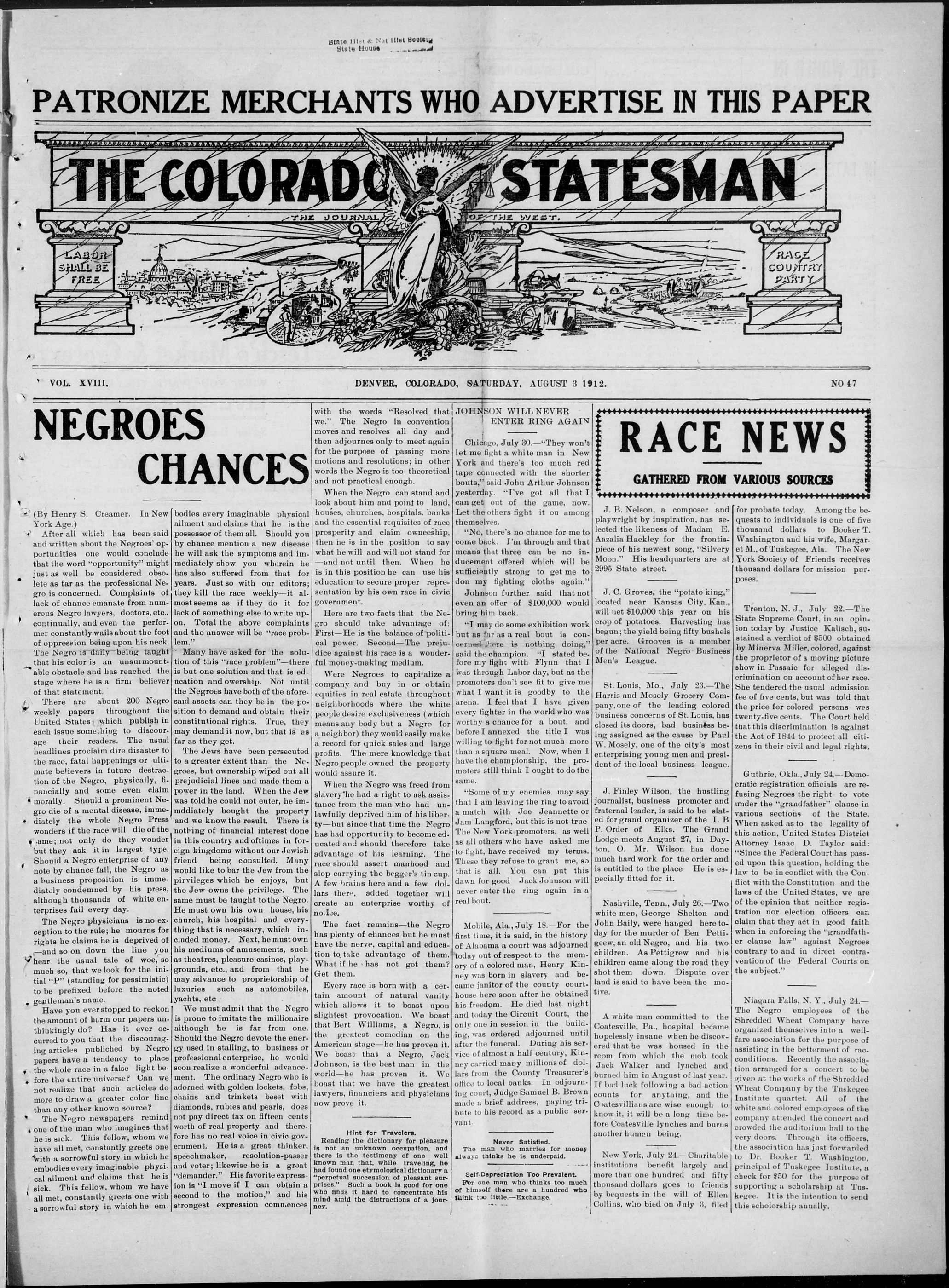
PATRONIZE MERCHANTS WHO ADVERTISE IN THIS PAPER
THE COLORADO STATESMAN
THE JOURNAL OF THE WEST.
LABOR SHALL BE FREE
RAGE COUNTRY PARTY
NEGROES CHANCES
VOL. XVIII.
NEGRO
CI
(By Henry S. Creamer. In New
York Age.)
After all which has been said and written about the Negroes' opportunities one would conclude that the word "opportunity" might just as well be considered obsolete as far as the professional Negro is concerned. Complaints of lack of chance emanate from numerous Negro lawyers, doctors, etc., continually, and even the performer constantly wails about the foot of oppression being upon his neck. The Negro is daily being taught that his color is an unsurmountable obstacle and has reached the stage where he is a firm believer of that statement.
There are about 200 Negro weekly papers throughout the United States which publish in each issue something to discourage their readers. The usual headlines proclaim dire disaster to the race, fatal happenings or ultimate believers in future destruction of the Negro, physically, financially and some even claim morally. Should a prominent Negro die of a mental disease, immediately the whole Negro Press wonders if the race will die of the same; not only do they wonder but they ask it in largest type. Should a Negro enterprise of any note by chance fail; the Negro as a business proposition is immediately condemned by his press, although thousands of white enterprises fail every day.
The Negro physicians is no exception to the rule; he mourns for rights he claims he is deprived of and so on down the line you hear the usual tale of woe, so much so, that we look for the initial "P" (standing for pessimistic) to be prefixed before the noted gentleman's name.
Have you ever stopped to reckon the amount of harm our papers unthinkingly do? Has it ever occurred to you that the discouraging articles published by Negro papers have a tendency to place the whole race in a false light before the entire universe? Can we not realize that such articles do more to draw a greater color line than any other known source?
The Negro newspapers remind one of the man who imagines that he is sick. This fellow, whom we have all met, constantly greets one with a sorrowful story in which he embodies every imaginable physical ailment and claims that he is sick. This fellow, whom we have all met, constantly greets one with a sorrowful story in which he em.
bodies every imaginable physical ailment and claims that he is the possessor of them all. Should you by chance mention a new disease he will ask the symptoms and immediately show you wherein he has also suffered from that for years. Just so with our editors; they kill the race weekly—it almost seems as if they do it for lack of something else to write upon. Total the above complaints and the answer will be "race problem."
Many have asked for the solution of this "race problem"—there is but one solution and that is education and ownership. Not until the Negroes have both of the afore-sand assets can they be in the position to demand and obtain their constitutional rights. True, they may demand it now, but that is as far as they get.
The Jews have been persecuted to a greater extent than the Negroes, but ownership wiped out all prejudicial lines and made them a power in the land. When the Jew was told he could not enter, he immediately bought the property and we know the result. There is nothing of financial interest done in this country and oftimes in foreign kingdoms without our Jewish friend being consulted. Many would like to bar the Jew from the pirvileges which he enjoys, but the Jew owns the privilege. The same must be taught to the Negro. He must own his own house, his church, his hospital and everything that is necessary, which included money. Next, he must own his mediums of amusements, such as theatres, pleasure casinos, playgrounds, etc., and from that he may advance to proprietorship of luxuries such as automobiles, vachts, etc.
We must admit that the Negro is prone to imitate the millionaire although he is far from one. Should the Negro devote the energy used in stalling, to business or professional enterprise, he would soon realize a wonderful advancement. The ordinary Negro who is adorned with golden lockets, fobs, chains and trinkets beset with diamonds, rubies and pearls, does not pay direct tax on fifteen cents worth of real property and therefore has no real voice in civic government. He is a great thinker, speechmaker, resolution-passer and voter; likewise he is a great "demander." His favorite expression is "I move if I can obtain a second to the motion," and his strongest expression commences
DENVER. COLORADO. SATURDAY. AUGUST 3 1912.
State Hist & Nat Hist Sources
State Houses
HANTS WI
ADC
Z JOURNAL
DENVER, COLORAD
with the words "Resolved that we." The Negro in convention moves and resolves all day and then adjournes only to meet again for the purpose of passing more motions and resolutions; in other words the Negro is too theoretical and not practical enough.
When the Negro can stand and look about him and point to land, houses, churches, hospitals, banks and the essential requisites of race prosperity and claim owneeship, then he is in the position to say what he will and will not stand for—and not until then. When he is in this position he can use his education to secure proper representation by his own race in civic government.
Here are two facts that the Negro should take advantage of: First—He is the balance of political power. Second—The prejudice against his race is a wonderful money-making medium.
Were Negroes to capitalize a company and buy in or obtain equities in real estate throughout neighborhoods where the white people desire exclusiveness (which means any body but a Negro for a neighbor) they would easily make a record for quick sales and large profits. The mere knowledge that Negro people owned the property would assure it.
When the Negro was freed from slavery he had a right to ask assistance from the man who had unlawfully deprived him of his liberty—but since that time the Negro has had opportunity to become educated and should therefore take advantage of his learning. The race should assert manhood and slop carrying the begger's tin cup. A few brains here and a few dollars there, added together will create an enterprise worthy of noise.
The fact remains—the Negro has plenty of chances but he must have the nerve, capital and education to take advantage of them. What if he has not got them? Get them.
Every race is born with a certain amount of natural vanity which allows it to boast upon slightest provocation. We boast that Bert Williams, a Negro, is the greatest comedian on the American stage—he has proven it. We boast that a Negro, Jack Johnson, is the best man in the world—he has proven it. We boast that we have the greatest lawyers, financiers and physicians now prove it.
Hint for Travelers
Reading the dictionary for pleasure is not an unknown occupation, and there is the testimony of one well known man that, while traveling, he had found one etymological dictionary a "perpetual succession of pleasant surprises." Such a book is good for one who finds it hard to concentrate his mind amid the distractions of a journey.
Chicago, July 30.—"They won't let me fight a white man in New York and there's too much red tape connected with the shorter bouts," said John Arthur Johnson yesterday. "I've got all that I can get out of the game, now. Let the others fight it ou among themselves.
"No, there's no chance for me to come back. I'm through and that means that three can be no inducement offered which will be sufficiently strong to get me to don my fighting cloths again."
Johnson further said that not even an offer of $100,000 would bring him back.
"I may do some exhibition work but as far as a real bout is concerned there is nothing doing," said the champion. "I stated before my fight with Flynn that I was through Labor day, but as the promoters don't see fit to give me what I want it is goodby to the arena. I feel that I have given every fighter in the world who was worthy a chance for a bout, and before I annexed the title I was willing to fight for not much more than a square meal. Now, when I have the championship, the promoters still think I ought to do the same.
"Some of my enemies may say that I am leaving the ring to avoid a match with Joe Jeannette or Jam Langford, but this is not true. The New York promoters, as well as all others who have asked me to fight, have received my terms. These they refuse to grant me, so that is all. You can put this dawn for good Jack Johnson will never enter the ring again in a real bout.
Mobile, Ala., July 18.—For the first time, it is said, in the history of Alabama a court was adjourned today out of respect to the memory of a colored man, Henry Kinney was born in slavery and became janitor of the county courthouse here soon after he obtained his freedom. He died last night and today the Circuit Court, the only one in session in the building, was ordered adjourned until after the funeral. During his service of almost a half century, Kinney carried many millions of dollars from the County Treasurer's office to local banks. In odjourning court, Judge Samuel B. Brown made a brief address, paying tribute to his record as a public servant.
Never Satisfied.
The man who marries for money always thinks he is underpaid.
Self-Depreciation Too Prevalent.
For one man who thinks too much of himself there are a hundred who think too little.—Exchange.
RACE NEWS
J. B. Nelson, a composer and playwright by inspiration, has selected the likeness of Madam E. Aazalia Hackley for the frontispiece of his newest song, "Silvery Moon." His headquarters are at 2995 State street.
J. C. Groves, the "potato king," located near Kansas City, Kan., will net $10,000 this year on his crop of potatoes. Harvesting has begun; the yield being fifty bushels per acre. Grooves is a member of the National Negro Business Men's League.
St. Louis, Mo., July 23.—The Harris and Mosely Grocery Company, one of the leading colored business concerns of St. Louis, has closed its doors, bad business being assigned as the cause by Paul W. Mosely, one of the city's most enterprising young men and president of the local business league.
J. Finley Wilson, the hustling journalist, business promoter and fraternal leader, is said to be slated for grand organizer of the I. B P. Order of Elks. The Grand Lodge meets August 27, in Dayton, O. Mr. Wilson has done much hard work for the order and is entitled to the place He is especially fitted for it.
Nashville, Tenn., July 26.—Two white men, George Shelton and John Baily, were hanged here today for the murder of Ben Pettigew, an old Negro, and his two children. As Pettigrew and his children came along the road they shot them down. Dispute over land is said to have been the motive.
A white man committed to the Coatesville, Pa., hospital became hopelessly insane when he discovered that he was housed in the room from which the mob took Jack Walker and lynched and burned him in August of last year. If bad luck following a bad action counts for anything, and the Coatesvillians are wise enough to know it, it will be a long time before Coatesville lynches and burus another human being.
New York, July 24.—Charitable institutions benefit largely and more than one hundred and fifty thousand dollars goes to friends by bequests in the will of Ellen Collins, who bied on July 3, filed
NO 47
for probate today. Among the bequests to individuals is one of five thousand dollars to Booker T. Washington and his wife, Margaret M., of Tuskegee, Ala. The New York Society of Friends receives thousand dollars for mission purposes.
Trenton, N. J., July 22.—The State Supreme Court, in an opinion today by Justice Kalisch, sustained a verdict of $500 obtained by Minerva Miller, colored, against the proprietor of a moving picture show in Passaic for alleged discrimination on account of her race. She tendered the usual admission fee of five cents, but was told that the price for colored persons was twenty-five cents. The Court held that this discrimination is against the Act of 1844 to protect all citizens in their civil and legal rights,
Guthrie, Okla., July 24.—Democratic registration officials are refusing Negroes the right to vote under the "grandfather" clause in various sections of the State. When asked as to the legality of this action, United States District Attorney Isaac D. Taylor said: "Since the Federal Court has passed upon this question, holding the law to be in conflict with the Conflict with the Constitution and the laws of the United States, we are of the opinion that neither registration nor election officers can claim that they act in good faith when in enforcing the "grandfather clause law" against Negroes contrary to and in direct contravention of the Federal Courts on the subject."
Niagara Falls, N. Y., July 24. The Negro employees of the Shredded Wheat Company have organized themselves into a welfare association for the purpose of assisting in the betterment of racconditions. Recently the association arranged for a concert to be given at the works of the Shredded Wheat Company by the Tuskegee Institute quartet. All of the white and colored employees of the company attended the concert and crowded the auditorium hall to the very doors. Through its officers, the association has just forwarded to Dr. Booker T. Washington, principal of Tuskegee Institute, a check for $50 for the purpose of supporting a scholarship at Tuskegee. It is the intention to send this scholarship annually.
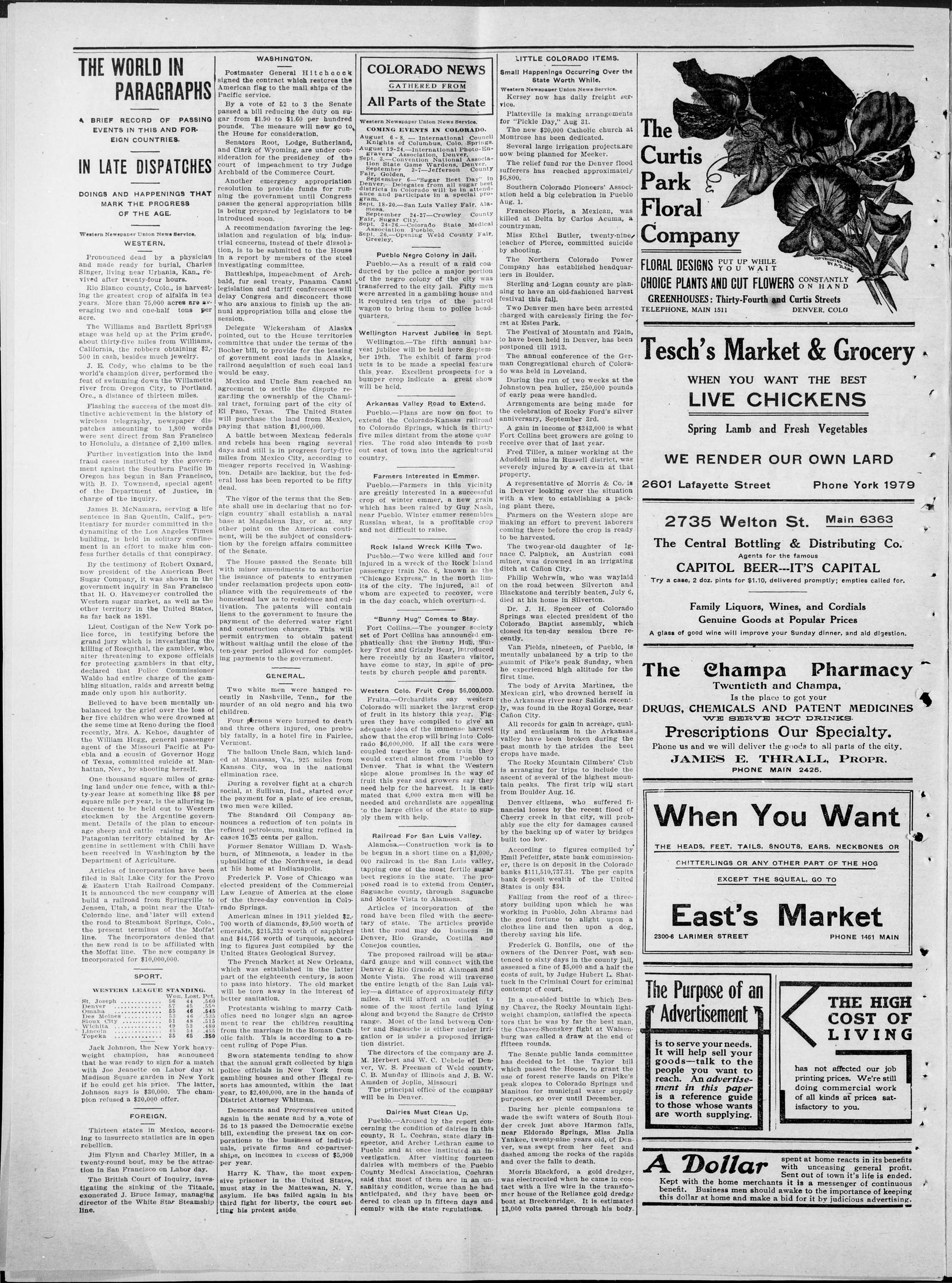
THE WORLD IN PARAGRAPHS
4 BRIEF RECORD OF PASSING EVENTS IN THIS AND FOR-EIGN COUNTRIES.
IN LATE DISPATCHES
IN LATE DISPATCHES
DOINGS AND HAPPENINGS THAT
MARK THE PROGRESS
OF THE AGE.
Western Newspaper Union News Service.
WESTERN.
Pronounced dead by a physician
and made ready for burial, Charles
Singer, living near Urbania, Kan., re-
vived after twenty-four hours.
Rio Blanco county, Colo., is harvest-
ing the greatest crop of alfalfa in tea
years. More than 75,000 acres are aver-
aging two and one-half tons per
acre.
The Williams and Bartlett Springs
stage was held up at the Prim grade,
about thirty-five miles from Williams,
California, the robbers obtaining $2,
500 in cash, besides much jewelry.
J. E. Cody, who claims to be the world's champion diver, performed the feat of swimming down the Willamette river from Oregon City, to Portland, Ore., a distance of thirteen miles. Flashing the success of the most distinctive achievement in the history of wireless telegraphy, newspaper dispatches amounting to 1,800 words were sent direct from San Francisco to Honolulu, a distance of 2,100 miles. Further investigation into the land fraud cases instituted by the government against the Southern Pacific in Oregon has begun in San Francisco, with B. D. Townsend, special agent of the Department of Justice, in charge of the inquiry.
James B. McNamara, serving a life sentence in San Quentin, Calif., penitentiary for murder committed in the dynamiting of the Los Angeles Times building, is held in solitary confinement in an effort to make him confess further details of that conspiracy. By the testimony of Robert Oxnard, now president of the American Beet Sugar Company, it was shown in the government inquiry in San Francisco that H. O. Havemeyer controlled the Western sugar market, as well as the other territory in the United States, as far back as 1891.
Lieut. Costigan of the New York police force, in testifying before the grand jury which is investigating the killing of Rosenthal, the gambler, who, after threatening to expose officials for protecting gamblers in that city, declared that Police Commissioner Waldo had entire charge of the gambling situation, raids and arrests being made only upon his authority.
Believed to have been mentally unbalanced by the grief over the loss of her five children who were drowned at the same time at Reno during the flood recently, Mrs. A. Kehoe, daughter of the William Hogg, general passenger agent of the Missouri Pacific at Puebla and a cousin of Governor Hogg of Texas, committed suicide at Manhattan, Nev., by shooting herself.
One thousand square miles of grazing land under one fence, with a thirty-year lease at something like $8 per square mile per year, is the alluring inducement to be held out to Western stockmen by the Argentine government. Details of the plan to encourage sheep and cattle raising in the Patagonian territory obtained by Argentine in settlement with Chill have been received in Washington by the Department of Agriculture.
Articles of incorporation have been filed in Salt Lake City for the Provo & Eastern Utah Railroad Company. It is announced the new company will build a railroad from Springville to Jensen, Utah, a point near the Utah-Colorado line, and later will extend the road to Steamboat Springs, Colo., the present terminus of the Moffat line. The incorporators denied that the new road is to be affiliated with the Moffat line. The new company is incorporated for $10,000,000.
WESTERN LEAGUE STANDING.
Won. Lost. Pet.
St. Joseph 56 44 .560
Denver 57 45 .550
Danah 55 46 .550
Dee Molins 53 46 .535
Sloux City 51 48 .515
Wilchita 49 53 .480
Lincoln 45 54 .455
Topeka 35 65 .350
Jack Johnson, the New York heavyweight champion, has announced that he was ready to sign for a match with Joe Jeanette on Labor day at Madison Square garden in New York if he could get his price. The latter, Johnson says is $30,000. The champion refused a $20,000 offer.
FOREIGN
Thirteen states in Mexico, according to insurrect statistics are in open rebellion. Jim Flynn and Charley Miller, in a twenty-round bout, may be the attraction in San Francisco on Labor day. The British Court of Inquiry, investigating the sinking of the Titanic, exonerated J. Bruce Ismay, managing director of the White Star Steamship line.
WASHINGTON
Postmaster General Hitchcock signed the contract which restores the American flag to the mail ships of the Pacific service. By a vote of 52 to 3 the Senate passed a bill reducing the duty on sugar from $1.90 to $1.60 per hundred pounds. The measure will now go to the House for consideration. Senators Root, Lodge, Sutherland, and Clark of Wyoming, are under consideration for the presidency of the court of impeachment to try Judge Archbald of the Commerce Court. Another emergency appropriation resolution to provide funds for running the government until Congress passes the general appropriation bills is being prepared by legislators to be introduced soon.
A recommendation favoring the legislation and regulation of big industrial concerns, instead of their dissolution, is to be submitted to the House in a report by members of the steel investigating committee. Battleships, impeachment of Archbald, fur seal treaty, Panama Canal legislation and tariff conferences will delay Congress and disconcert those who are anxious to finish up the annual appropriation bills and close the session. Delegate Wickersham of Alaska pointed, out to the House territories committee that under the terms of the Booher bill, to provide for the leasing of government coal lands in Alaska, railroad acquisition of such coal land would be easy.
Mexico and Uncle Sam reached an agreement to settle the dispute regarding the ownership of the Chamizal tract, forming part of the city of El Paso, Texas. The United States will purchase the land from Mexico, paying that nation $1,000,000.
A battle between Mexican federals and rebels has been raging several days and still is in progress forty-five miles from Mexico City, according to meager reports received in Washington. Details are lacking, but the federal loss has been reported to be fifty dead.
The vigor of the terms that the Senate shall use in declaring that no foreign country shall establish a naval base at Magdalena Bay, or at any other point on the American continent, will be the subject of consideration by the foreign affairs committee of the Senate.
The House passed the Senate bill with minor amendments to authorize the issuance of patents to entrymen under reclamation projects upon compliance with the requirements of the homestead law as to residence and cultivation. The patents will contain liens to the government to insure the payment of the deferred water right and construction charges. This will permit entrymen to obtain patent without waiting until the close of the ten-year period allowed for completing payments to the government.
GENERAL
Two white men were hanged recently in Nashville, Tenn., for the murder of an old negro and his two children. Four persons were burned to death and three others injured, one probably fatally, in a hotel fire in Fairlee, Vermont. The balloon Uncle Sam, which landed at Manassas, Va., 925 miles from Kansas City, won in the national elimination race. During a revolver fight at a church social, at Sullivan, Ind., started over the payment for a plate of ice cream, two men were killed. The Standard Oil Company announces a reduction of ten points in refined petroleum, making refined in cases 10.25 cents per gallon.
Former Senator William D. Washburn, of Minnesota, a leader in the upbuilding of the Northwest, is dead at his home at Indianapolis.
Frederick P. Vose of Chicago was elected president of the Commercial Law League of America at the close of the three-day convention in Colorado Springs.
American mines in 1911 yielded $2,700 worth of diamonds, $9,500 worth of emeralds, $215,332 worth of sapphires and $44,756 worth of turquois, according to figures just compiled by the United States Geological Survey.
The French Market at New Orleans, which was established in the latter part of the eighteenth century, is soon to pass into history. The old market will be torn away in the interest of better sanitation.
Protestants wishing to marry Catholics need no longer sign an agreement to rear the children resulting from the marriage in the Roman Catholic faith. This is according to a recent ruling of Pope Plus.
Sworn statements tending to show that the annual graft collected by high police officials in New York from gambling houses and other illegal resorts has amounted, within the last year, to $2,400,000, are in the hands of District Attorney Whitman.
Democrats and Progressives united again in the senate and by a vote of 36 to 18 passed the Democratic excise bill, extending the present tax on corporations to the business of individuals, private firms and co-partnerships, on incomes in excess of $5,000 per year.
Harry K. Thaw, the most expensive prisoner in the United States, must stay in the Matteawan, N. Y. asylum. He has failed again in his third fight for liberty, the court setting his protest aside.
All Parts of the State
Western Newspaper Union News Service.
COMING EVENTS IN COLORADO.
August 6-8. — International Council
Knights of Columbus, Colo. Springs.
August 19-24. — International Photo-Engravers' Association, Denver.
State Convention National Association
State Game Wardens, Denver.
September 3-7. — Jefferson County
Fair, Golden.
September 6—"Sugar Beet Day" in Denver. Delegates from all sugar beet farms in Colorado will be in attendance and participate in a special program.
Sept. 18-20.—San Luis Valley Fair, Alamosa.
Opening Fueblo.
Sept. 26-27. Weld County Fair
Greeley.
Pueblo Negro Colony in Jail.
Pueblo.—As a result of a raid conducted by the police a major portion of the negro colony of the city was transferred to the city jail. Fifty men were arrested in a gambling house and it required ten trips of the patrol wagon to bring them to police headquarters.
Wellington Harvest Jubilee in Sept.
Wellington.—The fifth annual harvest jubilee will be held here September 19th. The exhibit of farm products is to be made a special feature this year. Excellent prospects for a bumper crop indicate a great show will be held.
Arkansas Valley Road to Extend.
Pueblo.—Plans are now on foot to extend the Colorado-Kansas railroad to Colorado Springs, which is thirty-five miles distant from the stone quarries. The road also intends to push out east of town into the agricultural country.
Farmers Interested in Emmer
Pueblo.—Farmers in this vicinity are greatly interested in a successful crop of winter emmer, a new grain which has been raised by Guy Nash, near Pueblo. Winter emmer resembles Russian wheat, is a profitable crop and not difficult to raise.
Rock Island Wreck Kills Two.
Pueblo.—Two were killed and four injured in a wreck of the Rock Island passenger train No. 6, known as the "Chicago Express," in the north limits of the city. The injured, all of whom are expected to recover, were in the day coach, which overturned.
"Bunny Hug" Comes to Stay.
Fort Collins.—The younger society set of Fort Collins has announced emphatically that the Bunny Hus, Turkey Trot and Grizzly Bear, introduced here recently by an Eastern visitor, have come to stay, in spite of protests by church people and parents.
Western Colo. Fruit Crop $6,000,000.
Fruita.—Orchardists say western Colorado will market the largest crop of fruit in its history this year. Figures they have compiled to give an adequate idea of the immense harvest show that the crop will bring into Colorado $6,000,000. If all the cars were coupled together in one train they would extend almost from Pueblo to Denver. That is what the Western slope alone promises in the way of fruit this year and growers say they need help for the harvest. It is estimated that 6,000 extra men will be needed and orchardists are appealing to the large cities of the state to supply them with help.
Railroad For San Luis Valley.
Alamosa.—Construction work is to be begun in a short time on a $1,000,000 railroad in the San Luis valley, tapping one of the most fertile sugar beet regions in the state. The proposed road is to extend from Center, Saguache county, through Saguache and Monte Vista to Alamosa.
Articles of incorporation of the road have been filed with the secretary of state. The articles provide that the road may do business in Denver, Rio Grande, Costilla and Conejos counties.
The proposed railroad will be standard gauge and will connect with the Denver & Rio Grande at Alamosa and Monte Vista. The road will traverse the entire length of the San Luis valley—a distance of approximately fifty miles. It will afford an outlet to some of the most fertile land lying along and beyond the Sangre de Cristo range. Most of the land between Center and Sagauche is either under irrigation or is under a proposed irrigation district.
The directors of the company are J. M. Herbert and W. C. Uebele of Denver, W. S. Freeman of Weld county, C. B. Munday of Illinois and J. B. W. Amsden of Joplin, Missouri
The principal office of the company will be in Denver.
Dairies Must Clean Up.
Pueblo.—Aroused by the report concerning the condition of dairies in this county, R L. Cochran, state diary inspector, and Archer Lethran came to Pueblo and at once instituted an investigation. After visiting fourteen dairies with members of the Pueblo County Medical Association, Cochran said that most of them are in an unsanitary condition, worse than he had anticipated, and they have been ordered to clean up in fifteen days and comply with the state regulations.
Small Happenings Occurring Over the State Worth While.
Western Newspaper Union News Service.
Kersey now has daily freight service.
Platteville is making arrangements for "Pickle Day," Aug 31.
The new $20,000 Catholic church at Montrose has been dedicated.
Several large irrigation projects are now being planned for Meeker.
The relief fund for the Denver flood sufferers has reached approximately $6,800.
Southern Colorado Pioneers' Association held a big celebration in Pueblo Aug. 1.
Francisco Floris, a Mexican, was killed at Delta by Carlos Acuma, a countryman.
Miss Ethel Butler, twenty-nine teacher of Pierce, committed suicide by shooting.
The Northern Colorado Power Company has established headquarters in Boulder.
Sterling and Logan county are planning to have an old-fashioned harvest festival this fall.
Two Denver men have been arrested charged with carelessly firing the forest at Estes Park.
The Festival of Mountain and Plain, to have been held in Denver, has been postponed till 1913.
The annual conference of the German Congregational church of Colorado was held in Loveland.
During the run of two weeks at the Johnstown pea huller, 250,000 pounds of early peas were handled.
Arrangements are being made for the celebration of Rocky Ford's silver anniversary, September 3rd.
A gain in income of $343,000 is what Fort Collins beet growers are going to receive over that of last year.
Fred Tiller, a miner working at the Aduddell mine in Russell district, was severely injured by a cave-in at that property.
A representative of Morris & Co. is in Denver looking over the situation with a view to establishing a packing plant there.
Farmers on the Western slope are making an effort to prevent laborers coming there before the crop is ready to be harvested.
The two-year-old daughter of Ignace C. Palpnek, an Austrian coal miner, was drowned in an irrigating ditch at Cañon City.
Phillip Wehrwin, who was waylaid on the road between Silverton and Blackstone and terribly beaten, July 6, died at his home in Silverton.
Dr. J. H. Spencer of Colorado Springs was elected president of the Colorado Baptist assembly, which closed its ten-day session there recently.
Van Fields, nineteen, of Pueblo, is mentally unbalanced by a trip to the summit of Pike's peak Sunday, when he experienced high altitude for the first time.
The body of Arvita Martinez, the Mexican girl, who drowned herself in the Arkansas river near Salida recently, was found in the Royal Gorge, near Cañon City.
All records for gain in acreage, quality and enthusiasm in the Arkansas valley have been broken during the past month by the strides the beet crops have made.
The Rocky Mountain Climbers' Club is arranging for trips to include the ascent of several of the highest mountain peaks. The first trip will start from Boulder Aug. 16.
Denver citizens, who suffered financial losses by the recent flood of Cherry creek in that city, will probably sue the city for damages caused by the backing up of water by bridges built too low.
According to figures compiled by Emil Pefeifer, state bank commissioner, there is on deposit in the Colorado banks $111,510,737.31. The per capita bank deposit wealth of the United States is only $34.
Falling from the roof of a three-story building upon which he was working in Pueblo, John Abrams had the good fortune to alight upon a clothes line and then upon a dog, thereby saving his life.
Frederick G. Bonfills, one of the owners of the Denver Post, was sentenced to sixty days in the county jail, assessed a fine of $5,000 and a half the costs of suit, by Judge Hubert L. Shattuck in the Criminal Court for criminal contempt of court.
In a one-sided battle in which Benny Chavez, the Rocky Mountain lightweight champion, satisfied the spectators that he was by far the best man, the Chavez-Shonskey fight at Walsenburg was called a draw at the end of fifteen rounds.
The Senate public lands committee has decided to let the Taylor bill which passed the House, to grant the use of forest reserve lands on Pike's peak slopes to Colorado Springs and Manitou for municipal water supply purposes, go over until December.
Daring her picnic companions to wade the swift waters of South Boulder creek just above Harmon falls, near Eldorado Springs, Miss Julia Yankee, twenty-nine years old, of Denver, was swept from her feet and dashed among the rocks of the rapids and over the falls to death.
Morris Blackford, a gold dredger, was electrocuted when he came in contact with a live wire in the transformer house of the Reliance gold dredge boat at Breckenridge. It is estimated 13,000 volts passed through his body.
The
Curtis
Park
Floral
Company
FLORAL DESIGNS PUT UP WHILE
YOU WAIT
CHOICE PLANTS AND CUT FLOWERS CONSTANTLY
ON HAND
GREENHOUSES: Thirty-Fourth and Curtis Streets
TELEPHONE, MAIN 1511
DENVER, COLG
Tesch's Market & Grocery
WHEN YOU WANT THE BEST LIVE CHICKENS Spring Lamb and Fresh Vegetables
WE RENDER OUR OWN LARD
2735 Welton St. Main 6363
The Central Bottling & Distributing Co.
Agents for the famous
CAPITOL BEER---IT'S CAPITAL
Try a case, 2 doz. pints for $1.10, delivered promptly; empties called for.
Family Liquors, Wines, and Cordials Genuine Goods at Popular Prices A glass of good wine will improve your Sunday dinner, and aid digestion.
The Champa Pharmacy
Twentieth and Champa,
Is the place to get your
DRUGS, CHEMICALS AND PATENT MEDICINES
WE SERVE HOT DRINKS.
Prescriptions Our Specialty.
Phone us and we will deliver the goods to all parts of the city.
JAMES E. THRALL, PROPR.
PHONE MAIN 2426.
When You Want
THE HEADS, FEET, TAILS, SNOUTS, EARS, NECKBONES OR
CHITTERLINGS OR ANY OTHER PART OF THE HOG
EXCEPT THE SQUEAL, GO TO
Kept with the home merchants it is a messenger of continuous benefit. Business men should awake to the importance of keeping this dollar at home and make a bid for it by judicious advertising.
2601 Lafayette Street
2735 Welton
The Central Bottling
Agents for
CAPITOL BEER
Try a case, 2 doz. pints for $1.10, c
Family Liquors, W
Genuine Goods
A glass of good wine will improve
The Champ
Twentieth
Is the place
DRUGS, CHEMICALS AND
WE SERVE
Prescriptions
Phone us and we will deliver to
JAMES E. T.
PHONE N
When Y
THE HEADS, FEET, TAILS, S
CHITTERLINGS OR ANY
EXCEPT THE
East's
The Purpose of an Advertisement
is to serve your needs. It will help sell your goods—talk to the people you want to reach. An advertisement in this paper is a reference guide to those whose wants are worth supplying.
A Dollar
Kept with the home merchant benefit. Business men should this dollar at home and make
Phone York 1979
St. Main 6363
& Distributing Co.
famous
MIT'S CAPITAL
red promptly; empties called for.
es, and Cordials
Popular Prices
Sunday dinner, and aid digestion.
Pharmacy
Champa,
got your
PATENT MEDICINES
NOT DRINKS.
Our Specialty.
foods to all parts of the city.
ALL, PROPR.
2425.
You Want
ATS, EARS, NECKBONES OR
ER PART OF THE HOG
EAL, GO TO
Market
PHONE 1461 MAIN
THE HIGH
COST OF
LIVING
has not affected our job
printing prices. We're still
doing commercial work
of all kinds at prices sat-
isfactory to you.
ent at home reacts in its benefits
with unceasing general profit.
ent out of town it's life is ended.
it is a messenger of continuous
take to the importance of keeping
for it by judicious advertising.
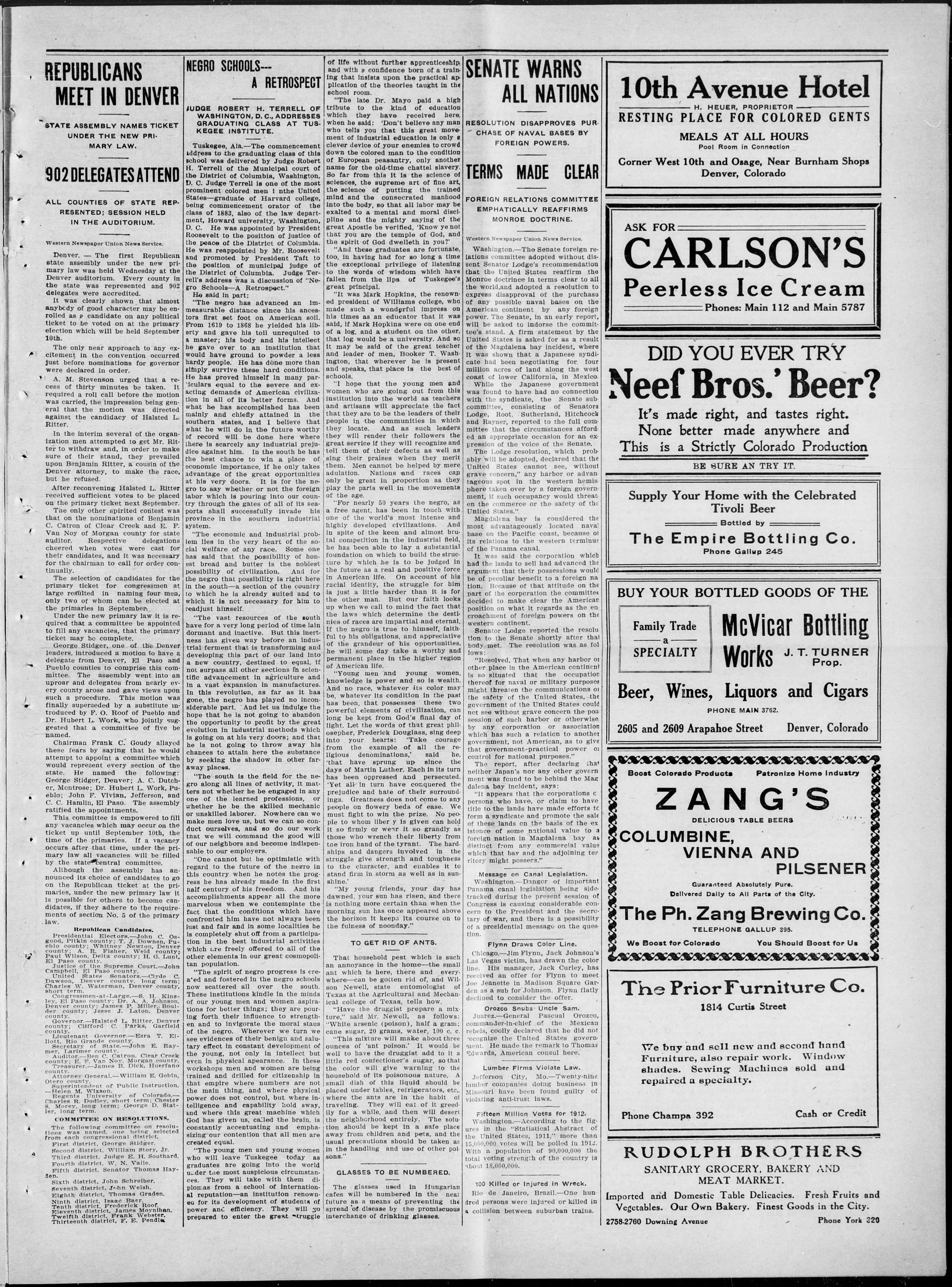
STATE ASSEMBLY NAMES TICKET UNDER THE NEW PRIMARY LAW.
902 DELEGATESATTEND
ALL COUNTIES OF STATE REPRESENTED; SESSION HELD IN THE AUDITORIUM.
Western Newspaper Union News Service.
Denver. — The first Republican state assembly under the new primary law was held Wednesday at the Denver auditorium. Every county in the state was represented and 902 delegates were accredited.
It was clearly shown that almost anybody of good character may be enrolled as p candidate on any political ticket to be voted on at the primary election which will be held September 10th.
The only near approach to any excitement in the convention occurred just before nominations for governor were declared in order.
A. M. Stevenson urged that a recess of thirty minutes be taken. It required a roll call before the motion was carried, the impression being general that the motion was directed against the candidacy of Halsted L. Ritter.
In the interim several of the organization men attempted to get Mr. Ritter to withdraw, in order to make sure of their stand, they prevailed upon Benjamin Ritter, a cousin of the Denver attorney, to make the race, but he refused.
After reconvening Halsted L. Ritter received sufficient votes to be placed on the primary ticket next September.
The only other spirited contest was that on the nominations of Benjamin C. Catron of Clear Creek and E. F. Van Noy of Morgan county for state auditor. Respective delegations cheered when votes were cast for their candidates, and it was necessary for the chairman to call for order continually.
The selection of candidates for the primary ticket for congressmen at large resulted in naming four men, only two of whom can be elected at the primaries in September.
Under the new primary law it is required that a committee be appointed to fill any vacancies, that the primary ticket may be complete.
George Stidger, one of the Denver leaders, introduced a motion to have a delegate from Denver, El Paso and Pueblo counties to comprise this committee. The assembly went into an uproar and delegates from nearly every county arose and gave views upon such a procedure. This motion was finally superseded by a substitute introduced by F. O. Roof of Pueblo and Dr. Hubert L. Work, who jointly suggested that a committee of five be named.
Chairman Frank C. Goudy allayed these fears by saying that he would attempt to appoint a committee which would represent every section of the state. He named the following: George Stidger, Denver; A. C. Dutcher, Montrose; Dr. Hubert L. Work, Pueblo; John F. Vivian, Jefferson, and C. C. Hamlin, El Paso. The assembly ratified the appointments.
This committee is empowered to fill any vacancies which may occur on the ticket up until September 10th, the time of the primaries. If a vacancy occurs after that time, under the primary law all vacancies will be filled by the state central committee. Although the assembly has announced its choice of candidates to go on the Republican ticket at the primaries, under the new primary law it is possible for others to become candidates, if they adhere to the requirements of section No. 5 of the primary law.
Republican Candidates
Presidential Electors.....John C. Osgood, Pitkin county; T. J. Downen, Pueblo county; Whitney Newton, Denver county; A. R. Fisher, Weld county; Paul Wilson, Delta county; H. G. Lunt, El Paso county.
Justice of the Supreme Court.—John Campbell, El Paso county.
Congressmen-at-Large.—S. H. Kinsley, EL Paso county; Dr. A. A. Johnson, El Paso county; James P. Miller, Boulder county; Jesse J. Laton, Denver county.
Governor. -Halsted L. Ritter, Denver
Clifford C. Parks, Garfield
COBBLY.
Lieutenant Governor—Ezra T. Ellott, Rio Grande county, San Antonio; John E. Raymer, Larimer county, Auditor—Ben C. Catron, Clear Creek county; E. F. Van Noy, Morgan county, Treasurer; James B. Dick, Huerfano county
- Herbert M. Jackson
- University of Colorado
- Charles R. Dudley, short term; Chester S. Morey, long term; George D. Statler, long term.
COMMITTEE ON RESOLUTIONS.
The following committee on resolutions was named, one being selected from each congressional district.
Sixth district, John Schreiber.
Seventh district, John Welsh.
Eighth district, Thomas Graden.
Ninth district, Isaac Baer.
Tenth district, Frederick Rooft.
Eleventh district, James Moynihan.
Twelfth district, Frank Webster.
Thirteenth district, F. E. Pendik
JUDGE ROBERT H. TERREL OF WASHINGTON, D.C., ADDRESSES GRADUATING CLASS AT TUSKEGEE INSTITUTE.
Tuskegee, Ala.—The commencement address to the graduating class of this school was delivered by Judge Robert H. Terrell of the Municipal court of the District of Columbia, Washington, D. C. Judge Terrell is one of the most prominent colored men in the United States—graduate of Harvard college, being commencement orator of the class of 1883, also of the law department, Howard university, Washington, D. C. He was appointed by President Roosevelt to the position of justice of the peace of the District of Columbia. He was reappointed by Mr. Roosevelt and promoted by President Taft to the position of municipal judge of the District of Columbia. Judge Terrell's address was a discussion of "Negro Schools—A Retrospect."
"The negro has advanced an immeasurable distance since his ancestors first set foot on American soil. From 1619 to 1888 he yielded his liberty and gave his toil unrequited to a master; his body and his intellect he gave over to an institution that would have ground to powder a less hardy people. He has done more than simply survive these hard conditions. He has proved himself in many particulars equal to the severe and exacting demands of American civilization in all of its better forms. And what he has accomplished has been mainly and chiefly attained in the southern states, and I believe that what he will do in the future worthy of record will be done here where there is scarcely any industrial prejudice against him. In the south he has the best chance to win a place of economic importance, if he only takes advantage of the great opportunities at his very doors. It is for the negro to say whether or not the foreign labor which is pouring into our country through the gates of all of its seaports shall successfully invade his province in the southern industrial system.
"The economic and industrial problem lies in the very heart of the social welfare of any race. Some one has said that the possibility of honest bread and butter is the noblest possibility of civilization. And for the negro that possibility is right here in the south—a section of the country to which he is already suited and to which it is not necessary for him to readjust himself.
"The vast resources of the south have for a very long period of time lain dormant and inactive. But this inertness has given way before an industrial ferment that is transforming and developing this part of our land into a new country, destined to equal, if not surpass all other sections in scientific advancement in agriculture and in a vast expansion in manufactures. In this revolution, as far as it has gone, the negro has played no inconsiderable part. And let us indulge the hope that he is not going to abandon the opportunity to profit by the great evolution in industrial methods which is going on at his very doors; and that he is not going to throw away his chances to attain here the substance by seeking the shadow in other faraway places.
"The south is the field for the negro along all lines of activity, it matters not whether he be engaged in any one of the learned professions, or whether he be the skilled mechanic or unskilled laborer. Nowhere can we make men love us, but we can so conduct ourselves, and so do our work that we will command the good will of our neighbors and become indispensable to our employers.
"One cannot but be optimistic with regard to the future of the negro in this country when he notes the progress he has already made in the first half century of his freedom. And his accomplishments appear all the more marvelous when we contemplate the fact that the conditions which have confronted him have not always been just and fair and in some localities he is completely shut off from a participation in the best industrial activities which are freely offered to all of the other elements in our great cosmopolitan population.
"The spirit of negro progress is created and fostered in the negro schools now scattered all over the south. These institutions kindle in the minds of our young men and women aspirations for better things; they are pouring forth their influence to strengthen and to invigorate the moral staus of the negro. Wherever we turn we see evidences of their benign and salutary effect in constant development of the young, not only in intellect but even in physical appearance. In these workshops men and women are being trained and drilled for citizenship in that empire where numbers are not the main thing, and where physical power does not control, but where intelligence and capability hold sway, and where this great machine which God has given us, called the brain, is constantly accentuating and emphasizing our contention that all men are created equal.
"The young men and young women who will leave Tuskegee today as graduates are going into the world u.nder the most auspicious circumstances. They will take with them diplomas from a school of international reputation—an institution renowned for its development of students of power and efficiency. They will go prepared to enter the great struggle
of life without further apprenticeship, and with a confidence born of a training that insists upon the practical application of the theories taught in the school room.
"The late Dr. Mayo paid a high tribute to the kind of education which they have received here, when he said: 'Don't believe any man who tells you that this great movement of industrial education is only a clever device of your enemies to crowd down the colored man to the condition of European peasantry, only another name for the old-time chattel slavery. So far from this it is the science of sciences, the supreme art of fine art, the science of putting the trained mind and the consecrated manhood into the body, so that all labor may be exalted to a mental and moral discipline and the mighty saying of the great Apostle be verified, 'Know ye not that you are the temple of God, and the spirit of God dwelleth in you?'
"And these graduates are fortunate, too, in having had for so long a time the exceptional privilege of listening to the words of wisdom which have fallen from the lips of Tuskegee's great principal.
"It was Mark Hopkins, the renowned president of Williams college, who made such a wonderful impress on his times as an educator that it was said, if Mark Hopkins were on one end of a log, and a student on the other, that log would be a university. And so it may be said of the great teacher and leader of men, Booker T. Washington, that wherever he is present and speaks, that place is the best of schools.
"I hope that the young men and women who are going out from this institution into the world as teachers and artisans will appreciate the fact that they are to be the leaders of their people in the communities in which they locate. And as such leaders they will render their followers the great service if they will recognize and tell them of their defects as well as sing their praises when they merit them. Men cannot be helped by mere adulation. Nations and races can only be great in proportion as they play the parts well in the movements of the age.
"For nearly 50 years the negro, as a free agent, has been in touch with one of the world's most intense and highly developed civilizations. And in spite of the keen and almost brutal competition in the industrial field, he has been able to lay a substantial foundation on which to build the structure by which he is to be judged in the future as a real and positive force in American life. On account of his racial identity, the struggle for him is just a little harder than it is for the other man. But our faith looks up when we call to mind the fact that the laws which determine the destinies of races are impartial and eternal. If the negro is true to himself, faithful to his obligations, and appreciative of the grandeur of his opportunities, he will some day take a worthy and permanent place in the higher region of American life.
"Young men and young women, knowledge is power and so is wealth. And no race, whatever its color may be, whatever its condition in the past has been, that possesses these two powerful elements of civilization, can long be kept from God's final day of light. Let the words of that great philosopher, Frederick Douglass, sing deep into your hearts: 'Take courage from the example of all the religious denominations,' said he, 'that have sprung up since the days of Martin Luther. Each in its turn has been oppressed and persecuted. 'Yet all in turn have conquered the prejudice and hate of their surroundings. Greatness does not come to any people on flowery beds of ease. We must fight to win the prize. No people to whom liber y is given can hold it so firmly or wear it so grandly as those who wrench their liberty from the iron hand of the tyrant. The hard-ships and dangers involved in the struggle give strength and toughness to the character, and enables it to stand firm in storm as well as in sunshine.'
"My young friends, your day has dawned, your sun has risen, and there is nothing more certain than when the morning sun has once appeared above the horizon it keeps its course on to the fulness of noonday."
TO GET RID OF ANTS.
That household pest which is such an annoyance in the home—the small ant which is here, there and every where—can be gotten rid of, and Wilson Newell, state entomologist of Texas at the Agricultural and Mechanical college of Texas, tells how, "Have the druggist prepare a mixture," said Mr. Newell, as follows: "White arsenic (poison), half a gram; can sugar, 20 grams, water, 100 c. c.
"This mixture will make about three ounces of 'ant poison.' It would be well to have the druggist add to it a little red confectioner's sugar, so that the color will give warning to the household of its poisonous nature. A small dish of this liquid should be placed under tables, refrigerators, etc., where the ants are in the habit of travelling. They will eat of it greedily for a while, and then will desert the neighborhood entirely. The solution should be kept in a safe place away from children and pets, and the usual precautions should be taken as in the handling and use of other poisons."
GLASSES TO BE NUMBERED.
The glasses used in Hungarian cafes will be numbered in the near future as a means of preventing the spread of disease by the promiscuous interchange of drinking glasses.
SENATE WARNS ALL NATIONS
RESOLUTION DISAPPROVES PUR
CHASE OF NAVAL BASES BY
FOREIGN POWERS.
TERMS MADE CLEAR
FOREIGN RELATIONS COMMITTEE
EMPHATICALLY REAFFIRMS
MONROE DOCTRINE.
Western Newspaper Union News Service.
Washington.—The Senate foreign relations committee adopted without dissent Senator Lodge's recommendation that the United States reaffirm the Monroe doctrine in terms clear to all the world, and adopted a resolution to express disapproval of the purchase of any possible naval bases on the American continent by any foreign power. The Senate, in an early report, will be asked to indorse the committee's stand. A firm statement by the United States is asked for as a result of the Magdalena bay incident, where it was shown that a Japanese syndicate had been negotiating for four million acres of land along the west coast of lower California, in Mexico.
While the Japanese government was found to have had no connection with the syndicate, the Senate subcommittee, consisting of Senators Lodge, Root, Sutherland, Hitchcock and Rayner, reported to the full committee that the circumstances afforded an appropriate occasion for an expression of the voice of the Senate. The Lodge resolution, which probably will be adopted, declared that the United States cannot see, without grave concern," any harbor or advantageous spot in the western hemisphere taken over by a foreign government, if such occupancy would threaten the commerce or the safety of the United States." Magdalena bay is considered the most advantageously located naval base on the Pacific coast, because of its relations to the western terminus of the Panama canal.
It was said the corporation which had the lands to sell had advanced the argument that their possessions would be of peculiar benefit to a foreign nation. Because of that attitude on the part of the corporation the committee decided to make clear the American position on what it regards as the encroachment of foreign powers on the western continent.
Senator Lodge reported the resolution to the Senate shortly after that body met. The resolution was as follows:
"Resolved, That when any harbor or other place in the American continent is so situated that the occupation thereof for naval or military purposes might threaten the communications or the safety of the United States, the government of the United States could not see without grave concern the possession of such harbor or otherwise by any corporation or association which has such a relation to another government, not American, as to give that government-practical power or control for national purposes." The report, after declaring that neither Japan's nor any other government was found to be behind the Magdalena bay incident, says:
"It appears that the corporations c persons who have, or claim to have title to the lands have made efforts to form a syndicate and promote the sale of these lands on the basis of the existence of some national value to a foreign nation in Magdalena bay as distinct from any commercial value which that bay and the adjoining territory might posses."
Message on Canal Legislation
Message on Casual Legislation
Washington—Danger of important
Panama canal legislation being sidetracked during the present session of Congress is causing considerable concern to the President and the secretary of war, and there is a possibility of a presidential message on the question.
Flynn Draws Color Line.
Chicago.—Jim Flynn, Jack Johnson's Las Vegas victim, has drawn the color line. His manager, Jack Curley, has received an offer for Flynn to meet Joe Jeanette in Madison Square Garden as a sub for Johnson. Flynn flatly declined to consider the offer.
Orozco Snubs Uncle Sam.
Juarez.—General Pascual Orozco, commander-in-chief of the Mexican rebels, coolly declared that he did not recognize the United States government. He made the remark to Thomas Edwards, American consul here.
Lumber Firms Violate Law.
Jefferson City, Mo.—Twenty-nine lumber companies doing business in Missouri have been found guilty of violating anti-trust laws.
Fifteen Million Votes for 1912. Washington—According to the figures in the "Statistical Abstract of the United States, 1911," more than 15,000,000 votes will be polled in 1912. With a population of 90,000,000 the total voting strength of the country is about 18,000,000.
Rio de Janeiro, Brazil.—One hundred persons were injured or killed in a collision between suburban trains.
MEALS AT ALL HOURS Pool Room in Connection
ASK FOR
CAR
Peerless
DID YOU
Neef B
It's made ri
None better
This is a Stri
BE S
Supply Your H
The Emp
BUY YOUR BO
At 10th and Osage, Near Bur-
Denver, Colorado
ARLSON
less Ice C
Phones: Main 112 and
DO YOU EVER T
'Bros.' B
made right, and tastes
better made anywhere
a Strictly Colorado F
Corner West 10th and Osage, Near Burnham Shops Denver, Colorado
ASK FOR CARLSON'S Peerless Ice Cream Phones: Main 112 and Main 5787
DID YOU EVER TRY Neef Bros.' Beer?
It's made right, and tastes right. None better made anywhere and This is a Strictly Colorado Production BE SURE AN TRY IT. Supply Your Home with the Celebrated Tivoli Beer
Supply Your Home with the Celebrated Tivoli Beer Bottled by The Empire Bottling Co. Phone Gallup 245
BUY YOUR BOTTLED GOODS OF THE
Beer, Wines, P
2605 and 2609 Arapa
Boost Colorado Prod
Z A
DELI
COLUMBIN
VIE
Guara
Dellivered Da
The Ph. Z
TELE
We Boost for Colorad
The Prior
182
We buy and s
Furniture, also
shades. Sewi
repaired a spe
The Prior Furniture Co. 1814 Curtis Street
We buy and sell new and second hand Furniture, also repair work. Window shades. Sewing Machines sold and repaired a specialty.
Phone Champa 392
RUDOLP
SANITARY G
ME
ported and Domestic
Vegetables. Our Own
8-2760 Downing Avenue
RUDOLPH BROTHERS
SANITARY GROCERY, BAKERY AND MEAT MARKET. Imported and Domestic Table Delicacies. Fresh Fruits and Vegetables. Our Own Bakery. Finest Goods in the City. 2758-2760 Downing Avenue Phone York 320
Family Trade a SPECIALTY
Cash or Credit
THE COLORADO STATESMAN
JOS. D. D. RIVERS.....Proprietor
1824 Curtis Street, Room 25.
JOS. D. D. RIVERS.....Proprietor
1824 Curtis Street, Room 25.
SUBSCRIPTION RATES:
One Year .....$2.00
Six Months .....1.00
Three Months .....60
PAYABLE IN ADVANCE.
Entered as second-class matter at the postoffice in the city of Denver, Colorado.
All communications of a personating nature that are not complimentary will be withheld from the columns of this paper.
It occasionally happens that papers sent to subscribers are lost or stolen. In case you do not receive any number when due, inform us by postal card and we will cheerfully forward a duplicate of the missing number.
Communications to receive attention must be newsy, upon important subjects, plainly written only upon one side of the paper; must reach us Tuesdays, if possible, anyway, not later than Wednesdays, and bear the signature of the author. No manuscript returned, unless stamps are sent for postage.
Remittances should be made by Express Money Order, Postoffice Money Order, Registered Letter or Bank Draft. Postage stamps will be received the same as cash for the fractional part of a dollar. Only 1-cent and 2-cent stamps taken.
Display advertising 25 cents per square. A square contains ten agate lines.
Reading notices, ten lines or less, 10 cents per line. Each additional line over ten lines, 5 cents per line.
No discounts allowed on less than three months' contract. Cash must accompany all orders from parties unknown to us. Further particulars on application.
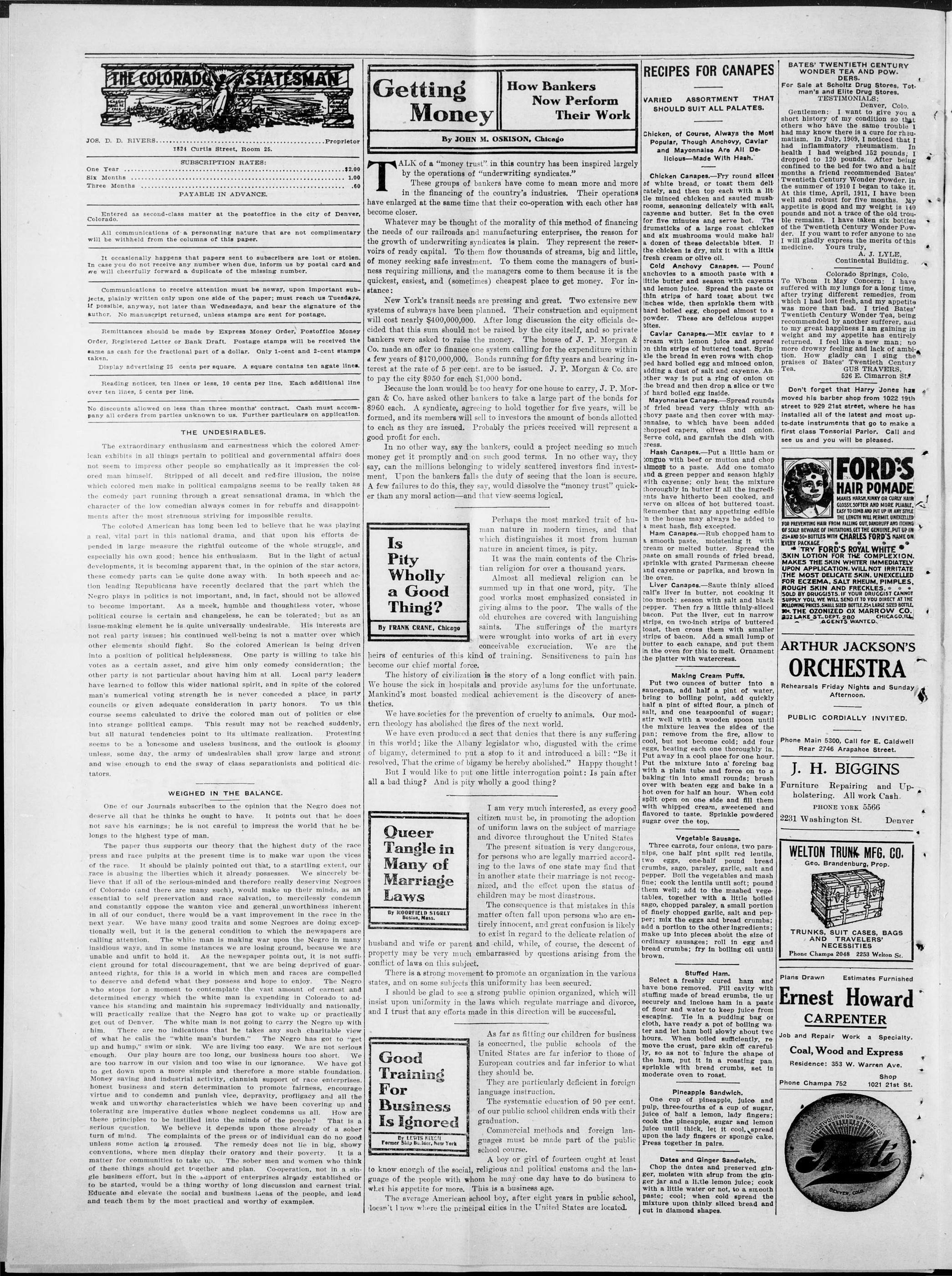
THE UNDESIRABLES.
enthusiasm and earnestness which things pertain to political and government people so emphatically as Stripped of all deceit and red-fist like in political campaigns seeming through a great sensational comedian always comes in for real strenuous striving for impossible American has long been led to believe this national drama, and that it secure the rightful outcome of the good; hence his enthusiasm. But becoming apparent that, in the opinion can be quite done away with. In humans have recently declared that this is not important, and, in fact, As a meek, humble and thoughtful and changeless, he can be the is quite universally undesirabler in his continued well-being is not bad fight. So the colored American political helplessness. One party hasasset, and give him only comedicular about having him at all, by this wider national spirit, and long strength he is never concede adequate consideration in party devoted to drive the colored man out of camps. This result may notencies point to its ultimate revive and useless business, and to the army of undesirables shall give end the sway of class separation.
The extraordinary enthusiasm and earnestness which the colored American exhibits in all things pertain to political and governmental affairs does not seem to impress other people so emphatically as it impresses the colored man himself. Stripped of all deceit and red-fire illusion, the noise which colored men make in political campaigns seems to be really taken as the comedy part running through a great sensational drama, in which the character of the low comedian always comes in for rebuffs and disappointments after the most strenuous striving for impossible results.
The colored American has long been led to believe that he was playing a real, vital part in this national drama, and that upon his efforts depended in large measure the rightful outcome of the whole struggle, and especially his own good; hence his enthusiasm. But in the light of actual developments, it is becoming apparent that, in the opinion of the star actors, these comedy parts can be quite done away with. In both speech and action leading Republicans have recently declared that the part which the Negro plays in politics is not important, and, in fact, should not be allowed to become important. As a meek, humble and thoughtless voter, whose political course is certain and changeless, he can be tolerated; but as an issue-making element he is quite universally undesirable. His interests are not real party issues; he continued well-being is not a matter over which other elements should fight. So the colored American is being driven into a position of political helplessness. One party is willing to take his votes as a certain asset, and give him only comedy consideration; the other party is not particular about having him at all. Local party leaders have learned to follow this wider national spirit, and in spite of the colored man's numerical voting strength he is never conceded a place in party councils or given adequate consideration in party honors. To us this course seems calculated to drive the colored man out of politics or else into strange political camps. This result may not be reached suddenly, but all natural tendencies point to its ultimate realization. Protesting seems to be a lonesome and useless business, and the outlook is gloomy unless, some day, the army of undesirables shall grow large and strong and wise enough to end the sway of class separationists and political dictators.
WEIGHED IN THE BALANCE.
als subscribes to the opinion that thinks he ought to have. It po; he is not careful to impress a type of man. supports our theory that the high
One of our Journals subscribes to the opinion that the Negro does not deserve all that he thinks he ought to have. It points out that he does not save his earnings; he is not careful to impress the world that he belongs to the highest type of man.
The paper thus supports our theory that the highest duty of the race press and race pulpits at the present time is to make war upon the vices of the race. It should be plainly pointed out that, to a startling extent, our race is abusing the liberties which it already possesses. We sincerely believe that if all of the serious-minded and therefore really deserving Negroes of Colorado (and there are many such), would make up their minds, as an essential to self preservation and race salvation, to mercilessly condemn and constantly oppose the wanton vice and general unworthiness inherent in all of our conduct, there would be a vast improvement in the race in the next year. We have many good traits and some Negroes are doing exceptionally well, but it is the general condition to which the newspapers are calling attention. The white man is making war upon the Negro in many insidious ways, and in some instances we are losing ground, because we are unable and unfit to hold it. As the newspaper points out, it is not sufficient ground for total discouragement, that we are being deprived of guaranteed rights, for this is a world in which men and races are compelled to deserve and defend what they possess and hope to enjoy. The Negro who stops for a moment to contemplate the vast amount of earnest and determined energy which the white man is expending in Colorado to advance his standing and maintain his supremacy individually and nationally, will practically realize that the Negro has got to wake up or practically get out of Denver. The white man is not going to carry the Negro up with him. There are no indications that he takes any such charitable view of what he calls the "white man's burden." The Negro has got to "get up and hump," swim or sink. We are living too easy. We are not serious enough. Our play hours are too long, our business hours too short. We are too narrow in our vision and too wise in our ignorance. We have got to get down upon a more simple and therefore a more stable foundation. Money saving and industrial activity, clannish support of race enterprises, honest business and stern determination to promote fairness, encourage virtue and to condemn and punish vice, deprivacy, profligacy and all the weak and unworthy characteristics which we have been covering up and tolerating are imperative duties whose neglect condemns us all. How are these principles to be instilled into the minds of the people? That is a serious question. We believe it depends upon those already of a sober turn of mind. The complaints of the press or of individual can do no good unless some action is aroused. The remedy does not lie in big, showy conventions, where men display their oratory and their poverty. It is a matter for communities to take up. The sober men and women who think of these things should get together and plan. Co-operation, not in a single business effort, but in the support of enterprises already established or to be started, would be a thing worthy of long discussion and earnest trial. Educate and elevate the social and business ideas of the people, and lead and teach them by the most practical and worthy of examples.
Getting Money How Bankers Now Perform Their Work By JOHN M. OSKISON, Chicago
"money trust" in this country has been operations of "underwriting syndicate groups of bankers have come to financing the country's industries same time that their co-operation be thought of the morality of this railroads and manufacturing enterprise writing syndicates is plain. They real. To them flow thousands of safe investment. To them come therons, and the managers come to the (sometimes) cheapest place to g transit needs are pressing and great. They have been planned. Their construction 10,000,000. After long discussion it should not be raised by the city in to raise the money. The house to finance one system calling for the 100,000,000. Bonds running for fifty y 5 per cent. are to be issued. J. B. for each $1,000 bond. In would be too heavy for one house, and other bankers to take a large publicicate, agreeing to hold together for bankers will sell to investors the amount issued. Probably the prices receive say, say the bankers, could a project notly and on such good terms. In was belonging to widely scattered in bankers falls the duty of seeing that, this, they say, would dissolve the "action—and that view seems logical.
TALK of a "money trust" in this country has been inspired largely by the operations of "underwriting syndicates."
These groups of bankers have come to mean more and more in the financing of the country's industries. Their operations have enlarged at the same time that their co-operation with each other has become closer.
Whatever may be thought of the morality of this method of financing the needs of our railroads and manufacturing enterprises, the reason for the growth of underwriting syndicates is plain. They represent the reservoirs of ready capital. To them flow thousands of streams, big and little, of money seeking safe investment. To them come the managers of business requiring millions, and the managers come to them because it is the quickest, easiest, and (sometimes) cheapest place to get money. For instance:
New York's transit needs are pressing and great. Two extensive new systems of subways have been planned. Their construction and equipment will cost nearly $400,000,000. After long discussion the city officials decided that this sum should not be raised by the city itself, and so private bankers were asked to raise the money. The house of J. P. Morgan & Co. made an offer to finance one system calling for the expenditure within a few years of $170,000,000. Bonds running for fifty years and bearing interest at the rate of 5 per cent. are to be issued. J. P. Morgan & Co. are to pay the city $950 for each $1,000 bond.
Because the loan would be too heavy for one house to carry, J. P. Morgan & Co. have asked other bankers to take a large part of the bonds for $960 each. A syndicate, agreeing to hold together for five years, will be formed, and its members will sell to investors the amount of bonds allotted to each as they are issued. Probably the prices received will represent a good profit for each.
In no other way, say the bankers, could a project needing so much money get it promptly and on such good terms. In no other way, they say, can the millions belonging to widely scattered investors find investment. Upon the bankers falls the duty of seeing that the loan is secure. A few failures to do this, they say, would dissolve the "money trust" quicker than any moral action—and that view seems logical.
Is
Pity
Wholly
a Good
Thing?
By FRANK CRANE, Chicago
heirs of centuries of this k
become our chief mortal for
The history of civilization
We house the sick in hospit-
Mankind's most boasted mo-
thetics.
We have societies for the
ern theology has abolished th
We have even produced
in this world; like the Alba
of bigamy, determined to pu-
resolved, That the crime of b
But I would like to pu-
all a bad thing? And is pit
of this kind of training. Sensitious
fortal force.
civilization is the story of a long
in hospitals and provide asylums in
astated medical achievement is the
uses for the prevention of cruelty to
published the fires of the next world.
produced a sect that denies that tha
the Albany legislator who, disgu
ned to put a stop to it and intro
crime of bigamy be hereby abolished
like to put one little interrogation
and is pity wholly a good thing?
heirs of centuries of this kind of training. Sensitiveness to pain has become our chief mortal force.
The history of civilization is the story of a long conflict with pain. We house the sick in hospitals and provide asylums for the unfortunate. Mankind's most boasted medical achievement is the discovery of anesthetics.
We have societies for the prevention of cruelty to animals. Our modern theology has abolished the fires of the next world.
We have even produced a sect that denies that there is any suffering in this world; like the Albany legislator who, disgusted with the crime of bigamy, determined to put a stop to it and introduced a bill: "Be it resolved, That the crime of bigamy be hereby abolished." Happy thought!
But I would like to put one little interrogation point: Is pain after all a bad thing? And is nity wholly a good thing?
Queer Tangle in Many of Marriage Laws
By MOORFIELD STORLY
Boston, Mass.
husband and wife or parent
property may be very much
conflict of laws on this subject
There is a strong move
states, and on some subjects
I should be glad to see
insist upon uniformity in th
and I trust that any efforts n
or parent and child, while, of course, much embarrassed by questioning this subject. Using movement to promote an organization subjects this uniformity has been added to see a strong public opinion on unity in the laws which regulate man efforts made in this direction will
husband and wife or parent and child, while, of course, the descent of property may be very much embarrassed by questions arising from the conflict of laws on this subject.
There is a strong movement to promote an organization in the various states, and on some subjects this uniformity has been secured.
I should be glad to see a strong public opinion organized, which will insist upon uniformity in the laws which regulate marriage and divorce, and I trust that any efforts made in this direction will be successful.
Good Training For Business Is Ignored By LEWIS KIKCH Former Ship Builder, New York
to know enough of the social
guage of the people with w
what his appetite for more.
The average American
doesn't know where the prince
the social, religious and political cove with whom he may one day have or more. This is a business age. American school boy, after eight yea the principal cities in the United S
to know enough of the social, religious and political customs and the language of the people with whom he may one day have to do business to what his appetite for more. This is a business age. The average American school boy, after eight years in public school, doesn't know where the principal cities in the United States are located.
must" in this country has been inspired largely by "underwriting syndicates."
The bankers have come to mean more and more of the country's industries. Their operations are that their co-operation with each other has out of the morality of this method of financing and manufacturing enterprises, the reason for syndicates is plain. They represent the reservation flow thousands of streams, big and little, amount. To them come the managers of business managers come to them because it is the times) cheapest place to get money. For in-ouses are pressing and great. Two extensive new plans planned. Their construction and equipment. After long discussion the city officials dept. be raised by the city itself, and so private the money. The house of J. P. Morgan & one system calling for the expenditure within Bonds running for fifty years and bearing in- it are to be issued. J. P. Morgan & Co. are $1,000 bond.
We too heavy for one house to carry, J. P. Morankers to take a large part of the bonds for seeing to hold together for five years, will be sell to investors the amount of bonds allotted. Probably the prices received will represent a fine bankers, could a project needing so much on such good terms. In no other way, they being to widely scattered investors find invest- is the duty of seeing that the loan is secure. Say, would dissolve the "money trust" quick- d that view seems logical.
Perhaps the most marked trait of human nature in modern times, and that which distinguishes it most from human nature in ancient times, is pity.
It was the main contents of the Christian religion for over a thousand years.
Almost all medieval religion can be summed up in that one word, pity. The good works most emphasized consisted in giving alms to the poor. The walls of the old churches are covered with languishing saints. The sufferings of the martyrs were wrought into works of art in every conceivable excruciation. We are the
and of training. Sensitiveness to pain has
e.
ion is the story of a long conflict with pain.
ails and provide asylums for the unfortunate.
ical achievement is the discovery of anes-
prevention of cruelty to animals. Our mode
fires of the next world.
a sect that denies that there is any suffering
my legislator who, disgusted with the crime
at a stop to it and introduced a bill: "Be it
gamy be hereby abolished." Happy thought!
one little interrogation point: Is pain after
wholly a good thing?
I am very much interested, as every good citizen must be, in promoting the adoption of uniform laws on the subject of marriage and divorce throughout the United States. The present situation is very dangerous, for persons who are legally married according to the laws of one state may find that in another state their marriage is not recognized, and the effect upon the status of children may be most disastrous. The consequence is that mistakes in this matter often fall upon persons who are entirely innocent, and great confusion is likely to exist in regard to the delicate relation of
and child, while, of course, the descent of embarrassed by questions arising from the试.
ent to promote an organization in the various this uniformity has been secured.
strong public opinion organized, which will laws which regulate marriage and divorce, made in this direction will be successful.
As far as fitting our children for business is concerned, the public schools of the United States are far inferior to those of European countries and far inferior to what they should be.
They are particularly deficient in foreign language instruction.
The systematic education of 90 per cent. of our public school children ends with their graduation.
Commercial methods and foreign languages must be made part of the public school course.
A boy or girl of fourteen ought at least religious and political customs and the lanom he may one day have to do business to This is a business age.
school boy, after eight years in public school, pal cities in the United States are located.
RECIPES FOR CANAPES
VARIED ASSORTMENT THAT
SHOULD SUIT ALL PALATES.
Chicken, of Course, Always the Most Popular, Though Anchovy, Caviar and Mayonnaise Are All Delicious—Made With Hash.
Chicken Canapes.—Fry round slices of white bread, or toast them delicately, and then top each with a little minced chicken and sauted mushrooms, seasoning delicately with salt cayenne and butter. Set in the oven for five minutes and serve hot. The drumsticks of a large roast chicken and six mushrooms would make hall a dozen of these delectable blites. If the chicken is dry, mix it with a little fresh cream or olive oil.
Cold Anchovy Canapes. — Pound anchovies to a smooth paste with a little butter and season with cayenne and lemon juice. Spread the paste on thin strips of hard toast about two inches wide, then sprinkle them with hard bolled egg, chopped almost to a powder. These are delicious supper bites.
Caviar Canapes.—Mix caviar to a cream with lemon juice and spread on thin strips of buttered toast. Sprinkle the bread in even rows with chopped hard bolled egg and minced onion, adding a dust of salt and cayenne. Another way is put a ring of onion on the bread and then drop a slice or two of hard bolled egg inside.
Mayonnaise Canapes.—Spread rounds of fried bread very thinly with anchovy paste and then cover with mayonnaise, to which have been added chopped capers, olives and onions. Serve cold, and garnish the dish with press.
Hash Canapes.—Put a little ham or tongue with beef or mutton and chop almost to a paste. Add one tomato and a green pepper and season highly with cayenne; only heat the mixture thoroughly in butter if all the ingredients have hitherto been cooked, and serve on slices of hot buttered toast. Remember that any appetizing edible in the house may always be added to a meat hash, fish excerted.
Ham Canapes.—Rub chopped ham to a smooth paste, moistening it with cream or melted butter. Spread the paste on small rounds of fried bread, sprinkle with grated Parmesan cheese and cayenne or paprika, and brown in the oven.
Liver Canapes.—Saute thinly sliced calf's liver in butter, not cooking it too much; season with salt and black pepper. Then fry a little thinly-sliced bacon. Put the liver, cut in narrow strips, on two-inch strips of buttered boast, then cross them with smaller strips of bacon. Add a small lump of butter to each canape, and put them in the oven for this to melt. Ornament the platter with watercress.
Making Cream Puffs.
Put two ounces of butter into a saucepan, add half a pint of water, bring to boiling point, add quickly half a pint of sifted flour, a pinch of salt, and one teaspoonful of sugar; stir well with a wooden spoon until the mixture leaves the sides of the pan; remove from the fire, allow to cool, but not become cold; add four eggs, beating each one thoroughly in. Put away in a cool place for one hour. Put the mixture into a forcing bag with a plain tube and force on to a baking tin into small rounds; brush over with beaten egg and bake in a hot oven for half an hour. When cold open on one side and fill them with whipped cream, sweetened and flavored to taste. Sprinkle powdered sugar over the top.
Vegetable Sausage
Three carrots, four onions, two parsnips, one half pint split red lentils, two eggs, one-half pound bread crumbs, sago, parsley, garlic, salt and pepper. Boll the vegetables and mash fine; cook the lentils until soft; pound them well; add to the mashed vegetables, together with a little boiled sago, chopped parsley, a small portion of finely chopped garlic, salt and pepper; mix the eggs and bread crumbs; add a portion to the other ingredients; make up into pieces about the size of ordinary sausages; roll in egg and bread crumbs; fry in boiling oil until brown.
Stuffed Ham.
Select a freshly cured ham and have bone removed. Fill cavity with stuffing made of bread crumbs, tie up securely and inclose ham in a paste of flour and water to keep juice from escaping. Tie in a pudding bag or cloth, have ready a pot of boiling water and let ham boll slowly about two hours. When boiled sufficiently, remove the crust, pare skin off carefully, so as not to injure the shape of the ham, put it in a roasting pan, sprinkle with bread crumbs, set in moderate oven to roast.
Pineapple Sandwich.
One cup of pineapple, juice and pulp, three-fourths of a cup of sugar, juice of half a lemon, lady fingers; cook the pineapple, sugar and lemon juice until thick, let it cool, spread upon the lady fingers or sponge cake. Press together in pairs.
Chop the dates and preserved ginger, molsten with slurp from the ginger jar and a little lemon juice; cook with a little water or not, to a smooth paste; cool; when cold spread the mixture upon thinly sliced bread and cut in diamond shapes.
BATES' TWENTIETH CENTURY
WONDER TEA AND POW-
DERS.
For Sale at Scholtz Drug Stores, Tot-
man's and Elite Drug Stores.
TESTIMONIALS:
Denver, Colo
Gentlemen; I want to give you a short history of my condition so that others who have the same trouble I had may know there is a cure for rheumatism. In July, 1909, I noticed that I had inflammatory rheumatism. In health I had weighed 152 pounds; I dropped to 120 pounds. After being confined to the bed for two and a half months a friend recommended Bates' Twentieth Century Wonder Powder. In the summer of 1910 I began to take it. At this time, April, 1911, I have been well and robust for five months. My appetite is good and my weight is 140 pounds and not a trace of the old trouble remains. I have taken six bottles of the Twentieth Century Wonder Powder. If you want to refer anyone to me I will gladly express the merits of this medicine. Yours truly,
A. J. LYLE,
Continental Building
Colorado Springs, Colo.
To Whom It May Concern: I have suffered with my lungs for a long time, after trying different remedies, from which I had lost flesh, and my appetite was more than bad. I tried Bates' Twentieth Century Wonder Tea, being recommended by another sufferer, and to my great happiness I am gaining in weight and my appetite has entirely returned. I feel like a new man; no more drowsy feeling and lack of ambition. How gladly can I sing the praises of Bates' Twentieth Century Tea.
GUS TRAVERS,
526 E. Cimarron St.
Don't forget that Harry Jones has moved his barber shop from 1022 19th street to 929 21st street, where he has installed all of the latest and most up-to-date instruments that go to make a first class Tonsorial Parlor. Call and see us and you will be pleased.
FORD'S
HAIR POMADE
MAKES HARSH, KINNY OR CURLY HAIR
GLOSSY, SOFTER AND MORE PLIABLE,
EASY TO COMB AND PUT UP IN AMY STYLE
THE LENGTH WILL PERMIT UNECCELLED
FOR PREVENTING HAIR FROM FALLING OUT, DANORUFF AND ITching OF SCALE BEWARE OF INITIATIONS, GET THE GENUINE, UP IN 25* AND 50* BOTTLES WITH CHARLES FORD'S NAME ON EVERY PACKAGE
TRY FORD'S ROYAL WHITE
SKIN LOTION FOR THE COMPLEXION.
MAKES THE SKIN WHITER IMEDIATELY
UPON APPLICATION. WILL NOT IRRITATE
THE MOST DELICATE SKIN. UNECCELLED
FOR ECZEMA, SALT RHEUM, PIMPLES,
ROUGH SKIN AND FRECKLES.
SOLD BY DRUGGISTS. IF YOUR DRUGGIST CANNOT
SUPPLY YOU, WE WILL SEND IT TO YOU DIRECT AT THE
LOPPING PRICES. SMALL SIZED BOTTLE 25*, LARGE SIZED BOTTLE.
THE OZONIZED OX MARROW CO.
202 LAKE ST. DOWNTOWN, CHICAGO,ILL
AGENTS WANTED
ARTHUR JACKSON'S ORCHESTRA Rehearsals Friday Nights and Sunday Afternoon. PUBLIC CORDIALLY INVITED.
Phone Main 5300, Call for E. Caldwell
Rear 2746 Arapahoe Street.
Furniture Repairing and Upholstering. All work Cash.
PHONE YORK 5566
2231 Washington St. Denver
WELTON TRUNK MFG. CO.
Geo. Brandenburg, Prop.
TRUNKS, SUIT CASES, BAGS
AND TRAVELERS'
NECESSITIES
Phone Champa 2048 2253 Welton St.
Plans Drawn Estimates Furnished
Ernest Howard
CARPENTER
Job and Repair Work a Specialty.
Coal, Wood and Express
Residence: 353 W. Warren Ave.
Shop
Phone Champa 752
1021 21st St.
THE EVOLITIUNION BREWING CO.
TRADEMARK
Pacifi
DENVER, COLOR.
Mrs. E. G. Prioleau and daughter, Mary, left Friday after visiting a week in the city.
R. Carn of New Orleans, La., is the guest of E. E. Halsey of 2239 Arapahoe street.
The Glacier Lake picnic last Wednesday was well attended and a general good time was enjoyed by all.
Everybody cordially invited. Admission free. Refreshments will served.
SCOTT M. E. CHURCH NOTES
26th and Clarkson Sts.
The passing of Bishop H. W. Wren takes away one of the past strongest friends. He gave him first appointment in the Lincoln
Miss Maggie Williams has returned home from Mercy hospital, where she was operated on several weeks ago.
Mrs. Josephine Cowden of 368 Steele street is suffering with a severe attack of heart trouble.
Mrs. Graves and Miss Von of Meberly, Mo., are visiting Mrs. Wims of 2227 Humboldt street.
Mrs. Rosie Hyman of 3213 Lawrence street entertained Mrs. Lee Jones and daughter at dinner Wednesday.
Mrs. Alice Eades gave a dinner last Thursday in honor of Mrs. L. Jones and daughter of Leadville.
Mrs. J. Willis of 2512 Clarkson gave a surprise party Wednesday evening in honor of her husband's thirty-eighth birthday.
Miss T. Thrashley, daughter of Mrs. M. Thrashley and Mr. C. L. Jones, were quietly married Wednesday even. Rev. Reynolds officiating.
The Misses Endicott of St. Joseph, Mo., who have been sight-seeing in the city for several days, left Wednesday for Colorado Springs.
Mrs. W. H. Gentry of 2927 Larimer street and Mrs. J. C. Gentry of 3714 Franklin are entertaining extensively in honor of their guest, Mrs. J. Alexander, of Topeka, Kansas.
Berry Craig left St. Luke's hospital this week and is residing with his sister, Mrs. W. B. Townsend, 2822 High street, where he will remain until his departure for Oakland, Cal., where he and his wife will visit relatives.
```markdown
```
The Odd Fellows' picnic at Dome Rock last Thursday was largely attended by those who wished to spend a day's recreation in the canon. There were all kinds of amusements and everybody had a jolly good time.
Edward Allison left the first of the week to assist in taking several prisoners to the training school at Boonville, Mo., and Ft. Leavenworth, Kansas. He returned home Wednesday.
Friday morning, July 26th, Mrs. Earnest Howard of 2196 South Delaware street entertained at breakfast: Mr. and Mrs. Rubin Williams of Dallas, Texas; Mrs. John Nelson and Mrs. Calaway.
Rev. J. C. C. Owens, the popular presiding elder of the A. M. E. conference, is making his quarterly pilgrimage to his northwest territory. Rev. Owens is so well known and popular with his parishioners that he at all times meets with a warm welcome.
J. M. Johns, who has had charge of the Brownleigh Court apartments at 1410 Grant street, for four years, will leave the city soon for an extensive visit. J. J. Johns, his brother will take his place at the Brownleigh.
One of the most pointed and elaborate social functions of the week was the reception given yesterday afternoon from 4 to 6 by Mrs. Edward C. Hamilton of 2432 Emerson street, in honor of Mesdames B. T. Alexander and O. A. Taylor of Topeka, Kansas, and Miss Essie Talbot of Pine Bluffs, Ark., all of whom were greeted by a large number of Denver's "400" society ladies, who, with the guests of honor, enjoyed the hospitality of the charming hostess. The house was profusely decorated with flowers and potted plants and this, together with the exquisite gowns worn by the guests, made the occasion a very brilliant affair. Dainty refreshments were served and the afternoon was voted as one of bliss.
Opening entertainment at the Lorena, 2401 Emerson street, Monday evening, August 5th. Music, elocution and speaking. Mrs. R. L. Pope will tell of woman's work in the South.
Everybody cordially invited. Admission free. Refreshments will be served.
SCOTT M. E. CHURCH NOTES.
26th and Clarkson Sts.
The passing of Bishop H. W. Warren takes away one of the pastor's strongest friends. He gave him his first appointment in the Lincoln conference and three years later ordained him elder and sent him to Seattle, Washington and since his incumbency in this city has caused him to be promoted to the district superintendency. During the first year in this city personally transferred the mortgage and helped to raise the $500 which was paid on the same. For the race he established Gammon Theological seminary through the Rev. Eligah Gammon and endowed it with $750,000. He has gone to his reward but his labors live after him. We bow our heads in humble submission to Him who does all things well.
Last week we forgot to mention four other names which should have appeared on the Missionary program, which are as follows: Misses Perry and McPherson, duet, (instrumental); Miss Parker and a splendid paper by Mrs. A. T. Kerr.
The choir will render a sacred concert Sunday evening. Rev. J. D. Rice will render a part on the program in the form of a short address. Come early in order to secure a comfortable seat. These musicals always attract a large and appreciative audience.
Misses Perry and McPherson led the League very acceptably last Sunday evening. Miss Raglen read a very interesting paper and the Rev. Rice sang a solo to the delight of all.
A Carpet committee has been organized by Miss Ross L. Rice to put in a new carpet in the church. The committee will have the carpet down by Sunday. The list is still open for new members. Something over twenty have already given in their names. Keep the good work going. Who will lead off next for improvements be fore the second quarter is held?
Do not forget that the Ladies' Aid Society will serve dinner on August the 5th and render an old Folks Concert at night. The Pinks will give a five days' festival or carnival beginning August 26 and going to the 31st Mr. F. D. McPherson is the energetic captain.
The sermon topic for Sunday morning will be "Motives to Christian Perseverance." Proverbs 4:18. Prof. and Mrs. Barrett were worshippers Sunday evening. They are here on a short vacation and are active members of our church in Texas.
Fort Rent—Three nice unfurnished rooms. Apply 2929 Glenarm Place.
Brickler's New Barber Shop is located at 2208 Larimer street. Shave, 10c. Hair Cut, 25c; Children, 15c.
Mrs. B. P. Johnson has a large front room for rent for gentlemen. Apply 2452 Gilpin street.
Write Hewetson-Watson for Special rates. Vocal and Instrumental Music and Elocution. Five Points Station.
Paul Lawrence Dunbar's complete works containing nearly five hundred pages, is for sale only by subscription by Miss Ruth Montgomery, 2549 Franklin street. All book lovers and those possessing race pride, should add to their collection this truly remarkable book and thus help this worthy young lady who is truly a Denver product. Prices—cloth, $1.75; half morocco, $2.50; full morocco, $3.50. Address Miss Montgomery a card at the above number and she will be pleased to call and show you the book.
FOR SALE.
A nice home; 4-room house with one, two or three lots, in Colorado City, on boulevard; fine location; on easy terms. Inquire at 1004 Nineteenth street or 4604 Elm Curt, Denver, Colo.
Write Hewetson-Watson for Special rates. Vocal and Instrumental Music and Elocution. Five Points Station.
FRIENDS ALL WANT IT.
Mrs. D. B. Simmons of Silex, Ark., writes: "I tried one bottle of Ford's Hair Pomade and found it to be the best preparation I have ever used. It stopped my hair from falling out and breaking off and my hair is now as soft as it can be and is longer than it has been for a long time. My friends all want it.
Ford's Hair Pomade, the old, reliable dressing for stubborn, curly hair makes harsh hair more pliable, glossy and easy to comb. Try it and Ford's Royal White Skin Lotion, for the complexion. For sale by druggists, accept no other, see that it is Ford's and manufactured by the Ozonized Ox Marrow Company, Chicago, Ill.
BRIGHT GLASS AND SILVER
How to Care for Both With the Least Work and to Clean Them Without Injury.
There is nothing that repays one more for careful washing and drying than glass. First one must have a bowl of warm water softened with dissolved soap, which makes a very good lather. Too hot water should not be used, as it might crack the glass.
Have a bowl of clean water to rinse the glass in after washing it and if a very fine polish be desired on it have a third bowl of cold water with a little ammonia in it. Wash each article separately, rinse it well and dry with a soft glass cloth, which should be made of linen or little, fluffy particles will stick to the glass and spoll the appearance.
When it is washed and dried polish with a leather kept for the glass or with a silk handkerchief or with some soft tissue paper.
How to Clean Silver—Have an aluminum pan containing about two gallons of cold water. In this dissolve a piece of washing soda about the size of an egg and heat the solution to boiling point. Drop into this the silver to be cleaned, taking care to keep the whole at boiling point. Let the silver soak for three or four minutes. Lift out with a wire spoon or long-handled fork, wash in hot soap suds and wipe quickly with a perfectly dry towel. The pieces so cleaned will be as highly polished as when new.
This process will neither injure plated or solid ware. When all the silver is finished, if there are any pieces that do not look white and clear, rub them with a little dry whiting and a dry duster, then polish off with a soft, dry cloth.
ALL AROUND
the HOUSE
To clean a copper kettle rub its surface with lemon skin and salt. Wipe the surface quickly and rub with a dry chamois skin.
Windows become dimmed quickly where soft coal is used as fuel. A good way to clean them is to rub alcohol and polish with cheesecloth. Coffee stains, even when cream has been put in the coffee, may be removed from the table linen by rubbing the spots with pure glycerin. Rinse afterward in lukewarm water. Leather can be cleaned very well with milk. Dust the leather thoroughly with a soft cloth, then use another cloth dipped in sweet milk and the spots will be easily removed. In turning out jellies, etc., from molds, wet with cold water the dish on which the jelly is to be placed; then the jelly will very easily slip out of the mold to the center of the dish.
When Food Burns.
"With too many irons in the fire some will burn." This old adage often proves too true to the busy housewife. She has forgotten to add water to the cooking food, and the odor of the burning meat, vegetable or fruit reminds her of the fact. When this happens, quickly seize the pot from the range and immerse it in a vessel containing cold water. The steam will escape from the outside instead of passing upward through the food. Place the food in another pan and continue cooking or dress to serve. The most critical person cannot detect a burnt taste in the food. This is a suggestion worth trying.
Planking a Fish
One shad, with backbone removed; a few drops of onion juice, four heaping teaspoonfuls of butter, three tablespoonfuls of finely chopped parsley, one level tablespoonful of salt, a few grains of red pepper, two tablespoonfuls of tomato catup, a few slices of lemon. Wipe the shad; place skin side down on hot oak plank; sprinkle with salt and red pepper; spread with butter; cook in hot oven for half an hour; spread with the chopped parsley and tomato catup; grinish with seasoned hot mashed potatoes, pressed through a forcing bag and tube; also lemons, cut in shape of crescents and dipped in chopped parsley, and sprigs of parsley.
To Keep Flat Irons From Busting.
To keep flatirons from rusting when exposed to dampness, melt paraffin to the depth of half an inch in pans large enough to hold two or more irons. Wait until it is nearly cold and then put the irons in. In that way they will not sink to the bottom of the pan. Irons treated in this manner have not rusted when left six months in a closed house. In case you have no paraffin, greasing the irons thickly and wrapping them in newspapers will serve the same purpose.
Dutch Toast.
To make Dutch toast, says an exchange, take slices of very stale or hard bread and toast the same in the oven until brown. Dip the slices in boiling water and set in the oven again until as crisp as desired.
Inexpensive Mattress Covering.
The inexpensive spring beds have no covers and often disfigure the mattress by streaks of rust. A cover of heavy, unbleached cloth, made large enough to tie down at sides and corners will save the mattress.
ANNOUNCEMENT
Negro Year Book and Annual Encyclopedia
The Negro Year Book, which has just been published under the auspices of Tuskegee Institute, is the result of a systematic attempt to supply the growing demand from all parts of the United States and many portions of the Old World for accurate and concise information in regard to the history, progress and present status of the Negro Race. It is based to a large extent on the inquiries that have come to the Institute and have been turned over for reply to the Department of Research of which Monroe N. Work, the author of this work, is the head. Among the subjects treated in the work are:
"A Review of the Negro in 1911."
"The Economic Progress of the Negro."
"The Negro in the Religious Field."
"Negro Education."
"Negro Soldiers and Heroes."
"A Chronological History of the Negro in America."
It contains directories of Negro Banks, Negro Towns, Business Leagues, Hospitals, Newspapers, and National and Fraternal Organizations. Theré are also carefully classified lists of books and articles relating to the Negro.
The Year Book which is bound in paper has 229 pages. The information is arranged in a concise, systematic form so as to make it easy of reference. The book is not published as a business venture although it may be so later, provided it finds a sufficient number of readers. In order to determine whether there is sufficient demand for the Year Book to warrant its continued publication in succeeding years a price of 25 cents has been placed upon it, postage, 5 cents. Any one desiring a copy of this book, send your name and address to The Colorado Statesman, P. O. Box 116 or call at the office, 1824 Curtis Street, Room
Doing Good by the Way.
I expect to pass through this life but once. If, therefore, there is any kindness I can show, or any good I can do to any fellow being, let me do it now, let me not defer or neglect it, for I shall not pass this way again. —Mrs. A. B. Hegeman.
Two Is Company.
"Did you ever tell that young man that late hours were bad for one?" asked the father, at the breakfast table. "Well, father," replied the wise daughter, "late hours may be bad for one, but they're all right for two."-Yonkers Statesman.
Longevity in French Villages.
Longevity in French Villages. A remarkable record of longevity is to be found in some of the rural parishes of France. In the village of St. Thomas de la Fliche there have been only fourteen parish priests in three hundred years, the fourteenth being still in possession. The parish of St. Germain du Val, in Paris, has had only three pastors in one hundred years, while that of Glivy en Argonne has had but five in 130 years.
Deserving of Sympathy.
"I am the mother of 21 children," declared a woman at Tower Bridge police court, who was alleged to be an habitual drunkard, "and I have always made my children's clothes, mended their boots, and cut their hair." "We all sympathize with you," remarked the magistrate, Mr. Cecil Chapman.—London Dail Mall.
Unfair.
Good old Desire for Information gets blamed for a lot of the sins of Morbid Curiosity.—Chicago Record-Herald.
Generally.
Prudence is a thing that generally comes to a man after he gets too old to need it.
Curious Result of Adder's Fite.
As the result of an adder bite, recently, the back of the hand of a Cardiff (Wales) boy named J. W. Coffy has become marked like an adder. The physician who is attending the case states that the skin and swollen flesh near the bite are like a piece of leather, pigmented exactly the same as an adder, the white streak or ring running round the dark mottled ground.
Dick Turpin Platol Found.
In the removal of a plaster ceiling and oak panelling of the Jacobaean room in the famous Reindeer inn at Banbury, England, which has been bought by Lord Curzon of Kedleston, workmen found in the rafters a double flintlock horse pistol inlaid with gold, inscribed, "Presented to Dick Turpin at the White Bear Inn, Drury Lane, February 7, 1735."
THE LORENA
Furnished Rooms with or without Board. Accommodations for House or Lawn Parties, Socials and Weddings EVERYTHING STRICTLY FIRST-CLASS 2401 Emerson PHONE YORK 7616 Sunday Dinner, 50c from 12 to 2 p.m.
THE BEST OF CORN FED MEATS.
Free Delivery all over the City
Staple and Fancy Groceries, Best of Quality at the Lowest Prices Free Delivery all over the City.
member of THE ROCKY MOUNTAIN ATHLETIC
why not? You can only give one reason, why not, to give thirteen reasons why you should be.
KRY MOUNTAIN is the only club (not religio
CASSIATION United States where gambia
city prohibited.
KRY MOUNTAIN gives physical training to
bers.
KRY MOUNTAIN teaches its members to be a
departement.
KRY MOUNTAIN loud, profane or
guague.
KRY MOUNTAIN will not sell liquors to one
bers who at the time is unde-
ence of drink.
KRY MOUNTAIN takes a per month im-
men who support families.
KRY MOUNTAIN gives one Annual Outing and
Dance each year.
KRY MOUNTAIN has nice, clean, steam-heat
feel on it.
KRY MOUNTAIN phytolizes the professional
Men of the Race.
KRY MOUNTAIN employs Negro mechani-
sans.
KRY MOUNTAIN has a clearing house for
plowed of the race, its endor-
sufficient with all the raili
out of Denver, and all the
houses employing Negroes.
KRY MOUNTAIN contains more a char-
gization in Denver except
carries nothing but the high
the purest wines and liquor
gars that money can buy.
FIRST TREATMENT $1.50
OTHER TREATMENTS EACH $1.00
RATES BY THE MONTH
ADD 3
MADAM HOLLY
Man
Madam Holly's W
PHONE CHAMPA 2561
Five-Points Pool
CIGARS
and SO
2710 V
ADD 3 CENTS FOR POSTAGE
DAM M. A. HOLLY
Manufacturer Of
Dam Holly's Wonderful Hair Grower
EMPA 2561 2118 ARAPAHO
nts Pool and Billiard
CIGARS, TOBACCO
and SOFT DRINKS
2710 WELTON STREET.
2759 E. R. H
FOR AND REPAIRING
ED YO
TELEPHONE MAIN 7377
E CAPITAL CITY SH
REPAIRING CO.
D HALF SOLES 60 cts. and 7
HENRY WARNECKE, President
PA STREET DENV
Pres. G. T. WASHINGTON, Treas. C. A.
arm spot in your heart for the Maceo Ice Cream a
Parlors, stop in and get cool.
MADAM M. A. HOLLY
Manufacturer Of Madam Holly's Wonderful Hair Grower PHONE CHAMPA 2561 2118 ARAPAHOE STREET.
Five-Points Pool and Billiard Parlor CIGARS, TOBACCO and SOFT DRINKS
WORK CALLED FOR AND
DELIVERED
TELEPHONE
THE CAPIT
REPAIR
SEWED HALF SOL
HENRY W
1511 CHAMPA STREET
J. A. GARFIELD, Pres. G. T. W.
If you have a warm spot in your he
Parlors, st
SEWED HALF SOLES 60 cts. and 75 cts.
HENRY WARNECKE, President
1511 CHAMPA STREET DENVER, COLO.
J. A. GARFIELD, Pres. G. T. WASHINGTON, Treas. C. A. BRYANT, Mgr. If you have a warm spot in your heart for the Maceo ice Cream and Confectionery Parlors, stop in and get cool.
THE MACEO
Fountain Drinks, C ICE CREAM 2712% WELTON STREET.
LET US Shirts, Collars Curtains and The Denver PHONE
In Drinks, Confectionery and
ICE CREAM, DAIRY LUNCHES
STREET. DENW
LET US WASH YOUR
Collars and Cuffs, B
ins and Rough Dry W
Fountain Drinks, Confectionery and Cigars ICE CREAM, DAIRY LUNCHES 2712½ WELTON STREET. DENVER, COLORADO.
LET US WASH YOUR
Shirts, Collars and Cuffs, Blankets, Curtains and Rough Dry Work. The Denver Sanitary Laundry. PHONE MAIN 5670
Midway
1946 I
GRAND
2017 L
Midway Theatre
GRAND THEATER,
2017 Larimer Street.
[UNDER NEW MANAGEMENT.]
Showing Three Reels of the Very Best Pictures Made
Phone Main 2759
1082 Broadway.
AT HALETIC ASSOCIA-
why not, to-wit: The sale of
(not religious) in the
where gambling is abso-
training to its mem-
bers to be gentlemen in
profane or obscene lan-
ors to one of its mem-
time is under the influ-
month in salaries to
families.
Outing and one Grand
steam-heated rooms for
professional and business
mechanics and arti
big house for the unem-
its endorsement being
all the railways in and
and all the commercial
Negroes to charity than any or-
ever except the churches,
but the highest grade of
and liquors, and finest
c and clear Havana ci-
can buy.
OIL 60 CENTS
DISCOUNT TO CUSTOMER
TREATED 10 CENTS
STAGE
HOLLY
er Grower
RAPAHOE STREET.
Milliard Parlor
CCO
NKS
E. R. PAGE, Prop.
REPAIRING DONE WHILE
YOU WAIT
TY SHOE
CO.
and 75 cts.
ident
DENVER, COLO.
ns. C. A. BRYANT, Mgr.
Ice Cream and Confectionery
ol.
EO
ery and Cigars
UNCHES
DENVER, COLORADO.
YOUR
fs, Blankets,
Dry Work.
y Laundry.
eatre St. EATER, street.
WHY?
Denver. Colo.
THE NEGRO PROBLEM
AND ITS SOLUTION
BY DR. G. W. BELL, PINE BLUFF,
ARK., AN EX-SLAVE AND AN
EX-STATE SENATOR.
Many writers and public speakers claim that there is no real problem concerning the negro any more than that which relates to any other race; that the application of the "golden rule" will destroy it; that if he is given a square deal in the struggle of life and let alone, that he will solve it. Some advance the idea that wealth and education are the most potent factors and essential requisites necessary for its solution. But the one idea which attracts more attention than all the others combined is the industrial education which makes him "a better hewer of wood and a better drawer of water," and chooses for him the south in preference to all the other countries of the earth. For 45 years past, more or less, these various propositions have been before the American people and the other civilized nations of the earth, and it is strange to say, yet 'tis true, that they are as far from the solution of this problem as they were when it first began. There are many elements in the formation of this all absorbing proposition which have never been discussed in the public forum heretofore. We therefore admit the existence of this problem, which began as we understand it from the flood and has continued from that period until the present day. When Nimrod sought to be independent of God and conceived within his fertile imagination the building of a tower broad enough and high enough to overcome every known obstacle to his ambition, a shadow indicative of his awful sin and disobedience was reflected and indelibly imprinted upon the mind and conscience of the world. Pause a moment and look with me down through the archives of the ages and there we behold the relics of God's awful wrath lying in the valleys, upon the plains and upon the highest mountains. The carcasses of those God had so recently destroyed by the flood can be plainly seen and the stench of their decay is still fresh in the nostrils of Nimrod, the great-grandson of Noah and the grandson of Ham and the son of Cush, the first born of Ham instead of becoming awed and impressed as he gazed upon these great and mighty deeds of God, his indignation was fired to a burning desire to be revenged on God. He therefore planned to build a tower with a base deeply riveted in the bowels of the earth and its topmost parts reaching the heavens. At this particular period there was no division in the family of Noah. Nimrod then was the ruler of all the inhabitants of the earth. He undertook the most gigantic and heroic scheme that has ever entered the brain of mankind.
God only could comprehend and overthrow his flagrant and contemptible scheme. There never has existed in the history of all the world since that eventful time such unity of mind and purpose as was concocted and cemented into a people as was matchlessly manifested by this wonderful and mighty one before the Lord. Behold his audacity! After God had confused their languages, overthrowing and checking the building of the Tower of Babel, Nimrod remained there and organized the first government upon the face of the earth after the flood. He planned and built the first Great City of Babylon and handed down the plans that enabled Asshur, the son of Shem, to build Nineveh on the River Tigris. How long he reigned and when he died we have no history. Centuries must have elapsed before the all conquering and haughty Hamatic family marched westward over the plains of Shinor and planting their great cities of Sidon, Sodom and Gomorrah upon the west bank of the Mediterranean sea. It was from these centers that Europe, Asia and Africa were colonized. It was here that the world learned its first lessons in ship-building and commercial enterprise. Here the Phoenicians, the Canaanites, the Philistines, constituting three branches of the Homitic family, conducted and carried on the most prosperous and supremacy that the world had ever seen. They held the keys of commerce with the whole world! Should any one ask what the negroes have done in history answer them by pointing to these achievements. If they are still ignorant of the facts, call their attention to Misraine, the second son of Ham, who was the founder of Egypt, and whose name means Egypt. He with his sons, Pathrusim, Ludim and Lehabim, migrated from Asia and settled, colonized and founded the garden spot of the earth. He was soon followed by Cush and Phut, the first and third sons of Ham. It was here in this rich and fertile country all the inventions and scientific discoveries were born! It is here we find the greatest wonders of the world! It was here that the world's greatest leader was reared and educated. Here God manifested himself to the Hamitic family in a most practical manner in the Red sea. Here also he sent his son Jesus for protection. This scrap of history is enumerated and cited on account of the direct bearing it has in dealing with the negro problem. This question, if you have followed me carefully, began at the Tower of Babel, repeating itself at Sodom, Gomorrah and in the Red sea. The negro is shown here to have reached the acme of political fame, inventive ingenuity, philosophical sagacity and the highest commercial supremacy! Yet notwithstanding the crash and overthrow at Babel, the thunderous tones of God in
his hearing at Mt. Sinal. The miraculous lessons God gave them when he overthrew Pharaoh in the Red sea, intoxicated with his wealth and charlots of gold, he refused from time to time to accept God's messengers, who tried to teach them revealed religion. They were stiff-necked and believed only in natural causations and that there was no God.
If the Negro, after reviewing his conduct in ancient days, can catch a ray of hope, in which he is justified in drawing the inference from the memorable statement, "That before the end of time Ethiopia shall stretch forth her hands unto God," to mean that special favors are to be granted unto him, without special efforts upon his part to merit them, there is no possibility for him in attaining them. If we can properly sum up his deeds as we have shown in his most active part played in building the Tower of Babel; his attempt to be revenged upon God, his maker, and his gross and beastly immorality; his utter and total neglect and forgetfulness of God; his highhanded and most wicked statement that there is no God, that all things exist from natural laws that spring up spontaneously without a God to govern and direct them; his rejection of Abraham, when God sent him among them to teach these worldly and most prosperous people the most skilled and the most powerful forces of men, who had demonstrated in every respect all that human ingenuity, backed by its most potent factor, wealth, revealed religion!
He marshaled all his forces both in Africa and Asia Minor and fought daily against the God of Israel; God overthrew the Negro king and drowned him with his host within the Red sea. He made David to kill the brazen and stubborn Negro Philistine, Goliath. God ordered every Negro killed who was found in the Promised Land. And those in Africa he overthrew and drove them from power; from all their beautiful cities, their wonderful pyramids, into the jungle of Africa and gave his inventions, skilled acts into the hands of others who at least acknowledged the existence of a God. The real, certain and comprehensive meaning of Ethiopia stretching forth her hands unto God may be summed up after this manner; I have tried you and you have absolutely rejected me, I shall sell you into strange lands, I shall heap burdens upon you and sting you with the lash of persecution until you can see the error of your wickedness and call upon me. When you do this I will harken unto you and try you once more. The Spanish, the Dutch and Portuguese, in fact every civilized nation upon the earth, were given a large bunch of the Negroes of Africa, and history shows the most cruel treatment given unto them until they submitted and cried unto God. In proportion to their moving into the glorious sunlight of Christianity their yoke was taken from their necks.
Though they had been working the soil, fountains of knowledge were opened and the streams thereof were sent by every Negro's door. The country was stocked with preachers and teachers of the Negro race. An industrial wave has swept over the race and has created the deepest interest. He is truly becoming skilled in all the arts and sciences that his ancient ancestors handed down in their early supremacy through Greece and Rome to the world. In order that the Negro might learn and imbibe the elements of self-sacrifice and the missionary working spirit, God raised up in his midst such characters as Abraham Lincoln, Lovejoy, Harriett Beecher Stowe and Frederick Douglas, who were used as instruments of God to fire the heart and mind of all nations against over-enslavement. We have been given marching orders according to the light and reason of Christian obligations to carry the gospel training, together with our knowledge manipulating the soil, over which we had roamed and more than two hundred million are now roaming, stumbling over gold and diamonds and plucking berries and other natural products from the bushes of the forest like so many wild beasts without knowing their value. Are we so blind to reason that we cannot see that history repeats itself? Let us at this moment compare God's dealing with the Jews, a people who have more than any other race been wrapped up in history since the flood. The world owes all of its substantial structures in civic pride and commercial prowess to the Jew and the Negro. It took the Negroes four hundred years to educate the Jews in order to teach them to make brick without straw; to learn and to become skilled in pottery, wood and iron. They knew absolutely nothing of these things, for they were a nomadic people living in tents before they were sent to Egypt. The Negroes had fallen into that same condition before they were taken from Africa. Joseph was sold by his brethren, so was the Negro sold like the Jew into a foreign land. Joseph's brethren had intended to kill him if they had not found captors always put their prisoners captured from other tribes to death. But like Joseph's brethren, Arabs purchased them for the market and they were thus redeemed from a cruel death. The Jews were put to tasks, so were the Negroes. The Jews were learned in all the arts and sciences of the Egyptians, so are the Negroes imbibing these principles from every nation. Frederick Douglas and Abraham Lincoln were our Aaron and Moses. The Jews spent forty years in the wilderness after their most wonderful deliverance. Some would-be leaders advised the going back into Egypt and to remain there rather than to bear the hardships which were necessary for their discipline in order to fit them to
grapple with the great problems on fighting and building up the country which God had given them. The bones of all those old grabbers after the gold and silver which here represents the golden calf are left in the desert. There are those among us who seem to be selected by our old task masters to persuade us to believe that we can find no other place upon the face of the earth more or better suited for us than our old land of bondage. These so-called leaders walk out or ride around in palace cars and lo! they see our brethren shot down, lynched and burned at the stake. Our women murdered and insulted and unlike Moses they are conspicuously silent. Such would-be leaders advise us to obey and love our old task master, to drop all political rights, not bother with commercialism, to let law, medicine and all the professions alone, but point with pride to southern fields, where live our "best friends," who on the slightest provocation show their friendship by giving "necktie parties." The southern Negroes as well as the slaves in other parts of the world have become infected with the germs of selfishness and greed. Having been reared in an atmosphere every atom of which is filled with submission, oppression, persecution and all the attributes of citizenship and the same deleterious and baneful elements are handed down and freely imbibed by their children. Though educated and that under a low pressure standard within such an atmosphere, how can we expect to produce strong men and women possessing the true requisites of manhood and womanhood? Just as it is impossible to rear a strong and healthy child in a loathsome and dirty, foul atmosphere, which will impoverish and weaken every cell and tissue in the child's mechanism, so it must be with those who are forced to live under menial and oppressive conditions. Like the Jews, the Negroes are not grateful to God and the friends who alded him in gaining his freedom from bondage. What he has gathered in art and science from his neighbors, the Negroes seek to bury it again in the flesh pots of slavery. He is again forgetting God and is running after and building up the golden calf. This is the same spirit he imbibed from his old master.
HOLES IN MACARONI
DEVICE BY WHICH THE HOLLOW STRIPS OF DOUGH ARE PRODUCED.
.Haven't you often asked, "How do they get the holes in macaroni?" Yes, you undoubtedly have, and unless you have visited a macaroni factory you are probably still in doubt. Interesting methods are employed in bringing this food into the form in which it is placed before the public.
After the dough has been well mixed and kneaded in a powerful machine it is ready to form into macaroni, which is of a tube shape about one-fourth inch in diameter, or spaghetti, which is a solid shape of about one-eighth inch in diameter. This is done by forcing the dough under hydraulic pressure through a cylinder with a flat circular bronze die or mold at the bottom. The macaroni die is full of holes about one-fourth inch in diameter, and each hole has a small pin in the center of it, which is attached to one side of the hole. This pin forms the hole in the macaroni and divides the dough on one side as it starts through the hole, but before the dough reaches the end of the hole the divided side comes together and remains so, making a perfect tube. The spaghetti die contains only plain holes about one-eighth inch in diameter arranged in groups. When macaroni and spaghetti come from the presses or cylinders they are cut into certain lengths, the length depending upon whether the curing or drying is to be done on trays or by hanging over rods.
In curing or drying macaroni the length of time varles according to the process employed and to atmospheric conditions outside the factory and the standard of quality maintained. Some makers require only three days, while others take as many as six days.—Omaha Bee.
THE DOCTOR'S FEE
There came a letup in the rush of patients, and the doctor opened two small envelopes lying on his desk. "It's all right," he said. "I wasn't sure. Without offending I couldn't open the envelopes in the presence of the persons who gave them to me. They contain the fees left by two Englishmen who called close on each other's heels. English etiquette is rather embarrassing for a physician who is used to patients who hand over their money with the denomination right on top, American fashion. In England it would be considered an insult to give a physician his fee unwrapped. You can't insult an American physician that way, but newcomers credit him with an excess of sensibility and give him a good many uneasy moments wondering if he hasn't been underpaid."—New York Sun.
AMERICAN SUNSHINE.
Until a man has made the experiment it is impossible to believe how vivid and how severe on British eyes is the glare of the American sun, and also how impossible it is, no matter how strong British prejudice may be in that regard, to play golf in the coat which all the traditions of Scotland prescribe as decent. Very soon the Britton golfing in America will have cast from him that worse than superfluous garment and will be going with light heart and light ralment—so called "in shirt sleeves"—like the American himself—London Globe.
SAYS THERE ARE 142 PUBLIC HIGH SCHOOLS FOR NEGRO YOUTH IN AMERICA—LARGE INCREASE IN 30 YEARS—FACILITIES FOR EDUCATION VERY GOOD.
Washington, D. C.—In presenting diplomas to the graduates of the Armstrong Manual Training school at Howard theater, Roscoe Conkling Bruce, assistant superintendent of public schools, said in part:
"I appreciate the honor which has been extended to me by the principal and faculty of the Armstrong school. The privilege of presenting the diplomas to this rare group of young men and women is one which would appeal to the least imaginative of men. I think of the ambitions of mothers and fathers that are realized today. I think of the struggles and sacrifices these faithful men and women have made to give their boys and girls the opportunities of an education prolonged through twelve or thirteen years. I think of the moral and intellectual victories which these young men and women have won over distractions of a thousand names and over the arduous tasks of school life. I think of their enduring effort and patience and determination. I think of the happy, serviceable lives they will lead in this and other communities. I think of the inestimable power for refinement and for social uplift which they will exert wherever their lots may be cast in the difficult years that are to come—I rejoice and am exceedingly glad.
"But I should do injustice to the significance of this occasion did I not mention the larger problem in which the endeavors of the Armstrong school are involved. In those cities and states where separate schools for our youth are maintained what progress has been made in extending high school opportunities? How do the facilities which exist here at the capital of the nation compare with those in other localities? Is there anything in the local situation which bids us take heed that substantial improvement may result? At these questions on this day of rejoicing we shall do well to glance.
"My first question relates to the enlargement of facilities for secondary education in those communities where separate colored high schools are maintained. In 1880 there were 36 public high schools for colored youth in the southern states, with 5,237 students; in 1890, 63, with 11,480 students, and in 1901, 100, with 12,202 students.
"In 1910 there were 142 public high schools for negro youth in America. These schools were scattered in 21 states and the District of Columbia; they enrolled 8,973 students, of whom 32 per cent, were boys.
From 1880 to 1910—a period of only 30 years—the number of high schools grew from 36 to 142—an increase of 294 per cent. and the number of students from 5.237 to 8.973, an increase of 71 per cent. Truly these facts reflect great credit not only upon the states and cities which made it possible, but also upon this great democratic nation.
"These young men and women before us are especially to be congratulated upon the fact that they have some reasonable conception of the life careers upon which they are to enter; they have enjoyed some preliminary training for those careers. The most eminent of American educators has recently remarked: 'In secondary education the high schools of commerce and mechanic arts have a decided advantage as regards motive power within the pupils over ordinary high schools. A pupil in a commercial high school or a mechanic arts high school has made a primary decision with regard to his life career; he has determined the first direction of his preparatory work, although later he may come to branchings of the way where a new decision will be needed.' You are to be congratulated upon that primary decision.
"Some of you will immediately enter upon the business of earning a livelihood. Prove worthy of your education and training, prove true sons and daughters of the Armstrong school. Armstrong will remember you, will encourage you, will be proud of you."
WALNUTS FROM FRANCE.
The best walnuts in the world—at least they have that reputation—are those growing around Grenoble, France, and a singular fact about them is that at least three-quarters of the entire production are transported across the ocean to be eaten in New York, Boston, Philadelphia, Chicago and other large American cities. The calcareous soil of southeastern France appears to be particularly favorable to the walnut. On the rising land at the base of the French Alps the nut trees often form veritable cultivated forests. The finest variety, the "mayette," has a light-colored shell and a broad, flat base, on which it readily stands upright.
THE SOIL AND MAN.
The Kansas Farmer says: "Aside from the vicissitudes of the weather, practically all of the misfortunes that come to the farmer or his farm can be traced to the haste to secure the present dollar without providing for the future good of his soil. Take care of the soil and it will take care of you, and any other method is a downhill pull
TELEPHONE
CHAMPA 1231
IMPORTED & D.
D. W. REEVES, Manager
FULL LINE
Five Point
272
PHONE CHAMPA 471.
COCHRAN
Contract
All kinds
jobbing. S
specialty .
RERTED & DOMESTIC WINES & LIC
KEVES, Manager. W. P. JONES,
FULL LINE OF CIGARS AND TOBACCO.
The Points Barber S
2727 WELTON STREET.
SHAMPA 471. DENV
HRAN, HOKLAS &
Contractors and Builders
All kinds of carpenter work and
jobbing. Store and office work a
specialty .. Phone Main 1925
COCHRAN, HOKLAS & CO.
All kinds of carpenter work and jobbing. Store and office work a specialty .. Phone Main 1925
1846 Arapahoe St.
Railroad
We lead, others for
Men. A welcome
and papers will be
Railroad Men and Wail Club
lead, others follow. Home for Railroad and
A welcome to visitors. All the latest mag
papers will be found in the Library room.
We lead, others follow. Home for Railroad and Club Men. A welcome to visitors. All the latest magazines and papers will be found in the Library room.
FRANK BURNLEY, Manager
2149 Curtis Street Denver.
THE ZOE
SAMP
1004 Nineteent
THE ZOBEL BROTHER
AMPLE ROO
Nineteenth Street, Corner of
1004 Nineteenth Street, Corner of Curtis
FINE WINES, LIQUORS AND CIGARS COORS' CELEBRATED BEER ON TAP
DENVER COD
R COLOR
JONES & LIQUORS
W. P. JONES, Proprietor
TOBACCO.
Bber Shop
ET.
DENVER, COLO
AS & CO.
Builders
work and
ce work a
Main 1925
DENVER, COLO.
1 Waiters'
Railroad and Club
the latest magazines
library room.
Denver, Colo.
OTHERS'
ROOM
Corner of Curtis
COLORADO
THE MONARCH
LIQUOR CO
Phone Main 8232
1516
COURT PLACE
AFRO-AMERICAN CULLINGS
One of the most informing papers read the Tuskegee International conference on the Negro, as published in The Southern Workman for June, was that on "Education and Racial Traits," by Mr. William I. Thomas, professor of sociology in the University of Chicago. Prof. Thomas takes no stock in race superiority or inherent intelligence as an inheritance. The children of every race have to be taught all that their fathers knew, and any break in the education from sire to son starts the child back from the highest to the lowest point of cultural education and refinement. That is to say, education and culture are not transmissible, as an inheritance, from the father to the son. These are locked up in the son, and require the same long cultural process to unlock them as was required in the case of the father. The same theory holds in the case of environment and social status; these must be continued unbroken from father to son or relapse is reasonably certain. Talking about handicaps to individual success or unsuccess, Prof. Thomas says: It may naturally occur to some of you that race prejudice is the most serious and oppressive form of isolation and cause of mental backwardness in the case of the Negro, and I am certainly not inclined to make light of prejudice. At the same time I do not regard it as a profoundly serious matter. It is something you can get by—it may even be a stimulation. Compared with slavery or serfdom, it is trivial. I am now making some studies among the Slavic peasants of Europe, for the peasant was and is mentally as backward as the Negro is or as he was in slavery. I have found even more backward cases. But my main reason for speaking lightly of prejudice is that it does not successfully isolate. One of the gentlemen from Jamaica who excited your interest here by his mental poise and the nimbleness of his wits confessed that he had studied in some of the most important centers of learning in the world. The point worth emphasizing is that race prejudice as "the most serious and oppressive form of isolation," need not be a drawback but may be made a "stimulation" to mental, physical and material development and growth. The imitator of anything is not the originator of the thing, and that which may be good for the originator of it may destructive for the originator of it. Mr. F. G. Peck, in the same number of the Workman, talkfng about "Conservation for the Indians," says that the difference between the Negro and Indian is that the Indian has retained his mental attitudes, his social isolation and his manhood independence, refusing to relinquish his own for those of the white man, and is the stronger for doing so; while "the unenvilable present social position of the Negro masses is undeniably partly due to the way in which they have faithfully allowed their native originality to become annihilated. . . . Surely the experiment in mild submission has not proved an advantage to the Negro, so far as his social rank is concerned;" while in the same issue, talking about "Education Among the Bantu of Southeast Africa," Mr. Maurice S. Evans of the African Society of London, takes the same view of the matter as Mr. Peck does. He says: It seems to me that in breaking down this life we, the Europeans of South Africa, are placed in a position of responsibility we must whole heartedly accept. To leave the native subject to the corrupting influences of our civilization in his present unprepared state, is to leave the door open to disaster for him and for us. And if for no other reason than to act as a counterpoise for this destructive process now going on, it is imperative that some influence for good should be brought to bear upon him. To go back to the old life is impossible, the new is full of danger to a race so unprepared for change; the Europeans of South Africa are responsible for this and it is our palpable duty to take steps to minimize or remove the danger and opportunity for the native guidance and opportunity for a higher and better life. And I must confess, the only method I can see is education in its broadest sense, which includes moral and religious instruction. It is problematical, however, if the broadest English education will ever make out of the Bantu as good and strong a people as would have cultural education of him along Bantu lines. He was a simple pastoral people, and education along his lines of thought and habits made him a strong African Bantu and not a weak English Bantu, thinking in Bantu and talking and working in English, as many American Negroes do even now, some centuries removed from their African habitat, language and religion. Far from allowing race prejudice and segregation to affect them disastrously, American Negroes should make them serve as opportunity for more natural culture of the native genius and virtues, with the advantage of adopting so much of the white man's genius and virtues as are lacking in their own. We have foreign colonies in every section of the country that are doing this, and Negro communities have made a good beginning in doing so, and should be encouraged to do so.—New York Age.
8
If thought photography ever becomes practical the world will learn some astonishing secrets. Indicative of the south's industrial awakening we must consider the improvement in southern stock raising; for the stock raising spirit is spreading over the south. In Mississippi alone we find four cattle breeders' associations. Almost every breed of sheep is tried in the south today. Within the last decade hog raising in the south has been revolutionized. A few years ago one could hardly see anything but unmitigated "Razorback." The best that could be looked for was a little group of grades. But now this is all changing, the south is supplanting the "razorbacks" with thoroughbred hogs, such as the Essex and the Berkshire.
Not only has the south awakened in the matter of stock raising, but she is becoming just as active in fruit growing. Within my own memory the south has become the fruit market for the whole country, instead of as formerly, importing fruit from the north. Neither is the south asleep in regard to her opportunities and possibilities in vegetables. Truck gardening has been given great attention in the south within the last few years. All along the coast from Norfolk to Galveston, trains and streams are well laden for months each year with early vegetables.
Having briefly considered the awakening gin regard to the stock, fruit and vegetable raising in particular; and agriculture in general, I pass to another phase, and note the south's awakening with reference to her mineral resources, of which coal and iron are among those of first importance. Extensive coal and iron mining operations are of comparative recent origin, yet it is in the south that the most rapid progress in opening of new mines is being made today. She has doubled her coal output in the last few years. Alabama mines nearly as much coal today as the entire south did in 1885. History now where records such stupendous increase as we see going on in the southern mining today.
Another phase of this awakening is that of manufacturing. For years the south regarded cotton seeds a nuisance, and dumped them into the river in order to get rid of them, but she has long since awakened to the full knowledge of the importance of cotton seed. Today there is a great demand for all cotton seed that can be produced. Having learned the economic value of these seeds, the south is now extracting millions of gallons of oil, and using the residue as food for stock and as fertilizers to enrich the soil.
Her 85 ice factories, 125 foundries and machine shops, I Bessemer steel rail mill, 40 miscellaneous iron works, 30 stove foundries, 5 gas works, 30 agricultural implement factories, 40 cotton mills, 60 furniture factories, 90 tobacco factories, 100 flour mills and 500 lumber mills are incontrovertible evidence of the south's industrial awakening.
Although the south's recent activity in productive industries has attracted world-wide attention, not less so has her industrial awakening in the building of railroads, which may be seen and heard in "the fierce meteoric of thunderous and clattering railroad trains" sweeping through the length and breadth of the southland, and exclaiming to northern travelers that the south, the industrial "Rip Van Winkle" of this nation, has awakened from a long, long industrial slumber, and today is delving in the depths of the earth, in quest of hidden coal and iron, multiplying furnace blasts in iron and steel factories, developing natural resources, converting forests into fertile fields, reclaiming waste lands, stretching better highways over the surface of the south, and causing a wilderness to blossom as a rose.
The colored natives of some parts of Georgia are considerably agitated over a prophecy recently uttered by a new-born babe. The prophecy foretold the death of the babe, which was to happen and did happen in four days thereafter, and the death of the mother, which was to occur and did occur in four weeks; and the end of the world, which is to occur in November! And it is this latter part that is sorely troubling the colored folks. Whether this old world is really going to come to an end in November remains to be seen, but the thing that worries us is not that it is coming to an end, but in the words of the old preacher, "My God, which end?"—"Old Hickory."
We can't all raise white potatoes, but most of us can and do eat them. It is interesting to know that the American negroes have a "Potato King" of their own, and a real good looking one. His name is J. G. Groves, and he lives at Edwardsville, Kan. He raises 75,000 bushels a year. We have found, too, that it is easier to buy potatoes at so much per than to raise them. It is easier to buy anything, if you have the price, than to raise it.
THE AGRICULTURAL LABORER IN ITALY AND HUNGARY
EXTRACTS FROM DR. BOOKER T.
WASHINGTON'S BOOK, "THE
MAN FARTHEST DOWN."
In the present chapter I shall describe what I saw of the agricultural laborer in Italy and Hungary.
While the situation of the farm hands in Hungary differs from that of the farm hands in Italy in many ways, there are two important respects in which the situation of each is the same. First, a large part of the land of both countries is held in large estates; second, farm laborers, as a rule, particularly in Hungary, do not live, as is the case in America, on the land. On the contrary, they dwell apart in villages, so that they are hardly any more attached to the soil they cultivate than the factory hand is attached to the factory in which he is employed. In Hungary, for example, it is the custom for a group of laborers to enter into a contract with the land owner during the summer to harvest his crop in the fall. A contractor, who either represents or employs a farm hand, will look over the field and bargain with the owner to do the harvest work for a certain percent of the crop. At the harvest time, the contractor arrives with his laborers, just as he would come with a gang of men to build a house or dig a ditch. While the work is going on, the laborers, men and women together, practically camp in the fields, sleeping sometimes in the open fields, or in such scant shelter as they are able to find.
It happened that I was in Hungary at the harvest time and, in the course of my journey through the country, I had several times seen these gangs of men and women going to their work at daybreak. In this part of the country, the strangest costumes are worn by these peasant people, and the women, especially, with their bright kerchiefs over their heads, their short skirts and high boots, when they are not barefooted, were quite as picturesque as anything I had read had led to expect. The field hands go to work at early dawn during the harvest season. They work sometimes as much as 16 to 18 hours a day, I have been told, and then throw themselves down to rest for the night on a truss of straw or under a single blanket. After the harvest is over they return again to their villages.
Working in this way, in troops of wandering laborers, there was no room for any permanent relationships between themselves and their employers; such relationships, for example, as exist in spite of the difference of race and color, between every white planter in the south and his negro tenants. On the other hand, the hand, the laborers, working and living together in the way I have described, come to have a strong sense of their common interest, all the more, perhaps, because they are looked down upon by the rest of the population, and particularly by the small land owners, with whom they had been associated up to the time of their emancipation in 1848.
About 1890, a series of bad harvests coming on the heels of other changes which, for a number of years, had made their lives steadily harder, helped to increase the discontent of the agricultural laborers. Thus it was that when, about this time, the socialists turned their attention to the agricultural population of Hungary, they found the people prepared to listen to their doctrine.
What made socialism the more popular among the lowest farming classes was the fact that it not only promised to teach the farm laborers how they might increase their wages, but declared that the state was going to take up the land out of the hands of the large land owners and divide it among the people who cultivated it. What made the situation the more difficult was the fact that, as soon as they were thoroughly organized, the agricultural laborers had the landowners, during the harvest time, at a peculiar disadvantage because when work in the fields stopped, the standing grain ripened and spoiled and the landowner was ruined.
In the emergency created by these strikes, the government came to the rescue of the landowner by establishing recruiting stations for farm laborers in different parts of the country. Collecting laborers in those parts of the country where labor was abundant, they shipped them to other parts of the country where, because of the strikes, laborers were scarce and crops were in danger. Thus the government had at one time a reserve force of not less than 10,000 strikebreakers with which it was at any moment able to come to the rescue of a landowner who was threatened.
One effect of these disturbances was to greatly increase the amount of emigration to America. In 1904 when the struggle was at its height, no less than 200,000 persons, mostly from the country districts, emigrated from Hungary. Thousands of others left the country and moved into the cities.
The exodus of the farm laborer from Hungary threatened. in spite of the rapid increase of the population, to permanently check the rising prosperity of that country. It was soon found that the great landowners could not rely upon repressive measures alone to solve their labor problems. Something must be done to redress the grievance and to improve the condition of the agricultural population. Relief funds were organized in 64 counties and boroughs to aid temporarily disabled workmen. Public
prizes and diplomas were offered to laborers who were faithful to their masters.
Something was also done to brighten the monotony of the agricultural laborer's life and strengthen the ties between the laborers and employers. At the suggestion of the minister of agriculture an attempt was made to revive the harvest least which brought the farmer and his laborer together, working men's clubs, libraries, friendly and co-operative societies were encouraged by the government. A popular weekly paper, printed in seven different languages was started for the benefit of agricultural laborers and as a means of agricultural education. A bill for life insurance against accidents and old age for the benefit of agricultural laborers provided that if a laborer loses more than a week's time, he shall receive in addition to the expenses of doctor and medicine, a sum amounting to about 25 cents a day for 60 days. In case of death of an agricultural laborer, his family receives a sum amounting to something between $40 and $50.
In Italy, the socialistic movement among the agricultural classes has taken a somewhat different course. For one thing, it was not confined merely to the poorest class, namely, those laborers who live in the villages and go out at certain seasons to assist in the work on the farms, but extend to the small proprietors also and those who rent land. In many cases, the large estates in Italy are not managed as in Hungary by the proprietor, but by middlemen and overseers, who pay a certain amount of rent to the proprietor and then sublet to tenants. Sometimes, particularly in southern Italy, lands are sublet again a second and third time. In many cases, the terms upon which the land was held and worked by the small farmer were terribly oppressive, even in northern Italy, where conditions are said to be incomparably better than in the south.
Although the peasants in northern Italy were normally given their freedom in 1973, their condition, until a few years ago, has been described by one who was himself a large land proprietor as, "a little better than if they were slaves." In addition to the high rents, the tennant former was compelled to furnish the overseer with a certain number of chickens and eggs, and certain amount of peaches, nuts, figs, hemp, and flax, in proportion to the amount of land he rented.
The overseer claimed, also, just as the overlord did in the days of feudalism, the rights to the labor of the peasant and his ox cart for a certain part of every year. His children were expected to work as servants in his household at a nominal price. The overseer sold the crop of the tenant farmer, and, after deducting all that was coming to him, for rent and other charges, returned the remainder to the tenant farmer as his share of the year's work.
In one case where, as a result of the revolt of his tenants, the middle man was driven out, the tenant farmer, under the direction of the socialist leaders, undertook to rent the land directly from the landowners. It was found that the middle man had been appropriating not less than 45 per cent. of the profits, which, under the new arrangement went directly into the hands of the man who tilted the soil.
In recent years, co-operative organization of all kinds have multiplies among the small farmers of northern Italy. There are societies for purchasing supplies as well as for disposing of the products of the small farmers; the most important of these societies have been, perhaps, the cooperative credit organizations, by means of which the small landowners have been able to escape the burden of the heavy interest charges they were formerly compelled to pay.
There is much in the history of the agricultural laborers of Hungary and Italy that is interesting to any one who has studied the condition of the negro farm laborer in the south. In many respects their history has been the same. There is, however, this difference, when the serfs were freed in Hungary, as in most other parts of Europe, provision was made to give them land, though to a very large extent they were denied the political privileges enjoyed by the upper classes. In Italy also it was intended, in giving the serfs freedom and again when the vast estates of the church were taken over by the states, to create a large class of small owners and to give them land to the people who tilted it.
In both cases, however, it was but a few years before the greater portion of the peasant owners were wiped out and their lands had been absorbed into the large estates. At the present time, the small land owners, under the influence of education and agriculture organization, are gaining ground, and both countries in the interest of agriculture, are seeking to encourage this movement.
The case of the negro was just the opposite. When the masses of the negro people were turned loose from slavery, they carried in their hand, the ballot that they did not know how to use, but they took no property with them. At the present time, I believe, by a conservative estimate, that the negroes in the south own not less than twenty million acres of land, an area greater than that of the four New England states of Vermont, Massachusetts, Rhode Is'land and Connecticut. On the other hand, the negroes have largely lost, at least temporarily, many of the political privileges which were given them at emancipation. The experience of the peasants of Europe, just as the experience of the
negro in America, has served to confirm an opinion I have long held, namely, that it is very hard for a man to keep anything that he has not earned or does not know how to use, and, in most cases, the best way and, in fact, the only way, to insure any people in the possession either of property or political privileges, is to fit them by education to use these gifts for their own good and for the highest good of the community in which they live.
ONE OF THE EARLY WILDCAT GET-RICH QUICK SWINDLES
The "Mississippi scheme" was one of the famous get-rich-quick bubbles in the world's history. Thousands of people in France were swept to ruin in it, and the infant king's reign in its early years was practically discredited by it. This pioneer of get-rich-quick schemes was the work of John Law, a notorious promoter of financial bubbles and frenzied financier of the period when Louis XV. ascended the throne of France in 1715, at the age of five years, under the regency of Philip, duke of Orleans. At thirteen the little king was declared of age.
Law was the son of a goldsmith of Edinburgh and early turned his attention to the question of public finances, always leaning toward the spectacular. Presently he came to be known as a skillful gambler and juggler of finances. He was finally forced to quit England for the killing of an antagonist in a duel, going to the continent, where he lived by his wits as a professional gambler until in 1716, when he landed in Paris. He soon ingratiated himself with the regent, the Duke of Orians, who authorized him to establish a sort of government bank and appointed him to the management of it.
Soon afterward Law created the Mississippi company, a monumental scheme for the payment of the entire national debt and the enrichment of every person in France who chose to subscribe for it. The promoter obtained for his gilded enterprise a water tight monopoly of the entire trade of France from the Cape of Good Hope eastward to all the other parts of Africa, to Persia, India, China, Japan, and even to the strait of Magellan.
The French people took to Law's fronzied scheme with a rush. They put into it every penny they could beg, borrow or steal. But one day the bubble was pricked and every investor in it went to sudden and complete ruin. Thousands of families that had been rated as wealthy found themselves paupers in an hour. Law fled with all France howling maledictions at his luckless heels. He became a wandering vagrant and died a few years later in Venice.
CURIOUS CONTRASTS
AUTHORS WHOSE WRITINGS AND METHODS OF LIFE WERE CONTRADICTORY.
A man of genius when he writes a book and "all the god comes rushing into his soul" is in an abnormal state and hence lives of men of letters have often been in glaring contrast to their writings. Montaigne tells us that he always observed supercelestial opinions to be accompanied with subterranean morals. On the other hand, the most latitudinarian professors of epicureanism have often lived like anchors or trappists. Some of the best sea songs have been written by men who never snuffed a salt water breeze, stirring war songs have been written by timid men and women who would have shrieked at the sight of a mouse, and hymns steeped in the verb spirit of devotion have been written by men of doubtful morality, who were never less at home than in a Christian church. Charles Lamb was ready to wager that Milton's morning hymn in Paradise was penned at midnight, and we know positively that Thompson, who sang the praises of early rising in the "Seasons," used to lie abed till noon. Sir Richard Steele could discourse eloquently on temperance when he was not drunk. Woodworth in his "Old Oaken Bucket" sang the praises of cold water under the inspiration of brandy. Dr. Johnson, who wrote so well on politeness, interrupted his opponents with "You lie, sr!" "You are a vile Whig, sr!" Burns was a compound of "dirt and deity." Rousseau, who was always filling people's eyes with tears, betrayed and slandered his benefactors in turn and sent his children to the foundlings' hospital. When Moore proposed to Scott to go and see Melrose abby, as Sir Walter had described it, by moonlight, "Pooh, pooh," said Scott, "you don't suppose I ever saw it by moonlight!" — William Matthews, Saline Beuve's Chaths.
U. S. FARM LIBRARIES.
The United States bureau of education, which is of recent establishment, is introducing a scheme for bringing a circulating library to the home of every farmer in the United States. The plan is to place from 100 to 150 books of suitable character in charge of the local storekeeper or postmaster, and to pay him a small salary for handling them. The books will be renewed every three months. The books will be of a character desired by the readers as far as possible. Collections may be loaned to schools. The plan is patterned after that tried in Van Wert county, Ohio, for many years.
A Big Gift to the Public THE DENVER REPUBLICAN
A Big Gift to the Public THE DENVER REPUBLICAN
DELIVERED TO SUBSCRIBERS AT SIXIY CENTS A MONTH.
A reduction of more than 20 per cent on former rates.
At this price THE REPUBLI-CAN is the cheapest and best paper published in Denver.
Neither money nor labor will be spared to make THE REPUBLI-CAN, as it has always been in the past, the best and most reliable paper in the West.
THE REPUBLICAN'S news service has no equal. The Associated Press, supplemented by the splendid New York Herald news service, gives our readers every morning all the news gathered from every part of the world. THE ILLUSTRATED SUNDAY MAGAZINE section of THE REPUBLICAN contains stories by the leading authors and humorists of the day and many pages of photographs of great interest.
SEND IN YOUR SUBSCRIP
TION TODAY
Please fill out and forward this
blank.
THE REPUBLICAN PUBISHING CO.
DENVER, COLO.
Send to my address until I order
it discontinued, THE DENVER REPUBLICAN, Daily and Sunday.
Name.....
Address.....
INTV CENTS A MONTH
The
WARD AUCTION
COMPANY
Sales Daily at 2 p.m. Office Fur-
niture a Specialty.
PRIVATE SALES AT ALL TIMES
HAVE MOVED TO—
1723-39 GLENARM ST.
PHONE MAIN 1675.
Miss M. Cowden Hair Dressing Parlor
Shampoo, cutting and curling. Scalp treatment, hair tonics, hair straightening, manicuring. Stage wigs for rent; theatrical use and masquerades. Goods delivered out of the city. All shades of hair matched by sending sample of hair; also combings made up.
Cheapest Switches 50 Cents
1219 21st St. Denver, Colo.
THE BEST ICE CREAM AND CANDIES AT
O.P. BAUR & CO.
CATERERS AND
CONFECTIONERS
Phone: 168
1512 Curtis Street, Denver, Colo.
Hours: 10 to 11 a. m., 2 to 5 and 7 to 9
p. m. and by Appointment.
Dr. J. H. P. Westbrook COR. 21ST AND ARAPAHOE STS
Day Phone Main 1144.
Night Phone Champa 570.
DO IT NOW Subscribe for THIS PAPER
WORK CALLED FOR AND DELIVERED FREE
Yellow Front 1527 Champa St.
PONE 8453 MAIN
A first-class Mortuary establishment. First aid to the bereaved in the time of death of loved ones. Prices below competitors. Polite service LAWRENCE JONES, Licenced Embalmer LOUIS HUBBARD, Funeral Director PARLORS 1925 Arapahoe Street
WINES, LIQUORS AND CIGARS
1644-46-48-50 LARIMER STREET.
PHONE MAIN 1053. DENVER, COLO.
Western agents for Minneapolis Grain Belt Beer and Carnegie Porter,
Pripps Imported Beer and Bock OI.
PHONE MAIN 3028
JOH
Meats, Fanc
JOHN K. RETTIGER
Fancy and Staple Gro
1864 CURTIS STREET
eenth.
THE CH
Is the place to get you
serve Cold Drinks, Ice
candies and box paper
elsewhere.
GASA
Palace
CALL MAIN 5038,
Special
"Cul
Fine Wines, Liqu
THE CHAMPA PHARMACY
Free to get your Drugs, Chemicals and Patent Media Drinks, Ice Cream Soda and Nut Sundae. Per box paper our specialties. Get our prices bet JAMES E. THRALL, Prop.
Is the place to get your Drugs, Chemicals and Patent Medicines. We serve Cold Drinks, Ice Cream Soda and Nut Sundae. Perfumes, box candies and box paper our specialties. Get our prices before buying elsewhere.
GASAWAY WALTON
Palace Car Auto Serve
N 5038, STAND 19th & MARKET
Special Rates for Parties and Balls.
"Cub" Clark's Bar.
Lines, Liquors and Cigars. Tivoli Beer on
ABBOTT HOTEL
ELEPHANT
BROOKLYN SHOP
BATHS
EAGLE
ROCK CLUB
CALL MAIN 5038, STAND 19th & MARKET STREETS Special Rates for Parties and Balls.
"Cub" Clark's Bar. Fine Wines, Liquors and Cigars. Tivoli Beer on Draught.
1017 19th St, Three Doors from Curtis St.
6123.
北
The CAPITOL BREWING COMPANY
DRINK CAPITOL BEER
DENVER'S PRIDE
The purity of Capitol Beer is demonstrated by its superior flavor and strength-giving qualities. It's capital.
HAVE A CASE SENT HOME.
The Capitol Brewing Co.
Phone Champa 356.
Delivered Anywhere.
Corner Nineteenth.
Phone Main 6123.
RES. PHONE GALLUP 942
RETTIG
Staple Groceries
STREET
1864 CURTIS STREET
PHARMACY
TWENTIETH AND CHAMPA.
RALL, Prop.
2425.
VALTON
Auto Service
h & MARKET STREETS,
eries and Balls.
k's Bar.
Tivoli Beer on Draught.
HOTEL
BREWING
PHONE MAIN 2425.
Denver, Colo.
Denver, Colo.
Lovely Moonlight Rose of White or Silver Gauze
6
THE last rose of summer to bloom in the millinery garden is the most beautiful of all. A dream of rose, a lovely ghost of all the oright colored beauties which have preceded her. This is the rose of white or silver gauze, made of the fabric folded over and wrapped about a rose center in the semblance of a full blown rose.
In the illustration a hat (which a French woman would be sure to call "ravishing") is shown trimmed with a wreath of gauze roses and delicate grasses. The hat is a fine dead-white chip faced with moire in pale silver gray. Besides the wreath of roses, a very full bow of white ribbon partially covers the crown, in the trimming. It is an adorable hat, beautiful in every detail. Nothing could be better for
SMART SLEEVE FROM WORTH
Silk Marquisette Gown Has a Long,
Tight Cuff of Black
Satin.
Worth has sent out a very smart
sleeve in a black silk marquisette
gown. It is full from a low shoulder
to within an inch of the elbow, made
of the marquisette, and there is a long
tight cuff of black satin that extends
to the hand, which is touched at the
top with a thick satin cord, and is
finished at the wrist with two white
crochet buttons and a half-inch fall
of black lace.
The bodice has two gathered scars of the marquisette starting from the shoulders, crossing the bust, and finished at an empire waist line in the back with a flat pump bow held in place by thick satin cords at the edges. A black satin girdle outlines the front of the blouse, and it runs into a narrow pointed panel for eight inches below the waist. This panel is part of the skirt.
PANIERS AN EARLY FANCY
Cannot Be Said to Have Achieved Much Success Despite Its Parisian Origin and Backing.
Numberless are the "robes de style" just now being shown in all the big dressmaking houses, says the Paris correspondent of Dress, and various are the forms they take. Of course the panier dress is one of them, copied exactly from old documents. But one never knows whether early models will be a success until La Parisienne has pronounced her opinion of them. Thus it is pretty safe to predict, instead of the panier dress, a return or a partial return to the directoire style. The high directoire collar and fancy vest are already seen at fashionable assemblies, worn with the cutaway habit coat and wide cuffs of the period. the directoire hat is worn with this costume, but the directoire hat is not new to us, for we have had it with us all the winter.
Tinted Walls.
It is far cheaper to tint walls with water or "size colors" than it is to paint them with oils. Moreover, the colors are lovely and the finish soft. The only difficulty lies in the fact that tinted walls cannot be washed. Size or fresco colors should never be touched with water. They may be cleaned with bread crumbs, or Indian meal, but the process is a tedious one. Dry pigments are used for this tinting. They are generally mixed in glue size that has been dissolved in hot water. They cost about fifty-five cents a package and one package will cover about forty square yards.—Harper's Bazar.
Crash Motor Coats
The newest coats for motoring are made of heavy plain colored crash, lined with flowered crash, and the trimming of grill work and fabric-covered buttons. The flower effects in the linings are bold and the coloring brilliant
midsummer, or any other season, providing the body of the hat is chosen of a material suited to the time of year in which it is to be worn.
Other roses branched into wreaths and bouquets, are made of lightweight ribbons in odd colors. Very high luster in the ribbons makes these ribbon roses unusually effective and attractive. They are used on mid-season hats of lace and embroidery and on the net and lace caps which are worn indoors and out.
Tiny tightly folded roses continue to grow in favor, worn like a bar pin at the throat, over small bows, and jabots. They are made of all the most popular of the summer colors, blue, pink, green, lavender, pale yellow and white
JULIA BOTTOMLEY.
[Illustration of a woman wearing a wide-brimmed hat and a fitted blouse with ruffled sleeves and a bow at the neck.]
This model is of mousseline de sole, but can be made of any other material. It is gathered or shirred at the shoulders and finished in front with a band of lace and buttons, on each side of which is a wide, graduated frill, bordered with heavy lace.
The collarette is of fine lace, the cravat and girdle are of satin. The sleeves are finished with odd-turned back frills of the material, edged with the heavy lace.
Fancy Vests in Favor.
A number of the smartest suits now being made up show fancy vests, says the Dry Goods Economist. These are occasionally made separately, so that the suit can be worn with or without them, but the majority are attached to the coat, and it is expected that the latter style will be made popular than the separate vests. These vests are made of satin, broadcloth, velvet, moire, faille, brocade and other fancy silks. Some of the more elaborate are beautifully embroidered in the new Oriental colorings or in blending colors to match the garment.
Lace and the Reticule.
Handbags made of lace are a pretty summer possession that will take the fancy of the lover of dainty dress accessories. They are swung from long cords and are to be worn with the lingerie frock. Irish and Venise, both real and limitation, compose them, as well as black and white Chantilly, and fillet combined with embroidery.
Waists Have Pockets
Sporting waisties for tennis, golf, etc. come in white or natural colors, butcher er's linen, with big pockets, belts and collars and cuffs made of plain or striped material. There are, of course the usual hip pockets and silk ties.
THE PEARL I
929 Twenty
First Class Tonsorial Artists in Attend
Call Again.
THE BARBER'S CAFE
THE PEARL BARBER SHOP
1929 Twenty-first Street.ests in Attendance. Best L
First Class Tonsil Artists in Attendance. Best Line of Cigars and Tobacco. Call Again. Harry Jones, Prop.
WALLACE CLOW
Colorado Wall
Com
WALL PAPER
AND C
Interior and Exterior
Do House Painting.
and Varnishes.
Masury & Sons.
728 W. Colfax, foot of W
SHOE RE
1023 EIGHT
We Have the Best Equipped Outfit
The Wall Paper Company
PAPER, PAINT AND GLASS
and Exterior Decor
Painting. Coach Co
shes. Agents for
Sons. TELEPHONE
foot of Welton St
REPAIR
23 EIGHTEENTH ST
Hoped Outfit in the West
Colorado Wall Paper & Paint Company
WALL PAPER, PAINTS, OILS AND GLASS
Interior and Exterior Decorators. We Do House Painting. Coach Colors, Paints and Varnishes. Agents for John W. Masury & Sons. TELEPHONE MAIN 871.
728 W. Colfax, foot of Welton St. Denver, Colo
THE SEWING MACHINE
SHOE REPAIRING
We Have the Best Equipped Outfit in the West to Produce the Goods
Sewed Soles .....60c 75c, $1.00
Nailed Soles .....50c 65c, 75c
Heels .....25c, 35c, 50c
Rubber Heels .....50c
Turn Rips .....15c to 25c
Patches .....15c to 25c
Resoling from heel to heel, entire new bottom $1.50 and heel
SHOES MADE TO ORDER.
Tailor Made .....$10
WE CAN FIT ANY KIND OF
We Use the Best Oak Lether.
REPAIRING W
WALTER CAR
PHONE MAIN 61
RESIDENCE PHONE
PARLORS 1023 NIN
THE DO
UNDER
Lether. DE
HIRING WHILE YOU
CAMBER
THE MAIN 6123—Day or
ENCE PHONE YORK 1
S 1023 NINETEENTH
THE DOUGLASS
PHONE MAIN 6123—Day or Night
RESIDENCE PHONE YORK 1669.
PARLORS 1023 NINETEENTH STREET.
THE DOUGLASS
UNDERTAKING
COMPANY
J. R. CONTEE
Pres. and Mgr.
R. E. Handy
Licensed
Embalmer
Frank Rogers
Assistant
Funeral
Director.
CURTIS M.
HARRIS
Asst. Manager
and Funeral
Director.
Lady Assistant
POLITE SERVICE TO ALL.
Ambulance and Carriages Furnished for All Occasions
We Solicit Your Patronage.
J. R. DRESSOR
First Class Work Guaranteed.
BER SHOP
eet.
First Line of Cigars and Tobacco.
Harry Jones, Prop.
A. B. CLOW