Colorado Statesman
Saturday, August 10, 1912
Denver, Colorado
Page text (machine-generated)
PATRONIZE MERCHANTS WHO ADVERTISE IN THIS PAPER
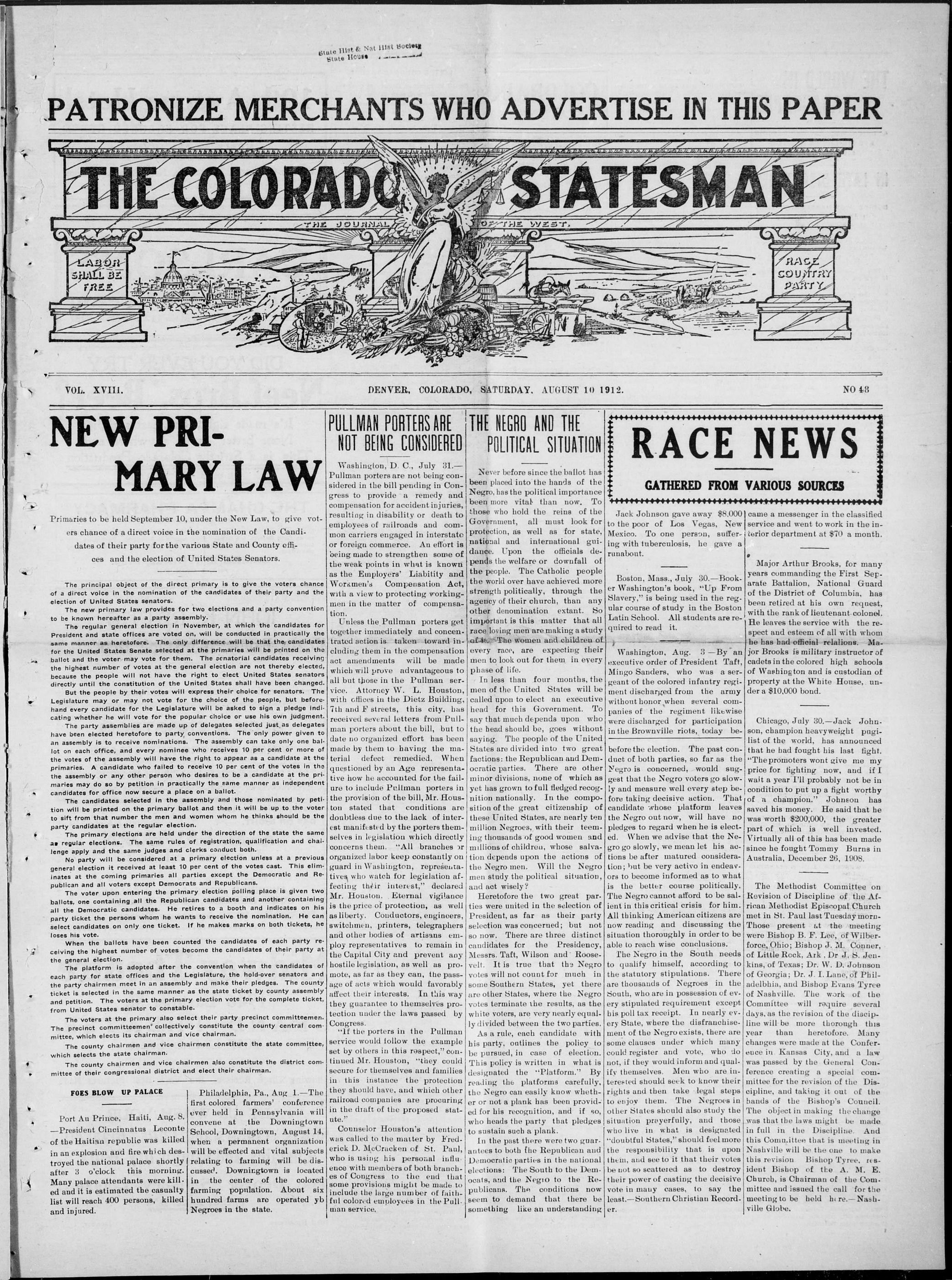
THE COLORADO STATESMAN
THE JOURNAL OF THE WEST.
LABOR SHALL BE FREE
RAGE COUNTRY PARTY
NEW PRI- MARY LAW
Primaries to be held September 10, under the New Law, to give voters chance of a direct voice in the nomination of the Candidates of their party for the various State and County offices and the election of United States Senators.
The principal object of the direct primary is to give the voters chance of a direct voice in the nomination of the candidates of their party and the election of United States senators.
The new primary law provides for two elections and a party convention to be known hereafter as a party assembly.
The regular general election in November, at which the candidates for President and state offices are voted on, will be conducted in practically the same manner as heretofore. The only difference will be that the candidates for the United States Senate selected at the primaries will be printed on the ballot and the voter may vote for them. The senatorial candidates receiving the highest number of votes at the general election are not thereby elected, because the people will not have the right to elect United States senators directly until the constitution of the United States shall have been changed.
But the people by their votes will express their choice for senators. The Legislature may or may not vote for the choice of the people, but before hand every candidate for the Legislature will be asked to sign a pledge indicating whether he will vote for the popular choice or use his own judgment.
The party assemblies are made up of delegates selected just as delegates have been elected heretofore to party conventions. The only power given to an assembly is to receive nominations. The assembly can take only one ballot on each office, and every nominee who receives 10 per cent or more of the votes of the assembly will have the right to appear as a candidate at the primaries. A candidate who failed to receive 10 per cent of the votes in the the assembly or any other person who desires to be a candidate at the primaries may do so by petition in practically the same manner as independent candidates for office now secure a place on a ballot.
The candidates selected in the assembly and those nominated by petition will be printed on the primary ballot and then it will be up to the voter to sift from that number the men and women whom he thinks should be the party candidates at the regular election.
The primary elections are held under the direction of the state the same as regular elections. The same rules of registration, qualification and challenge apply and the same judges and clerks conduct both.
No party will be considered at a primary election unless at a previous general election it received at least 10 per cent of the votes cast. This eliminates at the coming primaries all parties except the Democratic and Republican and all voters except Democrats and Republicans.
The voter upon entering the primary election polling place is given two ballots, one containing all the Republican candidates and another containing all the Democratic candidates. He retires to a booth and indicates on his party ticket the persons whom he wants to receive the nomination. He can select candidates on only one ticket. If he makes marks on both tickets, he loses his vote.
When the ballots have been counted the candidates of each party receiving the highest number of votes become the candidates of their party at the general election.
The platform is adopted after the convention when the candidates of each party for state offices and the Legislature, the hold-over senators and the party chairmen meet in an assembly and make their pledges. The county ticket is selected in the same manner as the state ticket by county assembly and petition. The voters at the primary election vote for the complete ticket, from United States senator to constable.
The voters at the primary also select their party precinct committeemen. The precinct committeemen collectively constitute the county central committee, which elects its chairman and vice chairman.
The county chairmen and vice chairmen constitute the state committee, which selects the state chairman.
The county chairmen and vice chairmen also constitute the district committee of their congressional district and elect their chairman.
VOL. XVIII.
Primaries to be held September 10
ers chance of a direct voice in
dates of their party for the v
ces and the election of the
The principal object of the direct
of a direct voice in the nomination o
election of United States senators.
The new primary law provides for
to be known hereafter as a party ass
The regular general election in the
same manner as heretofore. The only
for the United States Senate selected
ballot and the vote may vote for the
the highest number of votes at the g
because the people will not have the
directly until the constitution of the
But the people by their votes will
Legislature may or may not vote for
hand every candidate for the Legislat
cating whether he will vote for the p
The party assemblies are made up
have been elected heretofore to party,
an assembly is to receive nominations
lot on each office, and every nomine
the votes of the assembly will have the
primaries. A candidate who failed to
the assembly or any other person who
maries may do so by petition in pract
candidates for office now secure a pla
The candidates selected in the a
tion will be printed on the primary ba
to sift from that number the men and
party candidates at the regular electe
The primary elections are held un
as regular elections. The same rules
lence apply and the same judges and
No party will be considered at a
general election it received at least 10
inates at the coming primaries all p
publican and all voters except Democra
The voter upon entering the prim
ballots, one containing all the Republ
all the Democratic candidates. He r
party ticket the persons whom he w
select candidates on only one ticket.
loses his vote.
When the ballots have been cou
ceiving the highest number of votes b
the general election.
The platform is adopted after th
each party for state offices and the
the party chairmen meet in an assembl
ticket is selected in the same manner
and petition. The voters at the prima
from United States senator to consta
The voters at the primary also se
The precinct committeemen' collectiv
mittee, which elects its chairman and
The county chairmen and vice ch
which selects the state chairman.
The county chairmen and vice ch
mittee of their congressional district a
FOES BLOW UP PALACE
Port Au Prince, Haiti, Aug. 8. President Cincinnatus Leconte of the Haitian republic was killed in an explosion and fire which destroyed the national palace shortly after 3 o'clock this morning. Many palace attendants were killed and it is estimated the casualty list will reach 400 persons, killed and injured.
Philadelphia, Pa., Aug 1.—The first colored farmers' conference ever held in Pennsylvania will convene at the Downingtown School, Downingtown, August 14, when a permanent organization will be effected and vital subjects relating to farming will be discussed. Downingtown is located in the center of the colored farming population. About six hundred farms are operated yb Negroes in the state.
DENVER, COLORADO, SATURDAY, AUGUST 10 1912.
State Hist & Nat Hist Biotech
State House
CHANTS WH
ADO
THE JOURNAL
DENVER, COLORADO
PULLMAN PORTERS ARE NOT BEING CONSIDERED
Washington, D.C., July 31. Pullman porters are not being considered in the bill pending in Congress to provide a remedy and compensation for accident injuries, resulting in disability or death to employees of railroads and common carriers engaged in interstate or foreign commerce. An effort is being made to strengthen some of the weak points in what is known as the Employers' Liability and Workmen's Compensation Act, with a view to protecting workingmen in the matter of compensation.
Unless the Pullman porters get together immediately and concentrated action is taken toward including them in the compensation act amendments will be made which will prove advantageous to all but those in the Pullman service. Attorney W. L. Houston, with offices in the Dietz Building, 7th and F streets, this city, has received several letters from Pullman porters about the bill, but to date no organized effort has been made by them to having the material defect remedied. When questioned by an Age representative how he accounted for the failure to include Pullman porters in the provision of the bill, Mr. Houston stated that conditions are doubtless due to the lack of interest manifested by the porters themselves in legislation which directly concerns them. "All branches or organized labor keep constantly on guard in Washington, representatives who watch for legislation affecting their interest," declared Mr. Houston. Eternal vigilance is the price of protection, as well as liberty. Conductors, engineers, switchmen, printers, telegraphers and other bodies of artisans employ representatives to remain in the Capital City and prevent any hostile legislation, as well as promote, as far as they can, the passage of acts which would favorably affect their interests. In this way they guarantee to themselves protection under the laws passed by Congress.
"If the porters in the Pullman service would follow the example set by others in this respect," continued Mr. Houston, "they could secure for themselves and families in this instance the protection they should have, and which other railroad companies are procuring in the draft of the proposed statute."
Counselor Houston's attention was called to the matter by Frederick D. McCracken of St. Paul, who is using his personal influence with members of both branches of Congress to the end that some provisions might be made to include the large number of faithful colored employees in the Pullman service.
THE NEGRO AND THE POLITICAL SITUATION
Never before since the ballot has been placed into the hands of the Negro, has the political importance been more vital than now. To those who hold the reins of the Government, all must look for protection, as well as for state, national and international guidance. Upon the officials depends the welfare or downfall of the people. The Catholic people the world over have achieved more strength politically, through the agency of their church, than any other denomination extant. So important is this matter that all race loving men are making a study of it. The women and children of every race, are expecting their men to look out for them in every phase of life.
In less than four months, the men of the United States will be called upon to elect an executive head for this Government. To say that much depends upon who the head should be, goes without saying. The people of the United States are divided into two great factions: the Republican and Democratic parties. There are other minor divisions, none of which as yet has grown to full fledged recognition nationally. In the composition of the great citizenship of these United States, are nearly ten million Negroes, with their teeming thousands of good women and millions of children, whose salvation depends upon the actions of the Negro men. Will the Negro men study the political situation, and act wisely?
Heretofore the two great parties were united in the selection of President, as far as their party selection was concerned; but not so now. There are three distinct candidates for the Presidency, Messrs. Taft, Wilson and Roosevelt. It is true that the Negro votes will not count for much in some Southern States, yet there are other States, where the Negro votes terminate the results, as the white voters, are very nearly equally divided between the two parties. As a rule, each candidate with his party, outlines the policy to be pursued, in case of election. This policy is written in what is designated the "Platform." By reading the platforms carefully, the Negro can easily know whether or not a plank has been provided for his recognition, and if so, who heads the party that pledges to sustain such a plank.
In the past there were two guarantees to both the Republican and Democratic parties in the national elections: The South to the Democats, and the Negro to the Republicans. The conditions now seem to demand that there be something like an understanding
RACE NEWS
Jack Johnson gave away $8,000 to the poor of Los Vegas, New Mexico. To one person, suffering with tuberculosis, he gave a runabout.
Boston, Mass., July 30.—Booker Washington's book, "Up From Slavery," is being used in the regular course of study in the Boston Latin School. All students are required to read it.
Washington, Aug. 3 - By an executive order of President Taft, Mingo Sanders, who was a sergeant of the colored infantry regiment discharged from the army without honor when several companies of the regiment likewise were discharged for participation in the Brownville riots, today be-
before the election. The past conduct of both parties, so far as the Negro is concerned, would suggest that the Negro voters go slowly and measure well every step before taking decisive action. That candidate whose platform leaves the Negro out now, will have no pledges to regard when he is elected. When we advise that the Negro go slowly, we mean let his actions be after matured consideration; but be very activo in endeavors to become informed as to what is the better course politically. The Negro cannot afford to be salient in this critical crisis for him. All thinking American citizens are now reading and discussing the situation thoroughly in order to be able to reach wise conclusions.
The Negro in the South needs to qualify himself, according to the statutory stipulations. There are thousands of Negroes in the South, who are in possession of every stipulated requirement except his poll tax receipt. In nearly every State, where the disfranchisement of the Negro exists, there are some clauses under which many could register and vote, who do not, if they would inform and qualify themselves. Men who are interested should seek to know their rights and then take legal steps to enjoy them. The Negroes in other States should also study the situation prayerfully, and those who live in what is designated "doubtful States," should feel more the responsibility that is upon them, and see to it that their votes be not so scattered as to destroy their power of casting the decisive vote in many cases, to say the least.—Southern Christian Recorder.
NO 48
came a messenger in the classified service and went to work in the interior department at $70 a month.
Major Arthur Brooks, for many years commanding the First Separate Battalion, National Guard of the District of Columbia, has been retired at his own request, with the rank of lieutenant colonel. He leaves the service with the respect and esteem of all with whom he has had official relations. Major Brooks is military instructor of cadets in the colored high schools of Washington and is custodian of property at the White House, under a $10,000 bond.
Chicago, July 30.—Jack Johnson, champion heavyweight pugilist of the world, has announced that he had fought his last fight. "The promoters wont give me my price for fighting now, and if I wait a year I'll probably not be in condition to put up a fight worthy of a champion." Johnson has saved his money. He said that he was worth $200,000, the greater part of which is well invested. Virtually all of this has been made since he fought Tommy Burns in Australia, December 26, 1908.
The Methodist Committee on Revision of Discipline of the African Methodist Episcopal Church met in St. Paul last Tuesday morn-Those present at the meeting were Bishop B. F. Lee, of Wilberforce, Ohio; Bishop J. M. Conner, of Little Rock, Ark, Dr J. S. Jenkins, of Texas; Dr W. D. Johnson of Georgia; Dr. J. I. Lane, of Philadelphia, and Bishop Evans Tyree of Nashville. The work of the Committee will require several days, as the revision of the discipline will be more thorough this year than heretofore. Many changes were made at the Conference in Kansas City, and a law was passed by the General Conference creating a special committee for the revision of the Discipline, and taking it out of the hands of the Bishop's Council. The object in making the change was that the laws might be made in full in the Discipline. And this Committee that is meeting in Nashville will be the one to make this revision. Bishop Tyree, resident Bishop of the A. M. E. Church, is Chairman of the Committee and issued the call for the meeting to be held here.—Nashville Globe.
THE WORLD IN PARAGRAPHS
BRIEF RECORD OF PASSING EVENTS IN THIS AND FOR-EIGN COUNTRIES.
DOINGS AND HAPPENINGS THAT
MARK THE PROGRESS
OF THE AGE.
Western Newspaper Union News Service.
WESTERN.
San Francisco's municipal railroad is well on the way to completion.
Denver, Los Angeles and Omaha won the prizes for mileage at the recent Portland Elks' grand lodge convention.
Seeking to trace the troubles of sugar factory builders and promoters in Idaho to the machinations of the "sugar trust," the government has opened the Salt Lake end of the hearing.
San Francisco is to have a hall of fame. The twenty native sons and daughters of California who have done most to reflect glory on their state are to be glorified in art glass and sculpture.
While en route from Kansas City to Helena, Mont., Mrs. H. J. Mock of the first named city jumped through the window of the Pullman sleeping car in which she was traveling, and was instantly killed.
The wheat harvest of Minnesota and the two Dakotas will break all records this year. The yield will be 265,000,000 bushels this year, as against 198,000,000 bushels in 1905, the highest previous mark ever attained.
Information that Sidna Allen and Wesley Edwards, the Virginia outlaws, were believed to be in hiding in the vicinity of Seattle, caused the authorities to conduct a thorough search of the surrounding country for the men, but neither was found.
Frank Holloway, who confessed in Chicago to robbing the Westminster, B. C., bank of $375,000; the Panama City bank of $85,000, and to the killing of seven men, escaped recently from the Texas penitentiary. The governor has offered a $2,000 reward for his re-capture.
In the twenty-one years of the history of the National Irrigation Congress, there never has been another time when such wide-spread interest was manifested in the splendid work of that organization as is now shown in its twentieth session, which is to be held in Salt Lake City Sept. 30 to Oct. 3.
That her pets may not be annoyed on their journey to New York, Mrs. Malcolm Whitman of San Francisco, the former Miss Jennie A. Crocker, has engaged a special car for a score of high-priced animals, including Sir Barney Blue, the champlon Boston terrier, and Haleyon Alexandre, the world's famous French bull.
The United States has become a half billion ton coal country. During the last two years the total production has averaged just a trifle short of the 500,000,000 mark, exceeding that figure in 1910 and almost reaching it in 1911. It is considered probable that in the future it will be a bad year whose production falls far short of this quantity. The figures of production have been compiled by Edward W. Parker, the government coal statistician in Washington.
SPORT.
WESTERN LEAGUE STANDING.
CLUBS. Won. Lost. Pct.
Denver ..... 64 46 .580
St. Joseph ..... 57 49 .538
Omaha ..... 57 51 .528
Des Moines ..... 55 51 .518
Sioux City ..... 54 51 .514
Wichita ..... 53 55 .491
Lincoln ..... 51 55 .481
Topeka ..... 37 69 .349
Ad Wolgast and Packey McFarland have been matched to fight ten rounds at New York September 27th.
Bill Barnett, the colored fighter, and the "Fighting Newsboy" (Charlie Pierson), Denver, are signed to meet at Silverton, Colo., as the main event of the Labor Day celebration. Both are in active training.
Baseball is in a fair way to displace cock fighting and sports of a similar nature in the Philippines according to William Pierce Gorsuch, instructor in the department of Chicago, who returned recently from the islands, where he lectured before the teachers' assembly of Bagulo.
Miss Margaret Lawler, eighteen years old, won the 150-mile endurance contest of the Kenosha, Wis., Motorcycle Club. Although the only woman entered, Miss Lawler carried off all the honors against a field of twenty-one men. Five men finished with perfect scores but their time was not as good as that made by Miss Lawler.
Jim Flynn, who was defeated by Jack Johnson at Las Vegas, has drawn the color line, declaring he will not fight another negro.
FOREIGN
An imperial decree has been issued dissolving the Turkish parliament. The chamber passed a vote of want of confidence in the cabinet. Bombs exploded in the market place of Kotchana, fifty miles southwest of Uskup, European Turkey, killing or wounding fifty persons, according to a dispatch from Saloniki.
WASHINGTON.
Congress now plans to adjourn August 15.
The trial of Judge Archbald of the United States Commerce Court on impeachment proceedings is set for December 3.
A bill to create a Lincoln memorial highway from Boston to San Francisco has been filed in the House by Representative Taylor of Colorado.
The bar of the Supreme Court of the United States has been asked to contribute $40,000 for the relief of the widow and daughters of the late Associate Justice John M. Harlan.
President Taft has accepted the resignation of Federal Judge Hanford of Seattle, tendered while Judge Hanford's conduct on the bench was being investigated by a congressional committee.
Representative Mondell of Wyoming introduced a bill to appropriate $200,000 for the United States to pay its share of the cost of exterminating the "predatory wild animals" on the forest reserves of the West.
According to the figures in the "Statistical Abstract of the United States, 1911," more than 15,000,000 votes will be polled in 1912. With a population of 90,000,000 the total voting strength of the country is about 18,000,000.
Investigation of the loss of life, injuries and damages sustained by American citizens in the Madero revolution in Mexico in 1911, would be ordered by a resolution submitted in the House by Representative Smith of Texas.
A congressional "recall" of judges of the inferior courts of the United States is proposed in a constitutional amendment which Representative Hull of Tennessee, offered in the House, and which was referred to the judiciary committee.
Efforts are being made to have the $1,000,000 unexpended balance of the money appropriated for the Mississippi flood sufferers diverted by Congress for use in relief of the American refugees now pouring into El Paso from Mexico.
That President Taft will veto the wool bill as passed by the Senate or in any modified form as a result of the House action and conference on the measure as finally agreed to, is the assertion of those who assume to speak for him.
Evidence of the growing anxiety of the administration, because of the revolutionary movement in Nicaragua, was shown when orders were given the gunboat Tacoma at Guantanamo, Cuba, to proceed forthwith for Bluefields, Nicaragua.
The five judges of the Commerce Court would be retained in office as circuit judges, by an agreement reached by the House and Senate confeees on the legislative, executive and judicial appropriation bill. The Commerce Court would be abolished by the agreement and its work turned over to the District Courts.
Further limitations curbing contributions to political campaigns were incorporated in a bill agreed on by the Senate committee on privileges and elections and reported to the Senate for passage. Predictions are made that it would be enacted into law at once. By the new bill all corporations are prohibited from contributing money or anything of value to the nomination or election of presidential electors, representatives in Congress or state legislators who elect senators
GENERAL
Chicago street car men favor a strike by an 8,939 to 171 vote unless their demands for higher wages are granted.
The price of beef is soaring at the stockyards in Chicago. A three carload lot of heavy black steers sold for $10.10 a hundred.
A report emanating from political sources is current that Police Commissioner Waldo of New York will resign inside of two weeks.
After two meetings in New York, the Denver interests in the Moffat road and the committee appointed by the note holders there, failed to reach an agreement.
That President E. P. Ripley, of the Santa Fé, is to resign and retire from the railroad world because of his advancing years, was denied at the executive offices of the Santa Fé in Chicago;
Essia Carter, who is in the Macon, Ga., hospital as the result of a whipping inflicted upon her recently at Dawson by three men, is in a serious condition, and the attending physicians and relatives are alarmed.
Railroad gross earnings of all United States roads making weekly reports for three weeks in July, make a favorable comparison with those of a year ago, the total aggregating $23,343,711, an increase of 3.4 per cent.
A police fund of $50,000 is being raised for the defense of Charles Becker, the police lieutenant charged with instigating the murder of Herman Rosenthal, in New York, according to information in the hands of District Attorney Whitman.
The New York police scandal may pass into the hands of the federal authorities. An unexpected turn in the Rosenthal case has linked the murder inquest with serious charges made by influential New England reformers that young girls have been lured to the great city from country places in Massachusetts and other states and victimized by New York cadets.
in an effort to collect $4,236,000 back taxes, the state of Arkansas has instituted suit against 130 old line insurance companies doing business in that state.
COLORADO STATE NEWS
Western Newspaper Union News Service.
COMING EVENTS IN COLORADO.
August 19-24.—International Photo-Engravers' Association, Denver.
September 1-3.—Convention National Association State Game Wardens, Denver.
September 3-7.—Jefferson County Fair, Golden.
September 6—"Sugar Beet Day," in
district, Delegates from all sugar,
district in Colorado will be in an attendance
and participate in a special program.
Sept. 18-20.—San Luis Valley Fair, Alamosa.
September 24-27—Crowley County
Fair, Sugar City, MD
Fair, Sugar City,
Sept. 24-28. Colorado State Medical
Institution, Pueblo.
Sept. 26-28. Opening Weld County Fair,
Greeley.
Strawberry Crop Total Failure.
Steamboat Springs.—The strawberry crop here this year is a total failure as a result of the incessant rains that have fallen here in the last fifteen days.
Negroes Celebrate Emancipation Day
Canon City—Canon City was the
Mecca of the negro population
Monday, Aug. 5, negroes coming here from
all parts of the state to observe Emancipation Day.
Refused Black Hand Demand.
Grand Junction.—Because he refused to turn over $500 to the Black Hand, the home of Louis Pietrafeso, a wealthy Italian truck gardener, was burned to the ground.
Man Dies Beneath Auto.
Colorado Springs—K. O. Merrill, a painter, was instantly killed and two companions seriously injured six miles north of Colorado Springs when a large touring car skidded round a bend in the road.
Palisade,—Joe Barnal, a member of the convict road camp twenty miles above here in Plateau caon murdered Dominick Malino, another convict, and has not been captured. The two men quarreled shortly after starting work and Barnal crushed Malino's skull with a pickaxe.
Work on Taylor River Dam.
Gunnison.—Uncle Sam has started preliminary work on the Taylor River dam with a dozen or more men. They expect to put a larger force of men and teams, and cement machinery to work as soon as the preliminary work is finished. This dam, when completed, will furnish power for all the state, there being practically no limit to the power that can be produced.
Will Destroy Hail Clouds.
Greeley.—That there may be no recurrences of the disastrous hail storm of which the Eaton farmers had a taste recently, the Greeley Commercial Club will at once begin the investigation of the prevention of such storms as practiced in France and Italy. Hall guns, loaded with black powder, are used to disperse hail clouds. The Commercial Club may try these guns out in the near future.
Herder Finds Drowned Woman.
Briggsdale.—Attracted to a water hole in Crow creek by the barking of a dog, a sheep herder found the body of Mrs. Mary Williams, forty-five. She was lying face downward in two feet of water. After an investigation by Deputy Coroner Alnutt, it was found that the woman had dropped her handbag in the hole. She stooped to pick it up and it is believed while she tried to recover it she was stricken with heart disease.
$8,167.92 Lien Against D. L. & N.
Fort Collins.—The Orman Construction Company, which has done much of the work in building the Denver, Laramie & Northwestern railroad has filed a lien against the company and levies against the property in the county. The work claimed to have been done amounts to $114,782.07, of which $6,945.81 is still due. The company files a lien for the latter amount and for $1,222.11 interest, also interest from July 31, 1912, until the claim is paid.
Washington—Colorado's prosperity for 1912 will be shown not alone in the record-breaking yield of her lands and the $200,000,000 the farmers will receive for that yield, but in increased activity in almost every line of business, and especially increased output of factories.
Colorado's factory output, as shown by the census bureau, was about $130,000,000 in 1909. Last year was not an exceptionally prosperous year for manufacturers in the state, and the output was perhaps no greater than for 1909. But it will be much greater this year, reaching $150,000,000.
Democratic Congressional Assembly.
Denver.—The following nominations were made by the Democratic congressional and senatorial assembly for the first congressional and twenty-second senatorial districts: For congressman, man, First District, Addison W. Rucker, Arapahoe; George J. Kindel, Denver; Henry A. Drumm, Boulder; M. C. Harrington, Denver. For float senator, Twenty-second District, John J. Ryan, Denver; M. M. Bulkley, Yuma county; W. R. Terry, Arapahoe.
LITTLE COLORADO ITEMS.
Small Happenings Occurring Over the State Worth While.
Western Newspaper Union News Service.
The outlook for a bumper potato crop at Carbondale is good.
Cantaloupes in carload lots will be shipped from Rocky Ford by August 15th.
A large amount of small fruits and vegetables is being shipped from Cañon City.
The highway between Meeker, Colo., and Vernal, Utah, will be put in first-class condition.
It takes 60,000 gallons of water a day to sprinkle the streets of Grand Junction.
The French beetle is causing beet growers considerable trouble in the Rocky Ford country.
The roads between Marble and Crested Butte are still in bad shape from snowslides and washouts.
For beans which are allowed to dry on the vines the Fort Lupton canning factory will pay the farmers $105 per acre.
Fifteen hundred Methodists of the state gathered at Stratton park, Colorado Springs, Aug. 6, for a basket picnic.
Kersey is going after the big silver loving cup offered for the best district exhibit at the Weld Connty fair in September.
Harry Winslow, forty years old, a farm hand, was drowned in Seeley's lake near Greeley at the inlet of No. 2 ditch.
An organized band of horse thieves is operating in the vicinity of Rocky Ford, and the losses have been considerable.
Gophers, burrowing in the bank of the Evans town ditch, caused a leak that inundated crops, causing losses estimated at $10,000.
A heavy hailstorm swept the Eaton district, covering a path twelve miles wide and twenty miles long. Hundreds of acres were destroyed.
One report says that during a recent hail storm in Weld county stones twenty feet long, fourteen feet wide and eight inches thick fell.
Dr. F. A. Bushee, head of the department of economics in Colorado college, has resigned to take a professorship in the State university at Boulder.
A hailstorm, almost a cyclone, swept the Lakespur district, destroying everything in its path and causing damage to crops estimated at $100,000.
Mrs. J. W. Lasser, sixty-two, was seriously injured at Grand Junction when an unknown person in a speeding auto struck her on the head with a rock.
Perry Lewis, foreman of a switch crew on the Santa Fe, was instantly killed at La Junta by losing his balance and falling from a swiftly moving freight train.
Stanley Caywood, age nineteen, son of Arthur Caywood of Nederland, Boulder county, was drowned in a gulch north of the Nederland reservoir.
The thirteenth annual international council of the Knights of Columbus was held in Colorado Springs, several hundred delegates being in attendance.
The flow of water from the Roosevelt tunnel at Cripple Creek has increased to 10,000 gallons per minute or more, as against 9,600 gallons two weeks ago.
Benny Chavez, the Trinidad Mexican prize fighter, has been matched for a twenty-round bout with Monte Attel of San Francisco, at Santa Fe, Labor Day.
This coming fall for the first time Colorado voters will nominate their candidates for all state, district and county offices under what is known as the direct primary law.
Actual construction of the woman's building at the University of Colorado at Boulder, to be erected as a memorial to Mrs. Sarah Platt Decker, probably will be started soon.
The Chicago, Rock Island & Pacific is the third railroad running into Denver to organize a safety bureau for the protection of its passengers. The Denver & Rio Grande and Union Pacific have within three months, adopted this method.
Robert W. Speer, publisher of the Times, and former mayor of Denver, was fined $1,000 and given a jail sentence of five days in the county jail by Judge Shattuck in the West Side Court on a charge of publishing articles in contempt of court.
Exhausted from lack of food and exposure to zero weather in the forests of Buffalo Pass, the eight members of the Steamboat Springs party lost in the mountains for two days were brought to that city by a rescuing party.
That a milling company holding rights to non-consumptive use of water cannot waive its appropriation for the benefit of a reservoir company is the substance of a decree entered in the District Court by Judge Graham at Fort Collins.
Improvements contemplated by Armour & Co. and Swift & Co. at the Denver stockyards, following the acquisition by these two firms of the stock of the Denver Union Stockyards Company, will approximate $1,000,000. The deal provides that each of the two purchasers shall own fifty per cent. of the capital stock of $1,500,000.
Handling the entire output of the Johnstown and Ault pea hullers, as well as the crop of local contractors, the Empson canning factory at Greeley is working to full capacity and both peas and beans are being canned.
RESTING PLACE FOR COLORED GENTS
Corner West 10th and Osage, Near Burnham Shops Denver, Colorado
ASK FOR CARLSON'S Peerless Ice Cream Phones: Main 112 and Main 5787
DID YOU EVER TRY Neef Bros.' Beer?
It's made right, and tastes right. None better made anywhere and This is a Strictly Colorado Production
THE CHAMPA PHARMACY
Is the place to get your Drugs, Chemicals and Patent Medicines. We serve Cold Drinks, Ice Cream Soda and Nut Sundaes. Perfumes, box candies and box paper our specialties. Get our prices before buying elsewhere.
JAMES E. THRALL, Prop.
PHONE MAIN 2425.
WINES, LIQUORS AND CIGARS
1644-46-48-50 LARIMER STREET.
PHONE MAIN 1053. DENVER, COLO.
Western agents for Minneapolis Grain Belt Beer and Carnegie Porter,
Pripps Imported Beer and Bock Ol.
A first-class Mortuary establishment. First aid to the bereaved in the time of death of loved ones. Prices below competitors. Polite service LAWRENCE JONES, Licenced Embalmer LOUIS HUBBARD, Funeral Director
GRAND THEATER,
2017 Larimer Street.
[UNDER NEW MANAGEMENT.]
Showing Three Reels of the Very Best Pictures Made
The Denver Sanitary Laundry. PHONE MAIN 5670
PHONE MAIN 3028
JOH
Meats, Fane
Corner Nineteenth.
HENRY BECK
BECK
WINES,
PHONE MAIN 1053.
Western agents for M.
Pri
DAY OR NIGHT.
A. M.
U
A first-class Mortu
time of death of loved
LAWRENCE
LOUIS HU
PARLORS 19
Midw
194
GRAN
201
[UNDER
Showing Three Re
LET
Shirts, Coll
Curtains a
The Denver
1082 Broadway.
BE SURE AN TRY IT.
IAMPA PHAR
TWENTIETH AND CHAMPA
our Drugs, Chemicals and Pa-
ice Cream Soda and Nut Sunda-
ter our specialties. Get our p-
RES E. THRALL, I
PHONE MAIN 2425.
PHARMACY
TO CHAMPA.
Medicals and Patent Medicines. We
and Nut Sundaes. Perfumes, box
Get our prices before buying
RALL, Prop.
N 2425.
RES. PHONE GALLUP 942
RETTIG
Staple Groceries
STREET
JOHN ENGSTROM
BIGSTROM
SALERS IN
CIGARS AND CIGARS
BER STREET. DENVER, COLO.
Belt Beer and Carnegie Porter,
and Bock Oil.
PHONE MAIN 6243
WHORN
makers
First aid to the bereaved in the
new competitors. Polite service
Excenced Embalmer
General Director
Shoe Street
Theatre
Amer St.
THEATER,
Per Street.
MANAGEMENT.]
Very Best Pictures Made
SH YOUR
Cuffs, Blankets,
High Dry Work.
Finary Laundry.
5670
---
Denver, Colo.
Denver, Colo.
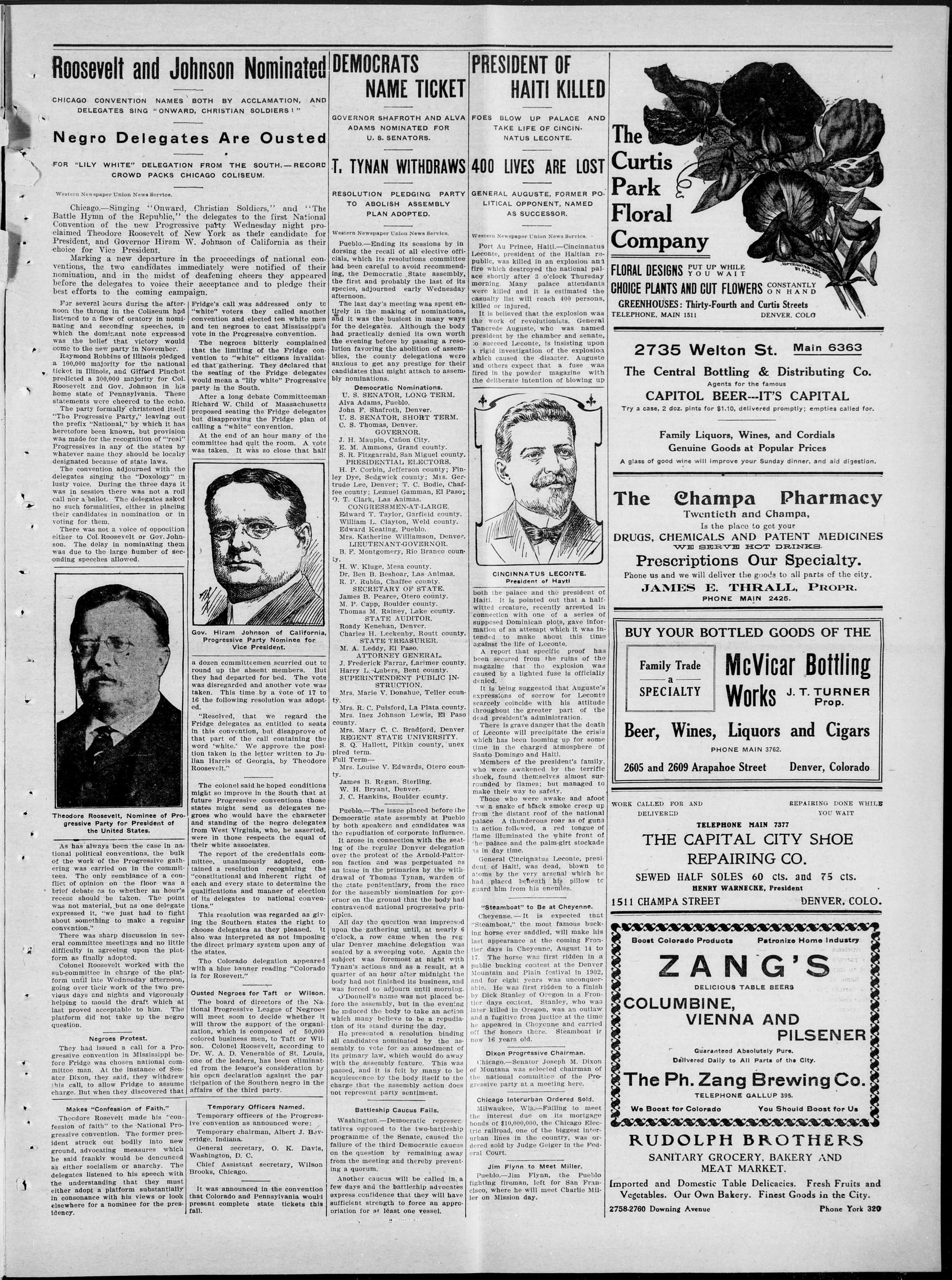
Roosevelt and Johnson Nominated
CHICAGO CONVENTION NAMES BOTH BY ACCLAMATION, AND DELEGATES SING "ONWARD, CHRISTIAN SOLDIERS!"
Negro Delegates Are Ousted
Negro Delegates Are Ousted
FOR "LILY WHITE" DELEGATION FROM THE SOUTH. — RECORD
CROWD PACKS CHICAGO COLISEUM.
Chicago.—Singing "Onward, Christian Soldiers," and "The Battle Hymn of the Republic," the delegates to the first National Convention of the new Progressive party Wednesday night proclaimed Theodore Roosevelt of New York as their candidate for President, and Governor Hiram W. Johnson of California as their choice for Vice President.
Marking a new departure in the proceedings of national conventions, the two candidates immediately were notified of their nomination, and in the midst of deafening cheers they appeared before the delegates to voice their acceptance and to pledge their best efforts to the coming campaign.
Western Newspaper Union News Service.
For several hours during the afternoon the throng in the Coliseum had listened to a flow of oratory in nominating and seconding speeches, in which the dominant note expressed was the belief that victory would come to the new party in November.
Raymond Robbins of Illinois pledged a 100,000 majority for the national ticket in Illinois, and Gifford Pinchot predicted a 300,000 majority for Col. Roosevelt and Gov. Johnson in his home state of Pennsylvania. These statements were cheered to the echo. The party formally christened itself "The Progressive Party," leaving out the prefix "National," by which it has heretofore been known, but provision was made for the recognition of "real" Progressives in any of the states by whatever name they should be locally designated because of state laws.
The convention adjourned with the delegates singing the "Doxology" in lusty voice. During the three days it was in session there was not a roll call nor a ballot. The delegates asked no such formalities, either in placing their candidates in nomination or in voting for them. There was not a voice of opposition either to Col. Roosevelt or Gov. Johnson. The delay in nominating them was due to the large number of second speeches allowed.
THE PRESIDENT OF THE UNITED STATES
Theodore Roosevelt, Nominee of Progressive Party for President of the United States.
As has always been the case in national political conventions, the bulk of the work of the Progressive gathering was carried on in the committees. The only semblance of a conflict of opinion on the floor was a brief debate as to whether an hour's recess should be taken. The point was not material, but as one delegate expressed it, "we just had to fight about something to make a regular convention."
There was sharp discussion in several committee meetings and no little difficulty in agreeing upon the platform as finally adopted.
Colonel Roosevelt worked with the sub-committee in charge of the platform until late Wednesday afternoon, going over their work of the two previous days and nights and vigorously helping to mould the draft which at last proved acceptable to him. The platform did not take up the negro question.
Negroes Protest.
They had issued a call for a Progressive convention in Mississippi for Fridge was chosen national committee man. At the instance of Senator Dixon, they said, they withdrew this call, to allow Fridge to assume charge. But when they discovered that
Makes "Confession of Faith."
Makes "Confession of Faith."
Theodore Rosevelt made his "confession of faith" to the National Progressive convention. The former president struck out bodily into new ground, advocating measures which he said frankly would be denounced as either socialism or anarchy. The delegates listened to his speech with the understanding that they must either adopt a platform substantially in consonance with his views or look elsewhere for a nominee for the presidency.
Fridge's call was addressed only to "white" voters they called another convention and elected ten white men and ten negroes to cast Mississippi's vote in the Progressive convention.
The negroes bitterly complained that the limiting of the Fridge convention to "white" citizens invalidated that gathering. They declared that the seating of the Fridge delegates would mean a "illy white" Progressive party in the South.
After a long debate Committeeman Richard W. Child of Massachusetts proposed seating the Fridge delegates but disapproving the Fridge plan of calling a "white" convention.
At the end of an hour many of the committee had quit the room. A vote was taken. It was so close that half
M.
Gov. Hiram Johnson of California, Progressive Party Nominee for Vice President.
a dozen committeemen scurried out to round up the absent members. But they had departed for bed. The vote was disregarded and another vote was taken. This time by a vote of 17 to 16 the following resolution was adopted.
"Resolved, that we regard the Fridge delegates as entitled to seats in this convention, but disapprove of that part of the call containing the word 'white.' We approve the position taken in the letter written to Julian Harris of Georgia, by Theodore Roosevelt."
The colonel said he hoped conditions might so improve in the South that at future Progressive conventions those states might send as delegates negroes who would have the character and standing of the negro delegates from West Virginia, who, he asserted, were in those respects the equal of their white associates.
The report of the credentials committee, unanimously adopted, contained a resolution recognizing the "constitutional and inherent right of each and every state to determine the qualifications and manner of election of its delegates to national conventions."
This resolution was regarded as giving the Southern states the right to choose delegates as they pleased. It also was interpreted as not imposing the direct primary system upon any of the states.
The Colorado delegation appeared with a blue banner reading "Colorado is for Roseveett."
Ousted Negroes for Taft or Wilson.
The board of directors of the National Progressive League of Negroes will meet soon to decide whether it will throw the support of the organization, which is composed of 50,000 colored business men, to Taft or Wilson. Colonel Roosevelt, according to Dr. W. A. D. Venerable of St. Louis, one of the leaders, has been eliminated from the league's consideration by his open declaration against the participation of the Southern negro in the affairs of the third party.
Temporary Officers Named.
Temporary officers of the Progressive convention as announced were:
Temporary chairman, Albert J. Beveridge, Indiana.
General secretary, O. K. Davis, Washington, D. C.
Chief Assistant secretary, Wilson Brooks, Chicago.
It was announced in the convention that Colorado and Pennsylvania would present complete state tickets this fall.
T. TYNAN WITHDRAWS 400 LIVES ARE LOST
T. TYNAN WITHDRAWS 400 LIVES ARE LOST
GOVERNOR SHAFROTH AND ALVA
ADAMS NOMINATED FOR
U. 8. SENATORS.
RESOLUTION PLEDGING PARTY TO ABOLISH ASSEMBLY PLAN ADOPTED.
Western Newspaper Union News Service.
Pueblo.—Ending its sessions by indorsing the recall of all elective officials, which its resolutions committee had been careful to avoid recommending, the Democratic State assembly, the first and probably the last of its species, adjourned early Wednesday afternoon.
The last day's meeting was spent entirely in the making of nominations, and it was the busiest in many ways for the delegates. Although the body had practically denied its own worth the evening before by passing a resolution favoring the abolition of assemblies, the county delegations were anxious to get any prestige for their candidates that might attach to assembly nominations.
Democratic Nominations.
U. S. SENATOR, LONG TERM.
Alva Adams, Pueblo.
John F. Shafroth, Denver.
U. S. SENATOR, SHORT TERM.
C. S. Thomas, Denver.
GOVERNOR.
J. H. Maupin, Cañon City.
E. M. Ammons, Grand county.
S. R. Fitzgarrald, San Miguel county.
PRESIDENTIAL ELECTORS
PRESIDENTIAL ELECTORS.
H. P. Corbin, Jefferson county; Finley Dye, Sedgwick county; Mrs. Gertrude Lee, Denver; T. C. Bodie, Chaffee county; Lemuel Gamman, El Paso; O. T. Clark, Las Animas.
CONGRESSMEN-AT-LARGE.
Edward T. Taylor, Garfield county.
William L. Clayton, Weld county.
Edward Keating, Pueblo.
Mrs. Katherine Williamson, Denver.
LIEUTENANT-GOVERNOR.
B. F. Montgomery, Rio Branco county.
H. W. Kluge, Mesa county.
Dr. Ben B. Beshoar, Las Animas.
R. P. Rubin, Chaffee county.
SECRETARY OF STATE.
James B. Pearce, Otero county.
M. P. Capp, Boulder county.
Thomas M. Rainey, Lake county.
Charles H. Leekenby, Routt county.
STATE TREASURER.
M. A. Leddy, El Paso.
ATTORNEY GENERAL.
J. Frederick Farrar, Larimer county.
Harry L. Lubers, Bent county.
SUPERINTENDENT PUBLIC INSTRUCTION.
Mrs. Marie V. Donahue, Teller county.
Mrs. R. C. Pulsford, La Plata county.
Mrs. Inez Johnson Lewis, El Paso county.
Mrs. Mary C. C. Bradford, Denver.
REGENT STATE UNIVERSITY.
S. Q. Hallett, Pitkin county, unex pired term.
Full Term—
Mrs. Louise V. Edwards, Otero county.
James B. Regan, Sterling.
W. H. Bryant, Denver.
J. C. Hankins, Boulder county.
Pueblo.—The issue placed before the Democratic state assembly at Pueblo by both speakers and candidates was the repudiation of corporate influence. It arose in connection with the seating of the regular Denver delegation over the protest of the Arnold-Patterson faction and was perpetuated as an issue in the primaries by the withdrawal of Thomas Tynan, warden of the state penitentiary, from the race for the assembly nomination for governor on the ground that the body had contravened national progressive principles.
All day the question was impressed upon the gathering until, at nearly 6 o'clock, a row came when the regular Denver machine delegation was seated by a sweeping vote. Again the subject was foremost at night with Tynan's actions and as a result, at a quarter of an hour after midnight the body had not finished its business, and was forced to adjourn until morning. O'Donnell's name was not placed before the assembly, but in the evening he induced the body to take an action which many believe to be a repudiation of its stand during the day. He presented a resolution binding all candidates nominated by the assembly to vote for an amendment of its primary law, which would do away with the assembly feature. This was passed, and it is felt by many to be acquiescence by the body itself to the charge that the assembly action does not represent party sentiment.
Battleship Caucus Fails.
Washington.—Democratic representatives opposed to the two-battleship programme of the Senate, caused the failure of the third Democratic caucus on the question by remaining away from the meeting and thereby preventing a quorum.
Another caucus will be called in a few days and the battleship advocates express confidence that they will have sufficient strength to force an appropriation for at least one vessel.
FOES BLOW UP PALACE AND
TAKE LIFE OF CINCIN-
NATUS LECONTE.
GENERAL AUGUSTE, FORMER POLITICAL OPPONENT, NAMED AS SUCCESSOR.
Western Newspaper Union News Service.
Port Au Prince, Haiti.—Cincinnatus Leconte, president of the Haitian republic, was killed in an explosion and fire which destroyed the national palace shortly after 3 o'clock Thursday morning. Many palace attendants were killed and it is estimated the casualty list will reach 400 persons, killed or injured.
It is believed that the explosion was the work of revolutionists. General Tancrede Auguste, who was named president by the chamber and senate, so succeed Leconte, is insisting upon a rigid investigation of the explosion which caused the disaster. Auguste and others expect that a fuse was fired in the powder magazine with the deliberate intention of blowing up
CINCINNATUS LECONTE. President of Hayti both the palace and the president of Haiti. It is pointed out that a half-witted creature, recently arrested in connection with one of a series of supposed Dominican plots, gave information of an attempt which it was intended to make about this time against the life of Leconte. A report that specific proof has been secured from the ruins of the magazine that the explosion was caused by a lighted fuse is officially denied. It is being suggested that Auguste's expressions of sorrow for Leconte scarcely coincide with his attitude throughout the greater part of the dead president's administration.
There is grave danger that the death of Leconte will precipitate the crisis which has been looming up for some time in the charged atmosphere of Santo Domingo and Haiti.
Members of the president's family, who were awakened by the terrific shock, found themselves almost surrounded by flames; but managed to make their way to safety.
Those who were awake and afoot saw a snake of black smoke creep up from the distant roof of the national palace. A thunderous roar as of guns in action followed, a red tongue of flame illuminated the white front of the palace and the palm-girt stockade as in day time.
General Cincinnatus Leconte, president of Haiti, was dead, blown to atoms by the very arsenal which he had placed beneath his pillow to guard him from his enemies.
Steamboat to Be at Cheyenne.
Cheyenne. — It is expected that "Steamboat," the most famous bucking horse ever saddled, will make his last appearance at the coming Frontier days in Cheyenne, August 14 to 17. The horse was first ridden in a public bucking contest at the Denver Mountain and Plain festival in 1902, and for eight years was unconquerable. He was first ridden to a finish by Dick Stanley of Oregon in a Frontier days contest. Stanley, who was later killed in Oregon, was an outlaw and a fugitive from justice at the time he appeared in Cheyenne and carried off the honors there. Steamboat is now 16 years old.
Dixon Progressive Chairman
Chicago—Senator Joseph M. Dixon of Montana was selected chairman of the national committee of the Progressive party at a meeting here.
Milwaukee, Wis.—Failing to meet the interest due on its mortgage bonds of $10,000,000, the Chicago Electric railroad, one of the biggest interurban lines in the country, was ordered sold by Judge Geiger in the Federal Court.
Jim Flynn to Meet Miller.
Pueblo, Jim Flynn, the Pueblo fighting fireman, left for San Francisco, where he will meet Charlie Miller on Mission day.
FLORAL DESIGNS PUT UP WHILE YOU WAIT
CHOICE PLANTS AND CUT FLOWERS CONSTANTLY ON HAND
GREENHOUSES: Thirty-Fourth and Curtis Streets
TELEPHONE, MAIN 1511 DENVER, COLO
2735 Welton St. Main 6363
The Central Bottling & Distributing Co.
Agents for the famous
CAPITOL BEER---IT'S CAPITAL
Try a case, 2 doz. pints for $1.10, delivered promptly; empties called for
Family Liquors, Wines, and Cordials Genuine Goods at Popular Prices A glass of good wine will improve your Sunday dinner, and aid digestion.
The Champa Pharmacy
Twentieth and Champa,
Is the place to get your
DRUGS, CHEMICALS AND PATENT MEDICINES
WE SERVE HOT DRINKS.
Prescriptions Our Specialty.
Phone us and we will deliver the goods to all parts of the city.
JAMES E. THRALL, PROPR.
PHONE MAIN 2425.
BUY YOUR BOTTLED GOODS OF THE
Family Trade
a
SPECIALTY
Beer, Wine
2605 and 2609 Ar
WORK CALLED FOR AND
DELIVERED
THE CA
RE
SEWED HALF
HE
1511 CHAMPA STR
Boost Colorado P
ZA
DE
COLUMBIA
VI
SEWED HALF SOLES 60 cts. and 75 cts. HENRY WARNECKE, President
Guaranteed Absolutely Pure.
Delivered Daily to All Parts of the City.
The Ph. 2
We Boost for Colo
RUDOLPH BROTHERS
SANITARY GROCERY, BAKERY AND MEAT MARKET.
Imported and Domestic Table Delicacies. Fresh Fruits and Vegetables. Our Own Bakery. Finest Goods in the City.
2758-2760 Downing Avenue Phone York 320
Denver, Colorado
REPAIRING DONE WHILE
YOU WAIT
THE COLORADO STATESMAN
LADON
BALL
FAIR
PARK
NO
PARTY
JOS. D. D. RIVERS.......Proprietor
1824 Curtis Street, Room 25.
JOS. D. D. RIVERS..............................................................Proprietor
1824 Curtis Street, Room 25.
SUBSCRIPTION RATES:
One Year ..... $2.00
Six Months ..... 1.00
Three Months ..... .60
PAYABLE IN ADVANCE.
class matter at the postoffice
of a personating nature that
the columns of this paper.
seems that papers sent to subscri-
ve any number when due, inform-
ward a duplicate of the missing g
receive attention must be news-
ly upon one side of the paper; nor
later than Wednesdays, and be
returned, unless stamps are sent
be made by Express Money Or-
der or Bank Draft. Postage stamp
functional part of a dollar. Only 1
25 cents per square. A square o
in lines or less, 10 cents per line.
per line.
in less than three months' contri-
ties unknown to us. Further pr
Entered as second-class matter at the postoffice in the city of Denver, Colorado.
All communications of a personating nature that are not complimentary will be withheld from the columns of this paper.
It occasionally happens that papers sent to subscribers are lost or stolen. In case you do not receive any number when due, inform us by postal card and we will cheerfully forward a duplicate of the missing number.
Communications to receive attention must be newsy, upon important subjects, plainly written only upon one side of the paper; must reach us Tuesdays, if possible, anyway, not later than Wednesdays, and bear the signature of the author. No manuscript returned, unless stamps are sent for postage.
Remittances should be made by Express Money Order, Postoffice Money Order, Registered Letter or Bank Draft. Postage stamps will be received the same as cash for the fractional part of a dollar. Only 1-cent and 2-cent stamps taken.
Display advertising 25 cents per square. A square contains ten agate lines.
Reading notices, ten lines or less, 10 cents per line. Each additional line over ten lines, 5 cents per line.
No discounts allowed on less than three months' contract. Cash must accompany all orders from parties unknown to us. Further particulars on application.
THE BULL MOOSE PARTY.
proposed third party engineer in Rosevelt, met at Chicago, Monday, who had noted the signs of the western sentiment and result in beating the Blacks and Tans with liberations. The Colorado State political situation, and came to the was born in a spirit of revenge and defeat. The Bull Moose party award, as far as the Negroes' interest to be surprised at the attir Colorado Statesman is not. With a convention be given to, it have not a vote in their respect, such vote is not counted. Of self-appointed leaders of the Union and Democratic presidential candidates not entitled to, accepting our pure and simple. This class of men negated to the rear. These men White party, and got their just sentiments of the leading colors are satisfied with the Republic made good, and is worthy of our else gods. The present party Colorado Statesman is a voice of
Long before the proposed third party engineered by the aggressive Colonel Theodore Roosevelt, met at Chicago, Monday, August 5th, it had been predicted, by men who had noted the signs of the times, that it would be dominated by Southern sentiment and result in being a Lily White party pure and simple and that the Blacks and Tans would not be honored by even a voice in its deliberations. The Colorado Statesman long ago took a horoscope of the political situation, and came to the conclusion that the third party movement was born in a spirit of revenge, and it will and should meet with a disastrous defeat. The Bull Moose party of Progressives seem to be progressing backward, as far as the Negroes' interests are concerned. Some of our people appear to be surprised at the attitude that Colonel Roosevelt has taken. The Colorado Statesman is not. Why should consideration in the deliberations of a convention be given to, it might be said, to self-styled delegates who have not a vote in their respective states? And even though they have a vote, such vote is not counted. For many years there has existed a number of self-appointed leaders of the race, who have attended both Republican and Democratic presidential conventions, clamoring for rights that they were not entitled to, accepting of bribes, showing themselves to be grafters pure and simple. This class of men is a disgrace to the race and should be relegated to the rear. These men were in attendance at the Bull Moose Lily White party, and got their just deserts. The Colorado Statesman voices the sentiments of the leading colored citizens of Colorado when it says that we are satisfied with the Republican ticket, led by President Taft, who has made good, and is worthy of our support. We do not believe in following false gods. The present party is good enough for us. Sink or swim, The Colorado Statesman is a voice of Republican sentiments at all times!
MANNERS
General sense, is not supposed to being presumed that social tastes applies to ordinary social interests that have been passed upon which are often the source of hard porters in the dining car and used with being "impudent" and But we consider it best to ad
Department, in a general sense, is not supposed to be a subject requiring editorial advice, it being presumed that social taste creates and inculcates good manners which applies to ordinary social intercourse, but we have in mind certain criticisms that have been passed upon the Negro in certain capacities or callings which are often the source of his living. The criticism of Colored waiters and porters in the dining car and Pullman services, in which they are charged with being "impudent" and "insolent," especially when disappointed. But we consider it best to admit that in numerous instances the rearing of the young Negro does not tend to make him an adept in good manners, such as every ordinary person who earns his living by direct contact with others, and especially as persons in service, ought to be. There was a time when there were no more polite, courteous and good mannered servants in the world than the American Negro, but we doubt that the boast can be safely made to-day.
Waiting and serving are voluntary vocations, now everywhere and entirely honorable. If persons are engaged in these callings, they owe it to themselves to fulfill every requirement of their work, never failing politeness and good manners being not the least. Many Colored men recognize the necessity for such an acquirement, but all of them do not. Too many Negro servants are surly, ill-mannered and disagreeable. Such are responsible for the criticisms referred to above. The fault is generally in their raising. Many parents set bad examples before their children and utterly neglect or forget to impress upon them the value of good manners in every walk of life. Some of our parents are scrupulously zealous in forcing children to follow certain rules or mannerisms, but the real principle of good manners is often spoiled even in these same homes. Children do what they see or hear their parents do, rather than what the parents tell them to do. So we often hear Colored children (and some whites) yelling at other children when demanding a service or when seeking to correct them. This is a sure sign of ill-breeding and inbred insolence. Such children grow up with some knowledge of, but very little respect for real good manners. Their manners lack culture and refinement. They exist only in theory and are practiced with a special motive. The house servant is often thus afflicted. They possess mistaken ideas of pride and often expect their employers to be more courteous to them than they are to the employers. These errors often lead to dissatisfaction and sometimes to disgust on the part of those who furnish the employment. Then comes criticism and discharge. Then white waiters and servants find openings. Real good manners are a recommendation to any person and ought to be a servant's stock in trade. While we serve we should serve well. Inbred politeness does not leave a person, as a rule.
No servant should be first to lose his temper. If he has been properly raised he will not do so, and employés of all classes are reaching the point where they will be compelled to meet the competition of the whites seeking their places. It will not do to meet the situation with surly defiance. Good manners, inborn, and well practiced, will do more than anything else to win the fight. In so far as our cause is just, we should not be afraid to speak When we are maligned, we should talk back. But to prove our efficiency beyond a doubt, we must not forget or overlook the value of politeness and good manners under all circumstances.
By MRS. M. K. ALLEN, Uktah, Cal.
WHERE shall we were married and cided that if her old age we mustrice a certain amount of suitable. We lived in the city for church and street occasion because we could not. When or expense to give her the best cally perfect, for we knew we would develop in proportion. See her and when he inquired meat broths and meat juices "that's good. She's well now have those things, too, but we very high we can't do it." "Me that her new fall hat cost deny the baby things she nwould never, never do such a bowlegged, pale faced little. Alas for our delusions!
Five years passed and Jo We got her a new cloak, hat her Sunday school teacher an attended regularly for six whome one day crying as if he got from her "that a girl at a poor, for she had worn the This remark was made by a diamond ring and other course, we knew this child of her home had made a remark. But we never could co
WE shall we skimp—in food or cloak we married we talked the financial matter that if we were ever to come to an age we must begin to save at once. A count of social standing rather than a city and husband and I were a sweet occasions, but never aspired to a lot. When our little girl was born, her the best food obtainable. We want we knew that with a fine physique proportion. Once our family physician inquired about her diet I remarked neat juices two or three times a week's well nourished. One can see that too, but we just can't afford it. Gave do it." That week his wife incidental hat cost $15. Jack and I were horrified she needed and be so extravagant do such a thing. We would never faced little creatures and us animals!
Assed and Jennie was old enough to encloak, hat and shoes and one dress for teacher and Sunday was Jennie's one for six weeks. Then our air casting as if her heart were broken. After a girl at Sunday school had said we worn the same dress to Sunday school by a girl of ten years, who worried other equally foolish and extravagant is child of 10 had never thought that he a remark like that and the child he could convince little 5-year-old Jo only saw her own humiliation and being would induce her to go back. Fortunately we moved from the city gotten it. She goes to Sunday school better than we can afford to dress our table. We decided it would heartache and so chose the most difficult problem, but been solved.
HERE shall we skimp—in food or clothing? When we were married we talked the financial matter over and decided that if we were ever to come to an easy, comfortable old age we must begin to save at once. We decided to sac-
rifice a certain amount of social standing rather than economize on our table. We lived in the city and husband and I were always well dressed for church and street occasions, but never aspired to any social prestige because we could not. When our little girl was born, we spared no pains or expense to give her the best food obtainable. We wanted her to be psychically perfect, for we knew that with a fine physique, mental qualities would develop in proportion. Once our family physician was called in to see her and when he inquired about her diet I remarked I was giving her meat broths and meat juices two or three times a week. "Yes," he said, "that's good. She's well nourished. One can see that. Our baby should have those things, too, but we just can't afford it. Gas and meats are so very high we can't do it." That week his wife incidentally remarked to me that her new fall hat cost $15. Jack and I were horrified that one could deny the baby things she needed and be so extravagant in dress. We would never, never do such a thing. We would never let our children be bowlegged, pale faced little creatures and us animated fashion plates! Alas for our delusions!
Five years passed and Jennie was old enough to enter Sunday school. We got her a new cloak, hat and shoes and one dress for "best." She loved her Sunday school teacher and Sunday was Jennie's one day of all. She attended regularly for six weeks. Then our air castles fell. She came home one day crying as if her heart were broken. After much coaxing we got from her "that a girl at Sunday school had said we must be very, very poor, for she had worn the same dress to Sunday school for six weeks." This remark was made by a girl of ten years, who wore a silk dress and a diamond ring and other equally foolish and extravagant accessories. Of course, we knew this child of 10 had never thought that out. Some one in her home had made a remark like that and the child had passed the idea
only saw her own humiliation and no amount of coaxing would induce her to go back to Sunday school. Fortunately we moved from the city and she has forgotten it. She goes to Sunday school now and dresses better than we can afford to dress at the expense of our table. We decided it would be hunger-ache or heartache and so chose the former. It was a most difficult problem, but we think it has been solved.
Best Method of Punishing Young Child
By THOMAS C. RICE, Chicago
cause he did what you told him kindly and firmly. Such a the children will understand cerned.
The average parent is inflict corporal punishment. form the act, because he has roughly he handles the child.
Use a mixture of kindr judgment at your command would desire of them when y
if you told him not to do. Make the
r. Such a method adopted soon be
understand it and it will be enjoyed.
a parent is angry to some extent when
enishment. In which case he is in n
cause he has no idea as to how hard
is the child.
a use of kindness and firmness together
a command in caring for the little on
them when you again become the child
cause he did what you told him not to do. Make the statements simply, kindly and firmly. Such a method adopted soon becomes a habit and the children will understand it and it will be enjoyed by all parties concerned.
The average parent is angry to some extent when he undertakes to inflict corporal punishment. In which case he is in no condition to perform the act, because he has no idea as to how hard he strikes or how roughly he handles the child.
Use a mixture of kindness and firmness together with the very best judgment at your command in caring for the little ones, the same as you would desire of them when you again become the child in your dotage.
National Guard Is Adjunct of Army By C. T. Dawson, Quincy, Ill.
e. Practice is absolutely without expense the transportation are furnished by the state it is furnished by the state and a
The rifle practice is abmunition and transportation All equipment is furni without expense.
The rifle practice is absolutely without expense to members, as ammunition and transportation are furnished by the state.
All equipment is furnished by the state and a member is entirely without expense.
Hurry and Worry Proving Our Undoing
By Sarah Boyle, Alameda, Cal.
Moderation in all things, advised Sta. Paul. There is a safe medium between the pace of an ox team that the old folks waited two or three days for and the speed of autos curving around corners into overcongested thoroughfares and the whizzinz of lightning speeded motorcycles.
“All’s well that end’s well,” and the tortoise oftentimes gets there first.
The hurried meals, the complexity of unwisely self-imposed obligations, the lack of backbone, which opposes with an emphatic “No” the desire of a morbidly con-
tional in sky, earth and wa modern times.
Hurry and worry have tation, which looks placidly into the eternal verities.
th and water—are causes backing a worry have almost done away with the ks placidly at things present and her cities.
tional in sky, earth and water—are causes backing a great mortality in modern times.
Hurry and worry have almost done away with the fine art of meditation, which looks placidly at things present and largely and grandly into the eternal verities.
A. B.
ville, rifle practice.
we skimp—in food or clothing? When we talked the financial matter over and dewe ever to come to an easy, comfortable start to save at once. We decided to saccial standing rather than economize on our and husband and I were always well dressed as, but never aspired to any social prestige our little girl was born, we spared no pains of food obtainable. We wanted her to be psyiatr with a fine physique, mental qualities. Once our family physician was called in to about her diet I remarked I was giving her two or three times a week. “Yes,” he said,ished. One can see that. Our baby should just can't afford it. Gas and meats are so that week his wife incidentally remarked to 115. Jack and I were horrified that one could needed and be so extravagant in dress. We thing. We would never let our children be creatures and us animated fashion plates!
Jennie was old enough to enter Sunday school. And shoes and one dress for “best.” She loved 1 Sunday was Jennie's one day of all. Sheeks. Then our air castles fell. She came heart were broken. After much coaxing we Sunday school had said we must be very, very same dress to Sunday school for six weeks.” Girl of ten years, who wore a silk dress and a lily foolish and extravagant accessories. Of 10 had never thought that out. Some one in like that and the child had passed the idea since little 5-year-old Jennie of this. She own humiliation and no amount of coax-induce her to go back to Sunday school. Only we moved from the city and she has for-She goes to Sunday school now and dresses in we can afford to dress at the expense of. We decided it would be hunger-ache or and so chose the former. It was difficult problem, but we think it has had.
Why whip the children when there is another method? And never threaten the children. To do so places one under an unpleasant obligation. When the child does something that he should not, simply say to him in a kind way, "Do not do that." Then, provided the offense is committed again, you are at liberty to make a choice of punishments as you choose.
One of the finest methods is, after the deed, to ask: "Did not I tell you not to do that?" After a while the child will ask you for a favor and you can then refuse him by saying that he cannot have it be-
him not to do. Make the statements simply, method adopted soon becomes a habit and it and it will be enjoyed by all parties con-
grry to some extent when he undertakes to In which case he is in no condition to per-
no idea as to how hard he strikes or how less and firmness together with the very best in caring for the little ones, the same as you again become the child in your dotage.
The national guard is an organization founded for the purpose of protecting state and city property and to quell riots which are too great to be handled by the civil authorities. It is also a reserve force of the army, each man being called upon to do nine months' service.
Many persons form the belief that the national guard is used only to fight strikers and to protect "scabs." I can honestly say that it is founded for no such ideas.
The national guard offers a young man many club features, such as athletic meets, indoor baseball, basket ball, dancing, vaude-
olutely without expense to members, as amare furnished by the state. hed by the state and a member is entirely
Moderation in all things, advised St. Paul. There is a safe medium between the pace of an ox team that the old folks waited two or three days for and the speed of autos curving around corners into overcongested thoroughfares and the whizzinz of lightning speeded motorcycles.
"All's well that end's well," and the tortoise oftentimes gets there first.
The hurried meals, the complexity of unwisely self-imposed obligations, the lack of backbone, which opposes with an emphatic "No" the desire of a morbidly constituted public which demands the sensa- are causes backing a great mortality in almost done away with the fine art of mediat things present and largely and grandly
MINNESOTA CONVICT DECLINES
'ALL PROFFERS OF RELEASE.
He Is a Man of Good Habits and Impulses, Has Considerable Money Saved, and Could Have Been Free Long Ago.
Stillwater, Minn.—The man whom Dickens wrote about when he visited America, who refused to leave prison, has a counterpart in the Minnesota state prison. Frank Johnson, a "lifer" in the penitentiary here, declines all proffers of freedom thrust upon him; has declined them for ten years. "I will not go from here; I intend to die in prison," he said when offered a discharge. Johnson is 64 years old; has served longer than any other "lifer" now in the prison, his term having begun before the sentences of the famous Younger brothers. He has been indifferent and contented while other lifers clamored for release. The law passed in the interest of the Younger brothers, which made thirty-five years the limit for a life prisoner, brought no consolation to Johnson.
Johnson came from Sweden and worked in a brick yard in Minneapolis. Thirty-six years ago, while drinking, he shot to death one of his close friends, and for that crime was sentenced on March 11, 1876, for murder in the second degree to life imprisonment, having pleaded guilty. The prison record does not reveal the name of the man he killed. Johnson has been a model prisoner ever since he entered the prison's doors, and he is in the trusty class. He is not required to do heavy work, but now assists about the engine house as a wiper. His intellect has declined under long incarceration.
That the prisoner is a man of good impulses and probably the victim of mere circumstance is the belief of the prison authorities. Warden Wolfer says that years ago Johnson loaned to a friend funds to send for the friend's sweetheart in the old country. The young woman came, and was married to the friend located on a homestead near Graceville, Minn. She and her husband have prospered and are now possessed of considerable property. Under the law passed in the interest of the Younger brothers a few years ago, thirty-five years was made the minimum sentence for a life-term person. Under that law a person serving twenty-three years, seven months and eighteen days, with good time allowance, may be paroled, upon the action of the state board of parole with the unanimous consent of the state board of pardons. Johnson has persistently objected to any movement for his release.
Johnson has more than $1,228 to his credit in the state treasury, earnings for overtime, and the money is accumulating. He has refused the offer of a bosom friend near Graceville to make his home with him and rest the remainder of his days, an offer made from gratitude.
SEA LION SUPPLANTS DOG
Monster of the Deep Installa Himself at Gateway of a California Mansion.
Hillsboro, Cal.—A weird story to the effect that a real live sea lion had found its way from the ocean beach to Uplands, the Hillsboro home of Charles Templeton Crocker, has been going the rounds in San Mateo county. Up till a few nights ago the report was received with considerable skepticism, albeit many motorists are said to have steered clear of the Crocker gateway, at which the new "watchdog" was supposed to have installed himself.
The monster of the deep may have departed for regions where there is more congenial society than that of Hillsboro millionaires, but that he was there in spirit and in truth, even if more in spirit than in truth, is no longer doubted.
What greater confirmation of the report is needed than that he was alleged to have been seen by members of a jovial stag party returning in the cold, gray dawn from a midnight revel at a polo club? As a rule poloists do not run to sea lions, but they are a pleasing variation of visions of pink crocodiles and blue lizards.
Twice Dislocates Neck
Camden, N. J.—Turning his head to dodge a falling timber at the New York shipyards in Camden the other day, Hugh Washburn, forty-nine years old, dislocated his neck for the second time within two years.
He was taken to Cooper hospital suffering terrible agony, where it was stated that he would recover.
Washburn was injured in a like manner while working in a Baltimore shipyard two years ago.
Jumps In River: Wins Bet
Leavenworth, Kan.—John Filling jumped off the Terminal bridge the other day and was drowned in the flooded Missouri river. Filling, while in the business district, is said to have bet several friends that he was "game" to jump into the river. The bet was taken. After reaching the bridge he hesitated for a moment, then mounted to the rail and jumped.
Cupid In Court.
Chicago.—The trial of Charles St. Glich on a charge of larceny as ballee was suddenly terminated when St. Glich proposed matrimony in court to the presecuting witness. She dismissed the case.
REMAINS OF A BIG INDIAN FOUND
IN CALIFORNIA.
Seven Feet Four Inches Was the Height of Member of Extinct Race Whose Bones Were Dug Up.
San Francisco, Cal.-Up to about 300 years ago a giant race of Indians inhabited the coast region of California. Remains of these have been discovered in the islands of the Santa Barbara channel. To William Altmann, assistant curator of the Golden Gate Park Memorial museum, belongs the honr of discovering one of the tallest and best preserved skeletons of this extinct tribe.
Altmann utilized his vacation in excavating an old Indian burial mound in the nursery of Thomas S. Duane, two miles from Concord, in Contra Costa county. The giant skeleton was found ten feet from the surface, and around it were a large number of mortars and pestles, charm stones and obsidian arrow heads.
The skeleton has not yet been mounted, but the bones were assembled on a table in the curator's office and placed on private exhibition. The bones are in good state of preservation, being hard and firm, although brown with age. Two or three of the vertebra are missing, and the skull is broken into three parts. The skeleton measures seven feet four inches. The tibia is seventeen inches in length.
The skull is in great contrast with that of the Digger Indian of the present day, being of a much more intellectual type. The under jaw is square and massive, being remarkably thick and strong. Either the dead Indian was of great age or he subsisted on hard food, as shown by his molars, which are worn perfectly flat and close to the gums.
The find is of the greatest importance to anthropologists the world over, confirming as it does, the theory advanced when the giant skeletons were unearthed in the Santa Barbara islands, that a superior race of Indians, physically and mentally, preceded the Digger and other native races of the present day. This is evidenced also in the pestles and charm stones found near the body.
The former are ornamented with phallic carvings, whereas the pestles made by the former and present day Diggers, are not carved or ornamented in any way. The charm stones are of baked clay, a beginning in the art of pottery making, which are not found with Digger remains.
This interesting find was made on the Salvador Pacheco ranch, part of which is occupied by Duane's nursery. It is Altmann's intention to make a further exploration of the mound at an early date for other relics of the bygone tribe.
TAKES PAL'S PLACE IN JAIL
Man Breaks Into Lockup and Frees Chum, but Lands In Latter's Cell.
Altoona, Pa.—Breaking into the borough lockup at Tyrone, William Neugebauer liberated a comrade, William Davidson, but subsequently landed in the cell vacated by the latter.
Davidson was arrested the other day for disorderly conduct on a train between Altoona and Tyrone, and was confined in the lockup to await a hearing. Neugebauer went to the lockup about midnight, picked the lock on the door and walked in, found the cell keys hanging on a peg, opened Davidson's cell, and the two departed a few hours later.
"Hey, Billie! Let me out, too," cried another inmate, but the request was ignored, whereupon the unliberated one "peached" on Billie to Chief of Police Wands a few hours later. Neugebauer was arrested, and when arraigned before a magistrate made no defense, so he was held for court. Meantime his pal, Davidson, has gone away on a vacation.
Kent Vow Sixty-Eight Years.
St. Louis, Mo.—John M. Frey, eighty-nine years, old kept a vow 68 years, in which time he never crossed the Mississippi river, though he had lived continuously in St. Louis. Born in Switzerland and christened there Glovenie Frei he came to St. Louis at the age of twenty.
The three months' trip in crossing the ocean so disgusted and terrified the young Swiss-Italian that he vowed on reaching St. Louis he never again would trust his body over water. Ferries at St. Louis were succeeded by bridges, but the vow was kept, and he did not cross the river.
New York.Philip Walsh, fourteen, of Boston, who came here to make his fortune, became homesick in two days. He told City Hall Park Policeman Campbell that New York beans were not fit to eat.
Small Reward.
Kalamazoo, Mich.—A Burdick hotel chambermaid, who found $40,000 worth of jewelry belonging to a New York salesman which had been lost for 14 hours, received $1 reward.
Convicts Are Scientists.
Trenton, N. J.—Ninety-eight convicts in the state penitentiary are members of a Christian Science class started in the prison by Edward A. Stokes.
THE COLORADO STATESMAN
LAUGH
SMALL
BE
PARK
A
FAMILY
COUNTRY
PARTY
```markdown
```
Mrs. Josie Cowden is slowly recovering.
Mrs. J. T. Muse of Cheyenne is in the city on business.
Mrs. M. Martin of Chicago is the guest of Mrs. A. M. Gentry, 1899 Lafayette street.
Mrs. William Edwards will spend several weeks visiting with her husband 1 in Cheyenne.
Shelton White of Columbia, Mo., is the guest of Mrs. M. Jenkins of 2851 California street.
Frank Work has returned to Colorado Springs after spending several days in the city.
Mrs. H. M. Martin of Jersey House, Pa., niece of Mrs. H. M. Molson, is visiting in the city.
Lemuel Berry and Harry Smith of Kansas City, Kansas, are visiting friends and relatives in the city.
Mrs. Annie Seals, who has been stopping with Mrs. Norton, 2949 Glenarm Place, left Monday for Portland, Ore., to remain.
Mrs. C. H. Brown of 2930 Glenarm Place expects to leave soon for Silverton, Colo., to visit her daughter.
Thomas Chambers, after spending twelve years in the West, has returned to his Kansas City home on a visit.
Mrs. Lawrence George entertained a few friends last Saturday afternoon in honor of Miss B. Andrews of Springfield, Mo.
Thursday the Republican County assembly nominated C. A. Franklin, editor of the Statesman, one of the state representatives.
Watch this paper for further particulars concerning the candidates who are seeking nominations at the primaries to be held September 10th.
Mrs. S. H. Van of Wichita, Kan., daughter of Mrs. I. H. Harper, was the guest of her mother the first of the week.
Benjamin Hazard and Miss Lucille Jones were married this week. Many good luck attend this young couple is the wish of their many friends.
Mrs. Laura Warren of Colorado Springs has been in the city the past week visiting her brothers, Lewis Lamb and C. W. Buford.
Miss Eva Palmer, a member of the younger social set of Cheyenne, will make her future home with Mrs. John Watkins, her sister.
R. K. DePriest resigned his position as decorator of the McPhee building today. Mr. DePriest has been employed by the firm for eight years.
Wallace B. McLeod, one of the youngest business men of Boley, Okla., has been in the city on a sightseeing tour. He has been very favorably impressed.
Rev. J. C. C. Owens spent Sunday and Monday in Boulder on account of the illness of the resident pastor. He occupied the pulpit at both Sunday services.
Mrs. Samuel Glass and son of Kansas City, Kan., and Miss Zella Jackman of Kansas City are guests of Mrs. R. K. DePriest. Mrs. Glass is the niece of Mrs. DePriest.
Only two hotels in Manitou now employ colored waiters, when only a few years ago every prominent house there employed them. The signs of the times point to their complete absorption by white waiters. What is the cause?
Mrs. J. R. Contee, an ideal hostess at all times, entertained at cards Saturday, complimentary to Mrs. O. A. Taylor of Topeka, Kan. The time was very pleasantly spent. Light refreshments were served.
Mrs. Olive Elliott of 4311 Clayton street, the evangelist, returned home
last week from an Eastern trip, her cousin, Miss Belle Fort, a teacher of Topeka, Kan., and Miss Johnson, a teacher of Bonner Springs, Kan., accompanied her home to spend their vacation in Colorado.
Lawyer Townsend defeats the First National bank again, and the bank has at last paid to Damon Lodge the $75 sued for on account of the wrongful acts of Will Rice. We congratulate Lawyer Townsend for his ability and for his staying qualities.
Andrus Vincent died in this city Tuesday of quick consumption. He had been a resident of Denver for a number of years. He leaves to mourn his death a mother in New Orleans, an uncle, Bud Richardson; a cousin, Charles Lightner of this city, and an aunt, Mrs. Lee Jones of Leadville. The funeral took place Friday from Lawhorn's Undertaking chapel, interment at Riverside cemetery.
Mr. Charley Foree, formerly of Denver, but now residing in Minneapolis, Minn., stopped over Wednesday en route to his home. He met many friends that were glad to see him. Charley says Denver looks good to him.
The Colorado Statesman is always pleased to chronicle thrift on the part of any member of the race. This week we give space to Mr. nd Mrs. William Russ, who have a cozy residence at 2547 South Penn. avenue, who are surrounded by all things which make a home desirable—a well-appointed home, an excellent lawn, plenty of shade, a garden and plenty of chickens. More could not be asked.
Miss Joe Zora Peach of Columbia, Mo., and Miss Virgin M. Frierson, of Webster Groves, Mo, arrived in the city Tuesday. They are house guests of Mr. and Mrs S. H. Hobson, Mr. Hobson being a cousin to Miss Frierson. Both young ladies are prominent school teachers in Missouri, and are a credit to the race.
A GALA RECEPTION:
Mesdames Clark Craig and Frank A. Turner gave an elaborate reception at 2939 High street Monday afternoon from 4 to 6, complimentary to Mrs. N. J. Asberry, Tacoma Wash.; Mrs. O. A. Taylor, Topeka, Mrs. B. B. Craig, Chicago; Mrs. E. Alexander, Topeka. The house was beautifully and tastefully decorated, the color scheme being white and yellow. During the reception sweet, entrancing music was discoursed by our incomparable Mrs. Lilian Jones, our queen of song.
KNIGHTS OF PYTHIAS IN EIGHTH ANNUAL SESSION.
The Eighth Annual session of the Knights of Pythias met at Eureka Hall, Tuesday at 10 a. m., and remained in session three days. The attendance of delegates from the different lodges was very good indeed and the reports of the different committees rather satisfactory. The session was opened by Dr. Westbrook, supreme chancellor of Colorado. Hon. S. W. Green, supreme chancellor of New Orleans was introduced and presided over all deliberations of the sessions. The first days' proceedings were devoted to the reading of reports of the different committees. At night a public reception was held. Addresses were made by different prominent members, the principal address being delivered by Hon. S. W. Green. There were several vocal selections by Miss Jennie Hicks, Mrs. Lillian Jones and a quartet of Pueblo. Wednesday routine business was transacted. At night a big entertainment and reception to Supreme Chancellor Green was given, which was well attended. Thursday there was session work. The following officers were elected:
C. A. Franklin, Grand Chancellor, P. A. Watkins, Grand Vice Chancellor; Walter Cooper, G. K. of R. & S.; H. B. Fox, Grand Master of Ex.; C. W. Young, Grand Prelate; E. B. Blackwell, G. M. at Arms; Geo. Davis, Grand Marshal; W. B. Townsend, Grand Attorney; H. P. Scott, Grand Inner Guard; R. P. Steele, Grand Outer Guard; Leon Lester, Grand Lecturer; A. J. Steele, Grand Trustee, 3 years; Dr. S. A. Huff, G. Medical Examiner; Dr. J. H. P. Westbrook, Supreme Representative. The session adjourned to meet in Colorado Springs in 1913.
The Negroes of Carroll county, Tennessee, have orgranized and placed in operation a telephone service.
THE LORENA
PHONE
YORK 7616
BATES' TWENTIETH CENTURY
WONDER TEA AND POW-
DERS.
For Sale at Scholtz Drug Stores, Tot
man's and Elite Drug Stores.
TESTIMONIALS:
Gentlemen; I want to give you a short history of my condition so that others who have the same trouble I had may know there is a cure for rheumatism. In July, 1909, I noticed that I had inflammatory rheumatism. In health I had weighed 152 pounds, I dropped to 120 pounds. After being confined to the bed for two and a half months a friend recommended Bates' Twentieth Century Wonder Powder. in the summer of 1910 I began to take it. At this time, April, 1911, I have been well and robust for five months. My appetite is good and my weight is 140 pounds and not a trace of the old trouble remains. I have taken six bottles of the Twentieth Century Wonder Powder. If you want to refer anyone to me I will gladly express the merits of this medicine. Yours truly.
Colorado Springs, Colo.
To Whom It May Concern; I have suffered with my lungs for a long time, after trying different remedies, from which I had lost flesh, and my appetite was more than bad. I tried Bates' Twentieth Century Wonder Tea, being recommended by another sufferer, and to my great happiness I am gaining in weight and my appetite has entirely returned. I feel like a new man; no more drowsy feeling and lack of ambition. How gladly can I sing the praises of Bates' Twentieth Century Tea.
GUS TRAVERS,
PIKES PEAK REGION "SHAN KIVE" AND SUMMER CARNIVAL, COLORADO SPRINGS AND
August 27-29, 1912.
ONE FARE FOR THE ROUND TRIP by way of the Denver & Rio Grande Railroad, "The Scenic Line of the World."
Tickets on sale August 26, 27 and 28. Final return limit August 31.
This carnival is built with the Indians and is held in commemoration of early days.
The sensational feature of the 1912 carnival is to be the start of a transcontinental balloon race. It will be in charge of Lieut. Hunnewell, pilot of the St. Louis Aero Club. Fifty Ute Indians will take part in the exercises. There will be an automobile parade, masquerading at night, balls, beautiful decorations, music and all that goes to make a season of gaiety.
For fares and further detailed information, call on local Rio Grande agent. Frank A. Wadleigh, General Passenger Agent, Denver, Colorado.
New Orleans, July 26. The State Legislature has passed a law giving town and municipal authorities in Louisiana the privilege of refusing permits to colored people to build homes in white sections, and vice versa.
Reading the dictionary for pleasure is not an unknown occupation, and there is the testimony of one well known man that, while traveling, he had found one etymological dictionary a "perpetual succession of pleasant surprises." Such a book is good for one who finds it hard to concentrate his mind amid the distractions of a journey.
She—"I don't see any sense in your objecting to Mr. De Bumville being invited to the house." He—"Why, you know he's been shown to be a man of no principle or character, a man who had to leave his country to escape the law—" She (impatiently)—"That's very true; but no one can say he's not a perfect gentleman." Time.
ELEVENTH ANNUAL CONVENTION COLORADO BANKERS' ASSOCIATION.
Pueblo, Colorado, Aug. 19-20, 1912.
$5.35 ROUND TRIP TO PUEBLO
by way of the
DENVER & RIO GRANDE RAILROAD
"The Scenic Line of the World."
Frank A. Wadleigh, General Passenger Agent, Denver, Colorado.
FRIENDS ALL WANT IT.
Mrs. D. B. Simmons of Silex, Ark., writes: "I tried one bottle of Ford's Hair Pomade and found it to be the best preparation I have ever used. It stopped my hair from falling out and breaking off and my hair is now as soft as it can be and is longer than it has been for a long time. My friends all want it.
Ford's Hair Pomade, the old, reliable dressing for stubborn, curly hair makes harsh hair more pliable, glossy and easy to comb. Try it and Ford's Royal White Skin Lotion, for the complexion. For sale by druggists, accept no other, see that it is Ford's and manufactured by the Ozonized Ox Marrow Company, Chicago, Ill.
LODGES ENTERTAINED.
Rocky Mountain Court of Calanthes, Columbine Court and Progress Court entertained Wednesday afternoon at Eureka hall in honor of Mrs. S. W. Green, wife of the Supreme Chancellor. The hall was very tastefully decorated in the lodge colors, and refreshments in abundance were served.
SCOTT M. E. CHURCH NOTES.
Twenty-sixth and Clarkson streets.
The silver set contest was held last Thursday evening. The contest report was $60.20. Mrs. Ella Carter won the silver set and Miss Florstein Dooley won the the beautiful imitation set of cut glasses. Mrs. Anna Rice was the chairman of the committee. The committee and workers have our thanks for their faithful services.
Mr. and Mrs. F. D. McPherson entertained four visitors to our city last Monday evening with an elaborate reception. The guests of honor were Mrs. H. Muton, Mrs. Irene Scott of Galveston, Texas; Miss Vaughn and Mrs. Graves of Moberly, Mo. They are stopping with Mesdames Miller and Williams, 2151 Humboldt street, and Mrs. Wims, 2227 Humboldt. There were many friends in attendance, and the evening was spent very pleasantly.
The editor of the Western Star of Zion, St. Louis, Mo., will lecture at Scott's, August 29th. He was for twelve years connected with Living-stone College as professor of science and languages and was recently elected to the present position by his general conference held at Charlotte, N.C. The gentleman is the pastor's brother, Prof. Thomas W. Wallace, A.M. Do not fail to hear him on this occasion. Subject, "What Will He Do With It?" Prof. Barrett of Texas led the League last Sunday evening. The subject for Sunday is "The Renunciation of Self Dependence; the Power of Need." (Matt. 4:1-4; Exodus 3:11, 12.)
Mrs. E. E. Peterson will preach Sunday evening. You should hear her. She is to the Negro race what Miss Frances E. Willard was to the Anglo-Saxon race. Special music.
The sacred concert last Sunday evening was largely attended. The singing was better than ever. Congratulations to the members of the choir and its officers.
The Pinks are working with might and main on their five days' carnival to be given the last of this month. The proceeds from the lecture will be equally divided between the Pinks and I Blues. Let both clubs push the battle to the gates. Messrs. McPherson and Thomas are the respective captains.
The address delivered by the Rev. J. D. Rice last Sunday evening in connection with the sacred concert was a masterpiece on "Music." The address showed the wonderful knowledge possessed by the speaker of music of all ages and its effect upon the people and civilization. Rev. Rice was ordained traveling deacon at the last session of the Atlanta conference and transferred to the Lincoln. A lawn social will be given on the beautiful lawn of Miss Rosales Rice for the benefit of the carpet committee next Friday evening, August 16th. You are invited.
Washington, D. C., July 31. President Taft has reappointed T. V. McAllister to be Receiver of Public Moneys at Jackson, Miss. This position, with its salary and fees, pays about $3,000 per annum. Mr. McAllister had made a splendid reputation and record as a public official. His reappointment is accepted here as meaning that President Taft will appoint colored men to office in the South, and that the much discussed "Southern policy" does not bar colored men from office in the South.
Lead Pencils.
I don't think I'm exactly lazy and I have a fair amount of intelligence, but I cannot sharpen a lead pencil. I've been trying to learn for—well, I won't say how long, but it's many, many years. I couldn't sharpen them when I was little. I couldn't sharpen them when I was big. I can't sharpen them now that I am bigger. Pencil sharpeners don't sharpen them any better than I do. Or than you do, I wager, if you're a woman! When I'm rich I shall hire a man to sharpen my pencils for me every morning.—Exchange.
1-
Sunday Dinner, 50c from 12 to 2 p.m.
A. J. LYLE, Continental Building.
HInt for Travelers.
And the Best Was Trivial.
THE BEST OF CORN FED MEATS. Staple and Fancy Groceries, Best of Quality at the Free Delivery all over the Cit
Staple and Fancy Groceries, Best of Quality at the Lowest Prices Free Delivery all over the City.
FIRST TREATMENT $1.50
OTHER TREATMENTS EACH $1.00
RATES BY THE MONTH
ADD 3 CENTS
MADAM M
Manufacturer
Madam Holly's Wonder
PHONE CHAMPA 2561
ADD 3 CENTS FOR POSTAGE
HENRY BELL TAILOR PRESSING AND CLEA
ANNOUNCEMENT
Negro Year Book and Annual Encyclopedia
The Negro Year-Book, which has just been published under the auspices of Tuskegee Institute, is the result of a systematic attempt to supply the growing demand from all parts of the United States and many portions of the Old World for accurate and concise information in regard to the history, progress and present status of the Negro Race. It is based to a large extent on the inquiries that have come to the Institute and have been turned over for reply to the Department of Research of which Monroe N. Work, the author of this work, is the head. Among the subjects treated in the work are:
"A Review of the Negro in 1911."
"The Economic Progress of the Negro."
"The Negro in the Religious Field."
"Negro Education."
"Negro Soldiers and Heroes."
"A Chronological History of the Negro in America."
It contains directories of Negro Banks, Negro Towns, Business Leagues, Hospitals, Newspapers, and National and Fraternal Organizations. There are also carefully classified lists of books and articles relating to the Negro.
The Year Book which is bound in paper has 229 pages. The information is arranged in a concise, systematic form so as to make it easy of reference. The book is not published as a business venture although it may be so later, provided it finds a sufficient number of readers. In order to determine whether there is sufficient demand for the Year Book to warrant its continued publication in succeeding years a price of 25 cents has been placed upon it, postage, 5 cents. Any one desiring a copy of this book, send your name and address to The Colorado Statesman, P. O. Box 116 or call at the office, 1824 Curtis Street, Room 25.
A nice home; 4-room house with one, two or three lots, in Colorado City, on boulevard; fine location; on easy terms. Inquire at 1004 Nineteenth street or 4604 Elm Court, Denver, Colo.
Don't forget that Harry Jones has moved his barber shop from 1022 19th street to 929 21st street, where he has installed all of the latest and most up-to-date instruments that go to make a first class Tonsorial Parlor. Call and see us and you will be pleased.
FOR PREVENTING HAIR FROM FALLING OUT, BURROUF AND TICHING OF SCALE BEWARE OF IMITATIONS, GET THE GENUINE, PUT UP IN 25* AND 50* BOTTLES WITH CHARLES FORD'S NAME ON EVERY PACKAGE
TRY FORD'S ROYAL WHITE SKIN LOTION FOR THE COMPLEXION. MAKES THE SKIN WHITER IMMEDIATELY UPON APPLICATION. WILL NOT IRRITATE THE MOST DELICATE SKIN. UNEXCEELED FOR ECZEMA, SALT RHEUM, PIMPLES, ROUGH SKIN AND FRECKLES. SOLD BY DRUGGISTS. IF YOUR DRUGGIST CANNOT SUPPLY YOU, WE WILL SEND IT TO YOU DIRECT AT THE FOLLOWING PRICES, SMALL SIZED BOTTLE, 25* LARGE SIZED BOTTLE, 30* THE OZONIZED OX MARROW CO., 232 LAKE ST. DEPT. 260 CHICAGO,ILL AGENTS WANTED.
FOR SALE.
P
of Quality at the Lowest Prices
all over the City.
OIL 60 CENTS
DISCOUNT TO CUSTOMER
TREATED 10 CENTS
ITS FOR POSTAGE
R. A. HOLLY
Disturer Of
Wonderful Hair Grower
2118 ARAPAHOE STREET.
Has Moved to Room 12
Frederick Building
611 17th Street.
ANING A SPECIALTY
Fort Rent—Three nice unfurnished
rooms. Apply 2929 Glenarm Place.
Brickler's New Barber Shop is loca-
tated at 2208 Larimer street. Shave,
10c. Hair Cut, 25c; Children, 15c.
Mrs. B. P. Johnson has a large front
room for rent for gentlemen. Apply
2452 Gilpin street.
Write Hewetson-Watson for Special
rates. Vocal and Instrumental Music
and Elocution. Five Points Station.
Paul Lawrence Dunbar's complete works containing nearly five hundred pages, is for sale only by subscription by Miss Ruth Montgomery, 2549 Franklin street. All book lovers and those possessing race pride, should add to their collection this truly remarkable book and thus help this worthy young lady who is truly a Denver product. Prices—cloth, $1.75; half morocco, $2.50; full morocco, $3.50. Address Miss Montgomery a card at the above number and she will be pleased to call and show you the book.
Write Hewetson-Watson for Special rates. Vocal and Instrumental Music and Elocution. Five Points Station.
ARTHUR JACKSON'S ORCHESTRA Rehearsals Friday Nights and Sunday Afternoon.
PUBLIC CORDIALLY INVITED.
Phone Main 5300, Call for E. Caldwell
Rear 2746 Arapahoe Street.
Furniture Repairing and Upholstering. All work Cash.
PHONE YORK 5566
2231 Washington St. Denver
WELTON TRUNK MFG. CO.
Geo. Brandenburg, Prop.
TRUNKS, SUIT CASES, BAGS
AND TRAVELERS'
NECESSITIES
Phone Champa 2048 2253 Welton St.
Plans Drawn
Ernest Howard CARPENTER
Job and Repair Work a Specialty.
Coal, Wood and Express
Residence: 353 W. Warren Ave.
Shop
Phone Champa 752 1021 21st St.
THE TIVOLI UNION BREWING CO.
Tivoli
DENVER, CO.
---
Estimates Furnished
AFRO-AMERICAN CULLINGS
Let us consider wealth for a moment, says one writer. Man cuts down a tree and makes a house of it. Thus nature has been arrested—dammed up, so to speak—and man has created wealth.
Thus we have the thing we term wealth—houses, palaces, hovels, cities, railroads, steamships—all of the wonderful structures that man has built, which has been created by him through his energy, by arresting nature.
But something else has happened meanwhile, it is about like this:
In every 100 men, say, there will be one who has something else besides energy. He has brains. He is naturally superior to the rest. At first his superiority may be only the breadth of a hair. It is just enough for him to differentiate himself from the ninety and nine. Afterwards this difference may grow, as he has opportunity to cultivate it; but at first it is slight.
What has this man discovered? Merely that he is capable of playing a trick upon the rest. He says: "You are doing it this way; this is a pretty good way, of course, but I think I know a better. At present each one of you is working on his own hook, and sometimes you work against each other—without meaning to, of course. Now if you will let me direct your movements a little, I can produce twice as much wealth as you are producing at present."
So the man, who really makes a bargain with each one of the ninety and nine naturally gets his profit from each one. The rest don't realize this. Each one thinks he is the only one concerned. In a short time the man with brains owns about nineteens of all the wealth that the energy of the ninety and nine men has created. This gives him more leisure to think and to develop other plans. He then creates, from the resources of his own mind, three things, namely, religion, law and government. With religion he solaces the ninety and nine poor devils who have never learned to think, and if anyone argues with him about it, he says: "Sh! would you deprive them of their greatest consolation? Apostate!"
With law he arranges a process of selection so that the wealth which is constantly being created by the ninety and nine will all go to his own heirs and assigns. He fortifies himself thus against his own indiscreations, so that his children, who may not, and probably will not, have any brains at all, will be able to float along on the tire of wealth the ninety and nine are constantly renewing for them.
With government he clinches the whole matter and makes respectable his process of robbing the ninety and nine.
Thus we have that degenerate thing called society, a mass of retrograde brains, spouting culture, literature, art and honesty, all blindly supported by the ninety and nine, who in the first place didn't want to think, because it was too much trouble."Old Hickory."
There is no alliment or disease more prevalent among our people than that technically known as "aphasia." This disease attacks those brain areas that control speech. The symptoms of this disease in a mild form are lack of energy in talking, lapse of memory at frequent intervals in conversation, and a most annoying tendency to verbal "scatteration" and
The negroes of Washington and the District of Columbia of the old settlers, before the war, acquired much and valuable real estate when land values were cheap, but which has appreciated greatly with the years and the marvelous improvements that have made Washington one of the most beautiful capitals of the world. Much of this property was allowed by the first purchasers or their immediate heirs to get away from them, but much of it was "kept in the family," and is now held by the heirs. A very great volume has also been secured by "newcomers" since the war. The Washington Bee chronicles the passing of block 900 in S street to the ownership of negroes. For a great many years Mr. Daniel Murray of the Congressional library was the only negro proprietor in the street. Mr. Benjamin Washington purchased the adjoining property and the exodus of whites began. The Bee says: "Among the newest 'colonists' in this '900' block of S street, are prof. and Mrs. L. B. Moore, Dr. and Mrs. W. L. Tignor, Dr. and Mrs. J. R. Francis, Jr., and Mr. and Mrs. R. W. Thompson, Mr. and
Dr. Booker T. Washington traveled the red light districts of London, Paris and Berlin and was not molested, and thus we had "The Man Farthest Down." Then, why should it be dangerous for him to travel in the same district in his own country? An encouraging sign of the times is the fact that there are occasions when we certainly get together. Last week the entire race press featured the Washington-Ulrich case. Display headlines with well written stories of the affair did credit to the publishers. In many
general loitering along instead of going directly to the point. The victim of this ailment surcharges his expressions with "er"-"er"-"er's" until the hearer becomes nauseated; he tries to give you the name of some one, and the name eludes him; he refers to a place but can't think of its name; in other words, he is conducting you down to a point on the stream of conversation and instead of going directly to the object he turns aside and explores every little rivulet running into it. Wearied, you forget what he intended to say, or where he intended to go. The talk is at once diffusive and confusing, showing that the speaker is a victim of mental "scatteration" rather than a master of concentration. This common time-wasting fault is general among both the literate and the illiterate among our people. It becomes hideously disgusting among the educated (?), who, in addition to the foregoing, inject a troop of ill-chosen pronouns which make confusion worse confounded. Some days ago a young colored man boarded a train to go to a certain place. He had failed to buy a ticket. After the train had gotten under way, the conductor came in and shouted: "Tickets, tickets." Our young man handed him a piece of money. The conductor asked, "Where do you want to go?" There was considerable hesitation, scratching of the head, floundering over the "Ah"-"ah"-"er"-"er," and finally the fellow had to turn to one of his companions and ask; "What's the name 'er de place I want to go to?" This had consumed about four minutes of the conductor's time, and the latter passed on a sadder and a madder man!
Through the efforts of Dr. James H. Dillard, field agent of the combined Jeanes Rural school and John F. Slater funds, a commission of southern state university professors has been formed to study the race question from an economic, educational and sociological viewpoint. "The chief aim of the organization," says Dr. Dillard, "is to study the negro in his relation to southern life. I know that student groups in many southern universities have been studying this question. They have done this systematically and with high promise. So I was led to conclude that we should look to our state universities for the prosecution of the work, and it appeared that the work could best be prosecuted through co-ordination and cooperation by all the institutions. The commission has been formed by the selection of a member from each of the 11 state universities of the south, as follows: Alabama, Arkansas, Florida, Georgia, Louisiana, Mississippi, North Carolina, Tennessee, Texas and Virginia. Prof. C. H. Braugh of the University of Arkansas is president, and Prof. Hunley of the University of Virginia is secretary.
The negro lodge and the negro church should not forget from whence cometh their strength. 'They control thousands of dollars yearly, nearly all of which is placed in the banks owned and operated by white men, notwithstanding the colored banks are quite numerous. There are five colored banks in Texas, and out of something like $250,000 of colored money belonging to colored lodges and churches not 5 per cent of it can be found on deposit in colored banks. This condition must change. The negro must not be separated from his money.—Dallas Express.
Mrs. George Henry Murray, and Mr. and Mrs. J. S. Jones. It is given out that Prof. and Mrs. W. A. Hunton and Dr. Julla R. Hall have purchased property in the square, and will soor join the 'colony.'"
We may continue to erect and purchase churches, foster and promulgate protective organizations like that of the Young Men's Christian and Young Women's Christian associations, but until we begin within the home and let a higher and better influence radiate from those homes little if any good will be accomplished. Let the thoughtful Christian people of this city begin a crusade as has been suggested in and see that every man and woman in our community goes to work. There is at present too much idleness among us. The minister in the pulpit and every member of his congregation ought to bestir themselves to rid this community of these octupuses of idleness, these incubators of evil, such as infest many of the corners of this city.—Philadelphia Courant.
instances the news article was backed by a forcible editorial declaring the decision a travesty upon justice and the distinguished educator's influence increased rather than impaired by the incident.—Chicago Defender.
Love has been known to perform miracles, but it is so frail that it must be constantly petted or it will die.
When a girl sends a note to her best beau inviting him to call, is it writing for the press?
WARY OLD BLACKSNAKE
GAVE NATURALIST A MERRY
TIME BEFORE ITS CAPTURE.
Every Device, From Flight to Open Defiance Resorted To—Finally Shaken From Tree Top It Continues Resistance.
A naturalist in Virginia encountered a desirable specimen of blacksnake which he wanted for his collection. As usual in such cases the snake saw him first. It lay perfectly quiet, trusting to escape observation.
Directly in front of the naturalist lay a wide open space. The naturalist knew that he could easily overtake the blacksnake before it could reach the bushes opposite. The blacksnake, too, seemed to be cognizant of this fact, inasmuch as the man had not taken half a dozen steps in its direction before it changed its tactics and, some ten feet away, turned and charged its hunter.
The man spread his legs and stooped to catch the snake. But the blacksnake displayed such agility that before the hunter could determine just where to grasp it the snake was ten feet away.
It was evident that the blacksnake expected the man to flee, as no doubt it had seen other men flee under such circumstances. The snake was some seven feet in length and although quite harmless looked formidable enough to frighten the average man. As its hunter did not flee the snake turned about and again charged. This time it swerved from its course when it saw that the man was standing his ground. This deviation in the snake's rush got it into some bushes. Here it coiled after the manner of a rattlesnake.
It elevated its tail and vibrated it with great rapidity and, striking the leaves and twigs, managed to produce a buzzing sound not unlike the warning of a rattler. At the same time it drew back its head as if ready to strike.
The man continued to advance; so the snake once more changed its tactics. It began to dog in and out of the bush. The maneuvering continued for perhaps ten minutes. Then the man, seeing a good opportunity, rushed forward to secure his prize.
The blacksnake mounted through the bushes to their tops and went from the tops to the lower branches of a small birch. It continued to mount upward and made its way to the swaying tip, some 15 feet in the air, performing the feat as quickly as a squirrel could have done it.
From this elevated position the blacksnake surveyed the man in triumph. But its exultation was short lived, for a vigorous shake of the tree brought it down, and as it fell upon the soft bed of leaves at the hunter's feet the man threw himself upon the serpent and succeeded in catching it. Even then the blacksnake did not lose its head, but by an unexpected movement managed to fasten one of its teeth in a finger, inflicting deep scratches. The naturalist kept this snake for nearly two months. It proved to be the most intractable of blacksnakes. Whenever the naturalist took it in his hands it would exhibit much ingenuity in its attempts to escape.
Country Weekers.
Mayor Crump of Memphis in a recent address on behalf of children's country week associations said: "Astonishing is the ignorance of nature shown by these little pale, lean slum dwellers. One child, whose knowledge of trees and grass and flowers was derived from the early closing city parks, said as she gazed with delight on a green rural scene:
"What time does the'country shut up?"
"Another child watched a farmhand digging potatoes and said:
"Is this where you keep your potatoes, sir? I should think it would be handler to keep them in bags in the cellar."
"And I know of a third child to whom a farmer offered a superb, ripe peach."
"Let me pluck this peach for you right off the tree," he said.
"But the child, a little girl, turned up her nose and answered loftily:
"No, thank you. I never eat them till they're canned."—Exchange
Record Price for Rembrandt.
A work of Rembrandt ("Woman Plucking a Fowl") recently sold in Paris for $95,000, appears to hold the record price for that artist's work. The same picture was sold in Amsterdam in 1734 (it was probably painted about 1640) for $70. In 1845 in London it brought about $1,625, and in 1884 was sold in Paris, to the family which has now resold it, for about $2,800. The previous record price for a Rembrandt was that paid for the "Girl Holding a Medal," in the Hoe collection, sold here last year for $70,000.—New York Press.
Helping Turkish Women.
Dr. Mary Mills Patrick, president of the American College for Girls at Constantinople, arrived in New York a few days ago on a short visit to her native country. At the present time there are 250 students, Bulgarians, Armenians, Greeks, Persians, Turks, Jews, Hungarians and Germans, in the college. These girls all live in dormitories built after American plans and mostly with American money. Mrs. Russell Sage, Miss Helen Gould and John D. Rockefeller have given large sums to Dr. Patrick for her work.
MAKE BUSINESS OF EATING
Professionals Assist Dinners Who Are Compelled by Etiquette to Leave Clean Plates.
One of the most striking customs of the past that are preserved by the Indians of today is found among the tribes on the Devill's Lake reservation in North Dakota. According to the report of an officer of the Indian bureau the Devill's Lake Sloux have from time immemorial adhered to a curious custom in regard to the treatment of a guest. According to their etiquette it is the bounden duty of the host to supply his guest with all the food he may desire, and as a rule the apportionment set before the visiting Indian is much in excess of the capacity of a single man. But by the same custom the guest is obliged to eat all that is placed before him else he grossly insults his entertainer. It was found that this practice would work a hardship, but instead of dispensing with the custom the Indian method of reasoning was applied, and what is known as the professional eater was brought to the front.
While the guest is supposed to eat all that is placed before him, it serves the same purpose if his neighbor assists in devouring the bountiful repast, the main object being to have the plate clean when the meal is finished. It is not always practicable to depend upon a neighbor at table to assist in getting away with a large dinner, and in order to insure the final consumption of the allotted portion, visiting Indians call upon these professional eaters, whose duty it is to sit beside them throughout a meal and eat what the guest leaves. The professional eaters are never looked upon in the light of guests, but more as traveling companions with a particular duty to perform. These eaters receive from one dollar to two and even three dollars for each meal where they assist. It is said that one of these professional eaters has been known to dispose of seventeen pounds of beef at a sitting.
"Break" on the Wire.
Two telegraph operators were seated in a downtown cafe recently when an athletic young man and an exceedingly pretty girl entered. They were placed at a table opposite the "key" men, who were sitting side by side in a position facing the girl. As is the custom of the craft when wishing to discuss someone in a public place they telegraphed to each other, using their knives on the plate.
"Peacherino, isn't she?" one ticked to the other.
"A tree full," came back the tapping reply. "Wonder who the sack is with her?"
"Search me—looks like a boob tied up with a wren like her."
"Bet they aren't married. If they are, all she needs to do to get a divorce is to exhibit that map of his in court."
While the two men were enjoying a huge laugh over their silent joking they were surprised and somewhat alarmed to hear some more "table knife telegraphy." The "peacherino" was doing it and she did not look at all pleased, either.
"You two would better look out while you are all together," carelessly flicked her knife blade while she listened to something her companion was saying. "This sack and boob, as you called him, with the divorce map, is my husband—boilermaker by trade. He eats fresh little boys."
Something happened to the "wires" about that time and all communication ceased.—Kansas City Journal.
Law of Good Faith:
I see no exception to the respect that is paid among nations to the law of good faith. If there are cases in this enlightened period when it is violated, there are none when it is decried. It is the philosophy of politics, the religion of governments. It is observed by barbarians—a whiff of tobacco smoke, or a string of beads, gives not merely binding force, but sanctity to treaties. Even in Algiers a truce may be bought for money; but when ratified, even Algiers is too wiser or too just, to disown and annul its obligation. Thus, we see neither the ignorance of savages nor the principles of an association for piracy and rapine, permit a nation to despise its engagements. If there could be a resurrection from the foot of the gallows, if the victims of justice could live again, collect together and form a society, they would, however loath, soon find themselves obliged to make justice, that justice under which they fell, the fundamental law of their state—Fisher Ames.
Commercial Politics
Commerce forms a numerous class, friends of external peace and internal tranquility, who attach themselves to the established government.
It creates great fortunes, which in republics become the origin of the most forceful aristocracies. As a rule commerce enriches the cities and their inhabitants, and increases the laboring and mechanical classes, in opening more opportunities for the acquirement of riches. To an extent it fortifies the Democratic element in giving the people of the cities greater influence in the government. It arrives at nearly the same result by impoverishing the peasant and land owner, by the many new pleasures offered him and by displaying to him the ostentation and voluptuousness of luxury and ease. It tends to create bands of mercenaries rather than those capable of worthy personal service. It introduces into the nation luxury, ease and avarice at the same time as labor—Barnave.
Reliable Newport Thirst Parlors
SHORT ORDERS AT AL
oe Street.
THE
ONARCH LIQU
COMPANY
1841-45 Arapahoe Street.
MONARCH LIQUOR COMPANY
IMPORTED & DO
THE ZOB
SAMP
1004 Nineteenth
R TED & DOMESTIC WINES & L
E ZOBEL BROTHE
AMPLE ROO
Nineteenth Street, Corner of
IMPORTED & DOMESTIC WINES & LIQUORS
1004 Nineteenth Street, Corner of Curtis
FINE WINES, LIQUORS AND CIGARS COORS' CELEBRATED BEER ON TAP
Right Kind of
Reading Matter
the home news; the doings of the pe
own; the gossip of our own commun
the first kind of reading matter you w
more important, more interesting t
that given by the paper or magazine
outside world. It is the first read
you should buy. Each issue of this
you just what you will consider
The Right Ki
Reading M
pose of an
tisement
THE
COS
LIV
The Right
Reading M
The home new
town; the goss
the first kind o
more importa
that given by
outside world
you should bu
to you just w
The Purpose of a
Advertisement
The Right Kind of Reading Matter
The home news; the doings of the people in this town; the gossip of our own community, that's the first kind of reading matter you want. It is more important, more interesting to you than that given by the paper or magazine from the outside world. It is the first reading matter you should buy. Each issue of this paper gives to you just what you will consider
is to serve your needs. It will help sell your goods—talk to the people you want to reach. An advertisement in this paper is a reference guide to those whose wants are worth supplying.
A Dollar Kept with the home men benefit. Business men shi this dollar at home and m
Dollar spent at home reacts with unceasing glee. Sent out of town it's the home merchants it is a messenger of Business men should awake to the importance at home and make a bid for it by judicious
And the Old
TELEPHONE
CHAMPA 1231
DENVER
Richard Frazier and Tom Lewis, Props.
SHORT ORDERS AT ALL HOURS.
DENVER, COL
THE
CH LIQUOR
MPANY
THE MONARCH
LIQUOR CO.
DOMESTIC WINES & LIQUORS
EL BROTHERS'
LE ROOM
Street, Corner of Curtis
Kind of
Matter
s; the doings of the people in this
up of our own community, that' s
of reading matter you want. It is
t, more interesting to you than
the paper or magazine from the
It is the first reading matter
. Each issue of this paper gives
what you will consider
The Right Kind of
Reading Matter
The Right Kind of Reading Matter
THE HIGH COST OF LIVING
has not affected our job printing prices. We're still doing commercial work of all kinds at prices satisfactory to you.
spent at home reacts in its benefits with unceasing general profit. Sent out of town it's life is ended. chants it is a messenger of continuous would awake to the importance of keeping like a bid for it by judicious advertising.
1516
COURT PLACE
COLORADO
MR8. JONES PASSER DOWN THE
RECEIVING LINE.
And Strange to Say, Though There Was Some Sameness in the Remarks, She Votes the Whole Thling a Bore.
The Usher—This is our president, Mrs. Swift, whom I think you have met before.
Mrs. Swift—I should say so, when we have been next-door neighbors for eight or nine years! Glad to see you just the same. What a lovely day for our receptionion—lovely! You remember how it rained when we had our annual affair last year? Floods and torrents! Today is so much better. This is our first vice president, Mrs. Todhunter.
Mrs. Todhunter—Happy to see you, Delightful day, isn't it? And so many have come out! I hope there will be refreshments enough. Everything seems to be going off so nicely. So glad you could come. Let me pr ent you to our second vice president, whom you know, I am sure.
Second Vice President—Considering that we are own cousins, I guess we do know each other. Awfully glad you could come, May. You said last night that—You really like my gown? It's sweet of you to say so. You don't think it too much for an occasion like this? No? I am so glad, for I felt a little worried, and—You know our expresident, Mrs. Crozier, of course.
Mrs. Crozier—Of course! You were a member of the club all the time I was president. How do you do? What a lovely day for us! Last year it did rain! It makes it so bad when it rains on our annual affair. How lovely the room looks! And how charming the refreshment tables are! Of course, you know Mrs. Esterham, our treasurer.
Mrs. Esterham—O, how do you do? So glad you could come. Were you here last year? Didn't it rain? So many have spoken about the difference between the weather this year and the weather last year. I said last night that I was sure that we would have a good day today, because there was such a nice sunset. Every one seems to be having a good time. Well that is what we came for. Let me present the chairman of our board of directors. Mrs. Bankum.
Mrs. Bankum—O, we have been friends for ages! But I am glad to see you all the same. And on such a beautiful day! So different from last year. You recall how it rained? Aren't the decorations tasteful? Pink and green make such a pretty combination. Last year we had violet and white, but I like pink and white better. I want to present you to Mrs. Hillobran, who is president of the Progress club over in Springdale.
Mrs. Hillobran—Happy to know you, Mrs.—Mrs. I don't just get the name, Jones? O, I thought it sounded a little like Johnson. There is so much talking in the room. We have a Mrs. Henry Jones in our club. Is she a relative of yours? No? As you say, Jones is quite a common name. They tell me that it rained terribly last year when you had your annual reception. Well, you certainly can't complain of the weather this time, for it is ideal, simply ideal. So glad to have met you.
Mrs. Jones—Thank goodness, that's over with! If there is any greater bore than going along a receiving line and being presented to a lot of people you have known all your life, or a lot you haven't the least wish to know, I don't know what that bore is, and never want to—Puck.
Gold Nugget Punctures Tire.
A puncture in your automobile tire isn't always a misfortune. At least Joseph Kneebone doesn't think so, and he will never kick again when a blow-out delays him on the road. The reason for Mr. Kneebone's philosophy may be explained in the fact that while driving to Grass Valley, Nev., a day or two ago, with the thermometer at 90 degrees, he suddenly heard a report which caused him to lose his temper.
Getting down from the seat he looked upon the spectacle of a punctured tire, and proceeded to fix it. During the course of his labors he had occasion to stop near the little stream of water that was close by, and which is inappropriately named Dry creek. His eyes were caught by a sudden glint between the rocks, and stooping over he picked up a gold nugget that proved to be worth $70. The nugget exactly fitted the cut in the tire, and had caused the puncture.
Giving Her Time.
Mr. and Mrs. Nubbubs were not always on good terms. It was rather a sore point with Mrs. N. that her hubby seldom took her out, and it rankled. The other evening, however, Nubbubs arrived home very elated and pleased with himself.
"My dear," he remarked, "I'm going to take you to the theater."
Mrs. N. rose to the occasion and expressed her pleasure suitably.
"Yes, I've got the tickets, and it's a fine piece. Next Tuesday week's the date."
"How splendid!" echoed the lady.
"Yes," he chimed, "and you might begin to get ready at once!"
Awoke Commercial Instinct.
It is a sad blow to faith in human nature, says the New York Tribune, to learn that the rewards offered for dead files over in Flushing have induced the youth of the land to take to breeding the buzzing pests to gain wealth the quicker.
WHEN LIFE NEARS ITS CLOSE
Physical Changes That Paralyze, in Varying Degree, the Mind and Limbs of the Aged.
One of the chief tragedies of oncoming age is the increasing difficulty in moving about and in grasping new ideas. Limbs and wits both become less nimble and agile.
It has now been discovered to what this condition is due. Certain substances separate themselves from the gray matter of the brain and cause a thickening in the cells of that part of the brain lying under the frontal bone, forming a gland-like body, which scientists call "plaques." These "plaques" are ray-shaped kernels, more or less irregular in form and frequently assuming the shape of crystals.
Just what substances cause the growth of "plaques" by segregation from the brain matter, scientists do not know. But they do know that these substances are the substances which make for nlmbleness, quickness, ease of thought and movement. The favorite place of the plaque, the front portion of the brain, is also the part of the brain which becomes diseased, in cases of paralysis, so that some biological analogy exists between difficulty of movement and speech and impossibility of movement and speech.
The "plaques" are found chiefly in the rind of the brain. Very rarely they attack the spinal column. If present in minute numbers, the person attacked shows only the milder symptoms of old age, slowness of movement, fatigue, inability to understand quickly. If presented in large numbers, senile dementia, one of the most horrible conditions into which the human body lapse, occurs.
They attack the intellectual and the dull-witted people alike in old age, for some of the brightest minds become afflicted with dullness and apparent stupidity, even to senile dementia in some instances. On the other hand, people who have always been dull-witted, even illiterate, are afflicted in a like manner, so it cannot be claimed the affliction is due to an overworked brain.
Protect the Snake
Accentuating the idea in an editorial in The Sunday Star that birds should be protected as they are the farmers' friends, and their destruction would be followed by the destruction of the human race, comes the suggestion that snakes should also be protected. This from the Record-Herald is instructive:
Legislation to protect snakes that are harmless to man and destructive to rats, mice and other creatures obnoxious to farmers is being sought in several states, according to Prof. H. D. Bailey of Muhlenberg college, a Pennsylvania institution. In a recent lecture Prof. Bailey pronounced the "king snakes, the milk snakes, the bute, the corn, fox and indigo snakes all valuable allies of the farmer," and commended efforts to increase the number of bull snakes, which, though large, are harmless and abound in some western states.
As man's knowledge of nature increases, he finds many creatures useful or harmless to his interests, and he should act accordingly. Many snakes are benefactors of man, according to authorities, and once the instinctive dread of them disappears through knowledge and familiarity there is nothing objectionable in their presence.—Kansas City Star.
Balmy Days in Montana.
Bishop N. Luccock, recently named at the general conference of the Methodist Episcopal church at Minneapolis, Minn., will make his home in Helena, Mont., and have charge of conferences in Montana, Idaho and the two Dakotas. Meeting a citizen from Montana the bishop, who will have much traveling to do, asked:
"How is it out there in winter?"
"Oh, it gets a little chilly. In fact, quite biting along in the early morning," explained the man, "but by noon it warms up—moderates considerably.
"Ah, I see," smiled the bishop.
"Yep," explained the Montana man in all seriousness, "you may find it 36 degrees below zero when you get up in the morning, and by noon it will have moderated until the thermometer may show only 30 below."
"The afternoons of such balmy days," suggested Bishop Luccock, "are given over to gardening?"—Kansas City Journal.
Eager to Help.
He—My dear Miss Gladys, I have been converted, but I find there are some things I must do. The minister has told me, for instance, that where I have done wrong, I must make restitution.
She (sympathetically)—Sometimes that cannot always be done. For ministers ask hard things.
He (doubtfully)—Now, Miss Gladys, the other day I stole a kiss from you, and, according to the minister, I must give it back.
She (promptly)—Well, I suppose you ought to do what the minister tells you.
Education In China
One of the first official acts of the new Chinese government was to issue an order for the resumption of educational work on a modern and uniform basis.
Record Elevator Trin:
An electric elevator in a New York office building that travels to a height of 515 feet on each trip is believed to hold the world's recor
ORIGINAL IN POOR CONDITION
NOT ALWAYS SOLEMN
BOME CHEERFUL MOMENTS IN
LIFE OF UNDERTAKER.
Profession Not as Grewsome as an Outsider Might Naturally Imagine —Why Customer Countermanded Order for Casket.
"Ours is a solemn business," said an undertaker, "and yet there happens in it something over which all concerned can reasonably be cheerful.
"The grewsome old time coffin has now been all but supplanted in use by the modern burial casket, which In design and finish is as far from commlike in appearance as it is possible to make it, and which is also made in very great variety as to the materials used and styles of finish and cost.
"It is not uncommon now for persons in health to indicate the sort of casket in which they desire to be buried when their time shall come, and sometimes such a person may select and buy a casket to be held for him. It is out of these modern changes in our mortuary customs that we get the occasional cheerful note of which [ spoke.
"Some years ago there came to us to order a casket members of a family whose head was then, as supposed, mortally ill; that he must die appeared beyond a doubt; and it was desirable to make preparations for this event in advance because the casket required was of unusual size, and it was also desired that it should be elaborate in construction and finish. We had the casket ready in time, but when the casket was ready the man began to improve in condition and he continued to improve; and in the course of time he recovered his health and strength completely.
"Then there was the family with that casket on hand, of which he had no knowledge whatever, and they came to us to dispose of it, which of course we readily agreed to do. It was a costly casket, though that was no impediment to its sale, for we make and sell many beautiful and costly caskets; but its unusual size was against it, and it was some time before we finally disposed of it, which we did at considerably below its first cost. But this was a loss which the original purchasers were very glad to sustain.
"We once had a customer who had lost his wife and who came to us to bury her, which we did. After the funeral he came back to us. He had selected the casket in which his wife was buried and now he bought one just like it for himself. He was a man in health, with no prospect of death, so far as that was concerned, but he was greatly grieved and cast down over the death of his wife, and when he should die he wanted to be buried in a casket just like that in which we had buried her. So he bought this casket and we held it for him.
"Something more than a year after he met another woman with whom he fell in love and whom he married; and after that we got a letter from him, saying:
"Sell my casket. I've no use for it now."
Mysterious Cave Dwellers.
The sentiment that accompanies the common desire for the preservation of historical relics of the American Indians, who are fast passing away or being merged into the civilization of a new century, is now being manifested in reference to the preservation of the home of the cliff-dwelling Indians, whose history is as mysterious and unrecorded as that of the lost tribes of Israel. Various theories have been propounded regarding the cliff dwellers. Legends have it that they are the descendants of Montezuma. The popular theory is that the Indians began by living in caves, the homes that nature had provided, and then, with the natural ingenuity of man, proceeded to excavate caves high up in the side of the cliffs, where they might be safeguarded from attacks and where their supremacy would go unchallenged. Americans know very little of the history of the cliff dwellers or of the place where they formerly lived. If the Indians know, they do not tell.—Harriet Quimby in Leslie's.
Gentlemen's Valuables
So many men to whom the city missionary had given money for a night's lodging had expressed a preference for a certain east side lodging house that he wondered what constituted its particular attraction.
"It makes us feel self-respecting," the men said when questioned.
So far as the missionary could see, it was a typical lodging house. He appealed to the manager. By what method did he fan the fires of self-respect in his guests? The manager pointed to a sign:
"Gentlemen are requested to leave their valuables with the clerk."—New York Times.
Discouraging.
"No, no, don't tell me that. Something disagreeable or discouraging has happened. Your look shows it."
"Well, if you insist on knowing, I started out this morning feeling as gay and chipper as a boy of twenty; but a little while ago I met a former sweetheart of mine and she told me that her second daughter had just graduated from high school. Say, are the wrinkles around my eyes very noticeable?"
YOUNG MEN IN THE SADDLE
Comparative Youths Are Just Now Guiding the Destinies of the Great British Empire.
Lord Haldane, who has just been made lord chancellor of England, is exceptionally young for the post. He was born in 1859, remarks the New York Sun. He is the youngest member of the house of lords tribunal—the final court of appeal—younger than any of the appeal judges, and he has only two juniors on the chancery bench and three on the king's bench.
Winston Churchill is, of course, the youngest member of the British government, the changes in which entailed by Lord Haldane's transfer have still further reduced the average age of its members. There have probably been few or no administrations in which average has been lower.
Today there is only one minister seventy and only two are in the sixties. Ten, including the premier, are still in the fifties, and seven are still on the right side of fifty.
With Winston Churchill, aged thirty-eight, at the admiralty and Colonel Seely, aged forty-three, at the war office, youth is certainly well served. At their combined ages of eighty-one Gladstone was at the height of his fame and the duke of Wellington was still a power in the house of lords and in the country.
There are many links between the careers of Colonel Seely and Mr. Churchill. Both were at Harrow and both saw fighting in South Africa. Mr. Churchill began his career with a cavalry regiment and Colonel Seely fought with the imperial yeomanry. Both entered the house in 1900 and both entered it as unionists. Both have sat for three different constituencies. Colonel Seely followed Mr. Churchill as undersecretary for the colonies, an office which both held for two years. Both married soldiers' daughters.
Sir Philip Sasson, the new member for Hythe, is the "baby" of the house of commons, though he is far from being the youngest man to enter that chamber. Leaving Pitt and Palmerston out of account, Sir Philip, at twenty-four, was surpassed in point of youth by Mr. Gladstone, who had not completed his twenty-third year when he was first returned for Newark. In modern times Earl Winston was still younger when he first entered the house as member for the Horsham division a few months after he had attained his majority.
Before the return of the new member for Hythe Viscount Wolmer had been the youngest member of the house. On the liberal benches the youngest member is the Hon. F. W. S. McLaren, Lord Aberconway's second son, who entered his twenty-seventh year some weeks ago, while W. G. C. Gladstone is nearly twelve months older.
The labor members have few young men in their ranks, but the "baby" of the nationalists is their leader's son, W. A. Redmond, who celebrates his twenty-sixth birthday this year.
Paper Clothing.
The latest idea is clothing made of paper. A representative of a large English firm of paper manufacturers states that they are at the present moment experimenting in the hope of producing a kind of paper really suitable for the making of clothes which can be sewn and hold buttons. "Paper towels are an excellent idea—these are made in Germany," he said. Paper hats have been a fashion for some time. Instead of wearing washable cotton sun bonnets and caps, children can have each day a new paper hat costing from two cents to twelve cents, which takes one item off the washing bill. Paper shirts are being produced at 12 cents apiece, while the cost of a paper handkerchief is two cents—the price of the washing of a linen one. In the household, too, the washing bill can be largely reduced by using paper instead of linen, for now there are paper blinds—lace edged—paper servlettes, paper toilette mats, paper dolllies, paper table covers, while paper towelling could be adapted to kitchen use for tea cloths, dusters and similar articles.
Mourning Colors
"When people who write for fashion publication," says a Vienna letter, "have nothing more to say about queer-shaped hats, grotesque skirts and other equally 'important' matters, they tell us that black is going out and white is to be the mourning color—if white may be so termed. This 'fashion news item' may be looked for several times a year, but black, sombre black, still maintains its place. The band on the sleeve has done much to save money for those who still wish to wear a badge of mourning, but the sleeve band will never be white. The greater display of mourning is made with stationery, the size of the cards and the depth of the black borders indicating—what? There will be real mourning among the stationers when one may announce the death of a beloved one or tell of his good qualities on paper which is pure white."
Persevering Japanese.
Wakao Ippel, the wealthiest man in the province of Yamanashi, Japan, did not learn to read until he was sixty years of age, nor had he up to that time begun to accumulate his present great fortune. At one time he was a raglücker. His first real business venture was the purchase of crystal balls, which sold at a good profit. After reaching the age of sixty he engaged a tutor in Chinese classics, which study he pursued until his nineteth year. He is now ninety-three.
COOKING PEAS AND CARROTS
Many Ways of Preparation to Suit the Individual Taste—Peas Served In Turnip Shells.
One way of preparing peas, and for my own taste there is none better: Blend together two tablespoonfuls of butter and one tablespoonful of flour, one-half teaspoonful of salt and a little pepper, for each pint of peas. When the peas are soft stir this into the peas and cook five minutes. In preparing them in that way all the flavor and nutritive value of the peas are retained. Use care that there is not too much water; there should be only enough to cook the peas in, which is scarcely enough to cover them.
To Cook Young Carrots.—Wash and scrape the carrots and cut in quarters lengthwise; then holding the quarters together place on a board and cut crosswise through the four quarters in one-half inch pieces. Boll twenty minutes or until soft in just enough water to cover. They are very nice prepared by the same recipe given for peas; and just before serving add two teaspoonfuls of parsley finely minced to each pint of carrots.
Peas and Carrots.—One cup of carrots cut in small pieces as stated and two cups of shelled peas. Cook the carrots and peas together until soft. Drain; add four tablespoonfuls of cream and one tablespoonful of butter, one-half teaspoonful of salt and one-eighth of a teaspoonful of pepper. Heat over hot water and serve as soon as hot.
Peas Served in Turnip Shells. Use the flat turnips for this dish and choose them near of a size. Wash and pare the turnips and with a sharp knife scoop out the center, leaving a shell one-half inch thick. Steam the turnips and be careful not to overcook them or they will fall to pieces. Put a folded napkin in the serving dish and place the turnips on it; shake a little salt and pepper over them, and fill with cooked peas which have been seasoned with butter, salt and pepper. Do not waste the turnip which was scooped out, but cook and mash it and reserve for another meal.
ADORNMENTS FOR THE TABLE
Cloths, Luncheon Sets and Dollies Should All Be of the Finest Possible Materials.
The tablecloth is becoming a thing of rare beauty and some of the new ones are lovely enough, with their wealth of lace and hand embroidery, to be used for a lingerie gown.
For the round table the linen covers only the top, a 14-inch border of clunky lace hanging bellow. This same lace is inserted in the center of the cloth and takes the place of the usual center-piece.
For the luncheon set color is being introduced. Daisies embroidered in natural tints upon heavy Irish linen give a charming new touch. These, as a rule, include a large centerpiece and a dozen dolies.
The petals of the flowers are done with very thick, fluffy floss and the embroidery can be finished in a very short time.
Other pretty luncheon sets are made of finer linen, the doilies being cut in squares instead of round, while the new punch work and a very little fine French embroidery are introduced.
For breakfast the table linen is much plainer, and these sets include the cloth and a dozen small napkins.
Damask embroidered in quaint little flower designs in color are very attractive, while others are of linen crash embroidered in cross-stitch.
All of these are rather expensive when bought in the shops, but the housewife who has several idle hours during the day can with but a slight expense and little trouble give her table linen a distinctive air.
Health Plum Pudding.
Two cups best graham flour, sifted and then measured. Mix with half a teaspoon of salt, one-half teaspoon of soda and one teaspoon of baking powder, one cup of nuts (either almonds, English walnuts or pecans), a cup of ralsins, a cup of milk and one-half cup of molasses. Wash, seed and dry the ralsins and flour them lightly. Slice or chop the nuts fine, then add molasses and milk to the flour; mix well and quickly; add ralsins and nuts; mix thoroughly again. Butter pudding mold, turn in the batter and boll three hours. Serve with lemon sauce.
To Wash Blue Duck
To wash the child's blue duck suit, shake it free of all outer dust, then dip it in cold water containing ox-gall in proportion of a tablespoonful to a gallon of water. Let the garment get almost dry, drying it in the shade; then wash it quickly in tepid water, using borax soap, or if you have not this, use a very little pure white soap wherever necessary to remove the dirt, and add a little borax to the wash water. Rinse well, dry in the shade, and iron while still damp, or at least not thoroughly dry.
Seeded Grape Pie.
Take your grapes, pulp them, set aside the skins, bring the pulp to a boil slowly, then press through a steve, mix with the skins. Take a cup of sugar, mix two tablespoonfuls flour with it, put with your seeded grapes, add a lump of butter. Have a nice, rich pie crust; line your pan with it, put in grapes, then your top crust. Cut holes in it to allow the steam to escape. Brush the top with melted butter; bake in a hot oven to a golden brown. Serve a little warm with coffee.
A Big Gift to the Public THE DENVER REPUBLICAN
DELIVERED TO SUBSCRIBERS AT SIXTY CENTS A MONTH.
A reduction of more than 20 per cent on former rates.
At this price THE REPUBLI-CAN is the cheapest and best paper published in Denver.
Neither money nor labor will be spared to make THE REPUBLI-CAN, as it has always been in the past, the best and most reliable paper in the West.
THE REPUBLICAN'S news service has no equal. The Associated Press, supplemented by the splendid New York Herald news service, gives our readers every morning all the news gathered from every part of the world.
THE ILLUSTRATED SUNDAY MAGAZINE section of THE REPUBLICAN contains stories by the leading authors and humorists of the day and many pages of photographs of great interest.
SEND IN YOUR SUBSCRIPTION TODAY
Please fill out and forward this blank.
THE REPUBLICAN PUBLISHING CO.
DENVER, COLO.
Send to my address until I order
it discontinued, THE DENVER RE-
PUBLICAN, Daily and Sunday.
Name.....
Address.....
INTV ENTS A MONTH
The
WARD AUCTION
COMPANY
Sales Daily at 2 p.m. Office Furniture a Specialty.
PRIVATE SALIS AT ALL TIMES
HAVE MOVED TO—
1723-39 GLENARM ST.
PHONE MAIN 1675.
Miss M. Cowden Hair Dressing Parlor
Shampoo, cutting and curling. Scalp treatment, hair tonics, hair straightening, manicuring. Stage wigs for rent; theatrical use and masquerades. Goods delivered out of the city. All shades of hair matched by sending sample of hair; also combings made up.
Cheapest Switches 50 Cents
1219 21st St. Denver, Colo
THE BEST ICE CREAM AND
CANDIES AT
O.P. BAUR & CO.
CATERERS AND
CONFECTIONERS
Phone: 168
1512 Curtis Street, Denver, Colo.
Hours: 2 to 5 and 7 to 9
p. m. and by Appointment.
Dr. J. H. P. Westbrook
COR. 21ST AND ARAPAHOE STS
Phone Champa 570.
DO IT NOW Subscribe
for THIS
PAPER
---
WHILE YOU WAIT
Yellow Front 1527 Champa St.
PONE 8453 MAIN
BATUF
Palace Car Auto Service CALL MAIN 5038, STAND: 1221 19 ST. RES. PHONE M. 3860 Special Rates for Parties and Balls.
"Cub" Clark's Bar. Fine Wines, Liquors and Cigars. Tivoli Beer on Draught.
1017 19th St. Three Doors from Curtis St
CAPITOL BREWING COMPANY
DRINK CAPITOL BEER
DENVER'S PRIDE
Security of Capitol Beer is demonstrated by its super-
high-giving qualities. It's capital.
HAVE A CASE SENT HOME.
The Capitol Brewing Co.
Empa 356. Delivered
Points Pool and Billiard
CIGARS, TOBACCO
and SOFT DRINKS
The CAPIT
DRINK CAFE
DEL
The purity of Capitol' Beer
and strength-giving qualities.
HAVE A
The Capi
Phone Champa 356.
Five-Points Pool
CIGAR
and SO
2710
The CAPITOL BREWING COMPANY
The purity of Capitol Beer is demonstrated by its superior flavor and strength-giving qualities. It's capital.
HAVE A CASE SENT HOME.
The Capitol Brewing Co.
Phone Champa 356. Delivered Anywhere.
Five-Points Pool and Billiard Parlor CIGARS, TOBACCO and SOFT DRINKS
in 2759 E. R. PA
D, Pres. G. T. WASHINGTON, Treas. C. A.
warm spot in your heart for the Maceo Ice Cream and
Parlors, stop in and get cool.
THE MACEO
ain Drinks, Confectionery and
ICE CREAM, DAIRY LUNCHES
ON STREET. DENVE
J. A. GARFIELD, Pres. G. T. V.
If you have a warm spot in your home
Parlors, s
THE
Fountain Drinks, C
ICE CREAM
2712½ WELTON STREET.
W
Are you a member of THE RATION? If not, why not? You can liquors. I will give thirteen reasons.
1 THE ROCKY MOUNTAIN ATHLETIC ASSOCIATION
J. A. GARFIELD, Pres. G. T. WASHINGTON, Treas. C. A. BRYANT, Mgr. If you have a warm spot in your heart for the Macco Ice Cream and Confectionery Pariors, stop in and get cool.
THE MACEO
Fountain Drinks, Confectionery and Cigars
ICE CREAM, DAIRY LUNCHES
member of THE ROCKY MOUNTAIN ATHLETIC
t, why not? You can only give one reason, why not, to wi-
ll give thirteen reasons why you should be.
ROCKY MOUNTAIN is the only club (not religio-
nistic ASSOCIATION) where gamblin-
lately prohibited.
Are you a member of THE ROCKY MOUNTAIN ATHLETIC ASSOCIATION? If not, why not? You can only give one reason, why not, to wit: The sale of liquors. I will give thirteen reasons why you should be.
---
---
Phone Main 6123.
Phone Main 2759
CAPITOL BREWING COMPANY
CAPITOL BEER
LOVER'S PRIDE
It is demonstrated by its superior flavor
It's capital.
CASE SENT HOME.
Capitol Brewing Co.
Delivered Anywhere.
and Billiard Parlor
S, TOBACCO
DFT DRINKS
2710 WELTON STREET
E. R. PAGE, Prop.
WASHINGTON, Treas. C. A. BRYANT, Mgr.
art for the Maceo Ice Cream and Confectionery
top in and get cool.
MACEO
Confectionery and Cigars
I, DAIRY LUNCHES
DENVER, COLORADO.
WHY?
LOCKY MOUNTAIN ATHLETIC ASSOCIATION only give one reason, why not, to wi:t: The sale of why you should be.
Is the only club (not religious) in the middle class where gambling is absolutely prohibited.
Gives physical training to its members.
Traches its members to be gentlemen in deportment.
Prohibits loud, profane or obscene language.
Not sell liquors to one of its members who at the time is under the influence of drink.
Paays $255.00 per month in salaries to who owns the facilities.
Gives one Annual Outing and one Grand Dance each year.
Has nice, clean, steam-heated rooms for parties.
Patronizes the professional and business Men of the Race.
Employs Negro mechanics and arti sans.
As a clearing house for the unemployed of the race, its endorsement being sufficient with all the railways in and out of town. It sells the commercial buses employing Negroes.
contributes more to charity than any organization in Denver except the churches, caries nothing but the highest grade of the ourest wines and liquors, and finest grade of domestic and clear Havana cigars that money can buy.
Denver, Colo.
Pretty Straw Hat Suitable for Either Late Summer or Fall
III
A black empire straw hat with facing of black moire. The brim slashed on the side. The hat is trimmed with wings which are visible through the opening in the brim.
DRESS HAIR TO SUIT FACE FROCKS ALL EASY TO PACK
One of the Most Important Points to Remember in Arranging the Coiffure.
By No Means the Least of the Blessings of the Styles That Mark the Present Season.
I will not go so far as to say that "artistic hairdressers are born, not made," says M. Calle, the well-known coiffeur, in the July Strand, but let me hasten to say at once, therefore, that the arrangement of the hair is a study—not an accident, as it would seem to be regarded by those who have not studied the art of the coiffeur. For example, if a woman is endowed by nature with a long face—that is to say, a face longer than that of the average woman—there is one golden rule that she must always bear in mind when arranging her hair—namely, to do it as artistically full at the side as possible—always, of course, taking care not to overdo the fulness. Again, the woman with what I think may best be described as "a round face" will be wise to keep the fulness of her hair at the side within bounds, and to dress her hair in front as high as she reasonably can, thereby adding that length to her face which she lacks. One more golden rule. The woman with a suggestion of an oval face should, as far as possible, endeavor to preserve that suggestion of "ovalness" by dressing her hair "ovally."
Many years' experience has proved to me that, beyond all manner of doubt, a woman may make or mar herself by the manner in which she has her hair dressed. To the average French woman this remark will surely come more or less as a truism, for your modern French woman possesses more truly artistic instincts in this direction than the average English woman, who all too seldom studies the formation of her face when giving directions for the dressing of her hair.
Brims Sweep Upward.
Military grows more and more entrancing every week. Several quite fresh lines of expression have been struck, and a much more reasonable attitude is observable in every way. The favorite upward sweep now is taken from a little to one side of center front, and is carried to an exceeding length, and usually finishes rather sharply. It will be gathered from this line that this is no casual uplifting of a brim, but a specially constructed shape.
Pretty Wedding Gift.
One of the most appreciated wedding presents of a recent bride was an attractive basket containing six glasses of assorted jellies. The glasses were daintily wrapped in white crepe paper and the basket had been treated to a coat of white enamel paint, while the handles were tied together with a bow of white ribbon through which was thrust a tiny spray of artificial orange blossoms.
Corded Weaves Coming.
It is said on good authority that corded weaves will be popular in the autumn. These new ribbed fabrics will include materials so light in weight as to be suitable for dress draperies and heavier ones adapted for suits, outer wraps and trimmings.
Rose Parasol.
The rose parasol is one of the novelties of the season. This is made of affetta in a lovely pink, and it is entirely covered with scallops, the edges of which are slightly gathered to resemble rose petals.
By No Means the Least of the Blessings of the Styles That Mark the Present Season.
Let us rejoice and be glad that our garments this year are all "packable." The tub frock is a delectable thing that embraces materials of all sorts, and it can be bought very cheaply, especially when it is half made, which means that you have merely to run up the back of it with your machine after you have purchased it.
Lingerie robes, sweet little frocks of Shantung with colored embroidery, muslin garments, and the others of delaine, linen and zephyr, are all alike in certain details. They are narrow and they are flat, they will pack without creasing and they take up about as much room in a travelling case as a full grown bath towel.
Many of the cheapest stuffs are among the prettiest—take, for example, striped or checked zephyr. Some of the checks are quite quiet in black and white, combined with lines of blue and green, rose and green, mauve and gray, green and belge, the four tones being arranged together like a duster check. Stripes are effective in shaded lines of color, with threads of white. The popular Ottoman effects are also shown in this material in fine or pronounced stripes of color on white.
A woman in a striped dress is arranging flowers in a basket.
Pintucked batiste was used to build this pretty waist which buttons down the front with small white crochet buttons. An Irish lace collar finishes the neck and straps of Irish lace cross Val insertions and pintucking on the sleeve. The peplu is edged with lace.
Lace-Trimmed Vests:
Dalnity undervests of very lightweight cotton are edged at the top and around the armholes with a ruffle of fine valenciennes lace. These are not at all expensive and are soft and pretty enough to take the place of the more expensive silk undervest
THE BARBER'S CAFE
First Class Tonsil Artists in Attendance. Best Line of Cigars and Tobacco.
Call Again. Harry Jones, Prop.
Colorado Wall Paper & Paint Company
WALL PAPER, PAINTS, OILS AND GLASS
Interior and Exterior Decorators. We Do House Painting. Coach Colors, Paints and Varnishes. Agents for John W. Masury & Sons. TELEPHONE MAIN 871.
728 W. Colfax, foot of Welton St. Denver, Colo
THE SEWING MACHINE
PHONE MAIN 6123—Day or Night
RESIDENCE PHONE YORK 1669.
PARLORS 1023 NINETEENTH STREET.
THE DOUGLASS
UNDERTAKING
COMPANY
J. R. CONTEE
Pres. and Mgr.
R. E. Handy
Licensed
Embalmer
Frank Rogers
Assistant
Funeral
Director.
CURTIS M.
HARRIS
Asst. Manager
and Funeral
Director.
Lady Assistant
POLITE SERVICE TO ALL.
Ambulance and Carriages Furnished for All Occasions
We Solicit Your Patronage.
THE PEA
First Class Tonsorial Artists
Call Again.
J. R. DRESSOR
1929 Twenty-first Street.
ests in Attendance. Best L
WALLACE CLOW
The
A. B. CLOW