Colorado Statesman
Saturday, August 17, 1912
Denver, Colorado
Page text (machine-generated)
REGISTER NOW, at Court House, If You Want to Vote at Primaries, Sept.10
THE COLORADO STATESMAN
THE JOURNAL OF THE WEST.
LABOR SHALL BE FREE
RAGE COUNTRY PARTY
Money For Ex- Soldiers And Sailors
VOL. XVIII.
Money For
Soldie
(By R. W. Thompson.) Washington, D. C., August 7. "There are, in all probability, thousands and thousandss of dollars lying in the United States Treasury, due colored ex-soldiers and sailors of the Civil and Spanish-American Wars," was the statement made recently by William L. Houston, ex-grand master of the Colored Odd Fellows, and now a practicing attorney, with offices in the Dietz Building, 7th and F streets, of this city. Prior to practicing law, Mr. Houston was for a number of years a clerk in the War Department here, and as such, became familiar with military laws and records.
Continuing, Mr. Houston said, "It seems almost incredible that colored ex-soldies and sailors, or their heirs, would fail to file claims for monies rightfully due them from the government. In many cases, however, heirs are ignorant of the fact that any money is due their relatives who have served in either the Civil or the Spanish-American War. In some cases the money due is 'prize money'; in others it is bounty, arrears in pay or pension. During the Civil War and during the Spanish-American War, there were many colored sailors who served on American ships that captured ships of the enemy. Such are entitled to 'prize money,' and if they did not receive it, 'they are still entitled to it. Then, there are cases of colored soldiers or sailors who served in the Civil War, enlisting before a certain period, who are entitled to a bounty of $100 per year served. If they were not paid this bounty at the time of their discharge, then they or their heirs are still entitled to it. And, there are many colored veterans of the Civil War and some of the Spanish-American War, who can doubtless prove their claim to a pension, or perhaps to some arrears in pay, for in not a few instances, soldiers and sailors failed to receive all due them at the time of their discharge, or perhaps, if killed, or dying in the service, their heirs failed to receive all that was due them as pay."
As Mr. Houston practiced regularly before the Departments at Washington, he is familiar with all procedures necessary to secure whatever is due colored ex-soldiers and sailors, or their heirs,
from the United States government. Mr. Houston referred to, or rather, cited three recent instances of heirs of colored men who served either in the Army or Navy branch of the government, filing claims and securing the money due them. In one instance he cited, a widow made claim and received over $1,000; in another case a widow made claim and received over $400; and in a third case, a widow was paid over $100. And, he added, that in his opinion, there are scores of others, who, if they will but file and prove their claims are entitled to a comfortabe sum of money.
Mr. Houston, noted for his public spirit and ever willingness to help all kinds and ever willingness to help all kinds and conditions of mankind, stated that he, himself, would gladly take up any case of colored ex-soldiers or sailors or heirs of the same, are constantly—daily filing claims. But, remarked Mr. Houston, it is a rare thing for a colored person to file a claim. Why our people are so slow, it is difficult to fathom. The time to act is now."
JOHNSON AND
JEANETTE MATCHED
Chicago, Aug. 14.—Jack Johnson today signed articles to fight Joe Jeanette ten rounds before the St. Nicholas Athletic club of New York on September 25. Jess McMahon, who made the match, guaranteed Johnson $25,000, with a privilege of 50 per cent of the first $50,000 of the receipts and 35 per cent of all the gain over that amount. Johnson is to get half of the moving picture returns. Both Johnson and McMahon posted forfeits with Al Tierney. The referee was not named, but McMahon said it probably would be Dan Tone, the club's official referee. Jeanett's signature to the articles was obtained several days ago. What his share will be was not announced.
The National Federation of Colored Women, of which Mrs. Booker T. Washington is President, has accepted the invitation of President Scarborough, to hold its next National Meeting at Wilberforce University, July, 1913.
State Hist & Nat Hist Societies
State House
Colorado Statesman takes great care in the cut above of Dr. A. A. J. Johnson for Congressman-at-Large experience, finely educated and kind respect. He is a graduate who honored with scholarships devoted twenty-five years of the highest positions as president. His last position education of Wyoming, which he filled, is not only succeeded in mind in the fields of literature, author and writer of fine discipline devoted himself to various business attention to various political observant student. Although honors, he has always been himself to be allied in any form of the stalwart type. He is a Committee and has been a long years. He is a progressive type. He is possessed of great fine man" because he has a Republican party and the
AN FOR CONGRESS
PUBLICAN PRINT
man takes great pleasure
Dr. A. A. Johnson, wh
man-at-Large from Co
educated and a gentleman
a graduate of De Pa
scholarships and litera
the years of his life to
nions as professor in s
on educationally being
which he filled creditably
many diversified resou
and prove to be such a
needed in making hims
literature he is equal
fine discriminating pow
various business mat
arious political and eac
ent. Although having
always been an active
in any factorial fig
type. He is a member
has been a delegate to
progressive Republican
bed of great executive
he has always felt
y and the welfare of
DENVER, COLORADO, SATURDAY, AUGUST 17 1912.
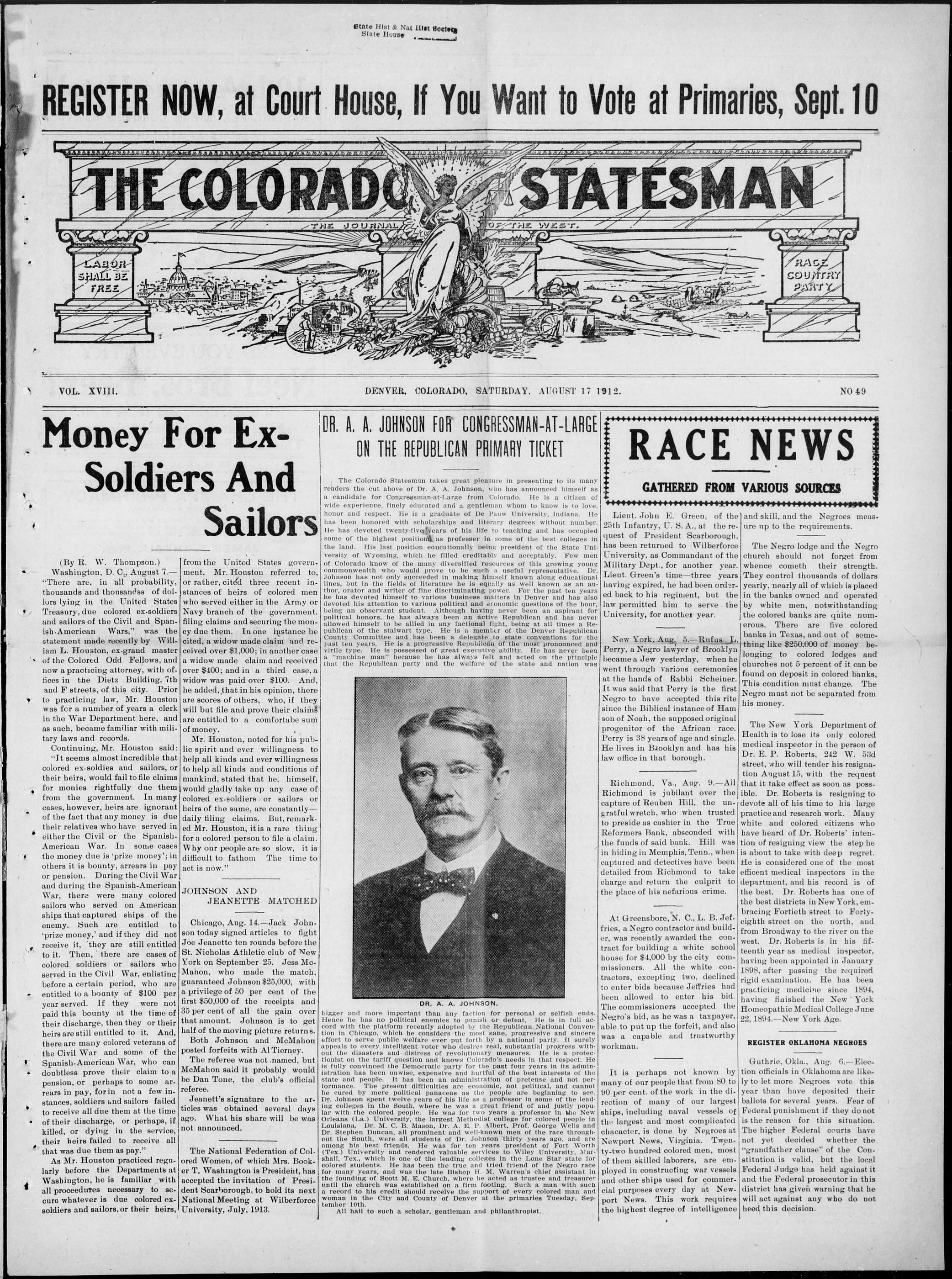
DR. A. A. JOHNSON FOR CONGRESSMAN-AT-LARGE ON THE REPUBLICAN PRIMARY TICKET
DR. A. A. JOHNSON FOR CONGRESSMAN-AT-LARGE ON THE REPUBLICAN PRIMARY TICKET
The Colorado Statesman takes great pleasure in presenting to its many readers the cut above of Dr. A. A. Johnson, who has announced himself as a candidate for Congressman-at-Large from Colorado. He is a citizen of wide experience, finely educated and a gentleman whom to know is to love, honor and respect. He is a graduate of De Pauw University, Indiana. He has been honored with scholarships and literary degrees without number. He has devoted twenty-five years of his life to teaching and has occupied some of the highest positions as professor in some of the best colleges in the land. His last position educationally being president of the State University of Wyoming, which he filled creditably and acceptably. Few men of Colorado know of the many diversified resources of this growing young commonwealth who would prove to be such a useful representative. Dr. Johnson has not only succeeded in making himself known along educational lines, but in the fields of literature he is equally as well known as an author, orator and writer of fine discriminating power. For the past ten years he has devoted himself to various business matters in Denver and has also devoted his attention to various political and economic questions of the hour, being an observant student. Although having never been an aspirant for political honors, he has always been an active Republican and has never allowed himself to be allied in any factional fight, being at all times a Republican of the stalwart type. He is a member of the Denver Republican County Committee and has been a delegate to state conventions for the past ten years. He is a progressive Republican of the most pronounced and virile type. He is possessed of great executive ability. He has never been a "machine man" because he has always felt and acted on the principle that the Republican party and the welfare of the state and nation was
[Name]
DR. A. A. JOHNSON. And more important than any faction for me has no political enemies to punish on the platform recently adopted by the R. Chicago, which he considers the most sanest serve public welfare ever put forth by no every intelligent voter who desires read disasters and distress of revolutionary men in the tariff question and knows Colorado convinced the Democratic party for the people has been unwise, expensive and hurtful people. It has been an administration. The present difficulties are economic by mere political panaceas as the peasant spent twelve years of his life as a progres in the South, where he was a great part of the colored people. He was for two year (La.) University, the largest Methodist co. a. Dr. M. C. B. Mason, Dr. A. E. P. Albe then Duncan, all prominent and well-known South, were all students of Dr. Johnson's best friends. He was for ten years University and rendered valuable services
t than any faction for enemies to punish or eventually adopted by the R. Re considers the most sane are ever put forth by a voter who desires readiness of revolutionary men and knows Colorado'ocratic party for the pre-expensive and hurtful been an administration difficulties are economic panaceas as the peers of his life as a pro where he was a great he. He was for two year the largest Methodist class, Dr. A. E. P. Albe mention and well-known students of Dr. Johnson He was for ten years elerated valuable services
bigger and more important than any faction for personal or selfish ends. Hence he has no political enemies to punish or defeat. He is in full accord with the platform recently adopted by the Republican National Convention in Chicago, which he considers the most sane, progressive and sincere effort to serve public welfare ever put forth by a national party. It surely appeals to every intelligent voter who desires real, substantial progress without the disasters and distress of revolutionary measures. He is a protectionist on the tariff question and knows Colorado's needs in that respect. He is fully convinced the Democratic party for the past four years in its administration has been unwise, expensive and hurtful of the best interests of the state and people. It has been an administration of pretense and not performance. The present difficulties are economic, not political, and cannot be cured by mere political panaceas as the people are beginning to see. Dr. Johnson spent twelve years of his life as a professor in some of the leading colleges in the South, where he was a great friend of and justly popular with the colored people. He was for two years a professor in the New Orleans (La.) University, the largest Methodist college for colored people in Louisiana. Dr. M. C. B. Mason, Dr. A. E. P. Albert, Prof. George Wells and Dr. Stephen Duncan, all prominent and well-known men of the race throughout the South, were all students of Dr. Johnson thirty years ago, and are among his best friends. He was for ten years president of Fort Worth (Tex.) University and rendered valuable services to Wiley University, Marshall, Tex., which is one of the leading colleges in the Lone Star state for colored students. He has been the true and tried friend of the Negro race for many years, and was the late Bishop H. M. Warren's chief assistant in the founding of Scott M. E. Church, where he acted as trustee and treasurer until the church was established on a firm footing. Such a man with such a record to his credit should receive the support of every colored man and woman in the City and County of Denver at the primaries Tuesday, September 10th.
All hail to such a scholar, gentleman and philanthropist.
RACE NEWS
GATHERED FROM VARIOUS SOURCES
Lieut. John E. Green, of the 25th Infantry, U. S. A., at the request of President Scarborough, has been returned to Wilberforce University, as Commandant of the Military Dept., for another year. Lieut. Green's time—three years having expired, he had been ordered back to his regiment, but the law permitted him to serve the University, for another year.
New York, Aug. 5.—Rufus L. Perry, a Negro lawyer of Brooklyn became a Jew yesterday, when he went through various ceremonies at the hands of Rabbi Scheiner. It was said that Perry is the first Negro to have accepted this rite since the Biblical instance of Hamson of Noah, the supposed original progenitor of the African race. Perry is 38 years of age and single. He lives in Brooklyn and has his law office in that borough.
Richmond, Va., Aug. 9.—All Richmond is jubilant over the capture of Reuben Hill, the ungrateful wretch, who when trusted to preside as cashier in the True Reformers Bank, absconded with the funds of said bank. Hill was in hiding in Memphis, Tenn., when captured and detectives have been detailed from Richmond to take charge and return the culprit to the place of his nefarious crime.
At Greensbore, N. C., L. B. Jeffries, a Negro contractor and builder, was recently awarded the contract for building a white school house for $4,000 by the city commissioners. All the white contractors, excepting two, declined to enter bids because Jeffries had been allowed to enter his bid. The commissioners accepted the Negro's bid, as he was a taxpayer, able to put up the forfeit, and also was a capable and trustworthy workman.
It is perhaps not known by many of our people that from 80 to 90 per cent. of the work in the direction of many of our largest ships, including naval vessels of the largest and most complicated chacacter, is done by Negroes at Newport News, Virginia. Twenty-two hundred colored men, most of them skilled laborers, are employed in constructing war vessels and other ships used for commercial purposes every day at Newport News. This work requires the highest degree of intelligence
NO 49
and skill, and the Negroes measure up to the requirements.
The Negro lodge and the Negro church should not forget from whence cometh their strength. They control thousands of dollars yearly, nearly all of which is placed in the banks owned and operated by white men, notwithstanding the colored banks are quite numerous. There are five colored banks in Texas, and out of something like $250,000 of money belonging to colored lodges and churches not 5 percent of it can be found on deposit in colored banks. This condition must change. The Negro must not be separated from his money.
The New York Department of Health is to lose its only colored medical inspector in the person of Dr. E. P. Roberts, 242 W. 53d street, who will tender his resignation August 15, with the request that it take effect as soon as possible. Dr. Roberts is resigning to devote all of his time to his large practice and research work. Many white and colored citizens who have heard of Dr. Roberts' intention of resigning view the step he is about to take with deep regret. He is considered one of the most efficient medical inspectors in the department, and his record is of the best. Dr. Roberts has one of the best districts in New York, embracing Fortieth street to Fortyeighth street on the north, and from Broadway to the river on the west. Dr. Roberts is in his fifteenth year as medical inspector, having been appointed in January 1898, after passing the required rigid examination. He has been practicing medicine since 1894, having finished the New York Homeopathic Medical College June 22, 1894.—New York Age.
REGISTER OKLAHOMA NEGROES
Guthrie, Okla., Aug. 6.—Election officials in Oklahoma are likely to let more Negroes vote this year than have deposited their ballots for several years. Fear of Federal punishment if they do not is the reason for this situation. The higher Federal courts have not yet decided whether the "grandfather clause" of the Constitution is valid, but the local Federal Judge has held against it and the Federal prosecutor in this district has given warning that he will act against any who do not heed this decision.
THE WORLD IN PARAGRAPHS
4 BRIEF RECORD OF PASSING EVENTS IN THIS AND FOR-EIGN COUNTRIES.
IN LATE DISPATCHES
DOINGS AND HAPPENINGS THAT
MARK THE PROGRESS
OF THE AGE.
Western Newspaper Union News Service.
WESTERN.
Fire starting in the Santa Fé railroad shops at Cleburne, Texas, caused an estimated loss of $250,000.
Reports say Mexican rebels have been entering Texas from Mexico recently and stealing and driving away horses.
A special commission to investigate government reclamation projects was proposed in a bill introduced in the Senate by Senator Borah.
At Los Angeles Leon Guiterrez, an anarchist, is dead, and Policemen Perry and Bains are wounded as the result of a riot in the Plaza.
Five persons were killed and several injured when the westbound Olympian train of the Chicago, Milwaukee & Puget Sound railroad broke through a bridge half a mile west of Keechelus, Wash., sixty-seven miles east of Seattle.
The death sentence was passed upon Idellus M. Dye at Salt Lake, convicted of the murder of Joseph Rainbow last November in an attempted hold-up. Dye, who is the son of a prominent lawyer of Pueblo, Colo., is to be shot September 16.
Sick and alone in his poorly furnished home, William H. Spencer, a carpenter sixty years old, of San Francisco, received word that he is heir to a fortune of $48,550 left by Isaac Spencer, an uncle who died recently in New Lexington, Ohio.
To be a true Christian, wear the simplest of frocks, discard high-heeled shoes and large hats, lay aside the tight fitting gowns, and, above all, avoid the extremes in dress as laid down by Dame Fashion. Such is the text of a resolution adopted by delegates attending the convention of Seventh Day Adventists at Glendale Cal.
A blood-stained half-ax and blood-stained clothing found in the house of a negro near the scene of the murder and assault of Miss Signe Amelia Carlzen in Denver led to the arrest of H. L. Jonas, fifty-five years old, owner of the cabin. Fresh scratches on his body furnish furrier confirmatory evidence connecting him with the crime and he is being held as a suspect.
SPORT.
WESTERN LEAGUE STANDING.
CLUBS. Won. Lost. Pet. Denver 66 50 569 Omaha 63 52 548 St. Joseph 61 52 540 Des Molines 58 52 527 Sloux City 58 55 513 Wilchita 56 58 491 Lincoln 52 61 460 Topeka 39 73 348
Seats for the Vanderbilt cup race meet to be held in Milwaukee in September have been placed on sale and blocks of the paste-boards were sent throughout the country.
Canadian oarsmen proved their superiority again in the final events of the National Association of Amateur Oarsmen regatta at Peorlo, Ill., finishing ahead of the Yankees in every race in which they were entered.
The first of the series of five yacht races for the Great Lakes international championship cup, at Chicago, was won by the Michicago, owned by a syndicate of Chicago Yacht Club members, over the Patricia, the Canadian contender, owned and piloted by Nor-
FOREIGN.
Santo Domingo is now menaced by a widespread revolution.
During the three months, April 1 to June 30, of the present year, 175,341 immigrants arrived in Canada. Of this number 121,998 arrived at ocean ports and 53,343 from the United States.
That Gen. Pascual Orozco, chief of the rebels in the northern part of the republic broke off peace negotiations after he had agreed to leave Mexico forever, was the information given out in a public statement issued by President Madero.
Two hundred and ten residents of the little town of Puraandiro, Michoacan, Mexico, at least half of whom were boys, were slaughtered at the behest of the jefe politico in June, according to a story brought to Mexico City by a commission which called upon the minister of the interior asking for guarantees.
Thirty-six soldiers, and more than twenty passengers were slaughtered by Zapatistas in a canon one kilometer north of Ticuman, 110 miles southeast of Mexico City, when a passenger train southbound from Mexico City was attacked from ambush. So far as known only a part of the train crew escaped. The Allan Line steamer, Corsican, which sailed from Montreal with two hundred passengers bound for Liverpool, struck an iceberg west of Belle Isle, near Newfoundland but apparently sustained no serious damage.
WASHINGTON.
The present high cost of beef and other meats may cause a congressional investigation of the so-called beef trust.
President Taft sent to the Senate the nomination of Jacob Schurman, president of Cornell university, to be minister to Greece.
This year's grain crop in the United States will be far in excess of last year's yield, as estimated by the Department of Agriculture.
When President Taft vetoed the wool bill, he had stamped with his disapproval the twenty-fifth legislative measure sent to him from Congress.
The fight to pass the $150,000,000 pension appropriation bill was lost by one vote in the Senate and the measure was sent back to the House for further conference.
Friends of Lieutenant Becker, charged with murder in connection with the New York police scandal, have raised $125,000 with which to fight his case.
Permission to erect a memorial to Major Archibald W. Butt and Francis Davis Millet, victims of the Titanic disaster, on the capitol grounds in Washington is granted in a resolution adopted by the Senate.
By the narrow margin of five votes the House passed the wool tariff revision bill over President Taft's veto. The vote, 174 to 80, was made possible only by the defection of twenty-one Republicans who voted with the Democrats.
President Taft will veto the legislative, executive and judicial appropriation bill because it carries a provision limiting the tenure of Civil Service employés in Washington to seven years. Clerks now are appointed practically for life, being removable only for cause.
Secretary Knox was designated by President Taft a special representative of the United States at the funeral of Mutsu-hito, the late emperor of Japan, and has left Washington for San Francisco and the Orient. The funeral will be held September 13. Knox is expected back in this country in October.
By a vote of 37 to 21 the Senate adopted the Senate substitute to the House provision in the postoffice appropriation bill extending federal aid to states in the improvement of highways. The amendment creates a commission to investigate the feasibility of a comprehensive system of good roads work. The House provision contemplated an appropriation of $15,000,000.
Past Assistant Surgeon T. B. McClintick of the United States public health and marine hospital service, died in Washington of Rocky Mountain "spotted fever," a martyr to the cause of medical science. One of the foremost specialists in this deadly malady, which he virtually had eradicated from the Bitter Root valley in Montana, it was the irony of fate that Dr. McClintick should succumb to the disease. He was thirty-nine years old.
GENERAL
Seven murderers were taken from their cells in Sing Sing prison Aug. 12, and put to death in the electric chair. The courts will be called upon to pass on the will of Col. John Jacob Astor, who went down with the Titanic.
The first negro to become a Jew, as far as records go, is Rufus L. Perry, a lawyer of Brooklyn, who has embraced the Jewish religion.
Three members of the Illinois guard were shot near Camp Lincoln at Springfield, by a farmer. None of the men was injured seriously.
The highest price ever paid for cattle in the United States was reached in Chicago when beef on the hoof brought $10.40 per hundred.
In gratitude for having restored his appetite, Diamond Jim Brady of New York has given $220,000 to the Johns Hopkins hospital at Baltimore.
Both the Catholic and Protestant clergy of Baltimore are engaged in a crusade against the tight-fitting skirts and low-neck waists worn by women. In over a score of cities, big and little, in the United States, government by commission supplanting the present mayor and council system is now in effect.
A $20,000 appropriation for federal aid to the Americans driven out of Mexico into Arizona was passed by the Senate. The refugees are now being supported by private subscription.
Crazed because of jealousy, Stephen Kostoff of Brockton, Mass., twenty-two years old, murdered his wife and their two-months-old baby in their home. He then blew out his brains.
The exports of coal from the United States during 1911, according to the United States Geological Survey, were 17,432,753 long tons, valued at $52,593,274, compared with 13,805,866 long tons valued at $41,470,792, in 1910. The exports in 1911 comprised 3,553,999 long tons of anthracite, valued at $18,093,285, and 13,878,754 long tons of bluminous coal, valued at $34,499,989.
The unfilled tonnage of the United States Steel Corporation July 31 totals 5,957,079 tons. This is an increase of 149,733 tons over the tonnage of June 29 last and compares with 3,584,085 tons July 31, 1911.
Tunneling through the ceiling of a basement room, then cutting a hole through the five-eighths inch steel floor of the vault of a bank in the lower part of New York. a band of robbers obtained $72,000 in bills of large denominations but missed $3,000,000 more in cash concealed in an inner safe.
Western Newspaper Union News Service.
COMING EVENTS IN COLORADO.
August 19-24.—International Photo-Engravers' Association, Denver.
Sept. 3.—Convention National Association State Game Wardens, Denver. September 3-7—Jefferson County Fair, Golden
September 3-6 — Arkansas Valley
Fair—Rocky Ford
September 6—"Sugar Beet Day" in Denver. Delegates from all sugar beet districts in Colorado will be in attendance and participate in a special pro-
September 11-13—Fremont County
Fair and Driving Club—Cañon City.
September 16-21—Colorado State
Fair—Pueblo.
Sept. 18-20—San Luis Valley Fair, Alamosa.
September 24-27—Crowley County Fair, Ningar City.
September 24-27—Las Animas County Fair, Trinidad.
Sept. 24-26. Colorado State Medical Association Pueblo.
Sept. 26. Opening Weld County Fair, Greeley.
Another Rock Island Victim Found.
Pueblo.—Lying in a marsh almost inaccessible, the body of a man supposed to have been a victim of the Rock Island wreck here July 31 was found ten miles south of here on the Arkansas river.
Government to Supervise Irrigation, Greeley.—Cognizance taken by the national government of the work of the Weld county grand jury recently may result in government supervision of irrigation projects and a general shakeup in the Department of Agriculture at Washington.
Student Crushed by Boulder.
Cañon City.—Lawrence H. Serrey, a student in the Denver University law school, had his leg and foot crushed in the Silica mine here. A large boulder which he was moving to protect the machinery from a blast rolled over and caught him beneath the iron rails of the car track.
To Begin Romeo Reservoir.
Romeo.—J. H. White, H. Neel and E. S. Christensen have been elected directors of the Romeo Reservoir district. Work will soon start on the new proposition in the San Luis valley, which will furnish water to over 20,000 acres of land and involve $500,000 in its construction.
Train Kills Ranchman.
Salida.—C. B. Kelso, thirty-five, a wealthy rancher of Fremont county, was run over and instantly killed by Denver & Rio Grande eastbound passenger train, No. 3, while he was transferring cattle in the stock yards at Howard, fourteen miles southeast of Salida.
Utes to Mark Trail
Colorado Springs.—Seventy-five Ute Indians in full regalia will solemnly conduct the ceremonies of marking the old Ute trail above Manitou Springs. The ceremony will take place August 29, at the time of the Pike's Peak summer carnival and Indian Shan Kive.
Explosion Kills Two Miners.
Cripple Creek.—The unexplained explosion of forty sticks of dynamite on the 400-foot level of the Good Sovereign mine resulted in the instant death of Edward Floyd, thirty-five and James Murphy, nineteen, miners Murphy's body was horribly mangled and parts were strewn seventy-five feet along the drift.
State to Pay Old Debts.
Denver.—The state of Colorado is making plans to clean house of all its old debts. Colorado is going to pay off $2,115,000 of old warrants that have littered the files of the treasurer's office many years—so long, in fact, that only $800,000 of the total amount the warrants call for was the original debt. The remaining $1,315,000 is for interest.
State Federation of Labor Meets.
Cripple Creek.—With 200 delegates representing every union of the state in attendance, the seventeenth annual convention of the Colorado State Federation of Labor opened here Aug. 13. The delegates were welcomed to Cripple Creek by Mayor Hassenplug. Use of the historic Miners' Union hall by the convention was tendered by President Moyer of the Western Federation of Miners.
Queer Facts Surrounds Death.
Pueblo.-Peculiar circumstances surrounding the death of Mrs. Dr. A. C. Scaife ten years ago, were unearthened when her daughter, Mrs. D. G. McNutt, requested a permit from the health department for the removal of the body from Eden, ten miles north of here, to Pueblo. Health Commissioner Provost discovered that the woman died unattended by a physician, the services of an undertaker had been dispensed with and the funeral sermon had been preached by her husband The casket had been built by Mrs. Scaife's uncle.
Canteloupes Are Ready.
Rocky Ford.—Cantaloupes are now being shipped from Rocky Ford in carload lots. The hot weather is causing the melons to ripen rapidly. Commission houses from all parts of the country are sending buyers here and the crop is being readily disposed of.
New School for Rangely.
Rangely.—Although it is merely a small oil camp Rangely is to have a school house which will equal anything in that line on the Western slope.
LITTLE COLORADO ITEMS.
Small Happenings Occurring Over the State Worth While.
Only one arrest has been made by the Boulder police in two months.
George Sherman, fifty-two, committed suicide at his livery stable in Moffat.
The state treasury has been enriched by the addition of $3,496.35 in inheritance taxes.
A bandstand costing nearly 1,000 has been erected on the courthouse lawn in Boulder.
Mrs. Ella Celeste Adams, a well known newspaper woman of the state, died in Colorado Springs.
With the exception of fruit, the lower Arkansas valley, clear to the Kansas line, has the best crops in its history.
William Brand, the "bee man," of LaSalle, was driven nearly crazy when a bee stung him on the tip of his tongue.
Work will be commenced on three irrigation projects in Routt county in the near future, involving over 200,000 acres of land.
Seventy-nine residents of El Paso county are seeking nominations for county offices at the coming primaries, September 10.
The International Supreme Council of the Knights of Columbus, held in Colorado Springs recently, attracted one thousand visitors to Colorado.
Charles Bowman, a well known cattle man of Grand Junction, has bought an automobile which he will use in rounding up his cattle.
On the Suter place, near Kersey, where there was over 150 acres of grain harvested, the average was nearly sixty-four bushels to the acre.
Cowgirls of Colorado and adjoining states will contest for the championship of the world at the State fair, to be held in Pueblo Sept. 16 to 21.
The highways leading into Denver are to be parrolled at intervals by men on motorcycles to prevent the overflow of irrigation ditches on the roads.
As a result of the visit of thirty-five farmers from Nebraska and Kansas to the San Luis valley, more than 3,000 acres of land in that valley has been sold.
Simon Schwalm, a business man of Johnstown, is the victim of a tropical disease, amoebic dysentery, although he has not been outside Colorado for twenty years.
A fine Jersey cow, the property of Walker Grayson, a rancher of Louisville, was found absolutely uninjured at the bottom of an abandoned mine shaft, eighty feet deep.
Thomas B. Whittington, for thirty eight years an employee of the C. F. and I. Company, most of that time superintendent of the pipe foundry at the Pueblo plant, is dead.
Mayor Arnold has signed the McGauran bill, which provides that growers of fruits and vegetables shall have the right to sell their products in Denver without a license.
The finding of the body of J. E. Marthar floating on Sloan's lake, at Manhattan beach, Denver, marks the thirty-eighth violent death that has occurred in that city since July 1.
Miss Signe Carlzen, thirty-eight years old, a music teacher, was assaulted and killed near East Alameda avenue and Forest street, in South Montclair, Denver, by an unknown fiend.
May Doran and Daniel Eisenberg of Denver are being held in custody in Cañon City pending an investigation into the death of Morris Williams, convict No. 8205, at the state penitentiary.
There has not been a time in three years when machine shops, foundries, steel mills, bridge and structural iron factories and similar manufacturing concerns in Denver and all Colorado employed more men or worked fuller hours than now.
Fleeing before Robert Freeman of Glenwood Springs, his employer, with whom he had been engaged in a fight, Robert Roberts, a negro ranch hand, ran half a mile before he reached the Grand river, into which he went headlong and was drowned.
Jean Talbot Miller, who fired four shots into the head of his sweetheart, Georgiana Lichtenwalter, because she would not elope with him, was sentenced to serve a term of from seven to fourteen years in the penitentiary by Judge Shattuck of Denver.
The eleventh of a list of auto fatalities that have saddened Denver since July 1 may be added as the result of an accident on the Denver-Littleton road, in which three-year-old Harry Chase was probably fatally injured, while his father was badly hurt.
The government has filed three suits for judgment amounting to $13,000, against the Colorado & Southern Railway Company, alleging the railway has violated the statute, providing that no railway employé be allowed to work more than sixteen consecutive hours.
Colorado will be the battleground of one of the bitterest fights ever waged in the West over the liquor question when the prohibition amendment abolishing the sale and manufacture of intoxicating liquors in the state, come up before the electors at the polls this fall.
While on his way to the police station in Pueblo, to report the robbery of his residence, Lee Culbertson, proprietor of a lunch counter, was struck over the head by a footpad and robbed of $40 and a gold watch.
RESTING PLACE FOR COLORED GENTS
Corner West 10th and Osage, Near Burnham Shops Denver, Colorado
CARLSON'S Peerless Ice Cream Phones: Main 112 and Main 5787
DID YOU EVER TRY Neef Bros.' Beer?
It's made right, and tastes right. None better made anywhere and This is a Strictly Colorado Production
Is the place to get your Drugs, Chemicals and Patent Medicines. We serve Cold Drinks, Ice Cream Soda and Nut Sundaes. Perfumes, box candies and box paper our specialties. Get our prices before buying elsewhere.
HENRY BECK JOHN ENGSTROM
BECK & ENGSTROM
WHOLESALE DEALERS IN
WINES, LIQUORS AND CIGARS
1644-46-48-50 LARIMER STREET.
PHONE MAIN 1053. DENVER, COLO.
Western agents for Minneapolis Grain Belt Beer and Carnegie Porter,
Pripps Imported Beer and Bock Ol.
A first-class Mortuary establishment. First aid to the bereaved in the time of death of loved ones. Prices below competitors. Polite service
LAWRENCE JONES, Licenced Embalmer
LOUIS HUBBARD, Funeral Director
PARLORS 1925 Arapahoe Street
1946 Larimer St. GRAND THEATER, 2017 Larimer Street. [UNDER NEW MANAGEMENT.] Showing Three Reels of the Very Best Pictures Made
Shirts, Collars and Cuffs, Blankets, Curtains and Rough Dry Work. The Denver Sanitary Laundry. PHONE MAIN 5670
PHONE MAIN 3028
JOH
Meats, Fane
Corner Nineteenth.
MEALS AT ALL HOURS Pool Room in Connection
At 10th and Osage, Near Bur
Denver, Colorado
ARLSON
less Ice C
Phones: Main 112 and
D YOU EVER T
f Bros.' B
made right, and tastes
better made anywhe
a Strictly Colorado F
e, Near Burnham Shops Colorado
SON'S
e Cream
min 112 and Main 5787
VER TRY
s.' Beer?
and tastes right.
anywhere and
colorado Production
BE SURE AN TRY IT.
CHAMPA PHAR
TWENTIETH AND CHAMPA.
Get your Drugs, Chemicals and Patent
es, Ice Cream Soda and Nut Sundaes
paper our specialties. Get our price
JAMES E. THRALL, Pro
PHONE MAIN 2425.
PHARMACY
TO CHAMPA.
Treats and Patent Medicines. We
and Nut Sundaes. Perfumes, box
Get our prices before buying
RALL, Prop.
N 2425.
RES. PHONE GALLUP 942
HN K. RETT ncy and Staple
RETTIG
Staple Groceries
STREET
1864 CURTIS STREET
CK & ENGSTRO
WHOLESALE DEALERS IN
JOHN ENGSTROM
GSTROM
ALERS IN
LAND CIGARS
ER STREET. DENVER COLO
Denver, Colo.
- CANDIDATES FILE FOR FALL PRIMARY
LIST OF THOSE WHO HAVE FILED FOR UNITED STATES SENATORS,
CONGRESSMEN AND STATE OFFICERS TO BE VOTED
FOR AT PRIMARY, SEPTEMBER 10.
Denver.—The following is a list of the nominations for the primary election filed with the secretary of state and the city and county clerk;
Presidential Electors.
Joen C. Osgood, Pitkin; T. J. Downen, Pueblo; Whitney Newton, Denver; A. R. Fisher, Weld; Paul Wilson, Delta; H. G. Lunt, El Paso, Republicans.
H. P. Corbin, Jefferson; Finley Dye, Sedgwick; Mrs. Gertrude Lee, Denver; T. C. Bodie, Chaffee; Lemuel Gamon, El Paso; O. T. Clark, Las Animas, Democrats.
Ira M. DeLong, Boulder; W. F. Field, Prowers; C. N. Crowder, Teller; Dr. John Grass, Denver; F. D. Catlin, Montrose; W. H. Trask, Denver, Roosevelt Republicans.
United States Senators—Long Term.
Alva Adams, Pueblo, Democrat; John F. Shafroth, Denver, Democrat and Progressive Democrat.
Clyde C. Dawson, Denver, Republican; Merle D. Vincent, Paonia, Progressive Republican.
United States Senators—Short Term.
C. S. Thomas, Denver, Democrat and Progressive Democrat.
C. W. Waterman, Denver; James H. Brown, Denver.
Justices of the Supreme Court.
John Campbell, El Paso, Republican; R. D. Rees, Denver, Progressive Republican.
John R. Dixon, Denver, Democrat; Fred N. Dickinson, Delta, Democrat; Tully Scott, Teller, Democrat and Progressive Democrat.
Congressmen at Large.
S. H. Kinsley, El Paso; Dr. A. A. Johnson, Denver; James P. Miller, Boulder; Jesse J. Laton, Denver, Republicans. Edward Keating, Pueblo, Democrat; Mrs. Katherine Williamson, Denver, Democrat. L. J. Stark, Denver, Progressive Republican. C. E. Fisher, Sterling, and D. C. Burns, Denver, Roosevelt Republicans. Edward T. Taylor, Garfield, and W. L. Clayton, Weld, Democrats and Progressive Democrats. C. P. Dodge, El Paso, Republican.
Congressman—First District.
Rice P. Means, Denver, Republican. W. J. L. Crank, Denver, Roosevelt Republican. George J. Kindel, Denver, Democrat and Progressive Democrat; A. A. Rucker, Denver, Democrat; Henry Drumm, Boulder, Democrat.
Congressman—Second District. H. Van Buskirk, Rocky Ford, Republic.
Governor.
Clifford C. Parks, Garfield, Republican.
J. H. Maupin, Fremont; E. M. Ammons, Grand; Thomas J. Tynan, Fremont, Democrats.
Philip B. Stewart, Progressive Republican.
Edward P. Costigan, Denver, Roosevelt Republican.
Lieutenant Governor.
Ezra T. Elliott, Rio Grande, Republican.
B. F. Montgomery, Rio Blanco, Democrat and Progressive Democrat; H. W. Kluge, Mesa; Dr. Ben B. Besharo, Las Animas and R. P. Rubin, Chaffee, Democrats.
J. C. Nixon, Weld, Roosevelt Republican; R. G. Davenport, Republican.
Secretary of State.
James B. Pearce, Otero; M. P. Capp, Boulder, and Thomas M. Rainey, Lake, Democrats; Leo Vincent, Denver, Progressive Democrat.
Ernest C. Bacon, Ouray, Progressive Republican; Patrick Byrne, Pu
Cuts His Throat in Utah Church.
Park City, Utah.—Going into the Catholic church here, Tim Hadley, aged thirty-two, a miner, who has been here about a month, cut his throat with a razor. His injury was not dangerous. After using the razor he rushed from the church. People saw him running with blood streaming from his throat, and after a hot chase he was overtaken and given medical attention. He will recover. Hadley has a sister, Mrs. Julia Clauson, living in Leadville, Colo.
Pastor Seeks Stage Glory.
Portage, Wis.—The Rev. William F. Phillips, until recently pastor of the St. John's Episcopal church in this city, will take the part of Manson in "The Master in the House," which will go on a tour out of Chicago this fall. He has gone to Chicago to attend rehearsals. Phillips was pastor of St. John's church for four years and is an able orator. If he is successful in his new venture he will abandon the church entirely for parts in dramas which have the uplift in mind.
Sourned by Girl—Commits Suicide
Steamboat Springs.—Love for a pretty school teacher who refused to marry him after they had been engaged two years, caused Louie P. Miller, forty, wealthy banker and irrigation promoter of this place, to commit suicide by shooting himself with a revolver.
Appoints Register at Lander. Washington.—President Taft sent to the Senate the nomination of John W. Cook to be register of the land office at Lander, Wyo.
eblo, Roosevelt Republican; John B.
Raymer, Republican.
State Auditor.
Ben C. Catron, Clear Creek, and B. F. Van Noy, Morgan, Republicans. Roady Kenehan, Denver, and Chas. H. Leckenby, Routt, Democrats; Mrs. Lillian Hartman Johnson, Denver, Progressive Democrat. Arthur F. Malcolm, Denver, Progressive Republican; W. C. Knight, Mesa, Roosevelt Republican.
State Treasurer.
James B. Dick, Huerfano, Republican.
M. A. Leddy, El Paso, Democrat; M. H. Van Fleet, Conejos, Progressive Democrat.
J. S. Temple, Denver, Roosevelt Republican; O. D. Cass, Denver, Republican.
Attorney General.
William E. Gobin, Otero, Republican.
J. Frederick Farrar, Larimer, and Harry L. Lubers, Las Animas, Democrats.
Benjamin F. Griffith, Denver, Progressive Republican.
State Superintendent of Public Instruction.
Mrs. Helen M. Wixson, Denver, Republican.
Mrs. Inez Johnson Lewis, El Paso, Democrat and Progressive Democrat;
Mrs. Mary V. Donahue, Teller; Mrs. R. C. Pulsford, La Plata; Mrs. Mary C. C. Bradford, Denver, Democrats.
Regents State University.
Charles R. Dudley, Denver, short term, Republican; Chester S. Morey,
George D. Statler and O. J. Pfeiffer, Denver, long term, Republicans.
S. Q. Hallett, Pitkin, short term,
Democrat.
Mrs. Louise V. Edwards, Otero; James B. Regan, Sterling, and J. C. Hankins, Boulder, long term, Democrats; W. H. Bryant, Denver, long term, Democrat and Progressive Democrat; John T. Bottom, Denver, long term, Progressive Democrat.
Dr. O. J. Pfeiffer, Denver, and B. P. Smith, Delta, Progressive Republicans.
Claims Magnetism Link With Heaven.
Santa Cruz, Calif.—An independent rediscovery "that the invisible agency connecting heaven to earth is electromagnetism," has been announced by the Rev. Father J. S. Rickard, in charge of the observatory at the University of Santa Clara, who recently made public a method of forecasting the weather from sun spots. Father Rickard also gave out a list of dates of disturbances for the Pacific coast. The dates are August 14th to 17th, August 21st to 24th, August 27th to 31st, and September 3rd to 6th.
To Sell 1,500,000 Acres Indian Lands.
Washington.—About 1,500,000 acres Indian lands in the former Shoshone Uintah and Crow reservations in Utah, Wyoming and Montana are to be sold at public auction at minimum prices ranging from 50 cents to $1.50 per acre in accordance with an order signed by President Taft and Secretary Fisher. Not more than 640 acres will be sold to any one person. The sales will begin at Lander, Wyo., September 1st; at Provo, Utah, October 8th, and at Billings, Mont., October 21st.
Senator Blamed for Orozco's Stand
Mexico City.—Mexico blames Senator Fall of New Mexico for its failure to come to peace terms with Gen. Pascual Orozco, rebel leader.
Flnds Mail Lost In Wreck.
Pueblo.—In searching for bodies of victims of the Rock Island wreck July 30th, W. F. and J. F. Andrews found a mail pouch in the Arkansas river six miles from the scene of the wreck. With only a few exceptions, addresses on the 2,000 pieces of mail were legible and sent to their destinations.
Equalization Board Meets.
Cheyenne.—The State Board of Equalization met here to affix assessable valuations to the railroads of Wyoming.
Sacramento.—Watson Bunker of Broderick completed the fortiest day of his fast, which he undertook to cure himself of throat trouble.
A Spring Tragedy.
A Spring Tragedy.
I climbed upon an open carrh
And gently bruce on my cigarrh.
A shillly bruce.
Anon I sneeze,
I get catarrap—and there you arrh
One of the Three.
Ex-Governor Pennypacker, discussing the divorce evil in Philadelphia, said with a smile:
"In these times one never, as the saying goes, knows where one is at. An acquaintance of mine extended his hand to me at the Historical Society the other day and cried:
"Congratulate me! I am the happiest man alive!"
"I looked at him doubtfully."
at their courtyard.
"Engaged, married or divorced!" I
asked.
ALEXANDRA AGAIN THROWS DOWN GAUNTLET TO MARY
Two queens of England warring for supremacy have set the empire gasping. Haughtly defying her royal son to relegate her to a secondary place, Alexandra, very inch a queen, has again thrown down the gantlet to her daughter-in-law with the proud declaration:
A
"Once a queen, always a queen." Queen Mary, entitled by law and custom to precedence over the consort of her royal mate's late father, King Edward VII., she has not hesitated to battle for her prerogatives, but the result of these encounters has made her wary. The latest episode, which only too plainly showed Queen Alexandra's determination to hold the exalted place she occupied as Edward's consort and which has caused a commotion in the royal household, occurred at a monster garden party given by Queen Alexandra for the Red Cross league.
Standing under an Indian canopy of red and gold, she insisted on shaking hands with more than 1,000 guests. She was loudly acclaimed for her condescension, and news of the event was carried to her rival, Queen Mary. Her reply to Alexandra's maneuver is being awaited breathlessly, but from intimate sources it is reported that she realizes that she has been conquered.
Ever since ascending the throne Queen Mary has been humiliated again and again in her efforts to oust her mother-in-law from the place she held and apparently still holds.
Her designation as "Queen Mother" in the manual of the Church of England and in other official records, was bitterly resented by Queen Alexandra. She demanded that this be instantly changed and her power was sufficient to gain acquiescence to her command. Coincident with the change in the national anthem, when King George's name was inserted in place of his father's, a secondary "national anthem" made its appearance, with "God Save Queen Alexandra" as the motif.
Buckingham palace, the principal seat of the court in London, was to have been turned over to the new king and his consort, while Queen Alexandra was to have taken up her residence in Marlborough house. To Queen Mary's vexation one delay after another prevented this, and when finally lacking in all other excuses, the dowager empress of Russia was conveniently taken ill in the palace and her condition was declared to be such that she could not be moved. Suggestions that she would find it agreeable to take up her residence at Copenhagen with her sister, the dowager empress, are said to have caused the king to go about with a dazed look for several days.
Her popularity and her strong hold on the imagination of the people have combined to make her position almost impregnable. The king is hedged about by constitutional provisions, but the queen's despotism in social matters is practically unlimited. Queen Alexandra had the prestige of rank. Queen Mary tried to seize it, but found that possession is nine points of the law, even when it comes to a queen's crown. Queen Elizabeth had Mary Queen of Scot's head cut off when her position was questioned. This method of disposing of an adversary has gone out of fashion in England, but Queen Mary has been unable to discover a satisfactory substitute method.
HARUM-SCARUM DAUGHTER OF DUKE OF SUTHERLAND
There is an entertaining story concerning Lady Rosemary Leveson-Gower, only daughter of the duke and Duchess of Sutherland, now going the rounds of Mayfair drawing rooms in London. As you probably know, she is a harum-s c a r u m young miss, almost a tomboy, who cares not the least bit for society, and her parents find it hard work to keep her in rein One of her
A.
favorite diversions is shying her slippers about any room in which she happens to be, with disastrous consequences to many of the ornaments. This fact came to the ears of a well-known insurance agent who was called in to write a policy on the pictures, furniture and works of art in the home of the Binghams, connected by marriage with Lady Rosemary, with whom she is a frequent visitor. After considering all the facts the agent reported that he was sorry but so long as the Sutherland miss was welcomed as a guest he could not care write the desired insurance at any figure.
Business Sagacity.
"How did you manage," asked the landlord's friend, "to get all the guests away from that other summer hotel? They set a good table there, and they certainly have you beaten as far as location is concerned."
"You see we serve four meals a day here, and thus give the ladies a chance to change their clothes more often than they had to at the other place."
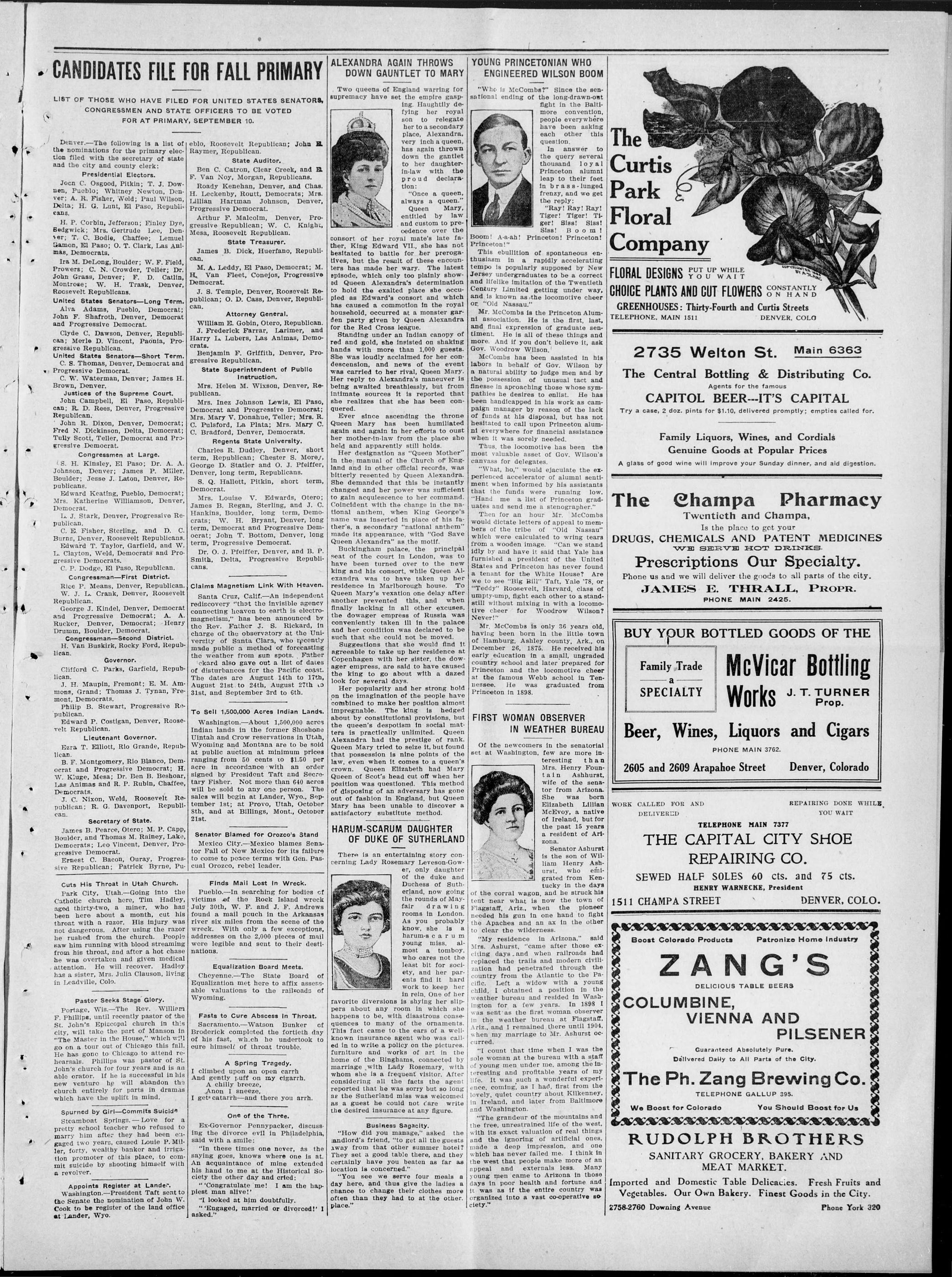
"Who is McCombs?" Since the sensational ending of the long-drawn-out fight in the Baltimore convention, people everywhere have been asking each other this question.
4
In answer to the query several thousand loyal Princeton alumni leap to their feet in brass-lunged frenzy, and we get the reply:
"Ray! Ray! Ray! Tiger! Tiger! Tiger! Siss! Siss! Siss! Boom!
Boom! A-a-ah! Princeton! Princeton! Princeton!"
This ebullition of spontaneous enthusiasm in a rapidly accelerating tempo is popularly supposed by New Jersey undergraduates to be a correct and lifelike imitation of the Twentieth Century Limited getting under way, and is known as the locomotive cheer or "Old Nassau."
Mr. McCombs is the Princeton Alumni association. He is the first, last, and final expression of graduate sentiment. He is all of these things and more. And if you don't believe it, ask Gov. Woodrow Wilson.'
McCombs has been assisted in his labors in behalf of Gov. Wilson by a natural ability to judge men and by the possession of unusual tact and finesse in approaching those whose sympathies he desires to enlist. He has been handicapped in his work as campaign manager by reason of the lack of funds at his disposal, but has not hesitated to call upon Princeton alumni everywhere for financial assistance when it was sorely needed.
Thus, the locomotive has been the most valuable asset of Gov. Wilson's canvass for delegates.
"What, ho," would ejaculate the experienced accelerator of alumni sentiment when informed by his assistants that the funds were running low. "Hand me a list of Princeton graduates and send me a stenographer." Then for an hour Mr. McCombs would dictate letters of appeal to members of the tribe of "Old Nassau" which were calculated to wring tears from a wooden image. "Can we stand idly by and have it said that Yale has furnished a president of the United States and Princeton has never found a tenant for the White House? Are we to see "Big Bill" Taft, Yale '78, or "Teddy" Roosevelt, Harvard, class of umpty-ump, fight each other to a standstill without mixing in with a locomotive cheer for Woodrow Wilson? Never!"
Mr. McCombs is only 36 years old, having been born in the little town of Hamburg, Ashley county, Ark., on December 26, 1875. He received his early education in a small, ungraded country school and later prepared for Princeton and the locomotive cheer at the famous Webb school in Tennessee. He was graduated from Princeton in 1898.
FIRST WOMAN OBSERVER
IN WEATHER BUREAU
Of the newcomers in the senatorial set at Washington, few are more interesting than Mrs. Henry Fountain Ashhurst, wife of the senator from Arizona. She was born Ellizabeth Lillian McEvoy, a native of Ireland, but for the past 15 years a resident of Arizona.
M. B.
Senator Ashurst is the son of William Henry Ashurst, who emigrated from Kentucky in the days of the corral wagon, and he struck his tent near what is now the town of Flagstaff, Ariz., when the pioneer needed his gun in one hand to fight the Apaches and an ax in the other to clear the wilderness.
"My residence in Arizona," said Mrs. Ashurst, "came after those exciting days, and when railroads had replaced the trails and modern civilization had penetrated through the country from the Atlantic to the Pacific. Left a widow with a young child, I obtained a position in the weather bureau and resided in Washington for a few years. In 1898 I was sent as the first woman observer in the weather bureau at Flagstaff, Ariz., and I remained there until 1904, when my marriage to Mr. Ashurst occurred.
"I count that time when I was the sole woman at the bureau with a staff of young men under me, among the interesting and profitable years of my life. It was such a wonderful experience, coming, as I had, first from the lovely, quiet country about Kilkenny, in Ireland, and later in Baltimore and Washington.
"The grandeur of the mountains and the free, unrestrained life of the west, with its exact valuation of real things and the ignoring of artificial ones, made a deep impression, and one which has never failed me. I think in the west that people make more of an appeal and externals less. Many young men came to Arizona in those days in poor health and fortune and it was as if the entire country was organized into a vast co-operative society."
The
Curtis
Park
Floral
Company
FLORAL DESIGNS PUT UP WHILE
YOU WAIT
CHOICE PLANTS AND CUT FLOWERS CONSTANTLY
ON HAND
GREENHOUSES: Thirty-Fourth and Curtis Streets
TELEPHONE, MAIN 1511 DENVER, COLO
2735 Welton St. Main 6363
The Central Bottling & Distributing Co.
Agents for the famous
CAPITOL BEER---IT'S CAPITAL
Try a case, 2 doz. pints for $1.10, delivered promptly; empties called for.
Family Liquors, Wines, and Cordials Genuine Goods at Popular Prices A glass of good wine will improve your Sunday dinner, and aid digestion.
The Champa Pharmacy
Twentieth and Champa,
Is the place to get your
DRUGS, CHEMICALS AND PATENT MEDICINES
WE SERVE HOT DRINKS.
Prescriptions Our Specialty.
Phone us and we will deliver the goods to all parts of the city.
JAMES E. THRALL, PROPR.
PHONE MAIN 2425.
Family Trade
a
SPECIALTY
McV
Work
Beer, Wines, Liquor
PHONE MAIN 3
2605 and 2609 Arapahoe Street
ED FOR AND REPAIRING
VERED YOU
TELEPHONE MAIN 7377
THE CAPITAL CITY SH
REPAIRING CO.
VERED HALF SOLES 60 cts. and 75
HENRY WARNECKE, President
AMPA STREET DENVER
Colorado Products Patronize Home In
WORK CALLED FOR AND
DELIVERED
TELEPHONE MAIN
THE CAPITAL OF
REPAIRING
SEWED HALF SOLES 60
HENRY WARNECKE,
1511 CHAMPA STREET
Boost Colorado Products
SEWED HALF SOLES 60 cts. and 75 cts.
HENRY WARNECKE, President
ZANG'S DELICIOUS TABLE BEERS COLUMBINE, VIENNA AND PILSE
LUMBINE VIENNA AND PILSE
COLUMBINE VIENNA AND
Guaranteed Absolutely Pure.
Dallivered Daily to All Parts of the City.
The Ph. Zang Brewin
TELEPHONE GALLUP 395.
We Boost for Colorado You Should Be
Ph. Zang Brewing TELEPHONE GALLUP 395.
RUDOLPH BROTHERS
SANITARY GROCERY, BAKERY AND MEAT MARKET. Imported and Domestic Table Delicacies. Fresh Fruits and Vegetables. Our Own Bakery. Finest Goods in the City. 2758-2760 Downing Avenue Phone York 320
J. T. TURNER Prop. and Cigars Denver, Colorado
REPAIRING DONE WHILE
YOU WAIT
77
TY SHOE
CO.
and 75 cts.
Ident
DENVER, COLO.
size Home Industry
PILSENER
wing Co.
95.
should Boost for Us
THE COLORADO STATESMAN
JOS. D. D. RIVERS.....Proprietor
1824 Curtis Street, Room 25.
JOS. D. D. RIVERS.....Proprietor
1824 Curtis Street, Room 25.
SUBSCRIPTION RATES:
One Year ..... $2.00
Six Months ..... 1.00
Three Months ..... .60
PAYABLE IN ADVANCE.
Entered as second-class matter at the postoffice in the city of Denver, Colorado.
All communications of a personating nature that are not complimentary will be withheld from the columns of this paper.
It occasionally happens that papers sent to subscribers are lost or stolen. In case you do not receive any number when due, inform us by postal card and we will cheerfully forward a duplicate of the missing number.
Communications to receive attention must be newsy, upon important subjects, plainly written only upon one side of the paper; must reach us Tuesdays, if possible, anyway, not later than Wednesdays, and bear the signature of the author. No manuscript returned, unless stamps are sent for postage.
Remittances should be made by Express Money Order, Postoffice Money Order, Registered Letter or Bank Draft. Postage stamps will be received the same as cash for the fractional part of a dollar. Only 1-cent and 2-cent stamps taken.
Display advertising 25 cents per square. A square contains ten agate lines.
Reading notices, ten lines or less, 10 cents per line. Each additional line over ten lines, 5 cents per line.
No discounts allowed on less than three months' contract. Cash must accompany all orders from parties unknown to us. Further particulars on application.
Boost for Colorado, but do it fairly. Don't overdo it, if you do the effect will be far worse than a premeditated knock. The unvarnished facts are surprising enough for the average outsider. They cannot but impress him favorably, nor is it necessary to run down any other state to do it. Colorado is so far ahead of her neighbors that her boosts can well afford to be fair and generous to her less fortunate sister states.
Many seem to think it is a sin to use money in political campaigns. When a campaign of education is necessary on public questions, when voters have to be visited and coaxed to come out and vote, and perhaps automobiles hired to haul them to the polls, money must be raised to do it. This may be wrong in principle, but the voters, not the political parties, are to blame.
---
DENVER POLITICAL MUDDLE.
Four political parties in Denver! How does that strike you? Two Republican parties, two Democratic. Who is right and who is wrong? That is the question the average voter is called upon to decide. There are no doubt unscrupulous Republicans, and treacherous Democrats, in either faction, and the question may now be asked, "does it pay to swap horses in the middle of the stream?" As time goes on the atmosphere is certain to clear; for this reason Negro voters should not express themselves too freely in favor of one faction or another, but study the situation clearly and get the truth in the matter. We know the Republicans are the party of progress, but it is the faction of the Taft type and not the mossbacks that are the most friendly to the Negro as a whole. We doubt not that certain individuals of the race have personal friends on the other side, but is this not the proper time to sink self and selfishness out of sight and work for the benefit of the race? The faction that believes in the whole Negro people rather than a certain few Negroes, to get our whole support. The party is now in a process of washing itself, and the Negro's interest ought to be given to the faction that shows the cleanest bill of goods. The Republican party is not a dead one for the reason that it shows inherent vitality sufficient to purify and reform itself, and any man or party that displays that power has a future. It is not our fight, but the battle of the leaders; let them fight it out and when the din and smoke has cleared will be time enough to ask, "where are we at?" and then use our influence to lift the regenerated faction into position and power.
STRENUOUS LIFE.
Almost as a total population of Colorado the Negro stands off and feels that he is not in touch with the great strenuous life which is the heart of the present century's human existence. The world's problems are not ours. There are no problems for us except those touching the right and the opportunity to live. If we can be employed in some way and dragged along in the wake of the world's hurrying events, we will be half-way content, at least. Such seems the position of the Negro race in Colorado, but as a matter of truth, is there not a great, ardent life opening before this same Negro? Is there not a great business development awaiting an enlightened direction? Are there not great social, financial and political problems of racial unity world-wide in their application, appealing for recognition before the awakening Negro of today?
Wealth-getting is the first great motive of the Caucasian. Let it be so with the Negro. The money-getting spirit carries enlightenment and civilization with it.
Business is the watchword of today. Even with the field filled up and handicapped as it is here, 11,000,000 of people of our race are sufficient within themselves to create a volume of new business of their own which would be more than respectable. But our business enterprises can easily take a peculiar advantage, providentially reserved, if they will, by seeking development on African soil. We are not talking of emigration. We are talking of business.
The wonderful and sagacious information coming occasionally to the Negroes of this country from native sources, combines to present to us a special business phase of life, gigantic in its possibilities and reserved for and applicable to us alone. In our present poverty this must sound like dreamtalk. But it is natural and therefore undoubtedly true. Men of faith, courage, patience, men of loyal race desire and strenuous energy are awakening among Negroes to a realization of the auspicious providence and heaven promises that this century will not close leaving the Negro, as now, an uncounted for factor in the world's development.
LILY WORK
Pillars Capped by Capitals of Beauty
By REV. FRANK CRANE, Chicago
WHEN King Solomon built his temple he had set up in front of it two pillars, which he called Jachin and Boaz, meaning permanence and strength.
The cunning artist, Hiram of Tyre, made the pillars, which must have been imposing, from the many references to them; and in the account in the book of Kings it is said: "And upon the top of the pillars was lily work; so was the work of the pillars finished."
Lily work upon the pillars! It is a haunting word.
All through the history of architecture men seem to have felt that the pillars of strength should be capped by the capitals of beauty.
The same law holds good in the realm of spiritual reality that holds good in the realm of material appearance.
The law is that the end of strength is beauty, and the basis of beauty is strength.
Virtue is pure strength; it is not usable in the temple of life until it becomes beautiful—that is, till it becomes love.
Love is virtue—with lily work.
Contrariwise, mere amiability, tenderness, a pleasing face and manner, with no strength of character beneath, is nothing but lily work for its own sake; hence cheap and unsatisfying.
So also goodness is the pillar, joy the lily work. Joy without goodness is moral tawdriness, and goodness without joy is moral crudeness.
The puritans were all for pillar; the cavaliers were all for lily work.
There has been a world long conflict between the moralist, seeking for strength and the artist seeking for beauty.
Manly strength is not perfect; nor is womanly beauty; it is the union of the two, the family, which is perfect.
Cromwell and his Ironsides, smashing stained glass windows were pillars.
Read George Eliot's "Romola." Romola's husband was all lily work.
I will tell you when the millennium will come. It will be when the good shall be beautiful, and the beautiful shall be good.
Then shall the future chronicler say: "At that time humanity solved its problem. Righteousness and peace kissed each other. For men had at last learned, in their lives as well as their houses, to crown all pillars with lily work, and put lily work only upon the pillars."
A certain writer is much exercised over the difficulties that will be experienced by "a man of forty raised in a big city, employed as a clerk on a moderate salary, used to comfortable, steam-heated flats, theaters and similar excitement, going to the country and raising fruit."
Many City Men Make Good On Farms By J. C. Worthington, New York
On Farms
By J. C. Worthington, New York
Thousands of such men are doing this work and making good at it, doing far better than they could ever have done with the extremely moderate incomes that they earned in the city.
Modern farm homes have running water, steam or hot water heat, telephones and many more, comforts and conveniences than are ever possible in a city apartment or on the average city income.
Many of our most successful farmers are ex-city men, who are succeeding better than many who never left the farm, because they came to the work with open and active minds, and willingness to learn new and improved methods. But often the native is content to follow the antionated methods of his grandfather.
The man who studies his fields, his crops, their fertilizer needs, the season, weather conditions; who fights weeds, insects, rodents and other pests; who studies the mating of different strains of horses, cattle, sheep, hogs, poultry, pets, bees, for the production of the most desirable qualities in their offspring; who studies feeding methods; who takes part in local politics; interests himself in schools, lodges, church, roads, bridges and all neighborhood doings will have all the "excitement" that any healthy minded man needs and then some. When he or his family wish to see a good play they have the price to do it properly, which is often lacking with the city man, and comparatively few farms are more than three or four hours' ride from a live town.
Man is a social animal and needs the companionship of his fellows to develop the best that is in him; nowhere is he able to enjoy such companionship better than in the country, where everybody knows everybody else and has a friendly interest in his welfare.
The man who can't live without constant excitement has degenerated; if not too far gone the country may cure him; otherwise, he is hopeless.
When is a girl old enough to marry? When she has sense enough to know that she honestly loves the man she is going to marry; to stay with him in sickness and trials. Above all, she must be able to cook a good meal, see that the house is kept clean, tend to his bodily comforts, be contented and happy, be she eighteen or forty years old. There would be fewer divorces if those directions were honestly followed.
When Is Girl Old Enough to Marry?
By Mrs. C. Kayser, San Francisco
A great number of girls, who marry, learn to cook after they marry. If the husband can't agree with the meals, trouble is sure to follow. Some delicatessen stores with quick order meals attract the young wife's attention. When hubby comes home, she runs to the store and gets the ready meal. It is in her opinion the easiest way to keep house. But when hubby becomes dyspeptic, she will really find out what trouble is.
Some girls have more ambition and sense than others, but a girl in my opinion should not marry till she is twenty years old and the man five years older. Life is not all sunshine, be you-married or single. When a girl marries, she should learn to bear her troubles like a Trojan and keep them to herself. She should learn to laugh. A good, hearty laugh is better than medicine.
Laugh and the world laughs with you, cry and you generally cry alone. Just learn to smile. The smile that bubbles from a heart that loves its fellow men, will drive away the clouds of gloom, and coax the sun again.
To the young wife: If hubby is cross, leave him alone; just smile and be patient, he cannot help loving you in return.
Historic Blackguards
By ALBERT PAYSON TERHUNE
Copyright © the Press Publishing Co. (The New York World).
Lord Byron, Scoundrel and Genius
Idol. Maidens clamored for locks of his hair and wrote him wildly romantic letters. All this delighted Byron. By this time he had plunged into the grossest dissipation of London life. He halted for a brief time in his career of vice to marry a Miss Milkbanke.
I WAS ac c u s e d of every mon strous vice. My name was tainted. I felt that if what was whispered and muttered and rumored was true, I was unfit for England. If false, England was unfit drew."
A. B.
They were wretchedly unhappy together and parted in less than a year. The true reason for their separation was not made public at the time, though the fault was admittedly Byron's. He proceeded to write a touching "farewell" to his wife. It was a poem that sought to draw all public sympathy from Lady Byron and to make himself appear more or less a martyr. In spite of this rascally effort popular opinion was against Byron, and he left England in a huff, never to return.
So wrote a first-class genius and third-class scoundrel, Lord Byron. He was a very pitiable sort of blackguard at best. Not one-tenth as bad as he tried to make people think. Yet bad enough in a cheap, sordid way to deserve decent men's contempt. He was tremendously vain. Not so vain of his poetry, which was great, as of the petty, melodramatic feats that roused more laughter than applause.
He wandered around Switzerland, Italy and Greece, leading a vile life and writing marvelous poetry. His jaded brain was seeking new sensations of every sort. For instance, he swam the Hellespont, watched the cremation of the poet Shelley and at last decided to become a military hero.
Byron's father was a dissolute worthless army officer. His mother was a gambler, a shrew and little better than her spendthrift husband. The couple quarreled and separated. The wife took her little boy and went to live in Scotland on an income of $650 a year. Byron's father died soon afterward. On the death of his great uncle, in 1798, the ten-year-old lad succeeded to the latter's title and estates, becoming "Lord" Byron. His days of bitter poverty were over, but their mark never wholly left him.
Greece was fighting for independence against her Turkish oppressors. Byron hurried to Missolonghi and placed his sword and life at the service of the Greeks. It seemed to him a fine thing for a poet to draw blade in defense of the Ancient Land of Poetry. The idea struck Byron as a bit of genuine inspiration. He is even said to have had vague hopes of becoming king of Greece.
Byron had been lame from birth. Part of the time his mother overwhelmed him with caresses and love words. At other times she would scream at him, curse him for "a lame brat" and hurl books at his head. It was a bitter childhood for the sensitive, afflicted youngster. He never forgot it. Nor did he forgive the mother who made him so miserable. He hated her to the day of his death.
But he found that drilling, marching, collecting provisions and studying maps was not as poetic a pastime as he expected. It bored him. He preferred to loaf at Missolonghi, taking long swims, writing poetic verse and flirting with dark-eyed Greek girls. And thus he spent much of his time when he might have been fighting for independence.
Byron began writing poetry while he was a mere schoolboy. It was an artificial, morbid era in English literature, and Byron was just the sort of writer to catch the public's fancy. He found that people were interested in gloomy, mysterious heroes. So, both in life and in poems, he proceeded to become mysterious and gloomy. He hinted at black secrets that clouded his life and talked vaguely of fearful crimes he had committed.
He also had a new ambition, namely, to reduce his flesh. He tried to do this by drinking vinegar and taking long rides. The result was not what he had hoped. In fact he fell ill.
"Don't grill me as you did poor Shelley!" he begged his friends. There, after a brief sickness, he died, on April 19, 1824. Byron was only thirty-six at the time of his death. Gifted beyond ordinary mortals, he had wilfully thrown away the respect of his friends and of the world at large.
This attitude, combined with his good looks, made him the School Girl
Duke of Marlborough, Prince of Time Servers
1
to win back some of his besmirched reputation.
THIS is the story of a man who started life without money or position, and who won vast measure of both. He won them because of his good looks, his utter lack of conscience and his
-
William died childless, and at his death the English crown went to James' youngest daughter, Anne. Churchill had foreseen this, and had made his plans accordingly. He had managed to install his clever wife as Anne's chief lady-in-waiting and to win for himself the new queen's trust and admiration. Anne—stupid, weak, good natured—was the willing and meek slave of the imperious Lady Churchill, obeying her every wish, heaping honors on her tricky husband; ever enriching the couple.
science and his MARLBOROUGH military genius. It would be hard to say which of these three qualities did most for him.
John Churchill—"Handsome Jack," as he was nicknamed—came of an old, impoverished family. He was born in 1650, had almost no early education and became a page to the duke of York (afterward James II.). Charles II., the duke of York's brother, was king of England and ruled a dissolute court, where wit and beauty brought far higher rewards than did mere merit.
Churchill was made commander-in-chief of England's forces in the continental war. Here he showed brilliant genius. He won battle after battle, campaign after campaign; amazing the world with his military skill. He also gained himself a name for humanity, during these wars, in spite of the fact that he burned more than 300 towns, villages and castles in Germany alone.
He soon worked his way into the duke of York's favor and received from him a commission in the army. As a soldier he showed both valor and martial skill. But it is doubtful if he would have risen as rapidly as he did were it not for the very shady means he employed for his own advancement. His good looks and his unscrupulous conduct brought him money and swift promotion. He strengthened his position by marrying Sarah Jennings, a woman much of his own sort, and even more ambitious.
Flushed with triumph, he came back to England. Foreign governments granted him high honors. Queen Anne made him duke of Marlborough and lavished priceless gifts on him. Among other presents from her he received the huge estate of "Blenheim" (named for one of his victories), and a castle was built there for him at royal expense.
For years he and his wife practically ruled England, through the weak old queen. But for the duchess of Marlborough's bad temper they might perhaps have continued so until the end. But the duchess at last, in 1711, lost her temper once too often with the patient Anne. She is even rumored to have slapped her majesty's face. There was a terrible scene, and the Marlboroughs fell into disgrace. The duke was stripped of his offices and found it convenient to leave England.
James II, came to the throne in 1685, and his favorite courtier, Churchill, was made a general and a baron. "Handsome Jack" owed everything to James. Yet, when the latter was attacked by William Prince of Orange, who claimed the English crown, Churchill quickly saw that William would be the victor, and decided to throw his fortunes with him. So when James Churchill calmly went over to the enemy and took the army with him, James deserted, fled to France and the Prince of Orange became king William III. of England. Churchill gained new honors by this bit of treachery.
Later, in George L's reign, he was partially restored to power. But his old greatness was gone. He was no longer fully trusted. Life turned bitter to him. His only son was dead. A stroke of apoplexy thickened his speech and made him feeble. "Handsome Jack" was an old, old man; broken and a wreck of his former self. He died in 1722 in his seventh-third year.
William's reign was not wholly popular. It looked at one time as if James might possibly regain his lost crown. Churchill, in order to make certain of being on the winning side, served with William openly and kept up a secret correspondence with James. William learned of this and Dad Churchill thrown into prison. For a less lucky, less shifty man, this exposure to treason would have meant political ruin. But Churchill managed to secure his freedom and even
Calculating Nature.
"Is that a garden you are making?" "No," replied Mr. Crosslots. "It's a subterfuge. I tear up as much of the yard as my wife will allow me to end then let it alone all summer. It's just that much less territory to run the lawn mower over."
Mrs. Ellen Russ has been slightly indisposed this week.
C. F. Horne of Omaha was a visitor in the city last week.
Miss Birdie Ellis of Topeka is in the city visiting relatives.
Mrs. Jessie Banks of Winfield, Kansas, is visiting friends in the city.
deprived of their clubs, went into a perfect Friday morning. The board placed to overhaul the entire department to the good of the service. This is very wise move, as there are many incompetents on the force.
To All Voters—Be sure and go to the court house at once and see if you are properly registered, even though you voted at the spring election. The books are now open for registration.
Henry Brown, one of the trusted janitors at the Cooper building is quite sick.
Mrs. G. D. Hall, 4265 Acoma street, is confined to her bed with stomach trouble.
Charley Myers was in the city a few days the past week on business from Colorado Springs.
Charles Burdine, the oldest colored clerk in the postoffice, is enjoying his annual vacation.
Messrs. H. J. M. Brown, J. W. Levell and Miller took a trip to Mt. Morrison last Sunday.
Miss Maggie Williams, who has been ill for some time at the county hospital, is improving slowly.
A. G. Campbell, an old employee of the Bohm-Allen jewelry company, is enjoying his annual vacation.
"Tobe" Johnson, treasurer of the Arkansas Social club of Pueblo, was in the city this week on business.
On account of illness Theodore Von Dickersohn has returned from Eldora, where he has been employed.
The Eagle Social Club is now re-organized in the name of the Central Social Club, 1914 Lawrence street.
Mrs. M. J. Asberry, after spending a few weeks in Colorado Springs and Manitou, returned to the city Thursday.
Rev. Wallace, member of Zion Baptist church, will occupy the pulpit at Mt. Olive Baptist church, 3762 Blake street, tomorrow evening.
Mrs. Wm. O'Bryant left the city Monday for Kansas and Missouri points on pleasure and health bent. She will be gone several weeks.
Mrs. Elizabeth Davis, who has been visiting her parents, Mr. and Mrs. S. H. Baxter, 2848 Welton street, returned to her home in the mountains last Sunday.
Mrs. Louise Oliver, Mrs. Laura Lewis and Miss Harriet Russ went sightseeing to Colorado Springs and Manitou last Saturday and returned Wednesday.
Mrs. Percy Lawrence, one of the most popular young matrons of Pueblo, after spending several weeks in the city as house guest of Mrs. Effie Walton, will return home next Tuesday.
Mrs. R. H. Cruse and daughter of Junction City, Kansas, are visiting relatives in the city. She is accompanied by her mother, Mrs. R. L. Williams of Salina.
Mrs. Berry Craig will leave the city shortly for Chicago preparatory to going to Oakland, Calif., where she and her husband will spend the winter with her mother, Mrs. Johnson.
Tomorrow is Educational day at Shorters' A. M. E. church. A collection will be taken up for the rebuilding of Ward Hall, at Western university, which was destroyed by fire.
Central Baptist church had a picnic at Rocky Mountain Lake Monday, which was an enjoyable outing to both the older people as well as the youngsters.
L. Chester Connell, one of the best known fraternal men in Colorado, left the city Tuesday for Washington, D. C., to attend the international conference of Knight Templars of the United States, which convenes August 19th.
The new order from the police commissioners whereby all policemen are
deprived of their clubs, went into effect Friday morning. The board plans to overhaul the entire department for the good of the service. This is a very wise move, as there are many incompetents on the force.
To All Voters—Be sure and go to the court house at once and see if you are properly registered, even though you voted at the spring election. The books are now open for registration. If you have moved, now is the time to change your registration.
Mr. and Mrs. John Commodore of St. Louis, Mo., who have been the guests of Chaplain and Mrs. George W. Prioleau of Fort Russell, Wyo., for two weeks, arrived in the city Thursday and will visit with Mr. and Mrs. William Sprague, 2434 Gilpin street, a few days.
The Sunday schools of Shorters' and Campbell churches picnicked at beautiful Rocky Mountain Lake Tuesday. Quite a number of grown-ups accompanied by their progeny, were in attendance and had one glorious time, swinging, playing different games and partaking of refreshments of various edibles.
Hear Prof. Thomas W. Wallace, A. M., at Scotts', 26th and Clarksd streets, August 29th. Subject "What Will He Do With It?" Admission 25 cents. He is editor of the Western Star of Zion, St. Louis, Mo. The lecture will be one of the features of the carnival by the Pinks, F. D. McPherson, captain.
Mrs. John W. Levell of 2546 South Broadway entertained Tuesday evening complimentary to Mrs. Robert Strode of Lawrence, Kansas, Mrs. Wilbur, Prescott, Ariz., and Mrs. J. C. Crumbly of 1309 Fox street. An excellent repast was served, consisting of all the delicacies of the season. Mrs. Levell is an ideal hostess.
Mrs. McLinda Glenn, wife of Collier Glenn, died Tuesday night at her residence, 657 Pearl street, after an illness of several years. Her funeral took place Thursday afternoon at two o'clock from her late residence. Rev. A. E. Reynolds and Dr. R. A. Randolph conducted the funeral exercises. Mrs. Glenn is survived by her husband, her son James Glenn, an employee in the Rio Grande dining car service, besides a host of friends. Interment was at Riverside.
Mrs. Luda Brown of Wichita, Kan. grand matron Eastern Star for the Colorado jurisdiction, spent several days in the city last week as the house guest of Mrs. Cora O'Bryant. She was entertained at their hall by Evergreen and Lone Star chapters. Mrs. T. L Williams gave a finely appointed dinner in her honor Thursday, after which Lone Star regaled her with an auto ride. Mrs. Brown left the city Friday for home much enthused with her trip and our hospitable people.
The Grand Lodge of Masons, which convened at Colorado Springs Tuesday and remained in session three days elected the following officers: G. M.—S. P. Douglass, Pueblo. D. M.—G. W. Cotwell, Pueblo. S. G. W.—R. E Young, Pueblo. G. W.—Wm. Lee Colorado Springs. G. T.—J. R. Conte, Denver. Grand Secretary—Wm. Sprague, Denver. The meeting was very harmonious. The reports by the different committees showed that the order was in a very prosperous condition. The Lodge meets in Grand Junction in 1913.
Mesdames G. B. Richardson and Jeff F. Waldon gave a reception at the latter's residence Thursday evening in honor of Mrs. Perey Lawrence, Pueblo, and Miss Mary Lawrence of Columbia, Mo. The appointments were very fine and tasty. The beautiful ladies with their handsome Paris creations, the gallant gentlemen, was a sight both entrancing and elevating. It was by far the largest reception of the season.
Hear Prof. Thomas W. Wallace, A.M., at Scotts', 26th and Clarkson streets, August 29th. Subject "What Will He Do With It?" Admission 25 cents. He is editor of the Western Star of Zion, St. Louis, Mo. The lecture will be one of the features of the carnival by the Pinks, F. D. McPherson, captain.
FOR SALE.
A nice home; 4-room house with one, two or three lots, in Colorado City, on boulevard; fine location; on easy terms. Inquire at 1004 Nineteenth street or 4604 Elm Court, Denver, Colo.
STATEMENT BY E. D. FOUNTAIN.
There recently came to Denver, presumably from Oklahoma a Negro by the name of E. E. Barton, who has run one excursion, which had many disgraceful features and is now advertising another for the 22nd of August.
During my many years' residence in Denver I have never taken any part in or allowed my name to be used in any of these "House Rent" affairs, but this gentleman (?) has, without authority used my name as a member of the committee on arrangements. I have always been opposed to an individual running excursions and fleecing money from the unsuspecting public for personal gain. I am bitterly opposed to such affairs when these grafters attempt to deceive the public by using the names of persons who are ignorant of and have no interests whatever in such entertainments. As far as I am concerned I do not know any of the committee except Mr. Bolden.
SCOTT M. E. CHURCH NOTES.
Twenty-sixth and Clarkson Sts.
Mrs. E. E. Peterson, national secretary of the W. C. T. U., spoke to a large and enthusiastic audience last Sunday evening. Mrs. Peterson is a very fluent speaker and has a message which commands attention and reflection. Dr. Maud Saunders and mother, Mrs. L. H. Froman, who are members of the Colorado W. C. T. U., accompanied Mrs. Peterson.
The pastor, James N. Wallace, B. D., D. D., former district superintendent of the Colorado district, received a night letter last week from Dr. I. Garland Penn, the new secretary of the Freemen's Aid Society of Cincinnati, Ohio, requesting him to speak upon the anniversary of this society during the session of the Colorado annual conference which meets at Cañon City August 28th. This position was formerly held for twenty years by Dr. M. C. B. Mason.
The Ladies' Aid society, under the competent leadership of Mrs. Anna McPherson, served a delightful dinner last Thursday, and at night, under the management of Mrs. Claudie Pash, an old folks concert was given. The dinner was a success from every viewpoint.
Mrs. Ella Carter and Mrs. M. J. Kirkpatrick gave a birthday dinner to Mrs. Brown last Sunday, who had reached her sixty-sixth mile stone in life. Mr. John F. Thomas, the pastor, and his family were present to enjoy the repast and to congratulate Mrs. Brown. She will soon leave for Silverton to join her grand-daughter.
Messrs. Hicks, McPherson and Thomas, carpenters of no mean ability, built the new pulpit and choir platform last week. Miss Rosalee Rice and her faithful committee will try to have the carpet laid this week. The carpet was delayed because there was not enough of the desired pattern in the city. The Epworth league is trying to work up sentiment enough to raise funds to paint or frescoe the interior of the church. Let as boost them.
Mrs. I. Scott and Muton of Galveston, Texas, who have been very pleasant visitors with Mrs. Miller and Mrs. Williams, left last week for Los Angeles, California. They will visit many points of interest in this state before returning to their homes.
The Pinks are organizing their forces with might and main to bring to pass one of the greatest carnivals ever held in Scott's. One of the main features of the carnival will be the scholarly lecture by Prof. Thomas W. Wallace of St. Louis, Missouri.
Mrs. Mary L. Hicks, president of the choir, will leave for Portland, Oregon, this week for an extended visit.
Mr. Charles L. Smith has been appointed district steward. The superintendent writes that he will hold his second quarter September 14 and 15.
The Pullman's Shining Parlor for ladies and gentlemen. Price 5 cents a shine. G. Crowder, proprietor, 1214 Nineteenth street.
Fort Rent—Three nice unfurnished rooms. Apply 2929 Glenarm Place.
Brickler's New Barber Shop is located at 2208 Larimer street. Shave, 10c. Hair Cut, 25c; Children, 15c.
Two nicely modern furnished rooms for rent at 3214 Champa street.
ELEVENTH ANNUAL CONVENTION COLORADO BANKERS' ASSOCIATION.
Pueblo, Colorado, Aug. 19-20, 1912.
$5.35 ROUND TRIP TO PUEBLO
by way of the
DENVER & RIO GRANDE RAILROAD
"The Scenic Line of the World."
Seven Frequent, Punctual Trains Daily
Tickets at City Ticket Office, 17th
and Stout Streets, or Union Depot.
Frank A. Wadleigh, General Passenger Agent, Denver, Colorado.
FRIENDS ALL WANT IT.
Mrs. D. B. Simmons of Silex, Ark., writes: "I tried one bottle of Ford's Hair Pomade and found it to be the best preparation I have ever used. It stopped my hair from falling out and breaking off and my hair is now as soft as it can be and is longer than it has been for a long time. My friends all want it.
Ford's Hair Pomade, the old, reliable dressing for stubborn, curly hair makes harsh hair more pliable, glossy and easy to comb. Try it and Ford's Royal White Skin Lotion, for the complexion. For sale by druggists, accept no other, see that it is Ford's and manufactured by the Ozonized Ox Marrow Company, Chicago, Ill.
BANISH ODORS FROM ICE BOX
Simple Precautions Will Keep Food Placed in Refrigerator Always Dainty and Palatable.
It was a friendly grocery clerk who suggested a remedy for the possible odor in an ice box affecting prints of butter. It so happened that the purchaser had only an ice chest of rather contracted proportions in which to keep her provisions, and in order to delay the melting of the ice (partly owing to a piece of the valve having some off) she used heavy brown paper to keep the chilly block from touching the sides of the box. So far, the idea worked well, but it is hard to find paper that will be absolutely without a "refrigerator smell" when the contact with the ice has made it damp, or a time this did not matter, as the milk was in closed bottles and the butter she was used to buying came in sanitary waxed pasteboard boxes. But when she was no longer able to get that brand and had to take ordinary one pound prints, without other protection than waxed paper, the grocery boy met her objections by suggesting the use of the oblong tin boxes in which half pounds of American teas are packed. They are good teas, too, but she did not even have to purchase them, as he offered to save her a box, and into it the pound print fitted with just the little margin to spare that would make it easy to slide the butter out when wanted. Since then she has also learned that a good lump of charcoal in the corner of the ice box helps to keep the air in it sweet—quite as much as it keeps fresh and odorless the water in which cut flowers are placed in vases or other receptacles.
OVEN HEAT NOT THE BEST
Hot Water Should Be Employed When Necessity Arises to Keep Prepared Food Warm.
To keep food warm is a very important detail, to which sufficient attention is not paid. First of all, food should never be put into the oven to keep warm. This is a common practice and a bad one. The kind of heat to which the article of food is subjected tends to dry the surfaces, sometimes to a leather, sometimes to a crisp. This spoils the flavor and renders the dish unappetizing.
There is the dish one right way to keep warm. Put it upon a dish, plate, or bowl, according to its consistency; cover it closely with an inverted bowl, dish, or plate; make it as air-right as possible. Half fill with boiling water a pot or saucepan, into the top of which the vessel containing the food will fit; set it back on the stove where the water will be kept at boiling point, place the dish or bowl under it, and leave until required.
If this suggestion is followed, it will be found that most dishes can be kept for a while without losing caste. Croquettes and all fried foods are the exception. By standing they become limp and soggy. If they cannot be fried at the last moment, they may be kept hot a short time in the front of an open oven.
Fried Perch.
Be sure the fish are fresh. Lay the fish on a board, outdoors if possible, take a dull knife and holding fish by the tail with knife nearly flat, scrape toward the head. See that they are perfectly cleaned, thoroughly rinse and dry, then roll lightly in flour. Use beef fat if you have it, if not use lard, but never butter, as the color is not so good. Be sure that your fat is proper temperature before putting in your fish. If not sufficiently experienced to tell when the right point is reached, drop in a bit of bread; if it browns in a minute the fat is at the right heat. As soon as the fish is browned on both sides move your pan to the back of the stove, cover and let cook slowly. Serve on a hot platter garnished with sprigs of parsley.
Nut Biscuit.
Sift together two cups flour, one half teaspoonful salt, one heaping teaspoonful baking powder. Rub in one heaping tablespoonful butter, add one cup finely chopped nuts, either walnuts, hickory nuts or almonds, and two tablespoonful sugar; mix to a soft dough with milk. Mold with the hands into small balls, place well apart on greased pans, brush each with milk, put a pinch of chopped nuts on back, and bake in quick oven.
Hickory Macaroons.
Put one-half of a pound of hickory nut meats through the food chopper, using a fine knife. In a dish beat very slightly the whites of three small eggs, then stir in one-half of a pound of sifted powdered sugar, the chopped nuts, a pinch of salt, one scant teaspoonful of baking powder. Drop by the half teaspoonful an inch apart on flat buttered pans and bake in a very moderate oven.
To Soften Candied Fruit.
Take candied fruit which has become too hard to use, put in a crock or earthen dish, and place in a moderate oven for 15 minutes and remove from the oven. It will be soft and juicy as when first purchased. Hard lemons may be softened in the same way.
To Save Linen.
If you desire to store your linen for any length of time, never starch it. It will crack and wear more quickly than if constantly in use. Rinse the articles quite free from starch, dry and fold away in blue paper. This will prevent them from turning yellow.
THE LORENA
Furnished Rooms with or without Board. Accommodations for House or Lawn Parties, Socials and Weddings EVERYTHING STRICTLY FIRST-CLASS
PRESSING AND CLEANING A SPECIALTY
HENRY BELL TAILOR
ANNOUNCEMENT
Negro Year Book and Annual Encyclopedia
The Negro Year Book, which has just been published under the auspices of Tuskegee Institute, is the result of a systematic attempt to supply the growing demand from all parts of the United States and many portions of the Old World for accurate and concise information in regard to the history, progress and present status of the Negro Race. It is based to a large extent on the inquiries that have come to the Institute and have been turned over for reply to the Department of Research of which Monroe N. Work, the author of this work, is the head. Among the subjects treated in the work are:
"A Review of the Negro in 1911."
"The Economic Progress of the Negro."
"The Negro in the Religious Field."
"Negro Education."
"Negro Soldiers and Heroes."
"A Chronological History of the Negro in America."
It contains directories of Negro Banks, Negro Towns, Business Leagues, Hospitals, Newspapers, and National and Fraternal Organizations. There are also carefully classified lists of books and articles relating to the Negro.
The Year Book which is bound in paper has 229 pages. The information is arranged in a concise, systematic form so as to make it easy of reference. The book is not published as a business venture although it may be so later, provided it finds a sufficient number of readers. In order to determine whether there is sufficient demand for the Year Book to warrant its continued publication in succeeding years a price of 25 cents has been placed upon it, postage, 5 cents. Any one desiring a copy of this book, send your name and address to The Colorado Statesman, P. O. Box 116 or call at the office, 1824 Curtis Street, Room 25.
Rheumatism and Asthma Cured
Rheumatism and Asthma Cured
Mr. J. J. Bates, 2910 Glenarm Place.
Dear Sir; I will cheerfully recommend the Twentieth Century Wonder to anyone suffering with rheumatism or bad colds and liver complaints.
I contracted an awful heavy cold; nothing would break it up; have taken two boxes and have not been troubled with such complaints since. Before taking, my kidneys troubled me very much.
W. M. SANDERS,
733 Franklin.
MISS KATIE BELL,
733 Franklin.
Denver, Colo., March 31, 1912.
Mr. J. J. Bates, Denver, Colo.
Kind Sir: I have taken your Twentieth Century medicine for several months, and it proved to be satisfactory, and I recommend it very highly. When I first came here I took a severe cold which brought on a violent cough with pain in my chest. After using about two packages I was entirely cured from cough and pain and am pleased to bear testimony to the virtue of your medicine.
Respectfully,
THERON HALLIDAY,
2117 Arapahoe St.
Chicago, Ill.
I was a lunger, suffering for a long time. A benefited friend endorsed Bates' Twentieth Century Wonder Tea. I took several packages of the tea and have not been troubled with my lungs since. That was several years ago, not being troubled with colds as I was theretofore. I most gladly recommend the Twentieth Century Wonder Tea to all lung sufferers.
MRS. SADIE STEPHENS,
2945 So. State St.
Don't forget that Harry Jones has moved his barber shop from 1022 19th street to 929 21st street, where he has installed all of the latest and most up-to-date instruments that go to make a first class Tonsioral Parlor. Call and see us and you will be pleased.
1-
611 17th Street.
ANING A SPECIALTY
PIKES PEAK REGION "SHAN KIVE"
AND SUMMER CARNIVAL,
COLORADO SPRINGS AND
MANITOU.
August 27-29, 1912.
ONE FARE FOR THE ROUND
TRIP by way of the Denver & Rio
Grande Railroad, "The Scenic Line of
the World."
Tickets on sale August 26, 27 and
28. Final return limit August 31.
This carnival is built with the Indians and is held in commemoration of early days.
The sensational feature of the 1912 carnival is to be the start of a transcontinental balloon race. It will be in charge of Lieut. Hunnewell, pilot of the St. Louis Aero Club. Fifty Ute Indians will take part in the exercises. There will be an automobile parade, masquerading at night, balls, beautiful decorations, music and all that goes to make a season of gaiety. For fares and further detailed information, call on local Rio Grande agent. Frank A. Wadleigh, General Passenger Agent, Denver, Colorado.
FORD'S
HAIR POMADE
MAKES HARSH, KINNY OR CURLY HAIR
CLOSSY, SOFTER AND MORE PLIABLE,
EASY TO COMB AND PUT UP IN ANY STYLE
THE LEMON MILLED PERMIT UNREYELLED
MAKES HARSH, KINNY or CURLY Hair
SOFTER, SOFTER and MORE PLAISE
THE LENGTH will PERMIT UNEXCEELED
FOR PREVENTING HAIR FROM FALLING OUT DANDRUFF AND ITCHING OF SCALE BEWARE OF IMITATIONS, GET THE GUINEAU, UP UP IN 25* AND 50* BOTTLES WITH CHARLES FORD'S NAME ON EVERY PACKAGE
TRY FORD'S ROYAL WHITE
SKIN LOTION FOR THE COMPLEXION.
MAKES THE SKIN WHITER IMEDIATELY UPON APPLICATION. WILL NOT IRRITATE THE MOST DELICATE SKIN. UNEXCELED FOR ECZEMA, SALT RHEUM, PIMPLES, ROUGH SKIN AND FRECKLES.
SOLD BY DRUGGISTS. IF YOUR DRUGGIST CANNOT SUPPLY YOU, WE WILL SEND IT TO YOU DIRECT AT THE FOLLOWING PICKS, SMALL SIZED BOTTLE, 25* LARGE SIZED BOTTLE.
THE OZONIZED OX MARROW CO.
30* LAKE ST. CHICAGO, IL
AGENTS WANTED.
ARTHUR JACKSON'S ORCHESTRA
Rehearsals Friday Nights and Sunday Afternoon.
PUBLIC CORDIALLY INVITED.
Phone Main 5300, Call for E. Caldwell
Rear 2746 Arapahoe Street.
J. H. BIGGINS
Furniture Repairing and Upholstering. All work Cash.
PHONE YORK 5566
2231 Washington St. Denver
WELTON TRUNK MFG. CO.
Geo. Brandenburg, Prop.
TRUNKS, SUIT CASES, BAGS
AND TRAVELERS'
NECESSITIES
Phone Champa 2048 2253 Welton
Plans Drawn Estimates Furnished
Ernest Howard CARPENTER
Job and Repair Work a Specialty.
Coal, Wood and Express
Residence: 353 W. Warren Ave.
Shop
Phone Champa 752 1021 21st St.
THE TIVOLI UNION BREWING CO.
Tivoli
DENVER, COLO.
The Silver Watch
By THOMAS COBB
It was only the importunity of his wife and daughters which induced Mr. Markwick to take four seats in Whitehall for the coronation, and fortunately he was also persuaded to substitute for his gold English lever a comparatively valueless silver watch which had lain in one of his drawers for several years.
Mr. Andrew Markwick—forty-five, looking well well fed, self-satisfied, and aggressively prosperous—found himself wedged in the crowd whilst deft hands passed stealthily over his white waistcoat. Still, as Mrs. Markwick subsequently remarked, how fortunate it was that he had left his gold watch at home.
This occurred on the Thursday, and the following morning he did not go to the city as usual. Late in the afternoon he set out for a stroll through some of the more deserted streets, and on reapproaching his house shortly after six o'clock saw a man of about his own age standing on his doorstep—a tall, slenderly built man wearing a blue serge suit a little the worse for wear and a soft felt hat. He had a somewhat pale face, a moustache, and a short pointed beard.
"For you, sir," said the butler, handling Mr. Markwick a small cardboard box.
"Good gracious!" was the answer as he removed the unsecured lid, "it's my silver watch."
That it should have been stolen in the crowd was not very astonishing, but why in the world should the thief take the trouble to return it? How did he know the address. If he was stricken by remorse why had he not brought back the fountain pen, the few odd shillings, and the pocket knife as well? As he stood looking from the watch to the restorer, who certainly had not the appearance of a thief, Mr. Markwick's thoughts momentarily flew back nearly a quarter of a century.
He was back at Chesterborough—a boy again. In his case the child had not been father to the man. What a young fool he was in those days. He would have given the world for Muriel Castelet, at whose death the capacity for those more romantic sensations had passed away. Although he had married a few years later and lived as contentedly with his wife as a man may in an imperfect world he had never felt towards her as he once had felt towards Muriel.
They used to read poetry together in those days. Good heavens! Mr. Markwick could have smiled at the recollection if he had felt less surprised by the restoration of his watch.
"Kindly walk this way," he said, turning towards his smoking room at the end of the hall, and after a moment's hesitation the visitor followed him. "I feel curious." Mr. Markwick added, "to hear what is your object in bringing back my watch. I presume you are aware it was stolen from my pocket yesterday morning."
"So you don't recognize me," was the answer.
"Certainly not," said Andrew Markwick.
"Look again," replied the visitor, and raising a hand he held it in front of his pointed beard. "Dimsdale," he added.
"Good heavens! You can't be Jack Dimsdale," he added.
"Nobody else, I assure you," returned Jack. "A beard makes a world of difference. Now you haven't altered much—stouter, of course, and all that, but then the change has been gradual and I've known you about town by sight a long while."
"Why didn't you speak?" demanded Mr. Markwick.
"Oh, well, you see you've got along in the world. I haven't."
"Yes," said Mr. Markwick complacently. "I've not done so badly. But then I have worked hard. How the sight of you takes one's memory back. Not that I should have known you from Adam. You haven't." Mr. Markwick added, "told me how my watch cane into your possession. You can scarcely have been the man who picked my pocket."
"Scarcely," replied Jack.
"It must be—good gracious!—it must be pretty well twenty-three years since we met. Dimsdale."
"To think," muttered Jack, "that Muriel can have been dead so long. Markwick," he continued, "do you recollect how you and I used to dodge one another—the tricks we used to play to cut each other out? There was never another woman in the world."
His Jacket was unbuttoned, and Mr. Markwick recognized the thin gold chain which hung from his waistcoat. As a matter of fact it was attached to a cheap gun-metal watch.
"Do you remember that morning a week after her funeral?" said Jack.
"Yes, yes, as if it were yesterday," was the answer.
"When old Castelet asked us to go to the house and suggested that we might care to have something she had worn? He gave you the first choice and you took her silver watch."
"What I can't make out," urged Mr. Markwick, "is your having possession of it. I can't understand that for an instant."
"Old Castelet," Jack continued, "gave me her chaln." He took it between his fingers. "It has been round my neck every day since. When Muriel died all my hopes seemed to die, too."
"After all," said Mr. Markwick, "a
man has to live his life. It is of no use to cry over split milk. The world is still going round. You ought to have pulled yourself together—you ought to have married." "Oh, of course you're quite right," Jack admitted. "You behaved very sensibly." "Ah, well," said Mr. Markwick contentedly, "you were always a bit of a fool. It's no use, Dimsdale; if you don't get on the top the chances are you'll stay at the bottom." "Anyhow," exclaimed Jack, "I was sorely tempted to stick to that watch." "I wish to goodness you would tell me how you got hold of it," said Andrew Markwick. "I never knew anything more bewildering. I hadn't looked at the thing until yesterday for nineteen or twenty years."
"Not looked at it!" cried Jack.
Not looked at it. cried Jack.
"I shouldn't have seen it then if my wife hadn't insisted I should run a risk of having my pocket picked. Surely enough my wife was right. I did get my pocket picked, and now you whom I haven't seen all these years coolly brink it back to me. That beats everything."
"The fact is," said Jack, "I've been a good many things in my time. I've spent four or five years on a cattle ranch in Texas, I've hawked vegetables in the streets of Sydney, I've tried to sell illustrated Bibles on commission all over England, and now—"
"Good gracious! you've not fallen so low—"
"As to pinch your watch. Not quite. At present," said Jack, "I happen to be a journalist of sorts. You remember the Trensham robbery last year?"
"Trensham is a friend of mine," answered Mr. Markwick with an air of pride.
"Well," Jack explained, "I was doing odd jobs for the Daily Magnifier, and I tried to play the amateur detective. I knew I should score if I got to the bottom of the Trensham affair, but of course there was no such luck. However," added Jack, "in the course of my investigations I made one or two rather interesting acquaintances—Jem Davidson amongst the rest."
"Who is Jem Davidson?" asked Mr. Markwick.
"The man who went through your pockets."
"How did you find that out?" demanded Mr. Markwick.
"I saw him in the act," said Jack. "Jem is a member of a pretty low down gang of thieves. I had at one time and another stood him a good many drinks. We grew quite chummy. I have told you I have known you by sight about town for a good many years. Sometimes I felt I would give anything for a good jaw over old times, but—— Well, you see, Markwick, I didn't feel certain I should meet with any reciprocity."
"No one can say I ever turned my back on a friend," was the answer.
"Anyhow," Jack continued with a smile, "I happened to be on the look out for copy in the crowd on Thursday morning when I spotted you just in front of Jem Davidson. I saw some of his pals wedge you in while he went through your pockets. Jem is supposed to be a skilful craftsman. I knew he would pick you clean. He wasn't likely to leave your watch behind—Muriel's watch. I imagined you as being immensely cut up at your loss. I could guess what that would mean whether you were married or not. No man who had ever known Muriel Castelet could ever quite forget her. So I tackled Jem Davidson," Jack explained. "In the end we compounded a felony. After swearing he had not got your watch till he was blue in the face he let me have it for a couple of pounds."
"Good heavens!" exclaimed Mr. Markwick with an expression of righteous indignation, "twice as much as it was worth."
There was silence for a few seconds. Jack drew in a deep breath as he stood gazing at Andrew Markwick. Then he slowly buttoned his shiny blue serge jacket.
"Now you know the whole story," he said in a different tone. "I shouldn't have troubled you if you hadn't caught me on your doorstep."
"Still, I can't allow you to be the loser," answered Mr. Markwick, taking out his purse. "Two pounds mean more to you than they do to me."
"Odd," said Jack, plicking up the watch from the writing table by which he was standing. "what a few bits of old metal do mean to a man."
"Well, here you are," cried Mr. Markwick, holding out his right hand with two sovereigns on its palm.
"Oh, none of that, Markwick," exclaimed Jack.
"I insist that you allow me to reimburse you," said Mr. Markwick while Jack still held the silver watch.
"You think it was dear at the price?" he suggested.
"Dear!" was the answer. "It was one robbery on the top of another."
"Then suppose we make a compromise," suggested Jack.
"A compromise!"
"Yes; suppose you keep your money and ease your conscience by letting me have the watch."
"With the utmost pleasure," said Mr. Markwick, replacing the two sovereigns in his purse whilst Jack's fingers closed tightly over the watch as he turned towards the door.
"Well, goodby, Dimsdale," exclaimed Mr. Markwick, holding out his hand.
"Strange we should have come across one another again after all these years."
"Goodbye," answered Jack, "and thank you immensely." He could not have looked more supremely delighted if he had come into a fortune even greater than that of Mr. Andrew Mark wick's.
WORDS OF WISDOM
Work makes the comrade.—Goethe.
It is not reason that governs love.
—Mollere.
Valor is the enemy's first battalion.
—Calderon.
Prosperity is a feeble reed.—Daniel D'Ancheres.
We must admire if we would aspire.—E. P. B.
No man can serve Mammon and books.—R. De Bury.
To see beauty is not to be beautiful.—Willian Hazlitt.
Too many expedients may spoil an affair.—La Fontaine.
One should wash his soiled linen in private.—Napoleon.
The only way to have a friend is to be one.—Emerson.
Whoever is right the persecutor must be wrong.—William Penn.
Nature has good intentions, but cannot carry them out.—Arlstotle.
Action is not life, but 'a way of spoiling something.—Arthur Rimbaud.
The living, rather than the dead, walk in a world of phantoms.—Gerald de Nerval.
Life is a perpetual changing of something that wishes to stand still.—Henri Bergson.
Life is a tragedy wherein we sit as spectators awhile, and then act our part in it.—Swift.
You waste time to make money. You cannot heap up years as a treasure—Palladas of Spain.
The wine of life goes into vinegar, and folks that hugged the bottle shirk the cruet.—Douglas Jerrold.
GOLDEN THOUGHTS
Man is not the creature of circumstances. Circumstances are the creatures of man.—Disraeli.
Failure after long perseverance is much grander than never to have had a striving grand enough to be called a failure.—George Eliot.
To him who goes cheerfully among the appointed thorns a thousand pretty blossoms spring up beneath his feet.—Sir Walter Besant.
Thou and I, my friend, can, in this most flunky world, make each of us one nonflunky, one hero, if we like; that will be two heroes to begin with.—Carlyle.
If, instead of looking at what our superiors possess we could see what they actually enjoy, there would be less envy and more pity in the world. —Horace Smith.
Write it in your heart that every day is the best day in the year. No man has learned anything rightly until he knows that every day is doomsday.—Ralph Waldo Emerson.
So long as we love, we serve. So long as we are loved by others, I would almost say we are indispensable; and no man is dispensable while he has a friend.—R. L. Stevenson.
QUEER MENTAL QUIRKS
Doctor's sign in Montreal: "Do not absolutely abandon hope until you have seen me."
Notice at Stone lake: "Boys, no bathing allowed while ladies are around without suits."
At Highland, N. J.: "Ten dollars reward for mutilating this poster." We'd do it for half the money.
A western editor is frank enough to say: "We print this paper to go into the homes and fireplaces of our our people."
Advertisement in El Paso Times: "Wanted, to know the whereabouts of Fred Campbell, who died in Chihuahua four years ago."
From the Buenos Ayres Standard: "Wanted, situation as plain cook; no objection to doing a little plain cooking." Evidently a very accommodating person—Boston Transcript.
THE PESSIMIST
Plan for a picnic or a ball game on your afternoon off—if your garden needs rain.
Why fret about where to spend your vacation? You can't escape mosquitoes and spoony couples.
The only time you can be comfortable in last year's gown is when you've got a new one and can wear it if you want to.
The day you run out of tea and sugar, and have no cake and are washing your hair is always the time for strangers to call.
There are seven days a week, which means seven days to provide for, worry about and get through. Nobody ever had seven days of good luck.
---
CURRENT VERSE
Hay in the haggard and cows in the byre. A turf stack is filled with its store for the fire.
Linen new woven and meal in the chest,
A cloak of red frieze that I bought in
the West,
But sorra a babe I can rock on my
breast.
But God! for a child that would clutch at my hand.
Milk and fresh butter and flour to spare,
The chickens, the goats, an' the turkeys to rare,
But never a little wee child I can care.
The beggar goes by, a babe in her shawl,
A wee one streels after and runs at her call.
'Tis I am the beggar, and she that has all.
God send me a child with the sorrow and pain,
Let him waken the quiet and squander the gain.
For I'm counting my riches and plenty in vain.
A child that will know to spoil and to tear.
What matter the trouble and moldher and care.
So I'm hearing the fall of his feet on the stair?
A beggar I am—shall I not be blessed
With a baby come home that will sleep on my breast?
Let me be a mother, O Christ, with the rest!
Leave It to Them.
When you're a has-been and out of the game;
When eyesight is falling and you're getting lame;
When life's little winter comes on with its cold.
Some one will warn you that you're getting old.
Age won't surprise you—of that have no fear—
Time need not whisper the news in your ear;
But somebody, somewhere, will warn you each day—
Some one will notice that you're getting gray.
The friend who has never in all of his life
Thought once to cheer as you fought in the strife.
Will gladly come forward with solace untold.
Just to remind you that you're getting old.
Men are forgetful when one meets success;
They are unmindful of one in distress.
But you can depend on them always to say:
"Good gracious, old chap, but your hair's getting gray!"
—Louis E. Thayer, in Puck.
The Boss.
The Boss.
Three-Finger Sam, he used to be as bold as any one.
He spoke up quick. They said he had four notices on his gun
And never took no back talk from a stranger or a friend.
Whenever trouble started he was there we stood and gazed respectful as he drained the jovial cup.
He never went to bed, but used to sleep a standin' up.
He was the roughest, toughest man that ever hit the place—
And now you ought to see him! He's completely fell from grace.
He met a gal, not five feet high and wispy-like and pale.
She married him an' now he's hit the water wagon trail.
He wears a coat an' collar and he even combs his hair
An' hesitates in talkin' 'cause he knows he does' he wear.
An' Mrs. Sam, she says she wouldn't be no suffragette;
She's satisfied to boss one able-bodied man, you bet.
That's ready to break loose like water from a busted dam
An' clean up the community if she says 'Sick 'em, Sam!'
Washington Star
This Picture and That:
John Smithers trod the road to fame—
He rose, like rocket, high;
The papers printed off his name
And oft the public eye
Fell on his features in the press—
In praise the captains ran—
And people said, on gazing, "Bless
Us! what a handsome man."
But Smithers fell, alas! from grace
And went unto the "pen";
How different when the selfsame face
Was pictured once again.
The folks who praised his looks before
Switched their ideals of art;
They scanned the convict's features o'er
And said, "He looks the thief!"
How would Apollo Belvidere,
Or Paris and the rest
Of lordly mien and vlssage clear
Have stood poor Smithers' test?
And were Adonis charged with crime
And truongged in vlssage chief.
Would not the readers of our time
Remark, "He looks the thief!"
—Denver Republican.
A Pilgrim.
A. Pilgrim.
Across the trodden continent of years
My heart is hipped pilgrim. turns with
my heart.
My heart, a hooded pilgrim, turns with tears—
Foolish I know
That in the temple of thy constancy
There still may burn a taper lit for me,
'Twould be a star in starless heaven to show
That heav'n could be.
Bent with the weight of all that I desired
And all that I foreswore,
My heart roams, mendicant, forlorn and tired
From door to door.
Begging of every stern-faced memory
An alms of pity—just to come to thee.
No more thy knight, thy champion no more—
Only thy devotee!
-Isabel Ecclestone Mackay, in Smart Set.
Advice
Advice.
When you think the Fates betray you
Whine about it;
When your efforts fail to pay you
Whine about it;
Don't brace up or keep on trying,
Spend your time in bitter sighing.
Let the world behold you crying—
Whine about it.
When your liver's acting badly
Whine about it;
Sit around and murmur sadly—
Whine about it;
Time was merely made to fritter:
When your luck is bad grow bitter,
Be a weakling and a quitter—
Whine about it.
Furnished
Rooms
And the Old
Reliable
Newport Thirst
Parlors
SHORT ORDERS AT AL
oe Street.
THE
ONARCH LIQU
COMPANY
1841-45 Arapahoe Street.
THE MONARCH LIQUOR COMPANY
THE MONARCH
LIQUOR CO
IMPORTED & DON
THE ZOBI
SAMPI
1004 Nineteenth
R TED & DOMESTIC WINES & L
E ZOBEL BROTHE
AMPLE ROO
Nineteenth Street, Corner of
IMPORTED & DOMESTIC WINES & LIQUORS
1004 Nineteenth Street, Corner of Curtis
FINE WINES, LIQUORS AND CIGARS COORS' CELEBRATED BEER ON TAP
Right Kind of Reading Matter
the home news; the doings of the people; the gossip of our own community; the first kind of reading matter you will more important, more interesting than what given by the paper or magazine outside world. It is the first read you should buy. Each issue of this book you just what you will consider.
The Right Kind of Reading M
purpose of an advertisement
The Right
Reading M
The home new
town; the goss
the first kind o
more importan
that given by
outside world.
you should buy
to you just w
The Purpose of a
Advertisement
The Right Kind of Reading Matter
The home news; the doings of the people in this town; the gossip of our own community, that's the first kind of reading matter you want. It is more important, more interesting to you than that given by the paper or magazine from the outside world. It is the first reading matter you should buy. Each issue of this paper gives to you just what you will consider
The Right Kind of Reading Matter
is to serve your needs. It will help sell your goods—talk to the people you want to reach. An advertisement in this paper is a reference guide to those whose wants are worth supplying.
A Dolla
Kept with the home me benefit. Business men s this dollar at home and n
Dollar spent at home react with unceasing Sent out of town it' with the home merchants it is a messenger Business men should awake to the importar at home and make a bid for it by judicior
Kept with the home merchants it is a messenger of continuous benefit. Business men should awake to the importance of keeping this dollar at home and make a bid for it by judicious advertising.
In Connection There Are Also Nicely
TELEPHONE
CHAMPA 1231
DENVER
Richard Frazier and Tom Lewis, Props.
THE CH LIQUOR MPANY
DOMESTIC WINES & LIQUORS
EL BROTHERS'
LE ROOM
Street, Corner of Curtis
Kind of matter
s; the doings of the people in this
hip of our own community, that's
of reading matter you want. It is
nt, more interesting to you than
the paper or magazine from the
It is the first reading matter.
Each issue of this paper gives
what you will consider
The Right Kind of
Reading Matter
THE HIGH
COST OF
LIVING
has not affected our job printing prices. We're still doing commercial work of all kinds at prices satisfactory to you.
spent at home reacts in its benefits with unceasing general profit. Sent out of town it's life is ended. Merchants it is a messenger of continuous should awake to the importance of keeping make a bid for it by judicious advertising.
DENVER, COLO.
1516
COURT PLACE
COLORADO
BAD LUCK HIS PORTION BOAT TURNS TURTLE
LOOKED UP WIFE AFTER 47
YEARS, FOUND HER MARRIED.
Story of a Georgia Man's Many Reverses Which Began in War Times
—Now He Has Wedded an Old Sweetheart.
Savannah, Ga.—Parted from his young wife and baby daughter by the fatuities of war, exiled from Savannah by order of General Sherman after marching through Georgia, Peter J. Thompson, wanderer extraordinary, has returned to his native state after 47 years to find the wife of his youth happily married to another man and mother of many children, his baby daughter grown to womanhood and nursing babies of her own, and his sister unable to recognize him.
After having his roof blown from over his head by a cyclone in Kansas, his barns and granaries burned in Ohio, his little store in another state destroyed by fire, tramping over the whole of the west and middle west, selling trees and lightning rods in the Mississippi valley, associating with feudists in the Kentucky mountains, Thompson, in his old age, turned his eyes and heart toward his own old state. So he worked his way across the intervening states and came at last to Pembroke.
But all the friends of his youth had disappeared. Many of the old families were broken up. The slabs in the little churchyard told him where many of the people he had known had gone. The graves of his father and mother he found there. No trace of his wife and child could he find
A chance acquaintance told him that his sister was married and was living in Savannah. Coming here he found her in the person of Mrs. L. A. Schuman. With some difficulty he persuaded her of his identity. From her he learned that his wife, after giving him up for dead, had married again and, with their daughter, also now married, was living at Blitchton. He went to Blitchton and spent a day with his daughter and his former wife, now Mrs. Berry Jones. The law had presumed him dead and he had ceased to have the status of a husband. By means of pictures and other mementos of her babyhood he persuaded his daughter of his identity and held her in his arms. Then he turned his back upon what was once his family and returned to take up his residence with his sister.
There were two families living in the house occupied by Mrs. Schuman. While passing through the hall an aged woman, who was living with the family above, saw him.
"Ain't this Peter Thompson?" she asked. "Don't you remember Ann Waller?"
Of course he did. Then he learned that she had been married twice, but was now a widow. He himself was a sort of a "widower." And Ann Waller had been his sweetheart before he met the girl who became his wife.
They were married the other day by the Rev. John S. Wilder, pastor of the Southside Baptist church, and are as happy as two doves. They will make their home in Savannah.
JESSE JAMES_A TRAVELER
Son of the Famous Outlaw Enjoys His Honeymoon in a Light Spring Wagon.
Philadelphia, Pa—Jesse James, Jr., son of Jesse James, once noted outlaw, is in Philadelphia.
With his wife, a former Philadelphia girl, and his three-months-old daughter, Myrtle, he is staying with the family of William Crooks, relatives of Mrs. James, at 246 Slocum street, Germantown. Mrs. James was Miss Elsie Lincsay of 6718 Chew street, Germantown.
The younger James has had a picturesque and enlivening career, though now only thirty-five years old. A soldier in Uncle Sam's regular army; a participant in the San Juan engagement in the Spanish-American war; a fighter in the eventful battle of Budajoho at Jolo, in the Philippines, an army farrier, a cowboy, a prize fighter, an ordinary laborer, a broncho busier, a professional athlete, a stockman, a newspaper reporter—these are some of the few things the son of the outlaw has done.
All of his life he has had a mania for traveling. Three times around the world, a residence in every state in the United States, across Australia in a buggy, a pedestrian in China and Japan, with an explorer in Africa—James, Jr., has been pretty nearly everywhere. Of all the things he has done there is only one which he regrets. He did not drive his horse Robbins into every state in the Union. But he says he will.
Of all the things he has been into, this man likes the army best. But he is done with it. Married nearly two years ago, he has given up all thought of soldiering any more for a living. He works just enough to accumulate a traveling sum, as he calls it, and then sets out.
The honeymoon trip which brought him and Mrs. James to Philadelphia started more than a year ago in Los Angeles, Cal. They traveled via naturo's roads, using a light spring wagon as the carrying apparatus, and what they both call the finest bay mare in the world as drawing power. For a year James, Jr., will live in Philadelphia. Then he is going back to California.
TRAVELS ALL NIGHT WITH ITS BOTTOM SHOWING.
Barge Carrying Convict Laborers Down the Mississippi River to Work on a Louisiana Levee Is Cut Adrift as Tow-boat Flops.
Baton Rouge, La.—The steamer Marjorie of this port is lying beached at Conrad's Point, six miles below Baton Rouge, turned turtle and tled to the bank, after one of the most remarkable voyages of the lower Mississippi.
The Marjorie was under charter by the state board of control when the accident overtook her. She was towing one of the penitentiary barges, with a levee gang of 120 negro convicts, under command of Captain Anderson. The negroes have been at Hope plantation, but were being taken up the river to Angola, to be used in closing the Torras crevasse.
The Marjorie, with her tow, had proceeded up the river without mishap as far as Morganza bend, six miles above Bayou Sara, when she ran into a storm, at about six o'clock. Just as the storm struck her she was caught in a strong eddy and became unmanageable. She was pushed through the eddy, however, and as she struck the eddy again turned turtle. The convict barge was cut loose from her and started aimlessly down the river. But as it passed Bayou Sara a gasoline boat put out and brought the barge to the bank.
In the meantime the officers and crew of the Marjorie, who, with the exception of the negro cook, had escaped, witnessed an unusual sight. Instead of sinking, the Marjorie started down the river, bottom upward, and soon was lost to sight.
Next morning, shortly after daybreak, Ship Carpenter Broussard of the Baton Rouge Ferry company saw her, bottom up, passing down the river. He telephoned to Capt. William McCausland, president of the ferry company, who rushed to the front, got one of his gasoline boats and with Broussard started in pursuit.
He overhaulied the Marjorie several miles below the city, and after working all day to save her, succeeded in beaching her just before night.
It is likely that the Marjorie will prove a total loss. She was insured for about $3,000 and was used in towing barges of cotton seed and other products for the oil mill. Her performance is said by river men to be unique. They attribute her long night voyage down the river to the fact that she was much larger than is customary for a boat carrying her machinery.
Captain Starns was master of the Marjorie, Capt. Laurence Mehaffy was at the wheel when the accident occurred, and George Frederichs and Mooney Aucoin of this city were among the crew. They had narrow escapes in leaving her. The body of the negro woman who served as cook was found in the wreckage in the morning. So far as known, this was the only loss of life.
PRESENTIMENT IMPELLED HIM
Vivid Impression That All Was Not Well Causes Man to Hurry to Sick Mother.
Pasadena, Ca.—At length giving in to a presentiment that something serious had happened at home, Oris Sutliff, son of H. R. Sutliff, No. 602 Summit avenue, rushed back with all possible speed to Pasadena from a remote place in the third range of mountains north of the city, where he had gone to camp with a boy companion, to find that his fears were well grounded. He arrived late at night, and learned that in his absence his mother had become ill with a fever and had been taken to the Pasadena hospital.
So vivid was the impression that all was not well which obtruded itself upon his inner consciousness that young Sutliff made a mad rush of the returning journey. He and his companion, Logan Green, of No. 611 North Los Robles avenue, traveled 35 miles with a pack burro during the day. The boys held up well under the strain, but the pack animal was about used up.
It was reported later that Mrs. Sutliff's condition had improved and she is not believed now to be in danger.
"I cannot describe the feeling that came over me," said the Sutliff youth. "It was not that I ever took any stock in mental telepathy or anything of that kind. I never have. But I suddenly got to feeling that something was wrong. The fear became a settled conviction. Although we had provisions enough to keep us two weeks longer, and had started out with the intention of remaining as long as possible, I could not keep from turning back. I felt queer and very much disturbed. Nothing could have held me back."
The boys were camping near the head of Mill creek, very near to the hills that border upon the desert.
Told Champion to Behave.
Chicago.—When Jack Johnson appeared in United States Commissioner Buell's office wearing his hat and smoking, a 120-pound balliff jerked the weed from his mouth, threw Johnson's hat on the floor, told the champion to "behave" and got away with it.
HOUSE PASSES THE STEEL BILL
ACTION TAKEN WITHIN 2 HOURS
AFTER PRESIDENT REFUSED
TO SIGN IT.
COTTON WINSINSENATE
REPASSED STEEL AND IRON TAR
IFF MEASURE BACK TO SEN-
ATE WITH WOOL BILL.
Western Newspaper Union News Service.
Washington.—Repeating its action of Tuesday when it passed the wool tariff bill over President Taft's veto, the House today repassed the vetoed steel and iron tariff bill within two hours after it had been returned from the White House with the President's veto message. The vote was 173 to 83, a margin of only two votes over the two-thirds necessary.
The Senate at almost the same time was engaged in passing the Democratic cotton tariff bill sent a week ago by the House. Senator La Follette's substitute, which represented the views of the tariff board, was voted down, 46 to 16, and La Follette and eight other Progressive Republicans later joined the Democrats and passed the cotton bill, 36 to 19. An amendment was attached repealing all but the pulp and paper section of the Canadian reciprocity law.
The repassed steel bill was sent to the Senate and reposed with the wool bill among the papers technically on the desk of the President of the Senate. Both measures will be called up and an attempt will be made to repass them, but Democratic leaders have little hope that they can obtain the necessary two-thirds vote.
REBELS THREATEN INVASION.
General Wood Expected to Issue Sweeping Orders to the Army. Washington.—With 1,100 Mexican rebels threatening to invade American territory and attack isolated detachments of American troops, with Major Sedgwick Rice, in command of the Third cavalry, calling for immediate help and Major General Leonard Wood, chief of staff, directing military operations from Washington, the situation on the Mexican border has become surcharged with electricity. Hurried conferences between Major General Wood and Mr. Stimson, the secretary of war, and other army strategists, were held over the latest dispatches from Brigadier General E. Steever, in command of the American border patrol.
The situation has become so intense that army officers expect Major General Leonard Wood to issue sweeping orders for American troops to reinforce Major Rice at his position near Palomas, New Mexico, where he is threatened with attack from a supervior force. At the same time, rumors flew thick and fast 'about increasing the border patrol, concentrating a greater force near the border and nipping in the bud the rebels' apparent campaign to defy the United States army on the boundary line.
There was evidence of increased concern over the Mexican developments at the State Department. But it is firmly reiterated that the administration's policy of "non-intervention" has not been altered.
Reports from the City of Mexico that President Taft had notified the Mexican government that the rebellion must be crushed by a certain date or the United States would intervene were categorically denied at the State Department and at the White House.
CARLZEN MURDER SUSPECT?
Colorado Springs Police Arrest "William, the Apostle."
Colorado Springs.—A man who styles himself "William, the Apostle" was arrested here as a suspect in connection with the Carlzen murder case. The prisoner, who is over sixty years old, was captured after he had terrorized little children on the outskirts of the city by shouting curses. The police say there is no direct evidence to connect him with the Denver crime.
A woman's blood-stained handkerchief was found on him and his trousers show a stain. The handkerchief and a broken pair of glasses were sent to the Denver police by Chief Stanley D. Burno.
A Bible, weather-beaten and pencil marked throughout, and a woman's picture are being retained by Chief Burno.
Marble, Colo.—Colonel C. F. Meek president of the Colorado Yule Marble Company, died here as a result of an accident.
Vacation Regrets
"Yes," said the young man pensive,
"and I'm on my way back home."
"Thinking of the girl you left behind?"
"No; of the wad."
He—What a glum and dismal wife you are! I don't believe you could be lively or pleasant to save your life. She—I may be a dull wife, but just give me a chance and see what a merry widow I would make.
EDUCATIONAL. MOVEMENT START.
ED BY STRONG COMMITTEE.
Function of the Organization Will Be to Co-operate With and Aid All Local Existing Bodies in the Advancement of Capital.
No time is being lost in forming the Washington development committee of 200, for which a resolution was introduced at the last board of trade meeting.
U.S. CAPITOL
Handsome letter heads have appeared, giving the officers as: Chairman, H. K. Bush-Brown; vice chairman, Harvey W. Wiley, and secretary, Charles Freeman Johnson. Mr. Johnson, who is more than enthusiastic over
the work, had this to say:
"It has been suggested that one of the plans our committee should promote for the betterment of Washington is the establishment by each state of separate state buildings, containing permanent exhibits of the products of each state, along Park Creek or fronting the Potomac near the Lincoln Memorial. It would be no expense to the District. It would give Washington a permanent world's fair, a world-wide attraction, and exhibits from other countries might be added to it, making it an international commercial museum.
"Philadelphia already has a commercial museum; but the logical place for a great permanent international commercial museum is Washington, in connection with these state exhibits, the Pan-American Union building and all the splendid sights of Washington."
"Arrangements could be made with every state and particularly with foreign countries, to remove the enduring portions of their exhibits at the Panama-Pacific International Exposition at San Francisco, at its close in 1915, to the Washington International Commercial Museum.
"Exhibits of great value will be shown at San Francisco. Instead of leaving them to be shipped back to foreign countries from which they came, why should not the enterprising business men of Washington secure their establishment at Washington.
"Such a project has been advocated for New York city, but its fruition has been prevented by the high cost of land. No such obstacle confronts Washington."
"It only rests with the wide-awake business men of Washington to make this a reality, practically without cost to Washington."
An attractive folder announcing the objects of this committee of 200 has been issued. Mr. Johnson also said:
"The function of this Washington development committee of 200 is distinct from that of every other civic body and in its particular sphere, it will co-operate with and aid all local existing bodies in carrying out their own purpose for the advancement of Washington.
The announcement states:
"United for the development of Washington. A united local organization, co-operating with 3,000 state and national organizations through local committees in every state."
Many of the Washington civic organizations are more or less actively assisting the development of Washington through committees. Their work is more or less circumscribed by specific purposes and local influences. The real control of Washington and its growth is in congress; this necessitates, under present methods, laboring for each item separately, without taking hold of the problem continuously as a whole.
"The purpose of the Washington development committee of 200 is twofold.
"First. To unite all citizens and all local organizations in a combined effort to develop Washington, following a consistent and well developed plan of procedure.
"Second. To keep in touch with permanent local committees in every state, county, and city, and by distributing through them details of the plans approved for the development of Washington, to educate the whole people in the ambition to make Washington the finest capital in the world.
"Washington is the only capital in the world that is distinctly a residential city; for this reason it has a unique character of great potential value for making it the highest expression of civic life. Every citizen of the United States wishes to see this accomplished and has pride in feeling that it is the capital of the whole people.
"The Washington development committee of 200 will place the facts before every local community in such a way that all the people can assist in accomplishing what we are all glad to work for, a capital that shall be the model city of the world.
"Maintaining an organized press bureau, disseminating through the newspapers, magazines, and special literature, under the direction of an experienced journalist, information about Washington, its education, and governmental institutions, its residence opportunities, and its importance as a financial, commercial, and railroad center, one of the gateways to the South."
HE HANDLED $4,837,226,388
Cash Transactions of the Government Treasurer Highest in the History of the Department.
The cash transactions of Lee McClung, treasurer of the United States, with the business world during the fiscal year 1912 climbed to the enormous total of $4,837,226,388, the highest in the history of the country. This amount, $300,000,000 greater than the previous year, represents the combined income and expenditures of the government.
Including the intra-departmental transactions, which necessarily involved duplication, the total amount of money handled by the divisions of the treasurer's office reached $6,601,731,502.
This sum passed hundreds of hands in the treasury, but only one official was bonded for its security—the treasurer of the United States, whose bond is only $150,000, and who, by law, is personally held responsible for every cent of the billions that pass through his office yearly. Mr. McClung admitted that he is startled when he contemplates the greatness of the amount of money which theoretically he must personally account for.
In the few cases of defalcations which have occurred in the treasury congress has invariably relieved the treasurer, but Mr. McClung, like his predecessor, maintains that every man in his office who handles money should be bonded. Under present conditions he must depend largely upon the honesty of his subordinates and a comprehensive system of checks against individuals and groups of individuals to detect irregularities.
The bureau of engraving and printing turned out during the year $870,096,000 in paper United States currency to take the place of notes worn to unfitness for circulation.
PAJAMAS FOR THE MARINES
They Are Not to Be Pink Ones, but Just Plain White Cotton.
Within a few days visitors to navy yards and marine barracks at night will witness a complete change of attire of the marines at sleep. Now, when the sea soldier goes to bed, either in a cot ashore or a hammock afloat, his night robe is his suit of underwear. On August 1 Uncle Sam's emergency soldiers will retire in pajamas—not pink ones, but plain white cotton.
The change is the result of sanitary progress in the marine corps. The surgeons of the marine corps ruled that it was unsanitary and unhealthy for a man to go to sleep at night when he is seeking complete rest, in a suit of underwear. If the underwear is that which is worn in the day time it is unsanitary, and if it is a clean, fresh suit, it is unhealthy because it is too binding, was the verdict of the doctors. Hence the pajamas.
In the matter of pajamas the marines will be one ahead of their colleagues of the army and navy. The men of that service, individual cases excepted, sleep in their underwear, the same underwear worn before retiring.
It will take 30,000 suits of pajamas to furnish each man of the marine corps with a suit and one change. There are now completed and waiting in the Philadelphia marine depot 10,000 suits. These will be distributed, two suits to a man, until exhausted The balance of the marines will have to wait a while until more suits of pajamas are being made.
Diplomats to See America.
Embassador Jusserand, of France, has become enthusiastic in urging his friends to see the natural beauties of America. As a result of a recent illustrated lecture on the wonders of park, mountain and stream to be seen in the western part of this country, heard at the embassy by a large part of diplomatic Washington, the new Peruvian Minister, Senior Pezet, and his wife have decided to visit Yellowstone Park In the immediate future and to take a more extended trip later, and the Swedish Minister and Mrs. Ekengren are planning a tour of the entire west.
A number of others who were at the lecture also have expressed their intention of "seeing" America before they leave it.
Historic Washington is fast becoming a thing of the past. The old Washington Inn, on North Capitol street, between B and C streets, is about to be torn down. It was built by George Washington while he was president of the United States. The site of the inn is to be used as a part of a parking scheme devised by engineers. A suggestion has been made that the brick in the old inn be used in constructing a monument to mark this exact site. The bricks are hard and just about as good as the day they were put into the house.
Professional Story Teller
Professional Story Teller. One of the duties of Miss Lena P. Wilkins, an employee of the Washington Playgrounds association, is to visit the playgrounds, gather the children around her, and relate to them the stories of the fair prince, who rescued the fair princess from the dragon, and after many trials and tribulations, were married and "lived happily ever afterward." Story telling is a new feature in playground work and one thing is heartily approved by Supervisor E. S. Merrill and the commissioner.
A Big Gift to the Public THE DENVER REPUBLICAN
DELIVERED TO SUBSCRIBERS AT SIXTY CENTS A MONTH.
A reduction of more than 20 per cent on former rates.
At this price THE REPUBLI-CAN is the cheapest and best paper published in Denver.
Neither money nor labor will be spared to make THE REPUBLI-CAN, as it has always been in the past, the best and most reliable paper in the West.
THE REPUBLICAN'S news service has no equal. The Associated Press, supplemented by the splendid New York Herald news service, gives our readers every morning all the news gathered from every part of the world.
THE ILLUSTRATED SUNDAY MAGAZINE section of THE REPUBLICAN contains stories by the leading authors and humorists of the day and many pages of photographs of great interest.
SEND IN YOUR SUBSCRIPTION TODAY
Please fill out and forward this blank.
Send to my address until I order
it discontinued, THE DENVER REPUBLICAN, Daily and Sunday.
Name......
Address.....
The
WARD AUCTION
COMPANY
Sales Daily at 2 p.m. Office Furniture a Specialty.
PRIVATE SALES AT ALL TIMES
HAVE MOVED TO—
1723-39 GLENARM ST.
PHONE MAIN 1675.
Miss M. Cowden
Hair Dressing Parlor
Shampoo, cutting and curling.
Scalp treatment, hair tonics,
hair straightening, manicuring.
Stage wigs, for rent; theatrical
use and masquerades.
Goods delivered out of the city. All shades of hair matched by sending sample of hair; also combings made up.
Cheapest Switches 50 Cents
1219 21st St. Denver, Colo.
THE BEST ICE CREAM AND CANDIES AT
O. P. BAUR & CO.
CATERERS AND
CONFECTIONERS
Phone: 168
1512 Curtis Street, Denver, Colo.
Hours: 2 to 5 and 7 to 9
p. m. and by Appointment.
Dr. J. H. P. Westbrook
COR. 21ST AND ARAPAHOE STS
00.1$ TREMTAERT TERM
00.1$ HOUSE TREMTAERT HETTO
HTTW MET YE BETAL
Phone Champa 570.
M MACAM
DO IT NOW
Subscribe
for THIS
PAPER
---
BATHS
BATHS
BATHS
Palace Car Auto Service
CALL MAIN 5038, STAND: 1221 19 ST. RES. PHONE M. 3866
Special Rates for Parties and Balls.
The CAPITOL BREWING COMPANY
Five-Points Pool and Billiard Parlor CIGARS, TOBACCO and SOFT DRINKS
2710 WELTON STREET.
2759 E. R. H.
D, Pres. G. T. WASHINGTON, Treas. C. A.
arm spot in your heart for the Maceo Ice Cream s
Parlors, stop in and get cool.
THE MACEO
in Drinks, Confectionery and
ICE CREAM, DAIRY LUNCHES
STREET. DENV
J. A. GARFIELD, Pres. G. T. W.
If you have a warm spot in your hea
Parlors, st
THE
Fountain Drinks, C
ICE CREAM
J. A. GARFIELD, Pres. G. T. WASHINGTON, Treas. C. A. BRYANT, Mgr.
If you have a warm spot in your heart for the Macco Ice Cream and Confectionery Parlors, stop in and get cool.
THE MACEO
Fountain Drinks, Confectionery and Cigars
ICE CREAM, DAIRY LUNCHES
2712½ WELTON STREET. DENVER, COLORADO.
WHY?
Are you a member of THE ROCKY MOUNTAIN ATHLETIC ASSOCIATION? If not, why not? You can only give one reason, why not, to wit: The sale of liquors. I will give thirteen reasons why you should be.
1 THE ROCKY MOUNTAIN is the only club (not religious) in the ATHLETIC ASSOCIATION United States where gambling is absolutely prohibited.
Are you a member of THE ROCKY MOUNTAIN ATHLETIC
TION? If not, why not? You can only give one reason, why not, to
liquors. I will give thirteen reasons why you should be.
1 THE ROCKY MOUNTAIN 10 miles to do (not relig)
ATHLETIC ASSOCIATION United States where gambil
lately prohibited.
2 THE ROCKY MOUNTAIN gives physical training to
bers.
3 THE ROCKY MOUNTAIN its members to be g
department.
4 THE ROCKY MOUNTAIN prohibits loud, profane or
guage.
5 THE ROCKY MOUNTAIN not sell liquors to one
bers who at the time is unde
ence of drink.
6 THE ROCKY MOUNTAIN pays $55,00 per month in
athletics who support families.
7 THE ROCKY MOUNTAIN gives one Annual Outing and
Dance each year.
8 THE ROCKY MOUNTAIN has nice, clean, steam-heater
buildings.
9 THE ROCKY MOUNTAIN patronizes the professional
ATHLETIC ASSOCIATION Men of the Race.
10 THE ROCKY MOUNTAIN employs Negro mechanics.
11 THE ROCKY MOUNTAIN acts as a clearing house for
ATHLETIC ASSOCIATION played of the race, its endors
12 THE ROCKY MOUNTAIN
ATHLETIC ASSOCIATION
13 THE ROCKY MOUNTAIN
ATHLETIC ASSOCIATION
Model Grocer
30th and Champa
del Grocery and Market
th and Champa Streets. Phone Main 10
30th and Champa Streets. Phone Main 1018. THE BEST OF CORN FED MEATS. Staple and Fancy Groceries, Best of Quality at the Low Free Delivery all over the City.
ncy Groceries, Best of Quality at the Free Delivery all over the Cities
Staple and Fancy Groceries, Best of Quality at the Lowest Prices Free Delivery all over the City.
FIRST TREATMENT $1.50
OTHER TREATMENTS EACH $1.00
RATES BY THE MONTH
ADD 3
MADAM I
Man
Madam Holly's W
PHONE CHAMPA 2561
ADAM M. A. HOLL
Manufacturer Of
Adam Holly's Wonderful Hair Grower
AMPA 2561 2618 DOWNIN
Manufacturer Of Madam Holly's Wonderful Hair Grower PHONE CHAMPA 2561 2618 DOWNING STREET
Phone Main 2759
E. R. PAGE, Prop.
WASHINGTON, Treas. C. A. BRYANT, Mgr.
Start for the Maceo Ice Cream and Confectionery
top in and get cool.
MACEO
Confectionery and Cigars
I, DAIRY LUNCHES
DENVER, COLORADO.
WHY?
OCKY MOUNTAIN ATHLETIC ASSOCIA-
only give one reason, why not, to wit: The sale of
why you should be.
is the only club (not religious) in the
United States where gambling is absou-
ly prohibited.
gives physical training to its mem-
teaches its members to be gentlemen in
department.
prohibits lions, profane or obscene lan-
ges.
will not sell liquors to one of its mem-
bers who at the time is under the influ-
ence of drink.
pays $355.00 per month in salaries to
men with important families.
gives one Annual Outing and one Grand
Dance each year.
has nice, clean, steam-heated rooms for
Men only.
patronizes the professional and business
men of the Race.
employs Negro mechanics and arti
sans.
acts as a clearing house for the unem-
ployed of the race, its endorsement being
applied to all the ways in and out
of Denver, and all the commercial
houses employing Negroes.
contributes more to charity than any organization in Denver except the churches, carries nothing but the highest grade of the purest wines and liquors, and finest grade of domestic and clear Havana cigars that money can buy.
y and Market Co.
Streets. Phone Main 1018.
F CORN FED MEATS.
Best of Quality at the Lowest Prices
ry all over the City.
OIL 60 CENTS
DISCOUNT TO CUSTOMER
TREATED 10 CENTS
ADD 3 CENTS FOR POSTAGE
M. M. A. HOLLY
Manufacturer Of
y's Wonderful Hair Grower
2618 DOWNING STREET.
DENVER, COLORADO.
A
SOME styles of hair dressing are not suited to dark shades of hair, but are especially effective for blondes. Those whose hair is in the lighter red shades, in gold or pale drab shades, and especially the ash blondes, may pick out fluffy and elaborate collures which are suited to their individual style.
An unusual collure is shown here worn by a model with pale gold hair. The very white skin and dark eyes perhaps lend a charm to this hair dress. It shows a return to many thin, fluffy puffs covering the back of the head and curled fringe across the forehead. This fringe is curled in little ringlets on a small iron and
Many of the Modes Verge on the Garish, Though Remarkably Pretty Effects Are Produced.
Just as colors in hosiery have been used with discretion by the woman with a talent for dress, so have colors in our footgear. Some women have adopted gayly colored tops for their shoes with an esat which carried them off; others have impressed us with the vulgarity of the new whim. But one and all have fallen captive to the new Colonial slipper, which was introduced along with the dashing little Directore coats, the Continental hats, and other reminders of the Napoleonic period. It is a jaunty little affair, which is simply bewitching on the right foot, a slender little foot with a well arched instep, for it boasts a broad pointed tongue, spreading out over the insted, a high heel, on the Spanish order, and a stunning buckle — just such a buckle as the more fortunate of us have handed down for generations. We copyists of today select such a buccle in gummetal, leather, old silver, or, if we wish to be very rash, rhinestones. Can't you see just how fascinating these slippers can be?
For evening, our satin slippers, whether in black or a color to match the gown, are brilliant with buckles of the glittering rhinestones, or cut steel. The bow knots of platinum, set with brilliants, are enfranching as adornments to a dainty satin slipper. Still another fancy calls for a button of brilliants.
SERVING THE AFTERNOON TEA
Appurtenances May Be Costly or Simple, but Everything Must Be of the Daintiest Order.
When the woman who is her own maid serves afternoon tea she appreciates the convenience of having a cart which can be wheeled from kitchen to living room and will hold everything that is needed for the collation. The carts come in mahogany or fumed oak with glass top shelves and rubber tired wheels and in natural wood with rattan, and, considering their usefulness, none are very expensive. Lacking the cart, many housekeepers have in their living room a little oak or mahogany or willow tea table equipped with a spoon drawer, which also holds several paper napkins. Instead of keeping the service upon the table its top is ordinarily covered with an elaborately embroidered silken mat, which is whisked off when the tea equipage is brought in on a tray of the proper size. Unless this tray is a handsome affair of glass rimmed with mahogany, silver or brass, it should be covered with a fine linen tray cloth and be accompanied by a nuffin stand of wood or of willow.
Space-Saving Parasols.
There is a growing fancy for parasols and umbrellas that can be easily packed. One of the newest is adjustable to any angle, which makes it convenient for motoring, tennis tournaments or the races, and when closed the top disappears in the handle. This sunshade has a rosette and loop by which it can be slung over the wrist.
Folding umbrellas are now made to go in small trunks and compact enough to be tucked into a suitcase or even a sachel. An umbrella which does not fold, but weighs only twelve ounces, is of thin, strong silk on a light steel frame and stick.
they are the new and individual feature of this style. Not everyone can wear them.
All the hair is waved for this hair dress and the puffs are quite liberally pinned on. That would at any rate be the most convenient way in which to wear them. They are too light and fluffy to burden or heat the head and as a matter of fact, much more comfortable than the natural hair is when arranged in so many puffs.
It will be noticed that the puffs are arranged very close to the head and that there is not much hair at the sides of the face as in the greater number of today's coiffures.
JULIA BOTTOMLEY.
Having the Fringe and Beads, the Decoration is by No Means Hard to Put Together.
A very simple bead tassel can be made from deep fringe or from loose beads.
If you use loose beads you must thread forty lengths of seventy beads each, or twenty lengths of a hundred and thirty beads if a double end is preferred to a single one. Each length is attached to a narrow strip of satin ribbon, which is then wound round and round and stitched through to prevent the middle of the little bundle from slipping.
If the tassel is made of fringe, cut off five inches and wrap the heading round and sew as described above. Next take a piece of stiffening one inch and a half long, two inches broad at one end and three-quarters of an inch at the other. Cover with silk and oversew the edges together so as to form a tube.
Slip the satin ribbon inside the larger aperture in the tube and stitch through securely, for the beads make the tassel very heavy. Thread about two hundred beads and wind the string round the tube to completely cover the silk, sewing at intervals. Make another string of eighty beads, double into three, and sew to the top to form a loop.
CHILD'S SUIT.
A
This attractive little suit is of tunah silk in natural color. The dress is made with a long-waisted blouse and short skirt, the latter finished with lace to match.
The blouse is trimmed at the top with hand-embroidered dots, and the girdle is of taffeta of a contrasting color.
The pretty jacket has a waistcoat, buttons and cravat of taffeta like the girdle.
Wrinkled Seam.
When a seam becomes wrinkled sewing on the machine, dampen slightly and press it on the right side with a warm iron, laying a piece of the same material over it and pulling the seam gently as you run the iron over it. This will shrink the material and the seam will become quite smooth.
THE BARBER'S CAFE
THE PEARL BARBER SHOP
First Class Tonsorial Artists in Attendance. Best Line of Cigars and Tobacco. Call Again. Harry Jones, Prop.
Colorado Wall Paper & Paint Company
WALL PAPER, PAINTS, OILS AND GLASS
Interior and Exterior Decorators. We Do House Painting. Coach Colors, Paints and Varnishes. Agents for John W. Masury & Sons. TELEPHONE MAIN 871.
728 W. Colfax, foot of Welton St. Denver, Colo
THE SEWING MACHINE
SHOE REPAIRING
1023 EIGHTEENTH ST.
PHONE MAIN 6123—Day or Night
RESIDENCE PHONE YORK 1669.
PARLORS 1023 NINETEENTH STREET.
THE DOUGLASS
UNDERTAKING
COMPANY
J. R. CONTEE
Pres. and Mgr.
R. E. Handy
Licensed
Embalmer
Frank Rogers
Assistant
Funeral
Director.
CURTIS M.
HARRIS
Asst. Manager
and Funeral
Director.
Lady Assistant
POLITE SERVICE TO ALL.
Ambulance and Carriages Furnished for All Occasions
We Solicit Your Patronage.
THE PEA
First Class Tonsorial Artists
Call Again.
J. R. DRESSOR
1929 Twenty-first Street. in Attendance. Best L WALLACE CLOW
First Class Work Guaranteed.
BER SHOP
set.
t Line of Cigars and Tobacco.
Harry Jones, Prop.
A. B. CLOW