Colorado Statesman
Saturday, September 21, 1912
Denver, Colorado
Page text (machine-generated)
PATRONIZE MERCHANTS WHO ADVERTISE IN THIS PAPER
THE COLORADO STATESMAN
THE JOURNAL OF THE WEST.
LABOR SHALL BE FREE
RACE COUNTRY PARTY
POLITICS AND THE NEGRO
VOL. XIX.
Democracy is a delusive snare to the Negro. He can never be a Democrat, as is now understood. He is neither solicited nor wanted, an undesirbale quantity, strenuously objected to and his citizenship begrudged. The party, in itself, is still the same sentimental, racial grouping, founded on color prejudice, the assumption of a superior race and the dominator of the inferior race—that is Negro. It is the organism and surviving oligarchy which originated the rebellion under the gross assumption of "a white man's country and a white man's government." It is the maintainer of the "white primary" in which not a single Negro vote is allowed to be cast. It declares class and caste and therefore a party for whites only.
Notwithstanding, we see the proscribed and ostracized Negro, illegitimately wearing the Democratic badge, begging and vainly petitioning the National Committee to insert a word or two modifying racial prejudice against arrogance, and the inclusion of a platform plank of principles, or a general, just and rightful recognition of the claims of simple manhood. It would seem that manhood, however eraven and degraded, instinctively resents every form of repulsion, indication of bondage and slavery; it is the instinct of the dumb brute which growls and snarls at rude and contemptuous treatment, nor do they forget.
Democracy wilfully misconstrues the National Constitution, which is the supreme will of the people, and denying that the "Negro has any rights which a white man is bound to respect;" regarding the Negro always as an alien and an inferior. No white man has any belief or confidence in a Negro Democrat. In mental reservation the Negro so pretends; in reality a hypocrite and only a sinister diplomacy cheeks the outspoken imputation.
How can there be Negro Democrats? Everywhere, especially below the Mason and Dixon line, he is the pariah, the subject of "Jim Crowism," open and silent derision, the object of a deep race hatred and most violent lynch law, even to lynching women. As a Democrat, the Negro is generally endured, calculatively tolerated as of a mercenary preferment, a hope for sordid gain, ambition for place, and is so to find a short route to cheap fame and a personal recognition. Certainly he does not stand on his merits and true worth as a man. Later on he is kicked. The Negro is by no means deceiving his white brother who well knows that that stratum of superiority which he persistently denies to the Negro, contradict and to maintain, the Negro ultimately seeks to establish.
The champions of the Democratic party—Tillman and Blease of South Carolina; Vardaman, of Mississippi; Hoke Smith, of Georgia; Senator Underwood, of Alabama; Senator Newland, of Ne-
vada, and the presidential nominee, Woodrow Wilson, all favor the elimination of the Negro as an element of political power, his subjection in the moral, industrial, educational, political and religious scale. As a proposition of equality, in any sense, the Negro is not considered. The anti-Negro sentiment prevails; as a political yoke-fellow he is not wanted only as a menial to hew, scrub and a bearer of burdens.
For progress (?) this party enunciates the three-fold principle—the initiative, referendum and recall. A metaphysical illusion to ensure the certain denial of a common heritage of American citizenship to the man of color. The argument has been faithfully advanced, and which many Negroes have injudiciously and ignorantly conceded that, the right of citizenship was conferred too soon upon the Negro; therefore, was a political blunder, a mistake. The new party would so construct itself and operate to correct that mistake.
The fangs are invisible and the rabidity of Bourbon Democracy is veiled, and it fails to assert a humane interpretation of the national constitution, at the same time, limit the interpretive amendments and thus render them ineffective under state constitutions.
Considering the innumerable cases of disfranchisement the Negro's voting power is weak, his ratio is but a fraction of a vote as against eight votes. In the initiative process what would be his chance for remedial legislation in the case of the eight initiating legislation on the color line, however unjust or unreasonable, how could he resist? The Negro, under the initiative, would be powerless to propose anything.
The referendum is still worse for him. The representatives, in the legislature, could enact any law, reflective and injurious, which he could not muster sufficient voting power to counteract or disannul. If the legislature, in wisdom, fairness, conscientiously would enact a law protecting the manhood and citizenship of the Negro, the majority, from motives of prejudice and through demagoguery could easily defeat the same. The Christian, philanthropic heart in law making, would not only be mocked but rendered unpopular as a representative.
The recall, in operation, would victimize him before the bar of justice, the mob and popular clamor would intimidate the judge, as the Jews did Pilate; the arm of justice would be rendered feeble and contemptible, for the Negro could not rally a vindication at the ballot the effort to degrade and recall the judicial decision. The law's interpreter would be exposed to obey the voice of demanding clamor.
Those Negroes who would now flatter Colonel Roosevelt in order to exonerate him concerning the Brownsville matter, after having venomously denounced and threat-
DENVER. COLORADO, SATURDAY. SEPTEMBER 21 1912.
state Hist & Nat Hist Biosci
State House
HANTS WH
ADO
THE JOURNAL
DENVER, COLORADO
ened him, by declaring that Mr. Taft was the cause of the discharge are conceding to Mr. Taft a superiority over the former president, who is thus set forth as a tool and weakling. The former president maintains his integrity in that matter; he has not forgotten his old denunciators, their position and villification at that time and can refer to them alphabetically in his memoranda, and they are far from fooling him; their apologies are both a reflection upon his intelligence and an insult to his manhood.
Mr. Taft is a safe, trained careful, judicial mind, capable of a strong reflective judgement and honesty of purpose. He is deliberate in action, not swayed by impulse, emotion, fickle sentiment, and we have cause to believe in him—New York Age.
AMERICA BAR ASSOCIATION AND COLOR LINE
(Editorial from Richmond Planet) The attitude of the officers and Executive Committee of the American Bar Association towards Hon. William H. Lewis, Assistant Attorney General, based wholly and solely upon his color is without a parallel in the history of this country. It shows that great principles no longer find a lodging place in many of the leading characters now practicing before the American bar. It has shown that the source of our supply of judges is tainted and that this fact accounts for the corruption now said to exist upon the bench in many parts of the United States. It accounts too for the agitation for the recall of judges and judicial decisions.
If men of the law, jurists, would claim that members of the legal profession, in good standing, who had been regularly admitted as members of the American Bar Association could be debarred from membership wholly and solely upon the basis of their color, and without one iota of law to sustain such a position, what chance would these same colored men have in a court presided over by any one of these lawyers, who rendered such an opinion?
Attorney General George W. Wickersham was equal to the emergency and the fight which he made will not only endear him to all right thinking people but will attract to him the favorable attention and commendation of the civilized world. A most significant fact in connection with the action of the American Bar Association itself was the adoption by that body of a report denouncing as "dangerous to the country" all movements for the recall of judges or of judicial decisions.
On the next breath, so to speak, this Association adopted a resolu-
tion recognizing the color line and virtually asserting that the race of an applicant would be a bar to membership, thus demonstrating the necessity of the exercise of the very power which the Association had but a few moments condemned.
It is interesting too to note that the compromise resolution adopted was offered by a Democrat Hon. Jacob M. Dickinson, who had served in the cabinet of a Republican President. It is as follows:
"Whereas three persons of the colored race were elected to membership in this Association without knowledge upon the part of those electing them that they were of that race, and are now members of this association,
"Resolved, That as it never has been contemplated that members of the colored race, should become members of the Association, the several local councils are directed, if at any time any of them recoma person of the colored race for membership to accompany the recommendation with a statement of the fact that he is of such race." This resolution was voted upon and declared carried. It recognized the validity of the election of the three colored attorneys but settled that status of any who might come thereafter. The entire affair is highly discreditable to the American Bar Association.
Attorney W. R. Morris of Minneapolis Minnesota lost no time in tendering his resignation after he learned of the action of the Association and the Association lost no time in accepting it. The vote on the acceptance is said to have been unanimous thus emphasizing the antipathy of this body of jurists to citizens of color in the United States of America. It is an object lesson to the world, an indication that the decay of this republic and its leaders is at hand.
HOME MISSION BOARD REPORT
Houston, Texas, Sept. 10.—The report of the Home Mission Board through its secretary, the Rev D. H. Aoyd, shows that from 1902 to 1911, 467 missionaries have been employed and that they have delivered 84,445 sermons and lectures; that 1,435 missionary Baptist Sunday schools and churches have been organized, 41,518 churches, associations and conventions were visited by them, and 1,651,225 miles traveled with a total expenditure of $385,511 24.
One of the most successful lumber merchants in Louisiana is C. C. Comb who does a yearly net business of $10,000 and owns and cultivates a farm of 160 acres. Combs got his first experience in business by operating a black smith shop.
RACE NEWS
GATHERED FROM VARIOUS SOURCES
Sixty-five of the porters employed in the subway, tunnel, tube and overhead service of the Boston Elevated Street Railway Company were admitted as members of the Street Carmen's Union yesterday. These members of the union probably will have a devision of their own, officials stated, and it is expected that all the porters in the employ of the company will be taken into the union within a few days.
From Baltimore Times, Aug. 24.
—Mr. C. S. A. Baker, the inventor of a friction heater that is to be applied to street cars and passenger trains, has sold his patent to Canadian people for $160,000.
Mr. Baker lives in St. Joseph, Mo. and is the inventor of several railway safety appliances. He was the first Negro in St. Joe to own an automobile and amusement park.
Baltimore, Md., Aug. 24.—J. Walter Hall, a blind furniture repairer, has been released from the action of the Grand Jury on the charge of violating the segregation ordinance. Hall moved into the 500 block on North Fremont avenue, and as an ally intervened between his home and the next colored residence his arrest followed. Shoubh he be indicted the case will be made one to test the validity of the law. Two prominent colored ministers are already under indictment for holding camp meeting in a white neighborhood.
Notwithstanding the many unfair acts of legislation intended to humiliate, discourage and hinder the progress of the Negroes in this country, they are going forward. Nothing, except murder, is meaner than the attempt to degrade and segregate by unfair methods a class of citizens which grew up with the republic, gave it nearly 500 years of free labor, helped to win its freedom and has never guilty of disloyalty to the country's flag.
New Orleans, Sept. 11.—That a lack of seats in the Jim Crow car caused the shooting of Conductor Van Zant last Saturday night on the New Orleans & Northwestern Road near Slidell, by a Negro passenger who refused to pay his fare because he had to stand, was charged in the State Railroad Commission by white citizens. The plea was that the railroad be made to equip its trains with more seats for Negroes.
NO 2
New Orleans, Sept. 13.—Men of the race here have formed a corporation to run a publishing house and daily paper to let the members of the race in this section of the country see and know what the others of the race are doing in other sections. One of the members of the company said, "We are the only race that is not making work for our sons and daughters. The time is at hand now that we should act and we should be outspoken on everything that is of vital importance to our race. Therefore we have named the paper the 'Daily Spokesman,' and we hope to speak, too, not too loud but in an audible manner, so as to be thoroughly understood."
DROWNS AT CHICAGO
Columbis, Ohio. Sept. 10.—With a small fortune amassed at the age of 31, Earl Ward, one of the best known colored residents of Columbus, for some unknown reason drowned himself in Lake Michigan at Chicago. His body was recovered last week and was sent to Columbus for burial.
From his peculiar actions prior to death it is believed Ward committed suicide while deranged. His sister, Mrs. Blanche Byrd, 283 South Twenty-second street, received a telegram from him, which said he was in Chicago. He had gone to that city August 18 as a delegate to the meeting of the National Business League. Mr. Ward was president of the local branch.
Ward, who was engaged in the transfer business at 171 South Champion avenue, lived at 231 Sherman avenue.
The day after sending the telegram he telephoned his sister, asking her to send him a suit of cloths that was at his house. The following day he countermanded the request, saying he was coming home. Mrs. Byrd received a small money order from him Monday, and Tuesday he sent his keys and a diamond ring to his brother, W. B. Ward. No explanation accompanied either. The handwriting on the envelope was not Wards. The body was found where it had been washed ashore at Jackson Park, near the site of the World's fair. Money and valuables in the clothing indicated he had not been murdered and robbed Neither were there any marks of violence on the body.
THE WORLD IN PARAGRAPHS
4 BRIEF RECORD OF PASSING EVENTS IN THIS AND FOR-EIGN COUNTRIES.
IN LATE DISPATCHES
DOINGS AND HAPPENINGS THAT
MARK THE PROGRESS
WESTERN.
A strike of 7,000 miners in the copper fields of Bingham, Utah, may be called.
The city of Fargo, N. D., has declared a dividend of 6½ per cent, which will be paid in cash on March 1, 1913.
Miss Effie Tanner, nineteen, accidentally shot and killed her father, J. B. Tanner, at Hookersville, nine miles south of Caldwell, Tex.
The Progressive convention of Washington nominated a state ticket headed by Robert T. Hodge of Seattle for the governorship.
Helen B. Grant of Albany county was nominated presidential elector for Wyoming by the Progressive party. She is the first woman ever so chosen in the state.
Aurellano Valle, assistant chief of police of Naco, Sonora, was shot and probably fatally wounded by Charles Brown, a private of the Fourth United States cavalry.
An arctic aneurism was blamed for the death of W. H. Lucas, president of the Union Association of Baseball Clubs. He dropped dead at his home at Missoula, Mont.
The British tank steamship Romeny arrived from Singapore at Seattle with 6,000 tons of benzine to be delivered at a new storage plant at Richmond Beach, north of Seattle.
John Beall Sneed's motive for killing Al. Boyce, who eloped with Mrs. Sneed last winter, was a letter from Boyce to the young wife, which the husband intercepted. The letter is said to have proposed another elopement.
The Washbourne-Chandler wedding which was performed after the signing of a pre-nuptial agreement that provided for "absolute independence" on the part of each contracting party, even to the extent of having children by other parents if either desired to has raised a storm among the preachers of Los Angeles, who condemn in unmeasured terms the marriage and the contract.
STANDING OF WESTERN LEAGUE.
CLUBS. Won, Lost, Pet.
Denver 89 61 .593
Omaha 84 65 .563
St. Joseph 83 65 .563
Charleston 76 71 .517
Sloux City 70 73 .517
Wichita 72 79 .477
Topeka 70 79 .483
Cochreham of the Topeka Club
pitched the first no-hit, no-run game
of the season at Omaha and shut out
Omaha.
The American team won the Palma
trophy, representing the military rifle
championship of the world at Ottawa,
Ontario.
Steve Ketchel, Chicago lightweight,
won the decision over Eddie Clabby of
Hammond in a ten-round bout at Hamm-
don, Ind.
John L. Sullivan, former world's champion heavyweight prize fighter, has notified Matthew Hale, leader of the Progressive movement in Massachusetts, that he desires to stump the state for the ticket.
J. A. Johnson, negro heavyweight champion pugilist, obtained an injunction in the Superior Court of Chicago restraining the management of a negro theater from exhibiting motion pictures of the funeral procession of the champion's wife, who committed suicide.
WASHINGTON
Promotion for 13,000 railway postal clerks on October 1 will be provided in orders to be issued by Postmaster General Hitchcock. More than $1,000,000 will be expended in making the promotions.
Mrs. Joseph Leiter, wife of the millionaire and former wheat king, has eschewed the pleasures of Bar Harbor and Newport for the delights of her million-dollar glass palace in the woods on the Virginia hills.
Proposed increases, ranging from one-half cent to two cents a hundred pounds, in the transportation rates on cattle and calves from points in New Mexico to Kansas City and Eastern destinations were suspended by the interstate Commerce Commission from September 26 until January 24.
The United States Supreme Court will begin its fall term with the consideration of many important cases.
American bluejackets and marines have been called upon by Minister Weitzel in Nicarague to rescue from famine a college full of girls at Granada. Stirred by failures of national banks during the past few months, Lawrence O. Murray, comptroller of the currency, has announced that he would take vigorous steps to make banking safer.
FOREIGN.
The federal garrison at Ojiniga, Mexico, surrendered to the rebels.
Franz Koetsch, a laborer of Vienna, was put on trial at Graz for his action in saving the life of a would-be suicide.
Oaxaca, capital of the state by that name, is reported to have been attacked by Ixtejpano Indians, numbering 6,000.
The Italian fleet has bombarded Scalanuova, a port in the vicinity of Smyrna, Asiatic Turkey, according to a dispatch received in London.
The terms for peace between Italy and Turkey have been practically arranged with the exception of a proposed loan to Turkey of between 500,000,000 and 600,000,000 francs.
The Duke of Grafton, who is in his ninety-second year, fell off a car in London and fractured his left thigh. In February the duke slipped on the ice and suffered from concussion of the brain.
The ranch of J. D. Burke, an American near Jalalingo, state of Vera Cruz, was reported at Mexico City to have been sacked by Zapatistas who are said to have treated Burke and members of his family brutally.
American sailors from the gunboat Tacoma were fired upon in the streets at Bluefields, Nic., during an anti-American demonstration incident to the celebration of the anniversary of Central American independence.
It is reported at Juneau that the White Pass & Yukon railway, which operates between Skagway, Alaska, and White Horse, Yukon Territory, 140 miles, has been sold to the Grand Trunk railway system and that the actual transfer will take place January 1, 1913.
Sir Max Waechter, seventy-five, who saved the famous view from Richmond hill, near the Star and Garter hotel, by presenting Glover's island and the freehold of Petersham lodge to the town of Richmond, was married at St. Peters, in London, to Armadrude, the twenty-two-year-old daughter of the late Col. Bertle Hobart.
GENERAL.
Five hundred miners, who have been striking for two weeks, resumed work at Pana, ill.
After waiting for ten years for his wedding, Robert P. Chappell of Louisville, died on the day he at last won his bride.
The fifthth anniversary of the battle of Antietam was celebrated on the battlefield near Hagerstown, Md., by hundreds of survivors.
American women today have bigger legs and feet than their mothers and grandmothers had, according to dealers in stockings and corsets.
Caro, a pedigreed Italian poodle, pet of Miss Helen Taft, has been returned to Parramatta and there is joy in the President's household again.
Thirteen million bushels of grain, received in thirteen business days in Minneapolis, was the crop movement which shattered all records, after railways had reported in 1,543 cars of grain.
Three persons were killed and fifty injured by a tornado which worked a ten-mile trail of destruction across the northern part of Onondaga county, N. Y. The property loss is estimated at $250,000.
H. D. Money, former United States senator from Mississippi and member of the national monetary commission, fell from the porch of his home at Fairhaven, Miss., and fractured his right hip.
With the indictment of John Beal Sneed for the murder of the man with whom she eloped and loved, it is reported that Mrs. Lena Sneed is seeking a divorce from her husband at Amarillo, Tex.
Wanting what she termed a romantic wedding, Mrs. E. Brinkerhoff Sanford, a widow of San Francisco, told in New York how she was married at midnight in a rainstorm to Addison Clark Angus of Briarcliff.
Miss Elsie Ellwood of DeKalb, Ill., young, attractive and worth more than $1,000,000 in her own right, carried out her determination to turn her back on titles when she became the bride of Leland Kenney, a young business man of Summerville, Conn.
Walter Johnson, Washington's pitcher, proved himself a hero when he led a group of his fellow players in the rescue of thirty men and women trapped in the historic Cadillac hotel, at Detroit as flames swept the lower floors.
The street railway company of Philadelphia is experimenting with women conductors on its new pay-as-you-enter cars. On the new cars the conductor is merely a cashier. She sits behind a desk, receives the fare, makes change and records the receipts.
The wife and three children, now in prison for the killing of a deputy sheriff during a raid on the home of defender of Cameron dam, were freed at Eau Claire, Wis., from the charge of assault with attempt to kill John Rogich in July, 1906.
Charged with the murder of her father, John Rockey, Mrs. Mary Muir, aged seventeen years, pleaded "not guilty" when placed on trial at Pittsburg, Pa.
An engagement of $750,000 in gold or import from Europe was made by Goldman, Sachs & Co. This is the first gold imported from Europe in more than two years.
William Newsome, a negro, walked down First avenue in New York distributing $5 bills "to make people think well of his race." He distributed $500 and is now in an asylum.
Western Newspaper Union News Service.
DATES OF COMING EVENTS.
Sept. 26-Opening Weld County Fair,
Greely.
September 24-25-Apple Pie Day—Rifle.
September 24-27-Crowley County
Fair, Sugar City.
September 24-27-Las Animas County
Fair—Tribal Park.
September 24-27-Mesa County
Industrial and Fruit Fair—Grand Junction.
September 24-27-Colorado and New
Mexico Fair and Indian Carnival—Durango.
September 24-27-Hotchkiss Fair—Hotchkiss.
September 25-27-San Luis Valley
Fair-Monte Vista.
September 26-October 6-Western
Colorado Conference of Seventh Day
Adventists—Delta.
at Grand Junction
Colorado
drado Kennel Club at Denver.
Rio Blanco Steers High in Chicago.
Rio Blanco Steers High in Chicago
Meeker.—Rio Blanco county steers
brought $10.50 per hundred on the Chicago market. The meat was some of the finest that ever went out from this section.
Jilted Girl Seeks Death.
Pueblo.—Disappointed over a love affair, Ferminin Lucerio, a pretty nineteen-year-old Mexican girl, attempted to commit suicide by drinking carbolic acid.
Mrs. Nellie Gatlin Reweds.
Trinidad.—Local society circles manifested surprise in the announcement of the marriage in Las Vegas, N. M., of Mrs. Nellie Gatlin and E. E.Hoppers, both residents of Trinidad.
Women's Club Holds Meet in Trinidad.
Trinidad.—About 100 delegates and 125 other women from different clubs throughout Colorado attended the eighteenth annual convention of the Colorado Federation of Women's clubs.
Boy Chain Gang at Work.
Kersey. Because a half dozen lads of this town, eight to sixteen years old, raided a melon patch belonging to J. B. Schaffner, they were sentenced by the police magistrate to work on the streets for several days.
Dancers Attacked by Striking Miners.
Lafayette. A pitched battle between union and non-union miners took place at Lafayette, in which more than 500 shots were fired, and one man, George Michoff, a non-union miner, was shot three times in the leg.
Girl Takes Acid: Man Arrested.
Pueblo.—Antonio Agota, a Mexican, is being held by the police pending an investigation into the alleged attempt of Ferinin Lucerio, a pretty Mexican girl, in Little Mexico, near the Pueblo smelters, to commit suicide with carbolic acid.
Colorado Japanese May Imitate Nogl, Grand Junction.—Grief over the death of the late emperor of Japan resulted in fifty Japanese holding a secret meeting to draw lots to ascertain which would commit suicide as a demonstration of grief over the ruler's death.
Stewart Chairman in El Paso County Colorado Springs.—Philip B. Stewart, defeated Progressive candidate for the nomination for governor, was elected chairman of the Republican county central committee; D. F. Law, secretary, and Ida M. Hamilton, vice chairman.
Gardeners Save Tomatoes
Boulder.—Truck gardens in the vicinity of Boulder were hard hit by the heavy frost. Many farmers saved their tomatoes by use of smudge pots. Boulder.—Truck gardens in the vicinity of Boulder were hard hit by the heavy frost. Many farmers saved their tomatoes by the use of smudge pots.
Bar Plague Horses at Nebraska Lines.
Julesburg.—The county commissioners have established a quarantine against horses from Nebraska which may be infected with meningitis. There have been many deaths in the Nebraska counties bordering on Colorado and immediate action was necessary.
Plunges Hundred Feet—To Safety. Delta.—One of the most damaging railroad wrecks in this section of the state was reported from Payne's siding, twelve miles south of this city, when six heavily loaded cars in the center of a freight train plunged through a bridge and were reduced to splinters. A brakeman was on top of one of the wrecked cars and made the 100-foot plunge to the bottom of the arroya and leaped to safety just as the cars struck the ground and were splintered. The wreck caused considerable delay to fruit shippers, who are now in urgent need of cars.
Woman Wins in Primary.
Boulder.—The first candidate in the state to be nominated for an office whose name did not appear an the primary ballot is Mrs. Anna Kerr. At the primary election held here no name appeared on the Republican ticket for the office of county superintendent of schools. However, twenty-eight voters wrote the names of various persons in the blank space on the ballot under that head, and of the twenty-eight eleven wrote the name of Mrs. Kerr.
LITTLE COLORADO ITEMS.
Small Happenings Occurring Over the State Worth While.
Western Newspaper Union News Service
W. W. Roan was chosen head of the Elks at the reunion held at Idaho Springs.
The thermometer fell to eighteen degrees above zero at Leadville Sunday morning.
The Elberta peach harvest is practically completed and the apple harvest is on in the Grand valley.
Ornamental side lights are to be placed in the down town section of Erie at once. There will be twenty-four posts.
The new St. Philomena's Catholic church in Denver was dedicated by Bishop N. C. Matz, before a congregation of 600.
On his second trip S. Piper of Denver, a new brakeman on the Santa Fé, fell from a freight train and was instantly killed.
Philip Strubel of Denver has been appointed by Governor Shafroth as the three-year member of the board of examiners of barbers.
A bandit wearing a piece of light-colored cloth over his face held up and robbed six men in a saloon in Denver and obtained $35.
Denver, as far as all surface indications now point, will have the G. A. R. encampment in 1913, according to General George W. Cook.
Because Kersey does not propose to lag behind others in the county, the Commercial Club has made plans for holding a "Dairy Day" celebration.
The Board of Aldermen of Denver passed an ordinance appropriating $5,000 as the city's share of the expense of the Mountain and Plain Festival. Five thousand visitors attended the opening of the Colorado State fair at Pueblo and heard the speech at the fair grounds by William Jennings Bryan. Amos Brown, a student at the State Agricultural college, reported to the police at Fort Collins that he was sandbagged and robbed of $25 and a gold watch. The fortieth annual convention of the International Association of Fire Engineers, better known as Fire Chiefs, held a four-day meeting in Denver.
Mrs. J. E. Mulnix was seriously and Mrs. George Devore slightly injured by jumping from a runaway while returning to Montrose from the Ashenfelter fruit farm.
Charles Ora, arrested at Colorado Springs on a charge of embezzling $8,000 from Mrs. E. H. Andres of Pueblo, was taken to Pueblo and is now held in jail in default of $500 bond.
Frank Eiser, the Denver barber who, with his mining partner, John Matson, was lost in a blizzard in Argentine pass was within 600 feet of rescuers when he gave up the fight for life.
The Women's Club will open a school of eugenics and practical nursing in conjunction with the confinement bureau established by the University of Colorado to care for poor mothers at childbirth, free of charge.
Almost dead as a result of five days on the prairie without either food or water, E. R. Avery, a patient who escaped from the Pueblo county poor farm, was found wandering on the prairie about twelve miles south of the farm.
Floyd McKenney, the sixteen-year-old son of Mr. and Mrs. Charles McKenney, is in a serious condition at his home, as the result of being struck in the abdomen by a baseball during a game between the Kersey and La Salle teams at La Salle.
Mrs. Sarah H. Steck, eighty-seven, one of the oldest pioneer settlers of Colorado, a resident of Denver for more than fifty years and widow of Judge Amos Steck, died at her home, 309 East Bayaud avenue. She had been in feeble health for more than two years and her death was attributed to old age.
With her wrists and ankles tightly bound and her head enveloped in a large rug, Miss May Peeler, nineteen years old, rolled herself from a couch, out of the room and down a flight of stairs, in the home of Halstead L. Ritter, in Denver, and screamed that a robber had bound her and escaped after ransacking the house.
Thomas Ryan, sixty years old, a laborer employed by the city water department at Colorado Springs, was fatally injured near the dam of reservoir No. 2, when he accidentally dropped a stick of dynamite into a camp fire. His entire left side was torn and several of his fingers blown off.
Dr. G. H. Glover of the State Agricultural college at Fort Collins, who has gathered several pieces of the bodies of horses killed by the plague at Lamar, has shipped them to the Agricultural college for laboratory investigation. Dr. B. F. Kaupp, pathologist of the college, will conduct the laboratory investigation.
The biggest stock beet produced in the Fort Collins district this season was brought to Fort Collins by Charles Crane and is on exhibition in the Chamber of Commerce room. It is 25 inches long, 22 inches in circumference and weighs 26 pounds.
The eighteenth annual convention of the Colorado Federation of Women's Clubs opened at Trinidad with addresses of welcome by the mayor of Trinidad, D. C. Taylor, and the president of the Trinidad Club, Mrs. A. C. McChesney. The response was by Mrs. J. H. Simpson of Loveland.
RESTING PLACE FOR COLORED GENTS
Corner West 10th and Osage, Near Burnham Shops Denver, Colorado
ASK FOR CARLSON'S Peerless Ice Cream Phones: Main 112 and Main 5787
DID YOU EVER TRY Neef Bros.' Beer?
It's made right, and tastes right. None better made anywhere and This is a Strictly Colorado Production
BE SURE AN TRY IT.
THE CHAMPA PHARMACY
TWENTIETH AND CHAMPA.
Is the place to get your Drugs, Chemicals and Patent Medicines. We serve Cold Drinks, Ice Cream Soda and Nut Sundaes. Perfumes, box candies and box paper our specialties. Get our prices before buying elsewhere.
JAMES E. THRALL, Prop.
PHONE MAIN 2425.
PHARMACY
CHAMPA.
Dials and Patent Medicines. We
l Nut Sundaes. Perfumes, box
Get our prices before buying
RALL, Prop.
2425.
Is the place to get your Drugs, Chemicals and Patent Medicines. We serve Cold Drinks, Ice Cream Soda and Nut Sundae. Perfumes, box candies and box paper our specialties. Get our prices before buying elsewhere.
RES. PHONE GALLUP 942
RETTIG
Staple Groceries
STREET
HENRY BECK JOHN ENGSTROM
BECK & ENGSTROM
WHOLESALE DEALERS IN
WINES, LIQUORS AND CIGARS
1644-40-48-50 LARIMER STREET.
PHONE MAIN 1053. DENVER, COLO.
Western agents for Minneapolis Grain Belt Beer and Carnegie Porter,
Prippa Imported Beer and Bock Ol.
Midway Theatre
Showing Three Reels of the Very Best Pictures Made
The Denver Sanitary Laundry. PHONE MAIN 5670
Denver, Colo.
AFRO-AMERICAN CULLINGS
It is a difficult problem to promote harmony among the flocks when the shepherds are estranged: for then the position of both is jeopardized and open to the attack of the destroyer. In a situation where private interest supersedes every consideration for the public weal, great havoc is wrought through the process; and all contentions which arise within the ranks operate to the detriment of the public good. The bitterness engendered by the pursuit of personal ambition is often destructive to the rights of man—especially in a case where obstinacy controls. There are some efforts purported to be undertaken for the uplift of mankind; but the assets are dangerous weapons in the grasp of determined spirits. Schism when nurtured by the remembrance of past grievances never halts to ponder as to the creation of intolerable conditions, but strides onward in pursuit of those attempts which lead to its designs. No atonement can suffice to remove defeat or compensate for the existence of a ruined cause, when it looks back and meditates upon the mischief it begets. Strenuous pretensions are often indulged supposedly in behalf of the people, but their primary object is to gain advantage and satisfy that unbridled ambition which has risen in all ages in its giant might to trample upon popular privileges. In every age and clime, in every stage of man's career instances are numerous wherein shrewd designers have usurped authority and destroyed the rights of their fellows. No man is so deeply imbued with such angelic disposition as to rise above suspicion in dealing with the personal affairs of his neighbor, nor is he likely to overlook the advantages which might greet his gaze. Time only is required to exhibit each individual in his true colors, to establish his just deserts; and should he be weighed and found wanting, he then relinquishes his claim to public confidence and forfeits his rights to loyalty. Every career, however brilliant, has an end to its existence, and a Waterloo attends the fortune of each worker in whatever sphere he strives. Our antagonist is our helper and the obstacles by which we are confronted tend only to strengthen our endeavors in the prosecution of life's pursuits. Let the negro not despair; for "there is a divinity that shapes our ends, rough-hew them as we may."—Ethiopian Phalanx.
There were no negroes on the ill-fated Titanic when she went down in mid-ocean. It develops that none were to be permitted to cross the pond on the majestic liner. One instance where race discrimination was of advantage to the black man.
There are many white men in this broad land of ours who are sore on Jim Flynn because he could not land on the championship title in the heavyweight class of the world, and these same people knew that Flynn had as much chance to win as a snowball has to keep from melting on a summer's day in the sunshine. They ought to be tickled to death that he was not put to sleep in the first round, which could have happened with perfect ease if Johnson had desired.
Coon songs have invaded musical circles in Germany, and rag time is giving battle to the classical selections of Wagner. It is peculiar how negro music is claiming the affections of music lovers the world over.
The annual session of the Texas Negro Buriness league was held in Palestine, Tex. The program was of must interest. The officers of the league are: R. L. Smith, Waco, president; R. C. Houston, Jr., Fort Worth first vice president; J. P. Starks, Dallas, second vice president; H. L. Price secretary; A. J. Sykes, Sherman, assistant secretary; W. C. Rollins, Prairie View, corresponding secretary; J. B. Bell, Houston, treasurer; E. M. Griggs, Palestine, state organizer Executive committee—S. J. Chestnut, Corsicana; H. B. Ellis, Waco; M. V. Morris, Houston; R. B. Wells, Temple; J. F. McGowan, Livingston; A. W. Taylor, Marshall.
The St. Luke Herald's editorial comment on Howard university's new president is this: "So, Howard university has another white preacher for president," from which we infer that this sprightly little weekly of Richmond, Va., is among the working number of negroes who are saying aloud that they prefer negro laymen with experience in our educational affairs to head our foremost institutions of learning.
Thanks to the fair and broad-minded stand taken by President W. P. Motley of the hospital and health board, and Health Commissioner W. S. Wheeler, negro internes will be retained at the old city hospital in Kansas City, which was remodeled at the expense of $15,000 and turned over to the colored citizens of Kansas City last year. The hospital has a visiting staff of colored and white physicians and surgeons, and although known as a colored institution, an effort was made to displace negro internes by white ones.
Our sympathies go out to the people of Haiti in the latest calamity that has befallen them. The national palace was destroyed by a gunpowder explosion, when President Cincinnatus Le Conte and many palace attendants were killed and some 400 people were injured. It appears that President Le Conte had stored large quantities of explosives and arms in the cellars of the palace to be in readiness for a war with his neighbor, Santo Domingo, just across the border, which, it was expected, would break out at any moment. The belief is general that an enemy of the president set a slow match to the magazine and thus got rid of the president, the national palace and the precious magazine in one grand explosion.
The presidents of Haiti have a hard time to get the office, and a harder time to keep it. Most of them die with their boots on, by the act of an assassin, some flee from mob soldier wrath and die in exile, often in poverty, and some are blown up. It does not appear by the record to be a very desirable job to have, and yet there is always a long line of men waiting and plotting their at it. A roll call of the presidents of Haiti during the past century reads as solemnly and mournfully as "The Death March in Saul." Already there are plots and rumors of revolution all the way from Port-au-Prince to Paris, by way of St. Thomas and Jamaica, by men ambitious to succeed President Le Conte. There is no hope for the future and stability of Haiti while it is governed by revolution and the impulse to revolution. It needs peaceful administration in order to develop its splendid resources of field, mine and forest, and to educate its children at home instead of in France for the work of construction at home. Can it have such administration and education? We hope so, but there is nothing in the history of Haiti to justify the hope.—New York Age.
The Charleston (S. C.) Messenger is untiring in its outspoken attitude on all vital questions affecting our people. This excellent weekly newspaper has been doing what it could to champion the cause of the oppressed and the unfortunate for nearly 28 years. Like old wine it is constantly improving with age.
In many Negro settlements the mouths of some Negro preachers can be heard along the highways during week days like fog-horns on ocean tramps. Men of this profession who make a practice of hanging around postoffices and grocery stores all day engaging in wordy arguments are a blackening disgrace to our people. The examples are bad before the young men. How can they muster the nerve to preach against loafing and vagrancy when they themselves are no better than loafers? Ministers are expected to greet people pleasantly on the highway and to enjoy a few moments of pleasant chat together when meeting with one another. It is not against this I raise a protest. I am protesting against preachers congregating on corners and in front of public places for long drawn-out blatant, verbal contents and hee-haw story telling which many of them indulge in out before the public for hours at a time. The preacher who stoops to this sort of conduct is void of ministerial dignity and lacks self-respect. Can't they find a more beneficial way to occupy their spare time so that their actions before the young will speak louder than their words?
The death of Dr. R. F. Boyd of Nashville, Tenn., removes from our professional ranks one of the most successful physicians and business men of the country.
In this great cooperation called life, the elements that are educatoinal are those that carry the least rewards. The school teacher works for the poorest pay—brother to the writer, the reporter, the editor and the magazinist—all on meager fare. Now and then a best seller is exploited, in some way catches the public eye and enriches a person here and there, but the great rank and file of this army are in moderate circumstances. The country editors may not be rich, but how brave they are in little communities, defying the rich, defying the wealthy, defying their creditors. I know an editor to whom the maginate owning a building said: "I shall foreclose this mortgage and you shall print your rag in the street;" and the little man said: "Very well, I will print it there." And many a little editor, some village Hampton, has done the same—Don Seltz, Business Manager New York World.
Although he is running a $50,000 colored theater to make money, Mr. A. N. Johnson of Nashville, Tenn., has not lost sight of the necessity for moral uplift for the negro. Recently at a performance in his magnificent show house a comedian began cracking suggestive, smutty jokes. Mr. Johnson immediately stopped the show and ordered the performer off the stage.
Professors in southern state universities have formed themselves into a commission for studying the race lem.
SECRET SURELY SAFE ANIMALS DO REASON
Everything All Right If It Was Told Only to Mabel.
And She Thinks It Absurd to Question Her Ability In That Line, and Forthwith Proceeds to Give Proof of It.
"Mabel," said Harriet, "can you keep a secret? If you can, I've half a mind to tell you something."
"Can I keep a secret?" returned Mabel. "Well, I rather guess I can! Hannah Brown was in here Thursday and told me how her mother threw a china plate at her father at breakfast last Thursday morning, and missed him, breaking all the teacups on the mantel-piece and entirely ruining their new ormolu clock, and I've never breathed a word about it to anybody yet. And two weeks ago yesterday, Lulu Henderson was in here and told me in strictest confidence, how her father had really had to take the family portraits down off the wall and send them to a pawnshop over in Philadelphia to raise money enough to pay for the second instalment on her mother's new motor car, and 40 elephants couldn't drag it out of me.
"What's more, poor Mrs. Windles was over here day before yesterday and confided to me the unhappy fact, which she wouldn't have get out for anything in the world, that her daughter Susie is not really over in New York studying music, as everybody has been given to believe, but has actually gone out to Reno and taken a cottage there for a year, so that before next spring comes around she can qualify as a resident in order to get a divorce from Jim Slobberts, who, Mrs. Windles says, though outwardly kind and considerate and generous, as a matter of fact is the meanest, most brutal old skinfiltin in private life that was ever inflicted upon a long-suffering woman.
"There are at least three of the most important secrets in this town, confided to me by people who know me, and who are fully aware that even the fire of the Inquisition could not lead me to betray them—and yet you ask me if I can keep a secret!
"Have I told anybody that Marie Shoemaker's first husband had been an English butler before he turned up here and married Marie representing himself as the younger son of the British peer?
"Have I ever breathed to a soul what I have known all along, that the reason Tom Traddles resigned as paying teller in Col. Blathers' bank was that Betsy Blathers proposed marriage to him and he refused even to think of it, thereby getting the whole Blathers family down on him? Did I ever tell you what Jessie Sikes told me after Sunday school last Sunday, that she knew you dved you hair and bought your complexion by the box from a mall-order house? You know I never did, what's more, I never will. Can I keep a secret? Suppose you try me!"—Harper's Weekly.
Seaweed as Food and Medicine
Seaweeds having been suggested as a possible source of future wealth, especially for food products. Perrot and Gatin, two French oceanographers, give some facts concerning present uses. In Europe they are collected for their alkaliates and iodine, for which they are chiefly valued. In some localities they are popular medicines, one kind being employed as a vermilfuge in Corsica, and others, on account of their iodine, being given in goiter and scrofula. In Brittany, where some of the poorer inhabitants have employed seaweed as food, about twenty tons in a year has been collected of the variety known as iceland moss. In the north of France a little seaweed is gathered by the peasants as manure. To the Asiatics these plants have been more important, and in Japan edible seaweed is not only the source of a number of food preparations but is even extensively cultivated to give a sufficient supply. Gelatines and glue are among the products. These gelatines are not very nutritious as food and it is supposed that their popularity may be as an aid to the digestion of the great quantities of fish and rice eaten by the Japanese.
How He Helped.
Apropos of the terrible Rosenthal murder in New York. District Attorney Whitman said to a reporter: "The ramifications of this crime were bewildering. The most unlikely men helped in it in the most unlikely ways. It's like the case of Johnny Jones. "The minister, one lovely Sabbath morning saw Johnny wending his way toward the cemetery with a basket on his arm. "Why, Johnny, what are you up to? he asked.
"I'm helping mother with her peach preserving, sir." said the lad
"The minister smiled incredulously.
"Helping with the preserving!" he scoffed. 'Nonsense!'
"Oh, yes, I am, sir.' Johnny persisted.
"I'm on my way to the cemetery now to collect the jars."
Edison Clings to Idea.
Thomas A. Edison is still enthusiastic over his idea of printing books on thin sheets of nickel, cheaper, tougher and more flexible than paper. He says that by his method he can produce the nickel sheets at a dollar a pound, and that they would print as well as paper and be practically indestructible.
Evidence Seems to Prove Correctness of This Position.
Instances From Real Life, in Which Dogs and Cats Have Apparently Used Their Brains, Have Been Verified.
Few subjects have been so painstakingly investigated or so widely discussed as the mental processes of the higher animals. Whether they reason or not, a great many careful observers are convinced that they do; and every reference to the question brings interesting letters from readers all over the country.
W L. Mott of Bollvar, Mo., has written to tell us of an extremely intelligent Newfoundland dog, of which he was the owner. In the presence of Mr. Mott and his brothers-in-law, this dog chased a gray squirrel into a hollow wooden pump log lying on the bank of a creek. For a time he barked and worried the end of the tube without any satisfactory result.
He then desisted from chewing the log, sat down in front of it and observed it attentively. Suddenly he sprang to his feet, seized the end of the pump log, dragged it over nearer the bank of the creek and with his nose pushed it into the water. The squirrel of course came out as soon as the water reached him, and the dog, springing into the water, easily caught and killed its prey. Here is a course of action which has certainly most of the external indications of a reasoned process.
Another reader, Mrs. May Jordan MacDougouh of Dubuque, Ia., sends two instances to show that animals do learn by imitating each other.
Bruno and Jeff were two dogs belonging to the same family. Jeff had an extensive repertory of tricks, none of which had ever been taught to Bruno. But Bruno observed that his friend's performances was invariably rewarded with a lump of sugar or other canine luxury. Accordingly, he set himself to do the same tricks, and in a short time, without any human instruction whatever, he could beg "play dead" and roll over as obediently and successfully as Jeff.
The other instance is that of a cat, Toots by name. Toots was a stray kitten that had been adopted by a charitably disposed family, which already owned a cat named Tom, so old that he had lost all his teeth, and had to hook his food from the plate and carry it to his mouth in his paw Toots watched this performance with interest, and gradually gave up eating in the usual way, feeding herself with her paw as long as Tom lived. When the older cat died the kitten returned to her own more natural method of feeding—Youth's Companion.
TomtIt a Lamplighter.
There is generally some quite simple explanation of a mystery—if it can only be found out. The lamplighter at Greenfort, near Ealing, has been puzzled for some time past by finding one of the lamps lighted every day, although he had duly turned it down. He suspects not spooks, but mischievous boys, and so he prepared an ambush. To his astonishment, as he was watching, up went the light with never a boy in sight, and then he discovered that the unauthorized lamplighter was a tomtit which had a nest in a corner of the lamp, and in getting into it was in the habit of hopping on to the ring of the incandescent bypass. Many years ago the writer of this note remembers a spell of mystery in the shape of the mysterious ringing of a bell at intervals during the night. No human agency could be detected, and the mystery grew deeper. Possibly the Psychical Research society might have been appealed to had not chance revealed the fact that the ringing was caused by a rat, which used the wire as a jumping-off place. Spooks are composed of very varied materials.—Westminster Gazette.
Prince's Romance
The Pulgarian crown prince Boris, it is said, fell in love with Princess Elizabeth, eldest daughter of the Roumanian crown prince—though he never met her—upon seeing a photograph of her when the queen of Roumania paid a visit to the Bulgarian court last year. Immediately upon coming of age Prince Boris is said to have informed his father, King Ferdinand, of his passion, and said that he must marry Elizabeth or remain single all his life. His father had no objection to the match, but on being approached on the subject, King Charles, of Roumania, vetoed it for political reasons. King Ferdinand, however, on a recent visit to Vienna, persuaded the Austrian emperor to use his influences with King Charles, and this has been so successful that an official announcement of the engagement of the young couple is expected shortly. — London Standard.
Reproach Returned.
Theodore Dreiser, who, at the age of 40, had produced but two novels believes in slow, painstaking composition.
A novelist of another type reproached Mr. Dreiser for the ten years of silence that lay between "Sister Carrie" and "Jennie Gerhardt."
"Why," this individual said,—"why Dreiser, I'll write a novel in three weeks and think nothing of it."
"And the rest of the world, I suppose, will think the same," said M. Dreiser coldly.
The
Curtis
Park
Floral
Company
FLORAL DESIGNS PUT UP WHILE
YOU WAIT
CHOICE PLANTS AND CUT FLOWERS CONSTANTLY
ON HAND
GREENHOUSES: Thirty-Fourth and Curtis Streets
TELEPHONE, MAIN 1511
DENVER, COLO
2735 Welton St. Main 6363
The Central Bottling & Distributing Co.
Agents for the famous
CAPITOL BEER---IT'S CAPITAL
Try a case, 2 doz. pints for $1.10, delivered promptly; empties called for.
Family Liquors, Wines, and Cordials Genuine Goods at Popular Prices A glass of good wine will improve your Sunday dinner, and aid digestion.
The Champa Pharmacy
Twentieth and Champa,
Is the place to get your
DRUGS, CHEMICALS AND PATENT MEDICINES
WE SERVE HOT DRINKS.
Prescriptions Our Specialty.
Phone us and we will deliver the goods to all parts of the city.
JAMES E. THRALL, PROPR.
PHONE MAIN 2425.
Family Trade
a
SPECIALTY
Beer, Wine
2605 and 2609 Ar
WORK CALLED FOR AND
DELIVERED
THE CA
RE
SEWED HALF
HE
1511 CHAMPA STRR
Boost Colorado P
ZA
DE
COLUMBIA
VI
Guaranteed Absolutely Pure. Delivered Daily to All Parts of the City.
The Ph. 2
We Boost for Colo
RUDOLPH BROTHERS
SANITARY GROCERY, BAKERY AND MEAT MARKET.
Imported and Domestic Table Delicacies. Fresh Fruits and Vegetables. Our Own Bakery. Finest Goods in the City.
2758-2760 Downing Avenue Phone York 320
REPAIRING DONE WHILE YOU WAIT
TY SHOE CO.
and 75 cts.
ident
DENVER, COLO.
ze Home Industry
'S
D
ILSENER
wing Co.
THE COLORADO STATESMAN
JOS. D. D. RIVERS:.....Proprietor
1824 Curtis Street, Room 25.
JOS. D. D. RIVERS:.....Proprietor
1524 Curtis Street, Room 25.
SUBSCRIPTION RATES:
head-class matter at the postoffice line.
ten lines or less, 10 cents per line.
s per line.
50 cents per square. A square con-
tents of a personating nature that are
in the columns of this paper.
that papers sent to subscriber
receive any number when due, inform u-
forward a duplicate of the missing num-
to receive attention must be newsy,
only upon one side of the paper; must
not later than Wednesdays, and bea-
pt returned, unless stamps are sent f
ould be made by Express Money Order,
letter or Bank Draft. Postage stamps,
fractional part of a dollar. Only 1-ce-
m on less than three months' contract
parties unknown to us. Further parity.
The Legislature has passed a "pure
people have a chance to know whet-
state that covers their feet. The o
manufacturers to tell the truth abo-
political excitement Colorado show
regardless of local differences, she
government if she hopes to develop
certainly be among the states th
tors should not overlook this imp-
in Congress who will be for her
of the road be on guard and defi-
take our state prosperous.
One Year ..... $2.00
Six Months ..... 1.00
Three Months ..... 60
Entered as second-class matter at the postoffice in the city of Denver, Colorado.
Reading notices, ten lines or less, 10 cents per line. Each additional line over ten lines, 5 cents per line.
Display advertising, 50 cents per square. A square contains ten agate lines.
All communications of a personating nature that are not complimentary will be withheld from the columns of this paper.
It occasionally happens that papers sent to subscribers are lost or stolen. In case you do not receive any number when due, inform us by postal card and we will cheerfully forward a duplicate of the missing number.
Communications to receive attention must be newsy, upon important subjects, plainly written only upon one side of the paper; must reach us Tuesdays, if possible, anyway, not later than Wednesdays, and bear the signature of the author. No manuscript returned, unless stamps are sent for postage.
Remittances should be made by Express Money Order, Postoffice Money Order, Registered Letter or Bank Draft. Postage stamps will be received the same as cash for the fractional part of a dollar. Only 1-cent and 2-cent stamps taken.
No discounts allowed on less than three months' contract. Cash must accompany all orders from parties unknown to us. Further particulars on application.
IN LOUISIANA the Legislature has passed a "pure shoe" law. If it is enforced, the people have a chance to know whether it is cowhide or a chemical substitute that covers their feet. The object of the bill is to compel the manufacturers to tell the truth about the contents of their goods.
DURING the political excitement Colorado should not loose sight of the fact that, regardless of local differences, she needs protection from the general government if she hopes to develop her infant industries. She should certainly be among the states that are for protection, and her electors should not overlook this important factor. We want Colorodaons in Congress who will be for her interest first, last and at every turn of the road be on guard and defend every bill that is calculated to make our state prosperous.
THE JEW AND THE NEGRO.
on against the Jews has a strik- juidence against the Negro. In both nation. Nobility of character spare- nor Negro is enough to count any k- either the Jew or a Negro may be b- misdemeanors, which every sensi- sed, yet the very accusation has its- s of the people and the prejudice- of pain, suffering and imprisonme- either case is based on nothing rea- beyond our control. Both the Jew- with other people and mix freely y-iers were cast away. But as the c- action it ought to bring them into- and Colored people ought in turn Jew, but, strange to say, that her- persecuted people while not en- my divergent points that they can- the world these differences, but more intense right thinking and rig- is hope that the Union will come as well as their persecutors will s- intelligent public opinion demands- all not continue in this new era.
The persecution against the Jews has a striking analysis in the ostracism and prejudice against the Negro. In both cases it is a blot upon our civilization. Nobility of character spares neither. To say that he is a Jew or Negro is enough to count any kind of contempt or discrimination. Either the Jew or a Negro may be accused of all sorts of high crimes and misdemeanors, which every sensible man knows that he never committed, yet the very accusation has its due effect in prejudicing the minds of the people and the prejudice leads to the infliction of all kinds of pain, suffering and imprisonment and even death. The prejudice in either case is based on nothing reasonable. The accident of birth is beyond our control. Both the Jew and Negro would willingly associate with other people and mix freely in their life and affairs if social barriers were cast away. But as the Jews feels the force of this class distinction it ought to bring them into greater sympathy with the Negro and Colored people ought in turn enter into deeper interest with the Jew, but, strange to say, that here the analogy ends for both of these persecuted people while not enemies of each other at least have many divergent points that they cannot coalesce. Thus is perpetrated in the world these differences, but perhaps, as the struggle becomes more intense right thinking and right acting will come to prevail. Let us hope that the Union will come very soon and all persecuted people as well as their persecutors will see that the wisdom and justice of an intelligent public opinion demands that senseless and color prejudice shall not continue in this new era of civilization and liberty loving age.
SELF-DESTRUCTION
hope? With Count Nogi and being their own lives, it does seem well keeping the old customs of des that is mortal of man. But for of all races and in all parts to self-destruction as a mean disgrace, poverty, ill health at there are many who argue that Their argument is not without suicide does not belong to any cl that has been with the human
Is there any hope? With Count Nogi and his wife, and Mrs. Jack Johnson ending their own lives, it does seem as though the human races are still keeping the old customs of destroying the temple which contains all that is mortal of man. But for thousands of years men and women of all races and in all parts of the universe have resorted to self-destruction as a means to escape from shame, dishonor, disgrace, poverty, ill health and unrequited love, much so that there are many who argue that all men can be driven to suicide. Their argument is not without foundation when we consider that suicide does not belong to any class, kind or condition, but a malady that has been with the human family from the beginning. Even the heathen has met conditions that have made life unreasonable to him, and he has found or tried to find escape in self-destruction. All man knows is that he lives with the shadow of death constantly around him, yet nothing of his destiny does he know. No man who lives to-day can say that complete felicity awaits him and neither does he know that he is secure from self-destruction. What shall we say about the strength of our minds being able to combat successfully against whatever time has in store for us, when we know that some of the greatest minds this world has ever produced have sought death, and become advocates and monuments of suicide? Demosthenes, the world's greatest orator, resorted to hemlock rather than to surrender to his enemies, and threw his soul upon the mercies of Jove. All great men of antiquity considered death a sure escape from surrender or disgrace, and that same spirit lives yet and forever. The church and her teachings have not convinced men that a miserable existence is preferable to the things that await all men in and beyond the grave. Men and women who have led pious and Christian lives have had their minds deranged by what is supposed to be religious tendencies and mental contemplations, and slew themselves, as it appears, for the sale of religion alone. Notwithstanding the sacred injunctions of the Holy Scripture and the punishment threatened those who destroy themselves, great men with great minds have published volumes to prove that man is an irresponsible creature revolving within, prescribed limits and that beyond this he is powerless to control himself, and the action that takes his life is not his, but the operation of destructive influence. Man in his natural state despies both suicide and death; but the causes that drag him down from the pleasures of the natural way also lead him to believe that death, and even suicide, is sweeter and better than a continual longing for that which is gone for ever. No man, no woman, knows what he or she will do as a final resort, and no man knows the anguish of his neighbor's breast, nor can he realize just how little or much of relations are required to kindle in his own breast that hankering for the grave. But we do know that millions of our fellow men all over the earth have been their own murderers, and at times when no one suspected that aught was wrong with them.
T
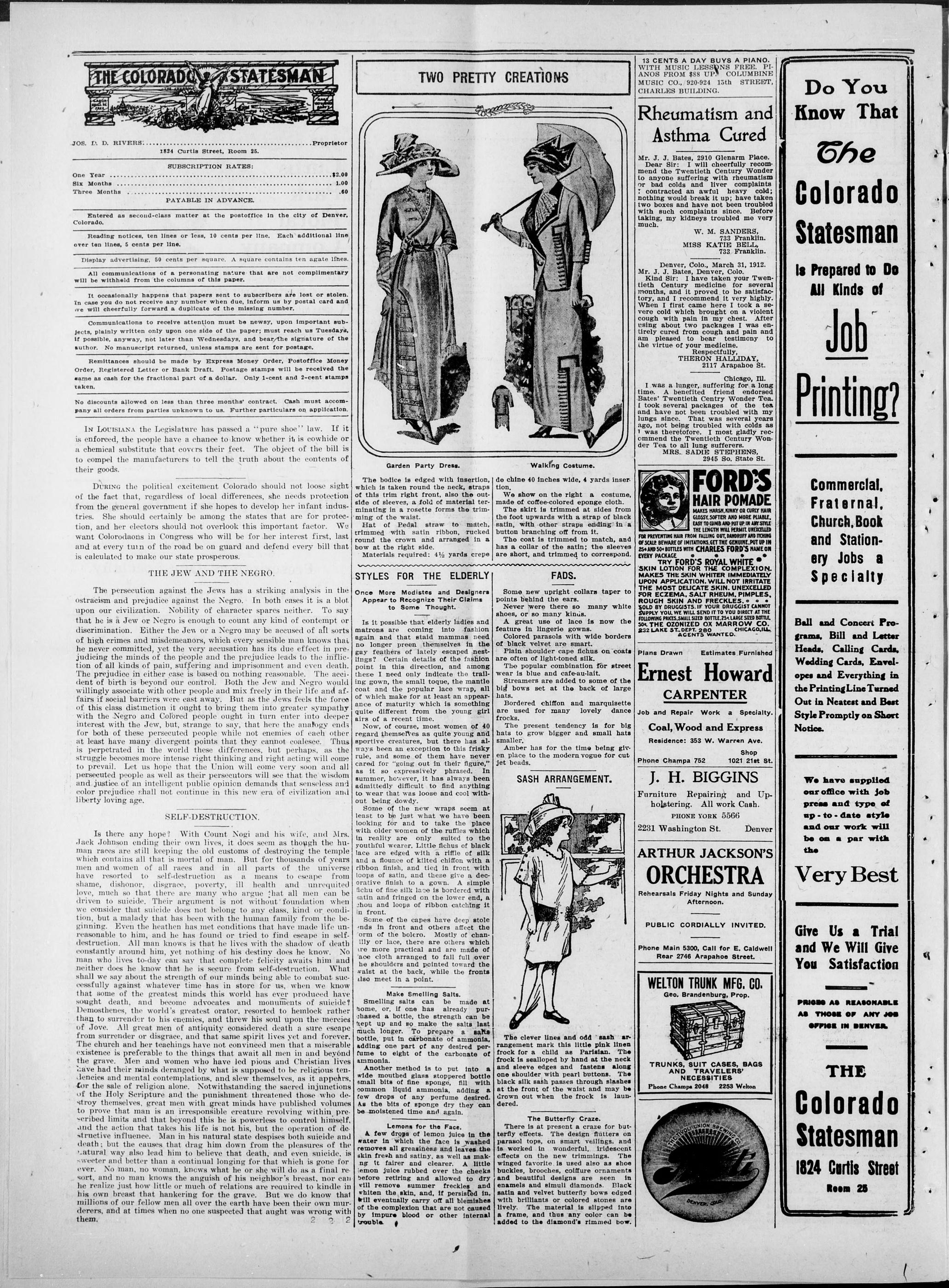
Garden Party Dress.
The bodice is edged with insertion, which is taken round the neck, straps of this trim right front, also the outside of sleeves, a fold of material terminating in a rosette forms the trimming of the waist.
Hat of Pedal straw to match, trimmed with satin ribbon, rucked round the crown and arranged in a bow at the right side.
Materials required: $4\frac{1}{2}$ yards crepe
STYLES FOR THE ELDERLY
Once More Modistes and Designers Appear to Recognize Their Claims to Some Thought.
Is it possible that elderly ladies and matrons are coming into fashion again and that staid mammas need no longer preen themselves in the gay feathers of lately escaped nestlings? Certain details of the fashion point in this direction, and among these I need only indicate the trailing gown, the small toque, the mantle coat and the popular lace wrap, all of which make for at least an appearance of maturity which is something quite different from the young girl airs of a recent time.
Now, of course, most women of 40 regard themselves as quite young and sportive creatures, but there has always been an exception to this frisky rule, and some of them have never cared for "going out in their figure," as it so expressively phrased. In summer, however, it has always been admittedly difficult to find anything to wear that was loose and cool without being dowdy.
Some of the new wraps seem at least to be just what we have been looking for and to take the place with older women of the ruffles which in reality are only suited to the youthful wearer. Little fichus of black lace are edged with a riffle of silk and a flounce of kilted chiffon with a ribbon finish, and tied in front with loops of satin, and these give a decorative finish to a gown. A simple fichu of fine silk lace is bordered with satin and fringed on the lower end, a chou and loops of ribbon catching it in front.
Some of the capes have deep stole ends in front and others affect the form of the bolero. Mostly of chanilly or lace, there are others which are more practical and are made of face cloth arranged to fall full over the shoulders and pointed toward the waist at the back, while the fronts also meet in a point.
Make Smelling Salts
Smelling salts can be made at home, or, if one has already purchased a bottle, the strength can be kept up and so make the salts last much longer. To prepare a salts bottle, put in carbonate of ammonia, adding one part of any desired perfume to eight of the carbonate of ammonia.
Another method is to put into a wide mouthed glass stoppered bottle small bits of fine sponge, fill with common liquid ammonia, adding a few drops of any perfume desired. As the bits of sponge dry they can be moistened time and again.
Lemons for the Face.
A few drops of lemon juice in the water in which the face is washed removes all greasiness and leaves the skin fresh and satiny, as well as making it fairer and clearer. A little lemon juice rubbed over the cheeks before retiring and allowed to dry will remove summer freckles and whiten the skin, and, if persisted in, will eventually carry off all blemishes of the complexion that are not caused by impure blood or other internal trouble.
Walking Costume.
de chine 40 inches wide, 4 yards insertion.
We show on the right a costume, made of coffee-colored eponge cloth.
The skirt is trimmed at sides from the foot upwards with a strap of black satin, with other straps ending in a button branching off from it.
The coat is trimmed to match, and has a collar of the satin; the sleeves are short, and trimmed to correspond.
FADS.
Some new upright collars taper to points behind the ears.
Never were there so many white shoes, or so many kins.
A great use of lace is now the feature in lingerie gowns.
Colored parasols with wide borders of black velvet are smart.
Plain shoulder cape fichus on coats are often of light-toned silk.
The popular combination for street wear is blue and cafe-au-lait.
Streamers are added to some of the big bows set at the back of large hats.
Bordered chiffon and marquisette are used for many lovely dance frocks.
The present tendency is for big hats to grow bigger and small hats smaller.
Amber has for the time being given place to the modern vogue for cut jet beads.
SASH ARRANGEMENT.
A
The clever lines and odd sash arrangement mark this little pink linen frock for a child as Parisian. The frock is sealloped by hand at the neck and sleeve edges and fastens along one shoulder with pearl buttons. The black silk sash passes through slashes at the front of the waist and may be drown out when the frock is laundered.
The Butterfly Craze
There is at present a craze for butterfly effects. The design flutters on parasol tops, on smart veilings, and is worked in wonderful, iridescent effects on the new trimmings. The winged favorite is used also as shoe buckles, brooches, collure ornaments and beautiful designs are seen in enamels and simuli diamonds. Black satin and velvet butterfly bows edged with brilliants or colored stones are lively. The material is slipped into a frame, and thus any color can be added to the diamond's rimmed bow.
13 CENTS A DAY BUYS A PIANO.
WITH MUSIC LESSONS FREE. PIANOS FROM $88 UP. COLUMBINE
MUSIC CO., 920-924 15th STREET.
CHARLES BUILDING.
Rheumatism and Asthma Cured
Rheumatism and Asthma Cured
Mr. J. J. Bates, 2910 Glenarm Place.
Dear Sir: I will cheerfully recommend the Twentieth Century Wonder to anyone suffering with rheumatism or bad colds and liver complaints.
I contracted an awful heavy cold; nothing would break it up; have taken two boxes and have not been troubled with such complaints since. Before taking, my kidneys troubled me very much.
W. M. SANDERS,
733 Franklin.
MISS KATIE BELL,
733 Franklin.
Denver, Colo., March 31, 1912.
Mr. J. J. Bates, Denver, Colo.
Kind Sir: I have taken your Twentieth Century medicine for several months, and it proved to be satisfactory, and I recommend it very highly. When I first came here I took a severe cold which brought on a violent cough with pain in my chest. After using about two packages I was entirely cured from cough and pain and am pleased to bear testimony to the virtue of your medicine.
Respectfully,
THERON HALLIDAY,
2117 Arapahoe St.
Chicago, Ill.
I was a longer, suffering for a long time. A benefited friend endorsed Bates' Twentieth Centry Wonder Tea. I took several packages of the tea and have not been troubled with my lungs since. That was several years ago, not being troubled with colds as I was theretofore. I most gladly recommend the Twentieth Century Wonder Tea to all lung sufferers.
MRS. SADIE STEPHENS,
2945 So. State St.
FORD'S
HAIR POMADE
MAKES HARSH, KINKY OR CURLY HAIR
GLOSSY, SOFTER AND MORE PLABLE,
EASY TO GMB AND PUP UP IN ANY STYLE
THE LENGTH WILL PERMIT URECELLED
FOR PREVENTING HAIR FROM FALLING OUT DANDBROUF AND ITSING
OF SCALE BEWARE OF IMITATIONS, GET THE GENUINE, PUP UP IN
25+ AND 50+ BOTTLES WITH CHARLES FORD'S NAME ON
EVERY PACKAGE
TRY FORD'S ROYAL WHITE
SKIN LOTION FOR THE COMPLEXION.
MAKES THE SKIN WHITER IMMEDIATELY
UPON APPLICATION. WILL NOT IRRITATE
THE MOST DELICATE SKIN. UNEXCELLED
FOR ECZEMA, SALT RHEUM, PIMPLES,
ROUGH SKIN AND FRECKLES. . . .
SOLD BY DRUGGISTS. IF YOUR DRUGGIST CANNOT
SUPPLY YOU, WE WILL送 IT TO YOU DIRECT AT
THE FOLLOWING Prices, SMALL SIZED BOTTLE, 25*LARGE SIZED BOTTLE,
50% THE OZONIZED OX MARROW CO.
234 LAKE ST, CHICAGO, IL 61211,
WHO WANTS WENT
Ernest Howard
CARPENTER
Job and Repair Work a Specialty.
Coal, Wood and Express
Residence: 353 W. Warren Ave.
Shop
Phone Champa 752
1021 21st St.
J. H. BIGGINS
Furniture Repairing and Upholstering. All work Cash.
PHONE YORK 5566
2231 Washington St. Denver
ARTHUR JACKSON'S ORCHESTRA
Rehearsals Friday Nights and Sunday Afternoon.
PUBLIC CORDIALLY INVITED.
Phone Main 5300, Call for E. Caldwell
Rear 2746 Arapahoe Street.
WELTON TRUNK MFG. CO.
Geo. Brandenburg, Prop.
TRUNKS, SUIT CASES, BAGS
AND TRAVELERS'
NECESSITIES
Phone Champa 2048 2253 Welton
THE TIVOLY UNION BREWING CO.
Rita
DENVER, SOLO.
Do You Know That
The Colorado Statesman
Is Prepared to Do All Kinds of
Job
Printing?
Commercial, Fraternal, Church, Book and Stationery Jobs a Specialty
Ball and Concert Programs, Bill and Letter Heads, Calling Cards, Wedding Cards, Envelopes and Everything in the PrintingLine Turned Out in Neatest and Best Style Promptly on Short Notice.
We have supplied our office with job press and type of up-to-date style and our work will be on a par with the
Very Best
Give Us a Trial and We Will Give You Satisfaction
PRICES AS REASONABLE
AS THOSE OF ANY JOB
OFFICE IN DENVER.
THE
Colorado
Statesman
1824 Curtis Street
Mrs. Wm. L. Puliam of Memphis, Tenn., is a guest at the Lorena.
Rev. James Rodgers of Albuquerque, N. M., is the guest of his cousin, Mrs. H. J. M. Brown, this week.
Mr. and Mrs. Thos. Cooley of Cheyenne are in the city, the guests of Mr. and Mrs. I. H. Harper.
J. B. Oglesby has returned from Pueblo, where he went on business. A letter was received from Faulkner, who is at present in N. ville, Tenn., desires to be remember to his Denver friends.
Charles Lightner and family, a several weeks' visit with relatives, will leave the city next w
Mrs. Scott De Neal left the city this week for Seattle, Washington. Her stay will be indefinite.
R. H. Rutherford, vice president of the National Benefit Association, is in the city, stopping at the Lorena.
One by one our visitors are depart in for their respective homes, hence social affairs were rare the past week.
Mrs. D. H. Williams left Friday for a month's visit with relatives and friends in Kansas City, Kans., and Nashville, Tenn.
Mrs. Henry Rogers and children, after er spending several weeks in the city, visiting Mr. Rogers returned to their Pueblo home Sunday.
Mrs. Dora Rolley of 743 E Twenty-sixth avenue leaves Saturday for Vancouver, B. C., to visit her sister, Mrs. Anna Lindsey.
D. B. Faw and Curtis Harris returned to the city Monday from Estes Park, where they have been employed at the Hotel Stanley.
Herman W. Bush left Wednesday for Indianapolis, Ind., on a visit to relatives and friends. His stay is indefinite.
J. W. Early, a brother-in-law of the late Mrs. A. M. Ward, was in attendance at her funeral. He is from Kansas City, Kansas.
Daniel Anderson, a pioneer of Denver and brother of the late Mrs. R. W. Mosby is quite ill with dropsy at his residence 3039 Walnut street.
Mrs. De Loache left the city Tuesday for Kansas City, where she will spend several months visiting her daughter, Mrs. James.
Mrs. Lena Taylor of 2239 Arapahoe street accompanied her daughter, Marie, to Kansas City, where she will attend school. Mrs. Taylor will visit friends in Kansas City for two weeks.
William Mash a prominent business man of Spokane, Wash., passed through the city Wednesday en route for Kansas City and points East.
A. G. Travers is at Mercy hospital, where he underwent an operation for an intestinal trouble. Dr. A. L. Bennett, the well known surgeon, has charge of the case.
Mrs. Charles Roberts of Independence, Mo., who has been spending the summer in the city, visiting her mother, Mrs. Hattie Williams of Englewood, returned home last Saturday.
Pocketbook, money and keys lost at Shorter's church, Thursday, during Mrs. Ward's funeral. Kindly return book and keys to this office.
The remains of John H. Brown were shipped from the Douglass Undertaking Co. parols Thursday, 19th inst., to New York City for interment.
The "Owls" will give their first colossal ball at Eureka hall, Tuesday evening, September 24. The committee is working hard to make this event the greatest of the season.
E. R. Page of the Five Points Billiard parlor has enlarged his place, as his business had so increased that such a course was rendered absolutely necessary.
Harry Cowell and wifo left the city yesterday for Dallas, Texas. Mrs. Cowell spent the summer here. Her general condition of health shows marked improvement. Mr. Cowell has been in the city since last Friday.
Mrs. Adline Smith, who died at her residence, 2132 Quitman street, Friday Sept. 13, was buried from the Lawn horn Undertaking parlors last Monday afternoon. Rev. Wallace officiating.
```markdown
```
J. B. Oglesby has returned from Pueblo, where he went on business.
Pueblo, where he went on business.
A letter was received from Dr. Faulkner, who is at present in Nashville, Tenn., desires to be remembered to his Denver friends.
Charles Lightner and family, after several weeks' visit with relatives and friends, will leave the city next week for Colorado Springs for a short visit with Mrs. S. Rice, en route for Guthrie, Okla., where Rev. Lightner is stationed.
Mrs. Lola McDaniel, a charming young matron of San Francisco, Calif., spent a few days in the city this week as kuest of J. H. Doniphan, her uncle, she is en route to Kansas City, Kan., on a visit to Mrs. L. D. Hall, her mother.
We have just passed through a week of great splendor, occasioned by the magnificent display made by the firemen. Denver certainly has a right to be proud of her fire department, which is second to none in any city. The colored hose company, as usual, acquitted itself nobly, and in the thrilling dash it held its own.
Complimentary to Mrs. N. J. Asberry of Tacoma, Wash., Mesdames Josephine Cassells and Julia Hubbard gave a six o'clock dinner last Saturday. The house was beautifully decorated and the table was bountifully supplied with all the viands calculated to tickle the palate of the most discriminating epicure. A few friends were invited to meet the guest of honor.
Mrs. F. Allen of 3532 Wewatta street gave a handsomely appointed surprise birthday party on her husband last Saturday on his 44th birthday. A few of their intimate friends were invited and made the occasion a joyous affair. It was inded a complete surprise to Mr. Allen, who was the recipient of many useful presents. Refreshments were served and an enjoyable evening was spent.
Mrs. Nettie J. Asberry of Tacoma, Wash., who has been spending several months in the city as house guest of her sisters, Mesdames, W. B. Townsend and America Finley, left the city last Sunday for Ogden, Utah, to visit her niece, Mrs. Flossie Craig Stewart. Mrs. Asberry is a leader in club and social circles in her home city; an accomplished musician and a linguist of rare ability.
SCOTT M. E. CHURCH NOTES.
Twenty-sixth and Clarkson Sts.
The Rev. J. D. Rice will preach his farewell sermon Sunday evening. Friends and admirers of this brilliant young preacher are invited to hear this sermon. It promises to be a message out of the ordinary.
The Rev. D. Smith. district superintendent, was well pleased with the tremendous progress that Scott has made during the last three months. The largest offering of any previous quarterly meeting was given last Sunday. Brother C. L. Smith, the district steward, wishes to thank the members of Shorters and Campbell for their liberal offering and large attendance all day. Brother Smith is the right man in the right place.
The Rev. H. L. Cato, an old friend of the pastor, of the Puget Sound conference of a few years ago, will preach Sunday morning. Do not fail to hear this eloquent preacher. He is now stationed at Proenix, Ariz.
Mrs. Jeanette Bailey continues ill. We wish for her a speedy recovery.
The Ladies' Aid Society will have its semi-election election Thursday, September 26th. All members are urged to be present on this day.
Mrs. Luella Williams conducted the Epworth League last Sunday. It was a special program of speeches and songs.
The choir has added three new members—Mr. Binkley, Mr. Taylor and Mrs. Richardson. A sacred concert will be rendered on the first Sunday evening in October. Do not fail to hear these beautiful new songs.
The Sunday evening services will commence fifteen minutes earlier on account of the shortening of the days. The Epworth League will begin at 6:45.
Mr. George B. Pash, the energetic recording steward, is busying himself in the interest of the pastor's salary, to his great delight. Prizes are offered each month by him for the largest attendance at the mid-week meetings and for the class giving the largest collections during the month. Keep that up, Brother Pash.
Don't forget that Harry Jones has moved his barber shop from 1022 19th street to 929 21st street, where he has installed all of the latest and most up-to-date instruments that go to make a first class Tonsorial Parlor. Call and see us and you will be pleased.
NOTICE
The negro year book can be bought at the Colorado Statesman's office, 1824 Curtis street, room 25 or of J. H. Donliphan, 1721 Marion street. A card will meet with an immediate response.
MRS. ELLA NORA CROSBY WARD.
Mrs. Ella Nora Crosby Ward was born of Alex and Hannah Crosby in Hannibal, Mo., June 4, 1868. She died in Cheyenne, Wyo., Sunday, Sept. 15, 1912, at 7:15 p. m. Age 44 years, 3 months, 11 days.
When yet a child she moved with her parents to Saline county, Mo., where she lived until she was united in marriage to the Rev. A. M. Ward, Sept. 20, 1887. For almost twenty-five years she has shared the joys, successes, burdens and sorrows of her husband in the ministerial life. To this happy union three children were born: A. Wayman, H. Vera and T. Vergil, all of whom survive her.
She was happily converted and united with the church at the age of fifteen years. For more than twenty-nine years she has lived a consistent Christian life, and a faithful member of the church. For the past fifteen years her life has been consecrated and devoted to the missionary work of the church wherever it has been her lot to labor. She has been able to fire the hearts of most every member in the charges. Her missionary work was done largely in the state of Kansas where she moved with her husband immediately after her marriage. Her five years of faith work in Colorado and the Colorado conference reached its climax when she was just elected to the presidency of the work in the conference but was called to her reward ere she could assume the duties of that office.
She leaves behind her a husband, fully devoted to her; three children as dear to her as her own life, one child who has been ordained to the Christian ministry, a brother, a sister, other relatives and a host of friends, who mourn her loss.
Rev. Pope, the recently appointed pastor of Shorter's, had charge of the services. Rev. Washington read a portion of Scripture. Rev. Wallace read the song service. Rev. Wiseman sang a solo. Resolutions on the death of Mrs. Ward were read from the following orders: Women's Mite Missionary Society, Mrs. Ida DePriest; Stewardess Board, Mrs. Glenn; A. M. E. Sabbath School, J. C. Porter; Sewing Circle, Mrs. Linzey; Deaconess Mrs. L. Lewis; Trustee Board, Mrs. Glenn, Taka Art, Mrs. Theta Miller; Eastern Star, Mrs. J. R. Contee. Solo by Mrs. Lillian Jones. Obituary read by Rev. Holmes. Sermon was delivered by Rec. J. C. C. Owens, who had known the deceased for a number of years. Solo by Miss Jennie Hicks. There was a profusion of flowers, the gifts of friends who honored, loved and admired the deceased. Interment was at Fairmount cemetery. Lawhorn Undertaking Co. in charge.
RESOLUTIONS
Resolutions of the Ministerial Alliance of Denver.
Whereas, it has pleased our Heavenly Father to remove from our midst and to take unto himself the wife of our co-laborer and the friend of humanity, Mrs. Elnora Crosby Ward; and
Whereas, Mrs. Ward had, by reason of her devoted and devout life, so deared herself, not only to Shorter Chapel, of which her husband was pastor, but to the churches of the city and community as well; and
Whereas, in her death the cause of Christ suffers an irreparable loss; be it
Resolved: That the Ministerial Alliance of Denver, of which Rev. A. M. Ward is an honored and faithful member, tender him and his bereaved children its deepest and sincerest sympathy, and prays that in this sad hour of their bereavement and loss that they may be sustained by His grace and resigned to His will, who hath said, "I will never leave nor forsake thee." Be it further
Resolved: That a copy of these resolutions appear in "The Statesman," "The Colorado Statesman," and the "Independent," and a copy given the family.
R. L. POPE,
A. E. REYNOLDS,
H. FRANKLIN BRAY,
Committee.
Denver, Colo., Sept. 18, 1912.
We, the members of the Deaconesses board of Shorter A. M. E. Church, tender the following resolutions:
Whereas, it has pleased the Ruler of the universe to take from our midst our beloved co-worker, Sister E. N. Ward;
Resolved, That we extend to our presiding elder and family our deepest sympathy in this their sad hour of bereavement.
Jesus, while our hearts are bleeding, O'er the spirit that death has won, We would at the solemn meeting Calmly say, Thy will be done.
Though cast down, we are not forsaken, Though afflicted, not alone. Thou didst give and thou hast taken. Blessed Lord thy will be done.
Resolved, That a copy of the resolutions be sent the bereaved family, one to the papers of Denver; also that they be recorded in the minutes of the Deaconesses Board.
SISTER UNITY HALL,
The Pullman's Shining Parlor for iadies and gentlemen. Price 5 cents a shine. G. Crowder, proprietor, 1214 Nineteenth street.
COLORADO IS A WET STATE
And Denver with its regulated policy should see to it that it is kept in the wet column. Take for instance New York, Chicago, Philadelphia, San Francisco, Los Angeles, where the policy is to encourage the investors. They are all prosperous and are gaining in population. The open policy of these cities keep them far in the lead of more restricted municipalities. It is a known fact that wherever sportsmen gather in any considerable number the conditions are always better for our people, as they can more readily secure employment. Prohibition is not calculated to encourage anyone to come here, unless they wish to come and fight against those who have their money invested in liquor and brewery business. We must not loose sight of this fact. As stated in The Colorado Statesman several years ago, the Anti-Saloon League is merely the advance guard of the Prohibition army, its duty is to feel the public pulse, after which they await the coming of the dry host, who will fight to the last ditch "regardless of cost," to destroy instead of regulating the liquor business. Post yourselves on the question of prohibition. Study its effect in states where it has been adopted and it will convince you that prohibition should not be adopted in Colorado; unless you want to see the state put on the bum.
COLORADO ANNUAL CONFERENCE
Appointments—1912-13.
COLORADO ANNUAL CONFERENCE
Denver, Campbell Chapel—Rev. H. F. Brax
Colorado Springs—C. H. Boone.
Pueblo, St. John—J. B. Holmes.
Cheyenne—James Washington.
Pueblo, St. Paul—To be supplied.
Salt Lake City—S. S. Freeman.
Grand Junction and Glenwood—J
W. Fant.
Salida and Leadville—To be supplied.
Sheridan—B. F. McCully.
Ogden—J. H. Brown.
Crawford and Alliance—P. M. Maxfield.
Rock Springs—To be supplied.
Albuquerque District.
Presiding Elder, J. H. Tillman.
Albuquerque, N. M.—J. W. Rodgers.
Phoenix, Ariz.—To be supplied.
Tucson—T. L. Cate.
Raton, N. M.—W. E. Ratcliffe.
La Junta, Colo.—K. P. Bond.
Durango and Silverton—To be supplied.
Douglas, Ariz.—P. M. Rickman.
Santa Fe—D. E. Perry.
Globe—W. T. Thornton.
Trinidad—J. M. Endicott.
Walsenberg—P. D. Yochum.
Las Vegas—To be supplied.
Transfers.
J. C. C. Owens to Kansas.
W. H. Prince to Georgia.
J. C. Bell to Missouri.
LOW ROUND TRIP FARES.
By Way of the Denver & Rio Grande Railroad, "The Scenic Line of the World."
$7.20 round-trip to Trinidad, account Trinidad-Las Animas County Fair, Sept. 24-27, 1912. Tickets on sale Sept. 23-25, inclusive. Final return limit, Sept. 29, 1912.
$14.00 round-trip to Grand Junction, account Mesa County Industrial and Fruit Fair, Sept. 24-27, 1912. Tickets on sale Sept. 23-24, 1912. Final return limit, Sept. 30, 1912.
For reservations and further detailed information, apply at City Ticket office, 17th and Stout streets. Telephone Main 605.
Relics of Roman Leglon.
In the course of recent excavations at Chester, Eng., for the extension of a local hospital, the skeletons of 18 soldiers of the 20th Roman Legion, which once occupied Chester, were found, interred, with their heads toward the north. Roman pottery, bottles, files and sandals were also found, many of these relics being in a state of perfect preservation.
Art of Cookery.
"The art of cookery is as old as history; its development measures the development of civilization. More people are engaged in cooking all or a part of their time than in any other occupation. On the selection and preparation of food depends, more than on any other single factor, the health and consequent happiness and prosperity of mankind."—American School of Home Economics.
Saving Old Trays
When a japanned tray becomes old and chipped, give it two coats of white paint and one of enamel, the bottom as well as the top. Stand it on the edge to dry after each coat. It will be found as good as new, as well as very pretty. The enamel is easily renewed.
FRIENDS ALL WANT IT.
Mrs. D. B. Simmons of Silex, Ark., writes: "I tried one bottle of Ford's Hair Pomade and found it to be the best preparation I have ever used. It stopped my hair from falling out and breaking off and my hair is now as soft as it can be and is longer than it has been for a long time. My friends all want it. Ford's Hair Pomade, the old, reliable dressing for stubborn, curly hair makes harsh hair more pliable, glossy and easy to comb. Try it and Ford's Royal White Skin Lotion, for the complexion. For sale by druggists, accept no other, see that it is Ford's and manufactured by the Ozonized Ox Marrow Company, Chicago, Ill.
```markdown
```
GRAND Autumn Ball
THE "OWLS"
WILL GIVE THE
LOSS A
Of the Season at
Tuesday Evening
Don't miss this event Every
ments in the R
WEBSTER, S FULL ORCHEST
The MUSIC
COMM
Syl Stewart, Bud Thomas, Chas.
White, Mack Smart, Webb La
ing, Royal Duke, Paul
When You
The Heads, Feet, Tails
or Chiterlings or any
except the squ
East's
IVE THE FIRE
CLOSSAL BALL
season at EUREK
Evening, September
event Everybody will be
events in the Palm Garden
L ORCHESTRA WILL H
ADMIN
Of the Season at EUREKA HALL Tuesday Evening, September 24th Don't miss this event Everybody will be there. Refreshments in the Palm Garden WEBSTER,S FULL ORCHESTRA WILL BE THERE WITH The MUSIC ADMISSION 50 cents
COMMITTEE
In You We
Feet, Tails, Snouts
gts or any other pa
not the squeal go to
st's Mar
et.
Your Home
Decorated Tivoli
BOTTLED BY
EMPIRE BOTTLE
PhONE Gallup 245
PRODUCER TO THE
Syl Stewart, Bud Thomas, Chas. Downing, Jimmie Berry, Tommy White, Mack Smart, Webb Lawson, Geo. Dean, Gus Downing, Royal Duke, Paul Caldwell, Floor Manager.
When You Want
The Heads, Feet, Tails, Snouts, Neckbones or Chiterlings or any other part of the hog except the squeal go to
Supply Your H
Celebrated
BOTTL
THE EMPIRE
PhONE G
FROM THE PRODUCER
Supply Your Home with the Celebrated Tivoli Beer BOTTLED BY THE EMPIRE BOTTLING CO. PhONE Gallup 245
A farm in the countryside.
FROM THE PRODUCER TO THE CONSUMER
A. S. Britton, who has been a resident of Arvada for a number of years, where he owns some very valuable property, has gone into the truck gardening business on an extensive scale. He has purchased two wagons, secured his license and is now prepared to deliver fresh eggs and all kinds of garden truck in all parts of the city. All goods sold by him are raised on his own farm, hence buyers are assured of good and fresh garden truck at all times. Mr. Britton is also handling fruit of all kinds, such as apples, pears, peaches, plums, etc., from the
Fort Rent—Three nice unfurnished rooms. Apply 2929 Glenarm Place.
Brickler's New Barber Shop is located at 2208 Larmer street. Shave, 10c. Hair Cut, 25c; Children, 15c.
Two nicely modern furnished rooms for rent at 3214 Champa street.
Nicely modern furnished rooms for rent. Apply 2218 Clarkson street.
---
2300-6 Larimer Street.
THE FIRST CO-
L BALL
EUREKA HALL
September 24th
body will be there. Refresh-
Palm Garden
TRA WILL BE THERE WITH
ADMISSION 50 cents
ATTEE
Downing, Jimmie Berry, Tommy
Dwson, Geo. Dean, Gus Down-
Caldwell, Floor Manager.
You Want
Hits, Snouts, Neckbones
other part of the hog
neal go to
Market
Home with the
Tivoli Beer
ED BY
BOTTLING CO.
fallup 245
TO THE CONSUMER
Western Slope, which he will sell direct to his customers, thus saving them from dealing with middlemen.
He guarantees everything he handles to be fresh, wholesome and reasonable in price. He has already sold 1,800 gallons of peas off of his place and other vegetables in proportion. He is the only colored man that we know of in this vicinity who has had the courage to engage in the truck gardening business on such an extensive scale and he should receive excellent patronage. Phone number, Arvada 1881.
High Cost of Living in Madrid. Living is costly in Madrid. Even a modest "apartment" costs $750 a year. Servants, however, cost much less than in the United States.
Uncle Pennywise Says:
Give a woman a gallon of leftover lemonade and she immediately wants to arrange a reception.
Phone Main 1461
CAUSE OF TERROR
Vagaries About Lightning Without Reason.
Although It Causes Fewer Violent Deaths Than Any Other Foe of American, It Is Feared Most
They agree that your danger from the celestial artillery depends principally upon the locality in which you live, and your shelter at the time of the storm. The weather bureau, by careful observation and tabulation, discovers our zone of greatest danger from lightning to include an irregular area of the east, covering all the Atlantic coast states from Massachusetts to Virginia, inclusive, and biting inland until it takes in southern Vermont, Pennsylvania, West Virginia, Ohio, Kentucky, Indiana and eastern Illinois. Thunderstorms therein are more fatal though less frequent than in the Gulf states. If you wish to escape thunderstorms almost entirely, pitch your tent upon the Pacific slope, where such storms are practically unknown. Or, if required to dwell within the danger zone, select for your castle a house in the midst of a city block with continuous tin roofs connected to well anchored waterspouts.
The fact that lightning annually strikes four times as many people of outdoor occupations as people in general emphasizes the wisdom of keeping indoors during such disturbances. But if caught in the open bear in mind that you are far safer in the dense heart of a wood than at its outskirts, and that the shelter of a single tree is particularly treacherous, especially if near the edge of a body of water, even a ditch. But if you must be near a tree, seek the companionship of the beech, which is struck least often of all, and avoid particularly the oak, which attracts lightning more than any other.
The oak is hit fifty-seven, the fir thirty-nine and the pine five times as often as the beech. Avoid above all else a tree or other shelter where under a group of men or beasts are huddled together. While in the shadow of the thunderhead, monarch of all clouds, be exclusive. The weather bureau also warns you against doorways, particularly of barns and atables; also a house connected with a metallic clothes line.
While successful in tabulating the destructive and fatal effects of lightning and, by deduction, formulating such common-sense rules as the above, our weather bureau, in common with other great meteorological institutions, finds the force behind the fiery cannon balls and projectiles of Jupiter Pluvius too illusive and vagarious to be reduced to law. For years the bureau has been gleaning from all parts of the world reports describing the eccentricities of this awe-inspiring phenomenon, of, which Flammarion has said:
"It is like an elementary spirit, eccentric or rational, clever or silly, farseeing or blind, headstrong or indifferent, passing from one extreme to the other. It wriggles through space, it moves among men with surprising agility, appearing and disappearing like lightning."
But the most weird of all lightning pranks on record is that of killing a man and leaving him standing erect, as in life. Such a phenomenon was lately reported by a Canadian observer, C. Ballarge, who near Beaumont saw a man struck by a thunderbolt while walking in a field. Although dead, he remained motionless, standing with one foot in front of the other in the attitude of taking a step.
PRESIDENT FOR A DAY.
In the talk about electing presidents of the United States it is recalled that Senator David Rice Atchison of Clay county, Mo., claimed the unique distinction of holding the office of president of the United States for one day. The terms of office of President James K. Polk and of Vice-President George M. Dallas terminated by limitation on Saturday night at midnight, March 4, 1849. Gen. Zachary Taylor, Polk's successor was not inaugurated until Monday, March 5, 1849. Senator Atchison was at the time president pro tem, of the United States senate. The expiration of vice-President Dallas' term left a vacancy to which Senator Atchison instantly succeeded. This made him ex-officio vice-president of the United States, but at the same instant there was likewise a vacancy in the presidential office, to which in turn Atchison instantly succeeded.
FAVORS A RETIREMENT LAW.
"If there were a retirement law for the clerks employed by Uncle Sam in the various departments at Washington, the civil service would not be cluttered up by a small army of aged and inefficient clerks," said W. R. Hayes, former congressman from Nebraska, the other day.
"As it is now, no head of a department or bureau chief will discharge a man or woman who has been a faithful worker for 30 years or more, because old age has impaired the usefulness of the employee. As a result, there are hundreds, if not thousands, who are kept on the rolls merely as a matter of humanity. If dismissed they would in many instances be thrown upon the charity of the world, for it is utterly out of the question that private employment could be obtained for them.
The stupidity of the clerks themselves has been one of the chief reasons why a liberal retirement law has failed of passage for all these years. The clerks can never agree on any policy among themselves. Many of them obstinately contend that the government has no right to withhold a dollar of their salaries to go into a pension fund for retired clerks, ignoring the recognized improvidence of that large per cent. of employees who never save a penny of their salaries, it would be an act of beneficence toward this class if a portion of their wages was regularly retained.
"Unquestionably, it would be cheaper for the government to give a pension outright to those whose faculties are decayed, and to put young and vigorous people in the place of the superannuated. Every other first-class nation in the world save the United States has some kind of pension scheme for its civil servants, that of Canada, especially, being a model."
MICROBE LOST HOPE
A lonely microbe, disheartened and ready to die because the public health service is rapidly putting all his ilk where they can do humanity no harm, peeked over the edge of Assistant Surgeon General George Rucker's desk the other day and heard the doctor humming a ditty that went like this: "A fly and a flea, a mosquito and a louse, all lived together in a very dirty house. The flea spread the plague and the skeeter spread the chills. All louse spread typhus, too. Folks in bills. The fly spread typhoid and the louse spread typhus, too. Folks in that house were a mighty sickly crew. Along came a man and he cleaned up the house. He screened out the skeeters and swatted the louse. The fly and the flea he cracked on the wall. Now the people in that house are never sick at all."
"Well," piped up the microbe, "that's all right as far as it goes, but it strikes me you've been a bit partial in this thing. How about the bedbug? Where does he get off?" "He's going to get off pretty quick," returned the doctor. "So far the bedbug has been able to prove an alib, but I've put the sanitary detective on his trail and I'll get him yet." Whereupon the microbe, seeing the jig was up, committed suicide by jumping into the inkwell.
11,221,624,084 CIGARETTES
If cigarette smoking is as deadly as some of the antis make out, this country will soon be inhabited exclusively by imbeciles.
During the fiscal year 1912, the tidy number of 11,221,621,084 cigarettes was smoked in this country, an average of about 128 for every man, woman and child. Inasmuch as not all men and women and few children before the walking age smoke cigarettes, the average consumption for those who do is considerably larger than 128.
This eleven billion odd is an increase of two billions over the consumption of 1911, and Secretary MacVeagh and his department officials confess they cannot explain this vast jump.
LIGHT HOUSEKEEPING DISCON
CONTINUED.
Secretary Franklin MacVeigh will not permit any more chafing dish parties in the Treasury building. The noonday parties, the daily teas and dalton hot luncheons have been discontinued. For many years clerks of the treasury have made merry over the chafing dish at noon, but there will be no more of that and everybody will have to go out to get lunch. The sanitary committee of the department recommended that the secretary have the little eating parties discontinued and all cooking utensils removed. Light housekeeping in Uncle Sam's money chest is a thing of the past.
Driving an Alligator:
Using a child's toy wagon and allowing himself to be drawn about by an alligator, is one of the queer methods adopted by a German sportsman to win a wager, says Popular Mechanics. He claimed in a conversation with a friend that there were no less than 10,000 methods of locomotion, and in the dispute that followed he wagered that he could prove it. The bet was taken up by the friend and a trip around the world was undertaken to try out all the various kinds of transportation, and incidentally to devise some new ones. The alligator stunt was carried out at the alligator farm at Los Angeles, Cal.
Worry and Work.
Wiggs—Worry kills more people than work
Wagg—Quite natural! there are more people worrying than working.
LORD CAVENDISH PREFERS U. S. MAIDS TO BEARS
Lord John Compton baron of Chesham, and
som's 10,000 acres of the land which fell to Sir William Cavendish in the dissolution of the monastery lands in Cardinal Wolsey's time, is in America passing eighteen - year-old judgment on American girls. He is preparing to follow in the footsteps of his elder brother
of the land which fell to Sir William Cavendish in the dissolution of the monastery lands in Cardinal Wolsey's time, is in America passing eighteen-year-old judgment on American girls. He is preparing to follow in the footsteps of his elder brother Charles William Hugh, in the army, who died at the head of the Seventeenth Lancers at Diamond Hills. A tall, rangy lad, yellow-haired and blue-eyed, the Baron Chesham would be typically American if he might exchange a slight English accent for a few pieces of American slang.
His first announcement was that, while primarily interested in American girls, he had never been exposed to the love bug, and did not intend to select the future Lady Chesham until after he had served his term in the army. The announcement followed a direct and personal question intended to be leading.
"More than anything else I have noticed your American girls, and I think them ripping, more interesting and more human, though not so pretty, perhaps, as the English girls, and—but, I say, old fellow, this won't be printed in London. What?
"You know they have picked me for a military career over home, and if they knew I was looking over the American girls they would send the Coldstream Guards after me."
Lord Chesham had just returned from a fishing and hunting trip through British Columbia and is on his way home.
Press "cuttings" told of his bagging grizzles single-handed.
"I say, you fellows are wonderful guessers," he laughed, as he looked over some of the "cuttings." "I shot a pheasant and a sparrow and caught some fish which uncle said were so small that I ought to throw them back, and I did."
Uncle, by the way, is Colonel William Edwin Cavendish, lieutenant colonel of the Grenadier Guards. The Colonel and Mrs Cavendish and Miss Bettine Cavendish, like her cousin, more American than English, accompany the young baron.
"I like your country and wish I could stay a while, but uncle seems to think he had better get me back to Buckingham before I elope with some of these pretty girls. But, you know, I haven't met one of them."
The Baron comes of one of the oldest and wealthiest of English families of the nobility. He is a descendant of the first Earl of Burlington and the First Duke of Devonshire, a cousin of the eighth Duke of Devonshire and of the latter's brother, Lord Cavendish, Chief Secretary of Ireland, who was murdered in Phoenix Park, Dublin, by the revolutionary faction known as the "Invincibles."
A KENTUCKY HEIRESS
DOING CHARITY WORK
The fact that she is a wealthy heir- ess does not cause Miss Rebecca Gor- don Averill of Frankfort. Ky., to lead an idle, useless life. On the contrary, she is one of the most active women in her state, in the cause of suffering humanity. Miss Averill is noted in her city for the splendid work she is doing for the children of Frank- fort's Tenderloin
district
Every day, from 9 until 2 o'clock, she may be found in a house in the slums, where she conducts a free kindergarten for children. Here are gathered a happy company of little waifs from homes of poverty and squalor. With the gracious and kindly southern lady to guide them, the children learn how to do many useful things. They also receive clean clothing and are given nourishing food. In addition to the kindergarten work, Miss Averill conducts a class for mothers, and one afternoon each week the women of the district gather in the cozy clubrooms; there to enjoy a social chat, some good music, and incidentally to receive instruction in many household matters and subjects pertaining to child rearing.
Thinks Baths Not Necessary.
Not having taken a bath in twenty years is the record of Ezekiel Parker, a farmer living in the northern part of Craven county, N. C. Several days ago he related the cause of his absence from the tub for such a long time. "When I was a youngster," said Mr. Parker. "my mother took a delight in having me take a bath every day in the year. Rain or shine, hot or cold. I was compelled to immerse myself in the tub. After my mother dled I took no more baths. My health began to improve after I stopped bathing so much and there is not a man in this country who is more healthy than I am." Mr Parker is almost a giant in size. His face is ruddy and he looks the perfect picture of health and from all outward appearance will live to a ripe old age
The recent grant by Mrs. Thomas Fortune Ryan to the Convent of the
Holy Child at,
Suffern, N. Y., of
property valued
at $250,000 serves
to draw attention
to the splendid
work this noble
woman is doing in
behalf of religion,
education and
humanity. The property
at Suffern
consists of a fine
mansion and 18
acres of ground,
and will be used
Suffern, N. Y., of property valued at $250,000 serves to draw attention to the splendid work this noble woman is doing in behalf of religion, education and humanity. The property at Suffern consists of a fine mansion and 18 acres of ground, and will be used by the nuns as an academy for young women. These sisters have their mother house in England. Their largest convent in the United States is at Sharon Hill, near Philadelphia.
Mrs. Ryan's gift to the Holy Child nuns follows a long list of benefactions to the Catholic church and to non-sectarian institutions. These include a million dollar cathedral, rectory and other buildings at Richmond, Va.; a school and a wing to a hospital at Richmond; three Catholic churches in other Virginia towns; a chapel for the Jesuits at St. Andrewson-Hudson; a chapel at Tucson, Ariz, and funds for the support of other chapels in Arizona, New Mexico and Indian Territory; the endowment of rooms for sick telephone girls and nurses at various hospitals; scholarships at four colleges and four convents; a hospital and a chapel for the Sisters of Charity costing $150,000 at Suffern; a hospital for consumptives near Phoenix, Ariz.; the establishment of the Order of the Perpetual Adoration in this country and a convent and chapel for the order at Washington, D. C.; the building of monuments on all the battlefields of Virginia, the state in which Mrs. Ryan and her husband were born, and a great many gifts to institutions throughout the country which are devoted to fighting tuberculosis.
Mrs. Ryan's gifts to charity years ago came to the attention of the pope and the Papal court has made known its gratitude to her for her charities many times. In 1904 she was decorated by Pope Plus X.
"NEWLY RICH" OVERRUN FASHIONABLE NEWPORT2
"The fashionable cities of the east, as Newport and Bar Harbor, have become so overcrowded and over-run with people of every class that the better class of folks are destrous of making some other place their headquarters."
PETER
"There is no use hiding or trying to hide the fact that people of fashion have no proper place in
which to live in America. It is not that they are exclusive. It is not that they are particular. People who have money—and money is easily made in America—are not necessarily fit associates for cultivated people.
"But with their money they are able to get property close by the homes of people who do not wish to associate with them, and, therefore, the latter must move or be regarded as snobs. There are today many common people with money enough to buy homes in refined residence places—and most of them have done so. I do not mean to reflect upon the common people, for they are necessary to the economic development of the world, but I am not compelled to have social relations with people whom I do not like," declares I. Townsend Burden, Jr.
Townsend Burden, who is a member of Meadowbrook and Rockaway clubs and one of the best known polo players in America, about 18 months ago married Miss Florence Sheedy, of Denver, Colo., the wedding being made notable by a check for $1,500,000 given the bride as her dower by her father.
Beyond Even Ty Cobb.
The baseball reporter's English is weird and wonderful, says the Washington Star, and apropos of it there is a story about the great Ty Cobb. In a New York hotel two college professors watched Ty Cobb bent over a newspaper. "Look at that poor fellow's frowns and mutterings," said the first professor. "with that journal." "Yes." said the other, "he can't make it out. you know." "Can't make it out, eh? Can't even read! These baseball players! I knew they were an uneducated lot."
"Oh," said the other. "Ty's educated all right enough; but that's the baseball page he's got there."
Oldest Riddle Known
The oldest riddle known is that one asked by Samson, in Judges 14:14-18: "Out of the eater came forth meat. and out of the strong came sweetness." It was naturally impossible for the guests at his wedding feast to solve the riddle, for it referred to that very uncommon incident of the bees making honey in the carcass of a lion. The old translators used the word meat in the sense of food, its real meaning in the seventeenth century. This riddle dates from possibly a thousand years before the Christian era, and is evidence of the very ancient custom of telling riddles or asking difficult questions.
Furnished Rooms
Parlors
41-45 Arapahoe Street.
MONARCO
CO
SHORT ORDERS AT ALL
oe Street.
THE
ONARCH LIQU
COMPANY
THE MONARCH LIQUOR COMPANY
THE MUNARCH
LIQUOR CO.
IMPORTED & DON
THE ZOBI
SAMPI
1004 Nineteenth
R TED & DOMESTIC WINES & L I E
E ZOBEL BROTHE
AMPLE ROO
Nineteenth Street, Corner of
IMPORTED & DOMESTIC WINES & LIQUORS
THE ZOBEL BROTHERS'
1004 Nineteenth Street, Corner of Curtis
FINE WINES, LIQUORS AND CIGARS COORS' CELEBRATED BEER ON TAP
Right Kind of
ing Matter
the home news; the doings of the pe
own; the gossip of our own commun
the first kind of reading matter you w
more important, more interesting t
hat given by the paper or magazine
outside world. It is the first read
you should buy. Each issue of this
you just what you will consider
The Right Ki
Reading M
purpose of an
tisement
THE
COS
L. L.
The Right
Reading M
The home new
town; the goss
the first kind o
more important
that given by
outside world.
you should buy
to you just w
The Purpose of a
Advertisement
The Right Kind of Reading Matter
The home news; the doings of the people in this town; the gossip of our own community, that's the first kind of reading matter you want. It is more important, more interesting to you than that given by the paper or magazine from the outside world. It is the first reading matter you should buy. Each issue of this paper gives to you just what you will consider
The Right Kind of Reading Matter
is to serve your needs. It will help sell your goods—talk to the people you want to reach. An advertisement in this paper is a reference guide to those whose wants are worth supplying.
A Dollar
Kept with the home men
benefit. Business men s
this dollar at home and n
Kept with the home merchants it is a messenger of continuous benefit. Business men should awake to the importance of keeping this dollar at home and make a bid for it by judicious advertising.
th the home merchants it is a messenger. Business men should awake to the importance at home and make a bid for it by judicious
In Connection There Are Also Nicely
And the Old Reliable Newport Thirst Parlors
TELEPHONE
CHAMPA 1231
DENVER
Richard Frazier and Tom Lewis, Propa.
THE CH LIQUOR MPANY
DOMESTIC WINES & LIQUORS
EL BROTHERS'
LE ROOM
A Street, Corner of Curtis
Kind of matter
s; the doings of the people in this
hip of our own community, that's
of reading matter you want. It is
nt, more interesting to you than
the paper or magazine from the
It is the first reading matter
. Each issue of this paper gives
what you will consider
The Right Kind of
Reading Matter
THE HIGH
COST OF
LIVING
has not affected our job printing prices. We're still doing commercial work of all kinds at prices satisfactory to you.
spent at home reacts in its benefits with unceasing general profit. Sent out of town it's life is ended.
archants it is a messenger of continuous should awake to the importance of keeping make a bid for it by judicious advertising.
DENVER, COLO.
1516
COURT PLACE
COLORADO
HER EXTRA SESSION
Teacher Cynthia Breaks in the New Pupil.
By A. MARIA CRAWFORD.
Bob Lawrence was disturbed. He struck savagely with his cane at the tender flowers along the country road. He had been promised a degree of happiness here and he had failed, as usual, to find it.
"Say, mister," said a small voice, "I wish you wouldn't knock the heads off these flowers. I want about a bushel of daisies to decorate our schoolroom tomorrow. Miss Cynthia's invited the board to hear us speak."
"Cynthia?" questioned Bob, wonderingly. "Cynthia who?"
"She's just Miss Cynthia, that's all," answered Jimmy Green. "She's about the best looker we ever had in this county. Pa said so, and pa knows."
"Does she teach school?"
"You bet she does and we're learning, too, 'cause we love her so we just study our heads off to see her smile," said Jimmy boyishly. "You must be Mrs. Collier's brother, visiting over at Three Oaks. My pa is the gardener there."
"You've guessed right. What's your name?"
"Jimmy Green. Green and gardens go together, pa says."
"Well, they ought to, at any rate. Now, Jimmy, where do you go to school?"
"I don't like to tell you 'cause pa said to me, 'I hope Mrs. Colliar's brother don't see Miss Cynthia, Jimmy, for she's too pretty not to catch any man who sees her and you're learning so well at school, I don't want you to have to change teachers.' Pa's right about that. Why, her face is just the color of the apple blossoms over in your sister's orchard." Jimmy pondered for a second. "Seees like I ought to answer you civil, you being a stranger here. The schoolhouse is about a quarter of a mile straight down this road. She's there all right, Miss Cynthia is. She's keeping Petle Murphy and Tom Vance in to learn their speeches for tomorrow?"
Cynthla! What a train of memories and pleasant dreams the word conjured up for Bob Lawrence, who thanked Jimmy for his information and kept on down the road toward the schoolhouse. This time the wayside flowers were free from his bruising cane. He was thinking—thinking intently of the only girl who had ever stirred any emotion in his heart. She, too, was called Cynthla, and her cheeks were like the apple blossoms in his sister's orchard. He had met her almost a year before, a few hours out from Liverpool. She had been touring the continent with a very wealthy aunt. The girl's beauty had attracted him at once, and later her superb health had been added to her list of other charms. She was the only woman on board, so the steward had told him, who did not miss a meal.
The last night out there had been a moon. Lawrence recalled how eagerly he had waited for her on deck while she went for a wrap after dinner. They had stood together watching the moonlight on the phosphorescent waves and listening to the soft strains of a Hungarian waltz. His love for her, none the less intense because of its short duration, had stirred him mightily, and he had spoken of that love and asked her to marry him.
"No," she had answered, forcing back his arms, "it is not possible. We belong to different worlds."
"What difference would that make, if it were true?" he had demanded. "What do you mean by different worlds?"
"You have money," she had told him. "I belong to the broken down aristocracy of the south. I work for my living. Aunt Lydia took me for this trip because I was her brother's child and she was sorry for my poverty." He remembered with bitterness how he had begged, stormed and argued, but all to no purpose, for Cynthia had remained deaf to his entreaties, protesting that his people would be disappointed.
When they landed, although he had tried to find out where she lived and follow her, she evaded him. His pride stirred then, and he had turned to his work determined to forget the girl, but in that, too, he had failed. The following spring his sister wrote to him. "Your letters sound as if you were blue, so leave your affairs—they are too enormous for a young man, anyway—and come to visit me for ten days. The fishing is fine near here, and you can count on mending your depressed spirits." A voice, young and vehement, broke into his meditation. "Yes'm, I'll do my best. Both of us will, won't we, Tom?"
Lawrence looked about him. There was the schoolhouse, and out the door rushed the two scholars who had been kept in to learn their speeches. He watched them out of sight, wondering what excuse he could offer to the country teacher if he dared go to the door just to look at her because her name was Cynthla.
He heard a sound that made him listen intently. The pretty school teacher was crying. Lawrence walked quietly to the door. Over by a window, her profile turned to him, stood the girl of Jimmy Green's dreams, and, incidentally, of his own.
"Cynthla!" he called.
"Why, it's you," said Cynthla, making a futile attempt to efface all signs of tears. "Will you—will you come in?"
"I will," said Lawrence promptly. "Why did you run away from me in New York?"
"I—I had to go. I mean that I had to come home. I told you enough to make you want to give me up, anyway."
"That is impossible. I can never stop wanting you."
"Do you really care for me like that?" she questioned, grave gray eyes on his face.
"I love you so that nothing else matters, and you—you put me aside for a mere whim, a fancy," said Lawrence, the sight of her beauty setting his pulses on fire again. "How can you treat me so?"
He dropped into one of the scarred little seats and leaned over on the desk marked with many a jackknife and pencil.
"How did you find me—here?"
"Jimmy Green showed me the way," answered Lawrence.
Cynthia moved nearer and stood looking down on the bowed black head.
"Why were you crying when I came?" asked Lawrence, noticing the motion.
"Because——" Cynthia waited for her heart to, quit its stormy beating, but it would not, and she went bravely on—"because I was thinking about you, and I was afraid that I would never see you again."
"Cynthia, do you mean that?" Lawrence was up facing her. "Do you mean that and all that it implies? Do you love me?"
"Yes," said Cynthia brokenly, "I think that I have always loved you."
"When will you marry me? Tonight?"
"Tomorrow after school," laughed Cynthia happily. "I have lately come into some money; quite a lot. I am not a pauper any more."
"You never were a pauper so long as you were you."
"I'm so sorry, Bob. I have to go to a dinner tonight at Mrs. Collier's. Her brother is coming—I forgot to ask his name—and she is most anxious to have me meet him. She is my best friend, and I can't disappoint her. I'll ring her up and ask if I can't take you."
"I'll have to be there, and I'm going to take you. Now you see how heartily my family approves of you after all," laughed Lawrence, holding her close in his arms. "I am the expected brother."
"Why, Bob! Is it possible? Only last week I told her all about you; that is, everything except your name." "Which will soon be yours, too."
"Say, Miss Cynthia," came a voice from the open door where Jimmy Green stood grinning at them, "ain't you holding an entry session today?" "I—I don't know," said the embarrassed school teacher. "She has a new pupil, one that she will have to teach all her life, and she has just been breaking him in," answered Lawrence, smiling to see the apple blossom pink of Cynthia's cheeks turn to crimson. (Copyright 1912 by Associated Literary
HIS ARGUMENT WON ATHEIST
Perhaps Not Strictly Ethical, but It Accomplished What the Rector Set Out to Do.
In raising money to pay for a new church a preacher sometimes has to shut his eyes to the dollars tossed into the plate or slipped into the duplex envelopes. Dr. Robert Nelson Spencer, rector of Trinity Episcopal church, tells this story about a brother clergyman who once went a bit further:
This rector, Dr. Spencer says, was so hard put to it that he decided to solicit funds from an atheist saloon-keeper, who was reputed to be the wealthiest man in the district.
One day, when the rector and the saloonist, with whom he was well acquainted, met on the street, the churchman put the question good and strong.
"I don't believe in the church; it hurts my business," retorted the booze merchant, with indignation in his voice.
"Now, Tom," returned the rector, in his most conciliatory manner, "listen to reason. I maintain that if it wasn't for the church you wouldn't have a chance in the world. The church is the pioneer of civilization, and where the beacon of modern enlightenment burns dimly or not at all the saloon is unknown.
"Suppose you tried to open a 'joint' in darkest Africa," he went on, with a good imitation of enthusiasm. "What would those cannibals do to you the first time one of their number got a drink at your bar and appeared before his tribe intoxicated? Why, sir, they would burn you for a witch; that's what they would do."
The saloon-keeper, Dr. Spencer says, signed up for $500 and later joined the church with all his family—Kansas City Journal.
Greatest Novel.
"What is the greatest novel?" is a question that admits of almost as many answers as there are types of mind. "Ten Thousand a Year," "Don Quixote," "William Melster," "Tristram Shandy," "The Cloister and the Hearth," "The Scarlet Letter," "Ivanhoe," "On the Heights," "Robert Elsere," "Looking Backward," and a hundred others are great novels, and each one of them is the "greatest novel" to somebody. It all depends upon the tempeq of soul and cast of mind in the particular individual. The novel that produces the greatest impression upon you and gives you the greatest all-round satisfaction is for you the "greatest novel." It might not be the greatest to another.
PIE IN PRESS GALLERY
PIE IN PRESS GALLERY
MYSTERIOUS DISAPPEARANCE OF
ONE "LIKE MOTHER MADE."
The Manner in which it Disappeared
Kicked up All Kinds of Disturb-
ance at the South End of the
Capitol—Walter Confesses.
Not many days ago the members of
the press who have the distinction of
belonging to the
house press gallery
were given a rare
treat in form of
two or three crates
of Georgia peaches.
There are many
kinds of Georgia
peaches; some of
them are not
crated for the bene-
fit of the press
gallery, or any one
else, and come one
house press gallery were given a rare treat in form of two or three crates of Georgia peaches. There are many kinds of Georgia peaches; some of them are not crated for the benefit of the press gallery, or any one else, and come one in a package—but we digress, this is a story of a peach pie. It can best be told in the language of a richly endowed wielder of the pen of the Washington Times. We therefore quote: The dramatis personae of this affair are:
Col. Charles H. Mann, superintendent of the house press gallery; Col. E. Jesse Conway of the Associated Press: Howard L. Acton of the Washington bureau of the Cincinnati Times-Star; Frank B. Lord of the International News Service. One peach pie. One colored waiter. Certain hungry bystanders in shape of newspaper men, messengers, house attaches, and members of congress. The story concerns the mysterious disappearance of the peach pie, or rather a large part of it. Its disappearance has kicked up all manner of disturbance at the south end of the capitol. Colonel Mann is an old Virginia cavalryman. Colonel Conway put in some years in the regular army in the Philippines. Both know something of the gentle art of foraging, and both understand the importance of subsistence in a campaign.
So the other day when a member of congress sent to the press gallery two large boxes of fine peaches, the two veterans selected certain of the peaches and quietly took them down to the house restaurant and gave instructions to have a pie constructed after those plans and specifications such as mother used to follow so successfully. The pie was to be two inches thick and with other dimensions in proportion.
All went well for a time. The pie was a success. At noon Colonel Mann and Colonel Conway sat them down together and each ate one-fourth of the pie. It was smothered in cream. Colonel Mann was heard to remark to Colonel Conway, as each bent behind a bastion of pie:
"Gee, I wish some of them fellows could see us."
Having eaten a square meal of pie, they gave orders for its conservation in the ice box until 4 o'clock. Then they were once more to advance to the attack. It was not long after this that Colonel Mann, up in the house press gallery, was heard to make certain remarks commissering folks who were so unfortunate as not to be able to eat real pie. He also let fall certain observations about the pie he would eat at 4 o'clock.
About 2 o'clock, according to the testimony, Howard L. Acton dropped gently down into the house restaurant. Mr. Acton is an accomplished young man, with an indurated countenance, a steely eye, a handsome and yet mephistophellan cast of feature and a canacity for sleight of hand that would make old Hermann the great go chase himself round the block. Mr. Acton stepped into the restaurant, singled out the right waiter, and said:
"Mr. Mann told me to come down here and get a piece of that peach pie over there in the refrigerator."
"Yassah," said the waiter.
"And bring some cream with it," quoth Mr. Acton.
"Yassah."
Presently Mr. Acton was communing with one-fourth of the Mann-Convav peach pie.
Soon Mr. Love hove in sight.
"Frank," said Mr. Acton, standing up from behind a rampart of pie, "tell the waiter Charley Mann said you could have that piece of pie over there in the ice box."
Mr. Lord duly advised the waiter that he had come on a mission of pie as an envoy of Colonel Mann.
Presently there was no pie. It was good pie while it lasted. Mr. Acton and Mr. Lord agreed to that. They got through about 3 p. m. and paid the waiter each a nickel for the cream. Accounts vary as to whether they tipped the waiter.
Punctually at 4 o'clock Colonel Mann and Colonel Conway appeared in the house restaurant. They sat down. They awaited pie.
The pie did not come. An investigation was ordered, and then it developed there was no pie, and the waiter, under the third degree, broke down and confessed.
Uniquely Dressed.
Representative Cyrus A. Sulloway of New Hampshire, the tallest and largest member of the House of Representatives, was uniquely dressed the other day. He wore a large brimmed panama hat, a Prince Albert coat, with trousers to match, russet colored bedroom slippers and pale yellow socks. Uncle Cy likes not a hard shoe.
CAPITAL CAR TICKETS SAFE
Between 80,000,000 and 90,000,000 Are Used Annually by Washingtonians.
No tokens of value issued by any concern in Washington come so near being actual hard cash as do the street car tickets, which sell six for a quarter. The stock market may go up or down; the cost of living may fluctuate; interest rates may vary; the purchasing power of that standard of all values, gold itself, may be more today than tomorrow; but through it all, in hard times and good times alike, the little coupons cost just the same and get the buyer just as much. Like postage stamps, they have a fixed price, below which no one can buy them and above which no one can sell them. Like postage stamps, also, they are "good for one fare," in the very act of giving which they are canceled at once, and their usefulness is gone forever.
Millions of dollars are represented by these humble bits of pasteboard. Between 80,000,000 and 90,000,000 of them—almost one for every person in the United States—are circulated in the district every year. In all, between 80 and 85 per cent of all money received by these companies for the transportation of passengers in the district is first exchanged for car tickets, which are accepted unquestionably by all conductors.
Washington street railroad officials attribute the entire immunity from imitation which their tickets enjoy to the great care with which they are gotten up, as well as the strict methods of accounting for all those issued. These causes, of course, are in addition to the severe penalties which the law visits upon counterfeiting.
WHY ARE HOLES IN CHEESE?
Experts at the Bureau of Animal Industry Tell All About Them.
Why are the holes in cheese? This is no midsumer "gag" or mere conundrum, but a serious query just put forth by the United States Department of Agriculture in a bulletin issued by the bureau of animal industry.
Did you, victim of the Swiss cheese habit, ever stop to consider why the holes, what makes them and what do they contain? The next time you order a cheese sandwich remember the following facts about the gases that cause their formation and if you are terrorized by the scientific terminology be careful not to eat the holes:
The gases of formal "eyes" in Emmental cheese are exclusively carbon dioxide and nitrogen and of these only the carbon dioxide is of significance.
There sometimes occurs during the initial fermentation a gas characterized by the presence of hydrogen. This is believed to be due to the gaseous fermentation of sugar.
The two fermentations are distinct and are characterized by their gaseous products. The one is detrimental, the other that demanded of a good Emmental cheese. High oxygen-absorbing power combined with low permeability of the cheese to air renders the interior thoroughly anaerobic and consequently favorable to the growth of anaerobic bacteria. A comparison between the amount of carbon dioxide evolved and the total of volatile fatty acids shows that the activity of the propionic bacteria of Von Freudenreich and Jensen is not sufficient to account for all the carbon dioxide found.
SCHOOL CHILDREN KILL FLIES
Millions of the Pests Are Slain by Capital Tots Who Win Prizes.
Approximately 10,000,000 files have been killed by Washington school children during the last two months and the war of extermination is going on merrily. The children expect to murder at least two million more before cool weather comes. Following the suggestion of officials of the department of agriculture that organized campaigns should be waged against house files, a local paper offered a series of prizes for children with the biggest murder roll. Here is a list of the leaders for the month of July: Fitzgerald, 2,820,400; Burdette, 2,666,400; Steiner, 1,429,400; Trice, 779,200; Lillian Porton, 589,400, and Trott, 576,800.
To Reside at Capital.
W. J. Bryan, Jr., with his wife and two children will make his home in Washington for the next three years. The son of the Democratic leader has leased the house at 1820 Belmont street and is expected here in about two months. Young Bryan, who formerly was a student at the University of Kansas, is going to study law at the Georgetown university.
The Young Idea.
"My boy shows no presidential tendencies. He has never cut down a cherry tree. He won't split wood, much less rails. Still, he has shown one tendency which may mean something." "What is that?"
"I lie always wants a third piece of pie. What does that indicate?"—Louisville Courier-Journal.
Must Have the Goods.
"Are candidates supposed to look surprised when formally notified of their nomination?"
"No. And neither are they supposed to say, 'My friends, I did not expect to be called on for a speech.'"
STRIKING MINERS FIGHT OFFICERS
BINGHAM, UTAH, SCENE OF UGLY BREAK FOR MORE PAY.
4,500 MEN WALK OUT
NONE ALLOWED TO ENTER COP PER MINES—SHERIFF'S DEPU TIES TARGETS.
Western Newspaper Union News Service.
Bingham, Utah.—Heavily armed and well supplied with ammunition, the 4,500 miners who walked out of the great copper mines here, have driven county officers away from the mines and are entrenched behind breastworks defying the sheriff.
They refuse to let the fires be drawn in the mine engines, have driven out officers of mining companies and say they will hold the mines until their demand for more wages is granted.
The 4,500 men laid down their tools after the operators refused to meet their demands for an increase in pay of 50 cents a day. Every mine in the camp, with one exception, is idle. The strikers are mostly aliens.
Seventy-five deputy sheriffs patrolled the streets and all saloons are closed.
OROZCO AGAIN REBEL HEAD.
Mexican Insurgent Leader Not Gaught by Americans.
El Paso, Tex.—Gen. Pascual Orozoo Jr., leader of the Mexican revolution in the north, is at the head of his troops in the Ojingo district and has succeeded in reorganizing the rebel forces scattered by the federal column of General Trucy Aubert. In his communication to rebel agents here, General Orozoo said he had heard of the capture by United States troops at Presidio, Tex., of his staff officers, including his father, Colonel Pascual Orozoo. He explained the cause of his defeat at Ojinaga, and declared that he had succeeded in gathering his forces and moving down the Conchos river with little loss of men or horses.
Orozco reported that only his advance had participated in the fight at Ojinaga, and that after the first victory, when he was about to bring up his main body of men, the rebel advance participated in a "fista," and drank too heavily of native liquor.
WOULD KILL ALL AMERICANS.
Zapata Says Will Slay Every U. S. Citizen in Mexico if Taft Intervenes.
New York.—"If intervention comes, I will kill every American in Mexico. Then I will enter Mexico City, but it will be to join the federal army to fight the northern invader."
This is a portion of a dictated statement to the people of the United States, forwarded by General Emiliano Zapata, the rebel chieftain, who is threatening to attack Mexico City. The statement includes Zapata's reasons or his uprising against President Madero.
Mexico City.—The cabinet, in special session, decided to send three additional troops through the United States to Sonora and to take similar action in Morelos and the south as part of a determined effort to wipe out the rebel bands.
The American embassy has received a report of the murder of Jacob Meyer, an American, at San Pedro, Chipa, by rebels.
Douglas, Ariz.—The rebel forces of Antonio Rojas and Inez Salazar have combined a few miles north of El Tigre and are preparing to recapture that town.
Mrs. Sneed Tries to Seize Bables.
Fort Worth, Tex.—Mrs. Lena Sneed, whose husband killed Al Boyce in Amarillo, was located in Calvert, trying to regain possession of her two young children, who are at her father-in-law's home and guarded to prevent kidnapping. The children have been kept away from their mother a large part of the time since she eloped to Canada with Boyce, last January. Sneed is in the Amarillo jail under indictment for first degree murder. The trial cannot be held before January. Sneed will be tried in November a second time for killing Al Boyce's father last winter.
Winnipeg, Man.—Thirty thousand Odd Fellows from all parts of America marched through Winnipeg streets while throngs looked on.
Kills Brother, Sister-in-Law and Self.
San Francisco.—Arthur Hall, known here as Arthur Knable, shot and killed his brother, James J. Hall, in the latter's downtown office, then went to his victim's apartments, fifteen blocks away, killed Mrs. James J. Hall, and committed suicide.
Women in Navy Hospital.
Newport, R. I.—For the first time female trained nurses have been called to the naval hospital to nurse ill officers and enlisted men.
DELIVERED TO SUBSCRIBERS AT SIXTY CENTS A MONTH.
A reduction of more than 20 per cent on former rates.
At this price THE REPUBLI-CAN is the cheapest and best paper published in Denver.
Neither money nor labor will be spared to make THE REPUBLI-CAN, as it has always been in the past, the best and most reliable paper in the West.
THE REPUBLICAN'S news service has no equal. The Associated Press, supplemented by the splendid New York Herald news service, gives our readers every morning all the news gathered from every part of the world. THE ILLUSTRATED SUNDAY. MAGAZINE section of THE REPUBLICAN contains stories by the leading authors and humorists of the day and many pages of photographs of great interest.
SEND IN YOUR SUBSCRIP
TION TODAY
Please fill out and forward this
blank.
THE REPUBLICAN PUBLISHING Co.
DENVER, COLO.,
Send to my address until I order
it discontinued, THE DENVER RE
PUBLICAN, Daily and Sunday.
Address
INTV CENTS A MONTH
The
WARD AUCTION
COMPANY
Sales Daily at 2 p.m. Office Furniture a Specialty.
PRIVATE SALIS AT ALL TIMES
HAVE MOVED TO—
1723-39 GLENARM ST.
PHONE MAIN 1675.
Miss M. Cowden Hair Dressing Parlor
Shampoo, cutting and curling. Scalp treatment, hair tonics, hair straightening, manicuring. Stage wigs for rent; theatrical use and masquerades. Goods delivered out of the city. All shades of hair matched by sending sample of hair; also combings made up.
Cheapest Switches 50 Cents
1219 21st St. Denver, Colo.
THE BEST ICE CREAM AND CANDIES AT
O. P. BAUR & CO.
CATERERS AND
CONFECTIONERS
Phone: 168
1512 Curtis Street, Denver, Cole.
Hours: 2 to 5 and 7 to 9
p. m. and by Appointment.
Dr. J. H. P. Westbrook
COR. 21ST AND ARAPAHOE STS
Phone Champa 570.
DO IT NOW Subscribe
for THIS
PAPER
THE CAPITOL BREWING COMPANY
The purity of Capitol Beer is demonstrated by its superior flavor and strength-giving qualities. It's capital. HAVE A CASE SENT HOME.
The Colorado Wall Paper & Company
WALL PAPER, PAINTS, C
AND GLASS
Interior and Exterior Decorators. W
House Painting. Coach Colors, Paint
and Varnishes. Agents for John
Treasury & Sons. TELEPHONE MAIN 8
wolfax, foot of Welton St. Denver
D, Pres. G. T. WASHINGTON, Treas. C. A.
arm spot in your heart for the Maceo Ice Cream and
Parlors, stop in and get cool.
THE MACEO
In Drinks, Confectionery and
ICE CREAM, DAIRY LUNCHES
STREET. DENVER
Colorado Wash
Color
WALL PAPER
AND
Interior and Exc
Do House Painti
and Varnishes.
Masury & Sons.
728 W. Colfax, foot o
J. A. GARFIELD, Pres. G. T. W.
If you have a warm spot in your he
Parlors, st
THE
Fountain Drinks, C
ICE CREAM
Colorado Wall Paper & Paint Company WALL PAPER, PAINTS, OILS AND GLASS
Interior and Exterior Decorators. We Do House Painting. Coach Colors, Paints and Varnishes. Agents for John W. Masury & Sons. TELEPHONE MAIN 871. 728 W. Colfax, foot of Welton St. Denver, Colo
J. A. GARFIELD, Pres. G. T. WASHINGTON, Treas. C. A. BRYANT, Mgr. If you have a warm spot in your heart for the Maceo Ice Cream and Confectionery Parlors, stop in and get cool.
THE MACEO
Fountain Drinks, Confectionery and Cigars
ICE CREAM, DAIRY LUNCHES
2742½ WELTON STREET. DENVER, COLORADO.
member of THE ROCKY MOUNTAIN ATHLETIC
why not? You can only give one reason, why not, to w-
ive thirteen reasons why you should be.
ROCKY MOUNTAIN is the only club (not religio-
nate) United States where gambles
are played. It gives physical training to
bers.
ROCKY MOUNTAIN teaches its members to be g
department.
ROCKY MOUNTAIN lends loud, profane or o
guage.
ROCKY MOUNTAIN will not sell liquors to one o
bers who at the time is under
bars.
ROCKY MOUNTAIN pays $355.00 per month in
men who support families.
ROCKY MOUNTAIN gives one Annual Outing and
Dance each year.
ROCKY MOUNTAIN has clean, steam-heated
Men only.
ROCKY MOUNTAIN patronizes the professional a-
d men of the Race.
ROCKY MOUNTAIN employs Negro mechanics.
ROCKY MOUNTAIN acts as a clearing house for
played of the race, its endorses
sufficient with all the rails out
of house employing Negroes.
ROCKY MOUNTAIN contributes more to charity
ganization in Denver except the higher
carries nothing but the highest
the purest wines, the highest
grapes on outside and clear
gars that money can buy.
Model Grocery and Market C
10th and Champa Streets. Phone Main 1011
Model Grocery and Market Co.
30th and Champa Streets. Phone Main 1018. THE BEST OF CORN FED MEATS. Staple and Fancy Groceries, Best of Quality at the Low Free Delivery all over the City.
ncy Groceries, Best of Quality at the L free Delivery all over the City
Staple and Fancy Groceries, Best of Quality at the Lowest Prices
Free Delivery all over the City.
FIEST TREATMENT $1.50 OIL 60 CENTS
OTHER TREATMENTS EACH $1.00 DISCOUNT TO CUSTOMER
BATES BY THE MONTH TREATED 10 CENTS
ADD 3
MADAM HOLLY
Man
Madam Holly's W
PHONE YORK 2229
CARS
FALL ANNOUN
DIN
Never before in the histo
ware been as complete or the
Regular $18.50 100-piece Din
set; choice of six decorations
imported English porcelains,
clal, $12.75.
Cut Glass
ADAM M. A. HOLL Manufacturer Of Adam Holly's Wonderful Hair Grower
CARSONS
ANNOUNCEMENT!
DINNERWARE
before in the history of the firm has our stock
as complete or the line as varied as at the present
18.50 100-piece Dinner-
of six decorations; all
english porcelains. Spe-
Regular $30.00 100-p-
set, in Haviland Chil-
dainty decorations. Sp
Glass Jardinieres Casser
CARSONS FALL ANNOUNCEMENT!
Never before in the history of the firm has our stock of Dinnerware been as complete or the line as varied as at the present time.
Regular $18.50 100-piece Dinner-set; choice of six decorations; all imported English porcelainls. Special, $12.75.
Cut Glass
Regular $5.00 and
$8.00 Fern Dish and
Liner; popular cutting.
Special price, $2.50,
complete.
Jardinieres
This is the time to put your favorite plants indoors, and we have a beautiful line of Jardinieres of 11 lamps, 25c, 60c, 60c and 75c each. All winners at the price.
Casserole Sets
8-inch Casserole and fine strap frame, including 6 Ramihirs and 2 Pudding Dishes, 9 pieces in all; worth $3.50. Special, $2.00 set.
THE CA SON CROCKERY CO.
Denver's Largest Exclusive China Store.
732-36 FIFTEENTH STREET.
---
J. R. DRESSOR
Paper & Paint
any
PAINTS, OILS
BASS
Decorators. We
th Colors, Paints
s for John W.
PHONE MAIN 871.
on St. Denver, Colo
N, Trens. C. A. BRYANT, Mgr.
Maceo Ice Cream and Confectionery
ret cool.
CEO
Monery and Cigars
LUNCHES
BRAIN ATHLETIC ASSOCIATION, why not, to wit: The sale of be. club (not religious) in the mes where gambling is absobited. local training to its mem-members to be gentlemen in aud, profane or obscene lan-li liquors to one of its mem- the time is under the influenk. per month in salaries to support families. Annual Outing and one Grand year. clean, steam-heated rooms for the professional and business Race. degro mechanics and arti clearing house for the unem- race, its endorsement being with all the railways in and over, and all the commercial buying Negroes. more to charity than any orn Denver except the churches, ing but the highest grade of wines and liquors, and finest domestic and clear Havana cigoney can buy.
Market Co.
Phone Main 1018.
quality at the Lowest Prices.
over the City.
OIL 60 CENTS
DISCOUNT TO CUSTOMER
TREATED 10 CENTS
ADD 3 CENTS FOR POSTAGE
A. HOLLY
r Of
Hair Grower
2618 DOWNING STREET.
ARE
form has our stock of Dinner-
ed as at the present time.
regular $30.00 100-piece Dinner-
in Haviland China; new and
city decorations, Special, $23.50.
s
Casserole Sets
8-inch Casserole and
fine tap frame, in-
cluding 6 Ramblers
and 2 Pudding Dishes,
9 pieces in all; worth
$3.50. Special, $2.00
set.
---
WALLACE CLOW
The
WHY?
This is the time to put your favorite jacket have a beautiful line of Jardiniers at 15c, 25c, 40c, 60c and 75c these winners at the price.
A. B. CLOW
DENVER, COLORADO.
"Buy Your China and Glassware Right"
GOVERNOR WILSON OPPOSED TO STATE-WIDE PROHIBITION
(Certain persons and organizations have asked for a vote on the question of STATE-WIDE PROHIBITION. A vote will be taken on this proposition at the election to be held in this state on November 5, 1912.)
W. A. B.
WOODROW WILSON.
fous letters received from license question, Government and declares him enactments.
BUGH BELIEVER INSELF-GOVERNMENTS A LOCAL UNITROL THE MATTER OF LICENSES. FOR WARD FOR LAW, HYDRA
proclamation will be offered his stamp of endorse and advises against suing to foist upon the people of diversified situation by different people on general prohibition policies in this state would such communities as Double Creek, Leadville, for their cities in that communities would not pass is extended to the privilege of admiss of such a course.
Se saloons from any county the local sentiment can be enforced with ever, wherever the local law cannot be enforced. License question throws legal option laws that bearable error to discard or so well proven a f
PROHIBITION QU
In response to numerous letters received from citizens of Maine asking for his views on the license question, Governor Wilson has declared in favor of LOCAL OPTION and declares himself opposed to STATE-WIDE PROHIBITION enactments. By Governor Wilson:
"I AM A THOROUGH BELIEVE IN LOCAL SELF-GROW MUNITY CONSTITUTES A LOG THE RIGHT TO CONTROL THE WITHHOLDING OF LICENSE MAKES FOR DISREGARD FOR FICATION."
Governor Wilson's proclamation this state for he has placed his state LOCAL OPTION law and advises hibitionists are attempting to foist us. Colorado is a state of diverse communities, populated by different habits.
To attempt to fix a general prentments of all communities in this folly. The voters in such commun Springs, Trinidad, Cripple Creek, state, know what is best for their granting of licenses, and if they prohibition in their communities w to have the same choice as is exten ties who are now extended the prince even a majority approves of such a.
The right to vote the saloons is freely conceded and where the local liquor a prohibitory law can be en accomplishment. However, wherev prohibition, a prohibitory law can enforcement proves ineffectual.
We now decide the license quo of the most modern local option and it would be a lamentable error LOCAL OPTION law for so well PROHIBITION.
VOTE NO ON THE PROHIBITION
YES
NO
"I AM A THOROUGH BELIEVER IN LOCAL OPTION. I BELIEVE IN LOCAL SELF-GOVERNMENT, THAT EVERY COMMUNITY CONSTITUTES A LOCAL UNIT AND SHOULD HAVE THE RIGHT TO CONTROL THE MATTER OF REGULATION OR WITHHOLDING OF LICENSES. FORCED PROHIBITION MAKES FOR DISREGARD FOR LAW, HYPOCRISY AND NULLIFICATION."
Governor Wilson's proclamation will be of interest to the voters of this state for he has placed his stamp of endorsement upon our present LOCAL OPTION law and advises against such legislation as the prohibitionists are attempting to foist upon the people of Colorado.
Colorado is a state of diversified situations. We have different communities, populated by different people of different customs and habits.
To attempt to fix a general prohibition policy to meet the requirements of all communities in this state would be the quintessence of folly. The voters in such communities as Denver, Pueblo, Colorado Springs, Trinidad, Cripple Creek, Leadville, and other cities of this state, know what is best for their cities in the matter of involving the granting of licenses, and if they decide that an attempt to establish prohibition in their communities would not prove feasible they ought to have the same choice as is extended to the voters in other communities who are now extended the privilege of adopting prohibition when even a majority approves of such a course.
The right to vote the saloons from any community in this state is freely conceded and where the local sentiment is opposed to the sale of liquor a prohibitory law can be enforced with a considerable degree of accomplishment. However, wherever the local sentiment is opposed to prohibition, a prohibitory law can not be enforced and any attempt at enforcement proves ineffectual.
We now decide the license question through the operation of one of the most modern local option laws that has as yet been enacted; and it would be a lamentable error to discard our present efficacious LOCAL OPTION law for so well proven a failure as STATE-W!DE PROHIBITION.
VOTE NO ON THE PROHIBITION QUESTION.
WILL MR. LAUGHAUM OF THE ANTI-SALOON LEAGUE EXPLAIN?
Superintendent Laughbaum of the Anti-Saloon League is speaking in the various communities of Colorado and he tells his auditors that state-wide prohibition is a success in Oklahoma. Read what the Daily Oklahoma has to say on this subject.
(From the Daily Oklahoma, August 22, 1912):
ditions upon the state of Can the fact that he is be his activity have any best attitude?
COLORADO BUSINESS HOME RULE
THE FARCE GOES ME
Just one report from F seizures made of con rab route to Oklahoma tells o cation of a shipment of co
"Nearly two hundred persons in Oklahoma City have paid a tax to the federal government so that the federal officers will not disturb these two hundred persons for selling liquor. Now then, why haven't the enforcement of officers found out who these persons are and why haven't they taken action that they swore they would take? How long will present conditions continue? This is a campaign year. Possibly candidates for public officers don't want to antagonize the bootleggers, but are the people satisfied to have public officials enforce a few laws and neglect others. Ask yourself if you are proud of the officials who have sworn to enforce the law, yet permit three times as many saloons in Oklahoma City as we had before we had the prohibitory law."
Oklahoma's prohibitory law is being openly and notoriously violated, and Mr. Laughbaum knows this to be true. Why would he force such con-
```markdown
```
ditions upon the state of Colorado?
Can the fact that he is being paid for
his activity have any bearing on his
attitude?
COLORADO BUSINESS MEN'S
HOME RULE LEAGUE.
THE FARCE GOES MERRILY ON.
Just one report from Fort Smith of seizures made of con raband liquor en route to Oklahoma tells of the confiscation of a shipment of coffins loaded with five-gallon jugs of whiskey concealed in a load of wood, in a box of merchandise billed to a woman's name, and supposed to contain dry goods, and in a box of books, which last would have gone through unsuspected, but that the "literature" sprang a leak.
And so the farce goes on of attempting to enforce state-wide prohibition laws which never have been enforced, never will be and never can be in communities where public sentiment opposes them. Meantime, enough stuff gets through undetected to make it worth while for 1,658 retailers and thirty wholesalers to pay the government special liquor tax in the state-wide prohibition state of Oklahoma.
The foundation of all government involves the consent of those governed. To force prohibition on a community against the wishes of the people is in conflict with a sane policy.
PHONE MAIN 6123—Day or Night
RESIDENCE PHONE YORK 1669.
PARLORS 1023 NINETEENTH STREET.
THE DOUGLASS
UNDERTAKING
COMPANY
J. R. CONTEE
Press. and Mgr.
R. E. Handy
Licensed
Embalmer
Frank Rogers
Assistant
Funeral
Director.
CURTIS M.
HARRIS
Asst. Manager
and Funeral
Director.
Lady Assistant
POLITE SERVICE TO ALL.
Ambulance and Carriages Furnished for All Occasions
HENRY BELL
TAILOR
PRESSING AND CLEANING
SHOE REPA
ND CLEANING A
REPAI
PRESSING AND CLEANING A SPECIALTY
THE SEWING MACHINE
SHOE REPAIRING
1023 EIGHTEENTH ST.
Sewed Soles .60c 75c, $1.00
Nailed Soles .50c 65c, 75c
Heels .25c, 35c, 50c
Rubber Heels .50c
Turn Rips .15c to 25c
Patches .15c to 25c
We Use the Best Oak Lether.
REPAIRING WHILE YOU
WALTER CAMBER
PAIRING WHILE YOU WA
R CAMBERS
image. First C
EARL BARBER
THE PEARL BARBE
THE BARBER'S CAFE
THE PEARL BARBER SHOP
929 Twenty-first Street.
First Class Tonsorial Artists in Attendance. Best L Call Again.
Artists in Attendance. Best Line
First Class Tonsil Artists in Attendance. Best Line of Cigars and Tobacco.
Call Again. Harry Jones, Prop.
THE LORENA
HALL BROTHERS, Proprietors
Furnished Rooms with or without Board.
ions for House or Lawn Parties, Socials
EVERYTHING STRICTLY FIRE
2401 Emerson
PHONE
YORK 7616
Five-Points Pool and B
CIGARS, TOBACO
and SOFT DRINK
2710 WELTON STREET
with or without Board. A
Lawn Parties, Socials and
WITHING STRICTLY FIRST-
erson PHONE
YORK 7616
Pool and Billi-
GARS, TOBACCO
and SOFT DRINK
Furnished Rooms with or without Board. Accommodations for House or Lawn Parties, Socials and Weddings
EVERYTHING STRICTLY FIRST-CLASS
2401 Emerson PHONE YORK 7616 Sunday Dinner, 50c from 12 to 2 p.m.
Five-Points Pool and Billiard Parlor CIGARS, TOBACCO and SOFT DRINKS
---
We Solicit Your Patronage.
Phone Main 2759
Has Moved to Room 12
rederick Building
611 17th Street.
ANING A SPECIALTY
PAIRING
in the WEST to Produce the Goods
Resoling from heel to heel, entire
new bottom
and heel ..... $1.50
SHOES MADE TO ORDER.
Tailor-Made ..... $10
WE CAN FIT ANY KIND OF
DEFORMED FOOT.
HILE YOU WAIT
First Class Work Guaranteed.
BARBER SHOP
CTLY FIRST-CLASS
PHONE
YORK 7616
Sunday Dinner, 50c
from 12 to 2 p. m.
and Billiard Parlor
TOBACCO
T DRINKS
TON STREET.
---
1023
Eighteenth St
da-
E. R. PAGE, Prop.