Colorado Statesman
Saturday, September 28, 1912
Denver, Colorado
Page text (machine-generated)
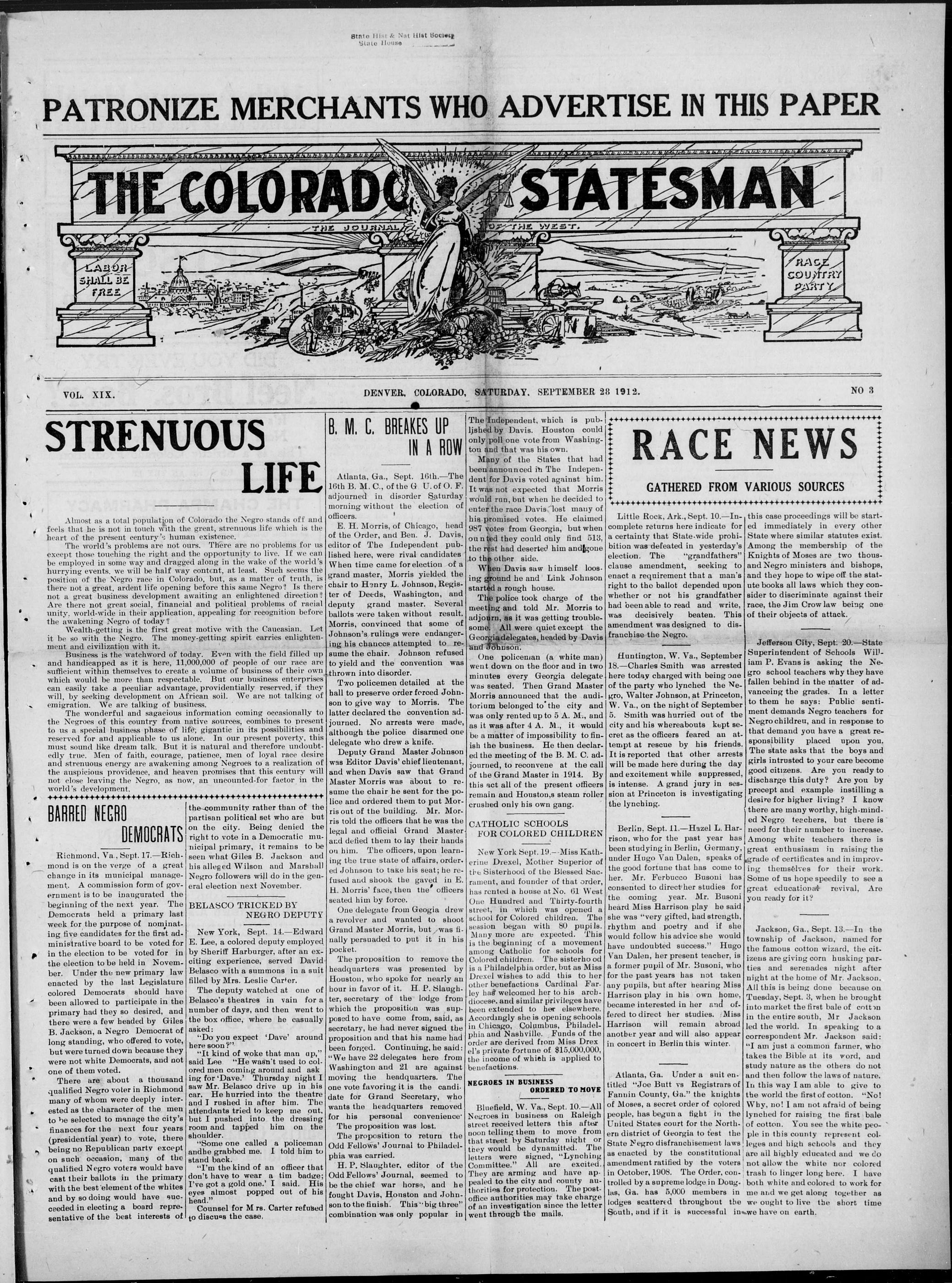
PATRONIZE MERCHANTS WHO ADVERTISE IN THIS PAPER
THE COLORADO STATESMAN
THE JOURNAL OF THE WEST.
LABOR SHALL BE FREE
RACE COUNTRY PARTY
STRENUOUS
Almost as a total population of Colorado the Negro stands off and feels that he is not in touch with the great, strenuous life which is the heart of the present century's human existence.
The world's problems are not ours. There are no problems for us except those touching the right and the opportunity to live. If we can be employed in some way and dragged along in the wake of the world's hurrying events, we will be half way content, at least. Such seems the position of the Negro race in Colorado, but, as a matter of truth, is there not a great, ardent life opening before this same Negro? Is there not a great business development awaiting an enlightened direction? Are there not great social, financial and political problems of racial unity, world-wide in their application, appealing for recognition before the awakening Negro of today?
Wealth-getting is the first great motive with the Caucasian. Let it be so with the Negro. The money-getting spirit carries enlightenment and civilization with it.
Business is the watchword of today. Even with the field filled up and handicapped as it is here, 11,000,000 of people of our race are sufficient within themselves to create a volume of business of their own which would be more than respectable. But our business enterprises can easily take a peculiar advantage, providentially reserved, if they will, by seeking development on African soil. We are not talking of emigration. We are talking of business.
The wonderful and sagacious information coming occasionally to the Negroes of this country from native sources, combines to present to us a special business phase of life, gigantic in its possibilities and reserved for and applicable to us alone. In our present poverty, this must sound like dream talk. But it is natural and therefore undoubtedly true. Men of faith, courage, patience, men of loyal race desire and strenuous energy are awakening among Negroes to a realization of the auspicious providence, and heaven promises that this century will not close leaving the Negro, as now, an uncounted-for factor in the world's development.
VOL. XIX.
Almost as a total population of feels that he is not in touch with the heart of the present century's hum.
The world's problems are not except those touching the right and be employed in some way and drags hurrying events, we will be half way position of the Negro race in Colo there not a great, ardent life opening not a great business development. Are there not great social, financial unity, world-wide in their application the awakening Negro of today?
Wealth-getting is the first great it be so with the Negro. The moment and civilization with it.
Business is the watchword of the and handicapped as it is here, 11 sufficient within themselves to create which would be more than respect can easily take a peculiar advantage will, by seeking development on A emigration. We are talking of bus.
The wonderful and sagacious the Negroes of this country from to us a special business phase of L reserved for and applicable to us must sound like dream talk. But i edly true. Men of faith, courage, and strenuous energy are awakening the auspicious providence, and hear not close leaving the Negro, as no world's development.
BARRED NEGRO
DEMOCRATS
Richmond, Va., Sept. 17.—Richmond is on the verge of a great change in its municipal management. A commission form of government is to be inaugurated the beginning of the next year. The Democrats held a primary last week for the purpose of nominating five candidates for the first administrative board to be voted for in the election to be voted for in the election to be held in November. Under the new primary law enacted by the last Legislature colored Democrats should have been allowed to participate in the primary had they so desired, and there were a few headed by Giles B. Jackson, a Negro Democrat of long standing, who offered to vote, but were turned down because they were not white Democrats, and not one of them voted.
There are about a thousand qualified Negro voter in Richmond many of whom were deeply interested as the character of the men to be selected to manage the city's finances for the next four years (presidential year) to vote, there being no Republican party except on such occasion, many of the qualified Negro voters would have cast their ballots in the primary with the best element of the whites and by so doing would have succeeded in electing a board representative of the best interests of
the community rather than of the partisan political set who are but on the city. Being denied the right to vote in a Democratic municipal primary, it remains to be seen what Giles B. Jackson and his alleged Wilson and Marshall Negro followers will do in the general election next November.
BELASCO TRICKED BY NEGRO DEPUTY
New York, Sept. 14.—Edward E. Lee, a colored deputy employed by Sheriff Harburger, after an exciting experience, served David Belasco with a summons in a suit filled by Mrs. Leslie Carter.
The deputy watched at one of Belasco's theatres in vain for a number of days, and then went to the box office, where he casually asked:
"Do you expect 'Dave' around here soon?"
"It kind of woke that man up," said Lee. "He wasn't used to colored men coming around and asking for 'Dave.' Thursday night I saw Mr. Belasco drive up in his car. He hurried into the theatre and I rushed in after him. The attendants tried to keep me out, but I pushed into the dressing room and tapped him on the shoulder.
"Some one called a policeman andhe grabbed me. I told him to stand back."
"I'm the kind of an officer that don't have to wear a tim badge; I've got a gold one.' I said. His eyes almost popped out of his head." Counsel for Mrs. Carter refused to discuss the case.
DENVER, COLORADO, SATURDAY, SEPTEMBER 28 1912.
State Hist & Nat Hist Soc
State House
HANTS WH
ADC
THE JOURNAL
DENVER, COLORADO
B. M. C. BREAKES UP IN A ROW
Atlanta, Ga., Sept. 16th.—The 16th B. M. C., of the G. U. of O. F. adjourned in disorder Saturday morning without the election of officers. E. H. Morris, of Chicago, head of the Order, and Ben. J. Davis, editor of The Independent published here, were rival candidates When time came for election of a grand master, Morris yielded the chair to Henry L. Johnson, Register of Deeds, Washington, and deputy grand master. Several ballots were taken without result. Morris, convinced that some of Johnson's rulings were endangering his chances attempted to resume the chair. Johnson refused to yield and the convention was thrown into disorder. Two policemen detailed at the hall to preserve order forced Johnson to give way to Morris. The latter declared the convention adjourned. No arrests were made, although the police disarmed one delegate who drew a knife.
Deputy Grand Master Johnson was Editor Davis' chief lieutenant, and when Davis saw that Grand Master Morris was about to resume the chair he sent for the police and ordered them to put Morris out of the building. Mr. Morris told the officers that he was the legal and official Grand Master and defied them to lay their hands on him. The officers, upon learning the true state of affairs, ordered Johnson to take his seat; he refused and shook the gaved in E. H. Morris' face, then the officers seated him by force.
One delegate from Geogia drew a revolver and wanted to shoot Grand Master Morris, but was finally persuaded to put it in his pocket.
The proposition to remove the headquarters was presented by Houston, who spoke for nearly an hour in favor of it. H. P. Slaughter, secretary of the lodge from which the proposition was supposed to have come from, said, as secretary, he had never signed the proposition and that his name had been forged. Continuing, he said: "We have 22 delegates here from Washington and 21 are against moving the headquarters. The one vote favoring it is the candidate for Grand Secretary, who wants the headquarters removed for his personal convenience The proposition was lost. The proposition to return the Odd Fellows' Journal to Philadelphia was carried. H. P. Slaughter, editor of the Odd Fellows' Journal, seemed to be the chief war horse, and he fought Davis, Houston and Johnson to the finish. This"big three" combination was only popular in
---
The Independent, which is published by Davis. Houston could only poll one vote from Washington and that was his own.
Many of the States that had been announced in The Independent for Davis voted against him. It was not expected that Morris would run, but when he decided to enter the race Davis lost many of his promised votes. He claimed 987 votes from Georgia, but when counted they could only find 513, the rest had deserted him and gone to the other side.
When Davis saw himself loosing ground he and Link Johnson started a rough house.
The police took charge of the meeting and told Mr. Morris to adjourn, as it was getting troublesome. All were quiet except the Georgia delegates, headed by Davis and Johnson.
One policeman (a white man) went down on the floor and in two minutes every Georgia delegate was seated. Then Grand Master Morris announced that the auditorium belonged to the city and was only rented up to 5 A. M., and as it was after 4 A. M., it would be a matter of impossibility to finish the business. He then declared the meeting of the B. M. C. adjourned, to reconvene at the call of the Grand Master in 1914. By this act all of the present officers remain and Houston,s steam roller crushed only his own gang.
CATHOLIC SCHOOLS
New York Sept. 19.—Miss Katherine Drexel, Mother Superior of the Sisterhood of the Blessed Sacrament, and founder of that order, has rented a house at No. 61 West One Hundred and Thirty-fourth street, in which was opened a school for Colored children. The session began with 80 pupils. Many more are expected. This is the beginning of a movement among Catholic for schools for Colored children. The sisterhood is a Philadelphia order, but as Miss Drexel wishes to add this to her other benefactions Cardinal Farley has welcomed her to his archdiocese, and similar privileges have been extended to her elsewhere. Accordingly she is opening schools in Chicago, Columbus, Philadelphia and Nashville. Funds of the order are derived from Miss Drexel's private fortune of $15,000,000, the income of which is applied to benefactions.
NEGROES IN BUSINESS
ORDERED TO MOVE
Bluefield, W. Va., Sept. 10.—All Negroes in business on Raleigh street received letters this after noon telling them to move from that street by Saturday night or they would be dynamitted. The letters were signed, "Lynching Committee." All are excited. They are arming and have appealed to the city and county authorities for protection. The postoffice authorities may take charge of an investigation since the letter went through the mails.
RACE NEWS
GATHERED FROM VARIOUS SOURCES
Little Rock, Ark., Sept. 10.—Incomplete returns here indicate for a certainty that State-wide prohibition was defeated in yesterday's election. The "grandfathers" clause amendment, seeking to enact a requirement that a man's right to the ballot depended upon whether or not his grandfather had been able to read and write, was decisively beaten. This amendment was designed to disfranchise the Negro.
this case proceedings will be started immediately in every other State where similar statutes exist. Among the membership of the Knights of Moses are two thousand Negro ministers and bishops, and they hope to wipe off the statute books all laws which they consider to discriminate against their race, the Jim Crow law being one of their objects of attack.
Huntington, W. Va., September 18.—Charles Smith was arrested here today charged with being one of the party who lynched the Negro, Walter Johnson, at Princeton, W. Va., on the night of September 5. Smith was hurried out of the city and his whereabouts kept secret as the officers feared an attempt at rescue by his friends. It is reported that other arrests will be made here during the day and excitement while suppressed, is intense. A grand jury in session at Princeton is investigating the lynching.
Berlin, Sept. 11.—Hazel L. Harrison, who for the past year has been studying in Berlin, Germany, under Hugo Van Dalen, speaks of the good fortune that has come to her. Mr. Ferbucco Busoni has consented to direct her studies for the coming year. Mr. Busoni heard Miss Harrison play he said she was "very gifted, had strength, rhythm and poetry and if she would follow his advice she would have undoubted success." Hugo Van Dalen, her present teacher, is a former pupil of Mr. Busoni, who for the past years has not taken any pupils, but after hearing Miss Harrison play in his own home, became interested in her and offered to direct her studies. Miss Harrison will remain abroad another year and will also appear in concert in Berlin this winter.
Atlanta, Ga. Under a suit entitled "Joe Butt vs Registrars of Fannin County, Ga." the knights of Moses, a secret order of colored people, has begun a fight in the United States court for the Northern district of Georgia to test the State Negro disfranchisement laws as enacted by the constitutional amendment ratified by the voters in October, 1908. The Order, controlled by a supreme lodge in Douglas, Ga. has 5,000 members in lodges scattered throughout the South, and if it is successful in
NO 3
this case proceedings will be started immediately in every other State where similar statutes exist. Among the membership of the Knights of Moses are two thousand Negro ministers and bishops, and they hope to wipe off the statute books all laws which they consider to discriminate against their race, the Jim Crow law being one of their objects of attack.
Jefferson City, Sept. 20.—State Superintendent of Schools William P. Evans is asking the Negro school teachers why they have fallen behind in the matter of advanceing the grades. In a letter to them he says: Public sentiment demands Negro teachers for Negro childreu, and in response to that demand you have a great responsibility placed upon you. The state asks that the boys and girls intrusted to your care become good citizens. Are you ready to discharge this duty? Are you by precept and example instilling a desire for higher living? I know there are many worthy, high-minded Negro teachers, but there is need for their number to increase. Among white teachers there is great enthusiasm in raising the grade of certificates and in improving themselves for their work. Some of us hope speedily to see a great educational revival, Are you ready for it?
Jackson, Ga., Sept. 13.—In the township of Jackson, named for the famous cotton wizard, the citizens are giving corn husking parties and serenades night after night at the home of Mr. Jackson. All this is being done because on Tuesday, Sept. 3, when he brought into market the first bale of cotton in the entire south, Mr Jackson led the world. In speaking to a correspondent Mr. Jackson said: "I am just a common farmer, who takes the Bible at its word, and study nature as the others do not and then follow the laws of nature. In this way I am able to give to the world the first of cotton. "No! Why, no! I am not afraid of being lynched for raising the first bale of cotton. You see the white people in this county represent colleges and high schools and they are all highly educated and we do not allow the white nor colored trash to linger long here. I have both white and colored to work for me and we get along together as we ought to live the short time we have on earth.
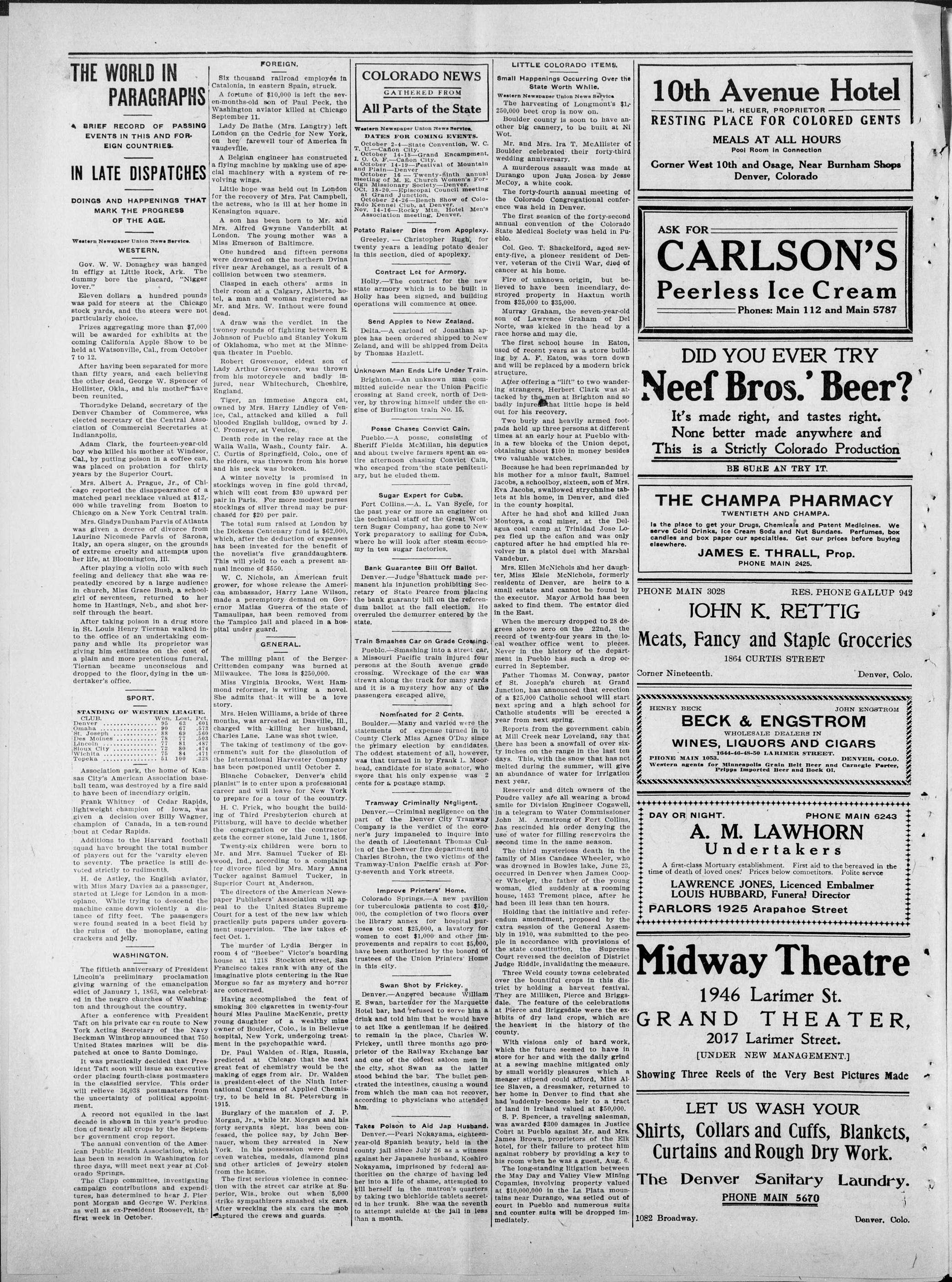
THE WORLD IN PARAGRAPHS
BRIEF RECORD OF PASSING EVENTS IN THIS AND FOREIGN COUNTRIES.
DOINGS AND HAPPENINGS THAT
MARK THE PROGRESS
OF THE AGE.
Western Newspaper Union News Service.
WESTERN.
Gov. W. W. Donaghey was hanged
in effigy at Little Rock, Ark. The
dummy bore the placard, "Nigger
lover."
Eleven dollars a hundred pounds
was paid for steers at the Chicago
stock yards, and the steers were not
particularly choice.
Prizes aggregating more than $7,000
will be awarded for exhibits at the
coming California Apple Show to be
held at Watsonville, Cal., from October
7 to 12.
After having been separated for more than fifty years, and each believing the other dead, George W. Spencer of Hollister, Okla., and his mother have been reunited.
Thorndyke Deland, secretary of the Denver Chamber of Commerce, was elected secretary of the Central Association of Commercial Secretaries at Indianapolis.
Adam Clark, the fourteen-year-old boy who killed his mother at Windsor, Cal., by putting poison in a coffee can, was placed on probation for thirty years by the Superior Court.
Mrs. Albert A. Prague, Jr., of Chicago reported the disappearance of a matched pearl necklace valued at $12,000 while traveling from Boston to Chicago on a New York Central train.
Mrs. Gladys Dunham Parvis of Atlanta was given a decree of divorce from Laurino Nicomede Parvis of Sarona, Italy, an opera singer, on the grounds of extreme cruelty and attempts upon her life, at Bloomington, Ill.
After playing a violin solo with such feeling and delicacy that she was repeatedly enced by a large audience in church, Miss Grace Bush, a schoolgirl of seventeen, returned to her home in Hastings, Neb., and shot herself through the heart.
After taking poison in a drug store in St. Louis Henry Tiernian walked into the office of an undertaking company and while its proprietor was giving him estimates on the cost of a plain and more pretentious funeral, Tiernian became unconscious and dropped to the floor, dying in the undertaker's office.
SPORT.
STANDING OF WESTERN LEAGUE.
CLUB. Won. Lost. Pet. Denver 95 63 601
Omaha 90 67 573
St. Joseph 88 69 560
Des Moines 78 77 503
Lincoln 77 81 487
Sioux City 72 80 474
Wichita 75 84 471
Topeka 51 100 325
Association park, the home of Kansas City's American Association baseball team, was destroyed by a fire said to have been of incendiary origin.
Frank Whitney of Cedar Rapids, lightweight champion of Iowa, was given a decision over Billy Wagner, champion of Canada, in a ten-round bout at Cedar Rapids.
Additions to the Harvard football squad have brought the total number of players out for the 'varsity' eleven to seventy. The practice is still devoted strictly to rudiments.
H. de Astley, the English aviator with Miss Mary Davies as a passenger started at Liege for London in a monoplane. While trying to descend the machine came down violently a distance of fifty feet. The passengers were found seated in a beet field by the ruins of the monoplane, eating crackers and jelly.
WASHINGTON
The fiftieth anniversary of President Lincoln's preliminary proclamation giving warning of the emancipation edict of January 1, 1863, was celebrated in the negro churches of Washington and throughout the country.
After a conference with President Taft on his private car en route to New York Acting Secretary of the Navy Beckman Winthrop announced that 750 United States marines will be dispatched at once to Santo Domingo.
It was practically decided that President Taft soon will issue an executive order placing fourth-class postmasters in the classified service. This order will relieve 36,038 postmasters from the uncertainty of political appointment.
A record not equalled in the last decade is shown in this year's production of nearly all crops by the September government crop report.
The annual convention of the American Public Health Association, which has been in session in Washington for three days, will meet next year at Colorado Springs. The Clapp committee, investigating campaign contributions and expenditures, has determined to hear J. Pierpont Morgan and George W. Perkins as well as ex-President Roosevelt, the first week in October.
FOREIGN.
Six thousand railroad employés in Catalonia, in eastern Spain, struck.
A fortune of $10,000 is left the seven-months-old son of Paul Peck, the Washington aviator killed at Chicago September 11.
Lady De Bathe (Mrs. Langtry) left London on the Cedric for New York, on her farewell tour of America in vaudeville.
A Belgian engineer has constructed a flying machine by making use of special machinery with a system of revolving wings.
Little hope was held out in London for the recovery of Mrs. Pat Campbell, the actress, who is ill at her home in Kensington square.
A son has been born to Mr. and Mrs. Alfred Gwynne Vanderbilt at London. The young mother was a Miss Emerson of Baltimore.
One hundred and fifteen persons were drowned on the northern Dvina river near Archangel, as a result of a collision between two steamers.
Clasped in each others' arms in their room at a Calgary, Alberta, hotel, a man and woman registered as Mr. and Mrs. W. Inthout were found dead.
A draw was the verdict in the twoween rounds of fighting between E. Johnson of Pueblo and Stanley Yokum of Oklahoma, who met at the Minnequa theater in Pueblo.
Robert Grosvenor, eldest son of Lady Arthur Grosvenor, was thrown from his motorcycle and badly injured, near Whitechurch, Cheshire, England.
Tiger, an immense Angora cat, owned by Mrs. Harry Lindley of Venice, Cal., attacked and killed a full blooded English bulldog, owned by J. C. Fromeyer, at Venice. $^{1}$
Death rode in the relay race at the Walla Walla, Wash., County fair. A. C. Curtis of Springfield, Colo., one of the riders, was thrown from his horse and his neck was broken.
A winter novelty is promised in stockings woven in fine gold thread, which will cost from $30 upward per pair in Paris. For more modest purses stockings of silver thread may be purchased for $20 per pair.
The total sum raised at London by the Dickens Centenary fund is $62,000, which, after the deduction of expenses has been invested for the benefit of the novelist's five granddaughters. This will yield to each a present annual income of $550. $^{2}$
W. C. Nichols, an American fruit grower, for whose release the American ambassador, Harry Lane Wilson, made a peremptory demand on Governor Matias Guerra of the state of Tamaulipas, has been removed from the Tampico jail and placed in a hospital under guard.
GENERAL
The milling plant of the Berger-Crittenden company was burned at Milwaukee. The loss is $250,000.
Miss Virginia Brooks, West Hammond reformer, is writing a novel. She admits that it will be a love story.
Mrs. Helen Williams, a bride of three months, was arrested at Danville, Ill., charged with killing her husband, Charles Lane. Lane was shot twice.
The taking of testimony of the government's suit for the dissolution of the International Harvester Company has been postponed until October 2.
Blanche Cobacker, Denver's child pianist" is to enter upon a professional career and will leave for New York to prepare for a tour of the country.
H. C. Frick, who bought the building of Third Presbyterian church at Pittsburg, will have to decide whether the congregation or the contractor gets the corner stone, laid June 1, 1866. Twenty-six children were born to Mr. and Mrs. Samuel Tucker of Elwood, Ind., according to a complaint for divorce filed by Mrs. Mary Anna Tucker against Samuel Tucker, in Superior Court at Anderson. The directors of the American Newspaper Publishers' Association will appeal to the United States Supreme Court for a test of the new law which practically puts papers under government supervision. The law takes effect Oct. 1.
The murder of Lydia Berger in room 4 of "Beebee" Victor's boarding house at 1218 Stockton street, San Francisco takes rank with any of the imaginative plots centering in the Rue Morgue so far as mystery and horror are concerned.
Having accomplished the feat of smoking 300 cigarettes in twenty-four hours Miss Pauline MacKenzie, pretty young daughter of a wealthy mine owner of Boulder, Colo., is in Bellevue hospital, New York, undergoing treatment in the psychopathic ward.
Dr. Paul Walden of Riga, Russia, predicted at Chicago that the next great feat of chemistry would be the making of eggs from air. Dr. Walden is president-elect of the Ninth International Congress of Applied Chemistry, to be held in St. Petersburg in 1915.
Burglary of the mansion of J. P. Morgan, Jr., while Mr. Morgan and his forty servants slept, has been confessed, the police say, by John Bernauer, whom they arrested in New York. In his possession were found seven watches, medals, diamond pins and other articles of jewelry stolen from the home. The first serious violence in connection with the street car strike at Superior, Wis., broke out when 5,000 strike sympathizers smashed six cars. After wrecking the six cars the mob captured the crews and guards.
All Parts of the State
Western Newspaper Union News Service.
DATES FOR COMING EVENTS.
October 2-4—State Convention, W. C.
T. U.—Cannon City.
October 14-18—Grand Encampment,
L. O. F.—Cannon City.
October 18—Festival of Mountain
and Plain—Denver.
October 16—Twenty-ninth annual
meeting of M. E. Church Women's For-
eign Mission Society—Denver.
Oct. 18-20—Episcopal Council meet-
ing at Grand Junction.
October 24-26—Bench Show of Colo-
rnal Kennett at Denver.
Nov. 15—Rocky Mt. Hotel Men's
Association meeting. Denver.
Potato Raiser Dies from Apoplexy.
Greeley. — Christopher Rugh, for
twenty years a leading potato dealer
in this section, died of apoplexy.
Contract Let for Armory.
Holly.—The contract for the new state armory which is to be built in Holly has been signed, and building operations will commence at once.
Send Apples to New Zealand.
Delta.—A carload of Jonathan apples has been ordered shipped to New Zeland, and will be shipped from Delta by Thomas Hazlett.
Unknown Man Ends Life Under Train.
Brighton.—An unknown man committed suicide near the Union Pacific crossing at Sand creek, north of Denver, by throwing himself under the engine of Burlington train No. 15.
Posse Chases Convict Cain.
Pueblo.—A posse, consisting of Sheriff Fields McMillan, his deputies and about twelve farmers spent an entire afternoon chasing Convict Cain, who escaped from the state penitentiary, but he eluded them.
Sugar Expert for Cuba.
Fort Collins.—A. L. Van Sylce, for the past year or more an engineer on the technical staff of the Great Western Sugar Company, has gone to New York preparatory to sailing for Cuba, where he will look after steam economy in ten sugar factories.
Bank Guarantee Bill Off Ballot.
Denver.—Judge Shattuck made permanent his injunction prohibiting Secretary of State Pearce from placing the bank guaranty bill on the referendum ballot at the fall election. He overruled the demurrer entered by the state.
Pueblo.—Smashing into a street car, a Missouri Pacific train injured four persons at the South avenue grade crossing. Wreckage of the car was strewn along the track for many yards and it is a mystery how any of the passengers escaped alive.
Nominated for 2 Cents.
Boulder.—Many and varied were the statements of expense turned in to County Clerk Miss Agnes O'Day since the primary election by candidates. The oddest statement of all, however, was that turned in by Frank L. Moorhead, candidate for state senator, who swore that his only expense was 2 cents for a postage stamp.
Tramway Criminally Negligent.
Denver.—Criminal negligence on the part of the Denver City Tramway Company is the verdict of the coroner's jury impaneled to inquire into the death of Lieutenant Thomas Cullen of the Denver fire department and Charles Strohn, the two victims of the Tramway-Union Pacific crash at Fort-seventh and York streets.
Improve Printers' Home.
Colorado Springs.—A new pavilion for tuberculosis patients to cost $10,000, the completion of two floors over the library annex for hospital purposes to cost $25,000, a lavatory for women to cost $1,000 and other improvements and repairs to cost $5,000, have been authorized by the board of trustees of the Union Printers' Home in this city.
Swan Shot by Frickey.
Denver.—Angered because William E. Swan, bartender for the Marquette Hotel bar, had refused to serve him a drink and told him that he would have to act like a gentleman if he desired to remain in the place, Charles W. Frickey, until three months ago proprietor of the Railway Exchange bar and one of the oldest saloon men in the city, shot Swan as the latter stood behind the bar. The bullet penetrated the intestines, causing a wound from which the man can not recover, according to physicians who attended him.
Takes Poison to Aid Jap Husband.
Denver.—Pearl Nokayama, eighteen-year-old Spanish beauty, held in the county jail since July 26 as a witness against her Japanese husband, Koshiro Nokayama, imprisoned by federal authorities on the charge of having led her into a life of shame, attempted to kill herself in the matron's quarters by taking two bichloride tablets secreted in her trunk. She was the seventh to attempt suicide at the jail in less than a month.
LITTLE COLORADO ITEMS.
Small Happenings Occurring Over the State Worth While.
Western Newspaper Union News Service
The harvesting of Longmont's $1,250,000 beet crop is now on.
Boulder county is soon to have another big cannery, to be built at Ni Wot.
Mr. and Mrs. Ira T. McAllister of Boulder celebrated their forty-third wedding anniversary.
A murderous assault was made at Durango upon Juan Josea by Jesse McCoy, a white cook.
The forty-fourth annual meeting of the Colorado Congregational conference was held in Denver.
The first session of the forty-second annual convention of the Colorado State Medical Society was held in Pueblo.
Col. Geo. T. Shackelford, aged seventy-five, a pioneer resident of Denver, veteran of the Civil War, died of cancer at his home.
Fire of unknown origin, but believed to have been incendiary, destroyed property in Haxtun worth from $25,000 to $35,000.
Murray Graham, the seven-year-old son of Lawrence Graham of Del Norte, was kicked in the head by a race horse and may die.
The first school house in Eaton, used of recent years as a store building by A. F. Eaton, was torn down and will be replaced by a modern brick structure.
After offering a "lift" to two wandering strangers, Herbert Clark was attacked by the men at Brighton and so badly injured that little hope is held out for his recovery.
Two burly and heavily armed footpads held up three persons at different times at an early hour at Pueblo within a new blocks of the Union depot, obtaining about $100 in money besides two valuable watches.
Because he had been reprimanded by his mother for a minor fault, Samuel Jacobs, a schoolboy, sixteen, son of Mrs. Eva Jacobs, swallowed strychnine tablets at his home, in Denver, and died in the county hospital.
After he had shot and killed Juan Montoya, a coal miner, at the Delagua coal camp at Trinidad Jose Lopez fled up the canon and was only captured after he had emptied his revolver in a pistol duel with Marshal Vandebur.
Mrs. Ellen McNichols and her daughter, Miss Elsie McNichols, formerly residents of Denver, are heirs to a small estate and cannot be found by the executor. Mayor Arnold has been asked to find them. The estator died in the East.
When the mercury dropped to 28 degrees above zero on the 22nd, the record of twenty-four years in the local weather office went to pieces. Never in the history of the department in Pueblo has such a drop occurred in September.
Father Thomas M. Conway, pastor of St. Joseph's church at Grand Junction, has announced that erection of a $25,000 Catholic school will start next spring and a high school for Catholic students will be erected a year from next spring.
Reports from the government cabin at Mill Creek near Loveland, say that there has been a snowfall of over sixty inches on the range in the last ten days. This, with the snow that has not melted during the summer, will give an abundance of water for irrigation next year.
Reservoir and ditch owners of the Poudre valley are all wearing a broad smile for Division Engineer Cogswell, in a telegram to Water Commissioner John M. Armstrong of Fort Collins, has rescinded his order denying the use of water for filling reservoirs the second time in the same season.
The third mysterious death in the family of Miss Candace Wheeler, who was drowned in Bowles lake, June 23, occurred in Denver when James Cooper Wheeler, the father of the young woman, died suddenly at a rooming house, 1453 Tremont place, after he had been ill less than ten hours.
Holding that the initiative and referendum amendment, proposed by the extra session of the General Assembly in 1910, was submitted to the people in accordance with provisions of the state constitution, the Supreme Court reversed the decision of District Judge Riddle, invalidating the measure. Three Weld county towns celebrated over the bountiful crops in this district by holding a harvest festival. They are Milliken, Pierce and Briggsdale. The feature of the celebrations at Pierce and Briggsdale were the exhibits of dry land crops, which are the heaviest in the history of the county.
With visions only of hard work, which the future seemed to have in store for her and with the daily grind at a sewing machine mitigated only by small worldly pleasures which a meager stipend could afford, Miss Alice Slaven, a dressmaker, returned to her home in Denver to find that she had suddenly become heir to a tract of land in Ireland valued at $50,000. S. P. Spencer, a traveling salesman, was awarded $300 damages in Justice Court at Pueblo against Mr. and Mrs. James Brown, proprietors of the Elk hotel, for their failure to protect him against robbery by providing a key to his room when he was a guest, Aug. 6.
The long-standing litigation between the May Day and Valley View Mining Copamies, involving property valued at $10,000,000 in the La Plata mountains near Durango, was settled out of court in Pueblo and numerous suits and counter suits will be dropped immediately.
Corner West 10th and Osage, Near Burnham Shops Denver, Colorado
CARLSON'S Peerless Ice Cream Phones: Main 112 and Main 5787
DID YOU EVER TRY Neef Bros.' Beer?
It's made right, and tastes right. None better made anywhere and This is a Strictly Colorado Production
Is the place to get your Drugs, Chemicals and Patent Medicines. We serve Cold Drinks, Ice Cream Soda and Nut Sundae. Perfumes, box candies and box paper our specialties. Get our prices before buying elsewhere.
WINES, LIQUORS AND CIGARS
1644-40-48-50 LARIMER STREET.
PHONE MAIN 1053 DENVER, COLO.
Western agents for Minneapolis Grain Belt Beer and Carnegie Porter,
Pripps Imported Beer and Bock Ol.
A first-class Mortuary establishment. First aid to the bereaved in the time of death of loved ones! Prices below competitors. Polite service LAWRENCE JONES, Licenced Embalmer LOUIS HUBBARD, Funeral Director
Showing Three Reels of the Very Best Pictures Made
LET US WASH YOUR Shirts, Collars and Cuffs, Blankets, Curtains and Rough Dry Work. The Denver Sanitary Laundry. PHONE MAIN 5670
Corner Nineteenth.
MEALS AT ALL HOURS Pool Room in Connection
Denver, Colo.
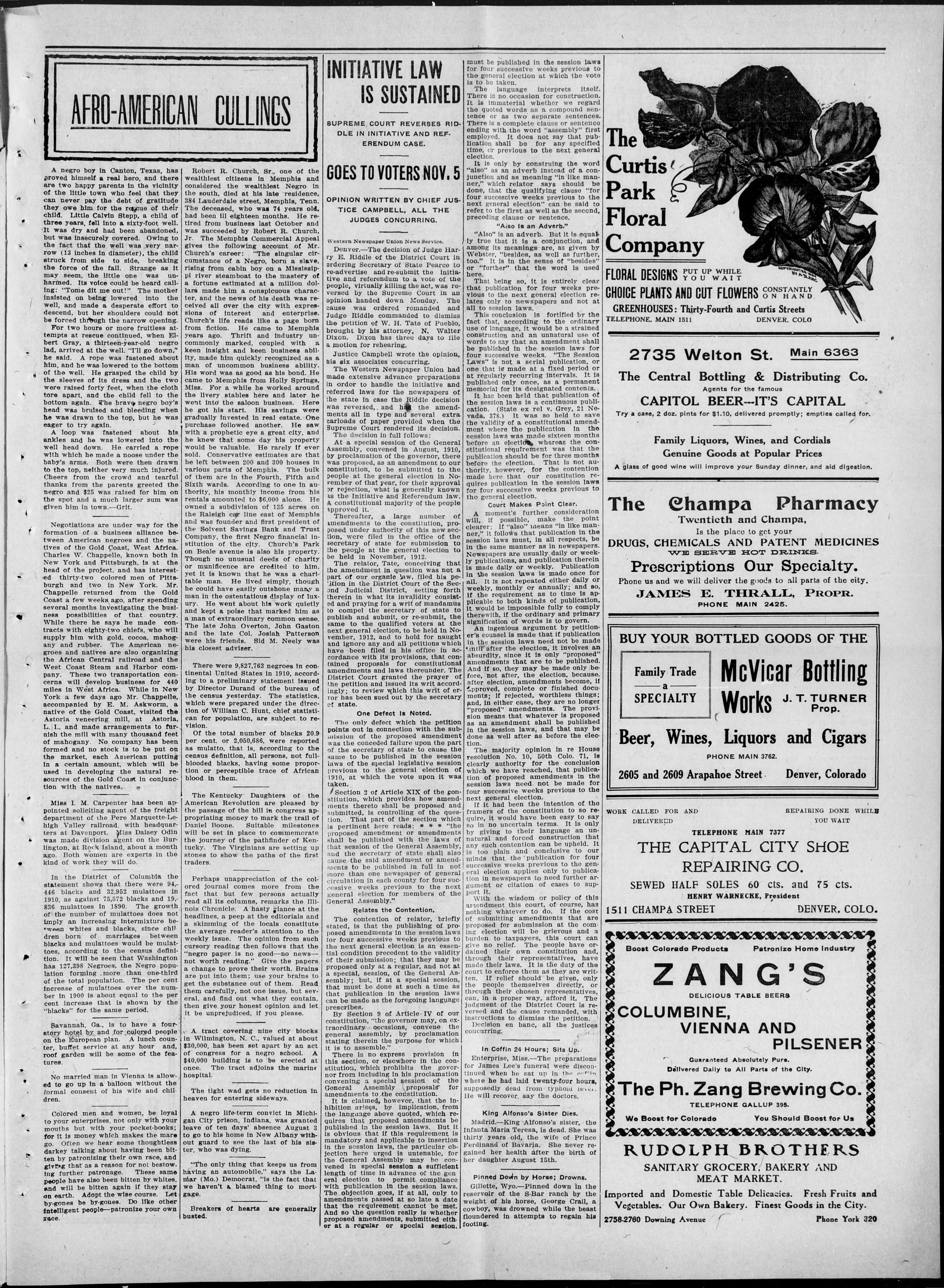
AFRO-AMERICAN CULLINGS
A negro boy in Canton, Texas, has proved himself a real hero, and there are two happy parents in the vicinity of the little town who feel that they can never pay the debt of gratitude they owe him for the rescue of their child. Little Calvin Stepp, a child of three years, fell into a sixty-foot well. It was dry and had been abandoned, but was insecurely covered. Owing to the fact that the well was very narrow (13 inches in diameter), the child struck from side to side, breaking the force of the fall. Strange as it may seem, the little one was unharmed. Its voice could be heard calling: "Tome dit me out!" The mother insisted on being lowered into the well, and made a desperate effort to descend, but her shoulders could not be forced through the narrow opening.
For two hours or more fruitless attempts at rescue continued, when Elbert Gray, a thirteen-year-old negro lad, arrived at the well. "I'll go down," he said. A rope was fastened about him, and he was lowered to the bottom of the well. He grasped the child by the sleeves of its dress and the two were raised forty feet, when the cloth tore apart, and the child fell to the bottom again. The brave negro boy's head was bruised and bleeding when he was drawn to the top, but he was eager to try again.
A loop was fastened about his ankles and he was lowered into the well head down. He carried a rope with which he made a noose under the baby's arms. Both were then drawn to the top, neither very much injured. Cheers from the crowd and tearful thanks from the parents greeted the negro and $25 was raised for him on the spot and a much larger sum was given him in town.—Grit.
Negotiations are under way for the formation of a business alliance between American negroes and the natives of the Gold Coast, West Africa. Charles W. Chappelle, known both in New York and Pittsburgh, is at the head of the project, and has interested thirty-two colored men of Pittsburgh and two in New York. Mr. Chappelle returned from the Gold Coast a few weeks ago, after spending several months investigating the business possibilities of that country. While there he says he made contracts with eighty-two chiefs, who will supply him with gold, cocoa, mahogany and rubber. The American negroes and natives are also organizing the African Central railroad and the West Coast Steam and Harbor company. These two transportation concerns will develop business for 440 miles in West Africa. While in New York a few days ago Mr. Chappelle, accompanied by E. M. Askworm, a native of the Gold Coast, visited the Astoria veneering mill, at Astorla, L. I., and made arrangements to furnish the mill with many thousand feet of mahogany. No company has been formed and no stock is to be put on the market, each American putting in a certain amount, which will be used in developing the natural resources of the Gold Coast in conjunction with the natives.
Miss I. M. Carpenter has been appointed soliciting agent of the freight department of the Pere Marquette-Lehigh Valley railroad, with headquarters at Davenport. Miss Daisey Odin was made division agent on the Burlington, at Rock Island, about a month ago. Both women are experts in the kind of work they will do.
In the District of Columbia the statement shows that there were 94,446 blacks and 32,952 mulattoes in 1910, as against 75,572 blacks and 19,836 mulattoes in 1890. The growth of the number of mulattoes does not imply an increasing intermixture between whites and blacks, since children born of marriages between blacks and mulattoes would be mulattoes, according to the census definition. It will be seen that Washington has 127,398 Negroes, the Negro population forming more than one-third of the total population. The per cent increase of mulattoes over the number in 1900 is about equal to the per cent increase that is shown by the "blacks" for the same period.
Savannah, Ga., is to have a four-story hotel by and for colored people on the European plan. A lunch counter, buffet service at any hour and, roof garden will be some of the features.
No married man in Vienna is allowed to go up in a balloon without the formal consent of his wife and children.
Colored men and women, be loyal to your enterprises, not only with your mouths but with your pocket-books; for it is money which makes the mare go. Often we hear some thoughtless darkey talking about having been bitten by patronizing their own race, and giving that as a reason for not bestowing further patronage. These same people have also been bitten by whites, and will be bitten again if they stay on earth. Adopt the wise course. Let by-gones be by-gones. Do like other intelligent people—patronize your own race.
Robert R. Church, Sr., one of the wealthiest citizens in Memphis and considered the wealthiest Negro in the south, died at his late residence, 384 Lauderdale street, Memphis, Tennessee, who was 74 years old, had been ill eighteen months. He retired from business last October and was succeeded by Robert R. Church, Jr. The Memphis Commercial Appeal gives the following account of Mr. Church's career: "The singular circumstance of a Negro, born a slave, rising from cabin boy on a Mississippi river steamboat to the mastery of a fortune estimated at a million dollars made him a conspicuous character, and the news of his death was received all over the city with expressions of interest and enterprise. Church's life reads like a page born from fiction. He came to Memphis years ago. Thrift and industry uncommonly marked, coupled with a keen insight and keen business ability, made him quickly recognized as a man of uncommon business ability. His word was as good as his bond. He came to Memphis from Holly Springs, Miss. For a while he worked around the livery stables here and later he went into the saloon business. Here he got his start. His savings were gradually invested in real estate. One purchase followed another. He saw with a prophetic eye a great city, and he knew that some day his property would be valuable. He rarely if ever sold. Conservative estimates are that he left between 200 and 300 houses in various parts of Memphis. The bulk of them are in the Fourth, Fifth and Sixth wards. According to one in authority, his monthly income from his rentals amounted to $6,000 alone. He owned a subdivision of 135 acres on the Raleigh car line east of Memphis and was founder and first president of the Solvent Savings Bank and Trust Company, the first Negro financial institution of the city. Church's Park on Beale avenue is also his property. Though no unusual deeds of charity or munificence are credited to him, yet it is known that he was a charitable man. He lived simply, though he could have easily outshine many a man in the ostentatious display of luxury. He went about his work quietly and kept a poise that marked him as a man of extraordinary common sense. The late John Overton, John Gaston and the late Col. Josiah Patterson were his friends. Sid M. Neely was his closest adviser.
There were 9,827,763 negroes in continental United States in 1910, according to a preliminary statement issued by Director Durand of the bureau of the census yesterday. The statistics, which were prepared under the direction of William C. Hunt, chief statistician for population, are subject to revision.
Of the total number of blacks 20.9 per cent. or 2,050,686, were reported as mulatto, that is, according to the census definition, all persons, not full-blooded blacks, having some proportion or perceptible trace of African blood in them.
The Kentucky Daughters of the American Revolution are pleased by the passage of the bill in congress appropriating money to mark the trail of Daniel Boone. Suitable milestones will be set in place to commemorate the journey of the pathfinder of Kentucky. The Virginians are setting up stones to show the paths of the first traders.
Perhaps unappreciation of the colored journal comes more from the fact that but few persons actually read all its columns, remarks the Illinois Chronicle. A hasty glance at the headlines, a peep at the editorials and a skimming of the locals constitute the average reader's attention to the weekly issue. The opinion from such cursory reading then follows that the "negro paper is no good—no news—not worth reading." Give the papers a change to prove their worth. Brains are put into them; use your brains to get the substance out of them. Read them carefully, not one issue, but several, and find out what they contain, then give your honest opinion and let it be unprejudiced, if you please.
A tract covering nine city blocks in Wilmington, N. C., valued at about $30,000, has been set apart by an act of congress for a negro school. A $40,000 building is to be erected at once. The tract adjoins the marine hospital.
The tight wad gets no reduction in heaven for entering sideways.
A negro life-term convict in Michigan City prison, Indiana, was granted leave of ten days' absence August 3 to go to his home in New Albany without guard to see the last of his sister, who was dying.
"The only thing that keeps us from having an automobile," says the Lamar (Mo.) Democrat, "is the fact that we haven't a blamed thing to mortgage.
Breakers of hearts are generally busted.
INITIATIVE LAW IS SUSTAINED
SUPREME, COURT REVERSES RIDDLE IN INITIATIVE AND REFERENDUM CASE.
GOES TO VOTERS NOV. 5
OPINION WRITTEN BY CHIEF JUSTICE CAMPBELL, ALL THE JUDGES CONCURRING.
Western Newspaper Union News Service.
Denver.—The decision of Judge Harry E. Riddle of the District Court in ordering Secretary of State Pearce to re-advertise and re-submit the initiative and referendum to a vote of the people, virtually killing the act, was reversed by the Supreme Court in an opinion handed down Monday. The cause was ordered remanded and Judge Riddle commanded to dismiss the petition of W. H. Tate of Pueblo, brought by his attorney, N. Walter Dixon. Dixon has three days to file a motion for rehearing.
Justice Campbell wrote the opinion, his six associates concurring.
The Western Newspaper Union had made extensive advance preparations in order to handle the initiative and referred laws for the newspapers of the state in case the Riddle decision was reversed, and had the amendments all in type and several extra carloads of paper provided when the Supreme Court rendered its decision. The decision in full follows:
At a special session of the General Assembly, convened in August, 1910, by proclamation of the governor, there was proposed, as an amendment to our constitution, to be submitted to the people at the general election in November of that year, for their approval or rejection, what is generally known as the Initiative and Referendum law. A constitutional majority of the people approved it. Thereafter, a large number of amendments to the constitution, proposed under authority of this new section, were filed in the office of the secretary of state for submission to the people at the general election to be held in November, 1912.
The relator, Tate, conceiving that the amendment in question was not a part of our organic law, filed his petition in the District Court of the Second Judicial District, setting forth therein in what its invalidity consisted and praying for a writ of mandamus to compel the secretary of state to publish and submit, or re-submit, the same to the qualified voters at the next general election, to be held in November, 1912, and to hold for naught and ignore any and all petitions which have been filed in his office in accordance with its provisions, that contained proposals for constitutional amendments and laws thereunder. The District Court granted the prayer of the petition and issued its writ accordingly; to review which this writ of error has been sued out by the secretary of state.
One Defect Is Noted.
The only defect which the petition points out in connection with the submission of the proposed amendment was the conceded failure upon the part of the secretary of state to cause the same to be published in the session laws of the special legislative session previous to the general election of 1910, at which the vote upon it was taken.
Section 2 of Article XIX of the constitution, which provides how amendments thereto shall be proposed and submitted, is controlling of the question. That part of the section which is pertinent here reads: * * * "the proposed amendment or amendments shall be published with the laws of that session of the General Assembly, and the secretary of state shall also cause the said amendment or amendments to be published in full in not more than one newspaper of general circulation in each county for four successive weeks previous to the next general election for members of the General Assembly."
Relates the Contention.
The contention of relator, briefly stated, is that the publishing of proposed amendments in the session laws for four successive weeks previous to the next general election is an essential condition precedent to the validity of their submission; that they may be proposed only at a regular, and not at a special, session, of the General Assembly; but, if at a special session, that must be done at such a time as that publication in the session laws can be made as the foregoing language prescribes.
By Section 9 of Article IV of our constitution, "the governor may, on extraordinary occasions, convene the general assembly, by proclamation stating therein the purpose for which it is to assemble."
There is no express provision in this section, or elsewhere in the constitution, which prohibits the governor from including in his proclamation convening a special session of the General Assembly proposals for amendments to the constitution.
It is claimed, however, that the inhibition arises, by implication, from the language above quoted, which requires that proposed amendments be published in the session laws. But it is obvious that if this requirement is mandatory and applicable to insertion in the session laws, the particular objection here urged is untenable, for the General Assembly may be convened in special session a sufficient length of time in advance of the general election to permit compliance with publication in the session laws. The objection goes, if at all, only to amendments passed at so late a date that the requirement cannot be met. And so the question really is whether proposed amendments, submitted either at a regular or special session.
must be published in the session laws for four successive weeks previous to the general election at which the vote is to be taken.
The language interprets itself. There is no occasion for construction. It is immaterial whether we regard the quoted words as a compound sentence or as two separate sentences. There is a complete clause or sentence ending with the word "assembly" first employed. It does not say that publication shall be for any specified time, or previous to the next general election.
It is only by construing the word "also" as an adverb instead of a conjunction and as meaning "in like manner," which relator says should be done, that the qualifying clause "for four successive weeks previous to the next general election" can be said to refer to the first as well as the second, preceding clause or sentence.
"Aiso Is an Adverb."
"Also" is an adverb. But it is equally true that it is a conjunction, and among its meanings are, as given by Webster, "besides, as well as further, too." It is in the sense of "besides" or "further" that the word is used here.
That being so, it is entirely clear that publication for four weeks previous to the next general election relates only to newspapers and not at all to session laws.
This conclusion is fortified by the fact that, according to the ordinary use of language, it would be a strained construction and an unnatural use of words to say that an amendment shall be published in the session laws for four successive weeks. "The Session Laws" is not a serial publication, or one that is made at a fixed period or at regularly recurring intervals. It is published only once, as a permanent memorial for its designated contents.
It has been held that publication of the session laws is a continuous publication. (State ex rel v. Grey, 21 Nevada, 378.) It was so held to save the validity of a constitutional amendment where the publication in the session laws was made sixteen months before an election, whereas the constitutional requirement was that the publication should be for three months before the election. That is not authority, however, for the contention made here that our constitution requires publication in the session laws for four successive weeks previous to the general election.
Court Makes Point Clear.
A moment's further consideration will, if possible, make the point clearer: If "also" neans "in like manner," it follows that publication in the session laws must, in all respects, be in the same manner as in newspapers. Newspapers are usually daily or weekly publications, and publication therein is made daily or weekly. Publication in the session laws is made once for all. It is not repeated either daily or weekly, monthly or annually; and so, if the requirement as to time is applicable to both kinds of publication, it would be impossible fully to comply therewith, if the ordinary and primary signification of words is to govern.
An ingenious argument by petitioner's counsel is made that if publication in the session laws need not be made until after the election, it involves an absurdity, since it is only "proposed" amendments that are to be published. And if so, they may be made only before, not after, the election, because after election, amendments become, if approved, complete or finished documents; if rejected, worthless things; and, in either case, they are no longer "proposed" amendments. The provision means that whatever is proposed as an amendment shall be published in the session laws, and that may be done as well after as before the election.
The majority opinion in re House resolution No. 10, 50th Colo. 71, is clearly authority for the conclusion which we have reached, that publication of proposed amendments in the session laws need not be made for four successive weeks previous to the next general election.
If it had been the intention of the framers of the constitution to so require, it would have been easy to say so in no uncertain terms. It is only by giving to their language an unnatural and forced construction that any such contention can be upheld. It is too plain and conclusive to our minds that the publication for four successive weeks previous to the general election applies only to publication in newspapers to need further argument or citation of cases to support it.
With the wisdom or policy of this amendment this court, of course, has nothing whatever to do. If the cost of submitting amendments that are proposed for submission at the coming election will be grievous and a burden to taxpayers, this court can give no relief. The people have ordained their own constitution and, through their representatives, have made their laws. It is the duty of the court to enforce them as they are written. If relief should be given, only the people themselves directly, or through their chosen representatives, can, in a proper way, afford it. The judgment of the District Court is reversed and the cause remanded, with instructions to dismiss the petition. Decision en banc, all the justices concurring.
In Coffin 24 Hours: Sits Up.
Enterprise, Miss.—The preparations for James Lee's funeral were discontinued when he sat up in the coffin where he had laid twenty-four hours, supposedly dead from typhoid fever. He will recover, say the doctors.
King Alfonso's Sister Dies.
Madrid.—King Alfonso's sister, the Infanta Maria Teresa, is dead. She was thirty years old, the wife of Prince Ferdinand of Bavaria. She never regained her health after the birth of her daughter August 15th.
Pinned Down by Horse; Drowns.
Gillette, Wyo.—Pinned down in the reservoir of the S-Bar ranch by the weight of his horse, George Crall, a cowboy, was drowned while the beast floundered in attempts to regain his footing.
The Curtis Park Floral Company
FLORAL DESIGNS PUT UP WHILE YOU WAIT
CHOICE PLANTS AND CUT FLOWERS CONSTANTLY ON HAND
GREENHOUSES: Thirty-Fourth and Curtis Streets
TELEPHONE, MAIN 1511 DENVER, COLO
2735 Welton St. Main 6363
The Central Bottling & Distributing Co.
Agents for the famous
CAPITOL BEER---IT'S CAPITAL
Try a case, 2 doz. pints for $1.10, delivered promptly; empties called for.
Family Liquors, Wines, and Cordials
Genuine Goods at Popular Prices
A glass of good wine will improve your Sunday dinner, and aid digestion.
The Champa Pharmacy
Twentieth and Champa,
Is the place to get your
DRUGS, CHEMICALS AND PATENT MEDICINES
WE SERVE HOT DRINKS.
Prescriptions Our Specialty.
Phone us and we will deliver the goods to all parts of the city.
JAMES E. THRALL, PROPR.
PHONE MAIN 2425.
BUY YOUR BOTTLED GOODS OF THE
Family Trade
a
SPECIALTY
McVicar Bottling
Works
J. T. TURNER
Prop.
Beer, Wines, Liquors and Cigars
PHONE MAIN 3762.
2605 and 2609 Arapahoe Street Denver, Colorado
WORK CALLED FOR AND DELIVERED
THE CA
RE
SEWED HALF
HE
1511 CHAMPA STR
Boost Colorado P
ZA
DE
COLUMBIA
VI
Guaranteed Absolutely Pure.
Delivered Daily to All Parts of the City.
The Ph.2
RUDOLPH BROTHERS
SANITARY GROCERY, BAKERY AND MEAT MARKET.
Imported and Domestic Table Delicacies. Fresh Fruits and Vegetables. Our Own Bakery. Finest Goods in the City.
2758-2760 Downing Avenue Phone York 320
REPAIRING DONE WHILE
YOU WAIT
THE COLORADO STATESMAN
JOS. L. D. RIVERS.....Proprietor
1824 Curtis Street, Room 25.
JOS. L. D. RIVERS.....Proprietor
1824 Curtis Street, Room 25.
SUBSCRIPTION RATES:
matter at the postoffice.
nines or less, 10 cents per line.
cents per square. A square.
of a personating nature the columns of this paper.
us that papers sent to submit any number when due, inflicted a duplicate of the mission.
receive attention must be no upon one side of the paper, better than Wednesdays, and returned, unless stamps are made by Express Money for Bank-Draft. Postage is personal part of a dollar. Only less than three months' course unknown to us. Further.
in the present political sign. It is only essential to keep in touch with the rest. It may annoy the sentinels of the paramed of the moves of the democratic bosses will apprehend it just the same of public questions is at least alive to public needs, be pursued.
One Year ..... $2.00
Six Months ..... 1.00
Three Months ..... .60
PAYABLE IN ADVANCE.
Entered as second-class matter at the postoffice in the city of Denver, Colorado.
Reading notices, ten lines or less, 10 cents per line. Each additional line over ten lines, 5 cents per line.
Display, advertising, 50 cents per square. A square contains ten agate lines.
All communications of a personating nature that are not complimentary will be withheld from the columns of this paper.
It occasionally happens that papers sent to subscribers are lost or stolen. In case you do not receive any number when due, inform us by postal card and we will cheerfully forward a duplicate of the missing number.
Communications to receive attention must be newsy, upon important subjects, plainly written only upon one side of the paper; must reach us Tuesdays, if possible, anyway, not later than Wednesdays, and bear the signature of the author. No manuscript returned, unless stamps are sent for postage.
Remittances should be made by Express Money Order, Postoffice Money Order, Registered Letter or Bank-Draft. Postage stamps will be received the same as cash for the fractional part of a dollar. Only 1-cent and 2-cent stamps taken.
No discounts allowed on less than three months' contract. Cash must accompany all orders from parties unknown to us. Further particulars on application.
There is nothing in the present political situation to call for an active or noisy campaign. It is only essential that the Republican organizations and press keep in touch with the people upon topics of current political interest. It may annoy the Democrats to know that the Republican press, the sentinels of the party, are on the alert and keeping the army informed of the moves of the enemy. It is not to be expected that the Democratic bosses will approve of this vigilance, but they will have to endure it just the same. A calm, fair and unimpassioned discussion of public questions is always in order. If public interest is to be kept alive to public needs, it is absolutely necessary that this course be pursued.
IN THE BALANCE
mals subscribes to the c
t he thinks he ought to l
arnings; he is not caref
highest type of man.
One of our journals subscribes to the opinion that the Negro does not deserve all that he thinks he ought to have. It points out that he does not save his earnings; he is not careful to impress the world that he belongs to the highest type of man.
The paper thus supports our theory that the highest duty of the race press and race pulpits at the present time is to make war upon the vices of the race.
It should be plainly pointed out that, to a startling extent, our race is abusing the privileges which it already possesses. We sincerely believe that if all of the serious-minded and therefore really deserving Negroes of Colorado (and there are many such), would make up their minds, as an essential to self-preservation and race salvation, to mercilessly condemn and constantly oppose the wanton vice and general unworthiness inherent in all of our conduct, there would be a vast improvement in our race in the next year. We have many good traits and some Negroes are doing exceptionally well, but it is the general condition to which the newspapers are calling attention. The white man is making war upon the Negro in many insidious ways and in some instances we are losing ground, because we are unable and unfit to hold it. As the newspaper points out, it is not sufficient ground for total discouragement that we are being deprived of guaranteed rights, for this is a world in which men and races are compelled to deserve and defend what they possess and hope to enjoy. The Negro who stops for a moment to contemplate the vast amount of earnest and determined energy which the white man is expending in Colorado to advance his standing and maintain his supremacy individually and nationally, will practically realize that the Negro has got to wake up or practically get out of Denver. The white man is not going to carry the Negro up with him. There are no indications that he takes any such charitable view of what he calls the "White Man's Burden." The Negro has got to "get up and hump," swim or sink. We are living too easy. We are not serious enough. Our play hours are too long; our business hours too short. We are too narrow in our vision and too wise in our ignorance. We have got to get down upon a more simple and therefore a more stable foundation. Money saving and industrial activity, clannish support of race enterprises, honest business and stern determination to promote fairness, encourage virtue and to condemn and punish vice, depravity, profligacy and all the weak and unworthy characteristics which we have been covering up and tolerating are imperative duties whose neglect condemns us all. How are these principles to be instilled into the minds of the people? That is a serious question. We believe it depends upon those already of a sober turn of mind. The complaints of the Press or of individuals, can do no good unless some action is aroused. The remedy does not lie in big showy conventions where men display their oratory and their poverty. It is a matter for communities to take up. The sober men and women who think of these things should get together and plan. Co-operation, not in a single business effort, but in the support of enterprises already established or to be started, would be a thing worthy of long discussion and earnest trial. Educate and elevate the social and business ideas of the people and lead and teach them by the most practical and worthy of examples.
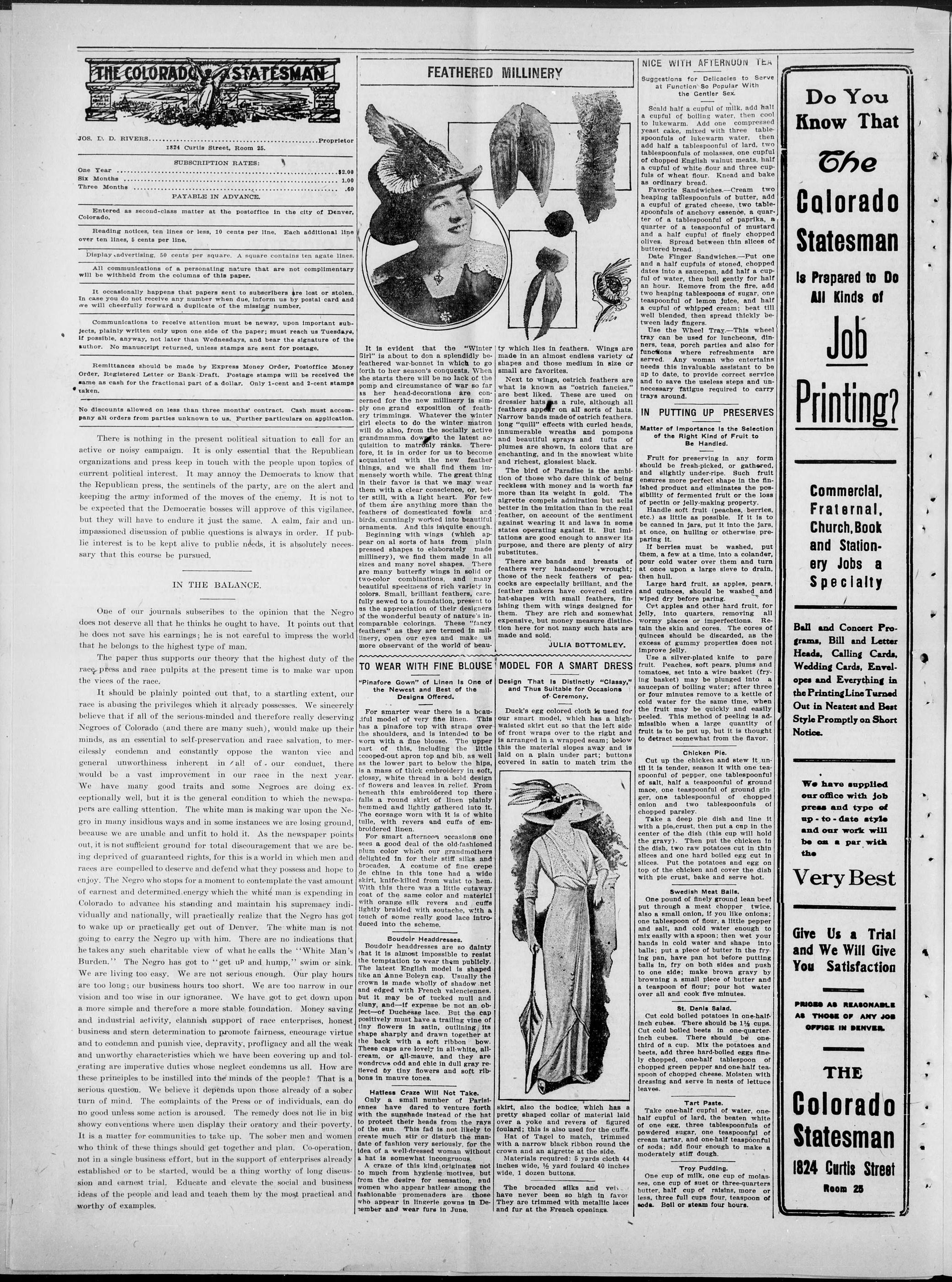
THE HAT
It is evident that the "Winter Girl" is about to don a splendidly beathered war-bonnet in which to go forth to her season's conquests. When she starts there will be no lack of the pomp and circumstance of war so far as her head-decorations are concerned for the new millinery is simply one grand exposition of feathery trimmings. Whatever the winter girl elects to do the winter matron will do also, from the socially active grandmamma down to the latest acquisition to matronly ranks. Therefore, it is in order for us to become acquainted with the new feather things, and we shall find them immensely worth while. The great thing in their favor is that we may wear them with a clear conscience, or, better still, with a light heart. For few of them are anything more than the feathers of domesticated fowls and birds, cunningly worked into beautiful ornaments. And this is quite enough.
Beginning with wings (which appear on al sorts of hats from plain pressed shapes to elaborately made millinery), we find them made in all sizes and many novel shapes. There are many butterfly wings in solid or two-color combinations, and many beautiful specimens of rich variety in colors. Small, brilliant feathers, carefully sewed to a foundation, present to us the appreciation of their designers of the wonderful beauty of nature's incomparable colorings. These "fancy feathers" as they are termed in millinery, open our eyes and make us more observant of the world of beau-
TO WEAR WITH FINE BLOUSE
"Pinafore Gown" of Linen Is One of the Newest and Best of the Designs Offered.
For smarter wear there is a beautiful model of very fine linen. This has a pinafore top with straps over the shoulders, and is intended to be worn with a fine blouse. The upper part of this, including the little scooped-out apron top and bib, as well as the lower part to below the hips, is a mass of thick embroidery in soft, glossy, white thread in a bold design of flowers and leaves in relief. From beneath this embroidered top there falls a round skirt of linen plainly hemmed and lightly gathered into it. The corsage worn with it is of white tulle, with revers and cuffs of embroidered linen.
For smart afternoon occasions one sees a good deal of the old-fashioned plum color which our grandmothers delighted in for their stiff silks and brocades. A costume of fine crepe de chine in this tone had a wide skirt, knife-kilted from waist to hem. With this there was a little cutaway coat of the same color and materiel with orange silk revers and cuffs lightly braided with soutache, with a touch of some really good lace introduced into the scheme.
Boudoir Headdresses
Boudoir headdresses are so dainty that it is almost impossible to resist the temptation to wear them publicly. The latest English model is shaped like an Anne Boleyn cap. Usually the crown is made wholly of shadow net and edged with French valenciennes, but it may be of tucked mull and cluny, and—if expense be not an object—of Duchesse lace. But the cap positively must have a trailing vine of tiny flowers in satin, outlining its shape sharply and drawn together at the back with a soft ribbon bow. These caps are lovely in all-white, allcream, or all-mauve, and they are wondrous odd and chic in dull gray relieved by tiny flowers and soft ribbons in mauve tones.
Only a small number of Parisiennes have dared to venture forth with the sunshade instead of the hat to protect their heads from the rays of the sun. This fad is not likely to create much stir or disturb the mandate of fashion very seriously, for the idea of a well-dressed woman without a hat is somewhat incongruous. A craze of this kind originates not so much from hygienic motives, but from the desire for sensation, and women who appear hatless among the fashionable promenaders are those who appear in lingerie gowns in December and wear furs in June.
ty which lies in feathers. Wings are made in an almost endless variety of shapes and those medium in size or small are favorites.
Next to wings, ostrich feathers are what is known as "ostrich fancies," are best liked. These are used on dressier hats as a rule, although all feathers appear on all sorts of hats. Narrow bands made of ostrich feathers. long "quill" effects with curled heads, innumerable wreaths and pompons and beautiful sprays and tufts of plumes are shown, in colors that are enchanting, and in the snowiest white and richest, glossiest black.
The bird of Paradise is the ambition of those who dare think of being reckless with money and is worth far more than its weight in gold. The algrette compels admiration but sells better in the imitation than in the real feather, on account of the sentiment against wearing it and laws in some states operating against it. But imitations are good enough to answer its purpose, and there are plenty of airy substitutes.
There are bands and breasts of feathers very handsomely wrought; those of the neck feathers of peacocks are especially brilliant, and the feather makers have covered entire hat-shapes with small feathers, finishing them with wings designed for them. They are rich and somewhat expensive, but money measure distinction here for not many such hats are made and sold.
JULIA BOTTOMLEY.
MODEL FOR A SMART DRESS
Design That Is Distinctly "Classy," and Thus Suitable for Occasions of Ceremony.
Duck's egg colored cloth is used for our smart model, which has a high-waisted skirt cut so that the left side of front wraps over to the right and is arranged in a wrapped seam; below this the material slopes away and is laid on a plain under part; buttons covered on satin to match trim the
skirt, also the bodice, which has a pretty shaped collar of material laid over a yoke and revers of figured foulard; this is also used for the cuffs. Hat of Tagel to match, trimmed with a narrow black ribbon round the crown and an aigrette at the side. Materials required: 5 yards cloth 44 inches wide, 1/2 yard foulard 40 inches wide, 1 dozen buttons.
The brocaded silks and velvet have never been so high in favor They are trimmed with metallic laces and fur at the French openings.
NICE WITH AFTERNOON TEA
Suggestions for Delicacies to Serve at Function So Popular With the Gentler Sex.
Scald half a cupful of milk, add half a cupful of boiling water, then cool to lukewarm. Add one compressed yeast cake, mixed with three tablespoonfuls of lukewarm water, then add half a tablespoonful of lard, two tablespoonfuls of molasses, one cupful of chopped English walnut meats, half a cupful of white flour and three cupfuls of wheat flour. Knead and bake as ordinary bread.
Favorite Sandwiches.—Cream two heaping tablespoonfuls of butter, add a cupful of grated cheese, two tablespoonfuls of anchovy essence, a quarter of a tablespoonful of paprika, a quarter of a teaspoonful of mustard and a half cupful of finely chopped olives. Spread between thin slices of buttered bread.
Date Finger Sandwiches.—Put one and a half cupfuls of stoned, chopped dates into a saucepan, add half a cupful of water, then boil gently for half an hour. Remove from the fire, add two heaping tablespoons of sugar, one teaspoonful of lemon juice, and half a cupful of whipped cream; beat till well blended, then spread thickly between lady fingers.
Use the Wheel Tray.—This wheel tray can be used for luncheons, dinners, teas, porch parties and also for functions where refreshments are served. Any woman who entertains needs this invaluable assistant to be up to date, to provide correct service and to save the useless steps and unnecessary fatigue required to carry trays around.
IN PUTTING UP PRESERVES
Matter of Importance is the Selection of the Right Kind of Fruit to Be Handled.
Fruit for preserving in any form should be fresh-picked, or gathered, and slightly under-ripe. Such fruit ensures more perfect shape in the finished product and eliminates the possibility of fermented fruit or the loss of pectin or jelly-making property.
Handle soft fruit (peaches, berries, etc.) as little as possible. If it is to be canned in jars, put it into the jars, at once, on hulling or otherwise preparing it.
If berries must be washed, put them, a few at a time, into a colander, pour cold water over them and turn at once upon a large sieve to drain, then hull.
Large hard fruit, as apples, pears, and quinces, should be washed and wined dry before paring.
Cut apples and other hard fruit, for jelly, into quarters, removing all wormy places or imperfections. Retain the skin and cores. The cores of quinces should be discarded, as the excess of gummy properties does not improve jelly.
Use a silver-plated knife to pare fruit. Peaches, soft pears, plums and tomatoes, set into a wire basket (frying basket) may be plunged into a saucepan of boiling water; after three or four minutes remove to a kettle of cold water for the same time, when the fruit may be quickly and easily peeled. This method of peeling is admissible when a large quantity of fruit is to be put up, but it is thought to detract somewhat from the flavor.
Chicken Ple.
Cut up the chicken and stew it until it is tender, season it with one teaspoonful of pepper, one tablespoonful of salt, half a teaspoonful of ground mace, one teaspoonful of ground ginger, one tablespoonful of chopped onion and two tablespoonfuls of chopped parsley.
Take a deep pie dish and line it with a pie, crust, then put a cup in the center of the dish (this cup will hold the gravy). Then put the chicken in the dish, two raw potatoes cut in thin slices and one hard boiled egg cut in slices. Put the potatoes and egg on top of the chicken and cover the dish with pie crust, bake and serve hot.
Swedish Meat Balls.
One pound of finely ground lean beef put through a meat chopper twice, also a small onion, if you like onions; one tablespoon of flour, a little pepper and salt, and cold water enough to mix easily with a spoon; then wet your hands in cold water and shape into balls; put a piece of butter in the frying pan, have pan hot before putting balls in, fry on both sides and push to one side; make brown gravy by browning a small piece of butter and a teaspoon of flour; pour hot water over all and cook five minutes.
St. Denis Salad.
Cut cold boiled potatoes in one-half inch cubes. There should be 1½ cups. Cut cold boiled beets in one-quarter-inch cubes. There should be one-third of a cup. Mix the potatoes and beets, add three hard-boiled eggs finely chopped, one-half tablespoon of chopped green pepper and one-half teaspoon of chopped cheese. Moisten with dressing and serve in nests of lettuce leaves.
Tart Paste.
Take one-half cupful of water, one-half cupful of lard, the beaten white of one egg, three tablespoonfuls of powdered sugar, one teaspoonful of cream tartar, and one-half teaspoonful of soda; add flour enough to make a moderately stiff dough.
Troy Pudding.
One cup of milk, one cup of molasses, one cup of suet or three-quarters butter, half cup of raisins, more or less, three full cups flour, teaspoon of soda. Boll or steam four hours.
Do You Know That
The Colorado Statesman
Is Prepared to Do All Kinds of
Job
Printing?
Commercial, Fraternal, Church, Book and Stationery Jobs a Specialty
Ball and Concert Programs, Bill and Letter Heads, Calling Cards, Wedding Cards, Envelopes and Everything in the PrintingLine Turned Out in Neatest and Best Style Promptly on Short Notice.
We have supplied our office with job press and type of up-to-date style and our work will be on a par with the
Very Best
Give Us a Trial and We Will Give You Satisfaction
PRICES AS REASONABLE
AS THOSE OF ANY JOB
OFFICE IN DENVER.
THE
Colorado
Statesman
1824 Curtis Street
re " SRP a ion in ae
DAT CH SCTAPECTA AN |
PANE COLORADC\ 274 STATESMAN
de
Pee lene a A De Aone ies
EE Sy os piesa een cr
aed, - ees hy Ae IN [what eosgsen yy
Sa SES re
Mrs. H. Nelson and son of Douglas, On last Saturday evening, Septer
Ariz. are the guests of Mrs. O'Neil, | ber 21st, a number of friends gathere
1425 East Sixteenth avenue. at the home of,Mrs. M. E. Morrisor
a 834 Fox street. The occasion was
Miss Geneva Morrison left the city airprise party given in honor of Mis
Wednesday for Colorado Springs to | Sita Harris, who has spent her v
SinlGs Habinleton whe tactilh cation in Denver and was on the verg
of making,her departure for Atlant:
eee Ga,, to resume her studies at Spellma
Miss Eliza Miller will visit in Colo- Seminary. The secret had been we
rado Springs tomorrow, as the guest guarded, so that the surprise was
of Mrs. S. Rice. real one. Those comprising the part
——— were Rey. and Mrs. A. E. Reynold:
Mrs. Gertie Harris and her two|Mr. and Mrs. William Hoy, Mesdame
children arrived in the city last week|J. W. Parker, W. M. Kennedy, Lél
from Littleton. Mrs. Harris wp en-|Johnson, E. Stanley, Ellen Johtisor
ter her children in the city schol,” | Dora B. Loveless, J. C. Stevie, B 3
Brown, Misses Lenora Rucker
J. M. Johns arrive in the city to-)Rocky Ford, Sallie B. Simms, Arlethi
day from Fort Smith, Ark. and will| Reynolds, Messrs. D. C. Burton, Ja
take charge of the apartment house at| Collins, L. E. Thalley. An imprompt
1410 Grant street. program was rendered which was th
Mrs. Lillie Lewis, one of our most
industrious and progressive widows,
has taken out a permit to erect a $3,
000 house at 2425 Humboldt street.
Rey. A. M. Ward left the city Sat-
urday for Pueblo, where he will pre-
side. St. Paul A. M. EB. church ie
without a pastor, one will be supplied
by transfer.
Mrs. Craig of Atchison, after
spending several weeks in the city
with friends, left Monday for Salida
on a visit_to her son, W. F. Craig and
his estimable wife.
Rey. James Rodgers, who was the
“guest of his cousin, Mrs. H. J. M.
Brown, last week, returned to his
home in Albuquerque, N. M., last Sat
urday.
Meredith Lee came down from Estes
Park Monday, where he has been em-
ployed for several years and left for
Béston, Mass., Tuesday on a visit to
his son.
Rey. Charles Lightner left for Colo:
rado Springs Wednesday to join his
family who went down last Sunday,
where they will remain for some little
time before again locating in Guth
rie, Oklahoma,
‘The affair given by the Owl Club
at Eureka hall Tuesday night was a
success from every viewpoint. A large
crowd, fine music and excellent de-
portment was the predominating feat
ures,
Mrs, Edith O'Kelley, of Detroit and
a former resident of our city, where
she spent her girlhood days, after
spending the past four months here
as house guest of her sister, Mrs. Bes-
sie Austion, returned home Monday.
Miss Jennie Stafford a former res-
ident of Denver, was married at Great
Bend, Kansas, Sept. 18th to Mr. Is.
rael Fancher, a prosperous farmer.
Her many friends join the Colorado
Statesman in wishing this young cou-
ple a prosperous voyage.
H. R. Hicks, wife and daughter,
Miss Jennie, will leave the city next
Thursday for Kansas City, St. Louis
and other Missouri points to be gone a
month, A certain young gentleman is
beginning to warble: “Gee, don’t 1
wish I had a girl, etc., but cheer up
V— it might be worse.
Wayman Ward, our young theologt.
cal student of whom we are justly
proud, preached an excellent sermon
at Shorter’s Tuesday eve. A small
sum of money was presented him by
his well wishers. He left the city
‘Wednesday for Wilberforce to con:
tinue his course in theology.
Rey. J. C. Owens has been appointed
presiding elder of the Omaha, Nebr.
district. He returned to the city this
week to attend to some important busi
ness, Rey. and Mrs. Owens will leave
for Kansas City, Kans., which place
will be his headquarters. Denverites
are loath to part with this worthy cow
ple, who have made many friends ir
this part of the West.
The Portland, Ore., Advocate has
the following excerpt concerning Mrs.
T. Cassell and family, recent arrivals
in Denver: “Mrs. T. Cassell of 102
Fast Soventy-fifth street North, one of
the most popular cultured and refined
society ladies of Portland, will leave
Portland, we regret to say, next Mon
day to make her future home In Den.
ver, Colo,, while Mr, Cassell, her hus
band, who is an excellent gentleman
will leave on the same day for Brit
ish Columbia on a prospecting tour
after which he will join Mrs, Cassel
and son in Denver.”
_ On last Saturday evening, Septem-
ber 2ist, a number of friends gathered
at the home of. Mrs. M. E. Morrison,
834 Fox street. The occasion was a
Sirprise party given in honor of Miss
Samira Harris, who has spent her va-
cation in Denver and was on the verge
of making,her departure for Atlanta,
Ga,, to resume her studies at Spellman
Seminary. The secret had been well
guarded, so that the surprise was a
real one. Those comprising the party
were Rev. and Mrs. A. E. Reynolds,
Mr. and Mrs. William Hoy, Mesdames
J. W. Parker, W. M. Kennedy, Léla
Johnson, E. Stanley, Ellen Johtison,
Dora B. Loveless, J. C. Steele, B. M.
Brown, Misses Lenora Rucker /of
Rocky Ford, Sallie E, Simms, Arlethia
Reynolds, Messrs. D. C. Burton, Jas.
Collins, L. E. Thalley. An impromptu
program was rendered which was the
cause of much merriment. Light re-
freshments were then indulged in by
those present. Miss Harris was the
recipient of several tokens of regard
and affection, among which was a
neat little sum of money. After sing-
ing “God Be With You,” etc., at about
10:30 the party dispersed, feeling that
they had spent an enjgyable evening
and wishing that the surprises® in
store for Miss Harris as she journeys
along the path of life may be agreea
‘ile oneal
SCOTT M. E. CHURCH.
Twenty-Sixth and Clarkson.
The drama “Engaged,” drew a
crowded house last Tuesday evening.
Miss Smith sold 101 tickets; Miss Dor-
othy Lewis 103. Miss Dorothy Lewis
was the winner of the first prize by a
very narrow margin, Both girls
worked heroically and deserve much
praise, There was a note of harmony
throughout the joint entertainment of
Central and Scotts. We are ready to
unite “again.
‘The large and appreciative audience
who heard Rey. J. D. Rice’s farewell
sermon last Sunday, gave him a purse
of $14.65. They gave to this worthy
young man with joy and counting it
a great privilege to be able to help
start a brilliant preacher on a career
of the highest usefulness in service for
God and man». We bid him God speed.
Mr. Emanuel Lewis and Miss Dian:
tha Birch were united in the holy
bonds of wedlock at 1923 Clarkson
last Thursday evening. The pastor
tied the Gorgian knot, The ceremony
was performed in the presence of a
few intimate friends. A reception was
given to the bride and groom the next
evening where many gathered around
the festive board and bade the young
couple God speed and wished them a
pleasant journey through life.
The Epworth League was enter
tained last Thursday eyening in the
parsonage by its energetic president,
Mrs. Ada Castry. Appetizing refresh-
ments were served. Several new mem.
bers were enrolled in this live depart
ment of the church.
Mrs, P. A, Campbell and Miss Love
of Colorado Springs were visitors to
the parsonage and attended morning
service last Sunday. They left for the
Springs after spending a pleasant
visit in our city.
Mrs, Jennette Bailey has gone te
the Springs for an indefinite stay.
We wish to call our members and
friends’ attention to the club rally on
the first Sunday in October. Let ey:
ery loyal member be ready to give
something on the mortgage.
Scott Church is growing in spite of
besettments. We do not look up dis
gruntled members in the other church
es and annex them to our roll. We
decry this method and think it is
harmful to the church militant.
CAMPBELL CHAPEL, A. M. E.
CHURCH.
Corner Twenty-Third and Lawrénce
Sts.—Rev. Franklin H. Bray, Pastor.
Last Sabbath was a day of great
rejoicing at this church. In the morn.
ing the pastor, Rev. Bray, preathed
to a large congregation on “The Mis.
sion of the Christian Ministry,” using
as a text, Mark xvi, 15: “Go ye into
all the world and preach my gospel to
every creature.” The spirit of the Lord
was present and a refreshing from on
high was had.
Rey. A. Wayman Ward, son of Pre-
siding Elder A. M. Ward, preached at
night to the edification of all who
heard him, The young man gives
‘promise of developing into a strong
and logical preacher, The church was
filled at-this service, many strangers
being in the congregation.
/ Receipts for the day, $46.75.
__ The pastor will preach both morning
‘and evening tomorrow. Morning sub-
ject, “The Abiding Companionship.”
In the evening, “The Name of Jesus.”
_ This is distinctly the people's
church, the home of strangers and a
‘good place to worship. Come.
CARD OF THANKS.
We wish to express our great appre-
ciation of the sympathy of our many
dear and sincere friends during our
recent bereavement in the loss of our
dear wife, mother and sister-in-law.
We are indeed thankful for the very
beautiful floral designs and the many
words of good cheer. May each of you
live long to lighten the burdens of
others,
Sincerely,
A. M. WARD, A. WAYMAN WARD,
VERA WARD, VERGIL WARD, H.
R. WARD.
Resolutions of Condolence.
Ser ee Lee Oe Caos AWD! ne Da.
Whereas, Death has again ‘entered
the family of our beloved pastor, Rev.
A. M. Ward, and has this time claimed
for his victim the wife of his bosom,
the darling of his heart, his compan:
fon in joy and sorrow, success or fail.
ure, and
Whereas, She was a loving wife, a
kind, indulgent mother, a loyal friend,
a true, faithful, earnest Sunday school
worker, and
Whereas, We know we can never
feel the loss as keenly as does Rev.
Ward and their dear children, yet we
feel her place in our hearts can never
be filled. She was a teacher in deed
and truth. She was a living example
of the lessons she taught in our school
Sabbath after Sabbath. She fell work-
ing for the Church and the Master.
‘Therefore be it
Resolved, That we, the officers-and
memers of the Sunday school of Short-
er Chapel, A. M. EB. Church, do here-
by extend to the bereaved family of
our dear Sister Ward our deepest
sympathy in this the saddest hour of
their lives and would say to them,
“Weep not for her.” "She has simply
gone to sleep in the arms of her lov-
ing Saviour. Do not ask for her to
come back to this place of sorrow and
suffering, Your loss is great—even
grievous, but think of what she has
gained. She has only gone on to
await your coming—
From a land of sorrow and sighing,
From a country so sad at the best,
To a land where dwelis our Redeemer
To give all his weary saints rest.
We further say to you, dear friends,
lean heavily upon the arm of Him who
has promised to put nothing upon us
but what he would give us strength to
bear. Be it further
Resolved, That a copy of these reso:
lutions be kept with the records of
our school, one sent to the family and
published in our city papers.
MRS. NANNIE BROWN,
MRS. ALICE MASON,
MRS. REBECCA GLENN,
MRS. FANNIE BROWN,
MRS. REBECCA NELSON,
J.C. PORTER,
Committee.
Like the “Pili” Nut.
The “pili” nut tree grows in the
southern part of the Island of Luzon,
and nowhere else in the Philippines.
It is a large iree, and its seed is de-
scribed as extraordinarily rich in
flavor. All the Americans in the Phil-
ippines think it the finest nut grown.
When the nuts are roasted, if a light-
ed match be touched to one of them,
it will burn like a lamp, so rich is it
in ofl.
Literary Note.
We are told that two and one-half
million people in this country live by
writing. Of course this includes those
who write home for money.—Cleve-
land Plain Dealer.
And tHe Rest Wae Trivial.
She—“I don't see any sense in your
objecting to Mr. De Bumville being
invited to the house.” He—“Why, you
know he’s been shown to be a man
of no principle or character, a man
who had to leave his country to es:
cape the law——” She (impatiently)
—‘That's very true; but no one can
say he's not a perfect géntleman.—”"
Time.
‘
Rheumatism and
Asthma Cured
Mr. J. Che 2910 Glenarm Place.
_ Dear Sir: I will cheerfully recom-
‘mend the Twentieth Century Wonder
to anyone suffering with rheumatism
or bad colds and~ liver complaints
7 contracted an awful heavy cold;
nothing would break it up; have taken
‘two boxes and have not been troubled
with such complaints since. Before
taking, my kidneys troubled me very
much,
W. M. SANDERS,
3. 733 Franklin.
MISS KATIE BELL,
733 Franklin.
Denver, Colo; March 31, 1912.
Mr. J. J. Bates, Denver, Colo.
Kind Sir: I have taken your Twen-
tleth Century medicine for several
months, and it proved to be satisfac-
tory, and I recommend it very highly.
‘When I first came here I took a se-
vere cold which brought on a violent
cough with pain in my chest. After
using about two packages I was en-
tirely cured from cough and pain and
am pleased to bear testimony to
ihe virtue of your medicine.
Respectfully,
THERON HALLIDAY,
2117 Arapahoe St.
Gomes tase.
I was a lunger, suffering for a long
time. A benefited friend endorsed
Bates’ Twentieth Centry Wonder Tea.
[ took several packages of the tea
and have not been troubled with my
lungs since. That was several years
‘ago, not being troubled with colds as
1 was theretofore. I most gladly rec-
ommend the Twentieth Century Won-
der Tea to all lung sufferers.
MRS, SADIE STEPHENS,
2945 So. State St.
For Rent—5 room frame at $20 24th
St. Apply at this office, 1824 Curtis,
room 25.
Brickler’s New Barber Shop Is lo-
cated at 2208 Larimer street. Shave,
10c. Hair Cut, 25¢; Children, 150.
Fort Rent—Three nice unfurnished
rooms. Apply 2929 Glenarm Place.
Two nicely modern furnished rooms
for rent at 3214 Champa street,
Nicely modern furnished rooms for
rent. Apply 2218 Clarkson street.
The Pullman’s Shining Parlor for
iadies and gentlemen. Price 5 cents a
shine. G. Crowder, proprietor, 1214
Nineteenth street.
Don't forget that Harry Jones has
moved his barber shop from 1022 19th
street to 929 21st street, where he has
Installed all of the latest and most up-
to-date instruments that go to make a
first class Tonsoria! Parlor. Gall and
see us and you will be pleased.
_13 CENTS A DAY BUYS A PIANO.
WITH MUSIC LESSONS FREE. PI-
ANOS FROM $88 UP. COLUMBINE
MUSIC CO,, 920-924 15th STREET,
CHARLES BUILDING.
NOTICE.
The negro year book can be bought
at the Colorado Statesman’s office,
1824 Curtis street, room 25 or of J. H.
Doniphan, 1721 Marion street. A card
will meet with an immediate response.
Look for This
Sign in Front of
Our Store.
BY
ay
a
i I
‘ HERS
WW
ia
NigsTaRN
\ MDP F
/BEEE7
An OR
i; M4 he Co
y a &
OUR LEADER.
Hog Chitterlings, 5¢ Ib,
Our store is your store.
We are at your service.
We Sell Everything a
Hog Furnishes
Get our prices before you buy else-
where. We also sell our groceries
OUR MOTTO:
Our profits are small,
Be ea
2048 LARIMER ST.
create een
Open Sunday All Day.
ARTHUR JACKSON’S
Rehearsals Friday Nights and Sunday
Afternoon.
PUBLIC CORDIALLY INVITED.
Phone Main 5300, Call for E, Caldwell
Rear 2746 Arapahoe Street.
Furniture Repairing and Up-
holstering. All work Cash.
PHONE YORK 5566
2231 Washington St. Denver
Ge
RW a
& pee)
X ——"
ae Og
lm +
Come and be Measured. . Do it To-Day.
Best Material, Latest Styles, Lowest Prices,
Best of Work. My Rent is low.
THE PROFIT IS YOURS.
N. FERRY Phone Main 7419,
. 1905 Curtis Street
SE fh, Saeed | SE SP ae
ko Pages ee a2)
Fo eA he i, eee, Eee ea
het son | oe a. oes a
I B77 ms ial RG (3 ? .
‘| a j ny
9) uN = oY
ae | Es as Vegas he ee
! P ede : Li os aT)
i , ‘higdel
th “ah
Ps hes. os =e i
CS ; f eA F
IF I PLEASE YOU, TELL YOUR FRIENDS, IFJNOT, TELL ME
a ee a : x ae
FROM THE PRODUCER 10 THE CONSUMER
Supply Your pwome with the
Celebrated Tivoli Beer
BOTTLED BY
THE EMPIRE BOTTLING CO.
PhONE™>Gallup 245
Tesch’s Market and Grocery
When You Want
Live Chickens, Fresh Meats and
Frech Vegetables
WE RENDER OUR OWN LARD
2601 Lafayette Street Telephone York 1979
When You Want
The Heads, Feet, Tails, Snouts, Neckbones
or Chiterlings or any other part of the hog
except the squeal go to
9
East's MarKet
2300-6 Larimer Street. = Phone Main 1461.
A. 8. Britton, who has been a resi-
dent of Arvada for a number of years,
where he owns some yery vaiuable
property, has gone into the truck gar-
dening business on an extensive scale.
He has purchased two wagons, se-
cured his license and is now prepared
to deliver fresh eggs and all kinds of
garden truck in all parts of the city.
All goods sold by him are raised on his
own farm, hence buyers are assured
of good and fresh garden truck at all
times. Mr. Britton is also handling
fruit of all kinds, such as apples,
pears, peaches, plums, ete., from the
Plans Drawn _—_ Estimates Furnished
CARPENTER
Job and Repair Work a Specialty.
Coal, Wood and Express
Residence: 353 W. Warren Ave.
Shop
Phone Champa 752 1021 2tst st.
Western Slope, which he will sell di-
rect to his customers, thus saving
them from dealing with middlemen.
He guarantees everything he han-
dies to be fresh, wholesome and rea-
sonable in price. He has already sold
1,800 gallons of peas off of his place
and other vegetables in proportion. He
is the only colored man that we know
of in this vicinity who has had the
courage to engage in the truck garden-
ing business on such an extensive
scale and he should receive excellent
patronage. Phone number, Arvada
1881.
WELTON TRUNK MFG. CO.
~ Geo. Brandenburg, Prop.
SS
a he
etnias: Sed
st
NEE
TRUNKS, SUIT CASES, BAGS
AND_ TRAVELERS’
NECESSITIES
Fhove Champa 2018 2253 Welton
SHIPS TO GATHER
Uncle Sam's Warships Soon to Be Mobilized.
New York Will Witness on October 14 and 15 Greatest Fleet of Fighting Craft Ever Assembled in American Waters.
Washington.—New York city will witten on Oct. 14 and 15 the mobilization of the greatest fleet of warships ever assembled in American waters. The navy department issued preparatory orders for the mobilization a few days ago. At the same time the warships of the Atlantic fleet and Atlantic reserve fleet gather in the harbor of New York city the Pacific fleet will mobilize at San Francisco and the Asiatic fleet at Manila.
In the mobilization in New York waters will be 120 ships, including the new 26,000-ton dreadnaughts Wyoming and Arkansas. There will be 43 ships assembled at San Francisco and 20 at Manila. Rear Admiral Hugo Osterhaus, commander-in-chief of the Atlantic fleet, will command the mobilization in New York; Rear Admiral Southernland the fleet at San Francisco and Rear Admiral R. R. Nicholson the Manila mobilization. President Taft and Secretary of the Navy Meyer, accompanied by foreign naval attaches and members of both houses of congress will be aboard the new battleship Arkansas on the day of the review, which will probably be on the last day of the mobilization, Oct. 15.
The ships will begin assembling in the Hudson river on or about Oct. 12. The last of the arrivals, the torpedo flotilla of the reserve fleet, will arrive on the night of Oct. 13.
The line of battleships will consist of the Alabama, Arkansas, Connecticut, Delaware, Florida, Georgia, Idaho, Illinois, Indiana, Iowa, Kansas, Kearsarge, Kentucky, Louisiana, Maine, Massachusetts, Michigan, Minnesota, Mississippi, Missouri, Nebraska, New Hampshire, New Jersey, North Dakota, Ohio, Rhode Island, South Carolina, Utah, Vermont, Virginia, Wisconsin and Wyoming.
The armored cruisers Montana, North Carolina, Tennessee and Washington.
The scout cruisers Birmingham, Chester and Salem.
Destroyers Amenm, Burrows, Drayton, Flusher, Lamson, McCall, MacDonough, Mayrant, Monaghan, Patterson, Paulding, Perkins, Preston, Reid, Roe, Smith, Sterett, Terry, Trippe, Walke, Warrington, Whipple and Worden.
Torpedo boats Bagley, Bailey, Barney, Biddle, Blakely, Cushing, Dahlgren, Davis, De Long, Du Pont, Ericson, McKee, Mackenzize, Manly, Morris, Porter, Stockton, Stringham, Thornton, Tingley and Wilkee.
The submarine flotilla and colliers and tenders.
ENTERTAINMENTS FOR FARMERS.
Free entertainments are given to rural communities in some counties in Alabama as part of a campaign to induce the people to stay on the land instead of abandoning their farms for city life. This information has been received by the United States bureau of education from E. M. Shackelford, principal of the state normal school at Troy, Pike county, Alabama, who is at the head of the movement. Mr. Shackelford writes:
"In my opinion, the exodus of the younger generation from the country to the town is at present the most serious menace to our general welfare. Good roads, motor cars, the telephone and rural mail delivery are improving rural conditions greatly, but rural social life does not yet afford the opportunities for the commerce of ideas that an active, reading, thinking public demands. Hence the tendency to congregate in the centers of population, and hence this effort of ours to afford a few social opportunities through a course of free entertainments."
The entertainments consist mainly of lectures, "lantern shows," and selections on the Victrola. Some of the lectures are given at night, and some in the afternoon. Occasionally dinner is provided at the school and an all-day session is held.
While this movement was started by the Troy State Normal school, the co-operation of the Alabama state health and medical departments and the various state institutions has been enlisted for supplying speakers, entertainment clubs and other attractions. Most of the entertainers give their services without charge, and transportation is furnished by the owners of automobiles. Friends of the new movement anticipate that it will be a powerful factor wherever introduced in adding to the pleasures of rural life by furnishing additional opportunities to the country folk for recreation, culture and social intercourse.
Practical if Not Poetic.
W. D. Howells, at a luncheon at Kittery Point, said of a certain popular novelist:
"There is about as much poetry in him as there is in McMasters.
"McMasters, you know, was walking with a beautiful girl in a wild New England wood.
"What is your favorite flower, Mr. McMasters?" the girl asked softly.
"McMasters thought a moment, then cleared his throat and answered:
"Well, I believe I like the whole wheat best."—Washington Star.
ROAD EXPERTS NEEDED.
A practical effort to bring the supply of expert highway engineers to the point where they will be numerous enough to meet the demand for their services is to be made at the American Road Congress, to be held on the Million-Dollar Pier, in Atlantic City, September 30 to October 5. At the present time, with the people of the United States spending more than $200,000,000 a year for the improvement of highways, the demand for expert highway engineers exceeds the supply. There is to be a conference of educational institutions at the American Road Congress, to be directed by the Society for the Promotion of Engineering Education, and through this conference efforts are to be made to induce the leading universities to establish specific and practical courses for the instruction of highway engineers.
At the present time there are about 82 universities devoting some attention to highway engineering. The instruction in this branch of engineering, however, is, in most cases, merely a part of the general training of engineers, so that there will be a sufficient number of trained men to handle the great problem that has been thrust upon the United States by the widespread agitation for a better system of public highways that will reduce the cost of hauling crops and permit shipments by farmers at all seasons of the year.
Prof. Henry H. Norris of Cornell university is secretary of the Society for the Promotion of Engineering Education, which is composed of officials of the leading educational institutions having engineering departments. Professor Norris has just sent letters to all the institutions which are represented in their society asking them to appoint delegates to represent them at the convention, which will be part of the American Road Congress at Atlantic City. Prof. William T. Magruder, of the Ohio state university, is president of the Society for the Promotion of Engineering Education, while the vice-presidents are Prof. L. S. Marks of Harvard and Prof. F. W. Sperr of the Michigan College of Mines. They believe that if the universities will supply well-equipped engineers it will be a long step towards doing away with the careless supervision of the construction and maintenance of public roads, that now results in the loss of a large percent of the money invested in roads.
MUST ANSWER QUESTIONS.
In the future, when a person calls at the general delivery window of any postoffice will have to answer these questions put by the clerk before he gets his mail:
"Are you twenty-one years of age?"
"Have you a permanent home in the city?"
"Are you using a fictitious name?"
"Is this correspondence illegal?"
"Is this correspondence illegal?"
An order issued to postmasters by Dr. C. P. Grandfield, first assistant postmaster general, reads in part:
"The attention of postmasters at offices having city carrier service is called to paragraph 2, section 713, postal laws and regulations, compliance with which should prevent the improper use of the general delivery by residents. Postmasters at such offices, may require all persons supposed to be residents to furnish in writing their names and addresses and statements of their reasons for preferring to be served at the general delivery. "Minors calling at such offices may be requested to furnish the information indicated above and also the names of their parents, in order that the parents may be notified and have an opportunity to control the delivery of the mail to the extent authorized by section 643, postal laws and regulations.
"Postmasters at offices not having city carrier service may notify the parents of minors in all instances where it appears that the minors are calling at the general delivery for mail under objectionable circumstances."
TIME "VIA WIRELESS."
The new wireless station at Arlington which will be completed in about a month will act as a clock regulator for thousands of jewelers all over the country. The right time as recorded at the naval observatory will be flashed all along the coast and as far west as the system will reach. The towers are expected to communicate with vessels three thousand miles at sea, but the exact distance they will command over land has not been calculated to a nicety. It is believed that messages will he recorded at least 1,500 miles inland. Many large jewelry stores have notified the navy department that they intend to install wireless receivers so they can get the right time regularly "vla wireless."
TO MODIFY BROOK TROUT.
Uncle Sam is going to try to produce a trout that can live and prosper in the warm water of the sluggish streams of the southern states. An experimental fish station will be established near Washington for that purpose. Congress has provided the money for the work.
The fighting brook trout is to be modified, domesticated and made to furnish more food and less sport for the human family. The experts of the bureau of fisheries hope to succeed in getting a trout that will fill the bill, but they recall the fact that many years ago fifty million Pacific coast salmon were planted in the Mississippi river and perished.
UNCLE SAM'S STAMPS
BUREAU OF PRINTING AND EN-
GRAVING BUSY PLACE.
Billions Are Turned Out Yearly—
Process of Manufacture From Paper Mill Until the Shipping Room Is Reached.
Think of receiving more than $603,000 on a single day's investment of
only $1,703! Think what the result would be in a year, counting the working days! Almost $181,000, 000 from an investment of $511, 000! It sounds like the vain imaginations of some drug vlictor or the ravings of a maniac. And yet it is not only true but it merely shows in plain fig-
what the result would be in a year, counting the working days! Almost $181,000, 000 from an investment of $511, 000! It sounds like the vain imaginations of some drug victim or the ravings of a maniac. And yet it is not only true but it merely shows in plain fig- the manufacturing business.
Furthermore, that business is carried on right here in the national capital; is, in fact, one of its recognized establishments. It is only when the above figures are given that the bureau of engraving and printing is lost sight of and a great temple of wealth is brought to mind. But even then it must be remembered that those figures, appalling as they appear, represent only the cost of manufacture and face value of the postage stamps printed by the government, beside which are the revenue and customs stamps.
Reports of the bureau of engraving and printing, when taken as a manufactory, show some astonishing figures. Take, for instance, the single items of postage stamps; that is, without the revenue and customs, which by the bureau's own classification fall under a separate head. There are 51 kinds and denominations printed, ranging from the humble little green 1 cent stamp up to its stately, aristocratic brother, which staggers under the weight of a $5 valuation. Also 15 colors are used in printing the stamps. A pause here for reflection will probably convince the most observant person that he is unfamiliar with several of these colors; that is, of course, in connection with stamps. We all know the 1, 2, 5 and 10 cent stamps. But to be able to call to mind just what those 15 colors are means a wide observation as well as a careful one. For the benefit of those who fail to solve this self appointed riddle the answer is this: Four shades of blue, two of green and two of brown, red, yellow, olive, orange, purple, lavender and dark slate.
The stamps which leave the bureau annually amount to more than $10,000,000, the latest yearly report showing the number to be 10,003,265,148. That brings the daily output down to 33,334,000 odd. Taking the yearly total in connection with the latest census report for the entire United States, it is seen that each year every man, woman and child in the country uses approximately 110 stamps. The paper on which the stamps are printed comes to the bureau direct from the manufacturers in sheets nine and one-fourth by ten and three-eighths inches, that being the required size for printing 100 stamps. More than 96,500,000 sheets are used in a year, while the daily consumption is about 322,000.
The figures regarding the cost of production are also interesting. The total cost of production, as before mentioned, is $511,000. Of that amount the greater portion is paid out in salaries to the 600 employees necessary in the manufacture of the stamps. The remainder is expended for paper, ink, gum and plates. The cost of the paper annually is $50,000. The amount used daily amounts to about $167. This paper for one year weighs 450 odd tons, while a ton and a half is used every day. Both the ink and gum used, the former in printing and the latter on the back of the stamps, are made at the bureau. The ink, purchased in its dry form, weighs more than 200 tons—enough for one year—while almost three-fourths of a ton is used daily. The cost of the dry ink is $38,500 a year, or $128 every day. The gum, purchased in the same form, is secured in equally large quantities, the amount sufficient for a year weighing 315 tons, with the daily consumption amounting to one ton. The cost of this, however, is less than the ink, as the yearly supply costs $15,000; the daily, $50.
Working for Women.
Miss Constance Leupp, daughter of the former commissioner of Indian affairs, is vice-president of the new Consumer's league of Washington, which has just started a movement in the District of Columbia to better the conditions of manufacture and sale and to secure better wages for workers, especially women and children. The league is now conducting an investigation into the hours of labor and the earnings of the women, and children in the District. It is said that many young girls who have no homes are working in stores at $2 and $3 a week.
Tough Flour.
"I wish to complain," said the bride, haughtily, "about that flour you sold me. It was tough."
"Tough, ma'am?" asked the grocer.
"Yes, tough. I made a pie with it, and my husband could hardly cut it."—Everybody's Magazine.
PLANT BOASTS A LONG NAME
Curious Structure of Green In Front of Treasury Building Attracts Attention.
A curious structure of green stands in the sunken plaza at the north front of the treasury at Washington. What was an old-fashioned fountain trickling a stingy stream has been consumed by the landscape gardener (or landscape architect, as those gentlemen prefer to be called) into a strange device suggestive of a Christmas decoration. It is the color of emerald, or shamrock, or something equally as green and dear. It grows bountifully upward from the top basin of the fount and then falls in feathery or plumey masses, velling all the ironwork of the fountain and hiding the bubbling and dripping water. Of course, it is a marine plant. Thousands of persons passing the treasury have stopped and stared at this green growth, asked many questions.
Enter the treasury, go to the captain of the watch and ask, "What is that?" One of the Civil war veterans on gurd there, glittering in a silver shield as big as a dishpan, will probably say:
"You are the ten thousandth man and the twenty thousandth woman to come here with that question. Nobody in the treasury know what the thing was, so we sent for one of the plant sharps at the National Botanic garden. He told us what the thing was, but still, we did not know and could never remember, so we got him to write it out and then we pasted the name in this ledger. If you can read it you may."
The watchman will open an impressive book and you may read this, the name of the plant:
"Myriophylum Prosefinacordiss." By common persons this strange water plant is sometimes called "parrot feather." Should you go to Washington, be sure to see this wonderful plant.
ADOPT HOBO SIGN LANGUAGE
House Doorkeeper Invents System to Stop Petty Pan-Handling Around Capitol.
The doorkeepers of the house of resentatives have adopted the hobo sign language, and they say it works like a charm. One of the pages invented the system to assist in putting as many crimps as possible into the petty pan-handling that goes on around the capitol.
The other day a flashy looking individual approached the doorkeeper at the main entrance to the floor of the house, flipped out a card and haughtily asked that it be sent in to Representative Sereno Payne, of tariff fame. It was then that one of the tricks of the "Weary Willie" code was worked.
The doorkeeper sized up the visitor as one of those pestiferous persons who make life a burden to statesmen. He passed the stranger's card to a page, but before doing so he turned down the upper left-hand corner in such a manner that the flashy looking man never noticed it. That turned down corner meant in the slang language, "Nothing doing."
The house page rushed in on the fior at Joe Dawson speed, noted the turned down corner and threw the card into the waste basket. Then he sauntered over to the pages' corner, back of the big screen on the Republican side, matched nickels with one of his fellow-pages, and, after the lapse of a polite length of time, returned with the information that Congressman Payne was out. The New York member sat nodding at his desk, touching elbows with Uncle Joe Cannon and John Dalzell, oblivious of the fact that he had just been sought.
Uncle Sam's Bat Hunt.
The government is to become a modern competitor of the Pied Piper of Hamlin as an exterminator of rats. But the magic of the Pied Piper's flute is to be displaced by the most improved, modern, double-action steel-jawed rat trap that American inventive genius can furnish. Through Surgeon General Bliss of the public health and marine hospital service, the government has asked for demonstrations of rat traps. The government wants traps to exterminate rodents which carry the bubonic plague from seaport to seaport. The trap which proves most efficacious will be recommended by the government for use in American ports where the plague-carrying rat may be expected.
As a means of promoting its country-wide campaign against the plague the service has issued a circular specifying the proper method of poisoning rats. This has been sent to every American port.
Towel Problem Solved.
Postmaster General Hitchcock has solved the towel-problem that confronts other executive departments. When the "laundry trust" of Washington jumped up the prices on towels Mr. Hitchcock installed a plant to launder the postoffice department towels. Local laundries laundered 100 towels for 32 cents last year. This year the price demanded is 75 cents. Up to recently one towel a week was allowed to each of the 1,800 employees of the department. Now each employee is allowed three towels a week. The department towels are washed by a machine owned by the government, and operated by a person paid $580 annually. Last year when the price of ice went too high, Mr. Hitchcock established a small ice factory, and makes his own ice, saving the government several hundred dollars annually.
Furnished Rooms
Newport Thirst Parlors
SHORT ORDERS AT ALL
hoe Street.
THE
ONARCH LIQU
COMPANY
MONA
MONARCH LIQUOR COMPANY
IMPORTED &
THE ZO
SAM
1004 Ninete
R TED & DOMESTIC WINES & L
E ZOBEL BROTHE
AMPLE ROO
Nineteenth Street, Corner of
1004 Nineteenth Street, Corner of Curtis
FINE WINES, LIQUORS AND CIGARS COORS' CELEBRATED BEER ON TAP
Right Kind of
The Right Reading The home
The Right Kind of Reading Matter
The home news; the doings of the people in this town; the gossip of our own community, that's the first kind of reading matter you want. It is more important, more interesting to you than that given by the paper or magazine from the outside world. It is the first reading matter you should buy. Each issue of this paper gives to you just what you will consider
The Purpose of an Advertisement
is to serve your needs. It will help sell your goods—talk to the people you want to reach. An advertisement in this paper is a reference guide to those whose wants are worth supplying.
THE HIGH COST OF LIVING
has not affected our job printing prices. We're still doing commercial work of all kinds at prices satisfactory to you.
A Dollar spent at home reacts in its benefits with unceasing general profit. Sent out of town it's life is ended.
Kept with the home merchants it is a messenger of continuous benefit. Business men should awake to the importance of keeping this dollar at home and make a bid for it by judicious advertising.
In Connection There Are Also Nicely
And the Old Reliable
TELEPHONE
CHAMPA 1231
DENVER
Richard Frazier and Tom Lewis, Props.
SHORT ORDERS AT ALL HOURS.
DENVER, COL
THE
CH LIQUOR
MPANY
THE MONARCH
LIQUOR CO
DOMESTIC WINES & LIQUORS
EL BROTHERS'
LE ROOM
Street, Corner of Curtis
Kind of matter
The Right Kind of Reading Matter
1516
COURT PLACE
COLORADO
CALLING WILD BIRDS
Imitation That Is Not at All Hard to Achieve
Given a Musical Ear With a Little Study the Substitute Will Be an Easy Matter—Naturalness First Requisite.
In order to call birds with much success a good musical ear is certainly needed; but any one with patience can lure birds near or bring from them an answer merely by whistling an imitation of their notes. The observer can call numbers of birds to him by sucking his finger or the back of his hand. The sound produced is like that made by a young bird in distress. No other sound will so speedily attract birds, and their response is a touching evidence of the natural affections that they possess.
Although this is the best way to bring many birds near, and bring them with dispatch, it has serious drawbacks. Those that come are likely to be fearful and excited, their voices are querulous and their bearing unnatural. Therefore, the experience is not nearly so satisfying or instructive as that of luring a single bird through the powers of attraction and charm, rather than through rousing curiosity and fear.
Move quietly and try to put yourself in the bird's place. This act of mind will soften and mellow your whistle, and it will give you a much better chance of success. Perhaps its first answer will be a half-amused, half-annoyed note of surprise that any bird should whistle so strongly.
When a bird is sighted or is thought to be within call give your first whistles gently, and give them to yourself, in order to make sure that you are on the right key. And as far as possible avoid the appearance of being a lurker or an object of suspicion. Act naturally.
The song of a bird cannot really be well imitated, even by experts, but with a little listening and practice the amateur can whistle the different calls. This innocent, instructive, and diverting pastime proves a great delight to those who love the woods and fields and the wild things that live in them.
"Beauty" Treatment Failed.
"Beauty" Treatment Failed.
Because she had a "sweet sixteen" cheek on one side of her face and a much wrinkled and faded "past fifty" cheek on the other a woman in Lyons, France, secured $5,000 damages from a beauty doctor much patronized in that city. She alleged disfigurement, and the judge agreed that her face did look very much like a walking certificate of feminine deceit. The doctor advertised in the newspapers that he could restore the beauty of youth by grafting—lifting the skin and sewing it again to the forehead under the hair. Madame Berthe Peully thought she would like to be a young girl again. She has buried two husbands and is now looking for No. 3. The beauty doctor operated. His method succeeded beautifully on the right cheek. The left one, however, refused to succumb to the treatment—a most provoking rebellion. "Have patience," pleaded the doctor, "we will yet succeed. See, Madame, the loveliness, the delicate youth of your right cheek!" The lady, however, could only see the faded accusativeness of the left side of her face. Indignant, ashamed, she sought her lawyer, who took the case into court, and won.
```markdown
```
His Lordship's Beard.
A certain peer, an important figure in the Upper Chamber by reason of a very long and very bushy beard, had dismissed his valet for the night. Shortly afterwards, however, he was much annoyed to hear peals of laughter from below, and called back the man to explain. The valet answered that it was just a little joke, but his lordship would have none of it, and demanded the details angrily.
"Well," admitted the man, with reluctance, "it was really a little game we were having, my lord."
"What game?"
"Well, my lord, a kind of guessing game."
"Don't be a fool, Walters! I rang for you in order to get an explanation. What guessing game were you playing? Guessing what?"
"We blindfolded the cook, to tell you the truth, my lord, and then one of us kissed her, and she had to guess who it was. The footman held the mop up, and she kissed it, and then cried out, "Oh, your lordship; how dare you!"—London Mall.
Had the Last Smile
A lady, having left her umbrella in a tram car, applied for it at the office.
"Oh, you ladies, you ladies!" said the official in charge, as he brought about 30 umbrellas for her inspection; "you are so terribly forgetful."
The lady smiled as she calmly pointed out to him that, with the exception of three, they were all gentlemen's umbrellas.
Doing Very Well.
He has no energy. "He has energy enough to roll his own cigarettes and to carry a large cane. You can't expect too much of a young feller."
Reclaiming Hawaiian Island. The practically barren Hawaiian island of Lanai will be reclaimed by a water conservation scheme and devoted to sugar beet culture
NOT CAST FOR FISH
Game Warden Had the Line, but Little Else.
Smiled When Caught With Two Lines Out, Which He Knew Was Contrary to the Law, and He Laughed Last.
Zeb Jenkins came in sight and was walking pretty rapidly for him. Getting within halling distance he called out:
"I jest see the funniest thing you ever see!"
"What was it?" I asked when he got a little closer.
He was so full of laugh and so out of breath through his unwonted exertions that he was entirely unable to say anything at first. But presently he began: "I been down to the lake all the mornin' trolin' fer pick'rel, Joe Bridges was out in a boat kind o lazyin' 'round fishin'. I passed him once and noticed he had two lines out.
"Better look out," I says. "You're bustin' the law. You hain't up right to fish with more'n one line. The game warden's liable to show up any time."
"O, pshaw!' he says. 'I ain't 'fraid o' no game warden; 'specially no such poor excuse as Bob Dawson."
"All right," I says. "Ef he gits you, jest remember I warned you."
"I rowed across to that deep place over near the other side. The fish got to bitin' purty good, and I forgot all about Joe and his two lines. The sun was hotter 'n it began to make me sleepy. By and by I heerd a shout: Hey, you, come in to shore! I want to see you.' I looked around, and it was the game warden, standin' on shore lookin' mighty important and yellin' to Joe. Joe looked up in a leisurely kind of way and says:
"What do you want?"
"You're arrested—that's what I want!"
"All right,' says Joe; 'come and git me!"
"By thunder, I will!' says the warden.
"He goes and gits a boat and starts out toward whar Joe is. I kind o' moved over that way to watch proceedin's. Joe set still and kep' on fishin'. When the warden got close to Joe he yells out: 'Now, you come along here! you're vl-latin' the stattoots and I've caught you red-handed.' Joe didn't move, so he says ag'in: 'Come here!'
"No, sir,' says Joe. 'I don't move an inch. Ef you want me so gold-danged bad, you'll hev to tow me ashore.'
"Well, they didn't seem to be nothin' else to do, so the warden hitches a rope to Joe's boat and begins to row him toward land. Did you ever tow a boat single-handed? Well, then you know it ain't no easy job, 'specially in the hot-sun. The warden keeps rowin' and sweatin', and Joe sets back in his boat calm and serene like the Gatobar of Brooda, both lines trailin' behind. Finally they gits to shore, and the warden says: 'Now, pile out o' there.' "Joe steps out and stands on shore, and the warden jumps into Joe's boat and pulls in one line. Well, they ain't nothin' on it. He throws it into the boat and starts to pull in the other one."
"‘Something on this!’ he says. With that he gives a yank and pulls in—what do you s'pose? Three bottles o' beer! Ha! Ha! I be'n laughin' ever sence. Never see any one look so dumfounded. Well, s'long! I got to git along and tell all the boys 'for the warden gits up here.'—Puck.
Tough on the Old Man.
The occasion was a choice little tea party on the lawn and the hostess was beaming and busy among her guests.
"Yes," she remarked, "my little girl is very clever. She can imitate almost anyone."
"She can, my dear," echoed the host delightedly. "Come, Alice, show what you can do. Pretend to be the housemaid."
The little girl, eagerly enough, came forward and bowed to one of the guests.
"Will you take some more tea, madam?" she asked politely. Then she turned to another guest:
"May I move your chair, madam? The sunlight is very strong."
At this the guests were exceedingly interested and asked for more.
"Imitate your papa, dear," said one. Backing away from her father Alice exclaimed in a terrified tone:
"Sir, let me go! Don't touch me, sir! Give you a kiss, indeed! Supposing the missus was to hear you?" Then the clever little darling was
Then the clever little darling was wafted away suddenly.
Real or Imitation.
Sir Thomas Lipton was talking about pure food laws to a New York reporter.
"And that reminds me," said Sir Thomas, "of my youth, when I was running my first shop and sleeping under the counter.
"A rival in the next street was selling notoriously bad goods, and I heard a story about him with delight.
"It seems that a customer entered his shop and asked for a pound of butter.
"Yes, sir," said my rival. 'The real or the imitation, sir?'
"What was it you sold me yesterday? inquired the customer.
"That was the real, sir."
"Then give me the imitation."
HUQHITT SAYS MUST
KNOW MEN TO SUCCEED
The most consistently inconsistent human paradox of these strenuous
times celebrated
his seventy-fifth
birthday anniversary
in and about
Chicago the other
day rounding out
a pretty fair record
for having
never done the
expected thing at
the expected time.
PETER H.
Inconsistency is his middle name. He revels in it by day and dreams by night of new outrages against the natural law and order of things. If we were scheduled to take the trip with Charon tomorrow morning he would either go tonight or wait until tomorrow afternoon, charter a scow and negotiate the Styx by himself.
He has made a dozen or more millions out of his inconsistencies. With him they are marketable commodities with fixed values. His aptitude for the unexpected rescued him from the turmoil of a farmer's life and left him serene and satisfied at the head of a railroad system of some 9,000 miles of track and $200,000,000 of assets.
This man—his name just happens to be Marvin Hughitt—spent his 27,383d day being exactly as consistent as he has been throughout the other 27,392.
"I don't see why any one should be interested in my birthday anniversary," said Mr. Hughitt at his summer home in Lake Forest. "Why do they keep reminding me that I am getting so close to the end of my rope?
"You know, I have a confession to make, and my birthday anniversary is a good time to make it. Really—I don't deserve half the credit I have been given for the remarkable success of the great railroad I happen to preside over.
"I'll tell you the honest truth. It wasn't I who did it. It was the small army of efficient, and faithful men I had around me."
Mr. Hughitt declared that the secret of advancing is to know men.
Hughitt is not of the Hawley or Harriman type of railroad magnates. He was essentially a builder, never a gambler. His life has been one of constant and steady growth, with none of the great successes and failures which left both these others bent and seared.
He is as straight as an Indian, alert and handsome as are few men at his age.
The folks expected him to stay at home and make something of a celebration of the event. Instead he went to the office, intent upon running the railroad. But everybody at the office seemed to expect him, so he decided to go calling on friends.
SUBJECTS OF KING OF SIAM PAY NO TAXES
SUBJECTS OF KING OF SIAM PAY NO TAXES
Traditional mental pictures of the king of Siam and the land over which he rules were ruthlessly destroyed the other day by Harry D. Warner, former Minneapolis man, who left America August 25 to return with his bride to Bankkok, the Siamese capital, where he is the representative of a big American corpotion. He made the long journey
he Tales were
ruthlessly de-
stroyed the other
day by Harry D.
Warner, former
Minneapolis man,
who left America
August 25 to return
with his
bride to Bank-
kok, the Siamese
capital, where he
is the representative
of a big
American corpotion. He made
the long journey
to Minneapolis to marry Miss Harriet M. Riggs. Of Vajiravudh, king of
Siam, Mr. Warner said:
"Instead of having 600 wives and
drowning the ones that displease him
in sacks with wildcats, as the old-time story books used to say, he
hasn't even one wife.
"Instead of riding about on the back of an elephant, he owns forty automobiles and keeps them all in use.
"Instead of being educated only in the mystic lore of the Orient, he is an Oxford graduate and the author of "The War of the Polish Succession."
"Instead of shrouding his country in the traditional weird customs of the east, he is doing his best to make the land as occidental as possible.
"Instead of surrounding himself with curiously robed white-bearded patriarchs to aid in the government, he pays J. I. Westengard of Chicago $25,000 a year to be special adviser, riding around in automobiles and thinking up new schemes for civic improvements.
"Instead of oppressing his subjects, though he is an absolute monarch, he levies virtually no taxes at all, practically all of the revenues needed for the government being obtained from the crown teakwood forests and jewel mines.
"Instead of maintaining a mysterious capital surrounded by an ancient wall, he has in Bangkok a modern city of nearly 700,000 inhabitants, paved and electric lighted, with an electric tramway system, four steam railroads, a fire department, police force, public health service, three newspapers, hospitals and European hotels.
"Siam is no toy kingdom. The country is larger than England and Wales combined and has a population of 16,000,000. Though Buddhism is the state religion. Christianity is not discouraged."
MRS. ADAMS' EXPERIENCES IN SOUTH AMERICA
Mrs. Harriett Chalmers Adams, woman explorer of South America,
Chairmen Adams of South America, and the wife of Franklin Adams of the Pan-American Union, has returned to the United States from another trip to hitherto unknown parts of South America. She has now traveled more than 40,000 miles on that continent. Speaking of her experiences, she says: "I have
MARY BROWN
gone through experiences such as, I am convinced, no white woman has had. I have circumnavigated the South American continent, covering more than 40,000 miles, and have penetrated savage wildernesses where no white man had ever been. I have climbed mountains, walked in the extinct crater of Mount Misti, wandered in regions of mountain cold where my eyelids froze, and, descending into the Amazonian wilderness, stayed in a region infested by vampires—creatures which until then I imagined to be pure myths. I have stood on the site of what is possibly the world's oldest civilization, and have studied ruins built before the time of Babylon."
Mrs. Adams has spent about eight years in exploration. In this work and pleasure she discovered, high in the Andes, an unknown river of peat
—an important geographical discovery, which sheds new light on the geologic formation of the continent. She was the first white woman to invade the interior wilderness of Peru, where she wandered about the sources of the Amazon, in company with jaguars, monstrous snakes and other wild animals, none of which ever harmed or even attacked her, which led Mrs. Adams to the conclusion that no wild beasts are dangerous unless first attacked themselves by men. On this trip Mrs. Adams came to a region infested by vampires, which previously she had believed to be mythical, and spent a night—the most horrible, she says, of her life—among them. On this occasion her husband and Indian guides were attacked and a number of their mules killed by the blood-sucking creatures, which measure three to four feet from tip to tip of their wings.
LONDON LORD MAYOR'S EXPENSES EXCEED SALARY
To be lord mayor of London costs a lot of money, the New York Times correspondent writes. He receives $50,500 a year in salary, free of income tax, but is expected to entertain lavishly; in fact, when the corporation in 1873 fixed the amount of his present emolument it recommended that the lord mayor should show hospitality and attention to
JOHN H. BURKE
the other municipalities of the kingdom, the representatives of the city gullds and the trading and commercial classes of London. Interest in the heavy pecuniary burden the lord mayor has to bear is revived through a motion pending in the city of London corporation in regard to the question of the lord mayor's expenses "owing to altered circumstances." Since 1873, when the matter of the lord mayor's salary was last discussed officially, the expenses of the office have increased enormously.
Probably none of the incumbents of the office in recent years has been able to defray the costs of the honor out of his salary, large as it is. It is asserted that one lord mayor-spent $150,000 in his year of service out of his own pocket, while the minimum expenditure is said to be about $40,000. Away back in 1774, the year before the system of compensating the lord mayor through certain dues was abolished. John Wilkes received about $21,000 and spent more than $41,000. After Wilkes' term the salary for 60 years was $5,000 with some allowances, and later these included about $16,500 paid by the corporation for the expenses of the mansion house, the lord mayor's official residence. This system was in force until the present salary was granted. In addition to what he now receives, the corporation spends from $30,000 to $40,000 a year on mansion house expenses. Those who have witnessed the lord mayor's show get an idea of one very heavy burden which the lord mayor had to bear in part. When the present lord mayor assumed office, the "show" included a historical pageant with costumes that were worth a small fortune.
Fashion's Dire Requirement:
The greatest destruction of wild animal life in the history of Siberia was caused last year by the requirements of fashion. The returns for the fur trade—$4,000,000—exceeded those of 1910 by half a million dollars.
Growing Hops In Italy.
Successful experiments in hop growing have been made in Italy. Heretofore, hops have been imported. The consumption of beer in Italy is said to be almost 26,000,000 gallons a year
SNEED WEEPS AT LOVE NOTES
"YOUR BOY FOREVER, AL BOYCE"
ENDING OF BURNING
LETTERS.
NEWS CAUSES ANGER
LIPS OF SLAYER CURL AS MES
SAGES SENT TO HIS WIFE
ARE READ.
Western Newspaper Union News Service.
Amarillo, Tex.—"Your moy ofrever, Al Boyce."
Thus ended the letters read in the court room here. They sizzle with burning, undying affection and, like a message from the tomb, reached the ears of John Beal Speed who is fighting for liberty.
Friends say Mrs. Lena Sneed, at Calvert, Texas, is awaiting a visit from the stork. They say that Sneed is doubly bitter on this account, and they ascribe this as the reason why the lips of the slayer curled and his eyes flashed fire, then he wept, when the letters between the dead man and the woman about to become a mother were read to the world. The letters are numerous and cover the period from the arrest of young Boyce and Mrs. Sneed in Winnipeg, nine months ago, until a few days before Boyce was killed here, September 14th, by Sneed.
All of the letters are written in most affectionate terms, the majority of them beginning: "My Precious Lena" or "My Darling Lena," and ending: "Your boy forever, Al Boyce."
It is these letters which caused the banker, John Beal Sneed, to plan every detail of the murder of his old rival in love, and upon them Sneed relies for acquittal when his trial commences. Len Boyce, brother of the slain man, was first put on the stand to identify the handwriting of Al Boyce, which he did, reluctantly.
One of the first letters read says:
"We are going through lots of suffering and sorrow, precious, and I love you with an undying love and will to the end. Life at present is one long, aching void, and I do miss you and long for you to comfort me. Your boy forever, Al Boyce."
While Judge Browning's court room was not packed to its capacity there were many women present. The deputy sheriffs searched as usual all persons entering the room for firearms. They found a handle of a tub in a boy's pocket and even took that away.
CANVASS NEARLY COMPLETE.
State Board Finds Tierney and Bulkeley Run Neck and Neck.
Denver. — The State Canvassing Board has about completed its work on the returns from the primary election.
The only contest is that between John I. Tierney and M. M. Bulkeley, candidates for the Democratic nomination for state senator from the twenty-second senatorial district. Tierney claims that he has 4,097 votes and that Bulkeley has 4,093.
Bulkeley, however, says that he is thirteen votes ahead. The canvassing board appointed one of its members, State Auditor Leddy, to meet with both candidates and go over the returns and settle the question.
Weld County Horses Dying.
Kerscy. Some disease is killing horses in this vicinity, according to reports received from the range and cattle camps east of town. Building Falls; 30 Entombed in Ruins.
Kansas City. Between twenty and thirty workmen are buried in the ruins of the new Davis hotel, under construction here. Three men have been taken from the ruins and all are in a dying condition. The groans of the others can be heard plainly as the firemen and scores of rescues are working desperately to dig them out from the tons of concrete and br'ck which cover them.
Governor Wilson in Denver Oct. 7.
Denver.—Governor Woodrow Wilson, Democratic nominee for President of the United States, will be in Denver Oct. 7.
First Game of World's Series Oct. 8.
New York.—Play for the baseball championship of the world will be begun on the Polo grounds in New York, October 8.
Report American Marines Massacred.
Panama.—That twenty-nine American bluejacket have been massacred at Leon, Nicraquaga, after killing (orty revolutionists was reported here
Vacation Regrets.
"You took your vacation early?" "Yes," said the young man pensively, "and I'm on my way back home." "Thinking of the girl you left behind?"
"No; of the wad."
Longing.
He—What a glum and dismal wife you are! I don't believe you could be lively or pleasant to save your life.
She—I may be a dull wife, but just give me chance and see what a merry widow I would make.
DELIVERED TO SUBSCRIBERS AT SIXTY CENTS A MONTH.
A reduction of more than 20 per cent on former rates.
At this price THE REPUBLI-CAN is the cheapest and best paper published in Denver.
Neither money nor labor will be spared to make THE REPUBLI-CAN, as it has always been in the past, the best and most reliable paper in the West.
THE REPUBLICAN'S news service has no equal. The Associated Press, supplemented by the splendid New York Herald news service, gives our readers every morning all the news gathered from every part of the world. THE ILLUSTRATED SUNDAY MAGAZINE section of THE REPUBLICAN contains stories by the leading authors and humorists of the day and many pages of photographs of great interest.
SEND IN YOUR SUBSCRIP-
TION TODAY
Please fill out and forward this
blank.
THE REPUBLICAN PUBISHING Co.
DENVER, COLO.,
Send to my address until I order
it discontinued, THE DENVER RE-
PUBLICAN, Daily and Sunday.
Name.....
Address.....
SIXTY CENTS A MONTH
The
WARD AUCTION
COMPANY
Sales Daily at 2 p.m. Office Furniture a Specialty.
PRIVATE SALES AT ALL TIMES
HAVE MOVED TO--
1723-39 GLENARM ST.
PHONE MAIN 1675.
Miss M. Cowden Hair Dressing Parlor
Shampoo, cutting and curling. Scalp treatment, hair tonics, hair straightening, manicuring. Stage wigs for rent; theatrical use and masquerades. Goods delivered out of the city. All shades of hair matched by sending sample of hair; also combings made up.
Cheapest Switches 50 Cents
1219 21st St. Denver, Colo.
THE BEST ICE CREAM AND
CANDIES AT
O.P. BAUR & CO.
CATERERS AND
CONFECTIONERS
Phone: 168.
1512 Curtis Street, Denver, Colo.
Hours: 2 to 5 and 7 to 9
p. m. and by Appointment.
Dr. J. H. P. Westbrook
COR. 218T AND ARAPAHOE 8TS
Phone Champa 570.
DO IT NOW Subscribe for THIS PAPER
The CAPITOL BREWING COMPANY
DRINK CAPITOL BEER
DENVER'S PRIDE
The purity of Capitol Beer is demonstrated by its superior flavor and strength-giving qualities. It's capital.
HAVE A CASE SENT HOME.
The Capitol Brewing Co.
Phone Champa 356. Delivered Anywhere.
The
Mado Wall Paper &
Company
WALL PAPER, PAINTS, C
AND GLASS
Interior and Exterior Decorators. W
House Painting. Coach Colors, Pa
and Varnishes. Agents for John
Messury & Sons. TELEPHONE MAIN 8
olfax, foot of Welton St. Den
D, Pres. G. T. WASHINGTON, Treas. C. A.
arm spot in your heart for the Mneco Ice Cremm.
Parlors, stop in and get cool.
THE MACEO
In Drinks, Confectionery and
ICE CREAM, DAIRY LUNCHES
N STREET. DENVER
Company
WALL PAPER, PAINTS, OILS
AND GLASS
Interior and Exterior Decorators. We
Do House Painting. Coach Colors, Paints
and Varnishes. Agents for John W.
Masury & Sons. TELEPHONE MAIN 871.
728 W. Colfax, foot of Welton St. Denver, Colo
J. A. GARFIELD, Pres. G. T. WASHINGTON, Treas. C. A. BRYANT, Mgr. If you have a warm spot in your heart for the Meeo Ice Cream and Confectionery Parlors, stop in and get cool.
2712½ WELTON STREET.
W
Are you a member of THE RO
TION? If not, why not? You can or
liquors. I will give thirteen reasons w
1 THE ROCKY MOUNTAIN
ATHLETIC ASSOCIATION
member of THE ROCKY MOUNTAIN ATHLETIC
why not? You can only give one reason, why not, to w
give thirteen reasons why you should be.
ROCKY MOUNTAIN is the only club (not relig
IC ASSOCIATION) likely prohibited.
Are you a member of THE ROCKY MOUNTAIN ATHLETIC ASSOCIATION? If not, why not? You can only give one reason, why not, to-wit: The sale of liquors. I will give thirteen reasons why you should be.
Model Grocer
30th and Champa
del Grocery and Market C
9th and Champa Streets. Phone Main 101
Model Grocery and Market Co.
30th and Champa Streets. Phone Main 1018. THE BEST OF CORN FED MEATS. Staple and Fancy Groceries, Best of Quality at the Low Free Delivery all over the City.
ncy Groceries, Best of Quality at the Lree Delivery all over the Cit
Staple and Fancy Groceries, Best of Quality at the Lowest Prices Free Delivery all over the City.
FIRST TREATMENT $1.50 OIL 60 CENTS
OTHER TREATMENTS EACH $1.00 DISCOUNT TO CUSTOMER
RATES BY THE MONTH TREATED 10 CENTS
ADD 3
MADAM HOLLY
Man
Madam Holly's W
PHONE YORK 2229
CARSO
FALL ANNOUN
DIN
Never before in the history
were been as complete or the best
Regular $18.50 100-piece Ding
set; choice of six decorations;
imported English porcelains, $1
cial, $12.75.
Cut Glass
ADD 3 CENTS FOR POSTAGE
ADAM M. A. HOLL
Manufacturer Of
Adam Holly's Wonderful Hair Grower
ARK 2229
2618 DOWNING
CARSONS
ANNOUNCEMENT!
MADAM M. A. HOLLY
CARSONS FALL ANNOUNCEMENT!
before in the history of the firm has our stock as complete or the line as varied as at the present 18.50 100-piece Dinner-set of six decorations; all english porcelains. Spe- Regular $30.00 100-piece set in Haviland Chin-dainty decorations. Sp Glass Jardinieres Casser
Never before in the history of the firm has our stock of Dinnerware been as complete or the line as varied as at the present time.
Regular $18.50 100-piece Dinner-set; choice of six decorations; all imported English porcelains. Special, $12.75.
Regular $30.00 100-piece Dinner-set, in Haviland China; new and dainty decorations. Special, $25.50.
Cut Glass
Regular $5.00 and
$8.00 Fern Dish and
Liner; popular cutting.
Special price, $2.50,
complete.
Jardinières
This is the time to put your favorite plants indoors, and we have a beautiful line of Jardinières at 15c, 25c, 40c, 100c and 75c each. All winners at the price.
Casserole Sets
8-inch Casserole and fine strap frame, including 6 Ramihirs and 2 Pudding Dishes, 9 pieces in all; worth $3.50. Special, $2.00 set.
THE CARSON CROCKERY CO.
Denver's Largest Exclusive China Store.
732-36 FIFTEENTH STREET.
---
er & Paint
NTS, OILS
ators. We
colors, Paints
er John W.
E MAIN 871.
. Denver, Colo
as. C. A. BRYANT, Mgr.
ce Cream and Confectionery
EO
ry and Cigars
NCHES
ATHLETIC ASSOCIA-
why not, to-wit: The sale of
(not religious) in the
gambling is abso-
training to its mem-
bers to be gentlemen in
profane or obscene lan-
tures to one of its mem-
time is under the influ-
month in salaries to
families.
Outing and one Grand
team-heated rooms for
professional and business
mechanics and arti
er house for the unem-
its endorsement being
the railways in and
all the commercial
Negroes.
to charity than any or-
per except the churches.
at the highest grade of
liquors, and finest
and clear Havana cil-
can bay.
Market Co.
Main 1018.
at the Lowest Prices.
the City.
oIL 60 CENTS
DISCOUNT TO CUSTOMER
TREATED 10 CENTS
AGE
HOLLY
F Grower
DOWNING STREET.
s our stock of Dinnerer
t the present time.
$30.00 100-piece Dinner-
viland China; new and
ornations. Special, $23.50.
Casserole Sets
8-inch Casserole and
fine wrap frame, in-
cluding 6 Ramihirs
and 2 Pudding Dishes,
9 pieces in all; worth
$3.50. Special, $2.00
set.
---
WALLACE CLOW
The
WHY?
DINNERWARE
This is the time to put your favorite lawn mower and have a beautiful line of Jardiniers at 15c, 25c, 40c and 75c at the winners at the price.
A. B. CLOW
DENVER, COLORADO.
"Buy Your China and Glassware Right"
WISCONSIN SENATOR NOT FOR PROHIBITION
M.
Senator La Follette, the Progressive Republican, who was the choice of many of his party for President before the Republican convention, and who is known as a clean, progressive, patriotic statesman, is opposed to state-wide prohibition. This developed incidentally at the New Jersey Camp Meeting grounds at Atlantic City, when the Rev. J. T. Scott, an Indian missionary of forty years' standing, while Senator La Follette was on the platform addressing the audience, called to him from the floor: "Senator, may I ask you one question?" "Go ahead," said the Senator. "Do you believe in prohibition?" Without a moment's hesitation, although the question was wholly foreign to the issues being discussed, the Senator answered: "NO." The crowd cheered and the Senator continued. We have already learned that President Taft and Woodrow Wilson are out of sympathy with state-wide prohibition enactments and thus the emphatic declaration of Senator La Follette makes a strong case against CONSTITUTIONAL prohibition.
It would bankrupt the English language to attempt to give all of the reasons why a state-wide prohibition law fails. The main reason, however, involves the accepted principle, that "laws which are not supported by a strong public sentiment fail in application."
President Taft, Woodrow Wilson, Robert La Follette and hundreds of other leaders in thought have declared against the wisdom of adopting such a law as state-wide prohibition; yet, such authorities emphatically endorse our present local option law, contending that in such matters as the regulation of the sale of liquor and deciding the license question, home rule and local self-government is to be desired.
Remember, the defeat of state-wide prohibition leaves the license question to be decided by the people. Communities that are now dry remain dry; licenses can only be granted where a majority of the voters in a community approve of such a course. This is as it should be.
Vote NO on the state-wide prohibition question, thus:
YES
NO X
MORE PROOF OF THE FAILURE OF PROHIBITION.
Governor Brewer of Mississippi Says: Can't Enforce the Law.
(From the Mobile Register, August 17, 1912)
(By Governor Brewer
"My attention has just to an article which appears Sunday's paper that purports an open letter from you which it is stated that you formed that never before been such a wide open sai
And now comes additional evidence of the failure of prohibition from far away Mississippi. Mrs. Harriet B. Wells, president of the Mississippi W. C. T. U. has written to the governor of her state informing him that NEVER BEFORE has there been such wide open sale of liquors as is now being experienced in the cities of "DRY" Mississippi. Vicksburg is said to be a veritable pool of liquor and the conditions are steadily becoming worse. In reply to the complaint of the W. C. T. U. leader the governor of the state is reported to have written the following:
WILLIAM J. BRYAN VOTED
AGAINST.
In his home state, Nebraska, when the issue of state-wide prohibition versus local option was voted on, Mr. Bryan cast his vote against state-wide prohibition. In explaining his vote he spoke as follows;
"So far as my personal habits go, I am a teetotaler, never having used liquor as a beverage, but I voted against state-wide prohibition because
at President Taft and Woodrow with state-wide prohibition enact-relaration of Senator La Follette CONSTITUTIONAL prohibition.
lish language to attempt to give wide prohibition law fails. The is the accepted principle, that by a strong public sentiment fail
Wilson, Robert La Follette and ought have declared against the as state-wide prohibition; yet, endorse our present local option matters as the regulation of the license question, home rule and irred.
state-wide prohibition leaves the the people. Communities that es can only be granted where a unity approve of such a course.
prohibition question, thus:
(By Governor Brewer)
"My attention has just been called to an article which appeared in a last Sunday's paper that purported to be an open letter from you to me, in which it is stated that you are informed that never before has there been such a wide open sale of illicit liquors in that city, referring to Vicksburg. This condition of affairs, I am informed, has existed for the last two years of the administration of my predecessor, and I understand that you frequently conferred with him on the subject, and that you were advised by him and by the late C H. Alexander that the governor was without power to enforce the statute.
"Such steps as are within the power given or could be taken within the limits prescribed by the constitution and laws, I have already taken. In fact, I think I have gone the limit, and if you have any suggestions to offer that will aid or assist me in an honest effort to enforce this statute I would be glad to receive them."
I thought the license system we had, with LOCAL OPTION, WAS BETTER SUITED TO THE CONDITIONS WE HAD TO MEET IN OUR STATE."
The defeat of the prohibition submission will mean the retention of our LOCAL OPTION LAW. Communities that are now dry will continue so.
It is an old axiom that laws not founded on right and reason cannot be enforced. Prohibition by force spells failure; it produces evil, as the tree beareth fruit of its kind.
PHONE MAIN 61 23—Day or Night
RESIDENCE PHONE YORK 1669.
PARLORS 1023 NINETEENTH STREET.
THE DOUGLASS
UNDERTAKING
COMPANY
J. R. CONTEE
Pres. and Mgr.
R. E. Handy
Licensed
Embalmer
Frank Rogers
Assistant
Funeral
Director.
CURTIS M. HARRIS
Asst. Manager
and Funeral
Director.
Lady Assistant
POLITE SERVICE TO ALL.
Ambulance and Carriages Furnished for All Occasions
C. W. JACQUES All kindS of LIGHT-GIVING and GAS-SAVING BURNERS Adjusted and Repaired SATISFACTION GUARANTEED 2053-55-57 Welton Street Denver, Colorado
A man sewing a garment on a sewing machine.
THE BARBER'S CAFE
THE PEARL BARBER SHOP
First Class Tonsorial Artists in Attendance. Best Line of Cigars and Tobacco. Call Again. Harry Jones, Prop.
THE LORENA
Five-Points Pool and Billiard Parlor CIGARS, TOBACCO and SOFT DRINKS
We Solicit Your Patronage.
Resolving from heel to heel, entire
new bottom
and heel.....$1.50
SHOES MADE TO ORDER.
Tailor Made.....$10
WE CAN FIT ANY KIND OF
DEFORMED FOOT.
BIRING WHILE YOU
CAMBER
FIRS
ARL BARBER
MILE YOU WAIT
MBERS 1023
Eighteenth St
1929 Twenty-first Street. Attn in Attendance. Best L ORENA
First Class Work Guaranteed.
a-